Rapid Failure Analysis of Train Derailment Potential Under Mixed Loading and Track Conditions

Abstract
1. Introduction
1.1. Background and Significance
1.2. Presented Work
2. Materials and Methods
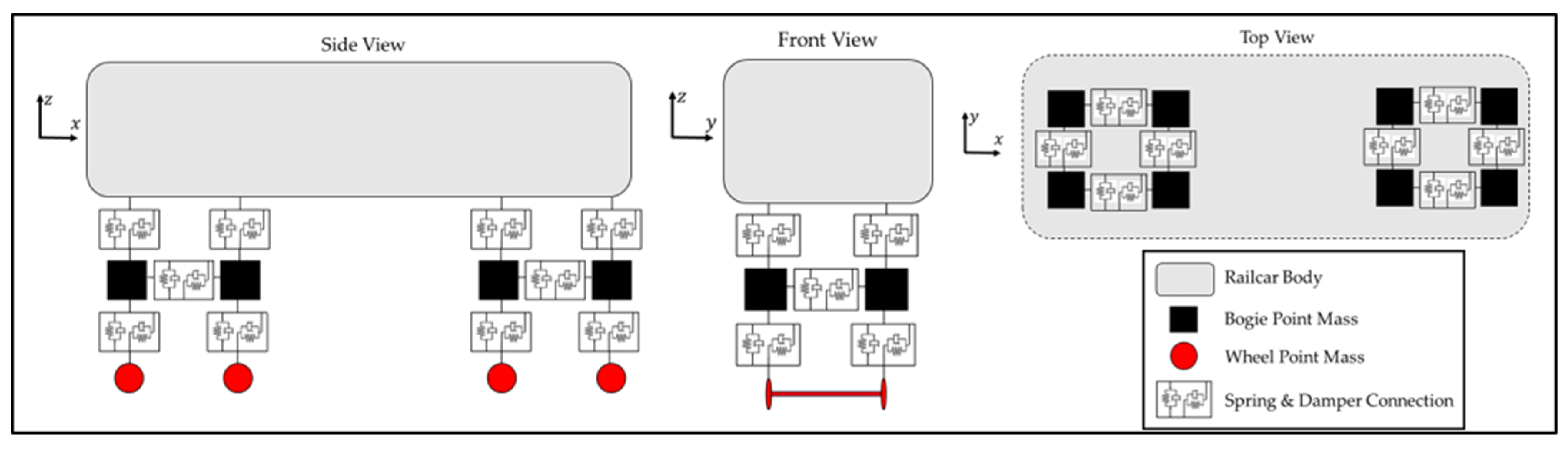
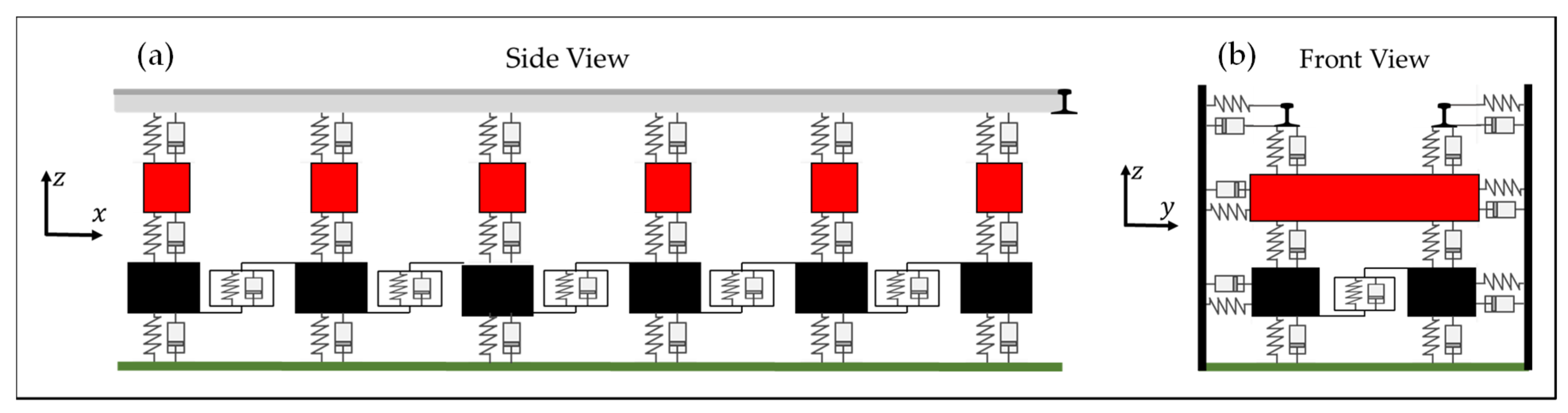
2.1. Vehicle Model
2.2. Vehicle-to-Vehicle Coupling
2.3. Track Model
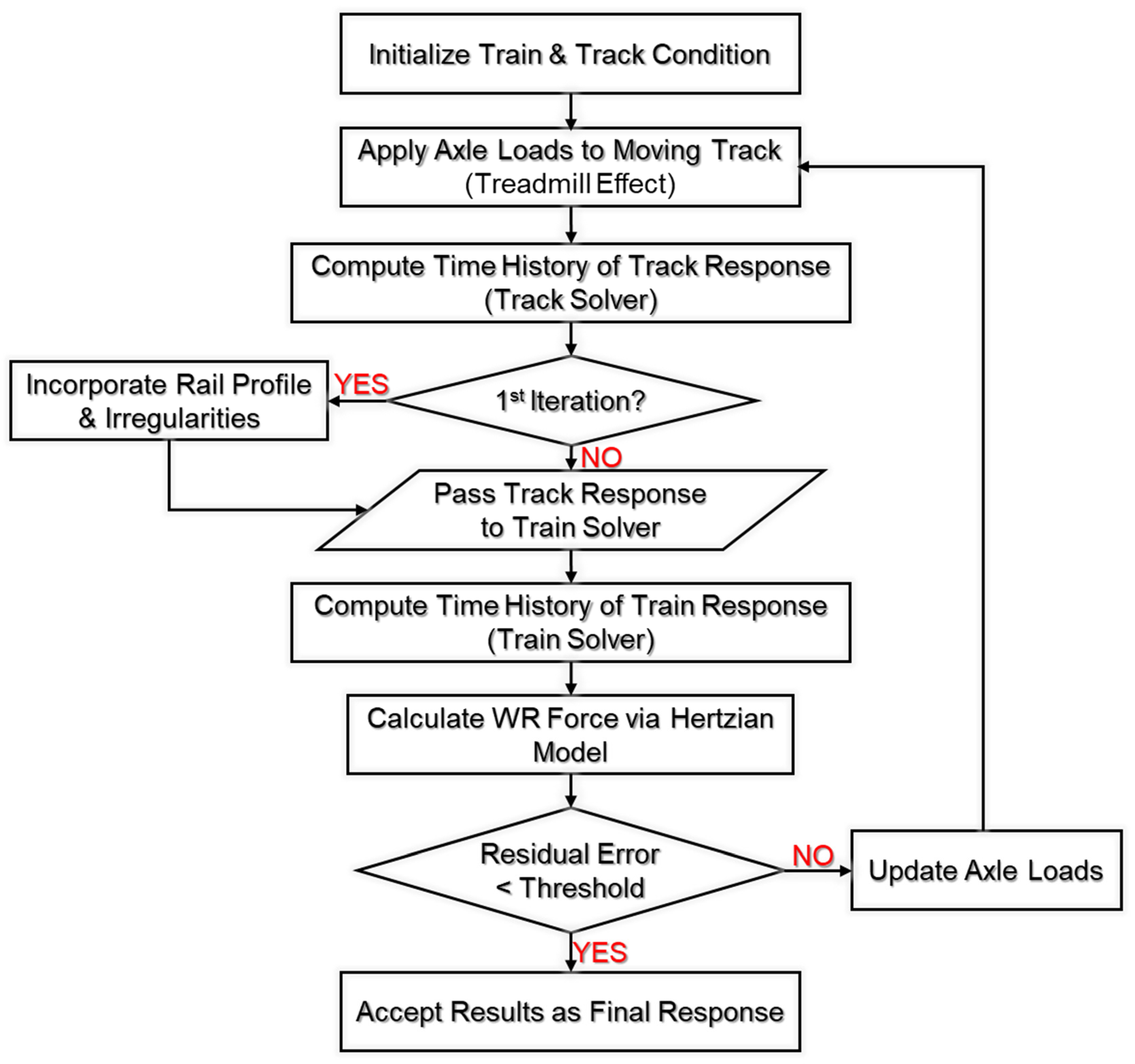
3. R-VTI Framework
3.1. Subsystem Solver
3.2. Subsystem Coupling via PDC Technique
3.2.1. Global Coordinate System
3.2.2. Train–Track Coupling
3.3. Derailment Criteria
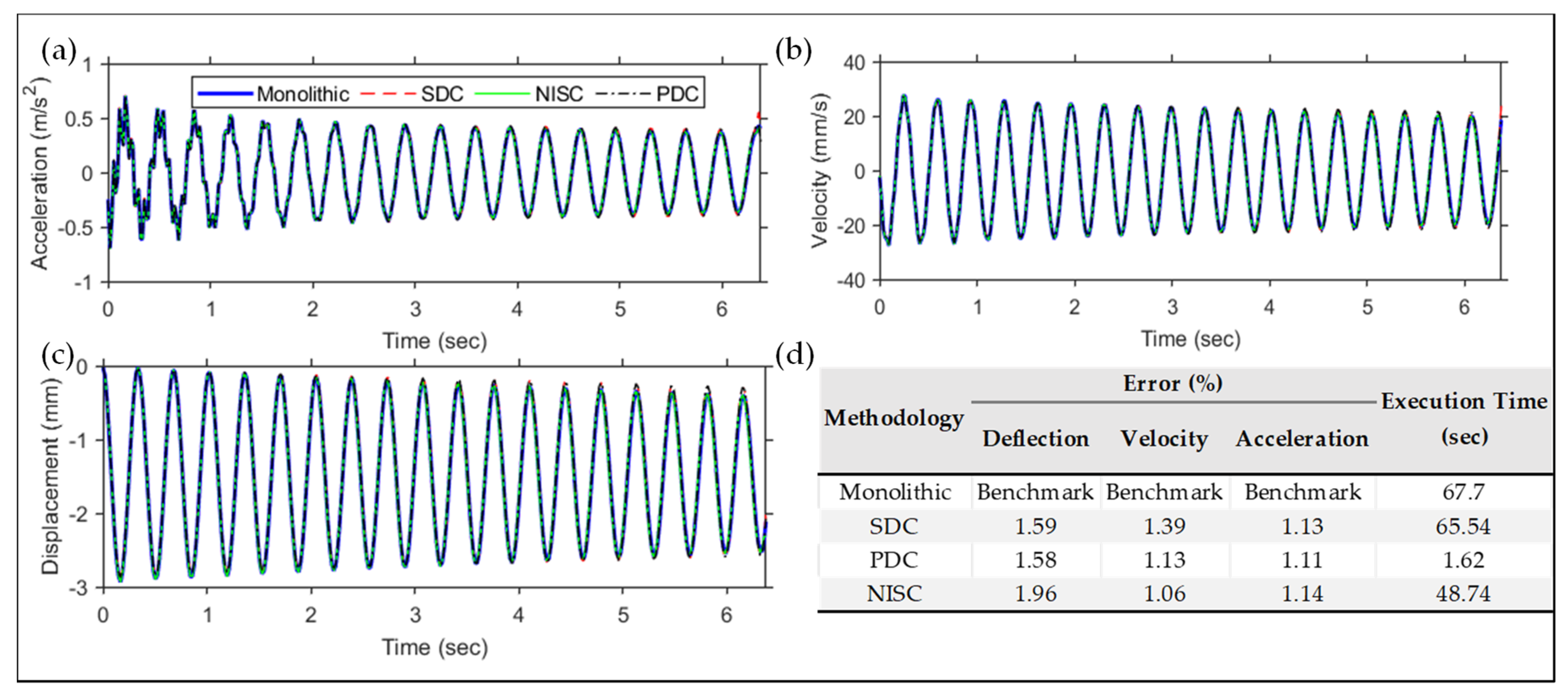
4. PDC Technique Verification
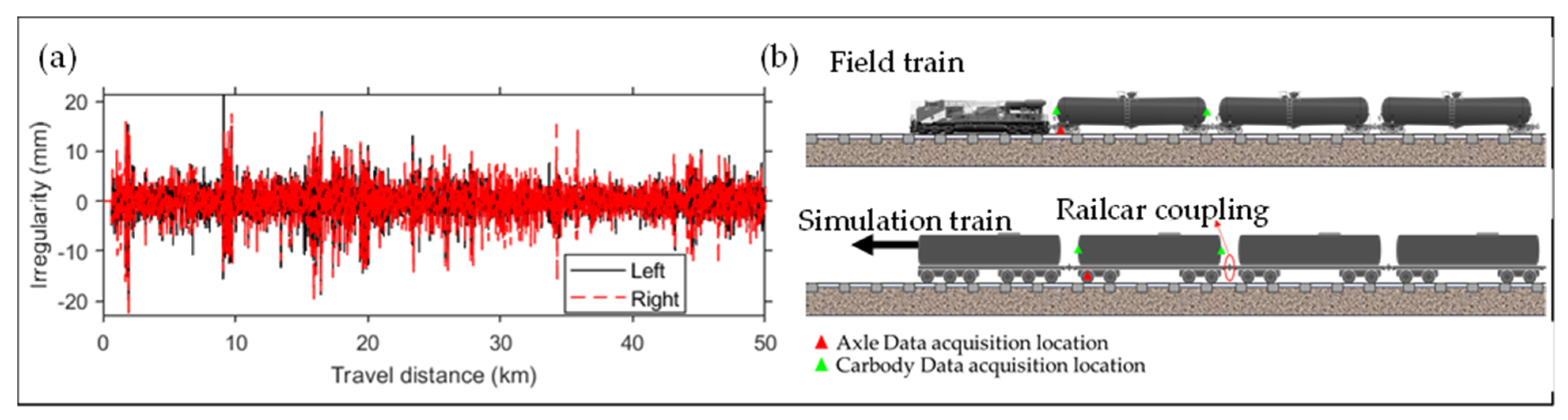
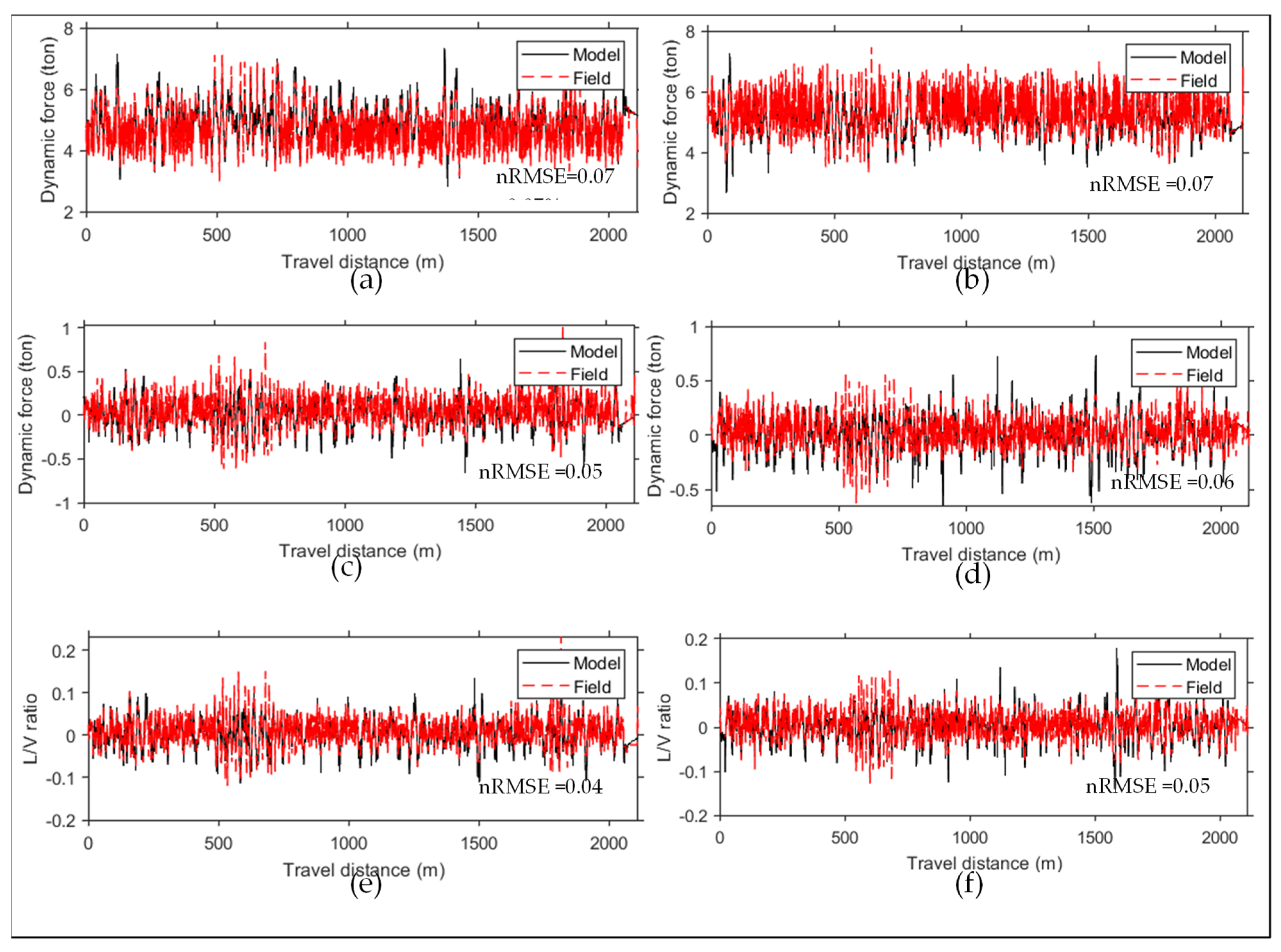
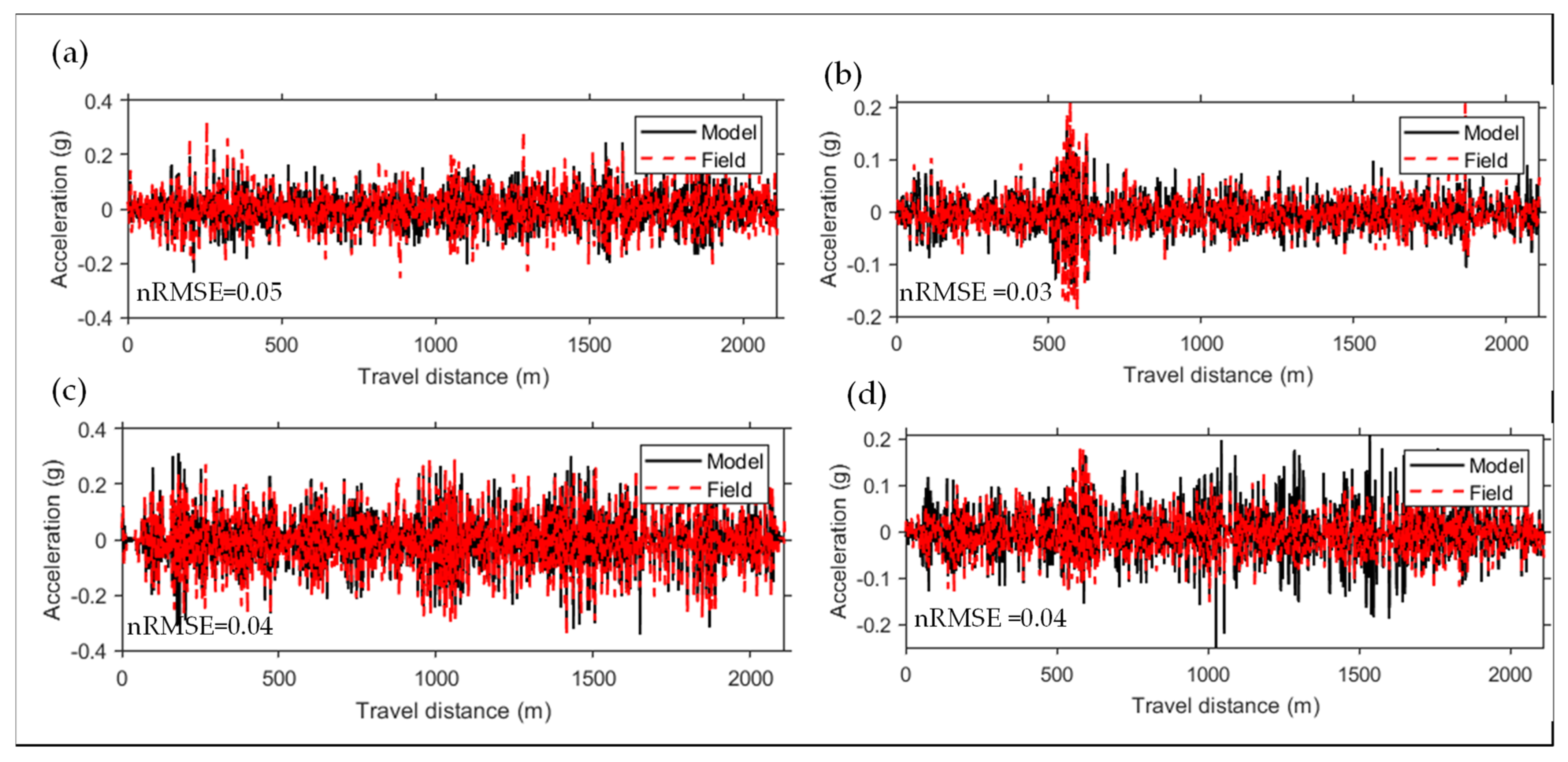
5. Model Validation via Field Measurements
6. Implementation Example: Assessment of Derailment Potential
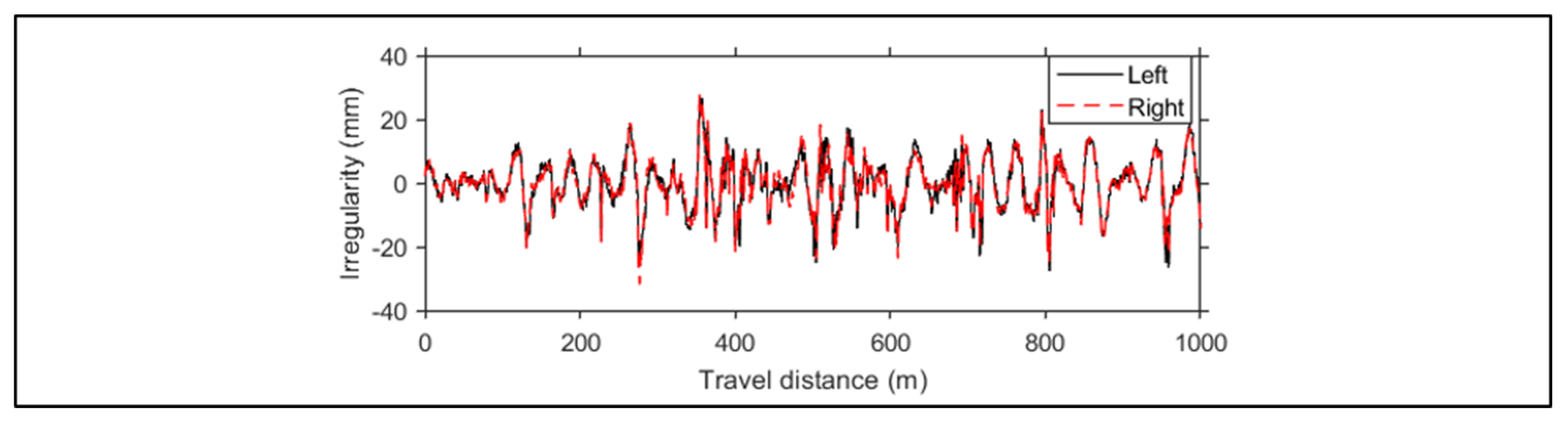
6.1. Track Measurements
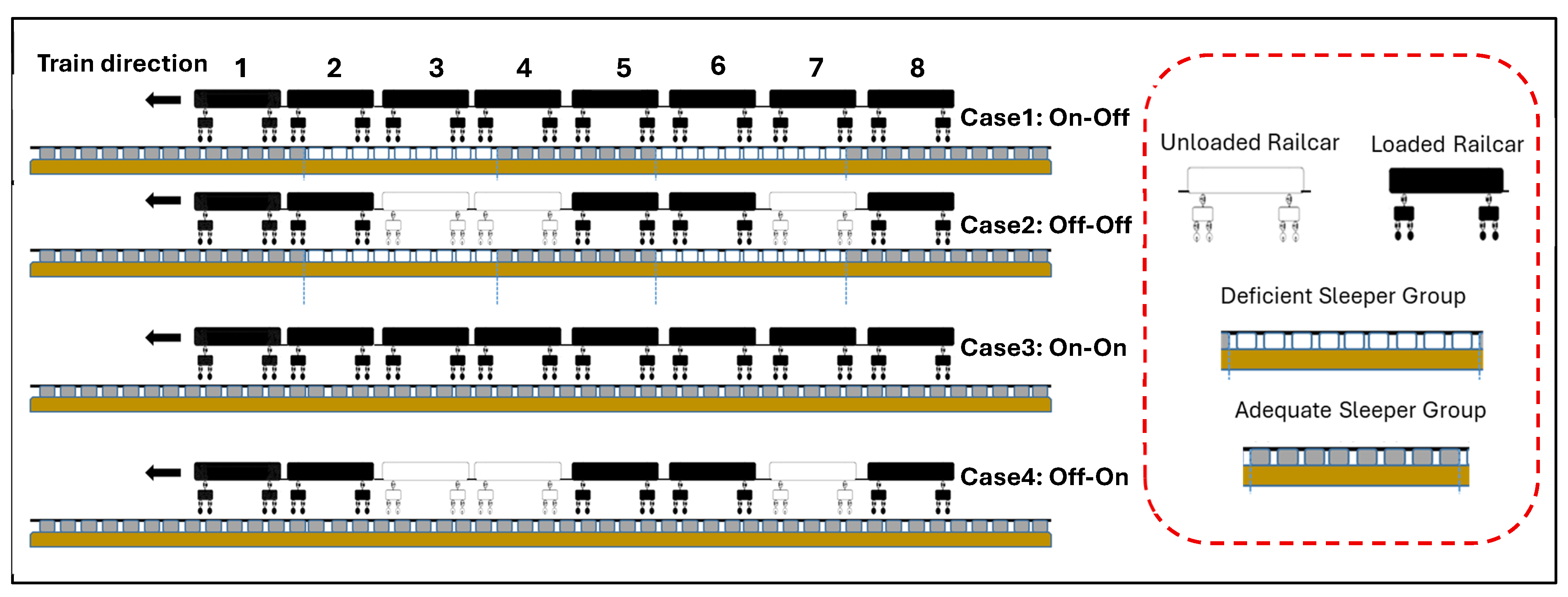
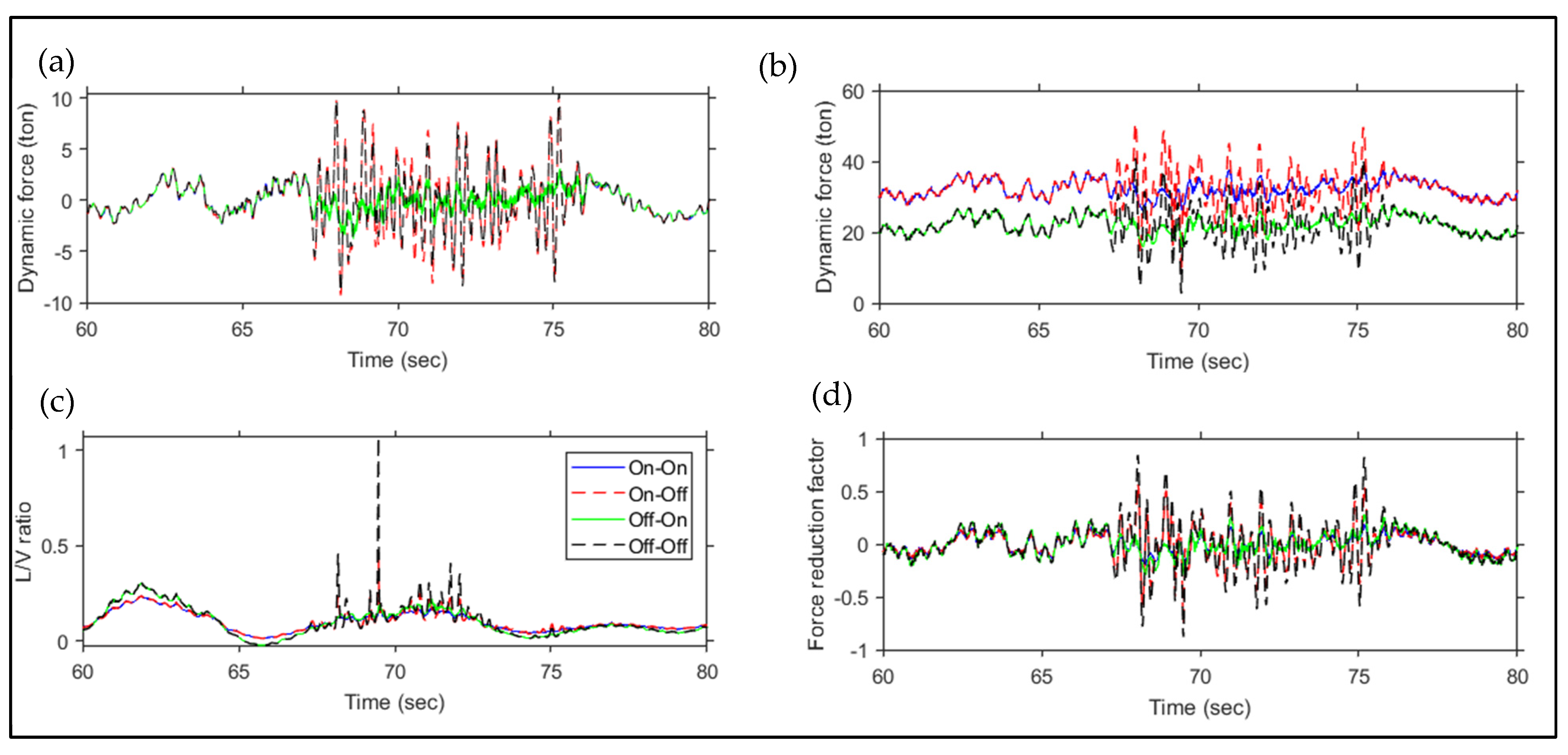
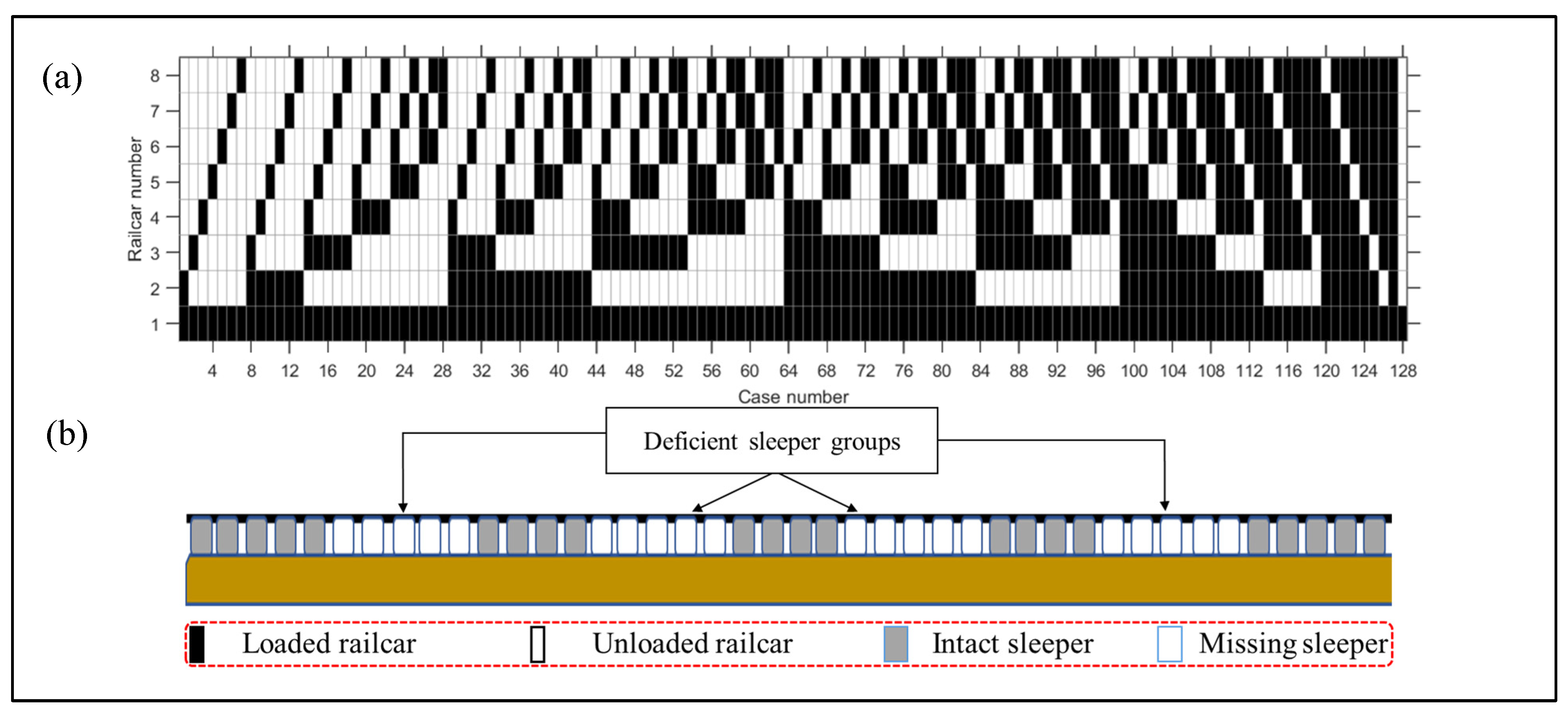
6.2. Combined Effects of Train Configurations and Track Condition
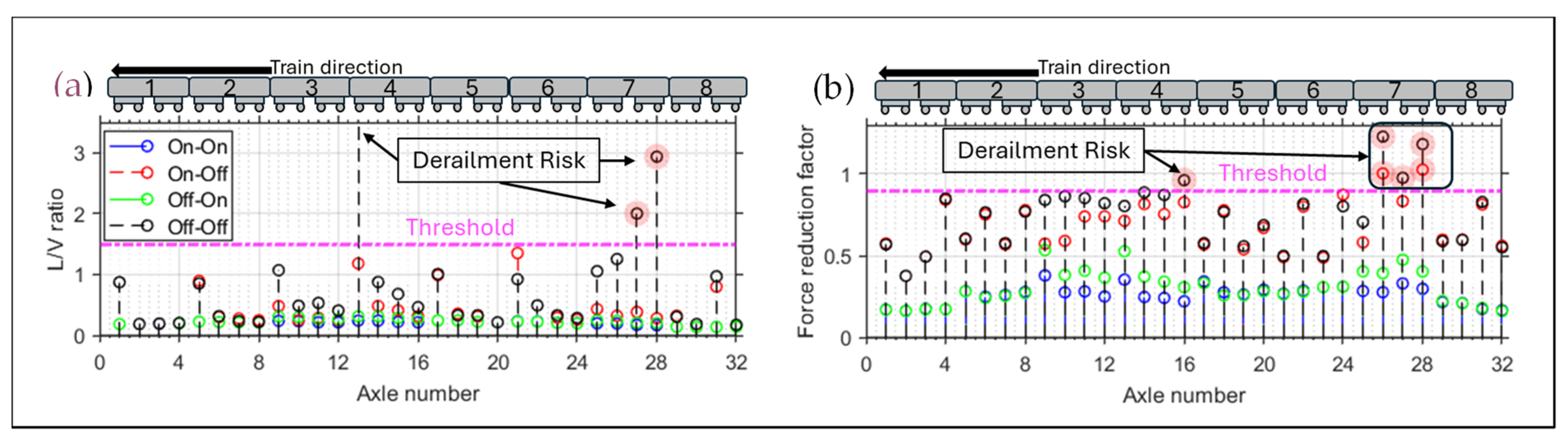
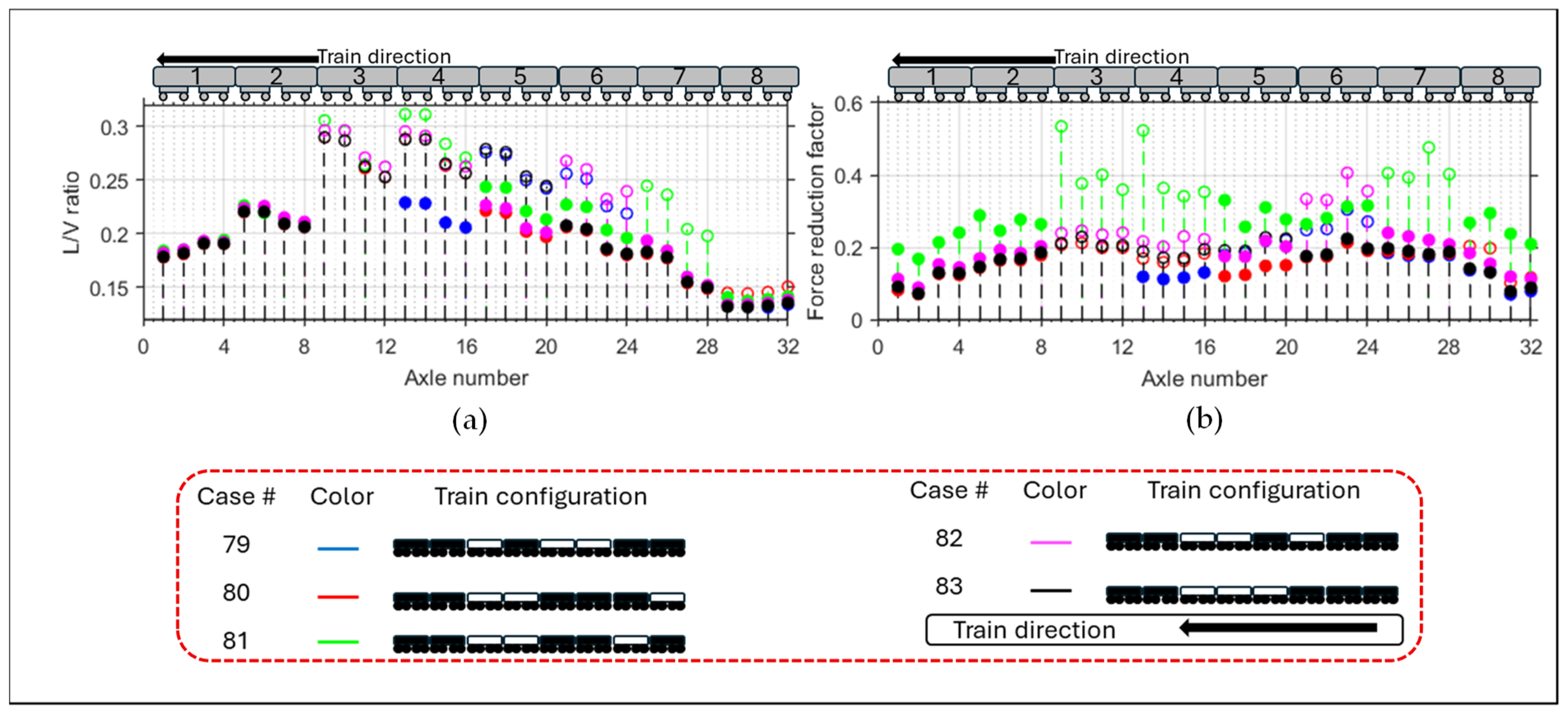
6.3. Axle-Level Derailment-Failure Distribution
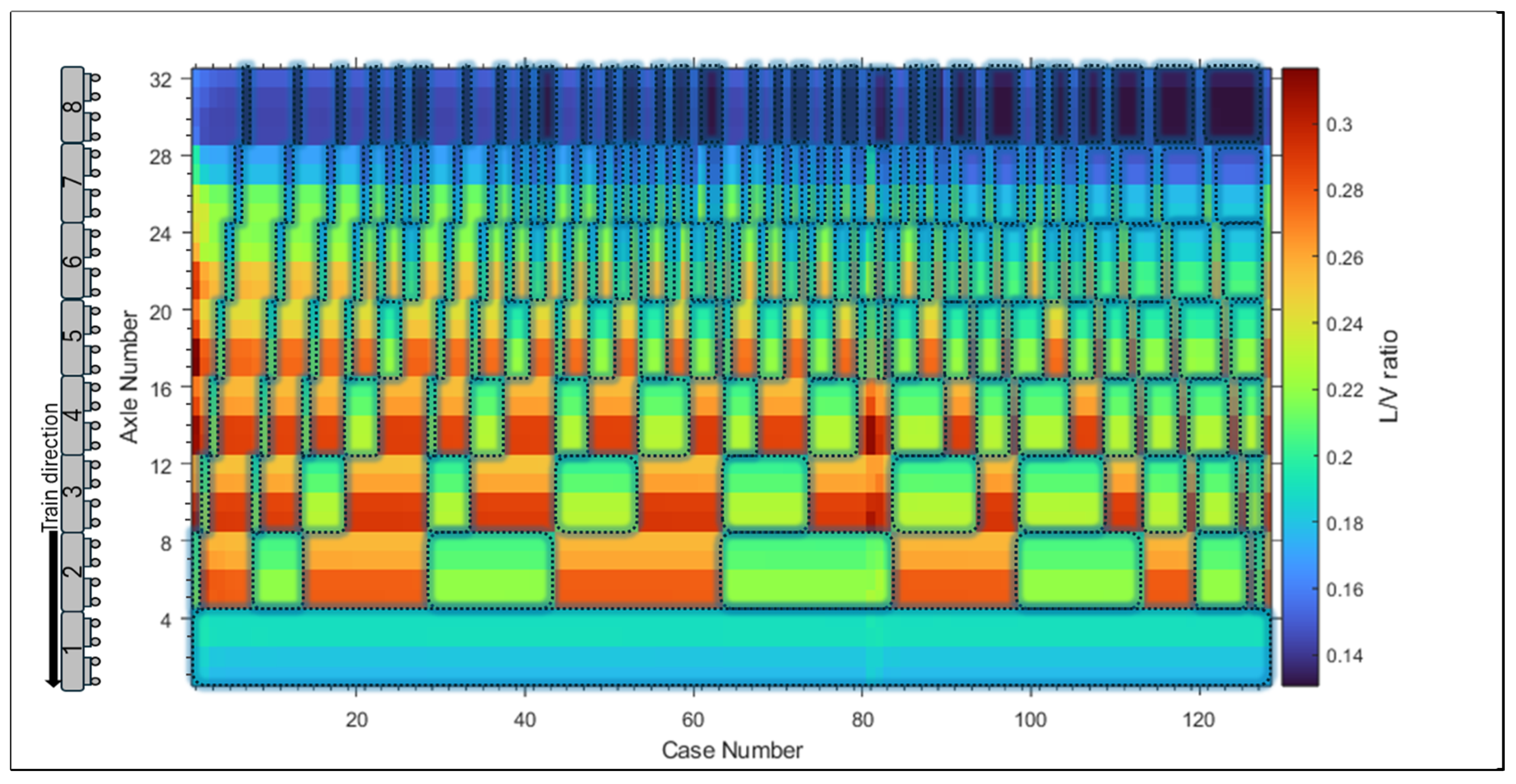
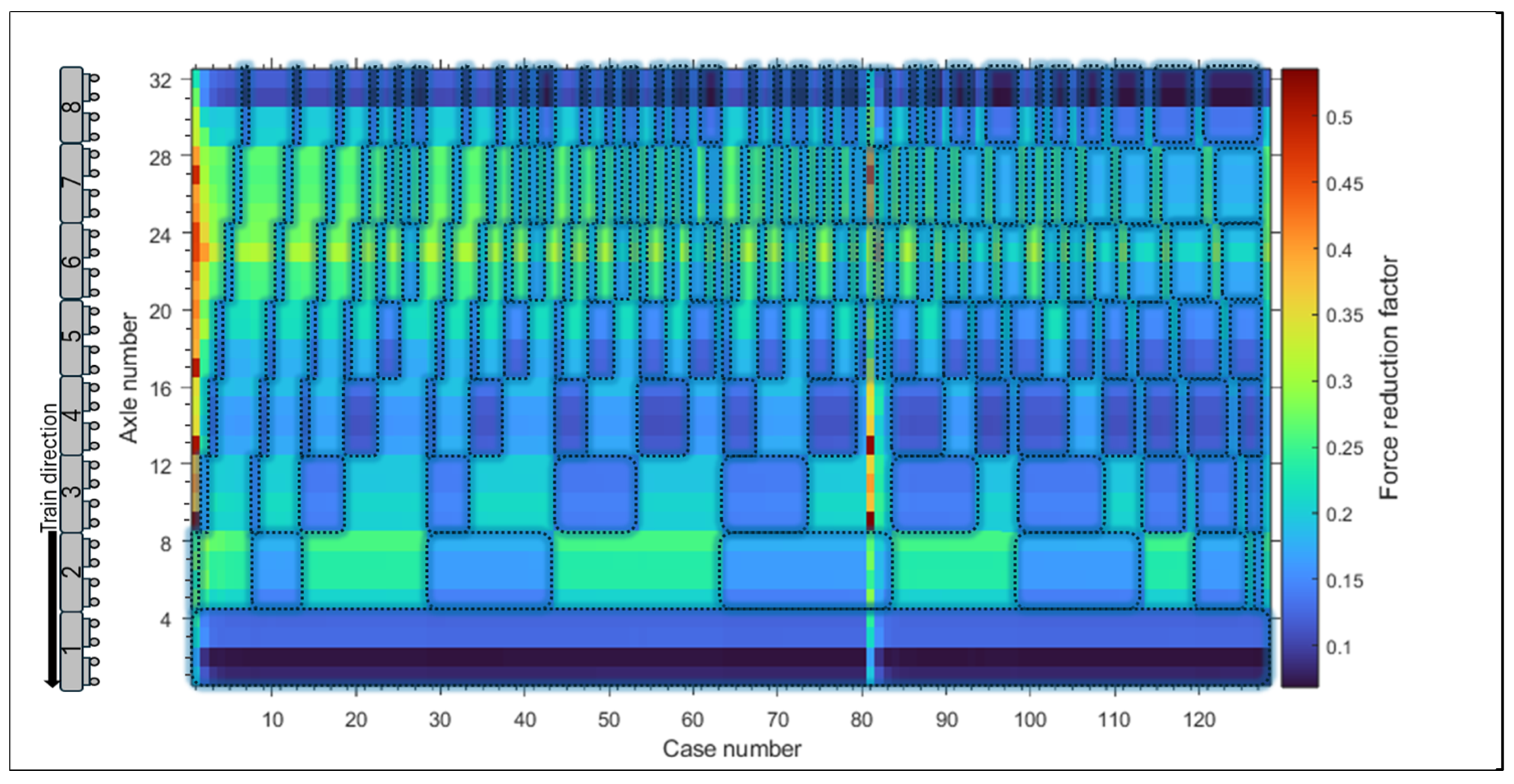
6.4. The Effect of Different Train Configurations
6.5. Case Comparison
7. Conclusions
Author Contributions
Funding
Data Availability Statement
Acknowledgments
Conflicts of Interest
Abbreviations
| R-VTI | Rapid Vehicle–Track Interaction |
| DOF | Degree of Freedom |
| nRMSE | Normalized Root Mean Squared Error |
| PDC | Pseudo-Dynamic Coupling |
| NISC | Non-Iterative Substructure Coupling |
| SDC | Staggered Dynamic Coupling |
References
- Islam, D.; Laparidou, K.; Burgess, A. What mitigation technique should be implemented to reduce freight vehicle derailments by 2050? In Proceedings of the Transport Research Arena (TRA) 2014, Paris, France, 14–17 April 2014. [Google Scholar]
- Federal Railroad Administration. Track Safety Standards Compliance Manual, Chapter 1: Introduction/General Guidance; Office of Safety Assurance and Compliance, Track and Structures Division, U.S. Department of Transportation: Washington, DC, USA, 2008.
- Gedney, B.L.; Naseri, R.; Al Kharousi, S.; Rizos, D.C. B-Spline signature responses in structural change detection: Method development. Struct. Health Monit. 2025, 24, 2911–2926. [Google Scholar] [CrossRef] [Scilit]
- Naseri, R.; Mohammadzadeh, S.; Rizos, D.C. Rail surface spot irregularity effects in vehicle-track interaction simulations of train-track-bridge interaction. J. Vib. Control 2025, 31, 738–752. [Google Scholar] [CrossRef] [Scilit]
- Tong, Y.; Liu, G.; Yousefian, K.; Jing, G. Track vertical stiffness—Value, measurement methods, effective parameters and challenges: A review. Transp. Geotech. 2022, 37, 100833. [Google Scholar] [CrossRef] [Scilit]
- Paixão, A.; Fortunato, E.; Calçada, R. A contribution for integrated analysis of railway track performance at transition zones and other discontinuities. Constr. Build. Mater. 2016, 111, 699–709. [Google Scholar] [CrossRef] [Scilit]
- Shi, C.; Zhou, Y.; Xu, L.; Zhang, X.; Guo, Y. A critical review on the vertical stiffness irregularity of railway ballasted track. Constr. Build. Mater. 2023, 400, 132715. [Google Scholar] [CrossRef] [Scilit]
- Jiang, Y.; Chi, M.; Yang, J.; Dai, L.; Xie, Y.; Guo, Z. Investigation on the mechanism and measures of derailment of empty freight train passing a turnout in the diverging route. Eng. Fail. Anal. 2024, 156, 107822. [Google Scholar] [CrossRef] [Scilit]
- Lai, J.; Wang, K.; Xu, J.; Wang, P.; Chen, R.; Wang, S.; Beer, M. A failure probability assessment method for train derailments in railway yards based on IFFTA and NGBN. Eng. Fail. Anal. 2023, 154, 107675. [Google Scholar] [CrossRef] [Scilit]
- Sanchez Trinidad, A.D.; Tarawneh, C.; Aguila, D.; Fuentes, A.; Guiterrez, S.; Pena, C.; Reyna, D. Experimental investigation of lateral load effects on railway tapered roller bearing performance. In Proceedings of the 2024 ASME Joint Rail Conference, Columbia, SC, USA, 13–15 May 2024. V001T05A008. [Google Scholar] [CrossRef] [Scilit]
- Xu, F.; Ding, N.; Li, N.; Liu, L.; Hou, N.; Xu, N.; Guo, W.; Tian, L.; Xu, H.; Wu, C.-M.L.; et al. A review of bearing failure modes, mechanisms and causes. Eng. Fail. Anal. 2023, 152, 107518. [Google Scholar] [CrossRef] [Scilit]
- Iwnicki, S.; Nielsen, J.C.O.; Tao, G. Out-of-round railway wheels and polygonisation. Veh. Syst. Dyn. 2023, 61, 1787–1830. [Google Scholar] [CrossRef] [Scilit]
- Liu, X.; Saat, M.R.; Barkan, C.P.L. Analysis of causes of major train derailment and their effect on accident rates. Transp. Res. Rec. 2012, 2289, 154–163. [Google Scholar] [CrossRef] [Scilit]
- Rizos, D.C.; Byrraju, S.; Sutton, M.A. Satellite Radar Data Analysis for Change Detection of Rural and Urban Railways; Report No. UTCRS-USC-O4CY23; University Transportation Center for Railway Safety: Columbia, SC, USA, 2025. [Google Scholar]
- Lewandowski, K.; Vitzilaios, N. UAV-Based Railroad Line Detection. In Proceedings of the 2024 ASME/IEEE Joint Rail Conference, Columbia, SC, USA, 13–15 May 2024. [Google Scholar] [CrossRef] [Scilit]
- Jin, Y.; Wang, H.; Liu, Y.-P.; Yu, Z.; Guo, L.; Liao, L.; Xu, H.; Chi, M.; Chan, S.-L. Numerical study on high-speed train derailment caused by debris flow deposition: A case study in China. Eng. Fail. Anal. 2025, 181, 109960. [Google Scholar] [CrossRef] [Scilit]
- Fang, C.; Jaafar, S.A.; Zhou, W.; Yan, H.; Chen, J.; Meng, X. Wheel-rail contact and friction models: A review of recent advances. Proc. Inst. Mech. Eng. Part F J. Rail Rapid Transit 2023, 237, 1245–1259. [Google Scholar] [CrossRef] [Scilit]
- Ge, X.; Ling, L.; Yuan, X.; Wang, K. Effect of distributed support of rail pad on vertical vehicle-track interactions. Constr. Build. Mater. 2020, 262, 120607. [Google Scholar] [CrossRef] [Scilit]
- Connolly, D.P.; Kouroussis, G.; Laghrouche, O.; Ho, C.L.; Forde, M.C. Benchmarking railway vibrations—Track, vehicle, ground and building effects. Constr. Build. Mater. 2015, 92, 64–81. [Google Scholar] [CrossRef] [Scilit]
- Pacheco, P.A.P.; Ramos, P.G.; Sá, T.L.; Santos, G.F.M.; Gay Neto, A.; Santos, A.A. Comparison between quasi-static and multibody dynamic simulations for wheel-rail contact analysis. Multibody Syst. Dyn. 2024, 63, 63–81. [Google Scholar] [CrossRef] [Scilit]
- Blader, F.B.; Elkins, J.A.; Wilson, N.G.; Klauser, P.E. Development and validation of a general vehicle dynamics simulation (NUCARS). In Proceedings of the IEEE/ASME Joint Railroad Conference, Philadelphia, PA, USA, 25–27 April 1989; pp. 39–46. [Google Scholar]
- Durali, M.; Jalili, M.M. A new criterion for assessment of train derailment risk. Proc. Inst. Mech. Eng. Part K J. Multi-Body Dyn. 2010, 224, 83–101. [Google Scholar] [CrossRef] [Scilit]
- Farkas, A. Measurement of railway track geometry: A state-of-the-art review. Period. Polytech. Transp. Eng. 2020, 48, 76–88. [Google Scholar] [CrossRef] [Scilit]
- Jiang, H.; Gao, L.; Zhao, W. Model updating of the vehicle-track coupled system based on in-situ dynamic measurements. Constr. Build. Mater. 2021, 298, 123861. [Google Scholar] [CrossRef] [Scilit]
- Dassault Systèmes. Abaqus 2025 Theory Manual; Dassault Systèmes SIMULIA Corp.: Providence, RI, USA, 2024. [Google Scholar]
- Rizos, D.C.; Wang, J. Coupled BEM–FEM solutions for direct time domain soil–structure interaction analysis. Eng. Anal. Bound. Elem. 2002, 26, 877–888. [Google Scholar] [CrossRef] [Scilit]
- O’Brien, J.; Rizos, D.C. A 3D BEM–FEM methodology for simulation of high speed train induced vibrations. Soil Dyn. Earthq. Eng. 2005, 25, 289–301. [Google Scholar] [CrossRef] [Scilit]
- Datta, A.; Rizos, D.C.; Qian, Y.; Mullen, R. A robust non-iterative algorithm for multi-body dynamics and vehicle–structure interaction analysis. Veh. Syst. Dyn. 2022, 60, 1209–1227. [Google Scholar] [CrossRef] [Scilit]
- Mulliken, J.; Rizos, D.C. A coupled computational method for multi-solver, multi-domain transient problems in elastodynamics. Soil Dyn. Earthq. Eng. 2012, 34, 78–88. [Google Scholar] [CrossRef] [Scilit]
- Swamy, S.; Fu, D.; Singh, S.P. Vehicle Dynamics Models for Derailment Incident Investigation; Report No. DOT/FRA/ORD-23/27; Federal Railroad Administration, U.S. Department of Transportation: Washington, DC, USA, 2023.
- Ling, L.; Jiang, P.; Wang, K.; Zhai, W. Dynamic interaction between rail vehicles and vibration-attenuating slab tracks. Constr. Build. Mater. 2020, 258, 119545. [Google Scholar] [CrossRef] [Scilit]
- Yang, Y.B.; Yau, J.D.; Wu, Y.S. Vehicle–Bridge Interaction Dynamics: With Applications to High-Speed Railways; World Scientific: Singapore, 2004; 564p. [Google Scholar]
- Heydari, H.; Naseri, R.; Khanie, N. Investigating the effect of ballast contamination in vertical and shear interlocking stiffness: Experimental and numerical study. Constr. Build. Mater. 2024, 428, 136337. [Google Scholar] [CrossRef] [Scilit]
- Heydari, H.; Khanie, N.; Naseri, R. Formulation and evaluation of the ballast shear interlocking coefficient based on analytical, experimental, and numerical analyses. Constr. Build. Mater. 2023, 406, 133457. [Google Scholar] [CrossRef] [Scilit]
- Newmark, N.M. A method of computation for structural dynamics. J. Eng. Mech. Div. 1959, 85, 67–94. [Google Scholar] [CrossRef] [Scilit]
- Jun, X.; Qingyuan, Z. A study on mechanical mechanism of train derailment and preventive measures for derailment. Veh. Syst. Dyn. 2005, 43, 121–147. [Google Scholar] [CrossRef] [Scilit]
- Xiang, J.; Zeng, Q.; Lou, P. Transverse vibration of train-bridge and train-track time varying system and the theory of random energy analysis for train derailment. Veh. Syst. Dyn. 2004, 41, 129–155. [Google Scholar] [CrossRef] [Scilit]
- Braghin, F.; Bruni, S.; Diana, G. Experimental and numerical investigation on the derailment of a railway wheelset with solid axle. Veh. Syst. Dyn. 2006, 44, 305–325. [Google Scholar] [CrossRef] [Scilit]
- Weinstock, H. Wheel climb derailment criteria for evaluation of rail vehicle safety. In Proceedings of the ASME Winter Annual Meeting, New Orleans, LA, USA, 9–14 December 1984. Paper No. 84-WA/RT-1. [Google Scholar]
- Elkins, J.A.; Carter, A. Testing and analysis techniques for safety assessment of rail vehicles: The state-of-the-art. Veh. Syst. Dyn. 1993, 22, 185–208. [Google Scholar] [CrossRef] [Scilit]
- Railway Group Standards. GMRT2141 Issue 2: Resistance of Railway Vehicles to Derailment and Roll-Over; Railway Safety and Standards Board: London, UK, 2000. [Google Scholar]
- Iwnicki, S. (Ed.) Handbook of Railway Vehicle Dynamics; CRC Press/Taylor & Francis: Boca Raton, FL, USA, 2006; ISBN 978-0-8493-3321-7. [Google Scholar]
- Greenbrier Manufacturing Operations. 30,100 Gallon NC/NI/TP DOT117J100W1 286K PG I/II/III Tank Car: Building Specification; Job R50830, Revision 1; Greenbrier Manufacturing Operations: Lake Oswego, OR, USA, 2015. [Google Scholar]






| Property | Symbol | DOTX 220 | DOTX 117 | Unit |
|---|---|---|---|---|
| Value | Value | |||
| Mass of car body | Mc | 77,420 | 40,990 | kg |
| Mass moment of inertia of car body about X-axis | Icx | 22,150 | 18,550 | kg·m2 |
| Mass moment of inertia of car body about Y-axis | Icy | 5,010,000 | 6,522,000 | kg·m2 |
| Mass moment of inertia of car body about Z-axis | Icz | 5,080,000 | 6,522,000 | kg·m2 |
| Mass of bogie | Mt | 2350 | 2280 | kg |
| Mass moment of inertia of bogie about X-axis | Itx | 1570 | 3580 | kg·m2 |
| Mass moment of inertia of bogie about Y-axis | Ity | 4220 | 5000 | kg·m2 |
| Mass moment of inertia of bogie about Z-axis | Itz | 5390 | 8450 | kg·m2 |
| Mass of wheelset | Mw | 1780 | 1350 | kg |
| Mass moment of inertia of wheelset about X-axis | Iw | 1220 | 1220 | kg·m2 |
| 1/2 long dist. b/w CG s of front and rear bogies | lc | 8.93 | 8.15 | m |
| 1/2 of wheelbase | lt | 1.28 | 1.20 | m |
| Long dist. b/w CG of bogie and nearest side of the car body | ls | 3.27 | 2.50 | m |
| 1/2 the trans. dist. b/w the contact points of the wheel and the rail | la | 0.72 | 0.70 | m |
| 1/2 transverse distance between vertical primary suspension systems | dp | 0.61 | 0.61 | m |
| 1/2 transverse distance between vertical secondary suspension systems | ds | 1.02 | 1.02 | m |
| Vertical distance between car body CG and lateral secondary suspension system | hcs | 0.66 | 0.80 | m |
| Vertical distance between lateral secondary suspension system and bogie CG | hts | 0.37 | 0.45 | m |
| Vertical distance between bogie CG and lateral primary suspension system | htp | 0.18 | 0.20 | m |
| Stiffness of vertical primary suspension system | kpz | 2.580 × 10⁶ | 3.064 × 10⁶ | N/m |
| Damping of vertical primary suspension system | cpz | 1.53 × 10⁴ | 1.53 × 10⁴ | N·s/m |
| Stiffness of lateral primary suspension system | kpy | 2.134 × 10⁴ | 2.134 × 10⁴ | N/m |
| Damping of lateral primary suspension system | cpy | 1.38 × 10³ | 1.38 × 10³ | N·s/m |
| Stiffness of vertical secondary suspension system | ksz | 1.48 × 10⁵ | 1.48 × 10⁵ | N/m |
| Damping of vertical secondary suspension system | csz | 6.35 × 10³ | 6.35 × 10³ | N·s/m |
| Stiffness of lateral secondary suspension system | ksy | 7.30 × 10⁴ | 7.30 × 10⁴ | N/m |
| Damping of lateral secondary suspension system | csy | 2.37 × 10³ | 2.37 × 10³ | N·s/m |
| Nominal radius of wheel | ro | 0.45 | 0.50 | m |
| Notation | Parameter | Value (Per Rail Seat) | Unit | |
|---|---|---|---|---|
| Rail | E | Elastic modulus of rail | 2.06 × 10¹¹ | Pa |
| I0 | Torsional inertia of rail | 3.74 × 10⁻⁵ | m4 | |
| Iy | Rail second moment of area about Y-axis | 3.22 × 10⁻⁵ | m4 | |
| Iz | Rail second moment of area about Z-axis | 5.24 × 10⁻⁶ | m4 | |
| GK | Rail torsional stiffness | 1.96 × 10⁵ | N·m/rad | |
| mr | Rail mass per unit length | 60.64 | kg/m | |
| kpv | Fastener stiffness in vertical direction | 6.00 × 10⁷ | N/m | |
| Fastener | kph | Fastener stiffness in lateral direction | 4.00 × 10⁷ | N/m |
| cpv | Fastener damping in vertical direction | 5.00 × 10⁴ | N·s/m | |
| cph | Fastener damping in lateral direction | 4.00 × 10⁴ | N·s/m | |
| ls | Sleeper spacing | 0.60 | m | |
| Sleeper | ms | Sleeper mass (half) | 170 | kg |
| le | Effective support length of half sleeper | 1.175 | m | |
| lb | Sleeper width | 0.29 | m | |
| mb | Ballast mass | 340 | kg | |
| Ballast | qb | Ballast density | 1.75 × 10³ | kg/m3 |
| Eb | Elastic modulus of ballast | 1.20 × 10¹⁰ | Pa | |
| cbv | Ballast damping | 6.00 × 10⁴ | N·s/m | |
| kw | Ballast shear stiffness | 7.84 × 10⁷ | N/m | |
| cw | Ballast shear damping | 8.00 × 10⁴ | N·s/m | |
| α | Ballast stress distribution angle | 35 | ° | |
| hb | Ballast thickness | 0.35 | m | |
| Ef | Subgrade K30 modulus | 1.90 × 10¹⁰ | Pa/m | |
| Subgrade | cfv | Subgrade damping | 1.00 × 10⁵ | N·s/m |
Disclaimer/Publisher’s Note: The statements, opinions and data contained in all publications are solely those of the individual author(s) and contributor(s) and not of MDPI and/or the editor(s). MDPI and/or the editor(s) disclaim responsibility for any injury to people or property resulting from any ideas, methods, instructions or products referred to in the content. |
© 2026 by the authors. Licensee MDPI, Basel, Switzerland. This article is an open access article distributed under the terms and conditions of the Creative Commons Attribution (CC BY) license.
Share and Cite
Naseri, R.; Gedney, B.L.; Rizos, D.C. Rapid Failure Analysis of Train Derailment Potential Under Mixed Loading and Track Conditions. Machines 2026, 14, 1056. https://doi.org/10.3390/machines14091056
Naseri R, Gedney BL, Rizos DC. Rapid Failure Analysis of Train Derailment Potential Under Mixed Loading and Track Conditions. Machines. 2026; 14(9):1056. https://doi.org/10.3390/machines14091056
Chicago/Turabian StyleNaseri, Reza, Brennan L. Gedney, and Dimitrios C. Rizos. 2026. "Rapid Failure Analysis of Train Derailment Potential Under Mixed Loading and Track Conditions" Machines 14, no. 9: 1056. https://doi.org/10.3390/machines14091056
APA StyleNaseri, R., Gedney, B. L., & Rizos, D. C. (2026). Rapid Failure Analysis of Train Derailment Potential Under Mixed Loading and Track Conditions. Machines, 14(9), 1056. https://doi.org/10.3390/machines14091056