Digital Intelligence-Enabled Green Scheduling in Dynamic Job Shops: A Review

Abstract
1. Introduction
1.1. Research Background
1.2. Review Scope, Objectives and Contributions
2. Materials and Methods
2.1. Literature Search Methods
2.1.1. Search Strategy
2.1.2. Literature Scope and Selection Criteria
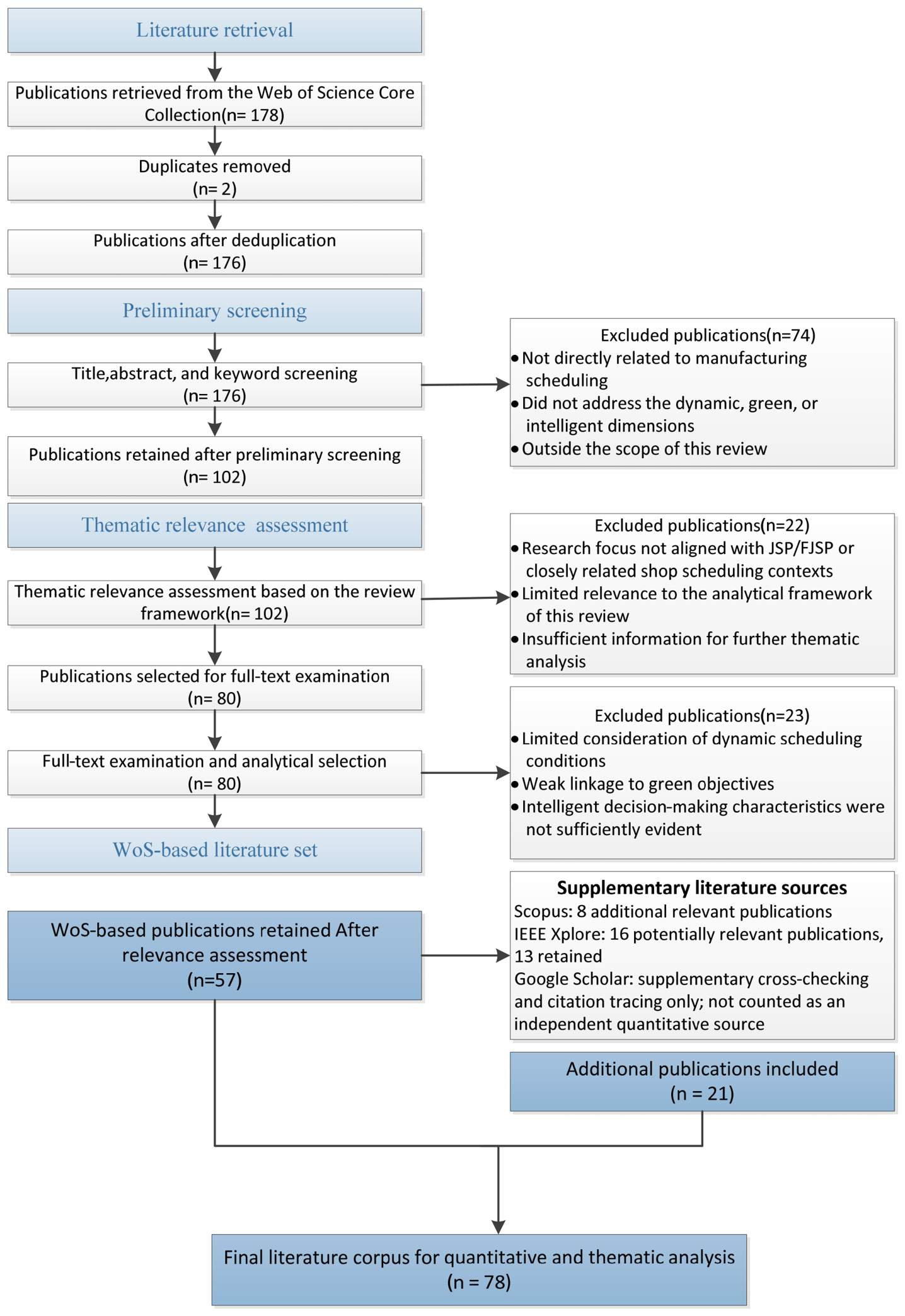
2.1.3. Literature Selection Process
2.2. Literature Analysis
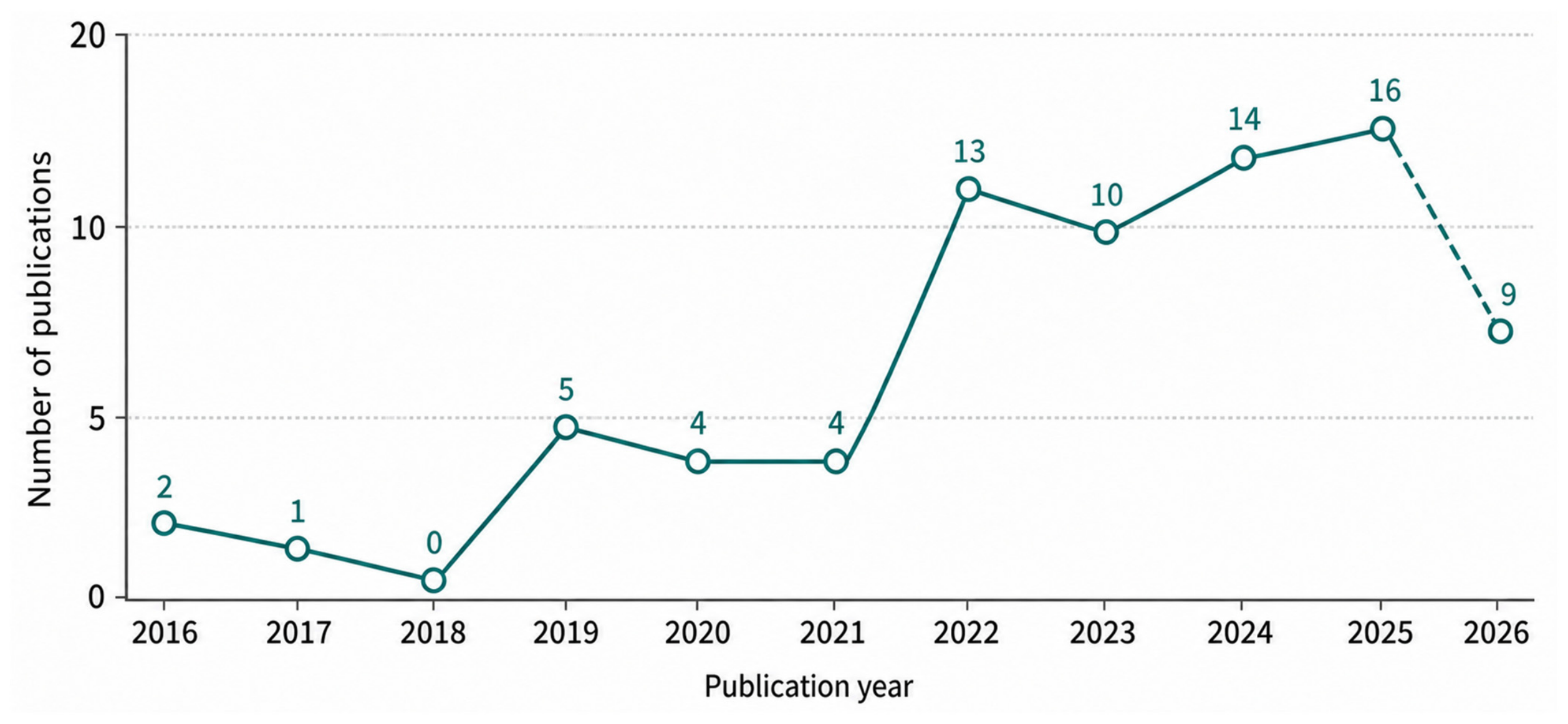
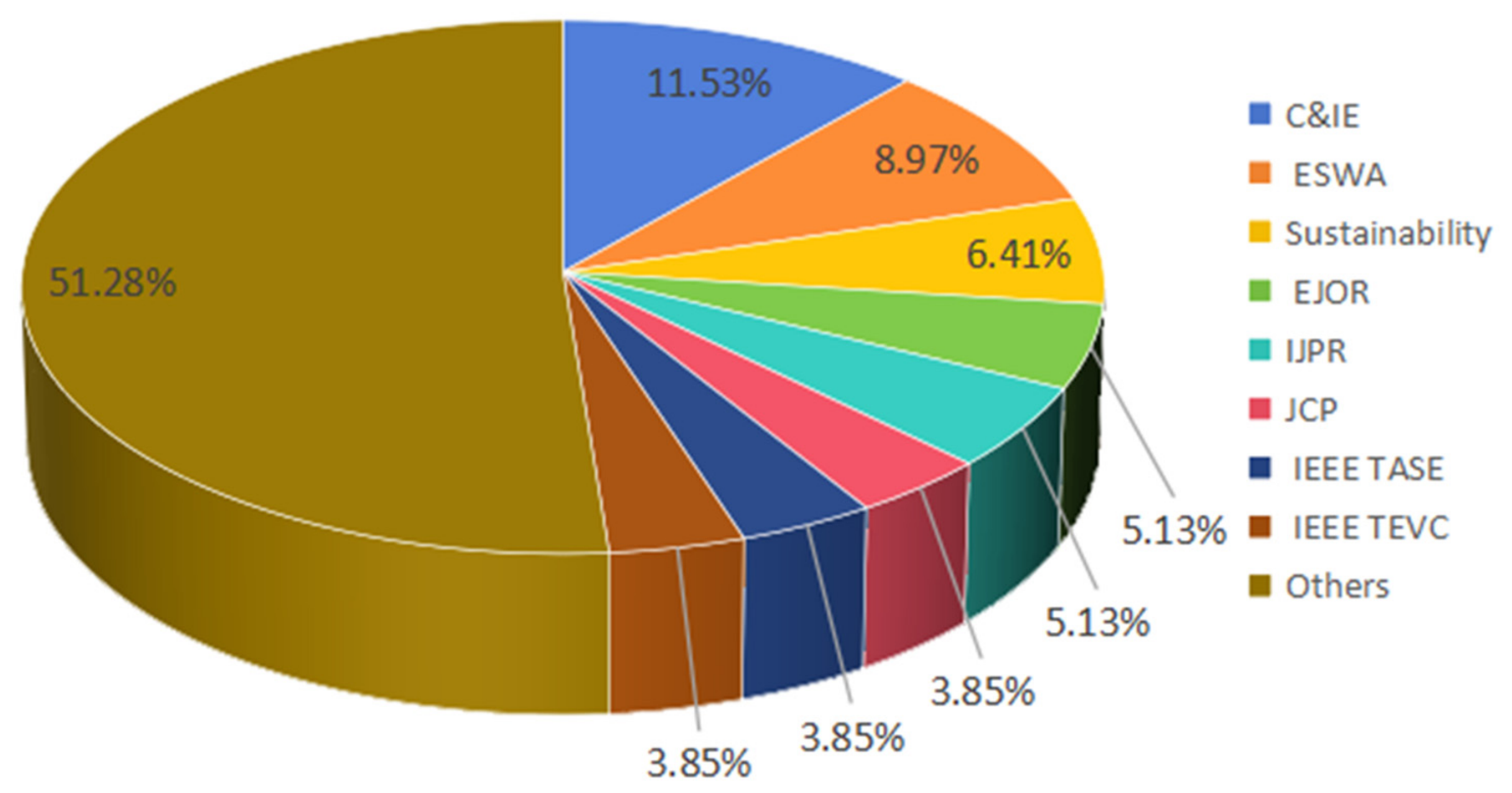
2.2.1. Overall Analysis
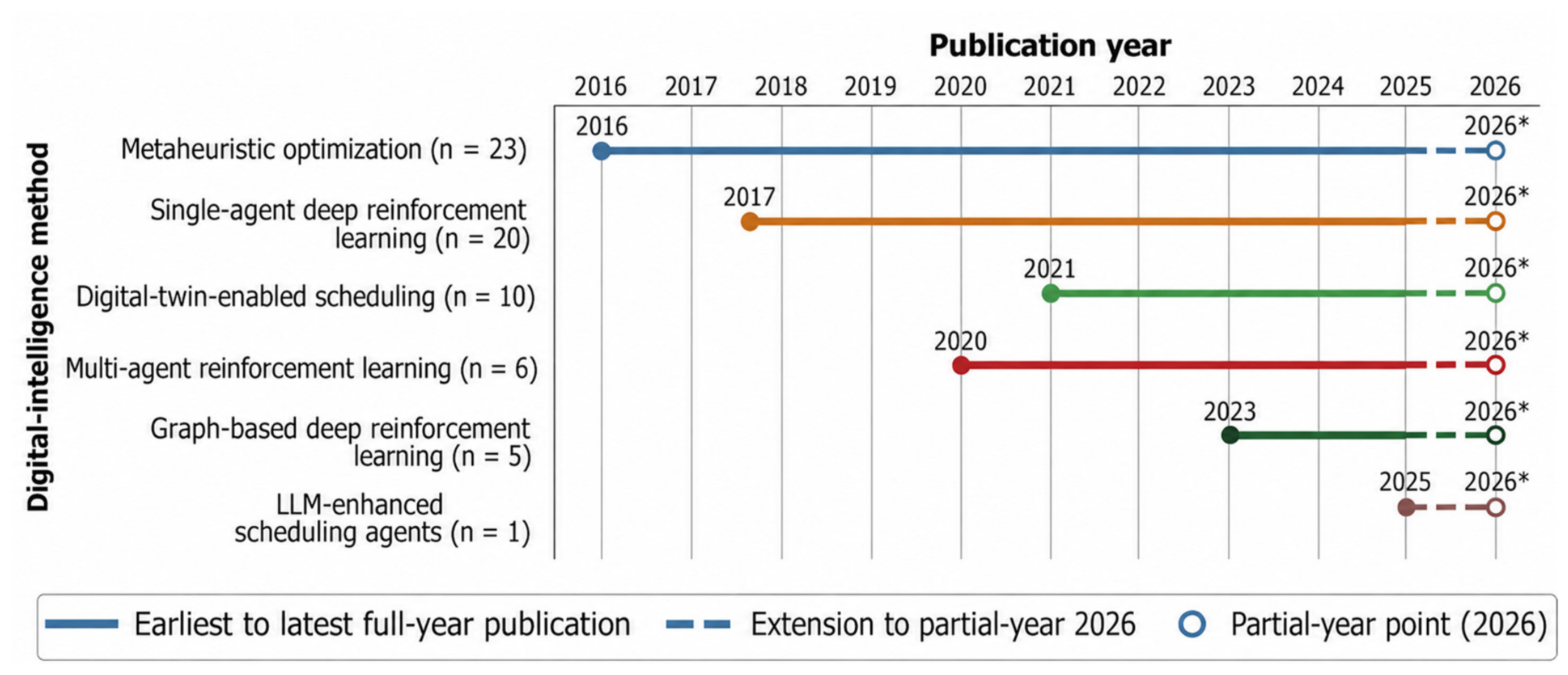
2.2.2. Classification by Scheduling Solution Methods
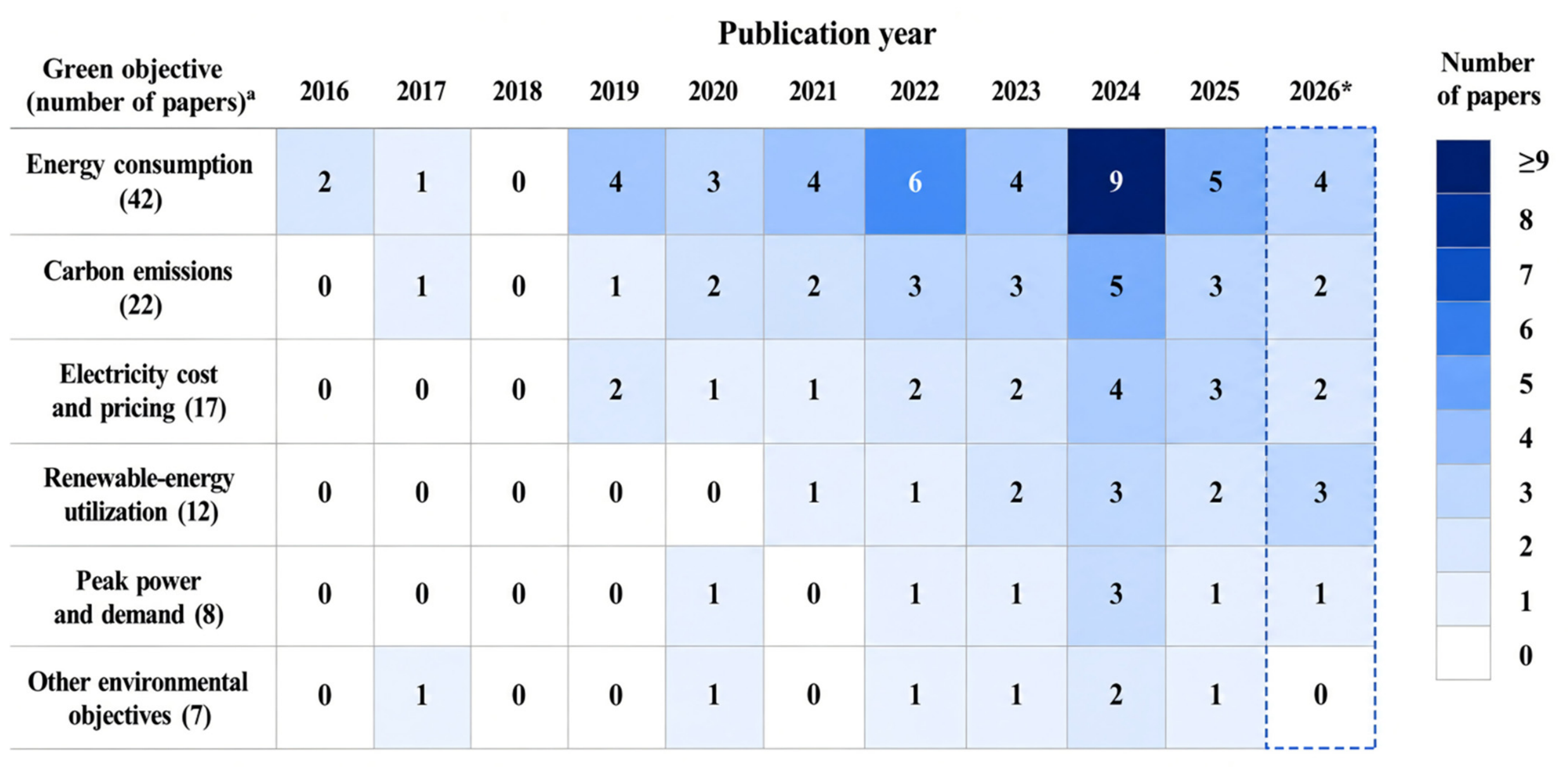
2.2.3. Classification by Green Objective Modelling
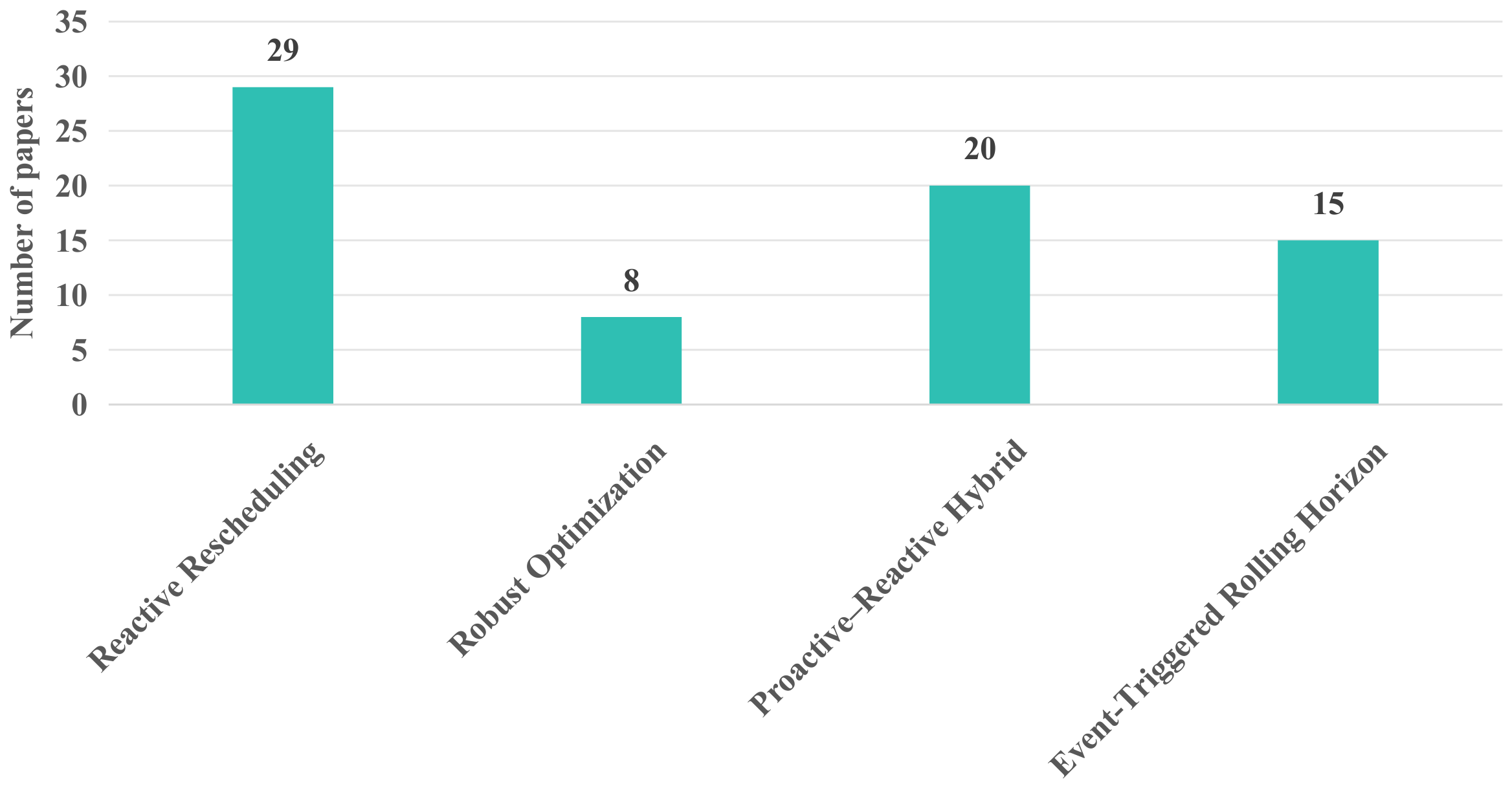
2.2.4. Classification by Dynamic-Event-Handling Strategies
3. Evolution of Green Scheduling in Dynamic Job Shops
3.1. Baseline Model for Dynamic Green Job Shop Scheduling
- (1)
- At the initial decision time, all jobs are waiting for processing and all machines are idle;
- (2)
- At any time, each machine processes at most one operation, and each operation is assigned to exactly one eligible machine;
- (3)
- Operations are non-pre-emptive in the baseline model. Failure-induced interruption and subsequent rescheduling are treated as dynamic extensions rather than as part of the static reference formulation;
- (4)
- Operations belonging to the same job follow the prescribed technological sequence. No precedence relation is imposed across different jobs.
3.2. Dynamic and Green State Representation
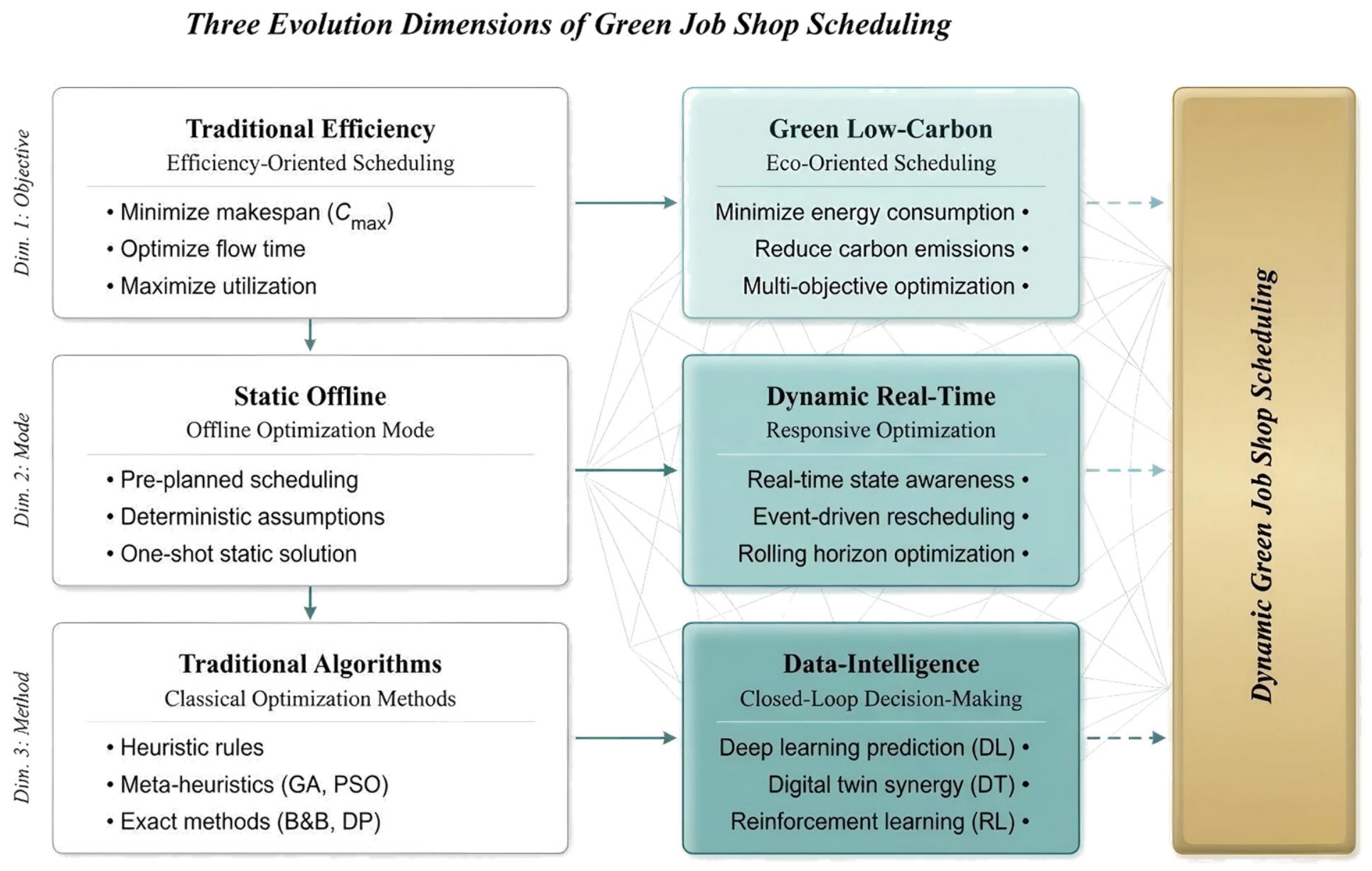
3.3. Research Evolution
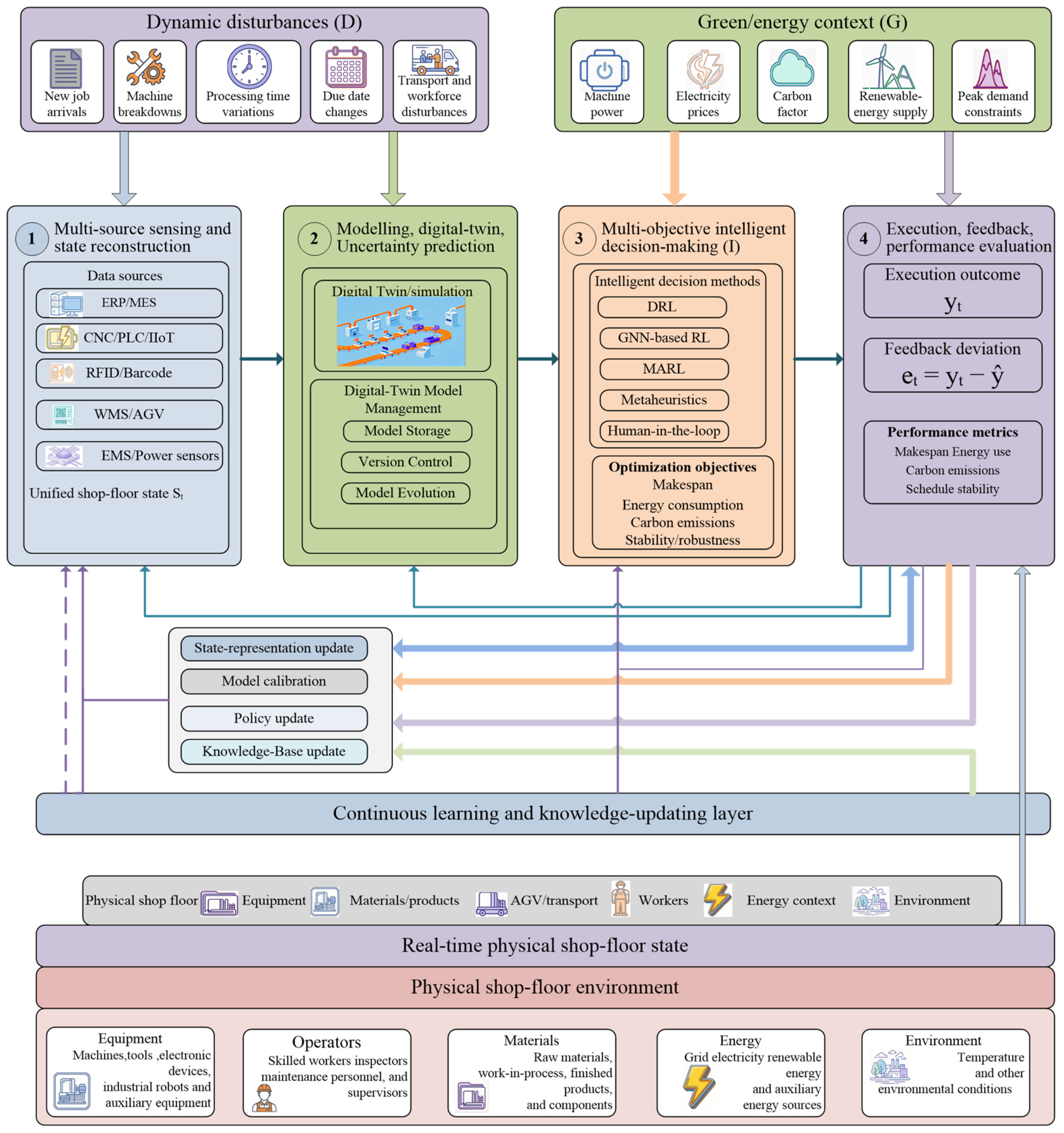
4. Closed-Loop Decision Mechanism for Digital Intelligence-Enabled Scheduling
4.1. Multi-Source Perception and Green-State Representation
4.1.1. Dynamic Event Perception
4.1.2. Energy- and Carbon-State Perception
4.1.3. Scheduling State Construction
4.1.4. Synthesis and Open Issues
4.2. Simulation Modelling and Decision-Oriented Prediction
4.2.1. Production System Modelling
4.2.2. Simulation-Based Prediction
4.2.3. Synthesis and Open Issues
4.3. Intelligent Decision-Making
4.3.1. Model- and Optimisation-Driven Decision-Making
4.3.2. Learning-Driven Decision-Making
4.3.3. Multi-Agent Systems and Industrial Foundation Models: Current Progress and Comparative Analysis
4.3.4. Synthesis and Open Issues
4.4. Execution Feedback and Continuous Learning
4.4.1. Execution-Feedback Trigger Mechanism
4.4.2. Updating and Continuous Learning
4.4.3. Synthesis and Open Issues
5. Future Research Directions
6. Conclusions
Author Contributions
Funding
Data Availability Statement
Acknowledgments
Conflicts of Interest
Abbreviations
| AI | Artificial Intelligence |
| D-G-I | Dynamic–Green–Intelligence |
| JSP | Job Shop Scheduling Problem |
| FJSP | Flexible Job Shop Scheduling Problem |
| MO-DQN | Multi-Objective Deep Q-Network |
| NSGA-II | Non-dominated Sorting Genetic Algorithm II |
| NSGA-III | Non-dominated Sorting Genetic Algorithm III |
| PPO | Proximal Policy Optimisation |
| DRL | Deep Reinforcement Learning |
| GNN | Graph Neural Network |
| IIoT | Industrial Internet of Things |
| RFID | Radio Frequency Identification |
| TOU | Time-of-Use |
| LLM | Large Language Model |
Appendix A

| Primary Category | Timing Relative to Disturbance | Operational Definition | Main Coding Evidence | Priority/Assignment Rule |
|---|---|---|---|---|
| Reactive rescheduling | Mainly after disturbance | The existing schedule is repaired, adjusted or regenerated after a realised disturbance changes the production state. | Explicit disturbance occurrence followed by schedule modification or regeneration. | Used when post-event schedule modification is the dominant mechanism and neither rolling horizon updating or an explicit proactive component is present. |
| Robust optimisation | Mainly before execution | Uncertainty is incorporated ex ante to construct a schedule that maintains feasibility or acceptable performance over anticipated scenarios, uncertainty sets or disturbance ranges. | Scenario-based, uncertainty-set, robustness-oriented or equivalent pre-execution modelling; no primary post-event rescheduling stage. | Used when uncertainty is handled predominantly before execution and explicit post-event adjustment is absent. |
| Proactive–reactive hybrid | Before and after disturbance | Explicit pre-event preparation is combined with schedule adjustment after the disturbance is observed. | Prediction, buffering, robustness or preventive adjustment together with an explicit post-event rescheduling mechanism. | Used when both pre-event and post-event mechanisms are explicit, unless repeated event-triggered horizon updating is the central mechanism. |
| Event-triggered rolling horizon | Repeated online updating | A predefined event, state change or threshold triggers advancement or reconstruction of the decision horizon and a new scheduling decision. | Explicit event/state trigger together with repeated horizon shifting, reconstruction or re-optimisation. | Assigned when triggered rolling-horizon updating constitutes the central scheduling mechanism. |
| Method Category | Inclusion Criterion | Boundary/Exclusion Rule |
|---|---|---|
| Metaheuristic optimisation | Search-based heuristic/evolutionary method directly generates or improves schedules | Mere comparison with a metaheuristic benchmark does not count |
| Single-agent DRL | One RL agent directly learns scheduling actions/policies from states | Prediction-only deep learning without RL-based scheduling decisions does not count |
| Digital twin-enabled scheduling | DT directly supports synchronisation, simulation/prediction, evaluation or rescheduling | Conceptual/background mention of DT does not count |
| Multi-agent reinforcement learning | Multiple RL agents coordinate or distribute scheduling decisions | Conventional multi-agent systems without RL are not coded here |
| Graph-based DRL | Graph representation and RL jointly support scheduling decisions | GNN/graph modelling without an RL decision mechanism does not count |
| LLM-enhanced scheduling agents | LLM/foundation model directly supports scheduling reasoning, retrieval, decomposition, coordination or decision support | Future work or background mention of LLMs does not count |
| Green-Objective Category | Inclusion Criterion | Boundary/Overlap Rule |
|---|---|---|
| Energy consumption | Explicitly optimised, constrained or evaluated energy use | Energy implied only through another derived indicator is insufficient |
| Carbon emissions | Explicit carbon/CO2 emission quantity or carbon factor-based emission criterion | Energy is additionally coded only if separately evaluated |
| Electricity cost and pricing | Electricity cost, TOU tariff, dynamic price or price signal directly affects scheduling | Does not automatically imply an energy consumption code |
| Renewable-energy utilisation | Renewable availability, consumption, matching or utilisation explicitly enters scheduling | General renewable energy discussion is insufficient |
| Peak power and demand | Peak power, maximum load or demand indicator explicitly modelled | Ordinary total energy use alone is insufficient |
| Other environmental objectives | Explicit measurable environmental criterion outside the five categories above | General sustainability statements are insufficient |
Appendix B
| No | Reference | Problem Setting | Dynamic/Uncertain Factor | Green Objective | Method | D-G-I Dimension | Main Contribution | Limitations |
|---|---|---|---|---|---|---|---|---|
| 1 | Lei et al. (2017) [159] | Bi-objective energy-aware FJSP | — | Workload balance and total energy consumption | Shuffled frog-leaping algorithm | G | Established an early bi-objective FJSP formulation linking workload balance with total energy consumption | The setting is static and does not support online disturbance response or data-driven adaptation |
| 2 | Gong et al. (2019) [70] | Energy- and labor-aware FJSP | Dynamic electricity prices | Electricity cost and labor-related sustainability objectives | Many-objective evolutionary optimisation | D + G | Linked time-varying electricity prices and labor considerations with many-objective shop scheduling | Dynamicity is mainly driven by electricity price variation rather than production disruptions |
| 3 | Meng et al. (2019) [160] | Energy-aware FJSP with machine on/off decisions | — | Total energy consumption | Mixed-integer linear programming | G | Developed and compared multiple MILP formulations for energy-aware FJSP with machine on/off strategies | Computational burden grows rapidly for large-scale or dynamic instances |
| 4 | Wu et al. (2019) [161] | Energy-aware FJSP with deterioration effects | Time-dependent deterioration of processing states | Makespan and energy consumption | Hybrid multi-objective metaheuristic | D + G | Coupled step-deterioration effects with machine state energy consumption in a multi-objective FJSP model | Deterioration parameters are difficult to estimate online, and no closed-loop learning mechanism is used |
| 5 | Caldeira et al. (2020) [75] | Dynamic energy-aware FJSP | New job arrivals | Makespan and energy consumption | Backtracking search algorithm | D + G | Integrated new job arrivals with energy-aware multi-objective rescheduling | Search-based re-optimisation may restrict response speed as problem size increases |
| 6 | Ren et al. (2021) [85] | Energy-aware FJSP with assembly operations | Assembly operation coupling | Production efficiency and energy consumption | Multi-objective optimisation | G | Extended energy-aware FJSP modeling to integrated machining–assembly operations | Dynamic disruptions and online adaptation are not the main focus |
| 7 | Wang et al. (2020) [162] | Real-time low-carbon FJSP | Multi-period real-time shop states | Low-carbon and energy-related objectives | Infinitely repeated game | D + G | Connected multi-period real-time decisions with low-carbon scheduling objectives | Game assumptions and model-specific structures may limit transferability to broader disturbance types |
| 8 | Duan and Wang (2021) [163] | Dynamic energy-efficient FJSP | Machine breakdowns | Makespan and total energy consumption | NSGA-II with speed selection and idle-time arrangement | D + G | Integrated machine failures, speed decisions and idle energy management in rescheduling | Re-optimisation after failures may be costly for large real-time instances |
| 9 | Lei et al. (2022) [41] | FJSP | — | — | Multi-action deep reinforcement learning | I | Expanded the action design for DRL-based operation sequencing and machine assignment | The study mainly addresses static production objectives rather than dynamic or green scheduling |
| 10 | Li et al. (2022) [164] | Distributed green FJSP | Type-2 fuzzy processing times | Makespan and total energy consumption | Two-stage knowledge-driven evolutionary algorithm | D + G + I | Combined processing time uncertainty, domain knowledge and energy objectives in distributed scheduling | Uncertainty is modeled offline, while event-triggered online adaptation remains limited |
| 11 | Zhao et al. (2022) [91] | Green sustainable FJSP with learning effects | Learning-effect-driven processing time changes | Production and energy-related sustainability objectives | Multi-objective evolutionary optimisation | G | Incorporated worker learning effects into green sustainable FJSP modeling | The learning effect is an endogenous model assumption rather than an online event-driven learning mechanism |
| 12 | Sang and Tan (2022) [165] | Many-objective green FJSP | — | Multiple production and green objectives | Many-objective memetic algorithm | G | Extended green FJSP toward high-dimensional trade-offs among production and environmental objectives | Preference articulation and dynamic adaptation become difficult as the number of objectives increases |
| 13 | Souza et al. (2022) [166] | Robust JSP with maintenance constraints | Preventive maintenance and random breakdowns | — | MILP, genetic algorithm and simulation-based robust optimisation | D | Integrated planned and stochastic machine unavailability within a robust scheduling framework | No explicit green objective or learning-based online policy was included |
| 14 | Wang et al. (2022) [167] | Carbon emission-aware FJSP | — | Makespan and carbon emissions | PPO-based deep reinforcement learning | G + I | Embedded explicit carbon emission modeling into end-to-end DRL-based FJSP decisions | The setting is mainly static or quasi-static, and robustness to production disturbances requires further study |
| 15 | Wei et al. (2022) [71] | Energy-efficient FJSP with variable machining speeds | Controllable machining-speed variation | Makespan and total energy consumption | Multi-objective optimisation with hybrid energy-saving measures | G | Clarified the trade-off among machining speed, completion time and machine energy use | Speed is a decision variable rather than an external disruption, and online adaptation is limited |
| 16 | Yan et al. (2022) [168] | Digital twin-enabled dynamic FJSP | Preventive maintenance and machine state changes | — | Digital twin and double-layer Q-learning | D + I | Connected digital twin state information, maintenance decisions and learning-assisted rescheduling | Energy consumption and environmental objectives were not explicitly included |
| 17 | Zhang et al. (2022) [111] | Bi-objective FJSP with machine breakdowns | Machine breakdowns | — | Convolutional neural network and two-stage optimisation | D + I | Used CNN-based robustness prediction to support breakdown-aware scheduling decisions | The objectives emphasize makespan and robustness rather than green performance |
| 18 | Chen et al. (2023) [169] | Digital twin-oriented multi-objective FJSP | Virtual–physical state updates | — | Digital twin and hybrid particle swarm optimisation | D + I | Linked digital twin modeling with multi-objective FJSP optimisation to improve dynamic responsiveness | Learning capability and explicit green state integration remain limited |
| 19 | Gui et al. (2023) [170] | Dynamic FJSP | Real-time job and machine state changes | — | Deep reinforcement learning | D + I | Developed adaptive DRL actions for real-time dynamic scheduling | The training–deployment gap and absence of green states may constrain industrial use |
| 20 | Li and Chen (2023) [171] | Green FJSP with learning effects | Learning-effect-driven processing time changes | Makespan and total carbon emissions | Mixed-integer model and improved multi-objective sparrow search algorithm | G | Linked worker learning effects with explicit carbon-aware scheduling objectives | Learning effect assumptions simplify actual shop behavior and do not constitute event-driven online learning |
| 21 | Li et al. (2023) [172] | Digital twin-based dynamic JSP | Anomalies and shop floor disturbances | — | Digital twin, anomaly detection and rolling-window optimisation | D + I | Integrated anomaly detection, virtual–physical synchronisation and rolling-window dynamic scheduling | Green objectives and long-term policy learning were not explicitly considered |
| 22 | Zhang et al. (2023b) [173] | Dynamic FJSP with transportation constraints | Insufficient transportation resources | — | Graph neural network and deep reinforcement learning | D + I | Extended graph-based DRL to coupled production and transportation resource decisions | Transportation energy consumption and carbon impacts were not explicitly modeled |
| 23 | Akram et al. (2024) [174] | Dynamic energy-efficient FJSP | New job insertions | Makespan, total energy consumption and schedule stability | Multi-objective black widow spider algorithm with machine on/off strategy | D + G | Combined new job rescheduling, energy efficiency and schedule stability in a unified multi-objective model | The metaheuristic response depends on iterative search and parameter design |
| 24 | Burmeister et al. (2024) [175] | Energy price-aware FJSP | Real-time energy tariffs | Energy cost and production objectives | Memetic NSGA-II | D + G | Integrated real-time energy tariffs into multi-objective FJSP optimisation | Evolutionary search may become costly when prices and shop states vary frequently |
| 25 | Lei et al. (2024) [176] | Dynamic distributed JSP | Inter-shop transfers and distributed resource changes | — | Deep reinforcement learning | D + I | Extended DRL-based dynamic decisions to distributed scheduling with transfer constraints | Energy consumption and carbon impacts of inter-shop transfers were not explicitly optimised |
| 26 | Luo et al. (2024) [177] | Energy-efficient dynamic FJSP | Machine breakdowns | Makespan and total energy consumption | Knowledge-driven two-stage memetic algorithm | D + G + I | Embedded scheduling knowledge and energy-saving strategies into breakdown-aware rescheduling | Problem-specific knowledge and neighborhoods may reduce transferability across shop configurations |
| 27 | Peng et al. (2024) [178] | Extended FJSP | — | — | Multi-agent reinforcement learning | I | Developed a multi-agent learning architecture for coupled operation and machine decisions in extended FJSPs | Dynamic disturbances and explicit green objectives were not central to the study |
| 28 | Ren and Liu (2024) [112] | Dynamic FJSP with AGV states | New job insertions, machine breakdowns, processing-time changes and AGV-state changes | — | MachineRank and reinforcement learning | D + I | Combined machine importance ranking with reinforcement learning for dynamic scheduling priorities | Performance depends on selected state indicators, and no explicit green objective is included |
| 29 | Tang et al. (2024a) [179] | Low-carbon FJSP | — | Makespan and carbon-related objectives | Graph-attention-enhanced deep reinforcement learning | G + I | Introduced attention-based state representation and DRL into low-carbon FJSP optimisation | Dynamic disturbances and industrial online validation remain limited |
| 30 | Tang et al. (2024b) [180] | Dynamic multi-objective FJSP | Dynamic production events | — | Deep Q-learning and NSGA-III | D + I | Combined learning-assisted strategy selection with multi-objective evolutionary search | Green objectives are absent, and learning mainly assists the optimizer rather than generating an end-to-end policy |
| 31 | Zhang et al. (2024a) [181] | Energy-aware FJSP with multiple AGVs | Production–transport resource coupling | Production and logistics energy consumption | Deep reinforcement learning-based memetic algorithm | G + I | Integrated production scheduling, AGV routing and energy-aware intelligent optimisation | Real-time disturbances are not the central focus, and the coupled model is computationally complex |
| 32 | Zhang et al. (2024b) [182] | Distributed energy-saving FJSP | Machine breakdowns | Makespan, total energy consumption and machine-load balance | Improved memetic algorithm | D + G | Extended energy-saving rescheduling to distributed FJSPs under machine failures | The approach still relies on iterative optimisation and limited real-time shop floor data feedback |
| 33 | Almasarwah (2025) [183] | Multi-objective green FJSP with operation-sequence flexibility | — | Green and sustainability objectives | Multi-objective optimisation | G | Extended the green FJSP feasible space by incorporating operation sequence flexibility | Dynamic disturbances and intelligent online adaptation are not central |
| 34 | Fan and Tian (2025) [184] | Dynamic green multi-objective FJSP | Dynamic job arrivals and real-time state changes | Production, energy and carbon-related objectives | Deep reinforcement learning | D + G + I | Directly combined dynamic scheduling, green multi-objective optimisation and learned online decisions | Generalisation across broader disruption types and real workshops still requires validation |
| 35 | Li et al. (2025) [185] | Energy-efficient dynamic FJSP | Machine breakdowns | Makespan, total energy consumption and critical machine workload | Knowledge-guided evolutionary algorithm with reinforcement learning | D + G + I | Combined domain knowledge, RL-based adaptation and energy-saving strategies for breakdown rescheduling | Reinforcement learning mainly assists evolutionary search rather than producing an end-to-end policy |
| 36 | Liao and Qian (2025) [186] | Low-carbon multi-objective FJSP | — | Makespan, carbon emissions and operational cost | Improved multi-objective metaheuristic | G | Made carbon footprint an explicit scheduling objective alongside cost and production trade-offs | The study is based on static optimisation without dynamic event-handling or online learning |
| 37 | Liu et al. (2025) [187] | Dynamic green FJSP | Dynamic shop floor events and time-of-use electricity pricing | Energy consumption, electricity cost and machine on/off decisions | Multi-objective scheduling optimisation | D + G | Coupled dynamic rescheduling with machine operating state control and electricity price mechanisms | The framework is optimisation-driven and provides limited learning or digital twin support |
| 38 | Tarek et al. (2025) [188] | Sustainable dynamic FJSP | Machine breakdowns | Energy consumption and production performance | Event-driven GWO and PSO rescheduling | D + G | Compared swarm-based breakdown rescheduling while exposing energy–makespan trade-offs | The intelligence is optimizer-centric, with limited adaptive policy learning and disturbance coverage |
| 39 | Wan et al. (2025) [189] | FJSP | — | — | Multi-agent graph reinforcement learning and MAPPO | I | Coordinated operation sequencing and machine assignment through graph representation and multiple agents | The study mainly considers a static production setting without explicit green objectives |
| 40 | Wu et al. (2025) [190] | Dynamic multi-objective FJSP | Machine breakdowns | — | Reinforcement learning-assisted dynamic scheduling | D + I | Applied learning-based decision support to breakdown-driven multi-objective rescheduling | Environmental performance is not explicitly optimised |
| 41 | Yi et al. (2025) [191] | Dynamic FJSP with maintenance constraints | Limited maintenance resources, machine breakdowns and urgent jobs | — | Improved deep Q-network | D + I | Integrated limited maintenance resources into learned dynamic scheduling decisions | Energy consumption and environmental costs associated with maintenance were not included |
| 42 | Yuan et al. (2025) [135] | Digital twin-based dynamic FJSP | Real-time shop changes and predicted disruptions | — | Digital twin and multi-agent PPO | D + I | Integrated digital twin simulation with multi-agent PPO for proactive dynamic scheduling | Green states and long-term continual learning are not central objectives |
| 43 | Zhang et al. (2025) [192] | Dynamic FJSP | Real-time production changes | — | Adaptive genetic algorithm and deep Q-network | D + I | Combined evolutionary search with DQN-based adaptive control for dynamic scheduling | Green objectives are absent, and the hybrid architecture increases implementation complexity |
| 44 | Akram et al. (2026) [193] | Multi-objective dynamic FJSP | New job arrivals | Total energy consumption and production objectives | Reinforcement learning-based black widow spider algorithm | D + G + I | Used reinforcement learning to adapt metaheuristic search while balancing energy, due date, makespan and stability objectives | Reinforcement learning mainly controls optimizer parameters, and continuous industrial deployment has not been demonstrated |
| 45 | Ma et al. (2026) [84] | Renewable energy-aware dynamic FJSP | Dynamic job arrivals and renewable energy fluctuations | Energy consumption, carbon emissions and renewable energy utilisation | Multi-agent PPO-based deep reinforcement learning | D + G + I | Coupled production disturbances and intermittent renewable energy in a multi-agent green scheduling framework | Agent coordination, training cost and industrial-scale validation remain challenging |
| 46 | Zhang et al. (2026) [142] | Distributed dynamic energy-efficient FJSP | Random job arrivals and dynamic disruptions | Energy efficiency and production performance | Hierarchical collaborative multi-agent DRL with TSDDQN | D + G + I | Integrated distributed resource assignment, real-time disruption response and energy-aware machine operation through collaborative agents | Communication overhead, credit assignment and training cost may hinder large-scale deployment |
| 47 | Destouet et al. (2026) [106] | Sustainable dynamic FJSP | Worker absences and renewable-energy availability fluctuations | Carbon emissions and renewable-energy utilisation | INSGA-III with Q-learning/deep-learning-based rescheduling strategy selection | D + G + I | Coupled workforce uncertainty, renewable energy variability and sustainable rescheduling while using machine learning to select rescheduling strategies | Validation is mainly computational; transfer across workshops and long-term industrial deployment remain limited |
| 48 | Wang et al. (2026) [143] | Dynamic green flexible assembly job shop | Learning–forgetting effects and real-time production changes | Total energy consumption and production performance | HGNN and hierarchical dual-agent DRL with PPO | D + G + I | Integrated human-related state changes, graph representation and multi-agent reinforcement learning for dynamic green assembly scheduling | Relies mainly on extended benchmark instances; long-term industrial validation remains insufficient |
| 49 | Ren et al. (2026) [133] | Digital twin-driven dynamic FJSP considering worker factors | Machine failures, worker absences and real-time worker/machine state changes | Carbon emissions, worker satisfaction and completion time | Digital twin and improved harmony search algorithm | D + G + I | Extended digital twin scheduling towards Industry 5.0 by jointly considering human factors, carbon performance and dynamic shop floor states | Deployment depends strongly on digital twin synchronisation quality and the reliable acquisition of human-related parameters |
| 50 | Zhang et al. (2026) [134] | Digital twin-driven dynamic JSP | Dynamic production disturbances and real-time shop floor state changes | — | Digital twin and Double DQN | D + I | Used a digital twin as an interactive scheduling environment and DDQN for adaptive dynamic scheduling decisions | Explicit green objectives are absent, and the simulation-to-reality gap remains to be validated |
| 51 | Zahid et al. (2026) [90] | Energy-aware FJSP with integrated energy management | TOU electricity prices, photovoltaic generation, battery storage and preventive maintenance constraints | Electricity cost and renewable energy utilisation | MILP, genetic algorithm and energy-aware post-optimisation | G + I | Integrated TOU pricing, renewable generation, battery storage and maintenance into a unified energy-aware scheduling framework | Random shop floor disturbances and learning-based online adaptation are not the main focus |
| 52 | Chen et al. (2025) [29] | Dynamic FJSP with transportation and sequence-dependent setup constraints | Continuous new task arrivals and dynamic transport/setup conditions | — | Evolutionary multitask optimisation and genetic-programming hyper-heuristic | D + I | Used multitask knowledge transfer and GP to evolve scheduling rules for complex dynamic FJSP environments | Explicit environmental objectives are absent, and online computational cost requires industrial validation |
| 53 | Lv et al. (2022) [94] | Energy-efficient dynamic FJSP with alternative process plans | New-job arrivals and machine breakdowns | Energy consumption | Heuristic multi-objective rescheduling framework | D + G | Integrated dynamic events, alternative process plans and energy-efficient rescheduling within a unified decision mechanism | Learning-based adaptation is limited and the framework relies mainly on heuristic re-optimisation |
| 54 | Xu et al. (2021) [115] | Multi-objective dynamic FJSP | Dynamic job flows and delayed routing decisions | Energy efficiency and mean tardiness | Genetic programming hyper-heuristic | D + G + I | Automatically evolved dispatching rules for multi-objective dynamic FJSP rather than relying on manually designed heuristics | Generalisation depends on the training scenarios and selected terminal/features |
| 55 | Wu et al. (2025) [95] | Dynamic FJSP | Machine failures and urgent job arrivals | Energy consumption and makespan | Meta-reinforcement learning with MAML and PPO | D + G + I | Improved rapid adaptation to previously unseen disturbance scenarios through meta-learning and reinforcement learning | Meta-training is computationally expensive and transfer performance depends on the training task distribution |
| 56 | Qian et al. (2022) [99] | Dynamic multi-objective scheduling in a UWB/5G-enabled workshop | Real-time shop floor and resource-state changes | Total energy consumption and production objectives | Cooperative bargaining game and multi-agent scheduling | D + G + I | Combined UWB/5G sensing and multi-agent bargaining for real-time multi-objective scheduling and resource coordination | Requires communication and localisation infrastructure; environmental modelling is mainly limited to total energy use |
| 57 | Huang et al. (2025) [30] | Dynamic JSP with flow-control decisions | Online job flow and changing dispatching states | — | Grammar-guided linear genetic programming | D + I | Automatically evolved interpretable dispatching rules while incorporating flow-control decisions into dynamic scheduling | Explicit energy and carbon objectives are not considered |
| 58 | Tian et al. (2019) [72] | Energy-efficient FJSP in an IoMT environment | Machine failures, urgent orders and real-time IoMT events | Energy consumption | Timed-transition Petri nets, ant colony optimisation and IoMT control | D + G + I | Linked IoMT-based real-time state acquisition with energy-efficient scheduling and event-driven rescheduling | Communication and control infrastructure increase implementation complexity |
| 59 | Li et al. (2024) [37] | Energy-aware distributed heterogeneous FJSP | — | Total energy consumption and makespan | Co-evolutionary optimisation assisted by DQN | G + I | Combined deep reinforcement learning with co-evolution to improve energy-aware distributed scheduling | Dynamic disturbances are not explicitly modelled, limiting direct applicability to online rescheduling |
| 60 | Wang et al. (2025) [42] | Multi-target FJSP with processing and transportation coordination | — | Processing and transportation energy consumption | Graph neural network and PPO | G + I | Developed an end-to-end framework that jointly represents operation–machine relationships and optimises production, transportation and energy objectives | Dynamic events are not explicitly considered, and online disturbance adaptation remains limited |
| 61 | Tarek et al. (2025) [136] | Knowledge-enhanced job shop scheduling | Virtual–physical and knowledge state updates | — | Knowledge graph-enhanced digital twin | I | Integrated knowledge graphs with digital twins to improve manufacturing knowledge representation and scheduling decision support | Dynamic disturbance handling and explicit green objectives remain limited |
| 62 | Li et al. (2024) [88] | Fuzzy FJSP with energy and transportation | Fuzzy processing time uncertainty | Energy consumption and transportation-related performance | Bi-population balancing multi-objective evolutionary algorithm | D + G + I | Integrated fuzzy processing time uncertainty, energy use and transportation into a multi-objective FJSP framework | Results depend on fuzzy-parameter assumptions, and real-time feedback is not explicitly incorporated |
| 63 | Yan et al. (2025) [89] | Distributed FJSP with maintenance decisions | Maintenance requirements and resource-state changes | Energy consumption and maintenance-related objectives | Learning-assisted bi-population evolutionary algorithm | D + G + I | Embedded learning assistance into evolutionary search while coordinating production scheduling and maintenance decisions | Dynamic random disturbances are not the central setting, and online learning remains limited |
| 64 | Li et al. (2026) [38] | Energy-saving distributed heterogeneous FJSP | — | Energy consumption | Knowledge transfer-based co-evolutionary search | G + I | Used knowledge transfer across related scheduling tasks to improve energy-saving optimisation and search efficiency | Explicit dynamic-event handling is absent, and transfer effectiveness depends on similarity between source and target tasks |
| 65 | Jiang et al. (2019) [73] | Green JSP with multi-speed machines | Controllable machine speed variation | Energy consumption/cost and production performance | Discrete whale optimisation algorithm | G + I | Introduced discrete whale optimisation and machine-speed decisions into green job shop scheduling | The model is essentially static and does not include online disturbance response or closed-loop adaptation |
| 66 | Hu et al. (2025) [194] | Real-time energy-saving FJSP | New job arrivals, machine failures and random shop floor disturbances | Makespan, machine idle rate and total production energy consumption | Bi-level multi-agent architecture with bargaining game | D + G + I | Developed a hierarchical real-time scheduling framework that coordinates shop-level job allocation and service unit-level machine sequencing while responding to disturbances and reducing energy consumption | Relies on predefined agent interaction and bargaining mechanisms; large-scale industrial deployment and long-term adaptation require further validation |
| 67 | Zhao et al. (2024) [195] | Energy-aware robust FJSP | Machine breakdowns and new job insertions | Scheduling efficiency, total energy consumption and robustness | Double Q-learning-assisted competitive evolutionary algorithm | D + G + I | Integrated unexpected production disruptions, energy consumption and robustness within a two-stage scheduling model, while using DQL to assist the evolutionary search | Learning mainly assists evolutionary optimisation rather than providing an end-to-end online scheduling policy; industrial-scale real-time validation remains limited |
References
- Lasi, H.; Fettke, P.D.P.; Kemper, H.-G.; Feld, T.; Hoffmann, M. Industry 4.0. Bus. Inf. Syst. Eng. 2014, 6, 239–242. [Google Scholar] [CrossRef] [Scilit]
- Kusiak, A. Smart manufacturing. Int. J. Prod. Res. 2018, 56, 508–517. [Google Scholar] [CrossRef] [Scilit]
- Wang, S.; Wan, J.; Zhang, D.; Li, D.; Zhang, C. Towards a smart factory for Industry 4.0: A self-organised multi-agent system with big data-based feedback and coordination. Comput. Netw. 2016, 101, 158–168. [Google Scholar] [CrossRef] [Scilit]
- Monostori, L.; Kádár, B.; Bauernhansl, T.; Kondoh, S.; Kumara, S.; Reinhart, G.; Sauer, O.; Schuh, G.; Sihn, W.; Ueda, K. Cyber-physical systems in manufacturing. CIRP Ann. 2016, 65, 621–641. [Google Scholar] [CrossRef] [Scilit]
- Lee, J.; Bagheri, B.; Kao, H.A. A cyber-physical systems architecture for Industry 4.0-based manufacturing systems. Manuf. Lett. 2015, 3, 18–23. [Google Scholar] [CrossRef] [Scilit]
- Xu, L.D.; He, W.; Li, S. The Internet of Things in industry: A survey. IEEE Trans. Ind. Inform. 2014, 10, 2233–2243. [Google Scholar] [CrossRef] [Scilit]
- Lu, Y. Industry 4.0: A survey on technologies, applications and open research issues. J. Ind. Inf. Integr. 2017, 6, 1–10. [Google Scholar] [CrossRef] [Scilit]
- Tao, F.; Qi, Q.; Liu, A.; Kusiak, A. Data-driven smart manufacturing. J. Manuf. Syst. 2018, 48, 157–169. [Google Scholar] [CrossRef] [Scilit]
- Qi, Q.; Tao, F. Digital Twin and Big Data towards smart manufacturing. J. Manuf. Syst. 2018, 48, 3–14. [Google Scholar] [CrossRef] [Scilit]
- Tao, F.; Zhang, H.; Liu, A.; Nee, A.Y.C. Digital twin in industry: State-of-the-art. IEEE Trans. Ind. Inform. 2019, 15, 2405–2415. [Google Scholar] [CrossRef] [Scilit]
- Applegate, D.; Cook, W. A computational study of the job-shop scheduling problem. ORSA J. Comput. 1991, 3, 149–156. [Google Scholar] [CrossRef] [Scilit]
- Dauzere-Peres, S.; Ding, J.; Shen, L.; Tamssaouet, K. The flexible job-shop scheduling problem: A review. Eur. J. Oper. Res. 2024, 314, 409–432. [Google Scholar] [CrossRef] [Scilit]
- Chaudhry, I.A.; Khan, A.A. A research survey: Review of flexible job shop scheduling techniques. Int. Trans. Oper. Res. 2016, 23, 551–591. [Google Scholar] [CrossRef] [Scilit]
- Xie, J.; Gao, L.; Peng, K.; Li, X.; Li, H. Review on flexible job shop scheduling. IET Collab. Intell. Manuf. 2019, 1, 67–77. [Google Scholar] [CrossRef] [Scilit]
- Turkyilmaz, A.; Senvar, O.; Unal, I.; Bulkan, S. A research survey: Heuristic approaches for solving multi-objective flexible job shop problems. J. Intell. Manuf. 2020, 31, 1949–1983. [Google Scholar] [CrossRef] [Scilit]
- Ouelhadj, D.; Petrovic, S. A survey of dynamic scheduling in manufacturing systems. J. Sched. 2009, 12, 417–431. [Google Scholar] [CrossRef] [Scilit]
- Vieira, G.E.; Herrmann, J.W.; Lin, E. Rescheduling manufacturing systems: A framework of strategies, policies, and methods. J. Sched. 2003, 6, 39–62. [Google Scholar] [CrossRef] [Scilit]
- Aytug, H.; Lawley, M.A.; McKay, K.; Mohan, S.; Uzsoy, R. Executing production schedules in the face of uncertainties: A review and some future directions. Eur. J. Oper. Res. 2005, 161, 86–110. [Google Scholar] [CrossRef] [Scilit]
- Gahm, C.; Denz, F.; Dirr, M.; Tuma, A. Energy-efficient scheduling in manufacturing companies: A review and research framework. Eur. J. Oper. Res. 2016, 248, 744–757. [Google Scholar] [CrossRef] [Scilit]
- Fernandes, J.M.R.C.; Homayouni, S.M.; Fontes, D.B.M.M. Energy-efficient scheduling in job-shop manufacturing systems: A literature review. Sustainability 2022, 14, 6264. [Google Scholar] [CrossRef] [Scilit]
- Gao, J.; Sun, L.; Gen, M. A hybrid genetic and variable neighbourhood descent algorithm for flexible job-shop scheduling problems. Comput. Oper. Res. 2008, 35, 2892–2907. [Google Scholar] [CrossRef] [Scilit]
- Li, J.Q.; Pan, Q.K.; Liang, Y.C. An effective hybrid tabu search algorithm for multi-objective flexible job-shop scheduling problems. Comput. Ind. Eng. 2010, 59, 647–662. [Google Scholar] [CrossRef] [Scilit]
- Nowicki, E.; Smutnicki, C. A fast taboo search algorithm for the job shop problem. Manag. Sci. 1996, 42, 797–813. [Google Scholar] [CrossRef] [Scilit]
- Church, L.K.; Uzsoy, R. Analysis of periodic and event-driven rescheduling policies in dynamic shops. Int. J. Comput. Integr. Manuf. 1992, 5, 153–163. [Google Scholar] [CrossRef] [Scilit]
- Sabuncuoglu, I.; Bayiz, M. Analysis of reactive scheduling problems in a job shop environment. Eur. J. Oper. Res. 2000, 126, 567–586. [Google Scholar] [CrossRef] [Scilit]
- Deb, K.; Pratap, A.; Agarwal, S.; Meyarivan, T. A fast and elitist multi-objective genetic algorithm: NSGA-II. IEEE Trans. Evol. Comput. 2002, 6, 182–197. [Google Scholar] [CrossRef] [Scilit]
- Poli, R.; Kennedy, J.; Blackwell, T. Particle swarm optimisation: An overview. Swarm Intell. 2007, 1, 33–57. [Google Scholar] [CrossRef] [Scilit]
- Branke, J.; Nguyen, S.; Pickardt, C.W.; Zhang, M. Automated design of production scheduling heuristics: A review. IEEE Trans. Evol. Comput. 2016, 20, 110–124. [Google Scholar] [CrossRef] [Scilit]
- Chen, X.; Li, J.; Wang, Z.; Chen, Q.; Gao, K.; Pan, Q. Optimizing Dynamic Flexible Job Shop Scheduling Using an Evolutionary Multitask Optimization Framework and Genetic Programming. IEEE Trans. Evol. Comput. 2025, 29, 1502–1516. [Google Scholar] [CrossRef] [Scilit]
- Huang, Z.; Mei, Y.; Zhang, F.; Zhang, M. Toward Evolving Dispatching Rules With Flow Control Operations by Grammar-Guided Linear Genetic Programming. IEEE Trans. Evol. Comput. 2025, 29, 217–231. [Google Scholar] [CrossRef] [Scilit]
- Luo, S. Dynamic scheduling for a flexible job shop with new job insertions using deep reinforcement learning. Appl. Soft Comput. 2020, 91, 106208. [Google Scholar] [CrossRef] [Scilit]
- Luo, S.; Zhang, L.; Fan, Y. Dynamic multi-objective scheduling for a flexible job shop using deep reinforcement learning. Comput. Ind. Eng. 2021, 159, 107489. [Google Scholar] [CrossRef] [Scilit]
- Li, Y.; Gu, W.; Yuan, M.; Tang, Y. Real-time data-driven dynamic scheduling for a flexible job shop with insufficient transport resources using a hybrid deep Q-network. Robot. Comput.-Integr. Manuf. 2022, 74, 102283. [Google Scholar] [CrossRef] [Scilit]
- Liu, R.; Piplani, R.; Toro, C. Deep reinforcement learning for dynamic scheduling of a flexible job shop. Int. J. Prod. Res. 2022, 60, 4049–4069. [Google Scholar] [CrossRef] [Scilit]
- Zhang, L.; Feng, Y.; Xiao, Q.; Xu, Y.; Li, D.; Yang, D.; Yang, Z. Deep reinforcement learning for dynamic flexible job shop scheduling considering variable processing times. J. Manuf. Syst. 2023, 71, 257–273. [Google Scholar] [CrossRef] [Scilit]
- Wu, X.; Yan, X.; Guan, D.; Wei, M. A deep reinforcement learning model for the dynamic job-shop scheduling problem with uncertain processing times. Eng. Appl. Artif. Intell. 2024, 131, 107790. [Google Scholar] [CrossRef] [Scilit]
- Li, R.; Gong, W.; Wang, L.; Lu, C.; Dong, C. Co-Evolution With Deep Reinforcement Learning for Energy-Aware Distributed Heterogeneous Flexible Job Shop Scheduling. IEEE Trans. Syst. Man Cybern. Syst. 2024, 54, 201–211. [Google Scholar] [CrossRef] [Scilit]
- Li, T.; Li, X.; Zhang, J.; Liu, D.; Wang, Z. Knowledge Transfer-Based Co-Evolutionary Search for Energy-Saving Distributed Heterogeneous Flexible Job Shop Scheduling. IEEE Trans. Emerg. Top. Comput. Intell. 2026, 10, 1610–1624. [Google Scholar] [CrossRef] [Scilit]
- Song, W.; Chen, X.; Li, Q.; Cao, Z. Flexible job-shop scheduling via graph neural networks and deep reinforcement learning. IEEE Trans. Ind. Inform. 2023, 19, 1600–1610. [Google Scholar] [CrossRef] [Scilit]
- Park, J.; Chun, J.; Kim, S.H.; Kim, Y.; Park, J. Learning to schedule job-shop problems: Representation and policy learning using graph neural networks and reinforcement learning. Int. J. Prod. Res. 2021, 59, 3360–3377. [Google Scholar] [CrossRef] [Scilit]
- Lei, K.; Guo, P.; Zhao, W.; Wang, Y.; Qian, L.; Meng, X.; Tang, L. A multi-action deep reinforcement learning framework for the flexible job-shop scheduling problem. Expert Syst. Appl. 2022, 205, 117796. [Google Scholar] [CrossRef] [Scilit]
- Wang, R.; Jing, Y.; Gu, C.; He, S.; Chen, J. End-to-End Multitarget Flexible Job Shop Scheduling With Deep Reinforcement Learning. IEEE Internet Things J. 2025, 12, 4420–4434. [Google Scholar] [CrossRef] [Scilit]
- Zhang, J.D.; He, Z.; Chan, W.H.; Chow, C.Y. DeepMAG: Deep reinforcement learning with multi-agent graph neural network for flexible job-shop scheduling. Knowl.-Based Syst. 2023, 259, 110083. [Google Scholar] [CrossRef] [Scilit]
- Waubert de Puiseau, C.; Meyes, R.; Meisen, T. On the reliability of reinforcement learning-based production scheduling systems: A comparative survey. J. Intell. Manuf. 2022, 33, 911–927. [Google Scholar] [CrossRef] [Scilit]
- Wu, Z.; Fan, H.; Sun, Y.; Peng, M. Efficient multi-objective optimisation in a dynamic flexible job shop using deep reinforcement learning. Processes 2023, 11, 2018. [Google Scholar] [CrossRef] [Scilit]
- Zhang, M.; Tao, F.; Nee, A.Y.C. Digital twin-enhanced dynamic job-shop scheduling. J. Manuf. Syst. 2021, 58, 146–156. [Google Scholar] [CrossRef] [Scilit]
- Liu, L.; Guo, K.; Gao, Z.; Li, J. Digital twin-driven adaptive scheduling for flexible job shops. Sustainability 2022, 14, 5340. [Google Scholar] [CrossRef] [Scilit]
- Zhang, F.; Bai, J.; Yang, D.; Wang, Q. Digital twin data-driven proactive job-shop scheduling strategy. Sci. Rep. 2022, 12, 1546. [Google Scholar] [CrossRef] [Scilit] [PubMed]
- Tliba, K.; Diallo, T.M.L.; Penas, O.; Ben Khalifa, R.; Ben Yahia, N.; Choley, J.-Y. Digital twin-driven dynamic scheduling of a hybrid flow shop. J. Intell. Manuf. 2023, 34, 2281–2306. [Google Scholar] [CrossRef] [Scilit]
- Wang, J.; Liu, Y.; Ren, S.; Wang, C.; Ma, S. Edge computing-based real-time scheduling for a digital twin flexible job shop with a variable time window. Robot. Comput.-Integr. Manuf. 2023, 79, 102435. [Google Scholar] [CrossRef] [Scilit]
- Gao, Q.; Gu, F.; Li, L.; Guo, J. A framework of cloud-edge collaborative digital twin for flexible job shop scheduling with conflict-free routing. Robot. Comput.-Integr. Manuf. 2024, 86, 102672. [Google Scholar] [CrossRef] [Scilit]
- Tao, F.; Cheng, J.; Qi, Q.; Zhang, M.; Zhang, H.; Sui, F. Digital twin-driven product design, manufacturing and service with big data. Int. J. Adv. Manuf. Technol. 2018, 94, 3563–3576. [Google Scholar] [CrossRef] [Scilit]
- Tao, F.; Sui, F.; Liu, A.; Qi, Q.; Zhang, M.; Song, B.; Guo, Z.; Lu, S.; Nee, A.Y.C. Digital twin-driven product design framework. Int. J. Prod. Res. 2019, 57, 3935–3953. [Google Scholar] [CrossRef] [Scilit]
- Zhang, C.; Xu, Q.; Yu, Y.; Zhou, G.; Zeng, K.; Chang, F.; Ding, K. A survey on the potentials, pathways and challenges of large language models in next-generation intelligent manufacturing. Robot. Comput.-Integr. Manuf. 2025, 92, 102883. [Google Scholar] [CrossRef] [Scilit]
- Zhao, Z.; Tang, D.; Liu, C.; Wang, L.; Zhang, Z.; Zhu, H.; Chen, K.; Nie, Q.; Ji, Y. A large language model-based multi-agent manufacturing system for intelligent shopfloors. Adv. Eng. Inform. 2026, 69, 103888. [Google Scholar] [CrossRef] [Scilit]
- Mouzon, G.; Yildirim, M.B.; Twomey, J. Operational methods for minimising energy consumption of manufacturing equipment. Int. J. Prod. Res. 2007, 45, 4247–4271. [Google Scholar] [CrossRef] [Scilit]
- Fang, K.; Uhan, N.; Zhao, F.; Sutherland, J.W. A new approach to scheduling in manufacturing for power consumption and carbon footprint reduction. J. Manuf. Syst. 2011, 30, 234–240. [Google Scholar] [CrossRef] [Scilit]
- Dai, M.; Tang, D.; Giret, A.; Salido, M.A.; Li, W.D. Energy-efficient scheduling for a flexible flow shop using an improved genetic-simulated annealing algorithm. Robot. Comput.-Integr. Manuf. 2013, 29, 418–429. [Google Scholar] [CrossRef] [Scilit]
- Zhang, H.; Zhao, F.; Fang, K.; Sutherland, J.W. Energy-conscious flow shop scheduling under time-of-use electricity tariffs. CIRP Ann. 2014, 63, 37–40. [Google Scholar] [CrossRef] [Scilit]
- Liu, Y.; Dong, H.; Lohse, N.; Petrovic, S.; Gindy, N. An investigation into minimising total energy consumption and total weighted tardiness in job shops. J. Clean. Prod. 2014, 65, 87–96. [Google Scholar] [CrossRef] [Scilit]
- Shrouf, F.; Ordieres-Mere, J.; Garcia-Sanchez, A.; Ortega-Mier, M. Optimising the production scheduling of a single machine to minimise total energy consumption costs. J. Clean. Prod. 2014, 67, 197–207. [Google Scholar] [CrossRef] [Scilit]
- Gao, K.; Huang, Y.; Sadollah, A.; Wang, L. A review of energy-efficient scheduling in intelligent production systems. Adv. Manuf. 2019, 7, 111–143. [Google Scholar] [CrossRef] [Scilit]
- Yin, L.; Li, X.; Gao, L.; Lu, C.; Zhang, Z. A novel mathematical model and multi-objective method for the low-carbon flexible job-shop scheduling problem. Sustain. Comput. Inform. Syst. 2017, 13, 15–30. [Google Scholar] [CrossRef] [Scilit]
- Mokhtari, H.; Hasani, A. An energy-efficient multi-objective optimisation for the flexible job-shop scheduling problem. Comput. Chem. Eng. 2017, 104, 339–352. [Google Scholar] [CrossRef] [Scilit]
- Salido, M.A.; Escamilla, J.; Giret, A.; Barber, F. A genetic algorithm for energy efficiency in job-shop scheduling. Int. J. Adv. Manuf. Technol. 2016, 85, 1303–1314. [Google Scholar] [CrossRef] [Scilit]
- Wu, X.; Sun, Y. A green scheduling algorithm for flexible job shops with energy-saving measures. J. Clean. Prod. 2018, 172, 3249–3264. [Google Scholar] [CrossRef] [Scilit]
- Wang, H.; Jiang, Z.; Wang, Y.; Zhang, H.; Wang, Y. A two-stage optimisation method for energy-saving flexible job-shop scheduling based on energy dynamic characterisation. J. Clean. Prod. 2018, 188, 575–588. [Google Scholar] [CrossRef] [Scilit]
- Jiang, T.; Deng, G. Optimising the low-carbon flexible job-shop scheduling problem with regard to energy consumption. IEEE Access 2018, 6, 46346–46355. [Google Scholar] [CrossRef] [Scilit]
- Liu, Z.; Guo, S.; Wang, L. Integrated green scheduling optimisation of flexible job shops and crane transport considering comprehensive energy consumption. J. Clean. Prod. 2019, 211, 765–786. [Google Scholar] [CrossRef] [Scilit]
- Gong, X.; De Pessemier, T.; Martens, L.; Joseph, W. Energy- and labour-aware flexible job shop scheduling under dynamic electricity pricing: A multi-objective optimisation study. J. Clean. Prod. 2019, 209, 1078–1094. [Google Scholar] [CrossRef] [Scilit]
- Wei, Z.; Liao, W.; Zhang, L. Hybrid energy-efficient scheduling measures for flexible job-shop problem with variable machining speeds. Expert Syst. Appl. 2022, 197, 116785. [Google Scholar] [CrossRef] [Scilit]
- Tian, S.; Wang, T.; Zhang, L.; Wu, X. An Energy-Efficient Scheduling Approach for Flexible Job Shop Problem in an Internet of Manufacturing Things Environment. IEEE Access 2019, 7, 62695–62704. [Google Scholar] [CrossRef] [Scilit]
- Jiang, T.; Zhang, C.; Sun, Q.M. Green Job Shop Scheduling Problem With Discrete Whale Optimization Algorithm. IEEE Access 2019, 7, 43153–43166. [Google Scholar] [CrossRef] [Scilit]
- Dai, M.; Tang, D.; Giret, A.; Salido, M.A.; Li, W.D. Multi-objective optimisation for energy-efficient flexible job shop scheduling with transport constraints. Robot. Comput.-Integr. Manuf. 2019, 59, 143–157. [Google Scholar] [CrossRef] [Scilit]
- Caldeira, R.H.; Gnanavelbabu, A.; Vaidyanathan, T. An effective backtracking search algorithm for multi-objective flexible job shop scheduling considering new job arrivals and energy consumption. Comput. Ind. Eng. 2020, 149, 106863. [Google Scholar] [CrossRef] [Scilit]
- Li, Y.; Huang, W.; Wu, R.; Guo, K. An improved artificial bee colony algorithm for solving the multi-objective low-carbon flexible job-shop scheduling problem. Appl. Soft Comput. 2020, 95, 106544. [Google Scholar] [CrossRef] [Scilit]
- Jiang, Z.; Zuo, L. Study on the multi-objective flexible job-shop scheduling problem considering energy consumption. J. Ind. Eng. Manag. 2014, 7, 589–606. [Google Scholar] [CrossRef] [Scilit]
- Naimi, R.; Nouiri, M.; Cardin, O. A Q-learning rescheduling approach to the flexible job-shop problem combining energy and productivity objectives. Sustainability 2021, 13, 13016. [Google Scholar] [CrossRef] [Scilit]
- Park, M.J.; Ham, A. Energy-aware flexible job shop scheduling under time-of-use pricing. Int. J. Prod. Econ. 2022, 248, 108507. [Google Scholar] [CrossRef] [Scilit]
- Shen, L.; Dauzere-Peres, S.; Maecker, S. Energy-cost-efficient scheduling in flexible job-shop manufacturing systems. Eur. J. Oper. Res. 2023, 310, 992–1016. [Google Scholar] [CrossRef] [Scilit]
- Jia, S.; Yang, Y.; Li, S.; Wang, S.; Li, A.; Cai, W.; Liu, Y.; Hao, J.; Hu, L. The green flexible job-shop scheduling problem considering cost, carbon emissions, and customer satisfaction under time-of-use electricity pricing. Sustainability 2024, 16, 2443. [Google Scholar] [CrossRef] [Scilit]
- Terbrack, H.; Claus, T. The generalised energy-aware flexible job-shop scheduling model: A constraint programming approach. Comput. Ind. Eng. 2025, 204, 111065. [Google Scholar] [CrossRef] [Scilit]
- Tian, Z.; Jiang, X.; Liu, W.; Li, Z. Dynamic energy-efficient scheduling of multi-variety and small-batch flexible job shops: A case study for the aerospace industry. Comput. Ind. Eng. 2023, 178, 109111. [Google Scholar] [CrossRef] [Scilit]
- Ma, Q.; Lu, Y.; Wu, N.; Zhu, Q.; Yao, L.; Zhang, T. A renewable energy-aware multi-agent reinforcement learning approach for the dynamic flexible job-shop scheduling problem. Adv. Eng. Inform. 2026, 70, 104113. [Google Scholar] [CrossRef] [Scilit]
- Ren, W.; Wen, J.; Yan, Y.; Hu, Y.; Guan, Y.; Li, J. Multi-objective optimisation for the energy-aware flexible job-shop scheduling problem with assembly operations. Int. J. Prod. Res. 2021, 59, 7216–7231. [Google Scholar] [CrossRef] [Scilit]
- Che, A.; Wu, X.; Peng, J.; Yan, P. Energy-efficient bi-objective single-machine scheduling with power-down mechanism. Comput. Oper. Res. 2017, 85, 172–183. [Google Scholar] [CrossRef] [Scilit]
- Lu, C.; Gao, L.; Li, X.; Pan, Q.; Wang, Q. Energy-efficient permutation flow shop scheduling problem using a hybrid multi-objective backtracking search algorithm. J. Clean. Prod. 2017, 144, 228–238. [Google Scholar] [CrossRef] [Scilit]
- Li, J.; Han, Y.; Gao, K.; Xiao, X.; Duan, P. Bi-Population Balancing Multi-Objective Algorithm for Fuzzy Flexible Job Shop With Energy and Transportation. IEEE Trans. Autom. Sci. Eng. 2024, 21, 4686–4702. [Google Scholar] [CrossRef] [Scilit]
- Yan, Q.; Wang, H.; Yang, S. A Learning-Assisted Bi-Population Evolutionary Algorithm for Distributed Flexible Job-Shop Scheduling With Maintenance Decisions. IEEE Trans. Evol. Comput. 2025, 29, 1795–1806. [Google Scholar] [CrossRef] [Scilit]
- Zahid, A.; Leclaire, P.; Hammadi, L.; Costa Affonso, R.; El Ballouti, A. Energy-Aware Flexible Job Shop Scheduling Under Time-of-Use Pricing With Renewable, Battery Storage and Preventive Maintenance. Sci. Rep. 2026, 16, 25007. [Google Scholar] [CrossRef] [Scilit] [PubMed]
- Zhao, P.; Zhang, H.; Tang, H.; Feng, Y.; Yin, W. Research on the flexible job-shop scheduling problem in green sustainable manufacturing based on the learning effect. J. Intell. Manuf. 2022, 33, 1725–1746. [Google Scholar] [CrossRef] [Scilit]
- Al-Hinai, N.; ElMekkawy, T.Y. Robust and stable flexible job-shop scheduling with random machine breakdowns using a hybrid genetic algorithm. Int. J. Prod. Econ. 2011, 132, 279–291. [Google Scholar] [CrossRef] [Scilit]
- Xiong, J.; Xing, L.N.; Chen, Y.W. Robust scheduling for multi-objective flexible job-shop problems with random machine breakdowns. Int. J. Prod. Econ. 2013, 141, 112–126. [Google Scholar] [CrossRef] [Scilit]
- Lv, Y.; Li, C.; Tang, Y.; Kou, Y. Toward Energy-Efficient Rescheduling Decision Mechanisms for Flexible Job Shop With Dynamic Events and Alternative Process Plans. IEEE Trans. Autom. Sci. Eng. 2022, 19, 3259–3275. [Google Scholar] [CrossRef] [Scilit]
- Wu, L.; Li, X.; Lu, X.; Feng, Z.; Jing, Y. An Adaptive Meta-Reinforcement Learning Framework for Dynamic Flexible Job Shop Scheduling. IEEE Trans. Autom. Sci. Eng. 2025, 22, 24036–24052. [Google Scholar] [CrossRef] [Scilit]
- Shen, X.N.; Yao, X. Mathematical modelling and multi-objective evolutionary algorithms applied to dynamic flexible job-shop scheduling problems. Inf. Sci. 2015, 298, 198–224. [Google Scholar] [CrossRef] [Scilit]
- Zhang, S.; Wong, T.N. Flexible job-shop scheduling/rescheduling in a dynamic environment: A hybrid MAS/ACO approach. Int. J. Prod. Res. 2017, 55, 3173–3196. [Google Scholar] [CrossRef] [Scilit]
- Kundakci, N.; Kulak, O. Hybrid genetic algorithms for minimising makespan in dynamic job-shop scheduling problems. Comput. Ind. Eng. 2016, 96, 31–51. [Google Scholar] [CrossRef] [Scilit]
- Qian, L.; Zhao, R.; Zhang, H.; Lu, J.; Wu, W. Cooperative Bargaining Game-Based Scheduling Model With Variable Multiobjective Weights in a UWB and 5G Embedded Workshop. IEEE Internet Things J. 2022, 9, 8498–8514. [Google Scholar] [CrossRef] [Scilit]
- Ning, T.; Huang, M.; Liang, X.; Jin, H. A novel dynamic scheduling strategy for flexible job-shop problems. J. Ambient Intell. Humanised Comput. 2016, 7, 721–732. [Google Scholar] [CrossRef] [Scilit]
- Li, X.; Peng, Z.; Du, B.; Guo, J.; Xu, W.; Zhuang, K. Hybrid artificial bee colony algorithm with a rescheduling strategy for solving flexible job-shop scheduling problems. Comput. Ind. Eng. 2017, 113, 10–26. [Google Scholar] [CrossRef] [Scilit]
- Shiue, Y.R.; Lee, K.C.; Su, C.T. Real-time scheduling for a smart factory using a reinforcement learning approach. Comput. Ind. Eng. 2018, 125, 604–614. [Google Scholar] [CrossRef] [Scilit]
- Han, B.; Yang, J. Research on adaptive job-shop scheduling problems based on dueling double DQN. IEEE Access 2020, 8, 186474–186495. [Google Scholar] [CrossRef] [Scilit]
- Chang, J.; Yu, D.; Hu, Y.; He, W.; Yu, H. Deep reinforcement learning for dynamic flexible job-shop scheduling with random job arrival. Processes 2022, 10, 760. [Google Scholar] [CrossRef] [Scilit]
- Zhang, M.; Lu, Y.; Hu, Y.; Amaitik, N.; Xu, Y. A dynamic scheduling method for job-shop manufacturing systems using deep reinforcement learning with proximal policy optimisation. Sustainability 2022, 14, 5177. [Google Scholar] [CrossRef] [Scilit]
- Destouet, C.; Tlahig, H.; Bettayeb, B.; Mazari, B. Machine Learning-Driven Solutions for Sustainable and Dynamic Flexible Job Shop Scheduling Under Worker Absences and Renewable Energy Variability. Comput. Oper. Res. 2026, 186, 107323. [Google Scholar] [CrossRef] [Scilit]
- Wang, H.; Cheng, J.; Liu, C.; Zhang, Y.; Hu, S.; Chen, L. A multi-objective reinforcement learning framework for dynamic flexible job-shop scheduling with uncertain events. Appl. Soft Comput. 2022, 131, 109717. [Google Scholar] [CrossRef] [Scilit]
- Zhang, F.; Mei, Y.; Nguyen, S.; Zhang, M. Evolving scheduling heuristics via genetic programming with feature selection in dynamic flexible job-shop scheduling. IEEE Trans. Cybern. 2021, 51, 1797–1811. [Google Scholar] [CrossRef] [Scilit] [PubMed]
- Zhang, F.; Mei, Y.; Nguyen, S.; Zhang, M. Correlation coefficient-based recombinative guidance for genetic programming hyperheuristics in dynamic flexible job-shop scheduling. IEEE Trans. Evol. Comput. 2021, 25, 552–566. [Google Scholar] [CrossRef] [Scilit]
- Zhang, F.; Mei, Y.; Nguyen, S.; Zhang, M.; Tan, K.C. Surrogate-assisted evolutionary multitask genetic programming for dynamic flexible job shop scheduling. IEEE Trans. Evol. Comput. 2021, 25, 651–665. [Google Scholar] [CrossRef] [Scilit]
- Zhang, G.; Lu, X.; Liu, X.; Zhang, L.; Wei, S.; Zhang, W. An effective two-stage algorithm based on convolutional neural networks for bi-objective flexible job shop scheduling with machine breakdown. Expert Syst. Appl. 2022, 203, 117460. [Google Scholar] [CrossRef] [Scilit]
- Ren, F.; Liu, H. Dynamic scheduling for flexible job shops based on the MachineRank algorithm and reinforcement learning. Sci. Rep. 2024, 14, 29741. [Google Scholar] [CrossRef] [Scilit] [PubMed]
- Tiacci, L.; Rossi, A. A discrete event simulator to implement deep reinforcement learning for dynamic flexible job shop scheduling. Simul. Model. Pract. Theory 2024, 134, 102948. [Google Scholar] [CrossRef] [Scilit]
- Liu, C.L.; Huang, T.H. Dynamic job-shop scheduling problems using graph neural networks and deep reinforcement learning. IEEE Trans. Syst. Man Cybern. Syst. 2023, 53, 6836–6848. [Google Scholar] [CrossRef] [Scilit]
- Xu, B.; Mei, Y.; Wang, Y.; Ji, Z.; Zhang, M. Genetic Programming with Delayed Routing for Multiobjective Dynamic Flexible Job Shop Scheduling. Evol. Comput. 2021, 29, 75–105. [Google Scholar] [CrossRef] [Scilit] [PubMed]
- Garey, M.R.; Johnson, D.S.; Sethi, R. The complexity of flowshop and job-shop scheduling. Math. Oper. Res. 1976, 1, 117–129. [Google Scholar] [CrossRef] [Scilit]
- Giffler, B.; Thompson, G.L. Algorithms for solving production-scheduling problems. Oper. Res. 1960, 8, 487–503. [Google Scholar] [CrossRef] [Scilit]
- Adams, J.; Balas, E.; Zawack, D. The shifting bottleneck procedure for job shop scheduling. Manag. Sci. 1988, 34, 391–401. [Google Scholar] [CrossRef] [Scilit]
- Brandimarte, P. Routing and scheduling in a flexible job shop by tabu search. Ann. Oper. Res. 1993, 41, 157–183. [Google Scholar] [CrossRef] [Scilit]
- Kacem, I.; Hammadi, S.; Borne, P. A Pareto-optimality approach for flexible job-shop scheduling problems: Hybridisation of evolutionary algorithms and fuzzy logic. Math. Comput. Simul. 2002, 60, 245–276. [Google Scholar] [CrossRef] [Scilit]
- Fattahi, P.; Mehrabad, M.S.; Jolai, F. Mathematical modelling and heuristic approaches to flexible job-shop scheduling problems. J. Intell. Manuf. 2007, 18, 331–342. [Google Scholar] [CrossRef] [Scilit]
- Pezzella, F.; Morganti, G.; Ciaschetti, G. A genetic algorithm for the flexible job-shop scheduling problem. Comput. Oper. Res. 2008, 35, 3202–3212. [Google Scholar] [CrossRef] [Scilit]
- Li, X.; Gao, L. An effective hybrid genetic algorithm and tabu search for the flexible job-shop scheduling problem. Int. J. Prod. Econ. 2016, 174, 93–110. [Google Scholar] [CrossRef] [Scilit]
- Shen, L.; Dauzere-Peres, S.; Neufeld, J.S. Solving the flexible job shop scheduling problem with sequence-dependent setup times. Eur. J. Oper. Res. 2018, 265, 503–516. [Google Scholar] [CrossRef] [Scilit]
- Wang, L.; Luo, C.; Cai, J. A variable interval rescheduling strategy for dynamic flexible job-shop scheduling using an improved genetic algorithm. J. Adv. Transp. 2017, 2017, 1527858. [Google Scholar] [CrossRef] [Scilit]
- Wang, H.; Liu, M.; Shen, W. Industrial-generative pre-trained transformer for intelligent manufacturing systems. IET Collab. Intell. Manuf. 2023, 5, e12078. [Google Scholar] [CrossRef] [Scilit]
- Zhong, R.Y.; Dai, Q.Y.; Qu, T.; Hu, G.J.; Huang, G.Q. RFID-enabled real-time manufacturing execution system for mass-customisation production. Robot. Comput.-Integr. Manuf. 2013, 29, 283–292. [Google Scholar] [CrossRef] [Scilit]
- Qin, S.J. Survey on data-driven industrial process monitoring and diagnosis. Annu. Rev. Control 2012, 36, 220–234. [Google Scholar] [CrossRef] [Scilit]
- Jardine, A.K.S.; Lin, D.; Banjevic, D. A review on machinery diagnostics and prognostics implementing condition-based maintenance. Mech. Syst. Signal Process. 2006, 20, 1483–1510. [Google Scholar] [CrossRef] [Scilit]
- Susto, G.A.; Schirru, A.; Pampuri, S.; McLoone, S.; Beghi, A. Machine learning for predictive maintenance: A multiple classifier approach. IEEE Trans. Ind. Inform. 2015, 11, 812–820. [Google Scholar] [CrossRef] [Scilit]
- Negahban, A.; Smith, J.S. Simulation for manufacturing system design and operation: Literature review and analysis. J. Manuf. Syst. 2014, 33, 241–261. [Google Scholar] [CrossRef] [Scilit]
- Macal, C.M.; North, M.J. Tutorial on agent-based modelling and simulation. J. Simul. 2010, 4, 151–162. [Google Scholar] [CrossRef] [Scilit]
- Ren, X.; Zhang, W.; Liu, X.; Li, Z.; He, Y. Digital Twin-Driven Dynamic Scheduling in Flexible Job Shop Considering Worker Factors Towards Industry 5.0. Expert Syst. Appl. 2026, 315, 131788. [Google Scholar] [CrossRef] [Scilit]
- Zhang, W.; Peng, Z.; Zhao, F.; Feng, B.; Mei, X. A Novel Deep Reinforcement Learning Framework Based on Digital Twins for Dynamic Job Shop Scheduling Problems. Expert Syst. Appl. 2026, 296, 128708. [Google Scholar] [CrossRef] [Scilit]
- Yuan, M.; Zhang, Z.; Mao, K.; Ye, Y.; Pei, F. Digital-Twin-Based Dynamic Flexible Job Shop Scheduling Problem via Multi-Agent Proximal Policy Optimisation. Digit. Twin 2025, 2, 2507007. [Google Scholar] [CrossRef] [Scilit]
- Tarek, N.; Algarni, A.D.; El-Hefnawy, N.A.; Abdel-Kader, H.; Abdelatey, A. Knowledge Graph-Enhanced Digital Twin Framework for Optimized Job Shop Scheduling in Smart Manufacturing. IEEE Access 2025, 13, 19863–19887. [Google Scholar] [CrossRef] [Scilit]
- Didden, J.B.H.C.; Dang, Q.V.; Adan, I.J.B.F. Decentralised learning multi-agent system for the online machine shop scheduling problem. J. Manuf. Syst. 2023, 67, 338–360. [Google Scholar] [CrossRef] [Scilit]
- Mnih, V.; Kavukcuoglu, K.; Silver, D.; Rusu, A.A.; Veness, J.; Bellemare, M.G.; Graves, A.; Riedmiller, M.; Fidjeland, A.K.; Ostrovski, G.; et al. Human-level control through deep reinforcement learning. Nature 2015, 518, 529–533. [Google Scholar] [CrossRef] [Scilit] [PubMed]
- Liu, C.L.; Tseng, C.J.; Weng, P.H. Dynamic job-shop scheduling via graph attention networks and deep reinforcement learning. IEEE Trans. Ind. Inform. 2024, 20, 8662–8672. [Google Scholar] [CrossRef] [Scilit]
- Wang, H.; Lin, W.; Peng, T.; Xiao, Q.; Tang, R. A multi-agent deep reinforcement learning-based approach for dynamic flexible assembly job-shop scheduling with uncertain processing and transport times. Expert Syst. Appl. 2025, 270, 126441. [Google Scholar] [CrossRef] [Scilit]
- Zhang, Z.Q.; Wu, Z.M.; Qian, B.; Hu, R. A reward-shaping dueling distributed multi-agent deep reinforcement learning framework for dynamic flexible job shop scheduling with random job arrivals. Expert Syst. Appl. 2026, 297, 128951. [Google Scholar] [CrossRef] [Scilit]
- Zhang, Z.Q.; Fang, M.H.; Qian, B.; Hu, R.; Chen, W. A Hierarchical Collaborative Multi-Agent Deep Reinforcement Learning Framework for Distributed Flexible Job Shop Scheduling Problems Considering Energy Efficiency and Dynamic Disruption in IIoTs. Appl. Soft Comput. 2026, 186, 113992. [Google Scholar] [CrossRef] [Scilit]
- Wang, R.; Liao, X.; Chen, G.; Liu, Y.; Liu, L. Preference-Guided Reinforcement Learning for Dynamic Green Flexible Assembly Job Shop Scheduling with Learning–Forgetting Effects. Sustainability 2026, 18, 3222. [Google Scholar] [CrossRef] [Scilit]
- Wang, M.; Zhang, J.; Zhang, P.; Cui, L.; Zhang, G. Independent double DQN-based multi-agent reinforcement learning approach for online two-stage hybrid flow shop scheduling with batch machines. J. Manuf. Syst. 2022, 65, 694–708. [Google Scholar] [CrossRef] [Scilit]
- Wang, W.; Zhang, Y.; Wang, Y.; Pan, G.; Feng, Y. Hierarchical multi-agent deep reinforcement learning for dynamic flexible job-shop scheduling with transportation. Int. J. Prod. Res. 2025, 1–28. [Google Scholar] [CrossRef] [Scilit]
- Wang, X.; Liang, Z.; Zhong, P.; Li, D.; Li, H.; Liu, M. Multi-objective scheduling for a green flexible assembly job-shop system via multi-agent deep reinforcement learning with game theory. IEEE Access 2025, 13, 103417–103438. [Google Scholar] [CrossRef] [Scilit]
- Wang, H.; Wang, C.; Liu, Q.; Zhang, X.; Liu, M.; Ma, Y.; Yan, F.; Shen, W. A data and knowledge-driven autonomous intelligent manufacturing system for intelligent factories. J. Manuf. Syst. 2024, 74, 512–526. [Google Scholar] [CrossRef] [Scilit]
- Wang, Z.; Wan, C.; Liu, J.; Zhang, X.; Wang, H.; Hu, Y.; Hu, Z. MASC: Large language model-based multi-agent scheduling chain for flexible job shop scheduling problem. Adv. Eng. Inform. 2025, 67, 103527. [Google Scholar] [CrossRef] [Scilit]
- Hong, T.Y.; Li, K.H. Large language model driven adaptive deep reinforcement learning with dynamic definition refinement for flexible job shop scheduling problem. Appl. Soft Comput. 2026, 186, 114253. [Google Scholar] [CrossRef] [Scilit]
- Hu, L.; Liu, X.; Wang, S.; Jiang, S.; Shen, J.; Zhao, W. A dual-enhancement framework for constraint-aware job shop scheduling with large language models. J. Manuf. Syst. 2026, 86, 802–814. [Google Scholar] [CrossRef] [Scilit]
- Arrieta, A.B.; Díaz-Rodríguez, N.; Del Ser, J.; Bennetot, A.; Tabik, S.; Barbado, A.; Garcia, S.; Gil-Lopez, S.; Molina, D.; Benjamins, R.; et al. Explainable artificial intelligence (XAI): Concepts, taxonomies, opportunities and challenges towards responsible AI. Inf. Fusion 2020, 58, 82–115. [Google Scholar] [CrossRef] [Scilit]
- Rai, A. Explainable AI: From black box to glass box. J. Acad. Mark. Sci. 2020, 48, 137–141. [Google Scholar] [CrossRef] [Scilit]
- Kirkpatrick, J.; Pascanu, R.; Rabinowitz, N.; Veness, J.; Desjardins, G.; Rusu, A.A.; Milan, K.; Quan, J.; Ramalho, T.; Grabska-Barwinska, A.; et al. Overcoming catastrophic forgetting in neural networks. Proc. Natl. Acad. Sci. USA 2017, 114, 3521–3526. [Google Scholar] [CrossRef] [Scilit] [PubMed]
- Li, Z.; Hoiem, D. Learning without forgetting. IEEE Trans. Pattern Anal. Mach. Intell. 2018, 40, 2935–2947. [Google Scholar] [CrossRef] [Scilit] [PubMed]
- Lu, W.; Liang, B.; Cheng, Y.; Meng, D.; Yang, J.; Zhang, T. Deep model-based domain adaptation for fault diagnosis. IEEE Trans. Ind. Electron. 2017, 64, 2296–2305. [Google Scholar] [CrossRef] [Scilit]
- Lugaresi, G.; Gangemi, S.; Gazzoni, G.; Matta, A. Online validation of digital twins for manufacturing systems. Comput. Ind. 2023, 150, 103942. [Google Scholar] [CrossRef] [Scilit]
- Shao, G.; Hightower, J.; Schindel, W. Credibility consideration for digital twins in manufacturing. Manuf. Lett. 2023, 35, 24–28. [Google Scholar] [CrossRef] [Scilit]
- Iyer, S.V.; Sangwan, K.S.; Dhiraj. Digital twin-based virtual commissioning for evaluation and validation of a reconfigurable process line. IET Collab. Intell. Manuf. 2024, 6, e12111. [Google Scholar] [CrossRef] [Scilit]
- Lei, D.; Zheng, Y.; Guo, X. A shuffled frog-leaping algorithm for flexible job shop scheduling with the consideration of energy consumption. Int. J. Prod. Res. 2017, 55, 3126–3140. [Google Scholar] [CrossRef] [Scilit]
- Meng, L.; Zhang, C.; Shao, X.; Ren, Y. MILP models for energy-aware flexible job shop scheduling problem. J. Clean. Prod. 2019, 210, 710–723. [Google Scholar] [CrossRef] [Scilit]
- Wu, X.; Shen, X.; Li, C. The flexible job-shop scheduling problem considering deterioration effect and energy consumption simultaneously. Comput. Ind. Eng. 2019, 135, 1004–1024. [Google Scholar] [CrossRef] [Scilit]
- Wang, J.; Yang, J.; Zhang, Y.; Ren, S.; Liu, Y. Infinitely repeated game based real-time scheduling for low-carbon flexible job shop considering multi-time periods. J. Clean. Prod. 2020, 247, 119093. [Google Scholar] [CrossRef] [Scilit]
- Duan, J.; Wang, J. Energy-efficient scheduling for a flexible job shop with machine breakdowns considering machine idle time arrangement and machine speed level selection. Comput. Ind. Eng. 2021, 161, 107677. [Google Scholar] [CrossRef] [Scilit]
- Li, R.; Gong, W.; Wang, L.; Lu, C.; Jiang, S. Two-stage knowledge-driven evolutionary algorithm for distributed green flexible job shop scheduling with type-2 fuzzy processing time. Swarm Evol. Comput. 2022, 74, 101139. [Google Scholar] [CrossRef] [Scilit]
- Sang, Y.; Tan, J. Many-Objective Flexible Job Shop Scheduling Problem with Green Consideration. Energies 2022, 15, 1884. [Google Scholar] [CrossRef] [Scilit]
- Souza, R.L.C.; Ghasemi, A.; Saif, A.; Gharaei, A. Robust job-shop scheduling under deterministic and stochastic unavailability constraints due to preventive and corrective maintenance. Comput. Ind. Eng. 2022, 168, 108130. [Google Scholar] [CrossRef] [Scilit]
- Wang, S.; Li, J.; Tang, H.; Wang, J. CEA-FJSP: Carbon emission-aware flexible job-shop scheduling based on deep reinforcement learning. Front. Environ. Sci. 2022, 10, 1059451. [Google Scholar] [CrossRef] [Scilit]
- Yan, Q.; Wang, H.; Wu, F. Digital twin-enabled dynamic scheduling with preventive maintenance using a double-layer Q-learning algorithm. Comput. Oper. Res. 2022, 144, 105823. [Google Scholar] [CrossRef] [Scilit]
- Chen, Z.; Zou, J.; Wang, W. Digital twin oriented multi-objective flexible job shop scheduling model and its hybrid particle swarm optimization. Proc. Inst. Mech. Eng. Part B J. Eng. Manuf. 2023, 237, 1269–1282. [Google Scholar] [CrossRef] [Scilit]
- Gui, Y.; Tang, D.; Zhu, H.; Zhang, Y. Dynamic scheduling for flexible job shop using a deep reinforcement learning approach. Comput. Ind. Eng. 2023, 180, 109255. [Google Scholar] [CrossRef] [Scilit]
- Li, Z.; Chen, Y. Minimizing the makespan and carbon emissions in the green flexible job shop scheduling problem with learning effects. Sci. Rep. 2023, 13, 6369. [Google Scholar] [CrossRef] [Scilit] [PubMed]
- Li, Y.; Tao, Z.; Wang, L.; Du, B.; Guo, J.; Pang, S. Digital twin-based job shop anomaly detection and dynamic scheduling. Robot. Comput.-Integr. Manuf. 2023, 79, 102443. [Google Scholar] [CrossRef] [Scilit]
- Zhang, M.; Wang, L.; Qiu, F.; Liu, X. Dynamic scheduling for flexible job shop with insufficient transportation resources via graph neural network and deep reinforcement learning. Comput. Ind. Eng. 2023, 186, 109718. [Google Scholar] [CrossRef] [Scilit]
- Akram, K.; Bhutta, M.U.; Butt, S.I.; Jaffery, S.H.I.; Khan, M.; Khan, A.Z.; Faraz, Z. A Pareto-optimality based black widow spider algorithm for energy efficient flexible job shop scheduling problem considering new job insertion. Appl. Soft Comput. 2024, 164, 111937. [Google Scholar] [CrossRef] [Scilit]
- Burmeister, S.C.; Guericke, D.; Schryen, G. A memetic NSGA-II for the multi-objective flexible job shop scheduling problem with real-time energy tariffs. Flex. Serv. Manuf. J. 2024, 36, 1530–1570. [Google Scholar] [CrossRef] [Scilit]
- Lei, Y.; Deng, Q.; Liao, M.; Gao, S. Deep reinforcement learning for dynamic distributed job shop scheduling problem with transfers. Expert Syst. Appl. 2024, 251, 123970. [Google Scholar] [CrossRef] [Scilit]
- Luo, C.; Gong, W.; Lu, C. Knowledge-driven two-stage memetic algorithm for energy-efficient flexible job shop scheduling with machine breakdowns. Expert Syst. Appl. 2024, 235, 121149. [Google Scholar] [CrossRef] [Scilit]
- Peng, S.; Xiong, G.; Yang, J.; Shen, Z.; Tamir, T.S.; Tao, Z.; Han, Y.; Wang, F.-Y. Multi-Agent Reinforcement Learning for Extended Flexible Job Shop Scheduling. Machines 2024, 12, 8. [Google Scholar] [CrossRef] [Scilit]
- Tang, Y.; Shen, L.; Han, S. Low-Carbon Flexible Job Shop Scheduling Problem Based on Deep Reinforcement Learning. Sustainability 2024, 16, 4544. [Google Scholar] [CrossRef] [Scilit]
- Tang, H.; Xiao, Y.; Zhang, W.; Lei, D.; Wang, J.; Xu, T. A DQL-NSGA-III algorithm for solving the flexible job shop dynamic scheduling problem. Expert Syst. Appl. 2024, 237, 121723. [Google Scholar] [CrossRef] [Scilit]
- Zhang, F.; Li, R.; Gong, W. Deep reinforcement learning-based memetic algorithm for energy-aware flexible job shop scheduling with multi-AGV. Comput. Ind. Eng. 2024, 189, 109917. [Google Scholar] [CrossRef] [Scilit]
- Zhang, H.; Qin, C.; Xu, G.; Chen, Y.; Gao, Z. An energy-saving distributed flexible job shop scheduling with machine breakdowns. Appl. Soft Comput. 2024, 167, 112276. [Google Scholar] [CrossRef] [Scilit]
- Almasarwah, N. Solving multi-objective green flexible job-shop scheduling problem considering operation sequence flexibility. Int. J. Sustain. Eng. 2025, 18, 2507916. [Google Scholar] [CrossRef] [Scilit]
- Fan, C.; Tian, J. Dynamic green multi-objective scheduling for flexible job shop by deep reinforcement learning. Comput. Ind. Eng. 2025, 210, 111530. [Google Scholar] [CrossRef] [Scilit]
- Li, Z.; Zhang, G.; Yu, N.; Guo, S.; Zhang, W. A knowledge-guided evolutionary algorithm incorporating reinforcement learning for energy efficient dynamic flexible job shop scheduling problem with machine breakdowns. Swarm Evol. Comput. 2025, 97, 102050. [Google Scholar] [CrossRef] [Scilit]
- Liao, W.; Qian, Y. Carbon Footprint-Driven Multi-Objective Scheduling Optimization for Flexible Job Shops. Systems 2025, 13, 1074. [Google Scholar] [CrossRef] [Scilit]
- Liu, Z.; Jiang, Y.; Ma, R. A Scheduling Optimization Method for Green Flexible Job Shop with Switching on/off Strategy and Time-of-use Pricing Under Dynamic Events. J. Intell. Fuzzy Syst. 2025, 49, 901–920. [Google Scholar] [CrossRef] [Scilit]
- Tarek, N.; Chelloug, S.A.; Alhelaly, S.; El-Hefnawy, N.A.; Abdel-Kader, H.; Abdelatey, A. Swarm algorithms for sustainable dynamic flexible job shop rescheduling under machine breakdown in smart manufacturing plants. PeerJ Comput. Sci. 2025, 11, e3379. [Google Scholar] [CrossRef] [Scilit]
- Wan, L.; Fu, L.; Li, C.; Li, K. An effective multi-agent-based graph reinforcement learning method for solving flexible job shop scheduling problem. Eng. Appl. Artif. Intell. 2025, 139, 109557. [Google Scholar] [CrossRef] [Scilit]
- Wu, R.; Zheng, J.; Yin, X. Dynamic Scheduling for Multi-Objective Flexible Job Shops with Machine Breakdown by Deep Reinforcement Learning. Processes 2025, 13, 1246. [Google Scholar] [CrossRef] [Scilit]
- Yi, W.; Chen, N.; Chen, Y.; Pei, Z. An improved deep Q-network for dynamic flexible job shop scheduling with limited maintenance resources. Int. J. Prod. Res. 2025, 63, 9112–9133. [Google Scholar] [CrossRef] [Scilit]
- Zhang, Z.; Chen, H.; Wang, Z.; Han, J. Dynamic Flexible Job Shop Scheduling via an Adaptive Genetic Algorithm and Deep Learning. Appl. Sci. 2025, 15, 12626. [Google Scholar] [CrossRef] [Scilit]
- Akram, K.; Bhutta, M.U.; Butt, S.I.; Rizwan, M.; Khan, M.S.; Khan, M.; Khan, A. A novel multi-objective dynamic flexible job shop scheduling algorithm using reinforced learning based black widow spider algorithm. PLoS ONE 2026, 21, e0347108. [Google Scholar] [CrossRef] [Scilit] [PubMed]
- Hu, M.; Qin, S.; Wang, S.; Zhang, J.; Ding, G. An energy-saving real-time scheduling method based on bi-level multi-agent architecture with bargaining game for flexible job shops. Expert Syst. Appl. 2025, 269, 126527. [Google Scholar] [CrossRef] [Scilit]
- Zhao, S.; Zhou, H.; Zhao, Y.; Wang, D. DQL-assisted competitive evolutionary algorithm for energy-aware robust flexible job shop scheduling under unexpected disruptions. Swarm Evol. Comput. 2024, 91, 101750. [Google Scholar] [CrossRef] [Scilit]




| Symbol | Definition |
|---|---|
| Index of jobs, = 1, …, n | |
| Index of operations of job i, = 1, …, | |
| Index of machines, k = 1, …, m | |
| Index of another job considered in the machine conflict constraints | |
| Index of an operation of job considered in the machine conflict constraints | |
| Number of jobs | |
| Number of machines | |
| Number of operations of job i | |
| The j-th operation of job i | |
| Set of eligible machines for operation | |
| Makespan | |
| TEC | Total energy consumption |
| Processing energy consumption | |
| Powered-on idle energy consumption | |
| Machine start-up/shutdown energy consumption | |
| Start time of operation | |
| Completion time of operation | |
| Total powered-on idle time of machine derived from the schedule and excluding intervals during which the machine is switched off | |
| Processing power of machine | |
| Idle power of machine | |
| Binary assignment variable: =1, if operation is assigned to machine ; 0 otherwise. | |
| Binary sequencing variable: =1 if operation precedes operation on machine when both are assigned to that machine; 0 otherwise. | |
| A sufficiently large positive constant used in the disjunctive machine capacity constraints | |
| Number of start-up/shutdown cycles of machine | |
| Energy consumed by one start-up/shutdown cycle of machine | |
| Processing time of operation on machine | |
| Set of jobs that have arrived and remain to be processed at time t | |
| Machine availability state at time t | |
| Realised processing time and its variation at time t | |
| Current operation queue and work-in-process state at time t | |
| Energy- and carbon-related state at time t | |
| New-job arrival event | |
| Machine breakdown event | |
| Processing time fluctuation event | |
| Due date change event | |
| Energy consumption | |
| Carbon emissions | |
| Electricity price/energy cost | |
| Renewable energy supply |
| Reference | Problem Setting | Dynamic/ Uncertain Factor | Green Objective | Method | D-G-I Dimension | Main Contribution | Limitations |
|---|---|---|---|---|---|---|---|
| Al-Hinai and ElMekkawy (2011) [92] | Robust and stable FJSP | Random machine breakdowns | — | Hybrid genetic algorithm | D | Balanced schedule robustness and stability under random machine breakdowns | Energy consumption and environmental objectives were not considered |
| Xiong et al. (2013) [93] | Robust multi-objective FJSP | Random machine breakdowns | — | Multi-objective robust optimisation | D | Developed a robust predictive scheduling approach for multi-objective FJSPs under stochastic machine failures | The method was mainly based on offline predictive optimisation, with limited online state feedback |
| Shen and Yao (2015) [96] | Dynamic multi-objective FJSP | New job arrivals | — | Proactive–reactive scheduling model and multi-objective evolutionary algorithm | D | Integrated production-efficiency objectives and schedule stability in dynamic rescheduling | Energy consumption, carbon emissions and real-time shop floor sensing were not considered |
| Zhang and Wong (2017) [97] | Dynamic FJSP | Job arrivals and resource status changes | — | Multi-agent system and ant colony optimisation | D + I | Enabled distributed scheduling and rescheduling through agent coordination | Performance depends on predefined negotiation rules and communication mechanisms |
| Luo (2020) [31] | Dynamic FJSP | New job insertions | — | Deep Q-network | D + I | Learned online dispatching decisions for dynamic job insertion without repeatedly solving a complete optimisation model | The optimisation objectives mainly focused on production performance |
| Luo et al. (2021) [32] | Dynamic multi-objective FJSP | New job insertions | — | Two-hierarchy deep Q-network | D + I | Coordinated high-level objective selection and low-level dispatching decisions for total weighted tardiness and machine utilisation | Generalisation across unseen shop configurations and disturbance distributions remains limited |
| Li et al. (2022) [33] | Transportation-constrained dynamic FJSP | Insufficient transportation resources, new job insertions and machine breakdowns | Makespan and total energy consumption | Hybrid deep Q-network | D + G + I | Integrated operation selection, machine allocation and transportation resource decisions in a real-time scheduling framework | Validation was mainly simulation-based, and scalability under larger heterogeneous transportation systems requires further examination |
| Liu et al. (2022) [34] | Dynamic FJSP | Continuous job arrivals | — | Hierarchical and distributed double deep Q-network | D + I | Developed distributed real-time scheduling policies for continuously arriving jobs | Policy performance remains dependent on the training distribution and predefined state representation |
| Zhang et al. (2023) [35] | Dynamic FJSP | Variable processing times | — | Deep reinforcement learning | D + I | Explicitly incorporated processing-time variation into real-time scheduling decisions | Energy-related machine states and environmental objectives were not considered |
| Wu et al. (2024) [36] | Dynamic JSP | Uncertain processing times | — | PPO-based deep reinforcement learning | D + I | Improved scheduling policy adaptation to uncertain processing durations | State–action complexity and scalability remain challenging for large-scale instances |
| Song et al. (2023) [39] | FJSP | — | — | Graph neural network and deep reinforcement learning | I | Represented operation–machine relationships as graphs and improved feature extraction for scheduling policy learning | The study mainly addressed static instances, with limited validation under dynamic green manufacturing conditions |
| Wu et al. (2023) [45] | Dynamic multi-objective FJSP | Non-uniform processing times, uncertain operation quantities and changing due-date conditions | — | Deep reinforcement learning | D + I | Addressed multiple production objectives in dynamic scheduling through reinforcement learning-based decision-making | Energy consumption, carbon emissions and other green indicators were not explicitly included |
| Zhang et al. (2021) [46] | Dynamic JSP | Machine availability changes and shop floor disturbances | — | Digital twin-based dynamic scheduling | D + I | Used real-time comparison between physical and virtual shop floor states to support rescheduling | Energy and carbon states were not incorporated into the digital twin scheduling loop |
| Liu et al. (2022) [47] | Flexible job shop | Order changes and machine-state changes | — | Digital twin-driven adaptive scheduling | D + I | Enabled real-time state synchronisation and adaptive adjustment of scheduling decisions | Long-term industrial validation and cross-shop transferability were limited |
| Zhang et al. (2022) [48] | Proactive JSP | Local delays and deviations between planned and actual production | — | Digital twin data-driven proactive scheduling | D + I | Used physical–virtual deviations to identify potential disturbances and trigger proactive scheduling adjustments | The propagation and accumulation of prediction errors were not quantitatively examined |
| Tliba et al. (2023) [49] | Dynamic hybrid flow shop | Dynamic production and resource state changes | — | Digital twin-driven dynamic scheduling | D + I | Extended digital twin-based dynamic scheduling from job shops to hybrid flow shop environments | Energy consumption and environmental performance were insufficiently modelled |
| Wang et al. (2023) [50] | Digital twin-enabled FJSP | Real-time operation, order and machine state changes | — | Edge computing-enabled digital twin and improved Hungarian algorithm | D + I | Reduced data transfer latency and supported real-time operation–machine assignment | Energy state coverage and large-scale industrial validation were limited |
| Gao et al. (2024) [51] | FJSP with transportation constraints | Routing conflicts and transportation resource changes | Energy consumption | Cloud–edge collaborative digital twin | D + G + I | Integrated production scheduling, conflict-free transportation routing and energy-related decisions | The cloud–edge architecture and coordinated decision process are relatively complex |
| Yin et al. (2017) [63] | Energy-efficient and low-carbon FJSP | — | Productivity, energy efficiency and noise reduction | Multi-objective optimisation | G | Established a representative multi-objective FJSP model integrating production and environmental performance | The scheduling environment was mainly static and lacked real-time disturbance handling |
| Naimi et al. (2021) [78] | Energy-efficient FJSP rescheduling | Machine breakdowns and rescheduling events | Energy consumption and productivity | Genetic algorithm and Q-learning | D + G + I | Used reinforcement learning to select rescheduling strategies by balancing energy and productivity objectives | Q-learning selected among predefined rescheduling strategies rather than generating an end-to-end scheduling policy |
| Park and Ham (2022) [79] | Energy-aware FJSP | Time-of-use electricity pricing and planned machine shutdowns | Electricity cost | Mathematical optimisation | G | Coordinated production scheduling, machine shutdown decisions and time-dependent electricity prices | Unplanned shop floor disturbances and real-time feedback were not extensively considered |
| Shen et al. (2023) [80] | Energy cost FJSP | Time-of-use electricity tariffs and energy price structure | Electricity and energy procurement cost | Mathematical optimisation | G | Developed a production-scheduling model incorporating time-dependent electricity cost structures | Online production state feedback and unplanned disturbances were limited |
| Jia et al. (2024) [81] | Green FJSP | Time-of-use electricity pricing | Production cost, carbon emissions and customer satisfaction | Multi-objective optimisation | G | Extended green FJSP evaluation by jointly considering economic, environmental and customer-oriented objectives | Experiments were mainly conducted in static scheduling environments |
| Terbrack et al. (2025) [82] | Generalised energy-aware FJSP | Changing electricity prices and energy conditions | Energy cost, peak demand and emissions | Constraint programming | D + G | Unified multiple energy-related indicators within a generalised FJSP formulation | Large-scale real-time computational performance requires further validation |
| Tian et al. (2023) [83] | Dynamic energy-efficient FJSP | Multi-variety and small-batch production changes | Makespan and energy consumption | Knowledge-based multi-objective evolutionary algorithm | D + G + I | Connected dynamic production conditions, multi-resource constraints and energy-efficiency objectives | The method relies on problem-specific knowledge and requires broader cross-shop validation |
| Ma et al. (2026) [84] | Renewable energy-aware dynamic FJSP | Job fluctuations and intermittent renewable energy supply | Carbon reduction and renewable energy utilisation | Multi-agent reinforcement learning | D + G + I | Coordinated dynamic production decisions with fluctuating renewable energy availability | Multi-agent training, coordination and industrial deployment are computationally complex |
| Perception Object | Data Source | Raw Observations | Scheduling-State Output | Decision Use |
|---|---|---|---|---|
| Orders and jobs | ERP, MES, RFID | Arrival time, due date, priority, process progress | Job status, remaining operations, order timing | Rush-order insertion and priority revision |
| Machines and tools | CNC, PLC, IIoT | Load, temperature, vibration | Availability, fault state, maintenance time | Machine reassignment and maintenance coordination |
| Processing operations | MES, CNC, machine vision | Operation start/end times, realised processing time | Speed deviation, blocking and rework state | Rolling rescheduling |
| Logistics resources | WMS, AGV control systems | AGV location, transport tasks | Transport availability and arrival time | Production logistics coordination |
| Energy resources | EMS, power sensors | Power, cumulative energy use, peak load | Operation- and machine-level energy state | Energy-saving and load-management decisions |
| Prediction Task | Prediction Output | Role in Green Scheduling | Current Limitation |
|---|---|---|---|
| Processing time prediction | Point estimates, intervals or probability distributions | Update operation duration, machine load and completion time | Limited accuracy for new products and small samples |
| Equipment failure prediction | Failure probability and remaining useful life | Reassign operations in advance and coordinate maintenance | Missed detections carry high decision costs |
| Order and due-date prediction | Arrival rate, order type and due-date change | Reserve capacity and adjust resources proactively | Abrupt orders remain difficult to forecast |
| Energy and carbon prediction | Power, energy consumption and carbon emissions | Select processing windows and start-stop strategies | Heterogeneous sources and misaligned time scales |
| Decision-Making Paradigm | Representative Algorithms | Decision Basis | Advantages | Limitations | Role in Green Scheduling |
|---|---|---|---|---|---|
| Rule- and optimisation-driven | GA, PSO, NSGA-II, MILP | Mathematical models | Explicit objectives and constraints; strong feasibility control | Limited responsiveness under large-scale or frequent disturbance | Suitable for explicit energy, carbon and cost constraints |
| Learning-driven | DQN, PPO, MARL | Data and experience | Rapid state-dependent response after training | Limited explainability; strong dependence on training data | Energy and carbon terms can be incorporated into reward functions |
| Foundation model-enhanced agents | LLM, RAG, agent systems | Industrial knowledge, historical data and model inference | Knowledge interaction, task decomposition, policy explanation and transfer support | Feasibility, latency and industrial reliability remain unresolved | Exploratory role in decision support and closed-loop coordination |
| Algorithm | Action Space | Illustrative Green Scheduling Use | Advantages | Limitations |
|---|---|---|---|---|
| DQN | Discrete | Select the next waiting job or operation–machine pair | Straightforward implementation; stable experience replay; suitable for offline training | Discrete actions only; Q-value overestimation; limited transfer to unseen disturbances |
| Double DQN | Discrete | Select rescheduling actions after a machine failure | Reduces overestimation and improves decision reliability | Still limited to discrete actions; convergence may be slower |
| Dueling DQN | Discrete | Distinguish energy decisions across idle and processing states | Improves state value estimation for energy-aware action learning | Feature engineering remains important in high-dimensional states |
| MO-DQN | Discrete | Learn Pareto policies for efficiency and carbon scheduling | Can produce multiple non-dominated policies without fixed weights | Higher training cost; online policy selection requires an additional mechanism |
| DDPG | Continuous/high-dimensional | Adjust machine speed or energy-saving shutdown thresholds | Supports continuous actions and integrated energy time optimisation | Sensitive to hyperparameters and training instability |
| SAC | Continuous | Jointly optimise machine speed and operation sequence in FJSP | Entropy regularisation supports exploration, robustness and sample efficiency | Temperature tuning is required; computational overhead is higher |
| PPO | Discrete/Continuous | Long-horizon and predictive decisions under periodic order variation | Clipped policy updates improve training stability | Hyperparameter sensitivity remains; online updating may be less efficient |
| QMIX | Discrete (multi-agent) | Joint multi-machine energy tardiness optimisation | Value decomposition supports cooperative credit assignment | Designed for fully cooperative settings; scalability may be limited |
| MAPPO | Discrete/continuous (multi-agent) | Coordinate heterogeneous machine scheduling | Handles heterogeneous agents with relatively stable training | Communication overhead can be high; centralised training is usually required |
| COMA | Discrete (multi-agent) | Attribute carbon effects from machine idling or overtime | A counterfactual baseline supports more precise credit assignment | High computational cost; difficult to scale to large agent populations |
| Study | Application Context | LLM/Foundation-Model Role | Technical Integration | Validation | Relevance to Dynamic Green Scheduling | Main Limitation |
|---|---|---|---|---|---|---|
| Wang et al. (2023) [126] | Intelligent manufacturing | Industrial knowledge representation and model adaptation | Industrial-GPT + domainknowledge + MaaS | Manufacturing application examples | Provides knowledge and reasoning support potentially useful for scheduling | No direct JSP/FJSP scheduling validation |
| Wang et al. (2024) [147] | Autonomous intelligent manufacturing | Autonomous perception, cognition and decision support | Industrial-GPT + knowledge graph + digital twin | Small-scale zinc-smelting factory case | Supports closed-loop manufacturing decision architectures | Scheduling is not the primary problem; green scheduling objectives are not explicitly optimised |
| Zhang et al. (2025) [54] | Intelligent manufacturing | Reviews LLM-enabled perception, reasoning, planning and interaction | Literature synthesis | Review-based analysis | Establishes pathways and challenges for LLM-assisted manufacturing decisions | No direct scheduling implementation or quantitative scheduling validation |
| Wang et al. (2025), MASC [148] | Flexible job shop scheduling | Direct scheduling, rescheduling and agent coordination | LLM + multi-agent scheduling chain + improved ReAct | Simulation and robotic experiments | Directly addresses FJSP scheduling and dynamic rescheduling | Energy and carbon objectives are not explicitly integrated |
| Zhao et al. (2026) [55] | Intelligent shop floor | Dynamic reasoning and machine selection among agents | LLM + multi-agent manufacturing system | Physical shop floor experiments | Closely related to dynamic resource assignment and real-time manufacturing decisions | Performance focuses mainly on makespan and stability rather than green objectives |
| Hong and Li (2026), LLM4A3C [149] | Flexible job shop scheduling | Dynamically refines RL state and reward definitions | LLM + adaptive DRL | Computational experiments, ablation and sensitivity analyses | Supports adaptive scheduling under changing production conditions | Industrial deployment, inference overhead and explicit energy/carbon objectives remain insufficiently validated |
| Hu et al. (2026) [150] | Job shop scheduling | Generates constraint-aware scheduling decisions | LLM + structured reasoning + task-oriented fine-grained loss | Multi-scale JSSP experiments | Addresses feasibility and adaptability of LLM-based dynamic scheduling | Focuses on scheduling feasibility and makespan; green objectives and real-shop deployment remain open |
| Update Target | Feedback Evidence | Content Updated | Trigger Condition | Principal Risk |
|---|---|---|---|---|
| Model | Processing time, fault state, machine power | Processing parameters, failure probability, energy model | Persistent physical–virtual deviation | Noise may cause incorrect parameter updates |
| Policy | Tardiness, energy consumption | Rule weights, reward function, policy network | Sustained deterioration in performance | Forgetting and policy oscillation |
| Knowledge | Disturbance type, response strategy, execution outcome | Case base, rule base, knowledge graph | A new scenario or validated experience emerges | Erroneous experience may accumulate over time |
| Dimension | Typical Simulation Assumption | Industrial Reality | Potential Consequence |
|---|---|---|---|
| Data quality | Clean, complete and synchronised data | Noisy, missing or asynchronous shop floor data | Incorrect state estimation and unstable scheduling decisions |
| Disturbance modelling | Predefined and often independent disturbance distributions | Correlated, non-stationary and partially unpredictable disturbances | Policies may fail under unseen disturbance combinations |
| Communication and latency | Negligible or fixed communication delay | Variable sensing, transmission and decision latency | Decisions may be based on outdated system states |
| System integration | Direct access to simulated machines and resources | Heterogeneous MES, ERP, PLC, IIoT and legacy interfaces | Additional integration effort and execution inconsistency |
| Energy and carbon information | Accurate and readily available energy parameters | Incomplete, delayed or time-varying energy/carbon information | Green objectives may be inaccurately evaluated |
| Human involvement | Fully automated execution | Operators may intervene, override or modify scheduling decisions | Actual execution may deviate from the planned schedule |
| Safety and feasibility | Constraint satisfaction is assumed or easily checked | Physical, operational and safety constraints must be guaranteed | High-performing policies may be infeasible in practice |
| Validation horizon | Short benchmark or simulation experiments | Long-term operation with model drift and maintenance requirements | Short-term gains may not persist in industrial deployment |
Disclaimer/Publisher’s Note: The statements, opinions and data contained in all publications are solely those of the individual author(s) and contributor(s) and not of MDPI and/or the editor(s). MDPI and/or the editor(s) disclaim responsibility for any injury to people or property resulting from any ideas, methods, instructions or products referred to in the content. |
© 2026 by the authors. Licensee MDPI, Basel, Switzerland. This article is an open access article distributed under the terms and conditions of the Creative Commons Attribution (CC BY) license.
Share and Cite
Sitahong, A.; Zhao, R.; Yuan, Y.; Nie, X.; Mo, P. Digital Intelligence-Enabled Green Scheduling in Dynamic Job Shops: A Review. Machines 2026, 14, 1054. https://doi.org/10.3390/machines14091054
Sitahong A, Zhao R, Yuan Y, Nie X, Mo P. Digital Intelligence-Enabled Green Scheduling in Dynamic Job Shops: A Review. Machines. 2026; 14(9):1054. https://doi.org/10.3390/machines14091054
Chicago/Turabian StyleSitahong, Adilanmu, Ruili Zhao, Yiping Yuan, Xinpeng Nie, and Peiyin Mo. 2026. "Digital Intelligence-Enabled Green Scheduling in Dynamic Job Shops: A Review" Machines 14, no. 9: 1054. https://doi.org/10.3390/machines14091054
APA StyleSitahong, A., Zhao, R., Yuan, Y., Nie, X., & Mo, P. (2026). Digital Intelligence-Enabled Green Scheduling in Dynamic Job Shops: A Review. Machines, 14(9), 1054. https://doi.org/10.3390/machines14091054