Review

Digital Intelligence-Enabled Green Scheduling in Dynamic Job Shops: A Review

School of Mechanical Engineering, Xinjiang University, Urumqi 830049, China
*
Author to whom correspondence should be addressed.
Machines 2026, 14(9), 1054; https://doi.org/10.3390/machines14091054
Submission received: 5 August 2026 / Revised: 7 September 2026 / Accepted: 11 September 2026 / Published: 16 September 2026
(This article belongs to the Section Industrial Systems)

Abstract

Dynamic job shops must absorb new orders, machine failures and processing time variations while operating under increasingly demanding energy and carbon constraints. In such settings, an offline schedule may become obsolete soon after release, especially when production and energy states evolve on different time scales. Digital twins, data-driven models and artificial intelligence methods now make it possible to sense shop floor changes, anticipate their effects and revise schedules through feedback. This review organises the emerging literature through a ‘four loops and one layer’ framework: perception, modelling and prediction, intelligent decision-making, and execution feedback form the operating cycle, while continuous learning spans successive scheduling rounds. Studies are examined along three distinct but related dimensions—dynamic events, green objectives and digital intelligence methods. Within this D-G-I framework, the literature reveals a move from static optimisation to adaptive scheduling, from efficiency-centred formulations to coordinated efficiency–energy–carbon objectives, and from stand-alone rules towards combinations of data, models and domain knowledge. Yet the evidence remains uneven. Data–model coupling is often weak, transfer across production settings is limited, and genuinely closed-loop industrial validation is rare. These limitations make explainable decision-making, cross-scenario adaptation and digital twin-enabled closed-loop optimisation central priorities for subsequent research.

1. Introduction

1.1. Research Background

Manufacturing systems are being reshaped by the joint effects of deeper digitalisation and tighter environmental constraints. Carbon-reduction and carbon-neutrality targets have made low-carbon production a strategic concern, while increasingly volatile shop floor conditions have shortened the time available for scheduling decisions. Job shop scheduling lies at this intersection because it directly affects throughput, resource utilisation and energy use. Much of the classical literature assumes a static environment and optimises a single criterion, usually makespan. That premise is becoming difficult to defend in operating factories. Electricity prices, carbon limits and renewable energy availability influence when and how production should proceed; meanwhile, new jobs, machine failures, rush orders and due date revisions can invalidate a released schedule. At the same time, Industry 4.0 and smart manufacturing research have established the broader context of connected, data-intensive and increasingly intelligent production systems [1,2]. Self-organised multi-agent architectures further demonstrate how feedback and coordination can be distributed across resources in smart factory environments [3]. Cyber–physical production systems connect physical assets with computational control [4,5], whereas the Industrial Internet of Things and data-driven manufacturing strengthen connectivity and analytics across people, machines, materials, methods and the production environment [6,7,8]. Digital twins extend this capability by maintaining an updated relation between the physical shop floor and its virtual counterpart [9,10]. Only when these technologies are embedded in an operating decision cycle, however, does scheduling move beyond the search for a one-off optimum. The emerging task is to observe, interpret, act and learn while production unfolds. Digital intelligence-enabled green scheduling in dynamic job shops has therefore developed into a distinct problem at the intersection of operations optimisation, artificial intelligence and green manufacturing.

1.2. Review Scope, Objectives and Contributions

Several adjacent strands of shop floor scheduling have already been widely reviewed. JSP/FJSP structures and flexible scheduling methods have been extensively studied and reviewed [11,12,13,14,15], while dynamic scheduling, rescheduling and uncertainty handling have been widely surveyed [16,17,18]. Reviews of green scheduling, by contrast, have focused mainly on energy consumption models and energy-efficient optimisation [19,20]. What remains less clearly organised is the interaction among these strands. A schedule may respond quickly to disturbances yet ignore environmental consequences; conversely, it may reduce energy use but fail once the shop floor changes. This review concentrates on that intersection—dynamic, green and digitally enabled intelligent scheduling—and uses it to organise both the evidence base and the proposed decision framework. The contribution is threefold.
(1) First, the field is examined through an integrated dynamic–green–intelligence (D-G-I) perspective. Within this analytical frame, disturbances and environmental objectives are not treated as parallel topics. Events such as new job arrivals and machine failures alter the feasible region in which energy- and carbon-related objectives must be pursued. The D-G-I perspective therefore provides a shared conceptual basis for studies otherwise dispersed across dynamic scheduling, green manufacturing and intelligent optimisation.
The D-G-I framework is derived from three recurring but analytically distinct questions identified across the reviewed literature. The dynamic dimension describes the production conditions that alter or invalidate an existing schedule; the green dimension defines the environmental or energy-related performance to be optimised; and the intelligence dimension represents the digital or intelligent mechanisms used to support scheduling decisions. These dimensions were kept separate because they respectively describe changes in the problem environment, changes in the optimisation criterion, and changes in the decision mechanism. Their intersections provide a basis for examining how previously separate dynamic, green and intelligent scheduling streams are gradually converging. Section 3.3 further traces this derivation through representative studies.
(2) Second, the proposed ‘four loops and one layer’ architecture links four operating functions: multi-source perception, modelling and prediction, intelligent decision-making, and execution feedback. Continuous learning extends across scheduling cycles rather than appearing as an isolated final step. By placing digital twins, deep reinforcement learning, graph neural networks and multi-agent systems within the same decision logic, the architecture highlights a substantive change in the research problem. Schedules are no longer produced once and merely released; they are repeatedly informed, tested, executed and revised.
(3) Third, green-objective modelling, dynamic-event-handling and digital intelligence solution methods are classified separately. Why retain this separation? Because problem conditions, optimisation goals and solution mechanisms answer different analytical questions. Within the present review, keeping them distinct prevents taxonomies from mixing settings with algorithms, and makes the development pattern easier to interpret; adaptive scheduling is displacing static offline optimisation, efficiency-only models are widening towards efficiency–energy–carbon trade-offs, and rule- or model-driven approaches are increasingly augmented by data and domain knowledge.
The remainder of the paper moves from a literature retrieval to a conceptual synthesis. Section 2 describes the literature retrieval and selection process and characterises the final literature corpus. Section 3 traces the development of dynamic green job shop scheduling, and sets out a common modelling basis. Section 4 develops the closed-loop decision framework. Research directions derived from the identified gaps are discussed in Section 5, and Section 6 concludes the review.

2. Materials and Methods

2.1. Literature Search Methods

To establish a focused literature base for this review, English-language journal publications relevant to digital intelligence-enabled green scheduling in dynamic job shops were retrieved from major bibliographic databases, including the Web of Science Core Collection, Scopus, and IEEE Xplore, with Google Scholar used as an additional source for identifying potentially relevant studies. Google Scholar was used only for supplementary cross-checking and citation tracing, rather than as a separate source of the quantitative literature sample. Web of Science and Scopus have substantial overlap in journal coverage, as both index journals published by major international publishers such as Elsevier, Springer Nature, Wiley, Taylor & Francis, and IEEE. Other bibliographic databases may also contain relevant publications; however, considering the overlap in journal coverage among major databases, Scopus and IEEE Xplore were used as representative and complementary sources to broaden the literature coverage. Scopus provides broad multidisciplinary coverage, whereas IEEE Xplore offers additional coverage of engineering, automation, industrial informatics, and intelligent manufacturing research. The literature search covered four interconnected themes: job shop scheduling, green and low-carbon scheduling, dynamic disruptions and rescheduling, and digital and intelligent methods. The search focused on Articles and Review Articles published in English between 2016 and 2026. Conference proceedings, book chapters, editorial materials, non-English publications, and studies outside the scope of this review were not considered. The retrieved publications were subsequently examined according to their relevance to the review framework, with particular attention paid to dynamic scheduling conditions, green objectives, and digital or intelligent scheduling methods. A single query requiring all three D-G-I dimensions would have excluded many pertinent studies because titles and keywords often state only two dimensions explicitly. The initial pool was therefore assembled through a combined core-and-extended strategy. The core query targeted work in which dynamic scheduling, green objectives and digital intelligence technologies appeared together. Three extended searches then covered the dynamic–green, dynamic–intelligence and green–intelligence intersections. After the retrieved publications had been merged and deduplicated, titles and abstracts were examined, followed by a full-text relevance assessment. The resulting literature corpus supported both the statistical description and the thematic synthesis.

2.1.1. Search Strategy

The final database search and update were completed on 31 July 2026. The search vocabulary was organised according to the D-G-I framework rather than a single established field label. The dynamic term block included “dynamic job shop”, “dynamic flexible job shop”, “dynamic FJSP”, and “rescheduling”; the green term block included “green”, “energy-efficient”, “energy consumption”, “carbon emission”, “low-carbon”, and “renewable energy”; and the digital-intelligence term block included “digital twin”, “deep reinforcement learning”, “data-driven”, “multi-agent”, and “graph neural network”. Synonyms within each term block were connected by OR, whereas different D-G-I dimensions were connected by AND.
For Web of Science, the search was conducted in the Web of Science Core Collection, covering the Science Citation Index Expanded (SCI-EXPANDED), Social Sciences Citation Index (SSCI), and Emerging Sources Citation Index (ESCI), using the Topic field (TS). The publication period was restricted to 2016–2026, and only English-language articles and review articles were retained. The D-G-I core search expression was:
TS = ((“dynamic job shop” OR “dynamic flexible job shop” OR “dynamic FJSP” OR “rescheduling”) AND (“green” OR “energy-efficient” OR “energy consumption” OR “carbon emission” OR “low-carbon” OR “renewable energy”) AND (“digital twin” OR “deep reinforcement learning” OR “data-driven” OR “multi-agent” OR “graph neural network”)).
For Scopus, the same conceptual term blocks were adapted to the database-specific field structure. Searches were conducted in the title, abstract, and keywords fields using the TITLE-ABS-KEY operator. The corresponding D-G-I core search expression was:
TITLE-ABS-KEY((“dynamic job shop” OR “dynamic flexible job shop” OR “dynamic FJSP” OR “rescheduling”) AND (“green” OR “energy-efficient” OR “energy consumption” OR “carbon emission” OR “low-carbon” OR “renewable energy”) AND (“digital twin” OR “deep reinforcement learning” OR “data-driven” OR “multi-agent” OR “graph neural network”)).
For IEEE Xplore, the predefined D-G-I term blocks were implemented using the Boolean search functions supported by IEEE Xplore. The advanced search field was set to All Metadata, and the Boolean expression was entered directly without the Web of Science-specific TS field tag:
((“dynamic job shop” OR “dynamic flexible job shop” OR “dynamic FJSP” OR “rescheduling”)AND(“green” OR “energy-efficient” OR “energy consumption” OR “carbon emission” OR “low-carbon” OR “renewable energy”)AND(“digital twin” OR “deep reinforcement learning” OR “data-driven” OR “multi-agent” OR “graph neural network”)).
Across the three databases, the publication period was restricted to 2016–2026. Database-specific filters were applied where available, and the final quantitative corpus was restricted to peer-reviewed English-language journal articles and review articles in accordance with the eligibility criteria described in Section 2.1.2.
A single query requiring all three D-G-I dimensions could omit relevant studies in which only two dimensions were stated explicitly. Therefore, in addition to the D-G-I core search, three pairwise searches were conducted using the same predefined conceptual term blocks: D-G (Dynamic AND Green), D-I (Dynamic AND Intelligence), and G-I (Green AND Intelligence). In each pairwise search, the unused D-G-I block was omitted while the terms within the two retained blocks remained unchanged. The conceptual logic was kept consistent across the three databases, whereas the field syntax was adapted to the search functions supported by each database. All retrieved records were subsequently merged and deduplicated before screening. Google Scholar was used only for supplementary cross-checking and citation tracing, and was not treated as an independent source of the quantitative literature corpus. The title, abstract, and full-text screening was conducted by the first author using the predefined inclusion and exclusion criteria. Records for which eligibility or relevance to the D-G-I framework was uncertain were discussed with the co-authors before a final decision was made. The final corpus and the subsequent thematic classifications were additionally checked for consistency during manuscript preparation.
The core results were supplemented by three pairwise searches: dynamic–green, dynamic–intelligence and green–intelligence. All retrieved records were merged and deduplicated before the screening stage.

2.1.2. Literature Scope and Selection Criteria

To maintain consistency in literature selection, publications were examined according to their relevance to the scope and analytical framework of this review. A study was retained when it addressed JSP, FJSP or a closely related extension, such as distributed scheduling or production–transport coordination; contributed directly to at least one D-G-I dimension; and reported a clearly defined problem, method and experimental or case-based evaluation. Single-dimension papers were admitted only when they clarified the field’s development or supplied a methodological basis for later two- or three-dimensional integration. The review was limited to peer-reviewed English-language journal articles and reviews for which the title, abstract and full text were available.
Publications were not retained when they did not directly concern manufacturing scheduling; focused only on equipment control, general energy management, or predictive maintenance without a clear scheduling link; showed only marginal relevance to the D-G-I framework; or provided insufficient information for further thematic analysis.
The restriction to peer-reviewed English-language journal articles and review articles was adopted to maintain a relatively consistent evidence base in terms of publication status, methodological detail and accessibility for full-text assessment. Conference proceedings, book chapters and editorial materials were therefore not included in the quantitative corpus. This restriction does not imply that conference or non-English studies are unimportant; rather, it defines the evidential boundary of the present review.
Although the use of Web of Science, Scopus and IEEE Xplore broadens coverage beyond a single indexing system, the resulting corpus should not be regarded as exhaustive. Differences in journal indexing, database update cycles and search field implementation may still lead to the omission of relevant studies. Google Scholar was used to reduce this risk through citation tracing and supplementary checking, but its results were not incorporated as an independent quantitative source because of difficulties in maintaining consistent retrieval and deduplication rules. These database and language boundaries should therefore be considered when interpreting the quantitative distributions reported in this review.
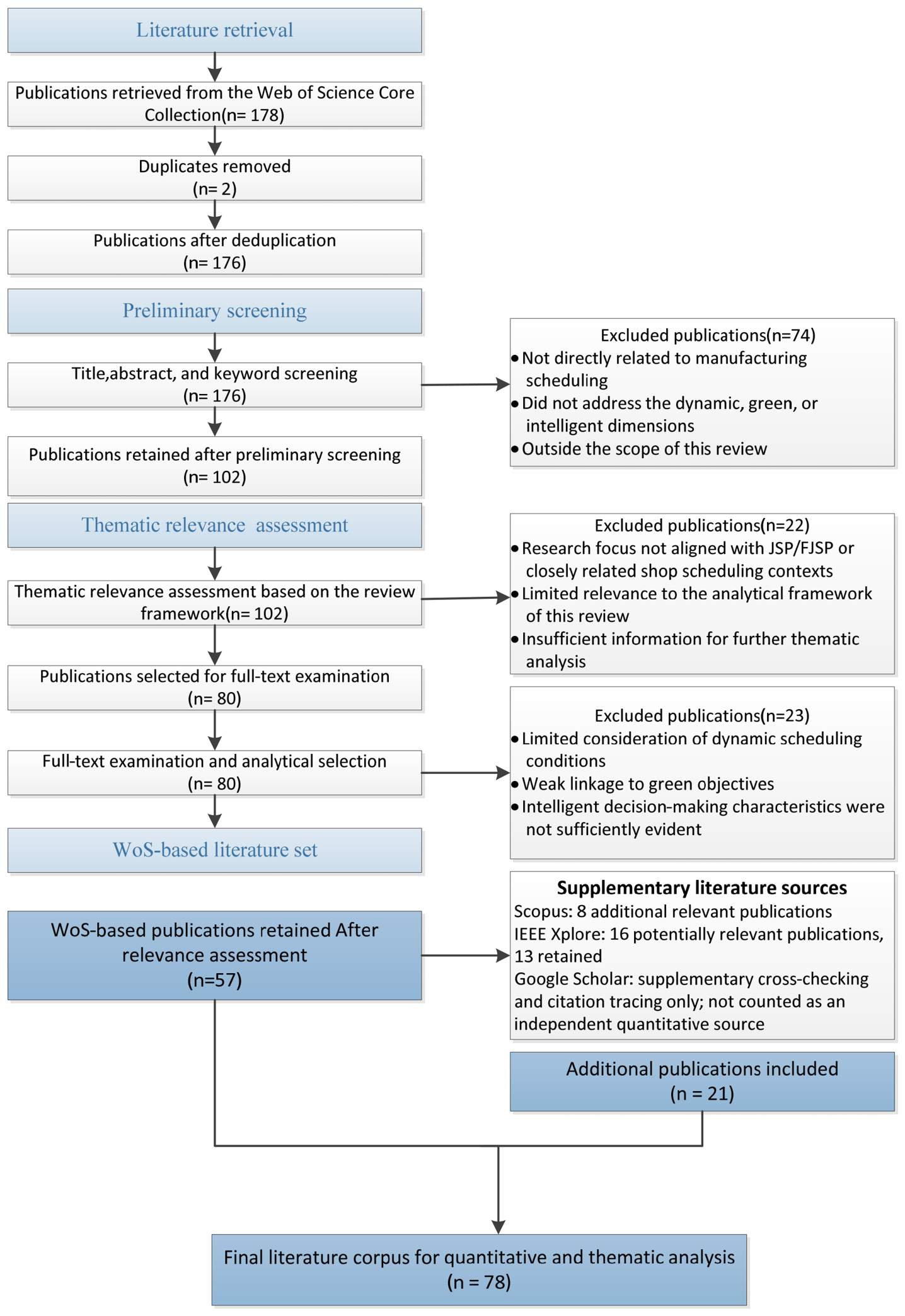
These eligibility criteria were applied sequentially during database-level deduplication, title/abstract screening, thematic relevance assessment, and full-text analytical selection, as detailed in Section 2.1.3 and illustrated in Figure 1.

2.1.3. Literature Selection Process

The literature screening was conducted in several sequential stages, as summarised in Figure 1. First, the core and pairwise searches in the Web of Science Core Collection yielded 178 records. After the removal of two duplicate records, 176 publications remained for preliminary screening. Titles, abstracts, and keywords were then examined to determine whether the records were directly related to manufacturing scheduling and whether they showed meaningful relevance to at least one of the D-G-I dimensions. At this stage, 74 publications were excluded because they were outside the scope of manufacturing scheduling, did not address the dynamic, green, or intelligent dimensions, or were otherwise inconsistent with the review scope. The remaining 102 publications were subjected to a thematic relevance assessment against the review framework. Twenty-two publications were excluded because their research focus was insufficiently aligned with JSP/FJSP or closely related scheduling settings, their relevance to the D-G-I framework was limited, or the available information was insufficient for subsequent thematic analysis.
The full texts of the remaining 80 publications were then examined in detail. At this stage, each study was assessed against the predefined eligibility criteria, including the scheduling context, contribution to the D-G-I framework, methodological clarity, and availability of experimental or case-based evidence. Twenty-three publications were excluded during this analytical selection stage because their consideration of dynamic scheduling conditions, green objectives, or intelligent decision-making characteristics was insufficient for inclusion in the quantitative corpus. The resulting Web of Science-based literature set therefore contained 57 publications.
To reduce the risk of database-specific omission, supplementary searches were subsequently conducted in Scopus and IEEE Xplore using the same conceptual search blocks and the database-specific search syntax described in Section 2.1.1. After comparison with the Web of Science-based set and application of the same eligibility criteria, eight additional relevant journal publications were retained from Scopus. The IEEE Xplore search yielded 16 potentially relevant records for further examination; 13 satisfied the inclusion criteria and were added to the quantitative corpus, whereas 3 were retained only as background references because they did not fully meet the criteria for quantitative inclusion. Consequently, 21 additional publications were incorporated, increasing the final quantitative literature corpus from 57 to 78 publications. Google Scholar was used only for supplementary citation tracing and cross-checking, and did not contribute independently counted records to the quantitative corpus.
The title, abstract and full-text screening was conducted by the first author using the predefined inclusion and exclusion criteria. Records for which eligibility or relevance to the D-G-I framework was uncertain were further discussed with the co-authors before a final decision was made. The same eligibility criteria were applied to the supplementary records retrieved from Scopus and IEEE Xplore. The final literature set and the subsequent thematic classifications were additionally checked for consistency during manuscript preparation.

2.2. Literature Analysis

The classification framework keeps three analytically different questions apart: which environmental outcome is optimised, which dynamic event must be handled, and which digital or intelligent mechanism supports the decision. The green dimension ranges from energy and carbon reduction to electricity cost and renewable energy use. The dynamic dimension covers new job insertion, machine failures, processing time uncertainty and real-time rescheduling. Deep reinforcement learning, graph neural networks, multi-agent reinforcement learning, digital twins and related approaches form the digital intelligence dimension. Within this review, the separation allows studies to be compared without confusing the problem setting with the solution technique.
For thematic coding, each publication in the 78-paper quantitative corpus was examined using a common set of analytical fields, as follows: problem setting, dynamic or uncertain factor, green objective, digital or intelligent method, validation environment, main contribution, and reported limitation. Classification was based on the substantive content of the full text rather than solely on titles or keywords. A study was coded as D when dynamic events, uncertainty or rescheduling formed part of the scheduling problem; as G when energy consumption, carbon emissions, electricity cost, renewable energy utilisation or another explicit environmental objective was modelled or evaluated; and as I when digital, data-driven, learning-based or knowledge-based mechanisms directly supported scheduling decisions. Combined labels, such as D + G, D + I, G + I and D + G + I, were assigned when a study substantively addressed more than one dimension.
For descriptive analyses in which categories were conceptually overlapping, multiple coding was permitted and the corresponding denominator or coding rule was stated in the figure or table note. Where a mutually exclusive classification was required, the principal research characteristic or dominant event-handling mechanism was used as the primary category. Foundational and complementary references cited for methodological background or emerging technologies were not included in the quantitative coding unless they formed part of the final 78-paper corpus. Accordingly, analyses specific to dynamic-event-handling were restricted to studies coded with a D dimension, whereas studies without a D dimension were retained in other corpus-level analyses where applicable.

2.2.1. Overall Analysis

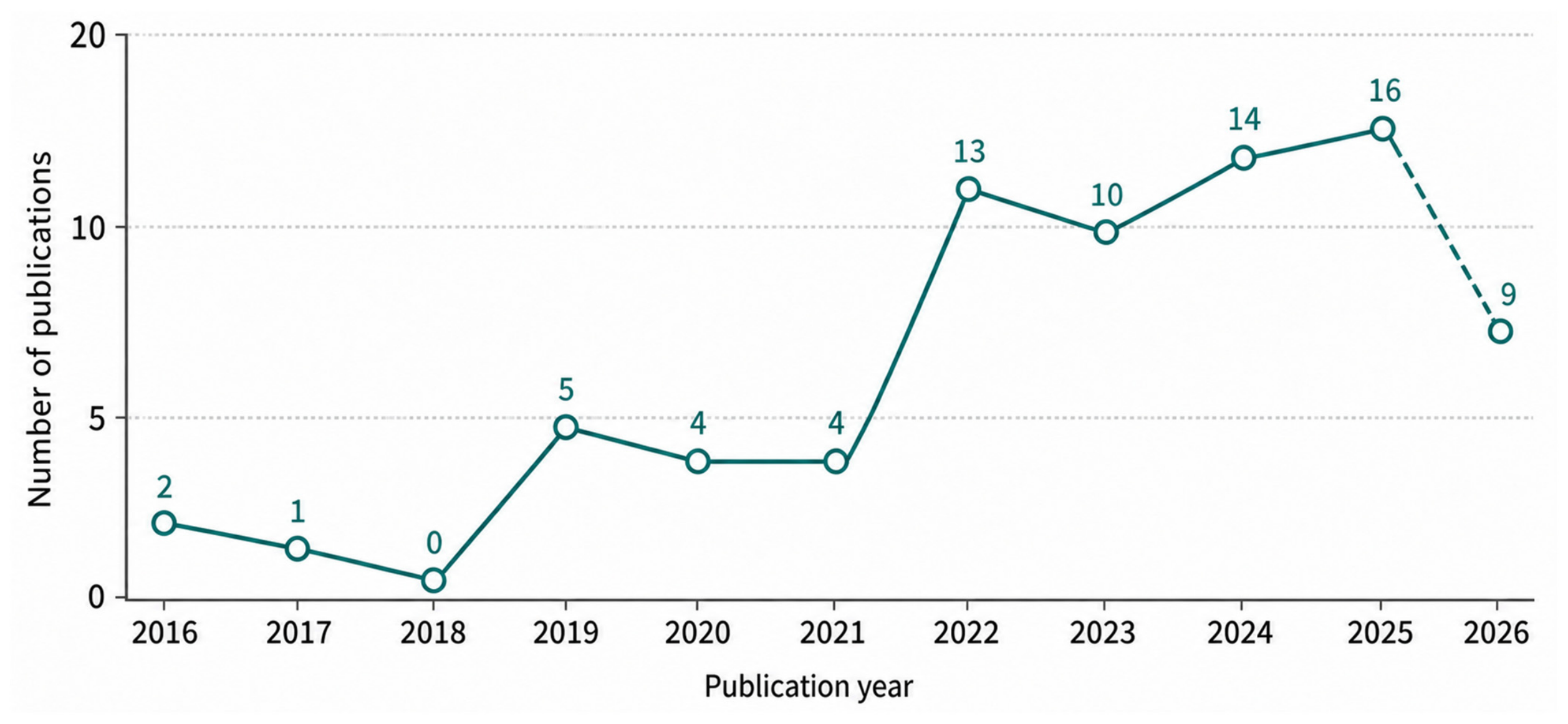
The 78-paper sample was analysed by publication year, source journal and research content. As Figure 2 indicates, activity increased markedly over the past decade, although not at a uniform rate. Eight papers appeared between 2016 and 2019, suggesting that the D-G-I intersection was then dispersed across partly separate research streams. The annual average rose to 4.0 papers in 2020–2021, and 37 papers were published between 2022 and 2024, accounting for 47.4% of the sample; 14 appeared in 2024 alone. This acceleration coincided with stronger low-carbon manufacturing requirements, wider access to DRL tools, and the diffusion of digital twins and IIoT infrastructures capable of supporting real-time data acquisition. Sixteen papers were identified for 2025 and nine for 2026, with the latter count limited to publications available by July. The post-2024 decline should therefore not be read as evidence of a substantive downturn: indexing delays and publication cycles may explain part of the pattern. More defensible is the observation that recent studies use a broader method set and engage more directly with online operation than the early literature.
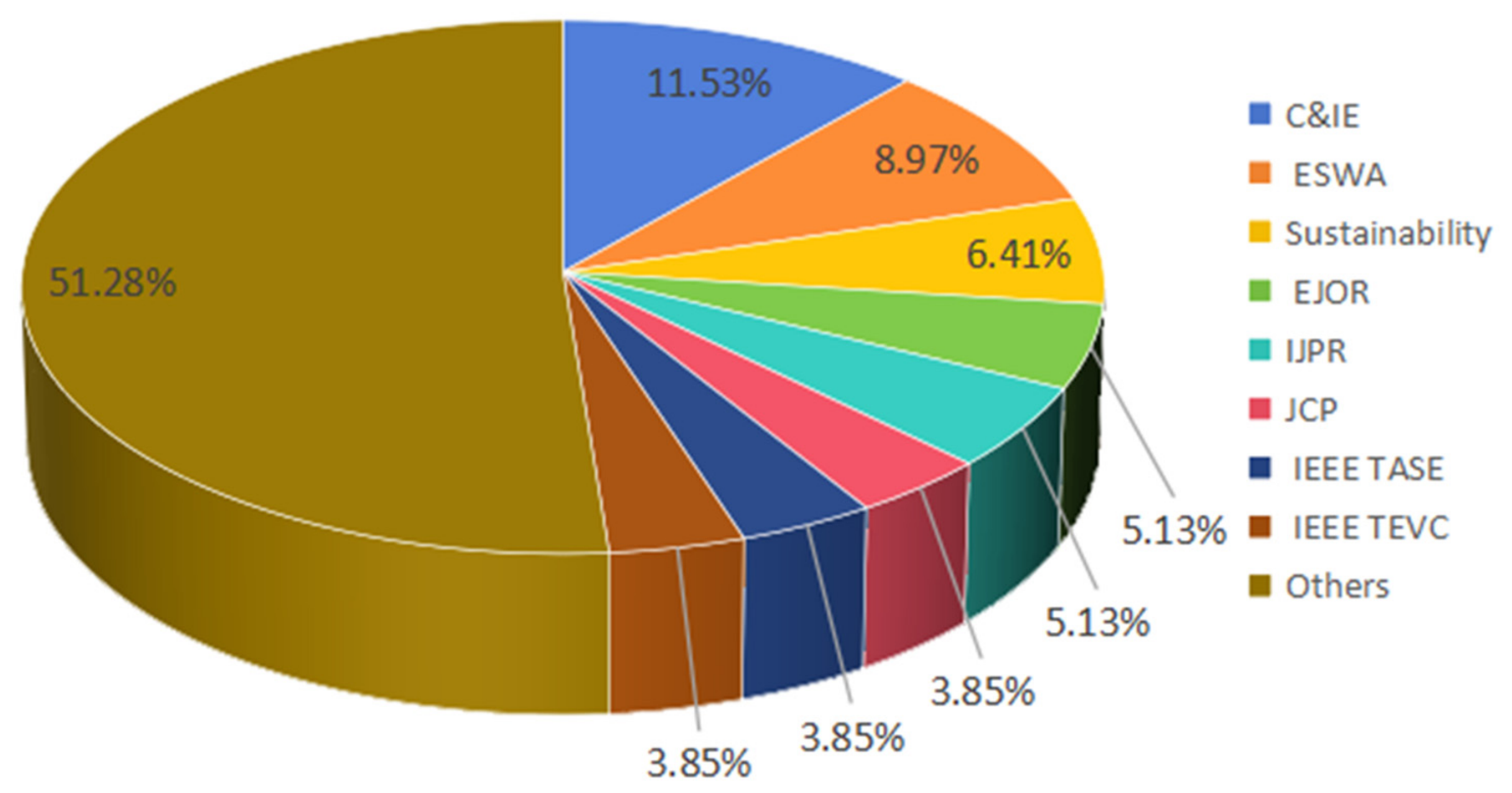
Figure 3 presents the distribution of the 78-paper corpus across eight major source journals and the remaining journals grouped as “Other journals”. The eight major journals were identified according to publication frequency within the final corpus. Together they account for 38 papers (48.72%), while the remaining 40 papers (51.28%) are distributed across other journals. Thus, the evidence is moderately concentrated in outlets covering manufacturing systems, operations research and artificial intelligence. Computers & Industrial Engineering (C&IE) contributes nine papers (11.53%), the largest share within the dataset. Expert Systems with Applications (ESWA) follows with seven (8.97%), reflecting the increasing use of AI-based and intelligent optimisation methods in dynamic green scheduling. Sustainability accounts for five papers (6.41%), while the European Journal of Operational Research (EJOR) and the International Journal of Production Research (IJPR) each account for four papers (5.13%), indicating that the topic is being addressed from sustainability, operations research and production management perspectives. The Journal of Cleaner Production (JCP) contributes three papers (3.85%), while IEEE Transactions on Automation Science and Engineering (IEEE TASE) and IEEE Transactions on Evolutionary Computation (IEEE TEVC) also contribute three papers each (3.85%). The remaining 40 papers (51.28%) are dispersed across a wide range of other journals, reflecting the broader disciplinary reach of this research topic. Within this sample, then, a small group of manufacturing and operations journals carries a substantial share of the literature, but the broader source profile remains interdisciplinary.

2.2.2. Classification by Scheduling Solution Methods

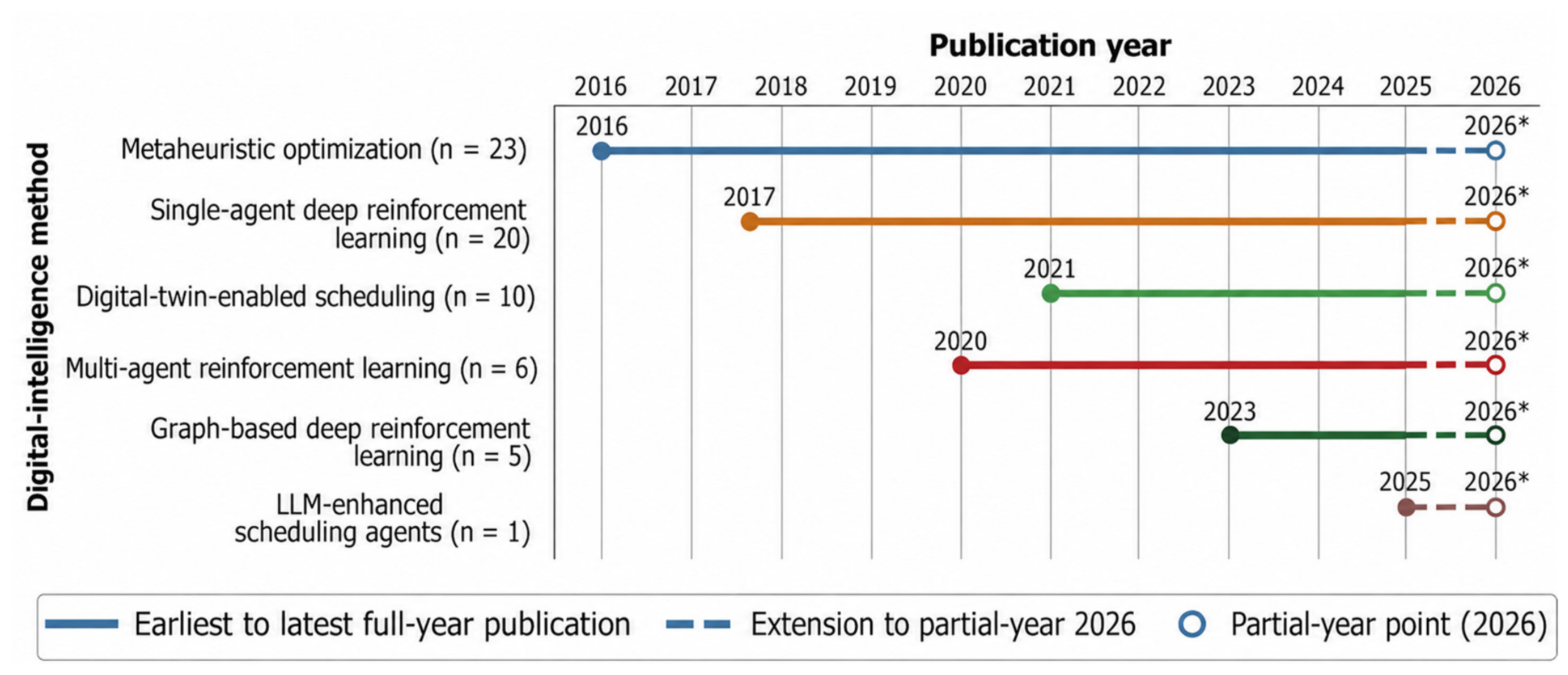
The timeline in Figure 4 places metaheuristics and multi-objective evolutionary algorithms at the early computational core of the field.
For the classification in Figure 4, all 78 publications in the quantitative corpus were examined at the full-text level to determine whether a digital or intelligent method played a direct functional role in scheduling. Coding evidence was taken from the proposed framework, state representation, prediction module, optimisation procedure, policy-generation mechanism and experimental implementation. A method was coded only when it directly contributed to representing the scheduling state, predicting production conditions, generating or improving schedules, selecting scheduling actions, or updating decisions during execution. Technologies mentioned only in the introduction, related work discussion or future outlook were not counted. Six recurring method families were used for temporal comparison. Metaheuristic optimisation was coded when a search-based heuristic or evolutionary procedure directly generated or improved scheduling solutions, including representative approaches such as genetic algorithms, particle swarm optimisation, tabu search, variable-neighbourhood search and multi-objective evolutionary algorithms. Single-agent deep reinforcement learning was coded when one learning agent directly mapped scheduling states to actions or policies through a reinforcement learning mechanism. Digital twin-enabled scheduling was coded only when a digital twin participated directly in state synchronisation, simulation or prediction, schedule evaluation, disturbance analysis or rescheduling; merely describing a digital twin architecture without using it in the scheduling decision process was insufficient. Multi-agent reinforcement learning was coded when multiple reinforcement learning agents interacted or coordinated scheduling decisions through distributed or cooperative policies. Graph-based deep reinforcement learning required both an explicit graph-based representation of the scheduling problem and a reinforcement learning mechanism that used this representation to generate or learn scheduling decisions. LLM-enhanced scheduling agents were coded when a large language model or related foundation model directly supported scheduling-oriented reasoning, knowledge retrieval, task decomposition, decision generation, coordination or policy explanation, rather than being mentioned only as a prospective technology.
These method families were not treated as mutually exclusive because hybrid scheduling frameworks may integrate several mechanisms within the same study. A publication was therefore assigned to every method category whose operational criterion it satisfied, but it was counted only once within each category regardless of how many variants of that method were used. For example, a study combining graph neural networks with PPO could be coded as both graph-based deep reinforcement learning and single-agent deep reinforcement learning when both components directly participated in scheduling. Similarly, a digital twin framework incorporating reinforcement learning could contribute to both the digital twin-enabled and reinforcement learning categories. Publications whose scheduling methods did not satisfy any of the six displayed definitions remained part of the 78-paper corpus but did not contribute to the corresponding category counts in Figure 4. For the temporal analysis, each coded publication was assigned according to its publication year; the category total nn denotes the number of unique publications satisfying that category, rather than the number of algorithms reported. Detailed inclusion and boundary rules are provided in Appendix A, Table A2.
Hybrid genetic-variable-neighbourhood search, hybrid tabu search and fast tabu search established effective solution procedures for JSP/FJSP [21,22,23], while periodic, event-driven and reactive rescheduling supplied practical means of revising schedules after disruption [24,25]. NSGA-II became a common benchmark for Pareto-based multi-objective search [26], particle swarm optimisation broadened the population-based toolkit [27], and automated heuristic design reduced the dependence on manually constructed dispatching rules [28]. Recent studies have further extended this line through evolutionary multitask optimisation and grammar-guided genetic programming for dynamic job shop scheduling [29,30]. As response time became more consequential, attention shifted from repeated online searches towards learned scheduling policies. Luo and co-workers proposed DRL frameworks for new-job insertion and dynamic multi-objective FJSP [31,32]; a hybrid deep Q-network was subsequently used to coordinate production and transportation under limited transport capacity [33], and policy-learning approaches were extended to variable and uncertain processing times [34,35,36]. Hybrid intelligent approaches have also combined deep reinforcement learning with co-evolutionary search and knowledge-transfer mechanisms for energy-aware distributed FJSP [37,38]. These methods can reduce repeated optimisation during execution, but the gain is conditional on state action scalability, adequate training coverage and the explicit treatment of safety constraints.
The scalability trade-off becomes sharper as jobs, machines and disturbance types multiply. Graph neural networks address part of this difficulty by representing operation precedence and machine competition directly; stronger structural representations can also support transfer across problem sizes [39,40]. Multi-action DRL frameworks further broaden the action representation used in flexible job shop scheduling [41]. End-to-end multi-target scheduling has further combined graph-based representations with PPO to coordinate processing, transportation and energy-related decisions [42]. Multi-agent graph networks extend this logic to distributed resource coordination [43]. Comparative research has also examined the reliability of reinforcement learning-based production scheduling [44], while dynamic multi-objective learning further supports decision-making under changing production conditions [45]. Digital twin research follows a complementary path. Instead of learning a policy alone, it links physical data, virtual simulation, disturbance recognition and rescheduling, and has progressed from dynamic JSP towards adaptive and proactive scheduling [46,47,48]. Recent extensions encompass hybrid flows, edge computing and cloud-edge production–transport collaboration [49,50,51], while lifecycle-oriented studies emphasise large-scale data as a means of maintaining cyber–physical consistency [52,53]. Large language models introduce a knowledge-oriented layer, particularly for representation, task decomposition and collaborative reasoning [54,55]. Their potential is evident; convincing evidence on feasibility, inference latency and industrial reliability in dynamic green settings is not.

2.2.3. Classification by Green Objective Modelling

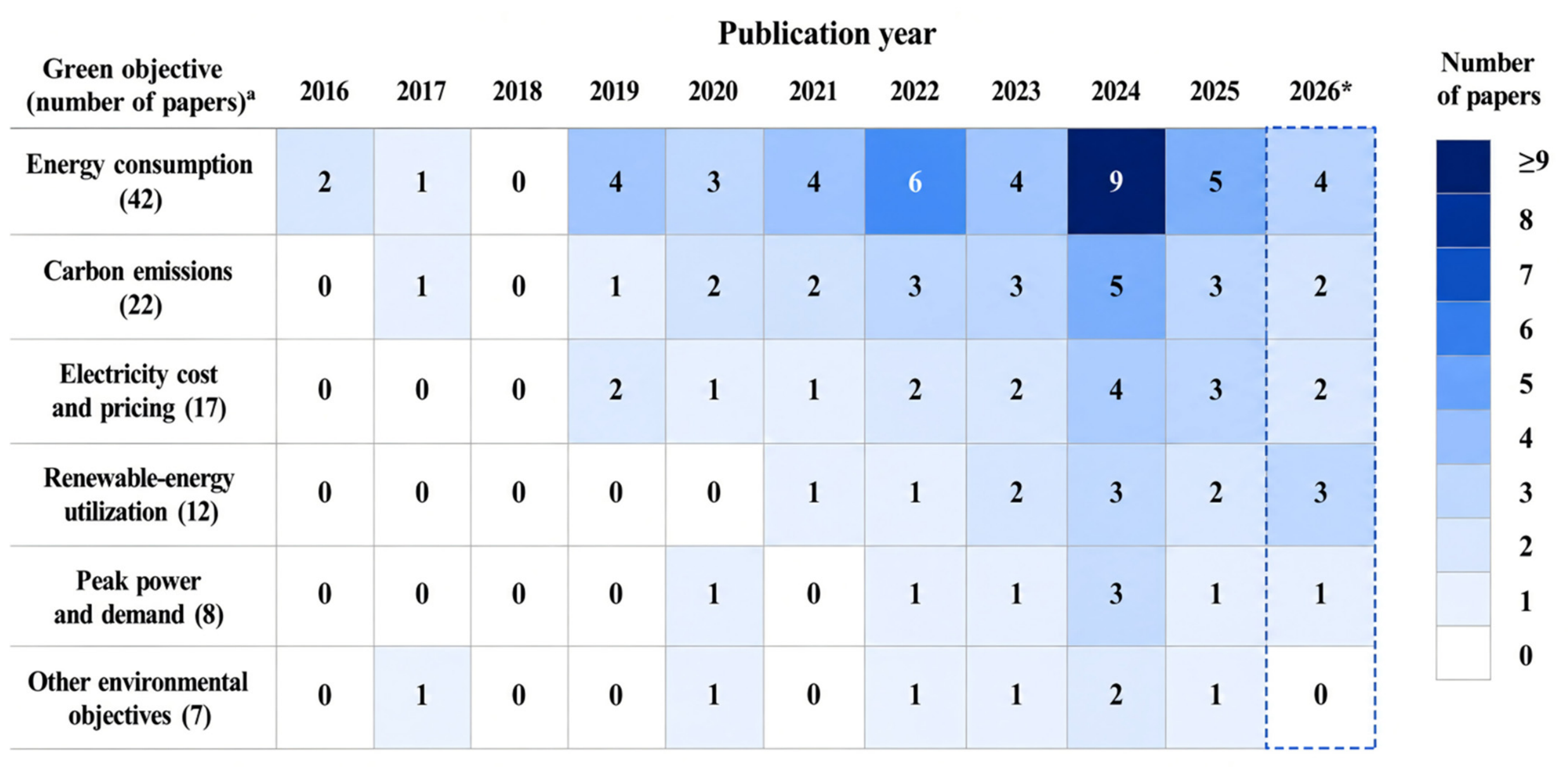
Figure 5 shows how the meaning of ‘green’ has widened within scheduling research.
For the green objective analysis in Figure 5, all 78 publications were examined to determine whether a measurable energy- or environment-related criterion was explicitly incorporated into the scheduling study. Coding was based on the mathematical formulation, objective function, constraints and quantitative performance indicators reported in the full text. A criterion was counted as a green objective only when it was explicitly optimised, constrained or quantitatively evaluated in relation to scheduling decisions. General statements concerning sustainability, green manufacturing or environmental improvement without a measurable criterion were not sufficient for coding. Six green objective categories were distinguished. Energy consumption was coded when total, processing, idle, transportation or other directly quantified energy use was explicitly optimised, constrained or evaluated. Carbon emissions were coded when carbon or CO2 emissions, or an equivalent emission quantity derived using an explicit carbon factor, formed a quantitative scheduling criterion. Electricity cost and pricing were coded when electricity expenditure, time-of-use tariffs, dynamic electricity prices or related price signals directly influenced the scheduling objective, constraints or evaluation. Renewable energy utilisation was coded when renewable energy availability, consumption, matching, utilisation level or a comparable renewable energy indicator directly entered the scheduling formulation or assessment. Peak power and demand were coded when maximum power, peak load, demand level or an equivalent peak demand indicator was explicitly considered. Other environmental objectives were used for measurable environmental criteria that did not fall within the preceding five categories.
Green-objective categories were coded independently and were therefore allowed to overlap. A publication was assigned to every category for which an explicit quantitative criterion was present, but it was counted only once within each category. Importantly, one indicator was not automatically inferred from another. For example, a study using time-of-use electricity prices was coded as electricity cost and pricing, but it was additionally coded as energy consumption only when energy use itself was separately formulated or quantitatively evaluated. Likewise, a carbon emission term calculated from electricity consumption and a carbon factor was coded as carbon emissions; the study was additionally assigned to the energy consumption category only when energy use was itself treated as a distinct scheduling criterion. This rule prevents derived quantities from artificially inflating multiple categories. Publications without an explicit measurable green criterion remained part of the overall corpus when they contributed to the dynamic or intelligence dimensions, but they did not contribute to the category counts in Figure 5. Detailed coding definitions and boundary cases are summarised in Appendix A, Table A3.
Early studies concentrated on equipment-level energy reduction through operating control, production sequencing and process flexibility [56,57]. Time-of-use tariffs, flexible manufacturing configurations and machine-level energy costs were later incorporated into scheduling models [58,59,60]. Single-machine energy cost scheduling further extended these ideas [61], while review work consolidated the growing literature on energy-efficient production scheduling [62]. Low-carbon FJSP, multi-objective energy optimisation and job shop energy efficiency studies then established a stronger basis for examining production time and environmental performance jointly [63,64]. Subsequent formulations incorporated machine turn off/on strategies, variable processing speed decisions, dynamic power characteristics, processing and transportation energy, and time-varying electricity prices [65,66,67,68,69,70,71]. IoMT-based real-time control and multi-speed green scheduling have further extended energy-aware scheduling mechanisms [72,73]. More recent work places new job arrivals, carbon objectives, energy production coordination, Q-learning-assisted rescheduling, customer satisfaction, peak demand and renewable energy fluctuations in the same decision space [74,75,76,77,78,79,80,81,82,83,84]. Related energy-efficient scheduling studies have also examined assembly operations, power-down mechanisms and energy-related trade-offs in adjacent production settings [85,86,87]. Fuzzy processing time uncertainty, maintenance decisions, integrated TOU–renewable energy management, and learning effects have also been incorporated into green FJSP formulations [88,89,90,91]. The environmental scope has expanded faster than the underlying energy model fidelity. Linear or piecewise linear assumptions remain common, whereas nonlinear power load relations, temperature effects, equipment ageing and maintenance-related energy behaviour are still represented only occasionally.
Beyond incorporating energy consumption and related environmental or economic indicators into scheduling objectives, energy-efficient scheduling studies have developed several operational strategies for improving energy and economic performance. Three representative approaches are machine turn off/on, processing speed selection, and time-of-use (TOU) electricity tariffs.
The turn off/on strategy exploits sufficiently long idle periods by shutting down inactive machines when the expected idle duration exceeds the break-even threshold associated with additional start-up energy and time. This strategy can therefore reduce unnecessary idle energy consumption, although frequent switching may introduce additional energy use, time loss and equipment-related constraints [56,86].
Processing speed selection treats machining speed as an additional scheduling decision. Different speed levels affect processing time and machine power simultaneously, creating an explicit trade-off among completion time, machine utilisation and energy consumption. Variable-speed FJSP studies therefore jointly optimise operation sequencing, machine assignment and processing speed levels to obtain a better balance between production efficiency and energy performance [71].
TOU-based scheduling incorporates time-varying electricity prices into scheduling decisions, and shifts energy-intensive operations away from high-price periods when production and technological constraints permit. Unlike the turn off/on and speed selection strategies, its primary benefit may be a reduction in electricity cost rather than a direct reduction in total energy consumption; however, it provides an important mechanism for coordinating production schedules with temporal energy conditions [59,79].

2.2.4. Classification by Dynamic-Event-Handling Strategies

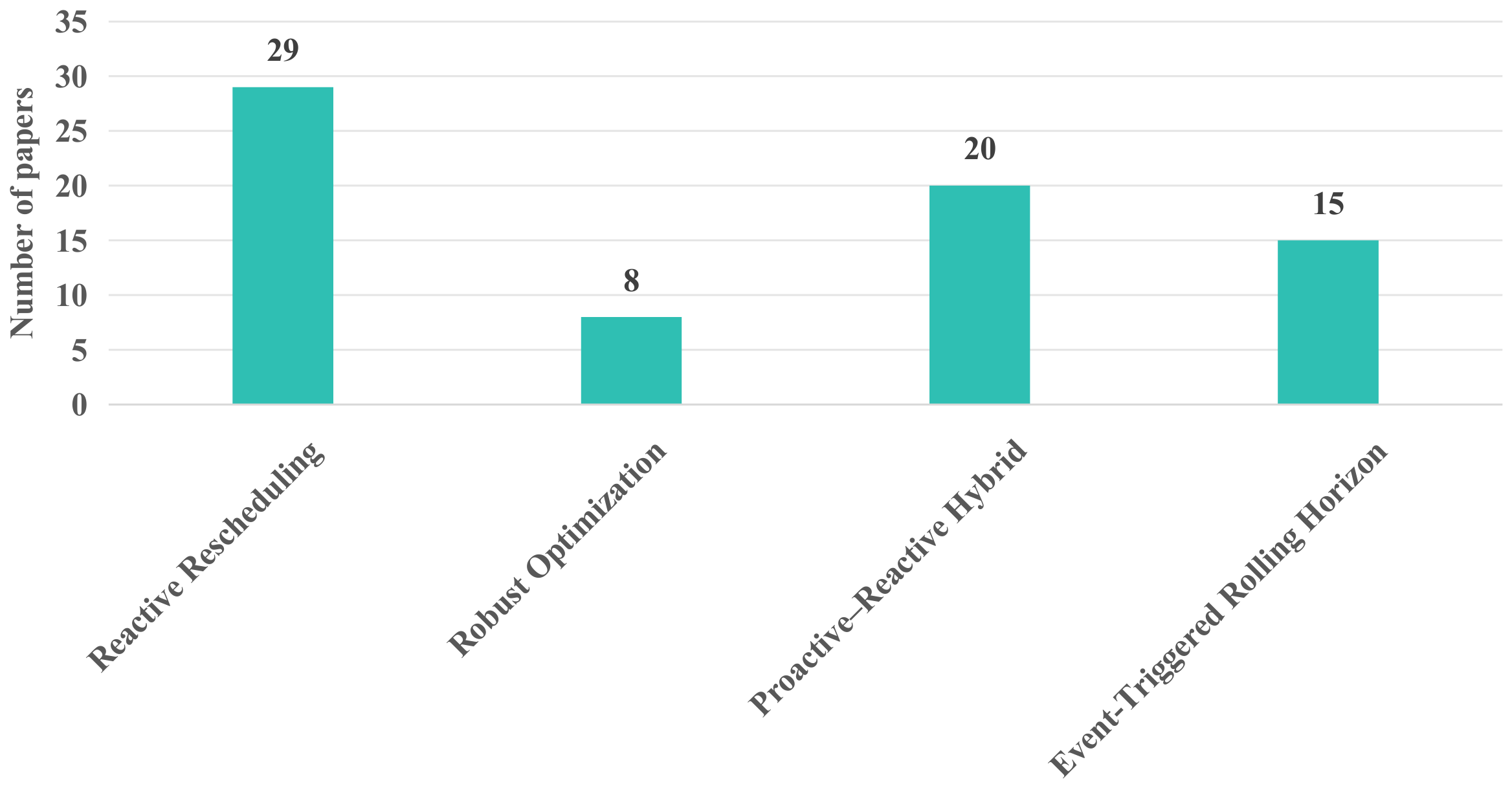
Figure 6 summarises the distribution of the four principal dynamic-event-handling strategies identified in the reviewed literature. The reviewed studies can be grouped into four principal event-handling strategies: reactive rescheduling, robust optimisation, proactive–reactive hybrid scheduling, and event-triggered rolling horizon scheduling.
For the dynamic event analysis, only publications in the 78-paper quantitative corpus that explicitly addressed dynamic events, uncertainty, or rescheduling were considered. Studies without a substantive dynamic dimension were retained in the overall D-G-I corpus but were not included in the event-handling classification. The individual publication was used as the unit of classification. For eligible studies, classification was based on full-text evidence from the problem formulation, scheduling procedure, algorithmic workflow, and experimental setting rather than on titles or keywords alone. More importantly, the classification criterion was the dominant event-handling logic governing when and how the schedule was updated, rather than the optimisation or learning algorithm used to obtain the schedule.
Four primary event-handling mechanisms were distinguished. Reactive rescheduling refers to approaches in which a realised disturbance, such as a machine failure, new job arrival or processing time deviation, first changes the production state and the existing schedule is subsequently repaired, adjusted or regenerated. Robust optimisation refers to approaches in which uncertainty is incorporated before execution and the scheduling model seeks a solution capable of maintaining feasibility or acceptable performance over anticipated scenarios, uncertainty sets or disturbance ranges, without relying primarily on post-event rescheduling. Proactive–reactive hybrid scheduling requires both an explicit pre-event component, such as prediction, buffering, robustness or preventive adjustment, and a post-event component that revises the schedule after the disturbance is observed. Event-triggered rolling horizon scheduling refers to approaches in which a predefined event, state change or triggering condition initiates the repeated advancement or reconstruction of the decision horizon and a new scheduling or optimisation decision. Learning-based methods are increasingly embedded within these event-handling mechanisms to select or generate scheduling actions from evolving system states; however, they are treated here as implementation techniques rather than as separate event-handling categories.
These four mechanisms were treated as operational primary categories for quantitative comparison rather than as theoretically exclusive scheduling paradigms. Because an individual study may contain characteristics of more than one mechanism, a hierarchical coding rule was applied to assign one primary category and avoid double counting. When repeated horizon updating triggered by an event or state change constituted the central scheduling mechanism, the study was classified as event-triggered rolling horizon. Otherwise, a study explicitly combining pre-event preparation with post-event schedule adjustment was classified as proactive–reactive hybrid; a study handling uncertainty predominantly before execution without an explicit post-event rescheduling stage was classified as robust optimisation; and a study modifying the schedule mainly after a realised disturbance was classified as reactive rescheduling. The operational definitions, coding evidence and priority rules used for this classification are summarised in Appendix A, Table A1.
Using this two-stage coding procedure, 72 publications in the 78-paper quantitative corpus were identified as having a substantive dynamic dimension, and were therefore included in the dynamic-event analysis. Of these, 29 were classified as reactive rescheduling, 8 as robust optimisation, 20 as proactive–reactive hybrid scheduling, and 15 as event-triggered rolling horizon scheduling. The remaining six publications were retained in the overall D-G-I corpus but were not included in this analysis because they did not contain a substantive dynamic-event-handling component. Figure 6 presents the resulting distribution.
For random machine failures and other dynamic events, hybrid genetic algorithms, multi-objective robust models and dynamic FJSP formulations have been proposed [92,93,94,95]. Multi-agent systems, genetic algorithms and dynamic rescheduling have also been used for order changes, resource anomalies and flexible job shop disruptions [96,97,98,99], while artificial bee colony methods and real-time reinforcement learning have supported rescheduling policy selection [100,101,102]. More recent DRL studies formulate adaptive job shop scheduling, random job arrivals and PPO-based scheduling as sequential decision problems [103,104,105]. Learning-based rescheduling has also been extended to worker absences and renewable energy variability in sustainable dynamic FJSP [106]. Genetic programming hyper-heuristics, convolutional networks, MachineRank, discrete event simulation and graph-based reinforcement learning further extend the toolkit for rule generation, failure response, training environment construction and online updating [107,108,109,110,111,112,113,114,115]. At the method level, the development is therefore less a race towards algorithmic complexity than a move towards richer state representations and closer interaction with the executing shop floor.
A limitation recurs across these approaches, namely, disturbances are usually cleaner in the model than in the factory. Uniform distributions and Poisson arrivals simplify experimentation, and independence among event types keeps the formulation tractable. Real production is rarely so orderly. Failure risk may rise with machine load, job arrivals may cluster, and a rush order may result from an upstream delay rather than from an independent random process. Such dependencies alter both the probability of disruption and the consequences of rescheduling. Within dynamic job shop research, their limited representation is therefore not a peripheral modelling choice; it is a major constraint on industrial validity.

3. Evolution of Green Scheduling in Dynamic Job Shops

3.1. Baseline Model for Dynamic Green Job Shop Scheduling

Consider a dynamic green job shop with n jobs and m machines. Each job consists of precedence-constrained operations, and every operation must be assigned to an eligible machine. Classical JSP theory supplies the computational and scheduling foundations [116,117,118], while FJSP introduces alternative machines, richer formulations and multi-objective decision structures [119,120,121]. Genetic algorithms, hybrid genetic-tabu search and models with sequence-dependent set-up times illustrate representative solution approaches [122,123,124]. What distinguishes the present setting is that execution conditions do not remain fixed. Variable-interval rescheduling has also been used to adapt scheduling decisions as shop conditions evolve [125]. Machine failures, rush-order insertions and other disturbances change resource availability and processing conditions; a schedule feasible at release may later become inefficient or infeasible. Within the common formulation adopted here, these dynamics are examined together with the dual objectives of makespan and total energy consumption, subject to technological and resource constraints.
The baseline formulation is based on four assumptions:
(1)
At the initial decision time, all jobs are waiting for processing and all machines are idle;
(2)
At any time, each machine processes at most one operation, and each operation is assigned to exactly one eligible machine;
(3)
Operations are non-pre-emptive in the baseline model. Failure-induced interruption and subsequent rescheduling are treated as dynamic extensions rather than as part of the static reference formulation;
(4)
Operations belonging to the same job follow the prescribed technological sequence. No precedence relation is imposed across different jobs.
The formulation is intended as a baseline, not as a universal model into which every published variant must be forced. It exposes the structure shared by much of the literature—technological precedence, resource exclusivity, and the trade-off between production efficiency and energy use. Individual studies can then be read as extensions that introduce additional disturbance variables, event logic or green-state variables. This distinction matters because failures, arrivals, electricity prices, carbon factors and other scenario-specific features are represented very differently across the literature.
The baseline formulation presented here is not reproduced from a single previous study. Rather, it synthesises the precedence and machine capacity constraints commonly adopted in classical JSP/FJSP formulations [116,117,119,121] with machine state energy modelling used in energy-efficient scheduling studies [56,60,64,66]. It is introduced as a reference formulation for organising the dynamic and green extensions discussed in the subsequent sections.
Electricity is a major manufacturing input, yet machine consumption varies substantially across operating states. Processing, idling, start-up and shutdown therefore produce different energy profiles [56,57]. Green scheduling models combine these components in different ways, sometimes adding transportation energy, electricity cost or carbon emissions [62,63,64]. For interpretability, the present baseline retains processing and idle consumption together with the start-up/shutdown energy associated with explicit energy-saving actions.
Using the notation in Table 1, the baseline optimisation model is formulated as follows:
m i n   F   =   C m a x , T E C
C m a x = max i = 1 , , n C i , n i
T E C = E p r o c + E i d l e + E s w
E p r o c = i = 1 n j = 1 n i k M i j x ijk P k p r o c p i j k
E i d l e = k = 1 m P k i d l e T k idle
E sw = k = 1 m N k s w e k s w
When machine power-state switching is not explicitly considered, E sw can be omitted or set to zero.
Equation (1) defines the bi-objective baseline problem in terms of makespan and total energy consumption. Equation (2) defines the makespan as the latest completion time among all jobs, while Equation (3) decomposes total energy consumption into processing, powered-on idle, and machine switching components. Processing energy in Equation (4) is determined by machine processing power, operation processing time, and machine assignment. Equation (5) accounts for powered-on idle energy, whereas Equation (6) represents the energy associated with machine start-up/shutdown cycles. When machine power-state switching is not explicitly modelled, E s w is set to zero. Formulations that explicitly optimise machine on/off decisions require additional switching variables and corresponding constraints. A feasible schedule must also satisfy the following constraints:
C i j = S i j + k M i j p i j k x i j k i , j
k M i j m x i j k = 1   i , j
S i , j + 1 C i j   i , j = 1 , , n i 1
S r s C i j H ( 1 z i j , r s , k ) H ( 2 x i j k x r s k )  
S i j C r s H z i j , r s , k H ( 2 x i j k x r s k )  
( i , j ) ( r , s ) , k M i j M r s
The decision variables satisfy x i j k   {0, 1}, z i j , r s , k   {0, 1} and S i j , C i j 0 . The constant H is selected to be sufficiently large to relax the corresponding disjunctive constraint when two operations are not assigned to the same machine.
The feasibility constraints are expressed independently of the energy model. Equation (7) links operation start and completion times, Equation (8) assigns every operation to exactly one eligible machine, and Equation (9) preserves within-job technological precedence. Equations (10) and (11) impose disjunctive machine capacity constraints so that any two operations assigned to the same machine cannot overlap in time. Together, these equations provide a common JSP/FJSP baseline onto which dynamic disturbances and additional green state variables can subsequently be introduced.

3.2. Dynamic and Green State Representation

The baseline formulation captures resource constraints and energy components, but it does not yet reveal why the problem is dynamic. In a static model, the job set, machine availability, processing times and energy parameters are fixed before optimisation. During shop floor execution, each of these quantities may change. The state of a dynamic green job shop at time t is therefore represented as
S t = { J t ,   M t ,   P t ,   Q t ,   G t }
The state vector contains five information groups: arrived but unfinished jobs, machine availability, realised processing times and deviations, the current operation queue and work-in-process condition, and energy- or carbon-related states.
These variables are not one-off inputs. They are refreshed during execution, and the scheduling policy must remain linked to that evolving information.
D t = { D t arr ,   D t break ,   D t ptime ,   D t due ,   }
The event variables in Equation (13) denote new-job arrivals, machine failures, processing time fluctuations and due-date changes. Any one of these events may invalidate assumptions embedded in the current schedule and require resequencing, machine reassignment or speed adjustment.
Production events are complemented by the following green-state variables: energy consumption, carbon emissions, electricity price or energy cost, and renewable-energy supply.
G t = { E t ,   C E t ,   C t ,   R t ,   }
The variables represent energy use, carbon emissions, electricity price or energy cost, and renewable energy supply, respectively.
Under this state-based view, dynamic green job shop scheduling is not simply conventional scheduling with an extra energy objective. It is a repeated multi-objective decision problem in which production, resource and energy states evolve together. Job arrivals, failures and processing time changes reshape the feasible region; machine power, electricity prices and carbon intensity change the environmental consequences of the remaining choices. Two moving targets must therefore be addressed at once: operational feasibility and green performance. This formulation supplies the problem basis for Section 4, where perception, prediction, decision, feedback and learning are treated as connected functions rather than isolated modules.

3.3. Research Evolution

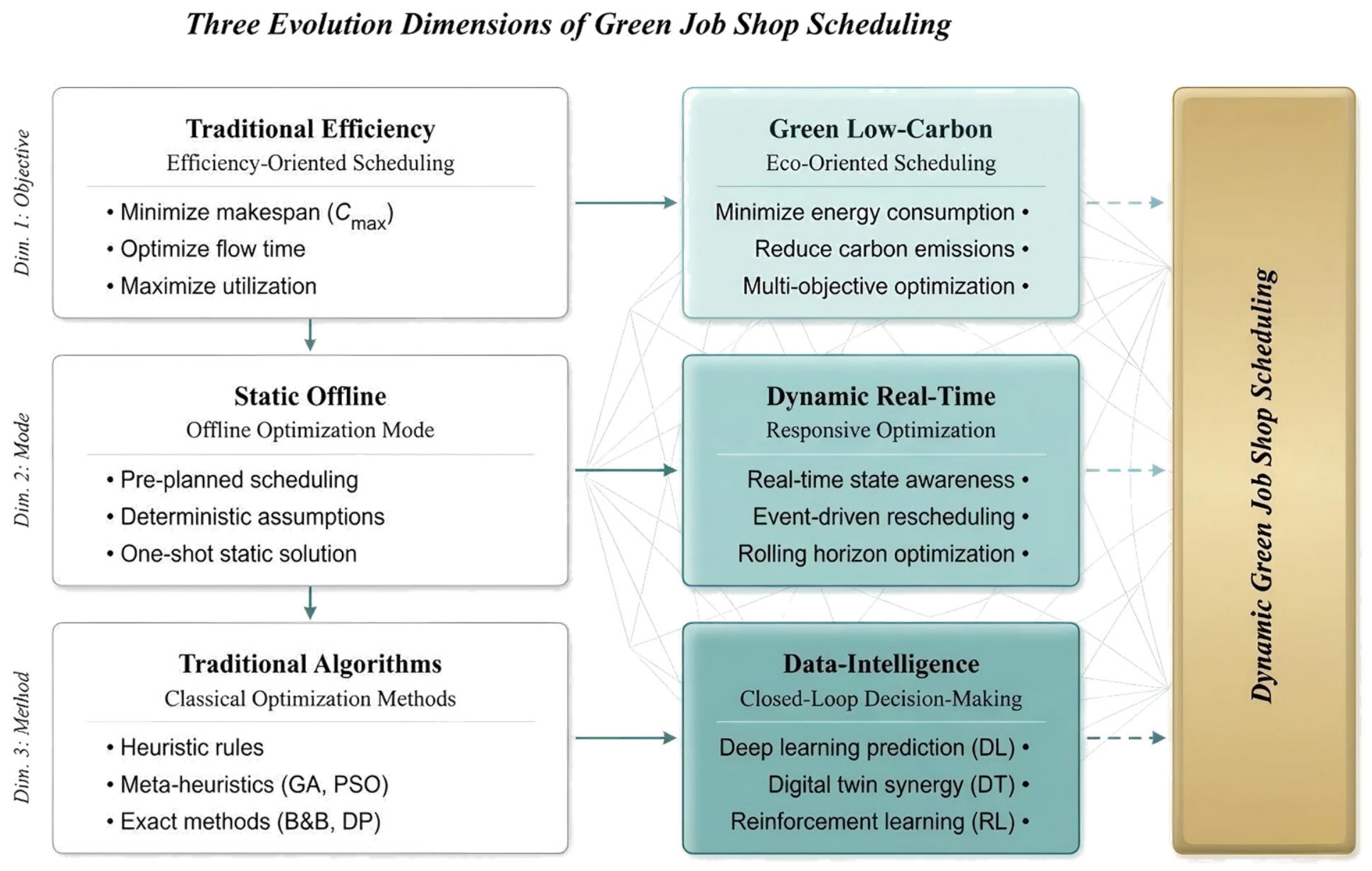
Three intertwined developments are condensed in Figure 7. Objective functions have widened from production efficiency towards energy and carbon performance. Scheduling has also moved from static offline planning to disturbance-aware and increasingly real-time revision. Alongside both changes, conventional optimisation has been supplemented by data-driven, learning-based and cyber–physical methods. These developments did not unfold independently. Reviews of dynamic scheduling established disturbance response and schedule stability as long-standing concerns [16,17,18], whereas green scheduling reviews documented the gradual entry of energy and environmental objectives into production planning [19,20]. Recent studies attempt to connect the two through digital sensing, prediction and intelligent decision support. Within this convergence, however, dynamic and green states remain weakly coupled, shop floor data are used unevenly, algorithmic explanation and transfer are limited, and digital twins seldom complete a verified path from virtual optimisation to physical execution. Table 2 is intended to make this convergence explicit by comparing representative studies across problem setting, disturbance type, green objective, digital intelligence method, contribution and limitation. Owing to space limitations, an extended classification of additional and complementary studies is provided in Appendix B.
The pattern in Table 2 is better described as convergence than as a single linear progression. Dynamic scheduling, green optimisation and intelligent decision-making initially developed as partly separate research streams. In the dynamic stream, Al-Hinai and ElMekkawy investigated robust and stable FJSP scheduling under random machine breakdowns, focusing on schedule robustness and recovery without explicitly incorporating environmental objectives [92]. In the green stream, Yin et al. developed a representative multi-objective FJSP formulation that jointly considered productivity, energy efficiency and environmental performance, although the scheduling environment remained largely static [63]. The intelligence stream subsequently introduced data-driven and learning-based mechanisms for online decision-making. Li et al. applied a hybrid deep Q-network to real-time dynamic FJSP scheduling under insufficient transportation resources [33], while Song et al. combined graph neural networks with deep reinforcement learning to represent operation–machine relationships and support scheduling decisions [39]. Digital twin studies further strengthened the connection between physical shop floor states and virtual scheduling models [46,47,48]. More integrated research has begun to connect all three dimensions; for example, Gao et al. developed a cloud–edge collaborative digital twin framework that coordinated flexible job shop scheduling, conflict-free transportation routing and energy-related decisions [51].
Taken together, these studies show that the three streams address different but complementary aspects of the same scheduling problem. Dynamic conditions determine how the feasible decision space changes; green objectives determine how candidate schedules should be evaluated from energy and environmental perspectives; and intelligent mechanisms determine how scheduling decisions are generated, updated or supported. Their gradual convergence therefore provides the empirical and conceptual basis for the D-G-I framework adopted in this review. This three-dimensional view is more informative than a taxonomy based solely on algorithms or application scenarios because it distinguishes problem conditions, optimisation purposes and decision mechanisms, while simultaneously revealing the degree to which they have actually been integrated. Industrial foundation models and LLM-based agents further extend the intelligence dimension towards knowledge-oriented support [54,55,126], but fully integrated D-G-I studies remain uncommon. Real-time green-state synchronisation, cross-scenario transfer and learning from execution feedback therefore remain open research problems rather than established capabilities.

4. Closed-Loop Decision Mechanism for Digital Intelligence-Enabled Scheduling

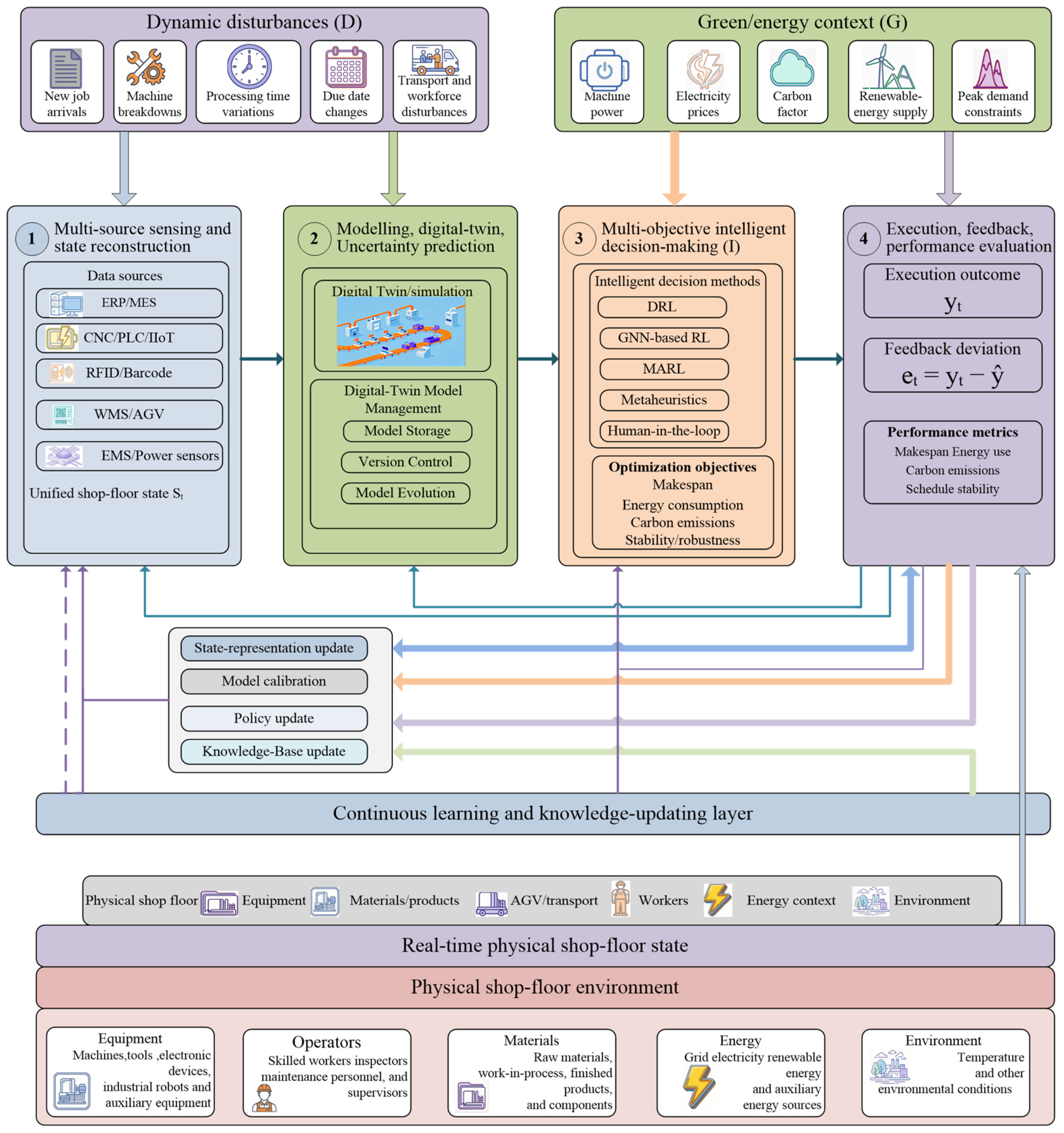
The digital technologies and intelligent algorithms improve scheduling only when they are connected through an operating decision cycle. The ‘four loops and one layer’ architecture was derived by synthesising recurring decision functions across the reviewed studies rather than by reproducing any single existing framework. Zhang et al. connected physical shop floor information with virtual scheduling models in digital twin-enhanced dynamic job shop scheduling [46]. Liu et al. extended this idea towards real-time state synchronisation and adaptive scheduling adjustment in flexible job shops [47]. Zhang et al. further used deviations between physical and virtual states to identify potential disturbances and trigger proactive scheduling actions [48]. At the infrastructure level, Wang et al. incorporated edge computing to reduce data transfer latency and support real-time operation–machine assignment [50], while Gao et al. used cloud–edge collaborative digital twins to coordinate production scheduling, transportation routing and energy-related decisions [51]. These studies illustrate a progressive movement from relatively isolated virtual modelling or rescheduling functions towards tighter coupling among shop floor observation, state representation, decision generation and physical execution.
Viewed collectively, however, the main evolution is not simply the introduction of increasingly sophisticated algorithms, but the gradual connection of previously isolated decision functions. Earlier approaches often concentrated on one stage of the process, such as state acquisition, optimisation, rescheduling or virtual modelling, whereas more recent studies increasingly connect sensing, prediction, decision and execution. The reviewed literature also shows that these connections remain incomplete. Perception may update a virtual model without reliably influencing the subsequent scheduling decision; a policy may generate scheduling actions without explicit feasibility or performance validation; and execution data may be collected without being used to recalibrate the model or update the policy. The ‘four loops and one layer’ architecture was therefore developed to make these functional dependencies explicit. Four recurring functions were abstracted into interconnected operating loops: multi-source perception and state reconstruction, modelling and prediction, intelligent decision-making and validation, and execution feedback and performance evaluation. Continuous learning and knowledge updating were placed across successive cycles as an additional layer, because experience from one scheduling cycle must be able to modify the models, policies or knowledge used in later cycles. In this sense, the four loops represent the functional chain required for scheduling to move from one-off optimisation towards closed-loop adaptation, while the learning layer represents the mechanism through which realised experience influences subsequent decisions. Figure 8 visualises this functional synthesis.
This synthesis also distinguishes the proposed architecture from conventional closed-loop or digital twin scheduling frameworks. Existing digital twin scheduling studies have progressively strengthened physical–virtual synchronisation, adaptive rescheduling, real-time computation and distributed decision support [46,47,48,49,50,51]. These capabilities constitute important components of the proposed architecture, but the present framework does not treat the digital twin itself as the entire closed loop. First, production disturbances and green states are explicitly incorporated into the same decision cycle. Second, decision generation is distinguished from decision validation and subsequent execution evaluation, allowing feasibility, environmental performance and realised outcomes to be considered before and after implementation. Third, execution feedback is extended towards continuous model, policy and knowledge updating, rather than terminating the loop once a new schedule has been generated. The proposed framework is therefore decision-centred rather than technology-centred: a digital twin may support perception, state reconstruction, prediction or validation; DRL may support decision generation; and graph-based, multi-agent or knowledge-based approaches may support other functional stages. None of these technologies alone constitutes a complete closed loop. Accordingly, the D-G-I framework and the ‘four loops and one layer’ architecture operate at different but complementary analytical levels; D-G-I explains what changes, what environmental objective is optimised and which intelligent mechanism is employed, whereas the four-loop architecture explains how these elements interact within repeated operational decision cycles. The proposed structure is therefore intended as a literature-derived, decision-oriented synthesis that complements rather than replaces existing digital twin scheduling architectures.

4.1. Multi-Source Perception and Green-State Representation

Within the proposed framework, multi-source perception converts physical shop floor activity into a decision-ready digital state. The objective is not to collect data indiscriminately. Equipment signals, production records, order information and energy measurements must be translated into variables that a scheduling system can interpret. This translation is difficult because data arrive from heterogeneous sources, at different sampling rates and with inconsistent semantics; missing values and measurement noise are common. If such observations are passed directly to a predictor or optimiser, a sensing defect can become a scheduling error. The discussion therefore separates three tasks: detecting production events, observing energy and carbon states, and fusing heterogeneous inputs into a coherent scheduling representation.

4.1.1. Dynamic Event Perception

Dynamic event perception asks a practical question: has the physical shop floor changed enough to undermine the current schedule? Relevant evidence includes order and task revisions, equipment state changes and process deviations. Once detected, these observations must be converted into event variables that update the system state or trigger rescheduling. Table 3 links the principal perception objects with their data sources, derived scheduling states and decision uses.
Earlier studies first made job flow and work-in-process status visible in real time. Zhong et al., for example, used an RFID-enabled manufacturing execution system to track material movement and identify shop floor abnormalities [127]. Later monitoring and predictive maintenance research has provided temperature, vibration, load and equipment health information that can support scheduling-relevant state assessments [128,129,130]. Digital twin studies extend this link by combining sensor, RFID, MES and machine control data to detect failures, delays and new job arrivals, and by comparing physical and virtual states before the schedule is revised [47,48]. Even with broader sensing, the evidence remains concentrated on new jobs and machine failures. Disturbances are typically represented as separate exogenous events; dependencies among workload, upstream delay, failure risk and other causes are observed far less often.

4.1.2. Energy- and Carbon-State Perception

Energy and carbon perception marks the point at which conventional shop floor monitoring becomes environmentally informative. Early scheduling studies distinguished processing, idling, standby, start-up and shutdown states so that time–energy trade-offs could be evaluated [62,63,64]. As time-of-use tariffs and energy management policies entered the models, electricity price, peak load and energy cost were added to the state description. Park and Ham shifted processing periods to reduce cost under time-of-use pricing [79]; Shen et al. examined energy cost optimisation in flexible job shops [80] and Terbrack et al. combined cost, peak demand and emissions in a broader energy aware formulation [82]. At the scheduling level, one production decision may therefore change several environmental and economic outcomes, not merely total kilowatt-hours.
Online sensing has not advanced at the same pace as green objective modelling. Failures, order arrivals and production progress are frequently updated during execution, whereas machine power, carbon factors, auxiliary equipment consumption and renewable energy availability are still often treated as fixed parameters. A persistent asymmetry results; production states are dynamic, but green states remain partly static. Comparison across studies is further complicated by inconsistent accounting boundaries. Some models include processing energy only; others add idle, start-up/shutdown or logistics consumption. Unless the green state boundary is stated clearly, reported gains in ‘energy efficiency’ are not necessarily comparable.

4.1.3. Scheduling State Construction

Constructing a scheduling state requires more than aggregating raw data. Missing, noisy, abnormal or duplicated observations must be cleaned and temporally aligned; relations among jobs, operations, machines, personnel, transport resources and energy resources must be established; and the resulting information must be encoded for prediction and scheduling. A useful representation captures both production conditions—machine availability, completed operations and queue congestion—and energy conditions such as processing, standby, idling, start-up and shutdown. Graph structures can preserve operation machine topology and express complex scheduling states more effectively [39]. Yet the graph alone does not close the loop. At the state representation level, the critical difference lies between a static structural encoding and one that remains synchronised with physical execution.

4.1.4. Synthesis and Open Issues

Shop floor data are becoming more observable, but observability should not be mistaken for decision-ready state estimation. Coverage remains uneven; machines, jobs and orders are monitored more often than auxiliary energy use, renewable supply or logistics energy, and green variables are frequently inserted as known parameters rather than updated online. Data reliability is another weak point. Although digital twin studies acknowledge noise, missing values and outliers, scheduling models usually assume that the incoming state is correct and timely; communication delay and estimation error rarely enter the decision model explicitly. Within the perception stage, progress therefore depends less on adding sensors than on building a consistent relation among production, logistics, energy and carbon data. The resulting state should be time-synchronised, entity-aligned and accompanied by an indication of confidence. Without this foundation, advanced prediction and optimisation may still solve an idealised shop floor.

4.2. Simulation Modelling and Decision-Oriented Prediction

Prediction has scheduling value only when it changes a decision. Discrete-event and multi-agent simulation offer established representations of production system dynamics [131,132], while digital twins maintain a persistent mapping between physical entities and virtual models [9,10]. A twin is distinguished not by three-dimensional visualisation, but by its capacity to keep the virtual state aligned with the physical system and to use that alignment for monitoring, prediction and schedule evaluation. Recent studies are moving from visualisation and offline what-if analysis towards real-time synchronisation, disturbance recognition, predictive scheduling and cyber–physical control [46,47,48]. Within this section, operational model construction is separated from the use of that model to anticipate future states—two functions that are often conflated in the literature.

4.2.1. Production System Modelling

The value of simulation depends on the fidelity of the production system mapping. Jobs, operations, machines, tools, logistics resources and energy resources are typically represented, together with the attributes and process relations that define their virtual states. Zhang et al. combined physical shop floor data with digital twin simulation data to predict equipment availability, recognise disturbances and reschedule production [46]. Later studies extended this approach towards adaptive scheduling, proactive prediction and hybrid process mapping [47,49]. More recent digital twin-driven FJSP studies have incorporated worker factors and deep reinforcement learning-based dynamic scheduling [133,134]. Multi-agent PPO and knowledge graph-enhanced digital twins further extend this direction towards distributed decision-making and knowledge-supported scheduling [135,136]. Edge and cloud-edge architectures can reduce data transfer and decision latency; they have also allowed transport resources and conflict-free routing to be incorporated into the same scheduling process [50,51].
However, faster computation alone does not guarantee an accurate digital representation of the executing shop floor. Physical–virtual consistency can be degraded by sensor noise, asynchronous updates, missing measurements, communication interruption and model mismatch. Once such discrepancies accumulate, the virtual state used by the scheduler may no longer correspond to the actual production state, and errors can propagate from state estimation to disturbance recognition and rescheduling decisions. Therefore, extending the mapping from individual machines to distributed production–logistics systems increases not only modelling capability but also the difficulty of maintaining reliable real-time synchronisation. Green-state mapping remains comparatively thin; real-time representations of machine power, carbon factors and renewable energy availability are still much less developed than those of orders and equipment status.

4.2.2. Simulation-Based Prediction

When does a forecast become operationally useful? Not when accuracy improves in isolation, but when the prediction changes rescheduling time, modifies a constraint, alters an acceptable risk level or reorders candidate schedules. The reviewed studies forecast processing times, failures, job arrivals, due-date deviations and energy states, as summarised in Table 4. Process monitoring, fault diagnosis and predictive maintenance support anomaly detection and remaining-useful-life estimation [128,129,130], whereas discrete event and multi-agent simulation can generate disturbance scenarios and evaluate candidate policies [131,132]. Electricity price, energy cost and peak load forecasts also affect schedule evaluation as green objectives widen [79,80,82]. Prediction and decision nevertheless remain loosely connected in many studies. A point estimate is passed to the scheduler, while confidence intervals, scenario probabilities and forecast error are discarded. Under that design, greater predictive accuracy does not necessarily reduce scheduling risk.

4.2.3. Synthesis and Open Issues

Simulation and prediction provide dynamic scheduling with foresight, but two gaps keep that foresight from becoming decision-aware. Predictive uncertainty is seldom propagated into the scheduling model; accurate forecasting and robust decision-making therefore remain separate achievements. Energy and carbon models are also calibrated mainly by use of rated or historical parameters, and are rarely corrected online when execution departs from expectation. For this reason, some systems described as digital twins still function as real-time digital mirrors; they reproduce the current shop floor but do not learn sufficiently from prediction error to recalibrate the operational model.
Beyond model calibration, the practical effectiveness of digital twin-driven scheduling depends on whether the physical–virtual loop can operate within engineering limits. First, sensing, transmission, model updating and schedule generation jointly introduce end-to-end latency. If this latency approaches or exceeds the time scale of shop floor disturbances, the virtual state used for rescheduling may already be outdated when the corresponding decision is issued or executed. Thus, latency is not merely a computational efficiency issue; it directly affects the temporal validity of scheduling decisions.
Second, physical–virtual synchronisation is inherently imperfect. Sampling intervals, sensor noise, missing or delayed measurements and accumulated modelling errors can create deviations between the physical shop floor and its digital representation. These deviations may propagate through the closed loop; an inaccurate state can distort disturbance recognition and prediction, which can then lead to inappropriate machine assignment, sequencing or rescheduling decisions [46,47,48]. The engineering problem is therefore not only how frequently the twin is updated, but whether the synchronisation error remains within a level that preserves decision reliability.
Third, communication overhead grows as the digital twin expands from individual machines to distributed production, logistics and energy resources. Edge and cloud-edge architectures can reduce part of the computational and transmission delay, but frequent state exchange, model synchronisation and coordination among distributed resources consume bandwidth and computing capacity [50,51]. As the numbers of machines, transport resources, sensors and energy variables increase, communication congestion can itself increase latency and further enlarge physical–virtual inconsistencies.
These bottlenecks are particularly important in dynamic green scheduling because production and energy states may evolve on different time scales. Delayed or inaccurate machine power, electricity price, carbon factor or renewable energy information can cause a schedule to be operationally feasible but environmentally suboptimal. Therefore, the value of a digital twin should be assessed not only by modelling fidelity or simulation accuracy, but also by end-to-end decision latency, physical–virtual synchronisation error, communication cost, and the ability to maintain reliable production and green-state updates during execution.

4.3. Intelligent Decision-Making

Once the shop floor has been sensed and modelled, the problem shifts from representation to action. The literature does not show a simple replacement of classical techniques by newer ones. Mathematical programming and metaheuristics remain valuable when constraints must be explicit; DRL is attractive when actions must be generated quickly from changing states; multi-agent and foundation model approaches add coordination or knowledge support. Within dynamic green scheduling, complementarity is therefore more informative than succession. Table 5 compares these paradigms by decision basis, responsiveness, limitations and present use.

4.3.1. Model- and Optimisation-Driven Decision-Making

Model- and optimisation-driven methods derive schedules from explicit objectives, decision variables and constraints through mathematical programming, metaheuristics or multi-objective optimisation. Early energy-aware research made the relations among equipment operation, sequencing and energy consumption visible in the model [51,52,53]; low-carbon FJSP formulations extended the trade-off to makespan, energy use and carbon emissions [63,64]. Under disturbance, robust models and breakdown-rescheduling methods update parameters, resource states or feasible regions before solving the revised problem [92,93,94]. Their appeal is direct: feasibility can be verified, trade-offs inspected and constraints interpreted. The weakness emerges when large or frequently changing problems must be solved repeatedly, because computation itself may become an operational bottleneck.
Different optimisation families serve different purposes. Exact methods are useful when instances are small enough for optimality information to matter. Multi-objective evolutionary algorithms support conflicting criteria and Pareto-set exploration, whereas rolling horizon or event-triggered re-optimisation offers a workable compromise under change. Their limitations are structural as well as computational. Re-solving after every significant event may be too slow; metaheuristic encodings and operators are often problem-specific; and methods labelled ‘dynamic’ may still assume that arrival times, failure durations or energy parameters become known once re-optimisation begins. In that case, the inputs are dynamic, but the optimiser repeatedly solves a deterministic snapshot.
Optimisation is consequently well suited to feasibility checking, benchmark generation and the production of high-quality candidate schedules. Under frequent disturbance, its more promising role may be hybrid rather than stand-alone—paired with prediction, learned policies or knowledge-based reasoning that determines when the optimiser should be invoked and which constraints require renewed attention.

4.3.2. Learning-Driven Decision-Making

Reinforcement learning addresses a different bottleneck by replacing repeated search with a policy that maps the observed state to a scheduling action. Table 6 compares representative DRL algorithms and their possible roles in green scheduling. Decentralised multi-agent scheduling has shown that local agents can coordinate online [137], and deep Q-networks provide a basis for value learning in high-dimensional state spaces [138]. Graph-attention reinforcement learning encodes operation precedence and machine competition in the state representation [139]. Multi-agent DRL has also been applied to uncertain processing transportation systems and stochastic job insertion [140,141]. Recent studies further extend this direction to energy-efficient distributed FJSP and dynamic green flexible assembly scheduling through hierarchical multi-agent DRL and graph-enhanced dual-agent reinforcement learning [142,143]. Luo et al. proposed DRL frameworks for new job insertion and dynamic multi-objective FJSP, and later combined DQN-based decision-making with limited transport capacity [31,32,33]. Once trained, such policies can act quickly. Their principal risk is distribution dependence; performance may deteriorate when the real shop floor produces event combinations absent from training.
These limitations originate from several structural characteristics of dynamic job shop scheduling rather than from individual DRL algorithms alone. First, the state and action spaces grow combinatorially with the numbers of jobs, operations, machines and feasible operation–machine assignments. Dynamic arrivals, machine failures and energy-related states further enlarge this space, making adequate exploration increasingly difficult. Second, rewards associated with makespan, tardiness, energy consumption or carbon emissions are often delayed and may be sparse over a long scheduling horizon. Consequently, it is difficult to determine which earlier dispatching or machine assignment decisions are responsible for the final performance, leading to a challenging credit assignment problem. Third, practical scheduling is inherently partially observable; processing progress, future failures, transport availability and actual energy states may be noisy, delayed or unfeasible when a decision is made. The policy therefore acts on an imperfect representation of the true shop floor state. Finally, dynamic disturbances continuously alter the state distribution, so a policy trained under one disturbance pattern may encounter substantial distribution shift during deployment [44,138,140].
These difficulties become more pronounced in green scheduling because production and environmental objectives often operate on different time scales. A dispatching decision may have an immediate effect on machine utilisation but only a delayed effect on total energy use, peak demand or carbon emissions. Reward design and state representation must therefore capture both short-term production responses and longer-term environmental consequences, which partly explains why the robust transfer of DRL policies across workshops and operating conditions remains difficult.
Furthermore, the black-box nature of DRL is closely associated with the implicit representation and nonlinear decision-making mechanism of deep neural policies. In most DRL-based scheduling frameworks, high-dimensional workshop states are compressed into latent representations and directly mapped to scheduling actions through neural networks. Although this mechanism enables agents to capture complex relationships among jobs, machines, disturbances, and environmental conditions, it provides limited insight into why a specific action is selected under a particular system state. The lack of decision traceability and interpretability becomes a critical challenge for the trustworthy deployment of DRL in dynamic green scheduling environments.

4.3.3. Multi-Agent Systems and Industrial Foundation Models: Current Progress and Comparative Analysis

As scheduling expands from individual machines to coupled production, logistics and energy resources, distributed decision-making becomes more attractive. Independent Double DQN, hierarchical multi-agent reinforcement learning and game-theoretic green assembly scheduling illustrate how local agents can coordinate online batching, production transport decisions and multi-objective green criteria [144,145,146]. Industrial generative pre-trained models and data knowledge-driven autonomous manufacturing systems introduce a different capability by integrating industrial data, domain knowledge and intelligent models for manufacturing-oriented reasoning and decision support [126,147]. LLM-based multi-agent systems are also beginning to appear in smart workshop research [55,148]. Recent studies nevertheless differ substantially in the role assigned to LLMs, their degree of integration with scheduling, and the level of experimental validation. To distinguish demonstrated capabilities from largely conceptual potential, Table 7 compares representative studies from industrial foundation models to direct LLM-enabled job shop scheduling.
Table 7 reveals a progression from general manufacturing knowledge support towards the increasingly direct involvement of LLMs in scheduling decisions. MASC embeds LLM agents directly in FJSP scheduling and rescheduling [148]; LLM4A3C uses an LLM to adapt the state and reward definitions of a DRL scheduler [149]; and the constraint-aware framework of Hu et al. [150] explicitly addresses scheduling feasibility.
Viewed comparatively, the existing LLM-enhanced scheduling studies can be grouped into three levels according to the degree of LLM involvement in scheduling decisions. At the first level, LLMs mainly provide knowledge representation, reasoning, and decision-support capabilities, while the scheduling optimisation process remains outside the language model and is performed by conventional optimisation or learning-based methods [54,126,147]. At the second level, LLMs are embedded into multi-agent or reinforcement learning frameworks to assist task decomposition, state interpretation, reward refinement, and agent coordination [55,149]. At the third level, emerging approaches allow LLMs to participate more directly in scheduling activities, including operation sequencing, machine assignment, and rescheduling [148,150].
These three levels also indicate different degrees of methodological maturity and validation depth. Knowledge-oriented industrial foundation models are mainly evaluated through application demonstrations or limited industrial cases, whereas scheduling-oriented LLM approaches are increasingly assessed using simulation environments, benchmark instances, or experimental platforms. However, the reviewed studies have not yet demonstrated a unified framework that simultaneously achieves dynamic disturbance adaptation, explicit green objective integration, and long-term industrial deployment. Therefore, a higher degree of LLM participation in scheduling does not necessarily correspond to higher industrial readiness or stronger sustainability-oriented capability.
Despite this progression, a substantial gap remains between LLM-enabled scheduling and dynamic green scheduling. Existing LLM-enhanced scheduling studies predominantly optimise production-oriented criteria such as makespan, tardiness or schedule validity, whereas the explicit integration of energy consumption, carbon emissions, time-varying electricity prices or renewable energy states remains limited [55,148,149,150]. Furthermore, the practical application of LLMs in scheduling still faces challenges related to communication overhead, inference latency, semantic reliability, and the preservation of hard scheduling constraints.
Within the four-loop, one-layer architecture proposed in this review, the current evidence suggests that the most credible near-term role of LLMs is not to replace the scheduler but to augment it. They may instead operate as a knowledge and decision-support layer, by interpreting anomalies and unstructured information during perception, assisting task decomposition or algorithm selection during decision-making, and explaining outcomes or retaining abnormal event knowledge during feedback. Machine assignment, operation sequencing and hard energy constraints would remain under optimisation or reinforcement learning modules. Such a hybrid arrangement assigns foundation model reasoning, optimisation and digital twin validation to tasks for which each is comparatively suited.
Industrial foundation models should therefore be treated as an emerging support technology, not as a mature autonomous scheduling paradigm. Evidence is strongest for knowledge question answering, task planning, human–machine interaction and agent construction. Direct demonstrations of online green scheduling under failures, dynamic arrivals and changing energy states remain scarce. Nor are the practical conditions trivial. Recommendations must satisfy technological and resource constraints, inference must fit the decision horizon, hallucinated knowledge must be controlled, and interaction with digital twins, optimisation algorithms and reinforcement learning policies must be verifiable. Until these requirements are demonstrated consistently, foundation models are better positioned as a knowledge-augmentation and decision-support layer within the closed loop.

4.3.4. Synthesis and Open Issues

Intelligent decision methods have improved responsiveness, yet the unresolved issues extend beyond algorithmic speed. Green objectives are often reduced to total energy or cost, leaving peak demand and equipment life effects outside the model. Fixed reward weights make many RL policies insensitive to changing enterprise priorities; end-to-end policies may violate constraints, transfer poorly across scales or provide little justification for the selected action. Explainable AI techniques offer feature attribution, rule extraction and human review [151,152], but scheduling still lacks a mature explain–validate–intervene process in which explanations can be checked and used to modify decisions. The empirical base is also narrow. Most models are trained and tested in simulation, so their behaviour under data drift, prolonged operation and changing industrial conditions remains uncertain.

4.4. Execution Feedback and Continuous Learning

A schedule acquires practical value only through execution. Predicted or optimised decisions must be translated into shop floor instructions, and the observed consequences must inform later decisions. Digital twins and cyber–physical systems make this return path technically possible, moving scheduling away from an open-loop ‘compute and release’ process towards repeated dispatch, execution, observation, evaluation and correction. Digital twin-enhanced methods combine current execution data with historical twin data for equipment availability prediction, disturbance detection and rescheduling [46,47,48], while edge and cloud-edge architectures reduce delays in state exchange and schedule revision [49,50,51]. Feedback, in this setting, is not merely an audit of whether the schedule worked. It is evidence for recalibrating the model and, where necessary, revising the policy that generated the schedule.

4.4.1. Execution-Feedback Trigger Mechanism

The central feedback question is not how many indicators can be monitored, but when deviation becomes large enough to justify intervention. A composite deviation measure can be defined as follows:
D t = k = 1 K w k x kt real x kt plan x kt plan + ε
The weighting coefficients indicate the relative importance of the monitored deviations. Rolling rescheduling or global re-optimisation is triggered only when the composite measure exceeds a predefined threshold or predicted risk moves beyond the acceptable range.
This threshold logic avoids two unproductive extremes. Responding to every small deviation destabilises the schedule and causes unnecessary switching; waiting for a major failure makes intervention too late. Dynamic scheduling research uses event triggers, periodic revision and stability measures to manage this trade-off [16,17,18], while digital twin approaches compare physical and virtual states before execution is confirmed or revised [46,47,48]. Green scheduling adds a further requirement, namely, that environmental performance must be verified after execution, not merely estimated during planning. Modelled energy savings may disappear when machine efficiency declines, start–stop cycles occur more often than expected or processing lasts longer in practice. Measured power, energy source information and equipment states are therefore needed to evaluate realised green performance [72,80,90].

4.4.2. Updating and Continuous Learning

Production systems are seldom statistically stationary for long. Processing times drift, failure patterns change, and machine power characteristics evolve with operating conditions and equipment age. Once such changes become material, the scheduling system must determine what should be updated: the model, the policy or the knowledge base. Elastic Weight Consolidation and Learning without Forgetting limit catastrophic forgetting through parameter protection and knowledge retention [153,154], while cross-domain adaptation aligns distributions across equipment or operating conditions [155]. Table 8 distinguishes the three update targets. In RL scheduling, new execution data may extend the experience buffer and support adaptation or transfer. Rule- and optimisation-based systems can revise priorities, objective weights or algorithm parameters from operational history. Digital twins require separate calibration so that the virtual shop continues to represent actual processing and equipment behaviour. Any update should be validated before deployment; a digital twin test environment, safety gates, version control and rollback offer a practical means of containing harmful changes.
Continuous learning should be selective rather than incessant. Retraining after every observation adds cost, and may destabilise an otherwise adequate policy. A more controlled logic uses execution feedback to diagnose whether a mismatch originates in the model, the decision policy or the accumulated knowledge. Only the implicated component is updated; the change is then validated before being returned to operation. Over time, this deviation–update–validation–re-execution cycle converts operating experience into governed adaptation rather than uncontrolled model drift.

4.4.3. Synthesis and Open Issues

The return path from execution to learning is often the weakest element of the proposed closed loop. Some studies transmit physical data to a virtual model but do not demonstrate the reliable delivery of revised instructions back to the shop floor; functionally, such systems remain closer to digital shadows than to bidirectional twins [46,47,48]. Feedback is also weighted towards production progress, while realised energy use, carbon emissions and peak power are verified less often online. Diagnosis creates a further difficulty. When performance deteriorates, data noise must be distinguished from parameter drift, environmental change and genuine policy failure, yet this boundary is rarely made explicit. Explainability and safety review can expose the basis of a decision [151,152], while knowledge-retention and adaptation mechanisms can limit forgetting, erroneous feedback accumulation and policy oscillation [153,154,155]. Long-horizon evidence remains the decisive gap; simulation experiments and short laboratory demonstrations reveal little about model degradation, maintenance burden or operator acceptance over months of operation.
The simulation-to-industry gap is not caused by a single factor but by the simultaneous mismatch in data, disturbances, system integration, decision timing and validation conditions. Simulation models usually assume clean and complete state information, predefined disturbance distributions, stable communication and directly measurable energy parameters. In actual workshops, however, sensor noise, missing data, asynchronous information, correlated disruptions and changing production conditions can distort the state observed by the scheduling system. Moreover, a scheduling policy that performs well in simulation may become impractical when decision latency, communication delays, equipment interfaces, operator intervention and safety constraints are considered. These differences mean that superior benchmark performance does not necessarily translate into reliable industrial performance. In particular, when digital twins are used to support operational decisions, the alignment and credibility of the virtual model must be continuously assessed rather than assumed [156,157,158].
More importantly, these mismatches do not act independently; they can propagate through the scheduling loop. For example, noisy or delayed shop floor data first distort the perceived system state, which may then bias disturbance prediction or digital twin synchronisation [156]. The resulting modelling error is subsequently transferred to the scheduler, where an apparently optimal action may be generated for a state that has already changed. When this action reaches the physical shop floor, communication delay, machine constraints, operator intervention or safety requirements may further alter its execution. The realised outcome can therefore deviate substantially from the simulated result even when the optimisation algorithm itself is computationally sound. In this sense, the simulation-to-industry gap can be understood as a cumulative error propagation problem across perception, modelling, decision-making and execution, rather than merely as a difference between simulated and real data.
From an implementation perspective, the proposed “four loops and one layer” framework can be mapped onto the information and control infrastructure already present in many modern manufacturing systems. The perception loop can obtain order, routing, due date and production status information from ERP and MES, while CNC controllers, PLCs, IIoT devices, RFID/barcode systems, WMS/AGV platforms and EMS or power sensors provide machine states, work-in-process locations, transportation availability and energy-related information. These heterogeneous observations should first be time-aligned, filtered and fused into a unified shop floor state before being transferred to the modelling and prediction loop. Digital twins, discrete-event simulation or data-driven predictive models can then reconstruct the current production state, estimate disturbance consequences and evaluate short-term production and green state evolution. Depending on latency and computational requirements, these functions may be distributed between edge nodes and cloud- or plant-level computing resources.
The decision loop should operate as a governed decision service rather than as a direct algorithm-to-machine connection. Optimisation, DRL, graph-based reinforcement learning or multi-agent methods may generate candidate schedules according to the current production and green states, but a candidate action should not be released solely because it is optimal in the computational model. Before execution, technological precedence, machine availability, transport capacity, energy constraints and operational safety requirements should be checked explicitly. Approved schedules can then be transmitted through MES, dispatching systems or PLC-level interfaces to machines, operators and material-handling resources. During execution, actual start and completion times, machine states, energy use, transport delays and operator interventions should be captured and compared with predicted outcomes. The resulting deviations provide the basis for state reconstruction and digital twin recalibration and, where persistent performance deterioration is observed, for controlled model, policy or knowledge updating. Human override, safety gates, version control and rollback should remain available so that adaptive behaviour can be interrupted or reversed when a proposed update creates unacceptable production or safety risks.
Industrial evaluation should therefore examine the entire closed-loop system rather than only the optimisation algorithm. Four groups of indicators are particularly relevant. Production performance can be measured through makespan, tardiness, throughput, disturbance recovery time and schedule stability; green performance through total energy consumption, carbon emissions, peak demand, electricity cost and renewable-energy utilisation; digital system performance through state-estimation accuracy, physical–virtual synchronisation error, end-to-end decision latency, communication overhead and model prediction error; and operational reliability through constraint-violation rate, operator intervention frequency, failed or rolled-back updates and performance degradation caused by model or policy drift. Evaluation should also consider whether the computational and communication energy required by the digital solution offsets part of the reported production energy benefit. A meaningful transition from simulation to industrial deployment therefore requires staged validation. Offline simulation or historical data replay can first establish algorithmic baselines under controlled conditions; digital twin or hardware-in-the-loop testing can then examine state synchronisation, communication delay, decision feasibility and interface behaviour; pilot-scale deployment can evaluate robustness under conditions of real disturbances, human interaction and heterogeneous equipment; and long-term industrial operation can assess model drift, maintenance effort, scheduling stability and the persistence of energy and carbon benefits. Comparing the proposed approach with the existing shop floor scheduling baseline over comparable production periods would further indicate whether the improvements observed in simulations remain significant after physical deployment.
Based on the above analysis, Table 9 summarises the principal mismatches between commonly adopted simulation conditions and actual industrial operating environments.
These mismatches show that industrial deployability depends not only on optimisation performance but also on data reliability, response latency, system integration, operational feasibility and long-term robustness.

5. Future Research Directions

The reviewed literature already contains many capable components—real-time sensing, digital twins, fast-learned policies, multi-objective optimisation and emerging knowledge tools. What is still uncommon is an industrial closed loop in which these components remain synchronised during operation. The principal bottlenecks now lie less in inventing another optimiser than in linking production and green data, carrying predictive uncertainty into decisions, enforcing physical constraints in intelligent policies and showing that simulation gains survive deployment. Three research priorities follow from these gaps, as follows:
(1) From energy minimisation to multidimensional green performance. Total energy is informative, but it is not an adequate proxy for carbon impact or economic cost. Under time-of-use tariffs, variable carbon factors and fluctuating renewable supply, schedules with similar consumption may have very different environmental and financial consequences. Frequent speed changes or start–stop actions can also shift costs into wear, maintenance and quality loss. Within a broader green formulation, production efficiency, energy cost, carbon emissions, peak demand, equipment lifetime and renewable energy utilisation should therefore be treated as related but non-equivalent objectives. Multi-timescale models could coordinate production, logistics and energy, while preference learning or interactive multi-objective methods could adjust trade-offs as priorities, prices and carbon constraints change. The energy consumed by the digital solution itself—training, twin operation, communication and computation—should also be included when net environmental benefit is reported. Work on time-of-use pricing and generalised energy-aware scheduling supplies part of this foundation [79,80,82], and recent renewable energy studies reinforce the need to treat supply fluctuations as online decision variables [84,90,106];
(2) From digital mapping to a calibratable closed-loop twin. Many scheduling ‘digital twins’ remain predominantly one-directional; shop floor data update the virtual model, but the return of decisions and the use of execution outcomes for calibration are less convincingly demonstrated. Closing this gap requires more than rapid synchronisation; synchronisation accuracy, communication overhead and end-to-end decision latency must also be explicitly controlled. Processing times, machine power, failures and carbon-related states must recalibrate the virtual model, while cloud-edge–device architectures keep detection and decision latency within an operational range. Model updating and policy updating should also remain distinct interventions. The former corrects how the system is represented; the latter changes how decisions are made. By preserving that distinction, a controlled cycle of state synchronisation, schedule generation, execution verification, deviation diagnosis and knowledge updating becomes possible. Adaptive and proactive digital twin scheduling studies provide the initial mechanism [46,47,48], and edge or cloud-edge research supplies part of the low-latency infrastructure [49,50,51];
(3) From benchmark performance to industrial evidence. Classical JSP/FJSP instances remain valuable for controlled comparison, but they cannot reproduce the combined power profiles, logistics congestion, maintenance states, electricity prices, carbon intensity and interacting disturbances of an operating factory. Progress towards deployment requires open datasets and standardised test environments that integrate production tasks with time-series energy data, failures, logistics states, prices, carbon factors and execution feedback. Evaluation must also move beyond makespan and total energy. Decision latency, recovery time, schedule stability, constraint violations, peak power, carbon emissions and the computational energy of the scheduling method all bear on industrial value. A staged validation path—from offline simulation to digital twin testing, pilot deployment and long-term operation—would permit cross-scale tests, sensitivity analysis and statistical validation before full implementation. Dynamic scheduling, discrete event simulation, graph-based reinforcement learning and variable-interval rescheduling already provide useful building blocks for such reproducible evaluations [16,18,113,114,125].

6. Conclusions

This review integrates research on dynamic disturbances, green objectives and digital or intelligent scheduling methods within a single account of dynamic green job shop scheduling. Its principal contribution is a decision-oriented structure rather than another algorithm catalogue. Multi-source perception, modelling and prediction, intelligent decision-making, execution feedback and continuous learning are connected within the ‘four loops and one layer’ architecture; the D-G-I classification complements that architecture by keeping disturbance mechanisms, environmental objectives and enabling methods analytically separate.
Three developments recur across the literature. Shop floor models have become less deterministic as order, machine, logistics and energy disturbances enter the scheduling problem. Objective sets have expanded from makespan and related efficiency criteria to energy use, carbon emissions, energy cost and schedule stability. Decision methods have likewise moved beyond rules and metaheuristics towards digital twins, graph-based representations, DRL, multi-agent systems and knowledge-enhanced approaches. These developments interact rather than proceed in isolation; policy learning changes how schedules are generated [31,32,33], digital twins change how system states are represented and validated [46,47,48], and foundation models may change how domain knowledge enters the decision process [54,126,147].
The field’s main limitation is systemic rather than purely algorithmic. Production and green states are synchronised unevenly; correlated disturbances and predictive uncertainty remain weakly represented; intelligent policies often lack transferability, explanation or explicit safety guarantees; execution feedback is seldom observed over long industrial horizons; and learning mechanisms remain vulnerable to data drift, unsafe updates and rollback failures. Better benchmark scores alone cannot resolve these problems. Progress depends on trustworthy green state representations, uncertainty-aware prediction, constraint-safe and explainable decisions, bidirectional feedback and controlled updates that can be validated under operating conditions.
Dynamic green job shop scheduling is thus moving from isolated offline optimisation towards continuous decision support embedded in production. The long-term objective is not merely to produce a lower-energy schedule. It is to build a system that recognises change, anticipates risk, balances production and environmental goals, tests the consequences of a decision and learns from realised outcomes. Not until data, models, algorithms and physical execution are connected in both directions—and assessed beyond short simulation runs—can intelligent scheduling become an industrial capability that is verifiable, transferable and sustainable in operation.

Author Contributions

A.S.: Conceptualisation, methodology, literature investigation and organisation, data analysis, visualisation, writing—original draft preparation, and writing—review and editing. R.Z.: Supervision, methodology, and writing—review and editing; Y.Y.: Literature organisation, data analysis, visualisation, and writing—review and editing. X.N.: Supervision, methodology, validation, and writing—review and editing. P.M.: Literature organisation, data verification, visualisation, and writing—review and editing. All authors are responsible for the content of the work. All authors have read and agreed to the published version of the manuscript.

Funding

This research was funded by the Xinjiang Uygur Autonomous Region Key Research and Development Program, grant number 2025B04005-0001; the National Natural Science Foundation of China (No. 72661036); the Youth Science Fund of the Natural Science Foundation of Xinjiang Uygur Autonomous Region (No. 2023D01C177); the Key Technology Research and Development of Large-scale Low-cost Magnesium Electrolytic Cell (No. HGX2025KJXM008); and the Xinjiang Uygur Autonomous Region Key R&D Special Program—Department-Local Joint Initiative (No. 2024B04003-1).

Data Availability Statement

No primary experimental data were generated in this review. The data supporting the quantitative and thematic analyses were derived from the published literature cited in this article. The literature screening and coding records used in the review are available from the corresponding author upon reasonable request.

Acknowledgments

Grateful thanks are extended to the supervisor for his valuable guidance in this research.

Conflicts of Interest

The authors declare no conflicts of interest.

Abbreviations

The following abbreviations are used in this manuscript:
AIArtificial Intelligence
D-G-IDynamic–Green–Intelligence
JSPJob Shop Scheduling Problem
FJSPFlexible Job Shop Scheduling Problem
MO-DQNMulti-Objective Deep Q-Network
NSGA-IINon-dominated Sorting Genetic Algorithm II
NSGA-IIINon-dominated Sorting Genetic Algorithm III
PPOProximal Policy Optimisation
DRLDeep Reinforcement Learning
GNNGraph Neural Network
IIoTIndustrial Internet of Things
RFIDRadio Frequency Identification
TOUTime-of-Use
LLMLarge Language Model

Appendix A

Table A1. Operational coding rules for primary dynamic-event handling strategies.
Primary CategoryTiming Relative to DisturbanceOperational DefinitionMain Coding EvidencePriority/Assignment Rule
Reactive reschedulingMainly after disturbanceThe existing schedule is repaired, adjusted or regenerated after a realised disturbance changes the production state.Explicit disturbance occurrence followed by schedule modification or regeneration.Used when post-event schedule modification is the dominant mechanism and neither rolling horizon updating or an explicit proactive component is present.
Robust optimisationMainly before executionUncertainty is incorporated ex ante to construct a schedule that maintains feasibility or acceptable performance over anticipated scenarios, uncertainty sets or disturbance ranges.Scenario-based, uncertainty-set, robustness-oriented or equivalent pre-execution modelling; no primary post-event rescheduling stage.Used when uncertainty is handled predominantly before execution and explicit post-event adjustment is absent.
Proactive–reactive hybridBefore and after disturbanceExplicit pre-event preparation is combined with schedule adjustment after the disturbance is observed.Prediction, buffering, robustness or preventive adjustment together with an explicit post-event rescheduling mechanism.Used when both pre-event and post-event mechanisms are explicit, unless repeated event-triggered horizon updating is the central mechanism.
Event-triggered rolling horizonRepeated online updatingA predefined event, state change or threshold triggers advancement or reconstruction of the decision horizon and a new scheduling decision.Explicit event/state trigger together with repeated horizon shifting, reconstruction or re-optimisation.Assigned when triggered rolling-horizon updating constitutes the central scheduling mechanism.
Table A2. Operational coding rules for digital intelligence solution method categories in Figure 4.
Method CategoryInclusion CriterionBoundary/Exclusion Rule
Metaheuristic optimisationSearch-based heuristic/evolutionary method directly generates or improves schedulesMere comparison with a metaheuristic benchmark does not count
Single-agent DRLOne RL agent directly learns scheduling actions/policies from statesPrediction-only deep learning without RL-based scheduling decisions does not count
Digital twin-enabled schedulingDT directly supports synchronisation, simulation/prediction, evaluation or reschedulingConceptual/background mention of DT does not count
Multi-agent reinforcement learningMultiple RL agents coordinate or distribute scheduling decisionsConventional multi-agent systems without RL are not coded here
Graph-based DRLGraph representation and RL jointly support scheduling decisionsGNN/graph modelling without an RL decision mechanism does not count
LLM-enhanced scheduling agentsLLM/foundation model directly supports scheduling reasoning, retrieval, decomposition, coordination or decision supportFuture work or background mention of LLMs does not count
Table A3. Operational coding rules for green objective categories in Figure 5.
Green-Objective CategoryInclusion CriterionBoundary/Overlap Rule
Energy consumptionExplicitly optimised, constrained or evaluated energy useEnergy implied only through another derived indicator is insufficient
Carbon emissionsExplicit carbon/CO2 emission quantity or carbon factor-based emission criterionEnergy is additionally coded only if separately evaluated
Electricity cost and pricingElectricity cost, TOU tariff, dynamic price or price signal directly affects schedulingDoes not automatically imply an energy consumption code
Renewable-energy utilisationRenewable availability, consumption, matching or utilisation explicitly enters schedulingGeneral renewable energy discussion is insufficient
Peak power and demandPeak power, maximum load or demand indicator explicitly modelledOrdinary total energy use alone is insufficient
Other environmental objectivesExplicit measurable environmental criterion outside the five categories aboveGeneral sustainability statements are insufficient

Appendix B

Table A4. Extended classification of studies from the D-G-I perspective.
NoReferenceProblem SettingDynamic/Uncertain FactorGreen ObjectiveMethodD-G-I DimensionMain ContributionLimitations
1Lei et al. (2017) [159]Bi-objective energy-aware FJSPWorkload balance and total energy consumptionShuffled frog-leaping algorithmGEstablished an early bi-objective FJSP formulation linking workload balance with total energy consumptionThe setting is static and does not support online disturbance response or data-driven adaptation
2Gong et al. (2019) [70]Energy- and labor-aware FJSPDynamic electricity pricesElectricity cost and labor-related sustainability objectivesMany-objective evolutionary optimisationD + GLinked time-varying electricity prices and labor considerations with many-objective shop schedulingDynamicity is mainly driven by electricity price variation rather than production disruptions
3Meng et al. (2019) [160]Energy-aware FJSP with machine on/off decisionsTotal energy consumptionMixed-integer linear programmingGDeveloped and compared multiple MILP formulations for energy-aware FJSP with machine on/off strategiesComputational burden grows rapidly for large-scale or dynamic instances
4Wu et al. (2019) [161]Energy-aware FJSP with deterioration effectsTime-dependent deterioration of processing statesMakespan and energy consumptionHybrid multi-objective metaheuristicD + GCoupled step-deterioration effects with machine state energy consumption in a multi-objective FJSP modelDeterioration parameters are difficult to estimate online, and no closed-loop learning mechanism is used
5Caldeira et al. (2020) [75]Dynamic energy-aware FJSPNew job arrivalsMakespan and energy consumptionBacktracking search algorithmD + GIntegrated new job arrivals with energy-aware multi-objective reschedulingSearch-based re-optimisation may restrict response speed as problem size increases
6Ren et al. (2021) [85]Energy-aware FJSP with assembly operationsAssembly operation couplingProduction efficiency and energy consumptionMulti-objective optimisationGExtended energy-aware FJSP modeling to integrated machining–assembly operationsDynamic disruptions and online adaptation are not the main focus
7Wang et al. (2020) [162]Real-time low-carbon FJSPMulti-period real-time shop statesLow-carbon and energy-related objectivesInfinitely repeated gameD + GConnected multi-period real-time decisions with low-carbon scheduling objectivesGame assumptions and model-specific structures may limit transferability to broader disturbance types
8Duan and Wang (2021) [163]Dynamic energy-efficient FJSPMachine breakdownsMakespan and total energy consumptionNSGA-II with speed selection and idle-time arrangementD + GIntegrated machine failures, speed decisions and idle energy management in reschedulingRe-optimisation after failures may be costly for large real-time instances
9Lei et al. (2022) [41]FJSPMulti-action deep reinforcement learningIExpanded the action design for DRL-based operation sequencing and machine assignmentThe study mainly addresses static production objectives rather than dynamic or green scheduling
10Li et al. (2022) [164]Distributed green FJSPType-2 fuzzy processing timesMakespan and total energy consumptionTwo-stage knowledge-driven evolutionary algorithmD + G + ICombined processing time uncertainty, domain knowledge and energy objectives in distributed schedulingUncertainty is modeled offline, while event-triggered online adaptation remains limited
11Zhao et al. (2022) [91]Green sustainable FJSP with learning effectsLearning-effect-driven processing time changesProduction and energy-related sustainability objectivesMulti-objective evolutionary optimisationGIncorporated worker learning effects into green sustainable FJSP modelingThe learning effect is an endogenous model assumption rather than an online event-driven learning mechanism
12Sang and Tan (2022) [165]Many-objective green FJSPMultiple production and green objectivesMany-objective memetic algorithmGExtended green FJSP toward high-dimensional trade-offs among production and environmental objectivesPreference articulation and dynamic adaptation become difficult as the number of objectives increases
13Souza et al. (2022) [166]Robust JSP with maintenance constraintsPreventive maintenance and random breakdownsMILP, genetic algorithm and simulation-based robust optimisationDIntegrated planned and stochastic machine unavailability within a robust scheduling frameworkNo explicit green objective or learning-based online policy was included
14Wang et al. (2022) [167]Carbon emission-aware FJSPMakespan and carbon emissionsPPO-based deep reinforcement learningG + IEmbedded explicit carbon emission modeling into end-to-end DRL-based FJSP decisionsThe setting is mainly static or quasi-static, and robustness to production disturbances requires further study
15Wei et al. (2022) [71]Energy-efficient FJSP with variable machining speedsControllable machining-speed variationMakespan and total energy consumptionMulti-objective optimisation with hybrid energy-saving measuresGClarified the trade-off among machining speed, completion time and machine energy useSpeed is a decision variable rather than an external disruption, and online adaptation is limited
16Yan et al. (2022) [168]Digital twin-enabled dynamic FJSPPreventive maintenance and machine state changesDigital twin and double-layer Q-learningD + IConnected digital twin state information, maintenance decisions and learning-assisted reschedulingEnergy consumption and environmental objectives were not explicitly included
17Zhang et al. (2022) [111]Bi-objective FJSP with machine breakdownsMachine breakdownsConvolutional neural network and two-stage optimisationD + IUsed CNN-based robustness prediction to support breakdown-aware scheduling decisionsThe objectives emphasize makespan and robustness rather than green performance
18Chen et al. (2023) [169]Digital twin-oriented multi-objective FJSPVirtual–physical state updatesDigital twin and hybrid particle swarm optimisationD + ILinked digital twin modeling with multi-objective FJSP optimisation to improve dynamic responsivenessLearning capability and explicit green state integration remain limited
19Gui et al. (2023) [170]Dynamic FJSPReal-time job and machine state changesDeep reinforcement learningD + IDeveloped adaptive DRL actions for real-time dynamic schedulingThe training–deployment gap and absence of green states may constrain industrial use
20Li and Chen (2023) [171]Green FJSP with learning effectsLearning-effect-driven processing time changesMakespan and total carbon emissionsMixed-integer model and improved multi-objective sparrow search algorithmGLinked worker learning effects with explicit carbon-aware scheduling objectivesLearning effect assumptions simplify actual shop behavior and do not constitute event-driven online learning
21Li et al. (2023) [172]Digital twin-based dynamic JSPAnomalies and shop floor disturbancesDigital twin, anomaly detection and rolling-window optimisationD + IIntegrated anomaly detection, virtual–physical synchronisation and rolling-window dynamic schedulingGreen objectives and long-term policy learning were not explicitly considered
22Zhang et al. (2023b) [173]Dynamic FJSP with transportation constraintsInsufficient transportation resourcesGraph neural network and deep reinforcement learningD + IExtended graph-based DRL to coupled production and transportation resource decisionsTransportation energy consumption and carbon impacts were not explicitly modeled
23Akram et al. (2024) [174]Dynamic energy-efficient FJSPNew job insertionsMakespan, total energy consumption and schedule stabilityMulti-objective black widow spider algorithm with machine on/off strategyD + GCombined new job rescheduling, energy efficiency and schedule stability in a unified multi-objective modelThe metaheuristic response depends on iterative search and parameter design
24Burmeister et al. (2024) [175]Energy price-aware FJSPReal-time energy tariffsEnergy cost and production objectivesMemetic NSGA-IID + GIntegrated real-time energy tariffs into multi-objective FJSP optimisationEvolutionary search may become costly when prices and shop states vary frequently
25Lei et al. (2024) [176]Dynamic distributed JSPInter-shop transfers and distributed resource changesDeep reinforcement learningD + IExtended DRL-based dynamic decisions to distributed scheduling with transfer constraintsEnergy consumption and carbon impacts of inter-shop transfers were not explicitly optimised
26Luo et al. (2024) [177]Energy-efficient dynamic FJSPMachine breakdownsMakespan and total energy consumptionKnowledge-driven two-stage memetic algorithmD + G + IEmbedded scheduling knowledge and energy-saving strategies into breakdown-aware reschedulingProblem-specific knowledge and neighborhoods may reduce transferability across shop configurations
27Peng et al. (2024) [178]Extended FJSPMulti-agent reinforcement learningIDeveloped a multi-agent learning architecture for coupled operation and machine decisions in extended FJSPsDynamic disturbances and explicit green objectives were not central to the study
28Ren and Liu (2024) [112]Dynamic FJSP with AGV statesNew job insertions, machine breakdowns, processing-time changes and AGV-state changesMachineRank and reinforcement learningD + ICombined machine importance ranking with reinforcement learning for dynamic scheduling prioritiesPerformance depends on selected state indicators, and no explicit green objective is included
29Tang et al. (2024a) [179]Low-carbon FJSPMakespan and carbon-related objectivesGraph-attention-enhanced deep reinforcement learningG + IIntroduced attention-based state representation and DRL into low-carbon FJSP optimisationDynamic disturbances and industrial online validation remain limited
30Tang et al. (2024b) [180]Dynamic multi-objective FJSPDynamic production eventsDeep Q-learning and NSGA-IIID + ICombined learning-assisted strategy selection with multi-objective evolutionary searchGreen objectives are absent, and learning mainly assists the optimizer rather than generating an end-to-end policy
31Zhang et al. (2024a) [181]Energy-aware FJSP with multiple AGVsProduction–transport resource couplingProduction and logistics energy consumptionDeep reinforcement learning-based memetic algorithmG + IIntegrated production scheduling, AGV routing and energy-aware intelligent optimisationReal-time disturbances are not the central focus, and the coupled model is computationally complex
32Zhang et al. (2024b) [182]Distributed energy-saving FJSPMachine breakdownsMakespan, total energy consumption and machine-load balanceImproved memetic algorithmD + GExtended energy-saving rescheduling to distributed FJSPs under machine failuresThe approach still relies on iterative optimisation and limited real-time shop floor data feedback
33Almasarwah (2025) [183]Multi-objective green FJSP with operation-sequence flexibilityGreen and sustainability objectivesMulti-objective optimisationGExtended the green FJSP feasible space by incorporating operation sequence flexibilityDynamic disturbances and intelligent online adaptation are not central
34Fan and Tian (2025) [184]Dynamic green multi-objective FJSPDynamic job arrivals and real-time state changesProduction, energy and carbon-related objectivesDeep reinforcement learningD + G + IDirectly combined dynamic scheduling, green multi-objective optimisation and learned online decisionsGeneralisation across broader disruption types and real workshops still requires validation
35Li et al. (2025) [185]Energy-efficient dynamic FJSPMachine breakdownsMakespan, total energy consumption and critical machine workloadKnowledge-guided evolutionary algorithm with reinforcement learningD + G + ICombined domain knowledge, RL-based adaptation and energy-saving strategies for breakdown reschedulingReinforcement learning mainly assists evolutionary search rather than producing an end-to-end policy
36Liao and Qian (2025) [186]Low-carbon multi-objective FJSPMakespan, carbon emissions and operational costImproved multi-objective metaheuristicGMade carbon footprint an explicit scheduling objective alongside cost and production trade-offsThe study is based on static optimisation without dynamic event-handling or online learning
37Liu et al. (2025) [187]Dynamic green FJSPDynamic shop floor events and time-of-use electricity pricingEnergy consumption, electricity cost and machine on/off decisionsMulti-objective scheduling optimisationD + GCoupled dynamic rescheduling with machine operating state control and electricity price mechanismsThe framework is optimisation-driven and provides limited learning or digital twin support
38Tarek et al. (2025) [188]Sustainable dynamic FJSPMachine breakdownsEnergy consumption and production performanceEvent-driven GWO and PSO reschedulingD + GCompared swarm-based breakdown rescheduling while exposing energy–makespan trade-offsThe intelligence is optimizer-centric, with limited adaptive policy learning and disturbance coverage
39Wan et al. (2025) [189]FJSPMulti-agent graph reinforcement learning and MAPPOICoordinated operation sequencing and machine assignment through graph representation and multiple agentsThe study mainly considers a static production setting without explicit green objectives
40Wu et al. (2025) [190]Dynamic multi-objective FJSPMachine breakdownsReinforcement learning-assisted dynamic schedulingD + IApplied learning-based decision support to breakdown-driven multi-objective reschedulingEnvironmental performance is not explicitly optimised
41Yi et al. (2025) [191]Dynamic FJSP with maintenance constraintsLimited maintenance resources, machine breakdowns and urgent jobsImproved deep Q-networkD + IIntegrated limited maintenance resources into learned dynamic scheduling decisionsEnergy consumption and environmental costs associated with maintenance were not included
42Yuan et al. (2025) [135]Digital twin-based dynamic FJSPReal-time shop changes and predicted disruptionsDigital twin and multi-agent PPOD + IIntegrated digital twin simulation with multi-agent PPO for proactive dynamic schedulingGreen states and long-term continual learning are not central objectives
43Zhang et al. (2025) [192]Dynamic FJSPReal-time production changesAdaptive genetic algorithm and deep Q-networkD + ICombined evolutionary search with DQN-based adaptive control for dynamic schedulingGreen objectives are absent, and the hybrid architecture increases implementation complexity
44Akram et al. (2026) [193]Multi-objective dynamic FJSPNew job arrivalsTotal energy consumption and production objectivesReinforcement learning-based black widow spider algorithmD + G + IUsed reinforcement learning to adapt metaheuristic search while balancing energy, due date, makespan and stability objectivesReinforcement learning mainly controls optimizer parameters, and continuous industrial deployment has not been demonstrated
45Ma et al. (2026) [84]Renewable energy-aware dynamic FJSPDynamic job arrivals and renewable energy fluctuationsEnergy consumption, carbon emissions and renewable energy utilisationMulti-agent PPO-based deep reinforcement learningD + G + ICoupled production disturbances and intermittent renewable energy in a multi-agent green scheduling frameworkAgent coordination, training cost and industrial-scale validation remain challenging
46Zhang et al. (2026) [142]Distributed dynamic energy-efficient FJSPRandom job arrivals and dynamic disruptionsEnergy efficiency and production performanceHierarchical collaborative multi-agent DRL with TSDDQND + G + IIntegrated distributed resource assignment, real-time disruption response and energy-aware machine operation through collaborative agentsCommunication overhead, credit assignment and training cost may hinder large-scale deployment
47Destouet et al. (2026) [106]Sustainable dynamic FJSPWorker absences and renewable-energy availability fluctuationsCarbon emissions and renewable-energy utilisationINSGA-III with Q-learning/deep-learning-based rescheduling strategy selectionD + G + ICoupled workforce uncertainty, renewable energy variability and sustainable rescheduling while using machine learning to select rescheduling strategiesValidation is mainly computational; transfer across workshops and long-term industrial deployment remain limited
48Wang et al. (2026) [143]Dynamic green flexible assembly job shopLearning–forgetting effects and real-time production changesTotal energy consumption and production performanceHGNN and hierarchical dual-agent DRL with PPOD + G + IIntegrated human-related state changes, graph representation and multi-agent reinforcement learning for dynamic green assembly schedulingRelies mainly on extended benchmark instances; long-term industrial validation remains insufficient
49Ren et al. (2026) [133]Digital twin-driven dynamic FJSP considering worker factorsMachine failures, worker absences and real-time worker/machine state changesCarbon emissions, worker satisfaction and completion timeDigital twin and improved harmony search algorithmD + G + IExtended digital twin scheduling towards Industry 5.0 by jointly considering human factors, carbon performance and dynamic shop floor statesDeployment depends strongly on digital twin synchronisation quality and the reliable acquisition of human-related parameters
50Zhang et al. (2026) [134]Digital twin-driven dynamic JSPDynamic production disturbances and real-time shop floor state changesDigital twin and Double DQND + IUsed a digital twin as an interactive scheduling environment and DDQN for adaptive dynamic scheduling decisionsExplicit green objectives are absent, and the simulation-to-reality gap remains to be validated
51Zahid et al. (2026) [90]Energy-aware FJSP with integrated energy managementTOU electricity prices, photovoltaic generation, battery storage and preventive maintenance constraintsElectricity cost and renewable energy utilisationMILP, genetic algorithm and energy-aware post-optimisationG + IIntegrated TOU pricing, renewable generation, battery storage and maintenance into a unified energy-aware scheduling frameworkRandom shop floor disturbances and learning-based online adaptation are not the main focus
52Chen et al. (2025) [29]Dynamic FJSP with transportation and sequence-dependent setup constraintsContinuous new task arrivals and dynamic transport/setup conditionsEvolutionary multitask optimisation and genetic-programming hyper-heuristicD + IUsed multitask knowledge transfer and GP to evolve scheduling rules for complex dynamic FJSP environmentsExplicit environmental objectives are absent, and online computational cost requires industrial validation
53Lv et al. (2022) [94]Energy-efficient dynamic FJSP with alternative process plansNew-job arrivals and machine breakdownsEnergy consumptionHeuristic multi-objective rescheduling frameworkD + GIntegrated dynamic events, alternative process plans and energy-efficient rescheduling within a unified decision mechanismLearning-based adaptation is limited and the framework relies mainly on heuristic re-optimisation
54Xu et al. (2021) [115]Multi-objective dynamic FJSPDynamic job flows and delayed routing decisionsEnergy efficiency and mean tardinessGenetic programming hyper-heuristicD + G + IAutomatically evolved dispatching rules for multi-objective dynamic FJSP rather than relying on manually designed heuristicsGeneralisation depends on the training scenarios and selected terminal/features
55Wu et al. (2025) [95]Dynamic FJSPMachine failures and urgent job arrivalsEnergy consumption and makespanMeta-reinforcement learning with MAML and PPOD + G + IImproved rapid adaptation to previously unseen disturbance scenarios through meta-learning and reinforcement learningMeta-training is computationally expensive and transfer performance depends on the training task distribution
56Qian et al. (2022) [99]Dynamic multi-objective scheduling in a UWB/5G-enabled workshopReal-time shop floor and resource-state changesTotal energy consumption and production objectivesCooperative bargaining game and multi-agent schedulingD + G + ICombined UWB/5G sensing and multi-agent bargaining for real-time multi-objective scheduling and resource coordinationRequires communication and localisation infrastructure; environmental modelling is mainly limited to total energy use
57Huang et al. (2025) [30]Dynamic JSP with flow-control decisionsOnline job flow and changing dispatching statesGrammar-guided linear genetic programmingD + IAutomatically evolved interpretable dispatching rules while incorporating flow-control decisions into dynamic schedulingExplicit energy and carbon objectives are not considered
58Tian et al. (2019) [72]Energy-efficient FJSP in an IoMT environmentMachine failures, urgent orders and real-time IoMT eventsEnergy consumptionTimed-transition Petri nets, ant colony optimisation and IoMT controlD + G + ILinked IoMT-based real-time state acquisition with energy-efficient scheduling and event-driven reschedulingCommunication and control infrastructure increase implementation complexity
59Li et al. (2024) [37]Energy-aware distributed heterogeneous FJSPTotal energy consumption and makespanCo-evolutionary optimisation assisted by DQNG + ICombined deep reinforcement learning with co-evolution to improve energy-aware distributed schedulingDynamic disturbances are not explicitly modelled, limiting direct applicability to online rescheduling
60Wang et al. (2025) [42]Multi-target FJSP with processing and transportation coordinationProcessing and transportation energy consumptionGraph neural network and PPOG + IDeveloped an end-to-end framework that jointly represents operation–machine relationships and optimises production, transportation and energy objectivesDynamic events are not explicitly considered, and online disturbance adaptation remains limited
61Tarek et al. (2025) [136]Knowledge-enhanced job shop schedulingVirtual–physical and knowledge state updatesKnowledge graph-enhanced digital twinIIntegrated knowledge graphs with digital twins to improve manufacturing knowledge representation and scheduling decision supportDynamic disturbance handling and explicit green objectives remain limited
62Li et al. (2024) [88]Fuzzy FJSP with energy and transportationFuzzy processing time uncertaintyEnergy consumption and transportation-related performanceBi-population balancing multi-objective evolutionary algorithmD + G + IIntegrated fuzzy processing time uncertainty, energy use and transportation into a multi-objective FJSP frameworkResults depend on fuzzy-parameter assumptions, and real-time feedback is not explicitly incorporated
63Yan et al. (2025) [89]Distributed FJSP with maintenance decisionsMaintenance requirements and resource-state changesEnergy consumption and maintenance-related objectivesLearning-assisted bi-population evolutionary algorithmD + G + IEmbedded learning assistance into evolutionary search while coordinating production scheduling and maintenance decisionsDynamic random disturbances are not the central setting, and online learning remains limited
64Li et al. (2026) [38]Energy-saving distributed heterogeneous FJSPEnergy consumptionKnowledge transfer-based co-evolutionary searchG + IUsed knowledge transfer across related scheduling tasks to improve energy-saving optimisation and search efficiencyExplicit dynamic-event handling is absent, and transfer effectiveness depends on similarity between source and target tasks
65Jiang et al. (2019) [73]Green JSP with multi-speed machinesControllable machine speed variationEnergy consumption/cost and production performanceDiscrete whale optimisation algorithmG + IIntroduced discrete whale optimisation and machine-speed decisions into green job shop schedulingThe model is essentially static and does not include online disturbance response or closed-loop adaptation
66Hu et al. (2025) [194]Real-time energy-saving FJSPNew job arrivals, machine failures and random shop floor disturbancesMakespan, machine idle rate and total production energy consumptionBi-level multi-agent architecture with bargaining gameD + G + IDeveloped a hierarchical real-time scheduling framework that coordinates shop-level job allocation and service unit-level machine sequencing while responding to disturbances and reducing energy consumptionRelies on predefined agent interaction and bargaining mechanisms; large-scale industrial deployment and long-term adaptation require further validation
67Zhao et al. (2024) [195]Energy-aware robust FJSPMachine breakdowns and new job insertionsScheduling efficiency, total energy consumption and robustnessDouble Q-learning-assisted competitive evolutionary algorithmD + G + IIntegrated unexpected production disruptions, energy consumption and robustness within a two-stage scheduling model, while using DQL to assist the evolutionary searchLearning mainly assists evolutionary optimisation rather than providing an end-to-end online scheduling policy; industrial-scale real-time validation remains limited

References

  1. Lasi, H.; Fettke, P.D.P.; Kemper, H.-G.; Feld, T.; Hoffmann, M. Industry 4.0. Bus. Inf. Syst. Eng. 2014, 6, 239–242. [Google Scholar] [CrossRef] [Scilit]
  2. Kusiak, A. Smart manufacturing. Int. J. Prod. Res. 2018, 56, 508–517. [Google Scholar] [CrossRef] [Scilit]
  3. Wang, S.; Wan, J.; Zhang, D.; Li, D.; Zhang, C. Towards a smart factory for Industry 4.0: A self-organised multi-agent system with big data-based feedback and coordination. Comput. Netw. 2016, 101, 158–168. [Google Scholar] [CrossRef] [Scilit]
  4. Monostori, L.; Kádár, B.; Bauernhansl, T.; Kondoh, S.; Kumara, S.; Reinhart, G.; Sauer, O.; Schuh, G.; Sihn, W.; Ueda, K. Cyber-physical systems in manufacturing. CIRP Ann. 2016, 65, 621–641. [Google Scholar] [CrossRef] [Scilit]
  5. Lee, J.; Bagheri, B.; Kao, H.A. A cyber-physical systems architecture for Industry 4.0-based manufacturing systems. Manuf. Lett. 2015, 3, 18–23. [Google Scholar] [CrossRef] [Scilit]
  6. Xu, L.D.; He, W.; Li, S. The Internet of Things in industry: A survey. IEEE Trans. Ind. Inform. 2014, 10, 2233–2243. [Google Scholar] [CrossRef] [Scilit]
  7. Lu, Y. Industry 4.0: A survey on technologies, applications and open research issues. J. Ind. Inf. Integr. 2017, 6, 1–10. [Google Scholar] [CrossRef] [Scilit]
  8. Tao, F.; Qi, Q.; Liu, A.; Kusiak, A. Data-driven smart manufacturing. J. Manuf. Syst. 2018, 48, 157–169. [Google Scholar] [CrossRef] [Scilit]
  9. Qi, Q.; Tao, F. Digital Twin and Big Data towards smart manufacturing. J. Manuf. Syst. 2018, 48, 3–14. [Google Scholar] [CrossRef] [Scilit]
  10. Tao, F.; Zhang, H.; Liu, A.; Nee, A.Y.C. Digital twin in industry: State-of-the-art. IEEE Trans. Ind. Inform. 2019, 15, 2405–2415. [Google Scholar] [CrossRef] [Scilit]
  11. Applegate, D.; Cook, W. A computational study of the job-shop scheduling problem. ORSA J. Comput. 1991, 3, 149–156. [Google Scholar] [CrossRef] [Scilit]
  12. Dauzere-Peres, S.; Ding, J.; Shen, L.; Tamssaouet, K. The flexible job-shop scheduling problem: A review. Eur. J. Oper. Res. 2024, 314, 409–432. [Google Scholar] [CrossRef] [Scilit]
  13. Chaudhry, I.A.; Khan, A.A. A research survey: Review of flexible job shop scheduling techniques. Int. Trans. Oper. Res. 2016, 23, 551–591. [Google Scholar] [CrossRef] [Scilit]
  14. Xie, J.; Gao, L.; Peng, K.; Li, X.; Li, H. Review on flexible job shop scheduling. IET Collab. Intell. Manuf. 2019, 1, 67–77. [Google Scholar] [CrossRef] [Scilit]
  15. Turkyilmaz, A.; Senvar, O.; Unal, I.; Bulkan, S. A research survey: Heuristic approaches for solving multi-objective flexible job shop problems. J. Intell. Manuf. 2020, 31, 1949–1983. [Google Scholar] [CrossRef] [Scilit]
  16. Ouelhadj, D.; Petrovic, S. A survey of dynamic scheduling in manufacturing systems. J. Sched. 2009, 12, 417–431. [Google Scholar] [CrossRef] [Scilit]
  17. Vieira, G.E.; Herrmann, J.W.; Lin, E. Rescheduling manufacturing systems: A framework of strategies, policies, and methods. J. Sched. 2003, 6, 39–62. [Google Scholar] [CrossRef] [Scilit]
  18. Aytug, H.; Lawley, M.A.; McKay, K.; Mohan, S.; Uzsoy, R. Executing production schedules in the face of uncertainties: A review and some future directions. Eur. J. Oper. Res. 2005, 161, 86–110. [Google Scholar] [CrossRef] [Scilit]
  19. Gahm, C.; Denz, F.; Dirr, M.; Tuma, A. Energy-efficient scheduling in manufacturing companies: A review and research framework. Eur. J. Oper. Res. 2016, 248, 744–757. [Google Scholar] [CrossRef] [Scilit]
  20. Fernandes, J.M.R.C.; Homayouni, S.M.; Fontes, D.B.M.M. Energy-efficient scheduling in job-shop manufacturing systems: A literature review. Sustainability 2022, 14, 6264. [Google Scholar] [CrossRef] [Scilit]
  21. Gao, J.; Sun, L.; Gen, M. A hybrid genetic and variable neighbourhood descent algorithm for flexible job-shop scheduling problems. Comput. Oper. Res. 2008, 35, 2892–2907. [Google Scholar] [CrossRef] [Scilit]
  22. Li, J.Q.; Pan, Q.K.; Liang, Y.C. An effective hybrid tabu search algorithm for multi-objective flexible job-shop scheduling problems. Comput. Ind. Eng. 2010, 59, 647–662. [Google Scholar] [CrossRef] [Scilit]
  23. Nowicki, E.; Smutnicki, C. A fast taboo search algorithm for the job shop problem. Manag. Sci. 1996, 42, 797–813. [Google Scholar] [CrossRef] [Scilit]
  24. Church, L.K.; Uzsoy, R. Analysis of periodic and event-driven rescheduling policies in dynamic shops. Int. J. Comput. Integr. Manuf. 1992, 5, 153–163. [Google Scholar] [CrossRef] [Scilit]
  25. Sabuncuoglu, I.; Bayiz, M. Analysis of reactive scheduling problems in a job shop environment. Eur. J. Oper. Res. 2000, 126, 567–586. [Google Scholar] [CrossRef] [Scilit]
  26. Deb, K.; Pratap, A.; Agarwal, S.; Meyarivan, T. A fast and elitist multi-objective genetic algorithm: NSGA-II. IEEE Trans. Evol. Comput. 2002, 6, 182–197. [Google Scholar] [CrossRef] [Scilit]
  27. Poli, R.; Kennedy, J.; Blackwell, T. Particle swarm optimisation: An overview. Swarm Intell. 2007, 1, 33–57. [Google Scholar] [CrossRef] [Scilit]
  28. Branke, J.; Nguyen, S.; Pickardt, C.W.; Zhang, M. Automated design of production scheduling heuristics: A review. IEEE Trans. Evol. Comput. 2016, 20, 110–124. [Google Scholar] [CrossRef] [Scilit]
  29. Chen, X.; Li, J.; Wang, Z.; Chen, Q.; Gao, K.; Pan, Q. Optimizing Dynamic Flexible Job Shop Scheduling Using an Evolutionary Multitask Optimization Framework and Genetic Programming. IEEE Trans. Evol. Comput. 2025, 29, 1502–1516. [Google Scholar] [CrossRef] [Scilit]
  30. Huang, Z.; Mei, Y.; Zhang, F.; Zhang, M. Toward Evolving Dispatching Rules With Flow Control Operations by Grammar-Guided Linear Genetic Programming. IEEE Trans. Evol. Comput. 2025, 29, 217–231. [Google Scholar] [CrossRef] [Scilit]
  31. Luo, S. Dynamic scheduling for a flexible job shop with new job insertions using deep reinforcement learning. Appl. Soft Comput. 2020, 91, 106208. [Google Scholar] [CrossRef] [Scilit]
  32. Luo, S.; Zhang, L.; Fan, Y. Dynamic multi-objective scheduling for a flexible job shop using deep reinforcement learning. Comput. Ind. Eng. 2021, 159, 107489. [Google Scholar] [CrossRef] [Scilit]
  33. Li, Y.; Gu, W.; Yuan, M.; Tang, Y. Real-time data-driven dynamic scheduling for a flexible job shop with insufficient transport resources using a hybrid deep Q-network. Robot. Comput.-Integr. Manuf. 2022, 74, 102283. [Google Scholar] [CrossRef] [Scilit]
  34. Liu, R.; Piplani, R.; Toro, C. Deep reinforcement learning for dynamic scheduling of a flexible job shop. Int. J. Prod. Res. 2022, 60, 4049–4069. [Google Scholar] [CrossRef] [Scilit]
  35. Zhang, L.; Feng, Y.; Xiao, Q.; Xu, Y.; Li, D.; Yang, D.; Yang, Z. Deep reinforcement learning for dynamic flexible job shop scheduling considering variable processing times. J. Manuf. Syst. 2023, 71, 257–273. [Google Scholar] [CrossRef] [Scilit]
  36. Wu, X.; Yan, X.; Guan, D.; Wei, M. A deep reinforcement learning model for the dynamic job-shop scheduling problem with uncertain processing times. Eng. Appl. Artif. Intell. 2024, 131, 107790. [Google Scholar] [CrossRef] [Scilit]
  37. Li, R.; Gong, W.; Wang, L.; Lu, C.; Dong, C. Co-Evolution With Deep Reinforcement Learning for Energy-Aware Distributed Heterogeneous Flexible Job Shop Scheduling. IEEE Trans. Syst. Man Cybern. Syst. 2024, 54, 201–211. [Google Scholar] [CrossRef] [Scilit]
  38. Li, T.; Li, X.; Zhang, J.; Liu, D.; Wang, Z. Knowledge Transfer-Based Co-Evolutionary Search for Energy-Saving Distributed Heterogeneous Flexible Job Shop Scheduling. IEEE Trans. Emerg. Top. Comput. Intell. 2026, 10, 1610–1624. [Google Scholar] [CrossRef] [Scilit]
  39. Song, W.; Chen, X.; Li, Q.; Cao, Z. Flexible job-shop scheduling via graph neural networks and deep reinforcement learning. IEEE Trans. Ind. Inform. 2023, 19, 1600–1610. [Google Scholar] [CrossRef] [Scilit]
  40. Park, J.; Chun, J.; Kim, S.H.; Kim, Y.; Park, J. Learning to schedule job-shop problems: Representation and policy learning using graph neural networks and reinforcement learning. Int. J. Prod. Res. 2021, 59, 3360–3377. [Google Scholar] [CrossRef] [Scilit]
  41. Lei, K.; Guo, P.; Zhao, W.; Wang, Y.; Qian, L.; Meng, X.; Tang, L. A multi-action deep reinforcement learning framework for the flexible job-shop scheduling problem. Expert Syst. Appl. 2022, 205, 117796. [Google Scholar] [CrossRef] [Scilit]
  42. Wang, R.; Jing, Y.; Gu, C.; He, S.; Chen, J. End-to-End Multitarget Flexible Job Shop Scheduling With Deep Reinforcement Learning. IEEE Internet Things J. 2025, 12, 4420–4434. [Google Scholar] [CrossRef] [Scilit]
  43. Zhang, J.D.; He, Z.; Chan, W.H.; Chow, C.Y. DeepMAG: Deep reinforcement learning with multi-agent graph neural network for flexible job-shop scheduling. Knowl.-Based Syst. 2023, 259, 110083. [Google Scholar] [CrossRef] [Scilit]
  44. Waubert de Puiseau, C.; Meyes, R.; Meisen, T. On the reliability of reinforcement learning-based production scheduling systems: A comparative survey. J. Intell. Manuf. 2022, 33, 911–927. [Google Scholar] [CrossRef] [Scilit]
  45. Wu, Z.; Fan, H.; Sun, Y.; Peng, M. Efficient multi-objective optimisation in a dynamic flexible job shop using deep reinforcement learning. Processes 2023, 11, 2018. [Google Scholar] [CrossRef] [Scilit]
  46. Zhang, M.; Tao, F.; Nee, A.Y.C. Digital twin-enhanced dynamic job-shop scheduling. J. Manuf. Syst. 2021, 58, 146–156. [Google Scholar] [CrossRef] [Scilit]
  47. Liu, L.; Guo, K.; Gao, Z.; Li, J. Digital twin-driven adaptive scheduling for flexible job shops. Sustainability 2022, 14, 5340. [Google Scholar] [CrossRef] [Scilit]
  48. Zhang, F.; Bai, J.; Yang, D.; Wang, Q. Digital twin data-driven proactive job-shop scheduling strategy. Sci. Rep. 2022, 12, 1546. [Google Scholar] [CrossRef] [Scilit] [PubMed]
  49. Tliba, K.; Diallo, T.M.L.; Penas, O.; Ben Khalifa, R.; Ben Yahia, N.; Choley, J.-Y. Digital twin-driven dynamic scheduling of a hybrid flow shop. J. Intell. Manuf. 2023, 34, 2281–2306. [Google Scholar] [CrossRef] [Scilit]
  50. Wang, J.; Liu, Y.; Ren, S.; Wang, C.; Ma, S. Edge computing-based real-time scheduling for a digital twin flexible job shop with a variable time window. Robot. Comput.-Integr. Manuf. 2023, 79, 102435. [Google Scholar] [CrossRef] [Scilit]
  51. Gao, Q.; Gu, F.; Li, L.; Guo, J. A framework of cloud-edge collaborative digital twin for flexible job shop scheduling with conflict-free routing. Robot. Comput.-Integr. Manuf. 2024, 86, 102672. [Google Scholar] [CrossRef] [Scilit]
  52. Tao, F.; Cheng, J.; Qi, Q.; Zhang, M.; Zhang, H.; Sui, F. Digital twin-driven product design, manufacturing and service with big data. Int. J. Adv. Manuf. Technol. 2018, 94, 3563–3576. [Google Scholar] [CrossRef] [Scilit]
  53. Tao, F.; Sui, F.; Liu, A.; Qi, Q.; Zhang, M.; Song, B.; Guo, Z.; Lu, S.; Nee, A.Y.C. Digital twin-driven product design framework. Int. J. Prod. Res. 2019, 57, 3935–3953. [Google Scholar] [CrossRef] [Scilit]
  54. Zhang, C.; Xu, Q.; Yu, Y.; Zhou, G.; Zeng, K.; Chang, F.; Ding, K. A survey on the potentials, pathways and challenges of large language models in next-generation intelligent manufacturing. Robot. Comput.-Integr. Manuf. 2025, 92, 102883. [Google Scholar] [CrossRef] [Scilit]
  55. Zhao, Z.; Tang, D.; Liu, C.; Wang, L.; Zhang, Z.; Zhu, H.; Chen, K.; Nie, Q.; Ji, Y. A large language model-based multi-agent manufacturing system for intelligent shopfloors. Adv. Eng. Inform. 2026, 69, 103888. [Google Scholar] [CrossRef] [Scilit]
  56. Mouzon, G.; Yildirim, M.B.; Twomey, J. Operational methods for minimising energy consumption of manufacturing equipment. Int. J. Prod. Res. 2007, 45, 4247–4271. [Google Scholar] [CrossRef] [Scilit]
  57. Fang, K.; Uhan, N.; Zhao, F.; Sutherland, J.W. A new approach to scheduling in manufacturing for power consumption and carbon footprint reduction. J. Manuf. Syst. 2011, 30, 234–240. [Google Scholar] [CrossRef] [Scilit]
  58. Dai, M.; Tang, D.; Giret, A.; Salido, M.A.; Li, W.D. Energy-efficient scheduling for a flexible flow shop using an improved genetic-simulated annealing algorithm. Robot. Comput.-Integr. Manuf. 2013, 29, 418–429. [Google Scholar] [CrossRef] [Scilit]
  59. Zhang, H.; Zhao, F.; Fang, K.; Sutherland, J.W. Energy-conscious flow shop scheduling under time-of-use electricity tariffs. CIRP Ann. 2014, 63, 37–40. [Google Scholar] [CrossRef] [Scilit]
  60. Liu, Y.; Dong, H.; Lohse, N.; Petrovic, S.; Gindy, N. An investigation into minimising total energy consumption and total weighted tardiness in job shops. J. Clean. Prod. 2014, 65, 87–96. [Google Scholar] [CrossRef] [Scilit]
  61. Shrouf, F.; Ordieres-Mere, J.; Garcia-Sanchez, A.; Ortega-Mier, M. Optimising the production scheduling of a single machine to minimise total energy consumption costs. J. Clean. Prod. 2014, 67, 197–207. [Google Scholar] [CrossRef] [Scilit]
  62. Gao, K.; Huang, Y.; Sadollah, A.; Wang, L. A review of energy-efficient scheduling in intelligent production systems. Adv. Manuf. 2019, 7, 111–143. [Google Scholar] [CrossRef] [Scilit]
  63. Yin, L.; Li, X.; Gao, L.; Lu, C.; Zhang, Z. A novel mathematical model and multi-objective method for the low-carbon flexible job-shop scheduling problem. Sustain. Comput. Inform. Syst. 2017, 13, 15–30. [Google Scholar] [CrossRef] [Scilit]
  64. Mokhtari, H.; Hasani, A. An energy-efficient multi-objective optimisation for the flexible job-shop scheduling problem. Comput. Chem. Eng. 2017, 104, 339–352. [Google Scholar] [CrossRef] [Scilit]
  65. Salido, M.A.; Escamilla, J.; Giret, A.; Barber, F. A genetic algorithm for energy efficiency in job-shop scheduling. Int. J. Adv. Manuf. Technol. 2016, 85, 1303–1314. [Google Scholar] [CrossRef] [Scilit]
  66. Wu, X.; Sun, Y. A green scheduling algorithm for flexible job shops with energy-saving measures. J. Clean. Prod. 2018, 172, 3249–3264. [Google Scholar] [CrossRef] [Scilit]
  67. Wang, H.; Jiang, Z.; Wang, Y.; Zhang, H.; Wang, Y. A two-stage optimisation method for energy-saving flexible job-shop scheduling based on energy dynamic characterisation. J. Clean. Prod. 2018, 188, 575–588. [Google Scholar] [CrossRef] [Scilit]
  68. Jiang, T.; Deng, G. Optimising the low-carbon flexible job-shop scheduling problem with regard to energy consumption. IEEE Access 2018, 6, 46346–46355. [Google Scholar] [CrossRef] [Scilit]
  69. Liu, Z.; Guo, S.; Wang, L. Integrated green scheduling optimisation of flexible job shops and crane transport considering comprehensive energy consumption. J. Clean. Prod. 2019, 211, 765–786. [Google Scholar] [CrossRef] [Scilit]
  70. Gong, X.; De Pessemier, T.; Martens, L.; Joseph, W. Energy- and labour-aware flexible job shop scheduling under dynamic electricity pricing: A multi-objective optimisation study. J. Clean. Prod. 2019, 209, 1078–1094. [Google Scholar] [CrossRef] [Scilit]
  71. Wei, Z.; Liao, W.; Zhang, L. Hybrid energy-efficient scheduling measures for flexible job-shop problem with variable machining speeds. Expert Syst. Appl. 2022, 197, 116785. [Google Scholar] [CrossRef] [Scilit]
  72. Tian, S.; Wang, T.; Zhang, L.; Wu, X. An Energy-Efficient Scheduling Approach for Flexible Job Shop Problem in an Internet of Manufacturing Things Environment. IEEE Access 2019, 7, 62695–62704. [Google Scholar] [CrossRef] [Scilit]
  73. Jiang, T.; Zhang, C.; Sun, Q.M. Green Job Shop Scheduling Problem With Discrete Whale Optimization Algorithm. IEEE Access 2019, 7, 43153–43166. [Google Scholar] [CrossRef] [Scilit]
  74. Dai, M.; Tang, D.; Giret, A.; Salido, M.A.; Li, W.D. Multi-objective optimisation for energy-efficient flexible job shop scheduling with transport constraints. Robot. Comput.-Integr. Manuf. 2019, 59, 143–157. [Google Scholar] [CrossRef] [Scilit]
  75. Caldeira, R.H.; Gnanavelbabu, A.; Vaidyanathan, T. An effective backtracking search algorithm for multi-objective flexible job shop scheduling considering new job arrivals and energy consumption. Comput. Ind. Eng. 2020, 149, 106863. [Google Scholar] [CrossRef] [Scilit]
  76. Li, Y.; Huang, W.; Wu, R.; Guo, K. An improved artificial bee colony algorithm for solving the multi-objective low-carbon flexible job-shop scheduling problem. Appl. Soft Comput. 2020, 95, 106544. [Google Scholar] [CrossRef] [Scilit]
  77. Jiang, Z.; Zuo, L. Study on the multi-objective flexible job-shop scheduling problem considering energy consumption. J. Ind. Eng. Manag. 2014, 7, 589–606. [Google Scholar] [CrossRef] [Scilit]
  78. Naimi, R.; Nouiri, M.; Cardin, O. A Q-learning rescheduling approach to the flexible job-shop problem combining energy and productivity objectives. Sustainability 2021, 13, 13016. [Google Scholar] [CrossRef] [Scilit]
  79. Park, M.J.; Ham, A. Energy-aware flexible job shop scheduling under time-of-use pricing. Int. J. Prod. Econ. 2022, 248, 108507. [Google Scholar] [CrossRef] [Scilit]
  80. Shen, L.; Dauzere-Peres, S.; Maecker, S. Energy-cost-efficient scheduling in flexible job-shop manufacturing systems. Eur. J. Oper. Res. 2023, 310, 992–1016. [Google Scholar] [CrossRef] [Scilit]
  81. Jia, S.; Yang, Y.; Li, S.; Wang, S.; Li, A.; Cai, W.; Liu, Y.; Hao, J.; Hu, L. The green flexible job-shop scheduling problem considering cost, carbon emissions, and customer satisfaction under time-of-use electricity pricing. Sustainability 2024, 16, 2443. [Google Scholar] [CrossRef] [Scilit]
  82. Terbrack, H.; Claus, T. The generalised energy-aware flexible job-shop scheduling model: A constraint programming approach. Comput. Ind. Eng. 2025, 204, 111065. [Google Scholar] [CrossRef] [Scilit]
  83. Tian, Z.; Jiang, X.; Liu, W.; Li, Z. Dynamic energy-efficient scheduling of multi-variety and small-batch flexible job shops: A case study for the aerospace industry. Comput. Ind. Eng. 2023, 178, 109111. [Google Scholar] [CrossRef] [Scilit]
  84. Ma, Q.; Lu, Y.; Wu, N.; Zhu, Q.; Yao, L.; Zhang, T. A renewable energy-aware multi-agent reinforcement learning approach for the dynamic flexible job-shop scheduling problem. Adv. Eng. Inform. 2026, 70, 104113. [Google Scholar] [CrossRef] [Scilit]
  85. Ren, W.; Wen, J.; Yan, Y.; Hu, Y.; Guan, Y.; Li, J. Multi-objective optimisation for the energy-aware flexible job-shop scheduling problem with assembly operations. Int. J. Prod. Res. 2021, 59, 7216–7231. [Google Scholar] [CrossRef] [Scilit]
  86. Che, A.; Wu, X.; Peng, J.; Yan, P. Energy-efficient bi-objective single-machine scheduling with power-down mechanism. Comput. Oper. Res. 2017, 85, 172–183. [Google Scholar] [CrossRef] [Scilit]
  87. Lu, C.; Gao, L.; Li, X.; Pan, Q.; Wang, Q. Energy-efficient permutation flow shop scheduling problem using a hybrid multi-objective backtracking search algorithm. J. Clean. Prod. 2017, 144, 228–238. [Google Scholar] [CrossRef] [Scilit]
  88. Li, J.; Han, Y.; Gao, K.; Xiao, X.; Duan, P. Bi-Population Balancing Multi-Objective Algorithm for Fuzzy Flexible Job Shop With Energy and Transportation. IEEE Trans. Autom. Sci. Eng. 2024, 21, 4686–4702. [Google Scholar] [CrossRef] [Scilit]
  89. Yan, Q.; Wang, H.; Yang, S. A Learning-Assisted Bi-Population Evolutionary Algorithm for Distributed Flexible Job-Shop Scheduling With Maintenance Decisions. IEEE Trans. Evol. Comput. 2025, 29, 1795–1806. [Google Scholar] [CrossRef] [Scilit]
  90. Zahid, A.; Leclaire, P.; Hammadi, L.; Costa Affonso, R.; El Ballouti, A. Energy-Aware Flexible Job Shop Scheduling Under Time-of-Use Pricing With Renewable, Battery Storage and Preventive Maintenance. Sci. Rep. 2026, 16, 25007. [Google Scholar] [CrossRef] [Scilit] [PubMed]
  91. Zhao, P.; Zhang, H.; Tang, H.; Feng, Y.; Yin, W. Research on the flexible job-shop scheduling problem in green sustainable manufacturing based on the learning effect. J. Intell. Manuf. 2022, 33, 1725–1746. [Google Scholar] [CrossRef] [Scilit]
  92. Al-Hinai, N.; ElMekkawy, T.Y. Robust and stable flexible job-shop scheduling with random machine breakdowns using a hybrid genetic algorithm. Int. J. Prod. Econ. 2011, 132, 279–291. [Google Scholar] [CrossRef] [Scilit]
  93. Xiong, J.; Xing, L.N.; Chen, Y.W. Robust scheduling for multi-objective flexible job-shop problems with random machine breakdowns. Int. J. Prod. Econ. 2013, 141, 112–126. [Google Scholar] [CrossRef] [Scilit]
  94. Lv, Y.; Li, C.; Tang, Y.; Kou, Y. Toward Energy-Efficient Rescheduling Decision Mechanisms for Flexible Job Shop With Dynamic Events and Alternative Process Plans. IEEE Trans. Autom. Sci. Eng. 2022, 19, 3259–3275. [Google Scholar] [CrossRef] [Scilit]
  95. Wu, L.; Li, X.; Lu, X.; Feng, Z.; Jing, Y. An Adaptive Meta-Reinforcement Learning Framework for Dynamic Flexible Job Shop Scheduling. IEEE Trans. Autom. Sci. Eng. 2025, 22, 24036–24052. [Google Scholar] [CrossRef] [Scilit]
  96. Shen, X.N.; Yao, X. Mathematical modelling and multi-objective evolutionary algorithms applied to dynamic flexible job-shop scheduling problems. Inf. Sci. 2015, 298, 198–224. [Google Scholar] [CrossRef] [Scilit]
  97. Zhang, S.; Wong, T.N. Flexible job-shop scheduling/rescheduling in a dynamic environment: A hybrid MAS/ACO approach. Int. J. Prod. Res. 2017, 55, 3173–3196. [Google Scholar] [CrossRef] [Scilit]
  98. Kundakci, N.; Kulak, O. Hybrid genetic algorithms for minimising makespan in dynamic job-shop scheduling problems. Comput. Ind. Eng. 2016, 96, 31–51. [Google Scholar] [CrossRef] [Scilit]
  99. Qian, L.; Zhao, R.; Zhang, H.; Lu, J.; Wu, W. Cooperative Bargaining Game-Based Scheduling Model With Variable Multiobjective Weights in a UWB and 5G Embedded Workshop. IEEE Internet Things J. 2022, 9, 8498–8514. [Google Scholar] [CrossRef] [Scilit]
  100. Ning, T.; Huang, M.; Liang, X.; Jin, H. A novel dynamic scheduling strategy for flexible job-shop problems. J. Ambient Intell. Humanised Comput. 2016, 7, 721–732. [Google Scholar] [CrossRef] [Scilit]
  101. Li, X.; Peng, Z.; Du, B.; Guo, J.; Xu, W.; Zhuang, K. Hybrid artificial bee colony algorithm with a rescheduling strategy for solving flexible job-shop scheduling problems. Comput. Ind. Eng. 2017, 113, 10–26. [Google Scholar] [CrossRef] [Scilit]
  102. Shiue, Y.R.; Lee, K.C.; Su, C.T. Real-time scheduling for a smart factory using a reinforcement learning approach. Comput. Ind. Eng. 2018, 125, 604–614. [Google Scholar] [CrossRef] [Scilit]
  103. Han, B.; Yang, J. Research on adaptive job-shop scheduling problems based on dueling double DQN. IEEE Access 2020, 8, 186474–186495. [Google Scholar] [CrossRef] [Scilit]
  104. Chang, J.; Yu, D.; Hu, Y.; He, W.; Yu, H. Deep reinforcement learning for dynamic flexible job-shop scheduling with random job arrival. Processes 2022, 10, 760. [Google Scholar] [CrossRef] [Scilit]
  105. Zhang, M.; Lu, Y.; Hu, Y.; Amaitik, N.; Xu, Y. A dynamic scheduling method for job-shop manufacturing systems using deep reinforcement learning with proximal policy optimisation. Sustainability 2022, 14, 5177. [Google Scholar] [CrossRef] [Scilit]
  106. Destouet, C.; Tlahig, H.; Bettayeb, B.; Mazari, B. Machine Learning-Driven Solutions for Sustainable and Dynamic Flexible Job Shop Scheduling Under Worker Absences and Renewable Energy Variability. Comput. Oper. Res. 2026, 186, 107323. [Google Scholar] [CrossRef] [Scilit]
  107. Wang, H.; Cheng, J.; Liu, C.; Zhang, Y.; Hu, S.; Chen, L. A multi-objective reinforcement learning framework for dynamic flexible job-shop scheduling with uncertain events. Appl. Soft Comput. 2022, 131, 109717. [Google Scholar] [CrossRef] [Scilit]
  108. Zhang, F.; Mei, Y.; Nguyen, S.; Zhang, M. Evolving scheduling heuristics via genetic programming with feature selection in dynamic flexible job-shop scheduling. IEEE Trans. Cybern. 2021, 51, 1797–1811. [Google Scholar] [CrossRef] [Scilit] [PubMed]
  109. Zhang, F.; Mei, Y.; Nguyen, S.; Zhang, M. Correlation coefficient-based recombinative guidance for genetic programming hyperheuristics in dynamic flexible job-shop scheduling. IEEE Trans. Evol. Comput. 2021, 25, 552–566. [Google Scholar] [CrossRef] [Scilit]
  110. Zhang, F.; Mei, Y.; Nguyen, S.; Zhang, M.; Tan, K.C. Surrogate-assisted evolutionary multitask genetic programming for dynamic flexible job shop scheduling. IEEE Trans. Evol. Comput. 2021, 25, 651–665. [Google Scholar] [CrossRef] [Scilit]
  111. Zhang, G.; Lu, X.; Liu, X.; Zhang, L.; Wei, S.; Zhang, W. An effective two-stage algorithm based on convolutional neural networks for bi-objective flexible job shop scheduling with machine breakdown. Expert Syst. Appl. 2022, 203, 117460. [Google Scholar] [CrossRef] [Scilit]
  112. Ren, F.; Liu, H. Dynamic scheduling for flexible job shops based on the MachineRank algorithm and reinforcement learning. Sci. Rep. 2024, 14, 29741. [Google Scholar] [CrossRef] [Scilit] [PubMed]
  113. Tiacci, L.; Rossi, A. A discrete event simulator to implement deep reinforcement learning for dynamic flexible job shop scheduling. Simul. Model. Pract. Theory 2024, 134, 102948. [Google Scholar] [CrossRef] [Scilit]
  114. Liu, C.L.; Huang, T.H. Dynamic job-shop scheduling problems using graph neural networks and deep reinforcement learning. IEEE Trans. Syst. Man Cybern. Syst. 2023, 53, 6836–6848. [Google Scholar] [CrossRef] [Scilit]
  115. Xu, B.; Mei, Y.; Wang, Y.; Ji, Z.; Zhang, M. Genetic Programming with Delayed Routing for Multiobjective Dynamic Flexible Job Shop Scheduling. Evol. Comput. 2021, 29, 75–105. [Google Scholar] [CrossRef] [Scilit] [PubMed]
  116. Garey, M.R.; Johnson, D.S.; Sethi, R. The complexity of flowshop and job-shop scheduling. Math. Oper. Res. 1976, 1, 117–129. [Google Scholar] [CrossRef] [Scilit]
  117. Giffler, B.; Thompson, G.L. Algorithms for solving production-scheduling problems. Oper. Res. 1960, 8, 487–503. [Google Scholar] [CrossRef] [Scilit]
  118. Adams, J.; Balas, E.; Zawack, D. The shifting bottleneck procedure for job shop scheduling. Manag. Sci. 1988, 34, 391–401. [Google Scholar] [CrossRef] [Scilit]
  119. Brandimarte, P. Routing and scheduling in a flexible job shop by tabu search. Ann. Oper. Res. 1993, 41, 157–183. [Google Scholar] [CrossRef] [Scilit]
  120. Kacem, I.; Hammadi, S.; Borne, P. A Pareto-optimality approach for flexible job-shop scheduling problems: Hybridisation of evolutionary algorithms and fuzzy logic. Math. Comput. Simul. 2002, 60, 245–276. [Google Scholar] [CrossRef] [Scilit]
  121. Fattahi, P.; Mehrabad, M.S.; Jolai, F. Mathematical modelling and heuristic approaches to flexible job-shop scheduling problems. J. Intell. Manuf. 2007, 18, 331–342. [Google Scholar] [CrossRef] [Scilit]
  122. Pezzella, F.; Morganti, G.; Ciaschetti, G. A genetic algorithm for the flexible job-shop scheduling problem. Comput. Oper. Res. 2008, 35, 3202–3212. [Google Scholar] [CrossRef] [Scilit]
  123. Li, X.; Gao, L. An effective hybrid genetic algorithm and tabu search for the flexible job-shop scheduling problem. Int. J. Prod. Econ. 2016, 174, 93–110. [Google Scholar] [CrossRef] [Scilit]
  124. Shen, L.; Dauzere-Peres, S.; Neufeld, J.S. Solving the flexible job shop scheduling problem with sequence-dependent setup times. Eur. J. Oper. Res. 2018, 265, 503–516. [Google Scholar] [CrossRef] [Scilit]
  125. Wang, L.; Luo, C.; Cai, J. A variable interval rescheduling strategy for dynamic flexible job-shop scheduling using an improved genetic algorithm. J. Adv. Transp. 2017, 2017, 1527858. [Google Scholar] [CrossRef] [Scilit]
  126. Wang, H.; Liu, M.; Shen, W. Industrial-generative pre-trained transformer for intelligent manufacturing systems. IET Collab. Intell. Manuf. 2023, 5, e12078. [Google Scholar] [CrossRef] [Scilit]
  127. Zhong, R.Y.; Dai, Q.Y.; Qu, T.; Hu, G.J.; Huang, G.Q. RFID-enabled real-time manufacturing execution system for mass-customisation production. Robot. Comput.-Integr. Manuf. 2013, 29, 283–292. [Google Scholar] [CrossRef] [Scilit]
  128. Qin, S.J. Survey on data-driven industrial process monitoring and diagnosis. Annu. Rev. Control 2012, 36, 220–234. [Google Scholar] [CrossRef] [Scilit]
  129. Jardine, A.K.S.; Lin, D.; Banjevic, D. A review on machinery diagnostics and prognostics implementing condition-based maintenance. Mech. Syst. Signal Process. 2006, 20, 1483–1510. [Google Scholar] [CrossRef] [Scilit]
  130. Susto, G.A.; Schirru, A.; Pampuri, S.; McLoone, S.; Beghi, A. Machine learning for predictive maintenance: A multiple classifier approach. IEEE Trans. Ind. Inform. 2015, 11, 812–820. [Google Scholar] [CrossRef] [Scilit]
  131. Negahban, A.; Smith, J.S. Simulation for manufacturing system design and operation: Literature review and analysis. J. Manuf. Syst. 2014, 33, 241–261. [Google Scholar] [CrossRef] [Scilit]
  132. Macal, C.M.; North, M.J. Tutorial on agent-based modelling and simulation. J. Simul. 2010, 4, 151–162. [Google Scholar] [CrossRef] [Scilit]
  133. Ren, X.; Zhang, W.; Liu, X.; Li, Z.; He, Y. Digital Twin-Driven Dynamic Scheduling in Flexible Job Shop Considering Worker Factors Towards Industry 5.0. Expert Syst. Appl. 2026, 315, 131788. [Google Scholar] [CrossRef] [Scilit]
  134. Zhang, W.; Peng, Z.; Zhao, F.; Feng, B.; Mei, X. A Novel Deep Reinforcement Learning Framework Based on Digital Twins for Dynamic Job Shop Scheduling Problems. Expert Syst. Appl. 2026, 296, 128708. [Google Scholar] [CrossRef] [Scilit]
  135. Yuan, M.; Zhang, Z.; Mao, K.; Ye, Y.; Pei, F. Digital-Twin-Based Dynamic Flexible Job Shop Scheduling Problem via Multi-Agent Proximal Policy Optimisation. Digit. Twin 2025, 2, 2507007. [Google Scholar] [CrossRef] [Scilit]
  136. Tarek, N.; Algarni, A.D.; El-Hefnawy, N.A.; Abdel-Kader, H.; Abdelatey, A. Knowledge Graph-Enhanced Digital Twin Framework for Optimized Job Shop Scheduling in Smart Manufacturing. IEEE Access 2025, 13, 19863–19887. [Google Scholar] [CrossRef] [Scilit]
  137. Didden, J.B.H.C.; Dang, Q.V.; Adan, I.J.B.F. Decentralised learning multi-agent system for the online machine shop scheduling problem. J. Manuf. Syst. 2023, 67, 338–360. [Google Scholar] [CrossRef] [Scilit]
  138. Mnih, V.; Kavukcuoglu, K.; Silver, D.; Rusu, A.A.; Veness, J.; Bellemare, M.G.; Graves, A.; Riedmiller, M.; Fidjeland, A.K.; Ostrovski, G.; et al. Human-level control through deep reinforcement learning. Nature 2015, 518, 529–533. [Google Scholar] [CrossRef] [Scilit] [PubMed]
  139. Liu, C.L.; Tseng, C.J.; Weng, P.H. Dynamic job-shop scheduling via graph attention networks and deep reinforcement learning. IEEE Trans. Ind. Inform. 2024, 20, 8662–8672. [Google Scholar] [CrossRef] [Scilit]
  140. Wang, H.; Lin, W.; Peng, T.; Xiao, Q.; Tang, R. A multi-agent deep reinforcement learning-based approach for dynamic flexible assembly job-shop scheduling with uncertain processing and transport times. Expert Syst. Appl. 2025, 270, 126441. [Google Scholar] [CrossRef] [Scilit]
  141. Zhang, Z.Q.; Wu, Z.M.; Qian, B.; Hu, R. A reward-shaping dueling distributed multi-agent deep reinforcement learning framework for dynamic flexible job shop scheduling with random job arrivals. Expert Syst. Appl. 2026, 297, 128951. [Google Scholar] [CrossRef] [Scilit]
  142. Zhang, Z.Q.; Fang, M.H.; Qian, B.; Hu, R.; Chen, W. A Hierarchical Collaborative Multi-Agent Deep Reinforcement Learning Framework for Distributed Flexible Job Shop Scheduling Problems Considering Energy Efficiency and Dynamic Disruption in IIoTs. Appl. Soft Comput. 2026, 186, 113992. [Google Scholar] [CrossRef] [Scilit]
  143. Wang, R.; Liao, X.; Chen, G.; Liu, Y.; Liu, L. Preference-Guided Reinforcement Learning for Dynamic Green Flexible Assembly Job Shop Scheduling with Learning–Forgetting Effects. Sustainability 2026, 18, 3222. [Google Scholar] [CrossRef] [Scilit]
  144. Wang, M.; Zhang, J.; Zhang, P.; Cui, L.; Zhang, G. Independent double DQN-based multi-agent reinforcement learning approach for online two-stage hybrid flow shop scheduling with batch machines. J. Manuf. Syst. 2022, 65, 694–708. [Google Scholar] [CrossRef] [Scilit]
  145. Wang, W.; Zhang, Y.; Wang, Y.; Pan, G.; Feng, Y. Hierarchical multi-agent deep reinforcement learning for dynamic flexible job-shop scheduling with transportation. Int. J. Prod. Res. 2025, 1–28. [Google Scholar] [CrossRef] [Scilit]
  146. Wang, X.; Liang, Z.; Zhong, P.; Li, D.; Li, H.; Liu, M. Multi-objective scheduling for a green flexible assembly job-shop system via multi-agent deep reinforcement learning with game theory. IEEE Access 2025, 13, 103417–103438. [Google Scholar] [CrossRef] [Scilit]
  147. Wang, H.; Wang, C.; Liu, Q.; Zhang, X.; Liu, M.; Ma, Y.; Yan, F.; Shen, W. A data and knowledge-driven autonomous intelligent manufacturing system for intelligent factories. J. Manuf. Syst. 2024, 74, 512–526. [Google Scholar] [CrossRef] [Scilit]
  148. Wang, Z.; Wan, C.; Liu, J.; Zhang, X.; Wang, H.; Hu, Y.; Hu, Z. MASC: Large language model-based multi-agent scheduling chain for flexible job shop scheduling problem. Adv. Eng. Inform. 2025, 67, 103527. [Google Scholar] [CrossRef] [Scilit]
  149. Hong, T.Y.; Li, K.H. Large language model driven adaptive deep reinforcement learning with dynamic definition refinement for flexible job shop scheduling problem. Appl. Soft Comput. 2026, 186, 114253. [Google Scholar] [CrossRef] [Scilit]
  150. Hu, L.; Liu, X.; Wang, S.; Jiang, S.; Shen, J.; Zhao, W. A dual-enhancement framework for constraint-aware job shop scheduling with large language models. J. Manuf. Syst. 2026, 86, 802–814. [Google Scholar] [CrossRef] [Scilit]
  151. Arrieta, A.B.; Díaz-Rodríguez, N.; Del Ser, J.; Bennetot, A.; Tabik, S.; Barbado, A.; Garcia, S.; Gil-Lopez, S.; Molina, D.; Benjamins, R.; et al. Explainable artificial intelligence (XAI): Concepts, taxonomies, opportunities and challenges towards responsible AI. Inf. Fusion 2020, 58, 82–115. [Google Scholar] [CrossRef] [Scilit]
  152. Rai, A. Explainable AI: From black box to glass box. J. Acad. Mark. Sci. 2020, 48, 137–141. [Google Scholar] [CrossRef] [Scilit]
  153. Kirkpatrick, J.; Pascanu, R.; Rabinowitz, N.; Veness, J.; Desjardins, G.; Rusu, A.A.; Milan, K.; Quan, J.; Ramalho, T.; Grabska-Barwinska, A.; et al. Overcoming catastrophic forgetting in neural networks. Proc. Natl. Acad. Sci. USA 2017, 114, 3521–3526. [Google Scholar] [CrossRef] [Scilit] [PubMed]
  154. Li, Z.; Hoiem, D. Learning without forgetting. IEEE Trans. Pattern Anal. Mach. Intell. 2018, 40, 2935–2947. [Google Scholar] [CrossRef] [Scilit] [PubMed]
  155. Lu, W.; Liang, B.; Cheng, Y.; Meng, D.; Yang, J.; Zhang, T. Deep model-based domain adaptation for fault diagnosis. IEEE Trans. Ind. Electron. 2017, 64, 2296–2305. [Google Scholar] [CrossRef] [Scilit]
  156. Lugaresi, G.; Gangemi, S.; Gazzoni, G.; Matta, A. Online validation of digital twins for manufacturing systems. Comput. Ind. 2023, 150, 103942. [Google Scholar] [CrossRef] [Scilit]
  157. Shao, G.; Hightower, J.; Schindel, W. Credibility consideration for digital twins in manufacturing. Manuf. Lett. 2023, 35, 24–28. [Google Scholar] [CrossRef] [Scilit]
  158. Iyer, S.V.; Sangwan, K.S.; Dhiraj. Digital twin-based virtual commissioning for evaluation and validation of a reconfigurable process line. IET Collab. Intell. Manuf. 2024, 6, e12111. [Google Scholar] [CrossRef] [Scilit]
  159. Lei, D.; Zheng, Y.; Guo, X. A shuffled frog-leaping algorithm for flexible job shop scheduling with the consideration of energy consumption. Int. J. Prod. Res. 2017, 55, 3126–3140. [Google Scholar] [CrossRef] [Scilit]
  160. Meng, L.; Zhang, C.; Shao, X.; Ren, Y. MILP models for energy-aware flexible job shop scheduling problem. J. Clean. Prod. 2019, 210, 710–723. [Google Scholar] [CrossRef] [Scilit]
  161. Wu, X.; Shen, X.; Li, C. The flexible job-shop scheduling problem considering deterioration effect and energy consumption simultaneously. Comput. Ind. Eng. 2019, 135, 1004–1024. [Google Scholar] [CrossRef] [Scilit]
  162. Wang, J.; Yang, J.; Zhang, Y.; Ren, S.; Liu, Y. Infinitely repeated game based real-time scheduling for low-carbon flexible job shop considering multi-time periods. J. Clean. Prod. 2020, 247, 119093. [Google Scholar] [CrossRef] [Scilit]
  163. Duan, J.; Wang, J. Energy-efficient scheduling for a flexible job shop with machine breakdowns considering machine idle time arrangement and machine speed level selection. Comput. Ind. Eng. 2021, 161, 107677. [Google Scholar] [CrossRef] [Scilit]
  164. Li, R.; Gong, W.; Wang, L.; Lu, C.; Jiang, S. Two-stage knowledge-driven evolutionary algorithm for distributed green flexible job shop scheduling with type-2 fuzzy processing time. Swarm Evol. Comput. 2022, 74, 101139. [Google Scholar] [CrossRef] [Scilit]
  165. Sang, Y.; Tan, J. Many-Objective Flexible Job Shop Scheduling Problem with Green Consideration. Energies 2022, 15, 1884. [Google Scholar] [CrossRef] [Scilit]
  166. Souza, R.L.C.; Ghasemi, A.; Saif, A.; Gharaei, A. Robust job-shop scheduling under deterministic and stochastic unavailability constraints due to preventive and corrective maintenance. Comput. Ind. Eng. 2022, 168, 108130. [Google Scholar] [CrossRef] [Scilit]
  167. Wang, S.; Li, J.; Tang, H.; Wang, J. CEA-FJSP: Carbon emission-aware flexible job-shop scheduling based on deep reinforcement learning. Front. Environ. Sci. 2022, 10, 1059451. [Google Scholar] [CrossRef] [Scilit]
  168. Yan, Q.; Wang, H.; Wu, F. Digital twin-enabled dynamic scheduling with preventive maintenance using a double-layer Q-learning algorithm. Comput. Oper. Res. 2022, 144, 105823. [Google Scholar] [CrossRef] [Scilit]
  169. Chen, Z.; Zou, J.; Wang, W. Digital twin oriented multi-objective flexible job shop scheduling model and its hybrid particle swarm optimization. Proc. Inst. Mech. Eng. Part B J. Eng. Manuf. 2023, 237, 1269–1282. [Google Scholar] [CrossRef] [Scilit]
  170. Gui, Y.; Tang, D.; Zhu, H.; Zhang, Y. Dynamic scheduling for flexible job shop using a deep reinforcement learning approach. Comput. Ind. Eng. 2023, 180, 109255. [Google Scholar] [CrossRef] [Scilit]
  171. Li, Z.; Chen, Y. Minimizing the makespan and carbon emissions in the green flexible job shop scheduling problem with learning effects. Sci. Rep. 2023, 13, 6369. [Google Scholar] [CrossRef] [Scilit] [PubMed]
  172. Li, Y.; Tao, Z.; Wang, L.; Du, B.; Guo, J.; Pang, S. Digital twin-based job shop anomaly detection and dynamic scheduling. Robot. Comput.-Integr. Manuf. 2023, 79, 102443. [Google Scholar] [CrossRef] [Scilit]
  173. Zhang, M.; Wang, L.; Qiu, F.; Liu, X. Dynamic scheduling for flexible job shop with insufficient transportation resources via graph neural network and deep reinforcement learning. Comput. Ind. Eng. 2023, 186, 109718. [Google Scholar] [CrossRef] [Scilit]
  174. Akram, K.; Bhutta, M.U.; Butt, S.I.; Jaffery, S.H.I.; Khan, M.; Khan, A.Z.; Faraz, Z. A Pareto-optimality based black widow spider algorithm for energy efficient flexible job shop scheduling problem considering new job insertion. Appl. Soft Comput. 2024, 164, 111937. [Google Scholar] [CrossRef] [Scilit]
  175. Burmeister, S.C.; Guericke, D.; Schryen, G. A memetic NSGA-II for the multi-objective flexible job shop scheduling problem with real-time energy tariffs. Flex. Serv. Manuf. J. 2024, 36, 1530–1570. [Google Scholar] [CrossRef] [Scilit]
  176. Lei, Y.; Deng, Q.; Liao, M.; Gao, S. Deep reinforcement learning for dynamic distributed job shop scheduling problem with transfers. Expert Syst. Appl. 2024, 251, 123970. [Google Scholar] [CrossRef] [Scilit]
  177. Luo, C.; Gong, W.; Lu, C. Knowledge-driven two-stage memetic algorithm for energy-efficient flexible job shop scheduling with machine breakdowns. Expert Syst. Appl. 2024, 235, 121149. [Google Scholar] [CrossRef] [Scilit]
  178. Peng, S.; Xiong, G.; Yang, J.; Shen, Z.; Tamir, T.S.; Tao, Z.; Han, Y.; Wang, F.-Y. Multi-Agent Reinforcement Learning for Extended Flexible Job Shop Scheduling. Machines 2024, 12, 8. [Google Scholar] [CrossRef] [Scilit]
  179. Tang, Y.; Shen, L.; Han, S. Low-Carbon Flexible Job Shop Scheduling Problem Based on Deep Reinforcement Learning. Sustainability 2024, 16, 4544. [Google Scholar] [CrossRef] [Scilit]
  180. Tang, H.; Xiao, Y.; Zhang, W.; Lei, D.; Wang, J.; Xu, T. A DQL-NSGA-III algorithm for solving the flexible job shop dynamic scheduling problem. Expert Syst. Appl. 2024, 237, 121723. [Google Scholar] [CrossRef] [Scilit]
  181. Zhang, F.; Li, R.; Gong, W. Deep reinforcement learning-based memetic algorithm for energy-aware flexible job shop scheduling with multi-AGV. Comput. Ind. Eng. 2024, 189, 109917. [Google Scholar] [CrossRef] [Scilit]
  182. Zhang, H.; Qin, C.; Xu, G.; Chen, Y.; Gao, Z. An energy-saving distributed flexible job shop scheduling with machine breakdowns. Appl. Soft Comput. 2024, 167, 112276. [Google Scholar] [CrossRef] [Scilit]
  183. Almasarwah, N. Solving multi-objective green flexible job-shop scheduling problem considering operation sequence flexibility. Int. J. Sustain. Eng. 2025, 18, 2507916. [Google Scholar] [CrossRef] [Scilit]
  184. Fan, C.; Tian, J. Dynamic green multi-objective scheduling for flexible job shop by deep reinforcement learning. Comput. Ind. Eng. 2025, 210, 111530. [Google Scholar] [CrossRef] [Scilit]
  185. Li, Z.; Zhang, G.; Yu, N.; Guo, S.; Zhang, W. A knowledge-guided evolutionary algorithm incorporating reinforcement learning for energy efficient dynamic flexible job shop scheduling problem with machine breakdowns. Swarm Evol. Comput. 2025, 97, 102050. [Google Scholar] [CrossRef] [Scilit]
  186. Liao, W.; Qian, Y. Carbon Footprint-Driven Multi-Objective Scheduling Optimization for Flexible Job Shops. Systems 2025, 13, 1074. [Google Scholar] [CrossRef] [Scilit]
  187. Liu, Z.; Jiang, Y.; Ma, R. A Scheduling Optimization Method for Green Flexible Job Shop with Switching on/off Strategy and Time-of-use Pricing Under Dynamic Events. J. Intell. Fuzzy Syst. 2025, 49, 901–920. [Google Scholar] [CrossRef] [Scilit]
  188. Tarek, N.; Chelloug, S.A.; Alhelaly, S.; El-Hefnawy, N.A.; Abdel-Kader, H.; Abdelatey, A. Swarm algorithms for sustainable dynamic flexible job shop rescheduling under machine breakdown in smart manufacturing plants. PeerJ Comput. Sci. 2025, 11, e3379. [Google Scholar] [CrossRef] [Scilit]
  189. Wan, L.; Fu, L.; Li, C.; Li, K. An effective multi-agent-based graph reinforcement learning method for solving flexible job shop scheduling problem. Eng. Appl. Artif. Intell. 2025, 139, 109557. [Google Scholar] [CrossRef] [Scilit]
  190. Wu, R.; Zheng, J.; Yin, X. Dynamic Scheduling for Multi-Objective Flexible Job Shops with Machine Breakdown by Deep Reinforcement Learning. Processes 2025, 13, 1246. [Google Scholar] [CrossRef] [Scilit]
  191. Yi, W.; Chen, N.; Chen, Y.; Pei, Z. An improved deep Q-network for dynamic flexible job shop scheduling with limited maintenance resources. Int. J. Prod. Res. 2025, 63, 9112–9133. [Google Scholar] [CrossRef] [Scilit]
  192. Zhang, Z.; Chen, H.; Wang, Z.; Han, J. Dynamic Flexible Job Shop Scheduling via an Adaptive Genetic Algorithm and Deep Learning. Appl. Sci. 2025, 15, 12626. [Google Scholar] [CrossRef] [Scilit]
  193. Akram, K.; Bhutta, M.U.; Butt, S.I.; Rizwan, M.; Khan, M.S.; Khan, M.; Khan, A. A novel multi-objective dynamic flexible job shop scheduling algorithm using reinforced learning based black widow spider algorithm. PLoS ONE 2026, 21, e0347108. [Google Scholar] [CrossRef] [Scilit] [PubMed]
  194. Hu, M.; Qin, S.; Wang, S.; Zhang, J.; Ding, G. An energy-saving real-time scheduling method based on bi-level multi-agent architecture with bargaining game for flexible job shops. Expert Syst. Appl. 2025, 269, 126527. [Google Scholar] [CrossRef] [Scilit]
  195. Zhao, S.; Zhou, H.; Zhao, Y.; Wang, D. DQL-assisted competitive evolutionary algorithm for energy-aware robust flexible job shop scheduling under unexpected disruptions. Swarm Evol. Comput. 2024, 91, 101750. [Google Scholar] [CrossRef] [Scilit]
Figure 1. Literature retrieval and selection process used in this review.
Machines 14 01054 g001
Figure 2. Annual publications on digital intelligence-enabled dynamic green job shop scheduling, 2016–2026. Note: Data for 2026 include publications available up to July 2026.
Machines 14 01054 g002
Figure 3. Distribution of publications across major source journals and other journals (n = 78).
Machines 14 01054 g003
Figure 4. Temporal evolution of scheduling solution methods in the reviewed literature. Note: All 78 publications were screened against the six displayed method families. Categories are not mutually exclusive; a publication may be coded into more than one category when multiple methods directly contribute to scheduling, but it is counted only once within each category. Publications using methods outside the six displayed families remain in the corpus but are not represented in these category counts. * Indicates that 2026 is a partial year; data for 2026 include publications avaiable up to July 2026.
Machines 14 01054 g004
Figure 5. Classification of literature on green objective modelling. Note: a All 78 publications were screened for explicit measurable green criteria. Green objective categories are not mutually exclusive; a publication may be assigned to multiple categories when distinct criteria are explicitly formulated, but it is counted only once within each category. One category is not inferred automatically from another merely because the corresponding quantities are mathematically related. * indicates that 2026 is a partial year; data for 2026 include publications available up to July 2026.
Machines 14 01054 g005
Figure 6. Distribution of primary event-handling strategies among publications explicitly addressing dynamic events, uncertainty, or rescheduling (n = 72). Note: The four event-handling categories are treated as mutually exclusive primary categories. Only publications explicitly addressing dynamic events, uncertainty, or rescheduling were included in this classification. Each eligible publication was assigned to one primary category according to the dominant event-handling logic and the hierarchical coding rule described in Section 2.2.4 and Appendix A, Table A1.
Machines 14 01054 g006
Figure 7. Three dimensions of the evolution of green job shop scheduling.
Machines 14 01054 g007
Figure 8. Four-loop, one-layer closed-loop decision mechanism.
Machines 14 01054 g008
Table 1. Symbols and definitions used in the baseline model.
SymbolDefinition
i Index of jobs, i = 1, …, n
j Index of operations of job i, j = 1, …, n i
k Index of machines, k = 1, …, m
r Index of another job considered in the machine conflict constraints
s Index of an operation of job r considered in the machine conflict constraints
n Number of jobs
m Number of machines
n i Number of operations of job i
O i j The j-th operation of job i
M i j Set of eligible machines for operation O i j
C max Makespan
TECTotal energy consumption
E p r o c Processing energy consumption
E i d l e Powered-on idle energy consumption
E s w Machine start-up/shutdown energy consumption
S ij Start time of operation O i j
C ij Completion time of operation O i j
T k idle Total powered-on idle time of machine k , derived from the schedule and excluding intervals during which the machine is switched off
P k p r o c Processing power of machine k
P k i d l e Idle power of machine k
x ijk Binary assignment variable: =1, if operation O i j is assigned to machine k ; 0 otherwise.
z i j , r s , k Binary sequencing variable: =1 if operation O i j precedes operation O r s on machine k when both are assigned to that machine; 0 otherwise.
H A sufficiently large positive constant used in the disjunctive machine capacity constraints
N k s w Number of start-up/shutdown cycles of machine k
e k s w Energy consumed by one start-up/shutdown cycle of machine k
p ijk Processing time of operation O i j on machine k
J t Set of jobs that have arrived and remain to be processed at time t
M t Machine availability state at time t
P t Realised processing time and its variation at time t
Q t Current operation queue and work-in-process state at time t
G t Energy- and carbon-related state at time t
D t arr New-job arrival event
D t break Machine breakdown event
D t ptime Processing time fluctuation event
D t due Due date change event
E t Energy consumption
C E t Carbon emissions
C t Electricity price/energy cost
R t Renewable energy supply
Table 2. Representative studies from the dynamic–green–intelligent (D-G-I) perspective.
ReferenceProblem SettingDynamic/
Uncertain Factor
Green ObjectiveMethodD-G-I DimensionMain ContributionLimitations
Al-Hinai and ElMekkawy (2011) [92]Robust and stable FJSPRandom machine breakdownsHybrid genetic algorithmDBalanced schedule robustness and stability under random machine breakdownsEnergy consumption and environmental objectives were not considered
Xiong et al. (2013) [93]Robust multi-objective FJSPRandom machine breakdownsMulti-objective robust optimisationDDeveloped a robust predictive scheduling approach for multi-objective FJSPs under stochastic machine failuresThe method was mainly based on offline predictive optimisation, with limited online state feedback
Shen and Yao (2015) [96]Dynamic multi-objective FJSPNew job arrivalsProactive–reactive scheduling model and multi-objective evolutionary algorithmDIntegrated production-efficiency objectives and schedule stability in dynamic reschedulingEnergy consumption, carbon emissions and real-time shop floor sensing were not considered
Zhang and Wong (2017) [97]Dynamic FJSPJob arrivals and resource status changesMulti-agent system and ant colony optimisationD + IEnabled distributed scheduling and rescheduling through agent coordinationPerformance depends on predefined negotiation rules and communication mechanisms
Luo (2020) [31]Dynamic FJSPNew job insertionsDeep Q-networkD + ILearned online dispatching decisions for dynamic job insertion without repeatedly solving a complete optimisation modelThe optimisation objectives mainly focused on production performance
Luo et al. (2021) [32]Dynamic multi-objective FJSPNew job insertionsTwo-hierarchy deep Q-networkD + ICoordinated high-level objective selection and low-level dispatching decisions for total weighted tardiness and machine utilisationGeneralisation across unseen shop configurations and disturbance distributions remains limited
Li et al. (2022) [33]Transportation-constrained dynamic FJSPInsufficient transportation resources, new job insertions and machine breakdownsMakespan and total energy consumptionHybrid deep Q-networkD + G + IIntegrated operation selection, machine allocation and transportation resource decisions in a real-time scheduling frameworkValidation was mainly simulation-based, and scalability under larger heterogeneous transportation systems requires further examination
Liu et al. (2022) [34]Dynamic FJSPContinuous job arrivalsHierarchical and distributed double deep Q-networkD + IDeveloped distributed real-time scheduling policies for continuously arriving jobsPolicy performance remains dependent on the training distribution and predefined state representation
Zhang et al. (2023) [35]Dynamic FJSPVariable processing timesDeep reinforcement learningD + IExplicitly incorporated processing-time variation into real-time scheduling decisionsEnergy-related machine states and environmental objectives were not considered
Wu et al. (2024) [36]Dynamic JSPUncertain processing timesPPO-based deep reinforcement learningD + IImproved scheduling policy adaptation to uncertain processing durationsState–action complexity and scalability remain challenging for large-scale instances
Song et al. (2023) [39]FJSPGraph neural network and deep reinforcement learningIRepresented operation–machine relationships as graphs and improved feature extraction for scheduling policy learningThe study mainly addressed static instances, with limited validation under dynamic green manufacturing conditions
Wu et al. (2023) [45]Dynamic multi-objective FJSPNon-uniform processing times, uncertain operation quantities and changing due-date conditionsDeep reinforcement learningD + IAddressed multiple production objectives in dynamic scheduling through reinforcement learning-based decision-makingEnergy consumption, carbon emissions and other green indicators were not explicitly included
Zhang et al. (2021) [46]Dynamic JSPMachine availability changes and shop floor disturbancesDigital twin-based dynamic schedulingD + IUsed real-time comparison between physical and virtual shop floor states to support reschedulingEnergy and carbon states were not incorporated into the digital twin scheduling loop
Liu et al. (2022) [47]Flexible job shopOrder changes and machine-state changesDigital twin-driven adaptive schedulingD + IEnabled real-time state synchronisation and adaptive adjustment of scheduling decisionsLong-term industrial validation and cross-shop transferability were limited
Zhang et al. (2022) [48]Proactive JSPLocal delays and deviations between planned and actual productionDigital twin data-driven proactive schedulingD + IUsed physical–virtual deviations to identify potential disturbances and trigger proactive scheduling adjustmentsThe propagation and accumulation of prediction errors were not quantitatively examined
Tliba et al. (2023) [49]Dynamic hybrid flow shopDynamic production and resource state changesDigital twin-driven dynamic schedulingD + IExtended digital twin-based dynamic scheduling from job shops to hybrid flow shop environmentsEnergy consumption and environmental performance were insufficiently modelled
Wang et al. (2023) [50]Digital twin-enabled FJSPReal-time operation, order and machine state changesEdge computing-enabled digital twin and improved Hungarian algorithmD + IReduced data transfer latency and supported real-time operation–machine assignmentEnergy state coverage and large-scale industrial validation were limited
Gao et al. (2024) [51]FJSP with transportation constraintsRouting conflicts and transportation resource changesEnergy consumptionCloud–edge collaborative digital twinD + G + IIntegrated production scheduling, conflict-free transportation routing and energy-related decisionsThe cloud–edge architecture and coordinated decision process are relatively complex
Yin et al. (2017) [63]Energy-efficient and low-carbon FJSPProductivity, energy efficiency and noise reductionMulti-objective optimisationGEstablished a representative multi-objective FJSP model integrating production and environmental performanceThe scheduling environment was mainly static and lacked real-time disturbance handling
Naimi et al. (2021) [78]Energy-efficient FJSP reschedulingMachine breakdowns and rescheduling eventsEnergy consumption and productivityGenetic algorithm and Q-learningD + G + IUsed reinforcement learning to select rescheduling strategies by balancing energy and productivity objectivesQ-learning selected among predefined rescheduling strategies rather than generating an end-to-end scheduling policy
Park and Ham (2022) [79]Energy-aware FJSPTime-of-use electricity pricing and planned machine shutdownsElectricity costMathematical optimisationGCoordinated production scheduling, machine shutdown decisions and time-dependent electricity pricesUnplanned shop floor disturbances and real-time feedback were not extensively considered
Shen et al. (2023) [80]Energy cost FJSPTime-of-use electricity tariffs and energy price structureElectricity and energy procurement costMathematical optimisationGDeveloped a production-scheduling model incorporating time-dependent electricity cost structuresOnline production state feedback and unplanned disturbances were limited
Jia et al. (2024) [81]Green FJSPTime-of-use electricity pricingProduction cost, carbon emissions and customer satisfactionMulti-objective optimisationGExtended green FJSP evaluation by jointly considering economic, environmental and customer-oriented objectivesExperiments were mainly conducted in static scheduling environments
Terbrack et al. (2025) [82]Generalised energy-aware FJSPChanging electricity prices and energy conditionsEnergy cost, peak demand and emissionsConstraint programmingD + GUnified multiple energy-related indicators within a generalised FJSP formulationLarge-scale real-time computational performance requires further validation
Tian et al. (2023) [83]Dynamic energy-efficient FJSPMulti-variety and small-batch production changesMakespan and energy consumptionKnowledge-based multi-objective evolutionary algorithmD + G + IConnected dynamic production conditions, multi-resource constraints and energy-efficiency objectivesThe method relies on problem-specific knowledge and requires broader cross-shop validation
Ma et al. (2026) [84]Renewable energy-aware dynamic FJSPJob fluctuations and intermittent renewable energy supplyCarbon reduction and renewable energy utilisationMulti-agent reinforcement learningD + G + ICoordinated dynamic production decisions with fluctuating renewable energy availabilityMulti-agent training, coordination and industrial deployment are computationally complex
Note: Studies published before 2016 are included as foundational references but are not counted in the final 78-paper quantitative sample. Appendix A provides an extended classification that includes both core-sample and complementary studies.
Table 3. Multi-source perception objects and scheduling state outputs.
Perception ObjectData SourceRaw ObservationsScheduling-State OutputDecision Use
Orders and jobsERP, MES, RFIDArrival time, due date, priority, process progressJob status, remaining operations, order timingRush-order insertion and priority revision
Machines and toolsCNC, PLC, IIoTLoad, temperature, vibrationAvailability, fault state, maintenance timeMachine reassignment and maintenance coordination
Processing operationsMES, CNC, machine visionOperation start/end times, realised processing timeSpeed deviation, blocking and rework stateRolling rescheduling
Logistics resourcesWMS, AGV control systemsAGV location, transport tasksTransport availability and arrival timeProduction logistics coordination
Energy resourcesEMS, power sensorsPower, cumulative energy use, peak loadOperation- and machine-level energy stateEnergy-saving and load-management decisions
Table 4. Prediction tasks and decision roles.
Prediction TaskPrediction OutputRole in Green SchedulingCurrent Limitation
Processing time predictionPoint estimates, intervals or probability distributionsUpdate operation duration, machine load and completion timeLimited accuracy for new products and small samples
Equipment failure predictionFailure probability and remaining useful lifeReassign operations in advance and coordinate maintenanceMissed detections carry high decision costs
Order and due-date predictionArrival rate, order type and due-date changeReserve capacity and adjust resources proactivelyAbrupt orders remain difficult to forecast
Energy and carbon predictionPower, energy consumption and carbon emissionsSelect processing windows and start-stop strategiesHeterogeneous sources and misaligned time scales
Table 5. Comparison of representative intelligent decision-making paradigms for dynamic green scheduling.
Decision-Making ParadigmRepresentative AlgorithmsDecision BasisAdvantagesLimitationsRole in Green Scheduling
Rule- and optimisation-drivenGA, PSO, NSGA-II, MILPMathematical modelsExplicit objectives and constraints; strong feasibility controlLimited responsiveness under large-scale or frequent disturbanceSuitable for explicit energy, carbon and cost constraints
Learning-drivenDQN, PPO, MARLData and experienceRapid state-dependent response after trainingLimited explainability; strong dependence on training dataEnergy and carbon terms can be incorporated into reward functions
Foundation model-enhanced agentsLLM, RAG, agent systemsIndustrial knowledge, historical data and model inferenceKnowledge interaction, task decomposition, policy explanation and transfer supportFeasibility, latency and industrial reliability remain unresolvedExploratory role in decision support and closed-loop coordination
Table 6. Advantages and limitations of representative DRL algorithms.
AlgorithmAction SpaceIllustrative Green Scheduling UseAdvantagesLimitations
DQNDiscreteSelect the next waiting job or operation–machine pairStraightforward implementation; stable experience replay; suitable for offline trainingDiscrete actions only; Q-value overestimation; limited transfer to unseen disturbances
Double DQNDiscreteSelect rescheduling actions after a machine failureReduces overestimation and improves decision reliabilityStill limited to discrete actions; convergence may be slower
Dueling DQNDiscreteDistinguish energy decisions across idle and processing statesImproves state value estimation for energy-aware action learningFeature engineering remains important in high-dimensional states
MO-DQNDiscreteLearn Pareto policies for efficiency and carbon schedulingCan produce multiple non-dominated policies without fixed weightsHigher training cost; online policy selection requires an additional mechanism
DDPGContinuous/high-dimensionalAdjust machine speed or energy-saving shutdown thresholdsSupports continuous actions and integrated energy time optimisationSensitive to hyperparameters and training instability
SACContinuousJointly optimise machine speed and operation sequence in FJSPEntropy regularisation supports exploration, robustness and sample efficiencyTemperature tuning is required; computational overhead is higher
PPODiscrete/ContinuousLong-horizon and predictive decisions under periodic order variationClipped policy updates improve training stabilityHyperparameter sensitivity remains; online updating may be less efficient
QMIXDiscrete (multi-agent)Joint multi-machine energy tardiness optimisationValue decomposition supports cooperative credit assignmentDesigned for fully cooperative settings; scalability may be limited
MAPPODiscrete/continuous (multi-agent)Coordinate heterogeneous machine schedulingHandles heterogeneous agents with relatively stable trainingCommunication overhead can be high; centralised training is usually required
COMADiscrete (multi-agent)Attribute carbon effects from machine idling or overtimeA counterfactual baseline supports more precise credit assignmentHigh computational cost; difficult to scale to large agent populations
Table 7. Comparison of representative LLM and foundation model studies.
StudyApplication ContextLLM/Foundation-Model RoleTechnical IntegrationValidationRelevance to Dynamic Green SchedulingMain Limitation
Wang et al. (2023) [126]Intelligent manufacturingIndustrial knowledge representation and model adaptationIndustrial-GPT + domainknowledge + MaaSManufacturing application examplesProvides knowledge and reasoning support potentially useful for schedulingNo direct JSP/FJSP scheduling validation
Wang et al. (2024) [147]Autonomous intelligent manufacturingAutonomous perception, cognition and decision supportIndustrial-GPT + knowledge graph + digital twinSmall-scale zinc-smelting factory caseSupports closed-loop manufacturing decision architecturesScheduling is not the primary problem; green scheduling objectives are not explicitly optimised
Zhang et al. (2025) [54]Intelligent manufacturingReviews LLM-enabled perception, reasoning, planning and interactionLiterature synthesisReview-based analysisEstablishes pathways and challenges for LLM-assisted manufacturing decisionsNo direct scheduling implementation or quantitative scheduling validation
Wang et al. (2025), MASC [148]Flexible job shop schedulingDirect scheduling, rescheduling and agent coordinationLLM + multi-agent scheduling chain + improved ReActSimulation and robotic experimentsDirectly addresses FJSP scheduling and dynamic reschedulingEnergy and carbon objectives are not explicitly integrated
Zhao et al. (2026) [55]Intelligent shop floorDynamic reasoning and machine selection among agentsLLM + multi-agent manufacturing systemPhysical shop floor experimentsClosely related to dynamic resource assignment and real-time manufacturing decisionsPerformance focuses mainly on makespan and stability rather than green objectives
Hong and Li (2026), LLM4A3C [149]Flexible job shop schedulingDynamically refines RL state and reward definitionsLLM + adaptive DRLComputational experiments, ablation and sensitivity analysesSupports adaptive scheduling under changing production conditionsIndustrial deployment, inference overhead and explicit energy/carbon objectives remain insufficiently validated
Hu et al. (2026) [150]Job shop schedulingGenerates constraint-aware scheduling decisionsLLM + structured reasoning + task-oriented fine-grained lossMulti-scale JSSP experimentsAddresses feasibility and adaptability of LLM-based dynamic schedulingFocuses on scheduling feasibility and makespan; green objectives and real-shop deployment remain open
Table 8. Update targets, triggers and risks.
Update TargetFeedback EvidenceContent UpdatedTrigger ConditionPrincipal Risk
ModelProcessing time, fault state, machine powerProcessing parameters, failure probability, energy modelPersistent physical–virtual deviationNoise may cause incorrect parameter updates
PolicyTardiness, energy consumptionRule weights, reward function, policy networkSustained deterioration in performanceForgetting and policy oscillation
KnowledgeDisturbance type, response strategy, execution outcomeCase base, rule base, knowledge graphA new scenario or validated experience emergesErroneous experience may accumulate over time
Table 9. Key sources of the simulation-to-industry gap in dynamic green job shop scheduling.
DimensionTypical Simulation AssumptionIndustrial RealityPotential Consequence
Data qualityClean, complete and synchronised dataNoisy, missing or asynchronous shop floor dataIncorrect state estimation and unstable scheduling decisions
Disturbance modellingPredefined and often independent disturbance distributionsCorrelated, non-stationary and partially unpredictable disturbancesPolicies may fail under unseen disturbance combinations
Communication and latencyNegligible or fixed communication delayVariable sensing, transmission and decision latencyDecisions may be based on outdated system states
System integrationDirect access to simulated machines and resourcesHeterogeneous MES, ERP, PLC, IIoT and legacy interfacesAdditional integration effort and execution inconsistency
Energy and carbon informationAccurate and readily available energy parametersIncomplete, delayed or time-varying energy/carbon informationGreen objectives may be inaccurately evaluated
Human involvementFully automated executionOperators may intervene, override or modify scheduling decisionsActual execution may deviate from the planned schedule
Safety and feasibilityConstraint satisfaction is assumed or easily checkedPhysical, operational and safety constraints must be guaranteedHigh-performing policies may be infeasible in practice
Validation horizonShort benchmark or simulation experimentsLong-term operation with model drift and maintenance requirementsShort-term gains may not persist in industrial deployment
Disclaimer/Publisher’s Note: The statements, opinions and data contained in all publications are solely those of the individual author(s) and contributor(s) and not of MDPI and/or the editor(s). MDPI and/or the editor(s) disclaim responsibility for any injury to people or property resulting from any ideas, methods, instructions or products referred to in the content.