
A Hierarchical Shared Steering Control Strategy Based on Driver States

Abstract
1. Introduction
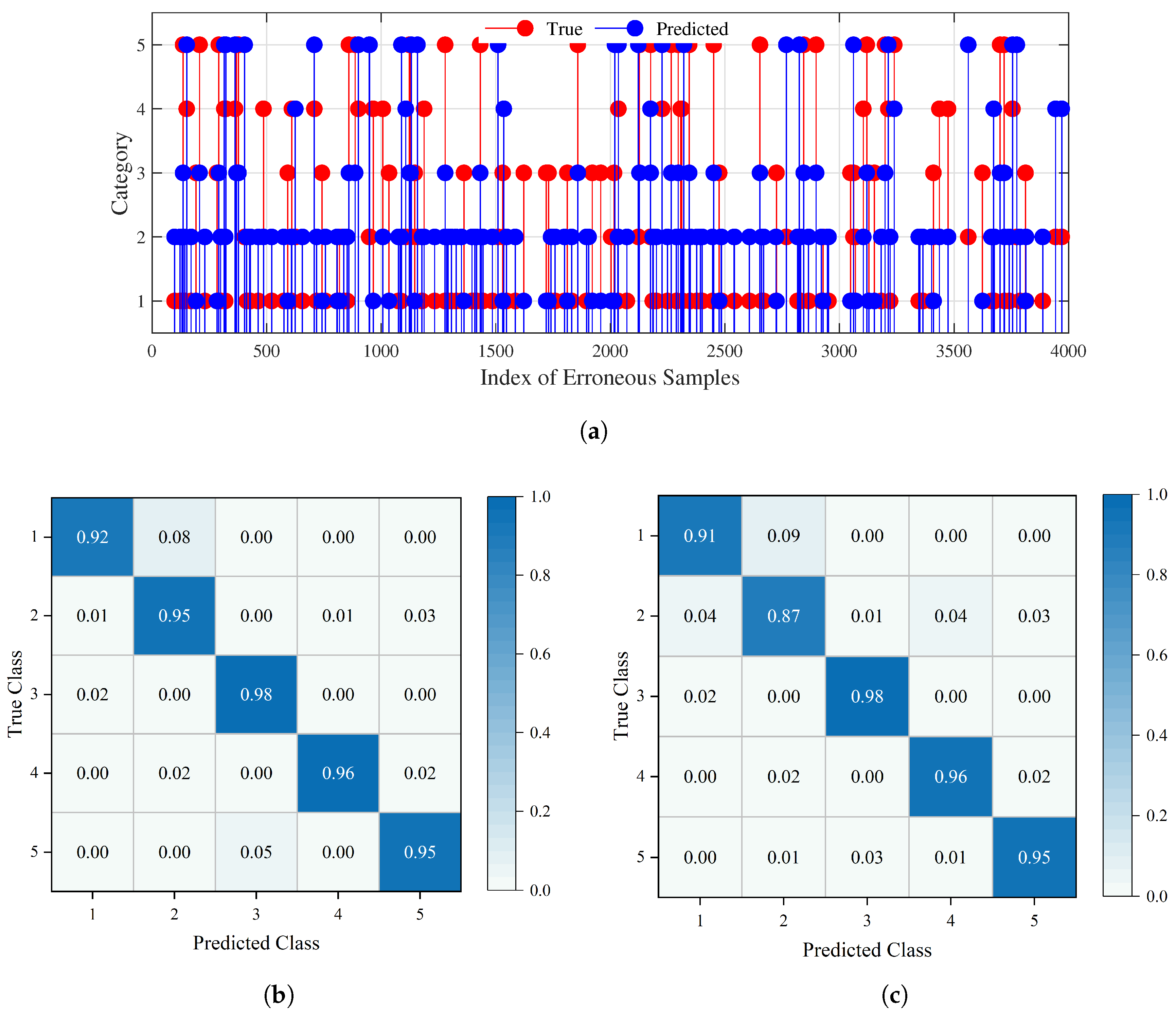
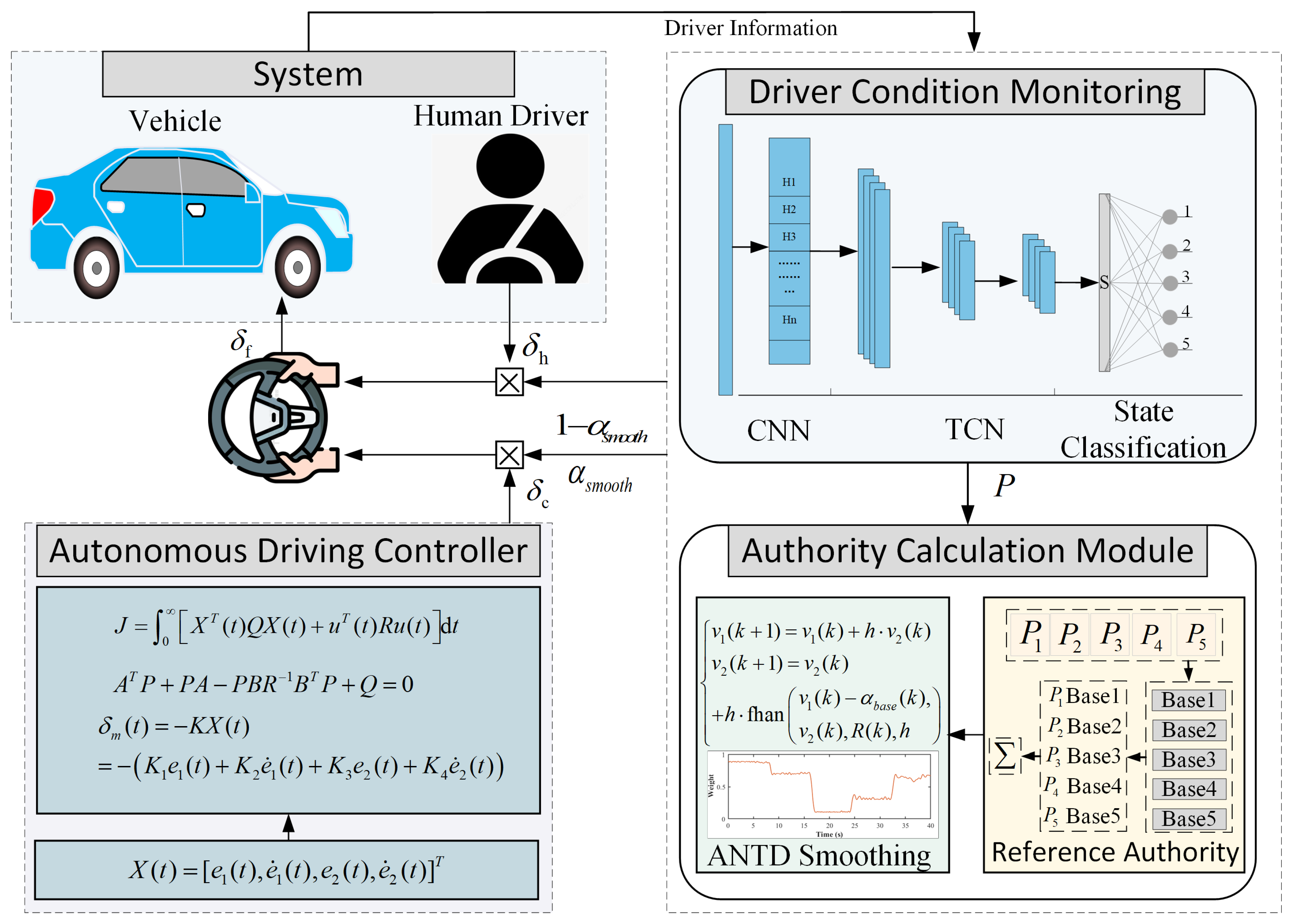
- To guarantee the driving experience while improving and ensuring vehicle stability, a shared steering control framework based on driver states is established. A driver state recognition model is constructed using CNN-TCN, achieving high-precision real-time recognition of five categories of driver states. Furthermore, control authority weights are smoothly allocated through the five-dimensional driver states.
- Addressing the issue where misclassifications from a single recognition result easily trigger unintended excessive system interventions, a dynamic human–machine control authority allocation mechanism is proposed based on total probability weighting theory. This method deeply integrates the real-time Softmax posterior probabilities output by the neural network, transforming hard-threshold takeovers into confidence-based continuous weighting, effectively accommodating the uncertainty of the recognition model in complex scenarios.
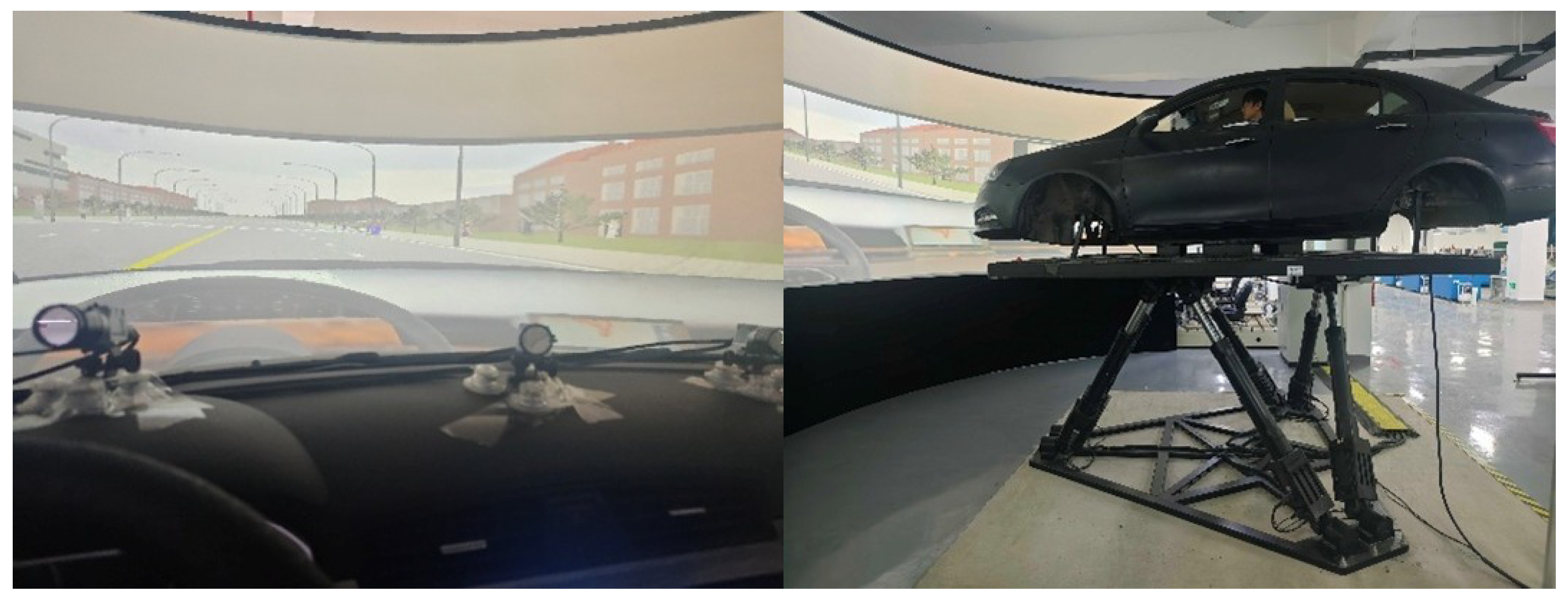
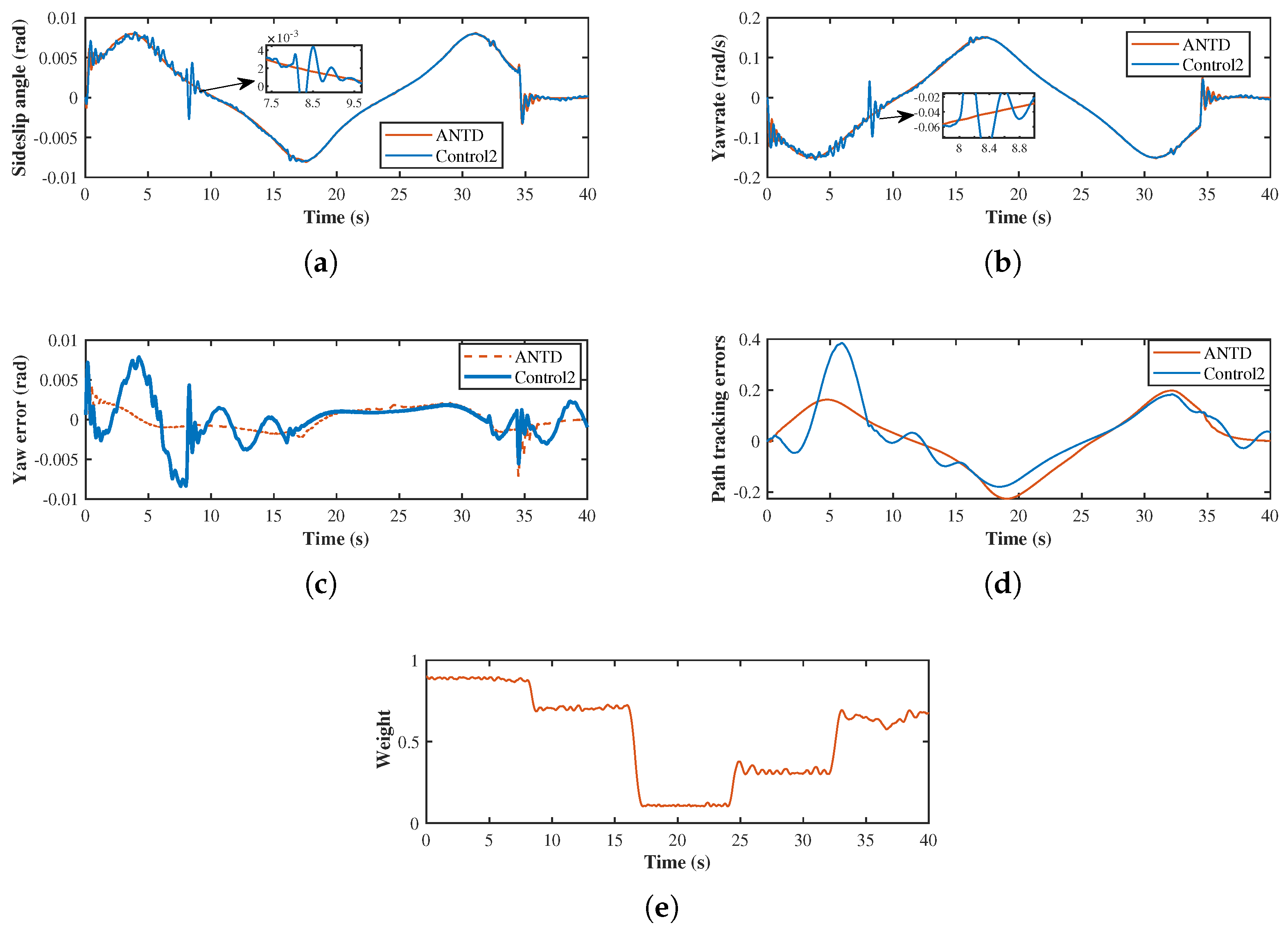
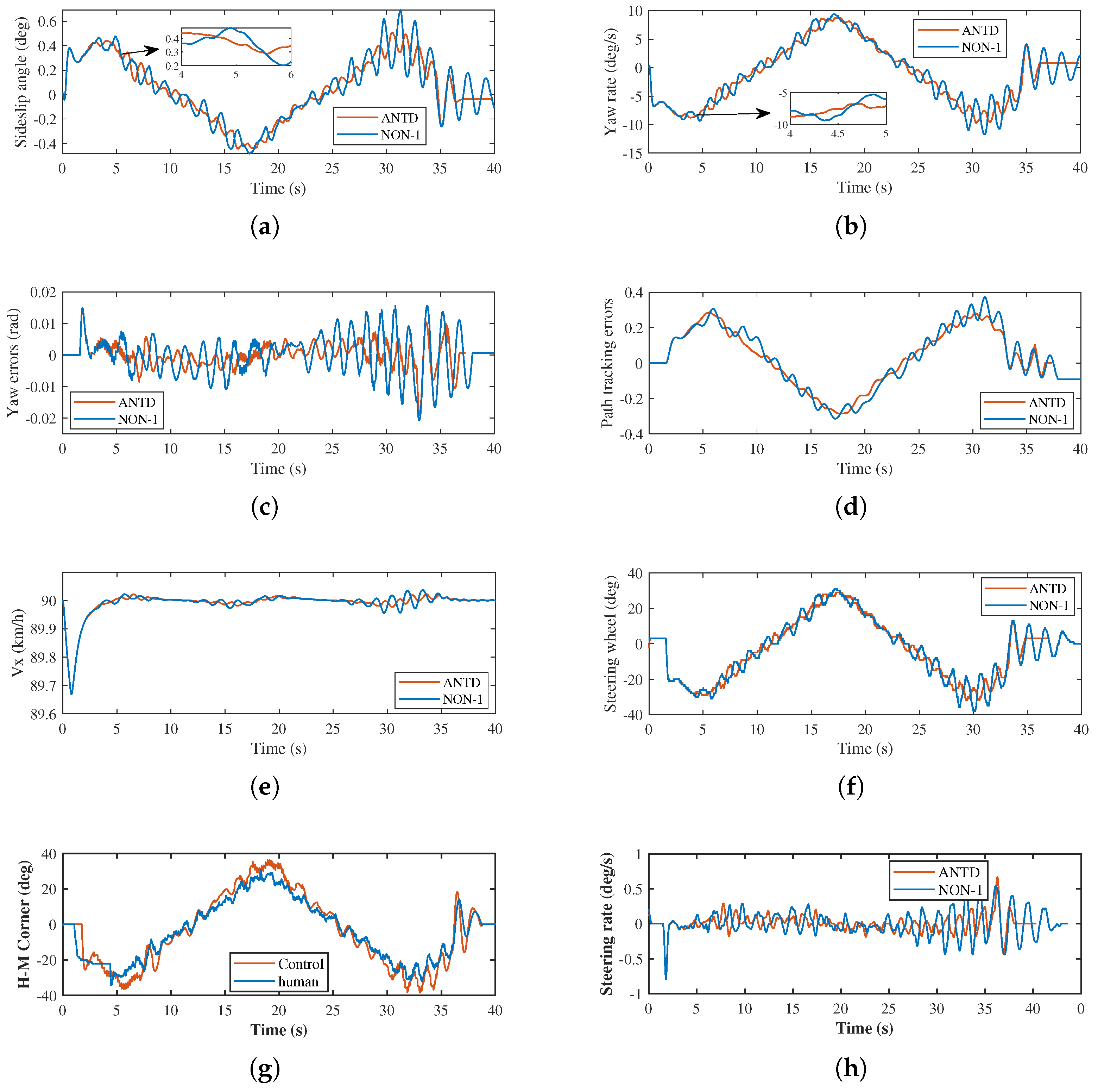
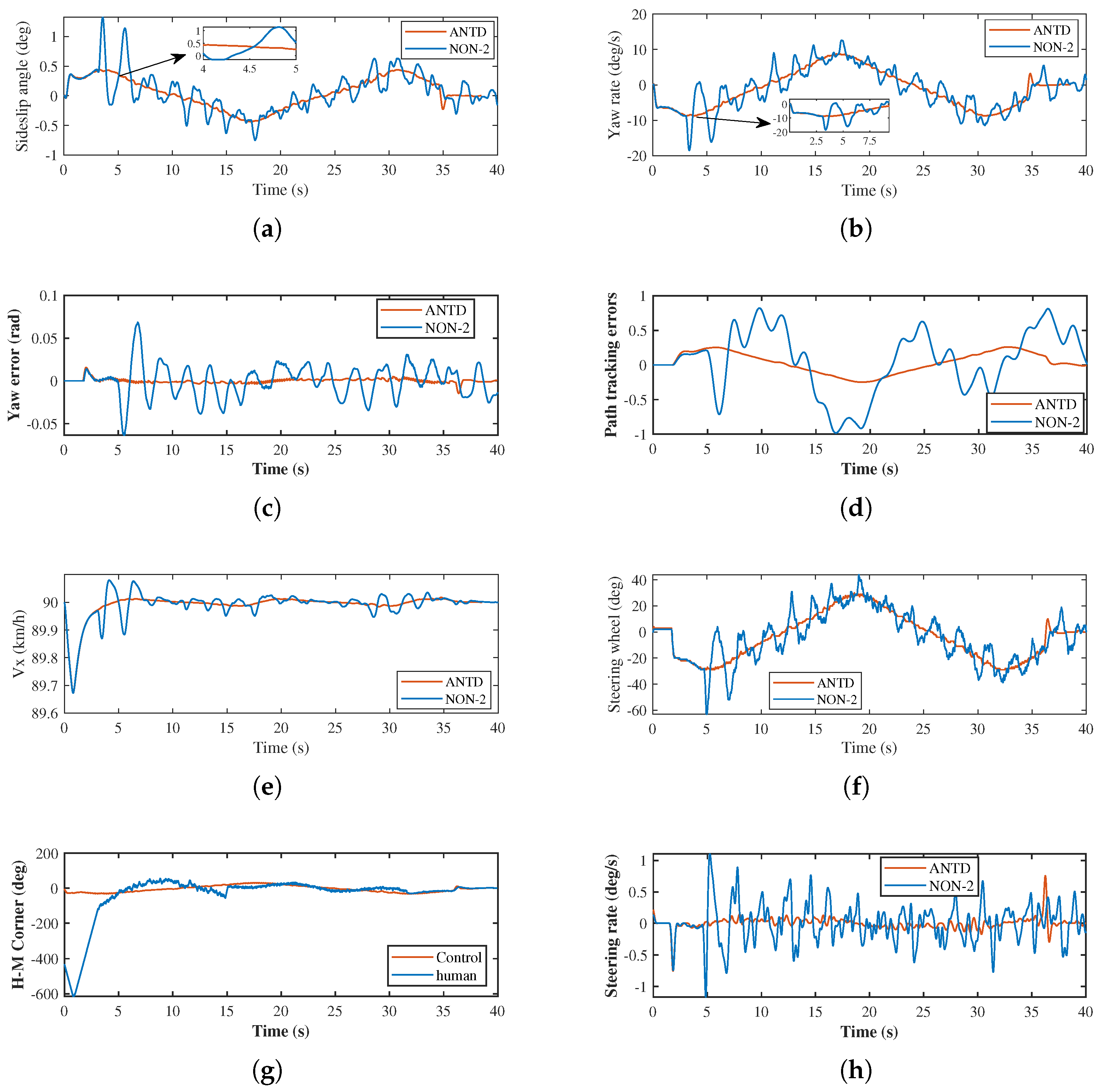
- Based on the concept of Active Disturbance Rejection Control (ADRC), an adaptive nonlinear tracking differentiator is designed, which effectively smooths weight changes. Meanwhile, Hardware-in-the-Loop (HIL) experiments conducted on a human–machine driving platform equipped with real actuators and physical feedback verify the effectiveness of the proposed hierarchical shared control strategy in actively adapting to driver states and enhancing the driving experience.
2. Vehicle System Dynamics Model and Driver State Recognition Model
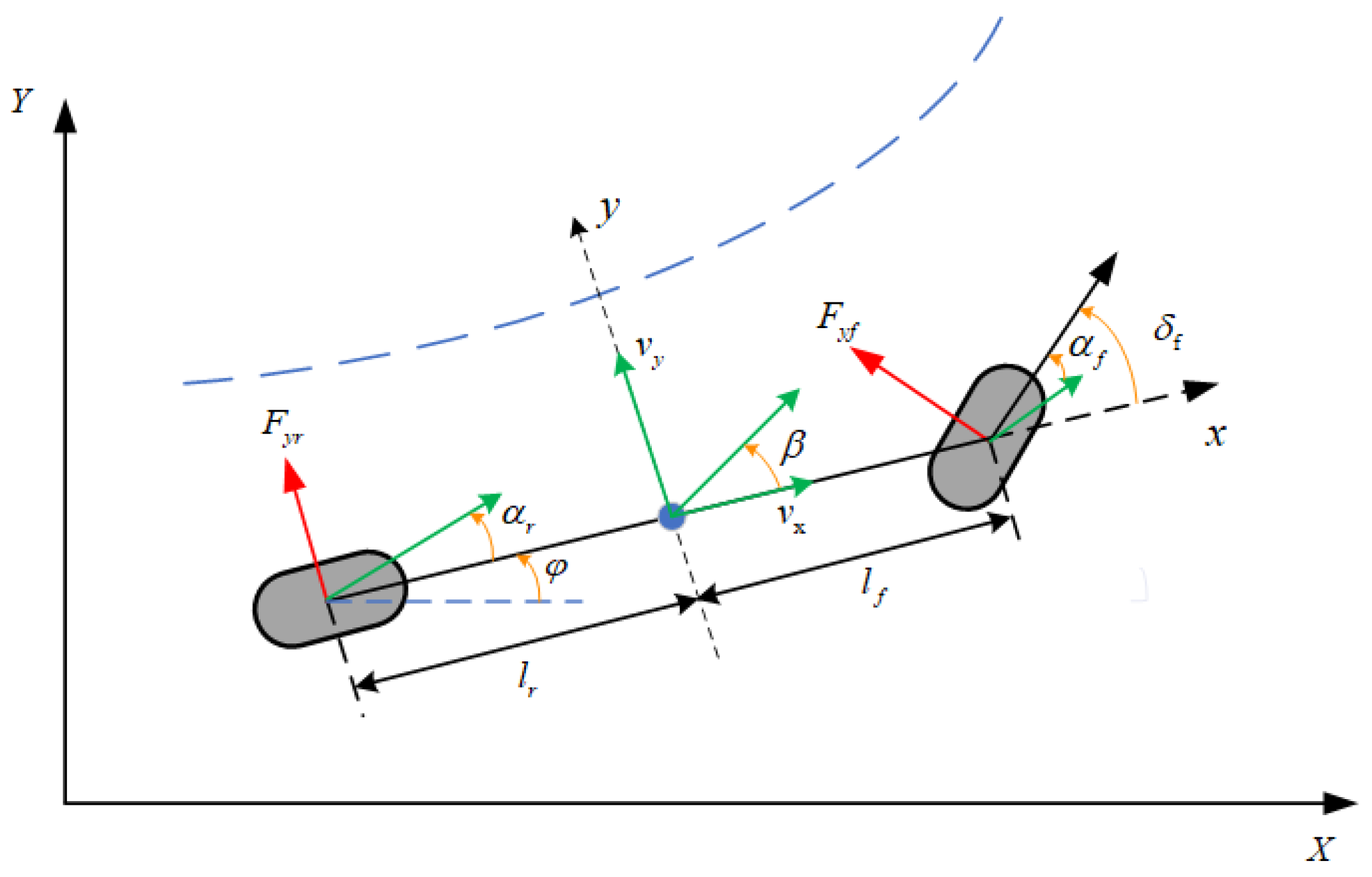
2.1. Vehicle System Dynamics Modeling
2.2. Driver State Recognition Model
3. Upper-Level Shared Steering Control Strategy Framework
3.1. Design Architecture
3.2. Authority Allocation Strategy
3.3. Weight Smoothing Strategy
4. Lower-Level Controller Design
4.1. Trajectory Tracking Controller Design
4.2. Design of Performance Index Function and Weight Matrices
4.3. Synthesis of Optimal Feedback Gain and Expected Steering Angle
5. Experiments and Results Analysis
5.1. Simulation Experiment Comparison and Analysis
5.2. HIL Experiment Comparison and Analysis
6. Conclusions
Author Contributions
Funding
Data Availability Statement
Conflicts of Interest
References
- Liu, M.; Yurtsever, E.; Fossaert, J.; Zhou, X.; Zimmer, W. A survey on autonomous driving datasets: Statistics, annotation quality, and a future outlook. IEEE Trans. Intell. Veh. 2024, 9, 7138–7155. [Google Scholar] [CrossRef] [Scilit]
- Fang, L.; Tianhe, Z.; Weixing, S. Servo-level human–machine shared control flexible strategy based on driving ability status and regionalized environmental risk. IEEE Trans. Transp. Electrif. 2023, 9, 4418–4436. [Google Scholar] [CrossRef] [Scilit]
- Zong, C.; Dai, C.; Zhang, D. Human-machine interaction technology of intelligent vehicles: Current development trends and future directions. China J. Highw. Transp. 2021, 34, 214–237. [Google Scholar]
- Yang, J.; Chu, D.; Liu, L.; Wang, J.; Wu, C.; Yin, G. Review on human-machine shared control of intelligent vehicles. J. Mech. Eng. 2022, 58, 31–55. [Google Scholar] [CrossRef] [Scilit]
- Hu, C.; Shi, Y.; Zhang, X. Trust-based shared control of human-vehicle system using model free adaptive dynamic programming. IEEE Trans. Syst. Man Cybern. Syst. 2025, 10, 4103–4115. [Google Scholar] [CrossRef] [Scilit]
- Zhang, X.; He, H.; Zhang, W.; Wang, H.; Sun, X.; Cai, Y.; Zhang, S. A personalized shared control method for co-driving intelligent vehicles: Considering collision severity and driver capability. Proc. Inst. Mech. Eng. Part D J. Automob. Eng. 2026. [Google Scholar] [CrossRef] [Scilit]
- Sarabia, J.; Marcano, M.; Diaz, S.; Rastelli, J.P.; Zubizarreta, A. Evaluating shared control in real-world conditions. IEEE Open J. Veh. Technol. 2026, 7, 418–431. [Google Scholar] [CrossRef] [Scilit]
- Yan, Z.; Xie, X.-P.; Liu, Y. Membership-Matched Gain-Scheduling Scheme for Human–Machine Shared Steering Systems with Comprehensive Driver State Assessment. IEEE Trans. Ind. Electron. 2026, 73, 4793–4803. [Google Scholar] [CrossRef] [Scilit]
- Chen, J.; Zhang, Q.; Chen, J.; Wang, J.; Fang, F.; Liu, Y.; Yin, G. A driving risk assessment framework considering driver’s fatigue state and distraction behavior. IEEE Trans. Intell. Transp. Syst. 2024, 25, 20120–20136. [Google Scholar] [CrossRef] [Scilit]
- Ju, J.; Li, H.; Liu, Y.; Li, J. A survey of EEG-based driver state and behavior detection for intelligent vehicles. IEEE Trans. Intell. Transp. Syst. 2024, 25, 6214–6235. [Google Scholar]
- Du, G.; Zhang, L.; Su, K.; Wang, X.; Teng, S.; Liu, P.X. A multimodal fusion fatigue driving detection method based on heart rate and PERCLOS. IEEE Trans. Intell. Transp. Syst. 2022, 23, 11475–11485. [Google Scholar] [CrossRef] [Scilit]
- He, W.; Wang, S.; Liu, Z.; Li, Z.; Fu, Z.; Zhao, D.; Hou, J.; Ming, W. Deep learning for distracted driving recognition with multisource data: A comprehensive review. J. Syst. Archit. 2026, 174, 103730. [Google Scholar] [CrossRef] [Scilit]
- Desai, M.; Kathad, K.; Modi, N. Real-time driver drowsiness detection using hybrid CNN-LSTM model with facial feature and behavioral analysis. In Proceedings of the Fourth International Conference on Ubiquitous Computing and Intelligent Information Systems (ICUIS); IEEE: New York, NY, USA, 2024; pp. 197–202. [Google Scholar]
- Wang, X.; Zheng, Y.; Zhao, X. CNN-LSTM driving style classification model based on driver operation time series data. IEEE Access 2023, 11, 15320–15331. [Google Scholar] [CrossRef] [Scilit]
- Zuo, K. Integrated Forecasting Models Based on LSTM and TCN for Short-Term Electricity Load Forecasting. In Proceedings of the 2023 9th International Conference on Electrical Engineering, Control and Robotics (EECR), Wuhan, China, 24–26 February 2023; IEEE: New York, NY, USA, 2023; pp. 207–211. [Google Scholar]
- Liang, J.; Feng, J.; Lu, Y.; Yin, G.; Zhuang, W.; Mao, X. A Direct Yaw Moment Control Framework Through Robust T-S Fuzzy Approach Considering Vehicle Stability Margin. IEEE ASME Trans. Mechatron. 2024, 29, 166–178. [Google Scholar] [CrossRef] [Scilit]
- Liang, J.; Lu, Y.; Wang, F.; Feng, J.; Pi, D.; Yin, G.; Li, Y. ETS-Based Human–Machine Robust Shared Control Design Considering the Network Delays. IEEE Trans. Autom. Sci. Eng. 2025, 22, 17501–17511. [Google Scholar] [CrossRef] [Scilit]
- Liang, J.; Wang, F.; Feng, J.; Zhao, M.; Fang, R.; Pi, D.; Yin, G. A Hierarchical Control of Independently Driven Electric Vehicles Considering Handling Stability and Energy Conservation. IEEE Trans. Intell. Veh. 2024, 9, 738–751. [Google Scholar] [CrossRef] [Scilit]
- Guo, C.; Pleiss, G.; Sun, Y.; Weinberger, K.Q. On calibration of modern neural networks. In Proceedings of the 34th International Conference on Machine Learning (ICML); ACM Digital Library: New York, NY, USA, 2017; pp. 1321–1330. [Google Scholar]
- Dong, W.; Lu, S.; Chen, X.; Zhang, S.; Liu, Q.; Liu, Z.; Chen, L.; Wang, H.; Cai, Y. End-to-End Autonomous Driving: From Classic Paradigm to Large Model Empowerment—A Comprehensive Survey. IEEE Internet Things J. 2026, 13, 3870–3898. [Google Scholar] [CrossRef] [Scilit]
- Liang, J.; Shen, C.; Xia, X.; Pi, D.; Yin, G. Robust Game-Theory Control for All-Wheel Steering to Enhance Vehicle Handling Stability Performance. IEEE Trans. Syst. Man Cybern. Syst. 2025, 55, 9230–9241. [Google Scholar] [CrossRef] [Scilit]
- Wu, J.; Yan, Y.; Liu, Y.; Liu, Y. Research on Anthropomorphic Obstacle Avoidance Trajectory Planning for Adaptive Driving Scenarios Based on Inverse Reinforcement Learning Theory. Engineering 2024, 33, 133–145. [Google Scholar] [CrossRef] [Scilit]
- Wu, J.; Kong, Q.; Yang, K.; Liu, Y.; Cao, D.; Li, Z. Research on the Steering Torque Control for Intelligent Vehicles Co-Driving with the Penalty Factor of Human–Machine Intervention. IEEE Trans. Syst. Man Cybern. Syst. 2023, 53, 59–70. [Google Scholar] [CrossRef] [Scilit]
- Wu, X.; Sun, W.; Su, S.F.; Xie, X. Adaptive stabilization for high-order fully actuated systems with unknown control directions. IEEE Trans. Syst. Man Cybern. Syst. 2024, 54, 5150–5159. [Google Scholar] [CrossRef] [Scilit]
- Sun, W.; Su, S.F.; Liu, Z.G.; Sun, Z.Y. Adaptive intelligent control for input and output constrained high-order uncertain nonlinear systems. IEEE Trans. Syst. Man Cybern. Syst. 2019, 51, 5577–5586. [Google Scholar] [CrossRef] [Scilit]
- Sun, W.; Wu, X.; Su, S.F. Fully actuated system approach-based tracking control for high-order nonlinear system under false data injection and malicious attacks. IEEE Trans. Cybern. 2026, 56, 4742–4754. [Google Scholar] [CrossRef] [Scilit] [PubMed]
- Xu, G.; Wu, D.; Xu, H.; Miao, H.; Chen, Y. Research on Longitudinal and Lateral Game Control of Intelligent Agricultural Machine Stackelberg Based on Takagi-Sugeno Fuzzy Model. Food Sci. Nutr. 2025, 13, e70579. [Google Scholar] [CrossRef] [Scilit] [PubMed]
- Xu, G.; Feng, J.; Wang, Q.; Xu, D.; Sun, J.; Chen, M.; Wu, J. A Study on the Speed Decision Control of Agricultural Vehicles in a Collaborative Multi-Machine Operation Scenario. Sustainability 2025, 17, 4326. [Google Scholar] [CrossRef] [Scilit]
- Xu, G.; Chen, M.; He, X.; Liu, Y.; Wu, J.; Diao, P. Research on state-parameter estimation of unmanned Tractor—A hybrid method of DEKF and ARBFNN. Eng. Appl. Artif. Intell. 2024, 127, 107402. [Google Scholar] [CrossRef] [Scilit]
- Oudainia, M.R.; Sentouh, C.; Nguyen, A.-T.; Popieul, J.-C. Adaptive cost function-based shared driving control for cooperative lane-keeping systems with user-test experiments. IEEE Trans. Intell. Veh. 2024, 9, 304–314. [Google Scholar] [CrossRef] [Scilit]
- Han, J. From PID to active disturbance rejection control. IEEE Trans. Ind. Electron. 2009, 56, 900–906. [Google Scholar] [CrossRef] [Scilit]
- Ma, J.; Cheng, Z.; Zhang, X.; Tomizuka, M.; Lee, T.H. Alternating direction method of multipliers for constrained iterative LQR in autonomous driving. IEEE Trans. Intell. Transp. Syst. 2022, 23, 23031–23042. [Google Scholar] [CrossRef] [Scilit]




| State | Weight |
|---|---|
| Awake | 0.1 |
| Normal | 0.3 |
| Mind wandering | 0.6 |
| Distracted | 0.7 |
| Fatigued | 0.9 |
| Symbol | Description | Value [Unit] |
|---|---|---|
| m | Vehicle mass | 1412 [kg] |
| Distance from CG to front axle | 1.015 [m] | |
| Distance from CG to rear axle | 1.895 [m] | |
| Front tire cornering stiffness | 52,000 [N/rad] | |
| Vehicle yaw moment of inertia | 1536.7 [kg·m2] | |
| Rear tire cornering stiffness | 34,500 [N/rad] |
| Control2 | ANTD | |
|---|---|---|
| Overshoot [m] | 0.39 | 0.16 |
| Rise Time [s] | 3.43 | 2.24 |
| Settling Time [s] | 5.89 | 6.67 |
| Steady State Error [m] | 0.0314 | 0.0016 |
Disclaimer/Publisher’s Note: The statements, opinions and data contained in all publications are solely those of the individual author(s) and contributor(s) and not of MDPI and/or the editor(s). MDPI and/or the editor(s) disclaim responsibility for any injury to people or property resulting from any ideas, methods, instructions or products referred to in the content. |
© 2026 by the authors. Licensee MDPI, Basel, Switzerland. This article is an open access article distributed under the terms and conditions of the Creative Commons Attribution (CC BY) license.
Share and Cite
Wang, Q.; Xuan, L.; Feng, J.; Wu, J. A Hierarchical Shared Steering Control Strategy Based on Driver States. Machines 2026, 14, 837. https://doi.org/10.3390/machines14080837
Wang Q, Xuan L, Feng J, Wu J. A Hierarchical Shared Steering Control Strategy Based on Driver States. Machines. 2026; 14(8):837. https://doi.org/10.3390/machines14080837
Chicago/Turabian StyleWang, Quanjin, Lina Xuan, Jiwei Feng, and Jian Wu. 2026. "A Hierarchical Shared Steering Control Strategy Based on Driver States" Machines 14, no. 8: 837. https://doi.org/10.3390/machines14080837
APA StyleWang, Q., Xuan, L., Feng, J., & Wu, J. (2026). A Hierarchical Shared Steering Control Strategy Based on Driver States. Machines, 14(8), 837. https://doi.org/10.3390/machines14080837