1. Introduction
Generating collision-free and smooth joint-space trajectories between start and goal configurations is a central problem in manipulator motion planning. Diffusion models [
1,
2,
3] have become attractive conditional generators because they capture multimodal trajectory distributions and admit test-time gradient guidance [
4,
5,
6]. In the setting considered here, a trajectory is counted as successful only if it remains collision-free and within joint limits over the full horizon.
In practice, the main difficulty is not producing a plausible path in open space but reshaping that path coherently when obstacles create bottlenecks. Under a limited guidance budget, a planner can fail simply because its representation converts a local collision correction into many scattered updates that are difficult to coordinate within a few denoising steps. Trajectory representation is therefore not a minor implementation detail but a consequential planning design choice.
Yet much of the recent diffusion-planning literature has emphasized backbone architecture, conditioning, or guidance design [
4,
5,
6,
7], while the representation family itself remains comparatively underexplored under controlled conditions. It is still unclear whether structured-scene performance is governed mainly by latent dimensionality or by how the representation organizes those coordinates for guidance.
This paper addresses a representation-level question: when collision costs are computed on dense manipulator trajectories but guidance updates are applied in a latent representation, which coordinate structures allow local collision gradients to induce globally coordinated trajectory changes?
To answer this question, spectral-linear representation is compared with five representative baselines with a shared training dataset, conditioning scheme, guidance rule, and dense-evaluation protocol. In the main comparison, the waypoint baseline is reported with its standard UNet direct-trajectory backbone, while the other families use the latent MLP backbone described in the experimental setup; an additional Waypoint-32 MLP control is also evaluated separately, and all six families are then rerun with a Transformer denoiser as an independent robustness check. Two ablations, RBF-linear and spectral-nullspace, isolate the roles of basis ordering and endpoint-mean handling. This shared protocol is more than a fairness device. It is also an identification device: if each family were instead paired with its own preferred backbone, conditioning design, guidance schedule, or post-processing stack, then representation would be confounded with multiple system-level choices, and the experiment would no longer answer a representation-level question. The detailed quantitative results are reported in
Section 5. Across the tested families, the structured-scene ranking aligns more with the representation structure than with simple increases in latent width, although each family still has its own dimensionality optimum.
Contributions. This study makes three contributions. First, it introduces a spectral-linear trajectory representation built from a frequency-ordered kernel eigenbasis for joint-space manipulator paths. Second, it provides a controlled empirical comparison indicating that, under the tested protocol, structured-scene success is more consistent with the representation structure than with raw dimensionality alone. Third, it tests the robustness of the main ranking with dimensionality sweeps, per-family guidance tuning, expert-only controls, and Transformer denoisers.
The remainder of this paper is organized as follows.
Section 2 reviews diffusion planning and trajectory parameterizations,
Section 3 defines the compared trajectory families,
Section 4 presents spectral-linear representation and the shared guidance geometry,
Section 5 reports the empirical results, and the final sections discuss limitations and conclude.
2. Related Work
2.1. Diffusion Models for Robot Motion Planning
A conditional diffusion model learns to denoise a latent variable from Gaussian noise for context
[
1,
3]. In trajectory planning, the latent follows a chosen trajectory parameterization, while
encodes the environment and endpoints. During reverse diffusion, the denoised latent is mapped back to trajectory space by a representation-specific decoder
, and geometric guidance is differentiated through that decoder:
where
controls guidance strength. The key observation for this paper is that the decoder structure determines how a local collision gradient becomes a latent update. Representations that convert local collision information into coordinated trajectory changes should therefore support more effective guidance than representations that disperse the same signal across largely independent local variables.
Representative diffusion-based motion-planning methods include Diffuser [
4], Diffusion Policy [
5], AdaptDiffuser [
8], M2Diffuser [
9], MPD [
6], PRESTO [
7], and RobotDiffuse [
10]. Subsequent work has imposed stronger trajectory structure [
11,
12,
13] and extended diffusion planning toward trajectory optimization, refinement, and alternative constrained-generation strategies [
14,
15,
16,
17]. These system papers differ substantially in environment encoding, backbone choice, and post-processing. For example, MPD emphasizes diffusion priors with cost guidance during denoising, PRESTO combines key-configuration conditioning with diffusion seed generation followed by trajectory optimization, and RobotDiffuse couples point-cloud conditioning with a Transformer denoiser for redundant manipulators. Taken together, these studies establish diffusion-based planning as a strong paradigm, but they largely treat trajectory representation as fixed rather than isolating it as the main experimental variable.
2.2. Low-Dimensional Trajectory Parameterizations
Structured low-dimensional trajectory representations have been used in robot motion for decades, well before diffusion-based planning. B-splines [
18,
19], DMPs [
20], ProMPs [
21], and ProDMPs [
22] encode different priors over smooth motion, while continuous-time Gaussian-process trajectory representations and GP-based motion planners construct trajectories with Gaussian-process priors [
23,
24,
25]. Functional-gradient motion planning in reproducing kernel Hilbert spaces is an early example of how kernel choice and continuous trajectory spaces affect optimization geometry, and it explicitly contrasts kernel parameterizations with discretized waypoint lists [
26]. For B-spline parameterizations, continuous trajectory optimization has also been studied for multi-jointed robotic systems, where B-spline coefficients serve as a finite-dimensional representation of continuous constraints and obstacle avoidance [
27]. BMPs further bridge B-splines and movement primitives by representing B-spline motion through basis functions and weight parameters [
28].
Classical trajectory-optimization methods such as STOMP, CHOMP, and TrajOpt also optimize smoothness-plus-cost objectives directly in trajectory space [
29,
30,
31].
Data-driven linear latent spaces have also been used for robot motion. PCA-based movement primitives extract joint-trajectory bases from demonstrations [
32], and goal-conditioned trajectory VAEs learn low-dimensional latent spaces for primitive motion generation and planning [
33]. Reaching Through Latent Space extends this idea to manipulator path planning by optimizing in the latent space of a generative model of robot poses [
34]. Learned collision-free latent spaces have also been used to support arbitrary optimization criteria in joint-space planning, where the latent representation is conditioned on an obstacle map and constrained to collision-free regions [
35]. More recently, PCA has also been used to compress trajectories for diffusion [
36]. For the present study, the relevant comparison is not simply low dimensionality versus high dimensionality. The more pertinent question is whether the basis itself aligns with the geometry on which test-time guidance operates. The spectral parameterization reuses kernel machinery to build a compact eigenbasis, while the PCA baseline isolates the difference between analytical and data-driven residual bases under the same diffusion and guidance protocol.
This use of a temporal kernel is distinct from GP-based motion planning. GPMP-style methods use a Gaussian-process prior as part of a trajectory-optimization objective and solve for a feasible trajectory online [
23,
24,
25]. By contrast, the leading eigenmodes of a conditioned temporal kernel are used as a low-dimensional coordinate system for a diffusion prior. The aim is not to optimize a GP trajectory directly but to construct a compact latent representation through which test-time collision guidance can induce coordinated trajectory updates. This distinction motivates the decoder-induced gradient-spreading view developed in
Section 4.
2.3. Test-Time Guidance and Constrained Generation
Steering diffusion samples toward constraints at test time is a defining mechanism in diffusion-based planning. Classifier-free guidance [
37] is the standard conditioning tool, and MPD [
6] formalized posterior sampling by backpropagating collision costs during denoising. Other methods enforce hard constraints through projection, composition of multiple diffusion models, or hierarchical refinement [
15,
16,
38].
Because bottlenecks expose whether guidance can coordinate local corrections, narrow-passage planning provides the motivating testbed [
39]. The focus is therefore on the guidance mechanism itself rather than the full end-to-end planning stack.
3. Trajectory Representation Families
This section defines the five baseline trajectory families compared in this work. For each representation, its parameterization, decoder
, and latent space are described below. The spectral-linear family and its two ablations are introduced in
Section 4.1. Together, these baselines cover direct trajectory-space denoising, spline or movement-primitive coefficients, and learned or data-driven latent codes used in diffusion and robot-motion planning [
4,
6,
9,
11,
36].
3.1. Nomenclature
Table 1 defines the main symbols used throughout the paper.
3.2. Problem Formalization
Let denote the start and goal joint configurations of a D-DOF manipulator. A trajectory is a function with and . In practice, trajectories are evaluated on a discrete time grid with , , yielding a matrix .
Let denote the variable that the diffusion model operates on. The decoder maps the latent variable and endpoint conditions to a dense trajectory: . For notational clarity, the dependence on and is suppressed when context permits.
3.3. Waypoint Representation
The waypoint representation is the most direct baseline: the diffusion variable is the trajectory itself, as in trajectory-space diffusion planners that denoise waypoint sequences directly [
4,
9]. For
waypoints,
with total dimensionality
. All waypoint positions participate in diffusion; after decoding, the first and last waypoints are clamped deterministically to
and
. The decoder is therefore the identity map followed by hard endpoint clamping. This yields maximum local flexibility but no built-in coordination between waypoints: each element of
evolves independently during denoising, and guidance gradients affect individual waypoints without inducing global shape corrections.
3.4. B-Spline Control Points
B-splines [
18,
19] represent trajectories through a set of control points
and a fixed basis matrix
determined by the knot vector and spline degree:
The diffusion variable is
, with
. This kind of low-dimensional spline parameterization is also used in guided motion-planning diffusion [
6]. In the implementation, the spline is
clamped: the knot vector is clamped, and the first and last control points are fixed to
and
during fitting and decoding, so the trajectory remains endpoint-conditioned rather than using a free-end spline. Each control point influences a local segment of the trajectory, providing built-in spatial smoothness. The decoder is a linear transformation, so guidance gradients on
are backpropagated as
.
3.5. ProDMP
ProDMP [
22] represents a trajectory using a boundary-condition term and analytically integrated RBF basis functions:
Here
handles the boundary condition and
is conditioned to vanish at the goal. The diffusion variable is
, with
. Its linear decoder and integrated basis provide hard endpoints, smooth trajectories, and direct guidance-gradient propagation. Movement-primitive diffusion methods use related structured coefficients to bias generated robot motions toward smooth trajectories [
11,
12].
3.6. VAE: Conditional Trajectory Latent Space
The conditional trajectory VAE [
33,
40] learns a nonlinear latent code
from the shared trajectory corpus, conditioned on endpoints and environment. The posterior mean is decoded for deterministic evaluation. Its neural decoder makes it the nonlinear latent-space reference; architecture and KL settings are provided in the
Supplementary Material.
3.7. PCA: Residual Principal Component Basis
The residual PCA baseline subtracts the endpoint linear-interpolation reference and fits a data-driven linear basis to flattened training trajectories, following the use of PCA bases in movement primitives and recent latent diffusion trajectory planners [
32,
36]:
where
is the mean residual,
contains the leading SVD components, and
are the diffusion coefficients. The decoder is linear with hard endpoint clamping. Unlike the analytical spectral basis, PCA orders directions by training-set variance and therefore provides the closest data-driven linear comparison.
4. Spectral-Linear Representation and Unified Framework
This section presents the spectral-linear trajectory representation, its ablations, and the test-time guidance geometry used throughout the study.
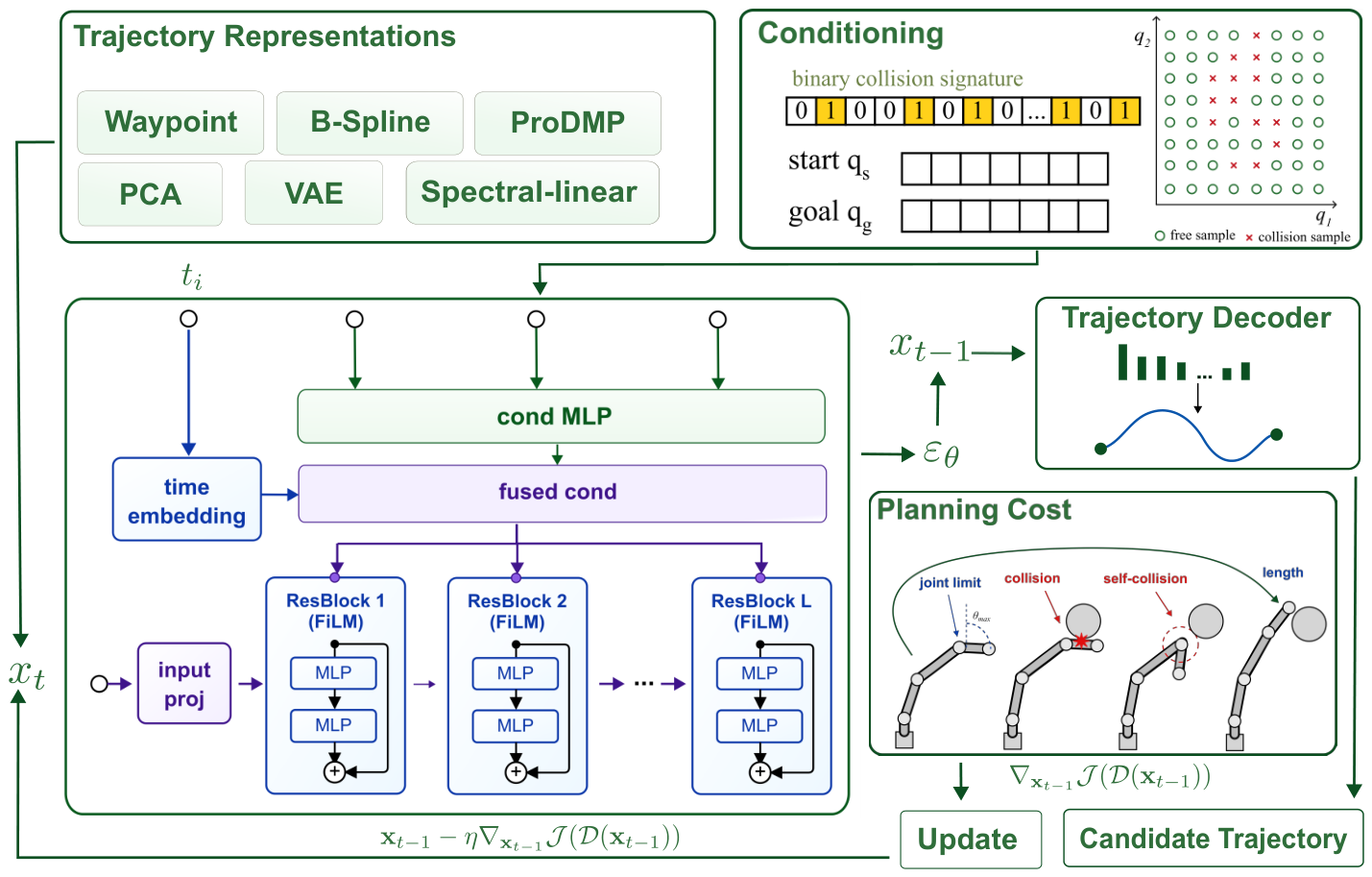
Figure 1 shows the model-level pipeline shared by all representations, and
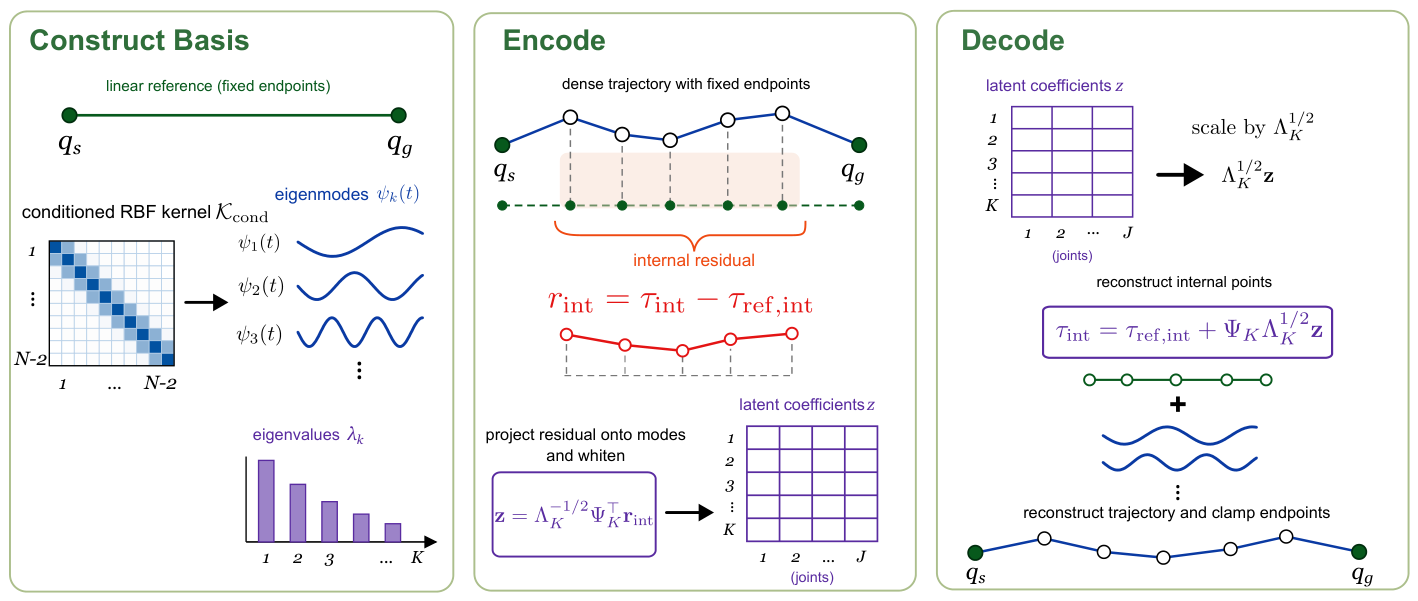
Figure 2 focuses on the proposed spectral-linear encoder and decoder. The shared backbone, environment encoding, and evaluation protocol are deferred to the experimental setup.
4.1. Spectral-Linear Trajectory Representation
Spectral-linear representation is constructed by deriving the trajectory basis from the eigendecomposition of a conditioned temporal kernel, thereby obtaining a global eigenbasis on which diffusion operates through spectral coefficients.
Figure 2 summarizes the associated basis construction, encoding, and decoding operations. The representation combines two components: (1) a linear interpolation mean that captures the endpoint-driven path, and (2) an eigenvalue-ranked basis that represents global trajectory deviations. To isolate the contribution of these components, two ablations are also introduced: RBF-linear, which replaces the eigenbasis with uniformly spaced RBF functions, and spectral-nullspace, which removes the explicit linear mean and enforces endpoints through a coefficient-space nullspace construction.
4.1.1. Spectral Basis Construction
Let
be a positive-definite kernel matrix defined over the time grid
. The Radial Basis Function (RBF) kernel is used:
with amplitude
and length-scale
(in normalized time units). The kernel amplitude is fixed as a normalization convention: scaling
changes the eigenvalue magnitudes but not the eigenvector shapes, and the coefficient whitening in (
11) largely cancels that global scale factor in the diffusion coordinates. By contrast,
ℓ changes the temporal correlation structure and therefore the mode shapes themselves. The choice
was intended to keep the leading modes global and smooth over the normalized horizon rather than concentrating variance in short-range oscillations. The
Supplementary Material reports an
ℓ-sensitivity check over
; within this tested range,
gives the strongest overall structured-scene performance under the shared 40-candidate evaluation protocol.
Because the endpoints
and
are fixed, we condition the kernel on the boundary time steps. Let
be the observed (endpoint) indices and
be the internal indices. The conditional covariance of the internal points given the endpoints is
where
denotes the submatrix of
with rows indexed by
and columns by
.
captures the variability of internal trajectory points
after accounting for the deterministic endpoints.
The conditioned kernel is eigendecomposed:
where
contains eigenvectors sorted by descending eigenvalues
with
. For the 1D temporal RBF kernel used here, this ordering empirically follows a smooth-to-oscillatory progression; it is not claimed as a general theorem. The spectral basis is formed by retaining the first
K eigenvectors:
The eigenvalue
quantifies the prior variance assigned to the
k-th eigenmode by the conditioned kernel. For the discretization used here, the spectrum decays rapidly. The main experiments therefore use
, which keeps the latent compact while retaining the dominant global shape. This was not chosen ad hoc: the shared-protocol sweep reported in the
Supplementary Material evaluates
and shows that
is the strongest structured-scene setting within the tested budget.
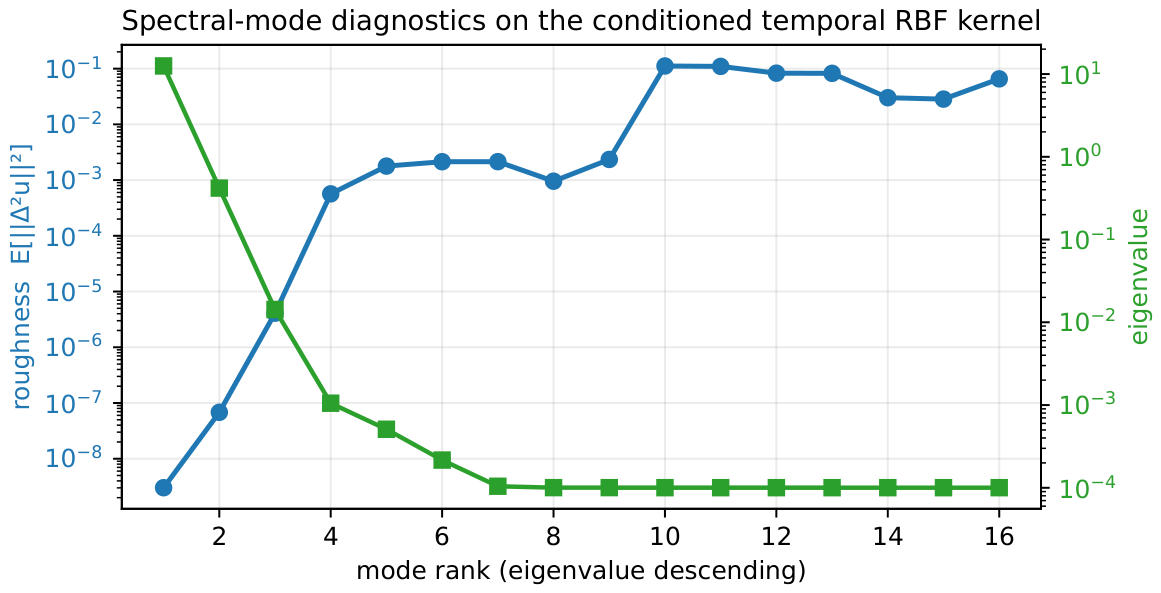
Figure 3 provides a diagnostic view of this truncation.
4.1.2. Encoding and Decoding
The full trajectory is decomposed into a linear interpolation mean and a spectral expansion of residuals. Encoding maps a dense trajectory to compact latent coefficients, and decoding reconstructs the trajectory from those coefficients.
Forward Model (Decoding)
The spectral decoder reconstructs the trajectory as
where
is the linear interpolation from
to
,
is the spectral basis zero-padded to include the endpoint rows (which are zero), and
are the spectral coefficients. The diffusion variable is
, with
. This is a fully linear transformation: the Jacobian
is constant and independent of the latent values, enabling reliable gradient propagation during guidance.
Encoding (Inverse Mapping)
Given a full trajectory
, the encoding operation projects its internal points onto the spectral basis, whitened by the inverse eigenvalue scale:
where
. The division by
whitens the latent coefficients to unit variance, ensuring that each mode contributes equally in the normalized diffusion space.
Endpoint Recovery
After decoding the internal trajectory, the full trajectory is assembled by clamping the endpoints to their exact target values:
Guidance Gradient Backpropagation
For test-time guidance, gradients of geometric costs defined on the dense trajectory must propagate back to the latent coefficients. Since the decoder is linear, this backpropagation is a simple linear projection:
Because each column of is a global basis function, a collision gradient at any time step affects all spectral coefficients and induces globally coordinated trajectory modifications.
Decoder-Induced Gradient Spreading
For any linear decoder of the form
, a dense-trajectory guidance gradient
induces the first-order update
, so
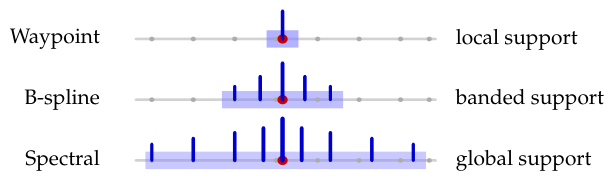
summarizes how guidance spreads over time. Waypoint-like decoders keep
G local, B-splines make it banded, and spectral-linear representation makes it dense and low-rank.
Figure 4 visualizes this diagnostic; for nonlinear learned decoders such as the conditional VAE baseline, the same picture holds locally with
A replaced by the state-dependent Jacobian.
4.1.3. Properties
Three properties make the spectral representation well suited to the guided-diffusion setting considered here.
Global support with smoother leading modes. Each eigenvector spans the whole horizon. With this discretization, the leading modes are smoother and encode macroscopic trajectory shape, while the oscillatory tail modes are naturally truncated.
Guidance-compatible gradient propagation. Equation (
13) shows that guidance gradients project through the spectral basis. The leading modes therefore collect more coherent collision signals, and the
scaling amplifies them relative to the tail modes.
Spectral truncation as a guided trade-off. The number of modes K trades off representational capacity against guideability. The main experiments use ; adding more modes preserves more kernel variance, but the additional directions are higher frequency and harder to guide under the fixed DDIM budget.
4.1.4. Ablation: RBF-Linear (Uniform Basis)
To isolate the effect of basis allocation, RBF-linear is introduced as an ablation that shares the linear interpolation mean with spectral-linear representation but replaces the spectral eigenbasis with uniformly spaced Gaussian RBF basis functions of equal bandwidth:
where
has Gaussian basis functions with centers evenly distributed across
. The decoder remains linear and uses hard endpoint clamping. Each basis function is local in time and all functions have equal bandwidth, so there is no frequency-domain prioritization. Comparing RBF-linear with spectral-linear representation isolates the effect of basis allocation under the same
budget.
4.1.5. Ablation: Spectral-Nullspace Variant
To probe the role of the explicit linear interpolation mean, a spectral-nullspace variant is introduced that replaces with a coefficient-space endpoint construction.
Unlike spectral-linear representation, spectral-nullspace starts from the unconditioned full kernel
. It keeps the first
scaled eigenvectors in
and enforces the endpoints through the evaluation matrix
The trajectory is reconstructed as
where
is the pseudoinverse of
,
spans
, and
are the free residual coefficients. Spec.-Null-2 uses
free modes (14D total), so it starts from
full-kernel modes before removing the two boundary-constrained directions.
4.2. Test-Time Collision Guidance
During reverse diffusion, every representation uses the same MPD-style gradient guidance [
6]. The current latent is decoded to a 120-point dense trajectory, and collision-world, self-collision, joint-limit, and path-length costs are differentiated through the representation-specific decoder. Hard endpoint projection is applied throughout, so the controlled comparison changes only how each representation propagates the shared geometric signal. Complete cost definitions, weights, guidance budgets, and inference pseudocode are provided in the
Supplementary Material.
5. Experiments and Results
The experiments address three questions. First, does spectral-linear representation improve performance on structured scenes? Second, can raw dimensionality alone explain the observed success rates? Third, does the main conclusion survive changes in dimensionality, guidance configuration, training data, and denoising backbone?
5.1. Experimental Protocol
All representation families are evaluated under the same 7-DOF Franka Panda joint-space planning protocol, training corpus, conditioning variables, test-time guidance rule, and dense evaluation procedure. For each test condition, every method generates 40 candidates; Condition-SR counts the condition as successful when at least one candidate is collision-free and satisfies the joint limits. This metric is therefore candidate-budget dependent by construction: increasing the number of sampled candidates raises the chance that at least one feasible trajectory appears. Regardless of native representation, every output is decoded to 120 uniformly spaced dense points and checked with additional interpolation between adjacent points. Random contains roughly 10,000 test conditions, and Passage and Racks each contain 10,000. Complete details on data generation, distillation, model configuration, environment encoding, training, inference, metrics, and benchmark construction are provided in the
Supplementary Material. With the inference configuration used in the main experiments, generating the full candidate set and selecting the best trajectory typically takes under 200 ms per condition on an evaluation workstation with an AMD Ryzen 7 9800X3D CPU and an NVIDIA GeForce RTX 5070 GPU (12 GB). The wall-clock time scales with the number of sampled candidates. The evaluation is trajectory-level and geometric: it does not simulate impact dynamics, contact stiffness, restitution, or PID tracking, and it does not include family-specific smoothing, hand-crafted gradient-spreading heuristics, or post-processing stages. This is deliberate, because system-level diffusion planners such as PRESTO apply Gaussian smoothing over trajectory parameters in their released implementation to propagate collision-cost gradients to neighboring waypoints and then refine the seed trajectory with trajectory optimization [
7].
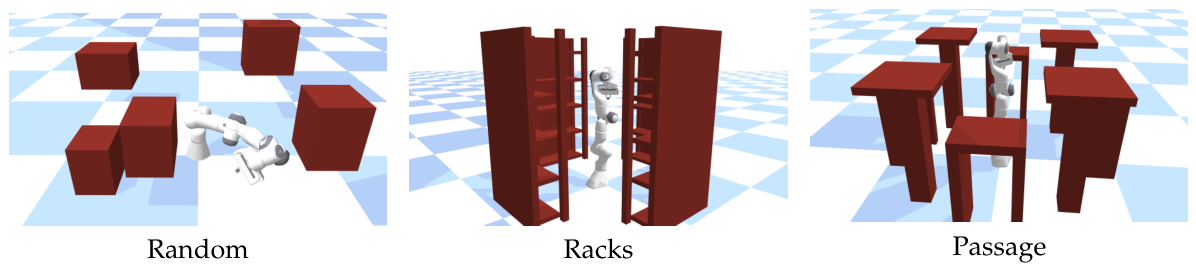
Figure 5 provides an overview of the three unseen procedural benchmark families.
The released MPD [
6] and PRESTO [
7] pipelines are not used as direct baselines. Both couple trajectory representation with additional system-level ingredients and different conditioning assumptions. Instead, they are treated as contextual system-level references, while the representation families are compared using a common training dataset, conditioning scheme, guidance rule, and dense-evaluation protocol. Non-learning planners are reported separately as fixed-budget external references.
5.2. Results
Table 2 compares the six main families. Within this comparison, spectral-linear representation attains the highest structured-scene Condition-SR, B-spline yields the lowest MSJ, and ProDMP produces the shortest successful Passage trajectories. Waypoint-32 performs strongly on Random but falls to 0.037 on Passage and 0.077 on Racks. A same-dimensional Waypoint-32 MLP control is reported in the
Supplementary Material and obtains 0.000 Condition-SR on Random, Passage, and Racks; the stronger UNet waypoint result is therefore retained as the main direct-trajectory baseline. This pattern is consistent with the qualitative behavior of the representation. Waypoint diffusion offers high local flexibility, but it provides no intrinsic mechanism for propagating a local geometric guidance signal across time, so bottleneck-entry collisions often remain unresolved under a fixed guidance budget.
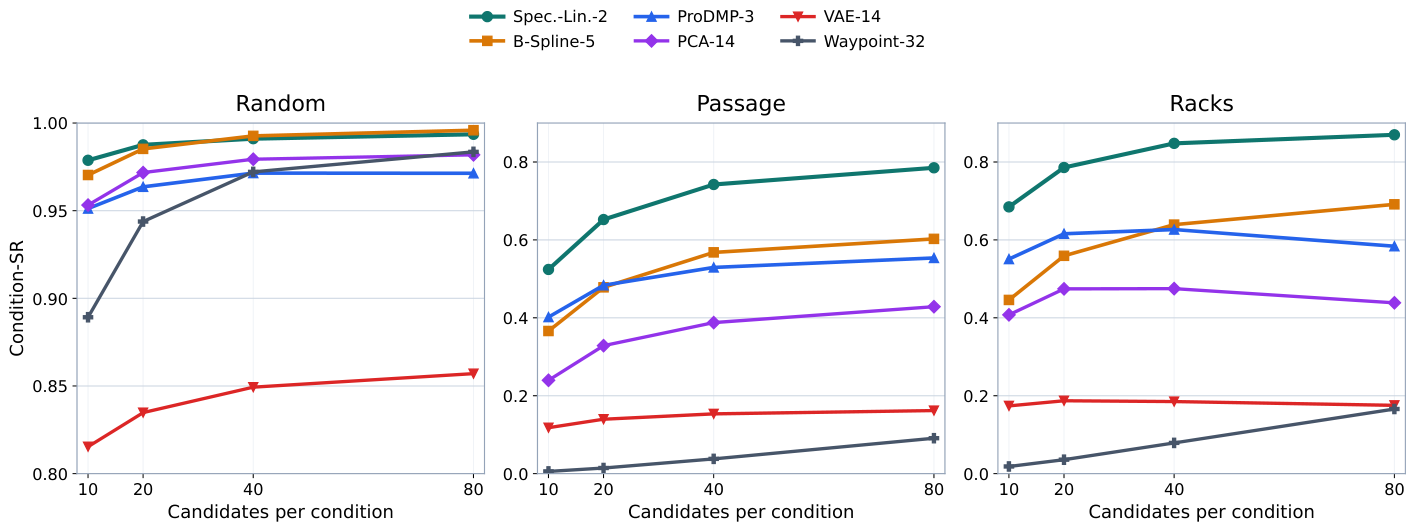
Candidate-budget sensitivity. Because Condition-SR depends on how many candidates are sampled per condition, we reran the six main methods at candidate counts of 10, 20, 40, and 80 for the same evaluation stack.
Figure 6 summarizes the three-scene trend.
These sweeps were independent reruns rather than reused samples from
Table 2, so the 40-candidate entries need not match
Table 2 exactly. The main observation is stable across budgets: on the structured scenes, spectral-linear representation remains the top family at 10, 20, 40, and 80 candidates, while on Random the compact families stay near ceiling over the full budget range. The complete three-scene values are also reported in the
Supplementary Material.
Relative gain summary. Since Random is near ceiling for most compact families, the structured benchmarks more clearly reveal representation effects.
Table 3 summarizes the gains of Spec.-Lin.-2 over representative baselines on the structured scenes.
Waypoint-32 is included as a direct-trajectory control. Its relative percentages are very large because the structured-scene baseline is near failure, so the absolute percentage-point gains are more informative. VAE sits close to failure on the structured scenes, so its relative percentages are also very large; more informative is the fact that spectral-linear representation still holds a clear advantage over the stronger compact baselines B-Spline-5 and ProDMP-3. For PCA, the gap should be read with the construction difference in mind: PCA is a data-driven residual linear basis ordered by training-set variance, whereas spectral-linear representation uses an analytically specified smooth kernel basis. Random is omitted from this summary because most compact representations are already near ceiling there.
Representation structure versus raw dimensionality. These results do not imply that lower dimensionality is universally preferable. Rather, latent width alone is not a reliable predictor across families, while each family still exhibits its own useful dimensionality range.
Table 4 reports the within-family B-spline and spectral-linear dimensionality sweeps.
The sweep confirms that width is non-monotonic within both families: B-spline peaks at different widths on the two structured benchmarks, whereas spectral-linear peaks at
on both. Complete sweeps, including VAE and PCA, are reported in the
Supplementary Material.
Spectral-linear ablation. Two matched 14D ablations are next examined around the spectral-linear design.
Table 5 reports the corresponding matched 14D comparison.
Spec.-Lin.-2 exceeds Spec.-Null-2 by 10.2 and 16.3 percentage points on Passage and Racks, respectively. It also exceeds RBF-Lin.-2 by 21.0 and 12.4 points, making it the highest-scoring variant within the shared guidance and evaluation protocol.
Expert-only control. To test whether the ranking is an artifact of teacher-generated augmentation, the main representations are retrained on the original expert trajectories only. The overall ranking pattern is preserved in this control: spectral-linear representation reaches 70.1%/82.7% Condition-SR on Passage/Racks, ahead of B-Spline-5 by 6.5/14.7 points and ProDMP-3 by 41.6/43.4 points. Waypoint-32 and VAE-14 remain near failure in the structured scenes.
Table 6 reports the full control results.
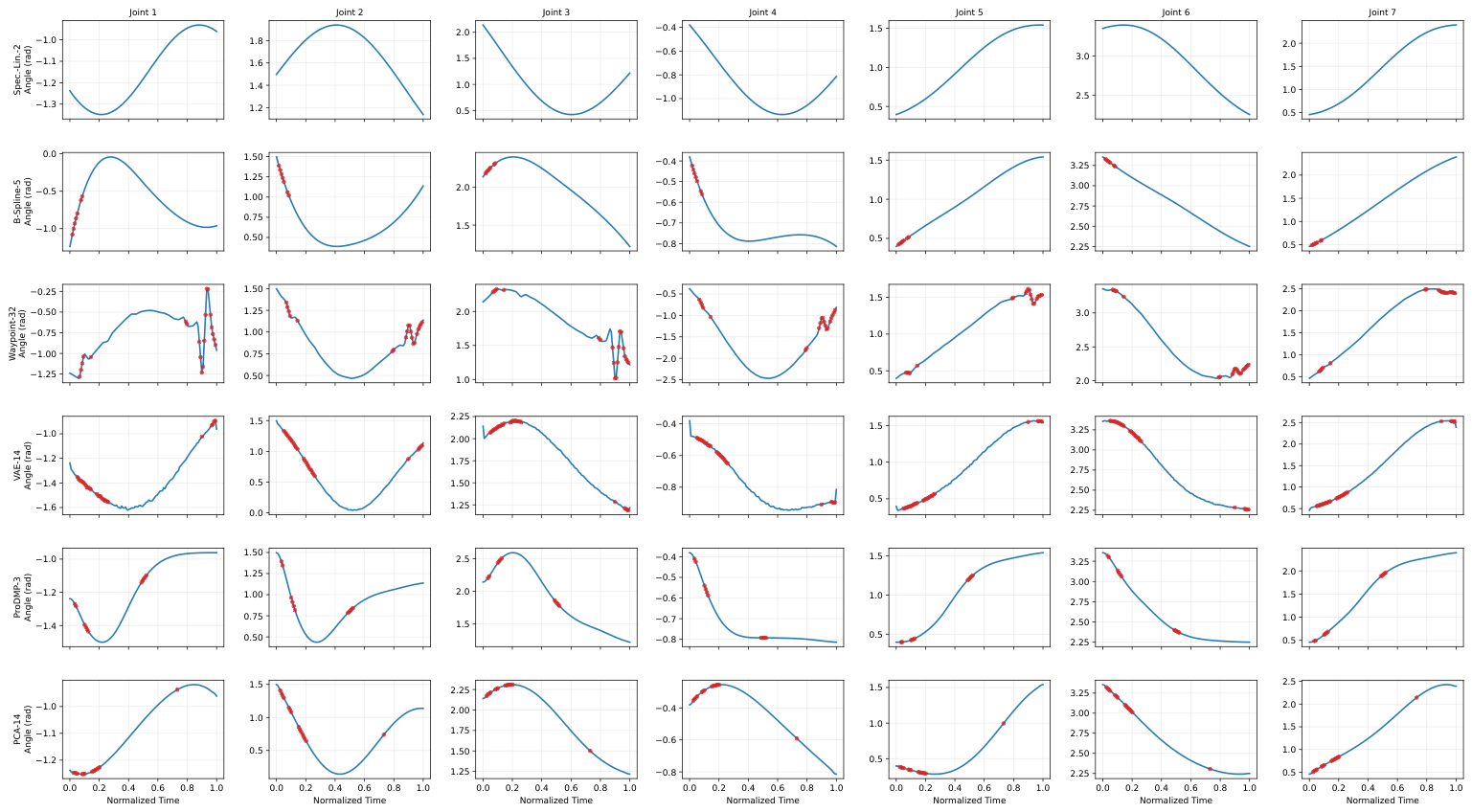
Figure 7 illustrates a representative Passage case. Several baselines accumulate collisions near the bottleneck entrance, whereas spectral-linear representation bends through the passage more coherently.
Table 2,
Table 3,
Table 4 and
Table 5 provide the corresponding quantitative ranking.
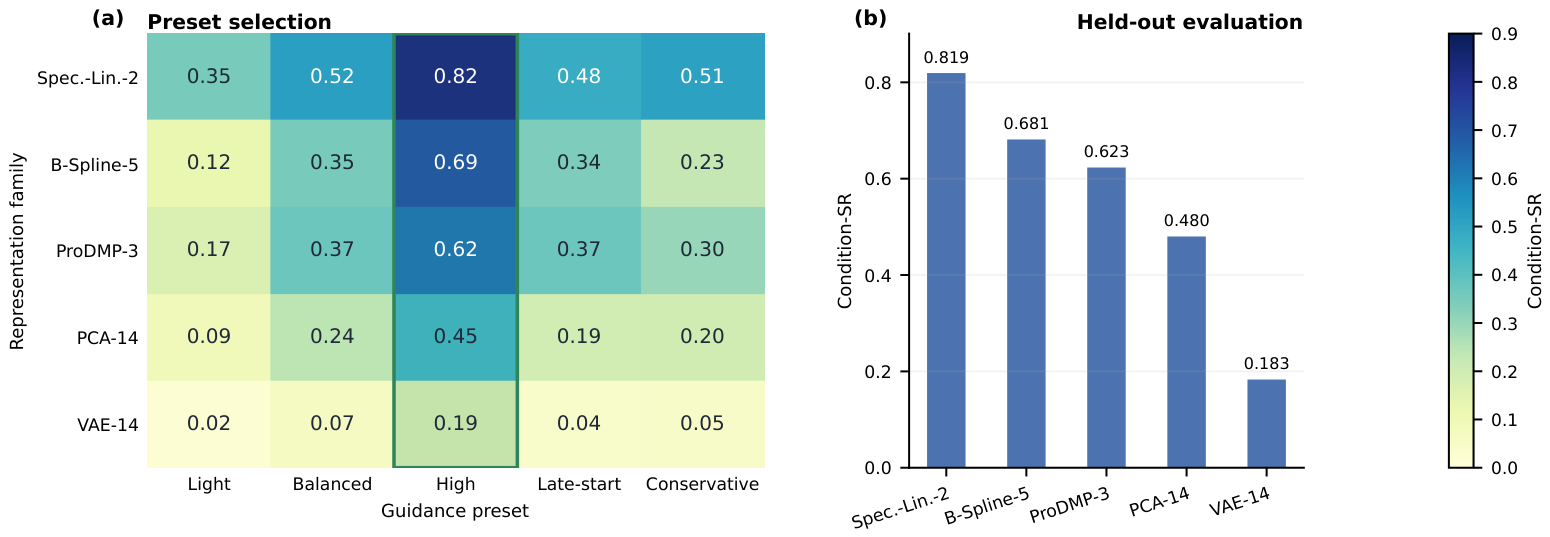
Per-family guidance tuning. To test whether the shared protocol favors any particular compact family, each family is allowed to choose its own guidance configuration on a held-out ring-passage tuning subset of 100 conditions while keeping the trained model, DDIM steps, candidate count, and collision/evaluation settings fixed. All families select the same high-guidance configuration, and spectral-linear representation remains the highest-scoring family on the tuning set.
Figure 8 shows the preset-selection and held-out evaluation results. These tuned results are reported only as a robustness check, not as replacements for
Table 2.
5.3. External References
To contextualize the learned representations,
Table 7 reports cuRobo [
41] and RRT-Connect [
42] under 200 ms and 1000 ms wall-clock budgets as fixed-budget external references. These numbers should be read as contextual rather than as an apples-to-apples baseline ranking: the planners rely on different system assumptions, and the public MPD [
6] implementation uses released weights with a collision backend and robot model that do not match the evaluation stack.
5.4. Backbone Robustness Check: Transformer
To test whether the representation ranking persists with a different denoising backbone, all six main representation families are retrained with a Transformer denoiser [
43] under the same protocol.
The structured-scene ranking is largely preserved: spectral-linear representation remains the highest-scoring family on both benchmarks. This result indicates that the main representation effect is not tied to the original denoiser pairing used in the principal comparison.
Table 8 reports the full Transformer-backbone results.
Table 9 provides a separate 6-DOF UR5e robustness check: the displayed families are retrained on UR5e-specific data and evaluated with the UR5e collision model. This check is not part of the shared 7-DOF Panda comparison and is reported only to test whether the ordering extends to a second simulated robot setting.
6. Discussion and Limitations
Implications for Guided Diffusion. Collision costs are evaluated in dense trajectory space, whereas optimization takes place in latent space. The experiments suggest that this interface is one of the main places where representation matters in the present setting. A basis that channels local geometric guidance signals into a few coherent directions is more likely to reshape the full path within a limited guidance budget. By contrast, a basis that isolates waypoints or disperses the signal across weakly coordinated dimensions tends to dilute that budget. This interpretation is consistent with the gradient pathways in
Section 4 and the decoder-induced spreading view in
Figure 4: waypoint updates remain local, B-spline updates influence a neighborhood, and spectral-linear updates extend across the full horizon.
Limitations. This study also has several limitations. First, the comparison is deliberately conducted under a shared guidance and evaluation protocol. That choice is required by the question studied here: the aim is not to rank end-to-end systems after family-specific co-optimization but to identify whether trajectory representation changes how dense-space collision gradients are transmitted into latent updates. If each family were instead paired with its own preferred backbone, conditioning stack, guidance schedule, or post-processing pipeline, representation would become entangled with system-level design choices, and the experiment would no longer identify a representation effect. The weaker PCA and conditional-VAE results should therefore be interpreted as shared-protocol outcomes rather than fully tuned upper bounds. The main comparison also retains a backbone asymmetry: five families use a latent MLP, whereas the reported waypoint baseline uses a UNet, even though an additional Waypoint-32 MLP control was also evaluated separately. The Transformer rerun and expert-only control suggest that the structured-scene ranking is reasonably stable, but they do not establish full backbone invariance or remove the influence of teacher augmentation on absolute success rates. The study is simulation-based and benchmark-based; physical prototype validation remains future work.
This point also clarifies the scope of the main claim. The paper should be read as a controlled sensitivity study on representation for a fixed planning stack, not as a statement that the same family must remain best after every component of every system is separately optimized. A full family-specific comparison would answer a different question, namely which complete planner works best after joint co-design. The present study instead asks which latent coordinate structures are most compatible with test-time geometric guidance when the surrounding stack is held fixed.
Second, the test sets are procedural rather than community-standard public benchmarks. The conclusions should therefore be read as controlled empirical regularities within these scene families, rather than as a universal ranking over all manipulator-planning benchmarks.
Finally, all experiments were conducted in static rigid-obstacle scenes, and the spectral basis was constructed from a fixed analytically specified RBF kernel. Dynamic obstacles, multi-arm coordination, contact-rich tasks, real-world execution metrics, and adaptive basis construction may change the relative preference among representations.
7. Conclusions
We compared trajectory representations for guided diffusion-based manipulator motion planning under a shared joint-space protocol, and we introduced spectral-linear representation, a compact kernel-eigenbasis parameterization. Across three procedural benchmarks and multiple robustness checks, spectral-linear representation achieved the highest structured-scene condition-level success rates among the tested families. Within the scope of this study, the results are more consistent with bottleneck performance being shaped by how a representation propagates geometric guidance than with latent width alone. The shared protocol is central to that conclusion: It keeps the surrounding planning stack fixed so that differences in guidance propagation are attributable to the representation variable itself, rather than to family-specific co-optimization of backbone, conditioning, or post-processing. This study is simulation-based and benchmark-based; physical prototype validation remains future work.
Supplementary Materials
The following supporting information can be downloaded at:
https://www.mdpi.com/article/10.3390/machines14070782/s1. Supplementary Material: Additional Experimental Details, including the experimental protocol, guidance-cost definitions and inference algorithm, hyperparameter summary, per-family guidance configurations, representation configurations, complete dimensionality sweeps, candidate-budget values, and kernel-length-scale sensitivity. The supplementary inference protocol uses DDIM sampling [
2].
Author Contributions
Z.C. and Z.Z. contributed to conceptualization, methodology, software, validation, formal analysis, investigation, data curation, and visualization; Z.C. drafted the manuscript; and R.Y. and S.J. supervised the work and administered the project. All authors have read and agreed to the published version of the manuscript.
Funding
This research was funded by the Municipal Key Research and Development Project of Guangzhou (Grant SL2022B01J00068), the Natural Science Foundation of Guangdong Province, China (Grant 2023A1515012546), and the Key Project of the National Key Research Program (Grant SQ2024YFF0500187).
Institutional Review Board Statement
Not applicable.
Informed Consent Statement
Not applicable.
Data Availability Statement
The data and code supporting the findings of this study are not publicly available because they are subject to proprietary and confidentiality restrictions. They may be made available from the corresponding author upon reasonable request and subject to approval by the data owner.
Conflicts of Interest
The authors declare no conflicts of interest.
References
- Ho, J.; Jain, A.; Abbeel, P. Denoising Diffusion Probabilistic Models. In Proceedings of the Advances in Neural Information Processing Systems (NeurIPS); Curran Associates Inc.: Red Hook, NY, USA, 2020. [Google Scholar]
- Song, J.; Meng, C.; Ermon, S. Denoising Diffusion Implicit Models. In Proceedings of the International Conference on Learning Representations (ICLR), Virtual Event, 3–7 May 2021. [Google Scholar]
- Song, Y.; Sohl-Dickstein, J.; Kingma, D.P.; Kumar, A.; Ermon, S.; Poole, B. Score-Based Generative Modeling through Stochastic Differential Equations. In Proceedings of the International Conference on Learning Representations (ICLR), Virtual Event, 3–7 May 2021. [Google Scholar]
- Janner, M.; Du, Y.; Tenenbaum, J.B.; Levine, S. Planning with Diffusion for Flexible Behavior Synthesis. In Proceedings of the International Conference on Machine Learning (ICML), Baltimore, MD, USA, 17–23 July 2022. [Google Scholar]
- Chi, C.; Feng, S.; Du, Y.; Xu, Z.; Cousineau, E.; Burchfiel, B.C.M.; Song, S. Diffusion Policy: Visuomotor Policy Learning via Action Diffusion. In Proceedings of the Robotics: Science and Systems (RSS), Daegu, Republic of Korea, 10–14 July 2023. [Google Scholar] [CrossRef] [Scilit]
- Carvalho, J.; Le, A.T.; Kicki, P.; Koert, D.; Peters, J. Motion Planning Diffusion: Learning and Adapting Robot Motion Planning with Diffusion Models. IEEE Trans. Robot. 2025, 41, 4881–4901. [Google Scholar] [CrossRef] [Scilit]
- Seo, M.; Cho, Y.; Sung, Y.; Stone, P.; Zhu, Y.; Kim, B. PRESTO: Fast Motion Planning Using Diffusion Models Based on Key-Configuration Environment Representation. In Proceedings of the IEEE International Conference on Robotics and Automation (ICRA); IEEE: Piscataway, NJ, USA, 2025; pp. 10861–10867. [Google Scholar] [CrossRef] [Scilit]
- Liang, Z.; Mu, Y.; Ding, M.; Ni, F.; Tomizuka, M.; Luo, P. AdaptDiffuser: Diffusion Models as Adaptive Self-evolving Planners. In Proceedings of the International Conference on Machine Learning (ICML), Honolulu, HI, USA, 23–29 July 2023. [Google Scholar]
- Yan, S.; Zhang, Z.; Han, M.; Wang, Z.; Xie, Q.; Li, Z.; Li, Z.; Liu, H.; Wang, X.; Zhu, S.C. M2 Diffuser: Diffusion-based Trajectory Optimization for Mobile Manipulation in 3D Scenes. IEEE Trans. Pattern Anal. Mach. Intell. 2025, 1–17. [Google Scholar] [CrossRef] [Scilit] [PubMed]
- Zhang, X.; Mou, X.; Wang, R.; Wo, T.; Gu, N.; Wang, T.; Xu, C.; Liu, X. RobotDiffuse: Motion Planning for Redundant Manipulator based on Diffusion Model. arXiv 2024, arXiv:2412.19500. [Google Scholar]
- Scheikl, P.M.; Schreiber, N.; Haas, C.; Freymuth, N.; Neumann, G.; Lioutikov, R.; Mathis-Ullrich, F. Movement Primitive Diffusion: Learning Gentle Robotic Manipulation of Deformable Objects. IEEE Robot. Autom. Lett. 2024, 9, 5338–5345. [Google Scholar] [CrossRef] [Scilit]
- Shi, X.; Hu, Y.; Jin, J. FRMD: Fast Robot Motion Diffusion via Trajectory-Level Consistency Distillation. Front. Robot. AI 2026, 13, 1751688. [Google Scholar] [CrossRef] [Scilit] [PubMed]
- Zhou, J.; Lin, S.; Fu, S.; Wu, Q. Decoupled Action Head: Confining Task Knowledge to Conditioning Layers. arXiv 2025, arXiv:2511.12101. [Google Scholar] [CrossRef] [Scilit]
- Pan, C.; Yi, Z.; Shi, G.; Qu, G. Model-Based Diffusion for Trajectory Optimization. In Proceedings of the Advances in Neural Information Processing Systems (NeurIPS); Curran Associates Inc.: Red Hook, NY, USA, 2024; Volume 37, pp. 57914–57943. [Google Scholar] [CrossRef] [Scilit]
- Sharma, M.; Fishman, A.; Kumar, V.; Paxton, C.; Kroemer, O. Cascaded Diffusion Models for Neural Motion Planning. In Proceedings of the 2025 IEEE International Conference on Robotics and Automation (ICRA); IEEE: Piscataway, NJ, USA, 2025; pp. 14361–14368. [Google Scholar] [CrossRef] [Scilit]
- Luan, H.; Goh, Y.X.; Ng, S.K.; Ling, C.K. Projected Coupled Diffusion for Test-Time Constrained Joint Generation. In Proceedings of the International Conference on Learning Representations (ICLR), Rio de Janeiro, Brazil, 23–25 April 2026. [Google Scholar]
- Nguyen, K.; Le, A.T.; Pham, T.; Huber, M.; Peters, J.; Vu, M.N. FlowMP: Learning Motion Fields for Robot Planning with Conditional Flow Matching. In Proceedings of the 2025 IEEE/RSJ International Conference on Intelligent Robots and Systems (IROS); IEEE: Piscataway, NJ, USA, 2025; pp. 11291–11297. [Google Scholar] [CrossRef] [Scilit]
- de Boor, C. A Practical Guide to Splines; Springer: Berlin/Heidelberg, Germany, 2001. [Google Scholar]
- Piegl, L.; Tiller, W. The NURBS Book; Springer: Berlin/Heidelberg, Germany, 1997. [Google Scholar]
- Ijspeert, A.J.; Nakanishi, J.; Hoffmann, H.; Pastor, P.; Schaal, S. Dynamical Movement Primitives: Learning Attractor Models for Motor Behaviors. Neural Comput. 2013, 25, 328–373. [Google Scholar] [CrossRef] [Scilit] [PubMed]
- Paraschos, A.; Daniel, C.; Peters, J.; Neumann, G. Probabilistic Movement Primitives. In Proceedings of the Advances in Neural Information Processing Systems (NeurIPS); Curran Associates Inc.: Red Hook, NY, USA, 2013. [Google Scholar]
- Li, G.; Jin, Z.; Volpp, M.; Otto, F.; Lioutikov, R.; Neumann, G. ProDMP: A Unified Perspective on Dynamic and Probabilistic Movement Primitives. IEEE Robot. Autom. Lett. 2023, 8, 2325–2332. [Google Scholar] [CrossRef] [Scilit]
- Barfoot, T.D.; Tong, C.H.; Särkkä, S. Batch Continuous-Time Trajectory Estimation as Exactly Sparse Gaussian Process Regression. In Proceedings of the Robotics: Science and Systems (RSS), Berkeley, CA, USA, 12–16 July 2014. [Google Scholar] [CrossRef] [Scilit]
- Rasmussen, C.E.; Williams, C.K.I. Gaussian Processes for Machine Learning; MIT Press: Cambridge, MA, USA, 2006. [Google Scholar]
- Dong, J.; Mukadam, M.; Dellaert, F.; Boots, B. Motion Planning as Probabilistic Inference using Gaussian Processes and Factor Graphs. In Proceedings of the Robotics: Science and Systems (RSS), Ann Arbor, MI, USA, 18–22 June 2016. [Google Scholar] [CrossRef] [Scilit]
- Marinho, Z.; Boots, B.; Dragan, A.; Byravan, A.; Gordon, G.J.; Srinivasa, S. Functional Gradient Motion Planning in Reproducing Kernel Hilbert Spaces. In Proceedings of the Robotics: Science and Systems (RSS), Ann Arbor, MI, USA, 18–22 June 2016. [Google Scholar] [CrossRef] [Scilit]
- Wang, C.; Xu, T.; Tomizuka, M. Continuous Trajectory Optimization via B-splines for Multi-jointed Robotic Systems. arXiv 2022, arXiv:2212.10500. [Google Scholar] [CrossRef] [Scilit]
- Liao, W.; Li, G.; Zhou, H.; Lioutikov, R.; Neumann, G. BMP: Bridging the Gap between B-Spline and Movement Primitives. arXiv 2024, arXiv:2411.10336. [Google Scholar] [CrossRef] [Scilit]
- Kalakrishnan, M.; Chitta, S.; Theodorou, E.; Pastor, P.; Schaal, S. STOMP: Stochastic Trajectory Optimization for Motion Planning. In Proceedings of the IEEE International Conference on Robotics and Automation (ICRA), Shanghai, China, 9–13 May 2011; IEEE: Piscataway, NJ, USA, 2011; pp. 4569–4574. [Google Scholar] [CrossRef] [Scilit]
- Zucker, M.; Ratliff, N.; Dragan, A.D.; Pivtoraiko, M.; Klingensmith, M.; Dellin, C.M.; Bagnell, J.A.; Srinivasa, S.S. CHOMP: Covariant Hamiltonian Optimization for Motion Planning. Int. J. Robot. Res. 2013, 32, 1164–1193. [Google Scholar] [CrossRef] [Scilit]
- Schulman, J.; Duan, Y.; Ho, J.; Lee, A.; Awwal, I.; Bradlow, H.; Pan, J.; Patil, S.; Goldberg, K.; Abbeel, P. Motion Planning with Sequential Convex Optimization and Convex Collision Checking. Int. J. Robot. Res. 2014, 33, 1251–1270. [Google Scholar] [CrossRef] [Scilit]
- Lim, B.; Ra, S.; Park, F.C. Movement primitives, principal component analysis, and the efficient generation of natural motions. In Proceedings of the 2005 IEEE International Conference on Robotics and Automation (ICRA); IEEE: Piscataway, NJ, USA, 2005; pp. 4630–4635. [Google Scholar] [CrossRef] [Scilit]
- Osa, T.; Ikemoto, S. Goal-Conditioned Variational Autoencoder Trajectory Primitives with Continuous and Discrete Latent Codes. SN Comput. Sci. 2020, 1, 303. [Google Scholar] [CrossRef] [Scilit]
- Hung, C.M.; Zhong, S.; Goodwin, W.; Parker Jones, O.; Engelcke, M.; Havoutis, I.; Posner, I. Reaching Through Latent Space: From Joint Statistics to Path Planning in Manipulation. IEEE Robot. Autom. Lett. 2022, 7, 5334–5341. [Google Scholar] [CrossRef] [Scilit]
- Ando, T.; Iino, H.; Mori, H.; Torishima, R.; Takahashi, K.; Yamaguchi, S.; Okanohara, D.; Ogata, T. Learning-based collision-free planning on arbitrary optimization criteria in the latent space through cGANs. Adv. Robot. 2023, 37, 621–633. [Google Scholar] [CrossRef] [Scilit]
- Guillen-Perez, A. Efficient Virtuoso: A Latent Diffusion Transformer Model for Goal-Conditioned Trajectory Planning. arXiv 2025, arXiv:2509.03658. [Google Scholar]
- Ho, J.; Salimans, T. Classifier-Free Diffusion Guidance. arXiv 2022, arXiv:2207.12598. [Google Scholar]
- Liu, N.; Li, S.; Du, Y.; Torralba, A.; Tenenbaum, J.B. Compositional Visual Generation with Composable Diffusion Models. In Proceedings of the European Conference on Computer Vision (ECCV); Springer: Berlin/Heidelberg, Germany, 2022. [Google Scholar]
- Hsu, D.; Latombe, J.C.; Kurniawati, H. Narrow Passage Sampling for Probabilistic Roadmap Planning. IEEE Trans. Robot. 2005, 21, 1105–1115. [Google Scholar] [CrossRef] [Scilit]
- Kingma, D.P.; Welling, M. Auto-Encoding Variational Bayes. In Proceedings of the International Conference on Learning Representations (ICLR), Banff, AB, Canada, 14–16 April 2014. [Google Scholar]
- Sundaralingam, B.; Hari, S.K.S.; Fishman, A.; Garrett, C.; Van Wyk, K.; Blukis, V.; Millane, A.; Oleynikova, H.; Handa, A.; Ramos, F.; et al. cuRobo: Parallelized Collision-Free Robot Motion Generation. In Proceedings of the IEEE International Conference on Robotics and Automation (ICRA); IEEE: Piscataway, NJ, USA, 2023; pp. 8112–8119. [Google Scholar] [CrossRef] [Scilit]
- Kuffner, J.J.; LaValle, S.M. RRT-connect: An efficient approach to single-query path planning. In Proceedings of the 2000 ICRA. Millennium Conference. IEEE International Conference on Robotics and Automation. Symposia Proceedings; IEEE: Piscataway, NJ, USA, 2000; Volume 2, pp. 995–1001. [Google Scholar] [CrossRef] [Scilit]
- Vaswani, A.; Shazeer, N.; Parmar, N.; Uszkoreit, J.; Jones, L.; Gomez, A.N.; Kaiser, Ł.; Polosukhin, I. Attention Is All You Need. In Proceedings of the Advances in Neural Information Processing Systems (NeurIPS); Curran Associates Inc.: Red Hook, NY, USA, 2017. [Google Scholar]
Figure 1.
Unified diffusion-planning pipeline with representation-specific latent updates and shared dense-trajectory guidance.
Figure 1.
Unified diffusion-planning pipeline with representation-specific latent updates and shared dense-trajectory guidance.
Figure 2.
Spectral-linear encoding and decoding from a conditioned temporal RBF kernel.
Figure 2.
Spectral-linear encoding and decoding from a conditioned temporal RBF kernel.
Figure 3.
Mode ordering for the conditioned temporal RBF kernel.
Figure 3.
Mode ordering for the conditioned temporal RBF kernel.
Figure 4.
Schematic decoder-induced gradient spreading. Gray dots denote trajectory states, the red marker denotes a local collision signal, and blue bars or bands show the decoder-induced propagation of that local signal.
Figure 4.
Schematic decoder-induced gradient spreading. Gray dots denote trajectory states, the red marker denotes a local collision signal, and blue bars or bands show the decoder-induced propagation of that local signal.
Figure 5.
The Random, Racks, and Passage procedural benchmark families. The Franka Panda robot is shown in neutral configuration.
Figure 5.
The Random, Racks, and Passage procedural benchmark families. The Franka Panda robot is shown in neutral configuration.
Figure 6.
Candidate-budget sensitivity across Random, Passage, and Racks. Lines are independent reruns; y-axis ranges differ for readability.
Figure 6.
Candidate-budget sensitivity across Random, Passage, and Racks. Lines are independent reruns; y-axis ranges differ for readability.
Figure 7.
Joint-space trajectories on a passage test scene. Blue curves denote joint trajectories, and red markers denote sampled trajectory states detected in collision, not post-impact states.
Figure 7.
Joint-space trajectories on a passage test scene. Blue curves denote joint trajectories, and red markers denote sampled trajectory states detected in collision, not post-impact states.
Figure 8.
Per-family guidance tuning. Cell values are Condition-SR, not entropy. Green outlines identify the selected high-guidance preset used for the held-out evaluation.
Figure 8.
Per-family guidance tuning. Cell values are Condition-SR, not entropy. Green outlines identify the selected high-guidance preset used for the held-out evaluation.
Table 1.
Main symbols used in the paper.
Table 1.
Main symbols used in the paper.
| Symbol | Meaning |
|---|
| Start and goal joint configurations |
| Dense joint-space trajectory |
| Diffusion variable in the native representation |
| Trajectory decoder from native space to dense trajectory space |
| m | Total latent dimensionality |
| T | Number of dense trajectory points |
| K | Number of retained modes or basis functions |
| ℓ | Temporal RBF-kernel length scale |
| Temporal RBF-kernel amplitude |
| Condition-SR | Fraction of planning conditions with at least one feasible sampled candidate |
Table 2.
Main results across the six trajectory families. Condition-SR is reported on Random, Passage, and Racks using 40 sampled candidates per condition; for Passage, MSJ and PL are averaged over successful candidate trajectories. For Passage and Racks, the 95% Wilson binomial confidence intervals are below about percentage point for the main methods. Bold marks the best value in each metric column.
Table 2.
Main results across the six trajectory families. Condition-SR is reported on Random, Passage, and Racks using 40 sampled candidates per condition; for Passage, MSJ and PL are averaged over successful candidate trajectories. For Passage and Racks, the 95% Wilson binomial confidence intervals are below about percentage point for the main methods. Bold marks the best value in each metric column.
| Method | m | Random
Condition-SR | Passage
Condition-SR | Racks
Condition-SR | MSJ | PL |
|---|
| Waypoint-32 (UNet) | 224 | 0.972 | 0.037 | 0.077 | | 6.129 |
| B-Spline-5 | 35 | 0.992 | 0.560 | 0.634 | | 5.567 |
| ProDMP-3 | 21 | 0.969 | 0.525 | 0.627 | | 5.532
|
| VAE-14 | 14 | 0.850 | 0.153 | 0.187 | | 5.811 |
| PCA-14 | 14 | 0.980 | 0.382 | 0.478 | | 5.575 |
| Spec.-Lin.-2 | 14 | 0.991 | 0.742 | 0.845 | | 6.378 |
Table 3.
Spec.-Lin.-2 relative to representative baselines on structured benchmarks. Improvement is reported as absolute percentage points (pp) and relative percentage change.
Table 3.
Spec.-Lin.-2 relative to representative baselines on structured benchmarks. Improvement is reported as absolute percentage points (pp) and relative percentage change.
| Baseline | Passage Gain | Racks Gain |
|---|
| Waypoint-32 (UNet) | 70.5 pp
(+1905.4%) | 76.8 pp
(+997.4%) |
| B-Spline-5 | 18.2 pp
(+32.5%) | 21.1 pp
(+33.3%) |
| ProDMP-3 | 21.7 pp
(+41.3%) | 21.8 pp
(+34.8%) |
| PCA-14 | 36.0 pp
(+94.2%) | 36.7 pp
(+76.8%) |
| VAE-14 | 58.9 pp
(+385.0%) | 65.8 pp
(+351.9%) |
Table 4.
Combined dimensionality sweeps for B-spline and spectral-linear representation, showing the structured-scene trend within each family. Bold marks the highest structured-scene score in the displayed sweep.
Table 4.
Combined dimensionality sweeps for B-spline and spectral-linear representation, showing the structured-scene trend within each family. Bold marks the highest structured-scene score in the displayed sweep.
| Method | m | Random | Passage | Racks |
|---|
| B-spline sweep |
| B-Spline-4 | 28 | 0.980 | 0.445 | 0.540 |
| B-Spline-5 | 35 | 0.992 | 0.560 | 0.634 |
| B-Spline-6 | 42 | 0.995 | 0.556 | 0.597 |
| B-Spline-7 | 49 | 0.996 | 0.561 | 0.569 |
| B-Spline-8 | 56 | 0.997 | 0.512 | 0.548 |
| B-Spline-12 | 84 | 0.996 | 0.437 | 0.468 |
| Spectral-linear sweep |
| Spec.-Lin.-2 | 14 | 0.991 | 0.742 | 0.845 |
| Spec.-Lin.-3 | 21 | 0.992 | 0.707 | 0.784 |
| Spec.-Lin.-4 | 28 | 0.987 | 0.608 | 0.760 |
Table 5.
Controlled ablations around the spectral-linear design under a matched 14D budget. Bold marks the best score in each benchmark column.
Table 5.
Controlled ablations around the spectral-linear design under a matched 14D budget. Bold marks the best score in each benchmark column.
| Method | Endpoint
Handling | Basis | Passage | Racks |
|---|
| RBF-Lin.-2 | Linear mean | Uniform | 0.532 | 0.721 |
| Spec.-Null-2 | Nullspace | Spectral | 0.640 | 0.682 |
| Spec.-Lin.-2 | Linear mean | Spectral | 0.742 | 0.845 |
Table 6.
Expert-only control results, without teacher-generated augmentations.
Table 6.
Expert-only control results, without teacher-generated augmentations.
| Method | Random | Passage | Racks |
|---|
| Waypoint-32 (UNet) | 0.925 | 0.004 | 0.011 |
| B-Spline-5 | 0.993 | 0.636 | 0.680 |
| ProDMP-3 | 0.939 | 0.285 | 0.393 |
| VAE-14 | 0.463 | 0.004 | 0.003 |
| PCA-14 | 0.976 | 0.357 | 0.351 |
| Spec.-Lin.-2 | 0.989 | 0.701 | 0.827 |
Table 7.
External planning references. Classical planners are run under 200 ms and 1000 ms wall-clock budgets; MPD uses released code and weights without retraining. Values are Condition-SR and should be read as contextual references rather than controlled baseline scores.
Table 7.
External planning references. Classical planners are run under 200 ms and 1000 ms wall-clock budgets; MPD uses released code and weights without retraining. Values are Condition-SR and should be read as contextual references rather than controlled baseline scores.
| Method | Budget (ms) | Random SR | Passage SR | Racks SR |
|---|
| cuRobo [41] | 200 | 0.907 | 0.425 | 0.275 |
| cuRobo [41] | 1000 | 0.943 | 0.674 | 0.559 |
| RRT-Connect [42] | 200 | 0.191 | 0.001 | 0.000 |
| RRT-Connect [42] | 1000 | 0.788 | 0.293 | 0.638 |
| MPD [6] | – | – | 0.375 | 0.437 |
Table 8.
Transformer backbone results for all six trajectory families. Bold marks the best scores on the two structured benchmarks.
Table 8.
Transformer backbone results for all six trajectory families. Bold marks the best scores on the two structured benchmarks.
| Method | Dim | Rand. | Pass. | Racks |
|---|
| Waypoint-32 | 224 | 0.863 | 0.016 | 0.012 |
| B-Spline-5 | 35 | 0.993 | 0.581 | 0.636 |
| ProDMP-3 | 21 | 0.967 | 0.472 | 0.579 |
| VAE-14 | 14 | 0.850 | 0.151 | 0.182 |
| PCA-14 | 14 | 0.981 | 0.365 | 0.478 |
| Spec.-Lin.-2 | 14 | 0.991 | 0.757 | 0.841 |
Table 9.
Additional 6-DOF UR5e robustness check. Each method uses a separately trained UR5e-specific checkpoint and the UR5e collision model; it does not reuse the 7-DOF Panda checkpoints from the main comparison. Values are mean Condition-SR over three evaluation seeds for the same method-specific UR5e checkpoint.
Table 9.
Additional 6-DOF UR5e robustness check. Each method uses a separately trained UR5e-specific checkpoint and the UR5e collision model; it does not reuse the 7-DOF Panda checkpoints from the main comparison. Values are mean Condition-SR over three evaluation seeds for the same method-specific UR5e checkpoint.
| Method | Random | Passage | Racks |
|---|
| ProDMP-3 | 0.980 | 0.837 | 0.919 |
| B-Spline-5 | 0.983 | 0.955 | 0.889 |
| Spec.-Lin.-2 | 0.985 | 0.968 | 0.921 |
| Disclaimer/Publisher’s Note: The statements, opinions and data contained in all publications are solely those of the individual author(s) and contributor(s) and not of MDPI and/or the editor(s). MDPI and/or the editor(s) disclaim responsibility for any injury to people or property resulting from any ideas, methods, instructions or products referred to in the content. |