Prediction of Tensile Strength in the FSW Process of AZ31B Magnesium Alloy Using Machine Learning
Abstract
1. Introduction
2. Materials and Methods
2.1. FSW Operation and Equipment
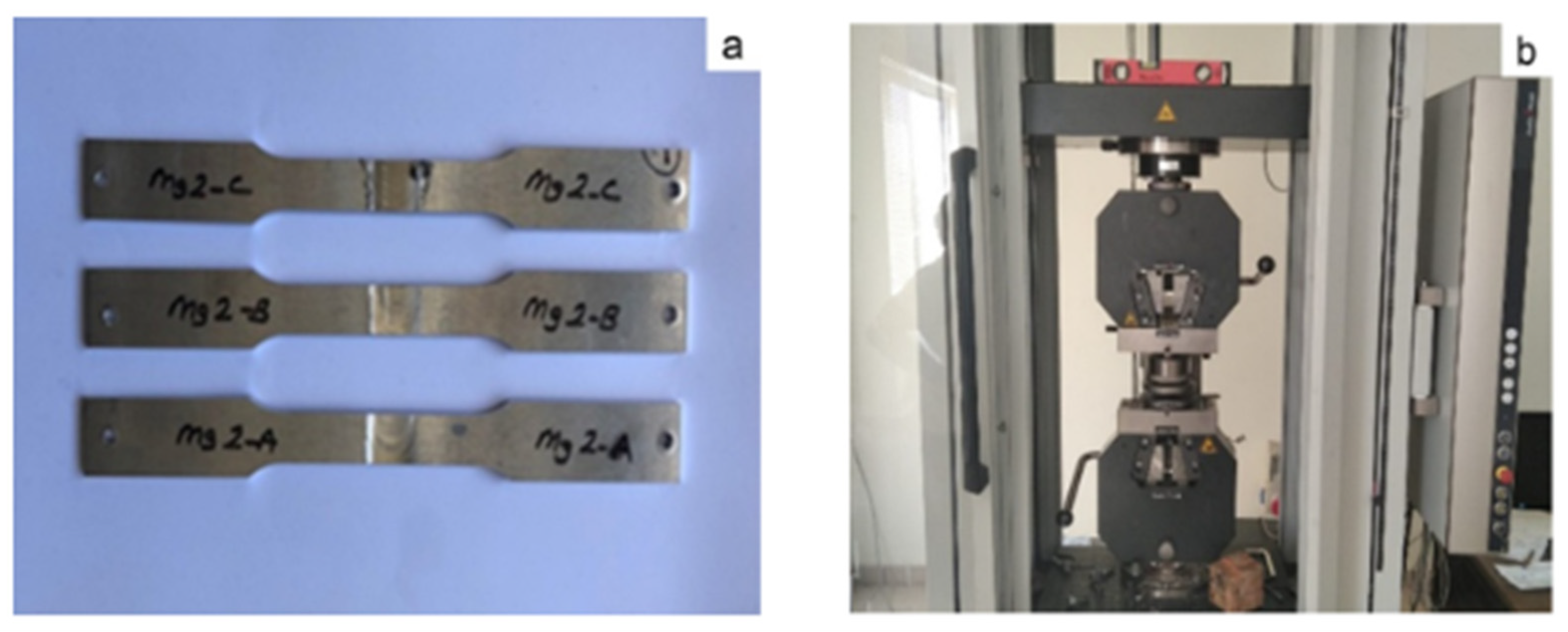
2.2. Experimental Parameters and Mechanical Testing
2.3. Dataset and ML Configuration
2.4. Machine Learning Methods
3. Results and Discussion
3.1. Performance Tests and Training
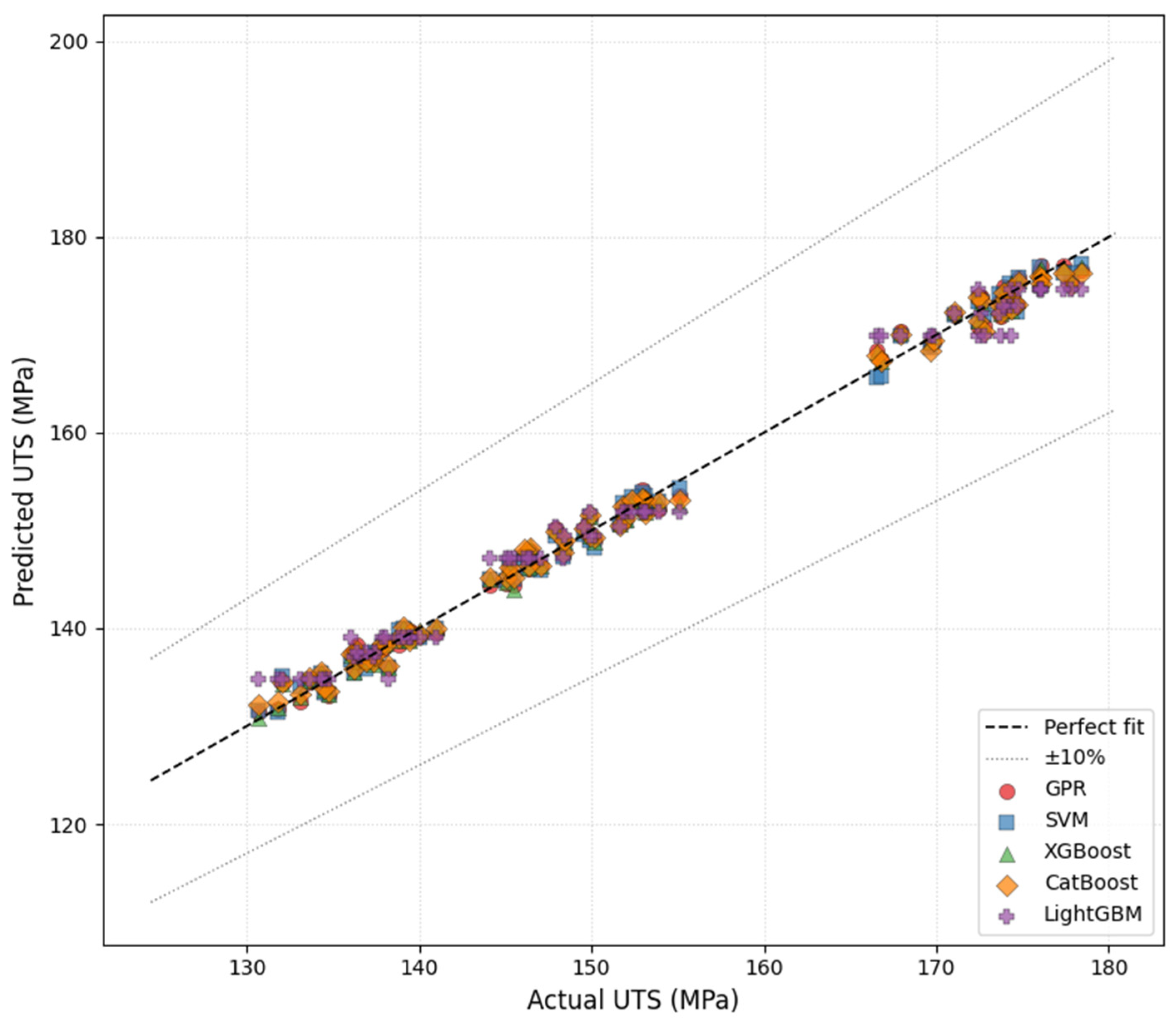
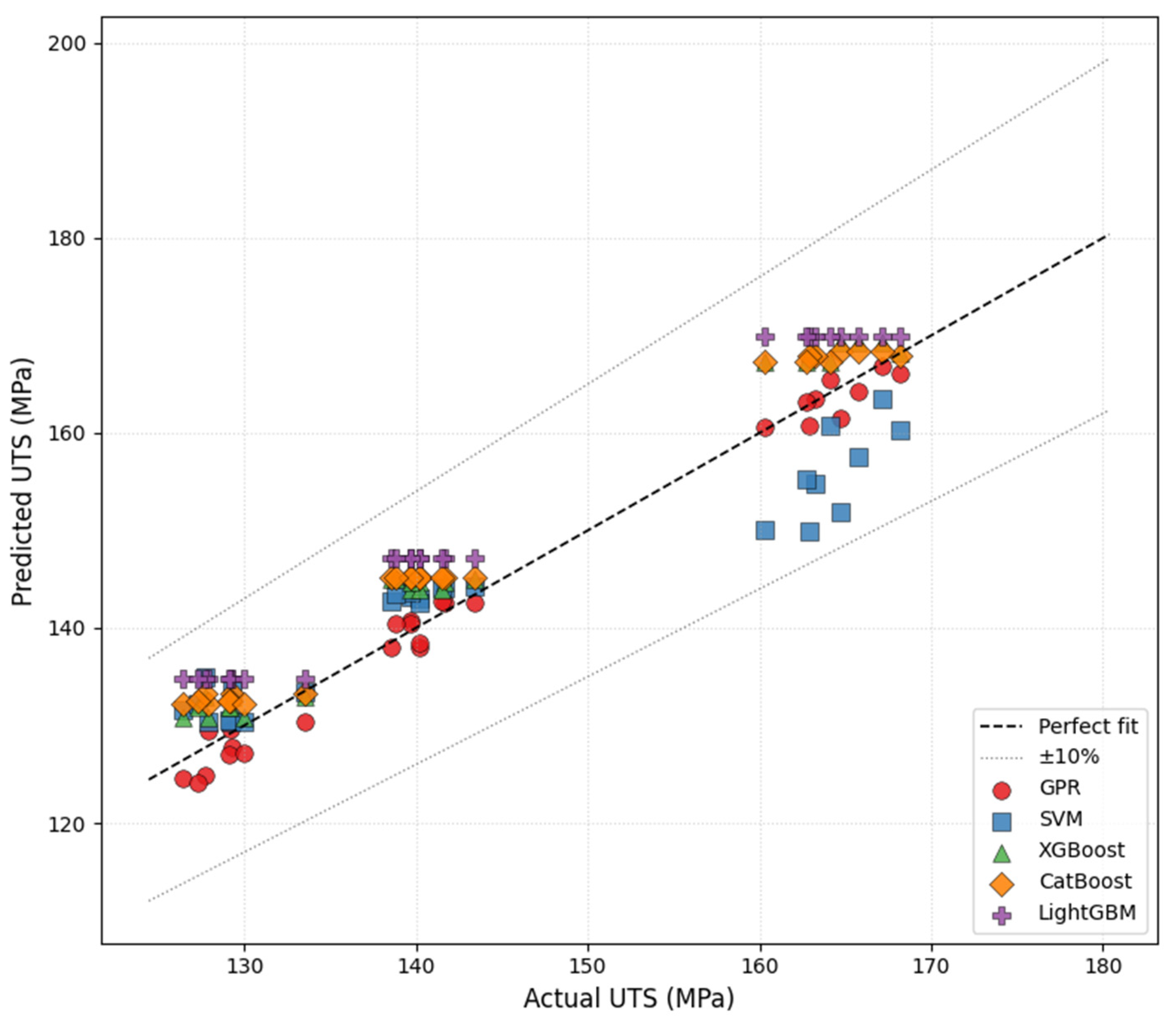
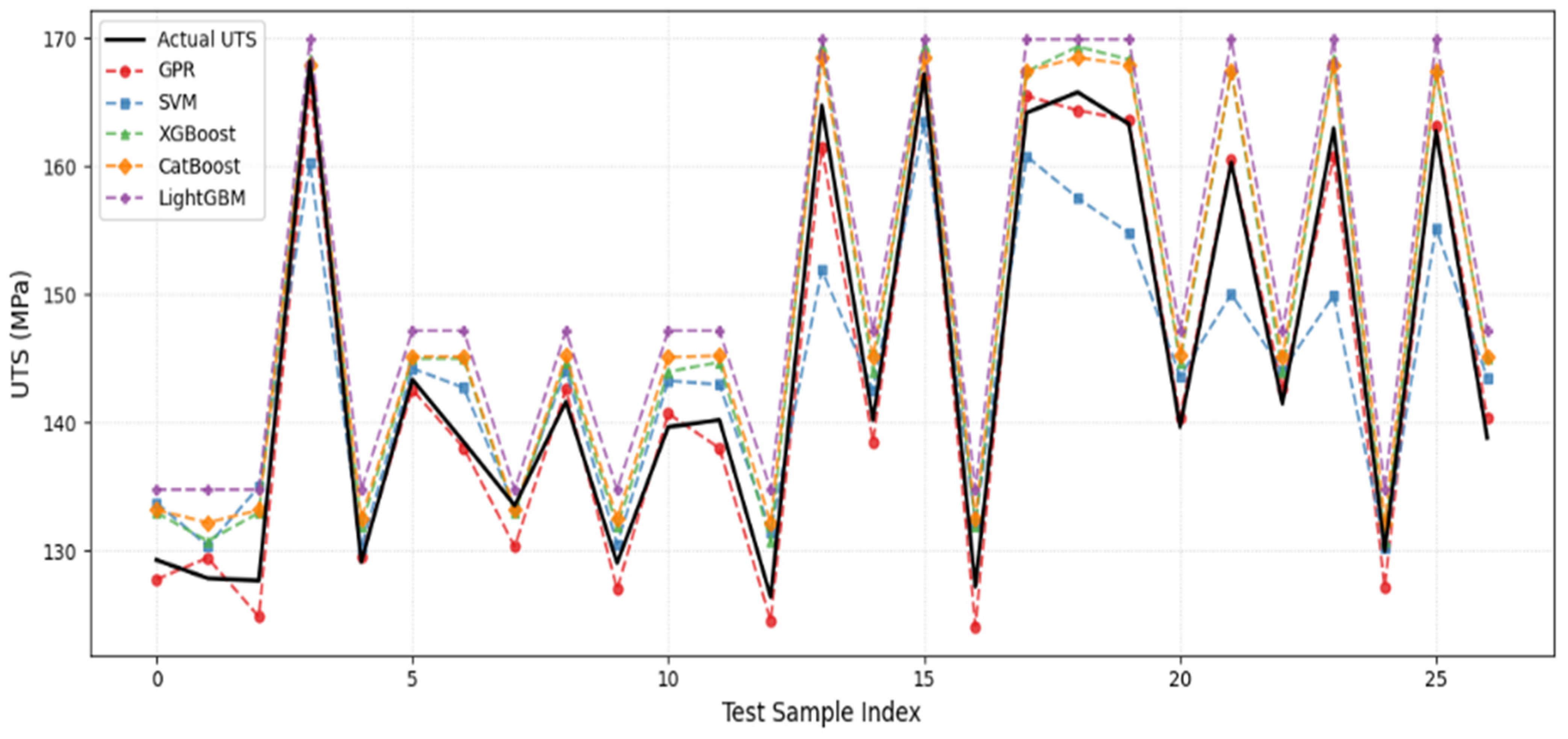
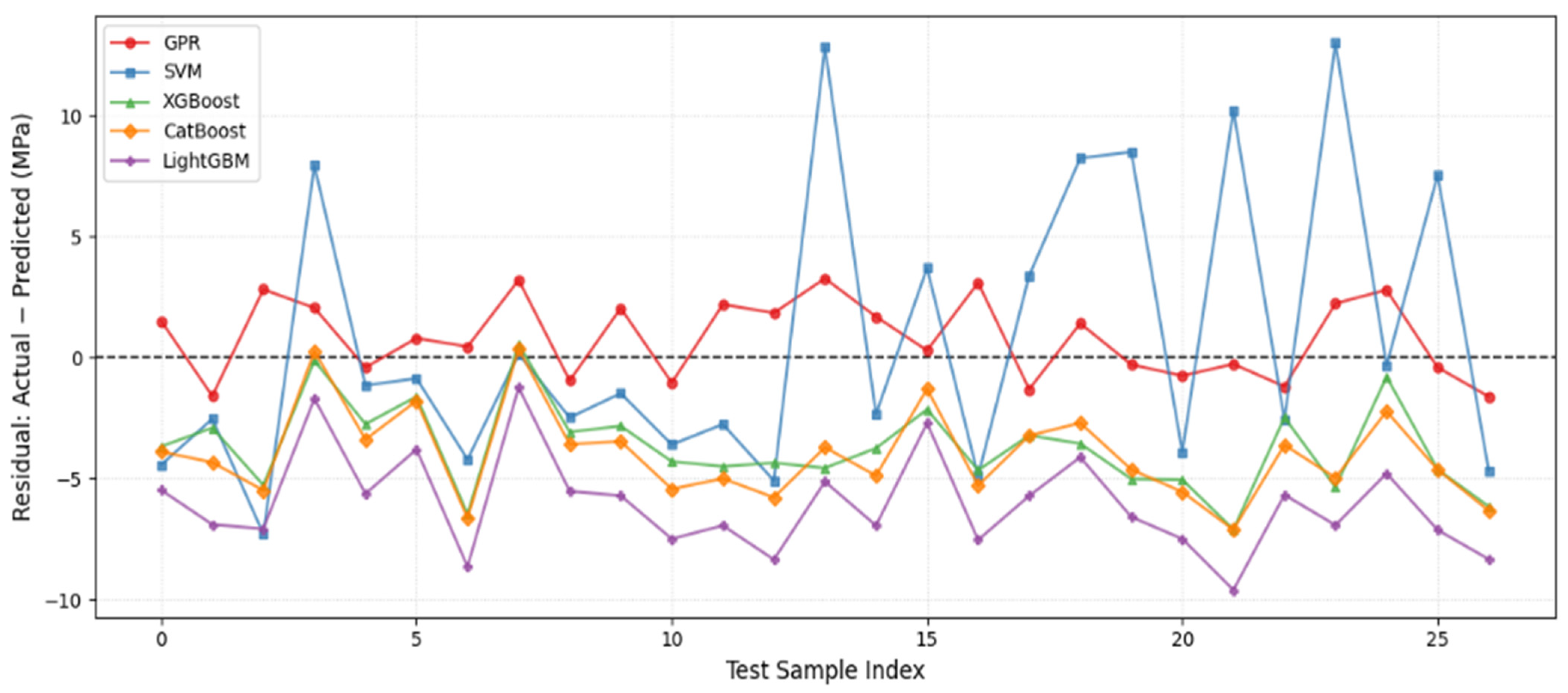
3.2. Expected and Residual Data Analysis
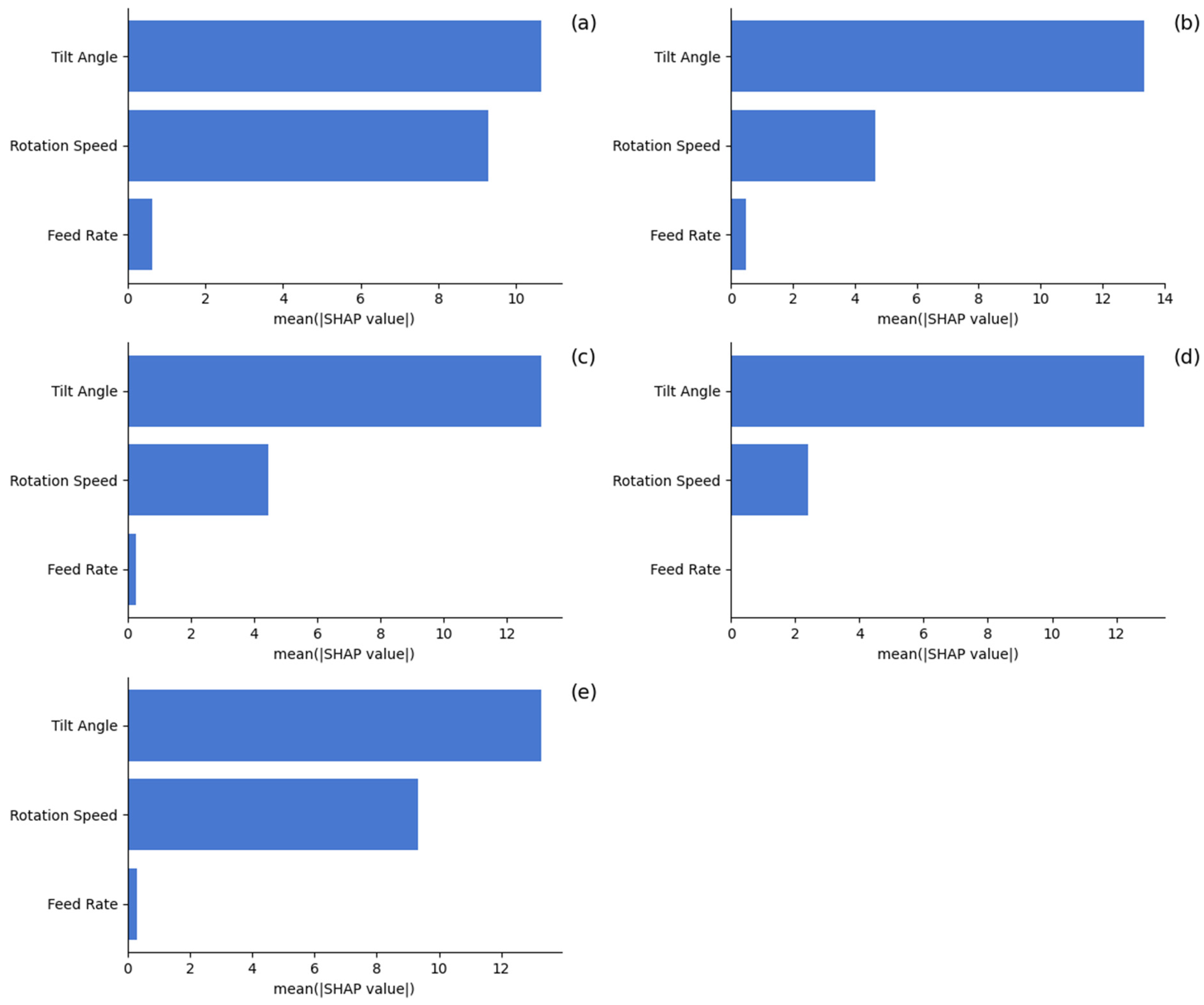
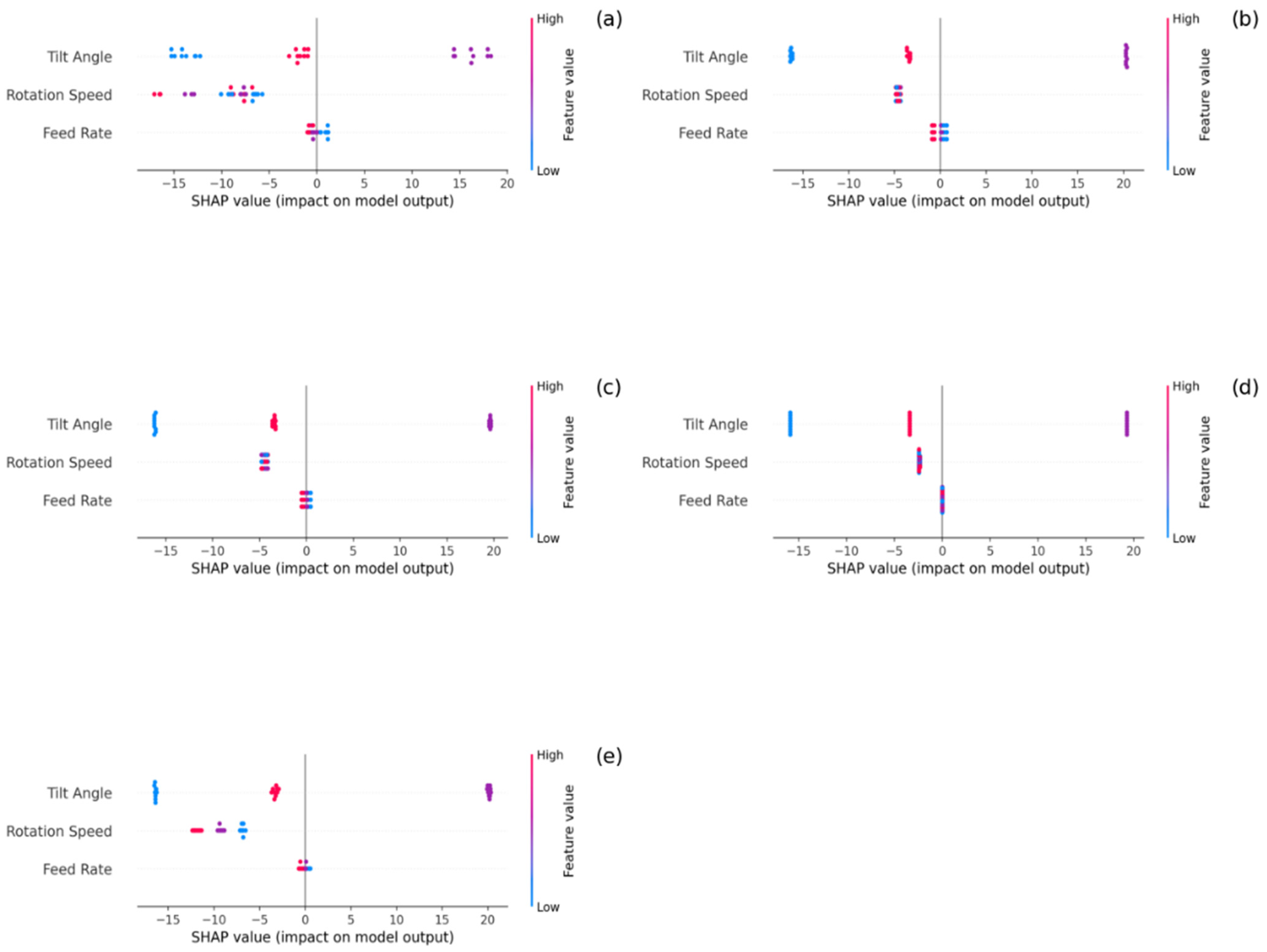
3.3. Sensitivity and SHAP Analysis
Feature Engineering Assessment
3.4. Comparison with Previous Studies
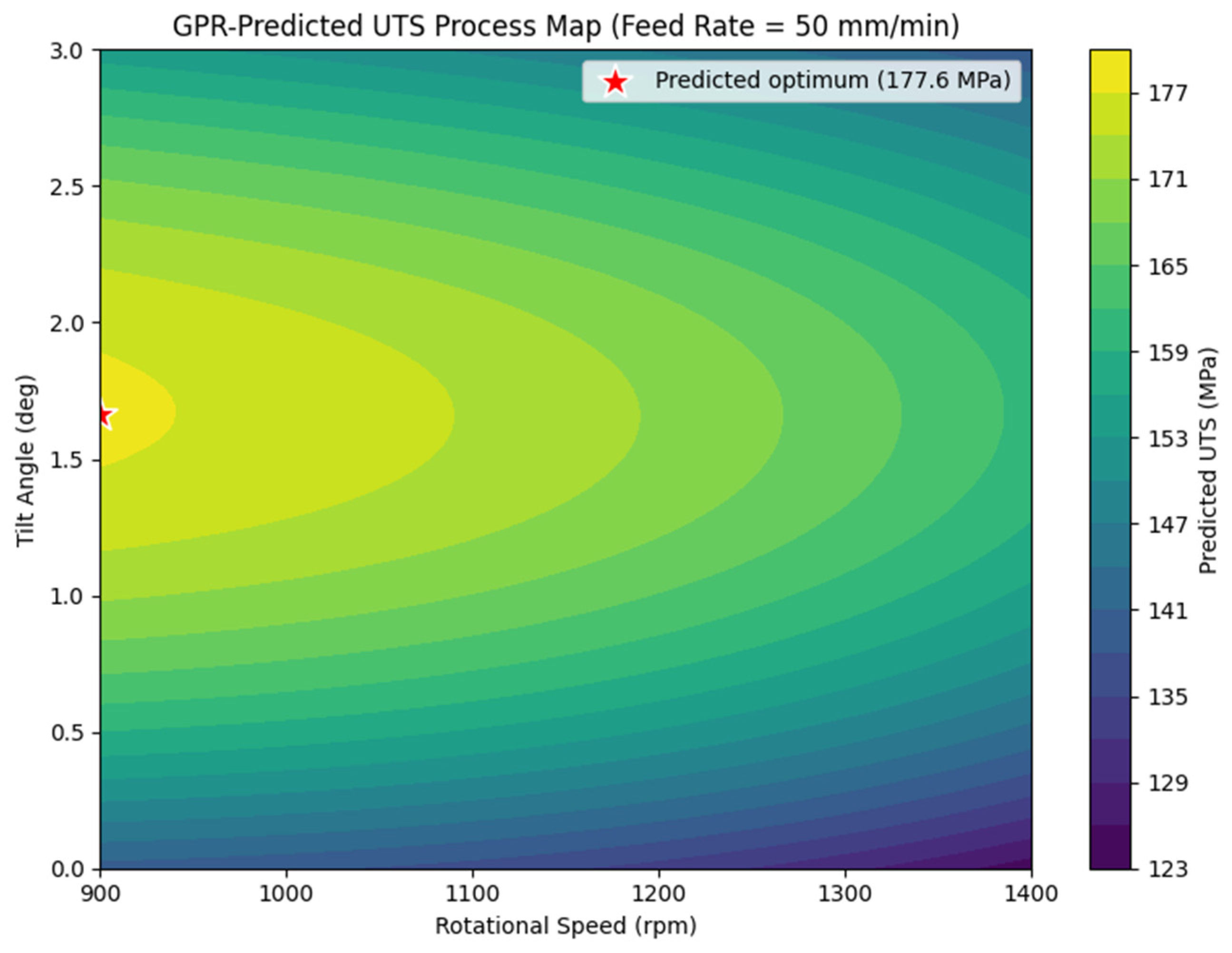
3.5. Process Optimization Map
3.6. Limitations
4. Conclusions
Author Contributions
Funding
Data Availability Statement
Conflicts of Interest
Abbreviations
| ML | Machine Learning |
| AI | Artificial Intelligence |
| FSW | Friction Stir Welding |
| GPR | Gaussian Process Regression |
| SVM | Support Vector Machine |
| UTS | Ultimate Tensile Strength |
References
- Khan, M.M.; Nemati, A.; Rahman, Z.U.; Shah, U.H.; Asgar, H.; Haider, W. Recent advancements in bulk metallic glasses and their applications: A review. Crit. Rev. Solid State Mater. Sci. 2018, 43, 233–268. [Google Scholar] [CrossRef] [Scilit]
- Tan, J.; Ramakrishna, S. Applications of magnesium and its alloys: A review. Appl. Sci. 2021, 11, 6861. [Google Scholar] [CrossRef] [Scilit]
- Meher, A.; Mahapatra, M.; Samal, P.; Vundavilli, P. A review on manufacturability of magnesium matrix composites: Processing, tribology, joining, and machining. CIRP J. Manuf. Sci. Technol. 2022, 39, 134–158. [Google Scholar] [CrossRef] [Scilit]
- Salih, O.S.; Ou, H.; Sun, W. Heat generation, plastic deformation and residual stresses in friction stir welding of aluminium alloy. Int. J. Mech. Sci. 2023, 238, 107827. [Google Scholar] [CrossRef] [Scilit]
- Kumar, S.; Triveni, M.K.; Katiyar, J.K.; Tiwari, T.N.; Roy, B.S. Prediction of heat generation effect on force, torque, and mechanical properties at varying tool rotational speed in friction stir welding using artificial neural network. Proc. Inst. Mech. Eng. Part C J. Mech. Eng. Sci. 2023, 237, 4495–4514. [Google Scholar] [CrossRef] [Scilit]
- Delir Nazarlou, R.; Pathak, R.; Schmidt, O.; Köpp, C.; Münchinger, E.; Schilling, C.; Salim, S.; Wiegand, M.; Kahlmeyer, M.; Jiang, Y.; et al. Optimizing and development of friction stir welding using AI-supported prediction method and digital twin technology. Weld. World 2026, 70, 935–948. [Google Scholar] [CrossRef] [Scilit]
- Elsheikh, A.H. Applications of machine learning in friction stir welding: Prediction of joint properties, real-time control and tool failure diagnosis. Eng. Appl. Artif. Intell. 2023, 121, 105961. [Google Scholar] [CrossRef] [Scilit]
- Bilgin, T.T.; Kunduracı, M.S.; Metin, A.; Doğru, M.; Nayir, E. Application of artificial intelligence techniques for defect prevention and quality control in arc welding processes: A comprehensive review. Middle East J. Sci. 2024, 10, 179–206. [Google Scholar] [CrossRef] [Scilit]
- Ravi Kumar, B.V.R.; Upender, K.; Ramana, M.V.; Sreenivasa Rao, M.S. Machine learning based tensile strength prediction and analysis on friction stir welded dissimilar joints (AA6082-AA5083) using conventional and hybrid tool pin profiles. Mater. Today Proc. 2023, in press. [Google Scholar] [CrossRef] [Scilit]
- Sambath, Y.; Natarajan, R.; Babu, P.K.; Raju, K.R.; Alahmadi, A.A.; Alwetaishi, M.; Khan, S.A. Comparative analysis of predictive modeling techniques for mechanical properties in dissimilar Friction Stir Welding of AA6061 and AZ31B. J. Mater. Eng. Perform. 2025, 34, 15597–15613. [Google Scholar] [CrossRef] [Scilit]
- Soto-Diaz, R.; Vásquez-Carbonell, M.; Escorcia-Gutierrez, J. A review of artificial intelligence techniques for optimizing friction stir welding processes and predicting mechanical properties. Eng. Sci. Technol. Int. J. 2025, 62, 101949. [Google Scholar] [CrossRef] [Scilit]
- Dorbane, A.; Harrou, F.; Sun, Y.; Ayoub, G. Machine learning for modeling and defect detection of friction stir welds: A review. J. Fail. Anal. Prev. 2025, 25, 110–139. [Google Scholar] [CrossRef] [Scilit]
- Sarsilmaz, F.; Kavuran, G. Prediction of the optimal FSW process parameters for joints using machine learning techniques. Mater. Test. 2021, 63, 1104–1111. [Google Scholar] [CrossRef] [Scilit]
- Fuse, K.; Venkata, P.; Reddy, R.M.; Bandhu, D. Machine learning classification approach for predicting tensile strength in aluminium alloy during friction stir welding. Int. J. Interact. Des. Manuf. 2025, 19, 639–643. [Google Scholar] [CrossRef] [Scilit]
- Thakur, A.; Sharma, V.; Bhadauria, S.S. Improving tensile properties by varying the welding conditions of the passes of the double-sided friction stir welding of AZ31B magnesium alloy. Mater. Today Commun. 2023, 34, 105406. [Google Scholar] [CrossRef] [Scilit]
- Xu, N.; Song, Q.; Bao, Y.; Fujii, H. Investigation on microstructure and mechanical properties of cold source assistant friction stir processed AZ31B magnesium alloy. Mater. Sci. Eng. A 2019, 761, 138027. [Google Scholar] [CrossRef] [Scilit]
- Husain, M.M.; Haldar, N.; Meena, L.K.; Ghosh, M. Evaluation of microstructure, mechanical properties, wear resistance and corrosion behaviour of friction stir-processed AZ31B-H24 magnesium alloy. Metallogr. Microstruct. Anal. 2023, 12, 34–48. [Google Scholar] [CrossRef] [Scilit]
- Mishra, A. Artificial intelligence algorithms for prediction of the ultimate tensile strength of the friction stir welded magnesium alloys. Int. J. Interact. Des. Manuf. 2024, 18, 1779–1787. [Google Scholar] [CrossRef] [Scilit]
- Imoisili, P.E.; Makhatha, M.E.; Jen, T.-C. Artificial intelligence prediction and optimization of the mechanical strength of modified natural fibre/MWCNT polymer nanocomposite. J. Sci. Adv. Mater. Devices 2024, 9, 100705. [Google Scholar] [CrossRef] [Scilit]
- D’Orazio, A.; Forcellese, A.; Simoncini, M. Prediction of the vertical force during FSW of AZ31 magnesium alloy sheets using an artificial neural network-based model. Neural Comput. Appl. 2019, 31, 7211–7226. [Google Scholar] [CrossRef] [Scilit]
- Krishnamurthy, B.; Rakkiyannan, J. Enhancing tool condition monitoring in friction stir welding with probabilistic neural network algorithm. Front. Mech. Eng. 2025, 11, 1613216. [Google Scholar] [CrossRef] [Scilit]
- Tolun, F. Effect of tool rotational speed and position on mechanical and microstructural properties of friction stir welded dissimilar alloys AZ31B Mg and Al6061. Mater. Test. 2022, 64, 714–725. [Google Scholar] [CrossRef] [Scilit]
- Zhou, B.; Feng, H.; Leng, Z.; Zhang, H. Effect of microstructure and mechanical properties of Al/Mg dissimilar alloy with Pb interlayer by friction stir welding. J. Sci. Adv. Mater. Devices 2025, 10, 100845. [Google Scholar] [CrossRef] [Scilit]
- ASTM E8-04; Standard Test Methods for Tension Testing of Metallic Materials. ASTM International: West Conshohocken, PA, USA, 2020. Available online: https://store.astm.org/e0008_e0008m-25.html (accessed on 1 June 2026).
- Williams, C.K.; Rasmussen, C.E. Gaussian Processes for Machine Learning; MIT Press: Cambridge, MA, USA, 2006. [Google Scholar]
- Álvarez, M.A.; Rosasco, L.; Lawrence, N.D. Kernels for vector-valued functions: A review. Found. Trends Mach. Learn. 2012, 4, 195–266. [Google Scholar] [CrossRef] [Scilit]
- Rizkallah, L.W. Enhancing the performance of gradient boosting trees on regression problems. J. Big Data 2025, 12, 35. [Google Scholar] [CrossRef] [Scilit]
- Xu, X.; Wang, L.; Zhu, G.; Zeng, X. Predicting tensile properties of AZ31 magnesium alloys by machine learning. JOM 2020, 72, 3935–3942. [Google Scholar] [CrossRef] [Scilit]
- Dong, S.; Wang, Y.; Li, J.; Li, Y.; Wang, L.; Zhang, J. Machine learning aided prediction and design for the mechanical properties of magnesium alloys. Met. Mater. Int. 2024, 30, 593–606. [Google Scholar] [CrossRef] [Scilit]
- Razal Rose, A.; Manisekar, K.; Balasubramanian, V. Effect of axial force on microstructure and tensile properties of friction stir welded AZ61A magnesium alloy. Trans. Nonferrous Met. Soc. China 2011, 21, 974–984. [Google Scholar] [CrossRef] [Scilit]
- Mallieswaran, K.; Padmanabhan, R.; Rajendran, C. Influence of tool pin profile on the microstructure and mechanical properties of friction stir welded copper–brass dissimilar joints. Trans. Can. Soc. Mech. Eng. 2026, 50, 1–14. [Google Scholar] [CrossRef] [Scilit]
- Chai, F.; Zhang, D.; Li, Y. Effect of thermal history on microstructures and mechanical properties of AZ31 magnesium alloy prepared by friction stir processing. Materials 2014, 7, 1573–1589. [Google Scholar] [CrossRef] [Scilit] [PubMed]
- Yılmaz, Ü. Behavioral Clustering and Load Characterization of EV Charging Stations: Revealing Hidden Grid Stress Patterns Using Machine Learning. Processes 2026, 14, 1692. [Google Scholar] [CrossRef] [Scilit]
- Yılmaz, Ü. Behavioral Fault Diagnosis in Inverter-Driven PMSM Systems Using a Hybrid CNN–BiLSTM–Attention Deep Learning Framework with SHAP-Based Interpretability. Machines 2026, 14, 638. [Google Scholar] [CrossRef] [Scilit]





| Parameter | Min | Max | Mean | Std. Dev. |
|---|---|---|---|---|
| Feed rate (mm/min) | 30 | 70 | 50.00 | 16.41 |
| Rotational speed (rpm) | 900 | 1400 | 1150.00 | 158.92 |
| Tilt angle (°) | 0 | 3 | 1.50 | 1.23 |
| Tensile strength (MPa) | 126.45 | 178.37 | 150.71 | 15.89 |
| Model | Search Space (Key Hyperparameters) | Optimal Values |
|---|---|---|
| GPR | alpha: {0.01, 0.1, 1.0}; constant_value: {0.1, 1.0, 10.0}; length_scale: {0.1, 1.0, 10.0} | alpha = 0.01; constant_value = 1.0; length_scale = 0.1 |
| SVM | kernel: {rbf, linear}; C: {0.1, 1, 10, 50, 100}; epsilon: {0.01, 0.1, 0.5, 1.0}; gamma: {scale, auto} | kernel = rbf; C = 100; epsilon = 1.0; gamma = scale |
| XGBoost | n_estimators: {100, 200, 300}; max_depth: {2, 3, 4, 5}; learning_rate: {0.03, 0.05, 0.1}; subsample: {0.8, 1.0}; colsample_bytree: {0.8, 1.0} | n_estimators = 100; max_depth = 2; learning_rate = 0.1; subsample = 0.8; colsample_bytree = 0.8 |
| CatBoost | iterations: {100, 200, 300}; depth: {3, 4, 5, 6}; learning_rate: {0.03, 0.05, 0.1}; l2_leaf_reg: {1, 3, 5, 7} | iterations = 200; depth = 3; learning_rate = 0.03; l2_leaf_reg = 1 |
| LightGBM | n_estimators: {100, 200, 300}; learning_rate: {0.03, 0.05, 0.1}; max_depth: {3, 4, 5, −1}; num_leaves: {15, 31, 63}; subsample: {0.8, 1.0}; colsample_bytree: {0.8, 1.0} | n_estimators = 100; learning_rate = 0.05; max_depth = 3; num_leaves = 15; subsample = 0.8; colsample_bytree = 1.0 |
| Model | R2 | MAE (MPa) | RMSE (MPa) | MedAE (MPa) | Max Error (MPa) |
|---|---|---|---|---|---|
| SVM | 0.841 | 4.821 | 5.936 | 3.916 | 13.013 |
| XGBoost | 0.923 | 3.740 | 4.118 | 3.750 | 7.109 |
| CatBoost | 0.912 | 4.061 | 4.425 | 4.336 | 7.120 |
| LightGBM | 0.817 | 6.048 | 6.369 | 6.592 | 9.612 |
| GPR | 0.985 | 1.539 | 1.798 | 1.510 | 3.269 |
| MLR (Baseline) | 0.088 | 13.864 | 14.210 | 12.827 | 20.410 |
| Model | R2 (Mean) | R2 95% CI | RMSE (Mean, MPa) | RMSE 95% CI |
|---|---|---|---|---|
| SVM | 0.835 | [0.753, 0.900] | 5.878 | [4.340, 7.350] |
| XGBoost | 0.918 | [0.872, 0.948] | 4.104 | [3.527, 4.694] |
| CatBoost | 0.906 | [0.848, 0.942] | 4.410 | [3.842, 4.938] |
| LightGBM | 0.805 | [0.694, 0.874] | 6.353 | [5.636, 6.954] |
| GPR | 0.985 | [0.976, 0.991] | 1.785 | [1.445, 2.131] |
| MLR (Baseline) | 0.032 | [−0.296, 0.213] | 14.174 | [12.959, 15.416] |
| Model | R2 (Mean ± SD) | RMSE (Mean ± SD, MPa) |
|---|---|---|
| SVM | 0.985 ± 0.009 | 1.780 ± 0.530 |
| XGBoost | 0.984 ± 0.008 | 1.843 ± 0.479 |
| CatBoost | 0.984 ± 0.007 | 1.844 ± 0.407 |
| LightGBM | 0.973 ± 0.017 | 2.384 ± 0.700 |
| GPR | 0.991 ± 0.003 | 1.430 ± 0.257 |
| MLR (Baseline) | 0.112 ± 0.021 | 14.287 ± 0.418 |
Disclaimer/Publisher’s Note: The statements, opinions and data contained in all publications are solely those of the individual author(s) and contributor(s) and not of MDPI and/or the editor(s). MDPI and/or the editor(s) disclaim responsibility for any injury to people or property resulting from any ideas, methods, instructions or products referred to in the content. |
© 2026 by the authors. Licensee MDPI, Basel, Switzerland. This article is an open access article distributed under the terms and conditions of the Creative Commons Attribution (CC BY) license.
Share and Cite
Tolun, F.; Ozcekic, E. Prediction of Tensile Strength in the FSW Process of AZ31B Magnesium Alloy Using Machine Learning. Machines 2026, 14, 772. https://doi.org/10.3390/machines14070772
Tolun F, Ozcekic E. Prediction of Tensile Strength in the FSW Process of AZ31B Magnesium Alloy Using Machine Learning. Machines. 2026; 14(7):772. https://doi.org/10.3390/machines14070772
Chicago/Turabian StyleTolun, Fatmagul, and Erol Ozcekic. 2026. "Prediction of Tensile Strength in the FSW Process of AZ31B Magnesium Alloy Using Machine Learning" Machines 14, no. 7: 772. https://doi.org/10.3390/machines14070772
APA StyleTolun, F., & Ozcekic, E. (2026). Prediction of Tensile Strength in the FSW Process of AZ31B Magnesium Alloy Using Machine Learning. Machines, 14(7), 772. https://doi.org/10.3390/machines14070772