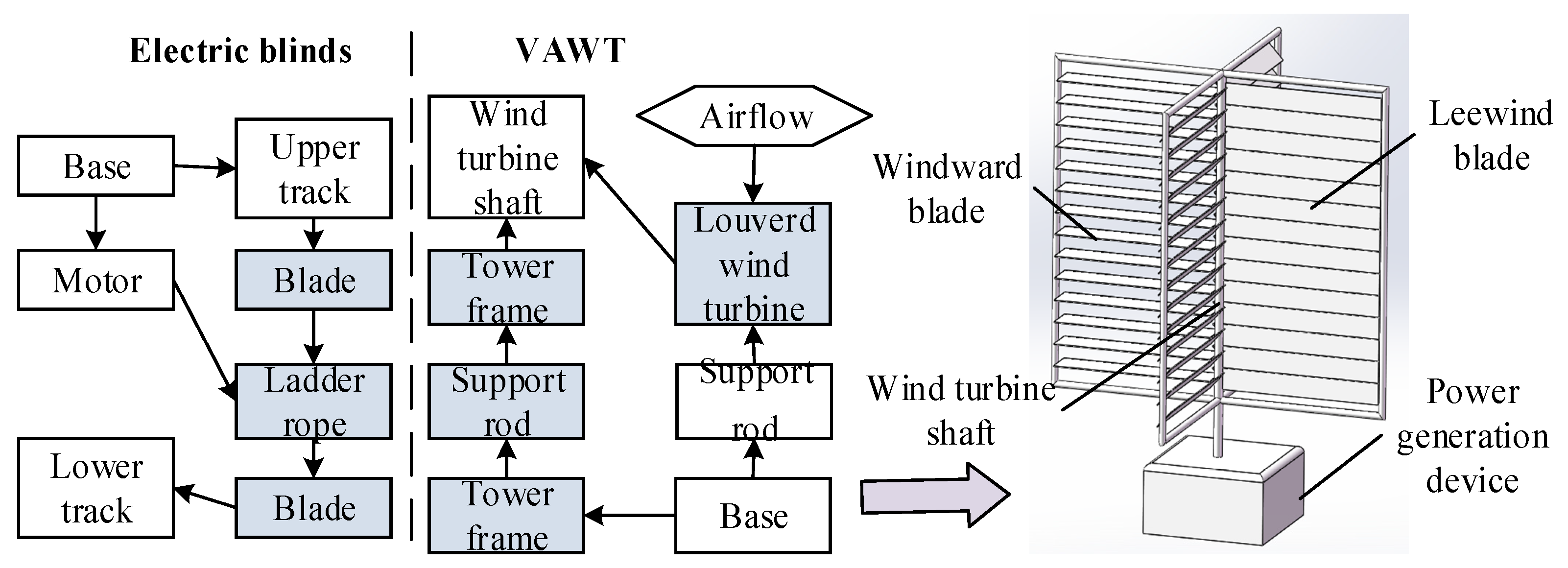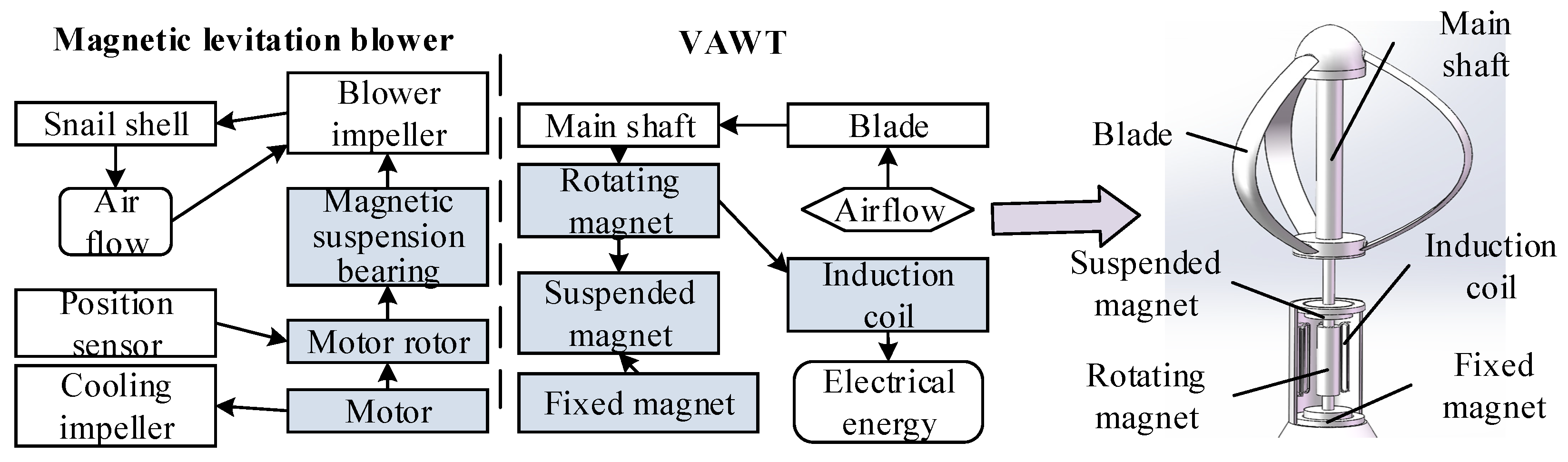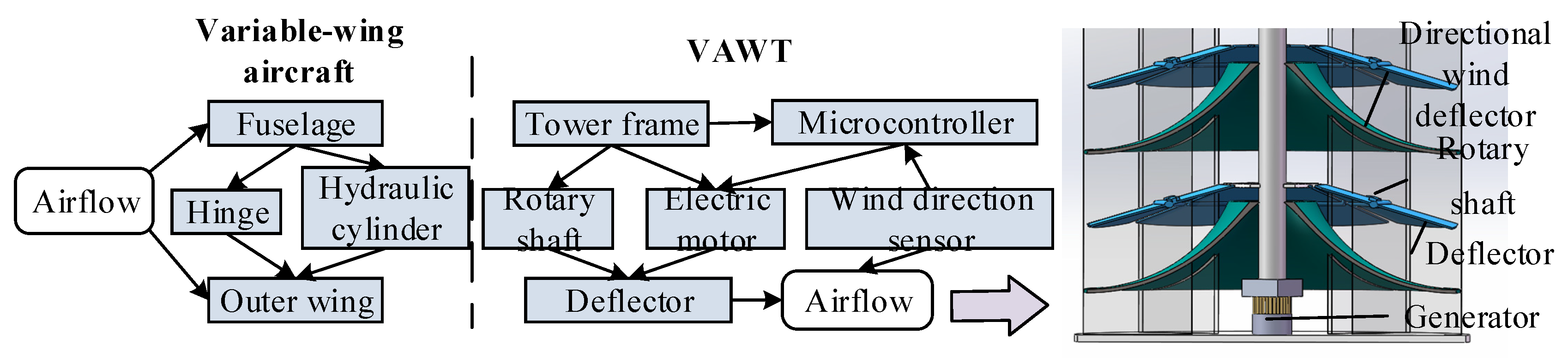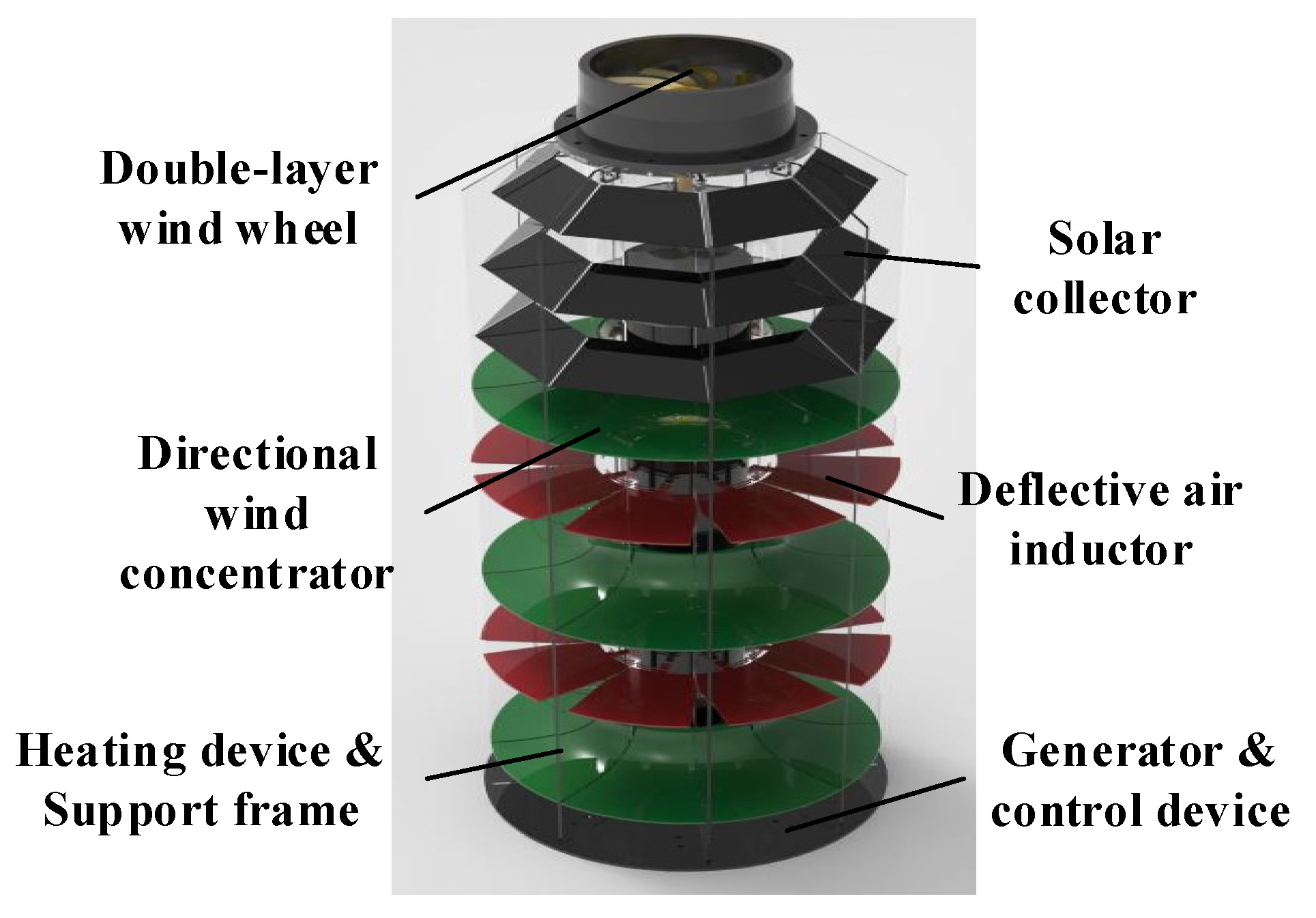

An Agile Innovation Design Method via Integrating LT Dimension and TRIZ



Abstract
1. Introduction
2. Related Research
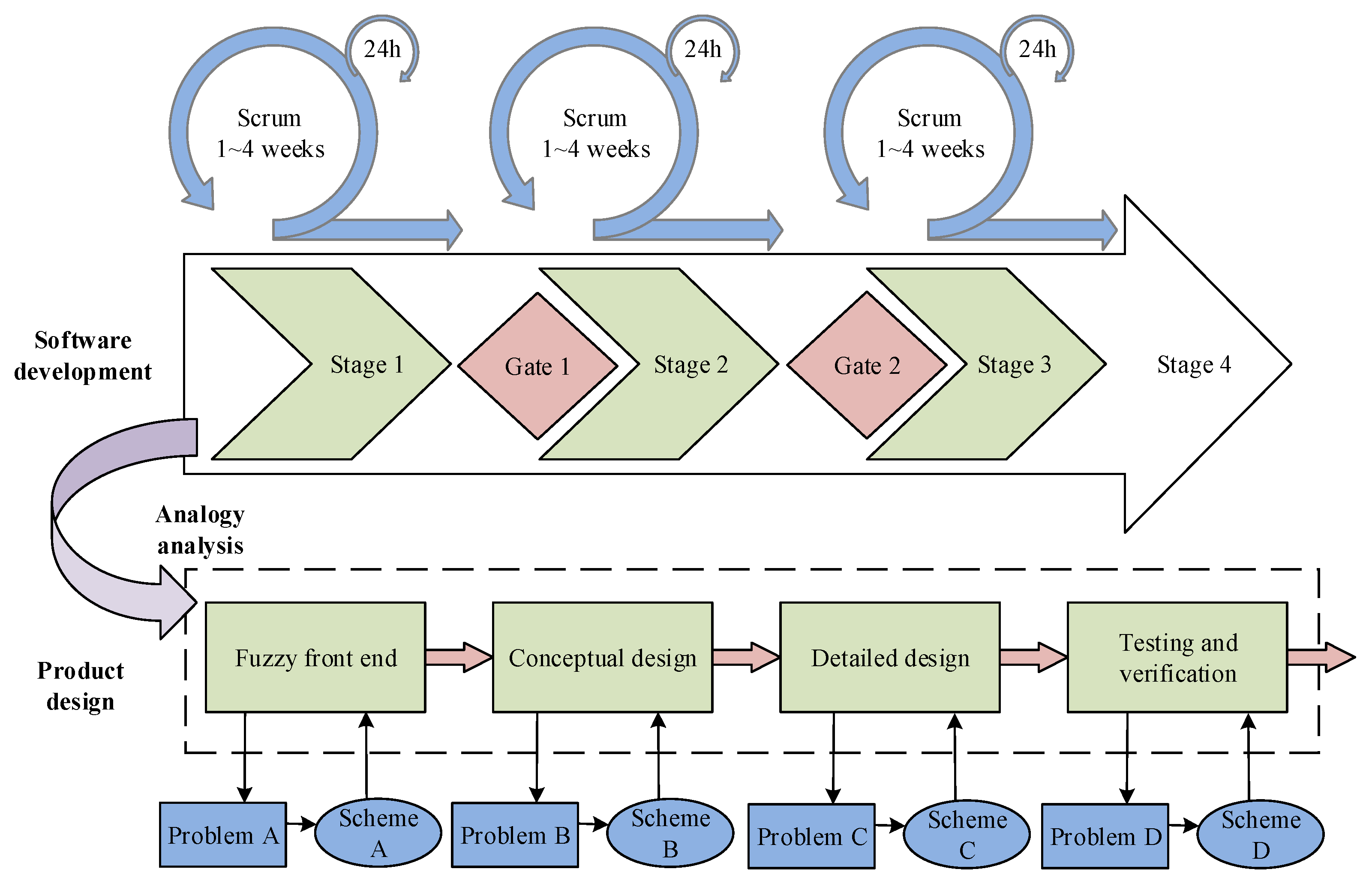
2.1. Agile Innovation in Mechanical Design
2.2. TRIZ in the Era of Smart Manufacturing
2.3. LT Dimension and Complex System Modeling
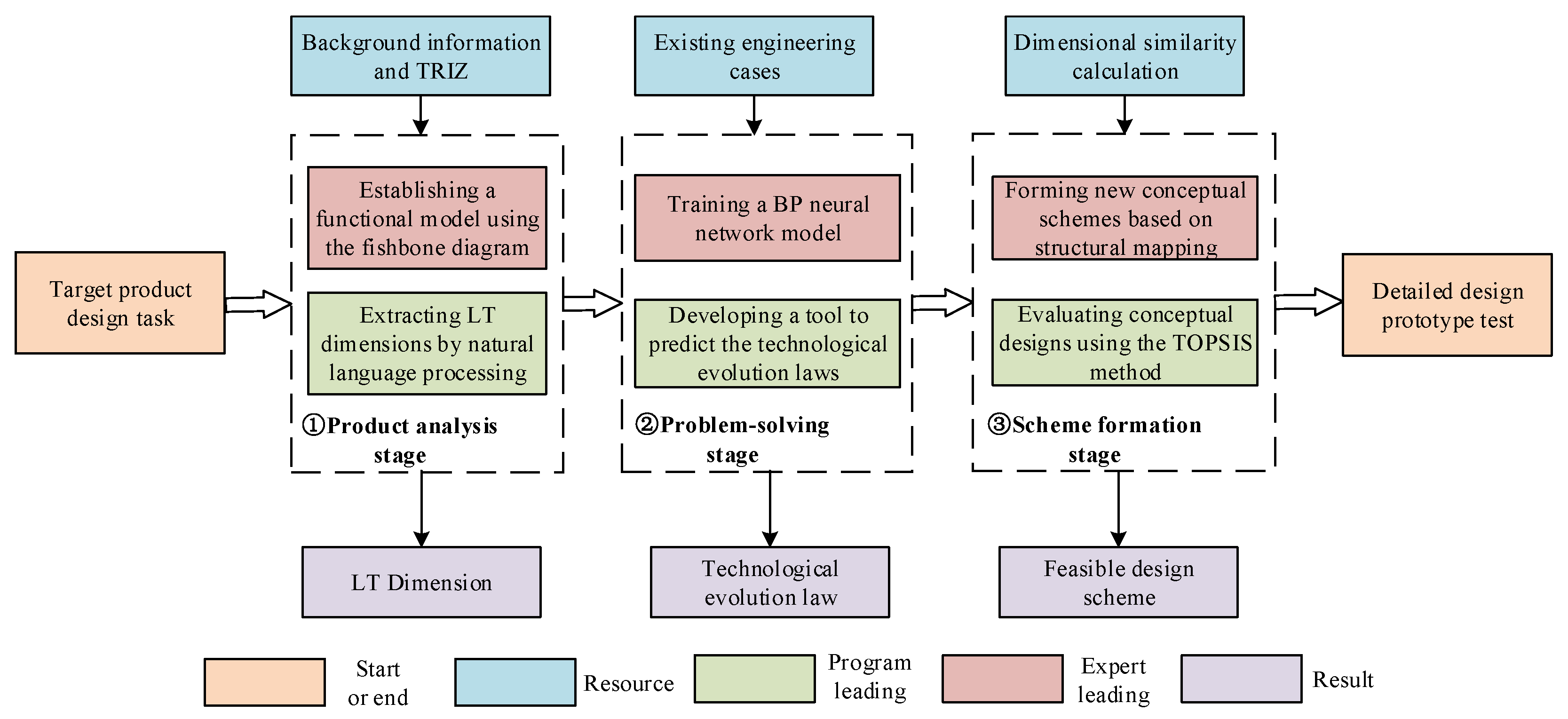
3. Proposed Method
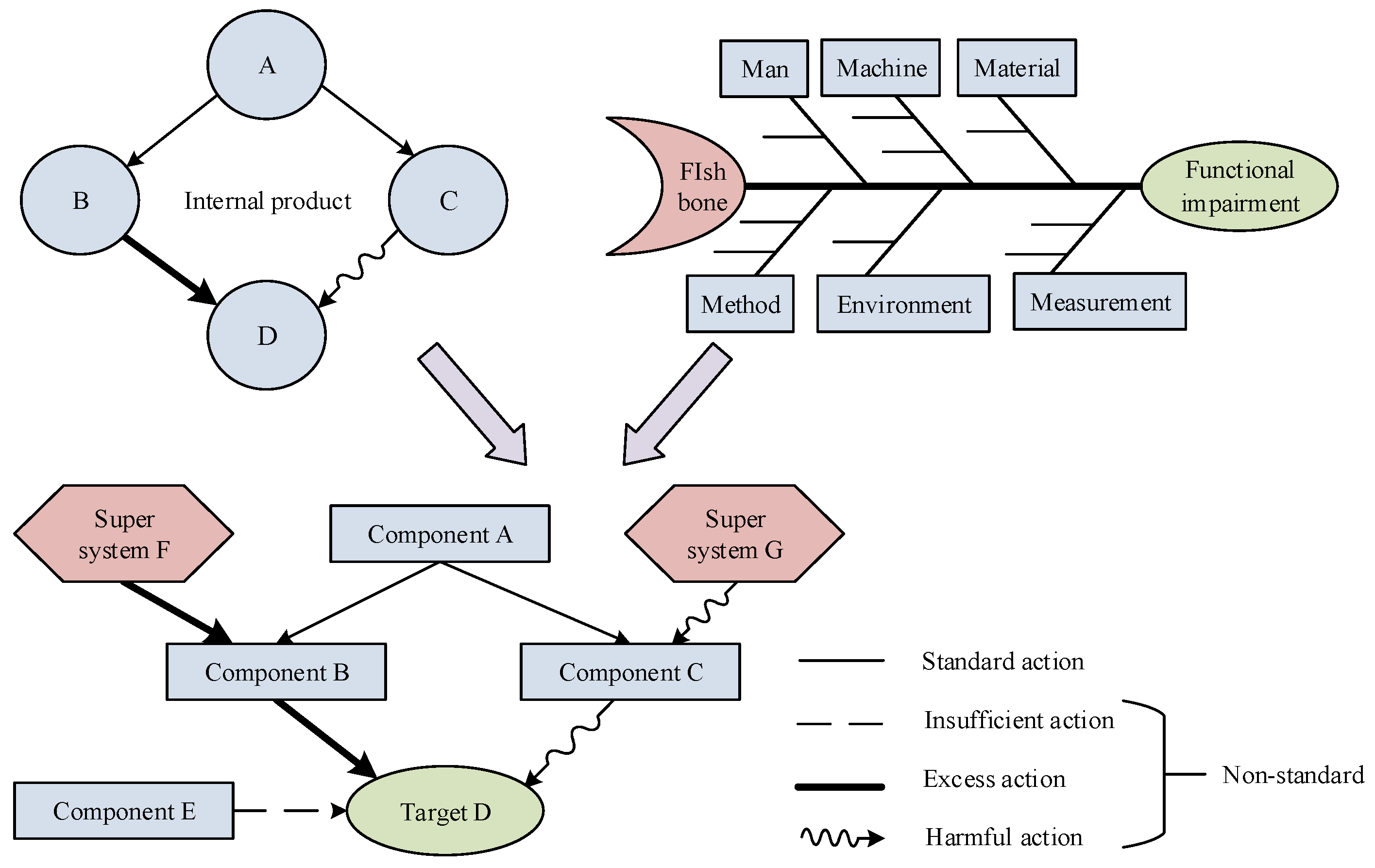
3.1. Functional Modelling and LT Dimension Classification
3.2. Construction and Prediction of the Neural Network
3.3. Conceptual Scheme Acquisition and Evaluation
4. Case Study
4.1. Product Analysis of the VAWT
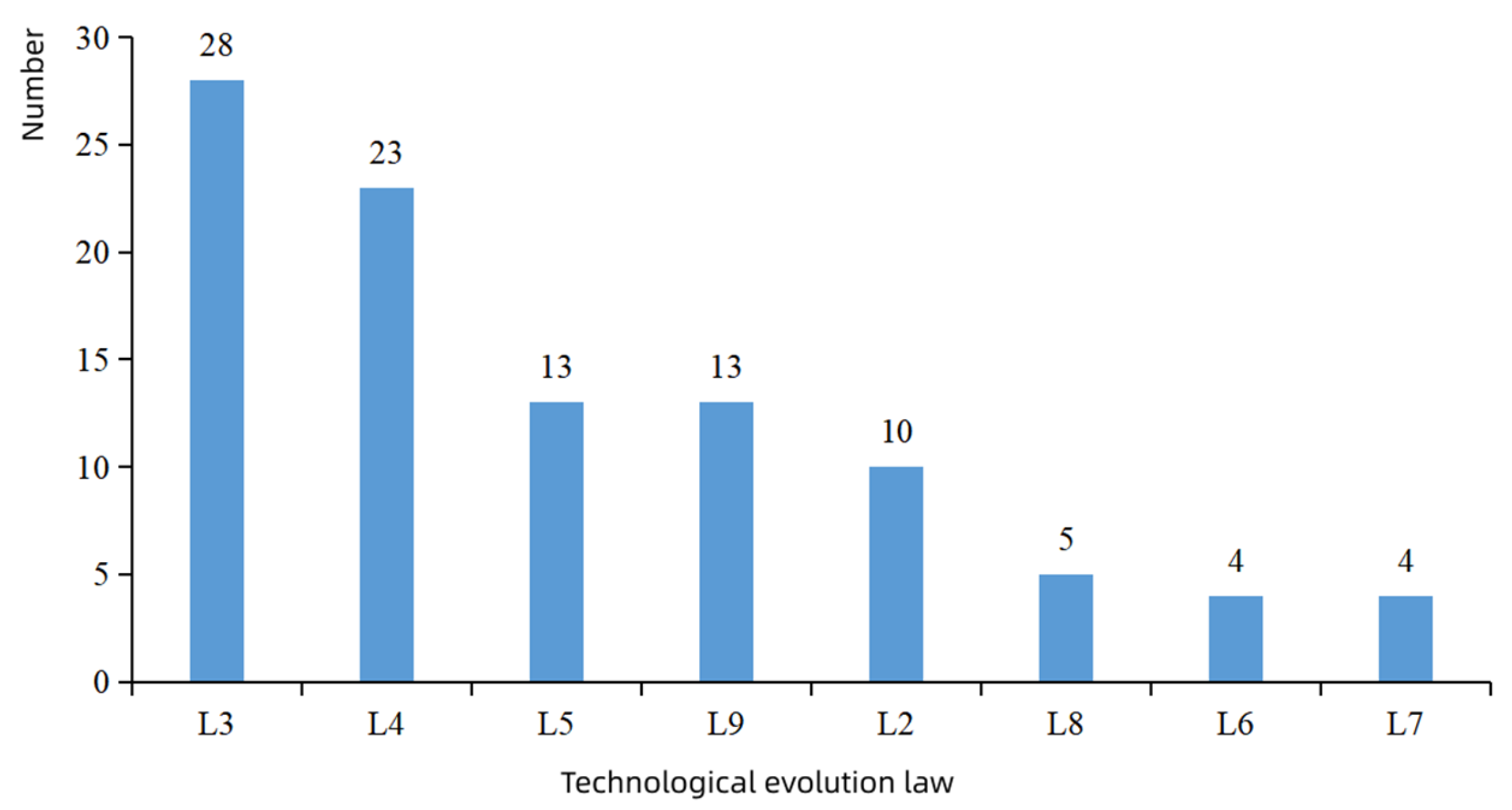
4.2. Problem-Solving of the VAWT
4.3. Scheme Evaluation of the VAWT
5. Discussion
5.1. Theoretical Implications
5.2. Practical Implications
5.3. Limitations and Future Work
6. Conclusions
Author Contributions
Funding
Data Availability Statement
Acknowledgments
Conflicts of Interest
References
- Guderian, C.C.; Bican, P.M.; Riar, F.J.; Chattopadhyay, S. Innovation management in crisis: Patent analytics as a response to the COVID-19 pandemic. R&D Manag. 2021, 51, 223–239. [Google Scholar] [CrossRef]
- Vanpaemel, S.; Kutz, J.N.; Brunton, S.L. Physics-Inspired Data-Driven Modeling of Complex Mechanical Components in Mechatronic Systems. Mech. Syst. Signal Process. 2025, 238, 113259. [Google Scholar] [CrossRef]
- Cano, E.L.; García-Camús, J.M.; Garzás, J.; Moguerza, J.M.; Sánchez, N. A Scrum-based framework for new product development in the non-software industry. J. Eng. Technol. Manag. 2021, 61, 101634. [Google Scholar] [CrossRef]
- Vlăsceanu, A.; Avram, M.; Constantin, V.; Moraru, E. Research on Indoor Positioning Systems and Autonomous Mechatronic Systems for Surveillance of Intrabuilding Zones. Appl. Sci. 2025, 15, 918. [Google Scholar] [CrossRef]
- Dihan, M.S.; Akash, A.I.; Tasneem, Z.; Das, P.; Das, S.K.; Islam, M.R.; Islam, M.; Badal, F.R.; Ali, F.; Ahamed, H.; et al. Digital Twin: Data Exploration, Architecture, Implementation and Future. Heliyon 2024, 10, e35216. [Google Scholar] [CrossRef]
- Cooper, R.G.; Ingby, J.; Källrot, C.; Mott, P.; Vedsmand, T. Agile Innovation in a Manufacturing Company: How Tetra Pak Evolved Its Product Development Process. Res. Technol. Manag. 2025, 68, 42–51. [Google Scholar] [CrossRef]
- Bianchi, M.; Marzi, G.; Guerini, M. Agile, Stage-Gate and their combination: Exploring how they relate to performance in software development. J. Bus. Res. 2020, 110, 538–553. [Google Scholar] [CrossRef]
- Baxter, D.; Turner, N. Why Scrum works in new product development: The role of social capital in managing complexity. Prod. Plan. Control 2023, 34, 1248–1260. [Google Scholar] [CrossRef]
- Andriyani, Y.; Yohanitas, W.A.; Kartika, R.S. Adaptive innovation model design: Integrating agile and open innovation in regional areas innovation. J. Open Innov. Technol. Mark. Complex. 2024, 10, 100197. [Google Scholar] [CrossRef]
- Sharma, S.; Singh, G.; Jones, P.; Kraus, S.; Dwivedi, Y.K. Understanding agile innovation management adoption for SMEs. IEEE Trans. Eng. Manag. 2022, 69, 3546–3557. [Google Scholar] [CrossRef]
- Beitz, W.; Pahl, G.; Grote, K. Engineering Design: A Systematic Approach. MRS Bull. 1996, 71, 3. [Google Scholar]
- Borgianni, Y.; Maccioni, L. Applications of TRIZ in manufacturing environments: A review. J. Manuf. Syst. 2020, 56, 303–319. [Google Scholar] [CrossRef]
- Luo, Y.; Ni, M.; Zhang, F. A design model of FBS based on interval-valued Pythagorean fuzzy sets. Adv. Eng. Inform. 2023, 56, 101957. [Google Scholar] [CrossRef]
- Bushuev, A.; Kudriavtseva, V. Simulation of the block diagrams of the information energy converters. In Proceedings of the International Conference on Innovative Applied Energy (IAPE ’19), Oxford, UK, 14–15 March 2019. [Google Scholar]
- Zhong, R.Y.; Xu, X.; Klotz, E.; Newman, S.T. Intelligent manufacturing in the context of industry 4.0: A review. Engineering 2017, 3, 616–630. [Google Scholar] [CrossRef]
- Liu, M.; Fang, S.; Dong, H.; Xu, C. Review of digital twin about concepts, technologies, and industrial applications. J. Manuf. Syst. 2021, 58, 346–361. [Google Scholar] [CrossRef]
- Wan, Y.W.; Liao, X.M.; Chen, C.; Wang, Z.W.; Liu, Y. Empowering LLMs by Hybrid Retrieval-Augmented Generation for Domain-Centric Q&A in Smart Manufacturing. Adv. Eng. Inform. 2025, 65, 103212. [Google Scholar]
- Alkhodair, M.; Alkhudhayr, H. Harnessing Industry 4.0 for SMEs: Advancing Smart Manufacturing and Logistics for Sustainable Supply Chains. Sustainability 2025, 17, 813. [Google Scholar] [CrossRef]
- Danneels, E.; Colarelli-O’Connor, G. From New Venture Idea to Viable Business: Breakthrough Innovation Capability in Established Firms. Technovation 2025, 141, 103186. [Google Scholar] [CrossRef]
- Ferrigno, G.; Barabuffi, L.; Marcazzan, D.; Piccaluga, A. What “V” of the Big Data Support Firms’ Radical and Incremental Innovation? Technovation 2025, 146, 103295. [Google Scholar] [CrossRef]
- Lichtenthaler, U. A conceptual framework for combining agile and structured innovation processes. Res. Technol. Manag. 2020, 63, 42–48. [Google Scholar] [CrossRef]
- Endres, M.; Bican, P.M.; Wöllner, T. Sustainability meets agile: Using Scrum to develop frugal innovations. J. Clean. Prod. 2022, 347, 130871. [Google Scholar] [CrossRef]
- Annosi, M.C.; Appio, F.P.; Martini, A. Institutional context and agile team innovation: A sensemaking approach to collective knowledge creation. Technovation 2024, 129, 102894. [Google Scholar] [CrossRef]
- Suárez-Gómez, E.D.; Hoyos-Vallejo, C.A. Scalable agile frameworks in large enterprise project portfolio management. IEEE Access 2023, 11, 98666–98684. [Google Scholar] [CrossRef]
- Cooper, R.G. The drivers of success in new-product development. Ind. Mark. Manag. 2019, 76, 36–47. [Google Scholar] [CrossRef]
- Beaumont, M.; Thuriaux-Alemán, B.; Prasad, P.; Hatton, C. Using agile approaches for breakthrough product innovation. Strategy Leadersh. 2017, 45, 19–25. [Google Scholar] [CrossRef]
- Cooper, R.G. Idea-to-Launch Gating Systems: Better, Faster, and More Agile. Res. Technol. Manag. 2017, 60, 48–52. [Google Scholar] [CrossRef]
- Albers, A.; Heimicke, J.; Spadinger, M.; Reiss, N.; Breitschuh, J.; Richter, T.; Bursac, N.; Marthaler, F. A systematic approach to situation-adequate mechatronic system development by ASD-Agile Systems Design. Procedia CIRP 2019, 84, 1015–1022. [Google Scholar] [CrossRef]
- Cubillos, J.; Aponte, J.; Gomez, D.; Rojas, E. Agile Effort Estimation in Colombia: An Assessment and Opportunities for Improvement. Sci. Comput. Program. 2024, 236, 103115. [Google Scholar] [CrossRef]
- Valdés-Rodríguez, Y.; Hochstetter-Diez, J.; Díaz-Arancibia, J.; Cadena-Martínez, R. Towards the Integration of Security Practices in Agile Software Development: A Systematic Mapping Review. Appl. Sci. 2023, 13, 4578. [Google Scholar] [CrossRef]
- Tomaselli, G.P.; Pinto, N.S.; Acuña, C. Requirements Management Methods and Practices for Improving the Quality of Agile Software Development Processes: A Review of the Literature. Requir. Eng. 2025, 30, 371–398. [Google Scholar] [CrossRef]
- Gupta, M.; Digalwar, A.; Gupta, A.; Goyal, A. Integrating Theory of Constraints, Lean and Six Sigma: A Framework Development and Its Application. Prod. Plan. Control 2024, 35, 238–261. [Google Scholar] [CrossRef]
- Fazeli, H.R.; Peng, Q. Generation and Evaluation of Product Concepts by Integrating Extended Axiomatic Design, Quality Function Deployment and Design Structure Matrix. Adv. Eng. Inform. 2022, 54, 101716. [Google Scholar] [CrossRef]
- Leng, J.W.; Guo, J.; Xie, J.; Zhou, X.; Liu, A.; Gu, X.; Mourtzis, D.; Qi, Q.; Liu, Q.; Shen, W.; et al. Review of Manufacturing System Design in the Interplay of Industry 4.0 and Industry 5.0 (Part I): Design Thinking and Modeling Methods. J. Manuf. Syst. 2024, 76, 158–187. [Google Scholar] [CrossRef]
- Hoenig, A.; Roy, K.; Acquaah, Y.T.; Yi, S.; Desai, S.S. Explainable AI for Cyber-Physical Systems: Issues and Challenges. IEEE Access 2024, 12, 73113–73140. [Google Scholar] [CrossRef]
- Li, H.; He, X.; Wu, Y.; Liu, G.; Wang, H.; Wen, X.; Li, L. Digital twin and AI-driven robotic embodied control system: A novel adaptive learning and decision optimization method. Rob. Comput.-Integr. Manuf. 2026, 98, 103138. [Google Scholar] [CrossRef]
- Jiang, S.; Li, W.; Qian, Y.; Zhang, Y.; Luo, J. AutoTRIZ: Automating engineering innovation with TRIZ and large language models. Adv. Eng. Inform. 2025, 65, 103312. [Google Scholar] [CrossRef]
- Mohammadi, A.; Zeng, Y. Enhancing TRIZ through Environment-Based Design Methodology Supported by a Large Language Model. AI EDAM 2025, 39, e12. [Google Scholar] [CrossRef]
- Chen, R.K.; Sheu, D.D.; Sheu, M.Y.; Shi, L. A 3-element structure mapping for enhanced TRIZ problem-solving based on substance-field analysis. Comput. Ind. Eng. 2025, 206, 111167. [Google Scholar] [CrossRef]
- Ghane, M.; Ang, M.C.; Cavallucci, D.; Kadir, R.A.; Ng, K.W.; Sorooshian, S. TRIZ trend of engineering system evolution: A review on applications, benefits, challenges and enhancement with computer-aided aspects. Comput. Ind. Eng. 2022, 174, 108833. [Google Scholar] [CrossRef]
- He, C.; Zhao, M.; Tan, R. Rainflow evolution model: A holistic method of complex product functional design. Adv. Eng. Inform. 2025, 65, 103162. [Google Scholar] [CrossRef]
- Mao, J.; Zhu, Y.; Chen, M.; Chen, G.; Yan, C.; Liu, D. A contradiction solving method for complex product conceptual design based on deep learning and technological evolution patterns. Adv. Eng. Inform. 2023, 55, 101825. [Google Scholar] [CrossRef]
- Cavallucci, D.; Rousselot, F.; Zanni, C. An ontology for TRIZ. Comput. Ind. 2021, 9, 251–260. [Google Scholar] [CrossRef][Green Version]
- Wei, L.; Yuanyuan, L. A systematic approach for business model innovation in RSWM product service systems by resolving multiple contradictions. Expert Syst. Appl. 2025, 290, 128367. [Google Scholar] [CrossRef]
- Shie, A.-J.; Xu, E.-M.; Ye, Z.-Z.; Ruan, J.-Q.; Yang, G.; Lee, C.-H. Kansei-oriented and artificial intelligence-driven framework for mutual aid elderly care service optimization. Adv. Eng. Inform. 2025, 67, 103489. [Google Scholar] [CrossRef]
- Liu, F.; Deng, Q.; Jing, Y.; Gao, J. Product innovation design methods based on multi-biological knowledge inspiration. J. Eng. Des. 2025, 37, 741–784. [Google Scholar] [CrossRef]
- Wang, X.; Liu, Z. Knowledge graph-based conceptual design of complex mechanical products. Adv. Eng. Inform. 2021, 49, 101340. [Google Scholar] [CrossRef]
- ElMaraghy, W.; ElMaraghy, H.; Tomiyama, T.; Monostori, L. Complexity in engineering design and manufacturing. CIRP Ann. 2012, 61, 793–814. [Google Scholar] [CrossRef]
- Buisson, C.-A.; Cardou, P.; Fréchette, A. Quantitative comparison of cable models through dimensional analysis. Mech. Mach. Theory 2025, 214, 106130. [Google Scholar] [CrossRef]
- Jurij, K. Estimation of transportation energy efficiency by Bartini criterion L6T-4. Archit. Eng. 2017, 2, 15–19. [Google Scholar][Green Version]
- Bushuev, A. Numerical Estimation of the Energy Information Circuits of Measurement Devices. Meas. Tech. 2017, 60, 857–862. [Google Scholar] [CrossRef]
- Kotikov, J. Formation of a function series for estimates of transportation energy efficiency based on Bartini’s LT-table entities. Archit. Eng. 2018, 3, 3–9. [Google Scholar]
- Rajić, D. Innovative synergism as a result of TRIZ and LT-system synthesis. In Proceedings of the International Conference on TRIZ, Heilbronn, Germany, 11–14 September 2019; pp. 226–242. [Google Scholar]
- Kuznetsov, O.; Bolshakov, B. Russian cosmism, global crisis, sustainable development. Proj. Baikal 2013, 1, 112–139. [Google Scholar]
- Zheng, P.; Lin, T.J.; Chen, C.H.; Xu, X. A systematic design approach for service innovation of smart product-service systems. J. Clean. Prod. 2018, 201, 657–667. [Google Scholar] [CrossRef]
- Wang, F.; Tan, R.; Wang, K.; Cen, S.; Peng, Q. Innovative product design based on radical problem solving. Comput. Ind. Eng. 2024, 189, 109941. [Google Scholar] [CrossRef]
- Grieves, M.; Vickers, J. Digital twin: Mitigating unpredictable, undesirable emergent behavior in complex systems. In Transdisciplinary Perspectives on Complex Systems; Springer: Cham, Switzerland, 2017; pp. 85–113. [Google Scholar] [CrossRef]
- Leng, J.; Wang, D.; Shen, W.; Li, X.; Liu, Q.; Chen, X. Digital twins-based smart manufacturing system design in Industry 4.0: A review. J. Manuf. Syst. 2021, 60, 119–137. [Google Scholar] [CrossRef]
- Luo, T.; Wu, C.; Duan, L. Fishbone diagram and risk matrix analysis method and its application in safety assessment of natural gas spherical tank. J. Clean. Prod. 2018, 174, 296–304. [Google Scholar] [CrossRef]
- Wang, K.; Tan, R.; Peng, Q.; Zhang, L.; Wang, F. A systematic problem analysis network for product conceptual design. Comput. Ind. Eng. 2024, 194, 110382. [Google Scholar] [CrossRef]
- Zhang, H.; Miao, J.; Liu, Z.; Wesson, I.L.; Shang, J. NLPIR-Parser: Making Chinese and English semantic analysis easier and complete. In Proceedings of the 15th International Conference on the Statistical Analysis of Textual Data, Toulouse, France, 16–19 June 2020. [Google Scholar]
- Wang, K.; Tan, R.; Peng, Q.; Zhang, L. Evaluation of design innovation using the length-time dimension and regression analysis. J. Mech. Sci. Technol. 2022, 36, 5625–5637. [Google Scholar] [CrossRef]
- Huang, J.; Wen, Z.; Xiao, X. Extended Levenberg-Marquardt method for composite function minimization. J. Comput. Math. 2017, 35, 529–546. [Google Scholar] [CrossRef]
- Liu, H.; Li, Y.; Chen, J.; Tao, Y.; Xia, W. A structure mapping-based representation of knowledge transfer in conceptual design process. Proc. Inst. Mech. Eng. Part B J. Eng. Manuf. 2020, 234, 400–420. [Google Scholar]
- Wang, K.; Tan, R.; Peng, Q. Product Improvement Using Knowledge Mining and Effect Analogy. Appl. Sci. 2024, 14, 3699. [Google Scholar] [CrossRef]
- Sun, J.G.; Li, G.Q.; Zhang, K.X.; Zheng, Y.; Li, H.Y.; Wang, K. Collaborative innovation design process model based on OPM. Comput. Integr. Manuf. Syst. 2024, 30, 3019–3037. (In Chinese) [Google Scholar]
- Han, F.; Alkhawaji, R.N.; Shafieezadeh, M.M. Evaluating sustainable water management strategies using TOPSIS and fuzzy TOPSIS methods. Appl. Water Sci. 2025, 15, 4. [Google Scholar] [CrossRef]
- Zhang, L.; Tan, R.; Peng, Q.; Yang, W.; Zhang, J.; Wang, K. A holistic method for radical concept generation based on technological evolution: A case application of DC charging pile. Comput. Ind. Eng. 2023, 179, 109213. [Google Scholar] [CrossRef]
- Liu, W.; Tan, R.; Cao, G.; Yu, F.; Li, H. Creative design through knowledge clustering and case-based reasoning. Eng. Comput. 2020, 36, 527–541. [Google Scholar] [CrossRef]
- Metsämuuronen, J. Typology of deflation-corrected estimators of reliability. Front. Psychol. 2022, 13, 891959. [Google Scholar] [CrossRef]
- Cazzaro, D.; Bedon, G.; Pisinger, D. Vertical axis wind turbine layout optimization. Energies 2023, 16, 2697. [Google Scholar] [CrossRef]
- Azadani, L. Vertical axis wind turbines in cluster configurations. Ocean Eng. 2023, 272, 113855. [Google Scholar] [CrossRef]


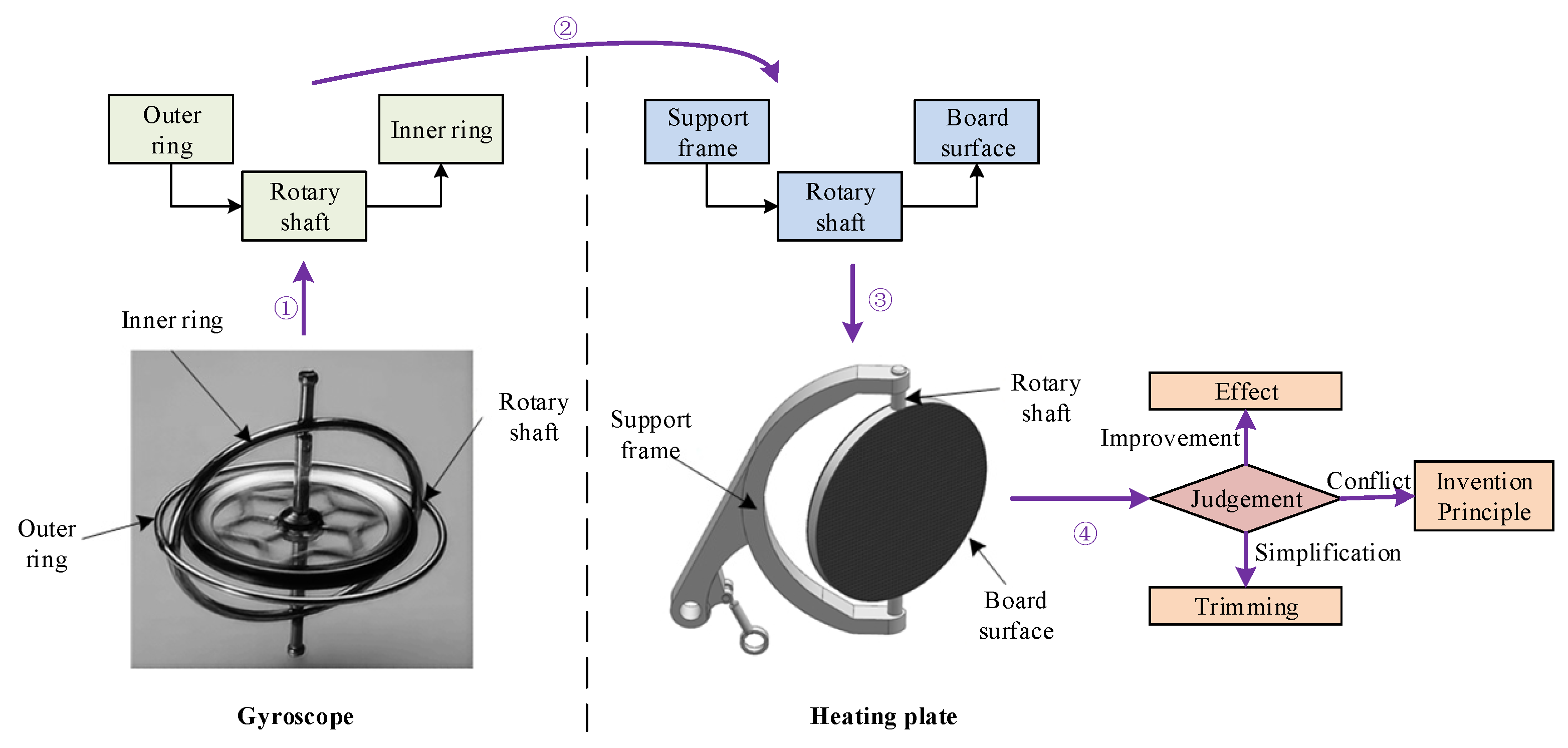


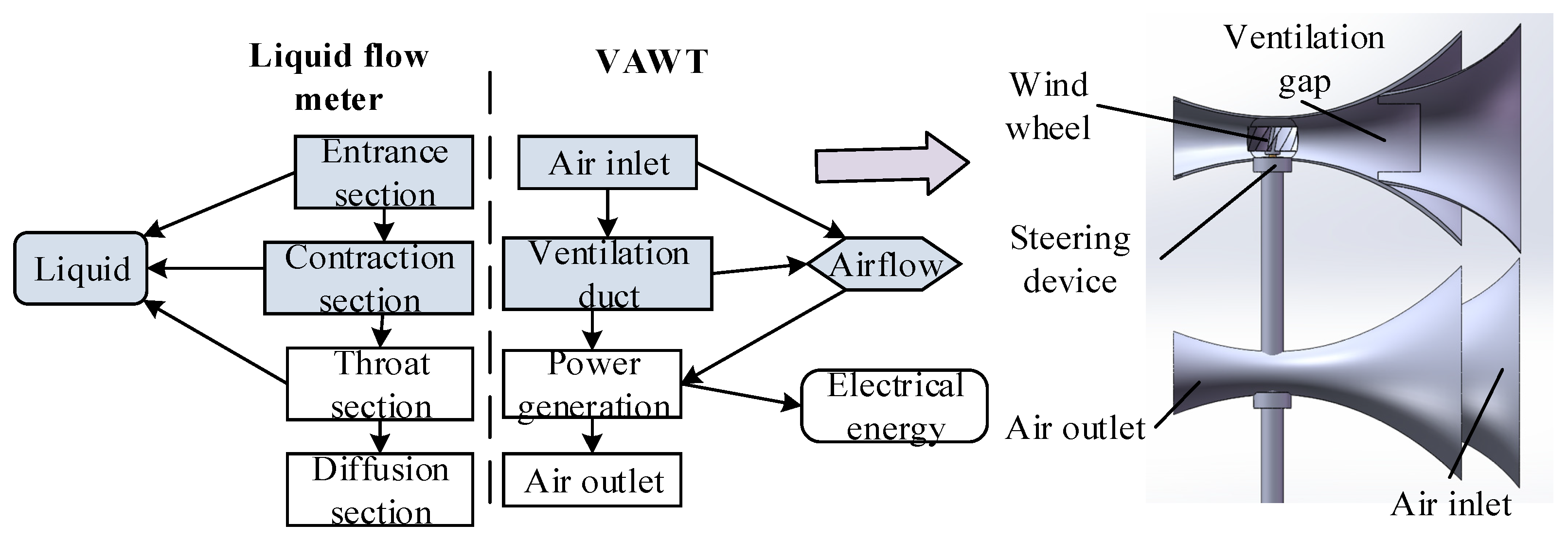

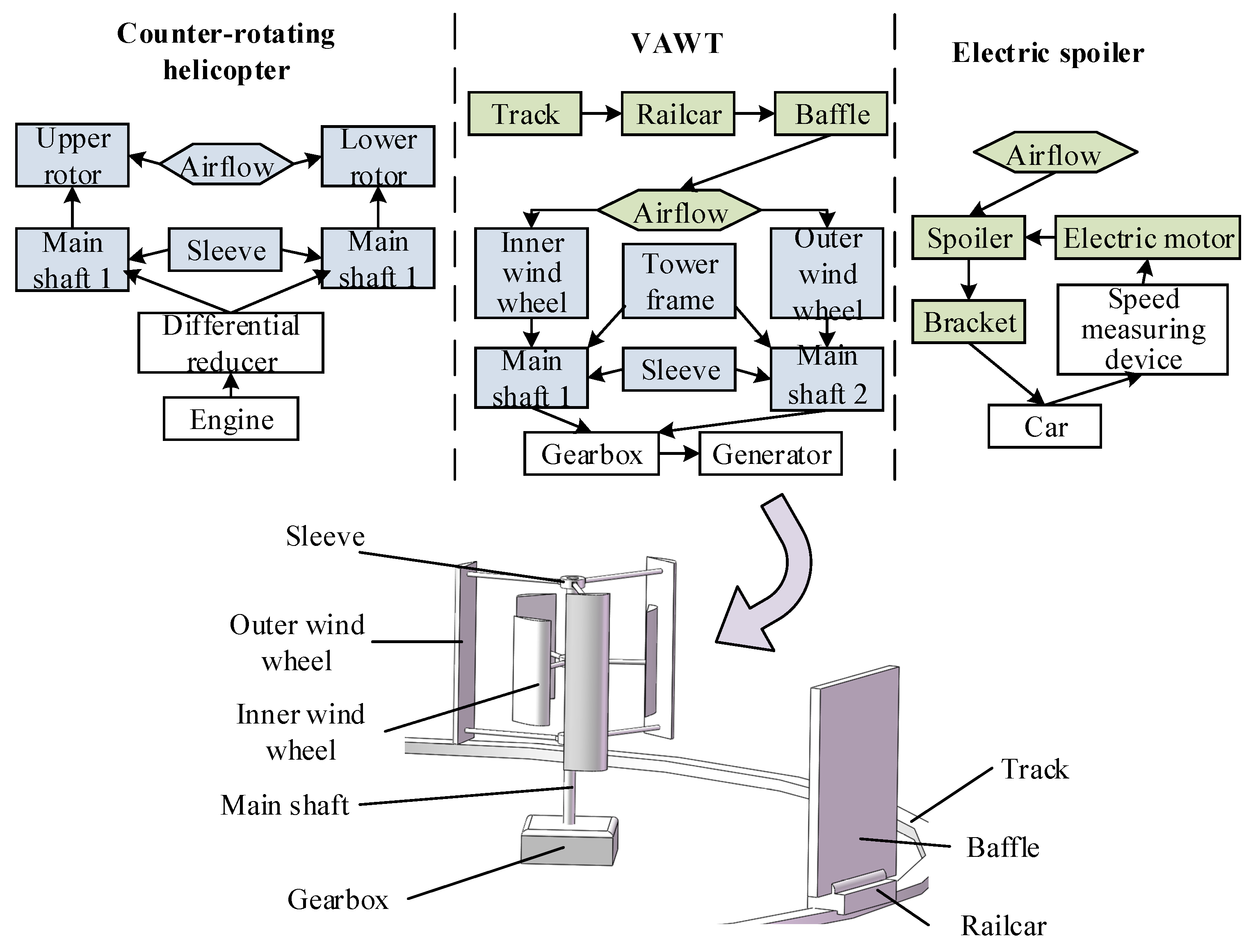
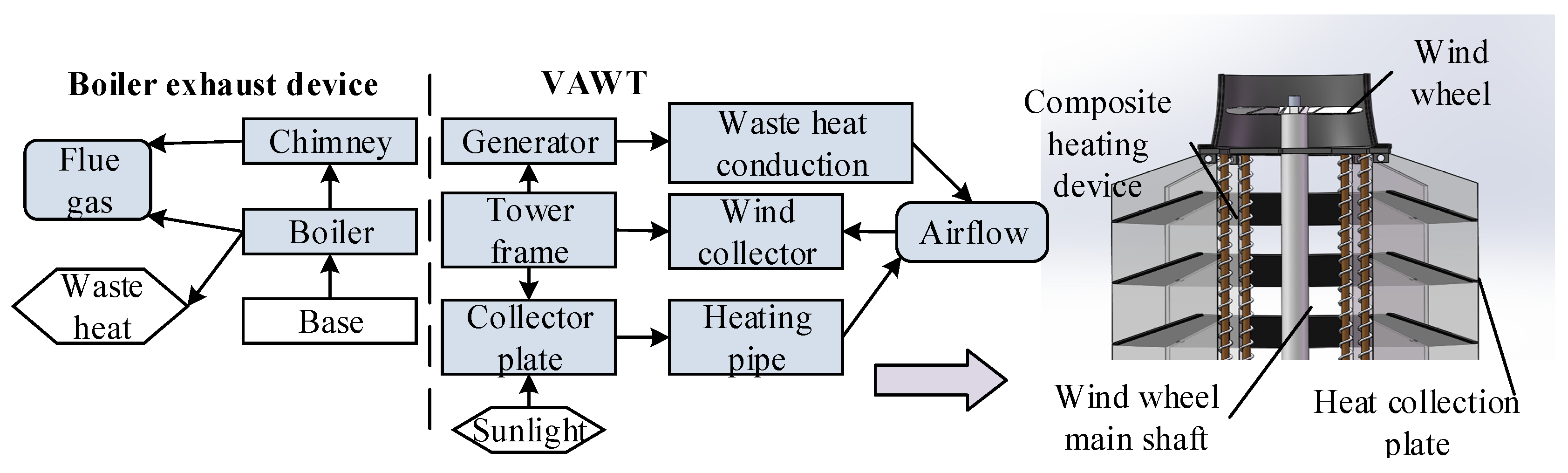


| No. | Name | Content |
|---|---|---|
| L1 | Law of Increasing Degree of Ideality | Increasing product revenue, reducing costs, and minimizing side effects can all improve idealization. |
| L2 | Law of Non-Uniform Evolution of Sub-Systems | The emergence of an unbalanced state is due to certain subsystems in the product developing at a higher level than other subsystems to meet new demands. |
| L3 | Law of Increasing Dynamism | The product’s structure is more flexible, enabling adaptation to changes in performance levels, environmental conditions, and diverse functional requirements. |
| L4 | Law of Transition to a Supersystem | Integrating a single system into a dual or multi-system is a form of product upgrade. The integrated product offers improved performance and useful new features. |
| L5 | Law of Transition to a Micro-Level | Functions performed by macroscopic materials, such as shafts, levers, and gears, can be performed by microscopic materials, thereby resolving conflicts that arise in products. |
| L6 | Law of Completeness | The complete product consists of four subsystems: power, transmission, execution, and control. |
| L7 | Law of Shortening of Energy Flow Path | The basic condition for product operation is that energy can be transferred from the power subsystem to the execution subsystem, and this path should be shortened to improve performance. |
| L8 | Law of Increasing Controllability | Controllability refers to the degree to which a product’s state can be achieved within specified time constraints. The better the controllability, the shorter the time required to achieve the desired state. |
| L9 | Law of Harmonization | In actual operation, the main components or subsystems of a product must work together and coordinate. This is a reliable guarantee that the product will complete its preset movements or operations. |
| Dimension | [L−1] | [L0] | [L1] | [L2] | [L3] | [L4] | [L5] |
|---|---|---|---|---|---|---|---|
| [T−6] | [L2T−6] | [L3T−6] | [L4T−6] | [L5T−6] | |||
| [T−5] | [L1T−5] | [L2T−5] | Surface power | [L4T−5] | Power | ||
| [T−4] | [L0T−4] | Pressure gradient | Pressure | Stiffness/ Surface tension | Force | Energy/ Temperature | |
| [T−3] | [L0T−3] | Current density | Magnetic field strength/ viscosity | Current | Impulse | Angular momentum | |
| [T−2] | [L−1T−2] | Mass density/ Angular acceleration | Linear acceleration/ Magnetic induction intensity | Voltage | Quality/ Power capacity | [L4T−2] | Moment of inertia |
| [T−1] | Charge density | Frequency/ Angular velocity | Linear velocity | Area change rate | Volume change rate | [L4T−1] | [L5T−1] |
| [T0] | Curvature | Angle/ Radian | Length | Area | Volume | [L4T0] | |
| [T1] | Resistance/ Reactance | Period | [L1T1] | [L2T1] | [L3T1] | ||
| [T2] | Self-sensing/ Mutual sensing | [L0T2] | [L1T2] | [L2T2] | |||
| [T3] | [L−1T3] | [L0T3] | [L1T3] |
| Approach | Main Focus | Strength | Limitation |
|---|---|---|---|
| Scrum-based development | Team collaboration and iterative task management | Fast communication and flexible planning | Does not directly generate physical structures |
| Classical TRIZ | Contradiction matrix, inventive principles, Su-field analysis | Provides systematic innovation logic | Relies strongly on expert interpretation |
| Digital twin-driven iteration | Virtual monitoring, prediction, and optimization | Enables data feedback from physical systems | Often assumes that product architecture already exists |
| QFD/AD/DFSS | Requirement translation and design quality control | Clarifies customer needs and design constraints | Limited support for inventive structure generation |
| Proposed LT–TRIZ agile method | User-feedback-driven conceptual structure generation | Links pain points, LT dimensions, TRIZ evolution laws, structural mapping, and TOPSIS | Mainly supports concept generation rather than detailed simulation |
| Rule ID | Typical Keywords | Physical Interpretation | LT Dimension |
|---|---|---|---|
| R1 | move, translate, flow, airflow, wind speed, conveying speed | Linear motion or fluid velocity | L1T−1 |
| R2 | rotate, rotational speed, angular velocity, frequency, oscillate | Rotational motion or periodic response | L1T−1 or L0T−1 |
| R3 | accelerate, decelerate, impact, rapid change | Change of velocity with time | L1T−2 |
| R4 | force, thrust, drag, load, torque-related action | Mechanical action causing motion or deformation | Case-dependent, often L4T−4 |
| R5 | pressure, pressure drop, suction, compression | Force distributed over area or fluid pressure | L0T−4 or related pressure cell |
| R6 | power, energy output, energy loss, conversion efficiency | Energy transfer or energy conversion rate | L5T−5 or related power/energy cell |
| R7 | heat, thermal accumulation, cooling, temperature rise | Thermal effect or thermal exchange | L2T−4 or related thermal cell |
| R8 | support, stiffness, deformation, vibration | Structural resistance or dynamic stability | Stiffness or vibration-related LT cell |
| Dimension | [L−2] | [L−1] | [L0] | [L1] | [L2] | [L3] | [L4] | [L5] |
|---|---|---|---|---|---|---|---|---|
| [T−6] | 6 | 13 | 21 | |||||
| [T−5] | 5 | 12 | 20 | 29 | ||||
| [T−4] | 4 | 11 | 19 | 28 | 37 | |||
| [T−3] | 3 | 10 | 18 | 27 | 36 | 44 | ||
| [T−2] | 2 | 9 | 17 | 26 | 35 | 43 | 50 | |
| [T−1] | 1 | 8 | 16 | 25 | 34 | 42 | 49 | |
| [T0] | 7 | 15 | 24 | 33 | 41 | 48 | ||
| [T1] | 14 | 23 | 32 | 40 | 47 | |||
| [T2] | 22 | 31 | 39 | 46 | ||||
| [T3] | 30 | 38 | 45 |
| Rule ID | R1 | R2 | R3 | R4 | R5 | R6 | R7 | R8 | R9 |
|---|---|---|---|---|---|---|---|---|---|
| R1 | 0 | 0 | 2 | 0 | 0 | 0 | 0 | 0 | 0 |
| R2 | 0 | 1 | 0 | 0 | 0 | 0 | 0 | 0 | 0 |
| R3 | 0 | 0 | 6 | 0 | 0 | 0 | 0 | 0 | 0 |
| R4 | 0 | 0 | 0 | 3 | 0 | 0 | 0 | 0 | 0 |
| R5 | 0 | 0 | 0 | 0 | 2 | 0 | 0 | 0 | 0 |
| R6 | 0 | 0 | 0 | 0 | 0 | 2 | 0 | 0 | 0 |
| R7 | 0 | 0 | 0 | 0 | 0 | 0 | 0 | 0 | 0 |
| R8 | 0 | 0 | 0 | 0 | 0 | 0 | 0 | 0 | 0 |
| R9 | 0 | 0 | 0 | 0 | 0 | 0 | 0 | 0 | 4 |
| Criterion | Value = 0.1 | Value = 0.5 | Value = 0.9 |
|---|---|---|---|
| SA | Mainly repeats existing structure with little evolutionary improvement. | Shows moderate improvement using a recognizable evolution direction. | Clearly reflects advanced evolution, such as dynamization, supersystem integration, micro-level replacement, or controllability improvement. |
| SD | Very similar to the current product; mainly parameter adjustment. | Contains visible structural or functional difference. | Provides a distinctly different solution principle or structural configuration. |
| SS | Difficult to manufacture, install, maintain, or align with user needs. | Generally feasible but still has several implementation concerns. | Highly compatible with user needs, manufacturing capability, installation space, and maintenance requirements. |
| Engineering Scenario | Typical User Feedback | Possible LT Interpretation | Evolution-Law Direction | Conceptual Design Implication |
|---|---|---|---|---|
| Collaborative robot gripper | The gripper adapts poorly to objects with different shapes | Force, displacement, deformation, sensing response | Increasing dynamism; increasing controllability | Introduce compliant fingers, adaptive joints, or sensor-guided gripping surfaces |
| CNC machine tool cooling system | Local overheating occurs during long machining operations | Heat transfer, temperature rise, flow rate | Shortening of energy flow path; transition to a supersystem | Add directed coolant channels, heat pipes, or hybrid cooling–lubrication modules |
| Automated packaging equipment | The feeding mechanism jams when package size changes | Linear motion, friction, clearance, control timing | Increasing dynamism; harmonization | Design adjustable guide rails and synchronized feeding modules |
| Industrial pump system | Energy consumption is high under variable flow conditions | Flow velocity, pressure, power, energy loss | Increasing controllability; transition to a supersystem | Add variable-speed control, adaptive impeller geometry, or bypass optimization |
| Agricultural harvesting machine | Crop loss increases when terrain and crop density change | Cutting force, vibration, motion stability, sensing | Increasing dynamism; harmonization | Introduce height-adaptive cutting units and vibration-suppression structures |
| Thermal management module for batteries | Heat accumulates locally during peak load | Heat flux, temperature gradient, response time | Transition to a supersystem; shortening energy flow path | Combine phase-change materials, microchannels, and sensor-driven thermal control |
| Fishbone Category | Possible Causes | Design Interpretation | Relevance to Conceptual Redesign |
|---|---|---|---|
| Man | Installation position may be constrained by buildings, roofs, or maintenance access | The turbine must remain compact and easy to maintain | Added structures should not greatly increase installation difficulty |
| Machine | Rotor receives insufficient directed airflow; part of the wind bypasses the effective working region | Airflow capture and torque generation are limited | Airflow-guiding or energy-concentrating structures may be needed |
| Material | Added parts must resist outdoor weather and avoid excessive mass | Structural additions must remain lightweight and durable | Concepts requiring heavy or complex materials should be avoided |
| Method | Current structure lacks a clear mechanism to concentrate weak wind | The product passively accepts the incoming wind field | Passive or adaptive airflow guidance should be considered |
| Environment | Near-ground wind is weak, turbulent, and directionally variable | The external supersystem strongly affects turbine behavior | The design should interact more effectively with the surrounding wind field |
| Measurement | Wind direction and speed are not actively sensed or used for adjustment | Control response is limited | Sensor-assisted or self-adjusting structures may improve adaptability |
| Engineering Case | LT Dimension | Similarity | Rank | Availability |
|---|---|---|---|---|
| Counter-rotating helicopter | 29, 44 | 0.76 | 6 | Y |
| Multi-cylinder engine | 25, 32 | 0.16 | 8 | N |
| Electric spoiler | 28, 29 | 0.77 | 5 | Y |
| High-speed train | 35, 25 | 0.07 | 10 | N |
| Multistage rocket | 25, 28 | 0.05 | 12 | N |
| Remote control blinds | 29, 34 | 0.93 | 2 | Y |
| Liquid flow meter | 11, 29 | 0.83 | 4 | Y |
| Ultrasonic nebulizer | 25, 33 | 0.16 | 8 | N |
| Boiler exhaust device | 29, 37 | 0.73 | 7 | Y |
| Wind tunnel apparatus | 11, 25 | 0.06 | 11 | N |
| Magnetic levitation blower | 18, 29 | 0.87 | 3 | Y |
| Multi-purpose treadmill | 25, 41 | 0.11 | 9 | N |
| Electric sunshade umbrella | 29, 41 | 0.94 | 1 | Y |
| Variable-wing aircraft | 28, 29 | 0.77 | 5 | Y |
| Scheme | SA | SD | SS | D+ | D− | Ci | Rank |
|---|---|---|---|---|---|---|---|
| 1 | 0.6 | 0.3 | 0.7 | 0.106 | 0.092 | 0.466 | 7 |
| 2 | 0.5 | 0.5 | 0.6 | 0.080 | 0.084 | 0.510 | 5 |
| 3 | 0.6 | 0.4 | 0.7 | 0.084 | 0.096 | 0.534 | 3 |
| 4 | 0.6 | 0.6 | 0.5 | 0.065 | 0.088 | 0.576 | 1 |
| 5 | 0.8 | 0.7 | 0.3 | 0.090 | 0.115 | 0.560 | 2 |
| 6 | 0.6 | 0.5 | 0.5 | 0.078 | 0.069 | 0.472 | 6 |
| 7 | 0.7 | 0.5 | 0.5 | 0.070 | 0.077 | 0.527 | 4 |
| Scheme | SA-Oriented | SD-Oriented | SS-Oriented |
|---|---|---|---|
| 1 | 0.439/1 | 0.316/7 | 0.632/2 |
| 2 | 0.390/7 | 0.505/4 | 0.617/3 |
| 3 | 0.484/4 | 0.407/6 | 0.687/1 |
| 4 | 0.501/3 | 0.666/2 | 0.536/4 |
| 5 | 0.631/1 | 0.694/1 | 0.389/7 |
| 6 | 0.428/6 | 0.488/5 | 0.486/6 |
| 7 | 0.572/2 | 0.511/3 | 0.512/5 |
| System | Existing Product | Final Scheme |
|---|---|---|
| Energy sub-system | Unable to perform wind and yaw control, resulting in low wind energy utilization efficiency. | The wind-gathering structure accelerates airflow, with low start-up wind speeds and high safe operating speeds. |
| Transmission sub-system | The generator is installed on the base, resulting in a longer mechanical transmission path. | Magnetic levitation technology is used in components such as generators and bearings to reduce friction and energy loss. |
| Working sub-system | Poor self-starting performance and difficult overspeed control. | Equipped with double-layer wind turbines and utilizing solar energy for auxiliary power generation. |
| Control sub-system | Manual control and information transmission are required. | The variable-direction air deflector’s angle can be adjusted in real time, and intelligent algorithms help the fan maintain its ideal operating state. |
| Author and Year | Research Theme | Unique Contributions | Limitations and Gaps |
|---|---|---|---|
| Liu 2019 [69] | Creative design via knowledge clustering and CBR | Integrates C-K theory with CBR to expand search boundaries and handle early-stage design uncertainty. | Innovation is bounded by the existing case library, tending towards incremental rather than radical changes. |
| Zhang 2023 [68] | Radical concept generation based on tech evolution. | Proactively identifies radical opportunities by using ANN to predict the shift from parasitic to symbiotic technologies. | The extraction of NCF remains subjective, and the model’s generalization to highly customized products is untested. |
| Wang 2024 [56] | Innovative design via radical problem solving. | Uses IFR to transform parameter issues into system-level Radical Problems, significantly enriching the solution space. | The “analogy” step still relies heavily on the designer’s intuition and experience to bridge the gap between abstraction and reality. |
| He 2025 [41] | Rainflow evolution model for complex systems. | Introduces the Fc-Fo-Fa field matrix and energy-based retrieval to de-couple complex system functions. | The rigorous modeling process is time-consuming, making it difficult to meet ultra-fast market response demands. |
| Proposed method 2026 | Agile innovation via LT Dimension and TRIZ. | Bridges user feedback to structural design via NLP-assisted LT mapping, emphasizing rapid iteration and agility. | As an agile approach, it excels in ideation but needs deeper multi-physics simulation to verify concept reliability. |
Disclaimer/Publisher’s Note: The statements, opinions and data contained in all publications are solely those of the individual author(s) and contributor(s) and not of MDPI and/or the editor(s). MDPI and/or the editor(s) disclaim responsibility for any injury to people or property resulting from any ideas, methods, instructions or products referred to in the content. |
© 2026 by the authors. Licensee MDPI, Basel, Switzerland. This article is an open access article distributed under the terms and conditions of the Creative Commons Attribution (CC BY) license.
Share and Cite
Wang, K.; Zhu, Y.; Peng, Q.; Tan, R. An Agile Innovation Design Method via Integrating LT Dimension and TRIZ. Machines 2026, 14, 657. https://doi.org/10.3390/machines14060657
Wang K, Zhu Y, Peng Q, Tan R. An Agile Innovation Design Method via Integrating LT Dimension and TRIZ. Machines. 2026; 14(6):657. https://doi.org/10.3390/machines14060657
Chicago/Turabian StyleWang, Kang, Yaqiang Zhu, Qingjin Peng, and Runhua Tan. 2026. "An Agile Innovation Design Method via Integrating LT Dimension and TRIZ" Machines 14, no. 6: 657. https://doi.org/10.3390/machines14060657
APA StyleWang, K., Zhu, Y., Peng, Q., & Tan, R. (2026). An Agile Innovation Design Method via Integrating LT Dimension and TRIZ. Machines, 14(6), 657. https://doi.org/10.3390/machines14060657