Article

Influence of Planet Phasing on Quasi-Static Transmission Error in Planetary Spur Gears with Profile Modifications


by
José I. Pedrero
*,
Miguel Pleguezuelos
,
Andrés F. Hidalgo
and
Miryam B. Sánchez
Departamento de Mecánica, Universidad Nacional de Educación a Distancia, Juan del Rosal 12, 28040 Madrid, Spain
*
Author to whom correspondence should be addressed.
Machines 2026, 14(6), 651; https://doi.org/10.3390/machines14060651

Submission received: 23 April 2026 / Revised: 1 June 2026 / Accepted: 1 June 2026 / Published: 4 June 2026

Abstract

In a planetary gear system, the planet phasing depends on the number of teeth in the sun and the ring and the number of planets. When the tooth numbers are both multiples of the number of planets, all planets mesh at the same relative position—which is called synchronous configuration—and the input torque is shared evenly among them. Otherwise, the configuration is asynchronous, or sequentially phased, and the torque sharing is uneven. This directly influences the instantaneous load sharing between the external planet–sun and internal planet–ring meshes, consequently altering both load-induced tooth deflections and the resulting transmission error. The profile relief, frequently used to avoid the mesh-in impact, influences the teeth contact along the interval of relief, which also affects the load distribution, mesh stiffness, and transmission error. Since the transmission error is a source of dynamic load, noise, and vibrations, its peak-to-peak amplitude should be controlled, and the geometry of the profile modification provides an efficient tool. In this paper, the transmission error of spur planetary gears is studied with an analytical model previously developed, based on the minimum elastic potential energy. The study also assesses the influence of the depth and length of the tip relief and compares the behavior of synchronous and asynchronous configurations. As a result of this analysis, it has been found that the variation in the amplitude of transmission error is significantly lower in sequentially phased configurations and reaches the minimum variation for the adjusted depth of relief and medium length of relief. Furthermore, an odd number of teeth on the planets results in a higher mesh stiffness than an even number, which induces a slightly lower peak-to-peak transmission error.

1. Introduction

Planetary gear transmissions are widely used in aerospace, automotive, wind energy, and industrial drivetrains because they provide high torque density within a compact coaxial architecture. Despite these advantages, the time variation in gear transmission error (TE) introduces internal excitations that highly influence the dynamic behavior of the system; specifically, the peak-to-peak amplitude of this error serves as a primary metric for quantifying vibration severity. In this regard, early analytical and numerical studies on planetary gear dynamics established the fundamental coupling between time-varying mesh stiffness (TVMS) and system vibration response [1,2,3,4]. Moreover, subsequent investigations showed that variations in mesh stiffness and geometric deviations directly govern quasi-static and dynamic tooth load distribution [5].
Classical investigations on geared transmission dynamics also demonstrated that fluctuations in mesh stiffness and tooth compliance are primary sources of dynamic tooth loads and vibration excitation. These studies established the physical basis of later quasi-static and dynamic analytical formulations for geared transmissions and clarified the relationship between elastic tooth deflections, mesh stiffness variation, and excitation harmonics [6,7,8].
This load sharing among planets was later formalized through physically based analytical formulations, clarifying that torque distribution is elastically coupled and highly sensitive to compliance and manufacturing errors [9,10,11]. Furthermore, these studies demonstrated that even load sharing is not guaranteed by kinematics alone but by results from the interaction among mesh stiffness, support flexibility, and geometric deviations. For instance, the flexibility of the internal ring gear has been demonstrated to significantly alter the quasi-static stiffness distribution [10,12].
Additional investigations highlighted the influence of manufacturing deviations, floating members, and assembly conditions on load sharing and transmission error response in planetary transmissions. In particular, several studies demonstrated that phasing configuration and manufacturing errors may substantially alter the instantaneous load distribution among planets and therefore modify the excitation mechanisms governing planetary gear dynamics [13,14,15,16].
Subsequently, the formalization of mesh phasing relationships in planetary gears was established [17], demonstrating that the superposition of individual mesh stiffness waveforms yields a resultant excitation that strictly depends on the angular positioning of the planets. Synchronous and sequential configurations therefore generate fundamentally different excitation patterns. Later comprehensive reviews highlighted the central role of this phasing, along with load sharing and TE, as primary drivers of planetary gear dynamics [18].
Further physical interpretation of the phasing phenomenon showed that asynchronous configurations may attenuate mesh-induced vibration through partial cancelation of excitation harmonics. Subsequent investigations demonstrated that mesh phasing also affects modulation sidebands, vibration modes, and vibro-acoustic response in planetary transmissions, especially in the presence of manufacturing deviations and unequal planet spacing [7,19,20,21].
Dynamic and nonlinear analyses further demonstrated that profile modifications strongly influence vibration response, excitation harmonics, and dynamic mesh forces. These studies confirmed that optimized tooth modifications may substantially reduce dynamic amplification and improve vibro-acoustic behavior in geared transmissions [22,23,24].
More recently, three-dimensional load sharing formulations under realistic assembly conditions led to the development of analytical models relating profile modifications to reductions in TE and dynamic loads [11]. In this way, analytical approaches have been proposed to reshape mesh excitation waveforms through optimized tip relief design [25], while the influence of these tooth profile modifications on TE and stiffness characteristics has been quantified through parametric studies [26,27,28]. Updated models for TVMS have also clarified the influence of geometric and structural parameters on the stiffness evolution in internal gears [29,30,31].
Additional investigations addressed TE evaluation, mesh stiffness estimation, and the influence of structural coupling and nonlinear dynamic effects on planetary gear behavior. Hybrid analytical–numerical approaches and vibro-acoustic propagation models further demonstrated the importance of accurately predicting quasi-static excitation sources prior to performing dynamic analyses of planetary transmissions [32,33,34,35,36].
Recent investigations have emphasized the growing relevance of excitation minimization strategies in high-performance planetary gears. In this context, mesh phasing, profile modification, and TVMS reshaping have been identified as key factors governing vibration suppression and dynamic load reduction in modern planetary gears [25,26,37,38].
Despite these advances, the combined influence of planet mesh phasing and profile modification geometry on the peak-to-peak quasi-static transmission error (PPTE) in planetary spur gears with internal meshing has not been systematically quantified within a unified analytical framework. In particular, the interaction between phasing configuration and modification parameters remains insufficiently characterized.
In previous studies, the authors developed an analytic model of mesh stiffness, load sharing, and transmission error based on the principle of minimum elastic potential energy, which was applied to simulate the behavior of external [27,39] and internal [28,31] spur gears. More recently, this framework was extended to planetary spur gears [40,41] by combining the internal and external gear formulations. The resulting model was validated against a hybrid model coupling finite element analysis with analytical formulations [41,42,43]. Building upon these foundations, the aim of the present study is to systematically quantify the PPTE of planetary spur gear sets as a function of mesh phasing (synchronous versus sequential) and tip relief parameters (depth and length). Notably, the simulations indicate that the phasing configuration and profile modification parameters are strongly coupled; specifically, the optimal modification depends heavily on the phasing condition, the number of planets, and tooth parity relationships.
Furthermore, the analysis of these results demonstrates that:
  • The PPTE is significantly smaller in planetary gears with asynchronous configuration than in synchronous counterparts.
  • The depth and length of profile modification exert distinct effects on the PPTE of synchronous and asynchronous configurations.
  • The number of planets has a minimal influence on the PPTE (considering input torques proportional to the number of planets) but exerts a more significant influence on the instantaneous dynamic load.
  • Planets featuring an odd number of teeth induce a lower PPTE than those with an even tooth count.
The manuscript structure is as follows: Section 2 details a brief description of the model of TVMS, the load sharing ratio (LSR), and the quasi-static transmission error (QSTE) of planetary spur gears presented in [27,30]. Section 3 outlines the results of the application of the model to the calculation of the PPTE of two planetary gearsets, one asynchronous and one synchronous, with different numbers of planets and profile modification geometries, including a discussion and analysis of the results, and a comparison between the behavior of synchronous and asynchronous configurations. Finally, Section 4 delivers a summary of the paper contributions.

2. Model of TVMS, LSR, and QSTE of Planetary Spur Gears

The time variation in the meshing stiffness and therefore of the transmission error is an important source of dynamic loads, noise, and vibrations. The control of the amplitude of variation is essential for the proper operation of the transmission.
According to [41], the QSTE of a planetary spur gear δ can be expressed as:
δ = F T + j K M j δ G j + δ R j j K M j
where F T is the total transmitted load, K M is the single mesh stiffness (SMS) of the tooth-pair, δ G is the separation distance, δ R is the depth of profile relief, and the summations extends to all the tooth pairs in contact at the considered meshing position, including planet–sun (PS) and planet–ring (PR) tooth pairs of all planets. Except the transmitted load, which remains constant throughout the meshing cycle, all the other parameters in Equation (1), including the QSTE δ , depend on the contact point, which will be different for each tooth pair. The contact position of a given tooth pair is described by the parameter ξ , which is defined as:
ξ = Z P 2 π r c P 2 r b P 2 1
Z is the number of teeth, r c is the radius of the contact point (or the intersection of its extension and the pressure line), r b is the base radius, and the subscript P denotes the planet. The meshing position of the planetary gear will be described by the ξ parameter of a specific tooth pair (tooth pair 0) of the PR meshing of a specific planet (planet 0), denoted by ξ P R 0 0 or, for simplicity, ξ 0 . The relation between the ξ parameter of the contact points of the PR tooth pair and the PS tooth pair of the same planet (planet k ) in simultaneous contact is [40]:
ξ P S k = ξ P R k Z P 2 1 α t P S α t P R π
in which α t P S and α t P R are the operating transverse pressure angles of the PS and PR meshes, respectively, and the x function denotes the fractional part of x . The relation between the ξ parameter of the contact points of both the PR or PS meshes of two planets (planets k and k + 1 ) is [40]:
ξ P R / P S k + 1 = ξ P R / P S k + 1 N P f o r   a s y n c h r o n o u s   t r a n s m i s s i o n s ξ P R / P S k + 1 = ξ P R / P S k f o r   s y n c h r o n o u s   t r a n s m i s s i o n s
N P is the number of planets. Finally, the relation between the ξ parameter of the contact points of two tooth pairs (tooth pairs j and j + 1 ) of the same mesh, PR or PS, of the same planet k is [30]:
ξ P R / P S ( j + 1 ) k = ξ P R / P S j k + 1
The combination of Equations (3)–(5) allows the parameter of the contact point of any tooth pair of any planet to be calculated as a function of the parameter of the reference tooth pair ξ 0 . Accordingly, the QSTE can be expressed as:
δ ξ 0 = F T + j K M j ξ 0 δ G j ξ 0 + δ R j ξ 0 j K M j ξ 0
The total transmitted load is calculated from the torque at the sun shaft T S :
F T = T S r b S
where the subscript S denotes the sun. The SMS K M can be approximately calculated by [28,30]:
K M ξ = K M m a x * b cos b 0 ξ i n n ξ m f o r ξ m i n ξ ξ i n n K M ξ = K M m a x * b cos b 0 ξ ξ m f o r ξ i n n ξ ξ o u t K M ξ = K M m a x * b cos b 0 ξ o u t ξ m f o r ξ o u t ξ ξ m a x
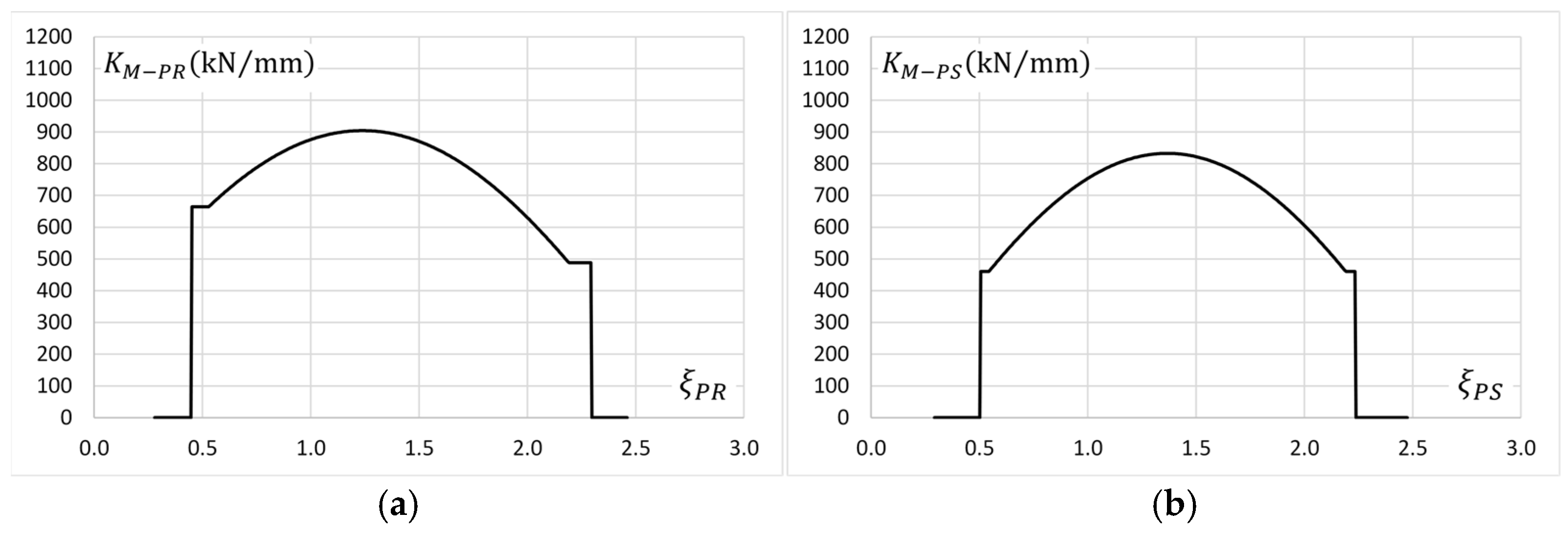
in which K M m a x * is the maximum SMS for unit face width, b is the face width, b 0 and ξ m are coefficients of the approximate equation, ξ i n n and ξ o u t are the contact parameters corresponding to the theoretical (unloaded) inner and outer points of contact, and ξ m i n and ξ m a x are the contact parameters corresponding to the actual (loaded) inner and outer points of contact. ξ is the contact parameter of each tooth pair of each planet and is calculated from ξ 0 and Equations (2)–(5). All these parameters are different for PR and PS meshes (except the face width, which is often equal) and can be computed as described in [28,39]. In addition, ξ m i n and ξ m a x depend on the instantaneous load and, consequently, both are a function of ξ 0 . Figure 1 shows plots of the curves of SMS for internal and external spur gear pairs.
The separation distance δ G is the distance in the line of action the driving tooth should approach (or move away) to the driven tooth to get (or finish) contact outside the theoretical contact interval due to the acting load [27,31]. The separation distance is null within the theoretical contact interval and can be accurately calculated by the approximate equation [27,31]:
δ G ξ = 2 π Z P 2 C p i n n   r b P ξ i n n ξ 2 f o r ξ m i n ξ ξ i n n δ G ξ = 0 f o r ξ i n n ξ ξ o u t δ G ξ = 2 π Z P 2 C p o u t   r b P ξ ξ o u t 2 f o r ξ o u t ξ ξ m a x
The coefficients C p i n n   and C p o u t   are different for PR and PS meshes and can be computed as described in [27,31]. The additional contact intervals ξ m i n ξ ξ i n n and ξ o u t ξ ξ m a x are caused by the transmitted load and the derived tooth deflections. The contact throughout these intervals is not conjugate and therefore begins with an impact, called mesh-in impact, and finishes with a push, called mesh-out push. Both, but primarily the mesh-in impact, are sources of noise, vibrations, and dynamic load, which reduce the tooth strength and the smoothness of the transmission. These undesirable effects can be avoided or mitigated by removing some amount of material at the tooth tips, which delays the start of contact and brings forward its end. This is called profile modification or tip relief. The depth of relief δ R can be expressed as [27,31]:
δ R ξ = Δ R i n n f o r ξ m i n ξ ξ i n n δ R ξ = Δ R i n n 1 ξ ξ i n n Δ ξ R i n n n f o r ξ i n n ξ ξ i n n + Δ ξ R i n n δ R ξ = 0 f o r ξ i n n + Δ ξ R i n n ξ ξ o u t Δ ξ R o u t δ R ξ = Δ R o u t 1 ξ 0 ξ Δ ξ R o u t n f o r ξ o u t Δ ξ R o u t ξ ξ o u t δ R ξ = Δ R o u t f o r ξ o u t ξ ξ m a x
where Δ R i n n and Δ R o u t are the depth of relief at the outer point of the driven and driving teeth, respectively, Δ ξ R i n n and Δ ξ R o u t are the corresponding lengths of relief, and n is equal to 1 and 2 for linear or parabolic reliefs. All these parameters may be identical or distinct for the PR and PS meshes, depending on the design requirements. The function δ R ξ is constant throughout the additional contact intervals because at these intervals, the contact occurs between the tip of one tooth and a small interval of the profile at the root of the mating tooth. It is noticeable that an equal length of relief on the sun, planets, or ring does not mean equal the radial length of the interval of modification because, as seen in Equation (2), Δ ξ is not proportional to the radius of the profile point and depends on the number of teeth.
From the parameters described above, the load at a specific tooth pair F when it contacts the point described by ξ is expressed as:
F ξ = K M ξ δ ξ δ G ξ + δ R ξ
Thus, the LSR R is:
R ξ = F ξ F T = K M ξ F T δ ξ δ G ξ + δ R ξ
and the TVMS K T :
K T ξ = F T δ ξ
Finally, the limits of the actual contact interval are the points in which the load F is null and therefore, from Equation (11), they can be calculated by solving the equation:
δ ξ m i n / m a x = δ G ξ m i n / m a x + δ R ξ m i n / m a x
for which an iterative method should be used. ξ m i n and ξ m a x are different for PR and PS meshes. In addition, since they depend on the QSTE δ , they are both a function of the meshing position parameter ξ 0 .
The mesh stiffness of the planets is given by:
K P k ξ 0 = i K M P R ξ P R k ξ 0 + i + j K M P S ξ P S k ξ 0 + j
and the LSR, or torque sharing ratio (TSR), between planets R P :
R P k ξ 0 = K P k ξ 0 n K P n ξ 0
The pairs of teeth that are in contact at a specific meshing position ξ 0 are those that verify the condition:
ξ m i n P R / P S ξ 0 ξ P R / P S k ξ 0 ξ m a x P R / P S ξ 0
This model was validated by comparison with a hybrid model which combines finite element techniques with an analytical formulation of theoretic–experimental correlation [40].

3. Influence of the Number of Planets, Mesh Phasing, and Tip Relief on the QSTE

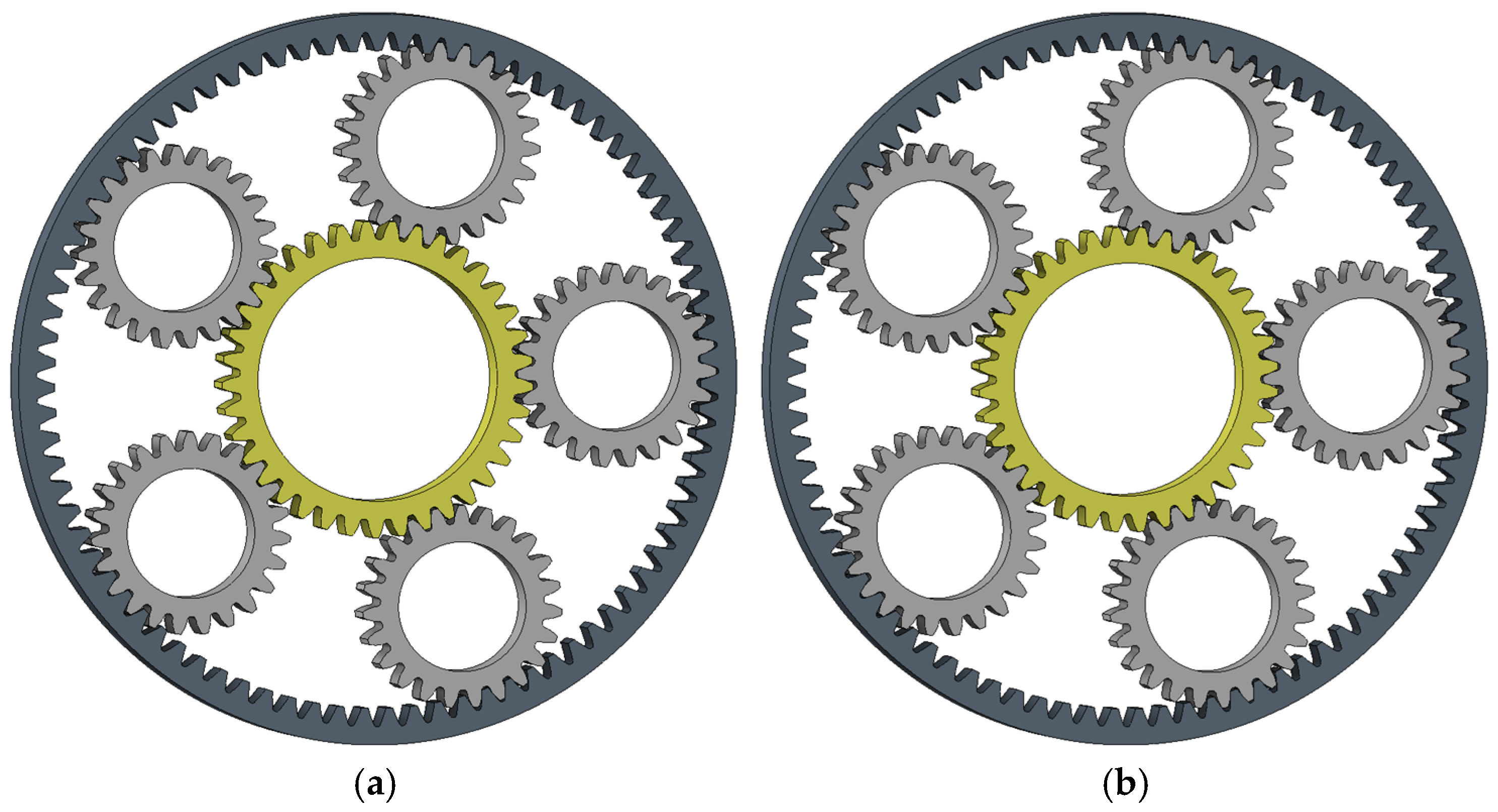
For the following analysis, two planetary spur gears have been considered. Geometrical data are presented in Table 1. In both cases, the number of teeth on the sun and the ring have been chosen in such a way that Z S + Z R = 120 , which ensures a uniform angular distribution of 3, 4, 5, and 6 planets. To obtain homogeneous tooth deflections and therefore comparable results, an input torque proportional to the number of planets in the sun gear is applied. Figure 2 shows the 3D drawings of both planetary gear configurations with five planets.
Planetary gear PSG-A has a 37-tooth sun gear and an 83-tooth ring gear. Since both are prime numbers, the transmission is asynchronous, regardless of the number of planets. To ensure comparable results, the tooth numbers of the PSG-S planetary gearset were selected to closely match those of the PSG-A configuration while enabling a synchronous operational behavior. A 36-tooth sun gear and an 84-tooth ring gear result in synchronous configuration for 3, 4, and 6 planets and asynchronous for 5 planets. Thus, if the results obtained for both planetary gears, PSG-A and PSG-S, with five planets (both asynchronous) were similar, as expected, the comparison of the results obtained for the remaining numbers of planets would highlight the influence of the mesh phasing.
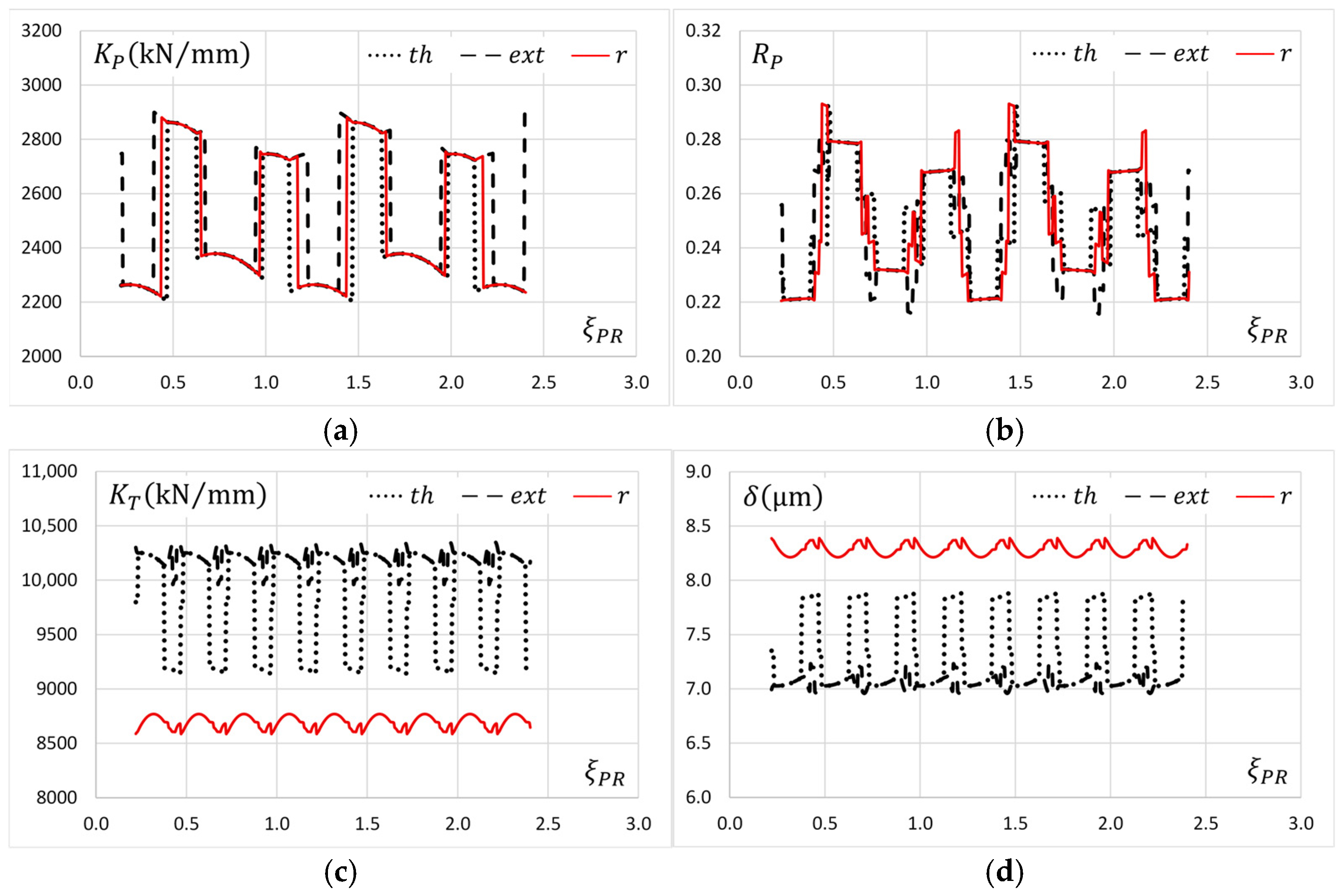
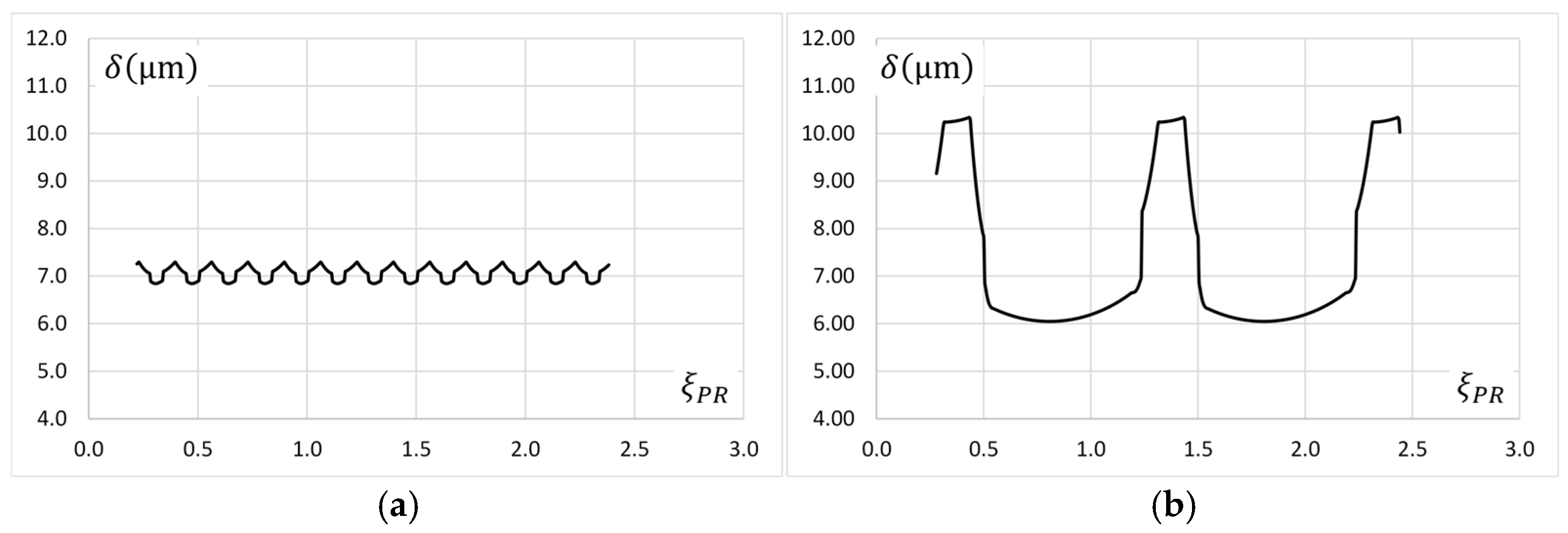
Figure 3 shows the plots for the planet mesh stiffness (PMS), TSR between planets, TVMS, and QSTE of the planetary gear set PSG-A with four planets (denoted by PSG-A/4). These plots are simply the graphical representation of Equations (15), (16), (13), and (6), respectively, for the considered planetary gear. Dotted lines correspond to the theoretical model (th), in which the influence of the tooth pair deflections on the contact interval is neglected. Dashed lines represent the extended model (ex) considering additional contact intervals without tip relief; solid lines denote the model with tip relief (r). A parabolic tip relief with equal depth ( Δ R = 7 μm) and length ( Δ ξ R = 0.4 ) in all gears has been applied.
The results obtained from the simulation reveal that the tip relief has noticeable influence on the QSTE. Specifically, it increases the average value of the QSTE, which is quite intuitive when considering that the material removed in the relieved tooth reduces stiffness and therefore increases deformation. However, the critical parameter does not correspond to the average QSTE but to its time variation, which induces accelerations and decelerations and therefore dynamic load. The dynamic load is related to the PPTE, Δ δ . For the PSG-A/4 planetary gear set considered in Figure 3, the PPTE decreases from 0.27 μm for unmodified teeth to 0.17 μm for relieved teeth.
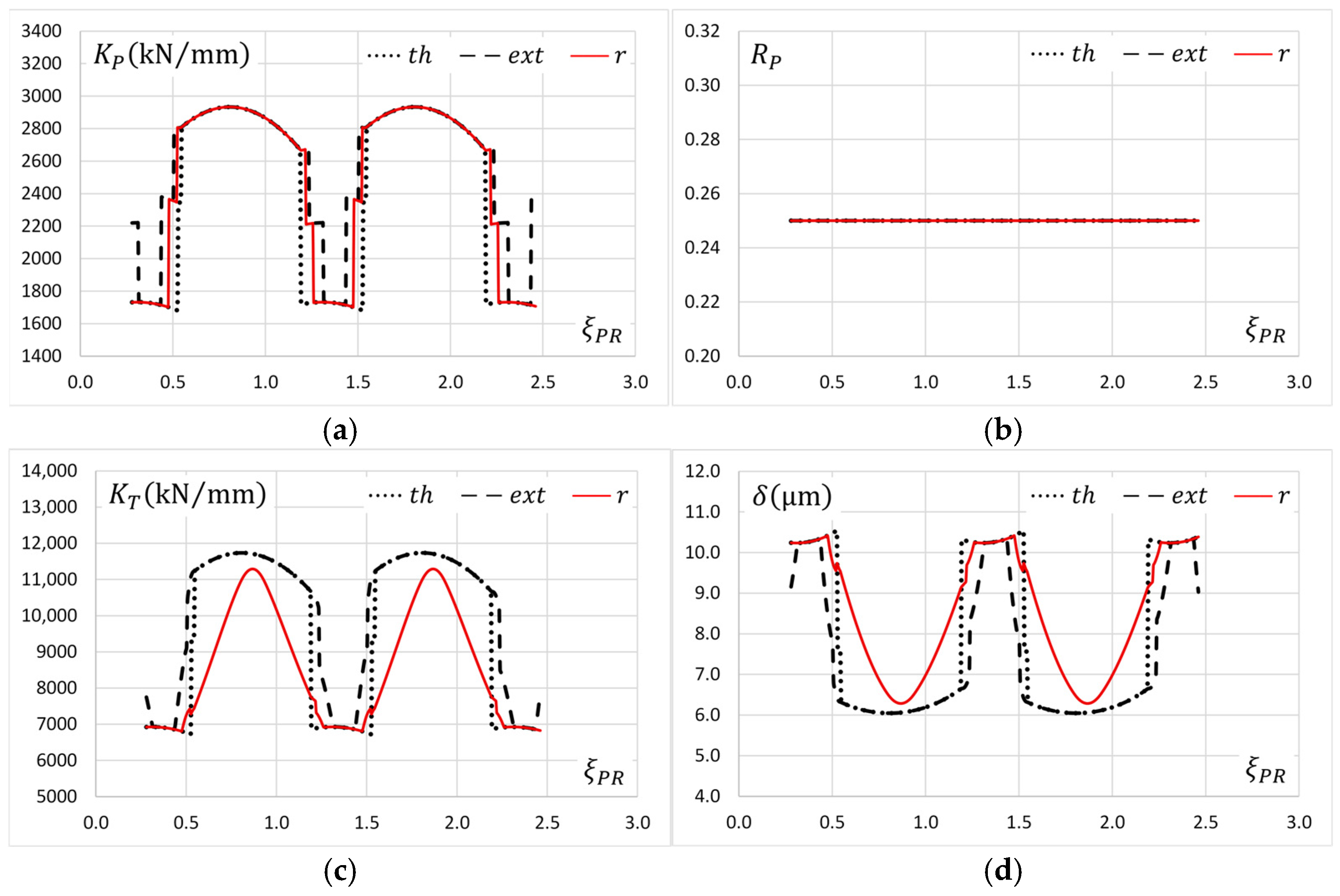
Figure 4 presents the same plots for the synchronous transmission PSG-S/4. From Equation (3), since the number of teeth of the planet is an even number, ξ P S = ξ P R . Consequently, according to Figure 1, the maximum SMS values of the PR and PS meshes are almost coincident, and the same trend occurs with the minimum values. These coincidences are more pronounced in these cases in which both meshes PR and PS have very similar contact ratios (Table 1) and limits of the contact interval (Figure 1). Accordingly, the maximum PMS of the synchronous transmission PSG-S/4 is slightly higher than that of the asynchronous PSG-A/4, while the minimum PMS is slightly lower, as seen in the diagram of Figure 4a. The TSR is, of course, uniform and equal to 0.25, as seen in Figure 4b.
Figure 4 also shows that the amplitude values of TVMS and QSTE are much greater than those for the asynchronous planetary gear set PSG-A/4. Since all the planets are in the same relative contact position all the time, the maximum PMS is reached on all planets simultaneously, and the same happens for the minimum PMS. Therefore, the maximum TVMS of the synchronous planetary gear is greater than that of the asynchronous one, while the minimum TVMS is smaller. The opposite occurs with the QSTE; therefore, the PPTE increases with respect to the asynchronous transmission. The PPTE of the PSG-S/4 planetary gear without tip relief is 4.29 μm and 4.13 μm with the applied tip relief, which are 15 and 24 times greater than those of the PSG-A/4 planetary gear.

3.1. Analysis of the Asynchronous Configuration

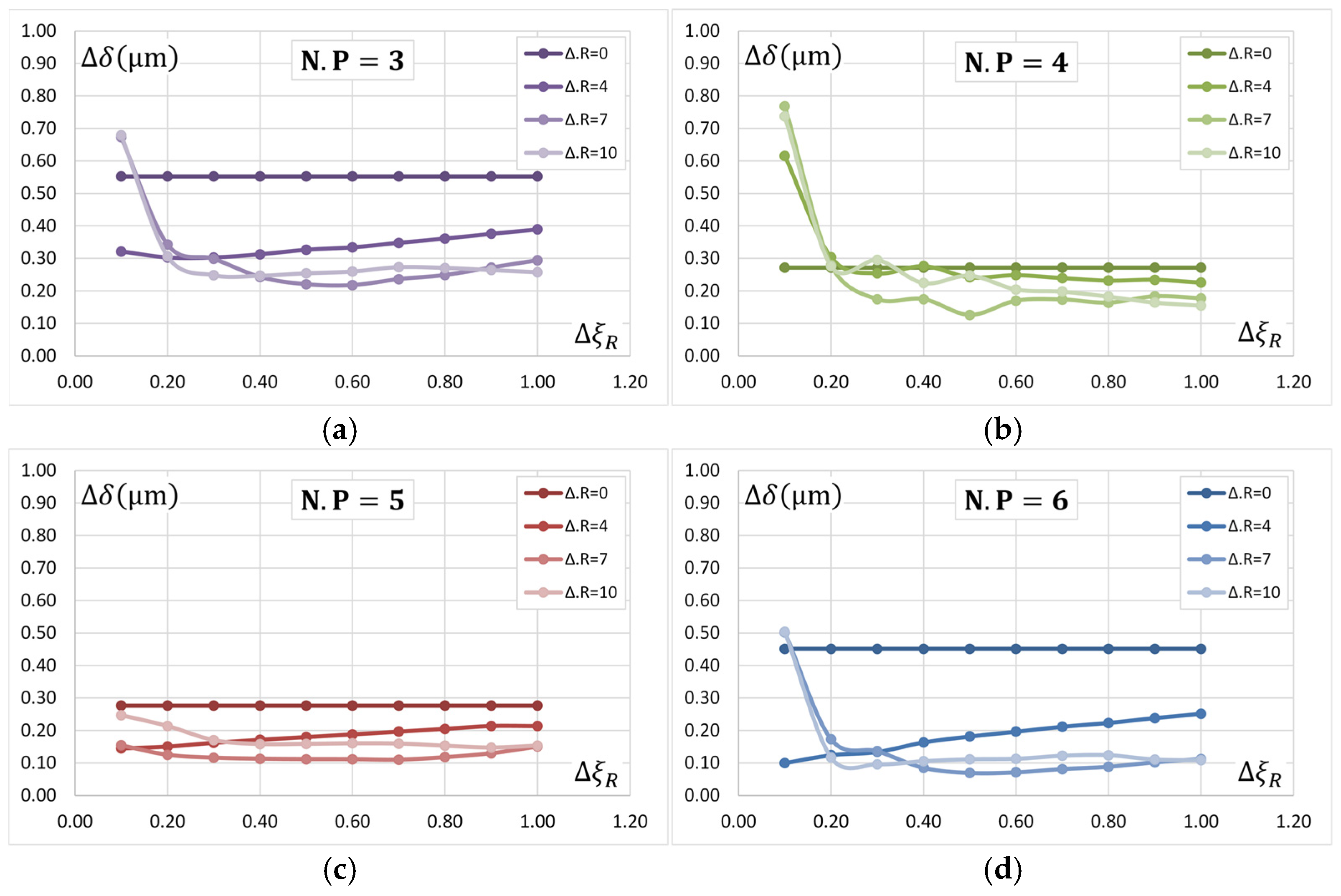
Figure 5 shows the simulated PPTE variation for the PSG-A planetary gear with the length of relief, considering four different depths of relief: 0, 4, 7, and 10 μm. Δ R = 7 μm coincides with the QSTE and therefore the tooth pair deflection for no tip relief (dashed curve in the diagram of Figure 3d). This is called the adjusted depth of relief because it delays the start of contact precisely to the theoretical inner point of contact, thereby avoiding the detrimental mesh-in impact with the least reduction in contact ratio. Thus, the four depths of relief analyzed correspond to no tip relief (0 μm), small depth (4 μm), adjusted depth (7 μm), and large depth (10 μm).
It is observed in Figure 5 that the general trends are quite erratic. However, some conclusions can be drawn:
  • The minimum PPTE is always obtained for the adjusted depth of relief ( Δ R = 7 μm) and length of relief around Δ ξ R = 0.50 . This length corresponds to a radial length of 3.460 mm for the planets, 3.170 mm for the sun, and 2.208 mm for the ring.
  • For the small length of relief, namely Δ ξ R 0.15 , the minimum PPTE is obtained for the small depth ( Δ R = 4 μm).
  • For the large length of relief, specifically Δ ξ R 0.9 , the PPTE is minimum for the adjusted or greater depth of relief ( Δ R 7 μm).
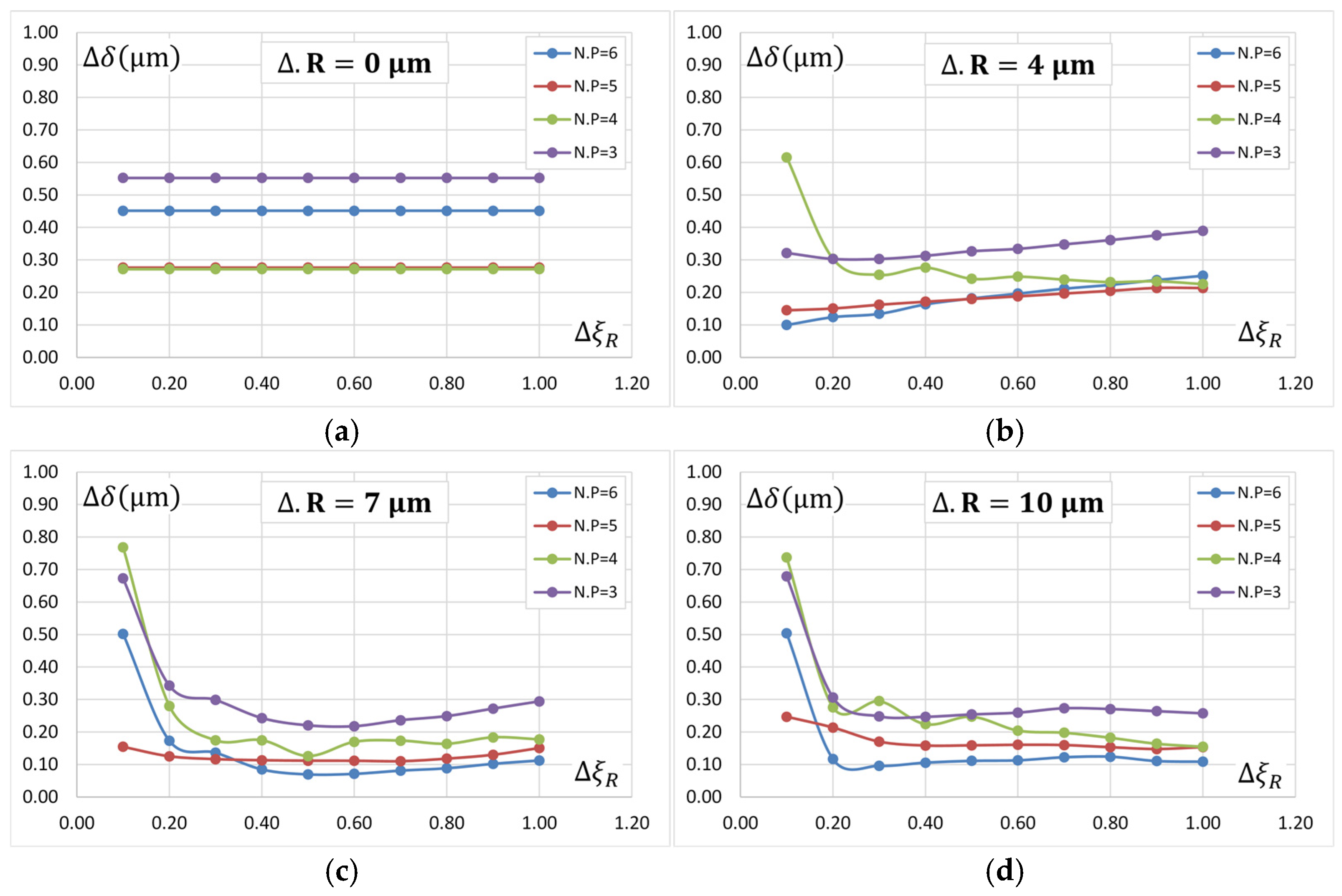
The influence of the number of planets on the PPTE can be seen in Figure 6. It can be observed that:
  • For small relief lengths ( Δ ξ R 0.15 ), the highest PPTE and therefore the least favorable dynamic load behavior occurs in the planetary gear PSG-A/4, with four planets. Conversely, the five-planet configuration exhibits the minimum PPTE (although with slightly lower PPTE for the six-planet configuration with a 4 μm relief depth).
  • For longer reliefs ( Δ ξ R 0.20 ), the highest PPTE is obtained for the planetary gear PSG-A/3, with three planets, while the minimum one corresponds to the six-planet configuration. An exception arises at a 4 μm relief depth, where the PPTE of the five-planet configuration is lower.
  • In terms of the behavior for unmodified profiles, Figure 6a presents completely different trends.
  • The configuration with five planets displays the most uniform PPTE, between 0.10 and 0.30 μm, regardless of the depth and length of relief.

3.2. Analysis of the Synchronous Configuration

An identical analysis was performed with the PSG-S planetary gear set, which is synchronous for three, four, and six planets and asynchronous for five. This asynchronous configuration with five planets serves to assess the similarity between the PSG-A and PSG-S planetary gear sets. Specifically, it quantifies the marginal influence of the slight discrepancy in the number while highlighting the behavior differences between synchronous and asynchronous configurations.
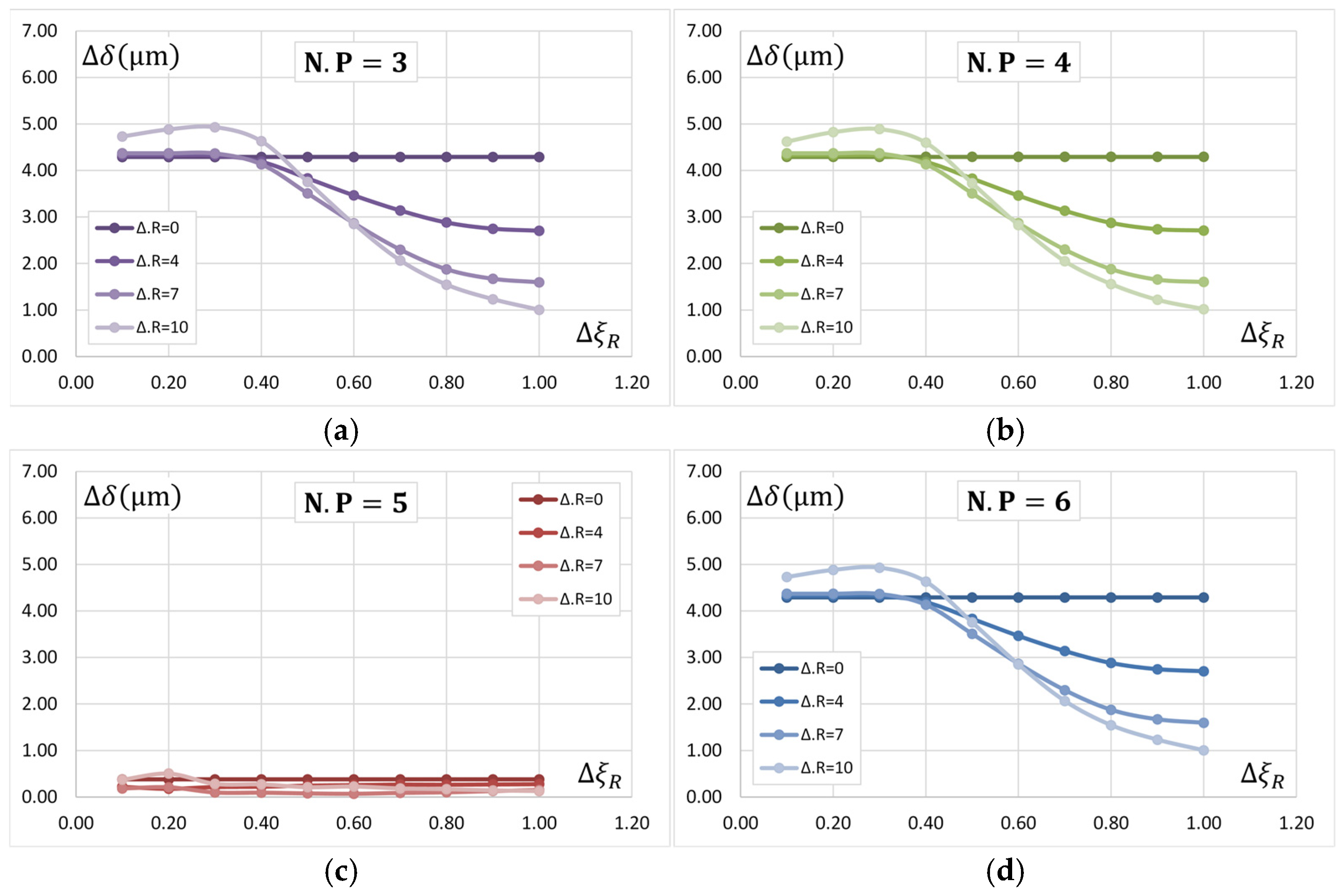
Figure 7 shows the simulated variation in the PPTE of the planetary gear PSG-S with the length of relief for the same four different depths of relief of 0, 4, 7, and 10 μm. In this case, Δ R = 7 μm is not the adjusted depth of relief (Figure 4), but Δ R = 10 μm corresponds to the maximum QSTE, which also guarantees the absence of mesh-in impact.
The following conclusions can be drawn:
  • The PPTE of the synchronous configurations is much greater than that of the asynchronous one, as expected.
  • For long lengths of relief ( Δ ξ R > 0.50 ), the deeper the relief, the lower the PPTE.
  • For lengths of relief Δ ξ R < 0.50 , the deeper the relief, the higher the PPTE, although the variation is smaller.
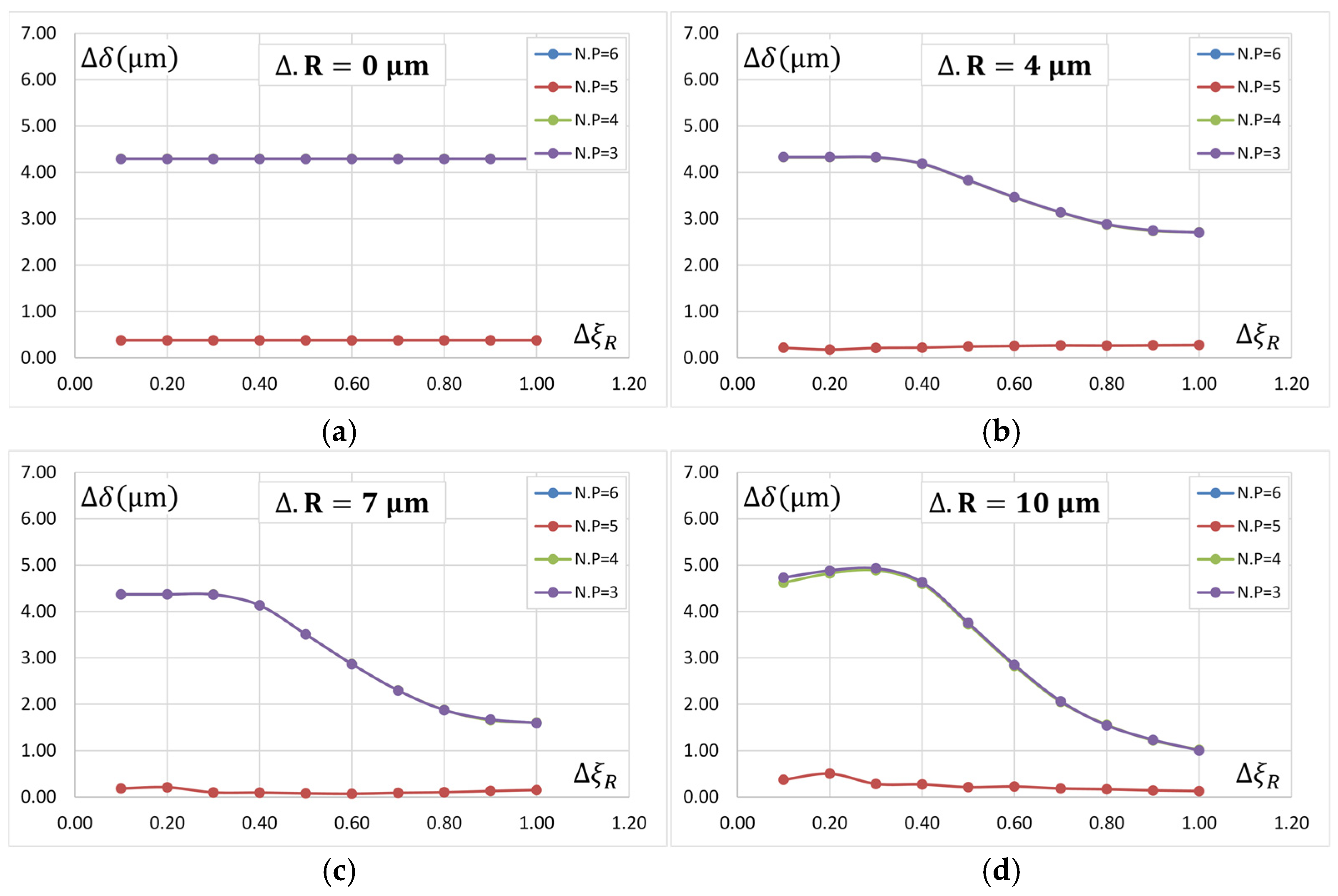
It is also observed that the simulated QSTE curves of the synchronous configurations (PSG-S/3, PSG-S/4, and PSG-S/6) are almost identical. In fact, if the relative meshing position of all the planets is the same, the torque is distributed evenly among them. Since the applied input torque is proportional to the number of planets, the QSTE must be identical in all three configurations. It can be clearly observed in Figure 8.

3.3. Comparison Between Synchronous and Asynchronous Configurations

The diagrams in Figure 8 clearly demonstrate that the PPTE of the asynchronous configuration is substantially lower than that of the synchronous configurations for the entire ranges of the depths and lengths of relief (Figure 6). The PPTE reduction for the asynchronous configuration oscillates between 90% and 95%, leading to significant reductions in the induced dynamic load.
However, the instantaneous dynamic load depends on the slope of the curve of QSTE. Assuming uniform input velocity, the variation in the QSTE is proportional to the variation in the output velocity, thus proportional to the acceleration and therefore to the dynamic load. As evident from Figure 3 and Figure 4, the QSTE is a periodic function. However, the period of a synchronous planetary gear represents the time required for a planet rotation of 2 π / Z P (denoted as Δ ξ P R = 1 in the diagrams), while the period for the asynchronous planetary gear is N P times shorter ( Δ ξ P R = 1 / N P ). Consequently, although the PPTE of the asynchronous gear set is between 10 and 20 times lower than that of the synchronous system, the resulting instantaneous dynamic load decreases by only 10 / N P to 20 / N P times lower. This can be observed in Figure 9 for planetary gear sets PSG-A/6 and PSG-S/6 with no tip relief.

3.4. Influence of the Number of Teeth on Planets

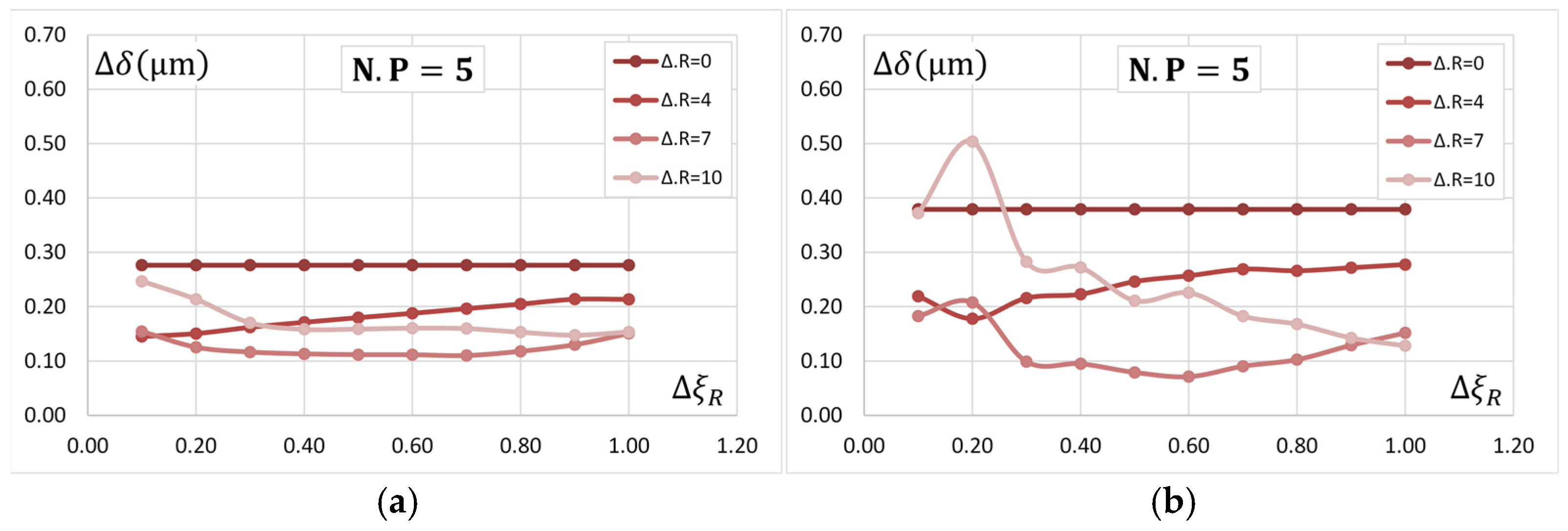
Figure 10 illustrates the results of the simulation of the PPTE of planetary gears PSG-A/5 and PSG-S/5, both asynchronous and with five planets. The PSG-A/5 gear set has one more tooth in the sun and one less tooth on the ring and planets than the PSG-S/5 gear set.
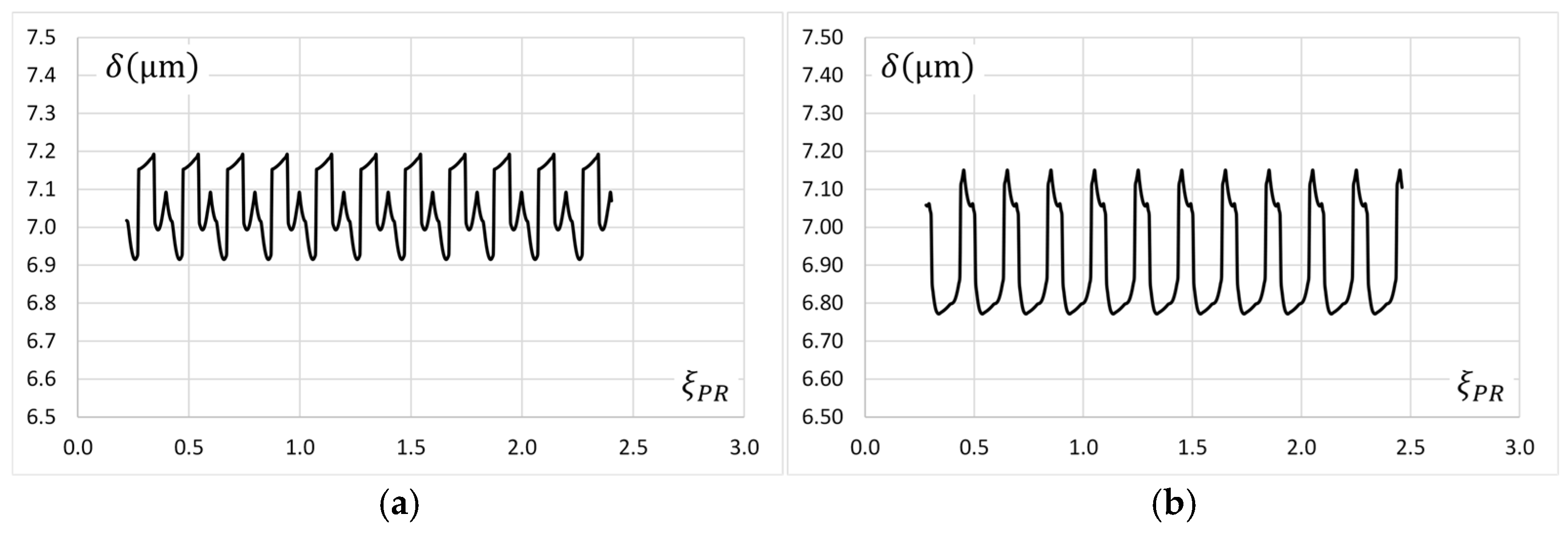
It is apparent that the general trends display high similarity, although the PPTE of the PSG-S/5 gear set is slightly higher. However, the differences between curves of QSTE are strongly significant, as shown in Figure 11.
The results indicate that the planet mesh stiffness of the PSG-A/5 gear set oscillates between 2200 and 2900 k N / m m , while that of the PSG-S/5 gear set oscillates between 1700 and 2900 k N / m m . In addition, the shape of the curves is significantly different. These differences are due to the number of teeth on the planets, being 23 and 24, respectively.
The number of teeth on the planets of the PSG-S/5 gear set is an even number. According to Equation (3), the planets contact the sun and the ring at the same point, ξ P R = ξ P S (in this case, the center distance corresponds to the nominal value and therefore α t P S = α t P R ). As seen in Figure 1, the minimum stiffness of both meshes, PR and PS, corresponds to the outer point of contact of the planet meshing with the inner point of contact of the ring and sun, respectively. As the contact at both points of minimum stiffness is given simultaneously, the planet mesh stiffness is minimum. On the contrary, when the planet of the PSG-A/5 gear set, which has an odd number of teeth, meshes with the ring at the outer point of contact, ξ P R 2.2 , the contact with the sun occurs at point ξ P S 1.7 , for which the mesh stiffness of the PS mesh is close to the maximum. This results in a higher minimum planet mesh stiffness and therefore a lower time variation in the planet mesh stiffness for this planetary gear. In conclusion, an odd number of teeth on the planets may reduce the PPTE and the associated dynamic load.
All the conclusions above have been obtained for two specific planetary gear configurations, PSG-S and PSG-A, with different numbers of planets, but additional simulations show that all of them are qualitatively valid for other geometries with different numbers of teeth, gear ratios, and contact ratios.

4. Conclusions

A systematic study evaluating the peak-to-peak transmission error (PPTE) in synchronous and asynchronous planetary gear trains has been carried out. To this end, the combined influence of tip relief modifications, planet numbering, mesh phasing, and tooth parity was quantified through analytical modeling. Our simulation results indicate the existence of an optimal combination of tip relief depth and length that minimizes PPTE under specific load conditions. In agreement with the classical literature on profile modification, the optimal relief depth is of the same order of magnitude as the elastic tooth deflection under nominal load, while the optimal length is closely associated with the extent of the double-contact interval. Consequently, insufficient relief leads to premature contact and mesh-in impacts, thereby increasing the PPTE; conversely, excessive relief reduces the effective mesh stiffness, yielding a similar spike in PPTE. Ultimately, minimizing PPTE requires a balanced design of both micro-geometric parameters—a process strongly governed by the operating load level and further compounded by the mesh phasing configuration.
From this analysis, the following primary conclusions can be drawn:
  • Regarding system phasing, the PPTE of asynchronous planetary gears is significantly lower than that of their synchronous counterparts, establishing asynchronous positioning as a superior design choice for vibration attenuation.
  • In asynchronous configurations, the minimum PPTE is achieved by setting the relief depth to its adjusted value and the relief length to reach the profile point corresponding to the midpoint of the double-contact interval. Crucially, our data reveals that for short relief lengths, the PPTE increases with relief depth, whereas the opposite occurs for large relief lengths.
  • In contrast, while the same trend is observed for synchronous configurations (where PPTE increases with relief depth for short reliefs and decreases for long ones), no single mathematical optimum for depth and length could be isolated to fully minimize PPTE within the investigated parameter space.
  • While scaling the input torques proportionally to the number of planets renders the planet count virtually negligible regarding PPTE, the number of planets exerts a highly pronounced impact on the instantaneous dynamic tooth loads.
  • In terms of micro-geometry parity, planets featuring an odd number of teeth demonstrably induce a lower PPTE than those with an even tooth count, implying that odd tooth selections introduce a favorable phase-canceling effect across the meshes.
As a continuation of the research lines described above, the following future studies can be suggested:
  • More comprehensive validation of the proposed analytical method through a more extensive finite element analysis and comparison with experimental data.
  • Extension of the model to consider the assembly errors and manufacturing deviations.

Author Contributions

Conceptualization, J.I.P.; methodology, J.I.P.; software, J.I.P., M.B.S. and A.F.H.; investigation, J.I.P., M.P., M.B.S. and A.F.H.; writing—original draft preparation, J.I.P. and M.P.; writing—review and editing, J.I.P., M.P., M.B.S. and A.F.H.; supervision, J.I.P.; project administration, J.I.P. and M.B.S.; funding acquisition, J.I.P., M.P., M.B.S. and A.F.H. All authors have read and agreed to the published version of the manuscript.

Funding

This research was funded by the Spanish Council for Scientific and Technological Research, project number PID2022–142632OB-I00.

Data Availability Statement

The original contributions presented in this study are included in the article. Further inquiries can be directed to the corresponding author.

Conflicts of Interest

The authors declare no conflicts of interest. The funders had no role in the design of the study; in the collection, analyses, or interpretation of data; in the writing of the manuscript; or in the decision to publish the results.

Glossary

List of symbols
b Face width (mm)
F Load at a specific tooth pair (kN)
F T Total transmitted load (kN)
K M Single mesh stiffness of the tooth pair (kN/mm)
K M m a x * Maximum SMS for unit face width (kN/mm2)
K P Planet mesh stiffness (kN/mm)
K T Time varying meshing stiffness (kN/mm)
N P Number of planets
R Load sharing ratio
r c Contact point radius (mm)
r b Base radius (mm)
T Torque (N·mm)
Z Number of teeth
α t Operating transverse pressure angle (rad)
δ G Separation distance (mm)
Δ R Depth of relief at the outer point (mm)
Δ δ Peak-to-peak amplitude of transmission error (mm)
Δ ξ R Length of relief
δ R Depth of relief (mm)
ξ Contact position parameter
Subscripts
i n n Theoretical inner point of contact
m a x Actual outer point of contact
m i n Actual inner point of contact
o u t Theoretical outer point of contact
P Planet gear
P R Planet–ring tooth pair
P R Planet–sun tooth pair
R Ring gear
S Sun gear
Abbreviations
LSRLoad sharing ratio
PMSPlanet mesh stiffness
PPTEPeak-to-peak amplitude of transmission error
PRPlanet–ring meshing
PSPlanet–sun meshing
QSTEQuasi-static transmission error
SMSSingle mesh stiffness
TETransmission error
TSRTorque sharing ratio between planets
TVMSTime-varying meshing stiffness

References

  1. August, R.; Kasuba, R.; Frater, J.; Pintz, A. Dynamics of Planetary Gear Trains; NASA Contractor Report 3793; National Aeronautics and Space Administration, Scientific and Technical Information Branch: Hampton, VA, USA, 1984.
  2. Lundvall, O.; Klarbring, A. Prediction of transmission error in spur gears as a consequence of wear. Mech. Struct. Mach. 2001, 29, 431–449. [Google Scholar] [CrossRef]
  3. Harris, S.L. Dynamic loads on the teeth of spur gears. Proc. Inst. Mech. Eng. 1958, 172, 87–112. [Google Scholar] [CrossRef]
  4. Mark, W.D. Analysis of the vibratory excitation of gear systems: Basic theory. J. Acoust. Soc. Am. 1978, 63, 1409–1430. [Google Scholar] [CrossRef]
  5. Yuksel, C.; Kahraman, A. Dynamic tooth loads of planetary gear sets having tooth profile wear. Mech. Mach. Theory 2004, 39, 695–715. [Google Scholar] [CrossRef]
  6. Blankenship, G.W.; Singh, R. A new gear mesh interface dynamic model to predict multi-dimensional force coupling and excitation. Mech. Mach. Theory 1995, 30, 43–57. [Google Scholar] [CrossRef]
  7. Parker, R.G. A physical explanation for the effectiveness of planet phasing to suppress planetary gear vibration. J. Sound Vib. 2000, 236, 561–573. [Google Scholar] [CrossRef]
  8. Velex, P.; Maatar, M. A mathematical model for analyzing the influence of shape deviations and mounting errors on gear dynamic behavior. J. Sound Vib. 1996, 191, 629–660. [Google Scholar] [CrossRef]
  9. Bodas, A.; Kahraman, A. Influence of carrier and gear manufacturing errors on the static load sharing behavior of planetary gear sets. JSME Int. J. Ser. C 2004, 47, 908–915. [Google Scholar] [CrossRef]
  10. Kahraman, A.; Vijayakar, S.M. Effect of internal gear flexibility on the quasi-static behavior of a planetary gear set. J. Mech. Des. 2001, 123, 408–415. [Google Scholar] [CrossRef]
  11. Leque, N.D.; Kahraman, A. A three-dimensional load sharing model of planetary gear sets having manufacturing errors. J. Mech. Des. 2017, 139, 033302. [Google Scholar] [CrossRef]
  12. Singh, A. Load sharing behavior in epicyclic gears: Physical explanation and generalized formulation. Mech. Mach. Theory 2010, 45, 511–530. [Google Scholar] [CrossRef]
  13. Kahraman, A. Load sharing characteristics of planetary transmissions. Mech. Mach. Theory 1994, 29, 1151–1165. [Google Scholar] [CrossRef]
  14. Ligata, H.; Kahraman, A.; Singh, A. A closed-form planet load sharing formulation for planetary gear sets using a translational analogy. J. Mech. Des. 2009, 131, 021007. [Google Scholar] [CrossRef]
  15. Sánchez-Espiga, J.; Fernandez-del-Rincon, A.; Iglesias, M.; Viadero, F. Influence of errors in planetary transmissions load sharing under different mesh phasing. Mech. Mach. Theory 2020, 153, 104012. [Google Scholar] [CrossRef]
  16. Sánchez-Espiga, J.; Fernandez-del-Rincon, A.; Iglesias, M.; Viadero, F. Numerical evaluation of the accuracy in the load sharing calculation using strain gauges. Mech. Mach. Theory 2022, 175, 104923. [Google Scholar] [CrossRef]
  17. Parker, R.G.; Lin, J. Mesh phasing relationships in planetary and epicyclic gears. J. Mech. Des. 2004, 126, 365–370. [Google Scholar] [CrossRef]
  18. Cooley, C.G.; Parker, R.G. A review of planetary and epicyclic gear dynamics and vibrations research. Appl. Mech. Rev. 2014, 66, 040804. [Google Scholar] [CrossRef]
  19. Inalpolat, M.; Kahraman, A. A theoretical and experimental investigation of modulation sidebands of planetary gear sets. J. Sound Vib. 2009, 323, 677–696. [Google Scholar] [CrossRef]
  20. Inalpolat, M.; Kahraman, A. A dynamic model to predict modulation sidebands of a planetary gear set having manufacturing errors. J. Sound Vib. 2010, 329, 371–393. [Google Scholar] [CrossRef]
  21. Parker, R.G.; Wu, X. Vibration modes of planetary gears with unequally spaced planets and an elastic ring gear. J. Sound Vib. 2010, 329, 2265–2275. [Google Scholar] [CrossRef]
  22. Velex, P.; Ajmi, M. On the modelling of excitations in geared systems by transmission errors. J. Sound Vib. 2006, 291, 882–909. [Google Scholar] [CrossRef]
  23. Bonori, G.; Pellicano, F. Non-smooth dynamics of spur gears with manufacturing errors. J. Sound Vib. 2007, 306, 271–283. [Google Scholar] [CrossRef]
  24. Eritenel, T.; Parker, R.G. Nonlinear vibration of gears with tooth surface modifications. J. Vib. Acoust. 2013, 135, 051005. [Google Scholar] [CrossRef]
  25. Zheng, X.; Zhu, W.; Li, G.; Hu, Y. Reshaping load-dependent mesh excitation waveforms of spur gears—An analytical framework on tip relief modeling and design. Machines 2025, 13, 161. [Google Scholar] [CrossRef]
  26. Zhou, D.; Guo, Y.; Yang, J.; Zhang, Y. Study on the parameter influences of gear tooth profile modification and transmission error analysis. Machines 2024, 12, 316. [Google Scholar] [CrossRef]
  27. Sánchez, M.B.; Pleguezuelos, M.; Pedrero, J.I. Influence of profile modifications on meshing stiffness, load sharing, and transmission error of involute spur gears. Mech. Mach. Theory 2019, 139, 506–525. [Google Scholar] [CrossRef]
  28. Sánchez, M.B.; Pleguezuelos, M.; Pedrero, J.I. Strength model for bending and pitting calculations of internal spur gears. Mech. Mach. Theory 2019, 133, 691–705. [Google Scholar] [CrossRef]
  29. Li, J.; Zhao, H.; Ren, Y.; Yang, J. Calculation of time-varying mesh stiffness of internal mesh transmission and analysis of influencing factors. Appl. Sci. 2025, 15, 4599. [Google Scholar] [CrossRef]
  30. Pleguezuelos, M.; Sánchez, M.B.; Pedrero, J.I. Analytical model for meshing stiffness, load sharing, and transmission error for spur gears with profile modification under non-nominal load conditions. Appl. Math. Model. 2021, 109, 344–365. [Google Scholar] [CrossRef]
  31. Pedrero, J.I.; Sánchez, M.B.; Pleguezuelos, M. Analytical model of meshing stiffness, load sharing, and transmission error for internal spur gears with profile modification. Mech. Mach. Theory 2024, 197, 105650. [Google Scholar] [CrossRef]
  32. Houser, D.R.; Harianto, J.; Talbot, D. Gear mesh transmission error—A review. Gear Technol. 2011, 28, 42–47. [Google Scholar]
  33. Liang, X.; Zuo, M.J.; Pandey, M. Evaluating time-varying mesh stiffness of a planetary gear set using the potential energy method. Proc. Inst. Mech. Eng. Part C 2014, 228, 535–547. [Google Scholar] [CrossRef]
  34. Guo, Y.; Parker, R.G. Dynamic modeling and analysis of a spur planetary gear involving tooth wedging and bearing clearance nonlinearity. Eur. J. Mech. A Solids 2010, 29, 1022–1033. [Google Scholar] [CrossRef]
  35. Hu, Y.; Talbot, D.; Kahraman, A. A theoretical study of the overall transmission error in planetary gear sets. Proc. Inst. Mech. Eng. Part C 2019, 233, 7200–7211. [Google Scholar] [CrossRef]
  36. Guo, Y.; Eritenel, T.; Ericson, T.M.; Parker, R.G. Vibro-acoustic propagation of gear dynamics in a gear-bearing-housing system. J. Sound Vib. 2014, 333, 5762–5785. [Google Scholar] [CrossRef]
  37. Huo, G.; Iglesias-Santamaria, M.; Zhang, X.; Sanchez-Espiga, J.; Caso-Fernandez, E.; Jiao, Y.; Viadero-Rueda, F. Influence of eccentricity error on the orbit of a two-stage double-helical compound planetary gear train with different mesh phasing configurations. Mech. Mach. Theory 2024, 196, 105634. [Google Scholar] [CrossRef]
  38. Molaie, M.; Deylaghian, S.; Iarriccio, G.; Samani, F.S.; Zippo, A.; Pellicano, F. Planet load-sharing and phasing. Machines 2022, 10, 634. [Google Scholar] [CrossRef]
  39. Sánchez, M.B.; Pleguezuelos, M.; Pedrero, J.I. Approximate equations for the meshing stiffness and the load sharing ratio of spur gears including Hertzian effects. Mech. Mach. Theory 2017, 109, 231–249. [Google Scholar] [CrossRef]
  40. Pedrero, J.I.; Pleguezuelos, M.; Sánchez, M.B. Influence of meshing stiffness on load distribution between planets of planetary gear drives. Mech. Mach. Theory 2022, 170, 104718. [Google Scholar] [CrossRef]
  41. Pedrero, J.I.; Sánchez-Espiga, J.; Sánchez, M.B.; Pleguezuelos, M.; Fernández-del-Rincón, A.; Viadero, F. Simulation and validation of the transmission error, meshing stiffness, and load sharing of planetary spur gear transmissions. Mech. Mach. Theory 2024, 203, 105800. [Google Scholar] [CrossRef]
  42. Del Rincón, A.F.; Viadero, F.; Iglesias, M.; García, P.; De-Juan, A.; Sancibrián, R. A model for the study of meshing stiffness in spur gear transmissions. Mech. Mach. Theory 2013, 61, 30–58. [Google Scholar] [CrossRef]
  43. Iglesias, M.; Del Rincón, A.F.; De-Juan, A.; Garcia, P.; Diez-Ibarbia, A.; Viadero, F. Planetary transmission load sharing: Manufacturing errors and system configuration study. Mech. Mach. Theory 2017, 111, 21–38. [Google Scholar] [CrossRef]
Figure 1. Plots of the curves of SMS for PR (a) and PS (b) tooth pairs.
Machines 14 00651 g001
Figure 2. 3D solid models of the planetary gear with 37/23/83 teeth (a) and 36/24/84 teeth (b) and five planets.
Machines 14 00651 g002
Figure 3. Plots of PMS (a), TSR (b), TVMS (c), and QSTE (d) of the PSG-A/4 planetary gear set.
Machines 14 00651 g003
Figure 4. Plots of PMS (a), TSR (b), TVMS (c), and QSTE (d) of the PSG-S/4 planetary gear set.
Machines 14 00651 g004
Figure 5. Variation in the PPTE with length and depth of tip relief of asynchronous planetary gear PSG-A with three (a), four (b), five (c), and six (d) planets.
Machines 14 00651 g005
Figure 6. Variation in the PPTE with the length of relief and the number of planets of asynchronous planetary gear PSG-A for depths of relief of 0 μm (a), 4 μm (b), 7 μm (c), and 10 μm (d).
Machines 14 00651 g006
Figure 7. Variation in the PPTE with the length and depth of tip relief of synchronous planetary gear PSG-S with three (a), four (b), five (c), and six (d) planets.
Machines 14 00651 g007
Figure 8. Variation in the PPTE with the length of relief and the number of planets of synchronous planetary gear PSG-S for depths of relief of 0 μm (a), 4 μm (b), 7 μm (c), and 10 μm (d).
Machines 14 00651 g008
Figure 9. Plots of the QSTE of planetary gear sets PSG-A/6 (a) and PSG-S/6 (b) with no tip relief.
Machines 14 00651 g009
Figure 10. Variation in the PPTE with the length and depth of tip relief of asynchronous planetary gear sets PSG-A/5 (a) and PSG-S/5 (b).
Machines 14 00651 g010
Figure 11. Plots of the QSTE of planetary gear sets PSG-A/5 (a) and PSG-S/5 (b) with no tip relief.
Machines 14 00651 g011
Table 1. Data of planetary spur gears.
PSG-A (Asynchronous)PSG-S (Synchronous)
SunPlanetsRingSunPlanetsRing
Module (mm)5.005.005.005.005.005.00
Normal pressure angle (°)20.0020.0020.0020.0020.0020.00
Tooth addendum coefficient1.001.000.801.001.000.80
Tooth dedendum coefficient1.251.251.251.251.251.25
Tool tip radius coefficient0.300.300.300.300.300.30
Number of teeth372383362484
Rack shift coefficient0.000.000.000.000.000.00
Outside radius (mm)97.5062.50203.5095.0065.00206.00
Pitch radius (mm)92.5057.50207.5090.0060.00210.00
Center distance (mm) 150.00 150.00
Face width (mm)25.0025.0025.0025.0025.0025.00
Single mesh contact ratio1.645 1.6581.647 1.662
Number of planets 3/4/5/6 3/4/5/6
Input torque (N·m)300· N P 300· N P
Rotational velocity (rpm)50.00 50.00
Gear ratio 3.243 3.333
Disclaimer/Publisher’s Note: The statements, opinions and data contained in all publications are solely those of the individual author(s) and contributor(s) and not of MDPI and/or the editor(s). MDPI and/or the editor(s) disclaim responsibility for any injury to people or property resulting from any ideas, methods, instructions or products referred to in the content.