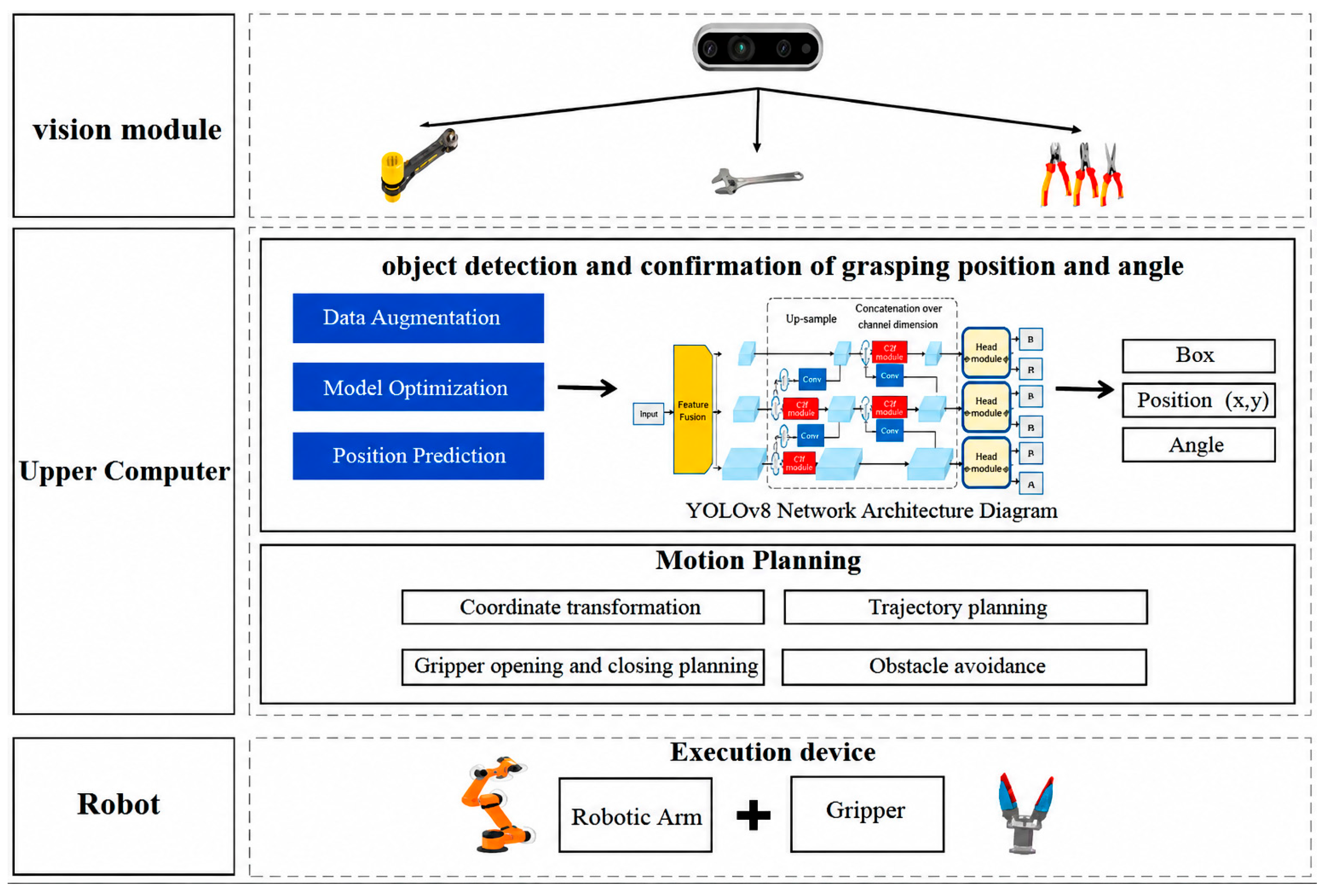
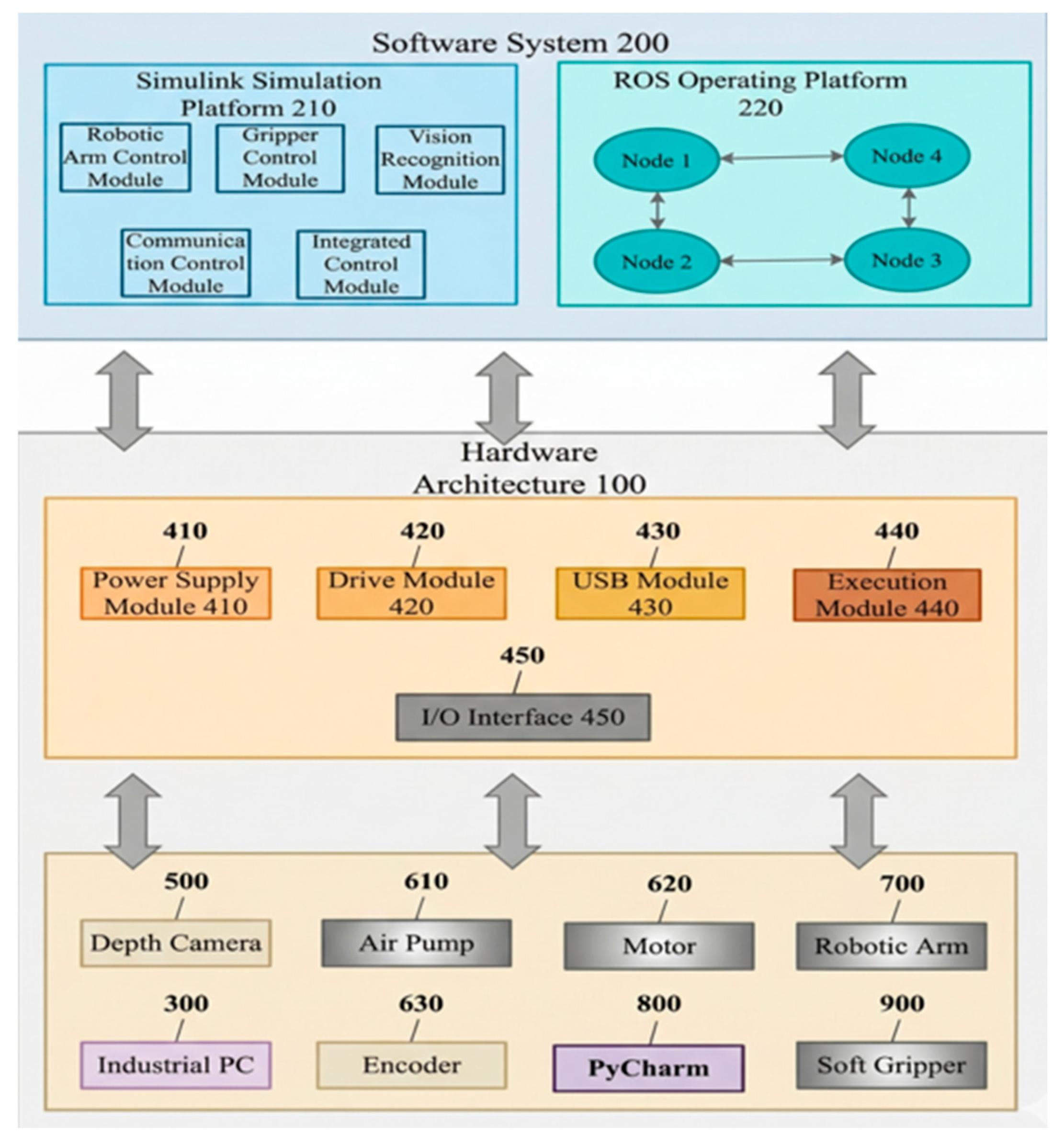
Figure 1.
Schematic diagram of the robotic system.
Figure 1.
Schematic diagram of the robotic system.
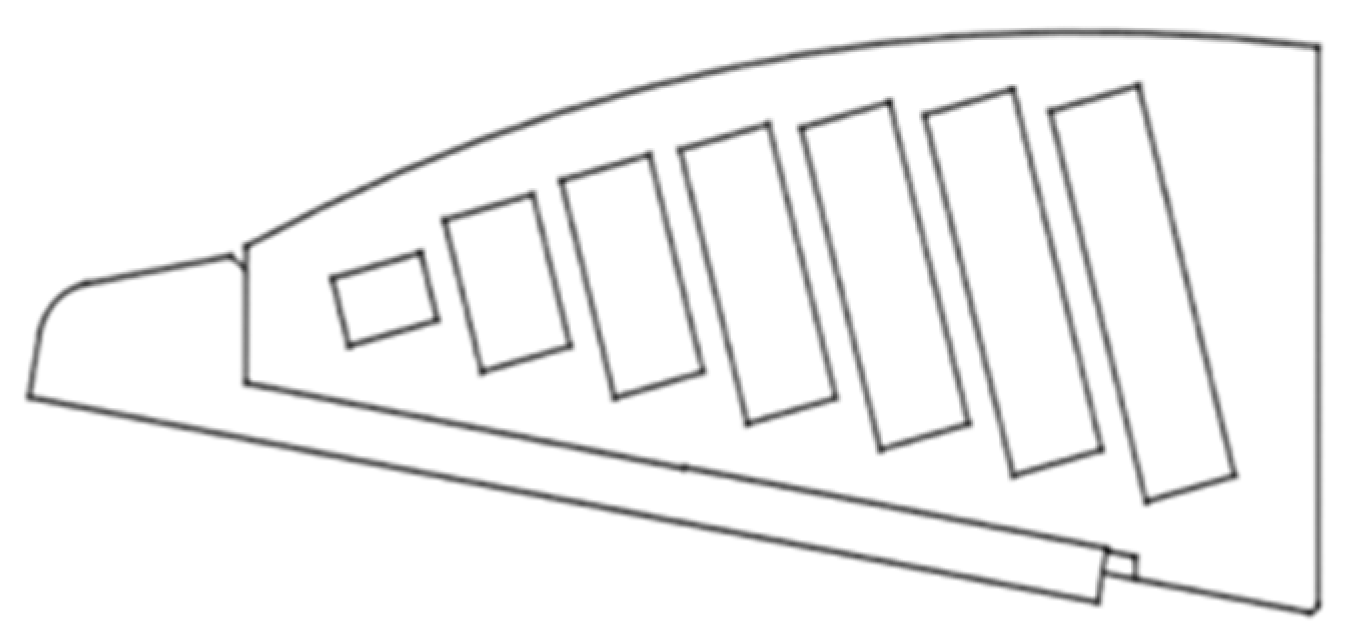
Figure 2.
Structural schematic of the asymmetric Fin Ray soft finger.
Figure 2.
Structural schematic of the asymmetric Fin Ray soft finger.
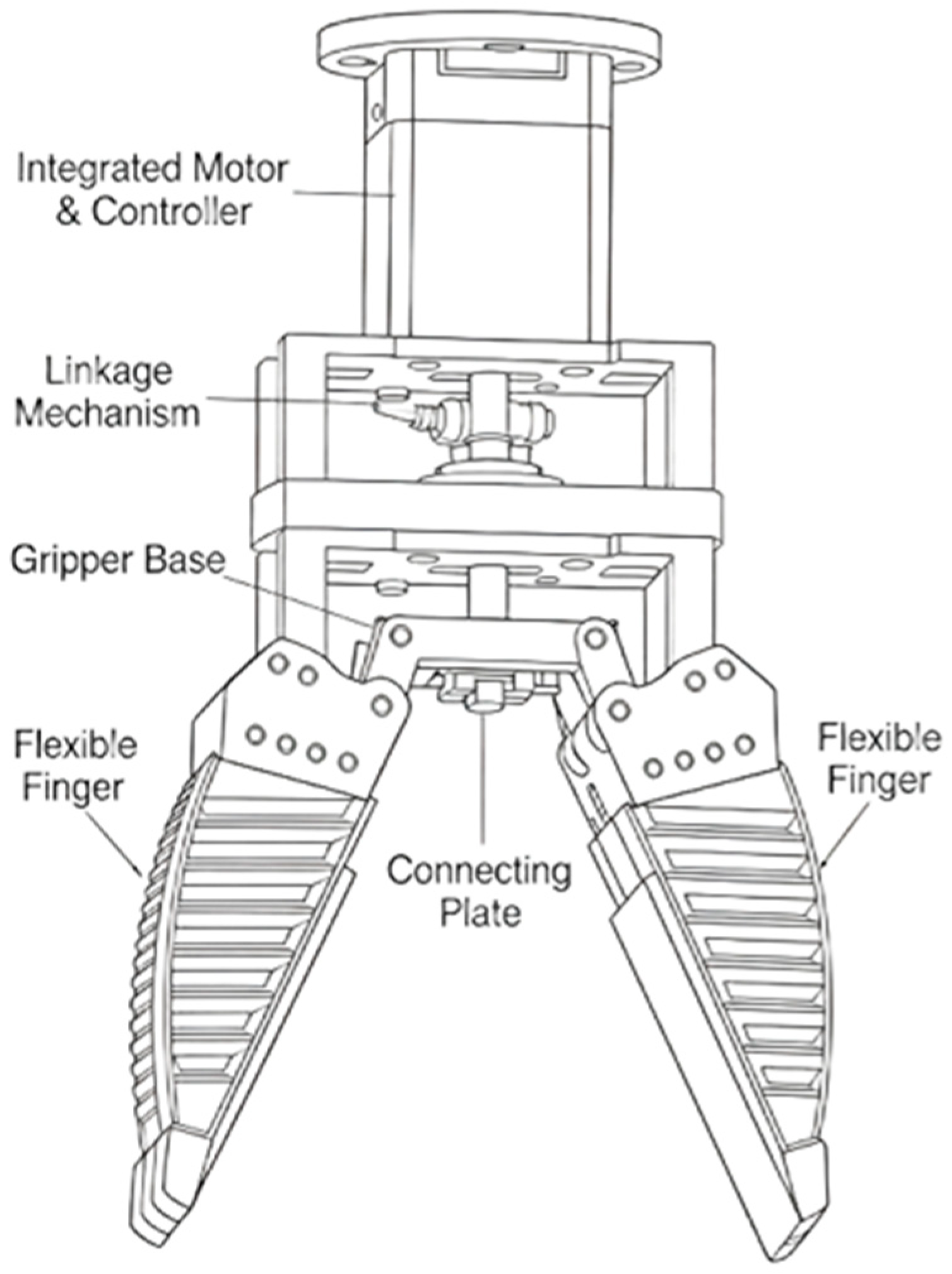
Figure 3.
Overall structural design of the soft gripper.
Figure 3.
Overall structural design of the soft gripper.
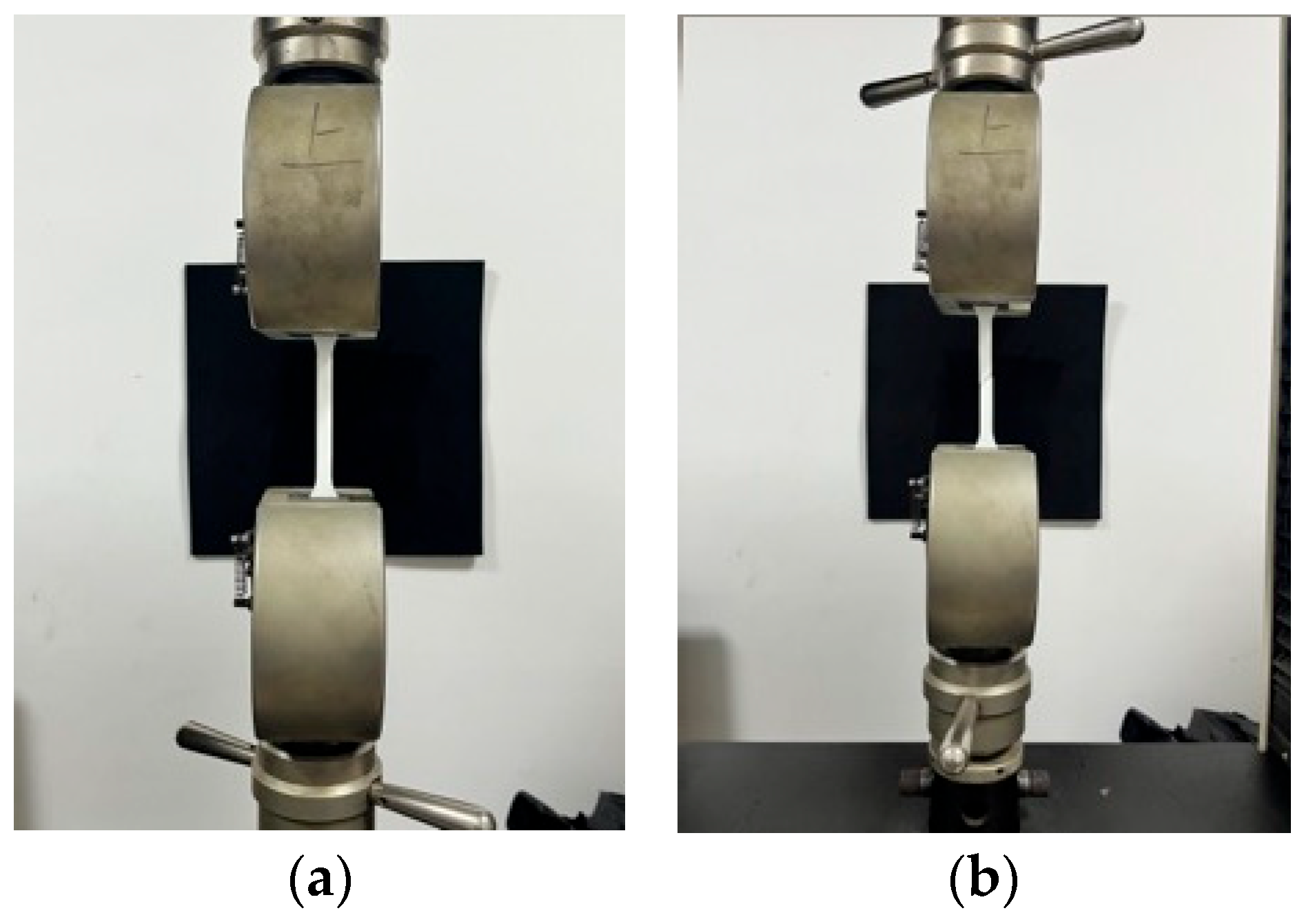
Figure 4.
Uniaxial (single-axis) tensile test setup of 3D-printed TPU specimens: (a) specimen mounted; (b) specimen during elongation.
Figure 4.
Uniaxial (single-axis) tensile test setup of 3D-printed TPU specimens: (a) specimen mounted; (b) specimen during elongation.
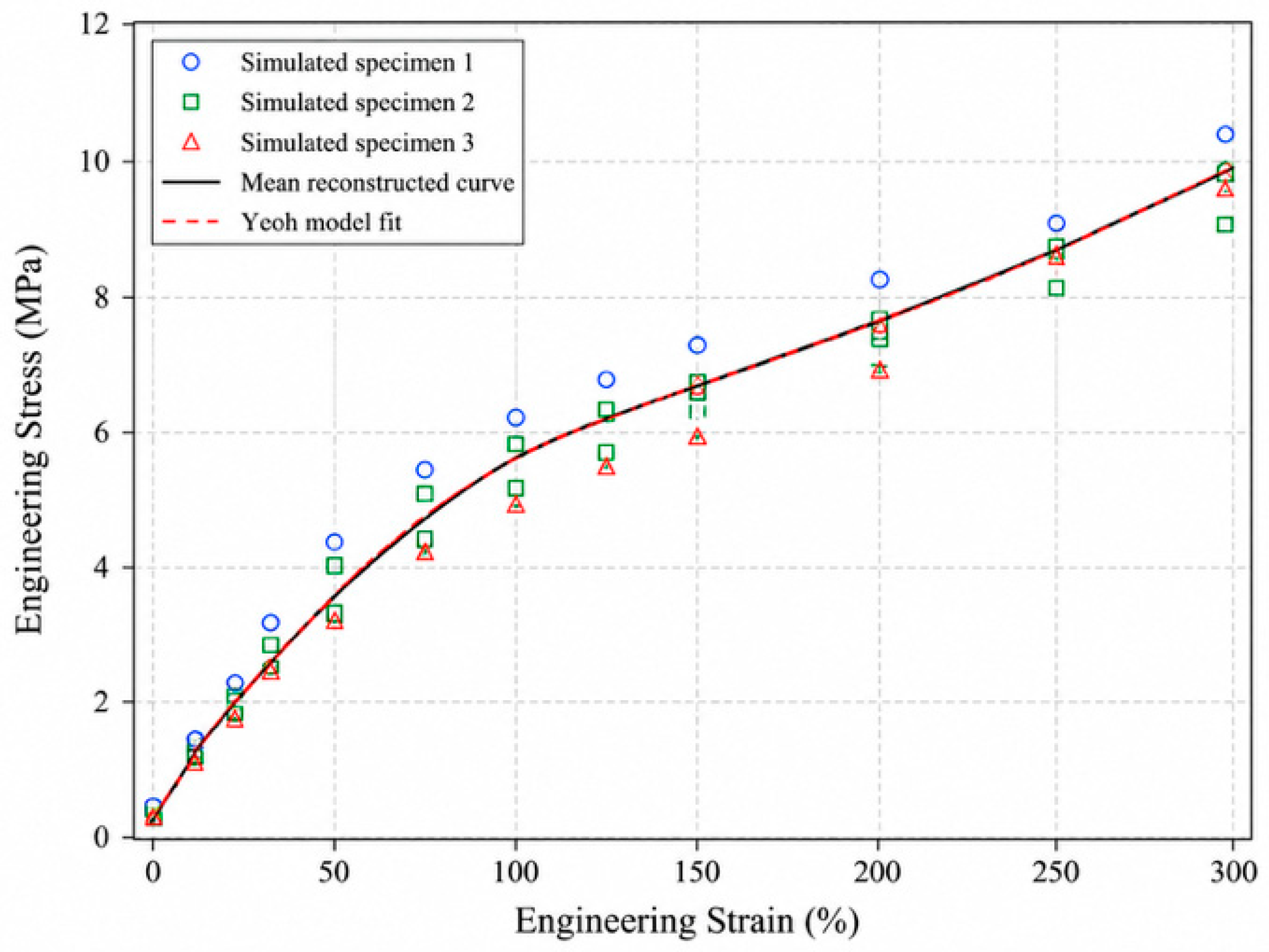
Figure 5.
Engineering stress–strain curve of 3D-printed TPU specimens (mean ± SD) and fitted Yeoh model (0–300% strain).
Figure 5.
Engineering stress–strain curve of 3D-printed TPU specimens (mean ± SD) and fitted Yeoh model (0–300% strain).
Figure 6.
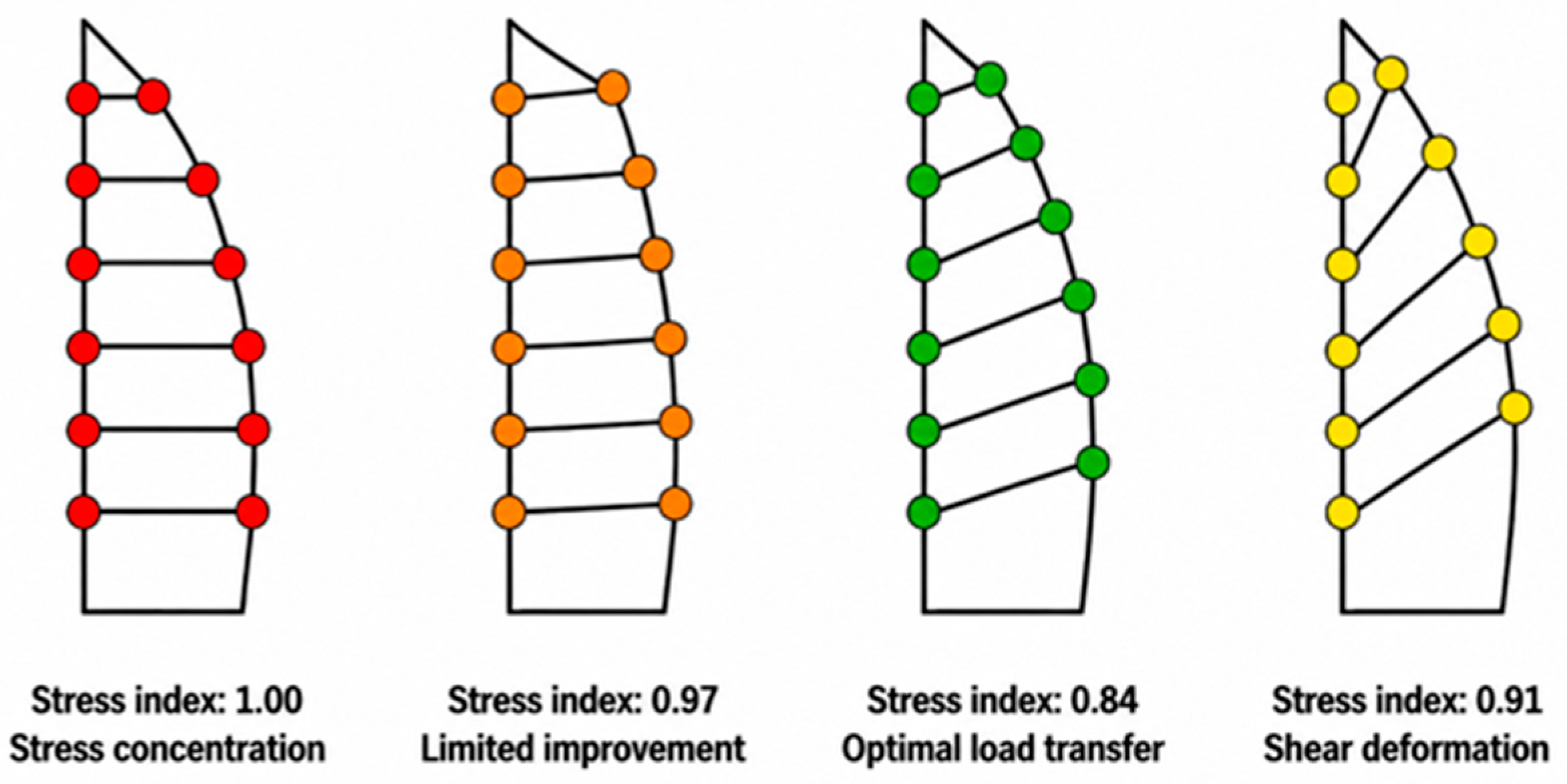
Comparison of stress distribution mechanisms for different rib inclination angles (θ). The colored dots indicate representative rib nodes used to illustrate stress-concentration regions and load-transfer paths under different rib inclination angles.
Figure 6.
Comparison of stress distribution mechanisms for different rib inclination angles (θ). The colored dots indicate representative rib nodes used to illustrate stress-concentration regions and load-transfer paths under different rib inclination angles.
Figure 7.
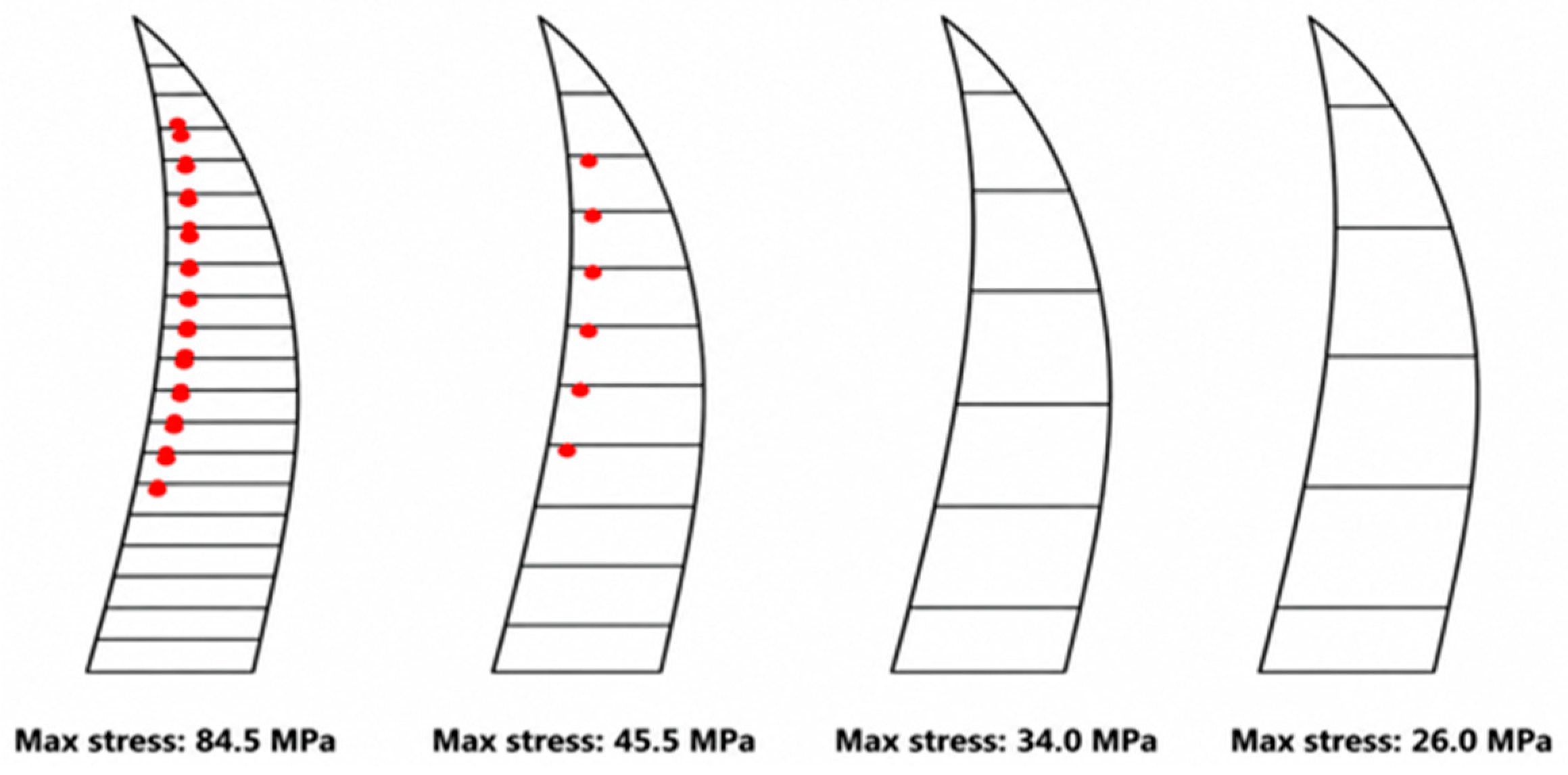
Internal structural interference analysis for different rib spacings (d). The red dots indicate representative regions where adjacent ribs tend to contact or interfere during large-curvature bending.
Figure 7.
Internal structural interference analysis for different rib spacings (d). The red dots indicate representative regions where adjacent ribs tend to contact or interfere during large-curvature bending.
Figure 8.
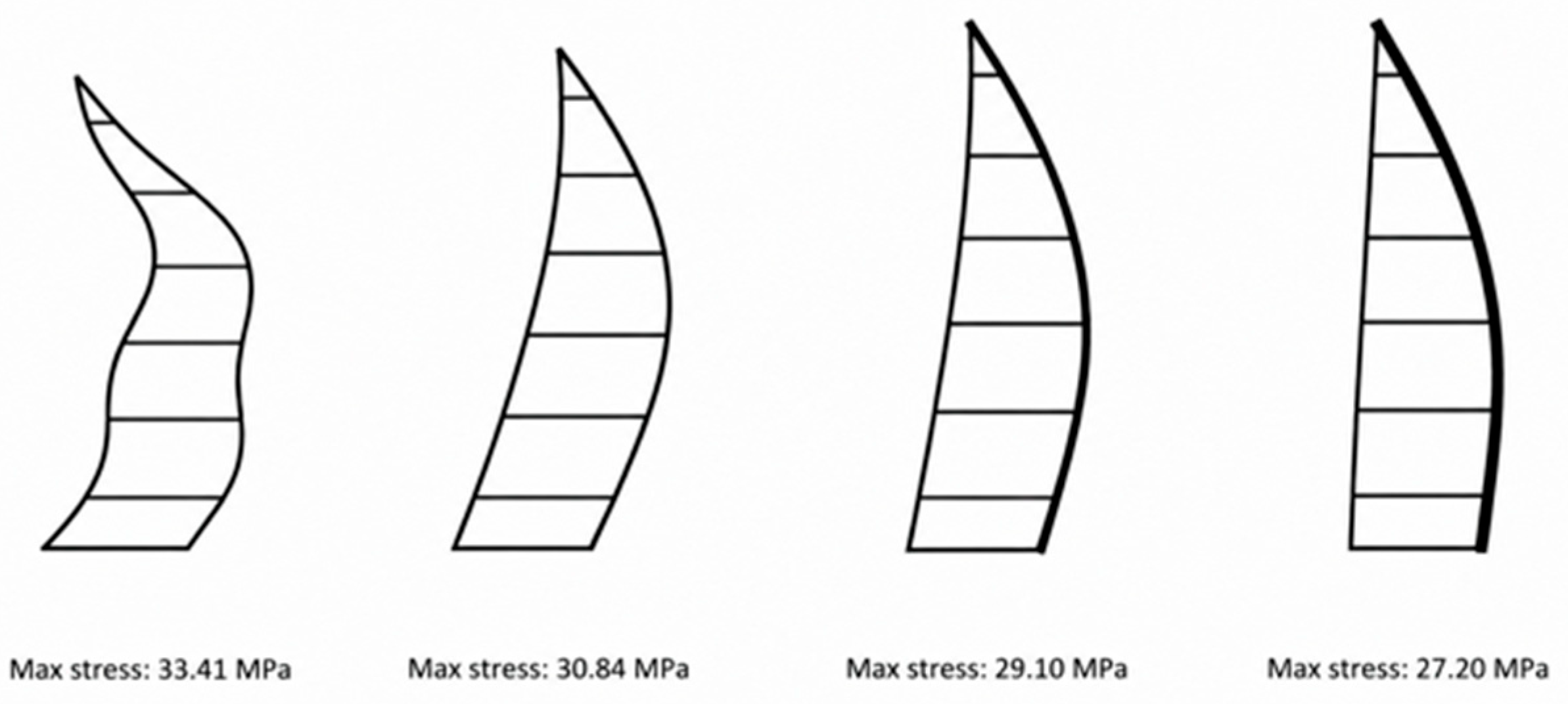
Effect of outer wall thickness (t) on stiffness and deformation mode.
Figure 8.
Effect of outer wall thickness (t) on stiffness and deformation mode.
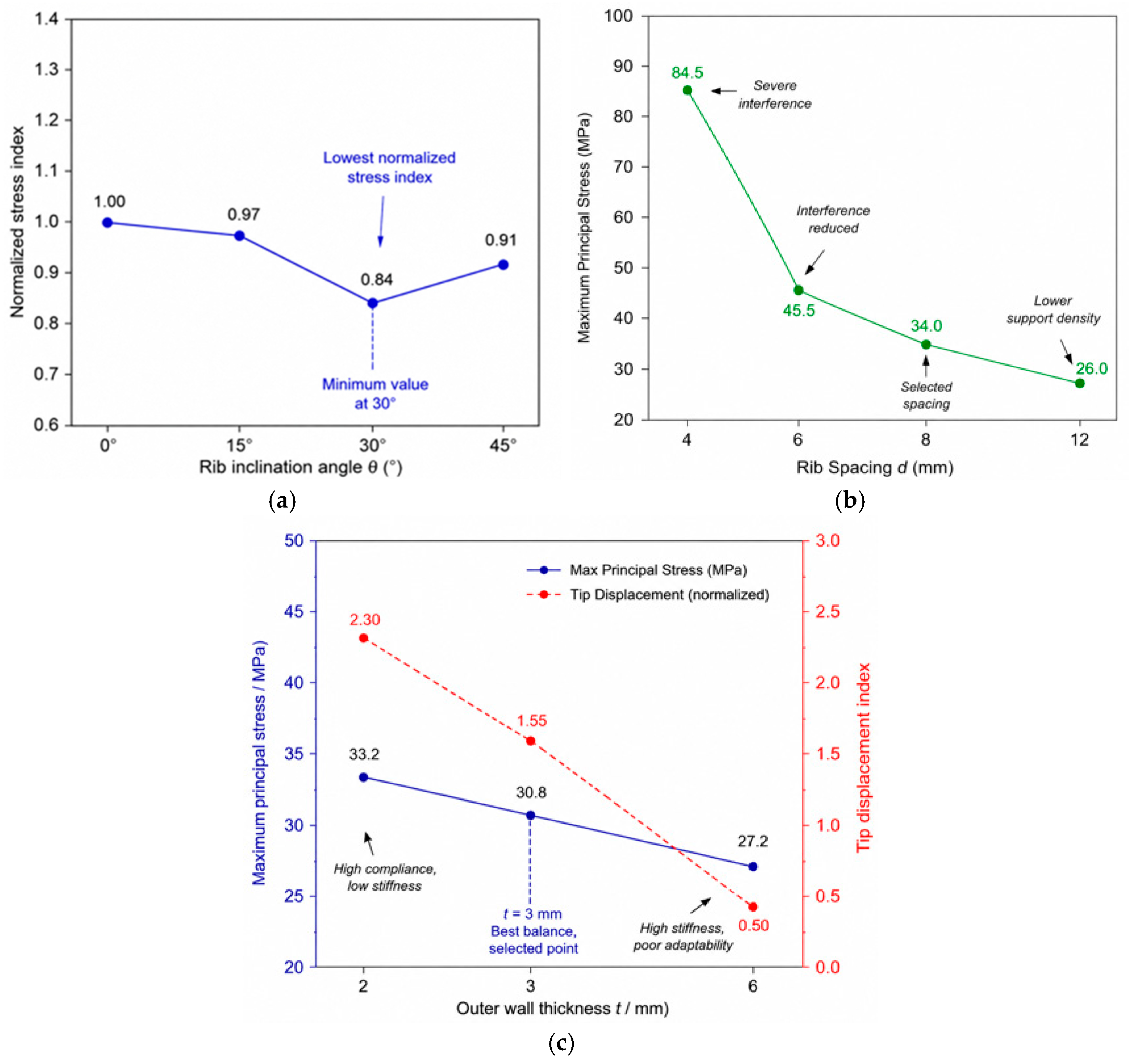
Figure 9.
Quantitative analysis of single-factor structural parameter trends: (a) normalized stress index under different rib inclination angles; (b) influence of rib spacing; (c) influence of outer wall thickness.
Figure 9.
Quantitative analysis of single-factor structural parameter trends: (a) normalized stress index under different rib inclination angles; (b) influence of rib spacing; (c) influence of outer wall thickness.
Figure 10.
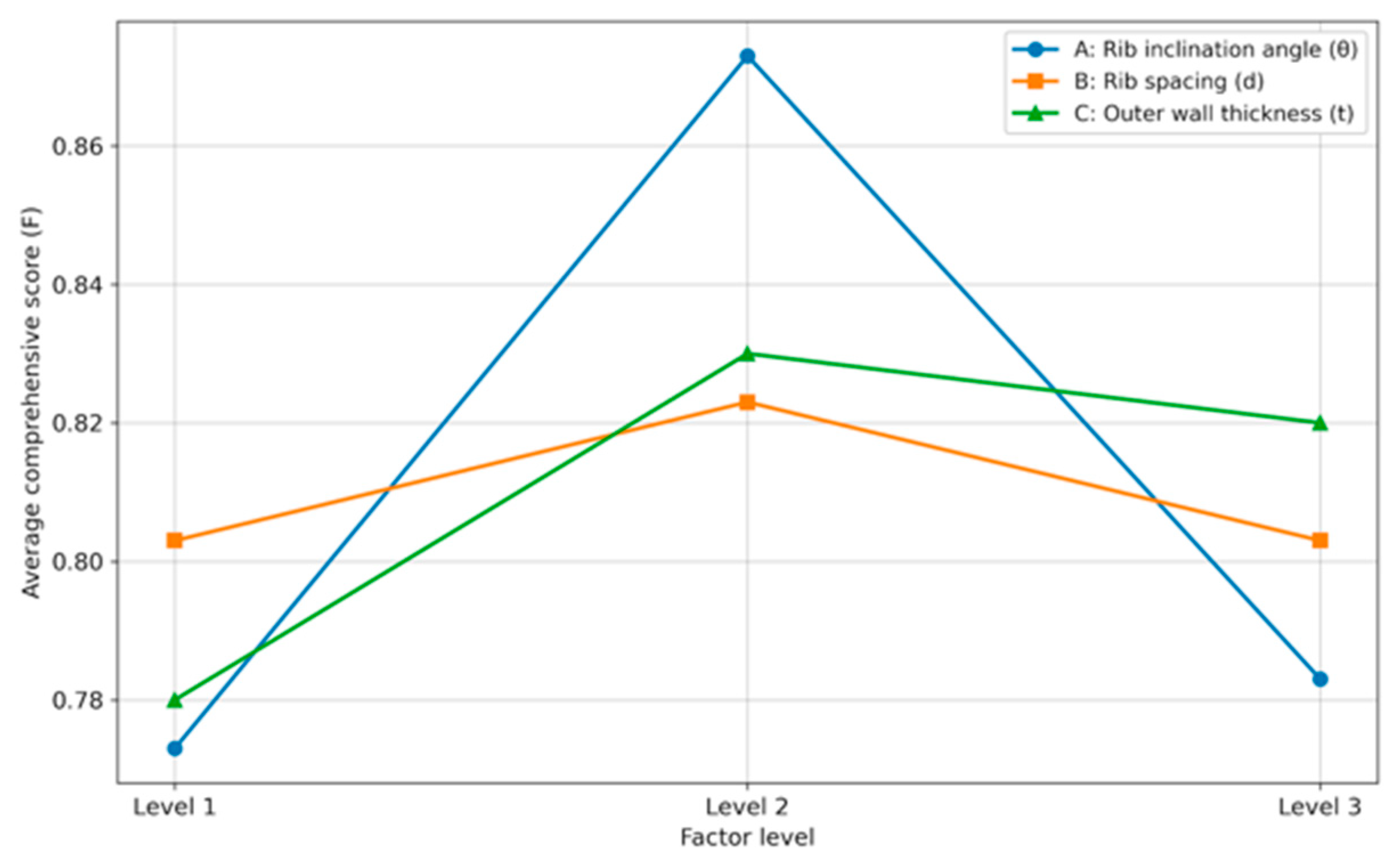
Main-effect plots of the orthogonal analysis for the comprehensive performance score.
Figure 10.
Main-effect plots of the orthogonal analysis for the comprehensive performance score.
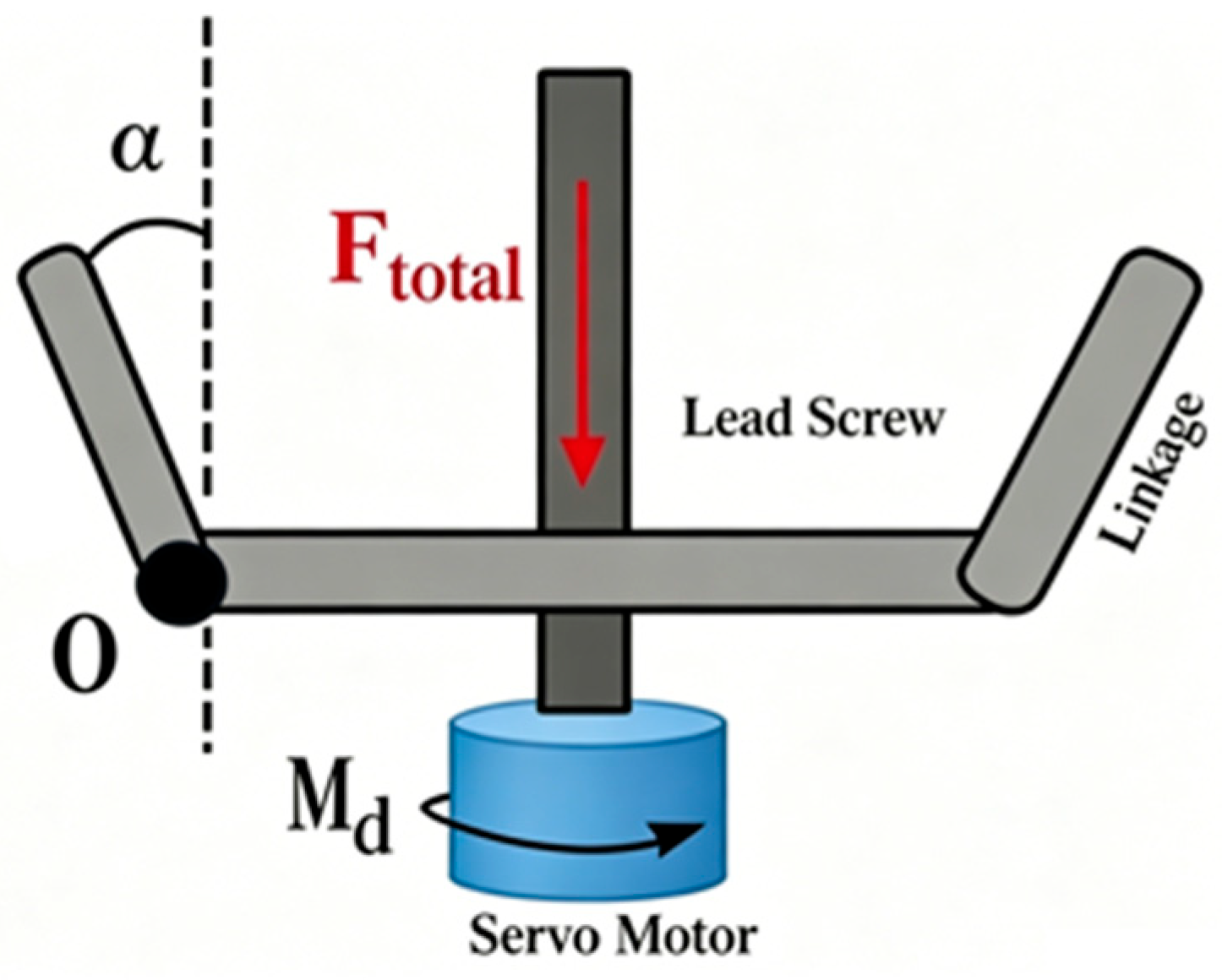
Figure 11.
Schematic diagram of the lead-screw-dual-crossbeam driving mechanism.
Figure 11.
Schematic diagram of the lead-screw-dual-crossbeam driving mechanism.
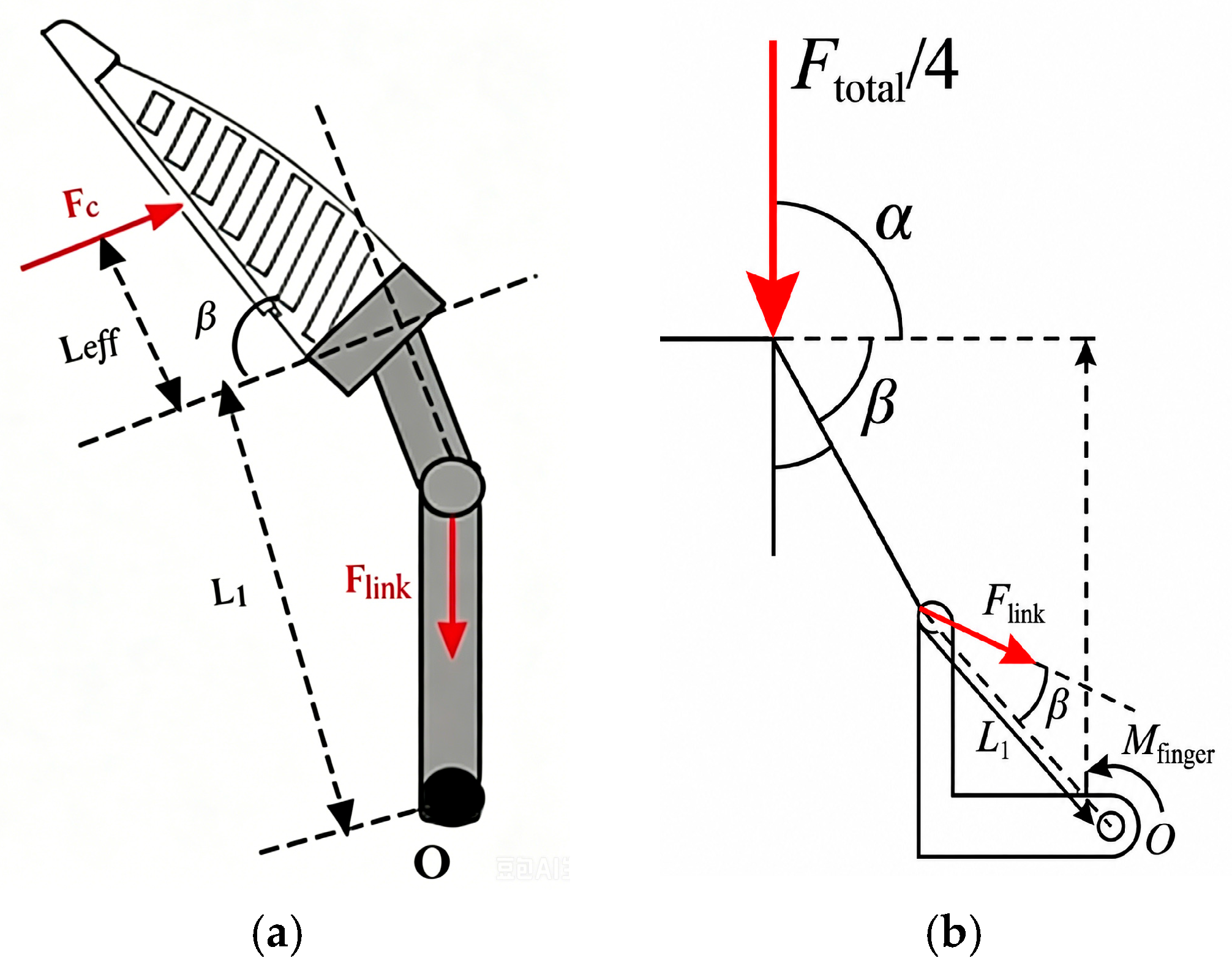
Figure 12.
Force analysis model of the rigid transmission mechanism: (a) geometric schematic of the link drive; (b) free-body force analysis of the single-finger transmission chain.
Figure 12.
Force analysis model of the rigid transmission mechanism: (a) geometric schematic of the link drive; (b) free-body force analysis of the single-finger transmission chain.
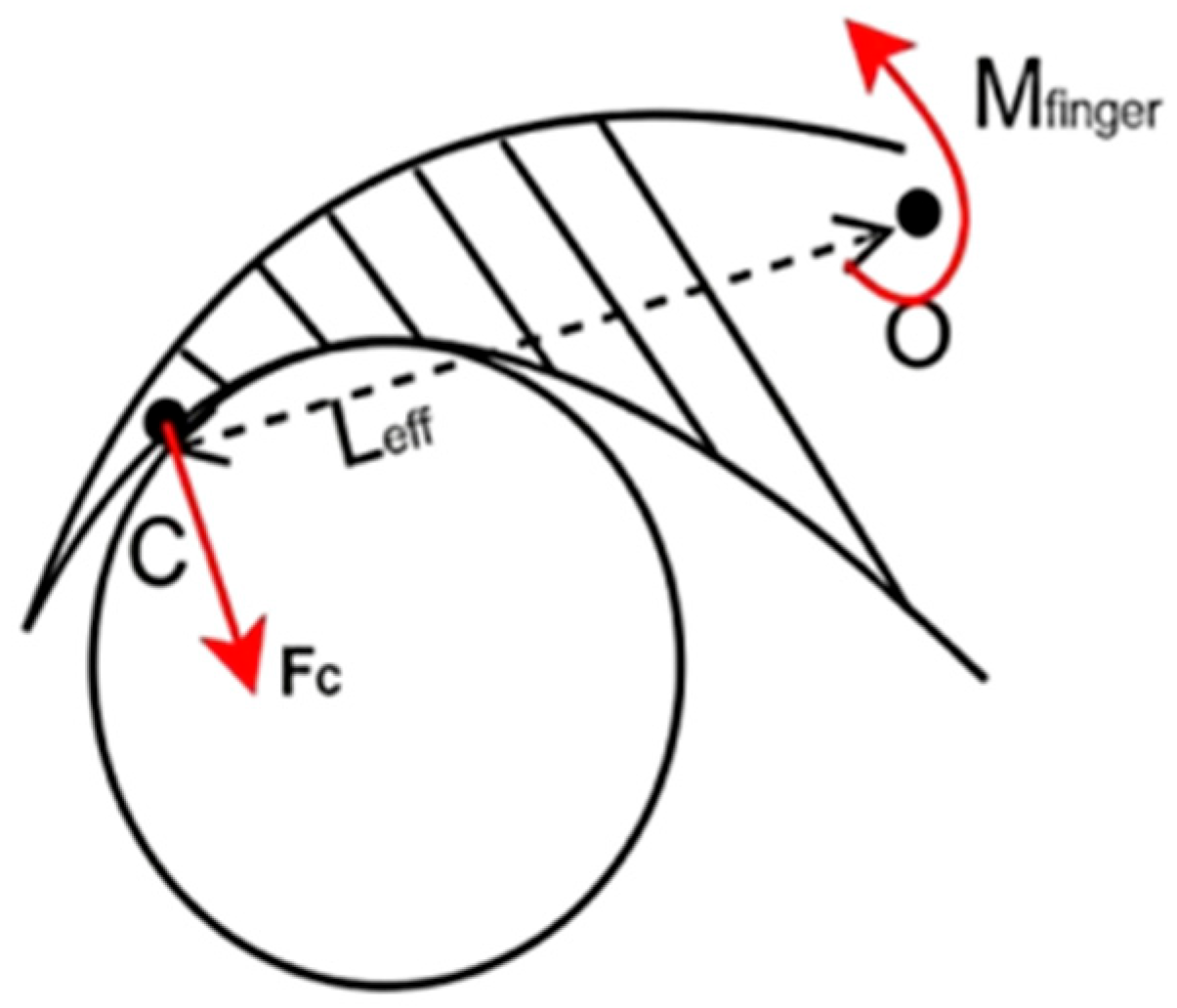
Figure 13.
Rigid–flexible coupled model of the soft finger. The arrows indicate the contact force , the equivalent elastic restoring moment , and the effective moment arm used in the pseudo-rigid-body analysis.
Figure 13.
Rigid–flexible coupled model of the soft finger. The arrows indicate the contact force , the equivalent elastic restoring moment , and the effective moment arm used in the pseudo-rigid-body analysis.
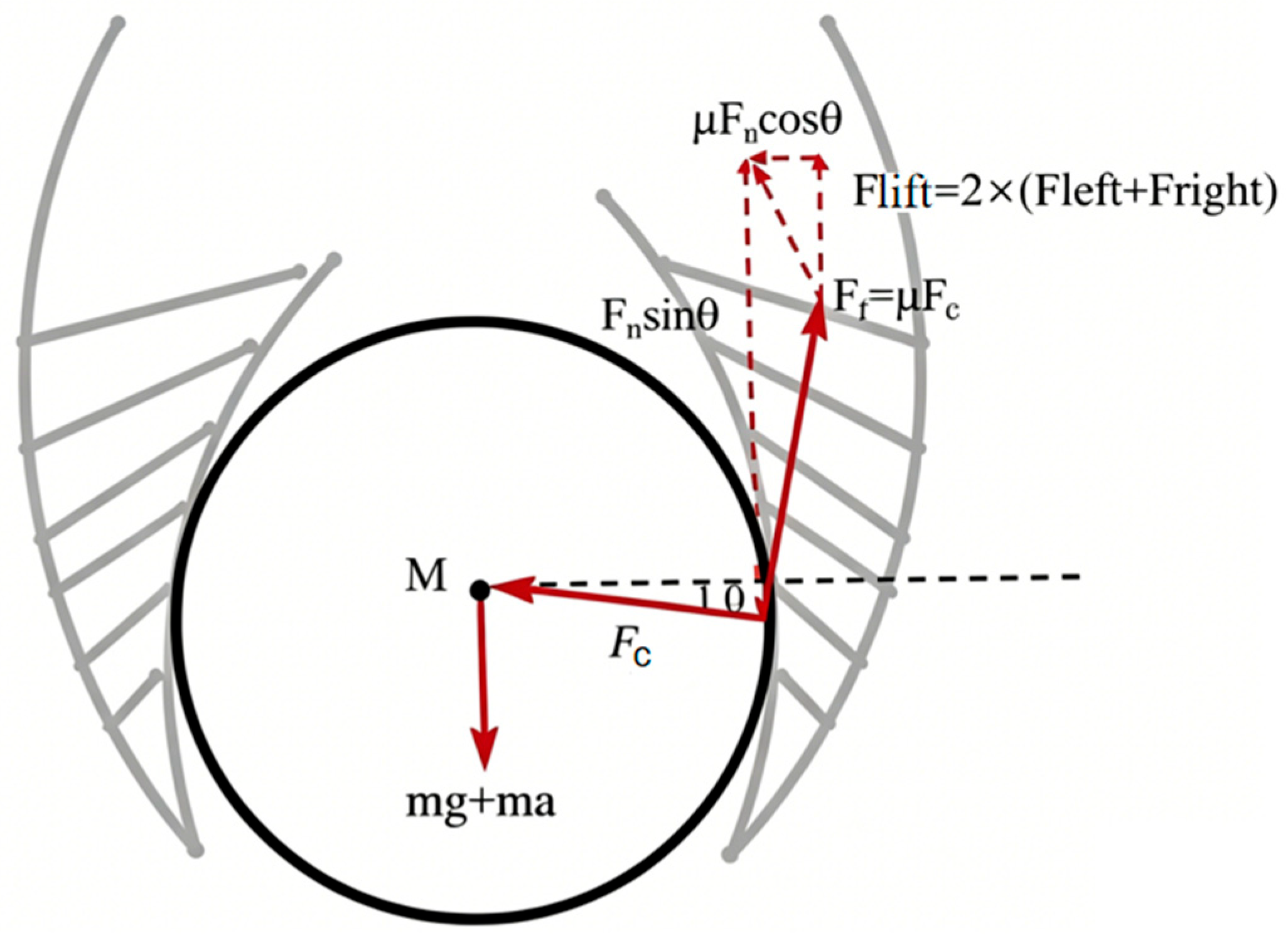
Figure 14.
Stability analysis. The red arrow Fc represents the normal clamping force from a finger, the curved arrow M indicates the bending moment, and dashed lines denote the effective moment arms.
Figure 14.
Stability analysis. The red arrow Fc represents the normal clamping force from a finger, the curved arrow M indicates the bending moment, and dashed lines denote the effective moment arms.
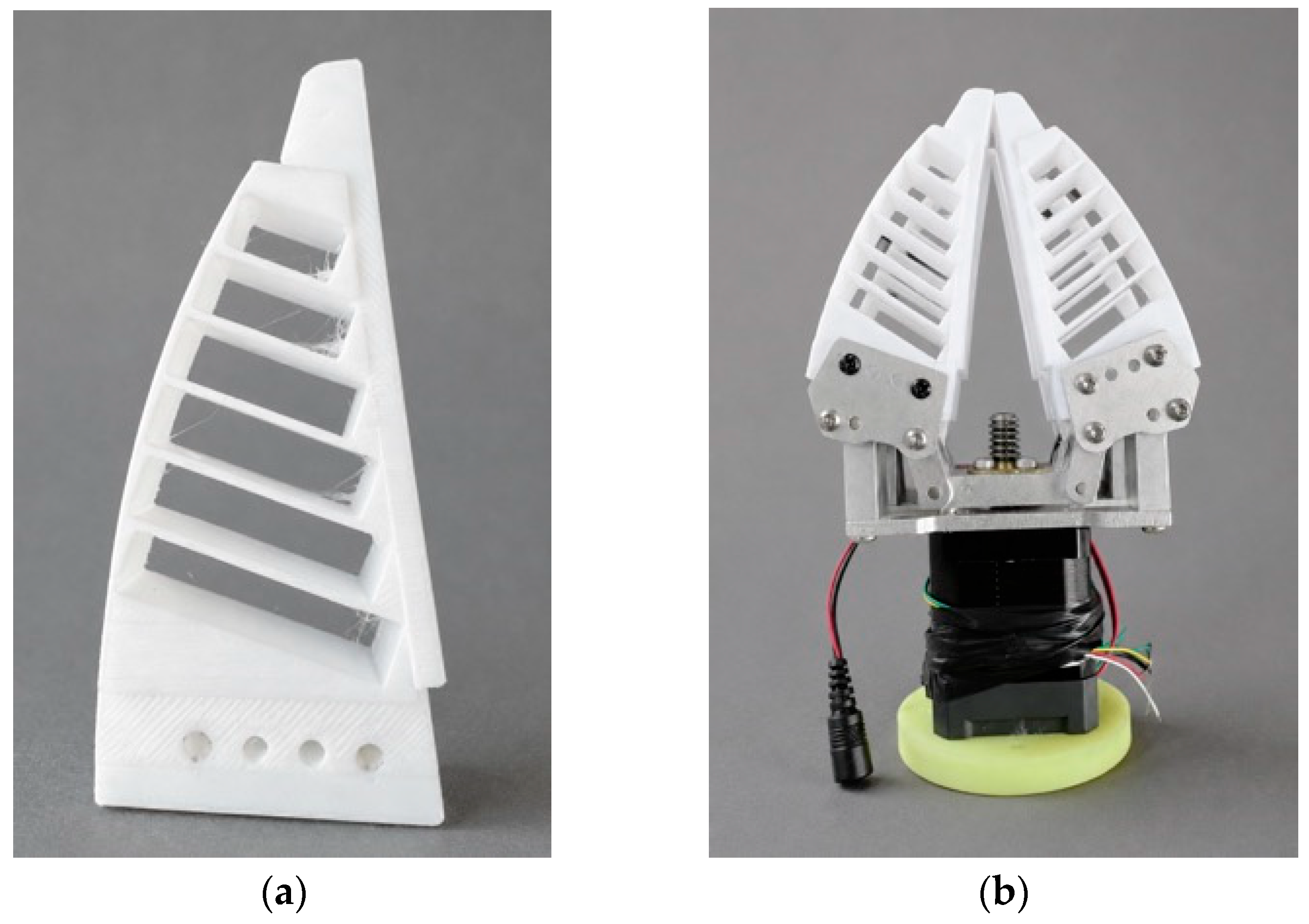
Figure 15.
Soft gripper prototype and integrated assembly: (a) a single 3D-printed soft finger; (b) overall assembly of the soft gripper system.
Figure 15.
Soft gripper prototype and integrated assembly: (a) a single 3D-printed soft finger; (b) overall assembly of the soft gripper system.
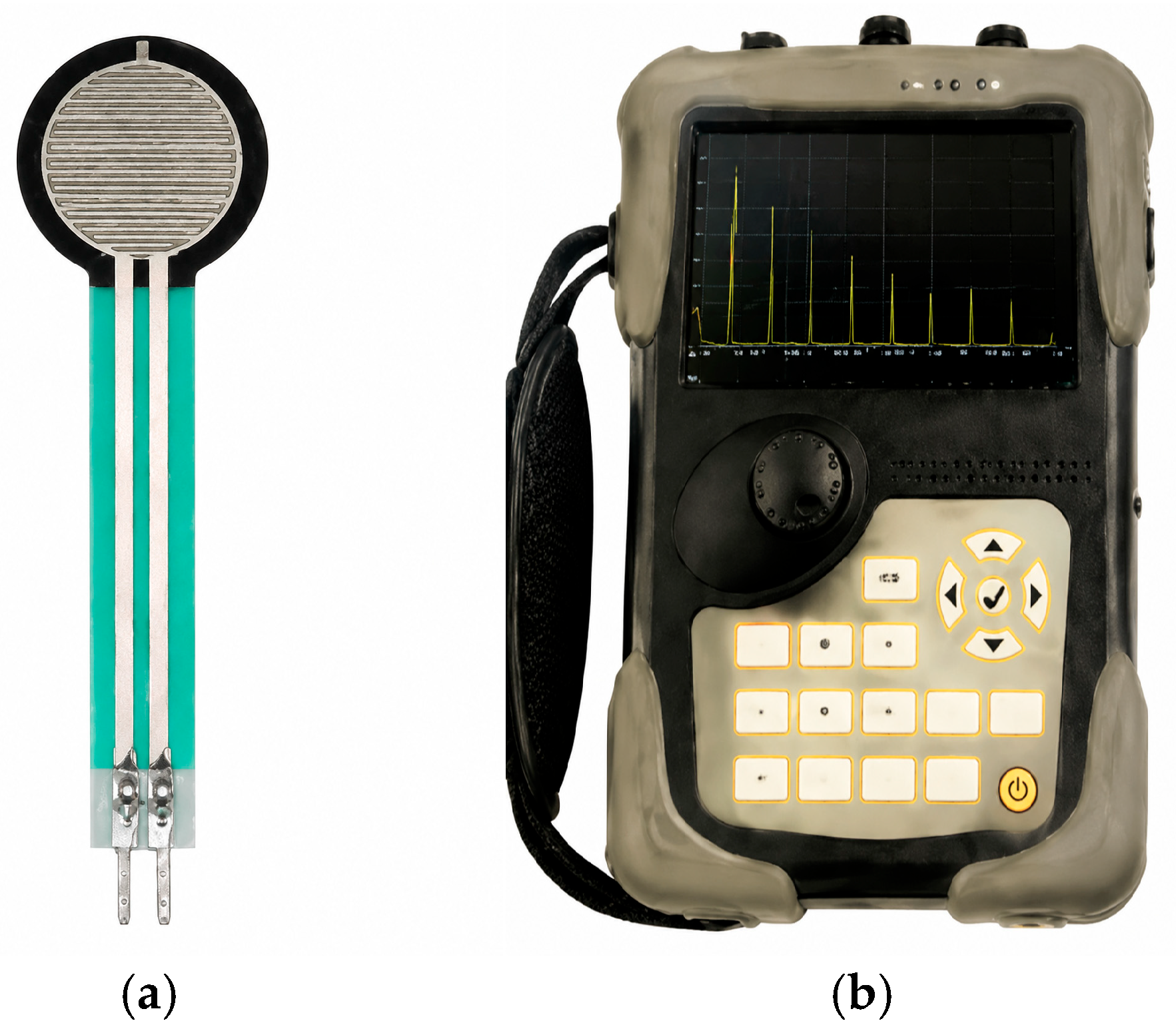
Figure 16.
Hardware components for fingertip contact force measurement: (a) thin-film force sensor; (b) dynamic signal analyzer.
Figure 16.
Hardware components for fingertip contact force measurement: (a) thin-film force sensor; (b) dynamic signal analyzer.
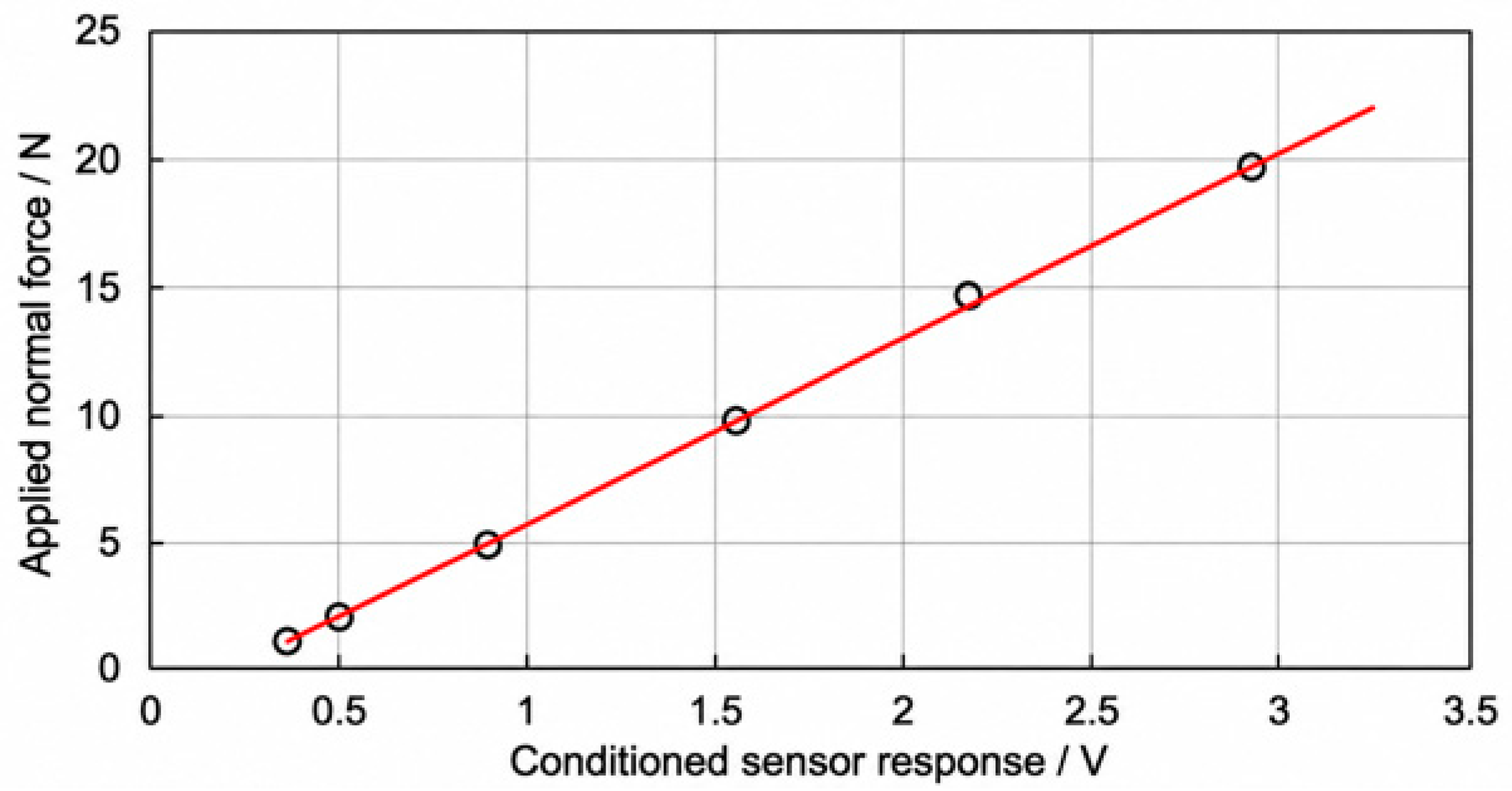
Figure 17.
Calibration curve of the thin-film force sensor.
Figure 17.
Calibration curve of the thin-film force sensor.
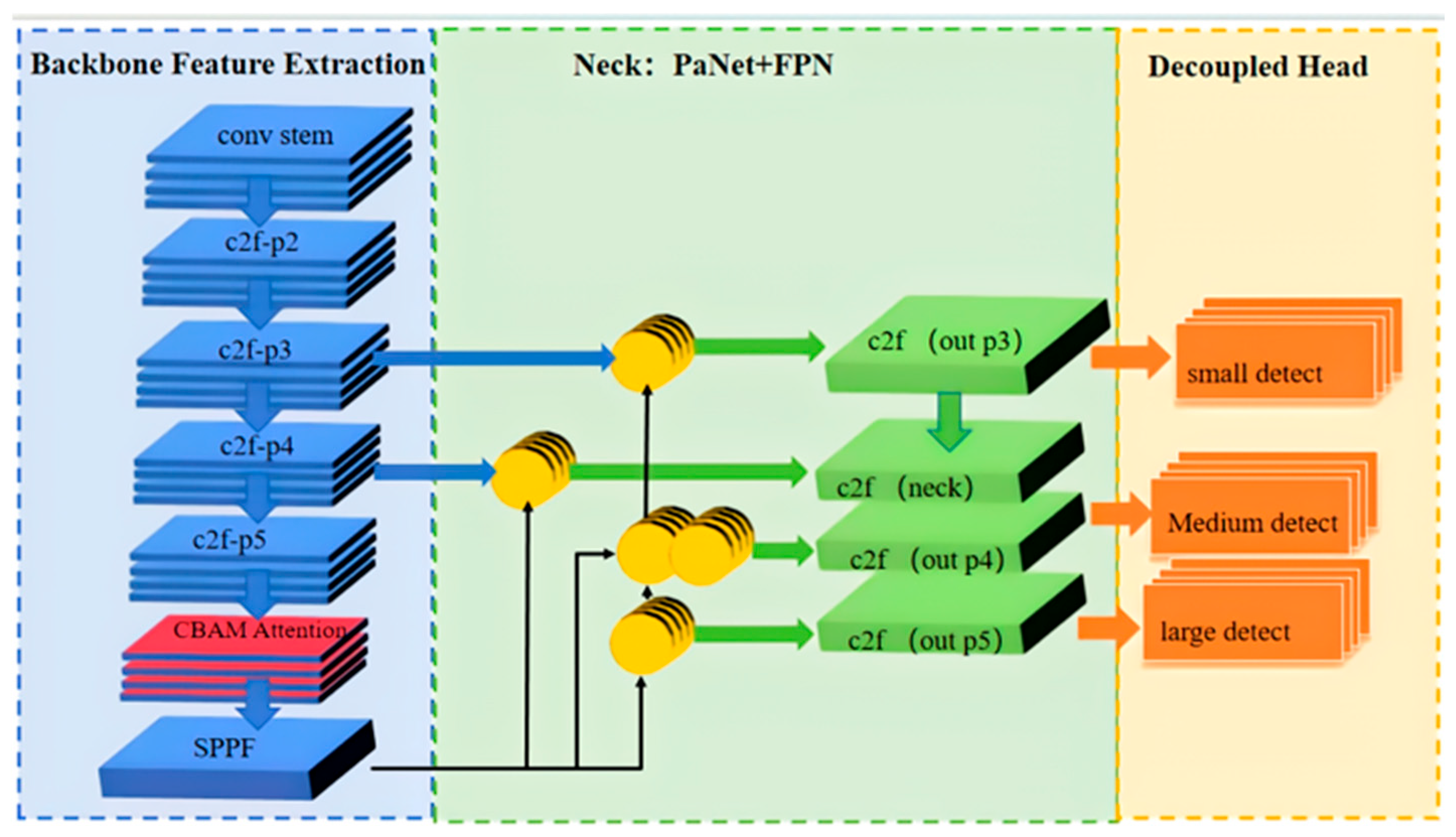
Figure 18.
Overall architecture of RA-YOLO.
Figure 18.
Overall architecture of RA-YOLO.
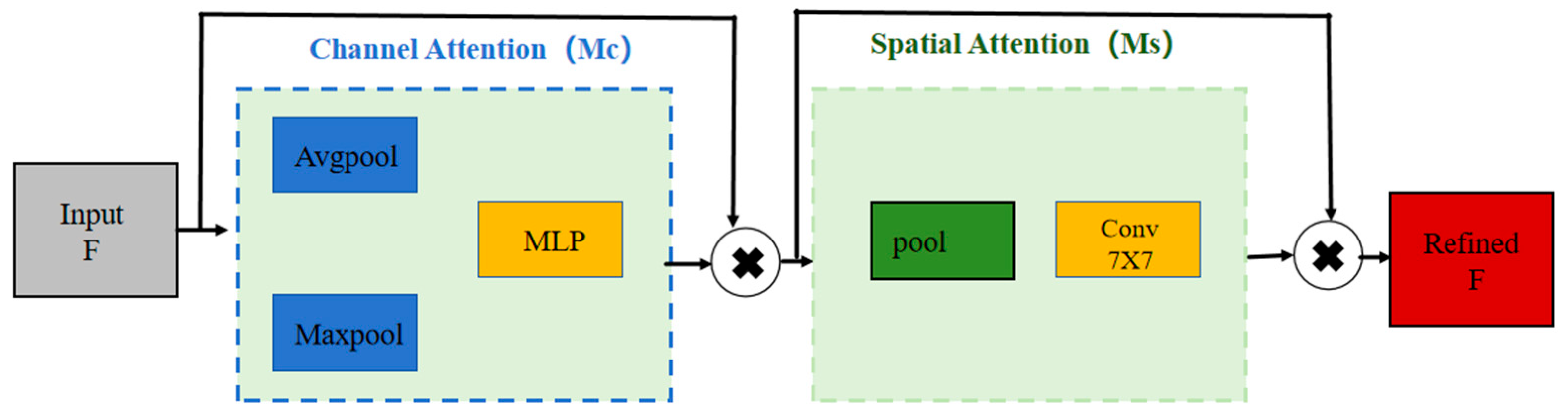
Figure 19.
Internal mechanism of the CBAM module.
Figure 19.
Internal mechanism of the CBAM module.
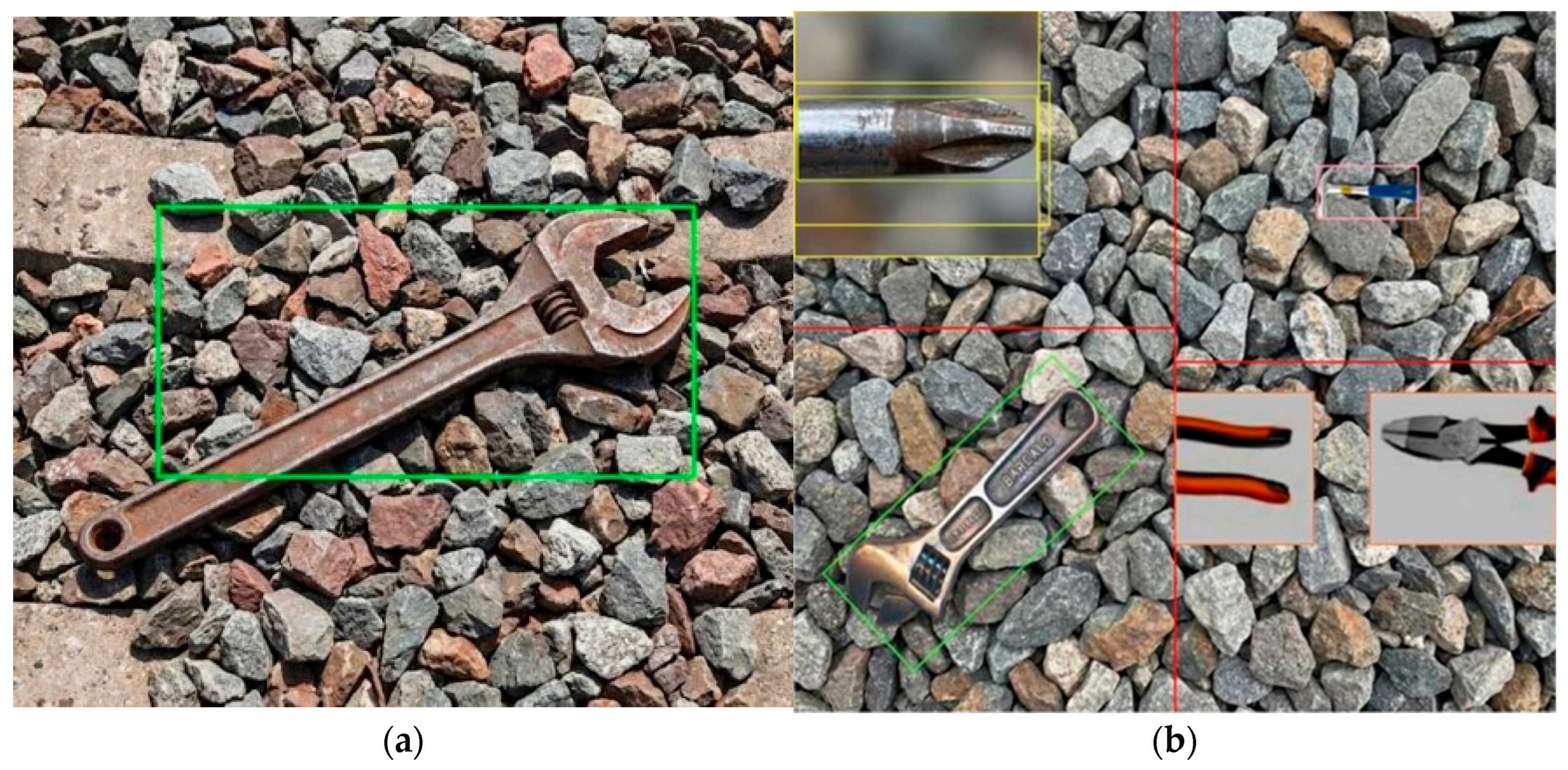
Figure 20.
Examples of augmented training samples: (a) original single sample; (b) training sample after Mosaic stitching augmentation. Colored boxes denote annotated tool targets.
Figure 20.
Examples of augmented training samples: (a) original single sample; (b) training sample after Mosaic stitching augmentation. Colored boxes denote annotated tool targets.
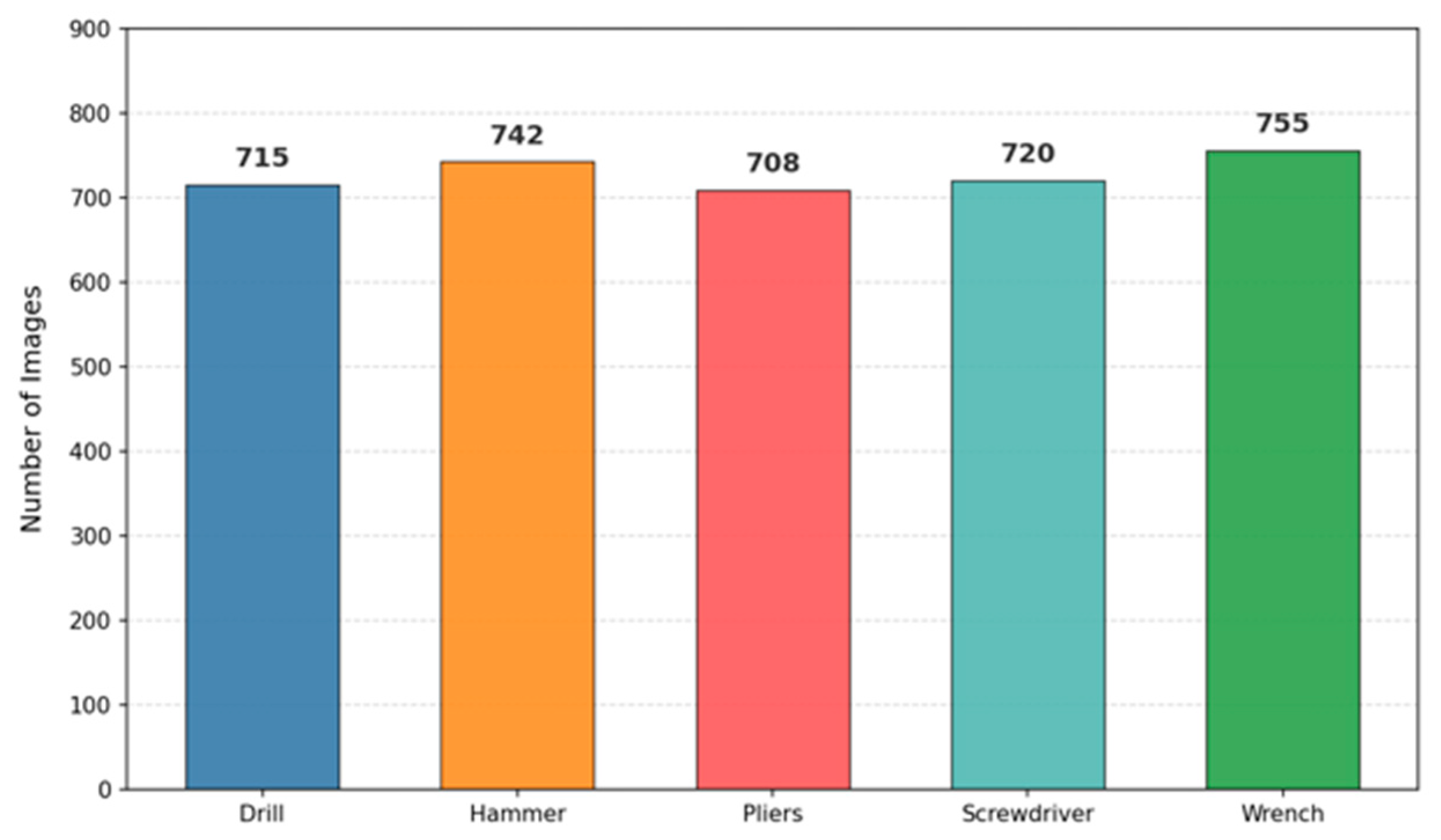
Figure 21.
Sample count distribution of each category in the self-built railway tool dataset.
Figure 21.
Sample count distribution of each category in the self-built railway tool dataset.
Figure 22.
Overall collaborative control architecture of the system. Arrows denote the flow of control commands, sensor data, and feedback signals between the visual recognition, soft gripper, and robotic arm modules.
Figure 22.
Overall collaborative control architecture of the system. Arrows denote the flow of control commands, sensor data, and feedback signals between the visual recognition, soft gripper, and robotic arm modules.
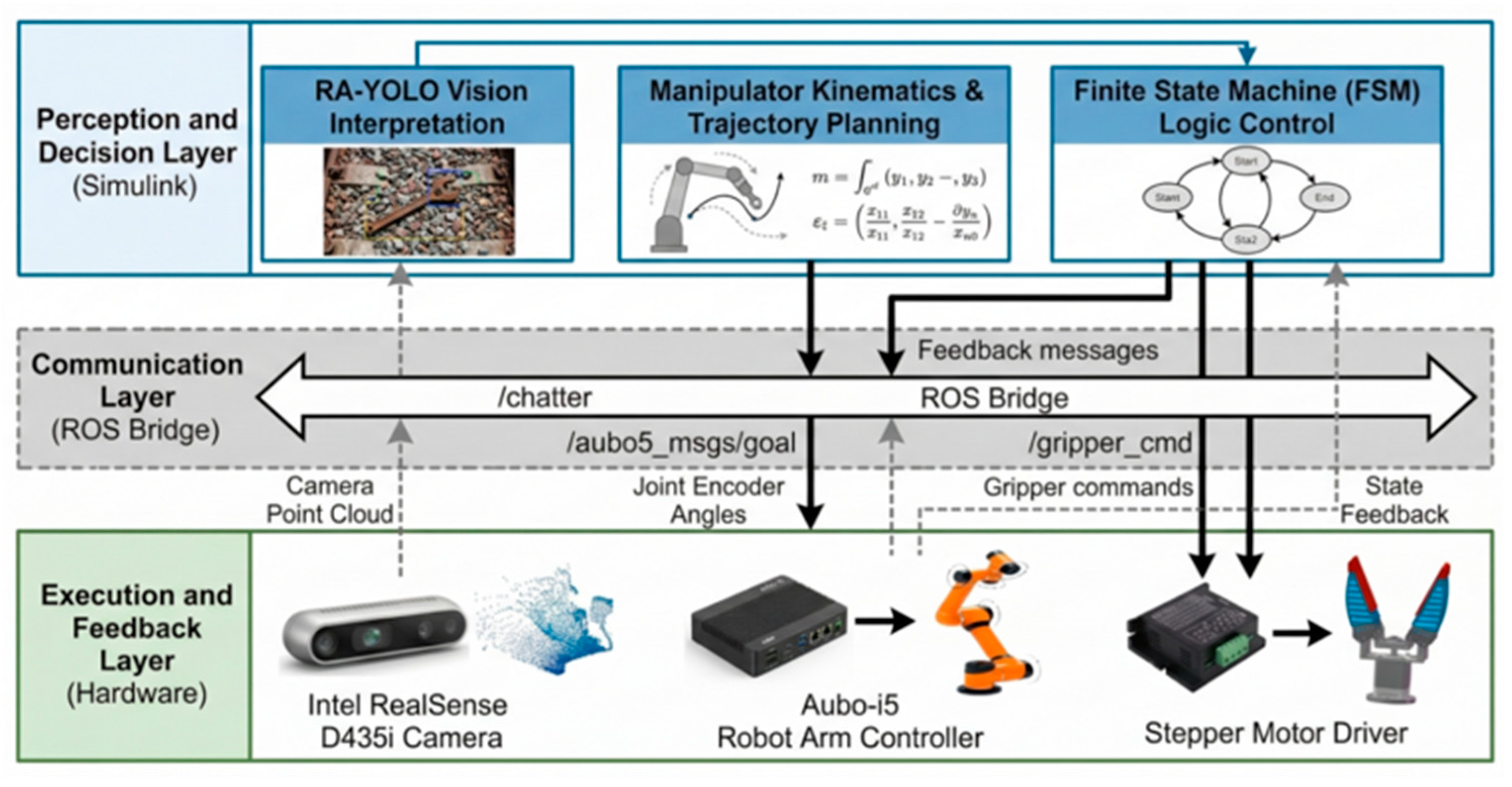
Figure 23.
Low-level hardware architecture and communication topology of the robotic collaborative control system. Arrows indicate communication and feedback links among modules.
Figure 23.
Low-level hardware architecture and communication topology of the robotic collaborative control system. Arrows indicate communication and feedback links among modules.
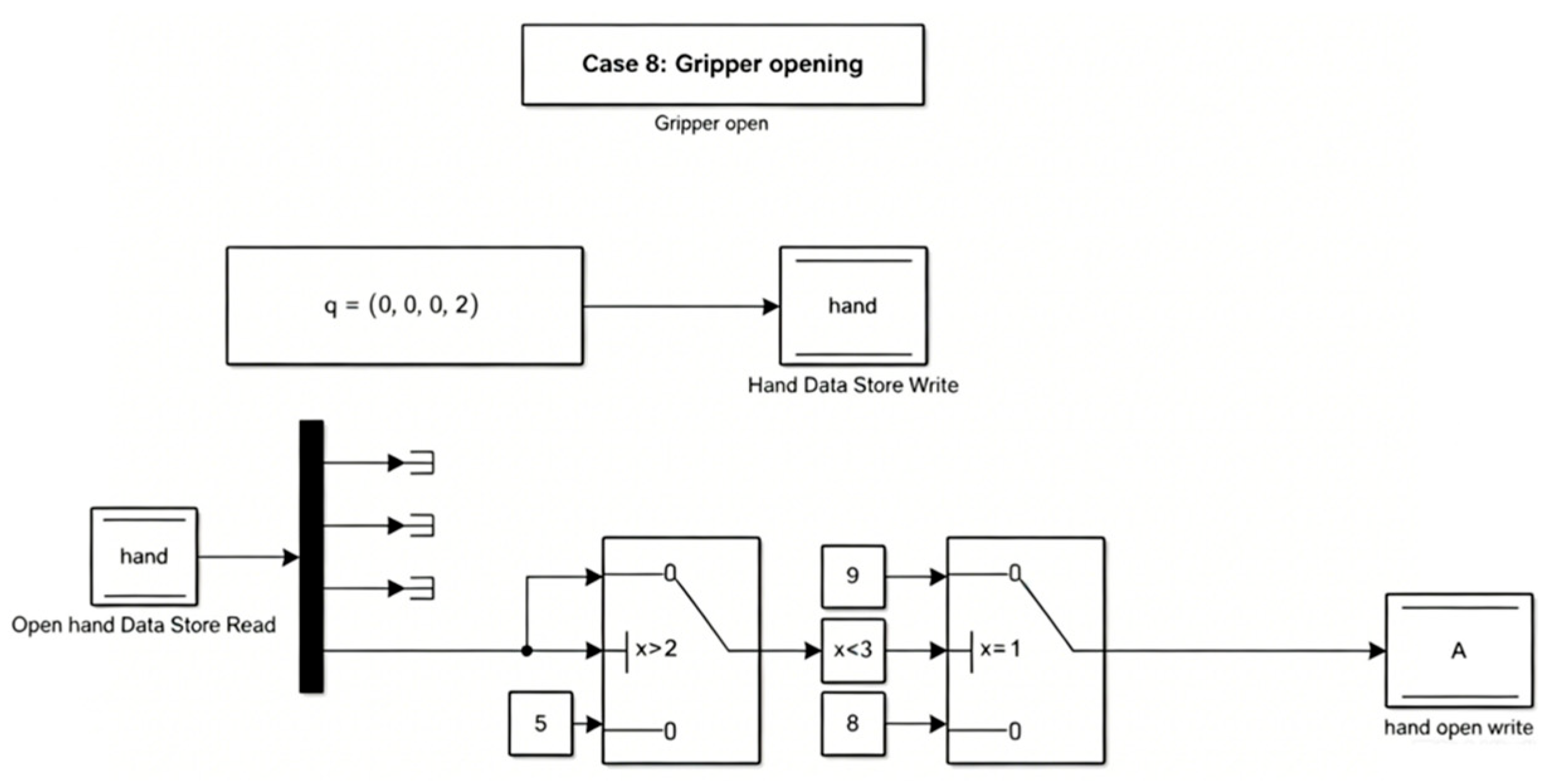
Figure 24.
Gripper state control model based on the geometry_msgs/Quaternion message format.
Figure 24.
Gripper state control model based on the geometry_msgs/Quaternion message format.
Figure 25.
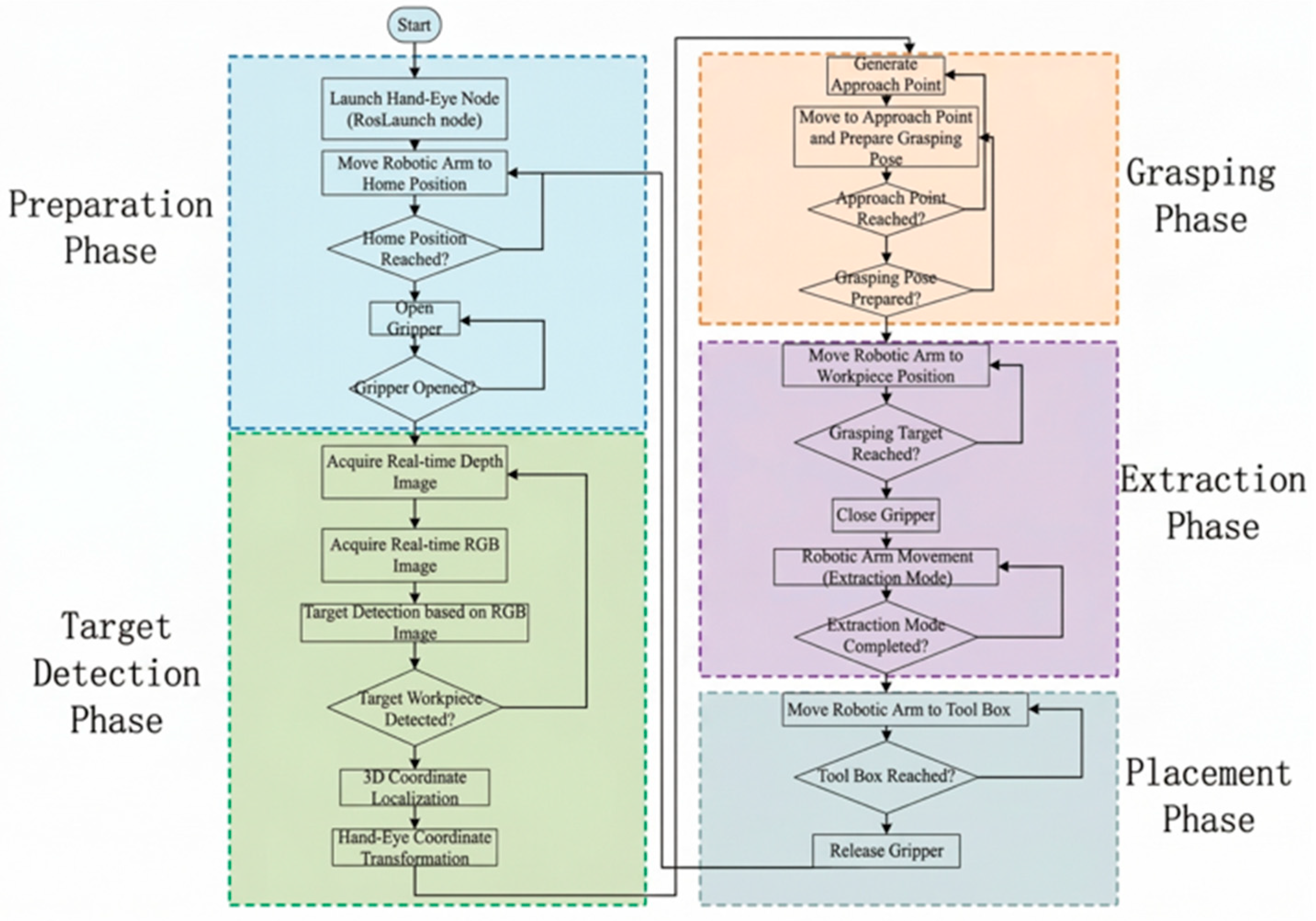
FSM-based control flowchart for maintenance tool sorting.
Figure 25.
FSM-based control flowchart for maintenance tool sorting.
Figure 26.
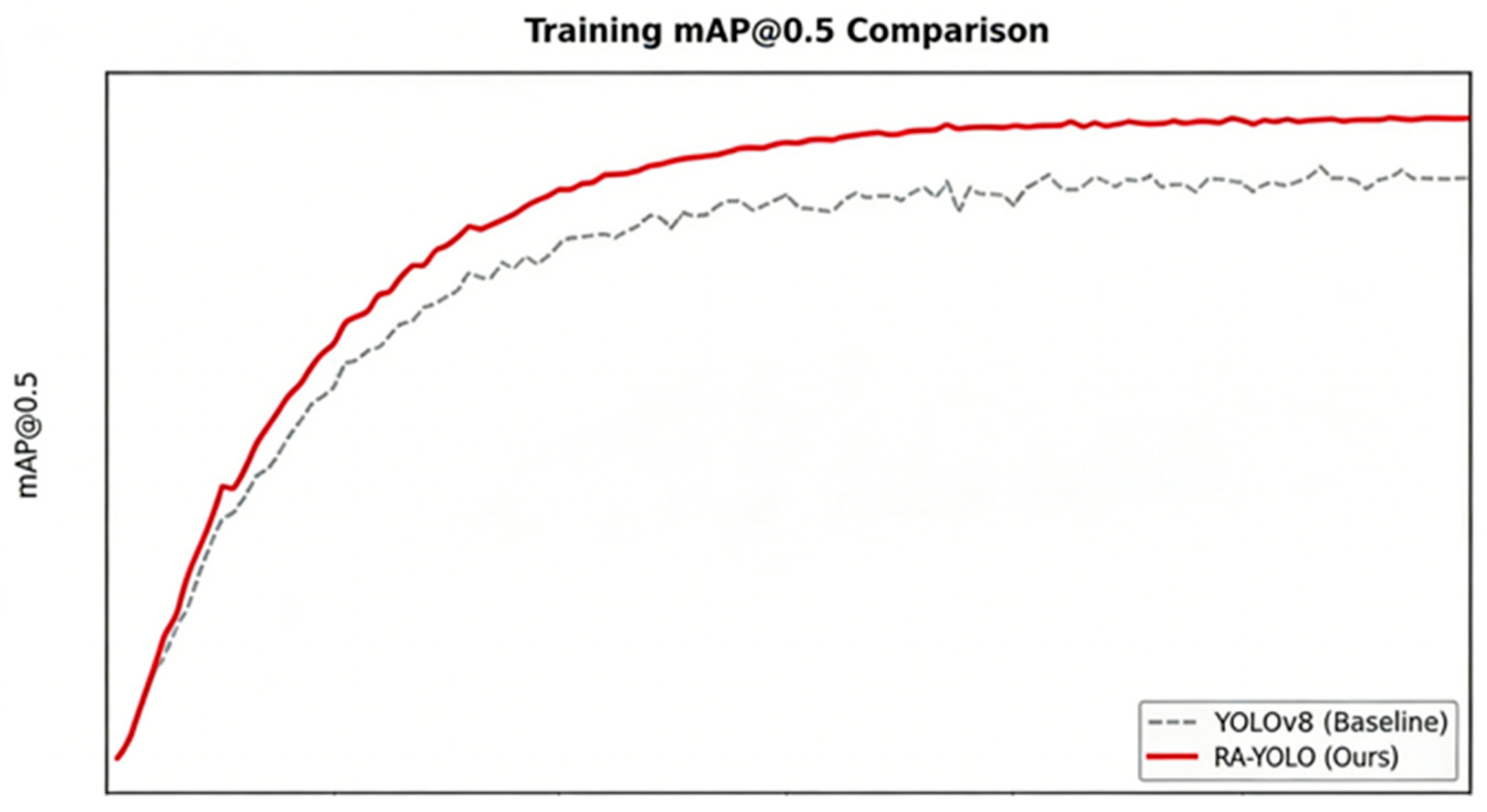
Comparison of mAP@0.5 training curves between the improved model and the baseline model.
Figure 26.
Comparison of mAP@0.5 training curves between the improved model and the baseline model.
Figure 27.
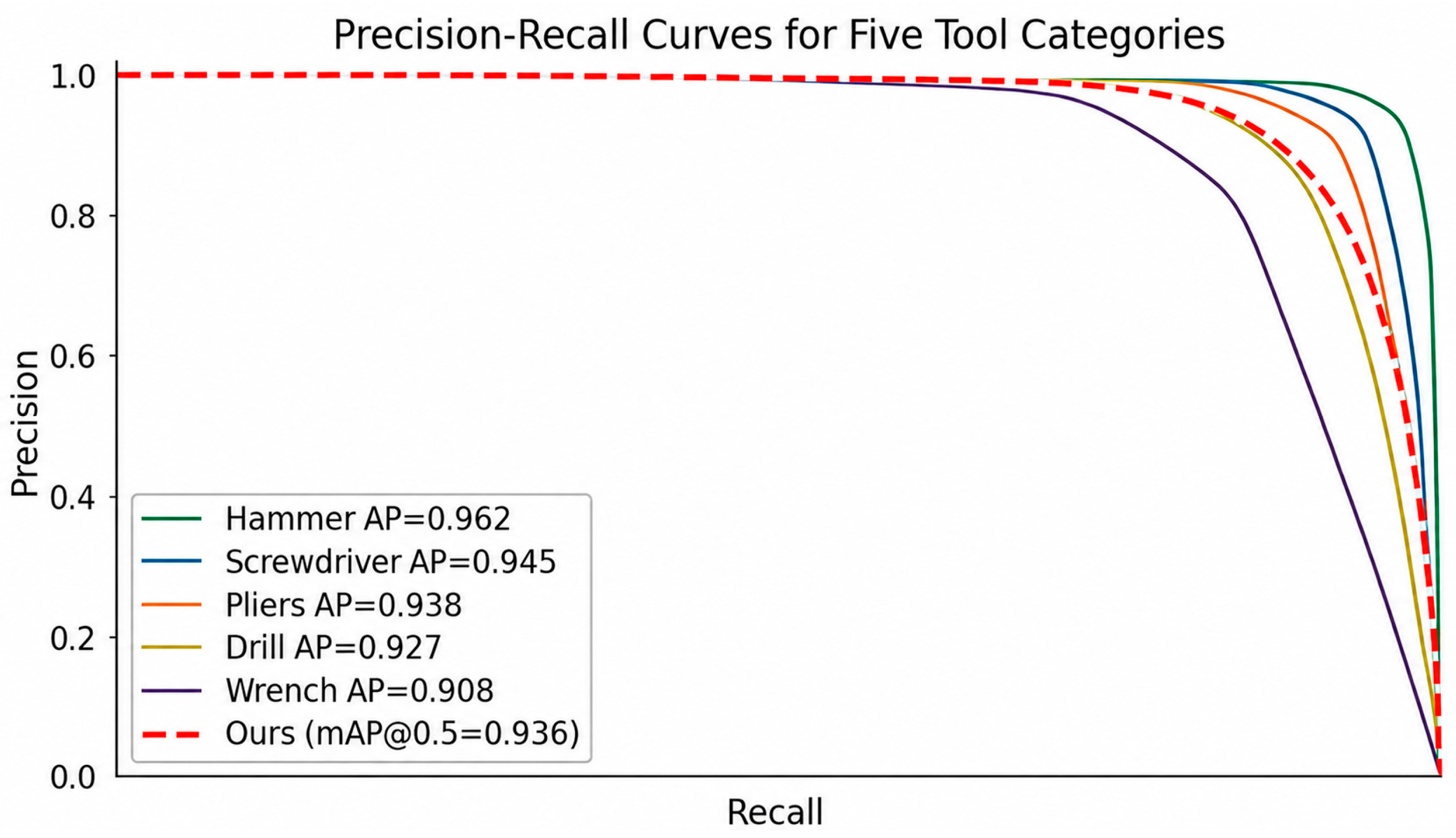
PR curves for the five tool categories.
Figure 27.
PR curves for the five tool categories.
Figure 28.
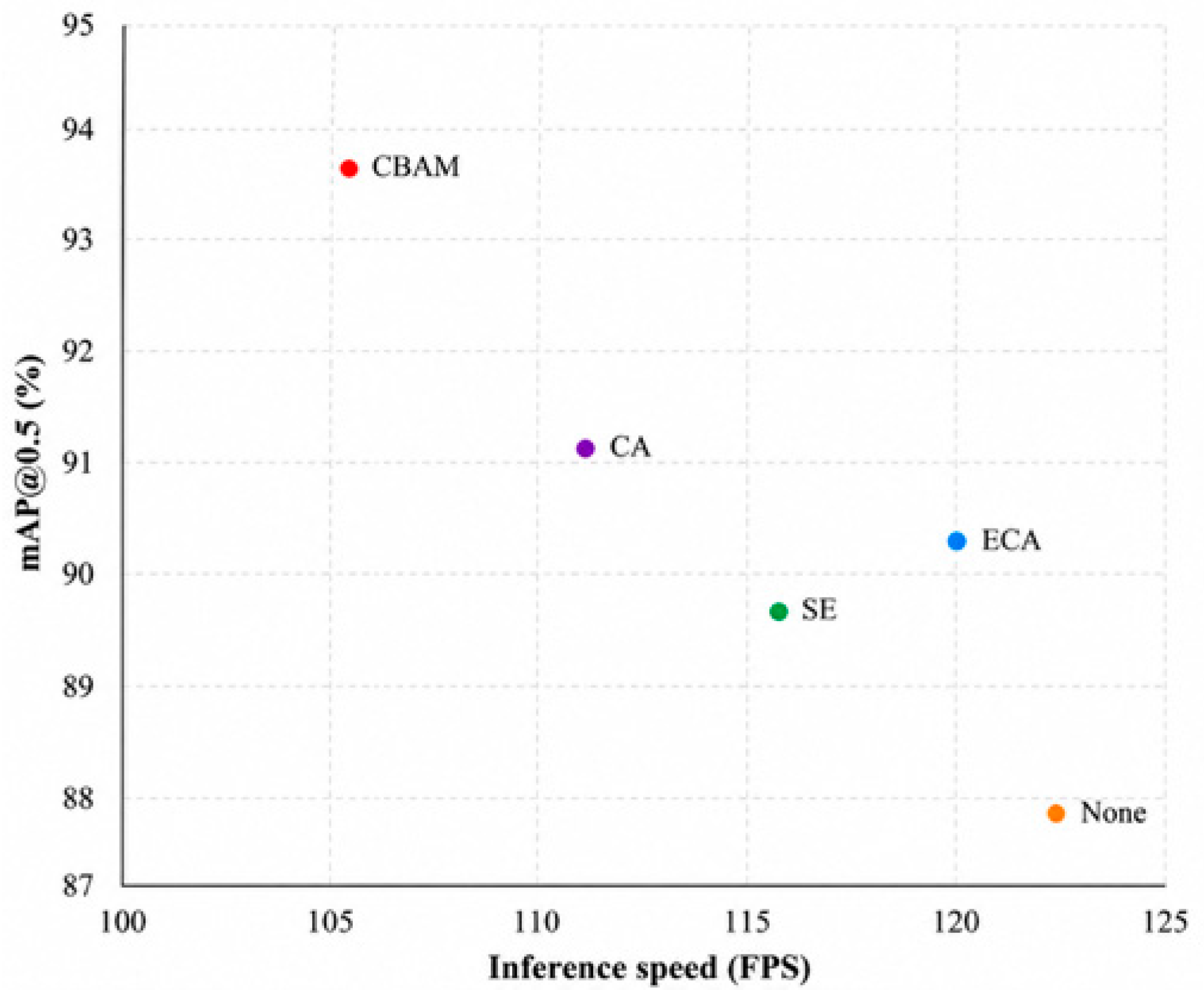
Accuracy–efficiency trade-off of different lightweight attention mechanisms.
Figure 28.
Accuracy–efficiency trade-off of different lightweight attention mechanisms.
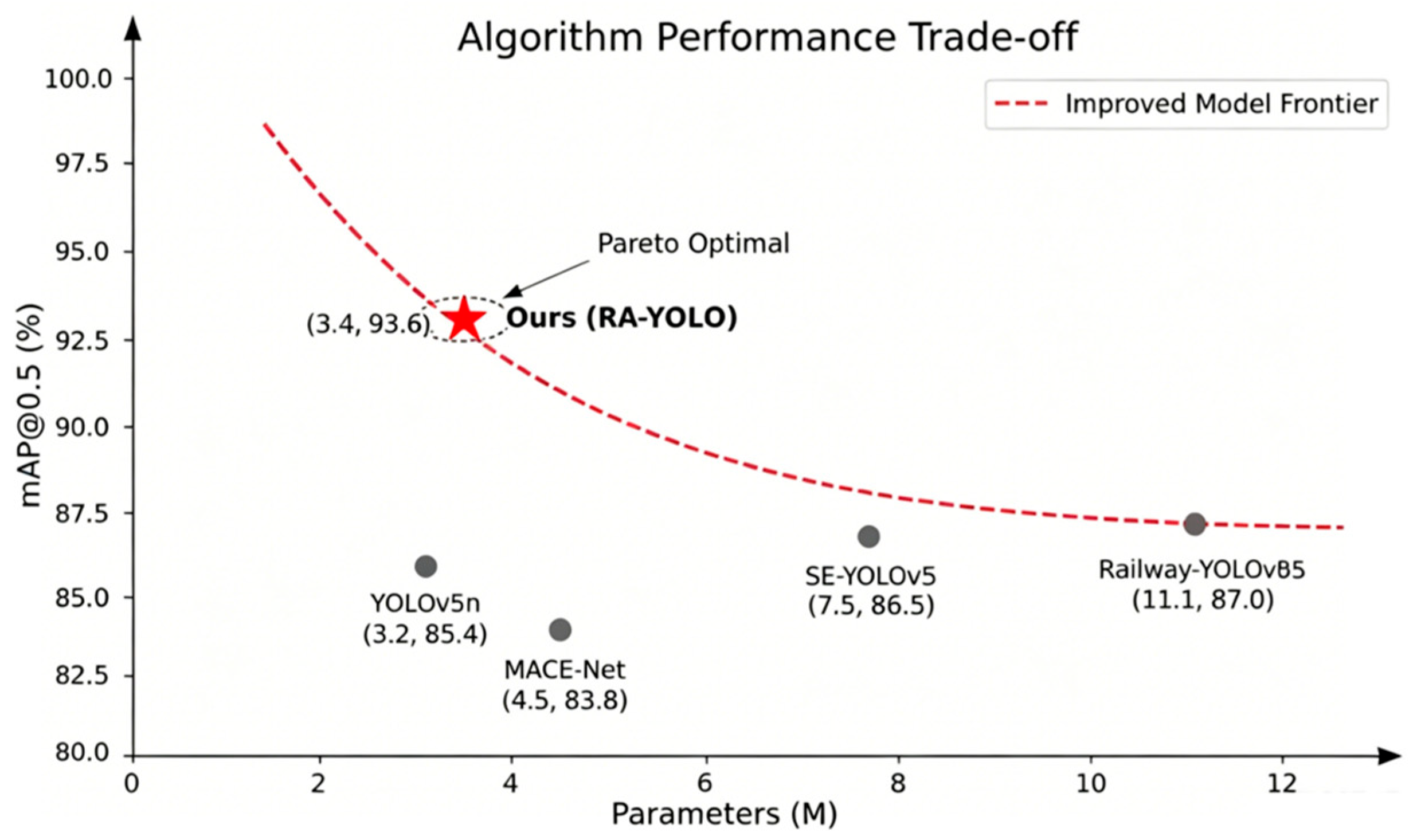
Figure 29.
Algorithm performance balance scatter plot.
Figure 29.
Algorithm performance balance scatter plot.
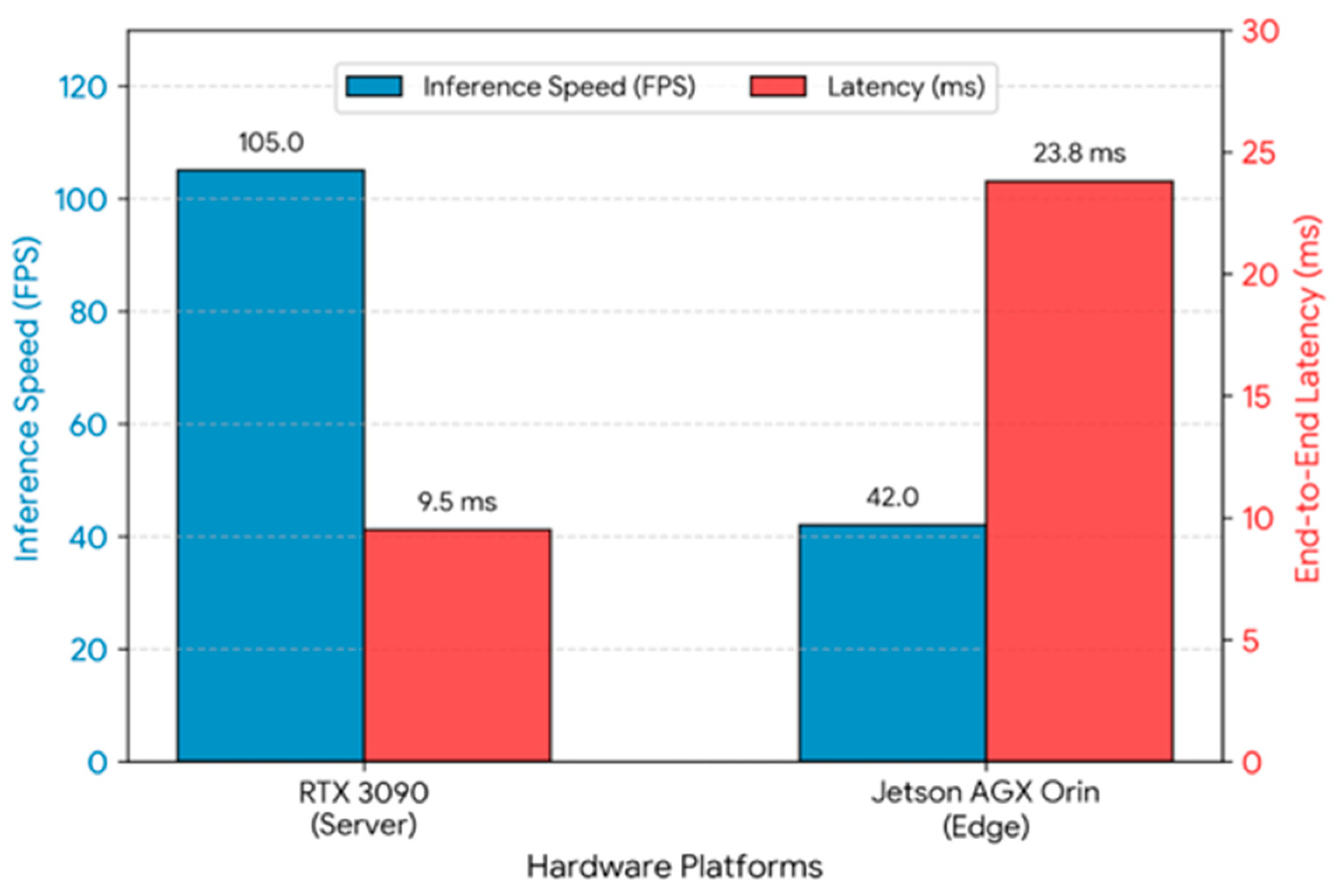
Figure 30.
Performance comparison of RA-YOLO inference speed across different hardware platforms.
Figure 30.
Performance comparison of RA-YOLO inference speed across different hardware platforms.
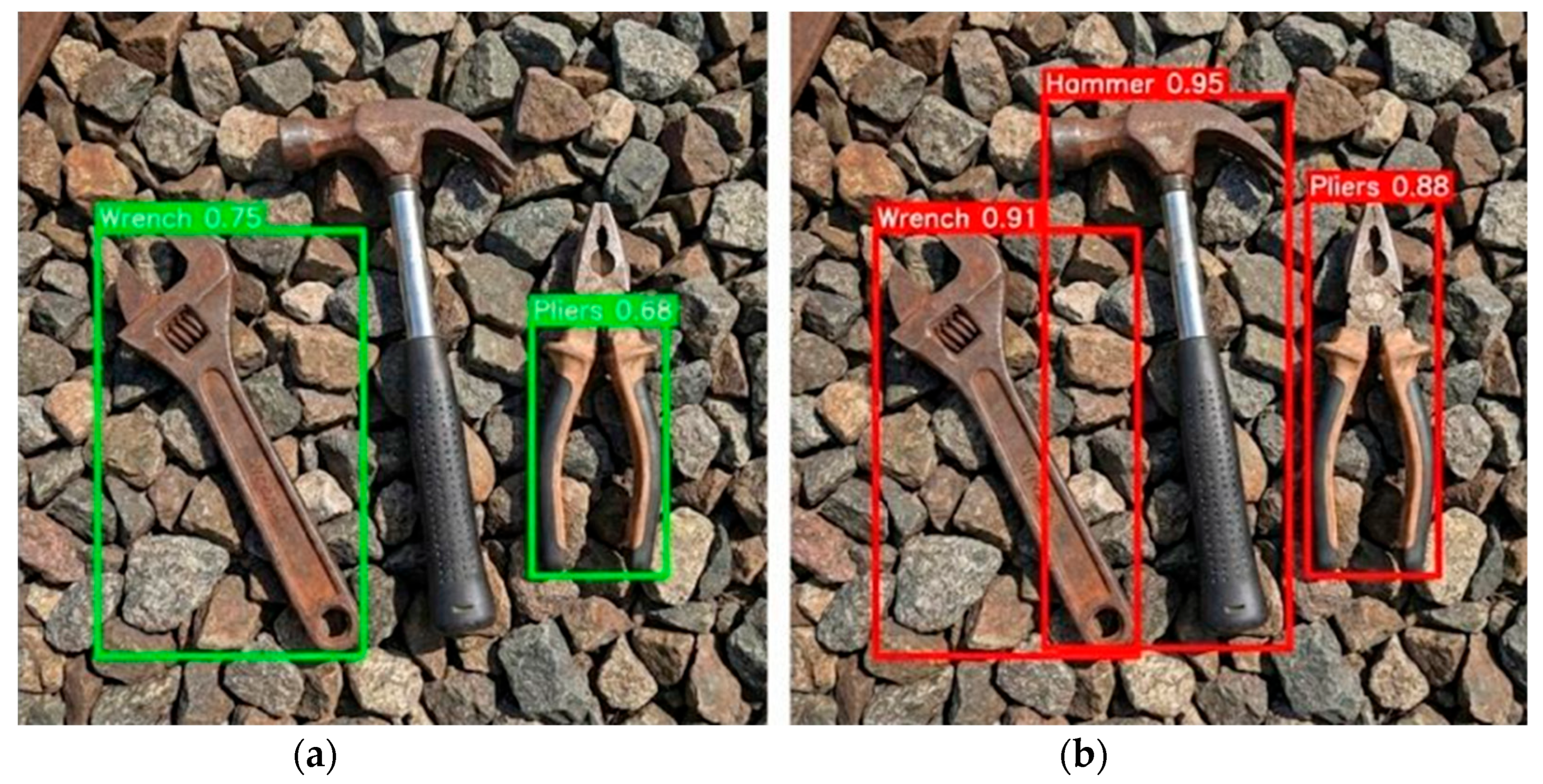
Figure 31.
Detection performance comparison under typical railway ballast backgrounds: (a) original YOLOv8n results marked in green; (b) improved RA-YOLO results marked in red. The numbers denote confidence scores.
Figure 31.
Detection performance comparison under typical railway ballast backgrounds: (a) original YOLOv8n results marked in green; (b) improved RA-YOLO results marked in red. The numbers denote confidence scores.
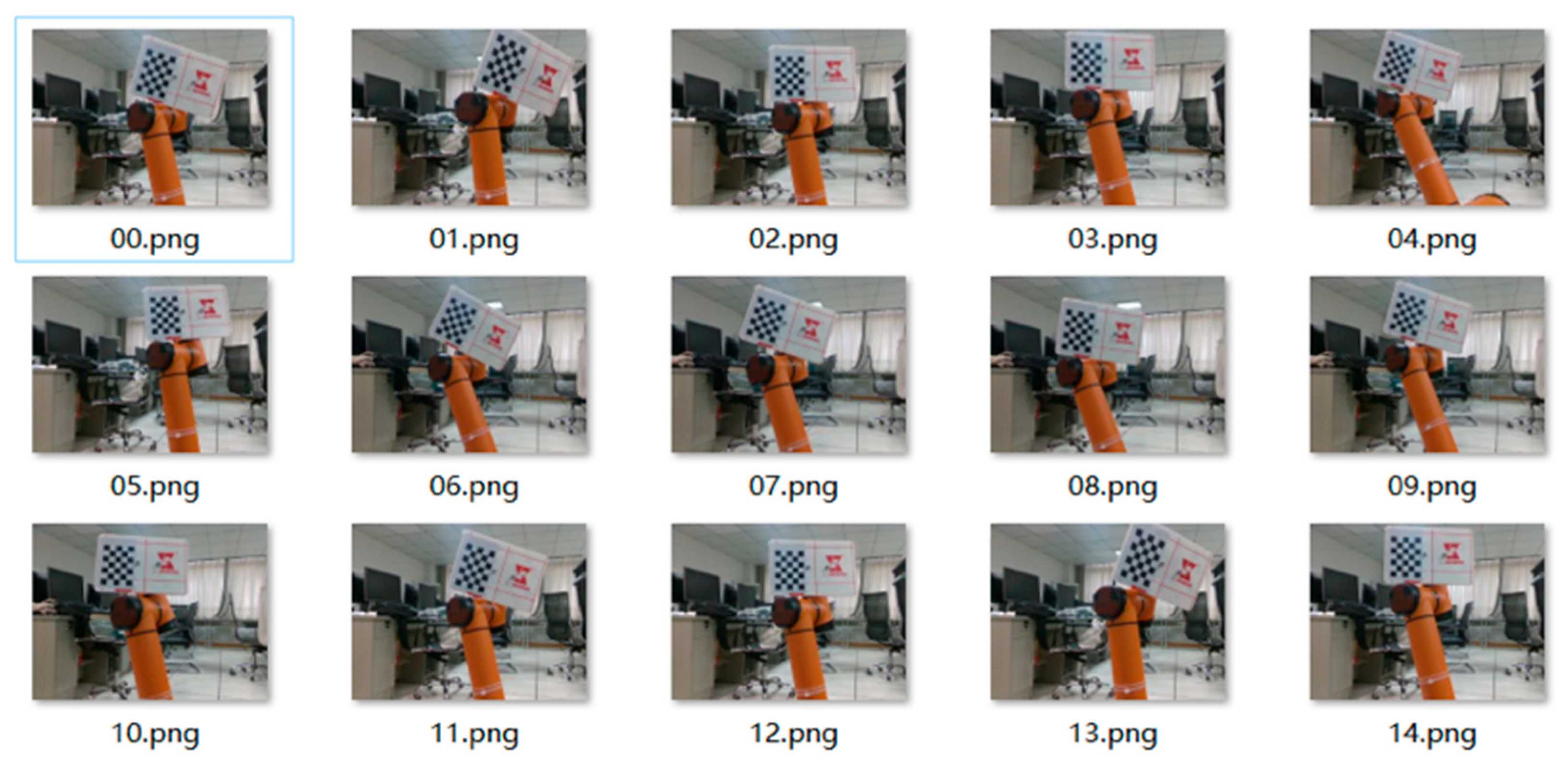
Figure 32.
Multi-pose image acquisition during hand-eye calibration.
Figure 32.
Multi-pose image acquisition during hand-eye calibration.
Figure 33.
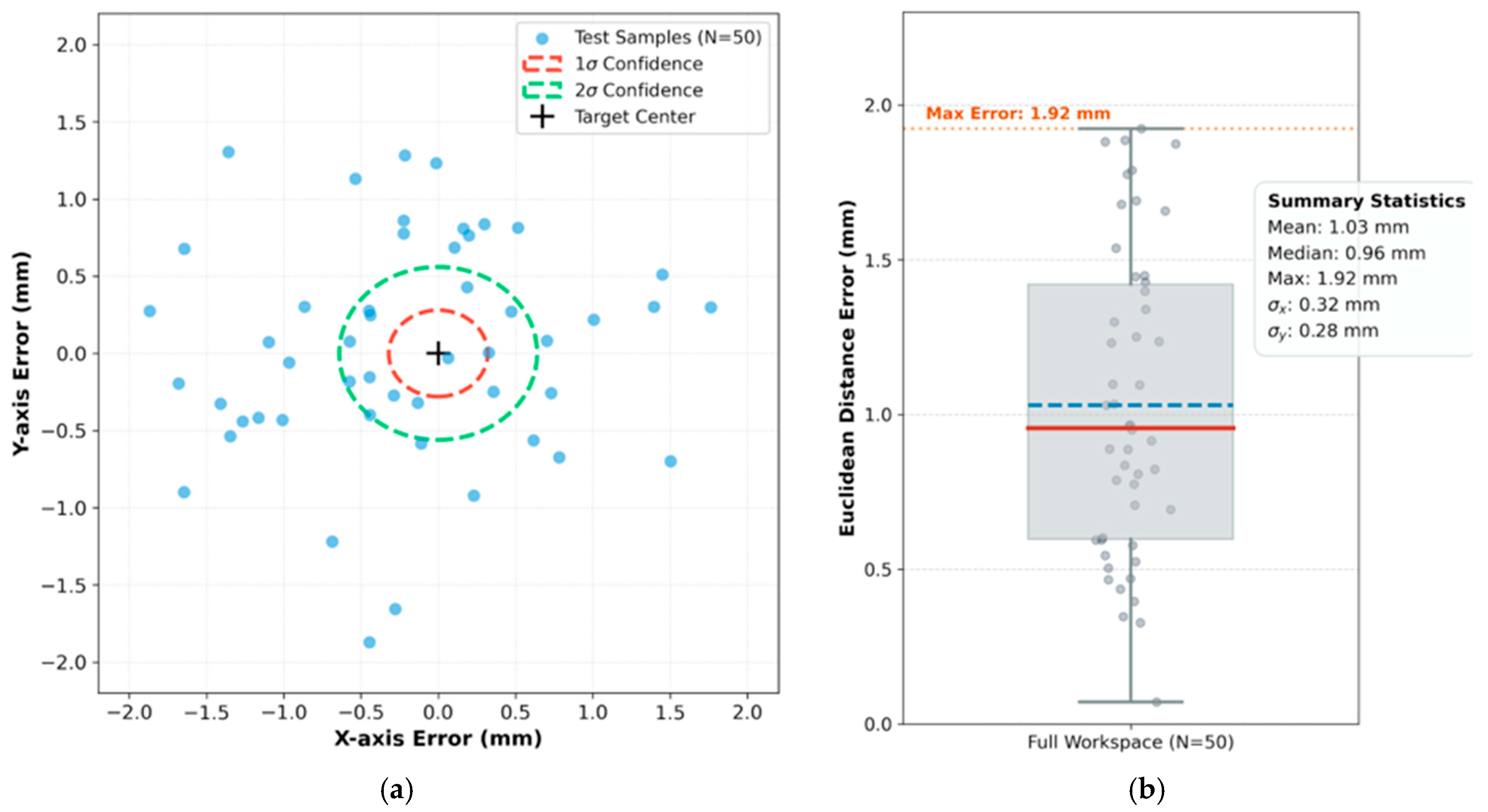
Multi-dimensional statistical analysis of absolute localization error: (a) spatial error distribution on the X-Y plane; (b) Boxplot of localization errors; red line = median, blue dashed line = mean.
Figure 33.
Multi-dimensional statistical analysis of absolute localization error: (a) spatial error distribution on the X-Y plane; (b) Boxplot of localization errors; red line = median, blue dashed line = mean.
Figure 34.
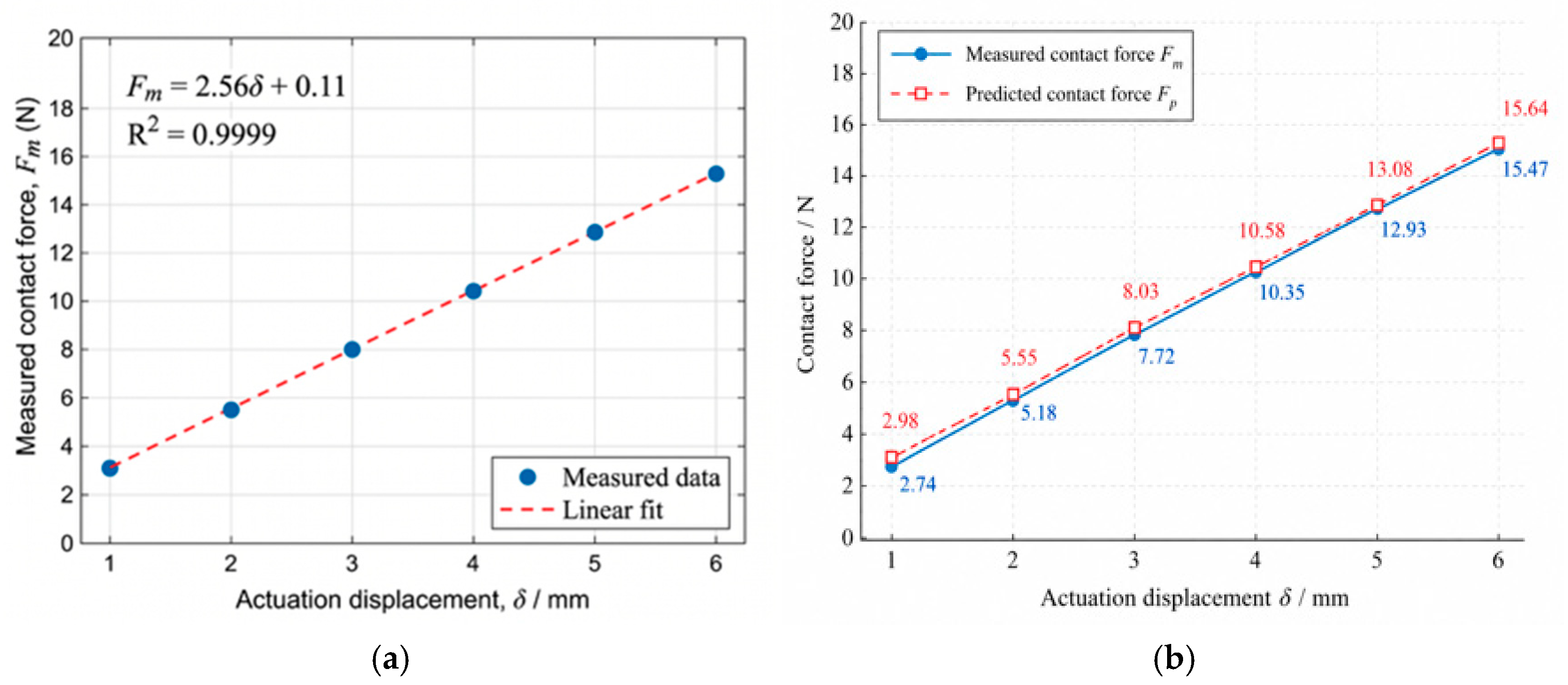
Force-output characterization of the soft finger: (a) forcedisplacement fitting for Kf identification; (b) comparison of measured and predicted contact forces.
Figure 34.
Force-output characterization of the soft finger: (a) forcedisplacement fitting for Kf identification; (b) comparison of measured and predicted contact forces.
Figure 35.
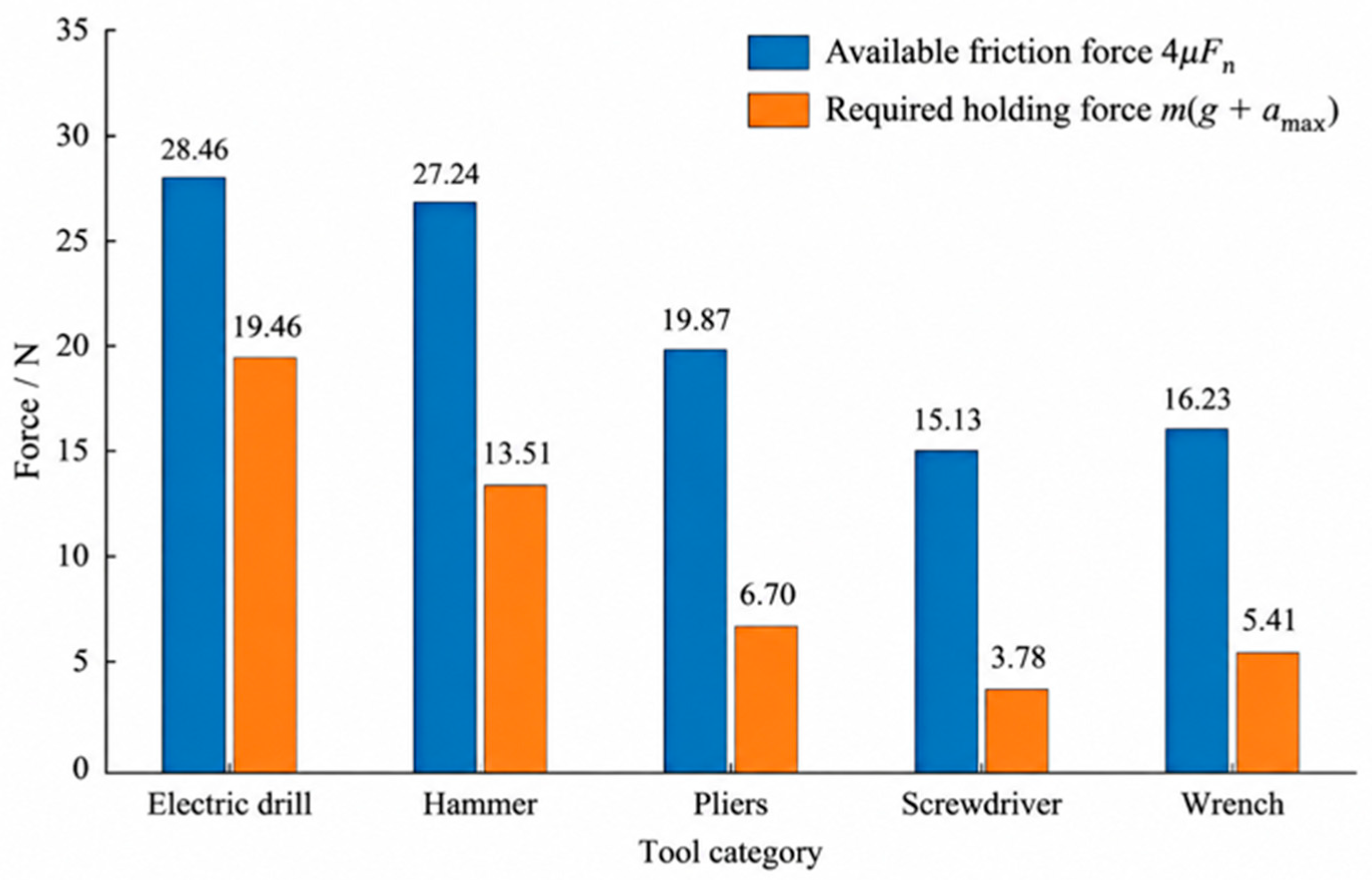
Comparison of available friction force and required holding force for different tools.
Figure 35.
Comparison of available friction force and required holding force for different tools.
Figure 36.
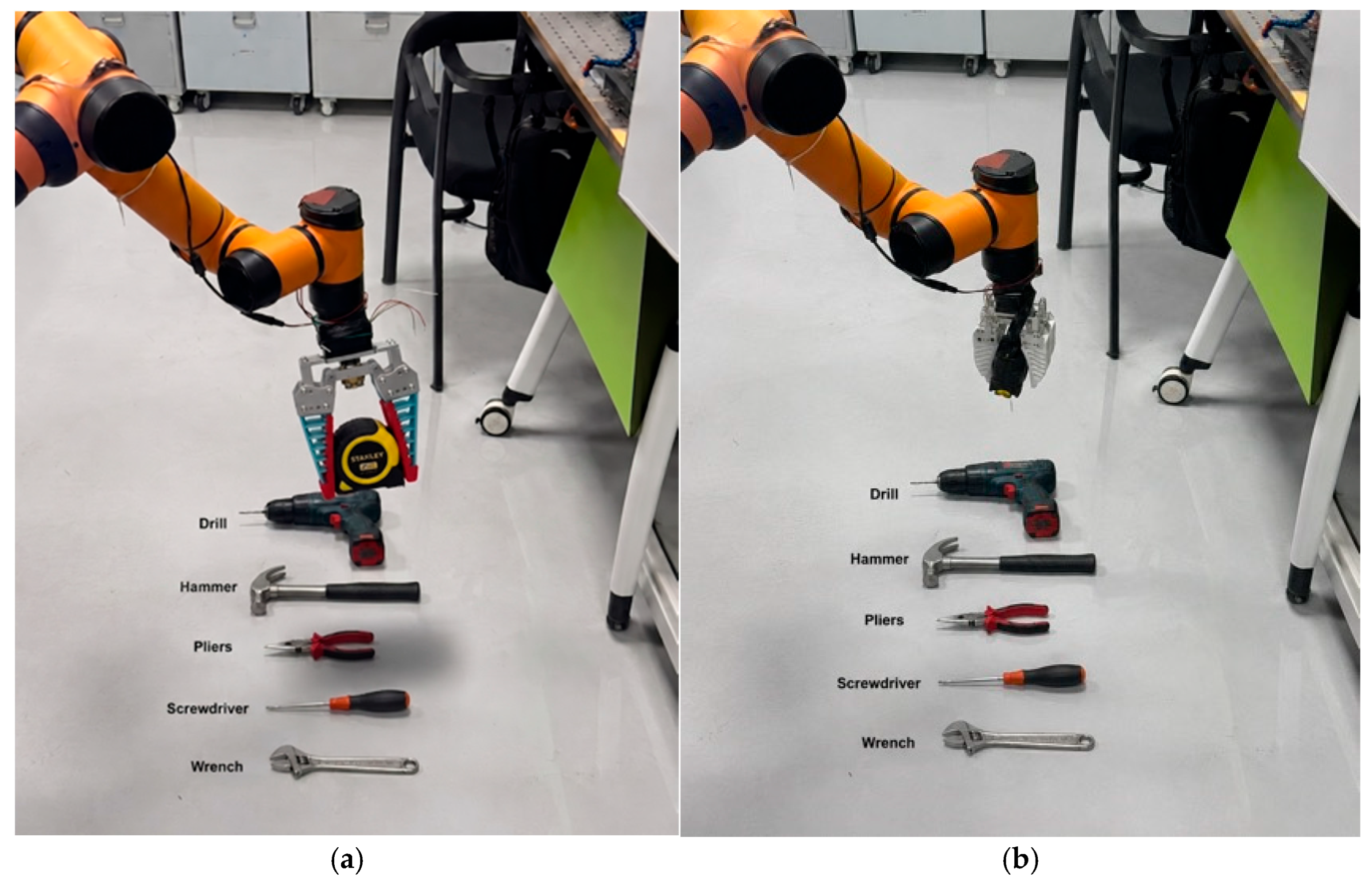
Baseline comparison between the proposed asymmetric Fin Ray gripper and the symmetric Fin Ray baseline: (a) symmetric Fin Ray baseline; (b) proposed asymmetric Fin Ray gripper.
Figure 36.
Baseline comparison between the proposed asymmetric Fin Ray gripper and the symmetric Fin Ray baseline: (a) symmetric Fin Ray baseline; (b) proposed asymmetric Fin Ray gripper.
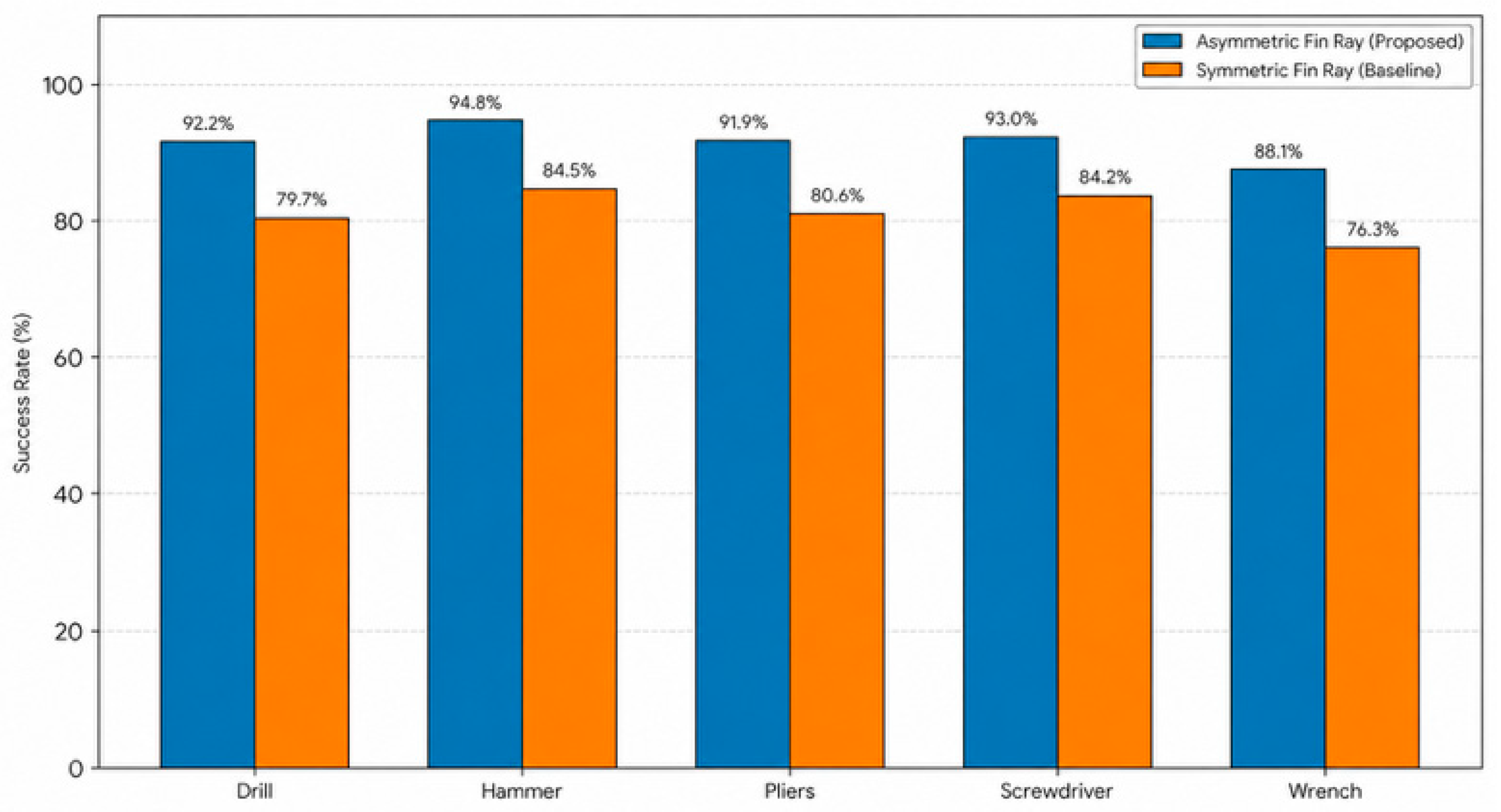
Figure 37.
Overall grasping success rates for different tool categories.
Figure 37.
Overall grasping success rates for different tool categories.
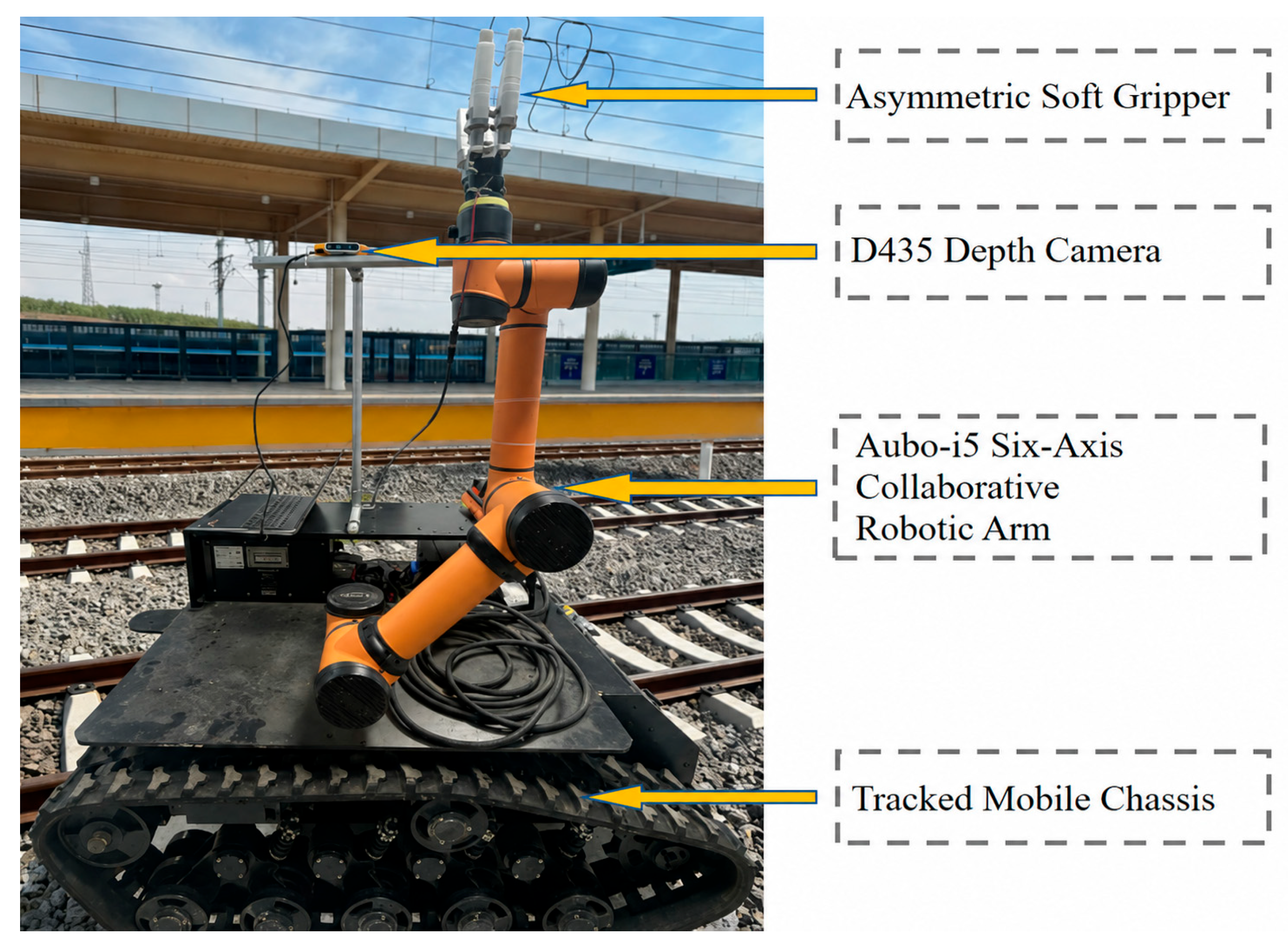
Figure 38.
Hardware integration and field deployment.
Figure 38.
Hardware integration and field deployment.
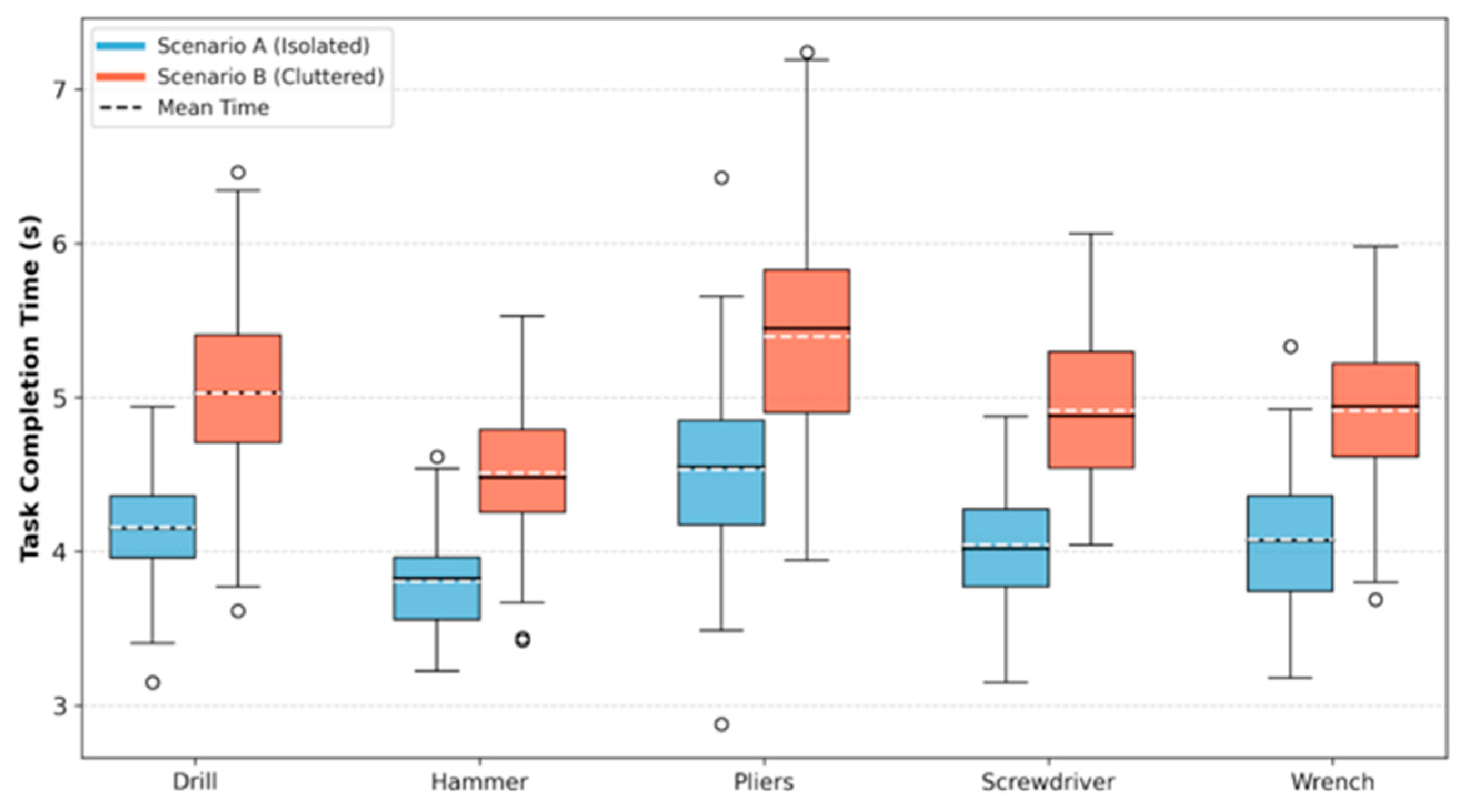
Figure 39.
Comparison of task completion time (TCT) distributions for each tool category under different experimental scenarios.
Figure 39.
Comparison of task completion time (TCT) distributions for each tool category under different experimental scenarios.
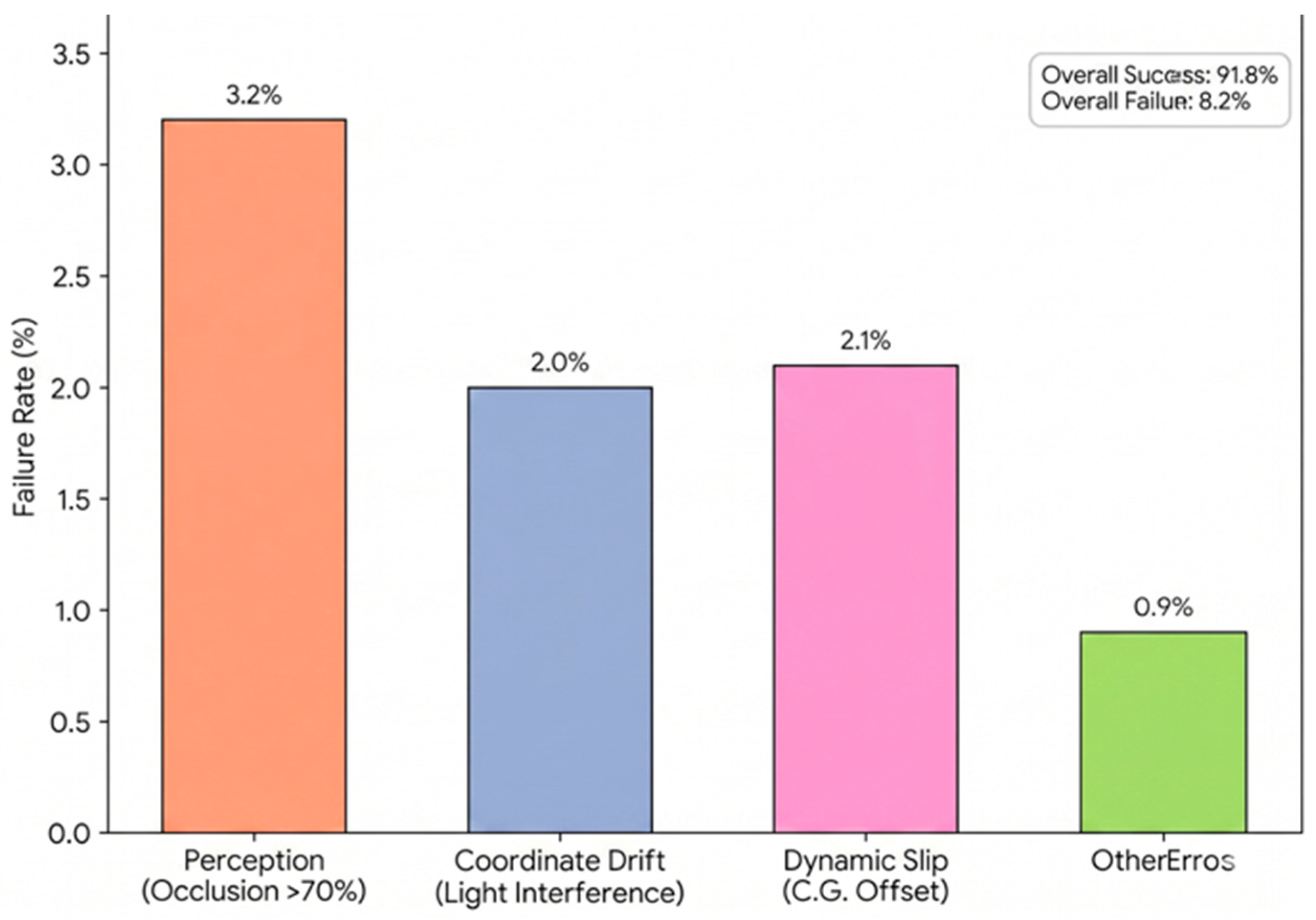
Figure 40.
Statistical analysis of grasping failure causes.
Figure 40.
Statistical analysis of grasping failure causes.
Table 1.
Design specifications of the soft gripper.
Table 1.
Design specifications of the soft gripper.
| Attribute | Specific Requirements |
|---|
| Overall Weight | ≤1 kg |
| Grasping Objects | Common tools for railway inspection, featuring irregular shapes and hard surfaces |
| Size Range | 10–120 mm |
| Maximum Payload Weight | ≤2 kg |
Table 2.
Mechanical properties of BASF Elastollan® 1185A.
Table 2.
Mechanical properties of BASF Elastollan® 1185A.
| Mechanical Property | Value | Unit | Test Standard |
|---|
| Tensile Strength | >45 | MPa | ISO 527-1/-2 |
| Elongation at Break | >500 | % | ISO 527-1/-2 |
| Shore A Hardness | 87 | Shore A | ISO 868 |
| Tear Strength | 70 | kN/m | ISO 34-1 |
| Abrasion Resistance | 25 | mm3 | ISO 4649 |
Table 3.
Factors and levels of the L9(33) orthogonal design.
Table 3.
Factors and levels of the L9(33) orthogonal design.
| Factor | Symbol | Level 1 | Level 2 | Level 3 |
|---|
| Rib inclination angle | | | | |
| Rib spacing | d | 4 mm | 8 mm | 12 mm |
| Outer wall thickness | t | 2 mm | 3 mm | 6 mm |
Table 4.
Orthogonal design matrix and normalized response evaluation of the soft finger structure.
Table 4.
Orthogonal design matrix and normalized response evaluation of the soft finger structure.
| Test No. | A:θ | B:d | C:t | Stress Safety Score fσ | Adaptive Deformation Score fδ | Lateral Stability Score fS | Comprehensive Score (F) |
|---|
| 1 | 0° | 4 mm | 2 mm | 0.64 | 0.78 | 0.62 | 0.68 |
| 2 | 0° | 8 mm | 6 mm | 0.70 | 0.62 | 0.78 | 0.70 |
| 3 | 0° | 12 mm | 3 mm | 0.72 | 0.70 | 0.76 | 0.73 |
| 4 | 30° | 4 mm | 6 mm | 0.76 | 0.65 | 0.84 | 0.75 |
| 5 | 30° | 8 mm | 3 mm | 0.92 | 0.86 | 0.90 | 0.90 |
| 6 | 30° | 12 mm | 2 mm | 0.68 | 0.88 | 0.58 | 0.71 |
| 7 | 45° | 4 mm | 3 mm | 0.68 | 0.78 | 0.64 | 0.70 |
| 8 | 45° | 8 mm | 2 mm | 0.62 | 0.84 | 0.56 | 0.67 |
| 9 | 45° | 12 mm | 6 mm | 0.70 | 0.60 | 0.76 | 0.69 |
Table 5.
Level-average and range analysis of the orthogonal design results.
Table 5.
Level-average and range analysis of the orthogonal design results.
| Factor | Level 1 | Level 2 | Level 3 | Range (R) | Rank |
|---|
| A:θ | 0.70 | 0.79 | 0.69 | 0.10 | 1 |
| B: | 0.71 | 0.76 | 0.71 | 0.05 | 3 |
| C: | 0.69 | 0.78 | 0.71 | 0.09 | 2 |
Table 6.
Selected structural parameters of the asymmetric Fin Ray soft finger.
Table 6.
Selected structural parameters of the asymmetric Fin Ray soft finger.
| Parameter | Symbol | Selected Value |
|---|
| Rib angle | θ | 30° |
| Rib spacing | d | 8 mm |
| Outer wall thickness | t | 3 mm |
Table 7.
Calibration data of the thin-film force sensor.
Table 7.
Calibration data of the thin-film force sensor.
| Test No. | Applied Mass (g) | Applied Force (N) | Conditioned Sensor Response (V) | Fitted Force (N) | Relative Error (%) |
|---|
| 1 | 100 | 0.98 | 0.36 | 0.97 | 1.49 |
| 2 | 200 | 1.96 | 0.51 | 2.08 | 5.96 |
| 3 | 500 | 4.91 | 0.89 | 4.90 | 0.21 |
| 4 | 1000 | 9.81 | 1.56 | 9.86 | 0.51 |
| 5 | 1500 | 14.72 | 2.16 | 14.30 | 2.86 |
| 6 | 2000 | 19.62 | 2.91 | 19.85 | 1.18 |
Table 8.
Detailed scale and subset partitioning statistics of the railway tool dataset.
Table 8.
Detailed scale and subset partitioning statistics of the railway tool dataset.
| Tool Category | Training Set | Validation Set | Test Set | Total Samples |
|---|
| Drill | 572 | 71 | 72 | 715 |
| Hammer | 594 | 74 | 74 | 742 |
| Pliers | 566 | 71 | 71 | 708 |
| Screwdriver | 576 | 72 | 72 | 720 |
| Wrench | 604 | 76 | 75 | 755 |
| Total | 2912 | 364 | 364 | 3640 |
Table 9.
Ablation study results for different improvement strategies.
Table 9.
Ablation study results for different improvement strategies.
| Group | Mosaic | CBAM | mAP@0.5 (%) | mAP@0.5:0.95 (%) | FPS |
|---|
| A | × | × | 85.4 | 64.2 | 122 |
| B | √ | × | 87.8 | 66.1 | 122 |
| C | × | √ | 88.5 | 66.7 | 105 |
| D (Ours) | √ | √ | 93.6 | 68.7 | 105 |
Table 10.
Comparison of different lightweight attention mechanisms.
Table 10.
Comparison of different lightweight attention mechanisms.
| Method | Attention Module | Params/M | GFLOPs | mAP@0.5 (%) | mAP@0.5:0.95 (%) |
|---|
| YOLOv8n | None | 3.20 | 8.7 | 87.8 | 66.1 |
| YOLOv8n + SE | SE | 3.28 | 8.8 | 89.6 | 66.8 |
| YOLOv8n + ECA | ECA | 3.22 | 8.7 | 90.3 | 67.2 |
| YOLOv8n + CA | Coordinate Attention | 3.34 | 9.0 | 91.1 | 67.7 |
| YOLOv8n + CBAM | CBAM | 3.40 | 9.2 | 93.6 | 68.7 |
Table 11.
Algorithm performance comparison results.
Table 11.
Algorithm performance comparison results.
| Method | mAP@0.5 (%) | FPS | Params/M |
|---|
| MACE-Net | 83.8 | 98 | 4.5 |
| SE-YOLOv5 | 86.5 | 92 | 7.5 |
| Railway-YOLOv8s | 87.0 | 85 | 11.1 |
| YOLOv8n | 85.4 | 122 | 3.2 |
| Ours | 93.6 | 105 | 3.4 |
Table 12.
Detection performance of RA-YOLO under different ballast moisture and texture conditions.
Table 12.
Detection performance of RA-YOLO under different ballast moisture and texture conditions.
| Test Condition | Number of Images | mAP@0.5 (%) | mAP@0.5:0.95 (%) | Precision (%) | Recall (%) |
|---|
| Dry ballast condition | 100 | 93.6 | 79.2 | 94.1 | 92.8 |
| Wet ballast | 80 | 92.5 | 78.1 | 93.0 | 91.5 |
| Different ballast texture/color | 80 | 91.8 | 77.5 | 92.2 | 90.8 |
| Wet + different ballast | 60 | 90.5 | 76.0 | 91.0 | 90.2 |
| Mean | — | 92.1 | 77.7 | 92.6 | 91.3 |
Table 13.
Quantified absolute error data between vision-computed coordinates and actual robotic arm coordinates.
Table 13.
Quantified absolute error data between vision-computed coordinates and actual robotic arm coordinates.
| Sample | Vision Coords (x, y, z) | Actual Coords (x, y, z) | Absolute Error (Δx, Δy, Δz) |
|---|
| 1 | (221.5, −85.2, 10.5) | (220.1, −86.5, 9.8) | (1.4, 1.3, 0.7) |
| 2 | (356.8, 107.3, 11.2) | (355.2, 106.1, 10.4) | (1.6, 1.2, 0.8) |
| 3 | (425.6, 121.5, 10.8) | (423.8, 119.8, 9.9) | (1.8, 1.7, 0.9) |
| 4 | (510.2, −55.4, 11.0) | (508.1, −53.9, 10.1) | (2.1, 1.5, 0.9) |
| 5 | (573.6, 132.1, 10.6) | (571.2, 130.5, 9.5) | (2.4, 1.6, 1.1) |
Table 14.
Experimental identification of linear fingertip stiffness and contact force validation.
Table 14.
Experimental identification of linear fingertip stiffness and contact force validation.
| Test No. | δ (mm) | Fm (N) | Fp (N) | (N) | Relative Error (%) |
|---|
| 1 | 1 | 2.74 | 2.98 | 0.24 | 8.76 |
| 2 | 2 | 5.18 | 5.55 | 0.37 | 7.14 |
| 3 | 3 | 7.72 | 8.03 | 0.31 | 4.02 |
| 4 | 4 | 10.35 | 10.58 | 0.23 | 2.22 |
| 5 | 5 | 12.93 | 13.08 | 0.15 | 1.16 |
| 6 | 6 | 15.47 | 15.64 | 0.17 | 1.10 |
Table 15.
Contact-force variation during the cyclic inward-curling test.
Table 15.
Contact-force variation during the cyclic inward-curling test.
| Cycle Number | Contact Force (N) | Degradation Ratio (%) | Visual Condition |
|---|
| 0 | 15.47 ± 0.08 | 0.00 | No damage |
| 500 | 15.39 ± 0.09 | 0.52 | No damage |
| 1000 | 15.32 ± 0.09 | 0.97 | No damage |
| 1500 | 15.26 ± 0.10 | 1.36 | No damage |
| 2000 | 15.19 ± 0.10 | 1.81 | No damage |
| 2500 | 15.11 ± 0.11 | 2.33 | No damage |
| 3000 | 15.04 ± 0.12 | 2.78 | No visible damage |
Table 16.
Results of the rated-payload cyclic grasping test.
Table 16.
Results of the rated-payload cyclic grasping test.
| Payload Mass (kg) | Cycles | Test Condition | Result |
|---|
| 2.0 | 500 | Lifted to 20 cm and held for 5 s in each cycle | No payload dropping, visible slippage, cracks, permanent deformation, or local structural damage |
Table 17.
Anti-slip performance of the soft gripper for typical railway maintenance tools.
Table 17.
Anti-slip performance of the soft gripper for typical railway maintenance tools.
| Test Object | Mass m (kg) | (N) | μ | (N) | | Margin (N) | Predicted State |
|---|
| Electric drill | 1.80 | 15.47 | 0.46 | 28.46 | 19.46 | 9.00 | Stable |
| Hammer | 1.25 | 13.62 | 0.50 | 27.24 | 13.51 | 13.73 | Stable |
| Pliers | 0.62 | 10.35 | 0.48 | 19.87 | 6.70 | 13.17 | Stable |
| Screwdriver | 0.35 | 8.05 | 0.47 | 15.13 | 3.78 | 11.35 | Stable |
| Wrench | 0.50 | 9.22 | 0.44 | 16.23 | 5.41 | 10.83 | Stable |
Table 18.
Controlled laboratory comparison of grasping success rates between the proposed asymmetric Fin Ray gripper and the symmetric Fin Ray baseline.
Table 18.
Controlled laboratory comparison of grasping success rates between the proposed asymmetric Fin Ray gripper and the symmetric Fin Ray baseline.
| Tool | Proposed Asymmetric
Fin Ray (%) | Symmetric Fin Ray Baseline (%) | Improvement (pp) |
|---|
| Drill | 92.2 | 79.7 | 12.5 |
| Hammer | 94.8 | 84.5 | 10.3 |
| Pliers | 91.9 | 80.6 | 11.3 |
| Screwdriver | 93.0 | 84.2 | 8.8 |
| Wrench | 88.1 | 76.3 | 11.9 |
| Average | 92.0 | 81.0 | 11.0 |
Table 19.
Tool grasping experimental scenario settings and evaluation focus.
Table 19.
Tool grasping experimental scenario settings and evaluation focus.
| Scenario | Type | Environment | Evaluation Focus |
|---|
| A | Isolated | Tools placed independently without mutual contact | Adaptive enveloping capability for diverse geometries |
| B | Cluttered | Randomly stacked tools with partial occlusions | Detection robustness of RA-YOLO in complex backgrounds |
Table 20.
Grasping success rate statistics for different tools in each experimental scenario.
Table 20.
Grasping success rate statistics for different tools in each experimental scenario.
| Tool Type | Scenario A | Scenario B | Overall |
|---|
| Drill | 94.5% | 87.9% | 91.2% |
| Hammer | 96.5% | 92.5% | 94.7% |
| Pliers | 95.2% | 88.6% | 91.9% |
| Screwdriver | 95.8% | 89.2% | 92.5% |
| Wrench | 93.8% | 83.6% | 88.7% |
| Average | 95.2% | 88.4% | 91.8% |