Article

Wind-YOLO: A Lightweight Detector for Wind Turbine Damage

School of Computer Science, Jiangsu University of Science and Technology, Zhenjiang 212003, China
*
Authors to whom correspondence should be addressed.
Machines 2026, 14(6), 610; https://doi.org/10.3390/machines14060610
Submission received: 27 April 2026 / Revised: 23 May 2026 / Accepted: 26 May 2026 / Published: 28 May 2026
(This article belongs to the Section Machines Testing and Maintenance)

Abstract

Wind turbine blades are prone to multiscale and weak-feature damage in complex natural environments. Accurate and efficient detection is crucial for ensuring the safe operation of wind turbine units. However, existing models struggle to balance detection precision, robustness, and lightweight deployment requirements. In this paper, we propose a lightweight model, Wind-YOLO, for wind turbine blade defect detection based on YOLOv11, with three core innovations: (1) We design a DynamicC3k2 that adaptively adjusts the convolutional receptive field for feature extraction, enhancing fine-grained feature capture of micro-cracks and weak-texture defects. (2) We construct a Cross-Stage Partial with Focused Linear Attention (C2FLA) that precisely focuses on defect regions via a linear attention mechanism, effectively mitigating complex background and noise interference. (3) We propose a Spatially Guided Gated Feature Pyramid Network (SGG-FPN) that optimizes multiscale feature transmission and aggregation through a gated fusion mechanism, improving adaptability to cross-scale defects from millimeter-level cracks to meter-level spalling. Extensive experiments on a dedicated wind turbine defect dataset show that Wind-YOLO achieves an mAP@0.5 of 80.9% and an mAP@0.5:0.95 of 37.1%, achieving an increase of 3.9 percentage points and 2.4 percentage points, respectively, compared with the baseline YOLOv11. Meanwhile, the model has only 2.34 million parameters (2.34 M) and a computational complexity of 6.0 GFLOPs. It delivers dual improvements in precision and lightweight performance, with superior environmental adaptability for real-time wind turbine inspection.

1. Introduction

With the global transition toward clean, sustainable energy, wind power, a renewable energy source with abundant reserves and zero carbon emissions, has become a core component of the global energy supply system [1]. As the key component of wind turbine units that captures wind energy and realizes energy conversion, the structural integrity of wind turbine blades directly determines the power generation efficiency, operational reliability, and service life of the units [2]. Currently, the length of commercial wind turbine blades generally exceeds 90 m, and some offshore wind turbine blades even exceed 120 m. Such large-scale components are long-term exposed to complex outdoor environments. They must continuously withstand strong wind loads, sand and gravel impacts, alternating cycles of temperature and humidity, making them prone to typical damages such as cracks, paint peeling, and fiber delamination [3]. Blade damage is the main driver of unplanned wind turbine shutdowns, contributing to 25–30% of global unplanned downtime (35% for offshore units). Consequently, the global wind power industry incurs annual operating and maintenance costs of around 1–1.2 billion dollars, including inspection, maintenance, and downtime losses [4]. If minor damage is not identified promptly, it can rapidly evolve into penetrating damage under cyclic stress, ultimately triggering catastrophic events such as blade breakage. Developing high-precision and real-time blade-damage detection technology is of great engineering value for ensuring the operational safety of wind farms and reducing the whole-life-cycle costs.
Traditional wind turbine damage detection methods primarily include manual visual inspection, ultrasonic testing, and thermal imaging, each with notable limitations. Manual visual inspection is inefficient, heavily dependent on experience, and poses occupational safety risks in outdoor environments [5]. Ultrasonic testing enables detailed detection of internal composite damage but requires turbine shutdown and cumbersome point-by-point scanning, making it unsuitable for large-scale rapid inspections [6]. Thermal imaging inspection is highly susceptible to environmental temperature differences, sunlight intensity, and material emissivity, resulting in reduced accuracy in identifying early-stage microcracks [7]. These methods generally exhibit narrow scene adaptability, struggle to balance detection efficiency and accuracy, and fail to meet comprehensive demands under complex operating conditions. They cannot achieve early, precise damage warnings, thereby failing to meet the requirements for the intelligent operation and maintenance of wind farms.
In recent years, deep learning-based object detection technologies have opened new avenues for wind turbine inspection via automatic feature extraction [8]. One-stage detection algorithms, such as the YOLO series, have emerged as a research focus for their balanced accuracy and speed. YOLOv5 innovatively adopted a multiscale detection architecture and an adaptive anchor box strategy, laying the engineering foundation for lightweight YOLO deployment in industrial inspection scenarios [9]. YOLOv8 reconstructed the backbone network, introduced a C2f feature fusion structure, and combined it with an Anchor-Free detection head, significantly enhancing feature extraction capability and robustness to complex background [10]. YOLOv11 integrated an enhanced attention mechanism to optimize the perception and localization of small-scale, low-feature objects, further adapting to industrial minute-defect detection requirements [11]. However, YOLO models still face challenges in wind power scenarios: defect features are weak and easily obscured by background noise. In contrast, high-precision models entail high computational overhead, hindering deployment on drone-carried embedded terminals [12].
This paper proposes Wind-YOLO, a novel lightweight detection model tailored for wind turbine damage detection. Building on YOLOv11, this method implements targeted improvements in subsampled feature retention, feature enhancement, and the utilization of edge information. The design mainly targets micro-cracks, low-contrast defects, multiscale damage, and complex background interference in actual detection scenarios. It aims to enhance detection capabilities for small-scale defects, irregularly shaped damages, and low-contrast targets in complex backgrounds while maintaining model lightness and computational efficiency.
The main contributions of this paper are summarized as follows:
(1)
We propose Wind-YOLO, a lightweight damage detection model for wind turbines, which achieves deep synergy between detection accuracy and operational efficiency while reducing the number of parameters.
(2)
We deeply integrate Dynamic Convolution with existing convolution structures, adaptively fusing multiple expert kernels to enhance the feature extraction capability for damages of different morphologies.
(3)
We design a Cross-Stage Partial with Focused Linear Attention (C2FLA), which effectively integrates global structural information with local fine-grained features and improves perception of weak-feature damage.
(4)
We construct a Spatially Guided Gated Feature Pyramid Network (SGG-FPN), which enables adaptive screening and enhancement of multiscale features by utilizing spatial perception and gating mechanisms, suppressing redundant spatial features and enhancing the recognition of defect edges.
The rest of this paper is organized as follows: Section 2 reviews related research on surface defect detection in wind turbines. Section 3 details the lightweight detection model Wind-YOLO. Section 4 conducts a variety of comparative and ablation experiments to verify the effectiveness and superiority of the model. Finally, Section 5 summarizes the work.

2. Related Work

2.1. Research Progress of Wind Turbine Damage Detection

Deep learning-based damage detection for wind turbines has emerged as a core research direction in industrial intelligent maintenance. Early studies primarily focused on the preliminary application of general object detection frameworks in wind power scenarios. For instance, Wang et al. [13] demonstrated through comparative experiments that damage recognition systems based on convolutional neural networks (CNNs) outperform traditional support vector machines when processing random sample data. Liu et al. [14] optimized YOLOv8 by integrating the C2f-FocalNextBlock into the backbone and introducing the ResNet-EMA cross-dimensional interaction mechanism, enhancing the extraction of subtle crack features in wind turbines. Liu et al. [15] proposed the YOLOv5s-L model, which replaces the original C3 module with a C2f structure to enrich gradient flow and incorporates BiFPN for efficient weighted feature fusion, thereby improving detection accuracy without increasing the number of parameters.
To further address the balance between detection accuracy and efficiency in industrial scenarios, researchers have proposed a series of improved models from diverse technical perspectives.
In terms of damage feature enhancement and robust representation, Zou et al. [16] proposed the ED Net, which incorporates enhanced asymmetric convolution blocks and dual-pooling cascaded attention modules to significantly boost the feature characterization capability for edge damage. Lv et al. [17] developed the EADD detector, adopting an improved ResNet as the backbone of the SSD framework to strengthen feature propagation and ensure stable feature extraction in complex environments.
In terms of collaborative optimization of segmentation and localization, Zhang et al. [18] presented the Mask-MRNet, which stacks Mask R-CNN and MRNet to achieve pixel-level defect segmentation and reduces single-frame inference time via network fusion, balancing detection accuracy and real-time performance. Yang et al. [19] designed a blade monitoring-oriented image recognition model that enables automatic feature extraction and end-to-end inference, providing technical support for the dynamic monitoring of blade operational status.
In terms of multimodal fusion and anti-interference perception in complex environments, Zhou et al. [20] proposed a visible-infrared image fusion scheme that leverages complementary multimodal features to suppress environmental interference and resolve the misclassification between real defects and false anomalies. Zou et al. [21] proposed the DCW-YOLO model by optimizing the model structure (architecture) and loss function, thereby enhancing detection robustness in complex scenes, reducing computational overhead, and maintaining high accuracy.
In terms of image quality enhancement and small-target detection, Xiao et al. [22] proposed the MFYOLO model, which employs super-resolution reconstruction to mitigate high-altitude image blurring, reinforces weak defect signals through feature enhancement, and enriches input information via multi-source image fusion. Lv et al. [23] developed the WHTMLDet model, integrating a channel split-and-conquer strategy, spatial perception mechanism, and heterogeneous multi-path learning framework to improve the detection stability and localization accuracy of small defects in complex backgrounds.
In terms of cross-scale feature optimization and lightweight architecture, Liu et al. [24] proposed the GFD-YOLOX model, which constructs a Dual-Frequency Fused Bidirectional Feature Pyramid Network (DFF-BiFPN) and integrates a Hierarchical Frequency-Adaptive Fusion (HFAF) module to optimize cross-scale feature interaction, thus improving adaptability to multiple defect types. Dai et al. [25] improved YOLOv5 by optimizing UAV image preprocessing and the model architecture, thereby effectively enhancing blade-damage detection performance in complex aerial scenes. Xu et al. [26] proposed the SNMSDA-YOLO11 model, which combines multiscale dilated attention with the SlimNeck architecture to reduce model parameters while preserving efficient feature extraction.
In addition, research advances in cross-industry defect detection provide valuable insights for weak-feature defect detection in wind turbines. Zhao et al. [27] proposed the RDD-YOLO model, which enhances weak-feature extraction and fusion to improve small-scale defect detection accuracy, and its core design provides an important reference for detecting microcracks and other weak-feature targets on wind turbines.
Despite fruitful achievements in wind turbine damage detection, existing models still suffer from feature signal attenuation when dealing with multiscale defects (from millimeter-level cracks to meter-level spalling). Mittal et al. [12] also noted that high detection accuracy is often achieved at the expense of excessive computational resources, thereby restricting the practical deployment of lightweight models on edge devices. Although existing studies have improved detection performance from input enhancement, module design, and model structure optimization, and some works have enhanced detection in complex scenes by optimizing UAV image preprocessing strategies and model structure, the synergy between lightweight design and high precision still needs further improvement.

2.2. Lightweight Challenges in Industrial Automation

In industrial inspection scenarios, real-time and edge deployment capabilities are core indicators for evaluating algorithm practicality, making lightweight detection networks a research hotspot. Existing lightweight methods mainly focus on operator innovation and architecture compression. By introducing depthwise separable convolution, grouped convolution, and channel rearrangement, these methods reduce computational overhead and balance detection performance with deployment efficiency. Representative models include MobileNetV4 [28], which innovatively adopts a universal inverted residual structure and universal inverted bottleneck (UIB). By combining odd-layer depthwise convolutions and even-layer 1 × 1 convolutions, it significantly reduces computation while maintaining strong feature representation to meet complex industrial requirements. ShuffleNet [29] optimizes inter-channel information flow and promotes cross-channel feature interaction through channel shuffle, achieving high computational efficiency and enabling the engineering deployment of lightweight models. GhostNet [30] generates redundant feature maps via cheap operations and produces more effective features from inherent features through dynamic convolution, greatly reducing parameter redundancy without obvious performance loss. BSE-YOLO [31] improves feature extraction in complex environments by leveraging enhanced feature fusion and multiscale attention mechanisms, enabling lightweight, efficient detection. Dynamic Grouping YOLOv8 [32] optimizes channel resource allocation through dynamic grouped convolution, thereby reducing model parameters and improving deployment convenience. These techniques provide important references for balancing detection performance and deployment feasibility in wind turbine inspection.
However, lightweight design inherently conflicts with feature representation capability, and this tension is amplified in wind turbine inspection due to the target’s characteristics. First, there exists a risk of feature loss. Owing to the tiny scale and variable morphology of wind turbine defects, overly simplistic downsampling structures progressively degrade critical spatial details during feature propagation, hampering the capture of microcrack topology [12]. Second, weakened noise robustness: constrained by limited parameter capacity, lightweight networks lack sufficient nonlinear expression ability to distinguish damage signals from environmental interference when inspecting images contaminated by heavy industrial noise or background clutter. Third, multiscale adaptation challenges: traditional lightweight feature fusion structures often suffer from signal drowning when dealing with damage spanning vastly different scales, such as 0.5 mm cracks and 2 m delaminations [25]. Compensating for performance loss through architectural innovation with minimal parameters has become a critical challenge in industrial visual inspection. Existing lightweight strategies often sacrifice feature extraction depth to reduce model parameters, significantly degrading the model’s ability to identify irregular blade damage and low-contrast defects, making it difficult to meet the stringent inspection demands of wind power sites.

3. Method

To achieve efficient wind turbine surface defect detection, this paper proposes a lightweight detection model, Wind-YOLO, on the YOLOv11 framework. In this section, we present the overall architecture and workflow, and elaborate on the design ideas and working principles of each improved module.

3.1. Overall Structure of Wind-YOLO

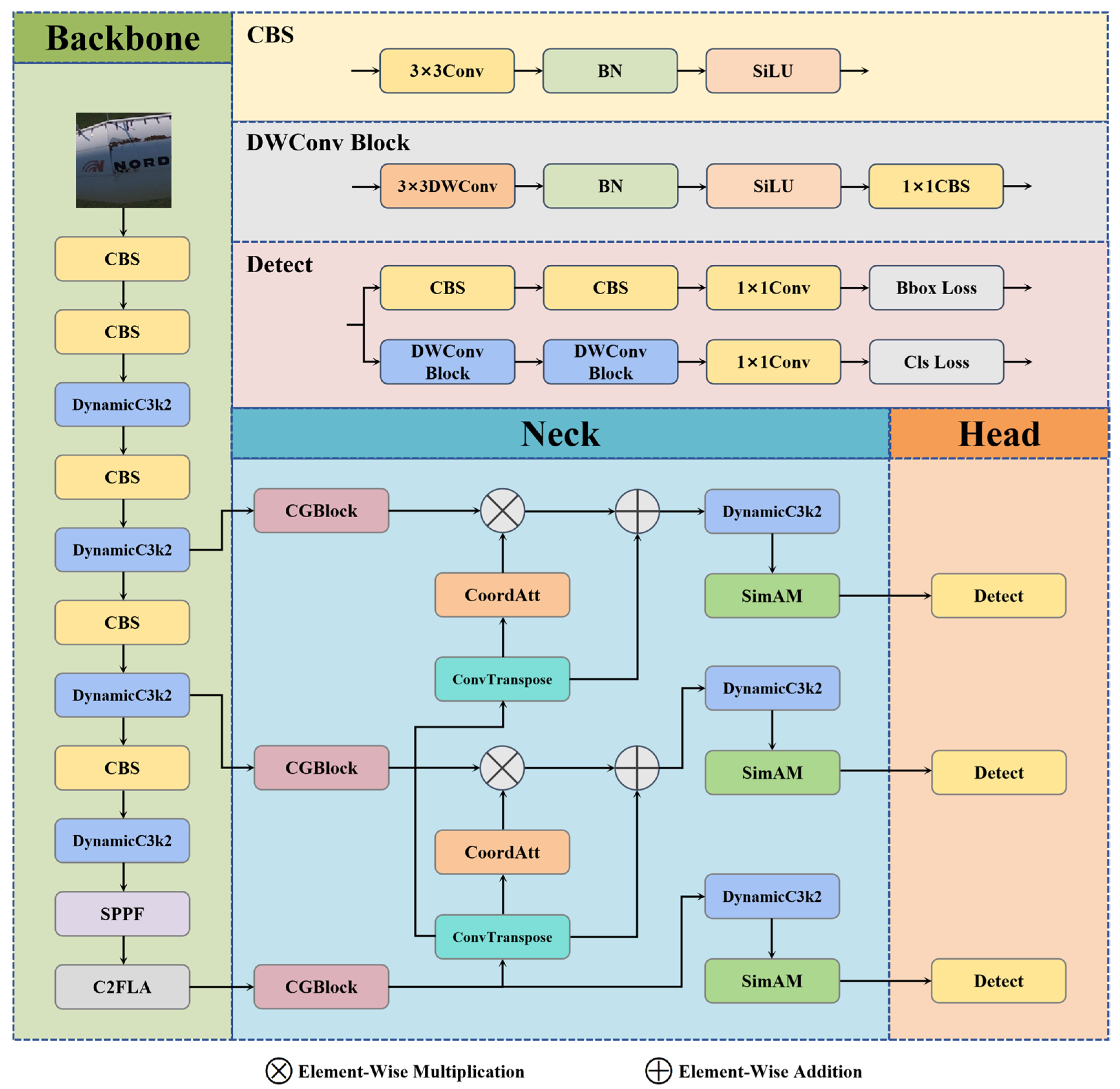
The overall architecture of Wind-YOLO is shown in Figure 1. Based on the YOLOv11 framework, the model is improved in three key dimensions: feature extraction, feature enhancement, and feature fusion. The lightweight architecture is developed to meet practical inspection demands, catering to limited computing resources, memory constraints, and real-time inference requirements of UAV and embedded inspection terminals. It aims to address the core challenges in defect detection. First, the backbone combines a dynamic convolution with the C3k2 structure to construct the DynamicC3k2 module. By dynamically adjusting convolution kernel weights, it adaptively fits various defect morphologies, enhances feature perception and representation, and supports subsequent feature processing. Second, the Cross-Stage Partial with Focused Linear Attention (C2FLA) is inserted after the SPPF module. Integrating a linear attention mechanism ensures the capture of long-range dependencies, enhances defect features, and suppresses interference. Third, the neck network is reconstructed into an improved Spatially Guided Gated Feature Pyramid Network (SGG-FPN). It enables deep interaction of multi-level features and provides high-quality defect representation and localization features for the detection head.

3.2. DynamicC3k2

Wind turbine surface defects differ from normal regions by irregular textures and abrupt grayscale changes, especially for microcracks and early delamination. Their detection requires adaptive multiscale feature capture rather than single high-level semantics. Existing YOLO-based methods rely on standard convolutions with fixed kernels, which extract only generic global features and fail to adapt dynamically to diverse defects. Such methods perform poorly on small, blurred defects under lighting or texture interference, leading to insufficient feature representation, low localization accuracy, and high false detection rates. The C3k2 module in YOLOv11 supports lightweight feature extraction through channel segmentation and cross-layer aggregation. However, the static structure of basic convolution units limits adaptability to complex and variable defects, leading to weak discrimination in scenes where defects are similar to background textures.
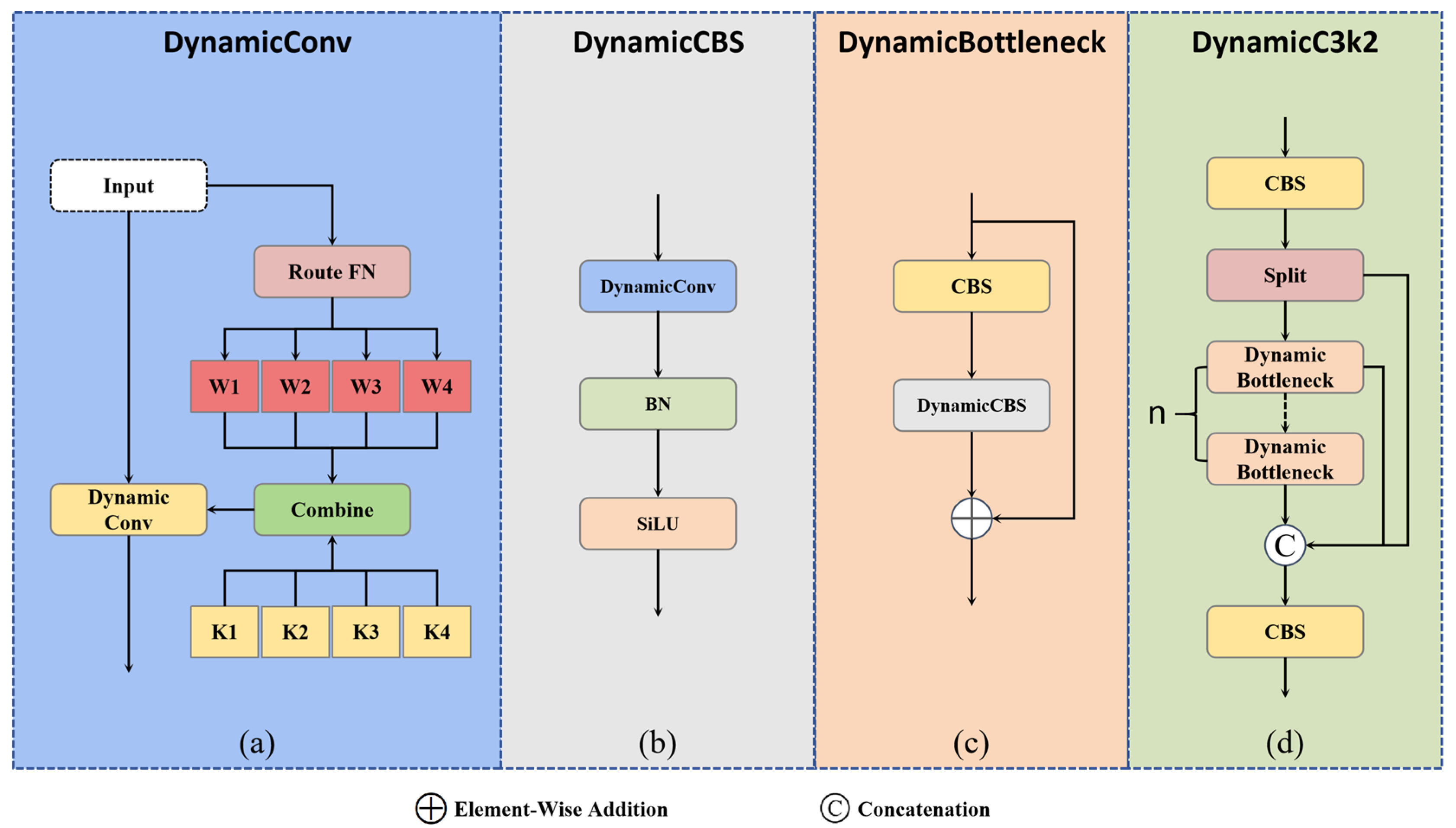
To address these limitations and enhance the model’s precision in capturing and representing defect features, we introduce DynamicConv [33]. It is deeply integrated into the Bottleneck and C3k2 modules of YOLOv11 to construct DynamicBottleneck and DynamicC3k2 modules in sequence, achieving an organic fusion of dynamic feature extraction with the original lightweight architecture. The core integration logic and workflow of the module are shown in Figure 2.
The foundation of this integration is DynamicConv. It breaks the fixed, globally shared constraints of traditional convolution kernels and achieves input-driven feature extraction by adaptively generating dedicated kernels tailored to input features. Its principle is to model the global information of input features through a Routing Network, generate weight coefficients for multiple expert kernels, and then fuse them to obtain dynamic kernels adapted to the current input, thus improving adaptability to complex and variable features. This process is embedded as a core unit in the feature extraction chains of DynamicBottleneck and DynamicC3k2.
First, the input feature map X is subjected to global average pooling and flattening to extract the global feature vector F global . This operation integrates the overall spatial information of the input feature map, providing a global feature basis for weight generation, as shown in Equation (1):
F global = flatten ( AdaptiveAvgPool 2 d ( X , 1 ) )
Second, the routing network generates weight coefficients for expert convolutional kernels, dynamically adjusting their contribution ratios, as shown in Equation (2):
W route = Sigmoid ( Linear ( F global , N expert ) )
where Linear denotes the linear layer that maps the global feature vector to a N expert dimensional vector, with N expert being the number of expert kernels. The Sigmoid activation normalizes the weights to the range (0, 1). The generated weights W route control the contribution ratio of each expert kernel, laying the foundation for dynamic kernel generation. In this work, N expert is set to 4, as this value achieves the optimal balance between feature diversity and detection performance for wind turbine defect detection.
Finally, the conditional convolution layer fuses the expert kernels and dynamically extracts features, producing a feature map tailored to the current input. This output is directly fed into the feature pipeline of subsequent modules, as shown in Equation (3):
Y = CondConv 2 d ( X , W route ) = i = 1 N expert W i K i × X
where W i represents the i-th expert weight generated by the routing network, and K i denotes the i-th expert convolutional kernel. For the input feature map X, the weights W route generated by the routing network are used to fuse all expert convolutional kernels, yielding a dynamic convolutional kernel adapted to the current input. This dynamic kernel then convolves the input feature map X and outputs the dynamically extracted feature map Y.
Based on the above DynamicConv, we first integrate it into the original Bottleneck structure of YOLOv11 to construct DynamicBottleneck, which achieves dynamic feature extraction enhancement at the bottleneck. Then, based on DynamicBottleneck, we further integrate it into the C3k2 module to construct DynamicC3k2, completing full-link dynamic enhancement from basic units to composite modules.
The native Bottleneck in YOLOv11 adopts a bottleneck structure with dimension reduction followed by dimension expansion using two convolutional layers. We optimize its core feature-extraction pipeline by replacing the second 3 × 3 static convolution with the DynamicConv. This design fully retains the original channel compression and residual connection mechanisms, ensuring compatibility with the original network structure. The feature propagation process is shown in Equation (4):
X out = X in + DynamicConv ( Conv ( X in , c , 1 ) )
where X in is the input feature of the module, X out is the output feature, and c is the number of channels after 1 × 1 convolution compression. This structure achieves deep fusion of static semantic features and dynamically adaptive features, which greatly enlarges the feature difference between defect regions and the background.
After integrating DynamicConv into DynamicBottleneck, we further construct the DynamicC3k2. This module fully preserves the core lightweight mechanisms of C3k2, including channel splitting and cross-layer feature aggregation, and replaces all Bottleneck units in the main branch with DynamicBottleneck. This design deeply embeds DynamicConv’s dynamic adaptation capability into the composite feature extraction pipeline. While maintaining lightweight, efficient inference, it alleviates the limitations of traditional static convolutions in complex scenes and significantly improves detection accuracy.

3.3. C2FLA

Wind turbine defects often appear small, weak in texture, and easily disturbed by complex backgrounds. The C2PSA module in YOLOv11 employs a dual-branch structure for lightweight feature extraction and applies basic attention to enhance key regions. However, such attention increases computational complexity and is unfavorable for real-time detection of high-resolution blade images. It also lacks directional guidance, indiscriminately enhances local regions, and cannot capture long-range dependencies between defects and backgrounds. As a result, defects are easily confused with background textures.
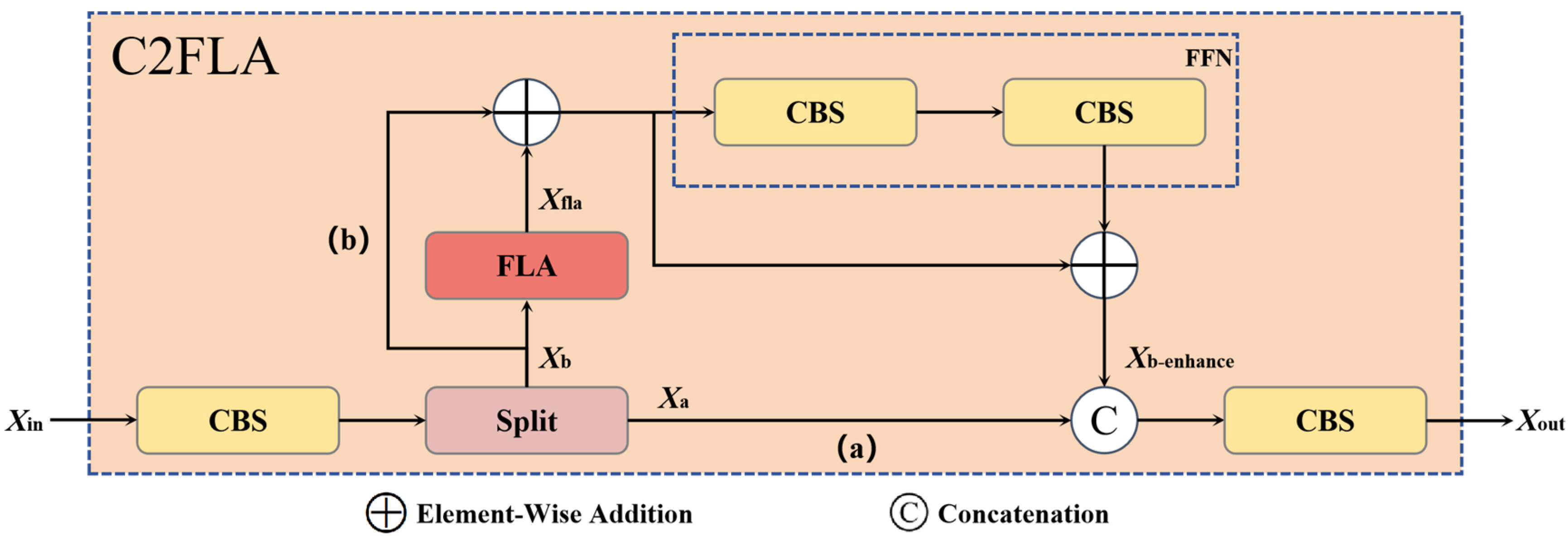
To address the above issues, this paper proposes a novel module, namely Cross-Stage Partial with Focused Linear Attention (C2FLA). It integrates the focused linear attention (FLA) mechanism [34] into the CSP dual-branch framework while retaining the original feed-forward network (FFN). This design preserves lightweight characteristics and controls time complexity. By introducing FLA into the vanilla C2CSP architecture, it achieves synergistic enhancement of global feature focusing and channel feature refinement. Its architecture is illustrated in Figure 3.
C2FLA employs a CSP dual-branch architecture and integrates Focused Linear Attention (FLA) and Feed-Forward Network (FFN) to form a serial residual enhancement stream, with FLA as the core module. By using focused linear attention, C2FLA alleviates the feature homogenization of conventional linear attention while achieving low computational cost, strong global feature modeling, and precise target focusing. By combining a focusing mechanism with rank recovery, it enables efficient global modeling. Its linear complexity reduces resource usage and meets the real-time demands of detection tasks. For query (Q) and key (K) vectors, power-enhanced focusing operations are utilized to enhance the discrimination of attention weights and strengthen feature weights within target regions. After global feature aggregation, depthwise convolution (DWC) is adopted to enrich local feature diversity. The proposed C2FLA achieves both effective global feature focusing and fine-grained local detail enhancement.
First, the input feature X in is adjusted by a 1 × 1 convolution and split into the shortcut branch (a) and the enhancement branch (b). The branch (a) retains the original features to minimize information loss and provide a stable feature baseline.
Subsequently, the enhancement branch (b) undergoes serial residual enhancement via FLA global focusing and FFN channel refinement. This attention unit projects features from the branch (b) into query (Q), key (K), and value (V) vectors through a linear layer. Its weight calculation avoids the limitations of traditional linear attention. These limitations include insufficient feature diversity (rank deficiency) and weak defect focusing, arising from direct similarity-based weight computation. Specifically, the focusing mechanism first applies ReLU activation to Q and K to ensure non-negativity. A power operation (focusing factor p = 3 ) is then applied to amplify the feature differences between defects and the background. Finally, norm restoration maintains stable feature amplitudes, directing attention weights to tilt significantly toward defect regions. The transformation is shown in Equations (5) and (6):
Q focus = ( ReLU ( Q ) + ϵ ) p | ( ReLU ( Q ) + ϵ ) p | | Q |
K focus = ( ReLU ( Q ) + ϵ ) p | ( ReLU ( Q ) + ϵ ) p | | K |
where ϵ = 10 6 is used to avoid numerical overflow during computation.
Based on the focused Q and K, the attention unit performs global feature aggregation with linear complexity. It first calculates the global weighted aggregation of K and V to construct a feature bank. Then it fuses the result with Q to generate attention-enhanced features X attn . A normalization factor z is also introduced to avoid overflow in weight summation. The computation process is shown in Equations (7) and (8):
X attn = Q focus ( K focus T V ) z
z = 1 sum ( Q focus K focus T , dim = 1 ) + ϵ
This linear-complexity approach avoids the high computational overhead of traditional attention, which has O ( N 2 ) complexity, while effectively capturing long-range correlations across the entire image. It enables efficient global feature association between defects and backgrounds. To address the inherent rank deficiency of linear attention, the attention unit employs depthwise convolution (DWC) as a rank recovery module. It rearranges V into image format and uses per-channel convolution to enrich local feature diversity. The data is then rearranged back into sequence format and connected with the attention output through a residual connection. Finally, the attention-refined feature X fla is obtained, as shown in Equation (9):
X fla = X attn + Reshape ( DWC ( Reshape ( V ) ) )
The FLA and FFN form an efficient synergistic enhancement logic for global feature focusing and channel feature refinement. After the attention unit completes global long-range correlation modeling and precisely focuses on defect regions, the FFN performs nonlinear transformations on the focused features through its bottleneck, with channel expansion and compression, further strengthening the fine-grained feature representation of defects. The serial stacking of these two components achieves dual enhancement of global features and local channel features. The feature X b undergoes two residual enhancements to yield the output feature X b-enhance , as shown in Equation (10):
X b-enhance = X b + X fla + Conv 1 × 1 2 c c ( SiLU ( Conv 1 × 1 c 2 c ( X b + X fla ) ) )  
Finally, the feature X a is concatenated with the enhanced feature X b-enhance along the channel dimension. Then, a 1 × 1 convolution is adopted to fuse features and generate the final output of the module, as shown in Equation (11):
X out = Conv 1 × 1 ( Concat ( X a , X b-enhance ) )
The C2FLA module integrates FLA and FFN into the CSP dual-branch framework to enhance global feature focusing and local detail refinement. While maintaining a lightweight structure, it improves target feature discrimination in complex backgrounds. Embedding C2FLA into the YOLO backbone can reduce small-target miss detection and background-induced false detection, thus improving detection accuracy and localization.

3.4. SGG-FPN

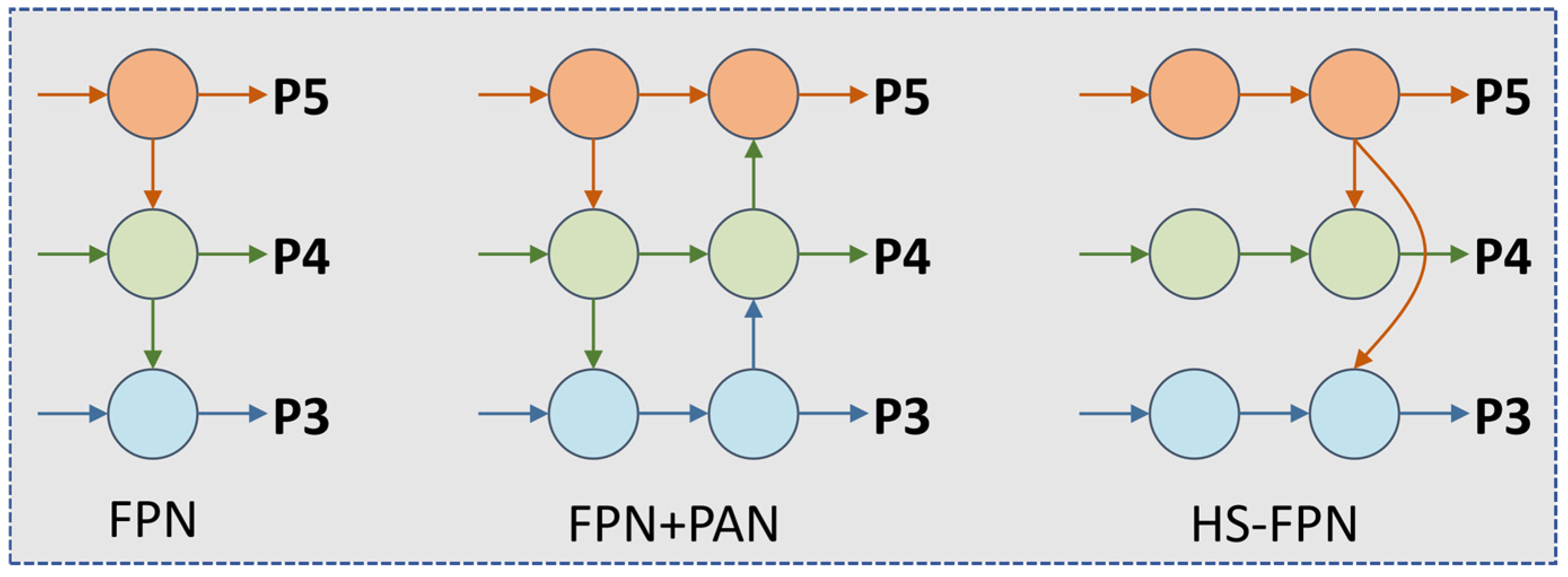
Blade surface defects come in diverse types and exhibit large-scale variations, ranging from millimeter-level microcracks and fine scratches to meter-level coating peeling and structural damage. Defects at different scales require distinct feature representations, which impose strict requirements on multiscale adaptability and anti-interference capability of feature fusion networks. As a mainstream object detection model, YOLOv11 adopts a native feature fusion architecture that combines the Feature Pyramid Network (FPN) [35] and the Path Aggregation Network (PAN) [36]. FPN conveys high-level semantic features top-down, and PAN supplements low-level detail features bottom-up to realize basic multiscale feature fusion. However, this architecture is not optimized for industrial defect detection. It is difficult to adapt to complex conditions, such as blade surface curvature and illumination variation, which can easily lead to feature attenuation and insufficient scale adaptability. Therefore, we adopt Hierarchical Structure FPN (HS-FPN) [37] as the basic fusion structure. Through hierarchical feature transmission and lateral connections, this architecture enhances ordered propagation and deep complementarity among multiscale features, providing a more stable foundation for multiscale defect-feature fusion in complex scenarios. The structures are illustrated in Figure 4.
Building the HS-FPN fusion framework, we propose the Spatially Guided Gated Feature Pyramid Network (SGG-FPN), tailored for wind turbine blade defect detection. The architecture follows the hierarchical fusion logic of HS-FPN and builds a full-chain feature optimization system with collaborative core modules. It enables accurate localization, efficient fusion, and refined feature purification. SGG-FPN fully considers the extraction and fusion of multiscale defect features and integrates Coordinate Attention (CoordAtt) [38], GSConv [39], transposed convolution, DynamicConv, and SimAM [40]. It leverages hierarchical feature transmission in HS-FPN. CoordAtt accurately locates defect regions in both spatial and channel dimensions. GSConv performs efficient feature fusion at low computational cost. Transposed convolution aligns cross-scale features precisely. DynamicConv extracts multiscale defect features adaptively. SimAM further refines features to increase the ratio of effective information.
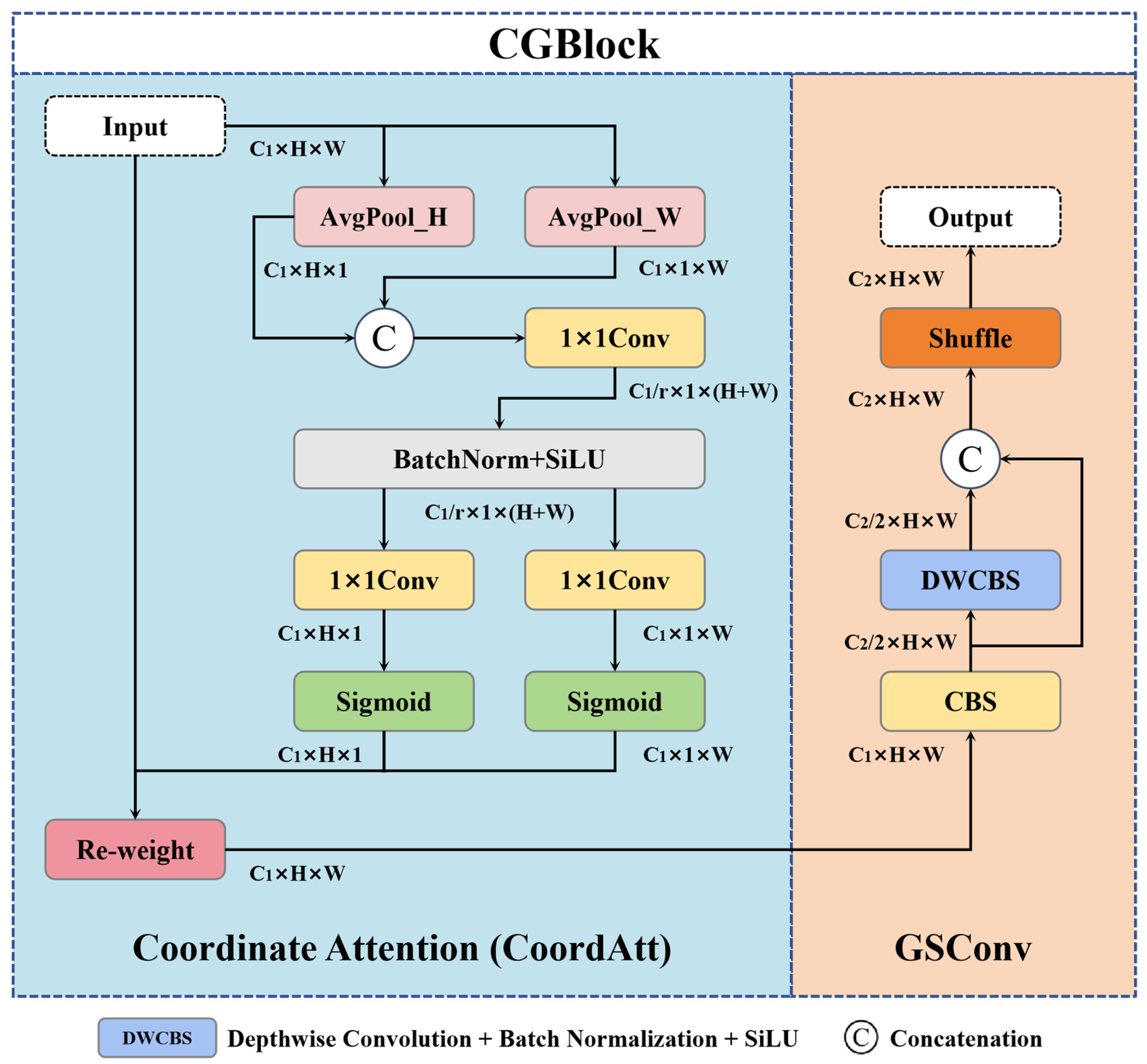
As the core logical unit for feature extraction and preliminary fusion in this architecture, the detailed structure and channel dimension transformation of CGBlock are illustrated in Figure 5. Its parameterized design follows strict logical mapping, with input channels C 1 , output channels C 2 , and a reduction ratio r introduced in the module to balance computational complexity and feature expressiveness. During the coordinate attention phase, input feature dimensions are mapped to the intermediate space C 1 / r . This dimension mapping operation significantly reduces parameters while fully preserving the most discriminative spatial and channel weight information.
The Coordinate Attention integrated into CGBlock overcomes the limitation of traditional channel attention, which ignores positional information. It decomposes channel attention into two one-dimensional encodings and aggregates features along horizontal and vertical directions separately. For the input feature x R C × H × W , where C , H , W denote channels, height, and width, pooling kernels of sizes ( H , 1 ) and ( 1 , W ) are applied to aggregate spatial information. For the c -th channel x c , x c h , i and x c j , w represent feature values at spatial coordinates ( h , i ) and ( j , w ) . The horizontal and vertical average aggregations produce direction-aware features z c h and z c w , which are presented in Equations (12) and (13):
z c h ( h ) = 1 W 0 i < W x c ( h , i )  
z c w ( w ) = 1 H 0 j < H x c ( j , w )
Subsequently, the aggregated feature is concatenated along the spatial dimension. Lightweight convolution and nonlinear transformation are applied to split the feature into horizontal and vertical attention components g c h and g c w , where c denotes the channel index. The re-weight module in Figure 5 then performs precise calibration of the original features via element-wise multiplication, which is formulated as Equation (14):
y c ( i , j ) = x c ( i , j ) × g c h ( i ) × g c w ( j )
This position-sensitive modeling approach enables SGG-FPN to precisely locate subtle defects under complex backgrounds of wind turbine blades. It provides reliable spatial guidance for subsequent feature encoding.
During feature encoding, CGBlock adopts the lightweight GSConv for efficient feature mapping. GSConv integrates standard and depthwise convolutions in a dual-branch parallel structure, capturing dense inter-channel correlations and spatial details with low computational cost. After feature fusion, it applies feature shuffle to alleviate the lack of cross-channel communication in depthwise convolution. Dimension rearrangement propagates semantic information globally, preserving lightweight efficiency and strong nonlinear expression while improving the model’s anti-interference robustness.
CGBlock serves as the first key unit for receiving backbone features in the Neck of SGG-FPN and is mainly responsible for feature purification and spatial pre-calibration. Since raw backbone features contain substantial background noise, CGBlock leverages CoordAtt and GSConv to suppress redundant information before deep fusion. As a result, the features delivered to subsequent FPN stages are refined with a high spatial signal-to-noise ratio, which suppresses the layer-by-layer diffusion of low-level noise in multiscale fusion and provides a stable initialization for the entire feature pyramid modeling.
In the deep alignment stage of feature fusion within the neck component (shown in Figure 1), transposed convolution unifies cross-scale feature dimensions. Using learnable kernels, it maps high-level semantic features back to high-resolution space, aligning them with low-level structural details and eliminating spatial dislocation and detail blurring induced by traditional upsampling.
Meanwhile, the gated fusion mechanism generates Sigmoid-activated dynamic weights from high-level features F high to adaptively filter low-level features F low , as shown in Equation (15):
F out = Sigmoid ( F high ) F low F high
where denotes element-wise weighted multiplication, and denotes element-wise addition. This mechanism selectively mitigates redundant background noise while amplifying the saliency of target-related features, especially for small-scale objects, thereby establishing a high signal-to-noise ratio feature foundation to support robust subsequent feature refinement and multiscale fusion.
The DynamicC3k2 in the Neck serves as a post-processing component for fused cross-scale features. It adaptively calibrates and fine-tunes the features by targetedly adjusting convolutional kernel weights based on the visual saliency and scale characteristics of target regions. By focusing on feature refinement after multiscale integration, it suppresses mismatched responses and strengthens semantically consistent representations across different scales. Such targeted refinement effectively enhances cross-scale feature coherence and produces robust, scale-adaptive representations for the detection head.
As the terminal module for feature refinement in SGG-FPN, SimAM is derived from neuroscientific spatial inhibition theory. It achieves high-purity feature extraction and thorough suppression of redundant information without introducing additional parameters. Distinct from conventional channel or spatial attention mechanisms that rely on manually designed feature interaction patterns, SimAM quantifies the importance of individual neurons for defect discrimination tasks by defining the energy function of each neuron, as presented in Equation (16):
e t ( w t , b t , y , x i ) = 1 M 1 i = 1 M 1 ( 1 ( w t x i + b t ) ) 2 + ( 1 ( w t t + b t ) ) 2 + λ w t 2
where t denotes the target neuron, x i represents the surrounding neurons within the same receptive field, w t and b t are the weight and bias of the linear transformation that maps neuron responses to binary classification scores, λ is the regularization coefficient, and M is the total number of neurons in the region. This energy function measures the linear separability between the target neuron t (assigned a label of 1) and its surrounding neurons (assigned a label of −1): the first term computes the squared classification error of the linear model, while the second term acts as an L2 regularization on the weight w t .
By minimizing this energy function, SimAM quantifies neuron discriminability: background neurons with homogeneous responses yield high energy (low discriminability), while target neurons with distinct distributions produce low energy (strong discriminability). Using these energy values, SimAM amplifies discriminative target responses and suppresses redundant background responses, enabling efficient feature selection and enhancement. The final energy weight calculation is given in Equation (17):
X ˜ = Sigmoid 1 E X
where E represents the neuron energy value, and denotes the element-wise Hadamard product. This operation achieves accurate purification of defect features without introducing extra parameters or computational overhead. It ensures high discriminative coherence and signal-to-noise ratio for features fed into the detection head, providing effective support for subsequent target localization and classification.
The SGG-FPN constructs a full-link feature optimization system tailored for defect detection, forming an effective feature enhancement paradigm. Through spatial guidance and dynamic adaptation, it alleviates feature distortion, background redundancy, and cross-scale inconsistency. By integrating lightweight GSConv and parameter-free SimAM attention, it greatly reduces computation while maintaining high feature discriminability and integrity, achieving a better balance between accuracy and speed.
Compared with the original FPN-PAN in YOLOv11, SGG-FPN provides robust multiscale coverage with fewer redundant parameters. It reduces small-target miss rate and captures large-target global features precisely, supporting lightweight, high-precision deployment in resource-constrained environments and enhancing feature representation and practicality in complex industrial scenarios.

4. Experimental Results and Analysis

4.1. Dataset

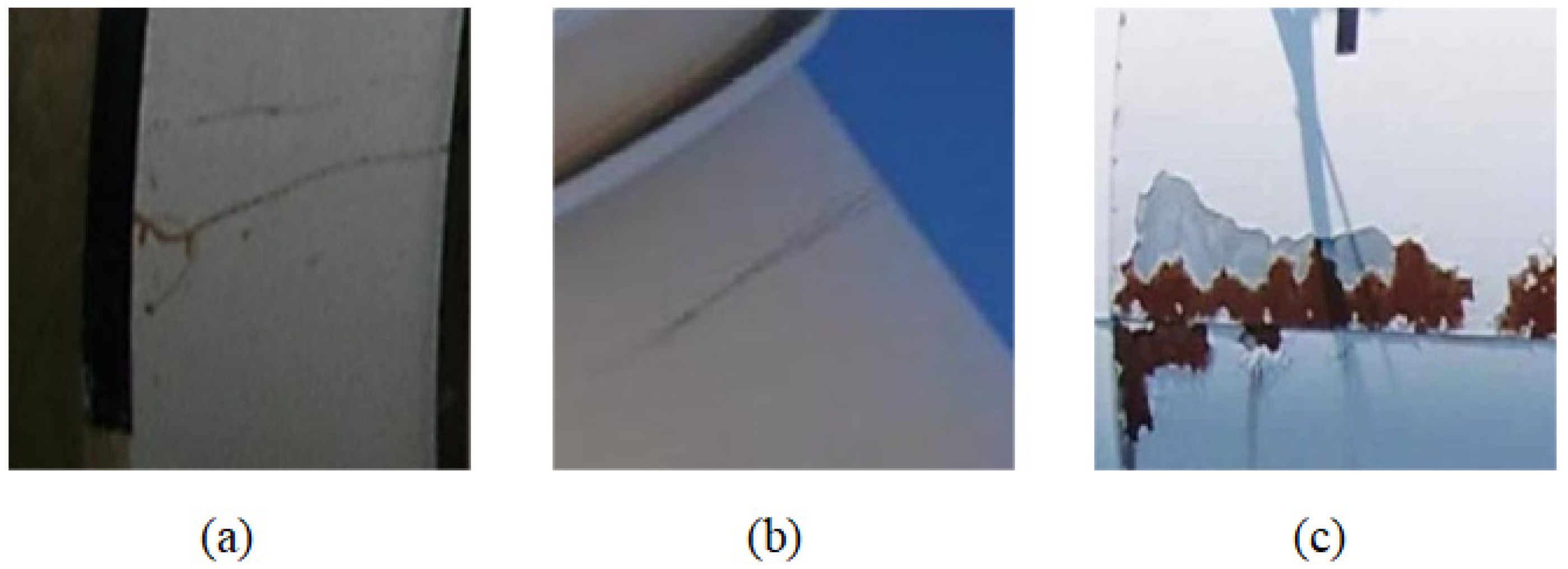
Addressing the demand for surface defect detection on multi-component wind power equipment, this study builds an experimental dataset through multi-source data integration and targeted enhancement. The dataset combines a public industry dataset [41] and practical damage samples of blades, turbines, and towers from wind farms. To alleviate the imbalance of sample distribution and singleness of scenes, data augmentation is adopted. It includes random flipping, brightness and contrast disturbance, local occlusion, and scale scaling. The final dataset contains 3633 images. All images are resized to a resolution of 640 × 640, and annotations follow the standard YOLO format. The dataset is divided into training, validation, and test sets with a ratio of 7:2:1, containing 2538, 739, and 356 images, respectively. It includes three typical defects: coating defects, surface scratches, and paint peeling. These defects exist on blades, turbines, towers, and other components, as shown in Figure 6.

4.2. Experimental Setup

The experiments were carried out on computing nodes equipped with NVIDIA A100 PCIe-40GB GPUs and Intel Xeon series CPUs. The experimental environment was built on the Linux operating system, utilizing the PyTorch 2.5.0 deep learning framework along with the CUDA 12.1 parallel computing platform. GPU computational performance optimization was achieved through the integration of the cuDNN 9.1 deep neural network acceleration library, with Python version 3.9.25. To ensure fairness and comparability of the experiments, all models were trained with weights initialized from scratch, without employing any pre-trained weights. Additionally, Automatic Mixed Precision (AMP) training was disabled to avoid the impact of numerical precision fluctuations on training stability. Training parameter settings are summarized in Table 1, while training augmentation hyperparameters are presented in Table 2.

4.3. Evaluation Metrics

In the experimental validation of object detection tasks, this paper adopts a widely recognized standardized evaluation metric system, conducting a comprehensive quantitative evaluation of the proposed model from two core dimensions: model complexity and detection accuracy. It specifically includes Parameters, Giga Floating-Point Operations Per Second (GFLOPs), and mean Average Precision (mAP) series, with their definitions and calculation methods detailed below.
Parameters refer to the total number of all trainable parameters in the neural network model, while GFLOPs denote the total floating-point operations required for a single forward propagation. As core metrics for model complexity, lower values indicate less storage and computational resources, facilitating lightweight deployment on edge devices to meet real-time engineering detection needs.
Mean Average Precision (mAP) is the core metric for evaluating detection accuracy. Derived from Precision and Recall, it comprehensively characterizes the model’s overall performance in target recognition and localization, as shown in Equations (18)–(21):
P r e c i s i o n = T P T P + F P
R e c a l l = T P T P + F N
A P = 0 1 P ( R ) d R
mAP = 1 N i = 1 N AP i
where TPs (True Positives) represents the number of correctly detected positive samples, FPs (False Positives) denotes the number of negative samples misclassified as positive samples, also referred to as false alarms. FNs (False Negatives) indicates the number of real positive samples that fail to be detected, also known as missed detections. Precision is defined as the ratio of correctly detected positive samples to the total number of detection results. Recall is defined as the ratio of correctly detected positive samples to the total number of real positive samples. Average Precision (AP) for a single category is the area under the Precision-Recall curve. For multi-category detection, mAP is the average of AP values over all categories, where N in Equation (21) represents the number of categories.
In addition, Intersection over Union (IoU) refers to the ratio of the intersection area to the union area between the predicted region and the ground-truth region. Setting the IoU threshold to 0.5 yields mAP@0.5. The mAP@0.5:0.95 metric is widely used for comprehensive performance evaluation, computed as the average mAP over IoU thresholds from 0.5 to 0.95 at a step size of 0.05.
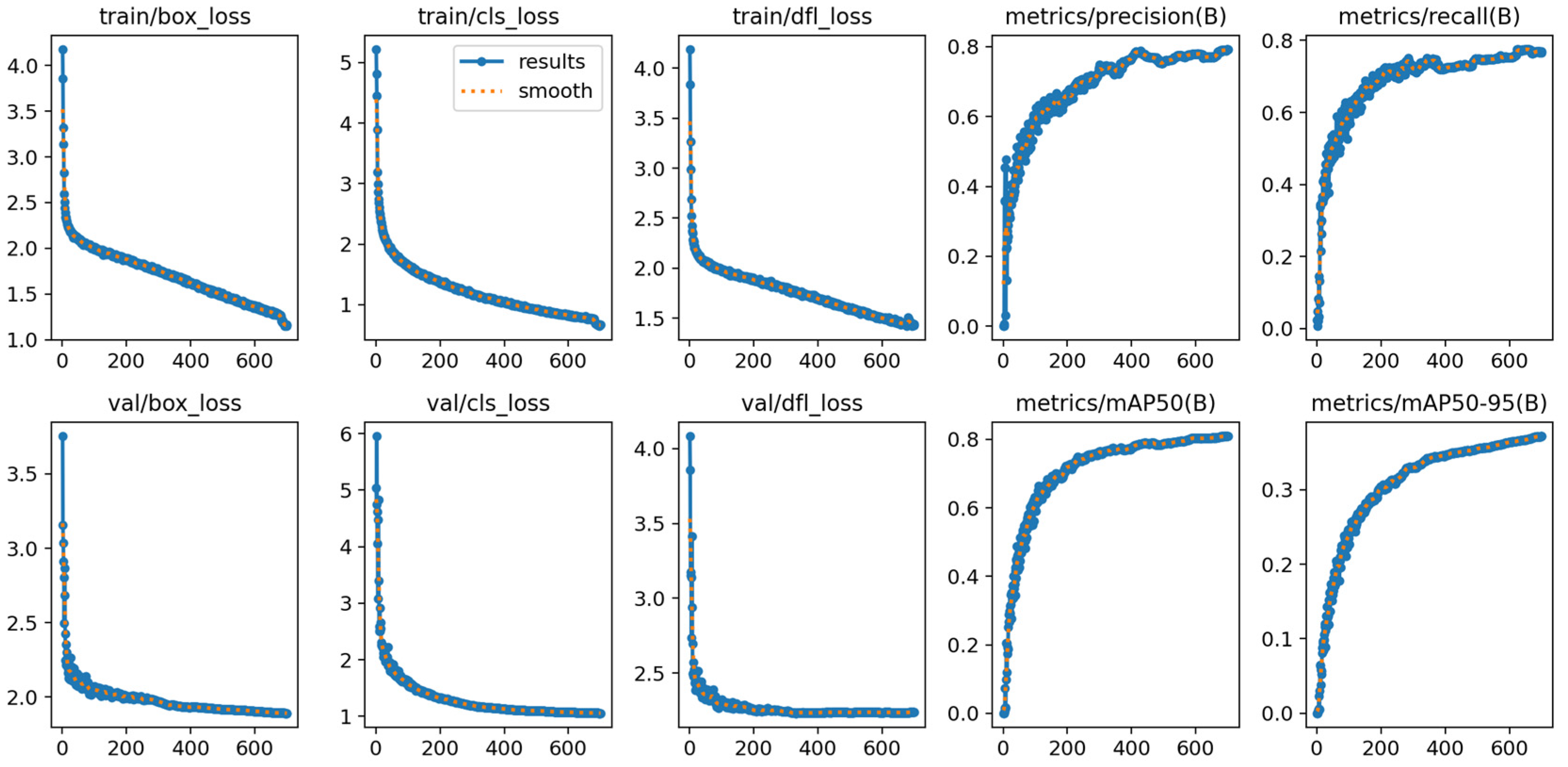
To intuitively present the dynamic evolution of evaluation metrics during training, Figure 7 shows the training loss and performance curves of the Wind-YOLO model for surface defect detection of wind turbines. Observing the convergence of precision, recall, and mAP over training epochs further validates training stability and detection effectiveness.

4.4. Comparison Experiment

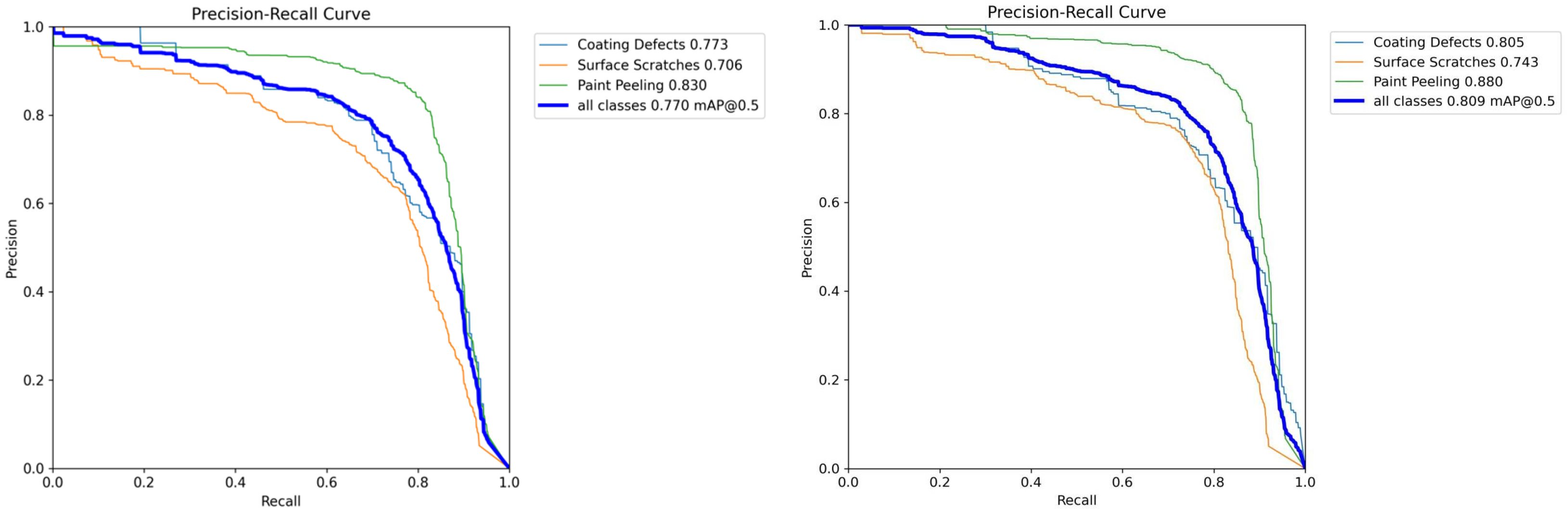
Figure 8 presents the precision-recall curves of YOLOv11n and Wind-YOLO for three defect categories and the overall performance. The four curves correspond to coating defects, surface scratches, paint peeling, and the average PR curve. It can be clearly observed that Wind-YOLO consistently outperforms YOLOv11n across all four curves. For coating defects, Wind-YOLO maintains higher precision at the same recall level. For surface scratches, its curve is notably higher, especially in the middle recall range, where YOLOv11n shows a sharp decline. For paint peeling, Wind-YOLO achieves a higher precision ceiling and a slower drop at high recall values. The average PR curve of Wind-YOLO also lies entirely above that of YOLOv11n, demonstrating its comprehensive superiority in detection accuracy and stability.
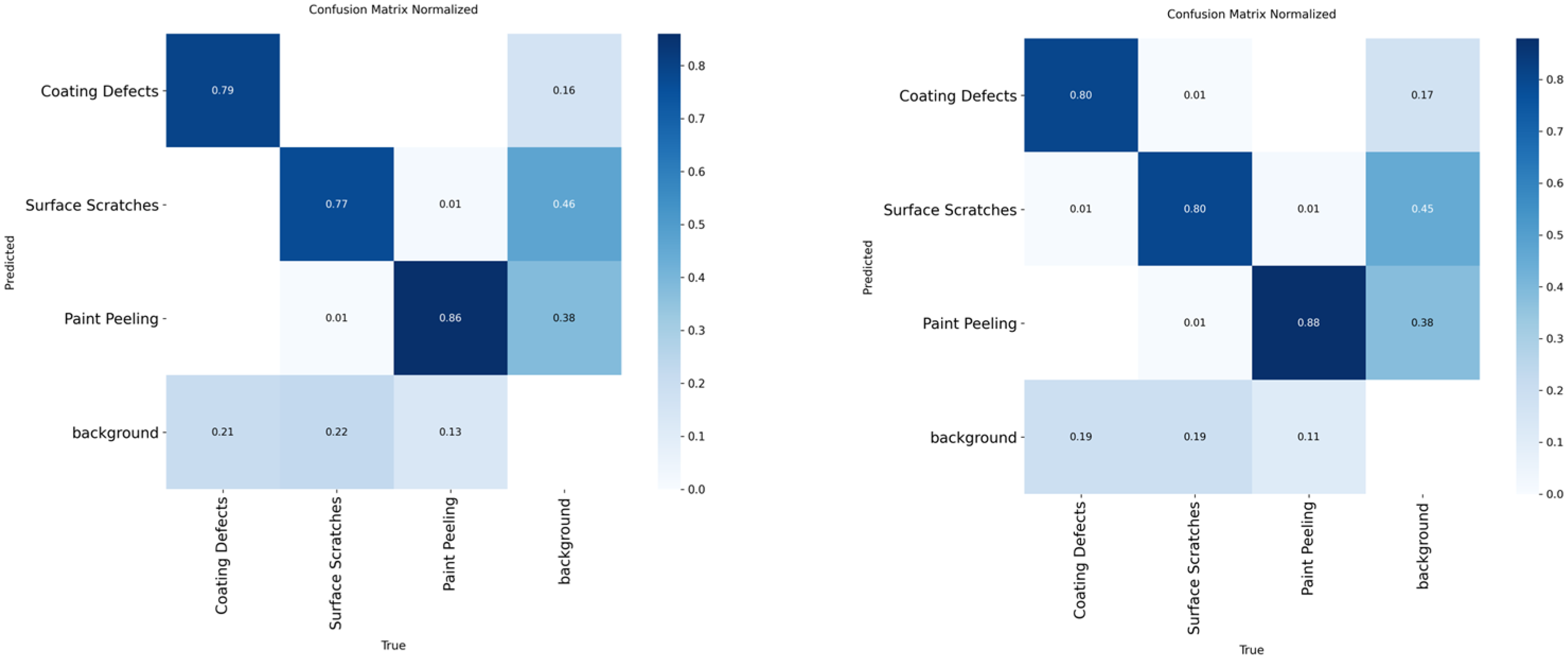
Figure 9 shows the normalized confusion matrices of YOLOv11n and Wind-YOLO. The diagonal elements represent recall values, while off-diagonal elements indicate misclassification rates. Compared with YOLOv11n, Wind-YOLO achieves higher recall for all three defect classes. The recall for coating defects increases from 0.79 to 0.80, surface scratches from 0.77 to 0.80, and paint peeling from 0.86 to 0.88. Meanwhile, Wind-YOLO effectively reduces misclassification between different defects and misclassification of defects as background. The proportion of defects misclassified as background decreases significantly, resulting in fewer false negatives. Inter-class confusion is effectively reduced, demonstrating stronger feature discrimination and improved ability to distinguish visually similar defects.
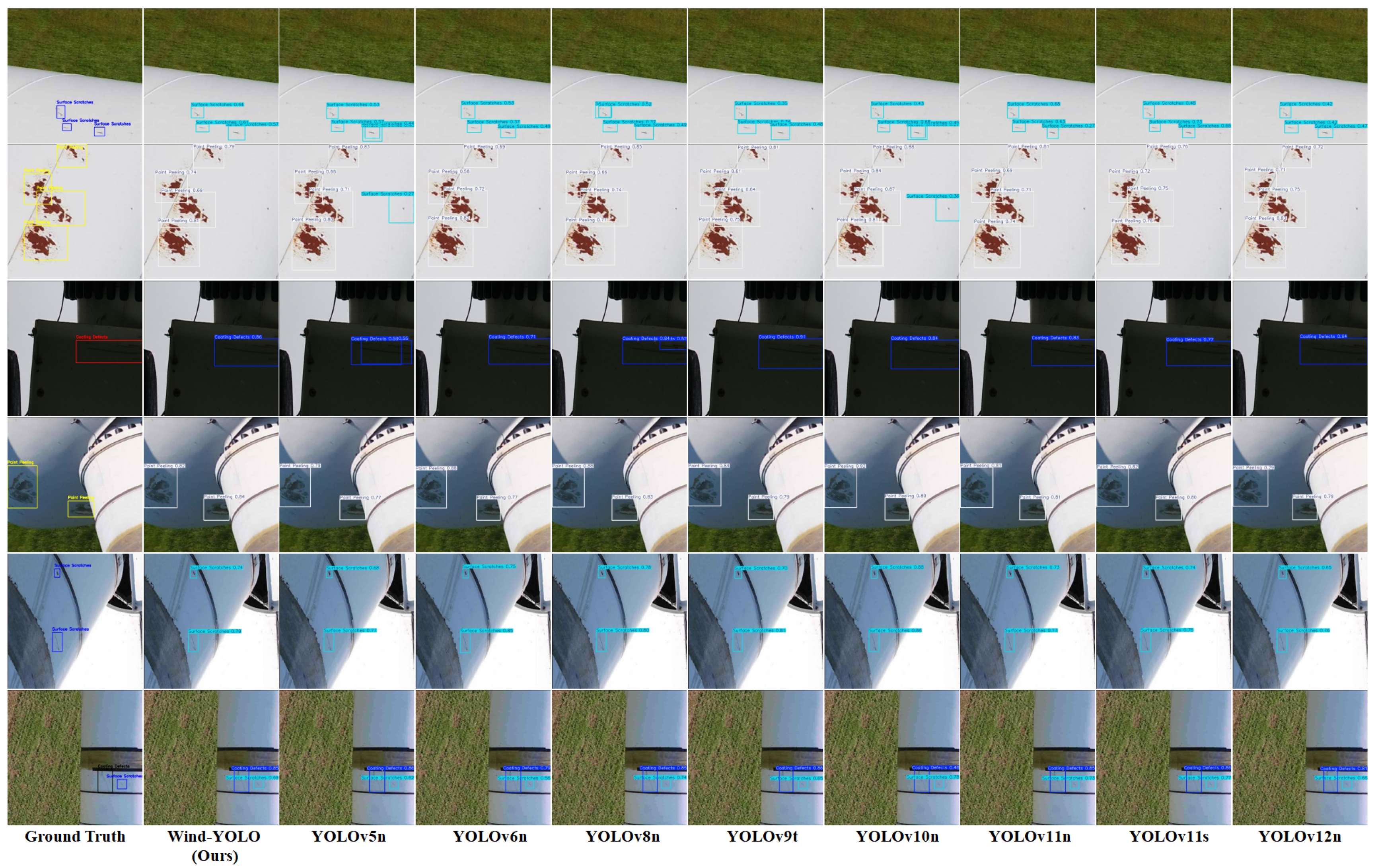
Table 3 presents a comprehensive performance comparison between Wind-YOLO and successive lightweight YOLO models on the wind turbine defect dataset. In terms of model complexity, Wind-YOLO achieves an optimal lightweight configuration with only 2.34 M parameters and 6.0 GFLOPs. It has fewer parameters than all compared models except YOLOv9t, and the lowest computational cost among all evaluated models. Specifically, its GFLOPs are 0.4 lower than YOLOv11n and 0.5 lower than YOLOv12n. In terms of detection accuracy, Wind-YOLO outperforms all baseline models across nearly all metrics. It achieves the highest precision of 79.1% and the highest mAP0.5 of 80.9%, representing a 3.9% improvement over YOLOv11n. The mAP0.5:0.95 also reaches 37.1%, leading the second-best model (YOLOv11s) by 1.3%. At the category level, Wind-YOLO delivers substantial improvements, especially for paint peeling with an AP of 88.0%, which is 4.6% higher than the best baseline. For surface scratches, it reaches 74.3%, outperforming all other models by at least 3.1%. The overall recall of 76.8% is also competitive among lightweight models. These quantitative results are further validated by the visual comparisons in Figure 10, which display the detection outputs of several models on typical defect images. It can be seen that Wind-YOLO achieves better detection accuracy and localization precision, with fewer missed detections and false positives under complex conditions.
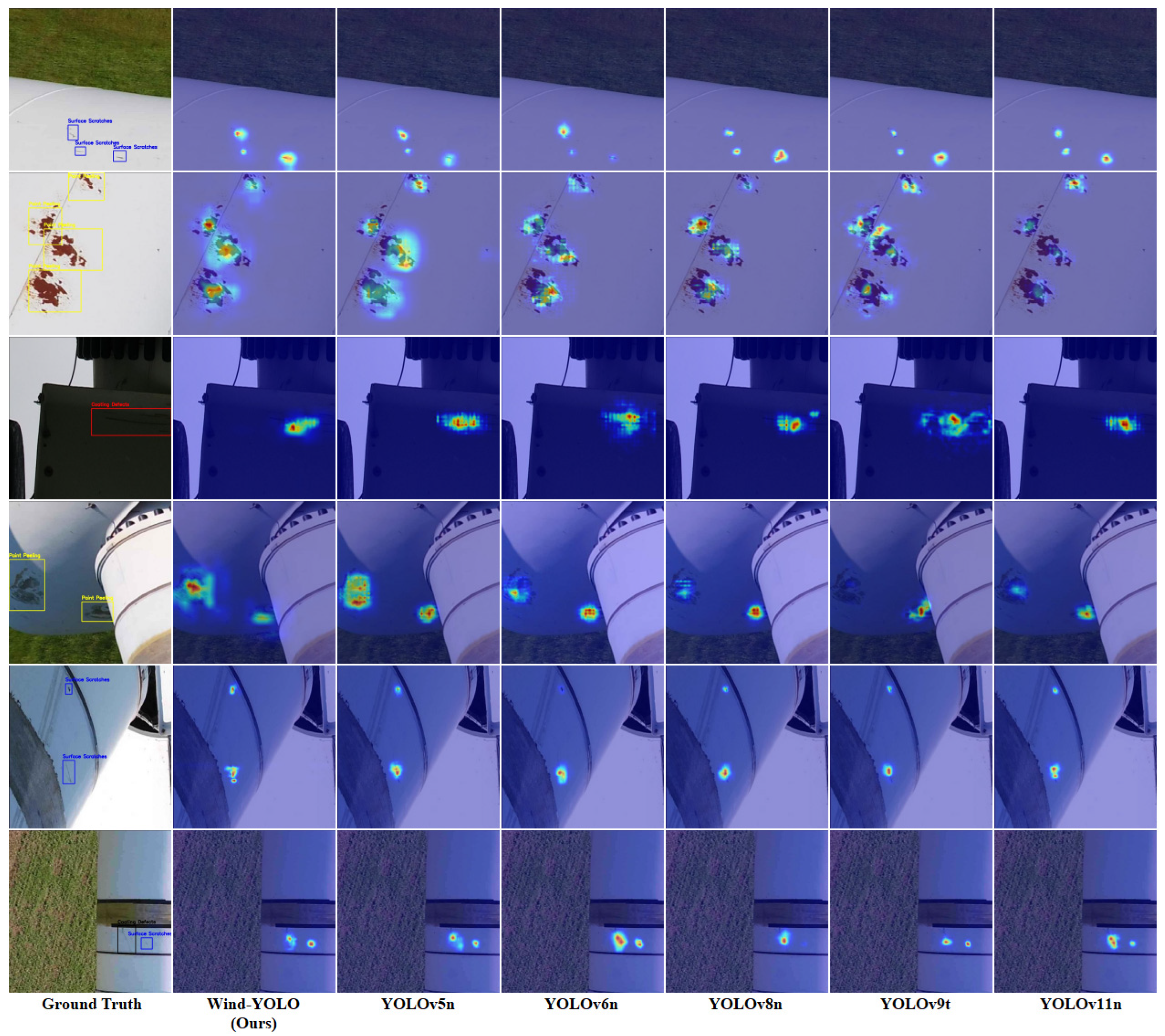
A comparison of visualization heatmaps is provided with LayerCAM [42] at the Neck output for Wind-YOLO and several comparative methods in Figure 11. Heat response regions show closer alignment with actual defect locations. Core textures and contour boundaries of defects receive accurate focus, and weak activation appears in noise regions such as background textures and surface reflections of blades. Superior defect localization and interference suppression are achieved in complex scenes, which supports stable and reliable feature discrimination in wind turbine defect detection.
Comprehensive experiments verify stable and distinct performance improvements of Wind-YOLO in wind turbine defect detection with strong robustness and adaptability. The most obvious accuracy enhancement is obtained for Paint Peeling, which covers large areas with blurred boundaries. Effective localization over large defect regions is realized through strengthened global feature extraction. For slender, low-contrast, and easily broken Surface Scratches, weak linear features are preserved via excellent spatial modeling and edge perception, leading to clear performance gains. For Coating Defects with subtle texture changes and high background confusion, real defects are distinguished reliably under complex interference through joint learning of local texture and multiscale structure information.
Compared with mainstream lightweight YOLO models, Wind-YOLO achieves higher detection accuracy and resource efficiency with fewer parameters and lower computation. It meets the requirements of lightweight design, high reliability, and edge deployment for wind turbine defect detection, and provides a valuable technical reference for industrial defect inspection.

4.5. Ablation Experiments

To explore the function of three proposed improvements in the whole network structure of Wind-YOLO and verify the effectiveness of each improvement, sufficient ablation experiments are carried out. Results are shown in Table 4, which includes all cases of individual and combined use of the three improvements.
Based on ablation experiments, replacing the traditional FPN-PAN architecture with the proposed SGG-FPN significantly reduces model parameters (−0.79 M) and computational complexity (−1.1 GFLOPs). It improves mAP0.5 by 1.6% over the baseline via efficient multiscale feature aggregation and redundant information suppression, effectively alleviating cross-scale feature decay under lightweight constraints, particularly aiding detection of small-sized surface scratches and defects with blurred boundaries.
C2FLA delivers the most significant accuracy gain, boosting mAP0.5 by 2.2% with only 0.02 M additional parameters. This improvement demonstrates its ability to achieve global long-range correlations and localized defect feature enhancement with minimal overhead, helping distinguish genuine defects from background noise such as blade surface textures and illumination reflections.
Replacing the original C3k2 with DynamicC3k2 improves mAP0.5 by 1.9%, validating the adaptability of dynamic convolutions in wind turbine defect detection. Compared with traditional static convolutions relying solely on fixed kernel parameters, dynamic convolutions adaptively adjust feature extraction strategies to explicitly amplify feature differences between defects of varying morphologies, enhancing model adaptability and detection accuracy for complex damage.
Pairwise combination of the three modules yields greater performance gains than individual use. DynamicC3k2 and SGG-FPN together boost mAP0.5 to 80.1%, outperforming single-module use by 1.2 and 2.5 percentage points, respectively. Integration of C2FLA with SGG-FPN attains 79.5% mAP0.5 with only 1.82 M parameters, achieving a favorable balance between lightweight constraint and high performance. Pairing DynamicC3k2 with C2FLA delivers 79.1% mAP0.5 at 2.90 M parameters, reinforcing collaboration between feature extraction and focusing mechanisms.
Deploying all three modules concurrently, the model reaches 80.9% mAP0.5 with 2.34 M parameters and 6.0 GFLOPs, forming a complementary synergistic mechanism: DynamicC3k2 handles adaptive feature extraction in the backbone, C2FLA manages global focusing and defect feature enhancement, and SGG-FPN enables precise multiscale feature fusion and noise suppression in the neck network. The three modules fulfill respective roles at different stages and collaborate seamlessly to construct an efficient feature processing pipeline for defect detection.

4.6. Discussion

Notably, comparison models such as YOLOv11s exhibit significantly higher parameters and computational costs than Wind-YOLO while delivering lower detection accuracy. It proves that a refined feature modeling strategy tailored to scene characteristics is far more crucial than simply increasing model scale and parameter redundancy in wind turbine defect detection. The core design of our Wind-YOLO focuses on lightweight optimization. All three proposed modules follow this principle, delivering targeted performance improvements with minimal parameter overhead. SGG-FPN constitutes the core of the lightweight design, eliminating redundant structures from traditional fusion frameworks. By coupling lightweight components with optimized fusion chains, it reduces model complexity and boosts multi-scale feature fusion efficiency. DynamicC3k2 provides adaptive feature extraction while keeping lightweight convolution structures. It captures diverse defect features precisely without introducing extra computational overhead. C2FLA achieves efficient defect focusing and effective noise reduction with only a small parameter increment. Global feature modeling and computational efficiency are well balanced in Wind-YOLO.
Wind-YOLO does not unthinkingly pursue excessive lightweight. It adapts to wind turbine defect detection needs with multiscale weak features and complex backgrounds through collaborative module design under lightweight constraints. DynamicC3k2 enables differentiated defect feature extraction. C2FLA focuses on defects and mitigates noise efficiently. SGG-FPN optimizes multiscale feature aggregation. Together, they achieve robust and consistent detection performance for various defects, validating the effectiveness of the proposed lightweight module innovations and scenario-specific design.

5. Conclusions

This paper proposes Wind-YOLO, a lightweight wind turbine defect detection model based on YOLOv11. It addresses key challenges, including large defect scale variations, weak features, complex backgrounds, and edge deployment constraints through our three improved modules. Wind-YOLO balances lightweight deployment, high accuracy, and robustness, alleviating performance shortages of traditional lightweight models in industrial scenarios and providing a practical solution for intelligent wind turbine inspection. Despite its competitive performance, Wind-YOLO still has limitations: the dataset covers insufficient defect types, and real-device deployment has not yet been implemented. Future work will expand dataset diversity to include more extreme lighting and motion blur scenarios and further optimize the model for edge device deployment in industrial applications.

Author Contributions

Methodology, H.T.; Software, H.T.; Formal analysis, H.T. and X.Z.; Validation, X.Z.; Investigation, B.H.; Resources, Y.W. and X.S.; Data curation, B.H.; Project administration, Y.W. and X.S.; Supervision, Y.W. and X.S.; Visualization, H.T.; Writing—original draft preparation, H.T.; Writing—review and editing, H.T., Y.W. and X.S. All authors have read and agreed to the published version of the manuscript.

Funding

This research received no external funding.

Data Availability Statement

Data will be made available on request.

Conflicts of Interest

The authors declare no conflicts of interest.

References

  1. IEA. Renewables 2024 Analysis and Forecasts; International Energy Agency: Paris, France, 2024. [Google Scholar]
  2. Kong, K.; Dyer, K.; Payne, C.; Hamerton, I.; Weaver, P.M. Progress and trends in damage detection methods, maintenance, and data-driven monitoring of wind turbine blades—A review. Renew. Energy Focus 2023, 44, 390–412. [Google Scholar] [CrossRef] [Scilit]
  3. Du, Y.; Zhou, S.; Jing, X.; Peng, Y.; Wu, H.; Kwok, N. Damage detection techniques for wind turbine blades: A review. Mech. Syst. Signal Process. 2020, 141, 106445. [Google Scholar] [CrossRef] [Scilit]
  4. GWEC. Global Wind Report 2024; Global Wind Energy Council: Brussels, Belgium, 2024. [Google Scholar]
  5. Yang, C.; Zhou, H.; Liu, X.; Ke, Y.; Gao, B.; Grzegorzek, M.; See, J. BladeView: Toward automatic wind turbine inspection with unmanned aerial vehicle. IEEE Trans. Autom. Sci. Eng. 2024, 22, 7530–7545. [Google Scholar] [CrossRef] [Scilit]
  6. Raišutis, R.; Jasiūnienė, E.; Žukauskas, E. Ultrasonic NDT of wind turbine blades using guided waves. Ultragarsas/Ultrasound 2008, 63, 7–11. [Google Scholar] [CrossRef] [Scilit]
  7. Sanati, H.; Wood, D.; Sun, Q. Condition monitoring of wind turbine blades using active and passive thermography. Appl. Sci. 2018, 8, 2004. [Google Scholar] [CrossRef] [Scilit]
  8. Sheiati, S.; Chen, X. Advances in computer vision-based structural health monitoring techniques for wind turbine blades. Renew. Sustain. Energy Rev. 2025, 224, 116078. [Google Scholar] [CrossRef] [Scilit]
  9. Jocher, G.; Chaurasia, A.; Qiu, J. Ultralytics YOLOv5 Documentation. 2020. Available online: https://github.com/ultralytics/yolov5 (accessed on 29 January 2026).
  10. Jocher, G.; Chaurasia, A.; Stoken, A. Ultralytics YOLOv8 Documentation. 2023. Available online: https://github.com/ultralytics/ultralytics (accessed on 29 January 2026).
  11. Ultralytics. YOLOv11: Real-time Object Detection for Edge Devices. 2024. Available online: https://github.com/ultralytics/ultralytics (accessed on 29 January 2026).
  12. Mittal, P. A comprehensive survey of deep learning-based lightweight object detection models for edge devices. Artif. Intell. Rev. 2024, 57, 242. [Google Scholar] [CrossRef] [Scilit]
  13. Wang, Y.; Zou, L. Research on surface damage detection of wind turbine blades based on machine vision. J. Phys. Conf. Ser. 2022, 2184, 012018. [Google Scholar] [CrossRef] [Scilit]
  14. Liu, L.; Li, P.; Wang, D.; Zhu, S. A wind turbine damage detection algorithm designed based on YOLOv8. Appl. Soft Comput. 2024, 154, 111364. [Google Scholar] [CrossRef] [Scilit]
  15. Liu, C.; An, C.; Yang, Y. Wind turbine surface defect detection method based on YOLOv5s-L. NDT 2023, 1, 46–57. [Google Scholar] [CrossRef] [Scilit]
  16. Zou, L.; Cheng, H. Research on wind turbine blade surface damage identification based on improved convolution neural network. Appl. Sci. 2022, 12, 9338. [Google Scholar] [CrossRef] [Scilit]
  17. Lv, L.; Yao, Z.; Wang, E.; Ren, X.; Pang, R.; Wang, H.; Zhang, Y.; Wu, H. Efficient and accurate damage detector for wind turbine blade images. IEEE Access 2022, 10, 123378–123386. [Google Scholar] [CrossRef] [Scilit]
  18. Zhang, C.; Wen, C.; Liu, J. Mask-MRNet: A deep neural network for wind turbine blade fault detection. J. Renew. Sustain. Energy 2020, 12, 055011. [Google Scholar] [CrossRef] [Scilit]
  19. Yang, X.; Zhang, Y.; Lv, W.; Wang, D. Image recognition of wind turbine blade damage based on a deep learning model with transfer learning and an ensemble learning classifier. Renew. Energy 2021, 163, 386–397. [Google Scholar] [CrossRef] [Scilit]
  20. Zhou, W.; Wang, Z.; Zhang, M.; Wang, L. Wind turbine actual defects detection based on visible and infrared image fusion. IEEE Trans. Instrum. Meas. 2023, 72, 3509208. [Google Scholar] [CrossRef] [Scilit]
  21. Zou, L.; Chen, A.; Li, C.; Yang, X.; Sun, Y. DCW-YOLO: An improved method for surface damage detection of wind turbine blades. Appl. Sci. 2024, 14, 8763. [Google Scholar] [CrossRef] [Scilit]
  22. Xiao, J.; Xu, L.; Li, C.; Tang, L.; Gao, G. MFYOLO: Improved UAV lightweighting algorithm for wind turbine blade surface visibility damage detection. Comput. Electr. Eng. 2025, 123, 110225. [Google Scholar] [CrossRef] [Scilit]
  23. Lv, F.; Wang, Y.; Wang, R.; Sun, B.; Zhou, F.; Bian, X. WHTMLDet: A wind turbine blade defect detection method integrating Channel Split-and-Conquer strategy and a Spatial Perception mechanism. Digit. Signal Process. 2026, 172, 105878. [Google Scholar] [CrossRef] [Scilit]
  24. Liu, D.; Liu, M. Wind turbine blades defect detection based on global and local attention with multi-feature fusion. Appl. Soft Comput. 2025, 185, 113914. [Google Scholar] [CrossRef] [Scilit]
  25. Dai, Z. Image acquisition technology for unmanned aerial vehicles based on YOLO-Illustrated by the case of wind turbine blade inspection. Syst. Soft Comput. 2024, 6, 200126. [Google Scholar] [CrossRef] [Scilit]
  26. Xu, W.; Yao, J.; Wang, Y.; Liu, C.; Liu, X.; Jiang, D. Wind turbine blade damage identification using lightweight YOLO11 with multiscale dilated attention. Appl. Soft Comput. 2025, 185, 114042. [Google Scholar] [CrossRef] [Scilit]
  27. Zhao, C.; Shu, X.; Yan, X.; Zuo, X.; Zhu, F. RDD-YOLO: A modified YOLO for detection of steel surface defects. Measurement 2023, 214, 112776. [Google Scholar] [CrossRef] [Scilit]
  28. Qin, D.; Leichner, C.; Delakis, M.; Fornoni, M.; Luo, S.; Yang, F.; Wang, W.; Banbury, C.; Ye, C.; Akin, B.; et al. MobileNetV4: Universal models for the mobile ecosystem. In Proceedings of the European Conference on Computer Vision, Milan, Italy, 29 September–4 October 2024; pp. 78–96. [Google Scholar]
  29. Zhang, X.; Zhou, X.; Lin, M.; Sun, J. Shufflenet: An extremely efficient convolutional neural network for mobile devices. In Proceedings of the IEEE Conference on Computer Vision and Pattern Recognition, Salt Lake City, UT, USA, 18–23 June 2018; pp. 6848–6856. [Google Scholar]
  30. Han, K.; Wang, Y.; Tian, Q.; Guo, J.; Xu, C.; Xu, C. Ghostnet: More features from cheap operations. In Proceedings of the IEEE/CVF Conference on Computer Vision and Pattern Recognition, Seattle, WA, USA, 13–19 June 2020; pp. 1580–1589. [Google Scholar]
  31. Wang, Y.; Ye, H.; Shu, X. BSE-YOLO: An Enhanced Lightweight Multiscale Underwater Object Detection Model. Sensors 2025, 25, 3890. [Google Scholar] [CrossRef] [Scilit]
  32. Shen, H.; Shu, X.; Guo, X.; Shao, C.; Xie, Z. Enhancing defect detection in photovoltaic cells: A dynamic group YOLOv8 approach. Vis. Comput. 2026, 42, 32. [Google Scholar] [CrossRef] [Scilit]
  33. Yang, B.; Bender, G.; Le, Q.V.; Ngiam, J. Condconv: Conditionally parameterized convolutions for efficient inference. Adv. Neural Inf. Process. Syst. 2019, 32, 1307–1318. [Google Scholar]
  34. Han, D.; Pan, X.; Han, Y.; Song, S.; Huang, G. Flatten transformer: Vision transformer using focused linear attention. In Proceedings of the IEEE/CVF International Conference on Computer Vision, Paris, France, 1–6 October 2023; pp. 5961–5971. [Google Scholar]
  35. Lin, T.Y.; Dollár, P.; Girshick, R.; He, K.; Hariharan, B.; Belongie, S. Feature pyramid networks for object detection. In Proceedings of the IEEE Conference on Computer Vision and Pattern Recognition, Honolulu, HI, USA, 21–26 July 2017; pp. 2117–2125. [Google Scholar]
  36. Liu, S.; Qi, L.; Qin, H.; Shi, J.; Jia, J. Path aggregation network for instance segmentation. In Proceedings of the IEEE Conference on Computer Vision and Pattern Recognition, Salt Lake City, UT, USA, 18–23 June 2018; pp. 8759–8768. [Google Scholar]
  37. Chen, Y.; Zhang, C.; Chen, B.; Huang, Y.; Sun, Y.; Wang, C.; Fu, X.; Dai, Y.; Qin, F.; Peng, Y.; et al. Accurate leukocyte detection based on deformable-DETR and multi-level feature fusion for aiding diagnosis of blood diseases. Comput. Biol. Med. 2024, 170, 107917. [Google Scholar] [CrossRef] [Scilit]
  38. Hou, Q.; Zhou, D.; Feng, J. Coordinate attention for efficient mobile network design. In Proceedings of the IEEE/CVF Conference on Computer Vision and Pattern Recognition, Nashville, TN, USA, 20–25 June 2021; pp. 13713–13722. [Google Scholar] [CrossRef] [Scilit]
  39. Li, H.; Li, J.; Wei, H.; Liu, Z.; Zhan, Z.; Ren, Q. Slim-neck by GSConv: A lightweight-design for real-time detector architectures. J. Real-Time Image Process. 2024, 21, 62. [Google Scholar] [CrossRef] [Scilit]
  40. Yang, L.; Zhang, R.Y.; Li, L.; Xie, X. Simam: A simple, parameter-free attention module for convolutional neural networks. In Proceedings of the International Conference on Machine Learning, Virtual, 18–24 July 2021; pp. 11863–11874. [Google Scholar]
  41. Foster, A.; Best, O.; Gianni, M.; Khan, A.; Collins, K.; Sharma, S. Drone footage wind turbine surface damage detection. In Proceedings of the 2022 IEEE 14th Image, Video, and Multidimensional Signal Processing Workshop (IVMSP), Nafplio, Greece, 26–29 June 2022; pp. 1–5. [Google Scholar]
  42. Jiang, P.T.; Zhang, C.B.; Hou, Q.; Cheng, M.M.; Wei, Y. LayerCAM: Exploring Hierarchical Class Activation Maps for Localization. IEEE Trans. Image Process. 2021, 30, 5875–5888. [Google Scholar] [CrossRef] [Scilit]
Figure 1. Wind-YOLO Architecture Diagram.
Machines 14 00610 g001
Figure 2. Structural diagrams of the proposed dynamic modules. (a) The DynamicConv module, (b) The DynamicCBS module replacing standard convolution with DynamicConv, (c) The DynamicBottleneck with DynamicCBS integrated, and (d) The DynamicC3k2 incorporating DynamicBottleneck.
Machines 14 00610 g002
Figure 3. Schematic diagram of the C2FLA module.
Machines 14 00610 g003
Figure 4. Structure diagrams of FPN, FPN + PAN, and HS-FPN.
Machines 14 00610 g004
Figure 5. Flowchart of the CGBlock.
Machines 14 00610 g005
Figure 6. Three types of defects in wind turbines: (a) coating defects, (b) surface scratches, (c) paint peeling.
Machines 14 00610 g006
Figure 7. Training loss and performance metric curves of Wind-YOLO for surface defect detection of wind turbines.
Machines 14 00610 g007
Figure 8. Precision-Recall Curves of YOLOv11n (left) and Wind-YOLO (right).
Machines 14 00610 g008
Figure 9. Normalized confusion matrices of YOLOv11n (left) and Wind-YOLO (right).
Machines 14 00610 g009
Figure 10. Detection results of various models on the Wind Turbine Defect Dataset.
Machines 14 00610 g010
Figure 11. Comparison of Layer-CAM visualization results on the Wind Turbine Defect Dataset.
Machines 14 00610 g011
Table 1. Training parameter settings.
ParametersValue
Image size640
Total epochs600
Batch size16
OptimizerSGD
Initial learning rate0.01
Final learning rate0.0001
Momentum0.937
Weight decay0.0005
Close mosaic epochs20
Table 2. Training augmentation hyperparameters.
ParametersValue
Translate0.1
Scale0.5
Flipud0.0
Fliplr0.5
Mosaic1.0
Hue0.015
Saturation0.7
Value0.4
Erasing0.4
Table 3. Comparison of Detection Results on the Wind Turbine Defect Dataset.
ModelParams (M)GFLOPsP (%)R (%)AP (%)mAP0.5
(%)
mAP0.5:0.95(%)
Coating DefectsSurface
Scratches
Paint
Peeling
YOLOv5n (2020)2.517.273.273.779.769.182.777.233.6
YOLOv6n (2022)4.2411.871.771.677.366.979.574.631.8
YOLOv8n (2023)3.018.275.275.180.369.882.477.534.7
YOLOv9t (2024)2.017.974.274.682.868.184.478.435.6
YOLOv10n (2024)2.718.472.174.178.968.681.576.333.9
YOLOv11n (2024)2.596.473.474.377.370.683.077.034.7
YOLOv11s (2024)9.4321.677.776.982.770.283.178.735.8
YOLOv12n (2025)2.576.577.173.080.171.282.477.934.4
Wind-YOLO (Ours)2.346.079.176.880.374.388.080.937.1
Table 4. Ablation Experiment Results on the Wind Turbine Defect Dataset.
BaselineDynamicC3k2C2FLASGG-FPNParams (M)GFLOPsP (%)R (%)mAP0.5
(%)
mAP0.5:
0.95(%)
2.596.473.474.377.034.7
2.886.275.677.578.936.3
2.616.577.375.879.236.5
1.805.376.875.578.635.5
2.906.276.175.579.135.9
2.336.076.078.280.136.3
1.825.376.672.679.536.3
2.346.079.176.880.937.1
Disclaimer/Publisher’s Note: The statements, opinions and data contained in all publications are solely those of the individual author(s) and contributor(s) and not of MDPI and/or the editor(s). MDPI and/or the editor(s) disclaim responsibility for any injury to people or property resulting from any ideas, methods, instructions or products referred to in the content.