Article

Analytical Modeling of Slot Leakage Inductance for Hairpin Windings

Electrical and Computer Engineering Department, University of Connecticut, Storrs, CT 0269, USA
*
Author to whom correspondence should be addressed.
Machines 2026, 14(5), 575; https://doi.org/10.3390/machines14050575
Submission received: 20 April 2026 / Revised: 14 May 2026 / Accepted: 17 May 2026 / Published: 21 May 2026

Abstract

With the increasing demand for higher efficiency and power density, innovative winding techniques have become crucial in modern electric machines. Hairpin windings are increasingly used in electric machines, particularly in high-current applications. A novel analytical model is proposed to estimate slot leakage inductance in hairpin windings. Traditional models are limited to random windings, which fail to capture the complex mutual inductance between multiple coil layers. This paper derives a generalized model to estimate specific permeance and total mutual specific permeance for the hairpin windings, which are key factors in determining slot leakage inductance. The proposed model is also valid for fractional-pitch windings. The derived analytical model is validated through finite element analysis (FEA) on an electric motor similar to that employed in Tesla Model S. In addition, experimental validation is performed to further validate the proposed model. Furthermore, parametric analysis is conducted to analyze the influence of slot geometry and conductor dimensions on the slot leakage inductance. This paper contributes an accurate method for predicting slot leakage inductance in hairpin windings; this provides electrical machine designers with a valuable tool for precise modeling and optimization for improved efficiency and performance in various applications.

1. Introduction

In recent years, major automotive manufacturers have adopted hairpin winding technology into their electric motors because of many advantages such as high slot fill factor, higher current capability, and short end winding [1,2,3,4]. However, due to the multiple layers and larger cross-sectional area of hairpin windings, the proximity and skin effects are dominant. As a result, AC loss increases with the increase in frequency, which lowers the motor’s efficiency at higher speed. The skin effect of the conductor in the slots is also increased by the slot leakage flux, which results in increased AC losses in the stator [5,6,7]. Accurate estimation of inductance in hairpin windings plays an important role in both the electromagnetic behavior and AC losses of electric machines. In particular, leakage inductance contributes to AC losses caused by skin and proximity effects, which become significant at higher operating frequencies. These losses can reduce motor efficiency which impacts the overall efficiency of electric vehicles [8].
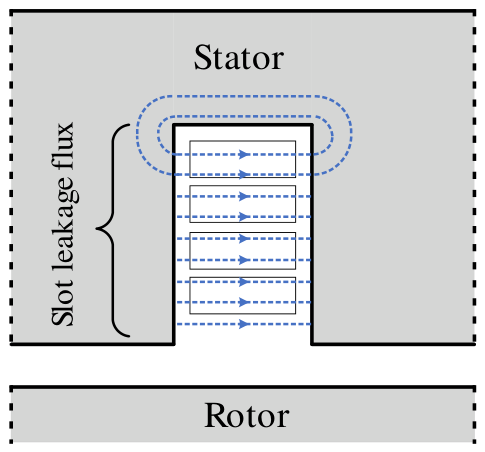
While flux leakage is typically considered a negative effect, it can also play an important role in certain aspects. For instance, when filtering the motor current in a pulse-width-modulated (PWM) AC inverter drive, the stator flux leakage is intentionally increased [9,10]. In electric machines, there are several components that contribute to leakage inductance. These include slot leakage flux, end-winding leakage flux, harmonic (or belt) leakage flux, zigzag leakage flux, and skew leakage flux. Of these flux leakages, slot leakage flux is particularly significant for AC losses and winding inductance, as the conductor is directly exposed to it. As shown in Figure 1, slot leakage flux follows the path from one tooth to another across the slots passing through the conductor.
The amount of slot leakage flux is dependent on several factors such as core depth, number of conductors, conductor cross-sectional dimensions, slot width, and slot dimensions. It is greater in semi-closed slots, which are commonly used in induction machines, due to their narrow openings, compared to open slots in synchronous and DC machines [10,11,12]. The calculation of slot leakage inductance (LSL) for traditional winding designs is well-established. The LSL inductance can vary based on the winding arrangement, such as single-layer or double-layer windings. In the case of single-layer windings, the calculation is relatively simple since no mutual leakage flux exists in the slot. However, for double-layer windings, mutual leakage flux coupling occurs because both sets of windings are located within the same slot [13,14,15].
In [11], the authors proposed an analytical model to estimate LSL of double-layer windings with semi-closed slots by solving the Poisson equation in the slot region. Although the model was validated against the finite element analysis (FEA), it was limited to traditional double-layer windings and did not consider fractional-pitch windings. In [16], an analytical model is proposed to estimate slot and tooth leakage inductance of fractional-pitch winding; however, the proposed model is only valid for a double-layer winding. A semi-analytical FEA approach was proposed in [17] to compute LSL in double-layer windings. Their method used a one-slot-pitch finite element model (FEM) with analytical post-processing. However, they did not consider the effect on LSL when more than two conductors are present in the slot. The presence of multiple layers of conductors within a single slot results in significant mutual-flux coupling, complicating the estimation process. Given the complex structure of hairpin windings, estimating LSL becomes considerably more challenging.
Considering these limitations in the literature, there is still a need for an analytical formulation that can estimate LSL in hairpin windings with multiple layers. Existing models cannot capture the complex mutual-flux interactions when more than two conductors occupy a single slot. Additionally, the impact of slot geometry and conductor dimensions on LSL has not been thoroughly analyzed for modern hairpin topologies. To cover these limitations, this paper makes the following key contributions and novelties:
  • A generalized novel analytical model for estimating LSL for hairpin windings with N layers.
  • Novel expressions for specific permeance and total mutual specific permeance that account for the complex mutual leakage flux coupling in multi-layer hairpin designs.
  • Extension of the model to fractional-pitch windings, which are usually employed in industrial tractions motors.
  • FEA validation of the proposed model with an error ≤ 3%.
  • A practical experimental procedure to estimate LSL based on total leakage inductance measurements using open E-core configuration.
  • Experimental validation of LSL, which demonstrates that the FEA and analytical results fall within the expected 30–80% range of total leakage inductance.
  • A comprehensive parametric analysis that quantitatively evaluates the influence of slot parameters and conductor size on LSL, which offers valuable insights to designers for reducing losses.
This article is organized as follows: Section 2 presents the proposed analytical model to estimate slot leakage permeance, LSL, leakage inductance corresponding to one stator phase belt, and LSL for fractional-pitch winding. Section 3 includes the FEA validation of the proposed model. A practical experimental procedure to estimate LSL is provided in Section 4. A parametric study is included in Section 5. Finally, this paper concludes in Section 6.

2. Modeling of Slot Leakage Inductance

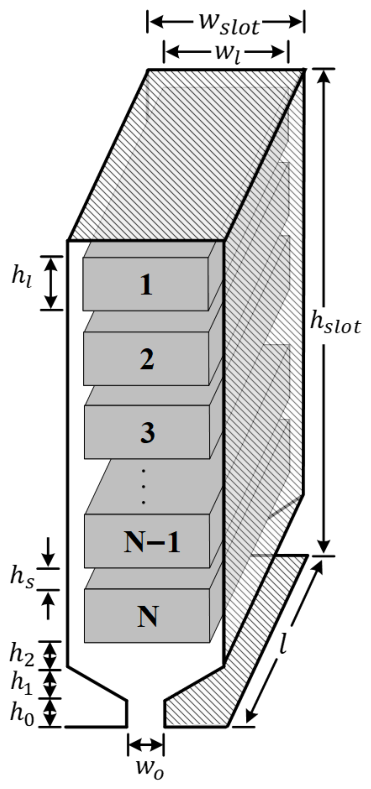
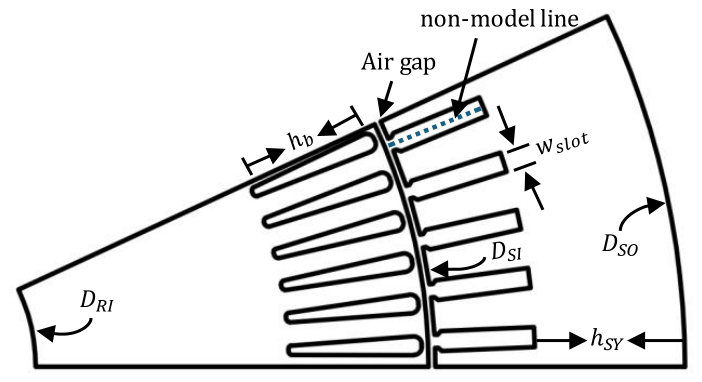
LSL results from the presence of a real leakage flux. In the case of hairpin windings, the total current within a slot is the product of the number of layers N, and the current following in them. Throughout this paper, LSL of a hairpin winding is investigated with reference to Figure 2. Moreover, the analysis is limited to the slot region while end-winding leakage effects are not considered.

2.1. Slot Leakage Permeance

In the literature, slot leakage permeance is typically calculated for either one or two coils of random winding [18]. However, for hairpin windings, N can reach up to eight for higher-current applications. For slot leakage permeance modeling, it is assumed that the leakage flux travels in a straight path from one side of the slot to the opposite side. This path is perpendicular to the slot’s center line, crossing it at a right angle. The specific permeance of the top two layers of Figure 2 is expressed in (1) and (2). Similarly, the specific permeance of the last layer near the slot opening is expressed in (3). A generalized expression is derived in (4), which is used to calculate the specific permeance of any layer, where i = 1, 2, …, N − 1, N.
p 1 = μ o h l 3 w s l o t + h 2 + ( h l + h s ) ( N 1 ) w s l o t + h 1 w s l o t w 0 ln w s l o t w 0 + h 0 w 0
p 2 = μ o h l 3 w s l o t + h 2 + ( h l + h s ) ( N 2 ) w s l o t + h 1 w s l o t w 0 ln w s l o t w 0 + h 0 w 0
p N = μ o h l 3 w s l o t + h 2 + ( h l + h s ) ( N N ) w s l o t + h 1 w s l o t w 0 ln w s l o t w 0 + h 0 w 0
p i = μ o h l 3 w s l o t + h 2 + ( h l + h s ) ( N i ) w s l o t + h 1 w s l o t w 0 ln w s l o t w 0 + h 0 w 0
where pi represents the specific permeance corresponding to the i-th conductor layer within the slot. The parameter hs represents the spacing between the conductors and hl denotes the height of each layer. The presence of two or more coils in a slot results in mutual inductance between the coils. In random winding, N cannot exceed two. However, in hairpin winding, mutual inductance becomes significant as N increases. The previously derived expression in [18] can be used to find specific permeance corresponding to mutual-flux linkages for the region involving h0, h1, and h2, as expressed in (5), (6), and (7), respectively.
p 0 M = μ o h 0 w 0
p 1 M = μ o h 1 w s l o t w 0 ln w s l o t w 0
p 2 M = μ o h 2 w s l o t
However, to model layers, specific permeance corresponding to mutual-flux linkages depends on N. A generalized equation is derived to calculate total mutual specific permeance for any N corresponding to mutual-flux linkages, as expressed in (8).
p T o t a l _ M = μ o h 0 w 0 + h 1 w s l o t w 0 ln w s l o t w 0 + h 2 w s l o t + ( N 1 ) h l 2 w s l o t + h s w s l o t
where pTotal_M represents the total mutual specific permeance. The first three terms correspond to mutual specific permeance of the geometric regions h0, h1 and h2. The terms proportional to (N − 1) capture the mutual specific permeance associated with the region of conductors and the spacing between them. The specific permeance in (1)–(8) is developed on the rectangular slot configuration with reference to Figure 2. However, the generalized expressions can be adapted to different slot geometries through appropriate modification in the geometric variables and flux path relationships.

2.2. Slot Leakage Inductance

As mentioned earlier, many electric machines use only one or two coil sides in random windings. Existing models are primarily limited to those simplified configurations, which may not fully capture the complex mutual coupling present in multi-layer hairpin windings. In the previous subsection, we derived the specific permeance and specific permeance related to mutual-flux linkages for hairpin windings. Now, it is possible to calculate LSL for hairpin windings using (4) and (8). The slot leakage associated with one slot is expressed as follows:
L S L = N 2 l e f f i = 1 N p i + 2 p T o t a l M
where leff is the effective length of the stator. Assuming the machine is connected to a three-phase system with a total of Ns stator slots and the machine has P poles, the leakage inductance corresponding to one stator phase belt is:
L P h a s e , L =   N s 3 P N 2 l e f f i = 1 N p i + 2 p T o t a l M

2.3. Slot Leakage Permeance for Fractional-Pitch Hairpin Windings

The previous model (10) considered full-pitch windings. However, for hairpin windings, fractional-pitch windings have also been used to reduce imbalanced circulating currents and torque ripples [19,20]. In fractional-pitch winding, the winding pitch is intentionally shortened so that each slot may have conductors of different phase. Winding pitch is defined as follows:
winding   pitch =   w p = Actual   throw T o t a l   N o .   o f   S l o t s T o t a l   N o .   o f   P o l e s
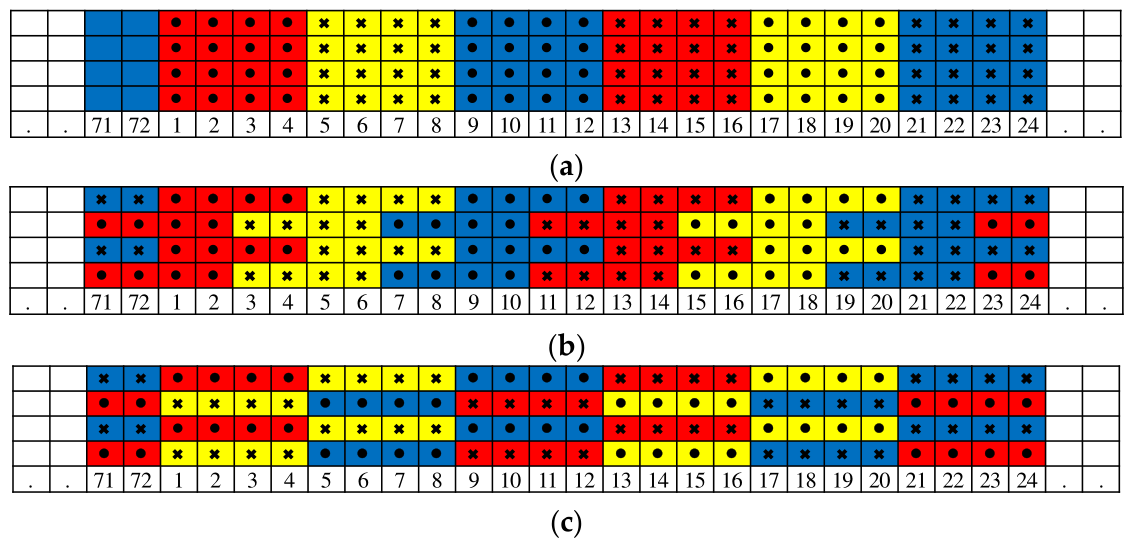
In the case of full-pitch windings, each slot contains only coils of the same phase. In contrast, in fractional-pitch windings, this is not the case, which results in a mutual coupling term between the phases. For illustration, a 72-slot and 6-pole winding configuration is shown in Figure 3. A full pitch winding is depicted in Figure 3a, while short-pitch windings with a winding pitch of 10/12 and 8/12 are shown in Figure 3b and Figure 3c, respectively. For the two layers of windings, it is relatively straightforward to estimate LSL per phase for fractional-pitch windings [18]. However, for hairpin windings with more than two layers, the estimation becomes more complex because multiple coils of each phase interact with one another. The mutual inductance within a slot of the same phase will vary depending on the winding pitch. From (10), we can separate the mutual and self-inductance as follows:
L P h a s e , L = N 2 l e f f   N s 3 P i = 1 N p i + N 2 l e f f   N s 3 P 2 p T o t a l M
L P h a s e , L = L S + L M , a a
L S = N 2 l e f f   N s 3 P i = 1 N p i
L M , a a = N 2 l e f f   N s 3 P 2 p T o t a l M
where LS is self-leakage inductance and LM,aa is the mutual leakage inductance of the same phase. For hairpin windings with more than two layers, it is evident that when wp = 1, the mutual inductance of the same phase remains unchanged, as illustrated in Figure 3a, while for wp = 2/3, the mutual inductance is reduced by half, as illustrated in Figure 3c. Therefore, when 2/3 < wp < 1, the mutual inductance between conductors of the same phase is:
L M , a a = N 2 l e f f   N s 3 P k s ( w p ) 2 p T o t a l M
k s ( w p ) = 3 w p 1 2
As illustrated in Figure 3b,c, for wp < 1, mutual coupling occurs between the two phases. This mutual coupling term becomes zero when wp = 1 and reaches its maximum value when wp = 2/3. Therefore, the mutual leakage inductance between any two phases is:
L M , a b = N 2 l e f f   N s 3 P k m ( w p ) 2 p T o t a l M
k m ( w p ) = 3 3 w p 2
The negative sign results from the fact that the currents in the two coil sides flow in opposite directions, as illustrated in Figure 3b,c. Therefore, (13) and (14) can be expressed as follows:
L P h a s e , L = L S + L M , a a +   L M , a b
The quantities ks(wp) and km(wp) are functions of wp, and can be expressed as follows:
k s ( w p ) = 3 w p 1 / 2 0 < w p   < 1 / 3 1 / 2 1 / 3 < w p   < 2 / 3 3 w p 1 2 2 / 3 < w p   < 1
k m ( w p ) = 3 w p / 2 0 < w p < 1 / 3 3 w p + 3 / 2 1 / 3 < w p < 2 / 3 3 w p 3 2 2 / 3 < w p < 1
As depicted in Figure 3, for 0 < w p < 1/3, conductors of the same phase are largely separated, which results in minimal LM,aa and dominant LM,ab. In the range of 1/3 < w p < 2/3, partial overlap occurs between LM,aa and LM,ab. For 2/3 < w p < 1, LM,aa is more dominant. Thus, (12)–(22) can be used to estimate the L P h a s e , L in hairpin windings with more than two layers and are extendable to the general case of up to N conductors per slot. Moreover, this model also accounts for fractional-pitch windings.

3. FEA Validation

To validate the derived analytical model for LSL, a 2D FEA is performed for an induction motor (IM) similar to a motor used in Tesla Model S, but a hairpin winding configuration of N = 4 is created using MotorCAD (2025 R1) and exported to Ansys Maxwell [21]. The IM is selected due to its widespread use in the literature. Since LSL is primarily determined by stator slot and conductor geometry, the effect of rotor type is minimal. The 2D FEA model does not capture 3D effects such as end-winding leakage. However, the objective of this study is to isolate and evaluate the LSL. Therefore, the use of 2D FEA leads to more accurate determination of LSL. The motor’s parameters and design variables are listed in Table 1, and a 2D geometric structure of the motor under study is shown in Figure 4. There are two methods to calculate LSL using FEA in Ansys Maxwell. The first method involves calculating the slot leakage flux. To do this, a non-model line is drawn in the radial direction from the top to the bottom of the slot as a reference to align the datapoints of the analytical model to the position of flux leakage. The integral of the flux density along this line represents the leakage flux passing through the slot. Multiplying this result by the motor’s stack length and N, and then dividing by the stator current, gives LSL. The second method involves running a simulation with the rotor removed. By supplying the stator current as usual and calculating the per-phase flux linkage, dividing this value by the stator current yields the per-phase LSL. In this paper, we used the first method to find LSL using FEA to validate our derived analytical model. Detailed slot dimensions are provided in Table 2.

3.1. Unity Winding Pitch

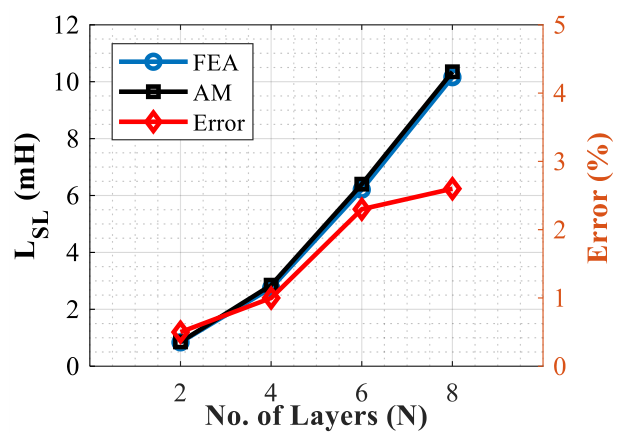
The analytical model is verified using two, four, six, and eight layers of hairpin winding configurations by varying the conductor height hl and keeping the slot fill factor constant. It is important to note that winding pitch is unity. The values of hl for each configuration are provided in Table 2. The comparison between the FEA and the analytical model is shown in Figure 5. It can be observed that the analytical model accurately estimates LSL for different hairpin winding configurations. The maximum error between FEA and the proposed model is noted in the eight-layer winding configuration of 2%. Since each layer contributes additional self- and mutual-flux interactions, increasing N increases the LSL, and both FEA and analytical models show similar trends. The increase in LSL is expected as the additional layers of hairpin windings result in a higher magnetic flux in the slot, which leads to more leakage flux.

3.2. Fractional-Pitch Winding

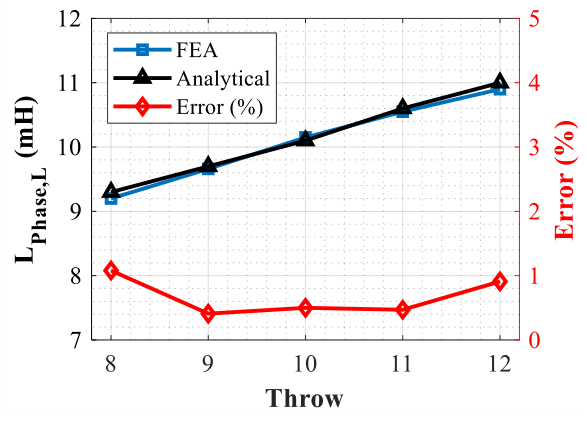
Fractional-pitch windings are commonly used to mitigate harmonics and reduce circulating currents. In practical applications, most machine designers in industry adopt fractional-pitch winding within the range of 2/3 < wp < 1. Therefore, the proposed analytical model is validated across this range to reflect the common industry practice. For the fractional-pitch winding, the overall effect can be evaluated through one stator phase belt. Therefore, Lphase,L is validated for N = 4 while keeping the slot dimension the same as in the previous analysis. The results are illustrated in Figure 6; it can be observed that as the winding pitch decreases, Lphase,L also decreases. Moreover, the proposed analytical model shows excellent results with FEA, with errors around 1%.

4. Experimental Validation

Experimental validation of LSL is challenging because it is difficult to isolate it from the total leakage inductance LTL. In practice, LTL includes multiple leakage components and can be expressed as follows:
L T L = L S L + L E W + L Z Z + L S K + L H
where LEW is the end-winding leakage inductance, LZZ is the zigzag leakage inductance, LSK is the skew leakage inductance, and LH represents the harmonic leakage component. LSL is often the dominant leakage component because a significant portion of the conductor length is concentrated within the slot region, and the presence of multiple conductor layers increases the mutual leakage flux coupling inside the slot. However, the exact contribution of LSL to LTL depends on factors such as the N, slot geometry, conductor dimensions, and end-winding length. As reported in [22,23,24,25], LSL is the primary component of LTL. LSL lies within 30–80% of LTL, which provides a practical reference range for validation.
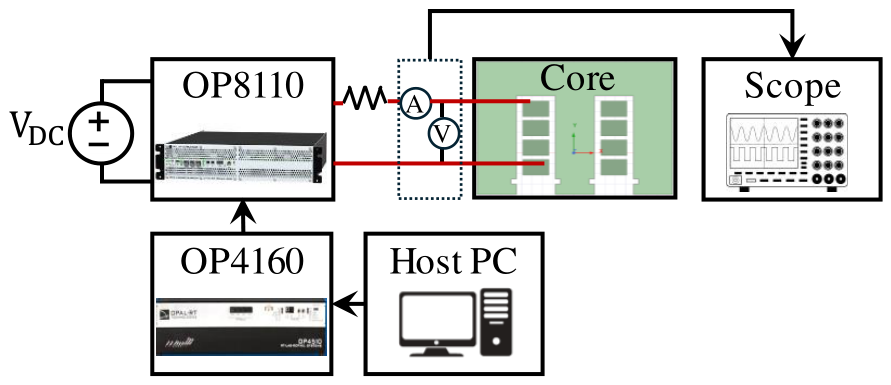
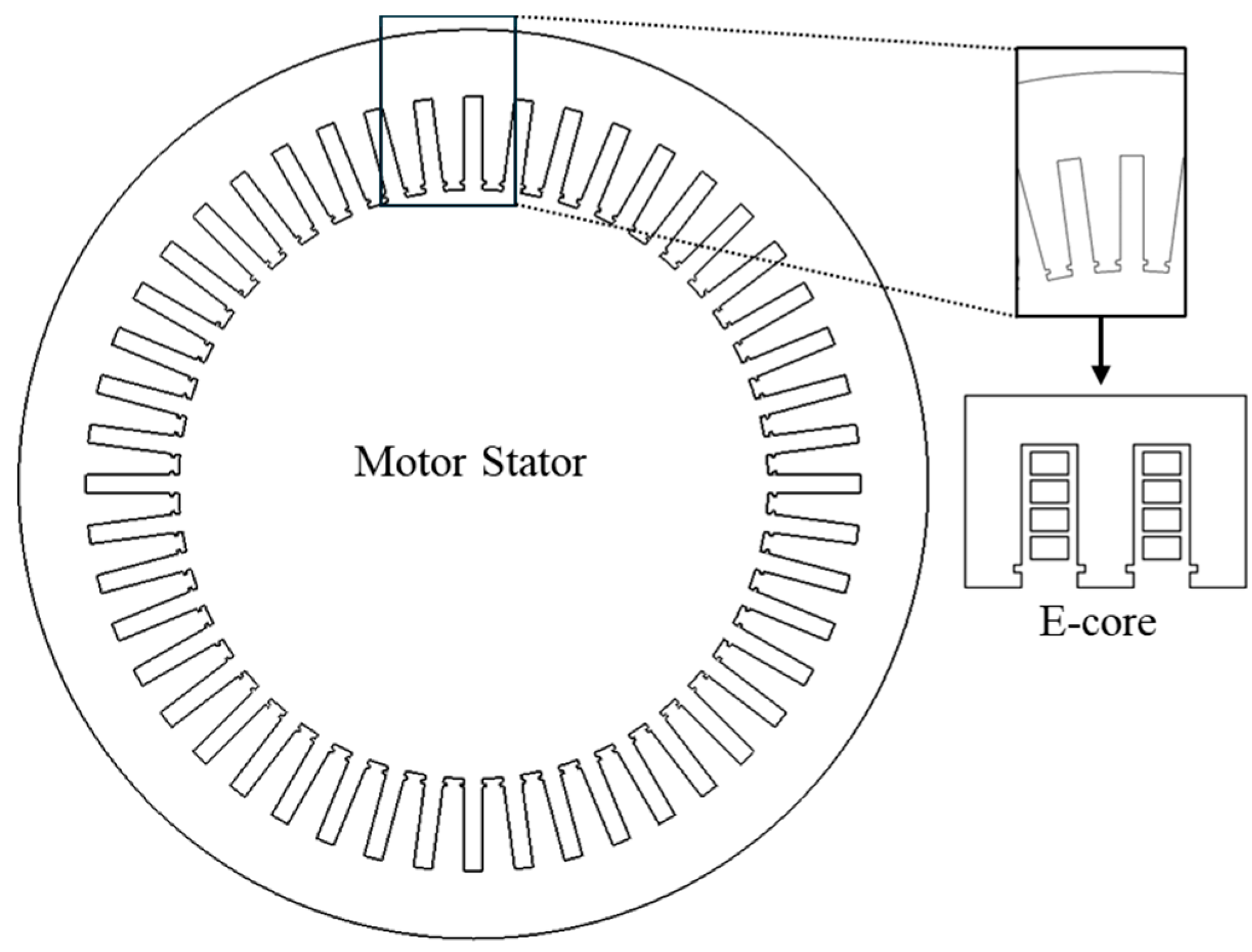
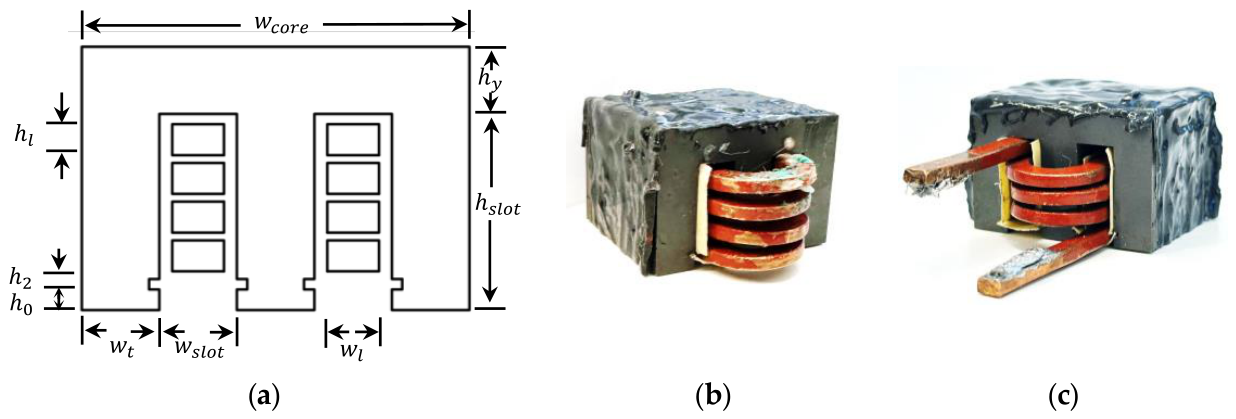
Experimental validation is conducted using an Opal-Real Time (Opal-RT) simulation platform (Montreal, QC, Canada) that serves as a power hardware-in-the-loop (PHIL) platform that excites the inductor with a controlled voltage source. The overall schematic of the experimental setup is illustrated in Figure 7. OP4160 is connected to the PC, where the voltage and frequency setpoints are controlled in real time. These signals are sent to OP8110 (4-Quadrant Amplifier) (Montreal, QC, Canada), which acts as a power amplifier to provide sinusoidal voltage excitation to the test core. The voltage across and the current through the core are measured using a digital oscilloscope (Tektronix DPO 2014B) (Beaverton, OR, USA). Simplified E-core or two-slot stator motorettes are commonly used in the literature to evaluate winding electromagnetic behavior, AC losses, and leakage flux effects because they preserve the essential slot geometry and conductor arrangement of the actual machine while reducing the complexity of the full motor structure [26,27,28,29,30]. As illustrated in Figure 8, the E-core structure resembles two stator teeth and slot regions of the motor stator. Although the actual stator contains curvature near the yoke region, its effect on LSL is negligible. Therefore, the E-core provides a practical and representative approach for validating the proposed analytical model. The core used in the experimental setup is made from M19 non-oriented electrical steel laminations. The experimental core structure and winding arrangement are illustrated in Figure 9, while the dimensions of the core used are summarized in Table 3.
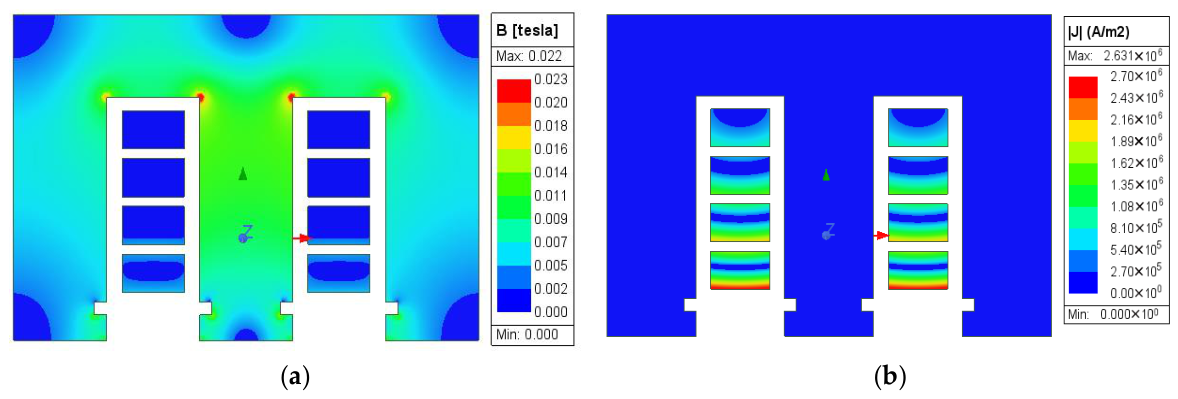
Inductance measurements were carried out over a frequency range of 500 Hz to 1000 Hz under a fixed output voltage of 80 V provided by OP8110. The current in the hairpin windings was approximately 9.71 A. In the FEA analysis, the same current excitation was used for the E-core configuration to estimate FEA LSL. Figure 10a shows the magnetic flux density distribution in the core material, while Figure 10b presents the current density distribution in the winding conductors. It can be observed that, with the open E-core configuration, the magnetic flux density is very low due to the high magnetic reluctance of the open magnetic path. As a result, the magnetizing inductance becomes very small, and the measured inductance is primarily dominated by the leakage inductance component. In the experimental validation, three configurations were considered:
(1)
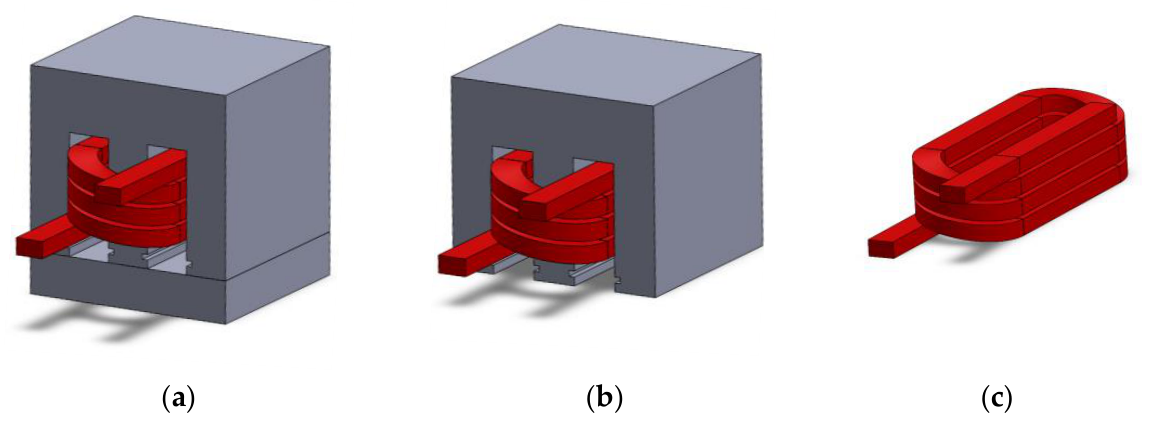
Closed E-core or E-I core to find the upper limit inductance (Figure 11a).
(2)
Open E-core to find LTL and magnetizing inductances, then estimate LSL from the LTL (Figure 11b).
(3)
Complete air-core without the E-core to find the bottom limit inductance (Figure 11c).
Figure 10. 2D FEA results of the E-core: (a) magnetic flux density distribution in the core material, and (b) current density distribution in the conductors.
Machines 14 00575 g010
Figure 11. Experimental configurations used for evaluation: (a) closed E-core (E-I core), (b) open E-core, and (c) air-core.
Machines 14 00575 g011
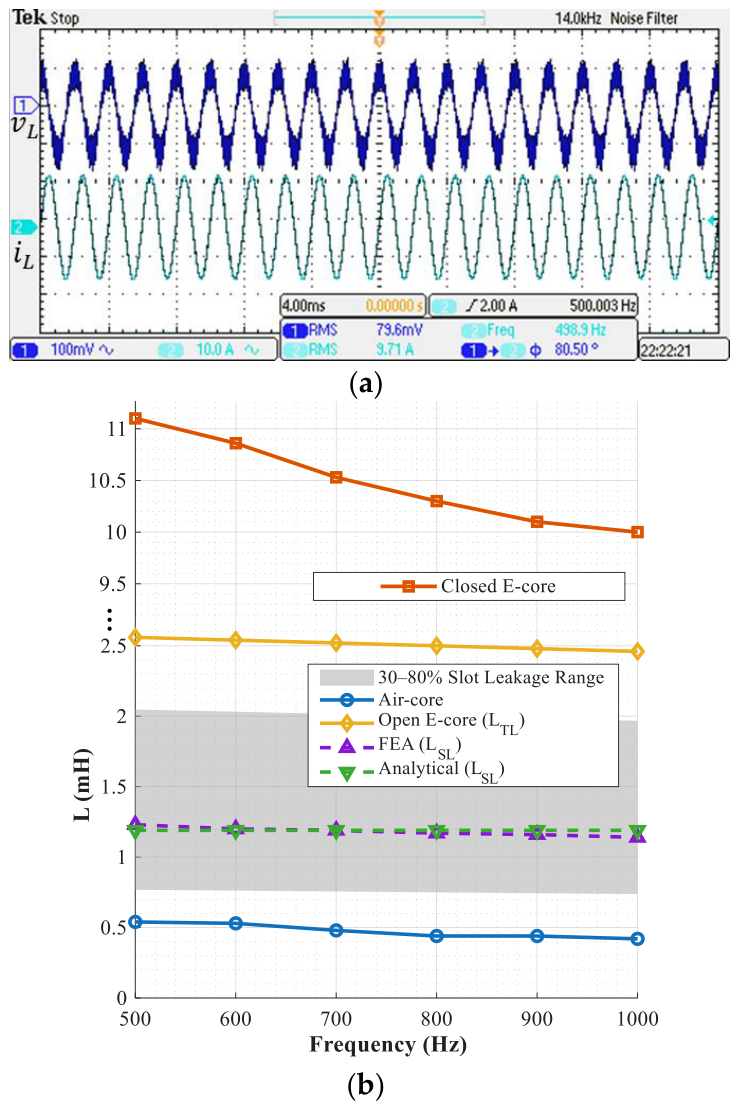
The air-core configuration represents the baseline inductance in the absence of magnetic material. The closed E-core configurations provide the maximum inductance due to the presence of a complete magnetic path. The open E-core configuration is used as an approximate of the LTL because the magnetic path is intentionally removed, which makes the leakage dominant. It should be noted that this approach does not isolate the LSL from other leakage components. Instead, the method provides LTL under conditions where the magnetizing component is minimum, from which LSL is approximated. Based on LTL measured, LSL is typically reported to lie within 30–80% of LTL, which is evaluated and compared with the proposed analytical model and FEA results. Figure 12 presents the experimental results, and Figure 12a shows the measured voltage (vL) and current (iL) waveforms for the open E-core configuration at frequency (f) of 500 Hz. The inductance is calculated by:
L = v L i L sin ( φ ) 2 π f
Figure 12b shows the calculated inductance for all test scenarios across the frequency range of 500 Hz to 1000 Hz, including air-core, closed E-core, and open E-core configurations. As shown in Figure 12b, in a closed E-core configuration, the measured inductance contains both leakage and magnetizing inductance components. Therefore, as the frequency increases, the permeability of the core decreases, which reduces the magnetizing inductance component and results in a lower overall inductance. The shaded region in Figure 12b represents the expected LSL range, which corresponds to 30–80% of the LTL. Both FEA and the analytical results lie within the expected range across all frequencies. This validates that the proposed analytical model for LSL for hairpin winding is accurate and falls within the expected range. It is also important to note that the proposed model (9) to estimate LSL is independent of the current amplitude and depends only on the slot geometry and hairpin winding configuration. Similarly, in FEA analysis, LSL is calculated as the ratio of flux linkage to current. Therefore, LSL is independent of the absolute current magnitude under linear magnetic conditions.

5. Parametric Analysis

The geometric parameters of the slots directly influence LSL; it is important to evaluate the extent to which parameters in the slot dimension have the most significant impact. In recent years, significant research has focused on optimizing the size of the layer to reduce AC losses at high frequencies [5,22]. Therefore, it is also important to analyze how the layer cross-sectional dimensions affect LSL, as they are proportional.

5.1. Slot Dimensions

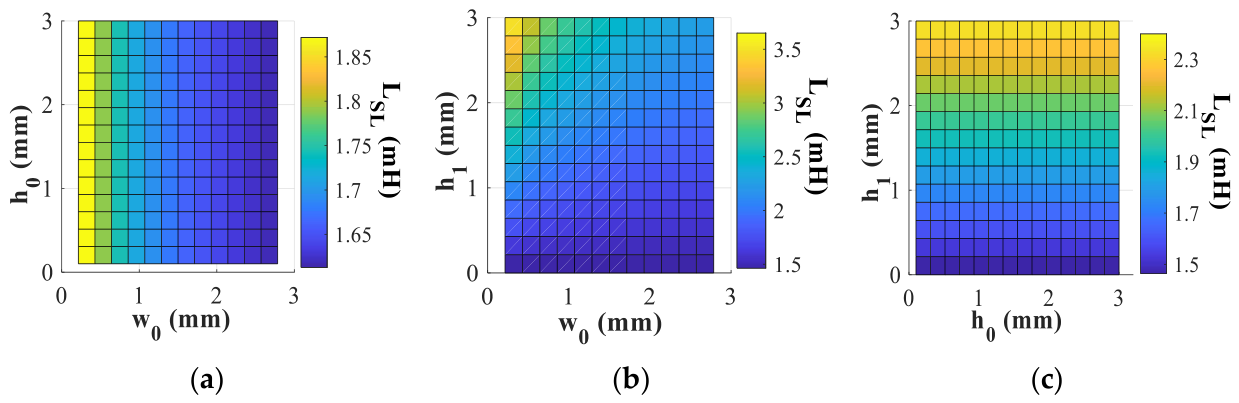
In this section, parametric analysis on the slot dimension is performed to assess the impact of key slot dimensions such as w0, h0, and h1.
The relationships between LSL and geometric parameters such as w0, h0, and h1 are illustrated in Figure 13, where two parameters are varied at a time, while all remaining parameters are kept constant at their baseline values shown in Table 2. In Figure 13a, it is observed that LSL increases with a decrease in w0 and increase in h0. This can be attributed to the fact that a smaller slot opening creates a more confined magnetic flux path, which causes higher LSL. Similarly, increasing h0 increases the magnetic flux path which, coupled with a narrow w0, causes a significant increase in LSL due to greater reluctance.
In Figure 13b, the relationship between w0 and h1 is illustrated. The analysis shows a decreasing trend in LSL with the larger values of w0, especially for greater h1. This is true because wider slots allow more magnetic flux to return through the air gap rather than leaking across the slot walls.
Figure 13c analyzes the relationship between h0 and h1. Increasing both parameters leads to a rise in LSL. This is due to the cumulative effect of increasing the magnetic flux path length, which increases the leakage in the slot regions. Both parameters contribute to larger flux leakage by increasing the reluctance of the slot regions, particularly when w0 remains constant.

5.2. Conductor Dimensions

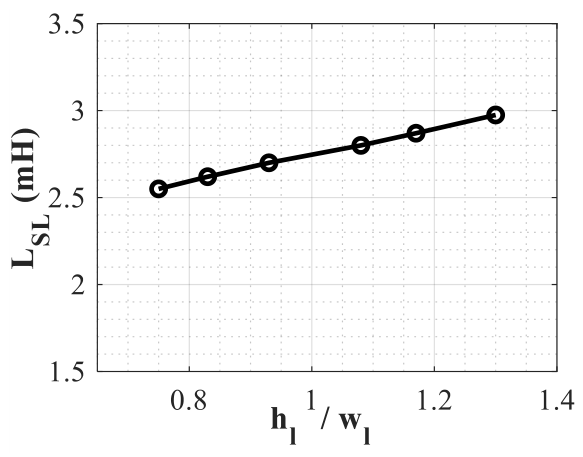
As expressed in (9), the conductor dimensions also affect how magnetic fields are distributed in the slot. Therefore, in this section, a parametric analysis of conductor dimensions, such as hl and wl, is conducted to evaluate their effect on LSL. It is important to note that the overall area of the conductor was kept the same in this analysis. As shown in Figure 14, the relationship between the ratio hl/wl and the slot leakage is directly proportional. When the ratio hl/wl increases from 0.77 to 1.28, LSL increases from approximately 2.55 mH to around 2.97 mH. This indicates that increasing the height of the conductor relative to its width results in a moderate increase in LSL. Although there is a noticeable increase, the overall change in LSL is relatively small. It can be noted from this analysis that the conductor dimensions do affect the leakage inductance. Therefore, adjusting the dimensions of the conductor can help reduce LSL.

6. Conclusions

This paper proposed a generalized analytical model for estimating LSL and LPhase,L in hairpin windings. Unlike traditional models, which are limited to two layers, this model captures the complex mutual inductance between multiple coil layers. The maximum error between the proposed model and FEA was lower than 3%. Furthermore, through parametric analysis, this study highlights the influence of slot geometry and conductor dimensions on LSL. In addition, a practical experimental procedure is presented to estimate LSL based on LTL, which provides further validation of the proposed model. The key findings are:
  • As N increases, LSL increases due to the higher magnetic flux in the slot region.
  • Reducing wp decreases LPhase,L.
  • Decreasing w0 and increasing h0 lead to a significant increase in LSL.
  • Larger values of w0, especially for greater h1, show a decreasing trend in LSL.
  • Increasing the conductor height hl relative to its width wl increases LSL for a constant conductor area.
  • The experimentally estimated LSL lies within the expected range relative to LTL.
This study provides electric machine designers with a valuable tool for precise modeling and optimization of hairpin winding designs. While the present work focuses on LSL, future research will extend the proposed analytical framework to incorporate LEW.

Author Contributions

Conceptualization, H.N. and A.M.B.; methodology, H.N. and A.M.B.; software, H.N.; validation, H.N. and A.M.B.; formal analysis, H.N.; investigation, H.N. and A.M.B.; resources, H.N. and A.M.B.; data curation, H.N.; writing—original draft preparation, H.N.; writing—review and editing, H.N. and A.M.B.; visualization, H.N.; supervision, A.M.B. All authors have read and agreed to the published version of the manuscript.

Funding

This research received no external funding.

Data Availability Statement

The data that support the findings of this study are available on request from the authors.

Conflicts of Interest

The authors declare no conflicts of interest.

References

  1. Shams Ghahfarokhi, P.; Podgornovs, A.; Cardoso, A.J.M.; Kallaste, A.; Belahcen, A.; Vaimann, T. Hairpin Windings for Electric Vehicle Motors: Modeling and Investigation of AC Loss-Mitigating Approaches. Machines 2022, 10, 1029. [Google Scholar] [CrossRef]
  2. Liu, H.-c.; Lee, M. Design Analysis of an Interior Permanent Magnet Synchronous Motor with Hybrid Hair-Pin and Litz Wire Windings. Electronics 2025, 14, 3350. [Google Scholar] [CrossRef]
  3. Ju, X.; Cheng, Y.; Yang, M.; Cui, S.; Sun, A.; Liu, X.; He, M. Voltage Stress Calculation and Measurement for Hairpin Winding of EV Traction Machines Driven by SiC MOSFET. IEEE Trans. Ind. Electron. 2022, 69, 8803–8814. [Google Scholar] [CrossRef]
  4. Zhao, Y.; Li, D.; Pei, T.; Qu, R. Overview of the rectangular wire windings AC electrical machine. CES Trans. Electr. Mach. Syst. 2019, 3, 160–169. [Google Scholar] [CrossRef]
  5. Preci, E.; Gerada, D.; Degano, M.; Buticchi, G.; Gerada, C.; Nuzzo, S.; Barater, D. Hairpin Windings: Sensitivity Analysis and Guidelines to Reduce AC Losses. In Proceedings of the 2021 IEEE Workshop on Electrical Machines Design, Control and Diagnosis (WEMDCD), Modena, Italy, 8–9 April 2021; pp. 82–87. [Google Scholar]
  6. Pyrhonen, J.; Jokinen, T.; Hrabovcova, V. Design of Rotating Electrical Machines, 2nd ed.; Wiley: Hoboken, NJ, USA, 2013; pp. 225–253. [Google Scholar]
  7. Sergeant, P.; Vansompel, H.; Dupré, L. Influence of stator slot openings on losses and torque in axial flux permanent magnet machines. Math. Comput. Simul. 2016, 130, 22–31. [Google Scholar] [CrossRef]
  8. Zhang, Y.; Li, J.; Zhang, B.; Mao, M.; Qi, W.; Ye, X.; Hu, B. Internet-distributed energy management strategy for plug-in fuel cell hybrid electric vehicles considering power source degradation. IEEE Trans. Veh. Technol. 2025, 1–14. [Google Scholar] [CrossRef]
  9. Vazquez-Guzman, G.; Martinez-Rodriguez, P.R.; Rosas-Caro, J.C.; Rivera-Perez, E.; Verdin-Cruz, J.A.; Rodriguez-Cortes, C.J.; Langarica-Cordoba, D. Three-Phase Space Vector PWM Inverter for Induction Motor Drive with Leakage Current Reduction. Sustainability 2025, 17, 9317. [Google Scholar] [CrossRef]
  10. Azab, M. A Review of Recent Trends in High-Efficiency Induction Motor Drives. Vehicles 2025, 7, 15. [Google Scholar] [CrossRef]
  11. Tessarolo, A. Leakage Field Analytical Computation in Semiclosed Slots of Unsaturated Electric Machines. IEEE Trans. Energy Convers. 2015, 30, 431–440. [Google Scholar] [CrossRef]
  12. Zhu, X.; Yue, Y. Study on Winding Inductances in Stator Surface-Mounted Permanent Magnet Machines. Energies 2024, 17, 5359. [Google Scholar] [CrossRef]
  13. Wang, C.; Peng, B.; Shi, C. Comprehensive investigation on the slot leakage inductance of axial flux permanent magnet motor with novel slot shape. Chin. J. Electr. Eng. 2024, 12, 387–397. [Google Scholar] [CrossRef]
  14. Liu, L.; Lu, F.; Wang, J. Research on calculation relation between stator slot leakage inductance and windings distributing for dual stator-winding machines. In Proceedings of the IEEE 2011 10th International Conference on Electronic Measurement & Instruments, Chengdu, China, 16–19 August 2011; pp. 288–291. [Google Scholar]
  15. Cavagnino, A. Accuracy-Enhanced Algorithms for the Slot Leakage Inductance Computation of Double-Layer Windings. IEEE Trans. Ind. Appl. 2017, 53, 4422–4430. [Google Scholar] [CrossRef]
  16. Ponomarev, P.; Alexandrova, Y.; Petrov, I.; Lindh, P.; Lomonova, E.; Pyrhönen, J. Inductance Calculation of Tooth-Coil Permanent-Magnet Synchronous Machines. IEEE Trans. Ind. Electron. 2014, 61, 5966–5973. [Google Scholar] [CrossRef]
  17. Bailey, L.; Jara, W.; Madariaga, C.; Riedemann, J.; Tapia, J.; Bramerdorfer, G.; Cavagnino, A. Semi-analytical Finite Element Study of the Slot Leakage Inductance of Double-Layer Windings. In Proceedings of the 2020 International Conference on Electrical Machines (ICEM), Gothenburg, Sweden, 23–26 August 2020; pp. 326–331. [Google Scholar]
  18. Lipo, T.A. Use of magnetic circuits in leakage reactance calculations. In Introduction to AC Machine Design; Wiley: Hoboken, NJ, USA, 2017; pp. 125–191. [Google Scholar]
  19. Dannier, A.; Di Bruno, F.; Fiume, F.; Fedele, E.; Brando, G. Hairpin Winding Technology for Electric Traction Motors: Design, Prototyping, and Connection Rules. In Proceedings of the 2022 International Conference on Electrical Machines (ICEM), Valencia, Spain, 5–8 September 2022. [Google Scholar]
  20. Carbonieri, M.; Venturini, G.; Popescu, M. A Practical Approach to Hairpin Winding Design: Patterns Investigation, Feasibility Verification and Fractional Slot Solutions. In Proceedings of the 2022 IEEE Energy Conversion Congress and Exposition (ECCE), Detroit, MI, USA, 9–13 October 2022; pp. 1–8. [Google Scholar]
  21. Nisar, H.; Mirza, A.Y.; Bazzi, A.M. Thermal Evaluation of Stator Liner and Winding Insulation in Power Traction Motors. In Proceedings of the 2023 IEEE Transportation Electrification Conference & Expo (ITEC), Detroit, MI, USA, 21–23 June 2023; pp. 1–5. [Google Scholar]
  22. Zhu, W.; Sun, Y.; Chen, X.; Jewell, G.W. A Hybrid Winding Design to Reduce AC Losses in Electrical Machines With Bar Conductors. IEEE Trans. Transp. Electrif. 2025, 11, 13923–13933. [Google Scholar] [CrossRef]
  23. Tessarolo, A. Analytical Determination of Slot Leakage Field and Inductances of Electric Machines With Double-Layer Windings and Semiclosed Slots. IEEE Trans. Energy Convers. 2015, 30, 1528–1536. [Google Scholar] [CrossRef]
  24. Li, D.; Wen, Y.; Li, W.; Fang, J.; Cao, J.; Zhang, X.; Lv, G. Numerical calculation of primary slot leakage inductance of a single-sided HTS linear induction motor used for linear metro. Cryogenics 2017, 82, 38–47. [Google Scholar] [CrossRef]
  25. Alger, P.L. Induction Machines: Their Behavior and Uses, 2nd ed.; Gordon and Breach: New York, NY, USA, 1970. [Google Scholar]
  26. Selema, A.; Ibrahim, M.N.; Sergeant, P. Additively Manufactured Ultralight Shaped-Profile Windings for HF Electrical Machines and Weight-Sensitive Applications. IEEE Trans. Transp. Electrif. 2022, 8, 4313–4324. [Google Scholar] [CrossRef]
  27. Nisar, H.; Bazzi, A.M. Modeling and Analysis of Skin Effects in Hairpin Windings Using Circuit Analysis. In Proceedings of the 2025 IEEE Energy Conversion Conference Congress and Exposition (ECCE), Philadelphia, PA, USA, 19–23 October 2025. [Google Scholar]
  28. Wrobel, R.; Williamson, S.J.; Simpson, N.; Ayat, S.; Yon, J.; Mellor, P.H. Impact of slot shape on loss and thermal behaviour of open-slot modular stator windings. In Proceedings of the 2015 IEEE Energy Conversion Congress and Exposition (ECCE), Montreal, QC, Canada, 20–24 September 2015. [Google Scholar]
  29. Selema, A.; Sergeant, P. Copper-Aluminum Tradeoff of Electrical Machine Windings for Energy-Efficient Drivetrains. In Proceedings of the 2025 Energy Conversion Congress & Expo Europe (ECCE Europe), Birmingham, UK, 31 August–4 September 2025. [Google Scholar]
  30. Bardalai, A.; Gerada, D.; Golovanov, D.; Xu, Z.; Zhang, X.; Li, J.; Zhang, H.; Gerada, C. Reduction of Winding AC Losses by Accurate Conductor Placement in High Frequency Electrical Machines. IEEE Trans. Ind. Appl. 2020, 56, 183–193. [Google Scholar] [CrossRef]
Figure 1. Slot leakage flux lines with multiple layers of winding.
Machines 14 00575 g001
Figure 2. Stator slot with hairpin winding configuration.
Machines 14 00575 g002
Figure 3. Winding configuration for a 72-slot, 6-pole machine: (a) full-pitch winding layout, (b) fractional-pitch winding layout with a winding pitch of 10/12, and (c) fractional-pitch winding layout with a winding pitch of 8/12.
Machines 14 00575 g003
Figure 4. Geometric structure of the motor under study.
Machines 14 00575 g004
Figure 5. LSL for different hairpin winding configurations.
Machines 14 00575 g005
Figure 6. LPhase,L under fractional-pitch winding 2/3 < wp < 1.
Machines 14 00575 g006
Figure 7. Schematic of the experimental setup.
Machines 14 00575 g007
Figure 8. E-core (motorette) representation of the motor stator slot region used for experimental validation.
Machines 14 00575 g008
Figure 9. Experimental test core and hairpin winding configuration: (a) schematic showing core geometry and dimensional parameters, (b) fabricated prototype of the E-core with hairpin winding (insertion side view), and (c) terminal side of the hairpin winding.
Machines 14 00575 g009
Figure 12. Experimental results: (a) measured voltage and current waveforms for the open E-core configuration at 500 Hz, and (b) inductance comparison for all test configurations with FEA, analytical results, and the 30–80% LSL range.
Machines 14 00575 g012
Figure 13. Variation in LSL with geometric parameters: (a) h0 and w0, (b) h1 and w0, and (c) h0 and h1.
Machines 14 00575 g013
Figure 14. Relation between LSL and the ratio hl/wl.
Machines 14 00575 g014
Table 1. Motor parameters.
ParameterUnitValue
Stator slots-72
Poles-6
Maximum currentA900
Peak torqueNm375
Base speedrpm6500
Maximum speedrpm14,800
Stator outer diameter (DSO)mm250
Stator inner diameter (DSI)mm175
Rotor inner diameter (DRI)mm55
Stator yoke (hSY)mm21.5
Rotor bar height (hb)mm18.28
Air gapmm1
Table 2. Slot and hairpin dimensions.
ParameterValue (mm)
h01.00
h10.80
h22.00
Height of conductor (hl)5.25, 2.7, 1.6, 1.05
Spacing between conductors (hs)0.30
Height of slot (hslot)16
Slot opening (w0)2.00
Width of conductor (wl)2.50
Width of slot (wslot)3.00
Table 3. Slot and hairpin dimensions of the experimental E-core.
ParameterValue (mm)
Width of core (wcore)37.50
Width of the teeth (wt)7.50
Width of the slot (wslot)7.50
Width of the conductor (wl)5.00
Height of the slot (hslot)19.00
Height of yoke (hy)7.50
Height of wedge (h0)2.00
Height of conductor (hl)3.00
Disclaimer/Publisher’s Note: The statements, opinions and data contained in all publications are solely those of the individual author(s) and contributor(s) and not of MDPI and/or the editor(s). MDPI and/or the editor(s) disclaim responsibility for any injury to people or property resulting from any ideas, methods, instructions or products referred to in the content.