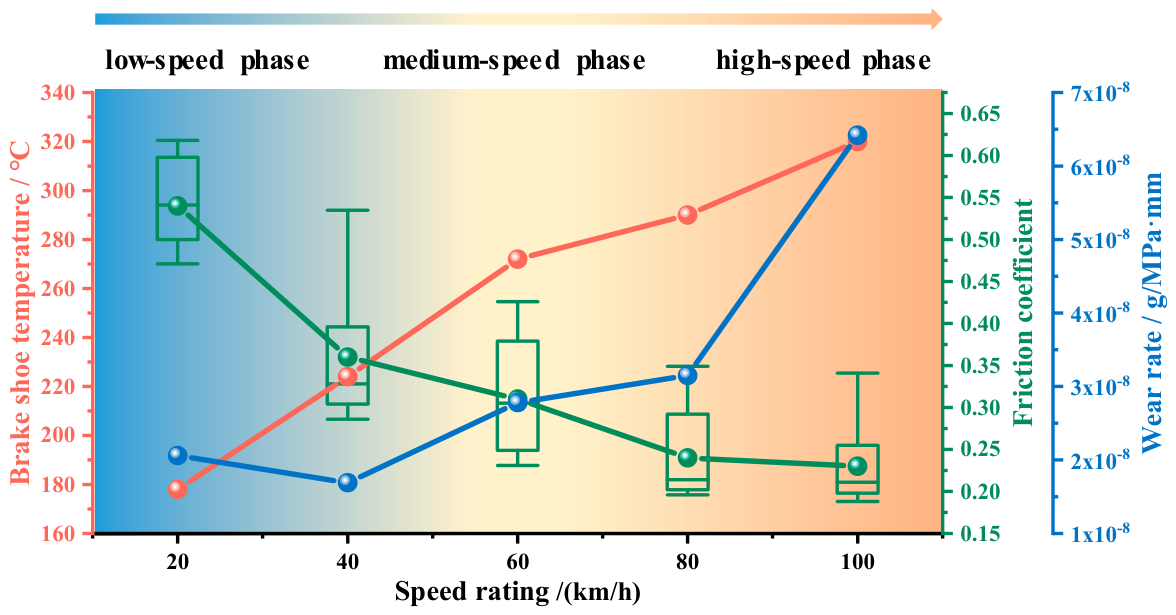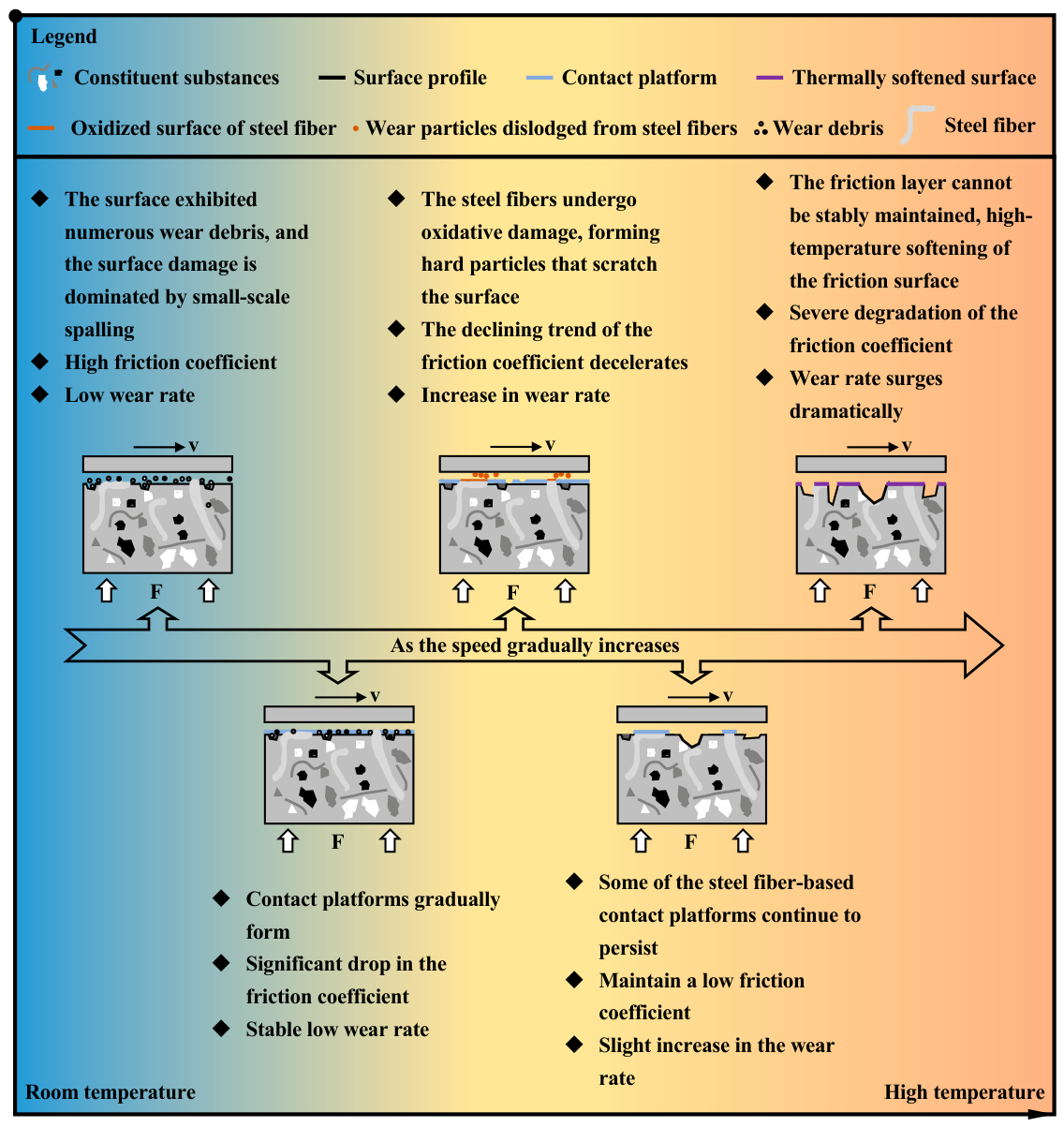


Friction and Wear Behavior of General Freight Train Composite Brake Shoes with Reinforced Steel Fibers
 and
and
Abstract
1. Introduction
2. Experiment Description
2.1. Test Device
2.2. Test Materials
2.3. Experimental Procedure
3. Experimental Results and Discussion
3.1. Overall Morphology of Brake Shoe Sample
3.2. Morphology of Surface Damage
3.3. Influence of RSF
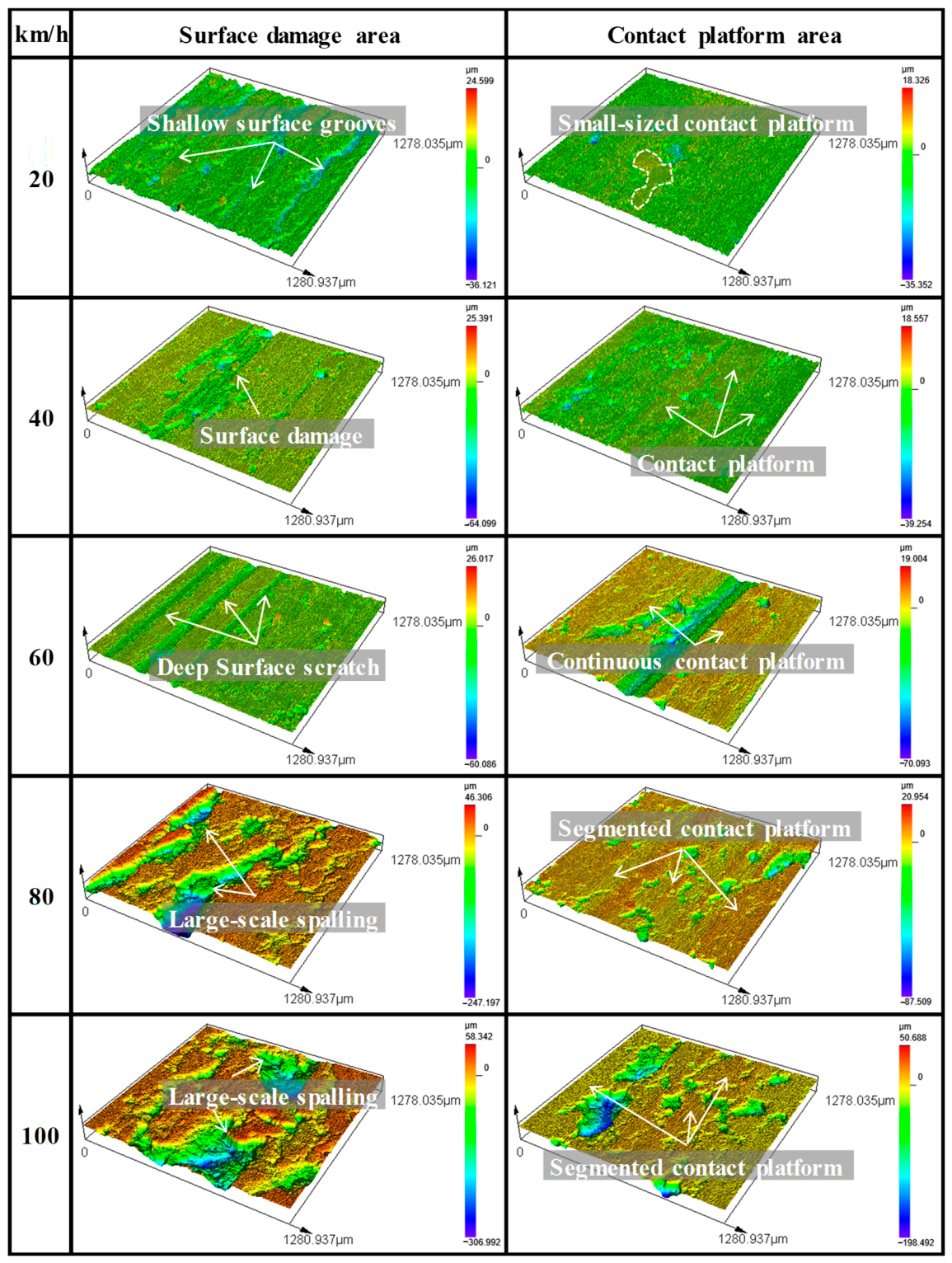
3.4. 3D Topography of the Damage
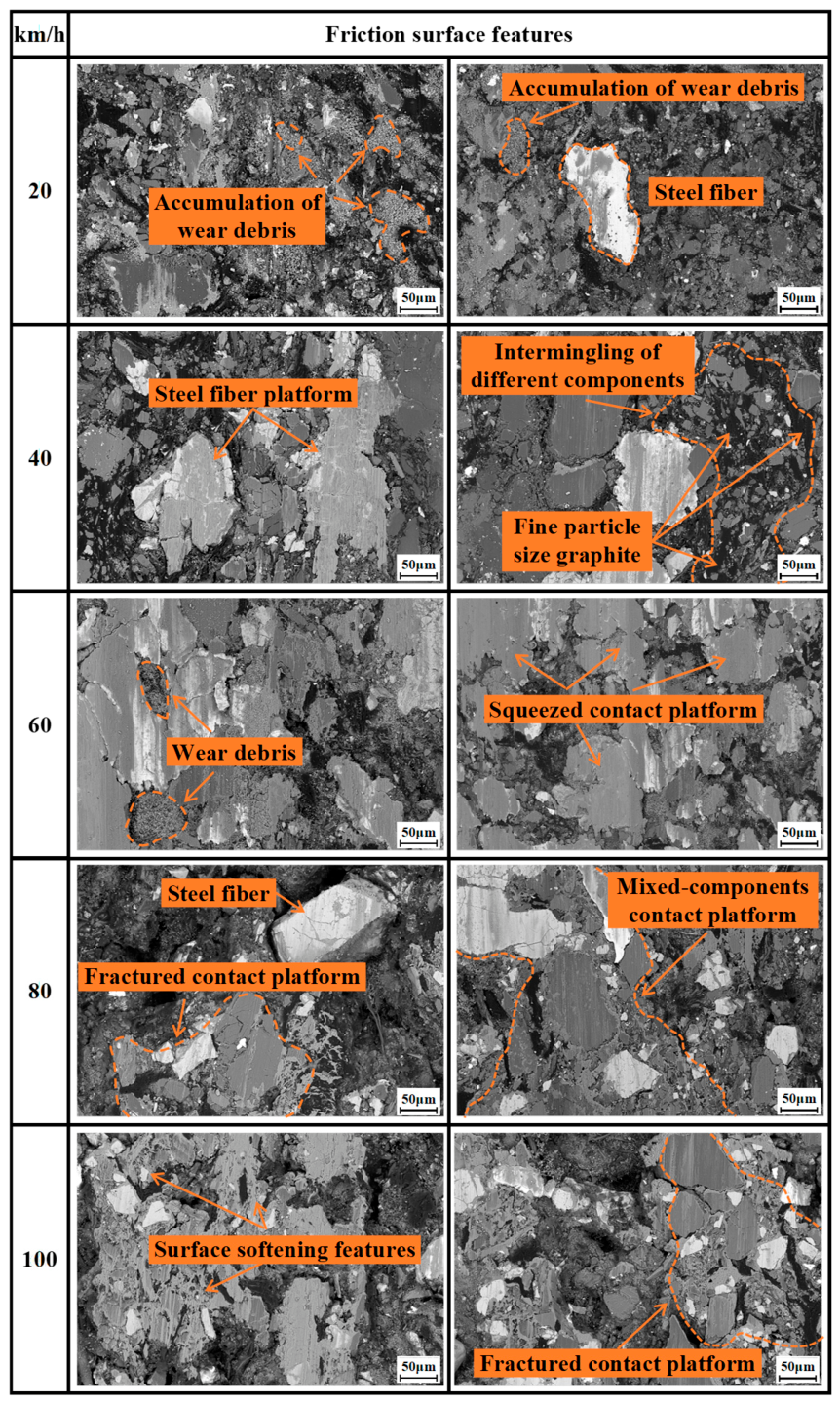
3.5. Micro-Damage Morphology
3.6. Friction Performance
4. Analysis and Discussion
5. Conclusions
Author Contributions
Funding
Data Availability Statement
Conflicts of Interest
References
- Chen, S.; Zhao, G.; Wang, H.; Tao, G.; Wen, Z.; Wu, L. Study of Wheel Wear Influenced by Tread Temperature Rising during Tread Braking. Wear 2019, 438–439, 203046. [Google Scholar] [CrossRef]
- Faccoli, M.; Provezza, L.; Petrogalli, C.; Ghidini, A.; Mazzù, A. Effects of Full-Stops on Shoe-Braked Railway Wheel Wear Damage. Wear 2019, 428–429, 64–75. [Google Scholar] [CrossRef]
- Günay, M.; Korkmaz, M.E.; Özmen, R. An Investigation on Braking Systems Used in Railway Vehicles. Eng. Sci. Technol. Int. J. 2020, 23, 421–431. [Google Scholar] [CrossRef]
- Ferrer, C.; Pascual, M.; Busquets, D.; Rayón, E. Tribological Study of Fe–Cu–Cr–Graphite Alloy and Cast Iron Railway Brake Shoes by Pin-on-Disc Technique. Wear 2010, 268, 784–789. [Google Scholar] [CrossRef]
- Zhang, J.; Zuo, J.; Ding, J. A Wave-Based Heat Source Model for Predicting Frictional Temperature Rise in Wheel–Brake Shoe Contacts on Long Downhill Slopes. Case Stud. Therm. Eng. 2025, 73, 106528. [Google Scholar] [CrossRef]
- Wasilewski, P. Experimental Study on the Effect of Formulation Modification on the Properties of Organic Composite Railway Brake Shoe. Wear 2017, 390–391, 283–294. [Google Scholar] [CrossRef]
- Nidhi; Bijwe, J.; Mazumdar, N. Influence of Amount and Modification of Resin on Fade and Recovery Behavior of Non-Asbestos Organic (NAO) Friction Materials. Tribol. Lett. 2006, 23, 215–222. [Google Scholar] [CrossRef]
- Nidhi; Bijwe, J. NBR-Modified Resin in Fade and Recovery Module in Non-Asbestos Organic (NAO) Friction Materials. Tribol. Lett. 2007, 27, 189–196. [Google Scholar] [CrossRef]
- Bijwe, J.; Nidhi; Majumdar, N.; Satapathy, B.K. Influence of Modified Phenolic Resins on the Fade and Recovery Behavior of Friction Materials. Wear 2005, 259, 1068–1078. [Google Scholar] [CrossRef]
- Monreal-Pérez, P.; López, D.; Sola, I.; Erroz, P. The Role of Glass Fiber Morphology on the Friction Behavior and Wear Mechanism of Low Steel-NAO Hybrid Railway Brake Shoes. Tribol. Int. 2023, 178, 108079. [Google Scholar] [CrossRef]
- Monreal-Pérez, P.; González, J.; Iraizoz, A.; Bilbao, U.; Clavería, I. Effect of the Steel Fiber Length on the Friction Performance and Wear Mechanism of Railway Brake Shoes. Tribol. Int. 2022, 172, 107589. [Google Scholar] [CrossRef]
- Monreal-Perez, P.; Elduque, D.; López, D.; Sola, I.; Yaben, J.; Clavería, I. Full-Scale Dynamometer Tests of Composite Railway Brake Shoes Including Latxa Sheep Wool Fibers. J. Clean. Prod. 2022, 379, 134533. [Google Scholar] [CrossRef]
- Wasilewski, P. Full-Scale Dynamometer Test of Composite Railway Brake Shoes-Study on the Effect of the Reinforcing Fibre Type. Acta Mech. Autom. 2018, 12, 204–208. [Google Scholar] [CrossRef]
- Mazzù, A.; Provezza, L.; Zani, N.; Petrogalli, C.; Ghidini, A.; Faccoli, M. Effect of Shoe Braking on Wear and Fatigue Damage of Various Railway Wheel Steels for High Speed Applications. Wear 2019, 434–435, 203005. [Google Scholar] [CrossRef]
- Mazzù, A.; Ghidini, A.; Provezza, L.; Petrogalli, C.; Faccoli, M. Study of the Damage Induced by Thermomechanical Load in ER7 Tread Braked Railway Wheels. Procedia Struct. Integr. 2019, 18, 170–182. [Google Scholar] [CrossRef]
- Su, J.; Ding, H.; Wang, W.; Huang, X.; Zhang, S.; Lewis, R.; Meli, E.; Liu, Q.; Zhou, Z. Experimental Study on the Effect of Brake Shoe Pressure on Wheel Wear and Fatigue Damage Behavior during Tread Braking. Wear 2025, 571, 205840. [Google Scholar] [CrossRef]
- Luo, Y.; Tao, G.; Su, J.; Wen, Z.; Wang, W.; Liu, K. Frictional Temperature Prediction of Freight Wagon Wheel-Brake Shoe during Non-Steady Tread Braking on Long and Steep Slope Considering Real-Time Temperature Monitoring. Appl. Therm. Eng. 2026, 288, 129638. [Google Scholar] [CrossRef]
- He, C.; Ji, Y.; Pei, D.; Gao, M.; Chen, C.; Zhao, J.; Wang, W. Morphology and Composition of the Third Body on the Friction Surface of an Organic Composite Railway Brake Shoe. Coatings 2023, 13, 952. [Google Scholar] [CrossRef]
- Faccoli, M.; Ghidini, A.; Mazzù, A. Experimental and Numerical Investigation of the Thermal Effects on Railway Wheels for Shoe-Braked High-Speed Train Applications. Metall. Mater. Trans. A 2018, 49, 4544–4554. [Google Scholar] [CrossRef]
- Faccoli, M.; Ghidini, A.; Mazzù, A. Changes in the Microstructure and Mechanical Properties of Railway Wheel Steels as a Result of the Thermal Load Caused by Shoe Braking. Metall. Mater. Trans. A 2019, 50, 1701–1714. [Google Scholar] [CrossRef]
- Meierhofer, A.; Hardwick, C.; Lewis, R.; Six, K.; Dietmaier, P. Third Body Layer—Experimental Results and a Model Describing Its Influence on the Traction Coefficient. Wear 2014, 314, 148–154. [Google Scholar] [CrossRef]
- Lu, C.; Jiang, X.; Chen, X.; Mo, J. Experimental Study on the Evolution of Friction and Wear Behaviours of Railway Friction Block during Temperature Rise under Extreme Braking Conditions. Eng. Fail. Anal. 2022, 141, 106621. [Google Scholar] [CrossRef]
- TB/T 3104.1; Brake Shoes for Rolling Stock-Part 1: Composite Brake Shoes. China Railway: Beijing, China, 2020.


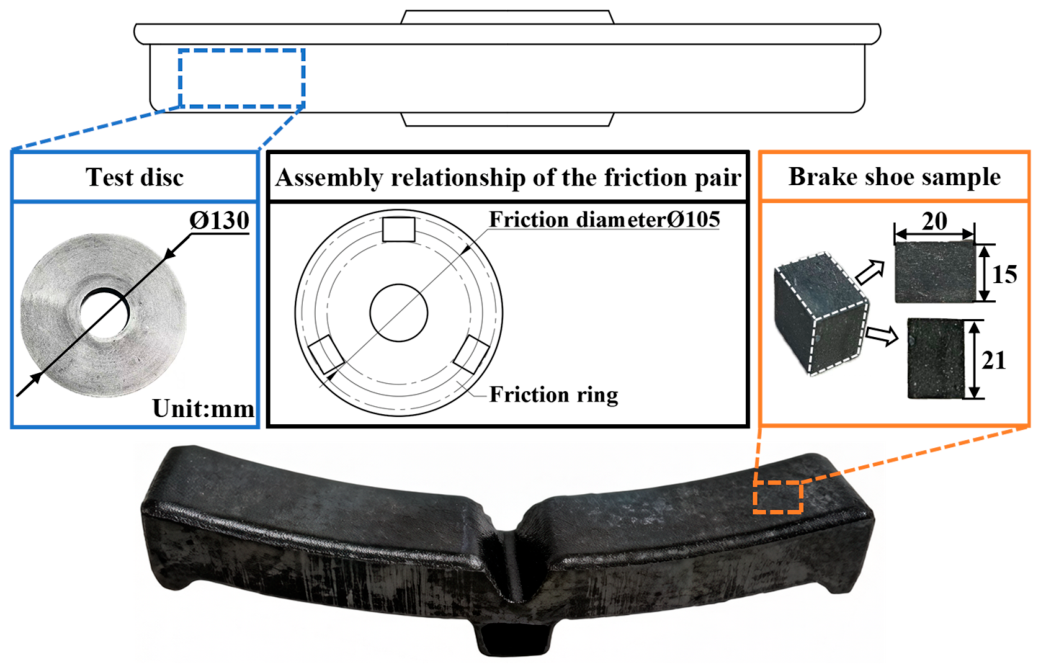
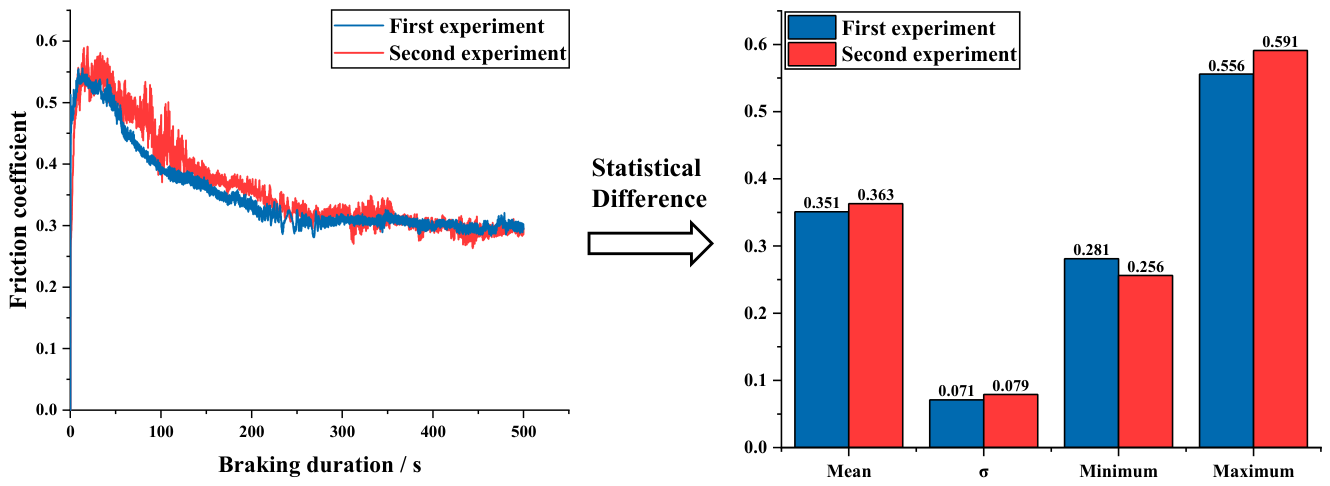





| Braking Force/kN | Speed Level/(km/h) | Braking Duration/s |
|---|---|---|
| 8 | 20 | 500 |
| 8 | 40 | 500 |
| 8 | 60 | 500 |
| 8 | 80 | 500 |
| 8 | 100 | 500 |
Disclaimer/Publisher’s Note: The statements, opinions and data contained in all publications are solely those of the individual author(s) and contributor(s) and not of MDPI and/or the editor(s). MDPI and/or the editor(s) disclaim responsibility for any injury to people or property resulting from any ideas, methods, instructions or products referred to in the content. |
© 2026 by the authors. Licensee MDPI, Basel, Switzerland. This article is an open access article distributed under the terms and conditions of the Creative Commons Attribution (CC BY) license.
Share and Cite
Wang, H.; Zhang, X.; Chen, G.; Song, J.; Martínez-Esnaola, J.M.; Lu, C. Friction and Wear Behavior of General Freight Train Composite Brake Shoes with Reinforced Steel Fibers. Machines 2026, 14, 573. https://doi.org/10.3390/machines14050573
Wang H, Zhang X, Chen G, Song J, Martínez-Esnaola JM, Lu C. Friction and Wear Behavior of General Freight Train Composite Brake Shoes with Reinforced Steel Fibers. Machines. 2026; 14(5):573. https://doi.org/10.3390/machines14050573
Chicago/Turabian StyleWang, Hengxi, Xin Zhang, Guansong Chen, Jiazheng Song, José Manuel Martínez-Esnaola, and Chun Lu. 2026. "Friction and Wear Behavior of General Freight Train Composite Brake Shoes with Reinforced Steel Fibers" Machines 14, no. 5: 573. https://doi.org/10.3390/machines14050573
APA StyleWang, H., Zhang, X., Chen, G., Song, J., Martínez-Esnaola, J. M., & Lu, C. (2026). Friction and Wear Behavior of General Freight Train Composite Brake Shoes with Reinforced Steel Fibers. Machines, 14(5), 573. https://doi.org/10.3390/machines14050573