1. Introduction
With the rapid development of robotics, its integration with multiple industries has accelerated industrial upgrading and promoted intelligent unmanned applications. The combination of robotics and medicine has made medical robots a key device in future healthcare. Medical robots assist physicians in diagnosis, surgery and nursing, mainly including surgical robots, rehabilitation robots and disinfection robots [
1]. Due to the high precision and complexity of surgery, surgical robots have strict requirements on mechanisms and control systems [
2,
3]. Their end effectors feature compact size, fast response and high dexterity [
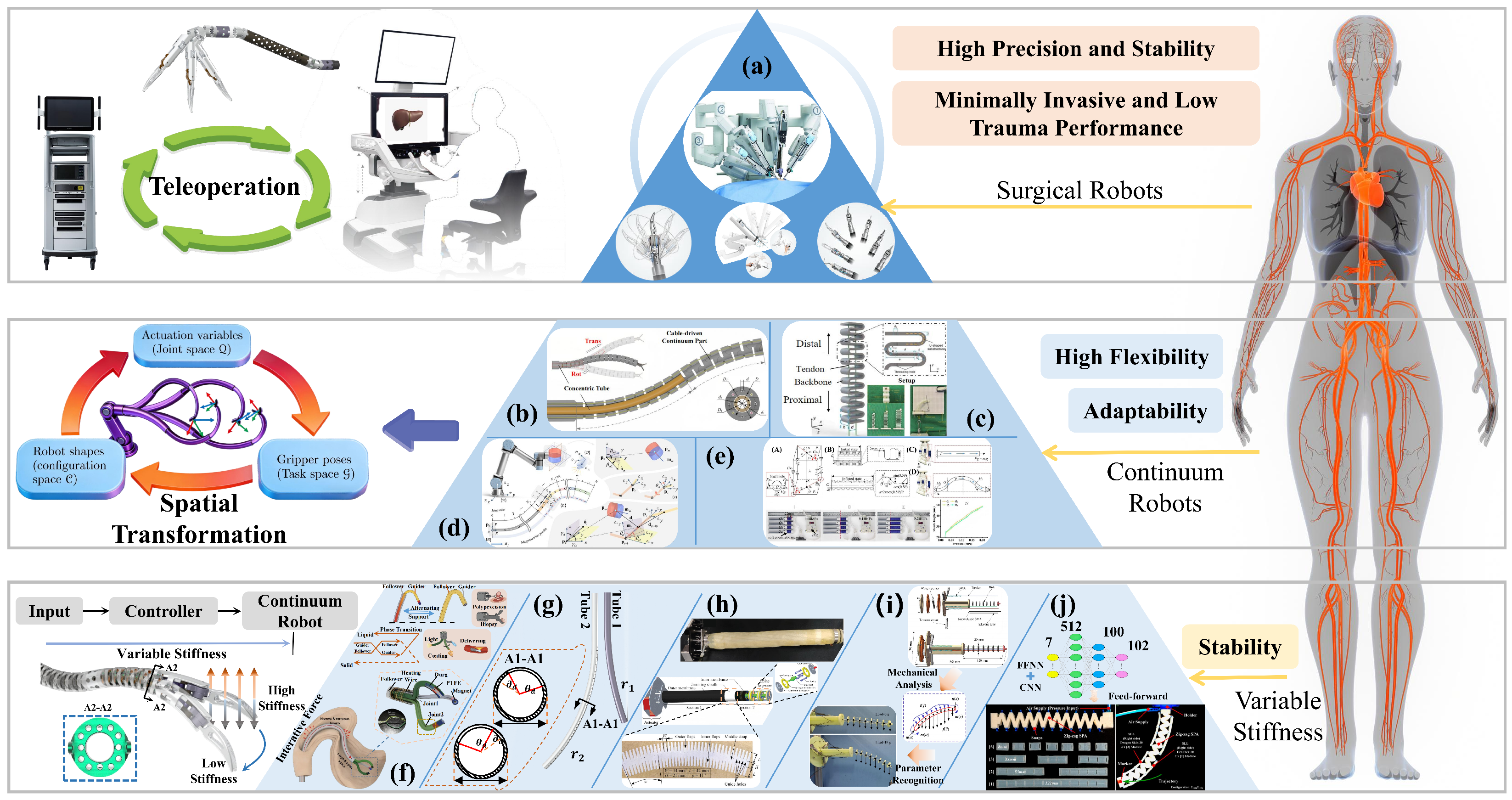
4]. Driven by an aging population and high-precision medical demand, surgical robot technology (
Figure 1a) is developing rapidly. Surgical procedures are mainly divided into open surgery and minimally invasive surgery (MIS). Open surgery requires large incisions, leading to high infection risks and slow postoperative recovery [
5]. MIS enables precise remote operation through small incisions and specialized instruments, which is more suitable for refined surgery [
6]. Its core lies in high-precision robotic systems in confined spaces [
7]. Thus, surgical robots show obvious advantages, requiring multiple degrees of freedom (DOFs) and high stability and precision [
8]. At present, continuum robots (CRs), as the core component of surgical robots, have been widely studied [
9,
10].
CRs are a new type of robot configuration with flexible deformation and continuous drive characteristics (
Figure 1b–e), a feature that distinguishes them from the discrete joint structure of traditional robots. This type of robot possesses redundant DOFs. Typically, a single-section continuum robot is equipped with 4–6 DOFs, while a multi-segment continuum robot can reach 8–12 DOFs or even more. Compared with the widely used 6-DOF industrial serial robots and the 7-DOF single-arm/14-DOF dual-arm ABB YuMi robot, continuum robots exhibit superior dexterity and environmental adaptability as well as inherent compliance. However, such inherent flexible characteristics also result in low structural stiffness, which limits their operational accuracy and load capacity, thereby creating performance bottlenecks in high-precision manipulation and heavy-load application scenarios. Therefore, variable stiffness adjustment has become one of the core requirements for its multi-functional and high-reliability applications, and also a key direction of current research. In recent years, with the continuous development and iteration of advanced intelligent materials [
21,
22], flexible sensors [
23] and artificial intelligence technologies, the variable stiffness implementation methods of continuum robots have been continuously enriched, their overall performance has been significantly improved, and they have gradually been verified in practical applications. The driving methods of continuum robots can be roughly divided into four categories: tendon-driven [
24,
25], pneumatic/hydraulic-driven [
26,
27], concentric tube-driven [
28], and external magnetic field-driven [
29]. From the perspective of precision motion control required in MIS, driving schemes differ markedly in motion accuracy performance. Tendon-driven achieve bending and posture adjustment via tendon actuation with straightforward control logic and high motion accuracy [
30]. Nevertheless, inevitable issues such as tendon backlash, friction and elastic deformation give rise to accumulated motion errors, which limit their capacity for high-precision micro-manipulation [
31]. Even so, millimeter-level errors exert little impact on their performance in teleoperated medical scenarios. Pneumatic and hydraulic-driven robots feature outstanding compliance and inherent safety, yet they suffer from pronounced nonlinear hysteresis, fluid compressibility and response lag, resulting in low steady-state motion accuracy and difficulty in high-precision closed-loop control [
32]. Their structural expansion and bulky size further restrict their application in medical practice. Concentric tube robots rely on the translation and rotation of nested superelastic nitinol tubes. They possess exceptional structural stiffness and superior positioning accuracy, offering unique advantages in directional targeted movement and minimally invasive microsurgical operations. However, abrupt potential energy variation introduces uncertainty in practical deployment [
33]. By contrast, external magnetic field actuation enables wireless miniaturized driving and remote manipulation. Its motion accuracy, however, is highly susceptible to magnetic interference, working distance and tissue occlusion, making it difficult to deliver stable high-precision motion output in complex in vivo environments.
The above technical schemes enable continuum robots to achieve compliant driving and complete complex movements such as bending. However, it should be pointed out that the characteristic of compliance itself also brings problems such as complex modeling, weak load capacity, and low positioning accuracy, and insufficient stiffness is a key factor exacerbating these problems. Therefore, the demand for variable stiffness has become increasingly prominent, serving as a core breakthrough to solve the above bottlenecks and improve the operational performance of continuum robots. An effective approach to solve the modeling problem is to abandon the linear mechanical modeling method designed for traditional discrete joints. The current mainstream modeling methods include the constant curvature assumption [
34,
35], variable curvature assumption [
36], Cauchy rod theory [
37], as well as data-driven models such as reinforcement learning [
38] and neural networks [
39] (
Figure 1f–j). These modeling methods also provide theoretical support for the precise control of variable stiffness. Meanwhile, CRs need to integrate flexible sensors [
36] (such as optical fiber sensors and strain sensors) to realize real-time perception of their own deformation and contact force, and this real-time perception capability is also an important prerequisite for the precise regulation of variable stiffness, ensuring the timeliness and accuracy of stiffness adjustment. However, it should be emphasized that as the mainstream execution platforms for flexible medical robots, tendon-driven and magnetic-driven technologies, the optimization and improvement of their variable stiffness performance should become the core research focus of the summary and optimization work at this stage, which is also the key to promoting the advancement of flexible medical robots towards high-precision and high-reliability clinical applications. It is worth noting that due to the miniaturization and compact structure of CRs, their manufacturing cost is extremely high. Simulation-based analysis can effectively reduce trial-and-error costs and improve production efficiency [
40].
In the medical field, tendon-driven and magnetically-driven technologies have emerged as core actuation solutions for CRs by virtue of their unique advantages. However, numerous issues remain to be systematically sorted out and optimized for the specific implementation of their variable stiffness technology. The tendon-driven approach achieves posture adjustment and motion execution of the robot body via cable traction. Boasting a simple structure and fast response, this solution has been widely applied in medical scenarios such as laparoscopic surgical robots [
41] and vascular interventional robots [
42]. Nevertheless, tendon-driven systems suffer from structural issues, including cable wear, slackening, interference of guiding mechanisms, and insufficient rigidity; notably, the variable stiffness technology implementation in such systems also faces challenges, as the cable traction mechanism is difficult to achieve precise and stable stiffness adjustment, which further exacerbates the rigidity defect. Coupled with the challenge of precision matching in the coordinated control of multi-segment configurations [
43], a systematic solution has not yet been formulated. It is therefore necessary to further refine structural design specifications and control strategies based on application experience across different medical scenarios, especially the variable stiffness control mechanism. Magnetically driven technology remotely actuates intrabody robots via external magnetic fields [
44]. Eliminating the need for penetrating human tissues, it enhances the degree of minimal invasiveness and operational safety, thus holding substantial application potential in interventional robots for natural lumens such as the digestive tract and blood vessels. However, its clinical application expansion is still hindered by issues including weak load capacity, the difficulty of balancing magnetic field penetration depth with actuation accuracy, the challenge of suppressing magnetic field interference in complex human environments, and limited DOFs [
45]; in terms of variable stiffness technology, the remote magnetic actuation method makes it hard to realize real-time and accurate stiffness regulation of the robot body, which restricts its adaptability to complex anatomical structures that require flexible stiffness adjustment during surgical procedures. To address the aforementioned core technical bottlenecks—with particular emphasis on the prominent challenges in the variable stiffness of both tendon-driven and magnetically-driven CRs—it is essential to establish a reusable design optimization framework by systematically organizing existing research findings and summarizing the technical adaptation rules for different situations.
2. Principle of Variable Stiffness
To address the inherent trade-off among load capacity, positioning accuracy, and compliance in flexible medical robots, variable stiffness technology [
46] has emerged as a targeted solution: the stiffness is reduced during the motion phase to ensure compliance and environmental adaptability, while it is increased during the task execution phase to enhance the EE load capacity; in addition, stiffness is lowered to prevent tissue damage when the robot comes into contact with human tissues such as blood vessel walls, and raised to improve operational force for procedures including puncture and knot-tying. Currently, variable stiffness methods for robots include physical mechanical structures [
47], jamming mechanisms [
48], and smart materials [
16], with representative examples illustrated in
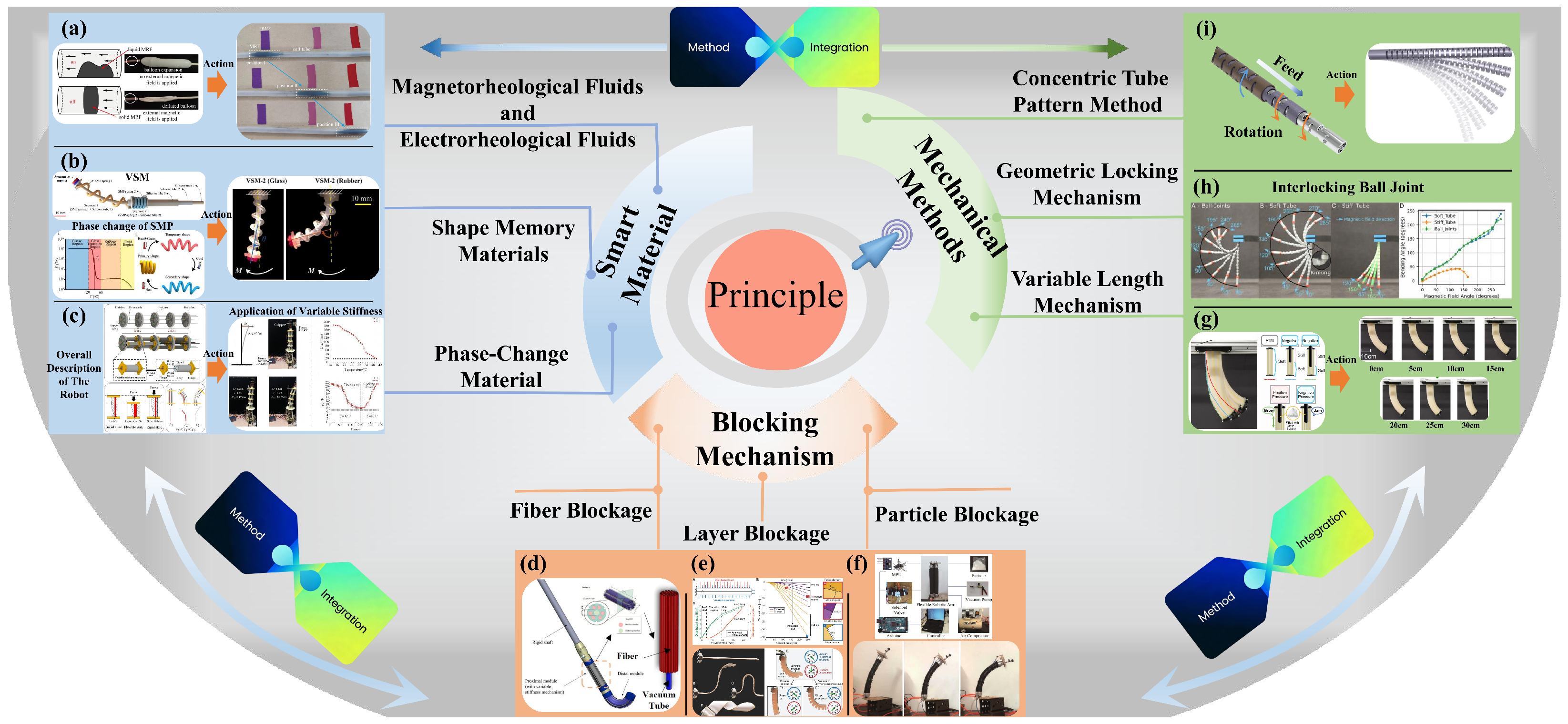
Figure 2. Furthermore, variable stiffness methods and actuation methods are not mutually exclusive; instead, they are predominantly characterized by an integrated and complementary relationship. Cable-driven systems combined with mechanical variable stiffness, as well as magnetically driven systems paired with phase-change materials [
49], represent the most widely adopted combinations at present. Nevertheless, more hybrid schemes integrating actuation and variable stiffness still await further exploration and realization by researchers. Although existing review papers have separately focused on actuation technologies, stiffness modulation, modeling methods, or control strategies, the integration of “actuation-variable stiffness-modeling” for variable stiffness in continuum-based medical robots remains to be further summarized and refined.
CRs exhibit excellent adaptability to complex environments due to their inherent high compliance and DOFs. However, such compliance also leads to structural instability and weak load capacity, which conflict with the requirements for high-precision operations. To address this issue, variable stiffness methods have been proposed, enabling robots to dynamically adjust their stiffness according to the environment and tasks, thus flexibly coping with complex working conditions. Taking vascular interventional surgical robots [
59] as an example, the robot needs to maintain a low-stiffness state when moving inside blood vessels. This not only reduces frictional damage to the vessel walls and ensures surgical safety, but also allows the robot to flexibly steer along the tortuous trajectories of blood vessels. It is evident that CRs in the medical field need to break through the limitations of fixed stiffness and elevate their operational performance ceiling through dynamic stiffness modulation.
In recent years, with the continuous advancement of smart materials, precision mechanical design, and modern control technologies, variable stiffness mechanisms have evolved into diverse forms. Their core focus has gradually shifted from pure mechanical design toward composite strategies that either regulate material properties or integrate control policies, featuring a wider adjustable stiffness range and higher control precision. Such strategies are poised to become the core technologies for medical robots, especially in the field of MIS.
Figure 2 presents schematic diagrams of nine variable stiffness methods, which are described and categorized in the subsequent sections.
2.1. Smart Materials for Stiffness Tuning
2.1.1. Phase Change Materials
Phase change materials refer to materials that undergo phase transition within a specific temperature range, and they are widely used in energy conservation, temperature regulation, and other fields (
Figure 2c). At present, low melting point alloys (LMPAs) are the most commonly adopted in CRs. LMPAs generally refer to metals with a melting point below 300 °C; however, for surgical robot applications, considering the temperature tolerance range of the human body, the melting point of such alloys is usually set below 50 °C or 60 °C.
To address the long-standing issue of insufficient flexibility in traditional CRs, the academic community has carried out a series of innovative studies focusing on stiffness-tuning technology based on LMPAs. Wei et al. [
60] proposed an LMPA-based single-module design, enabling the overall stiffness variation rate of the robot to exceed 42.3%. Qiao et al. [
49] developed a CR integrating magnetic actuation, LMPA-based stiffness tuning, verifying the practicality of this system in MIS. McCabe et al. [
61] proposed a tendon-driven scheme, which realizes the presetting and on-demand plastic reshaping of link shapes through the solidification of internal LMPA chambers. Zhang et al. [
62] designed a length-adjustable CR structure, coupled with a quasi-static stiffness model and a learning-based stiffness compensation method, which controlled the tip position fluctuation to approximately 1.1 mm, thus significantly improving the operational accuracy and controllability of MIS.
Phase change materials have become a research hotspot, but several critical issues remain to be solved urgently. First, optimization of the efficiency and safety of heating methods needs to be considered. In addition to hot water circulation and electric circuit heating, more optimal solutions need to be explored: Zhao et al. [
63] adopted 80 °C hot water circulation, achieving the rigid–flexible state switching of LMPA tubes within 17–18 s, and designed a heat insulation structure to avoid damage to the internal human body environment; Yang et al. [
16] utilized electric wire heating, and precisely regulated the current through a segmented temperature control circuit to realize controllable adjustment of stiffness. Second, the collaborative optimization of the stiffness–melting point relationship curve and the feedback control system needs to be examined. There is an obvious time lag among LMPA heating, stiffness variation and control adjustment, which puts forward higher requirements for the response speed of the control system and the precision of sensors.
2.1.2. Shape Memory Materials
Shape memory materials are a category of materials that can alter their shapes in response to external stimuli such as temperature and light irradiation, with the deformed state being retained once the stimuli are removed (
Figure 2b). When the external environment changes again according to specific rules, the materials can reversibly recover to their original state, i.e., they possess the cyclic functionality of deformation–setting–recovery. Yang et al. [
64] designed a structure composed of three pairs of superhelical polymer strings embedded with shape memory alloy (SMA) springs. Stiffness enhancement was achieved by thermally actuating the tensioning of the structure. Combining the integration of a three-fingered gripper and an EE-mounted endoscope, this study verified the application potential of SMA-based variable stiffness theory in the field of MIS. Zhu et al. [
65], on the other hand, regulated the stiffness of a series elastic actuator (SEA) via temperature control by adjusting its length according to external loads. Meanwhile, a displacement compensation strategy was innovatively adopted to enable the SEA to adapt to variations in external loads, thereby reducing the negative impacts of the elastomer on the output performance of the actuator.
Shape memory materials also exhibit prominent drawbacks. First, the deformation process of SMAs is relatively sluggish. Similar to stiffness regulation using LMPAs, external stimuli must be maintained for a certain duration. Therefore, it is necessary to further optimize the control system, such as adopting a current-heating temperature control scheme. Experimental results from Qiao et al. [
49] demonstrate that SMAs require approximately 55–75 s to reach a relatively stable temperature under different current conditions. Second, the variable stiffness characteristic of SMAs relies on reversible phase transformation. However, in medical surgical scenarios, repeated variable stiffness operations during a single surgery and recurrent usage across multiple surgical procedures tend to induce phase transformation fatigue in SMAs. Issues such as dislocation accumulation, grain growth, or microcracks may occur inside the alloy, leading to a decline in stiffness control accuracy and thereby compromising surgical precision. A study by Simoes et al. [
66] found that such surface cracks initially emerge in the phase transformation zone and spread to cover most areas after approximately 50 cycles. It is thus evident that more in-depth research on SMA-related structures is still required.
2.1.3. Magnetorheological and Electrorheological Fluids
Magnetorheological fluids (MRFs) and electrorheological fluids (ERFs) represent another category of smart materials enabling variable stiffness (
Figure 2a). Their viscosity undergoes a significant change under the influence of external magnetic or electric fields, thereby allowing substantial stiffness regulation. The application of MRFs in the field of CRs is highly innovative. Hu et al. [
50] embedded MRFs into soft pneumatic channels, controlling their switching between liquid and solid states by applying and removing magnetic fields to achieve the on–off control of the pneumatic channels. Zhang et al. [
62] developed a material based on Ga-Fe MRFs, whose stiffness can be increased by 4 times upon the application of a magnetic field, and the stiffness of the hardened Ga-Fe MRFs can even be enhanced by 10 times. However, MIS imposes stringent size constraints on CRs. In this context, magnetically controlled robots have emerged as a research hotspot in this field due to their advantages of compact size and high DOFs. Against this backdrop, whether the magnetic field required by MRFs will interfere with the driving magnetic field of magnetically controlled robots remains to be further explored and verified.
This concern, however, does not apply to those based on ERFs. The robotic artificial muscle designed by Xu et al. [
67] enables rapid adjustment of muscle stiffness and damping via electrorheological fluids, with the adjustment time being controllable within 10 s. Jin et al. [
68] proposed a dual-mode variable stiffness strategy for soft grippers based on electrorheological fluids. The minimum stiffness is close to zero, which is analogous to a fluid state. Through liquid–solid phase transition, the normal stiffness can be increased by 36.5 times to 0.73 N/mm, and the tangential stiffness can be enhanced by 5.1 times to 2.01 N/mm, demonstrating strong shape adaptability.
Compared with phase change material temperature control, which requires long heating and cooling cycles for adjustment and recovery, MRFs and ERFs provide significantly faster response speeds, as the former approach has inherent limitations in MIS. However, phase change materials, particularly LMPAs, boast a host of advantages such as low cost and relatively simple control systems. Therefore, this paper concludes that material-based variable stiffness strategies hold promising long-term development prospects.
2.2. Jamming-Based Variable Stiffness
The jamming mechanism is a representative stiffness-tuning method for CRs. Its core principle lies in switching between compliance and rigidity by altering the aggregation state of internal filling media or the contact state between layers, and it has been widely applied in MIS. According to the types of internal filling media, this mechanism can be categorized into three types: particle jamming, layer jamming, and fiber jamming.
2.2.1. Particle Jamming
For robots filled with particle materials, their stiffness increases with the rise of external pressure, exhibiting a compaction transition from a fluid-like state to a solid-like state. The particle jamming mechanism boasts remarkable advantages (
Figure 2f). First, it features a wide range in stiffness tuning—the continuous increase in pressure enables a substantial stiffness leap. Second, it has high stiffness controllability—the stiffness bears a functional relationship with external pressure instead of showing a simple binary state, which facilitates modeling and control.
When applying the particle jamming mechanism in the medical field, additional considerations should be given to the selection of particle types. Since CRs are required to operate inside the human body, the filled particles must meet medical standards such as biocompatibility and sterility. Amanov et al. [
69] selected sucrose, lactose, and collagen as the test particles, with coffee as the reference, and completed performance tests through circular motion with a diameter of 13 mm under both high and low stiffness conditions. However, this mechanism has obvious drawbacks: M. Runciman et al. [
70] pointed out that particles tend to distribute unevenly when the robot bends, which may further lead to stiffness instability. For another, Iqbal et al. [
71] proposed that particle movement exhibits irregularity and complexity under external pressure, and structural differences such as minor machining tolerances of the robot can also exert a significant impact on stiffness. These issues are unacceptable in high-precision medical scenarios. Therefore, the development of novel jamming fillers and stiffness-tuning methods has gradually become a research priority.
2.2.2. Layer Jamming
The core principle of the layer jamming mechanism lies in achieving precise adjustment of the overall stiffness by regulating the contact pressure and friction between multiple thin films (
Figure 2e). This process can be analogized to the structural characteristics of graphite and diamond: when there is no or low pressure between layers, the interlayer friction is minimal, allowing each layer to slide freely and resulting in an overall low-stiffness state; when vertical pressure is applied to the multi-layer structure, the interlayer friction increases significantly, thereby enhancing the overall stiffness. Regarding the layer jamming-based stiffness tuning mechanism, the academic community has carried out a series of targeted studies to improve its theoretical and application systems: Zhang et al. [
72] proposed a layer interference model based on the assumption of infinitely many thin layers and continuum medium theory. Through internal stress analysis, this model provides a core theoretical tool for the design of stiffness-tunable structures; Fan et al. [
18] adopted a shell interweaving method that combines nylon threads with limit card film baffles on adjacent layers, and defined and derived the effective stiffness calculation formula for four typical working conditions of the robot; Yi et al. [
73] developed a novel dynamic model integrating energy method modeling and the LuGre friction model for a specific type of robot, which effectively improves the fitting accuracy between the robot’s stiffness and negative pressure.
Compared with the particle jamming mechanism, the layer jamming mechanism has two prominent advantages: first, it enables more uniform stiffness tuning, fundamentally eliminating the problem of stiffness instability caused by uneven particle distribution; second, the layered structure can reduce meaningless collisions between materials, effectively extending the service life of the device, which makes it more suitable for surgical scenarios requiring repeated operations. At the same time, the layer jamming mechanism also has obvious shortcomings: on the one hand, to reduce interlayer wear, the selected materials usually have a low friction coefficient, which tends to result in low initial stiffness and increased control difficulty; on the other hand, an increase in the number of layers will synchronously raise requirements for the precision of manufacturing processes and control accuracy, thus increasing the technical threshold for research and development as well as production.
2.2.3. Fiber Jamming
The fiber jamming mechanism employs ordered fiber bundles as the filling medium, realizing stiffness tuning through the interlacing and interlocking effect between fibers (
Figure 2d). Its core structure consists of a flexible sleeve with internal parallel or interwoven fiber bundles; upon vacuumization, the fiber bundles gather tightly and lock each other, forming a rigid rod-like structure and thereby enhancing the overall stiffness. Brancadoro et al. [
53] found that the fiber roughness grade affects the effectiveness of the interlacing and interlocking effect and is directly correlated with the fiber sliding capacity; adopting a design strategy that combines joint configurations with fiber types can significantly optimize the stiffness tuning performance.
The authors argue that fiber jamming combines the high stiffness tuning ratio of particle jamming and the structural uniformity of layer jamming; moreover, it can maintain stable stiffness after bending deformation without local stress concentration or discontinuous stiffness. In the selection of fiber jamming schemes, the types and parameters of fibers are of paramount importance. With the continuous development of new materials, both the volume and roughness of fibers need to be considered simultaneously. In addition, due to the fact that fiber jamming integrates the respective advantages of particle jamming and layer jamming while featuring a more stable and controllable stiffness-tuning mechanism, the authors conclude that fiber jamming can serve as the main theoretical basis for stiffness-tunable robots based on jamming mechanisms in the future.
Existing studies [
74] adopt different experimental setups and testing methods when evaluating the stiffness uniformity and repeat positioning accuracy of jamming control schemes under bending conditions. For particle jamming [
69], the mainstream approach employs a bidirectional force–displacement platform equipped with a six-degree-of-freedom force/torque sensor combined with an electromagnetic tracking system. The stiffness uniformity is evaluated through the consistency of force–displacement curves under multi-angle cyclic loading, while the repeat positioning accuracy is quantified by the standard deviation of end-effector positions obtained from repeated experiments. For layer jamming [
18], researchers utilize customized bending fixtures and laser scanning systems. Under different vacuum pressures and stacking layers, the shape-locking capability and repeatability are assessed via residual displacement or residual bending angle. Among these indicators, the consistency of force–displacement curves is used to determine the influence of interlayer sliding on stiffness uniformity. For fiber jamming [
53], a uniaxial force–displacement platform and a proportional pressure regulation system are adopted. The repeat positioning performance of bundle-type and comb-type arrangements is compared in terms of the stiffness variation rate and the standard deviation of end-effector positions from multiple bending-recovery tests. Overall, the above experimental framework provides an effective foundation for performance comparison and repeatability verification of different jamming mechanisms and has become a mainstream testing method.
2.3. Physical and Mechanical Variable Stiffness Approaches
2.3.1. Concentric Tube Pattern Stiffness Tuning
The concentric tube is composed of several elastic thin curved tubes with initial pre-bending, featuring a nested structure layer by layer, decreasing diameter, and increasing length (
Figure 2i). Feizi et al. [
75] proposed a concentric tube surgical instrument for percutaneous nephrolithotomy, with a median error of 0.95 mm on average, which promoted the clinical translation of this technology. Lin et al. [
76] designed an end-to-end concentric tube robot; by optimizing the tube parameters and selecting manufacturing tolerances, the feasibility of the robot in micro-laryngeal surgery tasks was improved. It can be seen that the main limitations of concentric tube robots lie in the fact that manufacturing errors accumulate and diverge to the tip, and the tip pose error increases significantly with the increase of robot length and the decrease of machining accuracy. In addition, the patterned stiffness-tunable scheme achieves stiffness anisotropy by machining irregularly shaped through-holes on the tube body. It simultaneously realizes actuation and directional stiffness adjustment by means of tube rotation; however, such robots still pose a stability risk of causing human tissue rupture during actual surgical procedures.
Luo et al. [
77] adopted the topology optimization method and concluded that the pattern with a rhombus angle of 60° is an ideal shape for stability, with its torsional stiffness ratio reaching 0.28. However, Rucker et al. [
78] argued that this design variation would inevitably lead to a certain sacrifice in the overall stiffness of the robot, implying a potential deficiency in its stability. Rucker’s team proposed that the bending stiffness along the pre-bending axis could be reduced while maintaining high levels of off-axis bending stiffness and torsional stiffness, thereby enhancing stability without compromising the overall stiffness performance. In addition, research on the rotational control of patterned concentric tubes has primarily focused on the variation and regulation of the robot tip pose. Xie et al. [
79] proposed a novel control method for concentric tube robots, enabling the overall shape of the robot to approximate the target curve over time. This control method endows flexible robots with higher control accuracy and faster response speed when operating in confined human-body spaces such as complex blood vessels. In summary, the patterning method for concentric tubes can lay the foundation for the development of surgical platforms based on flexible robots.
2.3.2. Geometric Interlocking Stiffness Mechanisms
Geometric stiffness tuning achieves robust interconnection of components through specialized geometric design (
Figure 2h). Under external force or other stimuli, this connection enhances the overall structural stability and anti-interference capability, thereby adjusting the stiffness, with gear interlocking as a typical implementation. The interlocking mechanism designed by Zuo et al. [
80] consists of gear-shaped components and toothed layers; when the vacuum pressure increases from 0 to 90 kPa, the structural stiffness ratio reaches a 29.09-fold change. Although this mechanism was originally applied to exoskeleton robots, its stiffness-tuning principle can be transferred to CRs. Unlike the jamming mechanism discussed later, both approaches are actuated by external pressure stimuli. However, the jamming mechanism relies on disordered compression to tune stiffness, whereas geometric interlocking benefits from its pre-defined structural configuration, resulting in superior performance of the control system.
2.3.3. Variable-Length and Tunable-Stiffness Mechanisms
The core principle of stiffness tuning for length-variable robots is as follows: by adjusting the effective working length of the embedded functional materials, the combination of telescopic segments, or the axial elongation, the stiffness distribution per unit length and the force–deformation characteristics are modified, thereby achieving dynamic stiffness tuning to adapt to surgical scenarios. In this work, the defined variable length does not refer to the external geometric length of the robot prototype, but specifically represents the effective embedding length of internal hyperelastic functional materials (e.g., Nitinol). The effective working length of the functional material can be actively adjusted by drive control to realize local and global stiffness regulation of the CR. Shortening the effective working length of embedded functional materials leads to decreased structural stiffness, while lengthening it results in increased stiffness (
Figure 2g).
For the robot skeleton designed by Lloyd et al. [
81], the longer it is inserted, the more flexible regions are constrained, leading to higher stiffness; when the skeleton is withdrawn, the flexible regions are released, resulting in reduced stiffness. This mechanism, combined with magnetic actuation, enables large-deformation curling. Li et al. [
59] developed a three-layer concentric structure consisting of two PDMS hoses and one Nitinol stiff guidewire. The stiffness configuration is adjusted by independently regulating the telescopic length of each component: the longer the Nitinol guidewire is inserted, the higher the overall stiffness of the robot. When only the PDMS hoses are extended or retracted, the robot operates in a soft mode, thus adapting to different vascular scenarios. The catheter designed by Zhang et al. [
82] incorporates a telescopic segment with triangular incisions, which is driven by a linear motor to achieve axial elongation or shortening. During elongation, the deformation per unit length decreases, and the stiffness is reduced under the same driving force. For instance, the driving force required at an elongation of 30 mm is significantly lower than that at 0 mm elongation. When the catheter is bent, the stress distribution of the telescopic segment changes, resulting in higher transverse stiffness compared with the state of pure axial elongation.
To clearly illustrate the performance differences among the three typical variable stiffness mechanisms, a comprehensive comparison is summarized in
Table 1, including stiffness ratio, response time, control complexity, repeatability, miniaturization potential, and sterilization compatibility for surgical applications.
It can be observed that mechanical-based methods achieve fast response but face challenges in miniaturization; jamming-based methods provide a wide stiffness regulation range yet suffer from medium positioning accuracy; smart material-based methods enable compact integration but are limited by response speed and biocompatibility. Such trade-offs provide direct guidance for structural design in minimally invasive surgical scenarios.
2.3.4. Tensegrity-Based Variable Stiffness Structures
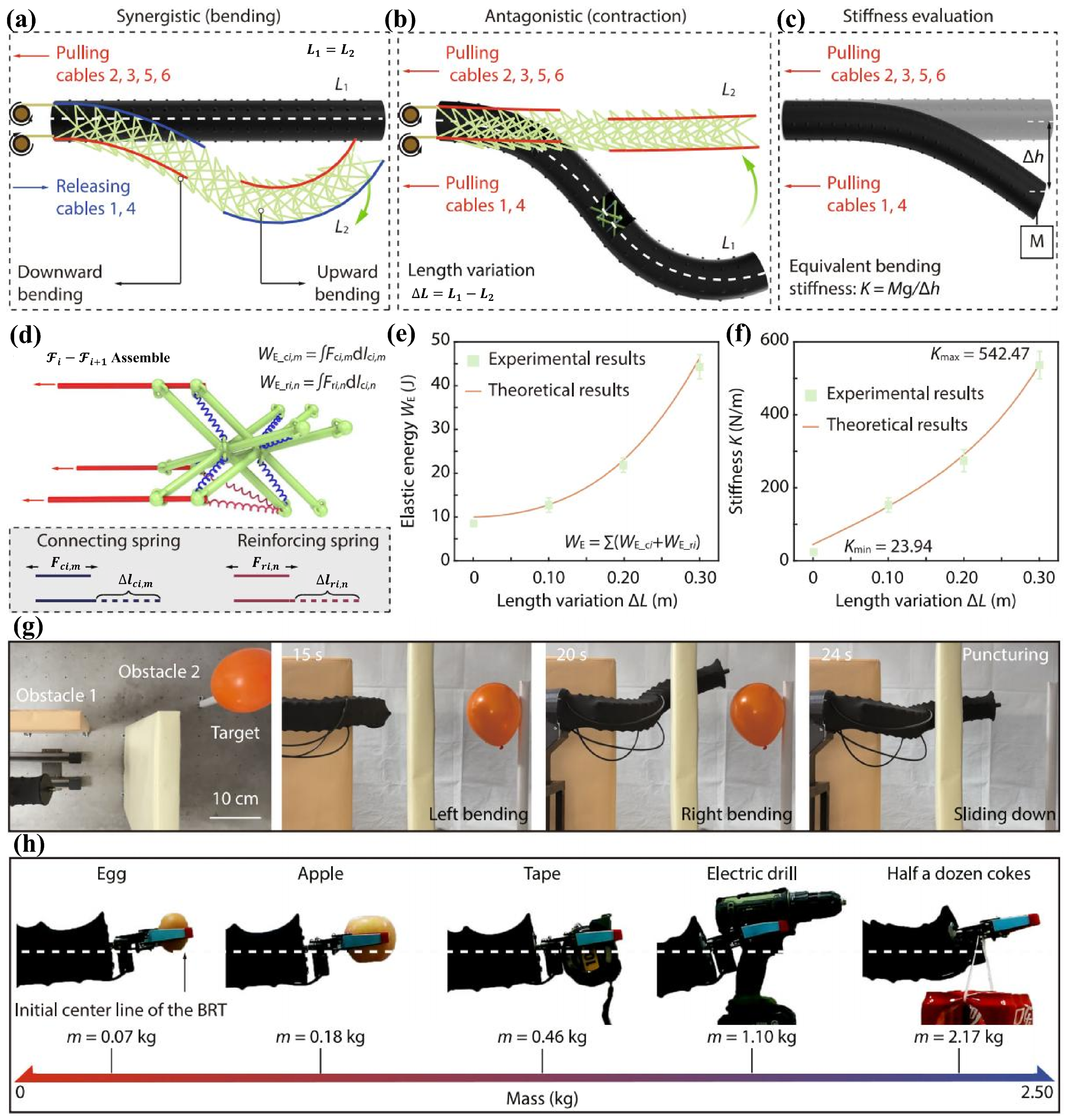
A tensegrity system is established when a set of discontinuous compressive components interacts with a set of continuous tensile components to define a stable volume in space. The core principle behind their variable stiffness lies in altering the mechanical response characteristics of the overall structure by regulating the pre-tension or elastic potential energy of the internal flexible tensile components. This functionality is intrinsically enabled by the tensegrity structure and the controlled coordination of cable actuation, inspired by synergistic and antagonistic muscular mechanisms. During synergistic actuation, internal tension decreases, reducing overall stiffness to achieve highly compliant deformation and dexterous manipulation. Conversely, during antagonistic actuation, the internal tensile components contract simultaneously, drastically increasing the elastic potential energy stored within the system. This allows the structure to become rigid in an extremely short time, enabling it to withstand external impacts and carry heavy loads (
Figure 3).
In recent years, the mechanism of achieving variable stiffness using tensegrity structures has been validated and applied in the fields of biomimetic robotics and compliant mechanisms. Abadi et al. [
83] proposed a novel three-degree-of-freedom spatial tensegrity mechanism based on the Stewart platform. By replacing the original three rigid links with springs, they not only preserved the system’s kinematic characteristics but also endowed the mechanism with inherent compliance, showing great potential for applications requiring soft contact and force control with the environment. Subsequently, they conducted a detailed stiffness and dynamic analysis of a six-degree-of-freedom compliant tensegrity mechanism. This design utilized adjustable cable-spring combinations to replace traditional piston-driven links, which not only significantly reduced the system’s moving inertia but also allowed the mechanism to adapt to external contact forces by sensing the deformation of the flexible components [
84]. Building on these variable stiffness theories, Zhang et al. [
85] developed a biomimetic robotic trunk (BRT) inspired by an elephant’s trunk, which employs a cable-driven tensegrity skeleton. Through highly coordinated synergistic and antagonistic cable actions, the robotic trunk can achieve a wide range of continuous stiffness adjustment ranging from 23.94 N/m to 542.47 N/m at a high frequency of 1.06 Hz. This perfectly combines compliant manipulation with heavy-load carrying capabilities and has been successfully integrated into an intelligent electric wheelchair system to assist stroke patients in completing complex daily interaction tasks, such as opening doors and retrieving objects.
3. Variable Stiffness Control Method
Once the structure of a variable stiffness robot is determined, it is necessary to establish a model for its motion control, particularly for the trajectory and motion control of the surgical EE. Distinguished from the modeling frameworks for traditional rigid manipulators, those for MIS impose higher precision requirements on the EE. However, the CRs investigated in this study, with their intrinsic compliance and adjustable stiffness, cannot be adequately described by conventional linear modeling approaches. Therefore, the modeling of variable stiffness CRs needs to take into account stiffness variation laws, environmental interaction characteristics, and the fitting of potential multi-physics fields. In addition, the models should be compatible with such features as a narrow workspace and low-interference performance.
Currently, as illustrated in
Figure 4, the modeling approaches for variable stiffness CRs generally adopt an integrated paradigm: they are based on mechanics analysis modeling, supplemented by data-driven modeling, and rely on various types of sensory feedback to transmit real-time data to the robot’s control unit, ultimately integrating multiple modeling methods. Meanwhile, different modeling approaches are applicable to distinct types of variable stiffness methods and actuation methods. Below, a classified analysis of these modeling approaches is presented.
3.1. Analysis of Mechanics
Based on the structural analysis of the robot, combined with classical mechanical analysis methods such as continuum mechanics and the calculus of variations, a series of analytical relationships among load, stiffness, and pose, including mechanical equations, constitutive equations, and deformation equations, can be derived. Relevant mechanics-based modeling approaches are mainly classified into three categories: Cosserat rod theory-based modeling, constant/variable curvature modeling, and multi-physics field coupling modeling (
Figure 4a–c).
3.1.1. Cosserat Rod Theory
Cosserat rod theory [
94,
95] refers to dividing a robot, especially a CR, into a number of infinitesimal Cosserat rod segments. By establishing the force equilibrium and moment equilibrium equations between adjacent infinitesimal segments, combined with the deformation equations of variable stiffness, the analytical relationships among the EE pose, deformation, and stiffness of the robot are derived through integration. This enables the accurate solution of the mechanical model and spatial pose, thereby achieving the precise control of surgical robots.
Basic assumptions of the Cosserat rod theory:
The robot is treated as a slender rod with uniform mass, whose cross-sectional dimensions are much smaller than its length, and the centroid of the cross-section coincides with its geometric center [
96].
At the ends of each Cosserat infinitesimal segment, bending, torsion, elongation, shear deformation, as well as their corresponding inertial effects (translational inertia, rotational inertia) are considered simultaneously [
97].
Changes in the geometric parameters of the rod (e.g., cross-sectional diameter, moment of inertia of the infinitesimal segment) during stiffness variation will alter the rod’s stiffness tensor [
98]. Therefore, the Cosserat rod theory is consistent with the slender characteristics of CRs, which are similar in shape to catheters. Meanwhile, considering its rigid constraint conditions, this model is generally applicable to concentric tubes [
86,
99] and robots that adopt stiffness variation methods based on blocking mechanisms [
100].
Dupont et al. [
94] pioneered research on stiffness control of CRs. Based on the Cosserat rod theory, they established a load-induced deformation model and realized stiffness modulation at the EE by iteratively solving the actuator positions. This method eliminates the need for force sensors, thereby providing a safe and flexible manipulation solution for surgical scenarios. Jalali et al. [
101] focused on supportive cooperative CRs, constructed a dynamic framework based on the Cosserat rod theory, and investigated the effects of parameters such as the position/angle of connection points on robot stiffness. Their work achieves stiffness modulation and improves the payload capacity and positioning accuracy of the robots. However, the limitations of using the Cosserat rod theory lie in simplified model assumptions, poor adaptability to specific working conditions, the influence of friction and assembly errors, as well as insufficient computational efficiency and generalization performance.
3.1.2. Modeling of Constant Curvature or Variable Curvature
Constant curvature [
102] and variable curvature [
103] are classic and straightforward approaches for the modeling of CRs. Their core assumptions are that the robot deforms into a single circular arc shape or is composed of multiple connected continuous circular arcs. These methods are more suitable for tendon-driven, magnetically actuated and other types of CRs. Particularly in the field of magnetically actuated robots, which have become a current research hotspot, the deformation caused by stiffness variation generally conforms to the variable curvature modeling framework, and thus the variable curvature modeling method is still widely adopted by researchers up to now.
The basic assumption of constant curvature modeling [
104,
105] is that the axis of a CR maintains a single constant curvature, where the curvature radius has a definite relationship with the applied external force and stiffness. In contrast, the stiffness tuning process of the robot directly alters the coupling relationship between curvature and driving input under the condition of constant external load. Therefore, the EE pose expression is generally derived through the solution of forward and inverse kinematics or D-H modeling. For the stiffness-tunable CR discussed in this paper, compared with the traditional constant curvature modeling method, an additional stiffness–curvature coefficient
needs to be introduced, where the curvature is expressed as:
where
F denotes the driving load, and
represents the equivalent flexural stiffness of the robot structure.
The effectiveness of constant curvature modeling in the field of stiffness-tunable CRs has been continuously consolidated through long-term validation. Yang et al. [
106] established a statics model incorporating geometric constraints based on the constant curvature assumption. They achieved stiffness tuning by regulating friction via SMA, resulting in a 287% increase in stiffness and a positioning error ratio of less than 2.23%, which laid a solid foundation for subsequent research. Hong et al. [
107] extended the variable curvature model within the constant curvature framework for maxillary sinus surgery. By combining segmented stiffness design and compensation strategies, they reduced the operational deviation to a clinically acceptable range, thus expanding the application scenarios of multi-segment robots. Zhang et al. [
82] focused on gastrointestinal endoscopic surgery, designing a dual stiffness-tuning mechanism and an intelligent compensation algorithm based on constant-curvature modeling. The average EE position variation was only 1.1 mm, which further enhanced the precise operation capability under complex working conditions.
Different from constant curvature modeling [
56,
108,
109], variable curvature modeling essentially discretizes the robot’s axis into multiple discrete segments, each adopting the constant curvature assumption, and the whole is composed of multiple smooth circular arcs with different curvatures. Its key lies in establishing the coupling relationship between the curvature distribution function and the axial stiffness distribution, essentially constructing the connection between curvature and stiffness. This modeling method is more consistent with the universal nonlinear deformation law of robots and is applicable to robots in large-deformation scenarios such as gastrointestinal [
110], bronchial [
111,
112], and cardiac interventional surgeries [
113,
114].
Chen et al. [
115] proposed a variable curvature model for multi-backbone CRs based on the Cosserat rod theory. Considering the inter-segment coupling and external disturbance effects, they derived compact static and kinematic formulas through simplified constraints. Compared with the constant curvature model, the maximum end-positioning error is reduced by 68.83%, and the average time consumption for inverse kinematics solution is only 0.7 ms, meeting the requirements of real-time control. Sayadi et al. [
114] proposed the finite arc method, which discretizes the flexible robot into several constant-curvature arc segments and combines B-spline curves to approximate deformation. In the large-deformation simulation of cardiovascular catheters, the computation time is shortened from 1244 ms to 3 ms compared with the finite element method, and the deformation error compared with experimental measurements is only 1.41–1.47 mm, realizing high-precision real-time prediction of complex deformations. Sun et al. [
113] tackled key challenges in cardiovascular catheter-based MIS by proposing a variable stiffness catheter design leveraging the fiber jamming effect. This design breaks through the limitation of slow stiffness adjustment of phase-change material-based catheters, achieving instantaneous stiffness change within 300 ms with a stiffness variation coefficient of 6.5 times. Moreover, it does not require in vivo electrical heating, which greatly reduces surgical risks and time consumption while improving operational flexibility.
3.1.3. Multi-Physics Coupling Modeling
The stiffness regulation and configuration evolution of variable stiffness CRs are essentially the results of the coupling effects of multiple physical fields, such as magnetic fields, thermal fields, flow fields, and structural mechanics. However, existing studies mostly focus on the analysis of a single physical field, lacking a systematic collation of the synergistic evolution laws of stiffness and configuration under multi-field coupling. To this end, this paper summarizes the core methods and application scenarios of multi-physics coupling modeling for variable stiffness CRs in recent years, aiming to provide a reference for research in this field.
To address the balance challenge between compliance and load-bearing capacity of soft robots, Liu et al. [
88] proposed a multi-physics coupled modular soft joint design integrating pneumatic actuation and magnetorheological fluid regulation. By establishing cross-field correlation models of gas pressure-deformation and magnetic field intensity–stiffness, combined with fluid–solid bidirectional coupling simulations and experimental validation, they revealed the coupling mechanism between pneumatically-driven deformation and magnetically regulated stiffness. Its rigid-flexible coupling characteristics enable the joint to achieve omnidirectional deformation while possessing dynamic stiffness adjustment capability. Fan et al. [
116] focused on the bottleneck of multi-physics-coupled dynamic modeling for layer-jamming CRs, proposing a port-Hamiltonian dynamic model integrating mechanical deformation, frictional effects, and vacuum pressure regulation. By incorporating the LuGre friction model to accurately characterize the coupling effect between interlayer friction and vacuum pressure, the core phenomena of shape locking and stiffness tunability were successfully captured. The designed passive feedback controller realized decoupled regulation of configuration and stiffness, and the real-time control performance under multi-physics coupling was verified on the OctRobot-I platform. Chen et al. [
117] tackled the multi-field coupled sensing challenge of micro-surgical CRs, proposing a quaternion multi-contact Cosserat rod theory integrating mechanical deformation, contact mechanics, and material nonlinearity. By coupling the cross-field effects of internal driving tension, external contact force, and structural deformation, the robot’s shape and body contact force can be simultaneously estimated with only end-position input, considering multi-physics interactions under complex constraints such as point, surface, and curved-surface contacts. High-precision estimation with approximately 1 mm shape error and 55 mN contact force error was achieved in vascular interventional scenarios. Alsarraj et al. [
118] further expanded the dimension of multi-physics coupled modeling, constructing a unified framework integrating motor electrical dynamics, mechanical transmission dynamics, and robot body deformation dynamics. Intrinsic sensing was realized by coupling electro-mechanical multi-field effects, enabling capture of cross-field characteristics of contact interactions without additional sensors. Its effectiveness in passive contact detection, active sensing, and target size estimation was verified on the SpiRob robot, improving the multi-physics-coupled actuation-sensing integration mechanism. The multi-physics field model is significantly superior to the single-physics field model.
3.2. Data-Driven
Different from traditional variable stiffness control methods, coupling equations derived from physical principles are prone to producing considerable errors and bringing potential safety hazards in application scenarios requiring high precision and high safety. This problem stems from the limitations of theoretical assumptions, inherent errors of material parameters, and complex disturbances existing in practical application environments.
In comparison, data-driven modeling adopts algorithms such as machine learning and deep learning to fit the nonlinear mapping relationship from actuation inputs and stiffness adjustment variables to the physical pose, structural deformation and contact force of the robot. This relationship features strong coupling and hysteresis characteristics and does not conform to linear assumptions. By collecting data including real or simulated control inputs, sensor feedback and stiffness outputs to construct a basic sample set, a nonlinear mapping relationship that better fits actual working conditions can be established (see
Figure 4d,e).
3.2.1. Neural Network-Based Variable Stiffness Control
The neural network [
119,
120,
121] is a mainstream data-driven modeling approach, suitable for scenarios with complex variable stiffness mechanisms, high difficulty in physical modeling, or intricate random variables—such as particle jamming and SMA-based variable stiffness. For magnetically actuated CRs, modeling solely from a mechanical perspective often overlooks numerous error-inducing factors. For instance, other medical devices in the operating room and the weak magnetic field of the human body may affect the magnet at the EE of the CR, thereby impairing operational accuracy and even causing certain damage to patients. Therefore, neural networks are trained on training data to enhance accuracy and implement stiffness adjustment.
El-Hussieny et al. [
122] addressed the challenge of static modeling for variable stiffness soft CRs, proposing an integrated framework of absolute nodal coordinate formulation and a deep convolutional neural network. This framework accurately captures the multi-physics coupling characteristics under variable stiffness, with the CNN learning the variable stiffness–deformation mapping, achieving millimeter-level positioning accuracy in trajectory tracking. To quantify its practical feasibility, this deep CNN-based approach is highly data-efficient, requiring a relatively small dataset of only 1520 training points. Evaluated via 5-fold cross-validation, the model successfully converges within 100 epochs, demonstrating rapid learning capabilities suitable for static modeling.
Cho et al. [
123] focused on the hysteresis effect of variable stiffness tendon-driven robots, adopting a deep learning decoder network that integrates historical and current tendon displacement inputs. This effectively overcomes the hysteresis error caused by variable stiffness adjustment, and the shape prediction accuracy is 6.6 times higher than that of traditional physical models. In terms of computational efficiency for closed-loop control, the network was trained on 2773 nominal configurations and achieves an average inference time of merely 0.32 ms to generate a complete shape point cloud. This sub-millisecond response time makes it highly promising for real-time surgical applications where high-frequency feedback is critical.
Licher et al. [
124] broke through the bottleneck of variable stiffness dynamic control efficiency, proposing a data-driven physics-informed neural network model based on the Cosserat rod theory. The model accelerates the variable stiffness dynamics solving speed by 44,800 times. Combined with the unscented Kalman filter for online adaptive stiffness estimation and paired with nonlinear model predictive control for high-acceleration trajectory tracking, the end error is controlled within 3 mm. By leveraging physical priors via a physics-informed neural network (PINN), this method eliminates the need for massive experimental datasets, requiring only about 10 seconds of real-world data to identify underlying parameters. Furthermore, it demonstrated robust generalization in physical tests, including tracking dynamic trajectories up to 1.5 Hz and maintaining stability during push recovery tests.
However, in medical scenarios, although data-driven neural network modeling offers the advantages of high prediction accuracy and strong generalization ability, this method suffers from drawbacks such as large sample size requirements and weaker model interpretability compared with mechanical modeling. Future research can further integrate the basic theories of mechanical modeling to optimize model performance while effectively reducing training costs.
3.2.2. Model Correction and Adaptive Control Based on Reinforcement Learning
With the reward function as its core optimization criterion, reinforcement learning [
125,
126,
127] transforms the variable stiffness modeling problem into a Markov decision process involving agent-environment interaction. Specifically, the agent outputs stiffness-adjusting actions to conduct real-time interaction with the environment that incorporates working condition constraints; the environment feeds back system state information, while the reward function quantifies the performance of the stiffness configuration, guiding the agent to perform iterative optimization and ultimately yielding an adaptive variable stiffness model. By learning the optimal stiffness-control strategy, reinforcement learning modeling serves as a dynamic online modeling method, which is more consistent with the actual operating conditions of CRs in dynamic environments such as the human body, thus enabling real-time regulation of stiffness and pose.
In the reinforcement learning modeling, the state space can be defined as pose, deformation, and contact force. Actions can be adjusted based on variable stiffness methods, such as the air pressure of particle jamming and the temperature of LMPA; the reward function can be set as indicators, including stiffness error, manipulator segment error, and human tissue damage.
Zhang et al. [
128] addressed contact-rich manipulation tasks by proposing the SRL-VIC, a safe reinforcement learning framework integrated with variable impedance control. They incorporated stiffness parameters into the action space and designed a safety critic and recovery policy, achieving deployment from simulation to physical robots without fine-tuning, which provides an important reference for the variable stiffness control of CRs. Trained with 40,018 simulated transitions, the policy exhibits strong zero-shot sim-to-real generalization. It was successfully deployed on a physical robot without any real-world fine-tuning, demonstrating the capability to robustly adapt to unknown obstacles and changed tool dimensions in unstructured environments.
Berjaoui Tahmaz et al. [
129] focused on sequential contact tasks and constructed the IMP-HRL, an impedance primitive-augmented hierarchical reinforcement learning framework. They expanded the action space to include stiffness parameters and developed an adaptive stiffness controller, which significantly improved the success rate and compliance of contact tasks. Their hierarchical decision-making and dynamic fine-tuning method for stiffness offers valuable insights for the reinforcement learning-based variable stiffness control of CRs. Utilizing a replay buffer of
samples without requiring expert demonstrations, this hierarchical framework accelerates convergence within 350 epochs. Its sim-to-real reliability was validated across various physical tasks with 20 randomized initializations per task, maintaining stable and high success rates.
Spoljaric et al. [
130] targeted the motion control of mobile robots by integrating variable stiffness into the reinforcement learning action space and proposing multiple stiffness grouping control strategies. Among them, the per-leg stiffness strategy exhibited optimal performance in velocity tracking and disturbance rejection, enabling robust locomotion on complex terrains. The policy, trained over 2000 epochs using 4096 parallel environments, demonstrated exceptional robustness in zero-shot physical deployments. Despite being trained only on flat surfaces, the robot successfully navigated multi-terrain environments carrying a 5 kg payload and reliably withstood random external pushes ranging from 50 N to 300 N. This work provides a useful reference for the coordinated variable stiffness control of multiple-DOF CRs.
Reinforcement learning modeling enables adaptive responses to dynamic environmental changes caused by the human body or modeling itself, yet the model training process is highly complex. Therefore, a key development direction lies in reasonably designing reward functions by integrating mechanical mechanism modeling to accelerate convergence and improve training efficiency.
3.3. Sensor-Based Variable Stiffness Strategy
In terms of variable stiffness control, real-time feedback and regulation are also of great significance in MIS. Owing to issues such as high-precision positioning requirements induced by stiffness variation and structural distortion under load, the robot is required to feed back data on stiffness distribution and the surrounding human body environment to the terminal in real time. At present, the mainstream sensing and feedback technologies include Fiber Bragg Grating (FBG) [
131,
132], visual sensing [
133,
134], and magnetic closed-loop systems [
135,
136,
137], as shown in
Figure 4f–h.
Lu et al. [
131] addressed the problem of 3D shape control for unmodeled continuum and soft robots operating in unstructured environments by proposing an adaptive closed-loop control method integrating FBG and online learning. They incorporated variable stiffness characteristics into the scope of online robot model estimation, achieved external independent, high-resolution 3D shape feedback using multicore FBG, and designed a closed-loop controller based on a radial basis function neural network combined with a composite adaptive law, with stability rigorously proven. This work demonstrated high-precision shape servo control of variable-stiffness soft robots under complex disturbances, providing a typical paradigm for the integrated application of FBG sensing and closed-loop control in variable-stiffness flexible robots. Zhu et al. [
133] focused on miniature magnetically controlled CRs, where variable stiffness is an inherent structural property (bending characteristics regulated by magnetic fields). Their core contribution lies in achieving markerless shape estimation via model-based visual sensing, thereby providing a sensor-free integrated closed-loop control scheme for miniature variable stiffness robots. Song et al. [
135] took active variable stiffness modulation as the core, utilizing magnetic actuation to achieve ultrafast and modular stiffness switching. The closed-loop control strategy focused on stiffness accuracy and force interaction optimization, making it suitable for robotic interaction tasks requiring dynamic stiffness adjustment.
4. Research Outlook
Despite the remarkable progress made by variable stiffness CRs in MIS, numerous challenges remain before their large-scale clinical application. Based on this study and relevant investigations, future research can be further explored in the following directions:
1. Integrated Design of “Actuation–Stiffness–Control”.
Current robot system designs are emerging one after another, yet the development of actuation systems and variable stiffness systems remains fragmented. This results in complex and non-universal control system architectures. Therefore, it is particularly crucial for future research to identify mainstream design paradigms or explore functional composite materials and structures, so as to realize more efficient and standardized mechatronic systems.
2. Precision Control in the Context of Multi-Physics Field Fusion.
During operation, CRs, especially those driven by non-classical mechanical systems such as magnetic actuation, are mostly exposed to the complex “force thermal magnetic fluid” multi-physics environment inside the human body. Thus, future efforts need to further integrate mechanical models with data-driven algorithms to construct interpretable real-time digital twin physics models, thereby achieving fast and accurate control of the robot’s manipulator.
3. Intelligent Development and Human–Robot Collaboration.
With the widespread adoption of artificial intelligence, surgical robots in the future should not only serve as medical devices with variable stiffness capabilities, but also be endowed with cognitive functions such as environmental perception and decision-making. Going forward, it is necessary to integrate FBG shape sensing and tactile perception sensors to realize closed-loop control of variable stiffness strategies, and incorporate algorithms such as reinforcement learning, enabling robots to adjust their postures and strategies more autonomously and rationally during surgery, as well as achieving human–robot collaboration with surgeons or even autonomous surgery, thus promoting the further advancement of surgical procedures.
4. Cross-Scenario Universalization and Modular Design.
At present, most robots developed for different surgical procedures are designed individually to accommodate their respective unique surgical paths and manipulator configurations. Nevertheless, most MIS share numerous similarities. Therefore, future research may focus on developing modular designs for CRs, enabling cross-scenario applications across different clinical departments and surgical types, and consequently reducing medical costs.
5. Clinical Translation Challenges of Different Variable Stiffness Methods.
Facing clinical translation, various current variable stiffness technologies still encounter their own unique key challenges. For physical mechanical structures (e.g., variable-length mechanisms and concentric tubes), the main limitation lies in integration reliability within a millimeter-scale diameter, and the risks of mechanical fatigue and intra-operative jamming after repeated sterilization remain urgent to be addressed. For jamming mechanisms (particle, layer, and fiber jamming), the core bottlenecks are biocompatibility and jamming consistency; unresolved issues include particle leakage, uneven distribution, difficulties in sterilization, and the miniaturization of negative pressure sources. Smart materials (phase change materials, shape memory alloys, magnetorheological and electrorheological fluids) are constrained by biosafety and dynamic response speed, accompanied by potential hazards such as thermal damage, phase transition hysteresis, cyclic fatigue, and field source interference. Therefore, future research on clinical translation must take sterility, biocompatibility, real-time response performance, reusability, reliability, and compatibility with existing clinical workflows as the core evaluation indicators. Meanwhile, the most suitable variable stiffness strategies should be selected or customized according to the specific requirements of different surgical procedures.
5. Conclusions
This paper systematically reviews the core technologies of variable-stiffness CRs for MIS. It takes the inherent coupling among actuation modes, variable-stiffness principles and motion control as the research focus, which has long hindered the clinical translation and practical application of such robots. This study sorts out and compares existing research outcomes. Rather than simply summarizing published literature, it summarizes in-depth research findings and forecasts future development trends. The research aims to establish a unified theoretical framework and engineering design paradigm for the development of high-performance medical CRs.
From the perspective of variable stiffness principles, existing variable stiffness mechanisms are mainly divided into three types: mechanical type, jamming type and smart material type. Each type possesses distinct merits and demerits in performance and practical application, which requires comprehensive trade-offs before reasonable selection. Comparative analysis shows that mechanical variable stiffness structures achieve the fastest stiffness response speed, yet they feature complicated and bulky configurations, making miniaturization and integrated design difficult. Although concentric tube structures are conducive to miniaturization and integration, they face great challenges in notch machining. The jamming-based mechanism boasts a wide stiffness adjustment range. Nevertheless, affected by medium inhomogeneity and internal friction, it leads to decreased positioning accuracy and uneven stiffness distribution. In addition, it bears potential leakage risks, which further increase operational risks in MIS. The smart material-based scheme realizes continuous and smooth stiffness regulation, but it has obvious limitations in response speed, thermal and electromagnetic safety, as well as long-term service stability. At present, tendon-driven and magnetic-driven modes have become the mainstream driving forms for minimally invasive surgical robots. The matched variable stiffness technologies are evolving toward the integration of actuation, stiffness tuning and motion control. This integrated design is not a simple combination of separate functions, but a collaborative design strategy that integrates actuation deformation, stiffness regulation and closed-loop control. It also serves as a vital approach to resolve the performance trade-off among flexibility, load capacity and positioning accuracy.
In terms of mathematical modeling and control strategies for variable stiffness, this paper summarizes three mainstream technical approaches: mechanical modeling, data-driven modeling and multimodal fusion modeling. Mechanical modeling features clear physical significance and a sound theoretical system. However, it is confronted with difficulties in parameter calibration and poor adaptability to nonlinear characteristics, and presents unsatisfactory real-time performance in complex in vivo surgical environments. Data-driven modeling can accurately fit complex nonlinear relationships with high computational efficiency, yet it heavily relies on high-quality datasets and lacks physical model support. It suffers from weak generalization ability in unstructured surgical scenarios and excessive dependence on calibration work. By organically integrating physical prior knowledge and data-driven learning, multimodal fusion modeling effectively remedies the inherent drawbacks of single modeling methods and greatly improves the control accuracy, robustness and operational reliability of the system. This fusion mode is not a simple combination of different technical modules, but an innovative research paradigm that realizes data augmentation based on physical models. It also represents the mainstream development trend of high-precision control for variable-stiffness CRs.
In addition, this paper identifies and summarizes the core bottlenecks in current research. At present, design elements, including driving modes, variable stiffness mechanisms and control systems, are mostly studied separately, which results in a fragmented technical system, poor environmental adaptability and insufficient generalization performance of robots and restricts further improvement of their clinical application performance. To resolve this key contradiction, this paper proposes an integrated collaborative design framework of actuation, variable stiffness and control for the new generation of intelligent minimally invasive surgical robots. Established on multi-physics coupled modeling, supported by multimodal sensor feedback for environmental perception, and adopting adaptive intelligent algorithms as the control core, this design paradigm can realize the collaborative optimization of robot flexibility, load capacity and positioning accuracy.
Finally, from the perspectives of clinical demands and technological iteration, variable-stiffness CRs possess irreplaceable application advantages in adapting to narrow human anatomical spaces and achieving safe human–robot interaction. Nevertheless, their large-scale clinical implementation still faces numerous challenges, mainly involving precise multi-physics field control, intelligent human–robot collaborative decision-making, and cross-scenario modular and universal applications. The research conclusions and design ideas summarized in this paper not only systematically sort out the overall development evolution of variable-stiffness technology, but also clarify distinct theoretical foundations and technical implementation routes for structural optimization, performance improvement and clinical translation of minimally invasive surgical CRs. This work is expected to further accelerate the advancement of precise and intelligent minimally invasive diagnosis and treatment technologies. Furthermore, relying on the generalization adaptability of variable-stiffness technology, relevant applications can be extended to various fields.



 ,
,