Article

Study on Thermal–Fluid–Solid Coupling Characteristics of a Scroll Compressor in an Oil–Gas Waste Heat Recovery Heat Pump System


1
State Key Laboratory of Oil and Gas Reservoir Geology and Exploitation, Chengdu University of Technology, Chengdu 610059, China
2
Tianfu Yongxing Laboratory, Geothermal Exploration, Development and Comprehensive Utilization Research Center, Chengdu 610213, China
3
College of Energy, Chengdu University of Technology, Chengdu 610059, China
4
College of Mechanical and Electrical Engineering, Chengdu University of Technology, Chengdu 610059, China
*
Author to whom correspondence should be addressed.
Machines 2026, 14(5), 569; https://doi.org/10.3390/machines14050569
Submission received: 17 March 2026 / Revised: 30 April 2026 / Accepted: 18 May 2026 / Published: 20 May 2026
(This article belongs to the Section Turbomachinery)

Abstract

Heat pump technology can efficiently recover waste heat from oil and gas gathering, processing, and transportation. However, the energy transfer mechanism of high-speed rotating internal flow in the scroll compressor remains unclear under unbalanced load conditions, leading to low equipment energy efficiency and high operation and maintenance costs. This study adopted dynamic grid technology, finite element analysis and one-way thermal–fluid–solid coupling method to quantitatively study the flow field characteristics and mechanical response of four characteristic phases. The results showed that the internal pressure and temperature fields of the compressor presented a non-uniform distribution. The deformation of the scroll wraps was mainly concentrated in the compression chamber, and the maximum stress was concentrated at the wraps’ root. Further analysis revealed that temperature loading played a dominant role in the structural responses. At a spindle rotation angle of 0°, under temperature loading alone, the maximum deformation and maximum stress were 28.605 μm and 521.81 MPa, respectively, while the corresponding values under pressure loading alone were small. In addition, the deformation and stress under coupled loading were not a linear superposition of the individual loading effects, with a deformation deviation of 0.938 μm and a stress deviation of 7.18 MPa at a spindle rotation angle of 0°. In this study, a numerical model of the scroll compressor was established and experimentally verified, which provided a theoretical basis for optimizing scroll profile design, suppressing wrap tip wear and improving the energy efficiency of heat pump systems.

1. Introduction

A heat pump is a thermal device that transfers thermal energy from a low-temperature heat source to a high-temperature heat source based on the principle of the reverse Carnot cycle. In the oil and gas industry, owing to its remarkable thermal energy utilization efficiency, this technology is mainly employed to replace traditional heating furnaces for long-distance pipeline transportation, and for waste heat recovery and utilization in the processes of oil and gas gathering, processing, storage and transportation. This allows the efficient utilization of energy during oil and gas gathering and transportation, thereby reducing energy consumption and enhancing energy conversion efficiency [1,2].
Waste heat resources refer to the heat that is no longer utilized and is emitted after several reactions of primary energy or fuel in a certain process of oil and gas transportation [3,4]. Against the background of continuously rising energy consumption in oil and gas transportation, substantial waste heat resources are generated during oil and gas transportation and oilfield production. The efficient utilization of these resources can effectively mitigate excessive energy consumption and fulfill energy conservation targets. Taking Daqing Oilfield as an example, it treats up to 100 × 104 m3 of wastewater per day, from which 4 × 10⁸ kcal of heat can be recovered at a temperature difference of 10 °C [5]. Indirect heat exchange modes in oilfield waste heat recovery technology mainly include the Organic Rankine Cycle (ORC) and heat pumps. Compared with the ORC, heat pumps exhibit stronger adaptability. The compressor serves as the core component of a heat pump. Among common compressor types such as reciprocating, screw and scroll compressors, the scroll compressor features the advantages of small size, light weight, high efficiency, low noise, continuous operation and long service life, making it more suitable for heat pump systems applied to wastewater waste heat recovery in oil and gas fields.
As a key component of the scroll compressor, the stress and deformation of the scroll wraps are closely related to the working performance and service life of the scroll compressor. Therefore, studying the stress distribution, deformation law, and internal flow field law of the scroll is of vital importance for improving the performance of the scroll compressor. At present, scholars at home and abroad mostly adopt methods such as finite element analysis to explore the stress distribution and deformation law of the scroll, as well as the internal flow field law. Chen et al. [6,7] initially obtained the temperature distribution of the refrigerant by combining the steady-state energy balance equation with programming, established a two-dimensional model, and on this basis, studied the internal flow field parameters of the scroll compressor to obtain the influence of internal leakage heat transfer loss on the compressor. Cui [8,9] analyzed the internal flow field of a scroll compressor with R22 as the compressor working fluid, obtained the distribution characteristics of pressure, velocity and temperature fields as well as the variation laws of pressure and temperature with rotation angle. Blunier et al. [10] established a scroll compressor model with a circular involute profile by utilizing symmetry. Hiwata et al. [11,12] loaded the actual internal temperature of the scroll compressor under stable operating conditions as the boundary condition onto the orbiting and fixed scroll for stress and thermal deformation research, and thereby obtained the stress variation and deformation laws of the scroll under the action of temperature load. Cha et al. [13] used the one-way fluid–solid coupling method to study the force and deformation laws of scroll wraps at arbitrary angles only under pressure load. Yang et al. [14,15,16,17,18] established a three-dimensional structured dynamic mesh model. By using numerical simulation methods combined with experimental methods, the suction process of the scroll compressor was analyzed, thereby obtaining the distribution and variation laws of the internal pressure field and temperature field of the scroll compressor during the suction process. Peng et al. [19] developed a mathematical model to characterize variations in gas parameters within the compressor. The model captured the flow and heat transfer characteristics within the compression chamber, as well as the non-uniform temperature and pressure distributions induced by leakages. Wu et al. [20] established a three-dimensional flow field numerical model of the vortex disk and obtained the internal flow field parameters by using the dynamic mesh technology. Emhardt et al. [21] obtained the internal flow field laws of scroll expanders under different compression ratios by using the CFD method. Zhou et al. [22,23,24] carried out finite element studies on the mechanical behavior of scroll wraps under thermal loading and gas pressure loading and revealed the influence of multi-field coupled loads on their mechanical properties. Zhao et al. [25] established a fluid computational domain and analyzed the effect of discharge port position on the transient flow field characteristics of scroll compressors with relevant finite element analysis software. Wang et al. [26] obtained the temperature and pressure loads of scroll teeth through fluid–solid–thermal coupling simulations, and mainly investigated the contact and clearance variations caused by deformation. Zhang et al. [27] analyzed the temperature field and thermal deformation distribution of scroll teeth in a multi-stage dry scroll vacuum pump based on a two-way thermal–fluid–solid coupling method. Li et al. [28,29,30,31,32] explored the stress variation and deformation laws of the scroll under the individual action of temperature load, gas force, and inertial load, as well as under the coupled action of multiple loads. The deformation of the scroll was more affected by temperature load, and the deformation under the coupled action was not a simple linear addition of the deformations under the individual action.
The existing research on the characteristic analysis of scroll compressors still has the following two key problems. On the one hand, most studies are only limited to describing the distribution characteristics of flow-field pressure and temperature at an arbitrary rotation angle of the main shaft, without further investigating the influence of these distributions on the mechanical behavior of scroll wraps. On the other hand, although a small number of studies have addressed the deformation of scroll wraps under one-way fluid–thermal–solid coupling, the individual contributions of the pressure field and temperature field and their coupling effects have not been systematically distinguished. Specifically, neither the quantitative comparison between the magnitudes of stress and deformation induced by pressure loading and thermal loading separately, nor the nonlinear enhancement or cancellation effect caused by their coupling has been clarified. Furthermore, there is a lack of quantitative characterization of the above differences at characteristic phase angles.
To address the above deficiencies, this study focused on the fluid–thermal–solid coupling effects of scroll compressors. A three-dimensional model was established based on the scroll compressor used in a heat pump experimental setup. By employing the finite element dynamic simulation platform together with dynamic mesh technology, combined with the RNG k-ε turbulence model and the NIST real gas model, numerical simulations were performed on the flow field, pressure field, and temperature field at four characteristic phases (0°, 90°, 180°, and 270°). The pressure and temperature distributions in the fluid domain at each phase angle were accurately obtained. Subsequently, the flow-field calculation results were mapped onto the surfaces of scroll wraps in the solid domain. The stress distribution and deformation of scroll wraps under pressure loading, temperature loading, and coupled loading were calculated, respectively. Quantitative comparisons revealed the contribution degrees of different load types to the mechanical response of scroll wraps and their coupling characteristics.
The research results reveal the dynamic response mechanism of scroll wraps from the perspective of multi-physics field coupling, providing a theoretical basis for engineering practices such as profile optimization design, fatigue life prediction, and reliability improvement of compressors. Especially, it has an important guiding value in solving key problems such as end wear of scroll wraps under high-speed working conditions.

2. Materials and Methods

2.1. Physical Model

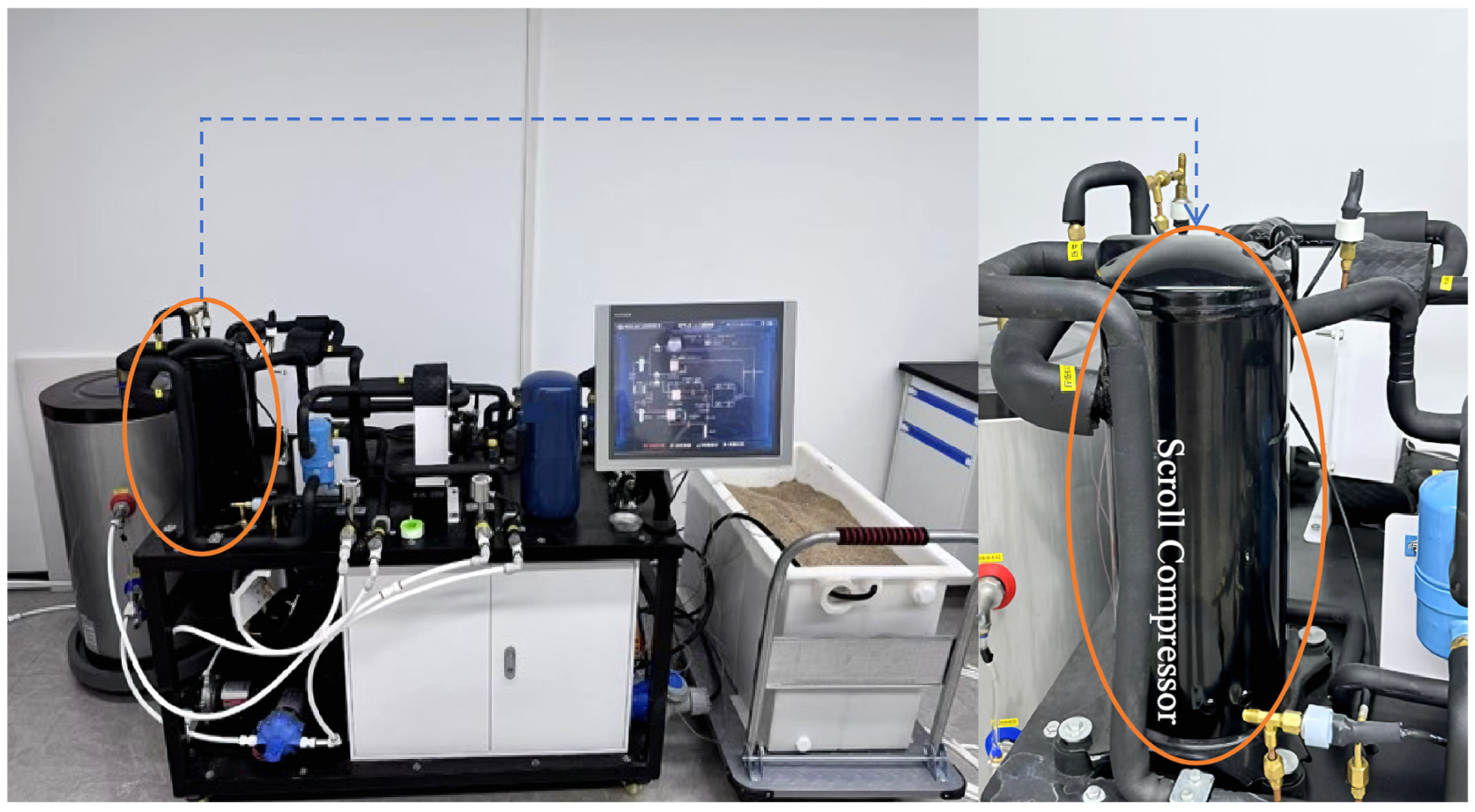
The three-dimensional geometric model constructed was simplified from the scroll compressor used in the actual built heat pump test bench. The schematic diagram of the heat pump test bench and the actual physical diagram of the scroll compressor are shown in Figure 1.
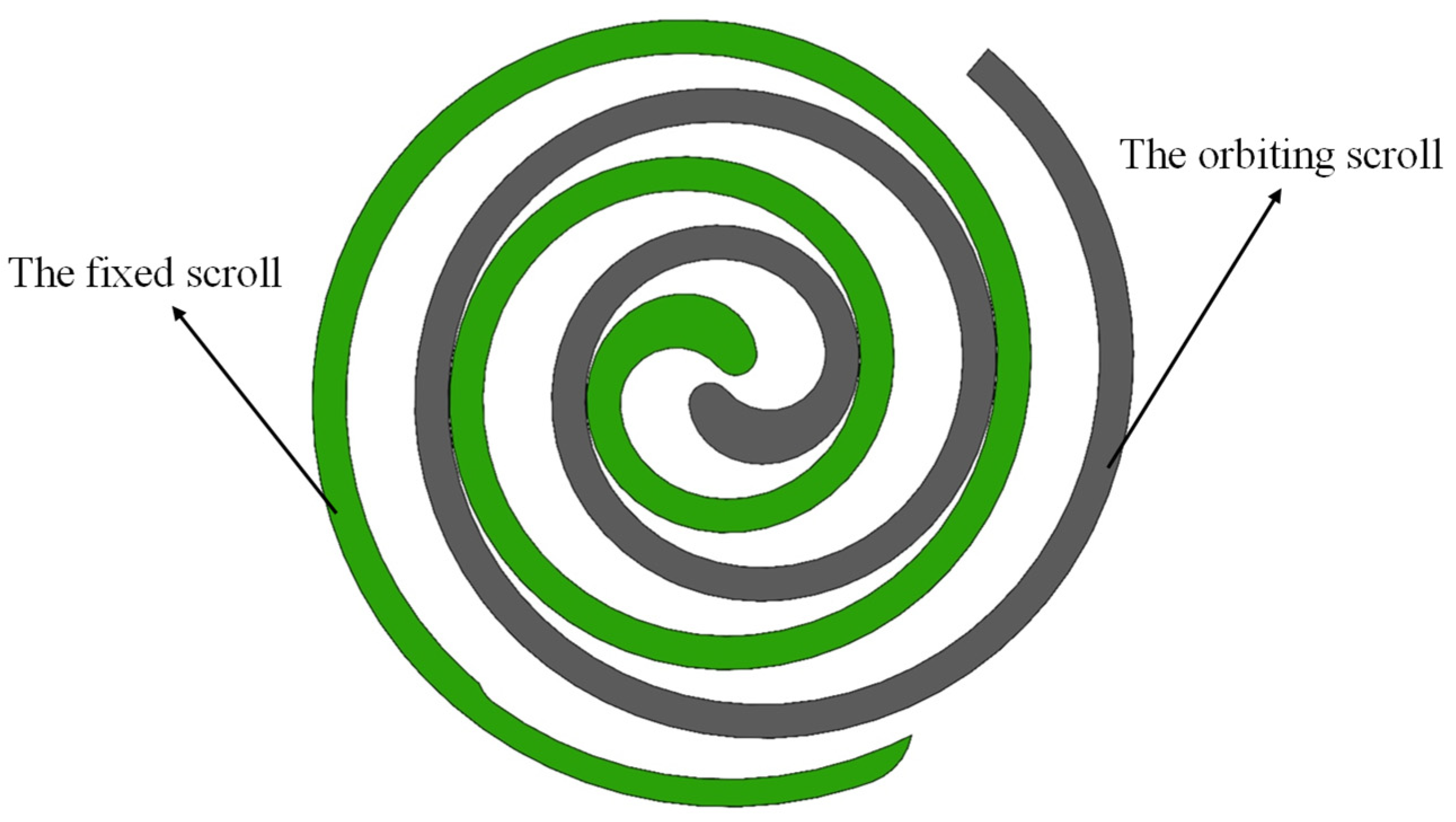
The scroll compressor operates by varying its working volume to complete the suction-compression-discharge cycle. Its working chamber consists of two core components: the orbiting scroll and the fixed scroll. The orbiting scroll is eccentrically offset from the fixed scroll center. The two scrolls are assembled face-to-face with a 180° phase angle difference in their scroll wrap profiles, as illustrated in Figure 2. To enable continuous volume variation, the compressor is equipped with a crankshaft drive mechanism to drive the orbiting scroll around the fixed scroll center. Concurrently, an anti-rotation mechanism (typically an Oldham coupling) is utilized to ensure pure revolution of the orbiting scroll without self-rotation. Furthermore, a back-pressure chamber structure is adopted to balance the axial gas forces. Additionally, lubricating oil forms a thin film on the scroll wrap surfaces to provide sealing, lubrication, and cooling.
The scroll profile adopts a circular involute profile, and the equation of the inner scroll profile is Equation (1).
x i = r c o s ϕ i + α + ϕ i s i n ϕ i + α y i = r s i n ϕ i + α ϕ i c o s ϕ i + α
The equation of the outer scroll profile is Equation (2).
x o = r c o s ϕ o α + ϕ o s i n ϕ o α y o = r s i n ϕ o α ϕ o c o s ϕ o α
During the operation of a scroll compressor, the fluid domain needs to satisfy the mass conservation equation and the momentum conservation equation and the energy conservation equation. The mass conservation equation, also known as the continuity equation, is based on Newton’s first law and indicates that the increment of the total mass of the fluid in a certain control body within a unit of time is equal to the mass of the fluid flowing into the control body. The specific mathematical expression is Equation (3).
ρ t + ρ v = 0
where ρ, v and represent the density of the fluid domain, the velocity vector of the fluid domain and the Hamiltonian operator.
The equation of conservation of momentum is an expression based on Newton’s second law, which describes the change in momentum in the fluid domain. That is, the rate of change in the total momentum inside the control volume is equal to the net flux of momentum across the control surface plus the sum of external forces acting on the fluid. The specific mathematical expression is Equation (4).
ρ u t + ρ u v = p x + ρ f x + F ν i s x ρ v t + ρ v v = p y + ρ f y + F ν i s y ρ w t + ρ w v = p z + ρ f z + F ν i s z
where u, v and w represent the velocity components in different directions, F v i s x , F v i s y and F v i s z represent the viscous forces in different directions, p represents the pressure acting on the control body.
When conducting finite element analysis, the fluid domain needs to satisfy the energy conservation equation, which can be specifically described as the increment of the total energy of the fluid in the control body per unit time being equal to the sum of the energy of the fluid flowing into the control body per unit time and the energy increment generated by the heat transferred from the outside and the work done by the external force. The specific mathematical expression is Equation (5).
ρ c p ( T t + v T ) = ( K eff T ) + β T D p D t + Φ
where c p is the specific heat capacity at constant pressure, v is the velocity vector of the fluid domain, K e f f is the thermal conductivity of the scroll material, β is the thermal expansion coefficient, and Φ is the viscous dissipation function.
In contrast to the energy equation for the fluid domain, the energy conservation equation for the solid domain does not include convection terms. Due to the absence of macroscopic flow within the solid medium, its energy transport relies solely on heat conduction. Consequently, the energy equation for the solid domain simplifies to the following pure heat conduction form.
ρ s c T t = ( K e f f T ) + q ˙
where ρ s is the density of the solid domain, c is the specific heat capacity of the solid material, and q ˙ is the frictional heat.
Since heat is transferred between the flow field domain and the solid domain, as shown in Equation (7), this flow system must meet the conservation requirements of gas heat flux and solid heat flux.
q s = q f
where q s and q f represent the solid heat flux and the fluid heat flux.
In this study, the material of the scroll plates is aluminum alloy 4032. The specific material properties are shown in Table 1. The geometric parameters of the scroll plates are simplified from the actual scroll compressor model scanned out. The specific geometric design parameters of the scroll plates are shown in Table 2.
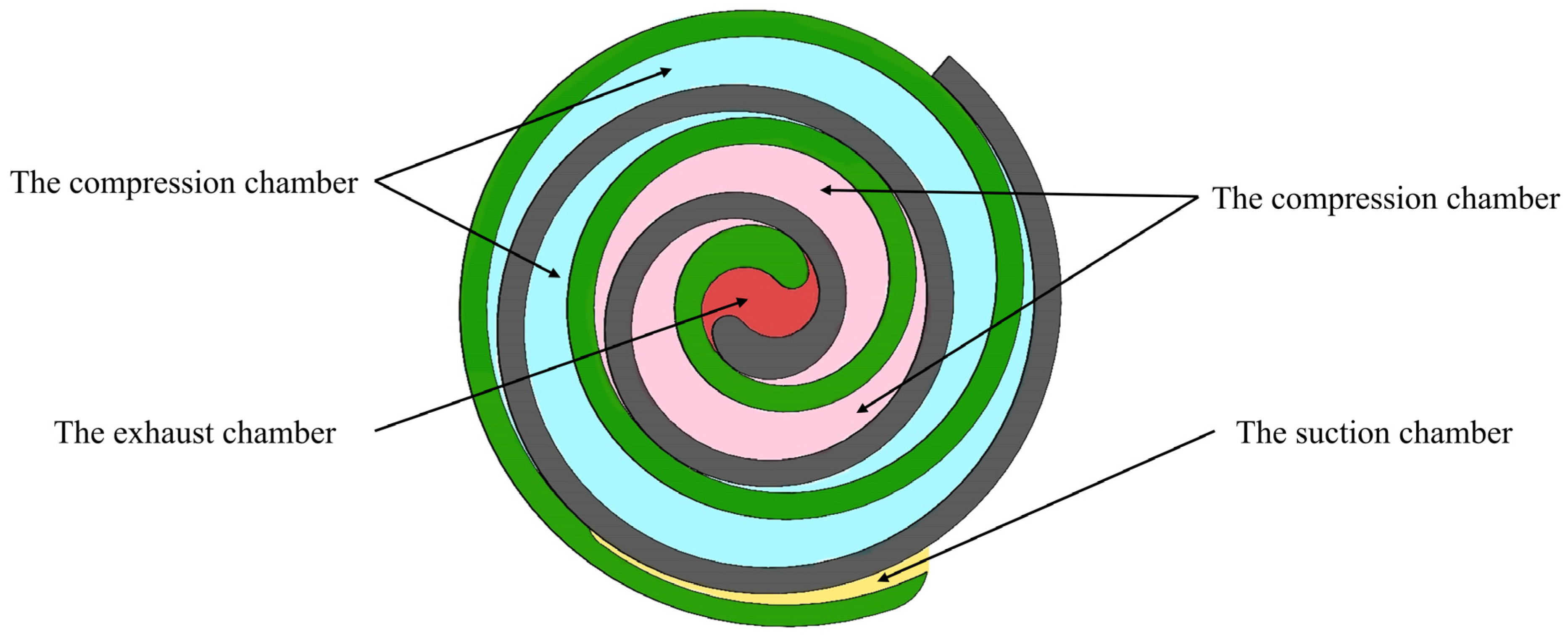
Due to the special installation of the orbiting and fixed scrolls, the inner/outer walls of the orbiting scroll and the outer/inner walls of the fixed scroll remain tangent. The tangent point is called the meshing point, and the meshing line can be obtained by extending it in the cross-sectional direction. The volume formed by these meshing lines and the side/end faces of the scrolls constitutes a basic volume, classified into suction, compression, and exhaust working chambers based on their distribution and operational characteristics. As shown in Figure 3, except for the central chamber (exhaust working chamber), the volumes of the other elements are paired and symmetrically arranged.
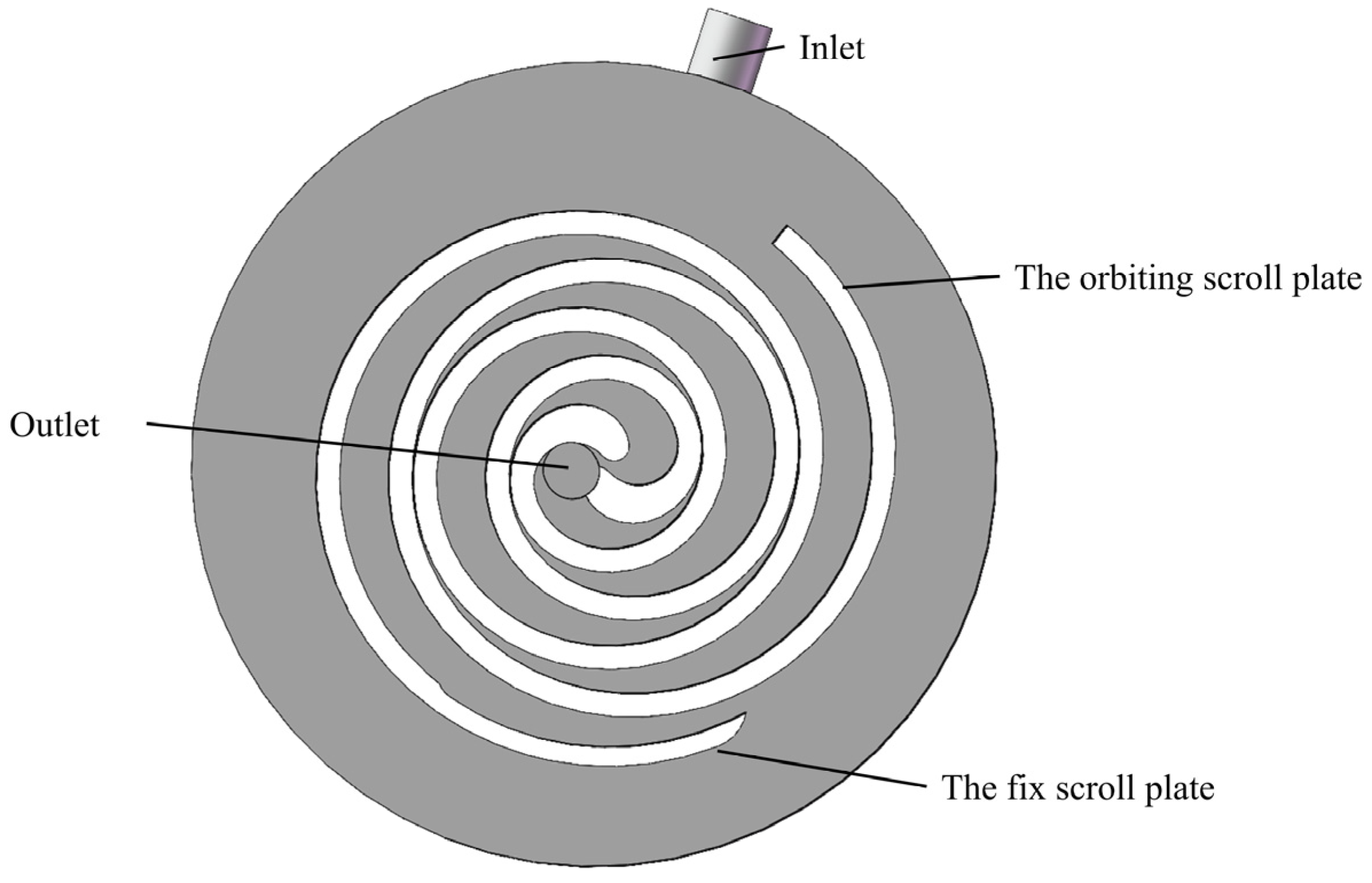
The scroll compressor compresses gas through periodic variations in the basic volume. This volume variation arises from the orbiting scroll’s orbiting translational motion relative to the fixed scroll, with a non-rotational planar circular trajectory around the fixed scroll center. As illustrated in Figure 4, the flow field model consists of three main parts: the intake inlet, the vortex working chamber, and the exhaust outlet. The solid domain structure, illustrated in Figure 5, includes a fixed scroll and an orbiting scroll with endplate structures.

2.2. Grid Division and Independence Verification

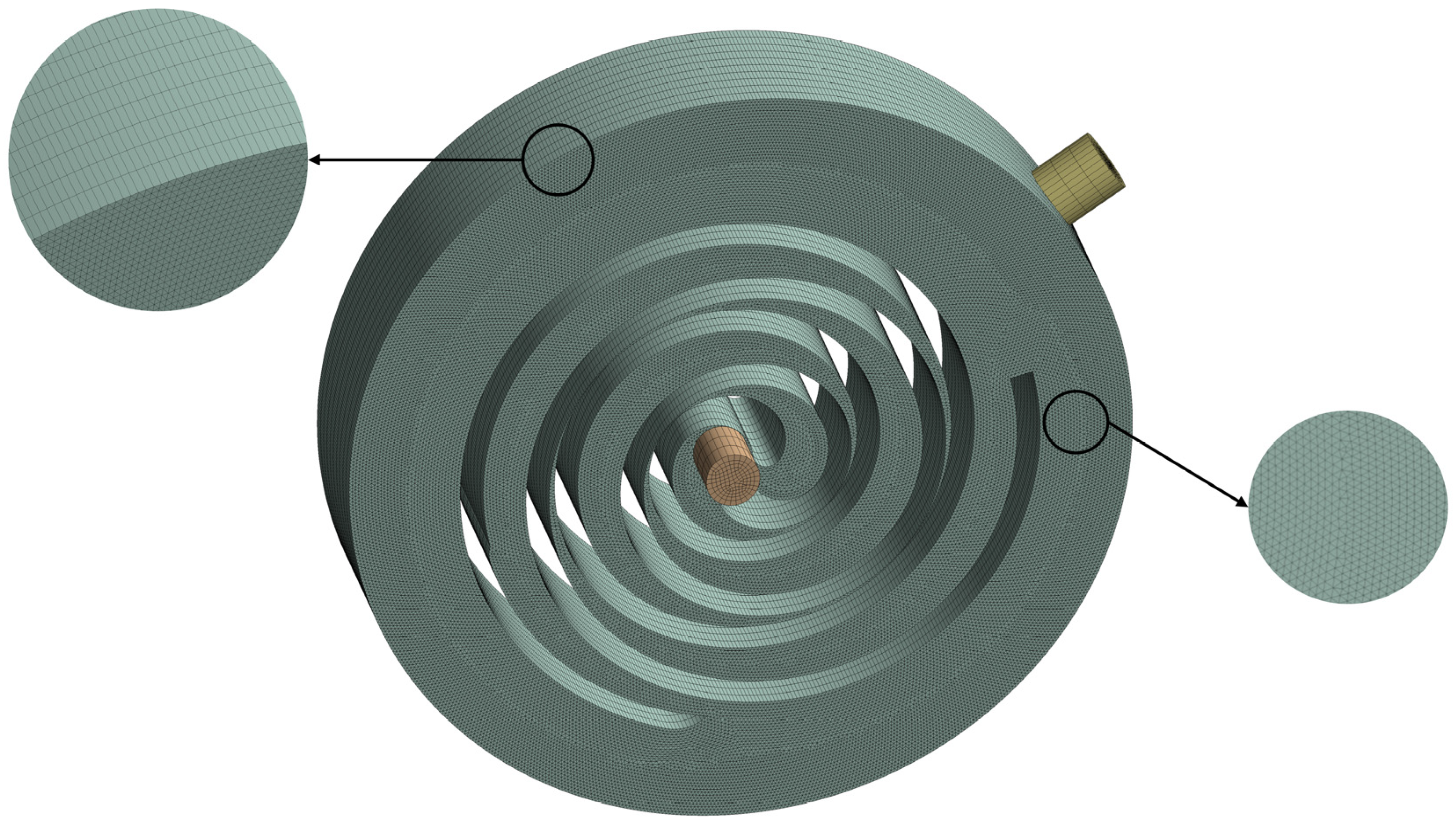
In view of the dynamic characteristics of the flow field of scroll compressors, this study combines the dynamic mesh technology to mesh the flow field. Since the orbiting scroll performs periodic orbital translational motion around the center of the fixed scroll, the flow field boundaries undergo continuous variation. It is necessary to maintain the calculation accuracy through dynamic mesh regeneration. The dynamic mesh adopted the Spring Smoothing method and the 2.5D Remeshing method, and combined the user-defined function (UDF) to achieve the motion control of the boundary and the deformation of the mesh. In accordance with the requirements of 2.5D dynamic meshing, the mesh elements within the computational domain must be prism cells. Specifically, the working chamber region was assigned 10 sweeping layers with an element size of 0.55 mm. The inlet and outlet regions were set to 3 sweeping layers with an element size of 1.0 mm. Meanwhile, considering the functional characteristics of different flow field regions, triangular surface meshes were applied to the working chamber to improve deformation adaptability, while mixed quadrilateral/triangular surface meshes were used for the inlet and outlet to strike a balance between computational accuracy and efficiency. The number of grid cells and grid nodes in the final divided flow field grid model, respectively, was 615,828 and 359,008, as shown in Figure 6.
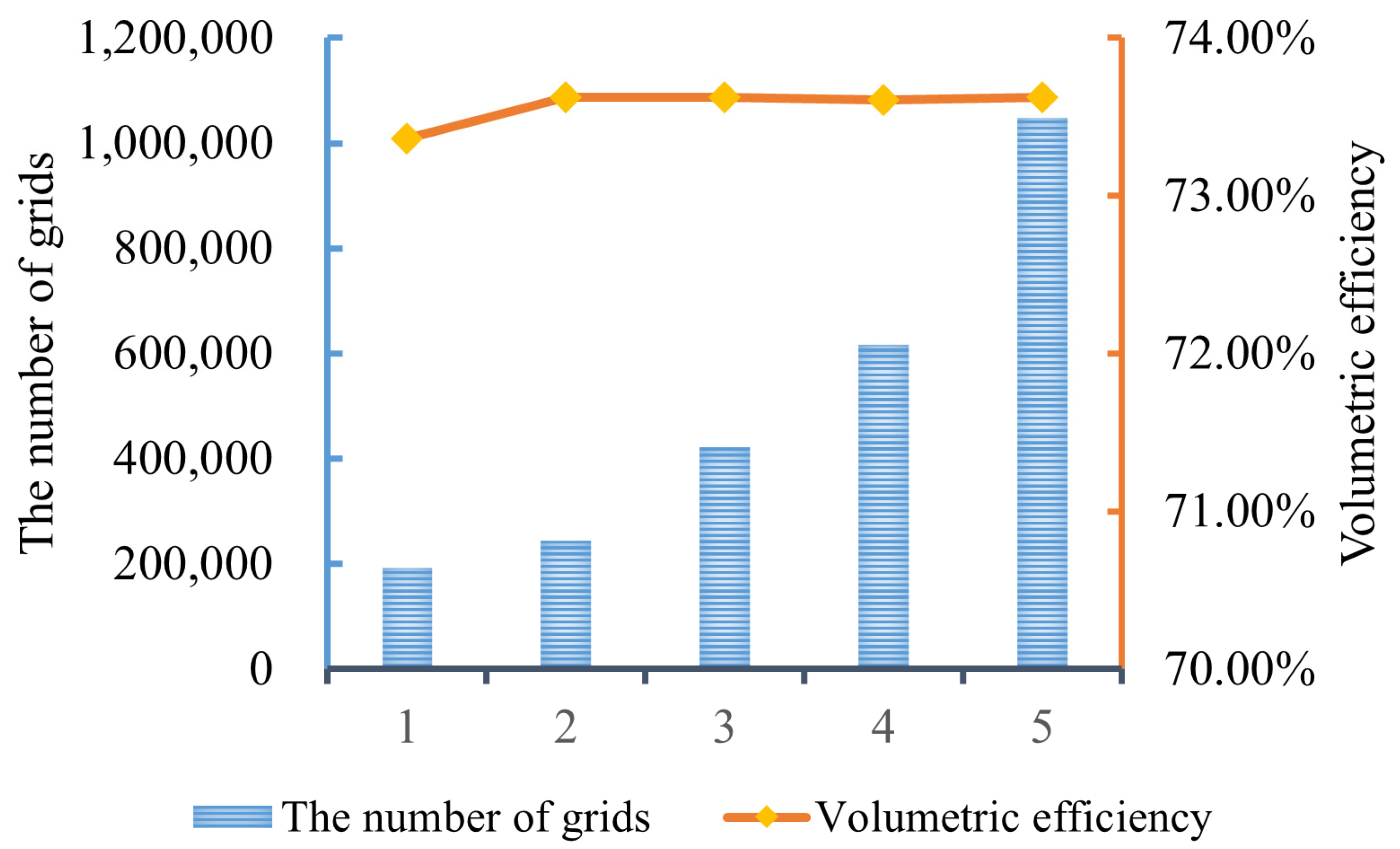
The number of grid cells with 615,828 was selected as the reference grid, on the basis of which the coarsening and refining of the grid were carried out. Models with different numbers of grids were selected for numerical simulation calculation under the same boundary conditions and solver settings, and the simulation results under different numbers of grids were compared. As shown in Figure 7, the method of judging the relationship between volumetric efficiency and the number of grids was adopted to verify the independence of the grids. The calculation formulas for the volumetric efficiency of the scroll compressor are Equations (8) and (9).
η v = m n ρ V s
V s = π P P 2 t h 2 i 1 θ s π
where η v , m, ρ , n, V s , P, t and θ s represent the volumetric efficiency, the mass flow rate, the gas density, the working speed of the scroll compressor, the suction volume, the pitch of the scroll, the wall thickness, and the spindle rotation angle corresponding to the end of suction.
As can be seen from Figure 7, the influence of grid number on volumetric efficiency tends to be insignificant starting from the second set of grids. Meanwhile, an excessive grid number will reduce the subsequent computational efficiency. Considering both calculation accuracy and time cost, the number of grid elements was finally determined as 615,828.
During the numerical simulation process of this flow field, a pressure inlet was adopted as the inlet boundary condition, and a pressure outlet was used as the outlet boundary condition. The specific boundary conditions are set as follows: the inlet pressure was 101,325 Pa, the outlet pressure was 300,000 Pa, the inlet temperatures were 300 K, and the rotational speed was 3000 rpm. Due to the high rotational speed of the spindle during the operation of the scroll compressor, the orbiting scroll plate moves around the center of the fixed scroll plate, and the working medium will generate vortex phenomena during the flow process, which belongs to unsteady flow. Therefore, the RNG k-ε model was selected as the turbulence model. In addition, the time step was set to 0.0000555556 s, and the convergence criteria for the continuity, momentum, energy, and turbulence equations were specified as 10−6. During the operating cycle, heat exchange between the working fluid and the surrounding environment was neglected, and the compression process was assumed to be adiabatic. Numerical simulations were performed using the Coupled algorithm for pressure-velocity coupling. The working fluid used in this study was refrigerant R134a. The real fluid properties of R134a, including density, viscosity, entropy, and thermal conductivity, were obtained from REFPROP software (Version 10.0) developed by the U.S. NIST.

2.3. Experimental Validation

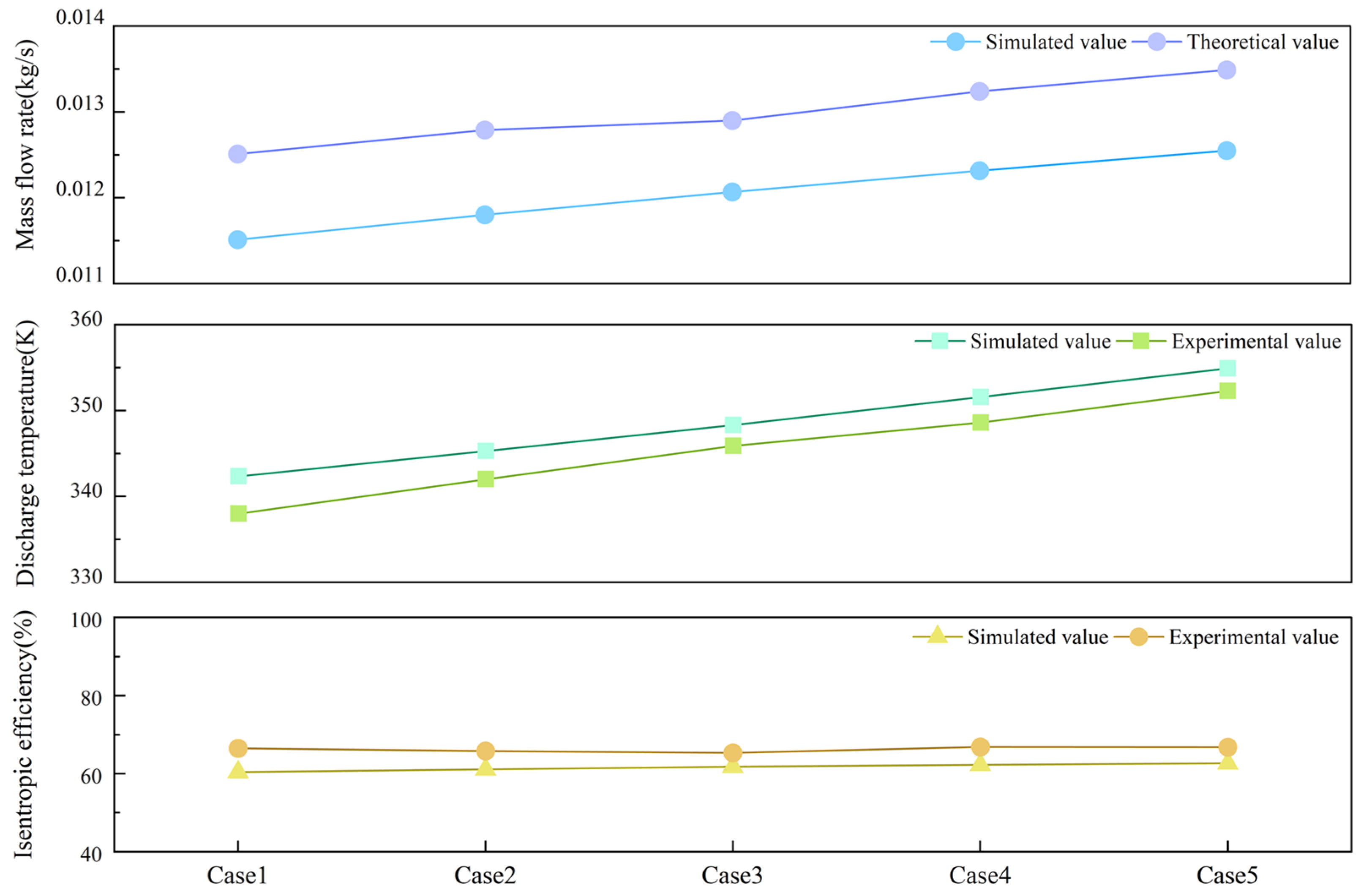
The experimental setup established in this work is illustrated in Figure 1. The cooling water temperature at the evaporator is adjusted by varying the geothermal soil tank temperature, which in turn regulates the compressor suction temperature. In experimental tests, the suction pressure increases synchronously with suction temperature. Accordingly, at a rotational speed of 2900 rpm, five operating conditions with matched suction temperature and pressure were tested by adjusting the geothermal temperature. The detailed operating parameters of the scroll compressor are presented in Table 3. Numerical simulations were conducted under these five operating conditions using a reliable mathematical model validated via grid independence analysis. The feasibility and accuracy of the model and numerical method were verified by comparing simulated and experimental results for mass flow rate, discharge temperature, and isentropic efficiency.
The refrigerant at the compressor inlet and outlet is in gaseous state, so its mass flow rate cannot be measured accurately using a flow meter. Therefore, the validity of the simulation is verified by comparing the theoretically calculated mass flow rate with the simulated value. The theoretical mass flow rate of the scroll compressor is calculated by Equation (10).
m ˙ th = V s ρ i n n
where m ˙ th is the theoretical mass flow rate, V s is the theoretical volume of the suction chamber, ρ in is the density of the working fluid at the inlet, n is the rotational speed of the compressor.
As illustrated in Figure 8, the simulated and theoretical mass flow rates exhibit an identical variation trend, both increasing as the case number increases. However, the simulated values are slightly lower than the theoretical counterparts, with a maximum difference of 0.000896 kg/s observed in Case 5. The higher theoretical values are attributed to the neglect of actual fluid dynamic losses and compressor leakages, whereas the simulation comprehensively accounts for these losses and more closely approximates actual operating conditions. This discrepancy validates the rationality of the simulation results. The simulated discharge temperature and isentropic efficiency exhibit generally consistent variation trends with the experimental values, though deviations exist as detailed below. The simulated discharge temperature is slightly higher than the experimental value, with a maximum difference of 2.6322 K observed in Case 5. This deviation is attributed to the neglect of certain actual heat losses in the simulation and the idealization of boundary conditions adopted in the simulation. The maximum discrepancy in isentropic efficiency occurs in Case 1, reaching 6.0873%, which may be attributed to the overestimation of the gas temperature rise in the compression chamber by the numerical model.
Overall, the simulation results fall within a reasonable error range, thus verifying the rationality of the simulation model and method, and effectively reflecting the accuracy of the aforementioned research findings.

2.4. Data Transfer Method at Fluid–Solid Interfaces

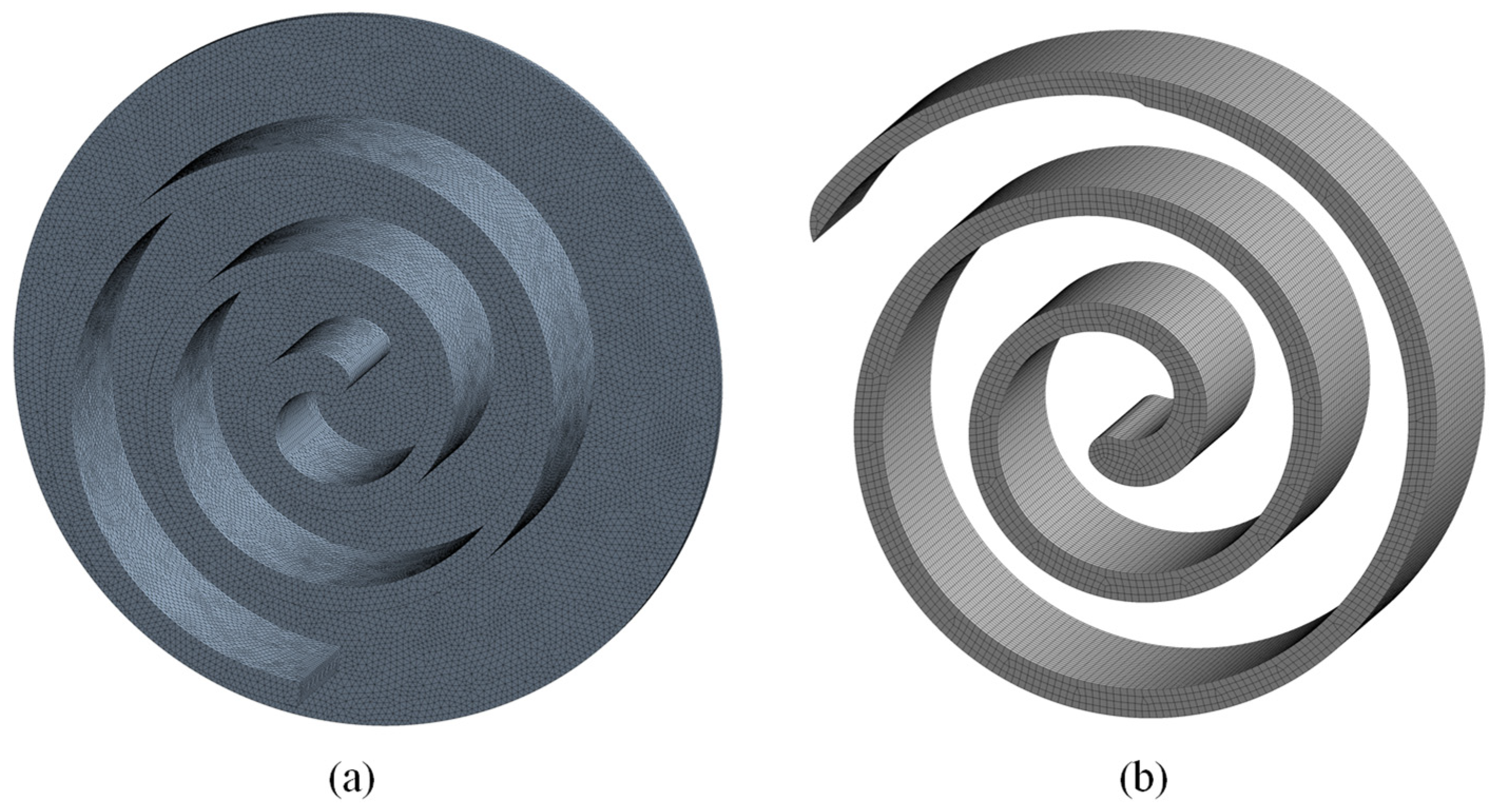
The basic parameters of the materials for the orbiting and fixed scroll plates are shown in Table 1. The grid division method in the solid domain was similar to that in the flow field. The grid division was carried out on the orbiting and fixed scroll plate, with the number of grid cells being 655,986 and the number of grid nodes being 1,154,667, as shown in Figure 9.
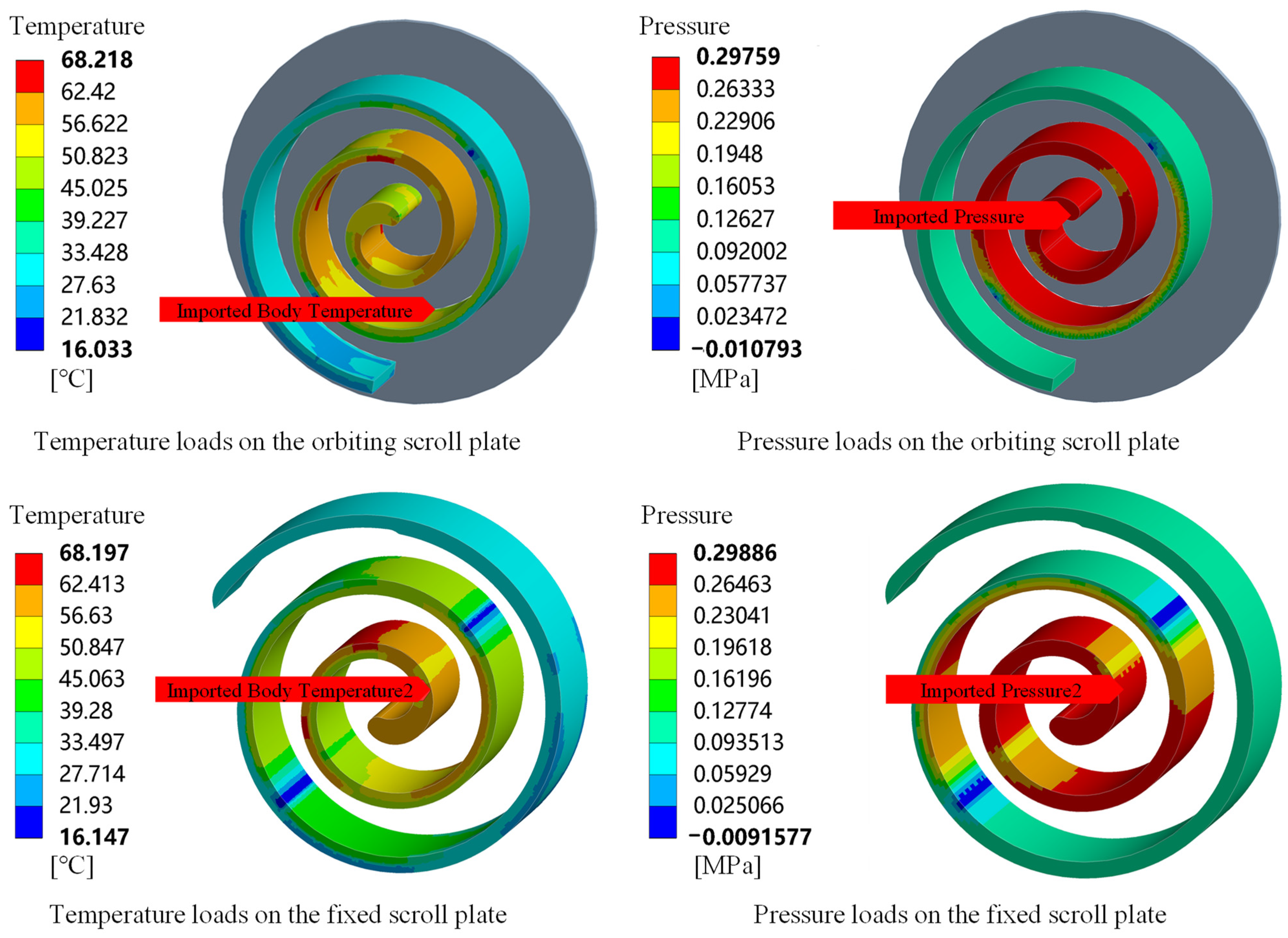
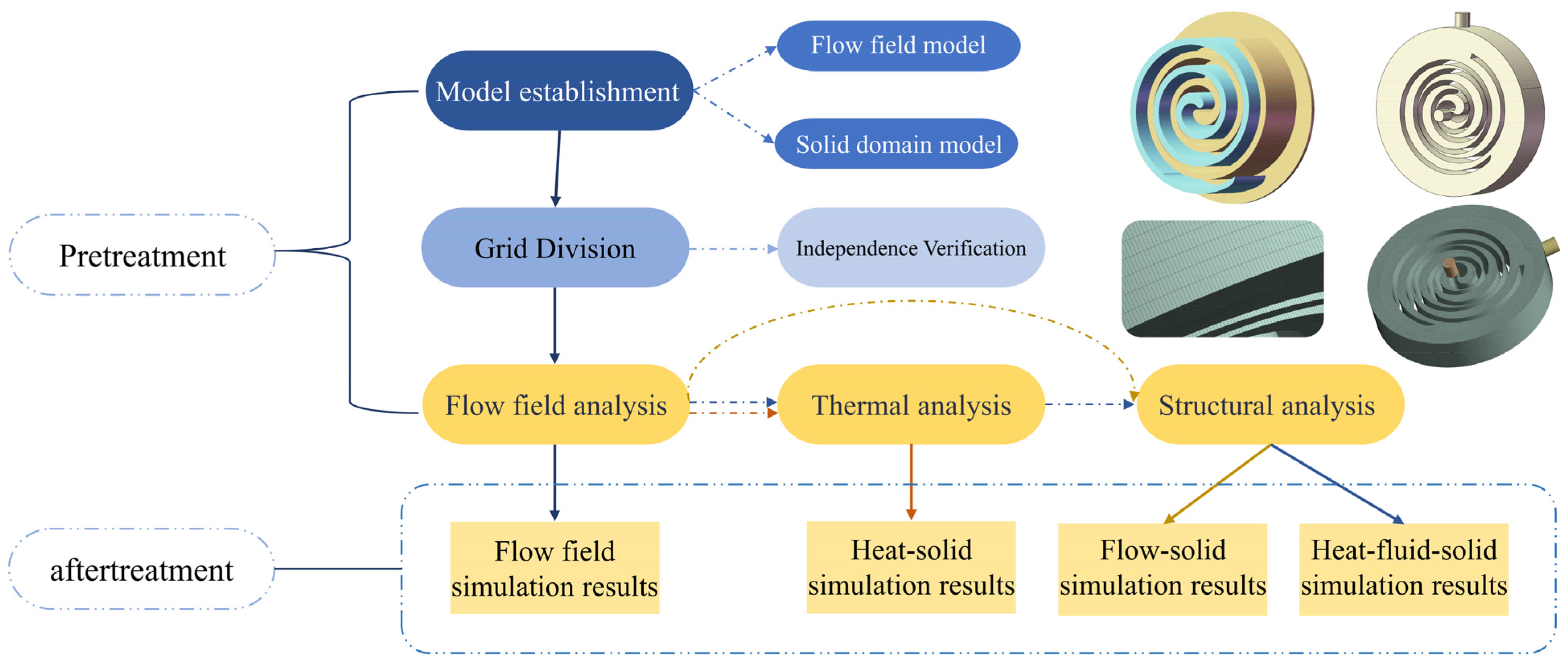
Aiming at the difficulty in accurately transferring pressure and temperature loads from the fluid domain to the solid domain during the multi-physics field coupling analysis of scroll compressors, this study proposes a load transfer method based on transient flow field synchronous mapping. Flow field parameters of the orbiting and fixed scroll plates at four characteristic phases (spindle rotation angles of 0°, 90°, 180°, and 270°) were obtained via flow field simulation. A data-mapping relationship for the fluid–solid coupling interface corresponding to these four characteristic phases was established to realize the synchronous transfer of transient flow field characteristic parameters to the solid domain model. The data transfer result at a spindle rotation angle of 0° is presented in Figure A1. This method effectively addresses the load transfer phase mismatch inherent in traditional one-way fluid–solid coupling analysis, and significantly enhances the dynamic load transfer efficiency and calculation accuracy of multi-physics field coupling simulations. The flowchart of the established heat–fluid–solid coupling analysis system is presented in Figure A2. The basic procedure for establishing this system involves loading the flow field’s pressure and temperature loads at a specific moment, either separately or in combination, onto the corresponding solid domain model. This enables the acquisition of stress and deformation cloud diagrams of the orbiting and fixed scroll plates under the action of pressure loads, temperature loads, and their coupling.
However, the one-way fluid–thermal–solid coupling method employed in this study transfers the loads obtained from flow field calculations to the solid domain unidirectionally, without considering the feedback effect of solid deformation on the flow field. When solid deformation significantly affects fluid flow, such as aggravating leakage or inducing vibration, this method cannot capture the resulting dynamic behaviors. Compared with two-way coupling, one-way coupling offers notable computational advantages. It requires fewer computational resources, provides faster solution speed, and significantly saves time and resources. Moreover, the calculation procedure is simpler and converges more readily. Furthermore, the effectiveness of this method has been widely validated. For instance, Liu et al. [33] demonstrated that one-way coupling can accurately predict the distribution and variation trends of physical fields when structural deformation remains small, providing a reliable basis for engineering design.
During the actual operation of the scroll compressor, the orbiting scroll plate rotates around the base circle center of the fixed scroll plate, while the fixed scroll plate remains stationary. Owing to the pneumatic force and the close contact between the top of the spindle and the top surface of the bearing hole, the self-rotation of the orbiting scroll is constrained. Therefore, the constraint conditions of the model can be simplified as follows:
  • Restrict the full-directional displacement of the side wall of the orbiting scroll end plate;
  • Restrict the X- and Y-direction displacements of the inner wall surface of the orbiting scroll bearing hole;
  • Restrict the Z-direction displacement of the bottom surface of the orbiting scroll end plate;
  • Restrict the Z-direction displacement of the inner bottom surface of the orbiting scroll bearing hole;
  • Restrict the full-directional displacement of the fixed scroll plate.

3. Results

3.1. Flow Field Energy Conversion Characteristics

During the operation of a scroll compressor, the orbiting scroll performs an orbital motion around the center of the fixed scroll, thereby forming periodically contracting crescent-shaped closed chambers. To further investigate the internal flow field characteristics, this study defined the spindle rotation angle as 0° when the suction chamber was about to finish the suction process, and focuses on analyzing the distribution characteristics and variation laws of pressure, temperature and velocity in the flow field with the spindle rotation angle.
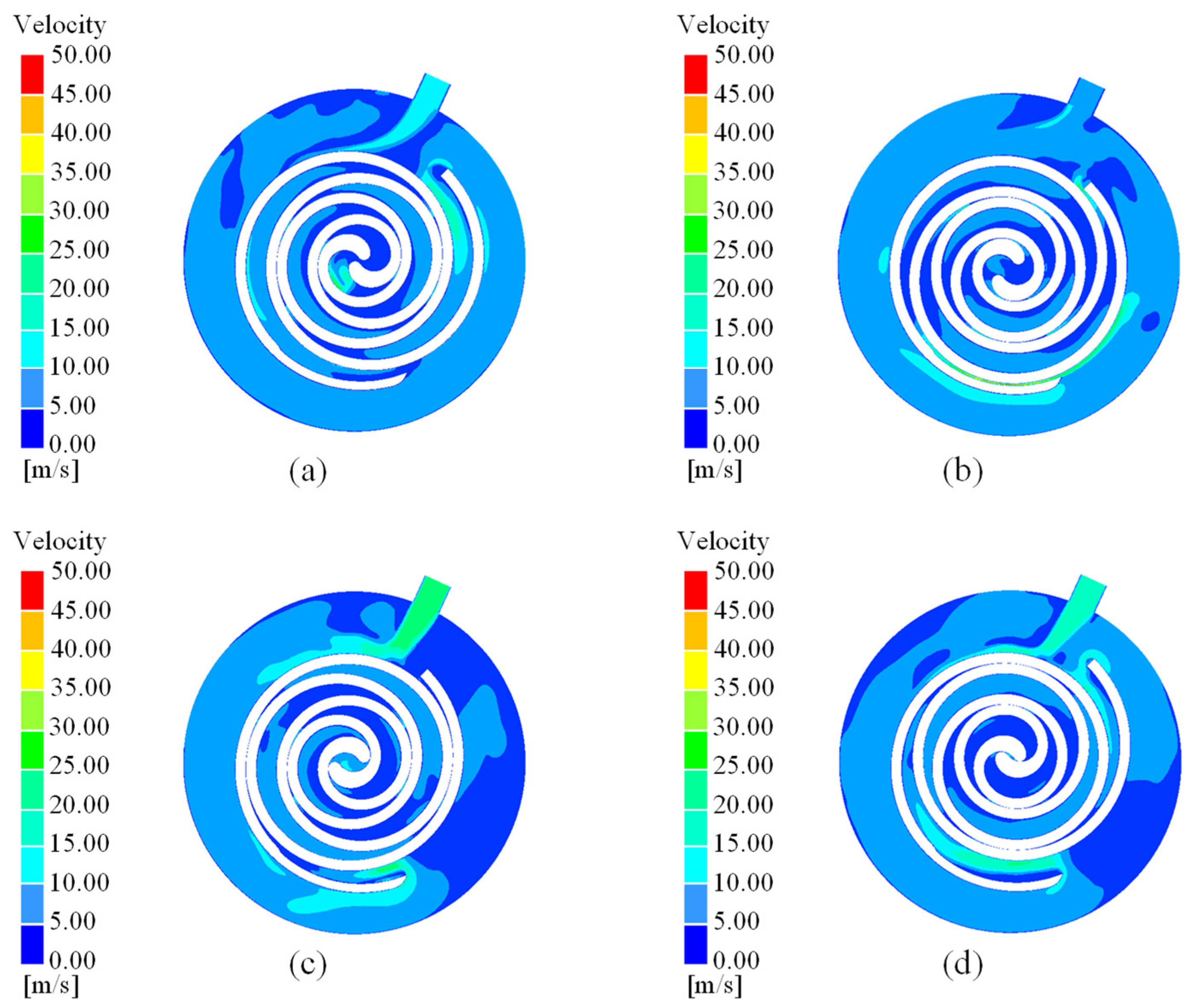
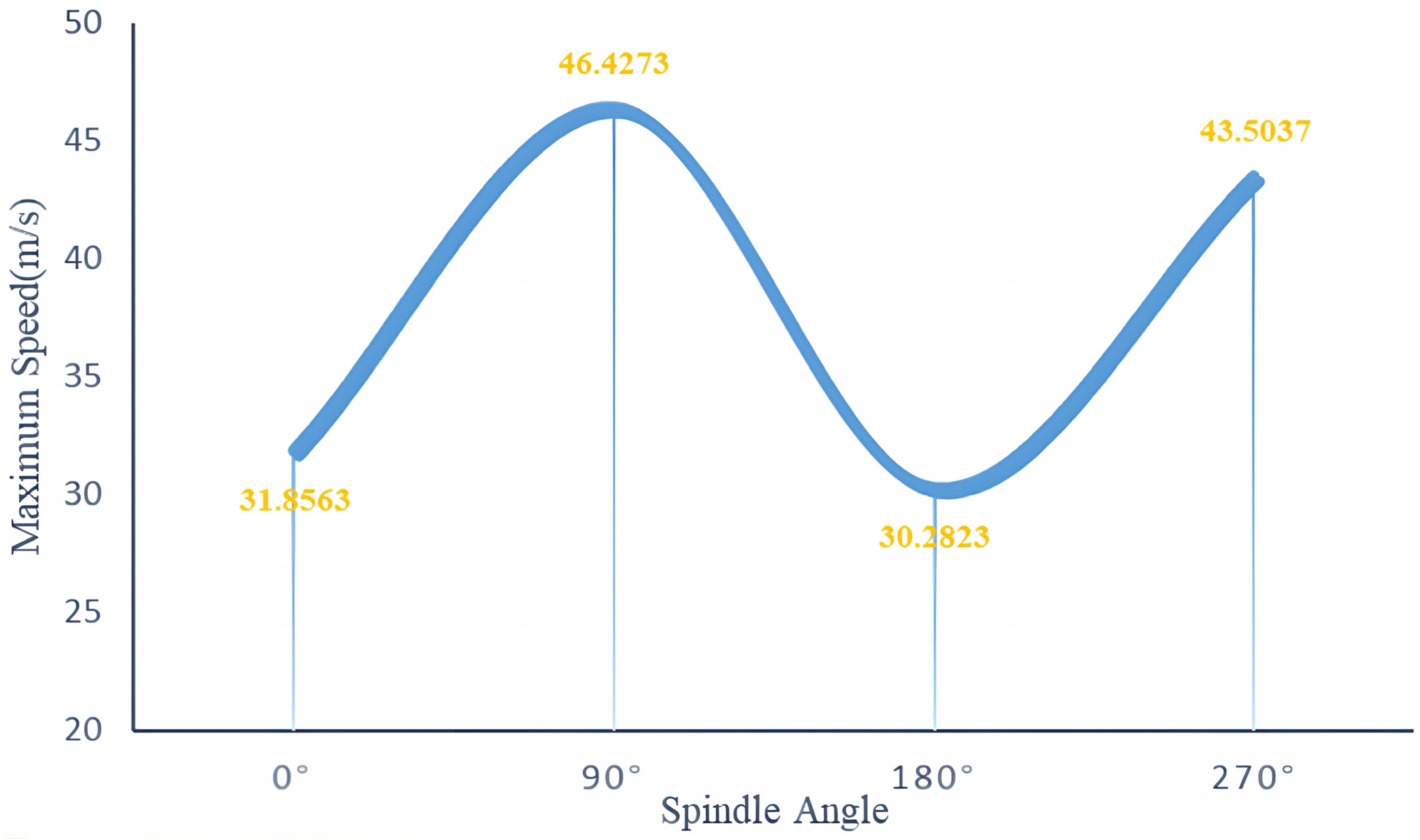
As shown in Figure 10 and Figure A3, the distribution of gas flow velocity inside the scroll compressor is significantly correlated with the motion trajectory of the orbiting scroll. During operation, the maximum flow velocity at different spindle rotation angles exhibits a trend of rising first, then falling, and rising again. Driven by the periodic orbital motion of the orbiting scroll, the velocity distribution in each chamber is non-uniform. Except for the suction and discharge stages, the gas flow velocity inside the working chambers remains at a relatively low level under other conditions. At a spindle rotation angle of 0°, the suction chamber is about to complete the suction process, and the working chamber gradually enters the compression stage, with a maximum flow velocity of 31.8563 m/s, and the velocity in all regions of the flow field shows a decreasing trend. When the spindle rotation angle reaches 90°, the suction process is fully completed and the compressor officially enters the compression stage, at which point the overall gas flow velocity is low. However, since gas mainly enters the compression chamber under the action of suction driving force, and the outer side of the suction chamber is affected by the coupling of inlet effect and centrifugal force, the flow velocity near the suction port is relatively high, reaching a peak of 46.4273 m/s. When the spindle rotation angle turns to 180°, the starting end of the scroll wraps meshes with the corresponding scroll to the position of minimum clearance, and the sharp contraction of the flow passage promotes the formation of a high-speed flow field in local regions. The compression chamber is in a state of continuous contraction, while the suction chamber starts the suction process simultaneously. The newly inflowing gas causes the high-pressure working fluid to suddenly expand into a low-pressure environment, part of the kinetic energy is converted into pressure energy, and the flow velocity drops sharply to 30.2823 m/s. As the spindle rotation angle changes to 270°, the volume of the compression chamber further decreases, the suction chamber enters a stable suction process, a large amount of gas enters from the inlet, the working fluid is continuously accelerated in the converging flow passage, and the flow velocity rises back to 43.5037 m/s. From the perspective of the entire orbital cycle of the spindle, the velocity distribution characteristics of the internal flow field of the scroll compressor clearly reflect the transformation and concentration law of gas kinetic energy during the compression process.
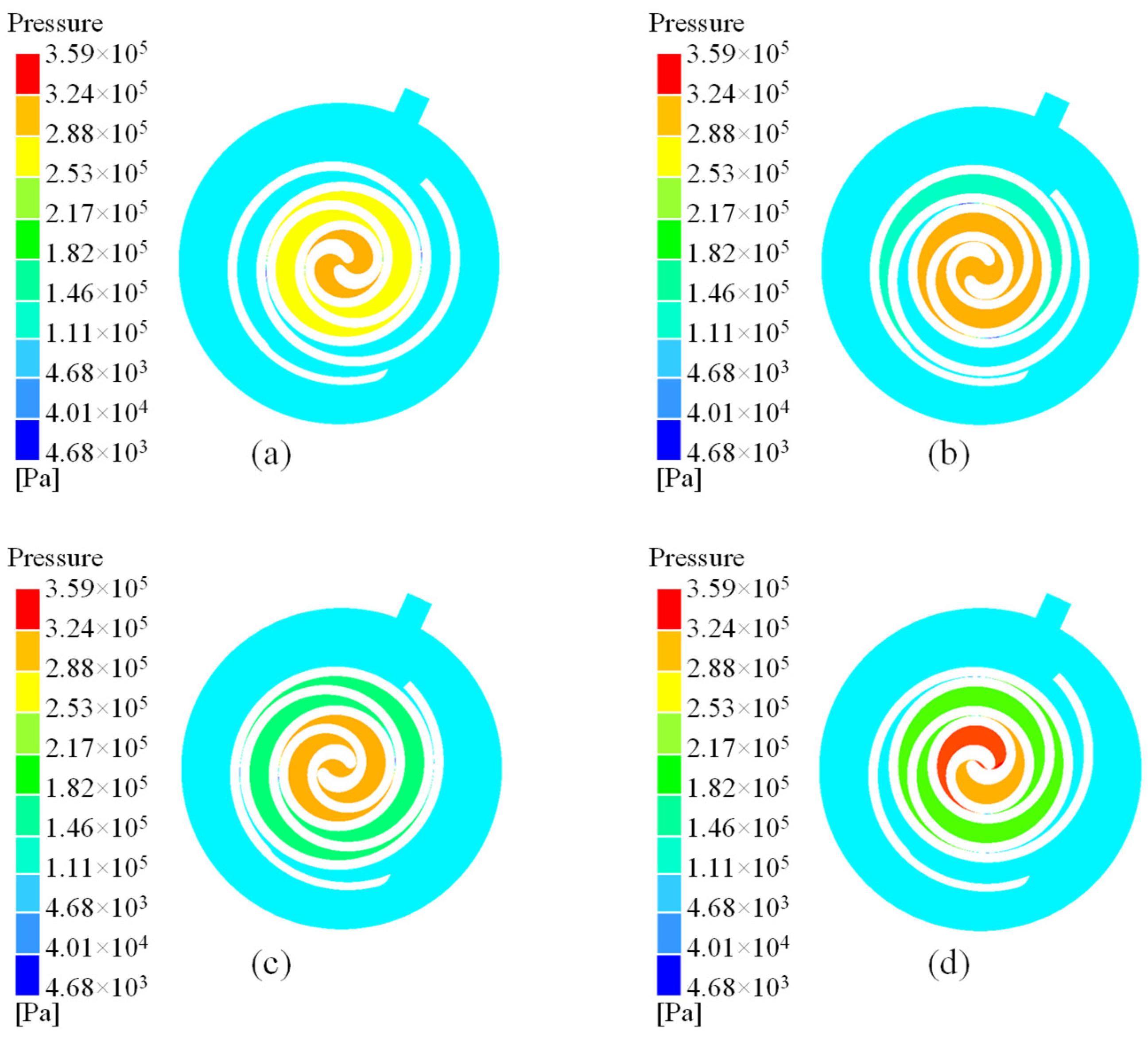
Figure 11 and Table 4 illustrate the pressure distribution of the internal flow field in the scroll compressor at different spindle rotation angles. During the entire operating process, the maximum pressure shows an evolutionary trend of rising first, then falling, and rising again, while the minimum pressure exhibits a variation law of decreasing first and then increasing. As can be seen from Figure 11a, when the orbiting scroll is at the initial phase, the working fluid is in the transition period between the late suction stage and the compression stage, and the pressure in the discharge chamber is 300,432 Pa. At this moment, the orbital motion of the orbiting scroll expands the volume of the suction chamber to nearly its maximum value. However, due to the inertial lag effect, the chamber is not fully filled, resulting in negative pressure in local regions, with a minimum value of -8464.09 Pa. As shown in Figure 11b, when the spindle rotates to 90°, the suction chamber has just completed the suction process, and the internal pressure distribution is relatively uniform and close to the suction pressure. Nevertheless, affected by the high-speed orbital motion of the orbiting scroll, the local pressure drops sharply to −37,339.6 Pa. Meanwhile, the continuous reduction of the compression chamber volume forces the working fluid to migrate, which converts mechanical work into pressure energy, and the pressure in the compression chamber rises to 312,445 Pa. As shown in Figure 11c, when the spindle rotation angle reaches 180°, the gas is compressed, and an extreme pressure zone is formed near the outlet due to the sharp decrease in volume, with a maximum pressure of up to 311,450 Pa. At this time, the suction chamber starts a new round of suction, the working chamber enters a stage of pressure balance adjustment as a whole, and the minimum pressure in the chamber is 4677.31 Pa. As shown in Figure 11d, when the spindle rotation angle is 270°, the minimum pressure in the working chamber is 52,703.1 Pa. The pressure in the compression chamber further increases to a peak value of 359,069 Pa, which is much higher than the discharge pressure, presenting an over-compression state. Over-compression not only raises the gas temperature and thus affects the overall performance, but also causes energy loss and efficiency degradation of the scroll compressor.
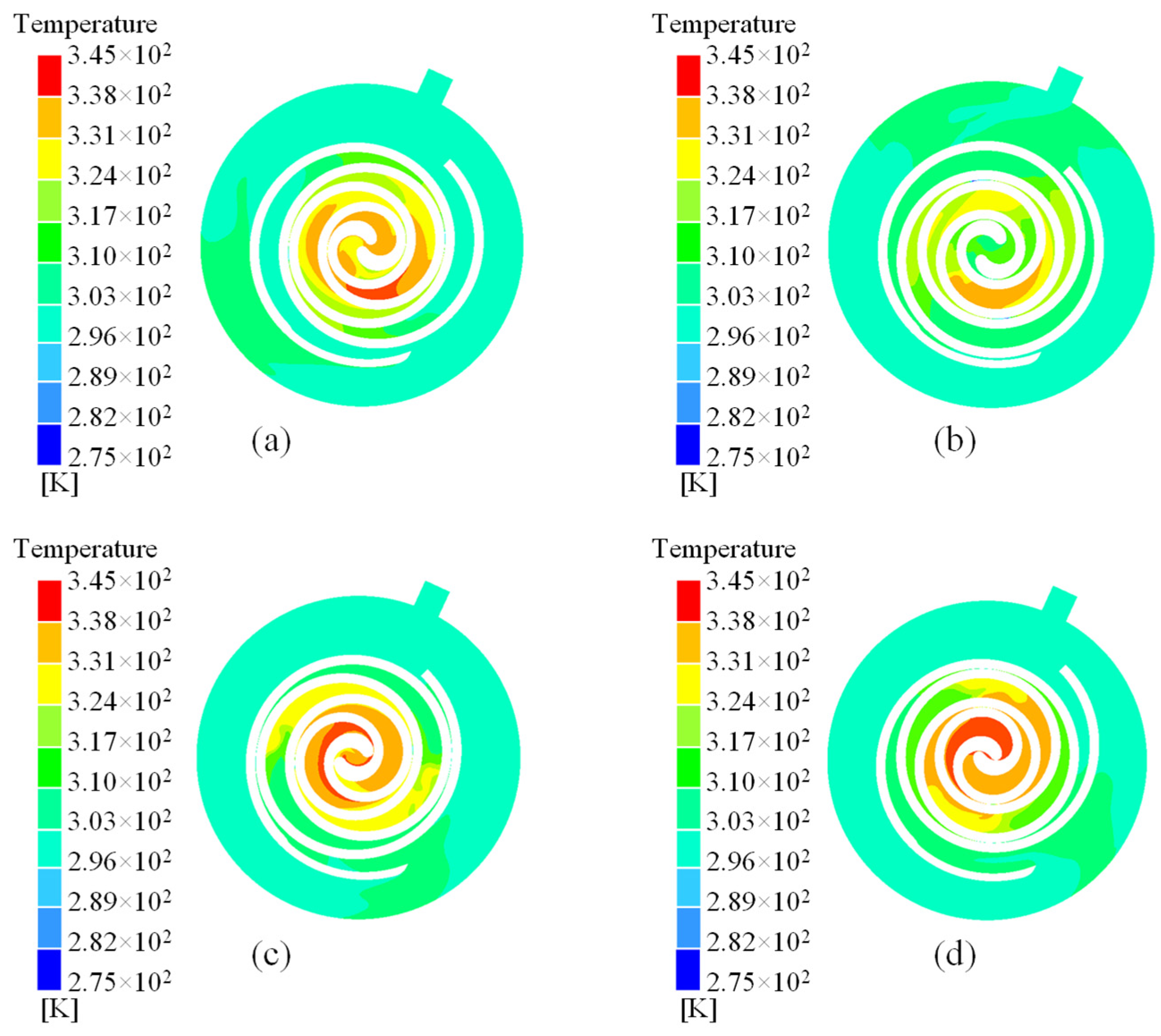
As shown in Figure 12 and Table 5, the internal temperature distribution in the scroll compressor is non-uniform, characterized by unilateral high temperature. The variation ranges of both the maximum and minimum temperatures are relatively limited at different spindle rotation angles. As shown in Figure 12a, the temperature distribution at the end of suction is relatively uniform, with a gentle temperature gradient in the peripheral regions. The orbital motion of the orbiting scroll draws the working gas into the suction chamber, where the minimum temperature drops to 289.354 K. Meanwhile, frictional heat and adiabatic temperature rise are generated at the front edge of the compression chamber due to initial compression, raising the local temperature to 341.24 K. As shown in Figure 12b, as the spindle rotates to 90°, the working chamber enters the compression stage. The flow path of the working fluid is concentrated in the middle of the compression chamber, where heat accumulation is prominent, causing the temperature in this region to rise significantly to 339.483 K, while the overall minimum temperature drops to 275.914 K. As shown in Figure 12c, at a spindle rotation angle of 180°, the volume of the working chamber decreases significantly with gas compression. The temperature of the working fluid gradually increases from the outer ring to the center, with the maximum temperature rising to 342.411 K and the minimum temperature also rising to 292.891 K. As shown in Figure 12d, when the spindle rotates to the 270° phase, the volume of the compression chamber is reduced to a minimum. The combined effect of adiabatic compression temperature rise and frictional heat brings the maximum temperature to a cycle peak of 344.753 K. At the same time, the suction chamber enters a stable suction process, with a large amount of gas inflowing from the suction port, pushing the minimum temperature in the suction chamber up to 299.132 K.
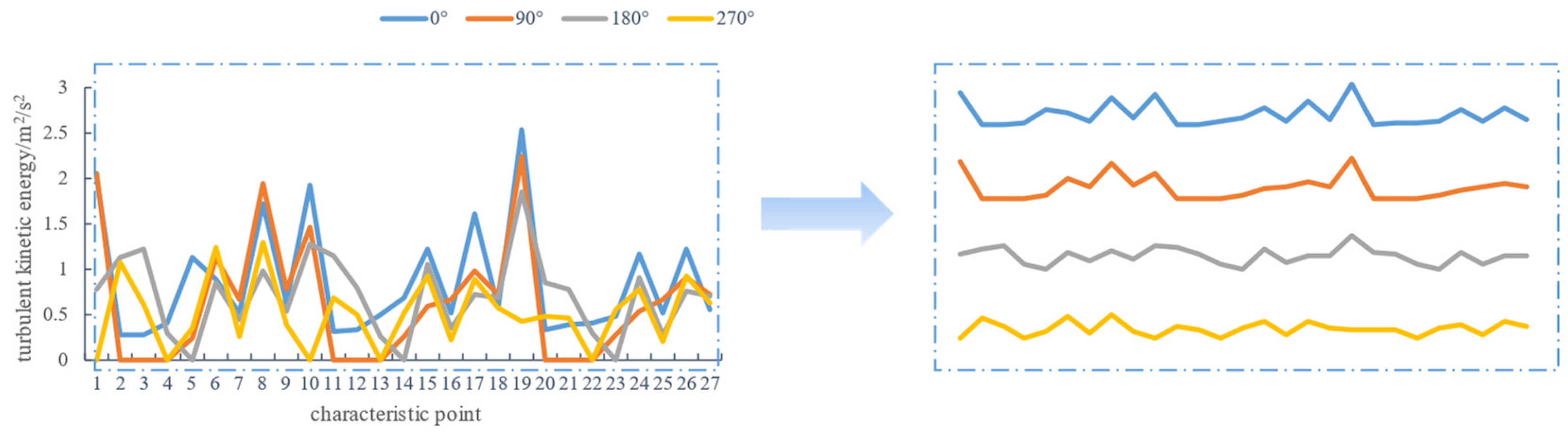
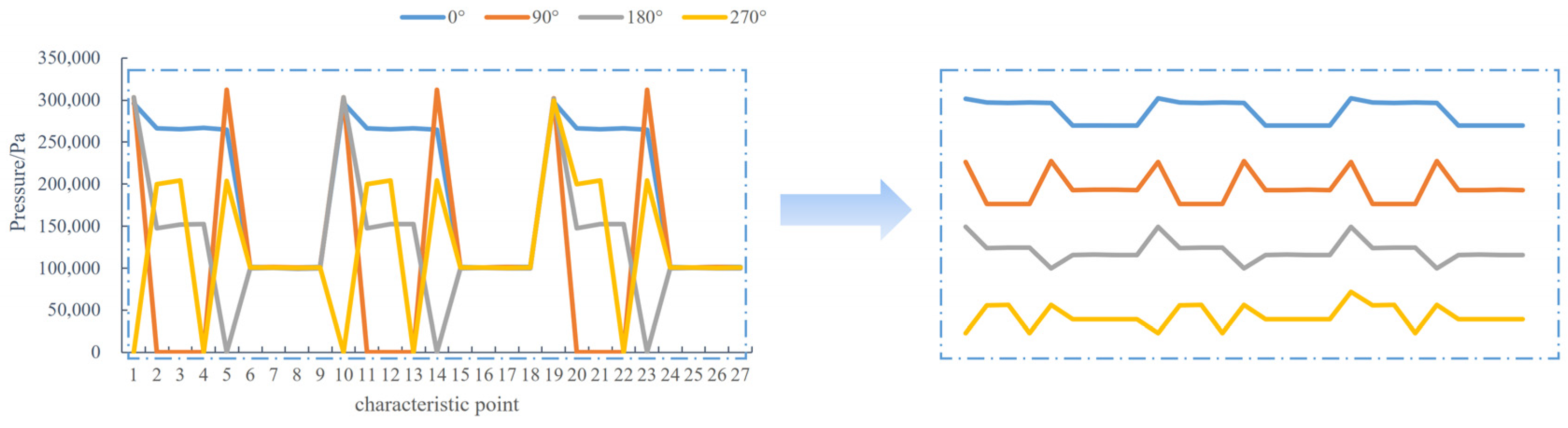
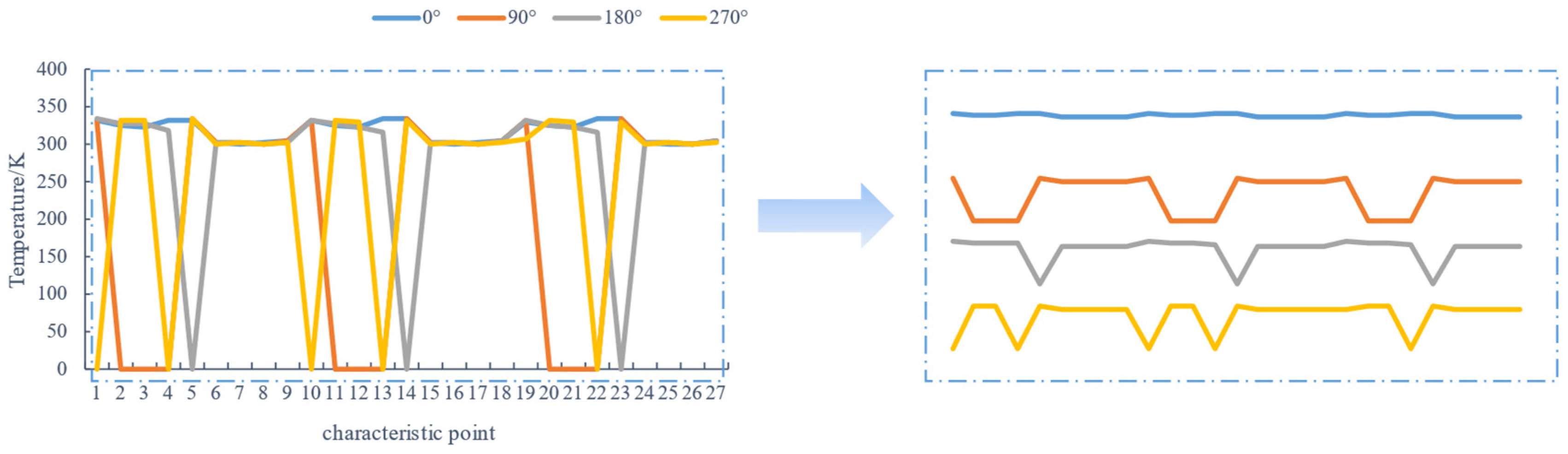
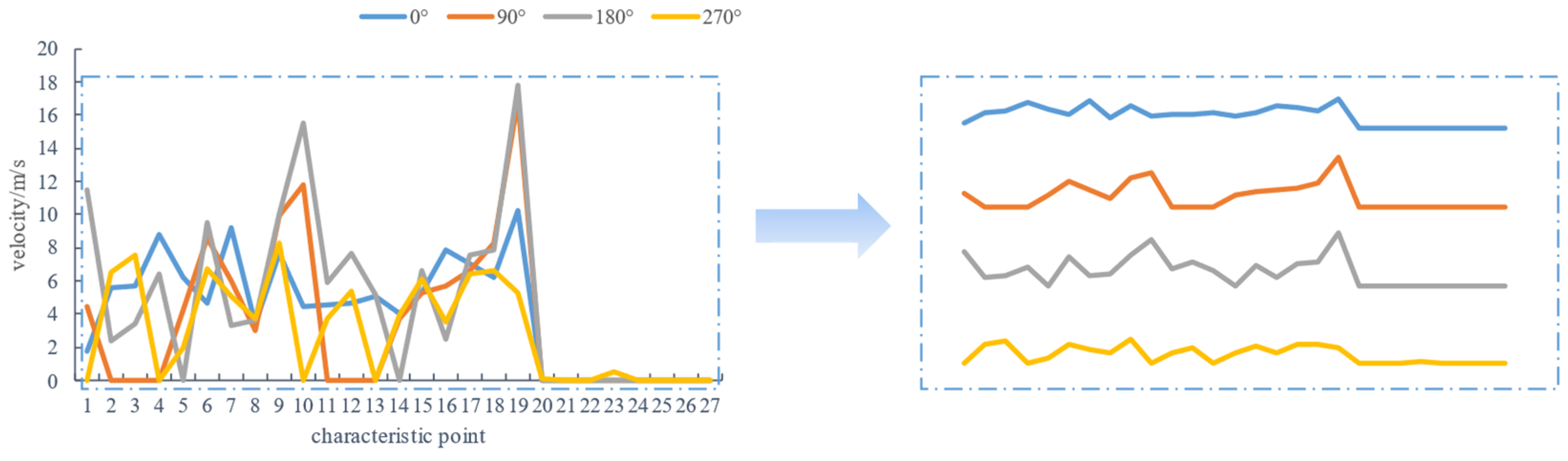
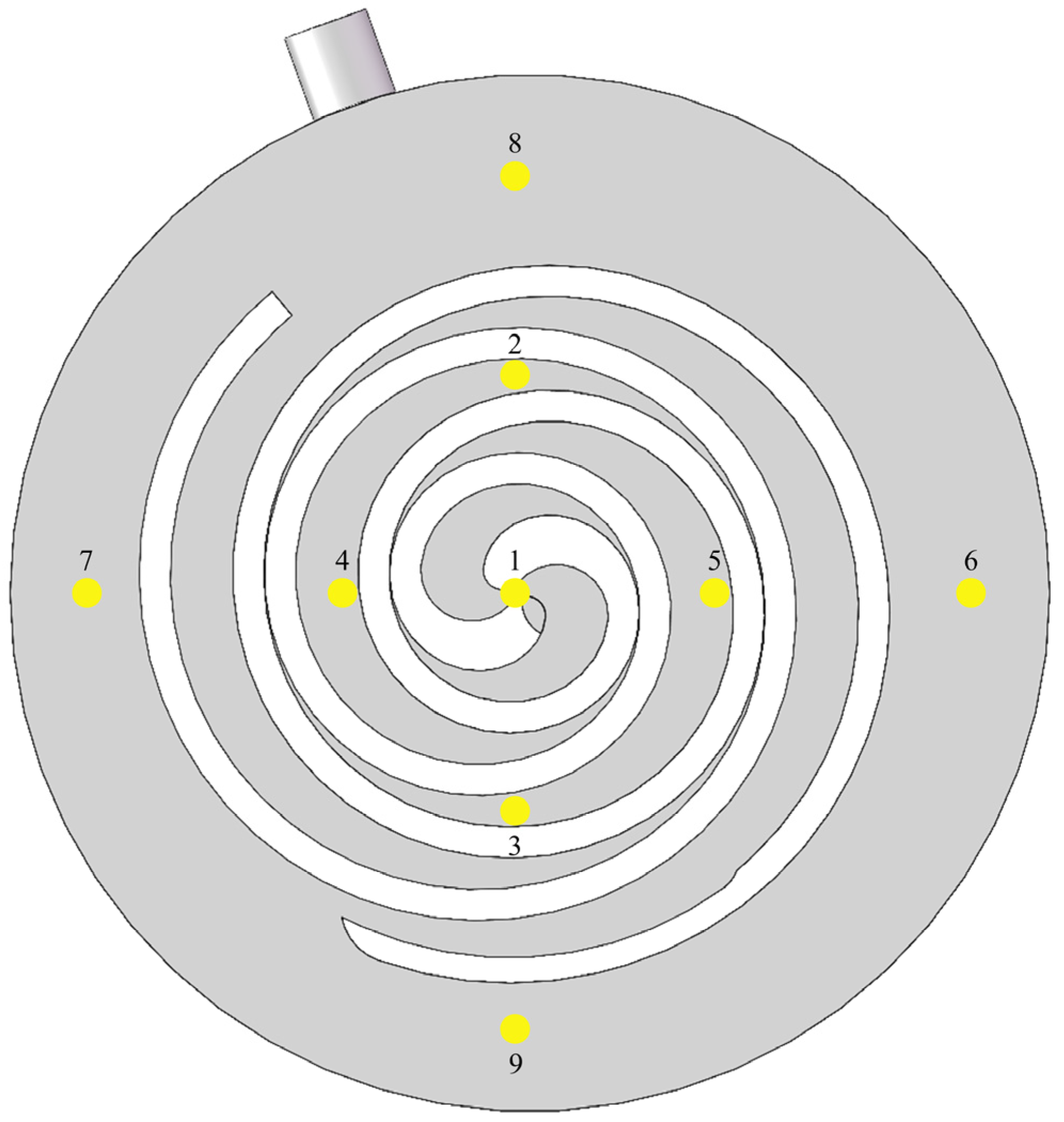
In the flow field of the closed working chamber formed by the meshing of the orbiting and fixed scroll plates, three X-Y sections were intercepted when the spindle rotation angle was 0°, 90°, 180° and 270°, and nine characteristic points (a total of 27 monitoring points) were uniformly set at the center and around each section to explore the distribution laws of pressure, temperature, turbulent kinetic energy and velocity inside the working chamber. Figure A4 is a schematic diagram of the specific positions of some of the set monitoring points in the flow field model. The distribution laws of pressure, temperature, turbulent kinetic energy and velocity are shown in Figure 13, Figure 14, Figure 15 and Figure 16, respectively. It can be seen from these figures that under any spindle rotation angle, the pressure field of the working chamber shows a uniform distribution characteristic, and the pressure value in the central area is generally higher than that in the surrounding areas. The overall distribution of the temperature field in the working chamber shows a non-uniform distribution feature. Similar to the temperature field, the turbulent kinetic energy and velocity distribution inside the working chamber are both non-uniform. The spatial distribution laws of pressure, temperature, turbulent kinetic energy and velocity are closely related to the geometric characteristics and kinematic mechanism of the scroll compressor. In addition, due to the fact that the involute profiles of the orbiting scroll plate and the fixed scroll plate form similar flow channel geometries during the rotation process, the patterns of flow separation and vortex generation at different rotation angles are similar, resulting in similar variation trends of pressure, temperature, turbulent kinetic energy and velocity in the internal flow field of the working chamber at any spindle rotation angle.
The side walls of the scrolls of the orbiting and fixed scroll plates are always perpendicular to the base plate, resulting in the working chamber volumes formed by the scrolls of the two plates having the same geometric shape at any cross-section perpendicular to the side walls of the scrolls. Moreover, the movement trajectories of the working medium at any cross-section show regular characteristics in space. Therefore, the flow field parameters (pressure, temperature, velocity, etc.) on any cross-section can be used as effective samples to characterize the hydrodynamic characteristics of the entire working chamber. The pressure, temperature, turbulent kinetic energy and velocity variation trends of the three X-Y cross-sections selected in this study are similar. The axial uniformity characteristics of the flow field inside the working chamber are further confirmed by the data in Figure 13, Figure 14, Figure 15 and Figure 16.

3.2. Analysis of Heat–Fluid–Solid Coupling Characteristics

During the operation of a scroll compressor, the orbiting and fixed scroll plates need to withstand both gas forces and non-gas forces. Among them, the gas forces mainly include tangential gas force Ft, radial gas force Fr, axial gas force Fa, etc. Both the tangential gas force and the radial gas force are caused by the pressure difference between the inside and outside of the scroll warps. The tangential gas force Ft, refers to the gas force applied to the orbiting scroll plate along the tangential direction of the eccentric axis. The radial gas force Fr refers to the gas force applied to the orbiting scroll plate along the direction of the line connecting the centers of the base circles of the orbiting and fixed scroll plates. Axial pneumatic force Fa is the most important type of pneumatic force that acts perpendicularly along the axis direction of the eccentric shaft on the orbiting scroll plate. This paper simplifies the forces acting on the orbiting and fixed scroll plates. After simplification, the forces acting on the orbiting scroll plate can be classified into tangential force Ft,o, radial force Fr,o, and axial force Fa,o that can be calculated by Equations (11)–(13).
F t , o = i = 1 N F y , o , i cos ω t F x , o , i sin ω t
F t , o = i = 1 N F x , o , i cos ω t F y , o , i sin ω t
F a , o r = i = 1 N F z , o r , i t i p + F z , o r , i b o t
where N represents the number of units, Fx,o,i, Fy,o,i and Fz,o,i represent the component forces acting on the orbiting scroll plate along the x, y and z axes, respectively.
Suppose the orbiting scroll plate remains stationary and the fixed scroll plate performs orbiting translational motion around the center of the base circle of the orbiting scroll plate, then the component force acting on the stationary scroll plate can be calculated by Equations (14)–(16).
F t , f = i = 1 N F y , f , i cos ω t F x , f , i sin ω t
F r , f = i = 1 N F x , f , i cos ω t F y , f , i sin ω t
F a , f = i = 1 N F z , f , i t i p + F z , f , i b o t + F z , f , i t o p
where F x , f , i   F y , f , i and F z , f , i represent the pressures applied to the fixed scroll plate along the x, y and z axes, respectively.
This paper only focuses on the pressure and temperature distribution laws of the flow field at times when the spindle rotation angles are 0°, 90°, 180°, and 270°, and discusses the stress distribution and deformation laws of the scroll wraps.

3.2.1. Strain Characteristics of Scroll Wraps Under Pressure Load

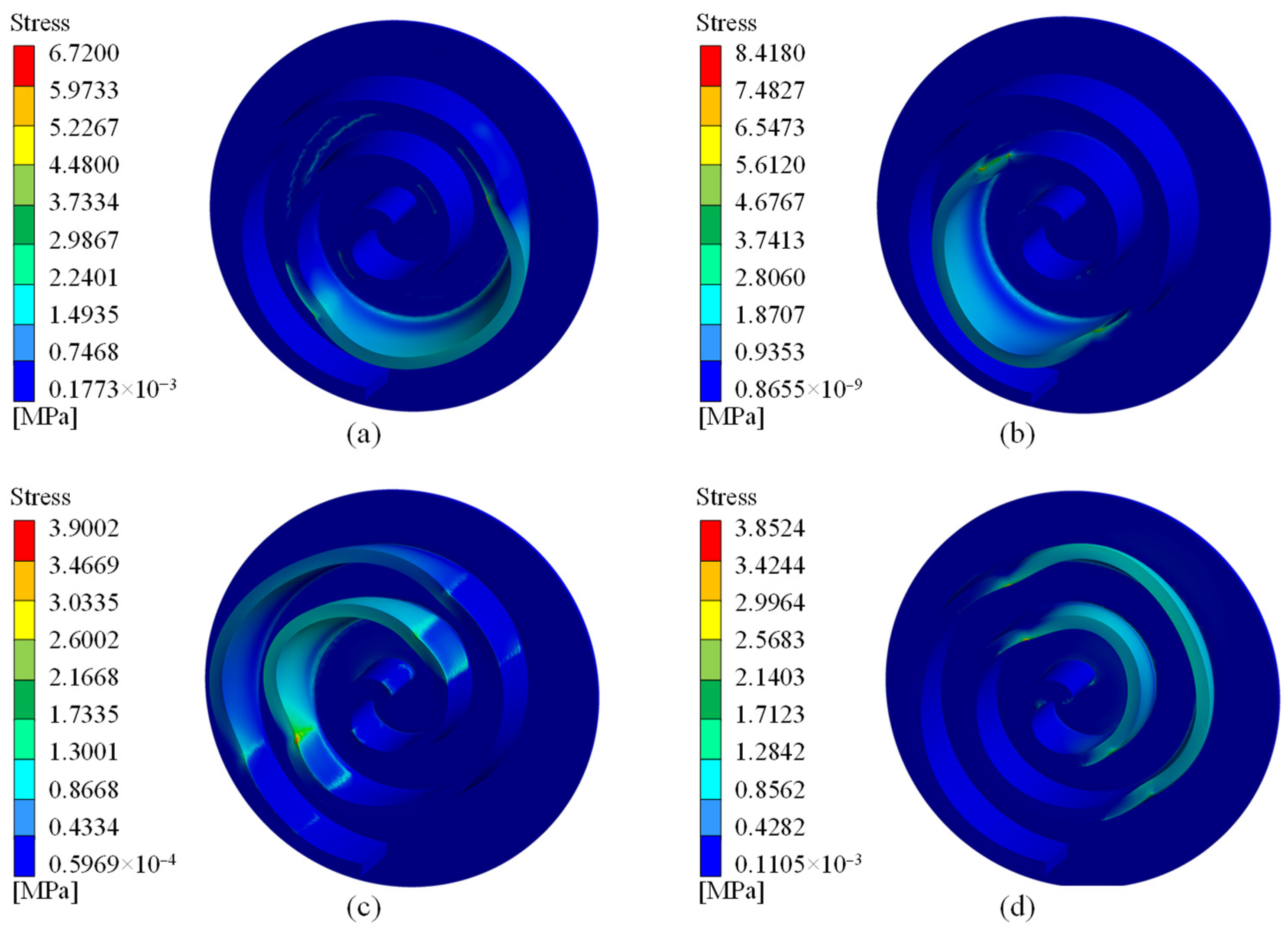
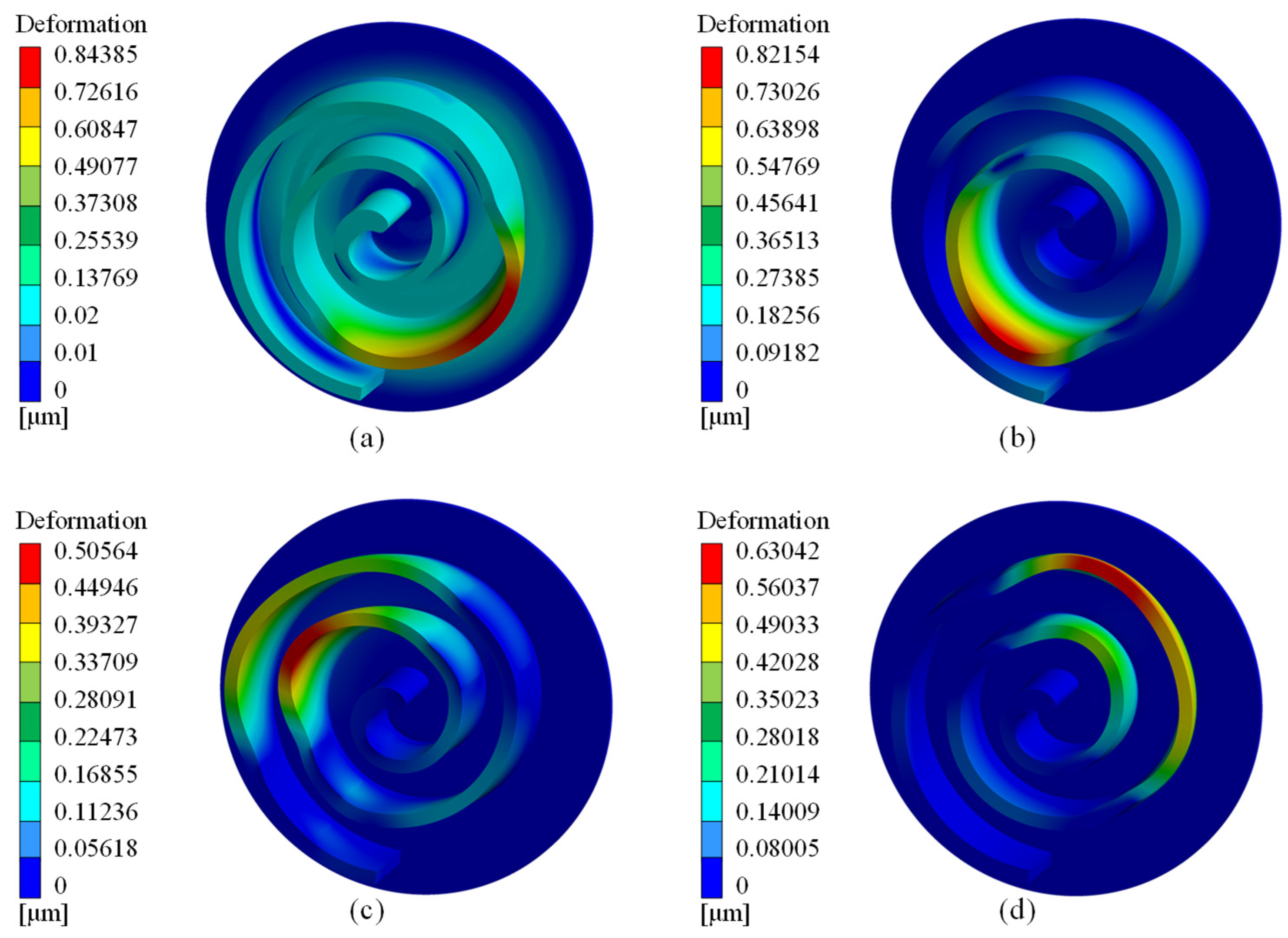
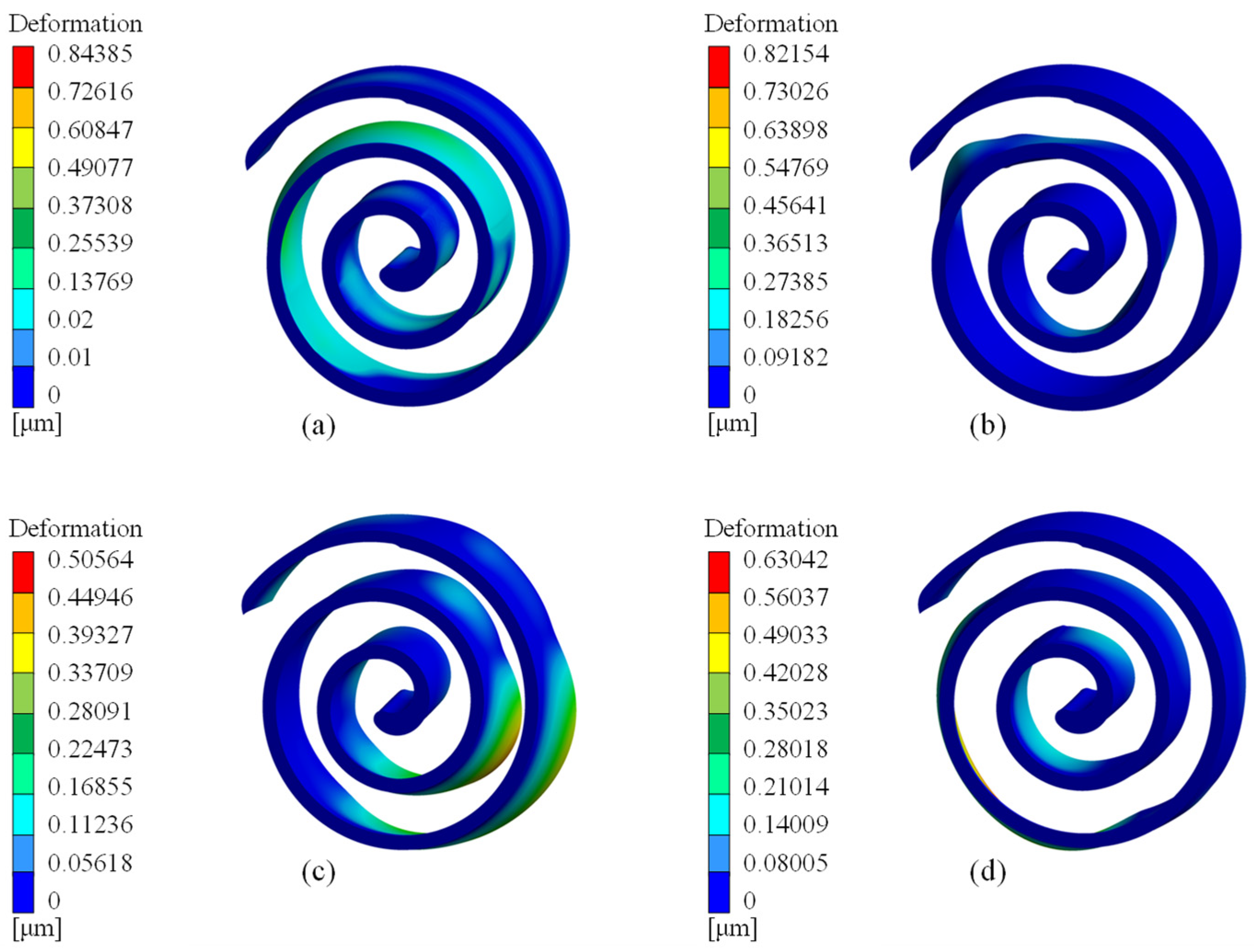
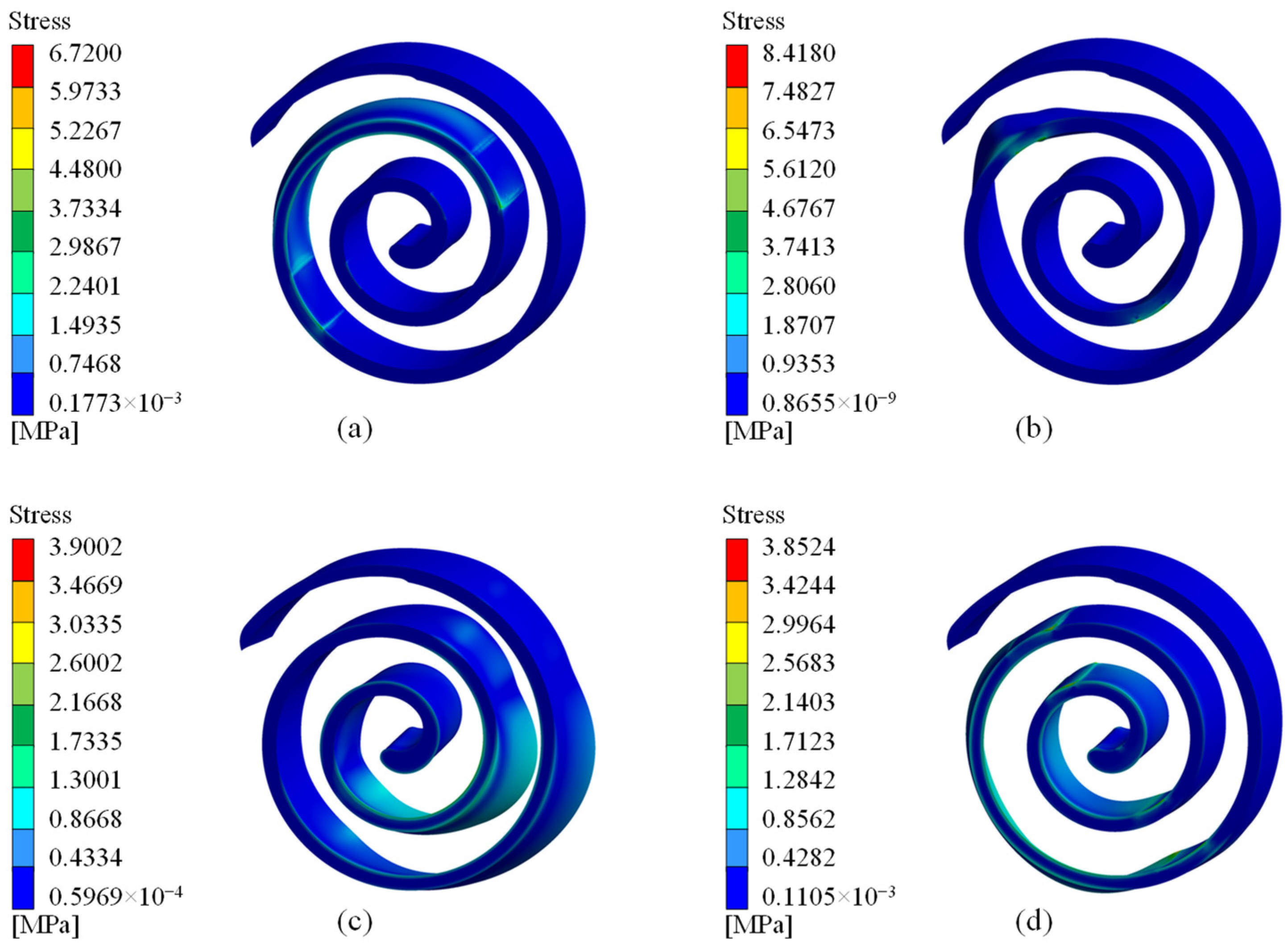
Figure 17 and Figure 18, respectively, reflect the total deformation of the orbiting scroll wraps and the fixed scroll wraps under the action of pressure load under different spindle rotation angles, and Figure 19 and Figure 20, respectively, reflect the stress distribution of the orbiting scroll wraps and the fixed scroll wraps under the action of pressure load under different spindle rotation angles. The dynamic variation in the maximum deformation location and magnitude in the scroll wraps closely corresponds to the suction-compression-discharge cycle of the scroll compressor. Meanwhile, the locations and amplitudes of stress concentration in the orbiting and fixed scroll wraps vary dynamically with the orbital motion of the orbiting scroll. The maximum deformation of the scroll wraps consistently occurs in the meshing clearance zone between the orbiting and fixed scroll wraps (i.e., the middle section of the scroll wraps). The primary reason is that the pressure difference between the inner and outer sides at the meshing clearance reaches its maximum, which generates a substantial radial gas force that bends the middle section of the scroll wraps. The pressure difference at the start and end sections of the orbiting and fixed scroll wraps is relatively small. Consequently, the wrap head and tail exhibit low deformation, with negligible magnitudes. The stress in both the orbiting and fixed scroll wraps is concentrated at the wrap root. In contrast to the orbiting scroll, all degrees of freedom of the fixed scroll are constrained, which leads to lower stress in the fixed scroll wraps.
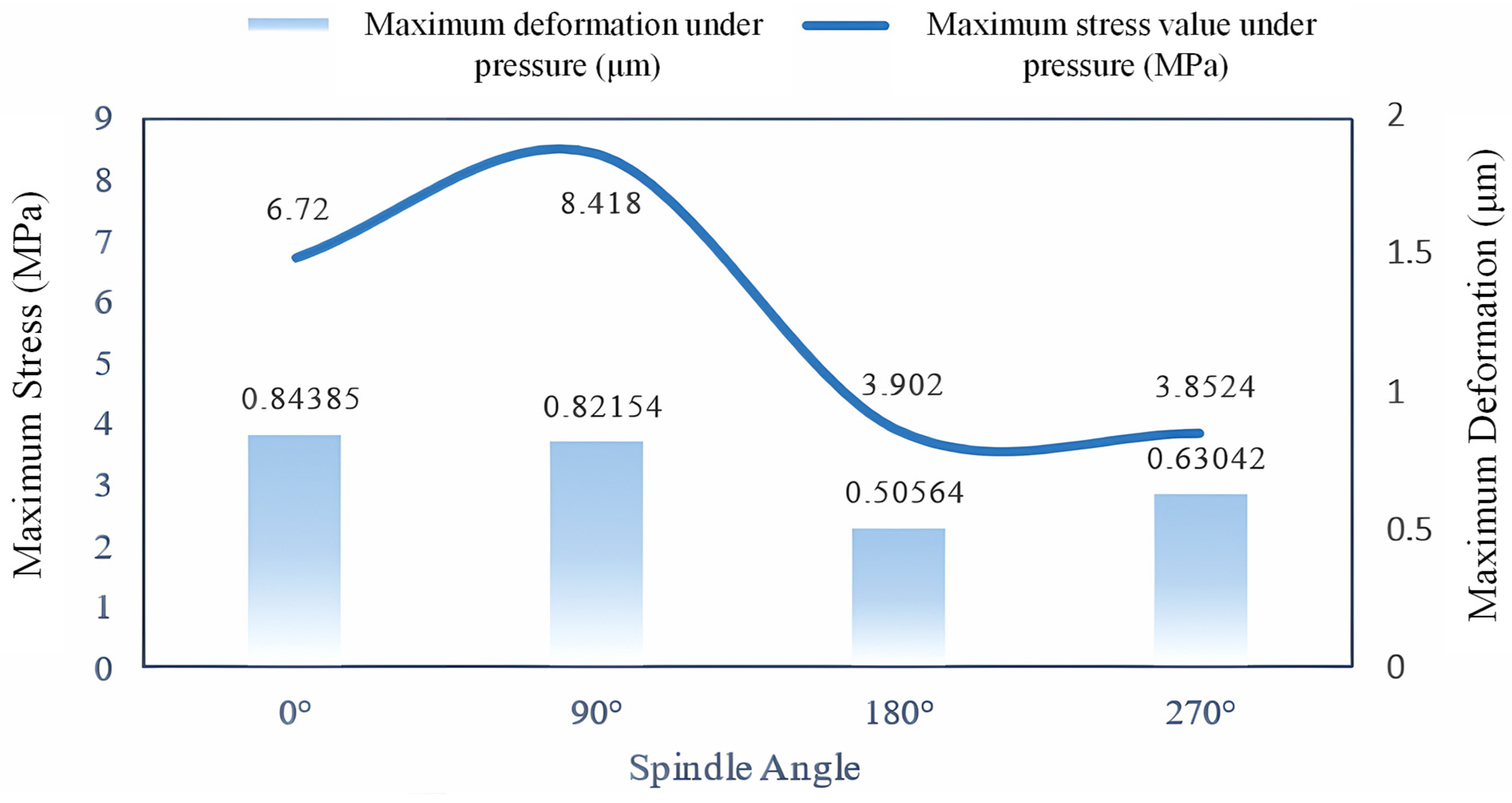
The maximum deformation, stress values and their corresponding positions of scroll wraps under different spindle rotation angles are shown in Table 6 and Table 7. At a spindle rotation angle of 0°, the scroll compressor is at the end of the suction stage. As the compression chambers begin to form in the meshing region of the orbiting scroll wraps, the pressure difference between the inner and outer sides increases rapidly, causing the maximum equivalent stress to rise to 6.72 MPa and the maximum deformation to reach 0.84385 μm. When the spindle rotation angle reaches 90°, the suction process in the suction chamber is completed, and the pressure difference across the middle section of the orbiting scroll wraps increases. However, because the radius of curvature of the involute profile decreases, the migration path of the working fluid shifts toward the wrap tip, leading to a slight decrease in maximum deformation to 0.82154 μm. Concurrently, continuous pressure loading causes plastic strain to accumulate in the contact region of the wrap tip, and the maximum equivalent stress rises to 8.418 MPa. When the spindle rotation angle reaches 180°, the radial load on the orbiting scroll wraps decreases significantly. The elastic recovery effect reduces the deformation to 0.50564 μm, and the maximum equivalent stress drops synchronously to 3.902 MPa. At a spindle rotation angle of 270°, the pressure distribution in the compression chamber becomes nearly uniform. The overall deformation of the scroll wraps increases to 0.63042 μm, while the maximum equivalent stress further decreases to 3.8524 MPa.

3.2.2. Strain Characteristics of Scroll Wraps Under Temperature Load

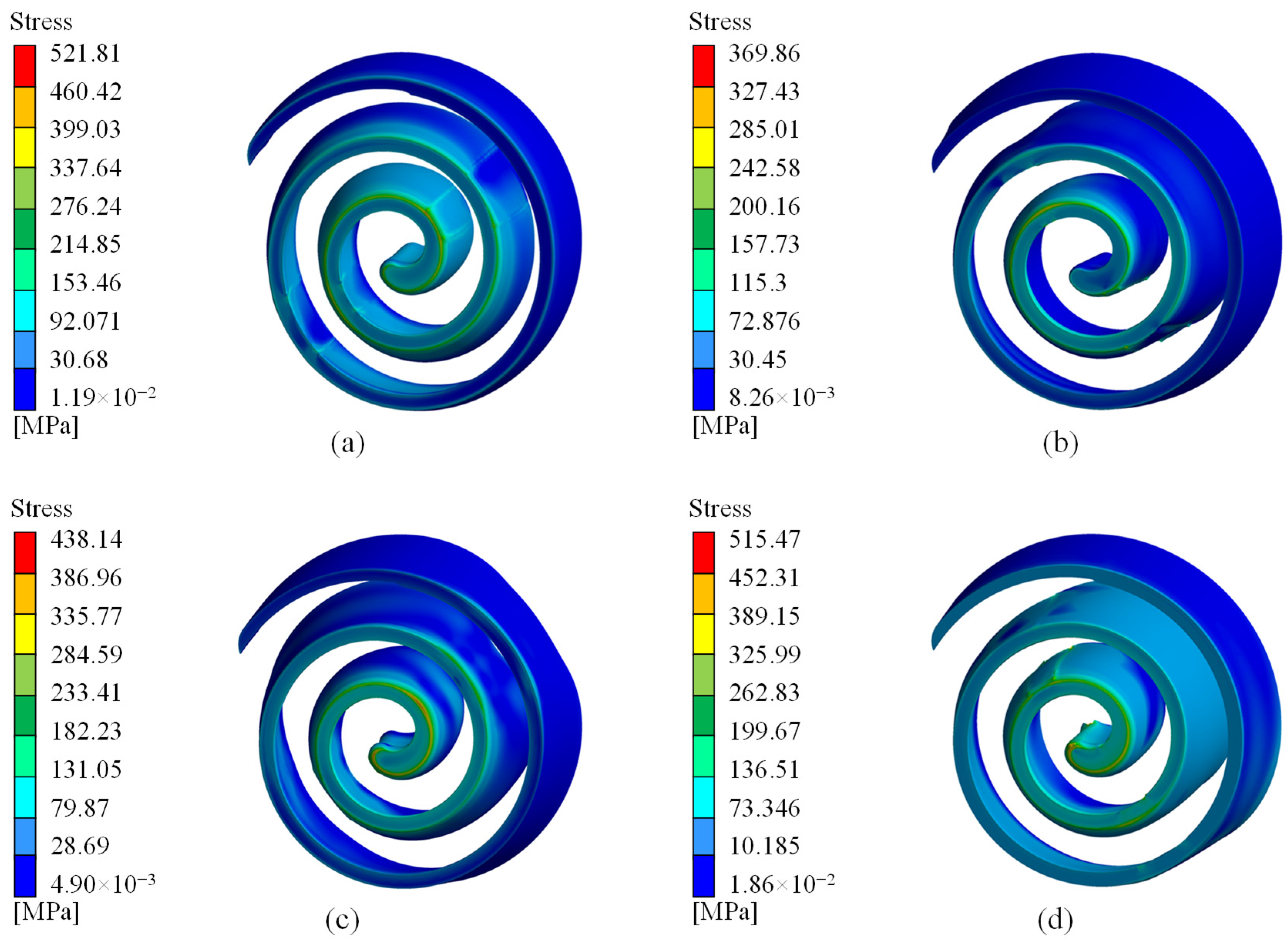
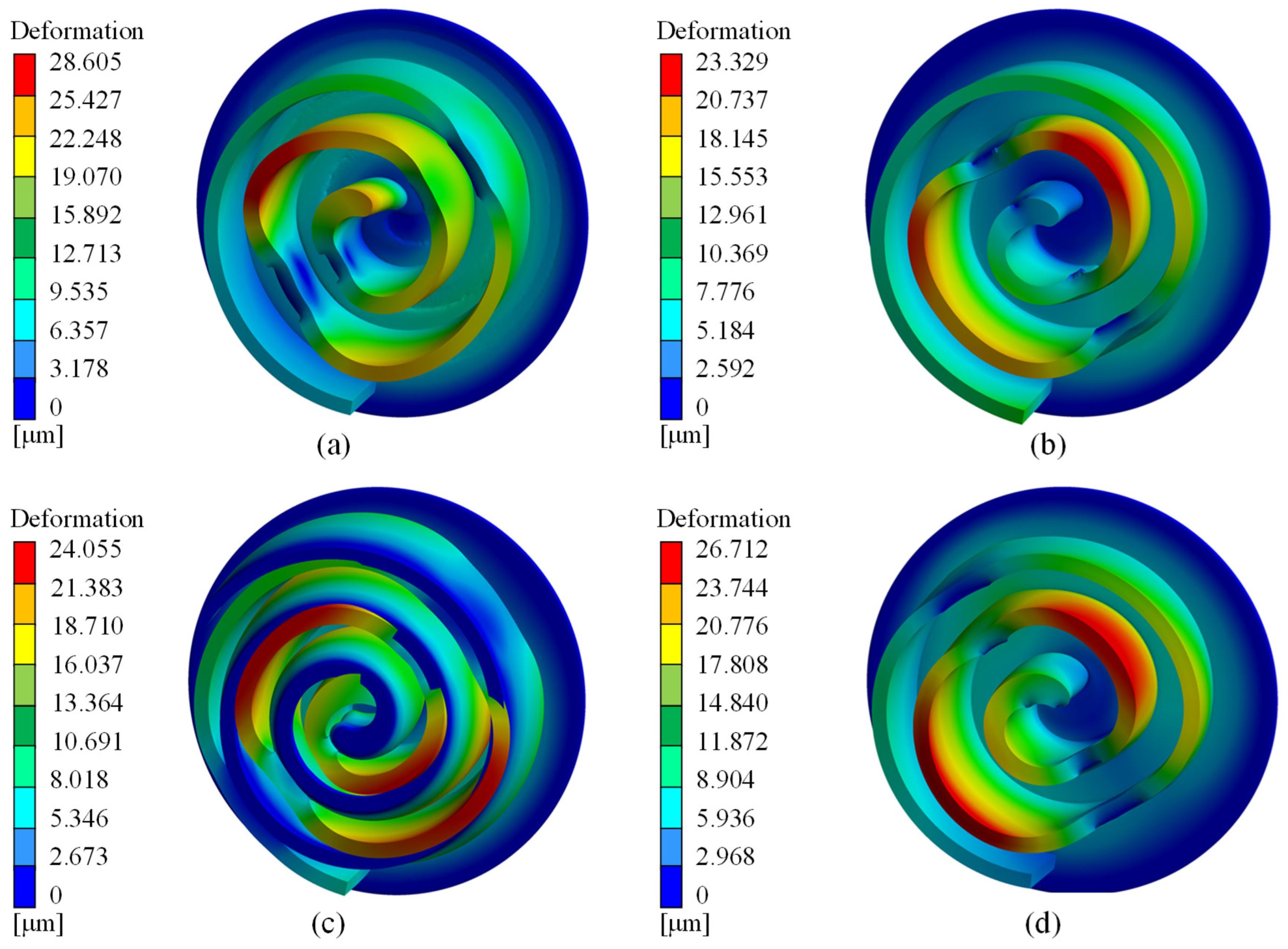
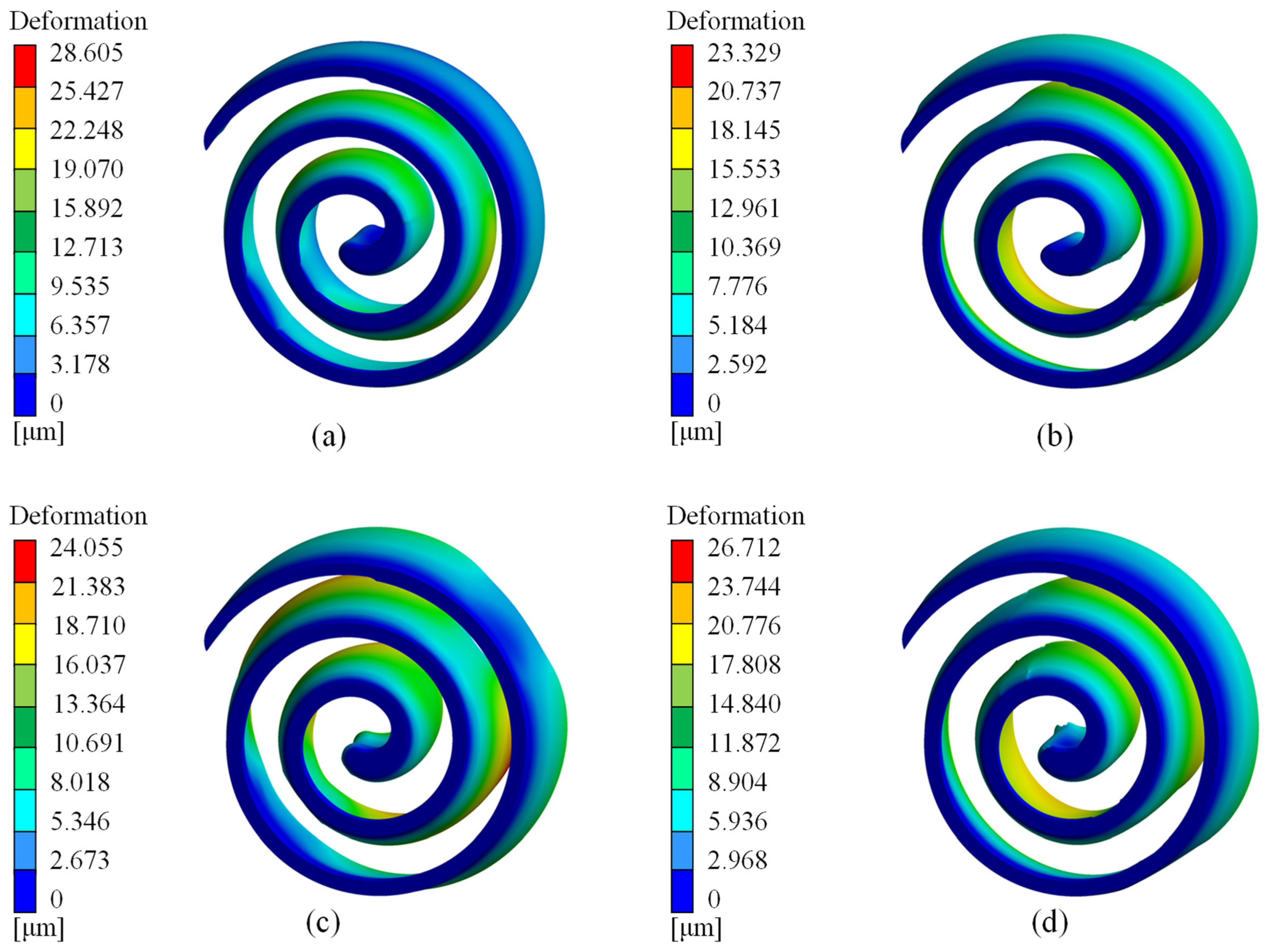
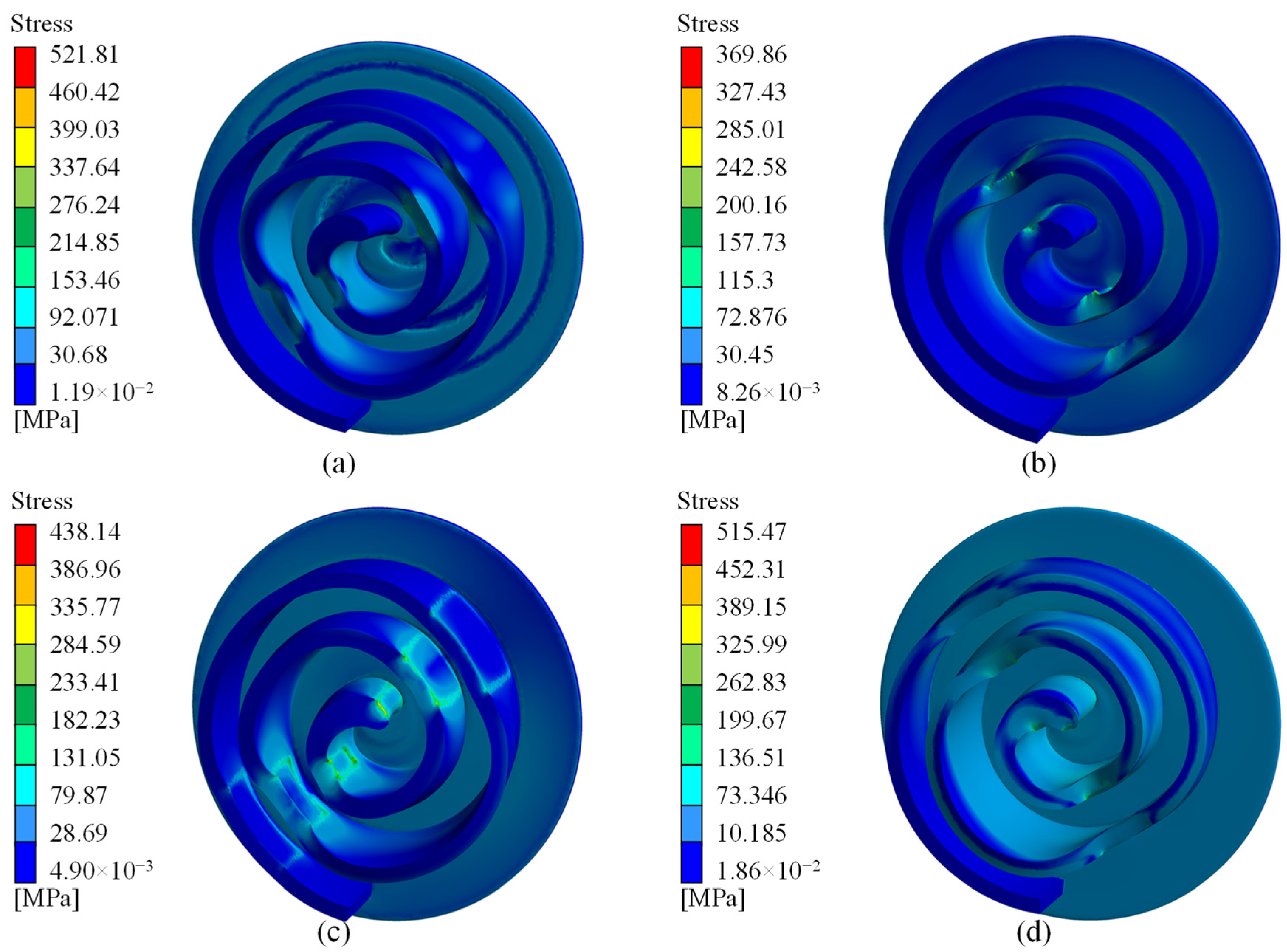
Figure 21 and Figure 22 show the total deformation of the orbiting scroll wraps and the fixed scroll wraps under the action of temperature load under different spindle rotation angles, while Figure 23 and Figure 24 show the stress distribution of the orbiting scroll wraps and the fixed scroll wraps under the action of temperature load under different spindle rotation angles. As the spindle rotates continuously, the deformation magnitude, location of maximum deformation, location of maximum stress, and stress amplitude of the scroll wraps vary dynamically. Compared with pressure loading, temperature loading has a greater effect on the deformation laws and stress distribution of the orbiting and fixed scroll wraps. The maximum deformation of the orbiting scroll wrap is located in the middle section of the compression chamber of the scroll wrap, and its overall deformation varies noticeably with the spindle rotation angle. The deformation of the fixed scroll wrap is relatively small, with its maximum deformation also located in the middle section of the compression chamber, while the changes in its deformation magnitude and position with spindle rotation are insignificant.
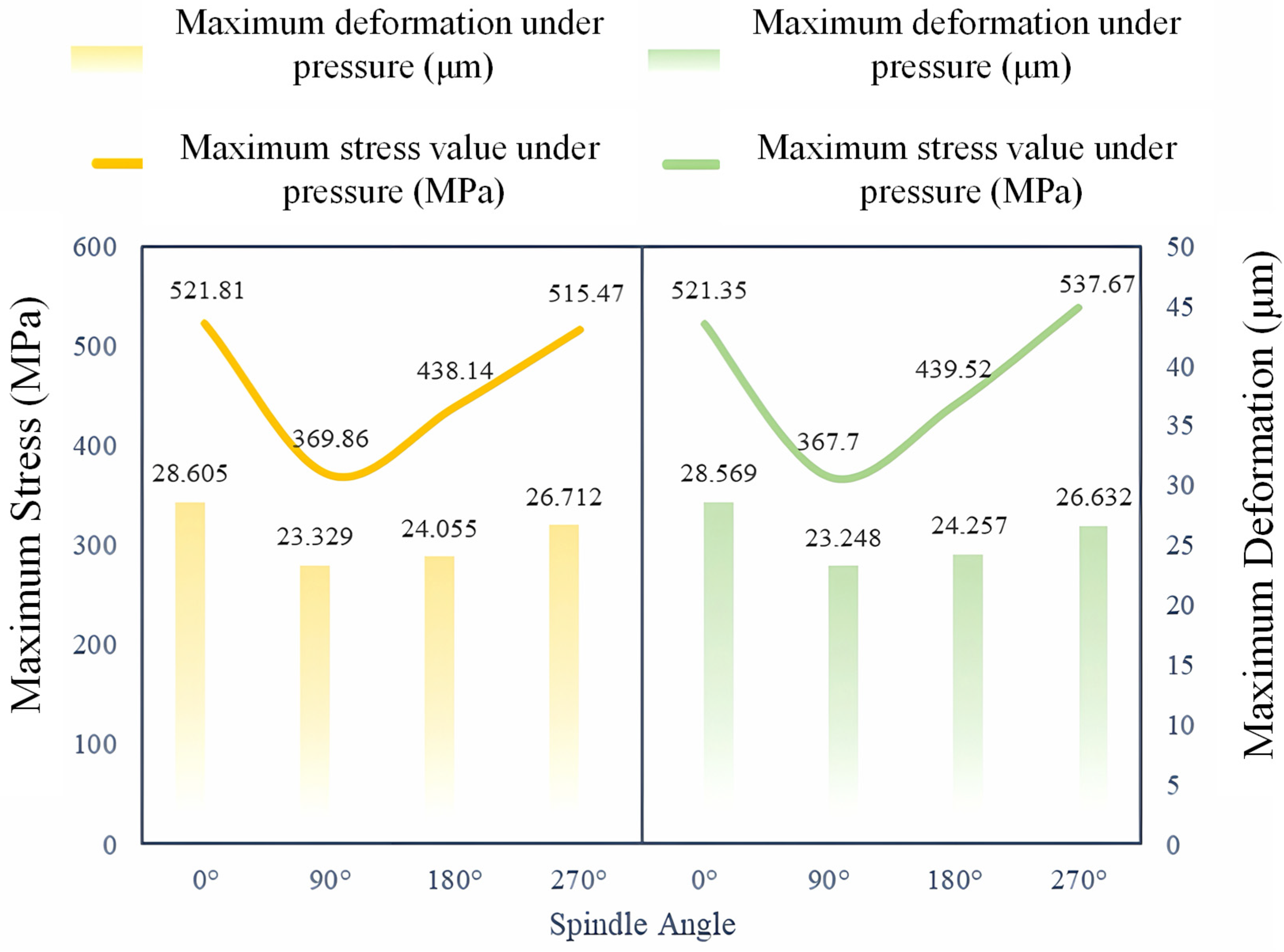
The maximum deformation, stress values and their corresponding positions of scroll wraps under different spindle rotation angles are shown in Table 8 and Table 9. At a spindle rotation angle of 0°, the scroll compressor is at the end of the suction stage. The high thermal expansion coefficient of the aluminum alloy restricts thermal expansion in the wrap tip region, producing a maximum deformation of 28.605 μm and a maximum thermal stress of 521.81 MPa. When the spindle rotates to 90°, the high-speed orbital motion of the orbiting scroll enhances convective heat transfer in the flow field, and the temperature distribution at the wrap tip becomes uniform. The maximum deformation decreases to 23.329 μm, and the maximum stress drops correspondingly to 369.86 MPa. At a spindle rotation angle of 180°, the maximum deformation rises to 24.055 μm, and the maximum stress increases to 438.14 MPa. When the spindle reaches 270°, the temperature in the central region of the scroll wraps peaks; consequently, the maximum deformation increases to 26.712 μm, and the maximum stress reaches 515.4 MPa.

3.2.3. Strain Characteristics of Scroll Wraps Under the Combined Action of Pressure and Temperature Loads

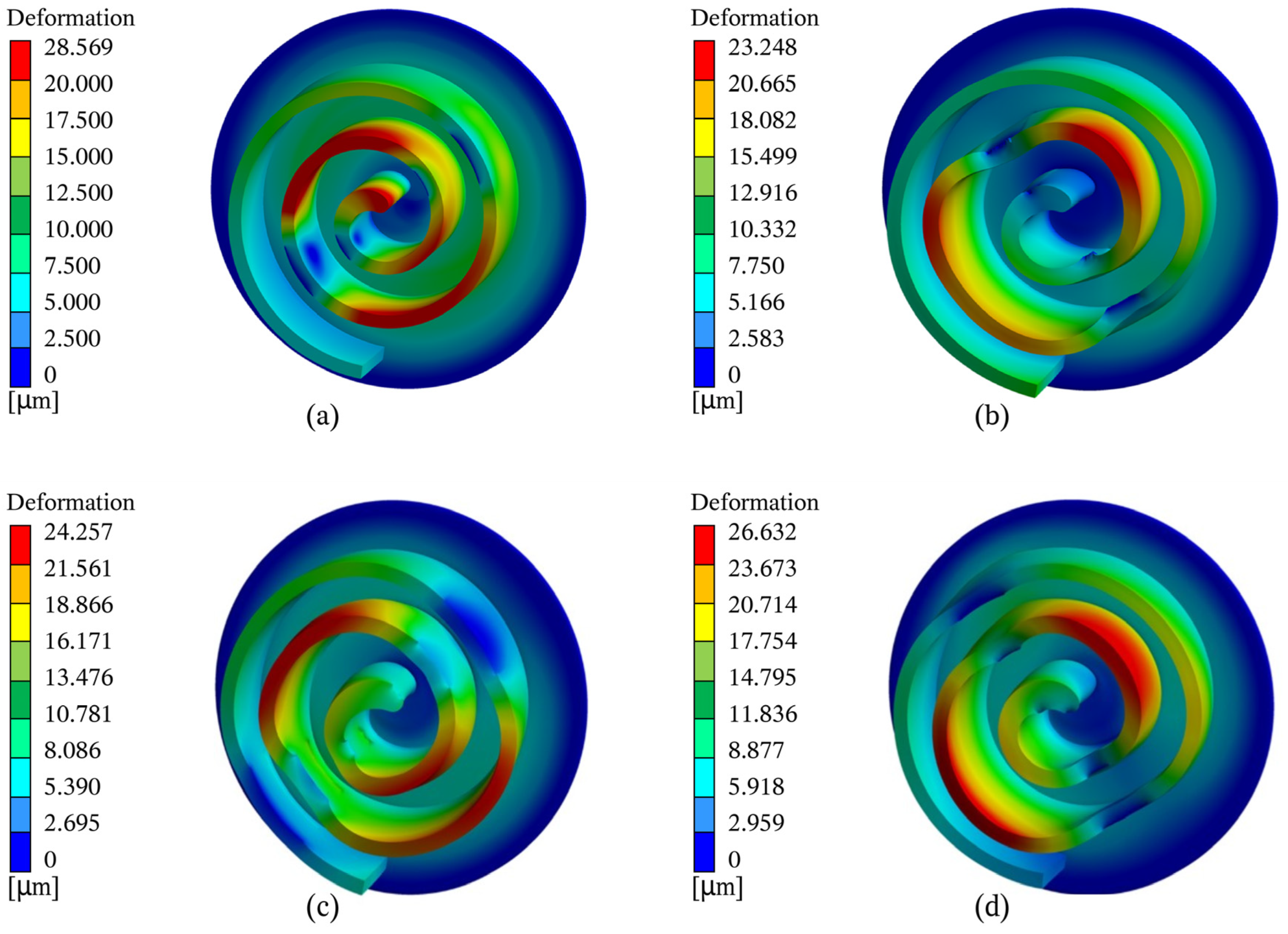
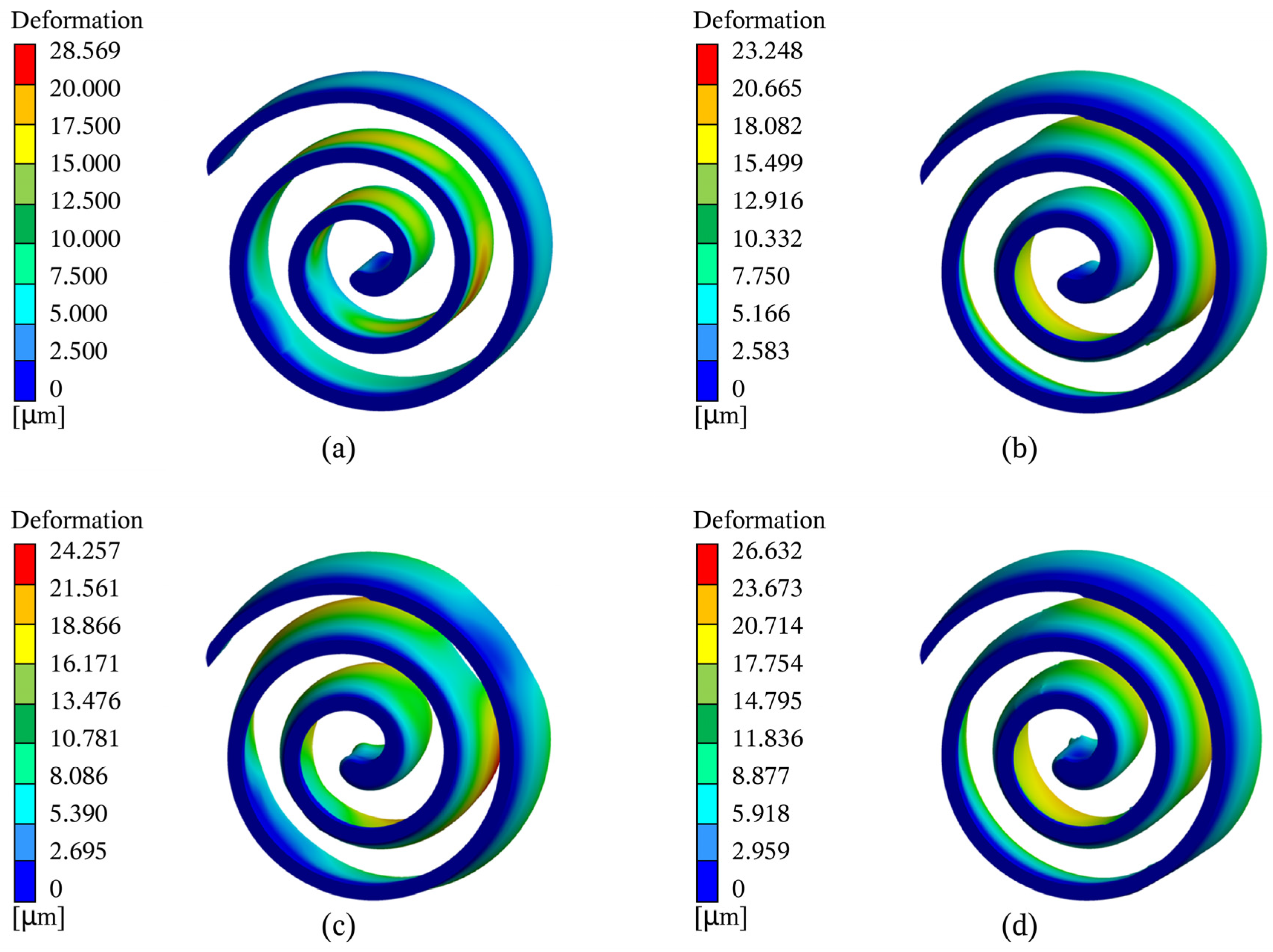
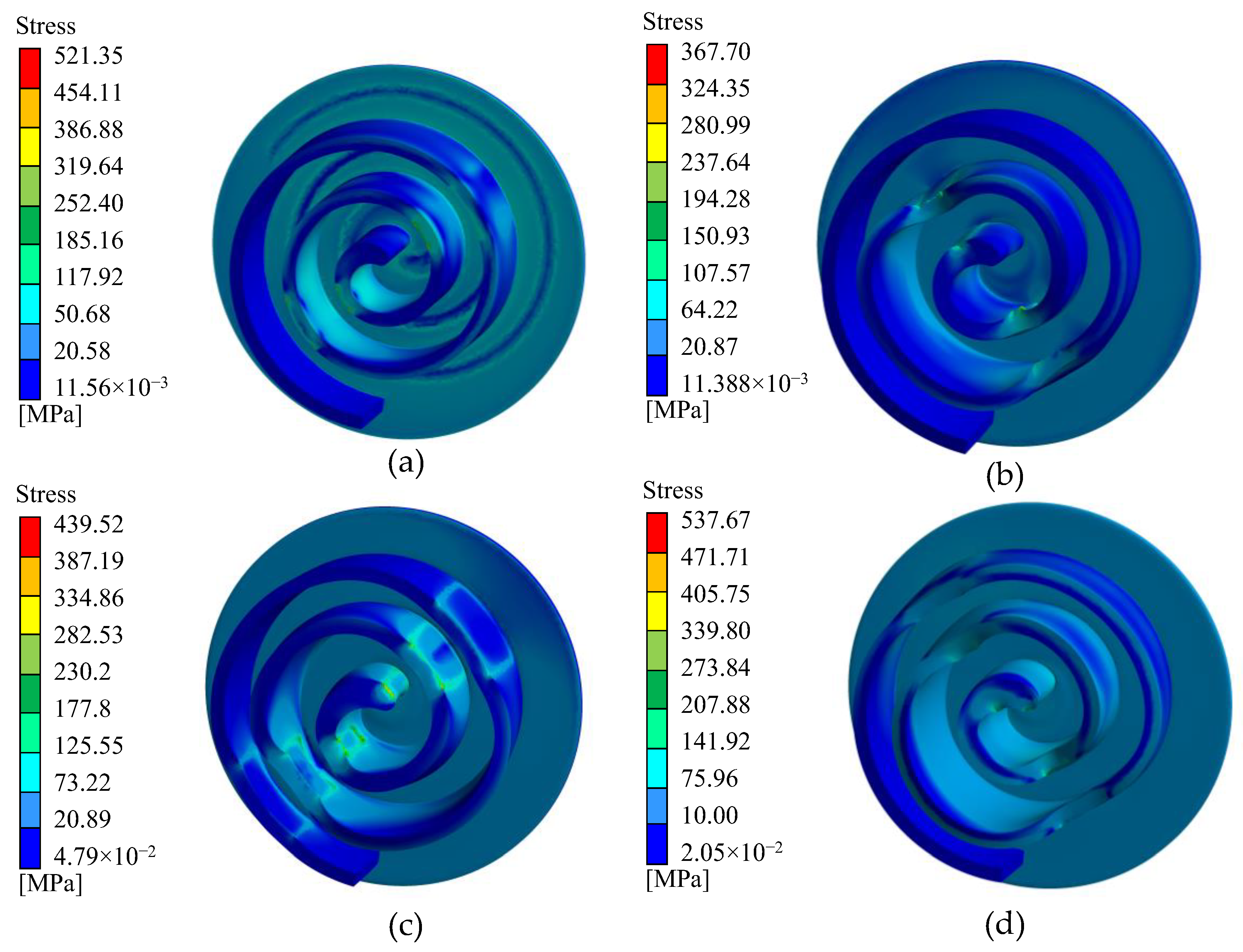
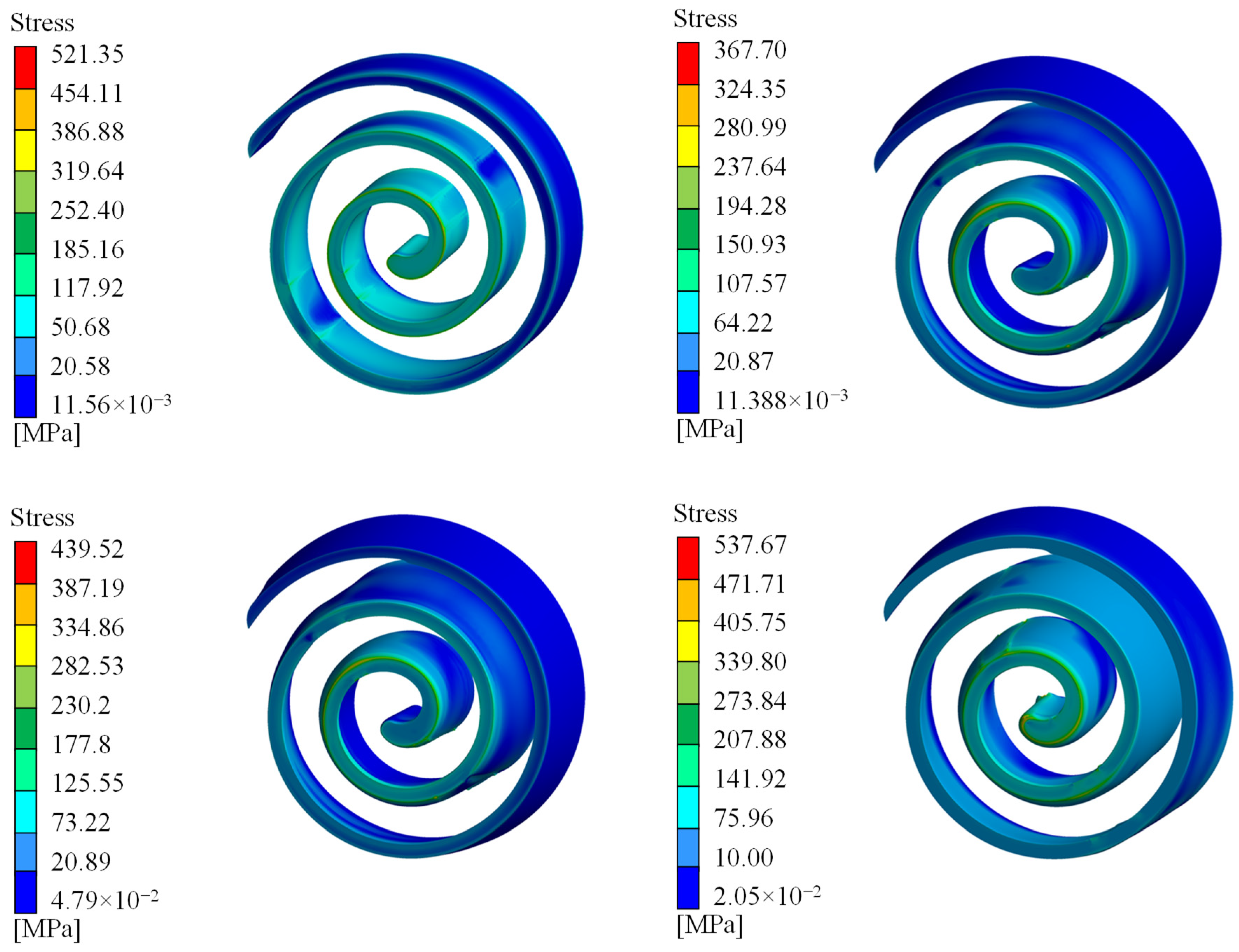
Figure 25 and Figure 26 reflect the total deformation of the orbiting scroll wraps and the fixed scroll wraps under the combined action of pressure and temperature loads at different spindle rotation angles. Figure 27 and Figure 28 show the stress distribution characteristics of the orbiting and fixed scroll wraps under the coupled action of pressure and temperature loads. The maximum deformation of both the orbiting and fixed scroll wraps occurs in the middle section of the compression chamber. The deformation magnitudes and peak positions of the two scroll wraps evolve dynamically with the spindle rotation angle, and their variation patterns are consistent with those under thermal loading alone. Stress in the orbiting scroll wrap concentrates at the wrap root, whereas stress in the fixed scroll wrap concentrates at the wrap root in the region from the wrap start to the compression chamber. Consistent with the deformation characteristics, the stress distribution under multi-field coupling is also more similar to that under temperature loading alone. Notably, the deformation and stress responses induced by combined temperature and pressure loading are not a linear superposition of the individual loadings. Taking the spindle rotation angle of 0° as an example, the maximum deformation of the orbiting scroll wrap is 0.84385 μm under pressure loading alone and 28.605 μm under temperature loading alone, while the actual deformation under coupled loading is 28.509 μm, which is not a linear superposition, with a difference of 0.938 μm. Similarly, the maximum stress is 6.72 MPa under pressure loading alone and 521.81 MPa under temperature loading alone, whereas the maximum stress under coupled loading is 521.35 MPa, which is also not a linear superposition, with a deviation of 7.18 MPa.
The maximum deformation, stress values and their corresponding positions of scroll wraps under different spindle rotation angles are shown in Table 10 and Table 11. At a spindle rotation angle of 0°, the scroll wraps are in the transition stage between the suction end and the initial compression phase. The combined effect of local high pressure generated by initial compression of the working fluid at the front edge of the compression chamber and thermal expansion caused by high temperature in the wrap tip region results in a maximum deformation of 28.569 μm and a maximum equivalent stress of 521.35 MPa. When the spindle rotates to 90°, the gas is further compressed, and pressure loading restricts the thermal expansion freedom, reducing the deformation to 23.248 μm. Concurrently, the reduced temperature gradient alleviates thermal stress concentration, lowering the maximum stress to 367.7 MPa. At a spindle rotation angle of 180°, the maximum deformation rises to 24.257 μm, and the stress increases to 439.52 MPa. When the spindle rotation angle reaches 270°, the compression chamber volume is reduced to its minimum. Continuous compression of the high-temperature working fluid leads to a maximum deformation of 26.632 μm and a maximum equivalent stress of 537.67 MPa.
Jin et al. [34,35,36,37,38,39] applied the pressure, temperature and their coupled loads obtained from theoretical calculations or flow field analyses to the solid domain of the scroll compressor, and investigated the stress and deformation distribution of the scroll plate. Their results indicate that the maximum stress occurs in the wrap root region, the maximum deformation is primarily concentrated at the start of the scroll plate and in the compression chamber, whereas the tail deformation is relatively small. Furthermore, temperature loading plays a dominant role in the structural response of the scroll wraps. The variation trends of the scroll plate stress and deformation obtained in this study are consistent with those reported in the aforementioned literature, which verifies the reliability of the analytical conclusions. It should be noted that differences in scroll plate materials, operating parameters, constraint conditions, and other factors employed across studies lead to specific values of maximum stress and deformation in this work that differ from those in the literature. However, such differences result from different model setups and do not affect the consistency of the overall variation laws.
As shown in Figure A5 and Figure A6, it can be clearly found that the variation trends of the maximum stress and the maximum deformation under the action of pressure are different from those under the action of temperature load only and under the combined action of temperature and pressure. The maximum stress and deformation trends of scroll compressors under the combined action of temperature and pressure are highly similar to those under the sole action of temperature load.

4. Conclusions

Based on the scroll compressor used in the built heat pump experimental bench, a three-dimensional model of the scroll compressor was established by simplifying its geometric parameters. The flow field characteristics and mechanical responses under the four characteristic phases of 0°, 90°, 180°, and 270° were studied by using the finite element dynamic analysis method. Combined with the unidirectional thermal–fluid–solid coupling analysis, the following conclusions are drawn:
  • The velocity distribution of the flow field inside the orbiting and fixed scroll plates is uneven. The velocity cloud diagrams and velocity vector diagrams at different spindle rotation angles reveal two typical flows. The tangential main flow along the involute profile and the radial secondary flow induced by centrifugal force. The velocity spatial distribution is directly related to the geometric constraint characteristics of the number of scroll turns.
  • Under any spindle rotation angle, the pressure field and temperature field of the internal flow field of the scroll compressor both show a distribution feature of being higher at the center and lower around the periphery. The pressure field is uniformly distributed, while the turbulent kinetic energy and velocity distribution inside the working chamber are similar to the temperature field distribution, both showing non-uniform distribution. The distribution laws of the four are jointly governed by the decreasing effect of the curvature radius of the involute profile and the gradual compression mechanism of the volume. Meanwhile, it is revealed that due to the symmetrical design of the scroll compressor, its internal flow field has the characteristic of axial uniformity.
  • Due to the difference in constraint conditions between the orbiting and fixed scroll wraps, the orbiting scroll wrap exhibits more significant stress distribution and deformation under pressure loading, temperature loading, and their combined coupling effect compared with the fixed scroll wrap. The reasons why the deformation of the fixed scroll wrap is less obvious than that of the orbiting scroll wrap, as well as why thermal loading plays a dominant role in the deformation of both orbiting and fixed scroll wraps, are investigated.
  • Multi-field coupling analysis shows that under the combined action of pressure and temperature loading, the stress distribution and deformation characteristics of the scroll wraps are closer to those under temperature loading alone, confirming that temperature loading dominates the structural response of the scroll wraps. Specifically, under the combined loadings, the maximum deformation of the scroll wrap is 28.509 μm and the peak stress is 537.67 MPa. Under temperature loading alone, the maximum deformation is 28.605 μm and the maximum stress is 521.81 MPa. While under pressure loading alone, the maximum deformation is only 0.84385 μm and the peak stress is 8.418 MPa. The above data fully verify the reliability of this conclusion.
  • The total deformation and stress distribution under the combined action of temperature and pressure loading are not a linear superposition of the effects of the two loadings applied separately. Taking the spindle rotation angle of 0° as an example, the maximum deformation of the orbiting scroll wrap is 0.84385 μm under pressure loading alone and 28.605 μm under temperature loading alone, while the actual deformation under the coupled loadings is 28.509 μm with a deviation of 0.938 μm, proving that the deformation under coupling is not a simple sum of the deformations under individual loadings. Similarly, at a spindle rotation angle of 0°, the maximum stress of the orbiting scroll wrap is 6.72 MPa under pressure loading alone and 521.81 MPa under temperature loading alone, whereas the maximum stress under coupled loadings is 521.35 MPa with a deviation of 7.18 MPa, indicating that the stress under coupling is not a simple superposition of the stresses under individual loadings.
Based on a multi-physics coupling analysis, this study systematically reveals the dynamic response mechanism of scroll wraps under combined fluid–thermal–solid interaction. This work provides a theoretical basis for key technologies such as profile optimization, fatigue life prediction, and reliability improvement of scroll compressors, and offers particular engineering support for addressing tip wear under high-speed operating conditions. Given the above analysis, the limitations of the one-way heat–flow–force coupling method employed in this study should be clarified. This method only transfers the loadings obtained from flow field calculations to the solid domain in a one-way manner and does not account for the feedback effect of solid deformation on the flow field. Consequently, when scroll wrap deformation significantly affects the internal flow field, for example, by exacerbating working fluid leakage or inducing structural vibration, the one-way coupling method cannot accurately capture the resulting dynamic behaviors. To overcome the above shortcomings, future research will introduce a two-way fluid–thermal–solid coupling method based on this study, focus on investigating the influence of leakage on compression performance, and attempt to design experimental verification schemes that can truly reflect the stress and deformation characteristics of scroll wraps. In addition, further comparisons will be conducted on the overall performance differences in scroll compressors under different profile parameters, so as to provide more comprehensive design references for the development of high-performance scroll compressors.

Author Contributions

Y.P.: Conceptualization; Formal Analysis; Funding Acquisition; Investigation; Project Administration; Supervision; Review and Editing. J.Z.: Formal Analysis; Investigation; Methodology; Software; Validation; Original Draft Preparation. L.Z.: Validation; Visualization; Review and Editing. L.K.: Software; Visualization; Original Draft Preparation. X.L.: Software; Formal Analysis; Original Draft Preparation. Y.L.: Methodology; Validation. All authors have read and agreed to the published version of the manuscript.

Funding

This research was supported by the National Natural Science Foundation of China Youth Fund [No. 52304004], State Key Laboratory of Oil and Gas Reservoir Geology and Exploitation Special Open Fund-Sichuan Province Geothermal Resources Development and Comprehensive Utilization Industry-Education Integration Demonstration Project [No. CDUT-PLC2025016CJRH], Central Guiding Local Science and Technology Development Special Project in Sichuan Province [No. 2024ZYD0122], Organized scientific research major project of Tianfu Yongxing Laboratory [2023KJGG13], Central Guiding Local Science and Technology Development Special Project in Sichuan Province [No. 2024ZYD0142], Key R&D Projects in Sichuan Province [2024YFNH0022], National Science and Technology Major Project [2024ZD1406500].

Data Availability Statement

The original contributions presented in this study are included in the article. Further inquiries can be directed to the corresponding author.

Conflicts of Interest

The authors declare no conflicts of interest.

Glossary

NomenclatureGreek symbols
FaAxial aerodynamic force acting perpendicular to the axis of the eccentric shaft on the orbiting scroll (N)ρDensity (kg/m3)
FrRadial aerodynamic force in the direction of the connecting line between the centres of the orbiting scroll and the fixed scroll (N)ηVolume efficiency
FtTangential aerodynamic force applied to the orbiting scroll in the direction of the tangent to the eccentric axis (N)
hEnthalpy (J/mol)Subscripts
KeffThermal conductivity (W/(m·K))fFixed scroll
mMass flow (kg/s)oOrbiting scroll
NCount of cellssSolid domain
qHeat flux (W/m2)Acronyms
tWall thickness (mm)ORCOrganic Rankine Cycle
vFluid velocity vector (m/s)NISTNational Institute of Standards and Technology
VsSuction volume (m3)
Hamiltonian operator

Appendix A

Figure A1. Schematic diagram of data transmission results.
Machines 14 00569 g0a1
Figure A2. Heat–fluid–solid coupling analysis system.
Machines 14 00569 g0a2
Figure A3. The maximum speed with different spindle rotation angles.
Machines 14 00569 g0a3
Figure A4. Schematic diagram of the positions of some feature points.
Machines 14 00569 g0a4
Figure A5. The variation trend of the maximum deformation and the maximum stress value at different spindle rotation angles under the action of pressure load.
Machines 14 00569 g0a5
Figure A6. The variation trends of the maximum deformation and the maximum stress value at different spindle rotation angles under the action of temperature load and under the action of temperature and pressure load.
Machines 14 00569 g0a6

References

  1. Hamid, K.; Sajjad, U.; Ahrens, M.U.; Ren, S.; Ganesan, P.; Tolstorebrov, I.; Arshad, A.; Said, Z.; Hafner, A.; Wang, C.-C.; et al. Potential evaluation of integrated high temperature heat pumps: A review of recent advances. Appl. Therm. Eng. 2023, 230, 120720. [Google Scholar] [CrossRef]
  2. Gangar, N.; Macchietto, S.; Markides, C.N. Recovery and utilization of low-grade waste heat in the oil-refining industry using heat engines and heat pumps: An international technoeconomic comparison. Energies 2020, 13, 2560. [Google Scholar] [CrossRef]
  3. Zhao, Z.Y. Waste Heat Utilization and Boiler Energy Saving; Ningxia People’s Publishing House: Yinchuan, China, 1984. [Google Scholar]
  4. Feng, H.S.; Xu, F.F.; Liu, Y.F.; Shan, C. Review of waste heat utilization technologies for industry processes. Chem. Ind. Eng. 2012, 1, 57–64. [Google Scholar] [CrossRef]
  5. Chen, Y. Research on waste heat recovery technology of oil field. Energy Conserv. Pet. Petrochem. Ind. 2021, 9, 7–9. [Google Scholar] [CrossRef]
  6. Chen, Y.; Halm, N.P.; Braun, J.E.; Groll, E.A. Mathematical modeling of scroll compressors—Part II: Overall scroll compressor modeling. Int. J. Refrig. 2002, 25, 751–764. [Google Scholar] [CrossRef]
  7. Chen, Y.; Halm, N.P.; Groll, E.A.; Braun, J.E. Mathematical modeling of scroll compressors—Part I: Compression process modeling. Int. J. Refrig. 2002, 25, 731–750. [Google Scholar] [CrossRef]
  8. Cui, M.M. Comparative study of the impact of the dummy port in a scroll compressor. Int. J. Refrig. 2007, 30, 912–925. [Google Scholar] [CrossRef]
  9. Cui, M.M. Investigation of the scroll compressor porting process. Part I: Global flow physics and behaviour of gas pockets. Proc. Inst. Mech. Eng. Part A J. Power Energy 2006, 220, 37–53. [Google Scholar] [CrossRef]
  10. Blunier, B.; Cirrincione, G.; Hervé, Y.; Miraoui, A. A new analytical and dynamical model of a scroll compressor with experimental validation. Int. J. Refrig. 2009, 32, 874–891. [Google Scholar] [CrossRef]
  11. Hiwata, A.; Futagami, Y.; Morimoto, T.; Murakami, H.; Ishii, N. Deformation control of scroll compressor for CO2 refrigerant. Trans. Jpn. Soc. Refrig. Air Cond. Eng. 2011, 27, 1–9. [Google Scholar]
  12. Lin, C.; Chang, Y.; Liang, K.; Hung, C. Temperature and thermal deformation analysis on scrolls of scroll compressor. Appl. Therm. Eng. 2005, 25, 1724–1739. [Google Scholar] [CrossRef]
  13. Zha, H.; Jiang, Y.; Wang, J.; Qiu, X.Q. One-way fluid-structure interaction method of scroll compressor and analysis on the deformation of the wrap. Fluid Mach. 2015, 43, 22–27. [Google Scholar] [CrossRef]
  14. Yang, X.H.; Pan, J.Z.; Wang, J.D.; Zhang, Z. Numerical simulation research on the interior flow field of scroll expander. Fluid Mach. 2013, 41, 15–18. [Google Scholar] [CrossRef]
  15. Xiao, G.F.; Liu, G.P.; Wang, J.T.; Song, H.G. Numerical simulation for transient flow in a scroll compressor using dynamic mesh technique. Mach. Tool Hydraul. 2013, 41, 146–149. [Google Scholar] [CrossRef]
  16. Wu, K.B.; Li, H.S.; Chen, Y.H.; Zhang, X.W.; Wang, J.S. Study on load distribution of the scroll compressor teeth seal. Fluid Mach. 2014, 42, 38–42,12. [Google Scholar] [CrossRef]
  17. Wang, J.; Song, Y.X.; Zha, H.B.; Li, Q. 3D Numerical simulation and study of discharge process for scroll compressors. J. Eng. Thermophys 2016, 37, 766–769. [Google Scholar]
  18. Zhang, D.H.; Zhang, X.H.; Wang, Z.B. 3D Numerical simulation technique of volumetric compressor based on scroll compressor. Fluid Mach. 2016, 3, 18–21. [Google Scholar] [CrossRef]
  19. Peng, B.; Zhao, S.X.; Li, Y.H. Research on leakage characteristics of oil-free scroll compressors. Fluid Mach. 2018, 46, 35–40. [Google Scholar]
  20. Wu, Z.; Feng, Z.G.; Su, Y.F. Simulation and analysis of internal flow field in scroll compressor with circular involute profile. Mech. Sci. Technol. Aerosp. Eng. 2019, 38, 1840–1846. [Google Scholar] [CrossRef]
  21. Emhardt, S.; Song, P.; Tian, G.; Chew, J.; Wei, M. CFD analysis of variable wall thickness scroll expander integrated into small scale ORC systems. Energy Procedia 2019, 158, 2272–2277. [Google Scholar] [CrossRef]
  22. Bo, B.Z.; Ren, H.D. Finite element analysis on oxide film strength of orbiting scroll in scroll compressor. Cryog. Supercond. 2018, 46, 78–84. [Google Scholar]
  23. Li, G.X.; Chen, Y.; Li, Y.M.; Wang, Y.; Xu, M.; Liu, H. Finite element analysis of variable tooth thickness for electric vehicle scroll compressor. Fluid Mach. 2019, 47, 18–22+12. [Google Scholar]
  24. Peng, B.; Xue, C. Stress and Deformation analysis of variable cross-section orbiting scroll of scroll compressor with different materials. Compress. Technol. 2019, 5, 1–4+24. [Google Scholar]
  25. Zhao, R.C.; Li, W.H.; Zhuge, W.L. Unsteady characteristic and flow mechanism of a scroll compressor with novel discharge port for electric vehicle air conditioning. Int. J. Refrig. 2020, 118, 403–414. [Google Scholar] [CrossRef]
  26. Wang, C.; Zhang, S.; Cheng, J.M.; Lei, B.W.; Du, Y.J.; Wu, J.H. Simulation of the deformation and contact of scrolls in the scroll compressor. IOP Conf. Ser. Mater. Sci. Eng. 2021, 1180, 012013. [Google Scholar] [CrossRef]
  27. Zhang, Y.-L.; Yue, X.-J.; Ba, D.-C.; Yang, F. Thermal field and scroll deformation analysis study of a multi-stage dry scroll vacuum pump based on fluid-solid coupling numerical simulation. Vacuum 2025, 233, 113971. [Google Scholar] [CrossRef]
  28. Li, C.; Liu, J.Z.; Wang, H.H. Stress and strain analysis of orbiting scroll of scroll compressor under coupled action of multiple loads. Fluid Mach. 2020, 48, 30–35,75. [Google Scholar]
  29. Li, Z.; Liu, Z.; Xie, D.S. Stress and deformation analysis of scroll disk of a scroll expander for waste heat recovery of vehicle. J. Chongqing Univ. Technol. Nat. Sci. 2022, 36, 93–100. [Google Scholar] [CrossRef]
  30. Dong, X.F.; Yan, W.G.; Wang, Z.; Qi, Z.; Gao, B. Fluid-solid coupled analysis in meshing condition and structure improvement for scroll. Mach. Tool Hydraul. 2022, 50, 145–151. [Google Scholar] [CrossRef]
  31. Luo, Y.; Li, Z.; Li, Q. Finite element analysis on scroll of a scroll compressor for electric-driven vehicle air-conditioner. In Proceedings of the 28th International Cryogenic Engineering Conference and International Cryogenic Materials Conference 2022, Hangzhou, China, 25–29 April 2022; pp. 379–386. [Google Scholar] [CrossRef]
  32. Yang, B.; Li, A.; Yuan, M.; Wu, J.; Gao, F.; Ge, M. Thermodynamic study on the vortex teeth of electric scroll compressors based on gradient tooth height. Appl. Sci. 2024, 14, 5977. [Google Scholar] [CrossRef]
  33. Liu, Z.; Wei, M.; Song, P.; Emhardt, S.; Tian, G.; Huang, Z. The fluid-thermal-solid coupling analysis of a scroll expander used in an ORC waste heat recovery system. Appl. Therm. Eng. 2018, 138, 72–82. [Google Scholar] [CrossRef]
  34. Jin, D.; Chen, X.; Tian, T. Stress and deformation analysis of the orbiting scroll plate in a scroll compressor under non-uniform temperature field. Fluid Mach. 2003, 31, 11–13. [Google Scholar] [CrossRef]
  35. Wang, J.; Zhang, N.; Liu, K.; Xu, S.; Zhang, D. Stress and deformation analysis of scroll wraps in a scroll compressor based on flow field simulation. J. Eng. Thermophys. 2012, 33, 1334–1337. [Google Scholar]
  36. Han, K.; Tang, J.C.; Gao, C. Thermoelastic coupling analysis of the orbiting scroll plate in a scroll compressor. J. Hefei Univ. Technol. Nat. Sci. 2013, 36, 769–772. [Google Scholar]
  37. Wang, J.; Liu, Q.; Jiang, Y.; Wang, Z.L.; Zha, H.B. Research on temperature distribution and deformation of scroll wraps in a scroll compressor. J. Eng. Thermophys. 2016, 37, 2344–2348. [Google Scholar]
  38. Wang, J.J.; Liu, T.; Hu, T.L. Strength analysis of variable cross-section scroll wraps based on flow field analysis. Fluid Mach. 2021, 48, 31–37. [Google Scholar] [CrossRef]
  39. Arifin, A.; Wu, Y.-R.; Sasongko, B.T.; Majid, A. Analytical design of scroll rotor with varying tooth-wall thickness and its mechanical investigation concerning deformation and stress on the tooth wall. Results Eng. 2025, 28, 107131. [Google Scholar] [CrossRef]
Figure 1. Physical pictures of the heat pump test bench and scroll compressor.
Machines 14 00569 g001
Figure 2. The scroll model.
Machines 14 00569 g002
Figure 3. Schematic diagram of the basic volume of the scroll compressor.
Machines 14 00569 g003
Figure 4. Flow field model.
Machines 14 00569 g004
Figure 5. Solid field model.
Machines 14 00569 g005
Figure 6. Schematic diagram of the flow field grid.
Machines 14 00569 g006
Figure 7. The relationship between volumetric efficiency and grid number.
Machines 14 00569 g007
Figure 8. Comparison of simulation and experiment.
Machines 14 00569 g008
Figure 9. Solid domain meshing: (a) The orbiting scroll plate; (b) The fixed scroll plate.
Machines 14 00569 g009
Figure 10. Velocity distribution under different spindle rotation angles: (a) 0°, (b) 90°, (c) 180° and (d) 270°.
Machines 14 00569 g010
Figure 11. Pressure distribution under different spindle rotation angles: (a) 0°, (b) 90°, (c) 180° and (d) 270°.
Machines 14 00569 g011
Figure 12. Temperature distribution under different spindle rotation angles: (a) 0°, (b) 90°, (c) 180° and (d) 270°.
Machines 14 00569 g012
Figure 13. Pressure distribution of characteristic points inside the working chamber.
Machines 14 00569 g013
Figure 14. Temperature distribution of characteristic points inside the working chamber.
Machines 14 00569 g014
Figure 15. Turbulent kinetic energy distribution of characteristic points inside the working chamber.
Machines 14 00569 g015
Figure 16. Velocity distribution of feature points inside the working chamber.
Machines 14 00569 g016
Figure 17. Deformation distribution of the orbiting scroll under different spindle rotation angles under pressure load: (a) 0°, (b) 90°, (c) 180° and (d) 270°.
Machines 14 00569 g017
Figure 18. Deformation distribution of the fixed scroll under different spindle rotation angles under pressure load: (a) 0°, (b) 90°, (c) 180° and (d) 270°.
Machines 14 00569 g018
Figure 19. Stress distribution of the orbiting scroll under different spindle rotation angles under pressure load: (a) 0°, (b) 90°, (c) 180° and (d) 270°.
Machines 14 00569 g019
Figure 20. Stress distribution of the fixed scroll under different spindle rotation angles under pressure load: (a) 0°, (b) 90°, (c) 180° and (d) 270°.
Machines 14 00569 g020
Figure 21. Deformation distribution of the orbiting scroll under different spindle rotation angles under temperature load: (a) 0°, (b) 90°, (c) 180° and (d) 270°.
Machines 14 00569 g021
Figure 22. Deformation distribution of the fixed scroll under different spindle rotation angles under temperature load: (a) 0°, (b) 90°, (c) 180° and (d) 270°.
Machines 14 00569 g022
Figure 23. Stress distribution of the orbiting scroll under different spindle rotation angles under temperature load: (a) 0°, (b) 90°, (c) 180° and (d) 270°.
Machines 14 00569 g023
Figure 24. Stress distribution of the fixed scroll under different spindle rotation angles under temperature load: (a) 0°, (b) 90°, (c) 180° and (d) 270°.
Machines 14 00569 g024
Figure 25. The deformation distribution of the orbiting scroll under different spindle rotation angles under the combined action of pressure and temperature loads: (a) 0°, (b) 90°, (c) 180° and (d) 270°.
Machines 14 00569 g025
Figure 26. Deformation distribution of the fixed scroll under different spindle rotation angles under the combined action of pressure and temperature loads: (a) 0°, (b) 90°, (c) 180° and (d) 270°.
Machines 14 00569 g026
Figure 27. Stress distribution of the orbiting scroll under different spindle rotation angles under the combined action of pressure and temperature loads: (a) 0°, (b) 90°, (c) 180° and (d) 270°.
Machines 14 00569 g027
Figure 28. Stress distribution of the fixed scroll under different spindle rotation angles under the combined action of pressure and temperature loads.
Machines 14 00569 g028
Table 1. Material properties.
PropertyValue
Density (kg/m3)2.68 × 103
Elasticity modulus (GPa)79
Poisson’s ratio0.33
Coefficient of expansion (K−1)1.95 × 10⁻⁵
Thermal conductivity (W/(m·K))141
Specific heat (J/(kg·K))864
Table 2. Geometric parameters.
ParameterValue
Base circle radius (mm)2.29997
Orbit diameter (mm)7.30852
Wrap height (mm)24
Wall thickness (mm)3.56103
Number of turns2.625
Involute generating angle (rad)0.774147
Table 3. Operating parameters under actual working conditions.
CaseSuction Temperature (K)Suction Pressure (MPa)Discharge Pressure (MPa)Pressure Ratio
Case 12831.96.53.42
Case 22881.9753.29
Case 32932.053.17
Case 42982.1253.05
Case 53032.22.95
Table 4. Maximum pressure and minimum pressure under different spindle rotation angles.
Parameters90°180°270°
Maximum pressure (Pa)300,432312,445311,450359,069
Minimum pressure (Pa)−8464.09−37,339.64677.3152,703.1
Table 5. Maximum temperature and minimum temperature under different spindle rotation angles.
Parameters90°180°270°
Maximum temperature (K)341.248339.483342.411344.753
Minimum temperature (K)289.354275.914292.891299.132
Table 6. Maximum deformation and maximum stress of scroll wraps at different spindle rotation angles under pressure loading.
Parameter90°180°270°
Maximum Deformation (μm)0.843850.821540.505640.63042
Maximum Stress (MPa)6.728.4183.9023.8524
Table 7. The maximum deformation position and the maximum stress position of the scroll wraps under different spindle rotation angles under pressure load.
Parameter90°180°270°
Location of the maximum deformation of the orbiting scrollThe middle section of the compression chamber of
the scroll wrap
Location of the maximum deformation
of the fixed scroll
The middle section of the compression chamber of
the scroll wrap
Location of the maximum stress value
of the orbiting scroll
The scroll wrap root
Location of the maximum stress value
of the fixed scroll
The scroll wrap root
Table 8. Maximum deformation and maximum stress of scroll wraps at different spindle rotation angles under temperature loading.
Parameter90°180°270°
Maximum Deformation (μm)28.60523.32924.05526.712
Maximum Stress (MPa)521.81369.86438.14515.47
Table 9. The maximum deformation position and the maximum stress position of the scroll wraps under different spindle rotation angles under temperature load.
Parameter90°180°270°
Location of the maximum deformation
of the orbiting scroll
The middle section of the compression chamber of
the scroll wrap
Location of the maximum deformation
of the fixed scroll
The middle section of the compression chamber of
the scroll wrap
Location of the maximum stress value
of the orbiting scroll
The wrap root region from the start of the scroll wrap to the compression chamber
Location of the maximum stress value
of the fixed scroll
The wrap root region from the start of the scroll wrap to the compression chamber
Table 10. Maximum deformation and maximum stress of scroll wraps at different spindle rotation angles under the combined action of pressure and temperature loads.
Parameter90°180°270°
Maximum Deformation (μm)28.56923.24824.25726.632
Maximum Stress (MPa)521.35367.70439.52537.67
Table 11. The maximum deformation and maximum stress values of the scroll wraps at different spindle rotation angles under the combined action of pressure and temperature loads.
Parameter90°180°270°
Location of the maximum deformation
of the orbiting scroll
The middle section of the compression chamber of the scroll wrap
Location of the maximum deformation
of the fixed scroll
The middle section of the compression chamber of the scroll wrap
Location of the maximum stress value
of the orbiting scroll
The wrap root region from the start of the scroll wrap to the compression chamber
Location of the maximum stress value
of the fixed scroll
The wrap root region from the start of the scroll wrap to the compression chamber
Disclaimer/Publisher’s Note: The statements, opinions and data contained in all publications are solely those of the individual author(s) and contributor(s) and not of MDPI and/or the editor(s). MDPI and/or the editor(s) disclaim responsibility for any injury to people or property resulting from any ideas, methods, instructions or products referred to in the content.