Article

Effects of Tip-Cavity Film Cooling on the Heat Transfer Characteristics of Gas Turbine Blades with Various Squealer Tip Geometries

1
Department of Mechanical Engineering, Korea University, Seoul 02841, Republic of Korea
2
Aero Engines Business Group, Hanwha Aerospace Co., Ltd., Pangyo Campus, Seongnam-si 13488, Republic of Korea
*
Author to whom correspondence should be addressed.
Machines 2026, 14(5), 545; https://doi.org/10.3390/machines14050545 (registering DOI)
Submission received: 3 April 2026 / Revised: 3 May 2026 / Accepted: 11 May 2026 / Published: 13 May 2026
(This article belongs to the Section Turbomachinery)

Abstract

Blade tip leakage flow in gas turbines is associated with aerodynamic loss and local heat transfer variation in the tip region. In this study, the flow structure, total pressure loss coefficient, heat transfer coefficient (HTC), and film cooling effectiveness (FCE) were numerically investigated for a plane tip (PLN) and five squealer tip geometries: a conventional squealer tip (SQR), cutback squealer tip (CBS), multi-cavity squealer tip (MCS), triangular-grooved suction-side squealer tip (GSS), and multi-cavity triangular-grooved suction-side squealer tip (MGS). All configurations were compared under the same cascade geometry, tip-clearance condition, and inlet/outlet boundary conditions to examine the geometry-dependent relationship among aerodynamic loss, heat transfer, and film cooling performance. Film cooling was evaluated at blowing ratios of M = 1 and 2 using a camber-line hole arrangement, and the effect of hole rearrangement was further examined at the same blowing ratio and with the same number of cooling holes. The results indicate that the aerodynamic and thermal characteristics of the tip region vary with the leakage-flow path, cavity recirculation, and reattachment behavior formed by each tip geometry. Under the present conditions, SQR showed the lowest downstream total pressure loss coefficient, with a 7.27% reduction relative to PLN, whereas MGS showed the lowest geometry-normalized heat transfer rate among the tested geometries. Increasing the blowing ratio tended to increase FCE, although local cooling performance was affected by high-pressure or reattachment-dominated regions where coolant ejection, surface attachment, or lateral spreading was limited. Compared with the camber-line arrangement, the rearranged hole configuration increased local FCE by up to 29.6% for CBS and 23.3% for MGS at the same blowing ratio. These results may be used as comparative data for evaluating squealer tip geometries and cooling-hole placement during preliminary blade tip cooling design.

1. Introduction

In the blade tip region of gas turbines, the flow field is closely related to the local tip geometry. Variations in rim shape, cavity depth, cutback opening, grooves, and ribs change the leakage flow path, cavity recirculation, reattachment location, and development of the tip leakage vortex. These changes are relevant to aerodynamic design because they affect the downstream total pressure loss, and they are also relevant to cooling design because they determine the spatial distribution of the heat transfer coefficient on the tip surface. Therefore, blade tip geometry can be treated as an aerothermal design variable rather than only as a geometric end condition. The present study examines the relationships among the flow structure formed by the tip geometry, total pressure loss coefficient, heat transfer coefficient, and film cooling effectiveness for several squealer tip configurations.
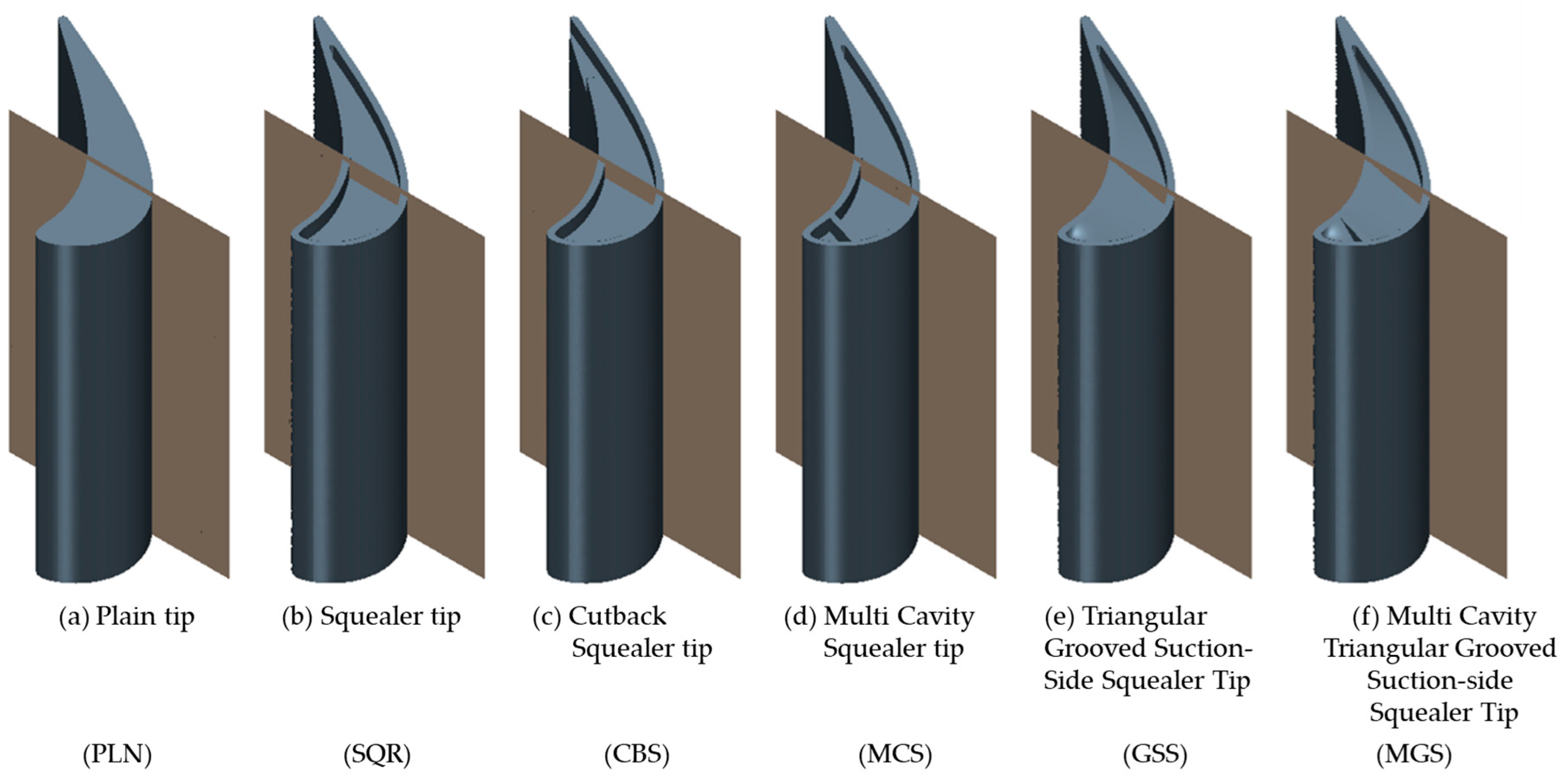
Blade tip configurations for leakage-flow control can be classified into several representative types. The plane tip (PLN) is the simplest baseline geometry, but it allows the leakage flow to pass directly over the tip surface. The conventional squealer tip (SQR) introduces a rim and cavity to restrict the leakage-flow path and alter vortex development. The cutback squealer tip (CBS) locally opens the rim, generally near the downstream region, so that the cavity flow and leakage flow exit through a modified downstream path. Groove-type squealer tips, such as the triangular-grooved suction-side squealer tip (GSS), modify the cavity floor and the flow structure near the suction-side region. The multi-cavity squealer tip (MCS) divides the cavity using ribs and thereby changes the recirculation and reattachment pattern. The multi-cavity triangular-grooved suction-side squealer tip (MGS) can be regarded as a combined configuration incorporating the multi-cavity and groove concepts. These geometries do not eliminate the tip leakage flow itself, but they can modify the leakage-flow trajectory, reattachment location, and heat transfer distribution on the tip surface.

1.1. Blade Tip Geometry Categories and Related Aerothermal Studies

Earlier studies on turbine blade tips established the basic loss and heat transfer mechanisms associated with tip leakage flow. Bindon [1] showed that tip clearance loss varied with tip gap size and decomposed the total tip clearance loss into internal gap loss, suction side edge loss, and endwall-induced secondary loss. Subsequent cascade studies reported that the separation bubble and tip leakage vortex were affected by incidence angle, tip gap, and tip edge radius [2,3,4]. These studies showed that the blade tip region is not only a leakage path but also a region where local heat transfer variation is produced by separation, pressure recovery, and reattachment.
Squealer tip geometries have been widely examined because they can modify the leakage flow structure inside and above the tip cavity. Recessed and squealer tips were reported to reduce tip leakage flow and heat transfer coefficients compared with the plane tip, although locally high heat transfer can still occur near the rim and reattachment regions [5,6]. The effects of rim location, rim height, and tip clearance were also investigated, showing that the thermal performance of a squealer rim depends on both geometric parameters and the local flow field [7]. Comparative studies of several tip geometries further indicated that aerodynamic loss and heat transfer do not always follow the same trend. For example, SQR showed a reduction in total pressure loss, whereas GSS showed a lower laterally averaged heat transfer coefficient and normalized thermal loading than SQR [8,9]. These findings suggest that blade tip geometries should be evaluated by considering both aerodynamic and thermal characteristics.
Because geometric modification alone may not sufficiently control all regions with high heat transfer coefficients, film cooling has also been applied to the blade tip region. Previous studies examined pressure-side injection, tip-surface injection, simultaneous injection, and camber-line hole arrangements for plane and squealer tips [10,11]. For cutback and modified squealer tips, film cooling effectiveness was reported to vary with blowing ratio, cavity-flow structure, coolant ejection, surface attachment, and the interaction between the coolant and leakage flow [12]. Studies on cooling-hole placement inside the tip cavity also showed that hole locations based on separation, reattachment, and cavity-flow direction can change film cooling effectiveness [13,14,15,16,17]. These studies provide important evidence that cooling-hole arrangement should be considered together with the local tip-flow structure.
Film cooling performance is influenced not only by the blowing ratio but also by the interaction between the injected coolant and the vortex structures formed in the tip region. Cavity recirculation, leakage-flow reattachment, and the tip leakage vortex can modify the mixing between the hot gas and coolant, which in turn affects the local film cooling effectiveness and heat transfer coefficient distribution. In regions with high heat transfer coefficients, the reduction in surface thermal loading may be limited when the coolant trajectory does not overlap the corresponding high-HTC region or when the coolant fails to remain attached to the tip surface. Because the vortex structures associated with these heat transfer variations are also related to downstream total pressure loss, the aerodynamic and thermal characteristics of blade tip geometries are considered together in this study.
Recent studies have continued to address these aerothermal issues through tip injection, multi-cavity configurations, ribbed squealer tips, and unsteady film cooling analysis [18,19,20,21]. For squealer tips, film hole arrangement, optimization of cooling hole locations, and blowing ratio effects have also been investigated under various cooling schemes and operating conditions [22,23,24,25]. Rim film cooling, cutback or suction-side squealer configurations, and cooling hole blockage have also been considered as factors affecting coolant distribution, local heat transfer, and aerodynamic loss in the blade tip region [24,26,27]. These studies indicate that recent research has increasingly considered tip geometry, leakage flow structure, heat transfer, aerodynamic loss, and film cooling in a connected manner.
Nevertheless, the results of previous studies are not always directly comparable as preliminary design references because many of them focus on a single tip geometry, a specific cooling arrangement, or a particular cooling concept. In the blade tip region, aerodynamic loss, heat transfer coefficient, and film cooling effectiveness are closely related to the flow structure induced by the tip geometry. The leakage flow path, cavity recirculation, reattachment location, and tip leakage vortex can affect the downstream total pressure loss, the local heat transfer coefficient distribution, and the film cooling effectiveness distribution. Therefore, these performance indicators need to be examined in relation to the underlying flow structure rather than treated as independent quantities.
After the preliminary aerodynamic design of a turbine blade, the blade tip region is commonly subjected to additional aerothermal assessment because the tip clearance flow may involve three-dimensional vortex stretching, cavity recirculation, reattachment, and mixing with the main passage flow. These flow characteristics can influence both the downstream total pressure loss and the local heat transfer coefficient distribution on the tip surface. Accordingly, the selection of a squealer tip geometry involves not only aerodynamic loss but also heat transfer characteristics and film cooling applicability. Organizing these relationships under identical operating and cooling conditions provides comparative information for evaluating the relative characteristics of squealer tip geometries and for identifying candidate directions for subsequent cooling design refinement.
In the preliminary stage of blade tip cooling design, cooling holes are commonly arranged along the camber line for geometric simplicity and manufacturability, whereas the injection angle and coolant flow distribution for each hole are not usually optimized in detail at this stage. In this context, the same number of cooling holes, normal injection, and blowing ratios of M = 1 and 2 were adopted as baseline conditions for comparing the relative cooling behavior of different tip geometries. The resulting differences in aerodynamic loss, heat transfer coefficient, and film cooling effectiveness are therefore interpreted as comparative trends rather than as an optimized cooling design. These trends can be used to identify candidate geometries and regions for subsequent refinement of cooling hole placement, injection angle, and coolant allocation.

1.2. Research Gap and Objectives

The objective of the present study is to numerically compare the aerodynamic loss, heat transfer coefficient, and film cooling effectiveness of representative blade tip geometries under controlled operating and cooling conditions. The tip configurations considered in this study are the baseline PLN and SQR, together with the modified squealer tip geometries CBS, MCS, GSS, and MGS. The purpose is not to propose a completely new tip geometry or a universal cooling design method, but to clarify how differences in leakage flow path, cavity recirculation, and reattachment behavior are associated with total pressure loss coefficient, heat transfer coefficient, and film cooling effectiveness under the present conditions.
The study was performed in three steps. First, the intrinsic flow structures, downstream total pressure loss coefficients, and tip heat transfer characteristics of the six tip geometries were compared without film cooling. Second, film cooling was applied using a camber line hole arrangement with normal injection, and the effect of blowing ratio was examined at M = 1 and M = 2. Third, the cooling holes were rearranged based on the local flow structure while maintaining the same blowing ratio and the same number of holes, so that the influence of hole location could be evaluated relative to the baseline camber line arrangement.
The comparisons are intended to clarify whether the geometry associated with lower aerodynamic loss also corresponds to the geometry associated with lower tip heat transfer or higher film cooling effectiveness. The observed differences are discussed in terms of the leakage flow path, cavity recirculation, reattachment location, and coolant trajectory formed by each tip geometry. The resulting data provide a comparative basis for evaluating squealer tip geometries using multiple aerothermal performance indicators during the preliminary blade tip cooling design stage.

2. Materials and Methods

This section presents the computational domain and grid structure used in the present study and describes the numerical method adopted herein. In addition, comparisons with experimental data were performed to examine the reliability of the numerical results for different tip geometries. Since gas turbines operate with high-temperature and high-pressure combustion gases as the working fluid, the numerical assessment of both aerodynamic and heat transfer characteristics is of particular importance. Accordingly, the aerodynamic characteristics were examined based on comparisons of blade surface pressure distributions, whereas the heat transfer characteristics were assessed based on the heat transfer coefficients on the blade tip surface.

2.1. Numerical Geometry and Computational Domain

2.1.1. Tip Geometries

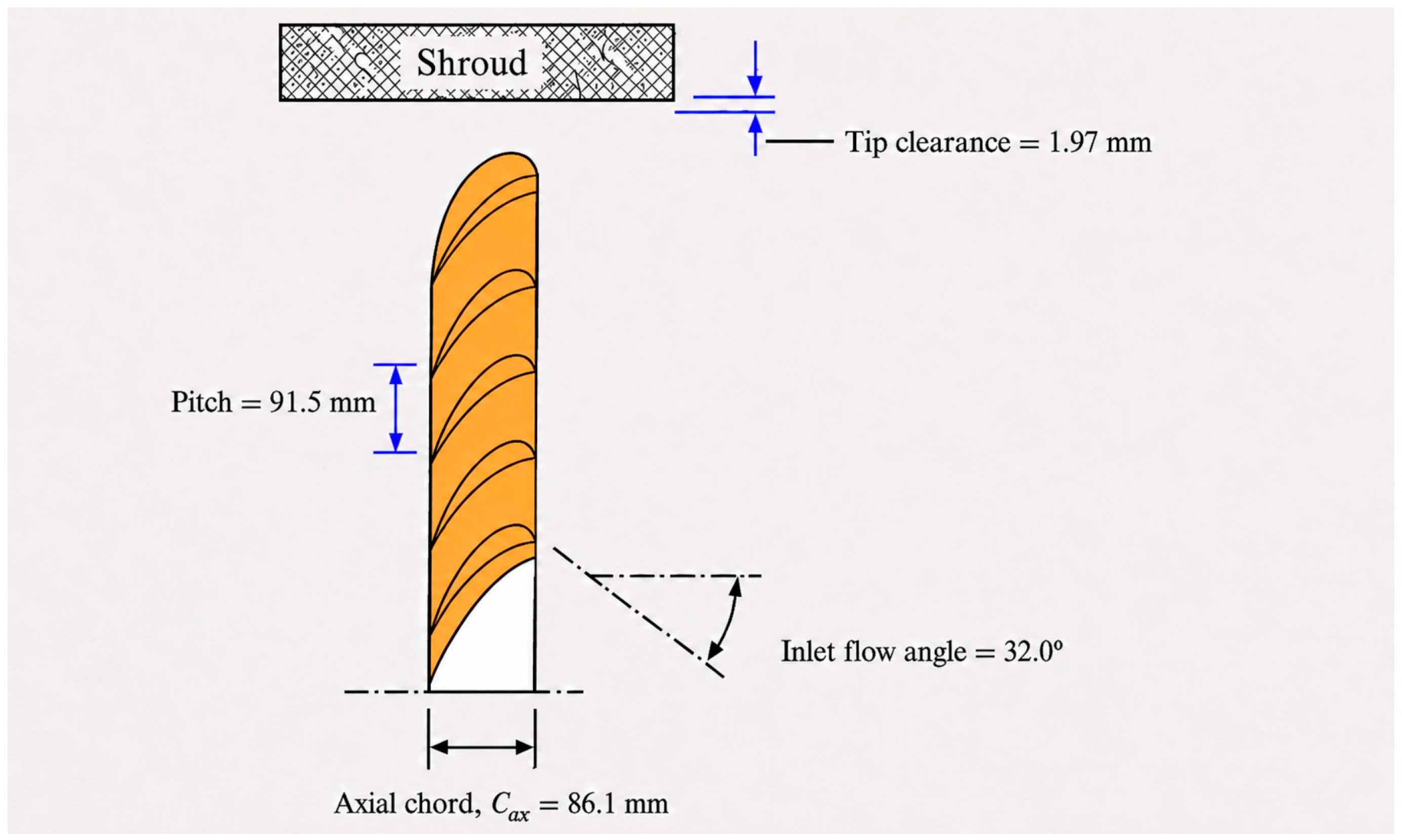
In the present study, the aerodynamic and heat transfer characteristics of a plane tip and five squealer tip configurations were analyzed. The baseline geometry was based on the GE-E3 first-stage rotor blade profile used in previous blade tip heat transfer and film cooling experiments [7,10,11]. Figure 1 defines the blade tip, shroud, tip-clearance region, and rim-thickness parameter used in the computational model. The inlet flow angle and inlet velocity were set to 32° and 85 m/s, respectively, following the reference experimental configuration.
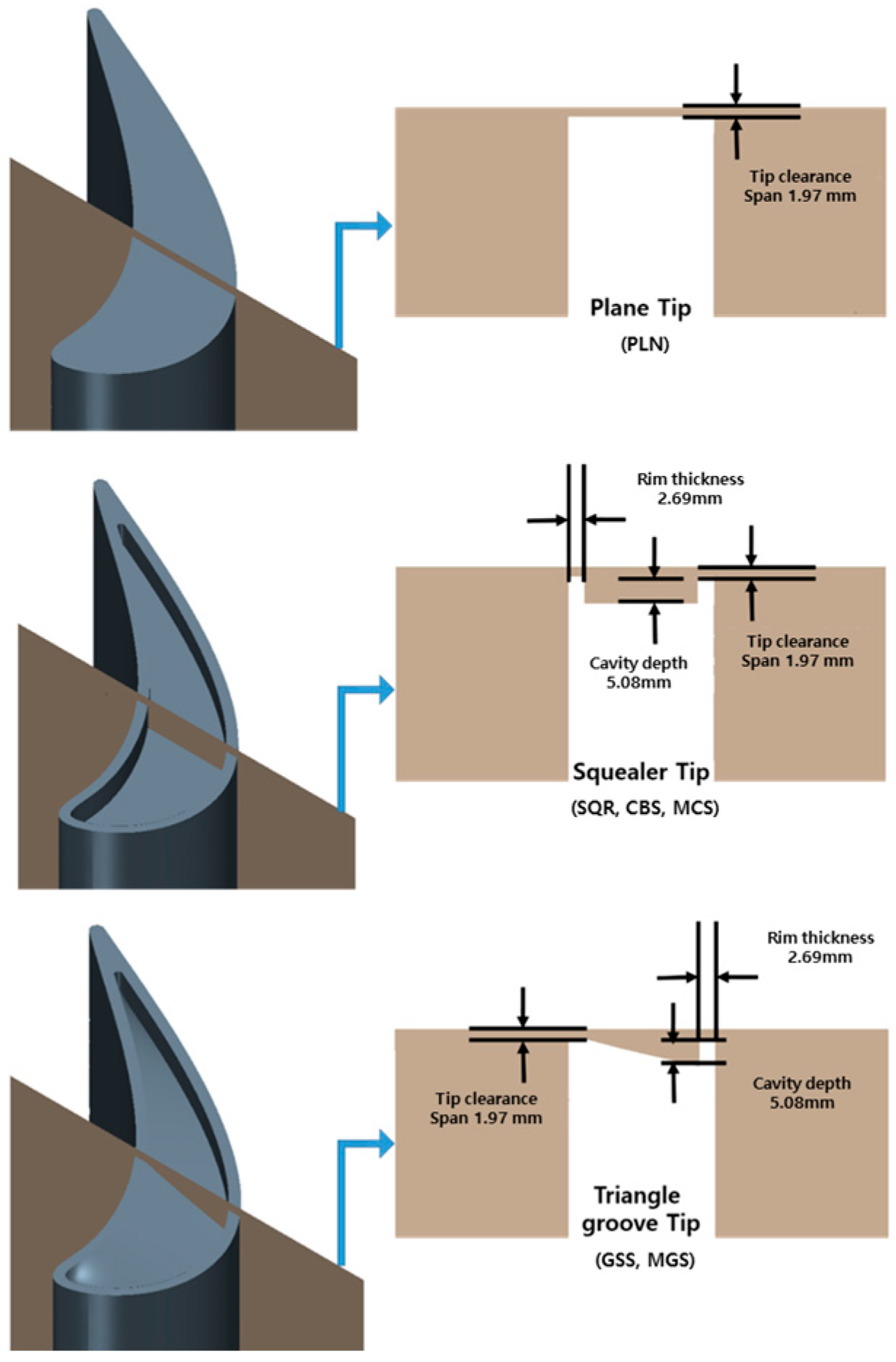
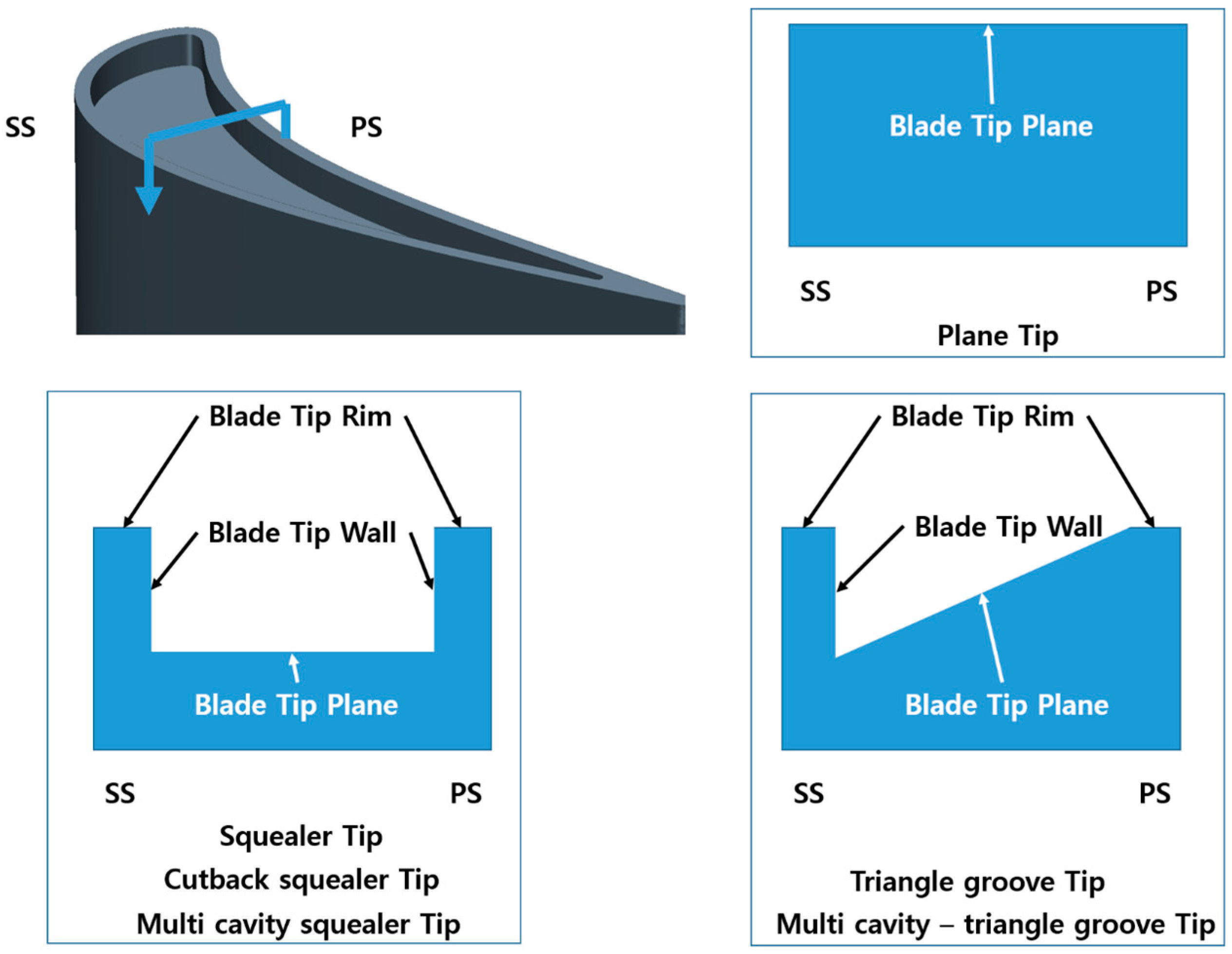
Figure 2 presents the geometric specifications of the tip configurations considered in this study. The tip clearance was fixed at 1.97 mm, corresponding to 1.5% of the blade span. For the squealer tip configurations, the rim thickness and cavity depth were fixed at 2.69 mm and 5.08 mm, respectively. The rib thickness used in the multi-cavity configurations was also set to 2.69 mm so that the effect of cavity division could be isolated from the effect of rib size. These dimensions were selected to remain consistent with the GE-E3 blade tip geometry used in the reference validation studies and related numerical studies based on the same reference blade tip configuration [7,10,28,29,30]. In the triangular-groove tip, the pressure-side rim is absent; therefore, the cavity floor is formed as an inclined surface.
Table 1 summarizes the principal blade and tip dimensions used as the common geometric basis for the present simulations. The axial chord length, pitch, span, tip clearance, cavity depth, rim and rib thicknesses, and cooling-hole diameter were defined consistently with the GE-E3/Kwak–Han blade tip configuration used for validation and comparison. As listed in Table 1, the axial chord length was Cax = 86.1 mm, the pitch was 91.5 mm, the span was 122 mm, the tip clearance was 1.97 mm, the cavity depth was 5.08 mm, the rim and rib thicknesses were 2.69 mm, and the cooling-hole diameter was 1.29 mm. These dimensions were fixed for all tip configurations to isolate the effects of the cutback opening, triangular groove, and multi-cavity rib arrangement.
In recent years, considerable attention has been paid to reducing the tip heat transfer coefficient of plane tips and squealer tips through film cooling. Alternative configurations proposed for conventional squealer tips may generally be classified into two categories: rim-modified tips and cavity-modified tips. In the present study, a cutback squealer tip was selected as a representative partial squealer tip configuration. This configuration has been reported to be associated with film cooling performance near the exit region [14].
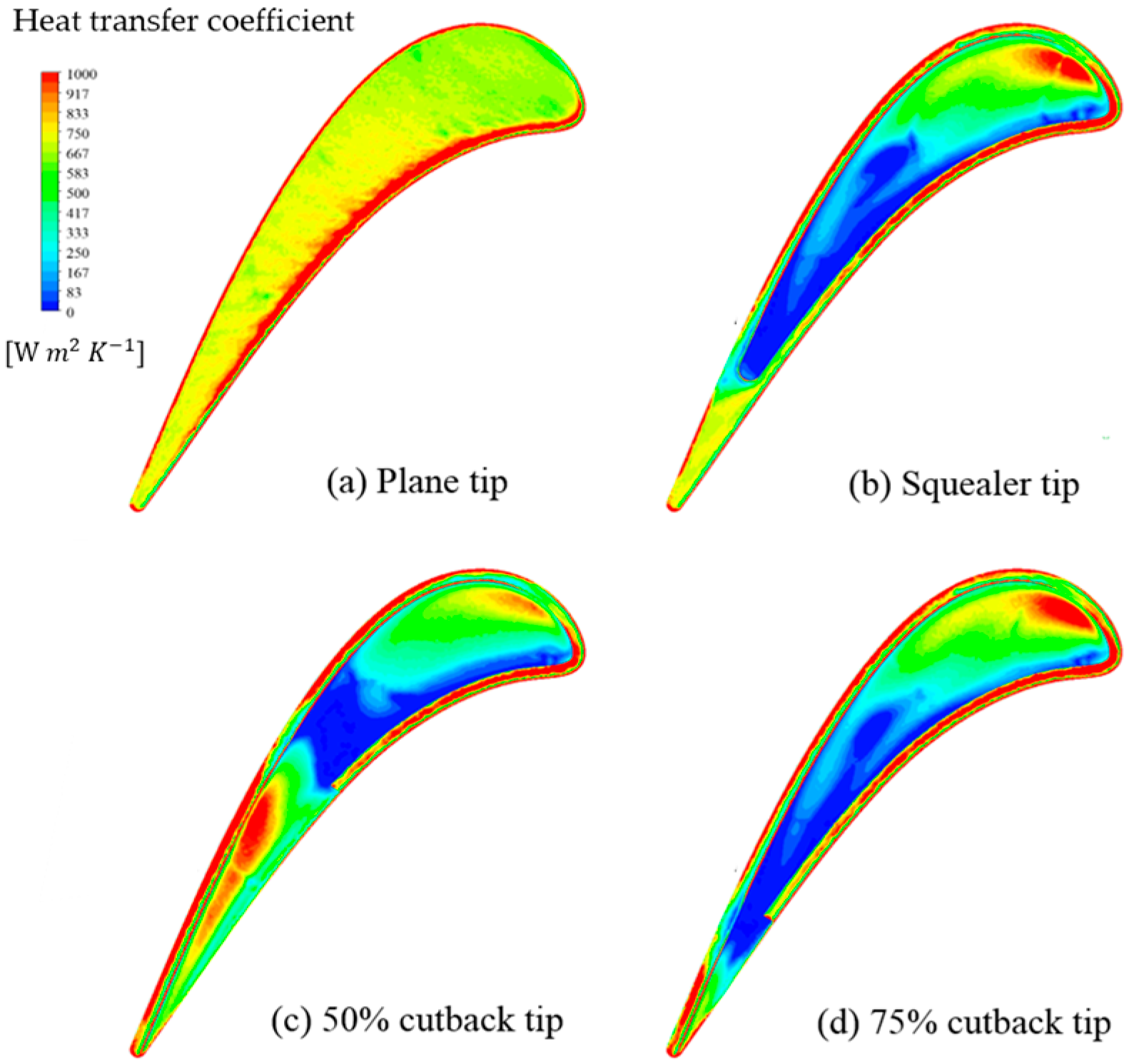
Figure 3 presents numerical results for cutback squealer tips reported by Mhetras and Han [13]. In the previous study, the case with a cutback opening length of 75% of the chord showed favorable performance, whereas the 50% case exhibited a tendency toward an increase in the heat transfer coefficient. On this basis, the cutback squealer tip with a cutback opening length of 75% of the chord was adopted in the present study.
In the present study, the groove squealer tip and the multi-cavity squealer tip were selected from the candidate configurations because of their potential relevance to aerodynamic performance and heat transfer reduction. For the groove tip, the suction-side groove squealer tip (GSS) configuration was adopted. For the multi-cavity tip, the cavity was divided by ribs arranged at 10% chord intervals. In addition, a combined configuration was constructed by incorporating the principal geometric features of the GSS and MCS configurations. The heat transfer characteristics and film cooling performance of these derived tip geometries were then examined under identical operating and cooling conditions.
Figure 4 shows the test blade models and their cross-sections. Model (a) is the plane tip (PLN), which serves as the reference geometry for the validation of the numerical results. Model (b) is a conventional squealer tip (SQR). Model (c) is a cut-back squealer tip (CBS) with an opening in the pressure-side rim near the exit region. Model (d) is a multi-cavity squealer tip (MCS), in which the cavity is divided by ribs arranged at 10% chord intervals. Model (e) is a triangular-grooved suction-side squealer tip (GSS), whose cavity depth becomes greatest near the suction side. Model (f) is a combined configuration incorporating the principal geometric features of the MCS and GSS configurations. The main geometric features and comparison purposes of the tip configurations are summarized in Table 2.

2.1.2. Grid Generation

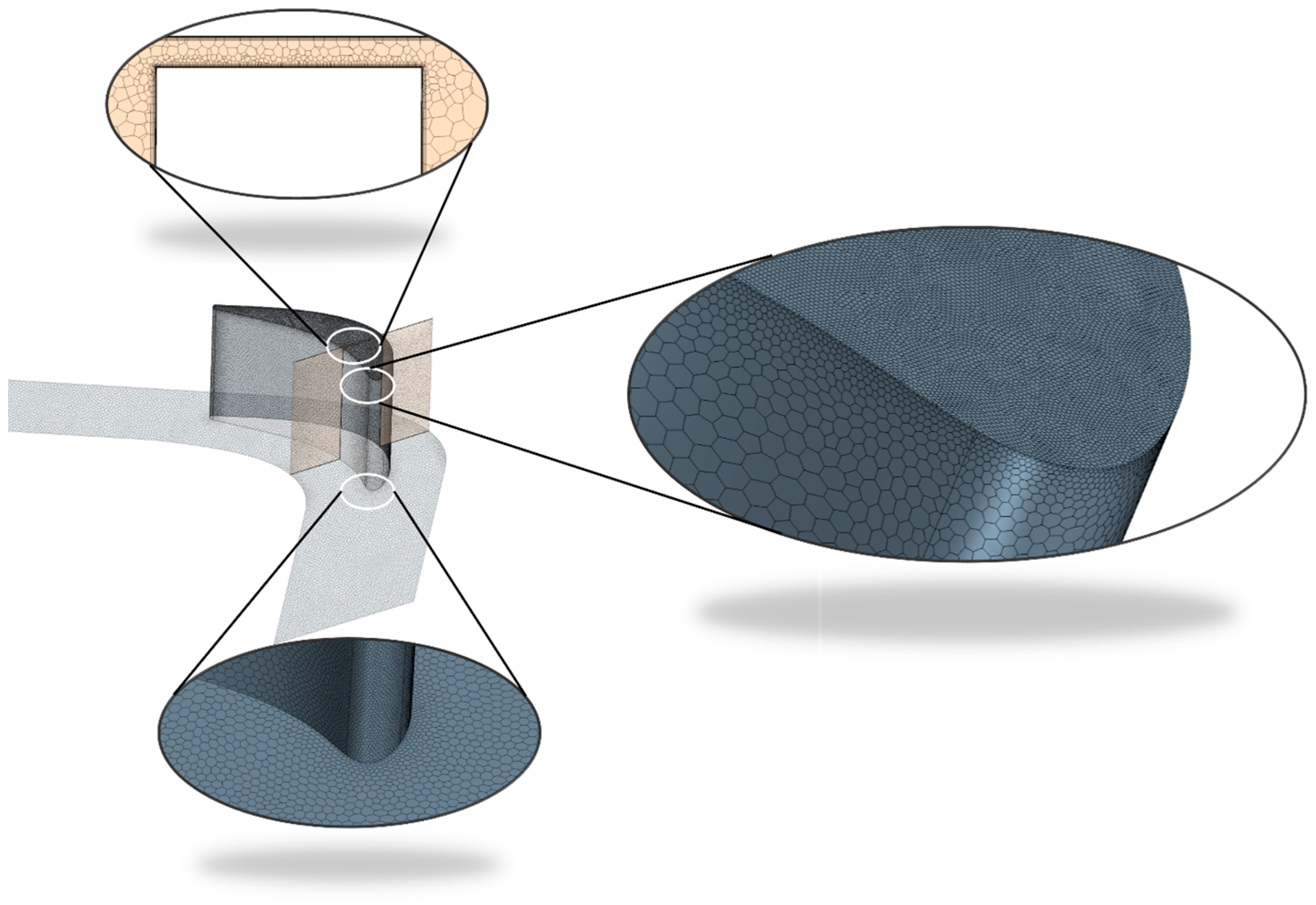
To resolve the tip-clearance flow, cavity flow, and the separation and recirculation regions within the boundary layer in greater detail, a refined mesh was applied in the tip region, as shown in Figure 5. In the present study, a polyhedral mesh was used to take advantage of the characteristics of both tetrahedral and hexahedral meshes. Tetrahedral meshes are advantageous for mesh generation in complex geometries, although they may have limitations in terms of solution accuracy and convergence behavior. By contrast, hexahedral meshes are generally known to be advantageous in terms of convergence and solution reliability, although their application to complex geometries is often restricted.
The polyhedral mesh was generated from a tetrahedral base mesh, and the conversion of multiple tetrahedral cells into a single polyhedral cell may improve both convergence characteristics and computational efficiency. In addition, 25 prism layers were generated near the wall in order to represent the boundary-layer flow more accurately. This mesh arrangement was considered appropriate for resolving the location and extent of the separation and recirculation regions.

2.1.3. Film Cooling Conditions and Hole Arrangement

In the present study, film cooling was applied as a means of alleviating the non-uniform heat transfer coefficient distribution induced by the tip flow field. Film cooling is widely recognized as a representative cooling technique in which the blade surface is protected by coolant injection. The effects of the blowing ratio and cooling-hole arrangement on cooling performance were numerically investigated. For this purpose, the blade geometry and experimental conditions used by Ahn et al. [7] were applied without modification.
The evaluation parameters used to quantify the effects of the blowing ratio and cooling-hole arrangement are defined in Section 2.3.
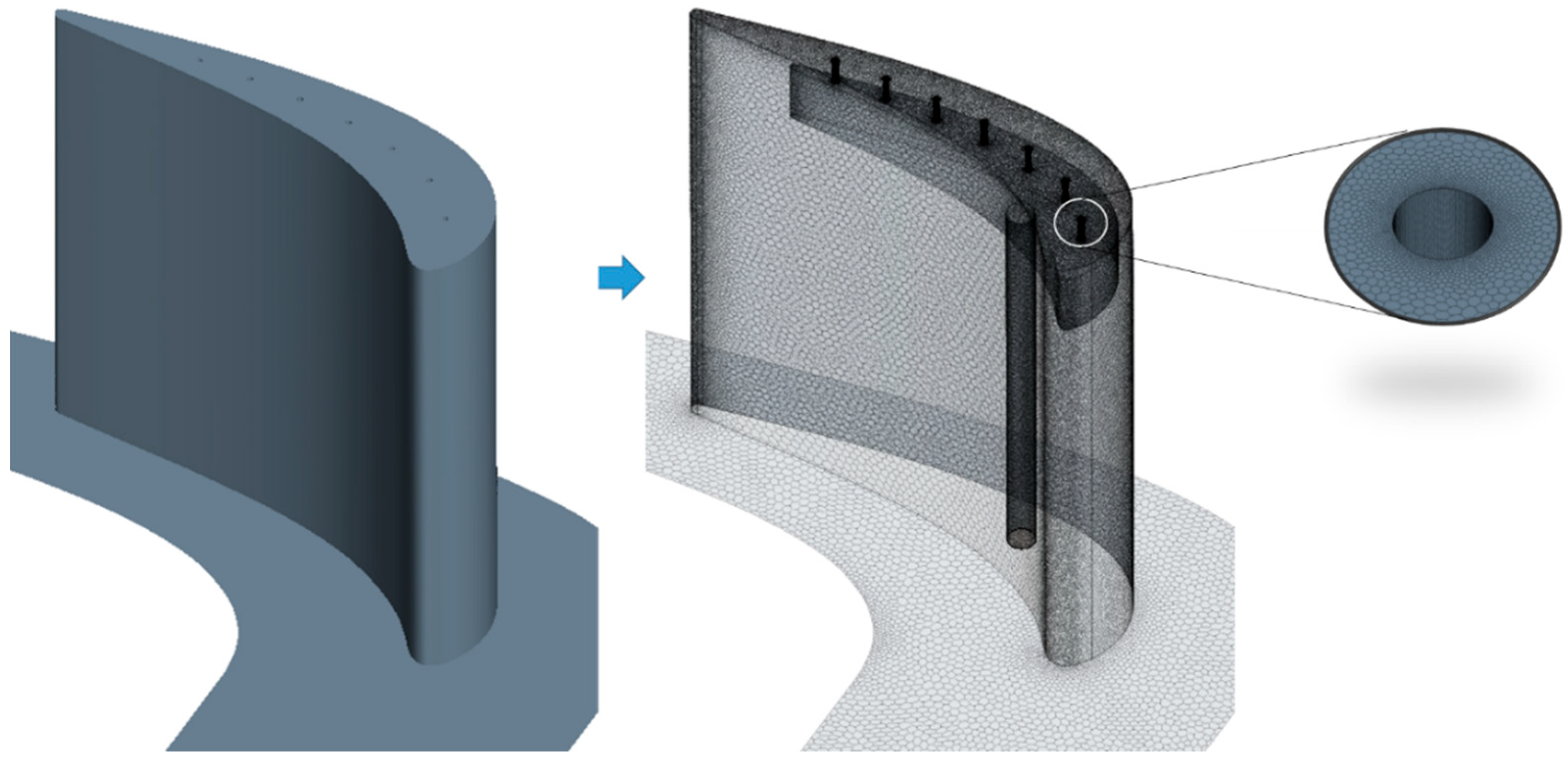
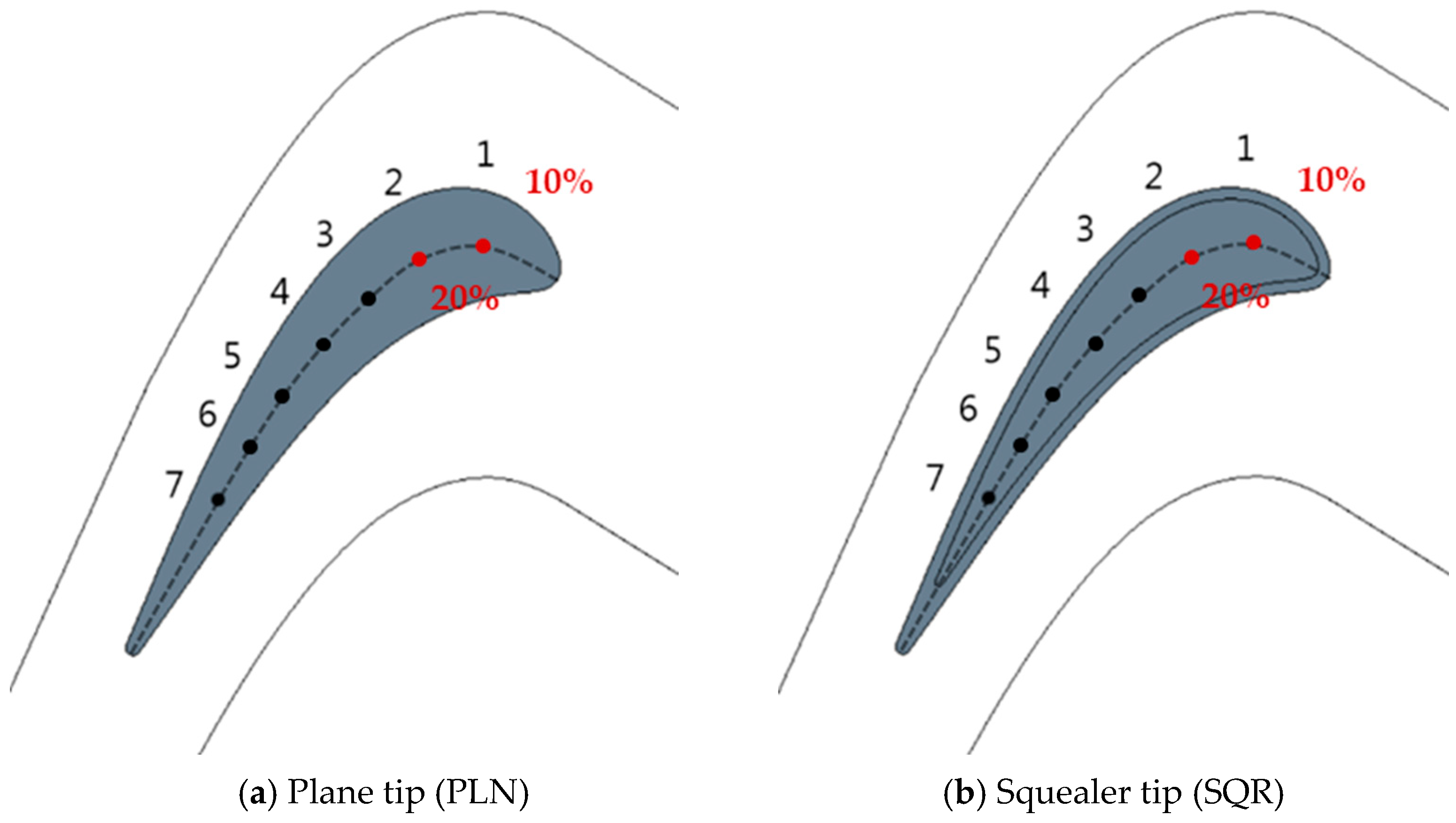
The internal coolant passage supplying the tip film cooling holes and the corresponding film cooling hole configuration are shown in Figure 6. The cooling holes were aligned along the camber line. Figure 7 shows the hole arrangement for the plane tip and the squealer tip. The holes were numbered from 1 to 7 in the direction from the leading edge to the trailing edge. This arrangement was considered suitable not only from the standpoint of manufacturability but also for applying a common layout criterion to different tip geometries. The holes were positioned along the camber line at 10% chord intervals. These seven holes, numbered from the leading edge to the trailing edge, are shown in Figure 7 for both tip geometries.

2.2. Numerical Method

Since the present study is based on numerical analysis, a validation procedure is required to assess the reliability of the numerical results. To this end, the numerical results were compared with experimental data obtained under identical boundary conditions, and grid independence was also examined. In addition, the predictive performance of several turbulence models was compared in order to select a model suitable for the prediction of flow and heat transfer characteristics.

2.2.1. Governing Equations, Solver, and Turbulence Model

The numerical simulations were performed using the commercial CFD software STAR CCM+ version 10.4 [31]. The calculations were conducted as steady simulations. The governing equations were the three-dimensional compressible Reynolds-averaged Navier–Stokes equations, including the conservation equations for mass, momentum, and energy. The working fluid was treated as an ideal gas, and the molecular viscosity was calculated using Sutherland’s law. The Reynolds stress was modeled using the Boussinesq approximation, in which the turbulent eddy viscosity is related to the mean strain rate.
Turbulence was modeled using the shear stress transport (SST) k-omega model. This model combines the near-wall treatment of the k-omega formulation with the freestream behavior of the k-epsilon formulation through a blending function. The SST k-omega model was selected because the blade tip clearance and cavity regions include wall-bounded flow, separation, recirculation, and reattachment. In the present calculation, the model was used together with prism layers near the wall to resolve the boundary layer in the tip region.

2.2.2. Discretization and Convergence Criteria

The governing equations were discretized using the finite volume method. For the convective terms, the High-Resolution Scheme in STAR CCM+ was applied. This scheme is based on a first-order upwind difference scheme with numerical advection correction. The same discretization method was applied to all tip geometries so that the calculated differences among the configurations were not affected by changes in numerical settings.
The calculations were continued until all residuals were reduced below 10-4. In addition to the residual criteria, the mass flow imbalance between the inlet and outlet boundaries was maintained below 0.01%. The area-averaged heat transfer coefficient on the tip surface and the mass-averaged total pressure loss coefficient at the downstream plane were also monitored during the iterative process. A solution was regarded as converged when these monitored quantities showed no noticeable variation with additional iterations. Under the present numerical settings, the steady solutions generally reached a stable state after approximately 2500 iterations.

2.3. Data Reduction and Evaluation Parameters

To provide a consistent basis for comparing the tip geometries, the main aerodynamic, heat transfer, and film cooling quantities were evaluated using common definitions for all cases. This section summarizes the pressure ratio, total pressure loss coefficient, heat transfer coefficient, geometry-normalized heat transfer rate, blowing ratio, hydraulic diameter, and film cooling effectiveness used in the present analysis. These definitions were applied consistently in the validation and subsequent result analyses so that the aerodynamic, heat transfer, and film cooling quantities could be compared on the same basis.

2.3.1. Pressure Ratio and Total Pressure Loss Coefficient

The blade surface pressure distribution was evaluated using the pressure ratio, defined as
P r e s s u r e   r a t i o ( P R ) = P t , P s
where P t , is the inlet total pressure and P s is the local static pressure on the blade surface. This parameter was used for aerodynamic validation by comparing the numerical pressure distribution with the experimental data.
The local total pressure loss coefficient was normalized by the inlet dynamic pressure and calculated as
C p t , l o s s = P t , i n P t 0.5 ρ i n U i n 2
where P t is the local total pressure at the downstream measurement plane, ρ i n is the inlet density, and U i n is the inlet velocity. The mass-averaged total pressure loss coefficient was obtained as
C ¯ p t , l o s s = A C p t , l o s s ρ u n d A A ρ u n d A
where A is the area of the downstream plane and u n is the velocity component normal to the plane. This mass-averaged value was used to compare the aerodynamic loss among the tip geometries.

2.3.2. Heat Transfer Coefficient and Area Averaging

The local heat transfer coefficient on the blade tip surface was defined as
h = q T m T w
where q is the local wall heat flux, T m is the mainstream temperature, and T w is the wall temperature. The area-averaged heat transfer coefficient over the tip surface was calculated as
h ¯ = 1 A t A t h d A
where A t is the blade tip surface area. This value was used in the grid independence test and in the comparison of the overall area-averaged HTC among the tip geometries.
For the comparison of the overall geometry-dependent heat transfer rate among the tip geometries, the geometry-normalized heat transfer rate, Q g e o , was defined using the plane tip without film cooling as the reference case. This parameter was used only to compare the heat transfer characteristics of different tip geometries under the same thermal boundary condition.
Q g e o = Q i Q P L N
Q i = A t h i T m T w d A
where Q i is the integrated heat transfer rate over the tip surface of geometry i, and Q P L N is the corresponding value for the plane tip. The subscript “geo” indicates that this normalized quantity was used for geometry comparison only.

2.3.3. Blowing Ratio and Film Cooling Effectiveness

The blowing ratio was defined as the ratio of the coolant mass flux to the mainstream mass flux:
M = ρ c u c ρ m u m
In the present study, blowing ratios of M = 1 and M = 2 were examined.
For the case without film cooling, the local heat flux may be expressed as
q 0 = h 0 T m T w
where h 0 is the local heat transfer coefficient without film cooling. When film cooling is applied, the local heat flux can be expressed as
q = h T f T w
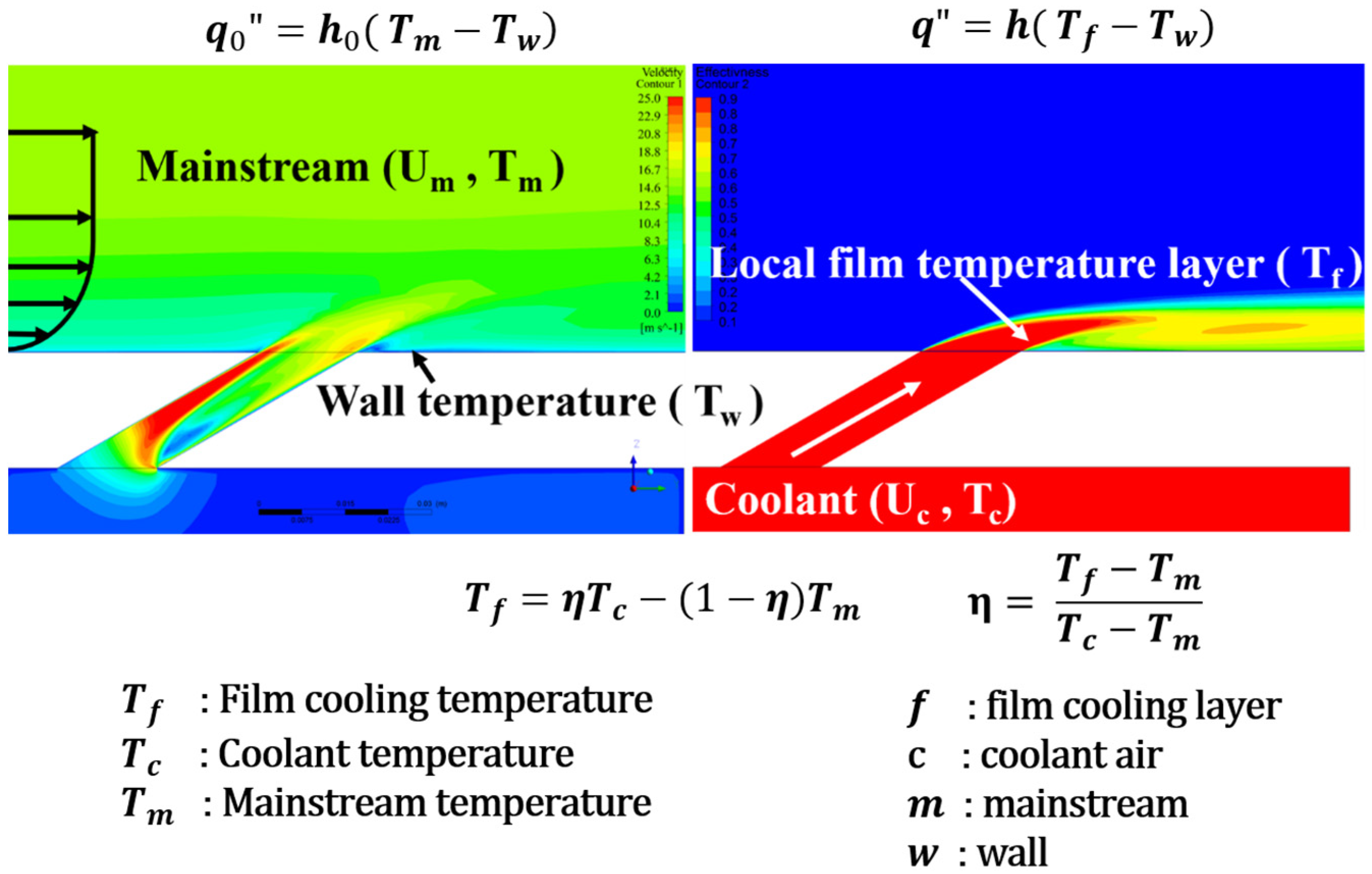
where h is the heat transfer coefficient with film cooling and T f is the local film temperature. The local film temperature depends on the mixing of the mainstream gas and coolant. The film cooling effectiveness is defined as
η = T m T f T m T c
where T c is the coolant temperature. The area-averaged film cooling effectiveness was calculated as
η ¯ = 1 A t A t η d A
The local and area-averaged values of eta were used to evaluate the effects of blowing ratio and cooling hole arrangement on the cooling performance of each tip geometry.

2.4. Numerical Validation

Since the present study is based on numerical analysis, a validation procedure is required to assess the reliability of the numerical results. The pressure ratio, heat transfer coefficient, area-averaged heat transfer coefficient, and film cooling effectiveness used for validation were evaluated using the definitions provided in Section 2.3. This section describes the boundary conditions, turbulence model assessment, grid-independence evaluation, and comparison with the available experimental data.

2.4.1. Boundary Conditions

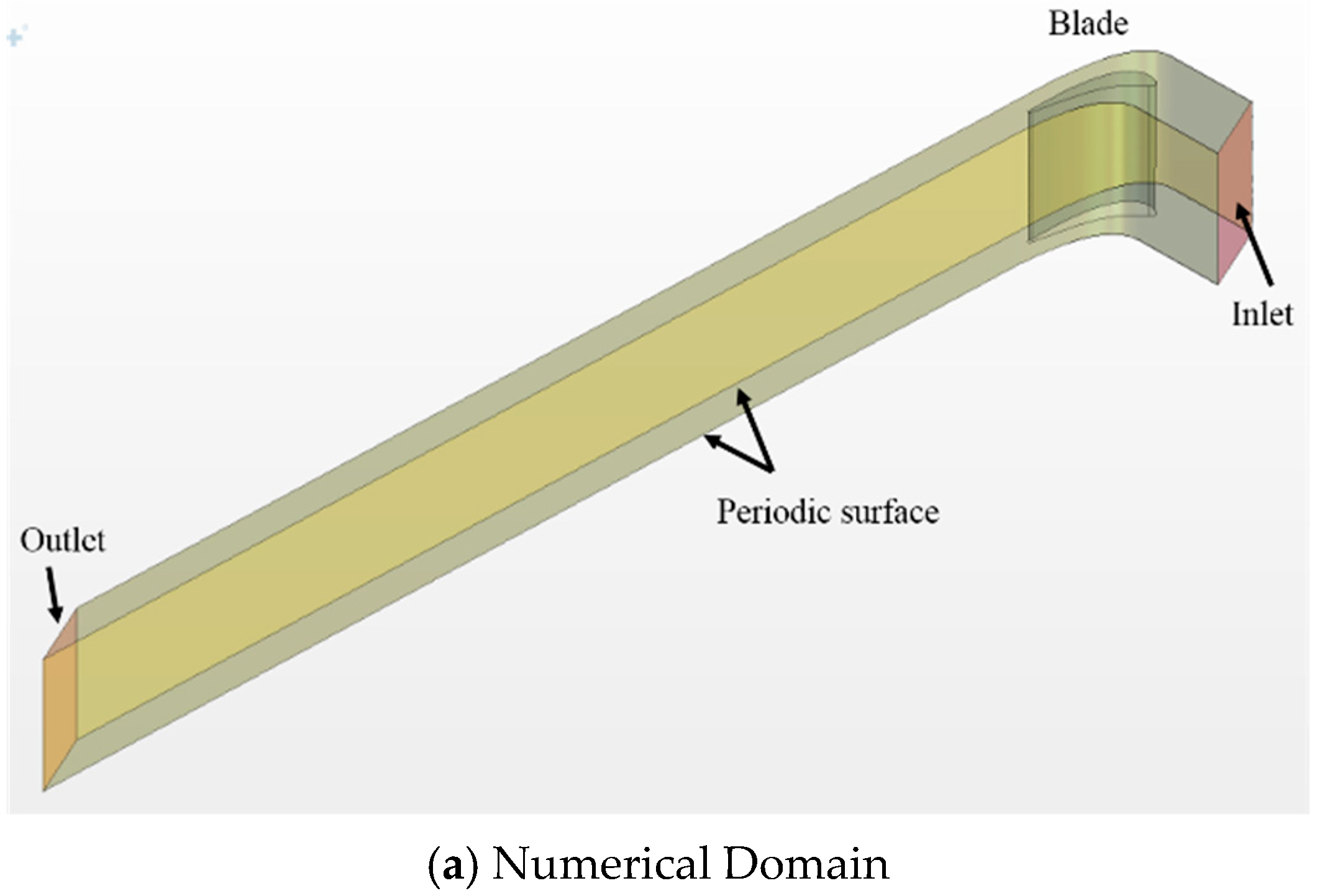
Figure 8 shows the computational domain used in the present analysis. In turbine-cascade experiments, a configuration including at least five blade passages is generally recommended in order to ensure inlet-flow uniformity and periodicity between adjacent blades. In numerical analysis, however, the use of a single passage with periodic boundary conditions may be more reasonable in terms of computational efficiency, provided that the periodicity of the experimental data has been sufficiently established. Accordingly, the present study was carried out for a single-passage domain with periodicity in the pitchwise direction. The blade pitch was 91.5 mm, and the outlet boundary was extended downstream of the blade trailing edge to reduce the influence of the outlet condition on the tip-leakage flow field.
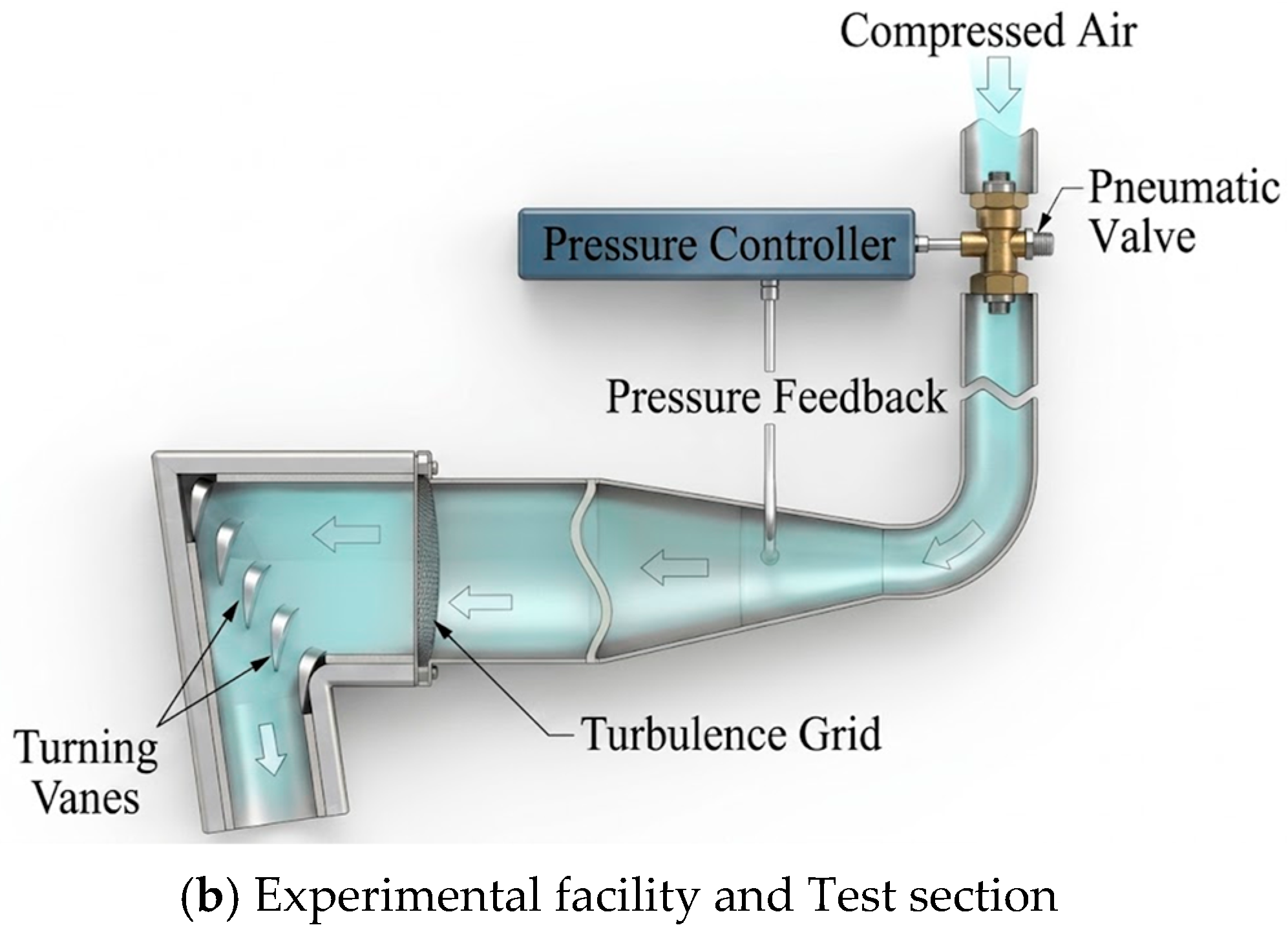
The coolant was supplied from the internal passage and ejected normally through the tip cooling holes. In the revised computational domain description, the coolant inlet location, coolant supply direction, and normal injection direction through the tip holes are explicitly indicated, together with the principal cascade dimensions. The outlet extension was defined using the axial chord length as the reference scale; related Kwak-Han-based numerical studies used an outlet section located approximately 2.5 C a x to 3 C a x downstream of the blade trailing edge for stable downstream loss evaluation [28,29,30].
Table 3 summarizes the boundary conditions used in the experiments of Kwak et al. [7]. In the present study, inlet velocity and outlet atmospheric pressure conditions were imposed as the boundary conditions. The inlet velocity condition allows the inlet flow angle and mass flow rate to be represented more directly and is considered advantageous for applying the blowing ratio condition in the subsequent film cooling analysis. In addition, the outlet passage length in the computational domain was extended beyond that of the experimental facility in order to reduce the influence of variations in outlet flow angle and outlet velocity. The outlet plane was therefore treated as a downstream evaluation location for the total pressure loss coefficient rather than as a location where local tip-flow structures were interpreted directly.

2.4.2. Selection of the Turbulence Model

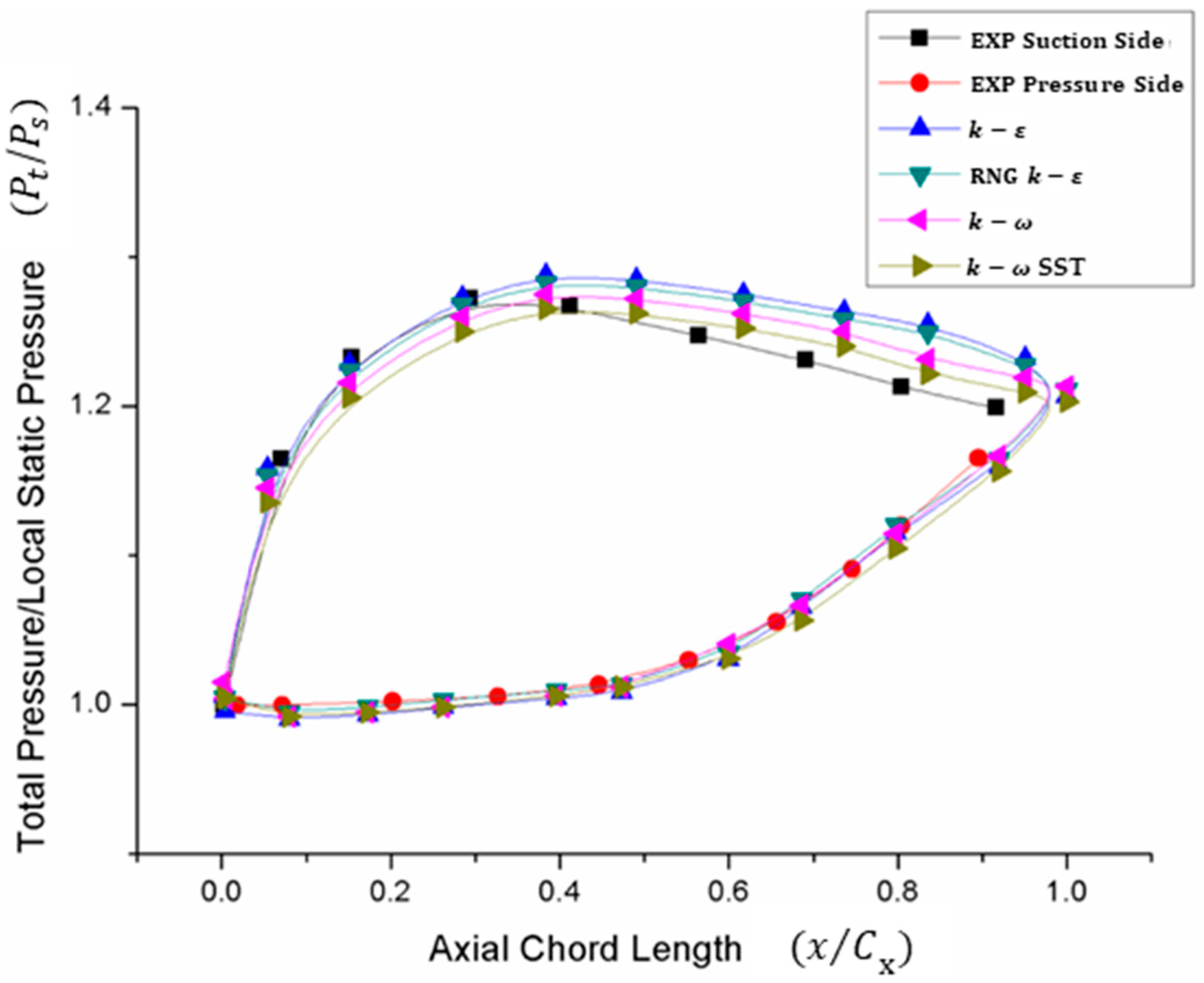
Figure 9 compares the pressure ratio distributions used for aerodynamic validation and turbulence model selection. The pressure ratio follows the definition given in Section 2.3.1 and is denoted as P t / P s in Figure 9, where P s represents the inlet total pressure and P s represents the local blade surface static pressure. The numerical distributions at 50% span were compared with the experimental results reported by Kwak et al. [7,8,14]. Near the leading edge, namely around x / C x = 0, the local static pressure approaches the inlet total pressure in the stagnation region; therefore, the pressure ratio approaches unity. The stagnation point location was broadly similar between the experiment and the numerical results.
On the pressure side, the differences among the turbulence models were not pronounced near the leading edge, although some discrepancies appeared toward the exit region. In this region, the k-epsilon model showed favorable agreement. However, the predictive accuracy on the suction side was considered more important in the present study. On the suction side, a high-speed flow region develops around x / C x = 0.4–0.5 owing to the blade pitch spacing, and the predictive capability in this region may significantly affect the reliability of the overall aerodynamic analysis. From this comparison, the k-omega and k-omega SST models were found to yield pressure-ratio distributions closer to the experimental data.
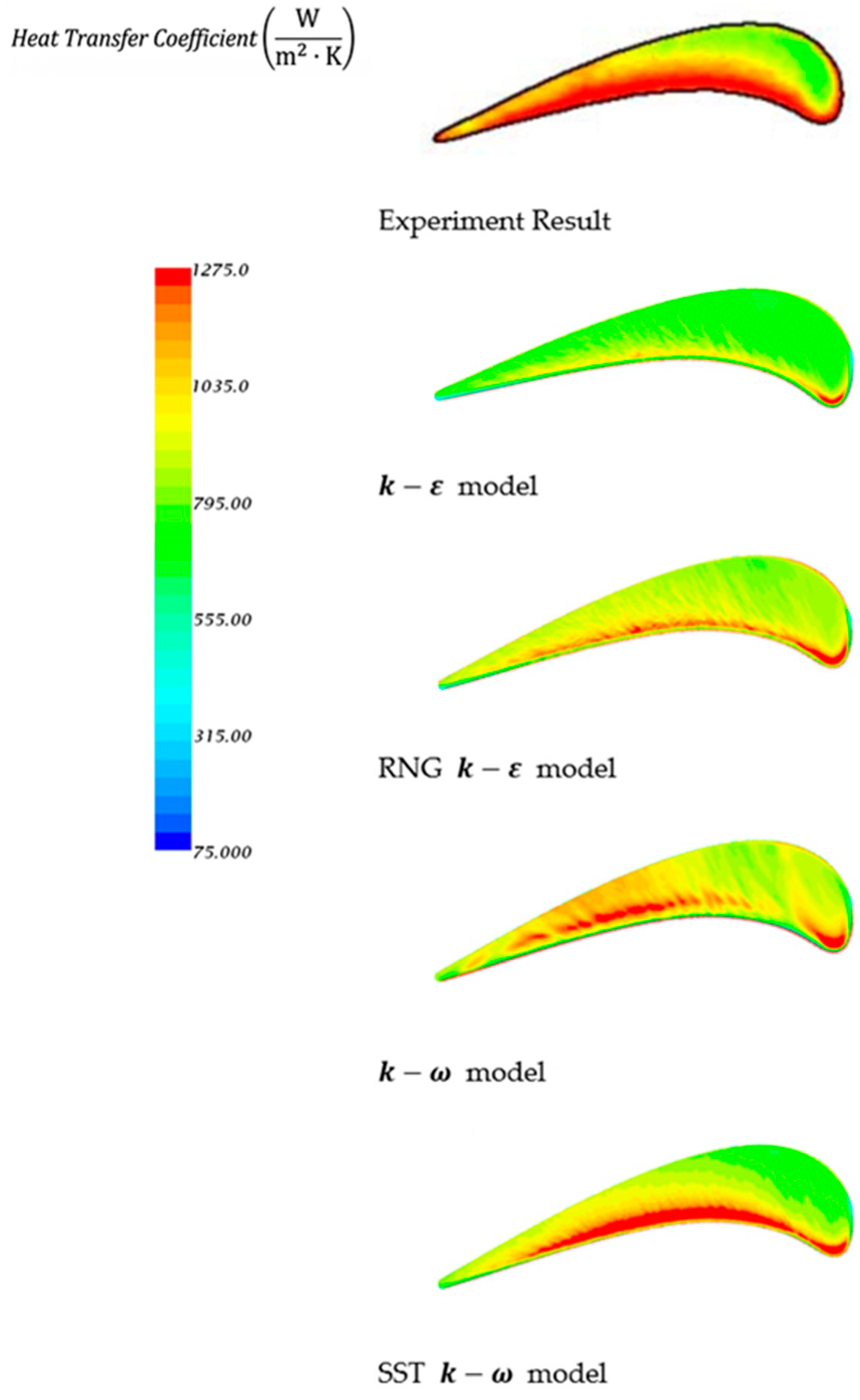
The applicability of the turbulence models was further examined through comparisons of the heat transfer characteristics. Figure 10 shows the heat transfer coefficient distributions on the plane tip surface predicted by different turbulence models. The selection criterion was the predictive accuracy in the region where the heat transfer coefficient becomes large. The plane tip exhibits recirculation and reattachment regions near the pressure-side edge, which leads to an increase in the local heat transfer coefficient. The k-epsilon and RNG k-epsilon models showed limited predictive capability for the recirculation and reattachment regions and tended to underestimate the heat transfer coefficient over the tip surface. By contrast, the k-omega model tended to overpredict the heat transfer coefficient near the leading-edge region, and its reproduction of the reattachment region near the pressure side was not sufficiently satisfactory.
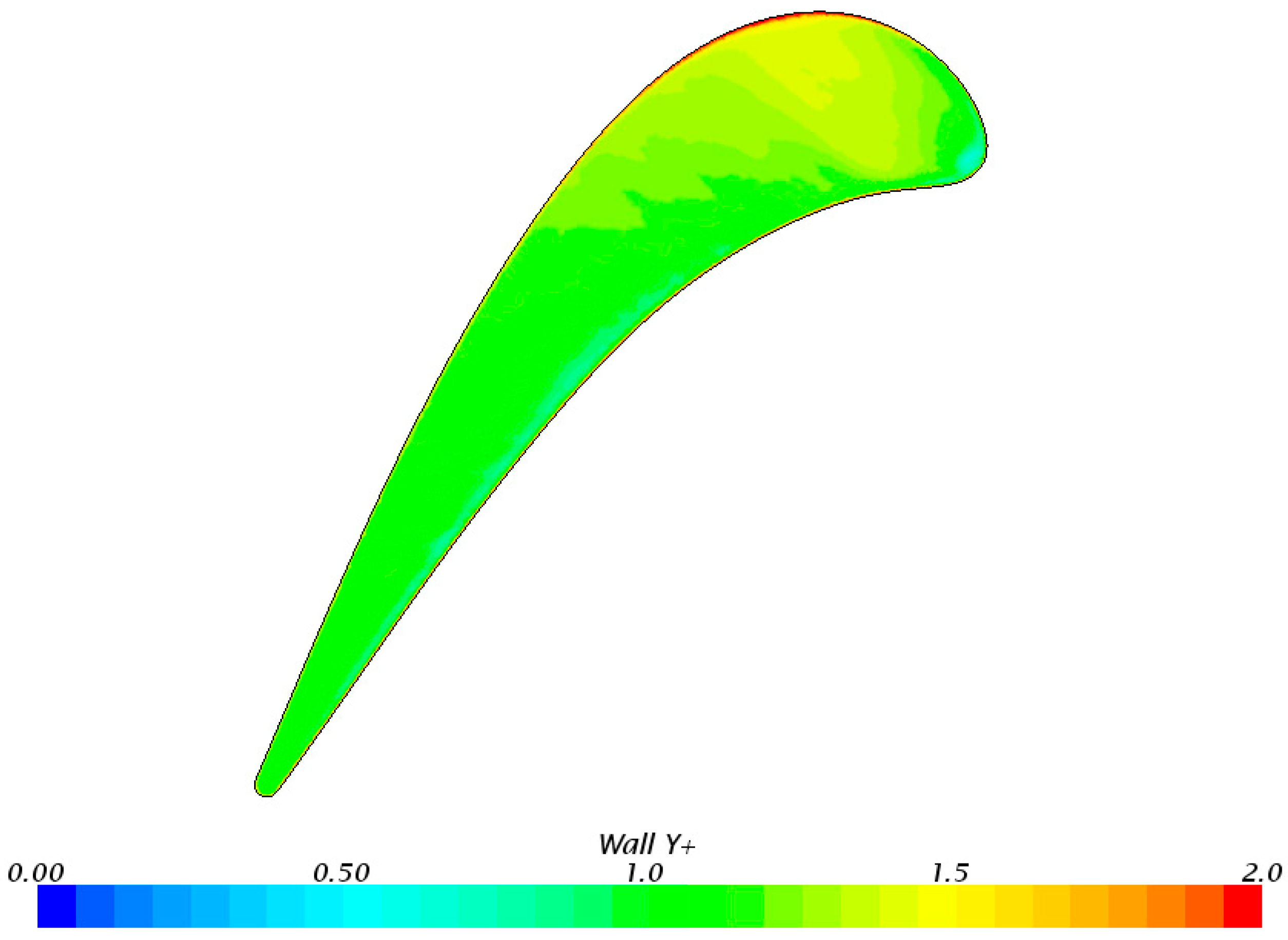
The near-wall grid resolution was also examined during the turbulence model selection process because the prediction of separation and reattachment in the tip clearance and cavity regions is sensitive to wall treatment. The first wall distance of the prism layer was determined based on the target y+ level. The wall distance was set to 0.004 mm or less so that the average y+ value remained below 2. In the tip clearance region, where the Mach number was approximately 0.5–0.75, the wall distance was further restricted to 0.0001 mm or less to maintain sufficient near-wall resolution.
y + = τ w / ρ n ν
Figure 11 shows the near-wall grid resolution on the tip surface expressed by y+. The values were distributed mostly within the range of 0–2. The SST k-omega model is generally used for separated and reattaching wall-bounded flows when the near-wall region is sufficiently resolved. Since the highest velocity region in the cascade occurs near the blade tip, satisfying the y+ < 2 condition on the tip surface supports the adequacy of the near-wall mesh resolution for the present tip flow calculation. On this basis, the SST k-omega model was selected as the final turbulence model in the present study.

2.4.3. Grid-Independence Test

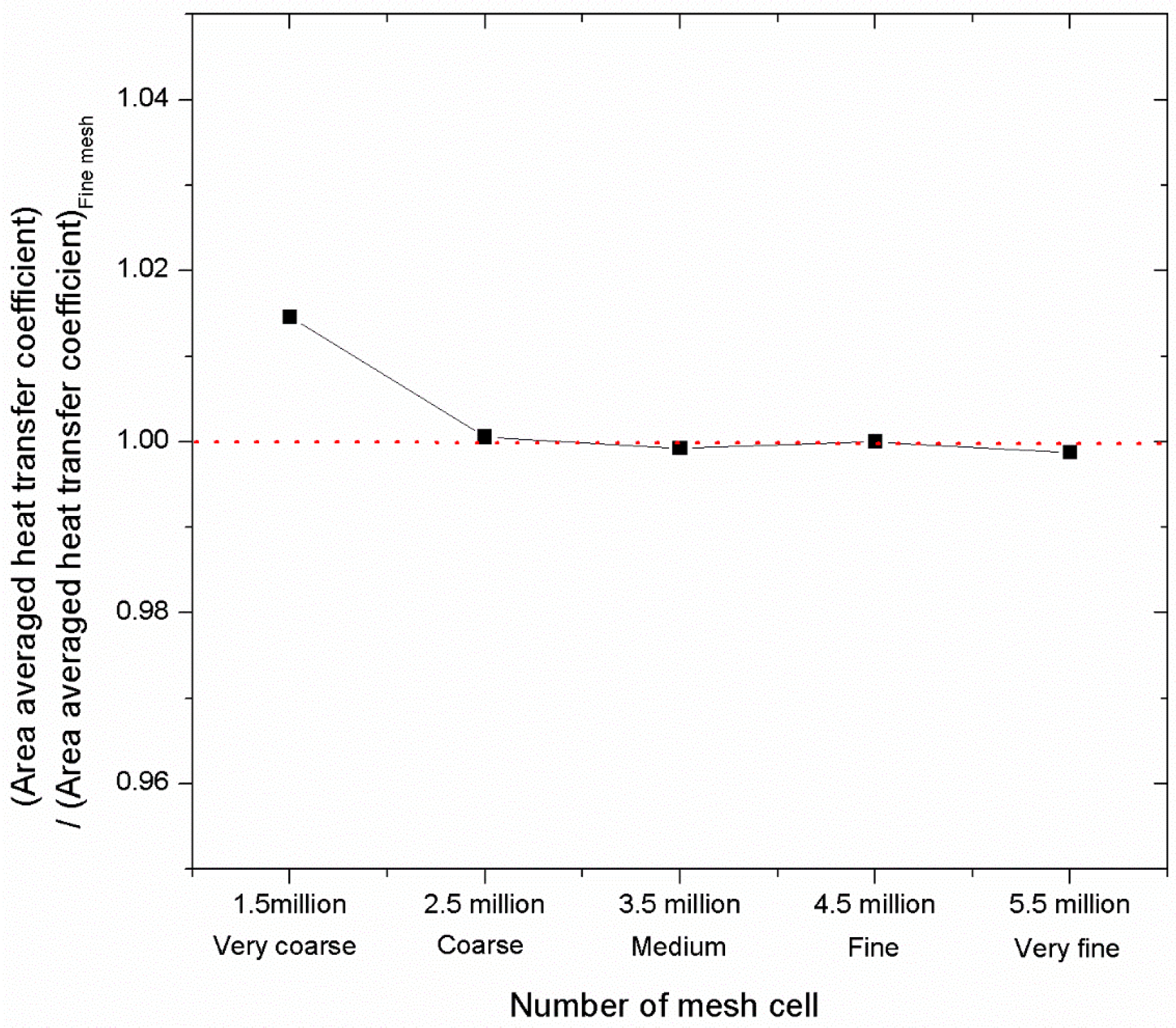
Figure 12 shows the results of the grid independence test for the plane tip. After the turbulence model validation, the effects of grid point location and near-wall grid density on the aerodynamic and heat transfer results were examined. The grid independence test was conducted using the area-averaged heat transfer coefficient, defined in Section 2.3.2, as the monitored quantity. The influence of mesh density was evaluated by comparing this value for different grid systems.
In Figure 12, the red dashed line indicates the grid-independence guideline based on the fine-mesh result. The mesh was generated to reflect the flow characteristics corresponding to a Reynolds number based on chord length of approximately 90,000–100,000. The location of the first grid point was fixed at 0.004 mm, and the boundary-layer thickness was also maintained at 0.5% of the span. Under these conditions, the area-averaged heat transfer coefficient was compared while varying the number of grid cells. As a result, a mesh consisting of approximately 4.5 million cells was judged to provide an acceptable balance between grid independence and computational efficiency, depending on the geometry.

2.4.4. Validation of Film Cooling Experiments and Numerical Results

Figure 13 illustrates film cooling on a surface exposed to hot gas in a gas turbine. The film cooling effectiveness used in the validation was evaluated using the definition provided in Section 2.3.3. The validation focused on whether the numerical results reproduced the main contour trends, coolant ejection behavior, and blowing-ratio effect observed in the experimental data.
Kwak et al. [14] investigated the heat transfer coefficient and film cooling effectiveness of a plane tip and a squealer tip under film cooling conditions. The film cooling holes were arranged along the blade camber line. Tip clearance and blowing ratio were employed as the main parameters to analyze their influence on the heat transfer characteristics. As the blowing ratio increased, the heat transfer coefficient decreased slightly. This behavior was attributed to the enhanced blockage effect of the injected coolant caused by the increase in shroud static pressure. In contrast, the film cooling effectiveness increased with increasing blowing ratio in all cases.
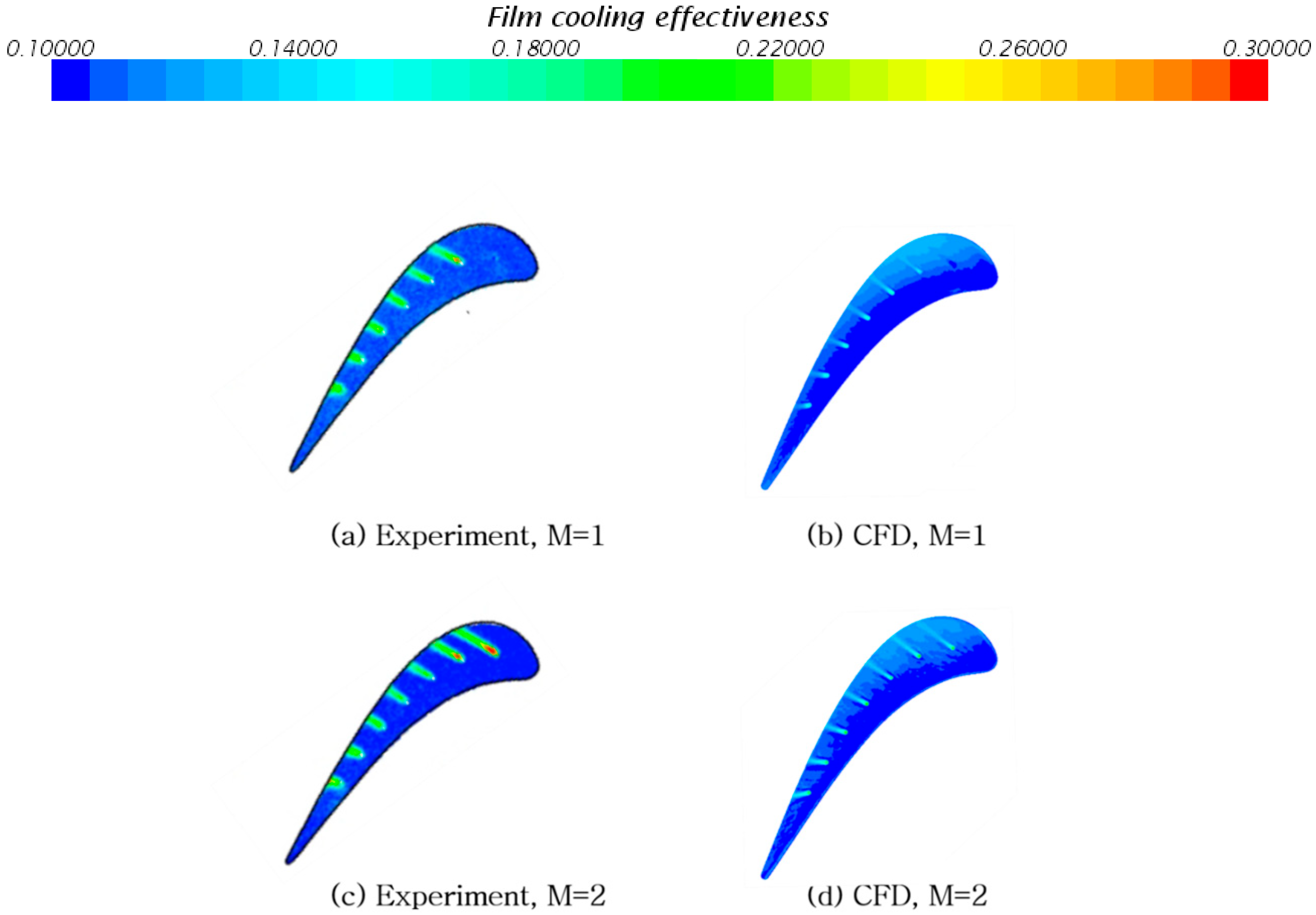
Figure 14 shows the validation results for film cooling effectiveness. The experimental data were taken from the plane tip blade experiments reported by Ahn et al. [10]. Because the reference data were provided as contour maps rather than pointwise numerical values, the comparison was conducted qualitatively by examining the main distribution trends, coolant ejection behavior, and the effect of the blowing ratio.
At a blowing ratio of M = 1, coolant injection from the first cooling hole was scarcely observed, and the film cooling effectiveness near the leading edge remained low. The numerical results reproduced this qualitative behavior. At M = 2, coolant ejection from the first hole became more apparent in both the experimental and numerical distributions, and the region of increased film cooling effectiveness extended farther over the tip surface. Although pointwise percentage deviations were not calculated from the contour images, the numerical results captured the main coolant ejection pattern and the variation of film cooling effectiveness with the blowing ratio.

3. Results and Discussions

3.1. Aerodynamic Characteristics

This section examines the flow structure in the tip clearance and cavity before film cooling is applied. The discussion focuses on the relationship among pressure-driven leakage flow, surface reattachment, tip leakage vortex development, and total pressure loss. The blade tip region is difficult to assess during the preliminary design stage because leakage flow, cavity recirculation, vortex development, and near-wall reattachment are strongly coupled. Therefore, several tip geometries are often considered as candidate configurations before detailed cooling design is performed.
In this context, the vorticity field is important because the tip leakage vortex and its associated turbulent mixing are closely related to total pressure loss. In addition, reattachment, recirculation, and stagnation near the tip surface modify the near-wall velocity gradient and wall-normal thermal transport, thereby affecting the local heat transfer coefficient (HTC). Because the HTC is evaluated on the wall surface, the surface limiting streamlines are used as near-wall flow information that supports the heat transfer interpretation in Section 3.2.

3.1.1. Vorticity and Surface Flow Pattern

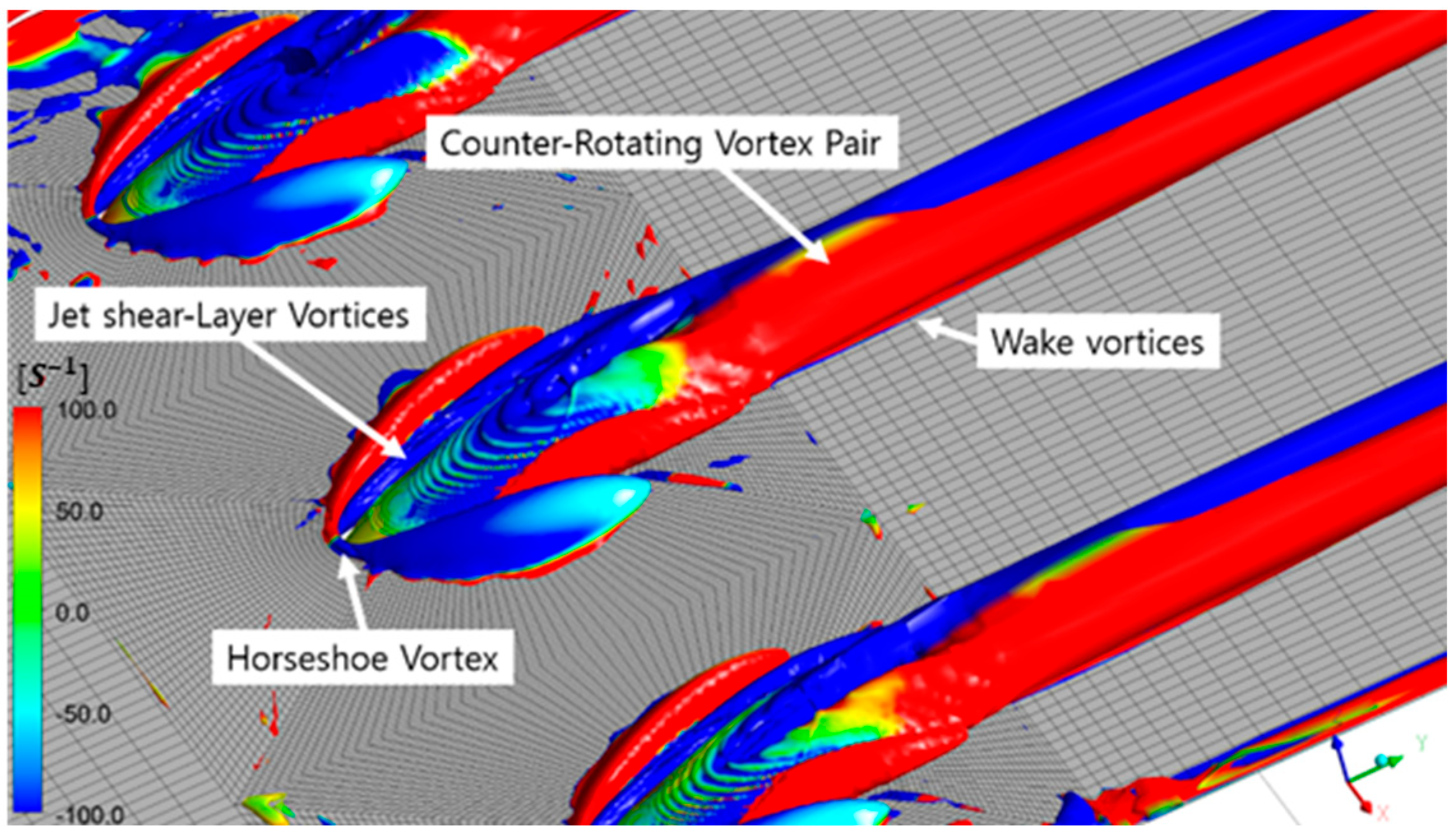
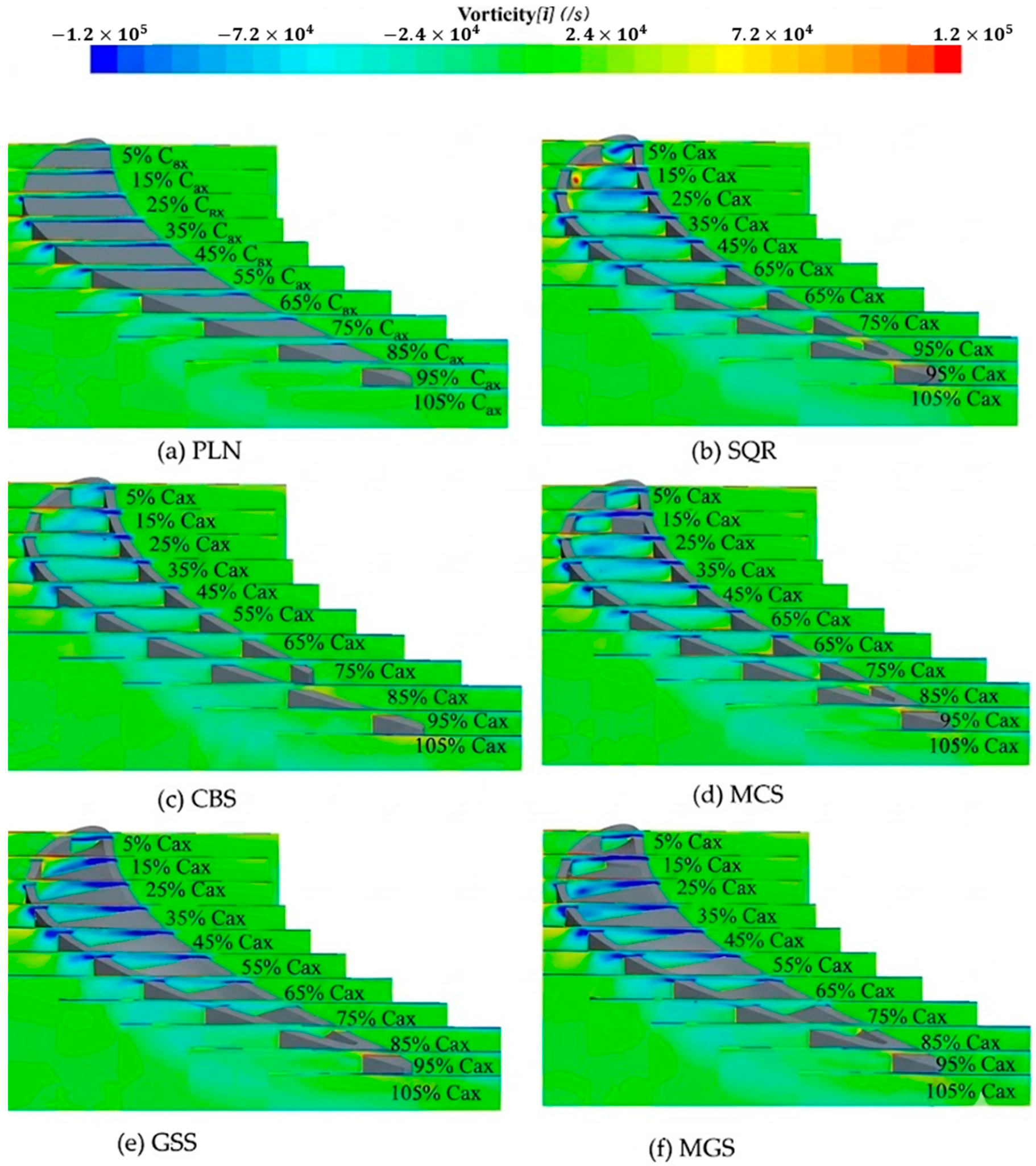
Figure 15 shows the vorticity contours on cross-sectional planes along the blade chord, together with representative surface flow trajectories on the tip surface. The vorticity contours indicate the cross-sectional vortex structure, whereas the surface trajectories are interpreted as limiting streamline information for identifying the surface footprint of leakage flow, recirculation, stagnation, and reattachment.
Overall, the tested tip geometries differ mainly in how they redirect the pressure-side to suction-side leakage flow and modify the development of the tip leakage vortex. In PLN, the leakage flow follows a relatively direct cross-tip path, and the shear layer rolling up near the suction side develops into a tip leakage vortex. In contrast, the squealer-based geometries divide the flow into upper leakage flow and cavity flow. The cutback opening, cavity rib, and suction-side groove further modify the local reattachment and recirculation pattern.
The quantitative comparison of the mass-averaged total pressure loss coefficient at the 105% chord plane is summarized in Table 4. Table 5 summarizes the dominant vortex locations, surface-flow behavior, and loss-related characteristics identified for each tip geometry. The comparison shows how each configuration modifies the leakage-flow path, cavity-flow behavior, and vortex development. These geometry-dependent flow characteristics provide the physical basis for interpreting the HTC distributions discussed in Section 3.2.

3.1.2. Total Pressure Loss Coefficient

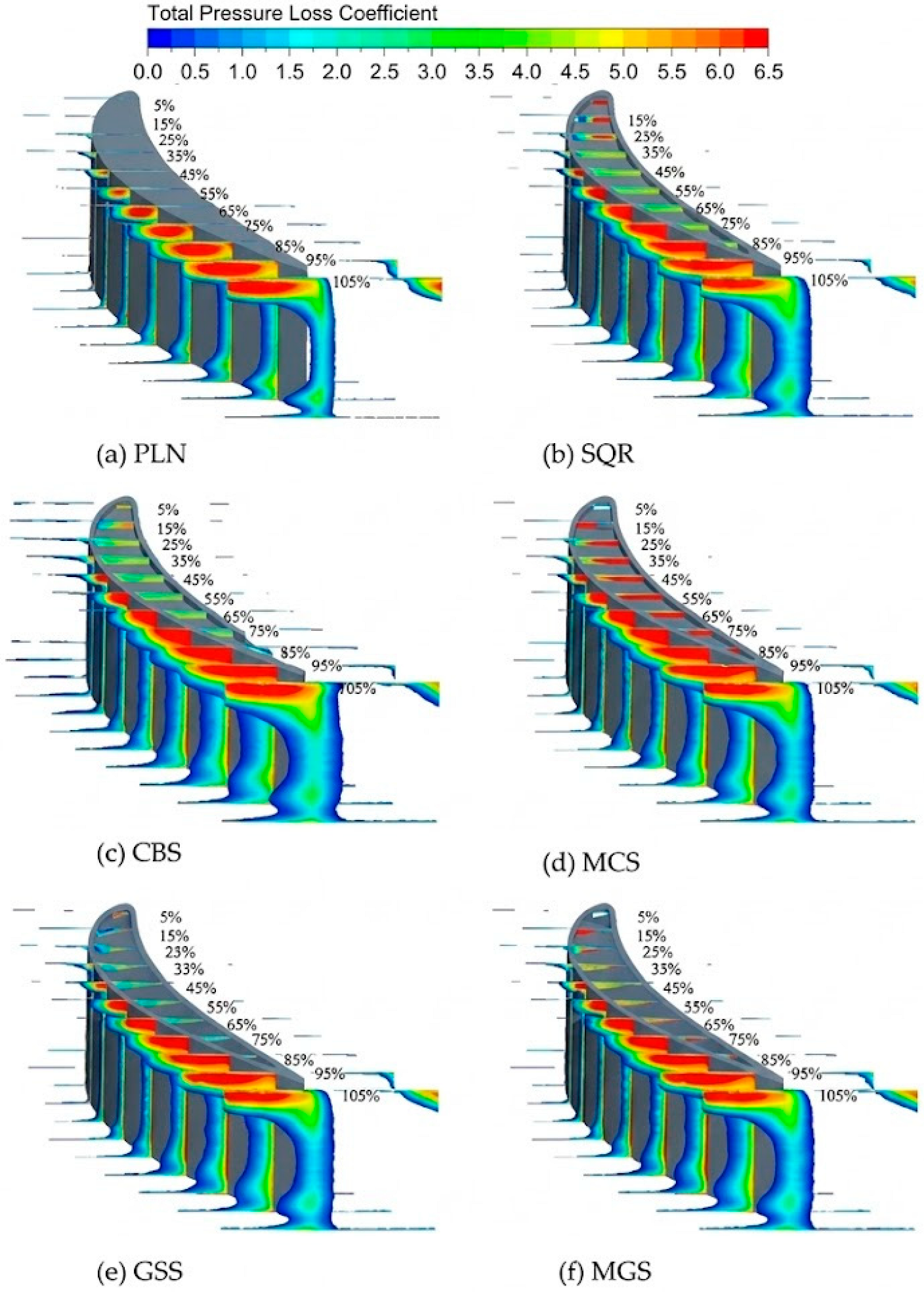
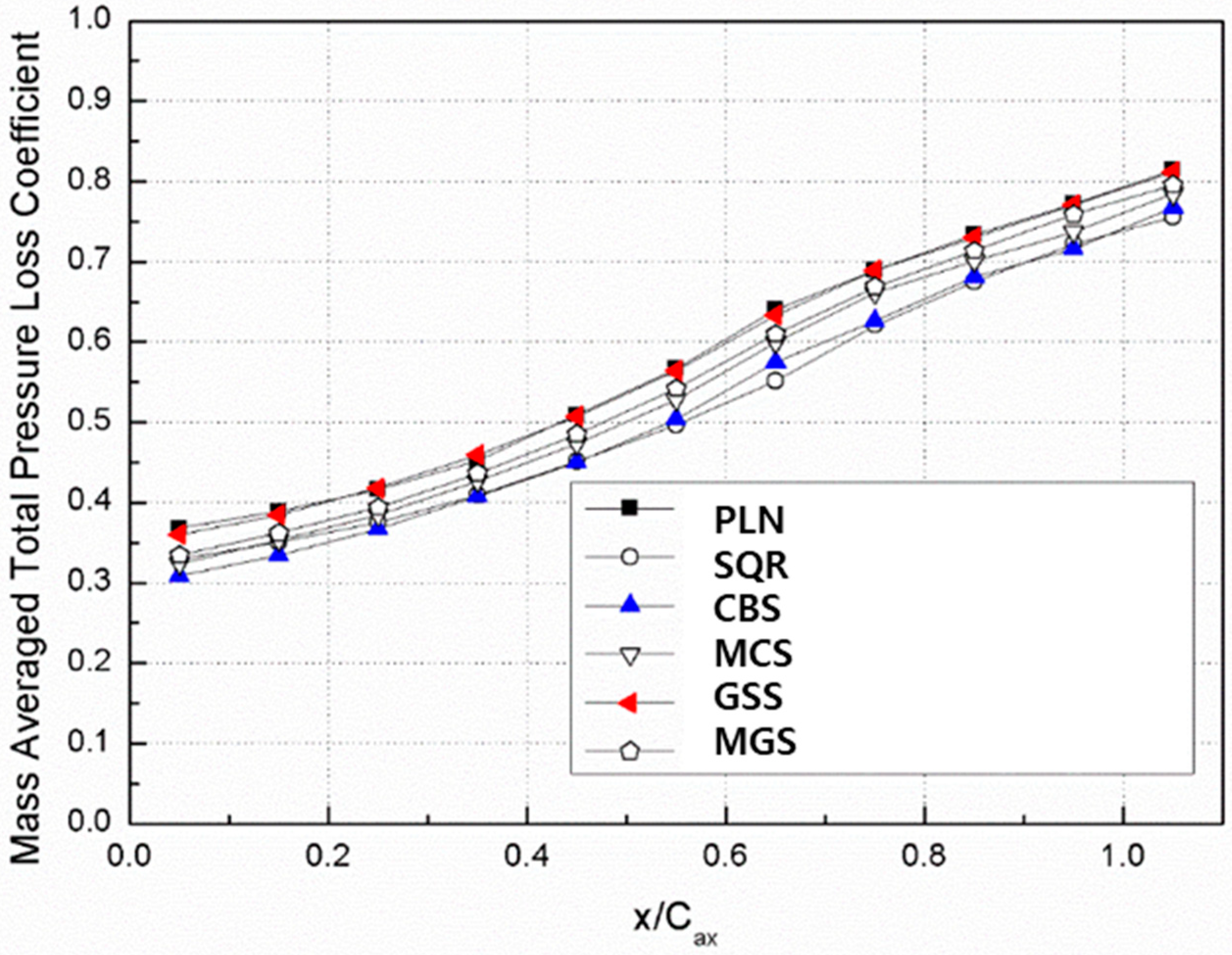
The total pressure loss coefficient was used to compare the aerodynamic loss associated with the different tip geometries. The definitions of the local and mass-averaged total pressure loss coefficients are provided in Section 2.3.1. Figure 16 presents the local total pressure loss coefficient contours, and Figure 17 shows the mass-averaged total pressure loss coefficient distribution from 5% to 105% chord.
The local loss contours were interpreted together with the vortex and surface-flow features summarized in Table 5. In general, high-loss regions are associated with the development or redistribution of the tip leakage vortex and with mixing among the leakage flow, cavity flow, and main passage flow. Therefore, the downstream loss is governed not only by the cavity volume but also by how each tip geometry modifies leakage-flow restriction, vortex development, and local recirculation.
At the 105% chord plane, PLN showed the highest mass-averaged total pressure loss coefficient. Among the squealer configurations, SQR showed the lowest value, corresponding to a 7.27% reduction relative to PLN. CBS, MCS, MGS, and GSS showed reductions of 5.85%, 3.74%, 2.32%, and 0.38%, respectively, as summarized in Table 4. These results indicate that the geometry with the lowest aerodynamic loss is not necessarily the same as the geometry with the lowest geometry-normalized heat transfer rate, which is examined in Section 3.2.
The representative flow phenomena generated by each tip geometry are closely associated with the mechanisms of aerodynamic loss generation and local HTC augmentation. Tip leakage vortex development contributes to mixing loss in the downstream passage, whereas reattachment, recirculation, and stagnation near the tip surface modify the near-wall velocity gradient and wall-normal thermal transport. In the blade tip region, cooling schemes are constrained by the available geometric space, manufacturability, and their interaction with the leakage flow. In addition, the appropriate coolant flow rate should be considered together with turbine aerodynamic performance because coolant injection can influence leakage-flow behavior, mixing loss, and downstream loss characteristics. Therefore, classifying the geometry-dependent flow structures, loss characteristics, and HTC-relevant near-wall flow features provides a preliminary basis for considering balanced aerodynamic-cooling design.
Table 5 provides a mechanism-based link between the observed flow structures and the measured loss characteristics. The comparison indicates that the downstream loss does not scale with the existence of a cavity alone. Instead, it depends on whether the geometry suppresses the direct cross-tip leakage path, redistributes the tip leakage vortex, or introduces additional recirculation and mixing inside the cavity. This interpretation explains why SQR gives the lowest downstream loss, whereas GSS shows only a limited reduction despite its locally low cavity-loss region. The table therefore converts the contour observations into a cross-geometry correlation among vortex behavior, leakage-flow restriction, and total pressure loss.

3.2. Heat Transfer Coefficient Distribution

3.2.1. Local Heat Transfer Coefficient Distribution on the Tip Surface

Because the HTC is a wall-based quantity, the HTC distribution on the tip surface was interpreted together with the surface streamlines and near-wall flow behavior. In the blade tip region, local heat transfer is governed by the wall-normal temperature gradient and by the turbulent transport of momentum and thermal energy close to the wall. Leakage-flow acceleration can thin the boundary layer, whereas separation and low-velocity recirculation can reduce near-wall momentum exchange. When the separated or redirected flow reattaches to the cavity floor, rim, or tip wall, the near-wall velocity gradient and turbulence production increase, which can augment the local HTC.
Figure 18 shows the measurement regions used for the quantitative analysis of the heat transfer coefficient on the blade tip surface. Although the tested geometries differ in local shape, the squealer-based configurations can be divided into tip floor, rim, and tip wall regions. This regional division was used to compare how each geometric modification changes the heat transfer distribution over the blade tip.
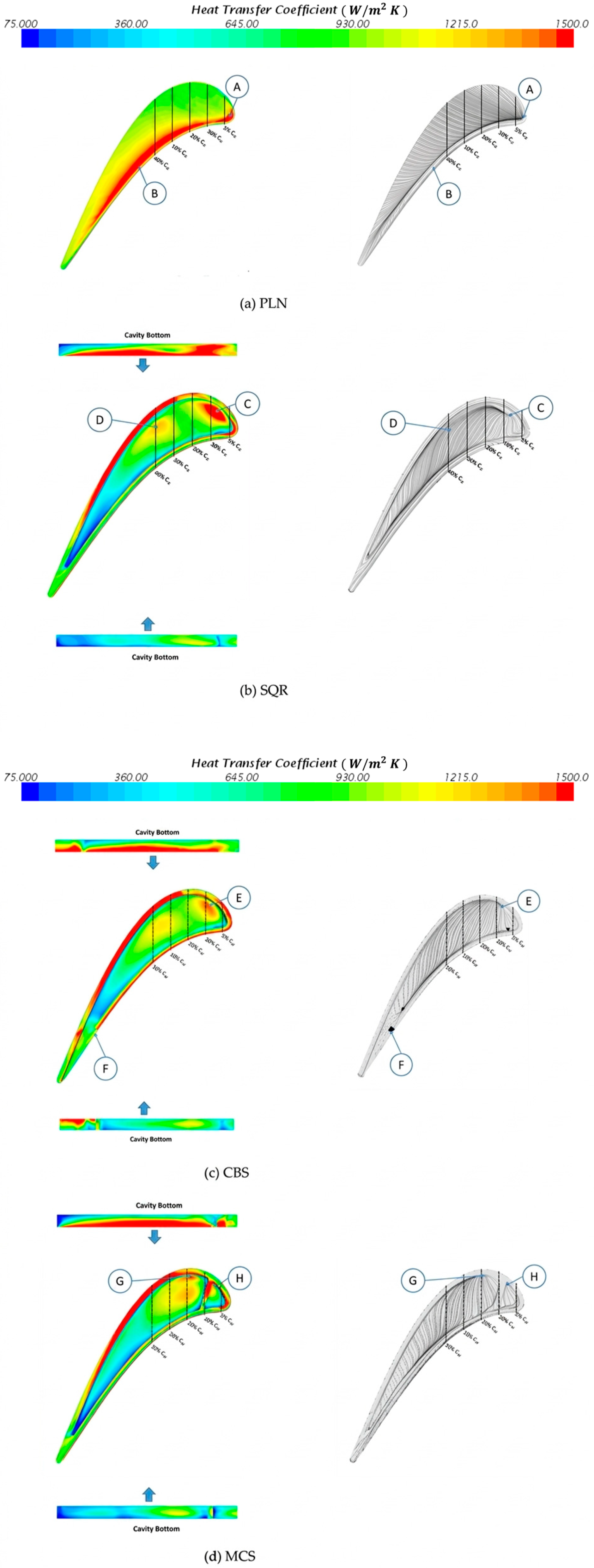
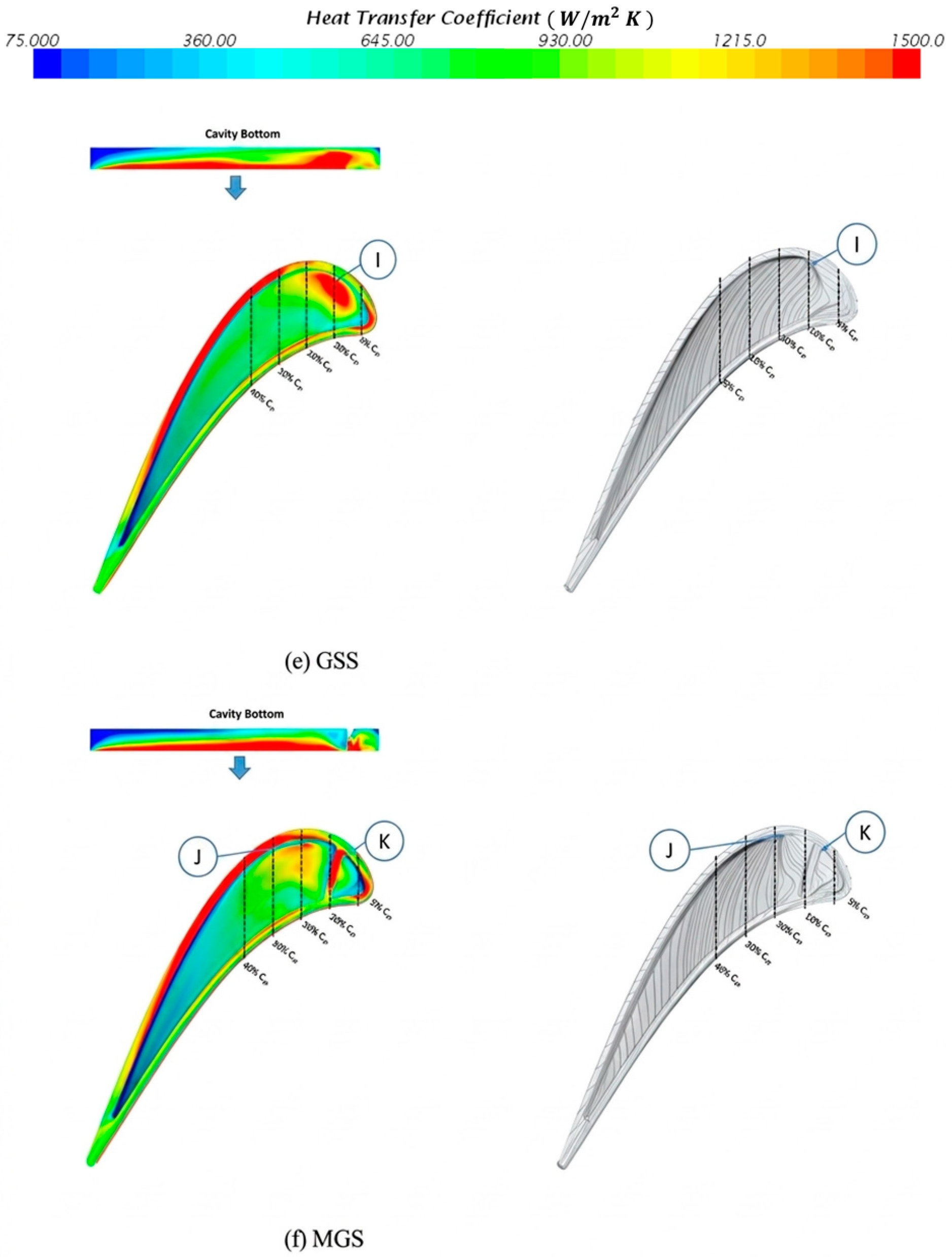
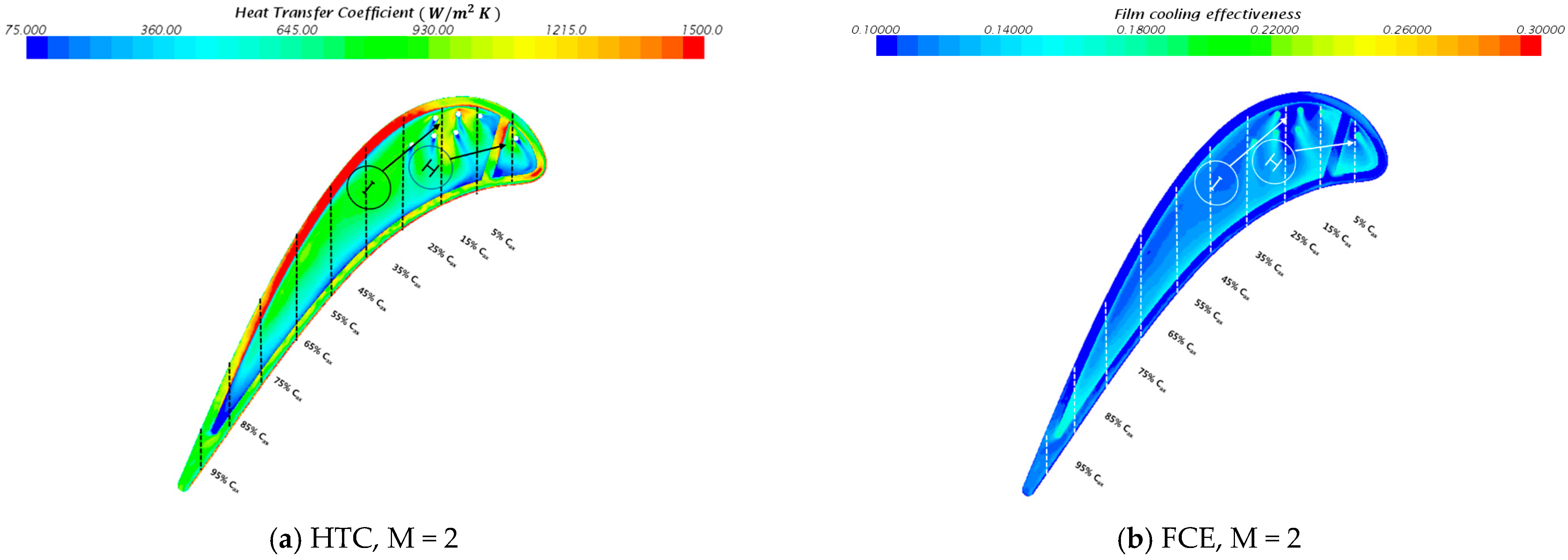
Figure 19 compares the HTC contours and surface streamlines for the tested tip geometries. The marked regions A–K indicate representative locations where the local HTC is affected by the near-wall flow structure. The HTC contours show the magnitude and location of wall heat transfer, whereas the surface streamlines indicate the near-wall flow path associated with acceleration, impingement, recirculation, stagnation, and reattachment.
Table 6 shows that similar HTC characteristics can be produced by similar near-wall aerodynamic features even when the corresponding regions appear in different tip geometries. Regions A–E are mainly associated with leakage-flow acceleration, wall impingement, and reattachment, which enhance the near-wall velocity gradient and increase HTC. Region F represents a downstream interaction zone where cavity-exit flow and vortex redevelopment affect the suction-side rim. Regions G–H indicate that a rib can reduce floor reattachment in one location while creating local turning and impingement in another. Regions I–J show the effect of suction-side-biased near-wall flow, whereas Region K represents a low-velocity cavity region with relatively weaker near-wall momentum and thermal transport. This classification therefore relates the marked HTC regions to the underlying aerodynamic mechanisms and provides a basis for identifying cooling-priority regions for each candidate geometry.

3.2.2. Comparison of Normalized Heat Transfer Rate

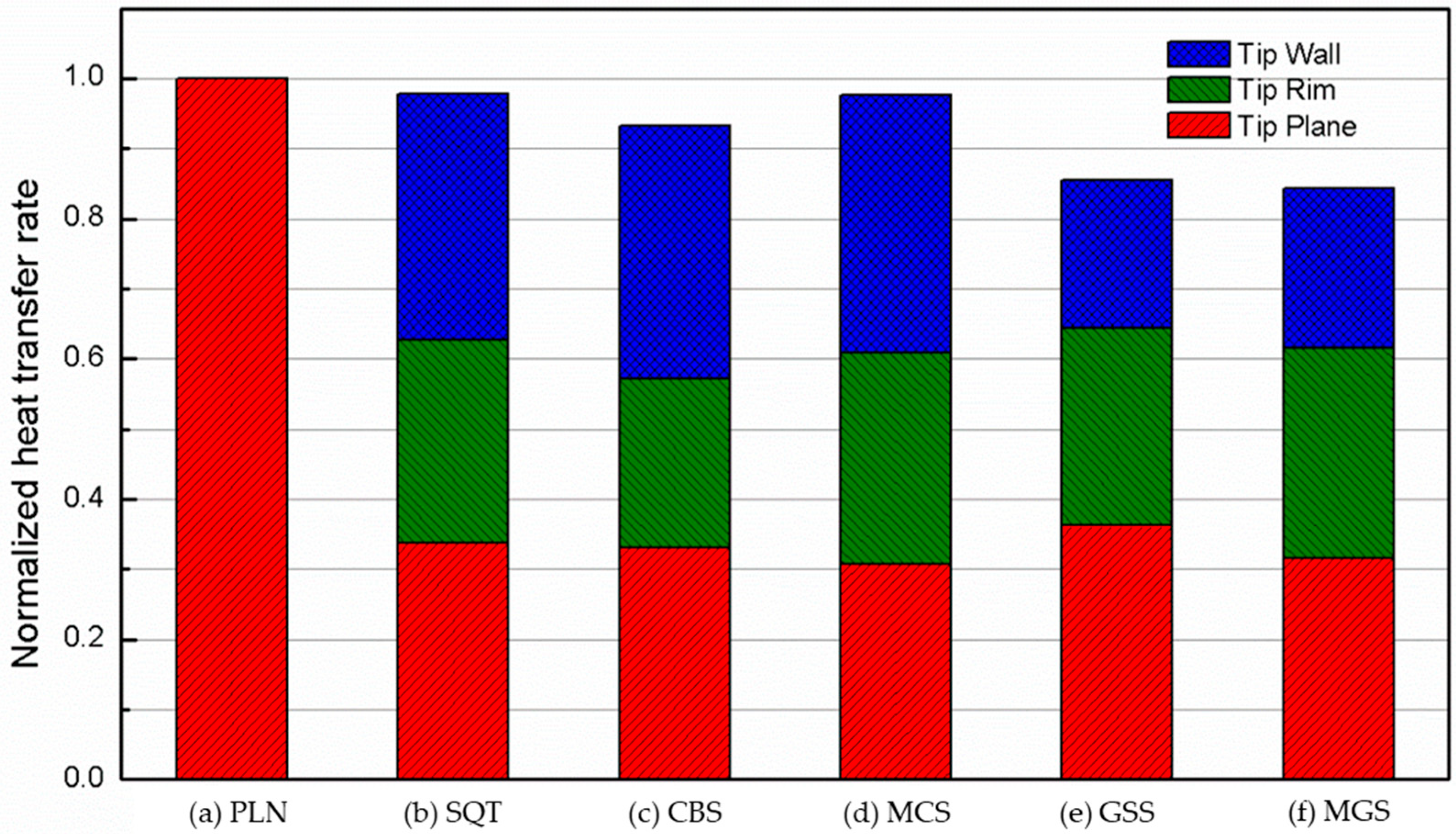
Figure 20 compares the geometry-normalized heat transfer rate, Q*geo, on the blade tip surface. The definition of Q*geo is provided in Section 2.3.2. This parameter was used to compare the overall geometry-dependent heat transfer rate among the tip geometries, using PLN as the reference case under the same thermal boundary condition.
PLN showed the highest geometry-normalized heat transfer rate among the tested configurations. Among the squealer-based geometries, MGS showed the lowest overall value. The regional contribution, however, differed among the geometries. MCS reduced the heat transfer rate on the tip floor because the rib weakened the high-HTC region near the leading part of the cavity. CBS showed a lower rim contribution because the cutback opening changed the downstream cavity-exit path. GSS and MGS showed lower tip-wall contributions, which are associated with the suction-side groove geometry and the redistribution of near-wall flow.
A comparison between the aerodynamic loss and Q*geo shows that the aerodynamic loss and heat transfer metrics are not minimized by the same geometry. Although SQR produced the lowest downstream total pressure loss coefficient, MGS showed the lowest geometry-normalized heat transfer rate. This difference occurs because the mechanisms responsible for reducing leakage-vortex loss and those responsible for redistributing wall reattachment and local HTC are not identical. Therefore, tip geometry assessment requires multiple aerothermal indicators rather than a single aerodynamic or thermal metric.
This comparison provides the basis for the subsequent film cooling analysis. Regions with high HTC are associated with local reattachment, stagnation, or enhanced turbulent mixing, but coolant supplied through fixed camber-line holes does not necessarily overlap these regions. Therefore, the heat transfer characteristics of each geometry should be interpreted together with the expected coolant trajectory and near-wall flow direction.

3.3. Analysis of Film Cooling Performance According to Blowing Ratio

The film cooling blowing ratio is associated with the coolant momentum and the amount of coolant supplied through the cooling holes. Increasing the blowing ratio may enhance coolant ejection and improve film cooling effectiveness (FCE), but the local cooling behavior is not determined by the blowing ratio alone. In the blade tip region, the coolant trajectory, surface attachment, and lateral spreading are also governed by the local pressure field, leakage-flow reattachment, cavity recirculation, rib-induced flow redistribution, and coolant-mainstream mixing. For cavity-type tips, the cavity may provide a space in which the coolant remains and interacts with the recirculating flow; however, this effect depends on the detailed tip geometry and the resulting near-wall flow structure. Therefore, the present study examined the effect of blowing ratio on the heat transfer coefficient (HTC) and FCE distributions over the blade tip floor, rim, and tip wall for different tip geometries under the baseline camber-line hole arrangement.

3.3.1. Effect of Blowing Ratio on HTC and FCE Distributions

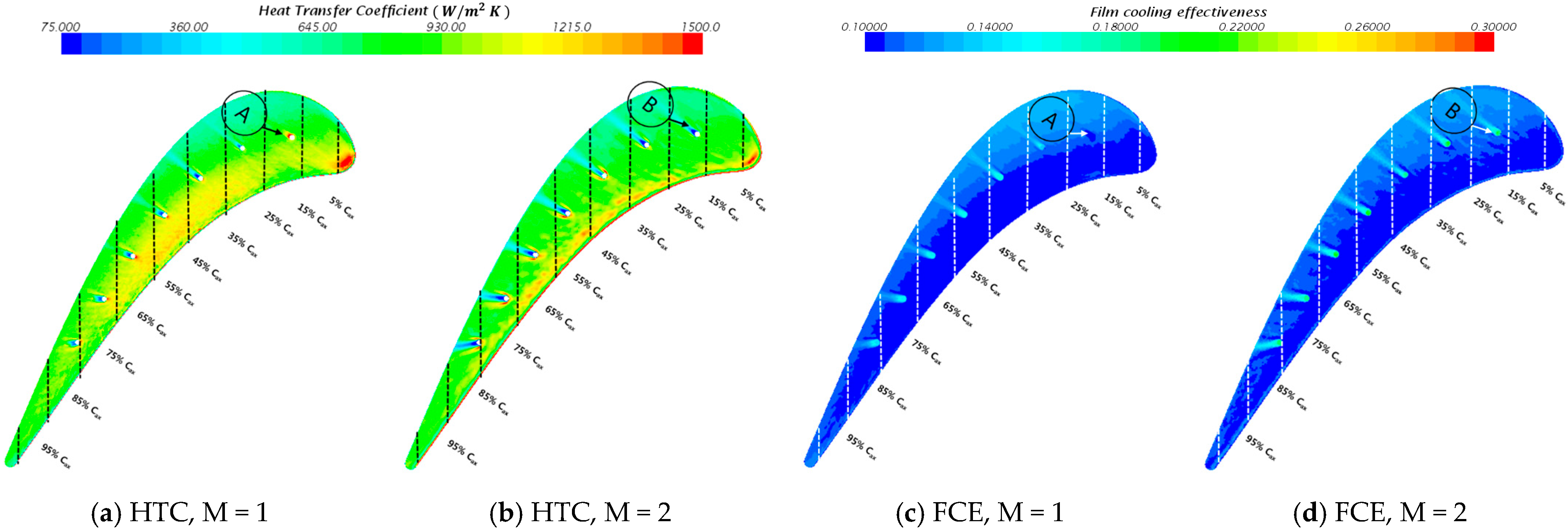
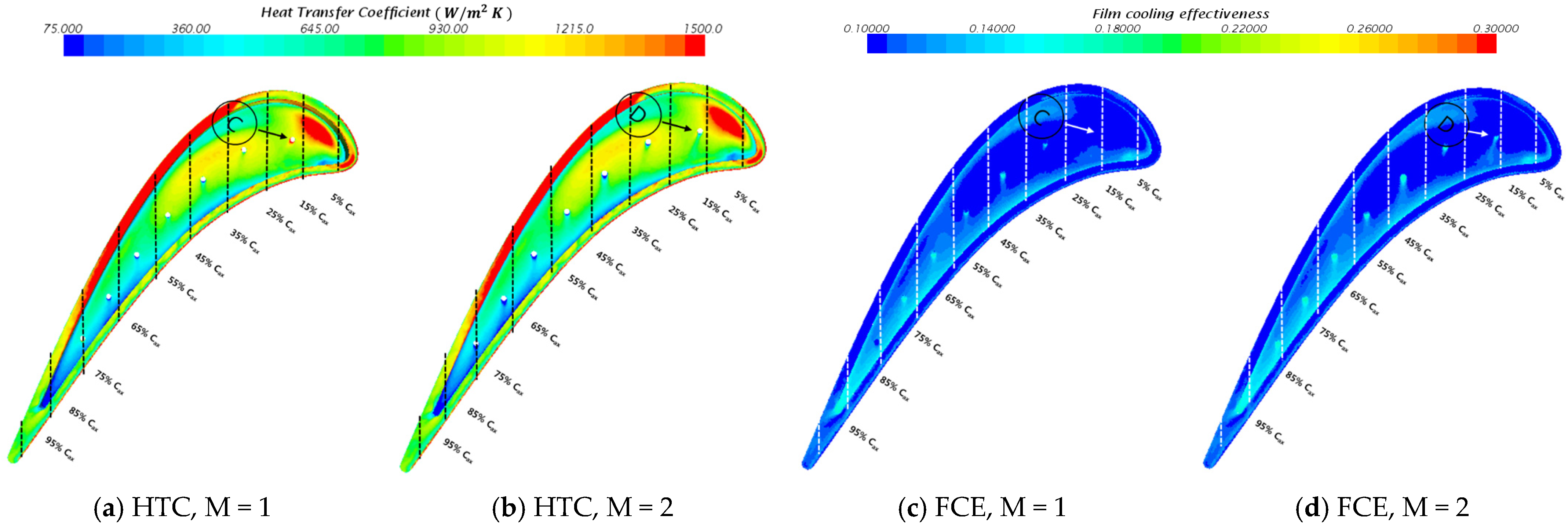
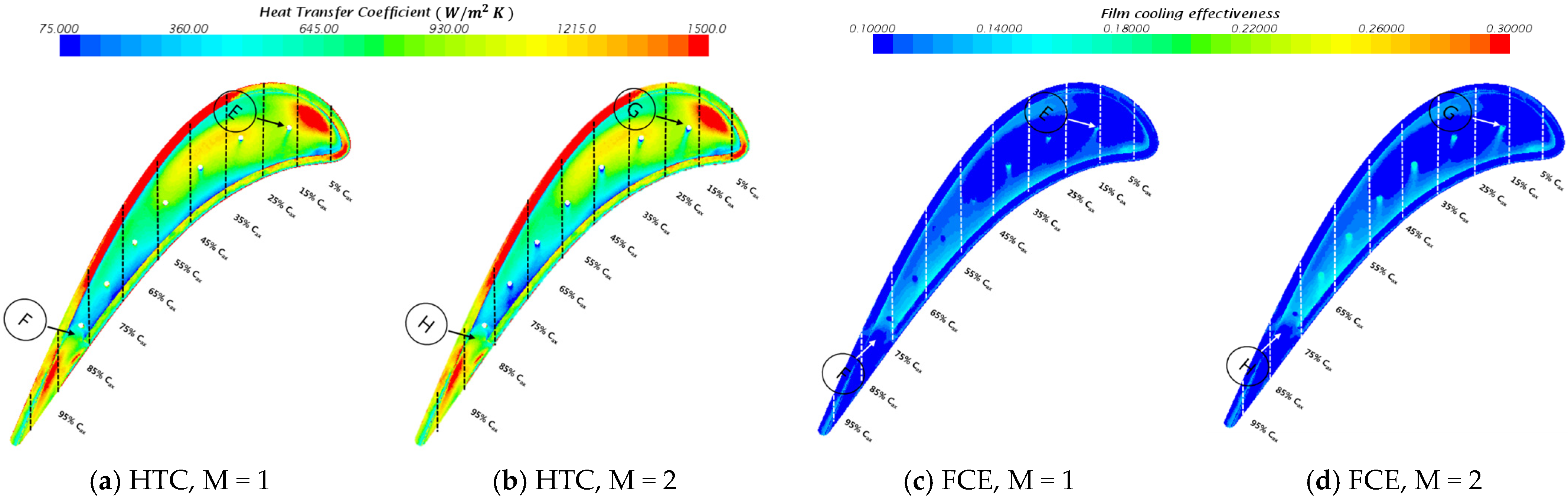
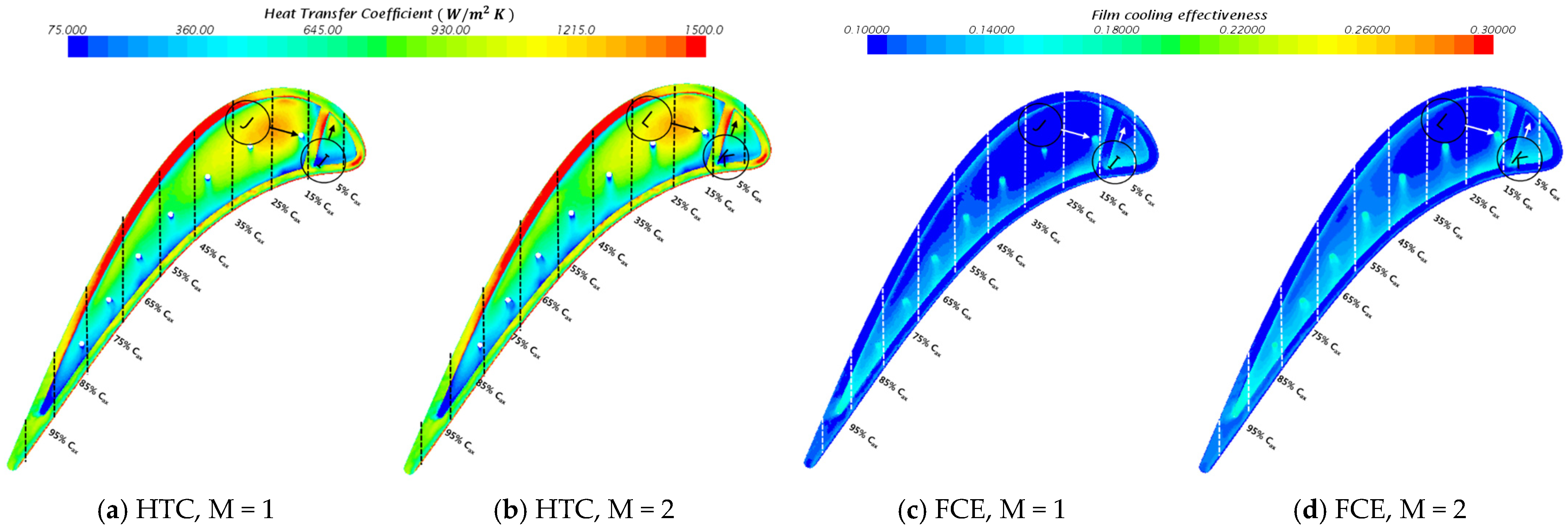
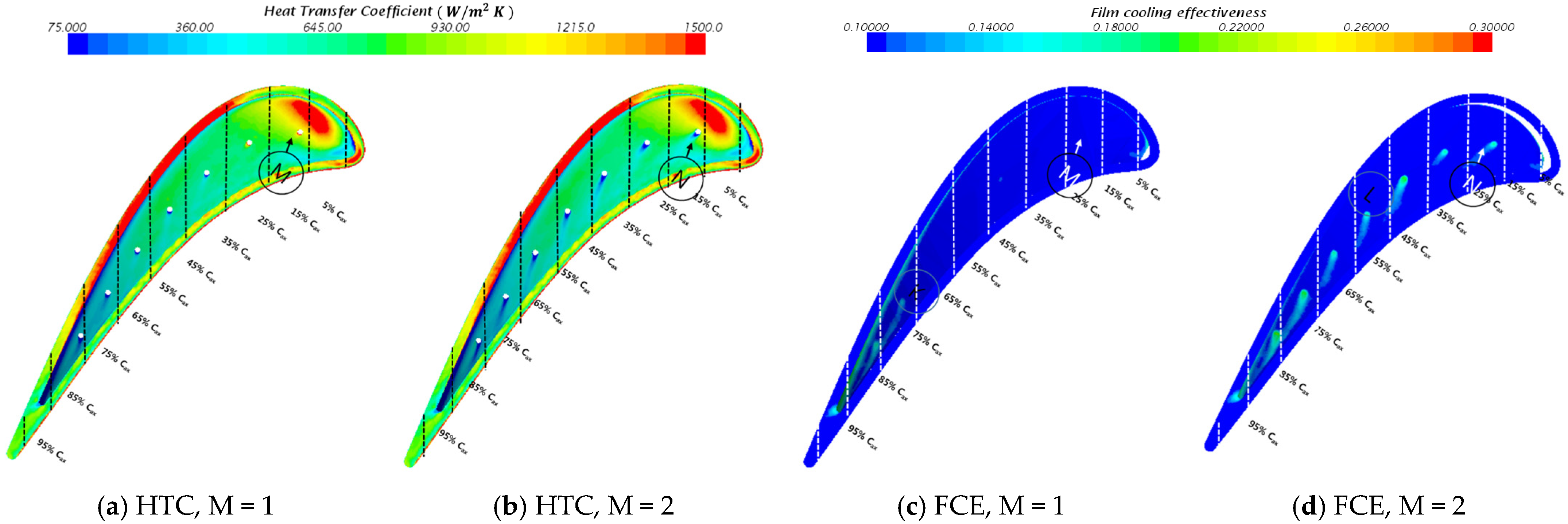
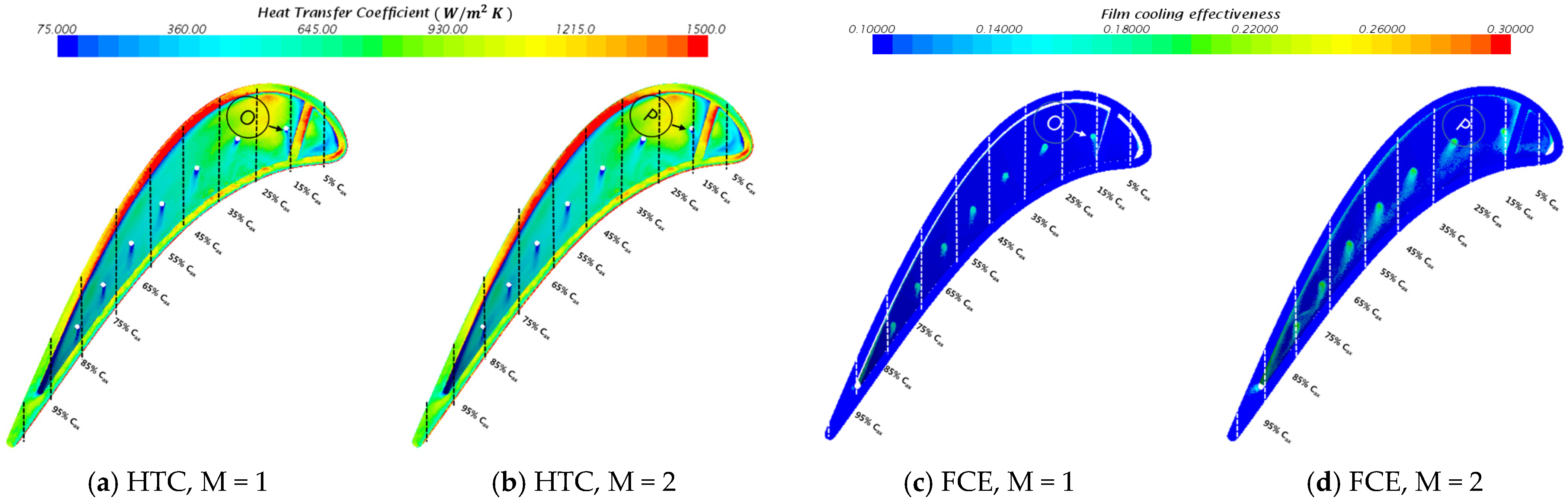
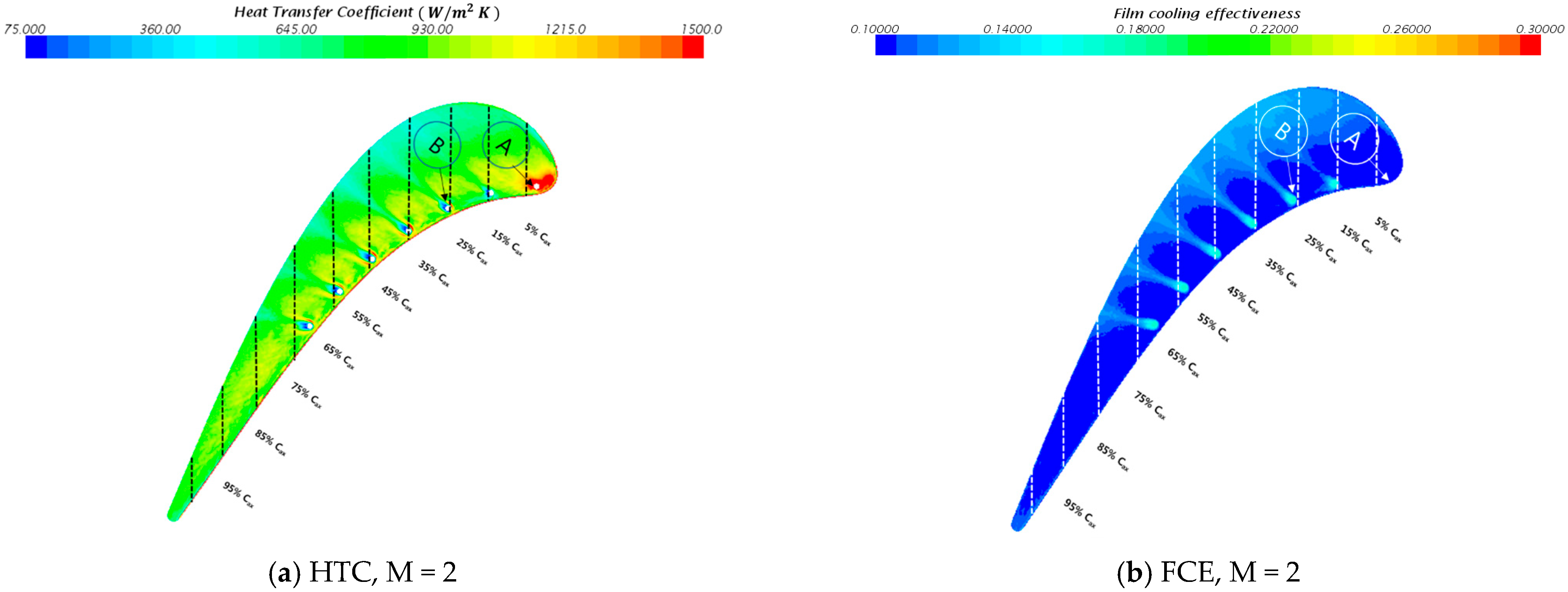
Figure 21, Figure 22, Figure 23, Figure 24, Figure 25 and Figure 26 compare the HTC and FCE distributions of the six tip geometries at M = 1 and M = 2 under the baseline camber-line hole arrangement. Increasing the blowing ratio generally enlarged the coolant-affected region and increased FCE. However, the HTC reduction and FCE increase were not spatially uniform, because the coolant trajectory was governed by the geometry-dependent near-wall flow structure, including leakage-flow reattachment, cavity recirculation, cutback-exit flow, rib-induced redistribution, and coolant-mainstream mixing.
The distributions can be interpreted using four dominant cooling-behavior types. The first is direct jet-leakage-flow interaction, represented by PLN, where no cavity exists. The second is cavity-reattachment control, represented by SQR and GSS, where upstream coolant ejection is affected by reattachment on the cavity floor. The third is cutback-exit control, represented by CBS, where the cavity-exit flow and leakage-vortex interaction influence downstream cooling behavior. The fourth is rib- and multi-cavity-induced redistribution, represented by MCS and MGS, where the rib, cavity division, and groove-guided flow redirect the coolant trajectory.
In the direct jet-leakage-flow interaction behavior, the coolant is exposed directly to the high-speed tip leakage flow over the plane tip surface. At M = 1, this interaction limits upstream coolant ejection, whereas at M = 2, the increased coolant momentum allows the coolant to follow the leakage-flow path more clearly. Nevertheless, local jet-crossflow interaction remains important near the hole exits, where high-HTC regions can persist.
In the cavity-reattachment-controlled behavior, the cavity can retain part of the ejected coolant, but upstream coolant ejection is restricted when the holes are located near reattachment-dominated regions. This behavior is observed in SQR and GSS, where the cavity-floor reattachment and groove-guided flow determine whether the coolant enters the cavity-flow path or rapidly mixes with the leakage flow. Therefore, increasing the blowing ratio improves FCE mainly along the cavity-flow trajectory rather than over the entire tip surface.
In the cutback-exit-controlled behavior, the downstream opening changes the internal pressure field and cavity-exit flow path. For CBS, upstream coolant ejection is observed even at M = 1, but the downstream cooling behavior remains constrained by the interaction among the cutback-exit flow, cavity-exit flow, and tip leakage vortex. Thus, the cutback opening redistributes the coolant-affected region without producing a uniform HTC reduction.
In the rib- and multi-cavity-induced redistribution behavior, the internal rib and cavity division redirect the coolant toward rib-adjacent or pressure-side cavity-flow paths. This behavior is observed in MCS and MGS. FCE increases where the coolant trajectory overlaps the rib- or groove-induced cavity flow, whereas high-HTC regions away from this trajectory, especially suction-side reattachment regions, remain comparatively less affected.
The marked regions in Figure 21, Figure 22, Figure 23, Figure 24, Figure 25 and Figure 26 were classified to relate the local flow structure to the corresponding HTC and FCE characteristics. This classification does not propose a universal film cooling correlation, but identifies the region-based relationship among coolant trajectory, near-wall flow structure, heat transfer, and cooling effectiveness under the present conditions. The resulting relationship is summarized in Table 7.
Table 7 indicates that the local cooling behavior is governed primarily by the overlap between the coolant trajectory and the high-HTC region. Regions dominated by direct jet-leakage interaction or cavity-floor reattachment tend to maintain a high HTC when coolant ejection is suppressed by the local pressure field or reattachment momentum. In contrast, FCE increases when the ejected coolant follows the leakage-flow or cavity-flow path and remains attached to the tip surface. The rib, groove, and cutback structures therefore redistribute the coolant path and determine where the cooling benefit appears, rather than producing a uniform increase in cooling performance.
From a design viewpoint, the classification in Table 7 suggests that increasing the blowing ratio is most effective when the additional coolant momentum improves the overlap between the coolant path and the high-HTC region. If a hole is located within a high-pressure or reattachment-dominated region, the additional coolant supply may not produce a proportional increase in FCE. This relationship provides the physical basis for the hole-rearrangement analysis in Section 3.4.

3.3.2. Geometry-Dependent Trends Under Camber Line Hole Arrangement

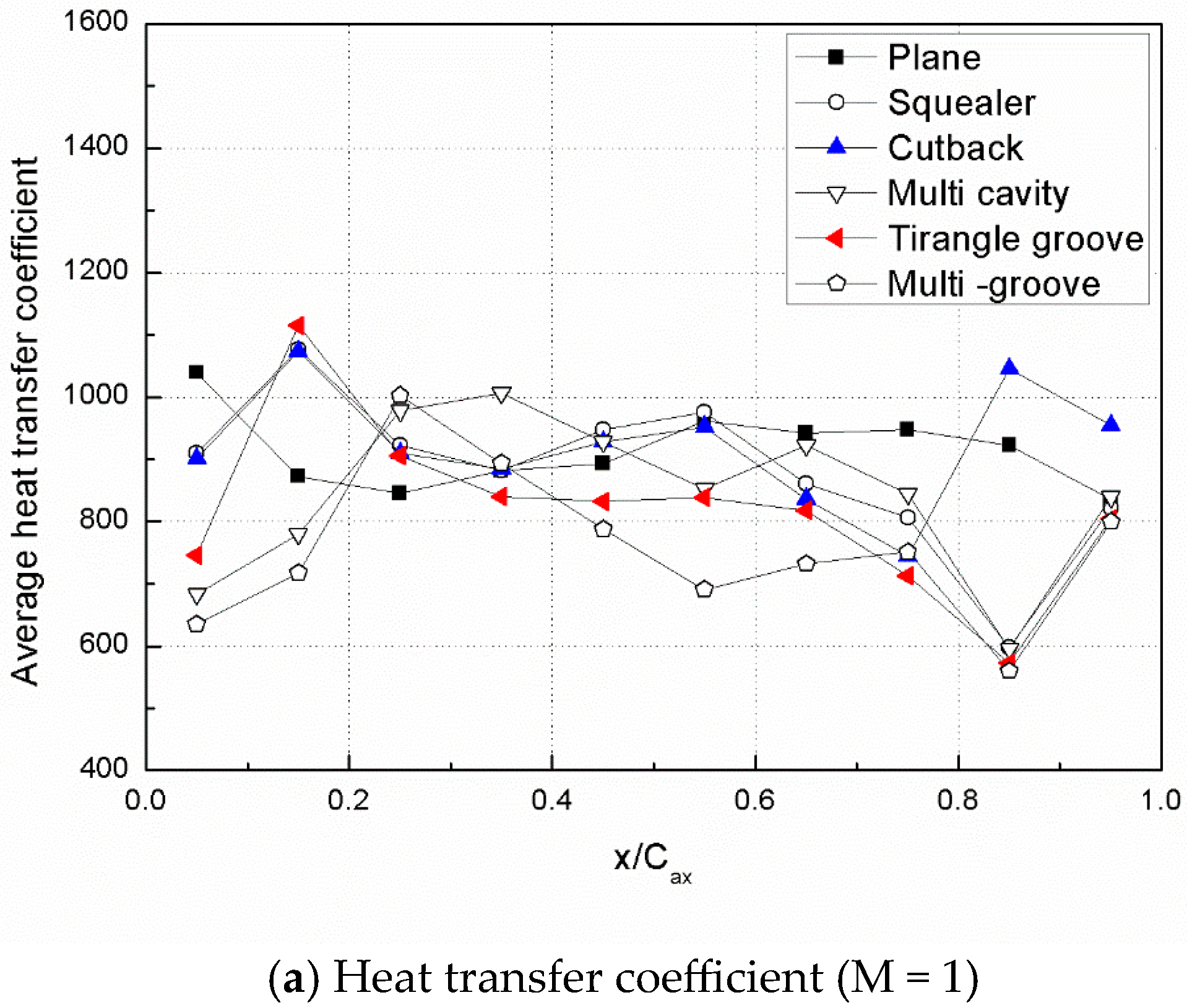
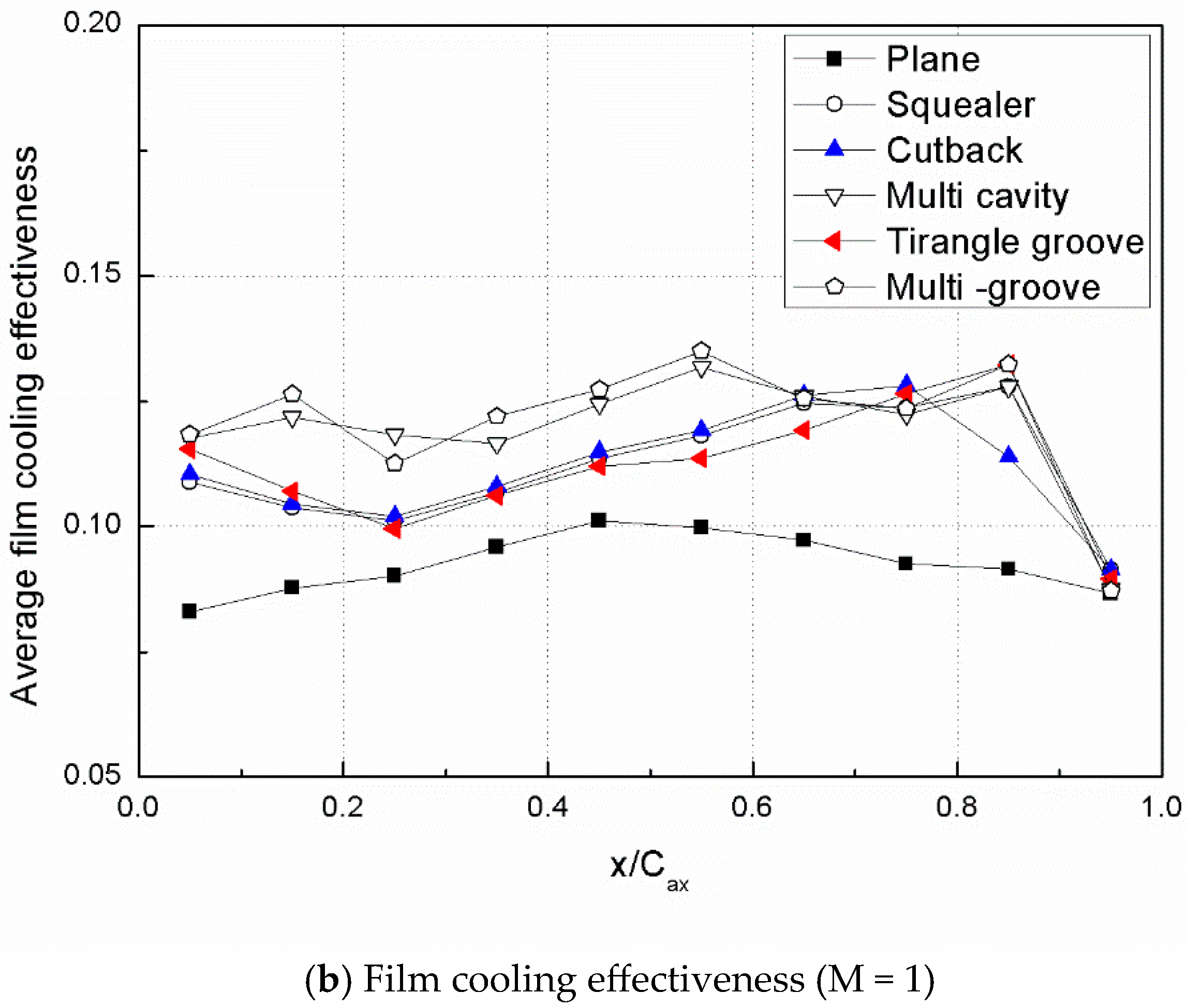
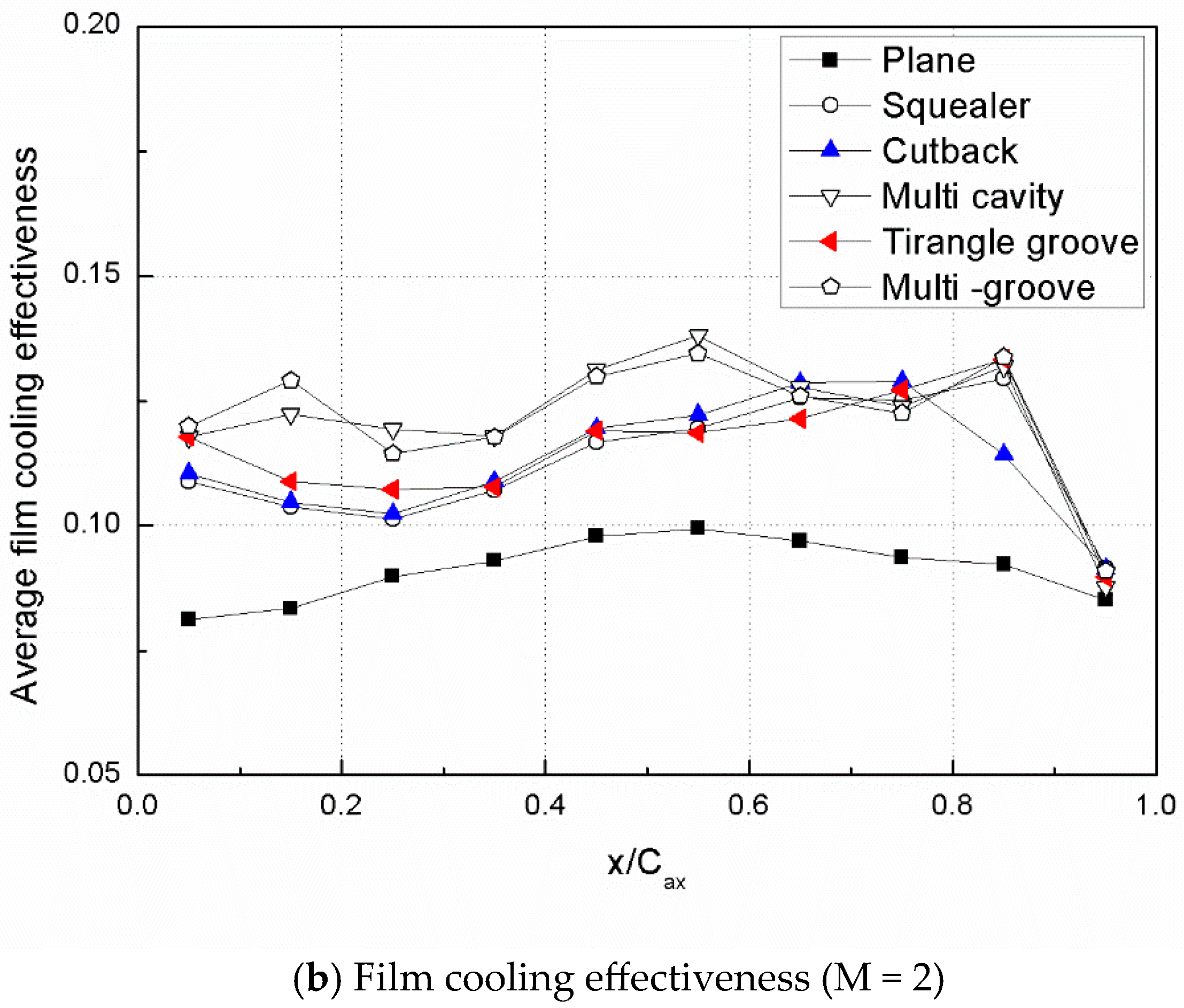
Figure 27 and Figure 28 compare the HTC and FCE of all tip geometries considered in this study. Figure 27a compares the average HTC values at a blowing ratio of 1. At the location corresponding to 5% chord length, the tip geometries with a multi-cavity structure exhibit the lowest HTC. Since no film cooling holes are located in this region, the magnitude of heat transfer generated purely by the flow can be compared directly. However, at 25% chord length, the tip geometries with a multi-cavity structure exhibit higher HTC values than the other tip geometries. This is because the high-HTC region formed near the suction side is not affected by the cooling holes located on the camber line. Beyond 35% chord length, the triangular-groove tip shows a lower HTC. At 85% chord length, where the cavity ends, the HTC values of all geometries are similar in magnitude. However, the cutback squealer tip exhibits a high HTC. Figure 27b compares the average FCE values at a blowing ratio of 1. Overall, the multi-cavity structures show higher FCE. The present results indicate that, at a blowing ratio of 1, the multi-cavity triangular-groove geometry, which was identified as the optimal configuration in terms of aerodynamics and heat transfer, also exhibits high FCE. The next best geometry in terms of FCE is the multi-cavity squealer tip. The squealer tip and the cutback squealer tip show very similar values, although below 75% chord length, the squealer tip exhibits higher FCE. The triangular-groove tip shows lower film cooling performance than the squealer tip. The plane tip exhibits markedly lower FCE than the other tip geometries over most of the region.
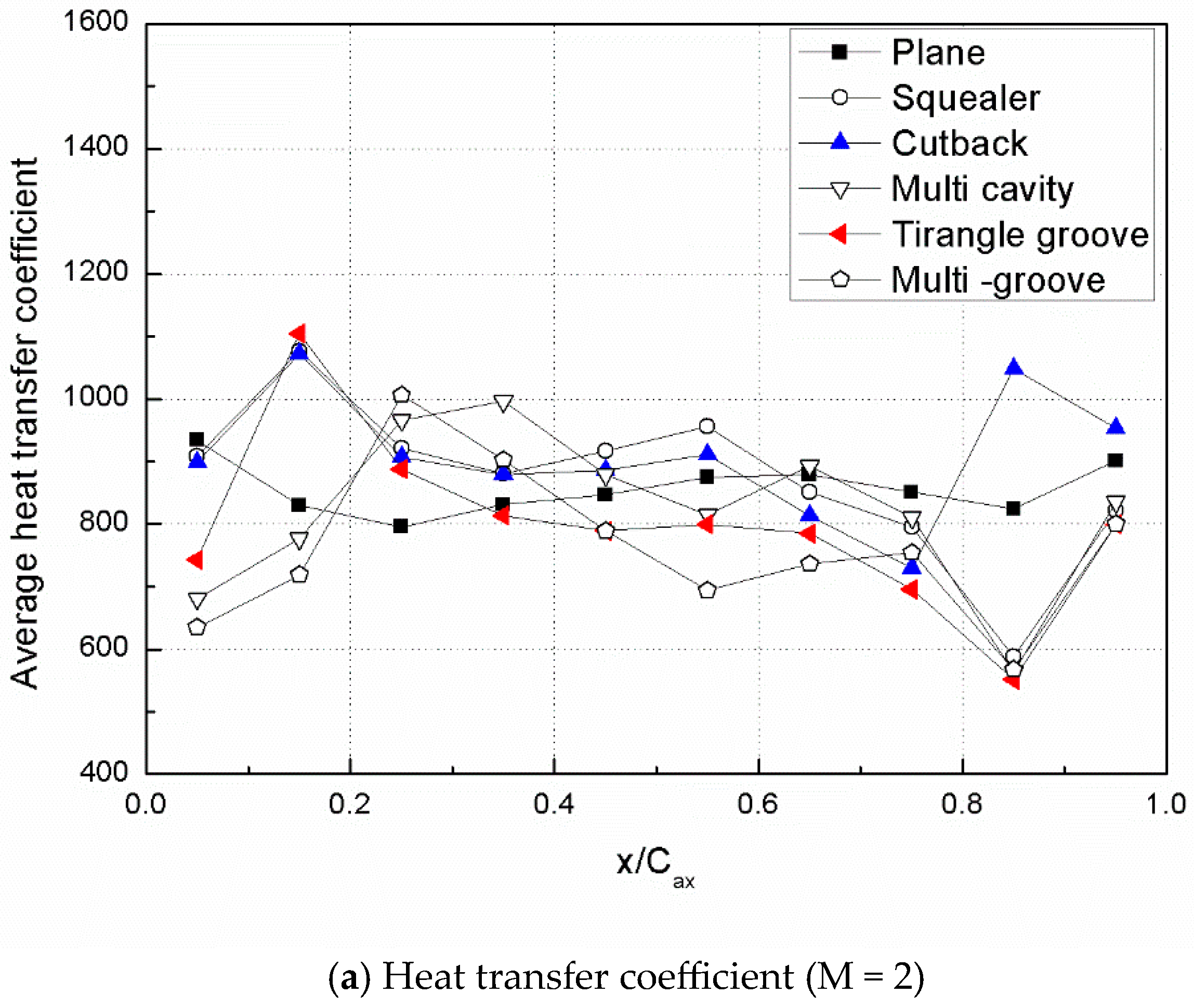
Figure 28a compares the average HTC values at a blowing ratio of 2. The overall ranking does not change significantly. In general, the HTC decreases relative to the case of blowing ratio 1, and at 15% chord length, the lowest HTC appears in front of the rib of the multi-cavity configuration. By contrast, the squealer tip, cutback squealer tip, and triangular-groove tip show regions of high HTC due to flow reattachment. The HTC gradually decreases downstream under the influence of the coolant. However, the triangular-groove tip, the multi-cavity squealer tip, and the multi-cavity groove squealer tip generally exhibit low HTC values. The cutback squealer tip shows the highest HTC at 85% chord length.
Figure 28b compares the average FCE values at a blowing ratio of 2. As the coolant flow rate increases, the cooling effect also improves. Except for the region at 75% chord length, the multi-cavity squealer tip and the multi-cavity groove squealer tip show high FCE throughout the entire region. The FCE becomes similar at 85% chord length, which corresponds to the end of the cavity exit region, whereas the cutback squealer tip exhibits the lowest FCE.
The baseline camber-line arrangement showed that increasing the blowing ratio from M = 1 to M = 2 generally increased FCE and reduced HTC. However, the cooling behavior was not spatially uniform. In regions dominated by local pressure rise, reattachment, or rapid mixing with the leakage flow, coolant ejection was locally suppressed or the cooling effect remained limited. This baseline result provided the basis for examining hole rearrangement under the same blowing ratio and hole number.
Under normal injection, the coolant jet interacts with the crossflow formed by the tip leakage flow and cavity flow. This interaction can generate local vortical structures near the cooling hole, including a horseshoe-type vortex, and can enhance turbulent mixing between the coolant and hot gas. Therefore, the blowing-ratio effect was interpreted not only from the amount of coolant supplied, but also from the local pressure field, surface reattachment, cavity recirculation, and coolant trajectory.

3.4. Effect of Cooling Hole Rearrangement

Film cooling reduces the thermal loading on the blade tip surface by supplying coolant to regions exposed to high heat transfer. However, under the baseline camber-line arrangement, the cooling holes do not necessarily coincide with the high-HTC regions identified from the local flow structure. As discussed in Section 3.3, coolant ejection, surface attachment, and lateral spreading can be limited in high-pressure regions, reattachment-dominated regions, or regions where rapid mixing with the leakage flow occurs. Therefore, the cooling holes were rearranged while maintaining the same blowing ratio and the same number of holes.
The rearrangement was based on the expected overlap between the coolant trajectory and the high-HTC region. Cooling holes were placed near high-HTC regions while avoiding the strongest reattachment or stagnation points, where coolant ejection may be suppressed. When the local flow direction allowed the ejected coolant to pass over a high-HTC region, the holes were positioned upstream of that region. Figure 29 shows the representative interaction between a normally injected coolant jet and the main flow. The resulting jet-crossflow interaction can produce local mixing near the hole exit, whereas the downstream coolant trajectory determines the region of increased FCE.

3.4.1. Rearranged Hole Locations Based on Local Flow Structure

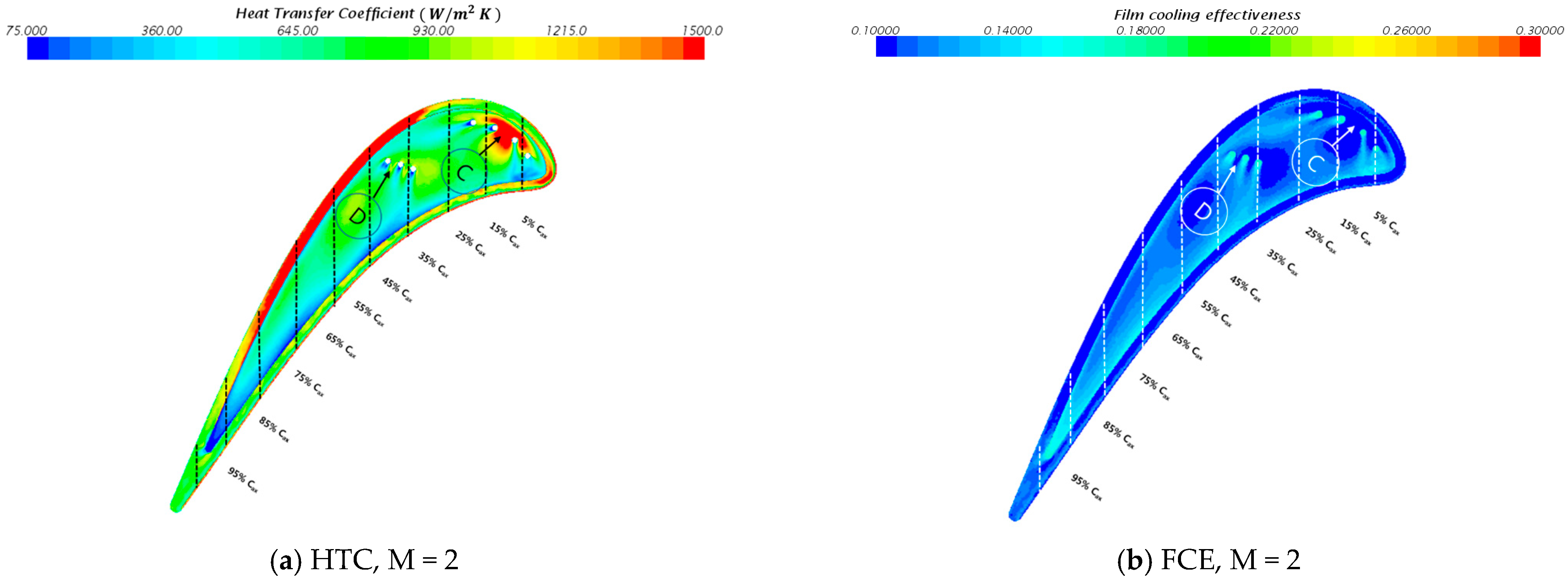
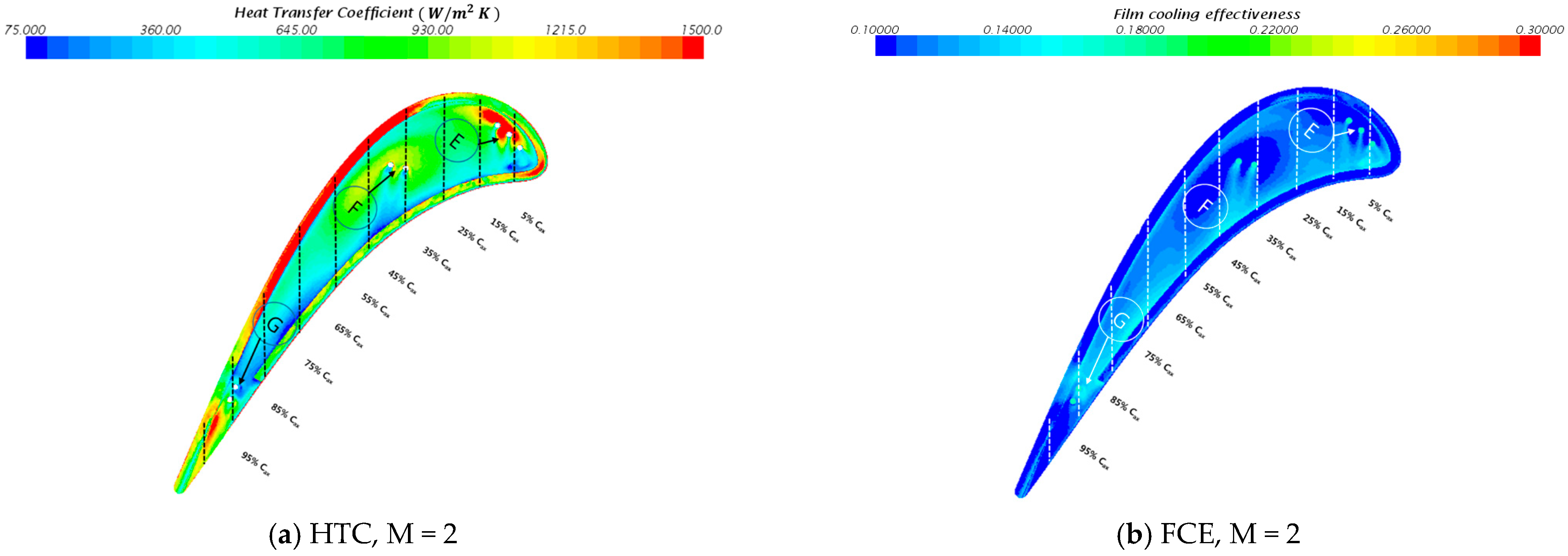
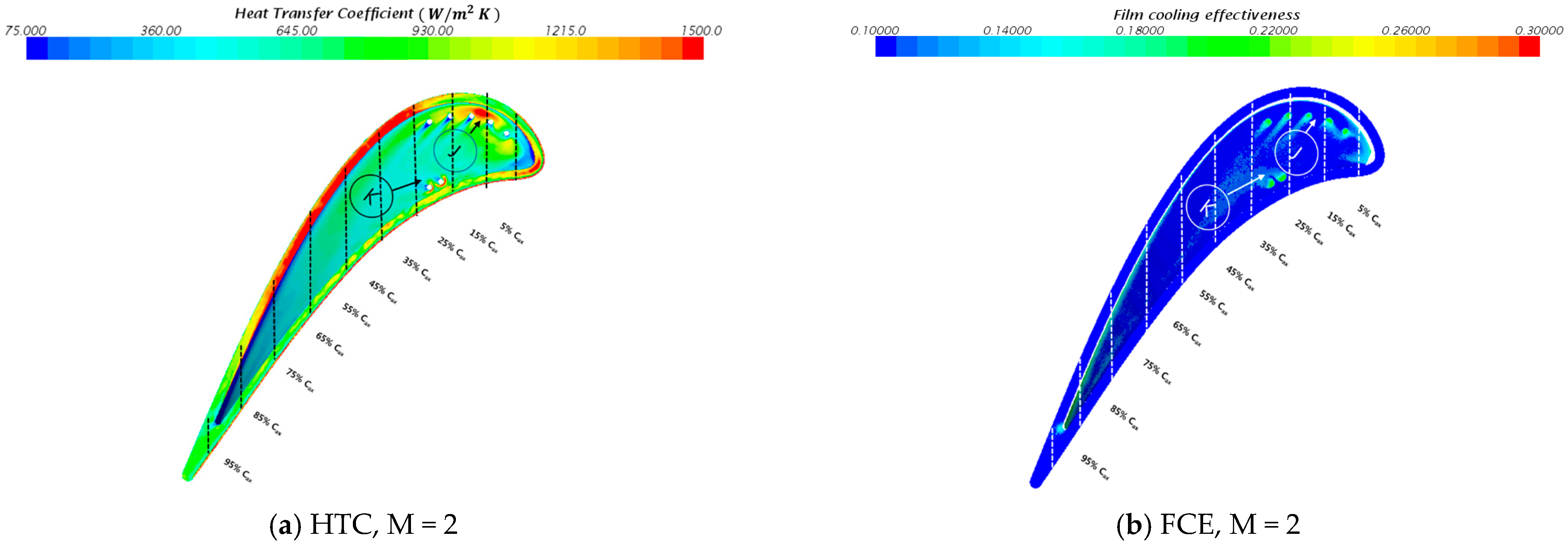
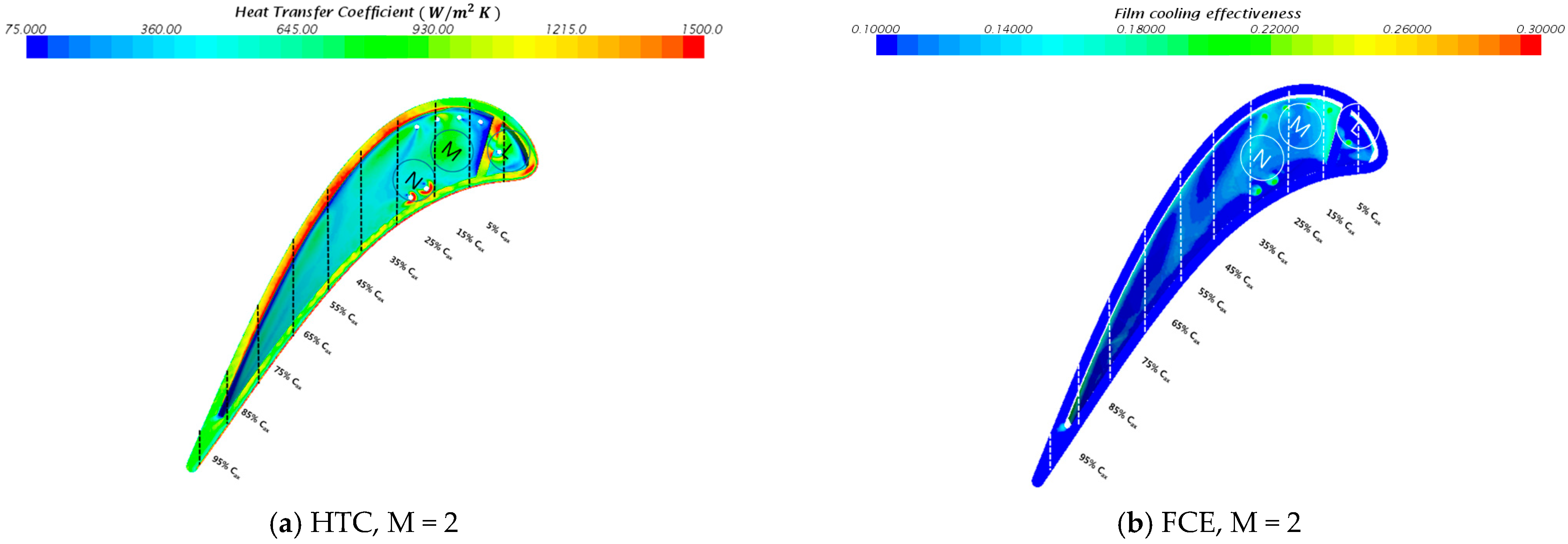
Figure 30, Figure 31, Figure 32, Figure 33, Figure 34 and Figure 35 show the HTC and FCE distributions for the rearranged-hole configurations at M = 2. The marked letters indicate representative local regions, as summarized in Table 8. Because the coolant amount was unchanged, the differences from the baseline case are attributed mainly to the hole location and the resulting coolant trajectory.
The rearranged configurations can be interpreted according to the dominant near-wall flow behavior. First, leakage-path alignment improves coolant surface attachment and downstream spreading when the ejected coolant follows the tip leakage-flow direction. This behavior is most relevant to the plane tip, where the absence of a cavity causes direct jet-crossflow interaction. Although the leading-edge region remains difficult to cool because of the local pressure and reattachment behavior, downstream FCE increases where the coolant follows the leakage-flow path.
Second, reattachment-adjacent supply improves cooling when the holes are placed near or upstream of cavity-floor high-HTC regions. In SQR and GSS, the strongest reattachment regions can suppress coolant ejection if the holes are located directly within them. By placing the holes adjacent to these regions, the ejected coolant enters the cavity-flow path and passes over part of the high-HTC region. However, the improvement remains local because strong reattachment and rapid mixing still limit coolant surface attachment and lateral spreading in some regions.
Third, cutback-exit control is important for CBS. The cutback opening modifies the cavity-exit flow and its interaction with the tip leakage vortex. As a result, downstream FCE is sensitive to hole location. Rearranged holes improve coolant delivery and downstream spreading in the region where the baseline arrangement provides weak cooling.
Fourth, rib- and groove-induced redistribution governs the cooling behavior of MCS and MGS. In these configurations, the rib, cavity division, and groove-guided flow redirect the coolant toward rib-adjacent or pressure-side cavity-flow paths. Consequently, FCE increases where the coolant trajectory overlaps the rib- or groove-induced cavity flow, whereas suction-side reattachment regions away from the coolant path remain less affected.
The local relationship among hole rearrangement, flow structure, HTC, and FCE is summarized in Table 8. Overall, hole rearrangement is effective when the ejected coolant follows the leakage-flow or cavity-flow path toward a high-HTC region. The improvement is limited when the coolant path is separated from the reattachment-dominated region or when the coolant rapidly mixes with the leakage flow.
Table 8 shows that the effectiveness of hole rearrangement depends less on geometric relocation itself than on the flow path into which the coolant is ejected. Leakage-path alignment improves downstream coolant attachment and spreading when the coolant follows the tip leakage flow, whereas reattachment-adjacent supply is effective only when the hole avoids the strongest reattachment point. In ribbed and groove-related configurations, the rearranged holes mainly redistribute coolant toward rib-adjacent or groove-guided cavity-flow paths. Thus, the rearranged-hole configuration functions as a local coolant-trajectory control strategy rather than as a uniformly superior cooling layout.

3.4.2. Geometry-Dependent FCE Characteristics Under Hole Rearrangement

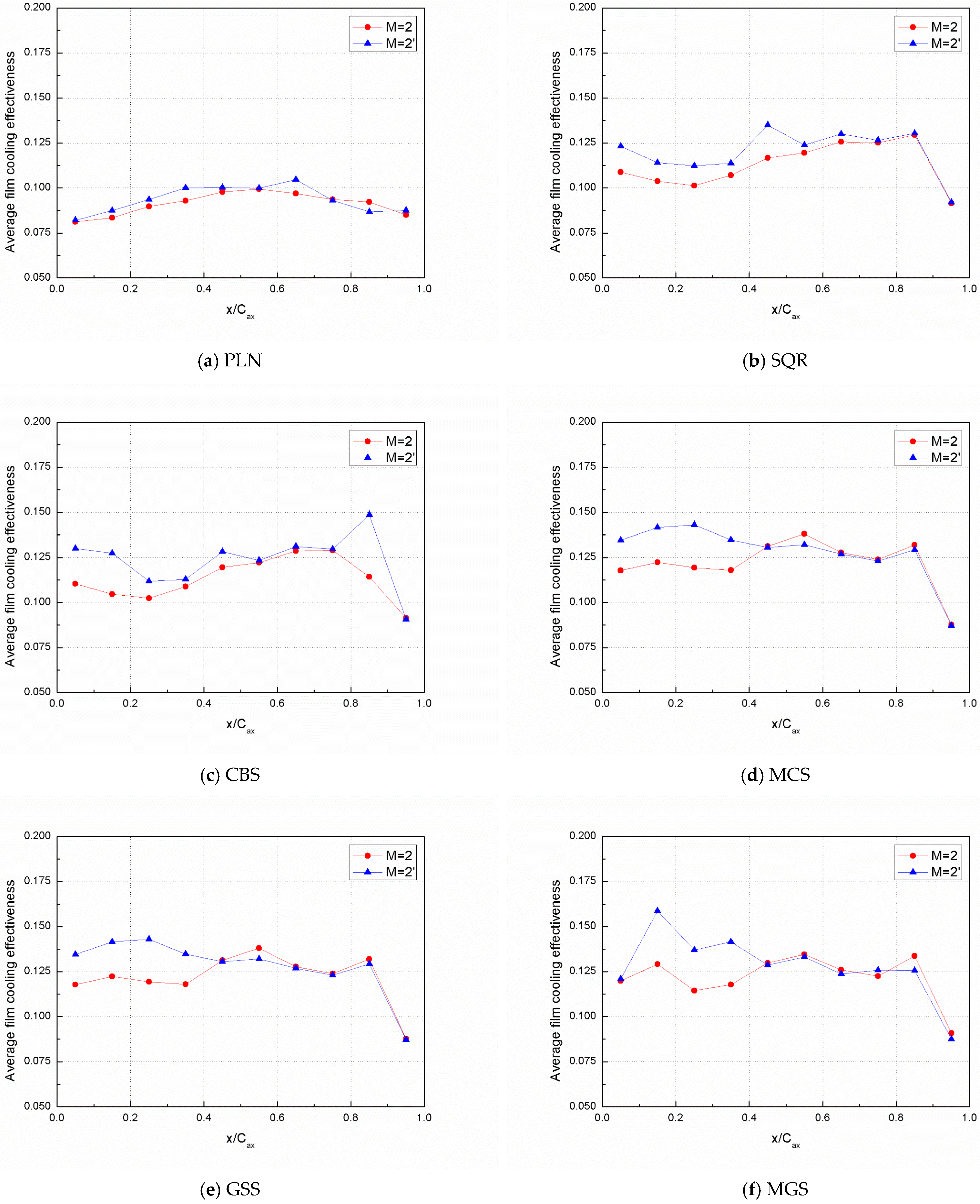
Figure 36 compares the average FCE distributions of the baseline and rearranged-hole configurations at M = 2. To isolate the effect of hole rearrangement, Table 9 summarizes only the change in FCE between the rearranged and baseline configurations at representative axial locations. Positive values indicate an increase in FCE after hole rearrangement, whereas negative values indicate a decrease.
Table 9 shows that the effect of hole rearrangement depends strongly on both tip geometry and axial location. Local FCE increases where the rearranged coolant trajectory becomes better aligned with the leakage-flow path, cavity-flow path, cutback-exit flow, or rib/groove-guided cavity flow. Conversely, negative values indicate regions where the coolant path has shifted away from the corresponding chordwise location.
CBS exhibits the largest downstream increase, with Delta FCE = +0.034 at x/Cax = 0.85. This trend corresponds to the cutback-exit-controlled behavior, where the rearranged holes improved coolant supply to a region affected by cavity-exit flow and leakage-vortex interaction.
MGS shows the largest upstream increase, with Delta FCE = +0.030 at x/Cax = 0.15, but its downstream FCE decreases by Delta FCE = −0.008 at x/Cax = 0.85. This behavior reflects rib/groove-induced coolant redistribution, in which the rearranged holes shifted the coolant path toward the upstream rib-adjacent cavity-flow path rather than increasing FCE uniformly over the entire tip surface.
These results support the flow-HTC-FCE relationship identified in the blowing ratio analysis. FCE increases when the coolant trajectory overlaps a high-HTC region or follows the local cavity-flow path. Conversely, the improvement remains limited when the coolant path is separated from reattachment-dominated regions or rapidly mixed with the leakage flow. Therefore, under the same blowing ratio and hole number, the effect of hole rearrangement is governed by the geometry-dependent near-wall flow structure.

3.5. Summary of Aerothermal Characteristics

Overall, aerodynamic loss, HTC, and FCE were coupled through the flow structure formed in the tip clearance and cavity. The tip leakage vortex contributed to downstream total pressure loss, whereas the same leakage and cavity flow structures determined where the boundary layer was thinned, separated, or reattached on the tip surface. These near-wall flow features affected the local HTC and also controlled the coolant trajectory and mixing with hot gas. Therefore, the geometry associated with lower aerodynamic loss did not necessarily correspond to the geometry associated with lower heat transfer or higher FCE. The geometry-dependent relationships among flow structure, aerodynamic loss, heat transfer characteristics, and film cooling behavior are summarized in Table 10.

4. Conclusions

In this study, the effects of tip geometry and film cooling on the aerothermal characteristics of a gas turbine blade tip were numerically investigated. A plane tip and five squealer-based tip geometries were compared under identical cascade geometry, tip clearance, inlet/outlet boundary conditions, cooling hole number, and blowing ratio conditions. The main conclusions are as follows:
  • The blade tip flow structure was strongly dependent on the tip geometry. In the plane tip, the leakage flow crossed the tip surface directly and developed into a suction-side tip leakage vortex. In the squealer-based geometries, the leakage flow was divided into upper leakage flow and cavity flow. The cavity recirculation, reattachment location, rib-induced flow redistribution, cutback-exit flow, and suction-side groove-guided flow governed the local aerodynamic loss and heat transfer characteristics.
  • The aerodynamic loss comparison showed that SQR provided the most favorable aerodynamic performance under the present conditions. At the 105% axial chord plane, SQR reduced the mass-averaged total pressure loss coefficient by 7.27% relative to PLN. The corresponding reductions for CBS, MCS, MGS, and GSS were 5.85%, 3.74%, 2.32%, and 0.38%, respectively. These results indicate that the downstream loss was governed mainly by the leakage-flow restriction and vortex development characteristics of each tip geometry.
  • The heat transfer characteristics did not follow the same trend as the aerodynamic loss characteristics. High-HTC regions were associated with leakage-flow acceleration, cavity-floor impingement, reattachment, stagnation, rib-induced flow turning, and suction-side-biased near-wall flow. Although SQR showed the lowest aerodynamic loss, MGS showed the lowest geometry-normalized area-averaged HTC. Therefore, aerodynamic loss and thermal loading should be evaluated using separate but coupled aerothermal indicators.
  • Under the baseline camber-line cooling hole arrangement, increasing the blowing ratio from M = 1 to M = 2 generally increased film cooling effectiveness and reduced the heat transfer coefficient. However, the improvement was not spatially uniform. In regions dominated by high local pressure, strong reattachment, or rapid coolant-mainstream mixing, coolant ejection, surface attachment, and lateral spreading were limited. Thus, the local cooling performance was governed by the overlap between the coolant trajectory and the high-HTC region.
  • Cooling hole rearrangement improved film cooling performance when the discharged coolant was aligned with the leakage-flow path, cavity-flow path, cutback-exit flow, or rib/groove-guided cavity flow. Under the same blowing ratio and the same number of cooling holes, CBS showed the largest downstream improvement, with a local FCE increase of 29.6% at x/Cax = 0.85. MGS showed the largest upstream improvement, with a local FCE increase of 23.3% at x/Cax = 0.15. These results indicate that flow-structure-based cooling hole placement can improve local thermal protection without increasing the coolant amount.
  • The present results demonstrate that blade tip cooling design should consider the coupled relationship among tip geometry, leakage-flow structure, HTC distribution, and coolant trajectory. The conclusions are limited to the present steady RANS simulations, normal-injection cooling holes, selected blowing ratios of M = 1 and M = 2, and the specified turbine cascade geometry.

Author Contributions

Conceptualization, J.T.C. and D.H.K.; methodology, D.H.K.; software, D.H.K.; validation, D.H.K.; formal analysis, D.H.K.; investigation, D.H.K.; resources, D.H.K.; data curation, D.H.K.; writing—original draft preparation, D.H.K. and D.H.K.; writing—review and editing, J.T.C. and D.H.K.; visualization, D.H.K.; supervision, J.T.C. All authors have read and agreed to the published version of the manuscript.

Funding

This research received no external funding.

Data Availability Statement

The data presented in this study are available from the corresponding author upon reasonable request.

Acknowledgments

This work was conducted during the graduate research period at Korea University. The authors would like to express their sincere gratitude to Jin Taek Chung for his valuable guidance and support throughout this study.

Conflicts of Interest

Author Dae Hyun Kim was employed by the company Aero Engines Business Group, Hanwha Aerospace Co., Ltd. The remaining authors declare that the research was conducted in the absence of any commercial or financial relationships that could be construed as a potential conflict of interest.

Abbreviations

The following abbreviations are used in this manuscript:
Roman symbols
A Area of the downstream plane (m2)
A t Blade tip surface area (m2)
C a x Axial chord of the blade (m)
C x Axial chord used for the normalized axial coordinate (m)
C p t , l o s s Local total pressure loss coefficient (-)
C ¯ p t , l o s s Mass-averaged total pressure loss coefficient (-)
d A Differential surface area element (m2)
h Local heat transfer coefficient (W/m2·K)
h 0 Local heat transfer coefficient without film cooling (W/m2·K)
h ¯ Area-averaged heat transfer coefficient (W/m2·K)
k Turbulent kinetic energy (m2/s2)
M Blowing ratio (-)
m ˙ Mass flow rate (kg/s)
P Pressure (Pa)
P s Local static pressure on the blade surface (Pa)
P t Local total pressure (Pa)
P t , Inlet total pressure used for the pressure ratio (Pa)
P t , i n Inlet total pressure used for loss normalization (Pa)
q Local wall heat flux (W/m2)
Q i Integrated heat transfer rate over the tip surface of geometry i (W)
Q P L N Integrated heat transfer rate for the plane tip reference case (W)
Q g e o Geometry-normalized heat transfer rate (-)
T Temperature (K)
T c Coolant temperature (K)
T f Local film temperature (K)
T m Mainstream temperature (K)
T w Wall temperature (K)
U Velocity (m/s)
Greek symbols
Δ n First wall-normal grid spacing (m)
ε Turbulence dissipation rate (m2/s3)
η Local film cooling effectiveness (-)
η ¯ Area-averaged film cooling effectiveness (-)
ν Kinematic viscosity (m2/s)
ρ Density (kg/m3)
ρ c Coolant density (kg/m3)
ρ i n Inlet density (kg/m3)
ρ m Mainstream density (kg/m3)
τ w Wall shear stress (Pa)
ω Specific dissipation rate (s−1)
Subscripts
0Without film cooling
cCoolant
fFilm
geoGeometry-normalized quantity
iGeometry index
inInlet
mMainstream
nNormal direction
PLNPlane tip reference case
sStatic property or blade-surface static pressure
Abbreviations
CBSCutback squealer tip
CFDComputational fluid dynamics
FCEFilm cooling effectiveness
FVMFinite volume method
GE-E3General Electric Energy Efficient Engine first-stage turbine blade
GSSSuction-side triangular-groove squealer tip
HTCHeat transfer coefficient
MCSMulti-cavity squealer tip
MGSMulti-cavity triangular-groove squealer tip
PLNPlane tip
PRPressure ratio
PSPressure side
RANSReynolds-averaged Navier–Stokes
RNGRe-normalization group
SQRSquealer tip
SSSuction side
SSTShear stress transport
TLFTip leakage flow
TPLCTotal pressure loss coefficient

References

  1. Bindon, J.P. The Measurement and Formation of Tip Clearance Loss. ASME J. Turbomach. 1989, 111, 258–263. [Google Scholar] [CrossRef]
  2. Yaras, M.I.; Yingkang, Z.; Sjolander, S.A. Flow Field in the Tip Gap of a Planar Cascade of Turbine Blades. ASME J. Turbomach. 1989, 111, 276–283. [Google Scholar] [CrossRef]
  3. Yamamoto, A. Endwall Flow/Loss Mechanisms in a Linear Turbine Cascade with Blade Tip Clearance. ASME J. Turbomach. 1989, 111, 264–275. [Google Scholar] [CrossRef]
  4. Bunker, R.S.; Bailey, J.C.; Ameri, A.A. Heat Transfer and Flow on the First Stage Blade Tip of a Power Generation Gas Turbine: Part 2-Experimental Results. ASME J. Turbomach. 2000, 122, 263–271. [Google Scholar] [CrossRef]
  5. Azad, G.S.; Han, J.C.; Boyle, R.J. Heat Transfer and Flow on the Squealer Tip of a Gas Turbine Blade. In Proceedings of the ASME Turbo Expo 2000: Power for Land, Sea, and Air, Munich, Germany, 8–11 May 2000. Paper No. 2000-GT-195. [Google Scholar]
  6. Azad, G.S.; Han, J.C.; Bunker, R.S.; Lee, C.P. Effect of Squealer Geometry Arrangement on Gas Turbine Blade Tip Heat Transfer. In Proceedings of the ASME 2001 International Mechanical Engineering Congress and Exposition, New York, NY, USA, 11–16 November 2001. Paper No. IMECE2001/HTD-24314. [Google Scholar]
  7. Kwak, J.S.; Ahn, J.; Han, J.C. Effects of Rim Location, Rim Height, and Tip Clearance on the Tip and Near Tip Region Heat Transfer of a Gas Turbine Blade. Int. J. Heat Mass Transf. 2004, 47, 5651–5663. [Google Scholar] [CrossRef]
  8. Nho, Y.C.; Park, J.S.; Lee, Y.J.; Kwak, J.S. Effects of Turbine Blade Tip Shape on Total Pressure Loss and Secondary Flow of a Linear Turbine Cascade. Int. J. Heat Fluid Flow 2012, 33, 92–100. [Google Scholar] [CrossRef]
  9. Lee, W.S.; Kim, D.H.; Park, J.S.; Kwak, J.S.; Chung, J.T. Effect of Triangular Grooved Tip on Blade Tip Region Heat Transfer. J. Thermophys. Heat Transf. 2014, 28, 223–231. [Google Scholar] [CrossRef]
  10. Kwak, J.S.; Han, J.C. Heat Transfer Coefficient and Film Cooling Effectiveness on a Gas Turbine Blade Tip. In Proceedings of the ASME Turbo Expo 2002: Power for Land, Sea, and Air, Amsterdam, The Netherlands, 3–6 June 2002. Paper No. GT2002-30194. [Google Scholar]
  11. Ahn, J.Y.; Mhetras, S.; Han, J.C. Film-Cooling Effectiveness on a Gas Turbine Blade Tip Using Pressure-Sensitive Paint. In Proceedings of the ASME Turbo Expo 2004: Power for Land, Sea, and Air, Vienna, Austria, 14–17 June 2004. Paper No. GT2004-53249. [Google Scholar]
  12. Yang, H.; Chen, H.C.; Han, J.C. Numerical Prediction of Film Cooling and Heat Transfer with Different Film Hole Arrangements on the Plane and Squealer Tip of a Gas Turbine Blade. In Proceedings of the ASME Turbo Expo 2004: Power for Land, Sea, and Air, Vienna, Austria, 14–17 June 2004. Paper No. GT2004-53249. [Google Scholar]
  13. Mhetras, S.; Han, J.C. Effect of a Cutback Squealer and Cavity Depth on Film-Cooling Effectiveness on a Gas Turbine Blade Tip. J. Turbomach. 2008, 130, 021002. [Google Scholar] [CrossRef]
  14. James, P. Experimental Study of the Heat Transfer on a Squealer Tip Transonic Turbine Blade with Purge Flow. Master’s Thesis, Virginia Polytechnic Institute and State University, Blacksburg, VA, USA, 2013. [Google Scholar]
  15. Park, J.S.; Lee, D.H.; Rhee, D.H.; Kang, S.H.; Cho, H.H. Heat Transfer and Film Cooling Effectiveness on the Squealer Tip of a Turbine Blade. Energy 2014, 72, 331–343. [Google Scholar] [CrossRef]
  16. Zhou, C.; Hodson, H. Squealer Geometry Effects on Aerothermal Performance of Tip-Leakage Flow of Cavity Tips. J. Propul. Power 2012, 28, 556–567. [Google Scholar] [CrossRef]
  17. Ledezma, G.A.; Allen, J.; Bunker, R.S. An Experimental and Numerical Investigation into the Effects of Squealer Blade Tip Modifications on Aerodynamic Performance. In Proceedings of the ASME 2013 Turbine Blade Tip Symposium, Hamburg, Germany, 29–30 August 2013. Paper No. TBTS2013-2004. [Google Scholar] [CrossRef]
  18. Liu, R.; Li, H.; Lin, J.; You, R.; Tao, Z. An Experimental and Numerical Investigation of Film Cooling Effectiveness on a Gas Turbine Blade Tip Region. Int. J. Therm. Sci. 2022, 177, 107544. [Google Scholar] [CrossRef]
  19. Bi, S.; Mao, J.; Chen, P.; Han, F.; Wang, L. Effect of Multiple Cavities and Tip Injection on the Aerothermal Characteristics of the Squealer Tip in Turbine Stage. Appl. Therm. Eng. 2023, 220, 119631. [Google Scholar] [CrossRef]
  20. Yan, X.; Yu, J.; Ye, M.; He, K. Reduction of Heat Transfer and Improvement of Film Cooling Effect on Squealer Tip with Multi-Rib Design Concept. J. Mech. Sci. Technol. 2023, 37, 4361–4374. [Google Scholar] [CrossRef]
  21. Huang, T.; Li, H.; Su, X.; Yuan, X. Influence of Film Hole Arrangement on Cooling and Aerodynamic Performance of Blade Tip with Squealer Structure. Int. J. Therm. Sci. 2024, 195, 108636. [Google Scholar] [CrossRef]
  22. Yildiz, F.; Alpman, E.; Kavurmacıoglu, L.; Camci, C. Aerothermal Optimization of Film Cooling Hole Locations on the Squealer Tip of an HP Turbine Blade. J. Therm. Sci. Eng. Appl. 2024, 16, 051001. [Google Scholar] [CrossRef]
  23. Fulmer, G.; Ligrani, P.; Collopy, H.; Xu, H.; Fox, M. Effects of Blowing Ratio on Surface Heat Transfer Characteristics of a Transonic Turbine Squealer Blade Tip with a Double Plenum Film Cooling Supply Arrangement. Int. J. Heat Mass Transf. 2024, 221, 125043. [Google Scholar] [CrossRef]
  24. Luo, L.; Zhao, Z.; Qiu, D.; Li, G. On the Aero-Thermal Performance of Rim Film Cooling in the Squealer Tip of a Linear Turbine Cascade. ASME J. Heat Mass Transf. 2024, 146, 033801. [Google Scholar] [CrossRef]
  25. Park, H.S.; Lee, J.; Kim, J.J.; Kim, T.; Moon, H.K.; Cho, H.H. Enhanced Cooling Design for Shelf Squealer Tips of Turbine Blade Using Rim Opening. Int. Commun. Heat Mass Transf. 2025, 161, 108519. [Google Scholar] [CrossRef]
  26. Yeh, M.F.; Burdett, T.A.; Wright, L.M.; Han, J.C. Film-Cooling Performance Comparison of Blade Tips with a Trailing Edge, Pressure Side Cutback, or a Suction Side Squealer in a Transonic Linear Cascade. J. Turbomach. 2025, 147, 051002. [Google Scholar] [CrossRef]
  27. Xu, K.; He, K.; Yan, X. Effects of Cooling Hole Blockage on Heat Transfer and Film Cooling Effectiveness of Gas Turbine Squealer Tip. Int. J. Heat Fluid Flow 2025, 112, 109678. [Google Scholar] [CrossRef]
  28. Lee, B.J.; Park, K.S.; Jeong, J.Y.; Kwak, J.S.; Chung, J.T. Numerical Investigation on Effects of Rib or Cavity Design of Gas Turbine Blade Tip on the Flow and Heat Transfer Characteristics near Tip Region. KSFM J. Fluid Mach. 2021, 24, 5–14. [Google Scholar] [CrossRef]
  29. Kong, Z.; Zhang, T.; Du, W. Influence of Grooved Rib Tip Structure on Tip Loss and Heat Transfer in a Gas Turbine Blade. Front. Energy Res. 2022, 10, 994811. [Google Scholar] [CrossRef]
  30. Zhou, H.; Wang, C.; Kong, Z.; Du, W.; Wang, Z. Effect of Film Position on the Flow and Heat Transfer Characteristics of Full-Ribbed Rotor Tip. Front. Energy Res. 2022, 10, 845350. [Google Scholar] [CrossRef]
  31. CD-Adapco Inc. STAR CCM+ User Guide; Version 10.4; CD-Adapco: Melville, NY, USA, 2015. [Google Scholar]
Figure 1. Definition of the blade geometry in the test rig.
Machines 14 00545 g001
Figure 2. Geometric specifications of the turbine cascade blade and blade tip design parameters.
Machines 14 00545 g002
Figure 3. Heat transfer characteristics of various cutback squealer tips.
Machines 14 00545 g003
Figure 4. Test blade models and their cross-sections.
Machines 14 00545 g004
Figure 5. Grid structure of the numerical domain.
Machines 14 00545 g005
Figure 6. Internal coolant passage and film cooling hole configuration.
Machines 14 00545 g006
Figure 7. Camber-line-based film cooling-hole distribution for plane and squealer turbine blade tips.
Machines 14 00545 g007
Figure 8. Numerical and experimental domains, including the blade pitch.
Machines 14 00545 g008aMachines 14 00545 g008b
Figure 9. Comparison of pressure ratio distributions between experimental data and numerical results for aerodynamic validation.
Machines 14 00545 g009
Figure 10. Comparison of heat transfer coefficient distributions predicted by different turbulence models.
Machines 14 00545 g010
Figure 11. Distribution of y+ on the blade tip surface for assessing near-wall grid resolution.
Machines 14 00545 g011
Figure 12. Grid-independence test based on the area-averaged heat transfer coefficient on the plane tip surface.
Machines 14 00545 g012
Figure 13. Schematic of convective heat transfer with film cooling.
Machines 14 00545 g013
Figure 14. Comparison of experimental and numerical film cooling effectiveness distributions.
Machines 14 00545 g014
Figure 15. Vorticity contours with representative flow trajectories.
Machines 14 00545 g015
Figure 16. Contours of total pressure loss coefficient for (a) PLN, (b) SQR, (c) CBS, (d) MCS, (e) GSS, and (f) MGS.
Machines 14 00545 g016
Figure 17. Mass-averaged total pressure loss coefficient distributions along the axial chordwise direction.
Machines 14 00545 g017
Figure 18. Measurement regions for heat transfer coefficient analysis.
Machines 14 00545 g018
Figure 19. Heat transfer coefficient contours (left) and surface streamlines (right) for (a) PLN and (b) SQR. Heat transfer coefficient contours (left) and surface streamlines (right) for (c) CBS and (d) MCS. Heat transfer coefficient contours (left) and surface streamlines (right) for (e) GSS and (f) MGS. The letters A–K denote representative local regions discussed in the text; their corresponding near-wall flow features and HTC-related mechanisms are summarized in Table 6.
Machines 14 00545 g019aMachines 14 00545 g019b
Figure 20. Geometry-normalized heat transfer rate on the blade tip surface for PLN, SQR, CBS, MCS, GSS, and MGS.
Machines 14 00545 g020
Figure 21. Heat transfer coefficient and film cooling effectiveness distribution of PLN.
Machines 14 00545 g021
Figure 22. Heat transfer coefficient and film cooling effectiveness distribution of SQR.
Machines 14 00545 g022
Figure 23. Heat transfer coefficient and film cooling effectiveness distribution of CBS.
Machines 14 00545 g023
Figure 24. Heat transfer coefficient and film cooling effectiveness distribution of MCS.
Machines 14 00545 g024
Figure 25. Heat transfer coefficient and film cooling effectiveness distribution of GSS.
Machines 14 00545 g025
Figure 26. Heat transfer coefficient and film cooling effectiveness distribution of MGS.
Machines 14 00545 g026
Figure 27. Comparison of average heat transfer coefficient and film cooling effectiveness for blowing ratio, M = 1.
Machines 14 00545 g027aMachines 14 00545 g027b
Figure 28. Comparison of average heat transfer coefficient and film cooling effectiveness for blowing ratio, M = 2.
Machines 14 00545 g028aMachines 14 00545 g028b
Figure 29. Vortex structure of coolant air on the plate.
Machines 14 00545 g029
Figure 30. Heat transfer coefficient and film cooling effectiveness of PLN.
Machines 14 00545 g030
Figure 31. Heat transfer coefficient and film cooling effectiveness of SQR.
Machines 14 00545 g031
Figure 32. Heat transfer coefficient and film cooling effectiveness of CBS.
Machines 14 00545 g032
Figure 33. Heat transfer coefficient and film cooling effectiveness of MCS.
Machines 14 00545 g033
Figure 34. Heat transfer coefficient and film cooling effectiveness of GSS.
Machines 14 00545 g034
Figure 35. Heat transfer coefficient and film cooling effectiveness of MGS.
Machines 14 00545 g035
Figure 36. Comparison of average film cooling effectiveness for blowing ratios M = 2 and M = 2′.
Machines 14 00545 g036
Table 1. Blade information.
ItemsInformation
Axial chord86.1 mm
Pitch91.5 mm
Span122 mm
Tip clearance1.97 mm
Cavity depth5.08 mm
Inlet flow angle32.0°
Outlet flow angle−65.7°
Rim thickness2.69 mm
Rib thickness (MCS/MGS)2.69 mm
Cooling-hole diameter1.29 mm
Table 2. Summary of tip geometries considered in the present study.
GeometryAbbreviationKey Geometric FeaturePurpose in Comparison
Plane tipPLNFlat tip surface without a cavity or squealer rimReference geometry for validation and baseline leakage/heat transfer comparison
Squealer tipSQRCavity surrounded by pressure-side and suction-side rimsBaseline squealer geometry for examining the effect of rim-confined cavity flow
Cutback squealer tipCBSSquealer rim with a downstream cutback opening near the exit regionConfiguration for examining the effect of cavity-exit flow through the cutback region
Multi-cavity squealer tipMCSCavity divided by ribs arranged at 10% chord intervalsConfiguration for examining the effect of rib-induced cavity-flow redistribution
Triangular-grooved suction-side squealer tipGSSInclined cavity floor with the greatest depth near the suction sideConfiguration for examining suction-side-biased cavity flow and tip-wall heat transfer
Multi-cavity triangular-groove squealer tipMGSCombination of multi-cavity ribs and suction-side triangular grooveCombined configuration for examining coupled rib and groove effects on aerothermal behavior
Table 3. Experimental boundary conditions.
Boundary ConditionsValue
Inlet total temperature300 K
Inlet total pressure126.7 kPa
Inlet flow angle32.0°
Inlet velocity85 m/s
Inlet turbulent intensity9.7%
Outlet velocity199 m/s
Outlet relative pressure102.7 kPa
Outlet flow angle65.7°
Blade surface temperature350 K
Coolant inlet turbulent intensity5%
Coolant air temperature350 K
Blowing ratio1, 2
Table 4. Mass-averaged total pressure loss coefficient at the 105% chord plane.
Geometry C p t ¯ Reduction Relative to PLN
PLN0.82-
SQR0.767.27%
CBS0.775.85%
MCS0.783.74%
GSS0.810.38%
MGS0.802.32%
Table 5. Summary of dominant flow structures, vortex locations, and aerodynamic loss characteristics for the tested tip geometries.
GeometryDominant Flow/LocationVortex Loss RelationshipDownstream Loss Implication
PLNPS leading-edge recirculation; TLV from SS, ~25% chordDirect leakage; shear-layer roll-up; mixing lossHighest loss; reference case
SQRInner SS-rim reattachment/stagnation, ~15% chordUpper leakage/cavity-flow separation; weakened direct leakageLowest loss; 7.27% reduction
CBSCutback-region leakage/cavity interaction, ~65–75% chordChanged cavity-exit path; vortex redevelopment; mixingLow loss; 5.85% reduction
MCSRib at 10% chord; low-velocity first cavity; downstream reattachmentCavity segmentation; rib-induced turning; local dissipationModerate reduction; 3.74%
GSSSS-rim stagnation/reattachment, ~15% chord; SS-biased cavity flowLimited cavity loss; weak leakage blockageSmall reduction; 0.38%
MGSLow-velocity first cavity; SS-biased second-cavity flowRib/groove redistribution; mixed suppression and local lossIntermediate reduction; 2.32%
Table 6. Classification of near-wall flow features and HTC-related mechanisms.
Flow-Feature GroupRegions/GeometriesHTC MechanismDesign Implication
Leakage-flow acceleration/reattachmentRegion A, PLNBoundary-layer thinning; wall reattachment; high near-wall momentum exchangeCoolant attachment and spreading along leakage path
Pressure-side recirculationRegion B, PLNRecirculation; pressure recovery; extended reattachmentCooling near PS recirculation path
Cavity-floor impingement/reattachmentRegions C–D, SQR; Region E, CBSCavity inflow; floor impingement; redirected-flow reattachmentCooling of cavity-floor reattachment zone
Cutback-exit interactionRegion F, CBSCavity-exit flow; leakage-cavity interaction; downstream vortex redevelopmentCooling near cutback exit and SS rim
Rib-induced flow redistributionRegions G–H, MCSRib-induced turning; local impingement; reattachment redistributionCooling near rib and second cavity
Suction-side-biased near-wall flowRegion I, GSS; Region J, MGSSS-biased streamline concentration; wall interaction; local reattachmentSS-biased coolant allocation
Low-velocity cavity recirculationRegion K, MGS; first cavity of MCSLow near-wall momentum; weakened thermal transportLower priority than reattachment zones
Table 7. Local flow-HTC-FCE characteristics grouped by the dominant cooling-behavior mechanism.
Cooling-Behavior GroupGeometry/Marked RegionsDominant Local Flow FeatureHTC CharacteristicsFCE Characteristics
Direct jet-leakage interactionPLN/A-BTip leakage flow; jet-crossflow interaction; no cavityHigh upstream HTC; local HTC reduction along coolant pathLow upstream FCE at M = 1; increased downstream FCE at M = 2
Cavity reattachment controlSQR/C-DCavity-floor reattachment; leading-edge rim separationHigh upstream cavity HTC; local HTC reduction at M = 2Limited upstream FCE at M = 1; increased cavity-path FCE at M = 2
Cutback-exit controlCBS/E-HCutback-exit flow; cavity-exit flow; leakage-vortex interactionUpstream HTC reduction; persistent downstream HTCLocal upstream FCE increase; limited downstream FCE
Rib/multi-cavity redistributionMCS/I-LRib separation; cavity division; rib-adjacent flowRib-adjacent HTC reduction; limited off-path HTC reductionIncreased rib-adjacent FCE; low FCE outside coolant path
Groove-guided cavity behaviorGSS/M-NInclined cavity floor; groove-guided cavity flow; reattachmentHigh upstream HTC at M = 1; HTC reduction along groove path at M = 2Low upstream FCE at M = 1; increased cavity-floor FCE at M = 2
Rib/groove redistributionMGS/O-PRib/groove interaction; pressure-side cavity flowHTC reduction downstream of rib; persistent suction-side HTCIncreased rib-adjacent FCE; pressure-side FCE improvement
Table 8. Region-based summary of cooling-hole rearrangement effects.
Dominant MechanismRelated GeometriesMarked RegionsFlow FeatureFCE/HTC Tendency
Leakage-path alignmentPLNA–BTip leakage flow; jet-crossflow interactionIncreased downstream FCE; local HTC near holes
Reattachment-adjacent supplySQR, GSSC–D, J–KCavity-floor reattachment; high-pressure regionIncreased cavity-path FCE; limited FCE/HTC change at strongest reattachment
Cutback-exit controlCBSE–GCutback-exit flow; cavity-exit/leakage-vortex interactionIncreased downstream FCE; persistent downstream HTC
Rib-induced redistributionMCSH–IRib separation; cavity divisionIncreased rib-adjacent FCE; limited off-path HTC reduction
Rib/groove-induced redistributionMGSL–NRib/groove-guided cavity flowIncreased upstream FCE; shifted coolant path
Table 9. Comparison of average film cooling effectiveness at representative axial locations for various tip geometries under hole-rearranged conditions at M = 2.
Tip Geometryx/Cax = 0.15x/Cax = 0.45x/Cax = 0.65x/Cax = 0.85Main Tendency
PLN+4.8%+3.1%+8.2%−5.4%Mid-to-downstream increase; downstream decrease
SQR+9.6%+15.4%+4.0%+0.8%Midstream increase
CBS+21.9%+7.6%+2.3%+29.6%Upstream and downstream increase
MCS+16.4%−0.8%−0.8%−1.5%Upstream increase; downstream redistribution
GSS+2.8%+6.3%+2.5%+0.8%Small overall increase
MGS+23.3%−0.8%−1.6%−6.0%Strong upstream increase; downstream decrease
Table 10. Summary of geometry-dependent aerodynamic, heat transfer, and film cooling characteristics.
GeometryMain Flow StructureAerodynamic CharacteristicsHeat transfer CharacteristicsFilm Cooling Characteristics
PLNDirect cross tip leakage path and suction side leakage vortexHighest downstream lossHigh HTC along the reattachment pathFirst-hole ejection limited at low M
SQRLeakage flow divided into upper leakage and cavity flowTPLC reduced by 7.27%High HTC near cavity reattachmentMidstream FCE increased after rearrangement
CBSCutback opening modifies cavity-exit flowTPLC reduced by 5.85%Downstream HTC affected by cavity exitDownstream FCE increased up to approximately 29.6%
MCSRib divides cavity and redistributes reattachmentTPLC reduced by 3.74%Tip floor HTC reduced, rib HTC increasedUpstream and rib adjacent regions affected
GSSSuction side biased cavity flowTPLC reduced by 0.38%Tip wall HTC affected by suction side flowRearrangement effect was limited
MGSCombined rib and suction side groove effectsTPLC reduced by 2.32%Lowest Q*geoUpstream FCE increased up to approximately 23.3%
Disclaimer/Publisher’s Note: The statements, opinions and data contained in all publications are solely those of the individual author(s) and contributor(s) and not of MDPI and/or the editor(s). MDPI and/or the editor(s) disclaim responsibility for any injury to people or property resulting from any ideas, methods, instructions or products referred to in the content.