
Comfort-Oriented Optimization of Speed-Dependent Variable Inertance for Intelligent Vehicle Suspension Systems

Abstract
1. Introduction
2. Modeling of Suspension System
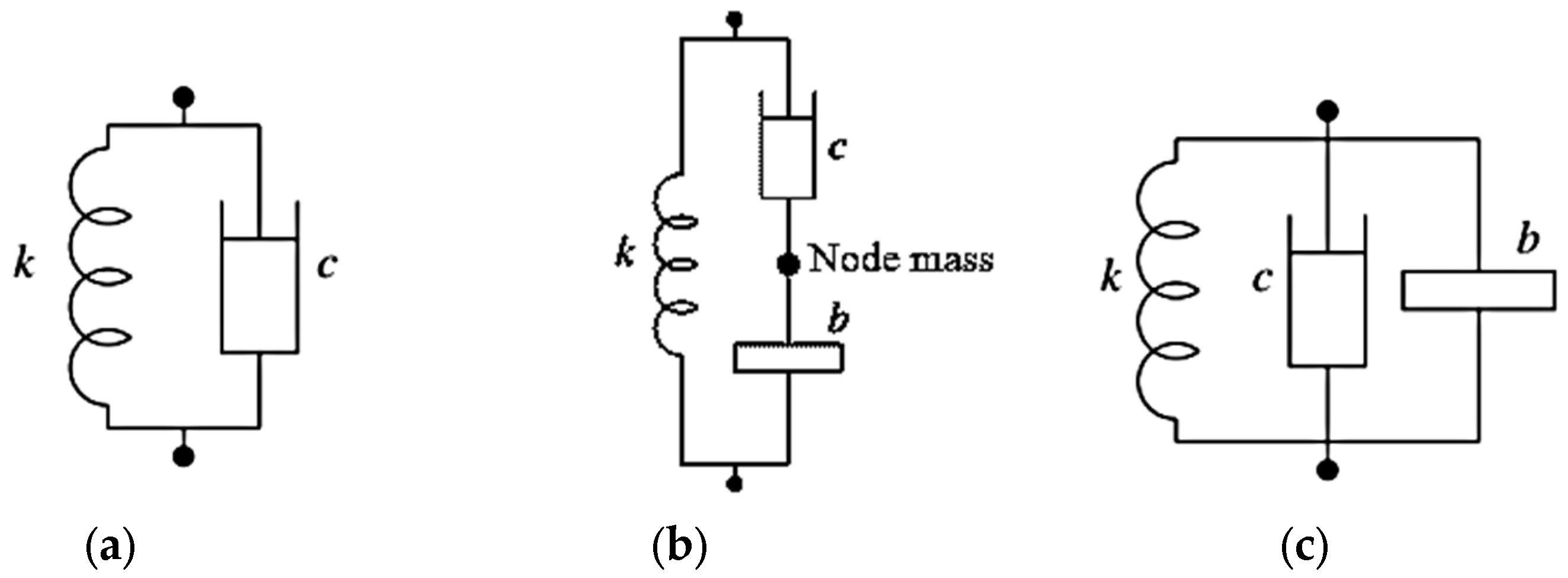
2.1. The Inerter
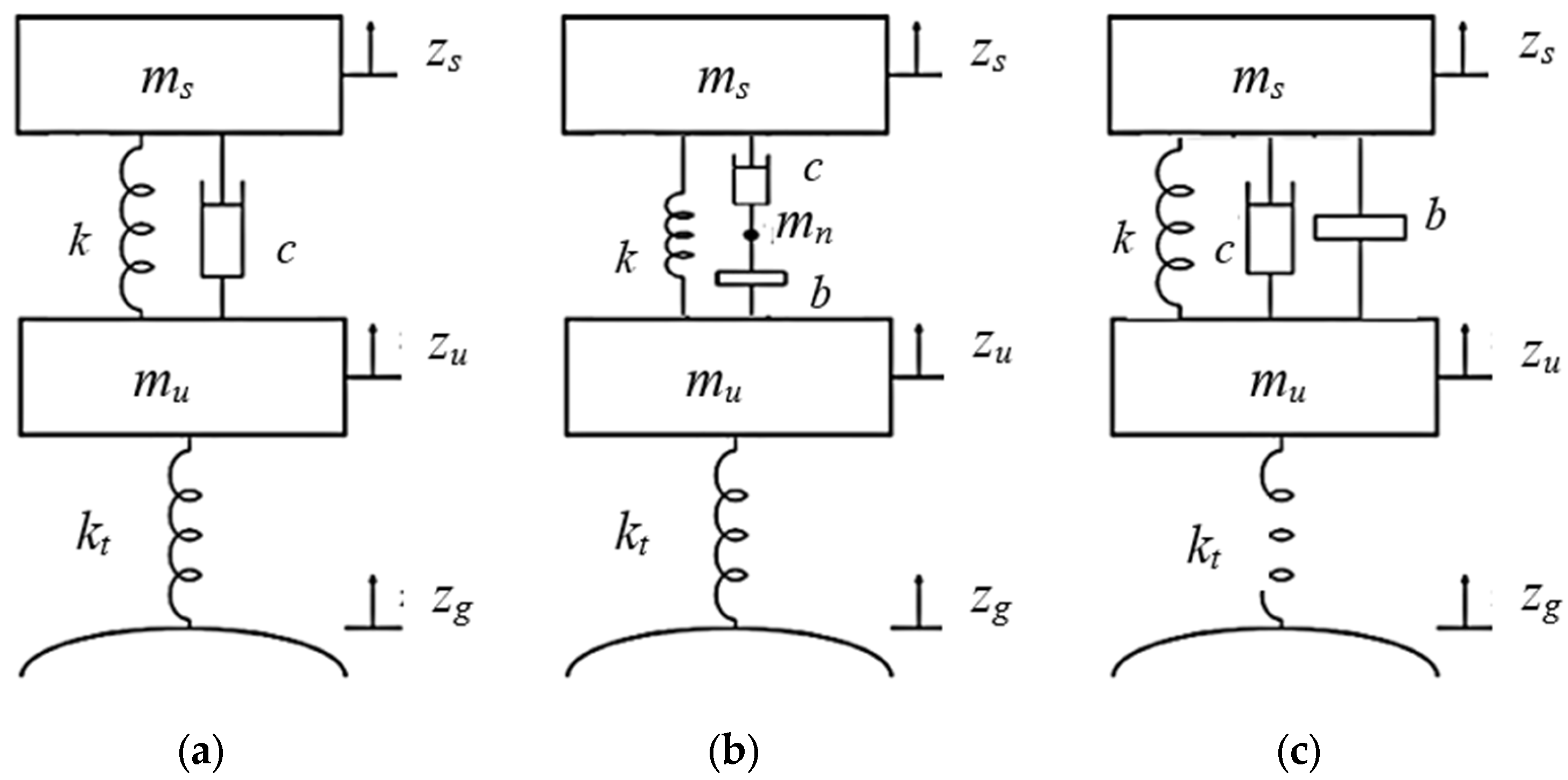
2.2. Vehicle Suspension Configurations
- Conventional suspension;
- Series passive inerter suspension;
- Series linearly increasing variable inerter;
- Series non-linearly increasing variable inerter;
- Parallel passive inerter suspension;
- Parallel linearly increasing variable inerter;
- Parallel non-linearly increasing variable inerter.
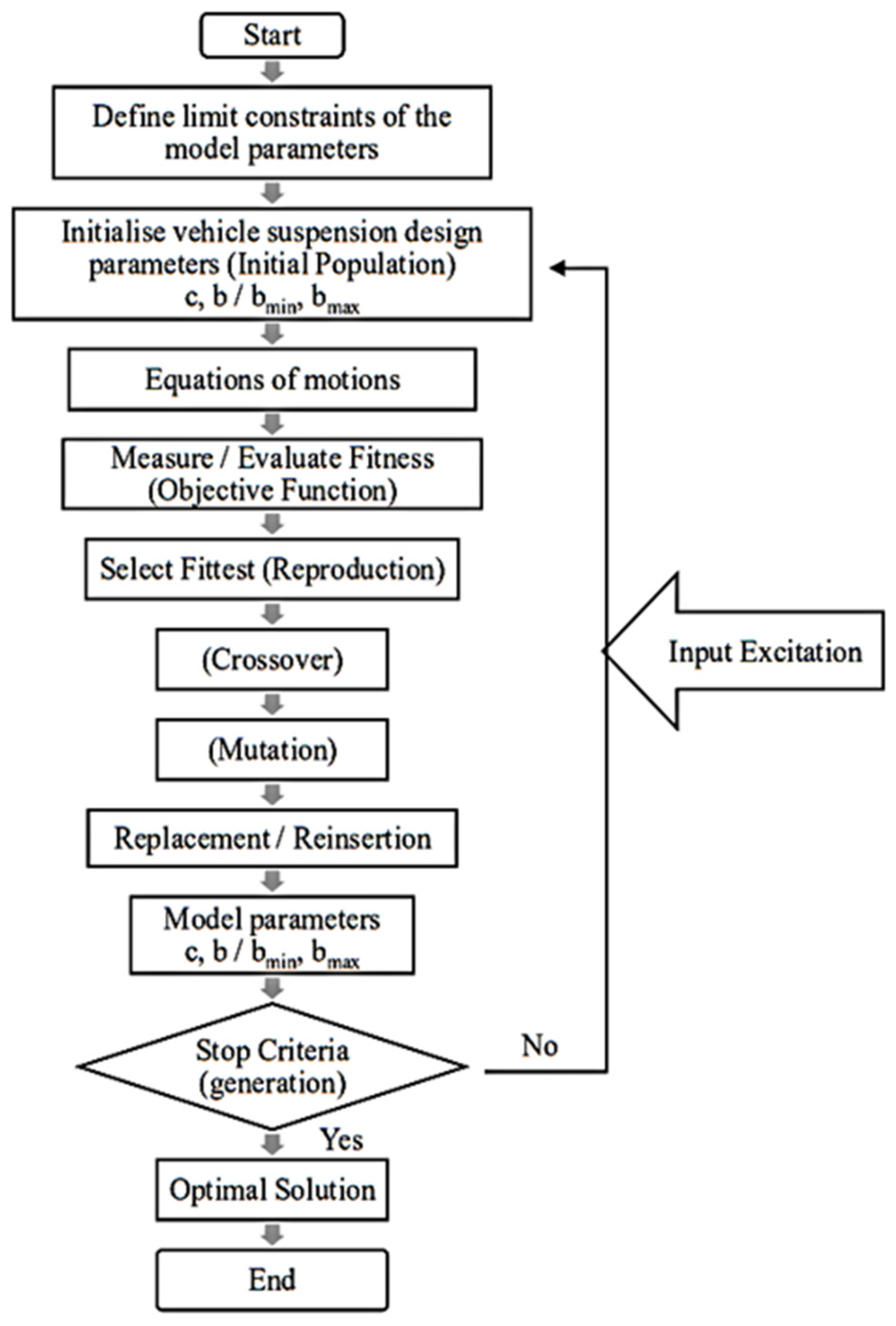
3. Optimization of Suspension Parameters Using Multi-Objective Genetic Algorithm
4. Simulation-Based Performance Analysis of Variable Inertance Profile
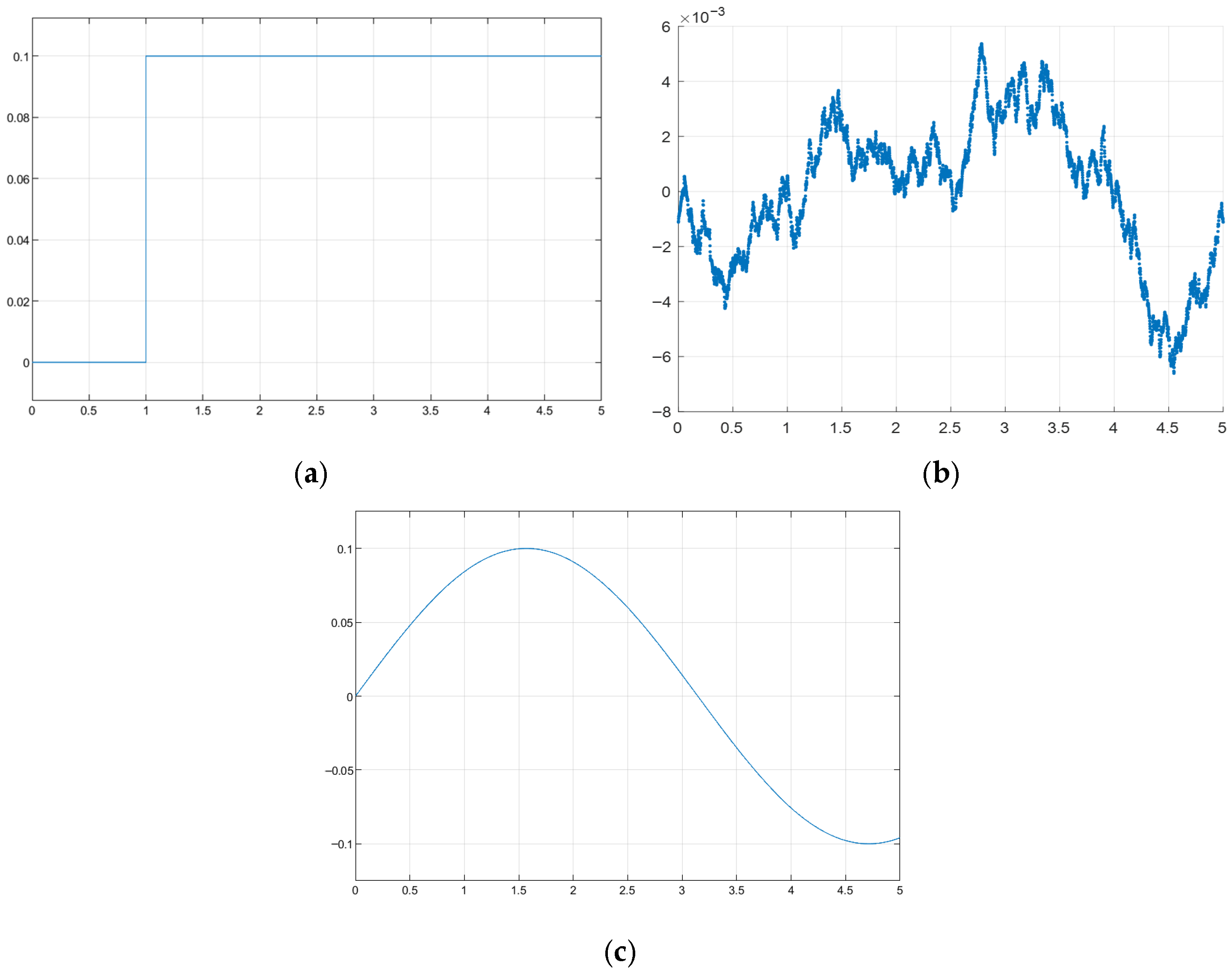
4.1. Performance Analysis Under Step Road Profile
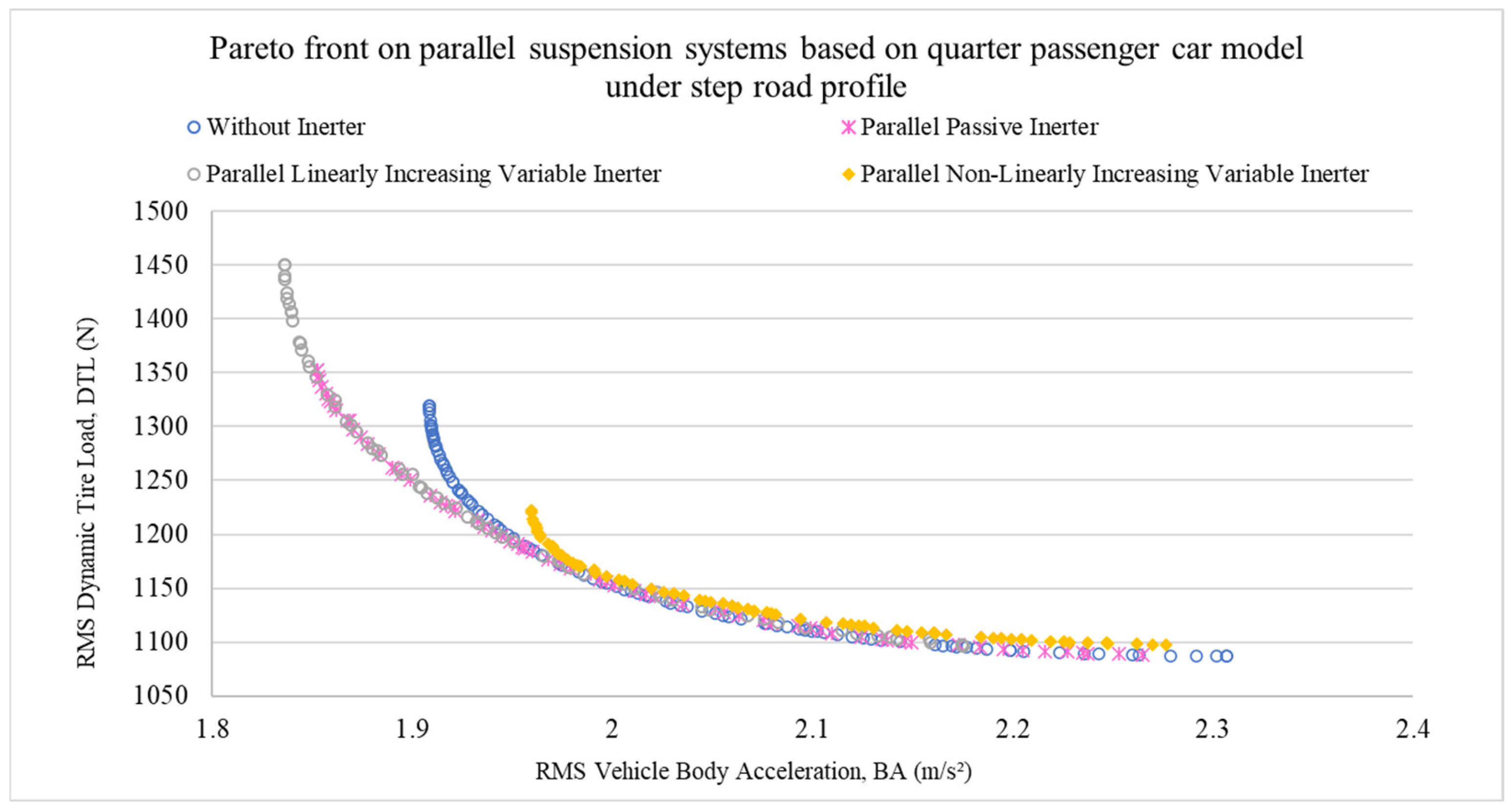
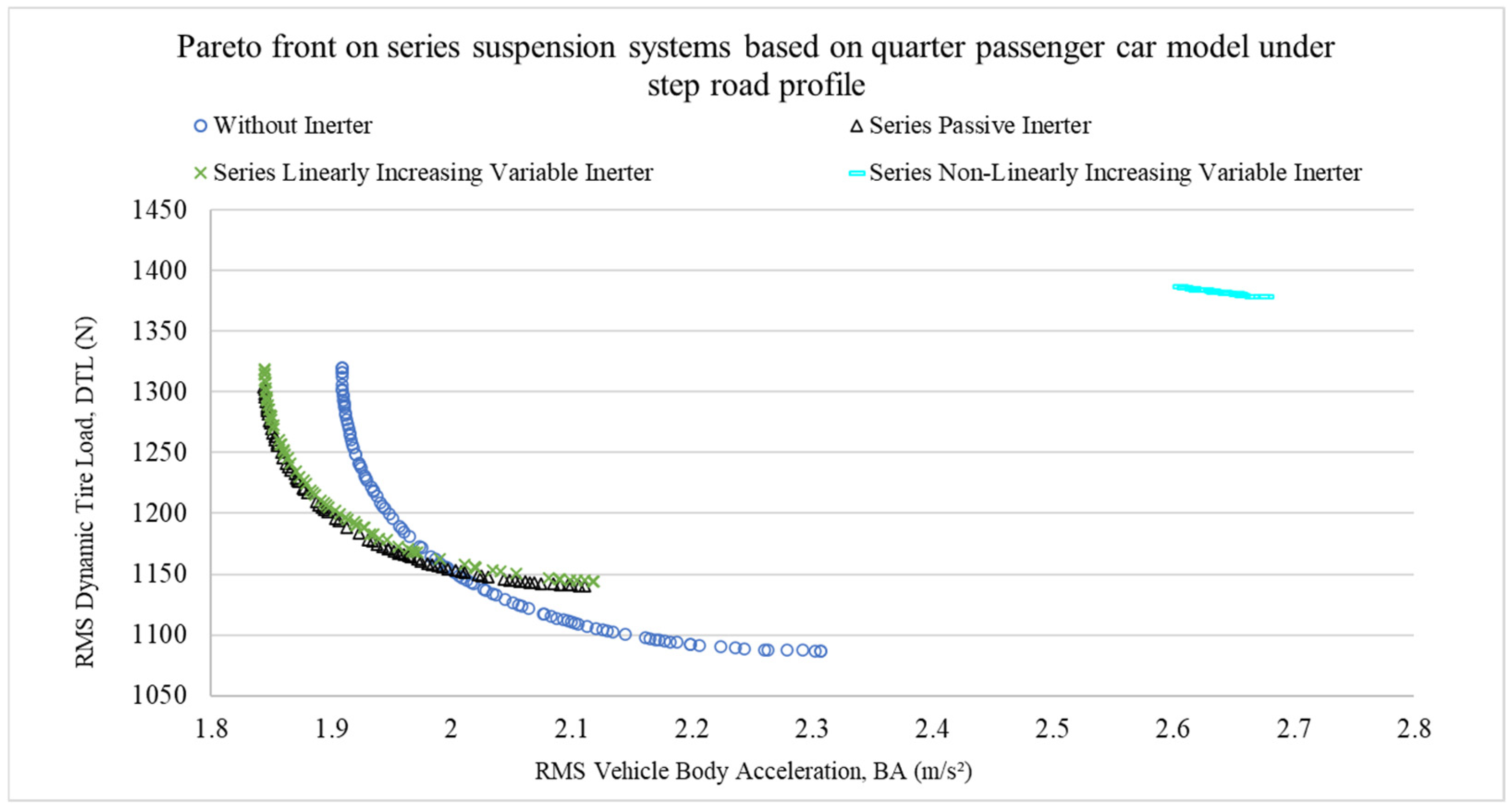
4.1.1. Pareto Front Characteristics
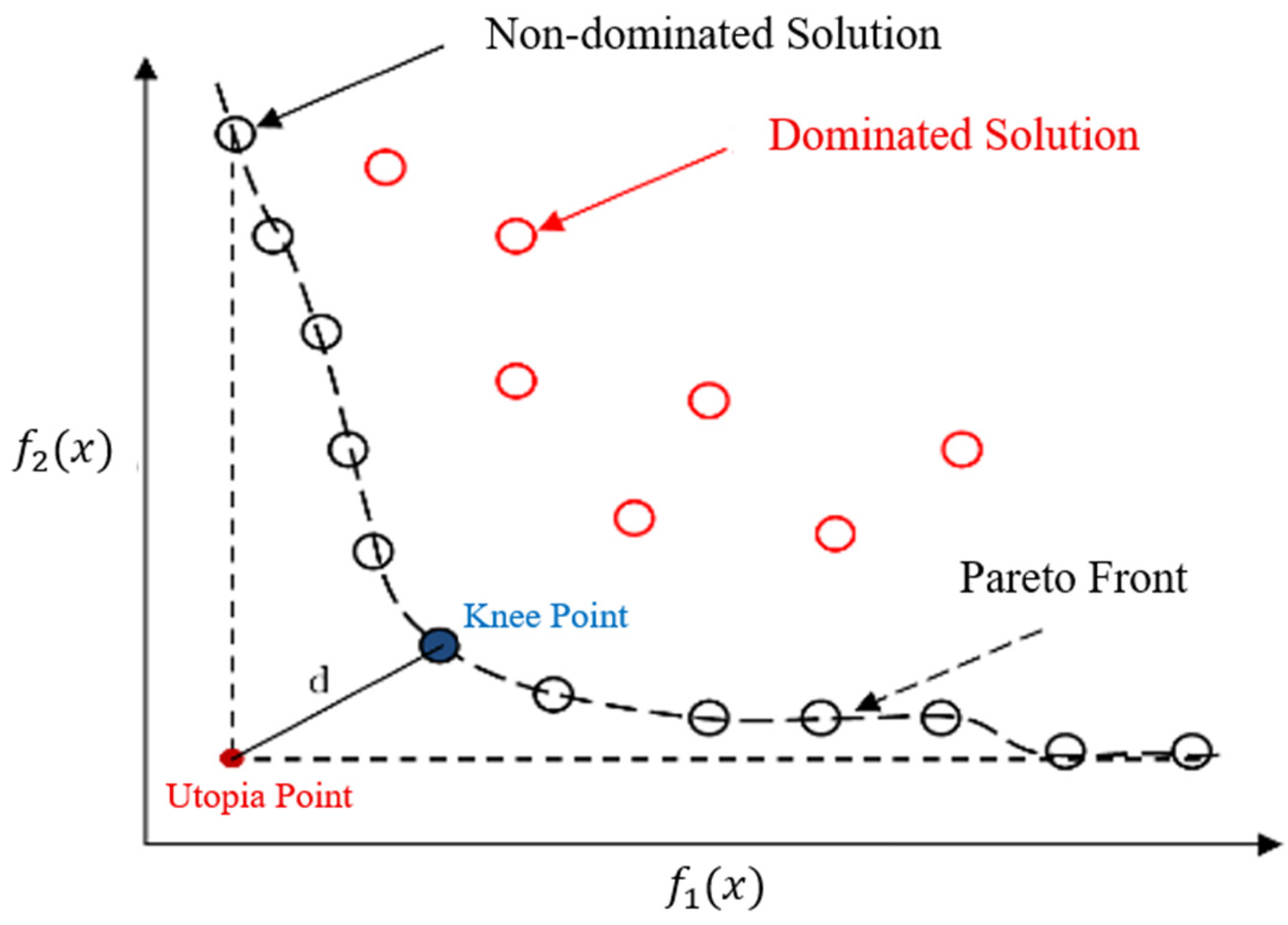
4.1.2. Utopia and Knee Point Evaluations
4.1.3. Analysis of Optimized Design Variables
4.2. Performance Analysis Under Multiple Road Profiles
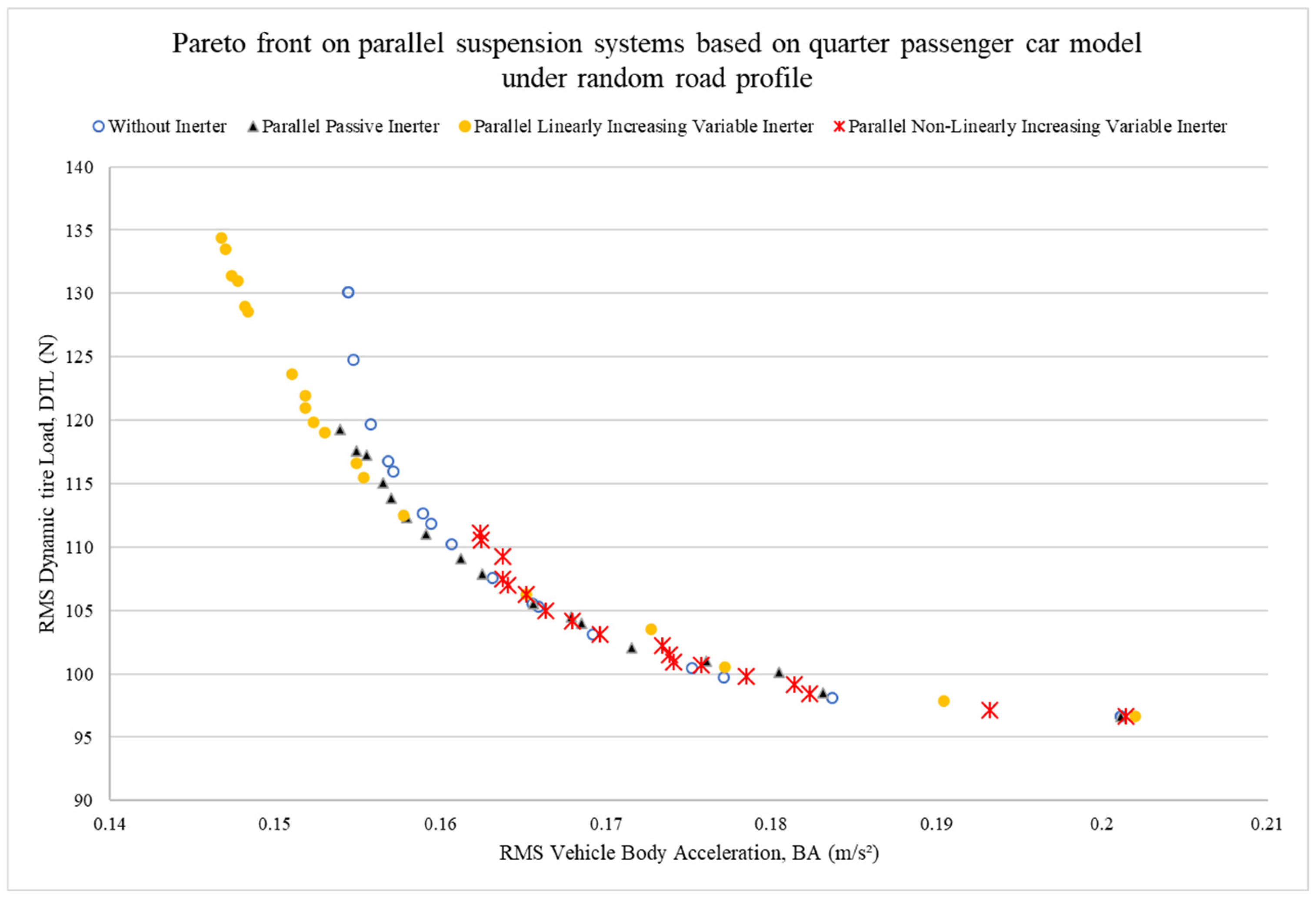
4.2.1. Performance Under Random Road Profile
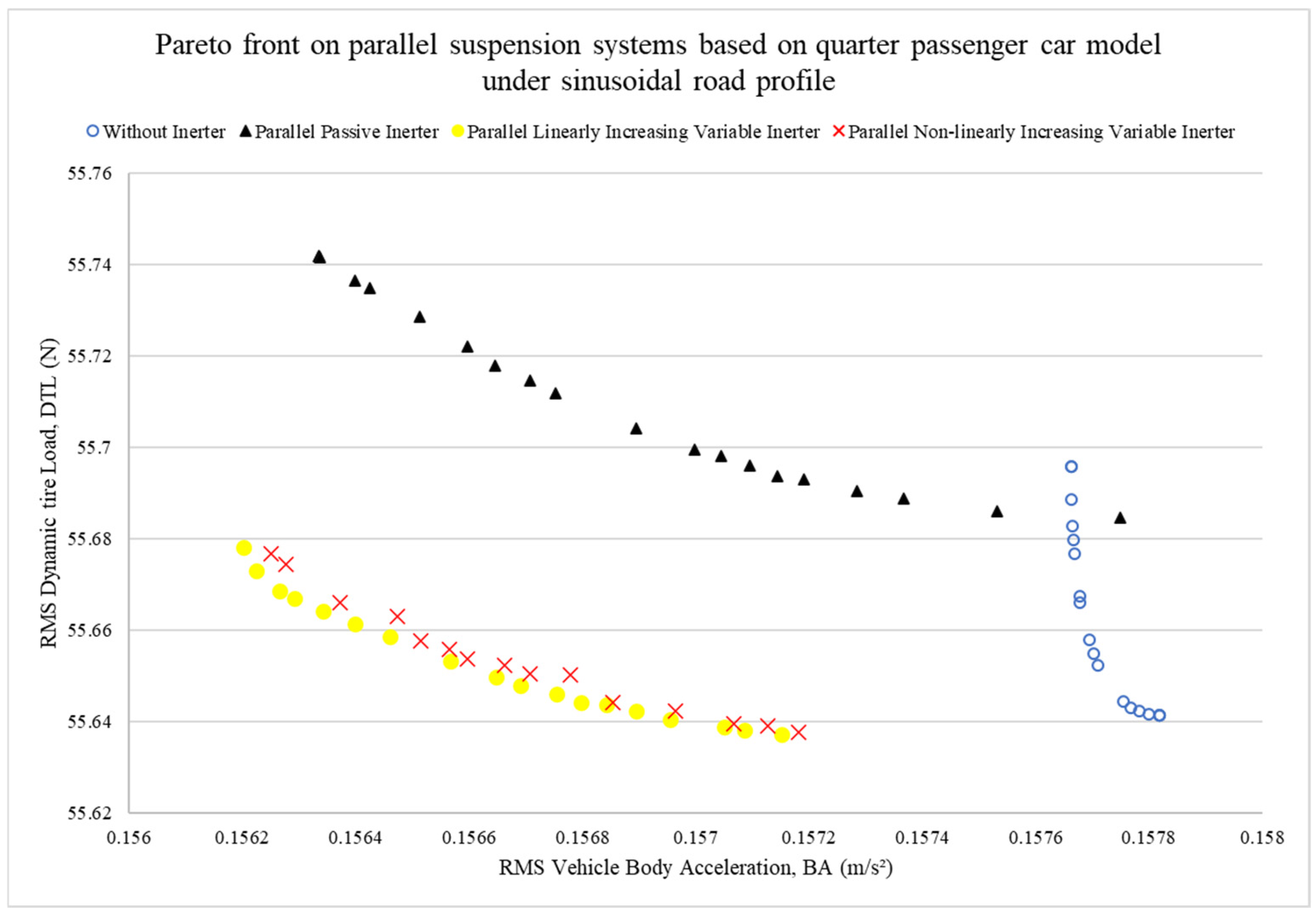
4.2.2. Performance Under Sinusoidal Road Profile
4.3. Physical Realization of Speed-Dependent Variable Inerter
5. Conclusions
Author Contributions
Funding
Data Availability Statement
Conflicts of Interest
References
- Soong, M.F.; Ramli, R.; Liza, M. Vehicle suspensions with parallel inerter: Effectiveness in improving vibration isolation. J. Vibro Eng. 2014, 16, 256–265. [Google Scholar]
- Smith, M.C. Synthesis of Mechanical Networks: The Inerter. IEEE Trans. Autom. Contr 2002, 47, 1648–1662. [Google Scholar] [CrossRef]
- Smith, M.C. The Inerter: A Retrospective. Annu. Rev. Control Robot. Auton. Syst. 2020, 3, 361–391. [Google Scholar] [CrossRef]
- Wen, H.; Guo, J.; Li, Y.; Liu, Y.; Goh, Y.P. Research on nonlinear inertance calculation method of ball-screw inerter. J. Vibro Eng. 2017, 19, 4042–4057. [Google Scholar] [CrossRef]
- Sun, X.Q.; Chen, L.; Wang, S.H.; Zhang, X.L.; Yang, X.F. Performance investigation of vehicle suspension system with nonlinear ball-screw inerter. Int. J. Automot. Technol. 2016, 17, 399–408. [Google Scholar] [CrossRef]
- Wagg, D.J. A review of the mechanical inerter: Historical context, physical realisations and nonlinear applications. Nonlinear Dyn. 2021, 104, 13–34. [Google Scholar] [CrossRef]
- Ma, R.; Bi, K.; Hao, H. Inerter-based structural vibration control: A state-of-the-art review. Eng. Struct. 2021, 243, 112655. [Google Scholar] [CrossRef]
- Soong, M.F.; Ramli, R.; Saifizul, A.A.; Goh, K.Y.; Long, S.X. Investigation of inerter-based suspension systems for heavy vehicles. PLoS ONE 2023, 18, e0280290. [Google Scholar] [CrossRef]
- Goh, K.Y.; Soong, M.F.; Ramli, R.; Saifizul, A.A. Design optimization of variable inerter based on vehicle suspension performance criteria. Microsyst. Technol. 2024, 31, 1597–1609. [Google Scholar] [CrossRef]
- Alshabatat, N.; Shaqarin, T. Impact of Using an Inerter on the Performance of Vehicle Active Suspension. Adv. Sci. Technol. Res. J. 2022, 16, 331–339. [Google Scholar] [CrossRef]
- Qiu, C.; Chen, A.; Xu, Y.; Shen, Y. Optimal Design and Dynamic Performance Analysis of Vehicle Suspension Employing an Eccentric Inerter. Shock Vib. 2022, 2022, 6696788. [Google Scholar] [CrossRef]
- Yang, X.; Yan, L.; Shen, Y.; Li, H.; Liu, Y. Dynamic performance analysis and parameters perturbation study of inerter–spring–damper suspension for heavy vehicle. J. Low. Freq. Noise Vib. Act. Control 2020, 40, 1335–1350. [Google Scholar] [CrossRef]
- Ge, Z.; Wang, W.; Li, G.; Rao, D. Design, Parameter Optimisation, and Performance Analysis of Active Tuned Inerter Damper (TID) Suspension for Vehicle. J. Sound. Vib. 2022, 525, 116750. [Google Scholar] [CrossRef]
- He, X.L.; Chen, J.; Tang, D.Y.; Peng, S.; Tang, B.B. Using an Inerter-Based Suspension to Reduce Carbody Flexible Vibration and Improve Riding-Comfort. SAE Int. J. Veh. Dyn. Stab. NVH 2023, 7, 137–151. [Google Scholar] [CrossRef]
- Liu, X.; Jiang, J.Z.; Titurus, B.; Harrison, A.J.L.; McBryde, D. Testing and modelling of the damping effects for fluid-based inerters. Procedia Eng. 2017, 199, 435–440. [Google Scholar] [CrossRef]
- Shen, Y.; Chen, L.; Liu, Y.; Zhang, X. Modeling and Optimization of Vehicle Suspension Employing a Nonlinear Fluid Inerter. Shock Vib. 2016, 2016, 2623017. [Google Scholar] [CrossRef]
- Ge, Z.; Wang, W. Modeling, Testing, and Characteristic Analysis of a Planetary Flywheel Inerter. Shock Vib. 2016, 2016, 2631539. [Google Scholar] [CrossRef]
- Wang, F.C.; Chen, Y.C.; Lee, C.H. Design and optimization of inerter layouts for a multi-layers building model. In Proceedings of the 2016 55th Annual Conference of the Society of Instrument and Control Engineers of Japan, SICE 2016; IEEE: New York, NY, USA, 2016. [Google Scholar] [CrossRef]
- Mitra, A.C.; Kiranchand, G.R.; Soni, T.; Banerjee, N. Design of Experiments for Optimization of Automotive Suspension System Using Quarter Car Test Rig. Procedia Eng. 2016, 144, 1102–1109. [Google Scholar] [CrossRef]
- Shen, Y.; Liu, Y.; Chen, L.; Yang, X. Optimal design and experimental research of vehicle suspension based on a hydraulic electric inerter. Mechatronics 2019, 61, 12–19. [Google Scholar] [CrossRef]
- Brzeski, P.; Lazarek, M.; Perlikowski, P. Experimental study of the novel tuned mass damper with inerter which enables changes of inertance. J. Sound. Vib. 2017, 404, 47–57. [Google Scholar] [CrossRef]
- Caicedo, D.; Lara-Valencia, L.; Blandón, J. Optimal design and performance evaluation of tuned mass damper inerter in building structures. Rev. Fac. Ing. 2022, 106, 66–77. [Google Scholar] [CrossRef]
- Sarkar, S.; Fitzgerald, B. Design of Tuned Mass Damper Fluid Inerter for Wind-Induced Vibration Control of a Tall Building. J. Struct. Eng. 2024, 150, 04023242. [Google Scholar] [CrossRef]
- Kang, X.; Wu, J.; Wang, X.; Lei, S. Parameters Optimization and Performance Evaluation of the Tuned Inerter Damper for the Seismic Protection of Adjacent Building Structures. CMES Comput. Model. Eng. Sci. 2024, 138, 551–593. [Google Scholar] [CrossRef]
- Pippi Ade, S.; Avila, S.M.; Doz, G. A review on the use of the inerter device in the structural coupling technique for adjacent building vibration control. Structures 2022, 42, 480–501. [Google Scholar] [CrossRef]
- Taflanidis, A.A.; Giaralis, A.; Patsialis, D. Multi-objective optimal design of inerter-based vibration absorbers for earthquake protection of multi-storey building structures. J. Franklin Inst. 2019, 356, 7754–7784. [Google Scholar] [CrossRef]
- Wang, F.C.; Hsieh, M.R.; Chen, H.J. Stability and performance analysis of a full-train system with inerters. Veh. Syst. Dyn. 2012, 50, 545–571. [Google Scholar] [CrossRef]
- Han, S.; Wang, X.; Yang, C.; Xie, G.; Qiu, Z.; Wang, C. Optimization and Performance Analysis of Rail-Train Coupling System with Inerters. Complexity 2021, 2021, 9974803. [Google Scholar] [CrossRef]
- Zhang, X.; Li, H.; Cheng, J.; Sheng, L.; Yao, Y. Adaptive stability mechanism of high-speed train employing parallel inerter yaw damper. Veh. Syst. Dyn. 2023, 61, 38–57. [Google Scholar] [CrossRef]
- Lewis, T.D.; Jiang, J.Z.; Neild, S.A.; Gong, C.; Iwnicki, S.D. Using an inerter-based suspension to improve both passenger comfort and track wear in railway vehicles. Veh. Syst. Dyn. 2020, 58, 472–493. [Google Scholar] [CrossRef]
- Chen, M.Z.Q.; Hu, Y. Semi-active Inerter and Adaptive Tuned Vibration Absorber. In Inerter and Its Application in Vibration Control Systems; Springer: Singapore, 2019. [Google Scholar] [CrossRef]
- Zhao, Z.; Zhang, R.; Jiang, Y.; Pan, C. A tuned liquid inerter system for vibration control. Int. J. Mech. Sci. 2019, 164, 105171. [Google Scholar] [CrossRef]
- Shen, Y.; Jia, M.; Yang, K.; Chen, Z.; Chen, L. Benefits of the inerter in vibration suppression of a milling machine. J. Franklin Inst. 2019, 356, 7689–7703. [Google Scholar] [CrossRef]
- Ning, D.; Sun, S.; Yu, J.; Zheng, M.; Du, H.; Zhang, N.; Li, W. A rotary variable admittance device and its application in vehicle seat suspension vibration control. J. Franklin Inst. 2019, 356, 7873–7895. [Google Scholar] [CrossRef]
- Li, Y.; Han, S.; Xiong, J.; Wang, W. Comfort-Oriented Semi-Active Suspension Configuration with Inerter-Based Network Synthesis. Actuators 2023, 12, 290. [Google Scholar] [CrossRef]
- Cao, J.; Ning, D.; Liu, P.; Sun, S.; Liu, G.; Du, H. A versatile semi-active magnetorheological inerter with energy harvesting and active control capabilities. Smart Mater. Struct. 2024, 33, 015040. [Google Scholar] [CrossRef]
- Yu, J.; Dong, X.; Su, X.; Tao, X.; Li, X. Design and testing of a semi-active inerter with magneto-rheological fluid valve. Smart Mater. Struct. 2021, 30, 105035. [Google Scholar] [CrossRef]
- Yang, Y.; Chen, L.; Liu, C.; Zhang, X. Two-Parameter Frequency Tracker and Its Application of Semi-active Suspension with Inerter. J. Vib. Eng. Technol. 2024, 12, 3905–3917. [Google Scholar] [CrossRef]
- Hu, Y.; Hua, T.; Chen, M.Z.Q.; Shi, S.; Sun, Y. Application of semi-active inerter in a two-body point absorber via force tracking. Trans. Inst. Meas. Control. 2021, 43, 2809–2817. [Google Scholar] [CrossRef]
- Shen, Y.; Chen, A.; Du, F.; Yang, X.; Liu, Y.; Chen, L. Performance enhancements of semi-active vehicle air ISD suspension. Proc. Inst. Mech. Eng. Part D J. Automob. Eng. 2025, 239, 2952–2963. [Google Scholar] [CrossRef]
- Su, X.; Xie, S.; Li, J. Analysis of Vehicle Vibration Considering Fractional Damping in Suspensions and Tires. Fractal Fract. 2025, 9, 620. [Google Scholar] [CrossRef]
- Karpenko, M.; Prentkovskis, O.; Skačkauskas, P. Analysing the impact of electric kick-scooters on drivers: Vibration and frequency transmission during the ride on different types of urban pavements. Eksploat. Niezawodn. 2025, 27. [Google Scholar] [CrossRef]
- Karpenko, M.; Skačkauskas, P.; Prentkovskis, O. Investigation of Vibration and Frequency Transmission to Riders from Electric Kick-Scooters on Various Urban Pavements. In Lecture Notes in Mobility; Springer: Cham, Switzerland, 2026. [Google Scholar] [CrossRef]
- Vella, A.D.; Digo, E.; Gastaldi, L.; Pastorelli, S.; Vigliani, A. Statistical Analysis of the Vibrations Transmitted From an Electric Kick Scooter to Riders. Exp. Tech. 2024, 48, 803–813. [Google Scholar] [CrossRef]
- Karpenko, M. Safety and reliability assessment of personal electric kick-scooter riding with different tire types. Eksploat. Niezawodn. 2026, 28. [Google Scholar] [CrossRef]
- Lee, K.J.; Yun, C.H.; Yun, M.H. Contextual risk factors in the use of electric kick scooters: An episode sampling inquiry. Saf. Sci. 2021, 139, 105233. [Google Scholar] [CrossRef]
- Karpenko, M.; Prentkovskis, O.; Skačkauskas, P. Numerical Simulation of Vehicle Tyre under Various Load Conditions and Its Effect on Road Traffic Safety. Promet Traffic Trans. 2024, 36, 1–11. [Google Scholar] [CrossRef]
- Karpenko, M.; Eičinas, D. Dynamic Analysis of Micromobility In-Wheel Suspension System—Enhancing Safety in Urban Environments. Promet. Traffic Transp. 2026, 38, 229–242. [Google Scholar] [CrossRef]
- Smith, M.C.; Wang, F.C. Performance Benefits in Passive Vehicle Suspensions Employing Inerters. In Proceeding of the IEEE Conference on Decision and Control; IEEE: New York, NY, USA, 2004. [Google Scholar] [CrossRef]
- Tan, B.; Tan, X.; Liu, J.; Li, H.; Xie, Y. Design and Dynamic Analysis of a Flexible Inertia Device for Vehicle Suspensions. In Lecture Notes in Electrical Engineering; Springer: Berlin/Heidelberg, Germany, 2024. [Google Scholar] [CrossRef]
- Shi, B.; Dai, W.; Yang, J. Performance enhancement of vehicle suspension system with geometrically nonlinear inerters. Arch. Appl. Mech. 2024, 94, 39–55. [Google Scholar] [CrossRef]
- Soong, M.F.; Ramli, R.; Mahadi, L.; Saifizul, A. Ride improvement of vehicle suspensions with switchable inerter based on force cancellation strategy. J. Vibro Eng. 2017, 19, 1260–1272. [Google Scholar] [CrossRef]
- ISO 8608; Road Surface Profiles—Reporting of Measured Data. International Standards Organisation: Geneve, Switzerland, 2016.
- Gampa, S.R.; Mangipudi, S.K.; Jasthi, K.; B, M.B.; Goli, P.; Das, D.; Balas, V.E. Pareto optimality based PID controller design for vehicle active suspension system using grasshopper optimization algorithm. J. Electr. Syst. Inf. Technol. 2022, 9, 24. [Google Scholar] [CrossRef]
- Zare, H.; Jalili, M.M.; Fazel, M.R. Multiobjective optimization for semi-active electromagnetic vehicle suspensions. J. Braz. Soc. Mech. Sci. Eng. 2023, 45, 419. [Google Scholar] [CrossRef]
- Llopis-Albert, C.; Rubio, F.; Zeng, S. Multiobjective optimization framework for designing a vehicle suspension system. A comparison of optimization algorithms. Adv. Eng. Softw. 2023, 176, 103375. [Google Scholar] [CrossRef]
- Ślaski, G. Damping paramenters of suspension of passenger vehicle equipped with semi-active dampers with by-pass valve. Transp. Probl. 2011, 6, 35–42. [Google Scholar]
- Li, C.; Liang, M.; Wang, Y.; Dong, Y. Vibration suppression using two-terminal flywheel. Part I: Modeling and characterization. J. Vib. Control 2012, 18, 1096–1105. [Google Scholar] [CrossRef]
- Gasparetto, V.E.L.; Reid, J.; Parsons, W.P.; ElSayed, M.S.A.; Saad, M.; Shieldand, S.; Brown, G.L.; Hilliard, L.M. Multi-Objective Design Optimization of Multiple Tuned Mass Dampers for Attenuation of Dynamic Aeroelastic Response of Aerospace Structures. Aerospace 2023, 10, 235. [Google Scholar] [CrossRef]
- Mohsen, M.; Kamel, H.; Sharaf, A.M.; El-Demerdash, S.M. Optimal design of passive suspension system of a 6 × 6 multi-wheeled all-terrain vehicle using genetic algorithm. Int. J. Heavy Veh. Syst. 2018, 25, 508–533. [Google Scholar] [CrossRef]
- Szparaga, A.; Stachnik, M.; Czerwińska, E.; Kocira, S.; Dymkowska-Malesa, M.; Jakubowski, M. Multi-objective optimization based on the utopian point method applied to a case study of osmotic dehydration of plums and its storage. J. Food Eng. 2019, 245, 104–111. [Google Scholar] [CrossRef]
- Georgiou, G.; Verros, G.; Natsiavas, S. Multi-objective optimization of quarter-car models with a passive or semi-active suspension system. Veh. Syst. Dyn. 2007, 45, 77–92. [Google Scholar] [CrossRef]
- Bre, F.; Fachinotti, V.D. A computational multi-objective optimization method to improve energy efficiency and thermal comfort in dwellings. Energy Build. 2017, 154, 283–294. [Google Scholar] [CrossRef]
- Hu, Y.; Michael, Z.Q.; Shu, Z. Passive vehicle suspensions employing inerters with multiple performance requirements. J. Sound. Vib. 2014, 333, 2212–2225. [Google Scholar] [CrossRef]
- Ramakrishnan, K.; Yang, L.; Ballo, F.; Gobbi, M.; Mastinu, G. Multi-Objective Optimization of Road Vehicle Passive Suspensions With Inerter. In Proceedings of the ASME 2016 International Design Engineering Technical Conferences and Computers and Information in Engineering Conference; ASME: New York, NY, USA, 2016. [Google Scholar] [CrossRef]
- de Toledo, V.M.; da Silva, R.R.; Avila, S.M.; Leonardo, E.; Murilo, A. A Comparative Analysis of Inerter Integration in Suspension Systems. In Proceedings of the XLV Ibero-Latin-American Congress on Computational Methods in Engineering, ABMEC, Maceio, Brazil, 11–14 November 2024; Available online: https://publicacoes.softaliza.com.br/cilamce/article/view/8085/6978 (accessed on 5 July 2025).
- Arakelian, V. Design of Variable Moment of Inertia Flywheel. In Mechanisms and Machine Science; Springer: Amsterdam, The Netherlands, 2022. [Google Scholar] [CrossRef]
- Zhang, Y.; Zhang, X.; Qian, T.; Hu, R. Modeling and simulation of a passive variable inertia flywheel for diesel generator. Energy Rep. 2020, 6, 58–68. [Google Scholar] [CrossRef]
- Goh, K.Y.; Soong, M.F.; Ramli, R.; Saifizul, A.A.; Khoo, S.Y. Design and Characterization of a Non-Linear Variable Inerter in Vehicle Suspension System. Int. J. Integr. Eng. 2023, 15, 198–207. [Google Scholar] [CrossRef]
- Yang, S.; Xu, T.; Li, C.; Liang, M.; Baddour, N. Design, Modeling and Testing of a Two-Terminal Mass Device With a Variable Inertia Flywheel. J. Mech. Des. Trans. ASME 2016, 138, 095001. [Google Scholar] [CrossRef]
- Rashid, M.M.; Ali, M.Y.; ul Islam, R. Energy Saving Capability of Variable Inertia Magneto-Rheological (MR) Flywheel. In AIP Conference Proceedings 2023; AIP Publishing: Melville, NY, USA, 2023. [Google Scholar] [CrossRef]
- Liu, P.; Ning, D.; Luo, L.; Zhang, N.; Du, H. An Electromagnetic Variable Inertance and Damping Seat Suspension with Controllable Circuits. IEEE Trans. Ind. Electron. 2022, 69, 2811–2821. [Google Scholar] [CrossRef]
- Li, W.; Dong, X.; Yu, J.; Xi, J.; Pan, C. Vibration control of vehicle suspension with magneto-rheological variable damping and inertia. J. Intell. Mater. Syst. Struct. 2021, 32, 1484–1503. [Google Scholar] [CrossRef]
- Zhong, W.M.; Bai, X.X.; Tang, C.; Zhu, A.D. Principle study of a semi-active inerter featuring magnetorheological effect. Front. Mater. 2019, 6, 17. [Google Scholar] [CrossRef]





| Types of Inerter | Mathematical Model |
|---|---|
| Passive inerter | |
| Linearly increasing variable inerter | |
| Non-linearly increasing variable inerter (exponential) |
| Vehicle Parameter | Passenger Car |
|---|---|
| Sprung mass, (kg) | 317.5 |
| Unsprung mass, (kg) | 45.4 |
| Node mass, (kg) | 0.001 |
| Suspension stiffness, (N/m) | 22,000 |
| Suspension damping, (N·s/m) | 1500 |
| Tire stiffness, (N/m) | 192,000 |
| Inertance, b (kg) | 6 |
| Types of Suspension System | Utopia Point | ||||
|---|---|---|---|---|---|
| RMS BA (m/s2) | RMS DTL (N) | Difference in BA (%) | Difference in DTL (%) | ||
| Standard (without inerter) | 1.9086 | 1087.16 | Reference | ||
| Series Suspension | Passive inerter | 1.8438 | 1140.25 | −3.40 | 4.88 |
| Linearly increasing variable inerter | 1.8444 | 1144.09 | −3.37 | 5.24 | |
| Non-linearly increasing variable inerter | 2.6053 | 1378.54 | 36.50 | 26.80 | |
| Parallel Suspension | Passive inerter | 1.8527 | 1087.91 | −2.93 | 0.07 |
| Linearly increasing variable inerter | 1.8360 | 1096.71 | −3.80 | 0.88 | |
| Non-linearly increasing variable inerter | 1.9595 | 1097.32 | 2.66 | 0.93 | |
| Types of Suspension System | Knee Point | ||||
|---|---|---|---|---|---|
| RMS BA (m/s2) | RMS DTL (N) | Difference in BA (%) | Difference in DTL (%) | ||
| Standard (without inerter) | 2.0185 | 1141.81 | Reference | ||
| Series Suspension | Passive inerter | 1.9303 | 1178.70 | −4.37 | 3.23 |
| Linearly increasing variable inerter | 1.9325 | 1183.34 | −4.26 | 3.64 | |
| Non-linearly increasing variable inerter | 2.6093 | 1386.27 | 29.27 | 21.41 | |
| Parallel Suspension | Passive inerter | 2.0010 | 1152.82 | −0.87 | 0.96 |
| Linearly increasing variable inerter | 1.9856 | 1163.35 | −1.63 | 1.89 | |
| Non-linearly increasing variable inerter | 2.0254 | 1146.27 | 0.34 | 0.39 | |
| Types of Suspension System | Suspension Damping, c (N·s/m) | Passive Inertance, b (kg) | Variable Inertance | |||
|---|---|---|---|---|---|---|
| Minimum Inertance, bmin (kg) | Maximum Inertance, bmax (kg) | Inertance Variation (%) | ||||
| Standard (without inerter) | 1549 | - | - | - | - | |
| Series Suspension | Passive inerter | 1587 | 316.91 | - | - | - |
| Linearly increasing variable inerter | 1586 | - | 283.15 | 285.15 | 0.71 | |
| Non-linearly increasing variable inerter | 1325 | - | 73.69 | 96.89 | 31.48 | |
| Parallel Suspension | Passive inerter | 1503 | 0.33 | - | - | - |
| Linearly increasing variable inerter | 1458 | - | 0.46 | 0.64 | 39.13 | |
| Non-linearly increasing variable inerter | 1628 | - | 1.13 | 2.26 | 100 | |
| Types of Suspension System | Utopia Point | |||
|---|---|---|---|---|
| RMS BA (m/s2) | RMS DTL (N) | Difference in BA (%) | Difference in DTL (%) | |
| Standard (without inerter) | 0.1544 | 96.63 | Reference | |
| Passive inerter | 0.1539 | 96.63 | −0.31 | 0 |
| Linearly increasing variable inerter | 0.1468 | 96.63 | −4.94 | 0 |
| Non-linearly increasing variable inerter | 0.1624 | 96.69 | 5.20 | 0.07 |
| Types of Suspension System | Knee Point | |||
|---|---|---|---|---|
| RMS BA (m/s2) | RMS DTL (N) | Difference in BA (%) | Difference in DTL (%) | |
| Standard (without inerter) | 0.1692 | 103.15 | Reference | |
| Passive inerter | 0.1656 | 105.56 | −2.11 | 2.34 |
| Linearly increasing variable inerter | 0.1651 | 106.27 | −2.39 | 3.03 |
| Non-linearly increasing variable inerter | 0.1741 | 100.91 | 2.90 | −2.17 |
| Types of Suspension System | Utopia Point | |||
|---|---|---|---|---|
| RMS BA (m/s2) | RMS DTL (N) | Difference in BA (%) | Difference in DTL (%) | |
| Standard (without inerter) | 0.1577 | 55.64 | Reference | |
| Passive inerter | 0.1563 | 55.68 | −0.84 | 0.08 |
| Linearly increasing variable inerter | 0.1562 | 55.64 | −0.93 | −0.01 |
| Non-linearly increasing variable inerter | 0.1563 | 55.64 | −0.90 | −0.01 |
| Types of Suspension System | Knee Point | |||
|---|---|---|---|---|
| RMS BA (m/s2) | RMS DTL (N) | Difference in BA (%) | Difference in DTL (%) | |
| Standard (without inerter) | 0.1577 | 55.66 | Reference | |
| Passive inerter | 0.1563 | 55.74 | −0.86 | 0.15 |
| Linearly increasing variable inerter | 0.1562 | 55.67 | −0.93 | 0.03 |
| Non-linearly increasing variable inerter | 0.1563 | 55.67 | −0.90 | 0.03 |
Disclaimer/Publisher’s Note: The statements, opinions and data contained in all publications are solely those of the individual author(s) and contributor(s) and not of MDPI and/or the editor(s). MDPI and/or the editor(s) disclaim responsibility for any injury to people or property resulting from any ideas, methods, instructions or products referred to in the content. |
© 2026 by the authors. Licensee MDPI, Basel, Switzerland. This article is an open access article distributed under the terms and conditions of the Creative Commons Attribution (CC BY) license.
Share and Cite
Goh, K.Y.; Soong, M.F.; Ramli, R.; Saifizul, A. Comfort-Oriented Optimization of Speed-Dependent Variable Inertance for Intelligent Vehicle Suspension Systems. Machines 2026, 14, 513. https://doi.org/10.3390/machines14050513
Goh KY, Soong MF, Ramli R, Saifizul A. Comfort-Oriented Optimization of Speed-Dependent Variable Inertance for Intelligent Vehicle Suspension Systems. Machines. 2026; 14(5):513. https://doi.org/10.3390/machines14050513
Chicago/Turabian StyleGoh, Kah Yin, Ming Foong Soong, Rahizar Ramli, and Ahmad Saifizul. 2026. "Comfort-Oriented Optimization of Speed-Dependent Variable Inertance for Intelligent Vehicle Suspension Systems" Machines 14, no. 5: 513. https://doi.org/10.3390/machines14050513
APA StyleGoh, K. Y., Soong, M. F., Ramli, R., & Saifizul, A. (2026). Comfort-Oriented Optimization of Speed-Dependent Variable Inertance for Intelligent Vehicle Suspension Systems. Machines, 14(5), 513. https://doi.org/10.3390/machines14050513