1. Introduction
The worldwide interest in hydrogen fuel cell electric vehicles (FCEVs) as a sustainable vehicle option has increased because they provide an environmentally friendly alternative to traditional internal combustion engine vehicles. FCEVs produce electricity through their fuel cell stacks by using hydrogen and oxygen to create power while emitting only water vapor as their sole waste product. FCEVs constitute a clean propulsion technology that supports worldwide initiatives for greenhouse gas emissions reduction, climate target achievement, and transportation sector decarbonization. The increasing interest in FCEVs is demonstrated by large-scale surveys and academic studies (İnci et al.; Singla et al.) which show how FCEVs contribute to building sustainable and resilient energy and transportation systems [
1,
2]. The global transportation industry is experiencing a complete transformation because of environmental issues and the depletion of fossil fuels and the requirement for sustainable energy transition methods. The transition process centers on battery electric vehicles (BEVs) and hydrogen fuel cell electric vehicles (FCEVs) as both options provide unique benefits and challenges. BEVs serve multiple light-duty applications across the market while FCEVs excel in heavy-duty and long-range operations, which include buses and trucks and maritime transport that requires quick refueling with high energy density. Hydrogen mobility serves as a necessary complementary technology to battery-based electrification systems. FCEVs function as necessary elements to create comprehensive low-carbon transportation networks. The academic community has studied FCEVs through multiple research methods which include technological progress assessment and system-level integration examination. Research efforts focus on developing fuel cell stack designs and power electronic converters and energy management strategies and vehicle architectural systems and marketing approaches for consumer acquisition (Waseem et al.; Pramuanjaroenkij) [
3,
4]. The academic community has emphasized three essential requirements that should receive equal focus to achieve successful large-scale deployment. The field achieved technology improvements through enhanced proton exchange membrane fuel cells (PEMFCs) which now have greater power output capabilities and improved thermal management systems which increase product lifespan and development of lightweight high-pressure hydrogen storage tanks. The commercial deployment of this technology faces three main barriers which involve expenses and infrastructure needs and safety requirement compliance (Manoharan et al.; Greene et al.) [
5,
6]. The main challenges that prevent FCEVs from becoming widely used across the population include three major obstacles.
Hydrogen production and costs: The four hydrogen production methods which include electrolysis and steam methane reforming and biomass gasification and solar-driven techniques produce different economic and environmental results. The cost of renewable energy powered electrolysis creates a sustainable green method which remains expensive. Steam methane reforming achieves commercial success but generates excessive carbon emissions until it applies carbon capture technology.
Storage and transportation: Storage requires the development of safe systems which operate with high efficiency. Hydrogen storage options include compressed gas storage systems and cryogenic liquid storage systems and solid-state carrier storage systems but each system comes with different costs and energy efficiency and storage capacity requirements. The distribution infrastructure for long-distance hydrogen transportation needs cryogenic or high-pressure systems which results in both high capital expenses and energy consumption throughout the distribution process.
Refueling infrastructure: Hydrogen refueling stations need an extensive and dependable network system for their successful operation. The existing infrastructure system does not provide sufficient coverage which limits user access to multiple regions. The refueling stations need to follow the safety requirements which apply to storage and handling and dispensing procedures.
Solid-state hydrogen storage using metal hydrides provides an alternative to conventional storage methods. Materials such as MgH
2 and LaNi
5 can store hydrogen with gravimetric capacities of approximately 1–7 wt%, depending on material composition and operating conditions. Although metal hydrides offer enhanced safety and volumetric density, challenges such as slow kinetics, high operating temperatures, and material degradation remain. Recent advancements include the use of nanostructured materials and metal–organic frameworks (MOFs), which improve hydrogen adsorption capacity and reversibility. These developments position solid-state storage as a promising solution for future FCEV applications, as shown in
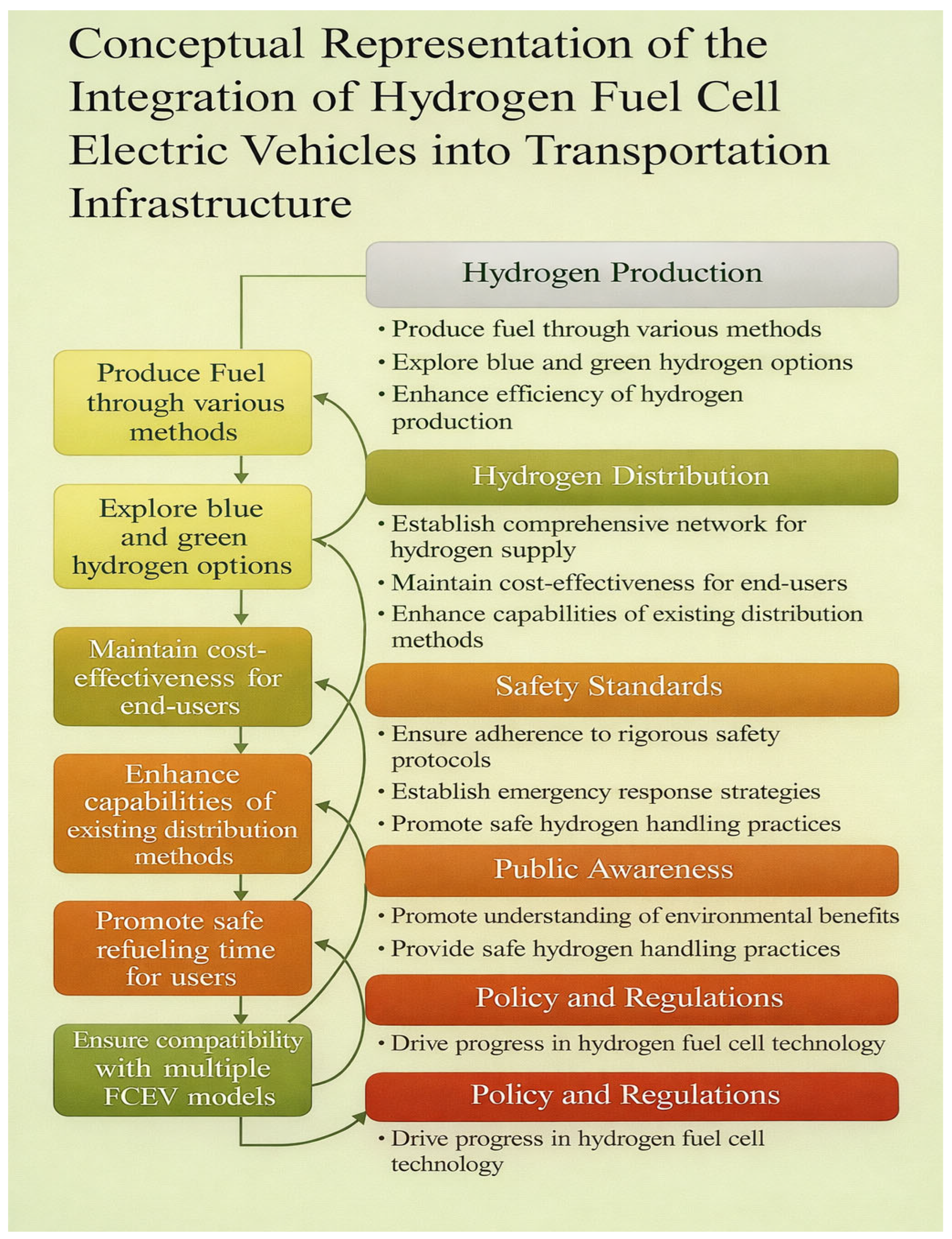
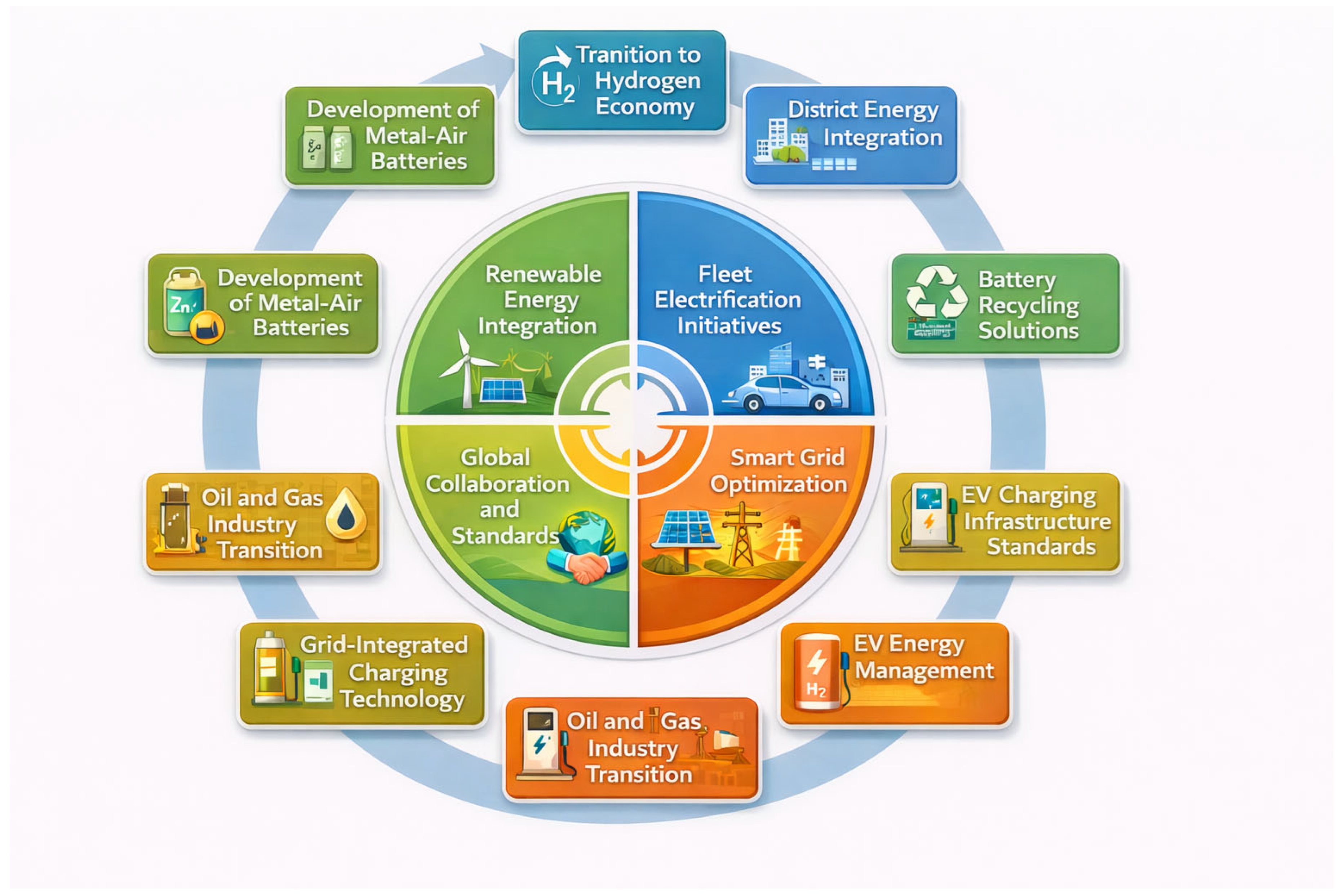
Figure 1.
Figure 1.
Conceptual representation of the integration of hydrogen fuel cell electric vehicles into transportation infrastructure.
Figure 1.
Conceptual representation of the integration of hydrogen fuel cell electric vehicles into transportation infrastructure.
The FCEV development process requires vehicle integration of advanced propulsion systems with energy management algorithms and lightweight designs to achieve customer expectations for extended driving range, product durability, and vehicle performance. Particular applications that involve heavy-duty operations need powertrain systems that deliver robust thermal management together with their thermal management capabilities. The design process requires strict safety standards because hydrogen can ignite and it creates material compatibility problems through hydrogen embrittlement. The safety of technology demonstrates its effectiveness in actual situations which people observe throughout their daily life. The introduction of innovative technologies and new developments enables FCEVs to break through their existing barriers. The main advancements that have taken place include the following:
Green hydrogen production via renewable-powered electrolysis, including solar-driven thermochemical and photoelectrochemical water-splitting processes.
The development of advanced hydrogen storage solutions which include high-pressure composite tanks (700 bar) and cryogenic liquid storage and metal hydrides which function as new solid-state carriers.
The development of next-generation fuel cell stacks which deliver higher power density with lower platinum loading and extended operational life.
AI-based digital twin energy management systems first perform predictive diagnostics and then conduct real-time optimization before they enhance system durability.
The smart thermal management technologies work from their core design to create operational efficiency throughout different load conditions.
FCEVs simultaneously provide transportation and energy storage services through their capability to connect with hybrid systems and renewable grid systems. The combined capabilities of these technologies enable organizations to enhance their operational performance while driving down expenses and speeding up their transition to hydrogen-based transportation systems.
Existing reviews focus on separate FCEV elements which include fuel cell technology and hydrogen production but they fail to demonstrate how FCEVs operate as complete systems. The existing research shows gaps because it lacks comparative studies between different propulsion systems particularly in relation to their scalability and the policies that govern their development. The role of cross-sector collaboration between academia and industry and government needs to be explored further. The identified gaps require a complete assessment which will combine existing knowledge with future research directions and implementation procedures for large-scale adoption. The review paper aims to deliver an all-encompassing assessment of FCEVs through its three main objectives. The current state of hydrogen production and storage and distribution technologies gets summarized in this section. The development of FCEV architectures plus energy management systems and thermal control solutions gets reviewed in this section. The analysis of hydrogen mobility implementation includes three main obstacles which are infrastructural barriers, economic barriers, and safety barriers. The analysis reveals how FCEVs outperform BEVs and ICE vehicles through their competitive advantages and their operational limitations. The research reveals knowledge gaps and recommends future research paths and innovative developments and policy interventions. The review demonstrates that FCEV commercial success depends on three elements which include technological innovations, infrastructure development, and regulatory support. The ultimate goal is to provide stakeholders—engineers, policymakers, and industry leaders—with a structured foundation to guide investments and strategies for building a cleaner, greener, and more sustainable transportation system. The storage process requires specific operational conditions based on whether hydrogen exists as a gas or liquid state. Compressed gaseous hydrogen is typically stored at 350 bar (≈5000 psi) or 700 bar (≈10,000 psi) in Type III or Type IV composite cylinders for automotive applications.
The storage system maintains energy density at high levels because it meets two requirements which allow for refueling delays and vehicle onboard space restrictions. The storage system requires cryogenic conditions at −253 °C (20 K) which lie just above absolute zero to store liquid hydrogen (LH2). The storage method provides greater energy storage capacity through liquid hydrogen but it needs cryogenic tanks which must be kept highly insulated along with continuous boil-off control operations and hydrogen liquefaction that requires 30 to 40 percent of its energy content. The preference for compressed gaseous hydrogen over liquid hydrogen exists because of three main reasons in multiple FCEV and distributed power applications through the following processes. The system requires less energy because compression needs less energy than liquefaction which requires a major hydrogen energy consumption. The small storage tanks make it impossible to store liquid hydrogen because they experience continuous boil-off losses which create practical limitations for light-duty vehicles. Gaseous hydrogen at 350 or 700 bar pressure serves as the standard design requirement for hydrogen refueling stations and distribution networks which makes gaseous storage solutions more suitable for practical use. Cryogenic hydrogen requires strong safety protocols at the same level as other systems; however, cryogenic hydrogen introduces safety difficulties because of its extremely low operating temperature, its tendency to make materials brittle, and the special requirements for handling and insulation. The current standard for passenger vehicles, buses, and light trucks uses compressed hydrogen gas as its main fuel source, while liquid hydrogen serves specialized applications which require maximum space efficiency for aerospace engines and heavy-duty vehicles that operate in remote areas with few gas stations.
1.1. Overview of Hydrogen Fuel Cell Technology
Hydrogen fuel cell research has the potential to yield more environmentally friendly modes of transportation. With the sole byproduct being water vapor, these electrochemical devices are capable of transforming oxygen and hydrogen into energy. To better understand the benefits and drawbacks of this renewable energy sector for electric vehicles, this study will examine the operation of fuel cells. Singla, Nijhawan, and Oberoi’s exhaustive review demonstrates that hydrogen has great potential as a greener energy option [
2]. Producing very pure hydrogen and focusing on hydrogen purification technologies tailored to fuel cell cars are both highlighted by Du, Liu, and colleagues. A recent publication by Sazali, Wan Salleh, and colleaguesprovides a concise overview of where fuel cell technology is at the moment and where it is headed in the future. Ferraren-De Cagalitan, Abundo, and colleagues evaluate the current state of biohydrogen synthesis and its potential applications in fuel cells by considering the environmental benefits and drawbacks. The efficiency and durability of fuel cell applications in stationary settings are investigated by Cigolotti, Genovese, and Fragiacomo, who also propose fuel cell technology for usage in poly-generational energy systems. In a 2022 study, Younas, Shafique, Hafeez and their team conducted research about the current state and future development of hydrogen production. The existing challenges need to be addressed because the current funding situation and technological infrastructure range from inadequate to outdated. Research conducted by Lebrouhi, Djoupo, Lamrani and their team in 2022 developed a worldwide investigation about hydrogen research and development by studying diplomatic relations and technological developments while advocating for global scientific partnerships. Thomas, Edwards, Dobson, and Owen explore how power regulations and incentives shape energy decarbonization in their work ‘The Global Landscape of Hydrogen Fuel Cell Research and Development’. The research team presents their findings from the year 2020. Stępień studied hydrogen-powered internal combustion engines in 2021 to identify technological progress and emission reduction challenges in the field. Dawood, Anda, and Shafiullah in 2020 studied various hydrogen generation methods to evaluate their practical usage and cost efficiency and environmental impact. The researchers Yue, Lambert, Pahon and their team conducted a comprehensive investigation about hydrogen energy systems in 2021. The authors assess the current state of the field by studying its infrastructure, regulatory barriers, existing technological capabilities, application potential, and existing challenges. The research team led by Ishaq Dincer and Crawford investigates hydrogen production and usage by identifying both challenges and opportunities and showing the necessity of technological development and supportive regulatory frameworks. The researchers Wang, Pang, Xu and their team present a detailed assessment of electrolysis cells and PEM fuel cells by showing how recent developments in materials science and system design help hydrogen infrastructure development. The researchers Abdelkareem, Elsaid, Wilberforce and their team studied hydrogen fuel cell technology by evaluating its environmental effects and sustainability factors across different fuel cell technology applications. Hydrogen generating methods are evaluated by Pinsky, Sabharwall, Hartvigsen, and O’Brien, who emphasize the significance of nuclear hybrid energy systems’ complex reactor designs and process optimization. In their study from 2020, Akinyele, Olabode, and Amole examine fuel cell technologies with the aim of developing microgrid systems that are environmentally benign. They show how crucial these technologies are for providing reliable and long-term power. The study conducted by Muthukumar, Rengarajan, Velliyangiri, and colleagues primarily focuses on the development of fuel cell electric vehicles, recent advances in infrastructure and technology, evaluations of performance, and potential commercial applications. Garcia, Arriola, Chen, and De Luna conducted a thorough evaluation of hydrogen production from methanol thermochemical conversion. They highlighted the importance of creating catalysts and improving procedures. Research into materials is highlighted by Wang, Diaz, Chen, and Adroher by exploring the history, current state-of-the-art, and components of PEM fuel cells.
In conclusion, Cunanan, Tran, Lee, and colleagues emphasize the significance of rules and infrastructure supporting advancements in heavy-duty vehicle powertrains, like electric vehicles powered by hydrogen fuel cells.
Table 1 includes the following fuel cell types: The term “fuel cell” encompasses a wide variety of devices, including those that use solid oxide, direct methanol, alkaline, molten carbonate, and proton exchange membranes. Many different types of fuel cells are on the market, and the optimal use of each kind is determined by its own set of pros and cons [
1,
2,
3,
4,
5,
6,
7,
8,
9,
10]. The working temperatures of PEM fuel cells can be as low as 60 to 80 °C, and they can start up in as little as one to two minutes with an efficiency of 50 to 60%. They are perfect for use in vehicles and other portable electronic equipment due to their small size and low weight. But their systems can get more complicated due to the exceedingly pure fuel and water control that is necessary. However, to attain a greater efficiency (55–65% for metal-catalyzed fuel cells and 60–70% for superoxide fuel cells), the operating temperatures of these cells are significantly higher (500–1000 °C and 600–700 °C, respectively). Their size, weight, and startup time make them ideal for stationary, large-scale power applications. These fuel cells may run on either hydrogen or natural gas, making them quite versatile. Similar to PEM fuel cells, AFCs are ideal for use in space and the military because of their lower operating temperatures (80–200 °C) [
11,
12,
13,
14,
15,
16,
17,
18,
19,
20]. Plus, they are not very fuel-flexible and need very pure fuel. The lower operating temperatures (50–120 °C) of DMFCs make them ideal for use in portable devices and smaller-scale applications. Their fuel flexibility is severely limited because they operate on methanol. Reaction kinetics, efficiency degradation, responsiveness to transients, and cost sensitivity to catalyst material may vary slightly between fuel cell types due to differences in electrolyte materials and catalysts. Because platinum is used as a catalyst in PEM and AFC fuel cells, the price of these fuel cells can go up. Cheaper nickel and ceramic SOFCs and MCFCs may have slower responses and more efficiency degradation, though. Longevity was determined to be 10–12 years for MCFCs, 8–10 years for SOFCs, 5–7 years for PEM and AFC fuel cells, and 4–6 years for DMFCs, according to the study. A variety of fuel storage options are utilized by fuel cells, including gas compression, liquid hydrogen, and liquid methanol.
While earlier review studies have examined individual aspects of hydrogen fuel cell electric vehicles (FCEVs), such as hydrogen production or fuel cell stack design, this work aims to provide a structured and system-level synthesis integrating hydrogen pathways, vehicle architectures, infrastructure challenges, and techno-economic considerations. Furthermore, this review incorporates recent developments in electrochemistry, materials science, and AI-driven energy management systems reported in the last five years (2020–2025), thereby strengthening its relevance as a contemporary “state-of-the-art” assessment.
Despite extensive research on hydrogen production pathways, fuel cell technologies, and vehicle integration, the existing body of literature predominantly addresses these domains in isolation, with limited emphasis on a holistic, system-level perspective. A structured assessment of recent studies published between 2020 and 2025 reveals several critical gaps. First, there is a lack of integrated analysis that simultaneously considers hydrogen production, storage, distribution infrastructure, and vehicle-level implementation within a unified framework. Second, current studies provide only limited comparative evaluation of scalability, techno-economic feasibility, and infrastructure readiness across different regions and application domains. Third, there is insufficient exploration of the linkages between FCEV deployment and broader sustainability frameworks, particularly their contribution to global targets such as Sustainable Development Goal 7 (Affordable and Clean Energy) and long-term decarbonization strategies. Furthermore, many existing reviews tend to focus either on technological advancements or policy perspectives independently, without adequately addressing the interdependencies between technological innovation, infrastructure development, and policy support mechanisms. This fragmented approach limits the ability to derive actionable insights for large-scale implementation and cross-sector integration of hydrogen-based mobility solutions.
To address these limitations, the present study adopts a systematic and integrative review approach, synthesizing recent advancements across hydrogen production technologies, storage solutions, fuel cell developments, and vehicle integration strategies. In addition, the review evaluates techno-economic and sustainability aspects to provide a comprehensive understanding of the FCEV ecosystem and its role in future energy systems. Accordingly, this study is guided by the following research objective: to develop a comprehensive system-level understanding of hydrogen fuel cell electric vehicles by analyzing the integration of production pathways, storage technologies, infrastructure requirements, and vehicle systems, with the aim of enabling scalable, efficient, and sustainable mobility solutions.
1.2. Thematic Classification of Reviewed Literature
To enhance the readability of this review and provide a structured guide to the extensive body of literature (204 references), the reviewed studies are categorized into major thematic domains as follows:
Hydrogen Production Technologies: Electrolysis, SMR, biomass, thermochemical processes;
Hydrogen Storage and Distribution: Compressed gas, liquid hydrogen, solid-state storage;
Fuel Cell Technologies: PEMFC, SOFC, AFC, MCFC, DMFC advancements;
Vehicle Integration and Energy Management: Powertrains, hybridization, AI-based control;
Infrastructure and Policy: Refueling networks, regulations, global hydrogen strategies;
Techno-Economic and Environmental Analysis: Cost, lifecycle emissions, sustainability.
The references listed in
Table 2 correspond to key studies within each thematic area of hydrogen energy research. Specifically, references [
1,
2,
3,
4,
5,
6,
7,
8,
9,
10,
11,
12,
13,
14,
15,
16,
17,
18,
19,
20] cover advances in fuel cell technologies, while [
21,
22,
23,
24,
25,
26,
27,
28,
29,
30,
31,
32,
33,
34,
35,
36,
37,
38,
39,
40] focus on hydrogen production pathways. Storage and distribution aspects are discussed in [
41,
42,
43,
44,
45,
46,
47,
48,
49,
50,
51,
52,
53,
54,
55,
56,
57,
58,
59,
60], and vehicle system developments are detailed in [
61,
62,
63,
64,
65,
66,
67,
68,
69,
70,
71,
72,
73,
74,
75,
76,
77,
78,
79,
80,
81,
82,
83,
84,
85,
86,
87,
88,
89,
90]. Infrastructure planning and policy frameworks are addressed in [
91,
92,
93,
94,
95,
96,
97,
98,
99,
100,
101,
102,
103,
104,
105,
106,
107,
108,
109,
110,
111,
112,
113,
114,
115,
116,
117,
118,
119,
120,
121,
122,
123,
124,
125,
126,
127,
128,
129,
130], whereas techno-economic analyses, including cost and lifecycle assessments, are presented in [
131,
132,
133,
134,
135,
136,
137,
138,
139,
140,
141,
142,
143,
144,
145,
146,
147,
148,
149,
150,
151,
152,
153,
154,
155,
156,
157,
158,
159,
160].
2. Power Generation in Hydrogen Fuel Cell Electric Vehicles
The analysis here draws on a wide range of academic literature to cover a wide range of topics related to hydrogen fuel cell power generation in vehicles. Performance optimization in real driving cycles of hybrid hydrogen fuel cell electric cars is, who also note the requirement of efficiency improvements. An integral and sustainable integration of fuel cell electric vehicles and hydrogen use into national energy and transportation networks is emphasized by Oldenbroek et al. [
42].
Optimal performance is the goal of Ahmadi and Khoshnevisan’s lifecycle assessments and dynamic simulations of hydrogen fuel cell electric vehicles, which take into account multiple methods of hydrogen production. A research by Li and Taghizadeh-Hesary examines the financial ramifications of introducing fuel cell electric cars and green hydrogen to China’s road transport system. The authors offer incisive analysis on the subject. Several ASEAN countries are now using or may use fuel cell electric vehicles and hydrogen energy, according to research by Li and Kimura that examined the economic and environmental impacts of these technologies. The difficulties of planning, building, and operating a hydrogen refueling infrastructure for FCEVs are discussed in a thoughtful and practical way by Muratori et al. [
107]. Hydrogen fuel cell electric vehicles are less detrimental to the environment than traditional gas-powered cars, according to research by Liu et al. [
133]. In their evaluation of methods for managing energy in hybrid electric vehicles, Lü et al. [
48] look at genetic algorithm optimization of fuel cell hybrid power systems. Alvarez-Meaza et al. [
49] offer a scientific and technological knowledge map about fuel cell electric vehicles. It outlines the main objectives of the field’s continuous endeavors to increase understanding. Fuel cell electric vehicles are thoroughly examined in the all-inclusive study by İnci et al. [
1], which covers topics like topologies, power electronic converters, energy management systems, technical hurdles, marketing, and predicted future outcomes. To increase the range of hybrid electric vehicles, Dimitrova and Nader suggest studying PEM fuel cells as supplementary power units beginning in 2022. The willingness of Chinese consumers to invest in electric vehicles driven by hydrogen fuel cells was investigated in a study conducted by Li et al. [
18]. The market and consumer preferences can be better understood thanks to their study. The goal of Xiong et al. is to tackle the problems and make use of the potential that this new industry’s focal point—fuel cell vehicles that produce hydrogen—presents [
52]. Mohideen et al. performed a techno-economic analysis to determine the environmental impact and economic feasibility of various energy sources for hydrogen fuel cell electric vehicles using renewable and non-renewable power [
53]. Through an analysis of the energy distribution in hydrogen fuel cell hybrid electric vehicles, Tanç et al. aim to comprehend the performance-enhancing impacts of supplementary traction batteries [
54]. Smart hybrid microgrids can implement the energy management architecture proposed by Gong et al. [
55]. In order to make energy more stable, this idea considers combining electric vehicles with PEM fuel cells. In an effort to lower manufacturing costs and emissions of greenhouse gases, Zhang et al. [
56] explore hydrogen generation for fuel cell cars through the use of flexible and environmentally friendly grid-based electrolysis. Using examples from California and elsewhere, Trencher demonstrates how to speed up the manufacturing and distribution of FCEVs. Optimizing and producing state-of-the-art fuel cell hybrid electric vehicles is the primary focus of Luo et al. [
58], who are investigating innovative methods to enhance efficiency and performance. Handwerker et al. [
59] demonstrate the significance of renewable energy sources through their analysis of hydrogen powertrains and battery electric vehicles and their investigation of small-scale hydrogen production from renewable energy sources. The research results in
Table 3 display key performance indicators (KPIs) for various hydrogen fuel cell electric vehicle models according to multiple studies. Looking at the names of the authors and the years of publication in each row makes finding a reference to a particular study very easy. The essential key performance indicators for this system include fuel adaptability, efficiency, power density, startup time, and materials used in the catalyst and electrolyte. A higher percentage indicates that the fuel cell system is more efficient at turning hydrogen into energy. According to the findings, efficiency levels might vary widely, ranging from 45% to 75%. Watts per square centimeter (W/cm
2) is the unit of measurement for the power density of a fuel cell, which is the electrical current it produces in relation to its surface area. It is clear that fuel cell devices have power densities ranging from 0.3 W/cm
2 to 1 W/cm
2. How long a fuel cell system can remain operational before showing signs of degradation is its durability. Results ranging from 3000 to 12,000 h show that fuel cell systems are durable and work well over extended periods of time. Once the fuel cell system is cold started, how long it takes to become operational is something to be looked into; the amount of time required to start up is one way to look at it. Since fuel cell vehicles’ startup times vary from one minute to seven minutes, there is no standard for their responsiveness or usability. A fuel cell system’s fuel flexibility reveals its adaptability to many types of fuels. A broader variety of fuels, including hydrogen and natural gas, can be used due to the increased adaptability. You can see from the table that different trials have used fuel flexibility levels that range from very low to relatively high. The catalyst and electrolyte materials used in fuel cells have a major influence on the efficiency and effectiveness of the cells. The investigators conducted their research by using ceramics and nickel and platinum and perfluorosulfonic acid (PFSA) membranes as their primary testing materials. The materials that scientists select for their electrolyte and catalyst systems determine how well their fuel cell system operates and how long it will function. The most commonly used materials for construction projects include metals and ceramics and PFSA membrane and nickel. The process of selecting materials requires evaluation of multiple factors which include material costs, availability, durability, and operational performance. The table below shows all the technical methods which researchers have used to study hydrogen fuel cell electric vehicle systems [
61,
62,
63,
64,
65,
66,
67,
68,
69,
70,
71,
72,
73,
74,
75,
76,
77,
78,
79,
80,
81,
82,
83,
84,
85,
86,
87,
88,
89,
90]. Fuel cell system development continues because researchers want to create better systems which will enhance system reliability and operational efficiency and system longevity. The current state of hydrogen fuel cell technology becomes visible when we examine and assess all performance metrics from different experiments. This knowledge benefits all people who hold university professor or CEO positions.
Transportation Applications of Hydrogen Fuel Cell Electric Vehicles
Researchers have studied hydrogen fuel cell electric vehicles through their transportation applications to understand how these vehicles can help decarbonize the transportation sector. The research team led by Cunanan et al. [
8] studied engine technologies for heavy-duty vehicles and discovered that FCEVs serve as essential tools for pollution control. The research conducted by Sun et al. [
19] investigates how FCEVs can work together with renewable energy sources to supply hydrogen-based power distribution systems and urban transportation systems.
The research conducted by Zhao et al. [
62] demonstrates how fuel cell hybrid electric vehicles have started to connect with existing energy systems and transportation networks through their study of dispatching. Ajanovic and Haas investigated hydrogen and FCEVs for transportation systems which requires public authorities to establish legal frameworks. The research conducted by Li and Kimura examines hydrogen energy and FCEVs in ASEAN countries by evaluating their environmental effects and economic viability. Wu et al. [
88] demonstrate how hydrogen-based transportation reduces environmental damage by showing how FCEVs produce lower emissions and energy usage compared to conventional gasoline-powered vehicles. Aguilar and Groß conducted research on decarbonizing transportation through alternative powertrain technologies which showed the importance of different options such as battery electric vehicles and FCEVs. Zhang et al. [
67] studied hydrogen as an alternative to fossil fuels for sustainable transport while they evaluated electric car and fuel cell electric vehicle technology. Wong et al. [
68] conduct a life-cycle assessment to evaluate the ecological effects of electric cars and FCEVs throughout their entire life cycle. Whiston et al. [
69] discuss hydrogen storage for FCEVs and proposes a model for levelized cost of driving, among other things. In their analysis of recent policy changes, Asif and Schmidt stress the need for supportive regulatory environments to boost FCEVs’ commercial viability. Fuel cell possibilities and obstacles in heavy-duty transportation were addressed in their debate, while continuous research endeavors to overcome technological difficulties are emphasized by Cullen et al. [
71]. The possible use of electric trains powered by hydrogen fuel cells and lithium-ion batteries in environmentally friendly transportation is investigated by Akhoundzadeh et al. [
72] through their simulations and analyses. Using municipal transportation networks as an example, Turoń investigates the past and future of hydrogen-powered cars. Turkdogan demonstrates the potential cooperation between FCEVs and home electrical demands by creating and enhancing a renewable-source hybrid energy system. As part of the solution to pollution, electric and hydrogen fuel cell medium- and heavy-duty cars and buses are discussed in Burke and Sinha’s marketing, technology, and sustainability reports. Wang et al. [
76] analyze current technological developments and potential future advancements in hydrogen station networks for vehicles and fuel cells that use polymer electrolyte membranes. Baba et al. [
77] review the topologies of power electronic converters and the technological issues experienced by FCEVs. They underline the significance of efficient power management systems. In their study of electric mobility in Portugal, Ala et al. [
78] forecast the impact of fuel cell vehicles on the energy infrastructure of the nation and their potential future use. When it comes to sustainable energy solutions for off-grid and mobility applications, Ma et al. [
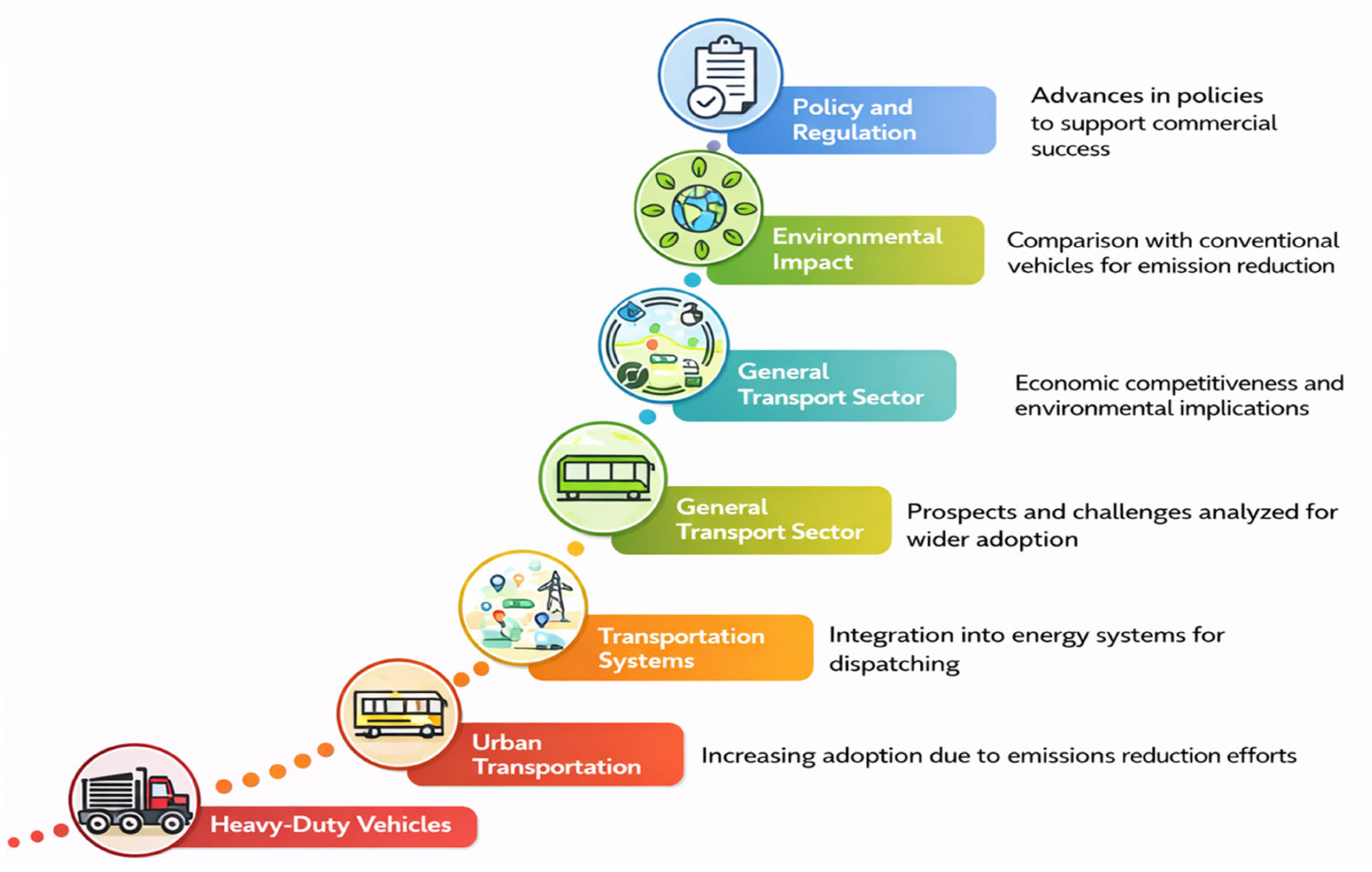
79] emphasize the promise and versatility of fuel cell–battery hybrid systems. The study examines the economic and regulatory and technological factors which determine the possibilities of hydrogen fuel cell electric vehicles as green transportation solutions. The industrial adoption of hydrogen fuel cell electric vehicles has increased according to
Figure 2, which shows a shift towards environmentally friendly transportation methods. Heavy-duty vehicles have become more popular because people want to decrease pollution levels. Urban transportation systems have started to connect with power distribution networks, which creates a new approach that combines efficient operations with system integration. Fuel cell electric vehicles (FCEVs) currently provide dispatch services for energy networks, but energy management requires an expanded framework to handle this situation. The transportation industry evaluates FCEVs by analyzing their benefits and drawbacks to determine their potential for driving wider adoption of these vehicles. Regional mobility assessments study hydrogen energy environmental consequences and fuel cell electric vehicle (FCEV) market competitiveness. FCEVs help the environment through their capacity to decrease pollution which is one of the main problems linked with traditional vehicles. The economic sustainability of FCEVs requires regulatory and legislative improvements before they can achieve widespread public acceptance. The technical resolution process for heavy-duty transport requires constant development because new roadways and obstacles emerge continuously. The rail transport sector conducts research and simulation experiments to test the operational capacity of FCEVs. Researchers in urban mobility study FCEV integration possibilities to create more sustainable and efficient urban transport systems. Making fuel cell electric vehicle (FCEV) designs as efficient as possible is a primary goal in renewable energy systems. There is a lot of buzz in the commercial vehicle industry right now about fuel cell electric vehicle (FCEV) marketing tactics, environmental effects, and the technology’s potential future. Infrastructure for fuel cell electric vehicles (FCEVs) must include charging station networks and fuel cells with polymer electrolyte membranes. A reassessment of power management systems is being prompted by issues with power electronic converters and the proper operation of FCEVs [
131,
132,
133,
134,
135,
136,
137,
138,
139,
140]. An extensive evaluation of current and future electric mobility trends is part of the national energy landscape analysis, which aims to guide policy choices. In an effort to increase FCEV use outside of the traditional transportation sector, researchers are looking into off-grid applications, such as mobility and off-grid hybrid systems. The overall adoption patterns show that working together, creating new ideas and establishing laws that support electric vehicles, are essential elements for their electric vehicle adoption. These factors will help to speed up the broad use of electric vehicles for a more sustainable future in various transportation sectors [
141,
142,
143,
144,
145,
146,
147,
148,
149,
150,
151,
152,
153,
154,
155,
156,
157,
158,
159,
160].
3. Technical Challenges in Implementing Hydrogen Fuel Cell Electric Vehicles
Research studies about hydrogen fuel cell electric vehicle (FCEV) technology problems show the difficulties of using this advanced technology. The investigation by Das et al. [
80] studies power conditioning units and topologies which function as essential components for improving FCEV performance. The research by Selmi et al. [
81] identifies development and innovation needs through their assessment of fuel cell-based electric vehicle technology and its associated challenges. The research by Waseem et al. [
3] provides a detailed analysis of fuel cell-based hybrid electric vehicles which includes their present state and main obstacles and their upcoming legal frameworks and future development paths. Yu et al. [
83] study energy management methods and system configurations to develop optimal fuel cell hybrid electric vehicle operations. Sulaiman et al. [
84] show that energy management systems play a critical role because FCEVs need these systems to achieve their highest operational performance. Using a SWOT analysis to weigh the pros and downsides of fuel cell technology in EVs, Olabi et al. [
85] investigate the possibilities and limitations of this technology in great detail. Chan outlines the present state of electric, hybrid, and fuel cell vehicles by giving background information and displaying recent advancements. By outlining the possibilities and challenges in this ever-changing industry, Bethoux provides a glimpse into the future of hydrogen fuel cell road vehicles. Wu et al. [
88] examine the obstacles to the adoption of hydrogen fuel cell cars in China and provide solutions to these problems, highlighting the importance of integrating technological advancement with environmental objectives. Alaswad et al. [
89] discuss the technical and commercial challenges faced by proton-exchange membrane (PEM) fuel cells, which are crucial to the operation of FCEVs [
161,
162,
163,
164,
165,
166,
167,
168,
169,
170]. In their analysis of the demands imposed on electric vehicle batteries and the problems in achieving those expectations, Deng et al. [
90] aim to help make FCEVs more widely used. Trencher et al. [
91] analyze the government programs and experiences of Japan to assist other areas in overcoming their own challenges to the development and dissemination of fuel cell cars. Highlighting the significance of fuel cell electric vehicles (FCEVs) in the pursuit of eco-friendly transportation, Olabi et al. [
92] analyze the present and future applications of fuel cell technology in the automotive industry. Sürer and Arat’s review of advances and current technologies concerning hydrogen fuel cell uses for marine vehicles emphasizes the possibility of FCEVs to radically alter the marine transport industry [
93]. Wahid et al. [
94] study new propulsion systems because they play a crucial role in improving the efficiency and performance of passenger electric vehicles. Hydrogen demand and fuel cell car uptake in South Korea are studied by Park et al. [
95]. The FCEV technology needs to become more common because the researchers provide their guidance to both government officials and business leaders. The authors of the hydrogen fuel cell heavy-duty truck study found that this technology plays a key role in cutting transportation-related pollution. The study by Şefkat and Özel investigates how researchers test and model energy environments that control temperature in hydrogen fuel cell–battery hybrid electric vehicles. The research results provide important information that will enable the vehicles to function with improved energy efficiency during their operational period. The research conducted by Samsun et al. [
98] provides a worldwide evaluation of fuel cell vehicle adoption together with hydrogen filling station infrastructure development, which identifies the positive and negative effects of FCEV market expansion. The researchers led by Kandidayeni et al. [
99] investigate how fuel cell hybrid electric vehicle energy management systems should operate, while they research how those systems affect human health and environmental safety. The research will reveal which technical obstacles and potential benefits exist for hydrogen fuel cell electric vehicle adoption, which will lead to more environmentally friendly and cost-effective transportation solutions in the future [
171,
172,
173,
174,
175,
176,
177,
178,
179,
180,
181,
182,
183,
184,
185,
186,
187,
188,
189,
190].
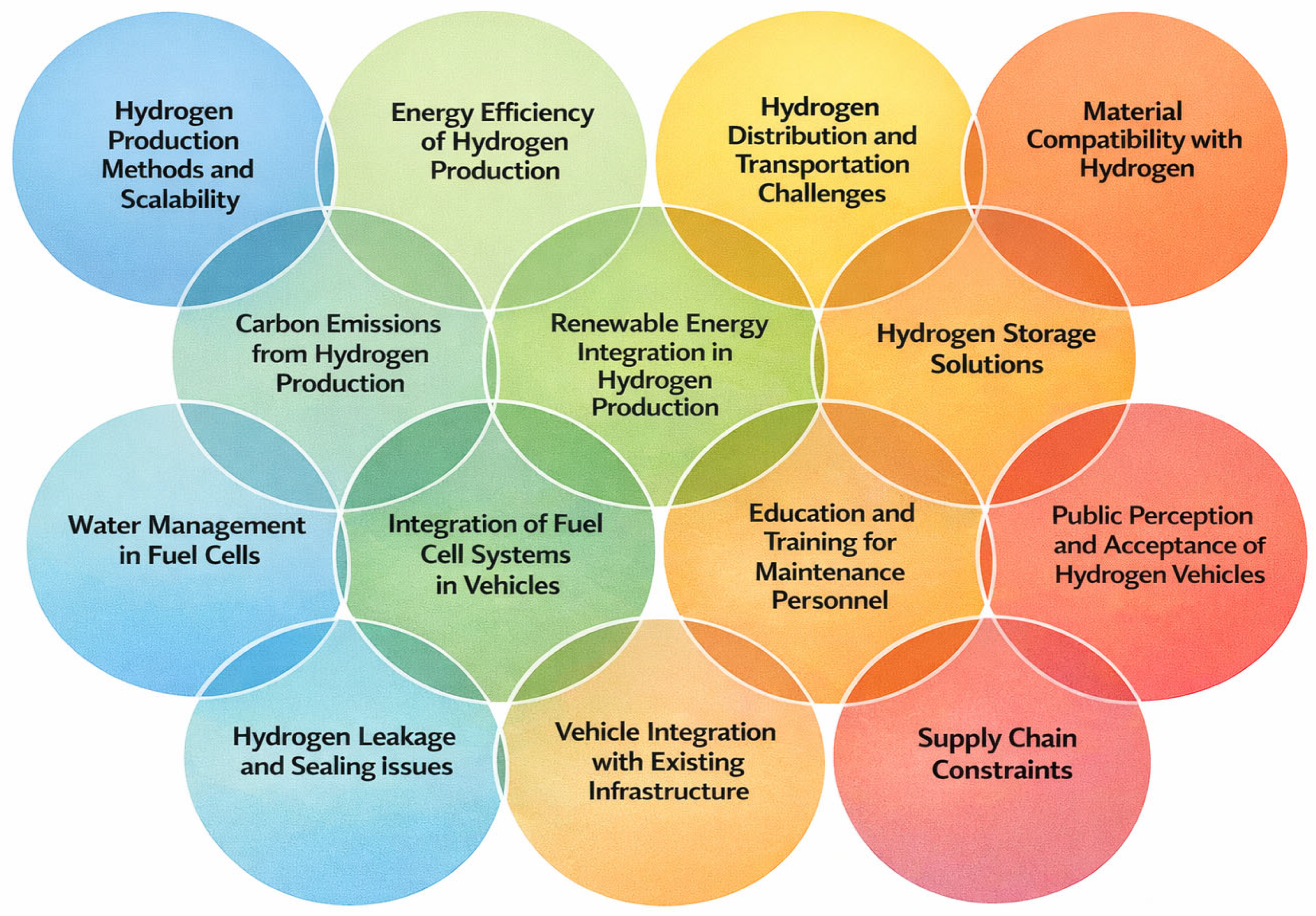
Figure 3 shows that hydrogen fuel cell electric vehicles (FCEVs) encounter several major technological challenges. Among the many obstacles presented by the ever-increasing need for hydrogen as a fuel source, the absence of effective and scalable production methods ranks highest. The emissions produced during hydrogen production through its manufacturing process demonstrate the urgent need for renewable energy sources because they enable environmental damage reduction. The energy-efficient operation of hydrogen production methods needs to be established because it leads to better resource utilization and reduced energy expenses. Hydrogen production requires the implementation of renewable energy sources to achieve sustainable operations while decreasing reliance on fossil fuels. Hydrogen operations require dedicated energy solutions to address their need for stable hydrogen availability because of their unpredictable energy supply patterns. The distribution and transportation challenges of hydrogen create a requirement for strong infrastructure systems which enable FCEV technology to achieve wider market adoption. The transportation industry requires hydrogen to be stored in a usable form before the gas can function as an actual fuel. The storage of hydrogen requires three essential aspects which need to be resolved to enhance the practicality of FCEVs. The compatibility of hydrogen with fuel cell component materials needs evaluation before proceeding with operations. Materials experience property changes through hydrogen exposure which leads to decreased performance or shortened material lifespan. Fuel cells depend on high purity hydrogen because its presence directly affects their operational capability. The performance and durability of fuel cell stacks require ongoing research activities to improve their operation capacity and extend their lifetime. The ability of cold-start systems to function at low temperatures becomes more critical in cold climates because fuel cells face operational challenges at such temperatures. Effective water management systems are essential for fuel cells because they need to stop flooding while maintaining optimal performance. The system needs urgent repairs to fix its sealing problems and prevent hydrogen from escaping because this work is vital for maintaining system safety and structural integrity. The development of fuel cell devices requires solutions to multiple problems which involve their spatial and weight requirements before they can enter vehicle integration. The successful adoption of FCEVs depends on building infrastructure facilities which require both operational budget allocation and infrastructure development planning to achieve effective integration with existing systems. FCEV operations depend on maintenance personnel who require proper training to maintain vehicle performance throughout their operational life. The cost of hydrogen and fuel cell components will fluctuate according to the existing supply chain limitations. The market demand and acceptance of hydrogen vehicles by the public directly impact their market penetration and adoption rate. FCEV production and distribution require legislative and regulatory frameworks to create a legal manufacturing environment. The high level of market penetration makes it hard to show that FCEVs compete with traditional vehicles. The technological barriers which need to be resolved must be removed for hydrogen fuel cell electric vehicles to become widespread in transportation systems. Sustainable mobility solutions require researchers and lawmakers and industry partners to work together in solving existing challenges.
The challenges illustrated in
Figure 3 are grouped into four primary domains: (i) hydrogen production, (ii) storage and distribution, (iii) fuel cell system limitations, and (iv) economic and infrastructure barriers. Rather than indicating infeasibility, these interconnected challenges highlight key research directions where ongoing innovations are actively reducing technological barriers.
Among these, hydrogen production cost, storage efficiency, and infrastructure development emerge as the most critical bottlenecks. Recent advancements in green hydrogen production, advanced materials, and system integration are progressively addressing these issues, indicating that FCEV deployment is challenging but technically feasible.
4. Solutions and Innovations Addressing the Challenges
The document describes the most important developments in hydrogen fuel cell electric vehicle (FCEV) technology which arose from industrial partnerships that conducted research to achieve these technological breakthroughs. Castillo et al. [
105] studied hydrogen–electric hybrid powertrain vehicles which offered both advantages and disadvantages while pointing out cleaner solutions for urban transportation and alternative powertrain options for commercial vans. Lindorfer et al. [
112] reviewed existing research to show fuel cell technology’s potential for energy conversion which scientists use to create clean energy solutions and to achieve greenhouse gas emission reductions. Collaboration in the planning of hydrogen fuel cell cars for use in energy distribution was emphasized by Tao et al. [
101], drawing attention to the role of hydrogen in enhancing distribution of energy and reducing emissions. Miller et al. [
117] expressed the DOE’s stance on fuel cell and hydrogen technologies, which shows the growing support for these alternatives in the field of renewable energy. Wang et al. [
129] investigated fuel cell hybrid propulsion systems for UAVs because there is a growing need for these vehicles that can fly for longer periods of time with less environmental effect. In their investigation of marine battery–electric and hydrogen alternatives, Bach et al. [
100] noted that the marine industry is increasingly embracing greener modes of transportation. By assessing EV technologies and challenges, Sanguesa et al. [
124] added to the ongoing research and advancement of EV infrastructure and technology. Concerns about pollution and limited driving distance prompted to study strategies for increasing EV battery life. Studying advancements in plug-in electric and hybrid vehicles with the aim of reducing carbon emissions, Zhao et al. [
121] reflected the increasing demand for environmentally friendly transportation options. Muratori et al. [
107] observed that significant investment and usage of EVs have occurred in tandem with technological advancements in their examination of the advent of EVs. Rasaki et al. [
109] showed how additive manufacturing might boost efficiency and cut costs by looking into its unique function in fuel cell production [
191,
192,
193,
194,
195]. Power management systems that incorporate renewable sources for electric vehicles were developed by Mohamed et al. [
102] in accordance with governmental funding for renewable energy integration. Sun et al. [
165] discussed the interconnected operation of urban transportation networks and power distribution networks that include hydrogen, drawing attention to fuel cell electric vehicle-based sustainable urban transportation systems. All things considered, these advancements show how technology based on hydrogen fuel cells is driving a shift towards cleaner, more environmentally friendly transportation options [
196,
197].
Hydrogen fuel cell electric vehicles (HFCEVs) are often positioned as a cornerstone technology in the global transition toward carbon-neutral energy systems. The sustainability potential and carbon reduction capability of hydrogen-based mobility depend on which hydrogen type is used. While grey and blue hydrogen remain the primary supply sources, green hydrogen production through electrolysis using renewable energy has gained recognition as the most effective method to reach net-zero emissions in both transportation and power generation. Several nations have included green hydrogen into their carbon neutrality plans because they recognize its multiple functions as an energy carrier and storage technology. The European Union together with Japan South Korea and India has established national hydrogen missions which outline pathways to implement green hydrogen technology in all industrial and transportation and power generation sectors. The hydrogen technologies developed through these strategies will work together with the sustainable development goals and the decarbonization targets established by the Paris Agreement and the circular economy frameworks. The current literature shows that green hydrogen production expenses prevent its widespread adoption because techno-economic factors such as electrolyzer efficiency and renewable electricity costs and infrastructure development determine production expenses [
198]. The researchers demonstrate that India’s National Green Hydrogen Mission (NGHM) and other national missions provide essential resources to achieve cost reductions through economies of scale and targeted subsidies and regulatory incentives [
199]. The implementation of carbon pricing and renewable energy mandates and public–private partnerships works as essential components which empower the fast adoption of green hydrogen for mobility and stationary power generation. The research shows that green hydrogen production systems can operate electrolysis together with renewable energy sources which include solar and wind and hybrid microgrids [
200]. The process of optimized hydrogen fuel production leads to reduced ecological impact throughout its entire lifespan while making distributed energy systems operate more efficiently and flexibly. The study shows that hybrid systems which combine solar PV with green hydrogen storage can effectively deliver power to research buildings in India, which creates models that other regions can use to develop self-sufficient carbon-neutral campuses and industrial facilities [
201,
202]. The research demonstrates that green hydrogen serves as both an alternate fuel and a fundamental technology which facilitates sustainable energy shifts. The interaction between technology development and cost reduction methods and policy frameworks establishes its vital role for countries which need to achieve economic expansion and maintain energy security and fulfill their climate agreements [
203]. The implementation of green hydrogen strategies through HFCEV deployment enables transportation decarbonization to reach its full potential while providing support for clean energy production systems. The advancements in Electrochemistry and Materials Science for Fuel Cell Electric Vehicles (FCEVs) is as follows. The hydrogen-powered fuel cell performance and durability and cost depends on progress which electrochemistry and materials engineering research yields. The research in these two fields has produced major advancements which solve the problems that previous sections reported during the last ten years.
Catalyst Innovations
- ◦
Fuel cell electric vehicles use conventional proton exchange membrane fuel cells as their primary fuel cell technology because these fuel cells need platinum-group metals to operate their main catalytic system. The restricted supply combined with the high cost of these materials has created major obstacles that prevent their broad adoption.
- ◦
The study of non-precious metal catalysts requires researchers to investigate two types of materials which include ultra-low platinum loading catalysts needing less than 0.1 mg/cm2 and platinum-nickel platinum-cobalt alloyed catalysts which achieve equivalent performance to standard platinum-based materials with 80% lower platinum consumption.
- ◦
The development of nanostructuring techniques together with core–shell architecture improvements has resulted in greater electrochemically active surface area which benefits both reaction kinetics and durability performance.
Membrane and Electrolyte Developments
- ◦
PFSA membranes with better water retention capability deliver enhanced proton conduction efficiency across multiple temperature and humidity conditions. The two material alternatives hydrocarbon-based membranes and composite membranes with inorganic fillers have demonstrated potential to achieve better thermal stability while experiencing less material breakdown.
- ◦
The FCEV operating range enhancements particularly benefit from advanced materials which sustain performance under severe weather conditions that typically cause Nafion® membrane malfunctions.
Durability and Degradation Mitigation
- ◦
Fuel cell stacks experience degradation through three main mechanisms which include catalyst dissolution, membrane thinning, and carbon support corrosion. The combination of advanced graphitized carbon supports and ceramic reinforcements with radical scavengers has achieved stack lifetime extension through 5000–8000 h which meets passenger vehicle requirements, while heavy-duty applications need over 20,000 h.
- ◦
Protective coatings together with novel corrosion-resistant alloys used on bipolar plates provide solutions for maintaining performance under demanding operating environments.
Hydrogen Storage Materials
- ◦
Researchers investigate solid-state hydrogen storage through metal hydrides (e.g., MgH2, LaNi5) and nanoporous materials (MOFs, carbon nanotubes) as a method to reach storage capacities beyond 700 bar of compressed hydrogen. These materials provide safer and denser storage capabilities, but their storage performance needs further research because their storage mechanism depends on kinetics and reversibility.
Integration with Battery Systems (Hybridization)
- ◦
The integration of advanced fuel cells with next-generation lithium-ion and solid-state batteries enables two functions which include load leveling and transient power support. The electrochemical advancements in fast-charging anodes Si/C composites and cobalt-free cathodes provide battery recycling benefits through reduced lifecycle costs which meet circular economy requirements.
Circular Economy and Recycling Approaches
- ◦
Materials science research develops methods to extract PGMs from end-of-life stacks through hydrometallurgical and electrochemical leaching methods which enable over 90% material recovery. The application of sustainable recycling methods for Li-ion batteries through direct cathode re-lithiation and closed-loop electrolyte recovery creates environmentally friendly solutions for hybrid FCEV systems.
4.1. Recent Advances (2020–2025)
In recent years, several important advancements have significantly influenced the development of hydrogen fuel cell technologies. For instance, ultra-low platinum catalyst designs (<0.1 mg/cm2) have been reported to reduce material cost without compromising efficiency. Solid-state hydrogen storage using metal–organic frameworks (MOFs) and nanostructured materials has demonstrated improved storage density and safety. Additionally, AI-based predictive diagnostics and digital twin technologies are increasingly being applied for real-time optimization of fuel cell performance and degradation monitoring. Recent large-scale pilot projects in Japan, South Korea, and the European Union have also demonstrated the feasibility of integrating FCEVs with renewable hydrogen ecosystems. These contributions highlight the rapid evolution of the field and reinforce the relevance of FCEVs in future sustainable mobility systems. In recent years, hydrogen fuel cell technologies have experienced significant advancements, driven by innovations in materials science, system integration, and digital optimization. Unlike earlier developments that primarily focused on component-level improvements, recent research emphasizes cost reduction, durability enhancement, and system-level performance optimization, which are critical for large-scale commercialization of hydrogen fuel cell electric vehicles (FCEVs).
One of the most notable advancements is in catalyst engineering. Conventional proton exchange membrane fuel cells (PEMFCs) rely heavily on platinum-group metals, which contribute significantly to system cost. Recent studies have demonstrated ultra-low platinum loading levels (<0.1 mg/cm2), achieving up to 80–90% reduction in catalyst usage without compromising electrochemical performance. In addition, alloy-based catalysts (e.g., Pt–Ni and Pt–Co) and core–shell nanostructures have shown improved catalytic activity, enhanced durability, and resistance to degradation mechanisms such as dissolution and agglomeration. These developments represent a major step toward economically viable fuel cell systems.
Advances in hydrogen storage technologies have also contributed to improved safety and energy density. Emerging materials such as metal–organic frameworks (MOFs), carbon nanotubes, and other nanoporous structures offer enhanced hydrogen adsorption capacity compared to conventional compressed gas systems. These materials enable safer storage at lower pressures while improving volumetric efficiency. However, challenges related to adsorption/desorption kinetics, thermal management, and material scalability remain key research priorities.
Another transformative development is the integration of artificial intelligence (AI) and digital twin technologies into fuel cell systems. These approaches enable real-time monitoring, predictive diagnostics, and adaptive control of operating parameters such as temperature, pressure, and humidity. Digital twin models, in particular, allow virtual replication of fuel cell systems, facilitating performance optimization and early fault detection. This significantly improves system reliability, reduces maintenance costs, and extends operational lifespan under dynamic driving conditions.
At the system level, hybridization strategies combining fuel cells with advanced battery technologies have gained increasing attention. The integration of lithium-ion and emerging solid-state batteries enables effective load sharing, transient response management, and regenerative energy utilization. This hybrid approach enhances overall vehicle efficiency and reduces stress on the fuel cell stack, thereby improving durability and performance under varying load conditions.
Furthermore, several large-scale demonstration and pilot projects in regions such as Japan, South Korea, Europe, and China have validated the feasibility of integrating FCEVs with renewable hydrogen production and refueling infrastructure. These initiatives demonstrate the practical viability of hydrogen-based mobility ecosystems, including the coupling of electrolysis systems with renewable energy sources such as solar and wind. Such projects provide critical insights into infrastructure deployment, operational challenges, and economic feasibility.
Despite these advancements, certain challenges persist, particularly in terms of hydrogen production cost, infrastructure scalability, and long-term durability under real-world conditions. Consequently, current research is increasingly focused on system-level optimization, lifecycle sustainability, and cross-sector integration, rather than isolated technological improvements.
Overall, the progress achieved during the 2020–2025 period indicates a clear transition of hydrogen fuel cell technology from laboratory-scale research toward commercially viable and scalable solutions, reinforcing its potential role in future sustainable mobility systems.
4.2. Contribution of FCEVs to SDG-7
Hydrogen fuel cell electric vehicles (FCEVs) contribute significantly to Sustainable Development Goal 7 (Affordable and Clean Energy) by enabling clean energy utilization in the transportation sector. When powered by green hydrogen, FCEVs provide near-zero lifecycle emissions, thereby supporting clean energy adoption. FCEVs also act as energy storage systems, enabling sector coupling between renewable energy generation and transportation. Excess renewable energy can be stored in the form of hydrogen and later utilized in fuel cells, improving grid stability and energy reliability. Compared to battery electric vehicles, FCEVs offer advantages in long-range and heavy-duty applications, making them suitable for large-scale decarbonization. These aspects highlight the role of FCEVs as a key enabler of clean, reliable, and sustainable energy systems.
4.3. Recent Advancements in PEM Fuel Cells for Electric Vehicle Applications
Recent advancements in proton exchange membrane fuel cell (PEMFC) technology have significantly enhanced their suitability for automotive applications, particularly in hydrogen fuel cell electric vehicles (FCEVs). Modern PEMFC systems have achieved notable improvements in power density, durability, cost reduction, and system integration, making them increasingly competitive with conventional and battery–electric powertrains. A key example of these advancements is demonstrated in commercial vehicles such as the Toyota Mirai, which represents one of the most mature FCEV platforms currently available. The latest generation of PEM fuel cell stacks in such vehicles has undergone substantial design optimization, including reduced size and weight, increased power output, and improved efficiency. For instance, advancements in stack architecture have enabled higher specific power densities through compact cell design and improved flow field configurations. Additionally, innovations in materials and components have played a crucial role. The use of advanced catalyst structures with reduced platinum loading, along with improved membrane electrode assemblies (MEAs), has significantly lowered system costs while maintaining high electrochemical performance. Furthermore, the integration of silicon carbide-based power electronics has enhanced energy conversion efficiency and reduced overall system losses. From a system-level perspective, modern PEMFC vehicles incorporate advanced control strategies and real-time monitoring systems to optimize fuel cell operation under dynamic driving conditions. These include feedback-based control of pressure, humidity, and temperature within the fuel cell stack, ensuring improved transient response and operational stability. In terms of vehicle performance, recent FCEVs demonstrate significant progress, with driving ranges exceeding 600 km and rapid refueling times comparable to conventional internal combustion engine vehicles. For example, the Toyota Mirai offers a driving range of approximately 400 miles (≈640 km), highlighting the practical viability of PEMFC-based transportation systems. Moreover, ongoing developments are focused on next-generation fuel cell systems, which aim to achieve higher durability comparable to diesel engines, lower costs through mass production, and broader applicability across both passenger and heavy-duty vehicles. These advancements collectively indicate that PEM fuel cell technology has transitioned from laboratory-scale research to commercially viable automotive solutions, with continued innovation expected to further accelerate the adoption of hydrogen-based mobility systems.
4.4. Multi-Fuel and Hybrid Fuel Cell Systems for Transition Pathways
Multi-fuel and hybrid fuel cell systems represent a promising pathway for facilitating a smooth transition toward hydrogen-based mobility. These systems are capable of operating on multiple fuels, including hydrogen, natural gas, methanol, or gasoline-derived fuels, thereby reducing dependency on a single energy source.
Hybrid configurations combining fuel cells with internal combustion engines or battery systems provide several advantages:
Improved fuel flexibility and reliability;
Reduced infrastructure dependency during early adoption stages;
Enhanced system efficiency through load sharing
In particular, reformer-based fuel cell systems that can utilize conventional fuels offer a transitional solution while hydrogen infrastructure is still under development. This approach enables gradual decarbonization without requiring immediate large-scale infrastructure investment. Therefore, multi-fuel fuel cell systems can act as a critical bridge technology, accelerating adoption while maintaining compatibility with existing energy systems.
5. Assessment of Alternative Fuel Vehicle Technologies
The study investigates three studies about alternative fuel vehicles which have been conducted by Muñoz et al. [
125] and Ternel et al. [
149]. The table reveals the study’s objectives, main discoveries, technological achievements, infrastructure expansion, consumer behavior patterns, and different vehicle categories. The researchers from Muñoz et al. [
125] studied diesel and natural gas and electric and hydrogen bus systems to calculate their operating costs, environmental effects, and energy consumption patterns. The technical maturity of the research study showed a midpoint between two stages while the infrastructure development and consumer preferences for different car models remained at the midpoint between two levels. Ugurlu performed emissions testing of hydrogen-powered vehicles through his analysis of environmental impacts and emission profiles. The research showed that technological maturity existed at a basic level while infrastructure development reached low levels and consumer preferences existed at moderate levels with vehicle options remaining restricted. The researchers Sheng et al. [
127] conducted a complete analysis of electric vehicle greenhouse gas emissions through their investigation of energy use and emissions data from Oceania. Their findings showed that consumers needed a developed system of transportation facilities to access the few vehicle choices available in the market. The study by Wanitschke & Hoffmann assessed future propulsion technologies which encompassed batteries, hydrogen, and internal combustion engines. The study presented research findings which showed that the technical maturity existed at a basic level while the research revealed that about half of the research centers had basic infrastructure and the majority of consumers preferred different vehicle types. The study by Mohideen et al. [
53] used techno-economic analysis to evaluate the environmental effects and economic feasibility of hydrogen-powered fuel cell vehicles. The research study identified multiple vehicle options together with moderate infrastructure development and technological maturity together with consumer preferences. Choi et al. [
130] predicted greenhouse gas emissions using South Korea’s energy program to analyze conventional and alternative vehicle emissions. The study results showed that customers had moderate preferences which matched the availability of mid-range vehicle options while technology maturity reached advanced levels but infrastructure development stayed at basic levels. Liu et al. [
133] researched how gasoline and hydrogen fuel cell vehicles consume energy and emit emissions throughout their entire operational lifetime. The study showed that the research center had an intermediate level of technological capability while the organization maintained a moderate selection of vehicles which appeared to have a strong customer base but the infrastructure development was only partially advanced. The study by Bamisile et al. [
132] investigated how developing nations implement electrification through their usage of renewable energy sources which generate hydrogen. The study discovered that technology development stayed at a basic level while infrastructure development remained absent together with strong consumer demand and the absence of different vehicle types. The research study conducted by Cunanan et al. [
8] examined the different technologies which operate heavy-duty driving engines. The innovations included three options which were diesel alternatives, battery-powered electric vehicles, and hydrogen-operated fuel cells. The research study showed that the technology existed at a high development level but the organization dedicated only limited resources to infrastructure building while customers had a moderate range of preferences for different vehicle types. The researchers conducted a life-cycle analysis of hydrogen-powered passenger vehicles to assess their environmental impacts throughout their entire operational lifespan. The research study showed that the advanced technology had reached a basic level of infrastructure development while customers had a moderate range of preferences between different types of cars. The researchers conducted tests on various power sources for small unmanned aerial vehicles to evaluate their performance and environmental impact. The analysis identified moderate technical maturity together with a lack of infrastructure and customers who preferred different types of vehicles. The researchers Desantes et al. [
136] assessed how hydrogen propulsion systems affect climate change and nitrogen oxide emissions by comparing their environmental performance against conventional systems in their research study. The research showed that the research entity had a basic technological maturity level which led to customers receiving a moderate range of vehicle options but infrastructure development remained at an intermediate level. Kim et al. [
137] calculated the TCO of battery, electric, and hydrogen buses by comparing the prices of various propulsion systems. According to their evaluation, there was a high level of technological maturity, moderate infrastructure development, moderate consumer demands, and a wide variety of vehicles. In their evaluation of the cost–environmental research of electric vehicles in Europe, Costa et al. [
138] considered both the environmental effects and the cost-effectiveness across European states. They found a reasonably developed infrastructure, a reasonable selection of vehicles, a high degree of technological maturity, and a high degree of consumer preference. Yang et al. [
139] looked into the lifespans of different types of fuel cell, electric, and internal combustion engine cars in China under different driving conditions. Among the other things they found were a variety of automobiles, a respectable degree of customer preference, developed infrastructure, and technological maturity. The research conducted by Aydin and Dincer in 2022 examined clean hydrogen production methods by comparing different production techniques. The assessment showed that the technology had reached advanced maturity while infrastructure development and consumer demand remained at average levels across various vehicle types. The study conducted by Pingkuo and Xue in 2022 investigated hydrogen energy development in major economies through an analysis of international policy and strategy implementation. The study showed that advanced technology, together with developed infrastructure and customers who had normal product requirements and various vehicle types, operated in the system. The study conducted by Kumar and his colleagues in 2020 evaluated power conversion and energy storage technologies to study their application in electric vehicles. The researchers found multiple vehicle types together with established customer preferences, existing transportation networks, and advanced technological systems. The study conducted by Hurtubia and Sauma in 2021 evaluated hydrogen production through two distinct analysis methods which assessed the economic and environmental impacts of the process. The research explored hydrogen renewable energy source combinations to understand their potential economic and environmental impacts. The assessment showed that the system included multiple vehicle types together with intermediate consumer requirements and sophisticated transportation networks and advanced technological systems. The life-cycle assessment which Gerloff conducted in 2021 focused on hydrogen production while examining various water electrolysis methods through a comparative analysis. The researchers discovered that advanced technology exists in the area together with moderate levels of infrastructure development, a large number of vehicles, and typical customer product preferences. Kim and his team in 2020 studied greenhouse gas emissions from electric vehicles and hydrogen cars in South Korea by examining changes in power sources and consumer preferences. The research showed that the system had moderate technological development while consumers preferred specific vehicle types which developed at an average rate through infrastructure growth. The study conducted by Valente and his team in 2020 assessed hydrogen impacts on fuel cell vehicle environmental performance through life-cycle assessment indicators. The researchers found advanced technology together with developed infrastructure, a large number of cars, and regular customer product preferences. The study conducted by Rezken and his team in 2021 evaluated different energy management techniques to achieve hydrogen consumption reduction in fuel cell hybrid systems. The assessment showed that the technology reached advanced maturity while infrastructure development and consumer demand remained at average levels across various vehicle types. Soumeur and his team in 2020 studied various energy management techniques to identify the optimal strategies for hybrid fuel cell vehicle energy management. The researchers found multiple vehicle types together with established customer preferences, existing transportation networks, and advanced technological systems. The study conducted by Ternel and his colleagues in 2021 assessed the environmental effects of mid-range passenger vehicles which operated on various fuel types through a life-cycle research approach. They discovered advanced technology, a moderate degree of infrastructure development, a large number of cars, and customers with moderate tastes. The comparison between Fuel Cell Electric Vehicles (FCEVs) and Hybrid Electric Vehicles (HEVs) in the context of the automobile industry is presented in
Table 4.
5.1. Techno-Economic Feasibility and Affordability Challenges
Despite their environmental advantages, hydrogen fuel cell electric vehicles (FCEVs) currently face significant challenges in terms of affordability and large-scale adoption. Compared to internal combustion engine (ICE) vehicles, FCEVs exhibit substantially higher upfront costs due to expensive fuel cell stacks, hydrogen storage systems, and limited economies of scale. In contrast, ICE vehicles continue to dominate due to their low manufacturing cost, established infrastructure, and mature supply chains. Battery electric vehicles (BEVs) have also gained a competitive advantage due to declining battery costs and expanding charging infrastructure. The high cost of hydrogen production—particularly green hydrogen—combined with limited refueling infrastructure further increases the total cost of ownership (TCO) for FCEVs. However, ongoing advancements in catalyst reduction, mass manufacturing, and policy incentives are expected to significantly reduce costs over the next decade. Therefore, while ICE vehicles currently outperform FCEVs in terms of affordability and accessibility, FCEVs hold long-term potential as costs decline and infrastructure matures.
5.2. Operation and Maintenance Cost Analysis
In addition to capital costs, operation and maintenance (O&M) costs play a critical role in evaluating the feasibility of hydrogen fuel cell electric vehicles. Fuel cell systems involve complex components such as membranes, catalysts, compressors, and thermal management systems, which may result in higher maintenance requirements compared to conventional vehicles.
Key maintenance considerations include:
Fuel cell stack degradation, requiring periodic replacement;
Hydrogen storage system inspection and safety compliance;
Balance-of-plant components, including pumps and humidifiers.
Studies indicate that while fuel cell systems have fewer moving parts than ICE vehicles, their sensitivity to operating conditions and material degradation can lead to higher life-cycle maintenance costs. However, advancements in durability (up to 20,000+ hours for heavy-duty systems) are expected to significantly reduce these costs.
Future research should focus on predictive maintenance, AI-based diagnostics, and modular system design to minimize operational expenses.
Energy pathway efficiency: The process of producing hydrogen through its production and compression and distribution requires extremely high energy consumption. The fuel cell stack provides efficient power conversion but its electricity-to-hydrogen -and-then-to wheels system operates with lower efficiency than gasoline hybrid vehicles until hydrogen production uses plentiful low-carbon energy sources which are distributed through effective delivery systems. (High-level efficiency context from DOE/National Academies.)
Emissions depend on the hydrogen: The ICCT (2025, EU) shows FCEV with fossil H2 ≈ HEV on life-cycle GHG (175 vs. 188 gCO2e/km). FCEV emissions reach approximately 50 gCO2e/km when using only renewable hydrogen. Theoretical benefits do not happen during actual driving because retail networks still use fossil hydrogen as their main source.
Operating cost reality: FCEV operation costs $0.52 per mile with hydrogen prices at ~$35 per kilogram and a fuel efficiency of ~67 miles per kilogram while HEV operation costs $0.06 per mile with fuel prices of ~$3.13 per gallon and a fuel efficiency of ~50 miles per gallon which creates a huge cost difference between the two vehicle types.
Infrastructure risk: California—the biggest U.S. FCEV market—has frequent station outages and a shrinking operational network which creates unpredictable travel conditions for FCEV users whereas hybrid vehicles do not face these service interruptions.
Market signal: Automakers increased their HEV production which led to more consumers buying HEVs while FCEV passenger-car sales dropped to almost nothing in 2024. TCO and uptime drive this fashion choice.
HEVs currently provide better value than any other vehicle type because they have lower ownership costs and create lower emissions with existing fuels while their infrastructure requirements are easier to manage. FCEVs only provide advantages over HEVs when both conditions (a) low-cost low-carbon hydrogen becomes available for making hydrogen and (b) fast refueling allows drivers to travel long distances without stopping occurs, which happens more often in heavy-duty fleets and specific regional pilots than in consumer car markets. The table presented as
Table 5 shows how alternative fuel vehicles compare with each other.
6. Environmental Impact Assessment
The Environmental Impact Assessment (EIA) of Fuel Cell Electric Vehicles (FCEVs) shows their environmental effects throughout five lifecycle stages which include:
Pre-production;
Production;
Manufacturing;
Utilization;
End-of-Life.
The horizontal stacked bar graph displays the total studies which researchers used to evaluate multiple impact categories through their research work. The categories which scientists use to study hydrogen supply chains include:
Fuel Production and Distribution—emissions and energy demand in hydrogen supply chains.
Vehicle Manufacturing and End-of-Life Treatment—raw material extraction, production, recycling, disposal.
Energy Source for Hydrogen Production—fossil vs. renewable-based hydrogen impacts.
Infrastructure Development—hydrogen refueling, storage, and distribution networks.
Use Phase Efficiency and Vehicle Performance—real-world fuel economy, efficiency, and emissions.
The assessment framework assesses environmental impacts of hydrogen fuel cell vehicles (FCEVs) throughout their entire life cycle starting from Pre-production to Production to Manufacturing to Utilization to End-of-Life. The stacked bars show the total references which scientists used to study various impact categories through their research work. The references which scientists used to study hydrogen supply chains include:
Fuel Production and Distribution (orange)—examines emissions, energy inputs, and logistics associated with hydrogen supply chains.
Vehicle Manufacturing and End-of-Life Treatment (purple)—includes raw material extraction, component production, recycling, and disposal.
Energy Source for Hydrogen Production (green)—highlights the influence of renewable vs. fossil-based hydrogen on overall sustainability.
Infrastructure Development (yellow)—accounts for refueling stations, storage facilities, and transportation networks.
Use-Phase Efficiency and Vehicle Performance (blue)—covers operational efficiency, range, and real-world environmental performance.
The figure shows that different lifecycle stages receive unequal distribution of impact assessment activities. Researchers study utilization and manufacturing because those processes require substantial energy while producing greenhouse gas emissions. The research base needs to expand to establish complete sustainability evaluations which cover all aspects of FCEVs research.
At this point, the focus moves to the process rather than the result, since this has direct impacts on the environment (as demonstrated in four studies). Although infrastructure development remains crucial, it has only been covered in four papers. In contrast, utilization phase economy and vehicle performance have only been the subject of two studies. Fuel delivery and energy sources remain critical during the utilization phase of HFCEVs, according to four research. The manufacturing step is crucial and has far-reaching consequences, as shown in five works of literature. Five studies have shown that infrastructure development during vehicle operation is important, and that this is still true. There are three publications that support the assumption that other factors are still considered, although usage phase economy and vehicle performance are given less weight. At the last, “end-of-life,” stage, just two studies deal with the environmental impacts of fuel distribution, while four deal with the ongoing importance of energy sources for hydrogen output. Two studies demonstrate that infrastructure development receives less attention than repercussions of automotive manufacture, which is reduced to four articles. Five publications highlight the importance of proper disposal, recycling, or reuse techniques in reducing environmental impacts when it comes to HFCEVs, which is a major concern at the end of their life. The evaluation process received help from multiple studies which evaluated specific problems through their research. Filote et al. [
150] and Yaqoob et al. [
151] established that the pre-production stage of hydrogen synthesis requires examination of fuel distribution, production operations, and hydrogen production energy sources. The components hold essential value because they create the base structure which supports subsequent development. The production process determines which energy sources and emission levels will produce environmental damage through their effect on environmental systems as shown in the study by Picatoste et al. [
152] and Balali and Stegen [
153]. The production phase begins with studies that investigate environmental effects which occur throughout automobile production and destruction processes. The production process uses all steps which begin with raw material acquisition and end with vehicle recycling to produce various environmental consequences. The research conducted by Çalışır et al. [
156] and Benitez et al. [
157] together with other researchers study how HFCEVs perform during their operational phases. The assessment begins with testing the vehicle’s performance efficiency and its ability to produce air pollutants. Osman et al. [
158] and Cunanan et al. [
8] conducted two studies which focused on how HFCEVs get disposed of and recycled after their operational period ends. The studies conducted by Delpierre et al. [
159] and Dolganova et al. [
162] show that researchers must examine HFCEVs through their entire lifecycle to assess their environmental effects. Experts are exploring these phases to discover methods which will lead to environmentally sustainable transportation solutions. The EIA of HFCEVs considers all stages which move from the product development stage until the final product disposal stage. The life cycle of a product extends through its production phase, manufacturing phase, usage phase, and end-of-life phase. The literature review demonstrates that researchers have advanced their understanding of HFCEVs environmental effects during the last five years and developed methods to mitigate their environmental impact. EIA requires an all-encompassing approach because it helps promote the development and adoption of green transportation solutions in response to rising environmental concerns.
The data represented in
Figure 4 are derived from a synthesis of the recent literature and global hydrogen energy reports, including studies by the International Energy Agency (IEA), U.S. Department of Energy (DOE), and relevant academic publications between 2020 and 2024.
7. Integrated Assessment and Future Outlook of Hydrogen Fuel Cell Electric Vehicles
This section is structured to systematically address the key research questions related to FCEV deployment, including technological feasibility, economic viability, environmental impact, and infrastructure readiness. Each subsection builds upon the previous discussion to provide a coherent understanding of the current status and prospects. The discussion integrates insights from prior sections to present a coherent understanding of the current status and future trajectory of FCEVs in the global mobility landscape.
7.1. Technological Feasibility and System Maturity
From a technological standpoint, FCEVs have demonstrated significant progress over the past decade, particularly in proton exchange membrane fuel cell (PEMFC) systems. Advances in catalyst design, including ultra-low platinum loading and alloy-based catalysts, have improved efficiency while reducing material costs. Similarly, innovations in membrane durability and water management strategies have enhanced operational stability under dynamic driving conditions.
Hybridization of fuel cell systems with battery storage has emerged as a practical solution to address transient load demands, improve energy efficiency, and extend fuel cell lifespan. In addition, AI-driven energy management systems and digital twin frameworks are increasingly being deployed for predictive diagnostics and real-time optimization, representing a shift toward intelligent and adaptive vehicle systems.
Despite these advancements, challenges remain in achieving long-term durability (particularly for heavy-duty applications requiring over 20,000 operating hours), cold-start performance, and system-level integration. However, the current trajectory of research indicates that these barriers are being progressively mitigated, positioning FCEVs as a technologically viable solution for specific mobility segments.
7.2. Economic Viability and Cost Dynamics
From an economic perspective, the widespread adoption of FCEVs is strongly influenced by hydrogen production costs, fuel cell manufacturing expenses, and infrastructure investment requirements. Currently, the high cost of green hydrogen—primarily due to electrolyzer expenses and renewable electricity costs—remains a key limitation. However, recent trends indicate a gradual decline in hydrogen production costs driven by economies of scale, technological improvements in electrolysis, and supportive policy frameworks such as national hydrogen missions. Additionally, advancements in catalyst materials and manufacturing processes are contributing to reductions in fuel cell system costs. When compared to alternative vehicle technologies, FCEVs currently face higher total cost of ownership (TCO), particularly in light-duty applications. However, in heavy-duty and long-range transport sectors—such as buses, trucks, and rail—FCEVs offer competitive advantages due to faster refueling times and higher energy density. Thus, their economic viability is expected to improve significantly in niche and high-utilization applications.
7.3. Environmental Sustainability and Life-Cycle Impact
In terms of environmental sustainability, FCEVs offer substantial benefits, particularly when powered by green hydrogen produced through renewable energy sources. Under such conditions, FCEVs can achieve near-zero life-cycle greenhouse gas emissions, making them a key enabler of decarbonized transportation systems. However, the environmental performance of FCEVs is highly dependent on the hydrogen production pathway. Hydrogen derived from fossil fuels without carbon capture (grey hydrogen) significantly reduces the environmental advantage of FCEVs. Therefore, the transition toward green hydrogen is critical to realizing their full sustainability potential. Life-cycle assessments also highlight the importance of material sourcing, recycling strategies, and end-of-life management. Recent developments in circular economy approaches, including platinum group metal (PGM) recovery and battery recycling in hybrid systems, further enhance the environmental viability of FCEVs.
7.4. Infrastructure Readiness and Deployment Challenges
From an infrastructure perspective, the limited availability of hydrogen refueling stations remains one of the most significant barriers to FCEV adoption. The development of hydrogen production, storage, and distribution networks requires substantial capital investment and coordinated policy support. Current infrastructure deployment is concentrated in specific regions such as Japan, South Korea, Europe, and parts of North America, where government initiatives and public–private partnerships are actively promoting hydrogen ecosystems. However, global coverage remains insufficient for large-scale adoption, particularly in developing regions. In addition to physical infrastructure, challenges related to hydrogen storage, transportation logistics, and safety regulations must also be addressed. Advances in high-pressure storage systems, cryogenic technologies, and solid-state hydrogen carriers are expected to improve the feasibility and scalability of hydrogen infrastructure.
7.5. Comparative Positioning with Alternative Technologies
When compared with battery electric vehicles (BEVs) and hybrid electric vehicles (HEVs), FCEVs occupy a complementary role rather than a competing one. BEVs currently dominate light-duty applications due to their higher energy efficiency and established charging infrastructure. In contrast, FCEVs demonstrate clear advantages in applications requiring long driving range, fast refueling, and high payload capacity. These include heavy-duty transport, commercial fleets, and certain off-grid or remote operations where battery limitations become significant.
Therefore, a multi-technology approach—integrating BEVs, HEVs, and FCEVs—is essential for achieving comprehensive transportation decarbonization. The optimal deployment of each technology depends on specific use-case requirements, regional conditions, and energy resource availability.
7.6. Future Outlook and Research Directions
Looking ahead, the future of FCEVs will be shaped by coordinated advancements across technology, policy, and infrastructure domains. Key research directions include:
Development of low-cost, high-performance catalyst materials with minimal reliance on precious metals;
Enhancement of fuel cell durability and degradation resistance for long-term operation;
Scalable and cost-effective green hydrogen production through renewable energy integration;
Advanced hydrogen storage solutions with improved safety and energy density;
AI-enabled energy management systems for optimized performance and predictive maintenance;
Expansion of hydrogen refueling infrastructure through policy support and investment.
In addition, the integration of FCEVs with renewable energy systems and smart grids presents new opportunities for sector coupling, where hydrogen acts as both an energy carrier and storage medium.
7.7. Concluding Perspective
Overall, hydrogen fuel cell electric vehicles represent a promising pathway toward sustainable mobility, particularly in sectors where battery-based solutions face limitations. While significant challenges remain, ongoing technological innovations, declining costs, and supportive policy frameworks are steadily improving their feasibility.
The transition toward a hydrogen-based transportation ecosystem will require strong collaboration among researchers, industry stakeholders, and policymakers. With continued progress in green hydrogen production and infrastructure development, FCEVs are expected to play a critical role in achieving global decarbonization goals and building a resilient, low-carbon energy future.
According to
Figure 5, hydrogen fuel cell electric vehicles (HFCEVs) will experience major changes that will bring us closer to green transportation and renewable energy production during their upcoming development phases. Research describes hydrogen as the main component which will shape energy production and consumption in the future according to their definition of a “Hydrogen Society” concept. Zhou explains that energy districts require both resilience and adaptive capacity, which must be supported by comprehensive systems to manage environmental difficulties. Researchers evaluate hybrid power-based charging systems for electric vehicle (EV) charging through their techno-economic assessment while proposing optimization solutions. Shared autonomous EVs function as sustainable mobility drivers according to the research of Sumitkumar and Al-Sumaiti. Fan et al. [
12] propose non-Li-ion alternatives that will help solve technical difficulties which obstruct sustainable battery recycling operations. Qazi investigates hydrogen’s potential for industrial applications which will emerge in future generations by evaluating hydrogen’s benefits and drawbacks. System-level integration and infrastructure both hold equal significance. Rose and Neumann assert that heavy-duty vehicles require hydrogen refueling networks for their operational needs, while Li et al. [
108] present current advancements in green hydrogen production technology. Sustainable mobility requires complete sector-wide strategies, while others demonstrate how pumped hydro storage will enhance future energy systems. Wang et al. [
76] explain the development of hybrid electric vehicle (HEV) engines while Zhou highlights the significance of storage technologies and spatiotemporal energy sharing for achieving carbon-neutral energy districts. The sustainable energy transition together with vehicle electrification process has been fully outlined in
Figure 5 as it shows four main strategies which form the core of the plan:
Integration with renewable energy sources;
Fleet electrification strategies;
International collaboration and standardization efforts;
Smart grid integration.
The technology needs of the business-use case must be arranged using a circular framework to present their flow movement.
Hydrogen society transition;
Energy district integration;
Sustainable battery recycling;
Battery chemistry advancements;
EV charging standards;
Hydrogen storage technology;
Vehicle energy management;
Grid-integrated EV charging;
Oil industry transition;
Zn–air battery development.
The cyclical layout, reinforced by directional arrows, represents a continuous feedback loop, where progress in one area accelerates advancements in others. Collectively, the figure illustrates that realizing a low-carbon future will require synergistic progress across hydrogen technologies, battery innovations, renewable integration, charging infrastructure, and global collaboration.
The article provides a summary of battery technology progress which they use to evaluate current electric vehicle battery chemistry and its future development. Researchers conducted a comprehensive evaluation of electric vehicle (EV) technology and charging methods and standards and optimization methodologies to demonstrate how optimization and standardization serve as vital components for enhancing EV infrastructure development. Whiston et al. [
69] applied a levelized cost of driving model together with expert elicitation to assess hydrogen storage systems that support fuel cell electric vehicles. The table presents a complete overview of the proposed policy and infrastructure development initiatives which aim to promote hydrogen fuel cell electric vehicles (FCEVs) through their respective development programs. The studies identified key elements which all research investigations shared to identify essential drivers which would increase FCEV adoption. Government regulations together with incentive programs serve as essential components according to researchers who both present regulatory backing and incentive programs as essential elements for their research. The implemented actions will establish optimal conditions which enable FCEVs to achieve widespread adoption. They all emphasize the critical need for infrastructure investment while each author focuses on their specific aspect of funding or development or improvement. The writers present technology advancements and methods as critical components which enable FCEVs to achieve progress in their development according to the views of Fan et al. [
12] and Xiao et al. [
189] Multiple studies demonstrate that organizations must establish collaborative frameworks which include partnerships and networks and ventures to achieve collective growth within this specific domain. Public awareness campaigns will help people begin discussions about FCEVs and their many benefits which need to be established as a main requirement. The creation of outreach programs and educational campaigns and public awareness programs has been recommended by multiple authors as methods to educate people about fuel cell electric vehicles (FCEVs) and encourage their adoption. The research results show that researchers need to develop complete policy frameworks and infrastructure systems which enable fuel cell electric vehicles to achieve widespread hydrogen-based transportation. The table presents policy and infrastructure development recommendations which will enable hydrogen fuel cell electric vehicle adoption according to its content.
Table 6 compiles strategic recommendations for regulatory policies and infrastructure development in hydrogen vehicle ecosystems, based on a wide range of recent studies. Government regulations and incentive mechanisms are highlighted in works, emphasizing the role of policy support in accelerating adoption. Infrastructure investment and development are addressed by several authors including Li et al. [
178].
Technological advancements, particularly in hydrogen production, storage, and utilization, are discussed in studies such as Fan et al. [
12], Li et al. [
178]. Collaboration and partnerships emerge as a dominant theme across the literature, with contributions from multiple researchers including Whiston et al. [
69], Zou et al. [
190], and others, highlighting the importance of multi-stakeholder engagement.
Additionally, public awareness and education are consistently emphasized across nearly all studies, including Fan et al. [
12], Xiao et al. [
189], and Ampah et al. [
195], underscoring the need for outreach programs and societal engagement to support hydrogen mobility adoption. This consolidated mapping enables readers to identify key focus areas and cross-cutting strategies essential for the large-scale deployment of hydrogen vehicle infrastructure.
Stakeholders need to work together with others to improve public awareness about FCEVs while developing new technologies and building infrastructure and establishing government regulations and establishing collaborative efforts between different groups. Hydrogen fuel cell electric vehicles will achieve their maximum environmental benefits when policymakers, infrastructure builders, technology developers, research partners, and community members work together on all aspects of development.
8. Conclusions
This review is primarily based on published literature and reported case studies, which may vary in terms of experimental conditions and assumptions. Additionally, rapid technological advancements in hydrogen systems mean that certain performance metrics and cost estimates are subject to change. Future work should include real-world deployment data and standardized benchmarking frameworks. This review presents a comprehensive system-level analysis of hydrogen fuel cell electric vehicles (FCEVs) by integrating key aspects of hydrogen production, storage technologies, fuel cell systems, and vehicle-level implementation. Unlike conventional studies that focus on individual components, this work synthesizes the interdependencies across the entire FCEV ecosystem, providing a holistic perspective on their role in sustainable transportation. The analysis highlights that green hydrogen production, particularly via renewable-powered electrolysis, is fundamental to achieving low-carbon mobility. In parallel, advancements in hydrogen storage technologies—including compressed, liquid, and solid-state systems—offer viable pathways for improving energy density, safety, and scalability. Furthermore, recent progress in proton exchange membrane fuel cell (PEMFC) technology, especially in automotive applications, demonstrates significant improvements in power density, durability, and system efficiency, making FCEVs increasingly competitive with conventional and battery electric vehicles for long-range and heavy-duty applications.
From a sustainability standpoint, FCEVs play a crucial role in enabling the transition toward clean and affordable energy systems, contributing directly to global decarbonization efforts and targets such as Sustainable Development Goal 7 (SDG-7). Their ability to facilitate sector coupling—linking renewable energy generation with transportation through hydrogen as an energy carrier—positions them as a key component of future integrated energy systems. Despite these advancements, several challenges remain. High production costs of green hydrogen, limited refueling infrastructure, and material constraints in fuel cell systems continue to hinder large-scale deployment. Addressing these challenges requires coordinated efforts across technology development, infrastructure planning, and policy frameworks. Future research should focus on:
- (i)
Cost reduction strategies for hydrogen production and fuel cell components through material innovation and economies of scale,
- (ii)
Development of efficient and scalable hydrogen storage solutions, particularly in solid-state systems,
- (iii)
Expansion and optimization of hydrogen refueling infrastructure,
- (iv)
Integration of digital technologies and advanced control systems for improved performance and reliability,
- (v)
Comprehensive techno-economic and life-cycle assessments to support policy and investment decisions.
In conclusion, this study underscores the significance of FCEVs as a promising pathway toward sustainable mobility. Continued advancements in technology, coupled with supportive policy measures and infrastructure development, are expected to accelerate the adoption of hydrogen-based transportation systems in the coming decades.
This review is primarily based on published literature and reported case studies, which may vary in terms of experimental conditions and assumptions. Additionally, rapid technological advancements in hydrogen systems mean that certain performance metrics and cost estimates are subject to change. Future work should include real-world deployment data and standardized benchmarking frameworks.






 ,
,