Article

Combining Augmented Reality Guidance and Virtual Constraints for Skilled Epidural Needle Placement †

by
Daniel Haro-Mendoza
1,
Marcos Lopez-Magaña
1,
Luis Jimenez-Angeles
2 and
Victor J. Gonzalez-Villela
1,*
1
Departamento de Mecatrónica, Circuito Exterior, Facultad de Ingeniería, Universidad Nacional Autónoma de México (UNAM), Av. Universidad, Mexico City 04510, Mexico
2
Departamento de Sistemas Biomédicos, Circuito Exterior, Facultad de Ingeniería, Universidad Nacional Autónoma de México (UNAM), Av. Universidad, Mexico City 04510, Mexico
*
Author to whom correspondence should be addressed.
This paper is an extended and substantially revised version of the conference paper: Haro-Mendoza, D.; Lopez-Magaña, M.; Jimenez-Angeles, L.; Gonzalez-Villela, V.J. Development of a Haptic Interface with Mixed Reality Guidance for Needle Insertion in Epidural Anesthesia. In Mechanisms and Machine Science, Proceedings of the Multibody Mechatronic Systems 2025 (MuSMe 2025), Guadalajara, Mexico, 21–24 October 2025; Springer: Cham, Switzerland, 2025; Volume 195. https://doi.org/10.1007/978-3-032-10862-3_19.
Machines 2026, 14(4), 446; https://doi.org/10.3390/machines14040446

Submission received: 22 February 2026 / Revised: 6 April 2026 / Accepted: 15 April 2026 / Published: 17 April 2026

Abstract

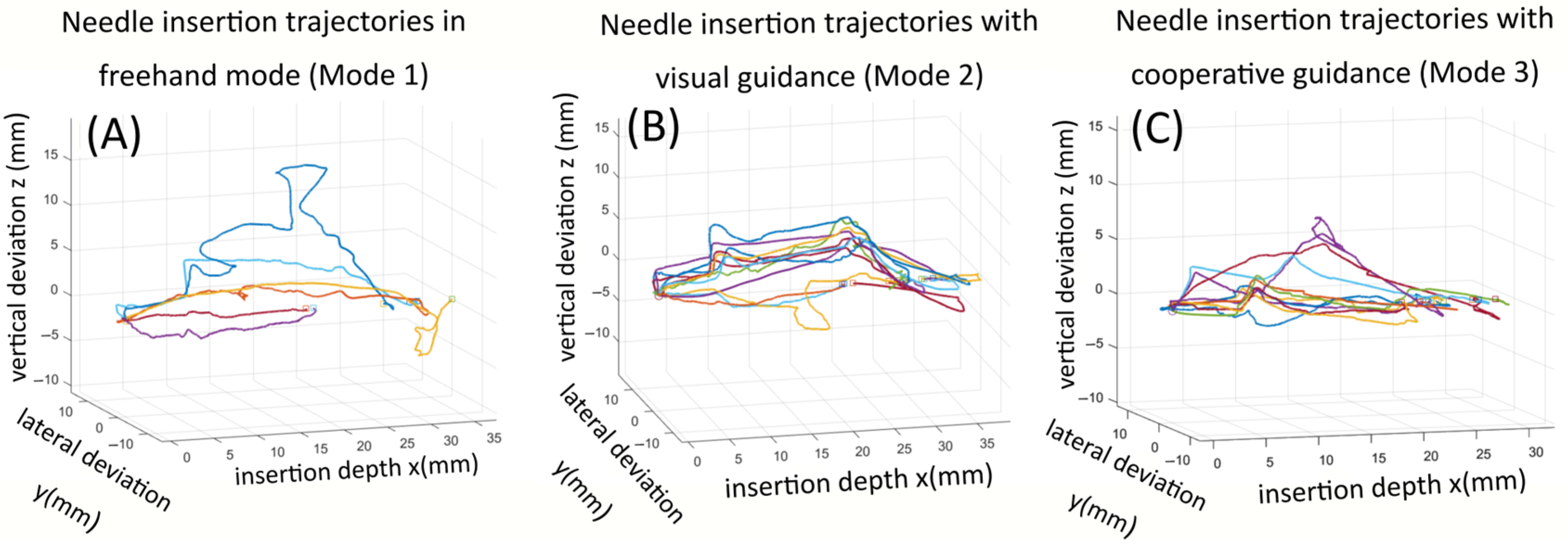
Accurate needle insertion during epidural anesthesia is challenging due to strong dependence on clinician experience and the limited integration of guidance modalities that simultaneously provide visual feedback and physical motion constraints. Current approaches, including ultrasound guidance and augmented reality visualization, mainly offer passive assistance and do not actively regulate insertion trajectory and depth, which may lead to variability in accuracy and increased risk of complications. This work presents a multimodal human–machine assistance system that combines augmented reality guidance with virtual fixtures to support lumbar epidural needle placement. A Tuohy needle is coupled to a haptic device interacting with a patient-specific L3–L4 lumbar phantom fabricated using 3D printing and ballistic gel. A model-based force profile reproduces the mechanical response of anatomical layers during insertion. Three experimental conditions are evaluated: freehand execution, augmented reality guidance with trajectory and depth visualization, and cooperative guidance using virtual fixtures defined by a cylindrical corridor and a depth-limiting plane. Results show a progressive reduction in mean depth error from 6.82 ± 3.46 mm (freehand) to 4.96 ± 2.41 mm (augmented reality) and 2.21 ± 1.73 mm (virtual fixtures). These findings indicate that the integration of visual and haptic guidance significantly enhances insertion precision and control. The proposed approach highlights the potential of multimodal human–machine cooperation for safer training and assisted interventions.
Keywords: epidural needle insertion; haptic guidance; augmented reality; virtual fixtures; human–machine cooperation; ultrasound-informed guidance epidural needle insertion; haptic guidance; augmented reality; virtual fixtures; human–machine cooperation; ultrasound-informed guidance