


Abstract
This paper presents a hybrid navigation architecture for mapless navigation based on monocular vision. The system combines perception-driven affordance control with event-triggered semantic reasoning within a unified decision framework. Navigation behavior is governed by interpretable perceptual signals and a vision-derived progress proxy that enables self-monitoring. A reactive control regime ensures real-time safety, while a semantic reasoning module is activated only under persistent navigation difficulty to provide structured guidance. Experimental results in simulation and real-world deployment demonstrate improved success rate, safety, and efficiency compared to reactive and continuously active semantic baselines, while maintaining real-time performance on embedded hardware.
1. Introduction
Autonomous indoor navigation remains a fundamental challenge in robotics, particularly in environments where accurate maps are unavailable, sensor data is noisy, and obstacles are dynamic or partially occluded [1,2]. Classical navigation systems typically rely either on precise geometric maps and localization, or on purely reactive controllers driven by low-level perception. While effective in structured settings, such approaches often degrade in cluttered or unfamiliar environments, producing oscillatory behavior, repeated collisions, or deadlocks near obstacles [3].
Recent learning-based methods, including deep reinforcement learning and imitation learning, aim to replace hand-designed controllers with end-to-end policies [4]. Although promising, these systems require large amounts of training data, are difficult to interpret, and often generalize poorly to unseen environments [5]. More recently, large language models (LLMs) and vision–language models (VLMs) have been explored as high-level decision-making components for robots [6]. While these models offer strong semantic reasoning capabilities, they are computationally expensive, can hallucinate unsafe actions, and lack the fast reflexes required for real-time navigation and collision avoidance [7].
Biological navigation systems demonstrate the importance of adaptive behavioral strategy selection. Rather than relying on a single monolithic control policy, biological systems dynamically adjust behavior according to environmental context and perceived progress, for example by slowing down under uncertainty, recovering from obstacles, or executing rapid evasive responses when danger is detected [8,9]. Inspired by these principles, modern robotic systems increasingly incorporate supervisory control layers that monitor performance and adapt behavior accordingly [10].
We propose a hybrid navigation architecture integrating perception-driven control with event-triggered semantic reasoning under a unified supervisory framework (detailed in Section 5). The system combines reactive navigation with conditional semantic guidance, enabling adaptive behavior while preserving real-time performance.
We evaluate the proposed architecture in both simulated indoor environments and real-world robotic deployment. Experimental results demonstrate improved navigation success, reduced collision frequency, and lower semantic reasoning cost compared to reactive baselines and continuously active language-guided controllers, while maintaining real-time performance on embedded hardware platforms. These results suggest that adaptive multi-regime navigation combining perception-driven control, supervisory event detection, and conditionally activated semantic reasoning provides a practical and scalable approach for vision-only autonomous navigation.
The main contributions of this work can be summarized as follows:
- A vision-only, mapless navigation architecture operating without depth sensing, localization, or metric goal information.
- A unified affordance-based framework integrating perception-driven control, supervisory modes, episodic memory, and semantic reasoning.
- An event-triggered hierarchical VLM–LLM navigation module that avoids continuous semantic inference.
- A visual progress proxy enabling self-monitoring without requiring spatial representations.
- A dual-regime adaptive navigation mechanism balancing real-time safety and high-level reasoning.
The remainder of the paper is organized as follows. Section 2 reviews related work. Section 3 and Section 4 describe perceptual invariants and the visual progress proxy. Section 5 presents the system architecture. Section 6, Section 7, Section 8 and Section 9 detail affordance control, supervisory modes, semantic navigation, and adaptive regime selection. Section 10 introduces episodic memory. Section 12 presents experiments and results, followed by conclusions.
2. Related Work
Autonomous robot navigation has been studied extensively, yielding approaches that can be broadly categorized as reactive control, affordance-based methods, learning-based systems, and, more recently, language-driven navigation. While each paradigm addresses specific aspects of the navigation problem, no paradigm alone provides a robust solution for mapless navigation in cluttered, unknown indoor environments.
2.1. Reactive and Invariant-Based Navigation
Early navigation systems relied on reactive control, generating actions directly from sensor measurements without constructing explicit world models. Classical approaches such as Braitenberg vehicles, potential fields, and subsumption architectures demonstrated that simple perception–action couplings can produce effective obstacle avoidance and goal-seeking behaviors in constrained settings. However, their lack of global context makes them vulnerable to oscillations and deadlocks in complex environments.
Biologically inspired extensions introduced perception-driven signals—such as looming-based visual expansion cues, motion asymmetry, and ground-plane continuity—to anticipate collisions and identify traversable space without explicit depth estimation. These methods offer fast, interpretable reflexes and low computational overhead, making them attractive for real-time control. Nevertheless, their decision-making remains inherently local, limiting their ability to recover from persistent failure cases or adapt behavior over longer time horizons [11,12,13].
2.2. Affordance-Based Action Selection
Affordance-based navigation formulates control as the evaluation of a small set of candidate actions based on perceptual cues, rather than explicit path planning in a metric map. This paradigm has been adopted in both classical vision-based systems and modern neural approaches that infer action likelihoods from images [14].
By constraining the action space, affordance fields enable efficient reactive decision-making. However, without higher-level supervision, affordance-based controllers remain susceptible to repetitive or counterproductive behaviors. In particular, they lack mechanisms to detect stagnation, negative progress, or repeated failure, which can lead to long-term divergence despite locally reasonable action choices [15].
2.3. Learning-Based Navigation
End-to-end learning approaches, including deep reinforcement learning and imitation learning, aim to directly map raw sensory inputs to control actions. While these methods can achieve strong performance in training environments, they typically require extensive data collection and careful reward shaping, and often generalize poorly to unseen scenes. Their internal representations are also difficult to interpret, complicating failure analysis and safety guarantees [16].
Hybrid learning-based systems attempt to combine learned components with classical control. However, many such systems still rely on a single policy or fixed control structure throughout an episode, making them vulnerable to catastrophic failures when encountering novel or ambiguous situations that fall outside the training distribution [17].
It is important to note that most reinforcement learning (RL) navigation approaches rely on reward signals derived from goal distance, privileged simulator state, or localization information. In contrast, the proposed system operates under strict vision-only constraints. While RGB-only RL is theoretically possible, designing a fair comparison under identical constraints would require a substantially different training setup and reward formulation. For this reason, RL-based methods are discussed qualitatively rather than included as direct experimental baselines.
2.4. Vision–Language Models for Robotics
Recent advances in vision–language models (VLMs) and large language models (LLMs) have motivated their use as high-level planners or decision-making modules in robotic systems. These models provide powerful semantic reasoning capabilities and can generate structured action suggestions from visual input. However, their high computational cost, latency, and susceptibility to hallucinated or unsafe outputs make them unsuitable for continuous low-level navigation control [18].
To address these limitations, several works employ language models only for high-level guidance while delegating execution to traditional controllers. Despite this separation, most existing approaches lack a principled mechanism for determining when language-based reasoning should be invoked or how its outputs should be integrated safely and efficiently into real-time control loops [19].
2.5. Hierarchical Semantic Navigation and Planning
Recent work has begun exploring hierarchical semantic navigation approaches that combine visual scene understanding with high-level reasoning to generate intermediate navigation targets such as semantic waypoints or landmark-based goals. These methods aim to bridge the gap between purely reactive navigation and full metric mapping by leveraging semantic structure in visual environments.
While promising, many existing semantic navigation systems rely on continuous semantic reasoning or assume access to structured environment representations, which can limit real-time performance and deployment on resource-constrained platforms. In addition, few systems provide mechanisms for dynamically switching between reactive control and semantic planning based on task difficulty or environmental structure.
2.6. Supervisory Control and Adaptive Strategy Selection
Layered control and subsumption-based architectures introduced the concept of behavior arbitration and multi-level decision-making. More recent work in adaptive control and meta-learning emphasizes monitoring performance and switching strategies when failures are detected. However, these concepts have rarely been applied in a unified manner to vision-based, mapless mobile robot navigation systems that integrate fast perception-driven control, hierarchical semantic reasoning, and experience-based adaptation within a single operational framework [20,21].
3. Perceptual Invariants
To enable fast, interpretable navigation without maps, localization, or depth sensors, the proposed system relies on a small set of handcrafted perceptual invariants extracted directly from consecutive monocular RGB images. These invariants are inspired by biological vision and ecological psychology, where stable visual cues guide action without requiring explicit 3D reconstruction. Rather than estimating geometry, the signals act as lightweight visual proxies that summarize local risk, motion, and environmental structure.
Let and denote two consecutive camera frames. From these, four scalar signals are computed to form a compact perceptual representation.
3.1. Looming-Inspired Brightness Expansion
Classical time-to-contact (TTC) theory estimates the imminence of collision based on the rate of image expansion [22]. Since explicit depth and dense optical flow are unavailable in our setting, we instead compute a brightness-based expansion heuristic inspired by looming perception.
Specifically, we measure the relative change in the number of bright pixels within a central image region:
where denotes the number of pixels above a fixed brightness threshold in the central region of the image at time .
A small value of corresponds to a rapid increase in bright pixels, which often correlates with forward motion toward nearby surfaces and thus elevated collision risk. When falls below a predefined threshold, the reflex layer suppresses forward motion and enforces a STOP or TURN action. This signal is a computationally efficient heuristic and does not represent a physically grounded estimate of time-to-collision.
3.2. Left–Right Motion Asymmetry
To capture lateral visual motion, we compute a frame-difference-based asymmetry signal between the left and right halves of the image:
where and denote the mean absolute pixel differences between and computed over the left and right image halves, respectively.
This signal does not represent true optical flow, but rather a motion energy asymmetry reflecting relative visual change across the image. A positive value indicates stronger motion on the left side, suggesting nearby structure or obstacles and a preference to turn right, and vice versa [23].
3.3. Ground Edge Density
To detect obstacles near the floor, we analyse the lower region of the image. Horizontal and vertical intensity gradients are computed, and strong edges are counted:
where edges are detected using a fixed gradient-magnitude threshold.
A high value of indicates dense edge structure near the ground plane, which often corresponds to walls, furniture, or other obstacles that impede forward motion [24].
3.4. Image Entropy
Visual entropy measures the overall texture and complexity of the scene:
where is the empirical probability of gray-level intensity in the image.
High entropy values indicate visually complex or highly textured scenes, which are often associated with cluttered or ambiguous regions where navigation decisions become less reliable [25].
4. Visual Progress Proxy
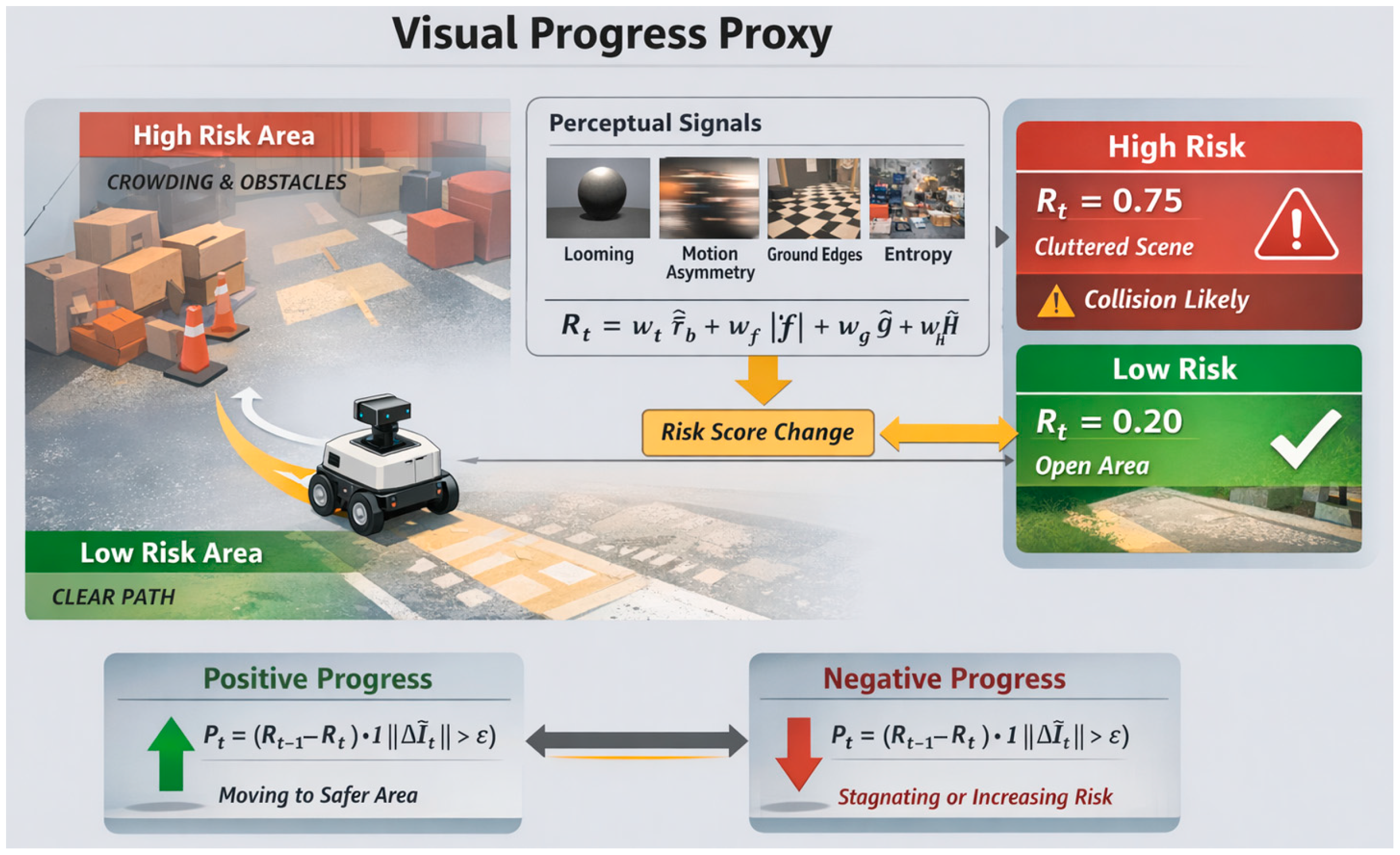
In the absence of metric localization, maps, or goal-distance-based control, the robot requires an internal mechanism to assess whether its recent actions are improving the navigational situation or leading toward increased difficulty. To this end, we introduce a visual progress proxy derived exclusively from the perception-driven signals described in Section 3. This proxy provides a perception-driven estimate of navigational improvement using only monocular RGB observations and is used for supervisory monitoring, explicit event detection, and adaptive regime selection.
At each time step , the agent computes the perceptual signal vector:
4.1. Perceptual Risk Estimate
We define an instantaneous perceptual risk score as a weighted sum of normalized invariant signals [26,27,28]:
where denotes normalization computed over a sliding window of W frames and are fixed scalar weights.
Each weight controls the relative contribution of a specific perceptual cue: the looming term captures collision imminence, motion asymmetry encodes lateral obstacle distribution, ground-edge density reflects traversability constraints, and entropy represents visual uncertainty. The weights were empirically tuned to balance safety and navigation progress, and all signals are normalized over a sliding window to ensure consistent scaling across environments.
This risk measure does not estimate geometric distance, time-to-collision, or goal proximity. Instead, it acts as a compact, vision-based indicator of how visually cluttered, uncertain, or hazardous the current situation appears.
4.2. Visual Progress Definition
Visual progress is defined as the temporal decrease in perceptual risk, gated by observed inter-frame motion [29,30]:
where denotes the mean absolute pixel difference between consecutive frames, is a small motion threshold, and is an indicator function that suppresses false progress estimates under near-static observations.
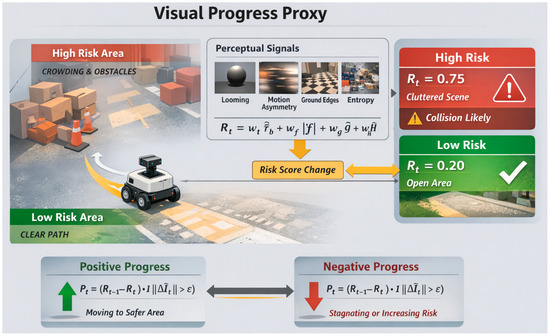
A positive value of indicates that the agent is moving toward visually safer or less cluttered regions, while near-zero or negative values indicate stagnation or increasing local perceptual risk. This signal is used exclusively for supervisory monitoring and event detection, such as identifying stagnation, triggering supervisory mode transitions (e.g., SLOW, RECOVER, or ESCAPE), and activating semantic navigation when persistent failure is detected (Figure 1).
Figure 1.
Visual Progress.
4.3. Vision-Based Goal Representation
In order to maintain consistency with the vision-only constraints of the proposed architecture, navigation goals are represented through visual similarity rather than metric coordinates. The controller does not have access to spatial goal positions, distance-to-goal, or global pose information. Instead, each task is defined by a goal visual representation, either as a reference image or as a semantic scene description interpreted through the VLM. At runtime, the system computes a goal similarity score directly from the current RGB observation, enabling goal-directed behavior without localization or map construction. Ground-truth spatial goal regions, when used in simulation, serve exclusively as external evaluation criteria and are never available to the controller during execution.
5. System Architecture Overview
5.1. Overview
The proposed navigation system follows a layered architecture in which perception-driven affordances provide the primary control mechanism, while supervisory processes monitor navigation progress and adapt behavior when local perception becomes insufficient.
The system is organized around a shared perception–control backbone supporting two complementary regimes: a reactive regime for real-time navigation and a semantic regime providing higher-level guidance when required. An adaptive supervisory mechanism regulates the activation of semantic reasoning.
All components interact through a unified affordance-based decision process, ensuring that action selection remains consistent and safety-driven across both regimes.
5.2. Architectural Components
The navigation architecture is composed of tightly integrated modules operating at different temporal and functional levels. Together, these components enable perception-grounded decision making, adaptive strategy selection, event-triggered semantic reasoning, and robust safety enforcement. Table 1 summarizes the principal architectural modules and their roles.
Table 1.
Main architectural components of the proposed system.
These components operate at multiple time scales, ranging from fast perception and affordance evaluation to slower supervisory monitoring, memory retrieval, and conditional semantic reasoning.
5.3. Control Loop
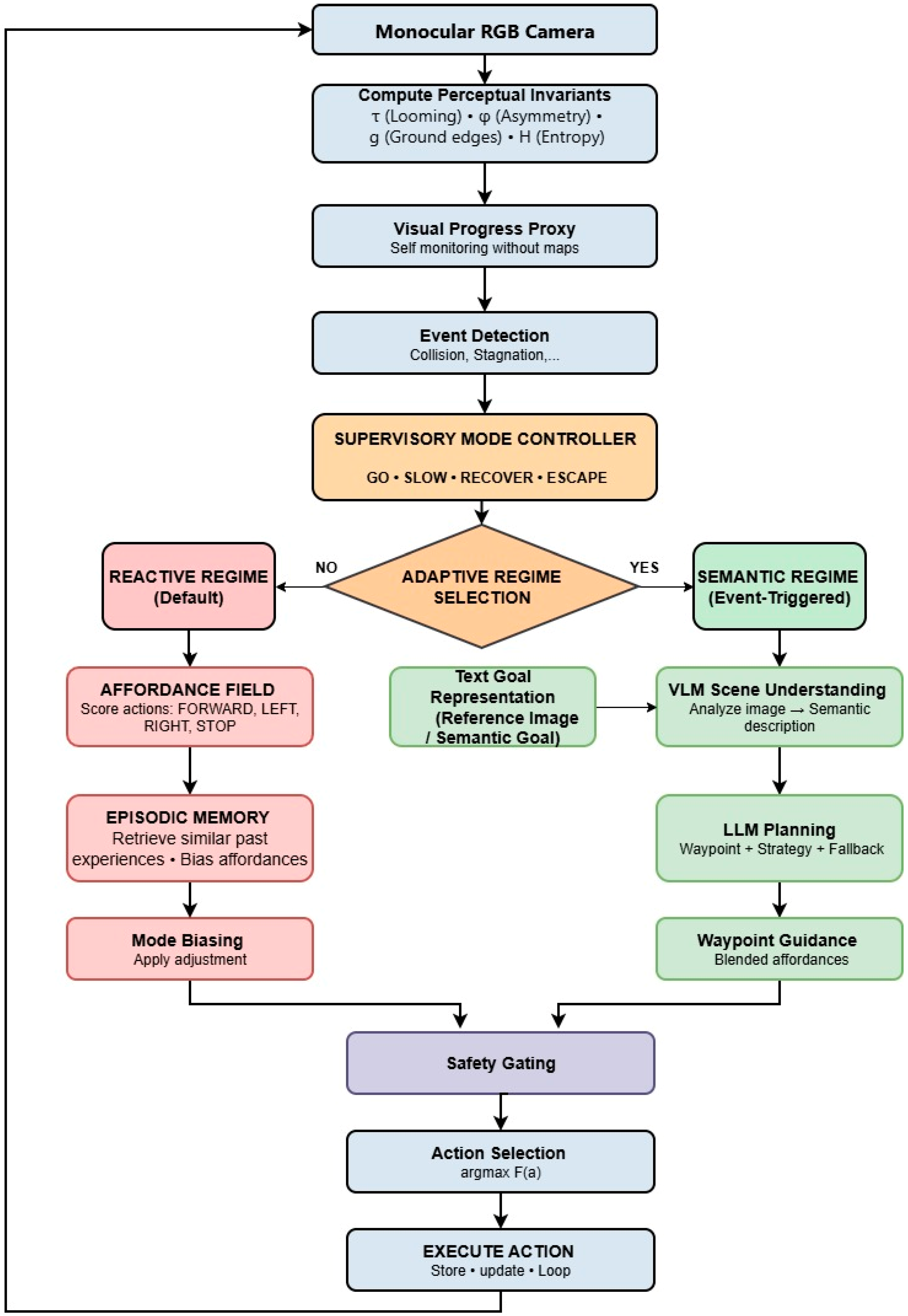
At each time step , the RGB input is converted into a perceptual vector . From this representation, a visual progress estimate is computed and passed to an event detection stage that explicitly identifies navigation-critical conditions. Detected events drive supervisory mode selection and adaptive regime switching.
Reactive affordance evaluation remains continuously active and produces a base affordance field over the discrete action set. Episodic memory and supervisory mode biasing reshape this field without directly selecting actions. When the semantic regime is active, visual waypoint guidance extracted from VLM scene understanding and LLM planning is blended as a soft bias into the same affordance representation rather than forming an independent controller.
After all contributions have been combined, the reflex safety gating layer performs the final action-selection check, enforcing hard safety vetoes on any action that violates immediate perceptual constraints. A single unified action selection step then chooses the highest-scoring safe action. This design ensures that semantic reasoning, memory, and supervisory modes influence behavior only through affordance modulation, while perception-driven safety remains dominant.
The Graceful Degradation Mechanism maintains robustness under repeated failures by progressively falling back from full semantic planning to reactive navigation with intensified recovery behavior. Semantic planning is invoked conditionally and persists across multiple control cycles, avoiding unnecessary computation and preserving real-time performance.
This unified decision process ensures that all system components influence behavior through a single action-selection stage, preventing conflicts between reactive control and higher-level reasoning.
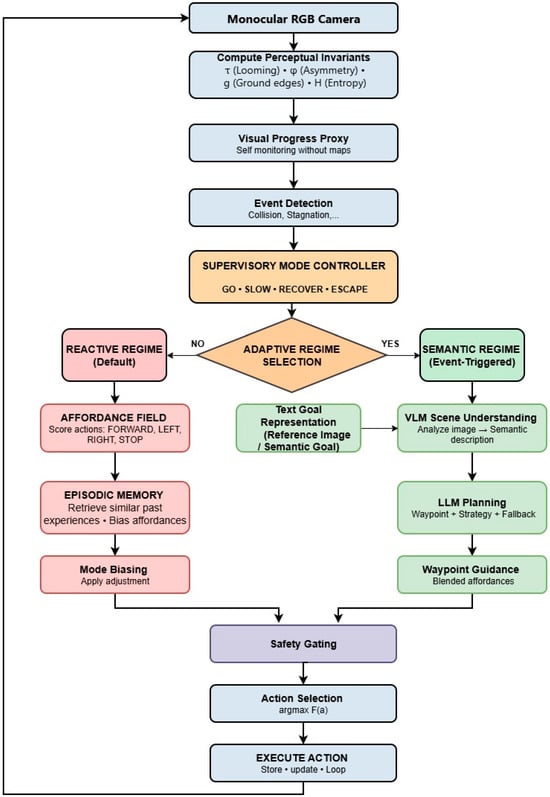
Figure 2 provides a block-diagram overview of the corrected dual-regime navigation architecture and the interaction between its components. The navigation objective is provided as a goal representation defined by a textual description, consistent with the structured prompts used in the implementation. This goal input, expressed either as a short natural-language instruction or a semantic scene description, conditions the VLM scene understanding and hierarchical planning modules without directly influencing perception-driven reactive control.
Figure 2.
Block diagram of the Cognitive Hybrid Navigation System.
We next describe how perceptual invariants are transformed into action preferences through an affordance-based control formulation.
6. Affordance Field
Rather than selecting actions directly from raw sensory input, the proposed system transforms perceptual signals into an affordance field: a continuous scoring of candidate actions based on their local safety and utility. This field provides a structured intermediate representation between low-level perception and higher-level supervisory control.
At each time step, the affordance field assigns a score to each discrete action:
using a weighted combination of invariant-based heuristic terms.
6.1. Base Affordance Model
For each action , an affordance score is computed as:
where is the perceptual invariant vector, are signal-to-action mapping functions, and are fixed scalar weights.
This formulation is an engineered heuristic model inspired by ecological theories of affordances in perception [31,32] and prior robotic affordance learning models [33]. The looming-inspired signal follows classical time-to-contact control principles [34]. Ground clutter and entropy capture traversability and perceptual uncertainty [35,36], while motion asymmetry reflects optical-flow-based obstacle avoidance principles [37]. Episodic memory modulation is inspired by cognitive models of episodic control [38,39].
6.2. Signal-to-Action Mappings
(a) Looming term
- Encourages forward motion when the path is open and stopping under high looming risk:
(b) Ground-edge term
- Penalizes forward motion when ground clutter is high and favors turning:
(c) Entropy term
- Discourages movement in visually complex scenes and favors stopping:
(d) Motion asymmetry term
- Steers away from the side with stronger visual motion:
6.3. Action Selection
The raw affordance scores are normalized and passed to an argmax operator:
This action represents the default local control decision and is subsequently modulated by the supervisory controller and reflex safety layer.
6.4. Episodic Memory Bias
During execution, episodic memory introduces a multiplicative bias on the affordance scores:
where is a memory-derived scaling factor computed from prior outcomes in similar perceptual conditions.
This mechanism allows accumulated experience to influence behavior while preserving the primacy of perception-driven safety constraints.
7. Supervisory Cognitive Modes and Strategy Control
The principal contribution of this work is a supervisory control layer that dynamically selects an appropriate behavioral mode based on perception-driven event monitoring. Rather than directly replacing low-level control, the supervisor reshapes the decision landscape of the affordance field by biasing action preferences according to recent perceptual outcomes.
Unlike purely reactive navigation strategies, which continuously execute locally optimal actions, the proposed supervisor evaluates whether recent behavior produces meaningful perceptual improvement. Monitoring relies exclusively on vision-derived signals and the visual progress proxy introduced in Section 4, without spatial priors.
Supervisory decisions are driven by an explicit event detection stage that identifies navigation-critical conditions such as stagnation, deterioration, elevated uncertainty, or immediate danger. These events influence both supervisory mode selection and the activation of higher-level semantic navigation. The supervisory layer therefore acts as an intermediate strategy controller that bridges fast perception-driven affordances and slower adaptive reasoning processes.
The mechanism is formalized as a finite-state controller operating over a small set of interpretable supervisory modes. These modes address common failure patterns of reactive navigation, including repeated ineffective actions, oscillations near obstacles, and prolonged hesitation under uncertainty [40,41].
7.1. Mode Set
The controller operates over four supervisory modes:
Each mode represents a short-horizon behavioral strategy rather than a direct control policy (Table 2).
Table 2.
Modes set.
This reduced mode set consolidates earlier exploratory and waiting behaviors into unified safety-oriented strategies, simplifying supervisory control while preserving adaptability.
7.2. Event Triggers
Transitions between modes are governed by events computed exclusively from perceptual invariants and the visual progress proxy :
- Collision: physical contact detected by the platform.
- Stagnation: smoothed visual progress remains near zero for consecutive steps.
- Deterioration: sustained negative visual progress indicating increasing perceptual risk.
- Uncertainty: elevated image entropy and ground-edge density indicating ambiguous or cluttered scenes.
- Immediate Danger: high looming or ground-edge signals indicating imminent collision risk.
All triggers rely solely on monocular vision-derived signals and do not use spatial coordinates, maps, or goal-distance information.
7.3. Priority Hierarchy
When multiple events occur simultaneously, mode selection follows a strict safety-first hierarchy:
This ordering ensures that rapid evasive behavior takes precedence over recovery or exploratory adjustments, reflecting the safety-dominant design of the architecture [42,43].
7.4. Timed Persistence
To prevent rapid oscillations between strategies, each non-GO mode persists for a bounded duration (typically 3–18 control steps). Temporal persistence allows each behavioral strategy sufficient time to influence perceptual feedback before reevaluation, stabilizing navigation while maintaining responsiveness.
This persistence mechanism also stabilizes regime selection by preventing rapid switching between reactive and semantic navigation. Semantic activation is maintained until clear exit conditions—such as sustained positive progress or waypoint completion—are observed.
7.5. Mode-Specific Control Policies
Supervisory modes do not replace the affordance controller. Instead, they bias or constrain action scoring within the shared affordance field:
- GO: standard processing pipeline with minimal bias.
- SLOW: reduces forward-motion weighting and increases turning diversity under uncertainty.
- RECOVER: suppresses forward actions and promotes controlled turning to escape local traps.
- ESCAPE: strongly penalizes forward motion and prioritizes evasive turning actions.
Because all modes operate through affordance modulation, final action selection remains unified and subject to reflex safety gating.
7.6. Discussion and Human Analogy
The supervisory modes implement a perception-driven self-monitoring process that separates strategy selection from low-level action execution. This design reflects functional similarities to human navigation behavior, where individuals slow down under uncertainty, adjust direction after repeated failure, and execute rapid evasive actions when danger is detected [44,45]. The analogy is conceptual rather than biological; the system remains grounded in engineered perceptual signals and deterministic supervisory logic.
9. Adaptive Regime Selection
The navigation system operates through a cooperative interaction between perception-driven control and higher-level semantic reasoning. Rather than functioning as independent controllers, these processes are integrated within the unified affordance-based framework described in Section 5. Adaptive regime selection regulates the influence of semantic guidance based on observed navigation performance.
Reactive affordance-based control remains continuously active and serves as the primary mechanism for real-time navigation. This ensures low-latency response and robust safety behavior under normal conditions. Semantic reasoning is introduced only when reactive behavior alone becomes insufficient to produce meaningful progress.
The activation of semantic guidance is governed by supervisory events derived from perception-driven monitoring. Persistent navigation difficulty—such as sustained stagnation, repeated deterioration, or elevated uncertainty—indicates that local perceptual cues are insufficient for effective decision making. Under these conditions, semantic reasoning is activated to provide structured guidance that complements reactive control.
Regime selection is therefore implemented as a continuous modulation process rather than a discrete switch. When active, semantic outputs influence behavior by biasing the shared affordance representation, while perception-driven evaluation remains dominant. This ensures that higher-level reasoning enhances navigation without compromising responsiveness or safety.
To maintain stability, regime transitions incorporate temporal persistence constraints. Once semantic guidance is activated, it remains active for a bounded duration to allow consistent execution of the current strategy. Deactivation occurs when navigation performance improves, as indicated by sustained positive progress or a return to stable supervisory conditions. Conversely, increasing perceptual risk or immediate danger reduces the influence of semantic guidance, allowing reactive safety responses to dominate.
This adaptive mechanism enables efficient allocation of computational resources by limiting semantic reasoning to situations where it provides clear benefit. At the same time, it preserves the robustness of perception-driven control by maintaining a unified, safety-constrained decision process throughout execution.
10. Episodic Memory and Bias Adaptation
To enable long-term adaptation without retraining any neural model, the proposed navigation system incorporates an episodic memory module that records past experiences and uses them to bias future decisions. Rather than learning through gradient updates, the robot improves by remembering the perceptual consequences of its actions in similar visual situations. This memory functions as a lightweight, lifelong knowledge base that captures both successful and failed navigation behaviors, enabling gradual environment-specific adaptation without explicit mapping or localization [46,47].
Each interaction step is stored as an episode described by a compact perceptual state–action–outcome tuple:
where denotes the looming-inspired brightness expansion heuristic, the left–right motion asymmetry, the ground-edge density, and the image entropy. The term is the executed action, and indicates whether forward motion was physically blocked by a collision. The quantity represents the change in perceptual risk following the action, computed from the visual progress proxy defined in Section 4, while encodes qualitative results such as safe progress or collision.
Importantly, no goal coordinates, goal distances, or metric spatial information are stored or used. All memory content is derived exclusively from monocular visual perception and observed action outcomes. Episodes are stored in a bounded, JSON-based memory buffer, allowing thousands of past experiences to be retained with minimal computational overhead.
At runtime, the current perceptual invariant vector is compared to stored episodes using a similarity metric in invariant space. A small support set of the most similar past experiences is retrieved. When sufficient matches are available, memory is considered reliable and is used to generate experience-based behavioral biases.
These biases operate in two complementary ways. First, affordance multipliers rescale current affordance scores, reinforcing actions that previously reduced perceptual risk and suppressing actions that frequently led to collisions or stagnation under similar visual conditions. Second, memory induces adaptive trigger shifts, slightly adjusting uncertainty thresholds—such as entropy or ground-edge limits—so that the robot behaves more cautiously in perceptually risky contexts and more permissively in historically safe ones.
Rather than directly commanding actions, episodic memory softly reshapes the decision landscape. It operates in synergy with the affordance field, reflex safety layer, and cognitive modes, ensuring that accumulated experience influences behavior while immediate safety constraints remain dominant. Over time, this mechanism reduces repeated failure patterns and enables environment-specific adaptation, effectively turning the system into a self-improving cognitive navigator capable of lifelong learning without retraining.
12. Experiments and Results
We evaluate the proposed dual-regime navigation architecture in both simulation and real-world deployment. The experiments assess navigation success, safety, efficiency, computational cost, and the functional contributions of (i) supervisory mode control, (ii) episodic memory bias adaptation, and (iii) event-triggered hierarchical semantic navigation (VLM–LLM).
The proposed architecture is designed for mapless navigation using monocular RGB vision as the primary sensing modality. The system explicitly excludes spatial priors, focusing instead on perception-grounded decision-making derived directly from camera observations. Under this formulation, direct comparison with SLAM-based navigation systems is difficult to interpret, as SLAM methods rely on accurate state estimation, map construction, and often multi-sensor fusion—capabilities intentionally outside the scope of this work.
Similarly, modern reinforcement learning and imitation learning navigation approaches typically require large-scale training data, task-specific reward design, and substantial computational resources for policy training and deployment [48]. In contrast, the proposed system operates in a training-free manner, enabling incremental adaptation through episodic memory without offline policy optimization. It is therefore targeted at deployment scenarios where only a monocular camera is available and mapping or training infrastructure may be impractical. Accordingly, evaluation focuses on comparisons within perception-driven and hybrid semantic navigation architectures operating under similar sensing and mapless constraints.
In this mapless formulation, navigation goals are not specified as metric coordinates or global spatial targets. Instead, they are defined through visual or semantic conditions observable from monocular RGB input. During deployment, goal completion is achieved when the robot detects scene characteristics consistent with the objective, such as an open navigable area, a distinctive landmark, or a semantically defined configuration inferred through VLM–LLM reasoning. Navigation thus emerges from perception-driven exploration combined with event-triggered semantic guidance, rather than explicit metric path planning.
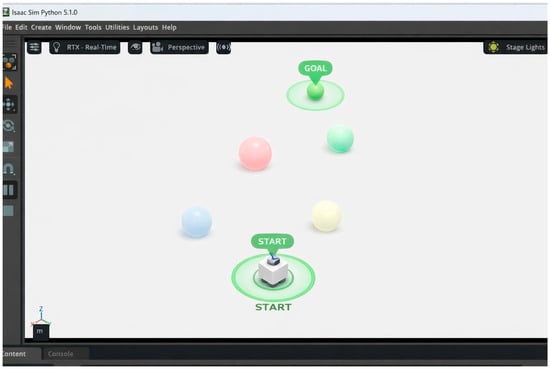
In the simulation experiments, the goal is represented by the green spherical marker shown in Figure 3. This marker defines the target region solely for evaluation and visualization purposes. The controller does not receive the sphere’s coordinates, distance, or any explicit spatial information. Instead, goal-directed behavior relies entirely on the vision-based formulation described in Section 4.3, where progress is determined through visual similarity and semantic consistency derived from monocular RGB observations.
Figure 3.
Simulation environment with goal marker (green sphere used for evaluation only).
We compare the proposed method with three categories of navigation approaches: (i) perception-driven reactive methods, (ii) continuous language-guided navigation using always-on VLM–LLM inference, and (iii) learning-based approaches discussed qualitatively. Direct comparison with RL-based methods is limited by differences in sensing assumptions, as many such methods rely on goal-distance signals or privileged state information not available in our formulation.
12.1. Simulation Environment
All simulation experiments are conducted in NVIDIA Isaac Sim using a lightweight indoor navigation benchmark with metric world units (1 unit = 1 m). The environment consists of a flat planar scene with fixed lighting and four static spherical obstacles placed at predefined locations.
The robot is modeled as a simple rigid-body proxy controlled in discrete time using the action set:
A FORWARD action translates the robot by 0.12 m along its heading, while turning actions rotate it by ±15°. The robot is equipped with a monocular RGB camera tilted downward by 10°, producing 128 × 128 images at 30 Hz. No depth sensors, LiDAR, odometry, maps, or localization signals are provided to the controller.
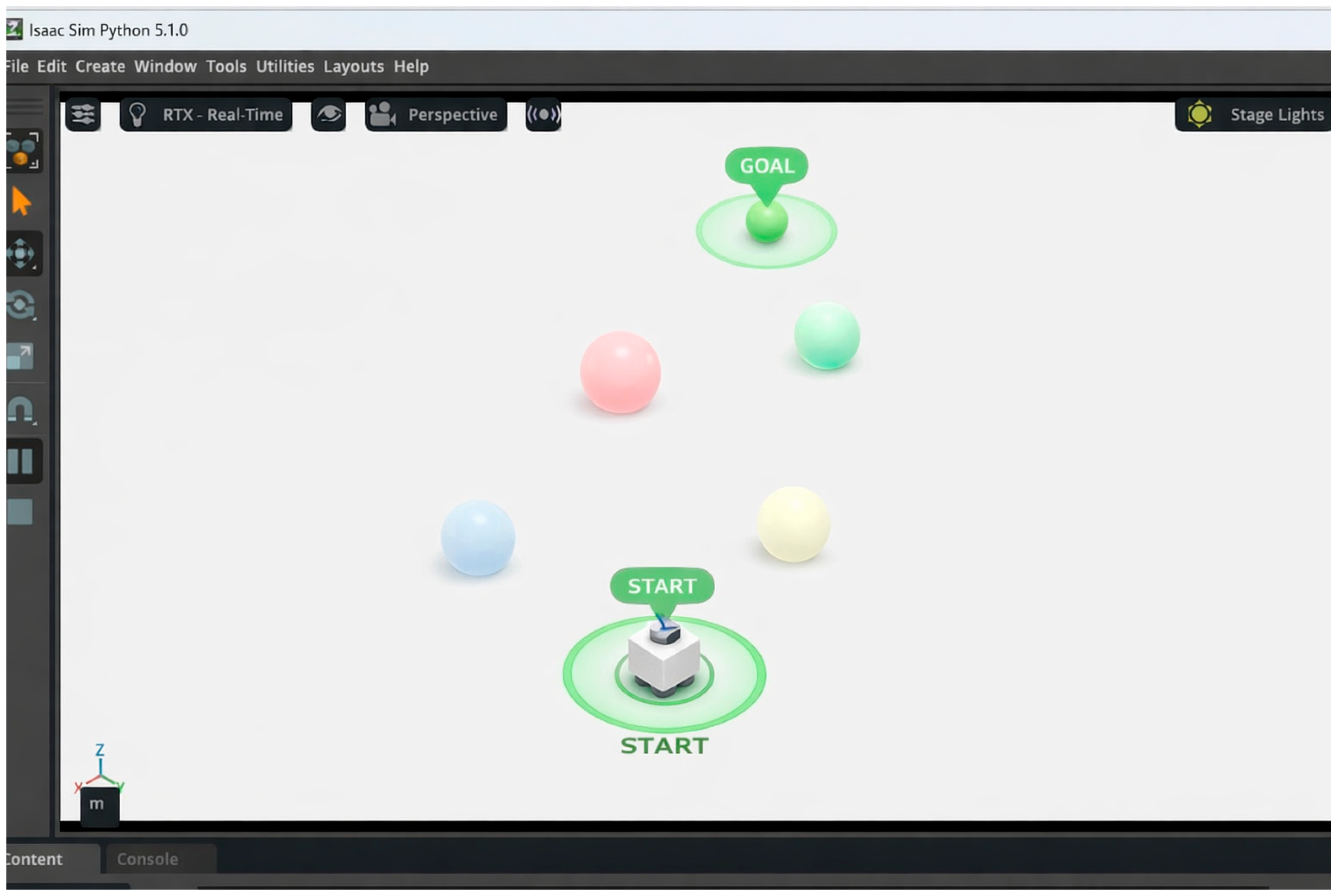
For evaluation purposes only, a circular region of radius 0.35 m in the horizontal plane is defined in the simulator to verify successful goal attainment. This region corresponds to the green spherical marker shown in Figure 3 and is used exclusively for performance measurement and visualization. The controller does not receive the region’s coordinates or distance information during execution. Each episode terminates when the robot enters this region or after a maximum of 1000 time steps. Collisions are detected using the simulator contact signal and are exposed as binary events used by the recovery mode and evaluation metrics. An example configuration is shown in Figure 4.
Figure 4.
Example start and goal configuration. The goal is not directly observable by the agent and is shown for visualization purposes only.
We compare the proposed system against baselines and ablations designed to isolate the contributions of each architectural component:
- Reactive Affordance Only: affordance-based action selection without supervisory modes, memory, or semantic navigation.
- Reactive + Reflex Safety: adds the reflex safety gating layer but no supervisory modes, memory, or semantic navigation.
- Reactive + Supervisory Modes: adds supervisory mode biasing (GO/SLOW/RECOVER/ESCAPE) but no memory or semantic navigation.
- Reactive + Always-On LLM: continuous VLM–LLM guidance applied throughout the episode (no event-triggering, no semantic waypoint stack).
- Dual-Regime (Ours): full system with supervisory modes, episodic memory bias, and event-triggered hierarchical semantic navigation (VLM scene understanding + LLM hierarchical planning + waypoint monitoring + fallback).
This set separates (i) safety reflexes, (ii) strategy-level supervision, (iii) experience-based biasing, and (iv) semantic planning and its activation policy.
Key implementation parameters include empirically tuned weights for perceptual signals, normalization window size for risk estimation, and thresholds for event detection (stagnation, uncertainty, and danger conditions). The control loop operates at 10–15 Hz, while semantic reasoning is triggered at a lower frequency (0.1–0.4 Hz), ensuring real-time performance.
12.2. Evaluation Metrics
We measure complementary metrics capturing task success, efficiency, safety, and internal system behavior:
- Success Rate: percentage of episodes reaching the goal within the step limit
- Steps to Goal: number of steps required in successful runs
- Collision Count: total obstacle contacts per episode
- Backtracking Ratio: fraction of steps that increase ground-truth distance to the goal
- STOP Loop Ratio: fraction of time spent issuing repeated STOP actions
- Semantic Calls: number of semantic navigation activations per episode (VLM–LLM planning calls).
Although ground-truth distance is used to compute efficiency and backtracking metrics, it is never available to the controller during execution.
12.3. Implementation Parameters
The system uses the following parameter values:
- Risk weights: w1 = 0.4, w2 = 0.2, w3 = 0.25, w4 = 0.15
- Normalization window: W = 20 frames
- Motion threshold: δ = 0.01
- Stagnation condition: Pt < 0.01 for 10 consecutive steps
- Entropy threshold: H > 4.5
- Looming threshold: τ < 0.2
- Ground-edge threshold: g = 25
- Mode persistence: 5–10 control steps depending on mode
- Memory retrieval: k = 5 nearest neighbors using cosine similarity
12.4. Simulation Results
Table 3 reports average performance over 100 episodes per method. The proposed dual-regime system consistently outperforms baselines, achieving the highest success rate, the lowest collision frequency, and improved path efficiency while maintaining low semantic reasoning frequency.
Table 3.
Average performance of navigation methods in simulation.
The reported values correspond to averages over 100 episodes, with variability indicated by standard deviations where applicable. Additional analysis confirms consistent performance improvements across different initial conditions, demonstrating robustness of the proposed architecture.
The affordance-only controller frequently becomes trapped in oscillatory behaviors near obstacles. Adding reflex safety reduces collisions but does not prevent prolonged stagnation. Introducing supervisory modes substantially improves stability by detecting stagnation and deterioration through the vision-based progress proxy and reshaping affordance preferences accordingly. Continuous LLM guidance improves success modestly but incurs high call frequency and can amplify STOP loops due to inconsistent or latency-prone suggestions.
All evaluated baselines operate under the same monocular, mapless sensing constraints, ensuring a fair comparison with the proposed method.
In contrast, the full system benefits from event-triggered hierarchical semantic navigation, which is activated only when persistent failure is detected. When active, semantic waypoint guidance provides multi-step directional bias within the shared affordance field, helping the agent escape ambiguous layouts without dominating control. Episodic memory further reduces repeated failure patterns across episodes by biasing affordance scores and adapting uncertainty thresholds based on past outcomes.
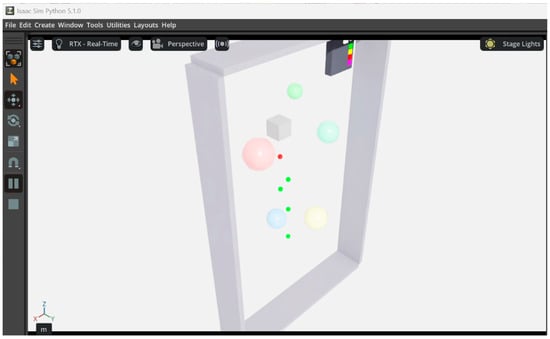
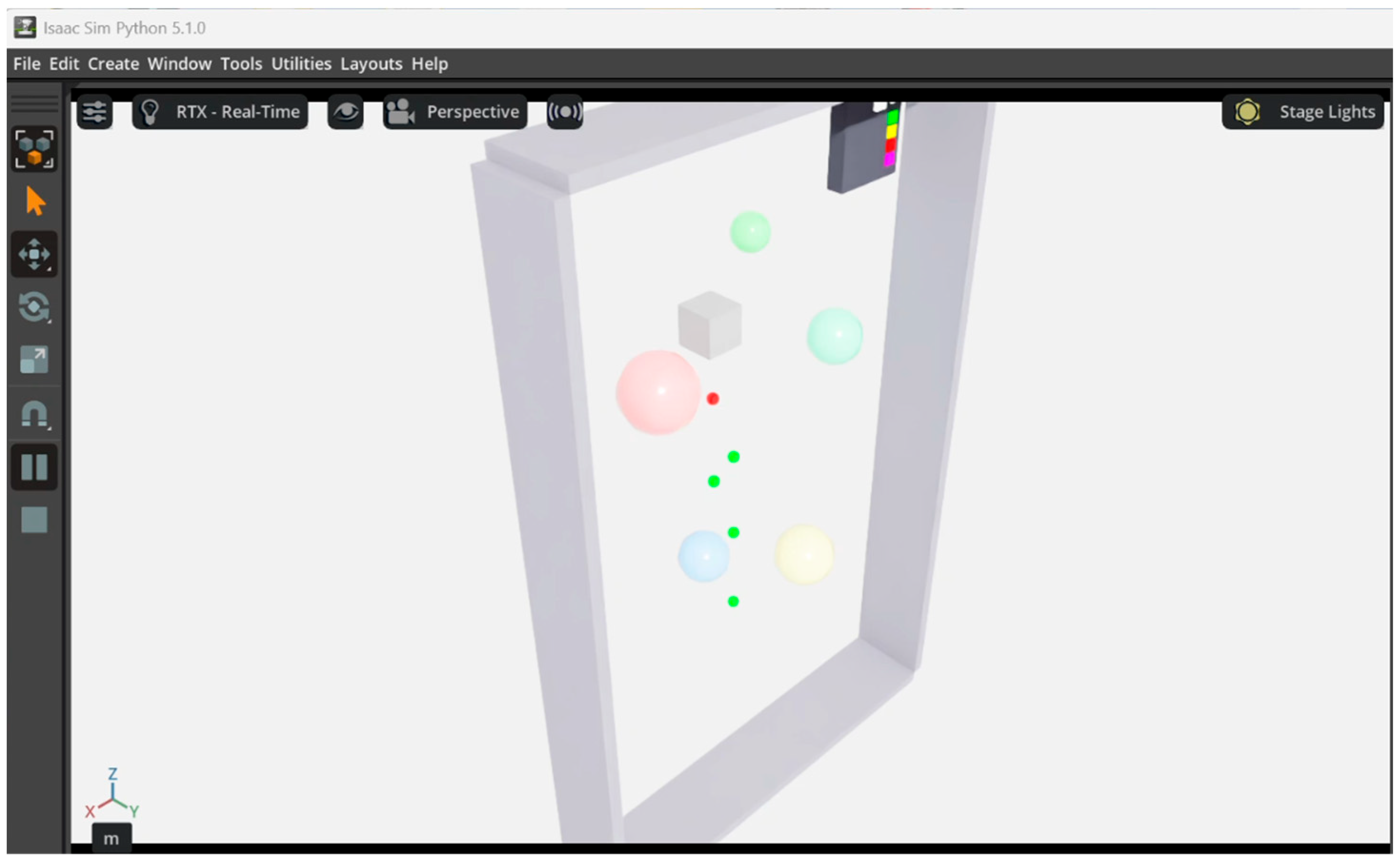
Trajectory visualizations (Figure 5) show smoother convergence with fewer oscillations under the proposed system compared to reactive baselines.
Figure 5.
Trajectory visualization with supervisory modes (GO, SLOW, RECOVER, ESCAPE) and regime transitions (Reactive (Sphere) vs. Semantic (Cube)).
12.5. Real-World Deployment on Embedded Platform
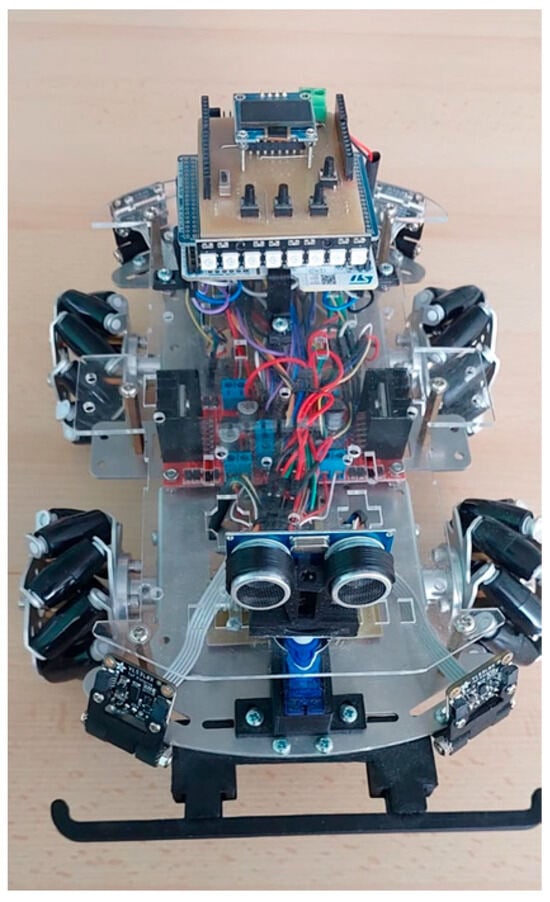
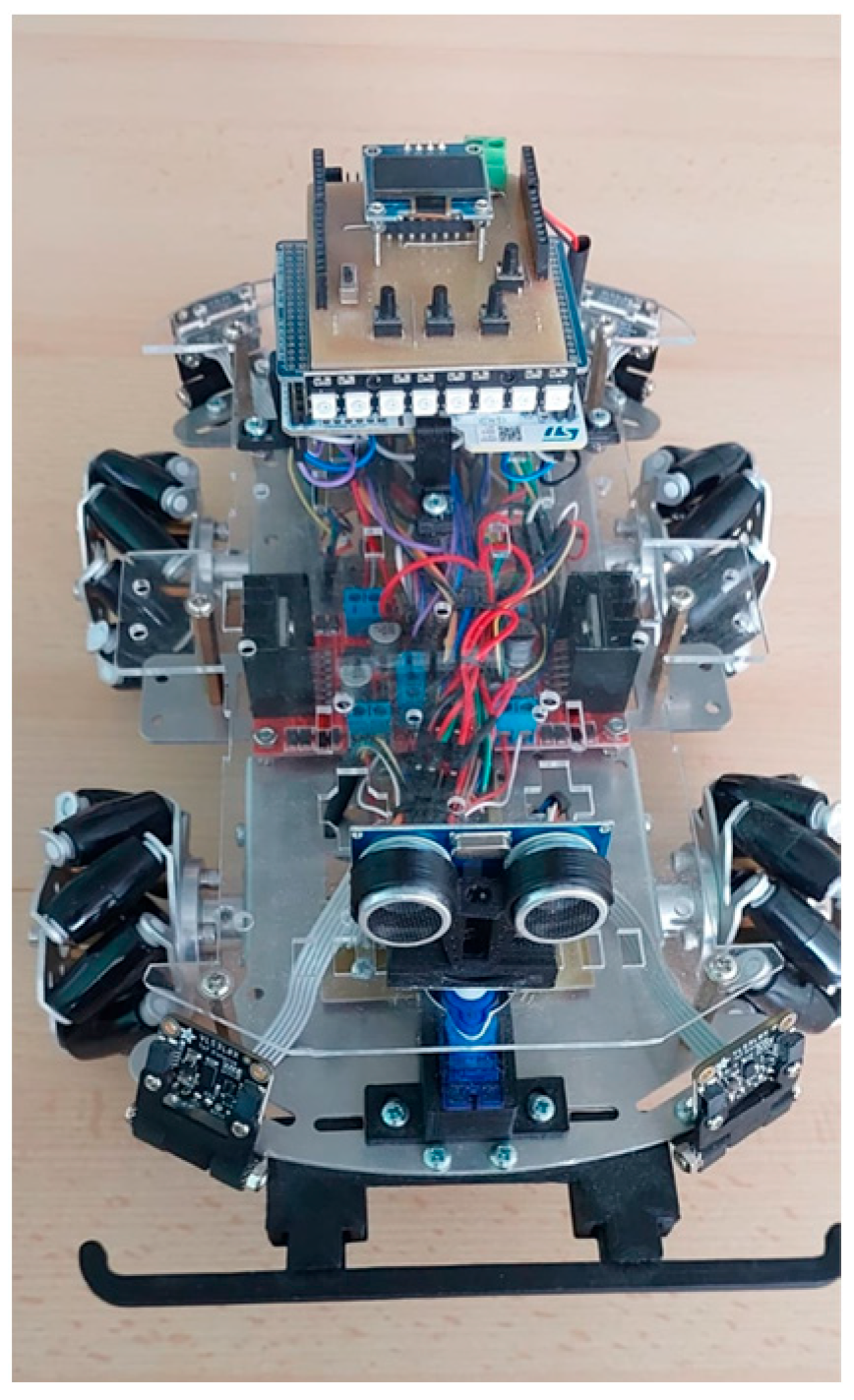
To evaluate feasibility on resource-constrained hardware, we deployed the system on a mobile robot (Figure 6) equipped with an STM32N6 microcontroller and a Raspberry Pi 5 (16 GB RAM), along with a monocular RGB camera directly interfaced to the STM32N6. In contrast to the simulation setup, the embedded architecture was split across two processing units. Low-level perception, affordance estimation, and motor control were fully implemented on the STM32N6, enabling real-time execution of the control loop. High-level semantic reasoning modules, including the Vision–Language Model (VLM) and Large Language Model (LLM), were executed on the Raspberry Pi 5. As in simulation, navigation relied exclusively on monocular vision without LiDAR, depth sensing, or metric localization.
Figure 6.
Robot used for navigation.
Vision–language and language models were executed locally on the Raspberry Pi 5 using a containerized runtime supporting quantized GGUF models. Scene understanding used a compact 4-bit VLM (e.g., Qwen-VL-2B or LLaVA-1.5-7B), while hierarchical planning used a compact 4-bit instruction-tuned LLM (e.g., Phi-3-mini or Qwen-2.5-3B). Average inference latency was approximately 180–250 ms per VLM call and 250–350 ms per LLM call for short prompts (≤128 tokens). Due to event-triggered activation, the semantic module operated at low frequency (0.1–0.4 Hz) during difficult navigation phases and remained inactive during most normal motion, acting asynchronously as a high-level bias layer. Meanwhile, the main perception–affordance–control loop was executed on the STM32N6 at 10–15 Hz, ensuring stable real-time motor control independent of high-level semantic processing latency.
Our architecture uses strict temporal decoupling between the reactive control loop (STM32N6) and semantic reasoning (Raspberry Pi 5), ensuring that reactive navigation runs at 10–15 Hz deterministically and is never blocked by VLM/LLM latency.
Across 100 real-world navigation trials in cluttered indoor environments (Table 4), the robot achieved an 80% success rate with a mean collision count of 1.3 per episode (compared to 92% success and 1.9 collisions in simulation under the same controller). Failures were primarily caused by extreme lighting variation and motion blur degrading perception-driven signal estimation. Nevertheless, supervisory modes and recovery behaviors remained stable, and event-triggered semantic navigation successfully resolved several local dead-ends and ambiguous scenes.
Table 4.
Real-World Embedded Deployment Performance.
These results indicate that the proposed dual-regime architecture is not only effective in simulation but also practical for real-world deployment on heterogeneous low-power embedded platforms. By decoupling real-time perception and motor control (STM32N6) from computationally heavier semantic reasoning (Raspberry Pi 5), the system validates the scalability of event-triggered semantic reasoning under tight computational and energy constraints.
13. Conclusions
This paper presented a dual-regime navigation architecture that combines perception-driven control with event-triggered semantic reasoning within a unified decision framework. The proposed system achieves robust mapless navigation by integrating affordance-based action evaluation, supervisory monitoring of navigation progress, and experience-driven bias adaptation through episodic memory.
The architecture maintains real-time performance through a perception-first control loop, while selectively incorporating higher-level semantic guidance only when navigation difficulty is detected. This adaptive interaction enables the system to retain the responsiveness and safety of reactive navigation while benefiting from structured reasoning in complex or ambiguous environments.
Experimental results in both simulation and real-world deployment demonstrate consistent improvements in success rate, collision reduction, and navigation efficiency compared to reactive and continuously active semantic baselines. The event-triggered design also significantly reduces the computational cost associated with high-level reasoning, enabling practical deployment on resource-constrained embedded platforms.
These results highlight the effectiveness of combining fast perception-driven control with selective semantic reasoning under a unified action-selection mechanism. More broadly, the work demonstrates that reliable navigation behavior can emerge from tightly integrated perception, supervision, and conditional reasoning, without relying on explicit spatial representations or training-based policies.
Future work will investigate extensions to multi-goal navigation, more robust semantic perception under challenging visual conditions, and the integration of longer-term memory structures to support richer environment understanding and adaptation.
Author Contributions
Conceptualization, R.F., G.O., M.A., A.M. and Y.F.; methodology, R.F., G.O., M.A., A.M. and Y.F.; software, R.F., G.O. and A.M.; validation, R.F. and G.O.; formal analysis, R.F., G.O., M.A. and A.M.; investigation, R.F., G.O., M.A. and A.M.; resources, R.F., G.O., M.A., A.M. and Y.F.; data curation, R.F.; writing—original draft preparation, R.F., G.O., M.A. and A.M.; writing—review and editing, R.F., G.O., M.A., A.M. and Y.F.; visualization, R.F., G.O., M.A., A.M. and Y.F.; supervision, R.F., G.O., M.A., A.M. and Y.F.; project administration, R.F.; funding acquisition, R.F., G.O. and Y.F. All authors have read and agreed to the published version of the manuscript.
Funding
This research was funded by Ongoing Research Funding program, (ORF-2026-698), King Saud University, Riyadh, Saudi Arabia and The APC was funded by Ongoing Research Funding program, (ORF-2026-698), King Saud University, Riyadh, Saudi Arabia and ISEN Toulon Mediterannée, France.
Data Availability Statement
The original contributions presented in this study are included in the article. Further inquiries can be directed to the corresponding author.
Conflicts of Interest
The authors declare no conflict of interest.
References
- Sun, J.; Zhao, J.; Hu, X.; Gao, H.; Yu, J. Autonomous Navigation System of Indoor Mobile Robots Using 2D LiDAR. Mathematics 2023, 11, 1455. [Google Scholar] [CrossRef] [Scilit]
- Farkh, R.; Oudinet, G.; Deleruyelle, T. Evaluating a Hybrid LLM Q-Learning/DQN Framework for Adaptive Obstacle Avoidance in Embedded Robotics. AI 2025, 6, 115. [Google Scholar] [CrossRef] [Scilit]
- Aremu, M.B.; Ahmed, G.; Elferik, S.; Saif, A.-W.A. Autonomous Mobile Robot Path Planning Techniques—A Review: Metaheuristic and Cognitive Techniques. Robotics 2026, 15, 23. [Google Scholar] [CrossRef] [Scilit]
- Han, D.; Mulyana, B.; Stankovic, V.; Cheng, S. A Survey on Deep Reinforcement Learning Algorithms for Robotic Manipulation. Sensors 2023, 23, 3762. [Google Scholar] [CrossRef] [Scilit] [PubMed]
- Levine, S.; Pastor, P.; Krizhevsky, A.; Ibarz, J.; Quillen, D. Learning Hand-Eye Coordination for Robotic Grasping with Deep Learning and Large-Scale Data Collection. Int. J. Robot. Res. 2018, 37, 421–436. [Google Scholar] [CrossRef] [Scilit]
- Huang, J.; Limberg, C.; Arshad, S.M.N.; Zhang, Q.; Li, Q. Combining VLM and LLM for Enhanced Semantic Object Perception in Robotic Handover Tasks. In Proceedings of the 2024 WRC Symposium on Advanced Robotics and Automation (WRC SARA), Beijing, China, 23 August 2024; IEEE: Piscataway, NJ, USA, 2024; pp. 135–140. [Google Scholar] [CrossRef] [Scilit]
- Wang, J.; Shi, E.; Hu, H.; Ma, C.; Liu, Y.; Wang, X.; Yao, Y.; Liu, X.; Ge, B.; Zhang, S. Large Language Models for Robotics: Opportunities, Challenges, and Perspectives. J. Autom. Intell. 2025, 4, 52–64. [Google Scholar] [CrossRef] [Scilit]
- Kessler, F.; Frankenstein, J.; Rothkopf, C.A. Human Navigation Strategies and Their Errors Result from Dynamic Interactions of Spatial Uncertainties. Nat. Commun. 2024, 15, 5677. [Google Scholar] [CrossRef] [Scilit]
- Qiu, Z.; Liu, Z.; Niu, W.; Bhattacharjee, T.; Kalantari, S. EgoCogNav: Cognition-Aware Human Egocentric Navigation. arXiv 2025, arXiv:2511.17581. Available online: https://arxiv.org/abs/2511.17581 (accessed on 10 February 2026).
- Vernon, D. The Future of Research in Cognitive Robotics: Foundation Models or Developmental Cognitive Models? Adv. Robot. Res. 2025, 1, e202500066. [Google Scholar] [CrossRef] [Scilit]
- Boretti, C.; Bich, P.; Zhang, Y.; Baillieul, J. Visual Navigation Using Sparse Optical Flow and Time-to-Transit. arXiv 2021, arXiv:2111.09669. [Google Scholar] [CrossRef] [Scilit]
- Alfarano, A.; Maiano, L.; Papa, L.; Amerini, I. Estimating Optical Flow: A Comprehensive Review of the State of the Art. Comput. Vis. Image Underst. 2024, 249, 104160. [Google Scholar] [CrossRef] [Scilit]
- Beintema, J.A. Self-Motion Perception from Optic Flow and Rotation Signals. Ph.D. Thesis, Erasmus University Rotterdam, Rotterdam, The Netherlands, 2000. [Google Scholar]
- Wang, M.; Luo, R.; Önol, A.Ö.; Padir, T. Affordance-Based Mobile Robot Navigation among Movable Obstacles. In Proceedings of Robotics: Science and Systems (RSS); IEEE: Piscataway, NJ, USA, 2021. [Google Scholar]
- Birr, T.; Pohl, C.; Younes, A.; Asfour, T. AutoGPT+P: Affordance-Based Task Planning Using Large Language Models. arXiv 2024, arXiv:2402.10778. [Google Scholar]
- Zhou, X.; Weber, C.; Wermter, S. Vision-Based Robot Navigation through Combining Unsupervised Learning and Hierarchical Reinforcement Learning. Sensors 2019, 19, 1576. [Google Scholar] [CrossRef] [Scilit]
- Schaal, S.; Atkeson, C.G. Learning Control in Robotics. IEEE Robot. Autom. Mag. 2010, 17, 20–29. [Google Scholar] [CrossRef] [Scilit]
- Sapkota, R.; Cao, Y.; Roumeliotis, K.I.; Karkee, M. Vision-Language-Action Models: Concepts, Progress, Applications and Challenges. arXiv 2025, arXiv:2505.04769. [Google Scholar]
- Zhou, X.; Liu, M.; Yurtsever, E.; Zagar, B.L.; Zimmer, W.; Cao, H.; Knoll, A.C. Vision Language Models in Autonomous Driving: A Survey and Outlook. IEEE Trans. Intell. Veh. 2024, 1–20. [Google Scholar] [CrossRef] [Scilit]
- Tang, X.; Yan, Y.; Wang, B. Trajectory Tracking Control of Autonomous Vehicles Combining ACT-R Cognitive Framework and Preview Tracking Theory. IEEE Access 2023, 11, 137067–137082. [Google Scholar] [CrossRef] [Scilit]
- Lieto, A.; Lebiere, C.; Oltramari, A. The Knowledge Level in Cognitive Architectures: Current Limitations and Possible Developments. Cogn. Syst. Res. 2018, 48, 39–55. [Google Scholar] [CrossRef] [Scilit]
- Lee, D.N. A Theory of Visual Control of Braking Based on Information about Time to Collision. Perception 1976, 5, 437–459. [Google Scholar] [CrossRef] [Scilit]
- Chang, J.; Li, Q.; Liang, Y.; Zhou, L. SC-AOF: A Sliding Camera and Asymmetric Optical-Flow-Based Blending Method for Image Stitching. Sensors 2024, 24, 4035. [Google Scholar] [CrossRef] [Scilit]
- Häne, C.; Heng, L.; Lee, G.H.; Fraundorfer, F.; Furgale, P.; Sattler, T.; Pollefeys, M. 3D Visual Perception for Self-Driving Cars Using a Multi-Camera System. Image Vis. Comput. 2017, 68, 14–27. [Google Scholar] [CrossRef] [Scilit]
- Luo, K.; Lin, M.; Wang, P.; Zhou, S.; Yin, D.; Zhang, H. Improved ORB-SLAM2 Algorithm Based on Information Entropy and Image Sharpening Adjustment. Math. Probl. Eng. 2020, 2020, 4724310. [Google Scholar] [CrossRef] [Scilit]
- Blake, A.; Bordallo, A.; Brestnichki, K.; Hawasly, M.; Penkov, S.V.; Ramamoorthy, S.; Silva, A. FPR—Fast Path Risk Algorithm to Evaluate Collision Probability. arXiv 2018, arXiv:1804.05384. [Google Scholar] [CrossRef] [Scilit]
- Majumdar, A.; Pavone, M. How Should a Robot Assess Risk? arXiv 2017, arXiv:1710.11040. [Google Scholar] [CrossRef] [Scilit]
- Xiao, X.; Dufek, J.; Murphy, R. Robot Motion Risk Reasoning Framework. arXiv 2019, arXiv:1909.02531. [Google Scholar] [CrossRef] [Scilit]
- Ma, C.-Y.; Wu, Z.; AlRegib, G.; Xiong, C.; Kira, Z. The Regretful Agent: Heuristic-Aided Navigation through Progress Estimation. arXiv 2019, arXiv:1903.0160. [Google Scholar] [CrossRef] [Scilit]
- Horn, B.K.P.; Schunck, B.G. Determining Optical Flow. Artif. Intell. 1981, 17, 185–203. [Google Scholar] [CrossRef] [Scilit]
- Gibson, J.J. The Ecological Approach to Visual Perception; Houghton Mifflin: Boston, MA, USA, 1979. [Google Scholar]
- Şahin, E.; Çakmak, M.; Doğar, M.R.; Uğur, E.; Üçoluk, G. To Afford or Not to Afford: A New Formalization of Affordances in Robotics. Robot. Auton. Syst. 2007, 55, 425–435. [Google Scholar]
- Montesano, L.; Lopes, M.; Bernardino, A.; Santos-Victor, J. Learning Object Affordances: From Sensory–Motor Coordination to Imitation. IEEE Trans. Robot. 2008, 24, 15–26. [Google Scholar] [CrossRef] [Scilit]
- Tresilian, J.R. Visually Timed Action: Time-Out for Tau? Trends Cogn. Sci. 1999, 3, 301–310. [Google Scholar] [CrossRef] [Scilit] [PubMed]
- Ulrich, I.; Nourbakhsh, I. Appearance-Based Obstacle Detection with Monocular Vision. In Proceedings of the AAAI Conference on Artificial Intelligence; AAAI: Washington, DC, USA, 2000; pp. 866–871. [Google Scholar]
- Hoiem, D.; Efros, A.A.; Hebert, M. Geometric Context from a Single Image. In Proceedings of the IEEE ICCV; IEEE: Piscataway, NJ, USA, 2005; pp. 654–661. [Google Scholar]
- Srinivasan, M.V.; Zhang, S.; Lehrer, M.; Collett, T.S. Honeybee Navigation: Visual Flight Control and Odometry. J. Exp. Biol. 1997, 200, 237–244. [Google Scholar] [CrossRef] [Scilit]
- Tulving, E. Episodic and Semantic Memory. In Organization of Memory; Academic Press: New York, NY, USA, 1972; pp. 381–403. [Google Scholar]
- Blundell, C.; Uria, B.; Pritzel, A.; Li, Y.; Ruderman, A.; Leibo, J.Z.; Rae, J.W.; Wierstra, D.; Hassabis, D. Model-Free Episodic Control. In Proceedings of the 33nd International Conference on Machine Learning ICML, New York, NY, USA, 19–24 June 2016; pp. 1331–1340. [Google Scholar]
- Thrun, S.; Burgard, W.; Fox, D. Probabilistic Robotics; MIT Press: Cambridge, MA, USA, 2005. [Google Scholar]
- Brock, O.; Khatib, O. High-Speed Navigation Using the Global Dynamic Window Approach. In Proceedings of IEEE ICRA; IEEE: Piscataway, NJ, USA, 1999; pp. 341–346. [Google Scholar]
- Brooks, R.A. A Robust Layered Control System for a Mobile Robot. IEEE J. Robot. Autom. 1986, 2, 14–23. [Google Scholar] [CrossRef] [Scilit]
- Arkin, R.C. Behavior-Based Robotics; MIT Press: Cambridge, MA, USA, 1998. [Google Scholar]
- Montello, D.R. Navigation. In The Cambridge Handbook of Visuospatial Thinking; Cambridge University Press: Cambridge, UK, 2005; pp. 257–294. [Google Scholar]
- Kuipers, B. The Spatial Semantic Hierarchy. Artif. Intell. 2000, 119, 191–233. [Google Scholar] [CrossRef] [Scilit]
- Zou, Q.; Cong, M.; Liu, D.; Du, Y. A Neurobiologically Inspired Mapping and Navigating Framework for Mobile Robots. Neurocomputing 2021, 460, 181–194. [Google Scholar] [CrossRef] [Scilit]
- Huang, W.; Chella, A.; Cangelosi, A. A Cognitive Robotics Implementation of Global Workspace Theory for Episodic Memory Interaction with Consciousness. IEEE Trans. Cogn. Dev. Syst. 2024, 16, 266–283. [Google Scholar] [CrossRef] [Scilit]
- Kumar, A.; Zhou, A.; Tucker, G.; Levine, S. Conservative Q-Learning for Offline Reinforcement Learning. Adv. Neural Inf. Process. Syst. 2020, 33, 1179–1191. [Google Scholar]



Disclaimer/Publisher’s Note: The statements, opinions and data contained in all publications are solely those of the individual author(s) and contributor(s) and not of MDPI and/or the editor(s). MDPI and/or the editor(s) disclaim responsibility for any injury to people or property resulting from any ideas, methods, instructions or products referred to in the content. |
© 2026 by the authors. Licensee MDPI, Basel, Switzerland. This article is an open access article distributed under the terms and conditions of the Creative Commons Attribution (CC BY) license.