


Abstract
Position-independent geometric errors crucially impact the accuracy of five-axis machine tools, yet their identification remains challenging due to computational complexities, inadequate measurement pose selection, and disturbances arising from thermal drift and residual uncompensated errors. Existing methods typically rely on linearized kinematic models, heuristic sampling of measurement poses, or computationally expensive global optimization procedures, which collectively limit their effectiveness in industrial environments. This study presents a unified identification framework that overcomes these limitations; it incorporates 3D offset parameters to enhance the decoupling of true geometric errors from non-PIGEs, an observability-driven measurement pose selection strategy to maximize the parameter sensitivity, and an ANN-surrogate model to accelerate high-dimensional global optimization. A genetic algorithm is used to optimize the measurement points based on the observability index of the machine tool. The ANN-surrogate model enhances the identification accuracy of error parameters (11 PIGEs + 3 offsets) through precise kinematic models, global exploration, and final refinement. Experimental validation on a five-axis machine tool demonstrates a volumetric error reduction of 88.615% after compensation, with RMSE decreasing to 0.4337 μm. Sensitivity analysis reveals that PIGEs contribute up to 75.26% of the total inaccuracy, while offset parameters capture 24.74% of the error from thermal and non-PIGE sources. The results confirm the method’s superiority over other techniques in terms of identification accuracy, efficiency, and robustness, providing a practical solution for high-precision applications in the manufacturing industries.
1. Introduction
Some of the major contributions of the five-axis machine tool are its precision and flexibility, which enhance the design of high-precision complex geometries in the manufacturing industry. However, geometric errors, that is, variations influenced by the machine tool geometry, massively affect its accuracy. They are grouped into position-independent geometric errors (PIGEs) and position-dependent geometric errors (PDGEs). While PDGEs are influenced by the machine tool coordinates, PIGEs are systematic throughout the workspace (mainly due to assembly or parts defects), which critically impacts the volumetric accuracy. These intrinsic variations caused by PIGEs may originate from manufacturing tolerances, thermal effects, and mechanical wear, which can affect the overall quality of machined parts by 40–70% [1,2,3,4]. The identification and compensation of PIGEs are, therefore, vital for achieving the micron-level tolerances demanded by modern industries. PIGEs propagate nonlinearly throughout the kinematic chain, making their isolation particularly challenging yet fundamentally impactful on the overall machine tool performance. Consequently, robust PIGE identification and compensation methodologies enhance the machine tool’s accuracy in manufacturing high-quality components [2,5,6].
Generally, identification methods have been summarized into modeling, measurement methods using precision devices, and compensation of errors [7,8]. Most PIGE measurement-based approaches require precision measuring devices, like the double-ball bar, touch-trigger, laser tracker, and laser interferometer; however, the R-test device (like the IBS’s Rotary Inspector [9]) enables simultaneous measurement of 3D volumetric errors during synchronized axes’ motion while reducing installation complications, providing a holistic error mapping with micron-level repeatability and high precision compared to other devices; yet, this has been less used for PIGE identification in previous studies [1,10,11,12,13,14]. Yang and Ding [15] proposed a method based on differential motion matrices and least-square algorithms to identify PIGEs, which has been widely applied in previous studies [3,16,17,18] and mostly involves several setup points for the measuring devices [1,10,11,12,19,20]. These methods of parameter identification, such as the least-square method involving Jacobian computation and linearization approaches, suffer from modeling inaccuracies in highly nonlinear kinematic chains due to factors like ignoring high-order terms [21,22,23,24], while local optimization methods like Levenberg–Marquardt often converge to suboptimal solutions resulting from non-convex error landscapes [25,26]. Global metaheuristics such as genetic algorithms (GAs) mitigate this but incur prohibitive computational costs when evaluating high-fidelity error models across thousands of points [27,28]. Recent attempts to address these limitations include sequential quadratic programming and particle swarm optimization, yet they remain challenged by high-dimensional parameter spaces and measurement noise amplification [29]. While surrogate-assisted optimization has been explored to mitigate computational challenges, including artificial neural network (ANN) model surrogates [20,21,22,23,24,25,26,27,28,29,30,31,32], its application to machine tool error identification is lacking in previous studies.
Crucially, these methods of identification overlook the foundational role of measurement point selection. Optimal measurement pose selection emerges as a critical yet underexplored factor during the measurement of PIGEs. The observability index (OI) quantifies the significance of a point set for parameter estimation and provides a rigorous theoretical framework for measurement point optimization across the workspace [33]. Commonly used point selection techniques, such as grid sampling, uniform selection, or heuristic placement point distribution, inadequately excite all error parameters, leading to ill-conditioned identification and poor generalizability; however, volumetric errors are highly impacted by the measurement points [34,35,36,37,38]. He et al. [34] and Ding et al. [39] demonstrated that optimal points minimize parameter estimation uncertainty compared to conventional schemes through a genetic algorithm (GA) selection strategy that maximizes the observability index across the machine tool workspace, yet the application of this point selection method in PIGE measurement is lacking in previous studies [8,40,41]. The GA’s evolutionary operations—tournament selection, order-based crossover, and swap mutation—efficiently explore the combinatorial pose space while preserving kinematic diversity. By capturing the logarithm of the aggregated information matrix’s eigenvalues as fitness, the GA prioritizes point sets that uniformly enhance parameter sensitivity, directly addressing the parameter sensitivity limitations in the previous studies [42,43].
The existing research on PIGEs in five-axis machine tools has made significant advancements, yet critical gaps remain. Current PIGE models often assume ideal geometric conditions and fail to account for the impact of non-geometric disturbances such as thermal drift, mechanical wear, and residual errors from PDGEs. Moreover, computational complexities in global optimization methods, particularly when coupled with physics-based models, hinder the efficiency and scalability of these approaches. Additionally, while observability-index-based optimal point selection is a key factor in improving identification accuracy, it remains underutilized in PIGE measurement. These limitations collectively restrict the effectiveness of current methods in achieving high accuracy and robustness in machine tool calibration, especially under real-world conditions [15,44,45,46,47,48].
The research problem addressed in this study lies in the integration of these factors into a unified framework that can overcome the inherent limitations. The goal is to propose a framework that not only accounts for non-geometric disturbances but also ensures high observability for geometric parameters. This approach aims to enable globally optimal PIGE identification without incurring high computational cost. By explicitly capturing disturbances within the kinematic chain, decoupling true PIGEs from transient errors, and introducing an ANN-accelerated global search framework, this work aims to set a new standard in machine tool calibration. Furthermore, the implementation of an observability-driven measurement pose selection strategy optimizes the distribution of measurement points, enhancing the sensitivity of error parameters. This integrated framework seeks to directly improve the precision of five-axis machine tools, thereby advancing the capabilities of high-precision manufacturing in various industries. The remaining sections are organized as follows: the mathematical and theoretical framework is described in Section 2, Section 3 describes the method implementation, the results are discussed in Section 4, and the work is concluded in Section 5.
2. Framework for PIGE Identification
2.1. Kinematic Error Modeling
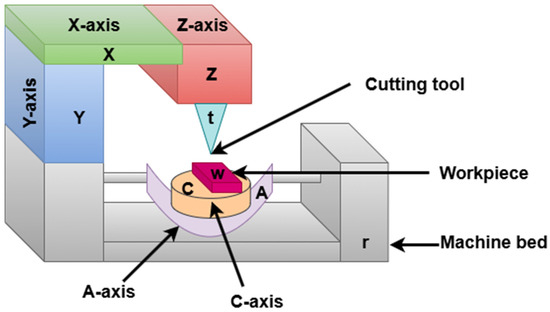
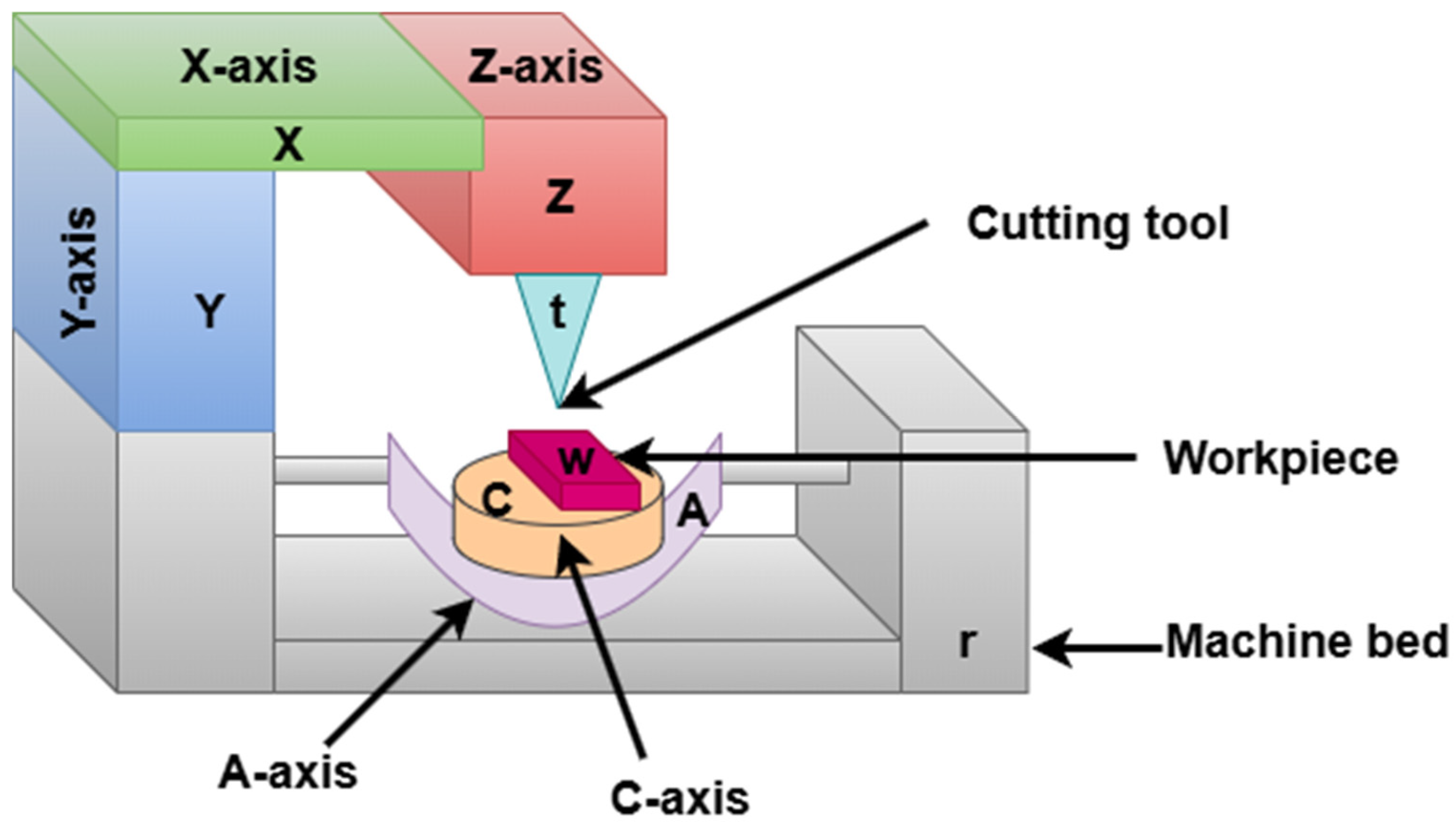
The methodology applies a rigid-body kinematic model to describe geometric error propagation in a five-axis machine tool (tilting–rotary configuration), as shown in Figure 1. The machine configuration considered in this study corresponds to a five-axis system with a tilting–rotary table, defined according to ISO 230-1 [49] as wC′A′bXYZ(C1)t. This configuration includes separate kinematic chains for the workpiece and the cutting tool, represented by “w” and “t”, respectively. Eleven position-independent geometric errors (PIGEs) are modeled with three offsets (disturbances from other error sources, ). The homogeneous transformation matrices (HTMs) define error accumulation through the kinematic chain:
where is the 3D error vector at the tool tip derived from deviations between the ideal and actual tool () positions at the jth point (total number of measurement points), and the parameter definition is presented in Table 1.
Figure 1.
The structural configuration of the five-axis machine tool.
Table 1.
PIGE parameter definitions.
2.2. Observability-Optimized Pose Selection
The coefficient matrices come from several factors and form the transfer matrix singular values during coordinate transformation in various directions of a vector; therefore, the sensitivity and orthogonality of these factors could be extracted from these singular values. This indicates that the observability index of the observables in the model defines the influence of the error coefficients’ orthogonality and sensitivity through singular value decomposition (SVD). Considering (E-optimality) as the best OI due to its ability to reduce the parameters’ variance and the end-effector pose uncertainty of dynamic systems like the machine tool (best for calibration [50]), the observability index can be mathematically defined as:
where is denoted as the Jacobian matrix linking the PIGEs’ vector to the volumetric error (); hence, the Jacobian at the position, , can be written as:
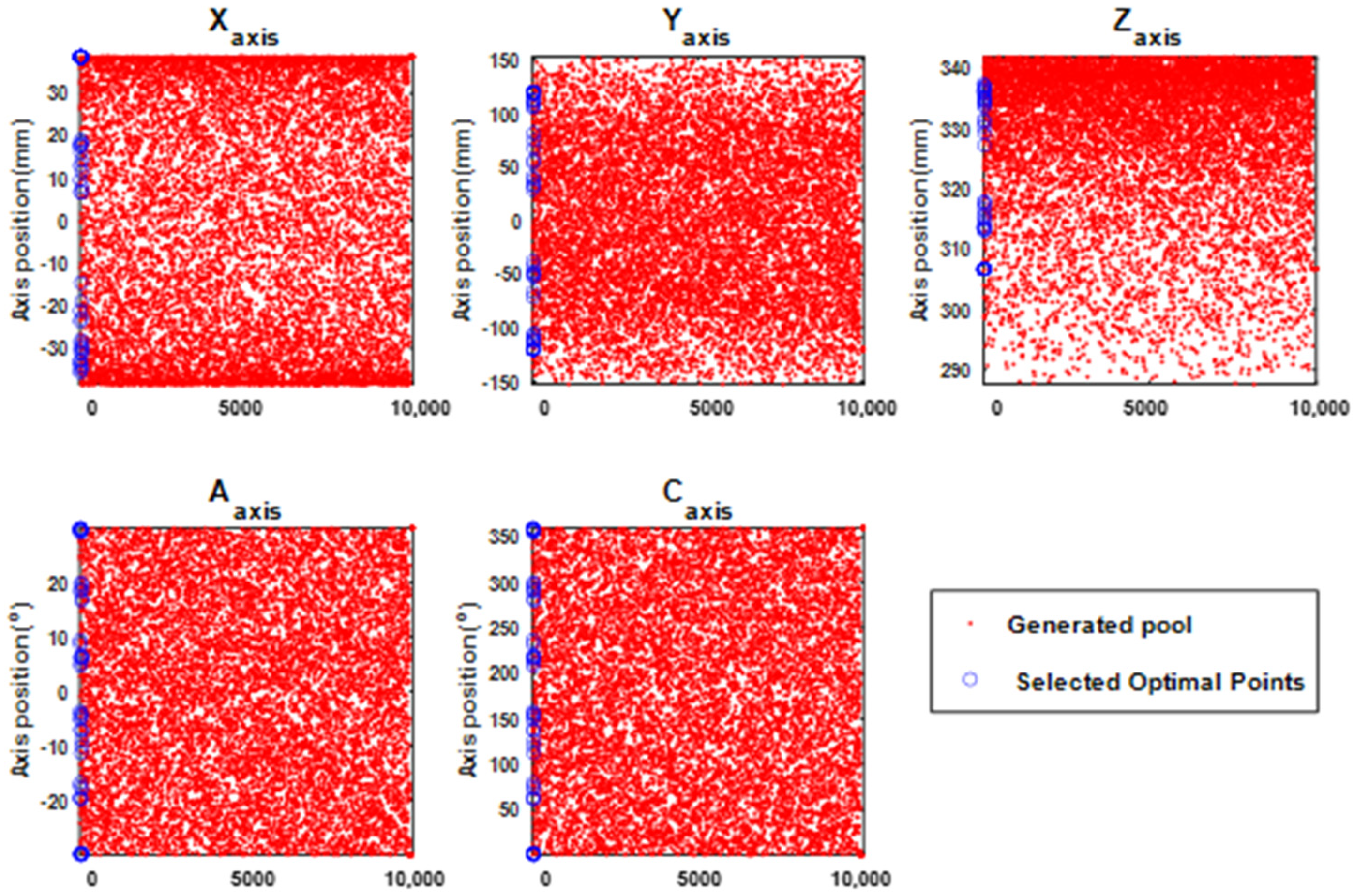
The measuring points in the machine tool workspace can be optimized by considering the indices as optimization indices in the model. At a high observability index, the identification accuracy is enhanced at a given set of measurement points during geometric error measurement through a modified genetic algorithm selection strategy. A set of 10,000 points for each motion axis is generated within the axis limits using the Hammersley sequence discussed in [51,52]; the corresponding axis limits for the X-, Y-, Z-, A-, and C-axes are [−600.5, 0.5] [−560.5, 0.5] . The point with a high OI is selected as a new optimal axis pose; however, the unchosen points are dropped back in the generated pool iteratively until the required number of points is chosen.
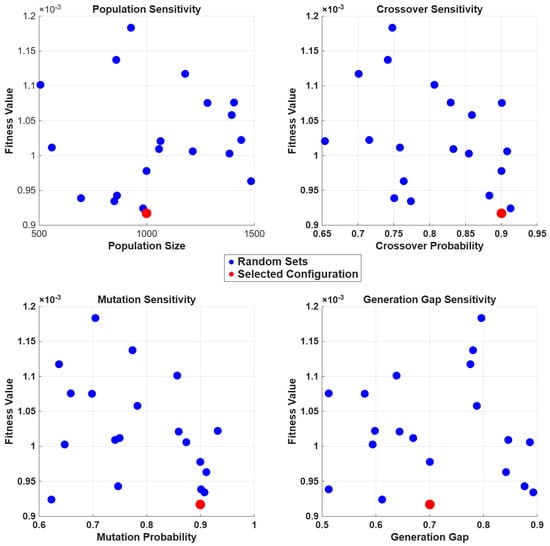
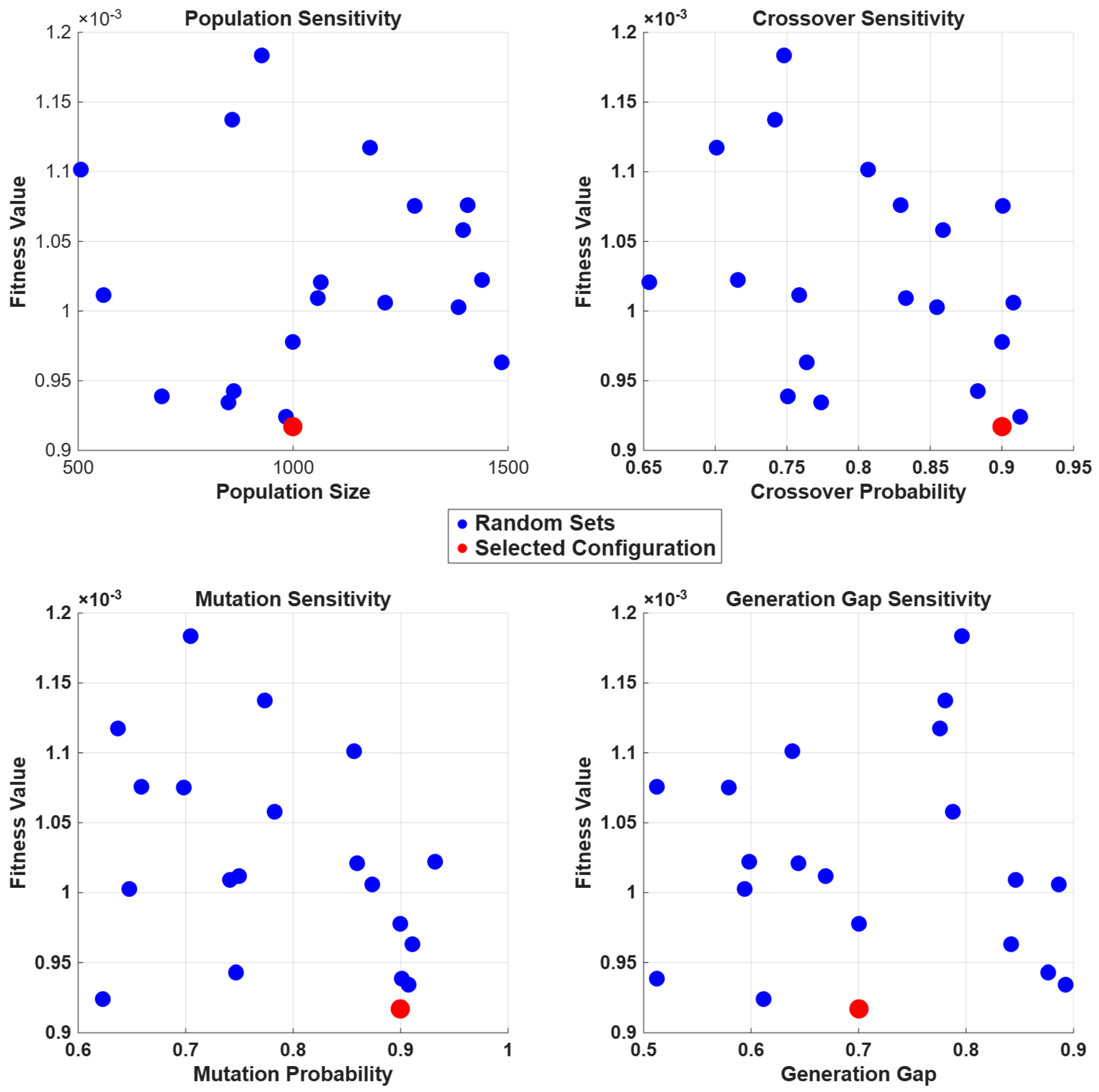
The modified genetic algorithm initializes a population of individuals linked to indexes and then iteratively applies crossover (swapping indexes), mutation (randomly altering and regrouping indexes), and gene invasion (introducing invasive individuals). The population is evaluated using an error observability metric, and the best individual is selected as the final optimum. The genetic algorithm uses a generation gap of 0.7, crossover and mutation probabilities of 0.9, and a population size of 1000, chosen based on parameter sensitivity, as shown in Figure 2, with ranked-based selection. Each candidate pose is kinematically validated to avoid singularities or axis limits. To ensure diverse coverage, k-means clustering is applied to the GA-optimized poses in the five-dimensional configuration space. This approach provides a solid basis for selecting optimal points, improving identification accuracy while respecting real-world kinematic constraints. Preliminary experiments compared the observability-based pose selection with random and uniform grid sampling [33,35]. Unlike these simpler methods, which place points with lower sensitivity to error, the observability-based strategy produced the lowest RMSE in parameter estimation (Table 2). This demonstrates that selecting measurement points using the observability index maximizes PIGE sensitivity.
Figure 2.
GA parameter optimization.
Table 2.
Comparative analysis of different sampling strategies.
2.3. ANN-Accelerated Global Optimization
The PIGE identification constitutes a high-dimensional nonlinear optimization problem where conventional metaheuristics become computationally challenging. To overcome this limitation, this work develops an ANN-accelerated global optimization framework that replaces expensive kinematic model evaluations with a surrogate predictor while preserving parameter accuracy. The methodology begins with the construction of a residual function for measurement poses, as defined in Equation (8), defining the discrepancy between measured and predicted volumetric errors in:
where represents the parameter vector, denotes the axis point, and the optimization objective is set as the scalar residual norm:
A feedforward neural network is constructed to approximate. The training dataset comprises 5000 parameter samples generated via Latin Hypercube Sampling across the parameter space dimensional space, with bounds [−0.01, 0.01] mm. For each sample , the true residual norm is computed through parallelized kinematic evaluation. The network uses a tanh activation in hidden layers and a linear output layer to map the parameter vector to the residual norm:
where and denote weight matrices and bias vectors. The Levenberg–Marquardt backpropagation algorithm was adopted due to its rapid convergence for small-to-medium-sized regression problems. To prevent overfitting, early stopping was applied when the validation error failed to improve after 20 epochs, and L2-regularization was used with a penalty coefficient of , minimizing the mean squared error between predicted and true values across an 80:10:10 data split.
The surrogate model was implemented as a fully connected feedforward ANN with two hidden layers consisting of 128 and 64 neurons, respectively. A systematic hyperparameter tuning process was conducted to ensure optimal predictive performance, as presented in Table 3; the selected architecture (128-64, tanh) achieved the lowest RMSE (0.012) and highest (0.966), justifying its adoption over deeper or ReLU-based networks. The ANN surrogate enables aggressive exploration of the parameter space through two coordinated optimization phases:
Table 3.
ANN architecture selection.
Phase 1: Genetic Algorithm Exploration
A population of 500 individuals evolves over 250 generations, guided by the surrogate-predicted fitness . Each generation applies tournament selection , simulated binary crossover , and polynomial mutation to maintain diversity. The GA parameters are optimized through a preliminary sensitivity analysis using 20 independent runs based on the sensitivity analysis stated in the previous section. The algorithm identifies promising regions where , terminating when the best fitness improvement falls below over 20 generations.
Phase 2: Pattern Search Refinement
Twelve start points sampled from the GA’s final population undergo parallel pattern search. At iteration , the algorithm polls points within a hypercube of radius :
where are standard basis vectors. The ANN surrogate evaluates all poll points, accepting any improvement . The step size contracts by half after failed polls, expanding upon success. This phase continues for 200 iterations per start point, exploiting local convexity properties near global minima. The top four candidates from Phase 2 undergo final refinement using the true kinematic model via bound-constrained Levenberg–Marquardt optimization:
where is the Jacobian of computed through finite differences and adapts to ensure descent; physical constraints [−0.01,0.01] are enforced via projected gradients. This stage achieves micron-level precision with termination at . The ANN, with multiple hidden layers and nonlinear activations, models the complex relationship between error parameters and volumetric errors. During training, it learns from a dataset of parameter–error pairs, adjusting weights to minimize prediction error. This creates a surrogate model that replicates the essential input–output behavior, enabling computations far faster than the original kinematic model.
The ANN supports a coarse-to-fine optimization, first guiding the search to optimum regions, and then letting the exact model refine the solution. This reflects human problem-solving by (i) identifying the right neighborhood before searching precisely, (ii) focusing computational resources on likely candidates, and (iii) allowing incorporation of prior knowledge. This strategy is especially valuable because exact model evaluations are computationally expensive. During training, the network captures the system’s general behavior, capturing the relationships between parameters and errors. This knowledge enables more informed optimization compared to blind search. The optimization algorithm is shown in Algorithm 1, and the overall identification strategy is illustrated in Figure 3. GA parameters were validated over 20 independent runs; the selected configuration (population = 1000, mutation = 0.9, crossover = 0.9) achieved the lowest mean RMSE (0.00802) with a standard deviation below 3%, indicating stable convergence.
| Algorithm 1: ANN-Accelerated Global Optimization |
| Initialize: Phase 1: Genetic Algorithm with ANN Surrogate Phase 2: Pattern Search with ANN Surrogate For iter=1 to 500: Phase 3: High-Fidelity Refinement : |
Figure 3.
Architecture of the proposed identification model.
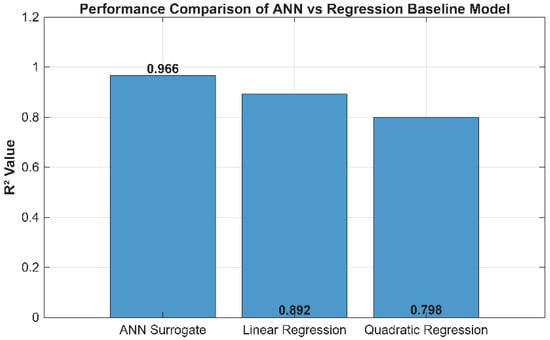
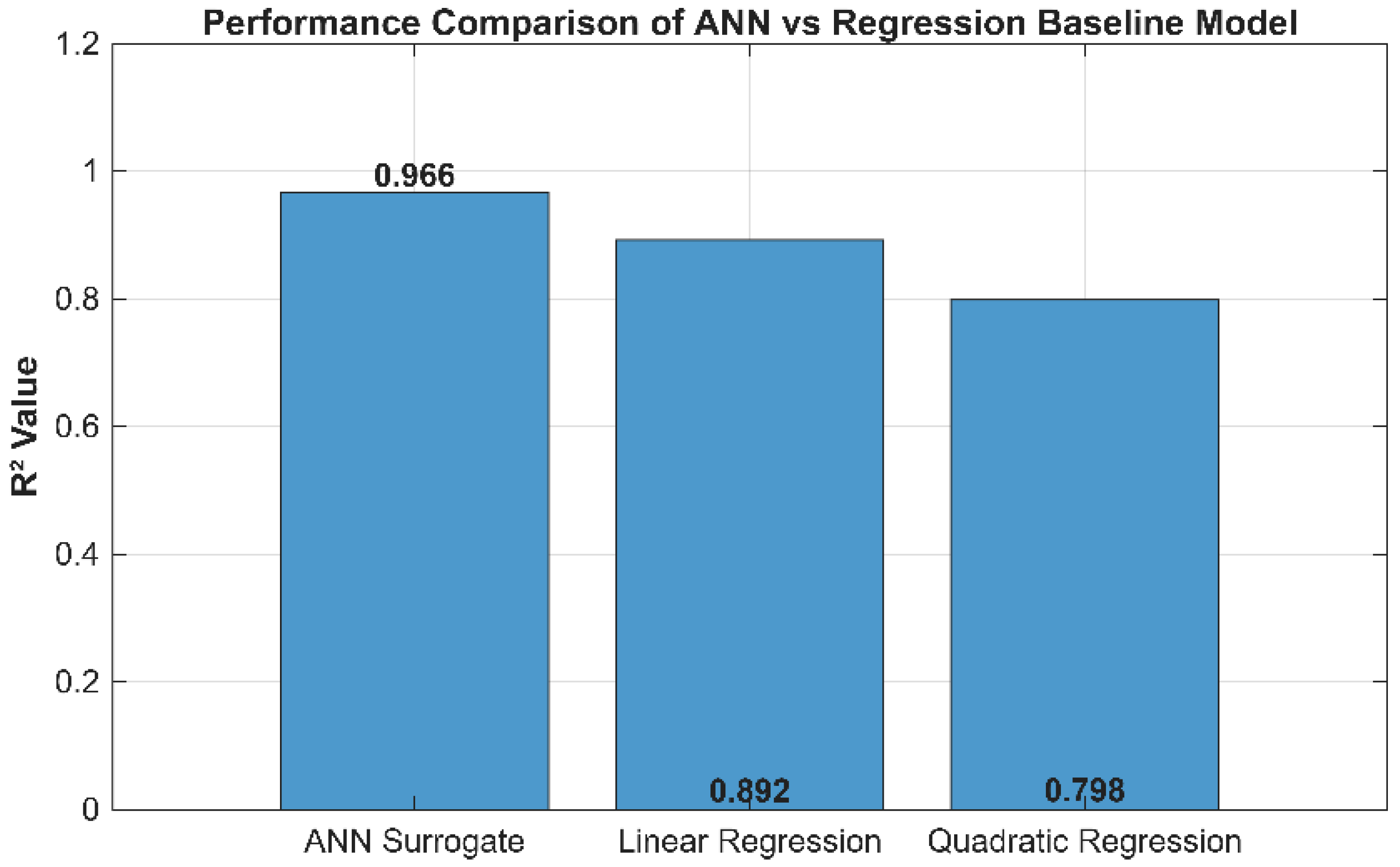
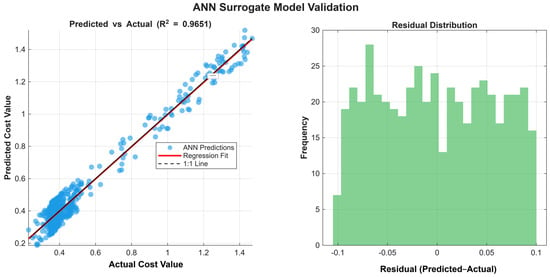
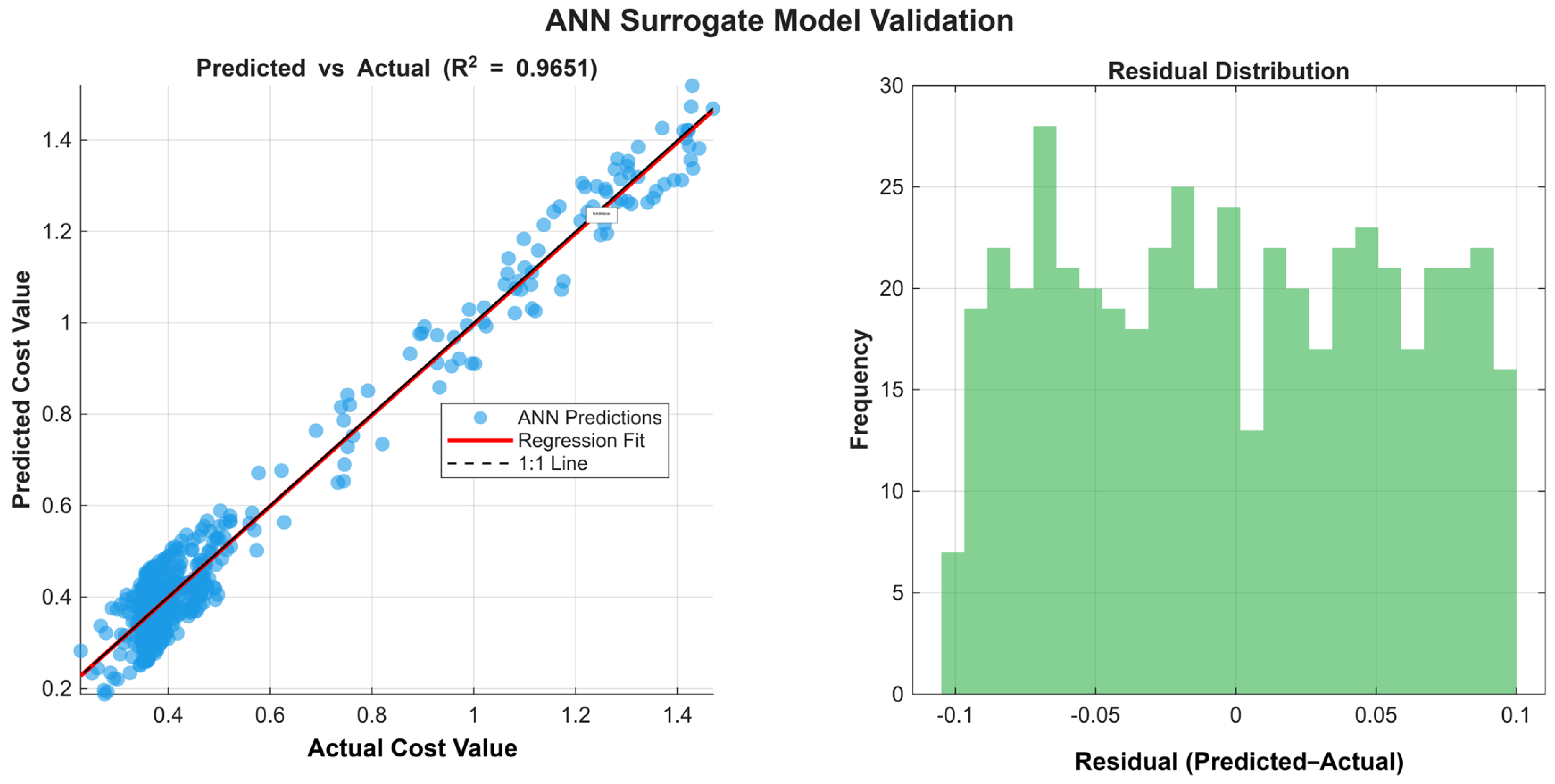
To validate the predictive reliability of the proposed ANN surrogate, its performance was compared with linear and quadratic regression baseline models using the same test dataset. As presented in Figure 4, the ANN achieved an of 0.966, outperforming both regression models ( and , respectively), confirming the model’s superior ability to capture nonlinear dependencies among geometric error parameters. A validation analysis based on the cost values was conducted (presented in Figure 5).
Figure 4.
Comparison analysis of ANN surrogate against regression baseline models.
Figure 5.
Model validation analysis.
The ANN surrogate reduces error by approximately 45% compared to GA alone, while final refinement improves accuracy by an additional 32%, as presented in Table 4.
Table 4.
Output of each optimization stage.
2.4. Mathematical Framework for Global Sensitivity Analysis
The Sobol sensitivity analysis employs a variance decomposition approach to quantify how uncertainty in model output, the parameter vector (where is the parameter vector), can be apportioned to different input parameters, as discussed in reference [53]. The method decomposes the total variance into partial variances attributed to individual parameters and their interactions:
where the partial variance from is defined as , and second-order interactions are represented as . The first-order index can be mathematically defined as:
This describes the fractional impact of on the output variance. The total-effect index can now be defined as:
where denotes all parameters except . This captures all effects involving , including interactions. The indices were computed using Saltelli’s sampling scheme with Latin Hypercube samples. Two sampling matrices were generated , and hybrid matrices are constructed by replacing the column in with the column in . The output of the model is evaluated by , and ; Hence, the total variance can be estimated as:
where . The first-order and the total-effect indexes are then computed as:
The output function was defined as the -norm of the residual vector , representing the overall discrepancy between measured and modeled volumetric errors. Using 10,000 Latin Hypercube samples in a Monte Carlo simulation, first-order () and total-effect () indices were computed for each parameter. measures the individual contribution of a parameter to output variance, while accounts for both its direct effect and interactions with others. This analysis quantifies parameter importance and interactions, supporting more efficient machine tool calibration.
2.5. Evaluation Metrics
Performance was quantified using four metrics computed across all measurement poses, and the compensation effectiveness was assessed through error reduction ratios:
- 1.
- Root Mean Square Error (RMSE):
- 2.
- Mean Absolute Error (MAE):
- 3.
- Mean Squared Error (MSE)
- 4.
- Coefficient of determination (R2)
- 5.
- Correlation coefficient between predicted and measured errors:
3. Implementation and Validation Framework
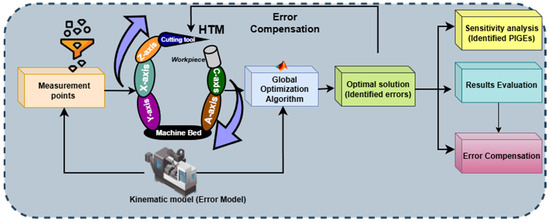
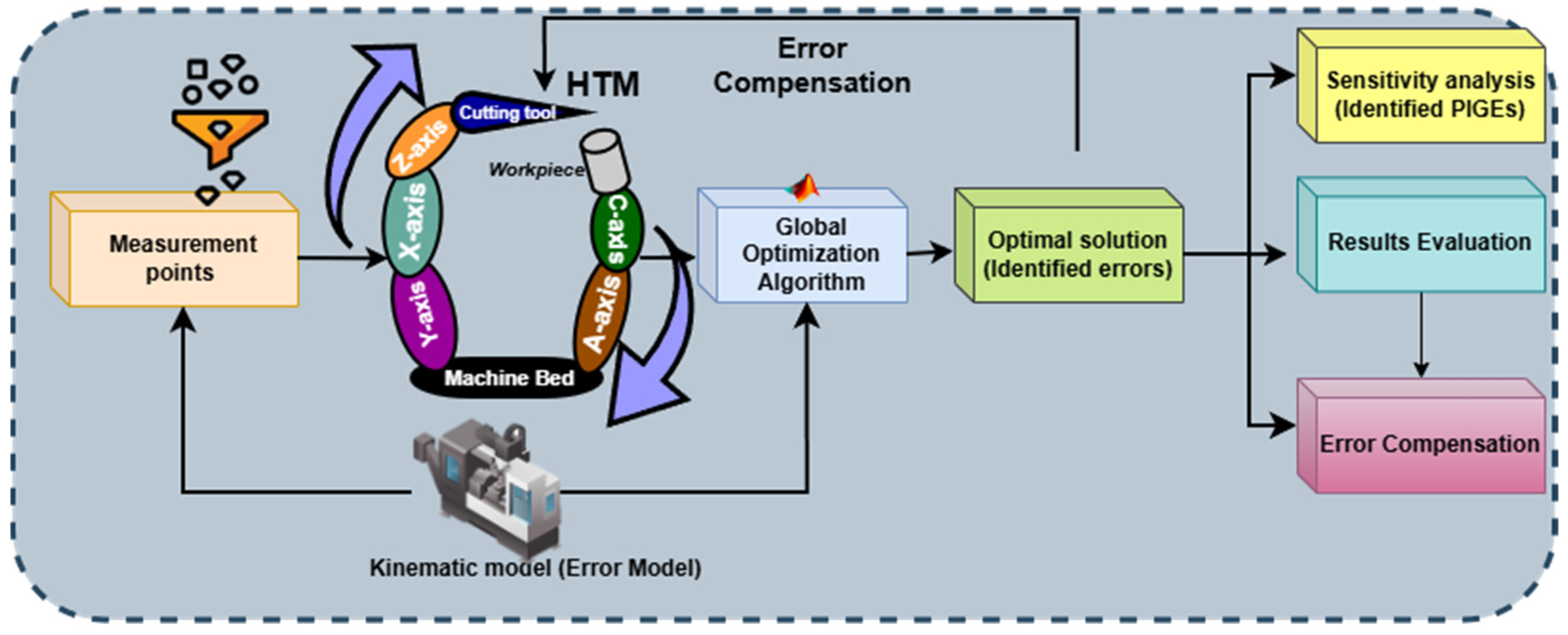
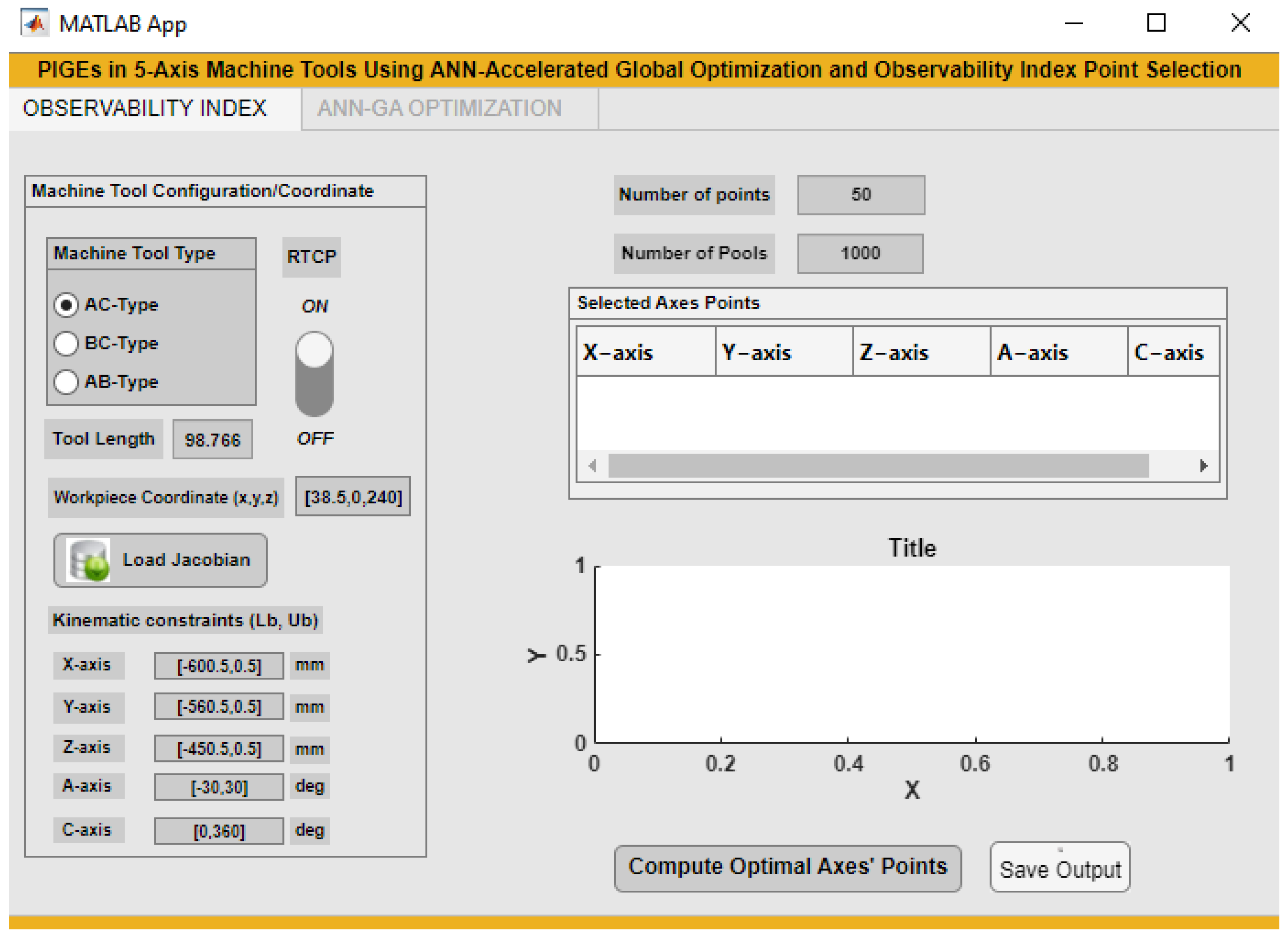
The proposed methodology was first verified through a comprehensive simulation framework developed in MATLAB R2024b (The MathWorks, Natick, MA, USA) using the App Designer tool, as presented in Figure 6. A kinematic model of a five-axis machine tool (tilting–rotary configuration) was constructed based on homogeneous transformation matrices discussed in Section 2, explicitly incorporating all model parameters (11 PIGEs and 3 dynamic offsets). To replicate real-world conditions, nominal parameter values were randomly sampled within their physical bounds: geometric errors in mm and/or degrees. These parameters were plugged into the model to generate synthetic volumetric error data across 50 observability-optimized poses. Gaussian noise was added to simulate measurement uncertainty inherent to the IBS Precision Engineering Rotary Inspector (IBS Precision Engineering B.V., Eindhoven, The Netherlands).
Figure 6.
MATLAB simulation app interface.
To focus on PIGEs, which is the primary objective of this study, PDGEs were pre-calibrated before applying the proposed method. Consequently, the framework is formulated specifically for PIGEs and does not account for residual axis- or pose-dependent deviations, which would require additional modeling. Moreover, the method relies on high-precision measurement systems (e.g., R-test device), which may limit applicability in environments where such instrumentation is not available.
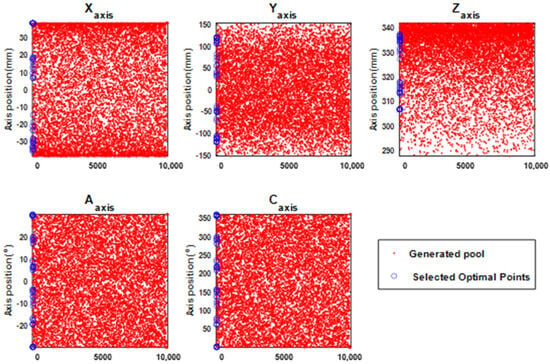
The identification algorithm was then executed using the synthetic data as input. Key assumptions included rigid-body kinematics (neglecting elastic deformations) and invariant thermal conditions. Validation was performed by computing relative error parameters between identified parameters and actual values. The kinematic motion constraints of the axes in the simulation were based on RTCP computation proposed by Ding et al. [39]; the linear axes’ positions were computed using those of the rotary axes. The points generated and selection made based on the machine tool’s observability index are presented in Figure 7.
Figure 7.
Points generated and selected based on the machine tool observability index.
Experimental Implementation
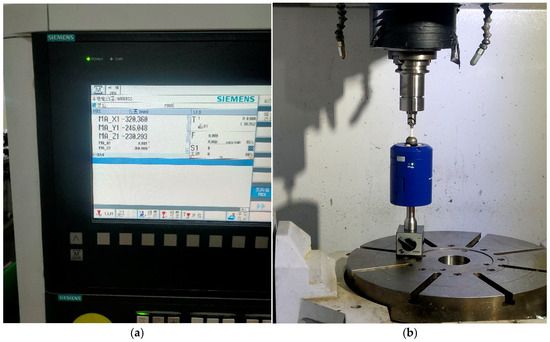
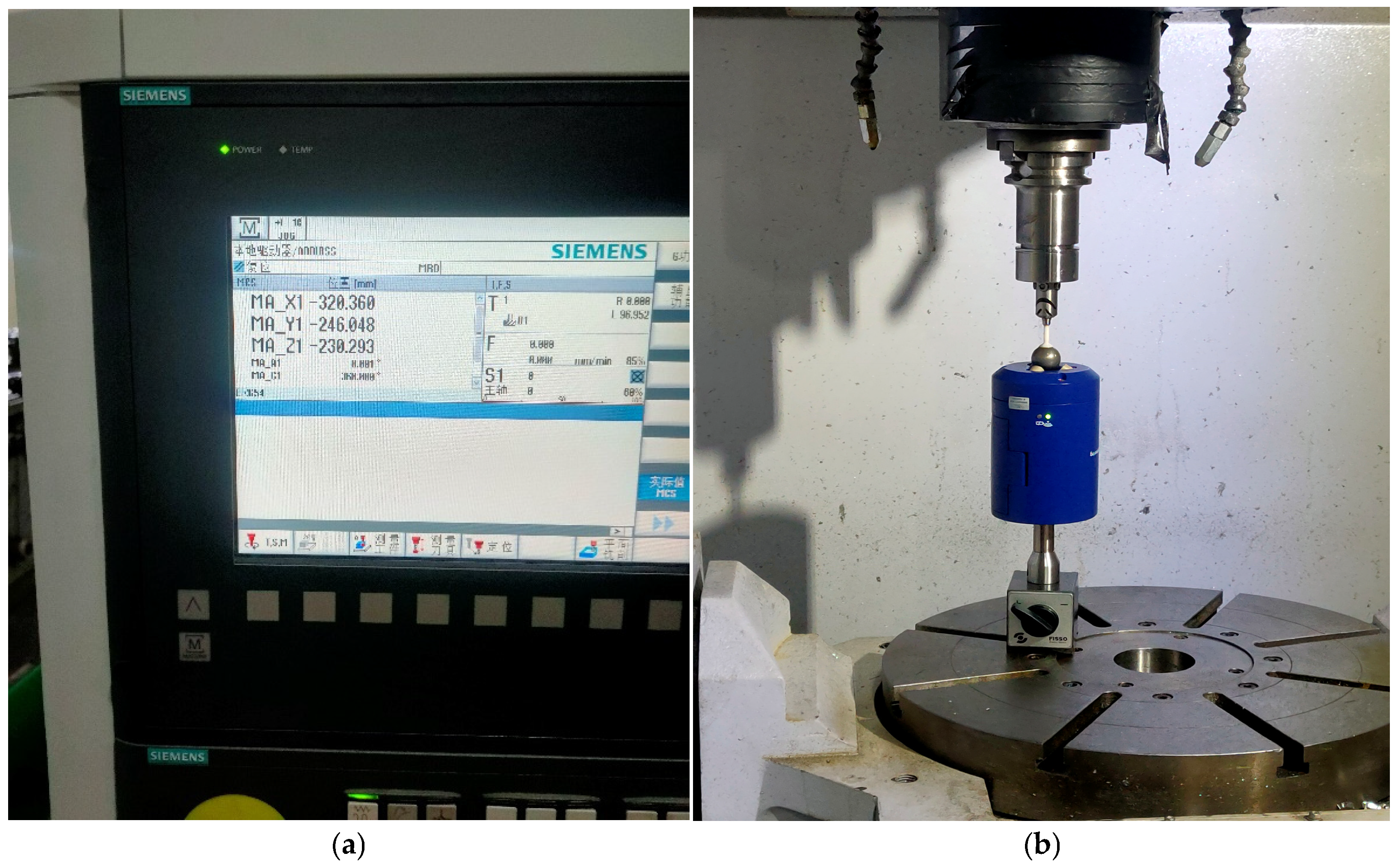
Experimental validation was carried out on an industrial Shenyang Machine Tool Co., Ltd. (Shenyang, China) (SMTCL) five-axis machine tool VMC 6056 equipped with a Siemens 840D SL controller in a non-machining test, as shown in Figure 8a. Measurement of 3D volumetric errors was performed using the IBS Rotary Inspector [9] at optimal poses (Figure 8b); further validation across different machine tool configurations is required to assess general applicability. The IBS Rotary Inspector device was mounted onto the spindle, with its calibration sphere positioned at mm relative to the workpiece coordinate system. The machine tool’s RTCP (Rotational Tool Center Point) function was activated to dynamically compensate for tool length (98.766 mm) during synchronized A/C-axis motion. Measurement followed a three-stage protocol: (1) Pre-compensation: Optimal measurement points were selected, and the volumetric errors were recorded at 50 GA-optimized poses. (2) Parameter Identification: The proposed algorithm computed optimal error parameters. (3) Compensation: After identifying the PIGEs and calculating the error parameters, an error compensation algorithm was applied to the machine tool. The compensation method used in this study is based on the approach outlined by Tsutsumi & Saito [53], which modifies the NC code to correct for identified errors during the machining process. The effectiveness of the compensation was evaluated by comparing pre- and post-compensation errors at the same 50 measurement points. (4) Post-compensation: Errors were re-measured at pre-compensated poses and evaluated under controlled conditions: stable temperature (20 ± 1 °C), minimal vibration, and consistent sensor calibration. The machine tool was thermally stabilized with a 30 min warm-up following ISO standards [54,55]. All tests were conducted under quasi-static conditions at a 250 mm/min feedrate, with a 10 s stabilization period before data acquisition. This setup ensured reliable validation in both simulation and practical machining environments.
Figure 8.
Experimental implementation. (a) Machine tool Controller User-interface and (b) experimental setup.
4. Results
4.1. Simulation Results and Analysis
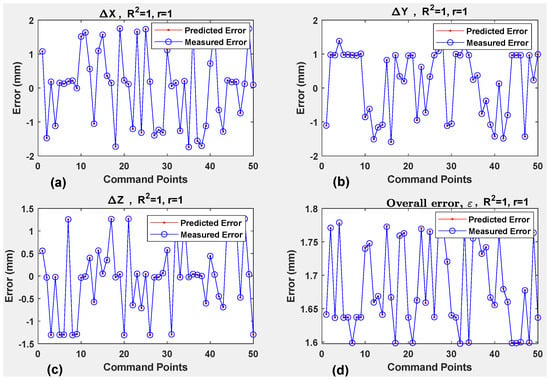
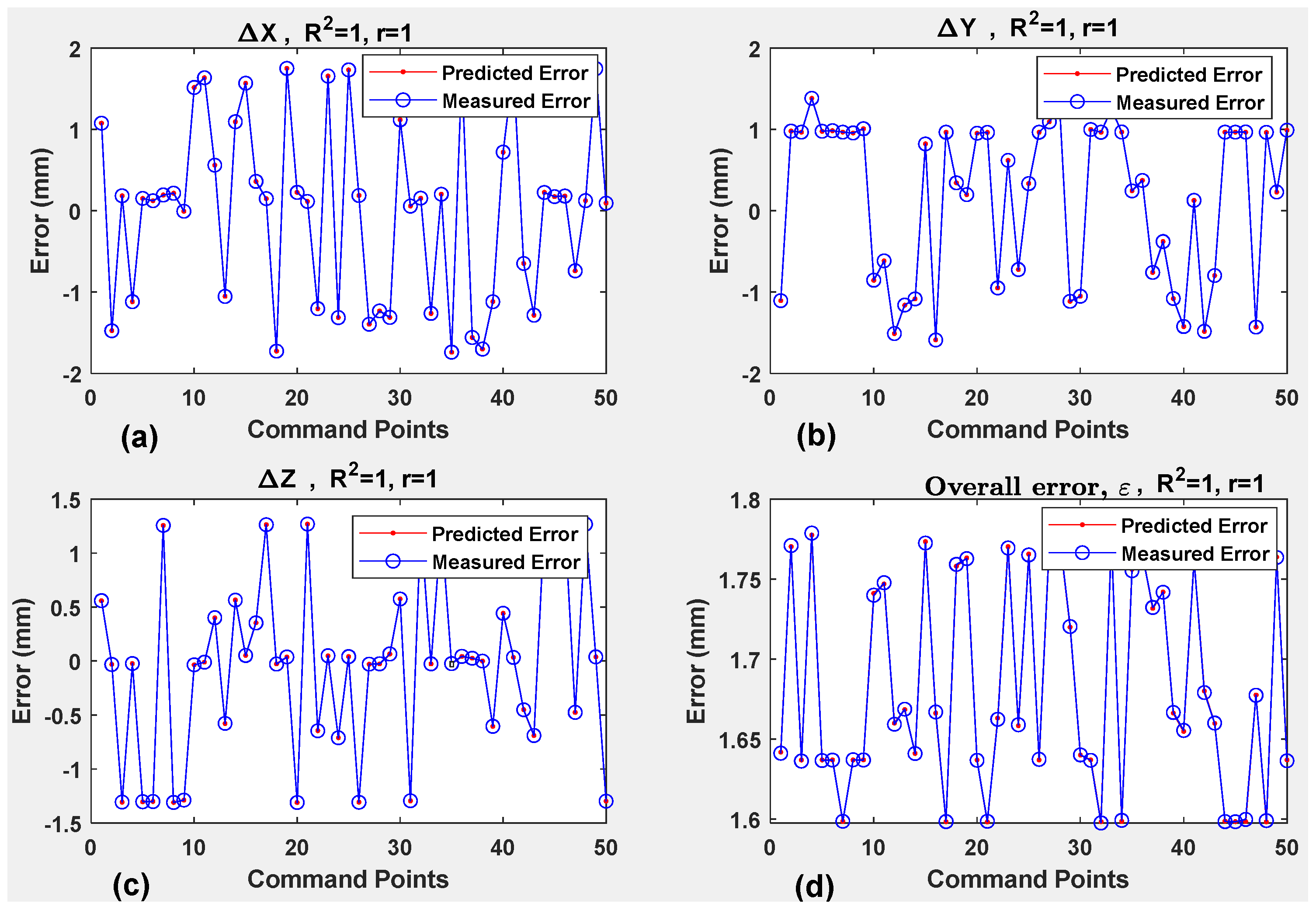
The simulation results demonstrate agreement between predicted and measured volumetric errors across all three coordinate directions and their combined Euclidean norm. As shown in Figure 9a–c, the predicted errors in the , ), -directions exhibit perfect correlation with the measured errors throughout all command points. This ideal alignment indicates that the kinematic model accurately captures the machine tool’s error behavior in each feed axis with fewer or no residual systematic errors. The parameter identification accuracy further validates the methodology’s precision, as evidenced by the high correlation between set and predicted PIGEs. As shown in Table 5, the predicted geometric parameters demonstrate near-perfect alignment with their preset values across all error types. The exceptionally low RMSE across all parameters ( for linear errors and for angular errors) confirms the method’s capability to precisely identify even subtle geometric deviations.
Figure 9.
Volumetric error of simulated work. (a) X-direction, (b) Y-direction, (c) Z-direction, and (d) norm of the volumetric error.
Table 5.
Simulation results of the model performance based on PIGEs identified.
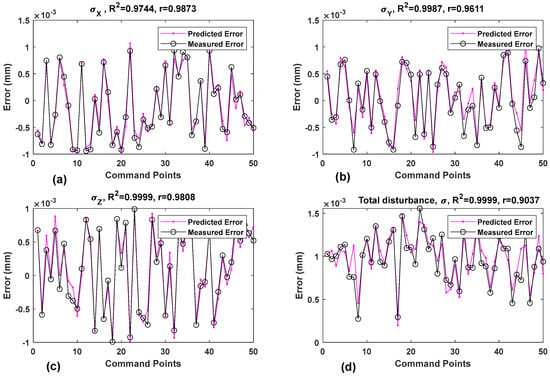
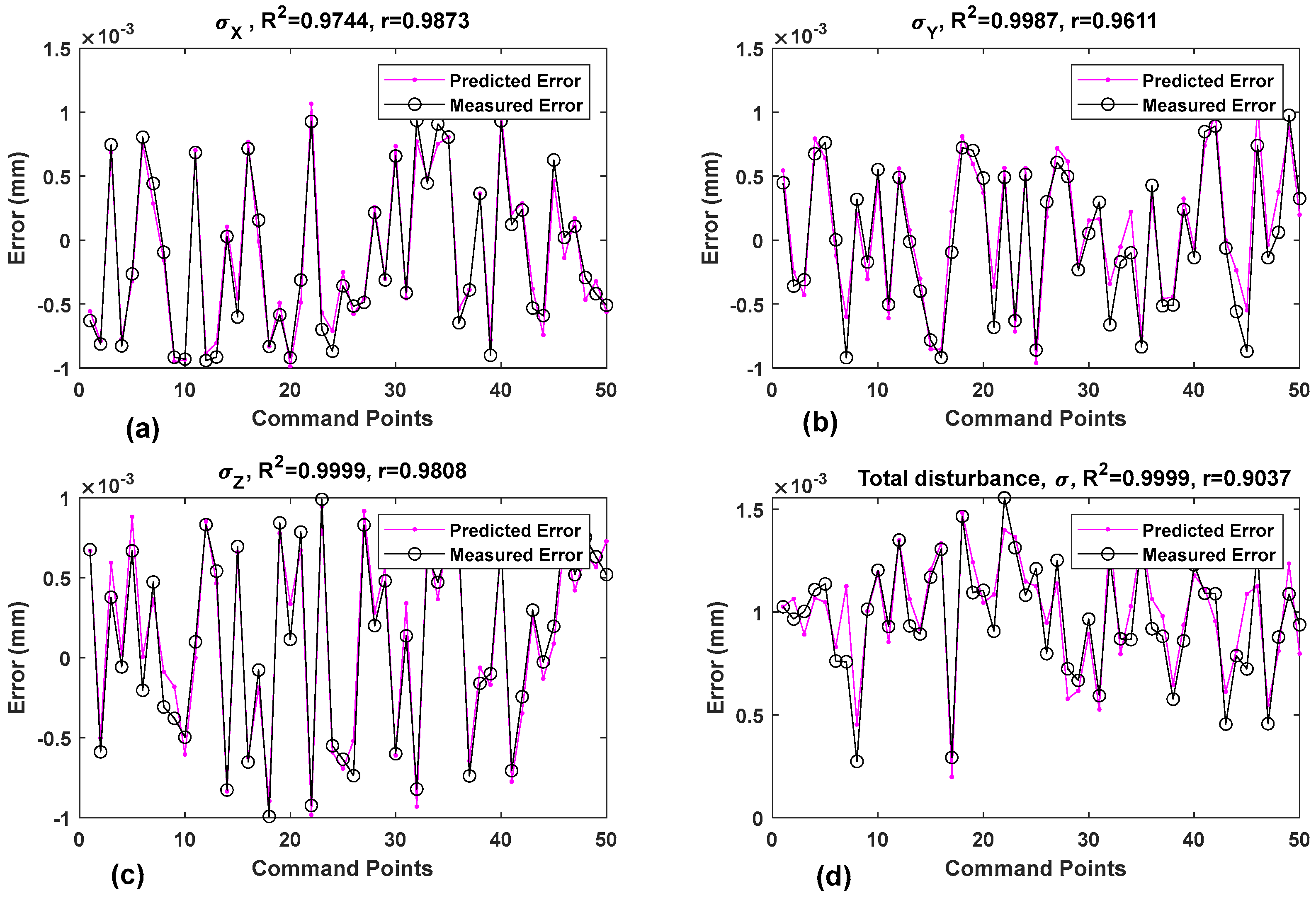
The Euclidean norm of the volumetric error (), representing the overall spatial accuracy, similarly shows a perfect correlation between predicted and measured values , as presented in Figure 9d. As shown in Figure 10a–d, the proposed methodology achieved strong correlations between predicted and measured disturbance across all 50 measurement points, with a high and for their three directions, respectively, as well as their Euclidean norm. This demonstrates that the method effectively captures the combined spatial impact of disturbances rather than merely addressing individual components. This is particularly significant given that these errors represent non-PIGE factors, including thermal drift, vibration-induced errors, and measurement noise components that traditionally challenge conventional identification methods. This comprehensive agreement across all error components validates the completeness of the mathematical model in representing the machine tool’s volumetric accuracy. The consistent precision across the entire range of command points suggests that the observability-optimized pose selection effectively excited all 11 PIGEs, ensuring their accurate identification without parameter coupling or unobservable directions.
Figure 10.
Simulation results of 3D disturbances. (a) X-direction, (b) Y-direction, (c) Z-direction, and (d) the norm.
The minimal discrepancies observed and the sub-micron RMSE values in parameter identification collectively demonstrate the method’s robustness against measurement noise and numerical approximations. These simulation results provide strong theoretical validation of the complete identification process, from optimal point selection and data acquisition through to parameter estimation. The demonstrated identification accuracy across all error components confirms that the proposed model can sufficiently capture the machine tool’s PIGEs without over-parameterization, while the high correlation coefficients and minimal RMSE values indicate high predictive capability for compensation applications.
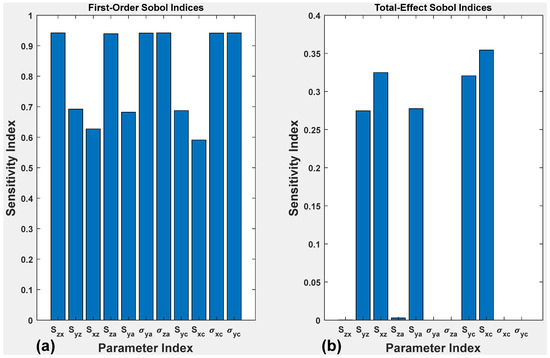
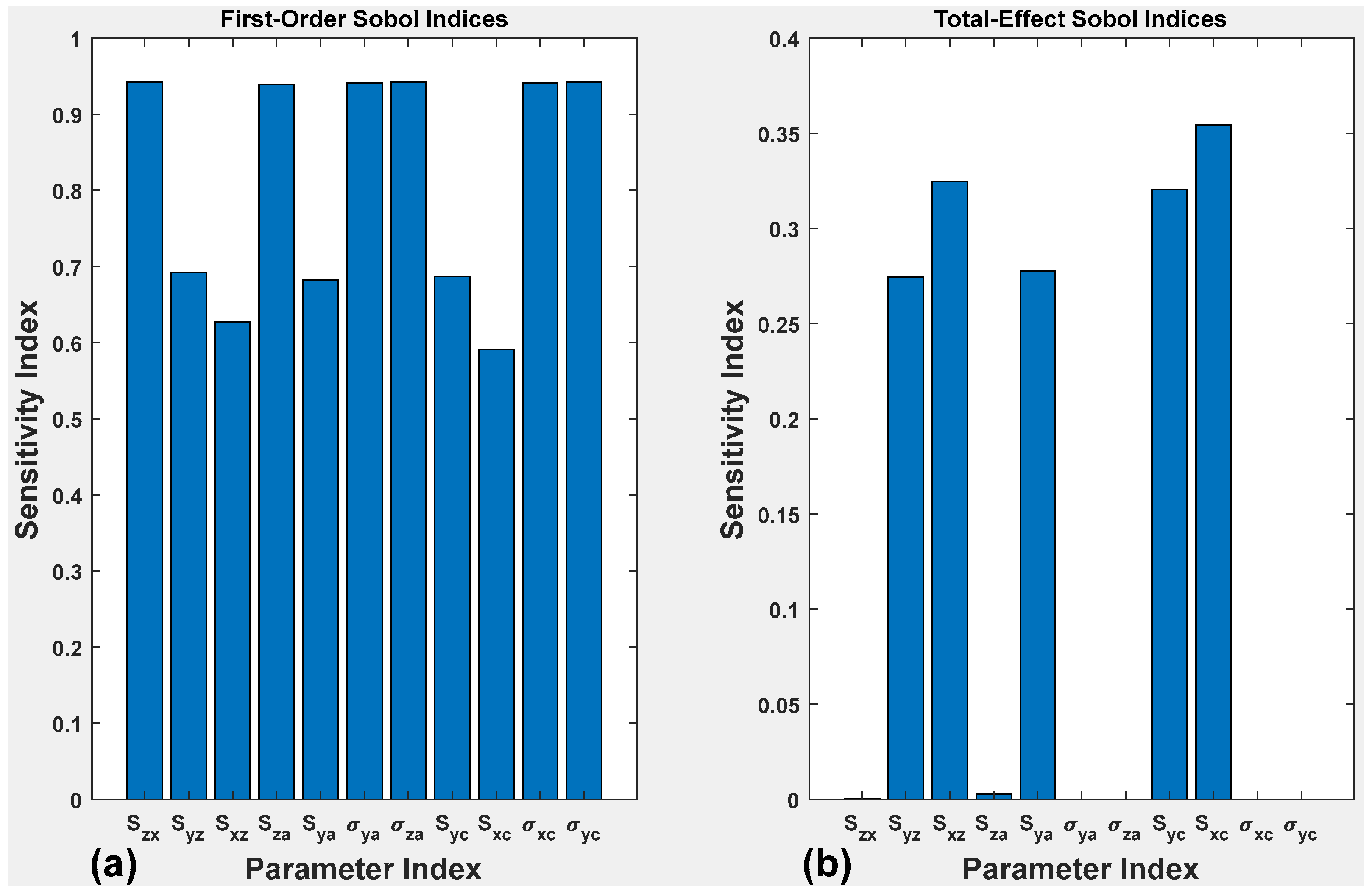
The global sensitivity analysis reveals that particularly , , , and dominated the volumetric error sensitivity, with first-order Sobol indices exceeding 0.8, indicating that these parameters highly affect the output variance in the simulation-kinematic model, as shown in Figure 11. The total-effect indices reveal significant interaction effects of and in particular, whose values increase substantially compared to their first-order indices, indicating important coupling phenomena with other parameters. This hierarchical sensitivity structure explains the exceptional identification accuracy achieved for the dominant PIGE parameters and validates the effectiveness of the observability-optimized point selection method. The comprehensive sensitivity profile confirms that all 11 PIGEs contribute meaningfully to volumetric accuracy, justifying their inclusion in the complete error model.
Figure 11.
Sobol sensitivity analysis of simulated works. (a) First order. (b) Second order.
4.2. Experimental Validation
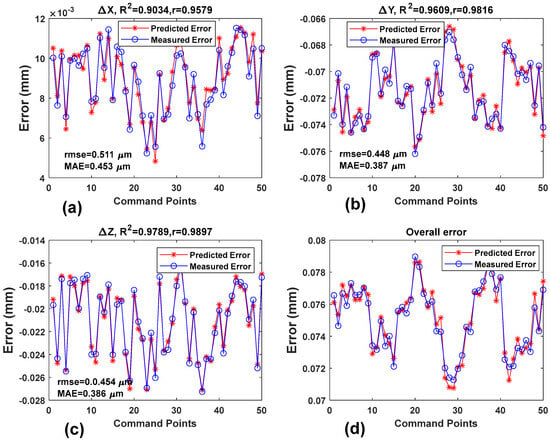
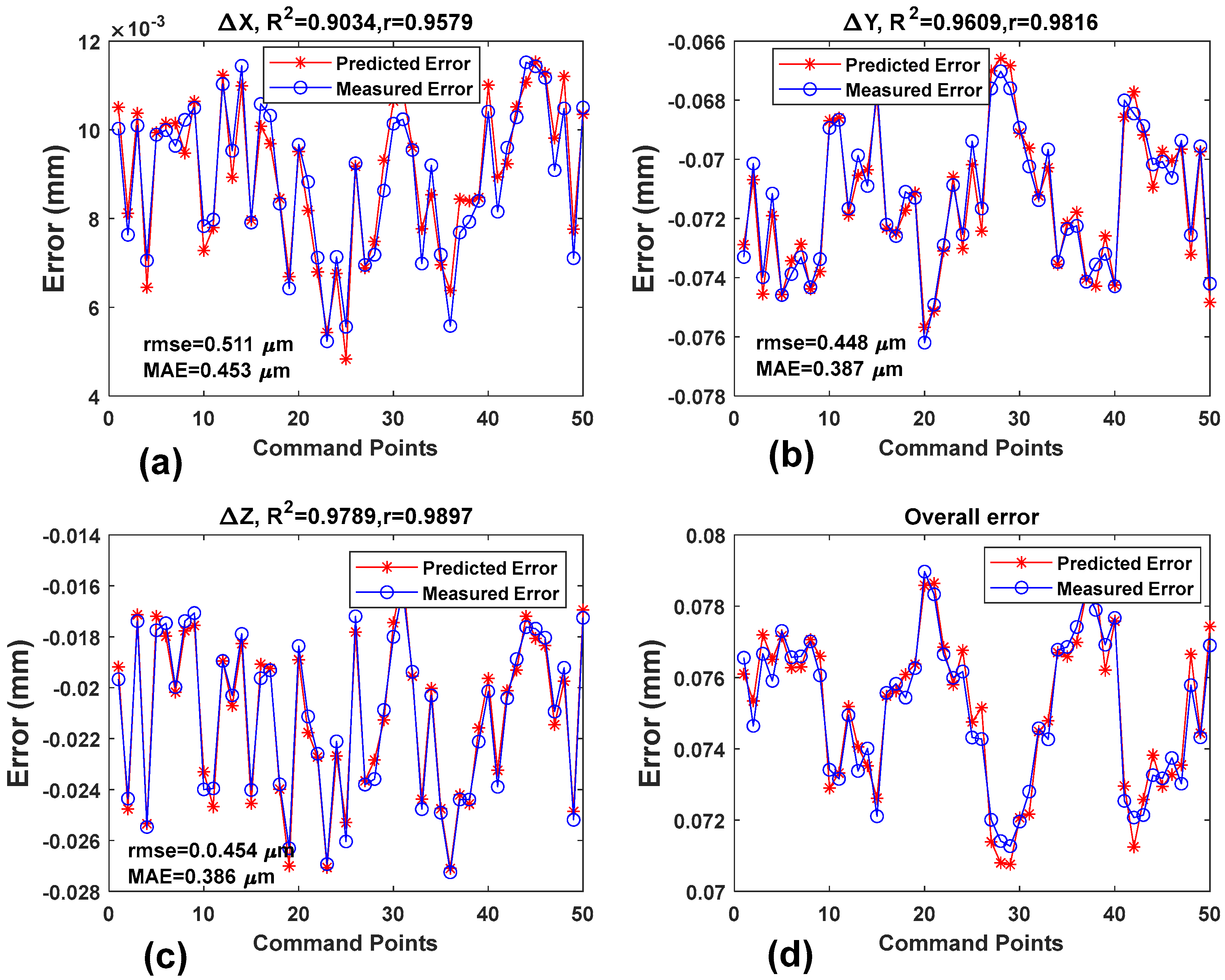
Experimental results on an industrial five-axis machine tool validate the simulation results, demonstrating significant error reduction across all metrics. The experimental results display the significant effectiveness of the proposed methodology across all measurement points and error components; Table 6 presents the identified values of the eleven PIGEs. Once the identified PIGEs were incorporated into the kinematic model, the predicted volumetric errors at 50 measurement points were compared with the experimentally measured values. The statistical results, summarized in Table 7, confirm the strong agreement between predicted and measured errors with low RMSE, MAE, and MSE, and high and which demonstrates that the volumetric errors can be predicted by the model, as presented in Figure 12. This validates not only the accuracy of the ANN-accelerated global optimization method, but also the effectiveness of the observability-index-driven point selection in ensuring a well-conditioned identification process.
Table 6.
Identified PIGEs through experimentation.
Table 7.
Statistical results of the identified PIGEs.
Figure 12.
Volumetric error in X-, Y-, and Z-directions in (a), (b), and (c), respectively. (d) Norm of the volumetric error.
The computational efficiency of the proposed method was evaluated against a conventional GA using the full kinematic model designed in Section 2. The conventional approach required approximately 125,000 model evaluations (1875 s), whereas the ANN-assisted framework reduced this to about 200 evaluations (220 s). This represents an approximate speedup. The improvement was achieved without a significant loss in accuracy (RMSE difference ).
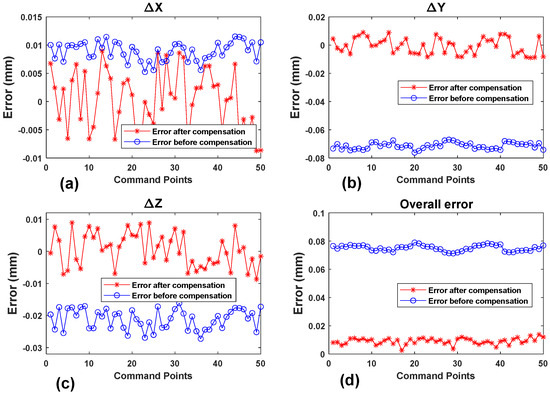
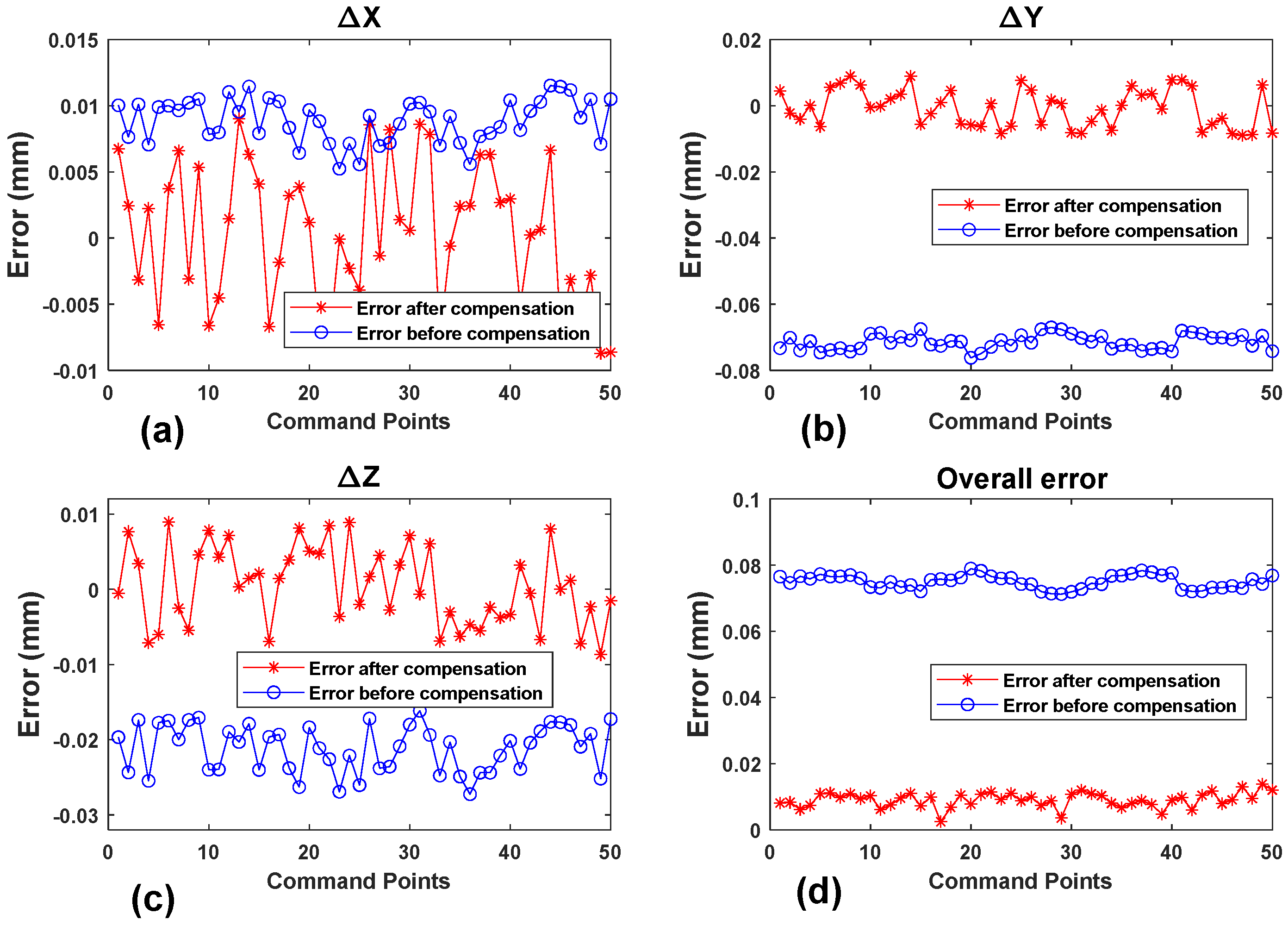
The compensation effectiveness is illustrated in Figure 13a–c, which compare the volumetric errors before and after compensation. In all three directions, the compensation process significantly reduces the error magnitude, bringing the values closer to zero. For example, in the X-direction, the uncompensated errors fluctuate around 0.01 mm, while the compensated errors are centered near zero with smaller variations. A similar trend is observed in the Y- and Z-directions, where the systematic deviations present before compensation are effectively eliminated. The experimental implementation demonstrated exceptional compensation performance, achieving an overall error reduction of 88.615% (reduction percentage of volumetric error) in volumetric accuracy after parameter identification and compensation, as depicted in Figure 13d. This improvement significantly surpasses conventional compensation methods, typically achieving 40–75% error reduction [8,56,57], establishing a new benchmark for PIGEs’ compensation in five-axis machine tools. The significant improvement can be attributed to the comprehensive model that successfully captured both the dominant PIGE parameters, addressing the complex error interactions that traditionally limit compensation performance. This demonstrates that the proposed identification and compensation framework not only provides accurate error modeling but also translates into noticeable improvements in the five-axis machine tool accuracy.
Figure 13.
Compensation analysis of volumetric error in X-, Y-, and Z-directions in (a), (b), and (c), respectively. (d) Norm of the volumetric error.
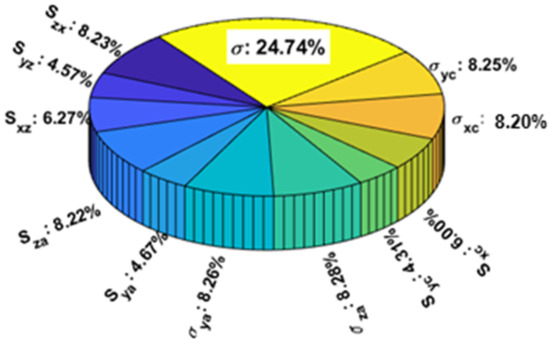
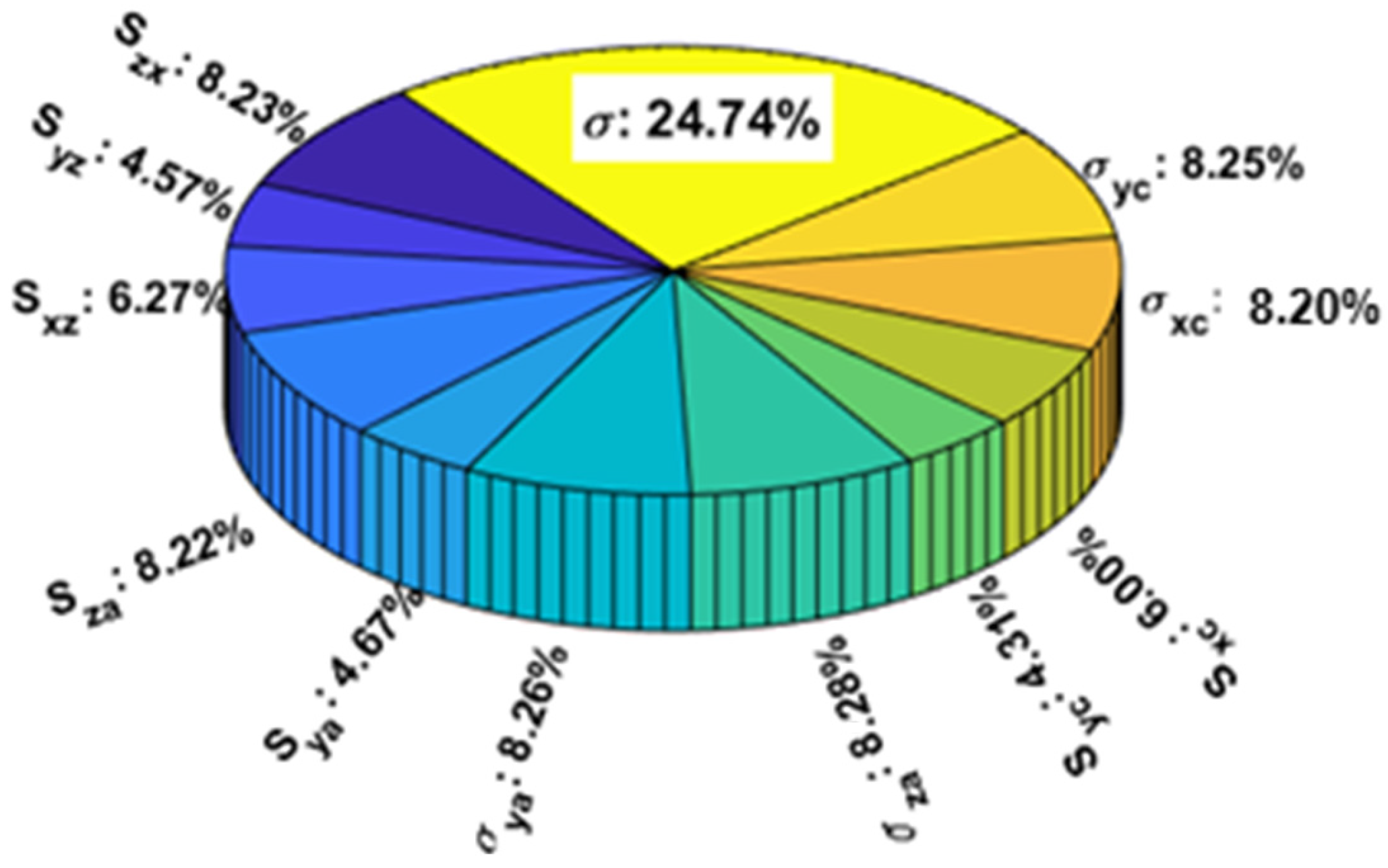
Figure 14 shows that are the dominant contributors, jointly accounting for 49.45% of the volumetric error, highlighting their strong influence on machine accuracy. The disturbance term contributes 24.74%, confirming the importance of including explicit offset parameters. These disturbances are typically unmodeled in conventional PIGE identification, which limits compensation performance. Their inclusion demonstrates the model’s ability to capture real-world error sources beyond ideal geometric assumptions. This result is consistent with the work of Jiang et al. [1], showing that PIGEs account for over 70% of five-axis machine tool inaccuracy. The error distribution matches the sensitivity analysis, explaining the effectiveness of the compensation approach, as it addresses both disturbances and dominant error parameters.
Figure 14.
Sensitivity analysis of volumetric error.
5. Conclusions
This research presented a comprehensive framework for identifying position-independent geometric errors in five-axis machine tools, integrating observability-optimized point selection with ANN-accelerated global optimization. The methodology successfully addressed critical limitations in existing approaches through several key innovations. The study developed a novel kinematic model that incorporates both conventional geometric errors (11 PIGEs) and three-dimensional offset parameters specifically designed to capture non-geometric disturbances, including thermal drift, residual errors, and measurement uncertainties. This model demonstrated exceptional capability in isolating true geometric errors from non-PIGEs, with the offset parameters accounting for 24.74% of the total volumetric error in experimental validation. The implementation of a genetic algorithm for observability-driven pose selection ensured optimal excitation of all error parameters throughout the machine tool workspace. This approach overcomes the limitations of conventional measurement strategies, especially for coupled PIGE parameters, and strengthens calibration robustness by thoroughly exploring the parameter space. The ANN-accelerated method reduces the risk of local minima, ensuring effective error identification across the entire machine tool workspace.
Experimental results confirmed the practical effectiveness of the methodology, showing an overall error reduction of 88.615% in volumetric accuracy. The high correlation coefficients between predicted and measured errors validated the model’s ability to enhance the identification accuracy of PIGEs in the five-axis machine tool. The sensitivity analysis revealed the importance of different error parameters, with the PIGEs being a significant contributor (75.26%) to volumetric inaccuracy, which confirms the results in previous studies on PIGEs. Future work could integrate real-time monitoring to update compensation parameters dynamically and extend the approach to account for position-dependent geometric errors and their interactions with PIGEs. While the ANN surrogate speeds up optimization, its accuracy relies on adequate sampling, proper regularization, and careful parameter selection. Thus, future work should explore adaptive sampling or physics-informed neural networks to further enhance reliability. The ANN surrogate’s performance depends on the quality and coverage of the training data. Insufficient sampling or poor architecture design can limit its ability to generalize beyond the trained parameter space. The successful integration of theoretical innovation, computational efficiency, and experimental validation positions this methodology as a valuable tool for enhancing the identification accuracy of PIGEs in the five-axis machine tool, with potential implications for product quality, manufacturing economics, and technological advancement in precision engineering.
Author Contributions
All authors contributed to the ideas in this study. S.O.: idea conception, methodology, simulation, software, data analysis, and writing the original draft. W.W.: funding acquisition, supervision, project administration, and editing. Q.D. and D.N.: experimentation, data analysis, and editing. All authors have read and agreed to the published version of the manuscript.
Funding
This work was supported by the National Program of China (Grant No.: J0017-2326-QT), Science and Technology Planning Project of Guangzhou City (Grant No.: 2024B01J0092), and Science and Technology Department of Sichuan Province Grant (No.: 2025NSFJQ0008, 2024ZHCG0133, J0024).
Data Availability Statement
Data will be made available on reasonable request.
Conflicts of Interest
The authors declare no conflicts of interest.
References
- Jiang, X.; Cui, Z.; Wang, L.; Liu, C.; Li, M.; Liu, J.; Du, Y. Critical Geometric Errors Identification of a Five-Axis Machine Tool Based on Global Quantitative Sensitivity Analysis. Int. J. Adv. Manuf. Technol. 2022, 119, 3717–3727. [Google Scholar] [CrossRef] [Scilit]
- Yang, S.H.; Lee, K.I. Adaptive Identification of the Position-Independent Geometric Errors for the Rotary Axis of Five-Axis Machine Tools to Directly Improve Workpiece Geometric Errors. Int. J. Precis. Eng. Manuf. 2024, 25, 995–1010. [Google Scholar] [CrossRef] [Scilit]
- Chen, Y.; Lee, T.; Liu, C.-S. Synchronous Measurement and Verification of Position-Independent Geometric Errors and Position-Dependent Geometric Errors in C-Axis on Mill-Turn Machine Tools. Int. J. Adv. Manuf. Technol. 2022, 121, 5035–5048. [Google Scholar] [CrossRef] [Scilit]
- Huang, Z.; Gao, C.; Wang, Y. Comprehensive Error Modeling of Four Axis Gear Machine Tool. IOP Conf. Ser. Earth Environ. Sci. 2021, 692, 022026. [Google Scholar] [CrossRef] [Scilit]
- Xu, K.; Li, Z.; Li, G.; Du, L.; Ji, J. An Improved Robust Identification Method for Position Independent Geometric Errors of the Swing Axis of the Gear Grinding Machine. Int. J. Adv. Manuf. Technol. 2024, 135, 4963–4973. [Google Scholar] [CrossRef] [Scilit]
- Yang, J.; Mayer, J.R.R.; Altintas, Y. A Position Independent Geometric Errors Identification and Correction Method for Five-Axis Serial Machines Based on Screw Theory. Int. J. Mach. Tools Manuf. 2015, 95, 52–66. [Google Scholar] [CrossRef] [Scilit]
- Zha, J.; Wang, T.; Li, L.; Chen, Y. Volumetric Error Compensation of Machine Tool Using Laser Tracer and Machining Verification. Int. J. Adv. Manuf. Technol. 2020, 108, 2467–2481. [Google Scholar] [CrossRef] [Scilit]
- Gao, W.; Ibaraki, S.; Alkan Donmez, M.; Kono, D.; Mayer, J.R.R.; Chen, Y.-L.; Szipka, K.; Archenti, A.; Linares, J.-M.; Suzuki, N. Machine Tool Calibration: Measurement, Modeling, and Compensation of Machine Tool Errors. Int. J. Mach. Tools Manuf. 2023, 187, 104017. [Google Scholar] [CrossRef] [Scilit]
- IBS Precision Engineering. Machine Tool Inspection and Analyzer Solutions; IBS Precision Engineering: Eindhoven, The Netherlands, 2022. [Google Scholar]
- Osei, S.; Wang, W.; Ding, Q. A New Method to Identify the Position-Independent Geometric Errors in the Rotary Axes of Five-Axis Machine Tools. J. Manuf. Process. 2023, 87, 46–53. [Google Scholar] [CrossRef] [Scilit]
- Xia, C.; Wang, S.; Wang, S.; Ma, C.; Xu, K. Geometric Error Identification and Compensation for Rotary Worktable of Gear Profile Grinding Machines Based on Single-Axis Motion Measurement and Actual Inverse Kinematic Model. Mech. Mach. Theory 2021, 155, 104042. [Google Scholar] [CrossRef] [Scilit]
- Praniewicz, M.; Kurfess, T.R.; Saldana, C. Error Qualification for Multi-Axis BC-Type Machine Tools. J. Manuf. Syst. 2019, 52, 211–216. [Google Scholar] [CrossRef] [Scilit]
- Yukitoshi, I.; Takehiro, N. Fundamental Study of the On-Machine Measurement in the Machining Center with a Touch Trigger Probe. Int. J. Autom. Technol. 2013, 7, 523–536. [Google Scholar] [CrossRef] [Scilit]
- Adam, W.; Katarzyna, M. Measurement Hysteresis of Touch-Trigger Probes for CNC Machine Tools. Measurement 2020, 156, 107568. [Google Scholar] [CrossRef] [Scilit]
- Yang, J.; Ding, H. A New Position Independent Geometric Errors Identification Model of Five-Axis Serial Machine Tools Based on Differential Motion Matrices. Int. J. Mach. Tools Manuf. 2016, 104, 68–77. [Google Scholar] [CrossRef] [Scilit]
- Lei, W.; Hsu, Y. Accuracy Enhancement of Five-Axis CNC Machines through Real-Time Error Compensation. Int. J. Mach. Tools Manuf. 2003, 43, 871–877. [Google Scholar] [CrossRef] [Scilit]
- Qiao, Y.; Chen, Y.; Yang, J.; Chen, B. A Five-Axis Geometric Errors Calibration Model Based on the Common Perpendicular Line (CPL) Transformation Using the Product of Exponentials (POE) Formula. Int. J. Mach. Tools Manuf. 2017, 118–119, 49–60. [Google Scholar] [CrossRef] [Scilit]
- Jennifer, R.C. Volumetric Error Compensation for 5-Axis Machine Tools. Ph.D. Thesis, Missouri University of Science and Technology, Rolla, MO, USA, 2017. [Google Scholar]
- Jiang, X.; Cripps, R.J. A Method of Testing Position Independent Geometric Errors in Rotary Axes of a Five-Axis Machine Tool Using a Double Ball Bar. Int. J. Mach. Tools Manuf. 2015, 89, 151–158. [Google Scholar] [CrossRef] [Scilit]
- Jiang, X.; Cripps, R.J. Geometric Characterisation and Simulation of Position Independent Geometric Errors of Five-Axis Machine Tools Using a Double Ball Bar. Int. J. Adv. Manuf. Technol. 2016, 83, 1905–1915. [Google Scholar] [CrossRef] [Scilit]
- Magnanini, M.C.; Terkaj, W.; Tolio, T. Robust Optimization of Manufacturing Systems Flexibility. Procedia CIRP 2020, 96, 63–68. [Google Scholar] [CrossRef] [Scilit]
- Fan, J.; Wang, P.; Ren, X. A Novel Global Sensitivity Analysis Method for Vital Geometric Errors of Five-Axis Machine Tools. Int. J. Adv. Manuf. Technol. 2021, 117, 3515–3527. [Google Scholar] [CrossRef] [Scilit]
- Lin, Z.; Tian, W.; Zhang, D.; Gao, W.; Wang, L. A Method of Geometric Error Identification and Compensation of CNC Machine Tools Based on Volumetric Diagonal Error Measurements. Int. J. Adv. Manuf. Technol. 2023, 124, 51–68. [Google Scholar] [CrossRef] [Scilit]
- Wang, H.; Li, T.J.; Ding, X.H. Tolerance Analysis of the Volumetric Error of Heavy-Duty Machine Tool Based on Interval Uncertainty. Int. J. Adv. Manuf. Technol. 2021, 114, 2185–2199. [Google Scholar] [CrossRef] [Scilit]
- Lasemi, A.; Xue, D.; Gu, P. Accurate Identification and Compensation of Geometric Errors of 5-Axis CNC Machine Tools Using Double Ball Bar. Meas. Sci. Technol. 2016, 27, 55004. [Google Scholar] [CrossRef] [Scilit]
- Abdulkadirov, R.; Lyakhov, P.; Nagornov, N. Survey of Optimization Algorithms in Modern Neural Networks. Mathematics 2023, 11, 2466. [Google Scholar] [CrossRef] [Scilit]
- Ronald, P.M.C.; Karl, A.S.; Roger, H.C. Review of Modelling and Control of Two-Wheeled Robots. Annu. Rev. Control 2013, 37, 89–103. [Google Scholar]
- Alkhalifa, R.; Alkhomayes, F.; Almazroua, B.; Alhaidan, D.; Alothman, M.; Almuhaidib, J. A Comparative Review of Parallel Exact, Heuristic, Metaheuristic, and Hybrid Optimization Techniques for the Traveling Salesman Problem. arXiv 2025, arXiv:2505.18278. [Google Scholar] [CrossRef] [Scilit]
- Yang, H.; Shen, M.; Li, L.; Zhang, Y.; Ma, Q.; Zhang, M. New Identification Method for Computer Numerical Control Geometric Errors. Meas. Control 2021, 54, 1055–1067. [Google Scholar] [CrossRef] [Scilit]
- Sun, C.; Jin, Y.; Cheng, R.; Ding, J.; Zeng, J. Surrogate-Assisted Cooperative Swarm Optimization of High-Dimensional Expensive Problems. IEEE Trans. Evol. Comput. 2017, 21, 644–660. [Google Scholar] [CrossRef] [Scilit]
- Haftka, R.T.; Villanueva, D.; Chaudhuri, A. Parallel Surrogate-Assisted Global Optimization with Expensive Functions—A Survey. Struct. Multidiscip. Optim. 2016, 54, 3–13. [Google Scholar] [CrossRef] [Scilit]
- Jin, Y. Surrogate-Assisted Evolutionary Computation: Recent Advances and Future Challenges. Swarm Evol. Comput. 2011, 1, 61–70. [Google Scholar] [CrossRef] [Scilit]
- Kazma, M.H.; Nugroho, S.A.; Haber, A.; Taha, A.F. State-Robust Observability Measures for Sensor Selection in Nonlinear Dynamic Systems. In Proceedings of the 62nd IEEE Conference on Decision and Control (CDC); IEEE: Singapore, 2023. [Google Scholar]
- He, S.; Osei, S.; Wang, W.; Yu, J.; Ding, Q.; Junjie, L. Volumetric Error Measurement of the Five-Axis Machine Tool Using Optimal Measurement Points Based on a Modified Genetic Algorithm. Measurement 2024, 238, 115265. [Google Scholar] [CrossRef] [Scilit]
- Bopardikar, S.D. A Randomized Approach to Sensor Placement with Observability Assurance. Automatica 2021, 123, 109340. [Google Scholar] [CrossRef] [Scilit]
- Zhao, D.; Bi, Y.; Ke, Y. An Efficient Error Compensation Method for Coordinated CNC Five-Axis Machine Tools. Int. J. Mach. Tools Manuf. 2017, 123, 105–115. [Google Scholar] [CrossRef] [Scilit]
- Creamer, J.; Sammons, P.M.; Bristow, D.A.; Landers, R.G.; Freeman, P.L.; Easley, S.J. Table-Based Volumetric Error Compensation of Large Five-Axis Machine Tools. J. Manuf. Sci. Eng. 2017, 139, 021011. [Google Scholar] [CrossRef] [Scilit]
- Beinecke, J.; Heider, D. Gaussian Noise Up-Sampling Is Better Suited than SMOTE and ADASYN for Clinical Decision Making. BioData Min. 2021, 14, 49. [Google Scholar] [CrossRef] [Scilit] [PubMed]
- Ding, Q.; Wang, W.; Ding, J.; Zhang, J.; Hu, C.; Lei, F.; Du, L.; Wang, L. RTCP Test Axis Motion Planning for Five-Axis Machine Tool Dynamic Performance Using Observability Optimization Based on Modified Genetic Algorithm. Int. J. Adv. Manuf. Technol. 2021, 119, 435–462. [Google Scholar] [CrossRef] [Scilit]
- Hsia, S.K.; Lei, W.T.; Chen, C.W. Calibration of Link Errors in Rotary Axes of Five-Axis Machine Tools Using a Six-Dimensional Motion Measuring Device. J. Manuf. Process. 2023, 108, 696–707. [Google Scholar] [CrossRef] [Scilit]
- Chen, X.; Liu, Y.; Xu, Y.; Gou, S.; Ma, S.; Ullah, Z. Kinematic Calibration of a Laser Tracker Based on Nonlinear Optimization of a Refined Geometric Error Model. Measurement 2022, 191, 110672. [Google Scholar] [CrossRef] [Scilit]
- Hassanat, A.; Almohammadi, K.; Alkafaween, E.; Abunawas, E.; Hammouri, A.; Prasath, V.B.S. Choosing Mutation and Crossover Ratios for Genetic Algorithms—A Review with a New Dynamic Approach. Information 2019, 10, 390. [Google Scholar] [CrossRef] [Scilit]
- Monique, S.V.; Orides, M.J.; Rodrigo, C.C. A Modified Genetic Algorithm with Local Search and Multi-Crossover Operator for Job Shop Problem. Sensors 2020, 20, 5440. [Google Scholar]
- Yang, H.; Huang, X.; Ding, S.; Yu, C.; Yang, Y. Identification and Compensation of 11 Position-Independent Geometric Errors on Five-Axis Machine Tools with a Tilting Head. Int. J. Adv. Manuf. Technol. 2018, 94, 533–544. [Google Scholar] [CrossRef] [Scilit]
- Guo, S.; Jiang, G.; Zhang, D.; Mei, X. Position-Independent Geometric Error Identification and Global Sensitivity Analysis for the Rotary Axes of Five-Axis Machine Tools. Meas. Sci. Technol. 2017, 28, 045006. [Google Scholar] [CrossRef] [Scilit]
- Yang, S.H.; Lee, K.I. Identification of 11 Position-Independent Geometric Errors of a Five-Axis Machine Tool Using 3D Geometric Sensitivity Analysis. Int. J. Adv. Manuf. Technol. 2021, 113, 3271–3282. [Google Scholar] [CrossRef] [Scilit]
- Yang, S.-H.; Lee, K.-I. Machine Tool Analyzer: A Device for Identifying 13 Position-Independent Geometric Errors for Five-Axis Machine Tools. Int. J. Adv. Manuf. Technol. 2021, 115, 2945–2957. [Google Scholar] [CrossRef] [Scilit]
- Wang, H.; Jiang, X.; Li, M. Identification and Compensation Machining Evaluation of Position-Independent Geometric Error of Dual Rotation Axes. Int. J. Adv. Manuf. Technol. 2023, 129, 2783–2799. [Google Scholar] [CrossRef] [Scilit]
- Yu, S.; John, M.H. Observability Index Selection for Robot Calibration. In Proceedings of the IEEE International Conference on Robotics and Automation; IEEE Xplore: New York, NY, USA, 2008; pp. 831–836. [Google Scholar]
- Wong, T.-T.; Luk, W.-S.; Heng, P.-A. Sampling with Hammersley and Halton Points. J. Graph. Tools 1997, 2, 9–24. [Google Scholar] [CrossRef] [Scilit]
- Drukker, D.M.; Gates, R. Generating Halton Sequences Using Mata. Stata J. 2006, 6, 214–228. [Google Scholar] [CrossRef] [Scilit]
- Kucherenko, S.; Iooss, B. Derivative Based Global Sensitivity Measures. In Handbook of Uncertainty Quantification; Springer Nature: Cham, Switzerland, 2017; pp. 1241–1263. [Google Scholar]
- Tsutsumi, M.; Saito, A. Identification and Compensation of Systematic Deviations Particular to 5-Axis Machining Centers. Int. J. Mach. Tools Manuf. 2003, 43, 771–780. [Google Scholar] [CrossRef] [Scilit]
- ISO 230-7:2006(E); Test Code for Machine Tools-Part 7: Geometric Accuracy of Axes of Rotation. ISO: Geneva, Switzerland, 2006.
- ISO 230-1; Test Code for Machine Tools Part 1: Geometric Accuracy of Machines Operating Under. ISO: Geneva, Switzerland, 2002.
- Chen, Q.; Maeng, S.; Li, W.; Zhou, Z.; Min, S. Geometric- and Force-Induced Errors Compensation and Uncertainty Analysis of Rotary Axis in 5-Axis Ultra-Precision Machine Tool. Int. J. Adv. Manuf. Technol. 2020, 109, 841–856. [Google Scholar] [CrossRef] [Scilit]
- Liu, J.; Zhao, Y.; Lai, T.; Li, F.; Liu, K. Identification of Geometrical Error on Multi-Axis Machine Tools Based on a Laser Tracker. J. Phys. Conf. Ser. 2022, 2185, 012008. [Google Scholar] [CrossRef] [Scilit]

Disclaimer/Publisher’s Note: The statements, opinions and data contained in all publications are solely those of the individual author(s) and contributor(s) and not of MDPI and/or the editor(s). MDPI and/or the editor(s) disclaim responsibility for any injury to people or property resulting from any ideas, methods, instructions or products referred to in the content. |
© 2026 by the authors. Licensee MDPI, Basel, Switzerland. This article is an open access article distributed under the terms and conditions of the Creative Commons Attribution (CC BY) license.