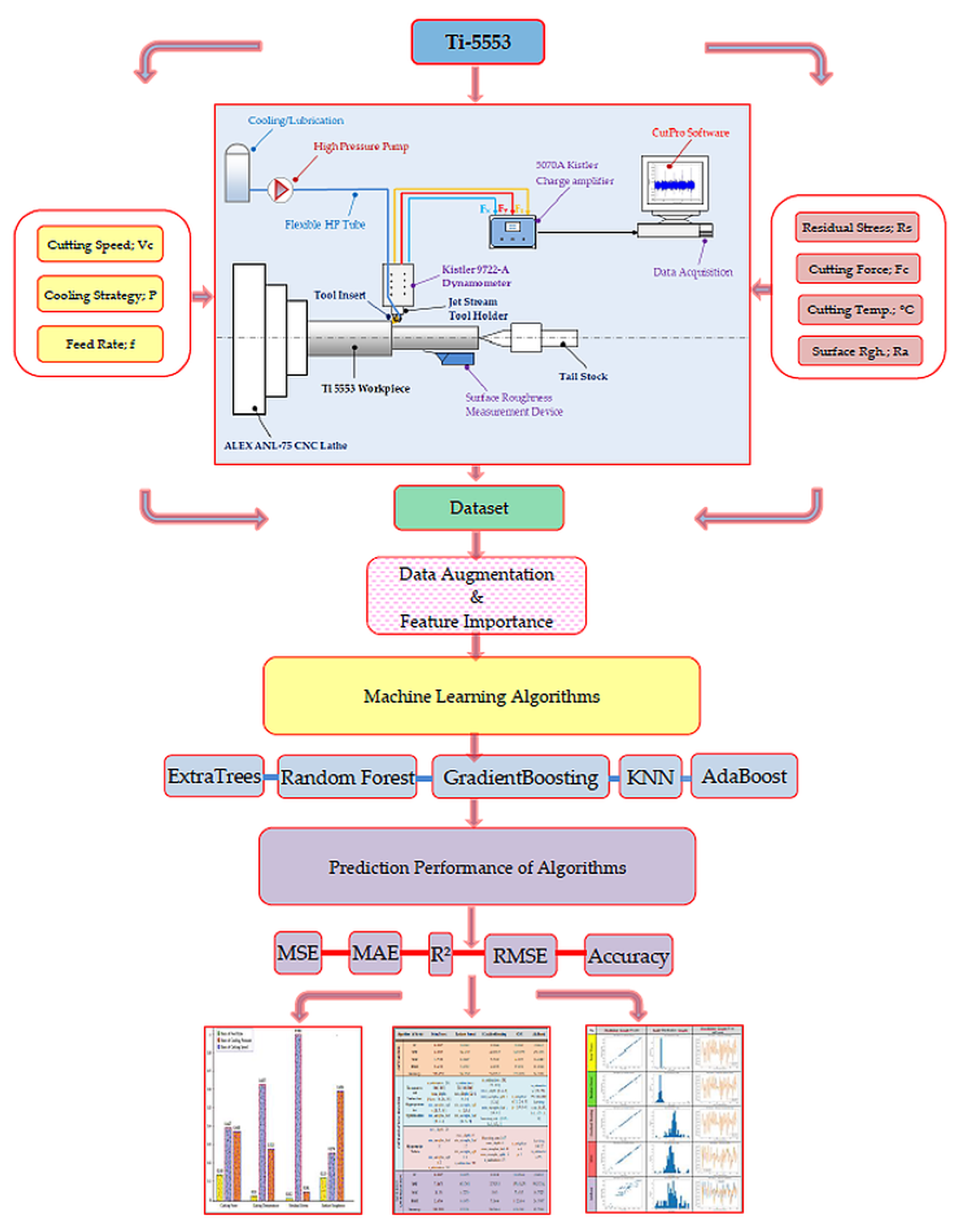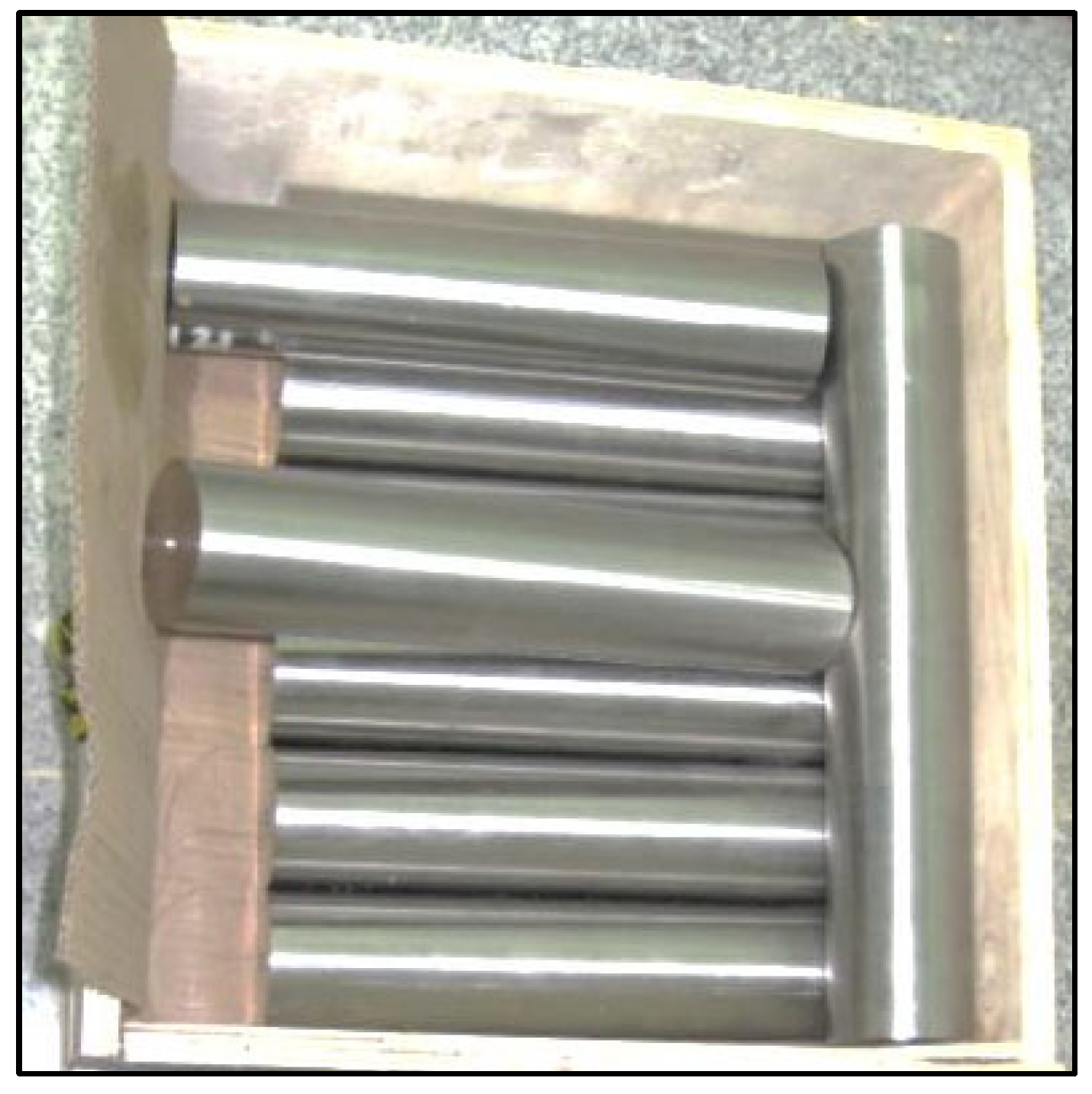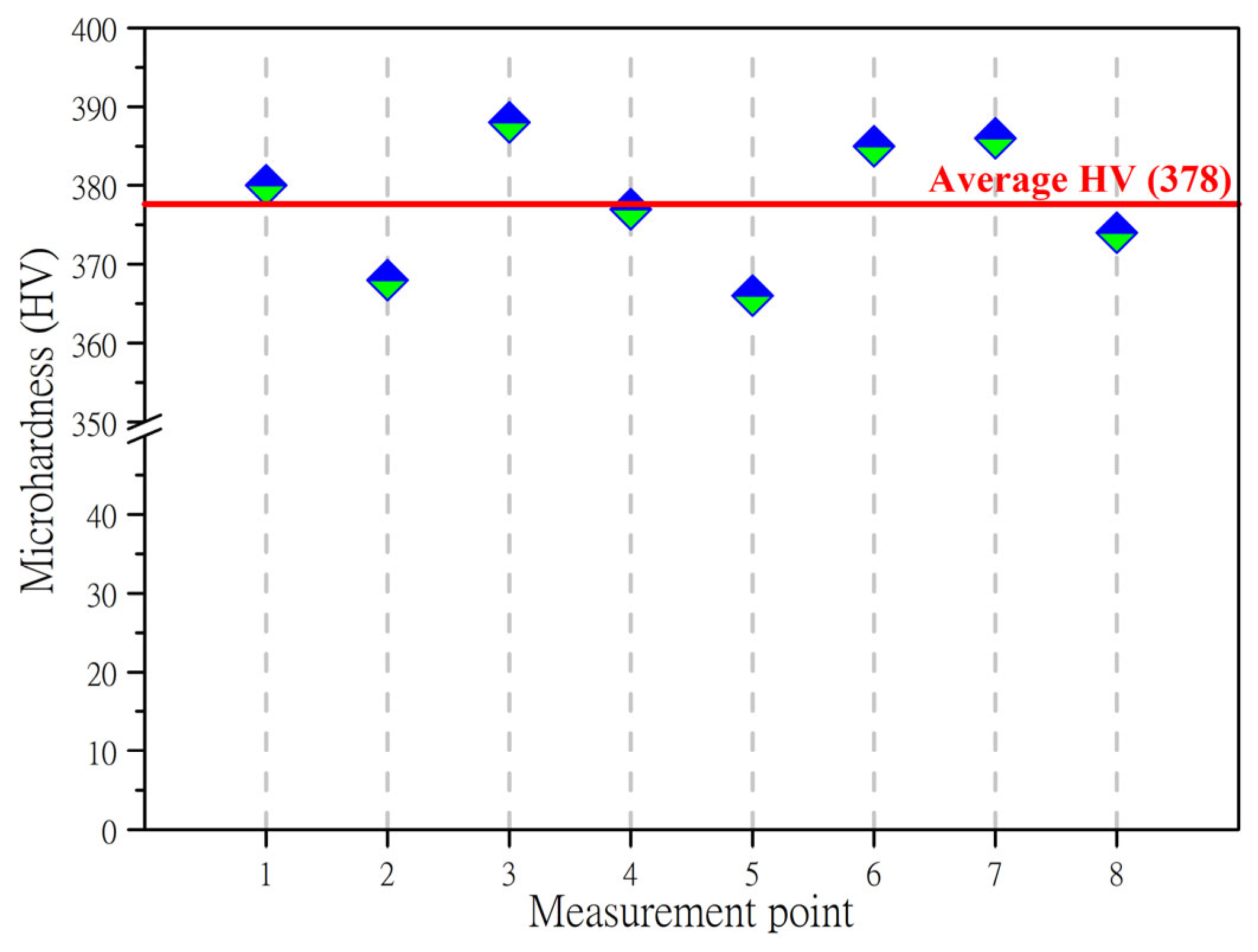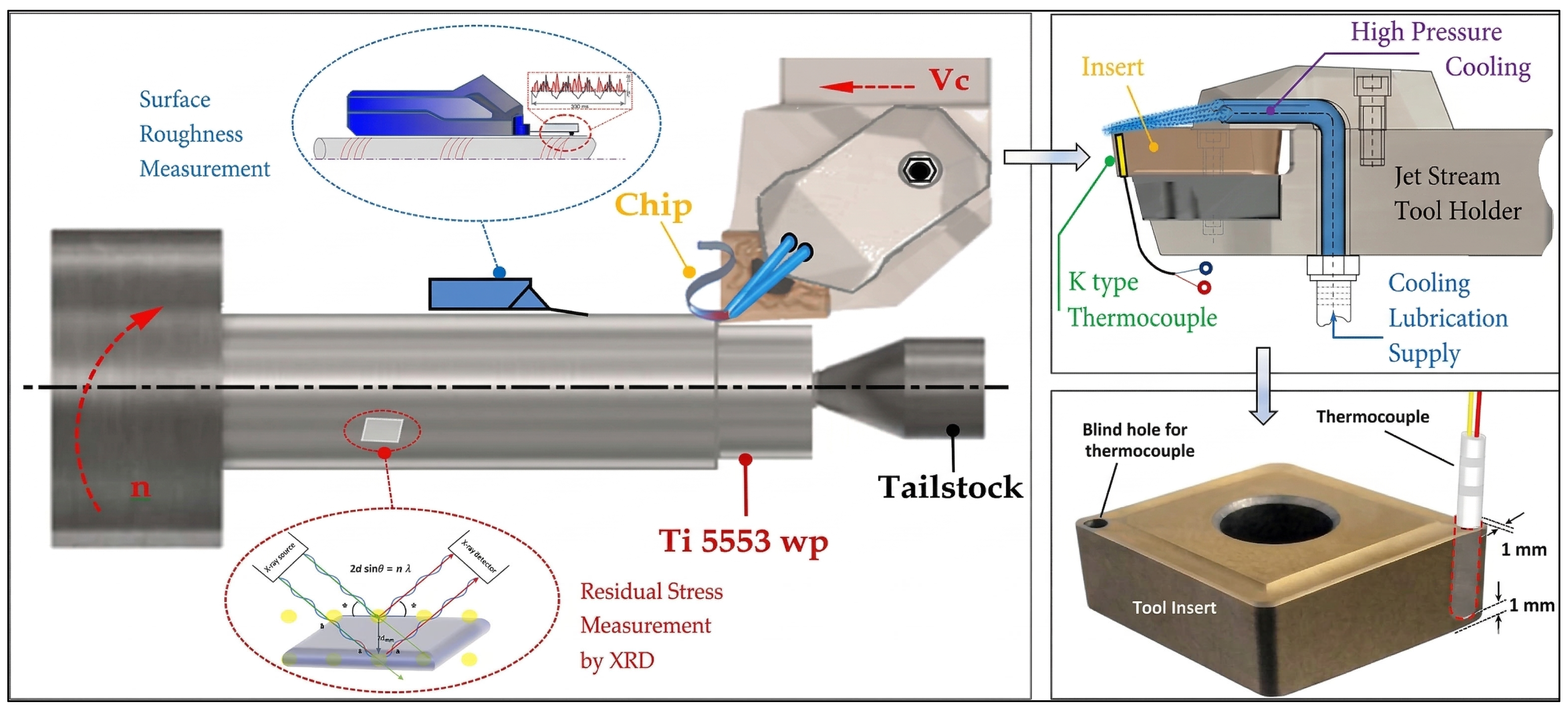
Machine Learning-Based Prediction of Surface Integrity in High-Pressure Coolant-Assisted Machining of Near-β Ti-5553 Titanium Alloy

Abstract
1. Introduction
2. Materials and Methods
2.1. Material
2.2. Methods
2.2.1. Machining Parameters and High-Pressure Cooling System
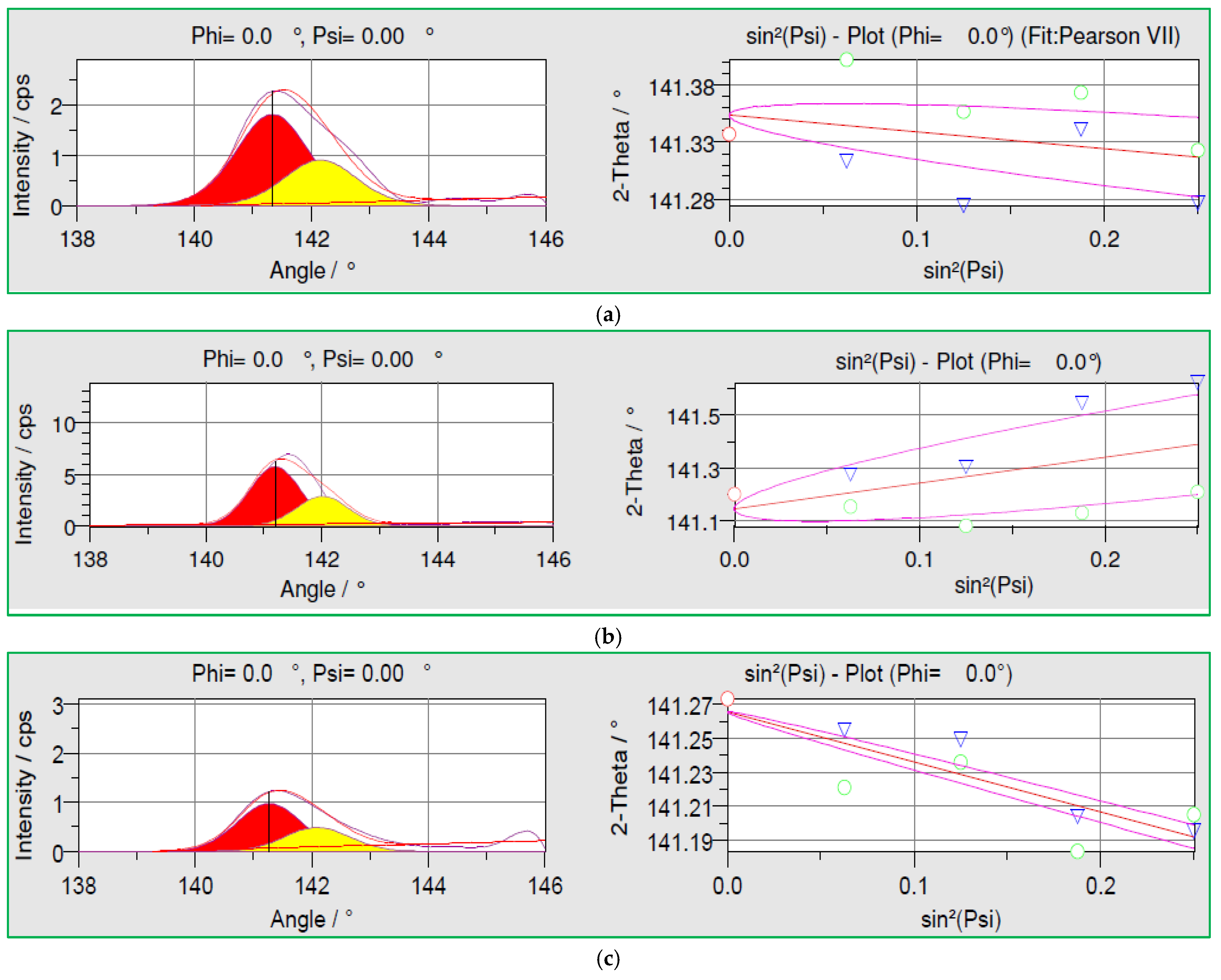
2.2.2. Residual Stress Measurement by X-Ray Diffraction (XRD)
2.2.3. Cutting Force Measurement
2.2.4. Cutting Temperature Measurement
2.2.5. Surface Roughness Measurement
2.3. Machine Learning Methodology
2.3.1. Dataset
2.3.2. Dataset Augmentation
| Algorithm 1: Synthetic data generation pseudo code | |
| 1: | if additional_samples_needed > 0: |
| 2: | additional_data = [] |
| 3: | for i in range(additional_samples_needed): |
| 4: | sample = dataset.random_sample (1) |
| 5: | jittered_sample = sample.copy() |
| 6: | for column in dataset.numerical_columns(): |
| 7: | jittered_sample[column] = add_jitter(jittered_sample[column]) |
| 8: | additional_data.append(jittered_sample) |
| 9: | dataset = dataset.append(additional_data) |
| 10: | save_excel(dataset, “augmented_dataset.xlsx”) |
2.3.3. Performance Evaluation of Machine Learning Algorithms and Prediction Results
Extra Trees Repressors Algorithm
K-Nearest Neighbors Regressor Algorithm
Gradient Boosting Regressor Algorithm
Random Forest Regressor Algorithm
Adaboost Regressor Algorithm
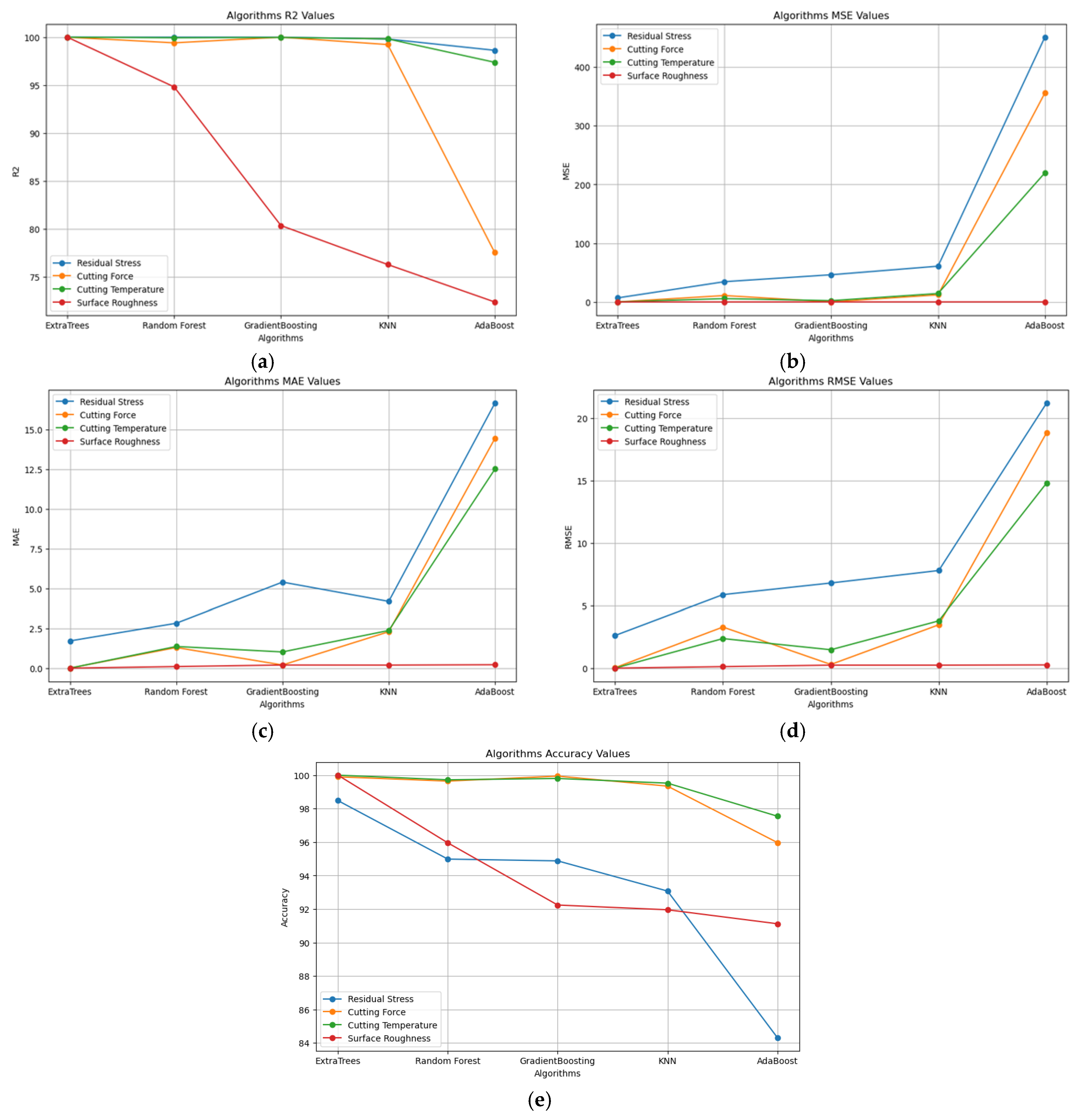
Evaluation of All Models
3. Analysis and Results
3.1. Experimental Test Results and Analysis
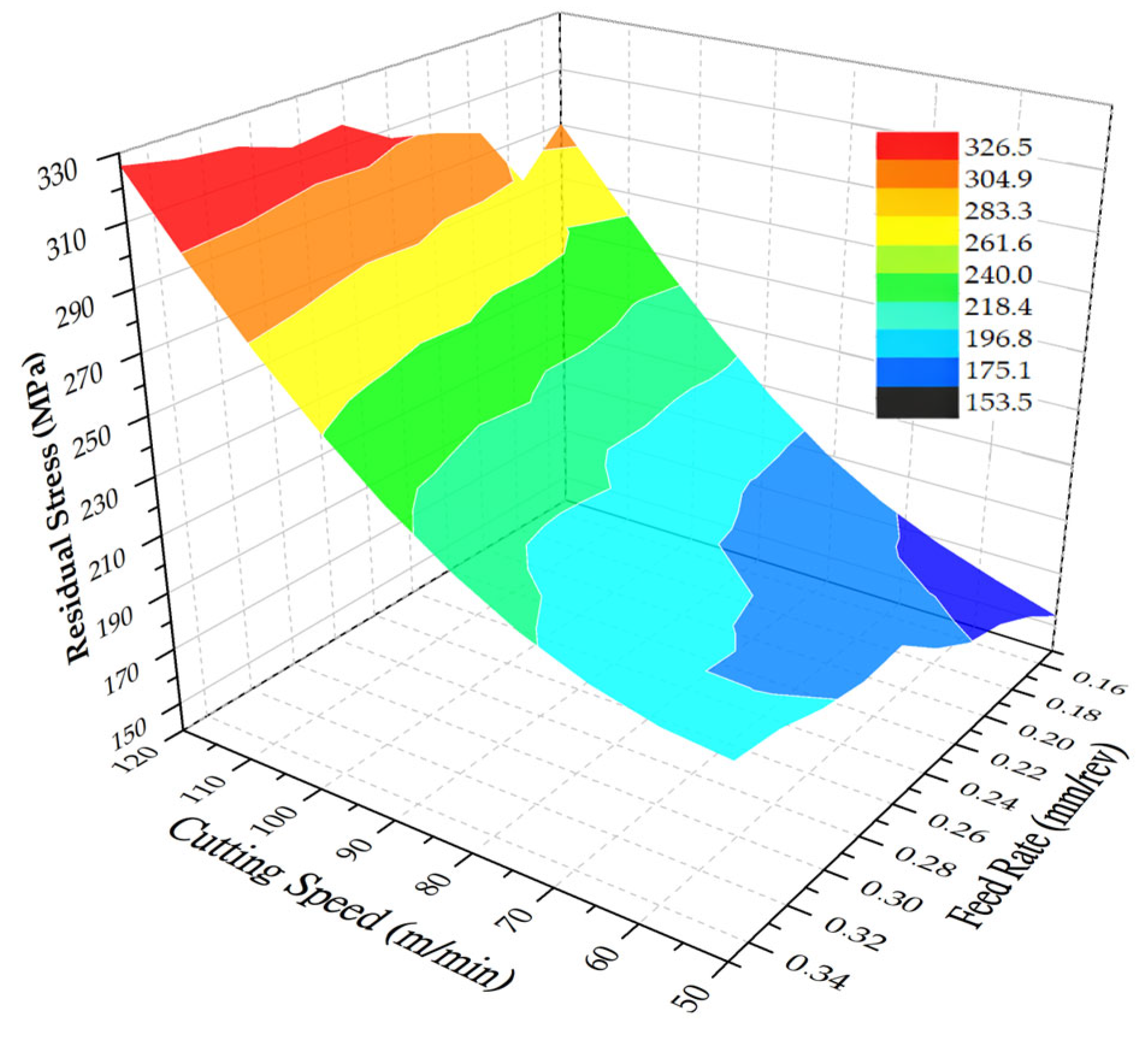
3.1.1. Residual Stress Results
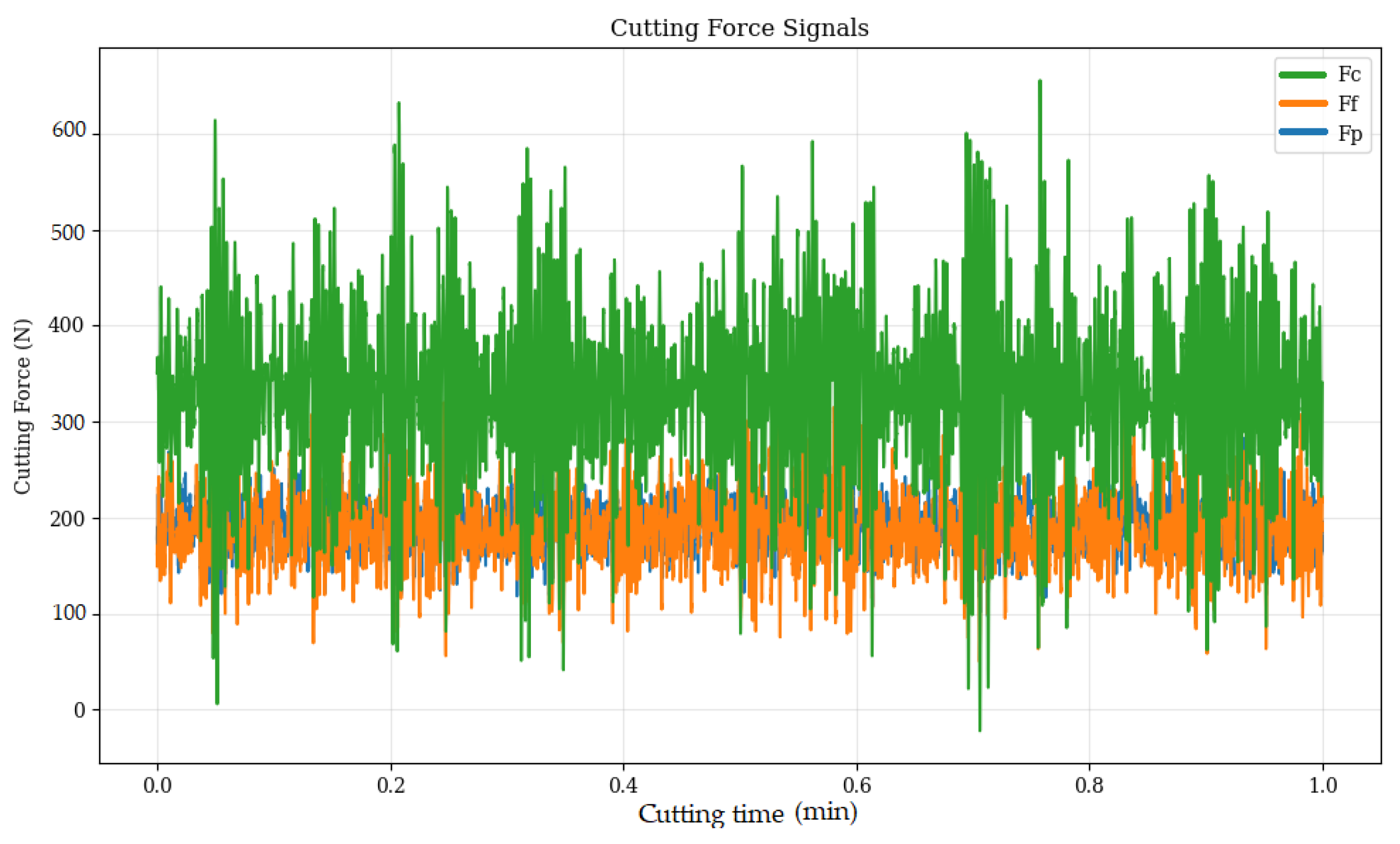
3.1.2. Cutting Force Results
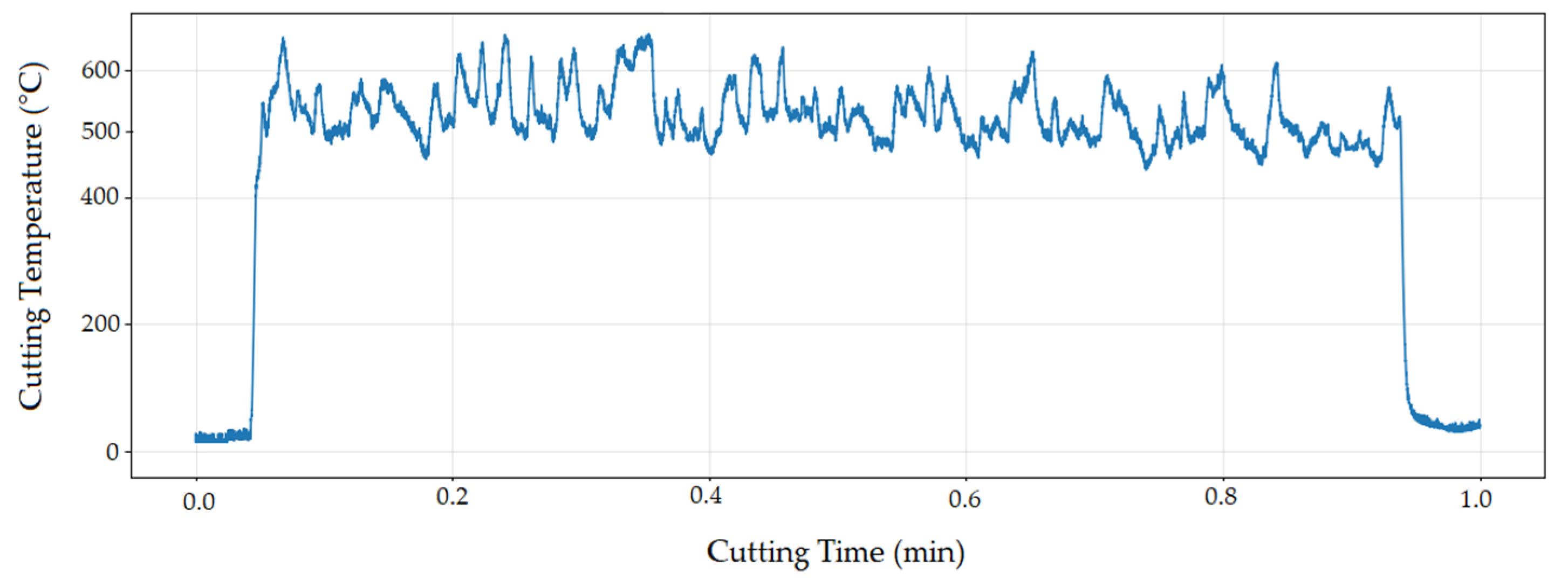
3.1.3. Cutting Temperature Results
3.1.4. Surface Roughness Measurement Results
3.2. Data Augmentation and Dataset Validation Analyses
3.3. Feature Importance for All Datasets
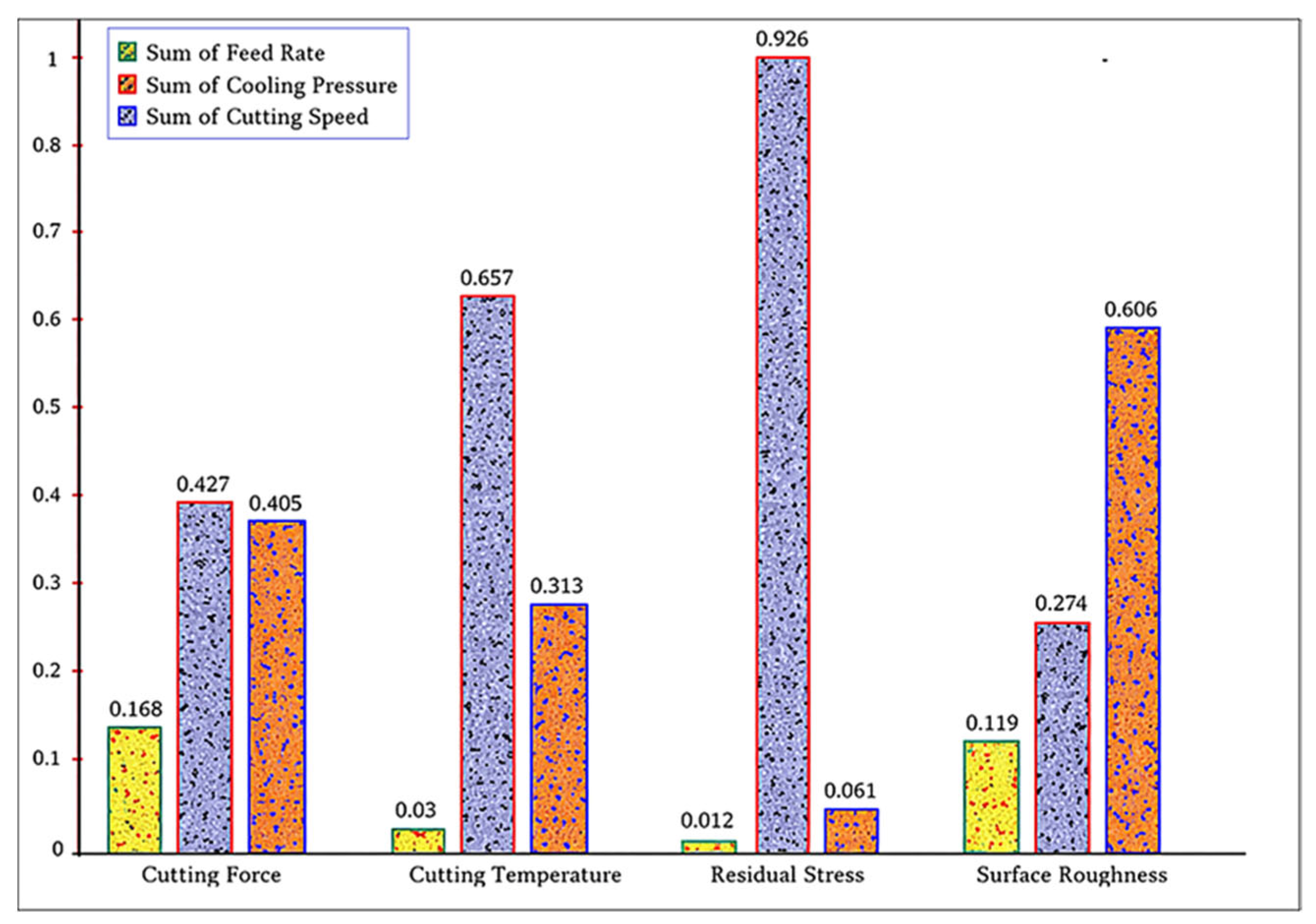
3.3.1. Feature Importance of Machining Responses
3.3.2. Cutting Speed and Machining Responses Relationship
3.3.3. Cooling Pressure and Machining Responses Relationship
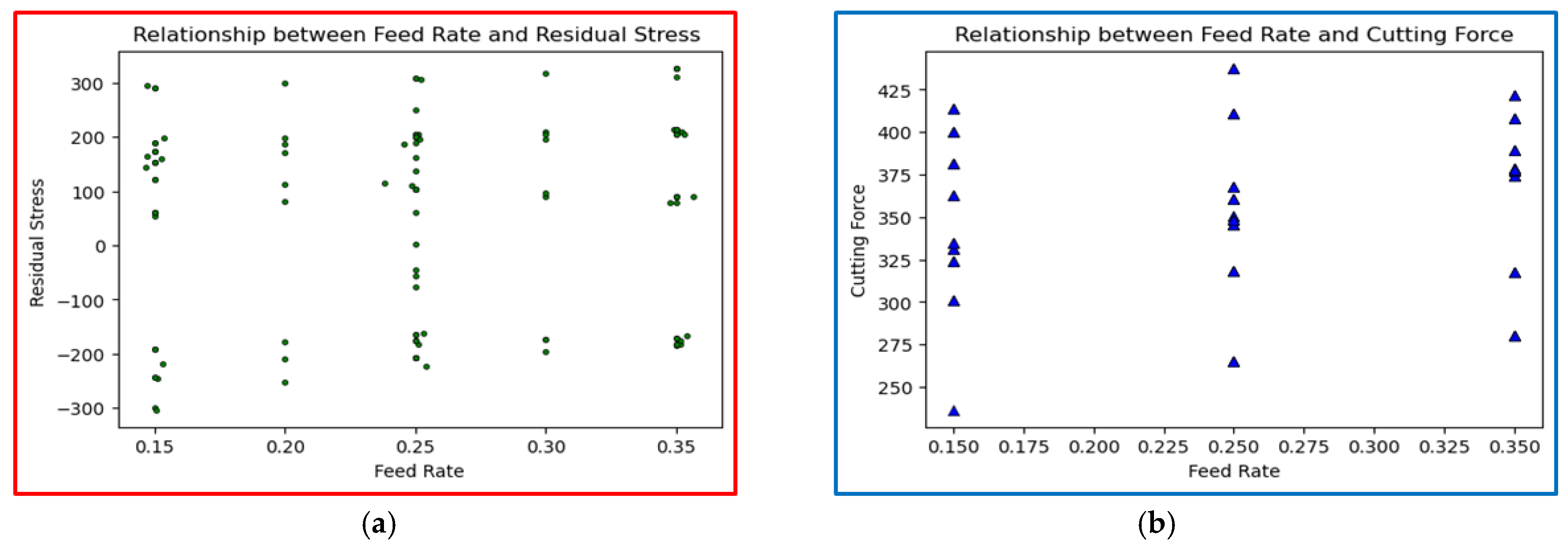
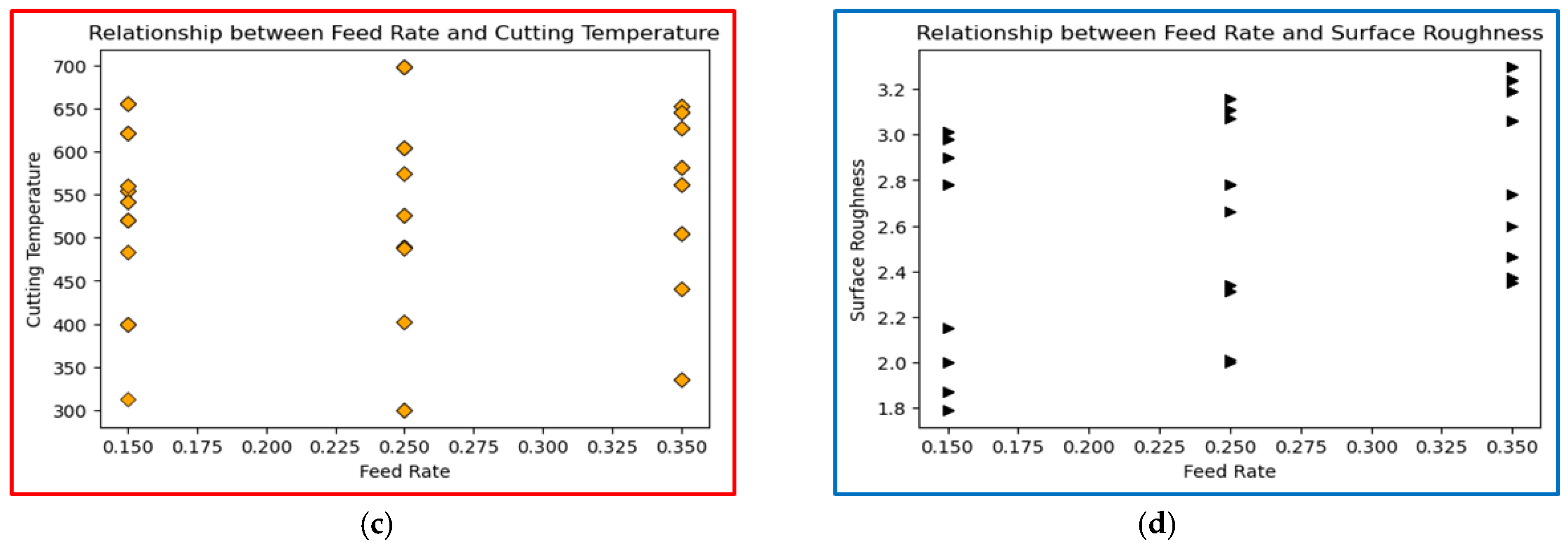
3.3.4. Feed Rate and Machining Responses Relationship
3.4. Findings and Discussions
3.4.1. Residual Stress Findings
3.4.2. Cutting Force Findings
3.4.3. Cutting Temperature Findings
3.4.4. Surface Roughness Findings
3.4.5. Discussions
4. Conclusions
Funding
Institutional Review Board Statement
Informed Consent Statement
Data Availability Statement
Conflicts of Interest
Abbreviations
| Vc | Cutting Speed (m/min) |
| f | Feed Rate (mm/rev) |
| HPJC/HPC | High-Pressure Jet-Assisted Cooling (MPa) |
| DoC | Depth of Cut (mm) |
| Fc | Cutting Force (N) |
| Rs | Residual Stress (MPa) |
| Tc | Cutting Temperature (°C) |
| Ra | Surface Roughness (µm) |
| P | Cooling Pressure (MPa) |
| ANNR | Artificial Neural Network Regression |
| XRD | X-Ray Diffraction |
| kNNR | k-Nearest Neighbors Regression |
| ML | Machine Learning |
| MLR | Multiple Linear Regression |
| RFR | Random Forest Regression |
| RMSE | Root Mean Square Error |
| SVR | Support Vector Regression |
| XGBoostR | Extreme Gradient Boosting Regression |
| GB | Gradient Boosting |
| R2 | Coefficient of Determination |
| MSE | Mean Squared Error |
| MAE | Mean Absolute Error |
References
- Ezugwu, E.O.; Wang, Z.M. Titanium alloys and their machinability: A review. J. Mater. Process. Technol. 1997, 68, 262–274. [Google Scholar] [CrossRef]
- Ulutan, D.; Özel, T. Machining induced surface integrity in titanium and nickel alloys: A review. Int. J. Mach. Tools Manuf. 2011, 51, 250–280. [Google Scholar] [CrossRef]
- Kolli, R.P.; Devaraj, A. A review of metastable beta titanium alloys. Metals 2018, 8, 506. [Google Scholar] [CrossRef]
- Loskutova, T.; Scheffler, M.; Pavlenko, I.; Zidek, K.; Pohrebova, I.; Kharchenko, N.; Smokovych, I.; Dudka, O.; Palyukh, V.; Ivanov, V.; et al. Corrosion Resistance of Coatings Based on Chromium and Aluminum of Titanium Alloy Ti-6Al-4V. Materials 2024, 17, 3880. [Google Scholar] [CrossRef]
- Vukelic, D.; Prica, M.; Ivanov, V.; Jovicic, G.; Budak, I.; Luzanin, O. Optimization of surface roughness based on turning parameters and insert geometry. Int. J. Simul. Model. 2022, 21, 417–428. [Google Scholar] [CrossRef]
- Kryzhanivskyy, V.; M’saoubi, R.; Bhallamudi, M.; Cekal, M. Machine learning based approach for the prediction of surface integrity in machining. Procedia CIRP 2022, 108, 537–542. [Google Scholar] [CrossRef]
- Mitra, S.; Rahul. Machinability of cryogenically treated and non-treated Ti-5553 workpiece: A comparative study. Sādhanā 2024, 49, 271. [Google Scholar] [CrossRef]
- Braham-Bouchnak, T.; Germain, G.; Morel, A.; Furet, B. Influence of high-pressure coolant assistance on the machinability of the titanium alloy Ti-5553. Mach. Sci. Technol. 2015, 19, 134–151. [Google Scholar] [CrossRef]
- Vukelic, D.; Milosevic, A.; Ivanov, V.; Kočović, V.; Santosi, Z.; Šokac, M.; Simunovic, G. Modelling and optimization of dimensional accuracy and surface roughness in dry turning of Inconel 625 alloy. Adv. Prod. Eng. Manag. 2024, 19, 371–385. [Google Scholar] [CrossRef]
- Pimenov, D.Y.; Mia, M.; Gupta, M.K.; Machado, A.R.; Tomaz, Í.V.; Sarikaya, M.; Wojtowicz, N.; Kapłonek, W. Improvement of machinability of Ti and its alloys using cooling-lubrication techniques: A review and future prospect. J. Mater. Res. Technol. 2021, 11, 719–753. [Google Scholar] [CrossRef]
- Yünlü, L. Residual Stress Analysis in Machining of a Near Beta Ti Alloy, Ti-5553 Under High Pressure Cooling and Lubrication. Int. J. Eng. Innov. Res. 2023, 5, 13–22. [Google Scholar] [CrossRef]
- Sun, Y.; Huang, B.; Puleo, D.A.; Jawahir, I.S. Enhanced machinability of Ti-5553 alloy from cryogenic machining: Comparison with MQL and flood-cooled machining and modeling. Procedia CIRP 2015, 31, 477–482. [Google Scholar] [CrossRef]
- Zhang, X.; Wang, D.; Peng, Z. Effects of high-pressure coolant on cooling mechanism in high-speed ultrasonic vibration cutting interfaces. Appl. Therm. Eng. 2023, 233, 121125. [Google Scholar] [CrossRef]
- Umbrello, D.; Ambrogio, G.; Filice, L.; Shivpuri, R. An ANN approach for predicting subsurface residual stresses and the desired cutting conditions during hard turning. J. Mater. Process. Technol. 2007, 189, 143–152. [Google Scholar] [CrossRef]
- Ugarte, A.; M’Saoubi, R.; Garay, A.; Arrazola, P.J. Machining behaviour of Ti-6Al-4V and Ti-5553 alloys in interrupted cutting with PVD coated cemented carbide. Procedia CIRP 2012, 1, 202–207. [Google Scholar] [CrossRef]
- Liu, E.; Wang, R.; Zhang, Y.; An, W. Tool wear analysis of cutting Ti-5553 with uncoated carbide tool under liquid nitrogen cooling condition using tool wear maps. J. Manuf. Process. 2021, 68, 877–887. [Google Scholar] [CrossRef]
- Zhao, X.; Li, R.; Liu, E.; Lan, C. Effect of cryogenic cutting surface integrity on fatigue life of titanium alloy Ti-5553. Ferroelectrics 2022, 596, 115–125. [Google Scholar] [CrossRef]
- Arrazola, P.J.; Garay, A.; Iriarte, L.M.; Armendia, M.; Marya, S.; Le Maître, F. Machinability of titanium alloys (Ti6Al4V and Ti555.3). J. Mater. Process. Technol. 2009, 209, 2223–2230. [Google Scholar] [CrossRef]
- Zhuo, L.; Zhan, M.; Xie, Y.; Chen, B.; Ji, K.; Wang, H. Recent Advances in Near-β Titanium Alloys: Microstructure Control, Deformation Mechanisms, and Oxidation Behavior. Adv. Eng. Mater. 2024, 26, 2401837. [Google Scholar] [CrossRef]
- Dinibutun, S.; Alshammari, Y.; Bolzoni, L. Machine Learning-Based Prediction of Young’s Modulus in Ti-Alloys. Metals 2026, 16, 233. [Google Scholar] [CrossRef]
- Kaur, R.; Kumar, R.; Aggarwal, H. Systematic Review of Artificial Intelligence, Machine Learning, and Deep Learning in Machining Operations: Advancements, Challenges, and Future Directions. Arch. Comput. Methods Eng. 2025, 32, 4983–5036. [Google Scholar] [CrossRef]
- Zhou, T.; Zhou, T.; Zhang, C.; Sun, C.; Cui, H.; Tian, P.; He, L. Hybrid modeling with finite element—Analysis—Neural network for predicting residual stress in orthogonal cutting of H13. J. Mater. Res. Technol. 2024, 29, 4954–4977. [Google Scholar] [CrossRef]
- Mu, S.; Yu, C.; Lin, K.; Lu, C.; Wang, X.; Wang, T.; Fu, G. A review of machine learning-based thermal error modeling methods for CNC machine tools. Machines 2025, 13, 153. [Google Scholar] [CrossRef]
- Makhfi, S.; Dorbane, A.; Harrou, F.; Sun, Y. Prediction of cutting forces in hard turning process using machine learning methods: A case study. J. Mater. Eng. Perform. 2024, 33, 9095–9111. [Google Scholar] [CrossRef]
- Cover, T.; Hart, P. Nearest neighbor pattern classification. IEEE Trans. Inf. Theory 1967, 13, 21–27. [Google Scholar] [CrossRef]
- Webb, G.I.; Pazzani, M.J.; Billsus, D. Machine learning for user modeling. User Model. User-Adapt. Interact. 2001, 11, 19–29. [Google Scholar] [CrossRef]
- Möhring, H.C.; Eschelbacher, S.; Georgi, P. Machine learning approaches for real-time monitoring and evaluation of surface roughness using a sensory milling tool. Procedia CIRP 2021, 102, 264–269. [Google Scholar] [CrossRef]
- Shen, X.; He, S.; Zhao, B.; Ma, S.; Jiang, J.; Li, S.; Pan, S. Electrochemical machining (ECM) prediction and control via multi-physics-constrained bi-layer machine learning with alloy electrochemistry knowledge. J. Manuf. Process. 2026, 162, 326–346. [Google Scholar] [CrossRef]
- Parida, A.K.; Maity, K. Analysis of some critical aspects in hot machining of Ti-5553 superalloy: Experimental and FE analysis. Def. Technol. 2019, 15, 344–352. [Google Scholar] [CrossRef]
- Headley, C.V.; del Valle, R.J.H.; Ma, J.; Balachandran, P.; Ponnambalam, V.; LeBlanc, S.; Martin, J.B. The development of an augmented machine learning approach for the additive manufacturing of thermoelectric materials. J. Manuf. Process. 2024, 116, 165–175. [Google Scholar] [CrossRef]
- Ko, J.H.; Yin, C. A review of artificial intelligence application for machining surface quality prediction: From key factors to model development. J. Intell. Manuf. 2025, 37, 775–798. [Google Scholar] [CrossRef]
- Soori, M.; Arezoo, B.; Dastres, R. Machine learning and artificial intelligence in CNC machine tools, a review. Sustain. Manuf. Serv. Econ. 2023, 2, 100009. [Google Scholar] [CrossRef]
- Hameed, M.M.; Al-Ansari, N.; Yaseen, Z.M. An Extra Tree Regression Model for Discharge Coefficient Prediction: Novel, Practical Applications in the Hydraulic Sector and Future Research Directions. Math. Probl. Eng. 2021, 2021, 7001710. [Google Scholar] [CrossRef]
- Willmott, C.J.; Matsuura, K. Advantages of the mean absolute error (MAE) over the root mean square error (RMSE) in assessing average model performance. Clim. Res. 2005, 30, 79–82. [Google Scholar] [CrossRef]
- Hammid, A.T.; Sulaiman, M.H.B.; Abdalla, A.N. Prediction of small hydropower plant power production in Himreen Lake dam (HLD) using artificial neural network. Alex. Eng. J. 2018, 57, 211–221. [Google Scholar] [CrossRef]
- Mishra, G.; Sehgal, D.; Valadi, J.K. Quantitative structure activity relationship study of the anti-hepatitis peptides employing random forests and extra-trees regressors. Bioinformation 2017, 13, 60–63. [Google Scholar] [CrossRef]
- Safari, H.; Sharif, S.; Izman, S.; Jafari, H. Surface integrity characterization in high-speed dry end milling of Ti-6Al-4V titanium alloy. Int. J. Adv. Manuf. Technol. 2015, 78, 651–657. [Google Scholar] [CrossRef]
- Nandy, A.K.; Gowrishankar, M.C.; Paul, S. Some studies on high-pressure cooling in turning of Ti–6Al–4V. Int. J. Mach. Tools Manuf. 2009, 49, 182–198. [Google Scholar] [CrossRef]
- Palanisamy, S.; McDonald, S.D.; Dargusch, M.S. Effects of coolant pressure on chip formation while turning Ti6Al4V alloy. Int. J. Mach. Tools Manuf. 2009, 49, 739–743. [Google Scholar] [CrossRef]
- Mia, M.; Al Bashir, M.A.; Dhar, N.R. High-pressure coolant effects on tool rake/flank in turning Ti-6Al-4V. Int. J. Adv. Manuf. Technol. 2017, 90, 2503–2512. [Google Scholar] [CrossRef]
- Özel, T.; Ulutan, D. Prediction of machining induced residual stresses in turning of titanium and nickel based alloys with experiments and finite element simulations. CIRP Ann. 2012, 61, 547–550. [Google Scholar] [CrossRef]
- Farias, A.; Paschoalinoto, N.W.; Bordinassi, E.C.; Leonardi, F.; Delijaicov, S. Predictive modelling of residual stress in turning of hard materials using radial basis function network enhanced with principal component analysis. Eng. Sci. Technol. Int. J. 2024, 55, 101743. [Google Scholar] [CrossRef]
- Outeiro, J.; Cheng, W.; Chinesta, F.; Ammar, A. Modelling and Optimization of Machining of Ti-6Al-4V Titanium Alloy Using Machine Learning and Design of Experiments Methods. J. Manuf. Mater. Process. 2022, 6, 58. [Google Scholar] [CrossRef]
- Ezugwu, E.O.; Bonney, J.; Da Silva, R.B.; Cakir, O. Surface integrity of finished turned Ti–6Al–4V alloy with PCD tools using conventional and high pressure coolant supplies. Int. J. Mach. Tools Manuf. 2007, 47, 884–891. [Google Scholar] [CrossRef]
- Hong, S.Y.; Ding, Y. Cooling approaches and cutting temperatures in cryogenic machining of Ti-6Al-4V. Int. J. Mach. Tools Manuf. 2001, 41, 1417–1437. [Google Scholar] [CrossRef]
- Bordin, A.; Sartori, S.; Bruschi, S.; Ghiotti, A. Feasibility of dry and cryogenic machining: Turning of Ti6Al4V. J. Clean. Prod. 2017, 142, 4142–4152. [Google Scholar] [CrossRef]
- Shokrani, A.; Dhokia, V.; Newman, S.T. Comparative investigation on using cryogenic machining in CNC milling of Ti-6Al-4V. Mach. Sci. Technol. 2016, 20, 475–494. [Google Scholar] [CrossRef]
- Khanna, N.; Shah, P.; Agrawal, C.; Sarikaya, M.; Pimenov, D.Y.; Gupta, M.K. Review on design and development of cryogenic machining setups and their performance. J. Manuf. Process. 2021, 68, 398–422. [Google Scholar] [CrossRef]
- Breiman, L. Random Forests. Mach. Learn. 2001, 45, 5–32. [Google Scholar] [CrossRef]
- Geurts, P.; Ernst, D.; Wehenkel, L. Extremely randomized trees. Mach. Learn. 2006, 63, 3–42. [Google Scholar] [CrossRef]
- Friedman, J.H. Greedy function approximation: A gradient boosting machine. Ann. Stat. 2001, 29, 1189–1232. [Google Scholar] [CrossRef]
- Aggogeri, F.; Pellegrini, N.; Tagliani, F.L. Recent advances on machine learning applications in machining processes. Appl. Sci. 2021, 11, 8764. [Google Scholar] [CrossRef]


| Elements | Al | Mo | V | Cr | Fe | Ti |
|---|---|---|---|---|---|---|
| Weight (%) | 4.4–5.7 | 4.0–5.5 | 4.0–5.5 | 2.5–3.5 | 0.3–0.5 | Balance |
| Density | 4650 kg/m3 |
| Melting Point | 1933 K |
| Specific Heat | 520 J/kg K |
| Thermal conductivity | 6.7 W/mK |
| Thermal Diffusivity | 2.76 mm2/s |
| Ultimate tensile strength | 1280 MPa |
| Young Modulus | 1.15 × 10⁵ MPa |
| Poisson’s Ratio | 0.33 |
| Elongation | 8–15% |
| Brinell Hardness | 350–400 HV |
| Category | Specifications |
|---|---|
| Machine tool | A general-purpose ALEX ANL-75 CNC lathe, (it has 15 kW, speed range: 35 to 3500 rpm and manufactured based in Taichung, Taiwan), Fanuc control system. |
| Work material | Ti-5Al-5V-5Mo-3Cr or known as near beta Ti alloy (Ti-5553) |
| Dimensions | Ø80 × 445 mm |
| Cutting Tool and Toolholder | Rhombic shape CNMG 120408, (Ti,Al)N + TiN coated carbide SECO Jet stream PCLNR tool holder. |
| Cutting speed, Vc (m/min) | 50, 80 and 120 |
| Feed, f (mm/rev) | 0.15, 0.25 and 0.35 |
| Depth of cut, DoC (mm) | 1 mm |
| Cooling environment (High-Pressure assisted Jet Stream Cooling) | Dry, Conventional (0.6 MPa) and HPC (30 MPa) The cooling/lubrication fluid (CLF) is a chemical-based, 5% concentration, water-soluble oil, 5 to 6°, with a cutting tool rake angle of 21 L/min, with a 1.5 mm brass nozzle diameter. |
| Symbol | Cutting & Response Parameters | Level 1 | Level 2 | Level 3 | |
|---|---|---|---|---|---|
| Machining Parameters | Vc; (m/min) | Cutting speed | 50 | 80 | 120 |
| f; (mm/rev) | Feed rate | 0.15 | 0.25 | 0.35 | |
| P; (MPa) | Cooling pressure | Dry | Conv. | 30 | |
| Machining Responses | Fc; (N) | Cutting Force | The four responses obtained from the analyses for each test were entered into the table corresponding to the results of the 27 experiments determined using the General Full Factorial Design method. | ||
| Rs; (MPa) | Residual stress | ||||
| Tc; (°C) | Cutting temperature | ||||
| Ra; (µm) | Surface roughness | ||||
| Algorithm & Metric | Extra Trees | Random Forest | Gradient Boosting | KNN | AdaBoost | |
|---|---|---|---|---|---|---|
| OPTIMIZED | R2 | 0.9997 | 0.9989 | 0.9986 | 0.9981 | 0.9863 |
| MSE | 6.8289 | 34.4913 | 46.2887 | 60.8995 | 451.063 | |
| MAE | 1.7122 | 2.8227 | 5.3949 | 4.1833 | 16.6629 | |
| RMSE | 2.6132 | 5.8729 | 6.8035 | 7.8038 | 21.2382 | |
| Accuracy | 98.4792 | 94.9827 | 94.8783 | 93.0728 | 84.3172 | |
| OPTIMIZATION PROCESS | Parameters and Values for Hyperparameter Optimization | n_estimators: [50, 100, 200] max_depth: [None, 10, 20, 30] min_samples_split: [2, 5, 10] min_samples_leaf: [1, 2, 4] | n_estimators: [50, 100, 200] max_depth: [2, 4, 8, 16] min_samples_split: [2, 3, 4] min_samples_leaf: [2, 3, 4, 8] | n_estimators: [50, 75, 100] max_depth: [2, 4, 8] min_samples_split: [1, 2, 4] min_samples_leaf: [1, 2, 8] learning rate: [0.05, 0.1, 0.5, 1] | n_neighbors: [1, 2, 4, 8] p: [1, 2, 3, 4] | n_estimators: [30, 50, 75, 100, 200] learning rate: [0.05, 0.1, 0.5, 1, 2] |
| Hypermeter Values | max_depth: 20 min_samples_leaf: 2 min_samples_split: 2 n_estimators: 50 | max_depth: 8 min_samples_leaf: 2 min_samples_split: 2 n_estimators: 50 | learning rate: 0.05 max_depth: 8 min_samples_leaf: 8 min_samples_split: 2 n_estimators: 75 | n_neighbors: 4 p: 1 | learning rate: 2 n_estimators: 75 | |
| WITHOUT OPTIMIZATION | R2 | 0.9997 | 0.9975 | 0.9991 | 0.99544 | 0.9820 |
| MSE | 7.0673 | 80.7830 | 27.5253 | 150.3425 | 592.3764 | |
| MAE | 2.176 | 4.7259 | 3.913 | 5.4315 | 18.7525 | |
| RMSE | 2.6584 | 8.9879 | 5.2464 | 12.2614 | 24.3387 | |
| Accuracy | 98.3999 | 93.004 | 96.3664 | 89.4361 | 82.7548 | |
| Alg. | Prediction Graph (Train) | Fault Distribution Graph | Prediction Graph (Test & Train) |
|---|---|---|---|
| Extra Trees | ![]() | ![]() | ![]() |
| Random Forest | ![]() | ![]() | ![]() |
| Gradiend Boosting | ![]() | ![]() | ![]() |
| KNN | ![]() | ![]() | ![]() |
| AdaBoost | ![]() | ![]() | ![]() |
| Algorithm & Metric | Extra Trees | Random Forest | Gradient Boosting | KNN | AdaBoost | |
|---|---|---|---|---|---|---|
| OPTIMIZED | R2 | 0.999 | 0.9941 | 0.999 | 0.9923 | 0.7756 |
| MSE | 0.0010 | 10.8459 | 0.0867 | 12.0678 | 355.8604 | |
| MAE | 0.0043 | 1.2966 | 0.1982 | 2.2902 | 14.442 | |
| RMSE | 0.0317 | 3.2933 | 0.2946 | 3.4738 | 18.8642 | |
| Accuracy | 0.999 | 99.6432 | 99.943 | 99.3442 | 95.972 | |
| OPTIMIZATION PROCESS | Parameters and Values for Hyperparameter Optimization | n_estimators: [50, 100, 200] max_depth: [None, 10, 20, 30] min_samples_split: [2, 5, 10] min_samples_leaf: [1, 2, 4] | n_estimators: [50, 100, 200] max_depth: [2, 4, 8, 16] min_samples_split: [2, 3, 4] min_samples_leaf: [2, 3, 4, 8] | n_estimators: [50, 75, 100] max_depth: [2, 4, 8] min_samples_split: [1, 2, 4] min_samples_leaf: [1, 2, 8] learning rate: [0.05, 0.1, 0.5, 1] | n_neighbors: [1, 2, 4, 8] p: [1, 2, 3, 4] | n_estimators: [30, 50, 75, 100, 200] learning rate: [0.05, 0.1, 0.5, 1, 2] |
| Hypermeter Values | max_depth: 20 min_samples_leaf: 2 min_samples_split: 2 n_estimators: 50 | max_depth: 8 min_samples_leaf: 2 min_samples_split: 2 n_estimators: 50 | learning rate: 0.05 max_depth: 8 min_samples_leaf: 8 min_samples_split: 2 n_estimators: 75 | n_neighbors: 4 p: 1 | learning rate: 2 n_estimators: 75 | |
| WITHOUT OPTIMIZATION | R2 | 99.999 | 0.9934 | 0.9838 | 0.9880 | 0.7271 |
| MSE | 2.07740 × 10⁻²⁵ | 12.2450 | 30.2194 | 19.009 | 432.919 | |
| MAE | 3.953 × 10⁻¹³ | 1.7933 | 4.2865 | 2.4617 | 15.9034 | |
| RMSE | 4.5578 × 10⁻¹³ | 3.499 | 5.4972 | 4.3599 | 20.806 | |
| Accuracy | 99.999 | 99.4980 | 98.7925 | 99.2951 | 95.6271 | |
| Alg. | Prediction Graph (Train) | Fault Distribution Graph | Prediction Graph (Test & Train) |
|---|---|---|---|
| Extra Trees | ![]() | ![]() | ![]() |
| Random Forest | ![]() | ![]() | ![]() |
| Gradiend Boosting | ![]() | ![]() | ![]() |
| KNN | ![]() | ![]() | ![]() |
| AdaBoost | ![]() | ![]() | ![]() |
| Algorithm & Metric | Extra Trees | Random Forest | Gradient Boosting | KNN | AdaBoost | |
|---|---|---|---|---|---|---|
| OPTIMIZED | R2 | 99.999 | 0.9994 | 0.9997 | 0.9982 | 0.9738 |
| MSE | 6.5182 × 10⁻²⁵ | 5.619 | 2.1709 | 14.3638 | 219.8588 | |
| MAE | 6.940 × 10⁻¹³ | 1.362 | 1.01962 | 2.3673 | 12.5081 | |
| RMSE | 8.0735 × 10⁻¹³ | 2.370 | 1.4734 | 3.7899 | 14.827 | |
| Accuracy | 99.999 | 99.721 | 99.8025 | 99.521 | 97.5465 | |
| OPTIMIZATION PROCESS | Parameters and Values for Hyperparameter Optimization | n_estimators: [50, 100, 200] max_depth: [None, 10, 20, 30] min_samples_split: [2, 5, 10] min_samples_leaf: [1, 2, 4] | n_estimators: [50, 100, 200] max_depth: [2, 4, 8, 16] min_samples_split: [2, 3, 4] min_samples_leaf: [2, 3, 4, 8] | n_estimators: [50, 75, 100] max_depth: [2, 4, 8] min_samples_split: [1, 2, 4] min_samples_leaf: [1, 2, 8] learning rate: [0.05, 0.1, 0.5, 1] | n_neighbors: [1, 2, 4, 8] p: [1, 2, 3, 4] | n_estimators: [30, 50, 75, 100, 200] learning rate: [0.05, 0.1, 0.5, 1, 2] |
| Hypermeter Values | max_depth: 20 min_samples_leaf: 2 min_samples_split: 2 n_estimators: 50 | max_depth: 8 min_samples_leaf: 2 min_samples_split: 2 n_estimators: 50 | learning rate: 0.05 max_depth: 8 min_samples_leaf: 8 min_samples_split: 2 n_estimators: 75 | n_neighbors: 4 p: 1 | learning rate: 2 n_estimators: 75 | |
| WITHOUT OPTIMIZATION | R2 | 99.999 | 0.9984 | 0.9971 | 0.9977 | 0.9685 |
| MSE | 6.518 × 10⁻²⁵ | 16.512 | 30.902 | 19.218 | 264.378 | |
| MAE | 6.9405 × 10⁻¹³ | 2.7308 | 4.3286 | 2.4791 | 13.2734 | |
| RMSE | 8.0735 × 10⁻¹³ | 4.0636 | 5.55899 | 4.3839 | 16.259 | |
| Accuracy | 99.999 | 99.4609 | 99.2055 | 99.4906 | 97.391 | |
| Alg. | Prediction Graph (Train) | Fault Distribution Graph | Prediction Graph (Test & Train) |
|---|---|---|---|
| Extra Trees | ![]() | ![]() | ![]() |
| Random Forest | ![]() | ![]() | ![]() |
| Gradiend Boosting | ![]() | ![]() | ![]() |
| KNN | ![]() | ![]() | ![]() |
| AdaBoost | ![]() | ![]() | ![]() |
| Algorithm & Metric | Extra Trees | Random Forest | Gradient Boosting | KNN | AdaBoost | |
|---|---|---|---|---|---|---|
| OPTIMIZED | R2 | 99.999 | 0.9481 | 0.8034 | 0.7627 | 0.7237 |
| MSE | 1.4230 × 10⁻²⁹ | 0.0152 | 0.0577 | 0.0574 | 0.0668 | |
| MAE | 3.1752 × 10⁻¹⁵ | 0.1006 | 0.1961 | 0.1924 | 0.21417 | |
| RMSE | 3.7722 × 10⁻¹⁵ | 0.1234 | 0.2403 | 0.2396 | 0.2586 | |
| Accuracy | 99.999 | 95.9533 | 92.239 | 91.9548 | 91.120 | |
| OPTIMIZATION PROCESS | Parameters and Values for Hyperparameter Optimization | n_estimators: [50, 100, 200] max_depth: [None, 10, 20, 30] min_samples_split: [2, 5, 10] min_samples_leaf: [1, 2, 4] | n_estimators: [50, 100, 200] max_depth: [2, 4, 8, 16] min_samples_split: [2, 3, 4] min_samples_leaf: [2, 3, 4, 8] | n_estimators: [50, 75, 100] max_depth: [2, 4, 8] min_samples_split: [1, 2, 4] min_samples_leaf: [1, 2, 8] learning rate: [0.05, 0.1, 0.5, 1] | n_neighbors: [1, 2, 4, 8] p: [1, 2, 3, 4] | n_estimators: [30, 50, 75, 100, 200] learning rate: [0.05, 0.1, 0.5, 1, 2] |
| Hypermeter Values | max_depth: 20 min_samples_leaf: 2 min_samples_split: 2 n_estimators: 50 | max_depth: 8 min_samples_leaf: 2 min_samples_split: 2 n_estimators: 50 | learning rate: 0.05 max_depth: 8 min_samples_leaf: 8 min_samples_split: 2 n_estimators: 75 | n_neighbors: 4 p: 1 | learning rate: 2 n_estimators: 75 | |
| WITHOUT OPTIMIZATION | R2 | 0.74822 | 0.7219 | 0.7351 | 0.7349 | 0.7002 |
| MSE | 0.07396 | 0.0816 | 0.0778 | 0.0641 | 0.0725 | |
| MAE | 0.2269 | 0.2351 | 0.22722 | 0.2030 | 0.2133 | |
| RMSE | 0.2719 | 0.2857 | 0.2789 | 0.2533 | 0.2694 | |
| Accuracy | 90.9042 | 90.639 | 90.8623 | 91.4726 | 91.0005 | |
| Alg. | Prediction Graph (Train) | Fault Distribution Graph | Prediction Graph (Test & Train) |
|---|---|---|---|
| Extra Trees | ![]() | ![]() | ![]() |
| Random Forest | ![]() | ![]() | ![]() |
| Gradiend Boosting | ![]() | ![]() | ![]() |
| KNN | ![]() | ![]() | ![]() |
| AdaBoost | ![]() | ![]() | ![]() |
| Response | Mean | Standard Deviation |
|---|---|---|
| Fc (N) | 356.17 | 48.95 |
| Tc (°C) | 525.57 | 106.20 |
| Rs (MPa) | 52.13 | 194.86 |
| Ra (µm) | 2.64 | 0.46 |
Disclaimer/Publisher’s Note: The statements, opinions and data contained in all publications are solely those of the individual author(s) and contributor(s) and not of MDPI and/or the editor(s). MDPI and/or the editor(s) disclaim responsibility for any injury to people or property resulting from any ideas, methods, instructions or products referred to in the content. |
© 2026 by the author. Licensee MDPI, Basel, Switzerland. This article is an open access article distributed under the terms and conditions of the Creative Commons Attribution (CC BY) license.
Share and Cite
Yünlü, L. Machine Learning-Based Prediction of Surface Integrity in High-Pressure Coolant-Assisted Machining of Near-β Ti-5553 Titanium Alloy. Machines 2026, 14, 367. https://doi.org/10.3390/machines14040367
Yünlü L. Machine Learning-Based Prediction of Surface Integrity in High-Pressure Coolant-Assisted Machining of Near-β Ti-5553 Titanium Alloy. Machines. 2026; 14(4):367. https://doi.org/10.3390/machines14040367
Chicago/Turabian StyleYünlü, Lokman. 2026. "Machine Learning-Based Prediction of Surface Integrity in High-Pressure Coolant-Assisted Machining of Near-β Ti-5553 Titanium Alloy" Machines 14, no. 4: 367. https://doi.org/10.3390/machines14040367
APA StyleYünlü, L. (2026). Machine Learning-Based Prediction of Surface Integrity in High-Pressure Coolant-Assisted Machining of Near-β Ti-5553 Titanium Alloy. Machines, 14(4), 367. https://doi.org/10.3390/machines14040367