1. Introduction
Pick-and-place tasks are among the most common applications of industrial robots in manufacturing, because they perform repetitive and hazardous operations with greater efficiency, precision, and reliability than humans. The main objective of pick-and-place tasks is to repeatedly grab objects located in an initial position and transfer them to a final position where they will be released [
1]. The path that the robot’s end-effector describes is not typically constrained unless there are obstacles in the workspace. Otherwise, meeting the positioning precision, process repeatability, and short cycle times are the most important requirements. Loading and unloading machines, sorting, packing, handling, and palletizing are examples of operations where pick-and-place robots are found in mass markets such as the automotive, electronics, food, pharmaceutical, and cosmetics industries [
2,
3]. According to the International Federation of Robotics (IFR), annual industrial robot installations exceeded 500,000 units in 2024, the second-highest yearly total on record and corresponding to an average annual increase of approximately 11% in operational robot stock since 2019 [
4].
The SCARA [
5] and Delta [
6] robots are the most frequently used robots for pick-and-place tasks because they perform high-speed motions with great position accuracy. In particular, the Delta robot can achieve higher speeds and accelerations than the SCARA due to its parallel kinematic structure with base-mounted actuators, which allows it to have a high payload-to-weight ratio and high stiffness [
7]. The maximum speed reported in the industry is 222 cycles per minute [
8], but typical application values can range between 150 and 180 cycles per minute [
9]. These short cycle times required to increase productivity result in high accelerations and decelerations, thus in high driving torques and energy consumption of the actuators.
Robot installations were expected to grow by 6% in 2025, and no evidence suggests that long-term growth will end soon [
4]. However, there is growing concern about the energy consumption of these machines, which aligns with the 2030 Agenda for Sustainable Development adopted by the United Nations [
10]. Therefore, studying the energy consumption of industrial robots performing pick-and-place tasks is highly relevant for reducing electrical energy requirements, thereby decreasing the associated carbon footprint and increasing overall profitability. Several strategies for reducing the energy consumption of industrial and mechatronic systems have been developed, and in [
11,
12,
13], most of them are reviewed, analyzed, and classified. These strategies are broadly categorized as hardware, software, and mixed.
Hardware approaches reduce energy consumption by replacing the robot’s type or its components with better-suited or optimized alternatives, or by adding energy-storing and energy-recovery components [
11]. In [
14], a fixed number of Delta-type robot configurations were optimally selected and assigned to handling tasks such that each configuration represented the most energy-efficient option. In [
15], the addition of flywheels as energy-storing elements and the incorporation of a DC-bus sharing system as an energy-sharing device harvested energy during the braking phase.
The software approaches focus on motion planning, leaving out hardware modifications. Typically, these strategies reduce energy consumption through operation scheduling or trajectory optimization, which can be performed by defining point-to-point trajectories or multi-point trajectories [
11].
Point-to-point trajectories are parametrized motion profiles defined from an initial to a final point in a continuous time interval. This kind of trajectory is commonly used in industrial mechatronic systems as they are already implemented in their drive and control programs. Typically, high-order polynomials or harmonic functions are used. An optimization problem whose objective function is related to electrical and mechanical energy is solved through gradient-based algorithms, genetic algorithms, or other optimization routines. In [
16], the authors analyzed several point-to-point trajectories based on well-known motion standard primitives for one-degree-of-freedom mechatronic systems. The energy expenditure was reduced by solving an optimization problem that parametrized the motion profile of point-to-point motions.
On the other hand, multi-point trajectories are defined by piecewise functions that pass through multiple desired points in the workspace or joint space of the robotic manipulator. In general, the greater degree of versatility of these trajectories, compared to point-to-point trajectories, contributes to higher energy consumption reductions. For example, in [
17], a method for calculating energy-efficient trajectories using piecewise polynomial functions that pass through a sequence of via-points was developed. A specific advantage of the proposed algorithm is that an analytic closed-form expression for the energy consumption of the manipulator was developed, which avoids the numerical integration of the dynamic equations. Likewise, in [
18], the design and optimization of both the geometric path and the motion law of specific trajectories in a parallel kinematic structure were studied. The authors demonstrated that a high potential for energy efficiency can be achieved by performing proper motion planning using a multi-point trajectory definition. Additionally, machine learning methods have been recently considered to study the energy efficiency of industrial robots. For example, data-driven methods combined with genetic algorithms were used for energy optimization in [
19], and a deep reinforcement learning-based multi-objective approach targeting accuracy, smoothness, and energy reduction was adopted in [
20].
Mixed strategies combine features from hardware and software approaches. For example, the energy efficiency of a parallel robot performing a pick-and-place task was increased by determining the optimal length of its lower arms, the task placement, and the execution time of the motion in [
21]. Moreover, integrating energy-storage elements or energy-sharing devices along with optimal motion planning is also possible. The combination of an energy-sharing device with trajectory optimization is classified as an optimized sharing system. For example, in [
22,
23], braking energy recuperation was exploited by scheduling and optimizing the trajectories of each axis, so that the energy was not wasted when some axes were braking, but others needed energy input. On the other hand, strategies that integrate motion planning with energy-storage components are classified as natural motion approaches.
Natural motion strategies were originally used in mobile robotics, as discussed in [
24], but they have become one of the most promising methods to reduce the energy consumption of industrial robots. In [
25], natural motion was defined as the system response caused by the conversion of potential elastic energy into kinetic energy, whether produced by a forced response assisted by an actuator or a free response. Exploiting natural motion is particularly beneficial when the motion is cyclic, such as in pick-and-place tasks. If dissipative forces are neglected, any perturbation from equilibrium causes the system to undergo undamped oscillatory motion. Therefore, if the motion is planned to match the free-vibration response, or, conversely, if the system’s natural motion is adapted to match the required motion, maximum energy efficiency will be reached. Even when non-conservative forces are considered in the model, the actuators will only be required to counteract them rather than supplying the entire energy needed for the task [
26].
Existing technologies and methods were reviewed and classified based on their mechanical design, the desired natural dynamics, and the design of the optimization problem in [
25]. Two main challenges arise when transferring this strategy to industrial robots, such as SCARA or Delta robots. First, as they exhibit nonlinear dynamics and multiple degrees of freedom, determining the optimal placement and the suitable properties of the elastic elements, namely the stiffness and equilibrium position, is more demanding. Second, the selection of the trajectory and the computation of the elastic parameters are strongly coupled; therefore, the method to calculate them both will determine the energy-saving potential. The following are some examples of strategies that addressed these challenges for both serial and parallel manipulators.
In [
27], the input torques of a high-speed five-bar mechanism were reduced by adjusting the stiffness of variable stiffness springs, configured parallel to the motors, to produce a desired pick-and-place trajectory. The authors extended their work to the spatial case of a Delta robot in [
28], in which an optimal trajectory that exploited the natural dynamics of the manipulator with the same type and parallel arrangement of springs was calculated. On the other hand, energy minimization was achieved through constant-stiffness springs that were connected in parallel to the actuators of a five-bar linkage in [
26] and in series to those of other parallel kinematic manipulators in [
29]. In [
30], natural and exact elastic balancing methods were compared for a SCARA-like manipulator performing pick-and-place tasks. A torsional and constant-stiffness spring was connected in parallel to the actuator responsible for the vertical displacement. The threshold of convenience between methods, which incorporated idling times and different trajectory shapes, was investigated using the maximum torque, integral control effort, and mechanical energy as performance indices. Similarly, in [
31], these balancing methods were also considered and compared for the manipulator, but now with a linear spring affecting the same degree of freedom. Moreover, the influence of idling times on the threshold of convenience between the elastic balancing methods was further discussed for each manipulator’s vibratory design.
Three main possibilities were identified in [
25] for determining the optimal elastic parameters: predefined trajectory, optimized trajectory, and free-vibration response (FVR). In [
32,
33,
34], trajectories were defined before the calculation of the elastic parameters. The energy performance of a Delta-2 robot performing cyclic tasks was investigated in [
32,
33] by integrating two optimized torsional springs mounted in parallel with the actuators, and capacitors for braking energy recovery. Extending to the spatial case, the authors in [
34] studied a linear Delta robot for 3D printing equipped with linear springs. In [
26,
35,
36], the free-vibration response was calculated, and the elastic parameters were obtained through two methods. The first method was based on the solution of the forward dynamics using a multibody model and the shooting method. In [
26], the spring parameters were determined such that a five-bar planar mechanism moved from the pick to the place position in a specific time. In [
35], the results were extended to a Delta robot solving a numerical optimization that adjusted the spring parameters so that the position and velocity deviation in the end position fell below a predefined limit. The second method, used in [
36,
37], was based on the inverse dynamics and an algorithm for determining the optimum trajectory. The aim was to find a trajectory in which the driving torque matched the torque exerted by the springs, which required a linear relationship between the driving torque and the actuator’s angular position. Once this relationship was obtained, the stiffness and equilibrium position of the corresponding spring were related to the slope and intercept of the torque versus angular position curve. Lastly, in [
29,
38,
39], the trajectory and spring parameters of a serial manipulator were simultaneously optimized through an optimal control approach to obtain minimum driving torques in repetitive tasks.
Regardless of the strategy used to calculate the elastic parameters, these will depend on the task specification, meaning that deviations from the border conditions of the required task could raise energy consumption.
In [
40], the path planning problem of a five-bar linkage extended with constant-stiffness springs arranged in parallel to the actuators was solved using an optimal control approach. The spring parameters were calculated for a specific pick-and-place task specified by its cycle time and start and end positions. Then, position and cycle time deviations were incorporated, and the optimal control approach was applied to determine a trajectory that reduced the energy consumption of the manipulator. The same type of manipulator was studied in [
37], where deviations from the nominal task, for which the elastic parameters were calculated, were addressed by simultaneously updating the parameters of a multi-point trajectory and the preloads of the nominal springs. Additionally, variable-stiffness springs parallel to the motors were designed in combination with a motion generator that optimized trajectories to reduce the driving torques for a parallel manipulator in [
41], and for a serial manipulator in [
42].
These approaches require several decision variables of different kinds, some kinematic and others geometric, which increases the complexity of the optimization problem. Moreover, if the free-vibration response methods are used, the resulting trajectories will require maximum acceleration at the start and end positions, which prevents the end-effector from stopping smoothly. As most pick-and-place task scenarios require dwell times, the designed trajectories must meet smoothness criteria and the selection of an adequate set of boundary conditions for rest-to-rest motion design. Here, zero velocity, acceleration, and jerk constraints are preferred at the pick-and-place positions to design this type of motion, since this helps reduce vibrations, tracking errors, and unnecessary stress in the manipulator, as explained in [
43,
44,
45].
In [
46], these challenges were addressed through two strategies that exploit the natural dynamics of a parallel manipulator extended with constant-stiffness springs while performing pick-and-place tasks. The first one involved a multi-point trajectory optimization that incorporated the mentioned boundary conditions to stop smoothly, and the second dealt with deviations from the nominal task in a palletizing scenario by updating the equilibrium position of the nominal springs and imposing a typical point-to-point trajectory. Therefore, this article aims to extend the results of [
46] with three contributions. Firstly, by providing a more comprehensive description of recent state-of-the-art strategies in this Introduction section. Second, by developing a possible approach for determining the optimal elastic parameters through the three described possibilities: predefined trajectory, optimized trajectory, and free-vibration response. Third, by extending the analysis on the palletizing scenario with trajectory and equilibrium position adjustments when deviations from the nominal task are introduced but nominal springs are preserved.
This article is organized as follows. First, the kinematic and dynamic equations are presented for parallel manipulators using the Lagrange first-kind approach and the inverse dynamics are solved. Second, two general strategies for trajectory planning based on polynomial definitions are developed. Third, the optimization problems of three methods for calculating the elastic parameters of constant-stiffness springs are presented. Additionally, two adjustment strategies are proposed to exploit the natural motion of the manipulator extended with elements when deviations from the nominal pick-and-place task are introduced. Fourth, all optimization problems are solved for a case study of a five-bar parallel manipulator. Finally, the results are discussed, and a future path is proposed.
2. Kinematic and Dynamic Models for Parallel Manipulators
The Lagrange equations of the first kind were used to develop the multibody dynamic model of a parallel manipulator [
47,
48]. Given
rigid bodies, the pose of the center of mass of each one of them is arranged in the vector of generalized coordinates
, as shown in Equation (1).
The dependencies between these coordinates are captured by the vector of constraints
, which consists of kinematic constraints grouped in
and driving constraints in
, as shown in Equation (2).
The kinematic constraints are a set of independent scalar equations that result from the vector closed-loop description of the kinematic joints. The driving constraints are a set of scalar equations describing the actuation of the degrees of freedom of the manipulator. For fully actuated non-redundant manipulators, there will be as many driving constraints as degrees of freedom, which means that and will have the same number of components. Therefore, as the system is kinematically determined, positions, velocities, and accelerations can be determined directly as follows.
The position analysis consists of computing the generalized coordinates in Equation (1), which specify the pose of the center of mass of each body, by solving Equation (2) at each time step. The velocity and acceleration analyses consist of calculating the generalized velocities in vector
in Equation (3), and the generalized accelerations in vector
in Equation (4), respectively.
This is done by time-differentiating Equation (2) to obtain the constraint equations at the velocity level, as shown in Equation (5), and solving for the vector of generalized velocities
, as shown in Equation (6).
Similarly, the constraint equations at the acceleration level can be determined by time-differentiating Equation (5), as shown in Equation (7), and the vector of generalized accelerations
can be determined with Equation (8).
In the previous equations, is the constraint Jacobian, obtained from the partial differentiation of the vector of constraints with respect to , is the time differentiation of this Jacobian, is the partial differentiation of with respect to time, and is the time differentiation of this vector .
Once the kinematics are solved, inverse dynamic analysis is performed using Equation (9) to determine the driving and reaction forces and torques.
The extended mass matrix
is given in Equation (10) by grouping the extended mass matrix
of each body
given by Equation (11), where
is the identity matrix, and
and
are the mass and the inertia matrix of the body
.
Additionally,
is the vector of applied generalized forces and
is the vector of reaction forces, which can be described using the method of Lagrange multipliers, as shown in Equation (12).
The vector of Lagrange multipliers
arranges the reaction forces at the joints as organized in the vector of constraints of Equation (2). Therefore, the vector of Lagrange multipliers can be solved with Equation (13).
The actuation forces and torques required to impose the desired motion are equal to the negative of the Lagrange multipliers associated with the driving constraints, since these multipliers represent reaction forces and torques arising from the constraints rather than applied actuation inputs.
3. Trajectory Planning
The specification of a pick-and-place task typically involves defining the cycle time and the pick and place positions in the workspace, as well as the required boundary conditions for the motion. For instance, in bin-picking and sorting applications, the manipulator’s end-effector must come to rest at the pick and place locations. In contrast, in packing applications involving conveyor-transported objects, the end-effector must match the conveyor’s velocity during pickup and placement. In either case, provided that no collisions occur within the workspace, the end-effector’s path is not part of the task specification, allowing the design of energy- or time-efficient trajectories. The pick-and-place tasks analyzed here will be defined within the manipulator’s workspace, assuming there are no possible collisions. Moreover, the type of tasks will require the end-effector to stop smoothly for dwell times at the pick and place positions. Then, zero values of velocity, acceleration, and jerk are enforced as a possible set of adequate boundary conditions to achieve this kind of rest-to-rest motion. The proposed trajectory planning will consider point-to-point polynomial trajectories and multi-point polynomial trajectories, also known as polynomial splines.
The point-to-point polynomial trajectory of actuator
is defined between the pick and place position by one polynomial function of order
, as shown in Equation (14).
Moreover, as point-to-point polynomial trajectories are completely specified by two positions and the motion time, the polynomial coefficients can be calculated with the set of boundary constraint equations at the pick and place positions. For example, for a fifth-order polynomial, , in addition to the pick and place positions, zero-velocity and acceleration constraints could be enforced at those positions. Another selection of constraints is also possible to completely define the polynomial. For instance, enforcing zero velocity and zero jerk, instead of zero acceleration, at the pick and place positions. For seventh-order polynomials, , additional zero-jerk constraints at these positions could complete the equations. However, this will not allow the manipulator to stop smoothly and meet dwell times.
On the other hand, multi-point polynomial trajectories are similarly defined between the pick and place positions but using two or more polynomial functions. Each one of them will be of order
and be defined as shown in Equation (15) for the actuator
.
The motion between the pick position and the first via position will be defined by Equation (15) when
. This allows,
to be the number of via positions
with
, which are positions connecting strictly two polynomial functions at time values
with
, a total of
polynomial functions between the pick and the place positions will be required. By including the pick and place positions, which, respectively, occur at
and
, there will be a total of
control positions and each polynomial function
will be defined between each consecutive pair of control positions,
and
, with
during the time interval
. Therefore, a total of
polynomial coefficients given by Equation (16) must be calculated.
To calculate all the polynomial coefficients of the polynomial spline, the same number of linear constraints must be provided. These include boundary conditions at the pick and place positions, as well as continuity constraints on the trajectory at the via positions, as shown in Equation (17), and its derivatives as shown in Equation (18), with
.
For example, for a polynomial spline composed of
polynomials of order
, defined between the pick and place positions, a total of
coefficients must be determined. Positions are known at all control positions, which gives a total of
constraints. Furthermore, continuity of the trajectory and its time derivatives up to order
can be imposed at each of the
via-points, yielding
additional constraints. Subtracting the number of constraints from the number of coefficients leaves
remaining equations to be established, which can be equally distributed between the pick and place positions as additional boundary conditions. With this selection of constraints, a fifth-order polynomial spline will enable the choice of two additional conditions, such as the velocity and acceleration at the pick and place positions [
18].
As described before, the trajectories will be designed with zero velocity, acceleration, and jerk at the pick and place positions. Therefore, seventh-order polynomials will be defined for point-to-point trajectories. On the other hand, multi-point trajectories will be defined as follows. First,
via positions will be selected between the pick and place positions. Then, two seventh-order polynomials will be defined. The first will connect the pick position and the first via position, and the second will connect the last via position and the place position. The remaining via positions will be connected using
fifth-order polynomials, one for each consecutive pair of via positions. Reducing the order of the polynomials connecting the via positions means fewer polynomial coefficients, thus lower complexity in the trajectory design. This multi-point polynomial trajectory from pick to place is defined by Equation (19) for the actuator
with
.
The total number of coefficients that must be determined can be calculated with Equation (20).
The same number of linear constraint equations must be provided. Starting with the boundary conditions, eight equations are added. As the via positions are known, more equations are added because two polynomial functions are taking these via-position values. Then, continuity constraints, as shown in Equation (18), are set until the fifth time derivate at the first and last via position, contributing more equations, and until the fourth time derivative at the remaining via positions, contributing final equations. Summing up all constraints, the linear system of equations is obtained: .
In the following, when referring to a point-to-point polynomial trajectory of order , the abbreviation will be used. On the other hand, when referring to a polynomial spline trajectory of functions of order , the abbreviation will be used, and for the spline defined by two seventh-order polynomials and fifth-order polynomials.
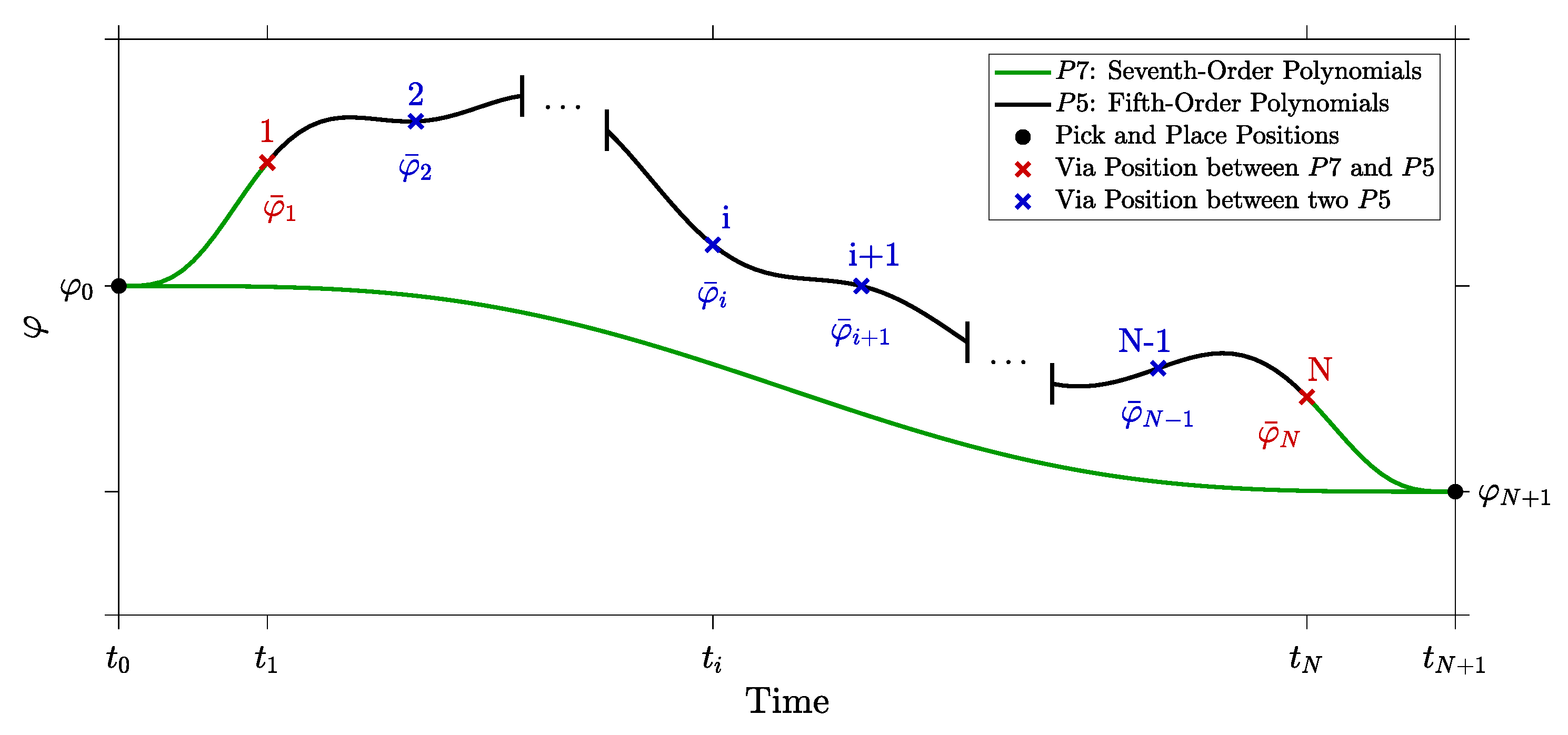
In
Figure 1, examples of a point-to-point seventh-order polynomial (
) and a polynomial spline following the described trajectory planning approach
are shown. The subindex for the actuator
has been omitted for clarity. The
polynomial is completely defined with the pick and place positions at
and
, respectively, and with the required boundary conditions at those positions (velocity, acceleration, and jerk). The
spline is defined by the same boundary conditions but also with the via positions that connect each pair of consecutive polynomial functions.
5. Case Study: Planar Five-Bar Linkage
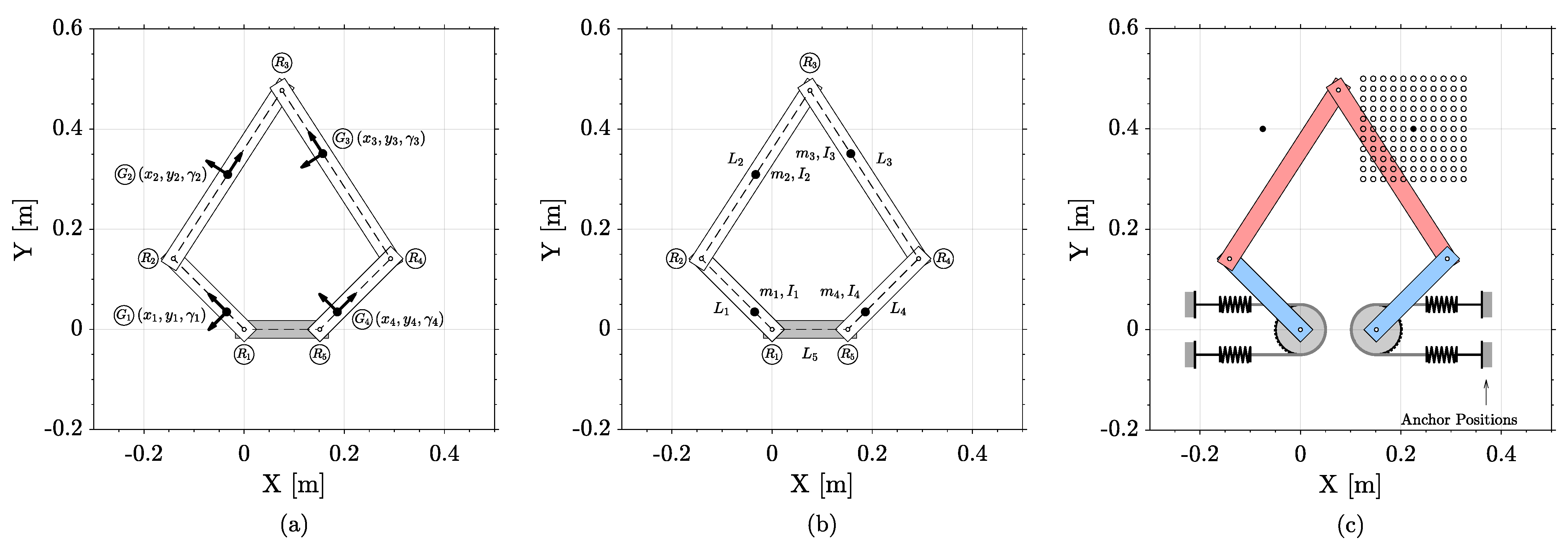
In this section, each proposed approach for the three spring calculation methods will be developed for the planar parallel five-bar manipulator, also known as
, shown in
Figure 2. The generalized coordinates
at the center of gravity
of each body
, as shown in
Figure 2a, are arranged in Equation (33). The center of gravity
of body
is located over the longitudinal straight line connecting the joints
and
at a distance
from the joint
. Moreover, the absolute frame origin is located at the frame joint
.
This mechanism has two degrees of freedom, each directly actuated by a rotational actuator located at the corresponding frame joint, which implies
and
. The length
, mass
, and mass inertia
, shown in
Figure 2b, and distance
of each link are reported in
Table 1.
The pick-and-place palletizing scenario to be analyzed is shown in
Figure 2c, where the nominal pick and place positions at
and
, respectively, are displayed with black circles. In this palletizing scenario, the pick position will always be the same, while the place position will vary within a grid, defined by Equation (34).
Additionally, a set of extension springs is illustratively shown in
Figure 2c to represent the torsional elastic effect that will produce the calculated torsional springs. Each torsional elastic effect acts parallel to its corresponding actuator, exhibiting the stiffness of an equivalent torsional spring assembled with the calculated equilibrium position, which is defined by the shown anchor positions.
Each motion between the pick position and the corresponding place position takes 0.3 s, and another 0.3 s to return to the original pick position, which means that each entire pick-and-place task, defined between
and
, has a total task period of 0.6 s. For simplicity, dwell times are not considered in the calculation of the elastic parameters or the trajectories. On the one hand, the required torque during these times will be zero for the mechanism without springs, as gravity is directed perpendicular to the planar motion. On the other hand, the holding torque requirement during dwell times will be maximum when springs are used; however, a mechanical brake can provide this torque. A more detailed discussion of the influence of dwell times in the threshold of convenience between natural and elastic balancing is discussed in [
30,
31].
In the following, all polynomial splines are defined with a total of
via positions time-equidistantly separated between the pick and place positions. Moreover, the multibody is modeled in MATLAB R2024b, and the optimization problems are solved using the optimization function fminunc and the quasi-Newton algorithm [
49]. First, the elastic parameters will be calculated for the nominal task using each of the methods described in the previous section.
5.1. Free-Vibration Response Method
Starting with the FVR method, a spline of
fifth-order polynomials
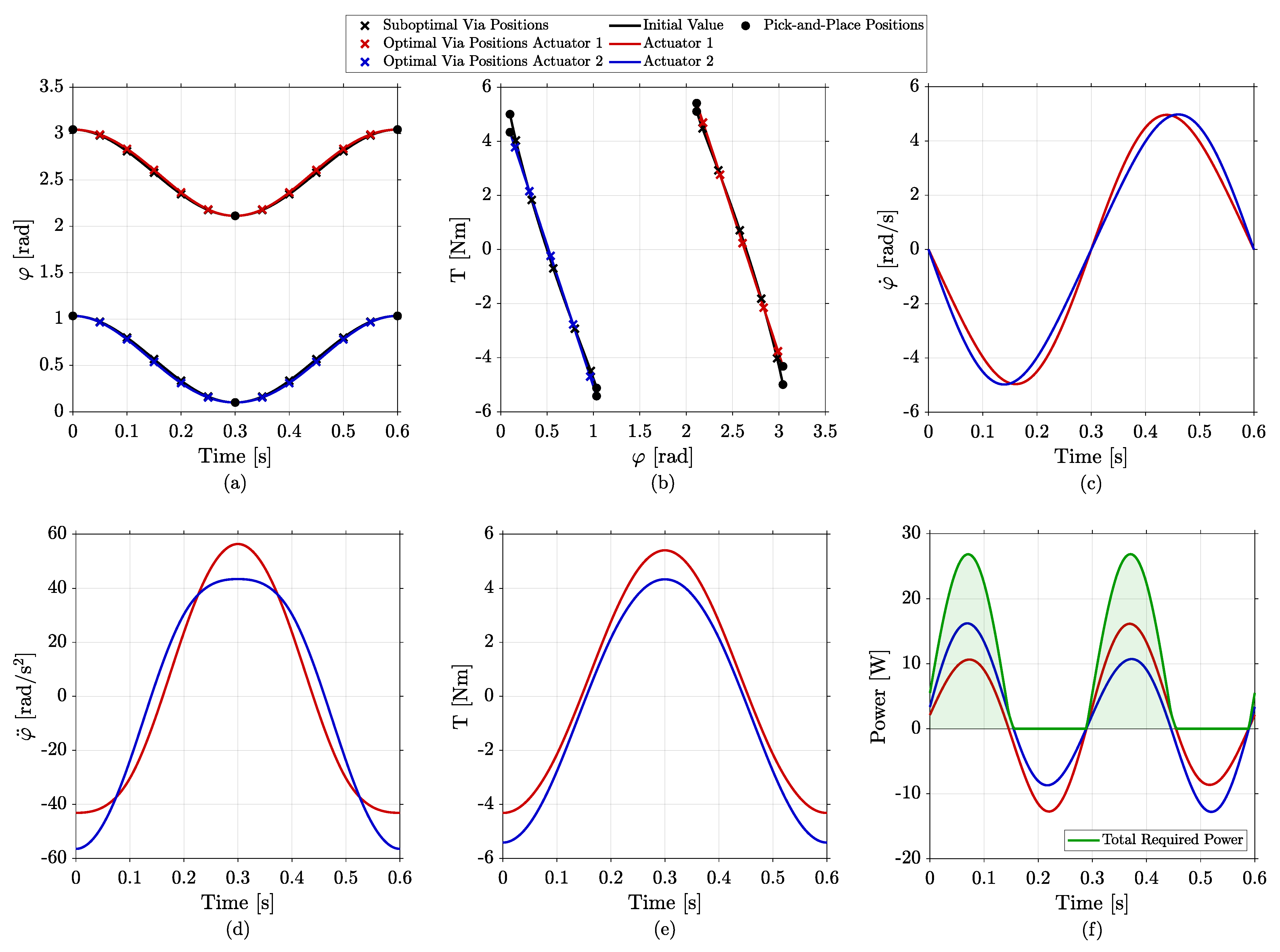
between the pick and place positions will be sufficient because only the velocity and jerk must be zero at those positions, leaving the acceleration unspecified. The results of applying the FVR method to the entire nominal task specification are shown in
Figure 3.
Suboptimal via positions displayed by black
markers in
Figure 3a,b were selected from point-to-point fifth-order polynomials, with the same boundary conditions as the splines. These serve to initialize the optimization routine due to their proximity to the optimal via-position values shown with red and blue markers for actuator 1 and 2, respectively. As shown in
Figure 3b, a linear relationship between the driving torque and the actuator angular position is successfully obtained, as the resulting mean squared error for each linear regression was reduced from the order of
to the order of
.
Additionally, zero velocity is attained in the pick and place positions, as shown in
Figure 3c, and acceleration reaches a zero gradient at these positions, as shown in
Figure 3d, which means that zero jerk is expected. The required driving torques to impose the free-vibration trajectory in the mechanism without springs are shown in
Figure 3e.
Figure 3f illustrates the assumption of no energy sharing and no regenerative braking by presenting both the individual actuator power profiles and the corresponding total power demand.
5.2. Optimized Trajectory Method
The implemented approach for calculating the elastic constants using the optimized trajectory method allows the definition of smooth stopping boundary conditions necessary for dwell times. Therefore, the polynomial spline
, composed of two seventh-order polynomials and four fifth-order polynomials per trajectory, is defined for the optimization of the entire pick-and-place task. This means a total of
via-position decision variables per actuator and a total of
elastic parameter decision variables. The results are shown in
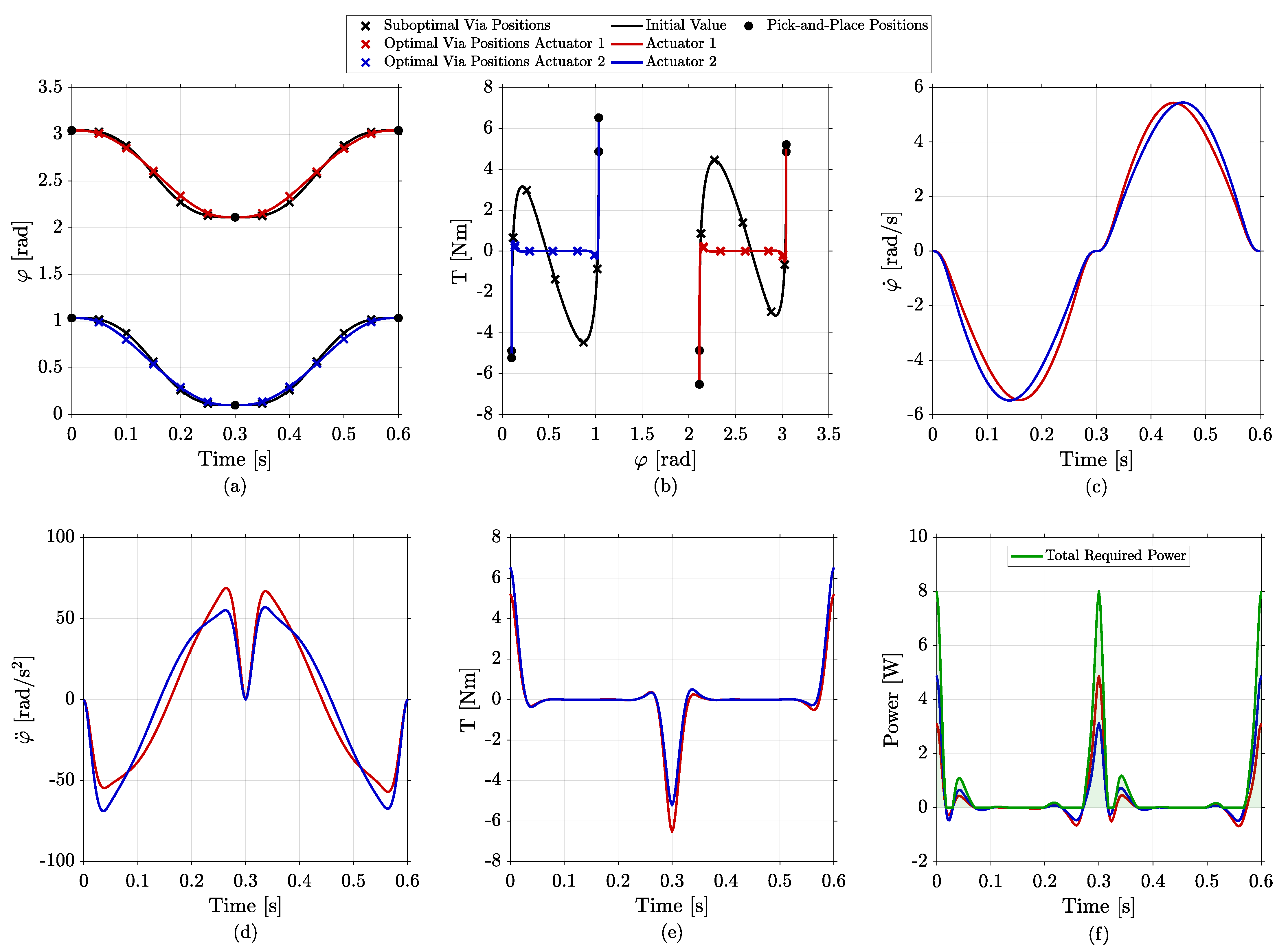
Figure 4.
The optimal values of the via positions for each actuator are shown in relation to the optimized trajectory in
Figure 4a and to the optimized torques in
Figure 4b. Moreover, the corresponding initial values generated with the same spline
formulation but using suboptimal via positions are also shown.
Figure 4c,d display the velocity and acceleration of each actuator, showing that in the pick and place positions, the velocity and acceleration are zero. In addition, the acceleration exhibits zero gradient at the pick and place positions, corresponding to zero jerk, as enforced by the boundary conditions. Different from the approach using the FVR method, the springs’ effect is already included in the dynamic model, thus reducing the actuator’s driving torque from the initial values in black to the values shown in
Figure 4b,e.
Finally, the actuator’s torque values are maximum at the pick and place positions, as are the opposing elastic torques due to the deformation of the springs and the imposed motion that requires zero acceleration at these positions. However, the calculated optimal elastic and trajectory parameters produce nearly zero torque during most of the motion. Additionally, each actuator’s power and the total required power are shown in
Figure 4f, which shows that power is required principally near the pick and place positions.
5.3. Predefined Trajectory Method
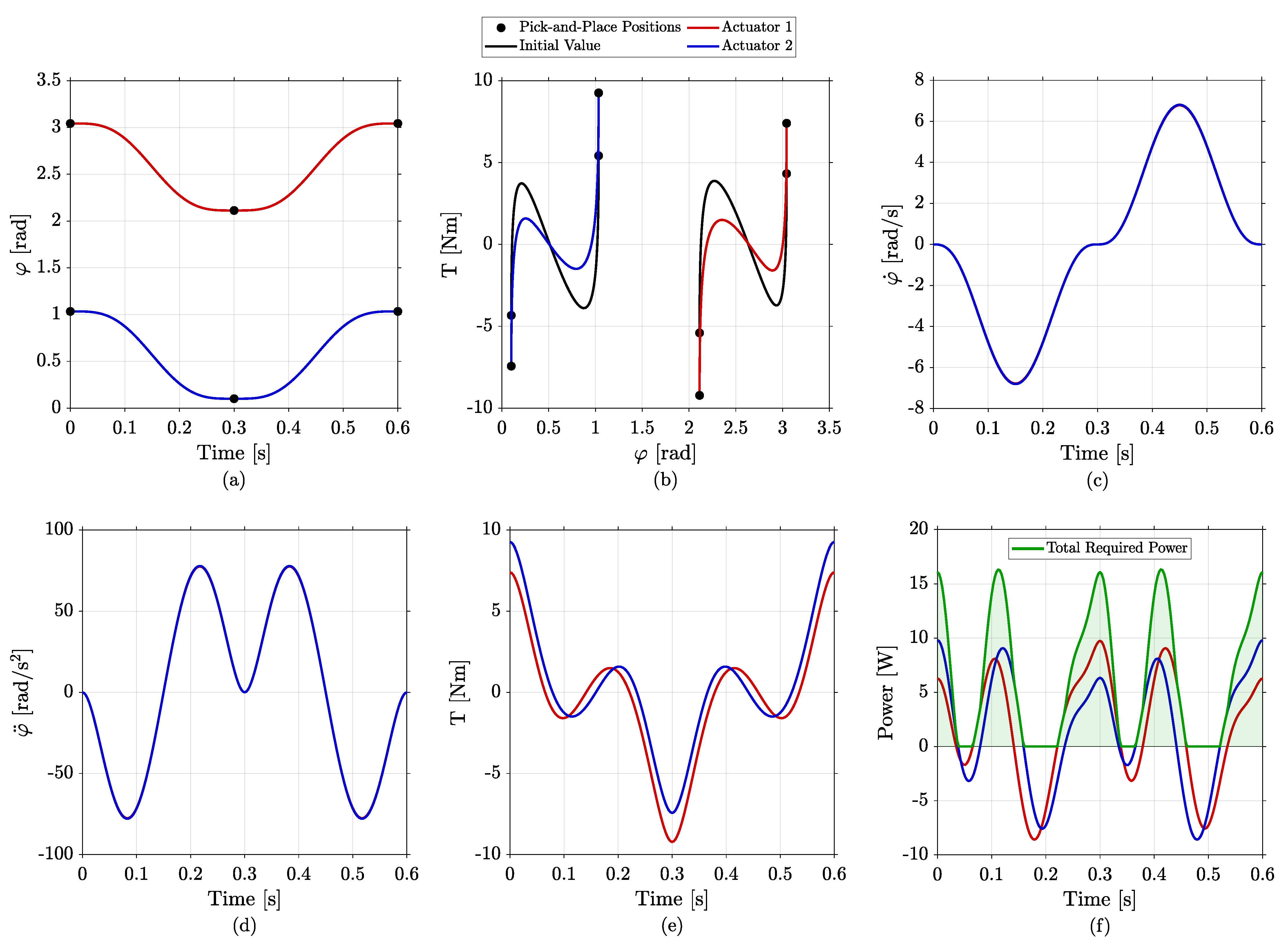
The results for the elastic parameter calculation approach using the last method based on a predefined trajectory are shown in
Figure 5. As the kinematics are predefined with seventh-order point-to-point polynomial driving trajectories, there are no via positions displayed in
Figure 5a,b. Likewise, the decision variables are just the
elastic parameters to be determined in the optimization routine. The initial values are generated with the same predefined trajectories and using the elastic parameters determined from the FVR method. Tuning these parameters shapes the driving torque values, as shown in
Figure 5b. On the other hand, velocities and accelerations are shown in
Figure 5c,d, respectively, in which the boundary conditions can be seen, as in the previous method results.
The elastic effect of the springs produces oscillations in the driving torques, as shown in
Figure 5e, but they are not reduced to zero because there is no trajectory optimization, as in the previous method. This effect is also seen in
Figure 5f, where each actuator’s power and the total required power are shown. Compared with the optimized trajectory method, the power demand extends over longer time periods.
5.4. Discussion
The elastic parameters calculated using each method are summarized in
Table 2 with the respective required energy consumptions. As expected, the energy consumption using the FVR method is zero if the free-vibration trajectory with zero jerk constraints is followed; otherwise, it rises to 2.09 J (not shown in
Table 2) per cycle if the FVR via positions are used with an
trajectory that meets the required boundary conditions.
The best energy result is obtained using the optimized trajectory method that already includes these stopping conditions, but results in stiffer springs. Although the predefined trajectory method includes boundary conditions too, it results in higher energy consumption compared to the preceding methods and even stiffer springs. However, with all three methods, the energy consumption is reduced compared to a minimum-energy trajectory, calculated with the formulation of the optimization problem in Equation (31), and a predefined trajectory, which were both calculated and implemented for the manipulator without springs. This motivates the use of optimal springs calculated through the proposed approaches.
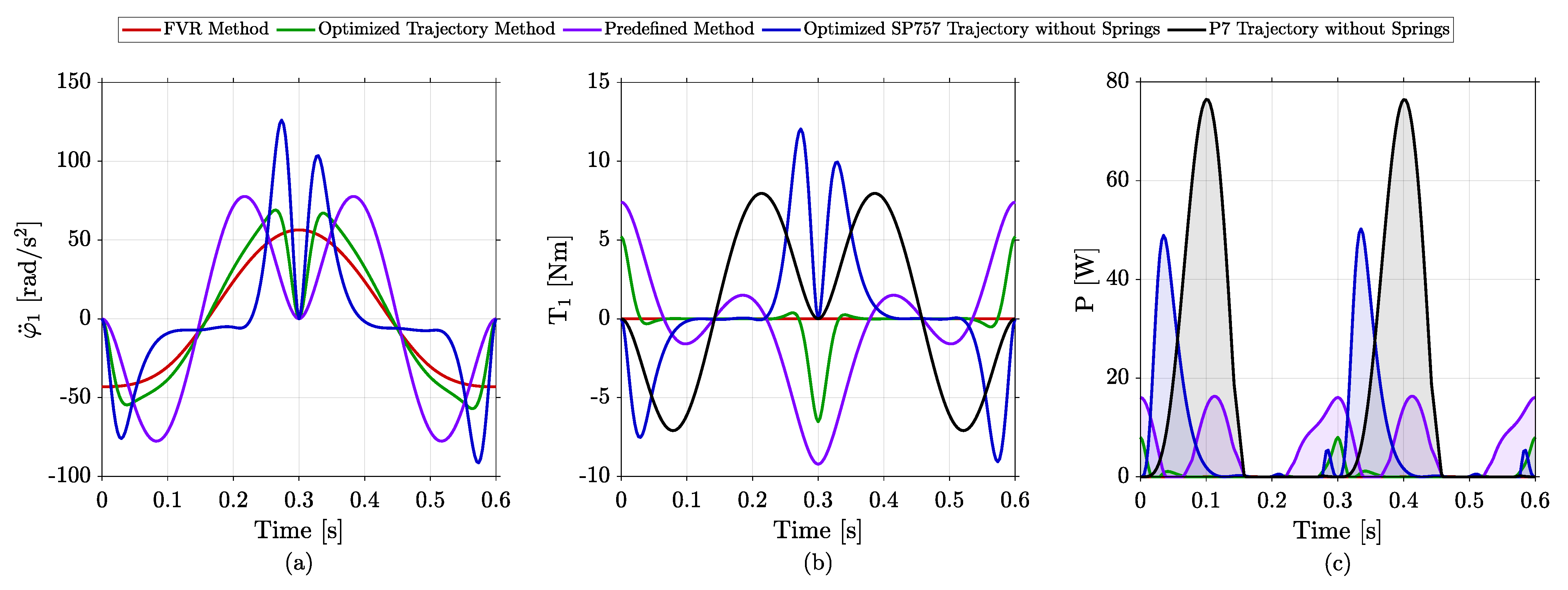
The calculated acceleration and torque of the left actuator using each spring calculation method are shown in
Figure 6a,b, respectively. Moreover, the two additional motions without considering springs are also displayed. Although the torque requirement for the FVR method will be zero during the complete motion, stopping at the pick and place positions implies instantaneous deceleration, because the produced accelerations are maximum at these positions. Alternatively, both the predefined and optimized trajectories allow the actuators to accelerate and decelerate smoothly thanks to the adequate set of boundary conditions with which they were designed.
Furthermore, the total power requirements shown in
Figure 6c demonstrate the energy reductions in
Table 2 for the trajectory optimization, with and without springs included, due to a near-zero torque demand during the intermediate phase of the motion between the acceleration and deceleration. However, these reductions result from two different effects that can be understood by analyzing the acceleration profiles in
Figure 6b. On the one hand, when springs are not included, the near-zero torque is achieved by a trajectory that starts with a peak acceleration, followed by a nearly constant velocity phase, and ends with a deceleration peak. On the other hand, when springs are used, the near-zero torque is achieved by a trajectory that tries to follow the free-vibration-response acceleration profile while meeting the required boundary conditions. Finally,
Figure 6b shows how the incorporation of the optimized springs shapes the torque requirement when a predefined
trajectory is used.
5.5. Palletizing Scenario
In an industrial scenario, the pick and place positions are typically not fixed, but may vary within a certain region, which will imply calculating a new set of springs for each pair of pick-and-place positions. In the presented case study, a total of 121 springs would have to be designed, manufactured, and assembled. Therefore, two strategies are proposed to maintain the nominal springs assembled and still exploit the natural motion to reduce energy consumption. In the first strategy, the nominal springs calculated using the optimized trajectory method are assembled into the mechanism. Then, for each task variation, the trajectory optimization problem of Equation (31) is solved using an polynomial spline formulation, but leaving the springs as initially designed and assembled.
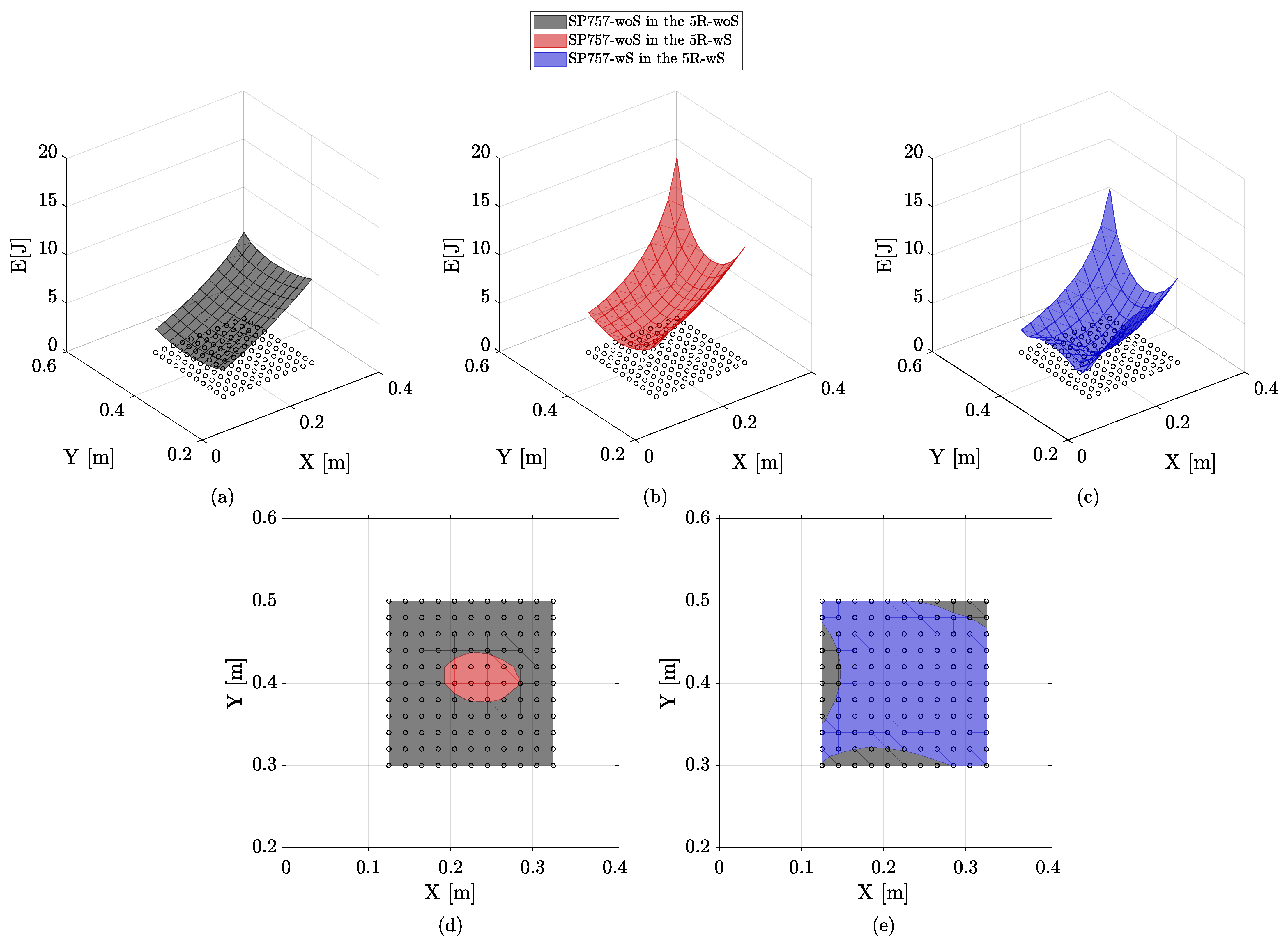
As the pick position is fixed, energy consumption is a function of the placement position, the trajectory planning, and the elastic parameters when springs are used. Therefore, three different energy consumption surfaces are shown in
Figure 7 to analyze the results of the proposed trajectory adjustment. Firstly, trajectory optimization is performed without the use of springs, which results in a trajectory of
. The surface shown in
Figure 7a results when this trajectory is implemented in the mechanism without assembled springs, meaning that no natural motion is exploited here. Then, if the same trajectory is followed, but now the nominal springs are assembled, the energy consumption will result in the surface of
Figure 7b. However, energy consumption rises for some placement positions, such as the top right corner, i.e.,
. Therefore, the springs are kept, but a new trajectory optimization considering them is performed, resulting in the trajectory of
.
Figure 7c shows the energy consumption when this trajectory is followed and the nominal springs are assembled. As expected, the lowest value lies in the center of the grid because the springs were designed, simultaneously with the trajectory, for that pick-and-place task.
Moreover, the surfaces can be intersected to evaluate the region of convenience of each one. In
Figure 7d, the intersection of surfaces from
Figure 7a,b is displayed. This demonstrates that using the nominal springs is convenient within the red region, while not using them is convenient for the black one. However, the size of the red region can be increased to the blue region shown in
Figure 7e, which is the result of the intersection of the surfaces of
Figure 7a,c. Additionally, with the information from
Figure 7d,e, it can be demonstrated that red and blue surfaces never intersect; thus, if springs are to be used, the trajectory optimization strategy is always convenient.
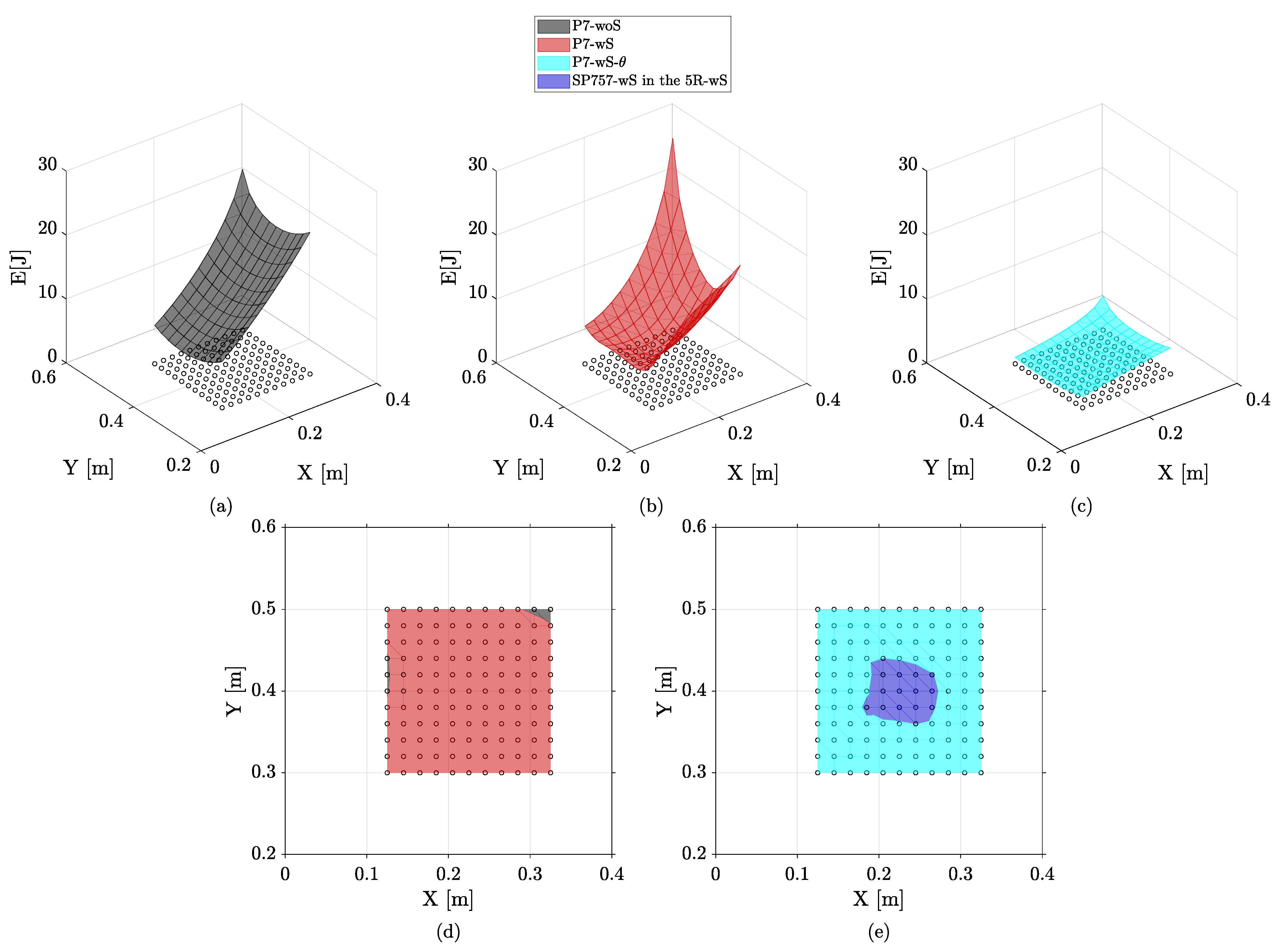
In the second strategy, predefined point-to-point seventh-order polynomials are used for planning the trajectory. As this is a straightforward trajectory definition based on the pick and place positions and their boundary conditions, adjustments cannot be performed at the trajectory level. On the other hand, they are performed by solving the optimization problem defined in Equation (32), where the equilibrium positions are the decision variables. A similar analysis as for the trajectory adjustment is performed for this second strategy. The energy consumption of three alternatives is displayed in
Figure 8.
First, the
trajectory is followed in the mechanism without springs, resulting in the energy consumption shown in
Figure 8a, labeled as
. Then, the springs calculated using the predefined trajectory method are assembled to the mechanism, which results in the energy consumption surface in
Figure 8b, labeled as
. Lastly, the energy consumption when the equilibrium is adjusted for each pick-and-place task is shown in
Figure 8c and labeled as
. Intersecting the black and red surfaces results in the convenient regions of
Figure 8d. This shows that if nominal springs are assembled, energy consumption rises for a few placement positions, but especially for the top right corner of the grid. On the other hand, the optimized energy surface of
Figure 8c is below the other two, which makes using the nominal springs along with the equilibrium update, the most convenient alternative when a predefined
polynomial trajectory is followed.
Finally, the energy surfaces of both adjustment strategies can be intersected, thus resulting in the two convenient regions shown in
Figure 8e. This shows that using trajectory adjustment is the best strategy if the placement positions are close to the nominal. However, it is important to recall that the springs used for each of the two adjustments are different. Then, applying one or the other is not straightforward because the springs need to be replaced.
Table 3 shows the total energy consumption of each of the six alternatives considered along the entire pick-and-place scenario. The highest energy consumption was obtained while following a seventh-order point-to-point polynomial trajectory without springs. This alternative was used as the benchmark to evaluate the energy reductions in the other, as this type of predefined trajectory is typically employed in pick-and-place tasks.
The energy reductions obtained demonstrate that adjustments must be implemented if springs are to be used for the entire pick-and-place palletizing scenario. Moreover, the best results were obtained for the adjustment of the equilibrium position, which is a simpler optimization problem to solve compared to trajectory optimization. However, a promising future alternative is to employ a variable-stiffness actuator, allowing motion from one surface to another.