
Article

Prediction of the Temperature Rise and Thermal Error of Feed Systems Under Repeatable Operating Conditions Using a Superposition Method

1
Department of Mechanical Engineering, National Chung Cheng University, Chiayi 621, Taiwan
2
Department of Energy and Refrigerating Air-Conditioning Engineering, National Taipei University of Technology, Taipei 106, Taiwan
3
HIWIN Technologies Corp., Taichung 408, Taiwan
*
Author to whom correspondence should be addressed.
Machines 2026, 14(2), 235; https://doi.org/10.3390/machines14020235
Submission received: 5 January 2026 / Revised: 11 February 2026 / Accepted: 14 February 2026 / Published: 18 February 2026
(This article belongs to the Section Advanced Manufacturing)

Abstract

In precision machining, the feed system is a critical subsystem. However, it can generate considerable frictional heat during operation, causing the temperature of the ball screw feed system to rise and resulting in thermal expansion of the ball screw. This thermal expansion reduces the machining accuracy of the final parts. To detect and compensate for the temperature and thermal error of the ball screw feed system in real time, rapidly assessing its temperature field is essential. Traditional methods such as the finite element method (FEM) provide high computational accuracy and have been extensively studied. However, their long computation process limits their application in real-time thermal error prediction. To address this, a feed drive superposition method (FDSM) is proposed herein to rapidly compute the temperature and thermal error of the ball screw feed system using the superposition principle. The FEM model divides the screw into 108 elements, each 10 mm long. The resulting temperature rise data for each element under each boundary condition are stored to form a screw temperature rise database. In practice, the actual machining conditions determine the boundary condition values. The corresponding temperature rise data are retrieved and superimposed to compute the complete screw temperature rise and thermal error. Crucially, the FDSM reduces the computation time from hours to less than 2 s—achieving an acceleration of over 3600-fold—while maintaining high accuracy. Across all three cases, the RMSE between the FDSM and FEM results is consistently below 1.2 μm, while comparison with experimental data yields an RMSE of 6.0 μm, demonstrating both its reliability and suitability for real-time thermal error compensation in ball screw feed systems.

1. Introduction

Thermal error is recognized as the most dominant contributor to precision machining inaccuracies, accounting for 40–70% of total errors [1,2,3,4]. Notably, the ball screw feed system serves as a key structural component of precision machining equipment. During operation, friction between the bearings and nuts of this feed system generates substantial heat, causing a temperature rise that leads to the thermal expansion of the screw. This expansion affects the positioning accuracy of the feed system and ultimately reduces the dimensional precision of the machined parts. Consequently, numerous recent studies have focused on analyzing, modeling, and compensating for the thermal error of the feed system to enhance machining accuracy. These studies can be broadly categorized into two main approaches. The first utilizes numerical models—including the Finite Element Method (FEM), Finite Difference Method (FDM), and Modified Lumped Capacitance Method (MLCM)—to predict temperature rise and estimate subsequent thermal errors. Li et al. [5], Liu et al. [6], and Jedrzejewski et al. [7] employed FEM to investigate complex thermo-mechanical coupling. Specifically, Li et al. [5] used Monte Carlo simulations and FEM to identify heat generation rates and proposed calculating heat output via motor torque current. Liu et al. [6] optimized thermal boundary conditions using Response Surface Methodology (RSM), controlling predictive errors within 7 μm. Jedrzejewski et al. [7] utilized a holistic FEM model to analyze the impact of dynamic loads and moving heat sources. While FEM provides high-fidelity results, its prohibitive computational load often limits its direct application in real-time control.
To balance speed and precision, FDM [4,8] and MLCM [9] have been extensively explored. Li et al. [4] utilized a 1D FDM model to reduce predictive errors to 7 μm, while Liu et al. [8] developed a 3D FDM model for reciprocating conditions to simulate dynamic thermal fields. Notably, Xu et al. [9] established a sensorless MLCM model requiring only stroke information, maintaining errors within 10 μm. Compared to FEM, FDM and MLCM significantly shorten calculation time by simplifying the system into discrete thermal nodes.
However, these methods possess inherent limitations. MLCM models are often overly simplified, tending to neglect the spatial temperature gradients across different positions of the screw under complex operating conditions. Furthermore, they heavily rely on experimental identification for key parameters, such as heat convection coefficients. On the other hand, the computational speed of FDM is strictly governed by the number of nodes; an increase in mesh density to capture localized thermal details leads to significantly longer calculation times.
The second approach involves constructing empirical models using classical response surface (RSM), Multiple Linear Regression Analysis (MLRA) or Neural Networks (NN). Zhang et al. [10] utilized MLRA to separate geometric and thermal errors under different mounting conditions, while Shi et al. [11] identified critical heat sources to reduce errors to 2 μm. Regarding NN models, Li et al. [3] proposed a random RBFNN (IR-RBFNN) to enhance robustness against stochastic factors. Shi et al. [2] developed a Bayesian Neural Network (BNN), successfully reducing the maximum error from 18.2 μm to 5.14 μm. While both offer fast computation for real-time compensation, MLRA struggles with non-linearity, and NN models require extensive training data. To address these limitations, Lu et al. [12] introduced a hybrid Digital Twin and Long Short-Term Memory (DT-LSTM) framework, utilizing physical simulation data to optimize the LSTM model and achieving an 11% improvement in accuracy over standalone models.
Building on the above insights from previous studies, this study proposes using the superposition method to predict the temperature rise and thermal deformation of the ball screw feed system. Notably, the superposition method has been extensively applied across various domains [13,14,15,16,17,18,19,20,21]. Its key advantages include an accuracy comparable to that of the FEM and a considerably shorter computation time [18], enabling real-time thermal error prediction and practical integration into thermal error compensation strategies for precision machining. In previous studies, Gorman et al. [13,14] employed the superposition method to analyze the free vibration modes of cantilever plates under various boundary conditions. Koopmann et al. [15] applied the method to compute sound fields. Wang et al. [16] proposed two improved superposition methods to analyze fluid interactions between water droplets. Wang [17] employed the method to assess the thermal performance of a radiator embedded with heat pipes. Rao et al. [21] simplified the complex gear dynamics problem into a linear transverse vibration problem and applied the principle of superposition to address the simultaneous presence of multiple fault frequencies. Maurya et al. [20] developed the Mares CT model by extending the superposition-based Mares model with coolant temperature variables, achieving an improvement of 12.19% to 66.35% in predicting spindle thermal deformation. Further, Jiang et al. [18] applied the method to calculate the temperature rise of aluminum blocks and thermal printers. Finally, Jiang et al. [19] developed a new superposition model to quantitatively distinguish the effects of cutting force and heat on residual stress.
Despite these successful applications in stationary components and spindles, applying the superposition method to ball screw systems remains a challenge. This difficulty arises from the high nonlinearity caused by the moving heat source (the nut) and the highly variable convective conditions associated with different feed speeds. Most previous studies focused on static boundaries, whereas this study addresses the dynamic complexity of feed drives.
Notably, the direct application of traditional superposition methods to ball screw feed systems is complicated as temperature rise varies with changes in heat generation rate, dissipation conditions, ambient temperature, and initial screw temperature. This study proposes a superposition-based method, called the feed system superposition method (FDSM), to rapidly calculate the temperature rise and thermal deformation of the ball screw feed system. Further, to address the variable and stochastic operating conditions of the system, this study separately considers its three primary heat sources, namely the front bearing, rear bearing, and nut’s travel range, under two scenarios: (1) screw temperature rise caused by standard heat flux alone and (2) screw temperature rise resulting from a 1 °C difference between the initial screw temperature and ambient temperature, each relative to the standard temperature T s t d (20 °C). The FEM is employed to calculate screw temperature rise, and the resulting data are stored in a database. This database and corresponding superposition methods, incorporating bearing heat flux, nut heat flux, ambient temperature, initial screw temperature, feed speed, and travel range, are used to model the temperature rise of the ball screw feed system under actual operating conditions. The FDSM is then used to rapidly calculate the temperature rise and thermal deformation of the ball screw feed system. The final results are compared with both FEM simulations and experimental measurements to verify the accuracy of the FDSM.
To provide a clear overview of the current research landscape and address the comparative performance of various methodologies, Table 1 summarizes the key characteristics of thermal error modeling approaches, including numerical, analytical, and data-driven methods.
While FEM provides high-fidelity results, its prohibitive computational load often limits direct application in real-time control. Conversely, MLCM and simplified FDM models improve calculation speed by simplifying the system into discrete thermal nodes, though they may neglect spatial temperature gradients or rely heavily on experimental parameter identification.
Regarding empirical methods, Data-driven models (such as RSM, MLRA, and NN) offer fast computation for real-time compensation. However, as highlighted in Table 1, these models—especially Neural Networks—require extensive training data and often struggle with non-linearity or lack physical interpretability. In contrast, the proposed FDSM leverages the physical principle of superposition to achieve high accuracy comparable to FEM while maintaining fast computational speed. Notably, unlike data-driven approaches, FDSM does not require a training dataset, offering a moderate implementation complexity that is well-suited for practical real-time thermal error compensation in ball screw systems.

2. Materials and Methods

To verify the FDSM, a measurement device was developed to first record the temperature and thermal error of the ball screw feed system under varying feed speeds and travel distances. Simultaneously, an FEM model was established to calculate the temperature rise and thermal error of the ball screw, thereby generating a temperature rise database for the FDSM. The experimental procedure for the screw feed system is presented in Section 2.1, that for the FEM is presented in Section 2.2, and that for the FDSM is presented in Section 2.3.

2.1. Experimental Methods

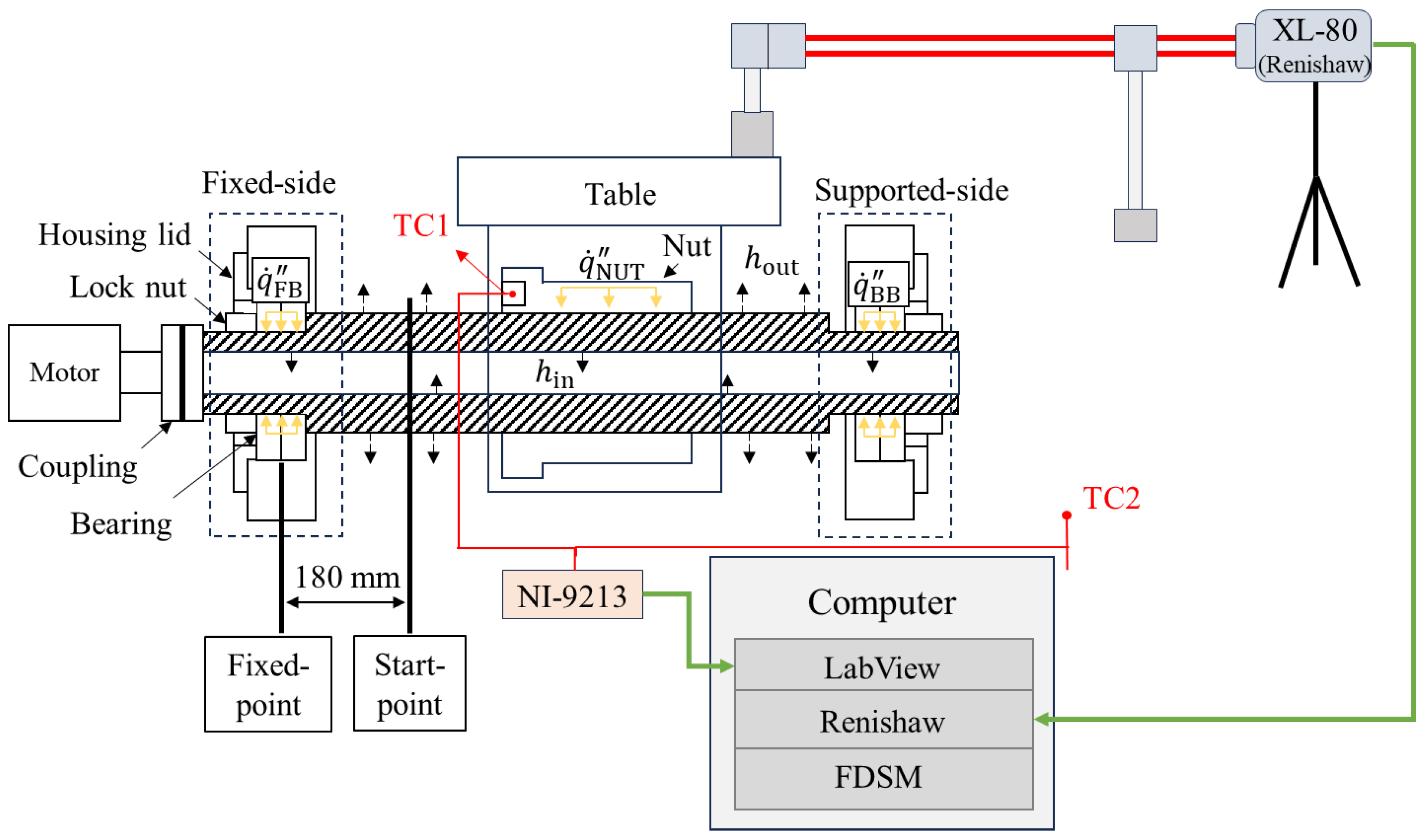
As depicted in Figure 1, the ball screw feed system comprises a motor, a coupling, bearings, a locking nut that secures the inner ring of the bearing, a gland that secures the outer ring, and the ball screw and nut. The measurement setup includes devices for recording temperature and thermal deformation.

2.1.1. Screw Feed System

This study employed a ball screw feed system with a total screw length of 1715 mm. To ensure clarity in thermal analysis and experimental verification, two coordinate systems were defined. The absolute origin was positioned at the midpoint between the two front bearings. This absolute coordinate system (X labeled as “Ball Screw” in subsequent figures) was used for calculating and representing the screw temperature distribution, as it directly relates to the physical locations of the heat sources. The travel began 180 mm from the absolute origin, with a total length of 900 mm. The length of the heating area of the nut was 126 mm. The effective heating travel length of the nut was 1026 mm (The total travel length + The length of the heating area of the nut). For evaluating positioning thermal errors, a travel coordinate system (X labeled as “Position”) originating at this travel start point was adopted to ensure a direct and consistent comparison with the results measured by the laser interferometer. The specifications of the ball screw and bearings are summarized in Table 2. A hollow screw was used; therefore, both the forced convection between the ball screw and surrounding ambient air (hₒᵤₜ) and that within the hollow screw (hᵢₙ) were considered. The front bearing, located near the motor, adopted a back-to-back (DB) arrangement, with the bearings secured to the housing and screw shoulder using a lid and lock nut. The screw could not move freely in either the radial or axial direction. The screw positions aligned with the centers of the two bearings were treated as fixed points. The rear bearing, located farther from the motor, employed a face-to-face (DF) bearing arrangement as the support end bearing assembly and also used a housing lid. The bearing was secured to the housing by the lid but did not rest against the screw shoulder or use a lock nut to secure its both ends to the screw. Consequently, the screw could expand freely in the axial direction, and this end was regarded as the support end. Therefore, when the screw underwent thermal deformation, it expanded toward the support end. In this study, the primary heat sources of the screw feed system included the motor, front bearing, rear bearing, and nut. The coupling connected the motor and screw. In this study, this coupling was of the flexible type, comprising a flexible sheet with thermal insulation in the middle. The heat generated by the motor was negligible and exerted minimal influence on the ball screw.

2.1.2. Temperature and Thermal Deformation Measurement Equipment

The temperature measurement system comprised an NI-9213 temperature acquisition card, LabVIEW 2013 (National Instruments, Austin, TX, USA), and an E-type thermocouple. It was used to measure the metal temperature (TC1) inside the nut hole and the ambient temperature (TC2) adjacent to the test bench. To ensure the feed system reached a state of complete thermal equilibrium and to eliminate any residual heat effects from previous operations, the machine was kept idle for at least 24 h before each experimental run. Under this equilibrium state, the metal temperature (TC1) was considered as the initial temperature of the screw (IT). It should be noted that the FDSM specifically accounts for scenarios where the IT or ambient temperature (AT) differs from the standard temperature through the compensation components TemInCint and TemInRTC, respectively (detailed in Section 2.3.3, Equations (6) and (7)). For the thermal deformation measurement, an XL-80 laser interferometer and LaserXL v20.3 (Renishaw plc, Wotton-under-Edge, UK) were employed to evaluate the positioning accuracy of the ball screw from the travel origin (0 mm) to 900 mm at 100 mm intervals. To prevent an excessive temperature drop during measurement, only a single measurement run was performed at each 300 s sampling interval. Additionally, to ensure consistent contact surfaces between the balls and the raceway, the nut was always moved to −5 mm before returning to the travel origin (0 mm) to begin each measurement run. The screw’s thermal error was calculated as the difference between the initial and subsequent positioning accuracies. An XC compensation unit was employed along with an ambient temperature sensor positioned at the side of the feed system. This configuration was used specifically to compensate for laser wavelength variations caused by environmental factors (temperature, humidity, and atmospheric pressure). The screw’s thermal error was measured as the difference between the initial and subsequent positioning accuracies and was used to validate the FDSM predictions.

2.1.3. Experimental Conditions

To verify that the FDSM can be applied under varying feed rates and travel ranges, four feed rates were selected: 40 m/min, 20 m/min, 10 m/min, and 2.7 m/min. As indicated in Table 3, these rates were applied under different operating scenarios. It should be emphasized that all travel ranges and nut positions specified in Table 3 are defined relative to the travel origin, rather than the absolute origin. Among these, a simple operating condition with the feed rate of 2.7 m/min was compared only with the numerical results of the FEM, while two composite operating conditions were designed to validate the FEM predictions against experimental results. The simple operating condition did not correspond to an actual operational case; rather, assumed values for the heat fluxes of the three primary heat sources were used to numerically predict the behavior of the feed system using both the FDSM and FEM. A comparison between the superposition method and FEM was then conducted. The primary objective was to demonstrate the procedural steps of the FDSM for the feed system rather than to validate the experimental results. Composite operating condition A included three single operating stages with different feed rates and travel ranges. In the first stage (t = 0–300 s), the feed rate was 40 m/min, and the nut’s effective heating travel length ranged from 200 mm to 826 mm. Further, between t = 300 and 600 s, the feed rate remained unchanged, and the nut’s effective heating travel length was adjusted to 0–1026 mm. From t = 600–900 s, the feed rate decreased from 40 m/min to 20 m/min, and the travel length shifted to 400–1026 mm. Composite operating condition B comprised segments with identical travel lengths but differing travel ranges and feed rates, progressing from high to low feed rates. This study focused on either single conditions or composite conditions formed by combining segments with any travel length, using one of the four designated feed rates. If the feed rate differed from the four predefined values, the superposition feed rate interpolation method was employed to calculate results for arbitrary feed rates and travel lengths; this approach has been experimentally validated. However, for clarity, this paper discusses only a limited superposition method database based on the four selected feed rates.

2.2. FEM Establishment

This study employed the FEM and superposition method to calculate the temperature rise and thermal error of the ball screw feed system, based on the following key assumptions [15,17]:
  • The radiation term can be neglected for small temperature increases.
  • Thermal conductivity, density, and specific heat can be treated as constants within narrow temperature ranges.
  • The convective heat transfer coefficient can be assumed constant for motion at a fixed feed rate.
  • Frictional heat within the nut’s travel range can be considered uniformly distributed.
  • Heat conduction through the lubricant can be deemed negligible.
  • The screw can be modeled as a homogeneous material with a constant coefficient of thermal expansion.
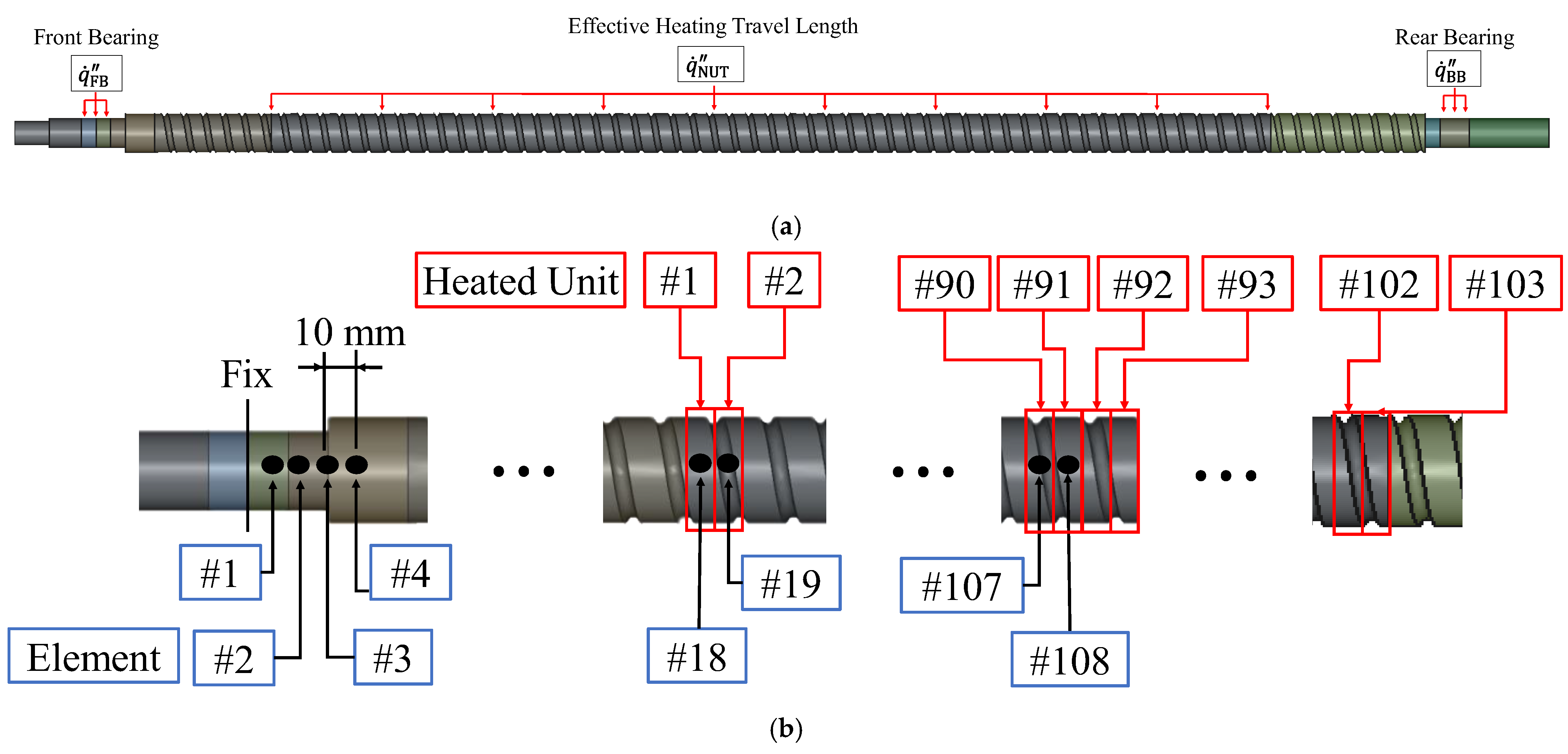
This study employed the FEM-generated data on temperature rise and thermal deformation. Numerical calculations were performed using the finite element software ANSYS® 2020 (ANSYS, Inc., Canonsburg, PA, USA) to investigate the thermal behavior of the ball screw. Figure 2a presents the numerical model developed for this purpose, where the heat fluxes in the front bearing, rear bearing, and nut coverage area are denoted as q ˙ F B , q ˙ B B , and q ˙ N U T , respectively. As depicted in Figure 2b, to facilitate the output of temperature and thermal deformation data, the centers of the two bearings were designated as fixed points, and each 10 mm segment was treated as a region (hereinafter referred to as an “element”). The travel origin was located 180 mm from the bearing center, and the nut travel length was 900 mm; consequently, 108 elements were established between the front bearing and the end of the travel range (18 elements for the 180 mm offset and 90 elements for the 900 mm travel). A temperature monitoring point was positioned at the center of each element. Each 10 mm section within the travel range was treated as a heated unit subjected to the heat flux generated by the nut. Considering the nut’s heating area of 126 mm and the 900 mm travel, the FEM model maintains physical integrity by incorporating a total of 103 heated units, covering an “Effective Heating Travel Length” of 1026 mm, and the rear bearing in its thermal conduction calculations. Because the laser interferometer cannot measure the thermal deformation beyond the 900 mm travel range and this region has no influence on thermal deformation calculations using the FDSM, no additional elements were established beyond this point. Furthermore, since the screw expands freely toward the support end, any thermal deformation occurring in the region beyond 900 mm does not accumulate into the positioning error measured within the 0–900 mm range. The boundary conditions (Equations (1)–(3)) based on the FEM model are detailed in References [22,23,24,25,26]. Specifically, Equation (1) calculates the frictional heat flux generated by the nut, Equation (2) determines the frictional heat flux produced by the front and rear bearings, and Equation (3) characterizes the forced convection coefficient on the screw surface as a function of the feed rate.
For calculations performed using the FEM and FDSM, accurate heat flux values and forced convection coefficients for the nut and bearings are required. Assuming that the nut load consists primarily of preload and dynamic load, the nut’s heat flux q ˙ N U T (W/m2) can be expressed as [22,26]
q ˙ N U T = 0.12 π f 0 v 0 n M N U T / A N U T .
Here, f0 is a coefficient determined by the nut type and lubrication method, v0 is the kinematic viscosity of the lubricant (m2/s), n is the screw’s rotational speed (rpm), MNUT is the total frictional torque of the nut (N·mm), and ANUT is the nut’s contact area on the screw (m2).
The heat flux q ˙ F B in the front bearing region and q ˙ B B in the rear bearing region (W/m2) are expressed as [24,26]
q ˙ F B   o r   q ˙ B B = 1.047 × 10 4 n   M b e a r i n g / A b e a r i n g .
Here, n is the screw’s rotational speed (rpm), Mbearing is the total frictional torque of the bearing (N·mm), and Abearing is the bearing’s contact area on the screw (m2).
The convective heat transfer coefficient h (W/(m2·°C)) is computed as described in [23,26]:
h = N u k f l u i d / d .
Here, the Nusselt number Nu is given by Nu = 0.133 Re(2⁄3) Pr(1⁄3), where Re and Pr denote the Reynolds number and the Prandtl number. The symbol kfluid denotes the thermal conductivity of the surrounding air, and d denotes the outer or inner diameter of the screw shaft (in mm).

2.3. FDSM

The proposed FDSM differs fundamentally from the RSM and classical superposition models. Unlike RSM, which establishes mathematical correlations via massive experimental data often limited to specific operating conditions, FDSM is based on the physical principle of superposition. Guided by the assumptions established in Section 2.2—specifically the neglect of radiation (Assumption 1), the use of constant material properties (Assumption 2), and the assumption of constant convection coefficients for specific feed rates (Assumption 3)—the governing heat transfer partial differential equation (PDE) for the ball screw system is maintained as linear and time-invariant (LTI). This LTI characteristic is the fundamental prerequisite for the validity of the superposition principle, enabling the FDSM to decompose the thermal field into independent solutions. It decomposes the thermal field into independent solutions for the three primary heat sources (front bearing, rear bearing, and nut), as well as the effects of ambient and initial screw temperatures. By discretizing the stroke area affected by the nut into individual heating units, the FDSM can assign precise heat fluxes according to specific operating conditions. While traditional superposition models are seldom applied to complex ball screw systems due to nonlinearity, the FDSM’s modular architecture enables it to provide high-accuracy results comparable to FEM with significantly reduced computation time, making it ideal for real-time compensation.
This study proposes the FDSM to rapidly calculate the temperature rise and thermal deformation of the ball screw feed system. Given the variable and random operating conditions of the feed system, this study separately considers the boundary conditions influencing the screw temperature rise of the ball screw feed system. For each feed speed, the boundary conditions include screw temperature rise caused by heating from the front bearing alone, rear bearing alone, and nut alone. The nut’s heating effect is modeled by applying heat to one unit at a time within the travel range, which is divided into 103 heated units of 10 mm each. Additionally, the screw temperature rise caused by deviations in ambient temperature and initial screw temperature from the standard temperature was calculated using an FEM model under 107 defined boundary conditions. These data were stored to build a screw temperature rise database for each feed speed. As four feed speeds were planned, four corresponding databases were established (see Section 2.3.1 for details). During actual calculation, the appropriate data were retrieved based on the measured feed speed to calculate the temperature rise of the ball screw feed system. The screw temperature rise database and the relevant superposition method were used to quickly calculate the temperature rise and thermal deformation of the ball screw feed system based on actual bearing heat flux, nut heat flux, ambient temperature, initial screw temperature, feed speed, and travel. Section 2.3.1 presents the screw temperature rise database for the ball screw feed system; Section 2.3.2 explains how the screw temperature rise database and the FDSM were used for calculation; Section 2.3.3 describes the application of the FDSM under single operating conditions; and Section 2.3.4 details its application under composite operating conditions.

2.3.1. Establishment of the FDSM Database

The FDSM calculates the screw temperature rise by superimposing the effects of 107 individually modeled boundary conditions to determine the combined temperature rise resulting from their simultaneous action. Additionally, the ball screw feed system often operates at different feed speeds. Accordingly, this study established temperature rise data for each of the 107 individual boundary conditions, including one with front bearing heating, one with rear bearing heating, one with an ambient temperature change, one with an initial screw temperature change, and 103 heated units in the nut heating zone, across 108 screw elements at four different feed speeds. These data constitute the FDSM database, as indicated in Table 4. Notably, for each feed speed, the corresponding screw temperature rise database contains entries reflecting the effects of all 107 boundary conditions.
  • Database of screw temperature rise caused by the separate heating of the front bearing: As illustrated in Figure 2, when both the ambient temperature and initial screw temperature were set to the standard value of 20 °C, only the front bearing provided continuous heating with the standard bearing heat q ˙ F B = q ˙ s , F B = 1000 W/m2, while the rear bearing and the nut did not heat up ( q ˙ B B = q ˙ N U T = 0 ) . Under these conditions, we recorded the temperature rise of 108 elements on the screw over a period of 1800 s, and this dataset constituted the database of screw temperature rise caused by the separate heating of the front bearing. The database was coded as DB_FB, where DB denotes “Database,” and FB indicates separate heating of the front bearing.
  • Database of screw temperature rise caused by the separate heating of the rear bearing: As illustrated in Figure 2, when both the ambient temperature and initial screw temperature were set to the standard value of 20 °C, only the rear bearing provided continuous heating with the standard bearing heat flux q ˙ B B = q ˙ s , B B = 1000 W/m2, while the front bearing and nut did not heat up ( q ˙ F B = q ˙ N U T = 0 ) . Under these conditions, we recorded the temperature rise of 108 elements on the screw over a period of 1800 s, and this dataset constituted the database of screw temperature rise caused by the separate heating of the rear bearing. The database was coded as DB_BB, where DB denotes “Database,” and BB indicates rear bearing heating.
  • Database of screw temperature rise caused by separate nut heating: As illustrated in Figure 2, when both the ambient temperature and initial screw temperature were set to the standard value of 20 °C, the front and rear bearings did not heat up ( q ˙ F B = q ˙ B B = 0 ) . The travel range was divided into heated units of 10 mm, resulting in a total of 103 heated units. Each heated unit was individually heated by the nut using a standard heat flux of q ˙ N U T = q ˙ s , N U T = 500 W/m2. Under these conditions, we recorded the temperature rise of 108 elements on the screw over a period of 1800 s, forming a database of screw temperature rise caused by nut heating. This database was coded as DB_NUT(p), where DB denotes “Database;” NUT refers to nut heating; and p ranges from 1 to 103, corresponding to the 1st through 103rd heated units in the travel zone.
  • Database of screw temperature rise under changing ambient temperature and no heat source: As depicted in Figure 2, when the initial screw temperature was set to the standard value of 20 °C and the ambient temperature was increased to 21 °C, the front bearing, rear bearing, and nut did not heat up ( q ˙ F B = q ˙ B B = q ˙ N U T = 0 ) . Under these conditions, we recorded the temperature rise of 108 elements on the screw over a period of 1800 s, creating the database of screw temperature rise under changing ambient temperature and no heat source. This database was coded as DB_RT, where DB denotes “Database,” and RT indicates changing ambient temperature.
  • Database of screw temperature rise with initial screw temperature changes without a heat source: As illustrated in Figure 2, when the ambient temperature was set to the standard value of 20 °C and the initial screw temperature was set to 21 °C, the front bearing, rear bearing, and nut did not heat up ( q ˙ F B = q ˙ B B = q ˙ N U T = 0 ) . Under these conditions, we recorded the temperature rise of 108 elements on the screw over a period of 1800 s, which formed the database of screw temperature rise with initial screw temperature change and no heat source. The database was coded as DB_IS, where DB denotes “Database,” and IS represents the change in initial screw temperature.
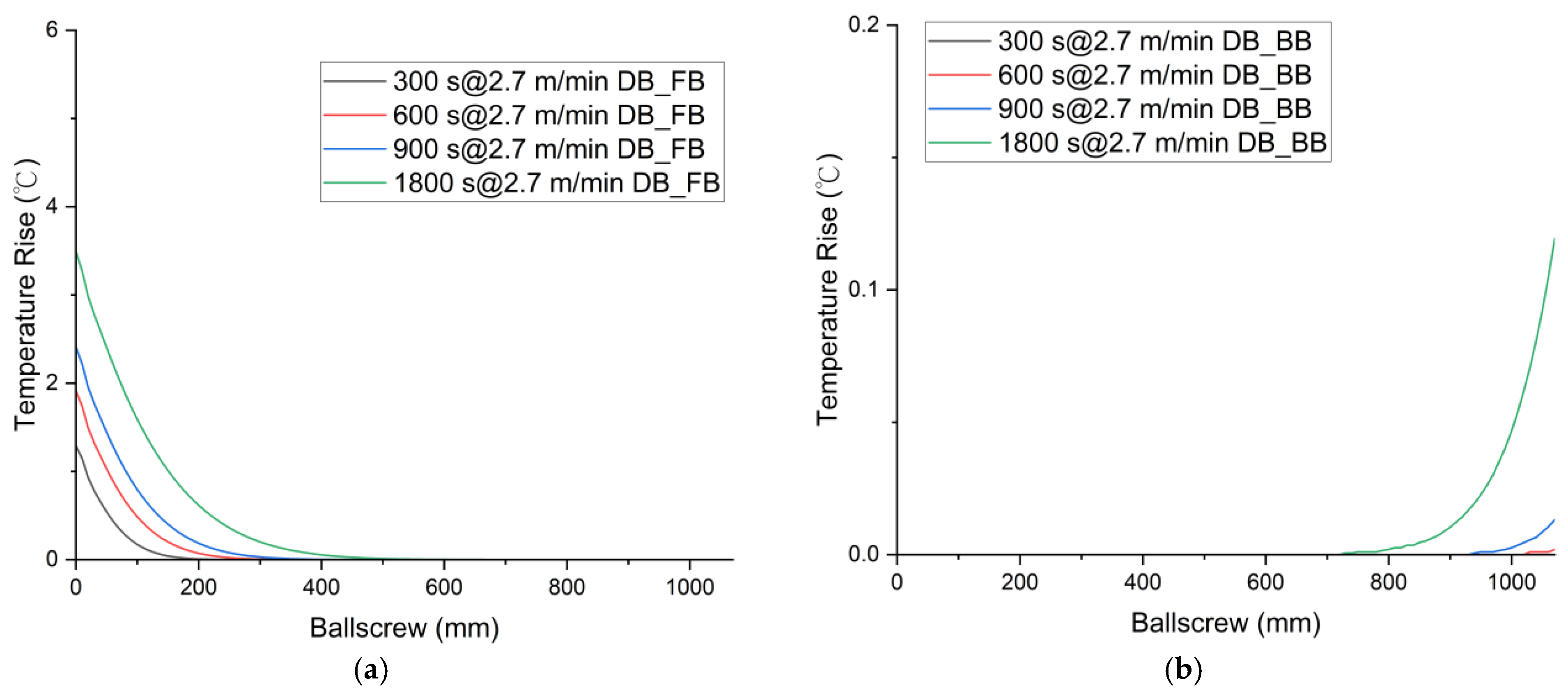
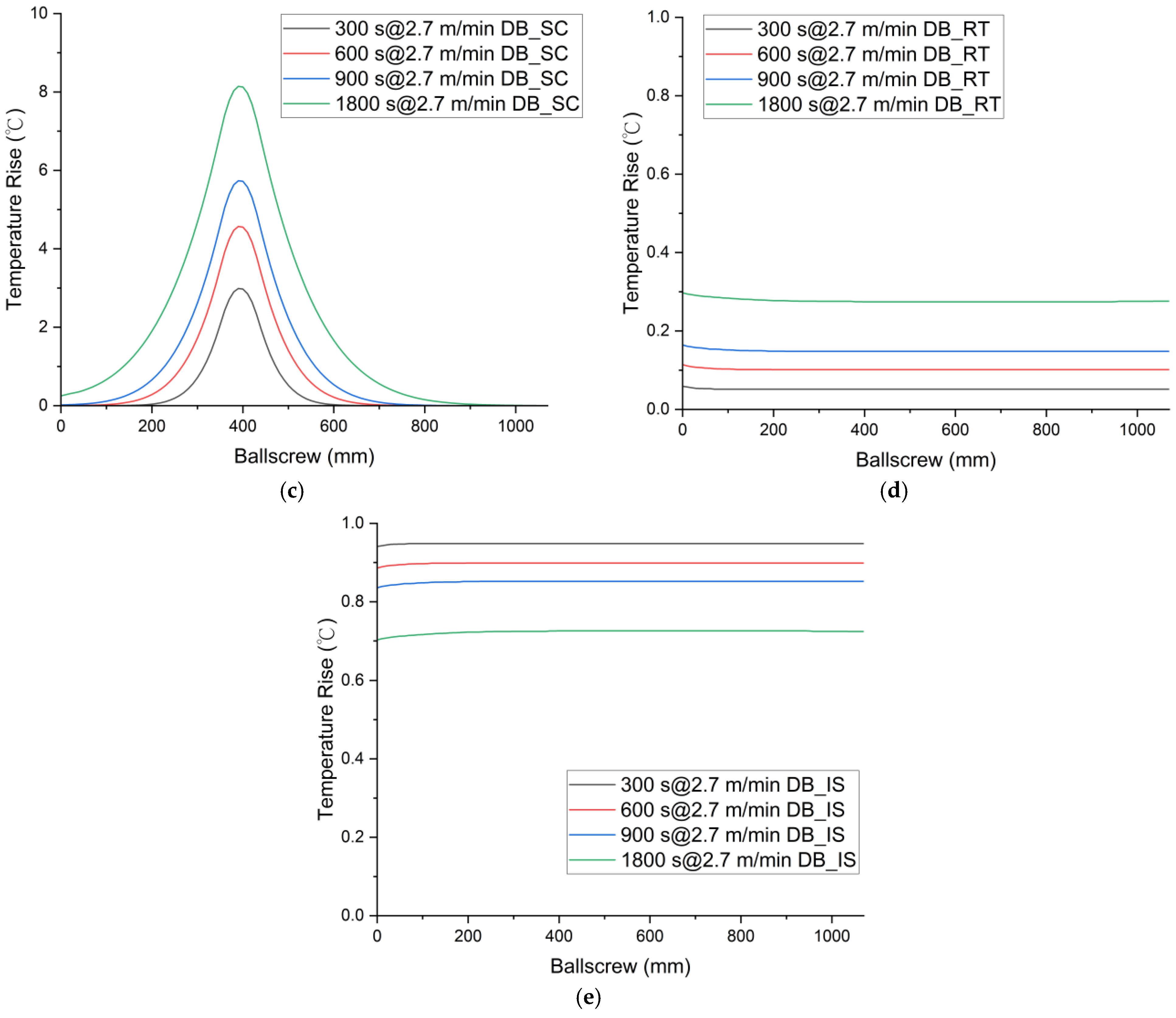
Under the 107 boundary conditions corresponding to the four previously mentioned feed rates, the screw temperature rise calculated by the FEM model was stored and compiled into the FDSM database, as indicated in Table 4. For a feed rate of 2.7 m/min, Figure 3a–e present the screw temperature rise corresponding to the cases DB_FB, DB_BB, DB_NUT (48), and DB_RT, respectively. Here, the temperature rise of the screw is shown at t = 300 s, 600 s, and 900 s during the 1800 s simulation period. Figure 3a presents the temperature rise of the screw caused by the heating of the front bearing (DB_FB). The first element on the screw is directly heated by the front bearing, resulting in a higher temperature rise than in the other elements. This temperature rise continues over time. The heat gradually transfers toward the rear end of the screw, causing a temperature rise in other regions. Figure 3b presents the temperature rise of the screw caused by the heating of the rear bearing (DB_BB). Because the rear bearing is located far from the travel range (approximately 200 mm), the temperature rise of the 108 elements from the front bearing to the end of the travel range remains close to zero during the first 900 s. Figure 3c presents the screw temperature rise when the nut provides heat (DB_NUT (38)). The temperature rise of the screw is highest within the heated region and continues to increase over time. Heat gradually transfers toward both ends, causing the temperatures at both ends of the screw to rise. Figure 3d presents the screw temperature rise under changing ambient temperature (DB_RT). In this case, the screw is heated by the surrounding air. However, because the ambient temperature influences the entire screw uniformly, the temperature rise is nearly equal across all positions at a given time. Figure 3e presents the screw temperature rise under a changing initial screw temperature (DB_IS). The screw is cooled by the ambient air; however, because the ambient temperature affects the entire screw, the temperature rise is again nearly uniform across all positions at any given time.
The database established in this study based on the FDSM includes four feed rates, each associated with 107 screw temperature rise databases. Each of these databases is a 1801 × 108 matrix, formatted as shown in Equation (4). The vertical columns represent the time axis, and the horizontal rows indicate screw element positions, that is, the temperature rise from 0 to 1800 s at 108 monitored element positions along the screw.
D B = d b 1801 × 108 = d b 0 , 1 d b 0 , 108 d b 1 , 1 d b 1 , 108 d b 1800 , 1 d b 1800 , 108

2.3.2. FDSM Superposition Rule

As indicated in Section 2.3.1, the boundary conditions used to establish the database of the ball screw feed system include the heat flux, ambient temperature, and initial screw temperature. However, under actual machining conditions, these boundary conditions often differ from those defined in the database. Accordingly, an FDSM was formulated for the ball screw feed system. Then, based on the actual boundary conditions, screw temperature rise and thermal deformation were computed using the database and superposition rules.
  • Multi-heat source superposition rule: At a constant ambient temperature, the screw temperature rise caused by the simultaneous heating of the three heat sources is equal to the sum of the screw temperature rise caused by each heat source individually (front bearing, rear bearing, and nut).
  • Heat source multiplication rule: The screw temperature rise caused by a given heat source (front bearing, rear bearing, or nut) is proportional to its heat flux. Therefore, once the screw temperature rise under the standard heat flux is known, the temperature rise under other heat fluxes can be estimated.
  • Ambient temperature change rule: The screw temperature rise due to both the heat source and ambient temperature variation can be decomposed into the sum of the screw temperature rise caused solely by the heat source and that caused solely by the ambient temperature change.
  • Ambient temperature scaling rule: The screw temperature rise caused by an ambient temperature change of k °C is equal to k times the screw temperature rise caused by a 1 °C ambient temperature change. Therefore, when compiling DB_RT, only the result for a 1 °C change needs to be obtained.
  • Initial screw temperature change rule: The screw temperature rise due to both the heat source and initial screw temperature change can be decomposed into the sum of the screw temperature rise caused solely by the heat source and that caused solely by the change in initial screw temperature. This also follows the heat source scaling rule.
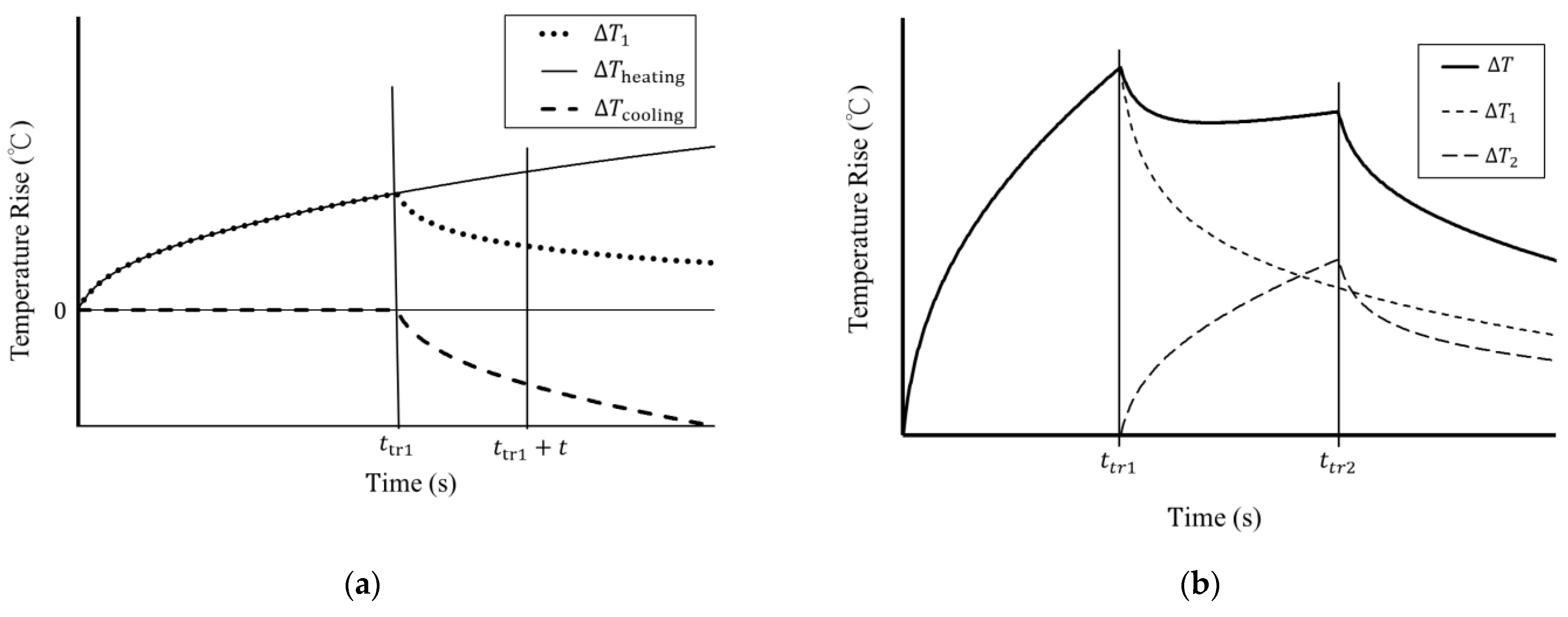
  • Operating condition cooling rule: As illustrated in Figure 4a, if an operating condition ends at time (ttr1) s, the screw temperature rise at time (ttr1 + t) s, denoted ∆T1, can be expressed as the sum of two components: (1) the screw temperature rise ∆Theating(ttr1 + t) that would result from continued heating with the same heat flux and (2) the screw cooling ∆Tcooling due to the cessation of heat input. Here, ∆Tcooling is defined by multiplying the heating function ∆Theating by −1 and applying a time-shift of ttr1 s (∆Tcooling (t > ttr1) = −∆Theating(t)). Therefore, when t > ttr1, the screw temperature rise satisfies ∆T1(ttr1 + t) = ∆Theating(ttr1 + t) − ∆Theating(t).
  • Operating condition’s superposition rule: As illustrated in Figure 4b, when a composite operating condition comprises a sequential combination of two single operating conditions, A and B, the total screw temperature rise ∆T is equal to the sum of the screw temperature rise ∆T1 caused by condition A and the screw temperature rise ∆T2 caused by condition B.

2.3.3. Application of the FDSM Under a Single Operating Condition

This section presents the calculation procedure for applying the FDSM under a single operating condition. In this context, a single operating condition refers to the nut performing reciprocating motion at a constant feed rate and travel length. Table 5 lists the typical boundary conditions for such a setting: heat flux from the front bearing ( q ˙ F B ), heat flux from the rear bearing ( q ˙ B B ), heat flux transferred from the nut to each heated unit p on the screw ( q ˙ N U T , p ), ambient temperature (AT), and initial screw temperature (IT). The computational steps of the FDSM are as follows:
Step 1.
Select the screw temperature rise dataset corresponding to the given feed rate.
Step 2.
From the selected screw temperature rise database, retrieve the datasets corresponding to the three primary heat sources in the ball screw feed system: front bearing heating alone (DB_FB), rear bearing heating alone (DB_BB), and nut heating alone (DB_NUT). Based on the actual heat flux values, calculate the screw temperature rise produced by each heat source individually using the heat source multiplication rule. Then, apply the multi-heat source superposition rule to obtain the combined screw temperature rise under the simultaneous heating of all sources, as expressed by the following equation:
T e m I n H e a t i n g = D B _ F B × q ˙ F B q ˙ s , F B + D B _ B B × q ˙ B B q ˙ s , B B + D B _ N U T p × q ˙ N U T , p q ˙ s , N U T ,
where TemInHeating represents the screw temperature rise resulting from the simultaneous action of the three heat sources; q ˙ s , F B and q ˙ s , B B denote the standard heat fluxes of the front and rear bearings, respectively; and p ranges from 1 to 103, corresponding to the 1st through the 103rd heated units in the travel range. If p lies within the nut’s travel range, q ˙ N U T , p denotes the heat flux received by heated unit p; otherwise, the heat flux for that unit is zero. q ˙ s , N U T denotes the standard heat flux generated by the nut. The first term on the right-hand side of the equation corresponds to the screw temperature rise caused solely by the front bearing under the standard heat flux (DB_FB). Using the heat source multiplication rule, the actual screw temperature rise attributed to the front bearing is obtained. The second and third terms represent the screw temperature rises caused solely by the rear bearing and nut, respectively. Applying the multi-heat source superposition rule, these individual contributions are summed to yield the screw temperature rise resulting from the combined action of all three heat sources.
Step 3.
Calculate the screw temperature rise resulting from deviations in the initial screw temperature and ambient temperature relative to the standard temperature. Specifically, compare the initial screw temperature, IT, and ambient temperature, AT, with the standard temperature, T s t d , and calculate the resulting screw temperature rise using Equations (6) and (7)
  • When IT differs from Tstd, the resulting screw temperature rise, TemInCint, is obtained using
    T e m I n C i n t = D B _ I S × I T T s t d .
  • When AT differs from Tstd, the resulting screw temperature rise, TemInRTC, is obtained using
T e m I n R T C = D B _ R T × A T T s t d .
Here, DB_IS is the screw temperature rise dataset associated with surges in the initial screw temperature in the absence of any heat source, and DB_RT is the dataset associated with changes in ambient temperature under the same condition. Both datasets are selected according to the actual operating condition.
Step 4.
To compute the screw temperature at different locations, TemFinal, add the screw temperature rise caused by the simultaneous heating of the front bearing, rear bearing, and nut (TemInHeating); rise caused by the difference between the initial screw temperature and standard temperature (TemInCint); rise caused by the difference between the ambient temperature and standard temperature (TemInRTC); and standard temperature, Tstd, as indicated in Equation (8). Further, as indicated in Equation (9) obtain TemInFinal, which is the screw temperature rise at different locations, by subtracting the initial screw temperature, IT, from TemFinal.
T e m F i n a l = T e m I n H e a t i n g + T e m I n C i n t + T e m I n R T C + T s t d
T e m I n F i n a l = T e m F i n a l I T
Step 5.
Use the screw temperature rise obtained from the FDSM to calculate the screw’s thermal deformation. Given that the feed system employs a fixed support bearing arrangement, the deformation accumulates along the travel direction toward the support end. Accordingly, compute the thermal deformation using Equation (10), where x denotes the element number (the position relative to the screw’s absolute origin); α denotes the coefficient of linear thermal expansion for the screw (CLTE = 1.16 × 10⁻⁵ 1/°C), and ∆L is the length of one screw element (10 mm = 10,000 μm).
E x , t = E x 1 , t + α × T e m I n F i n a l x 1 , t × L

2.3.4. Application of the FDSM Under Composite Operating Conditions

This section presents the calculation procedure for applying the FDSM to composite operating conditions. These conditions refer to combinations of distinct individual operating conditions. An example involving two individual operating conditions is used for illustration here, although the same procedure applies when more than two conditions are present. Table 6 summarizes this composite operating condition. The ambient temperature and initial screw temperature are denoted as AT and IT, respectively. The time period t = 0–ttr1 s corresponds to the first individual operating condition. Under this condition, the front bearing heat flux is denoted as q ˙ F B , 1 , rear bearing heat flux is represented as q ˙ B B , 1 , and nut heat flux transferred to heated units p along the screw is denoted as q ˙ N U T , p , 1 . Further, during the interval t = ttr1ttr2 s, the system operates under the second single operating condition. Under this condition, the front bearing heat flux is denoted as q ˙ F B , 2 , rear bearing heat flux is represented as q ˙ B B , 2 , and nut heat flux transferred to heated units p along the screw is denoted as q ˙ N U T , p , 2 Based on these definitions, the screw temperature rise caused by each single operating condition is summed using the superposition rule to obtain the screw temperature and temperature rise under the complete composite operating condition. The calculation procedure is organized into three subsections: Section Screw Temperature and Temperature Rise Calculation for the First Single Operating Condition presents the steps for computing the screw temperature rise and temperature under the first single operating condition (Steps 1–5); and Section Screw Temperature and Temperature Rise Calculation for the Second Single Operating Condition presents the corresponding steps for the second single operating condition (Steps 6–10); and Section Steps for Calculating the Temperature Rise and Conversion into Thermal Error Under Composite Operating Condition covers the conversion of the composite condition’s temperature rise into thermal error (Steps 11–12).
Screw Temperature and Temperature Rise Calculation for the First Single Operating Condition
Step 1.
Select the screw temperature rise dataset corresponding to the feed rate of the first single operating condition.
Step 2.
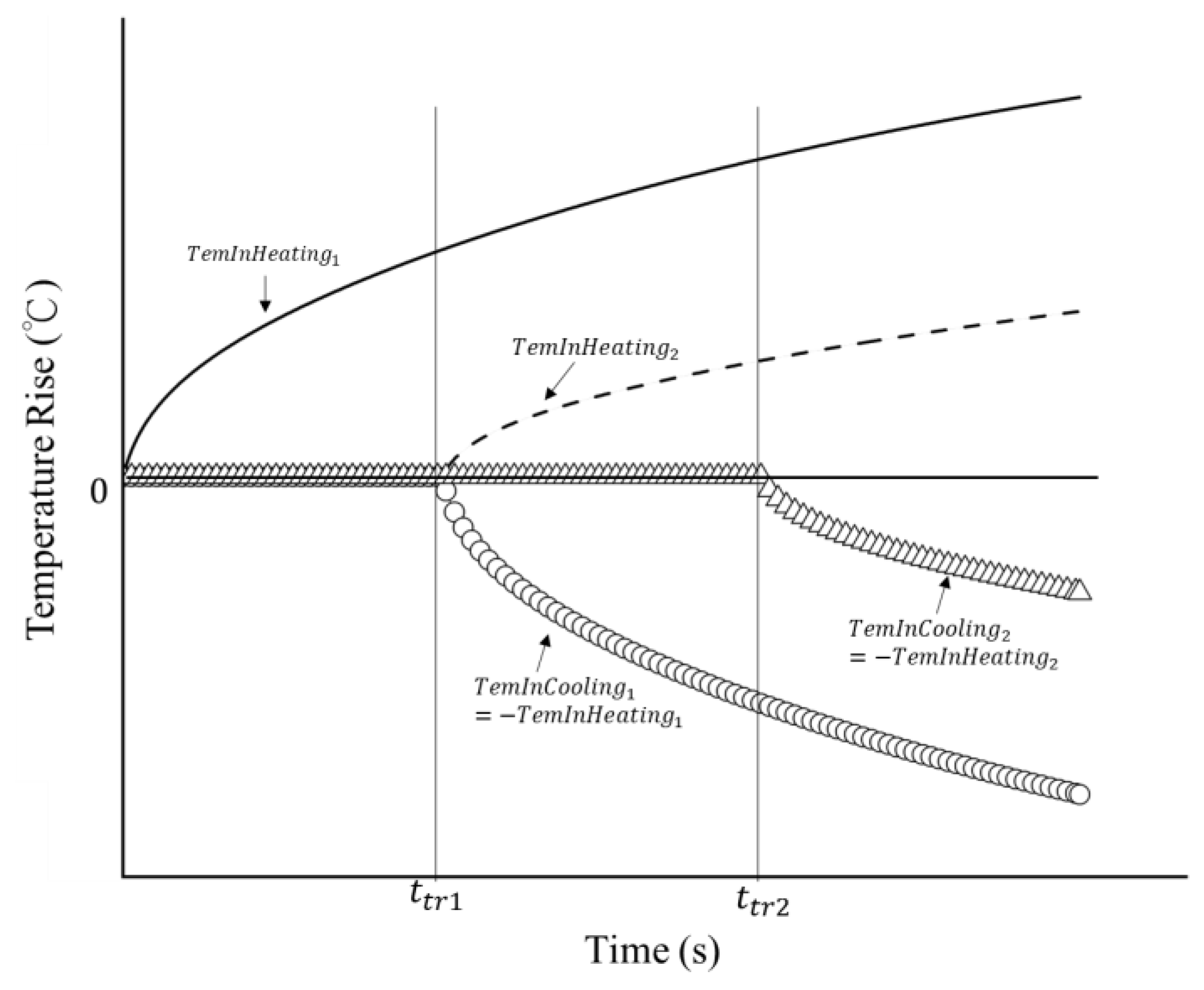
Calculate the screw temperature rise caused by the simultaneous heating of the three heat sources under the first single operating condition (TemInHeating1), using the method described in Step 2 of Section 2.3.3. The graph in Figure 5 illustrates the temperature rise and cooling behavior under the influence of the three heat sources (TemInHeating1) in the composite operating condition. The screw temperature rise resulting from the onset of heating under the first single operating condition is represented by the following equation.
T e m I n H e a t i n g 1 = D B _ F B 1 × q ˙ F B , 1 q ˙ s , F B + D B _ B B 1 × q ˙ B B , 1 q ˙ s , B B + D B _ N U T 1 ( p ) × q ˙ N U T , p , 1 q ˙ s , N U T .
Here, DB_FB1 is the database corresponding to the screw temperature rise caused by front bearing heating under the first single operating condition; DB_BB1 is the database corresponding to the screw temperature rise caused by rear bearing heating under the first single operating condition; and DB_NUT1(p) denotes the screw temperature rise database for each heated unit p under nut heating alone, selected based on the first single operating condition.
Step 3.
Calculate the cooling of the screw after the first single operating condition stops (t > ttr1) using the procedure described in Section 2.3.2 (Operating Condition Cooling Rule). In Figure 5, TemInCooling1 represents the screw temperature reduction caused by the termination of the first single operating condition. Apply Equation (12) to determine the temperature drop: when 0 < t < ttr1, no cooling occurs. Conversely, when t > ttr1, cooling begins.
T e m I n C o o l i n g 1 0 < t < t t r 1 = 0 ; T e m I n C o o l i n g 1 t > t t r 1 = T e m I n H e a t i n g 1
Step 4.
Calculate the screw temperature rise resulting from the differences between the initial screw temperature, IT, and the ambient temperature, AT, each relative to the standard temperature, Tstd, as indicated in Equations (13) and (14).
  • Calculate TemInCint, defined as the screw temperature rise due to the difference between IT and Tstd, using
T e m I n C i n t = D B _ I S 1 × I T T s t d .
  • Similarly, calculate TemInRTC, defined as the screw temperature rise due to the difference between AT and Tstd, using
T e m I n R T C = D B _ R T 1 × A T T s t d .
Here, DB_IS1 is the screw temperature rise database corresponding to changes in initial screw temperature without any heat source, selected based on the first single operating condition. Likewise, DB_RT1 is the screw temperature rise database corresponding to changes in ambient temperature without any heat source, also selected based on the first single operating condition.
Step 5.
To compute the screw temperature under the first single operating condition, TemCombine1, add the screw temperature rise caused by the simultaneous heating of the front bearing, rear bearing, and nut (TemInHeating1); cooling resulting from the termination of the first operating condition (TemInCooling1); rise caused by the difference between the initial screw temperature and standard temperature (TemInCint); rise caused by the difference between the ambient temperature and standard temperature (TemInRTC); and standard temperature, Tstd, as indicated in Equation (15):
T e m C o m b i n e 1 = T e m I n H e a t i n g 1 + T e m I n C o o l i n g 1 + T e m I n C i n t + T e m I n R T C + T s t d
Screw Temperature and Temperature Rise Calculation for the Second Single Operating Condition
If the composite operating condition includes two or more single operating conditions, repeat Steps 6–10 for each one until the screw temperature rise caused by all single operating conditions is calculated.
Step 6.
Select the screw temperature rise dataset corresponding to the feed rate of the second single operating condition.
Step 7.
Compute the screw temperature rise, TemInHeating2, resulting from the simultaneous heating of the front bearing, rear bearing, and nut in the second single operating condition. Use Equation (16) for the calculation and refer to Figure 5 for the corresponding thermal behavior. For 0 < t < ttr1, TemInHeating2 is zero. Conversely, for t > ttr1, apply the method described in Step 2.
T e m I n H e a t i n g 2 0 < t < t t r 1 = 0 ; T e m I n H e a t i n g 2 ( t t t r 1 ) = D B _ F B 2 × q ˙ F B , 2 q ˙ s , F B + D B _ B B 2 × q ˙ B B , 2 q ˙ s , B B + D B _ N U T 2 ( p ) × q ˙ N U T , p , 2 q ˙ s , N U T
Here, DB_FB2 refers to the screw temperature rise database corresponding to front bearing heating alone, selected based on the second single operating condition. DB_BB2 refers to the screw temperature rise database corresponding to rear bearing heating alone, also selected based on the second single operating condition. DB_NUT2(p) denotes the screw temperature rise database for each heated unit p under nut heating alone, selected based on the second single operating condition.
Step 8.
Calculate the cooling of the screw caused by the termination of the second single operating condition (t > ttr2) using Equation (17). Figure 5 illustrates the relationship between screw temperature rise and drop under the two single operating conditions. Here, TemInCooling2 represents the temperature drop caused by heat dissipation from the three heat sources in the second operating condition.
T e m I n C o o l i n g 2 0 < t < t t r 1 = 0 ; T e m I n C o o l i n g 2 t > t t r 2 = T e m I n H e a t i n g 2
Step 9.
Add the screw temperature under the first operating condition (TemCombine1), temperature rise under the second operating condition (TemInHeating2), and cooling resulting from its termination (TemInCooling2), as indicated in Equation (18):
T e m C o m b i n e 2 = T e m C o m b i n e 1 + T e m I n H e a t i n g 2 + T e m I n C o o l i n g 2 .
Step 10.
The compensation clarifies the adjustment for the changes in the temperature difference between the screw and the ambient temperatures, as well as the change in the forced convection value resulting from different feed rates. The feed rate increases, the forced convection coefficient rises, enabling faster heat dissipation from the screw. Consequently, the screw temperature rise decreases, and the compensation value becomes negative. Conversely, if the feed rate decreases, the compensation value becomes positive. Use Equation (19) to calculate the compensation value.
T e m I n W C C 2 0 < t < t t r 1 = 0 ; T e m I n W C C 2 t > t t r 1 = D B _ R T 1 D B _ R T 2 × T e m C o m b i n e 2 ( t = t t r 1 ) A T .
Here, D B _ R T 1 denotes the screw temperature rise dataset corresponding to ambient temperature variation without a heat source selected under the first single operating condition. D B _ R T 2 is defined similarly for the second single operating condition. Further, TemCombine2 (t = ttr1) denotes the screw element temperature at the transition point between the first and second operating conditions.
Steps for Calculating the Temperature Rise and Conversion into Thermal Error Under Composite Operating Condition
Step 11.
Compute the final screw temperature, TemFinal, by summing the results of E q u a t i o n s 18   a n d   19 , which represent the cumulative screw temperature and the feed-rate-related compensation, respectively, as shown in Equation (20). Further, determine the screw temperature rise at different positions, TemInFinal, by subtracting the initial screw temperature, IT, from TemFinal, as shown in Equation (21).
T e m F i n a l = T e m C o m b i n e 2 + T e m I n W C C 2
T e m I n F i n a l = T e m F i n a l I T
Step 12.
Use the same method as in Step 5 of Section 2.3.3 to convert TemInFinal into thermal error of the ball screw feed system.

2.4. Model Validation Metrics

To quantitatively evaluate the accuracy of the proposed FDSM model, comparative analyses were conducted against both FEM simulation results and experimental data, focusing on temperature rise and thermal error characteristics. The Root Mean Square Error (RMSE) was employed as the primary evaluation metric, defined as follows:
R M S E = 1 N i = 1 N X F D S M , i X r e f , i 2
where N is the number of sampling points; X F D S M , i represents the predicted value from the FDSM model, and X r e f , i denotes the reference value. In this study, X r e f , i refers to the temperature rise (∆T) at specific nodes or the thermal error (E) along the travel ranges.

3. Results

We used the FEM to compute the screw temperature rise and the FDSM to compute the screw thermal error. Because the duration of all operating conditions was 900 s, the screw temperature rise and thermal error were calculated only for the 0–900 s interval. The simplified operating condition used in the experiment is listed in Table 3, with a feed rate of 2.7 m/min and heating applied in the 170–250 mm region relative to the travel origin. The ambient temperature was 26 °C, and the initial screw temperature was 25 °C. For the computational method of the FDSM under a single operating condition, refer to Section 2.3.3.
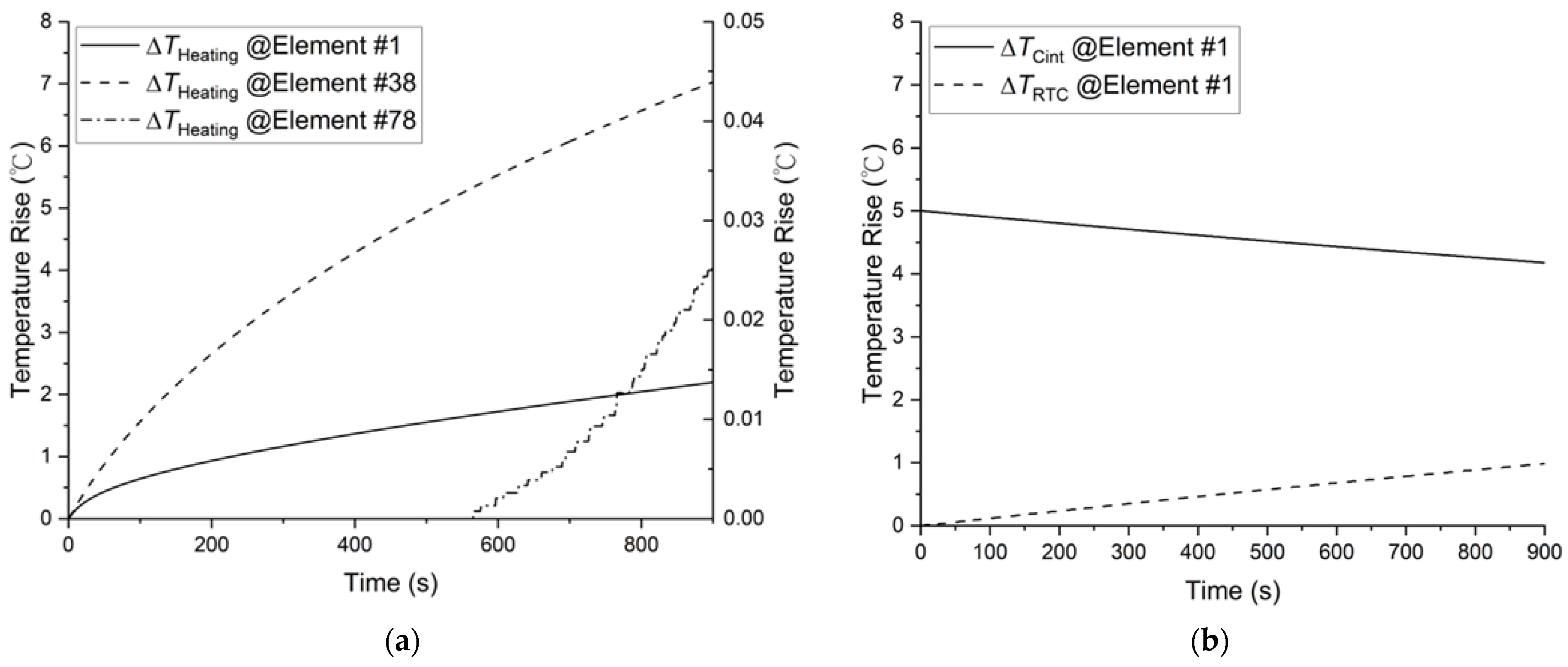
Based on Step 1, Select the screw temperature rise dataset corresponding to the feed rate of 2.7 m/min; Based on Step 2, calculate the screw temperature rise resulting from the individual heating of the three heat sources, and sum the results to obtain the screw temperature rise produced by their simultaneous heating, as illustrated in Figure 6a. The figure shows the screw temperature rise at different positions (Element #1, #48, and #78) over the 0–900 s interval under simplified operating conditions. The solid line represents the temperature rise at the first element position on the screw, corresponding to the 180 mm location along the travel range, caused by the simultaneous heating of the three heat sources. This temperature rise is primarily influenced by the heating of the front bearing, making it the second highest among the three measured positions. The dashed line represents the temperature rise at the 38th element position on the screw, corresponding to the 200 mm location along the travel range, caused by the simultaneous heating of the three heat sources. This position lies within the nut coverage area, resulting in the highest screw temperature rise among the three elements. The chain line represents the temperature rise at the 78th element position on the screw, corresponding to the 600 mm location along the travel range, under simultaneous heating by the three major heat sources. This position is far from all major heat sources; therefore, the screw temperature rise at this element remains nearly zero over the first 900 s.
Based on Step 3, calculate the screw temperature rise caused by the differences between the initial screw temperature and the ambient temperature, each relative to the standard temperature, as shown in Figure 6b. Under a simplified operating condition, the screw temperature rise caused by the deviation of the initial screw temperature and ambient temperature from the standard temperature is calculated over the 0–900 s interval. The solid line represents the screw temperature rise resulting from the difference between the initial screw temperature and the standard temperature. Since the initial screw temperature is higher than the standard temperature, the screw gradually cools. The dashed line represents the screw temperature rise resulting from the difference between the ambient temperature and the standard temperature. Since the ambient temperature is higher than the standard temperature, it gradually heats the screw, causing the screw temperature to increase.
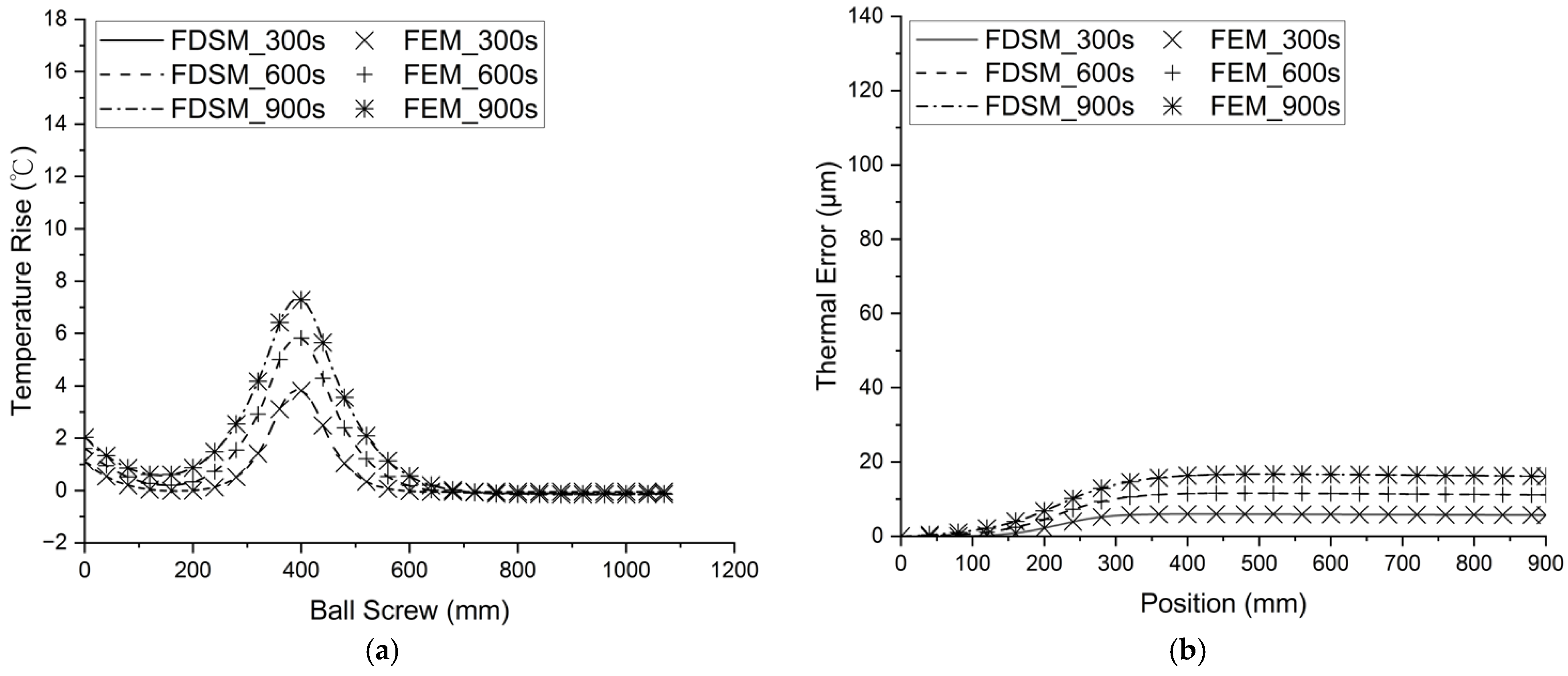
Based on Step 4 and Step 5, calculate the screw temperature rise and thermal error, as illustrated in Figure 7a,b. Here, FDSM denotes the screw temperature rise and thermal error calculated by the FDSM at three time points (300 s, 600 s, and 900 s), and FEM denotes the screw temperature rise and thermal error calculated by the FEM at the same time points. As shown in Figure 7a, the maximum temperature rise occurs around the 400 mm mark. This is because the nut’s travel range in this case was set between 170 mm and 250 mm in travel coordinates, which corresponds to the absolute physical positions of 350 mm to 430 mm (including the 180 mm offset). The 400 mm position represents the midpoint of this active travel interval, where frictional heat from the nut is most concentrated, leading to localized heat accumulation. The results indicate that the screw temperature rise and thermal error calculated by both methods are in close agreement. At 900 s, the maximum absolute error in the screw temperature rise between the two methods is less than 0.01 °C, with an RMSE of less than 0.01 °C. Furthermore, the thermal error results presented in Figure 7b demonstrate that both the maximum absolute error and the RMSE remain below 0.1 μm. The comparison of screw temperature rise and thermal error under the simplified operating condition demonstrates the validity of applying the FDSM to a single operating condition.
To further validate the FDSM, two composite operating conditions, A and B, were defined. In addition to the screw temperature rise calculated by the FEM, the FDSM results were also validated against experimental data obtained using a laser interferometer. The calculation method for applying the FDSM to these composite operating conditions is provided in Section 2.3.4. The following presents the calculation results for composite condition A.
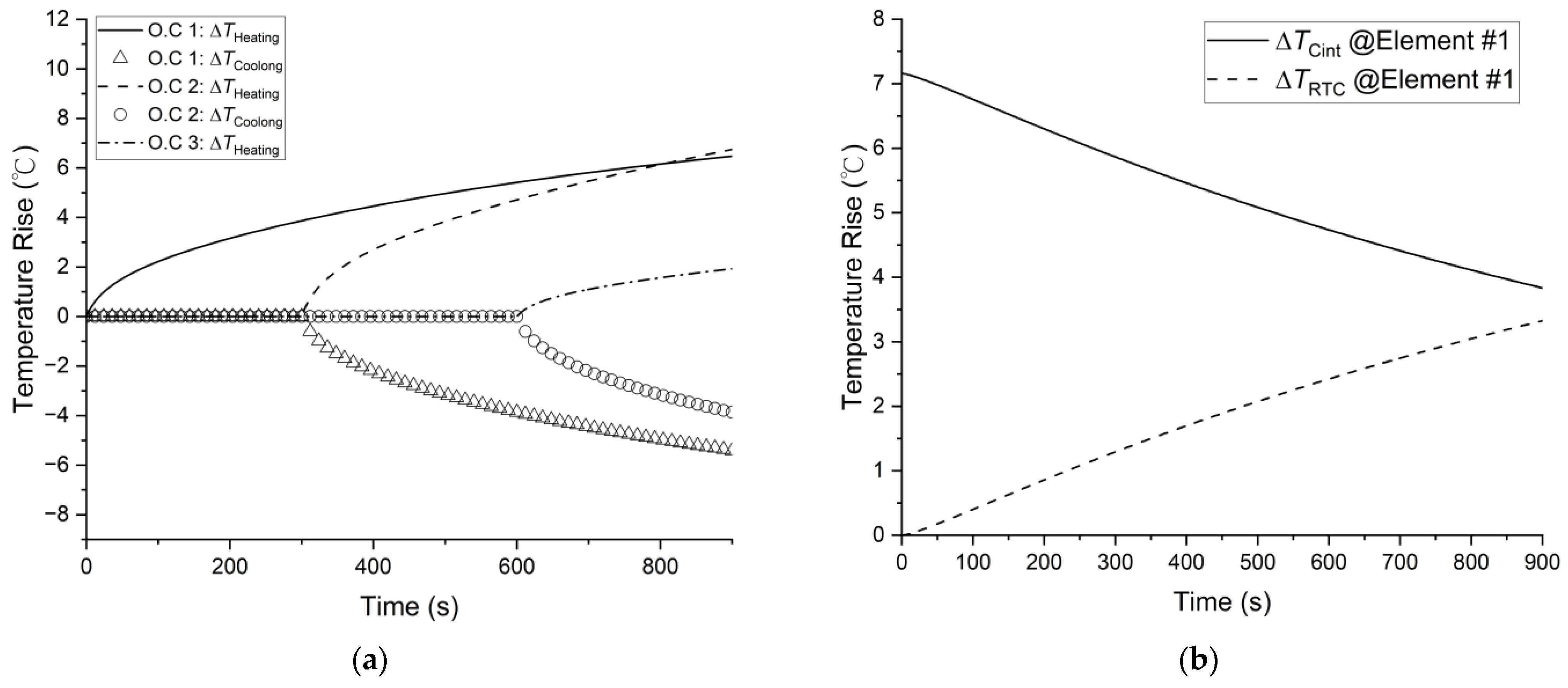
Based on Step 1, select the screw temperature rise dataset corresponding to the specified feed rate; Based on Steps 2, 3, 7, and 8, calculate the screw temperature rise caused by the heating of the three heat sources under the composite operating conditions, as shown in Figure 8a. In particular, this figure presents the screw temperature rise resulting from the simultaneous heating of the three heat sources, as well as the screw cooling that occurs following the cessation of heating. The results correspond to the first screw element over the 0–900 s interval under composite operating condition A. The solid line represents the screw temperature rise caused by the simultaneous heating of the three heat sources in the first operating condition. The triangles indicate the screw cooling that follows the cessation of heating in the first operating condition. The dashed line represents the screw temperature rise in the second operating condition, while the circles indicate the subsequent screw cooling. The chain line represents the screw temperature rise caused by the simultaneous heating of the three heat sources in the third operating condition.
Based on Step 4, calculate the screw temperature rise caused by the deviation of the initial screw temperature and ambient temperature from the standard temperature, as depicted in Figure 8b. The temperature rise is evaluated for the first screw element over the 0–900 s interval in composite operating condition A. This temperature rise proceeds more rapidly in composite operating condition A because its feed rate is higher than that in the simplified operating condition (as depicted in Figure 6b). Consequently, both the heating and cooling of the screw proceed more quickly.
Based on Step 10, calculate the screw temperature rise compensation resulting from changes in the relationship between screw temperature and ambient temperature caused by variations in feed rate, as shown in Figure 9a. The circular markers in Figure 9a represent the screw temperature rise compensation value for the third single operating condition resulting from the change in feed rate. Because the feed rate of the second single operating condition matches that of the first, the compensation value is zero and is thus omitted from the plot for clarity. However, because the feed rate in the third single operating condition is lower than in the second, the screw dissipates heat more slowly, resulting in a higher temperature rise; therefore, the compensation value becomes positive after 600 s.
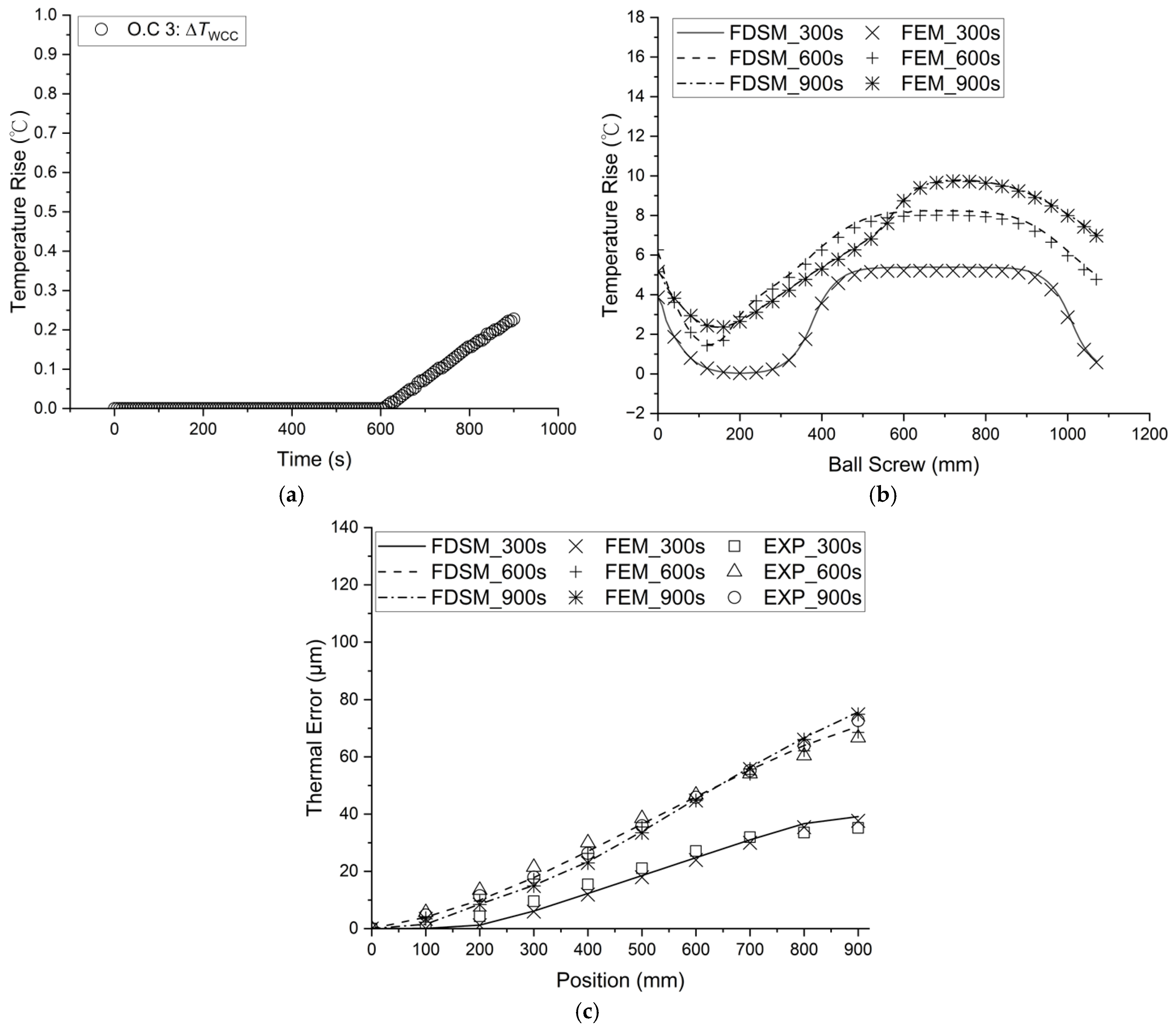
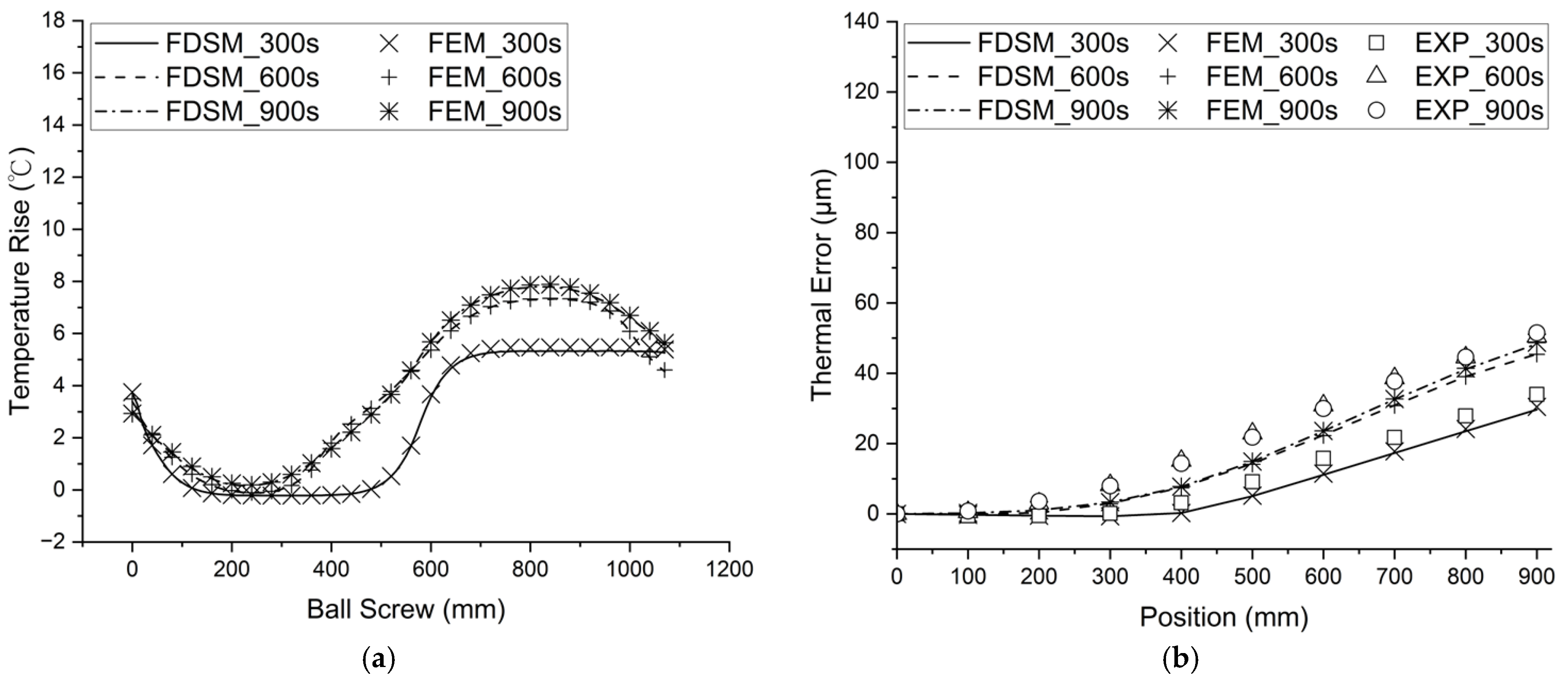
Based on Steps 11 and 12, calculate the screw temperature rise and thermal error under the full composite operating condition A, as depicted in Figure 9b. This figure compares the screw temperature rise calculated by the FDSM and by an FEM at three time points. Specifically, at 300 s, the temperature rise is highest at the heat sources, namely the front bearing (0 mm) and the primary heating zone of the nut (380–1006 mm). As heat conducts outward from these sources, the temperature decreases with distance. The 200 mm mark represents a thermal transition zone situated between the front bearing and the nut’s travel range; being the furthest from both active heat sources, it exhibits the lowest temperature rise before the curve rises again toward the nut. At 900 s, the maximum absolute error is 0.1 °C with an RMSE of less than 0.1 °C, which is considered small. Further, Figure 9c compares the thermal error from the FDSM, FEM, and experimental measurement (EXP) at the same time points. The maximum absolute error between the FDSM and FEM results occurs at 600 s, with a value of 2.0 μm and an RMSE of 1.2 μm. Meanwhile, the maximum absolute error between the FDSM result and experimental measurement also occurs at 600 s, with a value of 4.0 μm and an RMSE of 2.7 μm.
Composite condition B is a single operating condition involving three nuts, each with the same travel length but different travel ranges. Given that the calculation process is the same as that for composite condition A, intermediate steps are not described in detail. The screw temperature rise results for composite condition B are illustrated in Figure 10a, which compares the values calculated by the FDSM and FEM at three time points. The results indicate that the values from both methods are in close agreement, with a maximum absolute error of 0.2 °C and an RMSE of 0.1 °C. Further, Figure 10b compares the thermal error from the FDSM, the FEM, and the EXP at the same time points. The maximum absolute error between the FDSM and FEM results occurs at 300 s, with a value of 1.0 μm and an RMSE of 0.4 μm. Meanwhile, the maximum absolute error between the FDSM result and experimental measurement also occurs at 600 s, with a value of 8.5 μm and an RMSE of 6.0 μm. The calculation results of FEM and FDSM show a small error between them, but a larger error when compared to the experimental results. The main reason for this larger error is that the method used in this study for calculating the nut’s heat flux is relatively simple and may differ from the actual situation.
To quantitatively validate this hypothesis, a sensitivity analysis was performed for composite condition B. By perturbing the heat flux of the nut, front bearing, and rear bearing by +10% relative to the base case, the dominant thermal factors were identified (Table 7). The results reveal that the model is exceptionally sensitive to the heat flux generated by nut heating and the environmental thermal states. Specifically, a 10% increase in the nut’s heat flux reduced the RMSE from 6.03 to 4.32, marking a 28.33% improvement in predictive accuracy. Furthermore, the model exhibited significant sensitivity to the ambient temperature; a minor 0.5 °C deviation reduced the RMSE to 4.12, resulting in a 31.67% improvement. In contrast, the heat fluxes from the front and rear bearings exhibited minimal influence, with RMSE variations of only 1.67% and 0.00%, respectively. This sensitivity test confirms that the accuracy of the nut’s heat flux model, combined with precise environmental and initial thermal boundary conditions, are the decisive factors in minimizing the error between numerical simulations and experimental results.
To provide a concrete baseline for the computational efficiency, the reference FEM simulation was performed on a high-performance workstation equipped with a 48-core CPU and 96 GB of RAM. For a 900 s simulation interval, the FEM model required approximately 2 to 4 h to reach a converged solution. In contrast, the proposed FDSM completed the calculation in under 2 s on the same hardware, representing a 3600- to 7200-fold acceleration. This significant reduction in computation time clarifies the speed-up factor and demonstrates the suitability of the FDSM for real-time applications.

4. Summary and Conclusions

This study proposes a method for calculating the temperature rise and thermal deformation of the ball screw feed system based on a superposition approach. It separately considers the boundary conditions affecting the screw temperature rise of the ball screw feed system. These include the contributions from independent front bearing heating, independent rear bearing heating, and nut heating applied to individual heated units within the travel range. The nut heating range is divided into 103 heated units, each 10 mm long. Additional boundary conditions account for the temperature difference between the ambient temperature and the standard temperature and between the initial screw temperature and the standard temperature. An FEM model was used to generate screw temperature rise data under 107 distinct boundary conditions. These data were compiled into a screw temperature rise database corresponding to each feed speed. Four feed speeds were planned, resulting in four screw temperature rise databases. For each case, the appropriate database was selected, and calculations were performed using the proposed method and superposition rules. The results were obtained in under 2 s for all three operating conditions representing an approximately 3600- to 7200-fold reduction in calculation time compared to the 2–4 h required by the FEM and closely matched the results calculated using the FEM. This significant acceleration transforms thermal error prediction from a pre-process planning tool into a real-time computational sub-task that can be executed between machine cycles, enabling dynamic compensation strategies that adapt to varying load conditions.
Under simple operating conditions, the maximum absolute error and the RMSE of the thermal error calculated by the FDSM and FEM are both less than 0.1 μm, indicating excellent agreement between the two methods. For composite operating condition A, the maximum absolute error between the thermal errors calculated by the FDSM and the FEM occurs at t = 600 s, reaching 2.0 μm with an RMSE of 1.2 μm. The corresponding error between the FDSM prediction and the experimental result also occurs at t = 600 s, with a maximum absolute error of 4.0 μm and an RMSE of 2.7 μm. For composite operating condition B, the maximum absolute error between the FDSM and FEM calculations occurs at t = 300 s, reaching 1.0 μm with an RMSE of 0.4 μm. At the same time point, the maximum absolute error between the FDSM prediction and the experimental result reaches 8.5 μm, with an RMSE of 6.0 μm.
To evaluate the limits of the proposed model and identify the root cause of this discrepancy, a comprehensive sensitivity analysis was conducted on composite condition B (Table 7). The results reveal that the model is exceptionally sensitive to the ambient temperature and the nut heat flux. Specifically, a minor 0.5 °C deviation in the ambient temperature reduced the RMSE from 6.03 to 4.12 μm (a 31.67% improvement), while a 10% adjustment in the nut heat flux led to a 28.33% improvement. In contrast, the heat fluxes from the bearings showed negligible influence. These findings confirm that the simplified nut heat flux calculation and the precise setting of environmental and initial thermal boundary conditions are the decisive factors in minimizing the gap between numerical simulations and experimental reality.
Regarding the scalability of the proposed method, the underlying superposition laws remain applicable even when the screw length, diameter, or material changes. In such cases, only the database needs to be reconstructed via the established automated FEM process, while the core computational framework remains identical. Furthermore, while this study considers the screw’s free thermal expansion, different bearing configurations can be accommodated. For a “fixed-fixed” arrangement, the total thermal error can be determined by calculating the independent free expansion of the screw and the saddle, and then applying an elastic deformation model derived from the system’s structural stiffness.
The FDSM proposed in this study provides results comparable to those of the FEM with significantly reduced computation time. To handle the 2 s computation delay in practical applications without affecting machining precision, an IPC-CNC Hybrid Architecture is utilized. The expected latency for data acquisition, FDSM calculation, and uploading to the controller is estimated at approximately 3–5 s. In this configuration, the FDSM resides on an Industrial PC (IPC) to retrieve feed axis RPM and nut position from the CNC controller via high-speed Ethernet (e.g., FANUC FOCAS API). Instead of sending a single compensation value, the IPC generates a predictive thermal error array for future time steps and writes it into the CNC’s Custom Macro Variables. A background Macro Program within the CNC then performs real-time linear interpolation at a 1 s cycle, writing the result directly to the External Work Shift for immediate compensation. This system also supports online updating of boundary conditions by dynamically tracking heat generation rates and nut positions. To maintain operational continuity, a new FDSM calculation is triggered only when a change in speed or travel range is detected, ensuring that the transient thermal history is accurately preserved.

Author Contributions

Conceptualization, J.-H.H., A.-S.Y., Y.-C.H. and W.-H.H.; methodology, J.-H.H., A.-S.Y., Y.-C.H. and W.-H.H.; software, J.-H.H., A.-S.Y. and W.-H.H.; validation, J.-H.H., A.-S.Y. and W.-H.H.; formal analysis, J.-H.H., A.-S.Y. and W.-H.H.; investigation, J.-H.H., A.-S.Y., Y.-C.H. and W.-H.H.; resources, A.-S.Y., Y.-C.H. and W.-H.H.; data curation, J.-H.H., A.-S.Y. and W.-H.H.; writing—original draft preparation, J.-H.H., A.-S.Y. and W.-H.H.; writing—review and editing, J.-H.H., A.-S.Y., Y.-C.H. and W.-H.H.; visualization, J.-H.H., A.-S.Y. and W.-H.H.; supervision, A.-S.Y., Y.-C.H. and W.-H.H.; project administration, A.-S.Y., Y.-C.H. and W.-H.H.; funding acquisition, A.-S.Y., Y.-C.H. and W.-H.H. All authors have read and agreed to the published version of the manuscript.

Funding

This research was funded by the Ministry of Economic Affairs, Taiwan, under grant number 100-EC-17-A-05-S1-189.

Data Availability Statement

The raw data supporting the conclusions of this article will be made available by the authors on request.

Acknowledgments

This work was partially supported by the HIWIN Technologies Corp.

Conflicts of Interest

This research is part of a joint technology development project between National Chung Cheng University and HIWIN Technologies Corp. The funding was primarily provided by the Ministry of Economic Affairs (MOEA), Taiwan (Grant No. 100-EC-17-A-05-S1-189). The intellectual property rights resulting from this research are vested in National Chung Cheng University. The authors declare no conflicts of interest.

References

  1. Xu, Z.-Z.; Choi, C.; Liang, L.-J.; Li, D.-Y.; Lyu, S.-K. Study on a novel thermal error compensation system for high-precision ball screw feed drive (1 st report: Model, calculation and simulation). Int. J. Precis. Eng. Manuf. 2015, 16, 2005–2011. [Google Scholar] [CrossRef]
  2. Shi, H.; Jiang, C.; Yan, Z.; Tao, T.; Mei, X. Bayesian neural network–based thermal error modeling of feed drive system of CNC machine tool. Int. J. Adv. Manuf. Technol. 2020, 108, 3031–3044. [Google Scholar] [CrossRef]
  3. Li, T.-J.; Sun, T.-Y.; Zhang, Y.-M.; Zhao, C.-Y. Prediction of thermal error for feed system of machine tools based on random radial basis function neural network. Int. J. Adv. Manuf. Technol. 2021, 114, 1545–1553. [Google Scholar] [CrossRef]
  4. Liu, H.; Rao, Z.; Pang, R.; Zhang, Y. Research on Thermal Characteristics of Ball Screw Feed System Considering Nut Movement. Machines 2021, 9, 249. [Google Scholar] [CrossRef]
  5. Li, Z.-J.; Zhao, C.-Y.; Lu, Z.-C. Thermal error modeling method for ball screw feed system of CNC machine tools in x-axis. Int. J. Adv. Manuf. Technol. 2020, 106, 5383–5392. [Google Scholar] [CrossRef]
  6. Liu, J.; Ma, C.; Wang, S.; Wang, S.; Yang, B.; Shi, H. Thermal boundary condition optimization of ball screw feed drive system based on response surface analysis. Mech. Syst. Signal Process. 2019, 121, 471–495. [Google Scholar] [CrossRef]
  7. Jedrzejewski, J.; Kowal, Z.; Kwasny, W.; Winiarski, Z. Ball screw unit precise modelling with dynamics of loads and moving heat sources taken into account. J. Mach. Eng. 2019, 19, 27–41. [Google Scholar] [CrossRef]
  8. Li, Y.; Wei, W.; Su, D.; Wu, W.; Zhang, J.; Zhao, W. Thermal characteristic analysis of ball screw feed drive system based on finite difference method considering the moving heat source. Int. J. Adv. Manuf. Technol. 2020, 106, 4533–4545. [Google Scholar] [CrossRef]
  9. Xu, Z.; Liu, X.; Kim, H.; Shin, J.; Lyu, S. Thermal error forecast and performance evaluation for an air-cooling ball screw system. Int. J. Mach. Tools Manuf. 2011, 51, 605–611. [Google Scholar] [CrossRef]
  10. Zhang, J.; Li, B.; Zhou, C.; Zhao, W. Positioning error prediction and compensation of ball screw feed drive system with different mounting conditions. Proc. Inst. Mech. Eng. Part B J. Eng. Manuf. 2016, 230, 2307–2311. [Google Scholar] [CrossRef]
  11. Shi, H.; Zhang, D.; Yang, J.; Ma, C.; Mei, X.; Gong, G. Experiment-based thermal error modeling method for dual ball screw feed system of precision machine tool. Int. J. Adv. Manuf. Technol. 2016, 82, 1693–1705. [Google Scholar] [CrossRef]
  12. Lu, Q.; Zhu, D.; Wang, M.; Li, M. Digital twin-driven thermal error prediction for CNC machine tool spindle. Lubricants 2023, 11, 219. [Google Scholar] [CrossRef]
  13. Gorman, D. Free vibration analysis of cantilever plates by the method of superposition. J. Sound Vib. 1976, 49, 453–467. [Google Scholar] [CrossRef]
  14. Gorman, D.; Sharma, R. A comprehensive approach to the free vibration analysis of rectangular plates by use of the method of superposition. J. Sound Vib. 1976, 47, 126–128. [Google Scholar] [CrossRef]
  15. Koopmann, G.H.; Song, L.; Fahnline, J.B. A method for computing acoustic fields based on the principle of wave superposition. J. Acoust. Soc. Am. 1989, 86, 2433–2438. [Google Scholar] [CrossRef]
  16. Wang, L.-P.; Ayala, O.; Grabowski, W.W. Improved formulations of the superposition method. J. Atmos. Sci. 2005, 62, 1255–1266. [Google Scholar] [CrossRef]
  17. Wang, J.-C. Superposition method to investigate the thermal performance of heat sink with embedded heat pipes. Int. Commun. Heat Mass Transf. 2009, 36, 686–692. [Google Scholar] [CrossRef]
  18. Jiang, Y.; Li, E.; Zhang, X.; Wu, Q.; Yap, Y. Superposition method for the simulation of heat transfer. Int. J. Heat Mass Transf. 2018, 120, 914–922. [Google Scholar] [CrossRef]
  19. Jiang, X.; Kong, X.; He, S.; Wu, K. Modeling the superposition of residual stresses induced by cutting force and heat during the milling of thin-walled parts. J. Manuf. Process. 2021, 68, 356–370. [Google Scholar] [CrossRef]
  20. Maurya, S.N.; Li, K.-Y.; Luo, W.-J.; Kao, S.-Y. Effect of coolant temperature on the thermal compensation of a machine tool. Machines 2022, 10, 1201. [Google Scholar] [CrossRef]
  21. Rao, B.R.; Tiwari, R. Identification of the Asymmetric Transmission Error and Gear Mesh Dynamic Parameters using Full-Spectrum Responses in a Geared-Rotor System. J. Dyn. Monit. Diagn. 2024, 112–142. [Google Scholar]
  22. Koda, S.; Murata, T.; Ueda, K.; Sugita, T. Automatic compensation of thermal expansion of ball screw in machining centers. Trans. Jpn. Soc. Mech. Eng. Part C 1990, 21, 154–159. [Google Scholar] [CrossRef]
  23. Li, H.; Shin, Y.C. Integrated dynamic thermo-mechanical modeling of high speed spindles, part 1: Model development. J. Manuf. Sci. Eng. 2004, 126, 148–158. [Google Scholar] [CrossRef]
  24. Tian, R.; He, R. Solution for heating of ball screw and environmental engineering. World Manuf. Eng. Mark. 2004, 3, 65–67. [Google Scholar]
  25. Yang, A.; Cai, S.Z.; Hsieh, S.H.; Kuo, T.C.; Wang, C.C.; Wu, W.T.; Hsieh, W.H.; Hwang, Y.C. Thermal deformation estimation for a hollow ball screw feed drive system. In Proceedings of the World Congress on Engineering, London, UK, 3–5 July 2013. [Google Scholar]
  26. Yang, A.; Chai, S.; Hsu, H.; Kuo, T.; Wu, W.; Hsieh, W.; Hwang, Y. FEM-based modeling to simulate thermal deformation process for high-speed ball screw drive systems. Appl. Mech. Mater. 2014, 481, 171–179. [Google Scholar] [CrossRef]
Figure 1. Schematic of the ball screw feed system. The double red lines from the XL-80 represent the laser beams for measurement, while the thin red lines denote the sensor signal paths from the thermocouples (TC1 and TC2) to the DAQ module (NI-9213). The green lines indicate the transmission paths for the collected temperature and displacement data to the computer for FDSM calculation. Furthermore, the orange arrows represent the heat flux ( q ˙ F B , q ˙ B B   a n d   q ˙ N U T ) from the heat sources (nut and bearings), and the black arrows denote the convective heat transfer (hin and hout) on the surfaces.
Machines 14 00235 g001
Figure 2. (a) Numerical model and (b) schematic of the heated units and temperature monitoring points for each element. The double-headed arrow indicates the element length, while black and red single-headed arrows denote the locations of elements and heated unit, respectively.
Machines 14 00235 g002
Figure 3. Screw temperature rise profiles at various times in the database for a feed rate of 2.7 m/min. (a) DB_FB; (b) DB_BB; (c) DB_NUT (48); (d) DB_RT; (e) DB_IS.
Machines 14 00235 g003aMachines 14 00235 g003b
Figure 4. Calculation logic of the FDSM: (a) calculation of screw temperature rise after the operating condition terminates; (b) superposition rule for composite operating conditions.
Machines 14 00235 g004
Figure 5. Relationship between screw temperature rise and drop under the composite operating condition with combined effects from the three main heat sources.
Machines 14 00235 g005
Figure 6. Screw temperature variations under simplified operating conditions over the 0–900 s interval: (a) temperature rise at different locations (Element #1, #38, and #78) caused by the three major heat sources (∆THeating), where the left Y-axis corresponds to Element #1 and Element #38, and the right Y-axis corresponds to Element #78; (b) temperature variations for the first screw element, where ∆TCint represents the temperature rise from initial temperature deviation and ∆TRTC denotes the temperature rise from ambient temperature deviation.
Machines 14 00235 g006
Figure 7. Verification of the FDSM against the FEM under a simplified operating condition at three distinct time points: (a) comparison of screw temperature rise; (b) comparison of thermal errors.
Machines 14 00235 g007
Figure 8. Screw temperature variations for the first screw element under composite operating condition A over the 0–900 s interval: (a) Temperature rise from the simultaneous heating of the three major heat sources (∆THeating) and subsequent cooling (∆TCooling); (b) Temperature variations caused by initial screw temperature deviation (∆TCint) and ambient temperature deviation (∆TRTC).
Machines 14 00235 g008
Figure 9. Validation of the FDSM under composite operating condition A at three distinct time points: (a) Comparison of screw temperature rise between the FDSM and the FEM; (b) Comparison of thermal errors calculated by the FDSM and the FEM with experimental results; (c) Comparison of experimental and calculated thermal errors (FDSM and FEM) at three time points.
Machines 14 00235 g009
Figure 10. Validation of the FDSM under composite operating condition B at three distinct time points: (a) Comparison of screw temperature rise between the FDSM and the FEM; (b) Comparison of thermal errors calculated by the FDSM and the FEM with experimental results.
Machines 14 00235 g010
Table 1. Comparison of various thermal error modeling methods.
FDSMFEMMLCMData-Driven Models (RSM, MLRA)Data-Driven Models (NN Models)
Computational SpeedFastVery SlowFastVery FastVery Fast
AccuracyHighHighLowLowHigh
Training Data VolumeNot RequiredNot RequiredLowHighExtremely High
Difficulty/ComplexityModerateHighLowLowExtremely High
Table 2. Main component parameters of the ball screw feed drive system.
Ball Screw ShaftBall Screw Nut
Total length (mm)1715TypeFDC
Thread length (mm)1305Length (mm)143
Lead (mm)20Diameter (mm)70
BCD (mm)41.4
Outer diameter (mm)40
Inner diameter (mm)12.7Bearing
Number of turns2TypeTAC
Contact type4 pointsOuter diameter (OD) (mm)62
Ball diameter (mm)6.35Inner diameter (ID) (mm)30
Table 3. Experimental operating condition.
t = 0–300 st = 300–600 st = 600–900 sAmbient Temperature °CScrew Initial Temperature °C
Simple operating condition2.7 m/min, 170–250 mm2625
Composite operating condition A40 m/min,
200–826 mm
40 m/min,
0–1026 mm
20 m/min,
400–1026 mm
27.227.2
Composite operating condition B40 m/min,
400–1026 mm
20 m/min,
200–826 mm
10 m/min,
400–1026 mm
26.926.9
Table 4. Screw temperature rise database at different feed rates.
Feed RateScrew Temperature Rise Database
40 m/minDB_FB, DB_BB, DB_RT, DB_IS, DB_NUT (1), DB_NUT (2),..., DB_NUT (103)
20 m/minDB_FB, DB_BB, DB_RT, DB_IS, DB_NUT (1), DB_NUT (2),..., DB_NUT (103)
10 m/minDB_FB, DB_BB, DB_RT, DB_IS, DB_NUT (1), DB_NUT (2),..., DB_NUT (103)
2.7 m/minDB_FB, DB_BB, DB_RT, DB_IS, DB_NUT (1), DB_NUT (2),..., DB_NUT (103)
Table 5. Boundary conditions for a typical single operating condition.
t = 0–ttr1 sAmbient
Temperature (°C)
Initial Screw Temperature (°C)
Heat flux generated by the front bearing (W/m2) q ˙ F B ATIT
Heat flux generated by the rear bearing (W/m2) q ˙ B B
Heat flux generated by nut heating (W/m2) q ˙ N U T , p
Table 6. Boundary conditions for composite operating condition.
t = 0–ttr1 st = ttr1ttr2 sAmbient
Temperature (°C)
Initial Screw Temperature (°C)
Heat flux generated by the front bearing (W/m2) q ˙ F B , 1 q ˙ F B , 2 ATIT
Heat flux generated by the rear bearing (W/m2) q ˙ B B , 1 q ˙ B B , 2
Heat flux generated by nut heating (W/m2) q ˙ N U T , p , 1 q ˙ N U T , p , 2
Table 7. Sensitivity analysis of heat source parameters for composite condition B.
Variation (%)RMSEChange (%)
Base Case 0 % 6.0
Heat flux generated by the front bearing (W/m2) + 10 % 6.1 + 1.67 %
Heat flux generated by the rear bearing (W/m2) + 10 % 6.0 0.00 %
Heat flux generated by nut heating (W/m2) + 10 % 4.3 28.33 %
Ambient Temperature (°C) + 0.5   ° C 4.1 31.7 %
Initial Screw Temperature (°C) + 0.5   ° C 5.2 13.3 %
Disclaimer/Publisher’s Note: The statements, opinions and data contained in all publications are solely those of the individual author(s) and contributor(s) and not of MDPI and/or the editor(s). MDPI and/or the editor(s) disclaim responsibility for any injury to people or property resulting from any ideas, methods, instructions or products referred to in the content.