
Prediction of the Temperature Rise and Thermal Error of Feed Systems Under Repeatable Operating Conditions Using a Superposition Method

Abstract
1. Introduction
2. Materials and Methods
2.1. Experimental Methods
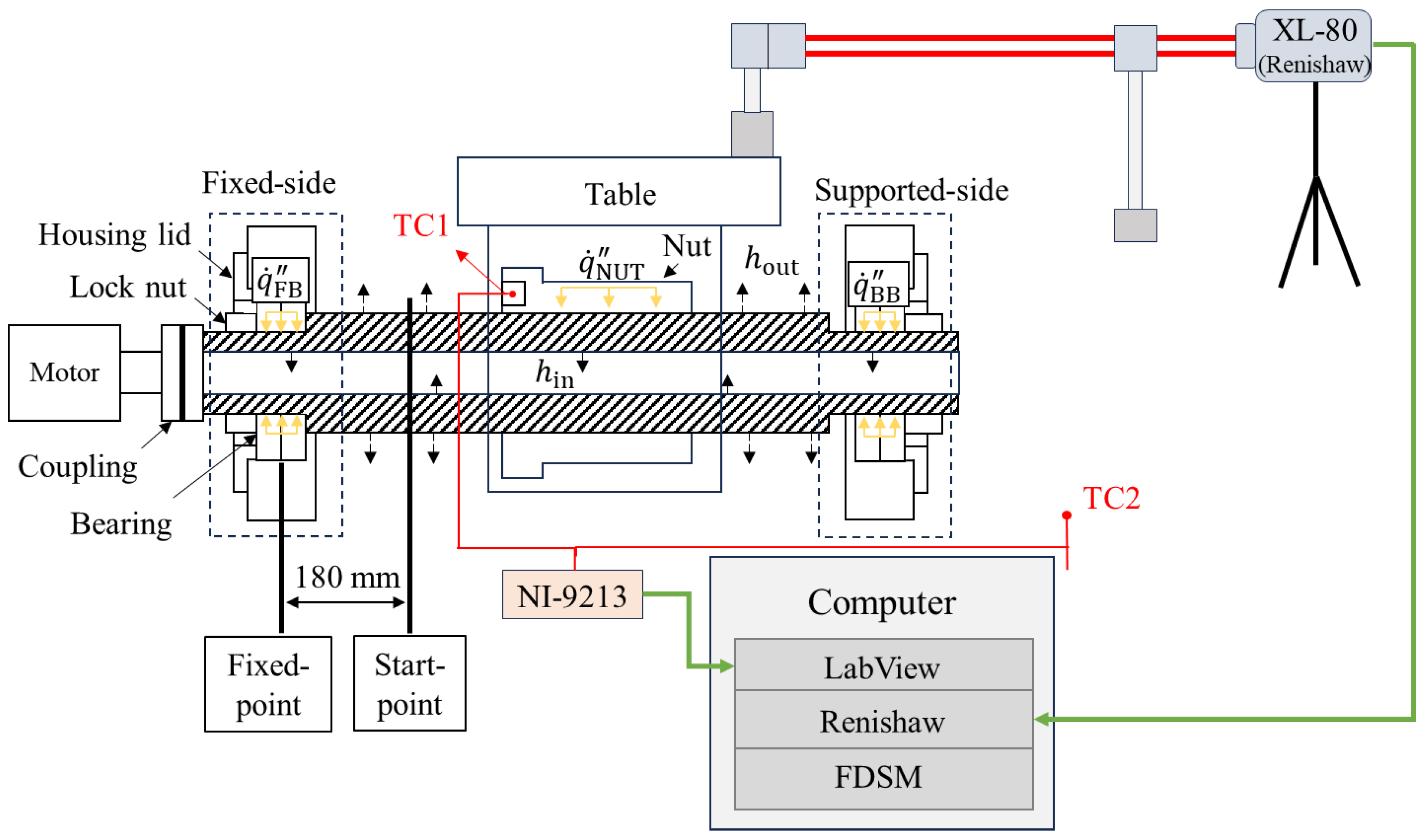
2.1.1. Screw Feed System
2.1.2. Temperature and Thermal Deformation Measurement Equipment
2.1.3. Experimental Conditions
2.2. FEM Establishment
- The radiation term can be neglected for small temperature increases.
- Thermal conductivity, density, and specific heat can be treated as constants within narrow temperature ranges.
- The convective heat transfer coefficient can be assumed constant for motion at a fixed feed rate.
- Frictional heat within the nut’s travel range can be considered uniformly distributed.
- Heat conduction through the lubricant can be deemed negligible.
- The screw can be modeled as a homogeneous material with a constant coefficient of thermal expansion.
2.3. FDSM
2.3.1. Establishment of the FDSM Database
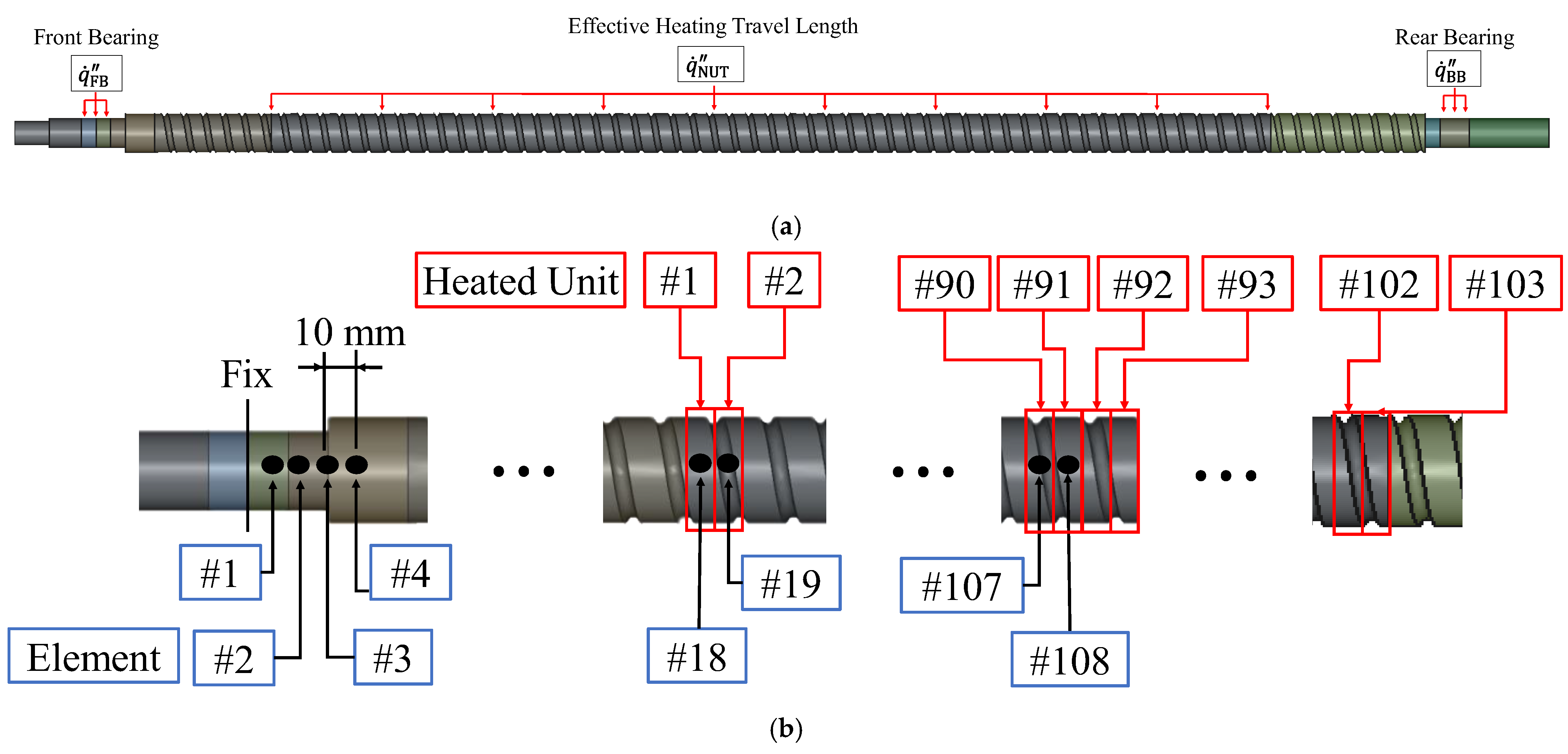
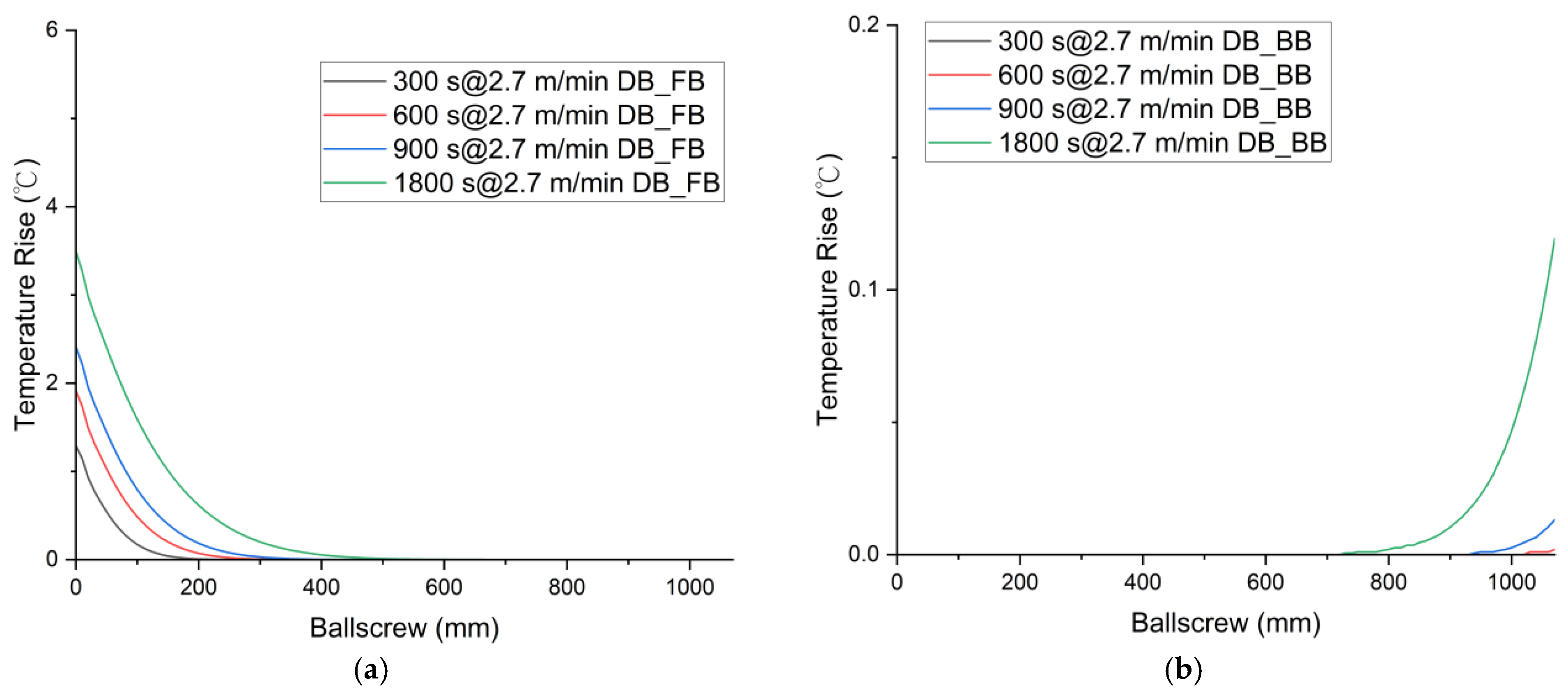
- Database of screw temperature rise caused by the separate heating of the front bearing: As illustrated in Figure 2, when both the ambient temperature and initial screw temperature were set to the standard value of 20 °C, only the front bearing provided continuous heating with the standard bearing heat 1000 W/m2, while the rear bearing and the nut did not heat up . Under these conditions, we recorded the temperature rise of 108 elements on the screw over a period of 1800 s, and this dataset constituted the database of screw temperature rise caused by the separate heating of the front bearing. The database was coded as DB_FB, where DB denotes “Database,” and FB indicates separate heating of the front bearing.
- Database of screw temperature rise caused by the separate heating of the rear bearing: As illustrated in Figure 2, when both the ambient temperature and initial screw temperature were set to the standard value of 20 °C, only the rear bearing provided continuous heating with the standard bearing heat flux 1000 W/m2, while the front bearing and nut did not heat up . Under these conditions, we recorded the temperature rise of 108 elements on the screw over a period of 1800 s, and this dataset constituted the database of screw temperature rise caused by the separate heating of the rear bearing. The database was coded as DB_BB, where DB denotes “Database,” and BB indicates rear bearing heating.
- Database of screw temperature rise caused by separate nut heating: As illustrated in Figure 2, when both the ambient temperature and initial screw temperature were set to the standard value of 20 °C, the front and rear bearings did not heat up . The travel range was divided into heated units of 10 mm, resulting in a total of 103 heated units. Each heated unit was individually heated by the nut using a standard heat flux of 500 W/m2. Under these conditions, we recorded the temperature rise of 108 elements on the screw over a period of 1800 s, forming a database of screw temperature rise caused by nut heating. This database was coded as DB_NUT(p), where DB denotes “Database;” NUT refers to nut heating; and p ranges from 1 to 103, corresponding to the 1st through 103rd heated units in the travel zone.
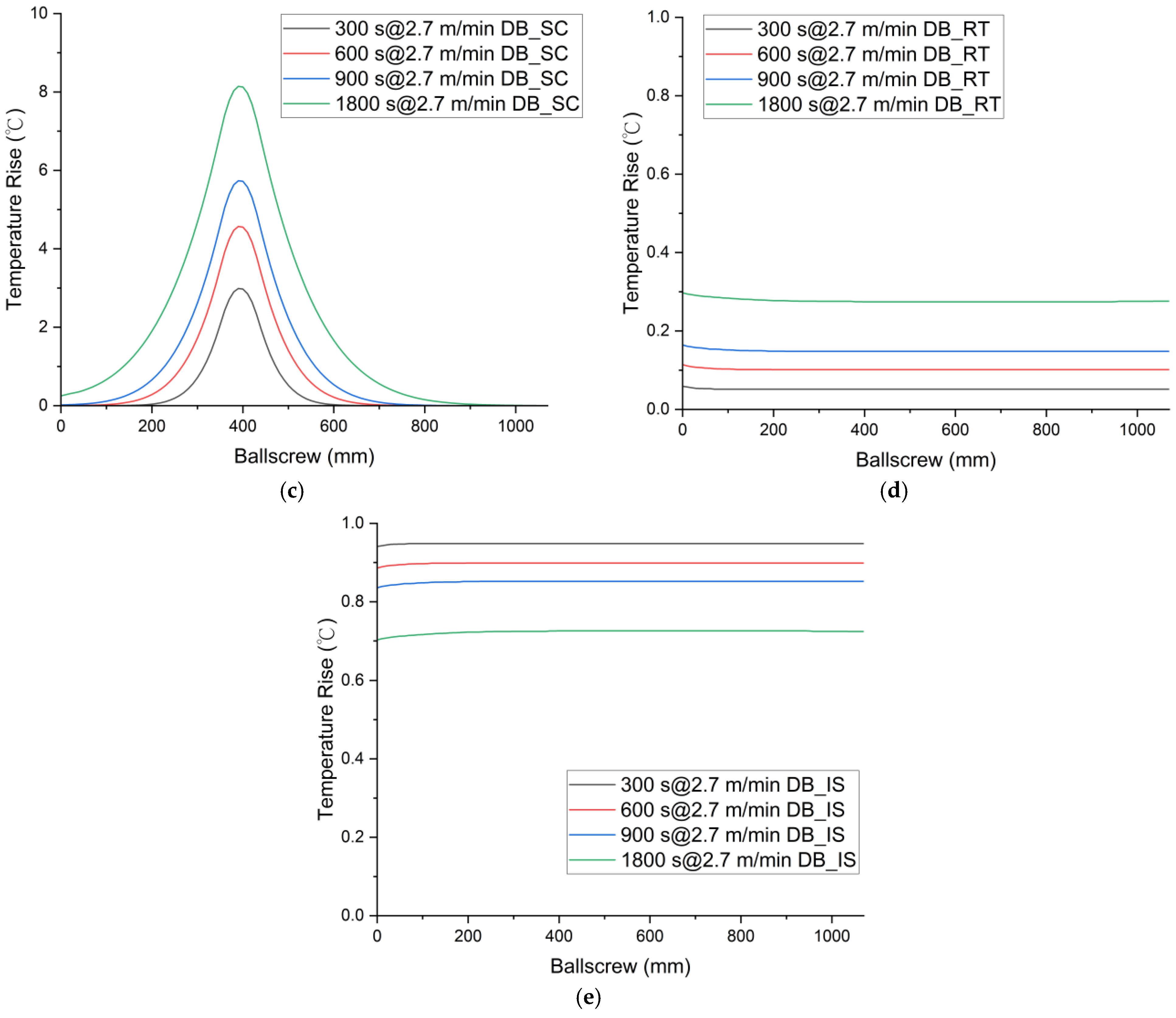
- Database of screw temperature rise under changing ambient temperature and no heat source: As depicted in Figure 2, when the initial screw temperature was set to the standard value of 20 °C and the ambient temperature was increased to 21 °C, the front bearing, rear bearing, and nut did not heat up . Under these conditions, we recorded the temperature rise of 108 elements on the screw over a period of 1800 s, creating the database of screw temperature rise under changing ambient temperature and no heat source. This database was coded as DB_RT, where DB denotes “Database,” and RT indicates changing ambient temperature.
- Database of screw temperature rise with initial screw temperature changes without a heat source: As illustrated in Figure 2, when the ambient temperature was set to the standard value of 20 °C and the initial screw temperature was set to 21 °C, the front bearing, rear bearing, and nut did not heat up . Under these conditions, we recorded the temperature rise of 108 elements on the screw over a period of 1800 s, which formed the database of screw temperature rise with initial screw temperature change and no heat source. The database was coded as DB_IS, where DB denotes “Database,” and IS represents the change in initial screw temperature.
2.3.2. FDSM Superposition Rule
- Multi-heat source superposition rule: At a constant ambient temperature, the screw temperature rise caused by the simultaneous heating of the three heat sources is equal to the sum of the screw temperature rise caused by each heat source individually (front bearing, rear bearing, and nut).
- Heat source multiplication rule: The screw temperature rise caused by a given heat source (front bearing, rear bearing, or nut) is proportional to its heat flux. Therefore, once the screw temperature rise under the standard heat flux is known, the temperature rise under other heat fluxes can be estimated.
- Ambient temperature change rule: The screw temperature rise due to both the heat source and ambient temperature variation can be decomposed into the sum of the screw temperature rise caused solely by the heat source and that caused solely by the ambient temperature change.
- Ambient temperature scaling rule: The screw temperature rise caused by an ambient temperature change of k °C is equal to k times the screw temperature rise caused by a 1 °C ambient temperature change. Therefore, when compiling DB_RT, only the result for a 1 °C change needs to be obtained.
- Initial screw temperature change rule: The screw temperature rise due to both the heat source and initial screw temperature change can be decomposed into the sum of the screw temperature rise caused solely by the heat source and that caused solely by the change in initial screw temperature. This also follows the heat source scaling rule.
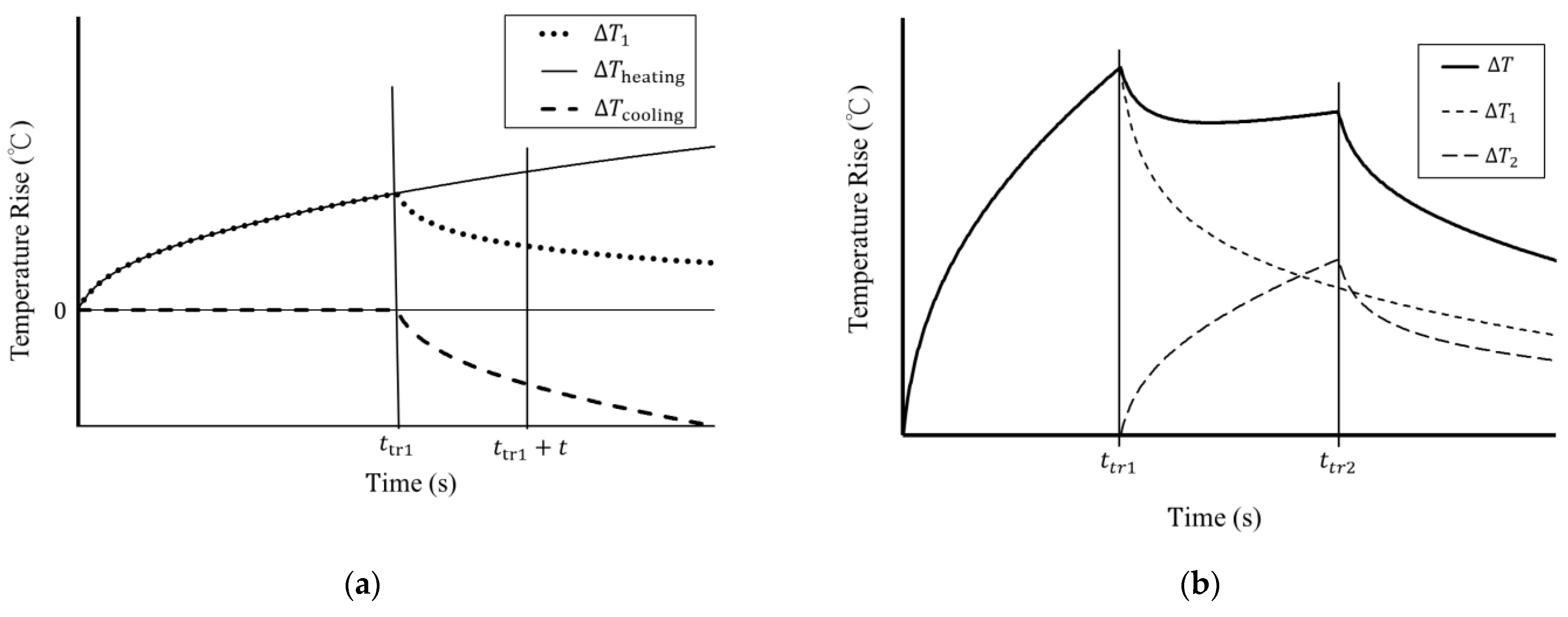
- Operating condition cooling rule: As illustrated in Figure 4a, if an operating condition ends at time (ttr1) s, the screw temperature rise at time (ttr1 + t) s, denoted ∆T1, can be expressed as the sum of two components: (1) the screw temperature rise ∆Theating(ttr1 + t) that would result from continued heating with the same heat flux and (2) the screw cooling ∆Tcooling due to the cessation of heat input. Here, ∆Tcooling is defined by multiplying the heating function ∆Theating by −1 and applying a time-shift of ttr1 s (∆Tcooling (t > ttr1) = −∆Theating(t)). Therefore, when t > ttr1, the screw temperature rise satisfies ∆T1(ttr1 + t) = ∆Theating(ttr1 + t) − ∆Theating(t).
- Operating condition’s superposition rule: As illustrated in Figure 4b, when a composite operating condition comprises a sequential combination of two single operating conditions, A and B, the total screw temperature rise ∆T is equal to the sum of the screw temperature rise ∆T1 caused by condition A and the screw temperature rise ∆T2 caused by condition B.
2.3.3. Application of the FDSM Under a Single Operating Condition
- Step 1.
- Select the screw temperature rise dataset corresponding to the given feed rate.
- Step 2.
- From the selected screw temperature rise database, retrieve the datasets corresponding to the three primary heat sources in the ball screw feed system: front bearing heating alone (DB_FB), rear bearing heating alone (DB_BB), and nut heating alone (DB_NUT). Based on the actual heat flux values, calculate the screw temperature rise produced by each heat source individually using the heat source multiplication rule. Then, apply the multi-heat source superposition rule to obtain the combined screw temperature rise under the simultaneous heating of all sources, as expressed by the following equation:
- Step 3.
- Calculate the screw temperature rise resulting from deviations in the initial screw temperature and ambient temperature relative to the standard temperature. Specifically, compare the initial screw temperature, IT, and ambient temperature, AT, with the standard temperature, , and calculate the resulting screw temperature rise using Equations (6) and (7)
- When IT differs from Tstd, the resulting screw temperature rise, TemInCint, is obtained using
- When AT differs from Tstd, the resulting screw temperature rise, TemInRTC, is obtained using
- Step 4.
- To compute the screw temperature at different locations, TemFinal, add the screw temperature rise caused by the simultaneous heating of the front bearing, rear bearing, and nut (TemInHeating); rise caused by the difference between the initial screw temperature and standard temperature (TemInCint); rise caused by the difference between the ambient temperature and standard temperature (TemInRTC); and standard temperature, Tstd, as indicated in Equation (8). Further, as indicated in Equation (9) obtain TemInFinal, which is the screw temperature rise at different locations, by subtracting the initial screw temperature, IT, from TemFinal.
- Step 5.
- Use the screw temperature rise obtained from the FDSM to calculate the screw’s thermal deformation. Given that the feed system employs a fixed support bearing arrangement, the deformation accumulates along the travel direction toward the support end. Accordingly, compute the thermal deformation using Equation (10), where x denotes the element number (the position relative to the screw’s absolute origin); α denotes the coefficient of linear thermal expansion for the screw (CLTE = 1.16 × 10⁻⁵ 1/°C), and ∆L is the length of one screw element (10 mm = 10,000 μm).
2.3.4. Application of the FDSM Under Composite Operating Conditions
Screw Temperature and Temperature Rise Calculation for the First Single Operating Condition
- Step 1.
- Select the screw temperature rise dataset corresponding to the feed rate of the first single operating condition.
- Step 2.
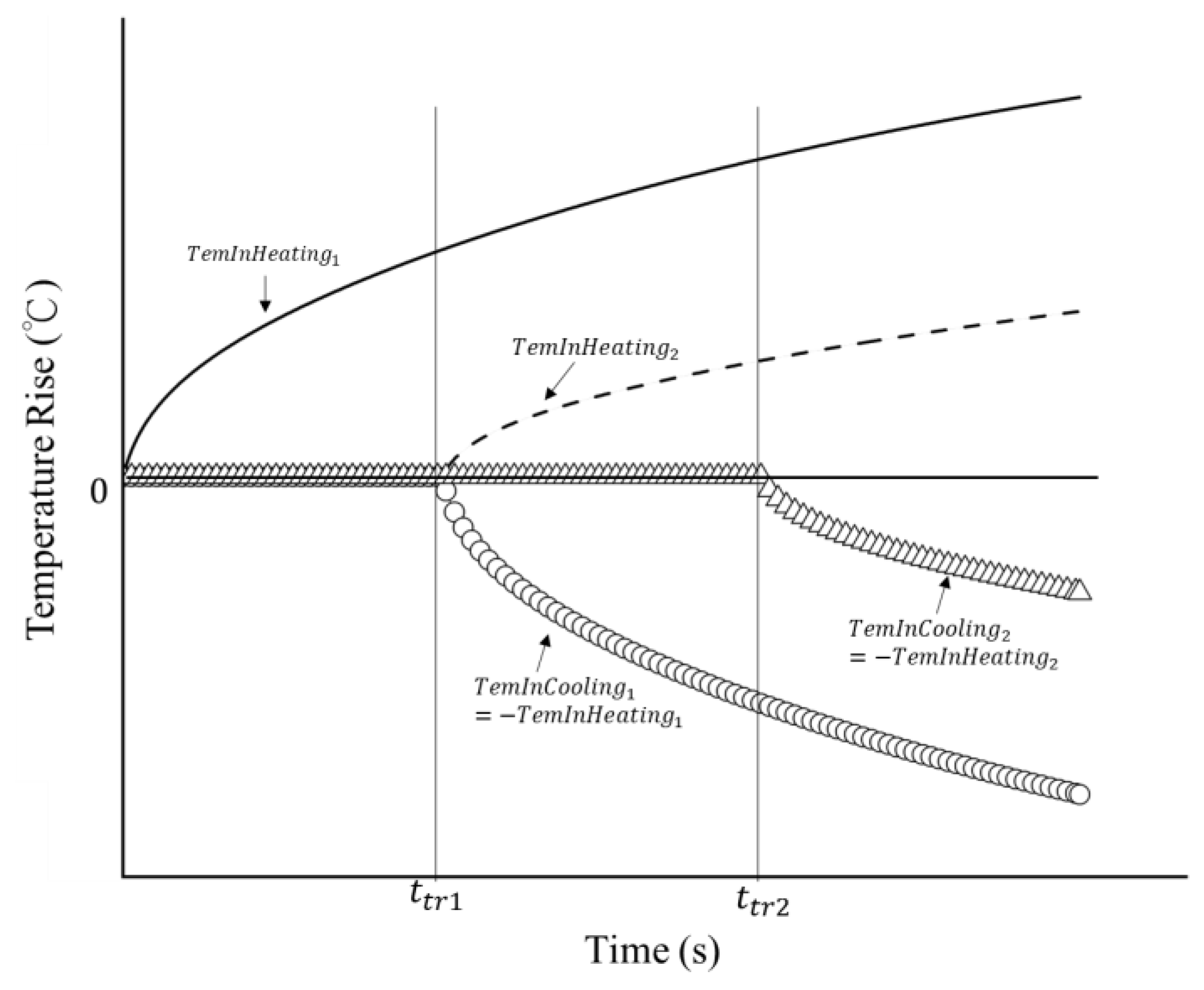
- Calculate the screw temperature rise caused by the simultaneous heating of the three heat sources under the first single operating condition (TemInHeating1), using the method described in Step 2 of Section 2.3.3. The graph in Figure 5 illustrates the temperature rise and cooling behavior under the influence of the three heat sources (TemInHeating1) in the composite operating condition. The screw temperature rise resulting from the onset of heating under the first single operating condition is represented by the following equation.
- Step 3.
- Calculate the cooling of the screw after the first single operating condition stops (t > ttr1) using the procedure described in Section 2.3.2 (Operating Condition Cooling Rule). In Figure 5, TemInCooling1 represents the screw temperature reduction caused by the termination of the first single operating condition. Apply Equation (12) to determine the temperature drop: when 0 < t < ttr1, no cooling occurs. Conversely, when t > ttr1, cooling begins.
- Step 4.
- Calculate the screw temperature rise resulting from the differences between the initial screw temperature, IT, and the ambient temperature, AT, each relative to the standard temperature, Tstd, as indicated in Equations (13) and (14).
- Calculate TemInCint, defined as the screw temperature rise due to the difference between IT and Tstd, using
- Similarly, calculate TemInRTC, defined as the screw temperature rise due to the difference between AT and Tstd, using
- Step 5.
- To compute the screw temperature under the first single operating condition, TemCombine1, add the screw temperature rise caused by the simultaneous heating of the front bearing, rear bearing, and nut (TemInHeating1); cooling resulting from the termination of the first operating condition (TemInCooling1); rise caused by the difference between the initial screw temperature and standard temperature (TemInCint); rise caused by the difference between the ambient temperature and standard temperature (TemInRTC); and standard temperature, Tstd, as indicated in Equation (15):
Screw Temperature and Temperature Rise Calculation for the Second Single Operating Condition
- Step 6.
- Select the screw temperature rise dataset corresponding to the feed rate of the second single operating condition.
- Step 7.
- Compute the screw temperature rise, TemInHeating2, resulting from the simultaneous heating of the front bearing, rear bearing, and nut in the second single operating condition. Use Equation (16) for the calculation and refer to Figure 5 for the corresponding thermal behavior. For 0 < t < ttr1, TemInHeating2 is zero. Conversely, for t > ttr1, apply the method described in Step 2.
- Step 8.
- Calculate the cooling of the screw caused by the termination of the second single operating condition (t > ttr2) using Equation (17). Figure 5 illustrates the relationship between screw temperature rise and drop under the two single operating conditions. Here, TemInCooling2 represents the temperature drop caused by heat dissipation from the three heat sources in the second operating condition.
- Step 9.
- Add the screw temperature under the first operating condition (TemCombine1), temperature rise under the second operating condition (TemInHeating2), and cooling resulting from its termination (TemInCooling2), as indicated in Equation (18):
- Step 10.
- The compensation clarifies the adjustment for the changes in the temperature difference between the screw and the ambient temperatures, as well as the change in the forced convection value resulting from different feed rates. The feed rate increases, the forced convection coefficient rises, enabling faster heat dissipation from the screw. Consequently, the screw temperature rise decreases, and the compensation value becomes negative. Conversely, if the feed rate decreases, the compensation value becomes positive. Use Equation (19) to calculate the compensation value.
Steps for Calculating the Temperature Rise and Conversion into Thermal Error Under Composite Operating Condition
- Step 11.
- Compute the final screw temperature, TemFinal, by summing the results of , which represent the cumulative screw temperature and the feed-rate-related compensation, respectively, as shown in Equation (20). Further, determine the screw temperature rise at different positions, TemInFinal, by subtracting the initial screw temperature, IT, from TemFinal, as shown in Equation (21).
- Step 12.
- Use the same method as in Step 5 of Section 2.3.3 to convert TemInFinal into thermal error of the ball screw feed system.
2.4. Model Validation Metrics
3. Results
4. Summary and Conclusions
Author Contributions
Funding
Data Availability Statement
Acknowledgments
Conflicts of Interest
References
- Xu, Z.-Z.; Choi, C.; Liang, L.-J.; Li, D.-Y.; Lyu, S.-K. Study on a novel thermal error compensation system for high-precision ball screw feed drive (1 st report: Model, calculation and simulation). Int. J. Precis. Eng. Manuf. 2015, 16, 2005–2011. [Google Scholar] [CrossRef]
- Shi, H.; Jiang, C.; Yan, Z.; Tao, T.; Mei, X. Bayesian neural network–based thermal error modeling of feed drive system of CNC machine tool. Int. J. Adv. Manuf. Technol. 2020, 108, 3031–3044. [Google Scholar] [CrossRef]
- Li, T.-J.; Sun, T.-Y.; Zhang, Y.-M.; Zhao, C.-Y. Prediction of thermal error for feed system of machine tools based on random radial basis function neural network. Int. J. Adv. Manuf. Technol. 2021, 114, 1545–1553. [Google Scholar] [CrossRef]
- Liu, H.; Rao, Z.; Pang, R.; Zhang, Y. Research on Thermal Characteristics of Ball Screw Feed System Considering Nut Movement. Machines 2021, 9, 249. [Google Scholar] [CrossRef]
- Li, Z.-J.; Zhao, C.-Y.; Lu, Z.-C. Thermal error modeling method for ball screw feed system of CNC machine tools in x-axis. Int. J. Adv. Manuf. Technol. 2020, 106, 5383–5392. [Google Scholar] [CrossRef]
- Liu, J.; Ma, C.; Wang, S.; Wang, S.; Yang, B.; Shi, H. Thermal boundary condition optimization of ball screw feed drive system based on response surface analysis. Mech. Syst. Signal Process. 2019, 121, 471–495. [Google Scholar] [CrossRef]
- Jedrzejewski, J.; Kowal, Z.; Kwasny, W.; Winiarski, Z. Ball screw unit precise modelling with dynamics of loads and moving heat sources taken into account. J. Mach. Eng. 2019, 19, 27–41. [Google Scholar] [CrossRef]
- Li, Y.; Wei, W.; Su, D.; Wu, W.; Zhang, J.; Zhao, W. Thermal characteristic analysis of ball screw feed drive system based on finite difference method considering the moving heat source. Int. J. Adv. Manuf. Technol. 2020, 106, 4533–4545. [Google Scholar] [CrossRef]
- Xu, Z.; Liu, X.; Kim, H.; Shin, J.; Lyu, S. Thermal error forecast and performance evaluation for an air-cooling ball screw system. Int. J. Mach. Tools Manuf. 2011, 51, 605–611. [Google Scholar] [CrossRef]
- Zhang, J.; Li, B.; Zhou, C.; Zhao, W. Positioning error prediction and compensation of ball screw feed drive system with different mounting conditions. Proc. Inst. Mech. Eng. Part B J. Eng. Manuf. 2016, 230, 2307–2311. [Google Scholar] [CrossRef]
- Shi, H.; Zhang, D.; Yang, J.; Ma, C.; Mei, X.; Gong, G. Experiment-based thermal error modeling method for dual ball screw feed system of precision machine tool. Int. J. Adv. Manuf. Technol. 2016, 82, 1693–1705. [Google Scholar] [CrossRef]
- Lu, Q.; Zhu, D.; Wang, M.; Li, M. Digital twin-driven thermal error prediction for CNC machine tool spindle. Lubricants 2023, 11, 219. [Google Scholar] [CrossRef]
- Gorman, D. Free vibration analysis of cantilever plates by the method of superposition. J. Sound Vib. 1976, 49, 453–467. [Google Scholar] [CrossRef]
- Gorman, D.; Sharma, R. A comprehensive approach to the free vibration analysis of rectangular plates by use of the method of superposition. J. Sound Vib. 1976, 47, 126–128. [Google Scholar] [CrossRef]
- Koopmann, G.H.; Song, L.; Fahnline, J.B. A method for computing acoustic fields based on the principle of wave superposition. J. Acoust. Soc. Am. 1989, 86, 2433–2438. [Google Scholar] [CrossRef]
- Wang, L.-P.; Ayala, O.; Grabowski, W.W. Improved formulations of the superposition method. J. Atmos. Sci. 2005, 62, 1255–1266. [Google Scholar] [CrossRef]
- Wang, J.-C. Superposition method to investigate the thermal performance of heat sink with embedded heat pipes. Int. Commun. Heat Mass Transf. 2009, 36, 686–692. [Google Scholar] [CrossRef]
- Jiang, Y.; Li, E.; Zhang, X.; Wu, Q.; Yap, Y. Superposition method for the simulation of heat transfer. Int. J. Heat Mass Transf. 2018, 120, 914–922. [Google Scholar] [CrossRef]
- Jiang, X.; Kong, X.; He, S.; Wu, K. Modeling the superposition of residual stresses induced by cutting force and heat during the milling of thin-walled parts. J. Manuf. Process. 2021, 68, 356–370. [Google Scholar] [CrossRef]
- Maurya, S.N.; Li, K.-Y.; Luo, W.-J.; Kao, S.-Y. Effect of coolant temperature on the thermal compensation of a machine tool. Machines 2022, 10, 1201. [Google Scholar] [CrossRef]
- Rao, B.R.; Tiwari, R. Identification of the Asymmetric Transmission Error and Gear Mesh Dynamic Parameters using Full-Spectrum Responses in a Geared-Rotor System. J. Dyn. Monit. Diagn. 2024, 112–142. [Google Scholar]
- Koda, S.; Murata, T.; Ueda, K.; Sugita, T. Automatic compensation of thermal expansion of ball screw in machining centers. Trans. Jpn. Soc. Mech. Eng. Part C 1990, 21, 154–159. [Google Scholar] [CrossRef]
- Li, H.; Shin, Y.C. Integrated dynamic thermo-mechanical modeling of high speed spindles, part 1: Model development. J. Manuf. Sci. Eng. 2004, 126, 148–158. [Google Scholar] [CrossRef]
- Tian, R.; He, R. Solution for heating of ball screw and environmental engineering. World Manuf. Eng. Mark. 2004, 3, 65–67. [Google Scholar]
- Yang, A.; Cai, S.Z.; Hsieh, S.H.; Kuo, T.C.; Wang, C.C.; Wu, W.T.; Hsieh, W.H.; Hwang, Y.C. Thermal deformation estimation for a hollow ball screw feed drive system. In Proceedings of the World Congress on Engineering, London, UK, 3–5 July 2013. [Google Scholar]
- Yang, A.; Chai, S.; Hsu, H.; Kuo, T.; Wu, W.; Hsieh, W.; Hwang, Y. FEM-based modeling to simulate thermal deformation process for high-speed ball screw drive systems. Appl. Mech. Mater. 2014, 481, 171–179. [Google Scholar] [CrossRef]






| FDSM | FEM | MLCM | Data-Driven Models (RSM, MLRA) | Data-Driven Models (NN Models) | |
|---|---|---|---|---|---|
| Computational Speed | Fast | Very Slow | Fast | Very Fast | Very Fast |
| Accuracy | High | High | Low | Low | High |
| Training Data Volume | Not Required | Not Required | Low | High | Extremely High |
| Difficulty/Complexity | Moderate | High | Low | Low | Extremely High |
| Ball Screw Shaft | Ball Screw Nut | ||
|---|---|---|---|
| Total length (mm) | 1715 | Type | FDC |
| Thread length (mm) | 1305 | Length (mm) | 143 |
| Lead (mm) | 20 | Diameter (mm) | 70 |
| BCD (mm) | 41.4 | ||
| Outer diameter (mm) | 40 | ||
| Inner diameter (mm) | 12.7 | Bearing | |
| Number of turns | 2 | Type | TAC |
| Contact type | 4 points | Outer diameter (OD) (mm) | 62 |
| Ball diameter (mm) | 6.35 | Inner diameter (ID) (mm) | 30 |
| t = 0–300 s | t = 300–600 s | t = 600–900 s | Ambient Temperature °C | Screw Initial Temperature °C | |
|---|---|---|---|---|---|
| Simple operating condition | 2.7 m/min, 170–250 mm | 26 | 25 | ||
| Composite operating condition A | 40 m/min, 200–826 mm | 40 m/min, 0–1026 mm | 20 m/min, 400–1026 mm | 27.2 | 27.2 |
| Composite operating condition B | 40 m/min, 400–1026 mm | 20 m/min, 200–826 mm | 10 m/min, 400–1026 mm | 26.9 | 26.9 |
| Feed Rate | Screw Temperature Rise Database |
|---|---|
| 40 m/min | DB_FB, DB_BB, DB_RT, DB_IS, DB_NUT (1), DB_NUT (2),..., DB_NUT (103) |
| 20 m/min | DB_FB, DB_BB, DB_RT, DB_IS, DB_NUT (1), DB_NUT (2),..., DB_NUT (103) |
| 10 m/min | DB_FB, DB_BB, DB_RT, DB_IS, DB_NUT (1), DB_NUT (2),..., DB_NUT (103) |
| 2.7 m/min | DB_FB, DB_BB, DB_RT, DB_IS, DB_NUT (1), DB_NUT (2),..., DB_NUT (103) |
| t = 0–ttr1 s | Ambient Temperature (°C) | Initial Screw Temperature (°C) | |
|---|---|---|---|
| Heat flux generated by the front bearing (W/m2) | AT | IT | |
| Heat flux generated by the rear bearing (W/m2) | |||
| Heat flux generated by nut heating (W/m2) |
| t = 0–ttr1 s | t = ttr1–ttr2 s | Ambient Temperature (°C) | Initial Screw Temperature (°C) | |
|---|---|---|---|---|
| Heat flux generated by the front bearing (W/m2) | AT | IT | ||
| Heat flux generated by the rear bearing (W/m2) | ||||
| Heat flux generated by nut heating (W/m2) |
| Variation (%) | RMSE | Change (%) | |
|---|---|---|---|
| Base Case | 6.0 | — | |
| Heat flux generated by the front bearing (W/m2) | 6.1 | ||
| Heat flux generated by the rear bearing (W/m2) | 6.0 | ||
| Heat flux generated by nut heating (W/m2) | 4.3 | ||
| Ambient Temperature (°C) | 4.1 | ||
| Initial Screw Temperature (°C) | 5.2 |
Disclaimer/Publisher’s Note: The statements, opinions and data contained in all publications are solely those of the individual author(s) and contributor(s) and not of MDPI and/or the editor(s). MDPI and/or the editor(s) disclaim responsibility for any injury to people or property resulting from any ideas, methods, instructions or products referred to in the content. |
© 2026 by the authors. Licensee MDPI, Basel, Switzerland. This article is an open access article distributed under the terms and conditions of the Creative Commons Attribution (CC BY) license.
Share and Cite
Huang, J.-H.; Yang, A.-S.; Hwang, Y.-C.; Hsieh, W.-H. Prediction of the Temperature Rise and Thermal Error of Feed Systems Under Repeatable Operating Conditions Using a Superposition Method. Machines 2026, 14, 235. https://doi.org/10.3390/machines14020235
Huang J-H, Yang A-S, Hwang Y-C, Hsieh W-H. Prediction of the Temperature Rise and Thermal Error of Feed Systems Under Repeatable Operating Conditions Using a Superposition Method. Machines. 2026; 14(2):235. https://doi.org/10.3390/machines14020235
Chicago/Turabian StyleHuang, Jen-Hung, An-Shik Yang, Yih-Chyun Hwang, and Wen-Hsin Hsieh. 2026. "Prediction of the Temperature Rise and Thermal Error of Feed Systems Under Repeatable Operating Conditions Using a Superposition Method" Machines 14, no. 2: 235. https://doi.org/10.3390/machines14020235
APA StyleHuang, J.-H., Yang, A.-S., Hwang, Y.-C., & Hsieh, W.-H. (2026). Prediction of the Temperature Rise and Thermal Error of Feed Systems Under Repeatable Operating Conditions Using a Superposition Method. Machines, 14(2), 235. https://doi.org/10.3390/machines14020235