Article

ASCON: A Hybrid Path Planning Algorithm for Manipulators in Strongly Constrained Narrow Passages


1
School of Mechatronics Engineering, Henan University of Science and Technology, Luoyang 471000, China
2
Longmen Laboratory, Luoyang 471000, China
3
Key Laboratory of Mechanical Design and Transmission System of Henan Province, Luoyang 471000, China
*
Author to whom correspondence should be addressed.
Machines 2026, 14(2), 228; https://doi.org/10.3390/machines14020228
Submission received: 19 January 2026 / Revised: 9 February 2026 / Accepted: 11 February 2026 / Published: 15 February 2026

Abstract

Path planning for high-DOF robotic manipulators in highly constrained environments (e.g., narrow passages) remains challenging due to poor configuration-space (C-space) connectivity, low computational efficiency, and susceptibility to local minima. This paper proposes a hybrid planner, termed ASCON, which couples the directional guidance of an improved Artificial Potential Field (APF) with the global exploration capability of RRT-Connect to achieve robust planning in non-convex, strongly constrained workspaces. A smoothed potential-field formulation is introduced to suppress oscillations and improve motion smoothness, while a link-radius-based envelope collision-checking strategy is incorporated to ensure safety margins for real deployment. The evaluation is conducted in two benchmark scenarios—dual-layer stacked obstacles and a 100 mm narrow passage—with 50 independent trials per method per scenario; a run is considered successful only if a collision-free feasible path is found within preset iteration/time limits using fixed hyperparameters. Results show that, compared with conventional APF, ASCON reduces average planning time by 66.0%, decreases iteration count by 80.5%, shortens path length by 13.5%, and lowers peak jerk by 40.3%. Physical experiments further validate practical feasibility by guiding a real manipulator through a 100 mm narrow passage in a collision-free manner, demonstrating efficient, smooth, and robust planning under extreme constraints.

1. Introduction

Robotic path planning is a core technology that enables intelligent manufacturing, especially for delicate operations such as human–robot collaborative assembly and quality inspection. Recent studies have shown that, in scenarios involving complex contact and dexterous manipulation, accurate perception and motion planning are fundamental to autonomous task execution [1,2]. Collaborative robots (cobots) are increasingly deployed in applications such as automotive interior assembly and component inspection due to their intrinsic safety, flexibility, and rapid deployment capability [3].

1.1. Background and Motivation

Unlike traditional industrial robots operating in fenced, structured cells, cobots frequently work in unstructured environments, where the equipped end-effector must penetrate deep into equipment cavities or traverse extremely narrow, constrained passages to complete inspection and manipulation tasks.
In highly constrained environments, a planning algorithm must generate collision-free trajectories that are smooth and executable with sufficient safety clearance, even when facing dynamic constraints. The continuity and smoothness of the commanded trajectory directly affect the stability and robustness of the underlying servo system [4]; otherwise, rough or highly non-smooth paths may lead to abrupt changes in motion, degraded tracking performance, and even unintended safety stops.

1.2. Related Work

To contextualize the proposed approach, this section reviews existing methodologies categorized into deterministic optimization, sampling-based strategies, and planning in dynamic environments.

1.2.1. Deterministic and Potential Field-Based Methods

A wide range of motion planning approaches has been developed to achieve this, including graph-based search methods (e.g., Dijkstra [4] and A* [5]), sampling-based Probabilistic Roadmaps (PRM) [6], evolutionary optimization strategies for high-dimensional constrained problems [7,8], and constraint-consistent trajectory optimization methods such as CHOMP [9] and TrajOpt [10]. Besides these, the Artificial Potential Field (APF) method, first proposed by Khatib in 1986 [11], has attracted sustained attention due to its mathematical simplicity and low computational overhead. By constructing attractive and repulsive fields to guide motion, APF achieves high planning efficiency in obstacle-free or relatively simple environments [12,13].
However, it has inherent drawbacks in narrow-passage scenarios. When a manipulator attempts to traverse elongated narrow spaces, the superposition of repulsive fields tends to create local potential minima near the passage entrance or inside the corridor, causing the robot to stagnate before reaching the goal [14]. In addition, when operating near obstacles, steep changes in the repulsive gradient can induce high-frequency oscillations in the trajectory, which may reduce end-effector precision and be interpreted by the controller as abnormal external interactions, triggering safety stops. Despite various improvements proposed to mitigate local potential minima, such as harmonic potential fields [15], virtual target approaches, and random perturbation mechanisms, APF alone still struggles to guarantee globally feasible solutions when traversing narrow passages.

1.2.2. Sampling-Based Planning in Constrained Spaces

In contrast, Rapidly-exploring Random Trees (RRT) [16] and their variants (e.g., Bi-RRT [17], RRT-Connect [18], and asymptotically optimal RRT [19]) provide probabilistic completeness through random sampling in the configuration space, which, in principle, enables path discovery in complex obstacle fields. However, in narrow-passage environments, RRT-based planners face the well-known “narrow passage problem”: when the feasible region is relatively small compared to the overall configuration space, it is less likely that random samples fall within the passage, leading to substantial degradation in search efficiency. Specifically, although RRT theoretically guarantees optimality, its iterative rewiring process incurs prohibitive computational costs in such tightly constrained spaces, making it difficult to meet real-time industrial requirements. Moreover, standard RRT paths consist of piecewise linear or even redundant segments with limited smoothness. Such non-smooth paths are difficult for cobot servo systems to track accurately in confined spaces with strict clearance constraints, where small tracking errors can violate clearance margins and cause incidental collisions with the passages’ surfaces. Although prior studies have attempted to improve path quality via B-spline smoothing or post-processing optimization, these approaches often increase computational cost and may fail to guarantee collision-free feasibility [20].

1.2.3. Planning in Dynamic Environments

While traditional methods focus on static environments, recent research has expanded into complex dynamic scenarios. For instance, ref. [21] proposed a finite-time optimization and GAN-LSTM framework for spacecraft-mounted soft manipulators, enabling robust navigation amidst dynamic orbital debris. While this work significantly advances dynamic avoidance and soft-body control in microgravity, the requirements for rigid industrial cobots in static, extremely narrow passages differ fundamentally. In the latter case, the primary challenge is not temporal avoidance of moving objects, but rather high-precision geometric exploration within strictly bounded static clearances. General-purpose dynamic planners often prioritize time-varying constraints over the geometric path quality required for narrow gaps. Therefore, specialized algorithms focusing on clearance maximization and servo-compatible smoothness, such as the proposed ASCON framework, are essential to address these spatial constraints efficiently.

1.3. Proposed Method and Contributions

Overall, path planning faces dual challenges: global exploration to discover a feasible route and local refinement to ensure smooth, dynamically executable motion under strict safety clearance requirements. Conventional APF methods are prone to deadlocks in such corridors, whereas standard RRT-based methods struggle to produce smooth trajectories compatible with cobot dynamics while maintaining reliable clearance. To address these limitations, this paper proposes a hybrid path planning framework termed ASCON (APF-Smooth–RRT-Connect), which integrates RRT’s global obstacle-crossing capability with APF’s advantages in local refinement.
The main contributions of this paper are summarized as follows:
  • A hybrid path planning framework for highly constrained narrow passages. By reconciling the exploration efficiency of sampling-based methods with the local refinement capability of deterministic methods, the framework successfully generates collision-free skeleton paths while ensuring accessibility in confined environments.
  • An improved APF-based optimization mechanism to enhance trajectory smoothness and stability. To overcome the oscillation and local-minima issues inherent in traditional APF, a smoothed potential-field function and a dynamic step-size adjustment strategy are introduced to actively reshape coarse paths into smooth trajectories compatible with cobot dynamics.
  • Experimental validation on a physical collaborative robot system. Comparative experiments with a collaborative robot in simulated and real-world environments featuring a 100 mm narrow passage demonstrate that ASCON significantly outperforms conventional methods in planning success rate, path smoothness, and minimum obstacle clearance.
The remainder of this paper is organized as follows. Section 2 formulates the robot and environment modeling, introduces the envelope-based collision checking scheme, and details the APF-Smooth design (dual-space attraction and enhanced repulsion), before presenting the overall ASCON hybrid workflow. Section 3 describes the experimental setup and metrics, and provides comprehensive analyses, including APF-Smooth validation, performance evaluation in challenging constrained environments, and real-world experimental verification. Section 4 concludes the paper and outlines future research directions.

2. Methodology

2.1. System Overview

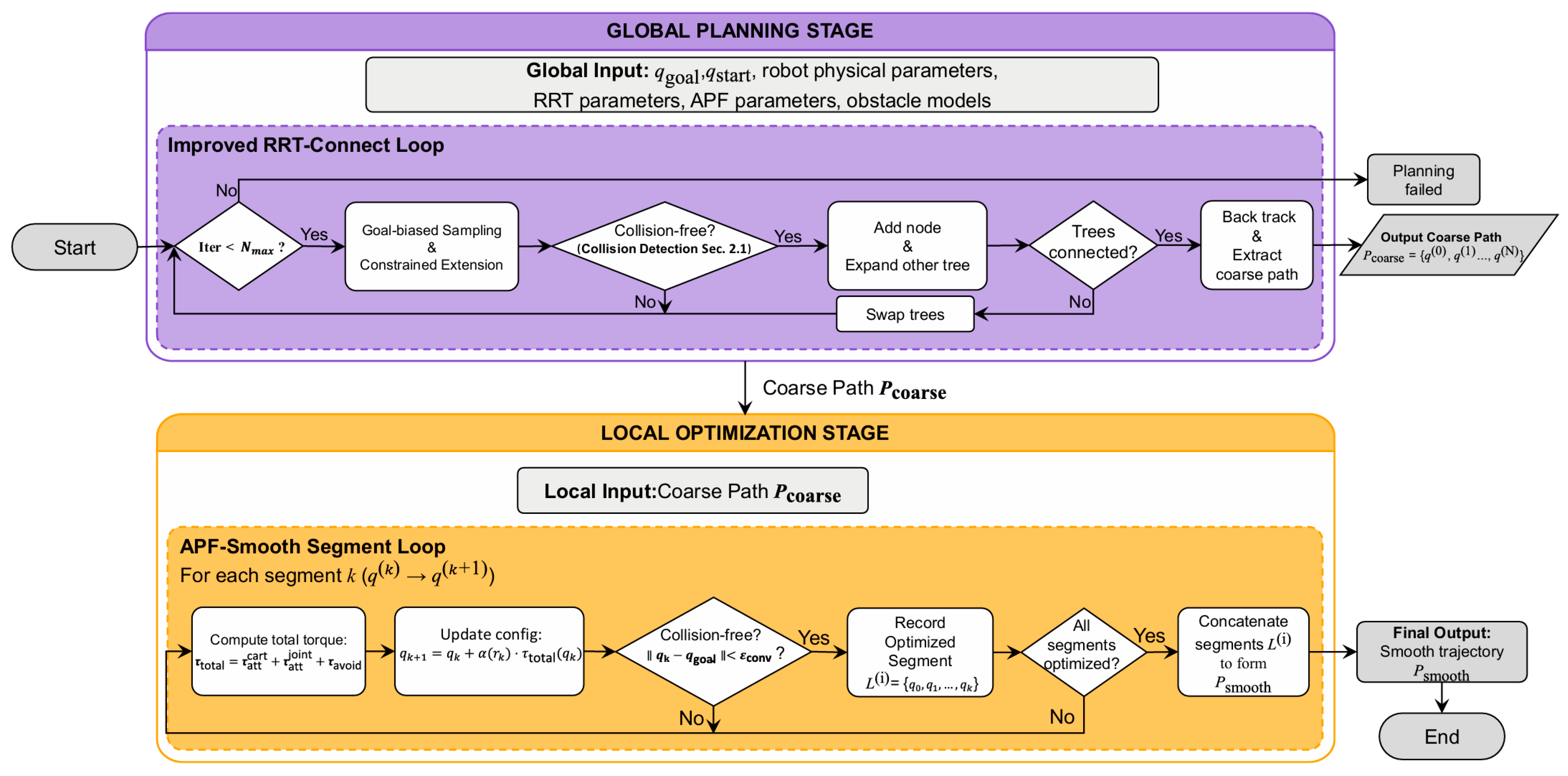
To address the computational trade-off between global exploration and local trajectory optimization in constrained environments, this paper proposes a novel hybrid path-planning framework named ASCON (APF-Smooth-RRT-Connect). As illustrated in Figure 1, the framework adopts a “global sampling—local potential field” dual-layer strategy.
Specifically, the workflow operates in two cascaded stages:
  • Global Exploration (Section 2.4.1): The algorithm first leverages RRT-based strategies within the manipulator’s joint space to conduct a rapid global search and obtain an initial collision-free path skeleton.
  • Local Optimization (Section 2.4.2): Subsequently, it utilizes an improved Artificial Potential Field (APF) to refine this path locally, mitigating abrupt turns and near-obstacle hazards present in the initial path.

2.2. Robot Model and Collision Detection

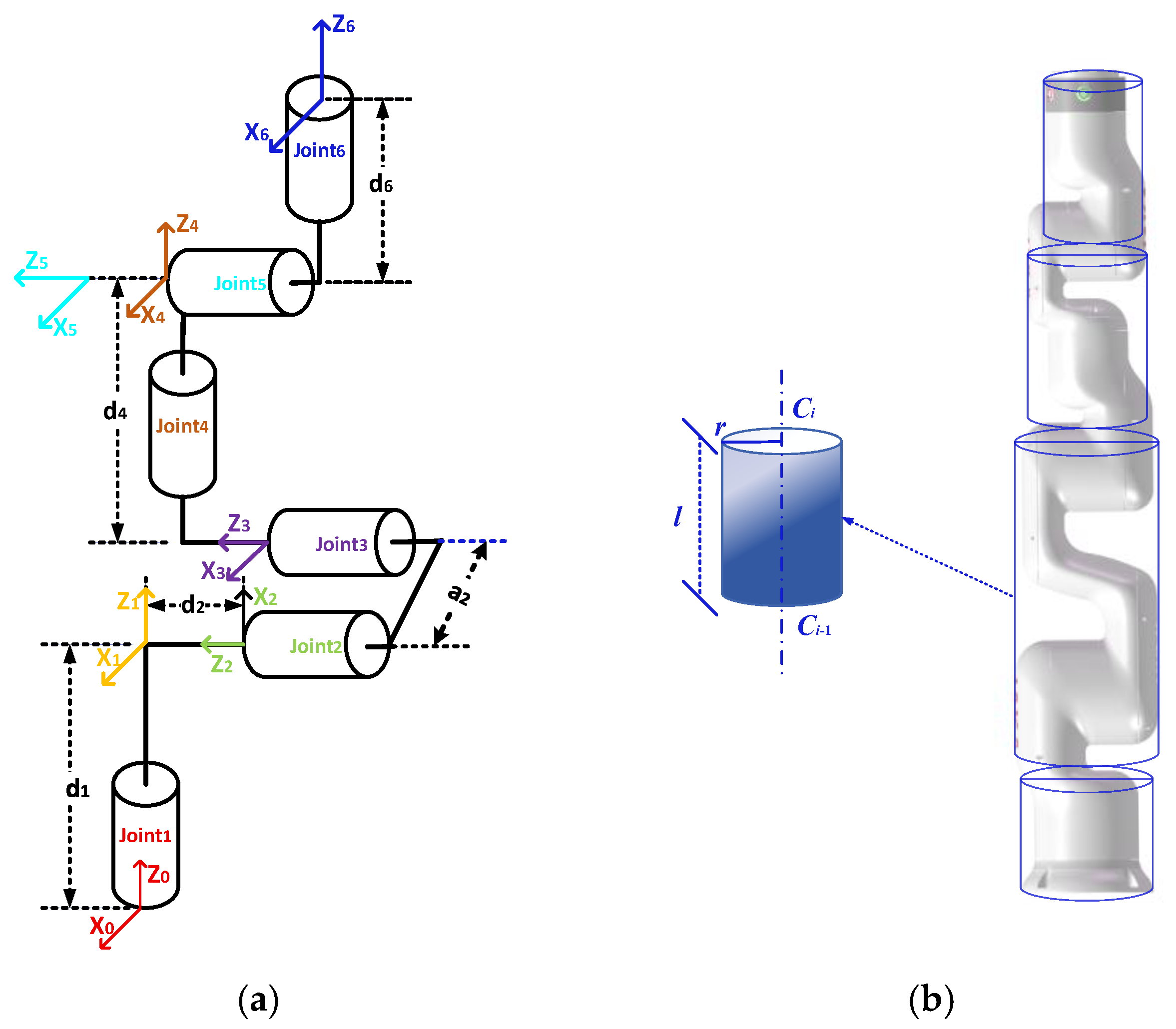
This study adopts a JAKA Minicobo 6-axis collaborative manipulator (Figure 2a) as the research object. This manipulator consists of six revolute joints, and the transformation matrix T i i 1 for link i can be expressed as:
T i i 1 = R ( x , α i 1 ) T ( x , a i 1 ) R ( z , θ i ) T ( z , d i )
  = c θ i s θ i 0 a i 1 s θ i c α i 1 c θ i c α i 1 s α i 1 d i s α i 1 s θ i s α i 1 c θ i s α i 1 c α i 1 d i c α i 1 0 0 0 1
where a , α , and d   denote the link length, link twist, and link offset, respectively, and θ represents the joint angle. Specifically, R ( x , α i 1 ) represents the rotational transformation by angle α i 1 about the x i 1 axis, and T ( x , a i 1 ) denotes the translational transformation by distance a i 1 along the x i 1 axis. Similarly, R ( z , θ i ) represents the rotation by angle   θ i   about the z i   axis, and T ( z , d i )   denotes the translational transformation by distance d i along the z i axis. For brevity, c θ i   and s θ i are used to denote c o s ( θ i ) and s i n ( θ i ) .
Consequently, the pose transformation matrix of the end-effector relative to the base frame is:
T 6 0 = T 1 0 ( θ 2 ) T 2 1 ( θ 2 ) T 6 5 ( θ 6 )
For collision detection, the manipulator links are modeled as cylinders using the Modified Denavit–Hartenberg (MDH) parameters (Figure 2b). This simplification reformulates the collision detection problem into determining whether the minimum distance between these cylinders and the obstacles is below a specific safety threshold. Let the i -th link be approximated as a cylinder with a radius r and a centerline segment   P . This segment is defined as P = seg P 0 , P 1 , where P 0 = c i 1 q and P 1 = c i q denote the joint centers at the two ends of link i . The obstacle surfaces are triangulated into a set T = { Δ k } ( k = 1,2 , . . . ) . Consequently, the minimum distance between link i and the obstacles is determined as the minimum value among the distances from the endpoints P 0 , P 1 , and the segment P to each triangle in the set T :
d i ( q ) = m i n Δ T dist ( P , Δ ) r
dist ( P , Δ ) = m i n { dist ( P 0 , Δ ) , dist ( P 1 , Δ ) , m i n e E ( Δ ) dist ( P , e ) }
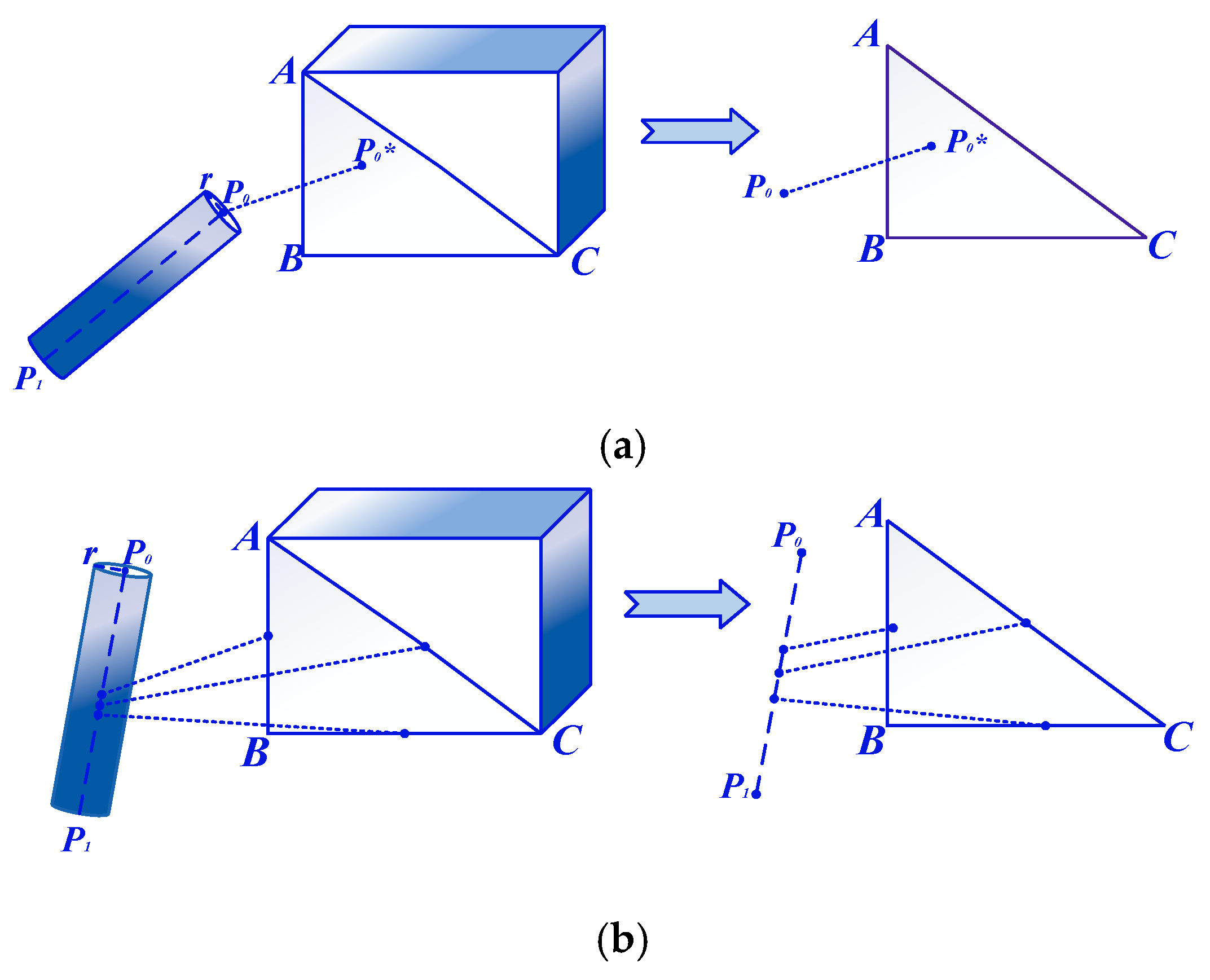
For a triangle Δ ABC in set T , the distance from the point P j ( j = 1,2 ) to this triangle can be computed as the minimum distance between P j   and a point P* located within the triangle (Figure 3a), where u and v are the parameters defining the position of P*:
dist ( P j ,   Δ   ) = m i n u , v 0 u + v 1 P j ( A + u ( B A ) + v ( C A ) )
Similarly, the distance between a line segment P and an edge e of triangle Δ ABC (Figure 2b) is:
dist ( P , e ) = m i n s , t [ 0,1 ] ( p 0 + s ( p 1 p 0 ) ) ( e 0 + t ( e 1 e 0 ) )
where s and t are the parameters associated with line segment P and edge e , respectively.
Although the link-radius model is theoretically more intensive than simple bounding boxes (e.g., AABB), the computational overhead is negligible due to the efficient analytical shortest-distance algorithm used for line segments. This approach avoids expensive mesh queries, ensuring real-time performance with minimal impact on the total planning time.

2.3. APF-Smooth: An Improved Artificial Potential Field Strategy

This paper improves the traditional APF method from three aspects: potential field construction, torque mapping mechanism, and step-size update strategy.

2.3.1. Construction of a Dual-Space Attractive Potential Field

In this approach, the attractive potential field function, denoted as U att , is constructed in both Cartesian space and joint space. First, in the Cartesian space R 3 , let the current spatial positions of the manipulator’s   n joints as matrix X = [ x 1 T , x 2 T , , x n T ] T , and the target spatial positions as matrix X g = [ x g 1 T , x g 2 T , , x g n T ] T . The total attractive potential energy in Cartesian space, U att cart , is defined as the sum of the attractive potential energies at the origins of the individual joints:
U att cart X = i = 1 n U att , i x i = i = 1 n 1 2 k a Δ x i 2                                     Δ x i     d s k a d s Δ x i 1 2 k a d s 2           Δ x i   >   d s
where Δ x i = x i x g i denotes the distance vector between the current and target positions for joint i , and k a and   d s represent the attractive gain coefficient and the saturation distance threshold, respectively. Equation (8) defines a piecewise attractive potential energy as the manipulator approaches target positions, since the quadratic potential function exhibits desirable convexity and fine convergence. Conversely, for a large distance vector, a linear saturation function is adopted to prevent excessive gradients. The attractive force F   att , i car t generated at the origin of the i -th joint coordinate frame is:
F att , i car t ( x i ) = x i U att , i ( x i ) = k a Δ x i                                     Δ x i     d s k a d s Δ x i Δ x i                 Δ x i   >   d s
By superimposing attractive forces mapped from all joints’ systems into the joint space, the total attractive torque derived from the Cartesian component, τ att cart , is obtained:
τ att cart = i = 1 n J i T ( X ) F att , i car t ( x i )
where J i ( X ) R 3 × n represents the Jacobian matrix associated with the i -th joint.
Next, in joint space, let q and q g denote the current and target joint vectors of the n -DOF manipulator, respectively. The attractive potential energy U att joint and its corresponding attractive torque τ att joint are then computed as:
U att joint ( q ) = 1 2 K q q q g 2
τ att joint = q U att joint = K q ( q q g )

2.3.2. Construction of an Enhanced Repulsive Potential Field

Building on the collision detection model detailed in Section 2.1, this study constructs an enhanced repulsive potential field that introduces a switching function into the traditional repulsive potential formulation Urep to establish a smooth transition zone. For an active interval of the repulsive force denoted as d [ 0 , d w ] , the range d D is defined as the near-field region, while D < d < d w acts as the warning region. Consequently, the total magnitude of the repulsive force Fmag is:
F mag d = F near ( d ) d D s z F near d + 1 s z F warn d D < d < d w 0 d d w
The near-field repulsive force, Fnear and the warning region repulsive force Fwarn:
F near ( d ) = k r ( 1 d + ε 1 D ) 1 ( d + ε ) 2
F warn ( d ) = F near ( D ) d w d d w D
In Equation (14), s ( z ) represents the Smoothstep function employed to smooth the transition between these two repulsive forces, which is given by:
s ( z ) = 3 z 2 2 z 3
z = clip ( d w d d w D , 0,1 )
F warn equals to F near at the boundary between the near-field region and the warning region, i.e., F warn ( D ) = F near ( D ) . Furthermore, since the first derivative of s ( z ) vanishes at z = 0 and z = 1 , the magnitude function F mag ( d ) guarantees at least C 1 continuity at the boundaries d = D and d = d w . This implies that both the function value and its first derivative are continuous. Consequently, this repulsive potential field effectively eliminates discontinuities during gradient-based optimization within the transition zone, thereby facilitating smoother manipulator motion.
Furthermore, the repulsive force vector acting on the i -th link, F rep , i d , is defined as:
F rep , i = F mag ( d i ) n ^ i
where n ^ i denotes the unit vector directed from the obstacle towards the link. To facilitate torque calculation, a normalized distribution coefficient, t , is defined to allocate the repulsive force to the adjacent joints:
F i 1 = ( 1 t ) F rep , F i = t F rep
t = clip ( CLP i P i 1 P i P i 1 , 0,1 )
where CLP i represent the closest point on the i -th link relative to the obstacle. By aggregating the torque increments generated by all links, the total collision avoidance torque, τ avoid , is derived as:
τ avoid = i = 1 n τ rep , i
τ rep , i = J i 1 T F i 1 + J i T F i

2.3.3. Dynamic Step-Size Update Based on Resultant Torque

The total control torque, τ total , is obtained by superimposing the Cartesian space attractive torque   τ att joint , the joint space attractive torque τ att joint , and the collision avoidance torque τ avoid . Subsequently, the joint configuration q is updated along the direction of the descending potential energy:
τ total = τ att cart + τ att joint + τ avoid
q k + 1 = q k + α ( r k ) τ total ( q k )
Here, k denotes the current iteration step, r k represents the current progress ratio, and α ( r k )   refers to the adaptive dynamic step-size function, which is defined as:
α ( r k ) = α max ( 1 r k 4 ) + α min r k 4
r k = 1 x curr x goal d 0
where x curr   and x goal represent the current and target positions of the end-effector, respectively, while d 0 = x init x goal defines the initial distance of the task. This strategy employs a non-linear weighting factor, r 4 , to perform smooth interpolation within the interval [ α min , α max ] . Consequently, a larger step size approaching α max when r 0 accelerates convergence at the beginning stage, and a smaller step size approaching α min when r 1 enhances positioning precision during the terminal phase.

2.4. Hybrid Framework

Following the system architecture outlined in Section 2.1, this section details the specific algorithmic implementation of the two-stage ASCON framework. The process is divided into Global Exploration and Local Optimization.

2.4.1. RRT-Connect-Based Global Sampling and Dual-Layer Collision Detection

Compared with the standard RRT-Connect, ASCON incorporates key improvements in four specific aspects: goal-biased sampling, constrained extension, discrete path-based collision detection, and path generation.
(1) Goal-Biased Sampling: In each iteration, the target point q g o a l is sampled directly with a probability p goal . Otherwise, a random point q r a n d is sampled within the boundaries of the joint space. A minimum node spacing threshold ε node > 0 is used to enhance exploration efficiency, with which a newly sampled q r a n d is discarded if its distance to the nearest node in the current tree is less than this threshold, and the sampling process repeats.
(2) Constrained Extension: Within the tree currently being extended, the nearest node relative to   q r a n d   is identified as q n e a r . An extension is then performed along the direction vector Δ =   q r a n d q n e a r with a maximum step size η . This yields a candidate node q c a n d = q n e a r + α Δ , where the scaling factor α = m i n ( 1 , η Δ ) .
(3) Discrete Path-Based Collision Detection: To ensure safety, collision detection is performed on the path segment L = [ q n e a r ,   q c a n d ] , where a set of intermediate configuration points, q k , is uniformly inserted to discretize path L to prevent miss detections:
q k = q n e a r + k K (   q c a n d q n e a r ) ,         k = 1,2 , , K
where the parameter K represents the number of sampling points or the discretization resolution. This is typically set as K =   q c a n d q n e a r 2 / δ , where δ denotes the detection step size. For each discrete point q k , the collision detection algorithm (Section 2.1) is invoked to calculate the minimum distances from all manipulator links and their adjacent joints to the obstacles. If any distance is less than or equal to the safety margin d safe , a collision is detected, and the candidate node   q c a n d is rejected; otherwise, the node is accepted as a new node   q n e w and is added to the random tree.
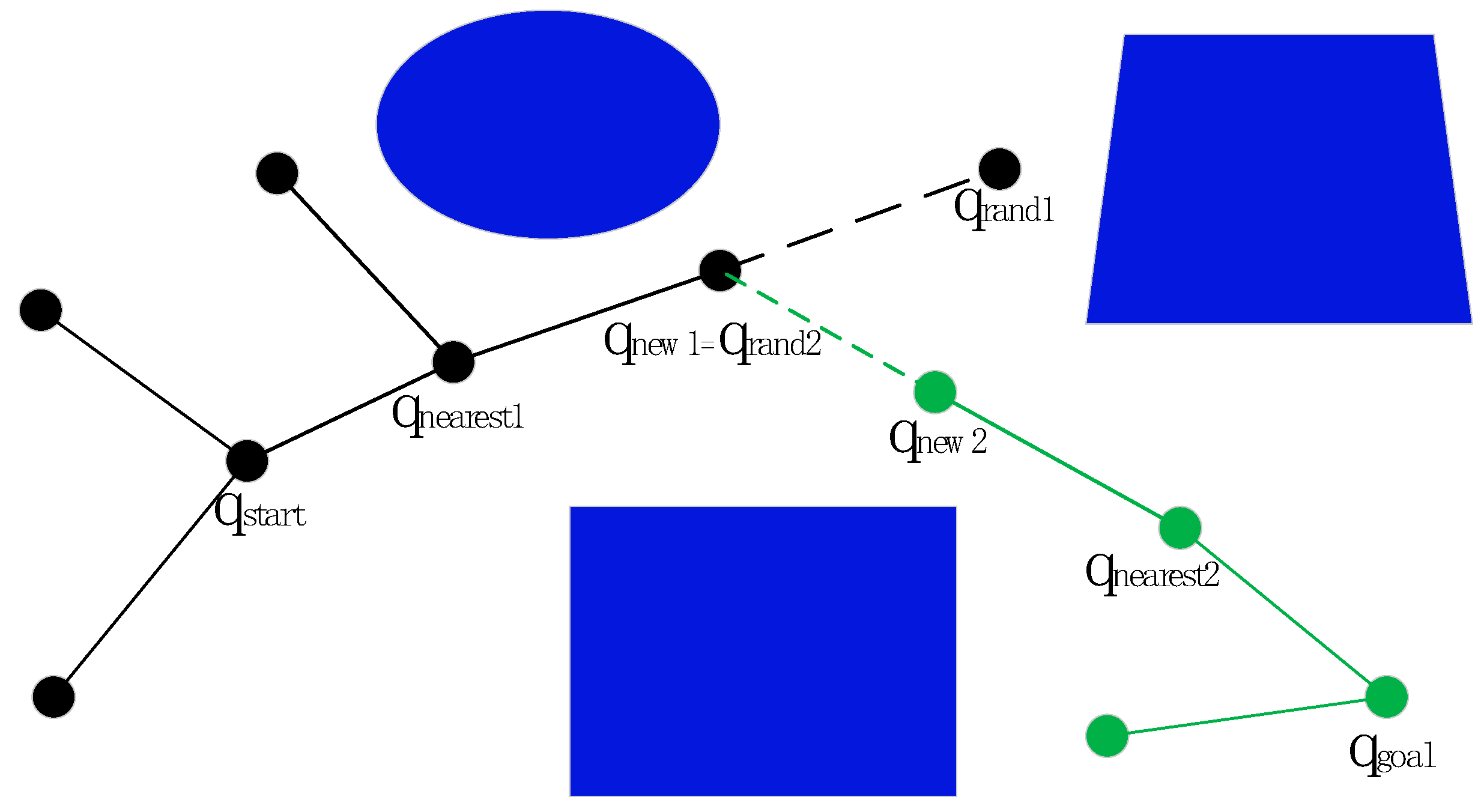
(4) Dual-Tree Connection and Path Generation: As illustrated in Figure 4, the standard RRT-Connect expands two trees alternately and attempts to connect them. If the path segment L passes the aforementioned safety check, the algorithm switches to the other tree and attempts to extend it towards q n e w using a “greedy” strategy: cyclically execute steps (2) and (3) until either a collision occurs or the distance between the extended node and q n e w falls below connection threshold r conn . For the latter case, the connection condition is met, and the global planning is deemed successful. The algorithm then outputs the complete coarse path, P coarse , connecting the start and goal configurations by backtracking the parent index chains of both search trees. If the iteration count exceeds the preset upper limit N max without establishing a connection, the planning task is declared a failure.

2.4.2. Local Planning Optimization Based on the APF-Smooth

To further enhance the smoothness and practical executability of the trajectory, ASCON performs piecewise local optimization on the coarse path, P coarse = q 0 , q 1 , , q N , by utilizing the APF-Smooth algorithm proposed in Section 2.2. For the i -th segment of the coarse path, the local start configuration is defined as q s t a r t = q ( i ) , and the local goal configuration is set as q g o a l = q ( i ) . In each iteration step k , the algorithm executes the following procedures:
(1) Torque Calculation: Based on the current manipulator configuration, the resultant torque τ total , comprising both attractive and repulsive components, is calculated using Equation (25).
(2) Dynamic Step Size Update: The dynamic step size is determined based on the distance between the current end-effector position and the target. Subsequently, the candidate configuration q k + 1 is obtained by updating the joint configuration in the direction This is a reminder: The companies/manufacturers of chemicals & reagents, devices, instruments, commercial cell lines/samples/materials should be indicated together with their city (states abbreviation is required for USA and Canada) and country in their first appearance. Please add necessary information for those items in text. For all the software used, please add the version number of them. Please check full text.of descending potential energy via Equation (26).
(3) Safety and Convergence Check: Collision detection is performed for q k + 1 . If the configuration is verified to be collision-free, the distance error relative to the local goal is evaluated. When the condition q k q goal   < ε conv is satisfied (where ε conv > 0 represents a preset convergence threshold), the optimization for this segment is deemed complete. The optimized trajectory fragment is then recorded as L ( i ) = { q 0 , q 1 , , q k } .
The aforementioned process is executed sequentially for all path segments i = 0,1 , , N 1 . Finally, a smoothed complete trajectory is generated by concatenating these optimized fragments.

3. Experimentation and Analysis

3.1. Experimental Setup

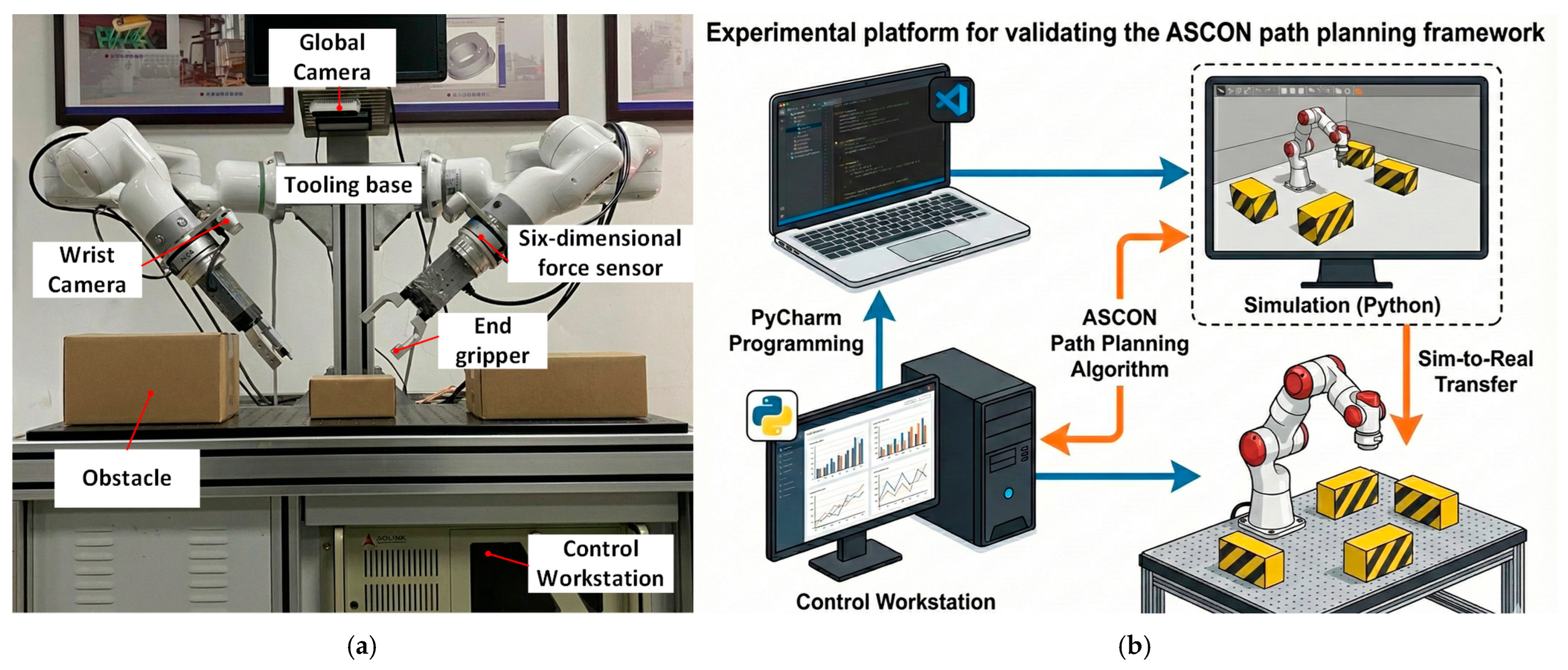
This section uses the experimental setup illustrated in Figure 5 to comprehensively evaluate ASCON’s effectiveness in both simulation and physical environments. The core algorithm is first compiled and simulated on a host computer, after which the optimized joint trajectory commands are transmitted to the physical terminal. The physical terminal is a side-mounted 6-DOF JAKA Minicobo collaborative manipulator (JAKA Robotics, Shanghai, China), and its end-effector is integrated with a six-dimensional force sensor and a two-finger gripper, which facilitate obstacle avoidance and manipulation tasks within constrained spaces, respectively.
All simulation experiments are conducted on a high-performance workstation equipped with an Intel® Core™ i9-13900HX CPU (2.20 GHz), 32 GB RAM, and an NVIDIA GeForce RTX 4060 GPU. Classical planners, including RRT and Bi-RRT, are selected as baselines for performance comparison. The experimental parameters for all algorithms are listed in Appendix A, Table A1 and Table A2, with consistent random seeds.
The evaluation metrics utilized in this study include: (i) the number of sampled nodes, which reflects the search effort and exploration complexity; (ii) planning time, the time required to obtain a feasible solution, indicating the computational efficiency; (iii) joint-space path length, the cumulative Euclidean distance between consecutive joint configurations representing the overall actuation effort; (iv) minimum safety clearance, the minimum distance between robot links and obstacles over the entire trajectory, quantifying the safety margin; and (v) jerk, the third-order time derivative of joint position, which characterizes motion smoothness, where a lower jerk indicates a smoother trajectory. To align with the control frequency of the physical robotic system (100 Hz), the planned trajectory is discretized with a fixed time step Δt = 0.01 s. The instantaneous jerk is then calculated using third-order finite differences based on this fixed interval.
Under these metrics, each test group is independently repeated 50 times to mitigate the uncertainty inherent in randomized sampling algorithms. A planning trial is deemed “successful” if and only if it generates a complete solution within a maximum cutoff time of T m a x = 60   s and satisfies all of the following constraints:
  • Convergence Constraint: The Euclidean distance between the final configuration q f i n a l and the goal configuration   q g o a l satisfies q f i n a l q g o a l   < ε goal , where the threshold is set to ε goal = 0.01 rad.
  • Safety Constraint: All discrete waypoints and interpolated path segments pass the collision check, ensuring that no penetration of any environmental obstacle occurs.
  • Kinematic Constraint: The planned trajectory strictly respects the joint servo velocity limits, i.e., q ˙ i     q ˙ m a x for all joints   i   where   q ˙ m a x = 0.15   r a d / s .
Conversely, a trial is classified as a “failure” if the planner exceeds this time limit or terminates due to being trapped in a local minimum without reaching the goal.

3.2. Validation of the APF-Smooth

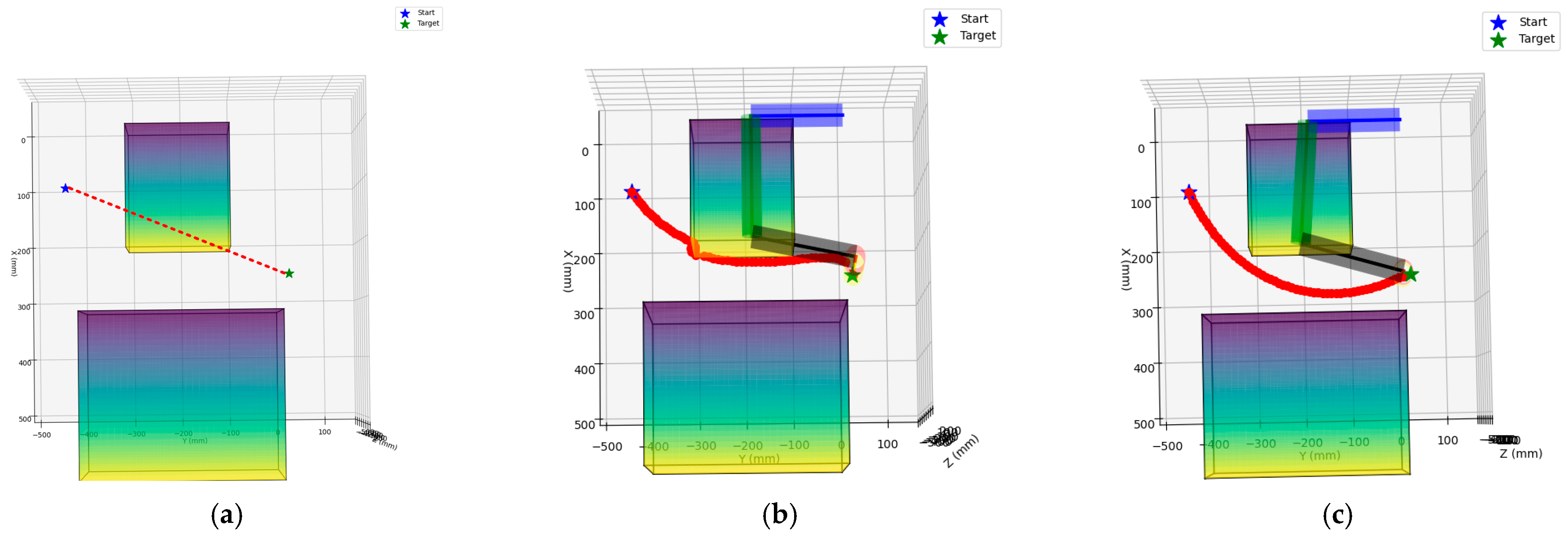
A comparative experiment is conducted between the standard APF and the proposed APF-Smooth algorithm within a 110 mm narrow passage scenario (as depicted in Figure 6a), with experimental results presented in Table 1.the 110 mm APF-Smooth result is included to indicate its feasibility boundary (provide a reference comparison), and it does not affect the main conclusion that ASCON remains feasible and robust under the extremely constrained 100 mm passage).
The APF-Smooth algorithm outperforms the standard APF algorithm across path quality, planning efficiency, and safety metrics.
For path quality, APF-Smooth reduced the average path length from 608.64 mm to 557.72 mm, a decrease of approximately 8.3%. Notably, the generated trajectory exhibits enhanced smoothness, evidenced by a reduction in the maximum jerk from 0.291 rad/s3 (Standard APF) to 0.254 rad/s3 (APF-Smooth). This improvement is primarily attributed to the potential field designed in Section 2.2. On one hand, the linear saturation mechanism introduced in the attractive field effectively suppresses excessive potential gradients in distant regions, enabling the manipulator to converge toward the target pose in a more stable manner. On the other hand, the repulsive field based on the Smoothstep function ensures a continuous transition within the interaction range, thereby eliminating gradient discontinuities commonly associated with paths generated by Standard APF. The synergistic effect of these two modifications significantly mitigates oscillations and unnecessary directional corrections during motion, thereby elevating the overall path quality.
Planning efficiency is also improved with APF-Smooth: the average planning time decreased from 4.41 s to 3.58 s, and the number of iterations dropped from 269 to 224, representing reductions of approximately 18.9% and 16.7%, respectively. These results suggest that the smoothed potential field provides numerically more stable gradient information, thereby regulating iterative oscillations caused by gradient spikes and facilitating rapid convergence.
Regarding safety, APF-Smooth, compared to standard APF, achieves a minimum collision clearance of 18 mm. This significant enhancement benefits directly from the link-joint repulsive force distribution strategy proposed in Section 2.3.2. By dynamically allocating a larger proportion of the repulsive torque to the joint geometrically closer to the obstacle interaction point (i.e., the specific point on the link closest to the obstacle), this strategy ensures more effective and stable obstacle avoidance behavior within confined spaces.

3.3. Performance Evaluation in Complex Scenarios

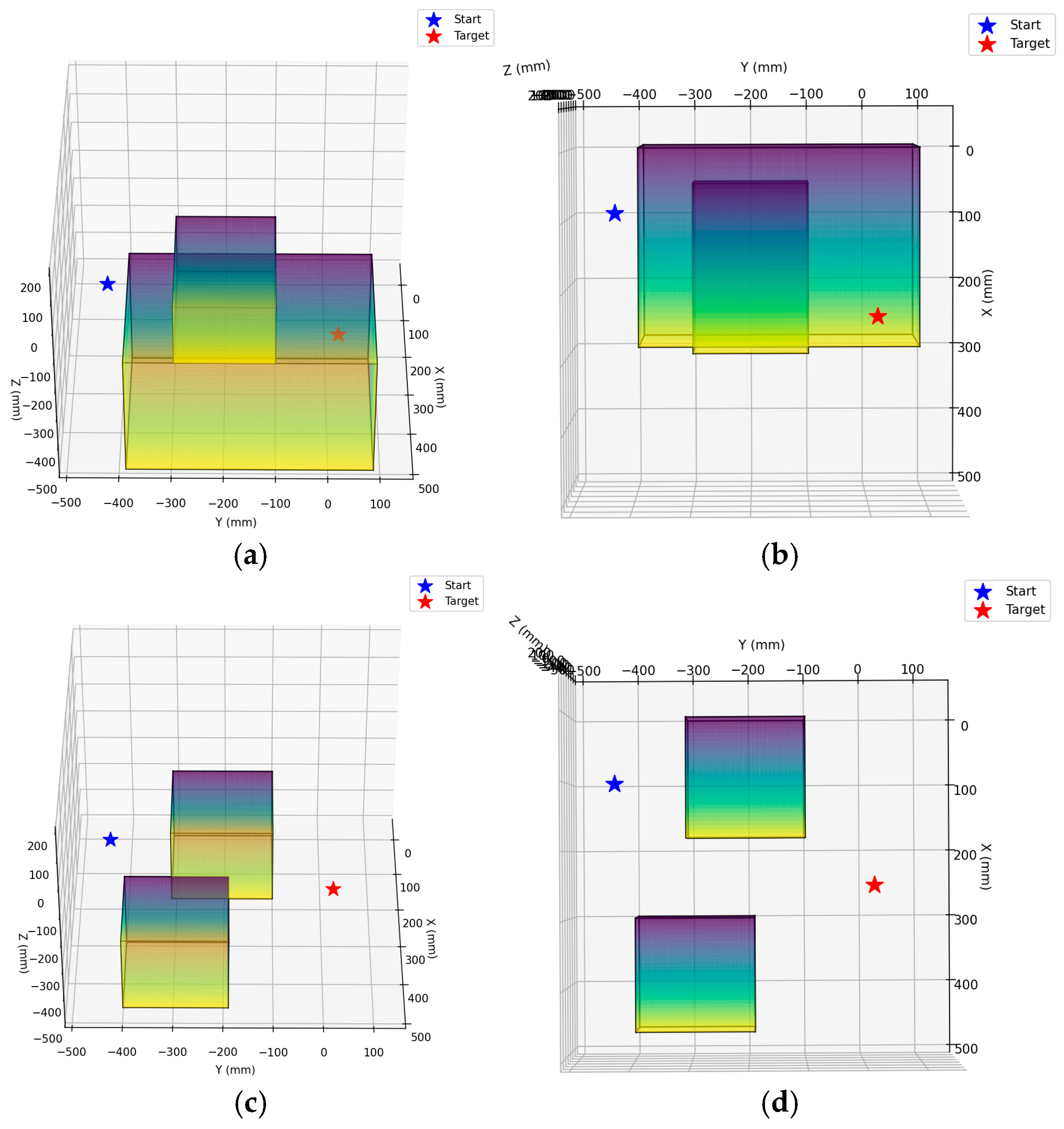
This section validates the adaptability and robustness of ASCON within two distinct environments, illustrated in Figure 7: the dual-layer stacked obstacle scenario and the 100 mm narrow passage scenario. The baselines for comparison include bidirectional BiRRT-APF, standard RRT-APF, and the standalone APF-Smooth.
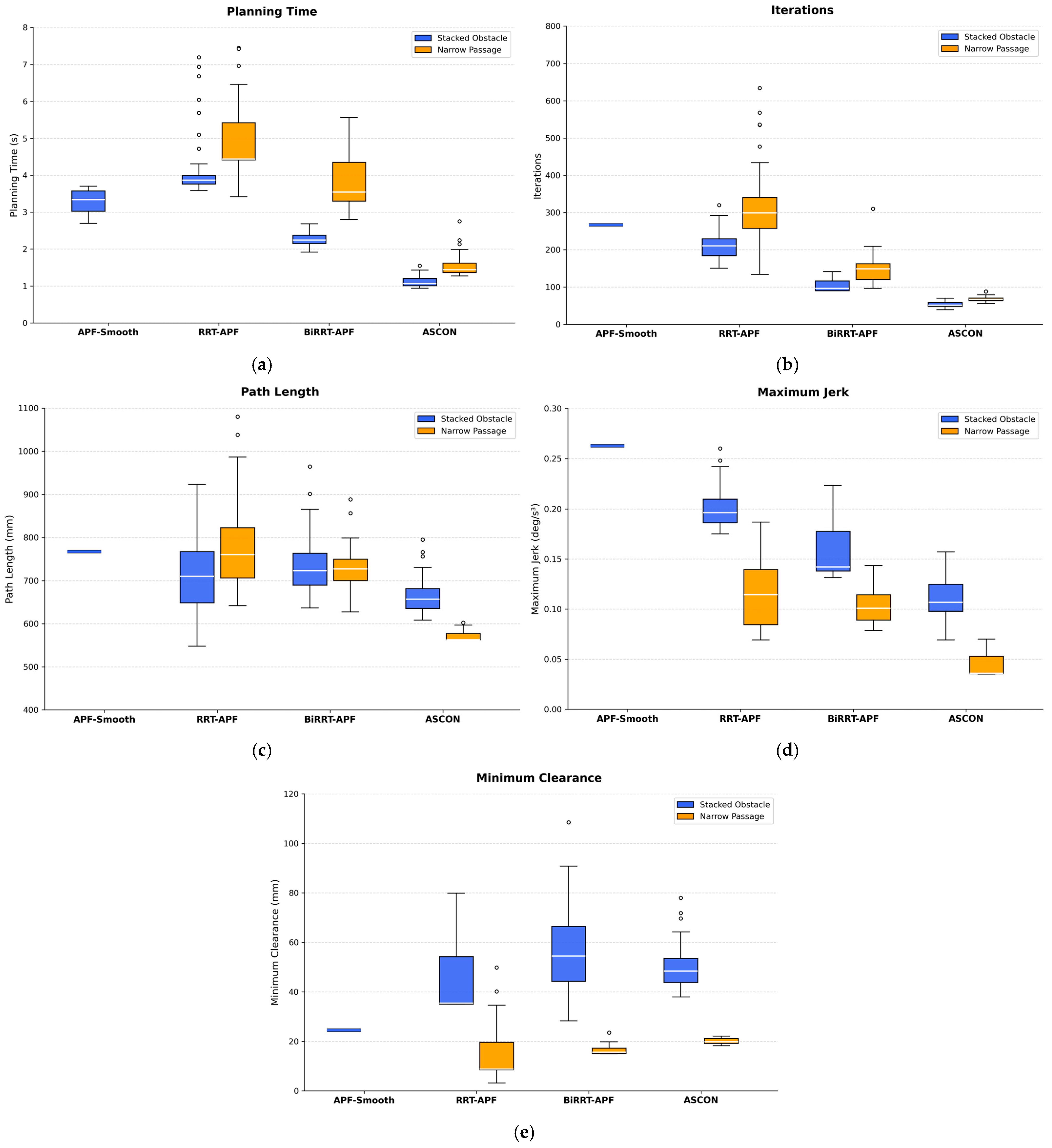
It should be noted that in the 100 mm narrow passage scenario, the standalone APF-Smooth fails to generate valid paths. Due to the extremely limited clearance, the algorithm inevitably encounters collisions or becomes trapped in oscillatory local minima caused by opposing repulsive fields. Consequently, APF-Smooth achieves a 0% success rate (0/50) in this scenario, and its corresponding performance metrics are reported as NA. The averaged results for the successful algorithms are summarized in Table 2, while their statistical distributions are visualized as box plots in Figure 8.
  • Planning Efficiency & Robustness:
Planning efficiency is evaluated via Planning Time (Figure 8a) and Iterations (Figure 8b). In the Stacked Obstacle scenario, ASCON outperforms all baselines with an average time of 1.11 s and 52 iterations—reducing costs by over 50% compared to the second-best BiRRT-APF. Regarding robustness (Figure 8a,b), the deterministic APF-Smooth fails completely in the Narrow Passage scenario due to entrapment in local minima. Meanwhile, stochastic methods such as RRT-APF and BiRRT-APF exhibit severe fluctuations, as evidenced by extended Interquartile Ranges (IQRs) and numerous outliers, indicating high variance in constrained spaces. Conversely, ASCON achieves superior consistency with the most compact IQR. This robustness is primarily attributed to the Dynamic Step Size Adjustment. By adaptively reducing step sizes near obstacles, ASCON enables high-precision connectivity, effectively mitigating the “blindness” of fixed-step sampling and ensuring reliable performance in narrow environments.
2.
Path Quality & Smoothness:
Path quality is evaluated via Path Length and Max Jerk. ASCON achieves an average length of 664.42 mm, a 13.5% reduction from the APF-Smooth baseline (767.82 mm). This significant gap (>100 mm) empirically demonstrates the geometric redundancy inherent in traditional potential-field paths. In terms of path length, ASCON maintains a standard deviation of 40.54 mm, markedly lower than the stochastic RRT-APF (81.78 mm). The compact IQR in Figure 8c confirms that ASCON’s performance stems from dynamic step size adjustment and smoothed gradient guidance, which consistently steer the planner toward rational paths rather than relying on random “shortcuts.” The proposed Smoothstep based strategy effectively eliminates force discontinuities. As shown in Figure 8d, ASCON limits the peak jerk to 0.157 rad/s3, the lowest among all methods; the second-best, Pure APF, achieves a maximum jerk of 0.263 rad/s3. This significant reduction in oscillation verifies that the improved potential field generates continuous trajectories suitable for direct servo control.
3.
Safety Margin Validation:
The Minimum Clearance reflects the trade-off between obstacle avoidance and path optimality. Statistically, BiRRT-APF achieves a higher average clearance (55.80 mm) compared to ASCON (50.0 mm). However, this higher mean does not imply superior safety but rather geometric inefficiency. As shown in Figure 8e, BiRRT-APF is unstable, exhibiting high variance and often generating overly conservative paths that stray unnecessarily far from obstacles. In contrast, ASCON exhibits a more uniform distribution. This indicates a deliberate, active optimization strategy: rather than indiscriminately maximizing clearance, ASCON maintains a stable “safety corridor” above the 20 mm physical threshold optimizing the trajectory to reduce the path length. This approach strikes a balance in performance by avoiding the trap-prone proximity of APF-Smooth (mean 24.55 mm) while curbing the excessive margins of random sampling.

3.4. Real-World Experimental Validation

This section validates the ASCON algorithm’s path-planning capability and applicability in a real-world environment. The experimental scenario consists of two rectangular obstacles, whose ranges of spatial coordinate ( x min , y min , z min , x max , y max , z max ) are detailed in Table 3. These obstacles are positioned to form a narrow passage approximately 100 mm wide. This width was specifically selected to account for the manipulator’s physical dimensional limits, thereby testing the algorithm’s performance under extreme constraints. The planned trajectory was executed on the JAKA MiniCobo robot using the direct joint servo interface. This manipulator is characterized by a high repeatability of ± 0.02 mm. In the simulation, the minimum safety clearance was calculated to be 20.13 mm. To validate robustness, the experiment was repeated over 20 times, achieving a 100% success rate without collisions. Given that the robot’s hardware precision ( ± 0.02 mm) is three orders of magnitude smaller than the safety margin (20.13 mm), the collision-free execution inherently demonstrates that the servo tracking error was negligible and well within the safe limits.
The specific configurations for the start joint angles ( q start ) and goal joint angles ( q goal ) are listed in Table 3.
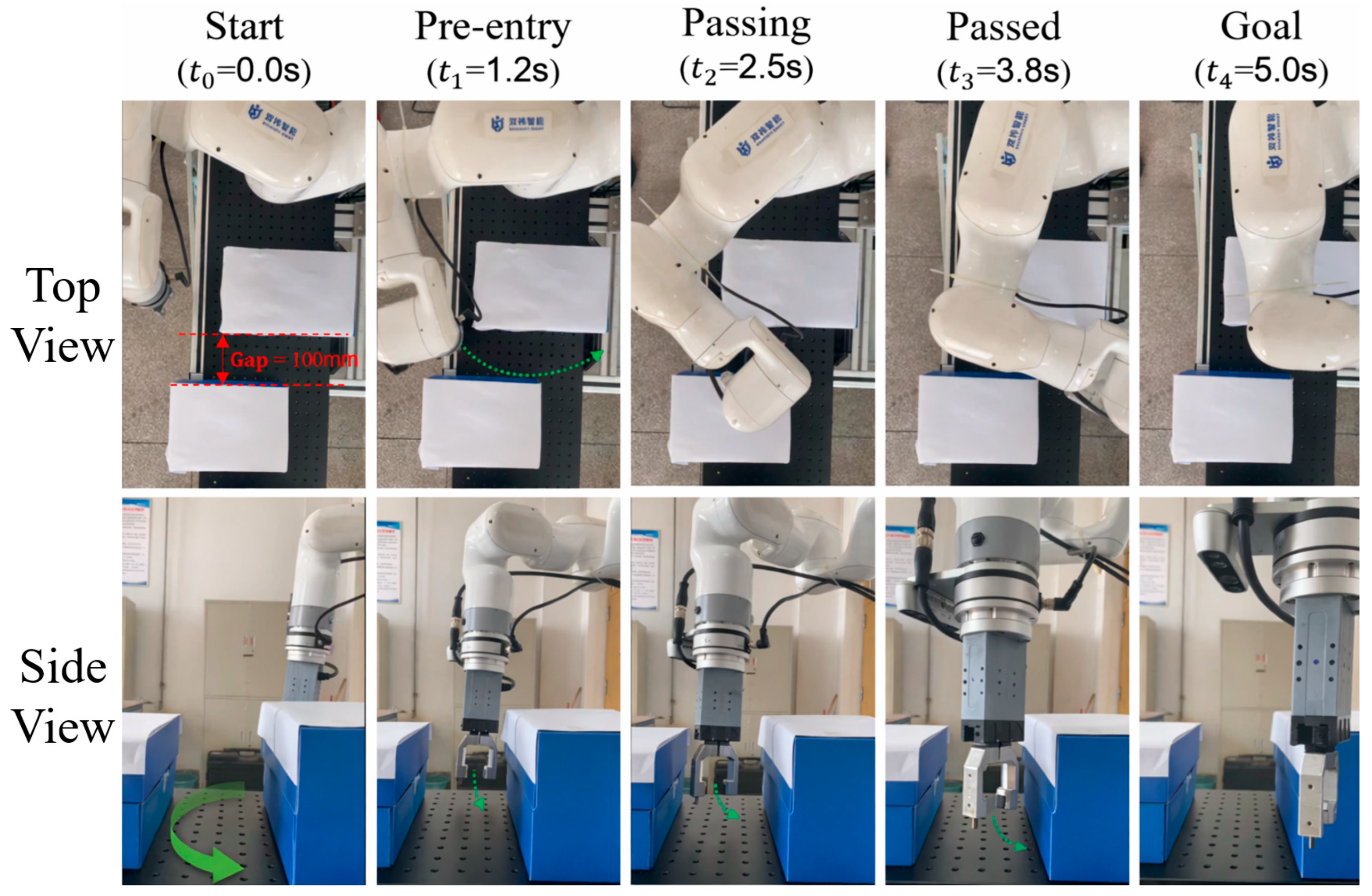
Figure 9 presents time-lapse snapshots of the robot successfully traversing the 100 mm narrow passage using ASCON. The figure includes two rows: the top row displays the top-down view, while the bottom row shows the side view. From left to right, the sequence illustrates five key motion stages:
  • Start (t0= 0.0 s): The robot is positioned at the initial configuration.
  • Pre-entry (t1 = 1.2 s): The end-effector reorients to align with the passage entrance (indicated by the green dashed arrow).
  • Passing (t2 = 2.5 s): The robot navigates through the confined space. The red dashed lines highlight the 100 mm clearance constraint, demonstrating collision-free performance.
  • Passed (t3 = 3.8 s): The robot safely exits the narrow passage.
  • Goal (t4 = 5.0 s): The robot converges to the target pose with high precision.

4. Conclusions

To tackle the twin issues of inefficient exploration and trajectory oscillation faced by high-DOF manipulators in narrow passages, this paper introduces ASCON, a hybrid path planning algorithm designed for highly constrained environments. By creating a synergistic “global exploration–local optimization” mechanism, ASCON effectively combines the gradient guidance of an improved potential field with the stochastic exploration ability of RRT-Connect.
Experimental results demonstrate that ASCON surpasses the performance limits of traditional sampling-based algorithms in confined spaces. Quantitatively, it enhances planning efficiency by roughly 50% in both computation time and iteration count compared to the BiRRT-APF baseline. Importantly, ASCON shows exceptional robustness in complex, narrow-passage environments: it maintains a 100% success rate while reducing the “high variance” characteristic of stochastic algorithms to a “low fluctuation” level that approaches that of deterministic methods. Specifically, it cuts the standard deviation of path metrics by more than 50% compared to BiRRT-APF, ensuring the high stability and repeatability needed for industrial automation tasks.
Furthermore, ASCON shows a better balance between safety and optimality. Instead of just maximizing obstacle clearance without thought, the algorithm uses an active optimization method: it maintains a strict physical safety buffer (minimum clearance > 20 mm) while also reducing geometric redundancy. This results in a 13.5% shorter path and smoother trajectories with less jerk, successfully balancing the need for safety and efficient movement.
Despite these contributions, this study has limitations that merit further investigation. First, the experimental validation was conducted on a single robotic platform (JAKA MiniCobo) within static obstacle environments; the algorithm’s adaptability to dynamic obstacles or distinct kinematic chains remains to be verified. Second, the smoothness evaluation (jerk) relied on a simplified kinematic time parameterization (Δt = 0.01 s) rather than a full dynamic model with torque constraints. Third, the algorithm relies on key hyperparameters (e.g., potential field gains) that were empirically tuned. While a fixed parameter set demonstrated robustness across all scenarios in this study, the lack of an automated sensitivity analysis limits the planner’s adaptability to unforeseen environments. Future work will focus on developing adaptive parameter adjustment mechanisms, integrating real-time perception to extend ASCON for dynamic obstacle avoidance, and incorporating full dynamic constraints to further enhance trajectory feasibility.

Author Contributions

Conceptualization, Y.Z. and Z.Z.; methodology, Y.Z.; software, Y.Z.; validation, Y.Z., C.L., X.S. and Y.H.; formal analysis, Y.Z.; investigation, Y.Z., N.G. and T.G.; resources, W.Z. and Z.Z.; data curation, Y.Z. and K.J.; writing—original draft preparation, Y.Z.; writing—review and editing, Y.Z., W.Z. and Z.Z.; visualization, Y.Z.; supervision, W.Z. and Z.Z.; project administration, Z.Z.; funding acquisition, Z.Z. All authors have read and agreed to the published version of the manuscript.

Funding

This work is supported by National Natural Science Foundation of China (52401045), Major Science and Technology Projects of Longmen Laboratory (231100220500), Major Science and Technology Special Project of Henan Province (241100210300).

Data Availability Statement

The original contributions presented in this study are included in the article. Further inquiries can be directed to the corresponding author.

Acknowledgments

The authors would like to thank the anonymous reviewers for their valuable comments and suggestions, which helped to improve the quality of this manuscript.

Conflicts of Interest

The authors declare no conflicts of interest. The funders had no role in the design of the study; in the collection, analyses, or interpretation of data; in the writing of the manuscript; or in the decision to publish the results.

Abbreviations

The following abbreviations are used in this manuscript:
APFArtificial Potential Field
ASCONAPF-Smooth–RRT-Connect
CHOMPCovariant Hamiltonian Optimization for Motion Planning
CobotCollaborative Robot
DoFDegree of Freedom
PRMProbabilistic Roadmap
RRTRapidly-exploring Random Tree

Appendix A

Table A1. MDH Parameter Table (Side Mount).
Linkαi-1 (Deg)ai-1 (mm)θi (Deg)di (mm)Range
190090187±360
2−900−900±120
30210906±130
49000210.5±360
5−90000±120
6900180159.3±360
Table A2. Experiment Parameters.
AlgorithmsParametersUnitValue
APFObstacle repulsive influence distancemm1000
Goal tolerancerad0.01
Repulsive gainNA300
Joint-space attractive gainNA300
Task-space attractive gainNA0.01
Joint update step sizerad0.02
Maximum iterationsNA1000
RRTStep sizerad0.05
Maximum iterationsNA10,000
Goal tolerancerad0.01
Goal bias probabilityNA0.4
Robot Arm Envelope for Collision DetectionBasemm64
Shoulder jointmm64
Elbow jointmm61
Wrist jointmm61
End-effectormm40

References

  1. Wang, R.; Xie, Y.; Liu, H.; Zhou, W. Center-of-Mass-Based Object Regrasping: A Reinforcement Learning Approach and the Effects of Perception Modality. IEEE/ASME Trans. Mechatron. 2025, 30, 1356–1365. [Google Scholar] [CrossRef]
  2. Sherwani, F.; Asad, M.M.; Ibrahim, B.S.K.K. Collaborative Robots and Industrial Revolution 4.0 (IR 4.0). In Proceedings of the 2020 International Conference on Emerging Trends in Smart Technologies (ICETST), Karachi, Pakistan, 26–27 March 2020; IEEE: Piscataway, NJ, USA, 2020. [Google Scholar] [CrossRef]
  3. Li, P.; Li, R.; He, Y.; Zhang, J. Adaptive Finite Control Set Model Predictive Control for Three-Phase Inverters Connected to Distorted Grid with Fewer Voltage Sensors. Control Eng. Pract. 2021, 116, 104936. [Google Scholar] [CrossRef]
  4. Ahmad, J.; Ab Wahab, M.N. Enhancing the Safety and Smoothness of Path Planning through an Integration of Dijkstra’s Algorithm and Piecewise Cubic Bézier Optimization. Expert Syst. Appl. 2025, 289, 128315. [Google Scholar] [CrossRef]
  5. Yang, T.-Y.; Zou, L.; Wu, Z.-X.; Chen, W.-M. An Improved A-Star Algorithm Coupled with Graph Division and AIS Data for Ship Path Planning. Ocean Eng. 2025, 330, 121234. [Google Scholar] [CrossRef]
  6. Tang, X.; Shang, W.; Hu, J.; Zhang, F.; Kong, L. Manifold Approximation-Based Probabilistic Roadmap Approach for Constrained Path Planning of Mobile Manipulators. IEEE/ASME Trans. Mechatron. 2025, 30, 7334–7345. [Google Scholar] [CrossRef]
  7. Zhang, J.; Wang, S.; Tang, Q.; Zhou, Y.; Zeng, T. An Improved NSGA-III Integrating Adaptive Elimination Strategy to Solution of Many-Objective Optimal Power Flow Problems. Energy 2019, 172, 945–957. [Google Scholar] [CrossRef]
  8. Zhang, J.; Zhu, X.; Li, P. MOEA/D with Many-Stage Dynamical Resource Allocation Strategy to Solution of Many-Objective OPF Problems. Int. J. Electr. Power Energy Syst. 2020, 120, 106050. [Google Scholar] [CrossRef]
  9. Zucker, M.; Ratliff, N.; Dragan, A.D.; Pivtoraiko, M.; Klingensmith, M.; Dellin, C.M.; Bagnell, J.A.; Srinivasa, S.S. CHOMP: Covariant Hamiltonian Optimization for Motion Planning. Int. J. Rob. Res. 2013, 32, 1164–1193. [Google Scholar] [CrossRef]
  10. Schulman, J.; Duan, Y.; Ho, J.; Lee, A.; Awwal, I.; Bradlow, H.; Pan, J.; Patil, S.; Goldberg, K.; Abbeel, P. Motion Planning with Sequential Convex Optimization and Convex Collision Checking. Int. J. Rob. Res. 2014, 33, 1251–1270. [Google Scholar] [CrossRef]
  11. Khatib, O. Real-Time Obstacle Avoidance for Manipulators and Mobile Robots. Int. J. Rob. Res. 1986, 5, 90–98. [Google Scholar] [CrossRef]
  12. Gan, L.; Li, X.; Yan, T.; Song, L.; Xiao, J.; Shu, Y. Intelligent Ship Path Planning Based on Improved Artificial Potential Field in Narrow Inland Waterways. Ocean Eng. 2025, 317, 119928. [Google Scholar] [CrossRef]
  13. Wu, C.; Guo, Z.; Zhang, J.; Mao, K.; Luo, D. Cooperative Path Planning for Multiple UAVs Based on APF B-RRT* Algorithm. Drones 2025, 9, 177. [Google Scholar] [CrossRef]
  14. Wilson, T.S.; Thomason, W.; Kingston, Z.; Gammell, J.D. AORRTC: Almost-Surely Asymptotically Optimal Planning with RRT-Connect. IEEE Robot. Autom. Lett. 2025, 10, 13375–13382. [Google Scholar] [CrossRef]
  15. Zhang, L.; Li, C. The Optimization and Application Research of the RRT-APF-Based Path Planning Algorithm. Electronics 2024, 13, 4963. [Google Scholar] [CrossRef]
  16. Liu, Y.; Tao, W.; Li, S.; Li, Y.; Wang, Q. A Path Planning Method with a Bidirectional Potential Field Probabilistic Step Size RRT for a Dual Manipulator. Sensors 2023, 23, 5172. [Google Scholar] [CrossRef] [PubMed]
  17. Zhang, Q.; Hu, S.; Duan, J.; Qin, J.; Zhou, Y. A SAC-Bi-RRT Two-Layer Real-Time Motion Planning Approach for Robot Assembly Tasks in Unstructured Environments. Actuators 2025, 14, 59. [Google Scholar] [CrossRef]
  18. Huang, A.; Zhou, M.; Liu, M.; Pan, Y.; Guo, J.; Hu, Y. Adaptive Path Planning for Robotic Winter Jujube Harvesting Using an Improved RRT-Connect Algorithm. Agriculture 2026, 16, 47. [Google Scholar] [CrossRef]
  19. Yu, J.; Wu, J.; Xu, J.; Wang, X.; Cui, X.; Wang, B.; Zhao, Z. A Novel Planning and Tracking Approach for Mobile Robotic Arm in Obstacle Environment. Machines 2024, 12, 19. [Google Scholar] [CrossRef]
  20. Zhang, X.; Zhang, Z.; Ling, L.; Hu, X.; Yang, D.; Li, H.; Fu, Y.; Liang, E. A Multi-Objective Optimization-Based Robot Coating Trajectory Planning Algorithm for Combustion Turbine Blades Using Seventh-Degree Non-Uniform B-Spline Curves. J. Therm. Spray Technol. 2025, 34, 1566–1588. [Google Scholar] [CrossRef]
  21. Shao, X.; Xu, L.; Zheng, T.; Sun, G.; Zhu, Y. Practical Finite-Time Motion Planning for Spacecraft-Mounted Soft Manipulators under Dynamic Obstacles. IEEE Trans. Aerosp. Electron. Syst. 2025; early access. [Google Scholar] [CrossRef]
Figure 1. Flowchart of ASCON.
Machines 14 00228 g001
Figure 2. Modeling of the robotic manipulator. (a) MDH model; (b) Simplified link-radius envelope model.
Machines 14 00228 g002
Figure 3. Schematic diagram of the collision detection model. (a) Distance between a point and a triangle; (b) Distance between a line segment and a triangle.
Machines 14 00228 g003
Figure 4. Flowchart of RRT-Connect.
Machines 14 00228 g004
Figure 5. Experimental Configuration for validating ASCON’s path planning. (a) photographs; (b) schematic diagram.
Machines 14 00228 g005
Figure 6. Comparison of planning results between APF-Smooth and the standard APF (110 mm narrow passage). (a) Planning scenario; (b) Path generated by standard APF; (c)Path generated by APF-Smooth.
Machines 14 00228 g006
Figure 7. Simulation test environments for adaptability and robustness validation (100 mm narrow passage). (a,b) Perspective view and Top-down view of the dual-layer stacked obstacle scenario; (c,d) Perspective view and Top-down view of the narrow passage scenario.
Machines 14 00228 g007
Figure 8. Box plots of five performance metrics based on 50 independent simulation trials. (a) planning time; (b) iterations; (c) path length; (d) maximum jerk; (e) minimum clearance.
Machines 14 00228 g008
Figure 9. Time-lapse sequence of the robot traversing the 100 mm narrow passage. The robot is equipped with a two-finger gripper (Jiangsu Shuangyi Intelligent Technology Co., Ltd., Suzhou, Jiangsu, China). The top row displays the top-down view, and the bottom row shows the side view. The red dashed lines mark the 100 mm constrained gap, while the green curve illustrates the schematic trajectory.
Machines 14 00228 g009
Table 1. Performance comparison between the standard APF and APF-Smooth.
AlgorithmAvg. Path Length (mm)Avg. Planning Time (s)Avg. IterationsMin. Clearance (mm)Max. Jerk (rad/s3)
APF608.64044.412426950.291
APF-Smooth557.72243.5797224180.254
Table 2. Comparison of planning performance in complex environments.
ScenarioAlgorithmAvg. Path Length (mm)Avg. Planning Time (s)Avg. IterationsMin. Clearance (mm)Max. Jerk (rad/s3)Success Rate (%)
Stacked
Obstacle
APF-Smooth767.823.26 ± 0.3326724.550.263100% (50/50)
RRT-APF713.47 ± 81.78 *4.16 ± 0.85208.12 ± 37.9143.680.26194% (47/50)
BiRRT-APF734.58 ± 66.882.27 ± 0.18103.84 ± 15.8655.80.22398% (49/50)
ASCON664.42 ± 40.541.11 ± 0.1552.66 ± 8.26500.157100% (50/50)
Narrow
Passage
(100 mm)
APF-SmoothNANANANANA0% (0/50)
RRT-APF777.11 ± 98.465.22 ± 1.72313.74 ± 96.8614.610.18678% (39/50)
BiRRT-APF730.51 ± 46.253.93 ± 1.32148.50 ± 35.3816.40.14388% (44/50)
ASCON569.98 ± 10.981.53 ± 0.2867.58 ± 6.0120.130.07100% (50/50)
* Each test group contains 50 independent trials. Values are reported as mean ± standard deviation computed over successful trials only. NA denotes 0 successful trials.
Table 3. Obstacle Bounding Boxes and Start/Goal Joint Configurations for the Planning Tasks.
Obstacle
Bounding (mm)
Joint Angles
(Deg)
Box1Box2 q s t a r t q goal
xmin3000q1−98−86
xmax470200q2−3990
ymin−400−310q311080
ymax−190−100q49193
zmin−500−500q5−77−90
zmax−250−250q6−81−83
Disclaimer/Publisher’s Note: The statements, opinions and data contained in all publications are solely those of the individual author(s) and contributor(s) and not of MDPI and/or the editor(s). MDPI and/or the editor(s) disclaim responsibility for any injury to people or property resulting from any ideas, methods, instructions or products referred to in the content.