Author Contributions
Conceptualization, F.A. and M.J.M.; methodology, F.A. and M.J.M.; software, M.J.M.; validation, F.A. and M.J.M.; formal analysis, F.A. and M.J.M.; investigation, M.J.M.; resources, F.A. and M.J.M.; data curation, F.A. and M.J.M.; writing—original draft preparation, M.J.M.; writing—review and editing, F.A. and M.J.M.; visualization, M.J.M.; supervision, F.A.; project administration, F.A.; funding acquisition, F.A. All authors have read and agreed to the published version of the manuscript.
Figure 1.
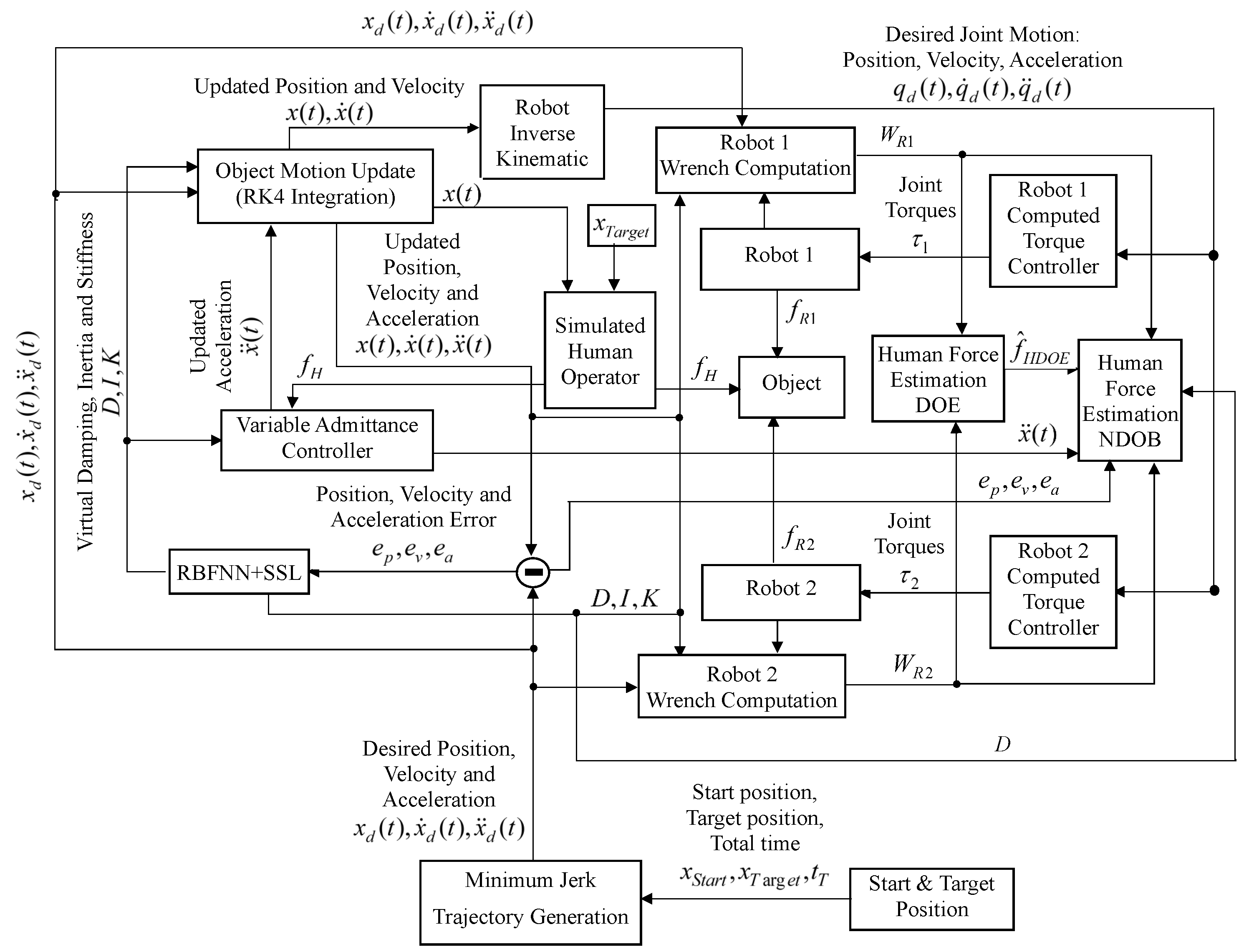
The structure of the proposed method.
Figure 1.
The structure of the proposed method.
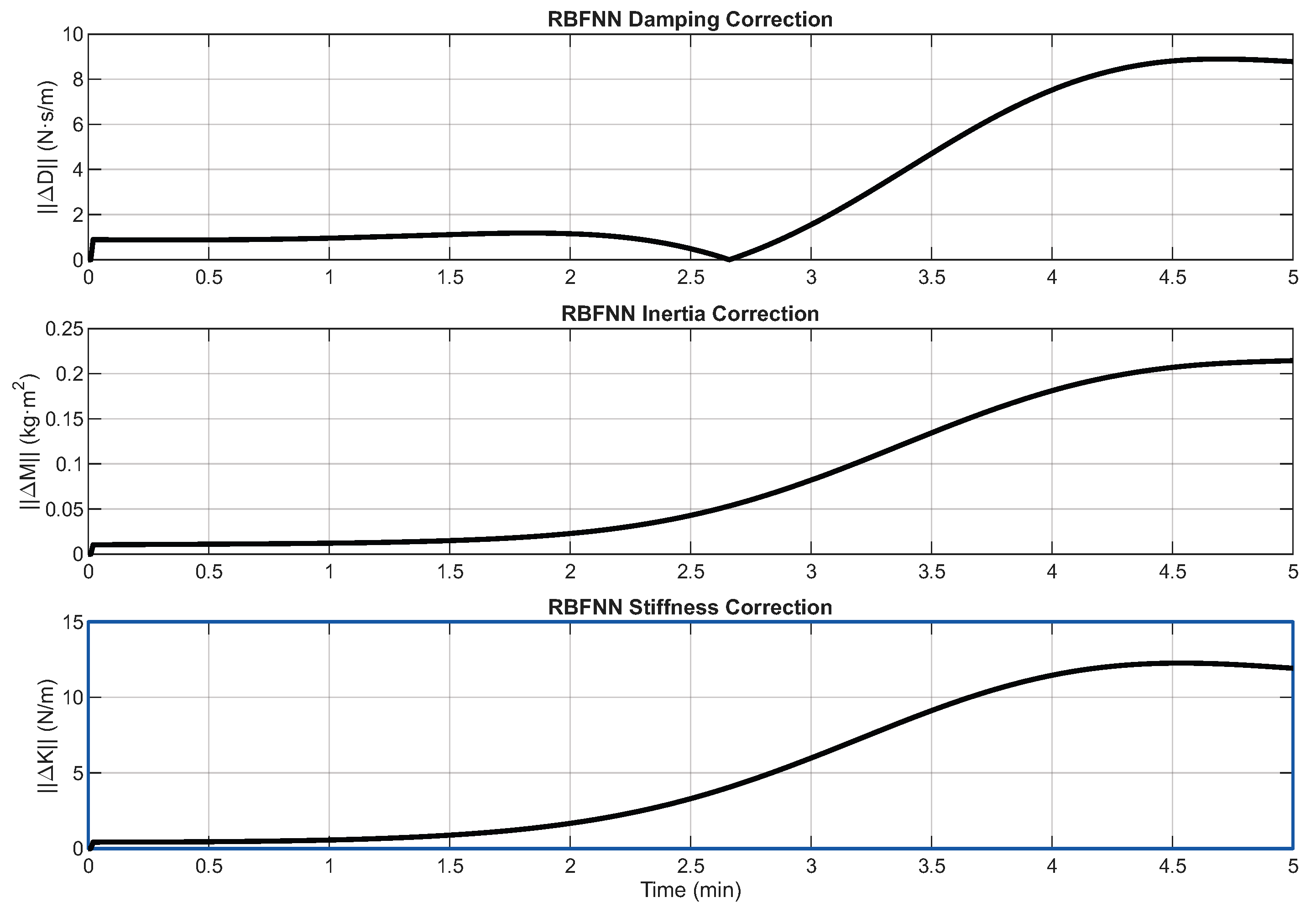
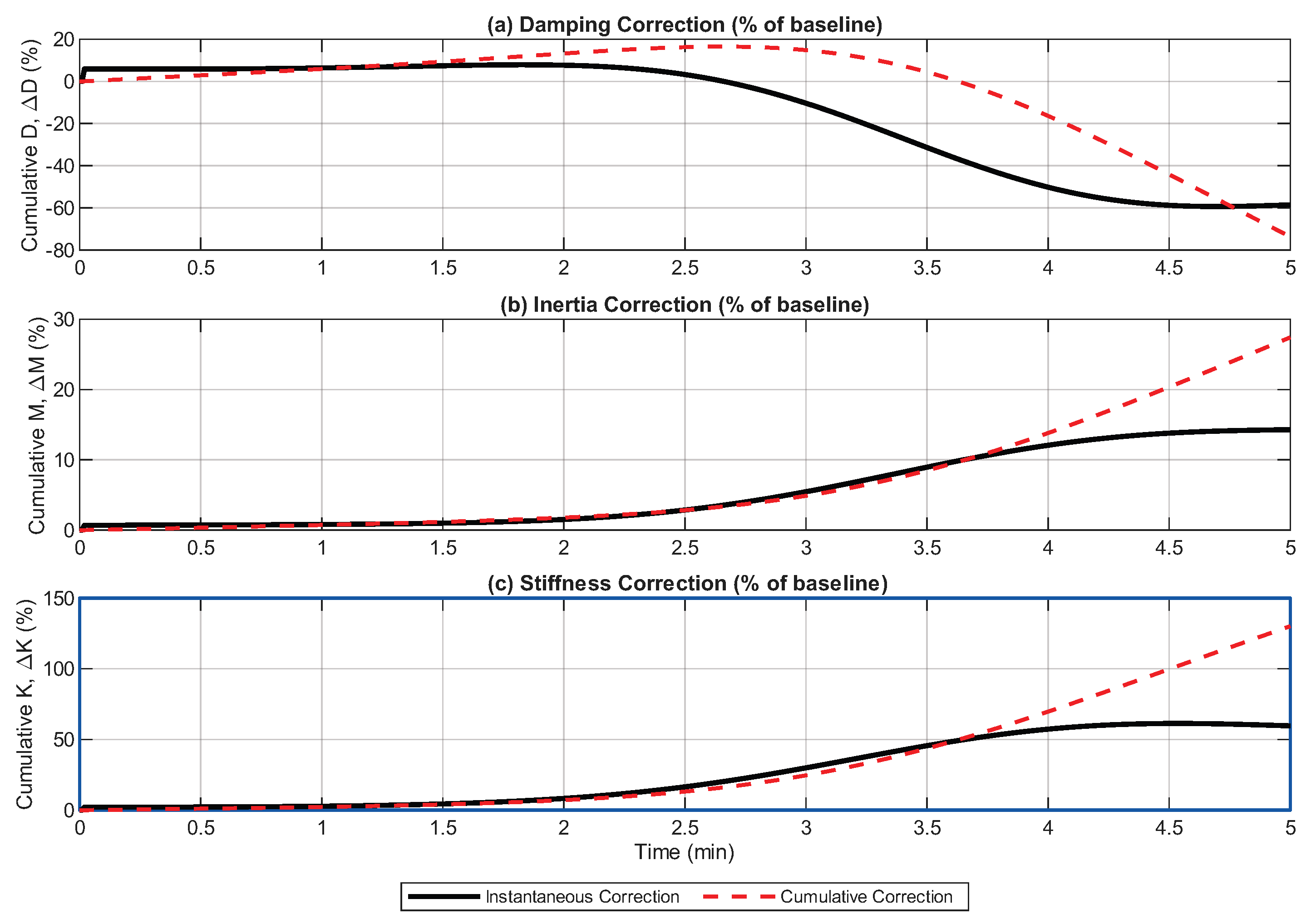
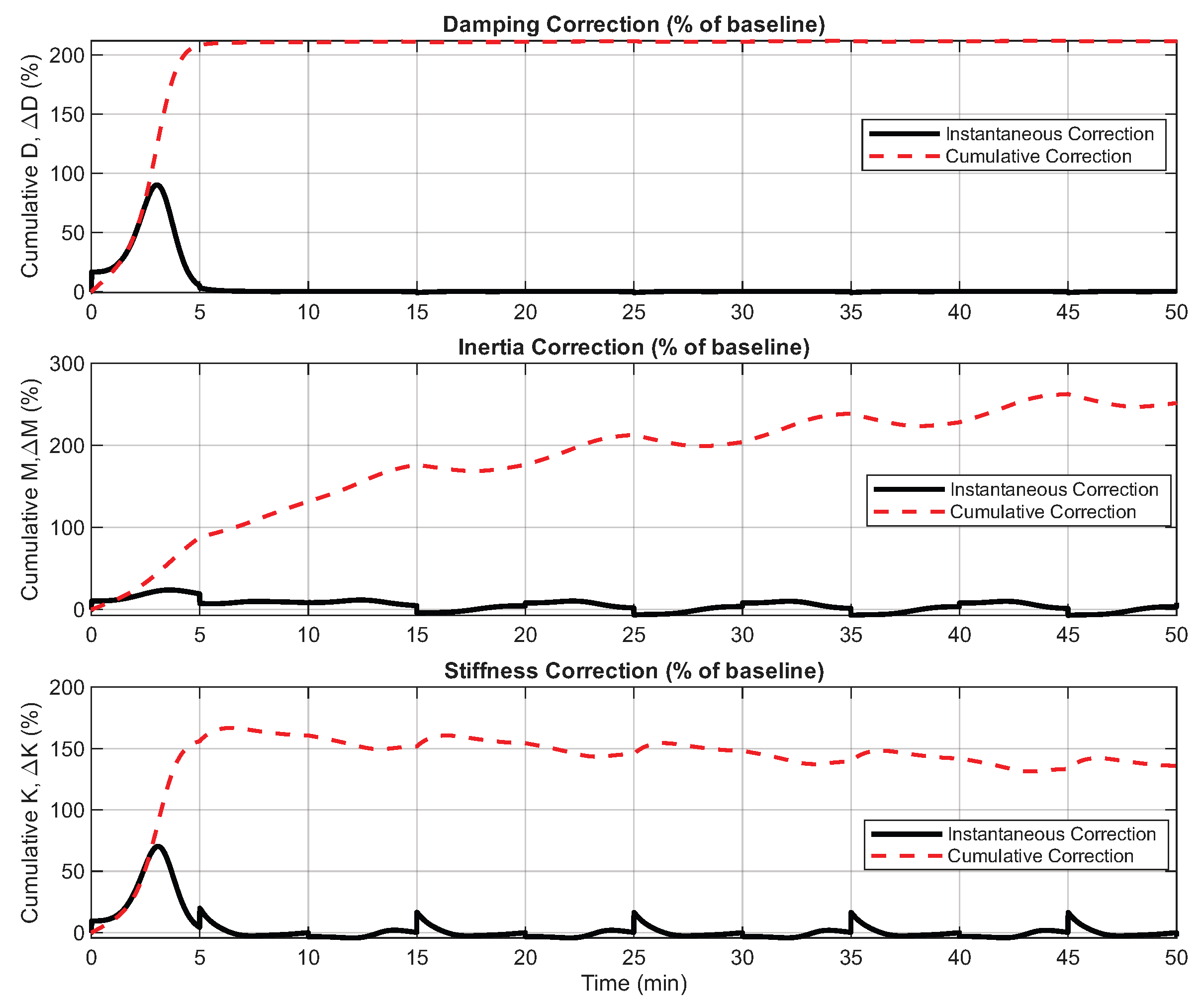
Figure 2.
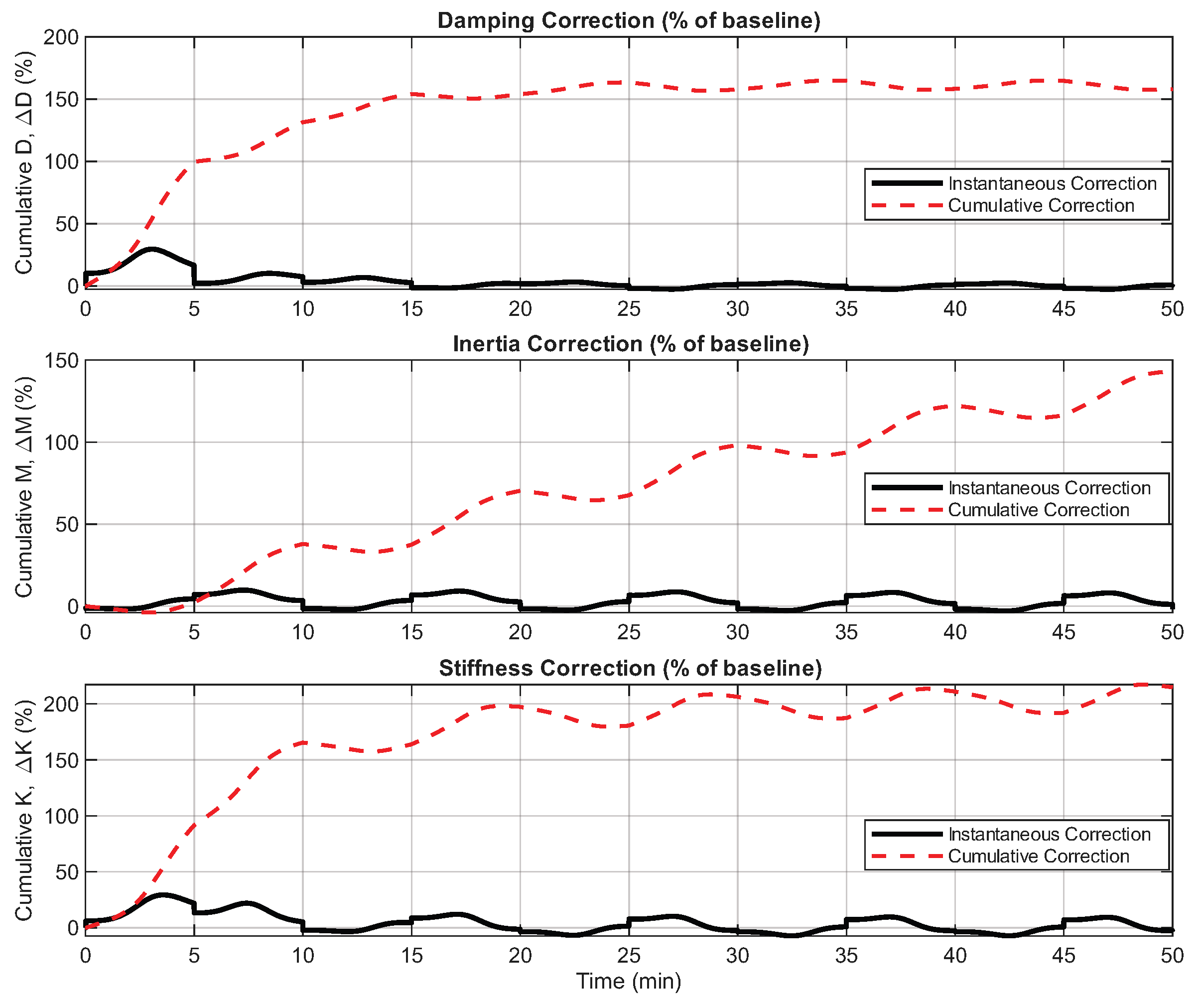
Percentage correction signalst for the VAC parameters: (a) damping, (b) inertia, and (c) stiffness. Solid lines indicate instantaneous RBFNN correction signals, while dashed lines show their cumulative (time-integrated) effect. The curves show the RBFNN-generated deviations , , and expressed as percentages of the corresponding baseline values.
Figure 2.
Percentage correction signalst for the VAC parameters: (a) damping, (b) inertia, and (c) stiffness. Solid lines indicate instantaneous RBFNN correction signals, while dashed lines show their cumulative (time-integrated) effect. The curves show the RBFNN-generated deviations , , and expressed as percentages of the corresponding baseline values.
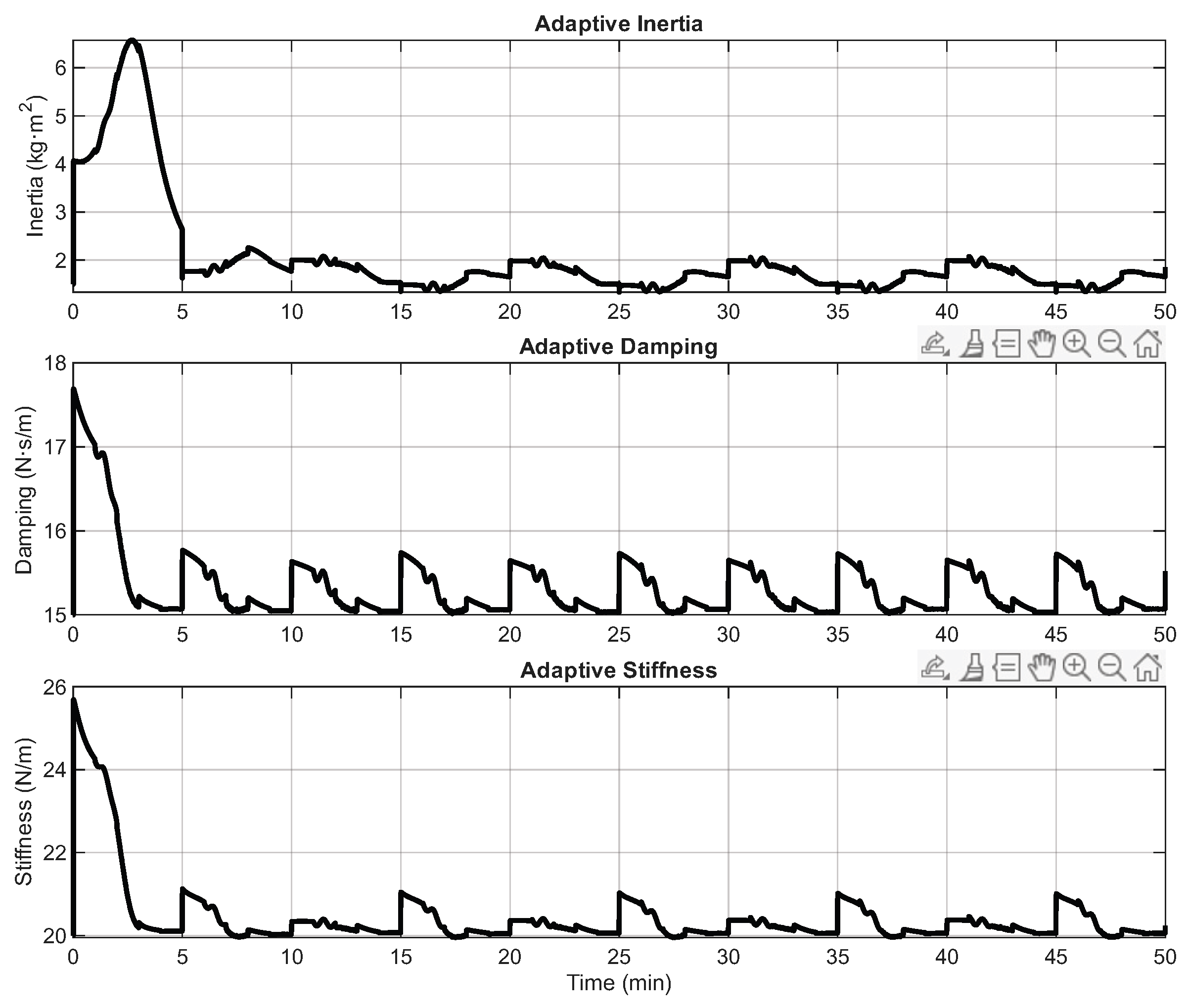
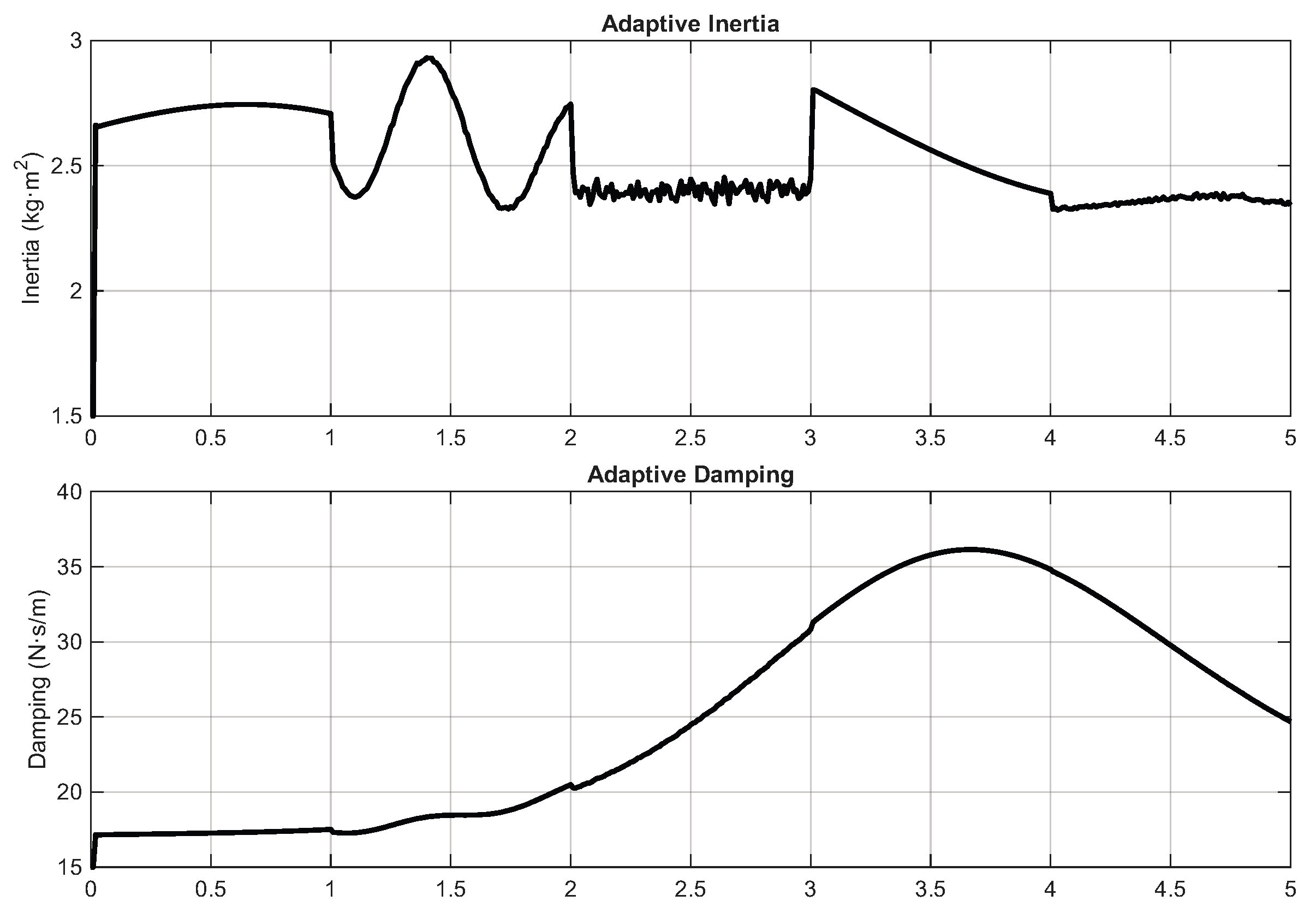
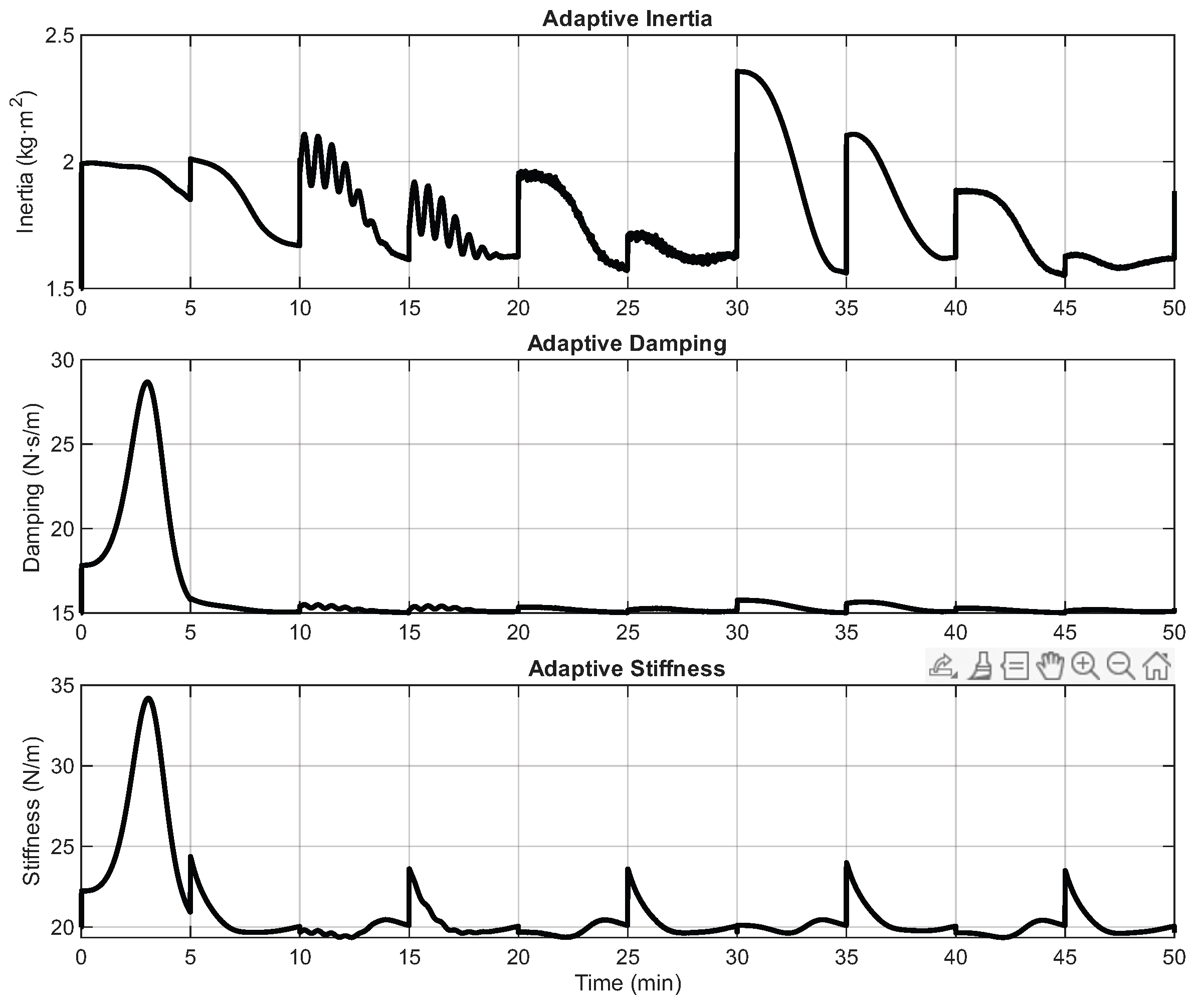
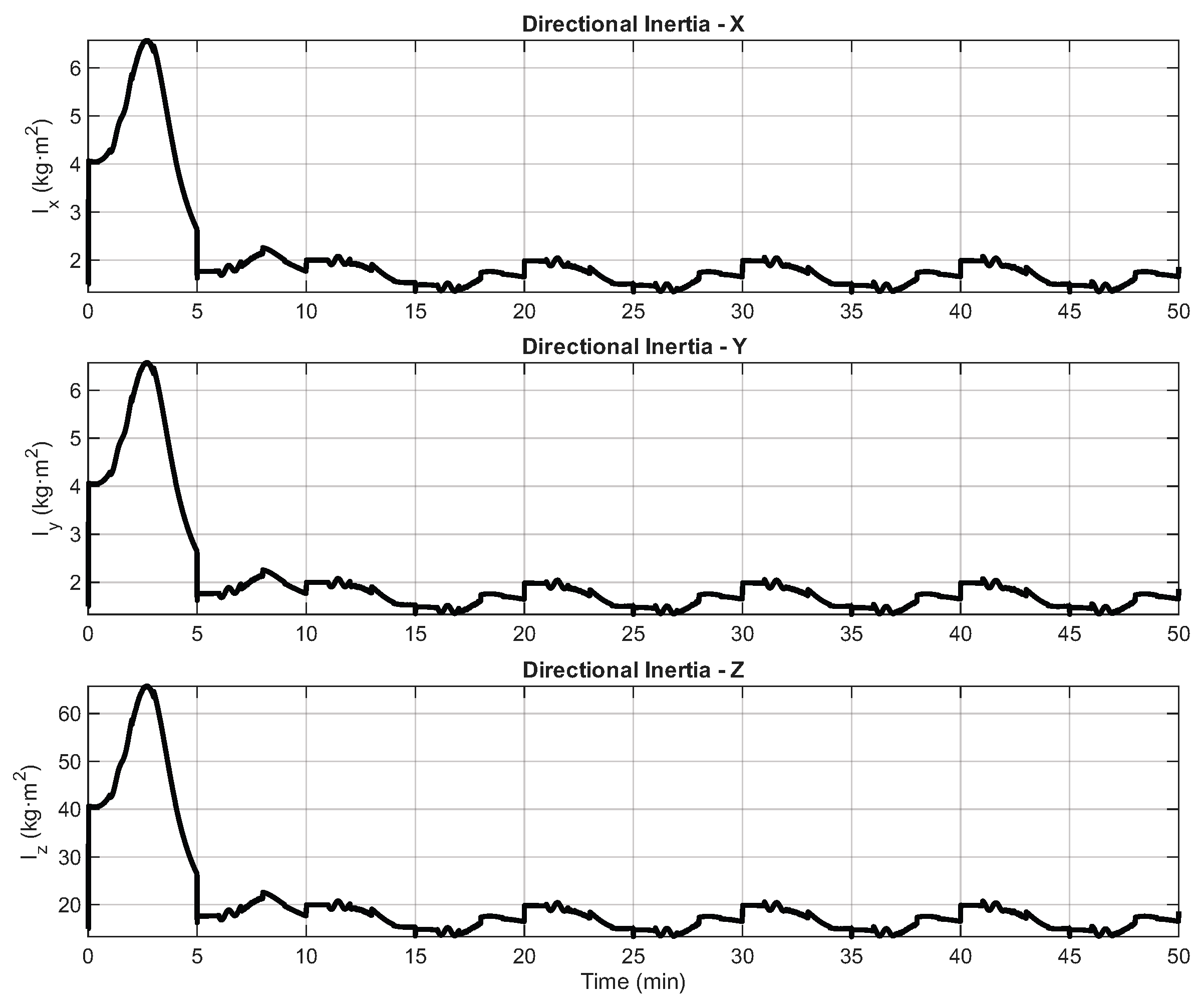
Figure 3.
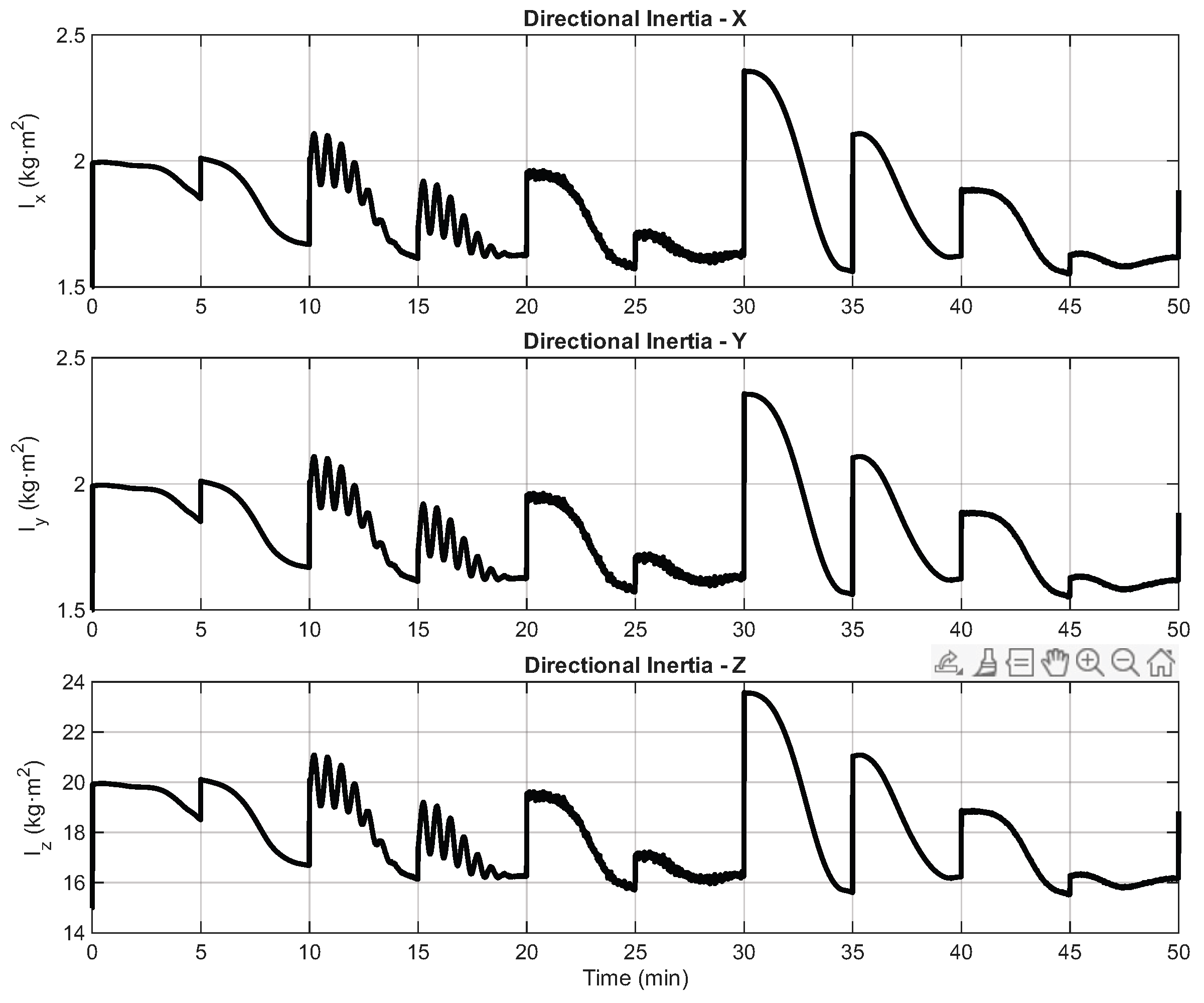
Robots’ inertia, damping, and stiffness changing over time.
Figure 3.
Robots’ inertia, damping, and stiffness changing over time.
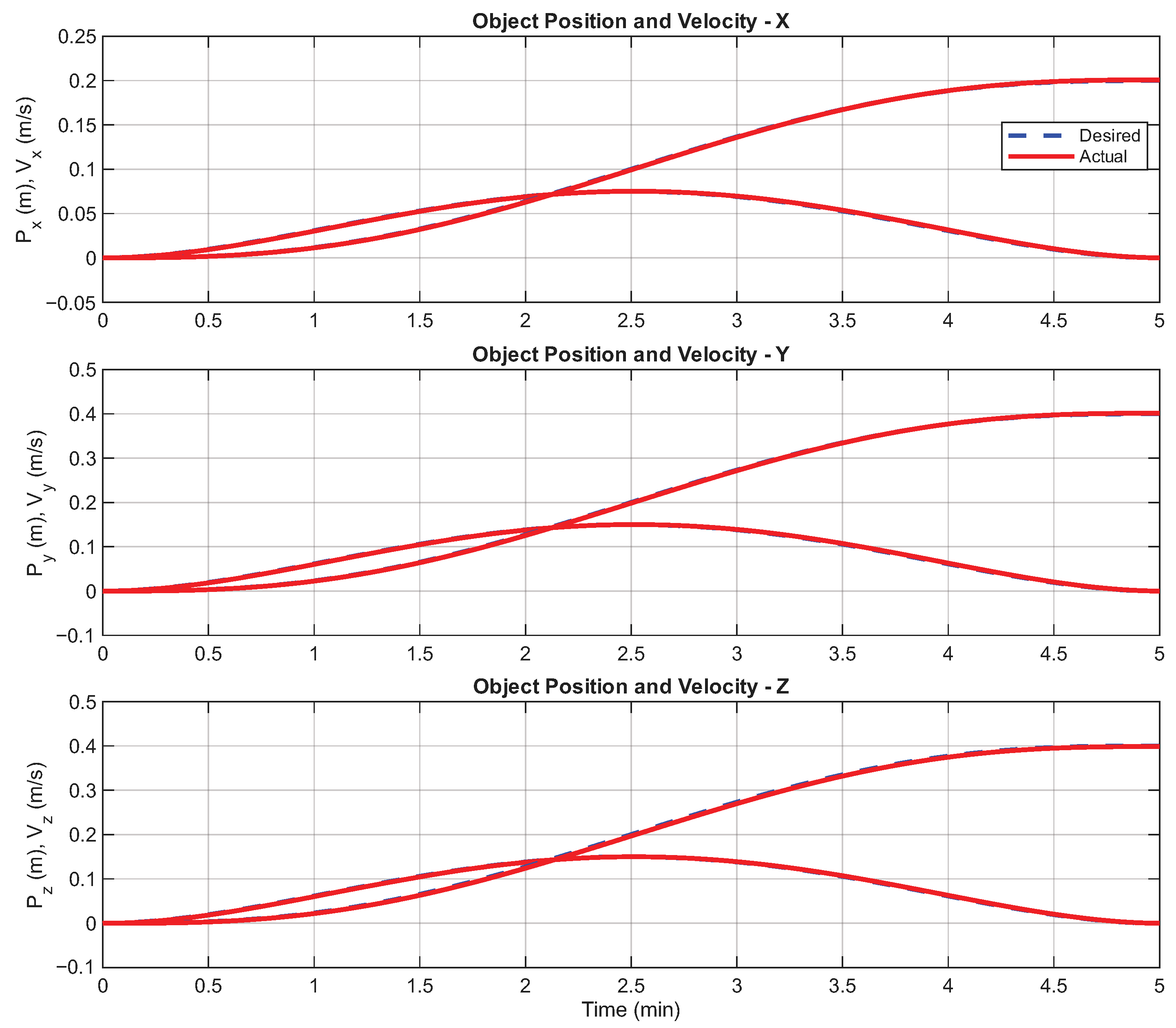
Figure 4.
Desired and actual object position and signed velocity profiles along X, Y, and Z directions generated by the minimum-jerk trajectory used in all simulations.
Figure 4.
Desired and actual object position and signed velocity profiles along X, Y, and Z directions generated by the minimum-jerk trajectory used in all simulations.
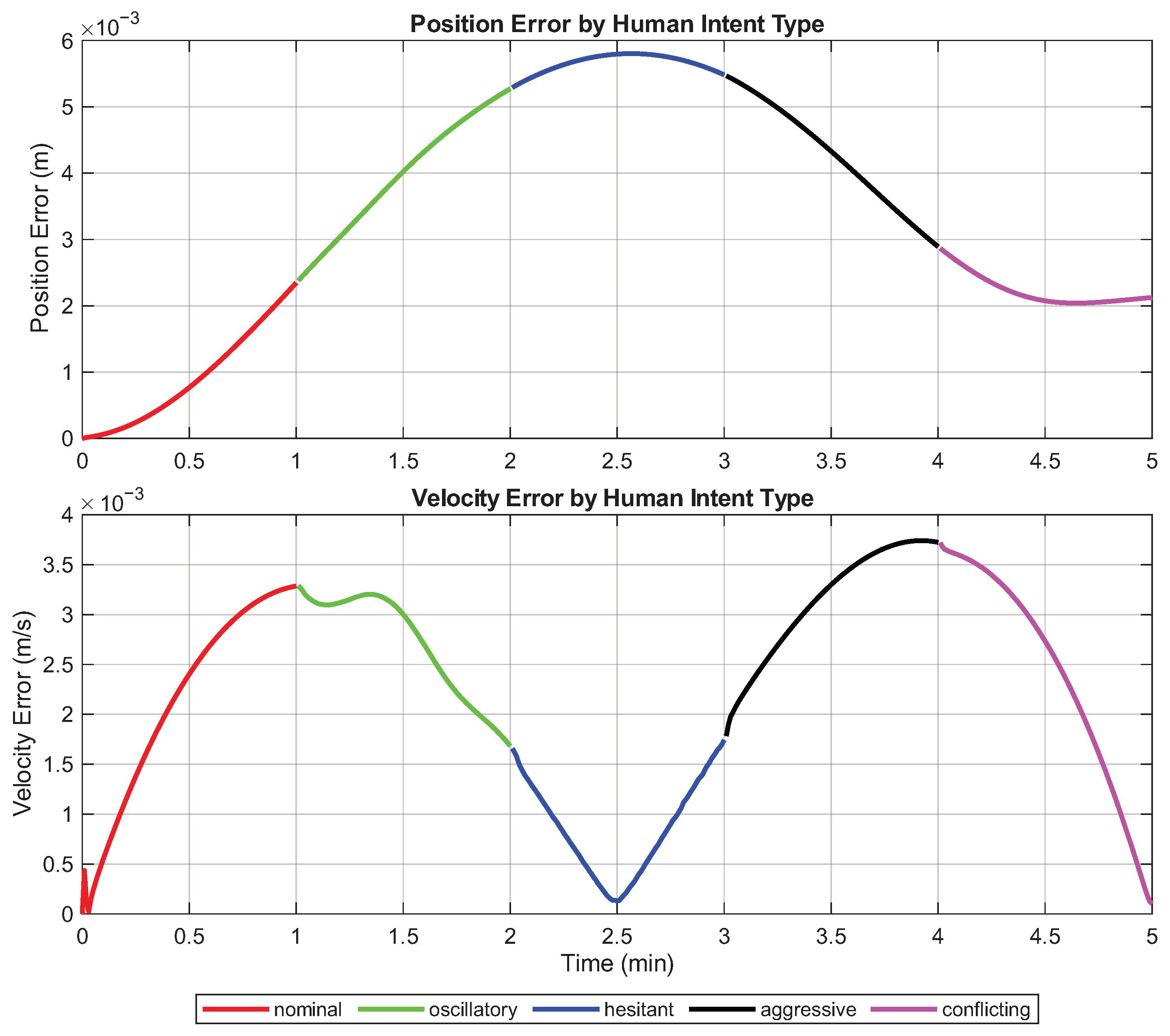
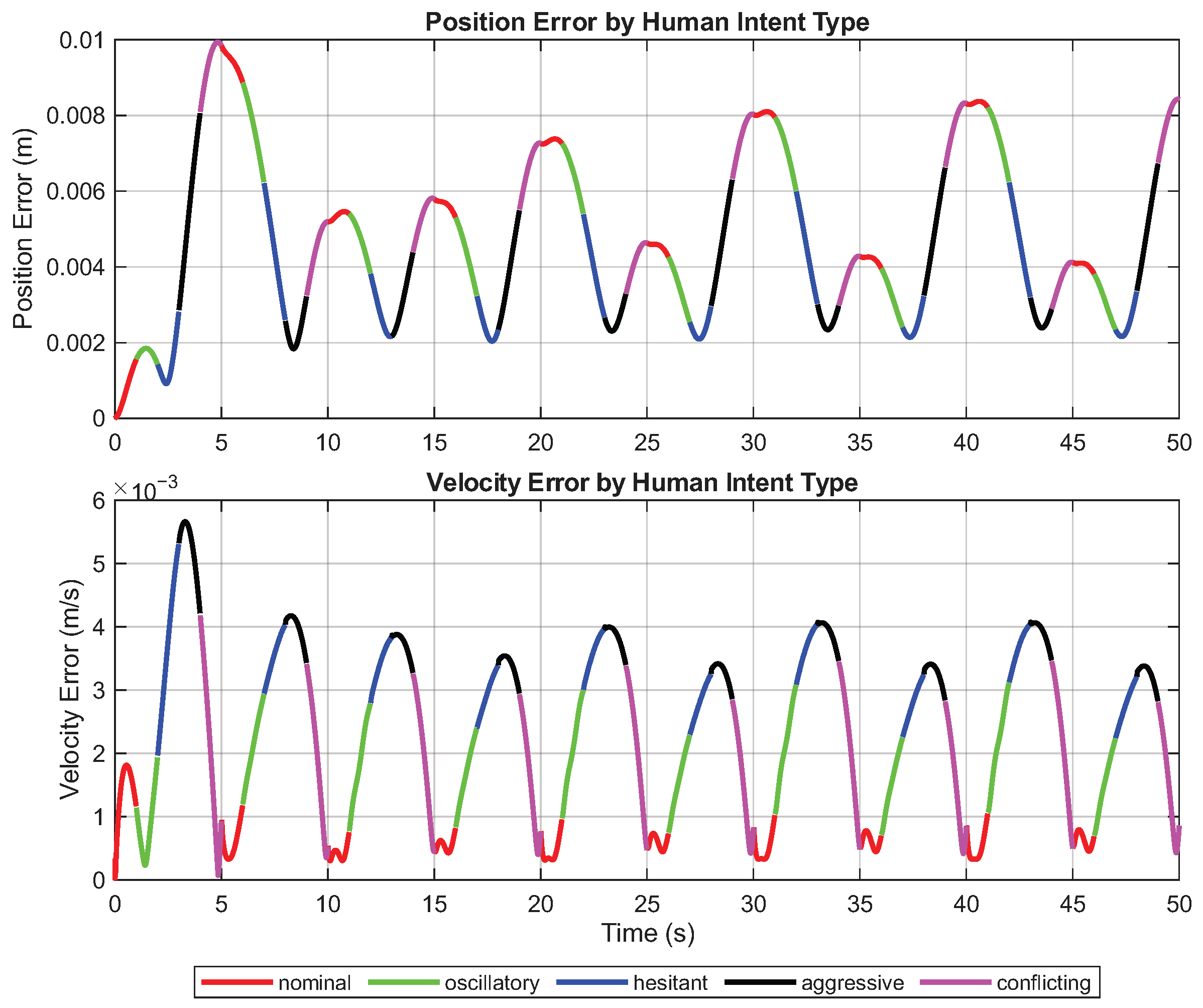
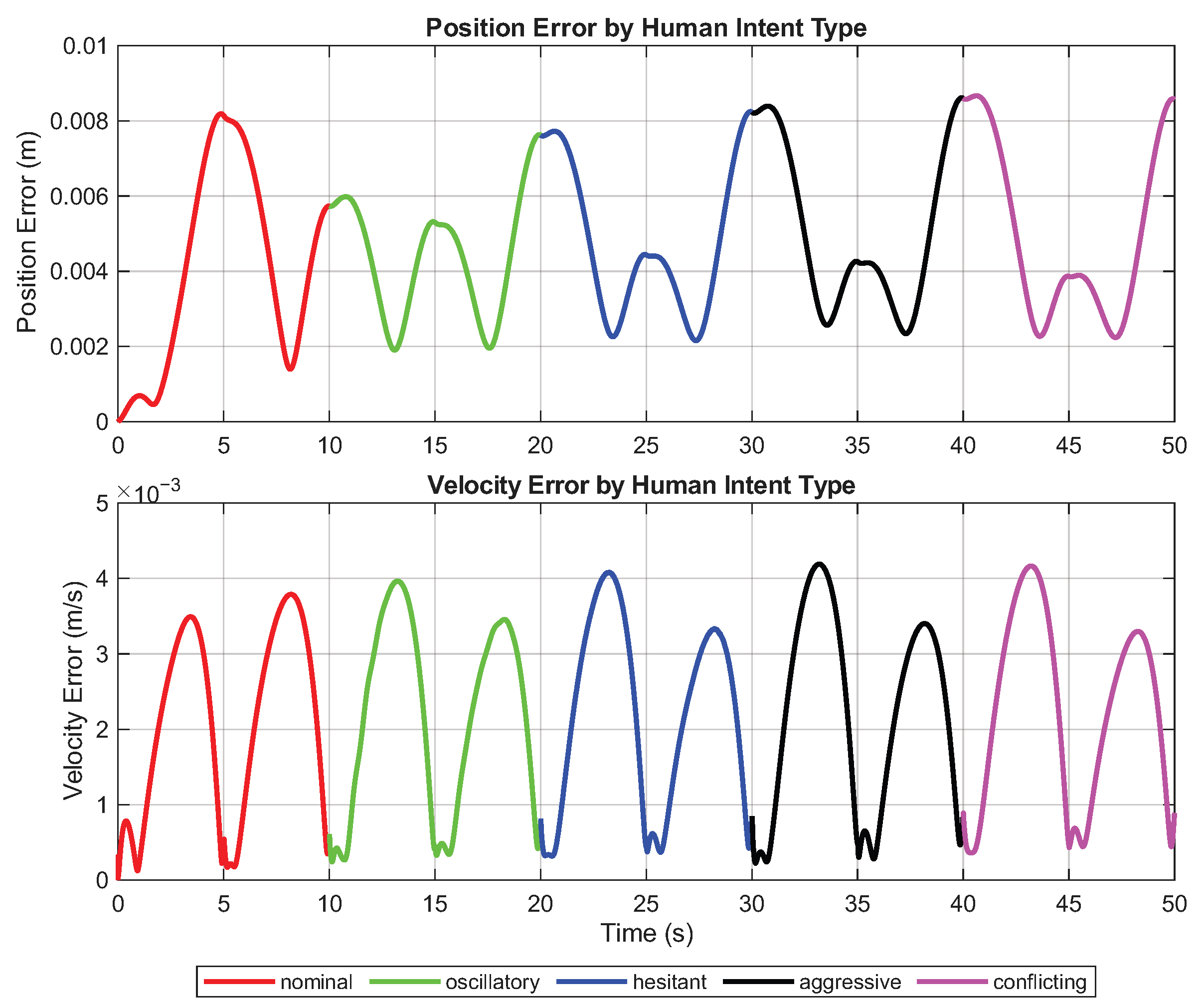
Figure 5.
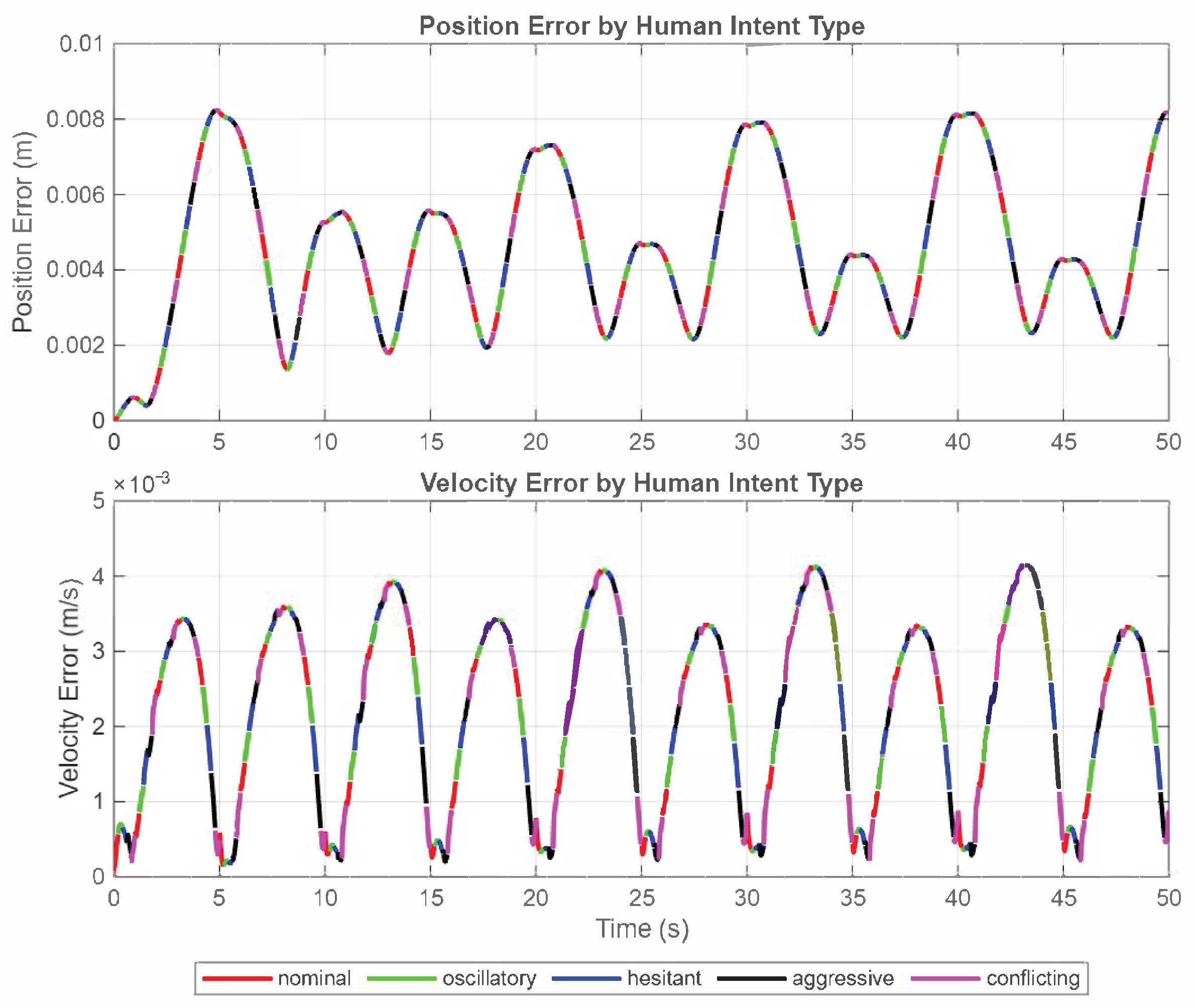
Tracking position and velocity errors in different human intents.
Figure 5.
Tracking position and velocity errors in different human intents.
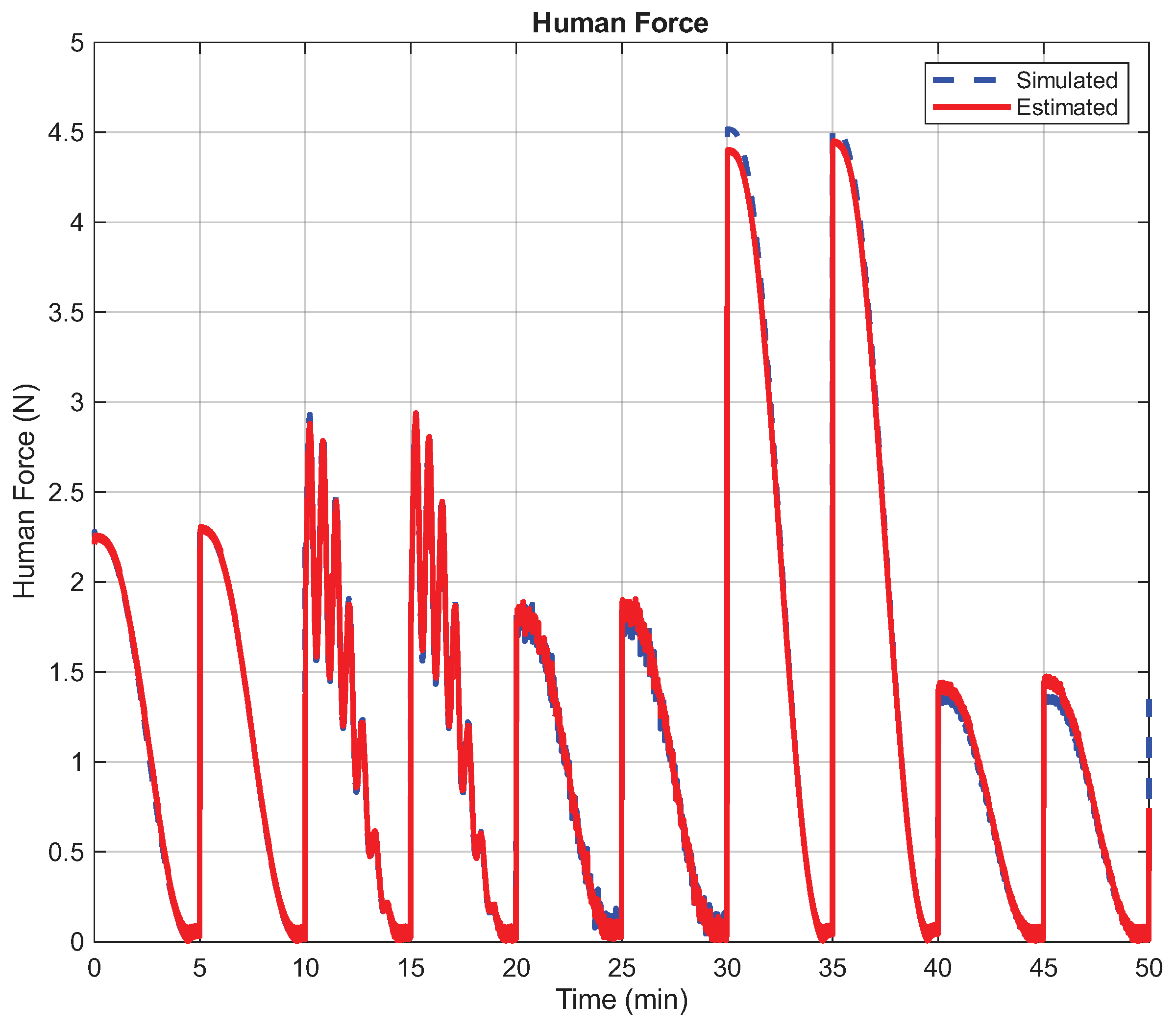
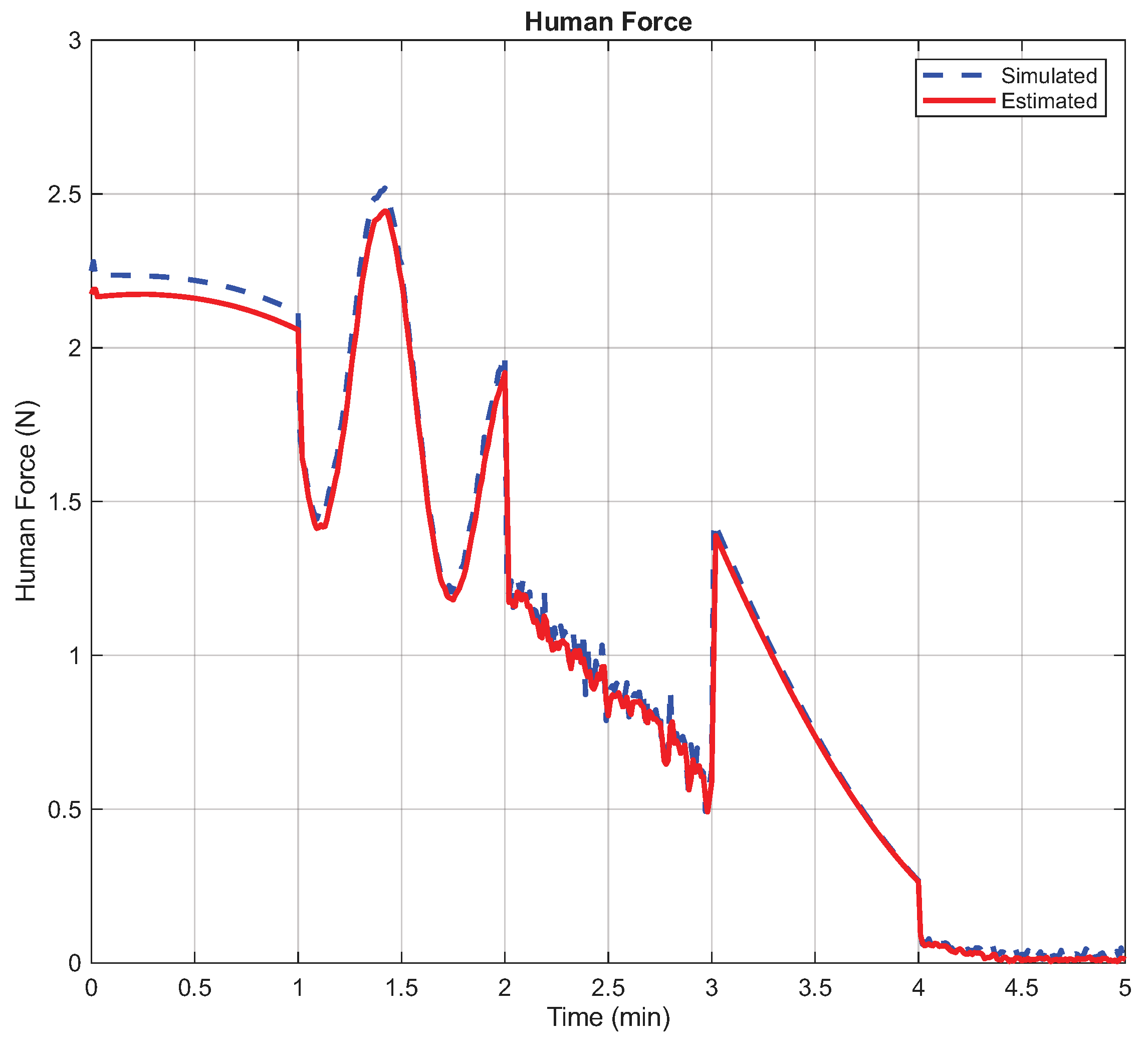
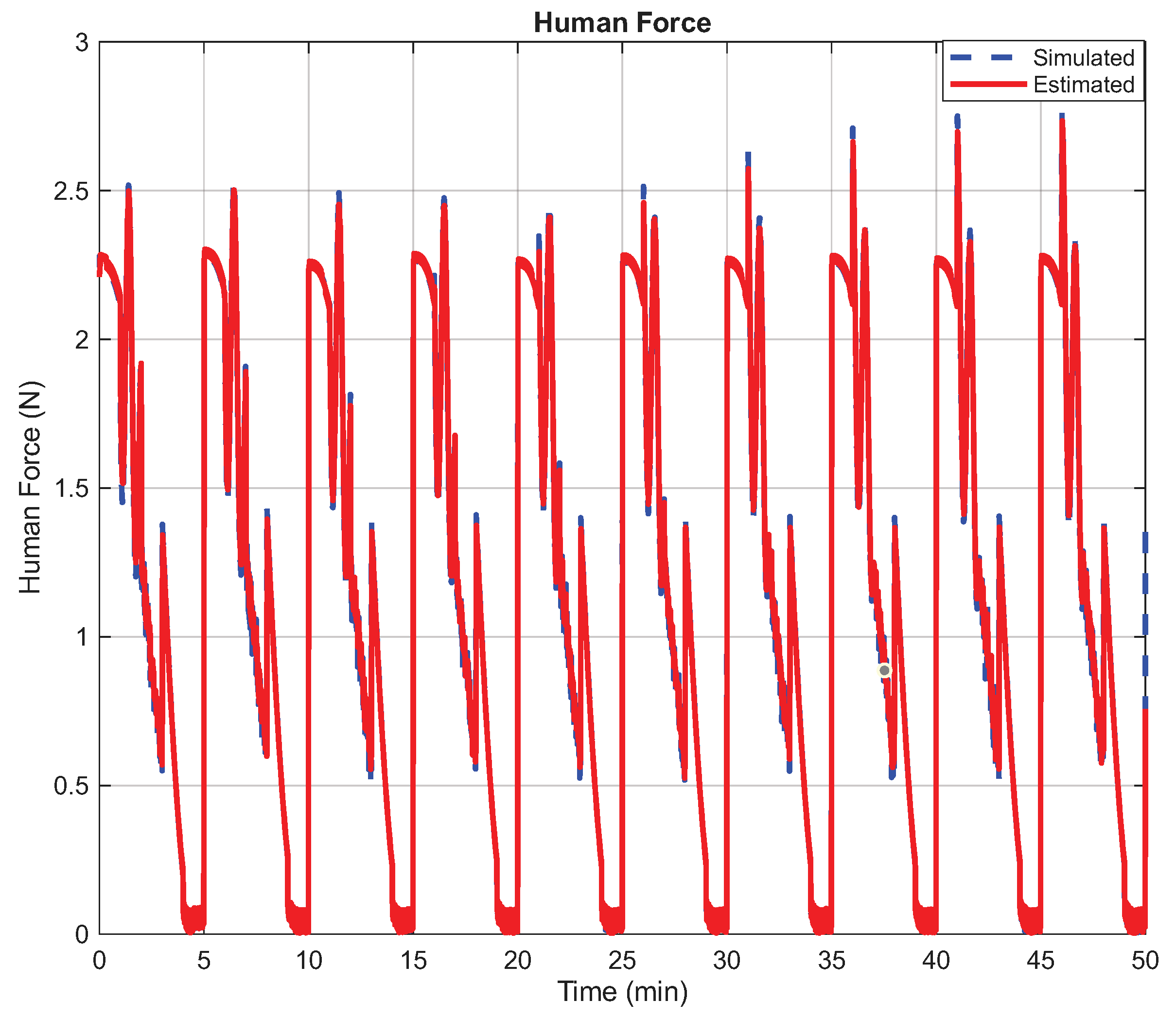
Figure 6.
Human force estimation.
Figure 6.
Human force estimation.
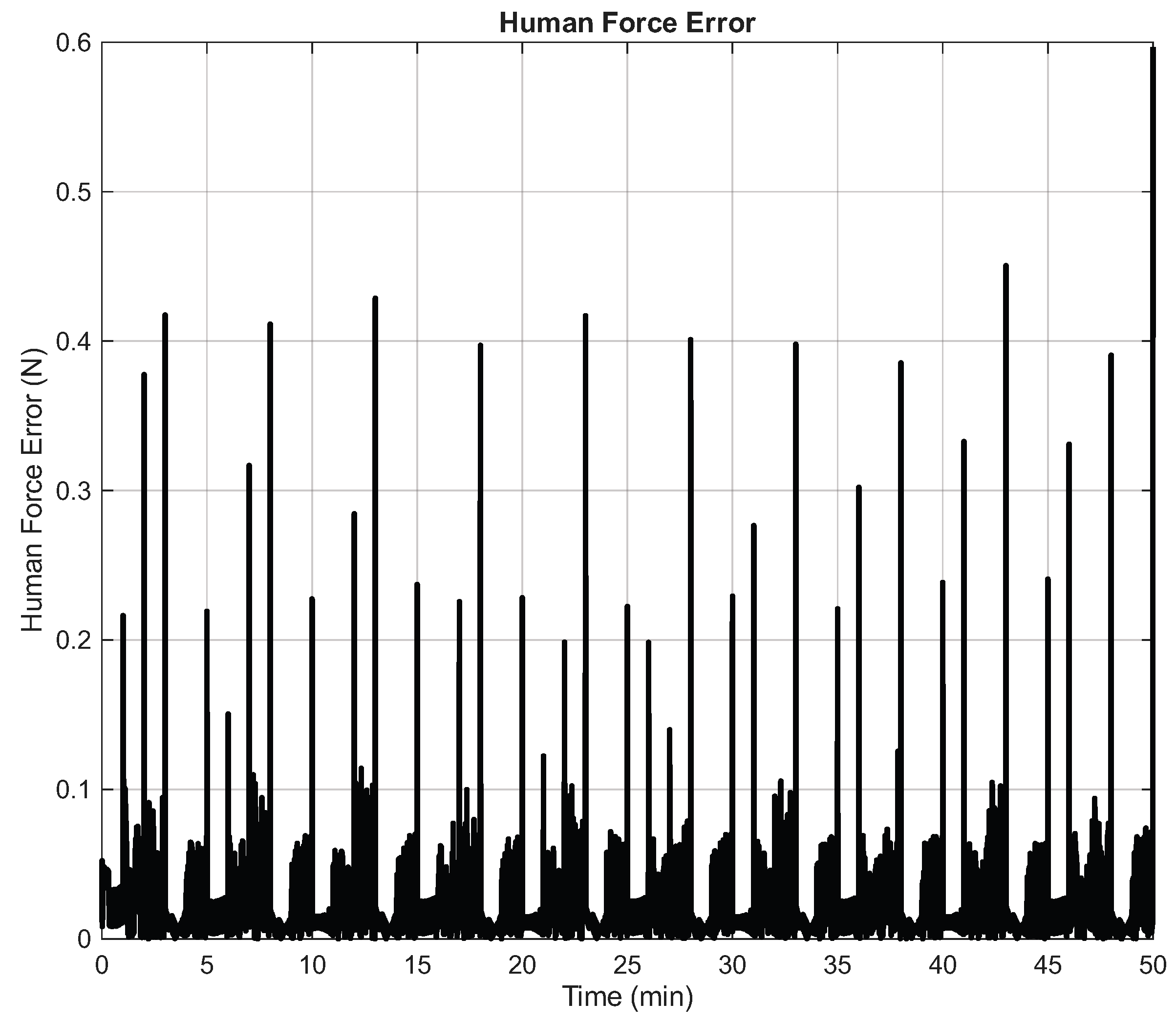
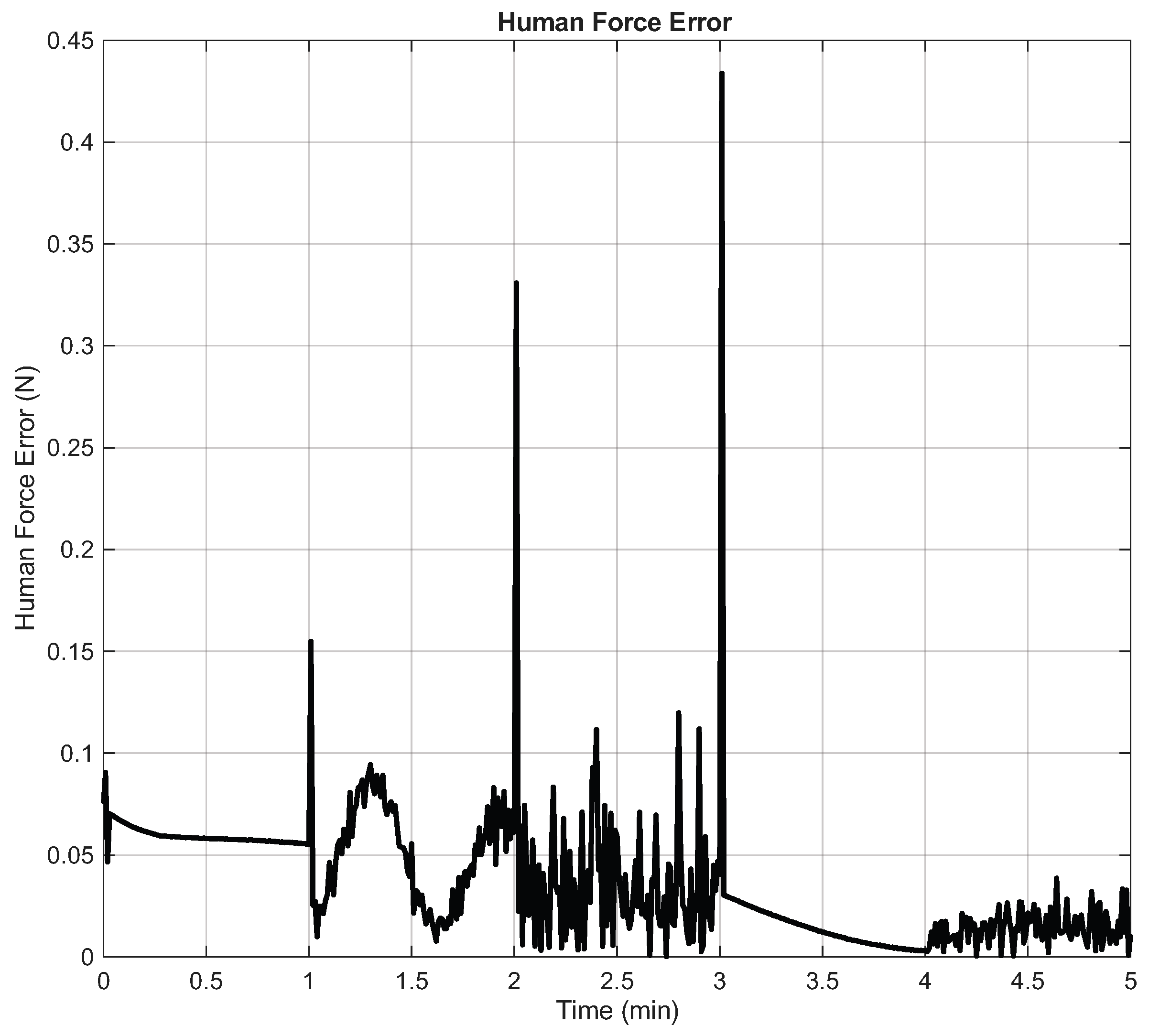
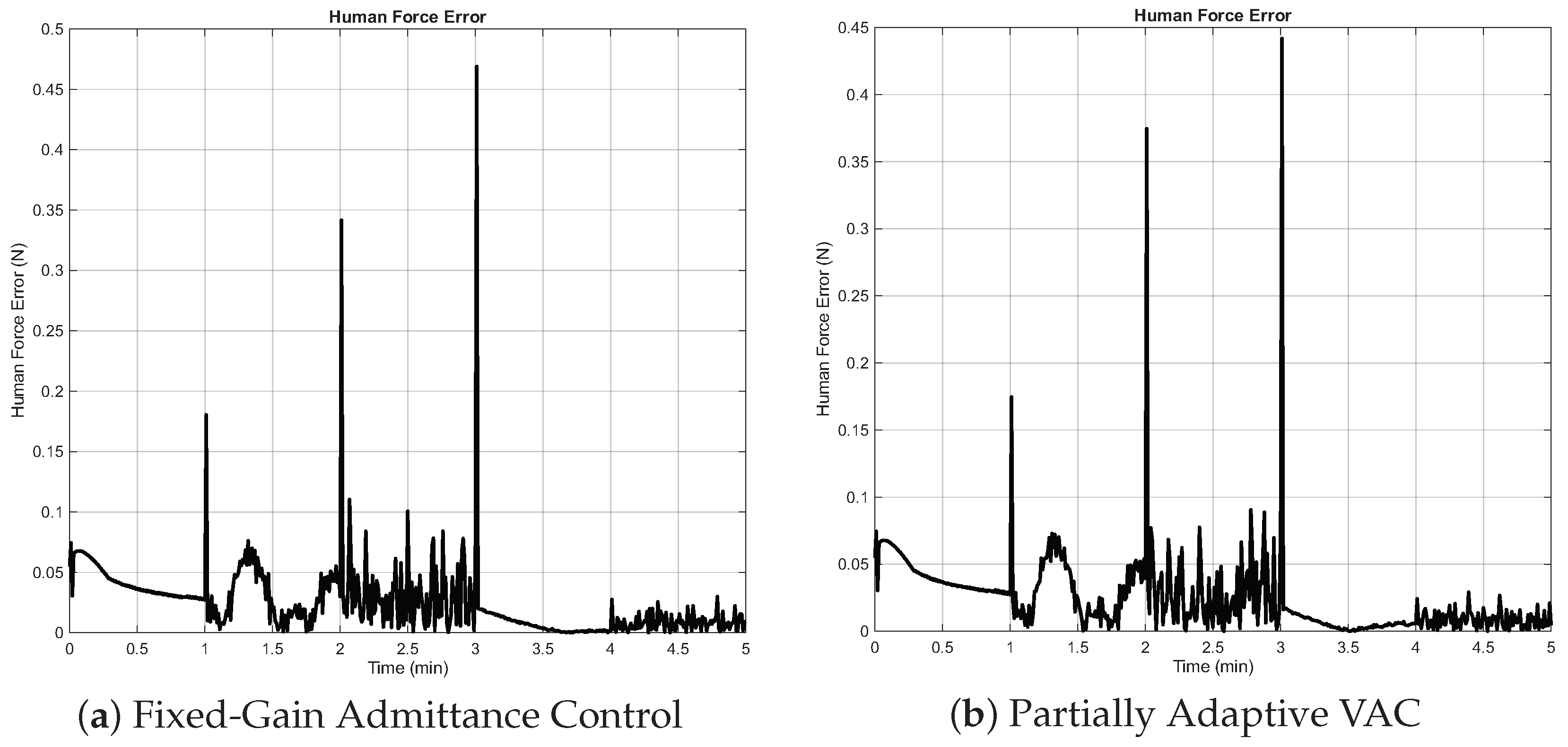
Figure 7.
Human force estimation error.
Figure 7.
Human force estimation error.
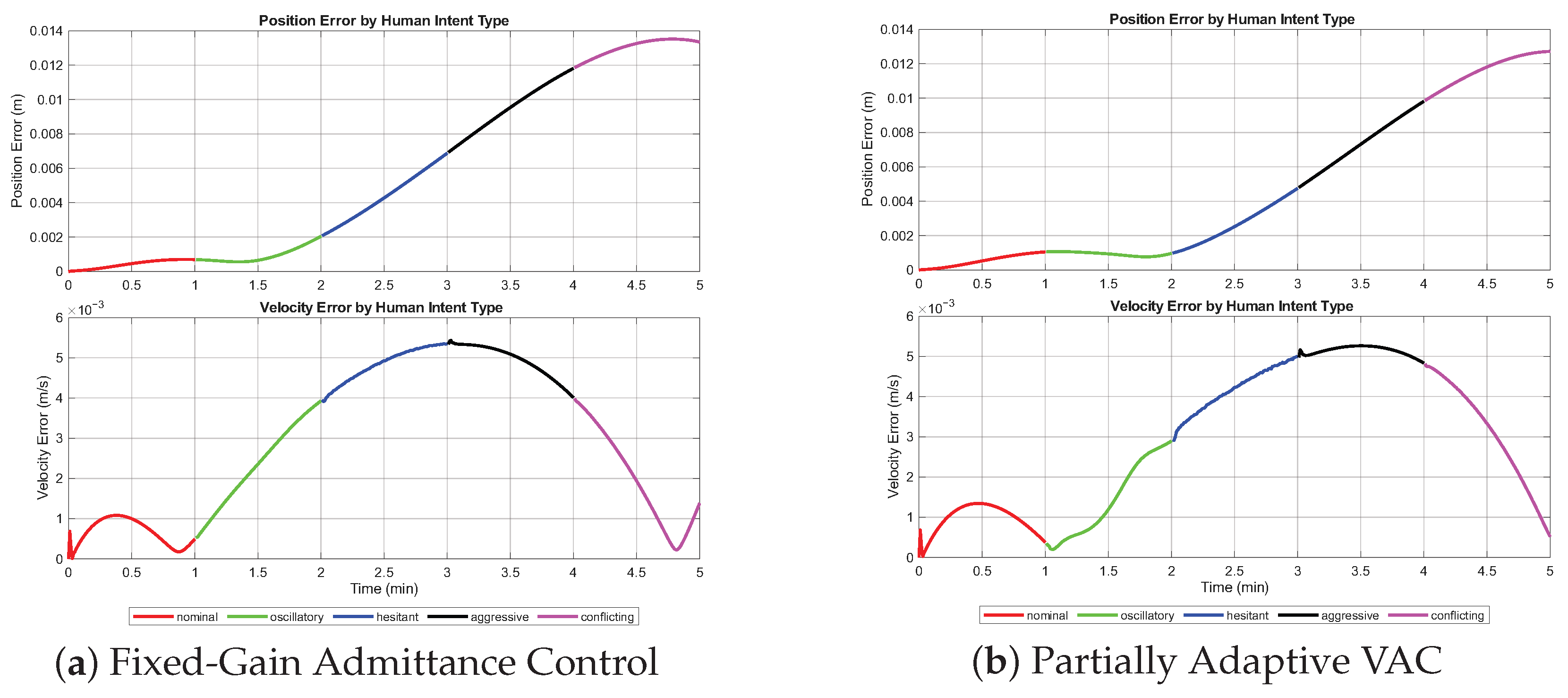
Figure 8.
Tracking errors across different human intents for fixed-gain (a) and partially adaptive (b) controllers.
Figure 8.
Tracking errors across different human intents for fixed-gain (a) and partially adaptive (b) controllers.
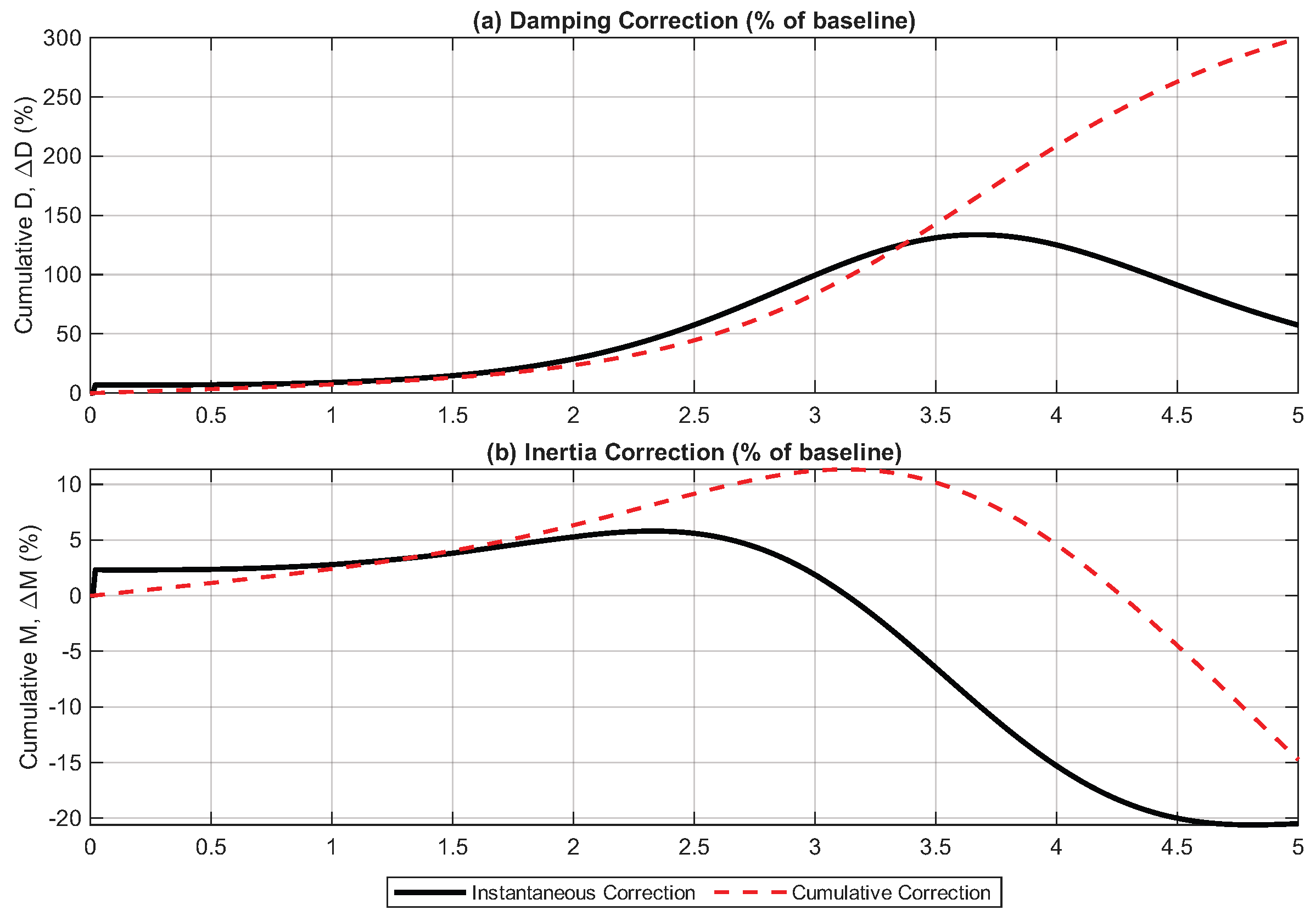
Figure 9.
Percentage rcorrection signals for the VAC parameters: (a) damping, and (b) inertia. Solid lines: instantaneous RBFNN correction signals; dashed lines: cumulative RBFNN correction signals—partially adaptive VAC.
Figure 9.
Percentage rcorrection signals for the VAC parameters: (a) damping, and (b) inertia. Solid lines: instantaneous RBFNN correction signals; dashed lines: cumulative RBFNN correction signals—partially adaptive VAC.
Figure 10.
Robots’ damping and inertia changing over time-partially adaptive VAC.
Figure 10.
Robots’ damping and inertia changing over time-partially adaptive VAC.
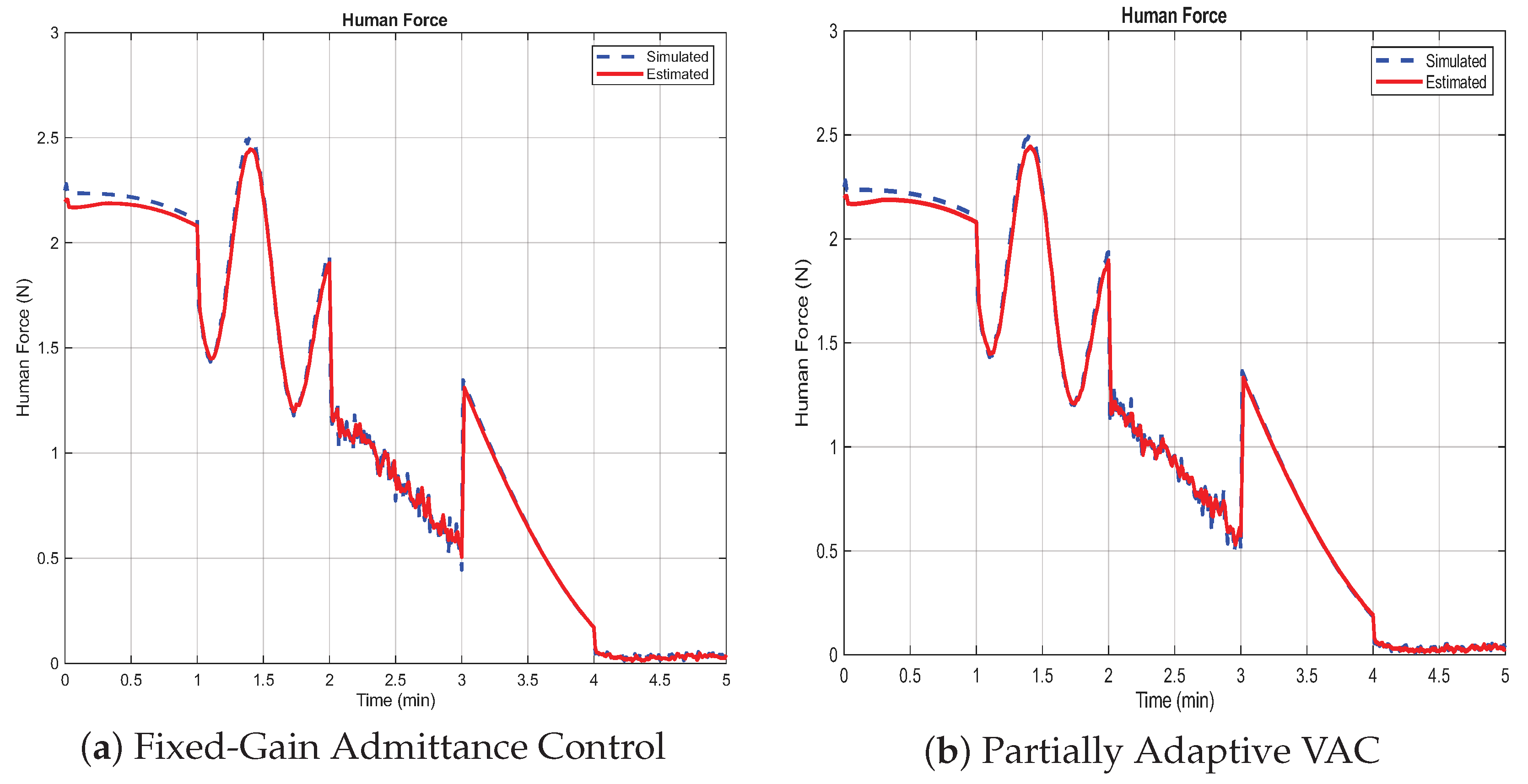
Figure 11.
Human force estimation across different human intents for fixed-gain (a) and partially adaptive (b) controllers.
Figure 11.
Human force estimation across different human intents for fixed-gain (a) and partially adaptive (b) controllers.
Figure 12.
Human force estimation error across different human intents for fixed-gain (a) and partially adaptive (b) controllers.
Figure 12.
Human force estimation error across different human intents for fixed-gain (a) and partially adaptive (b) controllers.
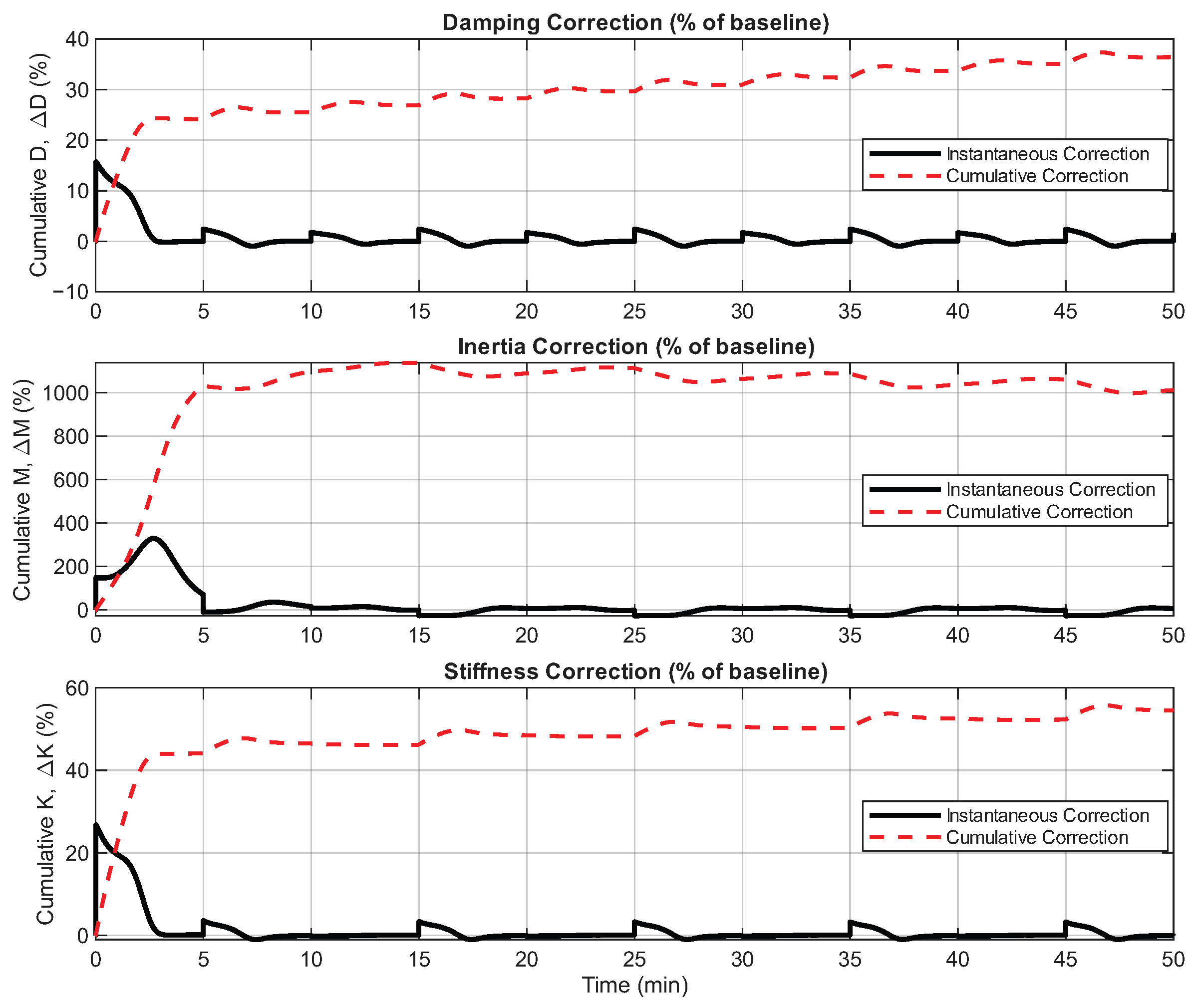
Figure 13.
Percentage correction signals for the VAC parameters: damping, inertia, and stiffness. Solid lines: instantaneous RBFNN correction signals; dashed lines: cumulative RBFNN correction signals—5Cycles-HFIS.
Figure 13.
Percentage correction signals for the VAC parameters: damping, inertia, and stiffness. Solid lines: instantaneous RBFNN correction signals; dashed lines: cumulative RBFNN correction signals—5Cycles-HFIS.
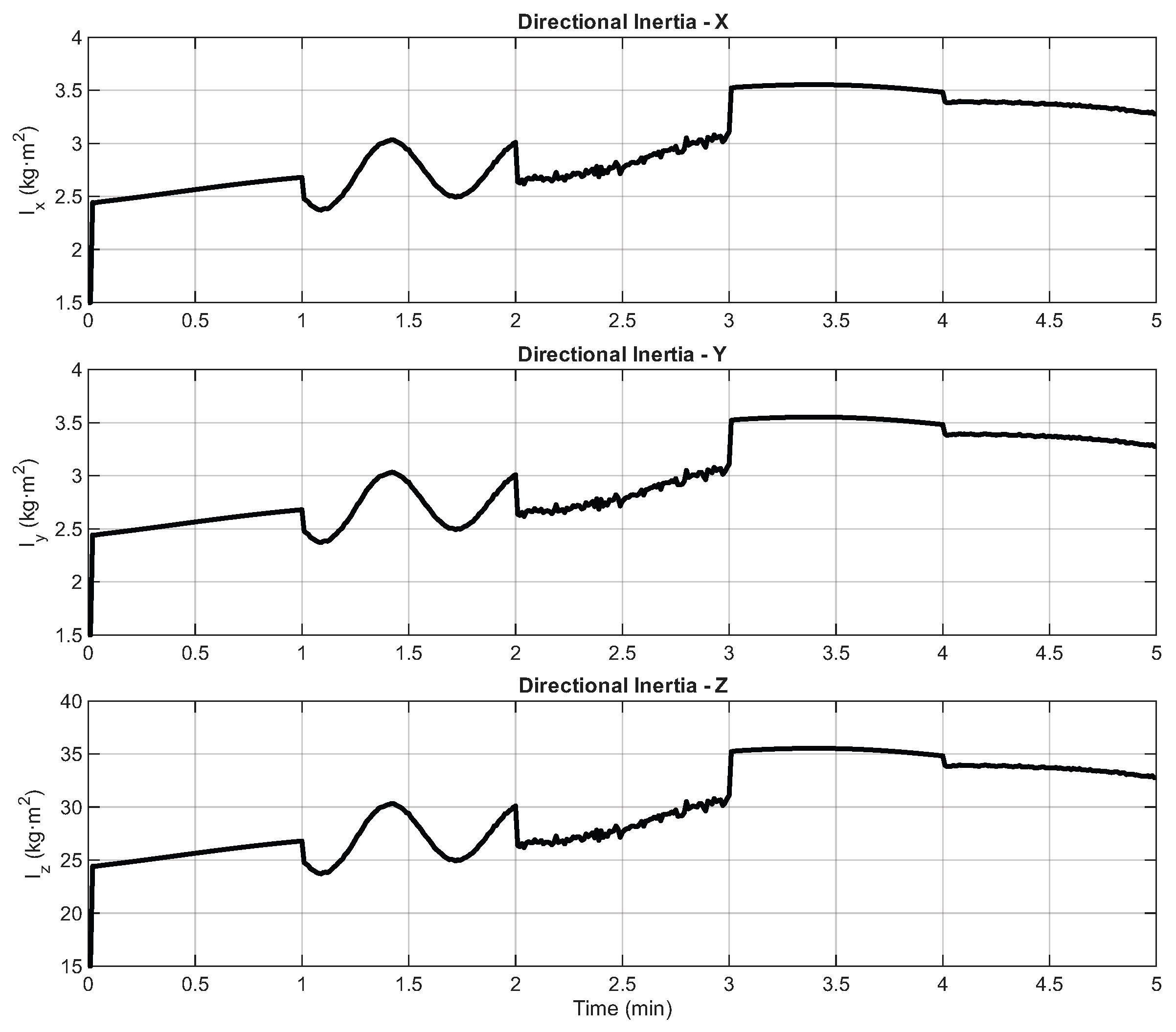
Figure 14.
Robots’ inertia, damping, and stiffness—5Cycles-HFIS.
Figure 14.
Robots’ inertia, damping, and stiffness—5Cycles-HFIS.
Figure 15.
Tracking position and velocity errors in different human intents—5Cycles-HFIS.
Figure 15.
Tracking position and velocity errors in different human intents—5Cycles-HFIS.
Figure 16.
Human force estimation—5Cycles-HFIS.
Figure 16.
Human force estimation—5Cycles-HFIS.
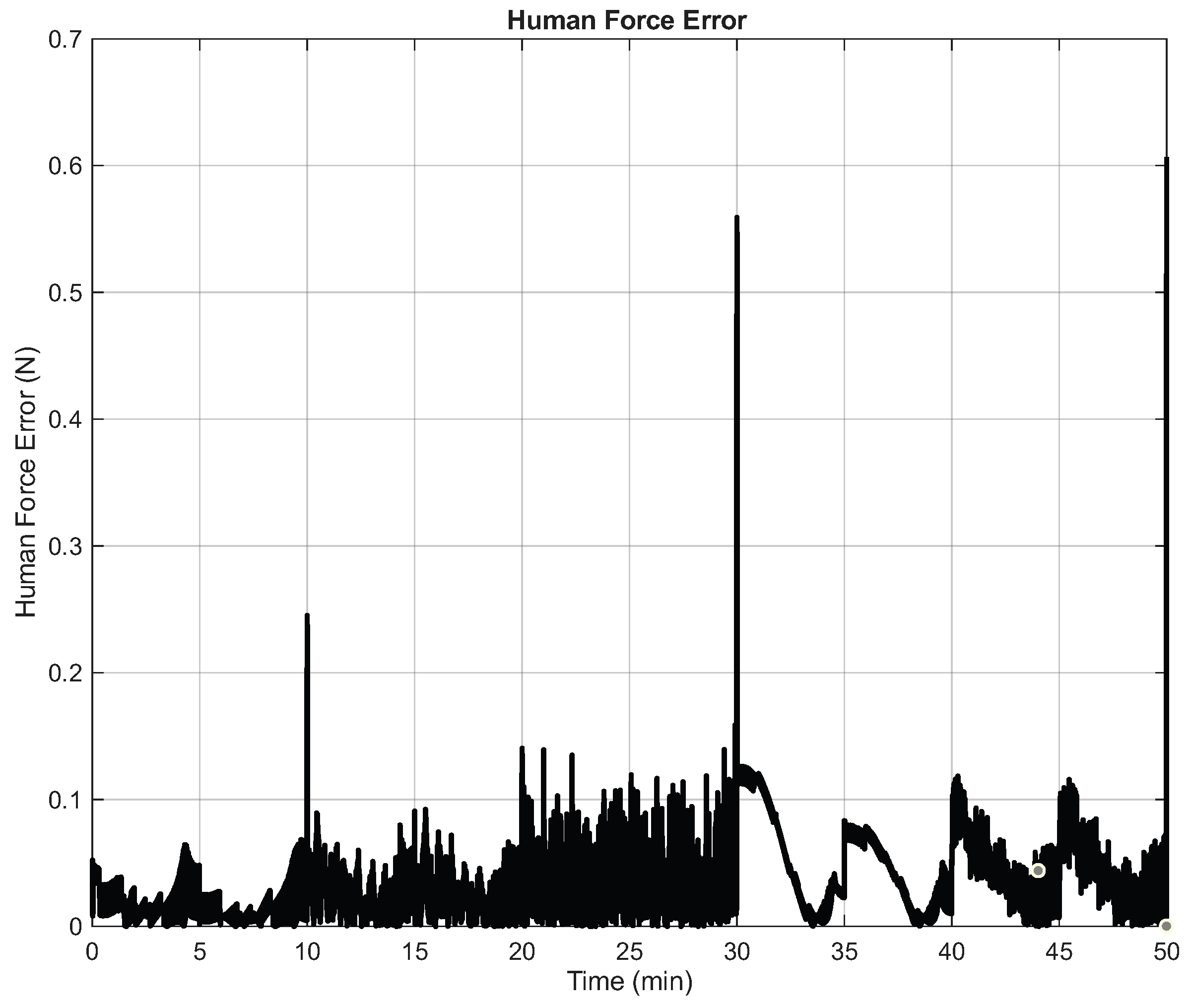
Figure 17.
Human force estimation error—5Cycles-HFIS.
Figure 17.
Human force estimation error—5Cycles-HFIS.
Figure 18.
Percentage correction signals for the VAC parameters: damping, inertia, and stiffness. Solid lines: instantaneous RBFNN correction signals: dashed lines: cumulative RBFNN correction signals—5Cycles-CWIS.
Figure 18.
Percentage correction signals for the VAC parameters: damping, inertia, and stiffness. Solid lines: instantaneous RBFNN correction signals: dashed lines: cumulative RBFNN correction signals—5Cycles-CWIS.
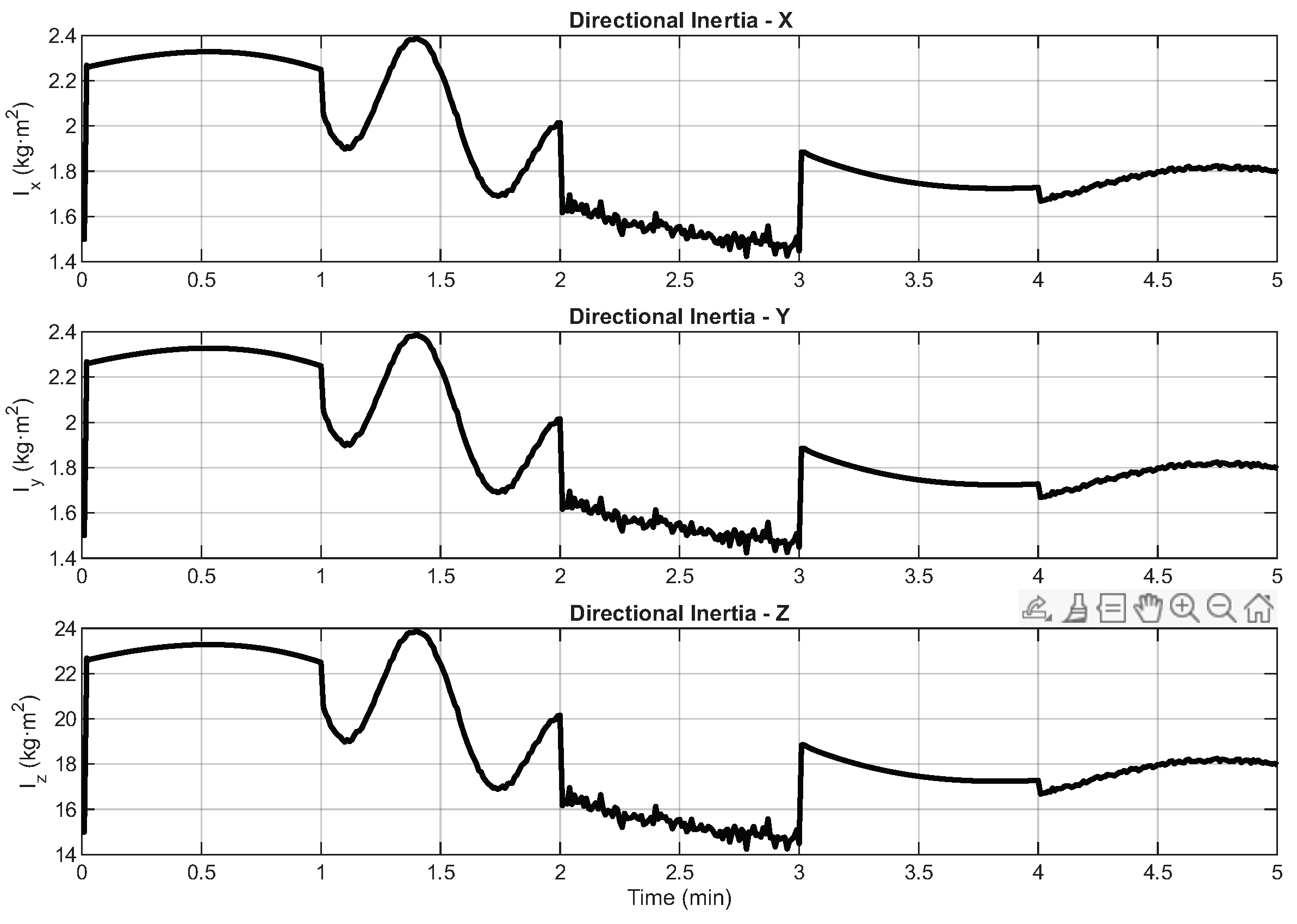
Figure 19.
Robots’ inertia, damping, and stiffness—5Cycles-CWIS.
Figure 19.
Robots’ inertia, damping, and stiffness—5Cycles-CWIS.
Figure 20.
Tracking position and velocity errors in different human intents—5Cycles-CWIS.
Figure 20.
Tracking position and velocity errors in different human intents—5Cycles-CWIS.
Figure 21.
Human force estimation—5Cycles-CWIS.
Figure 21.
Human force estimation—5Cycles-CWIS.
Figure 22.
Human force estimation error—5Cycles-CWIS.
Figure 22.
Human force estimation error—5Cycles-CWIS.
Table 1.
Comparison of systematic evaluation criteria in recent studies on human intent modeling and simulation for HRC controllers. Criteria include number of intent categories, dynamic switching/stochastic elements, evaluation metrics, and baseline comparisons.
Table 1.
Comparison of systematic evaluation criteria in recent studies on human intent modeling and simulation for HRC controllers. Criteria include number of intent categories, dynamic switching/stochastic elements, evaluation metrics, and baseline comparisons.
| Criterion/Study | Description/Details |
|---|
| This Work | |
| Intent Categories | 5 (nominal, aggressive, hesitant, oscillatory, conflicting) |
| Switching/Stochastic | Temporal scheduler + Gaussian noise |
| Evaluation Metrics | Intent-stratified RMSE (pos/vel), force magnitude, parameter evolution, human effort |
| Baselines/Comparisons | 3 (fixed-gain, partial adaptive, full adaptive) |
| [27] (2020) | |
| Intent Categories | 2–3 (cooperative, fast/slow) |
| Switching/Stochastic | Limited switching, no stochastic |
| Evaluation Metrics | Tracking error, human effort, damping adaptation |
| Baselines/Comparisons | 1–2 (fixed vs. variable admittance) |
| [22] (2024) | |
| Intent Categories | Simulated behaviors (assembly intents) |
| Switching/Stochastic | Virtual data generation, no explicit switching |
| Evaluation Metrics | Prediction accuracy, metabolic energy, assembly time |
| Baselines/Comparisons | Data-driven baselines (real vs. virtual data) |
| [28] (2024) | |
| Intent Categories | Pick-and-place intents |
| Switching/Stochastic | Gaze-based, implicit switching |
| Evaluation Metrics | Recognition accuracy, real-time latency |
| Baselines/Comparisons | Marginal baselines (without gaze conditioning) |
| [18] (2024) | |
| Intent Categories | Inferred intents (goals/actions) |
| Switching/Stochastic | Probabilistic Bayesian/MDP |
| Evaluation Metrics | Prediction horizon, error rate, adaptation |
| Baselines/Comparisons | Shared probabilistic frameworks |
| [10] (2025) | |
| Intent Categories | Multi-modality intents (scene + behavior) |
| Switching/Stochastic | Probabilistic, no explicit scheduler |
| Evaluation Metrics | Precision, F1-score, accuracy, collision avoidance |
| Baselines/Comparisons | Multiple baselines (GMM, CRF) |
Table 2.
Human intent parameter settings used in the simulation.
Table 2.
Human intent parameter settings used in the simulation.
| Intent Type | | | |
|---|
| Nominal | 5 | 0.01 | 0 |
| Aggressive | 10 | 0.03 | 0 |
| Hesitant | 4 | 0.005 | |
| Oscillatory | | | |
| Conflicting | | | |
Table 3.
Comparison between three VAC control strategies.
Table 3.
Comparison between three VAC control strategies.
| VAC Controller | Position Tracking Error (m) | Velocity Tracking Error (m/s) |
|---|
| Fixed-Gain | | |
| Partially Adaptive | | |
| Fully Adaptive | | |
Table 4.
RMSE performance of the three VAC controllers across different human intent types.
Table 4.
RMSE performance of the three VAC controllers across different human intent types.
| Human Intent | Fixed-Gain VAC | Partially Adaptive VAC | Fully Adaptive VAC (Proposed) |
|---|
|
Pos. RMSE (m)
|
Vel. RMSE (m/s)
|
Pos. RMSE (m)
|
Vel. RMSE (m/s)
|
Pos. RMSE (m)
|
Vel. RMSE (m/s)
|
|---|
| Aggressive | | | | | | |
| Hesitant | | | | | | |
| Conflicting | | | | | | |
| Oscillatory | | | | | | |
| Nominal | | | | | | |
Table 5.
Performance comparison of the proposed VAC under different intent switching frequencies across 5 task cycles.
Table 5.
Performance comparison of the proposed VAC under different intent switching frequencies across 5 task cycles.
| Scenario | Position Tracking Error (m) | Velocity Tracking Error (m/s) |
|---|
| CWIS (per 10 min cycle) | | |
| HFIS (every 1 min) | | |
| VHFIS (every 20 s) | | |
| Single 5 min Task (every 1 min) | | |
Table 6.
RMSE comparison under different intent switching frequencies.
Table 6.
RMSE comparison under different intent switching frequencies.
| Intent Type | CWIS | HFIS | VHFIS |
|---|
|
Pos. RMSE
|
Vel. RMSE
|
Pos. RMSE
|
Vel. RMSE
|
Pos. RMSE
|
Vel. RMSE
|
|---|
| Aggressive | | | | | | |
| Hesitant | | | | | | |
| Conflicting | | | | | | |
| Oscillatory | | | | | | |
| Nominal | | | | | | |