Article

Closed-Form Dynamic Analysis of a Novel Planar TTR Manipulator Based on Virtual Work and Hamiltonian Mechanics


by
Mahsa Hejazian
1,
Ahad Zare Jond
2,
Siamak Pedrammehr
2,* and
Kais I. Abdul-Lateef Al-Abdullah
3
1
Faculty of Mechanical Engineering, University of Tabriz, Tabriz 5166616471, Iran
2
Faculty of Design, Tabriz Islamic Art University, Tabriz 5164736931, Iran
3
Department of Electrical Engineering, Australian University (AU), Mubarak Al-Kabeer 1411, Kuwait
*
Author to whom correspondence should be addressed.
Machines 2026, 14(2), 220; https://doi.org/10.3390/machines14020220
Submission received: 25 December 2025 / Revised: 3 February 2026 / Accepted: 10 February 2026 / Published: 12 February 2026
(This article belongs to the Special Issue Advances in Dynamic Analysis of Multibody Mechanical Systems)

Abstract

This study presents the modeling, analysis, and control of a novel planar three-degrees-of-freedom TTR (Translational–Translational–Rotational) mechanism. A comprehensive kinematic and dynamic formulation is developed, with the governing equations derived analytically using the principles of virtual work and Hamiltonian mechanics. Due to the nonlinear nature of the inverse kinematics, a numerical solution based on the modified Newton–Raphson method is employed to compute joint trajectories. To ensure robust trajectory tracking in the presence of modeling uncertainties and external disturbances, a sliding-mode control strategy is designed and implemented. The proposed approach is evaluated through numerical simulations and experiments conducted on a custom-built prototype. Quantitative performance metrics, including mean squared error, are used to assess tracking accuracy and to compare simulation and experimental results. The consistency between analytical modeling, numerical solutions, and experimental observations demonstrates the feasibility of the proposed framework for planar robotic motion control applications.

1. Introduction

Over the past several decades, robotics has rapidly evolved, creating demand for systems that deliver high precision and stability across industrial and research environments. Among various architectures, planar manipulators are attractive due to their mechanical simplicity and straightforward control implementation. Nevertheless, achieving accurate motion and effective control remains challenging because of nonlinear dynamics, strong coupling among joints, and physical effects such as friction and clearance. These challenges underline the importance of developing reliable dynamic models and control frameworks capable of handling real-world uncertainties [1,2,3,4]. Numerous studies have explored these challenges from various perspectives in the design and control of planar manipulators. Jiang et al. [5] investigated the impact of nonlinearities such as joint clearance, friction, and lubrication on robotic dynamic performance. Nye et al. [6] designed and analyzed a three-joint, three-link planar manipulator, focusing on its kinematics, dynamics, control system, and sensor integration. Ganesh et al. [7] enhanced the performance of planar parallel manipulators by incorporating inclined non-planar links while maintaining planar end-effector motion. Malla and Shanmugavel [8] proposed a simplified and accurate kinematic model for manipulators employing parallelogram linkages to reduce computational complexity in palletizing tasks. Similarly, Yang et al. [9] developed a computationally efficient method for cable-driven manipulators using pure rolling joints.
Dynamic modeling continues to present a major challenge in robotic systems because of their inherently nonlinear and coupled behavior. A variety of methods have been introduced to manage this complexity [10]. Zahedi et al. [11] improved dynamic modeling techniques for parallel robots, while Najera and Todd [12] introduced a physics-informed neural network approach grounded in Hamiltonian mechanics. Dong et al. [13] and Malczyk et al. [14] proposed advanced Hamiltonian-based formulations to reduce computational costs in flexible multibody dynamics Several studies [15,16,17,18,19] have employed Hamilton’s principle across a range of robotic and mechanical systems, reporting notable gains in modeling accuracy and computational efficiency. The principle of virtual work has likewise proved valuable in recent investigations [20,21,22], particularly for incorporating non-conservative forces in inverse kinematics formulations.
Controlling robotic manipulators remains challenging given their nonlinear, time-varying, and highly coupled dynamics. Recent research has emphasized robust control strategies, including Proportional–Derivative (PD) and sliding-mode control (SMC) schemes [23,24,25]. For instance, Ali et al. [26] applied an integral sliding-mode control (ISMC) approach to counteract dynamic uncertainties, while Hosseini et al. [27] proposed a model-free robust nonlinear PD controller for cable-driven parallel manipulators. Additional studies [28,29,30,31] have further demonstrated the effectiveness of hybrid PD, fuzzy, and neural network-based controllers in improving trajectory tracking and managing system uncertainties. Despite considerable progress, many studies validate their results only through simulation. Experimental confirmation on real prototypes remains limited, which often reduces confidence in the practical applicability of these methods.
In this study, we introduce a novel TTR planar manipulator [32] and develop a full dynamic model using an integrated framework that draws on the principles of virtual work, Lagrangian mechanics, and Hamiltonian mechanics. Although standard approaches such as the Newton–Euler and Euler–Lagrange formulations are commonly applied in robotic modeling, their use in systems like the TTR manipulator becomes less efficient because of the pronounced nonlinearities and the strong coupling between translational and rotational motions. These limitations impede real-time implementation and can adversely affect performance in applications where a clear and computationally efficient representation is essential.
To address the challenges associated with modeling and controlling the strongly coupled dynamics of TTR planar manipulators, this paper presents an integrated modeling and control framework based on the principles of virtual work, Lagrangian mechanics, and Hamiltonian mechanics. The proposed approach enables the analytical derivation of the system’s dynamic equations, while numerical methods are employed where closed-form solutions are not feasible due to nonlinear kinematic constraints. A sliding-mode control strategy is then designed based on the derived dynamic model to ensure robust trajectory tracking in the presence of modeling uncertainties and external disturbances. The effectiveness of the proposed framework is evaluated through numerical simulations and experimental tests conducted on a custom-built prototype, with performance assessed using quantitative tracking error metrics.
The main contributions of this study can be summarized as follows:
A unified dynamic modeling algorithm in which the Lagrangian formulation is used for inverse-dynamics torque computation and the Hamiltonian formulation is used for forward-dynamics motion prediction, combined with the principle of virtual work.
  • Analytical derivation of the governing dynamic equations with clear separation between closed-form modeling and numerical solution stages;
  • Design and implementation of a sliding-mode controller tailored to the derived dynamics;
  • Simulation and experimental evaluation of trajectory tracking performance using clearly defined quantitative error measures.
The remainder of the paper is organized as follows. Section 2 and Section 3 describe the geometric configuration and kinematic formulation of the TTR manipulator. Section 4 presents the dynamic modeling procedure. Section 5 details the sliding-mode control strategy. Section 6 explains the experimental procedure, Section 7 discusses the simulation and experimental results, and Section 8 concludes the paper and outlines future research directions.

2. TTR Planar Mechanism

Geometric Features

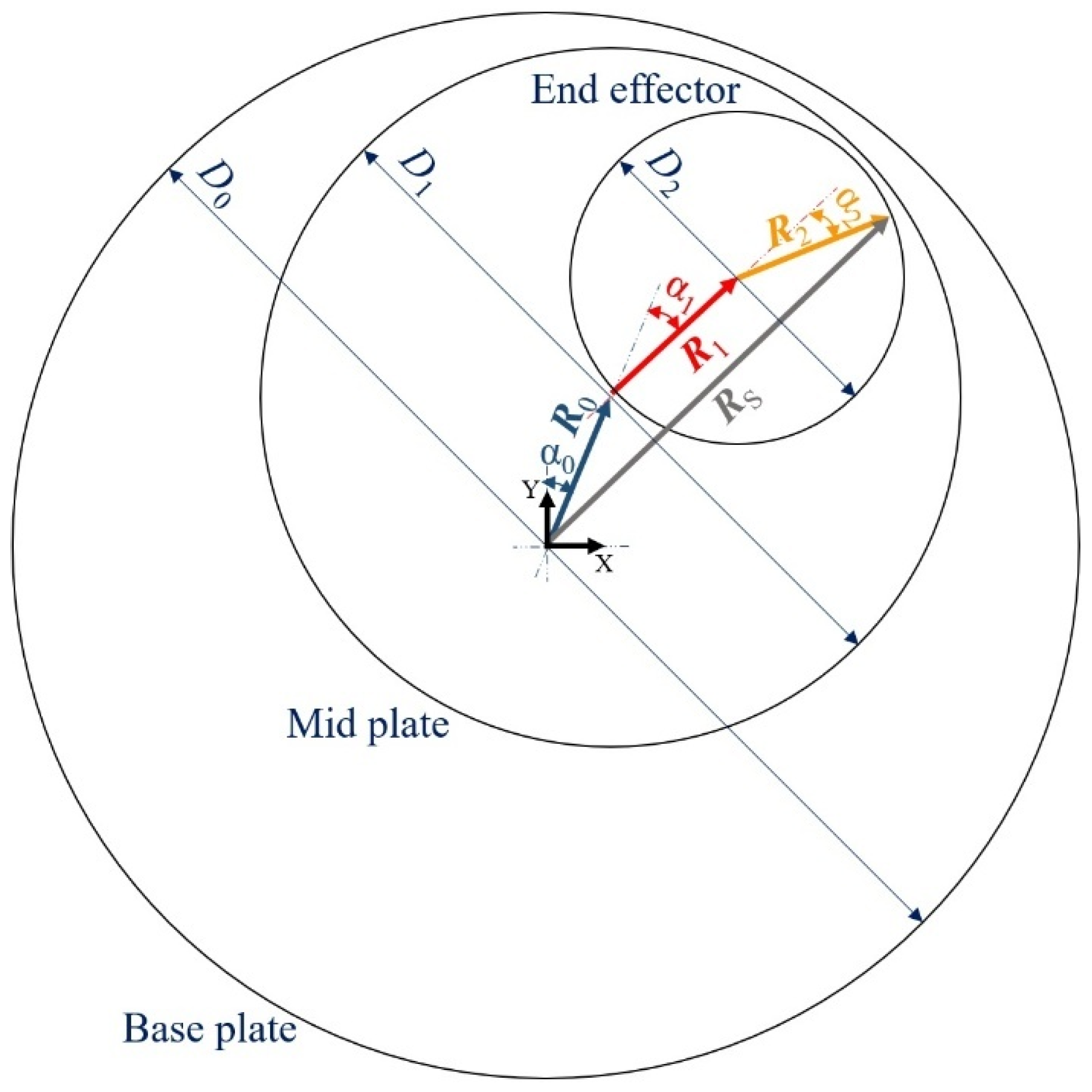
The TTR planar mechanism shown in Figure 1 consists of three interconnected circular plates: a main base plate and two smaller plates, designated as the mid plate and the end-effector [32]. Each of the smaller plates is driven by its corresponding actuator through a revolute joint. This configuration enables controlled planar motion, with the dominant forces oriented along the vertical (Z) axis. To maintain dynamic stability and ensure smooth rotational behavior, each plate is supported by a bearing assembly that restricts translational movement along the Z-axis while allowing accurate bidirectional rotation about its own axis.
Figure 2 shows the vector representation of the TTR planar mechanism. The vectors R0, R1, and R2 denote the distances from the base plate origin to the mid plate, from the mid plate to the end-effector, and the radius of the end-effector, respectively. As the base and mid plates rotate relative to the end-effector, the mechanism executes planar motion within the XY-plane. The third degree of freedom, corresponding to rotation about the Z-axis, is achieved by actuating the end-effector itself; based on the geometric arrangement illustrated in Figure 2, the following constraints must be satisfied:
R 2 < D 2 2 R 1 + R 2 < D 1 2 R 0 + R 1 + R 2 < D 0 2
where D0, D1, and D2 are the diameters of the base plate, mid plate, and end-effector, respectively. These constraints guarantee adequate mechanical clearance and define safe operational limits for both the rotational and translational motions of the system.
Figure 2. Vector representation of TTR mechanism.
Machines 14 00220 g002
Assuming the maximum diameter of the intended workpiece is denoted by DR, the diameter of the end-effector, D2, can be determined as:
D 2 = D R + 2 n
where n represents the additional radial space required to securely mount the workpiece onto the end-effector. This value can vary depending on the particular fixture design and the requirements of the intended manufacturing application.
The distance between the centers of the end-effector disks located at the leftmost and rightmost positions on the mid plate, denoted by RR, can be calculated as:
D R = 2 R R R R = D R 2
where DR is defined as the diameter of the desired workspace or the maximum allowable diameter of the workpiece.
The diameter of the mid plate, D1, can then be calculated using the following expression:
D 1 = R R + D 2 + 2 m
where m represents the clearance or spacing allocated for mechanical bearings located between the mid plate and the end-effector. The value of m depends on the design and is determined by the configuration of the mechanical bearings as well as the system’s operational requirements.
Consequently, the diameter of the base plate, D0 can be calculated as:
D 0 = R R + D 1 + 2 c
where c denotes the required clearance between the mid and base plates, typically dictated by the dimensions of the bearings used between these components. The parameters n, m, and c are defined according to the type of bearings used and the particular requirements of the application. For instance, in systems requiring bi-directional access to the workpiece, such as in electrical discharge machining (EDM), thrust ball bearings may be preferred. In these cases, the minimum required spacing can be determined by subtracting the outer radius of one bearing from the inner radius of the adjacent bearing, ensuring proper mechanical isolation and reliable operation. Geometrical characteristics of the mechanism have been listed in Table 1.

3. Kinematics of the Mechanism

3.1. Forward Kinematics

In mechanical systems, kinematics generally focuses on the relationship between the positions and orientations of joints in joint space and those of the end-effector in Cartesian space [33]. The forward kinematics problem, in particular, entails determining the position and orientation of the end-effector (denoted as point A) within the workspace as a function of the mechanism’s joint variables. For the TTR planar manipulator, these joint variables correspond to the rotational angles of the individual plates. A clear understanding of this relationship is crucial for precise end-effector motion control and for the effective implementation of advanced trajectory planning and control strategies.
The kinematics of the TTR planar mechanism can be described by expressing the position of the end-effector (point A) as a function of the joint angles α 0 , α 1 , and α 2 . Let ( x 0 - y 0 ) , ( x 1 - y 1 ) , and ( x 2 - y 2 ) denote the Cartesian coordinates of the mid plate center, the end-effector center, and point A, respectively. Based on the principles of forward kinematics, the position equations that govern the system can be derived as follows:
x 0 = R 0 sin α 0 , y 0 = R 0 cos α 0 x 1 = R 0 sin α 0 + R 1 sin α 0 + α 1 , y 1 = R 0 cos α 0 + R 1 cos α 0 + α 1 x 2 = R 0 sin α 0 + R 1 sin α 0 + α 1 + R 2 sin α 0 + α 1 + α 2 y 2 = R 0 cos α 0 + R 1 cos α 0 + α 1 + R 2 cos α 0 + α 1 + α 2
x 0 , y 0 shows the position of the mid plate center, x 1 , y 1 shows the position of end-effector’s center and x 2 , y 2 shows the point A position of the end-effector in the x and y axis respectively.
In the TTR planar manipulator, translational quantities (positions, velocities, and accelerations) are expressed in meters, meters per second, and meters per second squared, respectively, while rotational quantities are expressed in radians, radians per second, and radians per second squared. Although these variables appear together in vector and matrix formulations (e.g., Jacobian-based expressions), they retain their physical units and are treated independently in subsequent analysis.
The joint angle position of the end-effector is:
α T = α 0 + α 1 + α 2
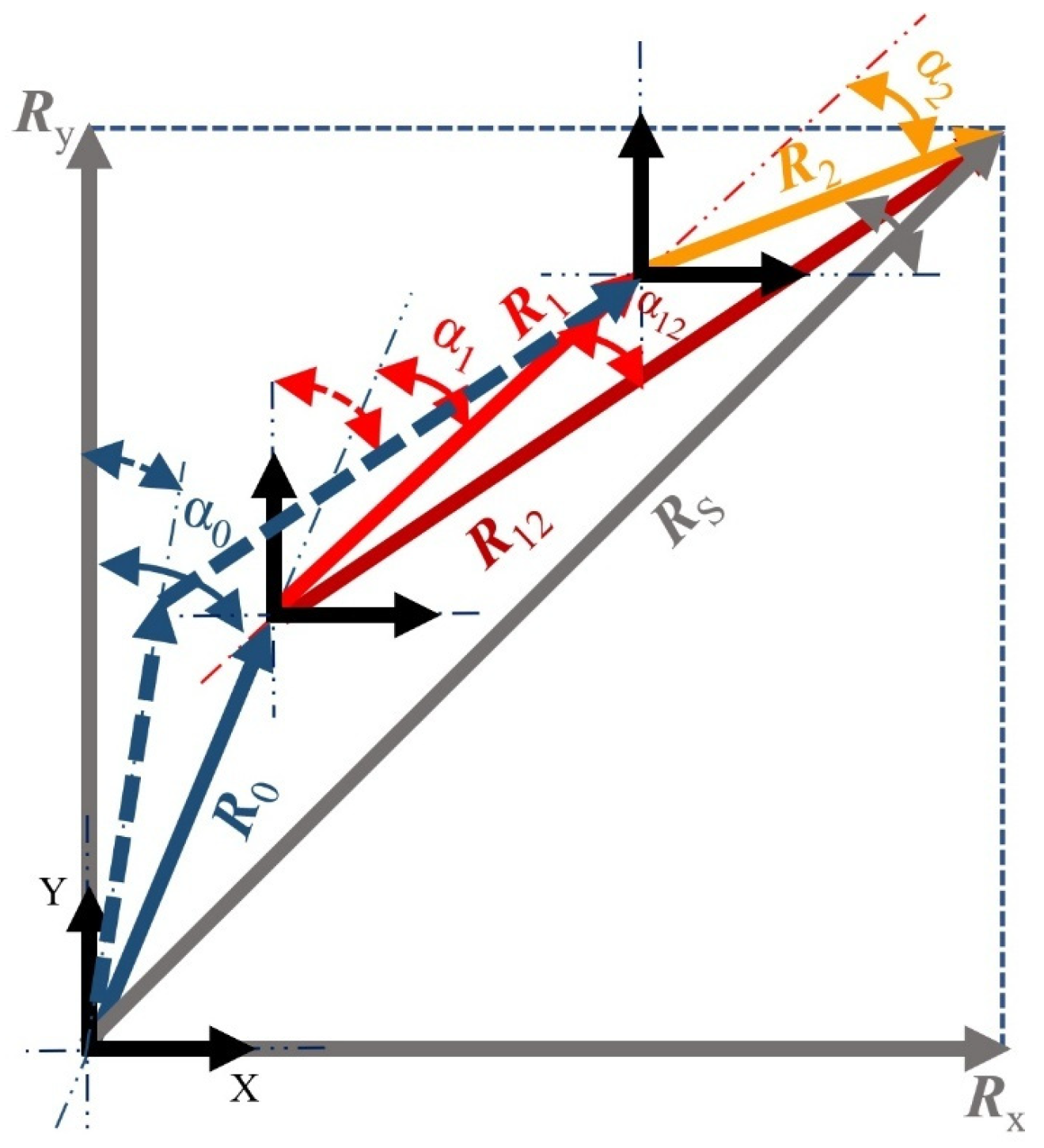
To determine the velocity and acceleration of the end-effector relative to the fixed base in the TTR planar mechanism, the first- and second-time derivatives of the position equations must be computed. The first derivative of the end-effector’s position provides its linear and angular velocities, while the second derivative gives the corresponding linear and angular accelerations. These kinematic quantities are fundamental for dynamic modeling, trajectory planning, and the implementation of control strategies in robotic systems (see Figure 3).
The angular velocity α ˙ T of the end-effector is the time derivative of its orientation α s :
α ˙ T = α ˙ 0 + α ˙ 1 + α ˙ 2
α ˙ 0 , α ˙ 1 and α ˙ 2 are angular velocities of the base plate, mid plate and the end-effector about the Z axis and the linear velocities of end-effector are:
x ˙ 2 y ˙ 2 = J α ˙ 0 α ˙ 1 α ˙ 2
in which J is the Jacobian matrix of the mechanism, and can be defined in the following matrix form:
J T = R 0 cos α 0 + R 1 cos α 0 + α 1 + R 2 cos α 0 + α 1 + α 2         R 0 sin α 0 R 1 sin α 0 + α 1 R 2 sin α 0 + α 1 + α 2 R 1 cos α 0 + α 1 + R 2 cos α 0 + α 1 + α 2                                   R 1 sin α 0 + α 1 R 2 sin α 0 + α 1 + α 2 R 2 cos α 0 + α 1 + α 2                                                                                                         R 2 sin α 0 + α 1 + α 2
The angular velocities of the mid plate and base plate are:
α ˙ m i d   p l a t e = α ˙ 0 + α ˙ 1
α ˙ b a s e   p l a t e = α ˙ 0
and the linear velocity of the mid plate and end-effector center is time derivation of x 0 , y 0 and x 1 , y 1 respectively.
x ˙ 0 y ˙ 0   = J α ˙ 0 α ˙ 1 α ˙ 2 ,   x ˙ 1 y ˙ 1   = J   α ˙ 0 α ˙ 1 α ˙ 2
The Jacobian matrix J and J relates the joint velocities α ˙ 0 and α ˙ 1 to the end-effector and mid plate linear velocities x ˙ 1 , y ˙ 1 , x ˙ 2   and y ˙ 2 . The Jacobian is given by:
J = R 0 cos α 0 0 0 R 0 sin α 0 0 0 J = R 0 cos α 0 + R 1 cos α 0 + α 1 R 1 cos α 0 + α 1 0 R 0 sin α 0 R 1 sin α 0 + α 1 R 1 sin α 0 + α 1 0
The angular acceleration α ¨ s of the end-effector with respect to the X-Y platform is the time derivative of its angular velocity:
α ¨ s = d α ˙ 2 d t = α ¨ 0 + α ¨ 1 + α ¨ 2
where α ¨ 0 , α ¨ 1 , α ¨ 2 are the angular accelerations of the base plate, mid plate, and end-effector, respectively.
The linear acceleration components x ¨ 2 and y ¨ 2 of the end-effector (point A) are the time derivatives of x ˙ 2 and y ˙ 2 :
x ¨ 2 = d x ˙ 2 d t ,   y ¨ 2 = d y ˙ 2 d t
x ¨ 2 = R 0 sin α 0 α ˙ 0 2 + R 0 cos α 0 α ¨ 0 R 1 sin α 0 + α 1 α ˙ 0 + α ˙ 1 2 + R 1 cos α 0 + α 1 α ¨ 0 + α ¨ 1 R 2 sin α 0 + α 1 + α 2 α ˙ 0 + α ˙ 1 + α ˙ 2 2 + R 2 c o s ( α 0 + α 1 + α 2 ) ( α ¨ 0 + α ¨ 1 + α ¨ 2 ) y ¨ 2 = R 0 cos α 0 α ˙ 0 2 R 0 sin α 0 α ¨ 0 R 1 cos α 0 + α 1 α ˙ 0 + α ˙ 1 2 R 1 sin α 0 + α 1 α ¨ 0 + α ¨ 1 R 2 cos α 0 + α 1 + α 2 α ˙ 0 + α ˙ 1 + α ˙ 2 2 R 2 s i n ( α 0 + α 1 + α 2 ) ( α ¨ 0 + α ¨ 1 + α ¨ 2 )
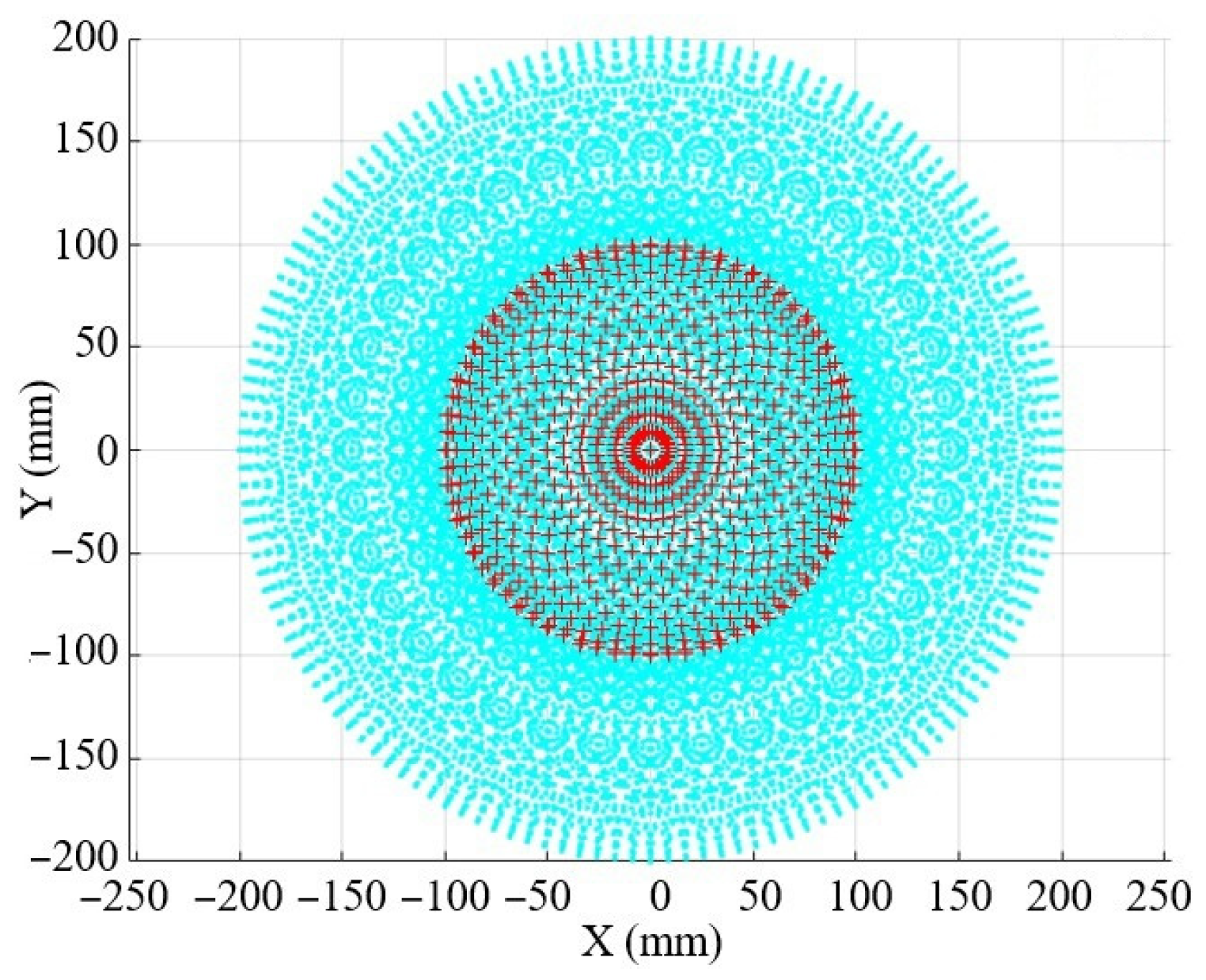
According to Figure 4, the reachable workspace of the TTR mechanism is a circular region with an approximate diameter of 400 mm. The workspace was obtained numerically in MATLAB R2019a using an iterative forward-kinematics-based search over the admissible actuator angle ranges, where points violating geometric constraints were excluded. A detailed geometric design and complete workspace analysis of the TTR mechanism are reported in [32]; therefore, only a concise workspace description is provided here, as the present paper focuses on dynamic modeling and control.
The TTR planar mechanism is actuated by three independent DC motors, each associated with one generalized coordinate. The first two motors drive the base and mid plates and jointly generate planar translational motion, while the third motor directly controls the end-effector rotation about the Z-axis. Cartesian trajectories are converted into joint-space commands via inverse kinematics and applied to the actuators.

3.2. Inverse Kinematics

Inverse kinematics plays a critical role in determining the joint angles required to position the end-effector at a specific target location within the manipulator’s workspace [34]. While forward kinematics determines the position and orientation of the end-effector from known joint variables, inverse kinematics tackles the opposite problem—calculating the joint angles required to achieve a specified end-effector pose. This procedure is essential for motion planning, trajectory tracking, and control in robotic systems.
The TTR planar manipulator features two translational and one rotational degrees of freedom. The end-effector’s Cartesian position ( x , y ) and orientation θ in the workspace are functions of the rotation angles of the base plate α 0 ,   mid   plate , and end-effector α 2 . The corresponding forward kinematics expressions are provided in Equation (6). The inverse kinematics problem involves determining the joint angles α 0 , α 1 , α 2 that yield a specified end-effector position ( x , y ) and orientation θ . Referring to Figure 3 and the geometric relationships defined therein, the inverse kinematics is formulated by analytically or numerically solving the forward kinematics equations in reverse. The approach is outlined as follows:
t a n ( α s ) = x 2 y 2 R 12 2 = R 1 2 + R 2 2 2 R 1 R 2 c o s ( π α 2 ) α = α s α 0 α 12 = sin 1 ( R 2 s i n ( π α 2 ) R 12 )
According to Equations (6) and (18), the three-degree-of-freedom equations is formed below, and the desired angles are found by solving them:
E ( α ) = E 1 α E 2 α E 3 α = R 12 s i n ( π α 1 α 12 ) R s s i n ( α ) x 2 R 0 s i n ( α 0 ) R 1 s i n ( α 0 + α 1 ) R 2 s i n ( α 0 + α 1 + α 2 ) y 2 R 0 c o s ( α 0 ) R 1 c o s ( α 0 + α 1 ) R 2 c o s ( α 0 + α 1 + α 2 )
E ( α ) is a matrix to describe the inverse kinematics equation for the mentioned TTR planar manipulator.

Numerical Solution Approach

Although the kinematic and dynamic equations of the TTR manipulator are derived explicitly in closed form, the inverse kinematics problem leads to a set of nonlinear algebraic equations that do not admit an analytical solution. Therefore, a modified Newton–Raphson algorithm is employed solely for computing joint variables corresponding to a desired end-effector pose. This numerical procedure does not affect the closed-form nature of the derived dynamic model. As a result, numerical techniques such as the Newton–Raphson method or gradient-based optimization are commonly employed to iteratively determine the joint angles corresponding to a desired end-effector position and orientation. These approaches operate by minimizing the positional error between the target end-effector pose and the pose estimated from the current set of joint angles. The computation typically begins with an initial guess for the joint angles, which is then refined iteratively until the calculated end-effector position converges to the desired target within a specified tolerance. Among the available iterative methods, the modified Newton–Raphson algorithm is particularly effective, offering rapid convergence and reliable performance for solving such nonlinear systems. The key steps of the modified Newton–Raphson method for inverse kinematics are outlined below:
Jacobian Matrix Construction: The Jacobian matrix J i n v ( α ) is the matrix of partial derivatives of the inverse kinematic Equation (19) with respect to the joint angles:
J i n v = E 1 α 0       E 1 α 1       E 1 α 2 E 2 α 0       E 2 α 1       E 2 α 2 E 3 α 0       E 3 α 1       E 3 α 2
Here, x and y represent the components of the forward kinematic mapping corresponding to the current joint angles. This matrix captures how small variations in the joint angles influence the position of the end-effector.
Iterative Update Formula: The joint angles are updated iteratively using the Newton–Raphson update rule:
α ( n + 1 ) = α ( n ) J i n v 1 α n E α n               n = 0 , 1 , 2 ,
where
  • is the constant factor that can improve the stability and convergence of the solution.
  • α ( n ) = [ α 0 ( n )   α 1 ( n )   α 2 ( n ) ] is the vector of joint angles at the nth iteration.
  • J i n v 1 ( α ( n ) ) is the inverse of the Jacobian matrix at the nth iteration.
  • E ( α ( n ) ) is the inverse kinematic matrix at the nth iteration.
Convergence Criterion: The iteration continues until the E(α) is reduced below a predefined tolerance:
E ( α ) < ζ
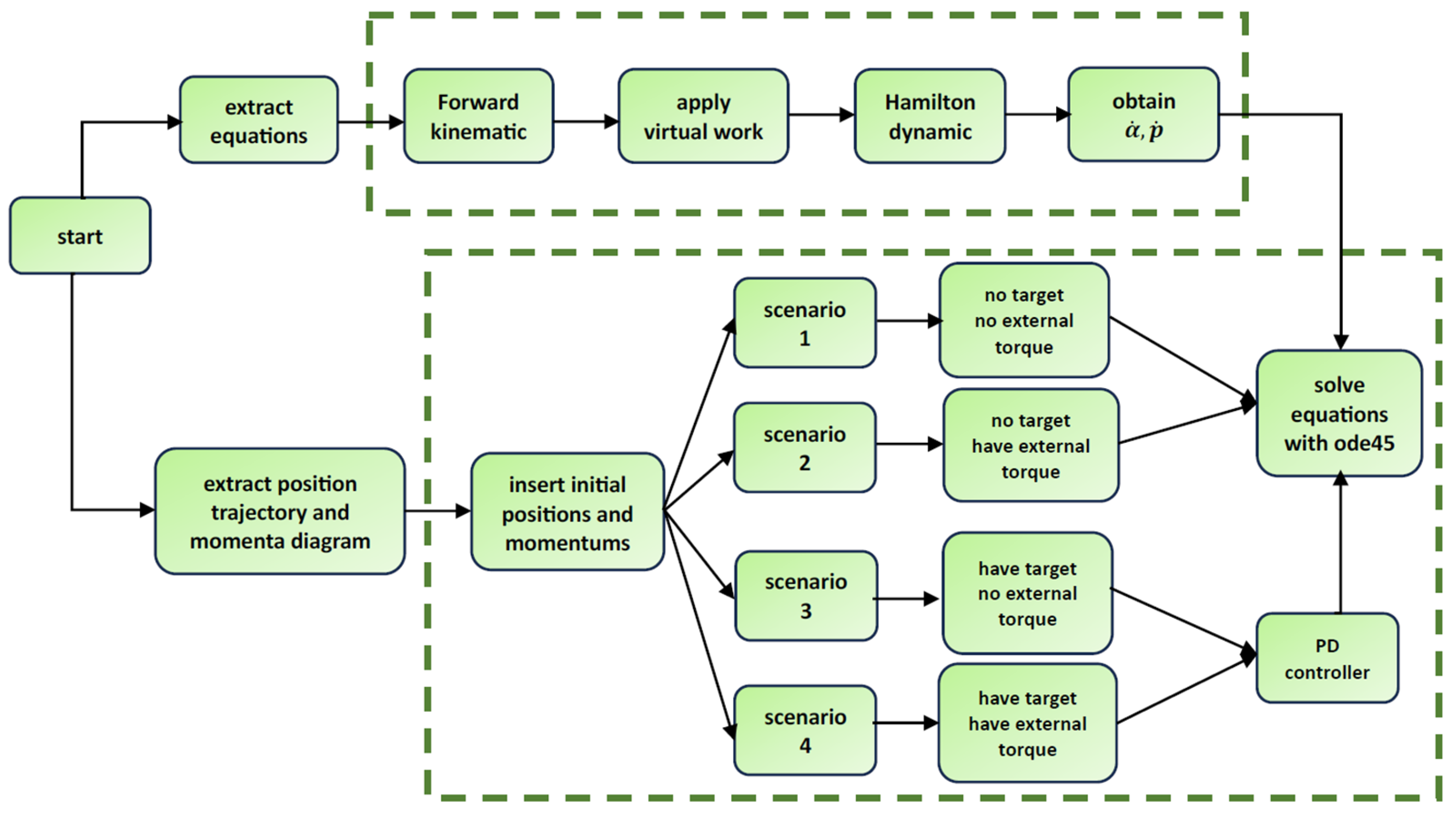
where ζ is the acceptable tolerance. Figure 5 shows how to solve the modified Newton–Raphson method.

4. Kinetics of the Mechanism

This section presents the kinetic analysis of the TTR planar mechanism using the principles of virtual work, Hamiltonian mechanics, and the Lagrangian approach. The analysis begins with the derivation of the Jacobian matrix, which defines the relationship between joint velocities and the end-effector’s linear and angular velocities, as described in Section 3. Next, the principle of virtual work is employed to relate the rotational and translational kinematic variables to the corresponding joint torques and external forces. The Lagrangian method is then applied to formulate the equations of motion for the end-effector. By substituting the angular positions, velocities, and accelerations obtained from inverse kinematics into the dynamic model, the required actuator torques and internal forces within the mechanism can be determined. Finally, the Hamiltonian formulation is used to describe the system’s energy dynamics. This provides an alternative perspective on the system’s behavior by expressing its total energy (kinetic and potential) and facilitates further insight into the conservation properties and stability analysis of the manipulator. It should be noted that inverse kinematics and inverse dynamics serve different roles in the proposed framework. Inverse kinematics is used to convert the desired end-effector trajectories in Cartesian space into joint-space position, velocity, and acceleration profiles. In contrast, inverse dynamics is employed within the control scheme to compute the required actuator torques based on the joint trajectories and the derived dynamic model. These two processes are treated separately in this study. In this work, the Lagrangian and Hamiltonian formulations are employed sequentially rather than as independent or competing dynamic models. The Lagrangian formulation is used in an inverse-dynamics sense: joint displacements, velocities, and accelerations obtained from inverse kinematics are substituted into the Lagrangian equations to compute the required actuator torques. These torques are then introduced into the Hamiltonian formulation, which is used for forward-dynamics analysis to predict the resulting motion of the mechanism. The close agreement between the displacements obtained from inverse kinematics and those predicted by the Hamiltonian model serves as a validation of the correctness and consistency of the proposed dynamic modeling framework.

4.1. Principle of Virtual Work

The principle of virtual work asserts that, for any virtual displacement, the total virtual work performed by all forces acting on the system—including inertial forces—must be zero. For the TTR mechanism, the virtual displacement of the end-effector can be related to the virtual displacements of the end-effector δ q , mid plate δ q and base plate. δ q can be related to the virtual displacements of the joints δ α via the Jacobian:
δ q = J δ q , δ q = J δ α , δ q = J δ α
The virtual work done by inertial forces is:
δ W = m 0 q ¨ T δ q + m 1 q ¨ T δ q + m 2 q ¨ T δ q = 0
m 2 is the mass of the end-effector. Substituting Equation (23) into Equation (24) and simplifying, we obtain:
δ W = m 0 J α ¨ T J δ α m 1 J α ¨ T J δ α m 2 J α ¨ T J δ α = 0 J T J α ¨ = 0 ,   J T J α ¨ = 0 ,   J T J α ¨ = 0
Including external torques τ , the dynamic equation considering effective forces is:
τ = J T F e f f J T   F e f f J T   F e f f

4.2. Lagrange Method

The Lagrangian method is used to derive the equations of motion by applying the principle of least action. The Lagrangian, L , is defined as the difference between the kinetic energy, T , and the potential energy, V , of the system:
L = T V
For the TTR planar manipulator, assuming that the potential energy is negligible (since the motion occurs primarily in the horizontal plane, and gravity does not significantly affect it), the Lagrangian is essentially the kinetic energy of the system:
L = T
Once the Lagrangian is defined, the equations of motion are obtained by applying the Euler–Lagrange equation for each generalized coordinate α i :
d d t L α ˙ i L α i = τ i               i = 0 , 1 , 2
where τ i is the generalized torque acting on the ith joint.
The kinetic energy of the system comprises both the rotational and translational contributions of each plate, including the base plate, mid plate, and end-effector. The total kinetic energy can be expressed as the sum of the kinetic energies of each component:
T = 1 2 I 0 α ˙ 0 2 +   1 2 I 1 α ˙ 1 2 + 1 2 I 2 α ˙ 2 2 + 1 2 m 0 v 0 2 + 1 2 m 1 v 1 2 + 1 2 m 2 v 2 2
v 0 2 , v 1 2 , v 2 2 , I 0 , I 1 and I 2 are the linear velocity of center of the mid plate, linear velocity of center of the end-effector, linear velocity of the end-effector, inertia-moment of the base plate, inertia moment of the mid plate and inertia-moment of the end-effector, respectively.
T = 1 2 I 0 α ˙ 0 2 + 1 2 I 1 α ˙ 1 2 + 1 2 I 2 α ˙ 2 2 + 1 2 m 0 J 11 α ˙ 0 + J 12 α ˙ 1 + J 13 α ˙ 2 2 + J 21 α ˙ 0 + J 22 α ˙ 1 + J 23 α ˙ 2 2 + 1 2 m 1 J 11 α ˙ 0 + J 12 α ˙ 1 + J 13 α ˙ 2 2 + J 21 α ˙ 0 + J 22 α ˙ 1 + J 23 α ˙ 2 2 + 1 2 m 2 J 11 α ˙ 0 + J 12 α ˙ 1 + J 13 α ˙ 2 2 + J 21 α ˙ 0 + J 22 α ˙ 1 + J 23 α ˙ 2 2 = 1 2 α ˙ T M α ˙
the inertia matrix M is:
M = I 0 + m 0 J 11 2 + J 21 2 + m 2 J 11 2 + J 21 2 + m 1 J 11 2 + J 21 2 m 0 J 11 J 12 + J 21 J 22 + m 1 J 11 J 12 + J 21 J 22 + m 2 J 11 J 12 + J 21 J 22 m 0 J 11 J 13 + J 21 J 23 + m 1 J 11 J 13 + J 21 J 23 + m 2 J 11 J 13 + J 21 J 23 m 0 J 11 J 12 + J 21 J 22 + m 1 J 11 J 12 + J 21 J 22 + m 2 J 11 J 12 + J 21 J 22 I 1 + m 0 J 12 2 + J 22 2 + m 2 J 12 2 + J 22 2 + m 1 J 12 2 + J 22 2 m 0 J 12 J 13 + J 22 J 23 + m 1 J 12 J 13 + J 22 J 23 + m 2 J 12 J 13 + J 22 J 23 m 0 J 11 J 13 + J 21 J 23 + m 1 J 11 J 13 + J 21 J 23 + m 2 J 11 J 13 + J 21 J 23 m 0 J 12 J 13 + J 22 J 23 + m 1 J 12 J 13 + J 22 J 23 + m 2 J 12 J 13 + J 22 J 23 I 2 + m 0 J 13 2 + J 23 2 + m 2 J 13 2 + J 23 2 + m 1 J 13 2 + J 23 2
according to Equations (28)–(32), the equation simplifies to:
d d t ( M ( α ) α ˙ i ) 1 2 α ˙ T M ( α ) α i α ˙ = τ i
This leads to the equations of motion for the TTR manipulator, which can be expressed in matrix form as:
M ( α ) α ¨ + C ( α , α ˙ ) α ˙ = τ
C ( α , α ˙ ) represents the Coriolis and centrifugal forces:
C i j α , α ˙ = k = 1 3 M k j α i 1 α ˙ k 1                 i , j = 1 , 2 , 3
By solving this equation for angular position, velocity and acceleration obtained from inverse kinematics, we can obtain the torque on the mechanism.

4.3. Hamiltonian Mechanics

Hamiltonian mechanics offers a robust framework for analyzing the energy dynamics of the system. The Hamiltonian H is the total energy of the system, given by the sum of kinetic energy T and potential energy V . For the proposed TTR planar manipulator, all motion takes place in the horizontal plane, and the centers of mass of the links do not experience any vertical displacement. As a result, the gravitational potential energy remains constant throughout the motion. Since a constant potential energy does not influence the equations of motion, it is omitted from the subsequent dynamic derivations without loss of generality. Accordingly, the Hamiltonian formulation used in this study is effectively based on the system’s kinetic energy; the Hamiltonian is: H = i = 1 3 p i α ˙ i L .
The generalized momenta p i are:
p i = L α ˙ i = M α ˙
and the Hamiltonian will be:
H ( α , p ) = 1 2 p T M 1 ( α ) p
α ˙ i = H p i = M 1 ( α ) p
p ˙ i = H α i = 1 2 p T M 1 ( α ) α p + τ
By substituting the expressions for kinetic energy T, generalized momenta p i and external torques in Hamiltonian, and solving it, we can predict the trajectory motion of the mechanism.

5. Control

In this section, we discuss the control strategy used to achieve robust velocity tracking for the three degrees of freedom (DOF) in the TTR planar manipulator. Controlling each joint’s velocity is crucial for accurate tracking of desired trajectories, which ensures the manipulator reaches target positions precisely and responds to disturbances effectively. In this study, a nonlinear control strategy based on sliding-mode control (SMC) is adopted, owing to its proven robustness against system uncertainties and external disturbances in a simulation environment to verify the stability and tracking performance of the derived dynamic model. Although the adopted sliding-mode control (SMC) structure follows the well-known formulation, its implementation in this study is specifically tailored to the dynamics derived through the proposed hybrid virtual work and Hamiltonian framework. This integration ensures that the control action directly reflects the true nonlinear coupling and energy exchange within the TTR mechanism, thereby enhancing tracking precision and robustness without the need for empirical tuning. Furthermore, the inclusion of the regularized fractional-power term contributes to smoother convergence and reduction in chattering near the switching surface. These aspects collectively differentiate the proposed controller from conventional SMC schemes that rely on simplified or approximated dynamic representations. Notably, the values of the joint angles α are obtained from the inverse kinematics analysis of the manipulator. The following sections outline the definitions of control errors, specify the control objectives, and present the detailed design of the sliding-mode controller (see Figure 6).

Sliding-Mode Control

The tracking control problem in operational space is to find a control law such that given a desired velocity α ˙ d e s i r e d , the tracking error e i goes to zero asymptotically.
e i = α ˙ α ˙ d e s i r e d       i = 1 ,   2 ,   3
where α ˙ is the measure angular velocity from inverse kinematics and α ˙ d e s i r e d is the desired angular velocity of the mechanism.
Since the relative degree of the system r = 1, the sliding surface selected in our work is given by:
s = e ,   s ˙ = e ˙ = α ¨ α ¨ d e s i r e d
Although a simple sliding surface s = e is adopted for clarity, finite-time convergence is enhanced through the nonlinear reaching law defined below.
Consider the following Lyapunov function candidate:
V = 1 2 s T s
From Lyapunov stability theory, we know that the system reaches S = 0 in finite time of the above Lyapunov function and V ˙ = s s ˙ < 0 .
Defining the control signal as:
τ = τ e q k 1 s k 2 s ρ s i g n ( s )
τ e q = M ( α ) α ¨ d e s i r e d C ( α , α ˙ ) α ˙
k 1 and k 2 are the gains, ρ is a parameter that controls the nonlinearity of the sliding term, and s i g n ( s ) is the switching function.
In practice, the control law in Equation (43) cannot be used because of containing the term s i g n ( S ) , which results in high-frequency oscillations, called chattering, and it is replaced by a continuous approximation. Chattering may be reduced by using a high-saturation function. We define the control law and tracking as:
τ = τ e q k 1 s k 2 s ρ s a t ( s )
where s a t ( S ) is a saturation function that can be defined as follows:
s a t s t = s ( t ) s ( t ) s ( t ) δ s ( t ) s ( t ) + δ s ( t ) < δ
which provides a very smooth control action. k 1 and k 2 are the gains and s i g n ( s ) is the switching function. The saturation function employed in the sliding-mode control law is introduced to replace the discontinuous sign function and to alleviate chattering. Although it is not explicitly written in the normalized form sat ( s / δ ) , the adopted formulation is mathematically equivalent and introduces a boundary layer around the sliding surface. This form has been widely used in the control of planar parallel manipulators and follows the approach presented in Litim et al. [35]. The boundary layer thickness is governed by the saturation parameters, which limit the control magnitude when the sliding variable approaches zero. As a result, high-frequency switching is avoided, and the control signal becomes continuous within the boundary layer while preserving robustness against disturbances and modeling uncertainties.
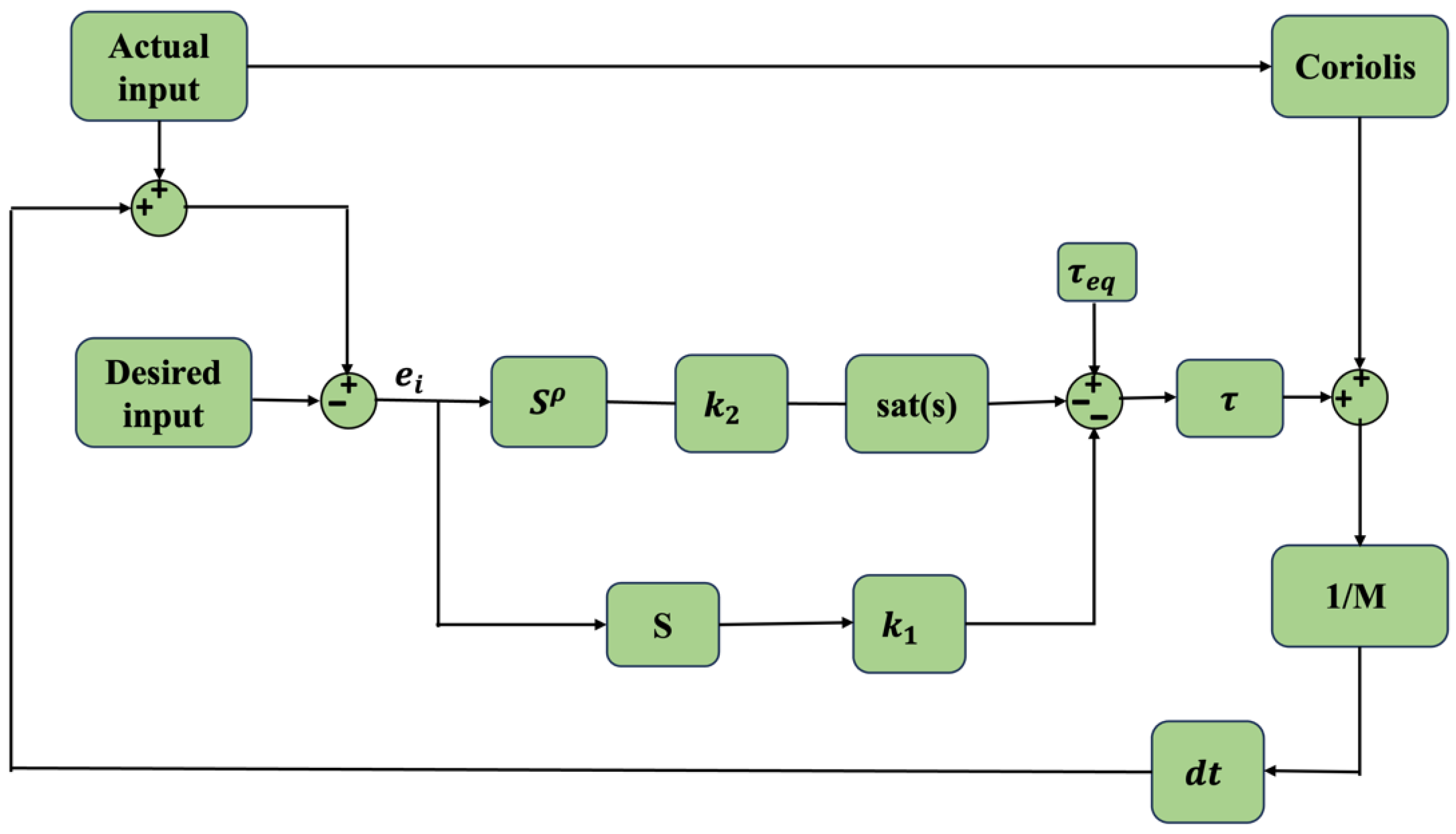
Figure 6 illustrates the implementation of the proposed control method within the dynamic framework of the TTR planar manipulator, based on the Lagrangian formulation and the mechanism’s equations of motion. As illustrated, the control input is determined based on the difference between the current angular velocity of each joint and its corresponding desired angular velocity. This error signal, denoted as e i , serves as the foundation for computing the control torque using the sliding-mode control law defined in Equations (40)–(46). In the control loop, the Coriolis forces and the inertial mass matrix of the manipulator are calculated based on the trajectory path derived in the preceding step. These dynamic parameters are subsequently incorporated into the control scheme to calculate the torque inputs required to compensate for nonlinearities and dynamic coupling. The angular acceleration is then updated using the Lagrangian formulation, and this acceleration is integrated to obtain the angular velocity for the next control step, thereby closing the feedback loop. This framework allows for accurate tracking of the desired trajectory while preserving robustness against modeling uncertainties and external disturbances.
Conventional linear controllers such as proportional–derivative (PD) or proportional–integral–derivative (PID) schemes are widely used in robotic manipulators due to their simplicity and ease of implementation. However, their performance strongly depends on accurate tuning and is known to degrade in the presence of modeling uncertainties, nonlinear coupling, and external disturbances, which are inherent to the proposed TTR mechanism. For this reason, and to maintain a clear focus on validating the closed-form dynamic model and its robustness properties, this study adopts sliding-mode control as the primary control strategy in the simulation environment. A quantitative comparison with PD/PID controllers is therefore not included, as the objective of this work is not controller benchmarking but model-based robustness validation. Consequently, the contribution of the control stage in this work lies not in introducing a new SMC formulation but in demonstrating how a precisely derived closed form dynamic model significantly improves the robustness and stability of an established SMC strategy. This application in simulation demonstrates the model’s readiness for closed-loop control; however, for the initial experimental validation presented in Section 6, a separate, simplified open-loop trajectory-tracking strategy is employed on the physical prototype.

6. Experimental Validation

This section presents the experimental validation of the proposed modeling framework for the TTR planar manipulator. The experiments aim to assess the manipulator’s ability to accurately track a predefined trajectory within its workspace, smoothly transitioning from an initial to a target position. Key performance metrics, including tracking accuracy, trajectory smoothness, and robustness under real-world conditions, are evaluated. The experimental validation focuses on assessing the accuracy of the kinematic and dynamic model. The physical prototype is commanded using a pre-computed, open-loop trajectory derived from the inverse kinematics solution. This approach allows for a direct comparison between the simulated model predictions and the actual hardware behavior, isolating the model’s fidelity from the complexities of real-time closed-loop control.

6.1. Experimental Setup

The experimental setup employs incremental rotary encoders mounted on each actuated plate to measure joint angular positions. Encoder signals are acquired through a data acquisition system at a fixed sampling rate of 550 Hz. Joint velocities are obtained by numerical differentiation of the measured angular positions. All signals are time-synchronized and logged for offline analysis. During experimental validation, actuator commands were bounded according to the motor and transmission specifications to ensure safe and realistic operating conditions.
The measured joint trajectories are mapped to Cartesian end-effector positions using the forward kinematic model described in Section 3, enabling a direct and consistent comparison between experimental and simulation results.
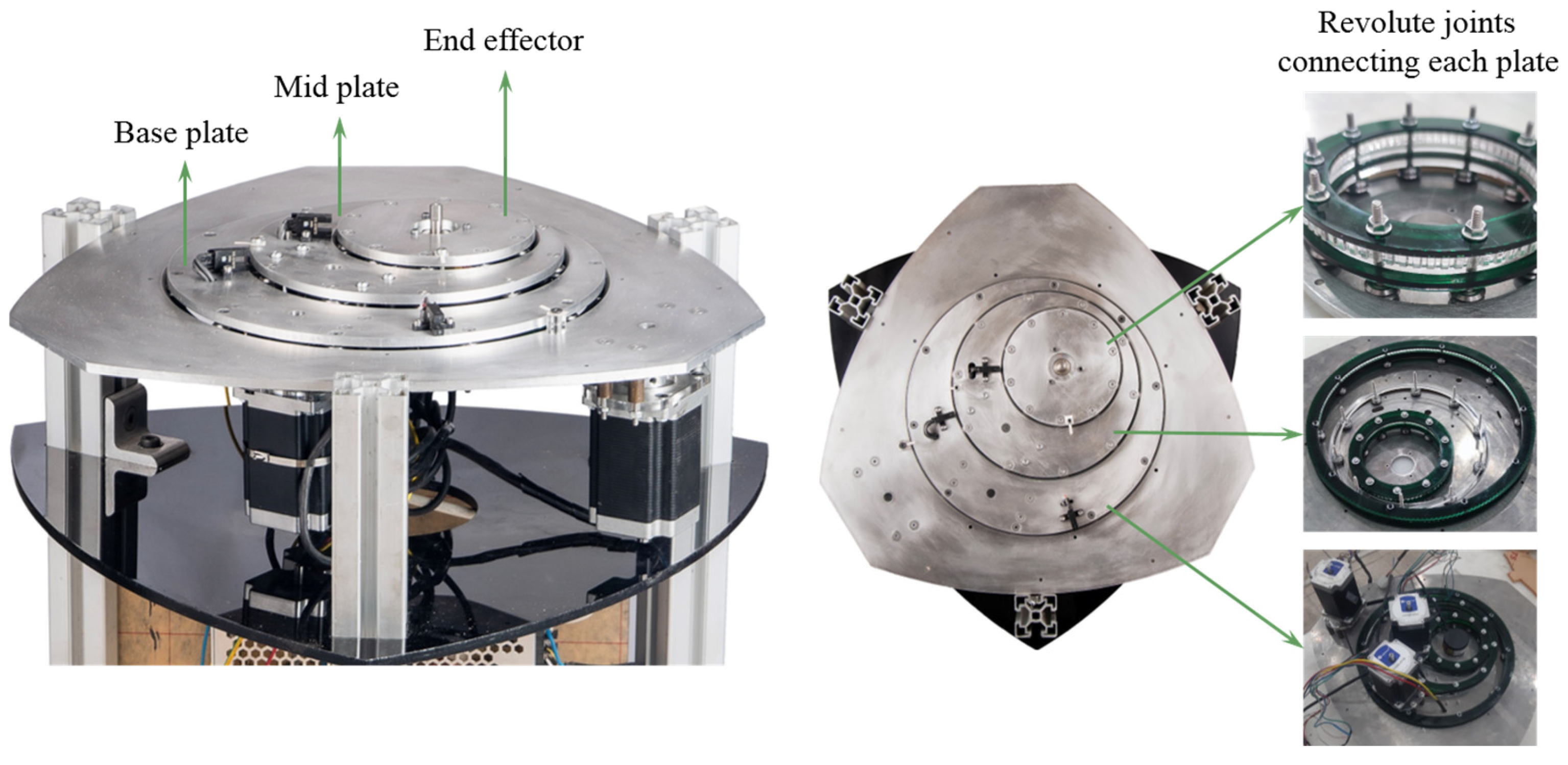
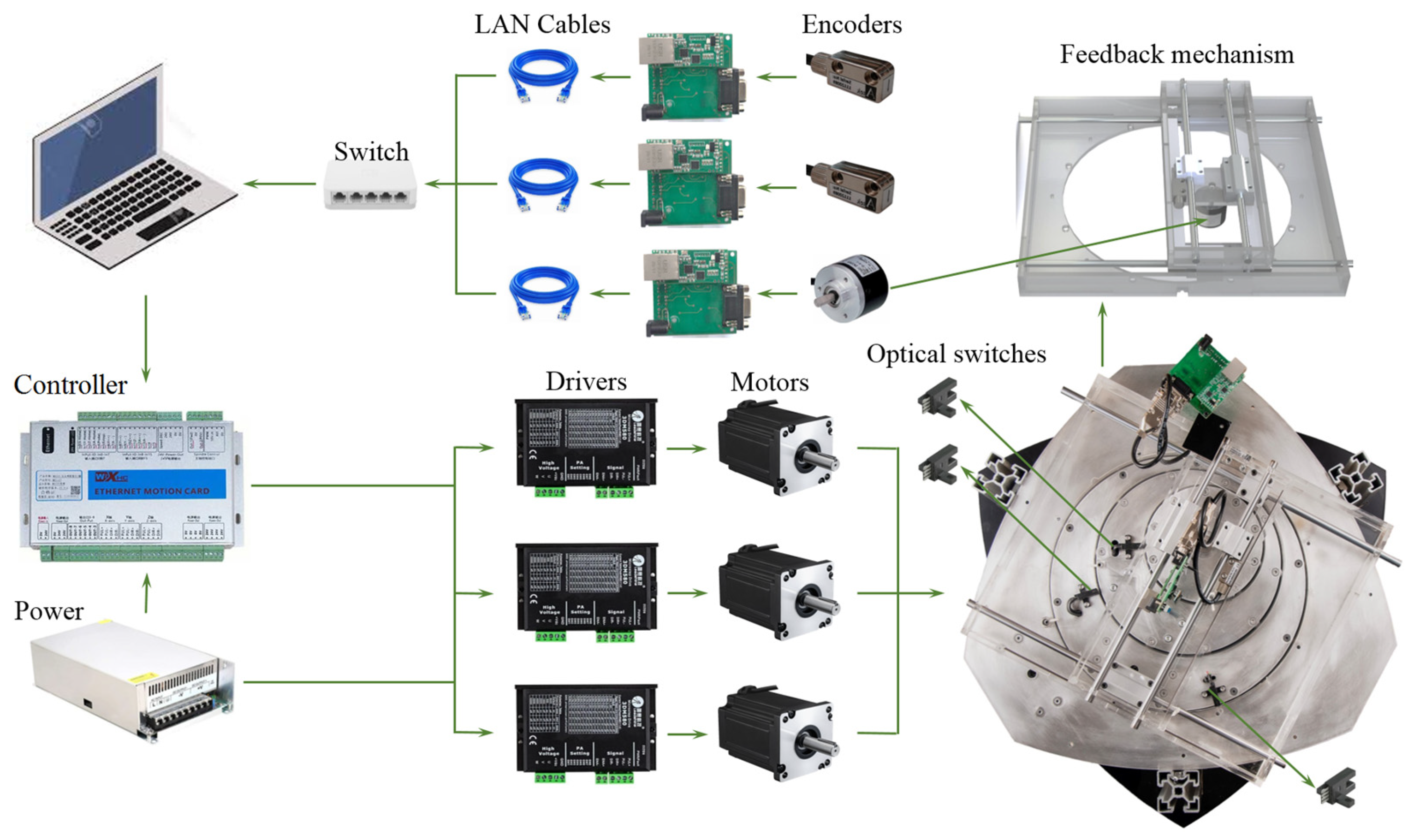
The TTR planar mechanism, shown in Figure 7, consists of three interconnected circular plates: a large base plate, a mid plate, and an end-effector. The base plate functions as the main structural support, with the mid plate and end-effector mounted sequentially above it. Each of the three DC motors directly actuates one revolute joint of the TTR mechanism (base plate, mid plate, and end-effector), and the experimental trajectories are generated by converting predefined Cartesian paths into joint-space commands using the inverse kinematics described in Section 3, without closed-loop control. Each plate is driven by a revolute joint, allowing rotational motion about the Z-axis. The primary forces acting on the mechanism are directed vertically along the Z-axis, as illustrated in the figure. Therefore, it is essential that the bearing assemblies for each plate are designed to maintain axial stability and to allow precise bidirectional rotation about their respective axes. This structural configuration facilitates smooth rotational motion while ensuring mechanical integrity and alignment during dynamic operation.
To ensure accurate and stable rotation, each plate in the TTR planar mechanism is supported by ten V-shaped groove ball bearings (type VW W0, 90-degree angle), which provide both axial and radial constraint. The actuation system utilizes 57HS22 stepper motors (Leadshine, Shenzhen, China), chosen for their compact size and high holding torque of 2.2 Nm with the step angle of 1.8°, ensuring the rotational joints between the plates are supported by VW W0 deep-groove ball bearings. Through the driver, the step resolution is converted to 1/8000 of a degree per microstep. Rotational motion along the three axes is coordinated and controlled using a Mach 3 MK3 Ethernet controller, which provides synchronized multi-axis control. The control interface of the prototype is implemented using an MK3 Ethernet motion Controller (Mach3-compatible, Shandong, China). The controller provides 16 digital inputs and 8 digital outputs, with a maximum pulse frequency of 200 kHz, enabling direct connection to the stepper motor drivers. Communication with the PC is performed through Ethernet TCP/IP, and motion commands are executed using the Mach3 control software R3.043. This configuration ensures intact trajectory execution, straightforward integration with the actuators, and sufficient I/O capacity for sensors and limit switches used in the experimental setup. Power from each motor is transmitted to its corresponding plate through custom-designed pulleys, optimized to maximize mechanical efficiency and maintain precise alignment. To establish accurate initial positioning and enhance control precision, the system integrates Omron EE-SX672 optical sensors (Farnell, Kyoto, Japan). These sensors serve as reference-point detectors, allowing precise homing of each rotational axis before trajectory execution.
Figure 7 illustrates the complete experimental testbed used to actuate and support the TTR planar mechanism shown in Figure 1. While the setup includes additional structural components such as bearings, couplings, shafts, and mounting frames, these elements do not introduce additional degrees of freedom and are not part of the kinematic model. The kinematic structure of the manipulator remains identical to that described in Section 2 and Section 3.

6.2. Experimental Procedure

The experiment was conducted to validate the kinematic and dynamic models developed in the preceding sections. The following steps were performed:
  • Trajectory Generation: desired end-effector trajectories in Cartesian space were defined.
  • Inverse Kinematics: the desired trajectories were converted into joint space using the numerical inverse kinematics algorithm.
  • Actuator Execution: the joint commands (α-trajectories) were sent to the linear actuators using the Simulink interface.
  • Data Acquisition: encoder readings were continuously recorded and synchronized with command data. The motion data comprised positions, velocities (obtained via differentiation), and the corresponding inferred torques.
  • Model Comparison: experimental results were compared with theoretical outputs from inverse kinematics to evaluate model accuracy.
It can be said that, during experimental validation, actuator commands were bounded according to the motor and transmission specifications to ensure safe and realistic operating conditions.

7. Results and Discussions

7.1. Simulation Results

This section presents the results obtained from implementing the proposed dynamic modeling algorithm and the SMC strategy on the TTR planar manipulator. Initially, the dynamic equations of motion were formulated based on inverse kinematics, and a numerical solution was subsequently employed to generate the joint angle trajectories corresponding to the desired end-effector positions. Subsequently, the angular velocities and accelerations along the trajectory were derived using Lagrange’s equations in conjunction with the principle of virtual work, with actuator torque considered as the primary control input. The SMC approach was then applied to ensure robust velocity tracking. Using the torques calculated from the Lagrangian formulation, Hamilton’s equations, combined with the principle of virtual work, were applied to simulate the manipulator’s motion along the planned trajectory. The results demonstrate both the computational efficiency and the accuracy of the proposed dynamic model in predicting the manipulator’s behavior across various motion profiles. Sliding-mode control was adopted due to its well-documented robustness to nonlinearities and modeling uncertainties, as reported in the literature. Furthermore, the performance of the sliding-mode control (SMC) scheme was evaluated through numerical simulations based on the derived dynamic model. The simulated results demonstrate finite-time convergence of the tracking error and robustness against modeling uncertainties and external disturbances. The following subsections provide a detailed analysis of the system’s dynamic response, actuator torque profiles, and trajectory tracking behavior, with emphasis on the consistency between simulation outcomes and experimental observations used for model validation. The physical parameters of the TTR mechanism are summarized in Table 2, and the model verification procedure is illustrated in Figure 5.
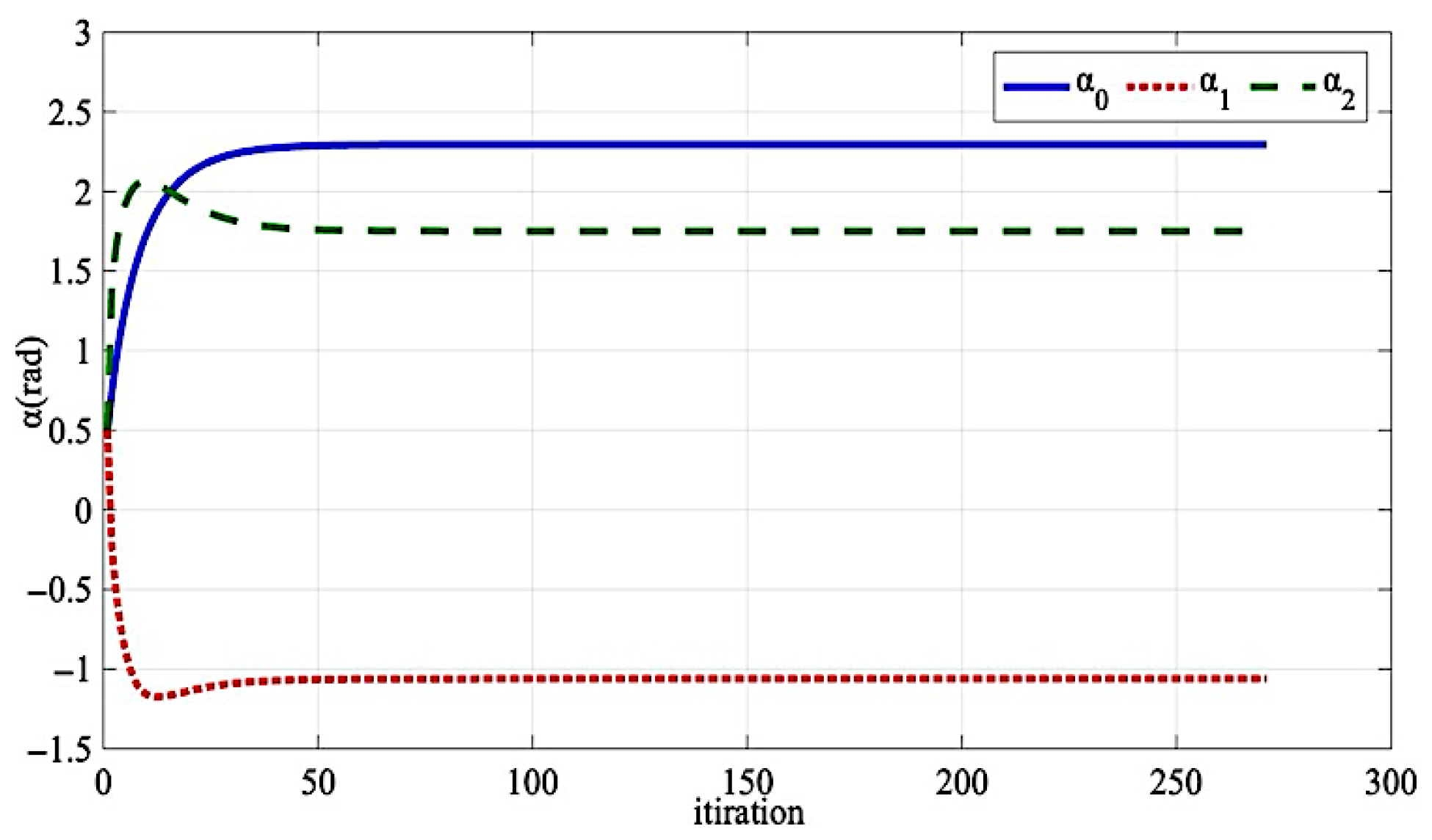
The simulation study was conducted entirely in MATLAB, with each computational step systematically implemented. The inverse kinematic equations of the TTR planar mechanism were first formulated. These equations were subsequently solved numerically using the Newton–Raphson method to determine the joint angle trajectories required to achieve a desired end-effector position. The simulation takes as input the initial and target coordinates of the end-effector. Specifically, the initial position was set as follow: x = 0.5 m, y = 0.2372 m, and the desired position was defined as x d e s i r e d = 0.3259 m, y d e s i r e d = −0.2879 m. The convergence criteria for the numerical solver were set as, ζ = 10 12 , = 0.1 , ensuring a clear and computationally efficient solution process. Under these constraints, the Newton–Raphson algorithm converged after a total of 271 iterations. The resulting joint angle trajectory for the mechanism is presented in Figure 8, illustrating the effectiveness and accuracy of the proposed numerical approach in solving the inverse kinematics problem. The iteration count of 271 corresponds to a conservative worst-case trial under a strict convergence tolerance of 10 6 . Despite this number, the Newton–Raphson algorithm remained computationally efficient due to the low cost per iteration and the use of previous time-step solutions as initial guesses. Total computation time per cycle stayed well within real-time constraints, confirming that the reported iterations reflect the strict accuracy requirements rather than a limitation in efficiency.
Figure 8 illustrates the evolution of the joint angles of the three rotating disks over the course of the Newton–Raphson iterations, as the mechanism transitions from the initial to the desired end-effector position. The figure depicts the rotational trajectories required for each joint to achieve convergence. As shown, all three joint angle trajectories display smooth and continuous behavior, accurately converging to their respective target values. The lack of oscillations or instability in the trajectories indicates that the numerical solution process was both stable and efficient. These results confirm the effectiveness of the proposed inverse kinematics algorithm in guiding the manipulator to its desired configuration while maintaining precise control over joint motion.
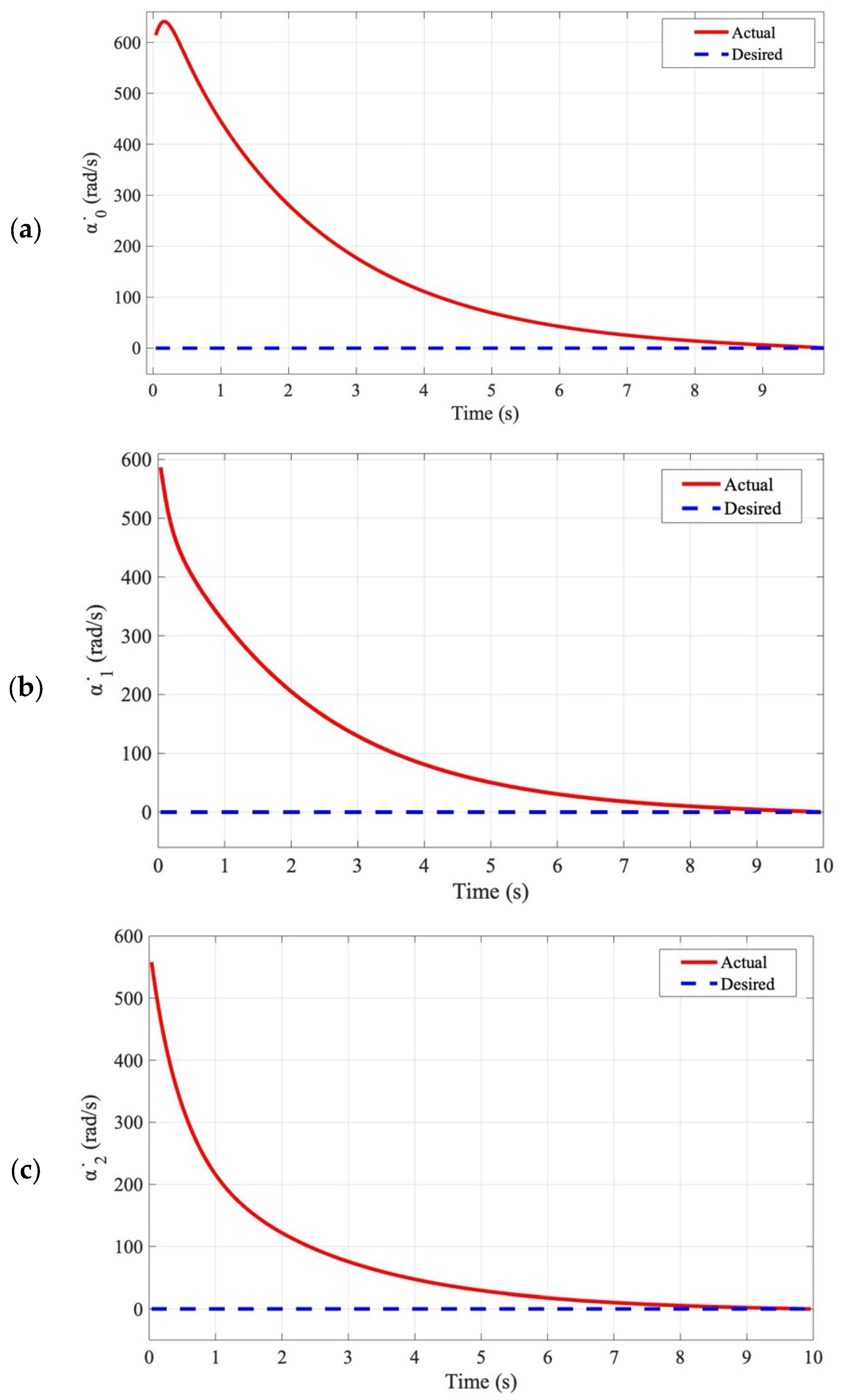
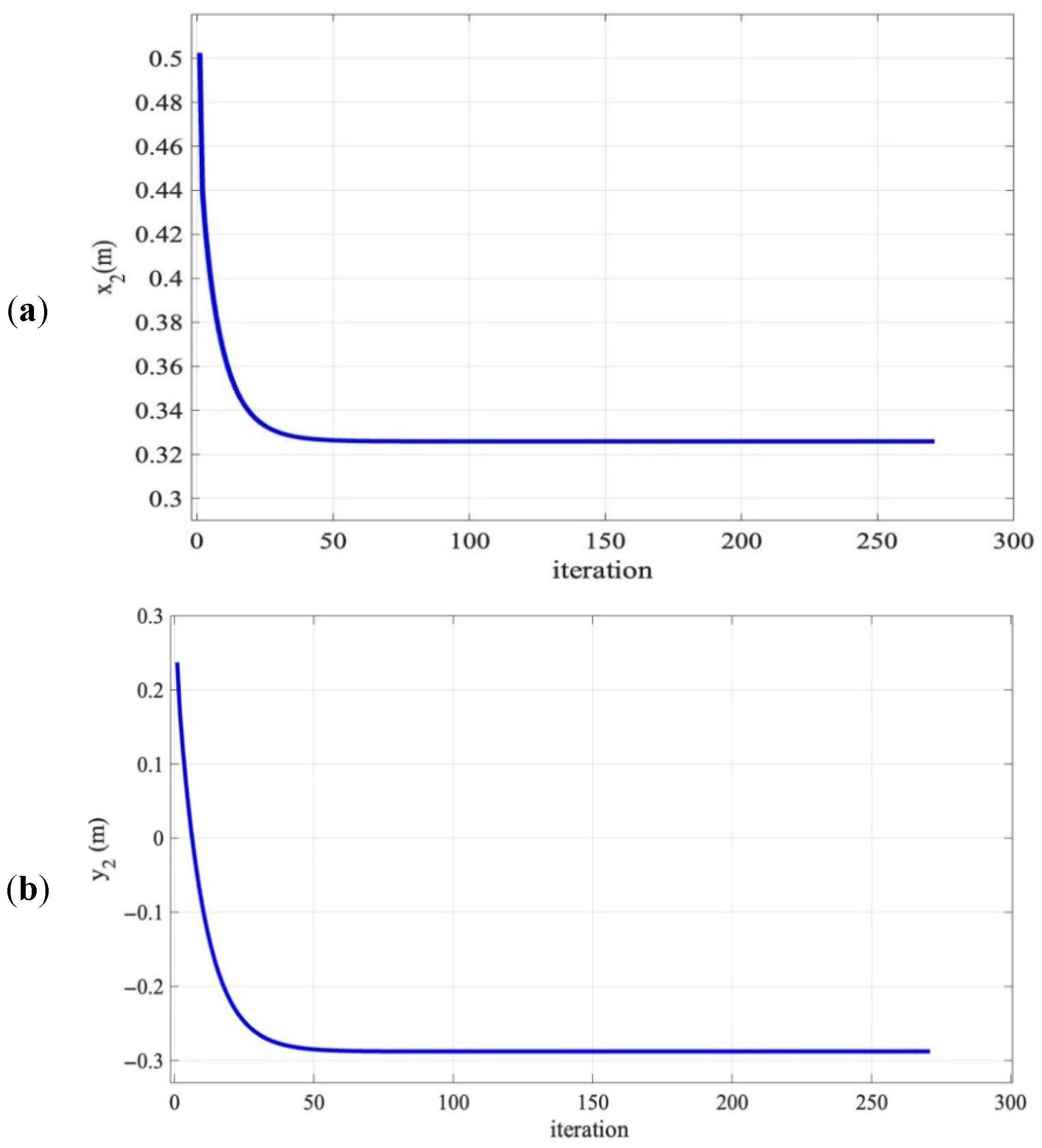
Figure 9 presents the convergence behavior of the end-effector’s Cartesian position, both x and y components, plotted against the number of Newton–Raphson iterations. Figure 9a depicts the convergence of the x-coordinate, while Figure 9b shows the convergence of the y-coordinate from the initial to the desired position. As illustrated in the plots, both components converge smoothly and monotonically, achieving their respective target values with high numerical precision. The convergence curves demonstrate the stability and accuracy of the proposed inverse kinematics and numerical solution framework. The mean squared error (MSE) values for the final iteration are exceptionally low, with MSEx = 3.36 × 10⁻¹⁴ m2, MSEy = 2.017 × 10⁻¹³ m2, where MSEx and MSEy demonstrate the error between the target Cartesian position and the position obtained from the inverse kinematics solution in the two directions of movement, X and Y, respectively. These error measures are computed independently for each Cartesian direction to avoid ambiguity in performance evaluation. It should be noted that instantaneous tracking errors may take positive or negative values; however, the mean squared error (MSE) is a non-negative scalar quantity obtained by squaring and averaging these errors over time. This presentation is consistent with the objective of the study, which focuses on validating the accuracy of the proposed kinematic and dynamic modeling framework. The obtained MSE values are on the order of ×10−13 m2 and ×10−14 m2, indicating extremely small tracking deviations over the entire trajectory. After computing the end-effector’s trajectory, the angular velocity, angular acceleration, and corresponding actuator torque for each rotating disk were determined along the path toward the desired final position. This analysis was carried out using Lagrange’s equations in conjunction with the principle of virtual work, with torque treated as the primary control input within the Lagrangian framework. To ensure a complete and physically meaningful motion profile, each disk is required to come to a full stop upon reaching the target, meaning that the angular velocity of each disk must reduce to zero at the end of the motion. For the purposes of this simulation, the total duration of movement was set as 10 s, during which the end-effector transitions to the desired position and the system decelerates to a stop. The initial angular velocity of each disk was assumed to be 600 rad/s. It should be noted that the initial angular velocity of 600 rad/s used in the simulation studies represents a numerical initial condition rather than a physically sustained operating speed of the experimental prototype. This value is intentionally selected to evaluate the robustness, stability, and convergence properties of the proposed dynamic model and sliding-mode controller under aggressive transient conditions. In the experimental setup, the actuator velocities are constrained by the motor ratings and transmission limits, and the operating speeds remain within the allowable range specified by the hardware. The parameters utilized in the control law were set as k 1 = 0.6 ,   k 2 = 10.273 , ρ = 0.3   and   δ = 0.1 . These values were selected to ensure convergence stability, responsiveness, and robustness of the system under the SMC scheme. The controller parameters are grouped and selected following a structured engineering tuning procedure. First, the sliding surface is defined based on the tracking error dynamics, which fixes the controller structure independently of parameter values. Next, the sliding surface gains are chosen to achieve the desired convergence speed of the nominal system. The switching gain is then increased conservatively until it dominates bounded modeling uncertainties and external disturbances, thereby guaranteeing satisfaction of the sliding condition and finite-time convergence. Finally, secondary smoothing parameters are adjusted to reduce chattering and ensure actuator-safe operation without affecting closed-loop stability.
It is emphasized that the precise numerical values of the controller parameters are not unique; rather, any set satisfying the stability inequalities leads to stable tracking behavior. The adopted values represent one feasible and experimentally validated tuning within this admissible range and are sufficient for the purpose of dynamic model validation pursued in this study. The nonlinear term s ρ with a negative exponent ( ρ = 0.3 ) is introduced to accelerate convergence when the tracking error is small, a characteristic feature of finite-time sliding-mode control. Without appropriate treatment, such terms may lead to large control values as s 0 . To avoid numerical singularities and ensure bounded control effort near the sliding surface, the term s ρ is implemented in a regularized form as: s ρ ( s + ε ) ρ s i g n ( s ) where ε > 0 is a small positive constant. This modification preserves the finite-time convergence property while guaranteeing numerical stability in practical implementation.
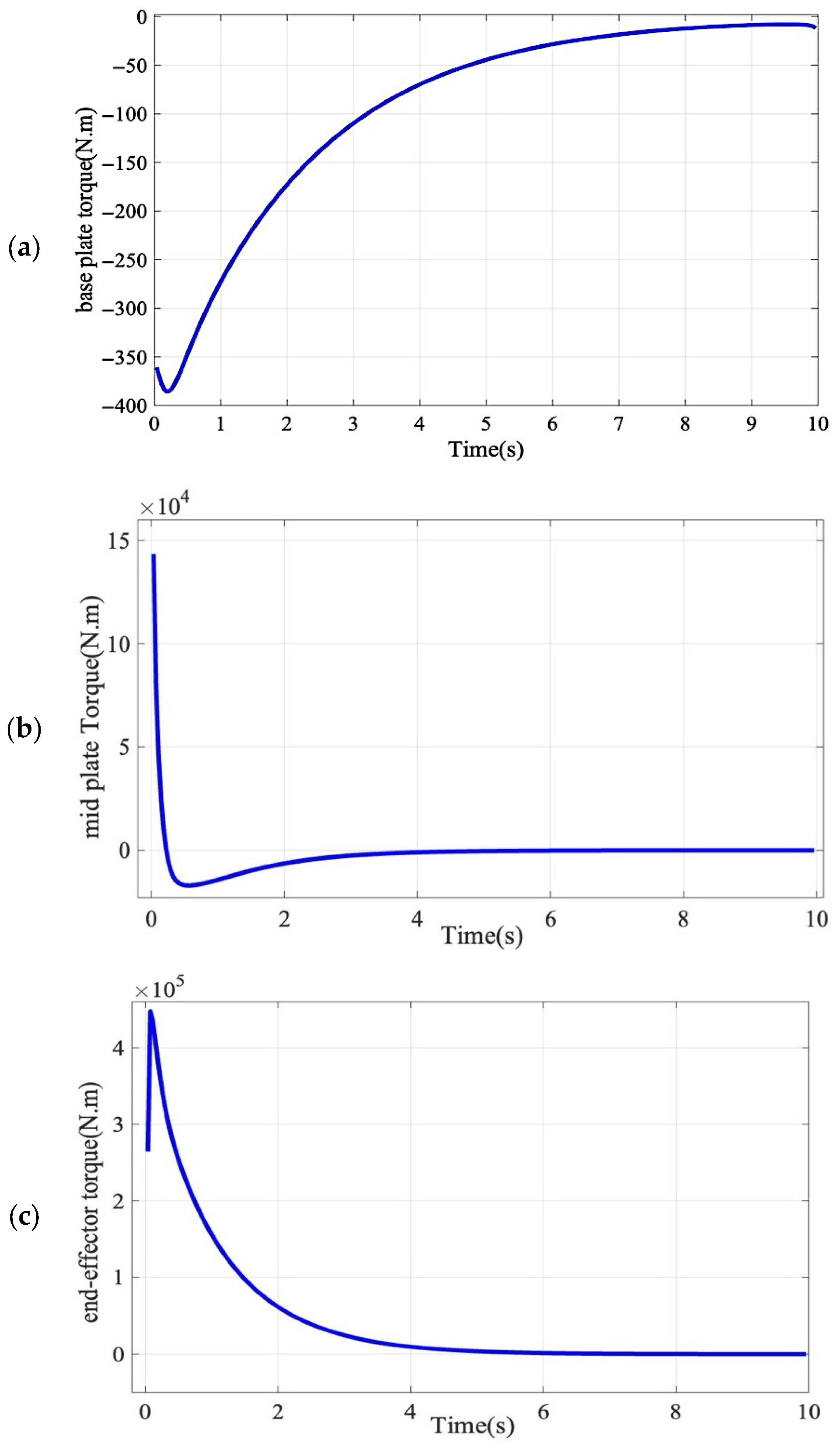
The simulation results for angular velocity, angular acceleration, and torque over the 10 s interval are presented in Figure 10, Figure 11 and Figure 12, demonstrating the system’s ability to smoothly and accurately follow the prescribed motion profile while achieving full deceleration at the final time step.
Figure 10 illustrates the angular velocity profiles of the three rotating disks over time, as governed by the proposed control strategy. The first subplot represents the base plate, the second the mid plate, and the third the end-effector. As illustrated, the angular velocities of all three components decrease smoothly to zero within the 10 s interval, in accordance with the control objective. This behavior demonstrates that the controller effectively managed the deceleration phase, ensuring that the manipulator reached its desired final configuration without any residual motion. The smooth and monotonic nature of the velocity curves, despite the system’s nonlinear dynamics and inherent uncertainties, demonstrates the effectiveness and robustness of the implemented SMC scheme. The controller maintained stable performance throughout the transition, demonstrating its ability to manage the dynamic coupling and complexity inherent in the TTR mechanism.
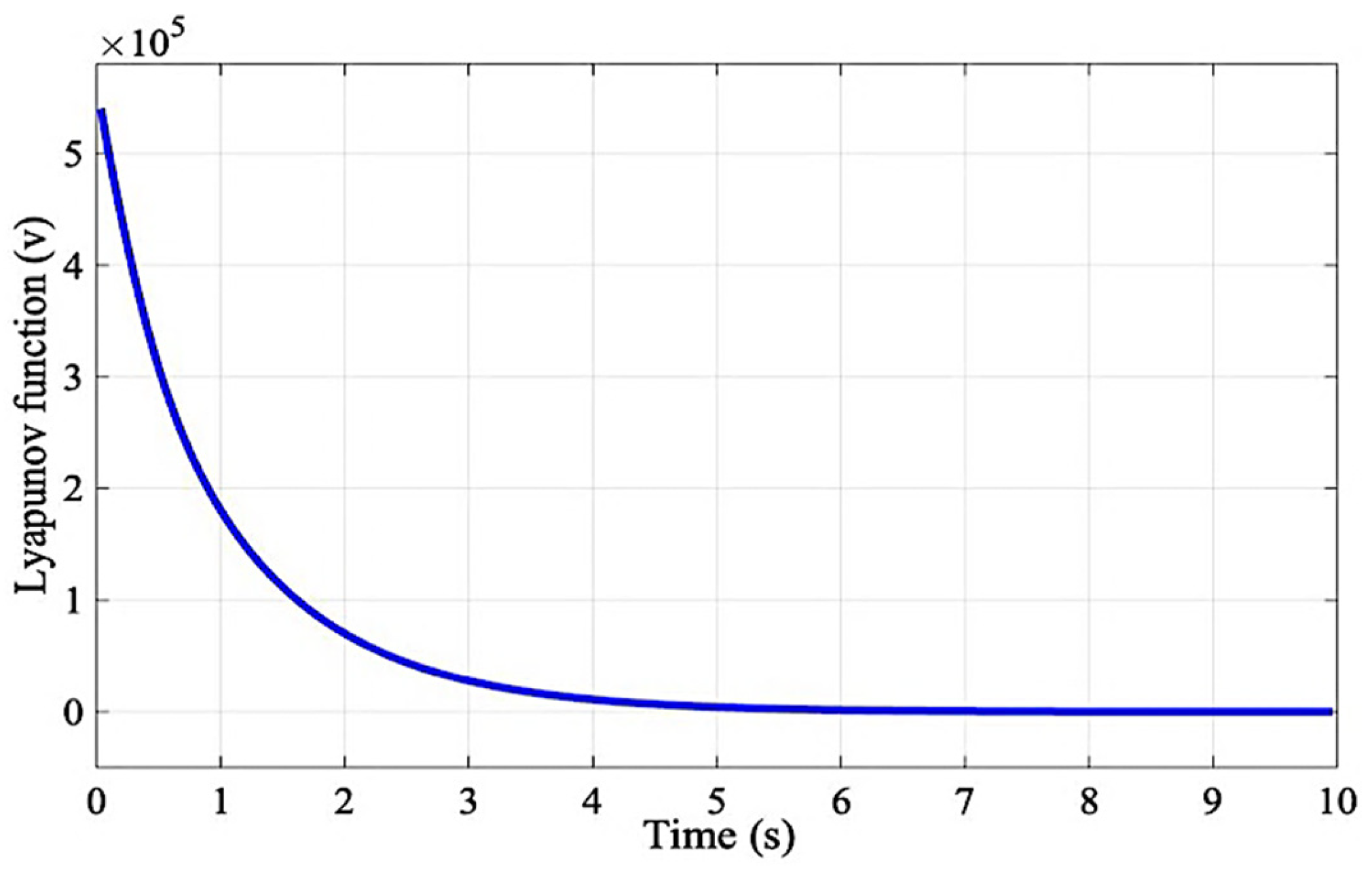
Figure 11 presents the time-domain response of the Lyapunov function V(t), which is formulated as a function of the sliding surface error s(t). Since the error term s represents the deviation between the actual and desired angular velocities, a reduction in s over time corresponds directly to a decrease in the Lyapunov function. As illustrated in the figure, the Lyapunov function decreases monotonically and approaches zero asymptotically within the predefined 10 s interval. This behavior confirms the asymptotic stability of the system under the designed sliding-mode control (SMC) law, in accordance with Lyapunov’s stability criteria. The smooth convergence of V(t) toward zero indicates that the tracking error has been effectively eliminated and that the closed-loop system maintains strong robustness and guaranteed convergence, despite the presence of system nonlinearities and uncertainties.
Figure 12 illustrates the applied torques to each of the three rotating disks over time, serving as the control inputs within the Lagrangian framework. These torques correspond to the control outputs responsible for driving the manipulator from its initial configuration to the desired end-effector position and velocity. Specifically, Figure 12a shows the torque applied to the base plate, Figure 12b depicts the torque applied to the mid plate, and Figure 12c corresponds to the end-effector. In all three cases, the torque profiles change smoothly and continuously, gradually stabilizing as the system reaches its final configuration. By applying these time-varying torque profiles, while accounting for the mechanism’s initial conditions and dynamic constraints, the manipulator successfully reaches the desired end-effector position and velocity within approximately 11 s. The smooth convergence of the torque values indicates that the controller effectively manages the system’s energy distribution, mitigates dynamic coupling effects, and ensures robust performance throughout the trajectory.
A more detailed analysis of the torque profiles in Figure 12 provides additional insight into the dynamics and control behavior of each joint.
In Figure 12a, the torque applied to the base plate is consistently negative throughout the motion. This behavior indicates that the torque required to actuate the base plate is directed opposite to that of the other two disks. The torque initially increases in magnitude and then decreases smoothly, approaching zero as the manipulator reaches its final position. This reflects the controller’s effort to counteract the system’s inertia at the start, followed by a deceleration phase as the motion completes. In Figure 12b, the torque applied to the mid plate begins with a relatively high positive value, indicating the need for a strong initial actuation to initiate movement. The torque then briefly becomes negative, signifying a transient phase of counteracting force, likely due to dynamic coupling or system inertia. Over time, the torque gradually stabilizes, reaching its target value within 10 s. As shown in Figure 12c, the torque applied to the end-effector initially rises during the first second of motion, followed by a smooth and consistent decline for the remainder of the trajectory. Importantly, the torque remains strictly positive throughout, indicating that the force applied to the end-effector is consistently directed in a single orientation. This suggests that the motion of the end-effector was unidirectional and free from any significant reversals or reactive forces.
Overall, the torque profiles demonstrate controlled, smooth transitions and effective energy distribution across all joints, further validating the performance of the proposed control framework under the nonlinear dynamics of the TTR manipulator. In all simulations, the regularization parameter was selected to be sufficiently small to preserve convergence speed. As demonstrated in the simulation results, the use of the saturation function significantly reduces chattering in the control input compared to an ideal discontinuous sliding-mode formulation. In the all simulations, the regularization parameter was selected to be sufficiently small to preserve convergence speed while avoiding control chattering.
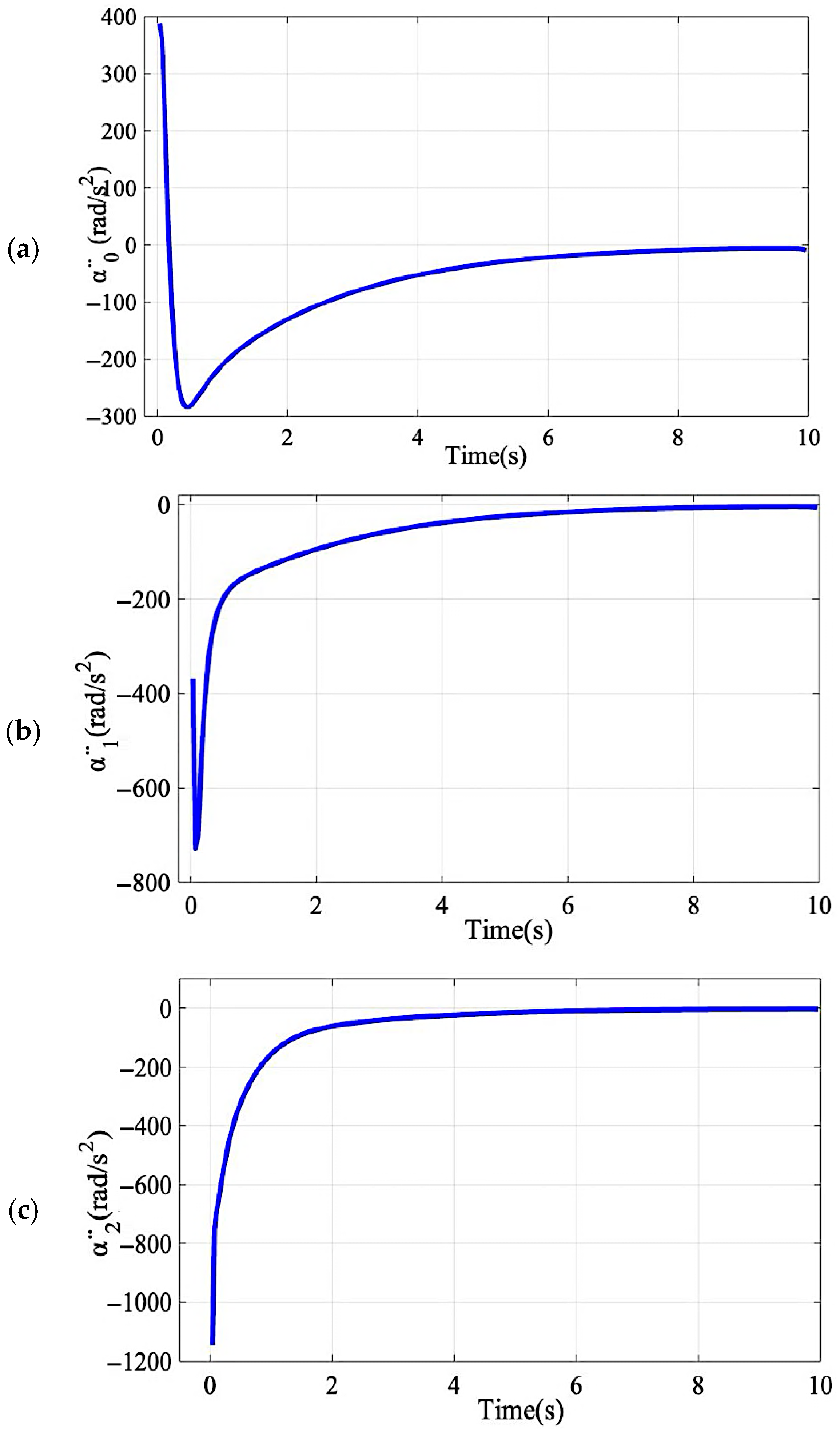
Figure 13 displays the angular acceleration profiles of each of the three rotating disks in the TTR planar manipulator during the motion execution phase. As shown, all three plots display predominantly negative acceleration values, reflecting a deceleration trend throughout the motion. This behavior aligns with the system’s objective of reducing the angular velocities to zero within the specified time interval.
In Figure 13a, the base plate begins its motion with a brief phase of positive angular acceleration, initiating the system’s response. However, it quickly transitions into a negative acceleration region within the first second, and the value then gradually decreases in magnitude, eventually stabilizing at zero. This pattern reflects an initial boost followed by controlled deceleration to bring the joint to a halt.
In Figure 13b, the mid plate also exhibits an initial increase in angular acceleration, followed by a rapid decline. Following this transient phase, the acceleration gradually and smoothly converges to zero. This suggests an aggressive initial actuation to overcome static resistance, followed by precise deceleration controlled by the system dynamics and the SMC controller. In Figure 13c, the end-effector starts with a negative angular acceleration, indicating an immediate deceleration requirement from the onset. Over the remainder of the motion, the acceleration decreases smoothly until it reaches zero, ensuring that the manipulator comes to rest without overshoot or oscillations. Overall, the angular acceleration profiles illustrate the controller’s capability to produce dynamically consistent and smooth deceleration across all three joints, facilitating accurate and stable convergence to the desired final configuration.
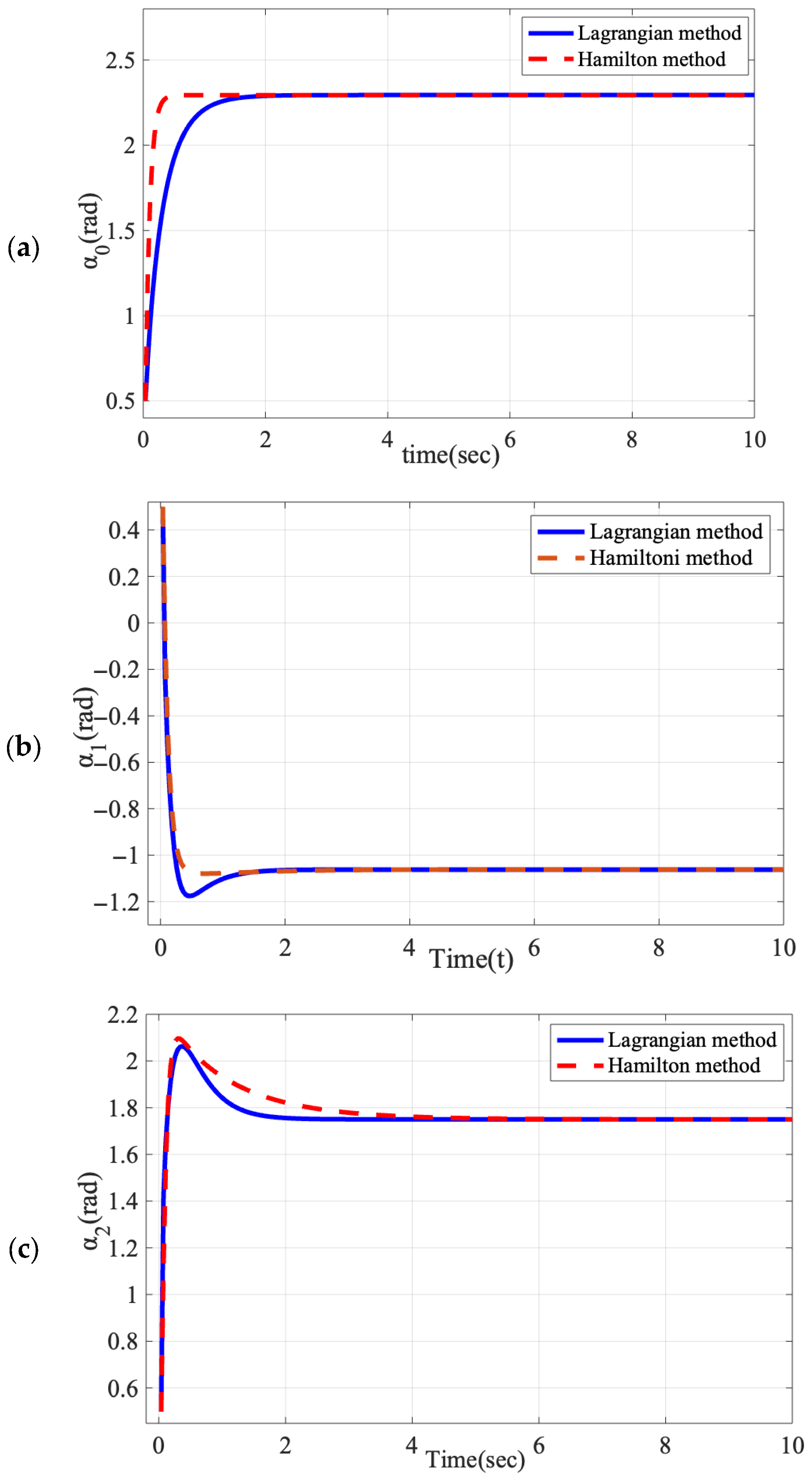
Figure 14 presents a comparative analysis of the simulated trajectories of the base plate, mid plate, and end-effector, obtained using both the Lagrangian and Hamiltonian formulations. In this figure, the displacements implemented in the Lagrangian equations obtained from inverse kinematics and the displacements predicted by the Hamiltonian model serve as a validation of the accuracy and consistency of the proposed dynamic modeling framework.
Figure 14a illustrates the base plate trajectory, where the Hamiltonian solution exhibits near-perfect overlap with the Lagrangian result throughout the simulation. This agreement confirms the theoretical consistency between the two energy-based frameworks and validates the correctness of the derived dynamic equations. Quantitatively, the mean squared error (MSE) between the two trajectories is 0.0016 rad2, highlighting the accuracy, numerical stability, and robustness of the Hamiltonian formulation as a reliable alternative to the Lagrangian approach.
Figure 14b depicts the trajectory of the mid plate, again demonstrating almost complete overlap between the two formulations. The corresponding MSE of 0.0006 rad2 reflects exceptionally a clear and computationally efficient representation, reinforcing the ability of the Hamiltonian model to replicate the motion and energy dynamics predicted by the Lagrangian framework. This result underscores the robustness of the Hamiltonian approach in accurately capturing the dynamics of the intermediate link, which plays a key role in trajectory propagation and overall system stability.
Figure 14c presents a comparison of the end-effector trajectories predicted by the two formulations. While the overall motion profiles remain consistent, the end-effector increases to 0.020 rad2, indicating a modest reduction in correspondence relative to the base and mid plate trajectories. This deviation is likely due to the end-effector’s increased sensitivity to initial conditions, the accumulation of numerical errors, or the Hamiltonian model’s responsiveness to variations in distal energy terms. Nonetheless, the overall trajectory trend remains consistent, confirming the Hamiltonian formulation’s validity in capturing the system dynamics.
Collectively, these results demonstrate that the Hamiltonian approach achieves strong agreement with the Lagrangian formulation across all levels of the mechanism, validating its effectiveness for simulation and control applications. These findings further reinforce its applicability in complex robotic systems, especially when integrated with advanced control strategies such as sliding-mode control.
It should be noted that translational and rotational tracking errors are evaluated separately using their respective physical units. Differences in numerical magnitude between translational and rotational error values reflect unit scaling rather than any inconsistency in the modeling or experimental measurements. No unit mixing is performed in the computation of the reported error metrics.

7.2. Experimental Resuzlts

To quantitatively assess the agreement between simulation and experimental results, tracking performance is evaluated using the mean squared error (MSE). These metrics are computed based on the time-domain difference between simulated and experimentally measured end-effector trajectories and are evaluated separately for the Cartesian x and y directions.
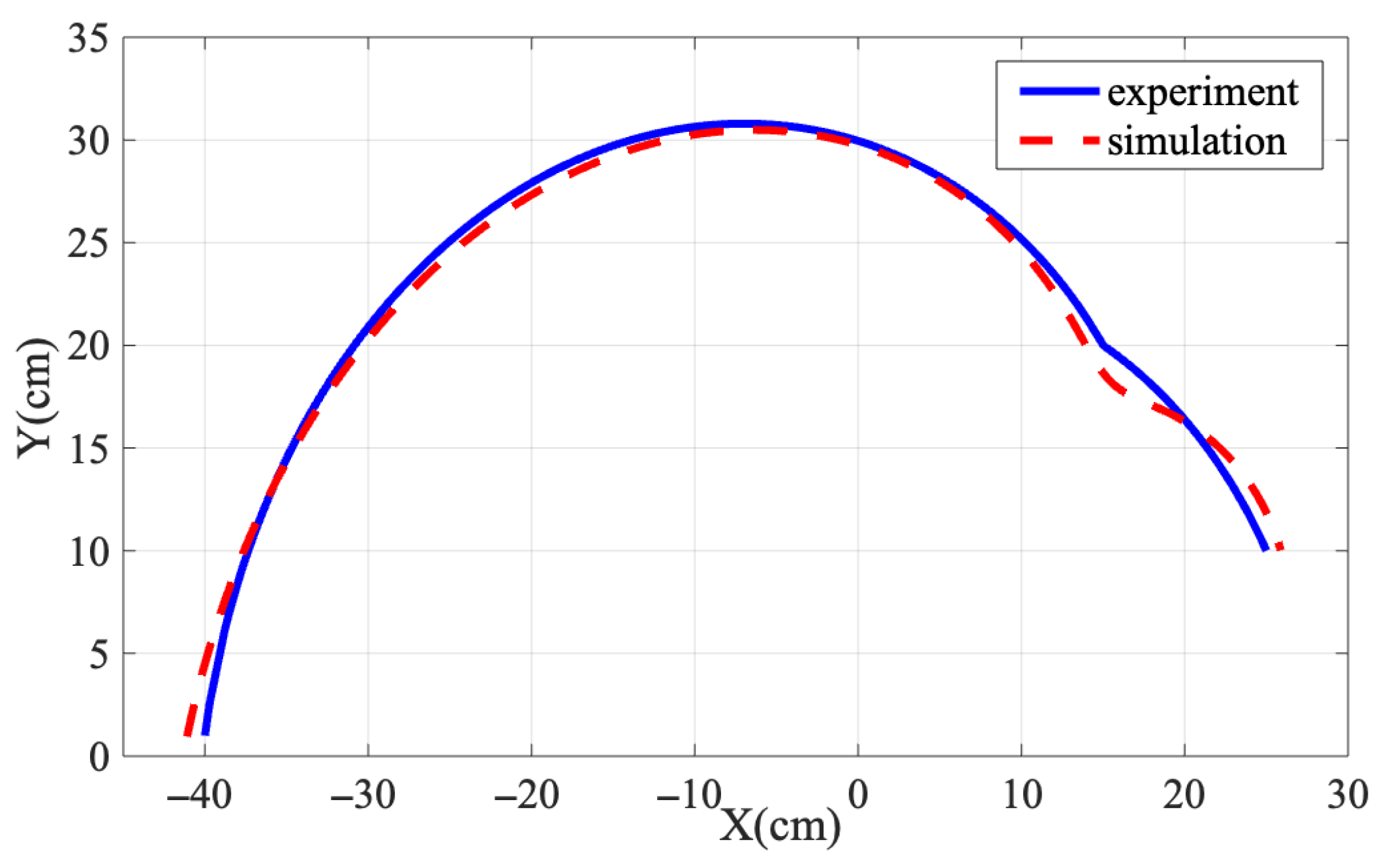
Figure 15 presents a comparative analysis between the experimentally measured trajectory of the planar TTR manipulator and the simulated trajectory obtained from the proposed dynamic model, incorporating both the Lagrangian and Hamiltonian formulations. As observed in the comparison plots, the experimental trajectories closely follow the simulated responses in both x and y directions, with bounded tracking errors and no observable divergence, indicating strong correlation between simulation and experimental results. The MSE between experimental and simulation results is 4 × 10 5 m2, and this value confirms that the experimental prototype reproduces the simulated reference trajectory with consistent accuracy, and that the simulation closely predicts real behavior within very small deviations as quantified by the reported MSE values. This consistency confirms the practical accuracy of the theoretical model and its capability to represent the manipulator’s real-world dynamics. Despite the presence of mechanical tolerances, sensor noise, and environmental disturbances, the alignment of the results underscores the robustness of the proposed framework. These findings provide compelling evidence of the reliability of the derived dynamic equations and demonstrate their applicability for system design, control synthesis, and performance prediction in real-time robotic operations. Overall, the experimental results reinforce the theoretical contributions of this work and establish the proposed modeling approach as a practical and scalable solution for planar robotic manipulators.

8. Conclusions

This study developed a closed-form dynamic model for a novel planar TTR manipulator by integrating the principles of virtual work, Lagrangian mechanics, and Hamiltonian mechanics. The resulting analytical formulation captures the coupled kinematic and dynamic behavior of the system and enables direct computation of joint trajectories, velocities, and generalized forces. Experimental validation demonstrated close agreement between simulated and measured responses, with deviations in joint positions and velocities remaining within a few percent across the tested motion profiles, indicating a clear improvement in dynamic modeling accuracy.
The inverse kinematics problem was solved using a modified Newton–Raphson algorithm, which consistently converged within a small number of iterations and maintained numerical stability throughout the manipulator workspace. The Hamiltonian formulation provided explicit insight into the system’s energy distribution and contributed to improved prediction of dynamic responses, reducing discrepancies between simulated and experimental joint torques and improving overall model fidelity compared to conventional formulations.
A sliding-mode control (SMC) strategy was implemented to ensure robust trajectory tracking in the presence of nonlinearities. Finite-time convergence was demonstrated in simulation using the proposed SMC, while experimental results were used to validate the accuracy of the dynamic and kinematic models through trajectory comparison. Quantitatively, simulation results demonstrate that the proposed sliding-mode control scheme achieves low steady-state tracking errors and accurate trajectory following under disturbance conditions. Experimental results, without closed-loop control, show that the measured trajectories remain within narrow bounds and closely match the corresponding simulation results, thereby validating the accuracy of the proposed kinematic and dynamic models.
Overall, this work validates both the proposed planar TTR manipulator architecture and the associated modeling and control framework. By combining closed-form energy-based dynamic modeling with robust control, the proposed approach demonstrates measurable improvements in dynamic analysis accuracy and control performance. The methodology is scalable to higher degree-of-freedom robotic systems and is well suited for precision-demanding applications in automated manufacturing, motion control, and energy-efficient robotic system design.

Author Contributions

M.H. and A.Z.J.: Software, Validation, Investigation, Data curation, Writing—original draft, Visualization. S.P. and K.I.A.-L.A.-A.: Conceptualization, Methodology, Formal analysis, Resources, writing—review and editing, Supervision, Project administration. All authors have read and agreed to the published version of the manuscript.

Funding

This research received no external funding.

Data Availability Statement

The original contributions presented in this study are included in the article. Further inquiries can be directed to the corresponding author.

Acknowledgments

During the preparation of this manuscript, the authors used ChatGPT (OpenAI, GPT-5.2) solely for English language editing and grammatical improvements. The authors carefully reviewed and verified all content to ensure its accuracy and originality, and take full responsibility for the final version of the manuscript.

Conflicts of Interest

The authors declare no conflicts of interest.

References

  1. Choudhury, R.; Singh, Y. Planar parallel manipulators: A review on kinematic, dynamic, and control aspects. Proc. Inst. Mech. Eng. C J. Mech. Eng. Sci. 2023, 238, 1991–2016. [Google Scholar] [CrossRef]
  2. Syed, K.; Yedukondalu, G.; Fattah, I.M.R. Kinematic and dynamic modeling of lightweight two-link planar manipulator for upper limb rehabilitation. In Trends and Applications in Mechanical Engineering, Composite Materials and Smart Manufacturing; Springer: Berlin/Heidelberg, Germany, 2024. [Google Scholar]
  3. Shen, M.; Wu, X.; Zhu, S.; Huang, T.; Yan, H. Intermittent iterative learning control for robot manipulators under packet dropouts. IEEE Trans. Autom. Sci. Eng. 2025, 22, 1451–1459. [Google Scholar]
  4. You, W.; Kong, M.; Sun, L.; Du, Z. Optimal design of dynamic and control performance for planar manipulator. J. Cent. South Univ. 2012, 19, 108–116. [Google Scholar]
  5. Jiang, M.; Yang, M.; He, K.; Chen, W.; Xie, L. A new approach of complexity analysis for the kinetics of a planar manipulator with clearance and lubrication in joint. Mech. Syst. Signal Process. 2025, 2025, W2044A. [Google Scholar]
  6. Nye, T.W.; LeBlanc, D.J.; Cipra, R.J. Design and modeling of a computer-controlled planar manipulator. Int. J. Robot. Res. 1987, 6, 85–95. [Google Scholar] [CrossRef]
  7. Ganesh, M.; Dash, A.K.; Venkitachalam, P.; Shrinithi, S. Static characteristic analysis of spatial (non-planar) links in planar parallel manipulator. Robotica 2020, 39, 88–106. [Google Scholar] [CrossRef]
  8. Malla, O.; Shanmugavel, M. Simplified model to study the kinematics of manipulators with parallelogram linkages. Ind. Robot. 2024, 51, 704–714. [Google Scholar] [CrossRef]
  9. Yang, H.; Xia, C.; Wang, X.; Xu, W.; Liang, B. An efficient solver for the inverse kinematics of cable-driven manipulators with pure rolling joints using a geometric iterative approach. Mech. Mach. Theory 2024, 196, 105611. [Google Scholar] [CrossRef]
  10. Pedrammehr, S.; Nahavandi, S.; Abdi, H. Evaluation of inverse dynamics of hexarot-based centrifugal simulators. Int. J. Dyn. Control 2018, 6, 1505–1515. [Google Scholar]
  11. Zahedi, A.; Shafei, A.M.; Shamsi, M. Kinetics of planar constrained robotic mechanisms with multiple closed loops: An experimental study. Mech. Mach. Theory 2023, 183, 105250. [Google Scholar] [CrossRef]
  12. Najera, D.; Todd, M.D. A structure-preserving neural differential operator with embedded Hamiltonian constraints for modeling structural dynamics. Comput. Mech. 2023, 72, 241–252. [Google Scholar] [CrossRef]
  13. Dong, S.; Otsuka, K.; Makihara, K. Hamiltonian formulation with reduced variables for flexible multibody systems under linear constraints: Theory and experiment. J. Sound Vib. 2023, 547, 117535. [Google Scholar] [CrossRef]
  14. Malczyk, P.; Chadaj, K.; Frączek, J. Parallel Hamiltonian formulation for forward dynamics of free-flying manipulators. In Advances in Robot Kinematics; Springer: Cham, Switzerland, 2019. [Google Scholar]
  15. Low, K.H. A systematic formulation of dynamic equations for robot manipulators with elastic links. J. Robot. Syst. 1987, 4, 435–456. [Google Scholar] [CrossRef]
  16. Zhu, W.Q. Nonlinear stochastic dynamics and control in Hamiltonian formulation. Appl. Mech. Rev. 2006, 59, 230–248. [Google Scholar] [CrossRef]
  17. Tang, L.; Gouttefarde, M.; Sun, H.; Yin, L.; Zhou, C. Dynamic modelling and vibration suppression of a single-link flexible manipulator with two cables. Mech. Mach. Theory 2021, 162, 104347. [Google Scholar] [CrossRef]
  18. Pappalardo, C.M.; Guida, D. On the use of two-dimensional Euler parameters for the dynamic simulation of planar rigid multibody systems. Arch. Appl. Mech. 2017, 87, 1647–1665. [Google Scholar] [CrossRef]
  19. Di Gregorio, R. A geometric and analytic technique for studying multi-DOF planar mechanisms’ dynamics. Mech. Mach. Theory 2022, 176, 104975. [Google Scholar] [CrossRef]
  20. Pedrammehr, S.; Asadi, H.; Nahavandi, S. The forced vibration analysis of hexarot parallel mechanisms. In Proceedings of the 2019 IEEE International Conference on Industrial Technology (ICIT), Melbourne, Australia, 13–15 February 2019; pp. 199–204. [Google Scholar]
  21. Xiao, X.; Xue, H.; Chen, B. Nonlinear model for the dynamic analysis of a time-dependent vehicle-cableway bridge system. Appl. Math. Model. 2021, 90, 1049–1068. [Google Scholar] [CrossRef]
  22. Dirksz, D.A.; Scherpen, J.M.A. Power-based setpoint control: Experimental results on a planar manipulator. IEEE Trans. Control Syst. Technol. 2012, 20, 1384–1391. [Google Scholar] [CrossRef]
  23. Peng, G.; Wang, X.; Xue, Y. Study on fuzzy PD control of planar two-link flexible manipulator. In Proceedings of the TENCON 2002: IEEE Region 10 Conference on Computers, Communications, Control and Power Engineering, Beijing, China, 28–31 October 2002; pp. 577–580. [Google Scholar]
  24. Hogan, N.; Nakamura, Y.; Asada, H.; Slotine, J.J.; Cheah, C.C.; Wang, D. Task-space PD control of robot manipulators: Unified analysis and duality property. Int. J. Robot. Res. 2008, 27, 1079–1093. [Google Scholar] [CrossRef]
  25. Wang, Y.-W.; Lai, X.-Z.; Zhang, P.; Su, C.-Y.; Wu, M. A new control method for planar four-link underactuated manipulator based on intelligence optimization. Nonlinear Dyn. 2019, 96, 573–583. [Google Scholar] [CrossRef]
  26. Ali, I.; Hassan, M.; Bano, Z.; Chunwei, Z. Robust tracking control of a three-degree-of-freedom robot manipulator with disturbances using an integral sliding mode controller. Int. J. Intell. Robot. Appl. 2024, 8, 370–379. [Google Scholar] [CrossRef]
  27. Hosseini, M.I.; Khalilpour, S.A.; Taghirad, H.D. Practical robust nonlinear PD controller for cable-driven parallel manipulators. Nonlinear Dyn. 2021, 106, 405–424. [Google Scholar] [CrossRef]
  28. Soleymani, M.; Kiani, M. Planar soft space robotic manipulators: Dynamic modeling and control. Adv. Space Res. 2024, 74, 384–402. [Google Scholar] [CrossRef]
  29. Rahmani, B.; Belkheiri, M. Robust adaptive control of robotic manipulators using neural networks: Application to a two-link planar robot. In Proceedings of the 8th International Conference on Modelling, Identification and Control (ICMIC), Algiers, Algeria, 15–17 November 2016; pp. 839–844. [Google Scholar]
  30. Norouzi, A.; Koch, C.R. Robotic manipulator control using PD-type fuzzy iterative learning control. In Proceedings of the 2019 IEEE Canadian Conference of Electrical and Computer Engineering (CCECE), Edmonton, AB, Canada, 5–8 May 2019. [Google Scholar]
  31. Caverly, R.J.; Forbes, J.R. Dynamic modeling and noncollocated control of a flexible planar cable-driven manipulator. IEEE Trans. Robot. 2014, 30, 1533–1545. [Google Scholar] [CrossRef]
  32. Zare Jond, A.; Pedrammehr, S.; Al-Abdullah, K.I.A.-L.; Pakzad, S. Geometric design, mathematical modeling, and motion analysis of a novel 2T1R planar manipulator based on nested circular plates. IEEE Access 2025, 13, 156665–156680. [Google Scholar] [CrossRef]
  33. Rahmani, A.; Ghanbari, A.; Pedrammehr, S. Kinematic analysis for hybrid 2-(6-UPU) manipulator using wavelet neural network. Adv. Mater. Res. 2014, 1016, 726–730. [Google Scholar] [CrossRef]
  34. Tajari, M.J.; Pedrammehr, S.; Qazani, M.R.C.; Nategh, M.J. The effects of joint clearance on the kinematic error of the hexapod tables. In Proceedings of the 2017 5th International Conference on Robotics and Mechatronics (ICRoM), Tehran, Iran, 25–27 October 2017; pp. 39–44. [Google Scholar]
  35. Litim, M.; Allouche, B.; Omari, A.; Dequidt, A.; Vermeiren, L. Sliding Mode Control of Biglide Planar Parallel Manipulator. In Proceedings of the 11th International Conference on Informatics in Control, Automation and Robotics, Vienne, Austria, 1–3 September 2014. [Google Scholar]
Figure 1. The manufactured TTR planar mechanism.
Machines 14 00220 g001
Figure 3. Schematic representation of the joint angles of the planar TTR mechanism.
Machines 14 00220 g003
Figure 4. Reachable workspace of the TTR planar mechanism.
Machines 14 00220 g004
Figure 5. Flowchart of the modified Newton–Raphson algorithm employed for kinematic analysis.
Machines 14 00220 g005
Figure 6. Flowchart of the SMC algorithm for the mechanism.
Machines 14 00220 g006
Figure 7. Experimental setup of the planar TTR mechanism for validation of the proposed modeling.
Machines 14 00220 g007
Figure 8. Trajectory paths of joint angles α0, α1, and α2 obtained using the Newton–Raphson method.
Machines 14 00220 g008
Figure 9. End-effector trajectory ( x 2 ,   y 2 ) obtained using the Newton–Raphson method: (a) displacement in the x-direction; (b) displacement in the y-direction.
Machines 14 00220 g009
Figure 10. Joint angular velocities of the mechanism obtained using the SMC and Lagrangian approach: (a) base plate, (b) mid plate, and (c) end-effector.
Machines 14 00220 g010
Figure 11. Lyapunov function illustrating the stability of the SMC for the mechanism.
Machines 14 00220 g011
Figure 12. Applied torques to the joints and disks of the mechanism: (a) base plate, (b) mid plate, and (c) end-effector.
Machines 14 00220 g012
Figure 13. Joint angular accelerations of the mechanism obtained using the SMC and Lagrangian approach: (a) base plate, (b) mid plate, and (c) end-effector.
Machines 14 00220 g013
Figure 14. Trajectory of the mechanism plates, comparison between the path used in the Lagrangian equations and the path of the plates obtained from Hamiltonian methods: (a) base plate, (b) mid plate, and (c) end-effector.
Machines 14 00220 g014
Figure 15. Trajectory of the mechanism: comparison between experimental data and simulation results (The quantitative deviation between the two trajectories is reported in terms of MSE in the text).
Machines 14 00220 g015
Table 1. Geometrical characteristics of the mechanism.
Description
m 0 data mass of base plate
m 1 mass of mid plate
m 2 mass of end-effector
I 0 moment inertia of base plate
I 1 moment inertia of mid plate
I 2 moment inertia of end-effector
R 0 vector between the base plate and the mid plate centers
R 1 vector between the mid plate and the end-effector centers
R 2 radius of the end-effector
D 0 diameter of base plate
D 1 diameter of mid plate
D 2 diameter of end-effector
Table 2. TTR mechanism specification.
m 0   ( k g ) m 1   ( k g ) m 2   ( k g ) I 0   ( k g · m 2 ) I 1   ( k g · m 2 ) I 2   ( k g · m 2 ) R 0   ( m ) R 1   ( m ) R 2   ( m )
0.52.830.00390.05600.11340.1250.20.275
Disclaimer/Publisher’s Note: The statements, opinions and data contained in all publications are solely those of the individual author(s) and contributor(s) and not of MDPI and/or the editor(s). MDPI and/or the editor(s) disclaim responsibility for any injury to people or property resulting from any ideas, methods, instructions or products referred to in the content.