Article

Contact Dynamics of a Rotary Drillstring System in Elliptical Wellbores

1
School of Mechanical Engineering, University of Science and Technology Beijing, Beijing 100083, China
2
Downhole Intelligent Cybernetics Institute, University of Science and Technology Beijing, Beijing 100083, China
3
CNPC Engineering Technology R&D Company Limited, Beijing 102206, China
*
Author to whom correspondence should be addressed.
Machines 2026, 14(2), 172; https://doi.org/10.3390/machines14020172
Submission received: 3 January 2026 / Revised: 23 January 2026 / Accepted: 31 January 2026 / Published: 2 February 2026
(This article belongs to the Section Machine Design and Theory)

Abstract

As drilling depths continue to increase in oil and gas operations, the associated downhole environment has grown more complex. Data from recent field measurements reveals significant differences between the major and minor axes of the wellbore cross sections, resulting in an elliptical rather than a circular geometry. Such a wellbore may affect the drilling trajectory and wellbore quality. In this work, a dynamic model of a downhole drillstring system incorporating elliptical wellbore constraints is developed using an Absolute Nodal Coordinate Formulation (ANCF)-based beam element, specifically designed to handle contact within both circular and elliptical wellbore cross sections. Numerical simulations are performed based on an actual well trajectory. The results indicate that the elliptical shape of the open-hole section affects the vibration of the drillstring and bit, thereby further influencing the shape of the actual drilling trajectory. The proposed approach can be used to predict the drilling process with an irregular wellbore. Simulation results can inform the selection and adjustment of drilling tools and control parameters for the upcoming drilling operation.

1. Introduction

The rotary drillstring system is an essential tool in the process of oil and gas extraction, and its dynamic characteristics during drilling operations are critical factors constraining drilling efficiency [1]. A drillstring system is composed of a series of drill pipes connected via connections, with a bottom-hole assembly (BHA) attached at the lower end. In the dynamics analysis of a drillstring system, the contact between the drill pipes and the wellbore constitutes a critical challenge during drilling operations. Contact between drill pipes and the wellbore generates both normal contact forces and tangential friction forces [2], which not only induce undesirable vibrations in the drillstring system but also reduce the energy transfer efficiency from top to bottom, significantly decreasing the rock-breaking efficiency. Complex contact and friction will amplify phenomena such as bit bounce [3] caused by axial vibrations, whirling induced by lateral vibrations, and stick-slip resulting from torsional motion of the drillstring [4,5]. These phenomena can severely impede torque transmission from the top drive to the bit, potentially causing pipe sticking incidents that ultimately decrease the service life of drill pipes and damage downhole bottom-hole assemblies. Consequently, dynamic modeling of drillstring–wellbore contact interactions has become a focal point in drillstring dynamics research.
In practical engineering applications, the scarcity of downhole measurement data necessitates a combined analytical approach utilizing dynamic modeling and field measurements. Recent advancements in dynamic modeling techniques have enabled extensive research on drillstring system dynamics. Current modeling methodologies including the analytical method, traditional linear finite element methods [6,7], co-rotational coordinate formulations [8], geometrically exact beam theories [9], and absolute nodal coordinate formulation (ANCF) beam elements [10] have demonstrated strong capabilities in characterizing the drillstring system’s high-speed rotation around the axis and large deformation characteristics [11]. For addressing the drillstring–wellbore contact problem, the analytical process typically involves three sequential stages [12]: initial contact point localization, subsequent contact detection, and final contact force computation at identified potential contact locations.
Significant research achievements have been made regarding the dynamic modeling of drillstring–wellbore contact interactions. Zhang et al. [13] presented an integrated model to analyze self-excited axial and torsional vibrations in rotary drilling systems using realistic PDC bits. Their model combines a multi-degree-of-freedom (MDOF) drillstring representation with a detailed PDC bit-rock interaction model, accounting for cutter layouts and rock properties. Bembenek et al. [14] proposed their work to evaluate drillstring–wellbore contact and friction forces that arise during conventionally vertical and inclined well construction. In their work, the authors considered rotary and combined methods of drilling and the usage of drill pipes made of various structural materials. Mao et al. [15] focused on the nonlinear dynamic characteristics of the bottom hole assembly (BHA). The drillstring dynamic model is established with the beam finite element method and solved by the generalized- α method. The PDC bit dynamic characteristics were analyzed, and the effects of weight on bit, rotation speed, and rock drill ability on the drillstring dynamic behavior were discussed. Yang et al. [16] proposed a consistent-contact-force algorithm and a highly efficient implicit-integration scheme. Geometric treatments were applied in gap and overlap areas to obtain a continuous contact force, in addition to contact-history-based fast detection. Yang et al. [17] developed a multibody dynamic model of the drillstring for the torque and drag analysis; the developed model relaxes the assumption of continuous contact between the drillstring and the wellbore. Moreover, their model can account for overall rigid motion, three-dimensional (3D) rotation, and large deformation of the drillstring with a large-scale slenderness ratio and random contact between the drillstring and the wellbore.
In most of the studies for drillstring dynamics, the wellbore cross sections have been modeled as perfectly circular. However, field measurement data indicate that actual open-hole sections exhibit a certain degree of ellipticity, meaning there is a noticeable difference between the diameters in two perpendicular directions, reflecting distinct major and minor axes. Irregular drilling processes caused by rock anisotropy and tortuous well trajectories [18,19] in practical operations result in elliptical wellbore profiles in actual open-hole intervals. The presence of elliptical wellbore sections introduces non-uniform contact distributions along the drillstring circumference [20], potentially inducing more complex vibrational patterns and sophisticated contact friction characteristics. Currently, no published literature has yet addressed this particular research issue.
In this work, dynamic modeling and analysis of rotary drillstring systems incorporating elliptical wellbore cross sections in open-hole intervals are conducted. An ANCF-based beam element model is developed to address the dynamics model of drill pipes. Then, the contact issues between drill pipes and wellbore within both circular and elliptical wellbore cross sections are discussed. Numerical simulations are performed on contact problems occurring during drilling operations of an actual well trajectory, with a comparative analysis of drillstring dynamic characteristics under circular versus elliptical cross sections, establishing fundamental insights for further research. The structure of the remaining part of this work is organized as follows: Section 2 presents the dynamics of the beam elements based on the absolute nodal coordinate formulation. The drillstring–wellbore contact and the bit-bottom interaction are detailed in Section 3, including contact modeling in both the circular and the elliptical cross sections. Simulations are conducted in Section 5 to analyze the influence of different open-hole cross sections, and concluding remarks are given in Section 6.

2. Dynamics of the Drillstring by the ANCF Beam Element

The dynamics modeling is established in this section, where the ANCF Euler-Bernoulli beam element [21] is used to describe the drillstrings.

2.1. Kinematics of an Element

The generalized coordinates of a beam element are selected as
q e = r α θ α r α r β θ β r β R 14
where r k R 3 , ( k = α , β ) is the absolute position of node k, θ k is the axial rotation angle, and r k = r k / s R 3 is the slope of the node, where s is the material coordinate along the center line of the beam.
To perform Gaussian integration [22] over the interval [−1, 1], ξ is defined as ξ = 2 s / l e 1 , where l e is the length of an element. Then, the position and slope of an arbitrary point on the center line can be determined by a Hermite interpolation [23] as
r ( s ) = r ( ξ ) = S 1 r α + S 2 r α + S 3 r β + S 4 r β = S q e
where
S = S 1 I 3 , 0 3 × 1 , S 2 I 3 , S 3 I 3 , 0 3 × 1 , S 4 I 3
S 1 = 1 2 3 4 ξ + 1 4 ξ 3 S 2 = l e 8 ( 1 ξ ξ 2 + ξ 3 ) S 3 = 1 2 + 3 4 ξ 1 4 ξ 3 S 4 = l e 8 ( 1 ξ + ξ 2 + ξ 3 )
and I 3 is a 3 × 3 identity matrix and 0 3 × 1 is a zero column vector of size 3.
The axial rotation angle θ of an arbitrary cross section is
θ = 1 ξ 2 θ α + 1 + ξ 2 θ β = S θ q e
where
S θ = 0 1 × 3 , 1 ξ 2 , 0 1 × 3 , 0 1 × 3 , 1 + ξ 2 , 0 1 × 3
The global displacement of an arbitrary point P on the cross section is
r P = r + n y + b z
where n is the normal unit vector of the center line at the intersection point of the center line and the cross section, b is the bi-normal unit vector at the same point, y and z are the local coordinates of the point P in a reference Frenet frame attaching to the element cross section. The normal unit vectors of the Frenet frame can be obtained by the 3-2-1 sequence rotation matrix of Euler angles.
R 321 = c 2 c 3 c 1 s 3 + s 1 s 2 c 3 s 1 s 3 + c 1 s 2 c 3 c 2 s 3 c 1 c 3 + s 1 s 2 s 3 s 1 c 3 + c 1 s 2 s 3 s 2 s 1 c 2 c 1 c 2 = t , n , b
where s i = sin ( θ i ) , c i = cos ( θ i , i = 1 , 2 , 3 ) , θ 1 equals to the axial rotation angle θ , s 2 , s 3 , c 2 and c 3 can be expressed as function of the slope vector r , and the tangent unit vector t is parrallel to the slope vector [17]. The velocities and accelerations of an arbitrary point P on the element can be evaluated by taking the first and second time derivatives of Equation (7), respectively. It is worth noting that the introduction of rotational Euler angles leads to a singular configuration problem in the aforementioned straight beam element when its centerline tangent aligns with the Z-axis of the inertial frame. In this study, the orientation of the drillstring remains largely aligned with the X-axis, with only minor directional variations, and the singularity issue does not arise. To completely avoid singularities, Liu et al. [9] introduced a rescaled technique to restrict the rotation angle to avoid the singularity problem. Gruber et al. [24] avoided the singularity by defining directors at the nodes and updating them with each computational step. Additionally, employing a Bishop frame to describe the local coordinate system can also prevent singularities [25].

2.2. Dynamics Equations

With the kinematics information of an arbitrary point on the element, the kinetic energy and strain energy of an element can be calculated as
T e = 1 2 0 l e A ( q ˙ T S T S q ˙ + n ˙ T n ˙ y 2 + b ˙ T b ˙ z 2 ) ρ d A d s
and
U e = 1 2 0 l e ( E A ϵ 2 + G J t κ t 2 + E J z z κ n 2 + E J y y κ b 2 ) d s
where ρ is the density of the material, A is the area of the cross section, E is the elastic modulus, G is the shear modulus, J t is the polar moment of inertia, J z z and J y y are the two area moments of inertia of the cross section, ϵ and κ i , ( i = t , n , b ) are the longitudinal strain and the curvatures.
The mass matrix of an element can be deduced from Equation (9) as
M e = l e 2 1 1 ( ρ A S T S + J z z n q T n q + J y y b q T b q ) d ξ
where The subscript q indicates partial differentiation with respect to the generalized coordinates. The elastic forces can be deduced from Equation (10) as
Q e = U e q T = l e 2 1 1 ( E A ϵ ϵ q T + G J t κ t κ t , q T + E J z z κ n κ n , q T + E J y y κ b κ b , q T ) d ξ
The structural damping of an element can be evaluated according to the Rayleigh model [26] as
Q d = ( α m M e + β k Q e q e ) q ˙ e
Then the dynamic equations of the system can be obtained as
M q ¨ + Q c = Q i + Q o
where M is the mass matrix of the system, in which Q c is the vector of the constraint forces, Q i is the internal forces caused by the element elastic forces, the structural damping, and the quadratic of the rotational velocity, Q o is the external load vector, including the gravity, the contact forces and the interaction between the drill bit and the well bottom. The system mass matrix and generalized forces can be assembled from the element mass matrices and forces. By introducing the Lagrange multipliers and the constraint equations of the system, the augmented differential-algebraic equations (DAEs) of the system can be expressed as
M q ¨ + C q T λ = Q e + Q i + Q o C = C ( q , q ˙ , q ¨ , t )
Motion of the system can be evaluated by solving Equation (15) with an implicit numerical integration method [27].

3. Drillstring and Bit Interaction with the Wellbore

Contact forces between the drillstrings and the wellbore are established in this section, and the interaction between the drill bit and the well bottom is introduced. The computation of the contact forces is divided into three steps: locating the potential contact points in the wellbore, the contact detection, and the contact force calculation. In this work, the focus is primarily on the contact issue between the drillstring and the wellbore in an elliptical wellbore. The locating of contact points and the calculation of contact forces in an elliptical wellbore are no different from those in the circular wellbore discussed in published literature. Therefore, only the contact detection issues in these two types of wellbore cross sections are discussed here.

3.1. Contact in the Wellbore with Circular Cross Section

The research methods for the contact detection between the drillstring and the circular wellbore are similar to those for joint clearance issues in mechanical systems [28,29]. Researchers have developed several algorithms for the beam contact issue, such as the penalty function method [29], the Hertz model [28], the linear complementary method [30], and the all-angle beam contact [31]. In this work, the Hertz model is adopted to describe the contact between the drill pipes and the wellbore.
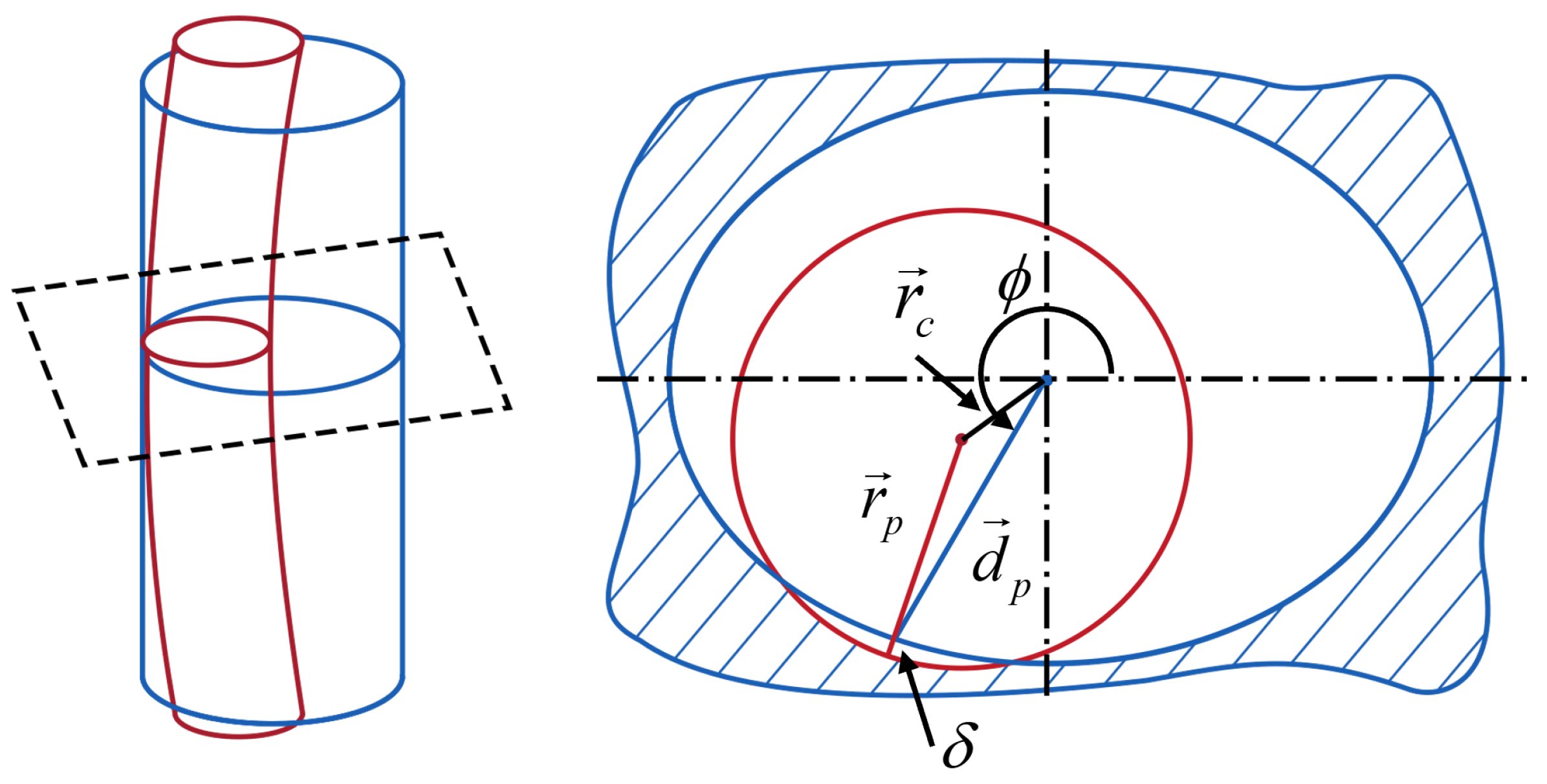
The section views of the drillstring and the wellbore can be treated as two circles due to the fact that the bending deformation near the contact points is small, as shown in Figure 1. The penetration of the contact can be defined as
δ = r p + d c r w
where r p is the out radius of the drill pipe parts, d c is the distance between the two circle centers, r w is the inner radius of the wellbore. This formulation is usually used in the clearance dynamics of revolute joints. Contact occurs when δ > 0 , then the contact force can be evaluated by using the Hertz contact model with damping as
F c = k δ e + c δ ˙
where k is the equivalent contact stiffness, e is a nonlinear exponent, and c is the damping coefficient. The tangent friction can be determined by the Coulomb model as
F f = μ F c

3.2. Contact in the Open Hole with Elliptical Cross Section

When the cross section of the wellbore open hole is elliptical, as shown in Figure 2, the contact detection is more difficult than that in a circular wellbore. The distance between the inner circle and the ellipse depends on the orientation of the relation between the two outlines. The radius of the ellipse at an arbitrary angle ϕ is
r ( ϕ ) = ( a cos ϕ ) 2 + ( b sin ϕ ) 2
where a and b are the major and minor axes of the ellipse. The distance between the circle center and the ellipse is
d = ( a cos ( ϕ ) x c ) 2 + ( b sin ( ϕ ) y c ) 2
where x c and y c are the local coordinates of the circle center in the ellipse fixed frame. Since d 0 , the minimum value d min of the distance can also be determined when the square of d achieves its minimum under the following condition
f = ( d 2 ) ϕ = 2 ( a cos ( ϕ ) x c ) a sin ( ϕ ) + 2 ( b sin ( ϕ ) y c ) b cos ( ϕ ) = 0
Equation (21) can be solved by using the Newton iteration as
ϕ ( k + 1 ) = ϕ ( k ) f ( ϕ ( k ) ) f ( ϕ ( k ) )
where the superscript ( k ) denotes the k-th Newton iteration.
f ( ϕ ) = f ( ϕ ) ϕ = 2 ( b 2 a 2 ) ( cos 2 ϕ sin 2 ϕ ) + 2 ( a x c cos ϕ + b y c sin ϕ )
An initial value of ϕ should be provided for the iteration of Equation (22), and the angle between the line of centers and the major axis of the ellipse can be used as the initial value as
ϕ 0 = arctan y c x c , if x c > ϵ π / 2 , if | x c |   < ϵ and y c > 0 π / 2 , if | x c |   < ϵ and y c < 0 arctan y c x c + π , if x c < ϵ
where ϵ is the limit of error, which is a positive value close to zero. When the absolute value of the increment f ( ϕ ( k ) ) f ( ϕ ( k ) ) is less than the prescribed error tolerance (0.01 deg in this work), the iteration terminates, yielding the solution ϕ d to Equation (21).
When d min is determined at the solution ϕ d of Equation (21), the position vector of the closest point in the 2D ellipse local frame is
d p = a cos ϕ d b sin ϕ d R 2
The penetration of the contact can be calculated as
δ = r p | | d p r c | |
where r c = ( x c , y c ) T R 2 . If δ > 0 , Equation (17) can be used to calculate the contact force.

3.3. Interaction Between the Drill Bit and the Bottom

In order to investigate the stick-slip vibration of the drillstring system, the model of the weight-on-bit (WOB) is adopted as
F W O B = W 0 + k f x 0 ( 1 sin θ bit )
The torque-on-bit (TOB) model is assumed to be
F T O B = μ k ( tanh ( ω bit ) + α 1 ω bit 1 + α 2 ω bit 2 ) F W O B
The parameters are selected as W 0 = 100 kN, k f = 25,000 kN/m, x 0 = 0.001 m, μ k = 0.04 , α 1 = 2.0 , and α 2 = 1.0 according to the work of Khulief et al. [5].

3.4. Integration of Generalized Forces

Due to the complexity of handling an excessive number of contact friction points in the system, the forces at the contact points are approximated as a combined external force acting on the beam axis and a torque about the axis. The combined external force vector is
F com = F c + F f = F c n c + F f τ
where n c is the unit vector of the contact direction and τ is the direction of the friction, which is determined by the tangent velocity of the contact point. and the axial torque caused by the friction is
T c = r p F f t
where r d is the radius at the contact point of the drill pipe, F f t is the component of the friction perpendicular to the beam axis. In order to integrate the combined force and the torque into the dynamic equation, the principle of virtual work is used, and the condition that both sets of forces perform an equal amount of virtual work is imposed as
δ W = δ r ( s ) T F com = δ q e Q com
Take Equation (2) into consideration, Equation (31) becomes
δ W = δ q e T S T F com
Comparing Equations (31) and (32), the following force transformation can be obtained as
Q com = S T F com
Similarly, the generalized force of the torque can be obtained by using Equations (5) and (6) as
δ θ T c = δ q e T Q T
Q T = S θ T T c
Finally the generalized forces Q com and Q T caused by the contact and friction can be integrated in to the dynamic equation of the system. The discontinuities of the friction will lead to iteration failure in the numerical solution. To deal with this problem, a tanh function is introduced in the calculation of the friction force and torque.

4. Validation and Analysis of the Model

4.1. Comparison Between the Proposed Element and the Traditional FEM

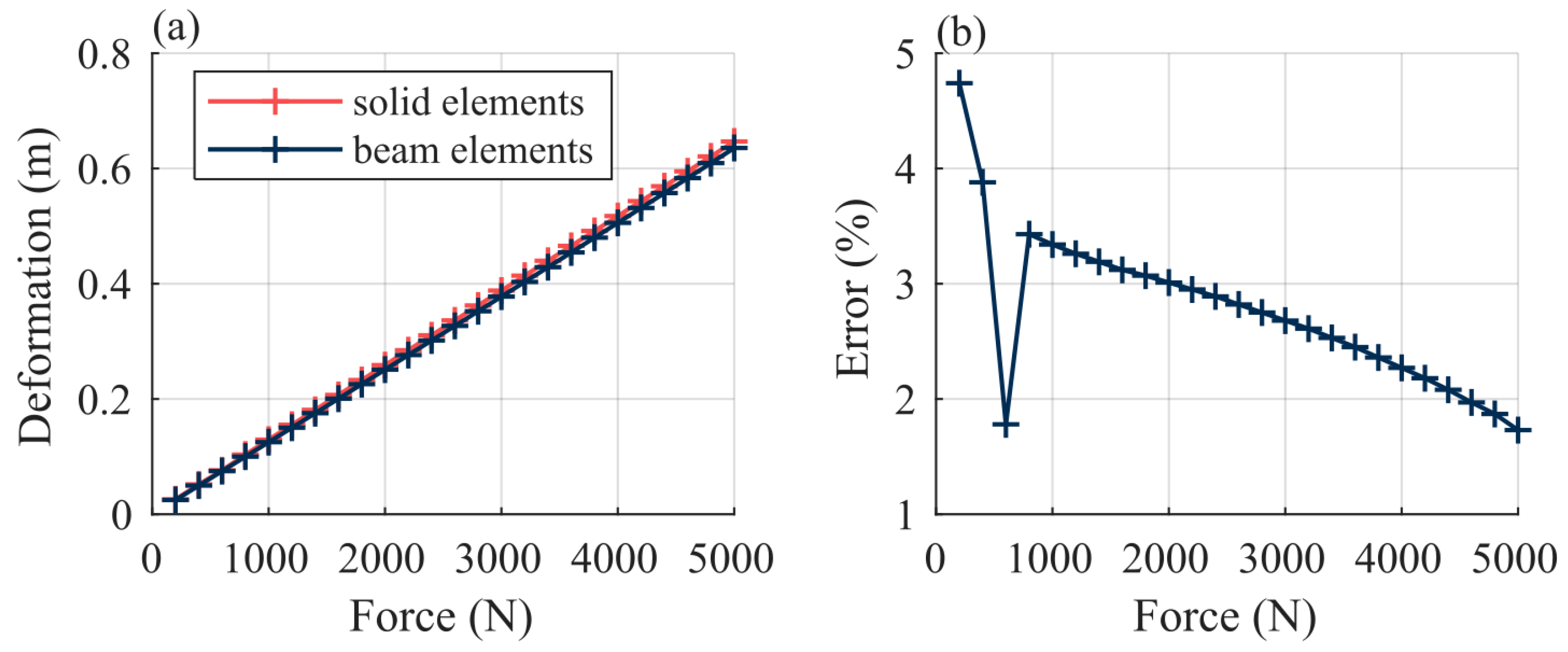
In order to validate the model, a single drill pipe is simulated using both solid elements and the proposed beam element of this work. The outer diameter is 149.2 mm, the inner diameter is 127.4 mm, and the length is set to be 9.5 m. One end of the drill pipe is fixed on the ground, and a lateral force ranging evenly from 200 N to 5000 N is applied to the other end. Simulation results in Figure 3 show that across all data points, the maximum relative error in lateral deformation is 4.74% (less than 5%), and the maximum absolute error is approximately 11 mm. The difference is mainly caused by the neglect of the shear deformation. Such errors are entirely negligible for a system that is several thousand meters in length.

4.2. Mesh Convergence

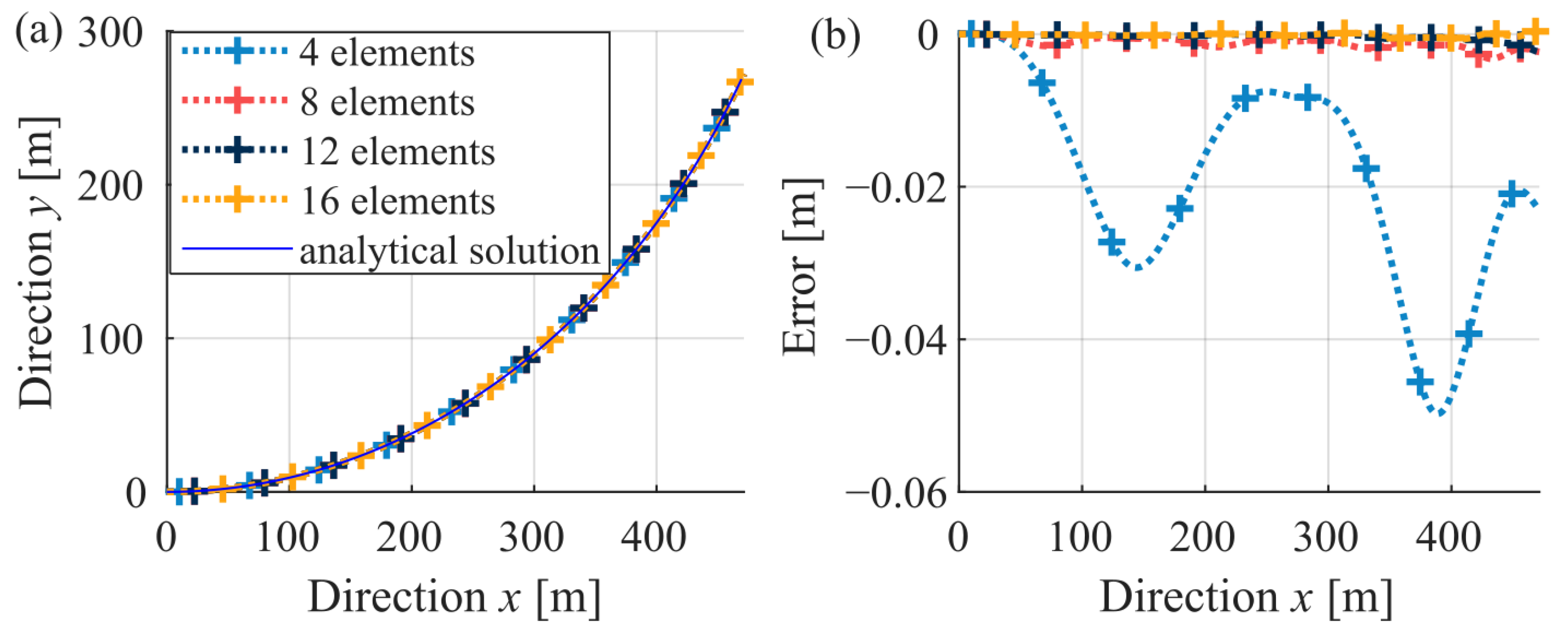
To analyze the mesh convergence of the presented element. A torque T = π E J z z / 3 L is applied at the end of a 570 m-long drillstring composed of 60 connected drill pipes, and the theoretical deformation should be an arc. The inner diameter of the drillstring is 111.96 mm, the outer diameter is 127 mm, the elastic modulus is 210 GPa, and the single pipe length is 9.5 m. The simulation results with different numbers of elements are compared with the theoretical analysis, as shown in Figure 4. From the results in this figure, when the number of elements is larger than 8, the simulation results converged. Correspondingly, each element can approximately be used to simulate about 5 drill pipes (about 12 elements for the 60 drill pipes). In subsequent simulations, the element length is less than 47.5 m.
Furthermore, the presented model has been applied to simulate drillstring systems in a conventional circular wellbore in the previously published work [32] of the authors. The vibration frequency and amplitude from the simulation results were compared with field measurement data, showing general agreement in both trend and numerical range.

5. Simulation and Results

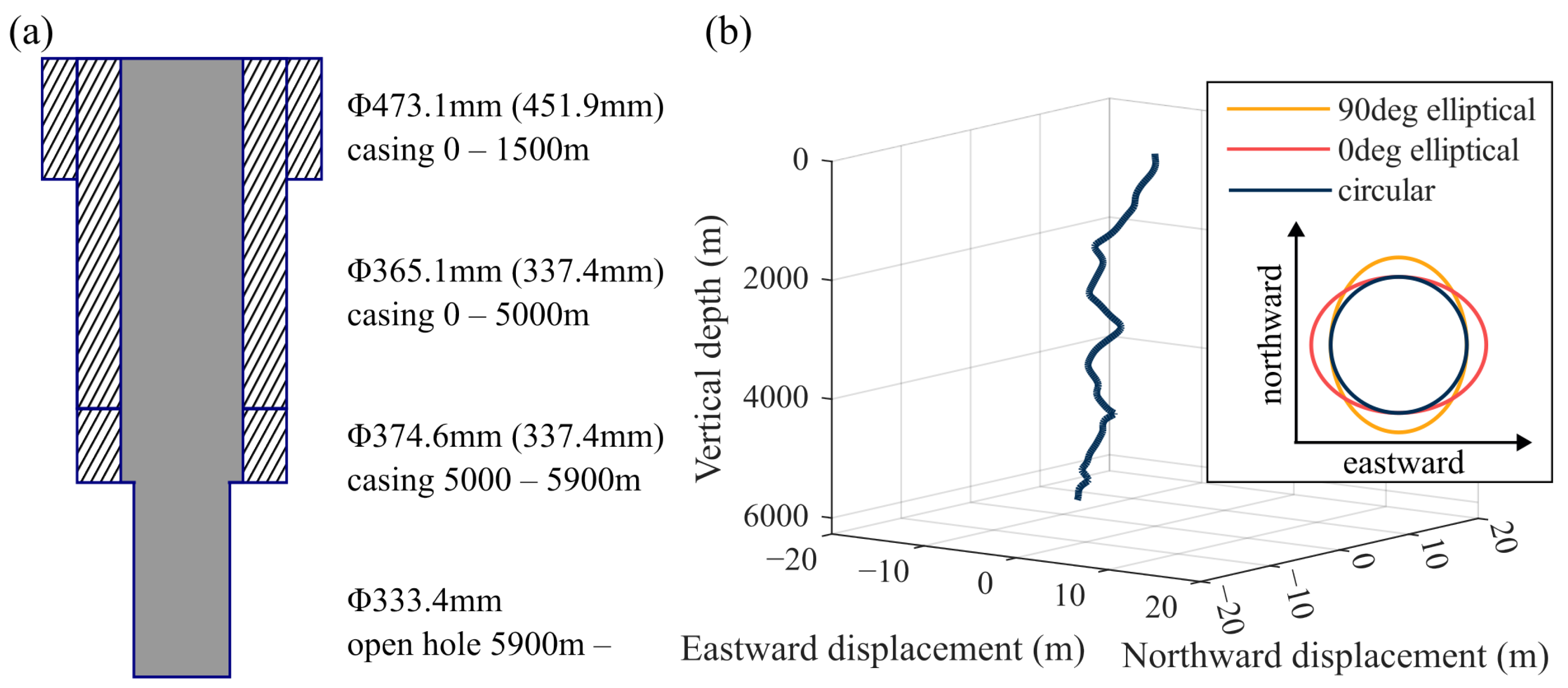
In this section, simulations for the drilling process of an ultra-deep well at approximately 6000 m depth are conducted. The corresponding wellbore structure and well trajectory at this stage are illustrated in Figure 5.
Parameters of the drill pipes and the BHA are shown in Table 1. In order to analyze the influence of elliptical open-hole cross section on the dynamic behavior of drillstring systems, simulations are conducted for two working conditions. In Case I, all open-hole cross sections are circular, while in Cases II and III, the bottom 150-m open-hole (6120–6270 m from the surface) section is elliptical, whereas the remainder of the borehole is circular. Based on field measurements, the major and minor diameters of the ellipse cross section in the two cases are set to be 453.0 mm and 337.36 mm, respectively, where the ellipticity ratio ( a / b ) reaches 1.34. The difference between the two elliptical cross sections is that the axial rotation angles differ by 90 degrees. From a geometric perspective, the greater the difference between the major and minor diameters, the more distinct the contact pattern becomes in different directions. Consequently, the allowable range for the lateral deformation of the drillstring becomes direction-dependent. As the drillstring rotates, the magnitude of lateral deformation at the contact points with the wellbore varies with the borehole diameter, thereby inducing additional vibrations in the drillstring system. In the simulation of the drillstring system, the contact parameters are adopted as k = 5 × 10 6 N/m, c = 1 × 10 3 Ns/m, e = 1.5 , and μ = 0.2 [17]. Parameters of the damping model are selected as α m = 0.017 s 1 and β k = 5 × 10 5 s according to the result of the experimental calibration by Tang [26]. The dynamic equation is solved by using the HHT- α method [27], with the parameters α = −0.3, β = 0.4225 and γ = 0.8. The iteration termination error tolerance is set to be 1 × 10 5 .

5.1. Comparison of Difference Time Steps

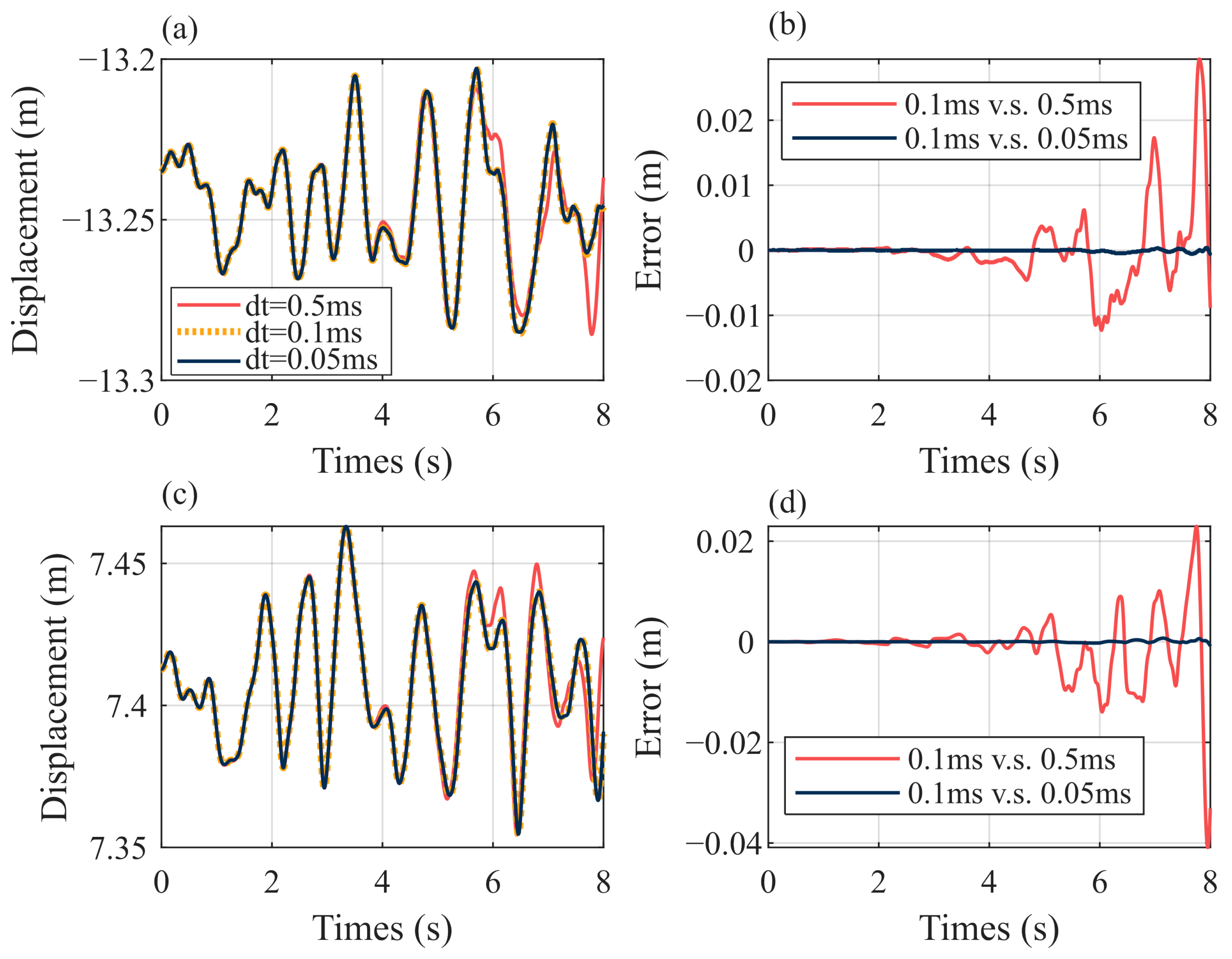
To analyze the time-step convergence of the simulation, simulations of the drillstring system are conducted using different step sizes, specifically 0.5 ms, 0.1 ms, and 0.05 ms. Since reducing the step size significantly affects computational efficiency, only an 8-s dynamic process was simulated for this comparison. Taking a point at vertical depth 4627 m from the surface on the drillstring as a reference, the lateral motion at this point is presented in Figure 6. It can be observed that when the step size is 0.5 ms, the error compared with smaller step sizes is noticeable, approximately 20 mm. When the step size is reduced to 0.1 ms and 0.05 ms, the error in the drillstring motion decreases significantly to about 0.85 mm, becoming essentially negligible. Therefore, in subsequent simulations, a step size of 0.1 ms is chosen to balance simulation efficiency and computational accuracy.

5.2. Motion of the Drillstring

The translational and angular velocities of the drillstring at different positions are analyzed, with specific points selected at vertical depths of about 2726 m, 4627 m, 6017 m, and 6175 m from the surface for analysis. These points correspond, respectively, to the upper-middle section, the lower-middle section, the circular cross section in the upper part of the open-hole section, and the lower part of the open-hole section of the drillstring. In the lower open-hole section, a comparative analysis is conducted using both circular and elliptical cross sections under two working conditions.
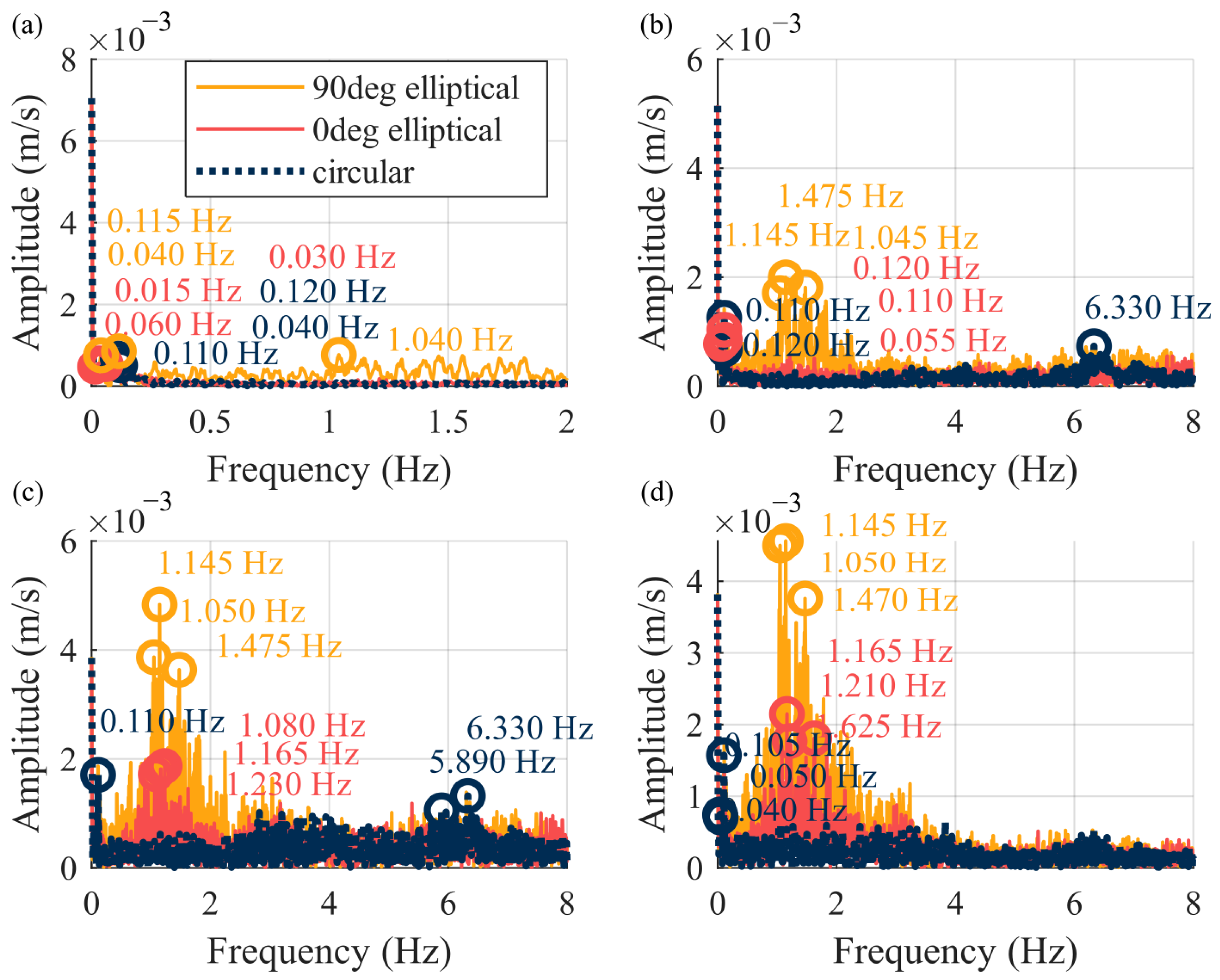
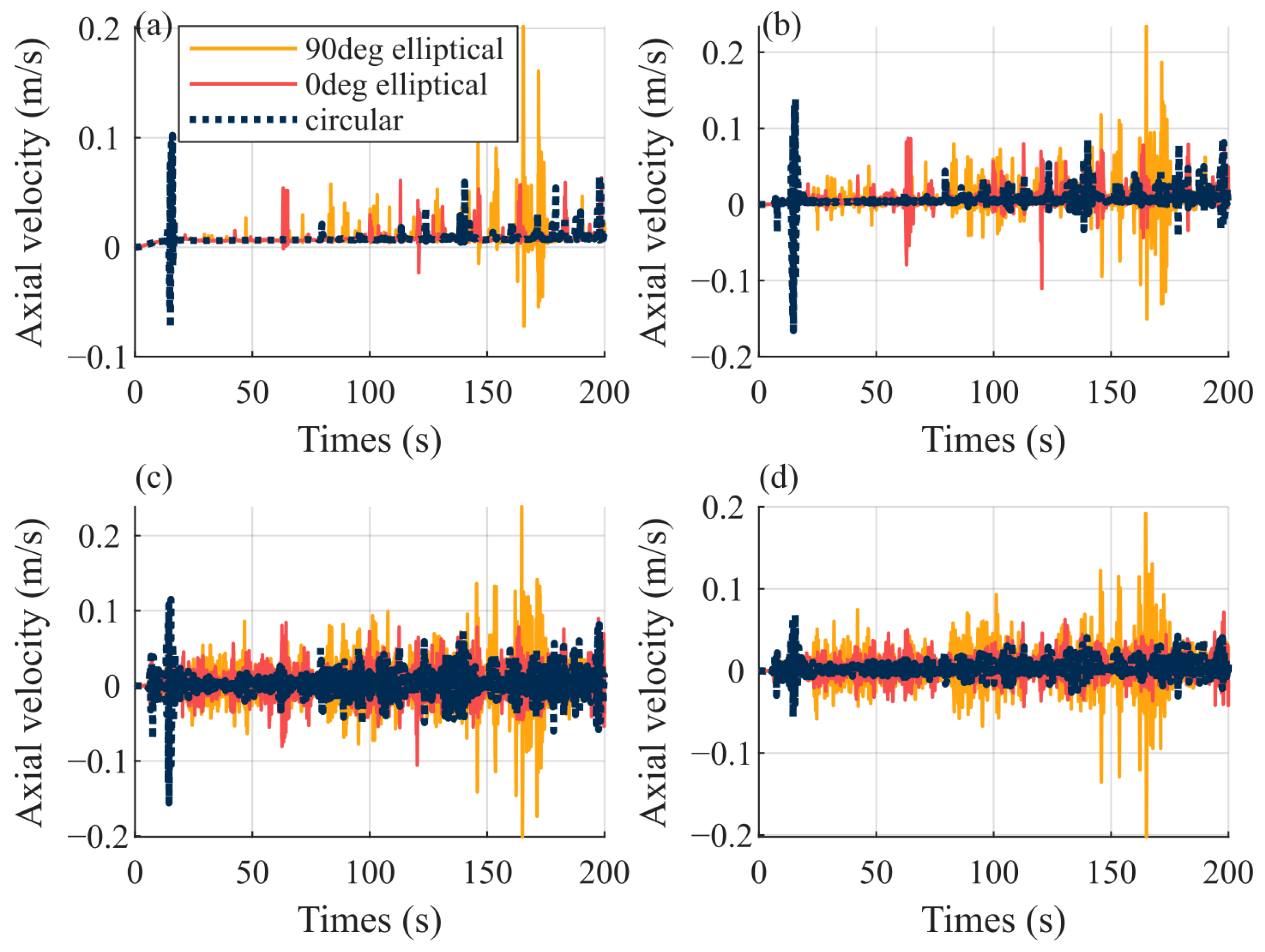
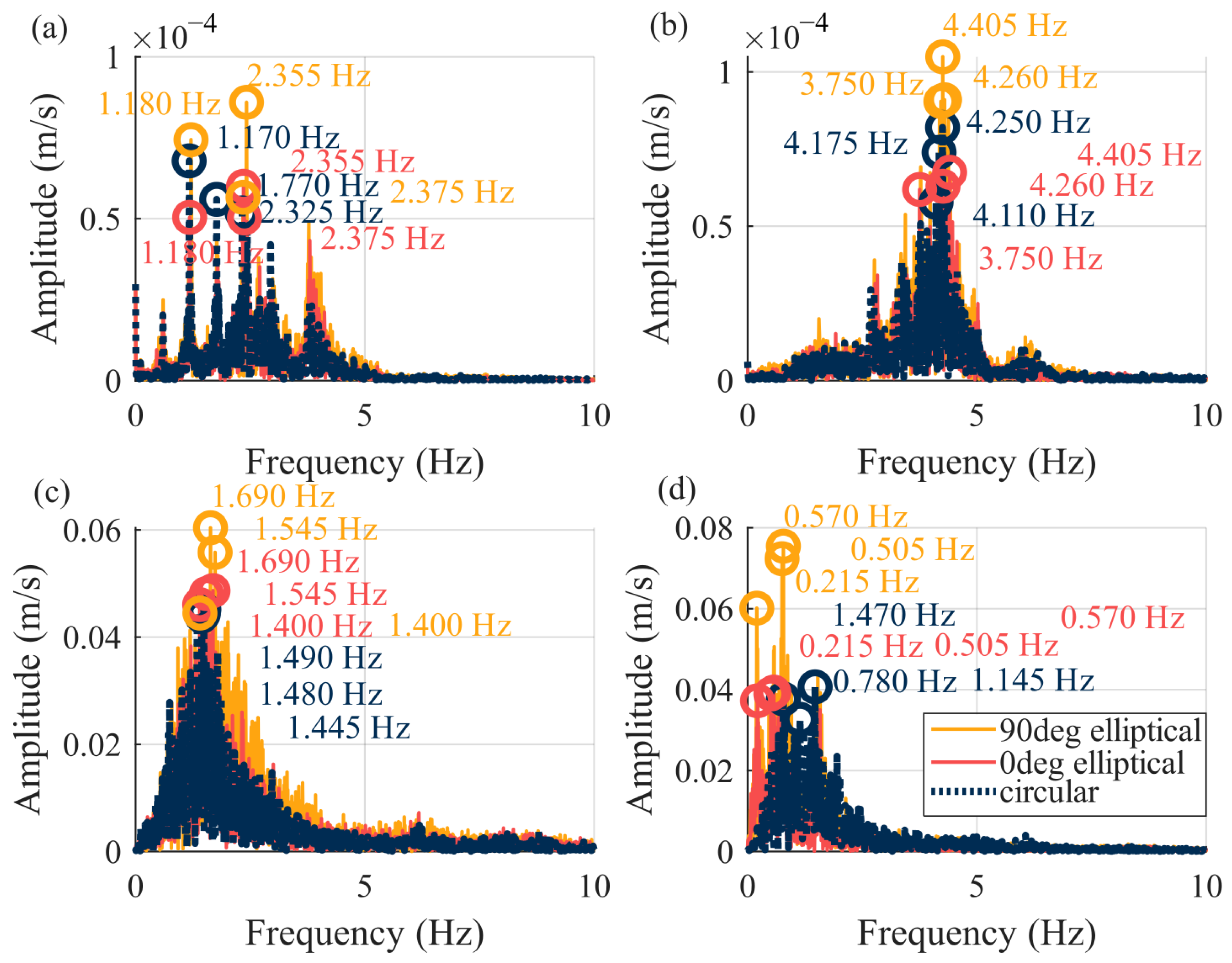
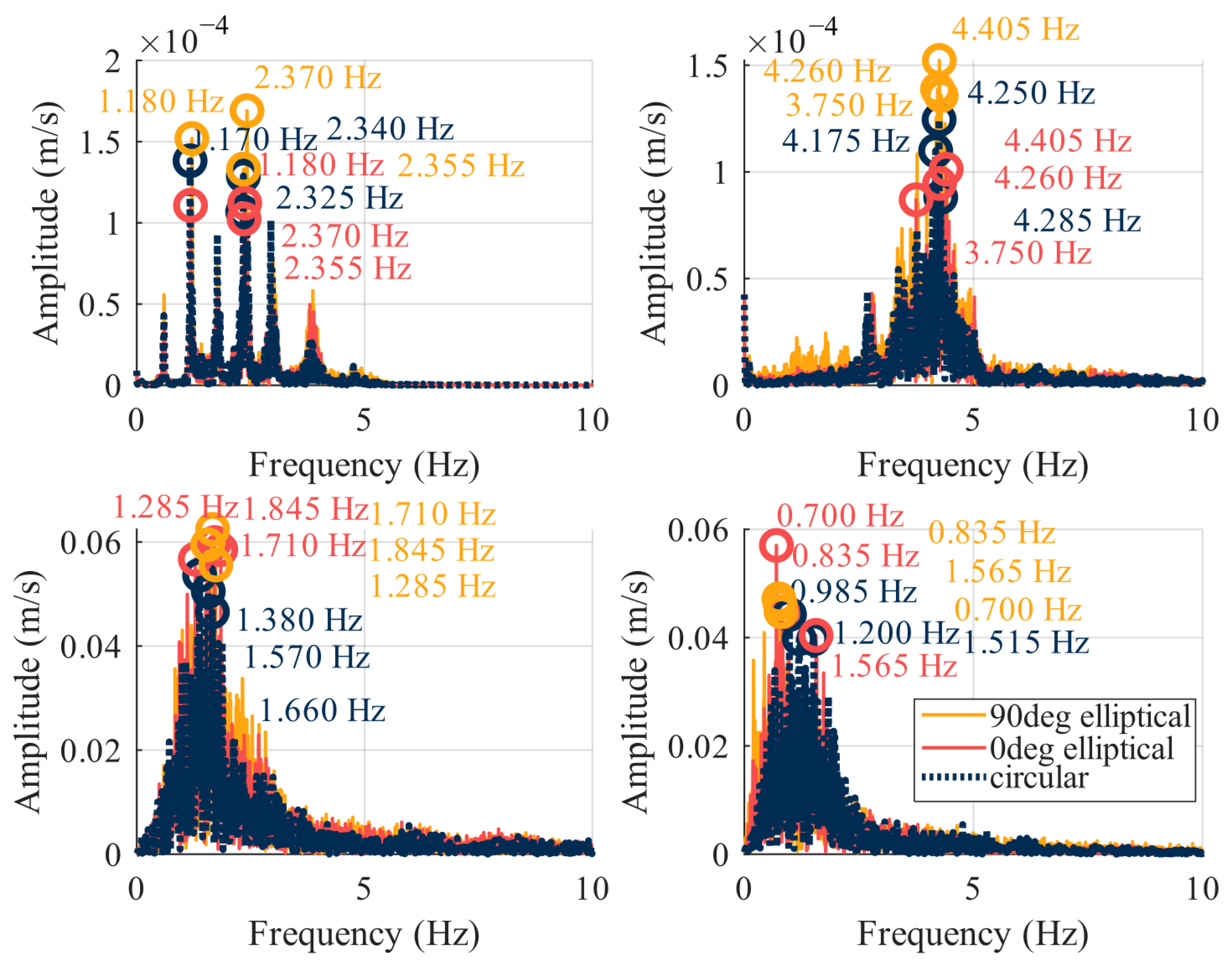
Figure 7 presents the axial velocities at the four selected points, along with an amplitude–frequency characteristic analysis in Figure 8, where the first three order frequencies with the largest amplitudes are marked by colored circles. It can be observed that the axial vibration frequencies at the first 2 points are relatively lower than those at the other two points. Furthermore, the cross section geometries of the lower open-hole section have no significant effect on the upper drill pipe. However, distinct differences can be observed between different conditions at the two lower measuring points. At the 4627 m point, a noticeable difference in amplitude occurs around 1.1 Hz, with the axial amplitude of the drillstring being greater inside the elliptical cross section. For the point at 6175 m, the simulation results under the elliptical wellbore condition show a significant increase in amplitude across most frequencies from 0.5 Hz to 3.0 Hz. Therefore, the local elliptical wellbore cross section exerts a considerable influence on the axial vibration of the drillstring throughout the open-hole section, leading to a marked rise in the amplitude of the axial vibration velocity.
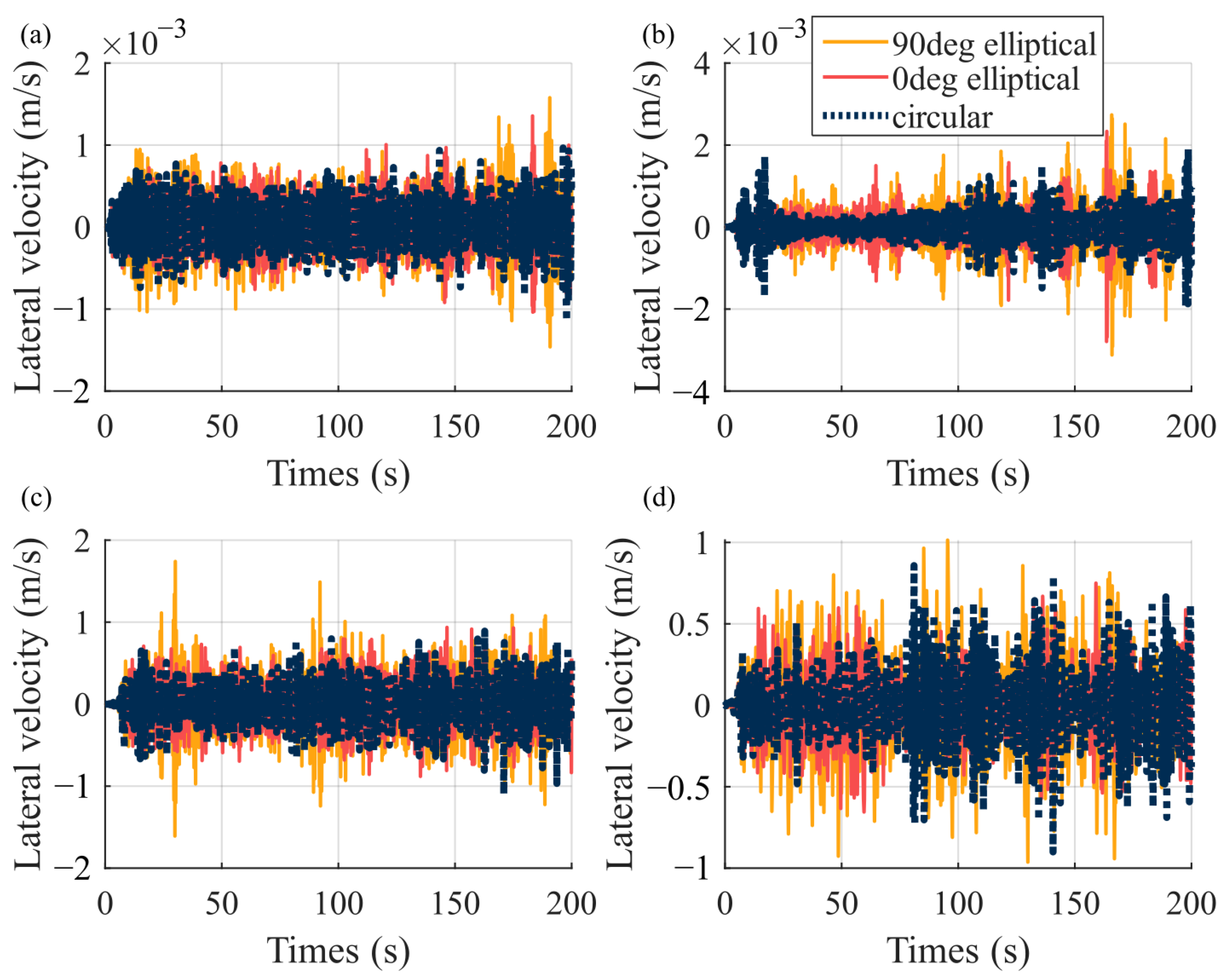
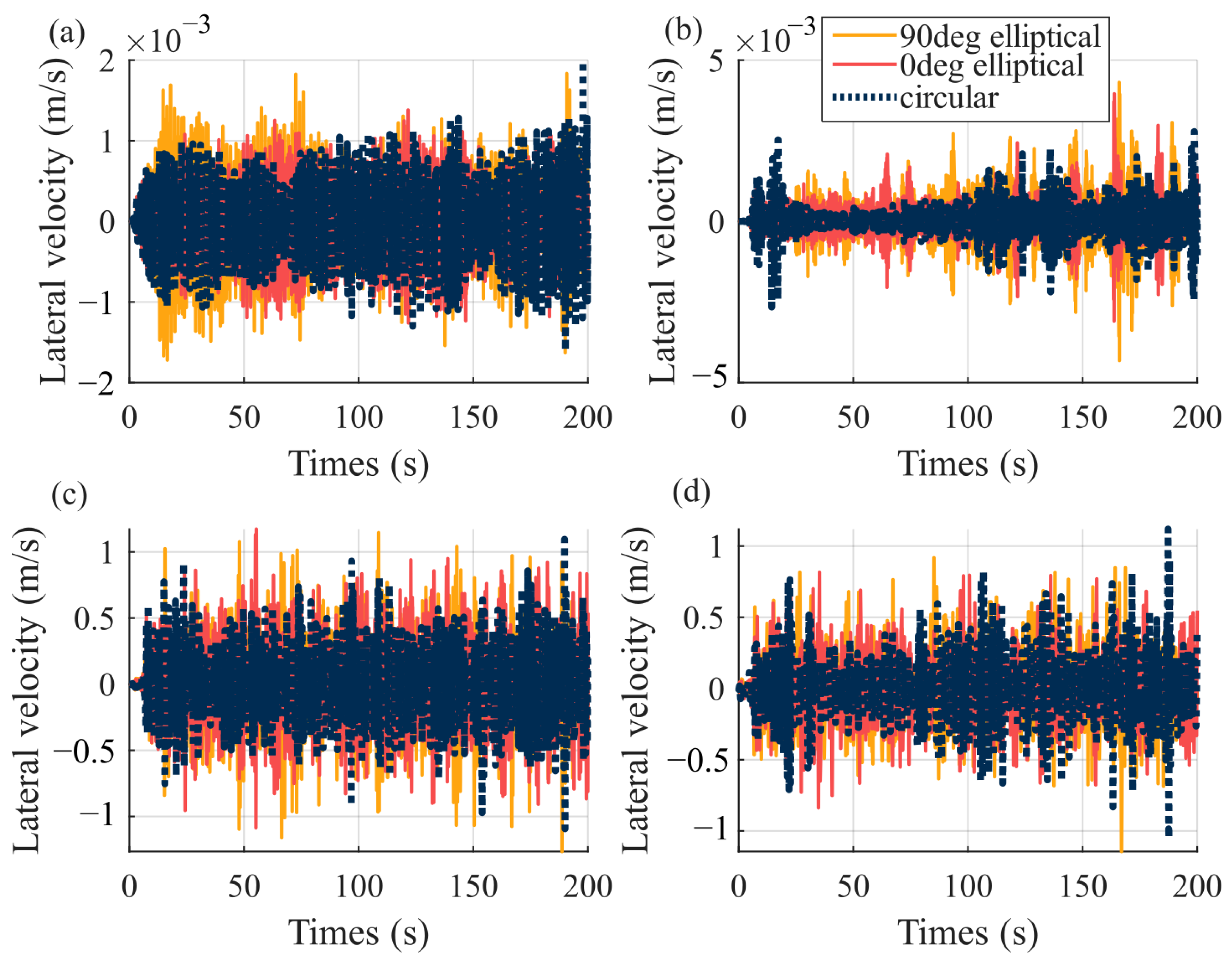
Figure 9 and Figure 10 show the lateral velocities of the drillstring. To facilitate the analysis, the major axis of the ellipse is set parallel to the y-direction. The minor axis is set parallel to the z-direction. Amplitude–frequency characteristics are plotted in Figure 11 and Figure 12. The analysis shows that, similar to axial vibration, the elliptical borehole cross section has no significant effect on the upper points of the drillstring. However, at the two lower points, results indicate an increase in vibration velocity amplitude within the elliptical cross section.
Further comparison shows that along the ellipse’s major axis, the velocity amplitude increases. Notably, this increase is observed both within the elliptical section and in the circular cross section at the 6017 m point. In the minor axis direction, however, a noticeable increase in velocity amplitude is only seen at the point within the elliptical section. Moreover, the influence of the elliptical borehole cross section on the axial velocity amplitude is more pronounced than its effect on the lateral amplitude. This is mainly because lateral vibration is constrained by the borehole, while axial vibration propagates along the well depth.
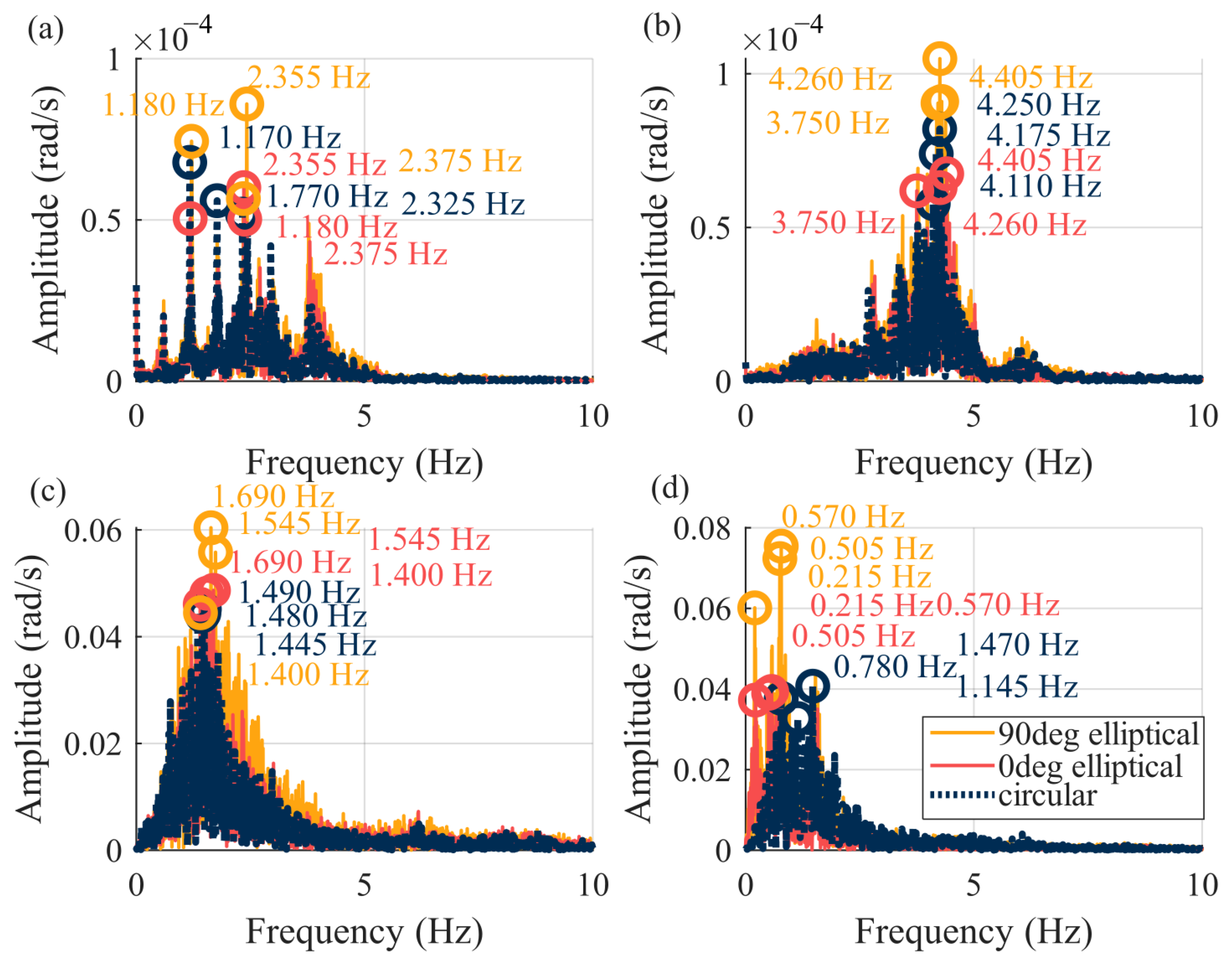
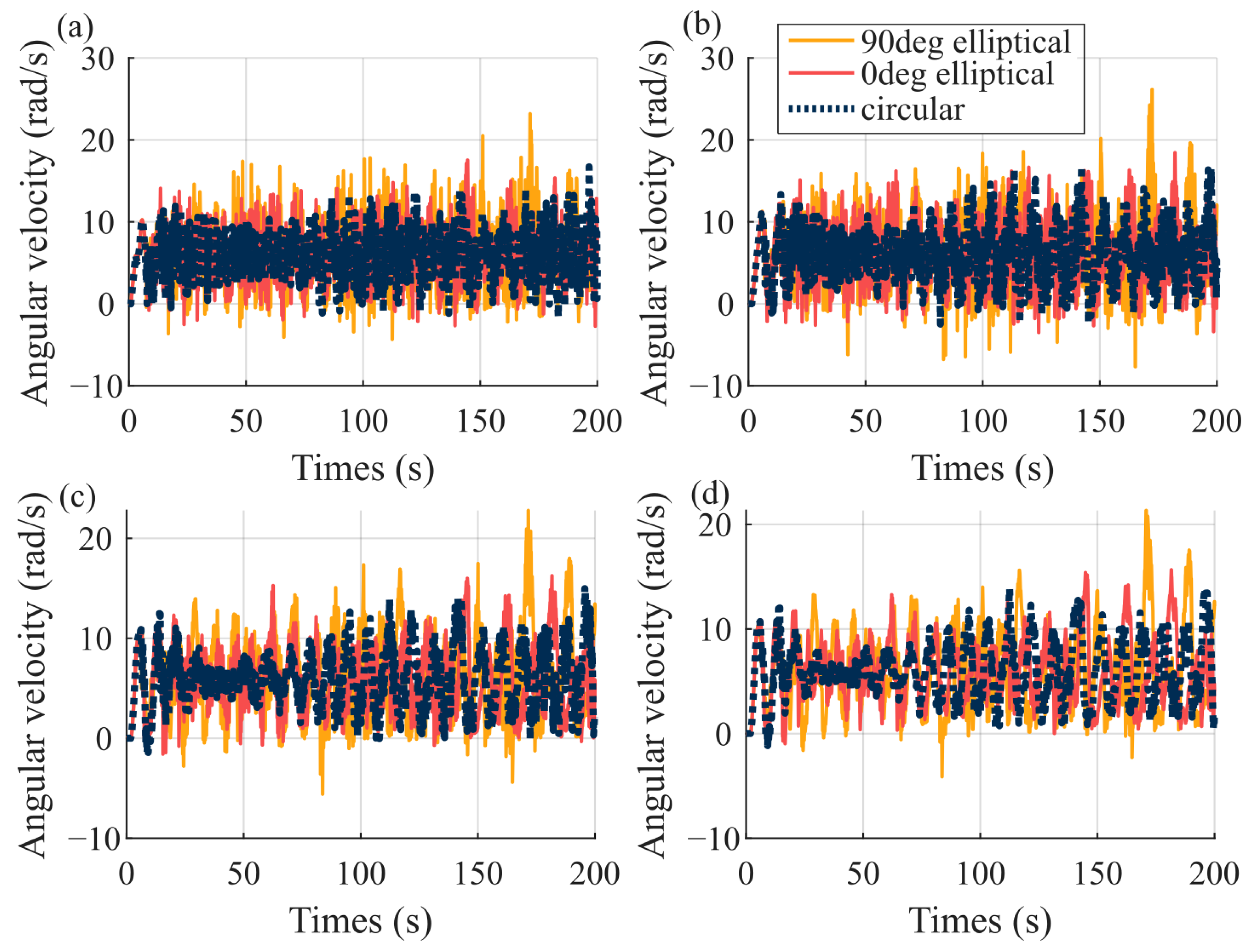
The angular velocity of each point rotating about the axial direction is shown in Figure 13 and Figure 14. It can be observed that the vibration frequency of the angular velocity is relatively low, and there is no significant difference in angular velocity between the two borehole cross section geometries. However, amplitude–frequency characteristic analysis reveals that at the middle and lower sections of the drillstring, the amplitude of angular velocity in the circular borehole is higher than that in the elliptical borehole.

5.3. Contact of the Drillstring

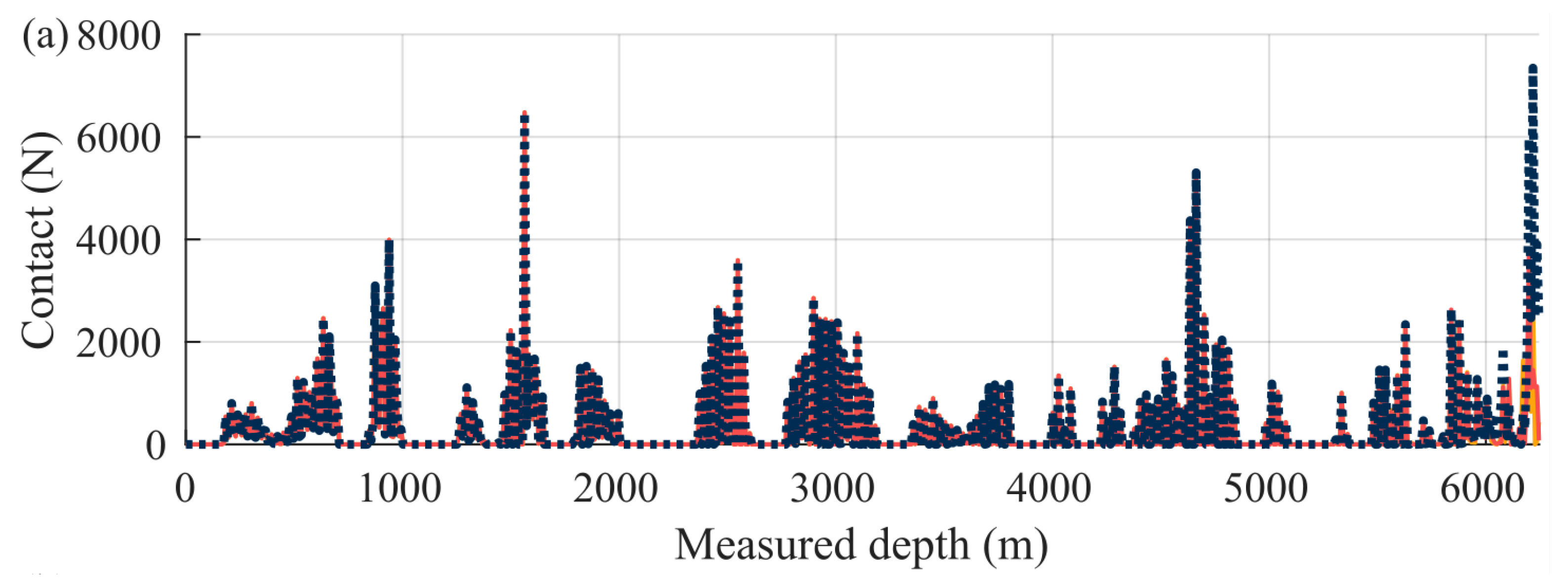
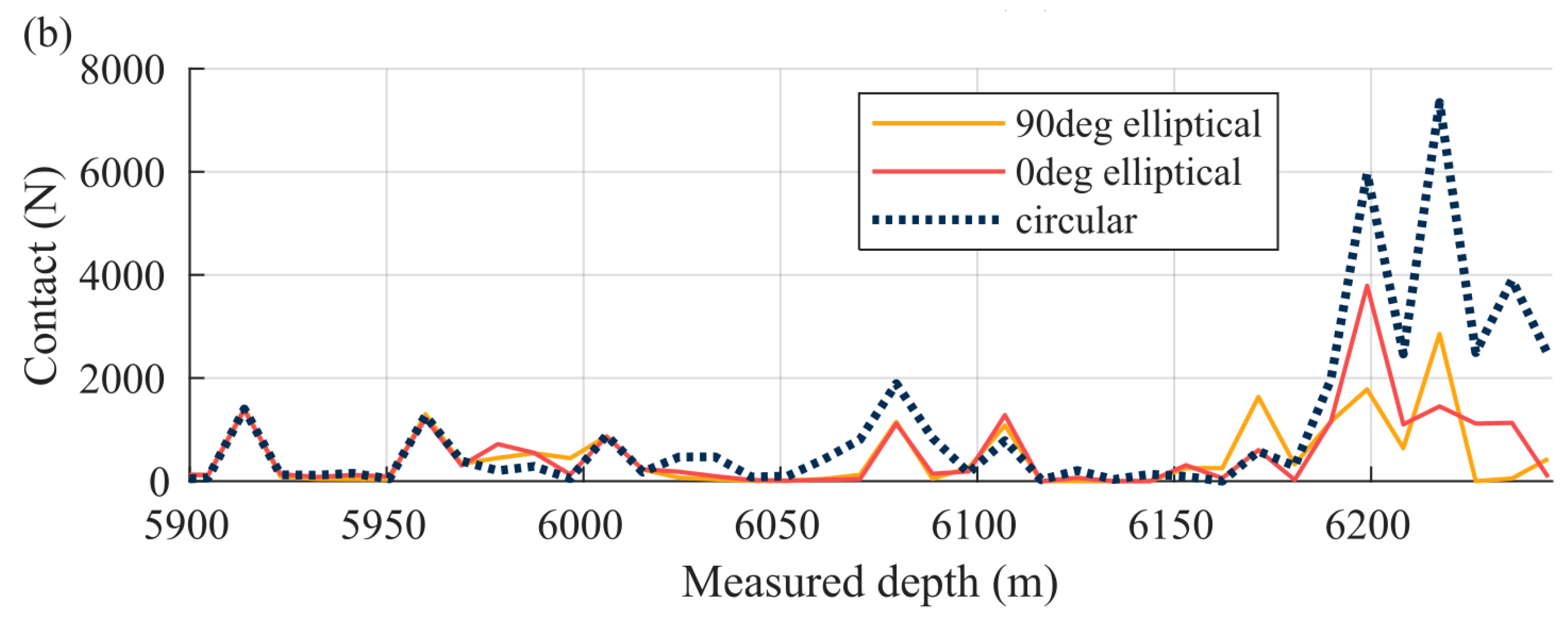
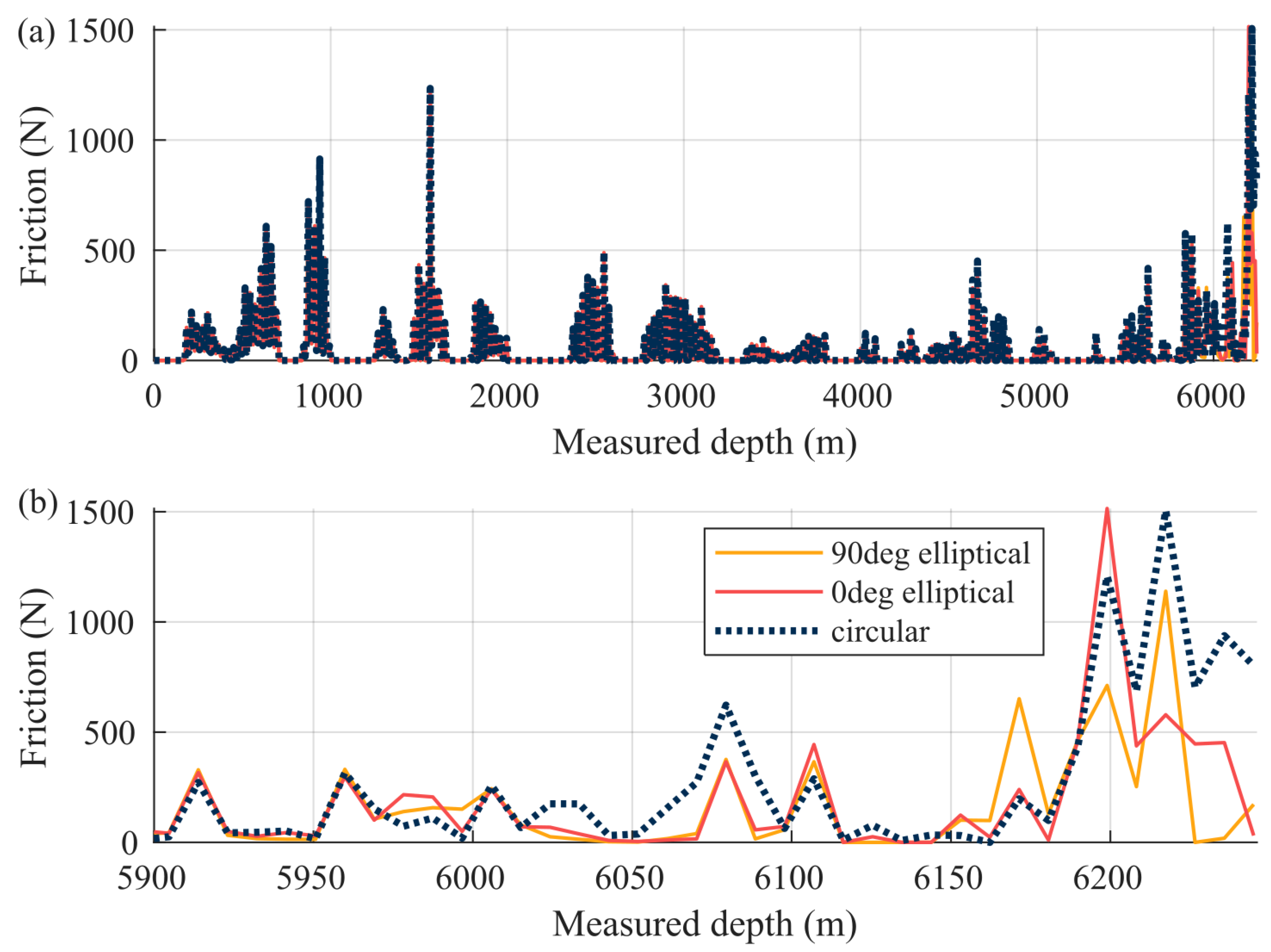
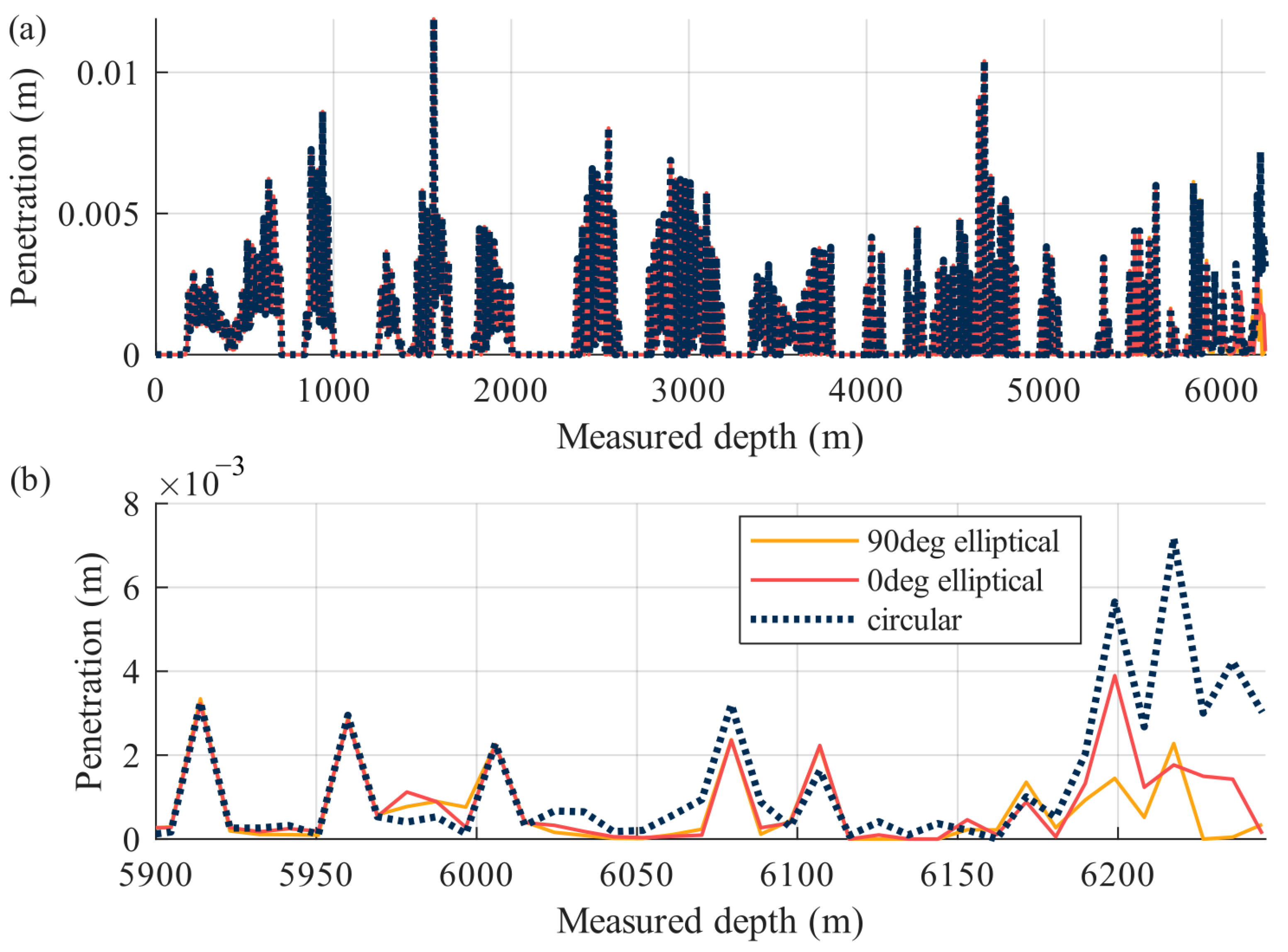
Figure 15, Figure 16 and Figure 17 present the maximum contact force, maximum friction force, and maximum penetration depth at various points during the simulation process. It can be observed that in the casing section of 0–5900 m, the contact forces under the three working conditions are almost identical. However, in the section below 5900 m, comparison reveals that the contact force in the circular open-hole is relatively greater. This result is likely primarily attributed to the fact that the major axis of the elliptical open-hole section is larger than the diameter of the circular cross section, thereby allowing the drill string to undergo greater lateral vibration without contacting the wellbore.

5.4. Motion of the Drill Bit

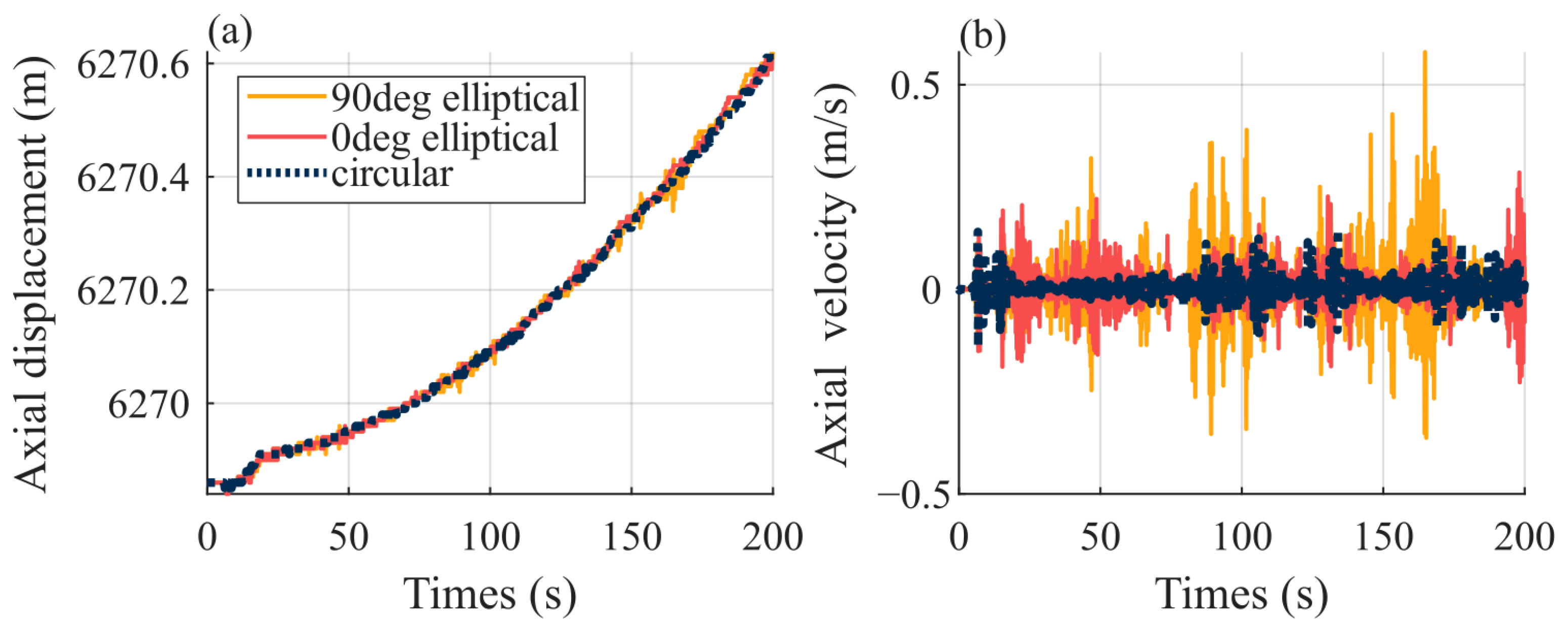
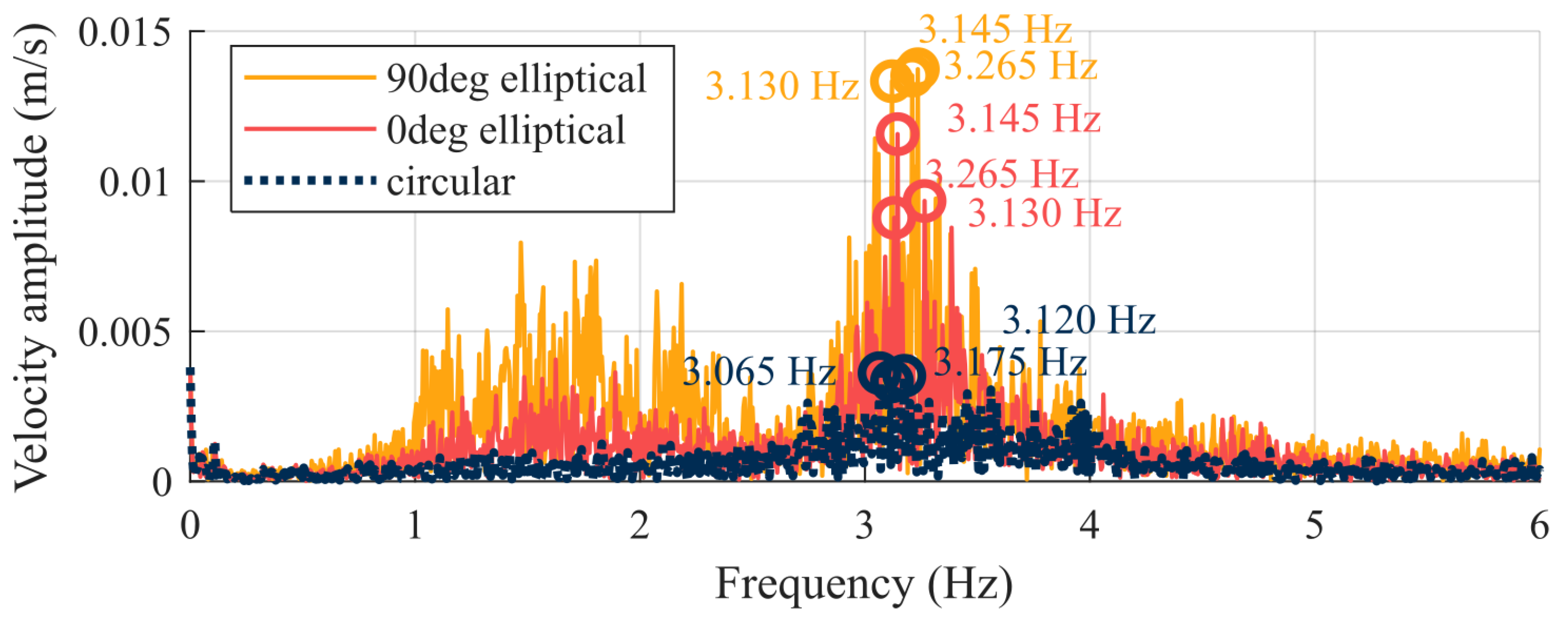
In this section, the axial motion and rotation of the drill bit are analyzed. Figure 18 compares the axial displacement and axial velocity of the bit. The displacement curves show that the shape of the open-hole section has little influence on the axial movement of the bit. In contrast, the velocity profile indicates that during the 200 s dynamic drilling process, the axial velocity fluctuates more intensely inside an elliptical wellbore. To better characterize the influence of the elliptical cross section on axial vibration, an amplitude–frequency analysis is performed on the axial velocity data. The results, presented in Figure 19, show the amplitude–frequency characteristics of the axial velocity under the two wellbore geometries. It is evident that the elliptical cross section raises the peak axial vibration velocity of the bit by approximately threefold and concentrates the vibration frequencies more distinctly. The peak axial velocity of the drill bit in the elliptical wellbores reaches 12 mm/s and 14 mm/s, while in the circular wellbore it is only 4 mm/s.
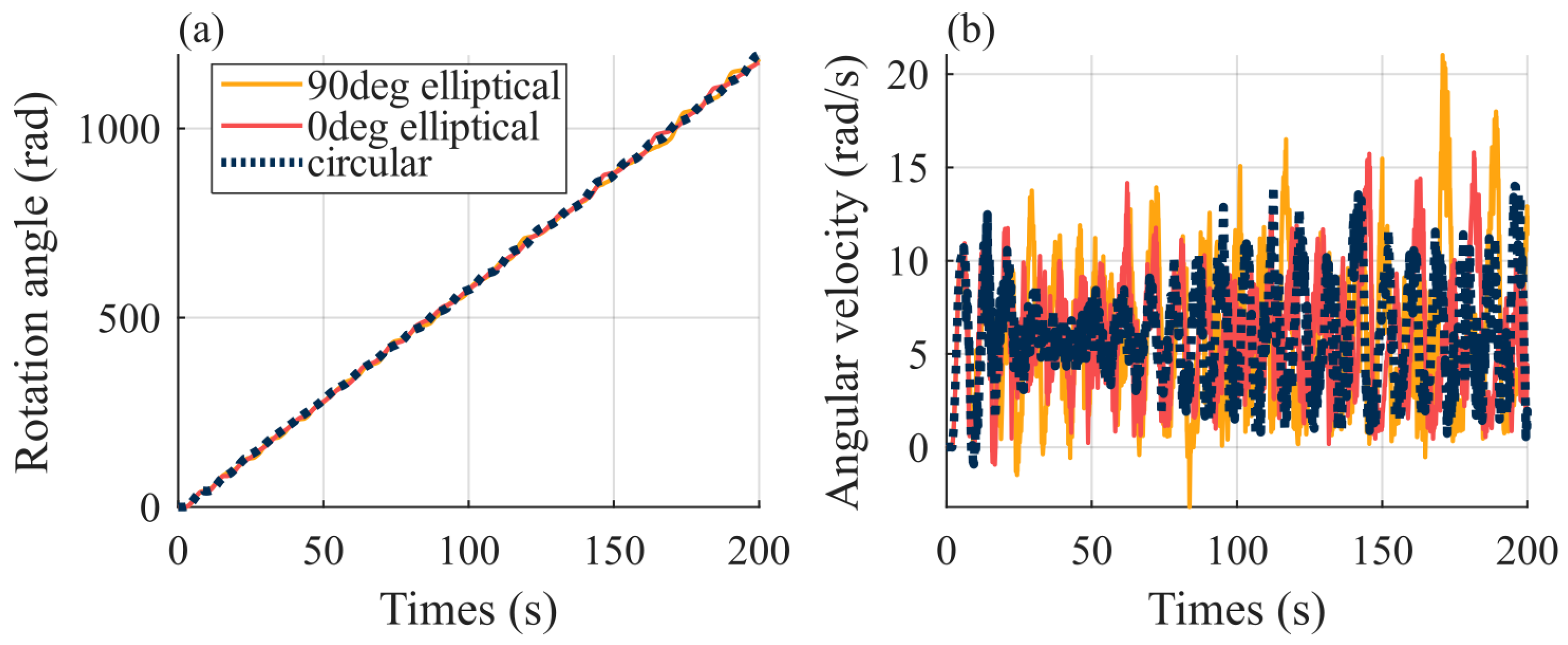
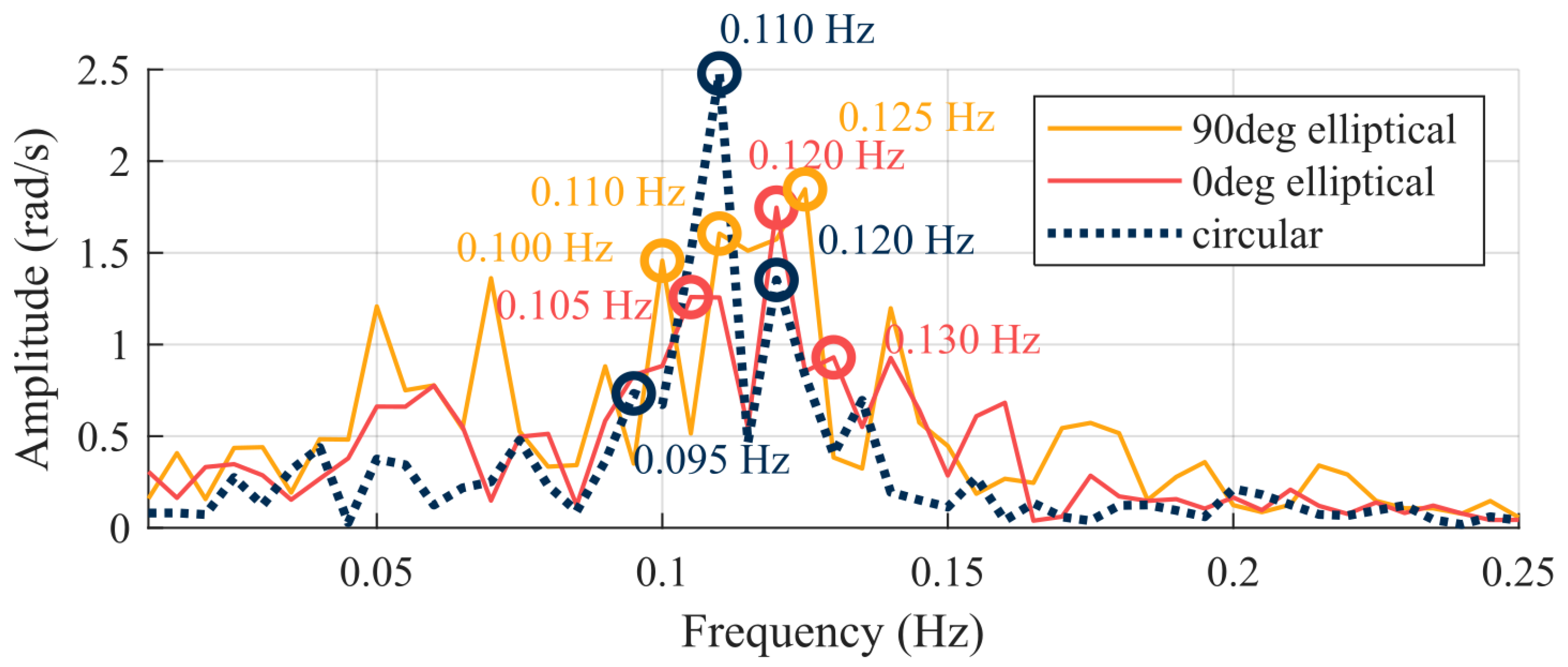
Figure 20 presents the angular displacement and angular velocity of the bit about its axis. Neither the rotation angle nor the angular velocity reveals a clear influence of the elliptical wellbore cross section. An amplitude–frequency analysis is further performed on the angular velocity data in Figure 21. As shown in the corresponding plot, only at 0.110 Hz does the angular velocity amplitude in the circular wellbore exhibit a noticeable peak; at other frequencies, the rotational response of the bit shows no significant difference between the two cross section geometries.

5.5. Drilled Trajectories

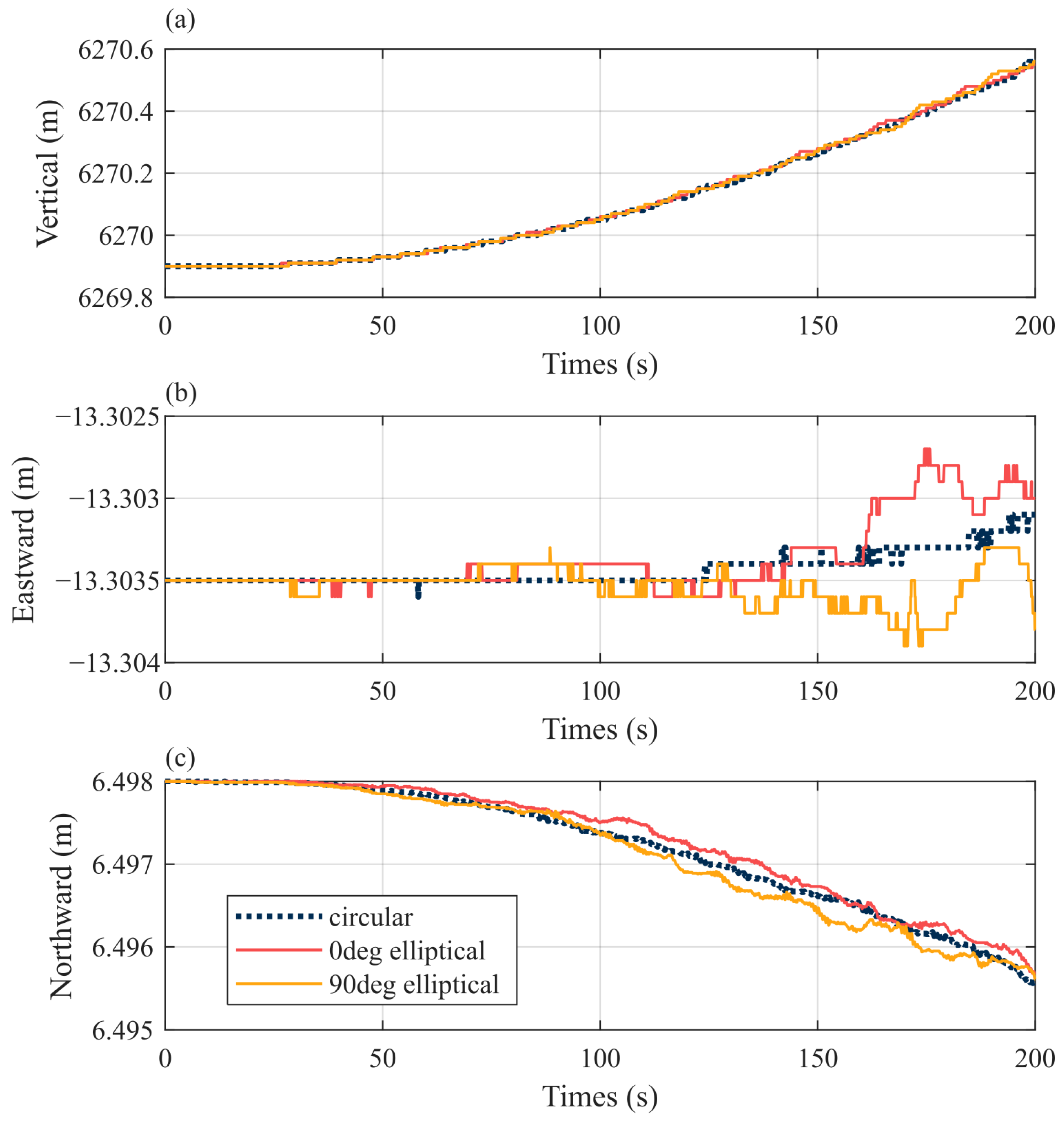
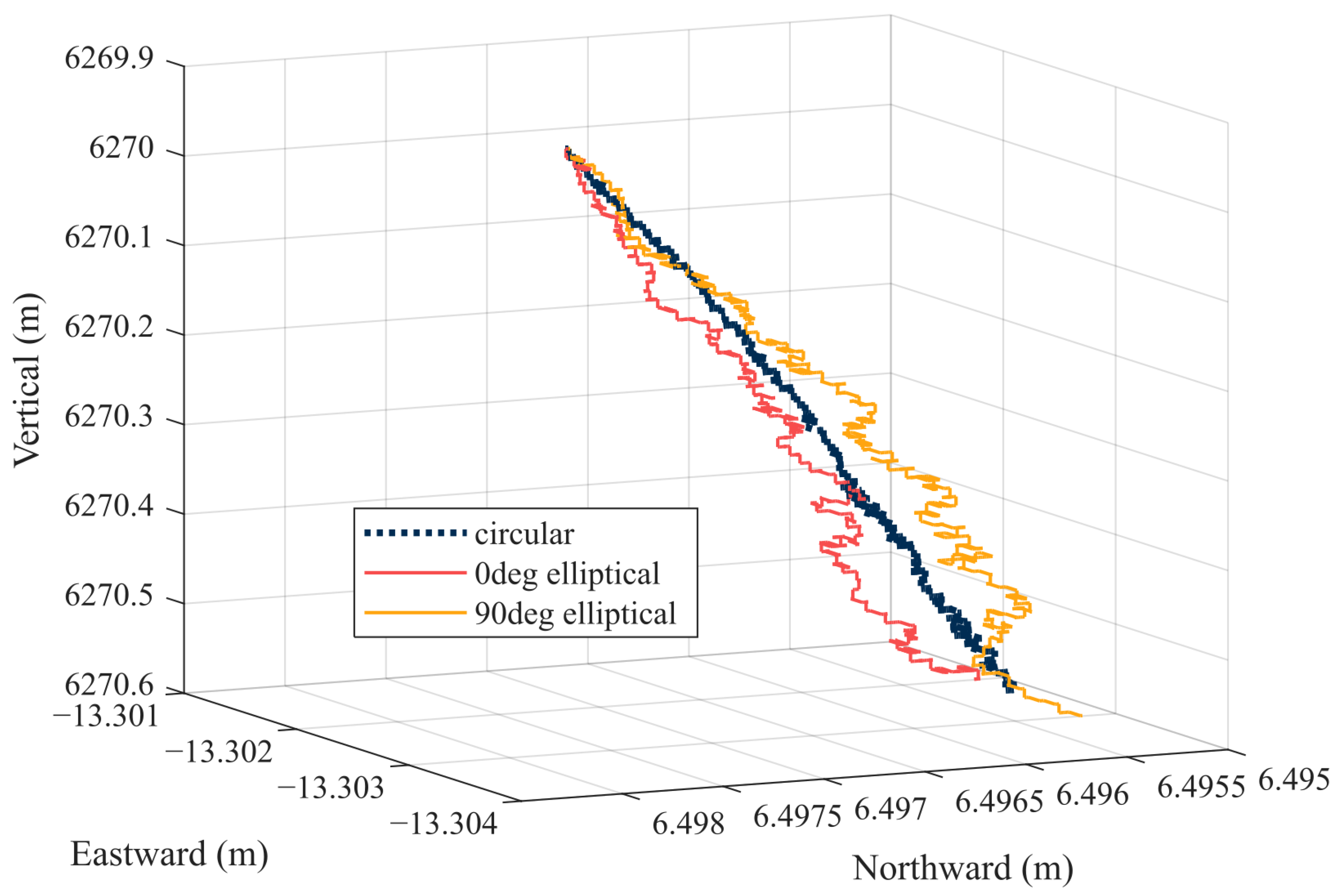
The drilled trajectory results are illustrated in Figure 22 and Figure 23. The 3D (three-dimensional) view and the time-history curves in three directions of the drilled trajectory are presented, respectively. In the figures, the dotted line represents the drilling trajectory inside the circular wellbore, while the solid line corresponds to the trajectory inside the elliptical wellbore.
As can be seen from the plots, under both conditions, the drilling advanced approximately 700 mm in the vertical direction, with an eastward displacement of less than 2 mm and a northward displacement of about 2.5 mm. Therefore, the trajectory drilled within 200 s is close to that of a vertical well. The numerical magnitude of the lateral trajectory deviation caused by the elliptical wellbore cross section is 1.6 mm during the 700 mm drilling. Although the deviation is very small, as the drilling depth increases to thousands of meters, the deviation may become more significant. Moreover, the smoothness and local shape of the trajectory have also been noticeably affected. From the 3D view, it can be observed that the trajectory inside the circular wellbore is relatively smooth, whereas the trajectories inside the elliptical wellbores exhibit more tortuosity. Moreover, Figure 23b shows that the eastward deviation of the trajectory in the elliptical wellbore is significantly larger than that in the circular wellbore. In addition, Figure 23c indicates that in the comparison of the northward displacement components, the trajectories inside both the elliptical wellbores display more pronounced trend fluctuations, and their smoothness is noticeably lower than that of the newly drilled trajectory inside the circular wellbore.

6. Conclusions

In this work, the dynamic modeling and contact issues of downhole drillstring systems are investigated. First, dynamic modeling of the drillstring system is carried out using beam elements based on the absolute nodal coordinate formulation (ANCF). Then, theoretical modeling of the contact between the drillstring and the wellbore is conducted in response to the elliptical wellbore cross sections identified during field tests. Contact detection models are developed separately for circular and elliptical wellbore cross sections. Finally, the established models are used to simulate a certain drilling process in an ultra-deep well. The simulation results considering elliptical wellbore cross sections are compared with those assuming simplified circular cross sections. The simulations reveal that elliptical wellbore cross sections have a noticeable influence on both the lateral and axial vibrations of the drillstring. The elliptical cross sections also significantly affect the motion of the drill bit and the direction of the newly drilled trajectory. Therefore, it is recommended that subsequent analyses of ultra-deep wells take into account the impact of wellbore cross section geometries on the drillstring.
Future research could proceed in the following aspects. In terms of beam element modeling, many new methods have been developed in recent years, particularly the ANCF beam element based on the Bishop frame [25], which significantly enhances both singularity handling and computational efficiency, making it a viable tool for analyzing drillstrings. Regarding contact models, numerous new and efficient models can also be applied to the contact between drillstrings and wellbores. Furthermore, the energy transfer process and efficiency of drillstrings have always been of great practical concern in the field. Analyzing the distribution and dissipation of energy from the top drive input based on the dynamic process remains a highly challenging task. Additionally, research could focus on optimizing drilling parameters and bottom-hole assembly designs for drilling processes in sections where elliptical cross sections have already developed.

Author Contributions

Conceptualization, C.F., Z.X. and H.P.; methodology, H.L. and M.L.; simulation, H.L.; validation, C.F., Z.X. and H.P.; formal analysis, W.L. and M.L.; investigation, H.L.; resources, Z.X. and C.F.; data curation, H.L.; writing—original draft preparation, H.L.; writing—review and editing, H.P. and M.L.; visualization, H.L.; supervision, M.L. and W.L.; funding acquisition, H.L., M.L. and W.L. All authors have read and agreed to the published version of the manuscript.

Funding

This research was funded by the Fundamental Research Funds for the Central Universities [No. FRF-TP-22-026A1], Research Project of China Petroleum Science and Technology Innovation Fund [No. 2025DQ02-0144], CNPC Projects Research on Rock-breaking Energy Transmission Mechanism and Optimization Control Methods for 10,000-meter Ultra-long Drillstrings (2024DQ03097), China Petroleum Corporation Major Field Test Project: “BH-VDT Vertical Drilling System Upgrade, Integration and Field Testing” (No. 2025ZS57).

Data Availability Statement

Dataset available on request from the authors.

Conflicts of Interest

Authors Chao Fang, Zhaohui Xu, Haibo Pang and Wei Liu were employed by the company CNPC Engineering Technology R&D Company Limited. The remaining authors declare that the research was conducted in the absence of any commercial or financial relationships that could be construed as a potential conflict of interest.

References

  1. Nguyen, K.L.; Tran, Q.T.; Andrianoely, M.A.; Manin, L.; Baguet, S.; Dufour, R.; Mahjoub, M.; Menand, S. Nonlinear rotordynamics of a drillstring in curved wells: Models and numerical techniques. Int. J. Mech. Sci. 2020, 166, 105225. [Google Scholar] [CrossRef]
  2. Hai, W.G.; He, Y.M.; Xue, Q.L. Research on the influence of deep-water drilling risers on drillstring motion trajectory and vibration characteristics. Machines 2024, 12, 112. [Google Scholar] [CrossRef]
  3. Wang, B.J.; Ren, F.S.; Yao, Z.G.; Fang, T.C. Mathematical model and experimental investigation of bit-bounce in horizontal oil well drillstring. Arab. J. Sci. Eng. 2019, 44, 8095–8111. [Google Scholar] [CrossRef]
  4. Choe, Y.M.; Kim, G.S.; Kim, I.S.; Cha, J.C.; Ri, K.W.; Han, Y.S.; Kang, C.H. Influence of torsional stick-slip vibration on whirl behavior in drill string system. Geoenergy Sci. Eng. 2023, 227, 211931. [Google Scholar] [CrossRef]
  5. Khulief, Y.A.; Al-Sulaiman, F.A.; Bashmal, S. Vibration analysis of drillstrings with self-excited stick-slip oscillations. J. Sound Vib. 2007, 299, 540–558. [Google Scholar] [CrossRef]
  6. Liu, W.L.; Ni, H.J.; Wang, Y.; Guo, Y.; Gao, Y.; He, P.Y. Dynamic modeling and load transfer prediction of drill-string axial vibration in horizontal well drilling. Tribol. Int. 2023, 177, 107986. [Google Scholar] [CrossRef]
  7. Nagaraj, M.; Kumar, A.J.P.; Ezilarasan, C.; Betala, R. Finite element modeling in drilling of Nimonic C-263 alloy using Deform-3D. CMES-Comp. Model. Eng. 2019, 118, 679–692. [Google Scholar] [CrossRef]
  8. Zhang, Y.F.; Ashok, P.; Chen, D.M.; van Oort, E. Coupled drillstring dynamics modeling using 3D field-consistent corotational beam elements. Geoenergy Sci. Eng. 2024, 233, 212424. [Google Scholar] [CrossRef]
  9. Liu, J.P.; Cheng, Z.B.; Ren, G.X. An arbitrary Lagrangian-Eulerian formulation of a geometrically exact Timoshenko beam running through a tube. Acta Mech. 2018, 229, 3161–3188. [Google Scholar] [CrossRef]
  10. Shabana, A.A. An overview of the ANCF approach, justifications for its use, implementation issues, and future research directions. Multibody Syst. Dyn. 2023, 58, 433–477. [Google Scholar] [CrossRef]
  11. Ma, Y.H.; Hong, D.F.; Cheng, Z.B.; Cao, Y.F.; Ren, G.X. A multibody dynamic model of the drilling system with drilling fluid. Adv. Mech. Eng. 2016, 8, 1–16. [Google Scholar] [CrossRef]
  12. Wang, N.Y.; Cheng, Z.B.; Lu, Y.J.; Jiang, W.; Zhou, J.L.; He, B.S.; Ren, G.X. A multibody dynamics model of contact between the drillstring and the wellbore and the rock penetration process. Adv. Mech. Eng. 2015, 7, 1687814015582117. [Google Scholar] [CrossRef]
  13. Zhang, H.; Tian, K.X.; Detournay, E. A high-fidelity model for nonlinear self-excited oscillations in rotary drilling systems. J. Sound Vib. 2024, 573, 118193. [Google Scholar] [CrossRef]
  14. Bembenek, M.; Grydzhuk, Y.; Gajdzik, B.; Ropyak, L.; Pashechko, M.; Slabyi, O.; Al-Tanakchi, A.; Pryhorovska, T. An analytical-numerical model for determining “drill string-wellbore” frictional interaction forces. Energies 2024, 17, 301. [Google Scholar] [CrossRef]
  15. Mao, L.J.; Ma, M.Y.; Cai, M.J. Research on the dynamics of drillstring considering bit-rock nonlinear interaction. Int. J. Non-Linear Mech. 2023, 148, 104301. [Google Scholar] [CrossRef]
  16. Yang, C.; Du, J.B.; Cheng, Z.B.; Wu, Y.; Li, C.W. A highly efficient beam-in-beam large sliding contact method for flexible multibody dynamics. Comput. Mech. 2021, 67, 1155–1175. [Google Scholar] [CrossRef]
  17. Yang, C.J.; Cheng, Z.B.; Jiang, W.; Jiang, S.Q.; Ren, G.X. A multibody dynamic model of drillstring for torque and drag analysis. J. Offshore Mech. Arct. Eng. 2015, 137, 031403. [Google Scholar]
  18. Chen, Y.L.; Liu, Z.; Zhang, X.; He, S.M.; Ma, D.X.; Zhou, J. Research on the collapse pressure of an elliptical wellbore considering the effect of weak planes. Energy Source Part A 2020, 42, 2103–2119. [Google Scholar] [CrossRef]
  19. Oyedokun, O.; Schubert, J. Stability of highly inclined non-circular wellbores in isotropic formations. Geomech. Geophys. Geo.-Resour. 2024, 10, 114. [Google Scholar] [CrossRef]
  20. Li, Z.F.; Zhang, C.Y.; Ren, W.M.; Ma, J.W. Study of radial vibration impact on friction and torque of rotary drill string. Shock Vib. 2020, 2020, 8852530. [Google Scholar] [CrossRef]
  21. Dombrowski, S.V. Analysis of large flexible body deformation in multibody systems using absolute coordinates. Multibody Syst. Dyn. 2002, 8, 409–432. [Google Scholar] [CrossRef]
  22. Gerstmayr, J.; Shabana, A.A. Analysis of thin beams and cables using the absolute nodal co-ordinate formulation. Nonlinear Dyn. 2006, 45, 109–130. [Google Scholar] [CrossRef]
  23. Bulín, R.; Hajžman, M. Efficient computational approaches for analysis of thin and flexible multibody structures. Nonlinear Dyn. 2021, 103, 2475–2492. [Google Scholar] [CrossRef]
  24. Gruber, P.G.; Nachbagauer, K.; Vetyukov, Y.; Gerstmayr, J. A novel director-based Bernoulli–Euler beam finite element in absolute nodal coordinate formulation free of geometric singularities. Mech. Sci. 2013, 4, 279–289. [Google Scholar] [CrossRef]
  25. Ebrahimi, M.; Butscher, A.; Cheong, H. A low order, torsion deformable spatial beam element based on the absolute nodal coordinate formulation and Bishop frame. Multibody Syst. Dyn. 2021, 51, 247–278. [Google Scholar] [CrossRef]
  26. Tang, L.L. Research on Modeling and Contact Dynamics of Flexible Multibody Systems Based on Absolute Nodal Coordinate Formulation. Ph.D. Thesis, Shanghai Jiao Tong University, Shanghai, China, 2021. [Google Scholar]
  27. Hussein, B.A.; Shabana, A.A. Sparse matrix implicit numerical integration of the stiff differential/algebraic equations: Implementation. Nonlinear Dyn. 2011, 65, 369–382. [Google Scholar] [CrossRef]
  28. Li, H.Q.; Yu, Z.W.; Guo, S.J.; Cai, G.P. Investigation of joint clearances in a large-scale flexible solar array system. Multibody Syst. Dyn. 2018, 44, 277–292. [Google Scholar] [CrossRef]
  29. Tang, L.L.; Liu, J.Y. Frictional contact analysis of sliding joints with clearances between flexible beams and rigid holes in flexible multibody systems. Multibody Syst. Dyn. 2020, 49, 155–179. [Google Scholar] [CrossRef]
  30. Kan, Z.Y.; Peng, H.J.; Chen, B.S. A simple linear complementarity approach for sliding cable modeling considering friction. Mech. Syst. Signal Process. 2019, 130, 293–314. [Google Scholar] [CrossRef]
  31. Meier, C.; Grill, M.J.; Wall, W.A.; Popp, A. Geometrically exact beam elements and smooth contact schemes for the modeling of fiber-based materials and structures. Int. J. Solids Struct. 2018, 154, 124–146. [Google Scholar] [CrossRef]
  32. Fang, C.; Li, H.Q.; Liu, W.; Xu, Z.H.; Liao, M.L.; Fan, J.C.; Lin, Z.L.; Pang, H.B. Dynamics modeling and analysis of a down-hole drill string multibody system based on the absolute coordinate formulation. J. Phys. Conf. Ser. 2024, 2901, 012041. [Google Scholar] [CrossRef]
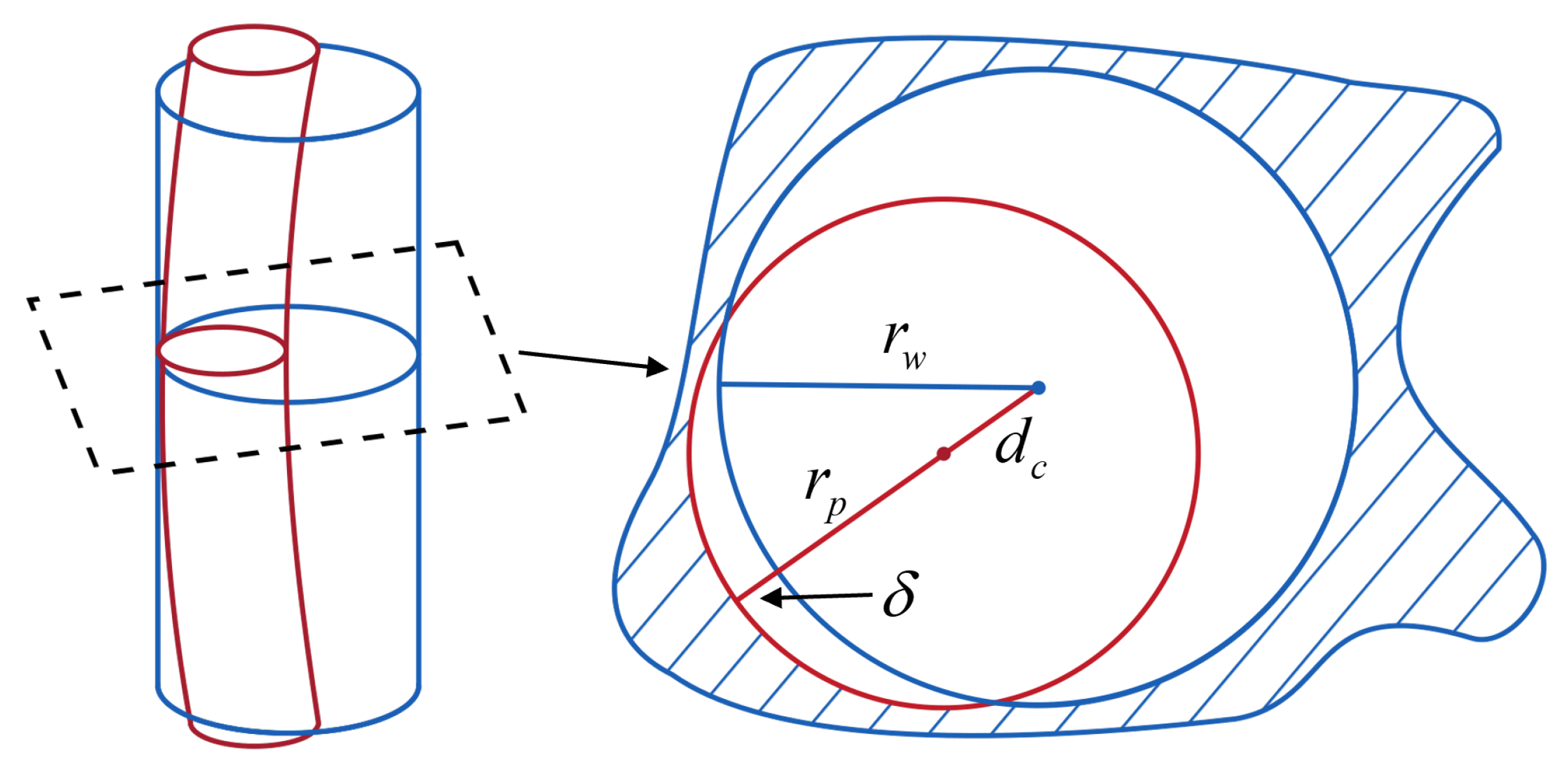
Figure 1. Contact between the drillstring and the circular wellbore.
Machines 14 00172 g001
Figure 2. Contact between the drillstring and the elliptical wellbore.
Machines 14 00172 g002
Figure 3. Comparison with the solid elements: (a) lateral deformation; (b) errors of the deformation.
Machines 14 00172 g003
Figure 4. Mesh convergence result: (a) deformation; (b) errors of the deformation.
Machines 14 00172 g004
Figure 5. Well information of the simulation: (a) wellbore structure; (b) well trajectory and the cross section of open hole.
Machines 14 00172 g005
Figure 6. Lateral motion of the drillstring at 4627 m: (a) lateral motion of the drillstring in y direction; (b) errors in y direction; (c) Lateral motion of the drillstring in z direction; (d) errors in z direction.
Machines 14 00172 g006
Figure 7. Axial motion of the drillstring: (a) axial velocity at 2726 m; (b) axial velocity at 4627 m; (c) axial velocity at 6017 m; (d) axial velocity at 6175 m.
Machines 14 00172 g007
Figure 8. Amplitude–frequency characteristic of the axial velocities: (a) amplitude–frequency at 2726 m; (b) amplitude–frequency at 4627 m; (c) amplitude–frequency at 6017 m; (d) amplitude–frequency at 6175 m.
Machines 14 00172 g008
Figure 9. Lateral motion of the drillstring in y direction: (a) lateral velocity at 2726 m; (b) lateral velocity at 4627 m; (c) lateral velocity at 6017 m; (d) lateral velocity at 6175 m.
Machines 14 00172 g009
Figure 10. Lateral motion of the drillstring in z direction: (a) lateral velocity at 2726 m; (b) lateral velocity at 4627 m; (c) lateral velocity at 6017 m; (d) lateral velocity at 6175 m.
Machines 14 00172 g010
Figure 11. Amplitude–frequency characteristic of the lateral velocities in y direction: (a) amplitude–frequency at 2726 m; (b) amplitude–frequency at 4627 m; (c) amplitude–frequency at 6017 m; (d) amplitude–frequency at 6175 m.
Machines 14 00172 g011
Figure 12. Amplitude–frequency characteristic of the lateral velocities in z direction: (a) amplitude–frequency at 2726 m; (b) amplitude–frequency at 4627 m; (c) amplitude–frequency at 6017 m; (d) amplitude–frequency at 6175 m.
Machines 14 00172 g012
Figure 13. Angular velocity of the drillstring: (a) angular velocity at 2726 m; (b) angular velocity at 4627 m; (c) angular velocity at 6017 m; (d) angular velocity at 6175 m.
Machines 14 00172 g013
Figure 14. Amplitude–frequency characteristic of the angular velocities: (a) amplitude–frequency at 2726 m; (b) amplitude–frequency at 4627 m; (c) amplitude–frequency at 6017 m; (d) amplitude–frequency at 6175 m.
Machines 14 00172 g014
Figure 15. Contact of the drillstring: (a) the whole drillstring; (b) drillstring in the open hole.
Machines 14 00172 g015aMachines 14 00172 g015b
Figure 16. Friction of the drillstring: (a) the whole drillstring; (b) drillstring in the open hole.
Machines 14 00172 g016
Figure 17. Penetration of the drillstring: (a) the whole drillstring; (b) drillstring in the open hole.
Machines 14 00172 g017
Figure 18. Axial motion of the drill bit: (a) axial displacement; (b) axial velocity.
Machines 14 00172 g018
Figure 19. Amplitude–frequency characteristic of the axial velocity.
Machines 14 00172 g019
Figure 20. Rotation of the drill bit: (a) Rotation angle; (b) Angular velocity.
Machines 14 00172 g020
Figure 21. Amplitude–frequency characteristic of the axial rotational angular velocity.
Machines 14 00172 g021
Figure 22. Three-dimensional view of the drilled trajectory.
Machines 14 00172 g022
Figure 23. Drilled trajectory: (a) vertical depth; (b) eastward displacement; (c) northward displacement.
Machines 14 00172 g023
Table 1. Parameters of the drill pipes and the BHA.
PartsOuter DiameterInner DiameterLengthTotal Length from BitMass per LengthInertia per Length
drill pipe149.2 mm127.4 mm1140 m6245.23 m36.9 kg/m0.178 kgm
drill pipe149.2 mm129.9 mm4745 m5105.23 m33.0 kg/m0.161 kgm
drill pipe149.2 mm92.1 mm144 m360.23 m84.4 kg/m0.324 kgm
drill collar203.2 mm71.44 mm27 m216.23 m221.7 kg/m1.286 kgm
drilling jar203.0 mm-10 m189.23 m252.5 kg/m1.300 kgm
drill collar203.2 mm71.44 mm126 m179.23 m221.7 kg/m1.286 kgm
drill collar228.6 mm76.2 mm18 m53.23 m284.6 kg/m2.065 kgm
stabilizer333.4 mm-1.8 m35.23 m681.0 kg/m9.461 kgm
drill collar228.6 mm76.2 mm9 m33.43 m284.6 kg/m2.065 kgm
stabilizer333.4 mm-1.8 m24.43 m681.0 kg/m9.461 kgm
drill collar228.6 mm76.2 mm18 m22.63 m284.6 kg/m2.065 kgm
shock sub229 mm-4 m4.63 m321.3 kg/m2.106 kgm
drill bit333.4 mm-0.63 m0.63 m681.0 kg/m9.461 kgm
Disclaimer/Publisher’s Note: The statements, opinions and data contained in all publications are solely those of the individual author(s) and contributor(s) and not of MDPI and/or the editor(s). MDPI and/or the editor(s) disclaim responsibility for any injury to people or property resulting from any ideas, methods, instructions or products referred to in the content.