
Investigation of Sintering Parameters for Low-Cost 3D-Printed Cast Iron Using Material Extrusion



Abstract
1. Introduction
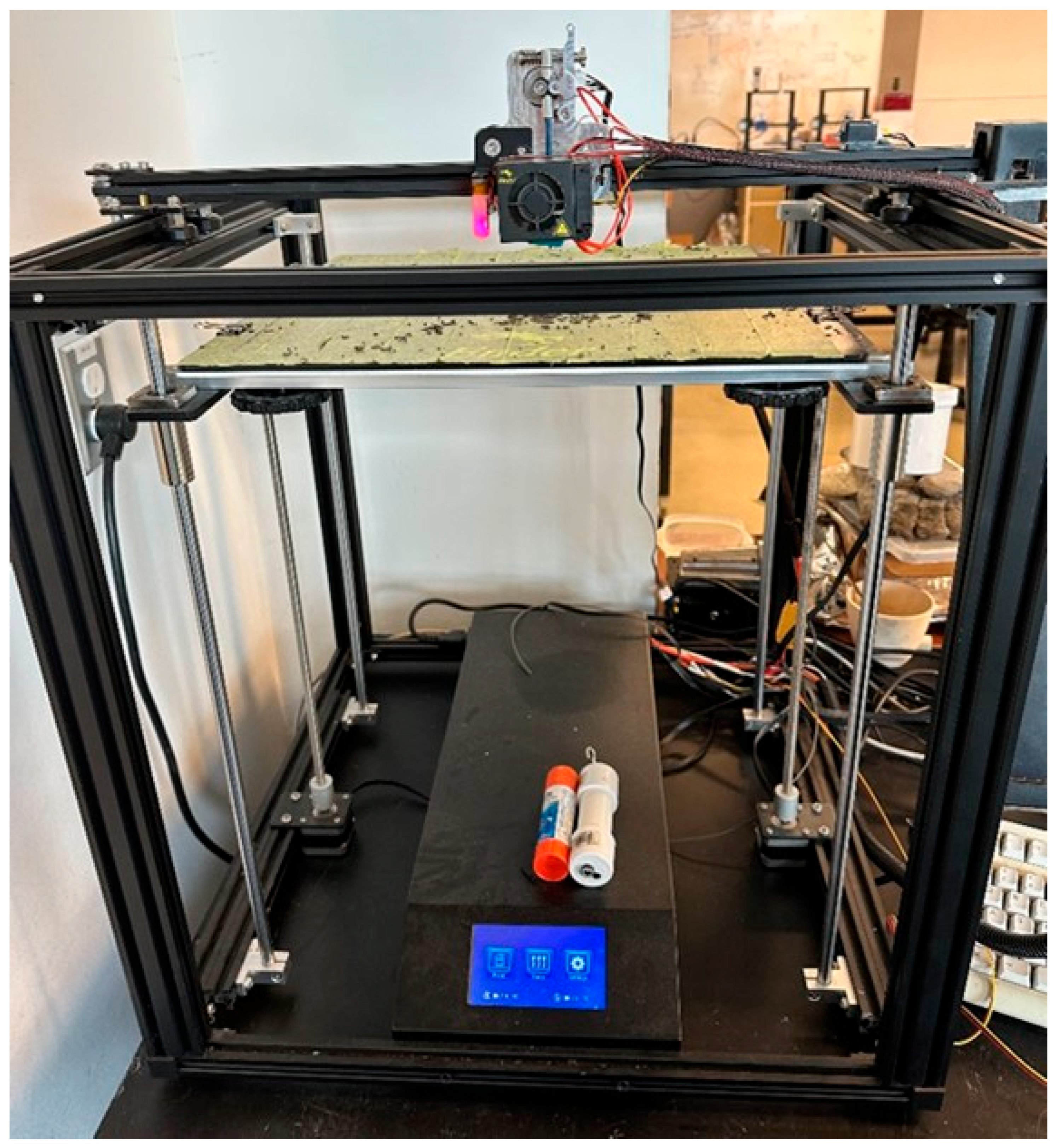
- Print: Material Extrusion deposits layer upon layer of heated thermoplastic filament to produce a printed shape of the intended part [2].
- Debind: Thermal debinding slowly vaporizes the thermoplastic binder, resulting in just the metallic powder being left behind [2].
- Sinter: The remaining metallic powder is heated to a liquid-like state, allowing it to connect and fuse as it cools [2].
2. Experimental Setup
3. Methodology
4. Results
5. Conclusions
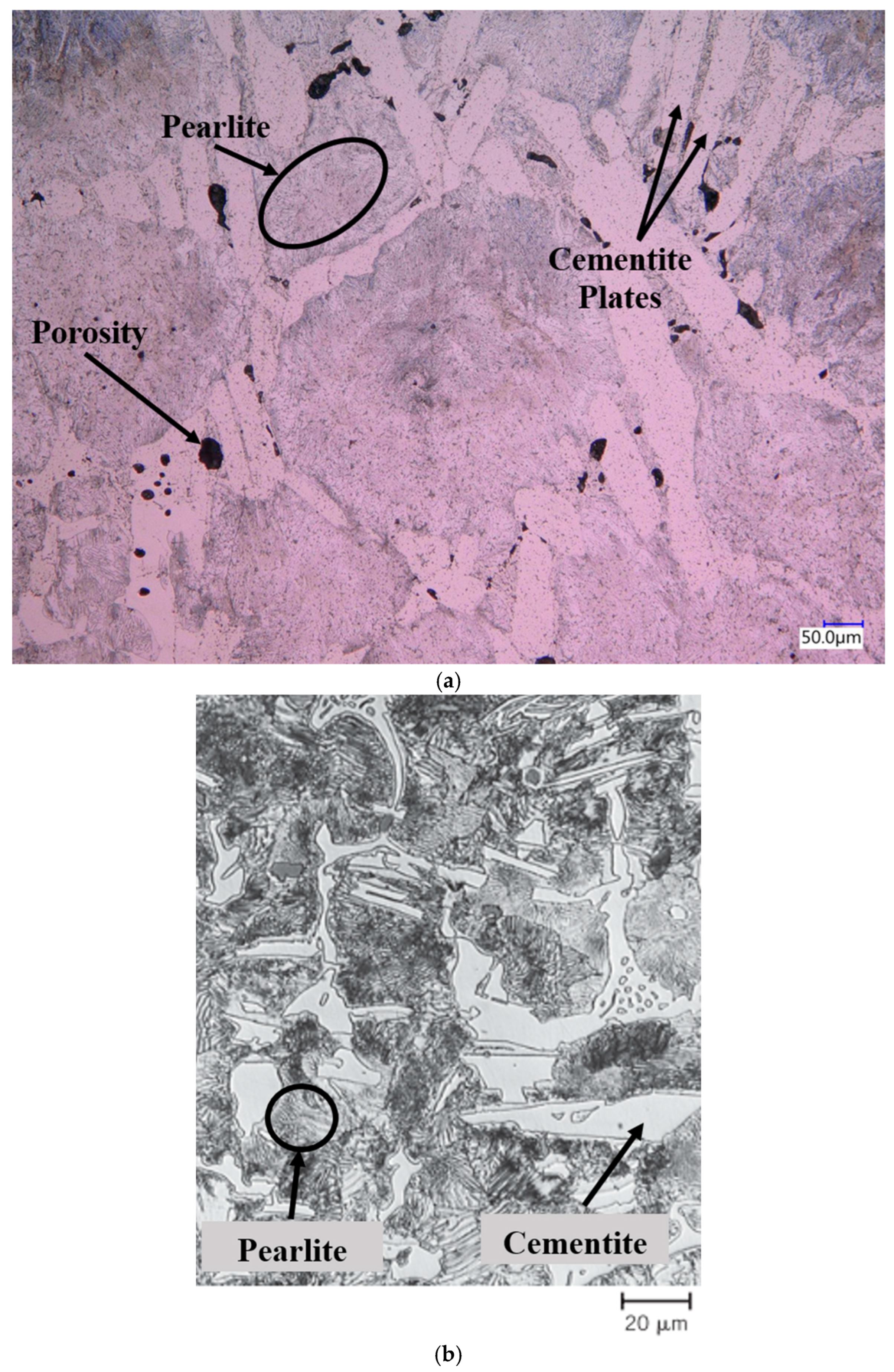
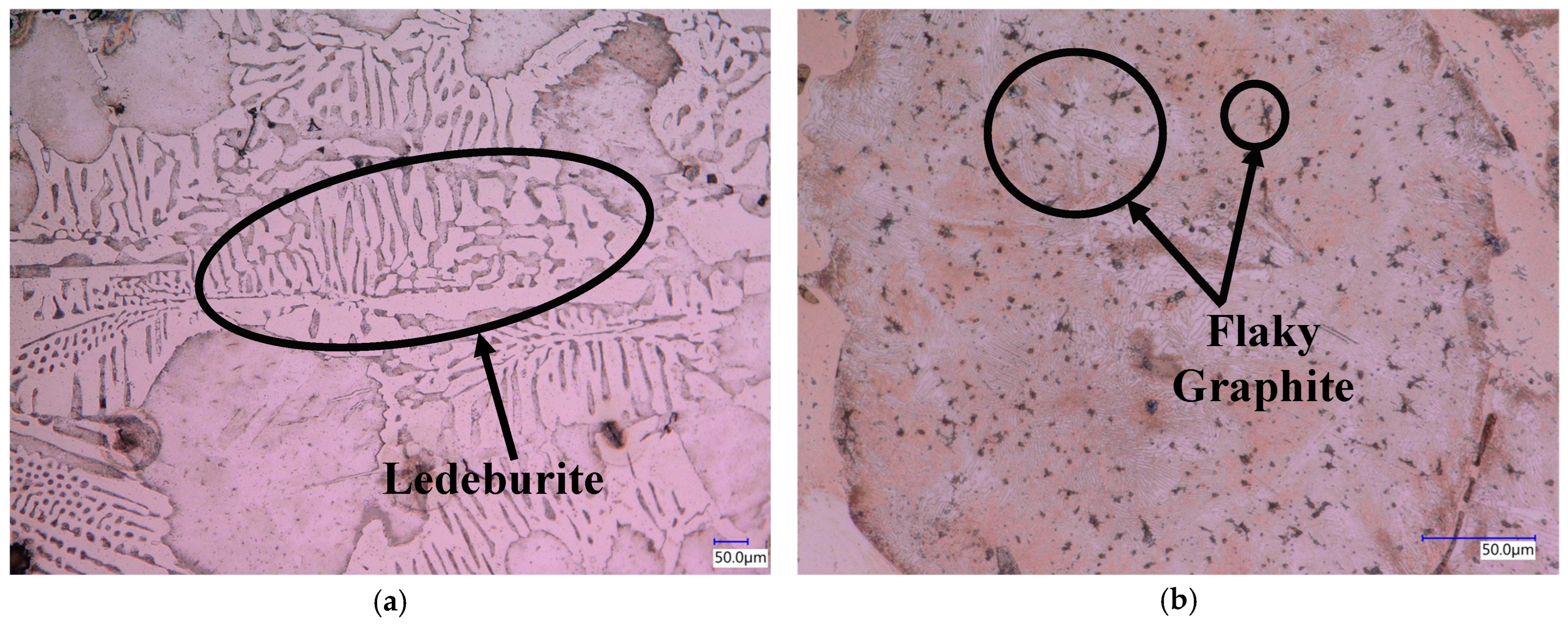
- A typically cast, white cast iron microstructure featuring coarse and fine pearlite can be created using MEX/M printing techniques.
- The dwell time influences the sintered density, volumetric shrinkage, and microhardness of the sample. This was to be expected, as similar results were reported in the literature review [4]. Longer dwell times increased the sintered density by 30.1% and volumetric shrinkage by 9.42%.
- The stress relief heat treatment used to compare the MEX/M cooling rate for printed white cast iron samples had no effect on the mechanical properties or microstructure of the sample. Similarly, Abe et al. [6] reported that heat treatment was ineffective.
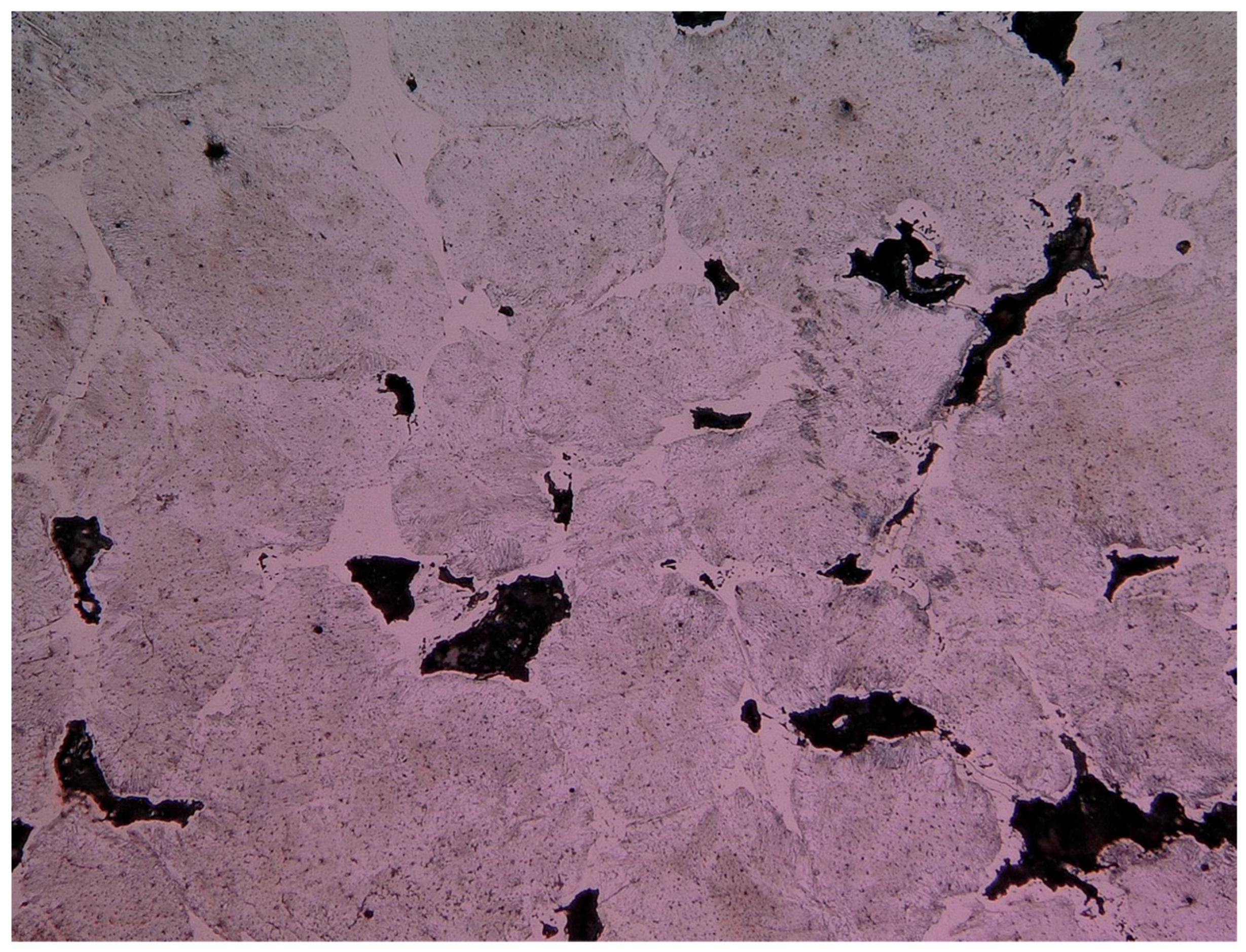
- Samples only achieved 85.8% of the density of white cast iron. This is due to the large porosity within the sample [22].
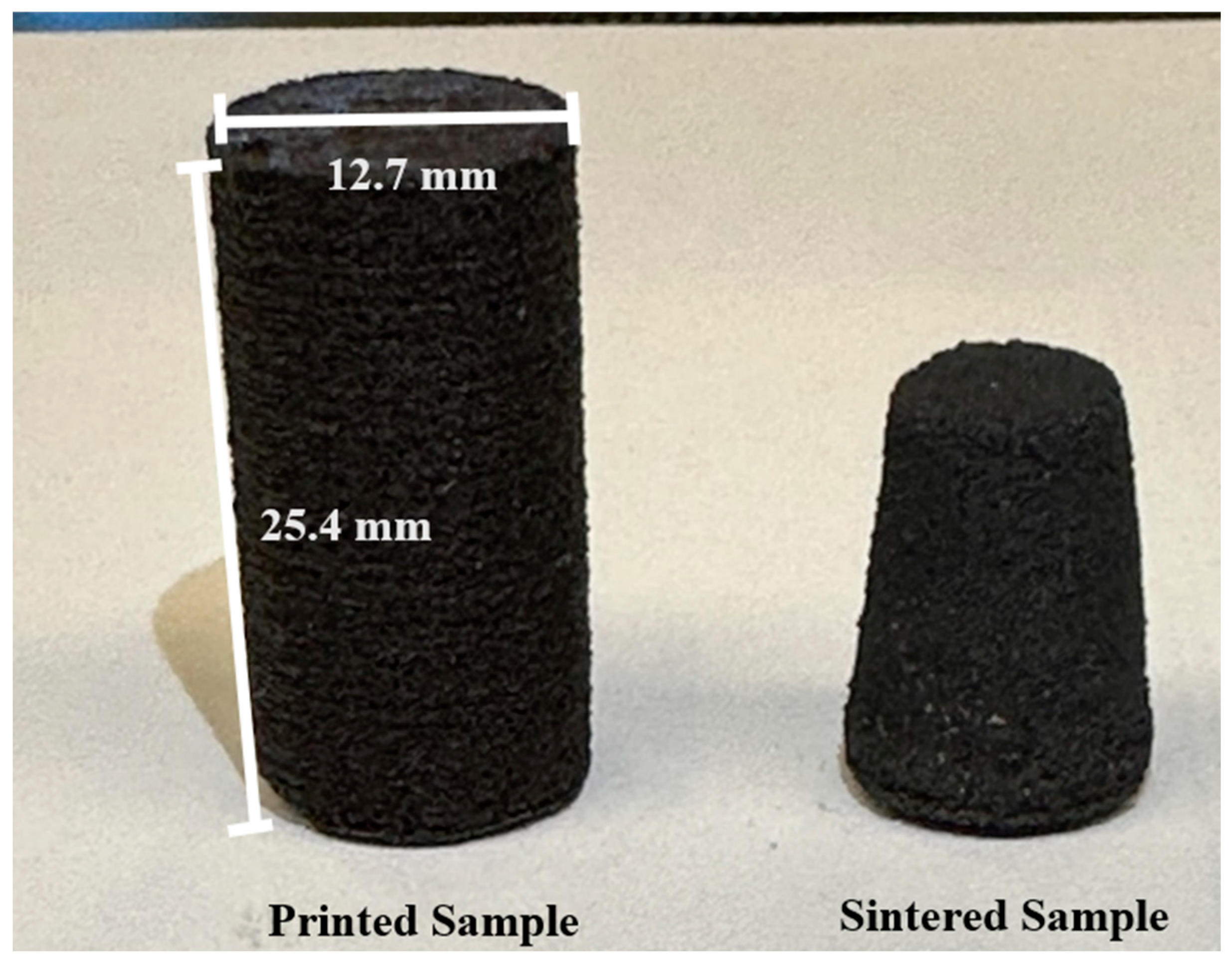
- Significant uncontrollable shrinkage combined with large internal porosity makes Material Extrusion of white cast iron infeasible for commercial use.
- Further sintering optimization to control the shrinkage and mechanical properties of the cast iron sample can enable MEX/M printed cast iron parts for use across various industries.
Author Contributions
Funding
Data Availability Statement
Acknowledgments
Conflicts of Interest
References
- Alexander, D. Suitability of Low-Cost Additive Manufacturing for Polymer Electrolyte Fuel Cells Electrolyte Fuel Cell. Ph.D. Thesis, University of Texas at El Paso, El Paso, TX, USA, 2020. Available online: https://scholarworks.utep.edu/open_etd/3469 (accessed on 28 August 2023).
- Drummond, M.; Eltaggaz, A.; Deiab, I. 3D Printing of High Melting Iron Alloys Using Metal-Fused Deposition Modeling: A Comprehensive Review. Int. J. Adv. Manuf. Technol. 2023, 129, 1–22. [Google Scholar] [CrossRef]
- Mousapour, M.; Salmi, M.; Klemettinen, L.; Partanen, J. Feasibility study of producing multi-metal parts by Fused Filament Fabrication (FFF) technique. J. Manuf. Process 2021, 67, 438–446. [Google Scholar] [CrossRef]
- de Seijas, M.O.V.; Bardenhagen, A.; Rohr, T.; Stoll, E. Indirect Induction Sintering of Metal Parts Produced through Material Extrusion Additive Manufacturing. Materials 2023, 16, 885. [Google Scholar] [CrossRef] [PubMed]
- Wagner, M.A.; Engel, J.; Hadian, A.; Clemens, F.; Rodriguez-Arbaizar, M.; Carreño-Morelli, E.; Wheeler, J.M.; Spolenak, R. Filament extrusion-based additive manufacturing of 316L stainless steel: Effects of sintering conditions on the microstructure and mechanical properties. Addit. Manuf. 2022, 59, 103147. [Google Scholar] [CrossRef]
- Abe, Y.; Kurose, T.; Santos, M.V.A.; Kanaya, Y.; Ishigami, A.; Tanaka, S.; Ito, H. Effect of layer directions on internal structures and tensile properties of 17-4ph stainless steel parts fabricated by fused deposition of metals. Materials 2021, 14, 243. [Google Scholar] [CrossRef] [PubMed]
- Charpentier, N.; Barrière, T.; Bernard, F.; Boudeau, N.; Gilbin, A.; Vikner, P. PIM-like EAM of steel-tool alloy via bio-based polymer. In Procedia CIRP; Elsevier B.V.: Amsterdam, The Netherlands, 2022; pp. 477–482. [Google Scholar] [CrossRef]
- Liu, B.; Wang, Y.; Lin, Z.; Zhang, T. Creating metal parts by Fused Deposition Modeling and Sintering. Mater. Lett. 2020, 263, 127252. [Google Scholar] [CrossRef]
- Ghadimi, H.; Jirandehi, A.P.; Nemati, S.; Ding, H.; Garbie, A.; Raush, J.; Zeng, C.; Guo, S. Effects of Printing Layer Orientation on the High-Frequency Bending-Fatigue Life and Tensile Strength of Additively Manufactured 17-4 PH Stainless Steel. Materials 2023, 16, 469. [Google Scholar] [CrossRef]
- Kedziora, S.; Decker, T.; Museyibov, E.; Morbach, J.; Hohmann, S.; Huwer, A.; Wahl, M. Strength Properties of 316L and 17-4 PH Stainless Steel Produced with Additive Manufacturing. Materials 2022, 15, 6278. [Google Scholar] [CrossRef] [PubMed]
- Kurose, T.; Abe, Y.; Santos, M.V.A.; Kanaya, Y.; Ishigami, A.; Tanaka, S.; Ito, H. Influence of the layer directions on the properties of 316l stainless steel parts fabricated through fused deposition of metals. Materials 2020, 13, 2493. [Google Scholar] [CrossRef] [PubMed]
- Gencul, S. Cast Irons-Properties and Applications. 2017. Available online: https://www.cabww.com/wp-content/uploads/2024/06/CastIronProp-wp.pdf (accessed on 2 September 2023).
- Wetzel, S. Metalcasting Supply Chain Responds. Mod. Cast. 2020, 22, 19–21. [Google Scholar]
- Joshi, S.; Martukanitz, R.P.; Nassar, A.R.; Michaleris, P. Additive Manufacturing with Metals Design, Processes, Materials, Quality Assurance, and Applications; Springer: Berlin/Heidelberg, Germany, 2023; pp. 7–9. [Google Scholar]
- ASTM E384-22; Standard Test Method for Microindentation Hardness of Materials. ASTM International: West Conshohocken, PA, USA, 2022. [CrossRef]
- ASTM E9-19(2025)e1; Standard Test Methods of Compression Testing of Metallic Materials at Room Temperature. ASTM International: West Conshohocken, PA, USA, 2025. [CrossRef]
- Drummond, M. Low-Cost 3D Printing of Cast Iron Using Fused Deposition Modeling. Master’s Thesis, Engineering, University of Guelph, Guelph, ON, Canada, 2023. [Google Scholar]
- Foundry, I.T.V. Webinar: All About Sintering FilametTM. Webinar Series. Available online: https://www.youtube.com/watch?v=CAv6SrjXibQ&t=2480s&ab_channel=TheVirtualFoundry%2CInc (accessed on 14 October 2021).
- Herring, D. Heat Treatment of Cast Iron; Industrial Heating: Lynchburg, VA, USA, 2021; pp. 2–9. [Google Scholar]
- Dossett, J.; Boyer, H. Heat Treating of Cast Irons, 2nd ed.; ASM International: Almere, The Netherlands, 2006. [Google Scholar] [CrossRef]
- Rethwisch, D.G.; Callister, W.D., Jr. Materials Science and Engineering an Introduction, 3rd ed.; John Wiley & Sons, Inc.: Danvers, MA, USA, 2010. [Google Scholar]
- Berns, H.; Theisen, W. Ferrous Materials: Steel and Cast Iron; Springer: Berlin/Heidelberg, Germany, 2008. [Google Scholar] [CrossRef]





| Chemical Analysis—See Below | ||||||||||||
|---|---|---|---|---|---|---|---|---|---|---|---|---|
| Si [%] | S [%] | P [%] | Mn [%] | C [%] | Al [%] | Co [%] | Cr [%] | Cu [%] | Mg [%] | Mo [%] | Comments | |
| 001: | 0.71 | 0.36 | 0.42 | 0.06 | 2.05 | 0.021 | 0.013 | 0.03 | 0.13 | <0.01 | 0.01 | See Below |
| Nb [%] | Ni [%] | Ti [%] | V [%] | Comments | ||||||||
| 001: | <0.005 | 0.04 | 0.014 | 0.011 | See Below | |||||||
| Item 001: Sample(s) tested in accordance to test method CHEM-1004 Rev11 | ||||||||||||
| (ASTM D1976-20 Modified) and ASTM E1019-18 (CHEM-21 Rev8) | ||||||||||||
| Sample(s) tested as received | ||||||||||||
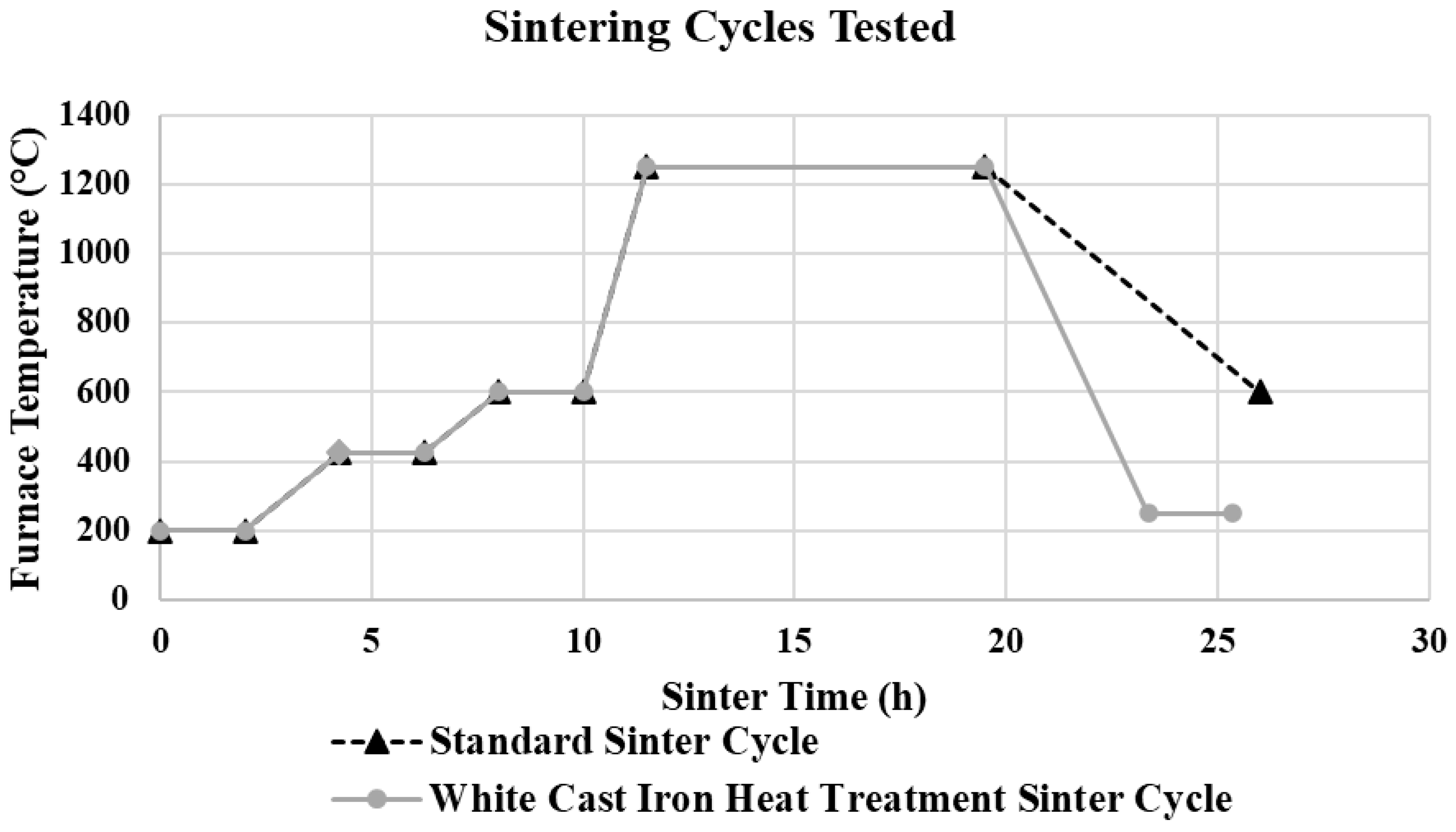
| Investigation | Peak Sinter Temperature (25 °C Intervals) | Dwell Time (4 h Intervals) | Cooldown Process (Standard/Heat Treatment) |
|---|---|---|---|
| Peak Sinter Temperature | 1225 °C | 8 h | Standard |
| 1250 °C | 8 h | Standard | |
| 1275 °C | 8 h | Standard | |
| Dwell Time Trials | 1250 °C | 4 h | Standard |
| 1250 °C | 8 h | Standard | |
| 1250 °C | 12 h | Standard | |
| Heat Treatment | 1250 °C | 8 h | Standard |
| 1250 °C | 8 h | Heat Treatment |
| Peak Sinter Temperature (°C) | Peak Sinter Dwell Time (h) | Cooldown Process | Average Printed Diameter (mm) | Average Printed Height (mm) | Average Printed Mass (g) | Average Printed Density (g/cc) | Volume (cc) | Sintered Diameter (mm) | Sintered Height (mm) | Sintered Mass (g) | Sintered Density (g/cc) | Sintered Volume (cc) | Average Sintered Microhardness (HV) | Diameter Shrinkage (%) | Height Shrinkage (%) | Volume Shrinkage (%) |
|---|---|---|---|---|---|---|---|---|---|---|---|---|---|---|---|---|
| 1250 | 12 | STD | 13.05 | 25.60 | 10.77 | 3.15 | 3.42 | 11.13 | 15.65 | 8.76 | 5.75 | 1.52 | 388 | 14.69 | 38.87 | 55.51 |
| 12.89 | 25.77 | 10.95 | 3.26 | 3.36 | 10.26 | 13.07 | 7.20 | 6.66 | 1.08 | 20.40 | 49.28 | 67.87 | ||||
| 1250 | 8 | STD | 12.85 | 25.80 | 10.82 | 3.23 | 3.35 | 10.34 | 15.94 | 8.81 | 6.59 | 1.34 | 245 | 19.56 | 38.22 | 60.02 |
| 12.75 | 25.76 | 11.01 | 3.35 | 3.29 | 10.75 | 17.52 | 8.88 | 5.59 | 1.59 | 15.71 | 31.99 | 51.68 | ||||
| 1250 | 4 | STD | 12.96 | 25.64 | 10.93 | 3.23 | 3.38 | 10.66 | 17.77 | 8.50 | 5.36 | 1.58 | 198 | 17.77 | 30.69 | 53.14 |
| 12.88 | 25.60 | 11.08 | 3.32 | 3.34 | 10.55 | 18.53 | 6.96 | 4.29 | 1.62 | 18.06 | 27.62 | 51.41 | ||||
| 1275 | 8 | STD | 12.98 | 26.17 | 11.25 | 3.25 | 3.46 | 10.90 | 13.05 | 7.20 | 5.91 | 1.22 | 274 | 16.00 | 50.13 | 64.81 |
| 12.94 | 25.99 | 11.21 | 3.28 | 3.42 | 10.62 | 12.32 | 7.22 | 6.61 | 1.09 | 17.90 | 52.60 | 68.05 | ||||
| 1225 | 8 | STD | 12.97 | 26.27 | 11.43 | 3.29 | 3.47 | 10.29 | 18.55 | 8.95 | 5.80 | 1.54 | 370 | 20.64 | 29.39 | 55.52 |
| 13.18 | 26.20 | 11.42 | 3.19 | 3.57 | 10.89 | 19.65 | 7.00 | 3.83 | 1.83 | 17.40 | 25.00 | 48.83 | ||||
| 1250 | 8 | HT | 12.98 | 26.12 | 11.39 | 3.30 | 3.46 | 10.51 | 17.56 | 9.00 | 5.91 | 1.52 | 254 | 19.03 | 32.77 | 55.92 |
| 13.01 | 26.02 | 11.37 | 3.29 | 3.46 | 10.20 | 16.47 | 9.00 | 6.69 | 1.34 | 21.62 | 36.70 | 61.12 |
| Peak Sinter Temperature (°C) | Dwell Time (h) | Cooling Cycle | Porosity (%) | Porosity Notes | Dominant Microstructure | Cast Iron Type Based on Microstructure |
|---|---|---|---|---|---|---|
| 1250 | 4 | STD | 13.8 | Large streaks of porosity throughout the entire sample. | Mixture of course and fine pearlite with cementite. Cementite exhibited as flowing plates. | White Cast Iron |
| 1250 | 8 | STD | 13.4 | Major uniform porosity throughout the sample. | Mixture of course and fine pearlite with cementite. Few spots with flake clusters of vermicular graphite. | White Cast Iron |
| 1250 | 12 | STD | 16.7 | Thin, uniform porosity scattered throughout the sample. | Course pearlite grains with austinite in the center with square cementite plates. | White Cast Iron |
| 1225 | 8 | STD | 15.8 | Major scattered porosity with a crack through the center of the sample. | Ledeburite throughout the cementite with course pearlite grains. | White Cast Iron |
| 1275 | 8 | STD | 9.8 | Large porosity streaks throughout the center of the sample. | Larger grains with course pearlite. Large non-circular carbon deposits. | Gray Cast Iron |
| 1250 | 8 | HT | 11.4 | Thin, uniform porosity with some larger spots scattered throughout the sample. | Fine pearlite grains with small streaks of flowing cementite. | White Cast Iron |
Disclaimer/Publisher’s Note: The statements, opinions and data contained in all publications are solely those of the individual author(s) and contributor(s) and not of MDPI and/or the editor(s). MDPI and/or the editor(s) disclaim responsibility for any injury to people or property resulting from any ideas, methods, instructions or products referred to in the content. |
© 2026 by the authors. Licensee MDPI, Basel, Switzerland. This article is an open access article distributed under the terms and conditions of the Creative Commons Attribution (CC BY) license.
Share and Cite
Drummond, M.; MacLean, G.; Eltaggaz, A.; Deiab, I. Investigation of Sintering Parameters for Low-Cost 3D-Printed Cast Iron Using Material Extrusion. Machines 2026, 14, 166. https://doi.org/10.3390/machines14020166
Drummond M, MacLean G, Eltaggaz A, Deiab I. Investigation of Sintering Parameters for Low-Cost 3D-Printed Cast Iron Using Material Extrusion. Machines. 2026; 14(2):166. https://doi.org/10.3390/machines14020166
Chicago/Turabian StyleDrummond, Matthew, Gillian MacLean, Abdelkrem Eltaggaz, and Ibrahim Deiab. 2026. "Investigation of Sintering Parameters for Low-Cost 3D-Printed Cast Iron Using Material Extrusion" Machines 14, no. 2: 166. https://doi.org/10.3390/machines14020166
APA StyleDrummond, M., MacLean, G., Eltaggaz, A., & Deiab, I. (2026). Investigation of Sintering Parameters for Low-Cost 3D-Printed Cast Iron Using Material Extrusion. Machines, 14(2), 166. https://doi.org/10.3390/machines14020166