


Abstract
Additive manufacturing enables lightweight sandwich structures with complex cellular cores, but the selection of material and process settings typically involves trade-offs among mechanical performance, cost, and sustainability. This study proposes an integrated multi-criteria decision-making framework to identify the most suitable configuration for Fused Filament Fabrication (FFF) sandwich structures featuring a gyroid triply periodic minimal surface (TPMS) core. Eight alternatives are evaluated by combining two materials (PLA and PLA–Flax biocomposite) with two extrusion temperatures (200 °C and 220 °C) and two infill densities (20% and 30%). Mechanical performance is represented by flexural strength obtained from three-point bending tests reported in a previously published experimental campaign, while economic and environmental indicators are quantified through material cost and printing energy consumption, respectively. Criteria weights are derived using the Analytic Hierarchy Process (AHP) based on expert judgment and consistency-ratio verification, and the alternatives are ranked using the TOPSIS method. The results highlight a clear dominance of PLA-based configurations under the adopted weighting scheme, with PLA printed at 200 °C and 20% infill emerging as the best compromise solution. PLA–Flax options are penalized by higher material cost, higher printing-process energy demand, and lower flexural strength in the investigated conditions. The proposed AHP–TOPSIS workflow supports transparent, data-driven selection of AM process–material combinations for gyroid sandwich structures, and it can be readily extended by including additional sustainability metrics (e.g., CO2-equivalent) and application-specific constraints. A sensitivity analysis under alternative weighting scenarios further confirms the robustness of the obtained ranking.
1. Introduction
In recent years, Additive Manufacturing (AM) technologies, as alternatives to traditional production methods that are often complex and time-consuming [1,2], have emerged as versatile solutions for producing components with complex geometries that are difficult or impossible to obtain with conventional techniques. These components are lightweight and can be manufactured with minimal material waste, and they are highly customizable, reducing production times and improving cost efficiency [3,4]. The design of ultra-light sandwich structures, conceived to guarantee specific and highly controlled performance properties, is one of the areas in which the above-mentioned techniques are used [5,6]. In particular, the Fused Filament Fabrication (FFF) technique uses a nozzle of a predetermined diameter and a thermoplastic filament, heated to a semi-molten state and extruded, to deposit the material layer by layer and thus build the component without the need for tools or instruments [2,7]. This approach enables the design of internal lattice or cellular architectures, significantly reducing the structural mass compared to solid components without compromising rigidity or strength, which is particularly interesting for applications in the automotive, packaging, light construction and sustainable design sectors [8,9].
Among the most promising lattice or cellular core architectures, the ‘gyroid’ geometry, belonging to the family of triply periodic minimal surfaces (TPMS), has recently gained increasing attention because it allows for optimization in material usage: its continuous, node-free morphology promotes efficient stress distribution while maintaining lightness and strength [10]. However, the core topology alone is not sufficient to guarantee good mechanical performance, as this is also strongly influenced by printing process parameters such as infill density, cell pattern, skin thickness, deposited material fraction, temperature, and deposition quality; these parameters often determine how rigid the structure is, how it flexes and how it breaks [11,12].
Beyond coupon-level testing, recent studies have increasingly coupled experimental mechanical characterization with structural analysis and numerical modeling to assess the real performance of additively manufactured components under service-relevant loading conditions. For instance, Gonabadi et al. [13] investigated small-scale 3D-printed composite tidal turbine blades by combining experimental characterization with numerical and structural assessments, highlighting how validated mechanical inputs are essential for predicting structural integrity and performance at the component level. Similarly, other works have emphasized that FFF parts exhibit anisotropic and spatially variable mechanical behavior and that experimental characterization is a key prerequisite for reliable finite element validation and structural performance prediction in AM components [14].
At the same time, growing attention to environmental sustainability has driven research into bio-based materials and the use of natural fibers as reinforcement. The bioplastic polymer polylactic acid (PLA) is widely used in FFF because it is renewable and biodegradable [15,16]. Improvements in mechanical properties can be achieved by incorporating natural fibers such as flax, hemp, or other lignocellulosic fibers into the matrix, generating 3D-printable biocomposites [17,18,19]. Although aspects such as uniform fiber dispersion, fiber-matrix compatibility, and interlayer adhesion are complex to manage, the performance gains reported in the literature can justify continued interest in these systems, provided that processing conditions are appropriately controlled [20].
From a decision-making standpoint, the increasing design freedom enabled by AM has also amplified the “selection problem”: engineers must choose among competing material–process–parameter combinations that rarely optimize mechanical performance, cost, and sustainability simultaneously. For this reason, multi-criteria decision-making (MCDM) methods have become increasingly adopted in AM research to support transparent ranking and selection tasks, particularly when multiple conflicting objectives must be reconciled within a single decision workflow [21,22].
Within extrusion-based AM, hybrid AHP/TOPSIS (and related fuzzy-AHP/TOPSIS variants) has been used to select and prioritize printing solutions when both performance and operational indicators must be considered. For example, Raja et al. [23,24] employed a Fuzzy-AHP + TOPSIS scheme to identify preferred parameter sets in extrusion-based 3D printing, showing how the method structures the trade-off between mechanical outputs and process-related indicators through an explicit weighting-and-ranking pipeline.
At the system level, MCDM has also been used to support the selection of FFF equipment. Raman et al. [25] proposed a TOPSIS-based methodology to assist technical experts in selecting FFF machines, motivated by the growing variability of printer architectures and the need to compare alternatives through a consistent multi-criteria perspective. More broadly, recent studies have framed AM equipment selection as an AHP-driven decision problem, reinforcing the role of structured expert judgment in AM-related choices beyond purely mechanical testing.
Despite the growing attention to reticular cores, biocomposites, and the influence of printing parameters, there is a significant gap in the literature. Few studies systematically integrate the three key evaluation dimensions: mechanical performance, production and cost efficiency, and environmental sustainability. An even smaller number of studies use multi-criteria decision-making (MCDM) methods to handle the inevitable trade-offs among these dimensions. Some studies apply these criteria for the manufacturing process selection, additive or not [22,26], or for choosing materials in specific applications, such as biomedical [27]. In process optimization, Akhoundi and Modanloo [28] presented an MCDM-based analysis for ABS/Cu composite printing, explicitly ad-dressing conflicting objectives (e.g., strength-related outputs versus time/weight-related indicators) and showing how a structured multi-criteria approach can guide parameter selection beyond single-objective optimization. Sartini et al. [29] proposed a TOPSIS-based MCDM procedure to optimize build orientation in additive manufacturing, structuring the decision problem through multiple criteria (including cost-effectiveness, rapidity/productivity, quality, and mechanical strength) and demonstrating the workflow on real components. This line of work illustrates how MCDM methods are increasingly used to formalize AM “trade-offs” into repeatable selection procedures.
However, the above MCDM applications are predominantly focused on bulk parts, generic process optimization, or single-component orientation decisions; conversely, the application of AHP–TOPSIS to the multi-criteria selection of FFF-printed rigid sandwich structures with TPMS (gyroid) cores—where structural performance is a feasibility prerequisite and cost/process-energy are decisive discriminants—remains scarcely explored. This gap is particularly relevant when comparing conventional PLA with bio-based composites such as PLA–Flax, where process-level indicators (printing time/energy) and material-level indicators (cost and sustainability proxies) must be combined consistently to enable actionable selection [30,31].
In this context, ref. [12] is intentionally adopted as a consolidated experimental benchmark, providing a validated dataset on the mechanical behavior of FFF-printed gyroid sandwich structures; the present work builds upon these data by introducing additional economic and process-energy criteria and by integrating all indicators within a structured AHP–TOPSIS decision-making framework.
In light of these considerations, this paper proposes an integrated approach aimed at selecting the optimal combination for 3D-printed sandwich structures with gyroid cores, balancing mechanical performance, production costs, and environmental sustainability, through an MCDM model applied to the available experimental configurations reported by Calabrese et al. [12]. While ref. [12] provides detailed mechanical evidence on the effects of material type, infill density, and extrusion temperature, it does not include cost or process-energy indicators; the present study addresses this gap to enable decision-oriented comparisons. Without such complementary indicators, the direct transfer of the mechanical findings of ref. [12] to practical decision-making contexts remains limited, particularly when economic constraints and process efficiency are decisive for implementation. The lack of economic and environmental assessments essential for practical decisions makes the results of this study difficult to use in real production contexts and limits their applicability to industrial or design fields only.
2. Materials and Methods
2.1. Materials, Printing Setup and Mechanical Testing
The reference experimental study for the mechanical input phase is that conducted by Calabrese et al. [12], which evaluated the flexural behavior of sandwich structures 3D printed using Fused Filament Fabrication (FFF) technology with two polymeric materials: PLA, provided by Filoalfa (Ciceri de Model Srl, Ozzero, Italy), and PLA reinforced with natural flax fibers (PLA–Flax; type Starflax 3D) provided by Nanovia (Nanovia, Louargat, France). The mechanical performance values adopted in this work are intentionally taken from ref. [12] as a validated benchmark dataset; this methodological choice enables the present study to focus on the decision-support contribution by complementing the benchmark mechanical data with additional cost and process-energy indicators generated in this work and by integrating all criteria within the AHP–TOPSIS workflow. PLA is a biodegradable thermoplastic used as a benchmark due to its ease of extrusion and the high surface quality that can be achieved during printing. The PLA–Flax filament incorporates discontinuous lignocellulosic fibers that give the material greater specific rigidity and a higher biobased content, although it also entails greater sensitivity to process parameters and melting temperature in order to ensure good fiber wettability and adequate interlaminar adhesion [12].
The structures investigated have a sandwich configuration, consisting of two high-density outer skins and an internal core based on a gyroid infill, belonging to the class of periodic minimal surfaces (TPMS). This architecture was chosen for its favorable mechanical properties: the geometric continuity of the gyroid allows for a more effective redistribution of stresses compared to beam-based lattices, limiting concentrated stresses and reducing the tendency to trigger localized failures. The infill densities considered, 20% and 30%, allow for the modulation of rigidity and material savings: lower values reduce weight and costs, while higher values increase the capacity to absorb bending loads and delay the instability of the internal cells. The structure was generated using parametric slicing, which keeps the layer height, track width, number of walls and pattern orientation constant, so as to isolate the effect of the temperature and infill density factors studied [11,12].
The samples were produced using a FFF printer, with the bed temperature maintained at a constant 60 °C and two extrusion temperature levels, 200 °C and 220 °C. The decision to vary only this parameter was motivated by its decisive role in promoting diffusion bonding between successive tracks, which increases the viscosity of the matrix and improves the wettability of natural fibers in the case of PLA–Flax. Higher extrusion temperatures can, in fact, promote a more solid interface between the core and skin, a phenomenon that is particularly relevant in sandwich structures where delamination is one of the main mechanisms of failure. The other printing parameters were kept identical for both materials [12].
Mechanical tests were performed using a three-point bending test, with test piece geometry in accordance with the methodology adopted by Calabrese et al. [12]. Each experimental configuration was tested in at least three replicates to ensure adequate statistical significance and to capture any dispersions related to the intrinsic variability of the FFF process, such as microstructural defects, incomplete fusions or internal porosity. The flexural strength results exhibit a limited experimental scatter for both PLA and PLA–Flax configurations. This variability is primarily associated with intrinsic FFF-related factors, including local variations in interlayer bonding quality, filament deposition continuity, and the onset of localized gyroid cell instability under bending loads, as discussed in [12]. In particular, PLA–Flax specimens may show a slightly higher dispersion due to the presence of natural fibers and their influence on melt flow, fiber wetting, and the sensitivity of interlaminar adhesion to processing temperature. Despite this scatter, the differences between material systems and processing conditions remain clearly distinguishable; therefore, the use of mean flexural strength values provides a representative and robust indicator for comparative purposes within the MCDM framework. The maximum force and flexural modulus were obtained from the force-displacement curves, while observation of the fracture surface allowed the failure modes to be classified as follows:
- breakage of the lower skin due to traction;
- core–skin delamination due to poor interlayer adhesion;
- collapse or instability of gyroid cells (localized buckling).
In particular, it is observed that PLA–Flax, due to the presence of natural fibers, is more sensitive to deposition temperature and shows greater variability in fracture modes when printed at insufficient temperatures [12].
The correlation among microstructure, process, and mechanical response forms the basis of the criteria subsequently used in the MCDM framework. In this study, the term “MCDM framework” refers to the structured application of established AHP and TOPSIS methods to the specific decision problem considered, without implying the development of a novel decision-making methodology.
2.2. Estimation of Material Cost and Printing Energy
To complement the mechanical dataset taken from ref. [12], two additional indicators were generated in this work to enable the multi-criteria assessment: (i) direct material cost (C2) and (ii) printing energy consumption (C3). For consistency, specimen masses and printing times were taken from ref. [12], which reports the same geometries and process configurations considered in the MCDM framework.
The direct material cost per specimen was computed as:
where is the specimen mass (kg) and is the filament unit price (EUR/kg). The mass values were taken from ref. [12]. Filament prices were defined through a market survey and expressed net of VAT (VAT excluded), since VAT is tax-neutral for VAT-registered entities and does not affect the comparative cost ranking. In particular, for PLA—characterized by a wide price range from approximately 10 EUR/kg (economy spools) to above 25 EUR/kg (premium spools)—a representative average value of 17.50 EUR/kg was adopted. For PLA–Flax, the unit price was set equal to the filament used in ref. [12] (commercial name “Starflax 3D”), i.e., 55 EUR/kg (excluding VAT).
Printing energy per specimen was estimated by coupling printing time to printer electrical power:
where is the nominal electrical power of the printer (kW) and is the printing time (h). Printing times for each configuration were taken from ref. [12]. Two printer platforms were considered, consistently with the equipment used to generate the time estimates: 118 W for Bambu Lab X1-Carbon (Bambu Lab, Shenzhen, China), used for PLA samples, and 200 W for Creality K1 Max (Creality, Shenzhen, China), used for PLA–Flax samples. The resulting energy values are therefore calculated directly as C3 (kWh) for each alternative and reported in the decision matrix.
It is noted that C2 represents direct material cost only (filament cost), while C3 represents the electricity demand associated with printing time and nominal printer power. Accordingly, C3 should be interpreted as printing-process energy consumption (a process-level proxy), rather than a comprehensive environmental footprint indicator, since upstream material impacts (e.g., embodied energy and CO2-eq of filament production) are not included. These indicators are intended as transparent, first-order proxies suitable for ranking alternatives within the AHP–TOPSIS framework, rather than a full life-cycle assessment.
3. Multi-Criteria Decision-Making (MCDM) Framework
In order to identify the optimal configuration for 3D-printed sandwich structures with gyroid cores, an integrated Multi-Criteria Decision-Making (MCDM) approach is employed. MCDM methods are powerful tools used to make decisions in complex situations where multiple objectives and criteria are often involved. These techniques allow decision-making processes to be structured, enabling decision-makers to balance various factors such as cost, quality, efficiency, and sustainability. In the field of additive manufacturing, MCDM approaches have been increasingly adopted to support transparent and systematic selection tasks when performance-related and operational indicators must be jointly evaluated. The multi-objective approach is particularly useful when decisions involve balancing conflicting goals, such as increasing production capacity while keeping costs low and minimizing pollution. Although MCDM methods are flexible and help make more rational decisions, their application requires careful evaluation of alternatives, complex data analysis, and the management of subjectivity in assessments. These methods are especially effective in supporting sustainability, as they allow for the consideration of both economic and environmental dimensions of each alternative. However, the use of MCDM can be limited by the difficulty of assigning appropriate weights to different criteria and by computational complexity, especially in contexts with many variables [32,33].
In the specific case, the decision-making process aims to balance the three key dimensions: mechanical performance, production costs, and environmental sustainability. The MCDM model considers the trade-offs between these criteria, which are influenced by non-linear interactions between printing parameters such as material type, extrusion temperature, and infill density.
Mechanical performance is evaluated based on previously obtained experimental data, including flexural strength which is adopted as the mechanical criterion in the decision matrix, as reported by Calabrese et al. 2025 [12]. In addition, qualitative observations on flexural response and failure modes reported in [12] are used to support the interpretation of the ranking results. These performance metrics are essential for determining the structural integrity of the printed sandwich components under bending loads. The failure modes, such as breakage of the lower skin, core-skin delamination, and collapse of gyroid cells, are particularly significant for assessing durability and reliability.
Production costs are assessed by considering material consumption, expressed as direct filament cost per specimen, as defined in Section 2.2. Material costs are influenced by the choice of filament (PLA vs. PLA–Flax), while printing time and printer power determine the process-energy indicator. These cost elements are essential for understanding the economic viability of different configurations, especially in an industrial context where cost reduction is a primary goal [34].
Environmental sustainability is evaluated by considering the environmental impact of the printing process, which in this study is represented by the electricity demand associated with printing time and nominal printer power (printing energy consumption, C3), as detailed in Section 2.2. Accordingly, upstream material-related impacts (e.g., embodied energy or CO2-equivalent emissions associated with filament production) and end-of-life considerations are outside the scope of the present analysis and are discussed as a limitation and future extension.
Given the non-linear relationships between the process parameters and the evaluation criteria, the TOPSIS (Technique for Order of Preference by Similarity to Ideal Solution) method is applied to rank the configurations. TOPSIS helps to identify the configuration that is closest to the ideal solution (i.e., the configuration that maximizes mechanical performance and minimizes costs and process-energy demand) while considering the trade-offs among the criteria [35].
In the following sections, the specific criteria, weights, and decision-making process will be detailed, and the results of the MCDM analysis will be presented. The outcomes will help guide the selection of the optimal configuration for 3D-printed sandwich structures with gyroid cores, balancing performance, cost, and environmental impact.
3.1. Identification of Criteria and Alternatives
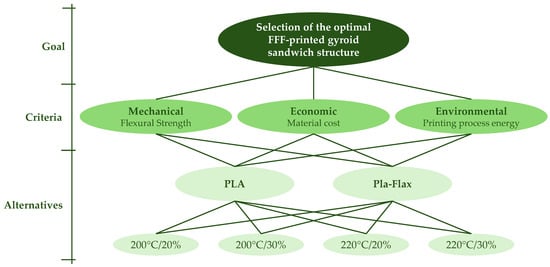
For the purpose of the multi-criteria evaluation, three criteria were selected to represent the mechanical, economic, and environmental aspects relevant to material selection in additive manufacturing (see Figure 1 for the hierarchical AHP structure). The mechanical criterion, defined by flexural strength, represents the ability of the material to withstand bending loads without undergoing permanent deformation or failure and constitutes one of the main indicators of the structural performance of 3D-printed components. Higher flexural strength values are associated with more reliable and mechanically robust materials. The economic criterion, represented by the material cost, reflects the financial impact associated with the use of each material in the manufacturing process, directly affecting economic sustainability, particularly in large-scale production scenarios; lower costs indicate a better cost–performance ratio. Finally, the environmental criterion, represented by the electricity demand of the printing process (printing energy consumption), was evaluated in terms of printing time and nominal printer power, as described in Section 2.2. This indicator represents a process-level environmental proxy and does not include upstream material-related impacts (e.g., embodied energy or CO2 footprint associated with filament production), which may influence the relative sustainability comparison between PLA and PLA–Flax. Lower printing-energy values correspond to lower process electricity demand.
Figure 1.
Hierarchical AHP structure.
The alternatives considered in the evaluation include two materials, PLA and PLA–Flax, each analyzed under different processing conditions by varying the deposition temperature and the infill density.
Specifically, for both materials, four configurations were investigated: deposition temperatures of 200 °C and 220 °C, combined with infill densities of 20% and 30%. These alternatives allow for a comprehensive assessment of the combined effects of material type and key printing parameters on mechanical performance, economic cost, and environmental impact, thus providing a solid comparative basis for the application of the TOPSIS approach.
3.2. The AHP Method
To determine the weights of the evaluation criteria, the Analytic Hierarchy Process (AHP) was adopted, as it is widely used in multi-criteria decision-making problems due to its ability to integrate qualitative and quantitative judgments in a structured manner. In this study, AHP is employed exclusively to derive the relative importance of the criteria, while the evaluation and ranking of alternatives are performed through the quantitative TOPSIS procedure based on numerical performance indicators.
Specifically, the environmental, economic, and mechanical criteria were organized in a single-level hierarchy and compared pairwise based on their relative importance with respect to the objectives of the present analysis. The pairwise comparisons were expressed using Saaty’s fundamental scale (1–9), which allows the intensity of preference of one criterion over another to be quantified [36]. The judgments required to populate the pairwise comparison matrix were elicited through a structured interview with an operational expert from the University of Messina (UniME), who possesses substantial hands-on experience and in-depth knowledge of the functional and strategic aspects of additive manufacturing (3D printing) operations, as well as of the mechanical behavior and performance of printed components. Although the weighting procedure relied on a single expert judgment, the resulting pairwise comparisons were verified through the consistency ratio (CR) to ensure internal logical coherence. The proposed AHP–TOPSIS framework is inherently flexible and can be readily extended to multi-expert or consensus-based weighting schemes (e.g., involving external industrial stakeholders) as well as to sensitivity analyses aimed at quantifying the impact of alternative weight sets on the final ranking. Accordingly, a sensitivity analysis was performed and is reported in Section Sensitivity Analysis of Criteria Weights, where alternative cost-oriented, energy-oriented, and balanced weighting scenarios are evaluated to assess the robustness of the TOPSIS ranking. This expert-based elicitation ensured that the pairwise judgments were grounded in practical industrial and operational considerations.
From the resulting pairwise comparison matrix, the criteria weights were obtained as the normalized principal eigenvector, ensuring that each weight was positive and that the sum of the weights was equal to unity
To assess the reliability of the judgments, the consistency ratio (CR) was also calculated, and the comparison matrix was accepted only when the CR value was below the threshold commonly recommended in the literature [37].
The higher weight assigned to flexural strength reflects a constraint-driven engineering perspective typical of load-bearing sandwich structures, where mechanical integrity represents a prerequisite for feasibility rather than a mere optimization objective. In other words, configurations that do not provide adequate structural performance would not be viable irrespective of their potential cost or energy advantages. Cost and printing energy were therefore included as secondary—but still relevant—criteria to discriminate among mechanically admissible alternatives. Different application contexts (e.g., non-structural components or sustainability-driven design) may justify alternative weighting schemes, which can be readily explored within the proposed AHP–TOPSIS framework.
The resulting weights represent the relative importance of the criteria in the decision-making process and were subsequently employed in the evaluation of the alternatives using the TOPSIS approach, thus ensuring methodological consistency between the weighting phase and the ranking phase. The weights obtained for the three criteria are inserted in Table 1.
Table 1.
Weights.
3.3. The TOPSIS Approach
The TOPSIS approach is based on the idea of identifying the alternative that most closely approximates the ideal solution (the configuration that maximizes the desired benefits and minimizes negative impacts) and that is farthest from the negative ideal solution [38]. In a context such as the design of 3D sandwich structures, where multiple conflicting criteria (performance, cost, sustainability) are involved, this approach helps to explicitly balance the trade-offs among these dimensions, while accounting for the non-linear interactions between the various process parameters.
The implementation of TOPSIS is divided into several phases [39]:
- Acquisition of input data: once the criteria Cj (j = 1, …, m) and the alternatives Ai (i = 1, …, n) have been defined, the weights of the criteria wj and the performance scores of the alternatives with respect to each criterion are collected. These performance scores constitute the elements of the decision matrix Z, where the generic element zij represents the evaluation of alternative Ai with respect to criterion Cj.
- Construction of the weighted normalized decision matrix R: the decision matrix Z is transformed into the weighted normalized decision matrix R through normalization and weighting procedures. The generic element rij of matrix R is computed according to the following equation.where tij denotes the normalized value of the element zij, as computed according to the following equation:
- Determination of the positive ideal solution (PIS)and the negative ideal solution (NIS)
The PIS and NIS are defined by selecting the best and worst values of each criterion, respectively, while distinguishing between benefit criteria and cost criteria .
- 4.
- Computation of separation measures: for each alternative Ai, the separation distances from the positive ideal solution PIS and from the negative ideal solution NIS are calculated with the following relations.
- 5.
- Evaluation of the relative closeness coefficient (Si): the relative closeness coefficient quantifies the proximity of each alternative to the ideal solution. Higher values of Si indicate alternatives that are closer to the positive ideal solution and thus more preferable, enabling the ranking of alternatives accordingly.
Table 2 presents the alternatives scores by criterion (mechanical data and specimen masses/printing times were taken from [12]; material prices and printer nominal powers were defined in this study as described in Section 2.2), while Table 3 reports their ranking and corresponding Si values.
Table 2.
Decision matrix.
Table 3.
Final ranking.
4. Results and Discussion
The results obtained through the TOPSIS analysis, expressed by the relative closeness coefficient Si, provide a clear and structured ranking of the investigated alternatives, highlighting the combined influence of material type and printing parameters on mechanical, economic, and environmental performance. Since Si represents the degree of proximity of each alternative to the positive ideal solution, higher values indicate configurations that achieve the best trade-off among the selected criteria.
A first noteworthy outcome is the clear dominance of PLA-based alternatives, which occupy the first four positions in the ranking with very high Si values. In particular, the configuration printed in PLA at 200 °C with 20% infill emerges as the best-performing option, with a Si value close to unity (0.995). This result indicates that this configuration closely approximates the ideal solution, combining adequate flexural strength with lower material costs and reduced energy consumption during printing. From a practical perspective, this suggests that moderate processing conditions and lower infill density are sufficient to achieve satisfactory mechanical performance while minimizing economic and environmental burdens.
As the deposition temperature and infill density increase, a gradual decrease in Si is observed for PLA-based configurations (0.928, 0.820, and 0.803). This trend suggests that the marginal gains in mechanical performance obtained at higher temperatures or higher infill densities do not compensate for the associated increases in material usage, energy consumption, and overall cost. Consequently, the TOPSIS results highlight a point of diminishing returns, beyond which more aggressive processing parameters lead to a reduction in overall multi-criteria performance.
Conversely, all PLA–Flax alternatives are ranked in the lower part of the hierarchy, with significantly lower Si values compared to PLA (0.349, 0.348, 0.134, and 0.132). Although PLA–Flax composites are often considered advantageous from an environmental standpoint due to the presence of natural fibers, their performance in the present analysis appears to be penalized by higher material costs and less favorable mechanical behavior under the selected printing conditions. Moreover, the need for higher processing temperatures and potentially longer printing times contributes to increased energy consumption, which negatively affects the environmental criterion when evaluated at the process level rather than at the raw-material level. It should be emphasized that the environmental ranking reflects process-level electricity demand only; therefore, the lower positioning of PLA–Flax configurations does not imply inferior intrinsic sustainability, but rather highlights the limitations of energy-based proxies when upstream material benefits (e.g., bio-based content and reduced fossil polymer fraction) are not explicitly accounted for.
An important aspect of the obtained ranking is the sharp discontinuity between the PLA and PLA–Flax groups, particularly between the fourth and fifth positions (0.803 vs. 0.349). This separation indicates that, within the adopted weighting scheme, the choice of material exerts a stronger influence on the final ranking than variations in deposition temperature or infill density. This finding suggests that, under the current assumptions, process optimization alone is insufficient to bridge the performance gap between PLA and PLA–Flax, emphasizing the critical role of intrinsic material properties and cost structure in multi-criteria decision-making.
Sensitivity Analysis of Criteria Weights
In Multi-Criteria Decision-Making (MCDM) studies, sensitivity analysis is a crucial step for assessing the robustness and reliability of the obtained rankings with respect to variations in criteria weights. Since criteria weights inherently reflect subjective judgments or context-dependent assumptions, evaluating how changes in these weights affect the final decision outcome is essential to ensure the soundness of the proposed decision-support model [40]. In this work, a sensitivity analysis was performed by defining alternative weighting scenarios within the TOPSIS framework, allowing the stability of the ranking to be evaluated under different decision-maker priorities. In particular, three alternative scenarios were considered: an increased weight assigned to the cost criterion, an increased weight assigned to the energy consumption criterion, and an equal weighting of all three criteria (see Table 4).
Table 4.
New scenarios investigated for sensitivity analysis.
In the baseline scenario, where criteria weights were derived using the AHP method, the TOPSIS results show a clear distinction between the PLA and PLA–Flax alternatives. All PLA configurations (Si ≈ 0.803–0.995) occupy the top four positions in the ranking, with significantly higher closeness coefficients Si compared to the PLA–Flax options (Si ≈ 0.132–0.349).
The configuration PLA printed at 200 °C with 20% infill achieves the highest Si value (0.995), indicating the best trade-off among mechanical performance, material cost, and energy consumption. Increasing either the processing temperature or the percentage of infill slightly reduces the performance, while all PLA–Flax alternatives remain substantially less competitive in this scenario.
When higher importance is assigned to the cost criterion, the overall ranking structure remains largely unchanged. PLA-based alternatives continue to dominate the top positions, with closeness coefficient values Si ranging from approximately 0.902 to 0.984, confirming their clear economic advantage over PLA–Flax solutions.
Within the PLA group, moderate shifts in the ranking are observed. In particular, PLA printed at 220 °C with 20% infill improves its relative position, reaching an Si value close to that of the best-performing configuration (0.959). This result suggests that, under a cost-driven perspective, certain higher-temperature processing conditions can provide a favorable trade-off between cost and overall performance. Nevertheless, PLA printed at 200 °C with 20% infill remains the top-ranked alternative, indicating that its superiority is not compromised even when economic aspects are strongly prioritized (0.984).
In contrast, all PLA–Flax alternatives remain clustered in the lower part of the ranking, with significantly lower Si values (below 0.30). Although slight internal variations are observed among these configurations, the increased weight assigned to cost does not lead to any substantial improvement in their relative performance. This behavior highlights that the higher material and processing costs associated with flax reinforcement are not sufficiently compensated for by performance gains, even in a strongly cost-oriented decision-making scenario.
When a higher importance is assigned to the energy consumption criterion, the overall ranking structure remains stable, with PLA-based alternatives consistently occupying the top positions. The closeness coefficient values Si for the PLA configurations range approximately between 0.818 and 0.988, confirming their favorable energy–performance balance compared to PLA–Flax solutions.
Within the PLA group, PLA printed at 200 °C with 20% infill remains the best-performing alternative, achieving the highest Si value (0.988), followed by PLA printed at 220 °C with 20% infill (0.944). This result indicates that moderate processing conditions, particularly lower infill percentages, are advantageous when energy efficiency is prioritized. Configurations with higher percentages of infill show a slight decrease in performance, reflecting the increased energy demand associated with more material usage.
In contrast, PLA–Flax alternatives remain relegated to the lower part of the ranking, with Si values generally below 0.35. Although a marginal improvement is observed for some configurations under this scenario, the energy-intensive processing associated with flax-reinforced materials continues to penalize their overall performance. Consequently, even when energy consumption is emphasized, PLA–Flax solutions do not achieve competitiveness with respect to PLA-based alternatives.
When equal weights are assigned to all criteria, the overall ranking remains very similar to the baseline scenario, confirming the stability of the decision-making model. PLA-based alternatives occupy the top positions, with closeness coefficient values Si ranging from approximately 0.862 to 0.986, highlighting their consistently superior performance across all criteria.
Within the PLA group, PLA printed at 200 °C with 20% infill maintains the highest Si (0.986), confirming its role as the optimal compromise among mechanical performance, cost, and energy consumption. PLA printed at 220 °C with 20% infill and PLA printed at 200 °C with 30% infill follow closely, showing slightly lower Si values (0.931 and 0.873, respectively). This indicates that moderate temperature and infill percentages provide a robust trade-off when no single criterion dominates the decision-making process.
The PLA–Flax alternatives continue to occupy the lower part of the ranking, with Si values between approximately 0.130 and 0.294. Although there is minor variation among the flax-reinforced configurations, none achieves competitiveness with PLA alternatives. This pattern confirms that, even under a balanced weighting scheme, the higher costs and energy demands associated with flax reinforcement outweigh the potential performance benefits.
Across all scenarios, PLA printed at 200 °C with 20% infill consistently maintains the first position, demonstrating its role as a dominant solution. The invariance of its ranking under varying weighting schemes indicates an intrinsic balance among mechanical performance, cost, and energy consumption. Minor shifts are observed within the PLA group, but none of the PLA–Flax alternatives surpasses PLA configurations in any scenario. This confirms the robustness of the MCDM model and the reliability of the identified optimal configuration for supporting material and process selection in additive manufacturing.
5. Conclusions
This study applied the TOPSIS method to evaluate and rank different PLA-based and PLA–Flax material configurations based on their mechanical, economic, and environmental performance. The results highlight that PLA-based configurations generally outperform PLA–Flax in terms of the overall balance between flexural strength, cost, and environmental impact. In particular, the configuration printed in PLA at 200 °C and 20% infill emerged as the best alternative, offering a high degree of proximity to the ideal solution. A sensitivity analysis under alternative weighting scenarios (cost-oriented, energy-oriented, and balanced) further confirmed the robustness of the obtained ranking, with PLA at 200 °C and 20% consistently maintaining the top position.
In contrast, the PLA–Flax alternatives were ranked significantly lower due to their higher material costs, increased energy consumption during printing, and relatively lower mechanical performance compared to pure PLA. Despite the potential environmental benefits of using bio-based composites, these configurations appear less competitive in the context of the parameters studied, particularly from an economic and operational standpoint. It should be noted, however, that the sustainability dimension in this study was represented by printing-process electricity demand only (C3), and therefore upstream material-related impacts (e.g., embodied energy and CO2-eq associated with filament production) were not included; this may influence the relative sustainability comparison between PLA and PLA–Flax. Accordingly, the present “environmental” ranking should be interpreted as a process-level assessment and should not be taken as a definitive indicator of overall environmental superiority, which would require additional life-cycle considerations (including embodied impacts and end-of-life scenarios).
The results highlight the importance of a multi-criteria approach for decision-making in extrusion-based additive manufacturing, where it is crucial to strike a balance between the mechanical properties of the material, economic sustainability, and environmental impact. Although PLA proves to be the most advantageous solution under the conditions studied, PLA–Flax may still represent a viable option for specific use-cases, provided that printing conditions and/or material formulations are further optimized. In this regard, future work should focus on the optimization of printing parameters for PLA–Flax, which, due to its potential environmental benefits, deserves further investigation to enhance its competitiveness, particularly for sustainable manufacturing applications. Future developments of the proposed AHP–TOPSIS framework will also integrate broader sustainability indicators (e.g., embodied impacts of filaments and/or LCA-based metrics) to provide a more comprehensive assessment beyond process-energy proxies.
Author Contributions
Conceptualization, M.P. and G.D.B.; methodology, M.P. and G.D.B.; validation, M.P. and G.D.B.; formal analysis, M.P.; investigation, M.P. and G.D.B.; data curation, M.P.; writing—original draft preparation, M.P.; writing—review and editing, M.P. and G.D.B.; visualization, M.P. and G.D.B.; supervision, G.D.B. All authors have read and agreed to the published version of the manuscript.
Funding
This research received no external funding.
Data Availability Statement
No new data were created or analyzed in this study. Data sharing is not applicable to this article.
Conflicts of Interest
The authors declare no conflicts of interest.
References
- Islam, M.A.; Mobarak, M.H.; Rimon, M.I.H.; Al Mahmud, M.Z.; Ghosh, J.; Ahmed, M.M.S.; Hossain, N. Additive Manufacturing in Polymer Research: Advances, Synthesis, and Applications. Polym. Test. 2024, 132, 108364. [Google Scholar] [CrossRef] [Scilit]
- Afonso, J.A.; Alves, J.L.; Caldas, G.; Gouveia, B.P.; Santana, L.; Belinha, J. Influence of 3D Printing Process Parameters on the Mechanical Properties and Mass of PLA Parts and Predictive Models. Rapid Prototyp. J. 2021, 27, 487–495. [Google Scholar] [CrossRef] [Scilit]
- Nikooharf, M.H.; Shirinbayan, M.; Arabkoohi, M.; Bahlouli, N.; Fitoussi, J.; Benfriha, K. Machine Learning in Polymer Additive Manufacturing: A Review. Int. J. Mater. Form. 2024, 17, 52. [Google Scholar] [CrossRef] [Scilit]
- Xames, M.D.; Torsha, F.K.; Sarwar, F. A Systematic Literature Review on Recent Trends of Machine Learning Applications in Additive Manufacturing. J. Intell. Manuf. 2023, 34, 2529–2555. [Google Scholar] [CrossRef] [Scilit]
- Kamarian, S.; Khalvandi, A.; Heidarizadi, E.; Saber-Samandari, S.; Song, J. Prediction and Optimization of 3D-Printed Sandwich Beams with Chiral Cores. Int. J. Mech. Sci. 2024, 262, 108747. [Google Scholar] [CrossRef] [Scilit]
- Zaharia, S.M.; Enescu, L.A.; Pop, M.A. Mechanical Performances of Lightweight Sandwich Structures Produced by Material Extrusion-Based Additive Manufacturing. Polymers 2020, 12, 1740. [Google Scholar] [CrossRef] [Scilit] [PubMed]
- Tian, X.; Todoroki, A.; Liu, T.; Wu, L.; Hou, Z.; Ueda, M.; Hirano, Y.; Matsuzaki, R.; Mizukami, K.; Iizuka, K.; et al. 3D Printing of Continuous Fiber Reinforced Polymer Composites: Development, Application, and Prospective. Chin. J. Mech. Eng. Addit. Manuf. Front. 2022, 1, 100016. [Google Scholar] [CrossRef] [Scilit]
- Harish, A.; Alsaleh, N.A.; Ahmadein, M.; Elfar, A.A.; Djuansjah, J.; Hassanin, H.; El-Sayed, M.A.; Essa, K. Designing Lightweight 3D-Printable Bioinspired Structures for Enhanced Compression and Energy Absorption Properties. Polymers 2024, 16, 729. [Google Scholar] [CrossRef] [Scilit]
- Lee, J.J.; Mohammed, A.A.; Pullen, A.; Myant, C.W.; Proud, W.G. Mechanical Characterisation of 3D Printed Lightweight Lattice Structures with Varying Internal Design Alterations. Mater. Today Commun. 2023, 36, 106456. [Google Scholar] [CrossRef] [Scilit]
- Abueidda, D.W.; Elhebeary, M.; Shiang, C.-S.; Pang, S.; Abu Al-Rub, R.K.; Jasiuk, I.M. Mechanical Properties of 3D Printed Polymeric Gyroid Cellular Structures: Experimental and Finite Element Study. Mater. Des. 2019, 165, 107597. [Google Scholar] [CrossRef] [Scilit]
- Marabello, G.; Chairi, M.; Di Bella, G. Optimising Additive Manufacturing to Produce PLA Sandwich Structures by Varying Cell Type and Infill: Effect on Flexural Properties. J. Compos. Sci. 2024, 8, 360. [Google Scholar] [CrossRef] [Scilit]
- Calabrese, L.; Marabello, G.; Chairi, M.; Di Bella, G. Optimization of Deposition Temperature and Gyroid Infill to Improve Flexural Performance of PLA and PLA–Flax Fiber Composite Sandwich Structures. J. Manuf. Mater. Process. 2025, 9, 31. [Google Scholar] [CrossRef] [Scilit]
- Gonabadi, H.; Hosseini, S.F.; Chen, Y.; Bull, S. Structural Analysis of Small-Scale 3D Printed Composite Tidal Turbine Blades. Ocean Eng. 2024, 306, 118057. [Google Scholar] [CrossRef] [Scilit]
- Torre, R.; Brischetto, S. Experimental Characterization and Finite Element Validation of Orthotropic 3D-Printed Polymeric Parts. Int. J. Mech. Sci. 2022, 219, 107095. [Google Scholar] [CrossRef] [Scilit]
- Castro-Aguirre, E.; Iñiguez-Franco, F.; Samsudin, H.; Fang, X.; Auras, R. Poly(Lactic Acid)—Mass Production, Processing, Industrial Applications, and End of Life. Adv. Drug Deliv. Rev. 2016, 107, 333–366. [Google Scholar] [CrossRef] [Scilit]
- Otieno, D.B.; Bosire, G.O.; Onyari, J.M.; Mwabora, J.M. Advances in 3-D Printing: Polymers, Fabrication Mechanisms, Mass Balance Models and Applications. Discov. Polym. 2024, 1, 10. [Google Scholar] [CrossRef] [Scilit]
- Siddiqui, M.A.S.; Rabbi, M.S.; Ahmed, R.U.; Billah, M.M. Biodegradable Natural Polymers and Fibers for 3D Printing: A Holistic Perspective on Processing, Characterization, and Advanced Applications. Clean Mater. 2024, 14, 100275. [Google Scholar] [CrossRef] [Scilit]
- Bi, X.; Huang, R. 3D Printing of Natural Fiber and Composites: A State-of-the-Art Review. Mater. Des. 2022, 222, 111065. [Google Scholar] [CrossRef] [Scilit]
- Somsuk, N.; Pramoonmak, S.; Chongkolnee, B.; Tipboonsri, P.; Memon, A. Enhancing Mechanical Properties of 3D-Printed PLA Composites Reinforced with Natural Fibers: A Comparative Study. J. Compos. Sci. 2025, 9, 180. [Google Scholar] [CrossRef] [Scilit]
- Mazur, K.E.; Borucka, A.; Kaczor, P.; Gądek, S.; Bogucki, R.; Mirzewiński, D.; Kuciel, S. Mechanical, Thermal and Microstructural Characteristic of 3D Printed Polylactide Composites with Natural Fibers: Wood, Bamboo and Cork. J. Polym. Environ. 2022, 30, 2341–2354. [Google Scholar] [CrossRef] [Scilit]
- Raigar, J.; Sharma, V.S.; Srivastava, S.; Chand, R.; Singh, J. A Decision Support System for the Selection of an Additive Manufacturing Process Using a New Hybrid MCDM Technique. Sādhanā 2020, 45, 101. [Google Scholar] [CrossRef] [Scilit]
- Ren, D.; Choi, J.-K.; Schneider, K. A Multicriteria Decision-Making Method for Additive Manufacturing Process Selection. Rapid Prototyp. J. 2022, 28, 77–91. [Google Scholar] [CrossRef] [Scilit]
- Raja, S.; Praveenkumar, V.; Rusho, M.A.; Yishak, S. Optimizing Additive Manufacturing Parameters for Graphene-Reinforced PETG Impeller Production: A Fuzzy AHP-TOPSIS Approach. Results Eng. 2024, 24, 103018. [Google Scholar] [CrossRef] [Scilit]
- Raja, S.; Jayalakshmi, M.; Rusho, M.A.; Selvaraj, V.K.; Subramanian, J.; Yishak, S.; Kumar, T.A. Fused Deposition Modeling Process Parameter Optimization on the Development of Graphene Enhanced Polyethylene Terephthalate Glycol. Sci. Rep. 2024, 14, 30744. [Google Scholar] [CrossRef] [Scilit]
- Raman, V.V.; Badarinath, R.; Prabhu, V.V. TOPSIS-Based Methodology for Selecting Fused Filament Fabrication Machines. Machines 2025, 13, 574. [Google Scholar] [CrossRef] [Scilit]
- Salmi, A.; Vecchi, G.; Atzeni, E.; Iuliano, L. Hybrid Multi-Criteria Decision Making for Additive or Conventional Process Selection in the Preliminary Design Phase. Designs 2024, 8, 110. [Google Scholar] [CrossRef] [Scilit]
- Abas, M.; Habib, T.; Noor, S.; Zimon, D.; Woźniak, J. Application of Multi-Criteria Decision-Making Methods in the Selection of Additive Manufacturing Materials for Solid Ankle Foot Orthoses. J. Eng. Des. 2023, 34, 616–643. [Google Scholar] [CrossRef] [Scilit]
- Akhoundi, B.; Modanloo, V. A Multi-Criteria Decision-Making Analysis on the Extrusion-Based Additive Manufacturing of ABS/Cu Composites. Int. J. Interact. Des. Manuf. (IJIDeM) 2023, 17, 1995–2003. [Google Scholar] [CrossRef] [Scilit]
- Sartini, M.; Luca, M.; Claudio, F.; Marco, M. A Multi-Criteria Decision-Making Approach to Optimize the Part Build Orientation in Additive Manufacturing. Proc. Des. Soc. 2023, 3, 293–302. [Google Scholar] [CrossRef] [Scilit]
- Dimitrellou, S.; Strantzali, E.; Iakovidis, I. A Decision-Making Strategy for Selection of FDM-Based Additively Manufactured Thermoplastics for Industrial Applications Based on Material Attributes. Sustain. Futures 2025, 9, 100640. [Google Scholar] [CrossRef] [Scilit]
- Junaid, M.; uz Zaman, U.K.; Naseem, A.; Ahmad, Y.; Aqeel, A.B. Material Selection in Additive Manufacturing for Aerospace Applications Using Multi-Criteria Decision Making. MATEC Web Conf. 2024, 398, 01012. [Google Scholar] [CrossRef] [Scilit]
- Mazumdar, N.; Kumar Sharma, J.; Navruzbek Shavkatovich, S.; Uike, D.; Kadam, S.; Verma, M.; Jaber Alam, M.; Sharma, A.; Thakur, A.; Saleh Al Ansari, M. Application of Distinct Multi Criteria Decision Analysis Techniques in the Manufacturing Sector: A Comprehensive Review. Mater. Today Proc. 2023. [Google Scholar] [CrossRef] [Scilit]
- Gil-García, I.C.; Ramos-Escudero, A.; Serrano-Gómez, L.; Fernández-Guillamón, A. Multi-Criteria Decision-Making. In Smart Choices for Clean Energy; Springer Nature: Cham, Switzerland, 2025; pp. 17–45. [Google Scholar]
- Zhou, L.; Miller, J.; Vezza, J.; Mayster, M.; Raffay, M.; Justice, Q.; Al Tamimi, Z.; Hansotte, G.; Sunkara, L.D.; Bernat, J. Additive Manufacturing: A Comprehensive Review. Sensors 2024, 24, 2668. [Google Scholar] [CrossRef] [Scilit]
- Sapkal, S.U.; Warule, P.H. Application of Multi-Attribute Decision Making Methods for Fused Deposition Modelling. In Sustainability for 3D Printing; Sandhu, K., Singh, S., Prakash, C., Subburaj, K., Ramakrishna, S., Eds.; Springer: Cham, Switzerland, 2022; pp. 55–75. [Google Scholar]
- Saaty, T.L. A Scaling Method for Priorities in Hierarchical Structures. J. Math. Psychol. 1977, 15, 234–281. [Google Scholar] [CrossRef] [Scilit]
- Saaty, T.L. Decision Making for Leaders: The Analytic Hierarchy Process for Decisions in a Complex World, 3rd ed.; RWS Publications: Pittsburgh, PA, USA, 2012. [Google Scholar]
- Hwang, C.-L.; Yoon, K. Multiple Attribute Decision Making: Methods and Applications a State-of-the-Art Survey; Springer: Berlin/Heidelberg, Germany, 1981. [Google Scholar]
- Giallanza, A.; Micale, R. A Structured Framework for Evaluating Logistics Networks: A Multidimensional Approach. In Technology and Science for the Ships of the Future; Rizzuto, E., Ruggiero, V., Eds.; IOS Press: Amsterdam, The Netherlands, 2025. [Google Scholar]
- Demir, G.; Chatterjee, P.; Pamucar, D. Sensitivity Analysis in Multi-Criteria Decision Making: A State-of-the-Art Research Perspective Using Bibliometric Analysis. Expert Syst. Appl. 2024, 237, 121660. [Google Scholar] [CrossRef] [Scilit]

Disclaimer/Publisher’s Note: The statements, opinions and data contained in all publications are solely those of the individual author(s) and contributor(s) and not of MDPI and/or the editor(s). MDPI and/or the editor(s) disclaim responsibility for any injury to people or property resulting from any ideas, methods, instructions or products referred to in the content. |
© 2026 by the authors. Licensee MDPI, Basel, Switzerland. This article is an open access article distributed under the terms and conditions of the Creative Commons Attribution (CC BY) license.