


Abstract
To address the increasing demands for faster response and higher control accuracy in the braking systems of electric and intelligent vehicles, a novel brake-by-wire actuation unit and its braking force control methods are proposed. The braking unit employs a permanent-magnet linear motor as the driving actuator and utilizes the lever-based force-amplification mechanism to directly generate the caliper force. Compared with the “rotary motor and motion conversion mechanism” configuration in other electromechanical braking systems, the proposed scheme significantly simplifies the force-transmission path, reduces friction and structural complexity, thereby enhancing the overall dynamic response and control accuracy. Due to the strong nonlinearity, time-varying parameters, and significant thermal effects of the linear motor, the braking force is prone to drift. As a result, achieving accurate force control becomes challenging. This paper proposes a model-free adaptive control method based on compact-form dynamic linearization. This method does not require an accurate mathematical model. It achieves dynamic linearization and direct control of complex nonlinear systems by online estimation of pseudo partial derivatives. Finally, the proposed control method is validated through comparative simulations and experiments against the fuzzy PID controller. The results show that the model-free adaptive control method exhibits significantly faster braking force response, smaller steady-state error, and stronger robustness against external disturbances. It enables faster dynamic response and higher braking force tracking accuracy. The study demonstrates that the proposed brake-by-wire scheme and its control method provide a potentially new approach for next-generation high-performance brake-by-wire systems.
1. Introduction
The braking system is a critical subsystem responsible for vehicle deceleration and stopping, and its performance directly affects driving safety and stability [1,2]. With the rapid development of electric vehicles (EVs) and high-level autonomous driving, the braking systems are required to achieve faster response, higher control accuracy, more redundancy, and fault-tolerance capabilities [3]. The traditional hydraulic braking systems suffer from slow response due to structural limitations and compressibility of brake fluid, and they also face difficulties in independent wheel braking force control [4]. Therefore, hydraulic braking systems are unable to satisfy the demands of electric and intelligent vehicles for high-precision braking force control, independent wheel control, and rapid dynamic response [5]. The higher-performance and more reliable brake actuators have become a key focus in the development of braking systems technology [6].
With the rapid advancement of vehicle electrification and intelligence, the brake-by-wire (BBW) system has become an important technology for braking systems [7]. BBW eliminates the mechanical and hydraulic connections between the brake pedal and wheel actuators. It employs the electronic control unit to acquire and interpret the brake pedal signal and to send corresponding control commands to the wheel actuators, which generate braking through motor-driven actuation [8]. BBW offers higher control accuracy and faster response speed [9]. In addition, BBW enables independent braking force distribution among wheels, facilitates the integration of lateral and longitudinal control, as well as energy recovery [10]. Therefore, BBW has attracted considerable attention from both the automotive industry and the academic community [11].
At present, BBW systems are mainly classified into two categories: electro-hydraulic brake (EHB) and electro-mechanical brake (EMB) [12]. EHB is derived from traditional hydraulic braking systems. It incorporates sensors and controllers into a hydraulic braking system to achieve precise and flexible braking force control [13]. EHB offers cost advantages and technological maturity, but its hydraulic architecture inevitably leads to adverse effects such as fluid compressibility, braking force lag, and dead zones [14]. To address these issues, researchers have explored various strategies to improve braking force control accuracy. Chen et al. [15] investigated the complex nonlinear characteristics of EHB and its sensitivity to environmental conditions. Subsequently, by incorporating dynamic models of key components, the braking force control method based on a sliding mode variable structure algorithm was developed and validated through simulations [15]. To address braking force control issues caused by friction, existing solutions are mainly divided into two categories: signal-based friction compensation and model-based friction compensation. In terms of signal-based compensation, Shi et al. [16] proposed an estimation strategy based on signal fusion. By using the least-squares method, the extended five-degree-of-freedom vehicle dynamics model was integrated with the pressure–position model, and the dynamics model was employed to update the pressure–position model online to compensate for brake-pad wear. The results indicate that the algorithm can achieve pressure estimation under all operating conditions [16]. In terms of model-based compensation, El-bakkouri et al. [17] and Freidovich et al. [18] incorporated the motor current variation model and the LuGre friction model into the controller design, effectively improving the stability and robustness of braking force. In terms of hydraulic pressure dead zones, Lin et al. [19] proposed the cascaded adaptive control strategy, which effectively improved the pressure-tracking accuracy of EHB.
Although EHB offers advantages in cost and technological maturity, it fundamentally remains a hydraulic system, and issues such as brake fluid compressibility and leakage cannot be completely eliminated, limiting potential performance improvements [13,20]. In contrast, EMB completely eliminates the hydraulic structure. It uses the motor to directly drive the brake caliper to apply braking force, resulting in faster response and a more compact structure [21]. EMB overcomes the physical limitations of hydraulic systems, allowing faster signal transmission and response, and the research on its braking force control has become increasingly refined [22]. Li et al. [23] established the caliper force model using polynomial function transformation and proposed the caliper force estimation algorithm that only requires measurement of motor feedback. Chen et al. [24] introduced the scaling factor into fuzzy control and proposed the variable-universe adaptive fuzzy PID caliper force control method, which demonstrates good braking force tracking performance and can meet braking requirements under various operating conditions. Zou et al. [25] proposed the second-order linear feedforward active disturbance rejection controller for caliper force. Compared with the fuzzy PID controller, it improves the response speed by 130 ms, reduces overshoot by 9.85%, and effectively enhances the system’s disturbance rejection capability [25]. Friction and slip phenomena between mechanical components can significantly affect braking force response and tracking accuracy [26,27]. The LuGre model can effectively describe static friction, velocity-dependent friction, and stick-slip characteristics, and is therefore widely used in braking systems [28]. The LuGre model can be applied for friction identification and compensation in EMB, and when combined with state observers or robust controllers, it can significantly enhance braking force control accuracy [21,29]. Meng et al. [30] also proposed the caliper force control strategy that takes into account the contact points between the brake pads and the brake disc. The results indicate that this approach can accurately identify the contact points, enabling rapid response and stable maintenance of caliper force.
Most proposed EMB solutions employ rotary motors. Such solutions first require a motion conversion mechanism to transform the motor’s rotational motion into linear motion, which then drives the caliper and brake pads to apply braking force [1,31]. To further enhance the performance of BBW and explore more efficient and convenient actuators and braking force control methods, this study proposes a novel brake-by-wire unit, which is named the direct-drive brake (DDB). The DDB employs a permanent-magnet linear motor to directly drive the lever mechanism for force amplification, which is then applied to the brake disc and friction pads [32]. Compared with other EMB systems, the proposed DDB eliminates the “rotary motion-to-linear motion” conversion mechanism, thereby reducing friction losses, lowering structural complexity, improving response speed, and enhancing overall system reliability [33].
However, the linear motor exhibits pronounced thermal effects and nonlinear characteristics, and its parameters vary over time. As a result, the accurate and stable thrust control becomes more challenging [34]. To achieve high-precision caliper force control, it is essential to effectively compensate for performance drift caused by friction, mechanical backlash, and temperature-induced coil resistance variations [35]. Although the classical proportional–integral–derivative (PID) controller is widely used in various control systems, it struggles to handle the time-varying and nonlinear characteristics of linear motors, especially under long-duration operation and fast dynamic conditions. In recent years, the rapidly developing model-free adaptive control (MFAC) has offered a new perspective for addressing these challenges [6]. MFAC does not require an accurate mathematical model of the controlled system; it achieves dynamic linearization based on input–output data through pseudo-partial derivative estimation. It is suitable for control systems with complex structures, uncertain parameters, or time-varying characteristics. For example, MFAC has been successfully applied in the control of direct-drive ultrasonic motors and DC linear motor speed regulation, demonstrating excellent responsiveness, adaptability, and robustness.
Compared with existing EMB schemes, the proposed DDB mainly demonstrates its advantages in driving architecture and force transmission principles. The ball screw EMB is composed of a rotating motor, gear mechanism, and ball screw mechanism. It converts the rotational motion of the motor into the linear displacement of the screw. This scheme inevitably introduces mechanical backlash, frictional losses, and multi-stage force transmission paths [36]. The wedge EMB enhances the braking force through the self-increasing force effect of the wedge-shaped mechanism itself. Its braking force is highly sensitive to friction coefficient variations, and complex control strategies are required to ensure stability. Moreover, the wedge EMB still relies on the ball screw mechanism [37]. The inherent defects of the complex structure and long force transmission path remain unchanged. The low force density, strong temperature sensitivity, strong nonlinear saturation characteristics, and long-term reliability issues of magnetorheological EMB also limit its application in automotive brake-by-wire systems [38]. In contrast, the proposed DDB employs a permanent-magnet linear motor to provide the driving force and integrates a lever-based force amplification mechanism. This scheme directly converts the electromagnetic force into a caliper force, without requiring any rotational-to-linear motion conversion. Therefore, the DDB features a shorter force transmission chain, lower friction loss, and higher controllability.
In summary, this paper first designs the compact direct-drive BBW actuator with a shorter transmission chain. It enables the linear motor to directly generate braking force, thereby reducing mechanical complexity and frictional losses. Subsequently, the dynamic models of linear motor and friction compensation models were developed for simulation analysis and controller design. Then, the MFAC method based on compact-form dynamic linearization was proposed to address parameter variations and nonlinearities that classical PID controllers cannot effectively handle. Finally, both simulation and experimental results demonstrate that MFAC outperforms both fuzzy PID and classical PID controllers in terms of response speed, steady-state accuracy, and disturbance rejection.
2. Direct-Drive Brake Unit and Its Brake-by-Wire System Configuration
2.1. Direct-Drive Brake Unit
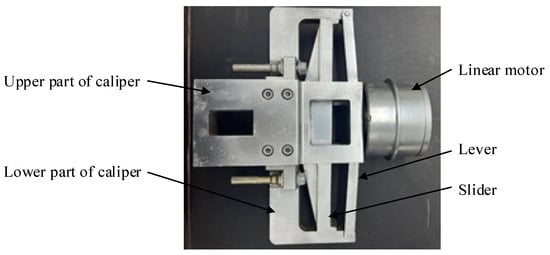
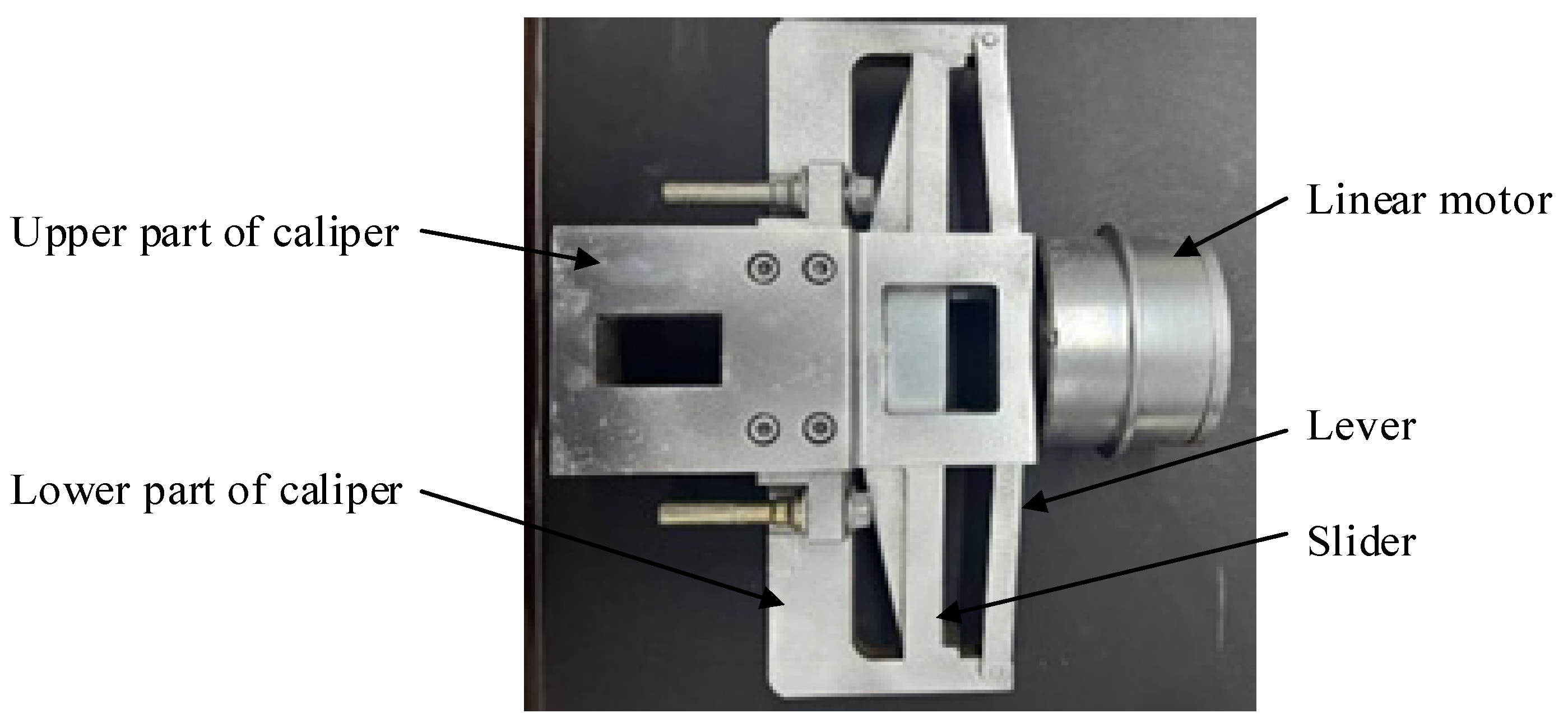
Existing EMB solutions often use rotary motors to provide driving force. The DDB unit designed in this paper replaces the rotary motor with a linear motor and employs the force-amplification mechanism to directly apply the motor’s axial output force to the brake caliper. Compared to other EMB systems, the DDB simplifies the system structure, reduces the number of components, enhances actuator stability, and effectively reduces the size. In addition, the DDB simplifies the complex force transmission process, resulting in faster response. The overall structure of DDB is shown in Figure 1, and its main components include a linear motor, lever mechanism, brake slider, and floating brake caliper.
Figure 1.
Structure of a direct-drive brake unit.
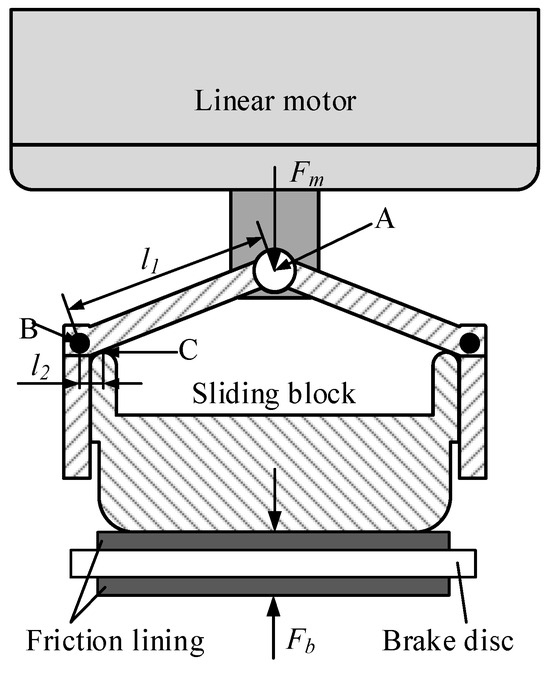
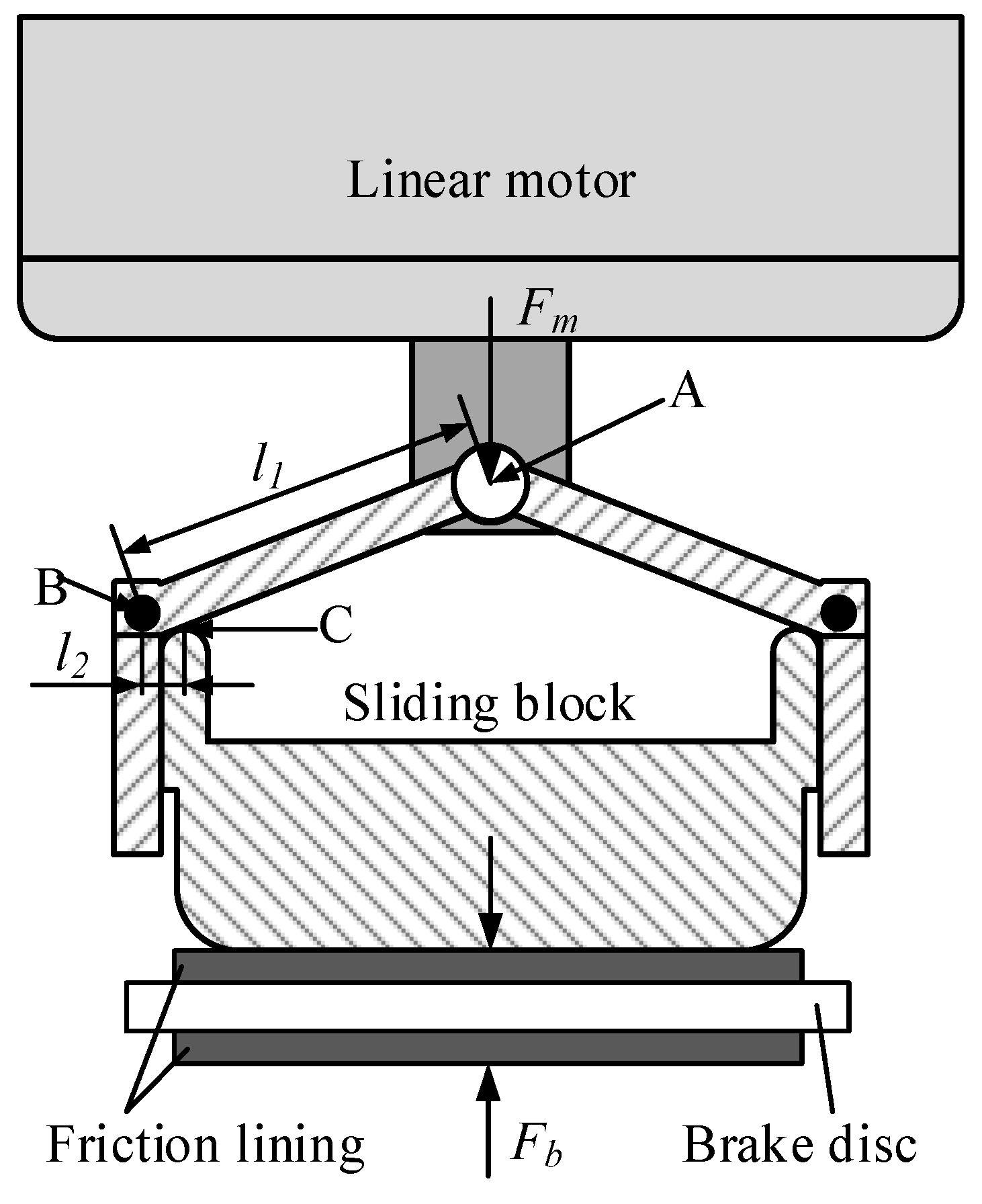
The basic principle and force transmission of DDB are illustrated in Figure 2. The linear motor generates axial electromagnetic force, whose magnitude and direction are controlled by the current magnitude and direction of the motor’s coils. Point A represents the force application point of the lever mechanism, where the linear motor’s electromagnetic force is applied. Point B is the pivot on the fixed bracket, about which the lever rotates. Point C is the resistance point of the lever, where the amplified force from the lever acts on the brake slider. Finally, the slider ensures that the caliper force is evenly applied to the friction pads, allowing the floating caliper to clamp the pads and brake disc, thereby decelerating or stopping the wheel. The lever mechanism can be flexibly designed to suit the operating environment, achieving the optimal force amplification. Unlike ball-screw EMBs or wedge EMBs, the proposed DDB does not require any motion conversion mechanism, resulting in a simpler structure and enhanced controllability of braking force. If the elastic deformation and friction of the lever are neglected, the relationship between motor thrust and caliper force can be expressed as follows:
where is the electromagnetic force of a linear motor, is the caliper force, is a power arm, is the resistance arm.
Figure 2.
Basic principle and force analysis of DDB.
2.2. Brake-by-Wire System Composed of the Direct-Drive Brake Unit
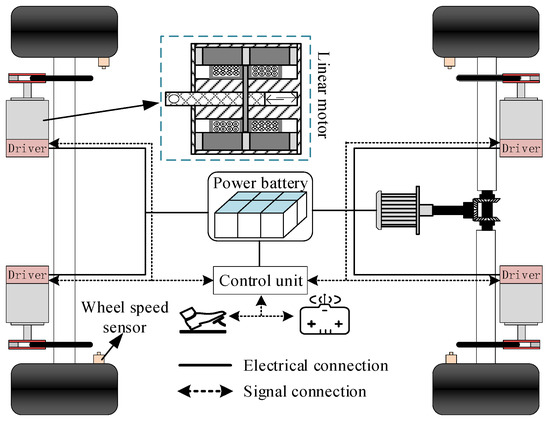
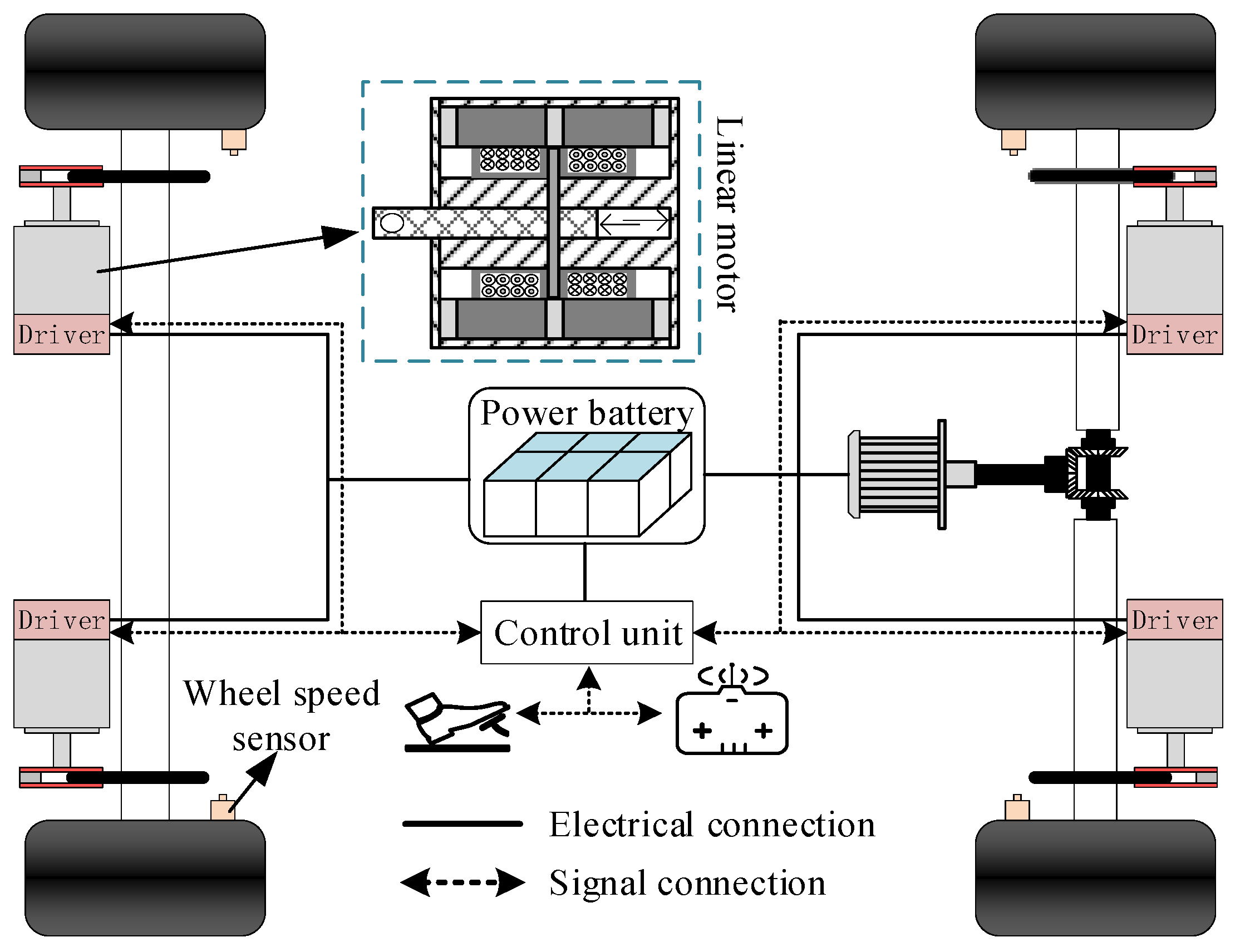
The complete brake-by-wire system composed of DDB is shown in Figure 3, and mainly consists of the DDB, control unit, power supply, and brake pedal. The control unit is responsible for processing braking-related control signals, including the driver’s braking commands and vehicle status information. It then allocates the required braking force for each wheel based on the brake intention recognition algorithm and the braking force distribution algorithm. Finally, the target braking force signals are sent to the motor drivers of each DDB unit, achieving independent and decoupled control of all four wheels. This scheme completely eliminates the hydraulic structure, so braking force control does not need to account for compression and hysteresis effects from hydraulic components, and it further avoids the risk of hydraulic fluid leakage. In addition, compared with other EMBs, this scheme does not require motion conversion components to transform rotational motion into linear motion, offering advantages in spatial compactness. Therefore, it holds great potential to replace hydraulic braking systems and offers promising prospects.
Figure 3.
Overall architecture of the brake-by-wire system based on the proposed DDB.
3. Mathematical Model of the Direct-Drive Brake Unit
3.1. Mathematical Model of the Permanent-Magnet Linear Motor
The actuation of all mechanisms in the DDB and the caliper force is provided by the linear motor. The permanent-magnet linear motor is a complex system that is nonlinear, multivariable, and time-varying. When establishing the mathematical model, several simplifications and assumptions are introduced to prevent the model from becoming overly complex, which would hinder simulation analysis and controller design. By neglecting secondary factors such as hysteresis loss, core saturation, and eddy-current loss, the relationship among the coil voltage, current, and motion velocity of the linear motor can be derived from Kirchhoff’s voltage law as follows:
where is the motor voltage, is the coil inductance, is the coil resistance, is the coil current, and is the back electromotive force of the coil. The magnitude of the back electromotive force is proportional to the coil velocity.
where is the back electromotive force constant and is coil displacement.
Finally, the electromagnetic thrust generated by the linear motor can be expressed as follows:
where is the thrust constant and is the electromagnetic force.
When the linear motor enters a steady-state condition, the displacement of the coil is constrained. That is, once the mechanical clearances are eliminated and the caliper clamps the brake disc and friction pads, the coil can no longer move. In this case, the coil velocity is zero, and the back electromotive force is also zero. From Equations (2)–(4), the transfer function between the electromagnetic force and voltage can be expressed as follows:
During the stage when mechanical clearances and brake gaps are eliminated, the load on the linear motor can be considered zero, and the electromagnetic thrust is entirely applied to accelerate the motor mover.
where is the total mass of the moving components of the linear motor.
In this case, taking the mover displacement as the output and the voltage as the input, the transfer function can be expressed as follows:
The output thrust of the linear motor always lags behind the applied voltage. The mechanical time constant reflects the time required to reach steady state from rest and characterizes the influence of the motor’s inertia and damping on the mover’s motion. The electrical time constant is determined by inductance and resistance, reflecting the speed of motor current response. For the linear motor used in this study, the two can be expressed as follows:
where is the equivalent mass inertia of the mover, and is the damping coefficient.
Experimental tests have shown that the mechanical time constant of the linear motor is much greater than the electrical time constant , i.e., . It can be seen that the mechanical inertia has a significant impact on its dynamic response characteristics. Since the travel of the linear motor used in the DDB is short and the mover’s motion time is brief, the effect of back electromotive force during the transition phase can be neglected.
In the subsequent control scheme, the pulse width modulated (PWM) signal is used to drive the motor via power electronic devices such as MOSFETs, whose transfer function is given by:
where is the voltage gain of the PWM converter, and is the time constant of the MOSFET delay.
The key parameters of the linear motor used in the DDB are listed in Table 1
Table 1.
Key parameters of the linear motor.
3.2. Friction Compensation Model
During operation, friction exists between the moving components of the DDB. The friction between some moving components is relatively small and can be further reduced using lubricants, such as the friction between the lever and its pivot. Therefore, it can be neglected. However, the contact force and contact area between the slider and fixed bracket are relatively large, so this friction cannot be easily neglected. The DDB is significantly influenced by this friction. Therefore, the friction model needs to be established to enable compensation control through motor thrust. Based on the LuGre friction model, the state update equation for the friction model between the slider and the bracket is given as follows [28,39]:
where represents the velocity of the slider, is the real-time frictional force of the slider, is the dynamic friction constant, is the peak static friction, is the elastic stiffness coefficient, is the damping coefficient, and is the adhesion coefficient. is the internal state variable of the slider, corresponding to its “elastic energy storage” state. Its initial value is , and it accumulates synchronically with the coil velocity until reaches the static friction peak . Thereafter, ceases to increase, and the friction force is locked at the dynamic friction constant . is the characteristic velocity that governs the transition rate of the friction force from the static friction level to the kinetic friction level with increasing velocity.
In the DDB, the slider and caliper bracket are made of hard steel, so and . At this time, Equation (12) can be simplified as follows:
Near the equilibrium point , the term is a second-order infinitesimal. Therefore, Equation (10) can be linearized approximately to obtain:
If the slider is stationary, Equation (14) is discretized as Equation (15) if .
If the slider moves, the real-time frictional force of the slider is equal to the sliding frictional force, i.e., . At this time, according to Equation (13), it can be known that:
By combining Equations (15) and (16), the update process of slider state can be obtained as follows:
In each control cycle, the controller reads the coil velocity to update the model state. Then, the required compensatory thrust is calculated based on the output state of the friction model. When the slider attempts to overcome static friction, exhibits a small positive value. According to Equation (17), this triggers to accumulate until it reaches a specific threshold. When the mechanical and brake clearances are fully eliminated, the coil velocity , and thus . Therefore, the friction model can be specifically expressed as follows:
It should be noted that this approximate model is applicable to friction compensation during the micro-motion (pre-sliding) stage, rather than for the precise friction modeling in the entire speed range.
4. Controller Design for the Direct-Drive Brake Unit
4.1. Hardware Architecture of the Controller
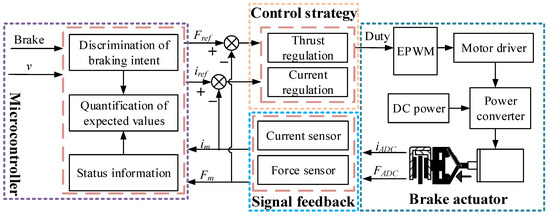
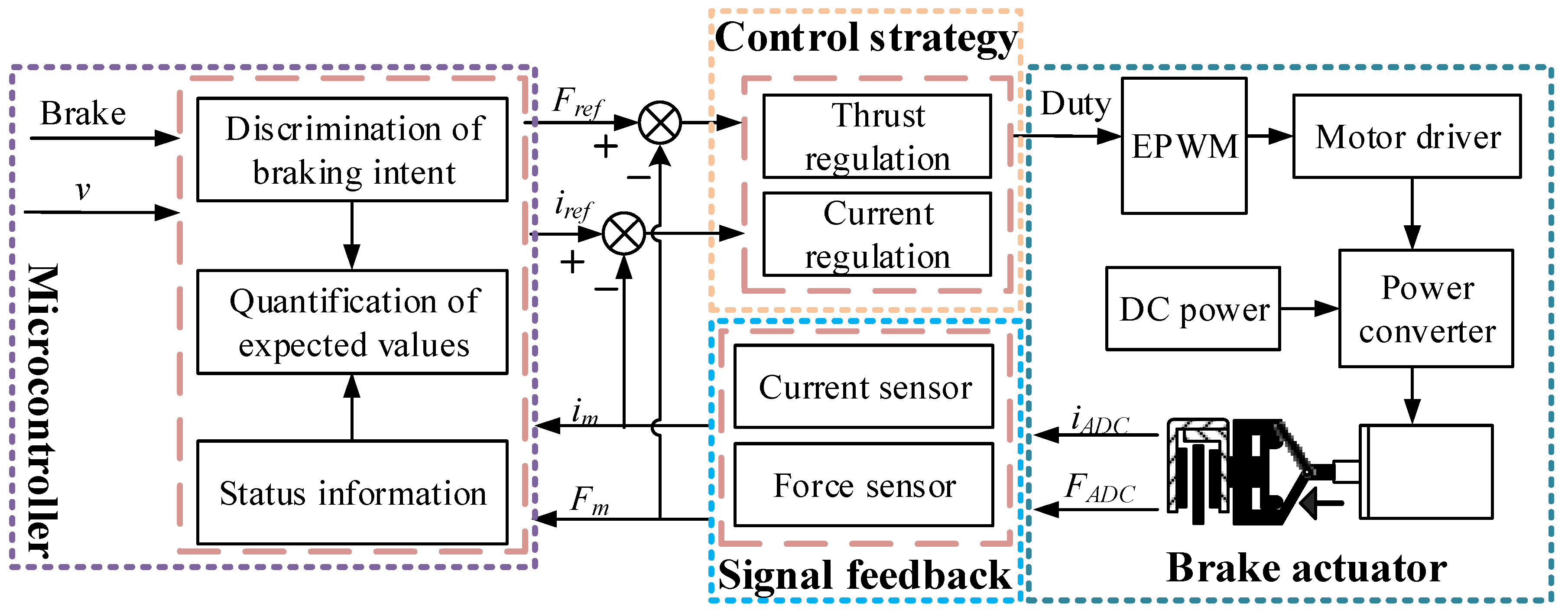
The controller is composed of a linear motor driver, microcontroller, actuator, and signal feedback unit. After receiving the braking command, the microcontroller acquires the vehicle state information and determines the driver’s braking intention. It then calculates the coil current based on the designed or selected braking strategy and outputs the control signal to the motor driver. The motor driver adjusts the DDB to output the appropriate braking force based on the control signal from the microcontroller. Finally, sensors such as current sensors and force sensors are used to acquire real-time status information of the DDB, which is fed back to the microcontroller to form a closed-loop control system. The complete control architecture of the DDB is shown in Figure 4.
Figure 4.
Control structure of the direct-drive brake unit.
In actual vehicle operation, it is not feasible to directly measure the caliper force or linear motor thrust using force sensors due to installation space constraints. However, the motor coil remains “static” when DDB outputs an effective braking force. At this moment, the magnetic field experienced by the coil remains essentially constant, and the motor thrust is proportional to coil current. Therefore, the braking force can be indirectly regulated by measuring and adjusting coil current. The coil current is isolated and measured by a high-precision Hall sensor, which converts the current into a corresponding voltage signal. Subsequently, the voltage-follower circuit is employed to perform hardware filtering.
4.2. Control Strategy of the Direct-Drive Brake Unit
The braking force needs to respond rapidly and maintain sufficiently high control accuracy. For conventional hydraulic brake systems, the braking force cannot be accurately controlled, and the response time ranges from 300 ms to 500 ms [14]. For EMB, relevant studies have shown that the response time can be reduced by 85–200 ms, and the braking force control error can be kept below 5% [40]. As a reference, the response time of the DDB is tentatively set to not exceed 300 ms, and the braking force control error should also remain below 5%. To meet the above requirements, two control methods were designed and comparatively studied in this work.
4.2.1. Fuzzy PID Controller
The PID controller is a classical, general-purpose control algorithm. It is characterized by simplicity and efficiency and is widely applied in industrial automation and other control fields. The PID controller does not require an accurate mathematical model; it regulates the controlled variable based on the difference between its setpoint and the actual value. Therefore, when the mathematical model of the controlled system is difficult to obtain accurately, the PID control strategy is often preferred. In this study, the incremental PID control algorithm is employed, with the control law expressed as follows:
where is the step size, is the deviation between the setpoint and the actual value, is the controller output, is the proportional gain, is the integral gain, and is the derivative gain.
The main task in designing a PID controller is to adjust and select appropriate control parameters , , and so that the controller can achieve rapid response and precise control. The DDB can be structurally divided into two main components: the linear motor and the caliper mechanism. Based on this structural characteristic, the cascaded PID controller was designed in this study. The outer controller serves as the caliper force controller, responsible for tracking the target caliper force, which corresponds to the desired braking force. The output of the outer controller is the target current for the linear motor. The target current must be limited according to the actual electrical system and the linear motor’s capacity before being passed to the inner controller as its input. The inner controller serves as the current controller, responsible for tracking the motor’s target current. The feedback signals primarily include the real-time current and caliper force. The structure of the cascaded PID controller is shown in Figure 5. In the figure, is the filter time constant. ACR (Automatic Current Regulator) is the current controller, and ATR (Automatic Thrust Regulator) is the force controller. Both controllers adopt the control structure represented by Equation (12).
Figure 5.
Cascaded force–current control structure of the PID controller.
The classical PID controller has a limited ability to resist external disturbances and load variations. Moreover, its parameters are not adaptive, making it unable to maintain precise control under all operating conditions. Fuzzy controllers offer strong disturbance rejection and high robustness. Therefore, the fuzzy controller is introduced in this study to improve the adaptability and robustness of the PID controller. The fuzzy controller is employed to adjust the proportional, integral, and derivative parameters in real time, enabling dynamic parameter updates and overcoming the limitation of poor robustness caused by fixed parameters.
The structures of the outer fuzzy controller and inner fuzzy controller are identical, differing only in their fuzzy logic rules. The fuzzy controller has two input variables. The first input is the difference between the setpoint (target caliper force or target current) and the actual value (actual caliper force or actual current), and is denoted as . The second input is the derivative of . Since the control system has a fixed sampling time, it can be approximated by , and is denoted as . The outer controller is a PID controller. Therefore, its fuzzy controller has three outputs, corresponding, respectively, to the three parameters , and . The inner controller is a PI controller, and its derivative gain is always 0. Therefore, its fuzzy controller has only two outputs, corresponding, respectively, to the two parameters and .
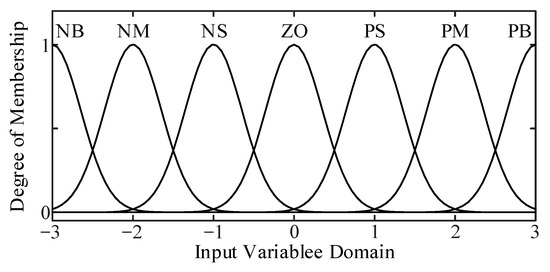
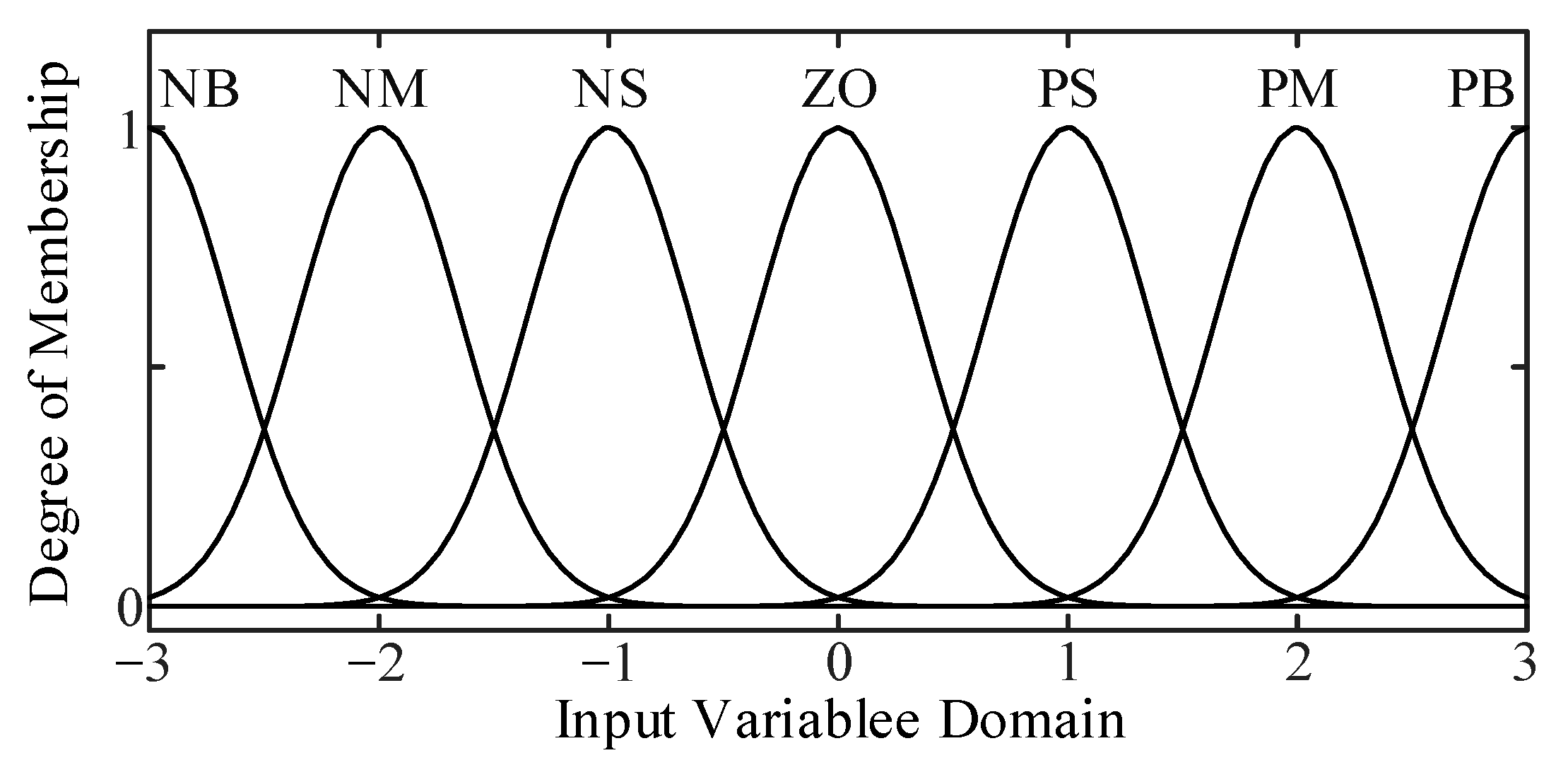
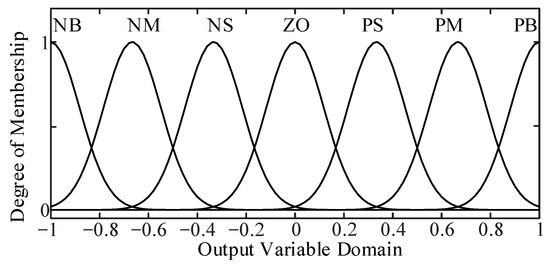
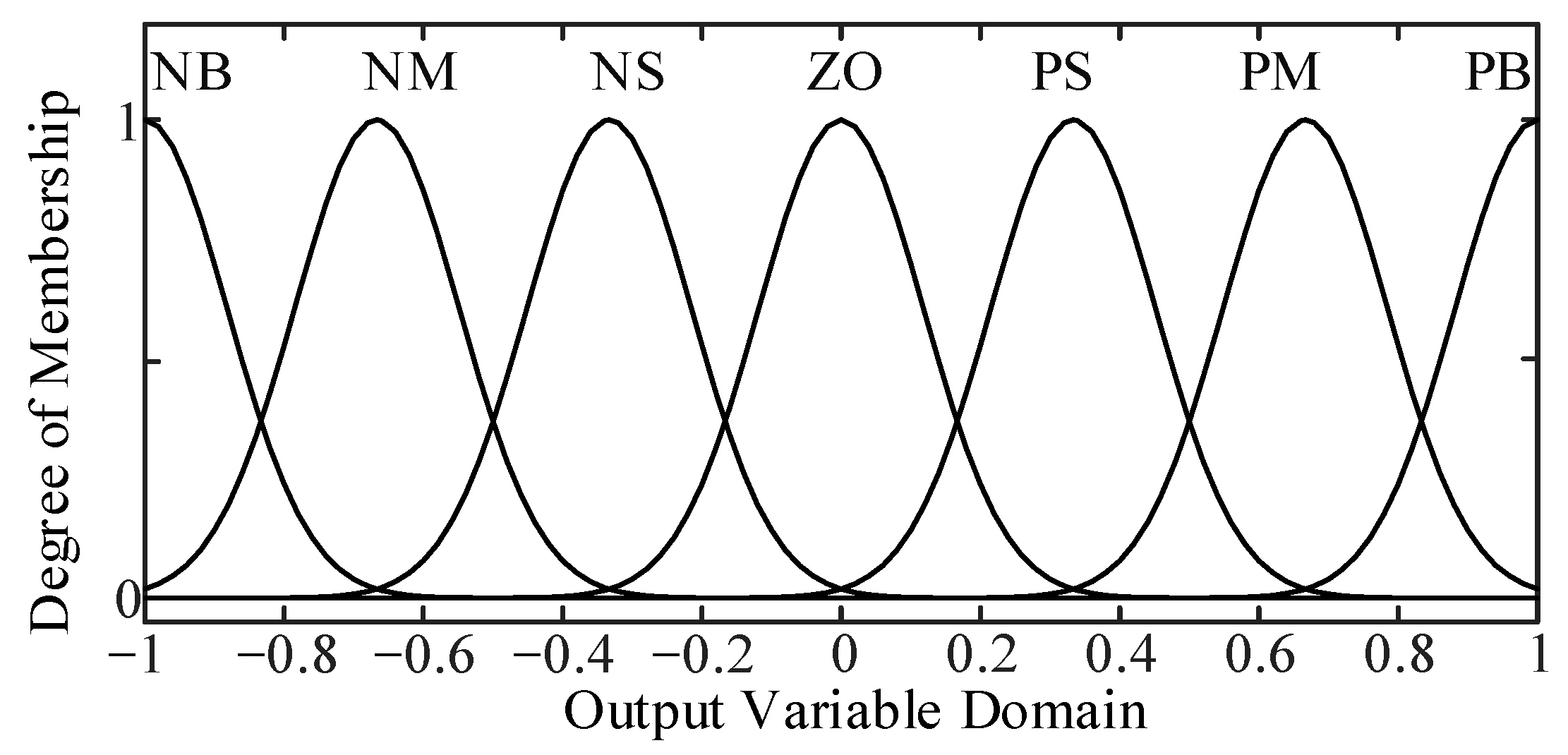
Both the input and output variables of the fuzzy controller are mapped into seven linguistic fuzzy sets, which are, respectively, defined as {NB, NM, NS, ZO, PS, PM, PB}. Both and are defined over symmetric ranges. For the convenience of fuzzy inference, and are linearly scaled to the fuzzy domain [−3, 3] using the following transformation:
where represents the actual error of clamping force or the actual error of current; represents the differential value of the actual error; and and denote the maximum input error bounds defined for the fuzzy controller. Specifically, is set to 10% of the target value, and is set to 200% of the target value. and are the scaling factors, defined as and .
Both the input and output variables are mapped using Gaussian membership functions, and the corresponding membership curves are shown in Figure 6 and Figure 7.
Figure 6.
Input variable membership function curve.
Figure 7.
Output variable membership function curve.
The output of the fuzzy controller is the correction of the PID controller parameters. The fuzzy controller adopts the centroid defuzzification method, and the defuzzified output is further mapped to the actual correction values through output scaling factors. The corrected PID parameters are as follows:
The fuzzy rule base is initialized heuristically based on control experience and is designed to maintain symmetry. If and have the same sign, increases. The actual value moves away from the setpoint and exhibits a divergent trend. If and have opposite signs, decreases. The actual value approaches the setpoint, exhibiting a convergent trend. Based on this principle, is set to increase with . This ensures strong corrective action for large differences while avoiding overly aggressive adjustments for small differences. is adjusted based on both and to suppress integral saturation. is primarily determined by , reducing the overshoot of the actual value and enhancing system stability. The specific fuzzy control rules are presented in Table 2 and Table 3.
Table 2.
Outer fuzzy rule table.
Table 3.
Inner fuzzy rule table.
It should be noted that numerous studies have explored more robust fuzzy control strategies, such as the type-2 fuzzy system and the adaptive neuro-fuzzy inference system (ANFIS) [41,42]. These advanced strategies indeed demonstrate stronger ability in handling uncertainties and nonlinear dynamics. However, they usually require more complex control structures, more computing resources, as well as more parameter adjustments or training. In this study, the traditional fuzzy PID controller was selected as the benchmark control strategy considering simplicity, effectiveness, and feasibility.
4.2.2. Model-Free Adaptive Controller
The foundation of many control theories and methods is the establishment of a mathematical model. However, the modeling process is often complex and cumbersome, particularly for nonlinear systems. Moreover, simplified mathematical models are often affected by unmodeled subsystems and simplifications, resulting in actual performance that often falls short of expectations. Model-free adaptive control (MFAC) is a data-driven algorithm designed for nonlinear control systems. The basic idea of MFAC is to introduce the pseudo-gradient vector and approximate the discrete nonlinear system near the controlled system’s trajectory with a series of linear time-varying models. This approach enables adaptive adjustment of controller parameters and ensures stable system control [43,44,45].
For a nonlinear system, the common approach is to linearize the system. The compact-form linearization method is adopted in this paper, and the general discrete-time nonlinear system can be expressed as follows [46,47]:
where and is the system output and input at time , respectively; and is the unknown output and input orders of the system; and is the inherent but unknown nonlinear function of the system.
In designing the specific MFAC scheme, the following assumptions are required. These assumptions generally hold in practice and are therefore not proven in this paper.
Assumption 1.
The system is observable and controllable. Specifically, for any bounded desired output , there exists one bounded and feasible control input . Under this input, the system output coincides with the desired output.
Assumption 2.
The partial derivative of the system function with respect to the current control input is continuous.
Assumption 3.
The system in Equation (23) satisfies the generalized Lipschitz condition. That is, for any time step and , the following holds:
When the nonlinear system in Equation (23) satisfies Assumptions 1–3, then for , there always exists a time-varying parameter such that its compact-form model can be represented in the following dynamically linearized form:
where , is the pseudo partial derivative of the system.
The convergence and validity of MFAC are not proven here. The compact-form linearization model features a simple structure and low computational complexity. It transforms the complex nonlinear system into a single-parameter linear time-varying model, without requiring the mathematical model, time delays, or reference trajectories of the controlled system. The linearized model has a simple structure with few parameters, which facilitates controller design.
For the variation of the DDB control input, the criterion function of one-step-ahead predictive input is considered as follows [46,47]:
where is the desired tracking signal of the DDB, is the penalty factor, and the term limits the magnitude of control input variation, which helps to reduce steady-state tracking errors.
Substituting the dynamic linearized expression (25) into the input criterion function (26), taking the derivative with respect to , and setting it equal to zero, the control input law is obtained as follows:
where is the step-size factor, and is the penalty factor that regulates the variation in control input. The smaller value of leads to the faster system response but may cause overshoot or even instability; conversely, the larger results in slower response with smoother input–output variations and reduced overshoot.
By adopting the parameter estimation algorithm that is symmetric and structurally similar to the control strategy, the following objective function for the control input is considered:
where is the actual DDB output, is the estimated value of , and is a weighting factor. The term penalizes the variation in the time-varying parameter . By substituting the dynamic linearized model (25) into the objective function (28) and differentiating with respect to , then setting the derivative to zero, the pseudo-gradient estimation algorithm is obtained as follows:
To enhance the tracking capability of the parameter estimation algorithm for time-varying parameters, the reset condition needs to be designed. When or :
where is the step-size sequence, is a sufficiently small positive number, and is the initial value of . Different control effects can be obtained by reasonably selecting the value to change the substitution range of the dynamic linear Equation (25) of the nonlinear system Equation (23).
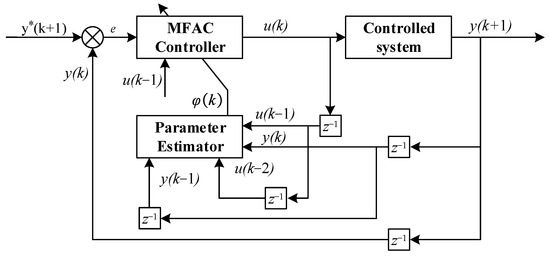
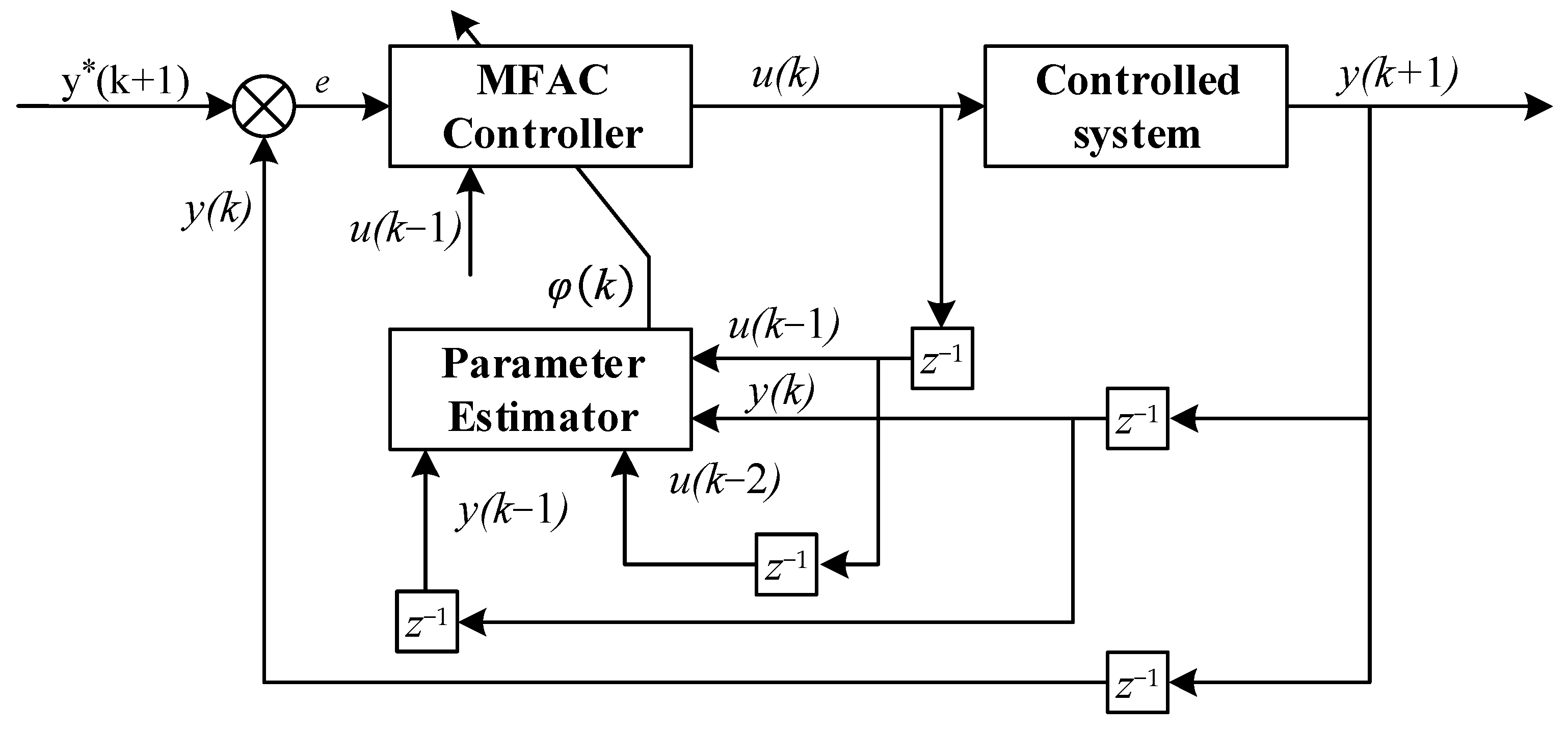
In summary, Equations (27)–(30) constitute the compact-form MFAC algorithm for the DDB. Among them, Equation (27) presents the control law based on pseudo-partial derivatives, and Equations (29) and (30) implement the online estimation of pseudo-partial derivatives and the abnormal reset mechanism. Unlike traditional control methods that rely on a precise model, this controller does not require an exact mathematical model. MFAC only uses the online-collected input–output data and to adaptively update the pseudo-partial derivative , thereby achieving direct adaptive control of the discrete nonlinear system. At the tuning level, the algorithm performance is mainly determined by the input increment penalty factor and the parameter estimation smoothing weight . is used to constrain the input variation to balance the response speed and control smoothness, while is used to suppress the jitter of pseudo partial derivative estimation and enhance the anti-interference robustness. Therefore, after setting the given step size factor , the estimated step size sequence , the reset threshold , and the initial value , the MFAC usually only make minor parameter adjustments around and during its online operation to achieve satisfactory dynamic and static performance. The structure of MFAC is shown in Figure 8.
Figure 8.
MFAC structure.
In Figure 8, is the desired output, while is the measured output. In the DDB control system, these correspond to the caliper force or electromagnetic thrust of the linear motor. is the system control input, which corresponds to the armature voltage of the linear motor. Based on MFAC theory, the control scheme for the DDB is designed using compact-form linearization, where the parameter tuning relies solely on online input/output data and does not require an accurate mathematical model. Compared with the fuzzy PID controller, the MFAC approach involves only a single online tuning parameter. Consequently, the computational burden on the microcontroller is reduced. MFAC better meets the fast-response requirements of the braking system and is easier to implement.
It should be noted that other advanced control strategies have also been successfully applied in the BBW, such as sliding-mode control (SMC), adaptive control based on neural networks, and reinforcement learning (RL), etc. These methods have demonstrated remarkable nonlinear control capabilities and robustness under specific conditions. However, these methods usually require precise mathematical models, extensive offline training, or a large amount of computing resources. In automotive applications, controllers prioritize safety and reliability requirements over computational performance. Therefore, it will limit the application of the above control method in real-time on automotive controllers. In contrast, MFAC relies solely on online input–output data. It has fewer adjustable parameters and lower computational complexity. These characteristics make MFAC particularly suitable for braking systems where response speed and robustness are of critical importance. Therefore, MFAC was selected as the adaptive control method in this study.
4.2.3. MFAC Parameter Sensitivity Analysis
To clarify the sensitivity of the MFAC controller to the key parameters, this paper further analyzes the regulatory mechanisms of and . As shown in Equation (27), is the input increment penalty factor, which determines the value and smoothness of the control increment. As shown in Equation (29), is used to suppress the jitter of pseudo partial derivative estimation and enhance the robustness against interference.
According to Equation (27), the increment of the control input value can be obtained as follows:
Take the partial derivative of Equation (32) with respect to :
Then, the relative sensitivity of with respect to is defined as follows:
From Equation (34), it can be seen that when , , indicating that the control increment is highly sensitive to . When , , indicating that the control increment is not sensitive to . At this point, the control performance of MFAC is mainly determined by .
To quantitatively evaluate the sensitivity of the input increment penalty factor of the MFAC controller, this paper conducts the parameter scanning analysis on under the condition of fixed . Considering that the role of sensitivity analysis is to reveal the balance relationship between “tracking performance and control smoothness”, five indicators were selected for evaluation. The five indicators are as follows: root-mean-square error (RMSE), integral of time absolute error (ITAE), input total error (ITE), input energy (IE), and input peak value (IPV). The definitions of the above indicators are as follows:
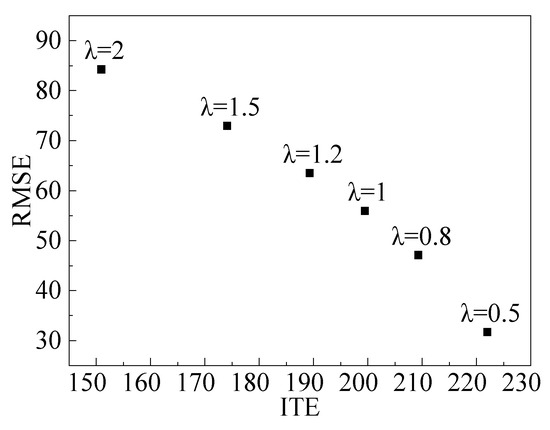
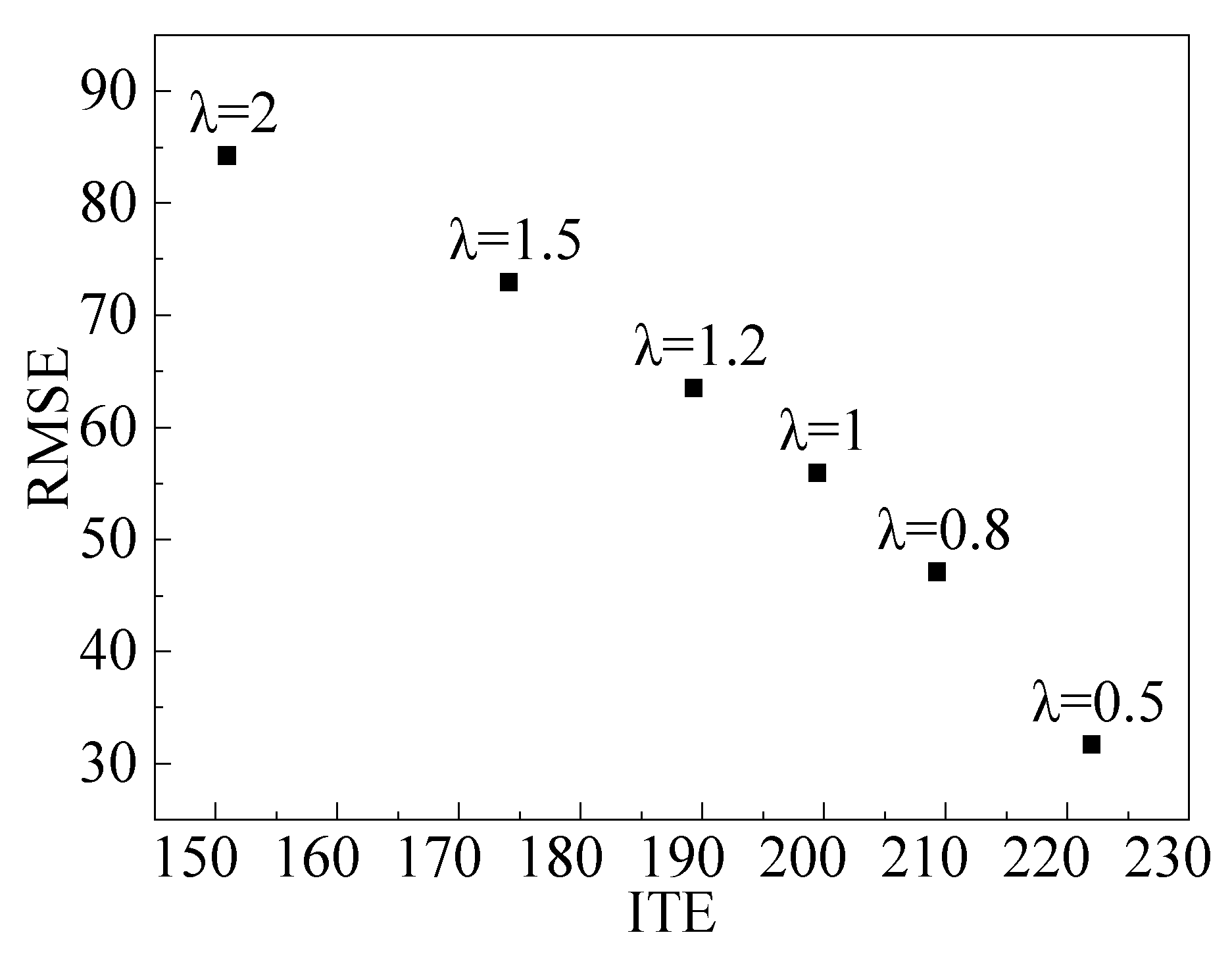
Table 4 presents the evaluation indicators obtained through parameter scanning under the condition of , for values in the set {0.5, 0.8, 1.0, 1.2, 1.5, 2.0}. Figure 9 presents the trade-off relationship in the form of RMSE-ITE. It can be seen from Table 4 and Figure 9, that has a significant impact on the closed-loop performance of MFAC and the input smoothness. When increases from 0.5 to 2.0, the decreases from 221.95 to 150.86, the reduces from 177.05 to 144.35, and the decreases from 21.74 to 18.35. These results indicate that the larger value of can effectively suppress changes in control inputs and reduce energy consumption as well as peak risks. However, the tracking performance deteriorated accordingly, with the RMSE increasing from 31.74 to 84.35, and the ITAE rising from 13.10 to 35.80. This indicates that the excessively large will significantly reduce the regulation strength, leading to an increase in dynamic cumulative errors.
Table 4.
Sensitivity analysis table.
Figure 9.
RMSE-ITE trade-off ().
On the other hand, the pseudo partial derivative estimation Equation can be rewritten as Equation (42) according to Equation (29).
Equation (42) takes the partial derivative of :
Then, the relative sensitivity of with respect to is defined as follows:
From Equation (44), it can be seen that when , , and the pseudo derivative is sensitive to . From the analysis of Equation (27), it can be seen that the increase in can effectively reduce the adaptive update amplitude and enhance the noise resistance, but it will weaken the tracking ability for time-varying parameters. When , , and the pseudo gradient is insensitive to .
Under the fixed value of , the scanning analysis was conducted for . In addition to tracking performance indicators, input indicators, and other indicators, two types of indicators and are further introduced in order to directly characterize the influence of on the MFAC controller. The definitions of these two indicators are as follows:
where represents the statistical average of .
measures the overall dispersion of the estimated value around the average value, while measures the cumulative amplitude and jitter of the updated estimated value. Smaller values of these two indices indicate the smoother estimation performance and stronger robustness against disturbances. Considering that the all-time indicators will include the normal update of the initial convergence process, this paper further defines the steady-state index , which is the cumulative change of calculated within the last 5% of sth ample time (tail window). Since the system has approached the steady state in the last 5% of the sample time (tail window), the actual parameters are approximately unchanged. The smaller value of indicates that the estimated values are smoother in the steady-state phase and less affected by noise disturbances, reflecting stronger disturbance rejection capability.
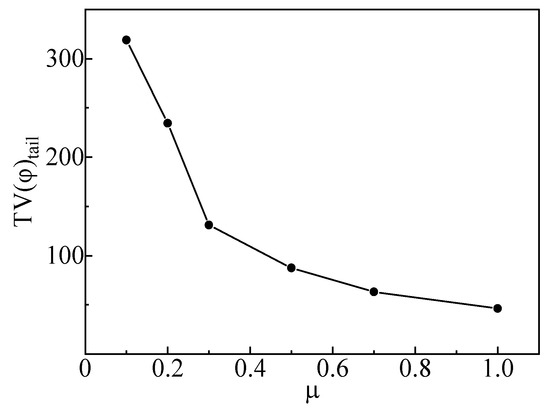
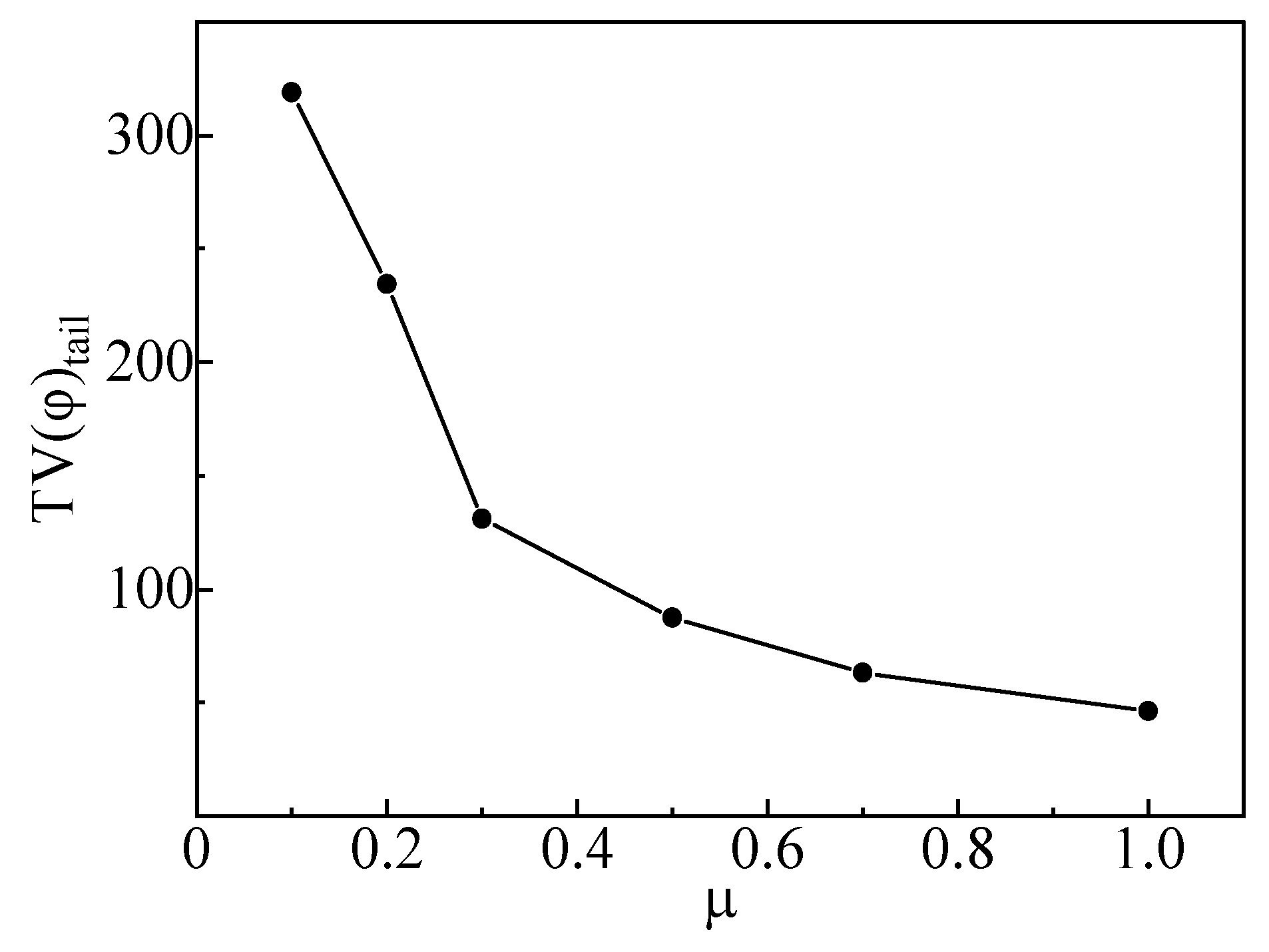
Table 5 presents the evaluation indicators obtained through parameter scanning under the condition of , for values in the set {0.1, 0.2, 0.3, 0.5, 0.7, 1.0}. Figure 9 presents the trade-off relationship in the form of . From Table 5 and Figure 10, it can be seen that as increases, the denominator term in the estimated value of also increases. This causes the equivalent update gain to decrease, and the update becomes more conservative. The sensitivity results show that and decrease monotonically with , and the tail of the steady-state end window of is significantly reduced. It indicates that the larger value can effectively suppress estimation jitter and enhance noise resistance. On the other hand, when increases from 0.1 to 1.0, the and decrease by approximately 52% and 59%, respectively, while decreases by about 30%. It indicates that suppressing the estimation jitter of can help reduce the input fluctuations and improve the tracking performance.
Table 5.
Sensitivity analysis table.
Figure 10.
Sensitivity of to ().
5. Simulation Analysis and Experimental Validation of the Direct-Drive Brake Unit
To verify the feasibility and effectiveness of the proposed DDB and its control strategy, simulation tests were conducted using the MATLAB/Simulink 2020b platform, followed by experimental validation on a test bench. Both the simulations and experiments conducted comparative studies among the classical PID controller, the fuzzy PID controller, and the MFAC controller. The main evaluation metrics included response time, overshoot, and steady-state error.
5.1. Simulation Analysis and Verification
First, the mathematical model and control strategies of the DDB were established in MATLAB/Simulink. Subsequently, the parameters of the linear motor and caliper mechanism were configured based on experimentally measured data. Two operating conditions were defined for the simulations. The first operating condition is the step response condition. The target caliper force is set to change in steps within the range of 0 to 9 kN every 0.5 s to verify the rapid response capability of the DDB. The second operating condition is the braking force tracking condition. The target caliper force is set as a sinusoidal signal with a frequency of 60 Hz and an amplitude of 9 kN to verify the tracking capability and control accuracy of braking force. The parameters of the classical PID controller are listed in Table 6 and Table 7. The fuzzy PID controller uses the same initial parameters as the classical PID controller, but these parameters are adjusted online by the fuzzy controller. The parameters of the MFAC controller are listed in Table 8.
Table 6.
Outer parameters of the classic PID controller.
Table 7.
Inner parameters of the classic PID controller.
Table 8.
The parameters of the MFAC controller.
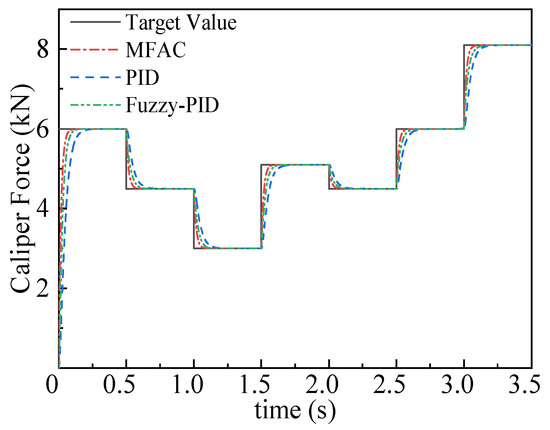
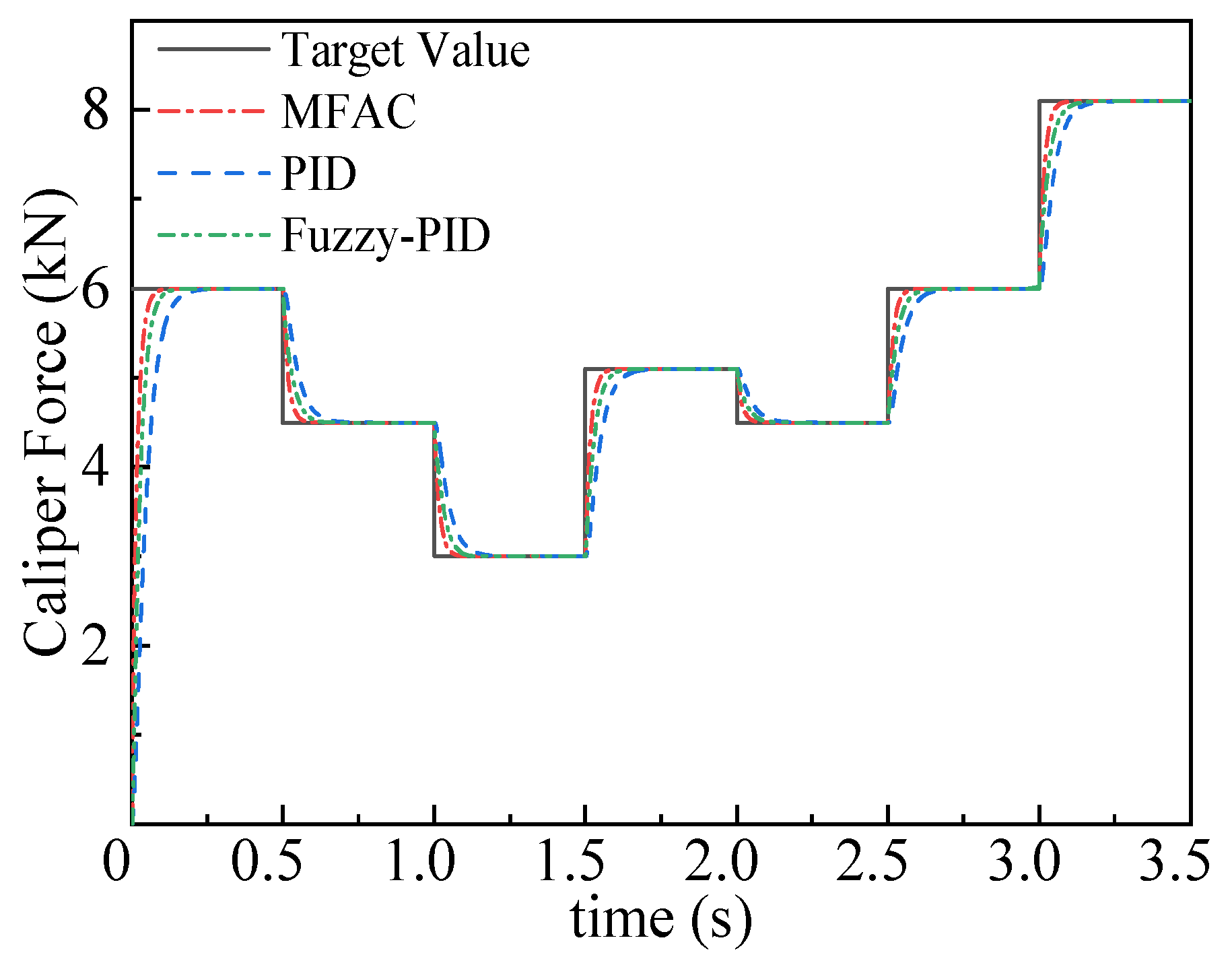
The step response simulation results are shown in Figure 11. As shown in the figure, all control strategies exhibit high control accuracy when the target caliper force is constant. However, the response speeds of different strategies show significant differences when the target changes. It is clear that under the MFAC algorithm, the DDB exhibits the shortest response time and the lowest steady-state error. The classical PID controller exhibits the slowest response. When the target value changes, the classical PID controller requires the longest time to stabilize the output at the target value. The response speed and control accuracy of the fuzzy PID controller are intermediate among the three strategies. Compared with the classical PID controller, it shows clear advantages, but it is still inferior to the MFAC controller.
Figure 11.
Step-response comparison of caliper force under the classical PID, fuzzy PID, and MFAC.
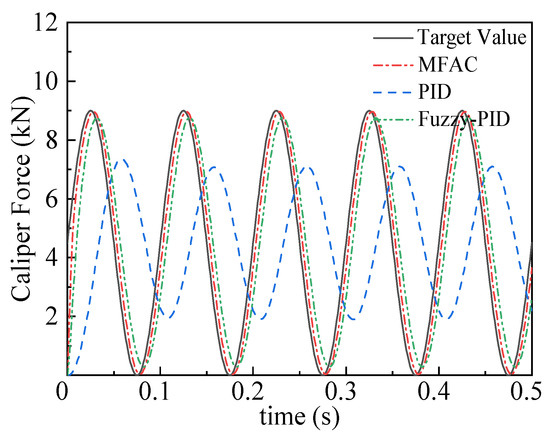
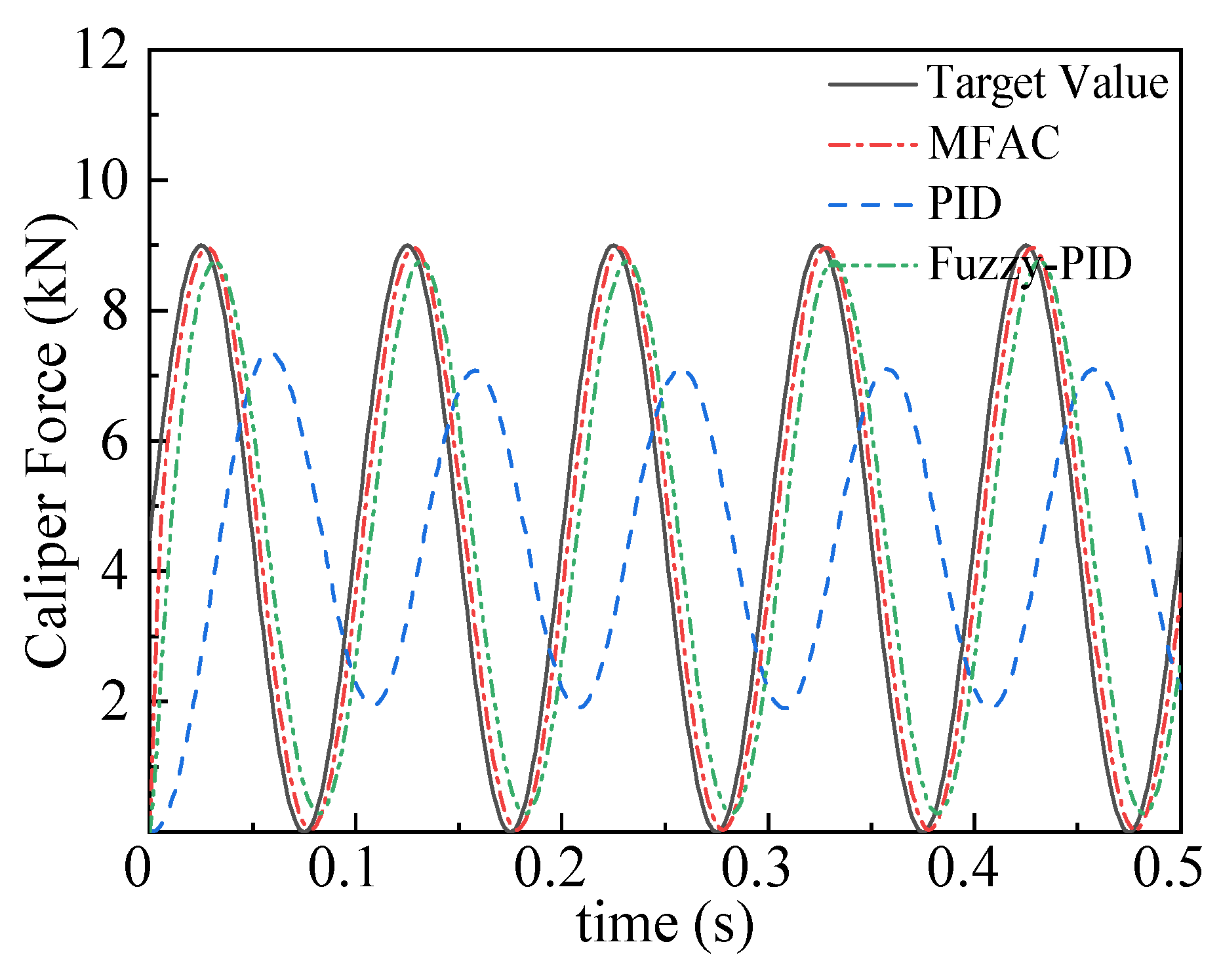
The tracking simulation results under sinusoidal excitation are shown in Figure 12. For the sinusoidal varying target caliper force, the MFAC achieves the best control performance. It enables rapid tracking of high-speed varying targets, with the response curve exhibiting superior performance in both phase lag and amplitude error. The performance of the fuzzy PID controller ranks second. The introduced fuzzy rules address the limitations caused by the fixed parameters of the classical PID controller. This enables the fuzzy PID controller to achieve adaptive parameter adjustment. Under 60 Hz sinusoidal excitation, the fuzzy PID controller showed slight phase lag and amplitude error, which were still acceptable. Due to its inherent characteristics, the classical PID controller exhibited the poorest performance among the three control strategies. Under the same sinusoidal excitation, the classical PID controller displayed noticeable phase lag and significant amplitude error, making it unsuitable for scenarios requiring precise control. One possible reason for the observed large deviation with the classical PID controller is that it is not the research focus of this study. Therefore, excessive time and effort were not devoted to tuning the classical PID controller, so its parameters were not optimized. The initial parameters of the fuzzy PID controller are the same as those of the classical PID controller. However, as shown in Figure 12, the fuzzy PID controller can adaptively adjust its parameters, resulting in significantly better performance than the classical PID controller, whose parameters remain fixed.
Figure 12.
Sinusoidal tracking performance comparison under the classical PID, fuzzy PID, and MFAC.
In summary, both MFAC and fuzzy PID controllers can achieve fast and stable control of caliper force. However, the MFAC demonstrates superior performance in terms of overshoot, steady accuracy, and response time.
5.2. Experimental Analysis and Validation
5.2.1. Thrust Experiment of Linear Motor
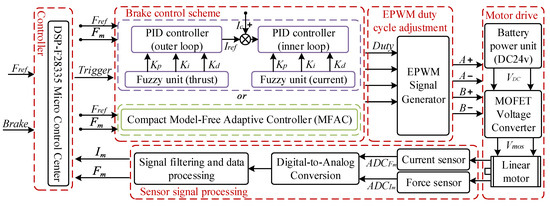
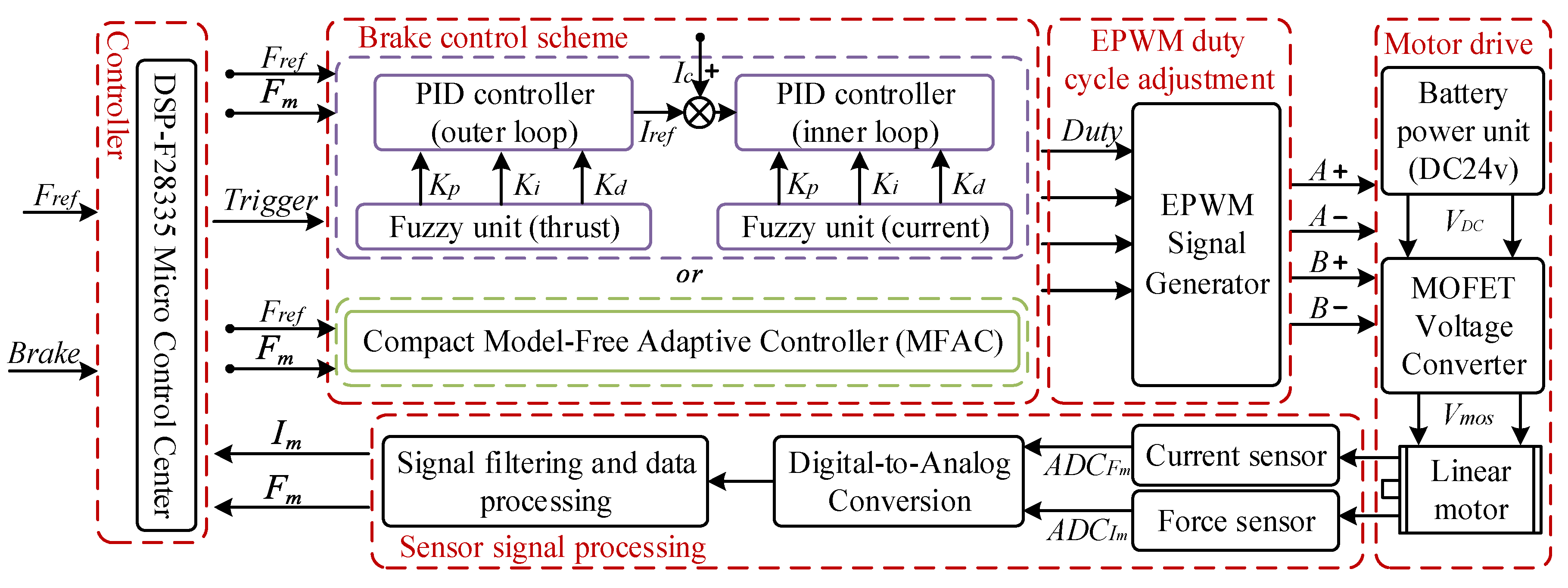
To further validate the effectiveness of DDB and the proposed strategies, the experimental platform was constructed to conduct the verification tests. The controller is a Texas Instruments F28335 digital signal processor (DSP), which operates at a clock frequency of 300 MHz. The Hall current sensor is employed for current measurement. To balance measurement accuracy, control real-time performance, computational load per cycle, and noise immunity, the control sampling period is set to 0.1 ms. During the linear motor thrust test, the force sensor is employed to directly measure the output thrust. During the DDB testing, the force sensor cannot be used to directly measure the caliper force. Therefore, the caliper force is indirectly estimated from the coil current. The difference between the estimated caliper force and the target value is then fed into the controller to calculate the control voltage of the linear motor. Finally, the voltage signal is amplified by the PWM converter and used to drive the linear motor, thus forming a closed-loop control system.
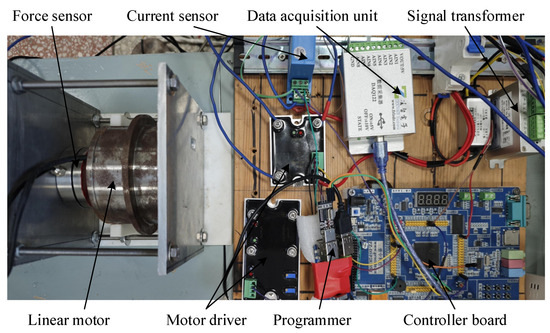
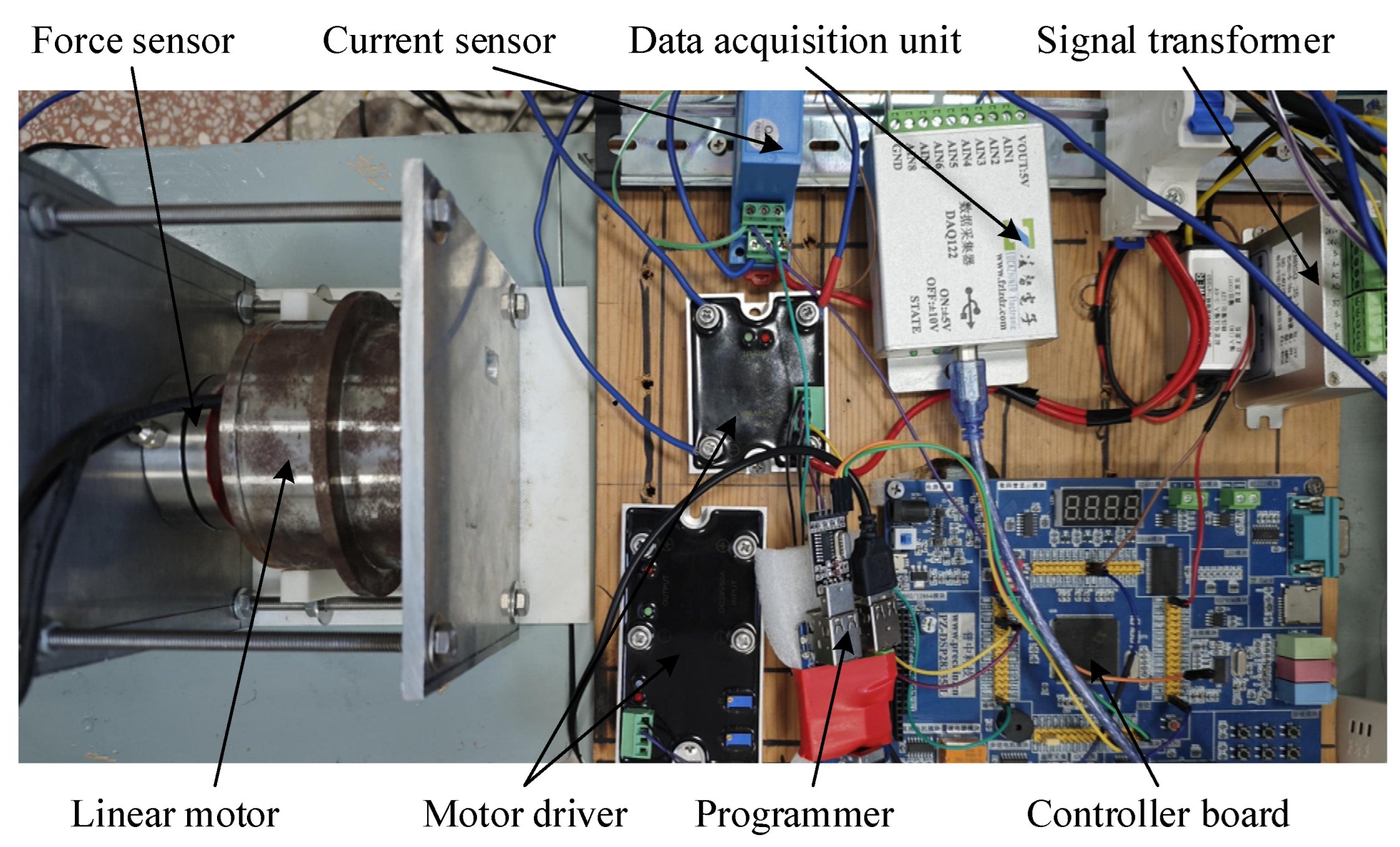
Since the simulation results have shown that the classical PID controller performs worse than fuzzy PID and MFAC controllers, the experimental validation focuses only on the fuzzy PID and MFAC approaches. The experimental platform based on F28335 is shown in Figure 13 and Figure 14. The hardware architecture of the two control strategies is essentially identical; the only distinction lies in the control algorithms employed. As previously described, the fuzzy PID controller adopts a cascaded structure. The outer loop serves as the force controller, responsible for tracking target thrust; while the inner loop serves as the current controller, responsible for tracking the motor’s reference current. According to the aforementioned simulation study, the initial control parameters of the fuzzy PID controller are listed in Table 9 and Table 10. The MFAC controller exhibits excellent parameter self-adaptability and employs a single-loop structure. Its parameters are listed in Table 11.
Figure 13.
Control architecture of the DDB.
Figure 14.
Linear motor experimental test platform.
Table 9.
Initial control parameters of the fuzzy PID (outer controller).
Table 10.
Initial control parameters of the fuzzy PID (inner controller).
Table 11.
Controller parameters of the MFAC.
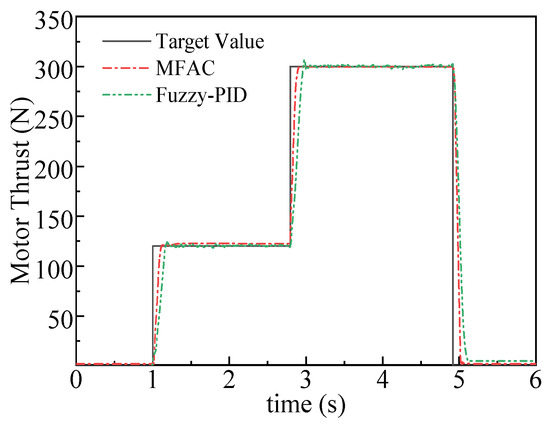
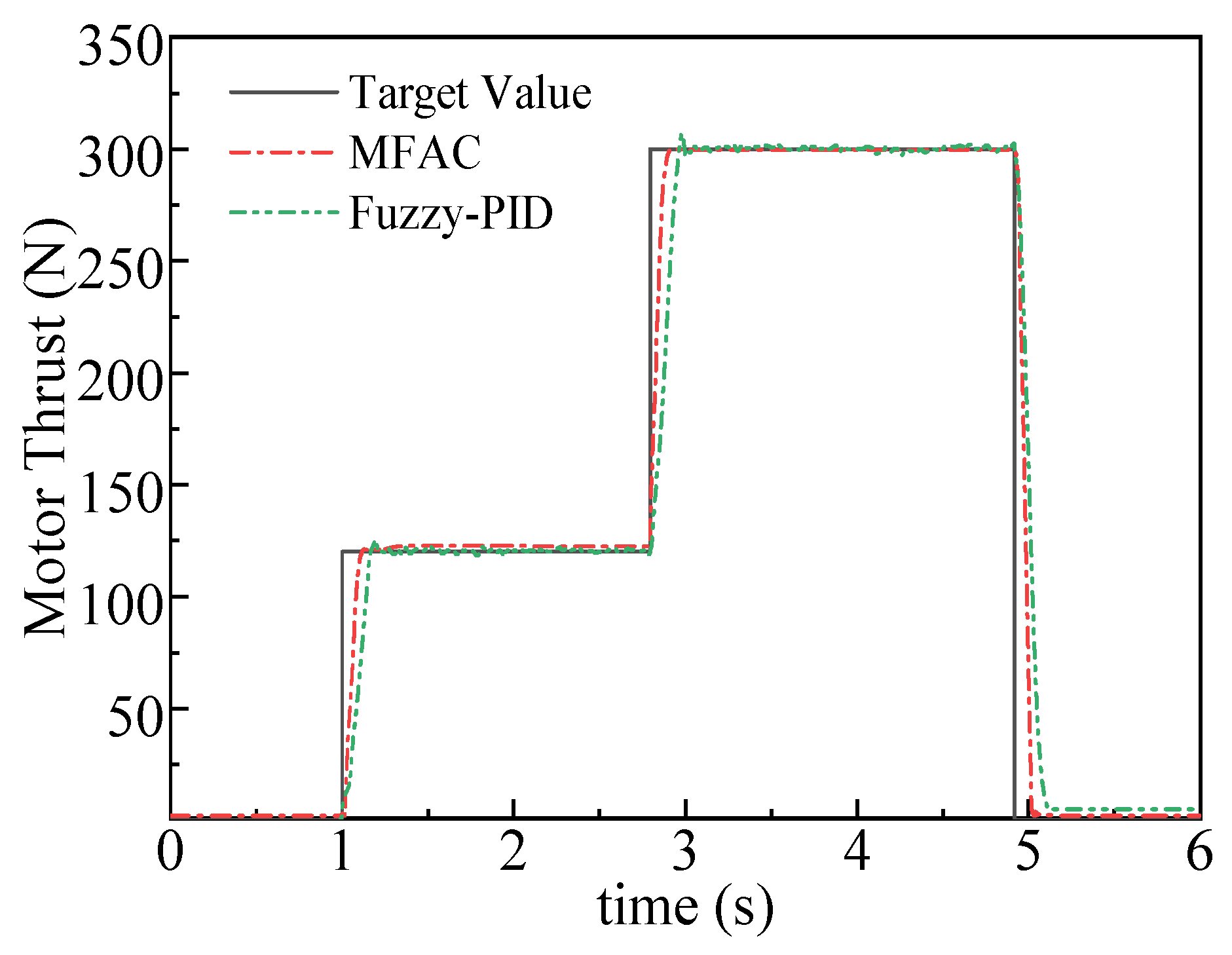
In the experiment, serial communication was used to acquire the linear motor’s current, voltage, and thrust. The data were transmitted to the host computer for filtering. After removing the noise, the experimental results of motor thrust are presented in Figure 15. The experimental results clearly show that, compared to the fuzzy PID control, the motor thrust under the MFAC demonstrates shorter response time, smaller overshoot, and lower steady-state error. When the setpoint changes, the MFAC demonstrates superior dynamic response, enabling the motor output to rapidly track the desired target while exhibiting stronger robustness against load disturbances. The MFAC exhibits the maximum overshoot of 1.6% and the final steady-state output error of 1%. In contrast, the fuzzy PID controller requires longer settling time with a maximum overshoot of 4.1% and a final steady-state output error of 2.1%. In summary, the specific simulation and experimental results of the linear motor are presented in Table 12.
Figure 15.
Experimental thrust response of the linear motor under fuzzy PID and MFAC.
Table 12.
Performance comparison of fuzzy PID and MFAC based on thrust tests.
5.2.2. Direct-Drive Brake Unit Experiment
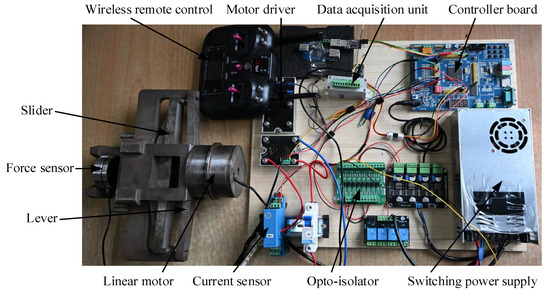
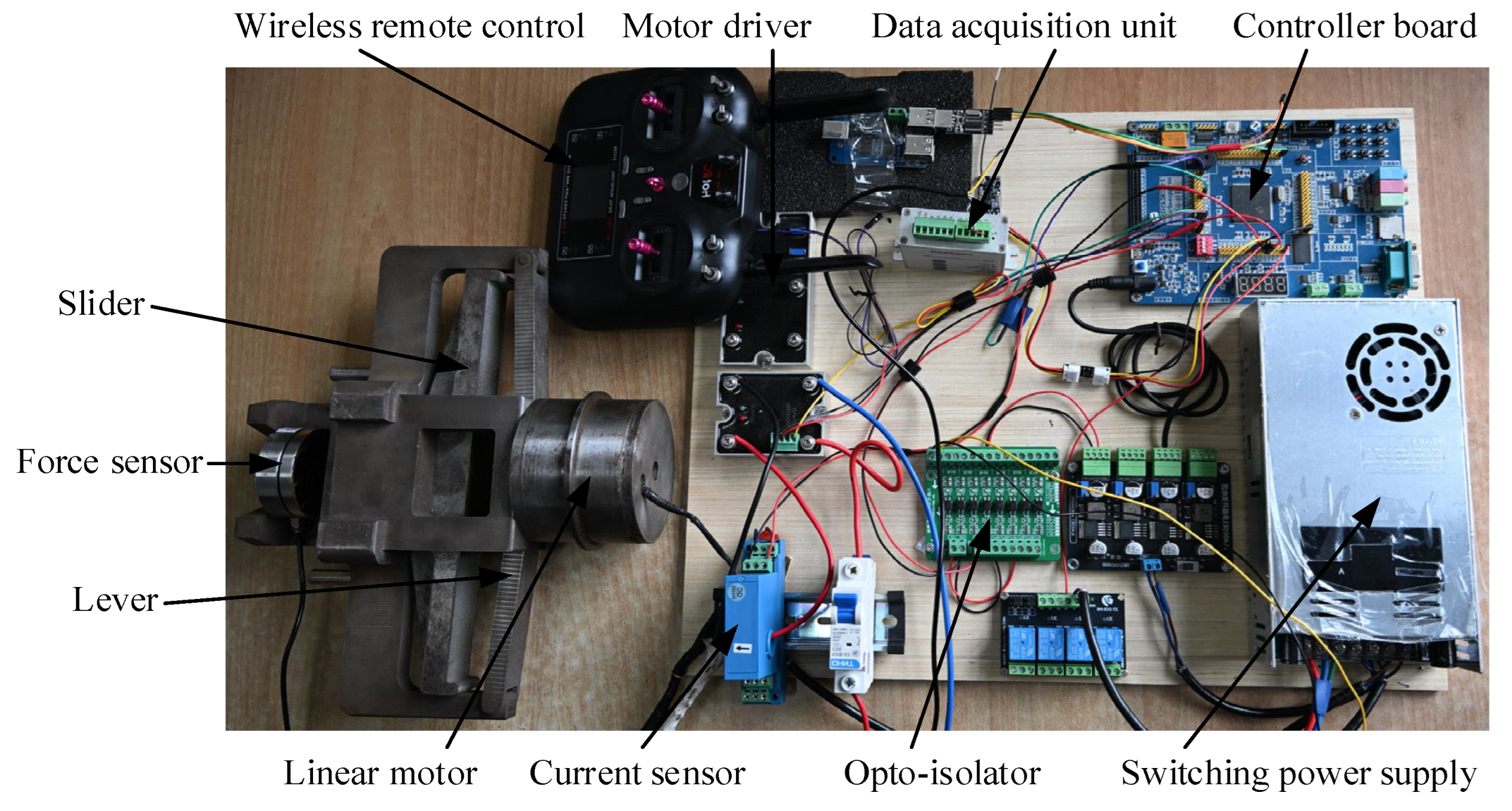
To evaluate the braking force regulation performance of the DDB, the DDB was installed on a brake test bench for experimental testing, as seen in Figure 16. For safety purposes, the direct-drive brake unit was controlled wirelessly. The experiment employed a wireless joystick to simulate brake pedal travel. The joystick signal was initially set to 0, corresponding to the pedal being unpressed, and its maximum value was set to 15, corresponding to the pedal being fully depressed. During the preliminary experiments, the maximum electromagnetic thrust of the linear motor was limited to 300 N to ensure the structural stability and safety of the DDB. The lever amplification factor was 29.62. Two braking conditions were selected for the experiment: one representing comfort braking with a gentle pedal press, and the other representing emergency braking with a rapid pedal press. Subsequently, the braking force control performance of fuzzy PID and MFAC was tested separately on the experimental platform.
Figure 16.
DDB experimental test platform.
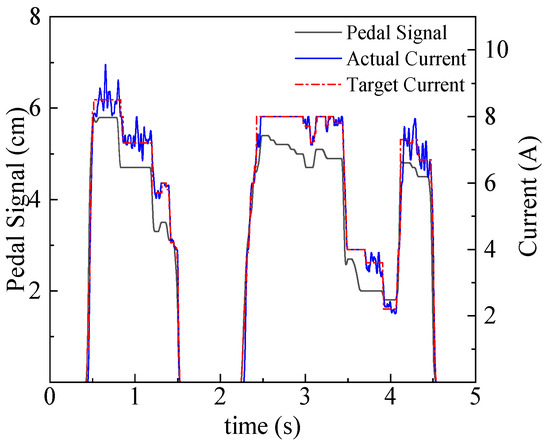
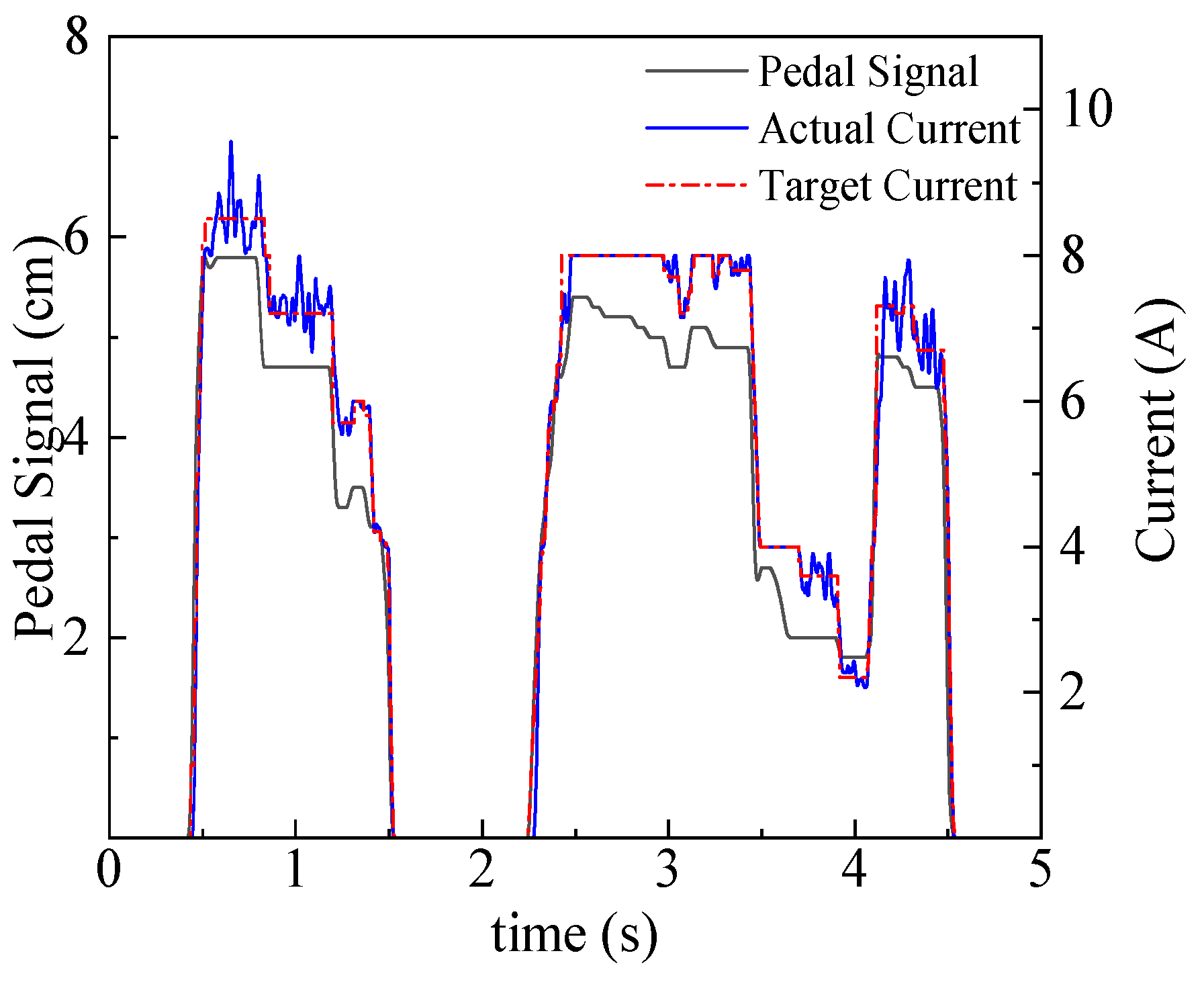
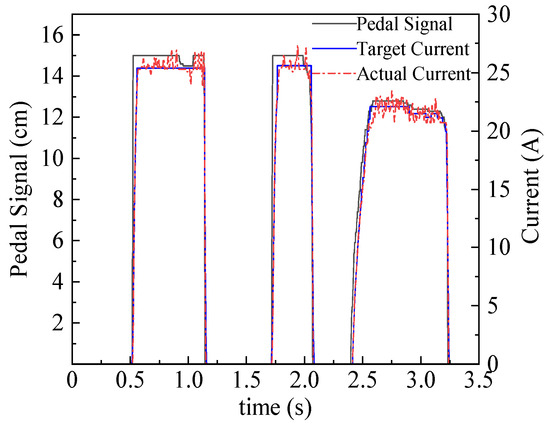
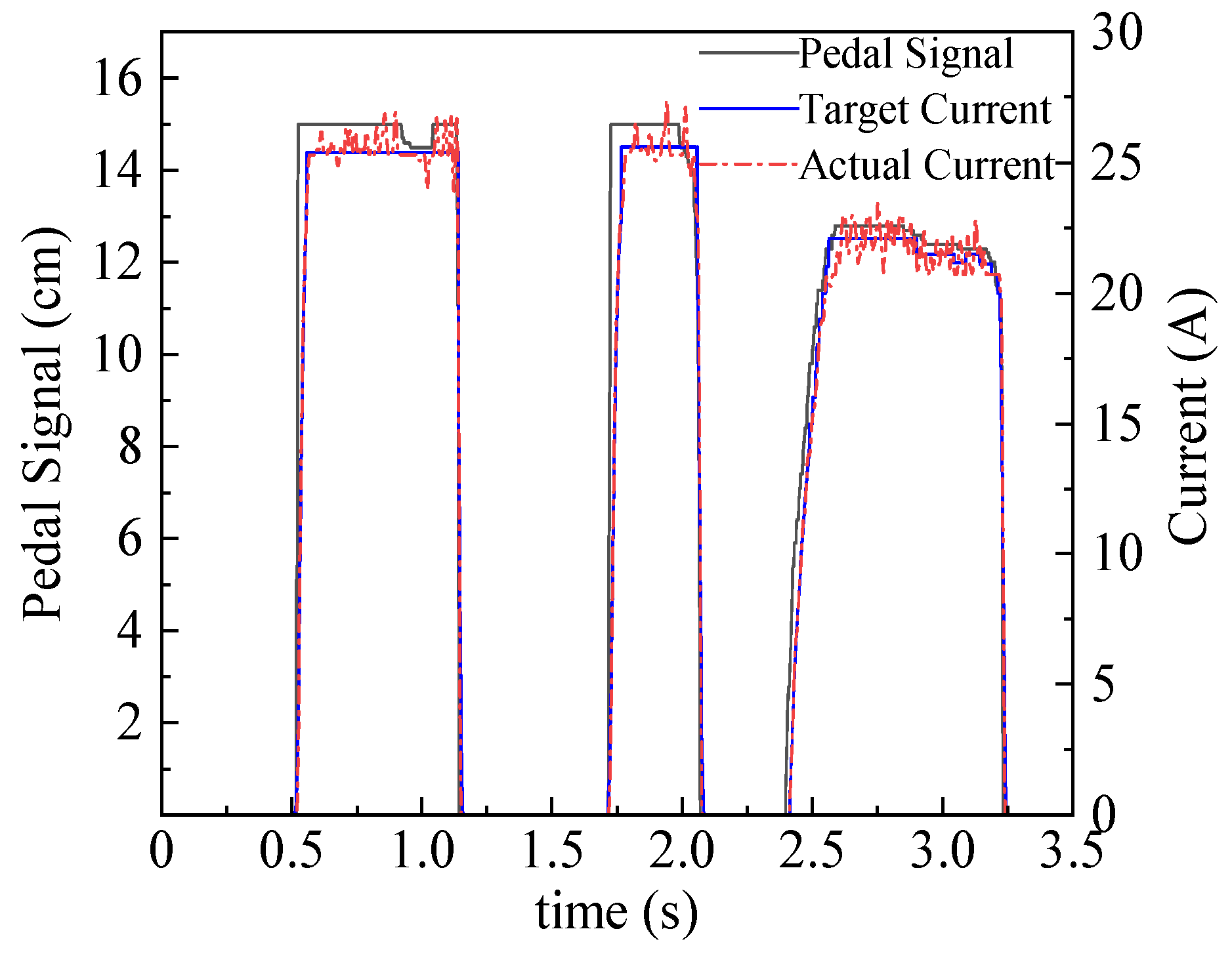
The linear motor current and caliper force responses of the fuzzy PID controller under comfortable-braking conditions are shown in Figure 17 and Figure 18. From Figure 17, it can be observed that both the target current and measured current of the linear motor follow the variation in the brake-pedal input signal. From Figure 18, it is evident that the caliper force of the DDB exhibits the trend consistent with that of motor current, and therefore also aligns with the brake-pedal input signal. The actual output of DDB reaches the desired value within approximately 269 ms. It indicates that the DDB and fuzzy PID controller exhibit fast rise time and are capable of promptly responding to the driver’s light brake-pedal inputs. During steady braking, the actual caliper force curve deviates only slightly from the desired value. However, in the transition phase following the change in braking force, the noticeable overshoot occurs. The maximum overshoot is approximately 240 N, corresponding to about 4.31% of the target amplitude.
Figure 17.
Current responses under fuzzy PID control during gentle braking.
Figure 18.
Caliper force responses under fuzzy PID control during gentle braking.
In emergency scenarios, the linear motor is required to respond rapidly and deliver a sufficiently large braking force to enable prompt emergency braking. Figure 19 and Figure 20 are the response curves of the fuzzy PID controller under emergency braking conditions. From an overall perspective, the output braking force of the DDB aligns well with the brake-pedal input signal. The braking force response time is approximately 292 ms, with a steady-state error of about 3.13%, essentially meeting the requirements for emergency braking.
Figure 19.
Current responses under fuzzy PID control during emergency braking conditions.
Figure 20.
Caliper force responses under fuzzy PID control during emergency braking conditions.
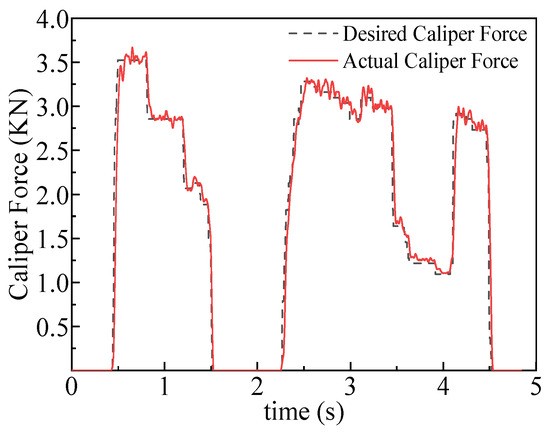
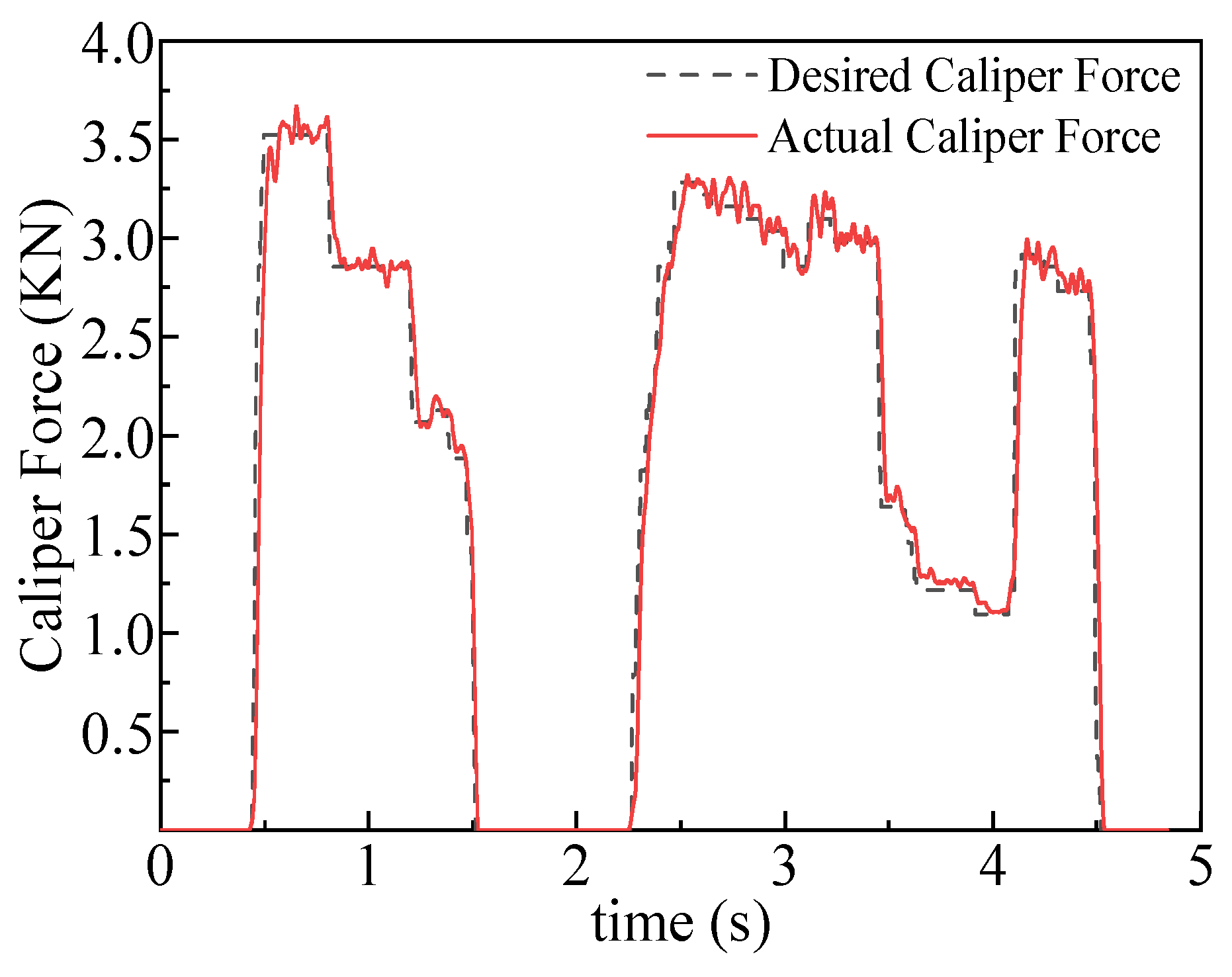
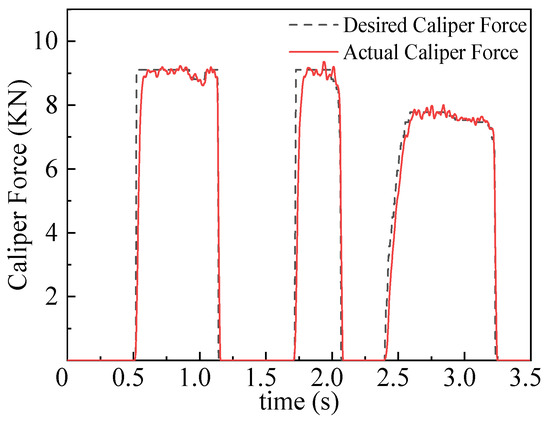
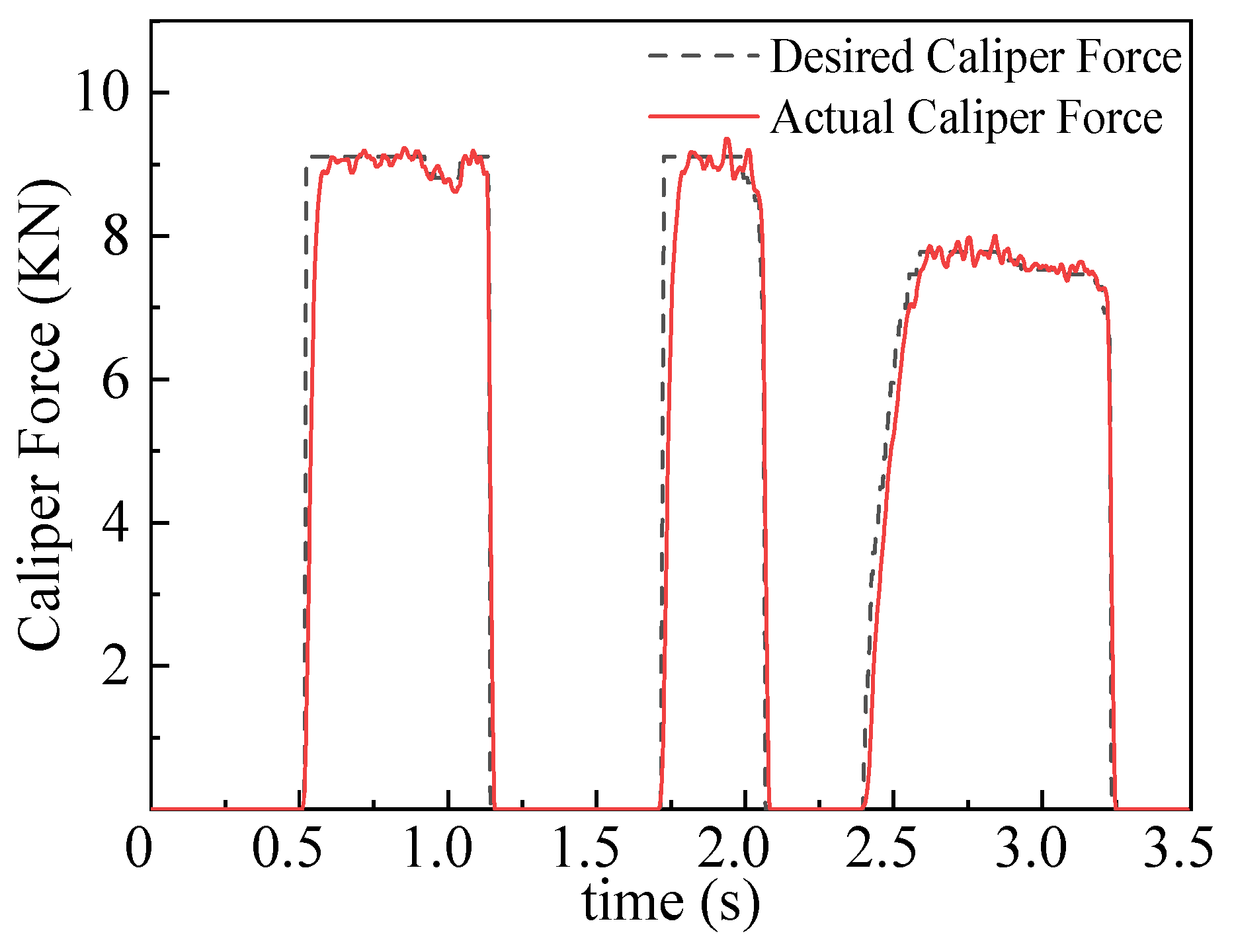
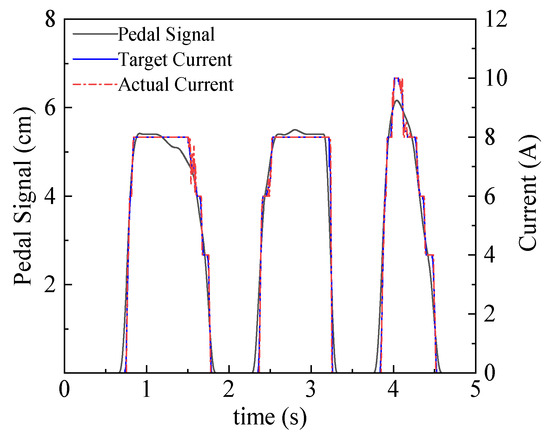
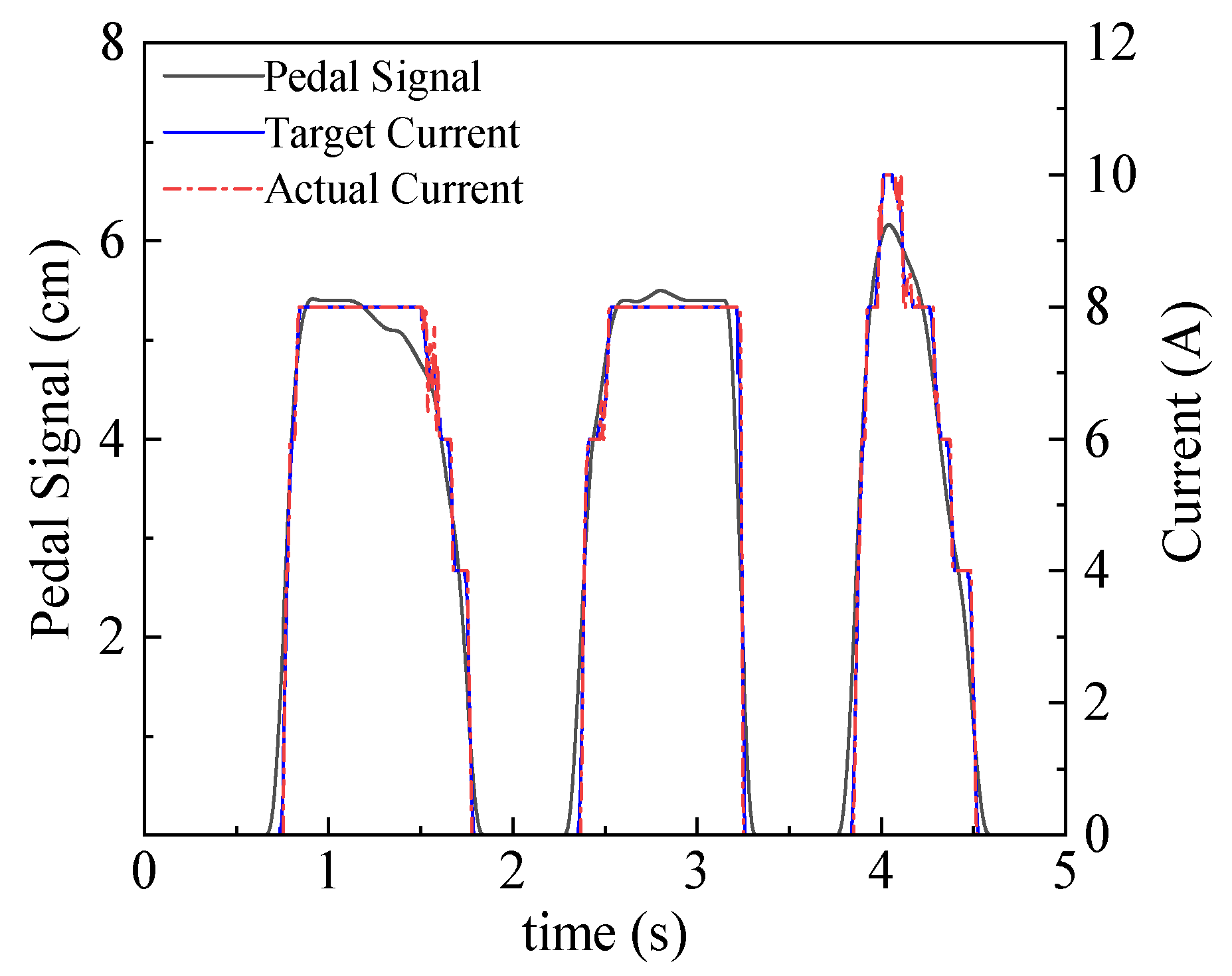
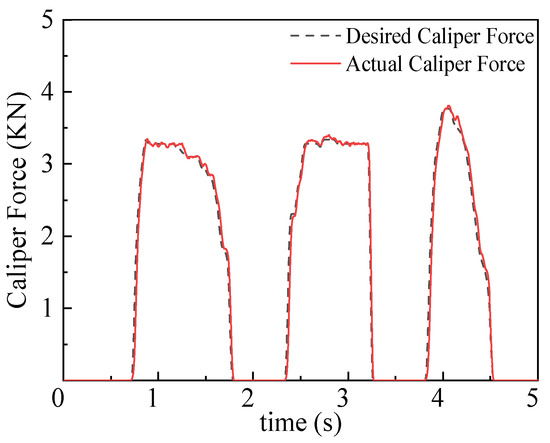
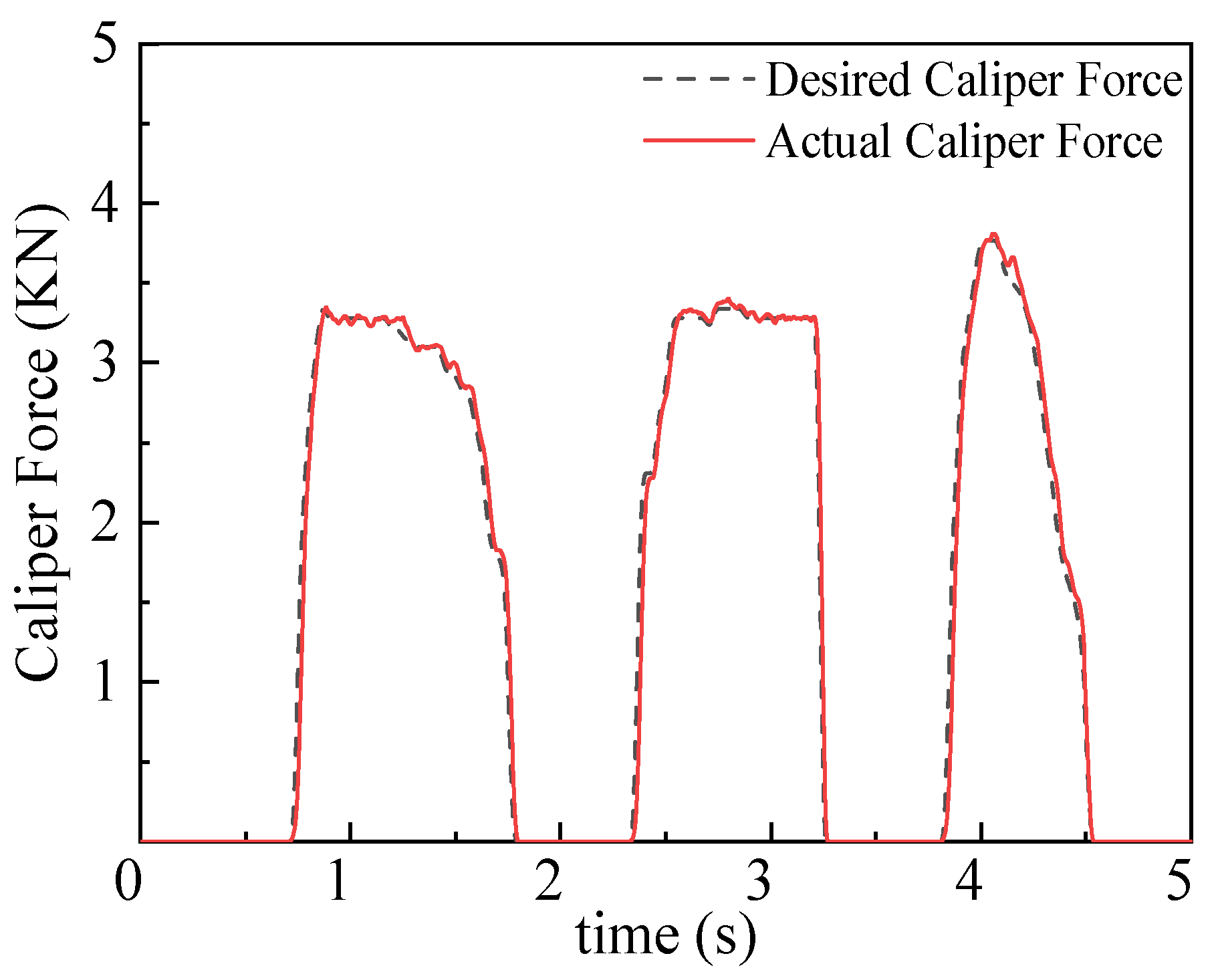
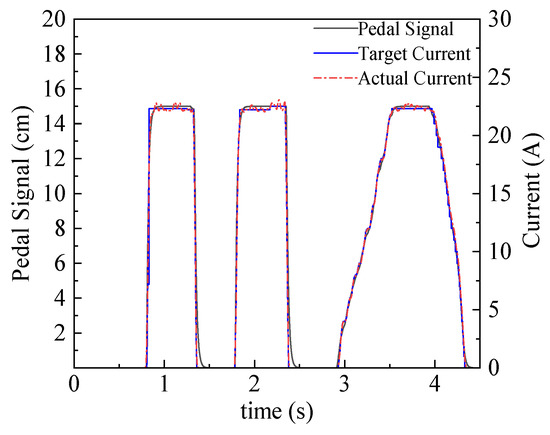
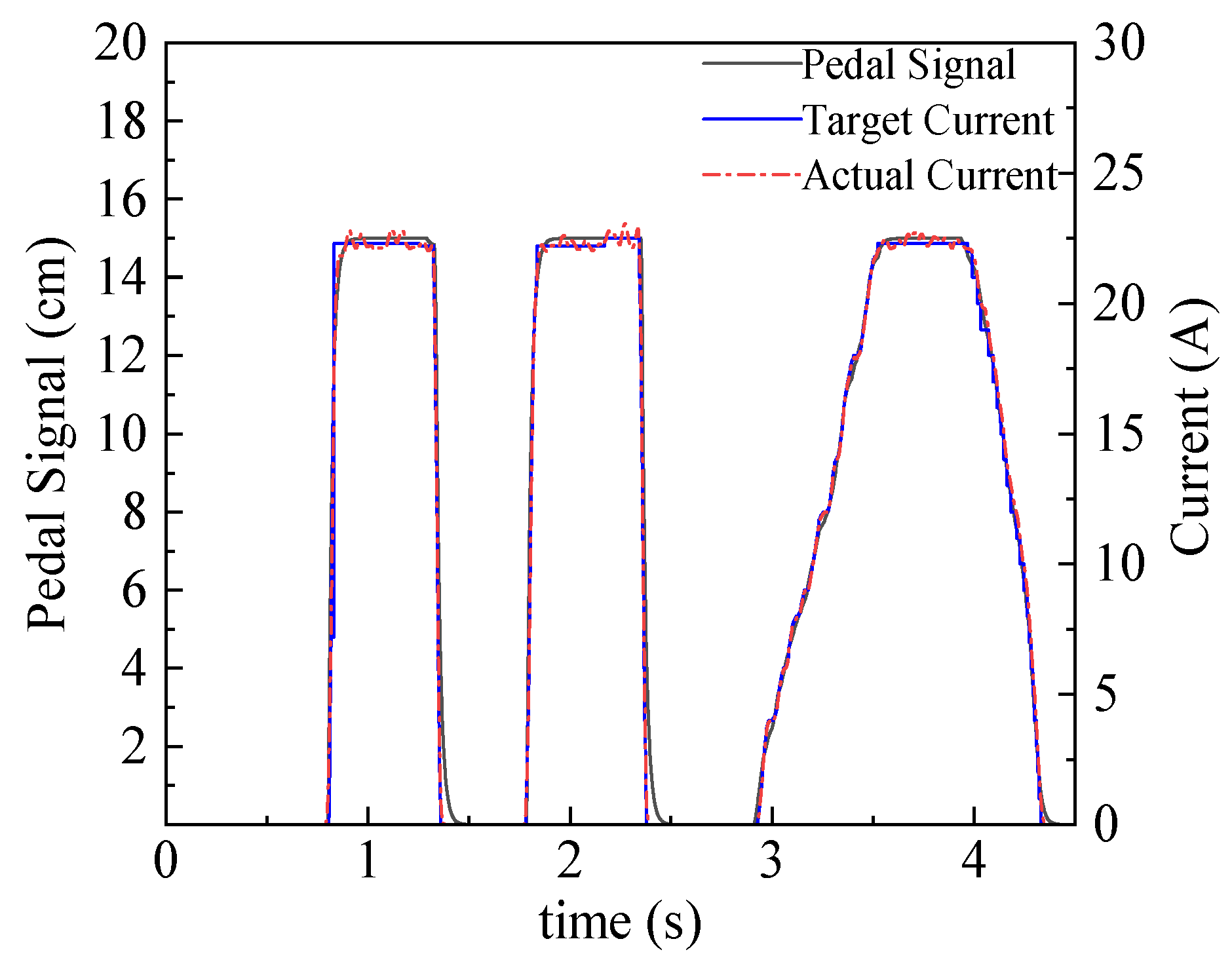
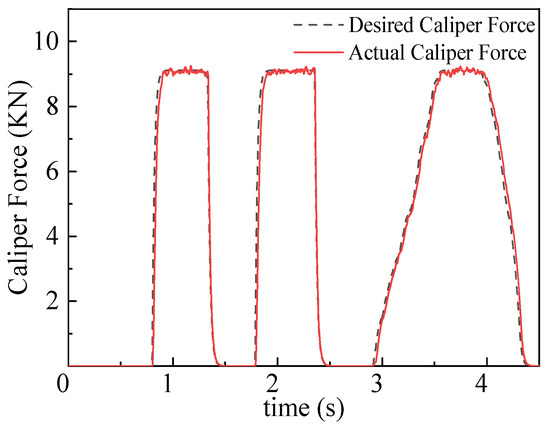
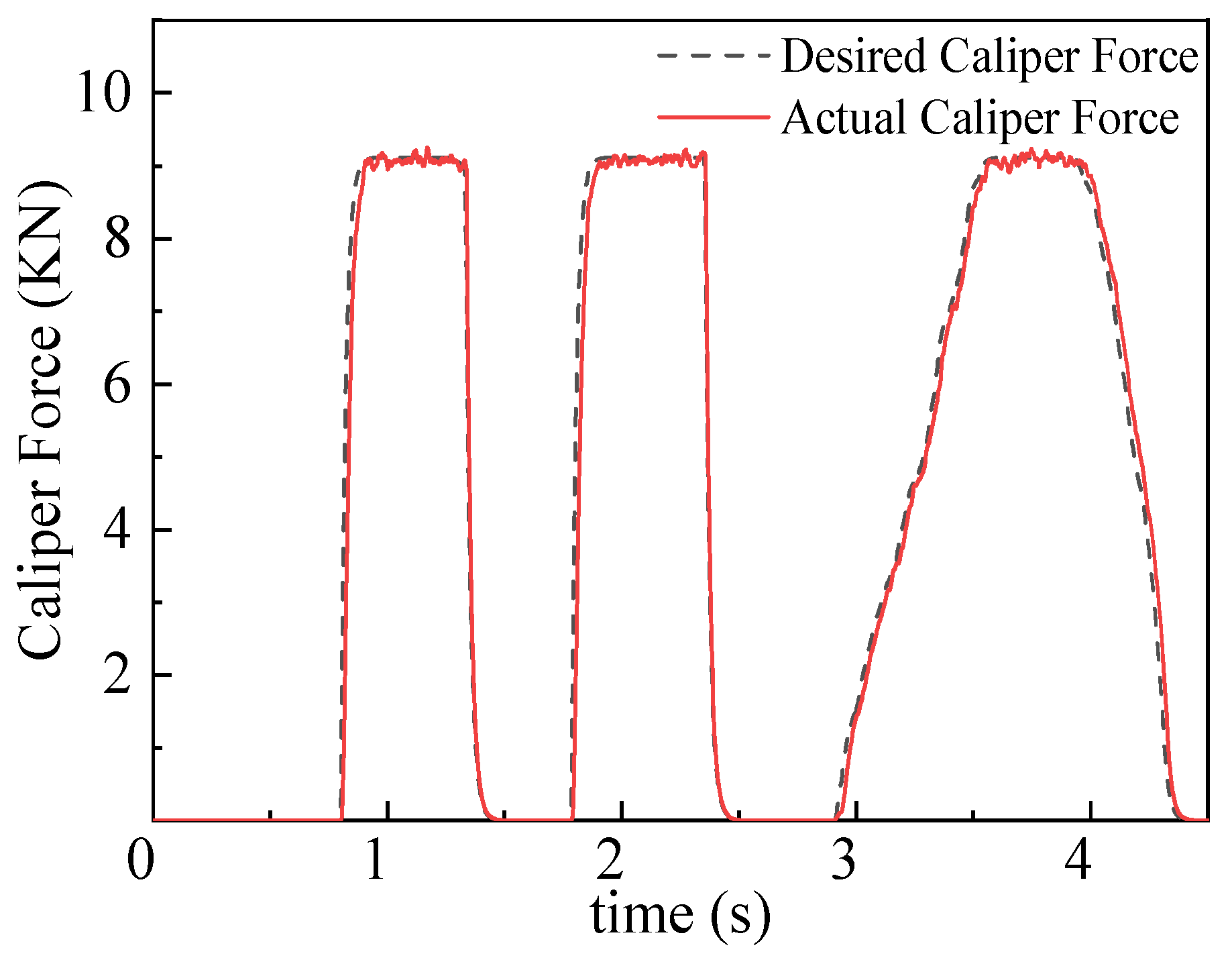
The response results of the DDB under two braking conditions using the MFAC strategy are shown in Figure 21, Figure 22, Figure 23 and Figure 24 and Table 13. From these figures, it can be seen that the DDB’s caliper force closely tracks the desired value after the brake signal is issued, showing a high degree of agreement with the brake pedal signal variation. Under both the low-intensity braking and emergency braking conditions, the measured response times of braking force are approximately 156 ms and 213 ms, respectively. Compared with the fuzzy PID control scheme, the response time is significantly improved. In the steady braking phase, the measured caliper force of the DDB closely coincides with the desired value with an error of only 1.23%, which demonstrates that the braking force can be controlled with high precision. During the caliper force transition phase, the caliper force curve exhibits a smooth response with negligible overshoot or oscillations. This demonstrates that the MFAC strategy provides superior online adaptability and maintains effective control performance when switching between linear and nonlinear system behaviors. This demonstrates that the MFAC strategy’s online adaptability provides superior control performance during abrupt changes in braking force.
Figure 21.
Current responses under MFAC during gentle braking.
Figure 22.
Caliper force responses under MFAC during gentle braking.
Figure 23.
Current responses under MFAC during emergency braking conditions.
Figure 24.
Caliper force responses under MFAC during emergency braking conditions.
Table 13.
DDB experimental results of two control strategies.
6. Conclusions
To address the prevalent issues in current EMB systems, including multiple force transmission stages, complex structures, and slow response, this study proposes a novel drive-by-wire brake unit based on a linear motor and investigates its braking force control. The main research results are summarized as follows:
(1) The designed DDB employs the linear driving force of a linear motor to directly actuate on the lever amplification mechanism, thereby generating the braking force. This approach effectively eliminates friction losses and accuracy limitations associated with “rotary-to-linear” motion conversion mechanisms. Therefore, the DDB features a short force transmission path, high force transmission efficiency, and fast dynamic response. Consequently, it exhibits clear advantages in compactness, responsiveness, and reliability, making it well-suited for the rapid-response requirements of future electric vehicles.
(2) To address the strong nonlinearity, time-varying parameters, and significant thermal effects of the linear motor, the MFAC strategy based on compact-form dynamic linearization was proposed. The designed controller does not rely on an accurate mathematical model. It achieves dynamic linearization through online estimation of pseudo partial derivatives, enabling adaptation to actuator parameter variations and external disturbances. Additionally, the penalty term for constraining input variables and the parameter reset mechanism are incorporated, enabling the controller to maintain rapid response while ensuring good stability and robustness.
(3) The comparative study of the proposed MFAC and fuzzy PID controller was conducted through both simulation and experimental tests. The results demonstrate that MFAC outperforms fuzzy PID in response speed, tracking accuracy, disturbance rejection, and adaptability to parameter variations. In particular, during the transition phase of gap elimination and under high-dynamic conditions, MFAC exhibits more stable data-driven regulation capabilities. The study demonstrates that integrating the DDB with MFAC offers a potentially new approach for next-generation high-performance brake-by-wire systems.
(4) In the future, it is necessary to explore other data-based control methods combined with DDB, such as reinforcement learning and adaptive control based on neural networks, to further enhance the adaptability of DDB under more complex operating conditions.
Supplementary Materials
The following supporting information can be downloaded at: https://www.mdpi.com/article/10.3390/machines14020163/s1.
Author Contributions
Conceptualization, X.G.; methodology, C.H.; validation, H.H. and H.Z.; data curation, Y.L. and H.Y.; writing—original draft preparation, C.H.; writing—review and editing, C.H. and C.C. All authors have read and agreed to the published version of the manuscript.
Funding
This research was supported by Chongqing Natural Science Foundation Projects, grant number (Grant No. CSTB2024NSCQ-MSX0420), Science and Technology Research Program of Chongqing Municipal Education Commission (Grant No. KJQN202401205), and Science and Technology Project of Wanzhou District (Grant No. WZSTC-20240002).
Data Availability Statement
The original contributions presented in this study are included in the article/Supplementary Material. Further inquiries can be directed to the corresponding author.
Conflicts of Interest
The authors declare no conflicts of interest.
References
- Arasteh, E.; Assadian, F. A comparative analysis of brake-by-wire smart actuators using optimization strategies. Energies 2022, 15, 634. [Google Scholar] [CrossRef] [Scilit]
- Bayar, K.; Biasini, R.; Onori, S.; Rizzoni, G. Modelling and control of a brake system for an extended range electric vehicle equipped with axle motors. Int. J. Veh. Des. 2012, 58, 399–426. [Google Scholar] [CrossRef] [Scilit]
- Ji, Q.; Zheng, L.; Bi, Y.; Pang, H. Review of brake-by-wire technology for low-speed and autonomous vehicles. World Electr. Veh. J. 2024, 15, 581. [Google Scholar] [CrossRef] [Scilit]
- Li, C.; Zhuo, G.; Tang, C.; Xiong, L.; Tian, W.; Qiao, L.; Cheng, Y.; Duan, Y. A review of electro-mechanical brake (EMB) system: Structure, control and application. Sustainability 2023, 15, 4514. [Google Scholar] [CrossRef] [Scilit]
- Wu, X.; He, R.; Ge, H.; Chen, M. Electronic mechanical braking system executive mechanism design, calculation, and modeling based on dynamic control. Front. Mech. Eng. 2024, 10, 1368683. [Google Scholar] [CrossRef] [Scilit]
- Arasteh, E. Future Brake-by-Wire Smart Actuators: Enhancing Vehicle Control Systems for Collision Avoidance and Braking. Ph.D. Thesis, University of California, Davis, CA, USA, 2023. [Google Scholar]
- Li, D.; Tan, C.; Ge, W.; Cui, J.; Gu, C.; Chi, X. Review of brake-by-wire system and control technology. Actuators 2022, 11, 80. [Google Scholar]
- Chen, Z.; Wang, R.; Ding, R.; Liu, B.; Liu, W.; Sun, D. Research progress and future prospects of brake-by-wire technology for new energy vehicles. Energies 2025, 18, 2702. [Google Scholar]
- Ji, Y.; Zhang, J.; He, C.; Hou, X.; Liu, W.; Han, J. Wheel braking pressure control based on central booster electrohydraulic brake-by-wire system. IEEE Trans. Transp. Electrific. 2023, 9, 222–235. [Google Scholar] [CrossRef] [Scilit]
- Liu, Z.; Cheng, S.; Liu, J.; Wu, Q.; Li, L.; Liang, H. A novel braking control strategy for hybrid electric buses based on vehicle mass and road slope estimation. Chin. J. Mech. Eng. 2022, 35, 150. [Google Scholar] [CrossRef] [Scilit]
- Chen, X.; Wei, L.; Wang, X.; Li, L.; Xiao, L. Hierarchical cooperative control of anti-lock braking and energy regeneration for electromechanical brake-by-wire system. Mech. Syst. Signal Process. 2021, 159, 107796. [Google Scholar] [CrossRef] [Scilit]
- Hua, X.; Zeng, J.; Li, H.; Huang, J.; Luo, M.; Feng, X.; Xiong, H.; Wu, W. A review of automobile brake-by-wire control technology. Processes 2023, 11, 994. [Google Scholar]
- Zhao, X.; Xiong, L.; Zhuo, G.; Tian, W.; Li, J.; Shu, Q.; Zhao, X.; Xu, G. A review of one-box electro-hydraulic braking system: Architecture, control, and application. Sustainability 2024, 16, 1049. [Google Scholar] [CrossRef] [Scilit]
- Yang, Y.; Li, G.; Zhang, Q. A pressure-coordinated control for vehicle electro-hydraulic braking systems. Energies 2018, 11, 2336. [Google Scholar]
- Chen, Q.; Liu, Y.; Zeng, L.; Xiao, Q.; Zhou, C.; Kang, S. On the control of the master cylinder hydraulic pressure for electro-hydraulic brake systems with the sliding mode design methodology. Fluid Dyn. Mater. Process. 2018, 14, 281–291. [Google Scholar] [CrossRef] [Scilit]
- Shi, B.; Xiong, L.; Yu, Z. Pressure estimation of the electro-hydraulic brake system based on signal fusion. Actuators 2021, 10, 240. [Google Scholar] [CrossRef] [Scilit]
- El-Bakkouri, J.; Mansouri, A.; Ouadi, H.; El-Aoumari, A.; El-Khlifi, Y.; Giri, F. Robust braking pressure control for an electrohydraulic brake system under friction and disturbance conditions. IFAC-PapersOnLine 2024, 58, 539–544. [Google Scholar] [CrossRef] [Scilit]
- Freidovich, L.; Robertsson, A.; Shiriaev, A.; Johansson, R. LuGre-model-based friction compensation. IEEE Trans. Control Syst. Technol. 2009, 18, 194–200. [Google Scholar] [CrossRef] [Scilit]
- Lin, G.; Cao, W.; Chen, Y.; Wang, G.; Nie, X. Adaptive pressure control for electro-hydraulic brake system considering nonlinearity and uncertainty. Proc. Inst. Mech. Eng. Part D J. Automob. Eng. 2025. [Google Scholar] [CrossRef] [Scilit]
- Pustavrh, J.; Hočevar, M.; Podržaj, P.; Trajkovski, A.; Majdi, F. Comparison of hydraulic, pneumatic and electric linear actuation systems. Sci. Rep. 2023, 13, 20938. [Google Scholar] [CrossRef] [Scilit]
- Xu, Z.; Wu, J.; Bi, G.; Hou, J.; Zheng, W.; Li, L.; Gao, S.; Chen, Z. An adaptive clamping force control strategy for electro-mechanical brake system considering nonlinear friction resistance. In Proceedings of the WCX SAE World Congress Experience, Detroit, MI, USA, 16–18 April 2024; SAE Technical Paper: Warrendale, PA, USA, 2024. [Google Scholar]
- Yan, Z.; Peng, H.; Chen, X.; Yan, M. Design, modeling, and control of electronic mechanical brake system: A review. SAE Int. J. Veh. Dyn. Stab. NVH 2024, 8, 467–489. [Google Scholar] [CrossRef] [Scilit]
- Li, Y.; Shim, T.; Shin, D.H.; Lee, S.; Jin, S. Control system design for electromechanical brake system using novel clamping force model and estimator. IEEE Trans. Veh. Technol. 2021, 70, 8653–8668. [Google Scholar] [CrossRef] [Scilit]
- Chen, Q.; Lv, Z.; Tong, H.; Xiong, Z. Clamping force control strategy of electro-mechanical brake system using VUF-PID controller. Actuators 2023, 12, 272. [Google Scholar] [CrossRef] [Scilit]
- Zou, J.; Yan, H.; Yan, Y.; Huang, X. EMB system design and clamping force tracking control research. Modelling 2025, 6, 72. [Google Scholar] [CrossRef] [Scilit]
- Liu, N.; Ouyang, H.; Fu, Y.; Liao, W.H. Non-smooth self-excited vibration of a novel dynamical model for a disc brake. J. Dyn. Monit. Diagn. 2024, 3, 297–310. [Google Scholar]
- Zhou, H.; Wang, Z.; Wang, Q.; Mo, J.; Zhao, C.; Wang, K. Dynamic models and analysis of key factors influencing stick–slip vibration in disc brake system. Railw. Eng. Sci. 2025, 1–15. [Google Scholar] [CrossRef] [Scilit]
- De Wit, C.C.; Olsson, H.; Åström, K.J.; Lischinsky, P. A new model for control of systems with friction. IEEE Trans. Autom. Control 1995, 40, 419–425. [Google Scholar] [CrossRef] [Scilit]
- Zhang, W.; Ping, Z.; Fu, Y.; Zheng, S.; Zhang, P. Observer-based backstepping adaptive force control of electro-mechanical actuator with improved LuGre friction model. Aerospace 2022, 9, 415. [Google Scholar]
- Meng, Y.; Wu, T.; Rong, J.; Yang, X.; Peng, J.; Chu, L. Clamping force control of electromechanical brake actuator considering contact point between friction lining and brake disc. Actuators 2024, 13, 345. [Google Scholar] [CrossRef] [Scilit]
- Abusaima, M.; Abuzied, H. Simulation of screw size effect on performance of electro-mechanical braking system. Discover Appl. Sci. 2024, 6, 64. [Google Scholar]
- He, H.; Gong, X.; Deng, Z.; Li, T.; Wang, X.; Zhang, H.; Xu, R. Research on direct-drive brake actuator and its control method for electric vehicles. SAE Int. J. Veh. Dyn. Stab. NVH 2024, 9, 53–67. [Google Scholar]
- Li, T.; Gong, X.; He, C.; Deng, Z.; Zhang, H.; Xu, R.; He, H.; Wang, X.; Zhang, H. Braking force distribution strategy for brake-by-wire systems: Enhancing safety and redundancy. SAE Int. J. Veh. Dyn. Stab. NVH 2025, 9, 10-09-03-0028. [Google Scholar] [CrossRef] [Scilit]
- Mo, J. Numerical and experimental investigation of compressible-brake-fluid flow characteristics and brake-bleeding performance in EPB caliper. Int. J. Automot. Technol. 2021, 22, 315–325. [Google Scholar] [CrossRef] [Scilit]
- Merzouki, R.; Cadiou, J.C.; M’Sirdi, N.K. Compensation of friction and backlash effects in an electrical actuator. Proc. Inst. Mech. Eng. Part I J. Syst. Control Eng. 2004, 218, 75–84. [Google Scholar]
- Ma, T.; Weng, J.; Tian, C.; Wu, M. A Wear Prediction Framework for Ball-Screw of Electro-Mechanical Brake Unit on Railway Trains. Actuators 2024, 13, 135. [Google Scholar] [CrossRef] [Scilit]
- Ahmad, F.; Hudha, K.; Mazlan, S.A.; Jamaluddin, H.; Aparow, V.R. Modelling and Control of a Fixed Calliper-Based Electronic Wedge Brake. J. Mech. Eng. 2017, 63, 181–190. [Google Scholar]
- Karakoc, K.; Park, E.J.; Suleman, A. Design considerations for an automotive magnetorheological brake. Mechatronics 2008, 18, 434–447. [Google Scholar] [CrossRef] [Scilit]
- Dupont, P.E.; Hayward, V.; Armstrong, B.; Altpeter, F. Single State Elastoplastic Friction Models. IEEE Trans. Autom. Control 2002, 47, 787–792. [Google Scholar]
- Baek, S.K.; Oh, H.K.; Kim, S.W.; Seo, S.I. A clamping force performance evaluation of the electro-mechanical brake using PMSM. Energies 2018, 11, 2876. [Google Scholar]
- Mendel, J.M.; Wu, D. New results about the centroid of an interval type-2 fuzzy set, including the centroid of a general type-2 fuzzy set. Inf. Sci. 2010, 180, 367–386. [Google Scholar]
- Zadeh, L.A. Toward a theory of fuzzy information granulation and its centrality in human reasoning and fuzzy logic. Fuzzy Sets Syst. 1997, 90, 111–127. [Google Scholar] [CrossRef] [Scilit]
- Wang, H.; Jian, H.; Huang, J.; Lan, Y. Fractional-order MFAC with application to DC motor speed control system. Mathematics 2025, 13, 610. [Google Scholar] [CrossRef] [Scilit]
- Zhou, X.; Chen, W.; Huang, J.; Liu, J.; Feng, L.U. A thrust estimation and control method of an adaptive cycle engine based on improved MFAC algorithm. Chin. J. Aeronaut. 2025, 38, 103424. [Google Scholar] [CrossRef] [Scilit]
- Geng, R.; Yang, M.; Li, J.; Qian, W.; Liu, Q. Design and analysis of a preload-controllable lead screw linear ultrasonic motor based on model-free adaptive control. IEEE Access 2025, 13, 158183–158193. [Google Scholar]
- Jin, S.; Hou, Z.; Wang, W. Model-free adaptive control used in permanent magnet linear motor. In Proceedings of the Chinese Control Conference, Zhangjiajie, China, 26–31 July 2007; IEEE: Beijing, China, 2007. [Google Scholar]
- Hou, Z. Non-Parameter Model and Its Adaptive Control Theory; Science Press: Beijing, China, 1999; English Version: Model Free Adaptive Control: Theory and Applications; CRC Press/Taylor & Francis: Boca Raton, FL, USA, 2014. [Google Scholar]



Disclaimer/Publisher’s Note: The statements, opinions and data contained in all publications are solely those of the individual author(s) and contributor(s) and not of MDPI and/or the editor(s). MDPI and/or the editor(s) disclaim responsibility for any injury to people or property resulting from any ideas, methods, instructions or products referred to in the content. |
© 2026 by the authors. Licensee MDPI, Basel, Switzerland. This article is an open access article distributed under the terms and conditions of the Creative Commons Attribution (CC BY) license.