Actuator Fault-Tolerant Control of Anthropomorphic Manipulator Using Adaptive Backstepping and Neural Estimation of LuGre Friction Torque


Abstract
1. Introduction
- The LuGre friction model is incorporated into the Lagrangian equation of motion dynamics for the ED-7220C robotic manipulator, capturing nonlinear and hysteretic joint friction behavior.
- An adaptive backstepping controller is developed to ensure robust trajectory tracking, especially in relation to the occurrence of the actuator faults.
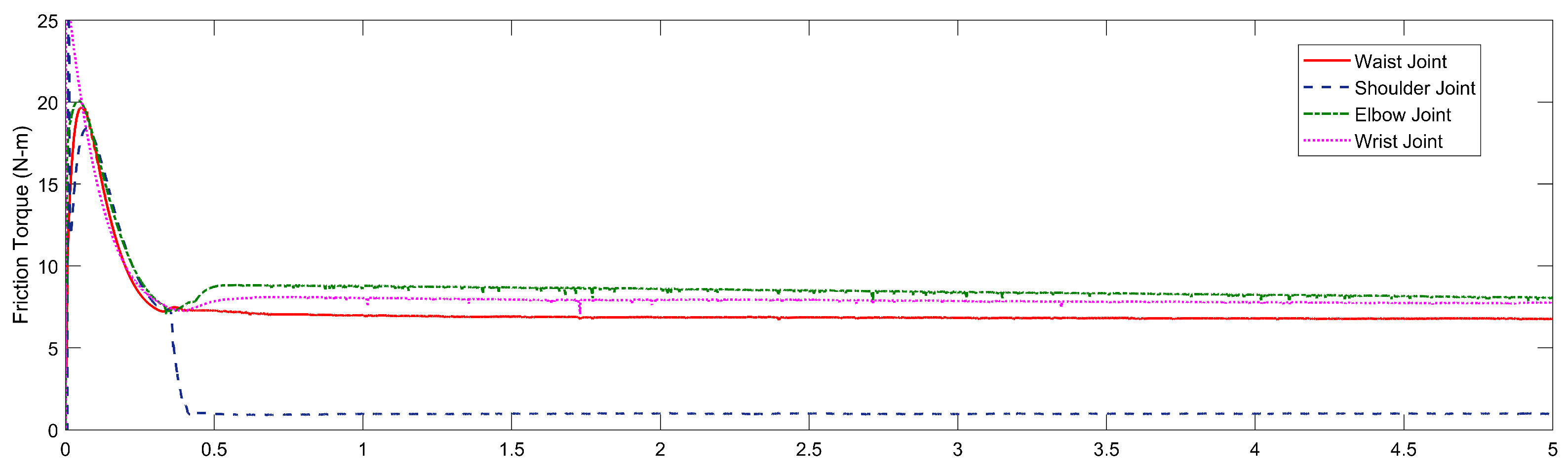
- The feedforward neural network (FFNN) is employed for real-time estimation and compensation of LuGre friction, enhancing tracking precision.
- An adaptive law is designed for the online estimation of actuator effectiveness, enabling fault-tolerant control under partial actuator failures.
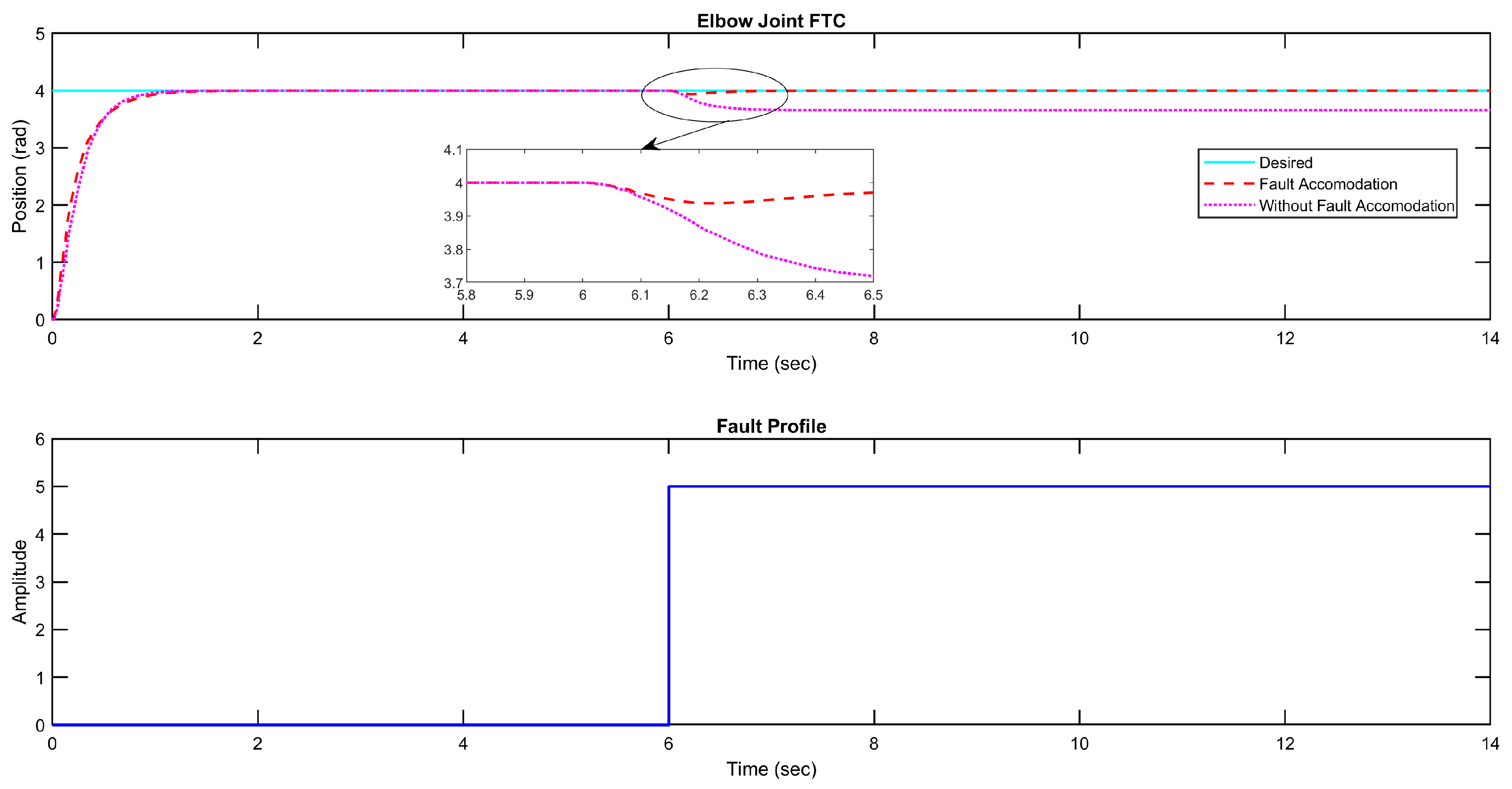
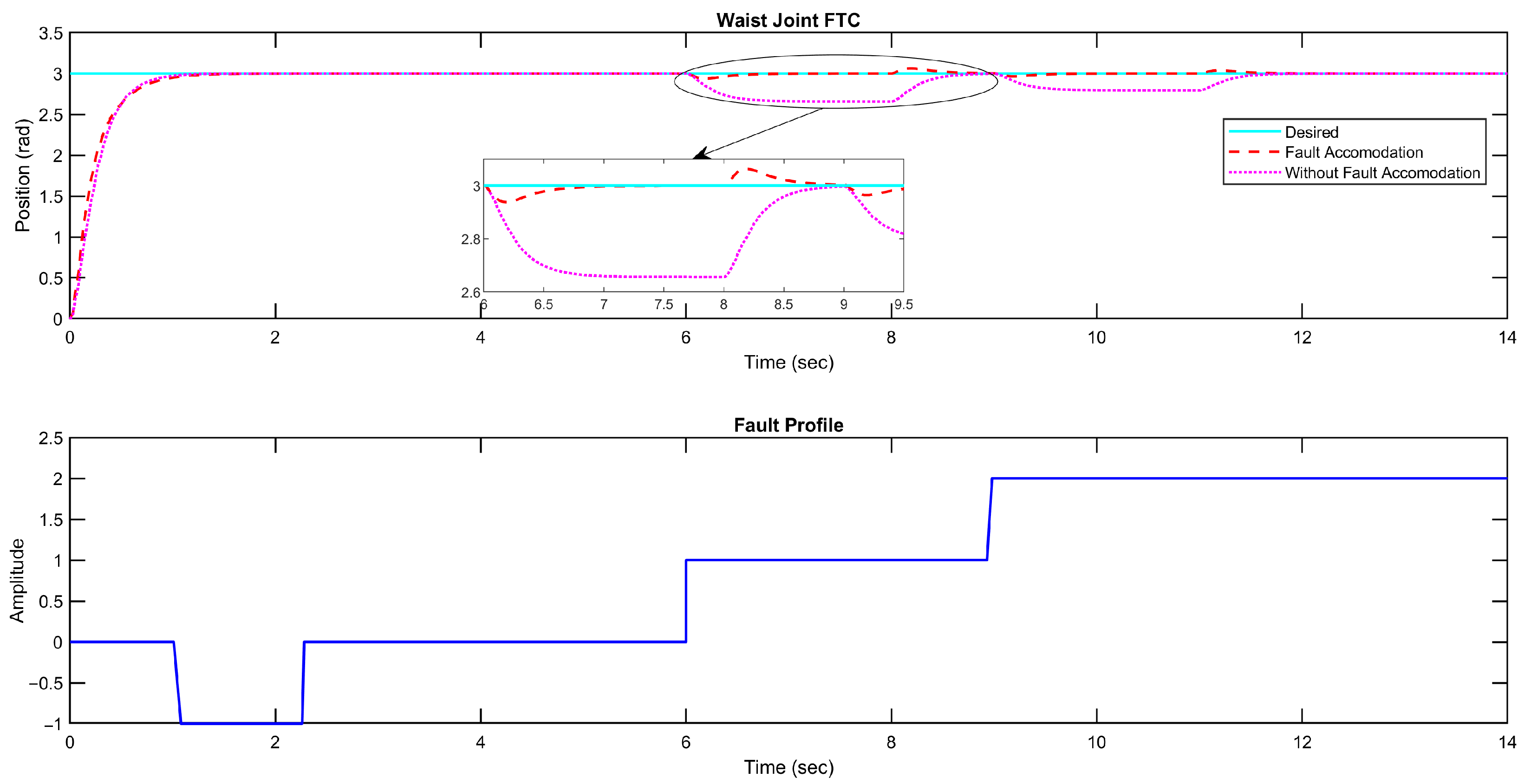
- The proposed method demonstrating effective performance under simultaneous actuator faults and friction disturbances is validated through simulations.
2. System Modeling
- is the mass matrix,
- is the gravitational force vector,
- represents Coriolis and centripetal forces,
- denotes the friction torque vector,
- is the total joint torque of the robotic manipulator.
Dyanmic LuGre Friction Model
- denotes the predicted friction torque.
- represents the internal state of the friction model.
- is the relative velocity between the two contacting surfaces.
- The velocity-dependent function is defined in Equation (5).
- and are the bristle-related coefficients of the friction model.
- represents the Coulomb friction torque.
- denotes the stiction (static) friction torque.
- The parameter governs the rate at which the function transitions to the Coulomb friction torque .
- Specifically, determines how rapidly reaches as the velocity increases.

| Parameter | Description | Value | Unit |
|---|---|---|---|
| Stiffness coefficient | 2750 | Nm/rad | |
| Viscous friction coefficients | Nm·s/rad | ||
| Static friction torque | Nm | ||
| Damping coefficient | Nm·s/rad | ||
| Coulomb friction torque | Nm | ||
| Velocity | rad/s |
3. Problem Formulation
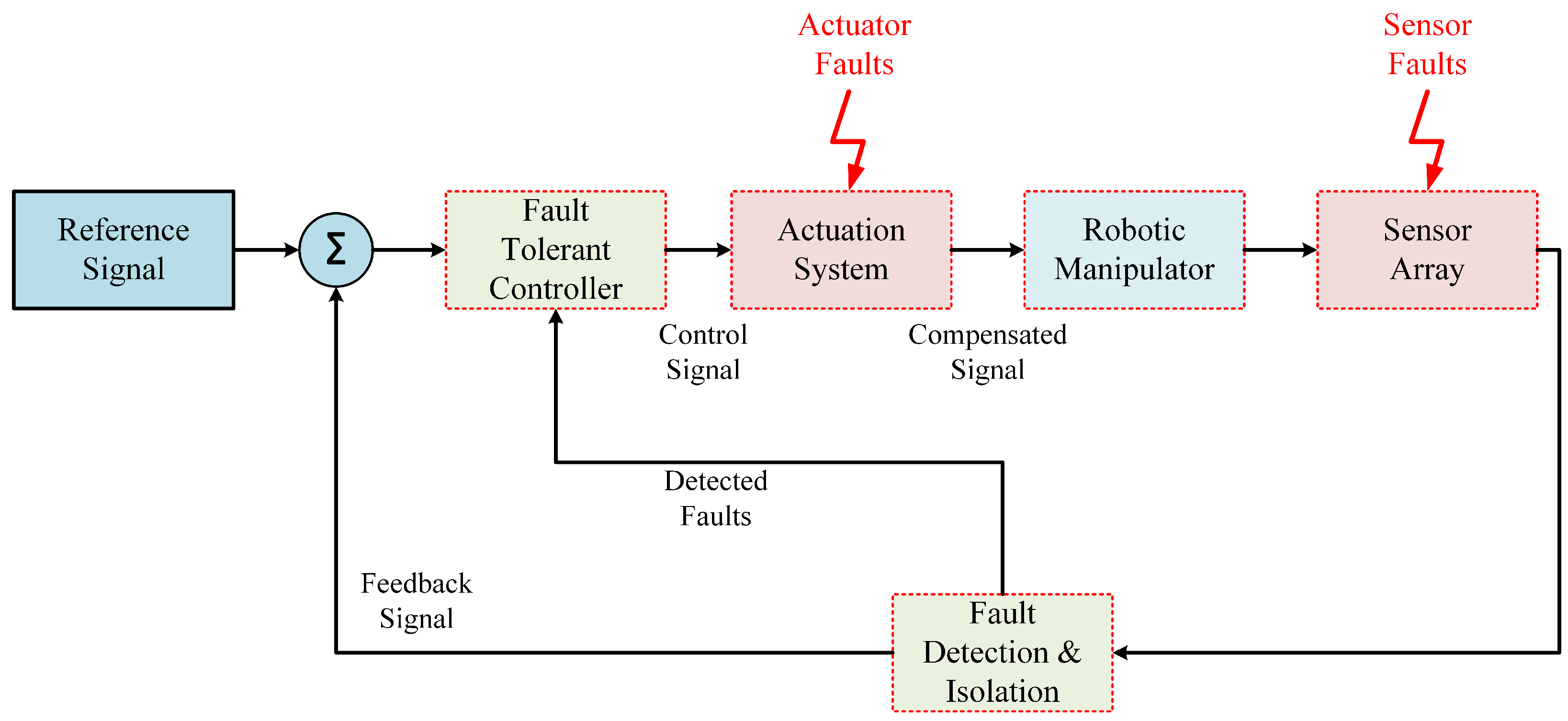
- Loss of Effectiveness (LOE): The actuator produces a reduced output torque compared to the commanded input. Loss-of-effectiveness (LOE) faults are widely regarded as one of the most common actuator faults because they naturally arise from gradual degradation mechanisms such as mechanical wear, aging, thermal stress, and partial electrical failures.
- Stuck Actuator: The actuator remains fixed at a certain torque value regardless of the control command.
- Bias Fault: A constant offset is added to the commanded torque.
- Total Failure: The actuator ceases to produce any torque.
- is the actual torque applied;
- is the actuator effectiveness vector;
- ⊙ denotes the element-wise (Hadamard) product;
- denotes the health of actuator i, with for a fully functional actuator and indicating partial failure.
- Recognise and adjust to actuator degradation.
- Make up for decreased torque availability.
- Preserve system performance and stability in the event of faults.
4. Adaptive Backstepping Controller with Actuator Fault Tolerance
4.1. Backstepping Controller for ED-7220C Robotic Manipulator
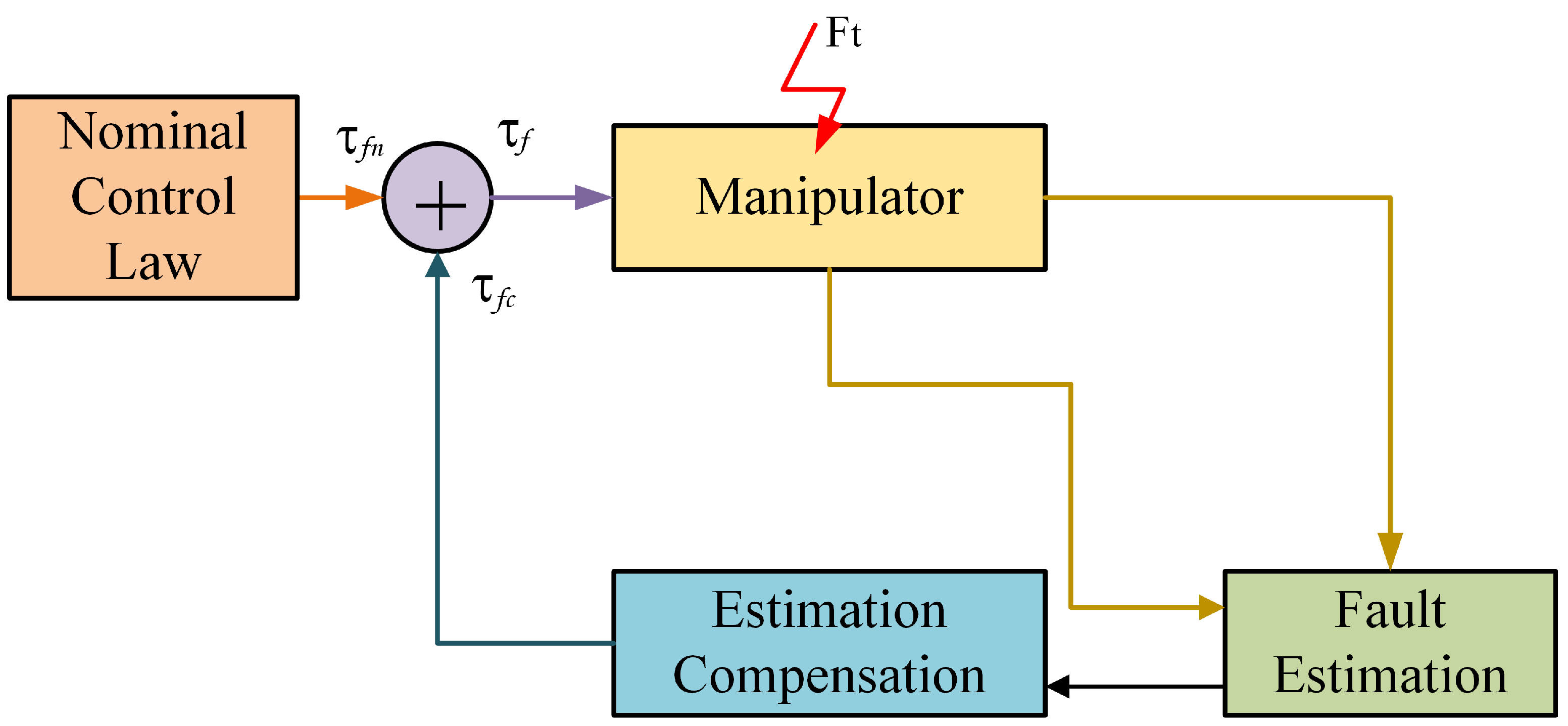
4.2. Adaptive Fault Compensation Control Law
4.3. Friction Torque Estimation Using a FFNN
- Input layer: 5 neurons (velocity-based features).
- Hidden layer 1: 32 neurons.
- Hidden layer 2: 16 neurons.
- Output layer: 1 neuron (estimated friction torque).
4.4. Stability Analysis
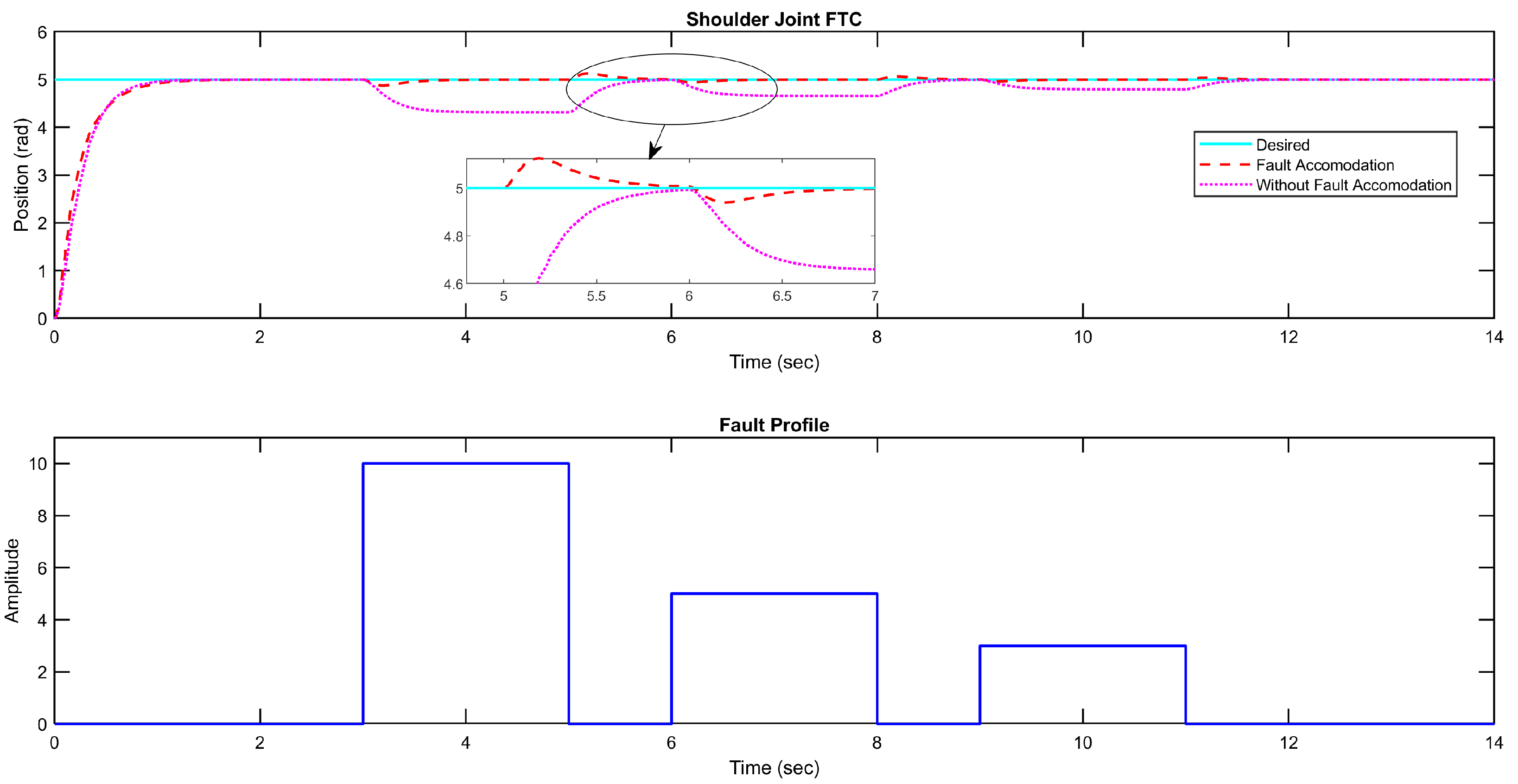
5. Discussion
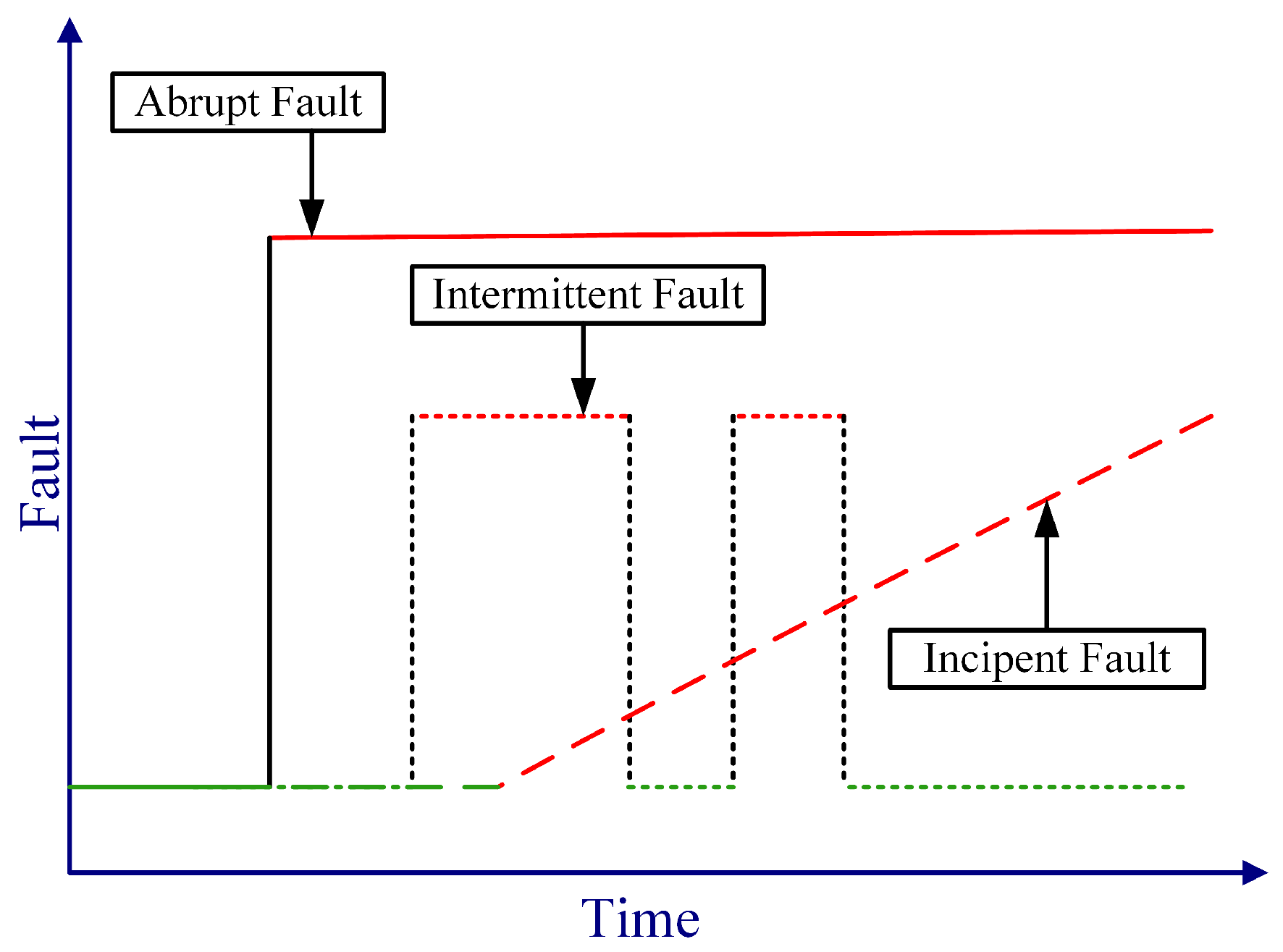
- Abrupt Faults: An unexpected actuator failure that results in an instantaneous loss of output torque due to a power supply drop or mechanical breakage.
- Intermittent Faults: frequent deviations from desired torque due to actuator sticking or signal dropout triggered on by loose wiring or transient electrical contact problems.
- Incipient Faults: Actuator performance gradually declines over time due to wear, increased friction, or long-term component degradation.
6. Conclusions
Author Contributions
Funding
Data Availability Statement
Conflicts of Interest
References
- Elghoul, A.; Tellili, A.; Abdelkrim, M.N. Reconfigurable control of flexible joint robot with actuator fault and uncertainty. J. Electr. Eng. 2019, 70, 130–137. [Google Scholar] [CrossRef]
- Jung, J.; Penning, R.S.; Ferrier, N.J.; Zinn, M.R. A modeling approach for continuum robotic manipulators: Effects of nonlinear internal device friction. In Proceedings of the 2011 IEEE/RSJ International Conference on Intelligent Robots and Systems, San Francisco, CA, USA, 25–30 September 2011; pp. 5139–5146. [Google Scholar]
- Bagheri, M.; Naseradinmousavi, P.; Krstić, M. Feedback linearization based predictor for time delay control of a high-DOF robot manipulator. Automatica 2019, 108, 108485. [Google Scholar] [CrossRef]
- Soltanpour, M.; Shafiei, S. Robust backstepping control of robot manipulator in task space with uncertainties in kinematics and dynamics. Elektron. Ir Elektrotech. 2009, 96, 47–50. [Google Scholar]
- Wai, R.J.; Tu, C.Y.; Hsieh, K.Y. Adaptive tracking control for robot manipulator. Int. J. Syst. Sci. 2004, 35, 615–627. [Google Scholar] [CrossRef]
- Fujimoto, K.; Baba, T.; Sakata, N.; Maruta, I. A passivity-based sliding mode controller for a class of electro-mechanical systems. IEEE Control Syst. Lett. 2021, 6, 1208–1213. [Google Scholar] [CrossRef]
- Billard, A.; Kragic, D. Trends and challenges in robot manipulation. Science 2019, 364, eaat8414. [Google Scholar] [CrossRef] [PubMed]
- Jokar, H.; Naghipour, A.; Jeloudari, I. A New Adaptive Robust Control Scheme for Trajectory Tracking of Robot Manipulators With Uncertain Dynamics Model. IET Control Theory Appl. 2025, 19, e70039. [Google Scholar] [CrossRef]
- Shtessel, Y.; Plestan, F.; Edwards, C.; Levant, A. Adaptive sliding mode and higher order sliding-mode control techniques with applications: A survey. In Sliding-Mode Control and Variable-Structure Systems: The State of the Art; Springer: Cham, Switzerland, 2023; pp. 267–305. [Google Scholar]
- Zhang, L.; Feng, J.; Qiu, W.; Zhang, L. Experiment and simulation research on synchronization control of shaking tables system based on adaptive sliding mode controller. J. Vib. Eng. Technol. 2023, 11, 1623–1645. [Google Scholar] [CrossRef]
- Gao, M.M.; Jin, X.Z.; Ding, L.J. Robust adaptive backstepping INTSM control for robotic manipulators based on ELM. Neural Comput. Appl. 2022, 34, 5029–5039. [Google Scholar] [CrossRef]
- Lu, E.; Ma, Z.; Li, Y.; Xu, L.; Tang, Z. Adaptive backstepping control of tracked robot running trajectory based on real-time slip parameter estimation. Int. J. Agric. Biol. Eng. 2020, 13, 178–187. [Google Scholar] [CrossRef]
- Castaño, M.L.; Tan, X. Backstepping-based tracking control of underactuated aquatic robots. IEEE Trans. Control Syst. Technol. 2022, 31, 1179–1195. [Google Scholar] [CrossRef]
- Yu, Y.; Guo, X.; Mi, Z. Adaptive robust backstepping control of permanent magnet synchronous motor chaotic system with fully unknown parameters and external disturbances. Math. Probl. Eng. 2016, 2016, 3690240. [Google Scholar] [CrossRef]
- Tong, Y.; Liu, J.; Zhou, H.; Ju, Z.; Zhang, X. Adaptive tracking control of robotic manipulators with unknown kinematics and uncertain dynamics. IEEE Trans. Autom. Sci. Eng. 2023, 21, 5252–5269. [Google Scholar] [CrossRef]
- Noura, H.; Sauter, D.; Hamelin, F.; Theilliol, D. Fault-tolerant control in dynamic systems: Application to a winding machine. IEEE Control Syst. Mag. 2002, 20, 33–49. [Google Scholar]
- Gao, B.; Liu, Y.J.; Liu, L. Adaptive neural fault-tolerant control of a quadrotor UAV via fast terminal sliding mode. Aerosp. Sci. Technol. 2022, 129, 107818. [Google Scholar] [CrossRef]
- Abbaspour, A.; Mokhtari, S.; Sargolzaei, A.; Yen, K.K. A survey on active fault-tolerant control systems. Electronics 2020, 9, 1513. [Google Scholar] [CrossRef]
- Urrea, C. Hybrid Fault-Tolerant Control in Cooperative Robotics: Advances in Resilience and Scalability. Actuators 2025, 14, 177. [Google Scholar] [CrossRef]
- Yeom, J. Active Fault-Tolerant Control of Quadrotors for Resilient and Safe Operations. Ph.D. Thesis, New York University Tandon School of Engineering, Brooklyn, NY, USA, 2025. [Google Scholar]
- Yu, X.; Jiang, J. A survey of fault-tolerant controllers based on safety-related issues. Annu. Rev. Control 2015, 39, 46–57. [Google Scholar] [CrossRef]
- Zhang, Y.; Jiang, J. Bibliographical review on reconfigurable fault-tolerant control systems. Annu. Rev. Control 2008, 32, 229–252. [Google Scholar] [CrossRef]
- Johanastrom, K.; Canudas-De-Wit, C. Revisiting the LuGre friction model. IEEE Control Syst. Mag. 2008, 28, 101–114. [Google Scholar] [CrossRef]
- Zhang, S.; Yang, P.; Kong, L.; Li, G.; He, W. A single parameter-based adaptive approach to robotic manipulators with finite time convergence and actuator fault. IEEE Access 2020, 8, 15123–15131. [Google Scholar] [CrossRef]
- Zhu, Y.; Li, X.; Kong, L.; Zhang, T.; Zheng, G. Online identification and feed-forward compensation of nonlinear friction in servo system based on RBF neural network model. Trans. Can. Soc. Mech. Eng. 2024, 48, 355–368. [Google Scholar] [CrossRef]
- Wang, Y.; Yu, Y.; Wang, Z.; Ji, L.; Yang, J.; Wang, S. Tracking control of humanoid manipulator using sliding mode with neural network and disturbance observer. Sci. Rep. 2025, 15, 38980. [Google Scholar] [CrossRef] [PubMed]
- Hu, H.; Zhu, X.; Batou, A.; Ouyang, H. Explicit frictional stick–slip dynamics of elastic contact problem incorporating the LuGre model. Nonlinear Dyn. 2024, 112, 16061–16080. [Google Scholar] [CrossRef]
- Katsiaris, P.T.; Artemiadis, P.K.; Kyriakopoulos, K.J. Modeling anthropomorphism in dynamic human arm movements. In Proceedings of the 2010 IEEE/RSJ International Conference on Intelligent Robots and Systems, Taipei, Taiwan, 18–22 October 2010; pp. 3507–3512. [Google Scholar]
- Trivedi, U.; Menychtas, D.; Alqasemi, R.; Dubey, R. Biomimetic approaches for human arm motion generation: Literature review and future directions. Sensors 2023, 23, 3912. [Google Scholar] [CrossRef]
- Mavrogiannis, C.I.; Liarokapis, M.V.; Kyriakopoulos, K.J. Quantifying anthropomorphism of robot arms. In Proceedings of the 2015 IEEE/RSJ International Conference on Intelligent Robots and Systems (IROS), Hamburg, Germany, 28 September–2 October 2015; pp. 4084–4089. [Google Scholar]
- Ali, K.; Ullah, S.; Mehmood, A.; Mostafa, H.; Marey, M.; Iqbal, J. Adaptive FIT-SMC Approach for an Anthropomorphic Manipulator With Robust Exact Differentiator and Neural Network-Based Friction Compensation. IEEE Access 2022, 10, 3378–3389. [Google Scholar] [CrossRef]
- Analytical describing function of LuGre friction model. Int. J. Intell. Robot. Appl. 2022, 6, 437–448. [CrossRef]
- Wang, X.; Wang, S. Output torque tracking control of direct-drive rotary torque motor with dynamic friction compensation. J. Frankl. Inst. 2015, 352, 5361–5379. [Google Scholar] [CrossRef]
- Blanke, M.; Kinnaert, M.; Lunze, J.; Staroswiecki, M. Introduction to diagnosis and fault-tolerant control. In Diagnosis and Fault-Tolerant Control; Springer: Berlin/Heidelberg, Germany, 2015; pp. 1–35. [Google Scholar]
- Piltan, F.; Kim, C.H.; Kim, J.M. Advanced adaptive fault diagnosis and tolerant control for robot manipulators. Energies 2019, 12, 1281. [Google Scholar] [CrossRef]
- Tao, G. Adaptive Control of Systems with Actuator Failures; Springer Science & Business Media: London, UK, 2004. [Google Scholar]




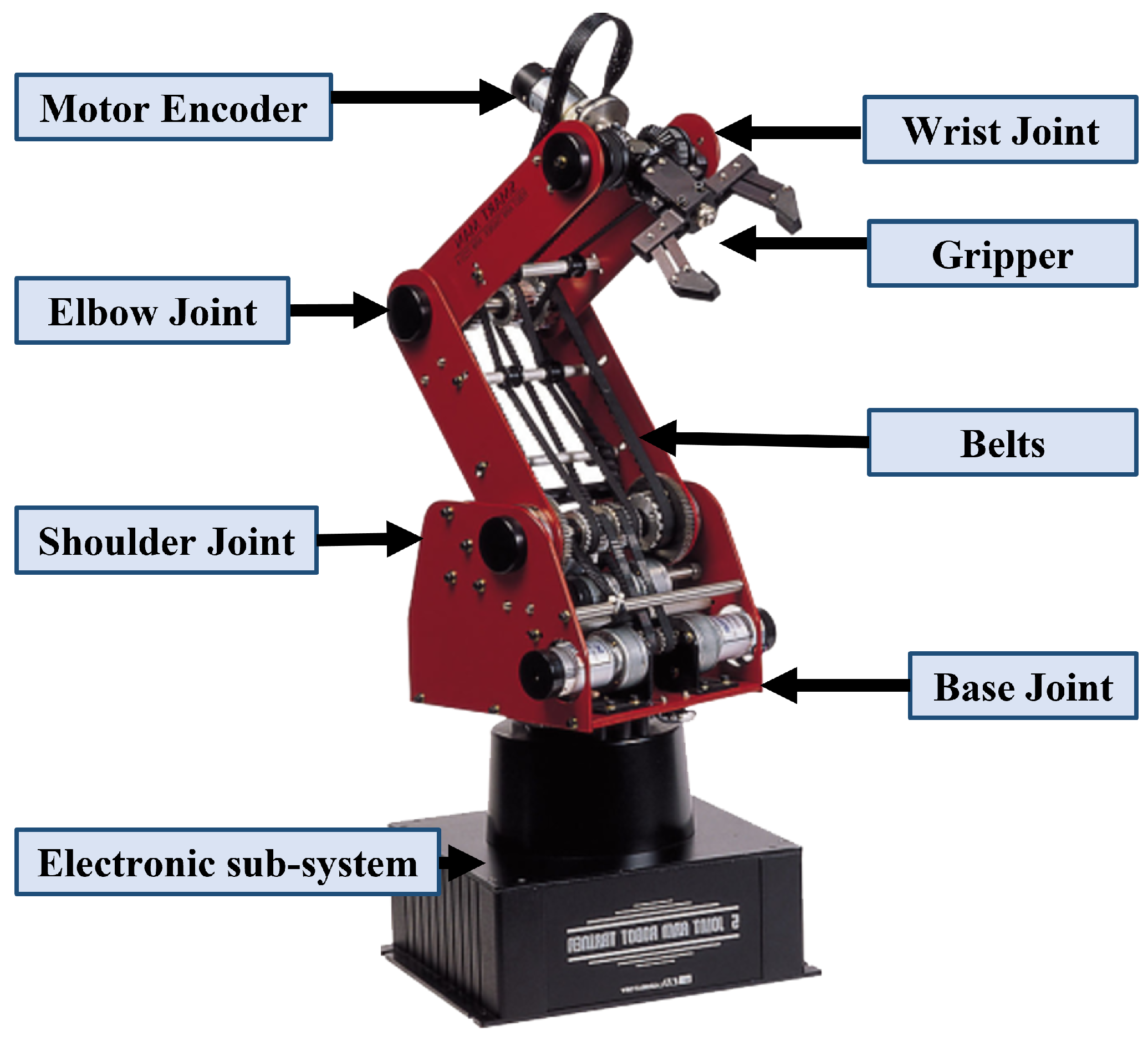
| Parameter | Base | Shoulder | Elbow | Wrist |
|---|---|---|---|---|
| Link Length (mm) | 385 | 220 | 220 | 155 |
| Range of Motion (deg) | 310 | +130/−35 | 360 (Rot.), (Up-Down) |
| Parameter | Specification |
|---|---|
| Construction | Vertical Articulated Arm |
| Maximum Movement Speed | Approx. 100 mm/s |
| Number of Joints | 5 Joints + Gripper |
| Weight | 33.0 kg |
| Actuator | DC Servo Motor (Optical Encoder) |
| Load Capacity | 1.0 kg |
| Precision (Position) | m |
Disclaimer/Publisher’s Note: The statements, opinions and data contained in all publications are solely those of the individual author(s) and contributor(s) and not of MDPI and/or the editor(s). MDPI and/or the editor(s) disclaim responsibility for any injury to people or property resulting from any ideas, methods, instructions or products referred to in the content. |
© 2026 by the authors. Licensee MDPI, Basel, Switzerland. This article is an open access article distributed under the terms and conditions of the Creative Commons Attribution (CC BY) license.
Share and Cite
Ali, K.; Shehzad, K.; Gul, S.; Ajwad, S.A.; Mehmood, A. Actuator Fault-Tolerant Control of Anthropomorphic Manipulator Using Adaptive Backstepping and Neural Estimation of LuGre Friction Torque. Machines 2026, 14, 156. https://doi.org/10.3390/machines14020156
Ali K, Shehzad K, Gul S, Ajwad SA, Mehmood A. Actuator Fault-Tolerant Control of Anthropomorphic Manipulator Using Adaptive Backstepping and Neural Estimation of LuGre Friction Torque. Machines. 2026; 14(2):156. https://doi.org/10.3390/machines14020156
Chicago/Turabian StyleAli, Khurram, Khurram Shehzad, Sikender Gul, Syed Ali Ajwad, and Adeel Mehmood. 2026. "Actuator Fault-Tolerant Control of Anthropomorphic Manipulator Using Adaptive Backstepping and Neural Estimation of LuGre Friction Torque" Machines 14, no. 2: 156. https://doi.org/10.3390/machines14020156
APA StyleAli, K., Shehzad, K., Gul, S., Ajwad, S. A., & Mehmood, A. (2026). Actuator Fault-Tolerant Control of Anthropomorphic Manipulator Using Adaptive Backstepping and Neural Estimation of LuGre Friction Torque. Machines, 14(2), 156. https://doi.org/10.3390/machines14020156