


Node-Incremental-Based Multisource Domain Adaptation for Fault Diagnosis of Rolling Bearings with Limited Data

Abstract
1. Introduction
- Current entropy-based feature extraction methods exhibit limited adaptability in capturing multi-level dynamical characteristics, particularly the intrinsic uncertainty present in rolling bearing vibration signals.
- Although deep domain adaptation offers significant performance benefits, it requires extended training times and large model parameters, limiting its practicality in modern industrial applications. Additionally, these methods often lack transparency and require enhanced interpretability for effective cross-domain network modeling.
- Existing shallow domain adaptation approaches, which integrate domain matching with a fault classifier, require manual configuration of network structures for cross-domain adaptation. Insufficient nodes reduce modeling accuracy, while excessive nodes increase the risk of overfitting and prolong training time.
- 1.
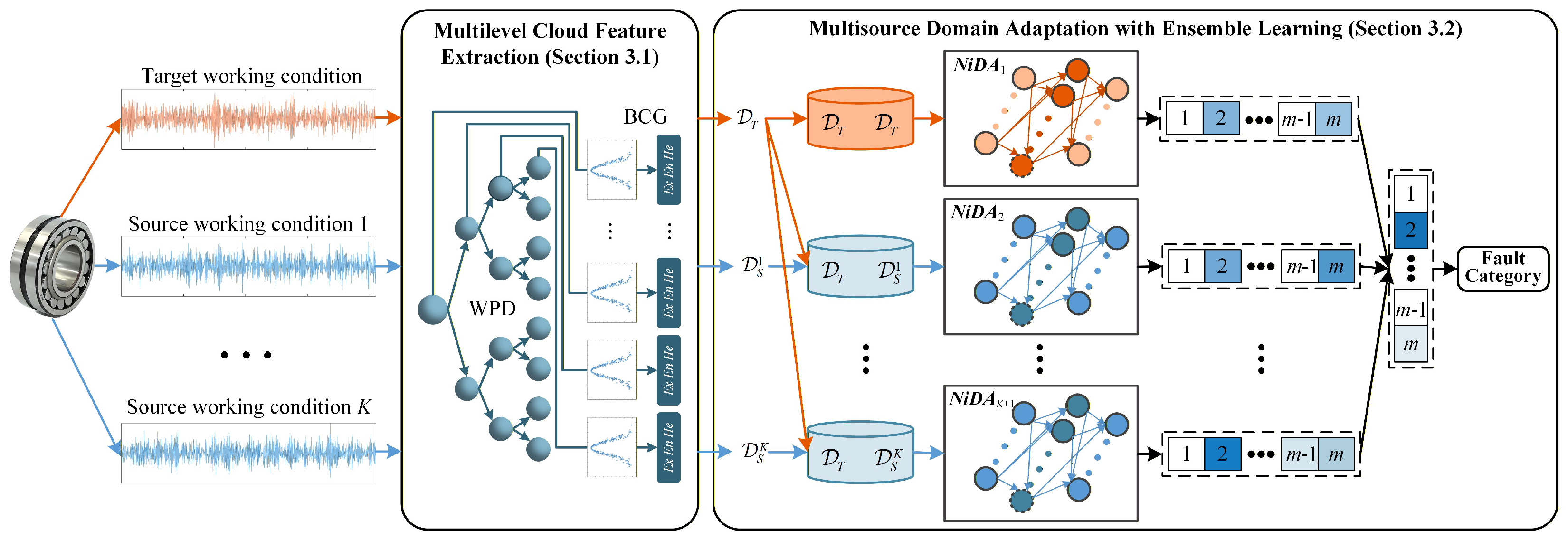
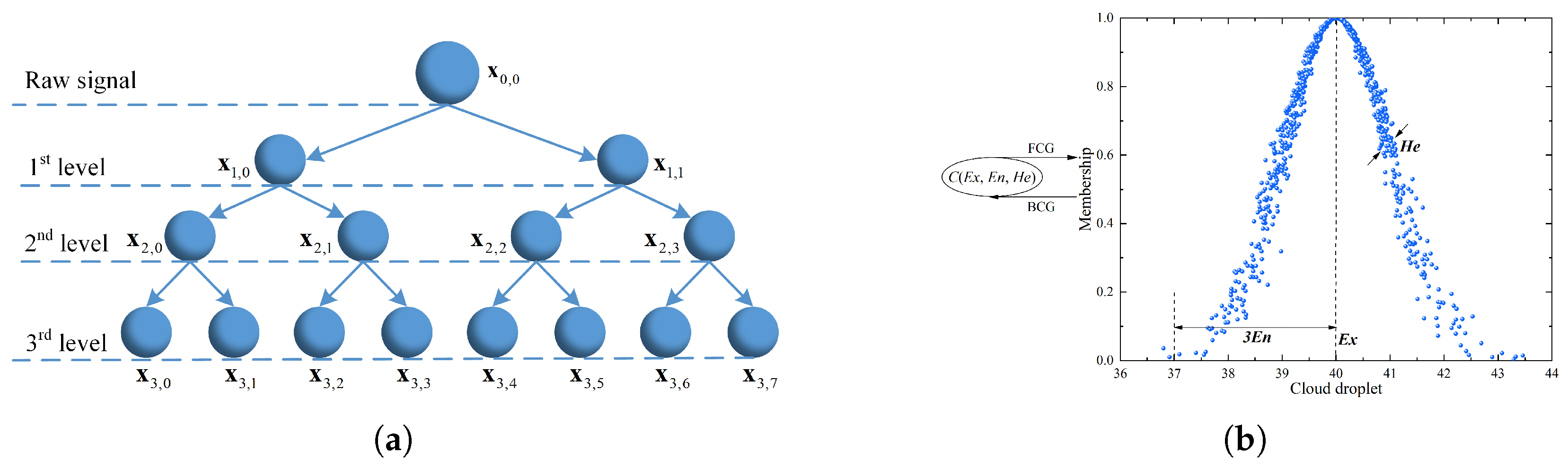
- Hierarchical cloud characteristics are extracted from multi-level wavelet packet coefficients of vibration signals using BCG, minimizing the need for human intervention. This approach facilitates the acquisition of high-resolution, fault-sensitive, and nonstationary features that account for uncertainties.
- 2.
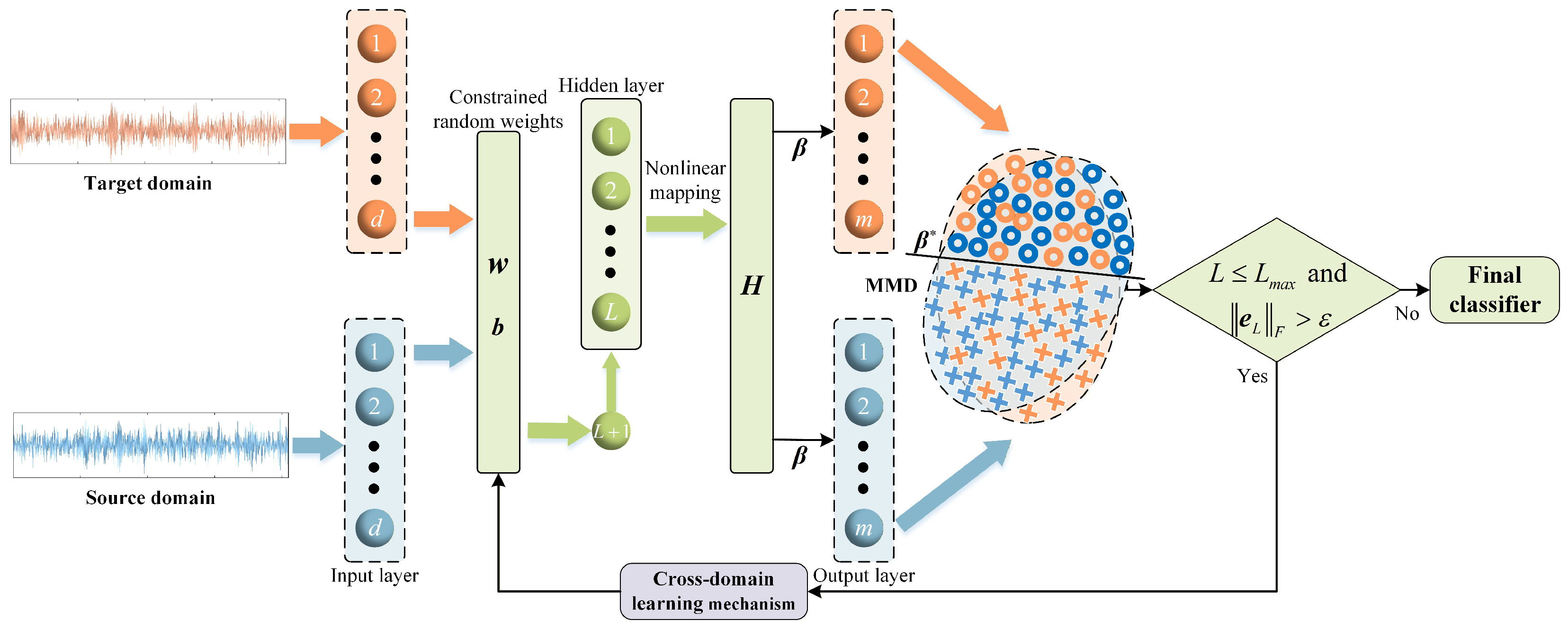
- A novel shallow-network-based MDA framework is proposed for timely fault diagnosis, utilizing diagnostic residual feedback to constrain the number of adaptive nodes and incorporating node incremental learning into domain adaptation. A rigorous convergence proof is provided to enhance theoretical interpretability in domain adaptation.
- 3.
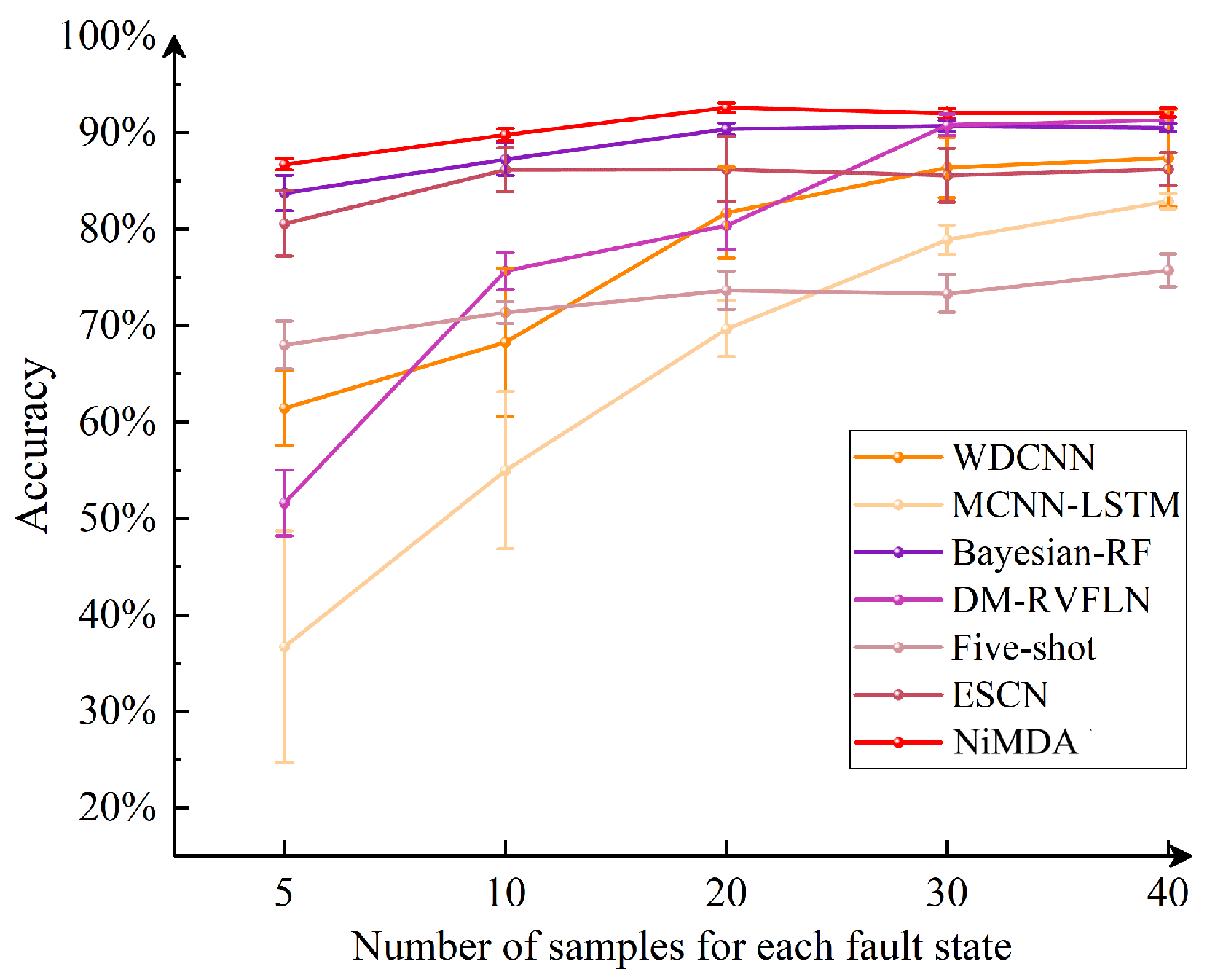
- A parallel ensemble learning approach is introduced to improve diagnostic accuracy and stability in the target domain with limited samples. This method leverages labeled data from multiple source domains and maintains a high diagnostic speed.
2. Preliminaries
2.1. Problem Formulation
2.2. Theoretical Background
3. Node-Incremental-Based Multisource Domain Adaptation for Bearing Fault Diagnosis
3.1. Multi-Level Cloud Feature Extraction
3.2. Multisource Domain Adaptation with Ensemble Learning
3.2.1. Node-Incremental-Based Domain Adaptation
| Algorithm 1 NiDA |
|
3.2.2. Ensemble Learning
4. Experiments
4.1. Data Description and Experiment Setup
4.1.1. Data Description
4.1.2. Experiment Setup
4.2. Effectiveness Analysis of NiDA
4.3. Comparison with Existing Fault Diagnosis Methods
4.4. Effect of the Number of Training Samples
4.5. Parameter Sensitivity
5. Conclusions
Author Contributions
Funding
Data Availability Statement
Conflicts of Interest
Appendix A
References
- Dai, W.; Liu, J.; Wang, L. Cloud ensemble learning for fault diagnosis of rolling bearings with stochastic configuration networks. Inf. Sci. 2024, 658, 119991. [Google Scholar]
- Chaouech, L.; Ben Ali, J.; Berghout, T.; Bechhoefer, E.; Chaari, A. BSEMD-transformer: A new framework for rolling element bearing diagnosis in electrical machines based on classification of time–frequency features. Machines 2025, 13, 961. [Google Scholar]
- Wang, L.; Zhao, W. An ensemble deep learning network based on 2D convolutional neural network and 1D LSTM with self-attention for bearing fault diagnosis. Appl. Soft. Comput. 2025, 172, 112889. [Google Scholar]
- Wang, R.; Jiang, H.; Zhu, K.; Wang, Y.; Liu, C. A deep feature enhanced reinforcement learning method for rolling bearing fault diagnosis. Adv. Eng. Inform. 2022, 54, 101750. [Google Scholar]
- Imaouchen, Y.; Kedadouche, M.; Alkama, R.; Thomas, M. A frequency-weighted energy operator and complementary ensemble empirical mode decomposition for bearing fault detection. Mech. Syst. Signal Process. 2017, 82, 103–116. [Google Scholar] [CrossRef]
- Seera, M.; Wong, M.D.; Nandi, A.K. Classification of ball bearing faults using a hybrid intelligent model. Appl. Soft. Comput. 2017, 57, 427–435. [Google Scholar]
- Li, Y.; Feng, K.; Liang, X.; Zuo, M.J. A fault diagnosis method for planetary gearboxes under non-stationary working conditions using improved Vold-Kalman filter and multi-scale sample entropy. J. Sound Vibr. 2019, 439, 271–286. [Google Scholar]
- Ying, W.; Zheng, J.; Pan, H.; Liu, Q. Permutation entropy-based improved uniform phase empirical mode decomposition for mechanical fault diagnosis. Digit. Signal Process. 2021, 117, 103167. [Google Scholar] [CrossRef]
- Sun, B.; Liu, X. Significance support vector machine for high-speed train bearing fault diagnosis. IEEE Sens. J. 2023, 23, 4638–4646. [Google Scholar]
- Li, X.; Yang, Y.; Hu, N.; Cheng, Z.; Cheng, J. Discriminative manifold random vector functional link neural network for rolling bearing fault diagnosis. Knowl.-Based Syst. 2021, 211, 106507. [Google Scholar]
- Liu, J.; Hao, R.; Zhang, T.; Wang, X. Vibration fault diagnosis based on stochastic configuration neural networks. Neurocomputing 2021, 434, 98–125. [Google Scholar] [CrossRef]
- Zhang, W.; Peng, G.; Li, C.; Chen, Y.; Zhang, Z. A new deep learning model for fault diagnosis with good anti-noise and domain adaptation ability on raw vibration signals. Sensors 2017, 17, 425. [Google Scholar] [CrossRef]
- Wang, S.; Zhang, J. An intelligent process fault diagnosis system based on Andrews plot and convolutional neural network. J. Dyn. Monit. Diagn. 2022, 1, 127–138. [Google Scholar] [CrossRef]
- Spirto, M.; Nicolella, A.; Melluso, F.; Malfi, P.; Cosenza, C.; Savino, S.; Niola, V. Enhancing SDP-CNN for gear fault detection under variable working conditions via multi-order tracking filtering. J. Dyn. Monit. Diagn. 2025; Early access. [Google Scholar] [CrossRef]
- Chen, X.; Zhang, B.; Gao, D. Bearing fault diagnosis base on multi-scale CNN and LSTM model. J. Intell. Manuf. 2021, 32, 971–987. [Google Scholar] [CrossRef]
- Tang, H.; Tang, Y.; Su, Y.; Feng, W.; Wang, B.; Chen, P.; Zuo, D. Feature extraction of multi-sensors for early bearing fault diagnosis using deep learning based on minimum unscented kalman filter. Eng. Appl. Artif. Intell. 2024, 127, 107138. [Google Scholar]
- Ding, Y.; Jia, M.; Zhuang, J.; Cao, Y.; Zhao, X.; Lee, C.G. Deep imbalanced domain adaptation for transfer learning fault diagnosis of bearings under multiple working conditions. Reliab. Eng. Syst. Saf. 2023, 230, 108890. [Google Scholar] [CrossRef]
- Li, X.; Zhang, W.; Li, X.; Hao, H. Partial domain adaptation in remaining useful life prediction with incomplete target data. IEEE/ASME Trans. Mechatron. 2023, 29, 1903–1913. [Google Scholar] [CrossRef]
- Ding, P.; Jia, M.; Zhao, X. Meta deep learning based rotating machinery health prognostics toward few-shot prognostics. Appl. Soft. Comput. 2021, 104, 107211. [Google Scholar] [CrossRef]
- Chai, Z.; Zhao, C. Fault-prototypical adapted network for cross-domain industrial intelligent diagnosis. IEEE Trans. Autom. Sci. Eng. 2022, 19, 3649–3658. [Google Scholar]
- Lei, Z.; Zhang, P.; Chen, Y.; Feng, K.; Wen, G.; Liu, Z.; Yan, R.; Chen, X.; Yang, C. Prior knowledge-embedded meta-transfer learning for few-shot fault diagnosis under variable operating conditions. Mech. Syst. Signal Process 2023, 200, 110491. [Google Scholar]
- Yu, K.; Li, Y.; Zhan, Q.; Zhang, Y.; Xing, B. Intelligent fault diagnosis for cross-domain few-shot learning of rotating equipment based on mixup data augmentation. Machines 2025, 13, 807. [Google Scholar]
- Li, Z.; Shen, S.; Liu, Z.; Chen, Y. A novel multisource domain adaptation framework for bearing fault diagnosis based on adversarial network and feature enhancement. IEEE Trans. Instrum. Meas. 2025, 74, 1–12. [Google Scholar] [CrossRef]
- Dong, S.; Wen, G.; Zhang, Z. Bearing fault diagnosis under different operating conditions based on cross domain feature projection and domain adaptation. In Proceedings of the IEEE International Instrumentation and Measurement Technology Conference, Auckland, New Zealand, 20–23 May 2019; pp. 1–6. [Google Scholar]
- Lei, Z.; Wen, G.; Dong, S.; Huang, X.; Zhou, H.; Zhang, Z.; Chen, X. An intelligent fault diagnosis method based on domain adaptation and its application for bearings under polytropic working conditions. IEEE Trans. Instrum. Meas. 2021, 70, 3505914. [Google Scholar]
- Yu, X.; Dong, F.; Xia, B.; Yang, S.; Ding, E.; Yu, W. An intelligent fault diagnosis scheme for rotating machinery based on supervised domain adaptation with manifold embedding. IEEE Internet Things J. 2023, 10, 953–972. [Google Scholar]
- Shi, M.; Ding, C.; Chang, S.; Wang, R.; Huang, W.; Zhu, Z. Cross-domain privacy-preserving broad network for fault diagnosis of rotating machinery. Adv. Eng. Inform. 2023, 58, 102157. [Google Scholar]
- Li, B.; Zhao, Y.P.; Chen, Y.B. Unilateral alignment transfer neural network for fault diagnosis of aircraft engine. Aerosp. Sci. Technol. 2021, 118, 107031. [Google Scholar] [CrossRef]
- Jiang, Y.; Tang, C.; Zhang, X.; Jiao, W.; Li, G.; Huang, T. A novel rolling bearing defect detection method based on bispectrum analysis and cloud model-improved EEMD. IEEE Access 2020, 8, 24323–24333. [Google Scholar] [CrossRef]
- Wang, Q.; Dai, W.; Lin, P.; Zhou, P. Compact incremental random weight network for estimating the underground airflow quantity. IEEE Trans. Ind. Inform. 2022, 18, 426–436. [Google Scholar]
- Li, M.; Wang, D. Insights into randomized algorithms for neural networks: Practical issues and common pitfalls. Inf. Sci. 2017, 382, 170–178. [Google Scholar] [CrossRef]
- Wang, D.; Li, M. Stochastic configuration networks: Fundamentals and algorithms. IEEE Trans. Cybern. 2017, 47, 3466–3479. [Google Scholar] [CrossRef]
- Liu, J.; Qin, Y.; Dai, W.; Yuen, C. A Lightweight Transfer Learning-Based State-of-Health Monitoring With Application to Lithium-Ion Batteries in Autonomous Air Vehicles. IEEE Trans. Ind. Inform. 2025; early access. [Google Scholar] [CrossRef]
- Huang, D.; Li, Y.; Guan, S.; Zhang, X.; Tang, M. A novel collaborative diagnosis approach of incipient faults based on VMD and SCN for rolling bearing. Opt. Control Appl. Methods 2023, 44, 1617–1631. [Google Scholar] [CrossRef]
- Dai, W.; Fan, R.; Nan, J. Simultaneous fault diagnosis for control valve using feature fusion and multi-label classification framework considering fault similarity. IEEE Trans. Instrum. Meas. 2025, 74, 3519211. [Google Scholar]
- Wang, X.; Liu, Z.; Zhang, L.; Heath, W.P. Wavelet package energy transmissibility function and its application to wind turbine blade fault detection. IEEE Trans. Ind. Electron. 2022, 69, 13597–13606. [Google Scholar] [CrossRef]
- Zhao, M.; Kang, M.; Tang, B.; Pecht, M. Multiple wavelet coefficients fusion in deep residual networks for fault diagnosis. IEEE Trans. Ind. Electron. 2019, 66, 4696–4706. [Google Scholar]
- Wei, X.; Liu, S.; Xiang, Y.; Duan, Z.; Zhao, C.; Lu, Y. Incremental learning based multi-domain adaptation for object detection. Knowl.-Based Syst. 2020, 210, 106420. [Google Scholar]
- Smith, W.A.; Randall, R.B. Rolling element bearing diagnostics using the Case Western Reserve University data: A benchmark study. Mech. Syst. Signal Process. 2015, 64–65, 100–131. [Google Scholar] [CrossRef]
- Yang, J.; Yan, R.; Hauptmann, A.G. Adapting SVM classifiers to data with shifted distributions. In Proceedings of the IEEE International Conference on Data Mining Workshops, Omaha, NE, USA, 28–31 October 2007; pp. 69–76. [Google Scholar]
- Motiian, S.; Piccirilli, M.; Adjeroh, D.A.; Doretto, G. Unified deep supervised domain adaptation and generalization. In Proceedings of the IEEE International Conference on Computer Vision, Venice, Italy, 22–29 October 2017; pp. 5715–5725. [Google Scholar]
- Long, M.; Cao, Z.; Wang, J.; Jordan, M.I. Conditional adversarial domain adaptation. In Proceedings of the 32nd International Conference on Neural Information Processing Systems, Montréal, QC, Canada, 3–8 December 2018; pp. 1647–1657. [Google Scholar]
- Aburakhia, S.A.; Myers, R.; Shami, A. A hybrid method for condition monitoring and fault diagnosis of rolling bearings with low system delay. IEEE Trans. Instrum. Meas. 2022, 71, 519913. [Google Scholar] [CrossRef]
- Zhang, A.; Li, S.; Cui, Y.; Yang, W.; Dong, R.; Hu, J. Limited data rolling bearing fault diagnosis with few-shot learning. IEEE Access 2019, 7, 110895–110904. [Google Scholar] [CrossRef]





| Dataset | Motor Load | Health State | Fault Diameter | Training Samples per Class | Testing Samples per Class |
|---|---|---|---|---|---|
| A | 0 HP | REF | 7/14/21 | 5 | 30 |
| B | 1 HP | IRF | 7/14/21 | 5 | 30 |
| C | 2 HP | ORF | 7/14/21 | 5 | 30 |
| D | 3 HP | NS | - | 25 | 30 |
| Tasks | Metrics | Methods | |||||||
|---|---|---|---|---|---|---|---|---|---|
| SCN | SVM | RVFL | NiDA | Adapt-SVM | UJD-RVFL | CCSA | CDAN | ||
| A→B | Accuracy (%) | 83.05 ± 4.28 | 87.37 ± 3.93 | 86.77 ± 0.86 | 95.47 ± 1.10 | 89.26 ± 2.31 | 94.83 ± 1.25 | 93.93 ± 1.23 | 92.33 ± 1.06 |
| Precision (%) | 86.91 ± 3.18 | 88.19 ± 3.71 | 89.76 ± 0.82 | 95.60 ± 0.93 | 90.12 ± 2.26 | 94.96 ± 1.30 | 94.61 ± 1.11 | 93.15 ± 1.01 | |
| Recall (%) | 83.07 ± 4.33 | 87.35 ± 3.98 | 86.78 ± 0.81 | 95.47 ± 1.05 | 89.24 ± 2.36 | 94.81 ± 1.20 | 93.93 ± 1.18 | 92.31 ± 1.01 | |
| F1-Score (%) | 83.30 ± 4.23 | 86.79 ± 3.83 | 88.24 ± 0.90 | 95.47 ± 1.00 | 89.68 ± 2.41 | 94.88 ± 1.35 | 94.27 ± 1.33 | 92.73 ± 1.16 | |
| Time (s) | 1.46 | 0.013 | 0.0068 | 11.49 | 0.15 | 24.33 | 35.16 | 42.07 | |
| A→C | Accuracy (%) | 82.03 ± 2.87 | 80.53 ± 3.71 | 81.32 ± 1.12 | 86.13 ± 0.87 | 85.51 ± 1.06 | 88.73 ± 2.42 | 90.63 ± 1.09 | 92.07 ± 1.16 |
| Precision (%) | 83.38 ± 2.77 | 80.36 ± 3.61 | 83.83 ± 1.02 | 86.50 ± 0.92 | 85.63 ± 1.11 | 92.61 ± 2.12 | 92.01 ± 1.14 | 92.11 ± 1.16 | |
| Recall (%) | 82.03 ± 2.82 | 80.53 ± 3.76 | 81.32 ± 1.07 | 86.13 ± 0.82 | 85.50 ± 1.01 | 91.48 ± 2.27 | 90.61 ± 1.04 | 92.07 ± 1.11 | |
| F1-Score (%) | 82.11 ± 2.92 | 80.33 ± 3.16 | 82.56 ± 0.97 | 86.10 ± 0.77 | 85.56 ± 1.16 | 92.04 ± 1.69 | 91.31 ± 1.19 | 92.09 ± 1.26 | |
| Time (s) | 1.14 | 0.0124 | 0.0077 | 11.32 | 0.15 | 26.33 | 35.63 | 44.22 | |
| A→D | Accuracy (%) | 86.33 ± 3.28 | 90.43 ± 4.62 | 91.75 ± 1.34 | 96.48 ± 1.07 | 88.74 ± 2.69 | 93.48 ± 1.42 | 92.00 ± 1.31 | 92.07 ± 0.97 |
| Precision (%) | 90.03 ± 2.31 | 90.92 ± 4.27 | 93.10 ± 1.44 | 96.60 ± 1.06 | 89.02 ± 2.54 | 94.37 ± 1.37 | 94.64 ± 1.12 | 91.64 ± 1.51 | |
| Recall (%) | 86.33 ± 4.03 | 90.44 ± 4.47 | 91.75 ± 1.29 | 96.48 ± 1.02 | 88.74 ± 2.66 | 93.47 ± 1.56 | 92.31 ± 1.26 | 92.68 ± 0.92 | |
| F1-Score (%) | 86.49 ± 3.33 | 90.33 ± 4.67 | 92.42 ± 1.39 | 96.50 ± 1.17 | 88.88 ± 2.59 | 93.92 ± 1.52 | 93.46 ± 1.41 | 92.16 ± 1.07 | |
| Time (s) | 1.66 | 0.0146 | 0.0082 | 12.17 | 0.13 | 25.66 | 35.09 | 44 | |
| B→A | Accuracy (%) | 82.78 ± 3.13 | 88.68 ± 4.03 | 82.50 ± 1.83 | 93.83 ± 1.38 | 73.66 ± 5.61 | 91.58 ± 2.10 | 91.73 ± 1.51 | 92.30 ± 1.64 |
| Precision (%) | 86.38 ± 2.08 | 89.36 ± 3.67 | 85.73 ± 1.78 | 94.34 ± 1.23 | 76.32 ± 5.31 | 92.16 ± 2.15 | 91.94 ± 1.46 | 92.33 ± 1.69 | |
| Recall (%) | 82.78 ± 3.18 | 88.68 ± 3.98 | 82.50 ± 1.88 | 93.83 ± 1.37 | 72.69 ± 5.84 | 91.59 ± 2.05 | 91.72 ± 1.56 | 92.30 ± 1.62 | |
| F1-Score (%) | 82.71 ± 3.23 | 89.02 ± 4.08 | 84.08 ± 1.93 | 93.90 ± 1.18 | 74.46 ± 5.66 | 91.87 ± 2.20 | 91.83 ± 1.61 | 92.31 ± 1.64 | |
| Time (s) | 1.75 | 0.015 | 0.0084 | 16.47 | 0.13 | 26.03 | 35.53 | 45.06 | |
| B→C | Accuracy (%) | 83.23 ± 2.20 | 81.38 ± 2.76 | 81.43 ± 1.01 | 91.48 ± 1.05 | 88.45 ± 1.33 | 89.28 ± 1.56 | 91.27 ± 1.11 | 91.03 ± 1.34 |
| Precision (%) | 84.15 ± 2.10 | 81.50 ± 2.86 | 83.99 ± 0.81 | 91.41 ± 1.10 | 88.39 ± 1.28 | 89.93 ± 1.51 | 91.66 ± 1.16 | 91.12 ± 1.30 | |
| Recall (%) | 83.23 ± 2.15 | 81.35 ± 2.71 | 81.42 ± 0.96 | 91.42 ± 1.06 | 88.42 ± 1.38 | 89.06 ± 1.35 | 91.23 ± 1.06 | 91.02 ± 1.29 | |
| F1-Score (%) | 83.20 ± 2.25 | 81.44 ± 2.71 | 82.68 ± 1.06 | 91.51 ± 1.05 | 88.40 ± 1.43 | 89.49 ± 1.26 | 91.44 ± 1.11 | 91.07 ± 1.44 | |
| Time (s) | 1.28 | 0.0141 | 0.0086 | 11.52 | 0.12 | 26.58 | 36.71 | 45.4 | |
| B→D | Accuracy (%) | 86.17 ± 4.33 | 88.20 ± 4.71 | 92.32 ± 1.17 | 96.82 ± 0.51 | 89.41 ± 1.21 | 93.45 ± 1.03 | 91.17 ± 0.86 | 90.30 ± 1.01 |
| Precision (%) | 90.13 ± 4.38 | 88.28 ± 4.76 | 93.45 ± 1.11 | 96.94 ± 0.56 | 89.56 ± 1.21 | 93.65 ± 1.01 | 93.55 ± 0.63 | 92.01 ± 1.06 | |
| Recall (%) | 86.17 ± 4.28 | 88.20 ± 4.66 | 92.32 ± 1.07 | 96.83 ± 0.46 | 89.40 ± 1.16 | 93.45 ± 0.98 | 92.50 ± 0.81 | 91.06 ± 0.96 | |
| F1-Score (%) | 86.54 ± 3.43 | 88.08 ± 4.21 | 92.43 ± 1.27 | 96.84 ± 0.61 | 89.48 ± 1.35 | 93.55 ± 1.13 | 93.02 ± 0.86 | 91.53 ± 0.86 | |
| Time (s) | 1.44 | 0.0133 | 0.0091 | 12.42 | 0.13 | 27.73 | 36.09 | 44.46 | |
| C→A | Accuracy (%) | 83.28 ± 3.12 | 87.90 ± 4.26 | 83.00 ± 1.82 | 92.83 ± 0.96 | 90.37 ± 1.19 | 91.60 ± 1.20 | 92.50 ± 1.03 | 90.50 ± 0.99 |
| Precision (%) | 86.79 ± 2.22 | 88.22 ± 4.12 | 86.29 ± 1.71 | 93.25 ± 0.91 | 91.06 ± 1.14 | 92.31 ± 1.21 | 92.86 ± 1.01 | 91.35 ± 1.04 | |
| Recall (%) | 83.28 ± 3.07 | 87.90 ± 4.21 | 83.01 ± 1.97 | 92.73 ± 1.01 | 90.37 ± 1.19 | 91.60 ± 1.25 | 92.50 ± 0.98 | 90.51 ± 0.94 | |
| F1-Score (%) | 83.26 ± 3.17 | 87.91 ± 4.31 | 84.62 ± 1.87 | 92.99 ± 1.06 | 90.71 ± 1.29 | 91.95 ± 1.20 | 92.68 ± 1.13 | 90.93 ± 1.09 | |
| Time (s) | 1.72 | 0.0152 | 0.0083 | 12.06 | 0.11 | 23.16 | 37.07 | 46.11 | |
| C→B | Accuracy (%) | 83.43 ± 4.19 | 86.37 ± 4.30 | 87.22 ± 0.81 | 95.10 ± 1.73 | 90.30 ± 2.45 | 90.57 ± 1.51 | 93.03 ± 1.96 | 92.07 ± 1.48 |
| Precision (%) | 87.46 ± 2.24 | 86.79 ± 4.15 | 90.01 ± 0.76 | 95.21 ± 1.72 | 90.38 ± 2.40 | 90.94 ± 1.46 | 94.61 ± 1.08 | 93.21 ± 1.23 | |
| Recall (%) | 83.43 ± 4.14 | 86.37 ± 4.25 | 87.32 ± 0.86 | 95.10 ± 1.68 | 90.31 ± 2.31 | 90.55 ± 1.56 | 93.00 ± 1.91 | 92.04 ± 1.43 | |
| F1-Score (%) | 83.91 ± 3.29 | 86.58 ± 4.40 | 88.64 ± 0.81 | 95.09 ± 1.83 | 90.34 ± 2.35 | 90.74 ± 1.31 | 93.81 ± 2.06 | 92.62 ± 1.28 | |
| Time (s) | 1.61 | 0.0146 | 0.0085 | 12.53 | 0.13 | 23.58 | 37.21 | 46.66 | |
| C→D | Accuracy (%) | 87.38 ± 3.56 | 90.37 ± 3.17 | 92.35 ± 1.07 | 96.70 ± 0.91 | 91.87 ± 2.83 | 93.67 ± 1.18 | 94.27 ± 1.16 | 91.43 ± 1.12 |
| Precision (%) | 90.72 ± 3.21 | 90.62 ± 3.12 | 93.51 ± 0.92 | 96.81 ± 0.90 | 92.64 ± 2.81 | 93.66 ± 1.23 | 94.16 ± 1.11 | 93.21 ± 1.07 | |
| Recall (%) | 87.38 ± 3.51 | 90.37 ± 3.15 | 92.35 ± 1.02 | 96.70 ± 0.86 | 91.87 ± 2.98 | 93.65 ± 1.13 | 94.27 ± 1.18 | 91.40 ± 1.17 | |
| F1-Score (%) | 87.72 ± 3.36 | 90.20 ± 3.27 | 92.47 ± 1.17 | 96.72 ± 1.01 | 92.25 ± 2.71 | 93.65 ± 1.28 | 94.21 ± 1.26 | 92.30 ± 1.00 | |
| Time (s) | 1.48 | 1.0134 | 0.0107 | 13.08 | 0.14 | 24.32 | 38.68 | 45.18 | |
| D→A | Accuracy (%) | 81.98 ± 4.28 | 89.05 ± 4.32 | 82.75 ± 0.97 | 93.07 ± 1.11 | 89.23 ± 3.11 | 91.60 ± 0.87 | 90.43 ± 2.06 | 92.67 ± 1.31 |
| Precision (%) | 86.11 ± 3.33 | 89.08 ± 4.37 | 85.93 ± 1.02 | 93.32 ± 1.06 | 91.11 ± 2.66 | 92.65 ± 0.82 | 91.34 ± 1.71 | 92.94 ± 1.26 | |
| Recall (%) | 81.98 ± 4.23 | 89.05 ± 4.27 | 82.71 ± 0.92 | 93.07 ± 1.08 | 89.20 ± 3.06 | 91.39 ± 0.92 | 90.41 ± 2.01 | 92.64 ± 1.36 | |
| F1-Score (%) | 82.03 ± 3.38 | 89.06 ± 4.42 | 84.29 ± 0.77 | 93.18 ± 0.81 | 90.14 ± 2.21 | 92.02 ± 0.87 | 90.87 ± 2.12 | 92.80 ± 1.10 | |
| Time (s) | 1.8 | 0.0163 | 0.0098 | 12.68 | 0.12 | 25.71 | 39.35 | 48.98 | |
| D→B | Accuracy (%) | 83.33 ± 4.09 | 87.03 ± 4.58 | 86.92 ± 0.61 | 95.15 ± 1.53 | 87.48 ± 2.61 | 90.48 ± 1.58 | 91.47 ± 2.32 | 90.03 ± 1.94 |
| Precision (%) | 86.94 ± 4.014 | 87.39 ± 4.43 | 89.96 ± 0.56 | 95.26 ± 1.28 | 88.16 ± 2.41 | 90.63 ± 1.53 | 93.11 ± 2.13 | 91.39 ± 1.64 | |
| Recall (%) | 83.33 ± 4.09 | 87.02 ± 4.53 | 86.92 ± 1.26 | 95.15 ± 1.42 | 87.48 ± 2.56 | 90.48 ± 1.53 | 91.40 ± 2.27 | 90.03 ± 1.89 | |
| F1-Score (%) | 83.75 ± 4.23 | 87.20 ± 4.61 | 88.41 ± 0.71 | 95.15 ± 1.46 | 87.82 ± 2.31 | 90.55 ± 1.29 | 92.25 ± 2.42 | 90.70 ± 1.66 | |
| Time (s) | 1.59 | 0.0138 | 0.0105 | 12.3 | 0.15 | 24.16 | 39.14 | 48.93 | |
| D→C | Accuracy (%) | 81.32 ± 2.71 | 79.88 ± 3.84 | 81.60 ± 1.20 | 87.52 ± 1.19 | 89.71 ± 2.06 | 88.37 ± 1.51 | 92.67 ± 2.15 | 92.10 ± 1.81 |
| Precision (%) | 82.87 ± 1.76 | 79.33 ± 3.89 | 84.06 ± 1.12 | 87.85 ± 1.21 | 89.92 ± 2.011 | 89.60 ± 1.56 | 92.46 ± 2.20 | 92.61 ± 1.76 | |
| Recall (%) | 81.30 ± 2.66 | 79.88 ± 3.79 | 81.60 ± 1.25 | 86.47 ± 1.24 | 88.63 ± 2.36 | 88.41 ± 1.46 | 91.51 ± 2.10 | 92.02 ± 1.69 | |
| F1-Score (%) | 81.45 ± 2.81 | 79.60 ± 3.94 | 82.81 ± 1.10 | 87.15 ± 1.29 | 89.27 ± 2.31 | 89.00 ± 1.61 | 91.98 ± 2.25 | 92.31 ± 1.91 | |
| Time (s) | 1.28 | 0.013 | 0.0102 | 13.44 | 0.14 | 26.11 | 40.55 | 48.74 | |
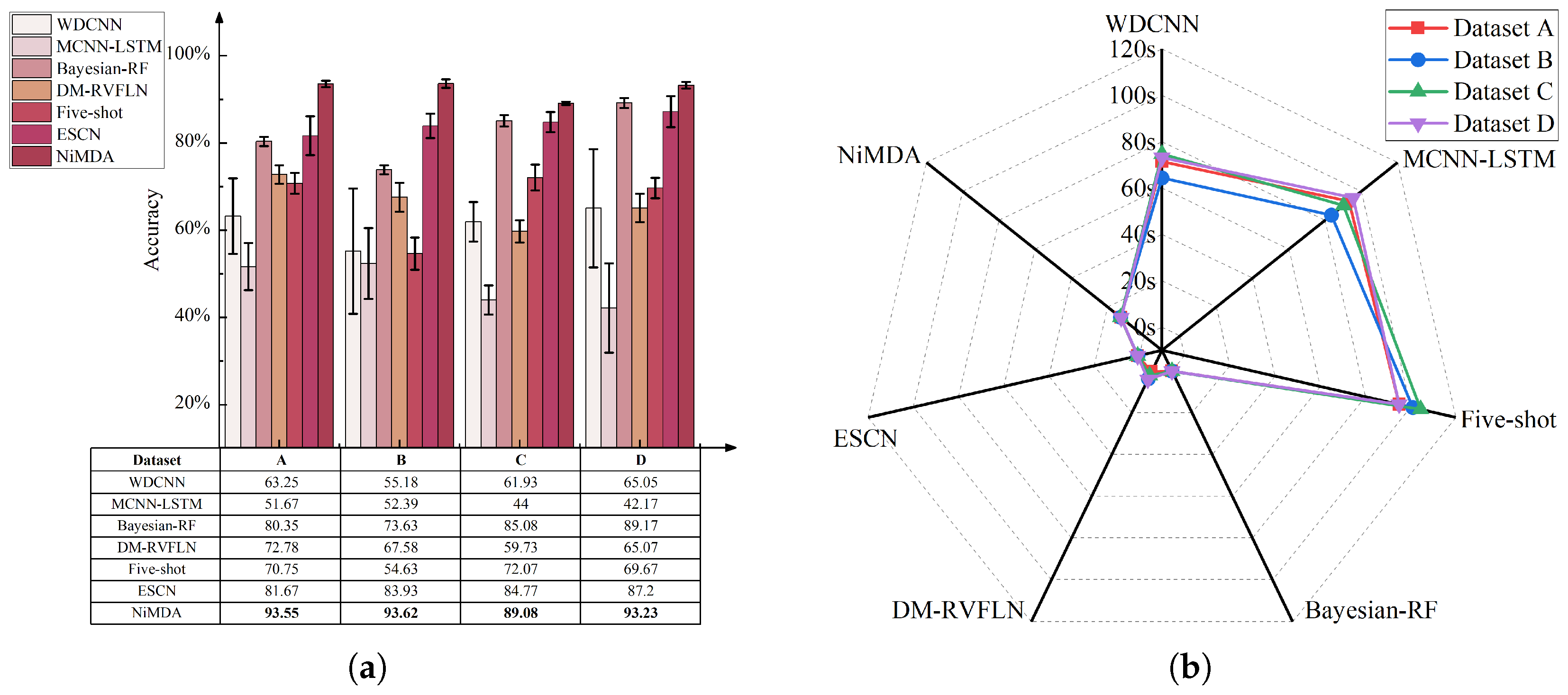
| Literature | Brief | Abbreviation |
|---|---|---|
| [12] | Deep convolutional neural networks with wide first-layer kernels. | WDCNN |
| [15] | Multi-scale convolutional neural network and long short-term memory. | MCNN-LSTM |
| [43] | Bayesian-optimization-based random forest algorithm. | Bayesian-RF |
| [10] | Discriminative manifold random vector functional link neural network. | DM-RVFLN |
| [44] | A deep Siamese neural network by repeating one-shot five times. | Five-shot |
Disclaimer/Publisher’s Note: The statements, opinions and data contained in all publications are solely those of the individual author(s) and contributor(s) and not of MDPI and/or the editor(s). MDPI and/or the editor(s) disclaim responsibility for any injury to people or property resulting from any ideas, methods, instructions or products referred to in the content. |
© 2026 by the authors. Licensee MDPI, Basel, Switzerland. This article is an open access article distributed under the terms and conditions of the Creative Commons Attribution (CC BY) license.
Share and Cite
Deng, D.; Li, W.; Liu, J.; Qin, Y. Node-Incremental-Based Multisource Domain Adaptation for Fault Diagnosis of Rolling Bearings with Limited Data. Machines 2026, 14, 71. https://doi.org/10.3390/machines14010071
Deng D, Li W, Liu J, Qin Y. Node-Incremental-Based Multisource Domain Adaptation for Fault Diagnosis of Rolling Bearings with Limited Data. Machines. 2026; 14(1):71. https://doi.org/10.3390/machines14010071
Chicago/Turabian StyleDeng, Di, Wei Li, Jiang Liu, and Yan Qin. 2026. "Node-Incremental-Based Multisource Domain Adaptation for Fault Diagnosis of Rolling Bearings with Limited Data" Machines 14, no. 1: 71. https://doi.org/10.3390/machines14010071
APA StyleDeng, D., Li, W., Liu, J., & Qin, Y. (2026). Node-Incremental-Based Multisource Domain Adaptation for Fault Diagnosis of Rolling Bearings with Limited Data. Machines, 14(1), 71. https://doi.org/10.3390/machines14010071