Article

Design and Analysis of an Anti-Collision Spacer Ring and Installation Robot for Overhead Transmission Lines


College of Electrical Engineering and Control Science, Nanjing Tech University, Nanjing 211816, China
*
Author to whom correspondence should be addressed.
Machines 2026, 14(1), 23; https://doi.org/10.3390/machines14010023
Submission received: 23 October 2025 / Revised: 17 December 2025 / Accepted: 22 December 2025 / Published: 24 December 2025
(This article belongs to the Section Machine Design and Theory)

Abstract

Overhead transmission lines often suffer from mutual collisions between adjacent conductors in windy weather, which can cause power failures to villages. To solve this problem, this paper introduces a spacer ring and a teleoperated robot for the installation and retrieval of the ring. The spacer ring and robot address the installation challenges of the anti-collision devices and enhance transmission line maintenance. Fixed by the locking mechanism, the spacer ring can isolate adjacent conductors to avoid collisions. The structure and working principle of the spacer ring and installation robot are introduced. Static analysis and finite element analysis (FEA) are conducted to analyze the output force of the locking mechanism, which is then validated through experiments. Experimental results show that the locking mechanism can generate a strong output force of up to 2000 N with about 6.0 N·m of input torque, providing a secure installation for the spacer ring. Diverse installation tests have validated the robot’s capability for live-line operations on transmission lines. Field tests indicate that the installation robot can travel at 0.3 m/s on a 15° slope and successfully install the spacer rings.

1. Introduction

Overhead transmission lines are essential infrastructure for urban power supply. Failures in these transmission lines can have a serious impact on industry operations. A major cause of such failures is inter-conductor collision, which results from excessive conductor motion (such as galloping or vibration) induced by high winds [1], snow [2], or ice accumulation [3]. Inter-conductor collision can accelerate conductor aging and increase the risk of short-circuit faults. These effects ultimately undermine the reliability of the power systems [4,5]. Therefore, reducing inter-conductor collision is a crucial measure that can significantly improve transmission efficiency and stability of power systems [6].
Vibration in overhead transmission lines has been extensively researched in recent years [6,7,8,9,10]. Zhang et al. developed a hybrid galloping analysis model for iced bundle conductors to prevent transmission line galloping [6]. Wei and Gao [8] utilized machine learning algorithms to construct a model for preventing transmission line vibration. With deepening research, two anti-collision devices, including spacer dampers [11,12,13,14,15,16,17] and Stockbridge dampers [18,19,20,21,22,23,24,25,26], have been developed and widely deployed.
The spacer dampers are installed between multiple conductors of the transmission lines. They function to maintain a constant distance between the conductors, thereby preventing collision. However, the spacer dampers are susceptible to fracture failure under persistent aeolian vibration [17]. The Stockbridge dampers can effectively suppress high-frequency aeolian vibration (5–150 Hz) of conductors. However, they exhibit minimal damping effect on low-frequency galloping [18]. The spacer dampers and Stockbridge dampers are predominantly installed using bolts, requiring workers to repeatedly rotate tools to secure them. However, during live-line operations on overhead transmission lines, workers must wear multiple layers of protective clothing and gloves, which makes the installation process cumbersome and challenging [27]. As a result, the spacer dampers and the Stockbridge dampers need high installation and maintenance expenditures.
To address these challenges, this study proposes a novel spacer ring to prevent the collision between adjacent conductors of overhead transmission lines. As shown in Figure 1, the spacer rings and Stockbridge dampers are installed on individual conductors. However, their working principles differ significantly. Stockbridge dampers function by damping vibration energy, yet their effects remain constrained under certain conditions. The spacer ring offers advantages over existing anti-collision devices in terms of installation method and suitability. The installation and retrieval of spacer rings are achieved by rotating the input handle of the locking mechanism. Even without robotic installation, workers need only rotate the input handle to install and retrieve the spacer rings, eliminating the need for bolting tools. Moreover, the spacer ring demonstrates superior adaptability. Installing a spacer ring on a single conductor within the transmission line prevents contact and collision between this conductor and others.
The installation of anti-collision devices is a high-risk operation [28]. Although existing transmission line robots can perform inspections, they generally lack the capability to install anti-collision devices [29,30,31,32,33]. The installation of anti-collision devices requires robots to have high-precision operational capabilities. To address these issues, this paper proposes a novel robot that can install and retrieve the spacer rings via direct teleoperation. The proposed robot achieves dual functionality for both installation and retrieval, which cannot be achieved in [27]. Due to its compact design and lightweight body, it has excellent mobility and strong climbing ability. It is capable of performing installation tasks on transmission lines with a 30° incline. However, existing robotic spacer-installation systems report a maximum climbing angle of only 15° [27,28].
This study contributes:
(1)
A spacer ring and a teleoperated robot to address the installation challenges of anti-collision devices.
(2)
A wedge-shaped locking mechanism that provides a strong output force.
The remainder of this paper is organized as follows. Section 2 covers the design of the spacer ring and installation robot, along with their prototypes. Section 3 develops an FEA model of the locking mechanism, characterizing its input torque–output force conversion relationship. It also includes collision and electrical performance analyses of the spacer ring, as well as a force analysis for the robot on inclined transmission lines. Section 4 develops dedicated test platforms to experimentally validate both the input torque–output force relationship in the locking mechanism and the operational performance of the installation robot. Section 5 concludes the paper.

2. Structure Design

2.1. Spacer Ring

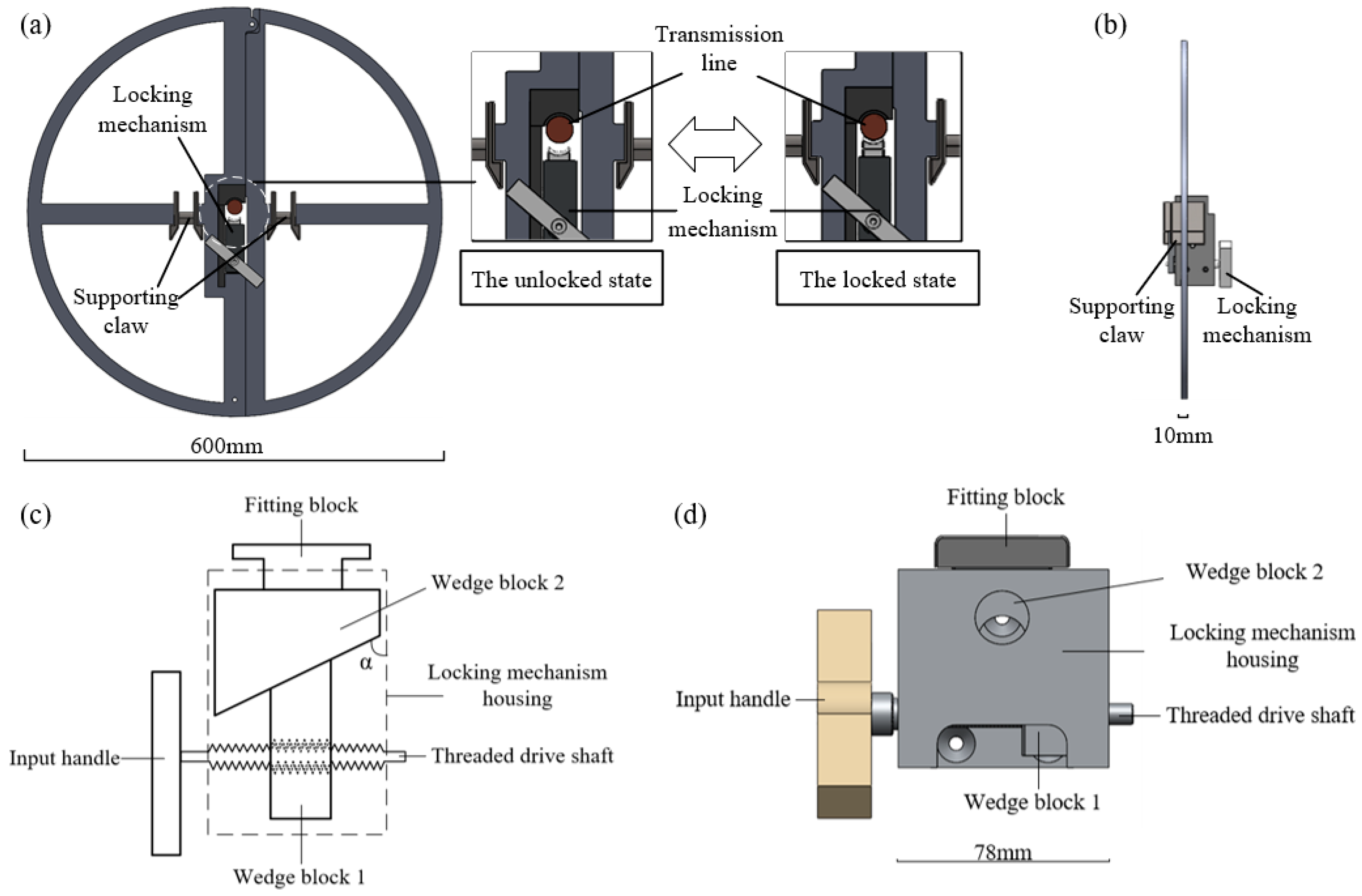
The 3D model of the designed spacer ring is shown in Figure 2. The circular spacer ring consists of two semicircular sections. They are held together by screws and lock nuts. To ensure the overall strength of the spacer rings, multiple edges are designed. Two supporting claws are fixed on the horizontal edge. Each supporting claw has a cylindrical central shaft. The sides of the supporting claws and the central shafts are designed individually and assembled onto the spacer rings. When a part fails, only that specific failed part requires replacement to restore the function of the spacer rings. The modular design can reduce the maintenance cost.
The spacer ring features a novel wedge-shaped locking mechanism located at its center. Figure 2 presents a structural schematic diagram and a 3D model of the locking mechanism. As depicted in Figure 2c, the wedge block 1 is connected to the threaded drive shaft via threaded engagement. When the input handle rotates, the wedge block 1 will translate along the threaded drive shaft. The wedge surfaces of the wedge block 1 and the wedge block 2 are in contact. Constrained within the locking mechanism housing, the wedge block 2 can only translate vertically. The fitting block moves vertically with the wedge block 2. When this fitting block gradually ascends to contact the transmission line, the spacer ring will be fixed on the transmission line; when the fitting block descends, the locked state between the spacer ring and the transmission line will be released. Figure 2a clearly shows the different states between the spacer ring and the transmission line.

2.2. Spacer Ring Installation Robot

In selecting the motion mechanism design, both inchworm-like telescoping mechanisms and wheeled mechanisms are compared. Related research demonstrated that the wheeled mechanism offers significant advantages in terms of movement speed. In contrast, the inchworm-like mechanism results in a bulky robot body to achieve its telescoping function, severely limiting the overall mobility of the system. Therefore, the wheeled motion solution is adopted ultimately. The primary function of the robot’s installation mechanism is to drive the rotation of the input handle in the spacer ring locking mechanism. For this purpose, a rotating mechanism is designed to actuate the input handle. The function of the lifting mechanism is to support the spacer ring and control its vertical movement. A critical design requirement is that the mechanism must reliably lock the spacer ring in position and keep it stationary when not in operation. Considering position-holding capability and static torque, a servo is selected as the drive unit for the lifting mechanism.
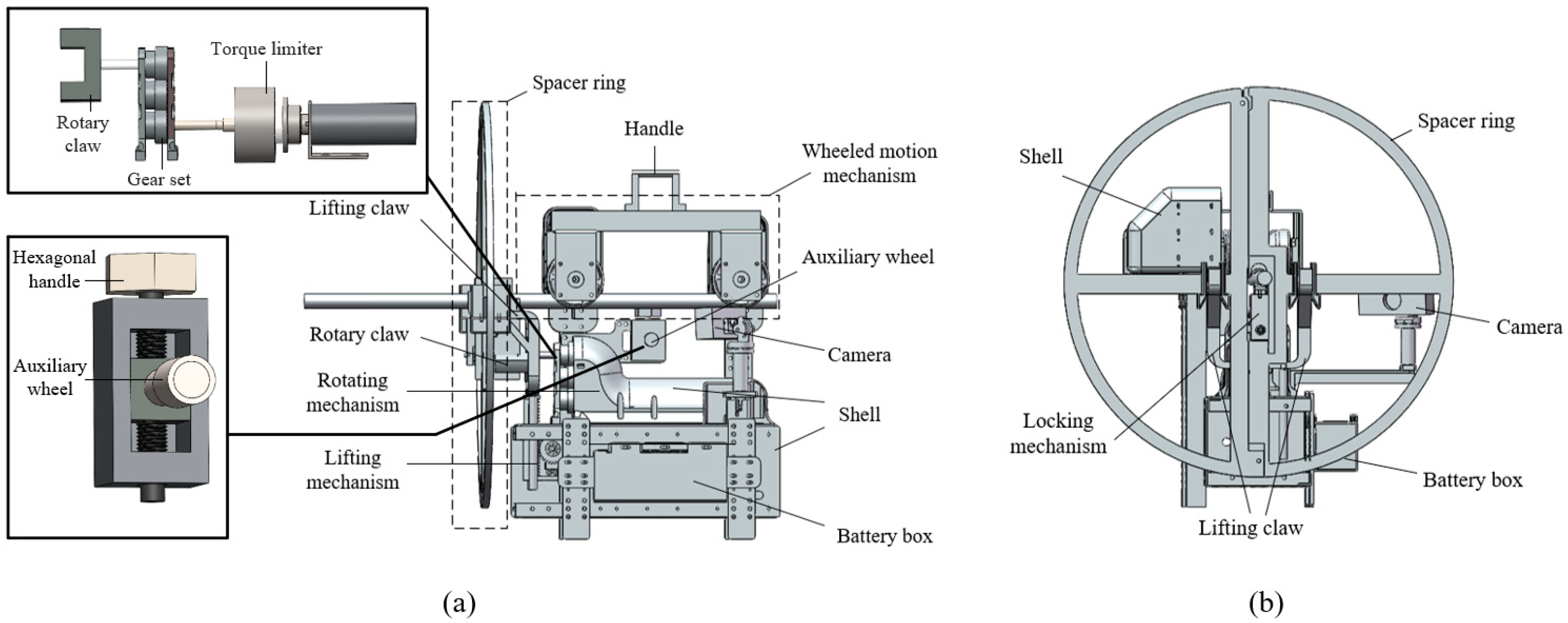
The design of the installation robot is shown in Figure 3. The robot includes three core mechanisms: a wheeled motion mechanism, a lifting mechanism, and a rotating mechanism. Figure 3a presents the wheeled motion mechanism, which achieves bidirectional movement of the robot along the transmission line. Two drive wheels directly contact the transmission line and are driven by two stepper motors.
The rotating mechanism and lifting mechanism are shown in Figure 3. A servo actuates the lifting motion of the spacer ring. The output shaft of the servo drives a gear, which is in mesh with a rack. The upper end of the rack is connected to a lifting claw. The gear and rack mechanism converts the rotational motion of the servo into the linear motion of the lifting claw. When the cylindrical central shafts of the supporting claws come into contact with this lifting claw, the spacer ring is firmly placed on the lifting mechanism.
The rotating mechanism primarily consists of a stepper motor, a torque limiter, a gear set with its mounting bracket, and a rotary claw. The torque limiter is connected to the stepper motor’s output shaft to control the maximum output torque. When the fitting block of the locking mechanism contacts the conductor, the required torque increases continuously. Once this torque reaches the preset value of the torque limiter, the motor’s output shaft stops rotating. This stall is the indicator that the locking task is complete. The output shaft is raised through the gear set to provide sufficient clearance for other robotic components. The rotary claw catches with the input handle of the spacer ring locking mechanism. This connection enables the rotating mechanism to control the locking mechanism and install the spacer ring on the conductor.
An auxiliary wheel system is employed to prevent the robot from detaching from the conductor. A detailed view of the auxiliary wheel system is shown in Figure 3a. After the robot is positioned on the conductor, rotating the hexagonal handle allows the auxiliary wheel to rise and descend. The robot’s battery is placed in a battery box around the lifting mechanism. A camera is positioned on one side of the robot, allowing for real-time monitoring of both the robot’s position and the spacer ring. The outer shells of the wheeled motion mechanism and the rotating mechanism have been designed to safeguard the key structures and internal circuitry.

2.3. Prototypes of the Spacer Ring, Installation Robot and Control System

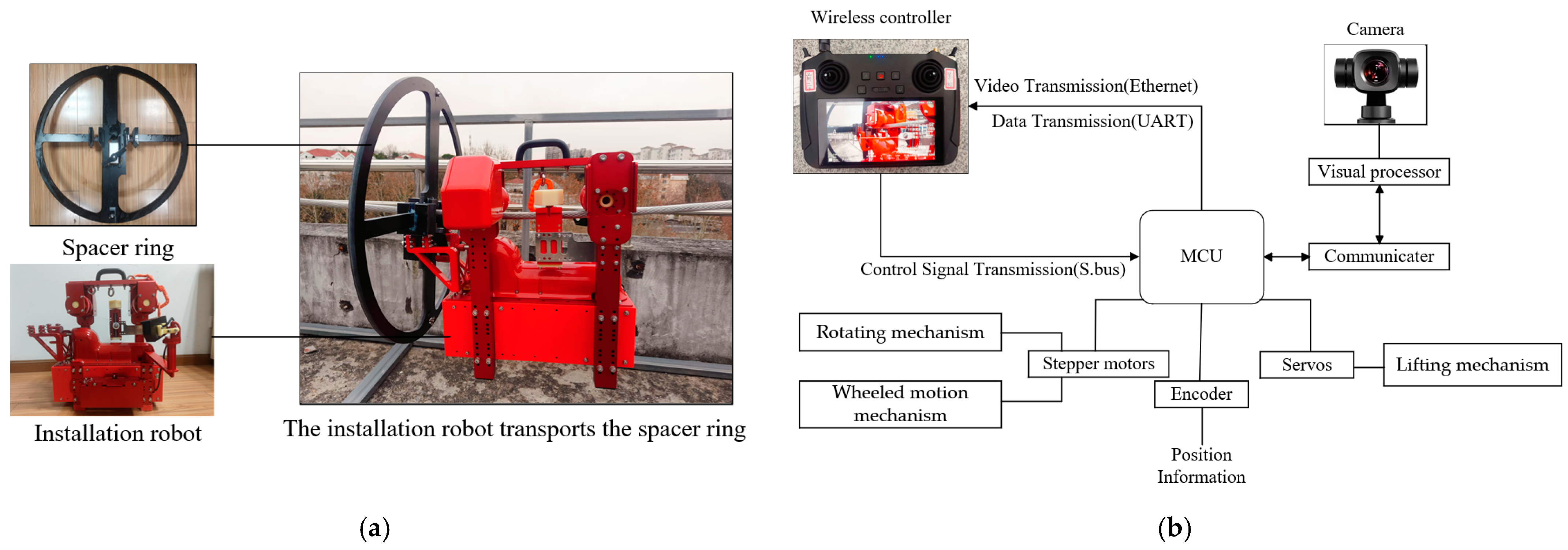
Figure 4a illustrates the prototypes of the spacer ring and the installation robot. The locking mechanism is secured to the spacer ring with screws. The assembly of the spacer ring is completed after installing bolts in the top and bottom mounting holes. As shown in Figure 4a, the installation robot transports a spacer ring steadily along the conductor of the transmission line. The robot has a low center of gravity and maintains its body parallel to the conductor, thereby ensuring stable operation on the transmission line.
As shown in Figure 4b, the hardware components of the control system include two stepper motors for the wheeled motion mechanism, a stepper motor for the rotating mechanism, a servo for the lifting mechanism, and a camera. Information collected by the encoder is input into the microcontroller unit (MCU). Data transmission occurs through a universal asynchronous receiver and transmitter (UART), and video transmission is via Ethernet. For operation, the system relies on this visual feedback for remote human control. Operators send control signals by buttons and joysticks based on the video and information displayed on the wireless controller. Control signal transmission is via S.Bus. The MCU receives signals and controls the stepper motors and servos, respectively, enabling the start and stop of the three core mechanisms. Coordinated control across different mechanisms achieves the installation and retrieval of the spacer rings.
The drive units of the wheeled motion mechanism and rotating mechanism are 24V DC stepper motors. The servo of the lifting mechanism provides a holding torque of up to 80 kg·cm, ensuring precise control during the lifting process and reliable self-locking after stopping. The wireless controller has a 5.5-inch display. The interface shown on the wireless controller’s display serves two purposes. Firstly, the distance between the fitting block and the conductor of the transmission line is assessed. Secondly, it provides visual monitoring of the contact condition between the installation robot and the spacer ring. Using the robot camera, the installation robot achieves precise localization, real-time control, and remote installation.

3. Modeling and Analysis

3.1. Output Force Analysis of the Locking Mechanism

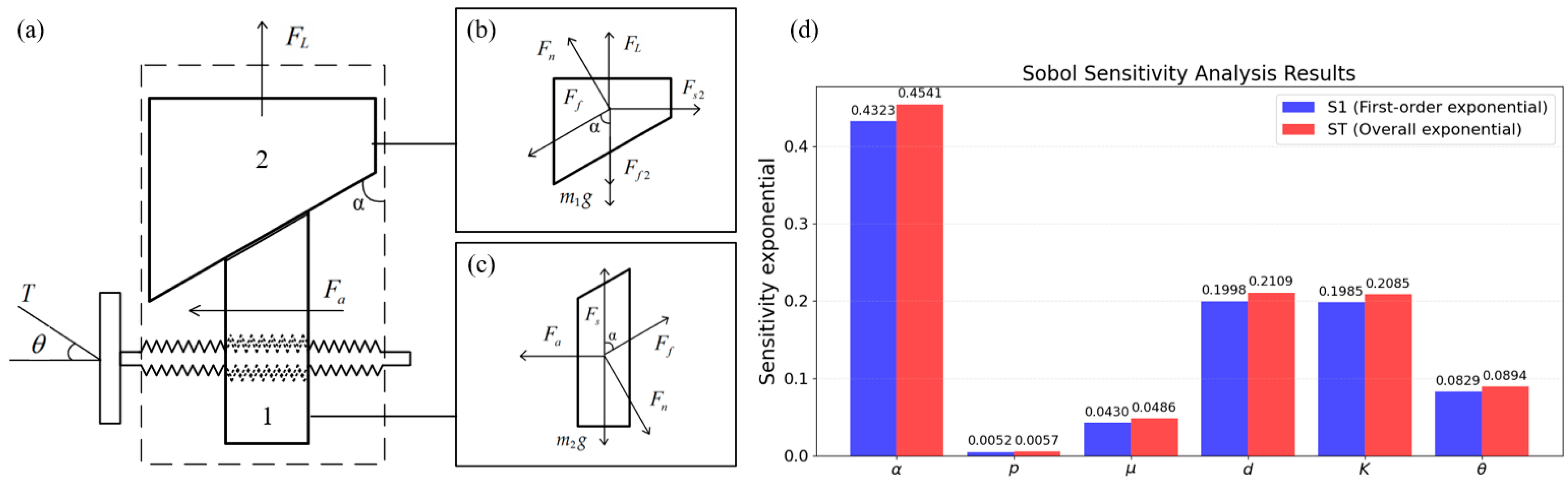
A force analysis diagram of the locking mechanism is shown in Figure 5. The analysis of Figure 5 leads to the following equations:
F n cos α + F f sin α = F a ,
F n sin α F f cos α + m 1 g = F s ,
F s 2 = F n cos α + F f sin α ,
where F n represents the pressure of the wedge block 1 from the wedge block 2, F f represents the value of friction force between two wedge blocks, F a represents the pre-tightening force of the threaded drive shaft, F s represents the supporting force of the wedge block 1 from the threaded drive shaft, F s 2 represents the pressure of the wedge block 2 from the locking mechanism housing, α represents the angle between the wedge face and the gravity, m 1 represents the mass of the wedge block 1.
The resultant upward output force F L is:
F L = sin α p cos α μ cos α p × μ sin α cos α + μ sin α F a m 2 g ,
where μ represents the friction coefficient between two wedge blocks, p represents the friction coefficient between the wedge block 2 and the locking mechanism housing, m 2 represents the mass of the wedge block 2.
The fundamental relationship between the input torque T and the pre-tightening force F a in bolted connections is established through the following equation:
T cos θ = F a × d × K ,
where d represents the thread nominal diameter, K represents the thread compound coefficient, θ represents the input torque angle relative to the threaded drive shaft. This leads to the following result:
F L = sin α p cos α μ cos α p × μ sin α cos α + μ sin α × d × K × T cos θ m 2 g .
Therefore, the proportional coefficient λ between the input torque T and the output force F L is:
λ = sin α p cos α μ cos α p × μ sin α cos α + μ sin α × d × K cos θ .
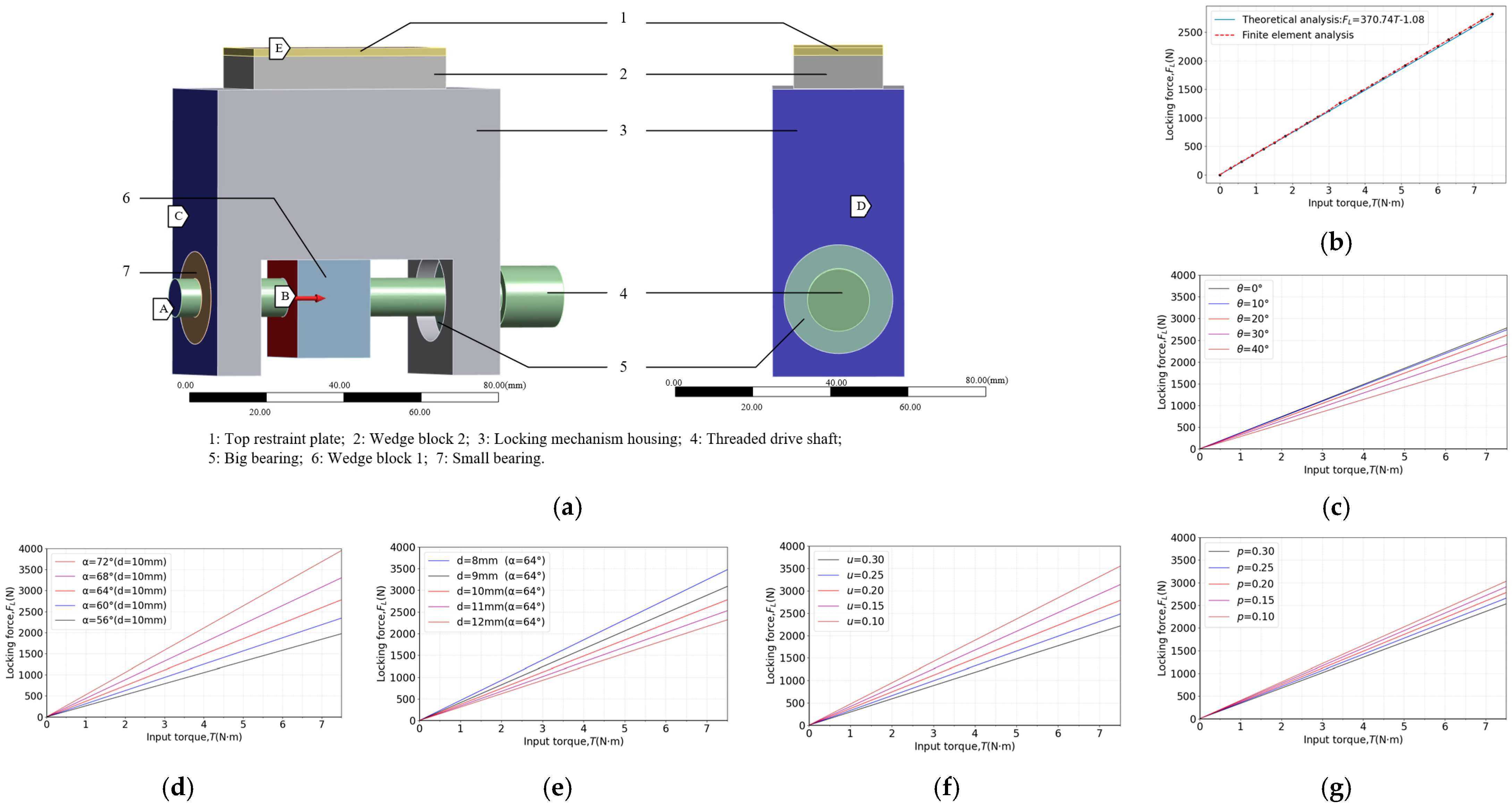
In Equation (7), the parameters α , p , μ , d , K , and θ are factors affecting the proportional coefficient λ . In this study, a global sensitivity analysis using the Sobol method is conducted to evaluate the impact of key variables ( α , p , μ , d , K and θ ) on the proportional coefficient λ . The parameters are varied within ±20% of their baseline values. The experimental results, as illustrated in Figure 5d, demonstrate that the value of λ exhibits limited sensitivity to variations in parameters p and μ , whereas it is significantly influenced by parameters α , d , K , and θ .
Figure 6a presents the FEA model of the locking mechanism, which is developed in ANSYS 2023 R1 as an assembly with simplified kinematic constraints. In the FEA model, fixed constraints are applied to the sides of the locking mechanism housing. Bilateral constraints are fixed on the threaded drive shaft. An equivalent horizontal axial force is applied to the wedge block 1, representing the preload force exerted on the threaded drive shaft when a certain torque is input. A force reaction sensor is added to the top restraint plate to record the output force. The model includes one large bearing and one small bearing. Two bearings are selected from 316 stainless steel. All other components are selected from 7075 aluminum alloy. The parameters of materials for simulation are shown in Table 1.
The wedge angle is selected based on the analysis of the required effective lifting stroke of the fitting block. This analysis yielded a feasible range of angles that could satisfy the stroke. Within this range, 64° is chosen as the final design to balance the output force requirement with structural compactness. The thread diameter is determined based on the target output force and the available input torque. Using the theoretical relationship (Equation (7)), a feasible diameter range is derived to meet the force objective. The value of 10 mm is then selected as a standard component size within this range, ensuring that both basic strength requirements and force output objectives are satisfied. The friction coefficients μ and p are conservatively set to 0.2, reflecting a well-lubricated state for aluminum alloys. The thread compound coefficient K is 0.3. The input torque angle relative to the threaded drive shaft θ is set to be 0°. The mass of the wedge block 2 is 0.11 kg, and the gravitational acceleration is set to 9.8 m/s2.
The relationship between the input torque T and the output force F L under the theoretical analysis is:
F L = 370.74 T 1.08 .
In the FEA simulations, the input torque T is changed from 0 N·m to 7.5 N·m. The obtained output force values are illustrated in Figure 6b and show strong agreement with the theoretical analysis. As input torque increases, the discrepancy between the FEA results and the theoretical analysis becomes more pronounced. However, the relative error consistently remains below 1.5%. The experimental data are fitted to the following curve equation:
F L = 2.65 + 375.96 T .
with a relative error of 1.41% in the proportional coefficient λ , the FEA model is validated.
A parametric study is conducted to analyze the effects of different parameters on the output force. Figure 6c shows the conversion relationship between the input torque and the output force across varying θ . When θ is 0°, the output force peaks under the same input torque. This suggests that the proportional coefficient λ is optimal at this angle. In practical applications, ensuring parallel alignment between the rotary claw of the rotating mechanism and the input handle of the locking mechanism will maximize the output force. Figure 6d,e illustrate that λ increases proportionally with α but varies inversely with d . When d is reduced from 12 mm to 8 mm under the same conditions, the locking mechanism’s output force rises by 50.3%. Increasing the value of α from 56° to 72° nearly doubles the output force. Although increasing α and reducing d can improve λ , each method has certain drawbacks. A larger α makes the locking mechanism bigger, and a smaller thread diameter d weakens its structure.
As shown in Figure 6f,g, λ is negatively correlated with the friction coefficients. This indicates that under well-lubricated conditions, the same input torque can generate a greater output force. Analysis results reveal that when p increases from 0.2 to 0.3, λ decreases by approximately 8.99%. When μ increases from 0.2 to 0.3, the reduction in λ reaches approximately 27.5%. These results clearly demonstrate that the friction coefficients also influence λ to a certain extent. Therefore, maintaining good lubrication in the locking mechanism is crucial for ensuring its output performance in practical applications.

3.2. Static Stress Analysis of the Locking Mechanism

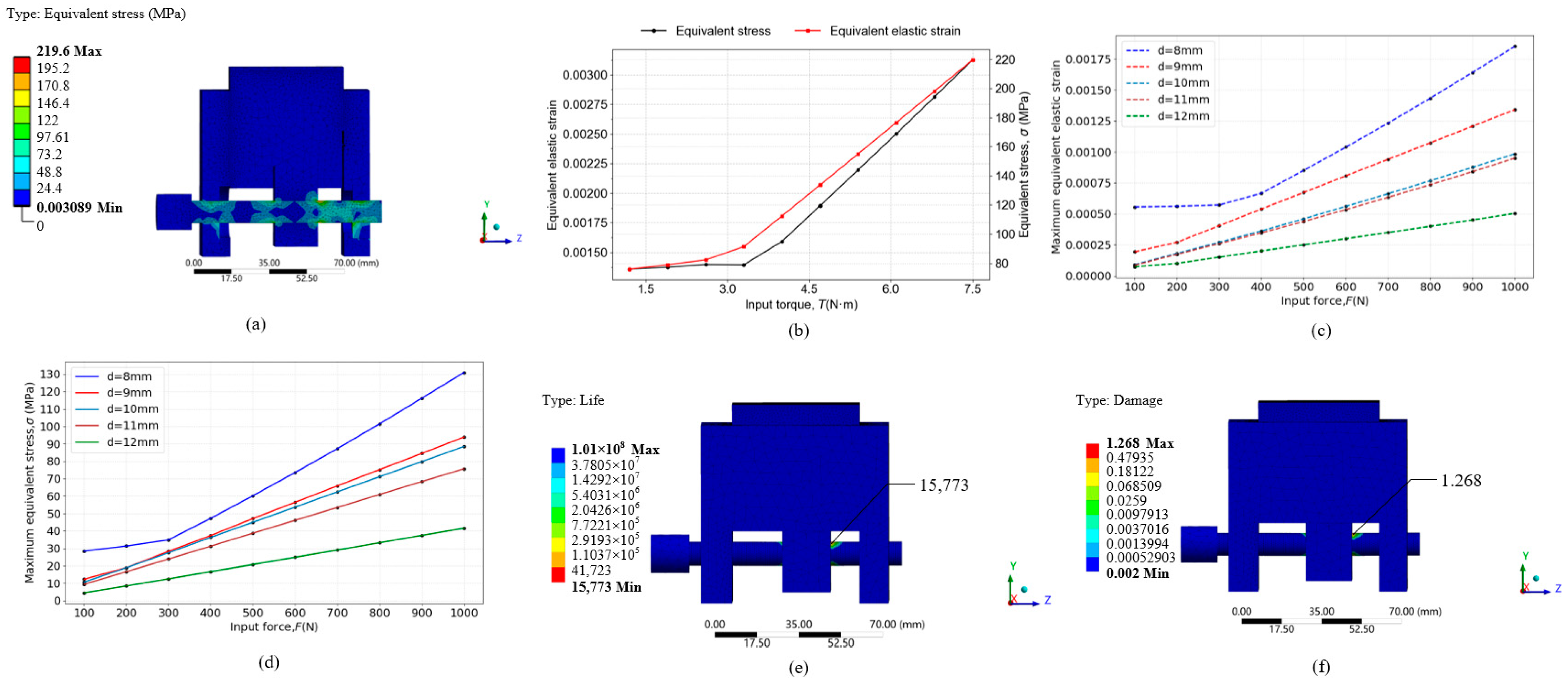
Different input torques are subsequently applied to the FEA model to evaluate stress distribution. Figure 7a displays the equivalent stress contour under an input torque of 7.5 N·m. Stress concentrations occur in three components: the wedge block 1, the locking mechanism housing, and the threaded drive shaft. The maximum equivalent stress results and maximum equivalent elastic strain results under different input torques are illustrated in Figure 7b. It is evident that the maximum equivalent stress and the maximum equivalent elastic strain are positively correlated with the input torque, particularly within the range of 3.3 N·m to 7.5 N·m. When the input torque remains below 7.5 N·m, the maximum elastic strain ε remains under 0.004, and the maximum equivalent stress σ does not exceed 220 MPa.
According to Von Mises criterion, yielding occurs when the equivalent stress σ v m satisfies:
σ v m = ( σ 1 σ 2 ) 2 + ( σ 2 σ 3 ) 2 + ( σ 3 σ 1 ) 2 2 σ y ,
where σ 1 , σ 2 , σ 3 are principal stresses, and σ y is the yield strength.
The wedge blocks and the housing for the locking mechanism are made of 7075 aluminum alloy, which has a yield strength of 455 MPa. This material is considered to yield if the maximum equivalent stress exceeds this value. As shown in Figure 7a, the maximum equivalent stress at 7.5 N·m reaches 219.6 MPa. Based on numerical calculations, the static yield safety factor is calculated to be 2.07. This indicates that, within the specified input torque range below 7.5 N·m, the locking mechanism has a sufficient static strength safety margin and is unlikely to experience yield failure.
A parametric study is performed to investigate how varying the thread nominal diameter d affects the structural strength of the locking mechanism. The analysis focused on the maximum equivalent elastic strain and equivalent stress under applied forces ranging from 100 N to 1000 N. As shown in Figure 7c,d, both the maximum equivalent stress and equivalent elastic strain increase with the applied force.
Additionally, for a given applied force, a smaller d results in higher equivalent stress and greater equivalent strain. This finding suggests that smaller d may compromise overall structural strength. However, as discussed in the previous section, a smaller d also leads to a higher proportional coefficient λ . A higher λ means a greater output force for the same input torque. Thus, selecting the appropriate thread nominal diameter d requires balancing structural strength, weight, and the output performance of the locking mechanism.
The fatigue analyses of the locking mechanism under an input torque of 4.5 N·m are shown in Figure 7e,f. The maximum number of repeatable locking cycles at this torque is limited to 15,773 cycles. Exceeding this count may lead to fatigue failure or a decrease in the mechanism’s functionality. The wear analysis reveals that the contact area between the threaded drive shaft and the wedge block 2 undergoes the most significant wear. This region is identified as the critical zone that limits the overall service life of the mechanism. Due to time and condition constraints, the effects of lubrication degradation and contamination tolerance on the locking mechanism are not systematically evaluated.
The fatigue analyses presented offer a basic understanding of the mechanism’s lifespan under controlled loading conditions. However, long-term reliability in real-world situations is affected by other factors. Lubricant degradation can occur due to several reasons, including dust contamination, oxidation, and exposure to moisture. The degradation affects the friction coefficients both at the thread engagement interface and between the two wedge blocks. This alteration can increase wear, potentially shortening the service life predicted by current FEA simulations. Consequently, it is essential to establish a preventive maintenance schedule for reliable operation. This schedule should include regular inspections and cleanings of the threaded drive shaft and wedge blocks to ensure optimal performance. Future life testing under environmental exposure will be conducted to quantify these effects and develop more efficient maintenance plans.

3.3. Electrical Performance and Collision Analysis of the Spacer Ring

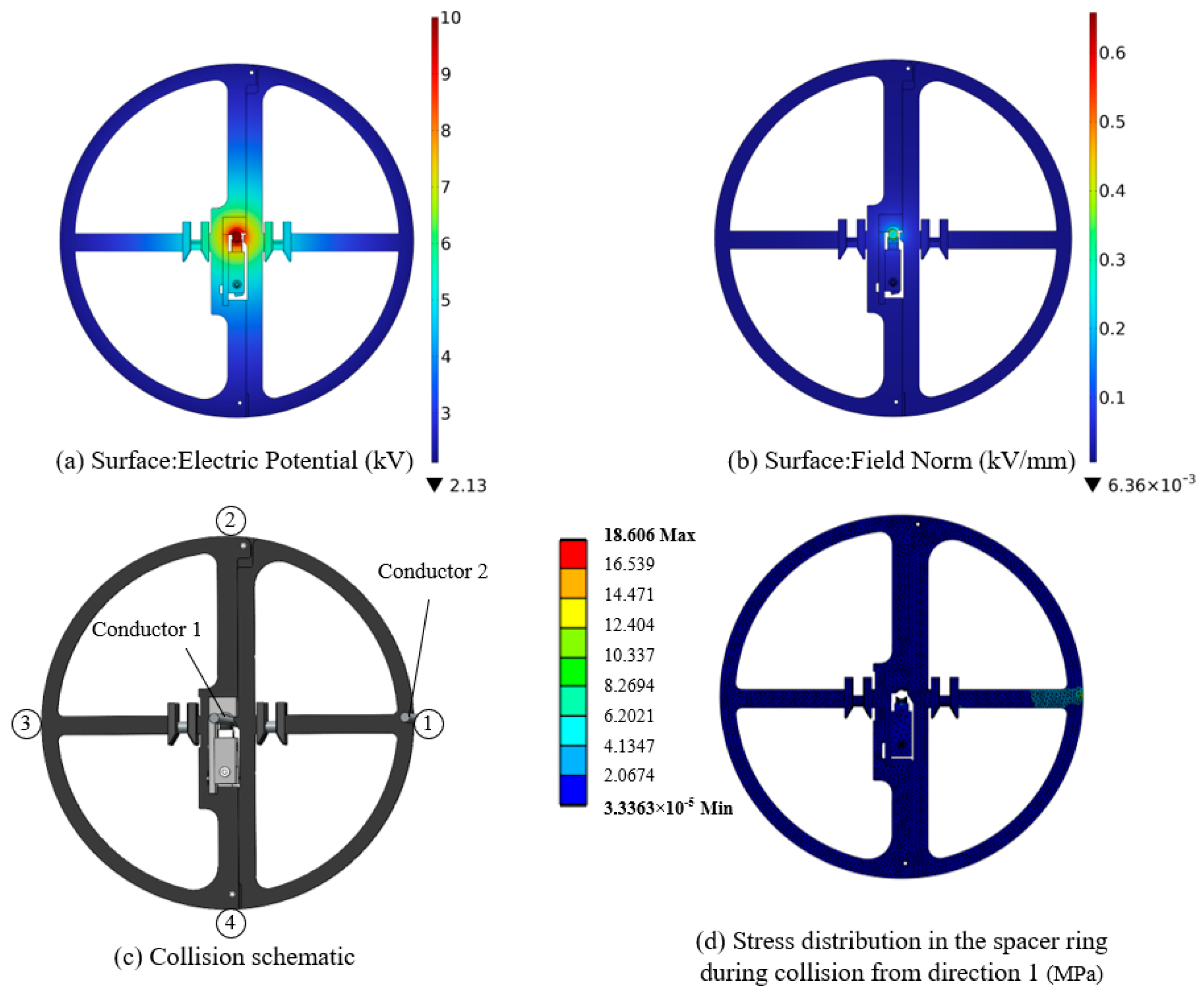
As a critical insulating component in high-voltage equipment, the electrical performance of spacer rings directly impacts the operational stability and safety of power systems. This study utilizes FEA to assess the electrical performance of the spacer rings at 10 kV using COMSOL Multiphysics® v. 6.3. The environmental conditions in the FEA are set to an air medium. By conducting an electrostatic field analysis on 10 kV transmission lines, the potential distribution and electric field distribution of the spacer ring are determined. The results are illustrated in Figure 8.
Figure 8a reveals a pronounced asymmetry in the potential distribution. This asymmetry is due to the imperfectly symmetrical structure of the spacer ring. The potential reaches its maximum value at the contact area between the spacer ring and the conductor, forming a highly concentrated region. Furthermore, a significant potential difference exists between the center and the edge of the spacer ring. Figure 8b displays the electric field strength under 10 kV voltage, where the highest electric field strength of 0.658 kV/mm occurs in the central region of the spacer ring structure. Since the breakdown strength of epoxy resin is 23.145 kV/mm, this indicates that the spacer ring design meets the insulation requirements for transmission lines operating at 10 kV.
As shown in Figure 8c, a spacer ring is installed on Conductor 1, with Conductor 2 colliding with it from directions 1, 2, 3, and 4. A force of 200 N is applied to Conductor 2 to simulate collisions from all four directions. Figure 8d presents the equivalent stress distribution contour plots for collisions in direction 1. The analysis results of different directions indicate that, under a collision force of 200 N, the maximum equivalent stress on the spacer ring reaches 18.606 MPa. This value is significantly below the yield strength of the epoxy resin material, which is 54.6 MPa. Therefore, the spacer ring meets strength requirements under the specified collision conditions.

3.4. Climbing Analysis of the Installation Robot

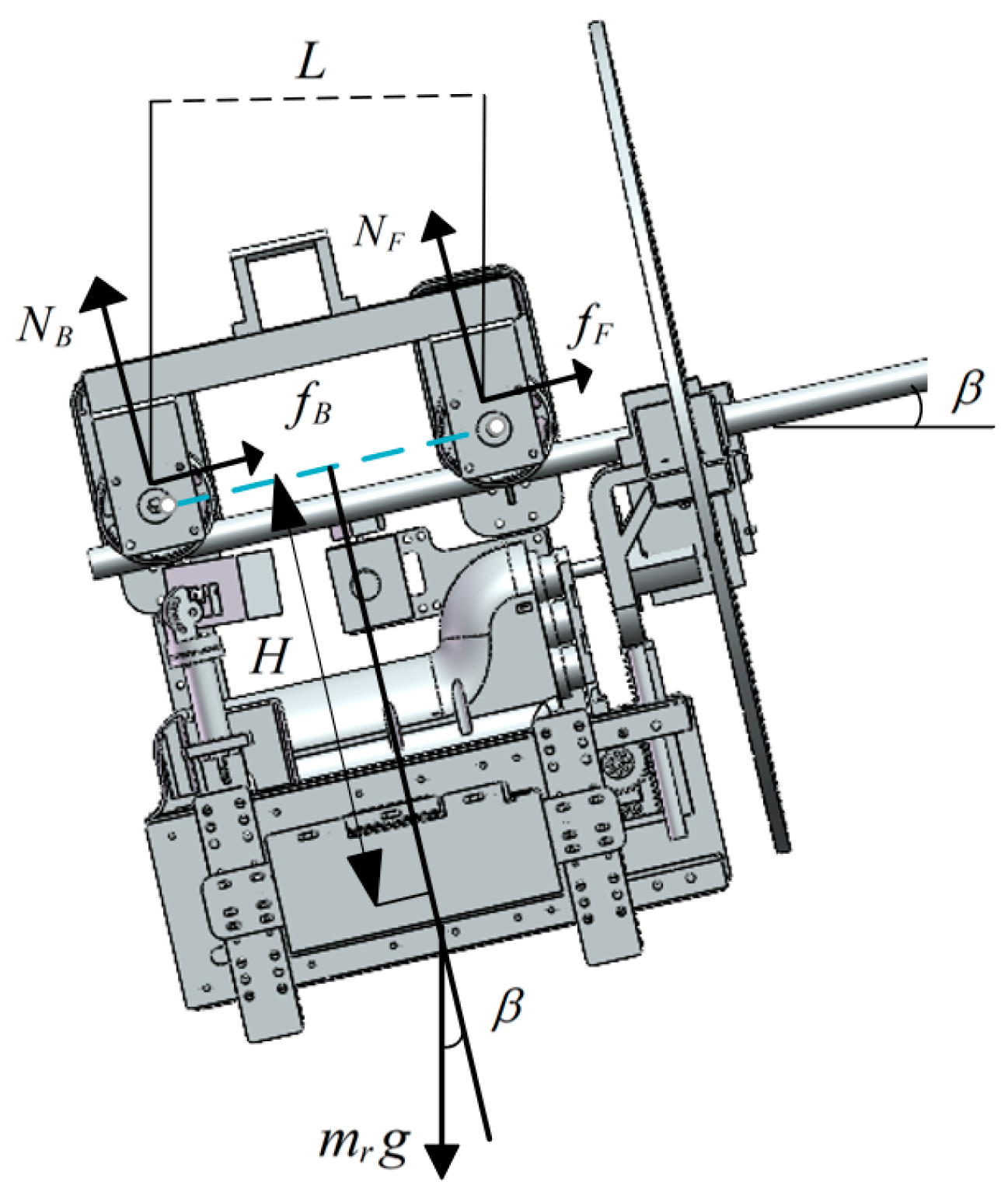
When the robot moves along a transmission line with a slope β , a force analysis is shown in Figure 9. Taking the robot body as the study object, the support forces on the front and rear wheels are N F and N B , respectively. They act perpendicular to the transmission line. The friction forces on the front and rear wheels are f F and f B , respectively. They are static friction forces under the no-slip condition. The robot’s total mass is m r . The distance between the two wheels is L , and the vertical distance from the center of gravity to the straight line connecting the wheels is H . The following equations are derived from the force analysis:
N F = ( 1 2 cos β + H L sin β ) m r g , N B = ( 1 2 cos β H L sin β ) m r g .
The support force on the front wheel is greater than that on the rear wheel. Additionally, the maximum static friction f m a x is proportional to the support force:
f F max     f B max ,
where f F m a x represents the maximum static friction of the front wheel, and f B m a x represents the maximum static friction of the rear wheel. Due to the relatively high friction at the front wheel, the rear wheel is more prone to slipping under identical driving force. In extreme cases, the rear wheel may even lift off. Consequently, the maximum climbing angle β m a x of the robot is given by:
β max = min { arctan ( L 2 H ) , arcsin ( f F + f B m r g ) } .
As shown in Equation (13), reducing the robot’s weight m r and lowering its center of gravity height H will enhance the value of β m a x . Increasing L also improves climbing capability. However, the increase of L would increase the robot size, potentially in conflict with the goal of a compact design. Therefore, the robot’s climbing performance on steep transmission lines is primarily improved through two key ways: (1) reducing the robot’s weight m r and (2) lowering its center of gravity height H .

4. Experiment

4.1. Experiment of Locking Force

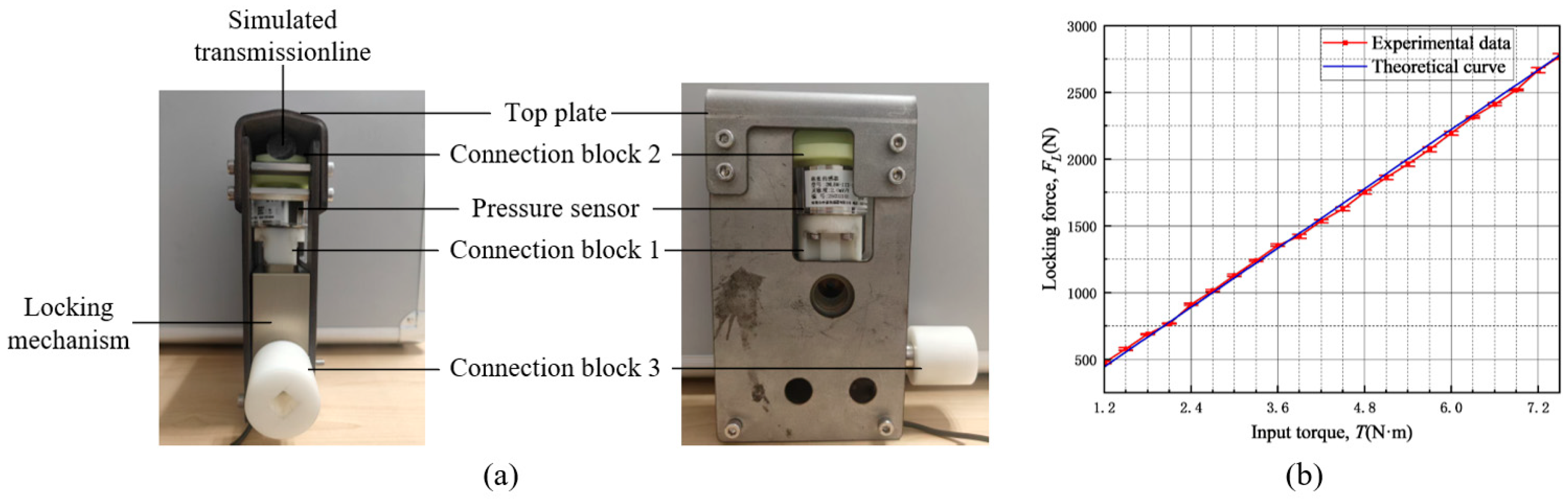
To study how the input torque relates to the output force in the locking mechanism, an experimental platform is developed (Figure 10a). A torque wrench is attached to the connecting block 3, which interfaces with the input shaft of the locking mechanism. Input torque is then applied to the locking mechanism by the torque wrench. A pressure sensor and two connecting blocks (labeled 1 and 2) are installed between the locking mechanism and the top plate. The entire assembly is secured using copper pillars and screws. As the torque wrench rotates, connecting block 2 moves vertically and generates a locking force upon contacting the simulated transmission line. Therefore, the force measured by the pressure sensor indicates the output force applied to the simulated transmission line by the locking mechanism.
Due to the notable measurement errors exhibited by the torque wrench at lower ranges, the minimum input torque value for this experiment is set at 1.2 N·m. Experimental validation is conducted within the input torque range of 1.2–7.5 N·m to evaluate the locking performance while ensuring that the structural integrity remains undamaged. The torque wrench is utilized to apply the input torque at predetermined levels, and the corresponding locking force is measured for each level. The experiment strictly adheres to the control variable method, and each test is conducted seven times to ensure accuracy, with the average value recorded as the final result. A fitted curve is derived from the experimental data. Within the range of 1.2 to 7.5 N·m, the locking force exhibits the following linear relationship with the input torque:
F L = 30.55 + 361.53 T
A comparison between Equations (8) and (14) indicates strong agreement in the proportional coefficient λ , with 2.48% relative deviation between the theoretical and experimental results. This close alignment of λ supports the accuracy of the proposed theoretical mechanical model and its corresponding FEA simulation. The experimental results indicate that at low torque ranges (e.g., 1.2 N·m), the conversion model exhibits significant error (maximum deviation of 6.87%); whereas at high torque ranges, the errors decrease significantly. Therefore, from an accuracy perspective, the locking mechanism should operate within the higher input torque range.
As illustrated in Figure 10b, an input torque of 6.0 N·m produces an output force exceeding 2000 N. The deviations between the experimental and the theoretical results are attributable mainly to two reasons. Firstly, the connecting blocks are fabricated using 3D printing, a process that introduces dimensional tolerances leading to uneven contact surfaces. These uneven contact surfaces disrupt the force transmission path, leading to variations in the measured locking force. Secondly, the limitations of the measurement instruments also contribute to this deviation. Calibration drift in the torque wrench and thermal drift in the pressure sensor are potential sources of deviation for the instrument. These factors collectively induce measurable deviation in the experimental data. However, statistical analysis indicates that the maximum deviation remains within 7%, which is considered acceptable and does not damage the validity of the research conclusions.

4.2. Indoor High-Voltage Tests

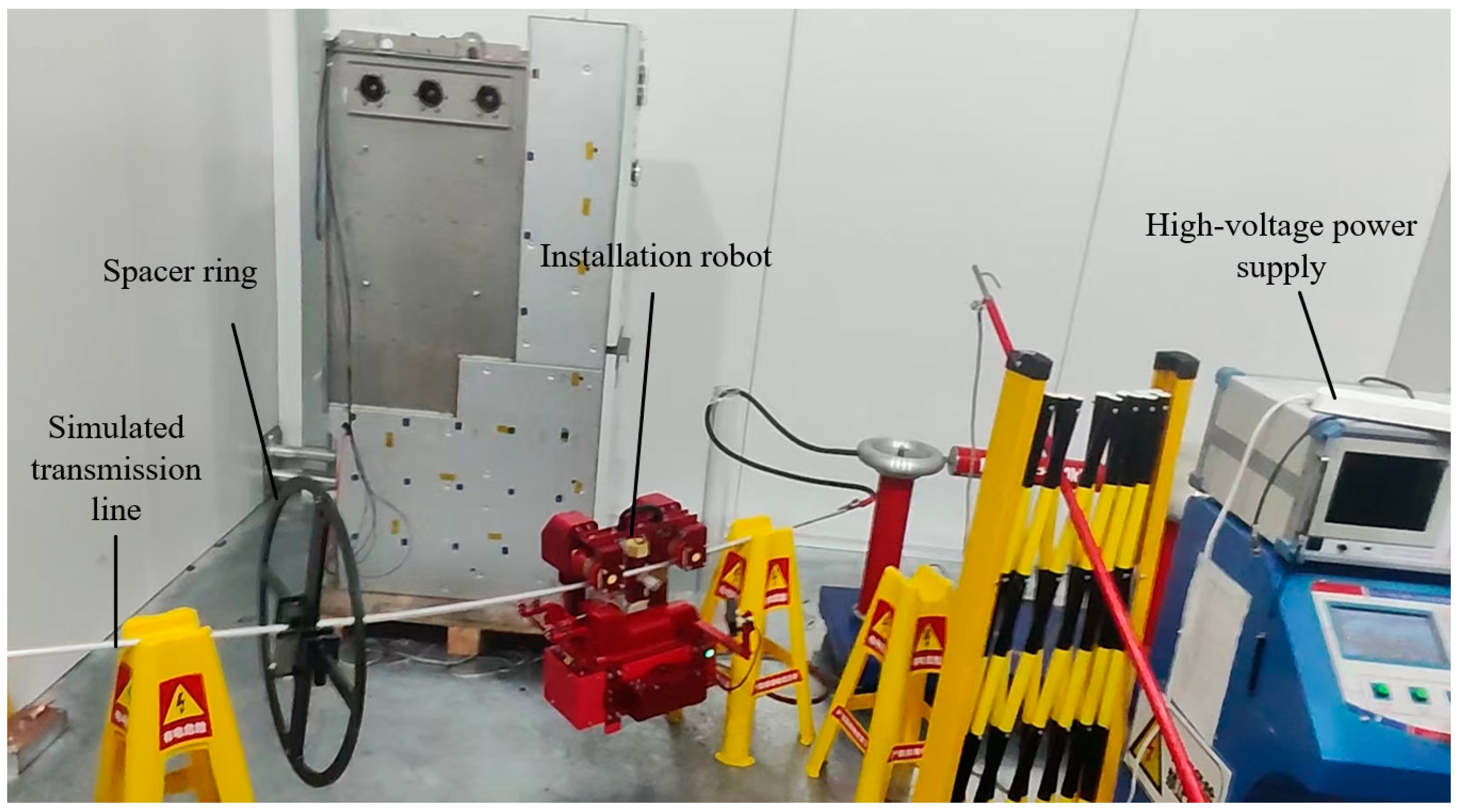
The high-voltage test platform is illustrated in Figure 11. The robot and spacer ring are tested separately at 10 kV, with no noticeable discharge phenomena occurring. The simulated conductor exhibits a maximum tilt of 5° under the weight of the conductor, robot, and spacer ring. At this tilt angle, the robot operates at a movement speed of 0.45 m per second. The positioning error for spacer ring installation is within ±10 mm. Indoor high-voltage tests have shown that the robot can perform spacer ring installations at voltages of less than 10 kV, providing a basis for future live-line spacer ring installations on transmission lines.

4.3. Outdoor Climbing Tests

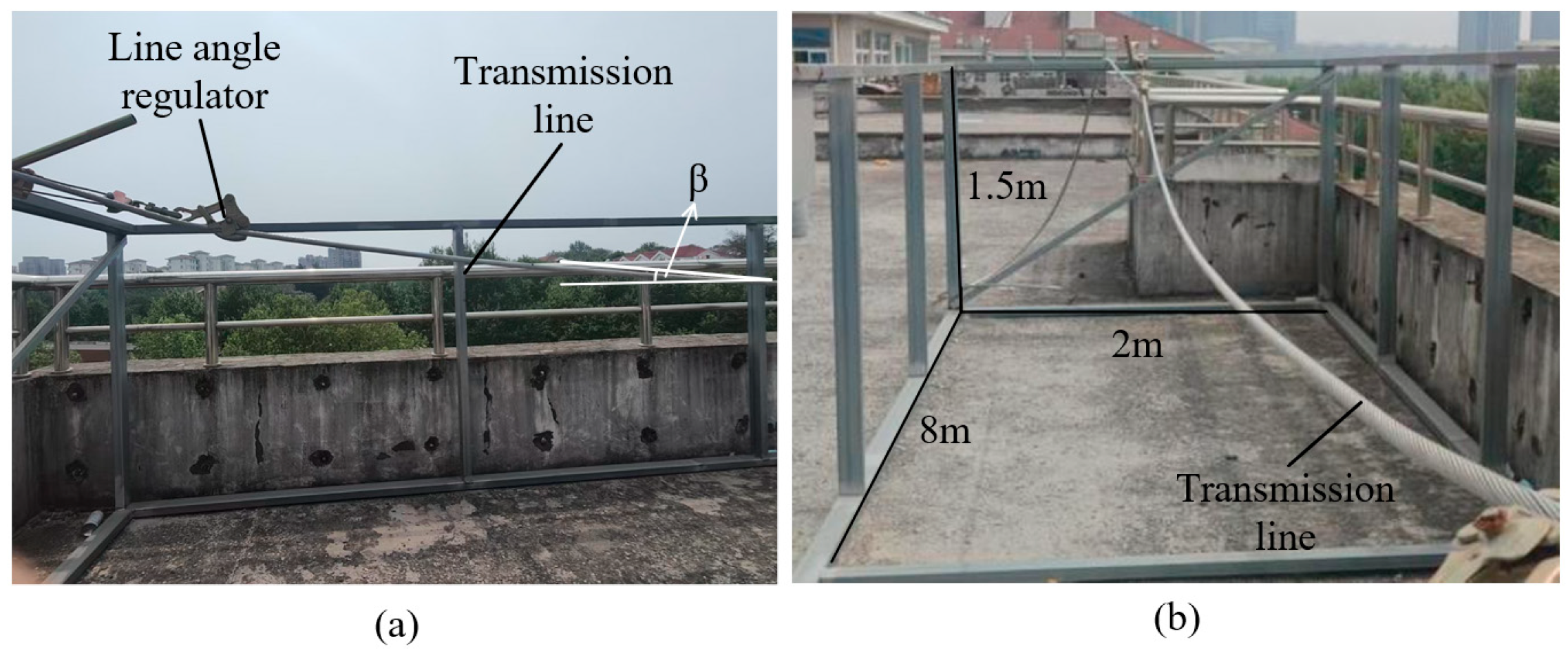
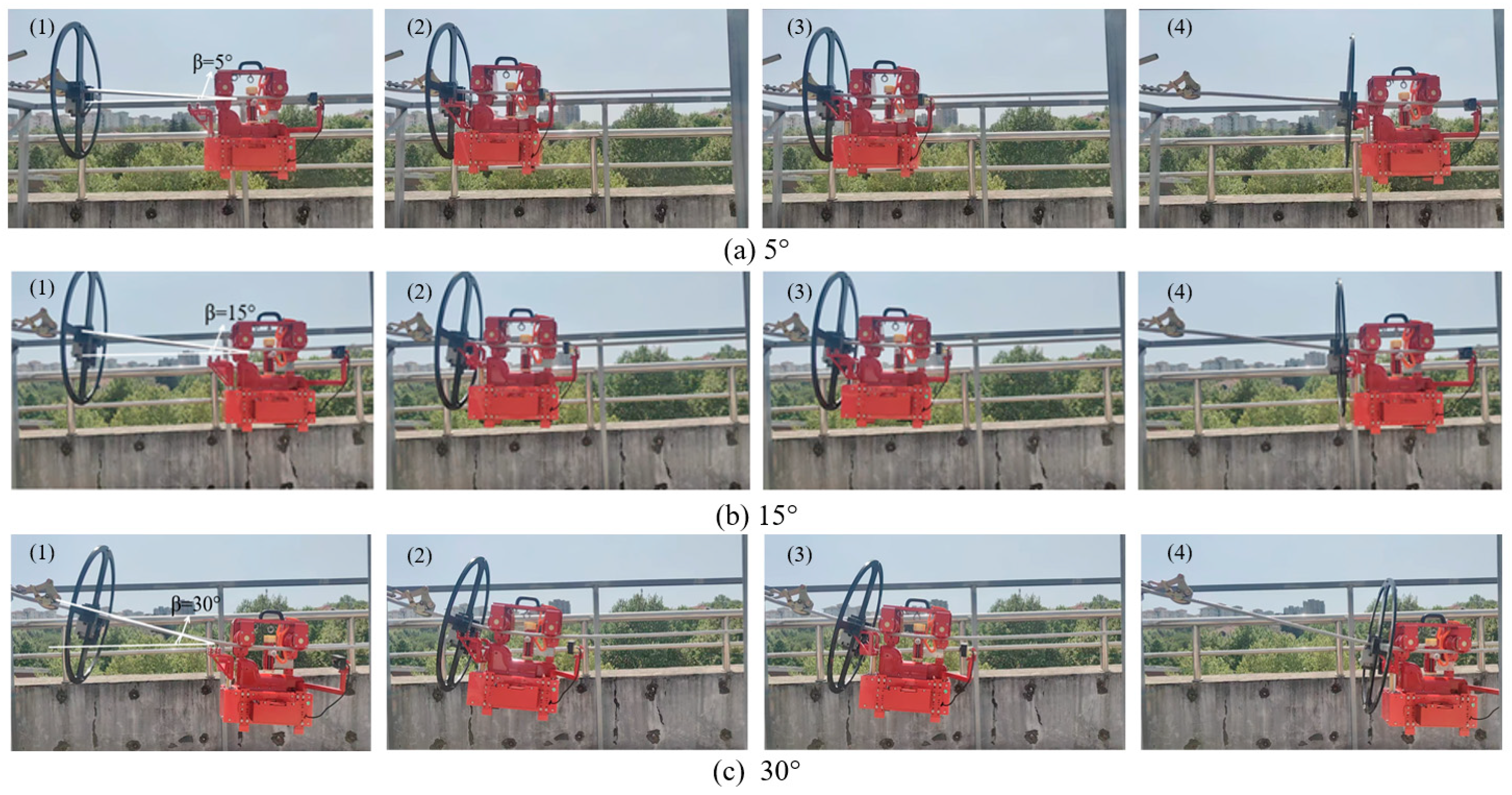
Figure 12 illustrates the climbing test platform, which measures 8 m in length, 2 m in width, and 1.5 m in height. The platform is equipped with a 10 kV expanded-diameter steel-core hard-drawn aluminum stranded conductor, measuring 6.5 m in length and 15.6 mm in diameter. The sag from the conductor’s weight generates subtle vibrations, simulating a dynamic environment. The angle of the transmission line β refers to its inclination relative to the horizontal plane. This platform allows controlled variation of β to evaluate this robot’s installation and retrieval capabilities across different inclinations. The tests are conducted at angles of 5°, 15°, and 30°. Each test includes sections for both installation and retrieval.
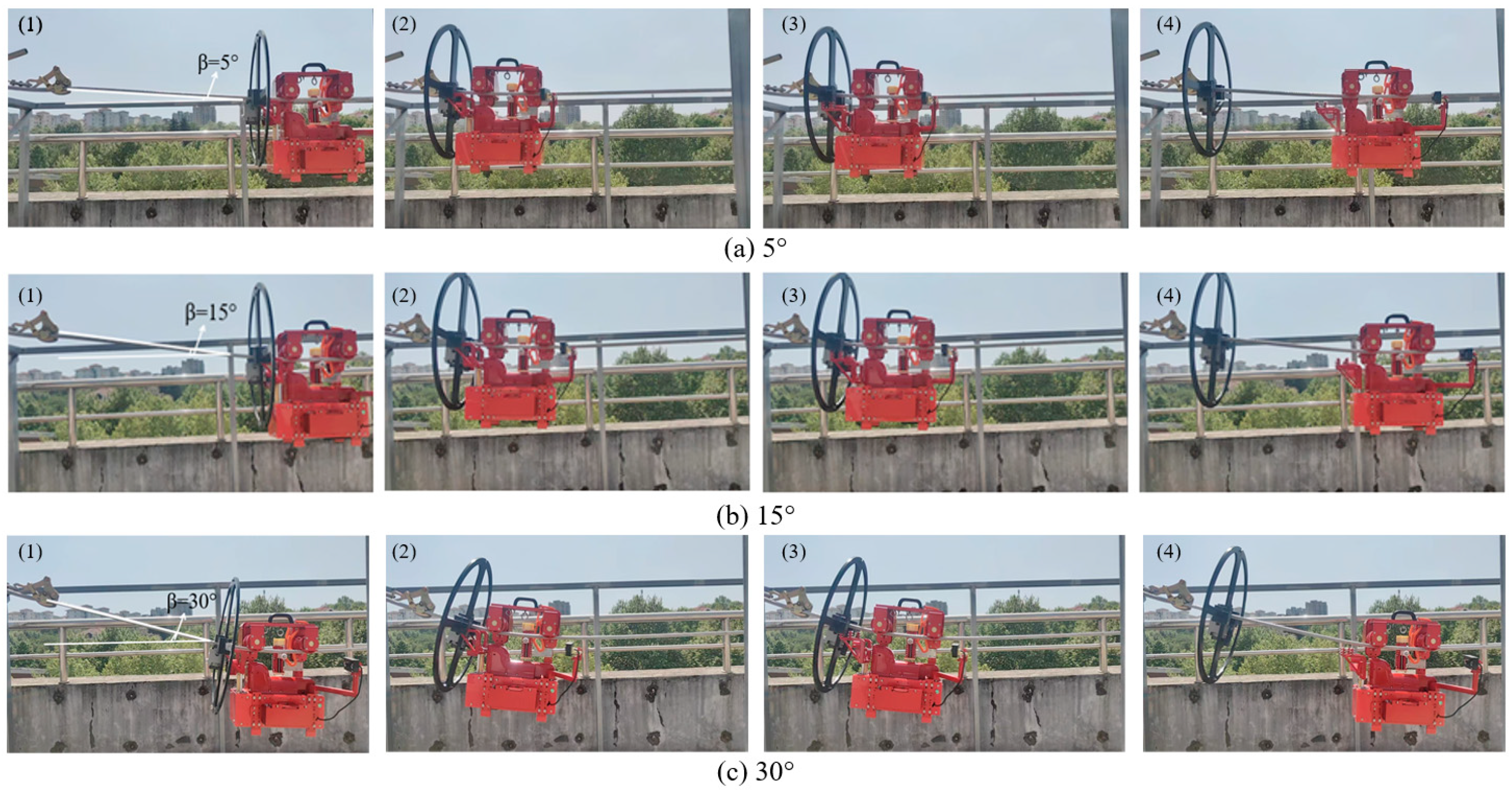
The sequence of the installation process is as follows: (1) The robot positions the spacer ring at the designated location. (2) The rotating mechanism remains activated until the spacer ring is securely locked. (3) The lifting claw retracts to its lower position. (4) Finally, the robot withdraws from the work area. The images of the installation process are shown in Figure 13.
The sequence of the retrieval process is as follows: (1) The robot positions itself facing the spacer ring. (2) The lifting claw ascends to make contact with the supporting claws of the spacer ring. (3) The rotating mechanism remains activated until the spacer ring is unlocked. (4) The robot then retrieves the spacer ring and withdraws. The images of the retrieval process are shown in Figure 14.
Retrieval and installation are each tested 50 times, yielding consistent results. The maximum speeds at angles of 5°, 15°, and 30° are measured at 0.45 m/s, 0.3 m/s, and 0.15 m/s, respectively. The positioning error observed during the installation of the spacer rings remains within a tolerance of 10 mm. As shown in Figure 13 and Figure 14, spacer rings exhibit a slight tilt during the installation and retrieval processes on the inclined transmission line. However, the robot completes the installation and retrieval tasks of the spacer rings. This achievement can be attributed to its inherent fault-tolerant capabilities: (1) the cylindrical design of the supporting claw’s center shaft enables the spacer rings to be securely positioned on the lifting mechanism, even when the transmission line is moderately tilted, and (2) the input handle of the locking mechanism can be effectively captured by the rotary claw of the rotating mechanism under a moderate tilt angle of the transmission line.
The remote controller’s display shows the distance between the fitting block and the conductor of the transmission line. In testing, the locking mechanism demonstrated an average transition time of approximately 8 s between the locked and unlocked states. Various tests conducted at different inclination angles showed that the robot can accurately and consistently perform both installation and retrieval tasks.

4.4. Training Field Tests

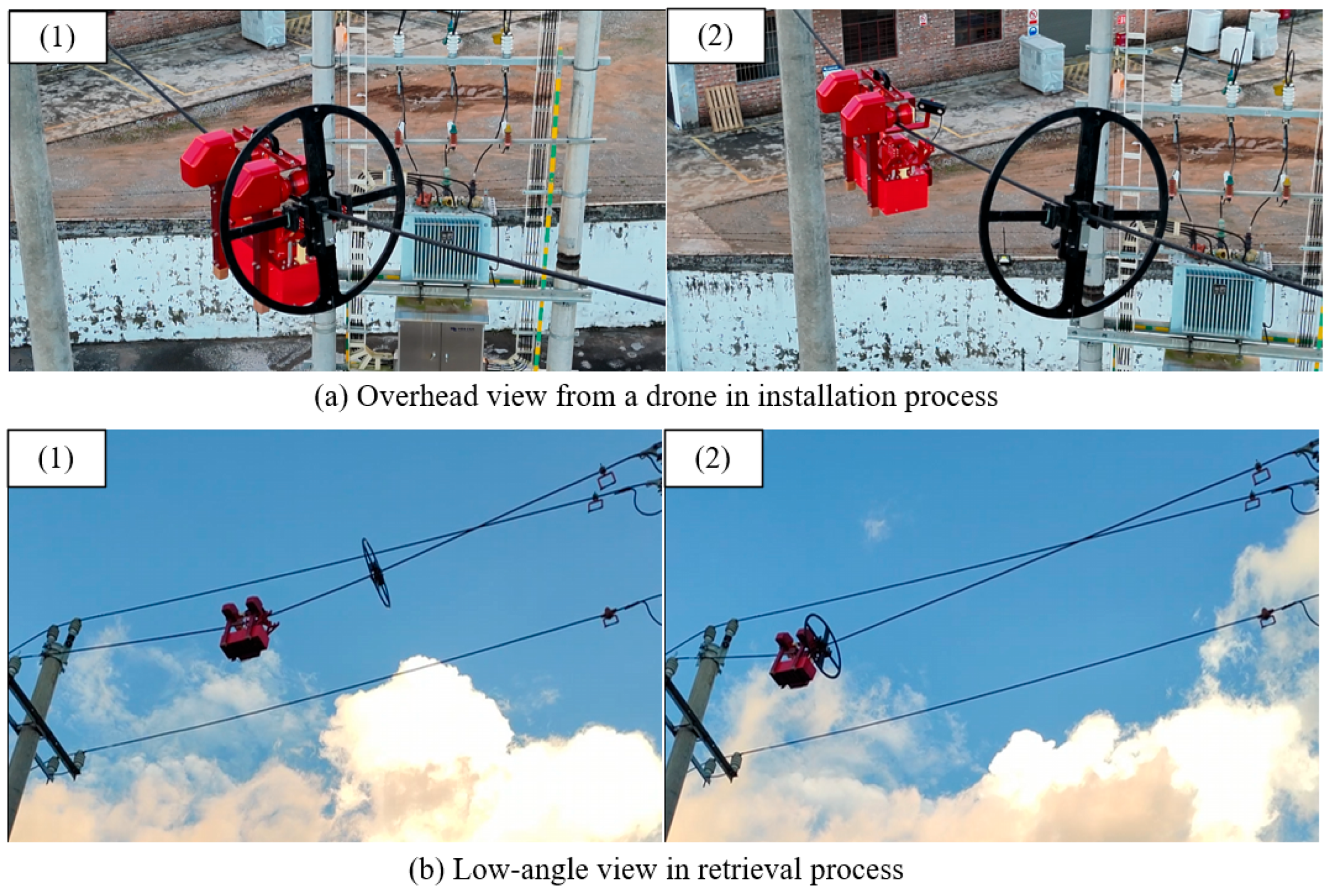
Before field testing in actual high-voltage environments, the robot undergoes comprehensive evaluations at a training field that is engineered to replicate real transmission line conditions. Established by China’s State Grid Corporation, this full-scale simulation platform employs authentic materials and environmental factors—including various conductor types, wind effects, and structural layouts. For safety reasons, testing is conducted without energization. However, all operational parameters and environmental conditions are precisely controlled to match actual working conditions closely. As shown in Figure 15, the robot successfully installs and retrieves spacer rings on the simulated transmission line. These trials provide quantitative validation of the robot’s operational efficiency and stability in near-real environments.

4.5. Field Tests

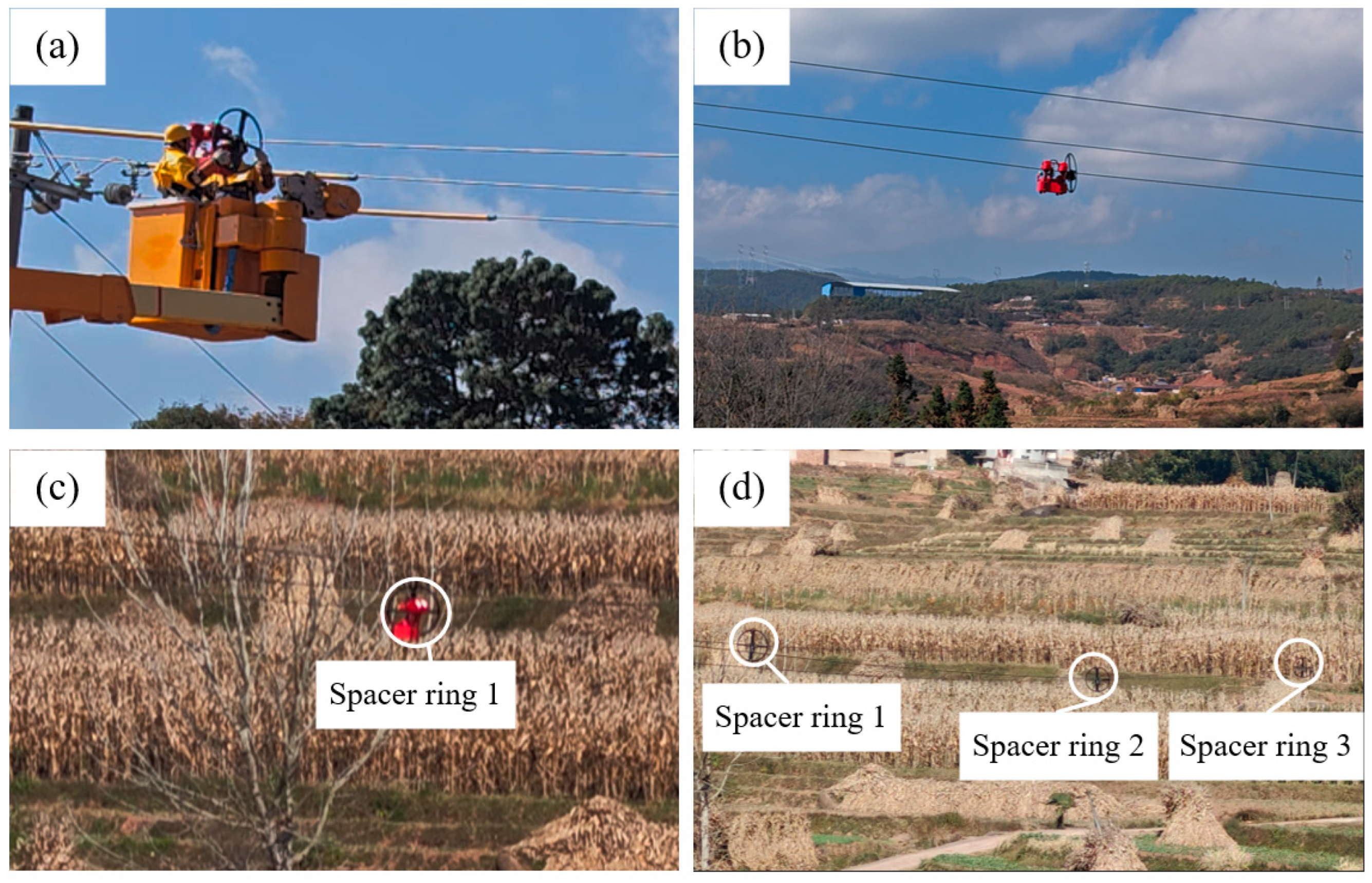
To further confirm the operational capability of the spacer ring robot, the robot conducts installation testing under field conditions. The conductor in the field sages at an angle of about 15°. This field test is conducted under a 10 kV high-voltage condition and in a windy environment. The testing procedure is as follows: Workers place the spacer ring and the robot onto the conductor. The robot then transports the spacer ring to the designated point and performs the installation task. After the installation task is complete, the robot returns to its initial position and is subsequently repositioned by workers onto another conductor for the next installation task. Figure 16 shows images from the field test, where the robot successfully installed three spacer rings. During this field test, one spacer ring is installed on each of the three conductors. The robot achieved an average speed of 0.3 m/s on a 15° incline, which is 1.5 times faster than the speed reported in [27].
The successful outcome of this field test clearly demonstrates that the robot can efficiently install spacer rings on live transmission lines. The spacer ring system effectively eliminates the need for cumbersome manual screw-tightening operations. To increase travel speed, the stepper motors of the wheeled mechanism will be upgraded to higher-torque units. In addition, applying high-friction materials to the drive wheels is expected to significantly enhance the robot’s climbing performance.

4.6. Limitations of Experimental Scope

The experimental validation included indoor high-voltage tests, outdoor climbing, training fields, and field tests. These tests successfully demonstrate the system’s core functionality and feasibility under controlled and semi-controlled conditions. However, these scenarios inherently simplify some challenges associated with unrestricted field deployment. Key environmental factors are not systematically evaluated. Several factors could impact the robot’s dynamic stability, positioning accuracy, and long-term reliability. These include sustained conductor oscillation and high wind variability. Extreme weather conditions, such as heavy rain, ice, or intense temperature cycles, also play a role.
As a result, the current findings establish a critical performance baseline. Future work will focus explicitly on testing and enhancing the system’s robustness against these broader environmental stressors. It will help advance the system towards all-weather operation.

5. Conclusions

This paper presents an anti-collision spacer ring and a corresponding installation robot to solve the collision-induced accident of overhead transmission lines. The spacer ring utilizes an efficient rotation driven locking mechanism to fix onto the conductors. The output locking force of the locking mechanism is analyzed using both theoretical modeling and FEA method, and then validated by experiment. Experiment results indicate that the mechanism can generate a strong output force of up to 2000 N with an input torque of about 6.0 N·m. A teleoperated robot is developed to enable safe and efficient installation and retrieval operation of the ring. Performance of the robot is demonstrated through comprehensive tests, including field trials on live lines. A travel speed of 0.3 m/s on a 15° incline is achieved.
This spacer ring system enhances the operational safety of transmission lines by preventing conductor collisions, thereby reducing the risk of power outages. Future work will focus on improving the robot performance in several aspects. For example, by adopting more advanced materials and system designs, the overall weight of the robot is expected to be reduced by over 20%, and the climbing angle is expected to be more than 40°. While the current system relies on remote operation with visual feedback, future work will integrate a closed-loop machine vision system to enable automatic identification and installation.

Author Contributions

Conceptualization, T.W.; Methodology, T.W., H.L. and T.C.; software, H.L.; validation, H.L. and T.C.; resources, T.W.; data curation, H.L. and T.C.; writing—original draft preparation, T.W. and H.L.; writing—review and editing, T.W.; project administration, T.W.; funding acquisition, T.W. All authors have read and agreed to the published version of the manuscript.

Funding

This work is supported by the National Natural Science Foundation of China (Grant No. 52201398) and the Natural Science Foundation of Jiangsu Province, China (Grant No. BK20220343).

Data Availability Statement

Data will be made available on request.

Conflicts of Interest

The authors declare no conflicts of interest.

References

  1. Nishihara, T.; Yagi, T. Aerodynamic modeling for large-amplitude galloping of four-bundled conductors. J. Fluids Struct. 2018, 82, 559–576. [Google Scholar] [CrossRef]
  2. Cui, F.; Zhang, S.; Huo, B.; Liu, X.; Zhou, A. Analysis of stability and modal interaction for multi-modal coupling galloping of iced transmission lines. Commun. Nonlinear Sci. Numer. Simul. 2021, 102, 105910. [Google Scholar] [CrossRef]
  3. Matsumiya, H.; Yagi, T.; Macdonald, J.H. Unsteady aerodynamic force modelling for 3-DoF-galloping of four-bundled conductors. J. Fluids Struct. 2022, 112, 103581. [Google Scholar] [CrossRef]
  4. Zengin, A.T.; Erdemir, G.; Akinci, T.C.; Seker, S. Measurement of power line sagging using sensor data of a power line inspection robot. IEEE Access 2020, 8, 99198–99204. [Google Scholar] [CrossRef]
  5. Desai, Y.; Yu, P.; Popplewell, N.; Shah, A. Finite element modelling of transmission line galloping. Comput. Struct. 1995, 57, 407–420. [Google Scholar] [CrossRef]
  6. Zhang, Z.; Han, Y.; Yu, J.; Hu, P.; Cai, C. Anti-galloping analysis of iced quad bundle conductor based on compound damping cables. Eng. Struct. 2024, 306, 117831. [Google Scholar] [CrossRef]
  7. Tan, T.; Duan, C.; Liu, X.; Fan, D.; Ye, Z.; Xie, K.; Chai, Q.; Tian, Y.; Zhang, J. Research on monitoring the transmission line tension and galloping based on FBG fitting sensor. IEEE Trans. Instrum. Meas. 2022, 71, 7008108. [Google Scholar] [CrossRef]
  8. Wei, Y.; Gao, X. Transmission line galloping prediction based on GA-BP-SVM combined method. IEEE Access 2021, 9, 107680–107687. [Google Scholar] [CrossRef]
  9. Zhang, X.; Wang, J.; Zhai, S.; Yu, Y.; Cheng, X.; Li, H.; Wang, Z.L.; Cheng, T. Multi-Parameters Self-Powered Monitoring via Triboelectric and Electromagnetic Mechanisms for Smart Transmission Lines. Adv. Energy Mater. 2024, 14, 2401710. [Google Scholar] [CrossRef]
  10. Yan, Q.; Zhou, C.; Feng, X.; Deng, C.; Hu, W.; Xu, Y. Galloping Vibration Monitoring of Overhead Transmission Lines by Chirped FBG Array. Photonic Sens. 2022, 12, 220310. [Google Scholar] [CrossRef]
  11. Zhao, Z.; Liu, B.; Liu, S.; Zhang, D. Design and Test of Quad-Bundle Spacer Damper Based on a New Rubber Structure. Shock Vibrat. 2023, 2023, 3828501. [Google Scholar] [CrossRef]
  12. Mou, Z.; Yan, B.; Yang, H.; Wu, K.; Wu, C.; Yang, X. Study on anti-galloping efficiency of rotary clamp spacers for eight bundle conductor line. Cold Reg. Sci. Technol. 2022, 193, 103414. [Google Scholar] [CrossRef]
  13. Si, J.; Rui, X.; Liu, B.; Zhou, L.; Liu, S. Study on a new combined anti-galloping device for UHV overhead transmission lines. IEEE Trans. Power Deliv. 2019, 34, 2070–2078. [Google Scholar] [CrossRef]
  14. Matsumiya, H.; Yukino, T.; Shimizu, M.; Nishihara, T. Field observation of galloping on four-bundled conductors and verification of countermeasure effect of loose spacers. J. Wind Eng. Ind. Aerodyn. 2022, 220, 104859. [Google Scholar] [CrossRef]
  15. Santos, S.; Richart, F.; da Silva, G.; Kowalski, E.; Ribeiro, S.; Dadam, A.; Munaro, M. Spacer design for 15 kv compact overhead distribution networks for regions with high environmental aggressiveness. IEEE Lat. Am. Trans. 2018, 16, 2634–2641. [Google Scholar] [CrossRef]
  16. Fu, X.; Li, H.-N.; Li, J.-X.; Zhang, P. A pounding spacer damper and its application on transmission line subjected to fluctuating wind load. Struct. Control Health Monit. 2017, 24, e1950. [Google Scholar] [CrossRef]
  17. Kubelwa, Y.; Swanson, A.; Dorrell, D.; Papailiou, K. A comparative study on high-voltage spacer-damper performance and assessment: Theory, experiments and analysis. SAIEE Afr. Res. J. 2019, 110, 153–166. [Google Scholar] [CrossRef]
  18. Barbieri, N.; Barbieri, R.; da Silva, R.A.; Mannala, M.J.; Barbieri, L.d.S.A.V. Nonlinear dynamic analysis of wire-rope isolator and Stockbridge damper. Nonlinear Dyn. 2016, 86, 501–512. [Google Scholar] [CrossRef]
  19. Peng, H.; Wang, B.; He, Q.; Zhen, Y.; Wang, Y.; Wen, S. Multi-parametric optimizations for power dissipation characteristics of Stockbridge dampers based on probability distribution of wind speed. Appl. Math. Model. 2019, 69, 533–551. [Google Scholar] [CrossRef]
  20. Gulbahce, E.; Gupta, S.K.; Barry, O. Position optimization of Stockbridge dampers under varying operating conditions: A comprehensive finite element and experimental analysis. Mech. Syst. Signal Process. 2025, 225, 112271. [Google Scholar] [CrossRef]
  21. Diana, G.; Manenti, A.; Pirotta, C.; Zuin, A. Stockbridge-type damper effectiveness evaluation. II. The influence of the impedance matrix terms on the energy dissipated. IEEE Trans. Power Deliv. 2003, 18, 1470–1477. [Google Scholar] [CrossRef]
  22. Sauter, D.; Hagedorn, P. On the hysteresis of wire cables in Stockbridge dampers. Int. J. Non-Linear Mech. 2002, 37, 1453–1459. [Google Scholar] [CrossRef]
  23. Wang, Z.; Li, H.-N.; Song, G. Aeolian vibration control of power transmission line using Stockbridge type dampers—A review. Int. J. Struct. Stab. Dyn. 2021, 21, 2130001. [Google Scholar] [CrossRef]
  24. Barry, O.; Zu, J.; Oguamanam, D. Analytical and experimental investigation of overhead transmission line vibration. J. Vib. Control. 2015, 21, 2825–2837. [Google Scholar] [CrossRef]
  25. Barry, O.; Long, R.; Oguamanam, D. Rational damping arrangement design for transmission lines vibrations: Analytical and experimental analysis. J. Dyn. Sys. Meas. Control 2017, 139, 051012. [Google Scholar] [CrossRef]
  26. Kim, C.-J. Design sensitivity analysis of a Stockbridge damper to control resonant frequencies. J. Mech. Sci. Technol. 2017, 31, 4145–4150. [Google Scholar] [CrossRef]
  27. Pan, J.; Cheng, Y.; Hu, C.; Jiang, M.; Ma, Y.; Meng, F.; Shi, Q. The Innovative Design and Performance Testing of a Mobile Robot for the Automated Installation of Spacers on Six-Split Transmission Lines. Machines 2025, 13, 432. [Google Scholar] [CrossRef]
  28. Espinosa Peralta, P.; Palomino-Díaz, V.; Rodríguez Herrerías, P.; Rodríguez del Castillo, C.; Pedraza Cubero, C.M.; Yuste, J.P.; Aparicio Cillán, P.; Mesía López, R.; Águila Rodríguez, G.; Fernández Franco, V.P. ROSE: Robot for Automatic Spacer Installation in Overhead Power Lines. In Iberian Robotics Conference; Springer International Publishing: Cham, Switzerland, 2022; pp. 325–337. [Google Scholar]
  29. Park, J.-Y.; Lee, J.-K.; Cho, B.-H.; Oh, K.-Y. An inspection robot for live-line suspension insulator strings in 345-kV power lines. IEEE Trans. Power Deliv. 2012, 27, 632–639. [Google Scholar] [CrossRef]
  30. Sehgal, A.; Mahammad, Z.; Sasank, P.; Badhwar, A.; Govindan, N. WireFlie: A Novel Obstacle-Overcoming Mechanism for Autonomous Transmission Line Inspection Drones. IEEE Robot. Autom. Lett. 2025, 10, 6528–6535. [Google Scholar] [CrossRef]
  31. Chen, M.; Cao, Y.; Tian, Y.; Li, E.; Liang, Z.; Tan, M. A passive compliance obstacle-crossing robot for power line inspection and maintenance. IEEE Robot. Autom. Lett. 2023, 8, 2772–2779. [Google Scholar] [CrossRef]
  32. Wang, Q.; Wang, W.; Li, Z.; Namiki, A.; Suzuki, S. Close-range transmission line inspection method for low-cost uav: Design and implementation. Remote Sens. 2023, 15, 4841. [Google Scholar] [CrossRef]
  33. Li, H.J.; Jiang, W.; Yan, Y.; Zhang, A.; Zuo, G. Operation Motion Planning and Principle Prototype Design of Four-Wheel-Driven Mobile Robot for High-Voltage Double-Split Transmission Lines. Math. Probl. Eng. 2020, 2020, 6195320. [Google Scholar] [CrossRef]
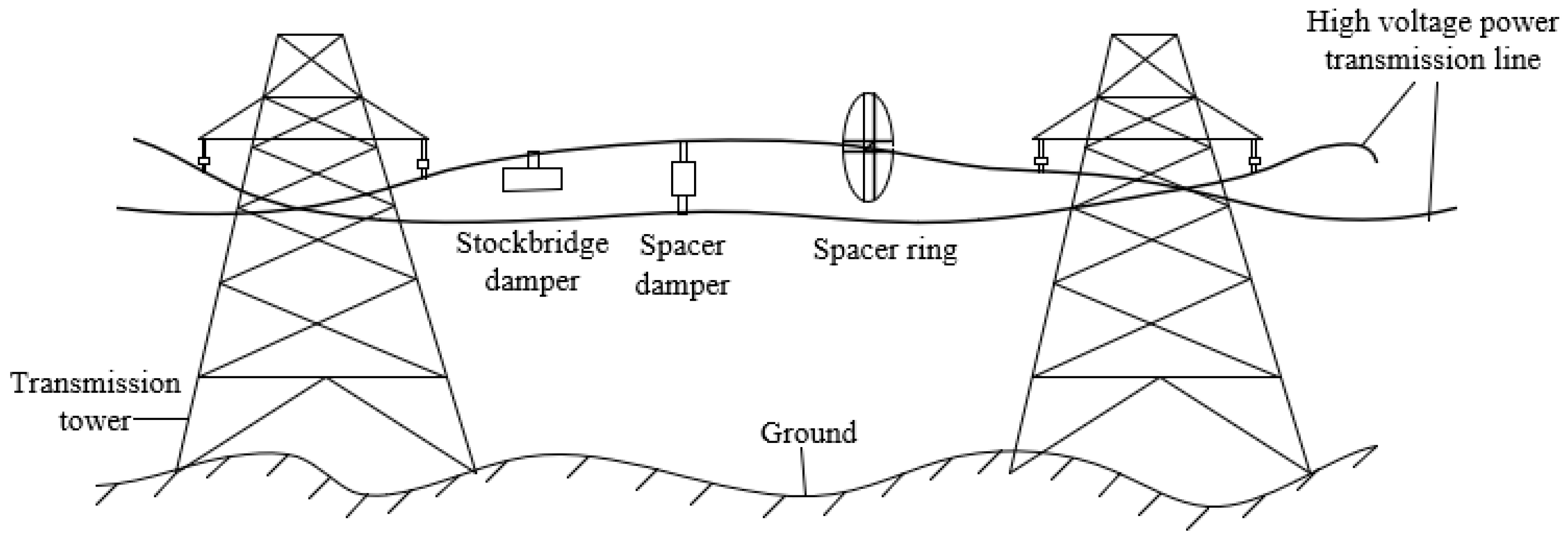
Figure 1. Various devices for preventing transmission lines from collision. Spacer rings have strong adaptability. Installing a spacer ring on a single conductor of the transmission line prevents contact and collision between the conductors.
Machines 14 00023 g001
Figure 2. Structure design of the spacer ring and the locking mechanism. (a) The front view of the spacer ring 3D model. The diameter of the spacer ring is 600 mm. Different states between the spacer ring and the transmission line are illustrated. (b) The side view of the spacer ring 3D model. The thickness of the spacer ring is 10 mm. (c) The structural schematic diagram of the locking mechanism. In this diagram, α represents the angle between the wedge face and the gravity. The dotted line represents the locking mechanism housing. (d) The 3D model of the locking mechanism.
Machines 14 00023 g002
Figure 3. Structure design of the installation robot. (a) The side view of the robot. The top-left section shows a detailed view of the rotating mechanism, and the bottom-left section depicts the auxiliary wheel system. (b) The front view of the robot.
Machines 14 00023 g003
Figure 4. The prototypes of the spacer ring, installation robot, and control system. (a) The prototypes of the installation robot and the spacer ring. (b) The control system diagram.
Machines 14 00023 g004
Figure 5. Output force analysis diagram and Sobol sensitivity analysis results. (a) The force analysis of the locking mechanism after applying an input torque T. (b) The force analysis of the wedge block 1. (c) The force analysis of the wedge block 2. (d) Sobol sensitivity analysis results of different parameters. The blue section is the first-order exponential, and the red section is the overall exponential.
Machines 14 00023 g005
Figure 6. Finite element analysis. (a) Simplified assembly model with labeled kinematic constraints: (A) Bilateral constraints fixed on the threaded drive shaft, (B) Equivalent horizontal axial force applied to the wedge block 1 (representing the pre-tightening force), (C) Fixed constraints at the left of the locking mechanism housing, (D) Fixed constraints at the right housing, (E) Force reaction sensors monitoring vertical output force. (b) Comparison of the theoretical and the FEA curves. (c) The relationship between the input torque and the locking force while changing different values of θ . (d) The relationship between the input torque and the locking force while changing different values of α . (e) The relationship between the input torque and the locking force while changing different values of d . (f) The relationship between the input torque and the locking force while changing different values of μ . (g) The relationship between the input torque and the locking force while changing different values of p .
Machines 14 00023 g006
Figure 7. Static stress analysis of the locking mechanism. (a) The equivalent stress contours from ANSYS simulations under an input torque of 7.5 N·m. (b) Maximum equivalent stress and equivalent elastic strain analysis results under different input torques. (c) The maximum equivalent stress under different applied forces with different thread nominal diameters. (d) The maximum equivalent elastic strain under different values of the applied force with different thread nominal diameters. (e) Life prediction of the locking mechanism. (f) Wear analysis of the locking mechanism.
Machines 14 00023 g007
Figure 8. Electrical performance and collision analysis of the spacer ring. (a) Electric potential. (b) Electric field norm. (c) Collision schematic: The spacer ring is mounted on conductor 1, and conductor 2 will collide with the spacer ring from four directions: 1, 2, 3, and 4. (d) Stress distribution in the spacer ring during collision from direction 1.
Machines 14 00023 g008
Figure 9. A force analysis when the robot climbs along a transmission line with a slope β . The blue line represents the straight line connecting the front wheel to the rear wheel.
Machines 14 00023 g009
Figure 10. Experiment platform and results. (a) Locking force experimental platform. (b) Comparison of the experimental data and the theoretical analysis.
Machines 14 00023 g010
Figure 11. High-voltage test platform.
Machines 14 00023 g011
Figure 12. Climbing test platform. In this test platform, the angle of the transmission line can be adjusted. (a) The side view. (b) The front view.
Machines 14 00023 g012
Figure 13. Installation process. (a) 5° (b) 15° (c) 30°.
Machines 14 00023 g013
Figure 14. Retrieval process. (a) 5° (b) 15° (c) 30°.
Machines 14 00023 g014
Figure 15. Installation and retrieval processes in a training field to simulated the real scenarios. (a) Overhead view from a drone in installation process: (1) The robot is installing the spacer ring, (2) The installation process is complete, and the robot departs. (b) Low-angle view in retrieval process: (1) The robot and spacer ring are in their initial positions, (2) The retrieval process is complete, and the robot carries the spacer ring back.
Machines 14 00023 g015
Figure 16. Field tests in 10 kV high-voltage environment. (a) Workers carefully position the spacer ring and the robot onto the conductor. (b) The robot efficiently moves the spacer ring forward. (c) The installation of the spacer ring 1. (d) The robot completed the installation of three spacer rings.
Machines 14 00023 g016
Table 1. Parameters for simulation.
Simulation Modeling of Spacer RingMaterialsModulus of Elasticity/MpaPoisson’s RatioDensity/(g/cm3)Yield Strength/Mpa
Spacer ringEpoxy resin37800.351.1654.6
Locking mechanism7075 aluminum alloy71,0000.332.81455
Bearings316 stainless steel193,0000.288.03205
Transmission line6061 aluminum alloy69,0400.332.713259.2
Disclaimer/Publisher’s Note: The statements, opinions and data contained in all publications are solely those of the individual author(s) and contributor(s) and not of MDPI and/or the editor(s). MDPI and/or the editor(s) disclaim responsibility for any injury to people or property resulting from any ideas, methods, instructions or products referred to in the content.