Multilevel Modeling and Validation of Thermo-Mechanical Nonlinear Dynamics in Flexible Supports


Abstract
1. Introduction
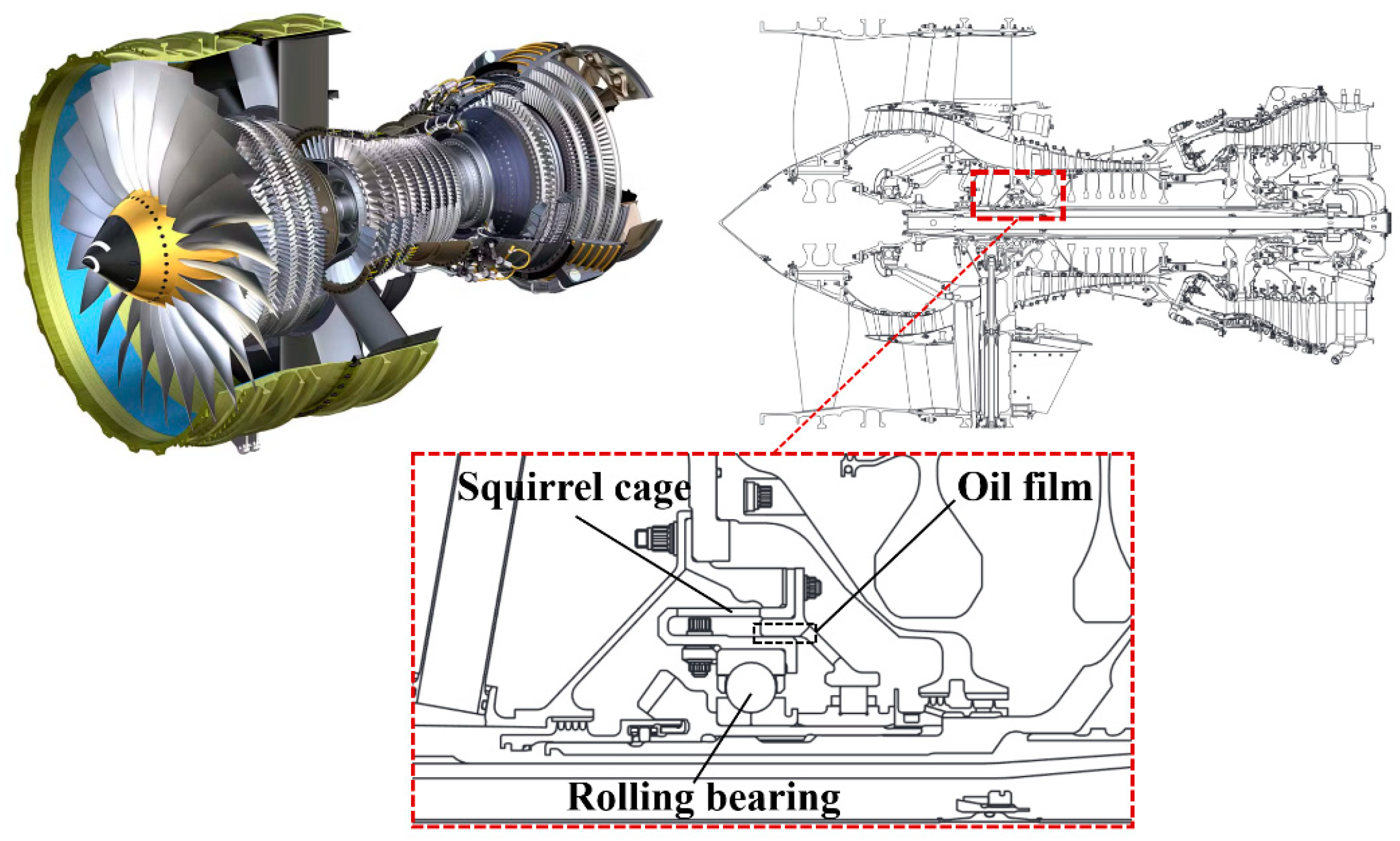
2. Coupled Multi-Physics Modeling
2.1. Thermo-Hydrodynamic Model of the SFD
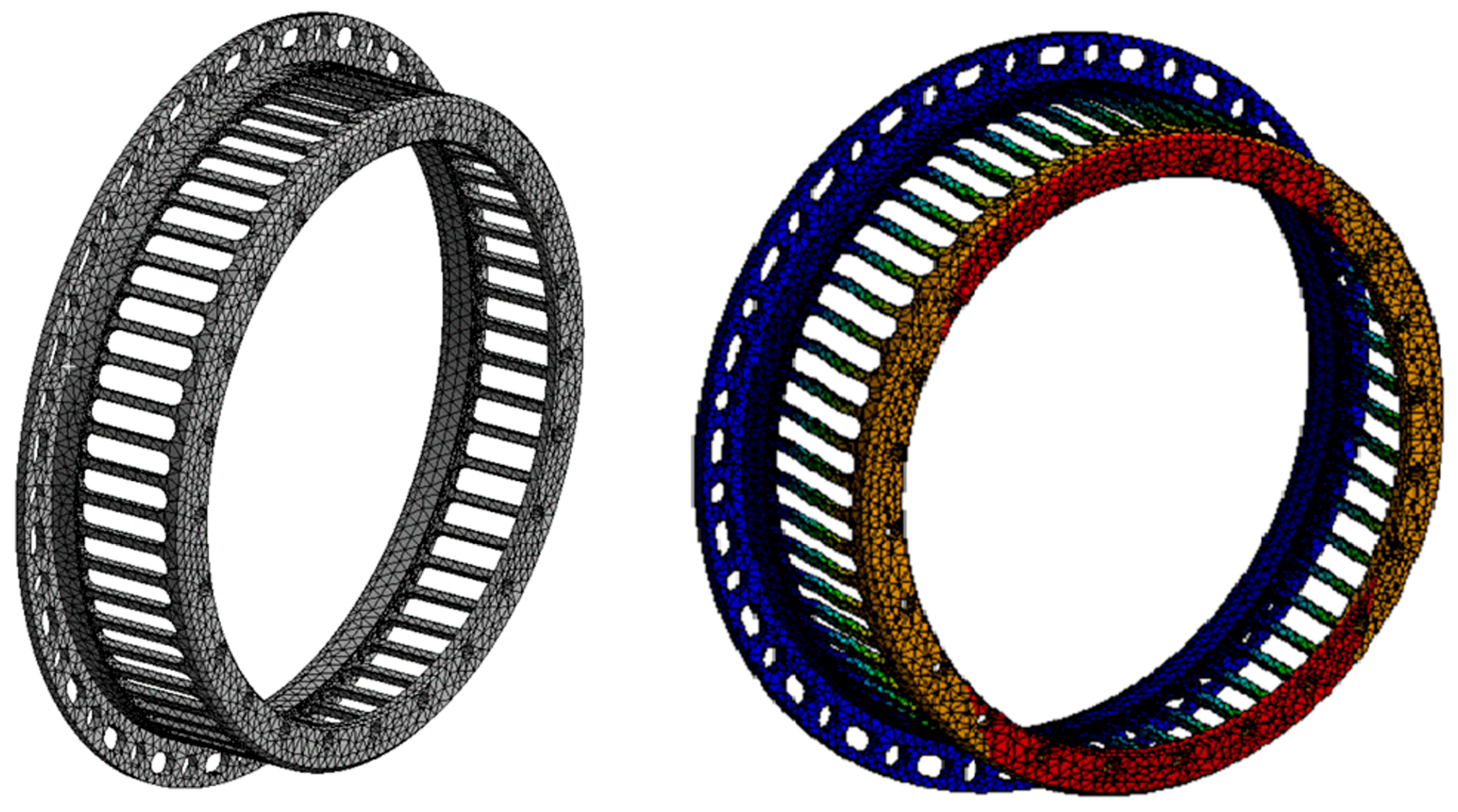
2.2. Finite Element Modeling of the Squirrel-Cage Support
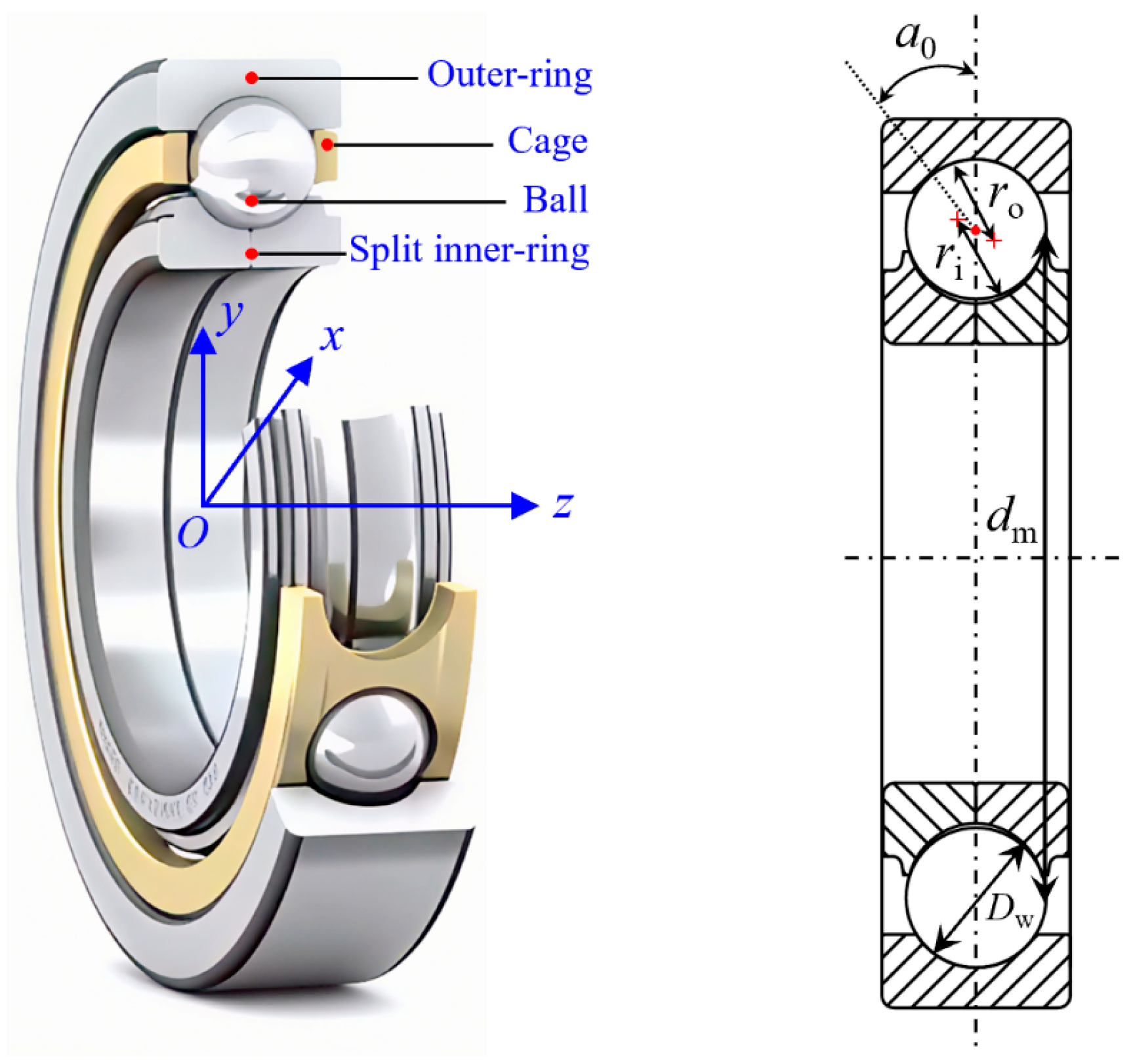
2.3. Nonlinear Bearing Model
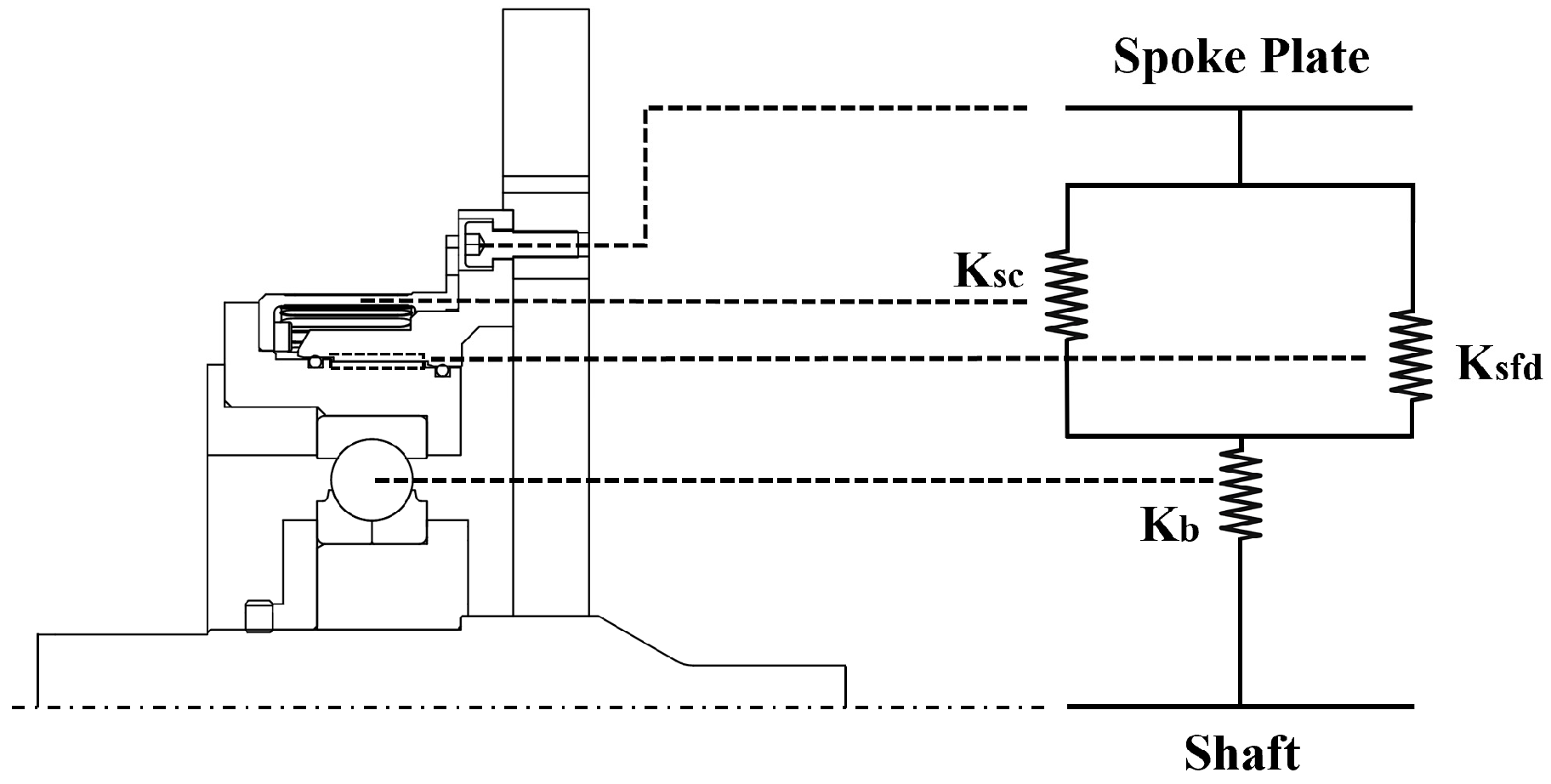
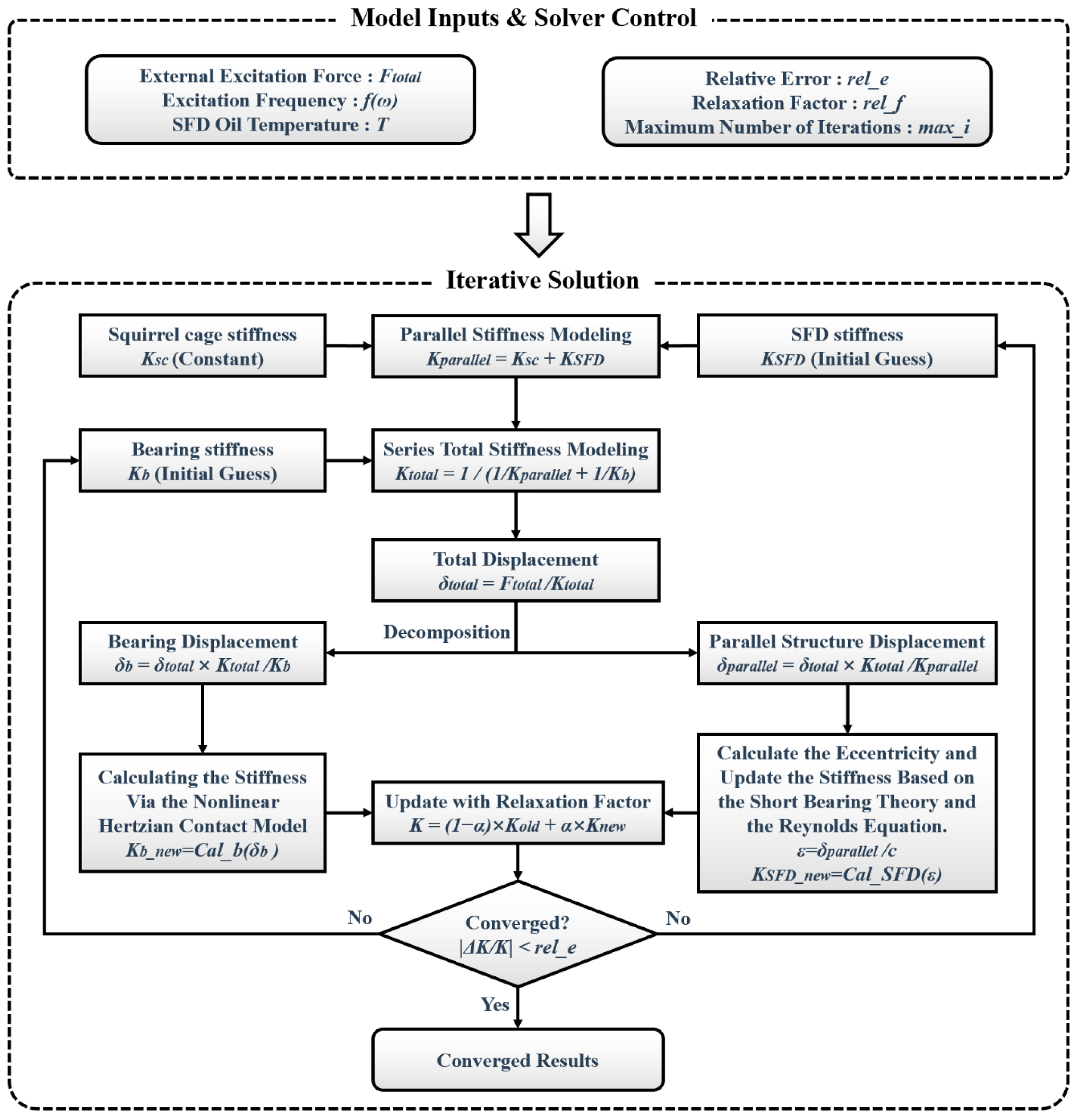
2.4. Integrated System Model and Solution Framework
3. Experimental Methodology
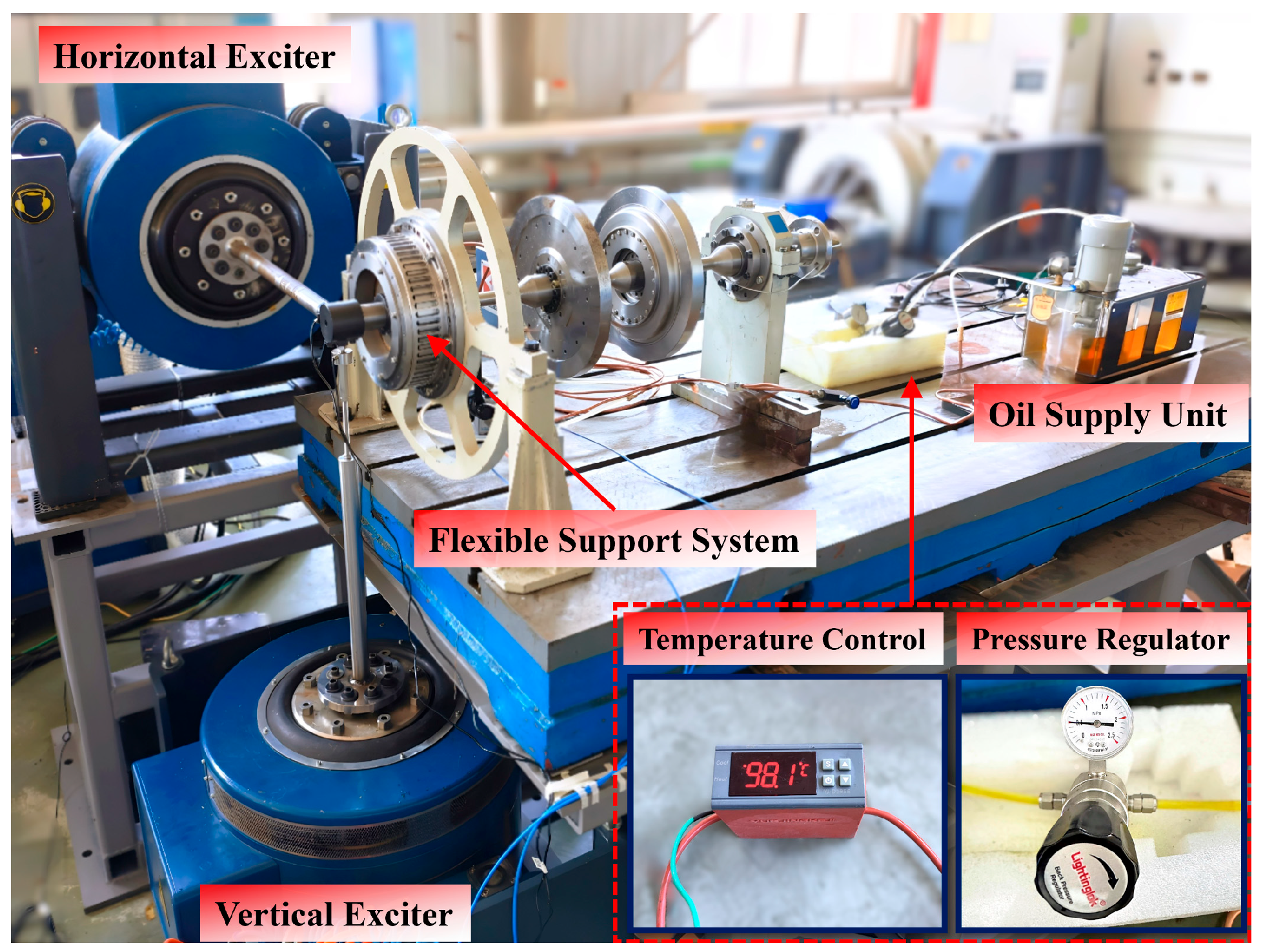
3.1. Bidirectional Excitation Test Rig
- Support Structure Platform: The test article—a complete flexible support assembly identical to the simulation model—is mounted on a high-stiffness, seismically isolated base to ensure measurement integrity. A rigid, non-rotating shaft is installed through the bearing to serve as the mechanical interface for load application.
- Bidirectional Excitation Module: To simulate complex planar dynamic loads, two orthogonally mounted electrodynamic shakers (EDM-1000, 10 kN, ECON Technologies Co., Ltd., Hangzhou, China) apply forces in the X and Y directions. This configuration is critical for characterizing the system’s anisotropic properties.
- Lubricant Temperature Control Module: Given the SFD’s thermo-viscous sensitivity, a closed-loop conditioning system is employed. A PID-controlled heater and pump unit circulate oil through the damper, maintaining the inlet temperature between 30 °C and 100 °C with a precision of ±0.1 °C.
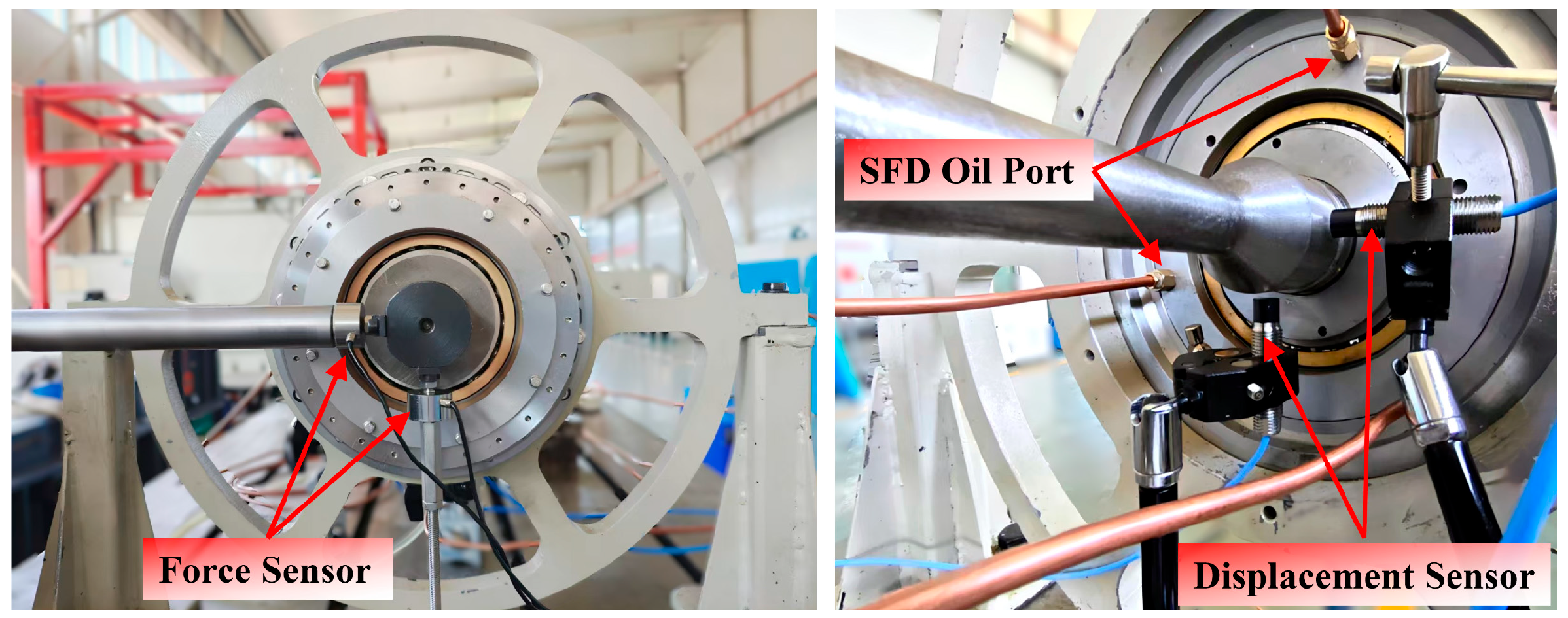
- Measurement and Data Acquisition: The sensor arrangement is detailed in Figure 9. Two piezoelectric force transducers (JLBM-500, ±5 kN, Bengbu Sensor System Engineering Co., Ltd., Bengbu, China) are installed between the shakers and the shaft to measure input excitation. Simultaneously, the shaft’s planar displacement response is captured non-intrusively by two orthogonal eddy current proximity probes (RP6605XL, ±5 mm, Shanghai Zhongxi Industrial Co., Ltd., Shanghai, China). All four signal channels are synchronized via a data acquisition system (cDAQ-9185, National Instruments, Austin, TX, USA) at a sampling rate of 5120 Hz, ensuring the capture of both amplitude and phase information essential for parameter identification. Measurement fidelity mandated a strict calibration protocol prior to dynamic testing. We subjected the piezoelectric force transducers (JLBM-500) to static linearity verification using standard weights. In situ calibration of the eddy current proximity probes (RP6605XL) utilized a precision micrometer stage. Mapping the gap-voltage curve indicated that sensitivity remains constant across the operational band. Consequently, linearity error stays below 1%.
3.2. Experimental Protocol
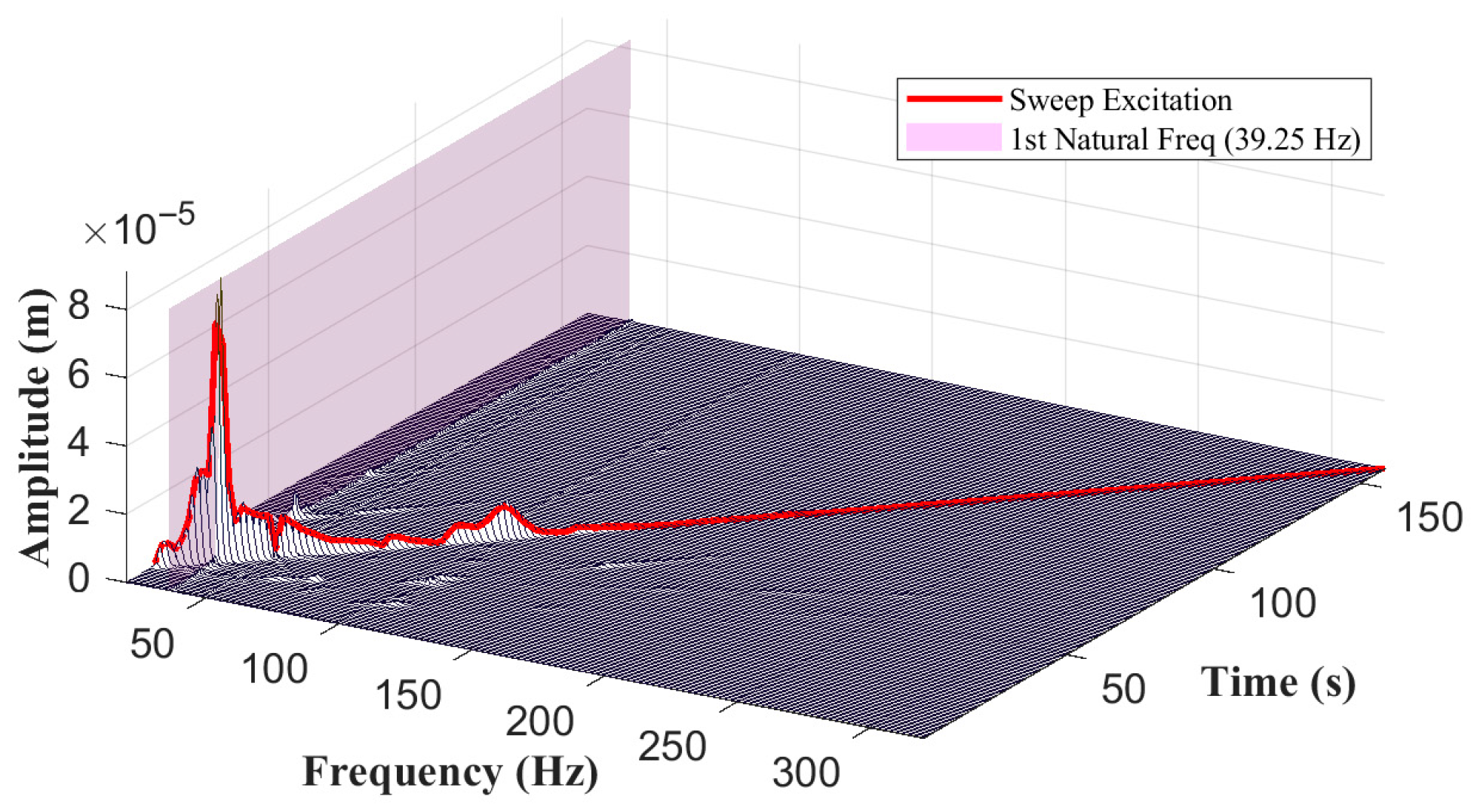
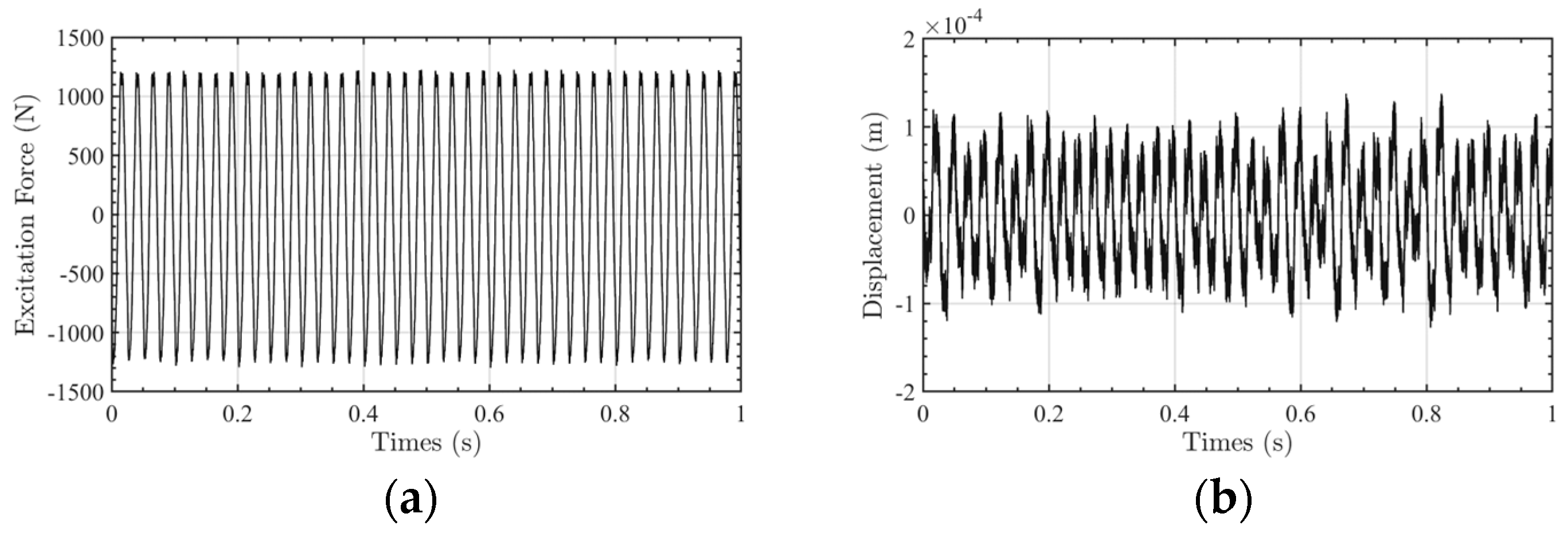
- Swept-Frequency Test: To identify the system’s natural frequencies and baseline dynamic signature, a linear frequency sweep was conducted from 20 Hz to 320 Hz. During this test, the excitation force amplitude was maintained at a constant 1200 N.
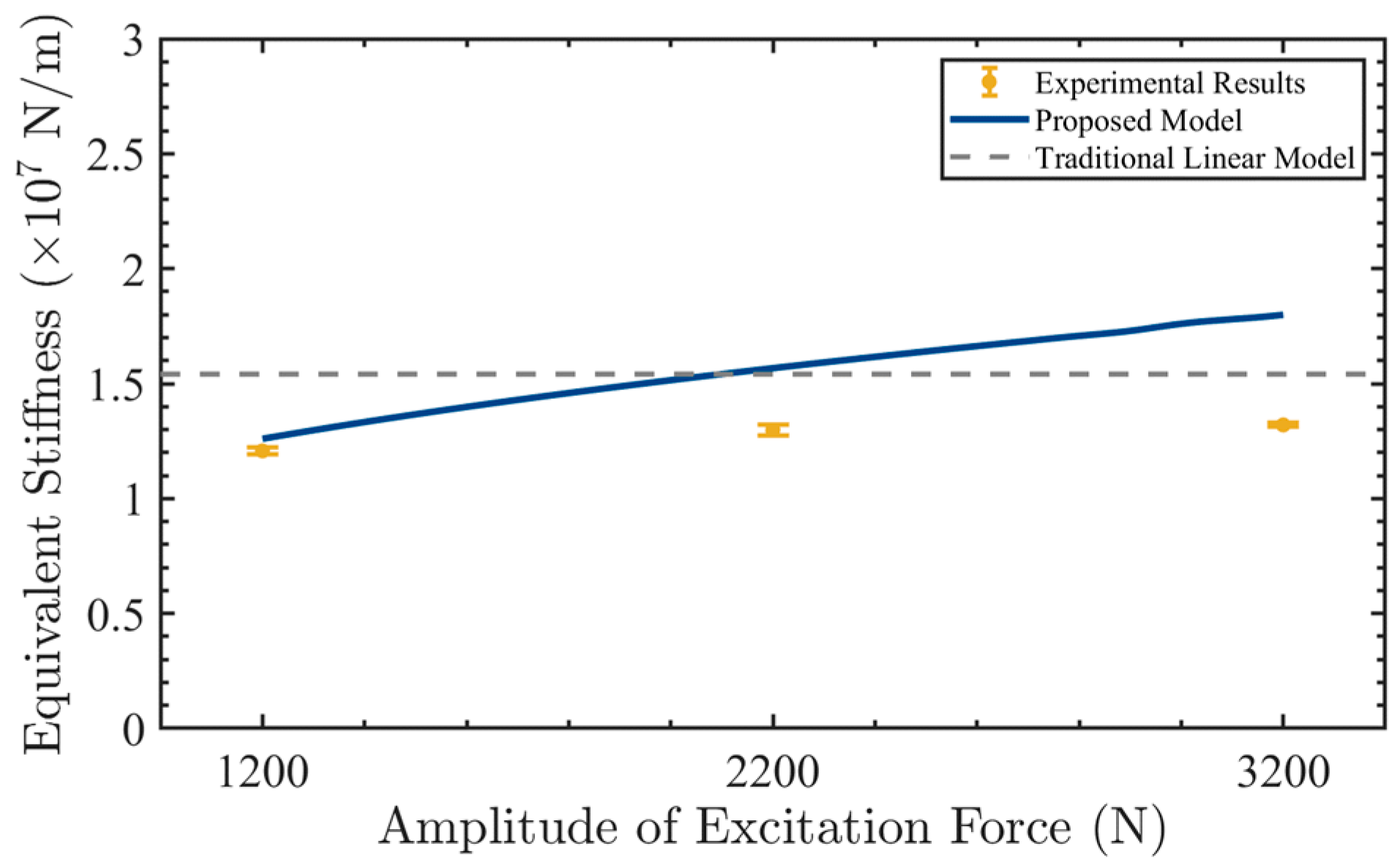
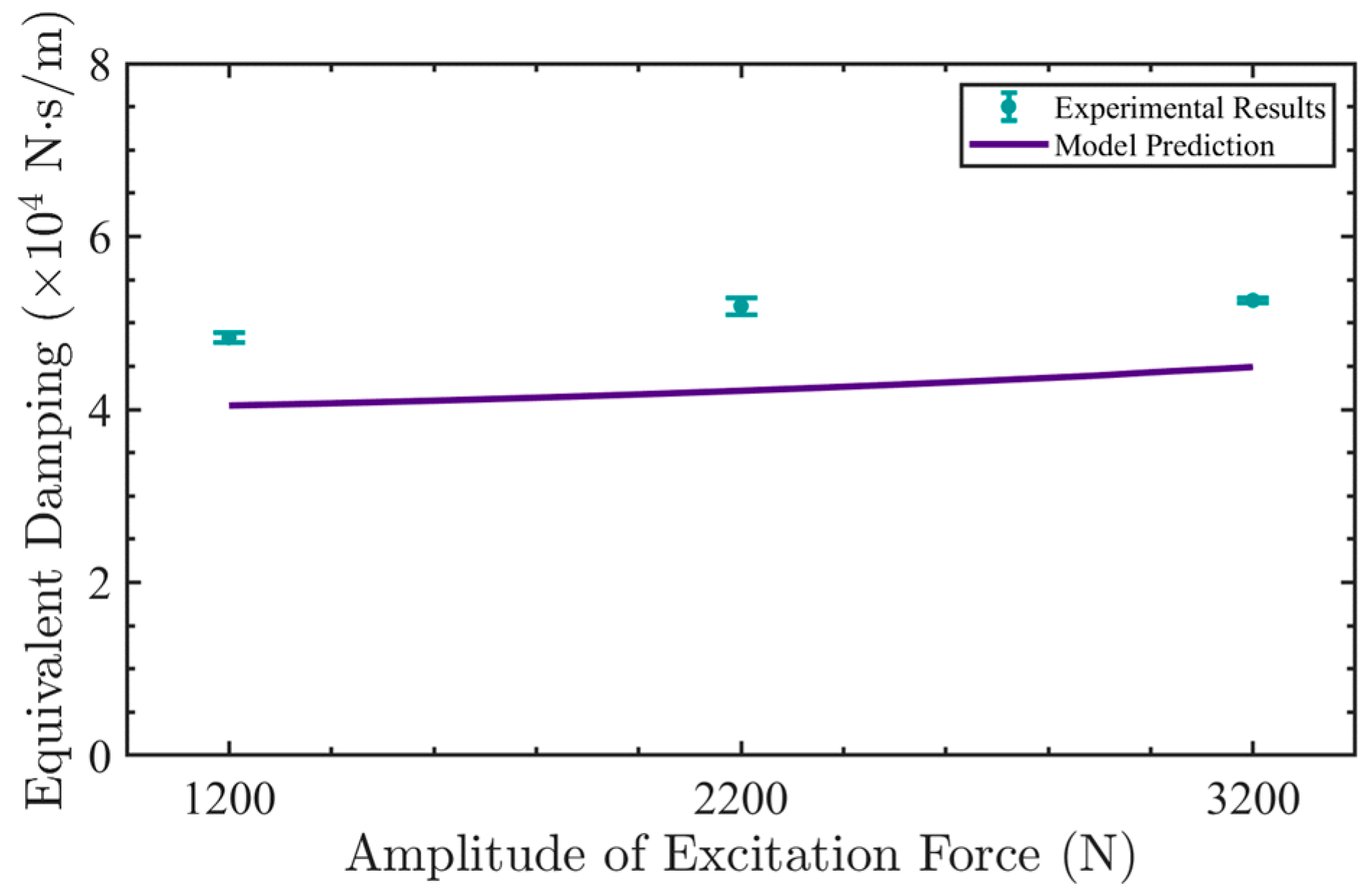
- Fixed-Frequency, Variable-Force Test: To investigate the load-dependent nonlinearities, tests were performed at a fixed representative frequency (40 Hz, near the identified first natural frequency). At this frequency, the excitation force amplitude was incrementally stepped through three levels: 1200 N, 2200 N, and 3200 N.
3.3. Parameter Identification Methodology
4. Model Validation and Dynamic Characteristic Analysis
4.1. Baseline Dynamic Characterization
4.2. Effect of Temperature: Thermo-Mechanical Validation
4.3. Effect of Load: Nonlinearity and Stiffness Hardening
4.4. Analysis of Internal Coupling Mechanisms
5. Conclusions
- Establishment of a High-Fidelity Coupled Model: A multilevel hybrid parallel–serial model was developed to resolve the fidelity gap in traditional approaches. This integrated framework synthesizes the thermo-viscous behavior of the SFD (via the coupled Reynolds–Walther equation), the high-fidelity structural flexibility of the squirrel-cage support (via FEM), and the load-dependent Hertzian contact mechanics of the bearing. A robust iterative algorithm was implemented to solve the resulting state-dependent system, enabling accurate prediction of bidirectional coupling effects.
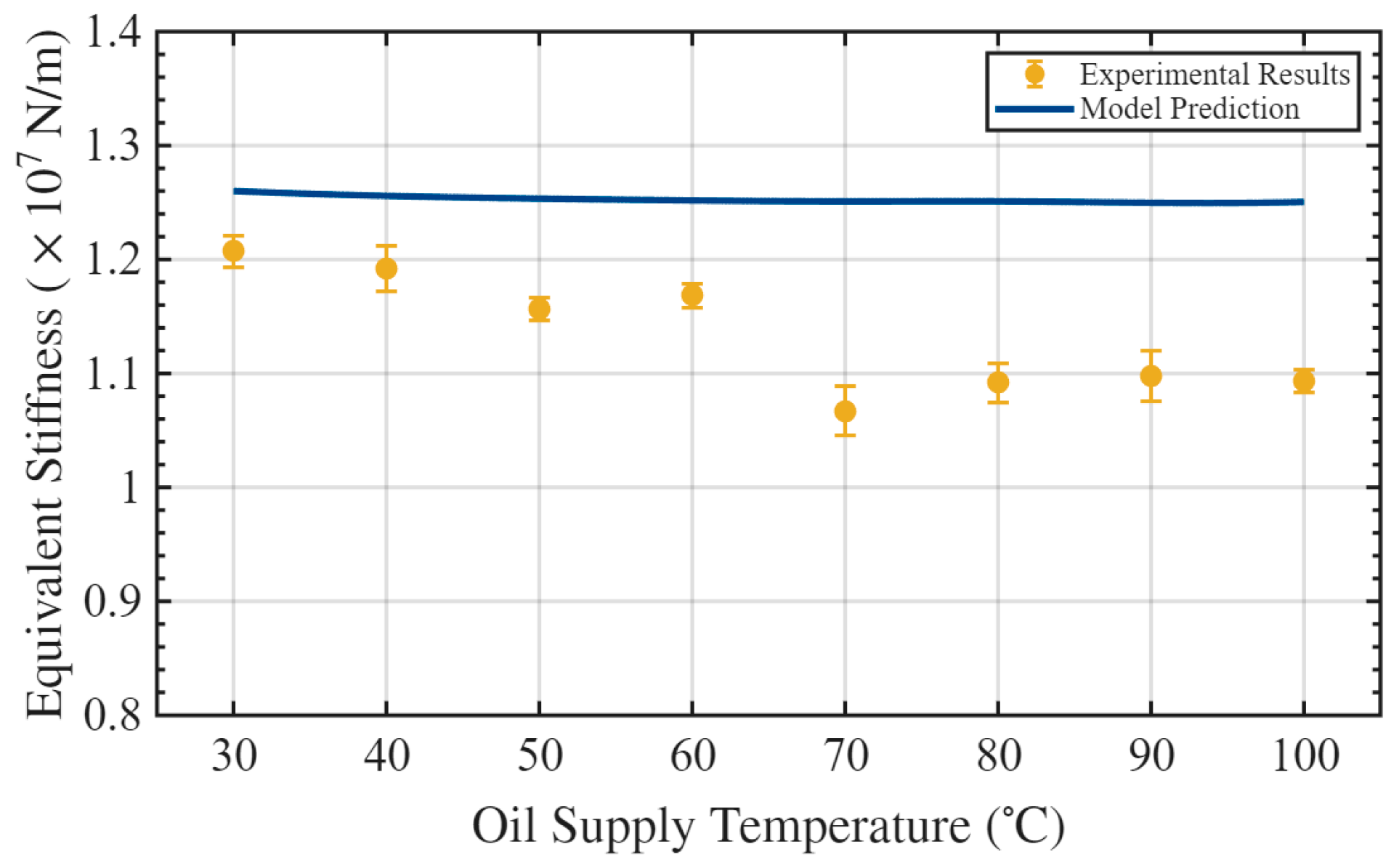
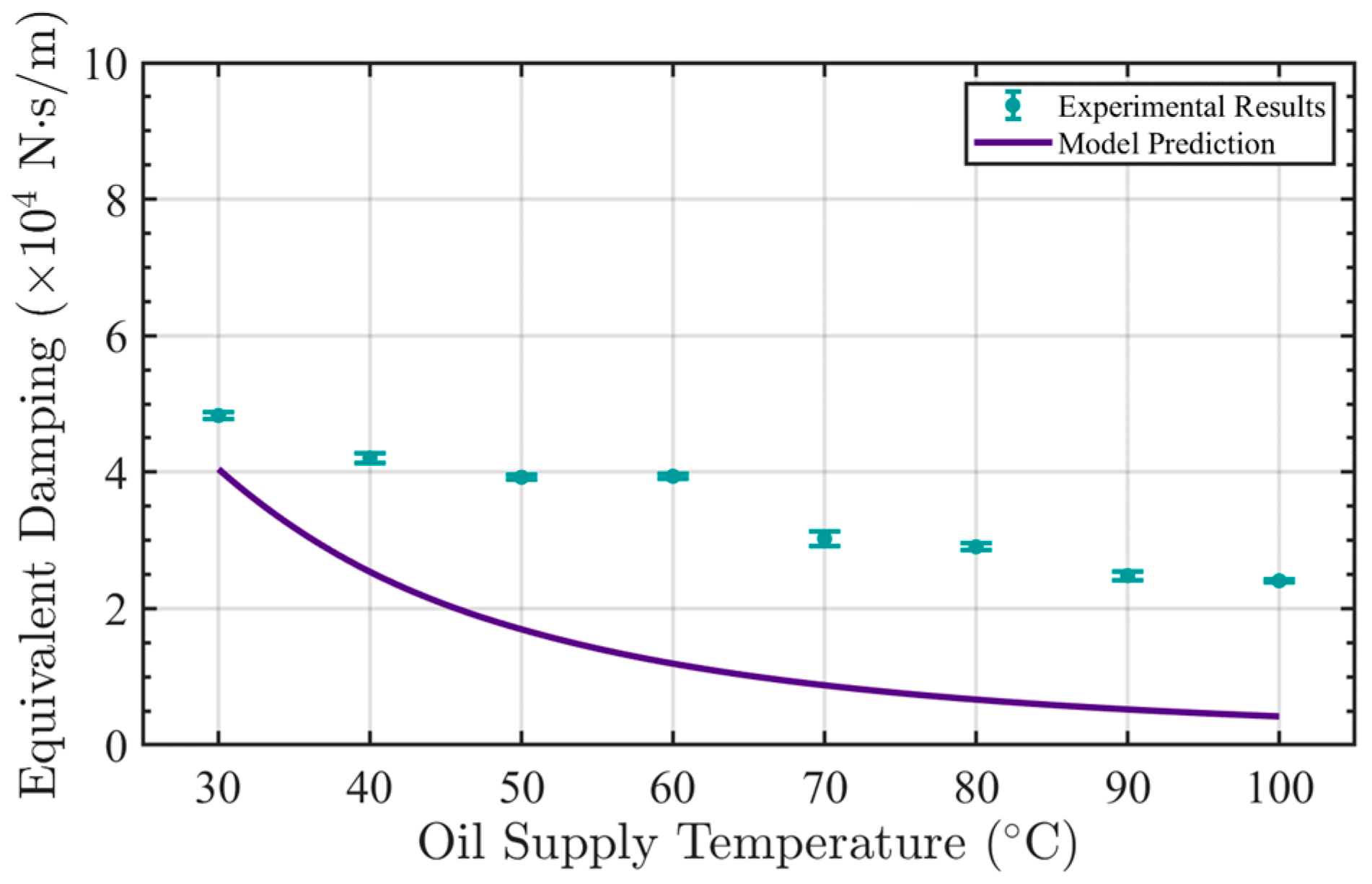
- Experimental Validation via Decoupled Characterization: The model’s predictive capability was rigorously validated against a novel bidirectional excitation test rig designed to isolate the support’s intrinsic dynamics. The results quantify two distinct macroscopic behaviors: system damping is dominated by thermo-viscous effects, decreasing by over 50% as the lubricant temperature rises from 30 °C to 100 °C; conversely, system stiffness is governed by load-dependent nonlinearity, exhibiting significant “stiffness hardening” while remaining essentially insensitive to thermal variations. Despite the validation of dynamic trends, a quantitative underestimation of the damping coefficient was observed. This deviation is attributed to the short-bearing assumption, which tends to overestimate side leakage by neglecting boundary fluid inertia. Future work will aim to correct this by incorporating finite-length bearing factors or end-leakage correction models.
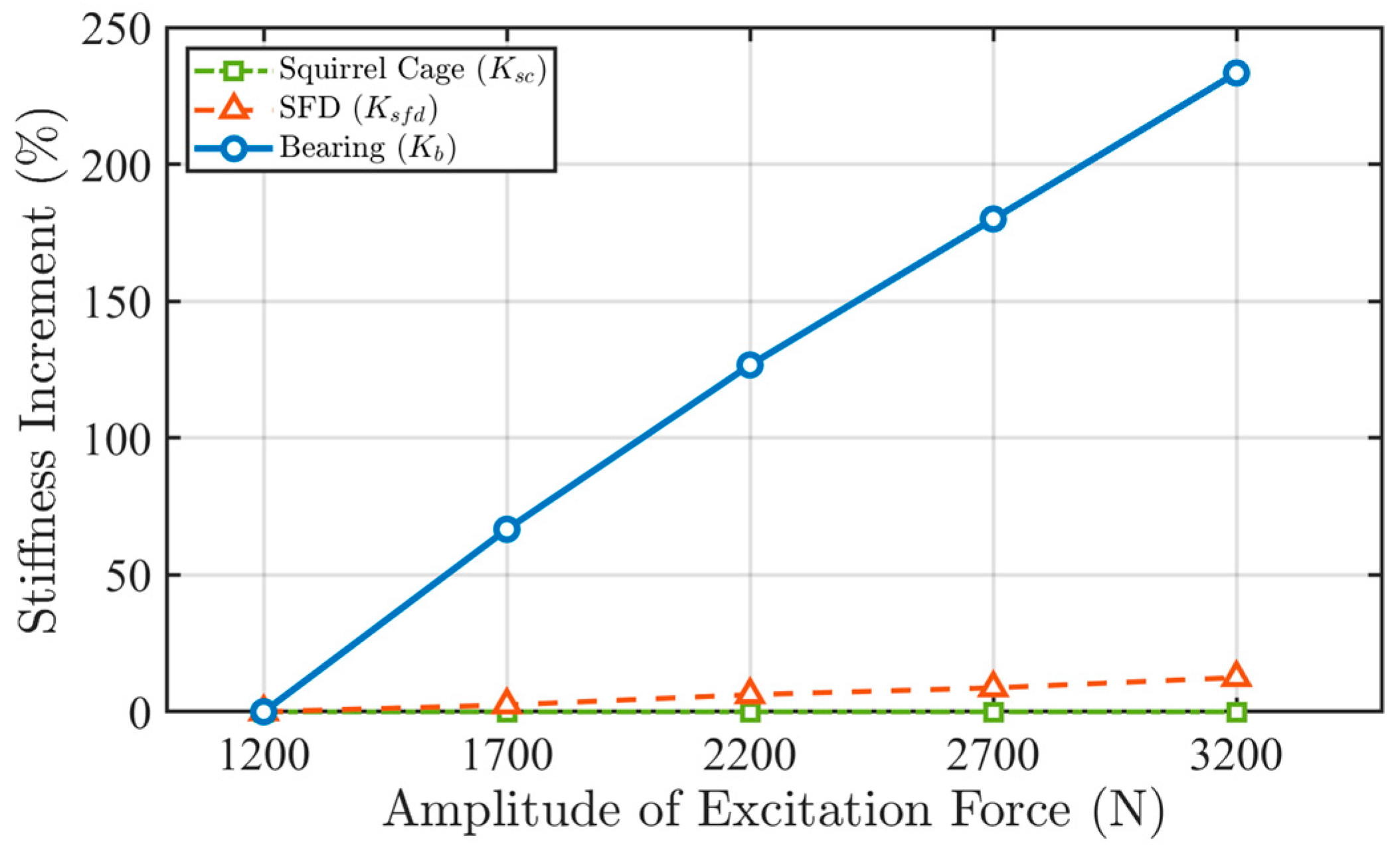
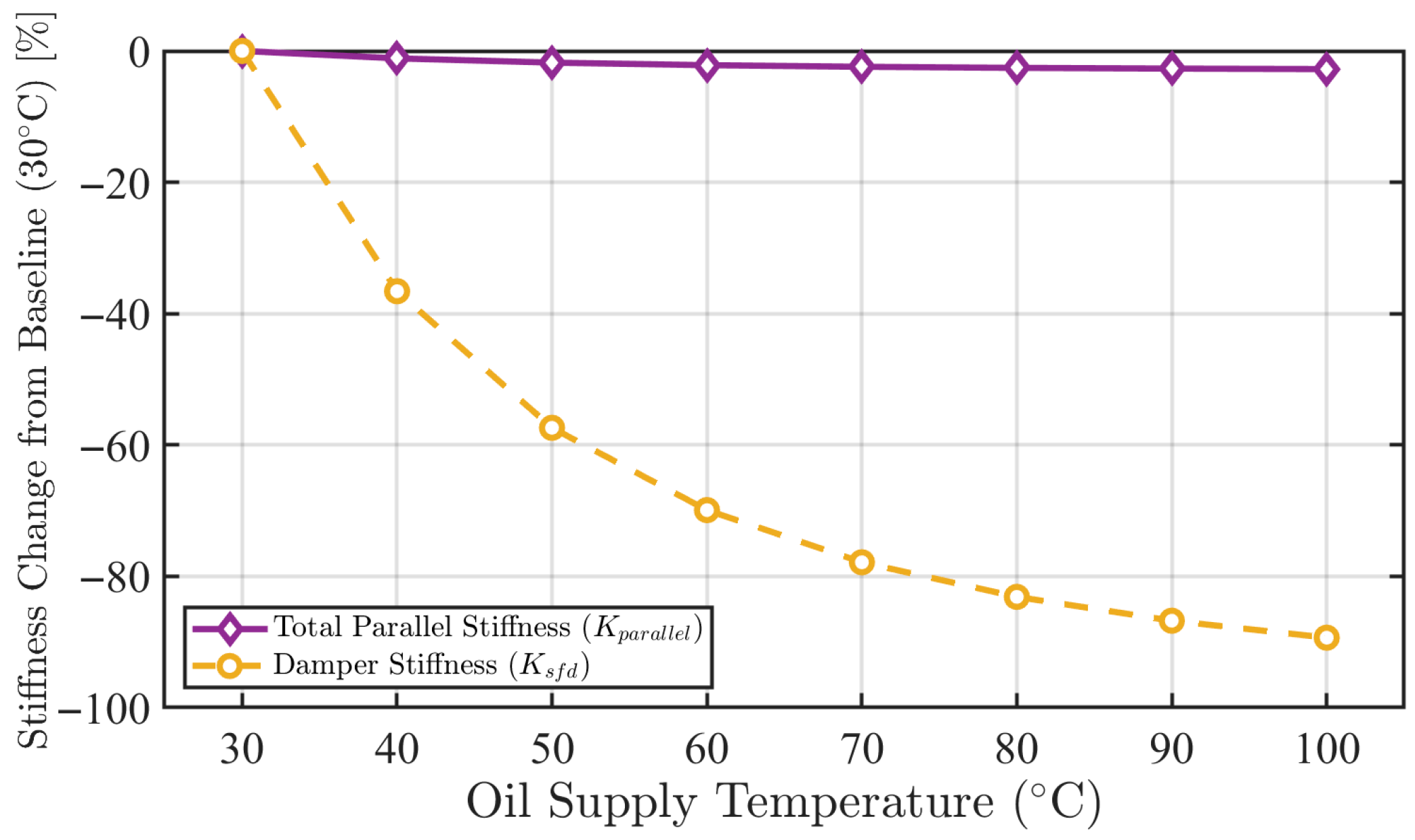
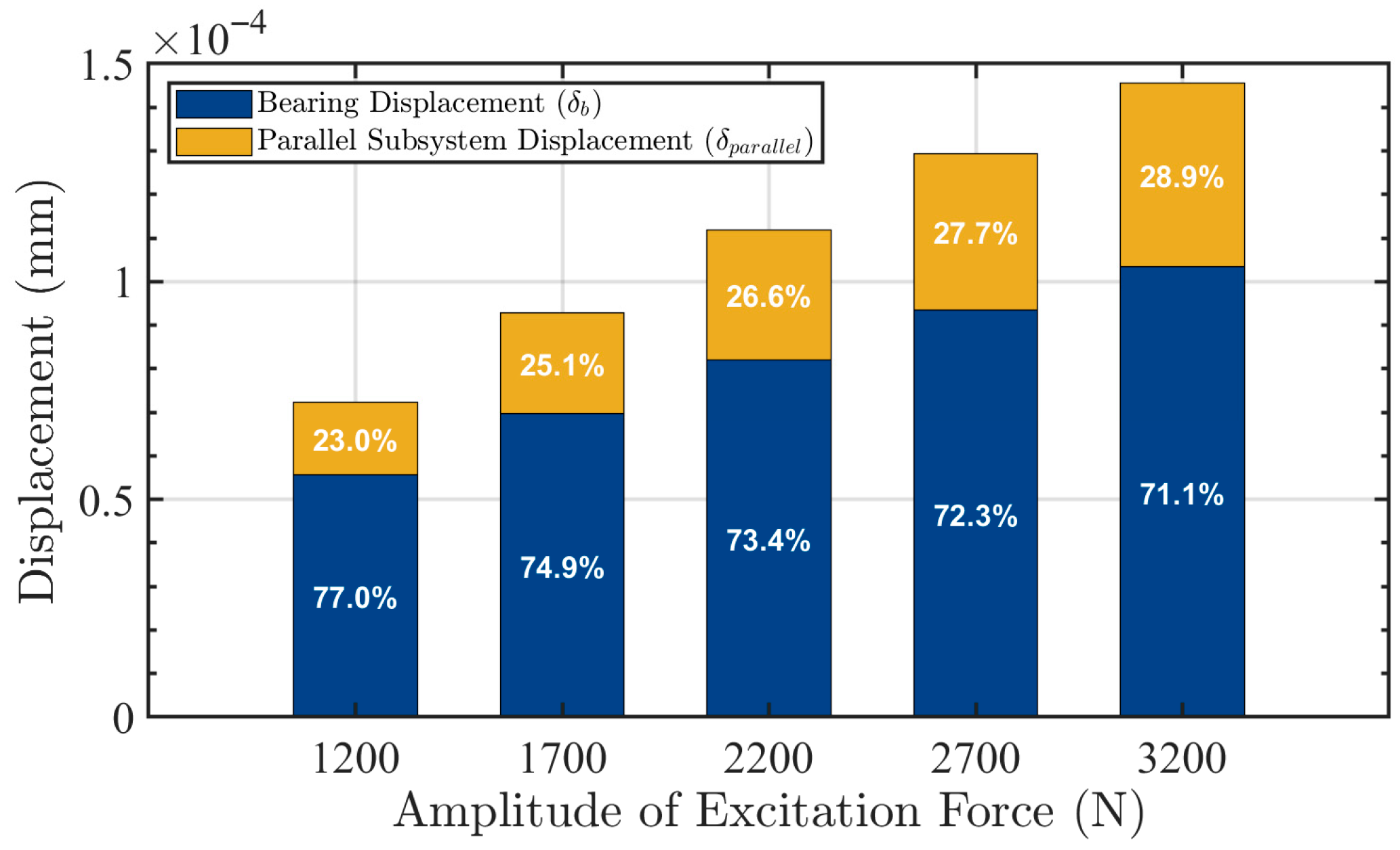
- Elucidation of Internal Coupling Mechanisms: Theoretical analysis quantitatively revealed the physical origins of the observed macroscopic responses. The “stiffness hardening” phenomenon is clearly attributed to the bearing’s Hertzian contact mechanics, which showed a stiffness increase of nearly 240% under load, rendering the SFD’s nonlinear contribution secondary. Furthermore, the apparent thermal insensitivity of the total stiffness is explained by the structural dominance of the squirrel-cage support, which effectively masks the high thermal sensitivity of the SFD oil film.
Author Contributions
Funding
Institutional Review Board Statement
Informed Consent Statement
Data Availability Statement
Conflicts of Interest
References
- Zhang, F.; Li, X.; Han, Q.; Guo, S.; Han, S.; Zhang, H. Research on Dynamic Balance Optimization Method of Flexible Rotor Based on GWO. Meas. Sci. Technol. 2024, 35, 106108. [Google Scholar] [CrossRef] [Scilit]
- Zhao, Y.; Liu, T.; Zhu, Y.-P.; Liu, Z.; Han, Q.; Ma, H. Lifelong Monitoring of Bearing-Rotor Systems Over Whole Life Cycle: An Emerging Paradigm. IEEE Trans. Ind. Inf. 2025, 21, 1319–1328. [Google Scholar] [CrossRef] [Scilit]
- Yang, T.; Wu, D.; Qiu, S.; Guo, S.; Li, X.; Han, Q. The STAP-Net: A New Health Perception and Prediction Framework for Bearing-Rotor Systems under Special Working Conditions. Reliab. Eng. Syst. Saf. 2025, 254, 110633. [Google Scholar] [CrossRef] [Scilit]
- San Andrés, L.; Den, S.; Jeung, S.-H. Transient Response of a Short-Length (L/D = 0.2) Open-Ends Elastically Supported Squeeze Film Damper: Centered and Largely Off-Centered Whirl Motions. J. Eng. Gas Turbines Power 2016, 138, 122503. [Google Scholar] [CrossRef] [Scilit]
- Vance, J.M.; Zeidan, F.Y.; Murphy, B.G. Machinery Vibration and Rotordynamics; John Wiley & Sons: Hoboken, NJ, USA, 2010. [Google Scholar]
- Ri, K.; Jang, J.; Yun, C.; Pak, C.; Kim, K. Analysis of Subharmonic and Quasi-Periodic Vibrations of a Jeffcott Rotor Supported on a Squeeze-Film Damper by the IHB Method. AIP Adv. 2022, 12, 055328. [Google Scholar] [CrossRef] [Scilit]
- Andréas, L.S.; De Santiago, O. Identification of Journal Bearing Force Coefficients under High Dynamic Loading Centered Static Operation. Tribol. Trans. 2005, 48, 9–17. [Google Scholar] [CrossRef] [Scilit]
- Adiletta, G.; Della Pietra, L. The Squeeze Film Damper over Four Decades of Investigations. Part II: Rotordynamic Analyses with Rigid and Flexible Rotors. Shock. Vib. Dig. 2002, 34, 97–126. [Google Scholar]
- Inayat-Hussain, J.I.; Kanki, H.; Mureithi, N.W. Chaos in the Unbalance Response of a Rigid Rotor in Cavitated Squeeze-Film Dampers without Centering Springs. Chaos Solitons Fractals 2002, 13, 929–945. [Google Scholar] [CrossRef] [Scilit]
- Yang, X.; Jiang, B.; Li, Y.; Zhao, Q.; Deng, S.; Zhang, W.; Cui, Y. Dynamic Characteristics of Elastic Ring Squeeze Film Damper Coupled High-Speed Ball Bearings. J. Sound Vib. 2022, 537, 117186. [Google Scholar] [CrossRef] [Scilit]
- Yang, X.; Jiang, B.; Li, Y.; Zhao, Q.; Deng, S. Dynamic Characteristics of Elastic Ring Squeeze Film Damper Oscillated by Bearing Contact Force. J. Vib. Eng. Technol. 2024, 12, 433–455. [Google Scholar] [CrossRef] [Scilit]
- Luo, Z.; Wang, J.; Han, Q.; Wang, D. Review on Dynamics of the Combined Support-Rotor System. J. Mech. Eng. 2021, 57, 44. [Google Scholar] [CrossRef] [Scilit]
- Zhou, H.; Cao, G.; Chen, X.; Zhang, Y.; Cang, Y. A Study on the Thermal Properties of Oil-Film Viscosity in Squeeze Film Dampers. Lubricants 2023, 11, 163. [Google Scholar] [CrossRef] [Scilit]
- Andres, S. Analysis of Short Squeeze Film Dampers with a Central Groove. ASME Trans. J. Tribol. 1992, 114, 659–664. [Google Scholar] [CrossRef] [Scilit]
- Gehannin, J.; Arghir, M.; Bonneau, O. A Volume of Fluid Method for Air Ingestion in Squeeze Film Dampers. Tribol. Trans. 2016, 59, 208–218. [Google Scholar] [CrossRef] [Scilit]
- Zhang, W.; Han, B.; Zhang, K.; Ding, Q. Dynamic Analysis of a Rotor System Supported on Squeeze Film Damper with Air Entrainment. Int. J. Bifurc. Chaos 2017, 27, 1750212. [Google Scholar] [CrossRef] [Scilit]
- Shaik, K.; Dutta, B.K. Tuning Criteria of Nonlinear Flexible Rotor Mounted on Squeeze Film Damper Using Analytical Ap-proach. J. Vib. Eng. Technol. 2021, 9, 325–339. [Google Scholar] [CrossRef] [Scilit]
- Karimulla, S.; Dutta, B.K.; Gouthaman, G. Experimental and Analytical Investigation of Short Squeeze-Film Damper (SFD) Under Circular-Centered Orbit (CCO) Motion. J. Vib. Eng. Technol. 2020, 8, 215–224. [Google Scholar] [CrossRef] [Scilit]
- Gupta, R.K.; Singh, R.C. Dynamic Experimental Investigation and Optimization of Flexible Rotor Vibration Control Using Squeeze Film Damper. J. Vib. Eng. Technol. 2025, 13, 79. [Google Scholar] [CrossRef] [Scilit]
- Perreault, M.; Hamzehlouia, S.; Behdinan, K. Application of Computational Fluid Dynamics for Thermohydrodynamic Analysis of High-Speed Squeeze-Film Dampers. Trans. Can. Soc. Mech. Eng. 2019, 43, 306–321. [Google Scholar] [CrossRef] [Scilit]
- Chatzisavvas, I.; Arsenyev, I.; Grahnert, R. Design and Optimization of Squirrel Cage Geometries in Aircraft Engines toward Robust Whole Engine Dynamics. Appl. Comput. Mech. 2023, 17, 2. [Google Scholar] [CrossRef] [Scilit]
- Zhang, W.; Han, B.; Li, X.; Sun, J.; Ding, Q. Multiple-Objective Design Optimization of Squirrel Cage for Squeeze Film Damper by Using Cell Mapping Method and Experimental Validation. Mech. Mach. Theory 2019, 132, 66–79. [Google Scholar] [CrossRef] [Scilit]
- Han, Q.; Chen, Y.; Zhang, H.; Jiang, L.; Li, X. Vibrations of Rigid Rotor Systems with Misalignment on Squirrel Cage Supports. J. Vibroeng. 2016, 18, 4329–4339. [Google Scholar] [CrossRef] [Scilit]
- Zhang, F.; Li, X.; Han, Q.; Zhao, Y.; Li, H.; Lin, J. Study on the Influence of Combined Unbalanced Phase Difference on Rotor Vibration Response and High-Speed Dynamic Balancing. J. Vib. Control. 2025, 10775463251342286. [Google Scholar] [CrossRef] [Scilit]
- Gupta, P.K. Dynamics of Rolling-Element Bearings—Part III: Ball Bearing Analysis. J. Lubr. Technol. 1979, 101, 312–318. [Google Scholar] [CrossRef] [Scilit]
- Harris, T.A.; Kotzalas, M.N. Advanced Concepts of Bearing Technology: Rolling Bearing Analysis; CRC Press: Boca Raton, FL, USA, 2006. [Google Scholar]
- Ghafari, S.H.; Abdel-Rahman, E.M.; Golnaraghi, F.; Ismail, F. Vibrations of Balanced Fault-Free Ball Bearings. J. Sound Vib. 2010, 329, 1332–1347. [Google Scholar] [CrossRef] [Scilit]
- Li, Z.; Wang, C.; Hu, X.; Xu, E.; Yang, L. Thermal-Mechanical Coupling Performance and Its Influence on Thermal Stiffness of Cylindrical Roller Bearings. J. Aerosp. Eng. 2024, 37, 04024031. [Google Scholar] [CrossRef] [Scilit]
- Fang, B.; Wan, S.; Zhang, J.; Hong, J. Research on the Influence of Clearance Variation on the Stiffness Fluctuation of Ball Bearing under Different Operating Conditions. J. Mech. Des. 2021, 143, 023403. [Google Scholar] [CrossRef] [Scilit]
- Zhao, Y.; Liu, Z.; Yang, Z.; Han, Q.; Ma, H. Machinery Fault Diagnosis-Oriented Regularization for Nonlinear System Identi-fication: Framework and Applications. Appl. Acoust. 2025, 231, 110537. [Google Scholar]
- Lacroix, S.; Nélias, D.; Leblanc, A. Experimental Study of Four-Point Contact Ball Bearing with Deformable Rings. Tribol. Trans. 2015, 58, 963–970. [Google Scholar] [CrossRef] [Scilit]
- Xiao, L.; Yan, F.; Chen, T.; Zhang, S.; Jiang, S. Study on Nonlinear Dynamics of Rigid-Flexible Coupling Multi-Link Mechanism Considering Various Kinds of Clearances. Nonlinear Dyn. 2023, 111, 3279–3306. [Google Scholar] [CrossRef] [Scilit]
- Yang, T.; Wang, S.; Jiang, S.; Ma, H.; Jiang, L.; Han, Q.; Wang, X.; Li, X. MSPI-Net Framework: A Novel Optimizer-Powered Multi-Source Physical Information Fusion Approach for Intelligent Diagnosis and Interpretability of Bearings. Expert Syst. Appl. 2025, 296, 129279. [Google Scholar]
- Filippi, M.; Magliacano, D.; Petrolo, M.; Carrera, E. Wave Propagation in Pre-Stressed Structures with Geometric Non-Linearities Through Carrera Unified Formulation. AIAA J. 2025, 63, 292–308. [Google Scholar] [CrossRef] [Scilit]
- Andrés, L.S.; Rodríguez, B. On the Experimental Dynamic Force Performance of a Squeeze Film Damper Supplied through a Check Valve and Sealed with O-Rings. J. Eng. Gas Turbines Power 2021, 143, 111011. [Google Scholar] [CrossRef] [Scilit]
- Prabith, K.; Krishna, I.R.P. Influence of Squeeze Film Damper on the Rub-Impact Response of a Dual-Rotor Model. J. Vib. Eng. Technol. 2024, 12, 9051–9064. [Google Scholar] [CrossRef] [Scilit]
- Diaz, S.; San Andrés, L. A Model for Squeeze Film Dampers Operating with Air Entrainment and Validation with Experiments. J. Tribol. 2001, 123, 125–133. [Google Scholar] [CrossRef] [Scilit]
- Delgado, A.; San Andrés, L. Identification of Squeeze Film Damper Force Coefficients from Multiple-Frequency, Non-Circular Journal Motions. In Proceedings of the ASME Turbo Expo 2009: Power for Land, Sea, and Air, Orlando, FL, USA, 8–12 June 2009; pp. 669–678. [Google Scholar]
- Zeidan, F.Y.; Vance, J.M.; San Andrés, L. Design and Application of Squeeze Film Dampers in Rotating Machinery. In Proceedings of the 25th Turbomachinery Symposium, Houston, TX, USA, 1996; Texas A&M University: College Station, TX, USA, 1996; pp. 169–188. [Google Scholar]
- ASTM D341-20 (Reapproved 2025); Standard Practice for Viscosity–Temperature Equations and Charts for Liquid Petroleum or Hydrocarbon Products. ASTM International: West Conshohocken, PA, USA, 2025.




| Parameter | Settings/Range |
|---|---|
| Lubricant Temperature(T) | 30, 40, 50, 60, 70, 80, 90, 100 °C |
| Excitation Frequency (f) | Swept-Frequency: 20~320 Hz (Linear Sweep) |
| Fixed-Frequency: 40 Hz | |
| Excitation Force Amplitude (F) | Swept-Frequency: 1200 N (Constant) |
| Fixed-Frequency: 1200, 2200, 3200 N |
Disclaimer/Publisher’s Note: The statements, opinions and data contained in all publications are solely those of the individual author(s) and contributor(s) and not of MDPI and/or the editor(s). MDPI and/or the editor(s) disclaim responsibility for any injury to people or property resulting from any ideas, methods, instructions or products referred to in the content. |
© 2026 by the authors. Licensee MDPI, Basel, Switzerland. This article is an open access article distributed under the terms and conditions of the Creative Commons Attribution (CC BY) license.
Share and Cite
Meng, X.; Zhu, Q.; Han, Q.; Lin, J. Multilevel Modeling and Validation of Thermo-Mechanical Nonlinear Dynamics in Flexible Supports. Machines 2026, 14, 131. https://doi.org/10.3390/machines14010131
Meng X, Zhu Q, Han Q, Lin J. Multilevel Modeling and Validation of Thermo-Mechanical Nonlinear Dynamics in Flexible Supports. Machines. 2026; 14(1):131. https://doi.org/10.3390/machines14010131
Chicago/Turabian StyleMeng, Xiangyu, Qingyu Zhu, Qingkai Han, and Junzhe Lin. 2026. "Multilevel Modeling and Validation of Thermo-Mechanical Nonlinear Dynamics in Flexible Supports" Machines 14, no. 1: 131. https://doi.org/10.3390/machines14010131
APA StyleMeng, X., Zhu, Q., Han, Q., & Lin, J. (2026). Multilevel Modeling and Validation of Thermo-Mechanical Nonlinear Dynamics in Flexible Supports. Machines, 14(1), 131. https://doi.org/10.3390/machines14010131