Article

Autonomous Offroad Vehicle Real-Time Multi-Physics Digital Twin: Modeling and Validation

The Department of Engineering Sciences and Mathematics, Luleå University of Technology, 97187 Luleå, Sweden
*
Author to whom correspondence should be addressed.
Machines 2026, 14(1), 128; https://doi.org/10.3390/machines14010128
Submission received: 23 December 2025 / Revised: 16 January 2026 / Accepted: 19 January 2026 / Published: 22 January 2026
(This article belongs to the Special Issue Advances in Autonomous Vehicles Dynamics and Control, 2nd Edition)

Abstract

The use of physical vehicles and environments during vehicle research and development is highly resource-intensive, particularly for autonomous vehicles. Recently, digital models are therefore increasingly used instead, which require high levels of fidelity and validity. While the two aforementioned qualities are often lacking, an absence of versatility for multi-purpose use is even more prevalent in current digital models. In response to these challenges, this work presents a novel real-time multi-physics digital twin of an offroad vehicle with high levels of fidelity and validity, both regarding the vehicle dynamics and hydraulics, as well as regarding the visual representation of the environment and the exteroceptive sensor emulation. The versatility of the digital twin enables its usage for vehicle development tasks concerning mechanical components and driveline, as well as for visual machine learning tasks, such as generation of auto-annotated visual training data. Development of control algorithms leveraging both visual input and mechanical systems is also enabled. Furthermore, the real-time capability allows for Hardware-in-the-Loop and Vehicle-in-the-Loop simulation. The modeling, calibration, and real-world validation of the digital twin is presented, with an emphasis on the vehicle dynamics and hydraulics. The shown validity enables advancements in the development of autonomous offroad vehicles.

1. Introduction

Vehicle research and development (R&D) is highly resource-intensive [1], both with regard to the cost of the time spent, as well as the costs related to e.g., field testing, test facilities, prototypes, and test equipment. In addition, R&D for autonomous vehicles involves developing advanced subsystems not found in traditional manually controlled vehicles, such as proprioceptive and exteroceptive perception systems, as well as control systems for the autonomous tasks. Machine learning (ML) is often used to develop these systems, which in turn requires large amounts of training data [2].
The current trend towards increased vehicle autonomy is also prevalent in offroad vehicles. For example, in the subcategory of forestry vehicles, increasing the level of automation (LoA) of the used vehicles, such as harvesters and forwarders, has recently been one of the main topics of R&D [3]. For example, autonomous navigation of forestry vehicles was studied in [4], ML for forestry crane control was studied in [5], and object detection in forestry was studied in [6,7].
If digital models can replace physical vehicles and test sites to a larger extent, the R&D required for increasing offroad vehicle LoA will be more resource efficient and also safer [2,8]. For example, R&D using digital models does not require moving personnel and equipment to remote locations to perform extensive testing and generation of training data for ML. Physical testing and training can also be harmful to the test operators, vehicles, and the flora and fauna of the natural test environment. An increased use of digital models mitigates these problems. In addition, digital models enable repeatable and rapidly exchangeable test scenarios. Furthermore, since the ground truth in digital models is already known, time-consuming manual annotation of training data can be substituted by auto-annotation [2,9].
If a digital model is to replace a physical vehicle and its test site to a larger extent in autonomous vehicle R&D, the digital model needs to have high levels of fidelity and validity, especially at the later stages of product development. For the model to be versatile enough to be usable for a broad range of R&D activities in the development of an autonomous vehicle, the fidelity and validity need to be high both regarding the vehicle dynamics and hydraulics, as well as regarding the visual representation of the environment, and the exteroceptive sensor emulation. This would enable the use of the model for vehicle development tasks concerning mechanical components and driveline, as well as for visual machine learning tasks such as generation of auto-annotated visual training data. Using ML for developing control algorithms that leverage both visual input and mechanical systems would also be enabled. Furthermore, if the digital model would be real-time (RT) capable, it would also allow for incorporation of various parts of the physical vehicle into the simulation loop, by using Hardware-in-the-Loop (HiL) or Vehicle-in-the-Loop (ViL) simulation [10]. This could increase the model accuracy, since the actual physical component or system would be used. Modeling time could also be reduced, since the physical components incorporated in the simulation loop would not need to be modeled. Additionally, HiL and ViL would allow the inclusion of physical black-box devices into the simulation, such as, e.g., control hardware running proprietary control systems or hydraulic components with unknown characteristics.
RT simulation in offroad vehicles has been studied to some extent, mainly in the context of agriculture, and to a lesser degree forestry, using models focused on a specific task or subsystem, but with a gap when it comes to versatile models useful for a broad range of autonomous vehicle R&D activities. For example, refs. [11,12,13,14,15,16,17] focus on operator training and sensor emulation, use relatively detailed virtual environments, but lack the intention or vehicle fidelity for use in detailed vehicle dynamics analysis. Conversely, refs. [18,19,20,21] focus on HiL-testing of components such as ECUs and hydraulic actuators, use detailed vehicle or subsystem representations, but lack detailed environment models and exteroceptive sensor emulation. Others, such as [22,23], study wheel–soil contact, but without focus on the rest of the vehicle or virtual environment.
To fill this gap, this study presents a novel versatile and RT-capable multi-physics digital twin of a full-scale forestry vehicle, that has the fidelity to be used both for detailed vehicle dynamics simulation as well as for visual representation of detailed virtual environments and emulation of exteroceptive sensors. The digital twin showed promising validity regarding its visual representation of environments and exteroceptive sensor emulation in the pilot study [9], where auto-annotated training images from a virtual environment were used to train a log detector. It was shown that a YOLOv3 Tiny detector, trained only in the virtual environment and without much optimization, could achieve 36% average precision (AP50) when tested on a difficult real-world dataset. Optimization methods that would likely improve the results were also identified. However, further closing of the domain gap between simulation and reality remains to be studied in future work. Virtual pre-training was also shown to improve the performance of log detectors trained on physical data, e.g., for domain generalization, and at low availability of real-world training data.
In [24], the digital twin also used an emulated RTK GPS sensor and the tracking script of the physical vehicle to autonomously navigate a virtual environment generated from a scan of the real world, following a GPS path that the physical vehicle had previously followed, in a Software-in-the-Loop (SiL) setup.
Thus, to fill the gap of having a versatile digital model, suitable for a broad range of autonomous offroad vehicle R&D activities, the validity of the hydraulics and vehicle dynamics also needs to be shown. The early stages of modeling and verification of this digital twin are described in [24], although not in full detail, and prior to real-world validation. Therefore, this study focuses on the detailed modeling of the hydraulics and vehicle dynamics of the digital twin. Additionally, a comprehensive real-world validation of the articulated joint hydraulics is performed by comparing the digital twin’s articulated joint flow rates in the time domain to those of the physical vehicle, at different turning speeds.

2. Materials and Methods

2.1. Physical Modular Offroad Vehicle

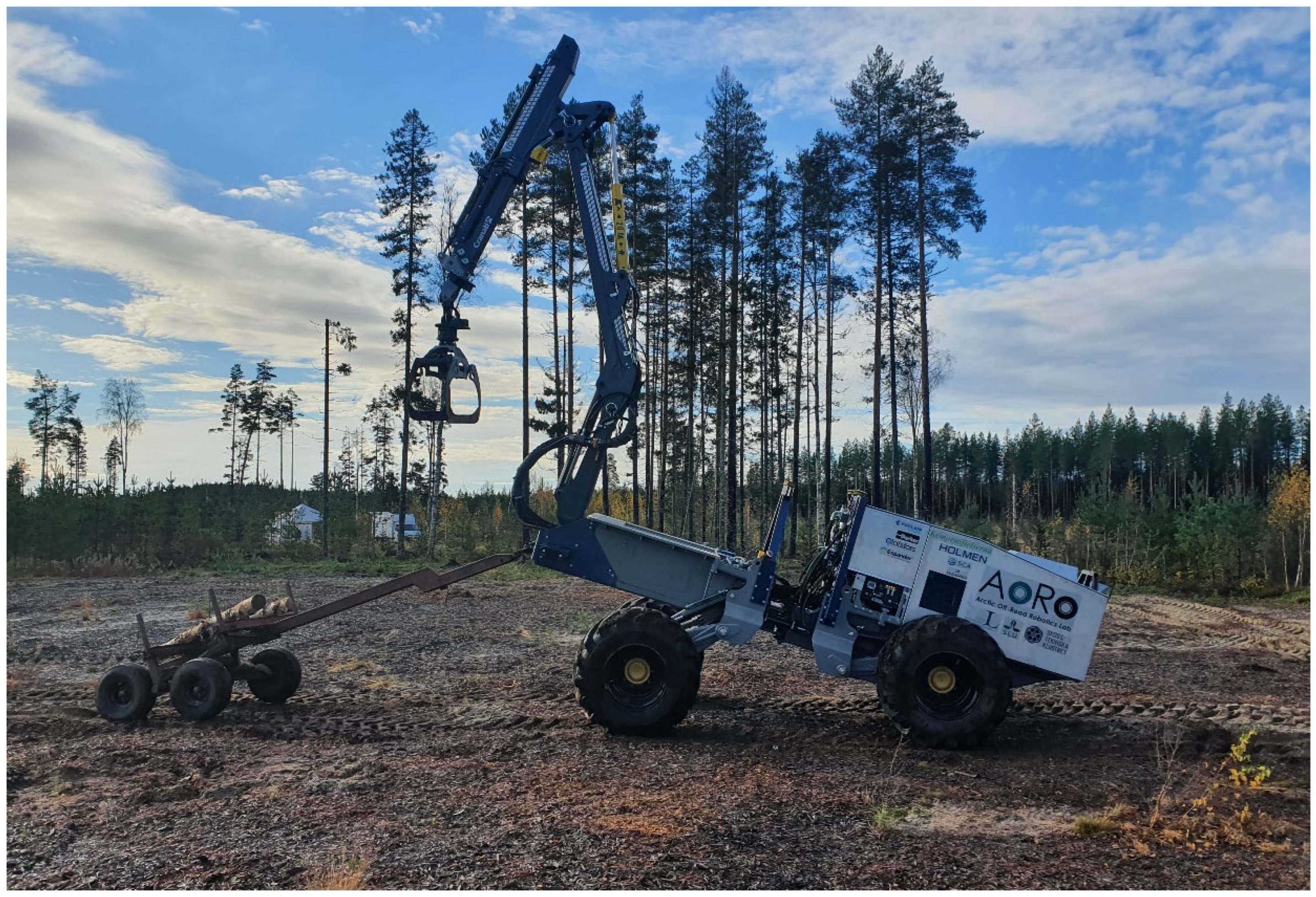
At Luleå University of Technology (Luleå, Sweden), a modular offroad vehicle called AORO (Arctic Offroad Robotics Lab) has been developed to support efforts to increase the LOA of forestry vehicles, as well as of other offroad vehicles [25]. The AORO vehicle is used as a research platform to develop and evaluate various hardware, software, algorithms, and methodologies, in the fields of forestry, agriculture, and offroad driving. AORO weighs 10 tonnes, which allows it to use much of the same hardware, and carry out many of the same tasks, as commercial forestry vehicles, making it a full-scale forestry vehicle. It performed the world’s first autonomous forwarding of full-scale logs in 2021 [26]. The use of a full-scale vehicle removes the scaling issues associated with miniature models [27]. The AORO vehicle is shown in Figure 1.
AORO currently features a driveline with four hydraulic motors, a hydraulic crane, a hydraulic articulated joint, and four hydraulic pendulum arms which can be controlled individually. The hydraulic system is powered by a diesel engine. Numerous proprioceptive sensors, positioned throughout the vehicle, monitor its state. Currently, the exteroceptive sensor suite features a dual-antenna RTK-GPS, a forward-facing stereo camera, and a forward-facing lidar sensor. The stereo camera is currently the primary visual sensor in use. More information about the AORO vehicle can be found in [25].

2.2. Simulation Software and Co-Simulation Capability

The multi-physics real-time simulation software Mevea (v. 4.1.1) [28] was used to simulate the digital twin and the environment in this study. Mevea was used in the previous studies featuring this digital twin [9,24], as well as in [15]. In [9], Mevea was used as the co-simulation master and for handling the multibody simulation (MBS) model, physics, and hydraulics computations, while the game engine Unity (v. 2021.3.36f1) [29] was used as the co-simulation slave responsible for high-fidelity visualization, camera emulation, and generation of auto-annotated visual training data. In [15,24], Mevea was used without co-simulation, and the visualization was handled by the built-in visualization tool in Mevea, since maximizing the visual fidelity and performing camera emulation were not emphasized those studies. Mevea also features a variety of other co-simulation capabilities, both through different software specific co-simulation APIs, such as the Mevea-Unity API used in [9], as well as through more general protocols such as TCP/IP.

2.3. Multibody Simulation Model

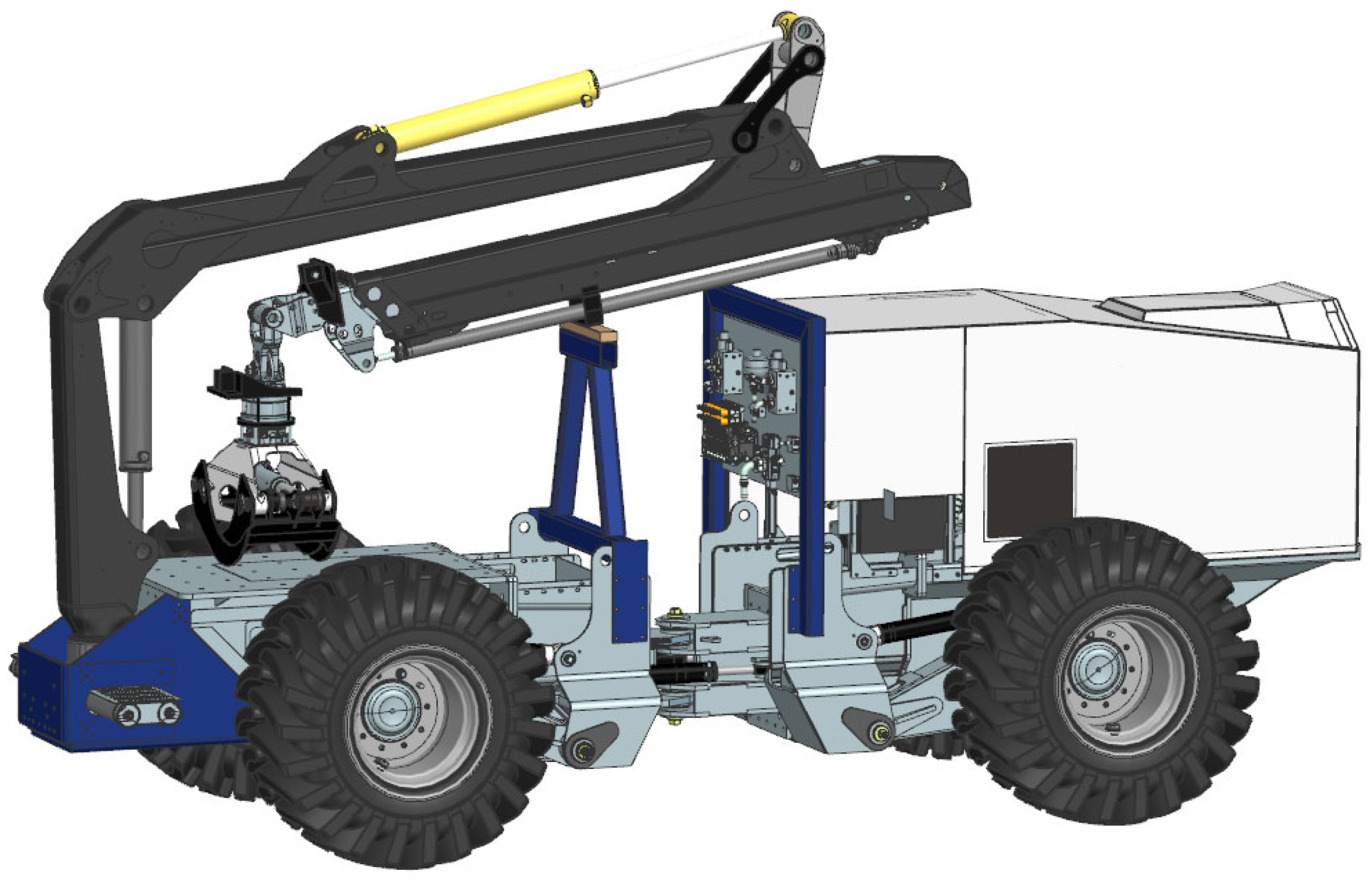
To define the kinetics of the digital twin, CAD geometry was used to create an MBS model of the AORO vehicle in Mevea. A detailed CAD model, shown in Figure 2, was available since the vehicle was developed in-house.
The CAD model and the CAD software Siemens NX (v. 1953) were used to extract the bodies that constitute the vehicle, as well as their mass, center of gravity, and moments of inertia. Joint positions were also extracted. Excluding movement of the crane, which was outside the scope of this study, the vehicle had 9 remaining internal degrees of freedom (DoF). These consisted of 4 rotational DoF of the wheels, 4 rotational DoF of the pendulum arms, and 1 rotational DoF of the articulated joint. Additionally, the vehicle has 6 DoF with respect to the environment, giving the vehicle a total of 15 DoF in the context of its environment.
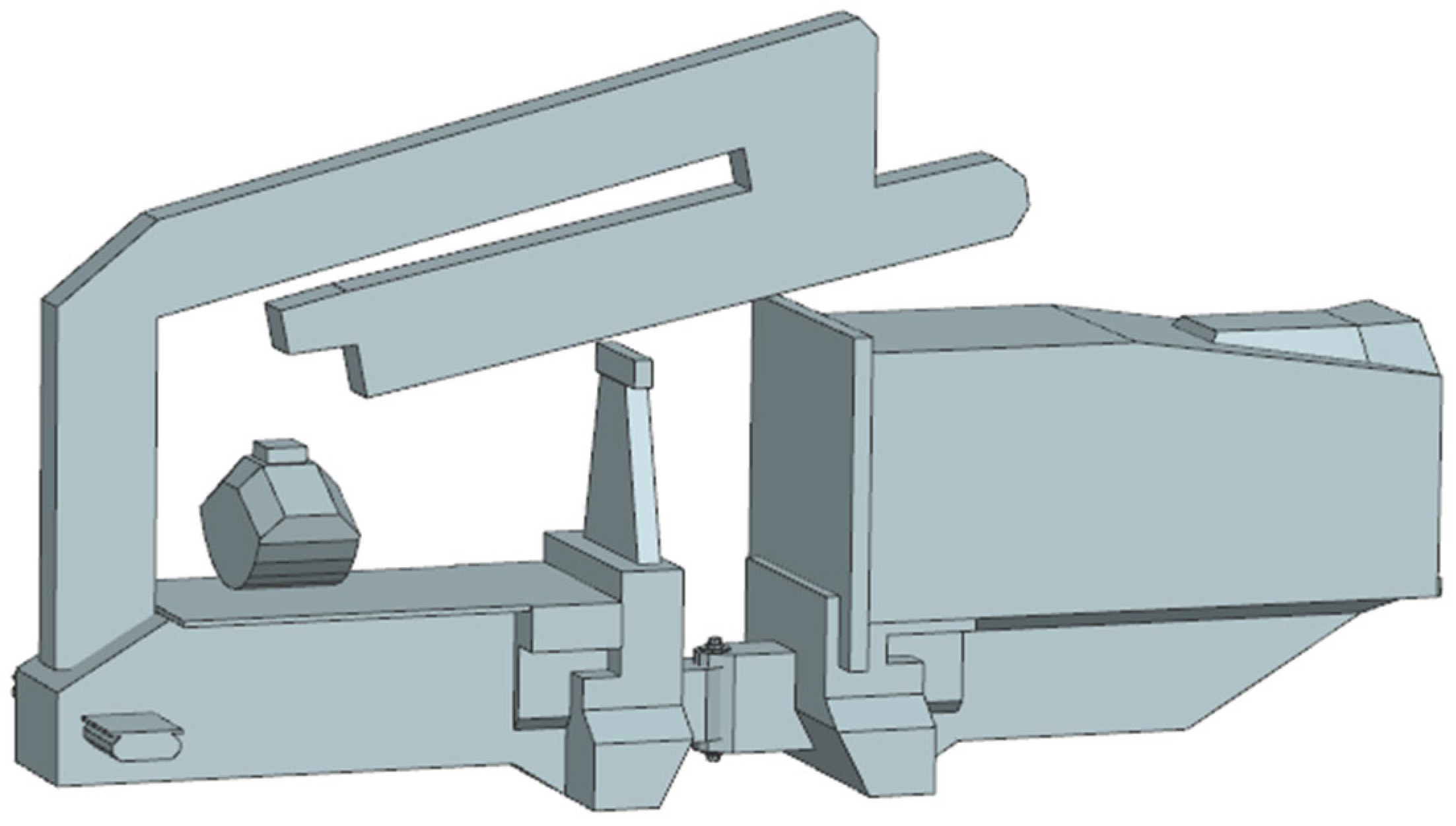
The detailed CAD geometry was used for visualization graphics, while simplified geometry was created for collision graphics, to reduce computational load. Examples of the simplified collision graphics are shown in Figure 3.

2.4. Tire Modeling

To create a three-dimensional but simplified representation of the physical tire, each tire was modeled as five discs spread out along the tire’s axial direction. A CAD model received from the tire manufacturer Trelleborg (Trelleborg, Sweden) was used to define the position and radius of each disc, for the simplified representation to match the shape and size of the physical tire. Based on the defining discs and the ground model, each tire has a single active point of contact with the ground at each time step, and the contact is defined by the penalty method [30]. Flexible behavior of the tires is accomplished by assigning a spring stiffness and a damping coefficient to the tires. The LuGre friction model, with separate longitudinal and lateral friction, is used to describe the friction between the contact points of the tires and the ground. The LuGre friction parameters were obtained from a wheel loader tire model supplied by Mevea. The spring stiffness and damping coefficient of the tires were determined through iteration, where the parameters were adjusted until the behavior of the simulated tires appeared to closely match that of the physical vehicle’s tires. A more comprehensive evaluation to determine the tire parameters through physical measurements and experimentation is envisioned as the next step for future work.

2.5. Hydraulics Theory and Calculations

The utilized simulation software Mevea performs its hydraulics calculations based on the lumped fluid theory [31]. This theory treats the hydraulic system as a set of volumes, with uniform internal pressures, separated by restricting valves. The volumes are modeled as hoses or pipes with diameters, lengths, and bulk moduli corresponding to the used physical hoses or pipes. The bulk modulus of the oil is also modeled and adjustable. Mevea considers the flow laminar if the pressure difference across a valve is less than 1 bar, otherwise the flow is considered to be turbulent. The turbulent flow rate Q over a simple restricting valve is defined as follows [32]:
Q   =   UC v p ,
where U is the relative opening of the valve, Δp is the pressure drop across the valve, and Cv is the semi-empirical flow rate coefficient of the valve, which is defined as follows:
C v   =   C d A t 2 ρ ,
where Cd is the flow discharge coefficient, At is the valve area, and ρ is the density of the oil. Cv is assumed to be constant around the operating point of nominal flow rate Qnom through the fully open valve, with nominal pressure drop across the valve Δpnom. From Equation (1), Cv can then be expressed as follows:
C v   =   Q nom p nom .
Qnom and Δpnom are often specified in the datasheets of valves and other hydraulic components.
To more accurately capture the high frequency behavior of hydraulic systems, the time step of the hydraulics calculations can be set as the general simulation time step divided by a chosen integer value. Thereby, the hydraulics calculation time step can be set significantly smaller than the general simulation time step.
More information about the hydraulics calculations in Mevea can be found in [15].

2.6. Hydraulics System Overview

Throughout this paper, simplified component names are used. The simplified names and their corresponding actual component names are listed in Table 1.
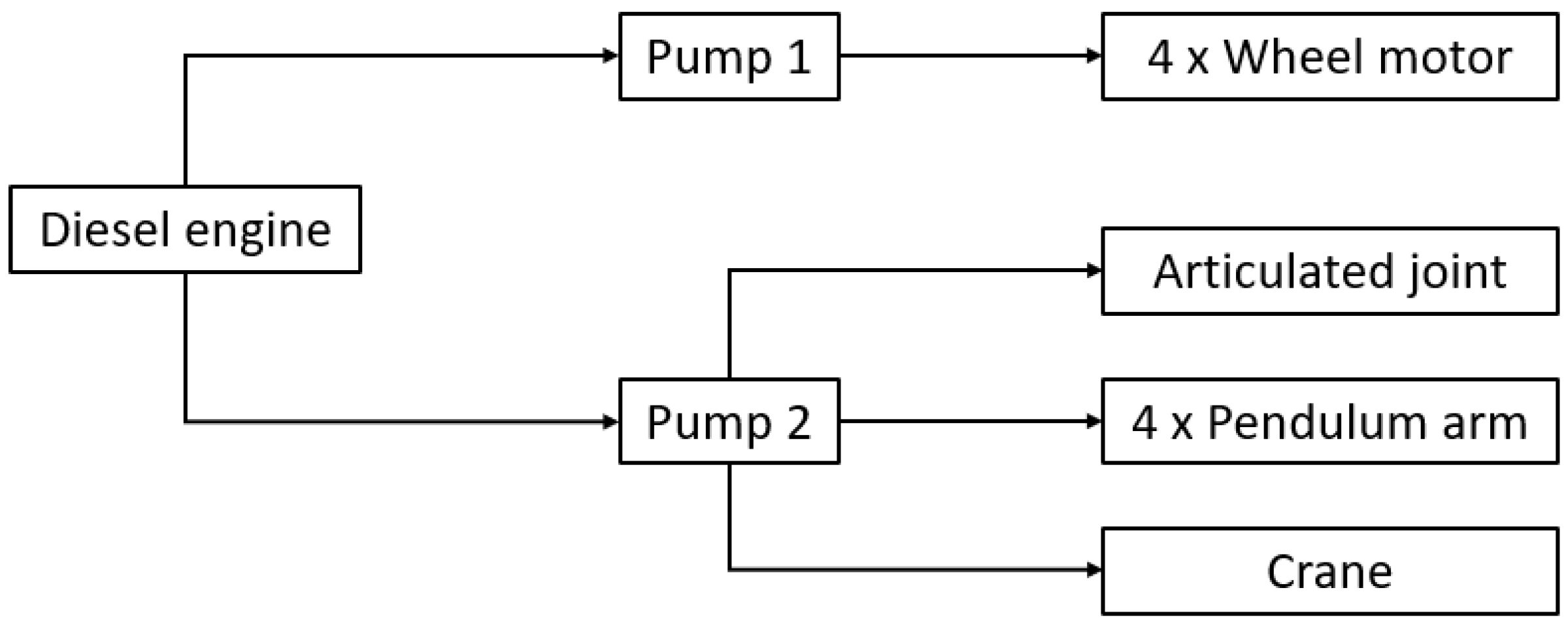
A simplified description of the hydraulics system of the AORO vehicle is shown in Figure 4.
The full hydraulic system was modeled in detail, with the exception of the crane. The crane was not to be used for early testing and validation; hence, it was left to be examined in future work.
The modeling, calibration and validation of these hydraulic systems are detailed in the following subsections and in Section 3 (Results and Discussion).

2.7. Hydraulic Component Modeling

To model the components of the hydraulic system, their parameters were gathered from their respective datasheets and drawings. The parameters were used to modify generic hydraulic components available through the Mevea hydraulics modeling interface.
The hydraulic cylinders were modeled by inserting the measurements from their drawings into generic cylinder components, as well as specifying their mounting positions on the vehicle, which were determined through the CAD model.
The hydraulic pumps and motors were modeled by inserting the parameters found in their datasheets into generic pump and hydraulic motor components. In the case of the variable displacement pumps (Pump 1 and Pump 2, but not the charge pump) generic pump controller components were also configured to match the physical pump controller settings.
For hydraulic valves, two main parameters were Qnom and Δpnom, which were used to determine the semi-empirical flow rate coefficient of the fully open valve Cv, see Equation (3). These two parameters were usually found in the datasheet of each valve. Additionally, other parameters were also gathered from datasheets, depending on the type of valve, such as the “set pressure” required for the valve to open for pressure relief valves.
A generic Parker L90LS load sensing valve was available in Mevea, which simplified the process of its implementation into the digital twin. This meant that the built-in shock valves and pressure compensator did not need to be modeled and connected separately. The modeling and calibration of the L90LS valve is described in further detail in Section 2.9.
The diesel engine (see Figure 4) was modeled by applying its speed–torque curve to a generic combustion engine component, and configuring a virtual motor controller to maintain the same constant angular speed as the diesel engine of the physical vehicle.
The physical hydraulic components are connected by hydraulic hoses. The hoses were included in the digital twin by inserting their lengths, inner diameters, and bulk moduli as parameters in the digital model. The bulk moduli of the two types of hoses used on the vehicle were taken from [33], where it was found that similarly rated hoses reinforced with “double steel wire braids” had a bulk modulus of 1.2 × 10⁹ Pa, while those reinforced with “four steel spirals” had a bulk modulus of 1.64 × 10⁹ Pa. The Mevea software also calculates the oil volume inside each hose from their length and inner diameter. The oil volume is then used together with the set oil bulk modulus (see Section 2.5) and bulk modulus of the hose, to determine the effective bulk modulus of each hose and its contained oil.
Parameter identification for the hydraulic components was usually straightforward, through gathering information from their respective datasheets and drawings, as described above. However, in some cases, parameters might not be readily available. Parameters found in datasheets are also subject to production tolerances and variation. Both of these situations were encountered for the L90LS valve, where Δpnom was unavailable, and the Qnom found in the datasheets did not correspond to the behavior that was observed.
In such cases where parameters were missing or found to be incorrect, alternative data gathering methodologies were assessed. In the case of the L90LS valve, the missing parameters were determined through physical experimentation and iteration, as described in detail in Section 2.9.
Other examples of missing parameters were the bulk moduli of the hydraulic hoses, which were instead gathered from scientific literature, as described earlier in this section.

2.8. Hydraulic Driveline Modeling

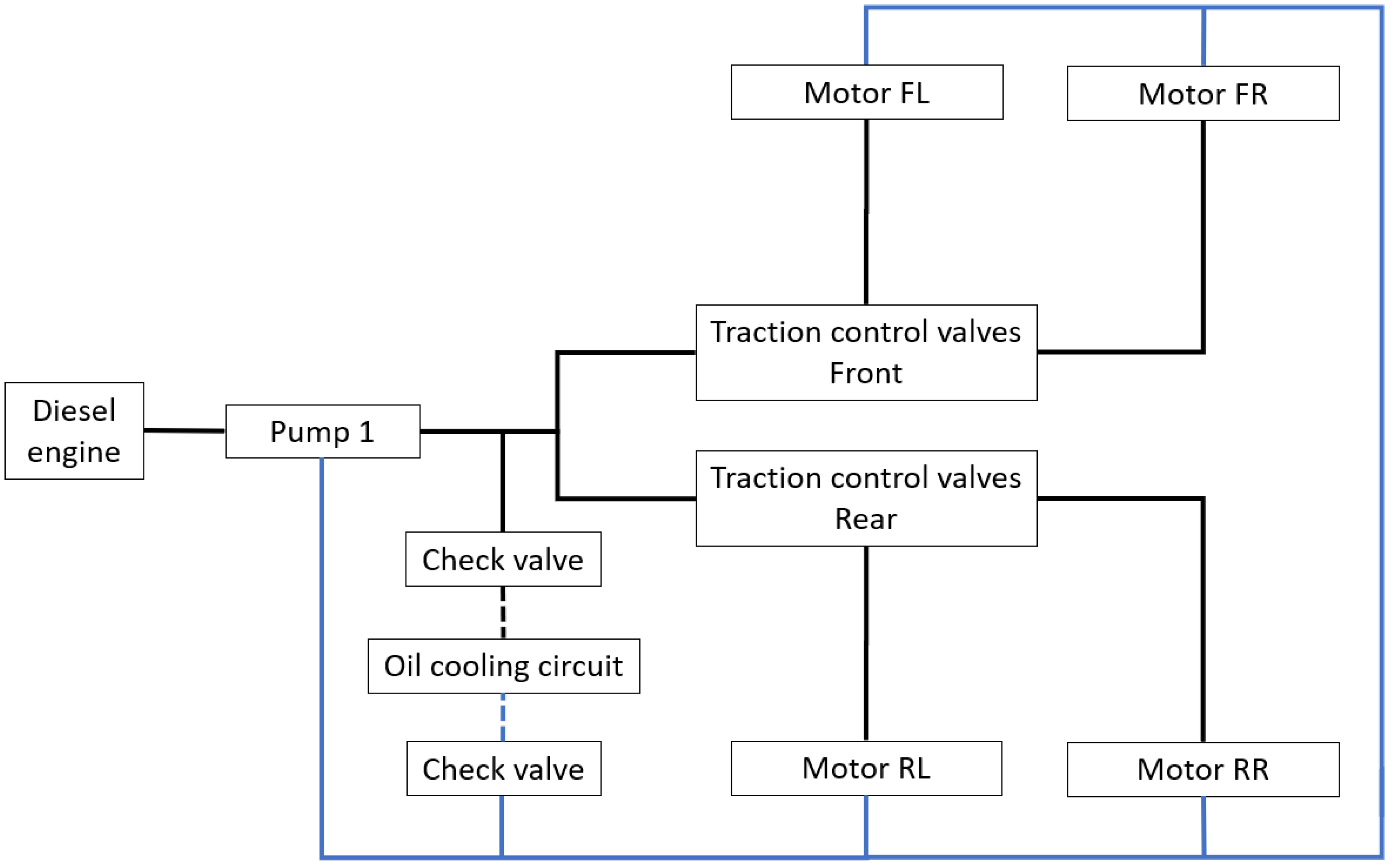
The hydraulic driveline was modeled with a high level of detail. For an overview, a simplified description of the hydraulic driveline is shown in Figure 5.
As shown in Figure 5, the hydraulic driveline is mainly a closed-loop hydraulic system, although the oil cooling circuit replaces some of the oil on the return side with cooled oil from the tank. Components of the oil cooling circuit were also included in the digital twin, although they are not detailed in Figure 5. These components include a charge pump, and a connection to the tank through a pressure relief valve (and through an oil cooler, which was not modeled). The two check valves in Figure 5 ensure that only the currently lower pressured return side of the driveline circuit is connected to the oil cooling circuit. Which side that is depends on whether the vehicle is running forward or reversing.
The traction control valves shown in Figure 5 (two in the front and two in the rear) can be controlled electronically to create the desired distribution of flow between the four motors. These valves were also included in the digital twin. However, in the cases described in this paper all four valves were kept in the fully open position, creating a four-wheel open differential. Even though the valves were kept fully open, they were still included in the digital twin to match the pressure drops and flow distribution of the physical vehicle, which had the same type of valves in the same fully open configuration. The modeled traction control valves are also expected to be useful for future use cases where the valves need to be actively controlled, such as offroad driving in digital environments.
The used tire model is not designed to fully capture the rolling resistance of the tires (see Section 2.4). In addition, it is not certain that the modeled hydraulics capture all losses in the hydraulic driveline. Therefore, the pressure drop across the hydraulic motors (forward pressure minus return pressure) required to drive on flat ground at a constant speed of 0.75 m/s was measured. The physical vehicle required 12.8 bar, while the digital twin required 4.6 bar. To account for the missing losses, a disc brake component was added to each wheel, with a constant normal force applied to the brake pads. The normal force was adjusted so that the digital twin also required 12.8 bar to drive on flat ground at a constant speed of 0.75 m/s.
The hydraulic motors on the physical vehicle, in their current configuration, support running the vehicle in three different gears. The second gear is accomplished by halving the geometric displacement (per revolution) of either the front or rear pair of motors. The third gear is accomplished by halving the geometric displacement of all four motors. The hydraulic motors are controlled by a Poclain control system, which allows for automatic shifting of gears at certain pump displacement values. The digital twin also supports running in the three different gears, although the automatic gear shifting functionality is not yet implemented in the digital model. Currently a new simulation needs to be started to enable running in a different gear. Implementing automatic gear shifting at the current stage of development was not a priority since the vehicle is mostly run in the lowest gear, and since the higher gears are still possible to run for validation purposes by starting a new simulation. The automatic gear shifting algorithm of the Poclain system is also proprietary, hence its parameters and behavior are not fully known. To circumvent that issue in the future, the Poclain control system could be included in the loop by using a Hardware-in-the-Loop setup.

2.9. Articulated Joint Modeling and Calibration

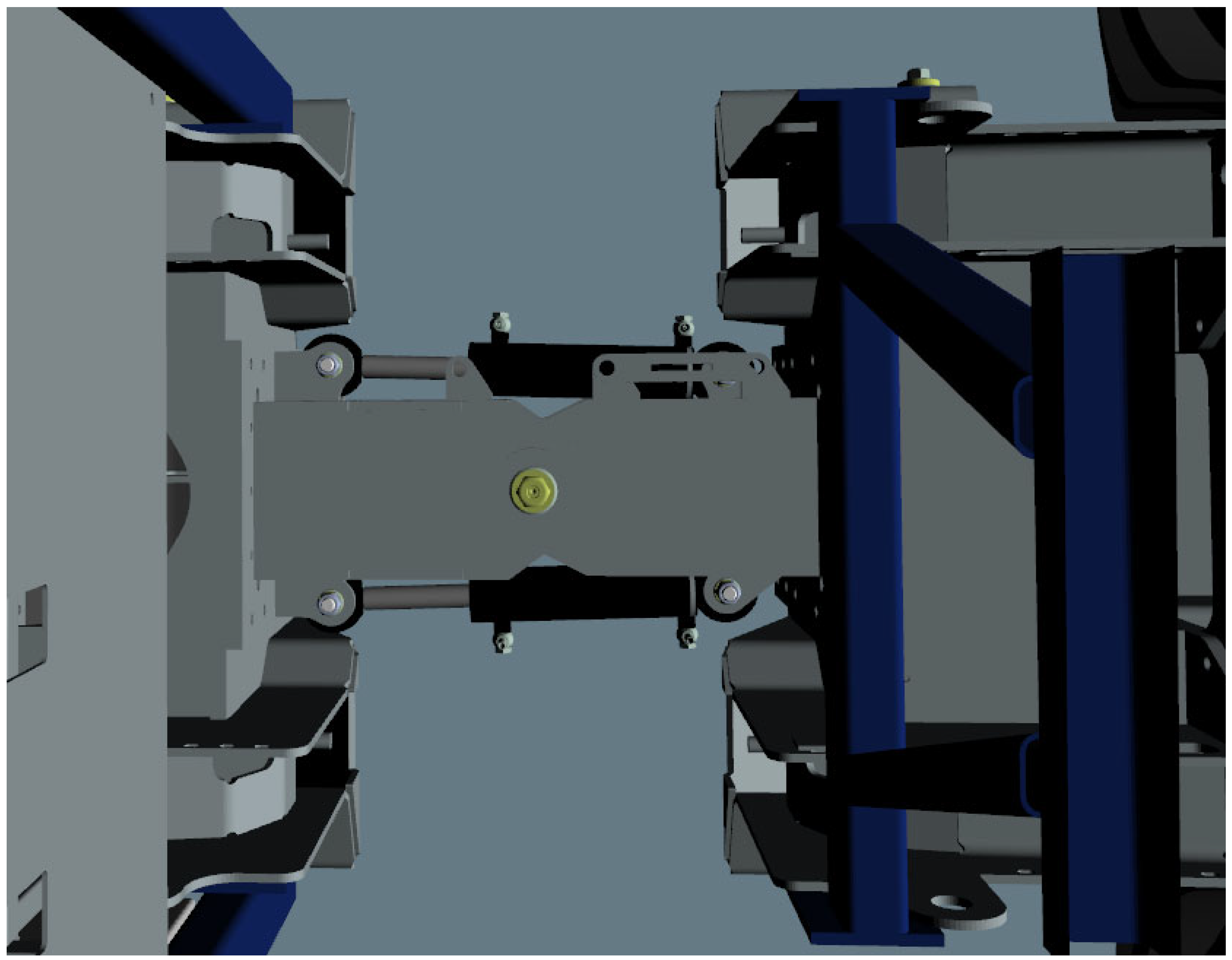
The articulated joint of the AORO vehicle is actuated by two double-acting hydraulic cylinders. The articulated joint, viewed from above in the digital twin, is shown in Figure 6.
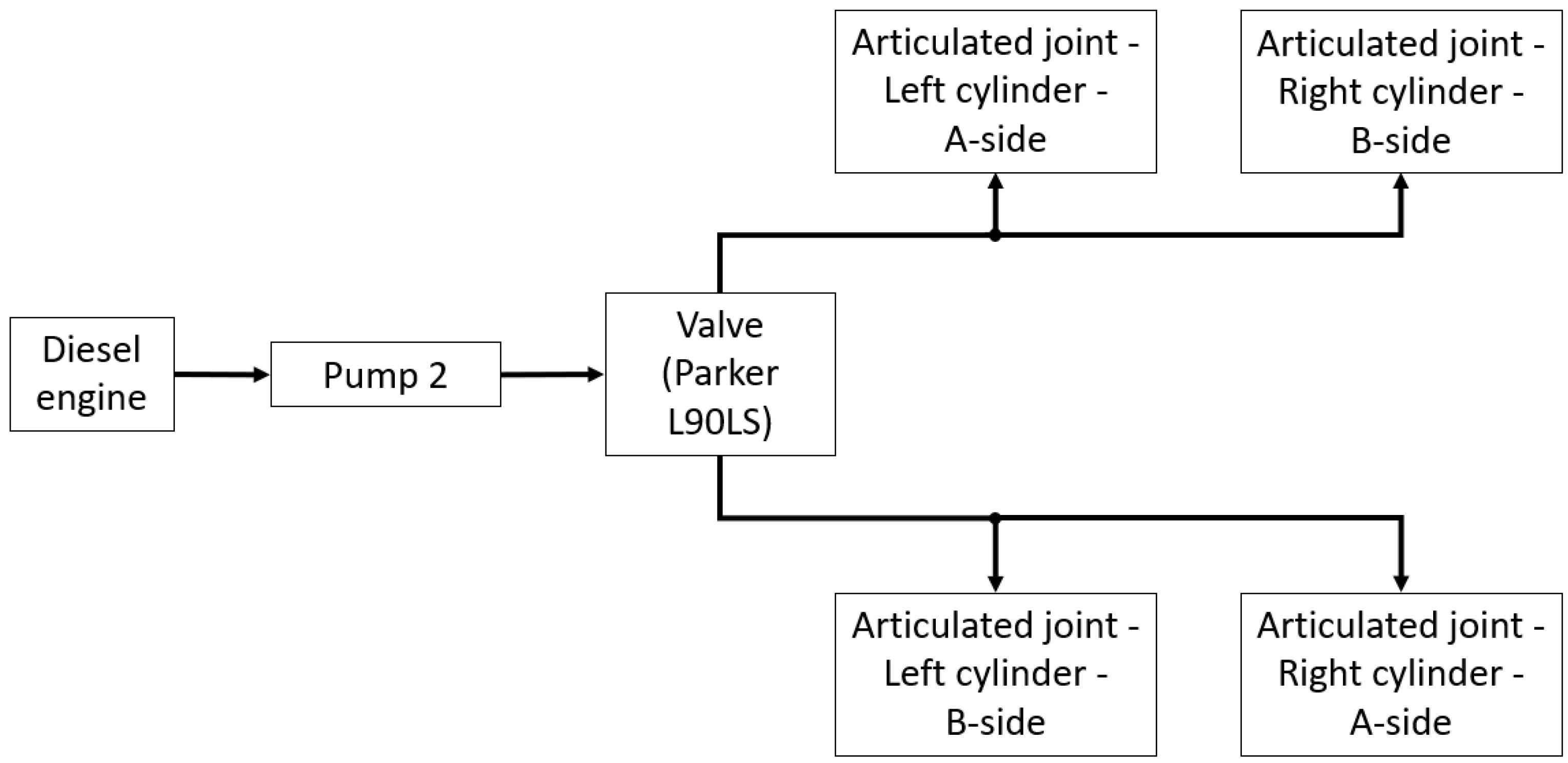
The two double-acting hydraulic cylinders are configured to operate in tandem by connecting the A-side of the left cylinder to the B-side of the right cylinder, and vice versa. An overview of the articulated joint hydraulics is shown in Figure 7.
Most of the important parameters for modeling the articulated joint and its hydraulics were available through the CAD model and the component datasheets and drawings. However, some of the key parameters for defining the L90LS valve had to be determined through physical testing and iteration.
As described in Section 2.5, the flow rate through a simple valve is defined by Equation (1). Solving Equation (1) requires solving Equation (3) to obtain the semi-empirical flow rate coefficient Cv. To solve Equation (3), the nominal flow rate through the fully open valve Qnom, and the pressure drop across the fully open valve at nominal flow rate Δpnom are needed. Additionally, since the flow rate to input signal relationship of the L90LS valve is not linear, the behavior of the parameter U in Equation (1) (the relative opening of the valve) also needs to be defined by a flow rate to input signal curve.
Since the L90LS valve has two output ports (see Figure 7) Qnom, Δpnom, and U need to be determined individually for each of the two ports.
Qnom for each port was available in the datasheets, but since the values in the datasheets did not reflect what was observed during testing, Qnom for each port was determined experimentally instead. Δpnom for each port was not provided in the datasheets and had to be determined through iteration. The processes of determining Qnom and Δpnom for Equation (3), as well as U for Equation (1) are described in Section 2.9.1 and Section 2.9.2.

2.9.1. Determining Qnom and U

The flow rate Q going through the L90LS valve and to the articulated joint cylinders determines the speed at which the vehicle turns. Since the volumes of the hydraulic cylinder chambers were known, the mean flow rate through the L90LS valve during a full turn could be deduced. A full turn was defined as a turn from the rightmost position to the leftmost position, or vice versa. The mean flow rate was calculated by dividing the total volume of oil that needed to be moved by the time it took to complete the turn.
The measured mean flow rate during a full turn, at full turning speed, was expected to correspond relatively well to the nominal flow rate of the fully open L90LS valve Qnom, which was available through its datasheets. However, the nominal flow rates found in the datasheets did not correspond as well as expected to the mean flow rates that were observed during testing. There was also an unexpected difference in turning speed depending on the direction of the turn. The physical vehicle completed a full turn at standstill, on flat ground, at full turning speed, in 1.98 s when turning to the left and 2.14 s when turning to the right. Turning to the left was consistently faster over multiple tests, both at different locations, and at different turning speed input signal values. The resulting deduced mean flow rates (at full turning speed) were 70.6 L/min and 65.4 L/min for a left and right turn, respectively, which can be compared to 62 L/min and 61 L/min, which were the corresponding nominal flow rates found in the datasheets. Because of these discrepancies, when setting the nominal flow rates of the fully open L90LS valve (Qnom) of the digital twin, the mean flow rates deduced from the tests were used instead of the nominal flow rates found in the datasheets.
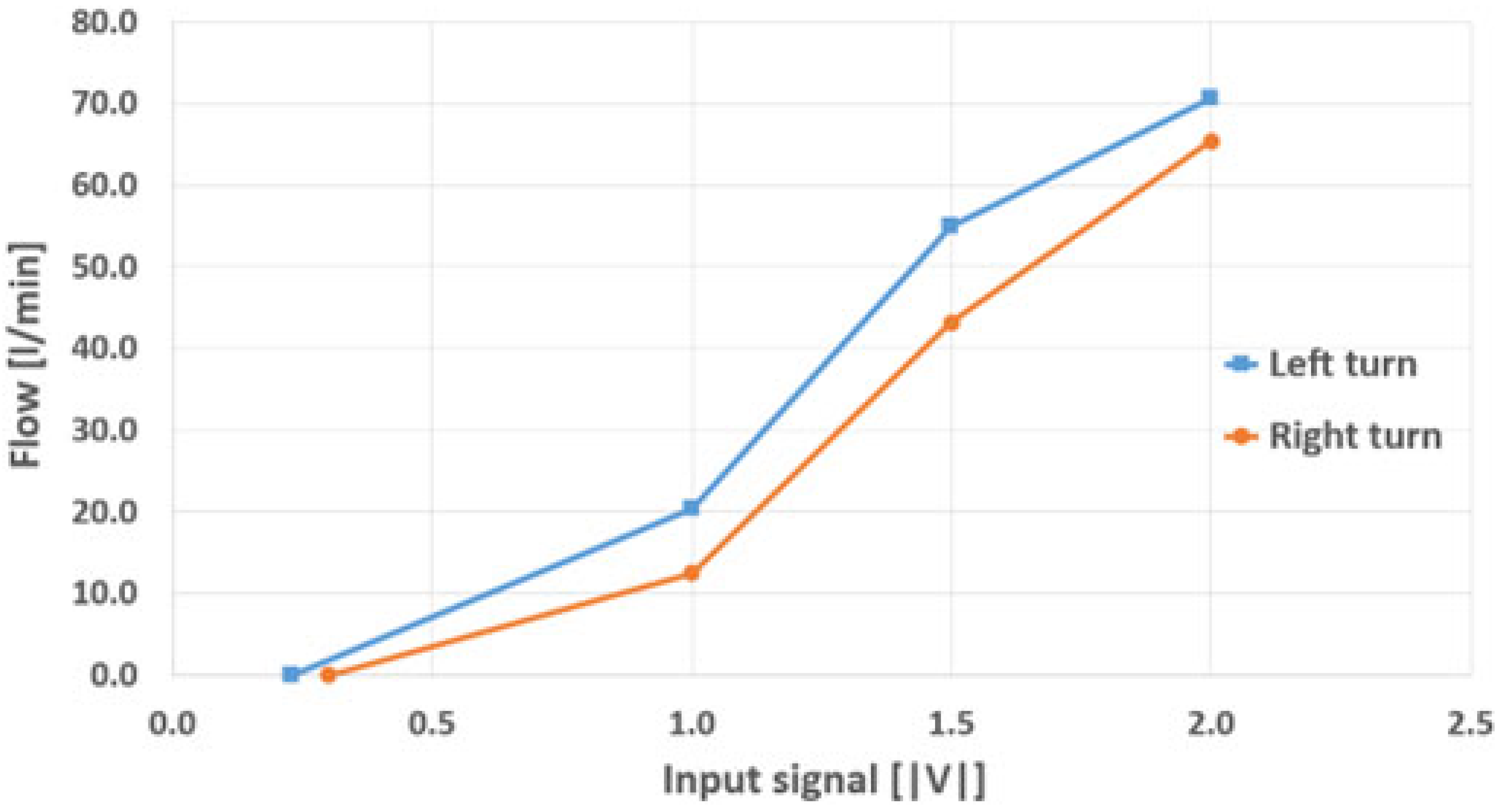
Additionally, based on its datasheets, the L90LS valve has a non-linear relationship between the input signal controlling the valve opening and the resulting flow rate. The L90LS valve also has an input signal deadband to prevent unsteady steering behavior. However, the nominal flow rates at submaximal input signal values, as well as the input signal deadband, were not specified in the datasheets. Hence, the nominal flow rate curves, with respect to the input signal, were unknown. This relationship is described by the parameter U in Equation (1). As for the nominal flow rate of the fully open valve (at maximum input signal), the mean flow rates deduced from full turn tests at submaximal input signal values were also used to represent the nominal flow rates of the valve for those input signal levels. The deadband was determined by slowly increasing the input signal to find the threshold below which no movement of the articulated joint could be perceived. The mean flow values with respect to the input signal are presented in Table 2. They are also presented in the form of curves in Figure 8. These mean flow rate curves were used to represent the nominal flow rate curves of the L90LS valve of the digital twin.
The L90LS valve on the AORO vehicle is voltage controlled and uses an input signal span of 2.5 V ± 2 V, where 2.5 V results in no turning, 0.5 V results in a full-speed turn to the left, and 4.5 V results in a full-speed turn to the right. To effectively illustrate the speed difference between left and right turns, the absolute value of the voltage offset from 2.5 V was used to represent the input signal value.
Figure 8 illustrates the consistent difference in turning speed between left and right turns. The cause is unclear but appears to be a systematic mechanical issue, as the signal flow was thoroughly investigated without revealing any issue able to explain the speed difference. Production tolerances of the L90LS valve are one feasible explanation. However, since the objective was only for the digital twin to replicate the behavior of the physical vehicle, determining the root cause of the speed difference was outside the scope of this study. To replicate the behavior, each of the two mean flow rate curves was assigned as the nominal flow rate curve for its corresponding output port of the digital L90LS valve. Hence, Qnom for Equation (3) and the parameter U for Equation (1) were determined for both output ports.

2.9.2. Determining Δpnom

The final key parameter of the articulated joint hydraulics to determine was the pressure drop across the fully open L90LS valve at nominal flow rate, Δpnom. Since Δpnom was the last remaining parameter needed to solve Equation (1) (through first solving Equation (3)), it could be determined through iteration. Equation (1) determines the flow rate through the L90LS valve at a given pressure drop across the valve. The flow rate through the L90LS valve to the articulated joint cylinders determines the speed at which the vehicle turns, as was previously discussed. Therefore, Δpnom was determined through adjusting it in the digital model, until the digital twin performed a full turn on a flat surface, at full speed, in the same amount of time as the physical vehicle did. Δpnom was adjusted separately for each of the two output ports of the L90LS valve, by adjusting it separately for left and right turns.
The time to perform a full turn was chosen as the adjustment criterion both because of its simplicity and because the time to perform turns was seen as the most important aspect to replicate in the digital twin.

2.10. Physical Articulated Joint Flow Rate Calculation

The articulated joint of the physical vehicle was equipped with a rotary sensor of the model Novotechnik (Ostfildern, Germany) Novohall RFD-4021-612-211-401, which provided the angle of the articulated joint at a rate of 100 Hz. When testing the articulated joint, this sensor was used to determine when the vehicle started and stopped turning, and subsequently the time required to complete a turn. The recorded angular data was also used to calculate the flow rate of the physical vehicle’s articulated joint.
Since all geometry of the articulated joint was known, the turning speed of the vehicle could be used to deduce the flow rate through the L90LS valve, as was discussed in Section 2.9. To calculate the volume of oil transfer between each angular measurement, a script that controlled a 2D CAD model of the articulated joint was created, using NX (v. 1953) and the NX Open Python (v. 3.8) API, to calculate the articulated joint cylinder strokes from the articulated joint’s angle. As the cylinder geometries were known, the change in cylinder strokes required a known volume of oil transfer. The transferred volume of oil per unit of time was the flow rate, which was calculated between each angular measurement.
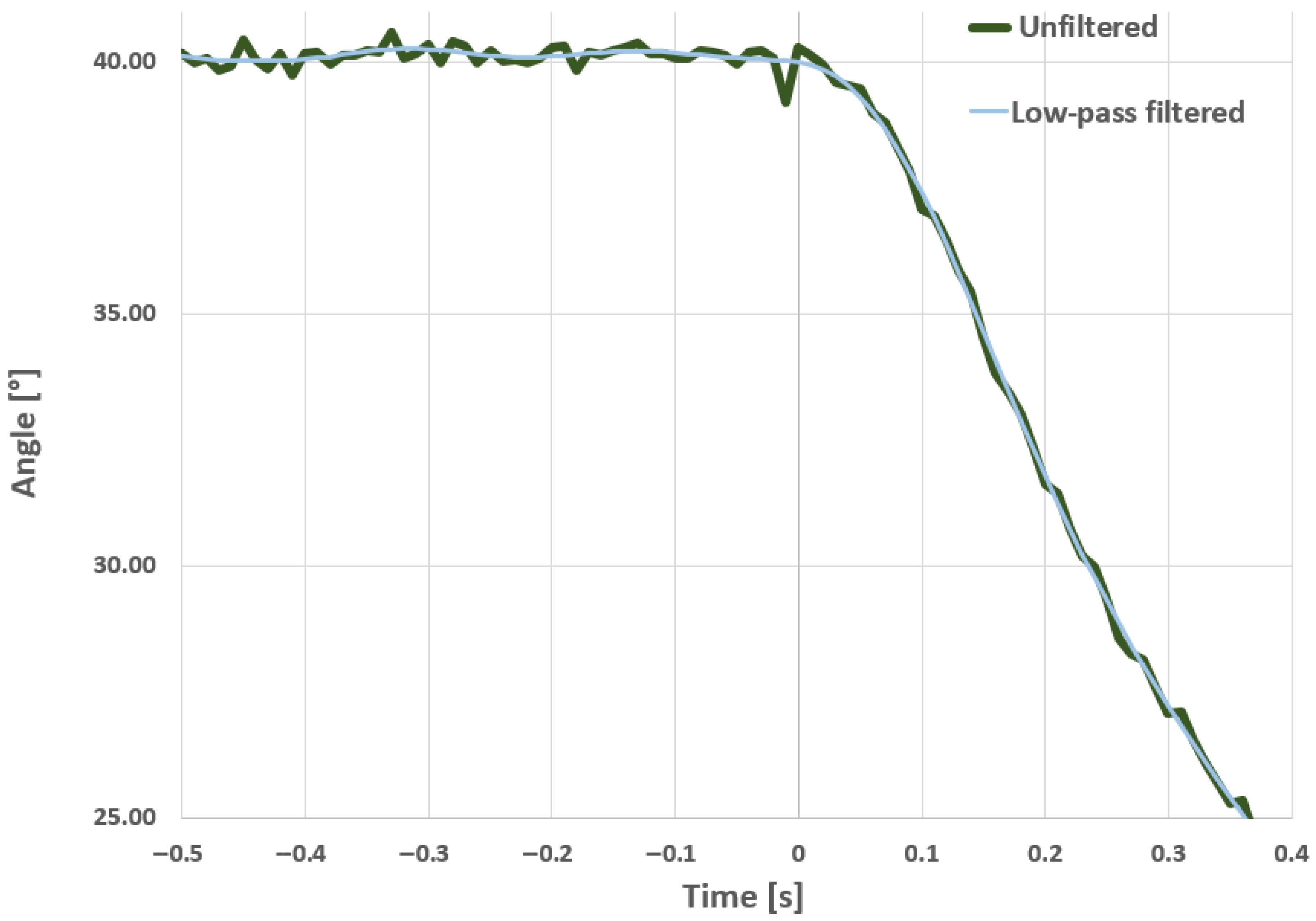
However, since the rotary sensor signal contained some noise, using the unfiltered angular data resulted in a very noisy flow rate curve. To address this, the angular data was filtered using a 4th-order Butterworth low-pass filter with a cutoff frequency of 7 Hz. Several cutoff frequencies and filter orders were evaluated, as well as a 7-point rolling mean filter. The 4th-order 7 Hz Butterworth filter was selected as a compromise between noise reduction and signal preservation, where some of the perceived noise was intentionally retained in order to avoid filtering out components of the original signal. The noise and filtering are further discussed in Section 3.2.
The filtering also introduced a slight temporal smearing (smoothing) of the angular data. Therefore, unfiltered angular data was still used to determine the turn durations. Figure 9 shows the angular values before and during the first 0.36 s of a turn at full speed, with and without low-pass filtering.
The turn in Figure 9 starts at the time 0 s. Before the turn starts, when the vehicle is standing still, the noise in the unfiltered signal is clearly visible. More importantly, during the full speed turn, e.g., at times 0.31 s and 0.35 s, the noise in the signal makes it appear as if the vehicle has been turning in the other direction between two time steps, which is not accurate. Hence, if the flow rate were to be calculated using the unfiltered angular data, the flow rate would go from positive to negative at these time steps. This illustrates why the smoother filtered angular curve is preferred for calculating the flow rate.
The resulting articulated joint flow rate curve is presented in Section 3.2.

3. Results and Discussion

To test the validity of the digital twin and its hydraulics, a comprehensive real-world validation of the digital twin’s articulated joint was performed.
The comprehensive validation of the digital articulated joint was performed in preparation for upcoming ViL tests in the NUVE-LAB in Oulu, Finland, where wheel-hub mounted dynamometers will be used to include the physical driveline into the simulation loop. The physical driveline thereby replaces the digital driveline in the simulation, with the exception of the tires, as the wheel-hub mounting prevents inclusion of the physical tires into the simulation.
The ViL setup does not allow the physical vehicle to turn, which means that the digital articulated joint and its hydraulics are instead used in the ViL simulation. Therefore, in preparation for the ViL tests, ensuring the validity of the digital articulated joint was a high priority.
Since the ViL tests will not include the digital twin’s driveline, but will facilitate a comprehensive real-world validation of it, the decision was made to focus the real-world validation in this study on the digital articulated joint. In this way, a more comprehensive validation of the articulated joint was enabled in this study, which will complement the upcoming comprehensive validation of the driveline associated with the ViL testing. Additionally, this strategy ensured that the highest possible accuracy of the digital articulated joint was achieved in preparation for the ViL tests. Furthermore, although the other modeled systems and subsystems are not validated directly in this study, they still affect the validation of the articulated joint hydraulics indirectly, which is highlighted in Section 3.4.

3.1. Real-Time Capability and Computational Requirements

All simulations described in this paper used a time step of 1 ms for the main simulation and 33 μs for the hydraulics simulation. It was observed that the digital twin could be run in real time with these time steps on a workstation PC with an Intel 10900KF CPU, an NVIDIA RTX 2080 SUPER GPU, and 32 GB of RAM. This is promising, as this workstation PC is from 2020, and more capable computer hardware already exists.
Other vehicle platforms or configurations could also be modeled and would be expected to be real-time capable with the same time steps if they were of the same level of complexity as the described digital twin. This makes the described framework generalizable.
Another factor that impacts the computational load is the complexity and level of detail of the virtual environment. The real-time capability of the digital twin in this study was tested in the scanned virtual environment described in [24], which was to be used in upcoming ViL testing. This environment is a UAV scan of a 57 × 103 m part of the OuluZone test track in Oulu, Finland. It contains asphalt roads with varying slopes between two grassy areas with slopes and ditches, as well as a few buildings and objects. The environment collision mesh used for tire contact detection consisted of 25,633 triangle elements. Testing the limitations on environment complexity was outside the scope of this study; however, at a high enough level of detail the real-time capability will be compromised. This depends also on, e.g., the complexity of the vehicle and tire models, the chosen time steps, the computer hardware, and collision detection optimization techniques, such as disabling collision graphics located further away from the vehicle.
The level of detail of the visualization can also impact the real-time capability. However, even if the simulation is run on a single computer, the visualization is mostly handled by the graphics card, while the physics calculations are mostly handled by the CPU. Therefore, as they were handled by different hardware, there was usually no trade-off to be considered between visual and physical model fidelity. Furthermore, if co-simulation with Unity is utilized for maximal visual fidelity, weather effects, and visual sensor emulation (see Section 2.2) the Unity visualization can be run on a separate computer, which should eliminate any trade-offs between visual and physical fidelity. However, if either the physical or visual simulation cannot be computed within the chosen time step, the real-time capability of the entire simulation is compromised. Therefore, the level of detail of the visualization can still impact the real-time capability.
The visual fidelity was not a priority in this study. Instead, visualizing the collision graphics was prioritized to enable seeing the collision graphics that were in contact with the tires, thus impacting the vehicle dynamics. However, significantly more detailed visualization graphics have previously been used, such as in [9] and to some extent in [24]. Therefore, using considerably more detailed visualization graphics would not have been expected to impact the real-time capability in this case.

3.2. Flow Rate of the Physical Vehicle’s Articulated Joint

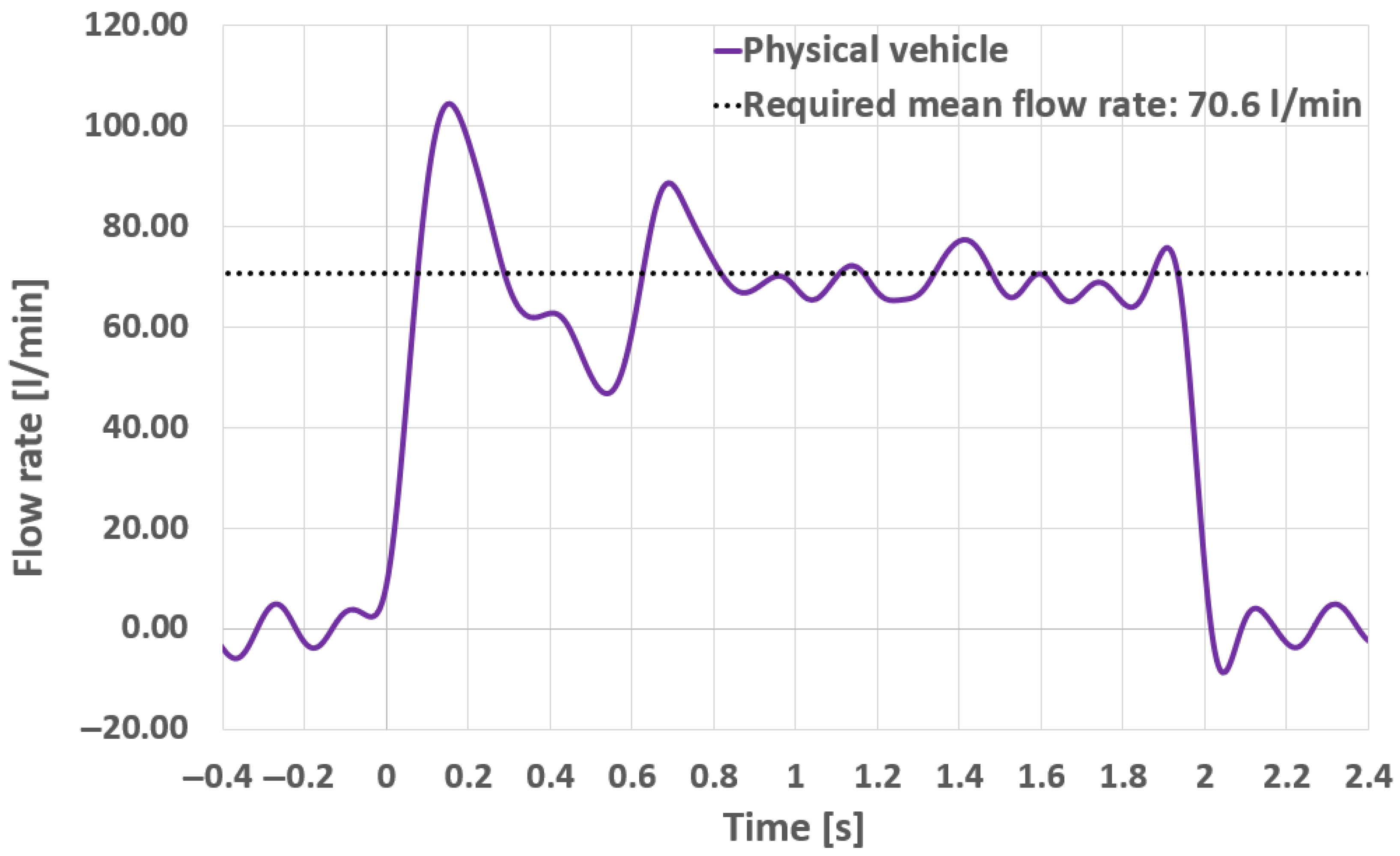
The articulated joint’s flow rate during a full left turn at standstill, on flat ground, at full turning speed, is presented in Figure 10. The flow rate is based on the low-pass filtered angular data and the articulated joint’s geometry, as described in Section 2.10.
Figure 10 also shows the calculated mean flow rate (70.6 L/min) required to complete the turn within the measured turn duration, which was 1.98 s. The required mean flow rate was calculated by dividing the volume of oil that needed to be transferred by the turn duration (see Section 2.9.1). It can be seen that after the second overshoot at 0.7 s, the flow rate stabilizes close to the required mean flow rate, which is desirable. The mean flow rate of the steady-state period between 0.95 s and 1.82 s is 69.0 L/min. However, the amplitude of the two first overshoots and the first undershoot should ideally be lower, to enable a more consistent and predictable turning velocity. The relatively high amplitudes could indicate some underlying issues, such as air in the articulated joint’s hydraulic system, or sub-optimal pump regulation, for example. Potential root causes are discussed further in Section 3.4.
As mentioned in Section 2.10, the low-pass filtering introduces some temporal smearing, which spreads out the flow rate slightly over the time axis, thereby making the turn appear to start just before 0 s and end just after 2 s.
As noted in Section 2.10, some of the perceived angular sensor noise is intentionally preserved in Figure 10 to avoid filtering out components of the original flow rate curve. Oscillations regarded as being caused by noise appear, for example, at negative time values before the start of the turn, when the vehicle is at a complete standstill. They are attributed to sensor noise because they occur even when no vehicle movement or vibration can be visually perceived, and because they do not appear to dampen out over time. These oscillations also seem to be present during the steady-state period between 0.95 s and 1.82 s, as well as after the turn is completed.
With the current low-pass filter applied, the oscillations are mainly around 6 Hz. However, higher frequencies were also observed when using different filter settings, mainly around 15 Hz and 25–33 Hz. The span 25–33 Hz derives from periods of 0.04 s and 0.03 s, and reflects the limited frequency resolution imposed by the 100 Hz sampling rate.
The root cause of the noise remains to be determined. The noise between 25 and 33 Hz could likely originate in the generator, which at the current engine speed of 1595 RPM has a rotational frequency of 26.6 Hz. Since low-pass filtering of the analog sensor signal prior to sampling is yet to be implemented, the other frequencies could likely be due to aliasing, caused by noise above the current Nyquist frequency of 50 Hz.
How the signal noise affects the validation of the digital twin’s flow rate curve is discussed in Section 3.3.

3.3. Validation of the Digital Twin’s Articulated Joint Flow Rate

The articulated joint flow rates of the digital twin and the physical vehicle were compared for full left turns, at standstill, on flat ground. Full turns, i.e., from the rightmost position to the leftmost position, were chosen since utilizing the end positions made the physical tests more repeatable.
The flow rate of the digital twin’s articulated joint was validated at three different turning speed input values: 100%, 75%, and 50%. The digital twin was mainly calibrated at full (100%) turning speed (see Section 2.9), as this was to be the predominant operating speed of the currently utilized tracking algorithm. The most important validation was therefore at full turning speed.
In the discussion of the validation results, assessments of whether the agreement is satisfactory are made, based on previous experience with testing the current physical vehicle. The assessments are made in the context of whether the agreement is expected to be satisfactory for making R&D design decisions, and for having potential transferability of ML from digital training to real-world applications. If the digital twin’s results are seen as highly likely to be within run-to-run variance of physical tests, both conditions are expected to be met, and the agreement is considered excellent. If the results are considered potentially within run-to-run variance, and likely useful for various R&D design decisions, the results are considered good. Future work is expected to delve further into this topic through real-world case studies of transferability of ML (as in [9]), and through quantitative comparisons between the digital twin’s results and run-to-run variance between physical tests.

3.3.1. Articulated Joint Flow Rate Validation at Full Turning Speed

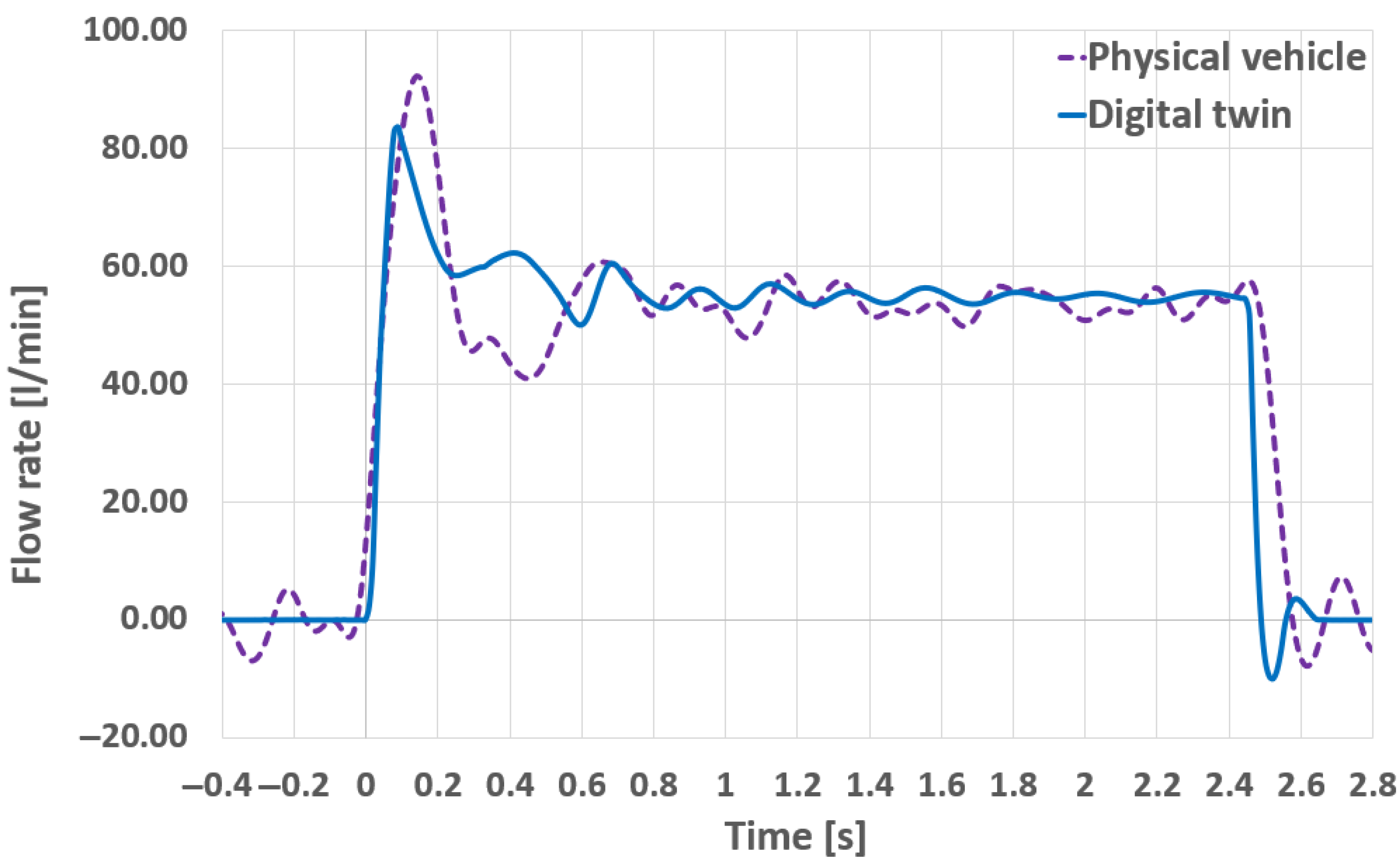
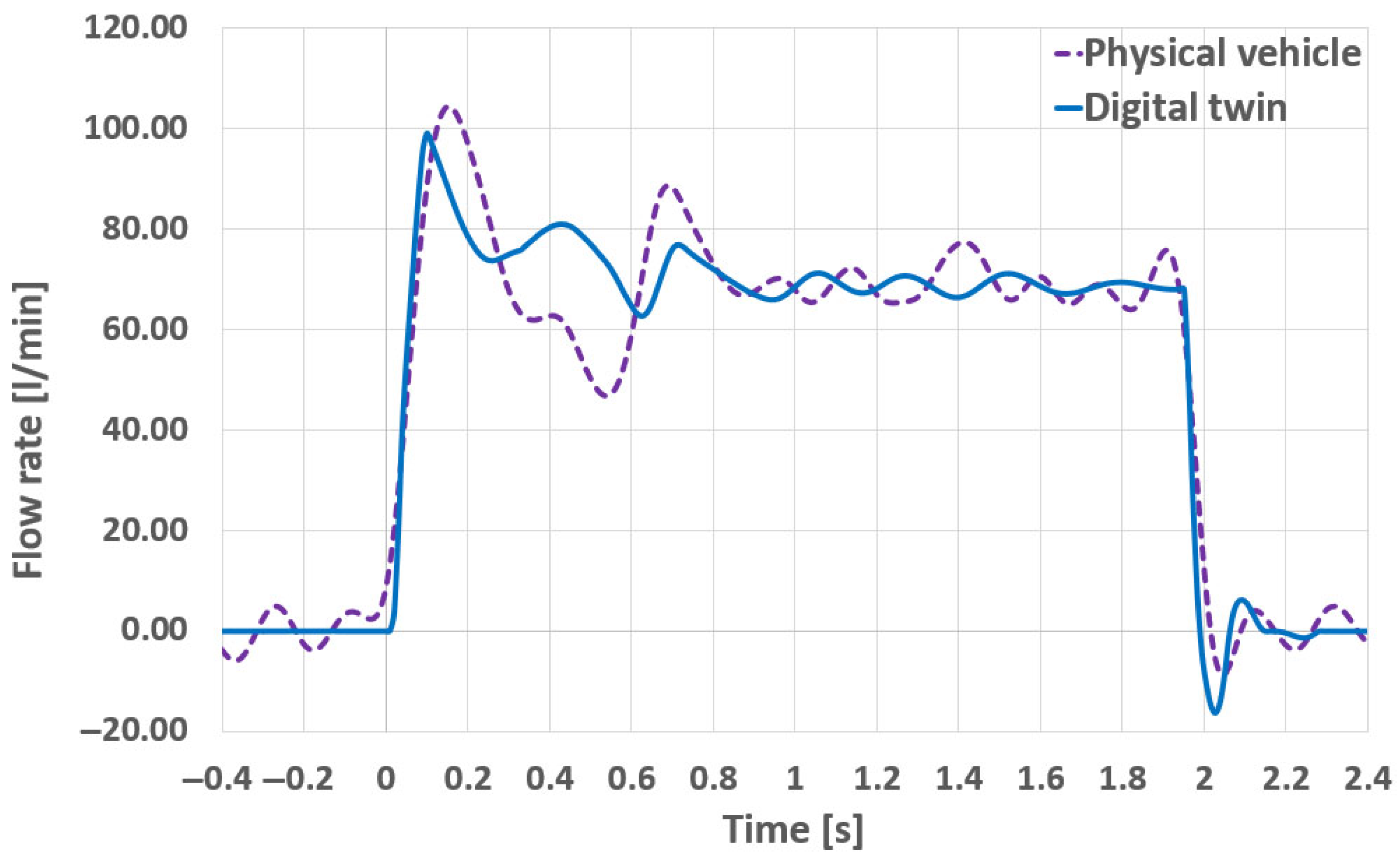
The articulated joint flow rates of the digital twin and the physical vehicle during full-speed left turns, are presented in Figure 11.
Figure 11 shows that the flow rate curve of the digital twin at full turning speed shares many characteristics with the corresponding flow rate curve of the physical vehicle, while some differences can also be observed. From 0.8 s and onward both curves reach a steady-state close to the required mean flow rate (see Section 2.9.1 and Section 3.2).
When comparing the two curves, the focus was on seven key metrics, loosely ordered based on perceived importance, with the most important being listed first: time required to complete a turn, mean flow rate, mean steady-state flow rate, first overshoot peak, first overshoot time, lowest undershoot, and overshoot peak at ~0.7 s.
The metrics “Time to complete turn” and “Mean flow rate” are directly proportional, hence one of them could be omitted. However, “Time to complete turn” was retained as it was seen as the most important and practically relatable metric, while “Mean flow rate” was retained to enable comparison with the other flow rate metrics.
The steady-state mean flow rates were measured between the first local maxima and the last local minima of the steady-state periods. This meant between 0.96 s and 1.82 s for the physical vehicle, and between 1.06 s and 1.93 s for the digital twin.
The signal noise present in the physical vehicle’s flow rate curves, described in Section 3.2, currently prevents more in-depth analyses from being accurate, such as comparing the peak-to-peak amplitudes and frequencies of the steady-state period oscillations. Transient properties, such as overshoot and undershoot values and timings, must also be treated with caution, as they are also susceptible to noise.
The seven key metrics of the two flow rate curves are listed in Table 3.
Since the digital twin was calibrated to perform a full turn at full turning speed in the same amount of time as the physical vehicle, their time to complete the turn and their mean flow rate, by definition, are equal (see Section 2.9.2). These two metrics are thus more interesting to compare at 50% and 75% turning speed input signal, for which they were not directly calibrated. However, the metrics still illustrate that the calibration results are in perfect agreement for the two most important attributes of the turn, which measure the overall turning velocity.
The steady-state mean flow rate, on the other hand, was not explicitly calibrated for. The fact that this metric was within 0.35% between the physical vehicle and the digital twin, at 69.0 L/min and 68.8 L/min, respectively, is considered excellent agreement.
The first overshoot peaks are relatively similar, with the physical vehicle peaking at 104.4 L/min and the digital twin at 99.1 L/min, which is 5.10% lower than the physical vehicle. The physical vehicle has its first overshoot peak at 0.15 s while the digital twin has its peak at 0.10 s. This means that the peaks happen relatively close in time, although the peak of the physical vehicle occurs 50 ms later. The overshoot timing is discussed further in Section 3.3.2.
Between the first overshoot and the steady-state period, the two curves have similar characteristics but also some differences, mainly regarding amplitudes.
Both curves have a second local maximum around 0.4 s, although this peak is significantly more pronounced for the digital twin. Subsequently, the lowest undershoot of the digital twin (62.8 L/min) is less pronounced than for the physical vehicle (46.8 L/min). The digital twin’s lowest undershoot value is thus 34.2% higher than that of the physical vehicle.
Both curves also have an overshoot at ~0.7 s, where the overshoot of the digital twin (76.8 L/min) is less pronounced than for the physical vehicle (88.7 L/min), making the digital twin’s overshoot 13.4% lower. It is plausible that signal noise could contribute to these differences, since the local maximum and minimum are transient properties.
Potential root causes behind the remaining differences between the two flow rate curves are investigated and discussed further in Section 3.4.

3.3.2. Articulated Joint Flow Rate Validation at 75% Turning Speed

The articulated joint flow rates of the digital twin and the physical vehicle during full left turns at 75% turning speed are presented in Figure 12.
The seven key metrics that were used in Section 3.3.1 are presented for 75% turning speed input signal in Table 4.
Figure 12 and Table 4 show a correspondence between the digital twin and the physical vehicle at 75% input signal similar to that observed at 100% input signal.
Table 4 shows that the first three metrics, considered the most important, display agreement that is regarded as good to excellent. The metrics “Time to complete a turn” and “Mean flow rate” from the digital twin are within 1.58% of the values from the physical vehicle, while the “Steady-state mean flow rate” is within 2.65%. The fact that none of these metrics were explicitly calibrated for at 75% input signal makes the level of agreement especially noteworthy.
The first overshoot peak of the digital twin (83.7 L/min) is again lower than that of the physical vehicle (92.3 L/min). This makes the peak of the digital twin 9.30% lower than that of the physical vehicle, which is more than the 5.10% difference observed at 100% input signal. The digital twin’s first overshoot peak again occurs slightly earlier than for the physical vehicle. The separation between the peaks, 50 ms, is identical to what was observed for 100% input signal. However, both peaks occur 10 ms earlier than they did for 100% input signal. These slightly earlier peaks are likely due to their lower peak values, since with the same ramp-up rate and a lower peak, the peak will occur earlier. This could also partly explain why the physical vehicle’s higher peaks occur later than their lower digital twin counterparts, but it does not appear to explain the entire difference.
The lowest undershoot is again the metric with the largest difference between the digital twin and the physical vehicle, which it also was at 100% input signal. However, the digital twin’s undershoot flow rate is only 22.4% higher than that of the physical vehicle, considerably less than the 34.2% difference seen at 100% input signal.
The overshoot peaks at ~0.7 s are significantly less pronounced for both the digital twin and the physical vehicle at 75% input signal compared to at 100% input signal. The peak values are close to identical, with the digital twin’s overshoot peak being 0.39% lower, which can be compared to 13.4% lower at 100% input signal. Thus, at 75% input signal the agreement of the digital twin’s “Overshoot peak at ~0.7 s” metric is seen as excellent.

3.3.3. Articulated Joint Flow Rate Validation at 50% Turning Speed

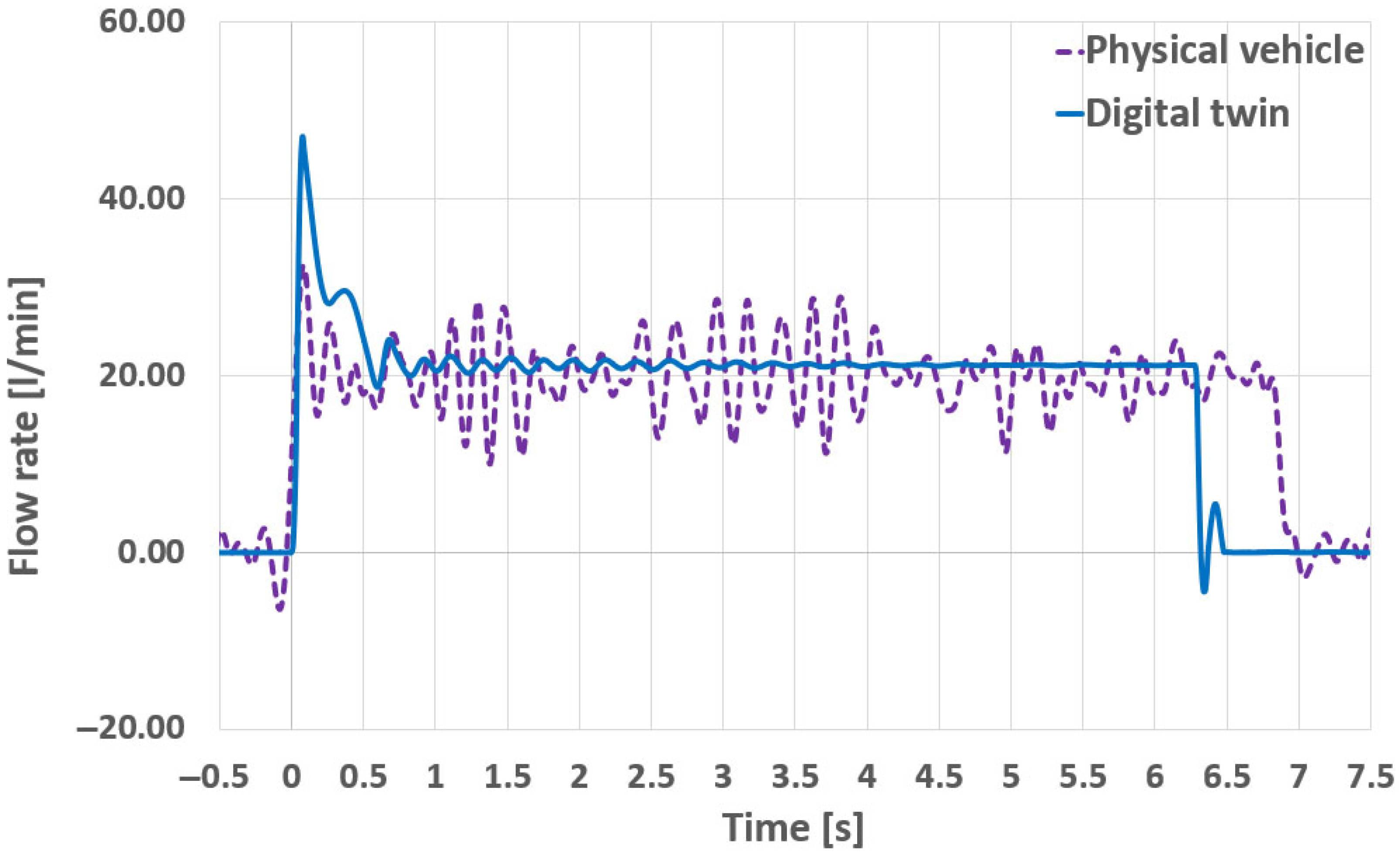
The articulated joint flow rates of the digital twin and the physical vehicle during full left turns at 50% turning speed are presented in Figure 13.
The seven key metrics that were used in Section 3.3.1 and Section 3.3.2 are presented for 50% turning speed input signal in Table 5.
Table 5 shows that the digital twin performs the turn 7.87% faster than the physical vehicle at 50% input signal. By comparing their “Mean flow rate” and “Steady-state mean flow rate” metrics, and observing Figure 13, this is concluded to be caused by the digital twin having both higher “Steady-state mean flow rate” and higher flow rate around the first overshoot. The “Steady-state mean flow rate” is 6.44% higher for the digital twin. As the digital twin very rarely operates at as low of a speed input signal as 50%, the 7.87% difference in mean flow rate is likely a negligible issue. However, if improved agreement is needed, the simplest solution would be to adjust the nominal flow rate curve described in Section 2.9.1. Yet, further analyzing the root cause behind the difference instead could yield valuable insights.
For the first time the “First overshoot peak” metric is higher for the digital twin, showing a difference of 45%. Based on the validations at 100% and 75% input signal, the large difference is due to the digital twin having an unexpectedly large overshoot peak, in relation to the steady-state mean flow rate.
This is also the first occurrence of both vehicles having their first overshoot peaks at the same time (at 0.08 s), instead of the digital twin having its peak earlier. This is more expected, however, based on the digital twin having a substantially higher first overshoot peak than the physical vehicle. The same ramp-up rate and a higher peak will make the peak occur later, as discussed in Section 3.3.2.
Neither of the two vehicles displays significant flow rate undershoot at the start of the turn at 50% input signal. Their lowest values, 15.4 L/min for the physical vehicle and 18.7 L/min for the digital twin, are relatively close to their steady-state mean flow rates of 19.9 L/min and 21.2 L/min, respectively. Therefore, to prevent later oscillations (suspected to be signal noise, see Section 3.2) from affecting the metric “Lowest undershoot”, local minima after 0.7 s were not considered, thereby preserving the intent of the metric.
The oscillation amplitudes during the steady-state period are larger at 50% input signal compared to at 100% and 75% input signal. The largest peak-to-peak amplitude at 50% input signal was 18.5 L/min, while at 100% it was 12.1 L/min. However, no such speed variations can be visually observed, which strengthens the hypothesis that the oscillations are caused by signal noise. Therefore, further investigation of the larger oscillations was not considered worthwhile. Future work will focus on trying to mitigate the perceived noise, for example, through low-pass filtering of the analog signal, as discussed in Section 3.2.
As for 75% input signal, the overshoot peak around 0.7 s was relatively low also at 50% input signal. The digital twin’s peak value of 24.1 L/min showed good agreement with the physical vehicle’s peak value of 24.7 L/min, yielding a difference of −2.53%.

3.4. Investigation of Differences Between the Digital and Physical Articulated Joint Flow Rate Curves

In Section 3.3, three main differences between the digital and physical articulated joint flow rate curves were observed.
The first difference was that the digital twin usually had a lower first overshoot, occurring slightly later (except at 50% input signal).
The second difference was that the digital twin had a more pronounced second local maximum.
The third difference was that the digital twin had a less pronounced undershoot.
At 100% and 75% input signal, the digital twin’s flow rate curves exhibited all three of these differences with respect to their physical counterparts. At 50% input signal, the digital and physical curves also differed in a similar way, except regarding the first overshoot, for which the digital twin’s curve was an outlier. This was discussed in Section 3.3.3 and will also be addressed further in this section.
To identify potential root causes behind the observed differences, the effect of various model parameters on the flow rate curve of the digital twin was investigated at 100% input signal.
It was observed that increasing the disc brake force resulted in a less pronounced second local maximum.
As discussed in Section 3.2, the unexpectedly pronounced and sub-optimal overshoot and undershoot observed in the flow rate curve of the physical vehicle at 100% input signal were suspected to potentially be caused by some underlying issue, such as air in the articulated joint hydraulics. Air in a hydraulic system is known to significantly reduce the effective oil bulk modulus [34]. It was also observed that decreasing the oil bulk modulus in the simulation resulted in a more pronounced overshoot and undershoot, leading to a flow rate curve that is more similar to that of the physical vehicle.
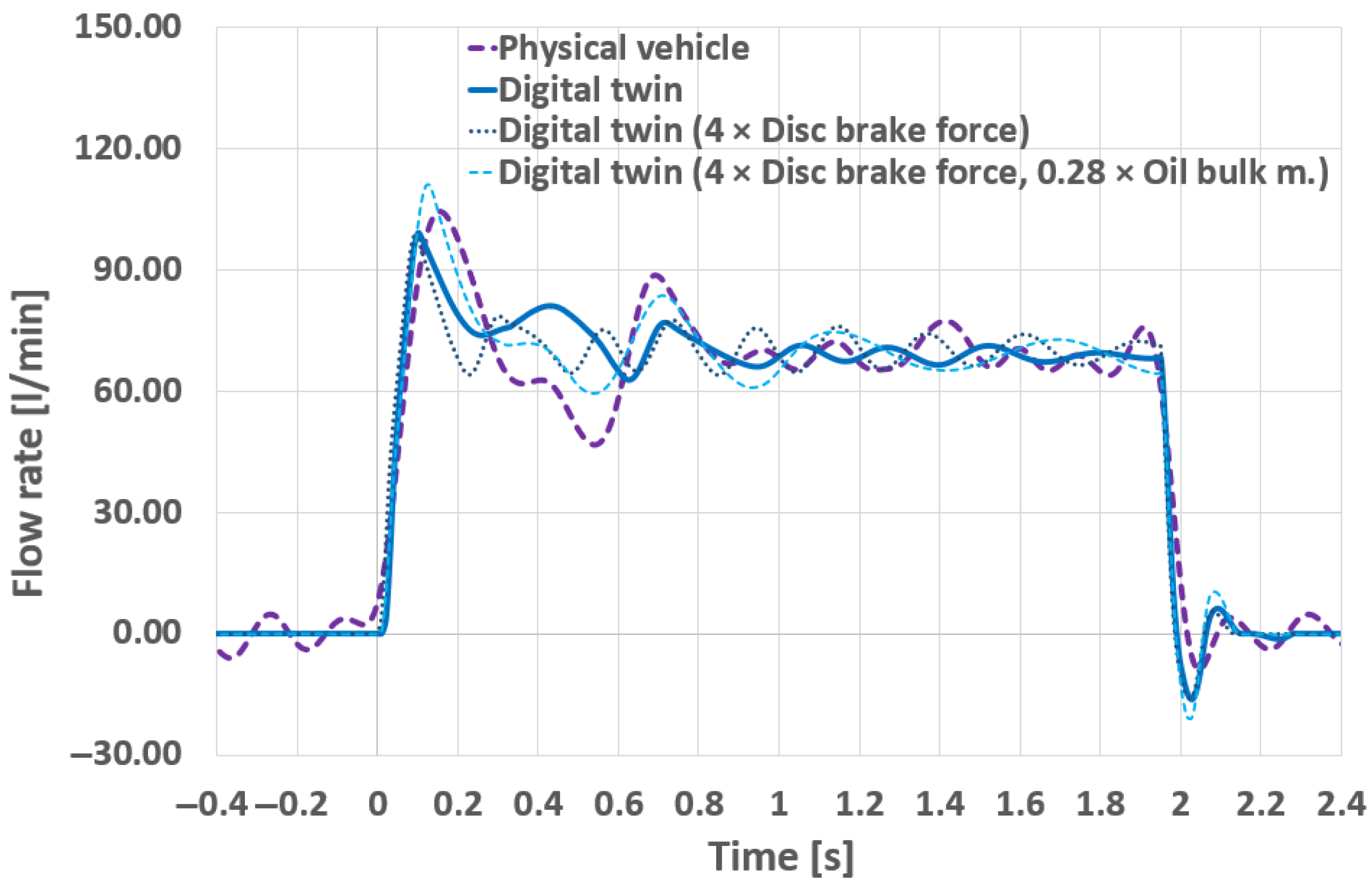
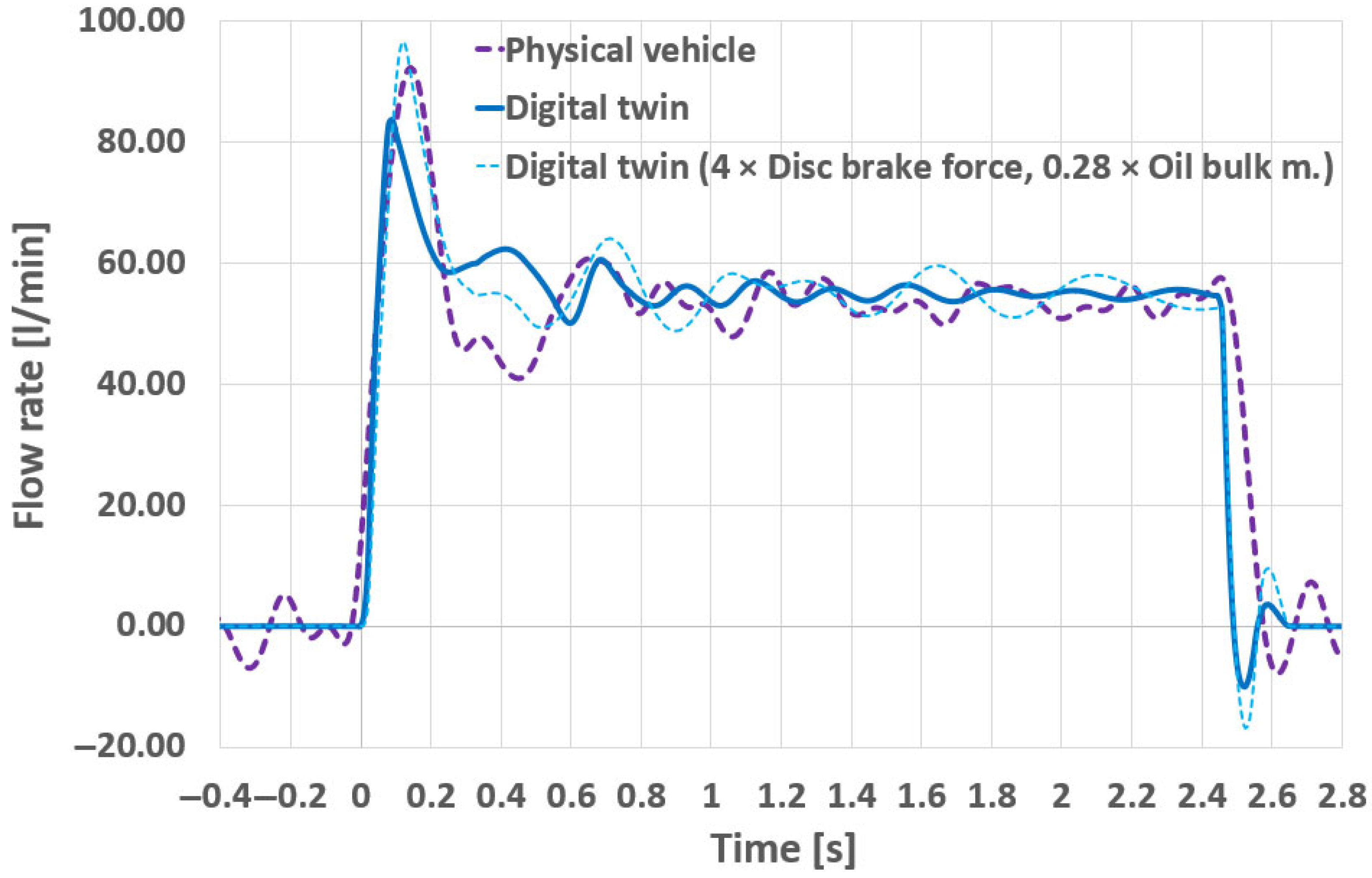
Figure 14 illustrates the effects of increasing the disc brake force and decreasing the oil bulk modulus on the flow rate curves of the digital twin. The modified versions of the digital twin were also calibrated to perform the full turn at full turning speed in 1.98 s, in the same way as the original version (see Section 2.9.2).
Figure 14 shows that increasing the disc brake force by a factor of 4 mainly yields a less pronounced and earlier second local maximum, more similar to that of the physical vehicle.
Figure 14 also shows that combining the increased disc brake force with an oil bulk modulus multiplied by a factor of 0.28 results in a flow rate curve that strongly resembles the curve of the physical vehicle.
Table 6 presents the seven flow rate key metrics from Section 3.3 for the physical vehicle, the digital twin, and the digital twin with the disc brake force and oil bulk modulus multiplied by the factors 4 and 0.28, respectively.
Table 6 shows that the last three key metrics, which are all related to the three observed main differences between the curves, display improved agreement with the multiplication factors implemented. For the other four key metrics, the agreement is equal or similar to that of the original digital twin.
The multiplication factors used in Figure 14 and Table 6 were selected through manual iteration to demonstrate that disc brake force and oil bulk modulus are strong candidates for explaining the three observed differences between the digital and physical flow rate curves. Further tuning of the multiplication factors would likely produce even better agreement, but this was deemed unnecessary for the purposes of this investigation.
Given that the digital articulated joint cylinder pressures mainly range from 5 bar to 15 bar during the overshoot and undershoot, the oil bulk modulus multiplication factor of 0.28 corresponds to an air content of about 1% according to [35], and this conclusion is further supported by [34]. Higher air contents could explain even more significant reductions in the effective oil bulk modulus, as air contents of up to 5% were studied in [34,35]. Hence, the used multiplication factor of 0.28 appears realistic if the hydraulic system contains some air.
When driving on flat ground at a constant speed of 0.75 m/s (see Section 2.8) the used disc brake force multiplication factor of 4 results in the pressure drop over the hydraulic motors increasing by a factor of 2.86. This indicates that the total driveline resistance is increased by approximately the same factor at similar speeds. During the full left turn at full turning speed, the tires reach angular velocities corresponding to driving at a speed of 0.74 m/s.
It is not clear whether the physical driveline resistance could be higher by a factor of 2.86 when comparing the turning test to the rolling resistance test at 0.75 m/s (described in Section 2.8). However, it is considered likely that the perceived higher resistance when turning could be caused by the tires needing to slide on the ground in order to reorient from forward-facing to pointing sideways. Because the tires are 530 mm wide, reorienting the physical tires to point sideways requires rotating an up to 530 mm wide contact patch, which likely demands considerable torque. The digital twin’s tires, on the other hand, are currently modeled to have only a single point of contact with the ground at each time step. This likely leads to significantly less torque being required to reorient the tires, as only a single point of contact needs to be rotated, as opposed to an up to 530 mm wide contact patch.
It is also plausible that the rolling resistance starting from a standstill could be higher than at a steady-state speed [36,37].
Other factors relating to the vehicle dynamics and the hydraulic driveline could also influence the perceived higher resistance, although this is considered less likely.
Further investigation of the driveline resistance during turning is planned for future work, e.g., through ViL testing. It is possible that this could necessitate exploring new ways of modeling the tires or the resistance during turning.
Three other parameters with some influence on the digital articulated joint flow rate curve were the time constant of the L90LS spool, the tire stiffness, and to a lesser extent the tire damping coefficient. None of them appeared to be causal for the three observed main differences. However, as they had some influence, these parameters should still be considered in future work.
To further test the hypothesis that improved agreement can be achieved by multiplying the disc brake force and oil bulk modulus by the factors 4 and 0.28, respectively, these multiplication factors were also evaluated at 75% and 50% input signal.
The effects of applying the multiplication factors at 75% input signal are illustrated in Figure 15.
Figure 15 shows that for 75% turning speed input signal, applying the multiplication factors also appears to increase the agreement between the digital and physical curves, particularly regarding the three observed main differences.
Table 7 presents the seven flow rate key metrics at 75% turning speed input signal for the physical vehicle, the digital twin, and the digital twin with the disc brake force and oil bulk modulus multiplied by the factors 4 and 0.28, respectively.
Table 7 shows that metrics 4–6 of the seven flow rate key metrics, which all relate to the three observed main differences, display improved agreement when the multiplication factors are applied. The last key metric “Overshoot peak at ~0.7 s” shows worse agreement, since the original agreement was already seen as excellent. The remaining three key metrics display identical or similar agreement to that of the original digital twin.
Overall, the agreement is considered better with the multiplication factors applied, as was also illustrated in Figure 15.
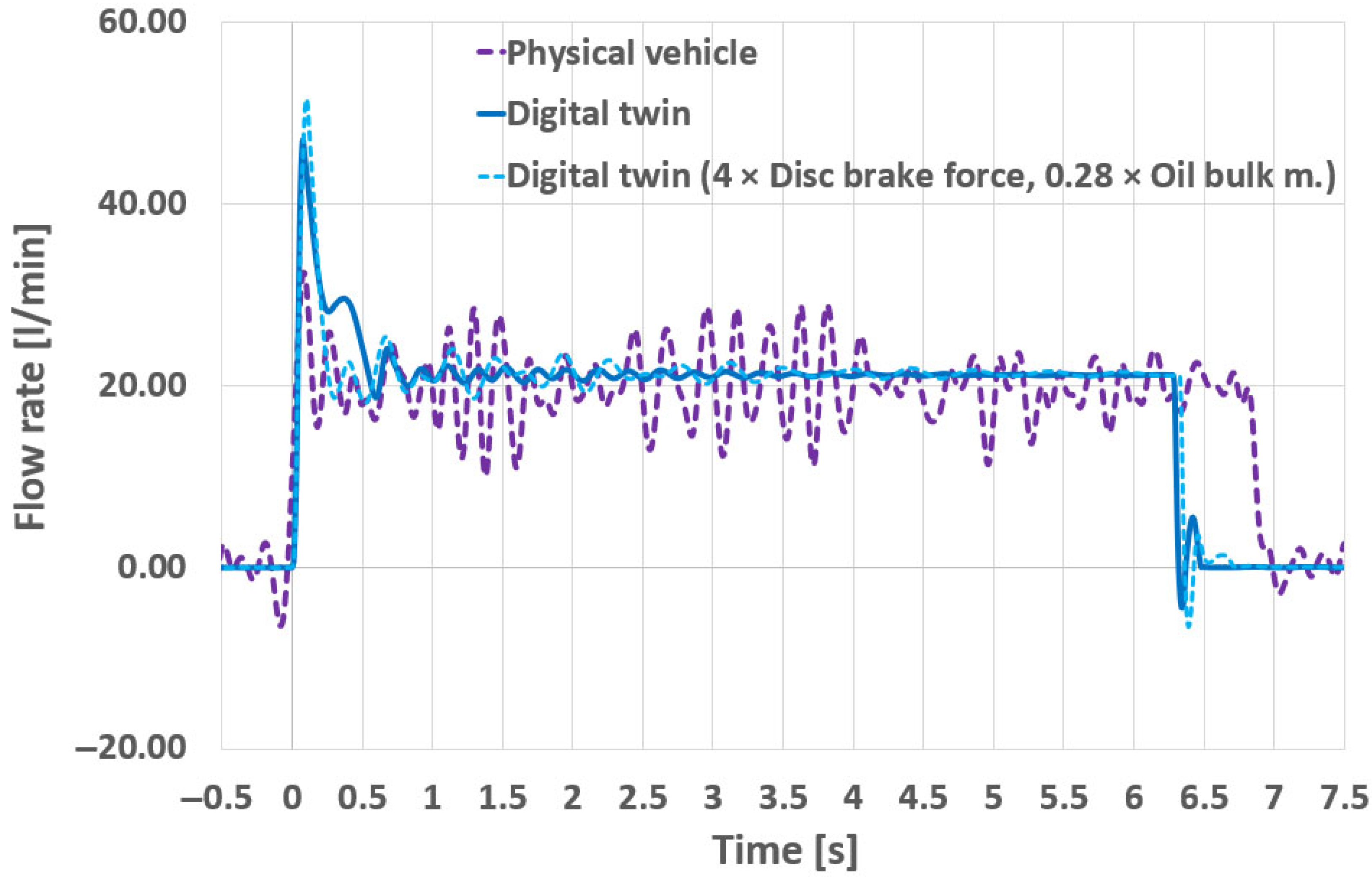
Finally, the effect of applying the multiplication factors is evaluated at 50% turning speed input signal, and the resulting flow rate curves are presented in Figure 16.
Figure 16 shows that, with the multiplication factors applied, the second local maximum of the digital twin occurs after the curve first drops below the steady-state mean flow rate. This is in contrast to the curve of the original digital twin, and more closely resembles the curve of the physical vehicle.
A comparison of the seven flow rate key metrics, at 50% turning speed input signal, is presented in Table 8. To preserve the original intent of the metric “Lowest undershoot”, local minima occurring after 0.7 s were not considered, which was explained in further detail in Section 3.3.3.
Table 8 highlights that, other than regarding the previously mentioned second local maximum, most of the remaining differences resulting from applying the multiplication factors are relatively minor. The most prominent of these remaining differences is in the metric “First overshoot time”, which is increased from 0.08 s to 0.10 s. This increase appears to be mainly caused by a higher first overshoot peak.
Unlike at 75% and 100% input signal, the original digital twin’s first overshoot peak was not lower than that of the physical vehicle, but was instead significantly higher. Therefore, when applying the multiplication factors further increased the height of the overshoot peak, this led to worse agreement with the physical vehicle’s curve. However, the main issue does not appear to lie in the multiplication factors, but rather in pre-existing differences in first overshoot behavior at 50% input signal.
Although input signals as low as 50% are rarely utilized, the root cause behind this difference should still be investigated in future work, as it could reveal some underlying details that differ between the digital and physical articulated joint hydraulics.
For the remaining five flow rate key metrics, only minor differences from applying the multiplication factors were observed, most of which led to slight improvements in agreement. However, the significance of these differences is considered minimal.
In summary, multiplying the disc brake force by 4 and the oil bulk modulus by 0.28 led to better agreement between the digital and physical articulated joint flow rate curves, across all three tested input signal levels. The improved agreement was observed particularly for the three previously identified main differences between the physical and original digital curves. These differences were that the digital twin usually had a lower first overshoot occurring slightly later, a more pronounced second local maximum, and a less pronounced undershoot.
The improved agreement from reducing the oil bulk modulus strengthens the hypothesis that air may be present in the articulated joint’s hydraulic system.
Higher disc brake force also improving the agreement suggests that the total driveline resistance derived from straight-line driving might not fully account for the resistance encountered when turning, especially with the currently used tire modeling strategy. These new insights gained from the validation of the digital twin provide new directions for future research, and give strong indications of where opportunities for improvement of the digital model may lie.
Planned future work includes studying the articulated joint hydraulics in a ViL setup, using wheel-hub mounted dynamometers. Wheel-hub mounted dynamometers eliminate the influence of the physical tires and their ground contact, which is expected to be helpful in further analyses, especially when it comes to studying the resistance encountered when turning.


4. Conclusions

A multi-physics digital twin of an autonomous offroad vehicle with a high level of detail was described and created. The digital twin was real-time capable, using a time step of 1 ms for the main simulation and 33 μs for the hydraulics simulation, enabling HiL and ViL simulation.
Through a comprehensive real-world validation of the digital twin’s articulated joint, the digital twin exhibited validity mostly seen as good to excellent regarding its hydraulics and vehicle dynamics, particularly with regard to the metrics viewed as the most important, which were the mean flow rate and steady-state mean flow rate at 100% and 75% turning speed. These were within 0.00% and 0.35% at 100% turning speed, and 1.58% and 2.65% at 75% turning speed. At the less critical 50% turning speed, some deviations were seen, with the corresponding values being 7.87% and 6.44%. The values at the submaximal turning speeds could, however, be markedly improved by calibration of the nominal flow rate curves if needed. Yet, further analyzing the root cause behind the differences instead could yield valuable insights.
The previously demonstrated promising validity regarding visual representation of environments and exteroceptive sensor emulation [9], combined with the shown real-time capability and the validity of the hydraulics and vehicle dynamics, make for a novel highly versatile digital twin that appears suitable for multi-purpose use during a broad range of R&D activities in the development of autonomous offroad vehicles. Used as a unified framework, ML for development of control algorithms that leverage both visual input and mechanical systems is also enabled.

Author Contributions

Conceptualization, M.L.; methodology, M.L.; software, M.L.; validation, M.L., H.L. and T.L.; formal analysis, M.L.; investigation, M.L., T.L. and H.L.; resources, M.K.; data curation, M.L.; writing—original draft preparation, M.L.; writing—review and editing, M.L., H.L., T.L. and M.K.; visualization, M.L.; project administration, M.K.; funding acquisition, M.K. and H.L. All authors have read and agreed to the published version of the manuscript.

Funding

This research was conducted within the projects Nordic Platform for Development of Autonomous Utility Vehicles (NUVE) (NYPS 20202905) and Sustainable Autonomous Material Handling (SAMHand) (NYPS 20357984), both funded by the EU and Region Norrbotten through Interreg Nord and Interreg Aurora, respectively, along with support from multiple additional stakeholders.

Data Availability Statement

The datasets presented in this article are not readily available due to time limitations. Requests to access the datasets should be directed to mattias.lehto@ltu.se.

Conflicts of Interest

The authors declare no conflicts of interest. The funders had no role in the design of the study; in the collection, analyses, or interpretation of data; in the writing of the manuscript; or in the decision to publish the results.

References

  1. Ulrich, K.; Eppinger, S.; Yang, M. Product Design and Development, 7th ed.; McGraw-Hill Education: New York, NY, USA, 2019. [Google Scholar]
  2. Pandharipande, A.; Cheng, C.H.; Dauwels, J.; Gurbuz, S.Z.; Ibanez-Guzman, J.; Li, G.; Piazzoni, A.; Wang, P.; Santra, A. Sensing and Machine Learning for Automotive Perception: A Review. IEEE Sens. J. 2023, 23, 11097–11115. [Google Scholar] [CrossRef]
  3. Lindroos, O.; La Hera, P.; Häggström, C. Drivers of advances in mechanized timber harvesting—A selective review of technological innovation. Croat. J. For. Eng. 2017, 38, 243–258. [Google Scholar]
  4. Jelavic, E.; Jud, D.; Egli, P.; Hutter, M. Towards Autonomous Robotic Precision Harvesting. arXiv 2021, arXiv:2104.10110. [Google Scholar] [CrossRef]
  5. Andersson, J.; Bodin, K.; Lindmark, D.; Servin, M.; Wallin, E. Reinforcement Learning Control of a Forestry Crane Manipulator. In Proceedings of the IEEE International Conference on Intelligent Robots and Systems, Prague, Czech Republic, 27 September–1 October 2021. [Google Scholar]
  6. Li, S.; Lideskog, H. Realization of Autonomous Detection, Positioning and Angle Estimation of Harvested Logs. Croat. J. For. Eng. 2023, 44, 369–383. [Google Scholar] [CrossRef]
  7. Li, S.; Lideskog, H. Implementation of a system for real-time detection and localization of terrain objects on harvested forest land. Forests 2021, 12, 1142. [Google Scholar] [CrossRef]
  8. Choi, H.S.; Crump, C.; Duriez, C.; Elmquist, A.; Hager, G.; Han, D.; Hearl, F.; Hodgins, J.; Jain, A.; Leve, F.; et al. On the use of simulation in robotics: Opportunities, challenges, and suggestions for moving forward. Proc. Natl. Acad. Sci. USA 2021, 118, e1907856118. [Google Scholar]
  9. Lehto, M.; Lideskog, H.; Karlberg, M. Log detection for autonomous forwarding using auto-annotated data from a real-time virtual environment. J. Terramech. 2026, 121, 101096. [Google Scholar] [CrossRef]
  10. Fathy, H.K.; Filipi, Z.S.; Hagena, J.; Stein, J.L. Review of hardware-in-the-loop simulation and its prospects in the automotive area. In Proceedings of the SPIE—The International Society for Optical Engineering, San Diego, CA, USA, 13–17 August 2006. [Google Scholar]
  11. Tsolakis, N.; Bechtsis, D.; Bochtis, D. Agros: A robot operating system based emulation tool for agricultural robotics. Agronomy 2019, 9, 403. [Google Scholar] [CrossRef]
  12. Zheng, Y.; Cheng, B.; Huang, Q.; Liu, J. Research on Virtual Driving System of a Forestry Logging Harvester. Wirel. Pers. Commun. 2018, 102, 667–682. [Google Scholar] [CrossRef]
  13. Dabbiru, L.; Goodin, C.; Scherrer, N.; Carruth, D. LiDAR Data Segmentation in Off-Road Environment Using Convolutional Neural Networks (CNN). SAE Int. J. Adv. Curr. Pr. Mobil. 2020, 2, 3288–3292. [Google Scholar]
  14. Wolf, P.; Groll, T.; Hemer, S.; Berns, K. Evolution of robotic simulators: Using UE 4 to enable real-world quality testing of complex autonomous robots in unstructured environments. 2020. In Proceedings of the 10th International Conference on Simulation and Modeling Methodologies, Technologies and Applications (SIMULTECH 2020), Paris, France, 8–10 July 2020. [Google Scholar]
  15. Baharudin, M.E.; Rouvinen, A.; Korkealaakso, P.; Mikkola, A. Real-time multibody application for tree harvester truck simulator. Proc. Inst. Mech. Eng. Part K J. Multi-Body Dyn. 2014, 228, 182–198. [Google Scholar] [CrossRef]
  16. Grondin, V.; Fortin, J.; Pomerleau, F.; Giguère, P. Tree detection and diameter estimation based on deep learning. For. Int. J. For. Res. 2023, 96, 264–276. [Google Scholar] [CrossRef]
  17. Condat, R.; Vasseur, P.; Allibert, G. Focusing on Object Extremities for Tree Instance Segmentation in Forest Environments. IEEE Robot. Autom. Lett. 2024, 9, 5480–5487. [Google Scholar] [CrossRef]
  18. Raikwar, S.; Wani, L.J.; Kumar, S.A.; Rao, M.S. Hardware-in-the-Loop test automation of embedded systems for agricultural tractors. Measurement 2019, 133, 271–280. [Google Scholar]
  19. Engelmann, D.; Unger, M.R.; Geimer, M. Testing and benchmarking a powertrain with independent wheel control for heavy machinery. VDI Ber. 2017, 2300, 303–313. [Google Scholar]
  20. Lee, C.J.; Jeon, C.W.; Han, X.Z.; Kim, J.H.; Kim, H.J. Electro-hydraulic steering control system for automated steering of an agricultural tractor. In Proceedings of the 2017 ASABE Annual International Meeting, Washington, DC, USA, 16–19 July 2017. [Google Scholar]
  21. Kelber, C.R.; Reis, B.R.; Figueiredo, R.M. Improving functional safety in autonomous guided agricultural self propelled machines using hardware-in-The-loop (HIL) systems for software validation. In Proceedings of the IEEE Conference on Intelligent Transportation Systems (ITSC 2016), Rio de Janeiro, Brazil, 1–4 November 2016. [Google Scholar]
  22. Dallas, J.; Cole, M.P.; Jayakumar, P.; Ersal, T. Terrain adaptive trajectory planning and tracking on deformable terrains. IEEE Trans. Veh. Technol. 2021, 70, 11255–11268. [Google Scholar] [CrossRef]
  23. Peiret, A.; Karpman, E.; Kovács, L.L.; Kövecses, J.; Holz, D.; Teichmann, M. Modelling of off-road wheeled vehicles for real-time dynamic simulation. J. Terramech. 2021, 97, 45–58. [Google Scholar] [CrossRef]
  24. Lehto, M.; Tikanmäki, A.; Lindbäck, T.; Lideskog, H.; Karlberg, M. Modeling and verification of a full-scale forestry vehicle real-time multi-physics digital twin. In Proceedings of the 16th European-African Regional Conference of the ISTVS, Lublin, Poland, 11–14 October 2023. [Google Scholar]
  25. Lideskog, H.; Karlberg, M.; Bergsten, U. Development of a Research Vehicle Platform to Improve Productivity and Value-extraction in Forestry. Procedia CIRP 2015, 38, 68–73. [Google Scholar] [CrossRef]
  26. La Hera, P.; Mendoza-Trejo, O.; Lindroos, O.; Lideskog, H.; Lindbäck, T.; Latif, S.; Li, S.; Karlberg, M. Exploring the feasibility of autonomous forestry operations: Results from the first experimental unmanned machine. J. Field Robot. 2024, 41, 942–965. [Google Scholar] [CrossRef]
  27. Verma, R.; Del Vecchio, D.; Fathy, H.K. Development of a scaled vehicle with longitudinal dynamics of an HMMWV for an ITS testbed. IEEE/ASME Trans. Mechatron. 2008, 13, 46–57. [Google Scholar] [CrossRef]
  28. Mevea. Available online: https://mevea.com (accessed on 17 December 2025).
  29. Unity. Available online: https://unity.com (accessed on 17 December 2025).
  30. Kikuchi, N.; Song, Y.J. Penalty/finite-element approximations of a class of unilateral problems in linear elasticity. Q. Appl. Math. 1981, 39, 1–22. [Google Scholar] [CrossRef]
  31. Watton, J. Fluid Power Systems: Modeling, Simulation, Analog, and Microcomputer Control, 1st ed.; Prentice Hall International: Hemel Hempstead, UK, 1989. [Google Scholar]
  32. Rahikainen, J.; Mikkola, A.; Sopanen, J.; Gerstmayr, J. Combined semi-recursive formulation and lumped fluid method for monolithic simulation of multibody and hydraulic dynamics. Multibody Syst. Dyn. 2018, 44, 293–311. [Google Scholar] [CrossRef]
  33. Johnston, D.N.; Way, T.M.; Cone, K.M. Measured dynamic properties of flexible hoses. J. Vib. Acoust. 2010, 132, 021011. [Google Scholar] [CrossRef]
  34. Gholizadeh, H.; Bitner, D.; Burton, R.; Schoenau, G. Modeling and experimental validation of the effective bulk modulus of a mixture of hydraulic oil and air. J. Dyn. Syst. Meas. Control. Trans. ASME 2014, 136, 051013. [Google Scholar] [CrossRef]
  35. Tanaka, Y.; Sakama, S.; Goto, H. Experimental investigation of effective bulk modulus of oil with entrained air bubbles. In Proceedings of the MOVIC 2014—12th International Conference on Motion and Vibration Control, Sapporo, Japan, 3–7 August 2014. [Google Scholar]
  36. Nielsen, L.; Sandberg, T. A New Model for Rolling Resistance of Pneumatic Tires. SAE Trans. 2002, 111, 1572–1579. [Google Scholar]
  37. Lippert, D.; Spektor, J. Rolling Resistance and Industrial Wheels. In Hamilton White Paper; Hamilton Caster: Hamilton, OH, USA, 2013; Number 11. [Google Scholar]
Figure 1. The modular offroad vehicle AORO (Arctic Offroad Robotics Lab).
Machines 14 00128 g001
Figure 2. Detailed CAD model of the AORO vehicle.
Machines 14 00128 g002
Figure 3. Simplified collision graphics.
Machines 14 00128 g003
Figure 4. Simplified hydraulics system overview.
Machines 14 00128 g004
Figure 5. Simplified description of the hydraulic driveline circuit. The forward side of the hydraulic circuit is drawn using black solid lines and the return side is drawn using blue solid lines. Dashed lines are used to show that the connection is only active on the side of the circuit with lower pressure.
Machines 14 00128 g005
Figure 6. The articulated joint viewed from above in the digital twin. The hydraulic hoses are not included in the visualization graphics of the digital twin.
Machines 14 00128 g006
Figure 7. Overview of the articulated joint hydraulics.
Machines 14 00128 g007
Figure 8. The mean flow rate curves of the L90LS valve with respect to the input signal. The mean flow rate curves were used to represent the nominal flow rate curves of the L90LS valve of the digital twin.
Machines 14 00128 g008
Figure 9. Angular values from the articulated joint’s rotary sensor on the physical vehicle, before and after applying a 4th-order Butterworth low-pass filter with a cutoff frequency of 7 Hz.
Machines 14 00128 g009
Figure 10. Flow rate of the physical vehicle’s articulated joint during a full left turn at full turning speed, based on the low-pass filtered angular data and the articulated joint’s geometry. The calculated mean flow rate required to complete the turn within the measured turn duration is also presented.
Machines 14 00128 g010
Figure 11. Articulated joint flow rates of the digital twin and the physical vehicle during left turns at full turning speed.
Machines 14 00128 g011
Figure 12. Articulated joint flow rates of the digital twin and the physical vehicle during left turns at 75% turning speed input signal.
Machines 14 00128 g012
Figure 13. Articulated joint flow rates of the digital twin and the physical vehicle during left turns at 50% turning speed input signal.
Machines 14 00128 g013
Figure 14. The effects of multiplying the disc brake force by 4 and the oil bulk modulus by 0.28 on the flow rate curve of the digital twin, at full turning speed input signal.
Machines 14 00128 g014
Figure 15. The effects of multiplying the disc brake force by 4 and the oil bulk modulus by 0.28 on the flow rate curve of the digital twin, at 75% turning speed input signal.
Machines 14 00128 g015
Figure 16. The effects of multiplying the disc brake force by 4 and the oil bulk modulus by 0.28 on the flow rate curve of the digital twin, at 50% turning speed input signal.
Machines 14 00128 g016
Table 1. Simplified and corresponding actual component names.
Simplified Component NameComponent Name
Articulated joint cylinderSide System (Oviken, Sweden) Hydagent 80/40-265
CraneCranab (Vindeln, Sweden) FC8DT with CR250 gripper
Diesel engineJohn Deere (Moline, IL, USA) Powertech 4045
Traction control valvesPoclain (Verberie, France) INT-VMA-H15
Pendulum arm cylinderSide System Hydagent 80/40-370
Pump 1Poclain P90R130
Pump 2Bosch (Gerlingen, Germany) A10VO140
Valve L90LSParker (Cleveland, OH, USA) L90LS
Wheel motor/MotorPoclain MSE18
Table 2. The mean flow rate of the L90LS valve with respect to the input signal.
Input Signal [|V|]0.230.301.001.502.00
Flow rate—Left turn [L/min]0.0>0.020.455.370.6
Flow rate—Right turn [L/min]0.00.012.543.265.4
Table 3. The seven flow rate key metrics, measured at full turning speed. Additionally, a comparison between the digital twin and the physical vehicle is included.
VehicleTime to Complete Turn [s]Mean Flow Rate [L/min]Steady-State Mean Flow Rate [L/min]First Overshoot Peak [L/min]First Overshoot Time [s]Lowest Undershoot [L/min]Overshoot Peak at ~0.7 s [L/min]
Physical vehicle1.9870.669.0104.40.1546.888.7
Digital twin1.9870.668.899.10.1062.876.8
Dig .   twin Phys .   veh . ±0.00%±0.00%−0.35%−5.10%−33.3%+34.2%−13.4%
Table 4. The seven flow rate key metrics, measured at 75% turning speed. Additionally, a comparison between the digital twin and the physical vehicle is included.
VehicleTime to Complete Turn [s]Mean Flow Rate [L/min]Steady-State Mean Flow Rate [L/min]First Overshoot Peak [L/min]First Overshoot Time [s]Lowest Undershoot [L/min]Overshoot Peak at ~0.7 s [L/min]
Physical vehicle2.5355.353.592.30.1440.960.7
Digital twin2.4956.254.983.70.0950.160.5
Dig .   twin Phys .   veh . −1.58%−1.58%+2.65%−9.30%−35.7%+22.4%−0.39%
Table 5. The seven flow rate key metrics, measured at 50% turning speed. Additionally, a comparison between the digital twin and the physical vehicle is included.
VehicleTime to Complete Turn [s]Mean Flow Rate [L/min]Steady-State Mean Flow Rate [L/min]First Overshoot Peak [L/min]First Overshoot Time [s]Lowest Undershoot * [L/min]Overshoot Peak at ~0.7 s [L/min]
Physical vehicle6.8620.419.932.40.0815.4 *24.7
Digital twin6.3222.121.247.00.0818.7 *24.1
Dig .   twin Phys .   veh . −7.87%−7.87%+6.44%+45.0%±0.00%+21.1%−2.53%
* Local minima after 0.7 s were not considered.
Table 6. The seven flow rate key metrics for the physical vehicle, the digital twin (DT), and the digital twin modified by multiplying the disc brake force and oil bulk modulus by the factors 4 and 0.28, respectively (DT-mod.), at full turning speed input signal. Additionally, comparisons between the digital twins and the physical vehicle are included.
VehicleTime to Complete Turn [s]Mean Flow Rate [L/min]Steady-State Mean Flow Rate [L/min]First Overshoot Peak [L/min]First Overshoot Time [s]Lowest Undershoot [L/min]Overshoot Peak at ~0.7 s [L/min]
Physical vehicle1.9870.669.0104.40.1546.888.7
DT1.9870.668.899.10.1062.876.8
DT-mod. (f. 4,
f. 0.28)
1.9870.669.7111.00.1359.583.7
DT Phys .   veh . ±0.00%±0.00%−0.35%-5.10%−33.3%+34.2%−13.4%
DT - mod . Phys .   veh . ±0.00%±0.00%+0.95%+6.30%−13.3%+27.2%−5.58%
Table 7. The seven flow rate key metrics for the physical vehicle, the digital twin (DT), and the digital twin modified by multiplying the disc brake force and oil bulk modulus by the factors 4 and 0.28, respectively (DT-mod.), at 75% turning speed input signal. Additionally, comparisons between the digital twins and the physical vehicle are included.
VehicleTime to Complete Turn [s]Mean Flow Rate [L/min]Steady-State Mean Flow Rate [L/min]First Overshoot Peak [L/min]First Overshoot Time [s]Lowest Undershoot [L/min]Overshoot Peak at ~0.7 s [L/min]
Physical vehicle2.5355.353.592.30.1440.960.7
DT2.4956.254.983.70.0950.160.5
DT-mod. (f. 4,
f. 0.28)
2.4956.255.296.60.1249.464.1
DT Phys .   veh . −1.58%−1.58%+2.65%−9.30%−35.7%+22.4%−0.39%
DT - mod . Phys .   veh . −1.58%−1.58%+3.29%+4.71%−14.3%+20.8%+5.48%
Table 8. The seven flow rate key metrics for the physical vehicle, the digital twin (DT), and the digital twin modified by multiplying the disc brake force and oil bulk modulus by the factors 4 and 0.28, respectively (DT-mod.), at 50% turning speed input signal. Additionally, comparisons between the digital twins and the physical vehicle are included.
VehicleTime to Complete Turn [s]Mean Flow Rate [L/min]Steady-State Mean Flow Rate [L/min]First Overshoot Peak [L/min]First Overshoot Time [s]Lowest Undershoot * [L/min]Overshoot Peak at ~0.7 s [L/min]
Physical vehicle6.8620.419.932.40.0815.4 *24.7
DT6.3222.121.247.00.0818.7 *24.1
DT-mod. (f. 4,
f. 0.28)
6.3622.021.351.60.1018.1 *25.4
DT Phys .   veh . −7.87%−7.87%+6.44%+45.0%±0.00%+21.1%−2.53%
DT - mod . Phys .   veh . −7.29%−7.29%+7.16%+59.0%+25.0%+17.3%+2.84%
* Local minima after 0.7 s were not considered.
Disclaimer/Publisher’s Note: The statements, opinions and data contained in all publications are solely those of the individual author(s) and contributor(s) and not of MDPI and/or the editor(s). MDPI and/or the editor(s) disclaim responsibility for any injury to people or property resulting from any ideas, methods, instructions or products referred to in the content.