Article

TOPSIS-Based Methodology for Selecting Fused Filament Fabrication Machines

by
Vignesh Venkat Raman
,
Rakshith Badarinath
and
Vittaldas V. Prabhu
*
Marcus Department of Industrial and Manufacturing Engineering, The Pennsylvania State University, University Park, PA 16802, USA
*
Author to whom correspondence should be addressed.
Machines 2025, 13(7), 574; https://doi.org/10.3390/machines13070574

Submission received: 17 April 2025 / Revised: 24 June 2025 / Accepted: 28 June 2025 / Published: 1 July 2025
(This article belongs to the Special Issue Recent Developments in Machine Design, Automation and Robotics)

Abstract

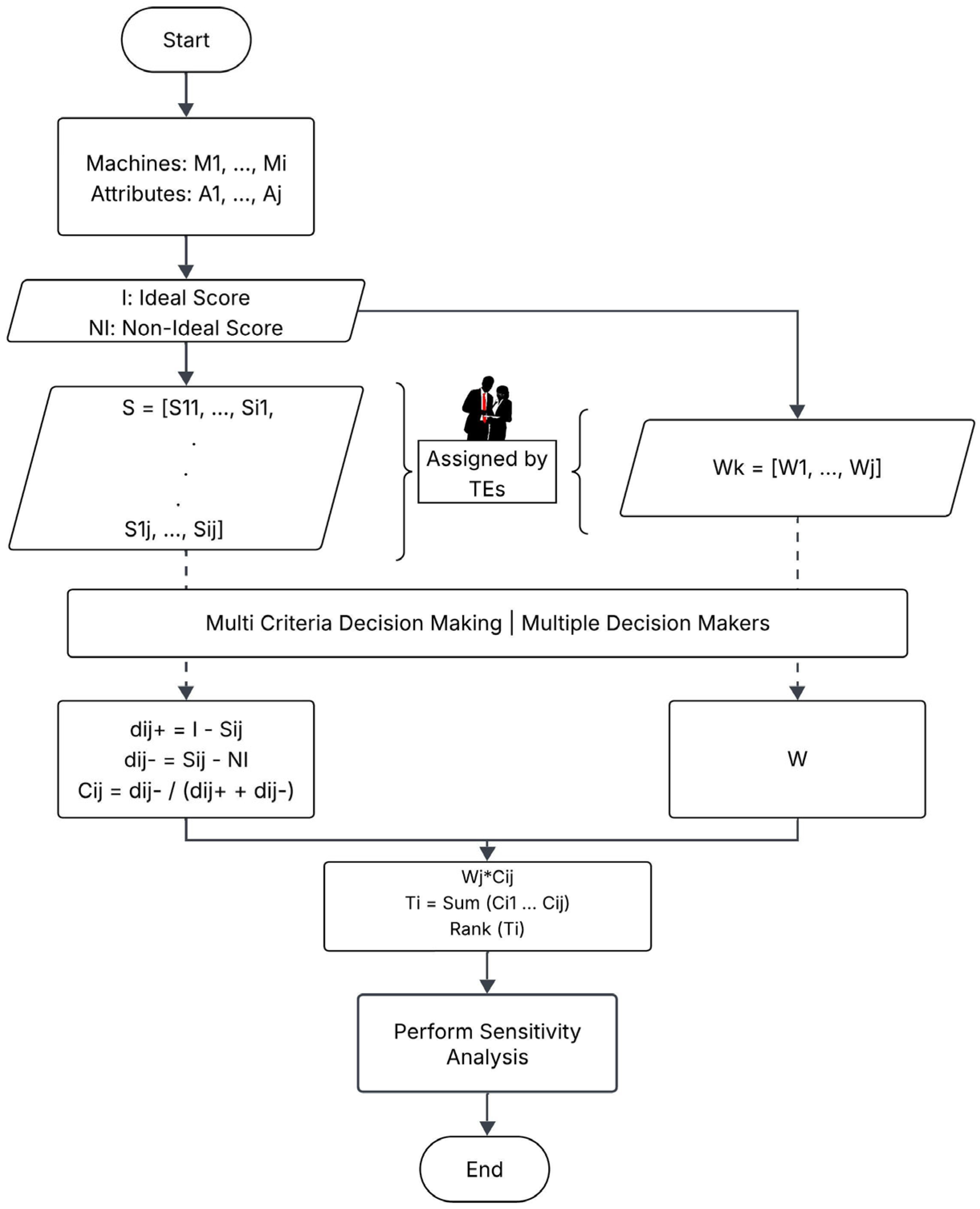
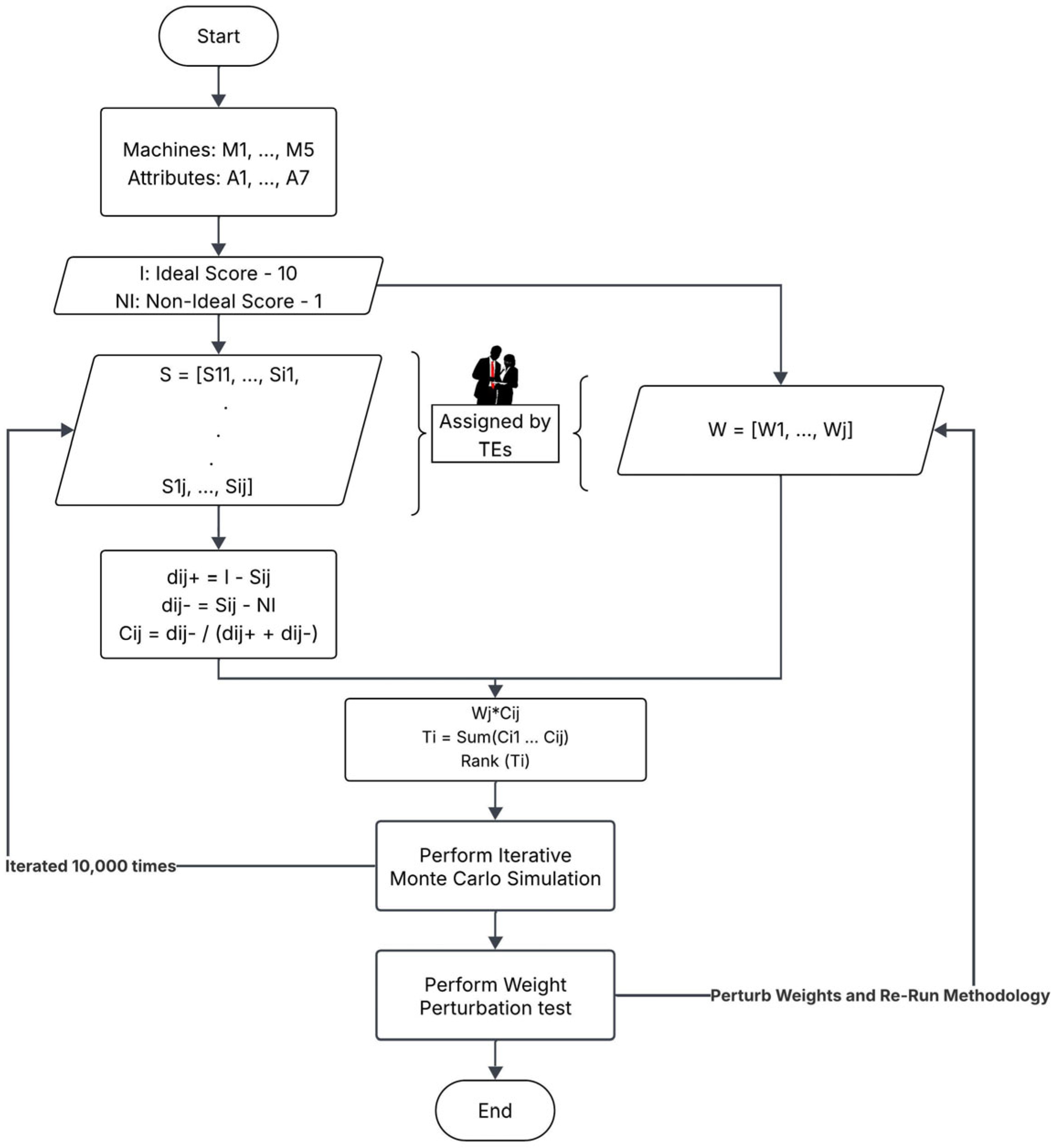
Additive manufacturing (AM) has been gaining increased traction in the manufacturing industry due to its ability to fabricate prototypes and end use parts in low volumes at a much lower cost compared to conventional manufacturing processes. There has been research to select an AM process appropriate for fabricating particular parts. However, there is little extant research to select appropriate AM machines even though there is a growing number of AM machines with interesting topologies, structures, and systems. This paper proposes a methodology that aims to assist Technical Experts in selecting a machine for Fused Filament Fabrication (FFF). The methodology is built around a weighted Technique for Order of Preference by Similarity to Ideal Solution (TOPSIS), which uses the concept of relative closeness and attribute weights to rank the machines. The paper uses Monte Carlo simulations for sensitivity analysis to evaluate the impact of randomizing attribute scoring, perturbing weights assigned, and probability distributions used to model human decision variability. The methodology and the sensitivity analysis were applied to three case studies, with five FFF machines and seven attributes, and top machines ranked for a specific part were found to be largely robust.
Keywords: Fused Filament Fabrication; TOPSIS; material extrusion; machine selection; Monte Carlo sensitivity analysis Fused Filament Fabrication; TOPSIS; material extrusion; machine selection; Monte Carlo sensitivity analysis