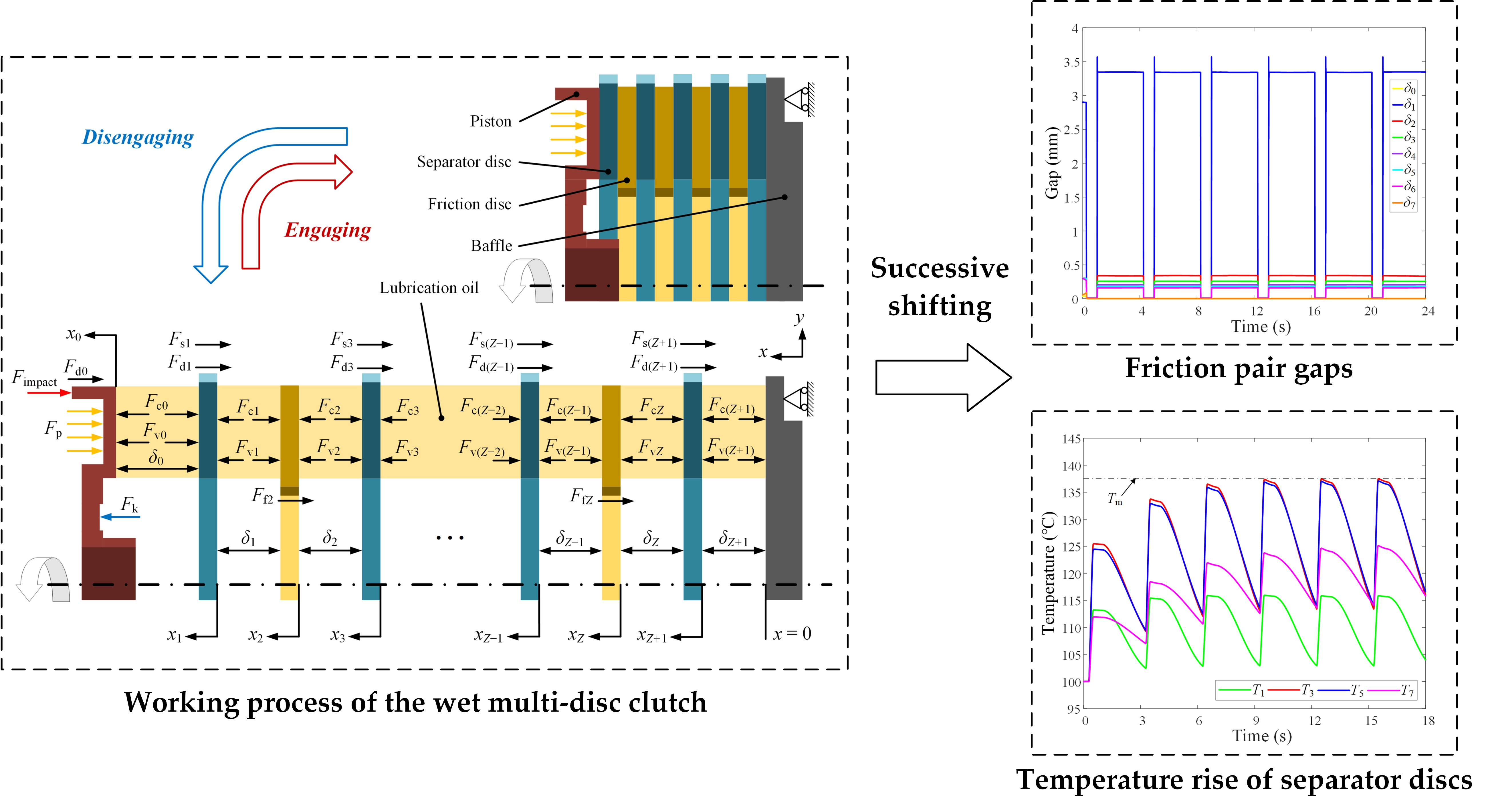
Study on the Temperature Rise Characteristics of Successive Clutch Shifting Considering the Disengaged Friction Pair Gaps



Abstract
Share and Cite
Zheng, L.; Ma, B.; Chen, M.; Yu, L.; Wang, Q.; Xue, J. Study on the Temperature Rise Characteristics of Successive Clutch Shifting Considering the Disengaged Friction Pair Gaps. Machines 2022, 10, 576. https://doi.org/10.3390/machines10070576
Zheng L, Ma B, Chen M, Yu L, Wang Q, Xue J. Study on the Temperature Rise Characteristics of Successive Clutch Shifting Considering the Disengaged Friction Pair Gaps. Machines. 2022; 10(7):576. https://doi.org/10.3390/machines10070576
Chicago/Turabian StyleZheng, Liangjie, Biao Ma, Man Chen, Liang Yu, Qian Wang, and Jiaqi Xue. 2022. "Study on the Temperature Rise Characteristics of Successive Clutch Shifting Considering the Disengaged Friction Pair Gaps" Machines 10, no. 7: 576. https://doi.org/10.3390/machines10070576
APA StyleZheng, L., Ma, B., Chen, M., Yu, L., Wang, Q., & Xue, J. (2022). Study on the Temperature Rise Characteristics of Successive Clutch Shifting Considering the Disengaged Friction Pair Gaps. Machines, 10(7), 576. https://doi.org/10.3390/machines10070576