


Abstract
This work focuses on a class of nonlinear second-order difference equations with non-autonomous periodic coefficients. We obtain explicit solution formulas that allow for a constructive characterization of their behavior. In particular, we derive necessary and sufficient conditions for the existence of periodic solutions, providing a complete description of when they arise. Several numerical examples are also included to illustrate the theoretical results.
Keywords:
difference equations; explicit formulas of the solutions; periodic solutions; asymptotic behavior MSC:
39A05; 39A10; 39A21; 39A23; 39A30
1. Introduction
Difference equations and their systems are an essential and fundamental tool for studying many discrete models in various fields such as applied mathematics, economics, and engineering. They provide an appropriate framework for describing discrete phenomena characterized by memory effects, delayed responses, or interactions between successive states. This explains the large number of studies dealing with these types of equations and systems. As examples, one may consult the following references [1,2,3,4,5,6,7,8].
Real discrete phenomena subject to periodic or seasonal variations can be modeled using difference equations and systems with periodic coefficients. For instance, in population dynamics, such models incorporate periodically varying parameters to reflect environmental seasonality, while in economics and engineering they capture cyclic behavior driven by internal or external periodic influences. A lot of studies have been devoted to such types of difference equations and systems; see, for example, references [9,10,11,12].
Solving nonlinear difference equations, especially those with non-autonomous coefficients, is challenging due to the lack of a general method; thus, researchers often rely on suitable variable transformations to reduce them to solvable forms and then reconstruct the original solutions. Once explicit formulas are derived, they facilitate a deeper analysis of key properties such as periodicity, asymptotic behavior, and oscillatory dynamics. Motivated by these observations, the present work is devoted to the study of a class of nonlinear second-order difference equations with non-autonomous periodic coefficients.
In realizing the present work, we are mainly motivated by a sequence of contributions that appeared progressively in the literature and that we briefly review below in chronological order. One of the earliest related contributions is due to Elabbasy et al. [13], in which the authors provide, among other things, the explicit formulas of the following nonlinear second-order rational difference equation:
Haddad et al., in [14] and as a generalization of Equation (1), studied the following second-order rational system:
where the parameters and the initial values are positive real numbers. Subsequently, Yazlik et al. [15] extended system (2) to the non-autonomous higher-order system
where and the sequences , , , and are periodic sequences of real numbers. Inspired by the above-mentioned works, Touafek and AL-Juaid [16] recently investigated the solvability of the following autonomous system of difference equations:
where a, and the initial values , , and are non-zero real numbers, while b, c, and are real numbers, and as a consequence of their obtained results, they present the formulas of the solutions of the following autonomous difference equation:
A natural extension of Equation (4) is to ask whether explicit formulas can be derived for the following difference equation with non-autonomous periodic coefficients:
where , , , are periodic sequences of real numbers of period two, and the initial values , , are non-zero real numbers. In this work, we provide a positive answer to this question. Specifically, we derive explicit formulas for the solutions of the equation. These formulas allow us to establish necessary and sufficient conditions for the existence of periodic solutions, leading to a complete characterization of when such solutions occur. In addition, we present results concerning the limiting behavior of solutions. Our theoretical findings are illustrated by several numerical examples. More related works can be found in the following references: [17,18,19].
While the present work is mainly devoted to the solvability of Equation (5) and the existence of periodic solutions, the study of local and global stability remains essential for understanding the robustness and long-term behavior of such solutions. Moreover, bifurcation analysis is crucial for describing qualitative changes in the dynamics caused by variations in the periodic parameters, including transitions between stability and instability and the emergence of more complex behaviors. For some contributions on these important notions, we refer to [20,21,22,23,24,25].
In this work, for periodic solutions, we adopt the following definition.
Definition 1.
A solution of Equation (5) is said to be eventually p-periodic, , if there exists such that
If , the solution is said p-periodic.
Remark 1.
If p in Definition 1 is the smallest for which
the solution is eventually prime p-periodic, respectively, prime p-periodic.
2. Explicit Representation of the Solutions of Equation (5)
In this section, we show that Equation (5) is solvable, and hence we provide explicit representation of its solutions. Following the approach in [14,16], we first transform (5) into a solvable first-order non-autonomous rational difference equation. Then, by considering the parity of , we derive two solvable first-order non-autonomous linear difference equations whose solutions coincide exactly with those of (5).
Let , ,
From (5), we can write
To be well-defined, in identity (6), we must assume that
Our first result is devoted to the explicit formulas of the solutions of Equation (5).
Theorem 1.
Let be a solution of (5), where the following statements are true.
- 1.
- For all , we havewhere
- 2.
- Assume that the sequence is constant, that is .
- If , then for all , we have
- If , then for all , we havewhere
Proof.
Let
It follows from (6) that
It is not hard to see that
Using (10), we obtain
Using the formulas of , , and , we get for all
Equation (17) is a non-autonomous first-order linear difference equation, in , and Equation (18) is a non-autonomous first-order linear difference equation, in ; the formulas of their solutions are given for all by
where
Now, in the case when is a constant sequence, that is , we obtain
So, for all we get
Or equivalently, for all
3. The Behavior of the Solutions of Equation (5) When 1 = 0
From Theorem 1, the behavior of the solutions of Equation (5) depends on the quantities and . When , one of the terms , grows exponentially while the other decays exponentially as . More precisely, if , then
whereas if , the reverse occurs:
Therefore, the asymptotic behavior of the solutions becomes difficult to characterize. Motivated by this observation, we focus in this section on the case where the sequence is constant, namely .
3.1. The Case
The following result, which is a direct consequence of Theorem 1, describes explicitly the formulas of the solutions of Equation (5) when .
Lemma 1.
Theorem 2.
Assume that , and let be a solution of (5). The following statements are true.
- 1.
- The solution is eventually prime 1-periodic if and only if
- 2.
- The solution is eventually prime 2-periodic if and only if
Proof.
- 1.
- First, assume thatthen from Lemma 1, the solution takes the formwhich means that the solution is eventually prime 1-periodic. Second, assume that is eventually prime 1-periodic, thenWe have , so from the formulas of the solutions given in Lemma 1, we get
- 2.
- From Lemma 1, the solution takes the formThat is, the solution repeats with the cycle of the two termsSo the solution will eventually be prime 2-periodic if and only if the terms of its cycle are different; that is, the solution is eventually prime 2-periodic if and only if□
3.2. The Case
The formulas of the solutions of Equation (5) when are represented in the following result.
Lemma 2.
Proof.
By replacing with in Theorem 1, we obtain
The proof is complete. □
Theorem 3.
Assume that and let be a solution of (5). Then:
- 1.
- The solution is prime 1-periodic if and only if
- 2.
- The solution is prime 2-periodic if and only if
Proof.
- 1.
- First assume thatSo, from Lemma 2, we obtainThat is,which means that the solution is prime 1-periodic.Second, assume that the solution is prime 1-periodic, thenso it follows that
- 2.
- First assume thatSo, from Lemma 2, we obtainOr equivalentlyThat is, the solution repeats with the cycle of the two different termsand the solution will be prime 2-periodic.Second, assume that the solution is prime 2-periodic, thenso it follows thatAs the solution is prime 2-periodic, it follows thator equivalently□
As a consequence of Theorem 3, we get the following result.
3.3. The Case
Now, we investigate the behavior of the solutions of Equation (5) in the case The following result is a direct consequence of Theorem 1, so its proof will be omitted.
Theorem 4.
Assume that , and let be a solution of (5). Then, the following statements are true.
- 1.
- If we getand the solution will be prime 2-periodic provided that
- 2.
- If we obtain
3.4. The Case
Here, we investigate the periodicity of the solutions of (5) when .
Theorem 5.
Let be a solution of (5). The following statements are true.
- 1.
- Assume thatthenthat is, the solution is 2-periodic and it will be prime 2-periodic provided that .
- 2.
- Assume thatthen, ifwe obtain
4. Numerical Examples
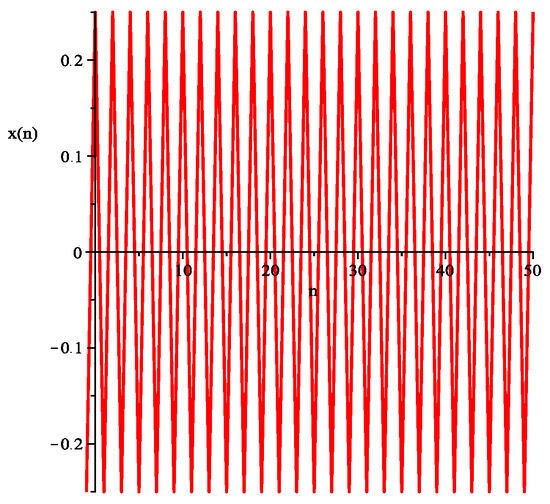
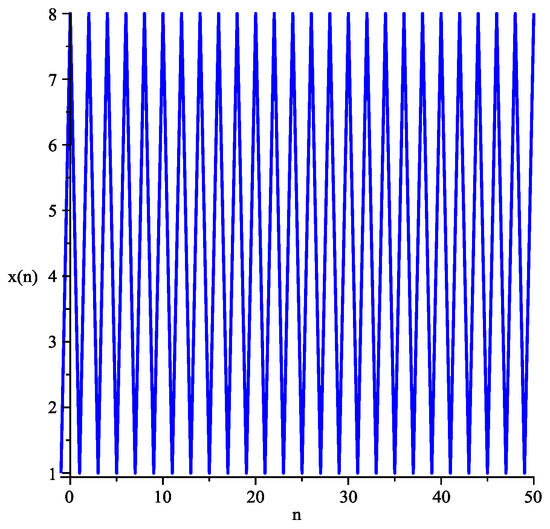
In this section, we present a series of numerical examples, together with their corresponding graphical representations, to illustrate the qualitative behavior of the solutions to Equation (5) when . The numerical results are in full agreement with the theoretical analysis, confirming that the periodicity and asymptotic behavior of the solutions depend on the values of the parameter .
Example 1.
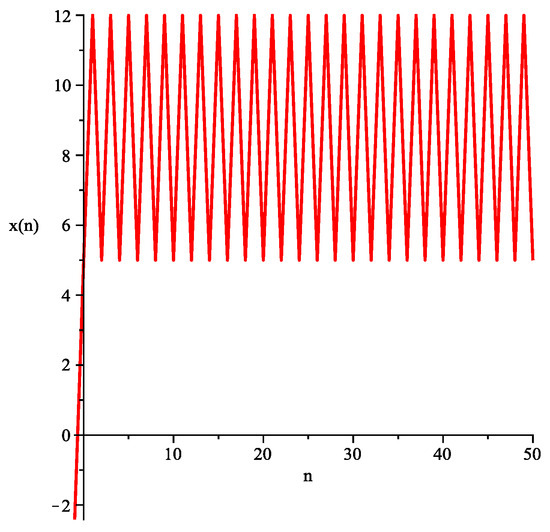
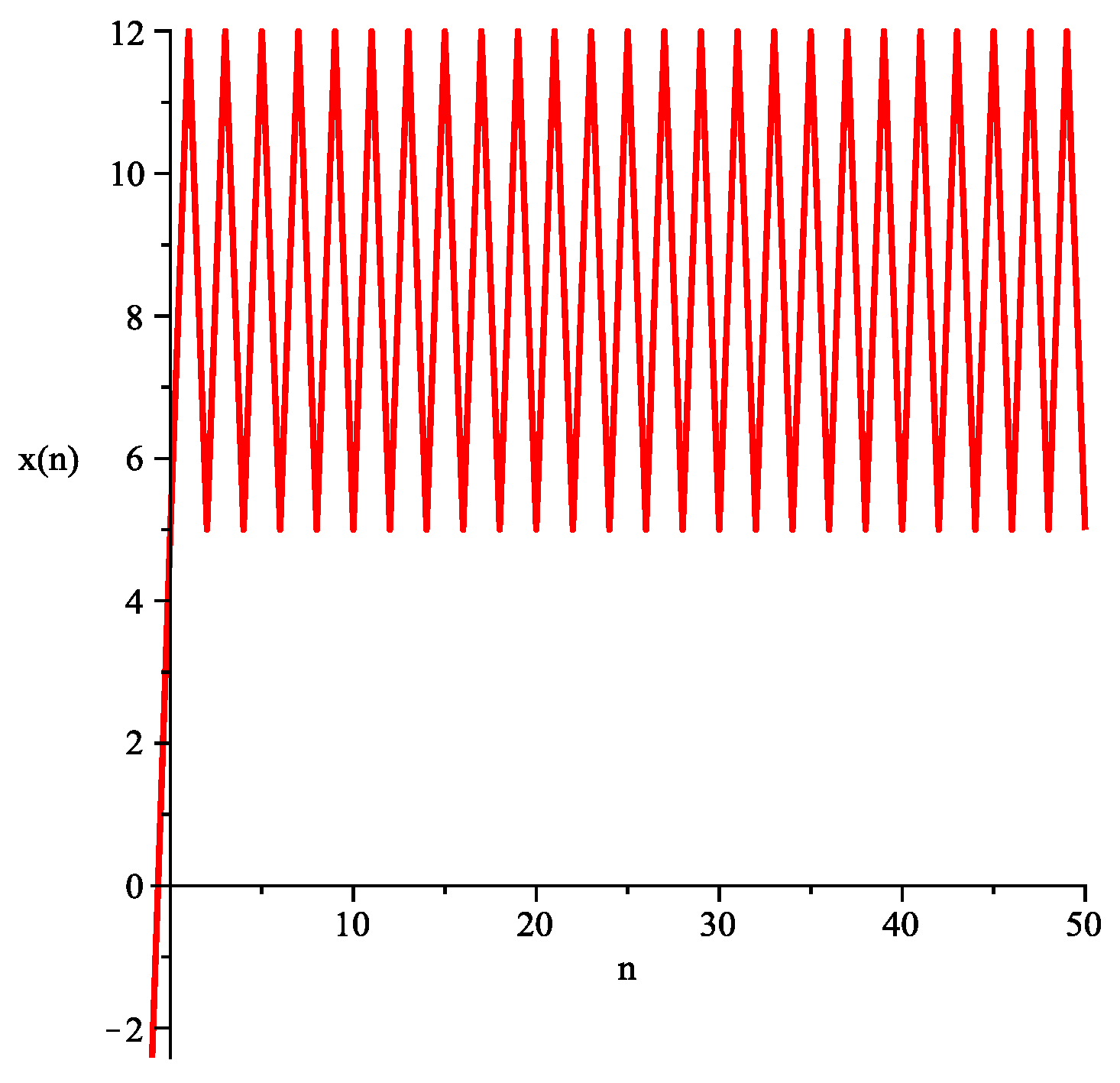
Consider Equation (5), and choose the parameters and initial values as follows:
For this choice, we have , and the solution takes the form
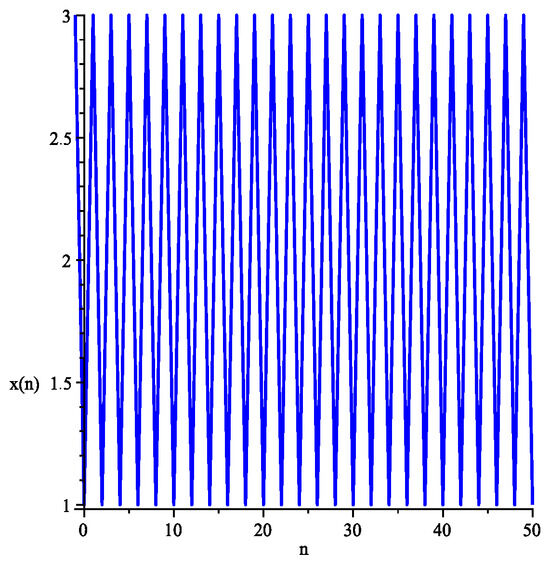
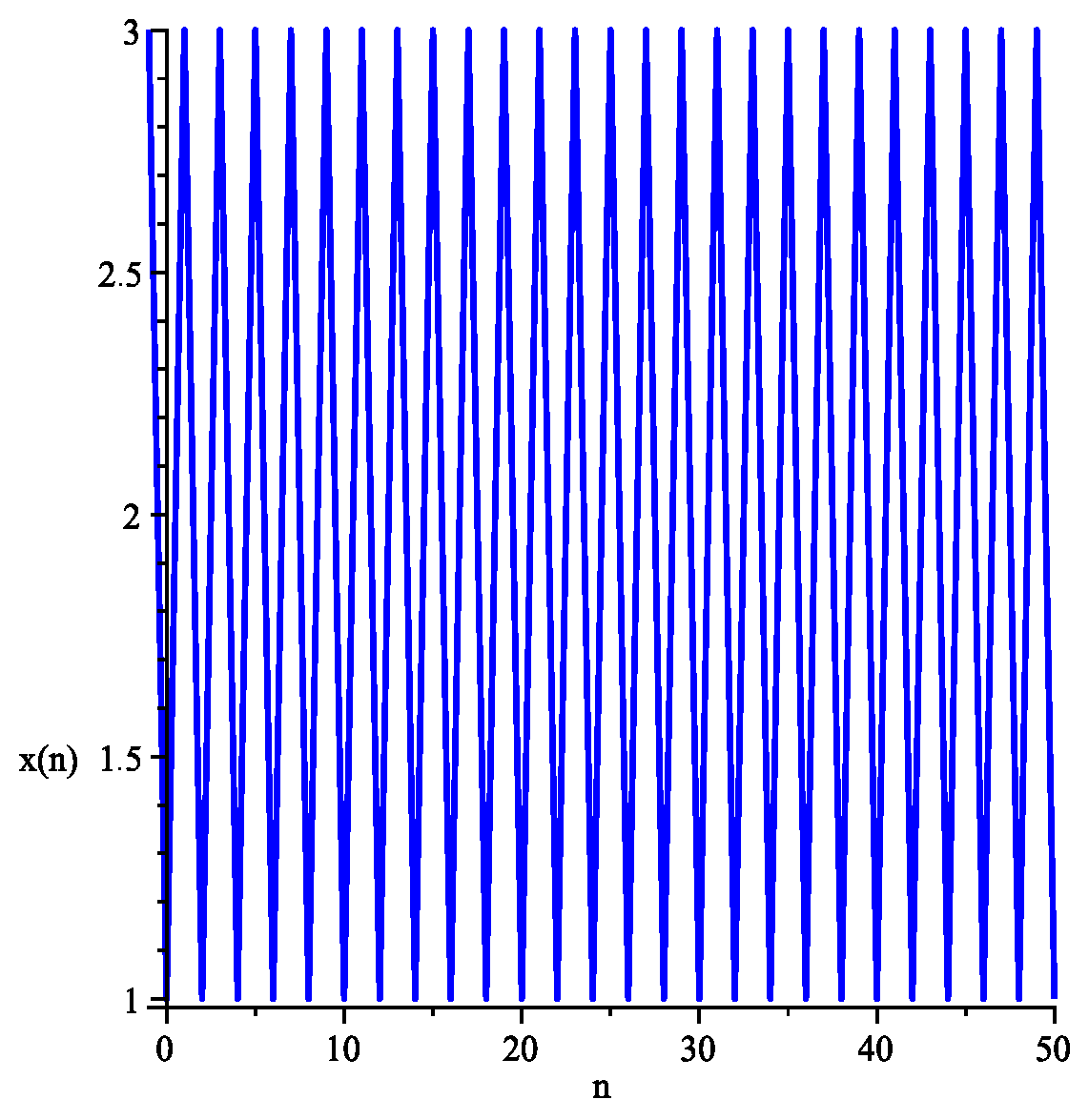
that is, the solution is eventually prime 2-periodic and this confirms the results of Lemma 1 and Theorem 2, case 2. The graph of the solution is presented in Figure 1.
Figure 1.
The graph of the solution of Equation (5) with the parameters and initial values given in Example 1.
Example 2.
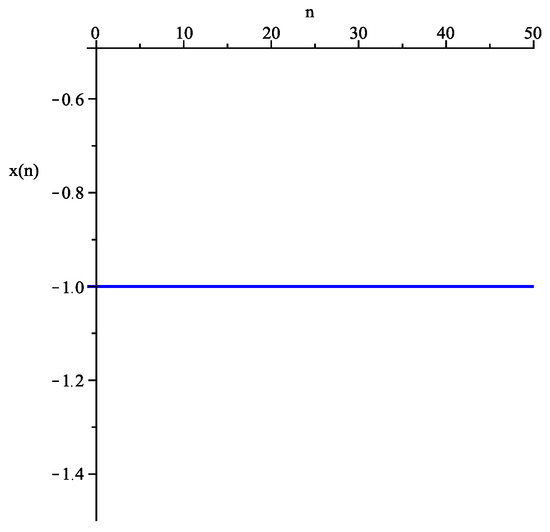
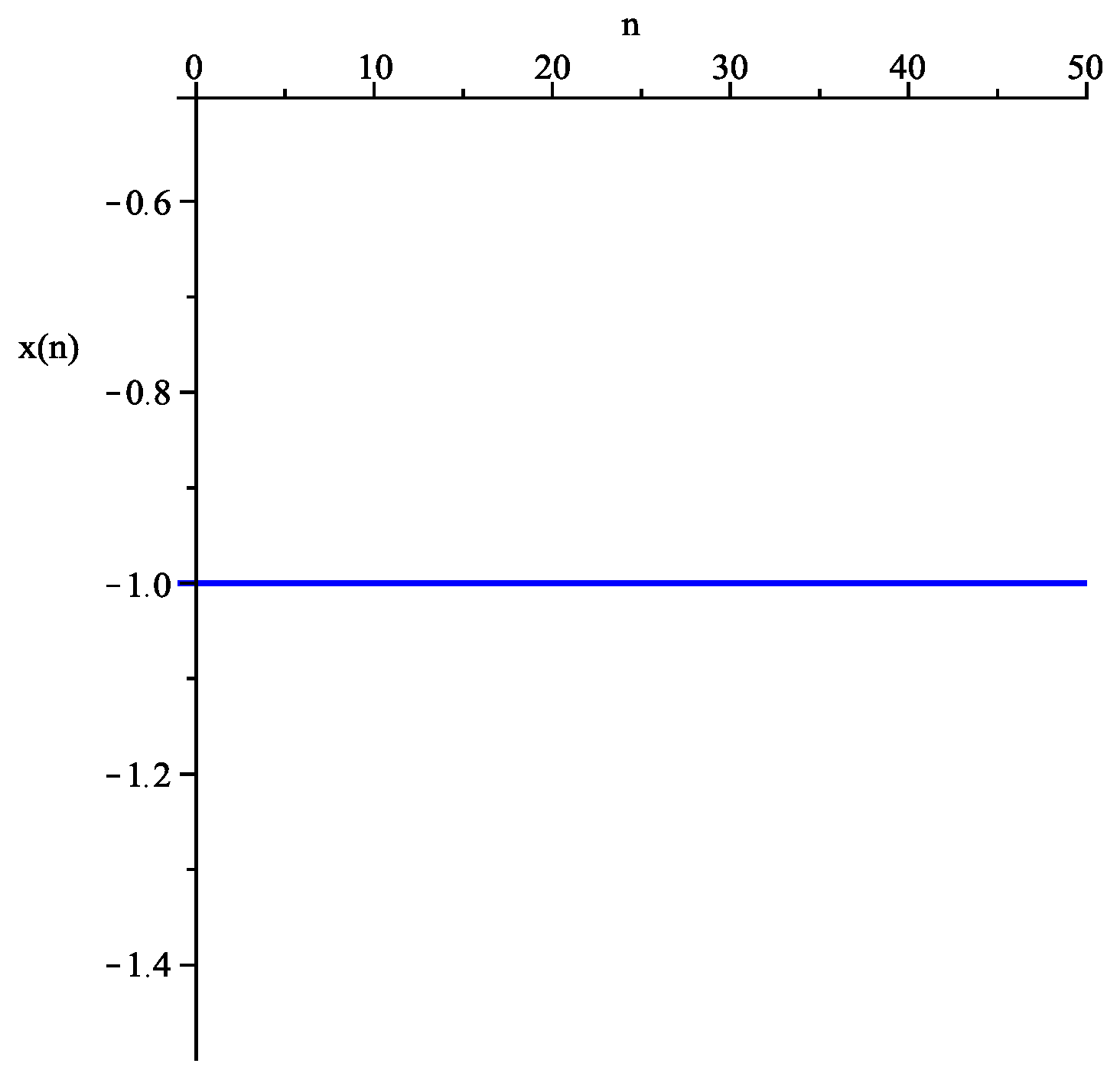
Consider Equation (5), and choose the parameters and initial values as follows:
For this choice, we have , and the solution takes the form
that is, the solution is prime 1-periodic and this confirms the results of Theorem 3, case 1. The graph of the solution is presented in Figure 2.
Figure 2.
The graph of the solution of Equation (5) with the parameters and initial values given in Example 2.
Example 3.
Consider Equation (5), and choose the parameters and initial values as follows:
For this choice, we have , condition (29) is satisfied, and the solution takes the form
that is, the solution is prime 2-periodic and this confirms the results of Theorem 3, case 2. The graph of the solution is presented in Figure 3.
Figure 3.
The graph of the solution of Equation (5) with the parameters and initial values given in Example 3.
Example 4.
Consider Equation (5), and choose the parameters and initial values as follows:
For this choice, we have , conditions (28) and (29) are not satisfied, and the solution takes the form
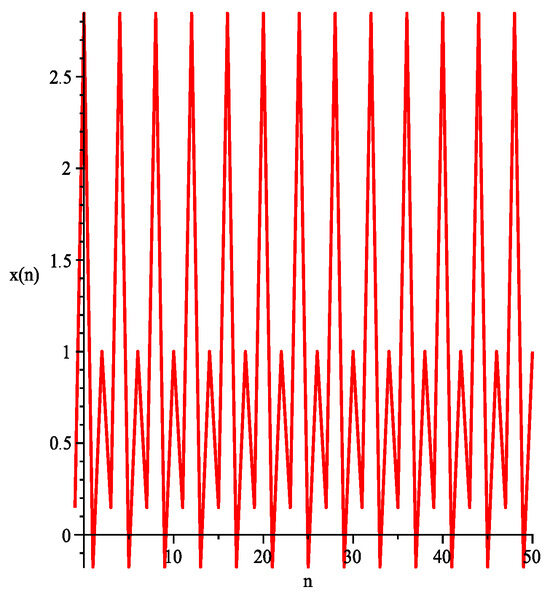
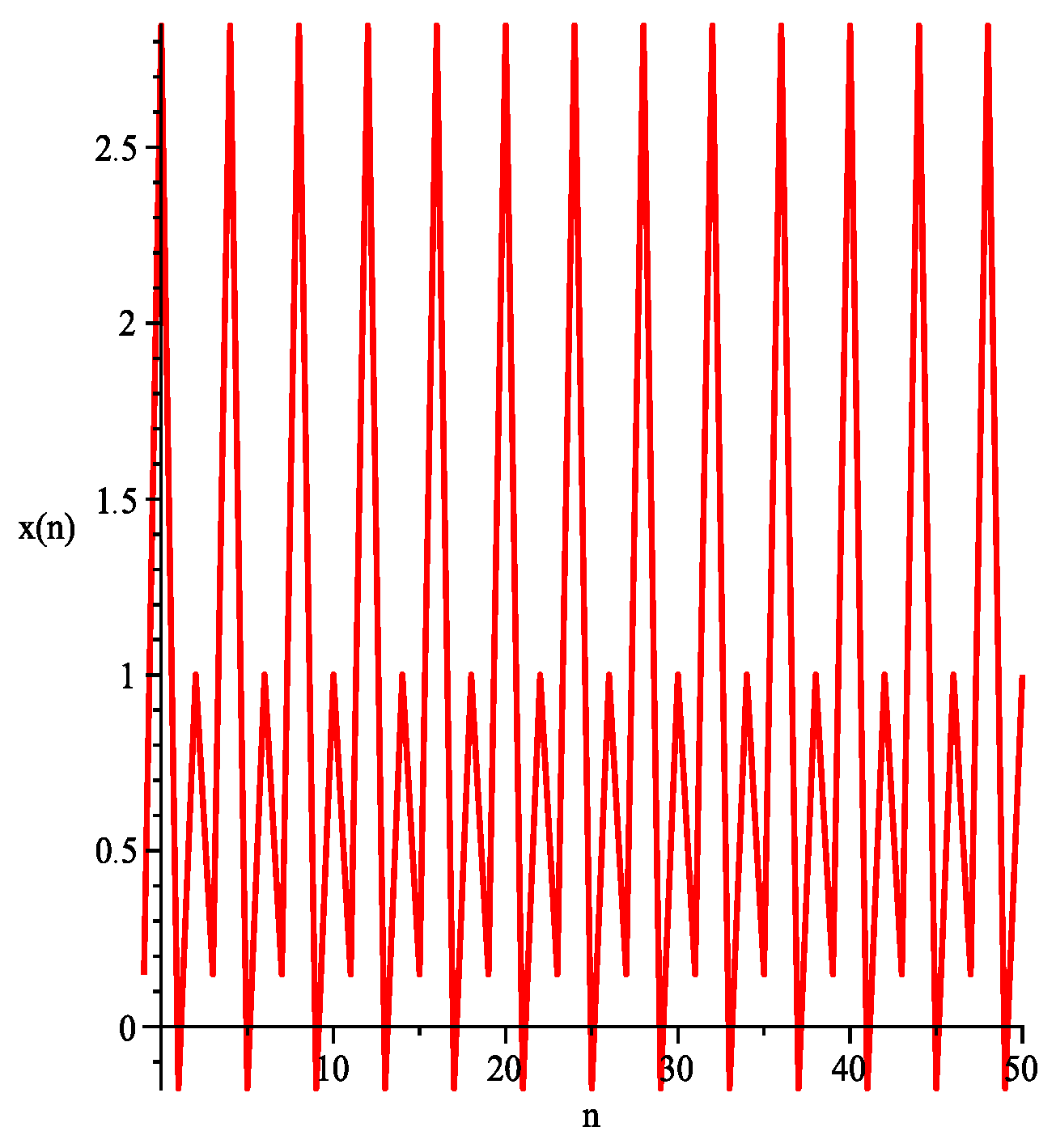
that is, the solution is prime 4-periodic and this confirms the results of Corollary 1. The graph of the solution is presented in Figure 4.
Figure 4.
The graph of the solution of Equation (5) with the parameters and initial values given in Example 4.
Example 5.
Consider Equation (5), and choose the parameters and initial values as follows:
For this choice, we have , , and the solution takes the form
that is, the solution is prime 2-periodic and this confirms the results of Theorem 4. The graph of the solution is presented in Figure 5.
Figure 5.
The graph of the solution of Equation (5) with the parameters and initial values given in Example 5.
Example 6.
Consider Equation (5), and choose the parameters and initial values as follows:
For this choice, condition (32) is satisfied, and the solution takes the form
that is, the solution is prime 2-periodic and this confirms the results of Theorem 5, case 1. The graph of the solution is presented in Figure 6.
Figure 6.
The graph of the solution of Equation (5) with the parameters and initial values given in Example 6.
Example 7.
Consider Equation (5), and choose the parameters and initial values as follows:
For this choice, conditions (33) and (34) are satisfied, and the solution satisfies
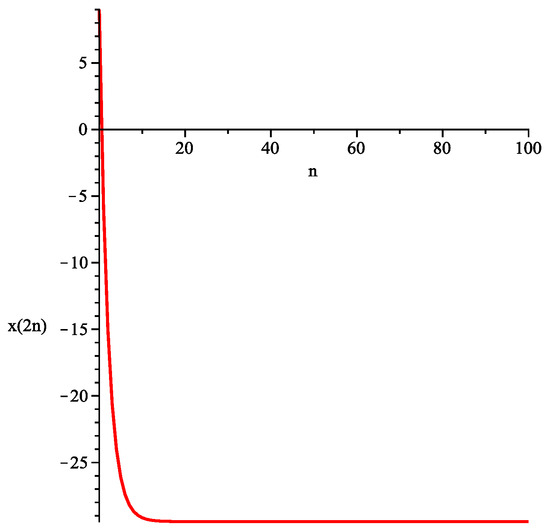
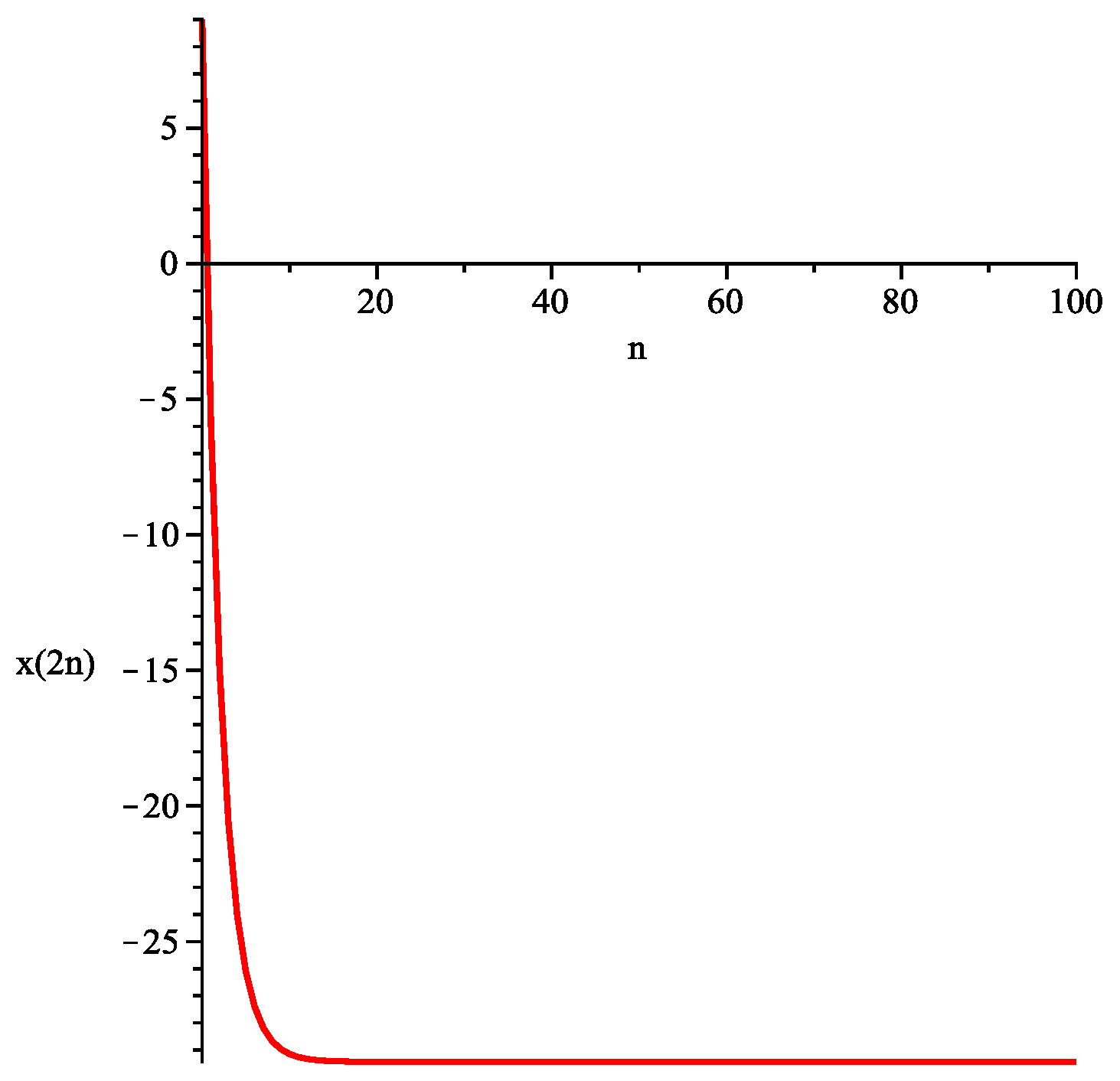
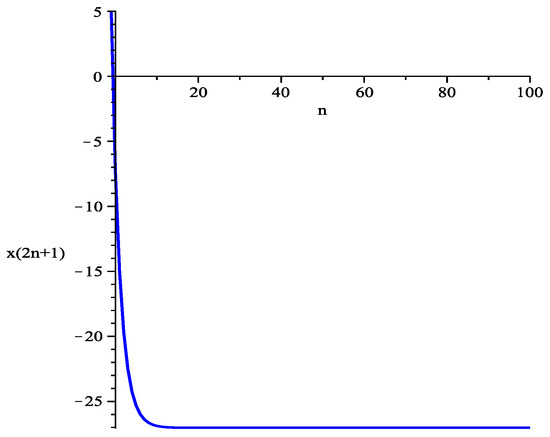
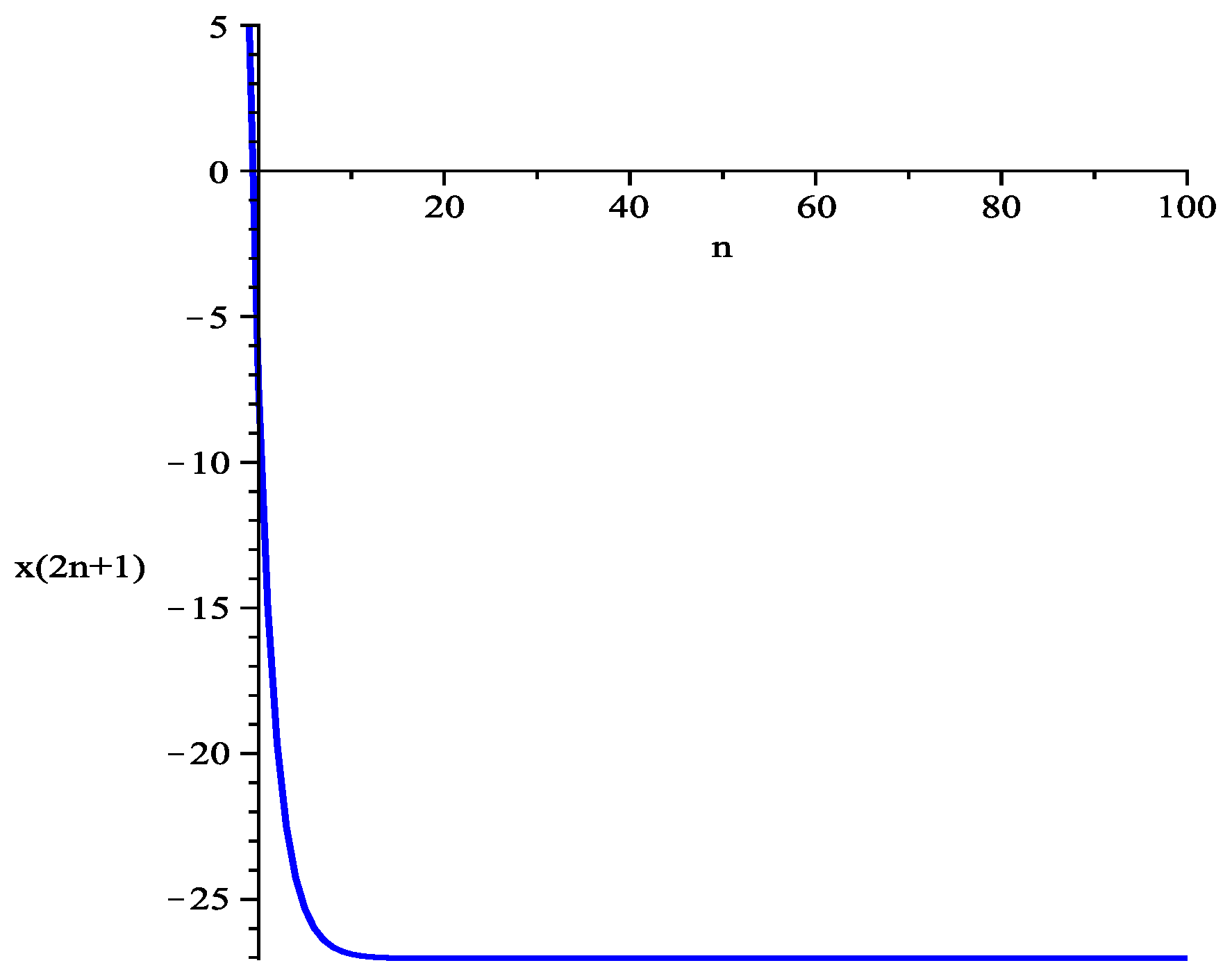
and this confirms the results of Theorem 5, case 2. The graphs of the solution are presented in Figure 7 and Figure 8.
Figure 7.
The graph of terms of the solution of Equation (5) with the parameters and initial values given in Example 7.
Figure 8.
The graph of terms of the solution of Equation (5) with the parameters and initial values given in Example 7.
5. Conclusions
In this work, explicit formulas for the solutions of Equation (5) are derived. This representation enables a detailed analysis of both the existence of periodic solutions and their asymptotic behavior. Several numerical examples are also presented to illustrate and confirm the validity of the results.
Open Problem: For interested readers and as a generalization of Equation (5), we propose to study the following second-order system of non-linear difference equations defined as follows:
where , , , , , are periodic sequences of real numbers of period two, and the initial values , , , are non-zero real numbers. System (37) can be written as follows:
which leads to the following equivalent system:
where
It is not hard to see that the solutions of system (39) are
Author Contributions
Methodology, L.S.A., N.T. and E.M.E.; formal analysis, L.S.A., N.T. and E.M.E.; investigation, L.S.A., N.T. and E.M.E.; software, L.S.A. and N.T.; writing—original draft preparation, L.S.A., N.T. and E.M.E.; writing—review and editing, L.S.A., N.T. and E.M.E.; visualization, L.S.A., N.T. and E.M.E.; supervision, N.T. and E.M.E. All authors have read and agreed to the published version of the manuscript.
Funding
This research received no external funding.
Data Availability Statement
The original contributions presented in this study are included in the article. Further inquiries can be directed to the corresponding author.
Conflicts of Interest
The authors declare no conflicts of interest.
References
- Amleh, A.M.; Ladas, G. Convergence to periodic solutions. J. Differ. Equ. Appl. 2001, 7, 621–631. [Google Scholar] [CrossRef] [Scilit]
- Elaydi, S. An Introduction to Difference Equations, 3rd ed.; Springer: New York, NY, USA, 2005. [Google Scholar]
- Abd El-Moneam, M. Global asymptotic stability of a system of difference equations with quadratic terms. Commun. Adv. Math. Sci. 2023, 6, 31–43. [Google Scholar] [CrossRef] [Scilit]
- Grove, E.A.; Kulenovic, M.R.S.; Ladas, G. Progress report on rational difference equations. J. Differ. Equ. Appl. 2004, 10, 1313–1327. [Google Scholar] [CrossRef] [Scilit]
- Grove, E.A.; Ladas, G. Periodicities in Nonlinear Difference Equations; Chapman and Hall/CRC: Boca Raton, FL, USA, 2005. [Google Scholar]
- Gumus, M. The global asymptotic stability of a system of difference equations. J. Differ. Equ. Appl. 2018, 24, 976–991. [Google Scholar] [CrossRef] [Scilit]
- Halim, Y.; Touafek, N.; Elsayed, E.M. Closed form solutions of some systems of rational difference equations in terms of Fibonacci numbers. Dyn. Contin. Discret. Impuls. Syst. Ser. A Math. Anal. 2014, 21, 473–486. [Google Scholar]
- Kulenovic, M.R.S.; Ladas, G. Dynamics of Second Order Rational Difference Equations with Open Problems and Conjectures; Chapman and Hall/CRC: Boca Raton, FL, USA, 2002. [Google Scholar]
- Dekkar, I.; Touafek, N.; Din, Q. On the global dynamics of a rational difference equation with periodic coefficients. J. Appl. Math. Comput. 2019, 60, 567–588. [Google Scholar] [CrossRef] [Scilit]
- Elaydi, S.; Sacker, R.J. Periodic difference equations, population biology and the Cushing–Henson conjectures. Math. Biosci. 2006, 201, 195–207. [Google Scholar] [CrossRef] [Scilit] [PubMed]
- Sacker, R.J. Semigroups of maps and periodic difference equations. J. Differ. Equ. Appl. 2010, 16, 1–13. [Google Scholar] [CrossRef] [Scilit]
- Voulouv, H.D. On a difference equation with periodic coefficients. J. Differ. Equ. Appl. 2007, 13, 443–452. [Google Scholar] [CrossRef] [Scilit]
- Elabbasy, E.M.; Elmatwally, H.; Elsayed, E.M. Qualitative behavior of higher order difference equation. Soochow J. Math. 2007, 33, 861–873. [Google Scholar]
- Haddad, N.; Touafek, N.; Rabago, J.F.T. Well-defined solutions of a system of difference equations. J. Appl. Math. Comput. 2018, 56, 439–458. [Google Scholar] [CrossRef] [Scilit]
- Yazlik, Y.; Kara, M. On a solvable system of difference equations of higher-order with periodic coefficients. Commun. Fac. Sci. Univ. Ank. Ser. A1 Math. Stat. 2019, 68, 1675–1693. [Google Scholar] [CrossRef] [Scilit]
- Touafek, N.; Al-Juaid, J.G. On a second-order system of difference equations: Expressions and behavior of the solutions. AIMS Math. 2025, 10, 28077–28099. [Google Scholar] [CrossRef] [Scilit]
- Kara, M.; Touafek, N.; Yazlik, Y. Well-defined solutions of a three-dimensional system of difference equations. Gazi Univ. J. Sci. 2020, 33, 767–778. [Google Scholar] [CrossRef] [Scilit]
- Al-Basyouni, K.S.; Elsayed, E.M. On some solvable systems of some rational difference equations of third order. Mathematics 2023, 11, 1047. [Google Scholar] [CrossRef] [Scilit]
- Ghezal, A.; Al Salman, H.J.; Al Ghafli, A.A. Three-dimensional second-order rational difference equations: Explicit formulas and simulations. Mathematics 2026, 14, 876. [Google Scholar] [CrossRef] [Scilit]
- Alsharawi, Z.; Angelos, J.; Elaydi, S. Existence and stability of periodic orbits of periodic difference equations with delays. Int. J. Bifurc. Chaos Appl. Sci. Eng. 2008, 18, 203–217. [Google Scholar] [CrossRef] [Scilit]
- Camouzis, E.; Ladas, G. When does local asymptotic stability imply global attractivity in rational equations? J. Differ. Equ. Appl. 2006, 12, 863–885. [Google Scholar] [CrossRef] [Scilit]
- Cheng, Q.; Deng, S. Flip bifurcations of two systems of difference equations. Math. Meth. Appl. Sci. 2020, 43, 9582–9597. [Google Scholar] [CrossRef] [Scilit]
- Elaydi, S.; Sacker, R.J. Basin of attraction of periodic orbits of maps on the real line. J. Differ. Equ. Appl. 2004, 10, 881–888. [Google Scholar] [CrossRef] [Scilit]
- Tasdemir, E.; Soykan, Y. Global dynamics and bifurcation of a higher order difference equation. Sarajevo J. Math. 2026, 21, 271–295. [Google Scholar] [CrossRef] [Scilit]
- Ghasemabadi, A. Stability and bifurcation of Metzler equation. Adv. Differ. Equ. 2015, 2015, 253. [Google Scholar] [CrossRef] [Scilit]
Disclaimer/Publisher’s Note: The statements, opinions and data contained in all publications are solely those of the individual author(s) and contributor(s) and not of MDPI and/or the editor(s). MDPI and/or the editor(s) disclaim responsibility for any injury to people or property resulting from any ideas, methods, instructions or products referred to in the content. |
© 2026 by the authors. Licensee MDPI, Basel, Switzerland. This article is an open access article distributed under the terms and conditions of the Creative Commons Attribution (CC BY) license.