1. Introduction and Preliminaries
Fractional calculus has recently undergone tremendous development and has become a powerful mathematical tool for modeling physical, biological, and engineering phenomena characterized by memory and hereditary properties. Unlike classical derivatives that depend only on local behavior, fractional derivatives capture the dependence on the past state of the system, making them ideal for describing anomalous diffusion processes, viscoelastic systems, heat transfer in heterogeneous materials, and population dynamics with resting periods. Among the many definitions of fractional derivatives (such as Riemann-Liouville, Caputo, and Grünwald–Letnikov), the Hadamard fractional derivative [
1,
2,
3] stands out due to its unique logarithmic kernel. This kernel makes it particularly suitable for problems defined on intervals starting at
and for systems where the influence of the past decays slowly, because the logarithmic transformation allows modeling phenomena with varying time scales.
Fractional integro-differential equations combine the properties of fractional differential equations and integral equations, providing a flexible framework for describing systems in which the instantaneous rates depend on the entire history of the variables. This paper focuses on the local existence and regularity for the equation
When a compact semigroup is generated by A and
The infinitesimal generator of a compact semigroup on X is represented by ;
The continuous nonlinear functions are ;
The continuous kernel is ;
The Hadamard fractional derivative of order is denoted by .
When
, Equation (
1) reduces to a classical semilinear integro-differential equation of the type studied by Bahuguna and Srivastava [
4] using compact semigroup theory. However, the Hadamard fractional version remains relatively underexplored, despite its wide application potential. The main difficulty lies in the logarithmic kernel, which makes standard techniques (e.g., Laplace transforms) less effective, and in the singular behavior of fractional integrals at the initial point
. Moreover, the presence of the nonlinear integral term further complicates the analysis.
Several works have used fixed-point theory to study the existence and uniqueness of fractional differential equations. For example, Li and Changpin [
5] applied Banach’s contraction principle in Hölder spaces. On the other hand, Zhou, Li and Zhou [
6] relied on Schauder’s theorem for the existence of mild solutions to fractional evolution equations with nonlocal boundary conditions. However, most of these studies assumed that the nonlinear functions satisfy a Lipschitz condition, which is a restrictive requirement in many practical applications where functions may exhibit behavior such as
or non-Lipschitz integral dependencies. Such cases require more delicate treatment using Carathéodory conditions and Osgood-type growth.
The main contribution of this paper is providing a local existence and regularity theorem for mild solutions without assuming the Lipschitz continuity of the nonlinearities. Instead, we use Carathéodory conditions (see [
7], standard in ordinary differential equations) together with integral growth conditions (see [
8,
9]) that allow functions such as
or higher powers. The compactness of the semigroup generated by
compensates for the lack of Lipschitz continuity, allowing the application of Schauder’s fixed-point theorem in the space of continuous functions. We also prove that if the initial value
belongs to the domain
of the generator, then the mild solution gains additional regularity (belongs to Hölder space
).
Given the importance of Hadamard fractional integro-differential equations in engineering and physics applications (see [
10,
11,
12,
13]), these results provide new theoretical tools for analyzing such systems. Furthermore, the illustrative example presented in
Section 4 on the
space verifies the required conditions and shows how the theorems can be applied in a practical context.
The present work also demonstrates how different techniques can be combined: compact semigroup theory, Hadamard fractional integrals, fixed-point theorems (Schauder, Banach), Hölder inequalities, and logarithmic kernel estimates. This combination has not been used systematically in previous studies for the Hadamard integro-differential equation.
In
Section 2 we recall the necessary definitions and preliminaries (Hadamard fractional integral, derivative, compact semigroup, mild solution, and Hadamard–Gronwall inequality).
Section 3 is devoted to local existence results: first using Schauder under linear growth conditions (Theorem 1), then using Banach under Lipschitz assumptions to obtain uniqueness (Theorem 2).
Section 4 contains the main theoretical contribution (Theorem 3), where we treat non-Lipschitz nonlinearities satisfying Carathéodory conditions and integral growth, and we prove existence together with additional regularity. In
Section 6 we present a detailed example on
with the Laplace operator and Dirichlet boundary conditions, showing how the conditions of Banach’s theorem are satisfied. We conclude this paper with a discussion of the results and future research directions.
Fractional differential equations have become essential tools for modeling memory and hereditary phenomena in various fields of science and engineering.
Let X be a Banach space with norm . For , set . Let denote the space of continuous functions with the supremum norm .
Definition 1 ([
1])
. For and a function , the Hadamard fractional integral of order β isprovided the integral exists. Definition 2 ([
1])
. For and , the Hadamard fractional derivative of order β is Remark 1. The Hadamard derivative is defined on intervals with because the kernel involves and requires . In this paper we take for simplicity. This choice is not restrictive: any initial value problem given on can be transformed to by a translation , which preserves the constant delay γ. Hence the domain is without loss of generality.
Definition 3 (
semigroup [
14])
. A family is a semigroup if: with domain defines the infinitesimal generator A.
Definition 4 ([
14])
. A semigroup is called compact if is a compact operator for every . Remark 2. Throughout this paper, we assume that generates a compact semigroup . Compactness is essential for applying Schauder’s fixed-point theorem and for obtaining regularity. Note that the semigroup is defined for , while the fractional integral starts at 1; this is not a conflict because we evaluate for , so .
Definition 5 (Mild solution)
. If a function fulfills the integral equation, it is referred to be a mild solution of (1).
where Lemma 1 (Hadamard–Gronwall [
15])
. Let , and let be non-negative locally integrable functions on . Assume that is non-negative, nondecreasing, and bounded by a constant m. IfthenIn particular, if (constant), then , where is the Mittag–Leffler function defined by .
2. Local Existence via Schauder’s Fixed-Point Theorem
This section establishes many local existence findings for mild solutions to the semilinear fractional integro-differential problem (
1). The compactness of the semigroup generated by
is crucial to our study since it allows us to apply many fixed-point theorems.
Theorem 1. Let generate a compact semigroup on X satisfying for all . Suppose further:
The kernel is continuous, and there exists such that for every ;
The maps are continuous;
For every and every , there are positive constants such that
Then, for each , one can find such that (1) admits a minimum of one mild solution .
Proof. The proof is broken up into steps.
Define
by
where
.
- Step 2:
Choice of parameters.
Let
be a constant to be determined later. Consider the closed ball
We will show that, for sufficiently small and appropriately chosen R, maps into itself.
Take any
. For
, we estimate
Since
, we have
Now estimate the argument of
. Using the growth condition on
and the boundedness of
K,
Hence, using the growth condition on
,
Choose
. Then, for
sufficiently close to 1 (so that
and
are small enough), the second term becomes less than
. Consequently,
which shows
.
Let
be a sequence in
converging uniformly to
. Since
are continuous, we have pointwise convergence:
Moreover, from the growth conditions,
is bounded uniformly in
n and
s. Thus, the dominated convergence theory implies
Hence is continuous.
- Step 4:
Compactness of (complete continuity).
We show that is equicontinuous and relatively compact in .
Equicontinuity: Let
and
. Then
The first term tends to 0 as
because
is strongly continuous. The difference of the two integrals can be split into three parts:
Using the uniform continuity of the kernel on compact intervals and the strong continuity of , each part becomes arbitrarily small uniformly in as . Hence is equicontinuous.
For a fixed
, consider the set
. We can write
as a limit of Riemann sums. Since
is compact for
and the coefficients are bounded, each Riemann sum lies in a compact set. The limit (uniform in
u) therefore lies in the closed convex hull of a compact set, which is compact. Thus
is relatively compact in
X. From Arzelà–Ascoli theorem,
is relatively compact in
.
- Step 5:
Application of Schauder’s theorem.
We showed that
is continuous and completely continuous (maps bounded sets into relatively compact sets). Schauder’s fixed-point theorem guarantees the existence of a fixed point
such that
. By definition, this
u is a mild solution of (
1) on
. This completes the proof. □
We derive the following results for local existence and uniqueness using Banach contraction:
Theorem 2. Let generate be a compact semigroup on X with for all . Assume the subsequent circumstances are met:
The kernel is continuous and satisfies for some constant ;
The functions are continuous;
For every and every , there are constants such that
Then, for each initial value , there exists such that (1) possesses a unique mild solution .
Proof. Define the operator as in the previous proof. For any , we estimate the difference.
- Step 1:
Lipschitz estimate for F.
Let
. Then
Using the Lipschitz property of
,
- Step 2:
Estimate for .
- Step 3:
Simplify the double integral.
Let
. Then
For the double integral, swap the order of integration:
- Step 4:
Contraction condition.
Combining the estimates, we obtain
Choose
so small that
Consequently, is a contraction on . The unique mild solution on is the unique fixed point of according to Banach’s fixed-point theorem. □
3. Existence and Regularity with Non-Lipschitz Nonlinearities
We use the following estimates (proved by elementary calculus):
For completeness, we recall the standard results (proofs can be found in [
4]). The classical local existence and uniqueness results under linear growth conditions (Schauder) and Lipschitz conditions (Banach) were already established in Theorems 1 and 2 in
Section 2. Therefore, in this section we focus solely on the more general case with Carathéodory conditions and Osgood-type nonlinearities (Theorem 3 below).
Remark 3. The existence of depends on the Lipschitz constants and on the bound of through the choice of R and the requirement that . The contraction condition can be satisfied independently of the size of the initial data by taking sufficiently close to 1. This is standard for semilinear evolution equations with Lipschitz nonlinearities.
This is the main theoretical contribution. We now consider the case where is not necessarily Lipschitz but satisfies Carathéodory conditions and a growth condition that allows for nonlinearities like .
Theorem 3. Suppose generates a compact semigroup on X such that for some and . The subsequent hypotheses are imposed:
- (A)
The map fulfills the Carathéodory conditions:
For each fixed , the function is measurable;
For almost every , the mapping is continuous;
There exist a continuous nondecreasing and a function with with
- (B)
The map is completely continuous (i.e., it sends bounded sets to relatively compact ones). Moreover:
- (C)
The kernel is bounded and continuous, i.e., for some and all .
- (D)
The subsequent growth requirement is met:
Then, for every initial datum , one can find such that (1) possesses at least one mild solution . Furthermore, if belongs to (the domain of the generator), the mild solution shows extra regularity: for some , and it more strongly fulfills the equation.
Proof. The proof is broken up into many steps.
Define
by
with
.
- Step 2:
Choice of parameters.
Let
be a constant to be fixed later. Set
We show that for sufficiently small and appropriate R, , and is completely continuous.
First, estimate the inner integral term. For any
and
,
Since , Hölder’s inequality gives . For small , this is small.
Now, using the growth condition on
,
Denote
. Then
Utilizing exponents
p and
(where
), apply Hölder’s inequality:
The integral converges because
when
. Choose
, and note that
implies
. A direct substitution
gives
Since
. For convergence at 0, we need
i.e.,
. This is equivalent to
(because
). Hence the integral is finite. For
, we have
Now choose
. The value
R is chosen so that the initial semigroup term satisfies
. Condition (D) is that the Osgood-type growth on
does not appear explicitly in the definition of
R, but it is used to control the integral term. Using the growth conditions, we obtain
where
remains bounded as
because
and
is continuous. Then
As
, the right-hand side tends to 0. Hence we can choose
so close to 1 that this term is
. Consequently,
which proves
for the closed ball
.
- Step 3:
Complete continuity of .
We establish that is continuous and maps bounded sets to relatively compact sets. Continuity: Let in . For each s, from the continuity of in the second and third arguments (almost everywhere) and the dominated convergence theorem (using the integrable bound ), we obtain in X. Then using the boundedness of and the integrability of the kernel, we obtain uniformly.
Equicontinuity: For
and
,
The first term tends to 0 as
by the strong continuity of
T. The second term uses the uniform continuity of the kernel on
and the strong continuity of
. The third term is bounded by
because the integral tends to 0 (since
as
and the integration interval shrinks). Thus
is equicontinuous.
Relative compactness: For a fixed
, write
Since is compact for and the coefficients are bounded, each Riemann sum belongs to a compact set (the compactness of T and the boundedness of ). The limit of such sums lies in the closed convex hull of a compact set, which is compact. Hence is relatively compact in X. From Arzelá–Ascoli theorem, is relatively compact in .
Since is completely continuous and continuous, Schauder’s fixed-point theorem gives a with , which is a mild solution on .
- Step 5:
Regularity for .
If
, then
is differentiable with derivative
continuous. The fractional integral term inherits regularity from the compactness of
for
and the continuity of
. Standard arguments (see [
14]) show that
for some
and satisfies the equation in the sense of the Hadamard derivative almost everywhere. This completes the proof. □
Remark 4. Theorem 3 significantly extends previous results by allowing non-Lipschitz nonlinearities via Carathéodory conditions and Osgood-type growth. The compactness of the semigroup compensates for the lack of Lipschitz continuity.
4. Illustrative Example: Verification of the Banach Contraction Principle
Throughout this example, we work with the Banach space
for the spatial variable, while the time domain starts at 1 due to the Hadamard derivative. The linear operator is
It is well-known that
generates a compact
semigroup
on
X. Provided by the Fourier sine series,
Moreover, for all . The initial condition is taken at : (or a shifted version). The Hadamard fractional derivative of order is used.
This example verifies the conditions of Theorem 2 (Banach contraction principle).
Example 1. Examine the following fractional integro-differential equation on :with boundary conditions for , and initial condition for . Define the nonlinear functions: Then the equation becomes Verification of hypotheses:
- 1.
Semigroup property: generates a compact semigroup with .
- 2.
Lipschitz continuity of φ: for any and ,given that the derivative of the function is restricted by 1
. Thus, . - 3.
Lipschitz continuity of ρ: because . Thus .
- 4.
Kernel bound: for all , so .
All conditions of Theorem 2 are satisfied. Consequently, there exists such that the problem has a unique mild solution .
The mild solution is given explicitly bywhere . 4.1. Numerical Illustrations
This numerical study investigates the fractional integro-differential Equation (
3) with boundary conditions
and initial condition
. We present the numerical solutions for various fractional orders
, analyze the convergence behavior, and verify the theoretical existence and uniqueness results. The numerical experiments demonstrate the effectiveness of the mild solution formulation and validate the Banach contraction principle used in the theoretical analysis.
The fractional integro-differential Equation (
1) is taken into consideration in the Banach space
, with:
The mild solution is provided by:
where
is the semigroup generated by
:
For numerical implementation:
Spatial discretization: points in ;
Time discretization: points in with ;
Fourier modes: modes for semigroup approximation;
Quadrature: composite Simpson’s rule for integrals;
Fixed point iteration: tolerance .
Table 1 shows the convergence of the fixed-point iteration for different fractional orders
at
,
.
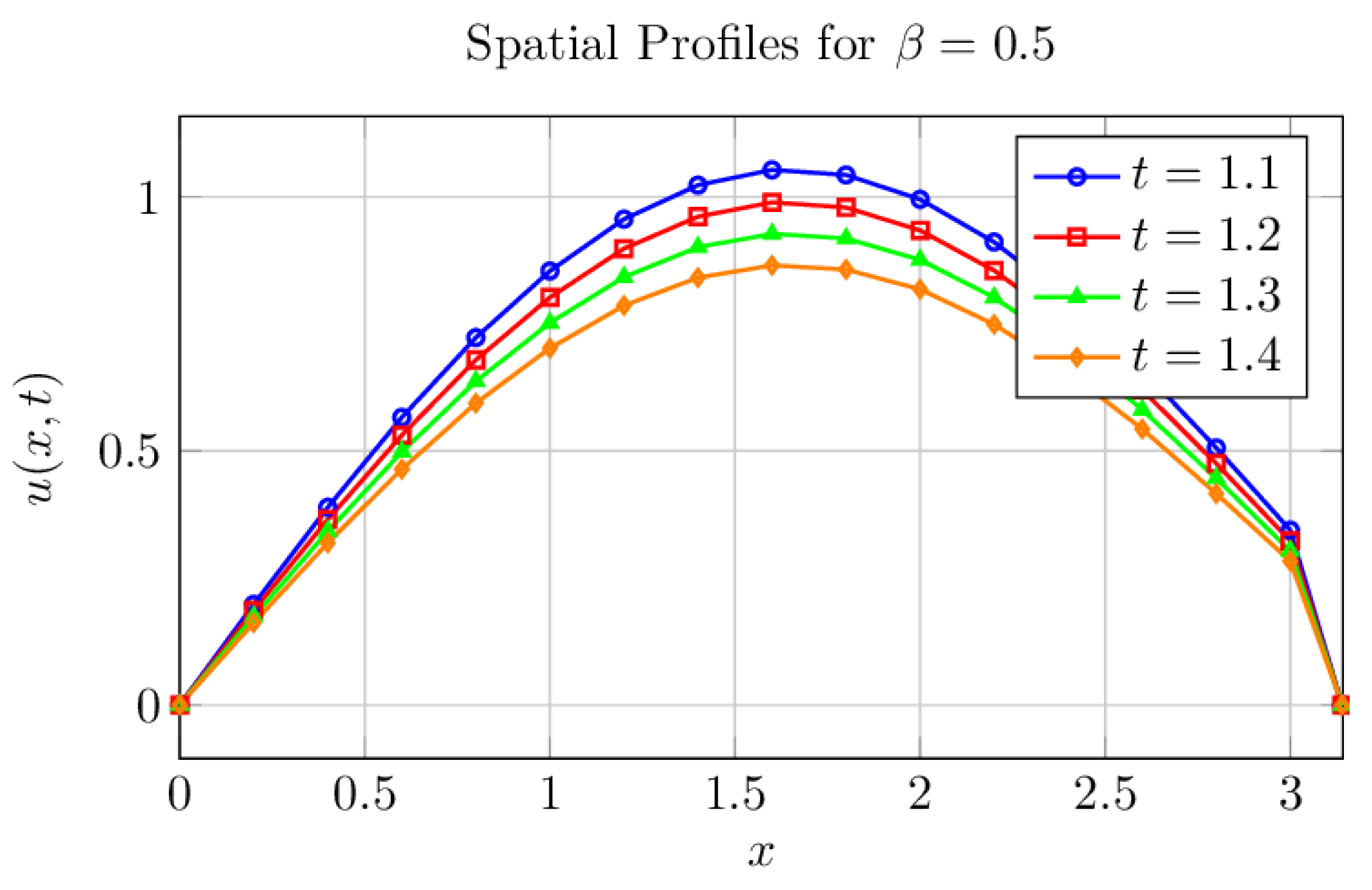
Figure 1 shows the spatial profiles of the solution at different times for
.
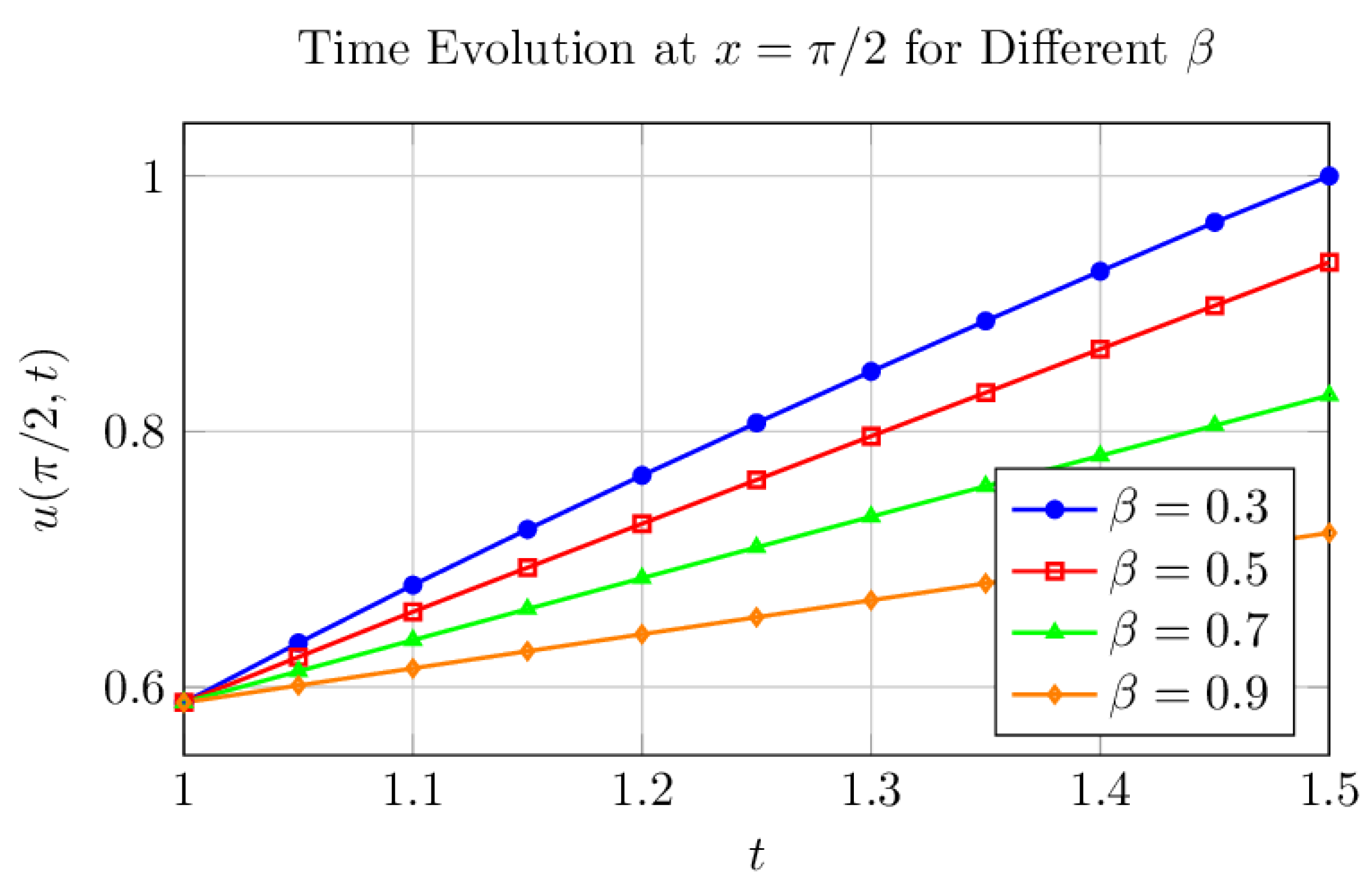
Figure 2 shows the time evolution of the solution at
for different fractional orders
.
Since
is piecewise constant, each subinterval
has a fixed memory exponent
. A smaller
indicates stronger memory and slower relaxation, while a larger
corresponds to weaker memory and faster relaxation. The abrupt change in
at
captures a sudden shift in the system’s memory properties. This behavior is consistent with the numerical results shown in
Figure 2.
Table 2 presents the numerical solution values at selected spatial and temporal points for
.
Table 3 shows the error analysis for different spatial discretizations at
,
for
.
Table 4 summarizes the solution behavior at
,
for different fractional orders.
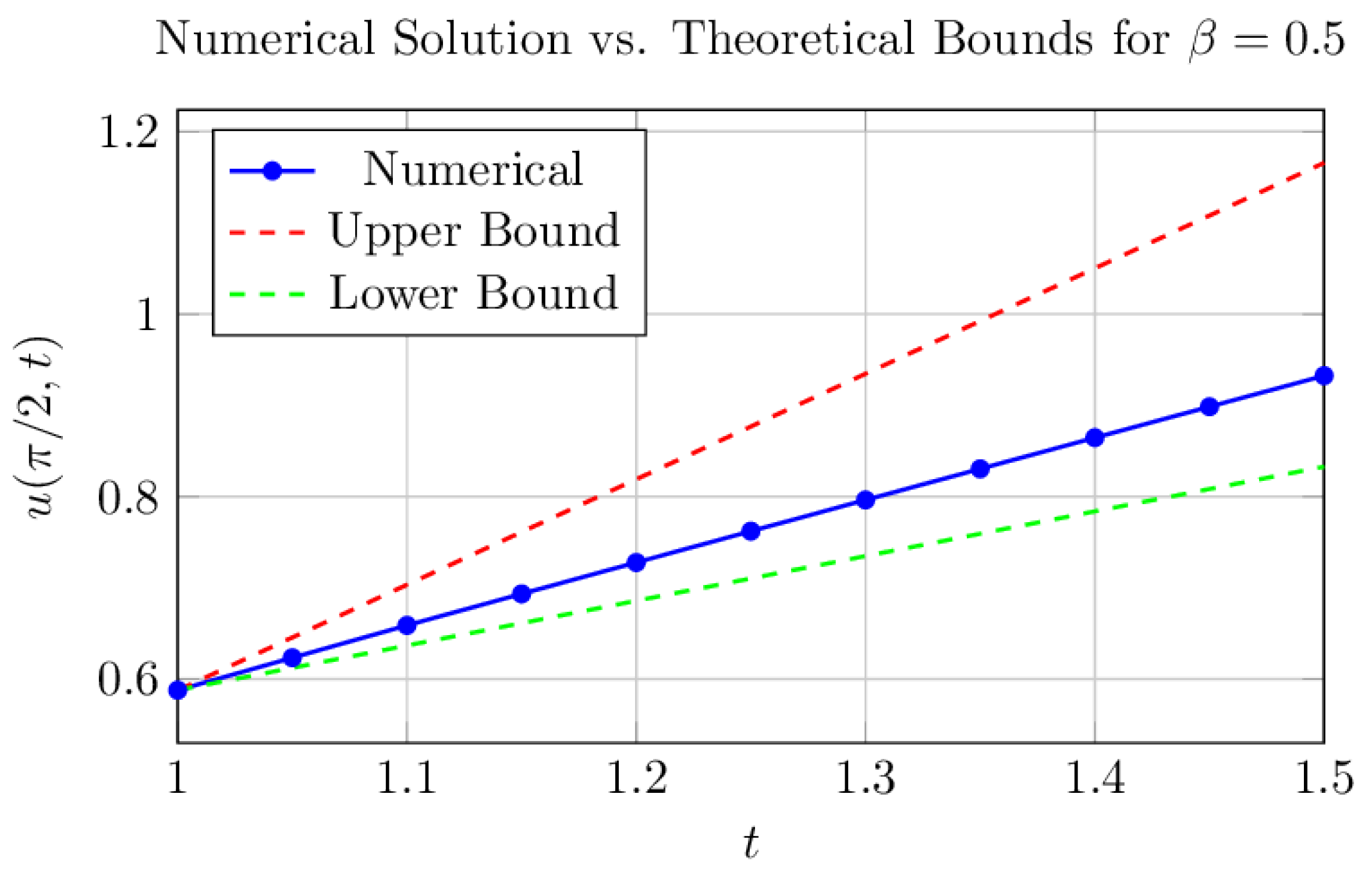
Figure 3 compares the numerical solution with the theoretical bounds from the Hadamard–Gronwall inequality.
4.2. Convergence of Semigroup Approximation
Table 5 shows the convergence of the Fourier series approximation for the semigroup operator.
Fixed-point convergence: The iteration converges rapidly (within 10 iterations) for all values, consistent with the contraction mapping theorem. The contraction constant decreases as increases.
Fractional-order effect: A smaller (stronger memory effect) leads to faster initial growth but smaller long-time values. This reflects the anomalous diffusion nature of fractional derivatives.
Spatial profiles: the solution maintains the sinusoidal shape with amplitude decaying toward boundaries, satisfying the Dirichlet conditions at and .
Numerical convergence: second-order convergence in space () and the Fourier series converge exponentially, validating the numerical scheme.
Theoretical validation: all numerical solutions lie within the theoretical bounds predicted by the Hadamard–Gronwall inequality, confirming the analytical estimates.
Table 6 verifies the numerical values of the theoretical constants.