Article

Solutions of a Fuzzy Difference Equation with Maximum

1
Faculty of Mathematics and Statistics, Sichuan Minzu College, Kangding 626000, China
2
College of Applied Mathematics, Chengdu University of Information Technology, Chengdu 610225, China
*
Author to whom correspondence should be addressed.
Axioms 2026, 15(3), 202; https://doi.org/10.3390/axioms15030202

Submission received: 30 January 2026 / Revised: 3 March 2026 / Accepted: 6 March 2026 / Published: 9 March 2026
(This article belongs to the Special Issue Delay Differential Equations: Theory, Control and Applications)

Abstract

This paper systematically investigates the dynamical properties of a class of max-type fuzzy difference equation. The study first establishes the existence and uniqueness of the solution sequence under given initial conditions with positive fuzzy numbers. Subsequently, by applying the cut-set theory, the fuzzy equation is transformed into a system coupled by two ordinary difference equations. Through a combination of case analysis and mathematical induction, the study rigorously demonstrates that the solutions of this system exhibit global periodicity with a period of 4, while also deriving the exact closed-form expressions of the periodic solutions. Based on the periodic solutions obtained from the ordinary difference system, the research successfully reveals the periodic characteristics of the solutions to the original fuzzy difference equation and rigorously analyzes their boundedness and persistence. Finally, numerical simulations conducted with Matlab 2016 provide robust data support for the theoretical conclusions and the effectiveness of the methodology.

1. Introduction

As an important class of difference equations, maximum-type difference equations have attracted considerable attention from scholars due to their significant application value in fields such as automatic control theory [1,2,3,4,5,6]. In reference [7], Voulov studied the periodicity of positive solutions to the maximum-type difference equation
x n = max { A x n k , B x n m } , n = 0 , 1 , 2 ,
where k , m is a positive integer. Let d = max { k , m } . The parameters A and B, as well as the initial values x d , x d + 1 , , x 1 are positive real numbers. In the paper, the author establishes the periodicity of positive solutions to this equation by employing a case-analysis approach.
In reference [8], Elsayed and Iričanin studied the following class of third-order max-type and min-type difference equation respectively
x n + 1 = max { A n x n , x n 2 } , x n + 1 = min { A n x n , x n 2 } , n = 0 , 1 , 2 ,
where the parameter { A n } are positive 3-periodic sequence. The authors proved that every positive solution of this system is periodic with period 3.
In reference [9], Fotiades and Papaschinopoulos studied the periodicity of solutions to the system of difference equations
x n + 1 = max { A , y n x n 1 } , y n + 1 = max { B , x n y n 1 } , n = 0 , 1 , 2 ,
where the parameters A , B and the initial values x 1 , x 0 , y 1 , y 0 are positive constants. They proved that every solution of this system is eventually periodic.
Driven by technological development needs, Sun et al. [10] investigated the dynamical properties of the following equation
x n = max { A n x n r , x n k } , n = 0 , 1 , 2 , .
Here, the parameter sequence { A n } is periodic with period p , while k , r { 1 , 2 , 3 , } , gcd { k , r } = 1 and k r are constants such that d = max { k , r } . The initial values x d , x d + 1 , , x 0 are real numbers. The authors demonstrated that if condition p = 1 holds (or if both p 2 and k are odd), then every solution of Equation (4) is periodic with period k .
In 2016, Sun and Xi [11] investigated the behavior of positive solutions for the following system of max-type difference equations
x n = max 1 x n m , min 1 , A y n r , y n = max 1 y n m , min 1 , B x n t , n = 0 , 1 , 2 , ,
where m , r , t , A , B R + with r m and t m . Let d = max m , r , t . The initial values x i , y j ( 1 i d , 1 j d ) are positive real number. They proved that every solution of the system is eventually periodic with period 2 m .
In the same year, Wang et al. [12] studied the following max-type difference equations
x n + 1 = max c , y n p x n 1 q , y n + 1 = max c , x n p y n 1 q , n = 0 , 1 , 2 , ,
where the parameters c , p , q and the initial values x 0 , x 1 , y 0 , y 1 are positive real numbers. The authors obtained several sufficient conditions that ensure the boundedness of the solutions to this equation.
In 2020, Su et al. [13] studied the periodicity of positive solutions for the following max-type difference equations
x n = max A , y n t x n s , y n = max B , x n t y n s , n 0 , 1 , 2 , ,
where A , B R + , t , s N + , gcd ( s , t ) = 1 . Let d = max t , s . The initial values x k , y k ( 0 k d ) are positive real numbers. They studied the eventual periodicity of positive solutions of system (7). Furthermore, in 2023, Sun et al. [14] investigated the global behavior of the following max-type difference equations with four variables and period-two parameters
x n = max A n , z n 1 y n 2 , y n = max B n , w n 1 x n 2 , z n = max C n , x n 1 w n 2 , w n = max D n , y n 1 z n 2 , n 0 , 1 , 2 , ,
where A n , B n , C n , D n R + are periodic sequences with periodic 2. The initial values x i , y i , z i , w i ( i = 1 , 2 ) are positive real numbers. They proved that every solution of this system is eventually periodic with period 4.
The continued advancement of max-type and min-type difference equation theory has led to its integration with fuzzy set theory, giving rise to the study of max-type and min-type fuzzy difference equations, which have subsequently attracted extensive research attention.
In reference [15], Stefanidou and Papaschinopoulos investigated the dynamical behavior of the fuzzy difference equation
x n + 1 = max { A 0 x n , A 1 x n 1 } , n = 0 , 1 , 2 ,
where the parameters A 0 , A 1 and the initial values x 1 , x 0 are positive fuzzy numbers. The authors demonstrated that the solutions of Equation (9) can exhibit periodicity, unboundedness, and non-persistence. Building on this work, Stefanidou and Papaschinopoulos [16] extended the form of Equation (9) and studied the periodicity of solutions for the following fuzzy difference equation
x n + 1 = max { A 0 x n k , A 1 x n m } , n = 0 , 1 , 2 ,
where the parameters A 0 , A 1 are positive fuzzy numbers. Let d = max { k , m } . The initial conditions x d , x d + 1 , , x 0 are also positive fuzzy numbers. In addition, the authors obtained conditions so that the solutions of this Equation (10) are unbounded.
In 2018, Sun et al. [17] studied the periodicity of positive solutions for the following max-type fuzzy difference equation
x n = max 1 x n m , α n x n r , n N 0 ,
where m , r N , d = max m , r , α n is a positive periodic fuzzy number sequence and the initial values x i ( 1 i d ) are positive fuzzy numbers. The authors proved that if max ( supp α n ) < 1 , then every positive solution of the Equation (11) is eventually periodic with period 2 m .
In 2020, Han et al. [18] investigated the periodicity of the following higher-order max-type fuzzy difference equation
x n = max C , x n m k x n m , n N 0 ,
where m , k N , the parameter C and the initial values x i ( 1 i m + k ) are positive fuzzy numbers. They established conditions on the support of the fuzzy number C : if C 1 > 1 , every positive solution eventually equals C ; if C 1 = 1 or C 2 1 , there exist positive solutions that are not eventually periodic.
In 2022, Sun et al. [19] studied the eventual periodicity of the following system of max-type fuzzy differences
x n = max A , y n 1 x n k , y n = max B , x n 1 y n k , n 0 , 1 , 2 , ,
where parameters A , B and initial values x i , y i ( 1 i k ) are positive fuzzy numbers. The authors gained characteristic conditions of the coefficients under which every positive solution of this system (13) is eventually periodic or not.
In 2023, Wang et al. [20] studied the following maximum difference equation with the fuzzy parameter and initial values in this paper
z n + 1 = max H z n 1 , H z n 2 , z n 3 ,
where the initial values x i ( 0 i 3 ) and parameter H are positive fuzzy numbers. They proved that every solution of this system (14) is eventually periodic with period 4.
Upon reviewing the above relevant studies, it is evident that current research on max-type difference equations has primarily focused on the existence of periodicity in solutions, while the explicit expression of periodic solutions has not yet been systematically explored. This theoretical gap, to some extent, limits the further application of related findings in practical engineering problems. In view of this, developing new analytical approaches to derive the exact forms of periodic solutions for max-type fuzzy difference equations not only contributes to a deeper understanding of the dynamical behavior of such systems but also holds significant theoretical value and practical importance for their application in engineering contexts.
Inspired by the aforementioned studies on max-type difference equations and max-type fuzzy difference equations, this paper investigates the dynamical properties of solutions to the following max-type fuzzy difference equation
x n + 1 = max { A x n 1 , x n 3 } , n = 0 , 1 , 2 ,
where { x n } is a sequence of positive fuzzy numbers, and the parameters A as well as initial values x 3 , x 2 , x 1 , x 0 are positive fuzzy numbers. The difference Equation (15) describes a discrete-time dynamical system in which the next state x n + 1 is determined by the larger of two candidate values: one is the ratio of a constant A to the state from two steps earlier x n 1 , and the other is the state from three steps earlier x n 3 . This form is commonly found in dynamic processes involving memory and competitive mechanisms, such as in resource management or ecological models, where x n may represent population size or resource stock. The term A / x n 1 embodies resource consumption or density dependence (becoming smaller when x n 1 is large), while x n 3 as a historical state reflects a lag effect or retention strategy. Taking the maximum value represents the system’s choice of a more favorable or stable development path among two possibilities, thereby simulating trade-offs and decision-making behaviors in real-world contexts. Through the development of new analytical techniques, we have not only proven that the solutions to Equation (15) exhibit period 4 for any positive fuzzy initial values, but also derived the exact expressions of the periodic solutions in all cases. This result generalizes and enriches the relevant findings in the literature [10,15,16,17,18,19,20].

2. Definitions and Preliminaries

To establish a rigorous foundation for the subsequent analysis, we first introduce the necessary definitions and key notations that will be used throughout this paper.
Definition 1
([21]). Let  u : R [ 0 , 1 ]  be a function. Then  u  is called a fuzzy number if the following properties are all satisfied:
(i)
Normality: x 0 R such that u ( x 0 ) = 1 ;
(ii)
Fuzzy convexity: x 1 , x 2 R , t [ 0 , 1 ] , u ( t x 1 + ( 1 t ) x 2 ) min { u ( x 1 ) , u ( x 2 ) } ;
(iii)
Upper semicontinuity: u is upper semicontinuous at every point in R ;
(iv)
Compact support: the set supp u = x R : u ( x ) > 0 ¯ is compact.
Given a fuzzy number u and a level α 0 , 1 , its α - cuts is the closed interval defined by [ u ] α = x R : u ( x ) α . In this paper, a fuzzy number u is called positive if supp u ( 0 , ) . Notably, any positive real number a > 0 can be identified with a trivial (crisp) fuzzy number whose membership function equals 1 at a and 0 elsewhere. For this crisp number, every α - cuts is the singleton [ a , a ] . Such a fuzzy number is termed a trivial or crisp fuzzy number.
Definition 2
([21]). The fuzzy analogues of boundedness and persistence for sequences are defined as follows:
(1)
A sequence { x n } of positive fuzzy numbers is called persistent (respectively, bounded if there exists a positive real numbers M (respectively, N ) such that the support of each x n is contained in [ M , ) (respectively, ( 0 , N ] ).
(ii)
A sequence { x n } of positive fuzzy numbers is called bounded and persistent if there exist two positive real numbers M , N > 0 such that the support of each x n is contained in [ M , N ] .
Definition 3
([18]). A sequence of positive fuzzy numbers  { x n }  that satisfied (14) is referred to as a positive solution. Furthermore, such a solution is called eventually periodic with period  T  if one can find an integer  M 0  such that the equality  x n + T = x n  holds for every  n M .
Definition 4
([22]). For any  u , ν R f  ,  [ u ] α = [ u l , α , u r , α ]  ,  [ ν ] α = [ ν l , α , ν r , α ]  , and  λ R  , the sum  u + ν  , the scalar product  λ u  , multiplication  u ν  and division  u ν  in the standard interval arithmetic (SIA) setting are defined by
u + ν α = u α + ν α , λ u α = λ u α , α [ 0 , 1 ] ,
u ν α = min u l , α ν l , α , u l , α ν r , α , u r , α ν l , α , u r , α ν r , α , max u l , α ν l , α , u l , α ν r , α , u r , α ν l , α , u r , α ν r , α ,
u ν α = min u l , α ν l , α , u l , α ν r , α , u r , α ν l , α , u r , α ν r , α , max u l , α ν l , α , u l , α ν r , α , u r , α ν l , α , u r , α ν r , α , 0 ν α .
Lemma 1.
Suppose the parameter  A  in Equation (15) is a positive fuzzy number. Then, given any positive fuzzy initial conditions  x 3 , x 2 , x 1  and  x 0  , there exists a unique sequence of positive fuzzy numbers  { x n }  satisfying (15).
Proof. 
The result can be established by constructing the solution iteratively. The method mirrors the one presented in the proof of Proposition 3.1 in [15], which guarantees both existence and uniqueness. Firstly, the existence of the solution is established by constructing an iterative sequence and applying mathematical induction along with the operational rules of fuzzy numbers. Subsequently, the uniqueness of the solution is proven using proof by contradiction. Given the similarity, we forgo a repetitive detailed proof. □
For any α ( 0 , 1 ] , denote [ A ] α = [ A L , α , A R , α ] , [ x n ] α = [ y n , α , z n , α ] . By Definition 4 and (15) we have
x n + 1 α = y n + 1 , α , z n + 1 , α = max { [ A l , α , A r , α ] [ y n 1 , α , z n 1 , α ] , [ y n 3 , α , z n 3 , α ] } = max { A l , α z n 1 , α , y n 3 , α } , max { A r , α z n 1 , z n 3 , α } , n = 0 , 1 , 2 , .
Then it holds from Lemma 1 that { ( y n , α , z n , α ) } n = 3 + satisfies the following system
y n + 1 = max { B z n 1 , y n 3 } , z n + 1 = max { C y n 1 , z n 3 } , n = 0 , 1 , 2 , ,
where the parameters B and C respectively denote the left and right endpoints of the α c u t s interval [ A ] α of the fuzzy parameter A in Equation (15). Correspondingly, the sequence { y n } is formed by the left endpoints of the α c u t s intervals of the fuzzy number sequence { x n } in Equation (15), and the sequence { z n } by the right endpoints. Both { y n } and { z n } are sequences of positive real numbers, and the inequality y n < z n holds for all n .
Lemma 2.
Assume that  { y n , z n } n = 3  is solution of system (16) and there is  k 0 N 0 { 3 , 2 , 1 }  such that
y k 0 = y k 0 + 4 , y k 0 + 1 = y k 0 + 5 , y k 0 + 2 = y k 0 + 6 , y k 0 + 3 = y k 0 + 7 , z k 0 = z k 0 + 4 , z k 0 + 1 = z k 0 + 5 , z k 0 + 2 = z k 0 + 6 , z k 0 + 3 = z k 0 + 7 .
Then this solution is eventually periodic with period 4.
Proof. 
To prove Lemma 2, we only need to prove that
y k 0 = y k 0 + 4 m , y k 0 + 1 = y k 0 + 1 + 4 m , y k 0 + 2 = y k 0 + 2 + 4 m , y k 0 + 3 = y k 0 + 3 + 4 m , z k 0 = z k 0 + 4 m , z k 0 + 1 = z k 0 + 1 + 4 m , z k 0 + 2 = z k 0 + 2 + 4 m , z k 0 + 3 = z k 0 + 3 + 4 m .
for every m N .
Next, we prove (18) using mathematical induction. The base case m = 1 follows directly from (17). Now, assume that (18) holds for some m 0 1 . Under this induction hypothesis, and by applying (17) together with (18) and the iterative method, we obtain:
y k 0 + 4 ( m 0 + 1 ) = max { B z k 0 + 4 m 0 + 2 , y k 0 + 4 m 0 } = max { B z k 0 + 2 , y k 0 } = y k 0 + 4 = y k 0 , z k 0 + 4 ( m 0 + 1 ) = max { C y k 0 + 4 m 0 + 2 , z k 0 + 4 m 0 } = max { C y k 0 + 2 , z k 0 } = z k 0 + 4 = z k 0 , y k 0 + 1 + 4 ( m 0 + 1 ) = max { B z k 0 + 4 m 0 + 3 , y k 0 + 4 m 0 + 1 } = max { B z k 0 + 3 , y k 0 + 1 } = y k 0 + 5 = y k 0 + 1 , z k 0 + 1 + 4 ( m 0 + 1 ) = max { C y k 0 + 4 m 0 + 3 , z k 0 + 4 m 0 + 1 } = max { C y k 0 + 3 , z k 0 + 1 } = z k 0 + 5 = z k 0 + 1 ,
y k 0 + 2 + 4 ( m 0 + 1 ) = max { B z k 0 + 4 m 0 + 4 , y k 0 + 4 m 0 + 2 } = max { B z k 0 + 4 , y k 0 + 2 } = y k 0 + 6 = y k 0 + 2 , z k 0 + 2 + 4 ( m 0 + 1 ) = max { C y k 0 + 4 m 0 + 4 , z k 0 + 4 m 0 + 2 } = max { C y k 0 + 4 , z k 0 + 2 } = z k 0 + 6 = z k 0 + 2 , y k 0 + 3 + 4 ( m 0 + 1 ) = max { B z k 0 + 4 m 0 + 5 , y k 0 + 4 m 0 + 3 } = max { B z k 0 + 5 , y k 0 + 3 } = y k 0 + 7 = y k 0 + 3 , z k 0 + 3 + 4 ( m 0 + 1 ) = max { C y k 0 + 4 m 0 + 5 , z k 0 + 4 m 0 + 3 } = max { C y k 0 + 5 , z k 0 + 3 } = z k 0 + 7 = z k 0 + 3 .
The proof is completed. □

3. Main Results

With the existence and uniqueness of solutions to the fuzzy difference Equation (15) established by Lemma 1, we now prove, in this section, that every such solution is eventually periodic with period 4. According to the analysis in the preceding section, it suffices to demonstrate that the solutions to the associated system of ordinary difference Equations (16) are eventually 4-periodic for all positive initial values.
Theorem 1.
For the ordinary difference Equation (16), given any positive real initial conditions  y 3 , y 2 , y 1 , y 0  and  z 3 , z 2 , z 1 , z 0  , every solution of the system is periodic with period 4. That is, for any positive real initial values and all integers  k 0  , it follows that
y 4 k + 1 = y 4 k + 5 , y 4 k + 2 = y 4 k + 6 , y 4 k + 3 = y 4 k + 7 , y 4 k + 4 = y 4 k + 8 , z 4 k + 1 = z 4 k + 5 , z 4 k + 2 = z 4 k + 6 , z 4 k + 3 = z 4 k + 7 , z 4 k + 4 = z 4 k + 8
Proof. 
Based on the difference system (16), the following equations can be derived
y 1 = max { B z 1 , y 3 } , z 1 = max { C y 1 , z 3 }
( a 1 ) Considering Equation (19), if B z 1 > y 3 , C y 1 > z 3 , then it follows that
y 1 = B z 1 , z 1 = C y 1
According to system (16), we have
y 2 = max { B z 0 , y 2 } , z 2 = max { C y 0 , z 2 }
( a 1 1 ) Considering Equation (20), if B z 0 > y 2 , C y 0 > z 2 , then it follows that
y 2 = B z 0 , z 2 = C y 0 .
y 3 = max { B z 1 , y 1 } = max { B C y 1 , y 1 } = y 1 , z 3 = max { C y 1 , z 1 } = max { C B z 1 , z 1 } = C B z 1 ,
y 4 = max { B z 2 , y 0 } = max { B C y 0 , y 0 } = y 0 , z 4 = max { C y 2 , z 0 } = max { C B z 0 , z 0 } = C B z 0 ,
y 5 = max { B z 3 , y 1 } = max { B 2 C z 1 , B z 1 } = B z 1 , z 5 = max { C y 3 , z 1 } = max { C y 1 , C y 1 } = C y 1 ,
y 6 = max { B z 4 , y 2 } = max { B 2 C z 0 , B z 0 } = B z 0 , z 6 = max { C y 4 , z 2 } = max { C y 0 , C y 0 } = C y 0 ,
y 7 = max { B z 5 , y 3 } = max { B C y 1 , y 1 } = y 1 , z 7 = max { C y 5 , z 3 } = max { C B z 1 , C B z 1 } = C B z 1 ,
y 8 = max { B z 6 , y 4 } = max { B C y 0 , y 0 } = y 0 , z 8 = max { C y 6 , z 4 } = max { C B z 0 , C B z 0 } = C B z 0 .
If y 4 k + 1 = B z 1 , y 4 k + 2 = B z 0 , y 4 k + 3 = y 1 , y 4 k + 4 = y 0 , z 4 k + 1 = C y 1 , z 4 k + 2 = C y 0 , z 4 k + 3 = C B z 1 , z 4 k + 4 = C B z 0 hold, then the following expressions can be derived
y 4 k + 5 = max { B z 4 k + 3 , y 4 k + 1 } = max { B 2 C z 1 , B z 1 } = B z 1 , z 4 k + 5 = max { C y 4 k + 3 , z 4 k + 1 } = max { C y 1 , C y 1 } = C y 1 ,
y 4 k + 6 = max { B z 4 k + 4 , y 4 k + 2 } = max { B 2 C z 0 , B z 0 } = B z 0 , z 4 k + 6 = max { C y 4 k + 4 , z 4 k + 2 } = max { C y 0 , C y 0 } = C y 0 ,
y 4 k + 7 = max { B z 4 k + 5 , y 4 k + 3 } = max { B C y 1 , y 1 } = y 1 , z 4 k + 7 = max { C y 4 k + 5 , z 4 k + 3 } = max { C B z 1 , C B z 1 } = C B z 1 ,
y 4 k + 8 = max { B z 4 k + 6 , y 4 k + 4 } = max { B C y 0 , y 0 } = y 0 , z 4 k + 8 = max { C y 4 k + 6 , z 4 k + 4 } = max { C B z 0 , C B z 0 } = C B z 0 .
For case ( a 1 1 ) , it can be readily proved by mathematical induction that when B z 1 > y 3 , B z 0 > y 2 , C y 1 > z 3 , C y 0 > z 2 , and k 0 , the relation
y 4 k + 1 = B z 1 , y 4 k + 2 = B z 0 , y 4 k + 3 = y 1 , y 4 k + 4 = y 0 , z 4 k + 1 = C y 1 , z 4 k + 2 = C y 0 , z 4 k + 3 = C B z 1 , z 4 k + 4 = C B z 0
holds.
( a 1 2 ) Considering Equation (20), if B z 0 > y 2 , C y 0 < z 2 , then it follows that
y 2 = B z 0 , z 2 = z 2 ,
y 3 = max { B z 1 , y 1 } = max { B C y 1 , y 1 } = y 1 , z 3 = max { C y 1 , z 1 } = max { C B z 1 , z 1 } = C B z 1 ,
y 4 = max { B z 2 , y 0 } = max { B z 2 , y 0 } = y 0 , z 4 = max { C y 2 , z 0 } = max { C B z 0 , z 0 } = C B z 0 ,
y 5 = max { B z 3 , y 1 } = max { B 2 C z 1 , B z 1 } = B z 1 , z 5 = max { C y 3 , z 1 } = max { C y 1 , C y 1 } = C y 1 ,
y 6 = max { B z 4 , y 2 } = max { B 2 C z 0 , B z 0 } = B z 0 , z 6 = max { C y 4 , z 2 } = max { C y 0 , z 2 } = z 2 ,
y 7 = max { B z 5 , y 3 } = max { B C y 1 , y 1 } = y 1 , z 7 = max { C y 5 , z 3 } = max { C B z 1 , C B z 1 } = C B z 1 ,
y 8 = max { B z 6 , y 4 } = max { B z 2 , y 0 } = y 0 , z 8 = max { C y 6 , z 4 } = max { C B z 0 , C B z 0 } = C B z 0 .
For the case of ( a 1 2 ) , by mathematical induction, when B z 1 > y 3 , B z 0 > y 2 , C y 1 > z 3 , C y 0 < z 2 and k 0 , it follows that
y 4 k + 1 = B z 1 , y 4 k + 2 = B z 0 , y 4 k + 3 = y 1 , y 4 k + 4 = y 0 , z 4 k + 1 = C y 1 , z 4 k + 2 = z 2 , z 4 k + 3 = C B z 1 , z 4 k + 4 = C B z 0 .
( a 1 3 ) Considering Equation (20), if B z 0 < y 2 , C y 0 > z 2 , then it follows that
y 2 = y 2 , z 2 = C y 0 ,
y 3 = max { B z 1 , y 1 } = max { B C y 1 , y 1 } = y 1 , z 3 = max { C y 1 , z 1 } = max { C B z 1 , z 1 } = C B z 1 ,
y 4 = max { B z 2 , y 0 } = max { B C y 0 , y 0 } = y 0 , z 4 = max { C y 2 , z 0 } = max { C y 2 , z 0 } .
( a 1 3 1 ) if C y 2 < z 0 (that is C z 0 < y 2 ), then z 4 = z 0 ,
y 5 = max { B z 3 , y 1 } = max { B 2 C z 1 , B z 1 } = B z 1 , z 5 = max { C y 3 , z 1 } = max { C y 1 , C y 1 } = C y 1 ,
y 6 = max { B z 4 , y 2 } = max { B z 0 , y 2 } = y 2 , z 6 = max { C y 4 , z 2 } = max { C y 0 , C y 0 } = C y 0 ,
y 7 = max { B z 5 , y 3 } = max { B C y 1 , y 1 } = y 1 , z 7 = max { C y 5 , z 3 } = max { C B z 1 , C B z 1 } = C B z 1 ,
y 8 = max { B z 6 , y 4 } = max { B C y 0 , y 0 } = y 0 , z 8 = max { C y 6 , z 4 } = max { C y 2 , z 0 } = z 0 .
For the case of ( a 1 3 1 ) , by mathematical induction, when B z 1 > y 3 , B z 0 < C z 0 < y 2 , C y 1 > z 3 , C y 0 > z 2 and k 0 , it follows that
y 4 k + 1 = B z 1 , y 4 k + 2 = y 2 , y 4 k + 3 = y 1 , y 4 k + 4 = y 0 , z 4 k + 1 = C y 1 , z 4 k + 2 = C y 0 , z 4 k + 3 = C B z 1 , z 4 k + 4 = z 0 .
( a 1 3 2 ) if C y 2 > z 0 (that is C z 0 > y 2 ), then z 4 = C y 2 ,
y 5 = max { B z 3 , y 1 } = max { B 2 C z 1 , B z 1 } = B z 1 , z 5 = max { C y 3 , z 1 } = max { C y 1 , C y 1 } = C y 1 ,
y 6 = max { B z 4 , y 2 } = max { B C y 2 , y 2 } = y 2 , z 6 = max { C y 4 , z 2 } = max { C y 0 , C y 0 } = C y 0 ,
y 7 = max { B z 5 , y 3 } = max { B C y 1 , y 1 } = y 1 , z 7 = max { C y 5 , z 3 } = max { C B z 1 , C B z 1 } = C B z 1 ,
y 8 = max { B z 6 , y 4 } = max { B C y 0 , y 0 } = y 0 , z 8 = max { C y 6 , z 4 } = max { C y 2 , C y 2 } = C y 2 .
For the case of ( a 1 3 2 ) , by mathematical induction, when B z 1 > y 3 , B z 0 < y 2 < C z 0 , C y 1 > z 3 , C y 0 > z 2 and k 0 , it follows that
y 4 k + 1 = B z 1 , y 4 k + 2 = y 2 , y 4 k + 3 = y 1 , y 4 k + 4 = y 0 , z 4 k + 1 = C y 1 , z 4 k + 2 = C y 0 , z 4 k + 3 = C B z 1 , z 4 k + 4 = C y 2 .
( a 1 4 ) Considering Equation (20), if B z 0 < y 2 , C y 0 < z 2 , then it follows that
y 2 = y 2 , z 2 = z 2 ,
y 3 = max { B z 1 , y 1 } = max { B C y 1 , y 1 } = y 1 , z 3 = max { C y 1 , z 1 } = max { C B z 1 , z 1 } = C B z 1 ,
y 4 = max { B z 2 , y 0 } = max { B z 2 , y 0 } = y 0 , z 4 = max { C y 2 , z 0 } = max { C y 2 , z 0 } .
( a 1 4 1 ) if C y 2 < z 0 (that is C z 0 < y 2 ), then z 4 = z 0 ,
y 5 = max { B z 3 , y 1 } = max { B 2 C z 1 , B z 1 } = B z 1 , z 5 = max { C y 3 , z 1 } = max { C y 1 , C y 1 } = C y 1 ,
y 6 = max { B z 4 , y 2 } = max { B z 0 , y 2 } = y 2 , z 6 = max { C y 4 , z 2 } = max { C y 0 , z 2 } = z 2 ,
y 7 = max { B z 5 , y 3 } = max { B C y 1 , y 1 } = y 1 , z 7 = max { C y 5 , z 3 } = max { C B z 1 , C B z 1 } = C B z 1 ,
y 8 = max { B z 6 , y 4 } = max { B z 2 , y 0 } = y 0 , z 8 = max { C y 6 , z 4 } = max { C y 2 , z 0 } = z 0 ,
For the case of ( a 1 4 1 ) , by mathematical induction, when B z 1 > y 3 , B z 0 < C z 0 < y 2 , C y 1 > z 3 , C y 0 < z 2 and k 0 , it follows that
y 4 k + 1 = B z 1 , y 4 k + 2 = y 2 , y 4 k + 3 = y 1 , y 4 k + 4 = y 0 , z 4 k + 1 = C y 1 , z 4 k + 2 = z 2 , z 4 k + 3 = C B z 1 , z 4 k + 4 = z 0 .
( a 1 4 2 ) if C y 2 > z 0 (that is C z 0 > y 2 ), then z 4 = C y 2 ,
y 5 = max { B z 3 , y 1 } = max { B 2 C z 1 , B z 1 } = B z 1 , z 5 = max { C y 3 , z 1 } = max { C y 1 , C y 1 } = C y 1 ,
y 6 = max { B z 4 , y 2 } = max { B C y 2 , y 2 } = y 2 , z 6 = max { C y 4 , z 2 } = max { C y 0 , z 2 } = z 2 ,
y 7 = max { B z 5 , y 3 } = max { B C y 1 , y 1 } = y 1 , z 7 = max { C y 5 , z 3 } = max { C B z 1 , C B z 1 } = C B z 1 ,
y 8 = max { B z 6 , y 4 } = max { B z 2 , y 0 } = y 0 , z 8 = max { C y 6 , z 4 } = max { C y 2 , C y 2 } = C y 2 ,
For the case of ( a 1 4 2 ) , by mathematical induction, when B z 1 > y 3 , B z 0 < y 2 < C z 0 , C y 1 > z 3 , C y 0 < z 2 and k 0 , it follows that
y 4 k + 1 = B z 1 , y 4 k + 2 = y 2 , y 4 k + 3 = y 1 , y 4 k + 4 = y 0 , z 4 k + 1 = C y 1 , z 4 k + 2 = z 2 , z 4 k + 3 = C B z 1 , z 4 k + 4 = C y 2 .
( a 2 ) Considering Equation (19), if B z 1 > y 3 , C y 1 < z 3 , then it follows that
y 1 = B z 1 , z 1 = z 3 .
According to system (16), we can obtain
y 2 = max { B z 0 , y 2 } , z 2 = max { C y 0 , z 2 } .
( a 2 1 ) Considering Equation (21), if B z 0 > y 2 , C y 0 > z 2 , then it follows that
y 2 = B z 0 , z 2 = C y 0 ,
y 3 = max { B z 1 , y 1 } = max { B z 3 , y 1 } = y 1 , z 3 = max { C y 1 , z 1 } = max { C B z 1 , z 1 } = C B z 1 ,
y 4 = max { B z 2 , y 0 } = max { B C y 0 , y 0 } = y 0 , z 4 = max { C y 2 , z 0 } = max { C B z 0 , z 0 } = C B z 0 .
For the case of ( a 2 1 ) , by mathematical induction, when B z 1 > y 3 , B z 0 > y 2 , C y 1 < z 3 , C y 0 > z 2 and k 0 , it follows that
y 4 k + 1 = B z 1 , y 4 k + 2 = B z 0 , y 4 k + 3 = y 1 , y 4 k + 4 = y 0 , z 4 k + 1 = z 3 , z 4 k + 2 = C y 0 , z 4 k + 3 = C B z 1 , z 4 k + 4 = C B z 0 .
( a 2 2 ) Considering Equation (21), if B z 0 > y 2 , C y 0 < z 2 , then it follows that
y 2 = B z 0 , z 2 = z 2 ,
y 3 = max { B z 1 , y 1 } = max { B z 3 , y 1 } = y 1 , z 3 = max { C y 1 , z 1 } = max { C B z 1 , z 1 } = C B z 1 ,
y 4 = max { B z 2 , y 0 } = max { B z 2 , y 0 } = y 0 , z 4 = max { C y 2 , z 0 } = max { C B z 0 , z 0 } = C B z 0 .
For the case of ( a 2 2 ) , by mathematical induction, when B z 1 > y 3 , B z 0 > y 2 , C y 1 < z 3 , C y 0 < z 2 and k 0 , it follows that
y 4 k + 1 = B z 1 , y 4 k + 2 = B z 0 , y 4 k + 3 = y 1 , y 4 k + 4 = y 0 , z 4 k + 1 = z 3 , z 4 k + 2 = z 2 , z 4 k + 3 = C B z 1 , z 4 k + 4 = C B z 0 .
( a 2 3 ) Considering Equation (21), if B z 0 < y 2 , C y 0 > z 2 , then it follows that
y 2 = y 2 , z 2 = C y 0 ,
y 3 = max { B z 1 , y 1 } = max { B z 3 , y 1 } = y 1 , z 3 = max { C y 1 , z 1 } = max { C B z 1 , z 1 } = C B z 1 ,
y 4 = max { B z 2 , y 0 } = max { B C y 0 , y 0 } = y 0 , z 4 = max { C y 2 , z 0 } = max { C y 2 , z 0 } .
( a 2 3 1 ) if C y 2 < z 0 (that is C z 0 < y 2 ), then z 4 = z 0 .
For the case of ( a 2 3 1 ) , by mathematical induction, when B z 1 > y 3 , B z 0 < C z 0 < y 2 , C y 1 < z 3 , C y 0 > z 2 and k 0 , it follows that
y 4 k + 1 = B z 1 , y 4 k + 2 = y 2 , y 4 k + 3 = y 1 , y 4 k + 4 = y 0 , z 4 k + 1 = z 3 , z 4 k + 2 = C y 0 , z 4 k + 3 = C B z 1 , z 4 k + 4 = z 0 .
( a 2 3 2 ) if C y 2 > z 0 (that is C z 0 > y 2 ), then z 4 = C y 2 .
For the case of ( a 2 3 2 ) , by mathematical induction, when B z 1 > y 3 , B z 0 < y 2 < C z 0 , C y 1 < z 3 , C y 0 > z 2 and k 0 , it follows that
y 4 k + 1 = B z 1 , y 4 k + 2 = y 2 , y 4 k + 3 = y 1 , y 4 k + 4 = y 0 , z 4 k + 1 = z 3 , z 4 k + 2 = C y 0 , z 4 k + 3 = C B z 1 , z 4 k + 4 = C y 2 .
( a 2 4 ) Considering Equation (21), if B z 0 < y 2 , C y 0 < z 2 , then it follows that
y 2 = y 2 , z 2 = z 2 ,
y 3 = max { B z 1 , y 1 } = max { B z 3 , y 1 } = y 1 , z 3 = max { C y 1 , z 1 } = max { C B z 1 , z 1 } = C B z 1 ,
y 4 = max { B z 2 , y 0 } = max { B C y 0 , y 0 } = y 0 , z 4 = max { C y 2 , z 0 } = max { C y 2 , z 0 } .
( a 2 4 1 ) if C y 2 < z 0 (that is C z 0 < y 2 ), then z 4 = z 0 .
For the case of ( a 2 4 1 ) , by mathematical induction, when B z 1 > y 3 , B z 0 < C z 0 < y 2 , C y 1 < z 3 , C y 0 < z 2 and k 0 , it follows that
y 4 k + 1 = B z 1 , y 4 k + 2 = y 2 , y 4 k + 3 = y 1 , y 4 k + 4 = y 0 , z 4 k + 1 = z 3 , z 4 k + 2 = z 2 , z 4 k + 3 = C B z 1 , z 4 k + 4 = z 0 .
( a 2 4 2 ) if C y 2 > z 0 (that is C z 0 > y 2 ), then z 4 = C y 2 .
For the case of ( a 2 4 2 ) , by mathematical induction, when B z 1 > y 3 , B z 0 < y 2 < C z 0 , C y 1 < z 3 , C y 0 < z 2 and k 0 , it follows that
y 4 k + 1 = B z 1 , y 4 k + 2 = y 2 , y 4 k + 3 = y 1 , y 4 k + 4 = y 0 , z 4 k + 1 = z 3 , z 4 k + 2 = z 2 , z 4 k + 3 = C B z 1 , z 4 k + 4 = C y 2 .
( a 3 ) Considering Equation (19), if B z 1 < y 3 , C y 1 > z 3 , then it follows that
y 1 = y 3 , z 1 = C y 1 .
According to system (16), we obtain
y 2 = max { B z 0 , y 2 } , z 2 = max { C y 0 , z 2 } .
( a 3 1 ) Considering Equation (22), if B z 0 > y 2 , C y 0 > z 2 , then it follows that
y 2 = B z 0 , z 2 = C y 0 .
y 3 = max { B z 1 , y 1 } = max { B C y 1 , y 1 } = y 1 , z 3 = max { C y 1 , z 1 } = max { C y 3 , z 1 } ,
y 4 = max { B z 2 , y 0 } = max { B C y 0 , y 0 } = y 0 , z 4 = max { C y 2 , z 0 } = max { C B z 0 , z 0 } = C B z 0 .
( a 3 1 1 ) By mathematical induction, under the conditions B z 1 < C z 1 < y 3 , B z 0 > y 2 , C y 1 > z 3 , C y 0 > z 2 and k 0 , it follows that
y 4 k + 1 = y 3 , y 4 k + 2 = B z 0 , y 4 k + 3 = y 1 , y 4 k + 4 = y 0 , z 4 k + 1 = C y 1 , z 4 k + 2 = C y 0 , z 4 k + 3 = z 1 , z 4 k + 4 = C B z 0 .
( a 3 1 2 ) By mathematical induction, under the conditions B z 1 < y 3 < C z 1 , B z 0 > y 2 , C y 1 > z 3 , C y 0 > z 2 and k 0 , it follows that
y 4 k + 1 = y 3 , y 4 k + 2 = B z 0 , y 4 k + 3 = y 1 , y 4 k + 4 = y 0 , z 4 k + 1 = C y 1 , z 4 k + 2 = C y 0 , z 4 k + 3 = C y 3 , z 4 k + 4 = C B z 0 .
( a 3 2 ) Considering Equation (22), if B z 0 > y 2 , C y 0 < z 2 , then it follows that
y 2 = B z 0 , z 2 = z 2 ,
y 3 = max { B z 1 , y 1 } = max { B C y 1 , y 1 } = y 1 , z 3 = max { C y 1 , z 1 } = max { C y 3 , z 1 } ,
y 4 = max { B z 2 , y 0 } = max { B z 2 , y 0 } = y 0 , z 4 = max { C y 2 , z 0 } = max { C B z 0 , z 0 } = C B z 0 .
( a 3 2 1 ) By mathematical induction, under the conditions B z 1 < C z 1 < y 3 , B z 0 > y 2 , C y 1 > z 3 , C y 0 < z 2 , k 0 , it follows that
y 4 k + 1 = y 3 , y 4 k + 2 = B z 0 , y 4 k + 3 = y 1 , y 4 k + 4 = y 0 , z 4 k + 1 = C y 1 , z 4 k + 2 = z 2 , z 4 k + 3 = z 1 , z 4 k + 4 = C B z 0 .
( a 3 2 2 ) By mathematical induction, under the conditions B z 1 < y 3 < C z 1 , B z 0 > y 2 , C y 1 > z 3 , C y 0 < z 2 , k 0 , it follows that
y 4 k + 1 = y 3 , y 4 k + 2 = B z 0 , y 4 k + 3 = y 1 , y 4 k + 4 = y 0 , z 4 k + 1 = C y 1 , z 4 k + 2 = z 2 , z 4 k + 3 = C y 3 , z 4 k + 4 = C B z 0 .
( a 3 3 ) Considering Equation (22), if B z 0 < y 2 , C y 0 > z 2 , then it follows that
y 2 = y 2 , z 2 = C y 0 ,
y 3 = max { B z 1 , y 1 } = max { B C y 1 , y 1 } = y 1 , z 3 = max { C y 1 , z 1 } = max { C y 3 , z 1 } ,
y 4 = max { B z 2 , y 0 } = max { B C y 0 , y 0 } = y 0 , z 4 = max { C y 2 , z 0 } = max { C y 2 , z 0 } ,
( a 3 3 1 ) By mathematical induction, under the conditions B z 1 < C z 1 < y 3 , B z 0 < C z 0 < y 2 , C y 1 > z 3 , C y 0 > z 2 , k 0 , it follows that
y 4 k + 1 = y 3 , y 4 k + 2 = y 2 , y 4 k + 3 = y 1 , y 4 k + 4 = y 0 , z 4 k + 1 = C y 1 , z 4 k + 2 = C y 0 , z 4 k + 3 = z 1 , z 4 k + 4 = z 0 .
( a 3 3 2 ) By mathematical induction, under the conditions B z 1 < y 3 < C z 1 , B z 0 < C z 0 < y 2 , C y 1 > z 3 , C y 0 > z 2 , k 0 , it follows that
y 4 k + 1 = y 3 , y 4 k + 2 = y 2 , y 4 k + 3 = y 1 , y 4 k + 4 = y 0 , z 4 k + 1 = C y 1 , z 4 k + 2 = C y 0 , z 4 k + 3 = C y 3 , z 4 k + 4 = z 0 .
( a 3 3 3 ) By mathematical induction, under the conditions B z 1 < C z 1 < y 3 , B z 0 < y 2 < C z 0 , C y 1 > z 3 , C y 0 > z 2 , k 0 , it follows that
y 4 k + 1 = y 3 , y 4 k + 2 = y 2 , y 4 k + 3 = y 1 , y 4 k + 4 = y 0 , z 4 k + 1 = C y 1 , z 4 k + 2 = C y 0 , z 4 k + 3 = z 1 , z 4 k + 4 = C y 2 .
( a 3 3 4 ) By mathematical induction, under the conditions B z 1 < y 3 < C z 1 , B z 0 < y 2 < C z 0 , C y 1 > z 3 , C y 0 > z 2 , k 0 , it follows that
y 4 k + 1 = y 3 , y 4 k + 2 = y 2 , y 4 k + 3 = y 1 , y 4 k + 4 = y 0 , z 4 k + 1 = C y 1 , z 4 k + 2 = C y 0 , z 4 k + 3 = C y 3 , z 4 k + 4 = C y 2 .
( a 3 4 ) Considering Equation (22), if B z 0 < y 2 , C y 0 < z 2 , then it follows that
y 2 = y 2 , z 2 = z 2 ,
y 3 = max { B z 1 , y 1 } = max { B C y 1 , y 1 } = y 1 , z 3 = max { C y 1 , z 1 } = max { C y 3 , z 1 } ,
y 4 = max { B z 2 , y 0 } = max { B z 2 , y 0 } = y 0 , z 4 = max { C y 2 , z 0 } = max { C y 2 , z 0 } .
( a 3 4 1 ) By mathematical induction, under the conditions B z 1 < C z 1 < y 3 , B z 0 < C z 0 < y 2 , C y 1 > z 3 , C y 0 < z 2 , k 0 , it follows that
y 4 k + 1 = y 3 , y 4 k + 2 = y 2 , y 4 k + 3 = y 1 , y 4 k + 4 = y 0 , z 4 k + 1 = C y 1 , z 4 k + 2 = z 2 , z 4 k + 3 = z 1 , z 4 k + 4 = z 0 .
( a 3 4 2 ) By mathematical induction, under the conditions B z 1 < y 3 < C z 1 , B z 0 < C z 0 < y 2 , C y 1 > z 3 , C y 0 < z 2 , k 0 , it follows that
y 4 k + 1 = y 3 , y 4 k + 2 = y 2 , y 4 k + 3 = y 1 , y 4 k + 4 = y 0 , z 4 k + 1 = C y 1 , z 4 k + 2 = z 2 , z 4 k + 3 = C y 3 , z 4 k + 4 = z 0 .
( a 3 4 3 ) By mathematical induction, under the conditions B z 1 < C z 1 < y 3 , B z 0 < y 2 < C z 0 , C y 1 > z 3 , C y 0 < z 2 , k 0 , it follows that
y 4 k + 1 = y 3 , y 4 k + 2 = y 2 , y 4 k + 3 = y 1 , y 4 k + 4 = y 0 , z 4 k + 1 = C y 1 , z 4 k + 2 = z 2 , z 4 k + 3 = z 1 , z 4 k + 4 = C y 2 .
( a 3 4 4 ) By mathematical induction, under the conditions B z 1 < y 3 < C z 1 , B z 0 < y 2 < C z 0 , C y 1 > z 3 , C y 0 < z 2 , k 0 , it follows that
y 4 k + 1 = y 3 , y 4 k + 2 = y 2 , y 4 k + 3 = y 1 , y 4 k + 4 = y 0 , z 4 k + 1 = C y 1 , z 4 k + 2 = z 2 , z 4 k + 3 = C y 3 , z 4 k + 4 = C y 2 .
( a 4 ) Considering Equation (19), if B z 1 < y 3 , C y 1 < z 3 , then it follows that
y 1 = y 3 , z 1 = z 3 .
According to system (16), we have
y 2 = max { B z 0 , y 2 } , z 2 = max { C y 0 , z 2 } .
( a 4 1 ) Considering Equation (23), if B z 0 > y 2 , C y 0 > z 2 , then it follows that
y 2 = B z 0 , z 2 = C y 0 ,
y 3 = max { B z 1 , y 1 } = max { B z 3 , y 1 } = y 1 , z 3 = max { C y 1 , z 1 } = max { C y 3 , z 1 } ,
y 4 = max { B z 2 , y 0 } = max { B C y 0 , y 0 } = y 0 , z 4 = max { C y 2 , z 0 } = max { C B z 0 , z 0 } = C B z 0 .
( a 4 1 1 ) By mathematical induction, under the conditions B z 1 < C z 1 < y 3 , B z 0 > y 2 , C y 1 < z 3 , C y 0 > z 2 , k 0 , it follows that
y 4 k + 1 = y 3 , y 4 k + 2 = B z 0 , y 4 k + 3 = y 1 , y 4 k + 4 = y 0 , z 4 k + 1 = z 3 , z 4 k + 2 = C y 0 , z 4 k + 3 = z 1 , z 4 k + 4 = C B z 0 .
( a 4 1 2 ) By mathematical induction, under the conditions B z 1 < y 3 < C z 1 , B z 0 > y 2 , C y 1 < z 3 , C y 0 > z 2 , k 0 , it follows that
y 4 k + 1 = y 3 , y 4 k + 2 = B z 0 , y 4 k + 3 = y 1 , y 4 k + 4 = y 0 , z 4 k + 1 = z 3 , z 4 k + 2 = C y 0 , z 4 k + 3 = C y 3 , z 4 k + 4 = C B z 0 .
( a 4 2 ) Considering Equation (23), if B z 0 > y 2 , C y 0 < z 2 , then it follows that
y 2 = B z 0 , z 2 = z 2 ,
y 3 = max { B z 1 , y 1 } = max { B z 3 , y 1 } = y 1 , z 3 = max { C y 1 , z 1 } = max { C y 3 , z 1 } ,
y 4 = max { B z 2 , y 0 } = max { B z 2 , y 0 } = y 0 , z 4 = max { C y 2 , z 0 } = max { C B z 0 , z 0 } = C B z 0 .
( a 4 2 1 ) By mathematical induction, under the conditions B z 1 < C z 1 < y 3 , B z 0 > y 2 , C y 1 < z 3 , C y 0 < z 2 , k 0 , it follows that
y 4 k + 1 = y 3 , y 4 k + 2 = B z 0 , y 4 k + 3 = y 1 , y 4 k + 4 = y 0 , z 4 k + 1 = z 3 , z 4 k + 2 = z 2 , z 4 k + 3 = z 1 , z 4 k + 4 = C B z 0 .
( a 4 2 2 ) By mathematical induction, under the conditions B z 1 < y 3 < C z 1 , B z 0 > y 2 , C y 1 < z 3 , C y 0 < z 2 , k 0 , it follows that
y 4 k + 1 = y 3 , y 4 k + 2 = B z 0 , y 4 k + 3 = y 1 , y 4 k + 4 = y 0 , z 4 k + 1 = z 3 , z 4 k + 2 = z 2 , z 4 k + 3 = C y 3 , z 4 k + 4 = C B z 0 .
( a 4 3 ) Considering Equation (23), if B z 0 < y 2 , C y 0 > z 2 , then it follows that
y 2 = y 2 , z 2 = C y 0 ,
y 3 = max { B z 1 , y 1 } = max { B z 3 , y 1 } = y 1 , z 3 = max { C y 1 , z 1 } = max { C y 3 , z 1 } ,
y 4 = max { B z 2 , y 0 } = max { B C y 0 , y 0 } = y 0 , z 4 = max { C y 2 , z 0 } = max { C y 2 , z 0 } .
( a 4 3 1 ) By mathematical induction, under the conditions B z 1 < C z 1 < y 3 , B z 0 < C z 0 < y 2 , C y 1 < z 3 , C y 0 > z 2 , k 0 , it follows that
y 4 k + 1 = y 3 , y 4 k + 2 = y 2 , y 4 k + 3 = y 1 , y 4 k + 4 = y 0 , z 4 k + 1 = z 3 , z 4 k + 2 = C y 0 , z 4 k + 3 = z 1 , z 4 k + 4 = z 0 .
( a 4 3 2 ) By mathematical induction, under the conditions B z 1 < y 3 < C z 1 , B z 0 < C z 0 < y 2 , C y 1 < z 3 , C y 0 > z 2 , k 0 , it follows that
y 4 k + 1 = y 3 , y 4 k + 2 = y 2 , y 4 k + 3 = y 1 , y 4 k + 4 = y 0 , z 4 k + 1 = z 3 , z 4 k + 2 = C y 0 , z 4 k + 3 = C y 3 , z 4 k + 4 = z 0 .
( a 4 3 3 ) By mathematical induction, under the conditions B z 1 < C z 1 < y 3 , B z 0 < y 2 < C z 0 , C y 1 < z 3 , C y 0 > z 2 , k 0 , it follows that
y 4 k + 1 = y 3 , y 4 k + 2 = y 2 , y 4 k + 3 = y 1 , y 4 k + 4 = y 0 , z 4 k + 1 = z 3 , z 4 k + 2 = C y 0 , z 4 k + 3 = z 1 , z 4 k + 4 = C y 2 .
( a 4 3 4 ) By mathematical induction, under the conditions B z 1 < y 3 < C z 1 , B z 0 < y 2 < C z 0 , C y 1 < z 3 , C y 0 > z 2 , k 0 , it follows that
y 4 k + 1 = y 3 , y 4 k + 2 = y 2 , y 4 k + 3 = y 1 , y 4 k + 4 = y 0 , z 4 k + 1 = z 3 , z 4 k + 2 = C y 0 , z 4 k + 3 = C y 3 , z 4 k + 4 = C y 2 .
( a 4 4 ) Considering Equation (23), if B z 0 < y 2 , C y 0 < z 2 , then it follows that
y 2 = y 2 , z 2 = z 2 ,
y 3 = max { B z 1 , y 1 } = max { B z 3 , y 1 } = y 1 , z 3 = max { C y 1 , z 1 } = max { C y 3 , z 1 } ,
y 4 = max { B z 2 , y 0 } = max { B z 2 , y 0 } = y 0 , z 4 = max { C y 2 , z 0 } = max { C y 2 , z 0 } .
( a 4 4 1 ) By mathematical induction, under the conditions B z 1 < C z 1 < y 3 , B z 0 < C z 0 < y 2 , C y 1 < z 3 , C y 0 < z 2 , k 0 , it follows that
y 4 k + 1 = y 3 , y 4 k + 2 = y 2 , y 4 k + 3 = y 1 , y 4 k + 4 = y 0 , z 4 k + 1 = z 3 , z 4 k + 2 = z 2 , z 4 k + 3 = z 1 , z 4 k + 4 = z 0 .
( a 4 4 2 ) By mathematical induction, under the conditions B z 1 < y 3 < C z 1 , B z 0 < C z 0 < y 2 , C y 1 < z 3 , C y 0 < z 2 , k 0 , it follows that
y 4 k + 1 = y 3 , y 4 k + 2 = y 2 , y 4 k + 3 = y 1 , y 4 k + 4 = y 0 , z 4 k + 1 = z 3 , z 4 k + 2 = z 2 , z 4 k + 3 = C y 3 , z 4 k + 4 = z 0 .
( a 4 4 3 ) By mathematical induction, under the conditions B z 1 < C z 1 < y 3 , B z 0 < y 2 < C z 0 , C y 1 < z 3 , C y 0 < z 2 , k 0 , it follows that
y 4 k + 1 = y 3 , y 4 k + 2 = y 2 , y 4 k + 3 = y 1 , y 4 k + 4 = y 0 , z 4 k + 1 = z 3 , z 4 k + 2 = z 2 , z 4 k + 3 = z 1 , z 4 k + 4 = C y 2 .
( a 4 4 4 ) By mathematical induction, under the conditions B z 1 < y 3 < C z 1 , B z 0 < y 2 < C z 0 , C y 1 < z 3 , C y 0 < z 2 , k 0 , it follows that
y 4 k + 1 = y 3 , y 4 k + 2 = y 2 , y 4 k + 3 = y 1 , y 4 k + 4 = y 0 , z 4 k + 1 = z 3 , z 4 k + 2 = z 2 , z 4 k + 3 = C y 3 , z 4 k + 4 = C y 2 .
In summary, for any given positive real-valued initial values y 3 , y 2 , y 1 , y 0 , z 3 , z 2 , z 1 , z 0 , every solution of the system (16) is periodic with a period of 4. The solutions of the system satisfy the following conditions: when k 0 , we have
y 4 k + 1 = y 4 k + 5 ,
y 4 k + 2 = y 4 k + 6 , y 4 k + 3 = y 4 k + 7 , y 4 k + 4 = y 4 k + 8 , z 4 k + 1 = z 4 k + 5 , z 4 k + 2 = z 4 k + 6 , z 4 k + 3 = z 4 k + 7 , z 4 k + 4 = z 4 k + 8
This completes the proof. □
Theorem 2.
For the fuzzy difference Equation (15), if the parameter  A  and the initial conditions  x 3 , x 2 , x 1 , x 0  are all positive fuzzy numbers, then every positive solution of the equation is periodic with a period of 4, bounded and persistent.
Proof. 
According to the α - cut theory, the fuzzy difference Equation (15) can be transformed into the form of the difference system (16). Then, by Theorem 1, for all k 0 , it follows that
y 4 k + 1 = B z 1 or   y 3 ,   y 4 k + 2 = B z 0 or   y 2 ,   y 4 k + 3 = y 1 ,   y 4 k + 4 = y 0 ,
z 4 k + 1 = C y 1 or   z 3 ,   z 4 k + 2 = C y 0 or   z 2 ,
z 4 k + 3 = C B z 1 ,   z 1 or   C y 3 ,   z 4 k + 4 = C B z 0 ,   z 0 or   C y 2 .
Therefore, every positive solution of the equation is periodic with a period of 4. In addition, there must exist P , Q ( 0 , + ) , P < Q such that
y n [ P , Q ] ,   z n [ P , Q ] , n = 1 , 2 , 3 .
According to Equation (24), for any x n , there exist S , T ( 0 , + ) , S < T such that
supp x n [ S , T ] , n = 1 , 2 , 3 .

4. Simulation Experiments

Example 1.
Consider the following max-type fuzzy difference equation:
x n + 1 = max { A x n 1 , x n 3 } , n = 0 , 1 , 2 ,
where A is a positive fuzzy number, and its membership function is defined as follows
A ( x ) = 1 2 x 2 , 4 x 6 , 1 3 x + 3 , 6 x 9 .
In addition, the initial values x 3 , x 2 , x 1 , x 0 are defined as
x 0 ( x ) = 2 x 2 , 1 x 1.5 , 2 x + 4 , 1.5 x 2 , x 1 ( x ) = 5 x 2.5 , 0.5 x 0.7 , 10 3 x + 10 3 , 0.7 x 1 , x 2 ( x ) = 5 2 x 10 , 4 x 4.4 , 5 3 x + 25 3 , 4.4 x 5 , x 3 ( x ) = 10 3 x 20 , 6 x 6.3 , 10 7 x + 10 , 6.3 x 7 .
According to Equations (26) and (27), we have
[ A ] α = [ 4 + 2 α , 9 3 α ] , α 0 , 1 ,
[ x 0 ] α = [ 1 + 0.5 α , 2 0.5 α ] , [ x 1 ] α = [ 0.5 + 0.2 α , 1 0.3 α ] ,
[ x 2 ] α = [ 4 + 0.4 α , 5 0.6 α ] , [ x 3 ] α = [ 6 + 0.3 α , 7 0.7 α ] , α 0 , 1 .
Based on Equation (25) and the given parameter (26) and initial values (27), the following difference system can be established
L n + 1 , α = max { 4 + 2 α R n 1 , α , L n 3 , α } , R n + 1 , α = max { 9 3 α L n 1 , α , R n 3 , α } , α 0 , 1 , n = 0 , 1 , 2 , ,
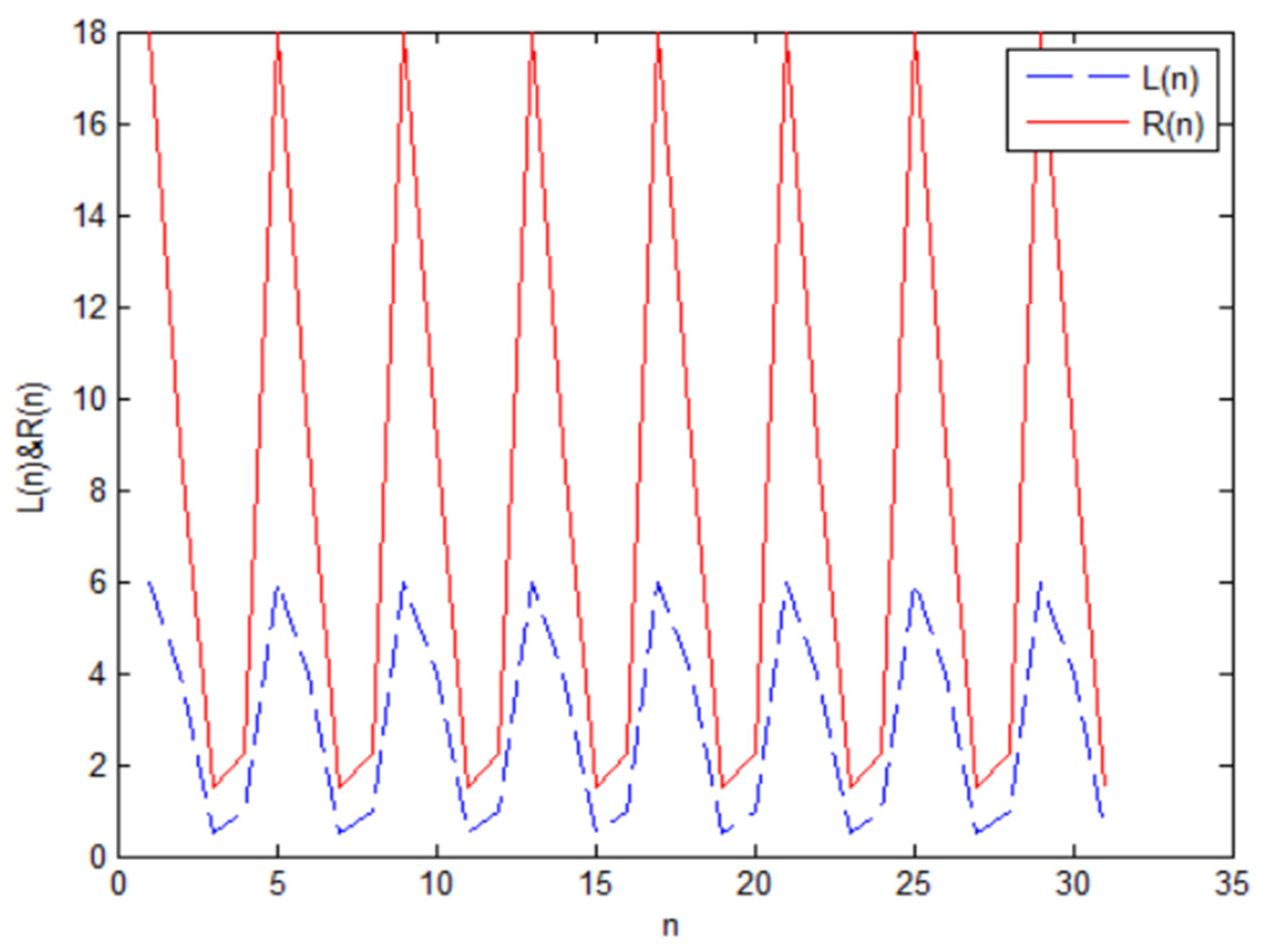
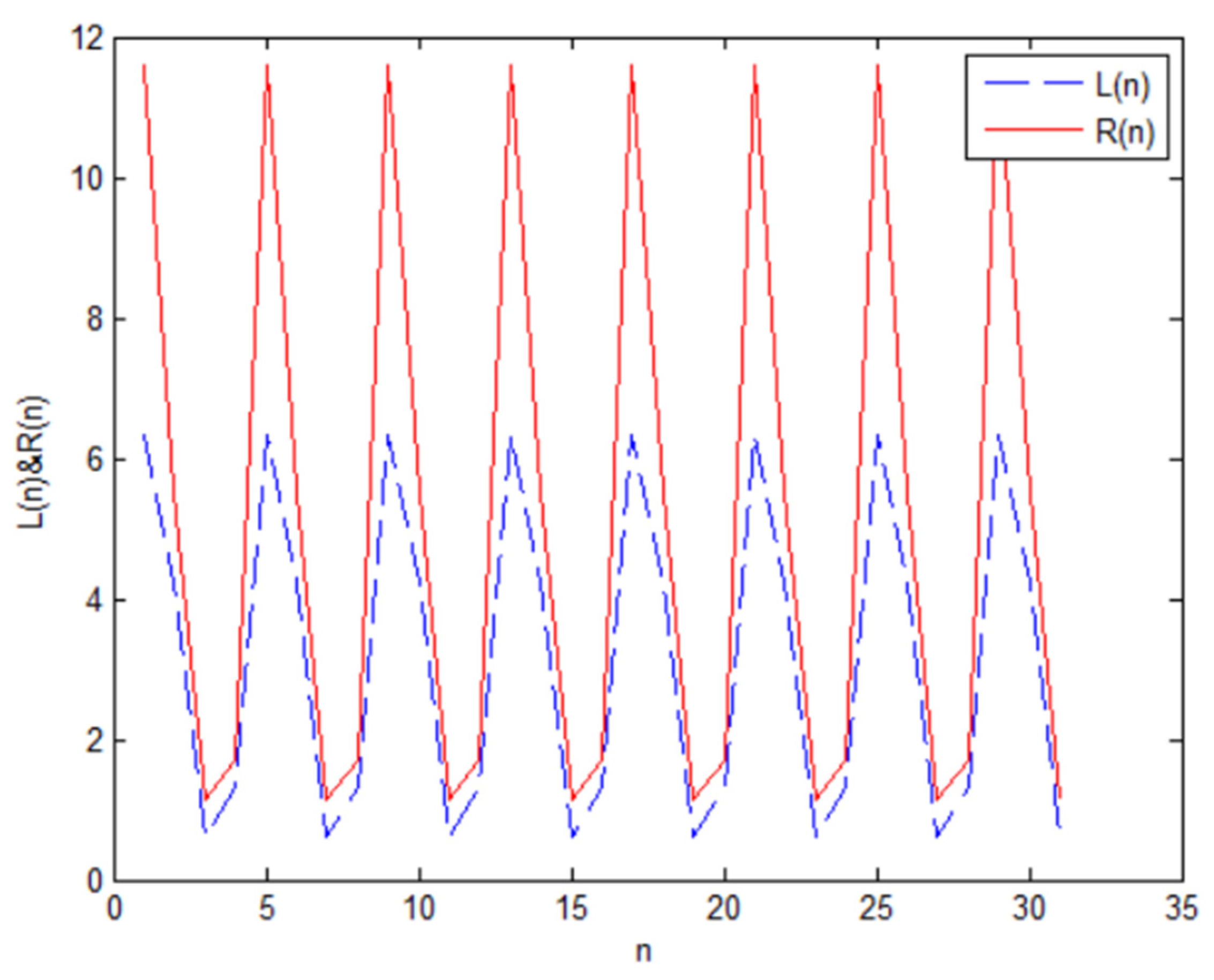
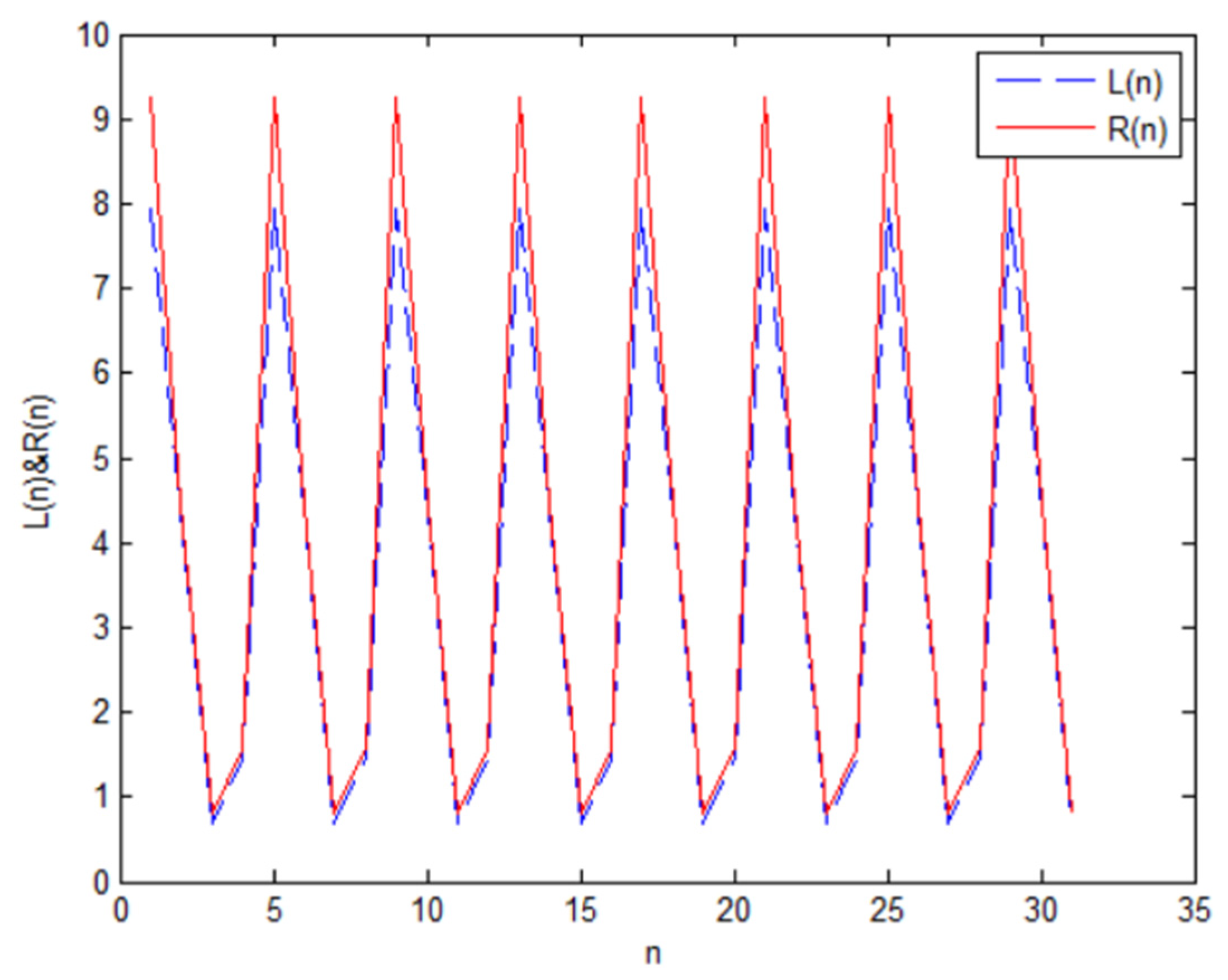
where we may set y i = L i , α , z i = R i , α ( i = 3 , 2 , 1 , ) . It follows that y i , z i can be expressed as numerical expressions in terms of α . Numerical simulations performed using Matlab 2016 yield the results shown in Figure 1, Figure 2 and Figure 3.
Figure 1 illustrates the solutions of system (28) for α = 0 . This solution corresponds to the specific periodic solution ( a 3 3 4 ) described in Theorem 1, and demonstrates that every positive solution x n of Equation (25) is periodic with period 4, bounded, and persistent. As can be seen from Figure 1, the periodicity is immediately apparent. Figure 2 illustrates the solutions of system (28) for α = 0.6 . This solution corresponds to the specific periodic solution ( a 1 3 1 ) described in Theorem 1, and further demonstrates that every positive solution x n of Equation (25) is periodic with period 4, bounded, and persistent. As can be seen from Figure 2, the periodicity is immediately apparent. Figure 3 illustrates the solution behavior of system (28) when α = 0.9 . This solution corresponds to the specific periodic solution ( a 1 4 1 ) described in Theorem 2.2. It can also be observed that every positive solution x n of Equation (25) is periodic with period 4, bounded, and persistent. As can be seen from Figure 3, the periodicity is immediately apparent.
Remark 1.
The initial values and fuzzy parameter of the model (25) are arbitrarily chosen positive fuzzy numbers. In the numerical simulation of this paper, the fuzzy numbers selected are triangular fuzzy numbers. The conclusions of this paper are also applicable to trapezoidal fuzzy numbers. To enhance the readability of this paper and to facilitate the application of its findings by engineers and technicians, the periodic solutions of Theorem 1 under various conditions are summarized in Table A1 in the Appendix A.

5. Conclusions

This paper has systematically investigated the dynamical behavior of a class of fourth-order max-type fuzzy difference equations. By employing iterative construction combined with mathematical induction and the operational rules of fuzzy numbers, the existence and uniqueness of positive solutions were first established. Using α - cuts theory, the fuzzy equation was transformed into an equivalent system of ordinary difference equations, which facilitated a detailed case analysis. Through rigorous mathematical induction, it was proved that every positive solution of this system exhibits global periodicity with period 4, and the exact closed-form expressions of the periodic solutions were derived for all possible parameter regimes. Based on these results, the periodicity, boundedness and persistence of the solutions to the original fuzzy difference equation were confirmed. Numerical simulations performed in Matlab 2016 corroborated the theoretical findings.
The analytical framework developed in this study not only generalizes existing results on max-type difference equations to the fuzzy setting but also provides explicit periodic expressions, which are crucial for practical applications. The methodology can be extended to investigate higher-order max-type fuzzy systems or systems with periodic fuzzy parameters. Future work may explore the application of this model to real-world problems involving uncertainty and memory effects, such as population dynamics with fluctuating carrying capacities, resource management in uncertain environments, or signal processing in control systems where data are imprecise. Additionally, the stability and bifurcation behavior of such fuzzy dynamical systems remain open for further investigation.

Author Contributions

Methodology and investigation, L.M., C.W. and Y.S.; software, writing—original draft preparation, L.M., C.W. and Y.S.; writing—review and editing, L.M., C.W. and Y.S.; funding acquisition, L.M. and C.W. All authors have read and agreed to the published version of the manuscript.

Funding

This work is supported by the Research Team on Differential Equations and Dynamical Systems of Sichuan Minzu College and the Sichuan Provincial Natural Science Foundation (Grant no. 2026NSFSC0138) of China.

Data Availability Statement

No new data were created or analyzed in this study. Data sharing is not applicable to this article.

Conflicts of Interest

The authors declare that they have no competing interests.

Appendix A

Table A1. All periodic solutions of max-type fuzzy difference Equation (15).
Condition iCondition i-jCondition i-j-kPeriodic Solution
B z 1 > y 3 , C y 1 > z 3 B z 0 > y 2 , C y 0 > z 2 B z 1 , B z 0 , y 1 , y 0 , C y 1 , C y 0 , C B z 1 , C B z 0
B z 0 > y 2 , C y 0 < z 2 B z 1 , B z 0 , y 1 , y 0 , C y 1 , z 2 , C B z 1 , C B z 0
B z 0 < y 2 , C y 0 > z 2 C y 2 < z 0 B z 1 , y 2 , y 1 , y 0 , C y 1 , C y 0 , C B z 1 , z 0
C y 2 > z 0 B z 1 , y 2 , y 1 , y 0 , C y 1 , C y 0 , C B z 1 , C y 2
B z 0 < y 2 , C y 0 < z 2 C y 2 < z 0 B z 1 , y 2 , y 1 , y 0 , C y 1 , z 2 , C B z 1 , z 0
C y 2 > z 0 B z 1 , y 2 , y 1 , y 0 , C y 1 , z 2 , C B z 1 , C y 2
B z 1 > y 3 , C y 1 < z 3 B z 0 > y 2 , C y 0 > z 2 B z 1 , B z 0 , y 1 , y 0 , z 3 , C y 0 , C B z 1 , C B z 0
B z 0 > y 2 , C y 0 < z 2 B z 1 , B z 0 , y 1 , y 0 , z 3 , z 2 , C B z 1 , C B z 0
B z 0 < y 2 , C y 0 > z 2 C y 2 < z 0 B z 1 , y 2 , y 1 , y 0 , z 3 , C y 0 , C B z 1 , z 0
C y 2 > z 0 B z 1 , y 2 , y 1 , y 0 , z 3 , C y 0 , C B z 1 , C y 2
B z 0 < y 2 , C y 0 < z 2 C y 2 < z 0 B z 1 , y 2 , y 1 , y 0 , z 3 , z 2 , C B z 1 , z 0
C y 2 > z 0 B z 1 , y 2 , y 1 , y 0 , z 3 , z 2 , C B z 1 , C y 2
B z 1 < y 3 , C y 1 > z 3 B z 0 > y 2 , C y 0 > z 2 C y 3 < z 1 y 3 , B z 0 , y 1 , y 0 , C y 1 , C y 0 , z 1 , C B z 0
C y 3 > z 1 y 3 , B z 0 , y 1 , y 0 , C y 1 , C y 0 , C y 3 , C B z 0
B z 0 > y 2 , C y 0 < z 2 C y 3 < z 1 y 3 , B z 0 , y 1 , y 0 , C y 1 , z 2 , z 1 , C B z 0
C y 3 > z 1 y 3 , B z 0 , y 1 , y 0 , C y 1 , z 2 , C y 3 , C B z 0
B z 0 < y 2 , C y 0 > z 2 C y 3 < z 1 , C y 2 < z 0 y 3 , y 2 , y 1 , y 0 , C y 1 , C y 0 , z 1 , z 0
C y 3 > z 1 , C y 2 < z 0 y 3 , y 2 , y 1 , y 0 , C y 1 , C y 0 , C y 3 , z 0
C y 3 < z 1 , C y 2 > z 0 y 3 , y 2 , y 1 , y 0 , C y 1 , C y 0 , z 1 , C y 2
C y 3 > z 1 , C y 2 > z 0 y 3 , y 2 , y 1 , y 0 , C y 1 , C y 0 , C y 3 , C y 2
B z 0 < y 2 , C y 0 < z 2 C y 3 < z 1 , C y 2 < z 0 y 3 , y 2 , y 1 , y 0 , C y 1 , z 2 , z 1 , z 0
C y 3 > z 1 , C y 2 < z 0 y 3 , y 2 , y 1 , y 0 , C y 1 , z 2 , C y 3 , z 0
C y 3 < z 1 , C y 2 > z 0 y 3 , y 2 , y 1 , y 0 , C y 1 , z 2 , z 1 , C y 2
C y 3 > z 1 , C y 2 > z 0 y 3 , y 2 , y 1 , y 0 , C y 1 , z 2 , C y 3 , C y 2
B z 1 < y 3 , C y 1 < z 3 B z 0 > y 2 , C y 0 > z 2 C y 3 < z 1 y 3 , B z 0 , y 1 , y 0 , z 3 , C y 0 , z 1 , C B z 0
C y 3 > z 1 y 3 , B z 0 , y 1 , y 0 , z 3 , C y 0 , C y 3 , C B z 0
B z 0 > y 2 , C y 0 < z 2 C y 3 < z 1 y 3 , B z 0 , y 1 , y 0 , z 3 , z 2 , z 1 , C B z 0
C y 3 > z 1 y 3 , B z 0 , y 1 , y 0 , z 3 , z 2 , C y 3 , C B z 0
B z 0 < y 2 , C y 0 > z 2 C y 3 < z 1 , C y 2 < z 0 y 3 , y 2 , y 1 , y 0 , z 3 , C y 0 , z 1 , z 0
C y 3 > z 1 , C y 2 < z 0 y 3 , y 2 , y 1 , y 0 , z 3 , C y 0 , C y 3 , z 0
C y 3 < z 1 , C y 2 > z 0 y 3 , y 2 , y 1 , y 0 , z 3 , C y 0 , z 1 , C y 2
C y 3 > z 1 , C y 2 > z 0 y 3 , y 2 , y 1 , y 0 , z 3 , C y 0 , C y 3 , C y 2
B z 0 < y 2 , C y 0 < z 2 C y 3 < z 1 , C y 2 < z 0 y 3 , y 2 , y 1 , y 0 , z 3 , z 2 , z 1 , z 0
C y 3 > z 1 , C y 2 < z 0 y 3 , y 2 , y 1 , y 0 , z 3 , z 2 , C y 3 , z 0
C y 3 < z 1 , C y 2 > z 0 y 3 , y 2 , y 1 , y 0 , z 3 , z 2 , z 1 , C y 2
C y 3 > z 1 , C y 2 > z 0 y 3 , y 2 , y 1 , y 0 , z 3 , z 2 , C y 3 , C y 2

References

  1. Su, G.; Sun, T.; Han, C.; Qin, B.; Quan, W. Eventual periodicity of a max-type difference equation system. J. Comput. Anal. Appl. 2018, 24, 976. [Google Scholar]
  2. Sun, T.X.; Su, G.W. Dynamics of a difference equation with maximum. J. Comput. Anal. Appl. 2017, 23, 401–407. [Google Scholar]
  3. Su, G.W.; Sun, T.X.; Qin, B. On the solutions of a max-type system of difference equations with period-two parameters. Adv. Differ. Equ. 2018, 2018, 358. [Google Scholar] [CrossRef]
  4. Dekkar, I.; Touafek, N. Existence and global attractivity of periodic solutions in a max type system of difference equations. Turk. J. Math. 2017, 41, 412–425. [Google Scholar] [CrossRef]
  5. Li, R.; Wang, C.Y.; Zhou, Y.Q.; Pan, S. On a system of three max-type nonlinear difference equations. J. Comput. Anal. Appl. 2018, 25, 1463–1479. [Google Scholar]
  6. Su, G.W.; Sun, T.X.; Qin, B. Eventually periodic solutions of a max-type system of difference equations of higher order. Discret. Dyn. Nat. Soc. 2018, 2018, 8467682. [Google Scholar] [CrossRef]
  7. Voulov, H.D. On the periodic character of some difference equation. J. Differ. Equ. Appl. 2002, 8, 799–810. [Google Scholar] [CrossRef]
  8. Elsayed, E.M.; Iričanin, B.D. On a max-type and a min-type difference equation. Appl. Math. Comput. 2009, 215, 608–614. [Google Scholar] [CrossRef]
  9. Fotiades, N.; Papaschinopoulos, G. On a system of difference equations with maximum. Appl. Math. Comput. 2013, 221, 684–690. [Google Scholar] [CrossRef]
  10. Sun, T.; Liu, J.; He, Q.; Liu, X.-H.; Tao, C. Eventually periodic solutions of a max-type difference equation. Sci. World J. 2014, 2014, 219437. [Google Scholar] [CrossRef]
  11. Sun, T.X.; Xi, H.J. On the solutions of a system of difference equations with maximum. Appl. Math. Comput. 2016, 290, 292–297. [Google Scholar] [CrossRef]
  12. Wang, C.Y.; Liu, H.; Li, R.; Hu, X.H.; Shao, Y.B. Boundedness character of a symmetric system of max-type difference equations. IAENG Int. J. Appl. Math. 2016, 46, 505–511. [Google Scholar]
  13. Su, G.W.; Han, C.H.; Sun, T.X.; Li, L. On the solutions of a max-type system of difference equations of higher order. Adv. Differ. Equ. 2020, 2020, 213. [Google Scholar] [CrossRef]
  14. Sun, T.X.; Su, G.W.; Qin, B.; Han, C.H. Global behavior of a max-type system of difference equations of the second order with four variables and period-two parameters. AIMS Math. 2023, 8, 23941–23952. [Google Scholar] [CrossRef]
  15. Stefanidou, G.; Papaschinopoulos, G. Behavior of the positive solutions of fuzzy max-difference equations. Adv. Differ. Equ. 2005, 2005, 153–172. [Google Scholar] [CrossRef]
  16. Stefanidou, G.; Papaschinopoulos, G. The periodic nature of the positive solutions of a nonlinear fuzzy max-difference equation. Inf. Sci. 2006, 176, 3694–3710. [Google Scholar] [CrossRef]
  17. Sun, T.X.; Xi, H.J.; Su, G.W.; Qin, B. Dynamics of the fuzzy difference equation zn = max{1/znm, an/znr}. J. Nonlinear Sci. Appl. 2018, 11, 477–485. [Google Scholar] [CrossRef]
  18. Han, C.H.; Su, G.W.; Li, L.; Xia, G.E.; Sun, T.X. Eventual periodicity of the fuzzy max-difference equation xn = max{C, xnmk/xnm}. Adv. Differ. Equ. 2020, 2020, 673. [Google Scholar] [CrossRef]
  19. Sun, T.X.; Su, G.; Han, C.H.; Zeng, F.P.; Qin, B. Eventual periodicity of a system of max-type fuzzy difference equations of higher order. Fuzzy Sets Syst. 2022, 443, 286–303. [Google Scholar] [CrossRef]
  20. Wang, C.Y.; Wang, Q.Y.; Zhang, Q.M.; Meng, J.W. Periodicity of a four-order maximum fuzzy difference equation. IAENG Int. J. Appl. Math. 2023, 53, 1617–1627. [Google Scholar]
  21. Wang, C.Y.; Li, J.H. Periodic solution for a max-type fuzzy difference equation. J. Math. 2020, 2020, 3094391. [Google Scholar] [CrossRef]
  22. Jia, L.L.; Zhao, X.J.; Wang, C.Y.; Wang, Q.Y. Dynamic behavior of a seven-order fuzzy difference equation. J. Appl. Anal. Comput. 2023, 13, 486–501. [Google Scholar] [CrossRef] [PubMed]
Figure 1. Solutions of system (28) when α = 0 .
Axioms 15 00202 g001
Figure 2. Solutions of system (28) when α = 0.6 .
Axioms 15 00202 g002
Figure 3. Solutions of system (18) when α = 0.9 .
Axioms 15 00202 g003
Disclaimer/Publisher’s Note: The statements, opinions and data contained in all publications are solely those of the individual author(s) and contributor(s) and not of MDPI and/or the editor(s). MDPI and/or the editor(s) disclaim responsibility for any injury to people or property resulting from any ideas, methods, instructions or products referred to in the content.