Data-Driven Prediction of Surface Transport Quantities in Williamson Nanofluid Flow via Hybrid Numerical Neural Approach


Abstract
1. Introduction
- A modified explicit Runge–Kutta scheme, proven to be stable and convergent, tailored for nonlinear convection–diffusion systems, has not been systematically applied to Williamson nanofluid flow.
- High-order compact spatial discretization has not been effectively coupled with such modified time integrators in this context.
- AI-based surrogate prediction of both the skin friction coefficient and the local Sherwood number for Williamson nanofluid systems remains underexplored.
- We developed a modified two-stage explicit Runge–Kutta scheme that preserves the classical stability region while reducing numerical error.
- We coupled the scheme with a high-order compact finite difference method for spatial discretization.
- We established rigorous stability and convergence analysis for scalar and coupled convection–diffusion systems.
- We applied the developed framework to an unsteady Williamson nanofluid model with magnetic, thermal, and mass transfer effects.
- We constructed an ANN-based surrogate model trained on high-fidelity numerical data to predict the skin friction coefficient and local Sherwood number efficiently.
2. Modified Numerical Scheme
2.1. Predictor Stage
2.2. Corrector Stage
2.3. Spatial Discretization Using Compact High-Order Schemes
2.4. Physical Relevance to the Real-World Williamson Nanofluid Problem
3. Stability and Convergence Analysis
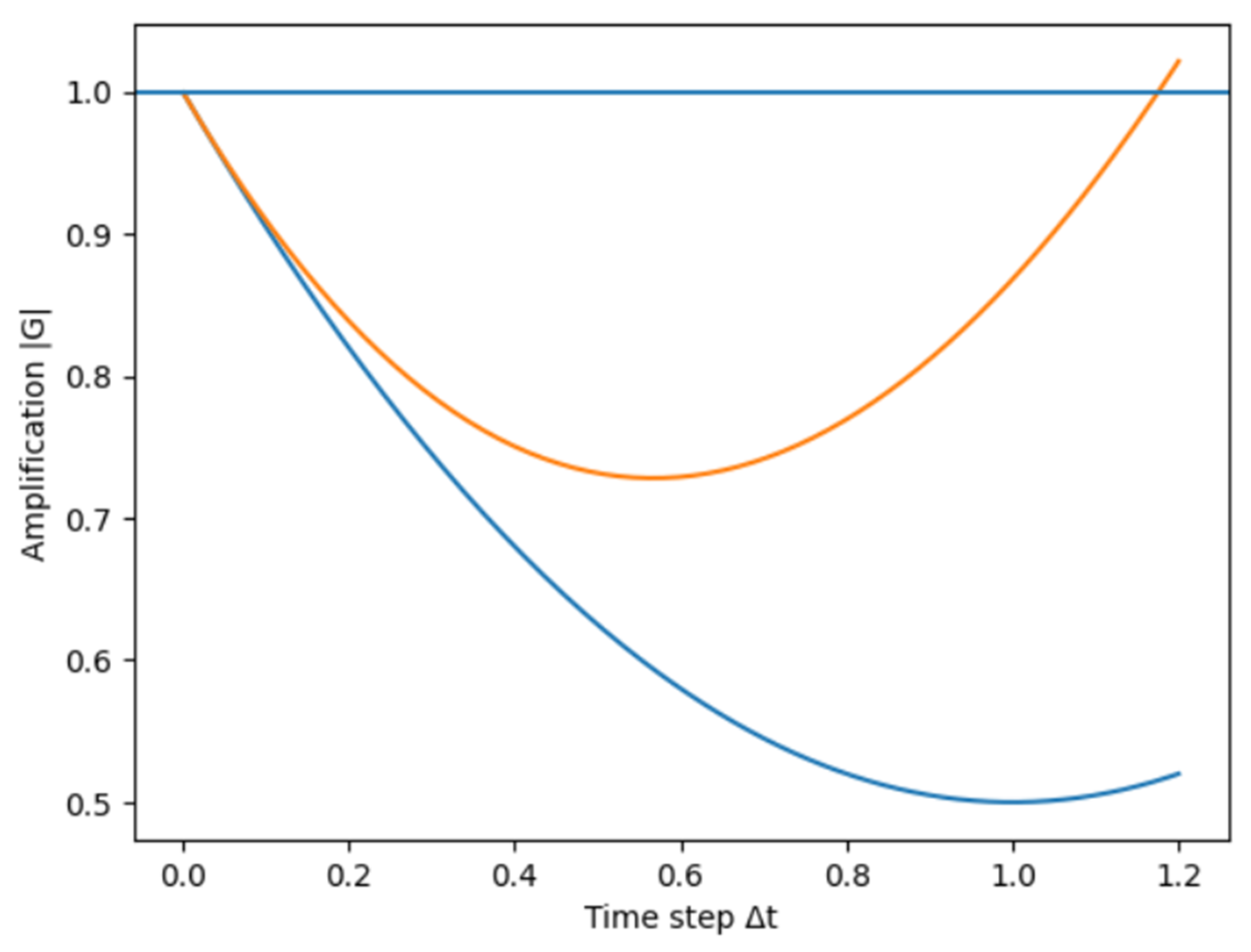
3.1. Numerical Stability Verification
3.2. Convergence of the Proposed Scheme
- corresponds to the convective transport coefficients (e.g., Reynolds number-dependent advection terms);
- represents the diffusive transport coefficients (including viscous, thermal, and mass diffusivity contributions);
- accounts for source terms such as magnetic damping (Hartmann effect), buoyancy forces (Grashof terms), and chemical reaction parameters.
- The matrices are bounded linear operators.
- The compact discretization matrices and are bounded in the -norm.
- The time step and spatial step are chosen such that
3.3. Clarification About
4. Problem Formulation
4.1. Time Discretization with Modified Runge–Kutta Scheme
4.2. Why This Scheme Is Powerful
4.3. Physical Relevance to Real-World Williamson Nanofluid Problems
5. Results and Discussion
- A numerical scheme is proposed for solving time-dependent partial differential equations, with a focus on nonlinear unsteady nanofluid flows. The scheme is structured to discretise only the temporal derivative terms, allowing it to be paired with various spatial discretization techniques.
- Spatial discretization is performed using a high-order compact finite difference scheme with a three-point stencil, achieving fourth- or sixth-order accuracy and effectively resolving near-wall gradients.
- The compact schemes are derived via Taylor series expansions and are well established for high-precision convection–diffusion problems.
- A modified explicit two-stage time integrator is proposed, in which an exponential predictor replaces the first Runge–Kutta stage to enhance temporal accuracy for stiff and nonlinear systems.
- The scheme is conditionally stable; the stability analysis confirms a stability region comparable to that of the classical Runge–Kutta method.
- Being an explicit approach, it does not use iterative solvers or matrix inversion, minimizing computational costs and implementation complexity.
- In nonlinear systems, explicit methods might be more accurate than large-step implicit methods, although explicit schemes only need small time steps to be stable.
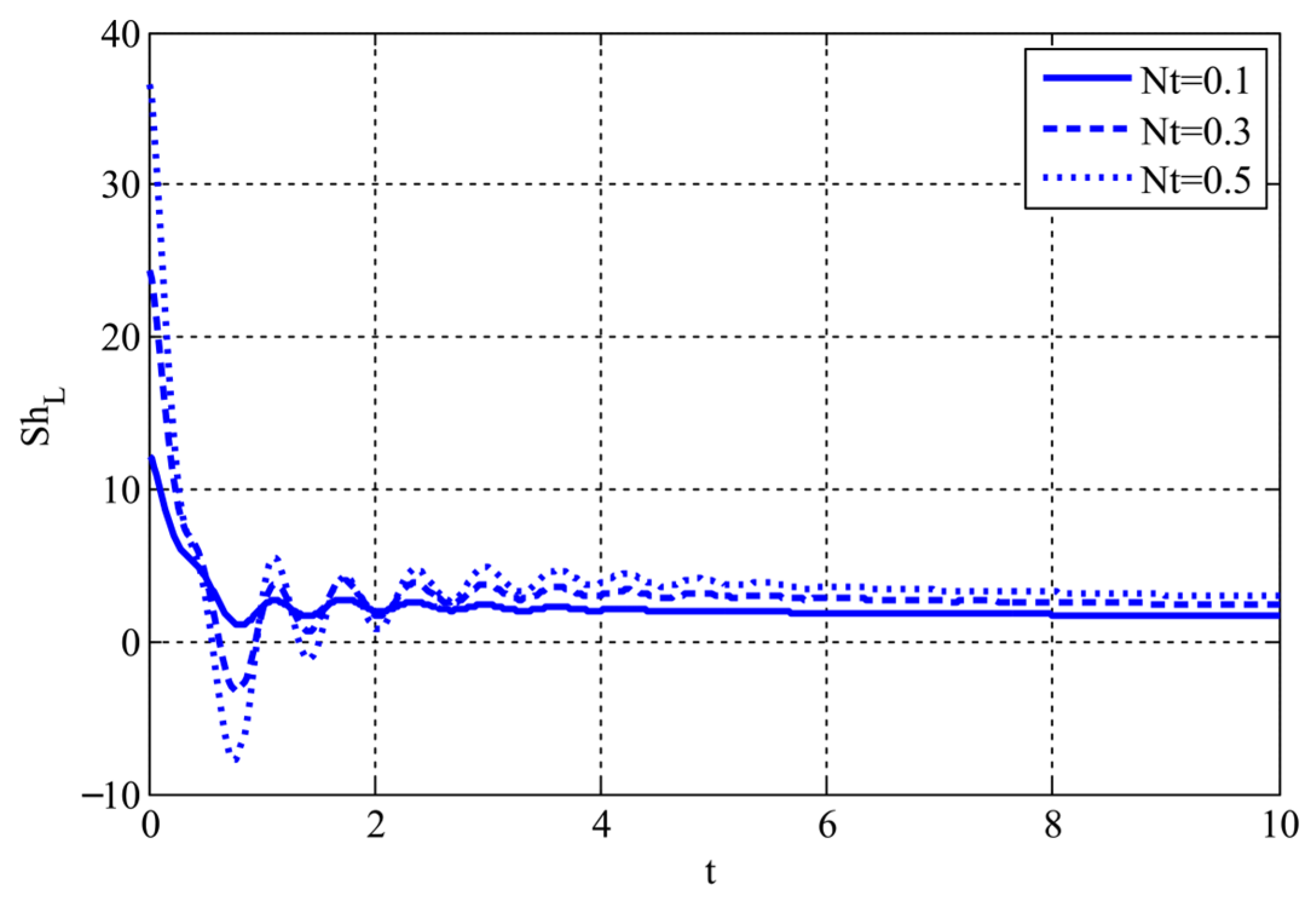
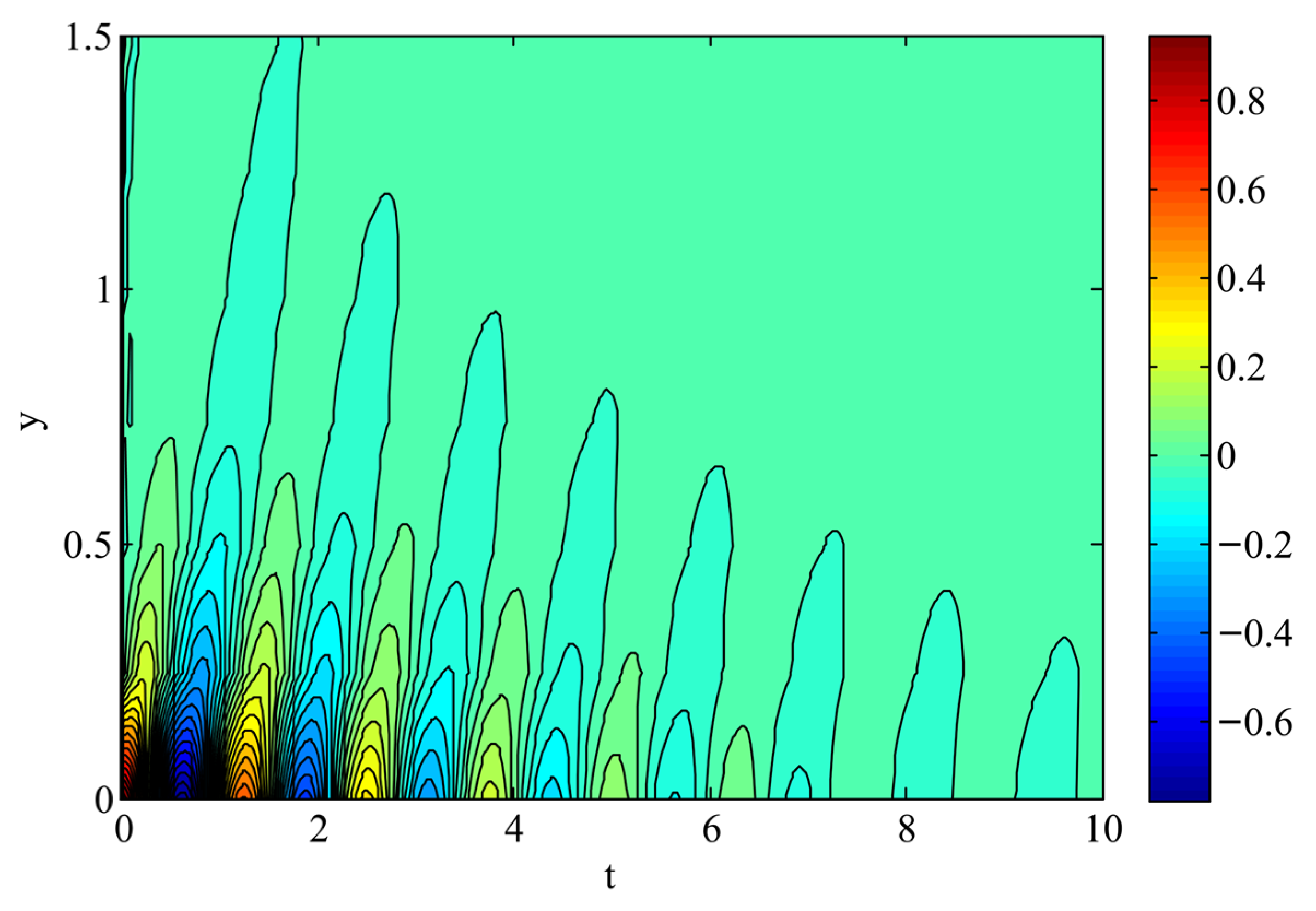
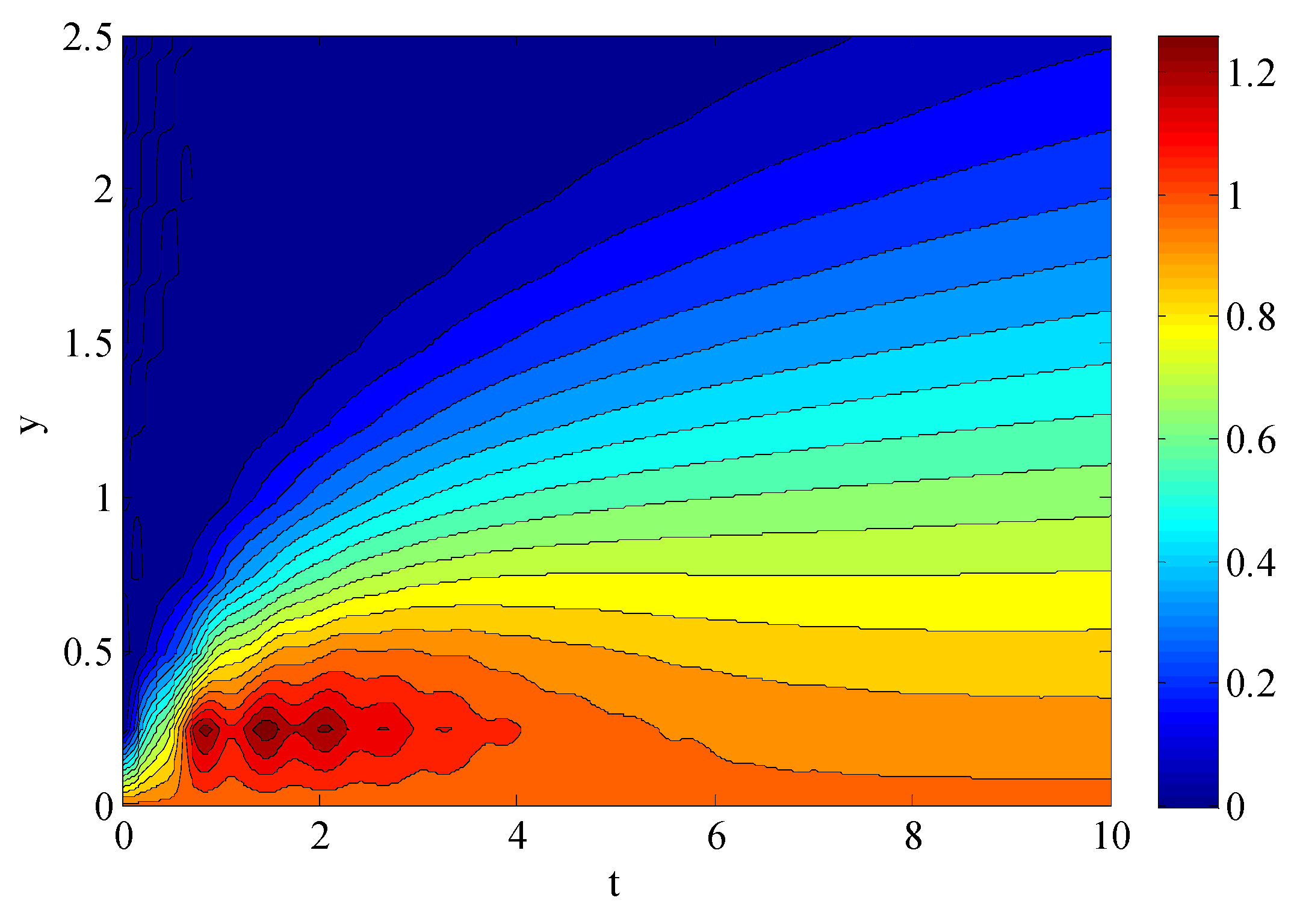
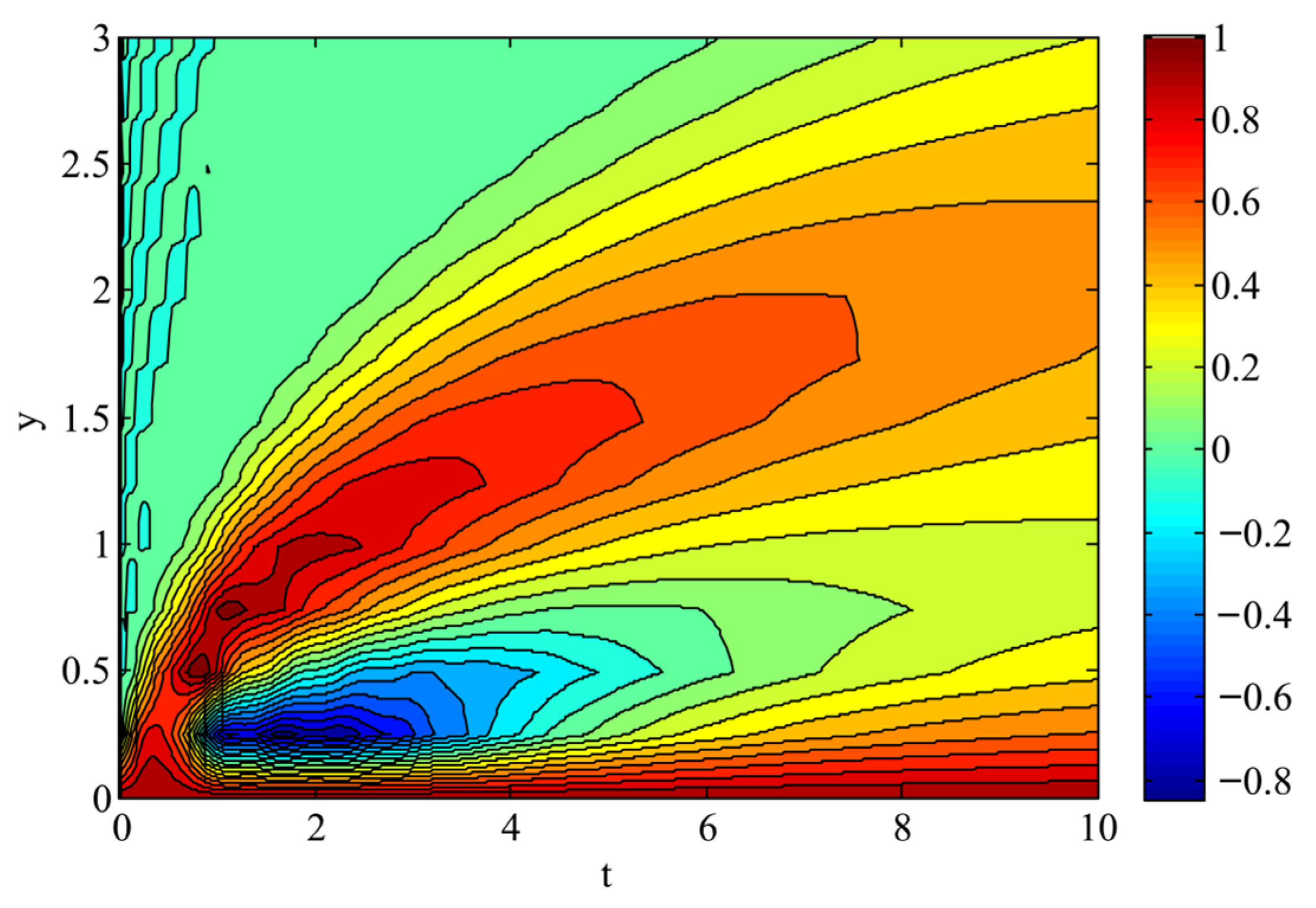
- The proposed framework is applied to the dimensionless Williamson nanofluid model (Equations (48)–(51)), yielding velocity, temperature, and concentration profiles for a detailed parametric analysis of heat and mass transfer.
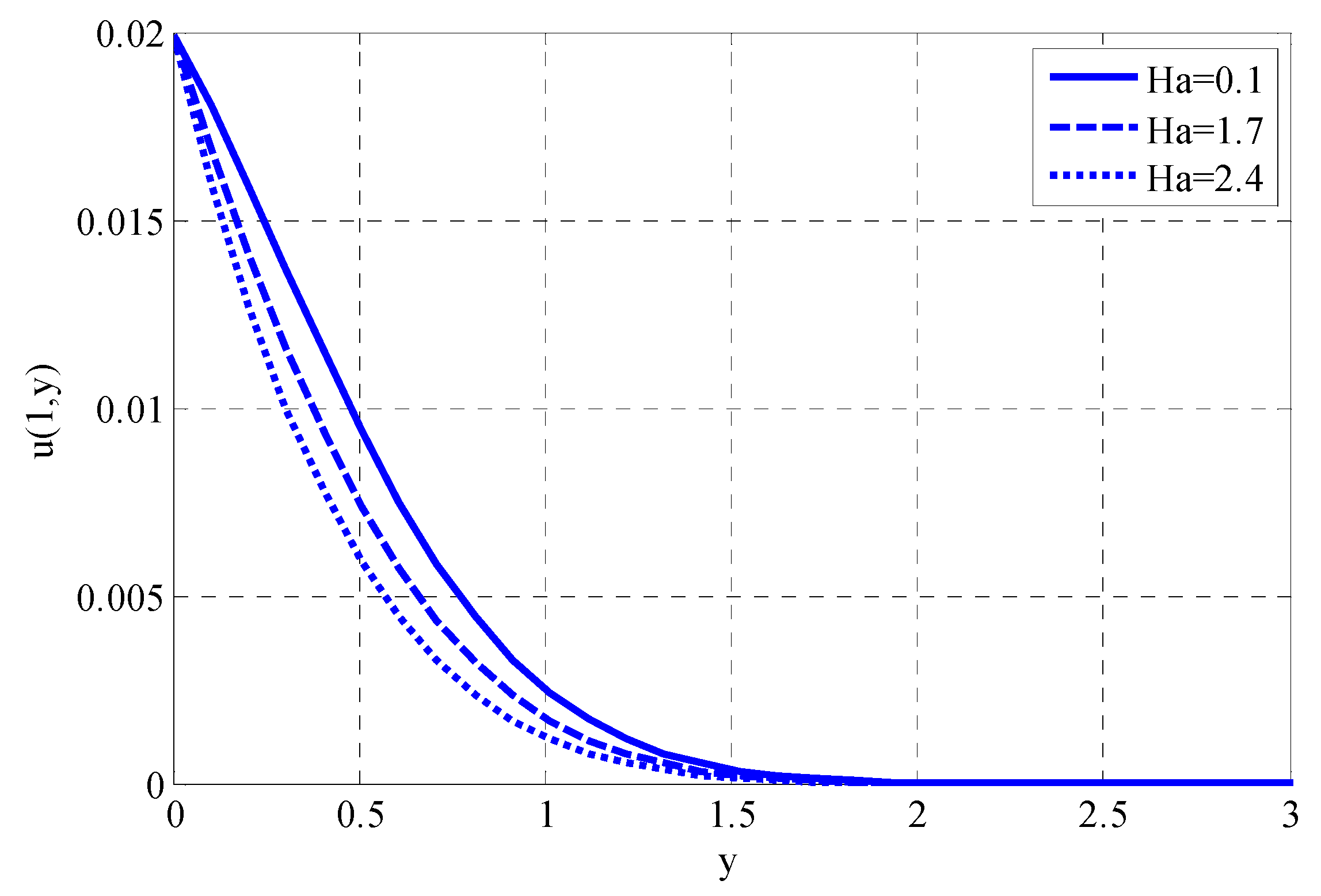
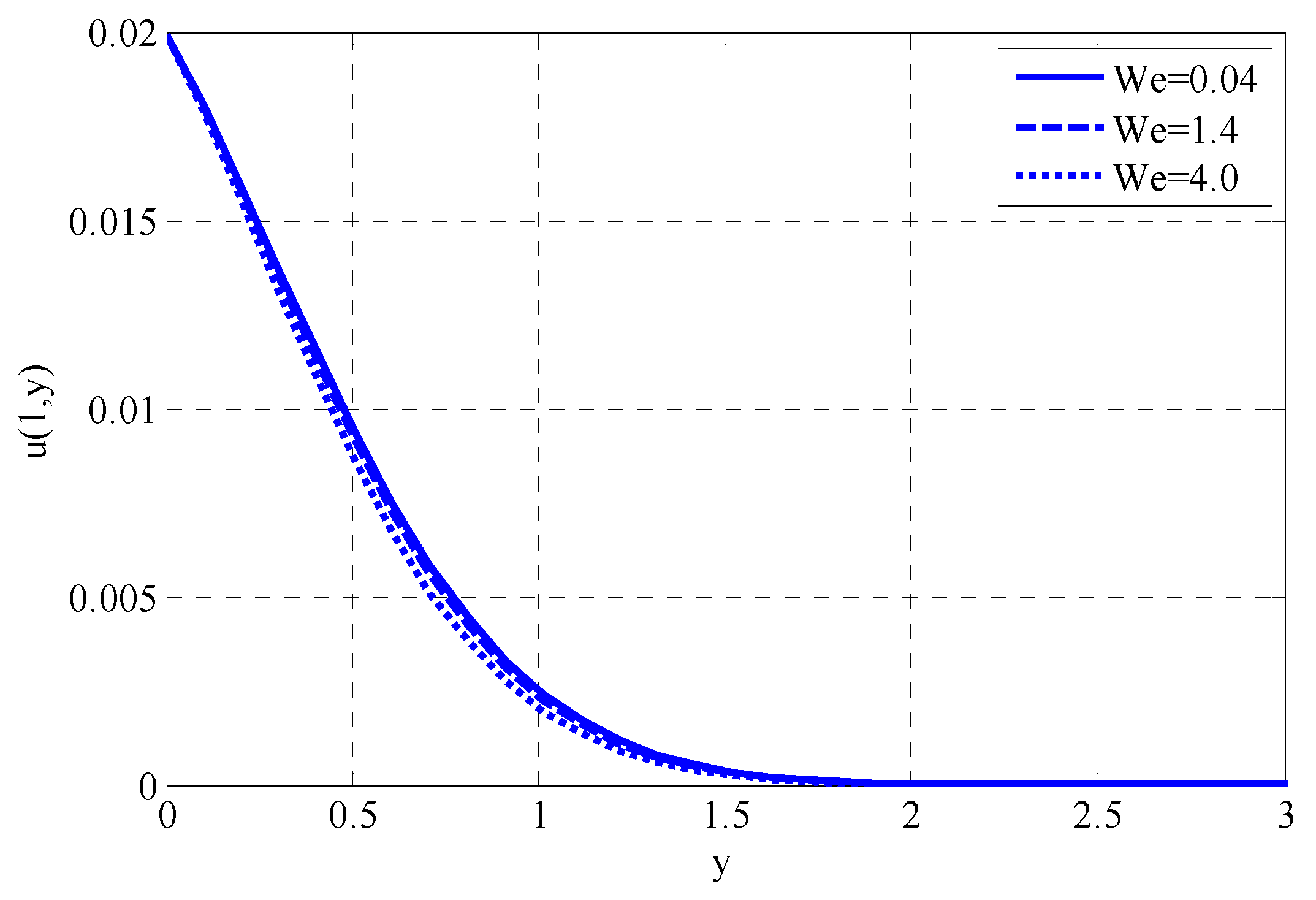
5.1. Velocity Profile Analysis
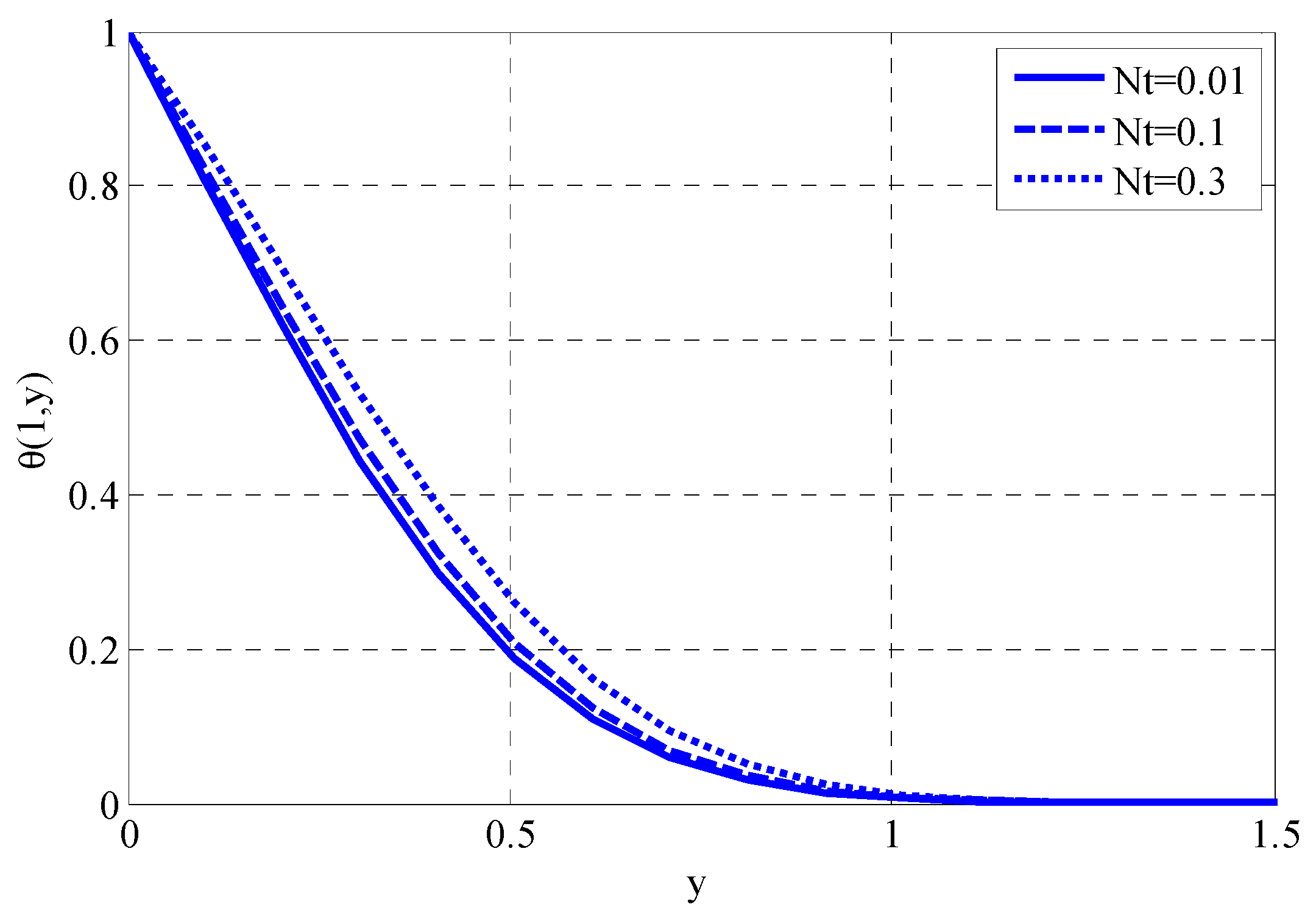
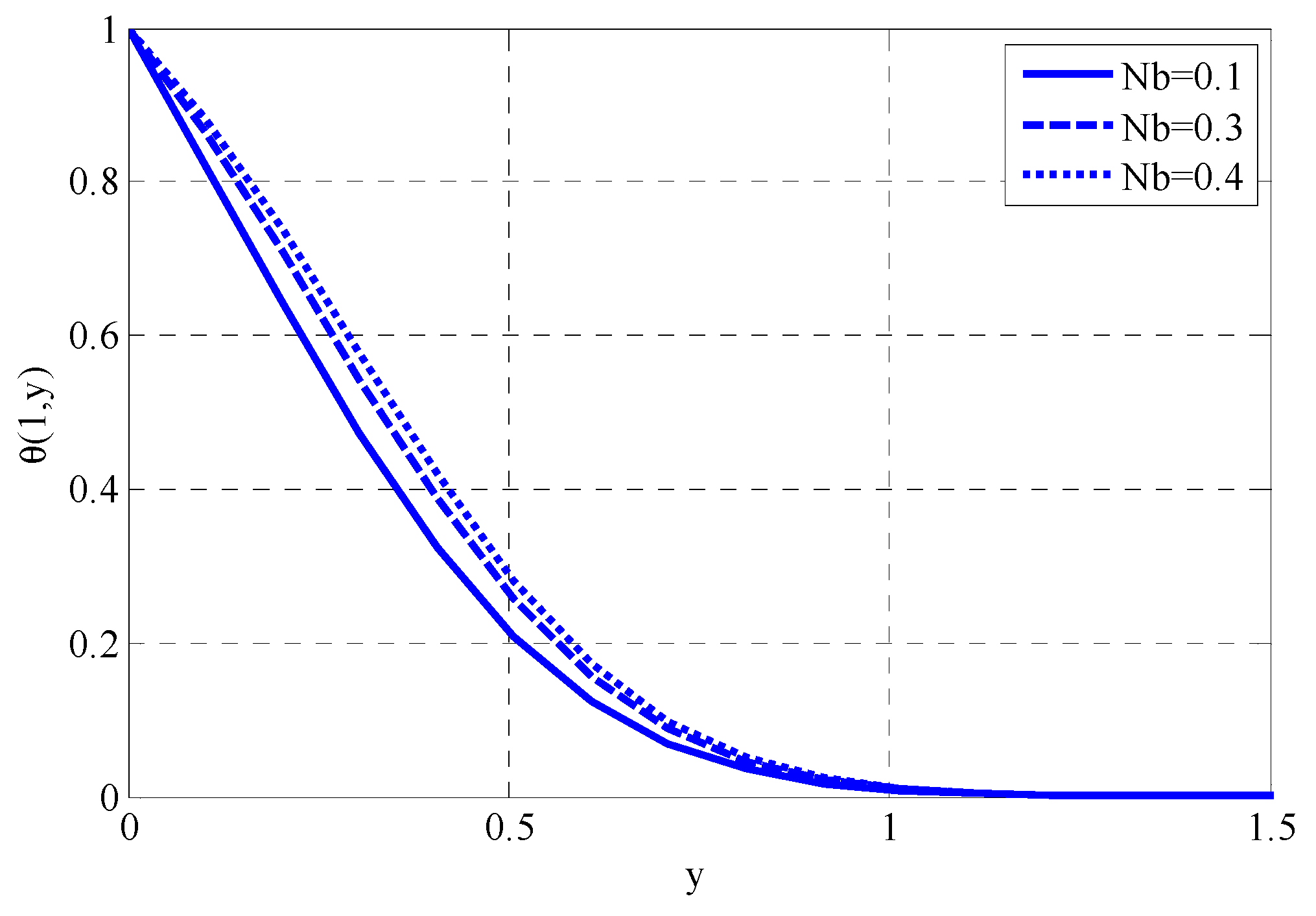
5.2. Temperature Profile Analysis
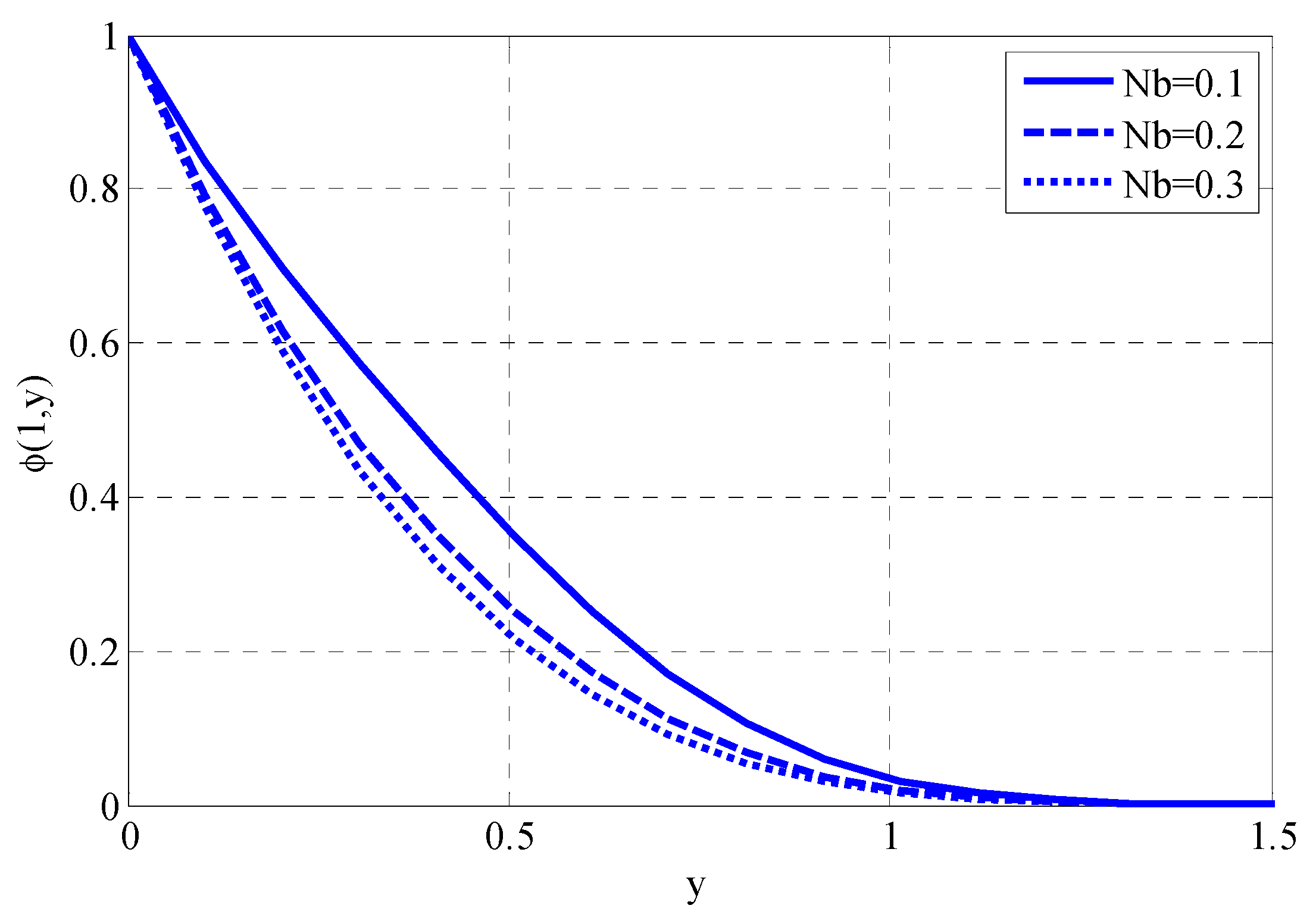
5.3. Concentration Profile
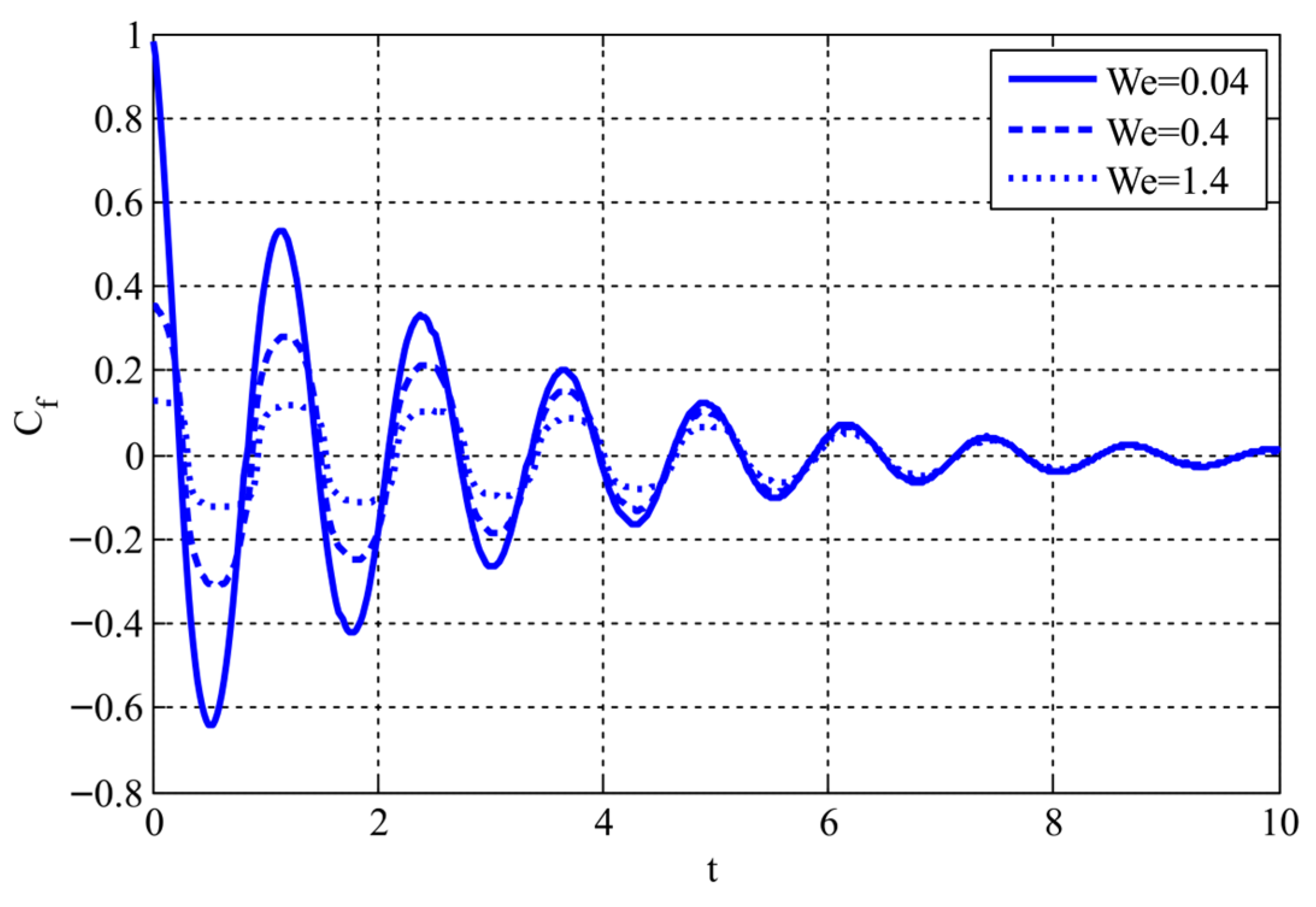
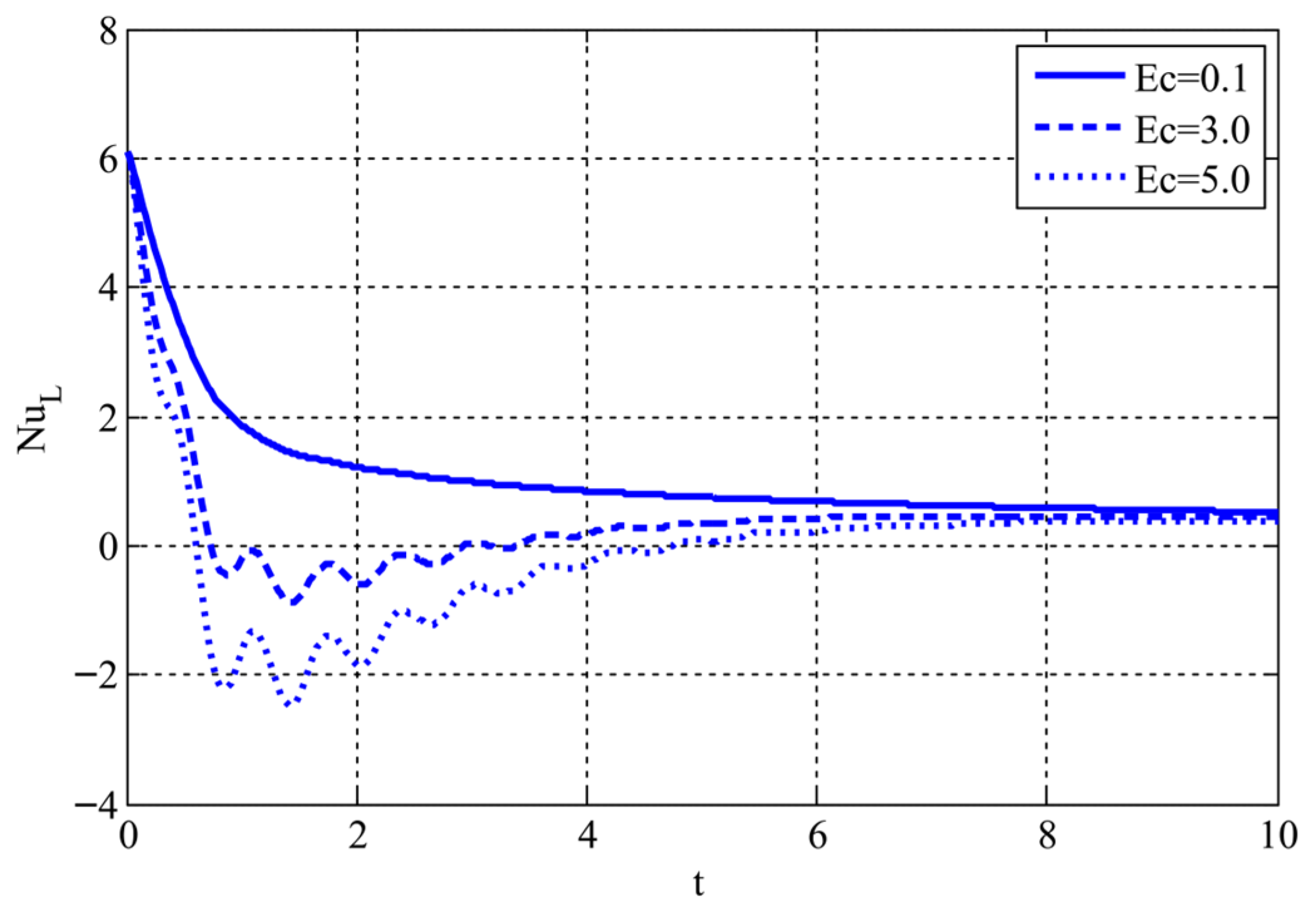
5.4. Different Parameter Analysis
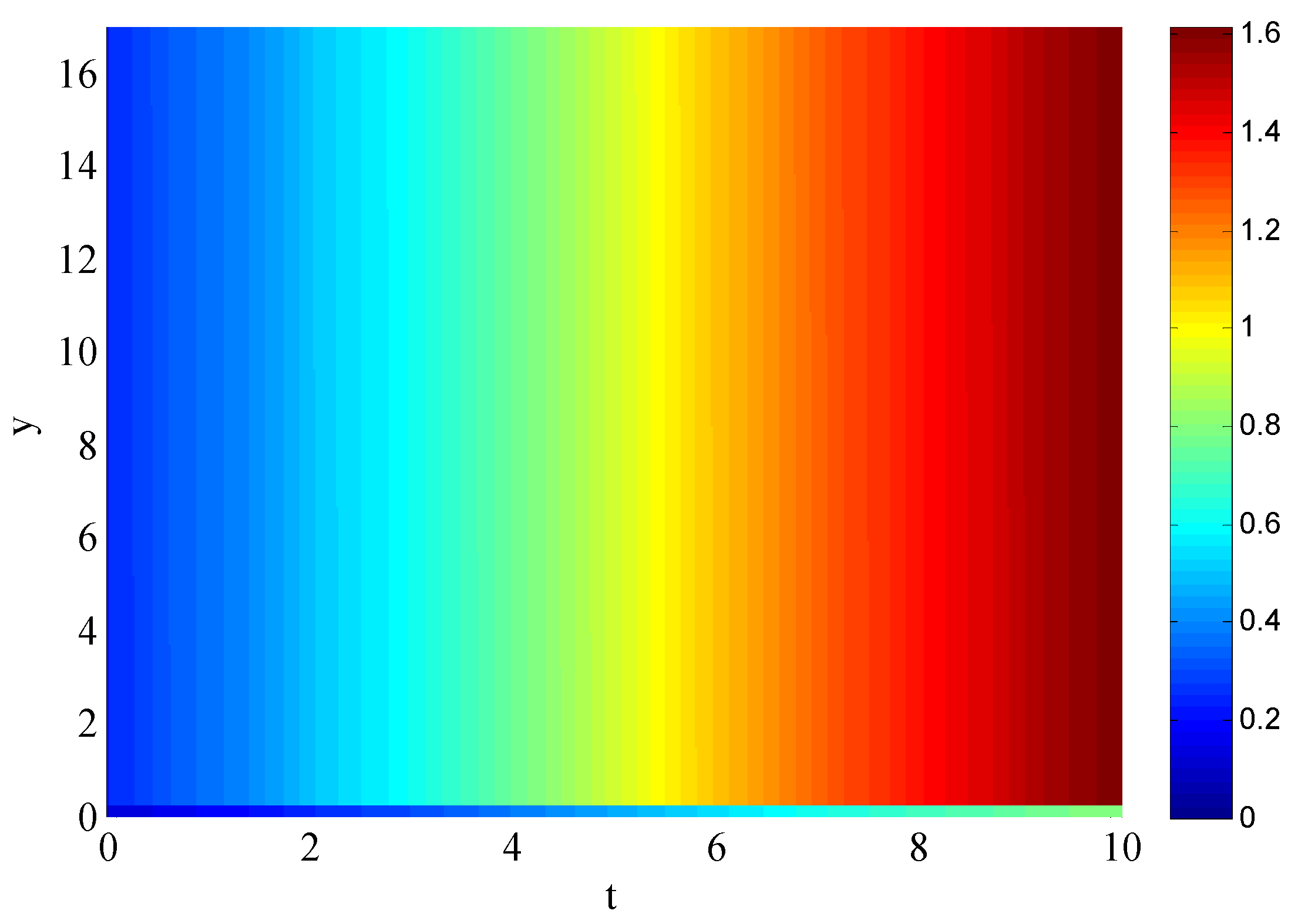
5.5. Contour Plot for Velocity, Temperature, and Concentration Profiles
5.6. Computational Time for the Proposed Scheme
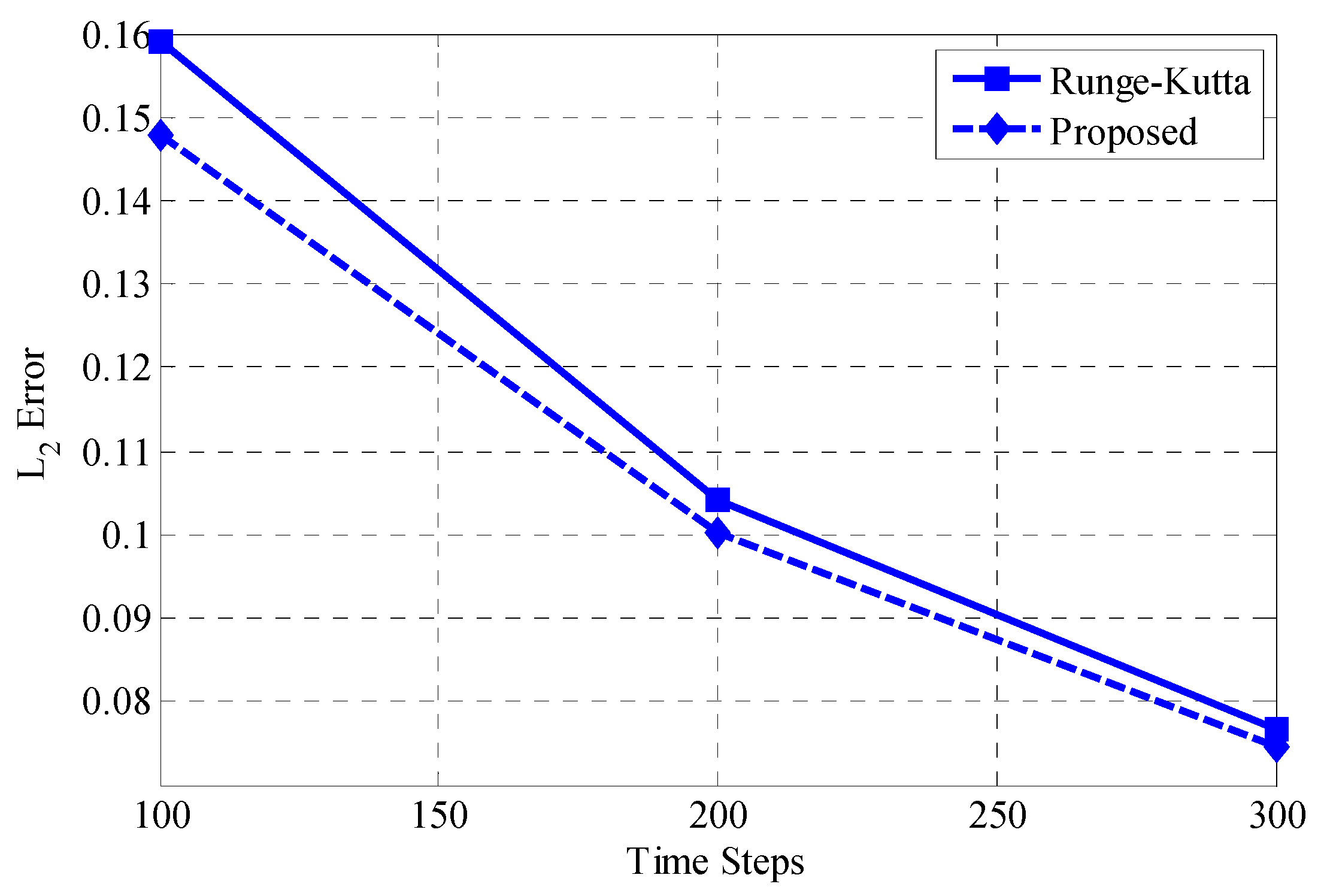
5.7. Convergence Comparison of the Proposed Scheme and Runge–Kutta Method for Stokes First Problem
6. Neural Network-Based Surrogate Model
6.1. Neural Network Configuration and Training Protocol
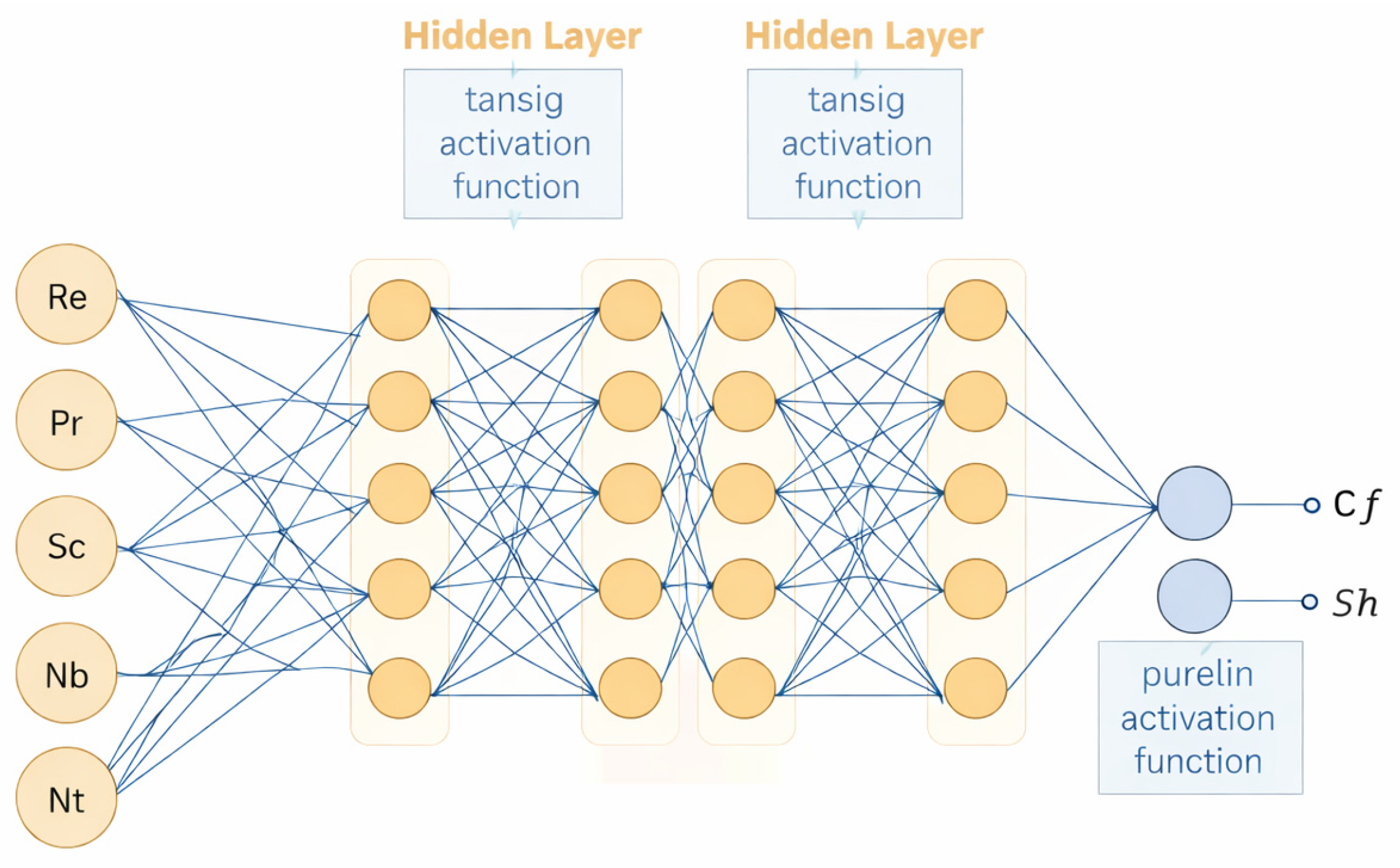
- Input Layer: Five neurons corresponding to input parameters ;
- Hidden Layers: Two hidden layers, each consisting of 10 neurons;
- Activation Functions: tansig (hyperbolic tangent sigmoid) for hidden layers, and purelin (linear) for output layer;
- Output Layer: Two neurons representing the predicted values of and .
- Data Partitioning: 70% training, 15% validation, and 15% testing;
- Loss Function: Mean Squared Error (MSE);
- Regularization: Coefficient to improve generalization;
- Cross-validation: Applied to ensure robust predictive performance.
6.2. Model Performance Evaluation
- Root Mean Square Error (RMSE):
- Visual Evaluation:
- ○
- Regression plots for both and ;
- ○
- Error histograms and residual scatter plots.
- Real-time parametric studies;
- Sensitivity analysis;
- Inverse design and control applications.
6.3. Schematic Illustration of the Artificial Neural Network (ANN) for Flow Prediction
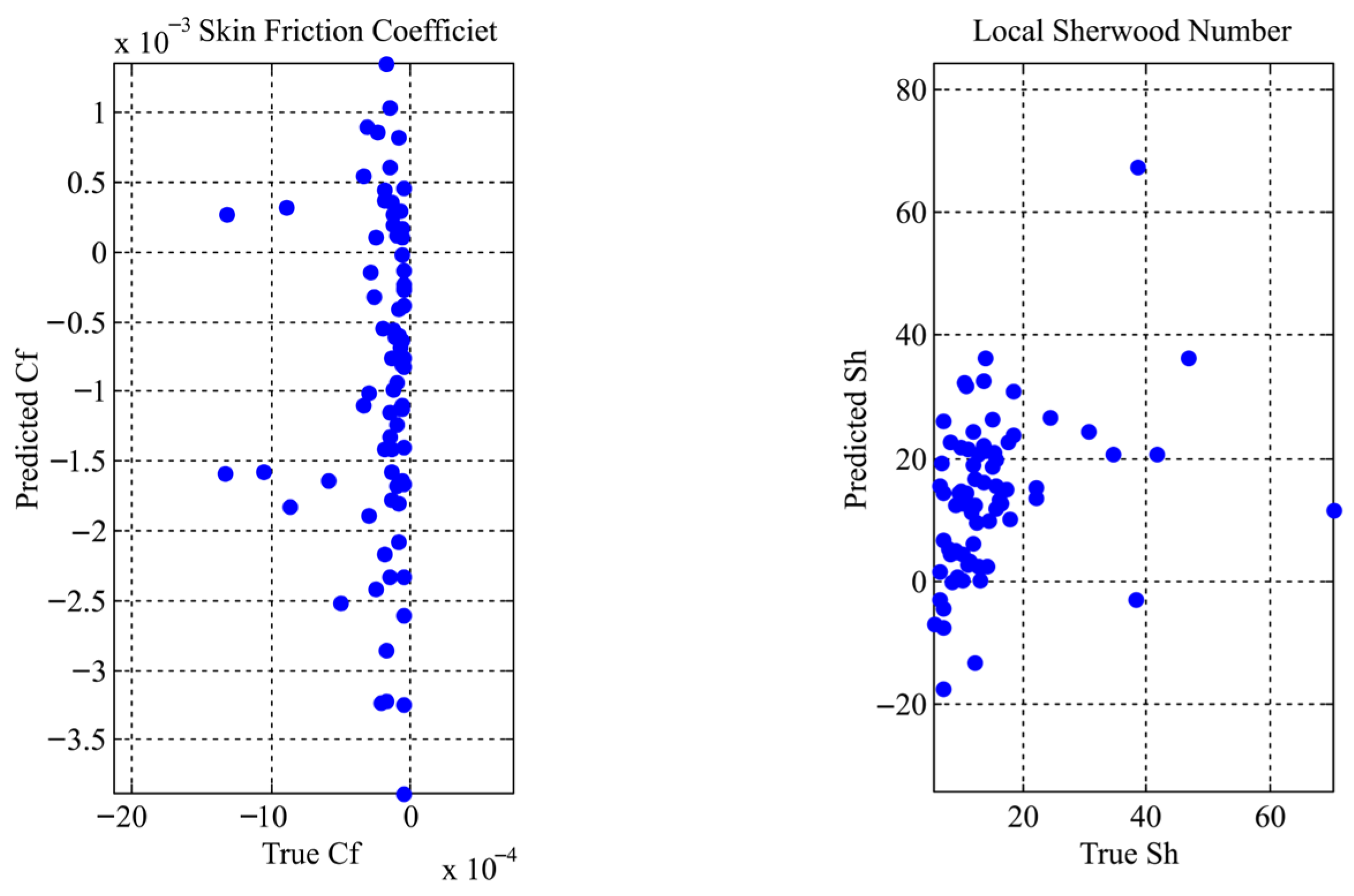
6.4. Prediction of Skin Friction Coefficient and Local Sherwood Number Using ANN
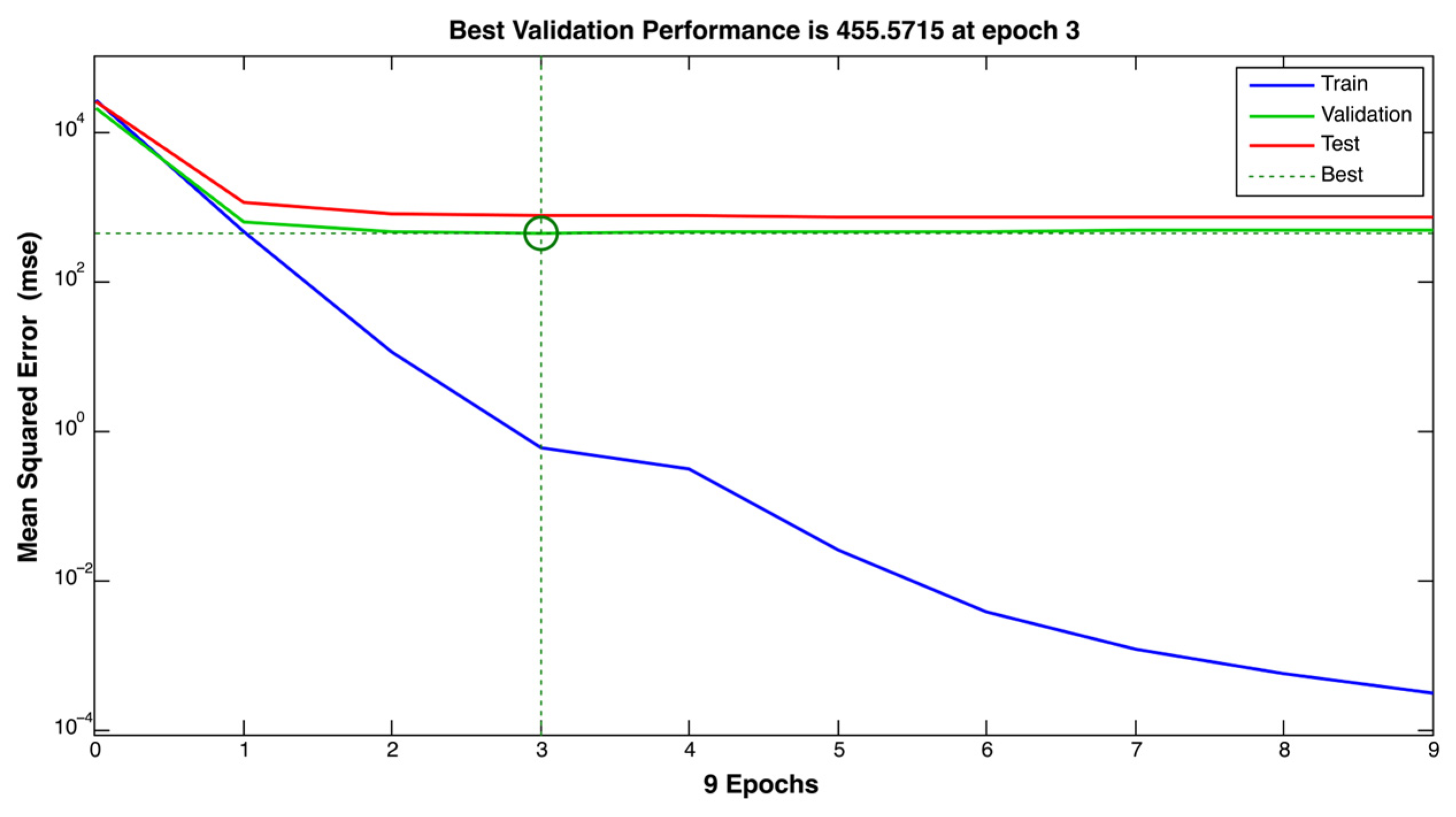
6.5. Neural Network Training Performance
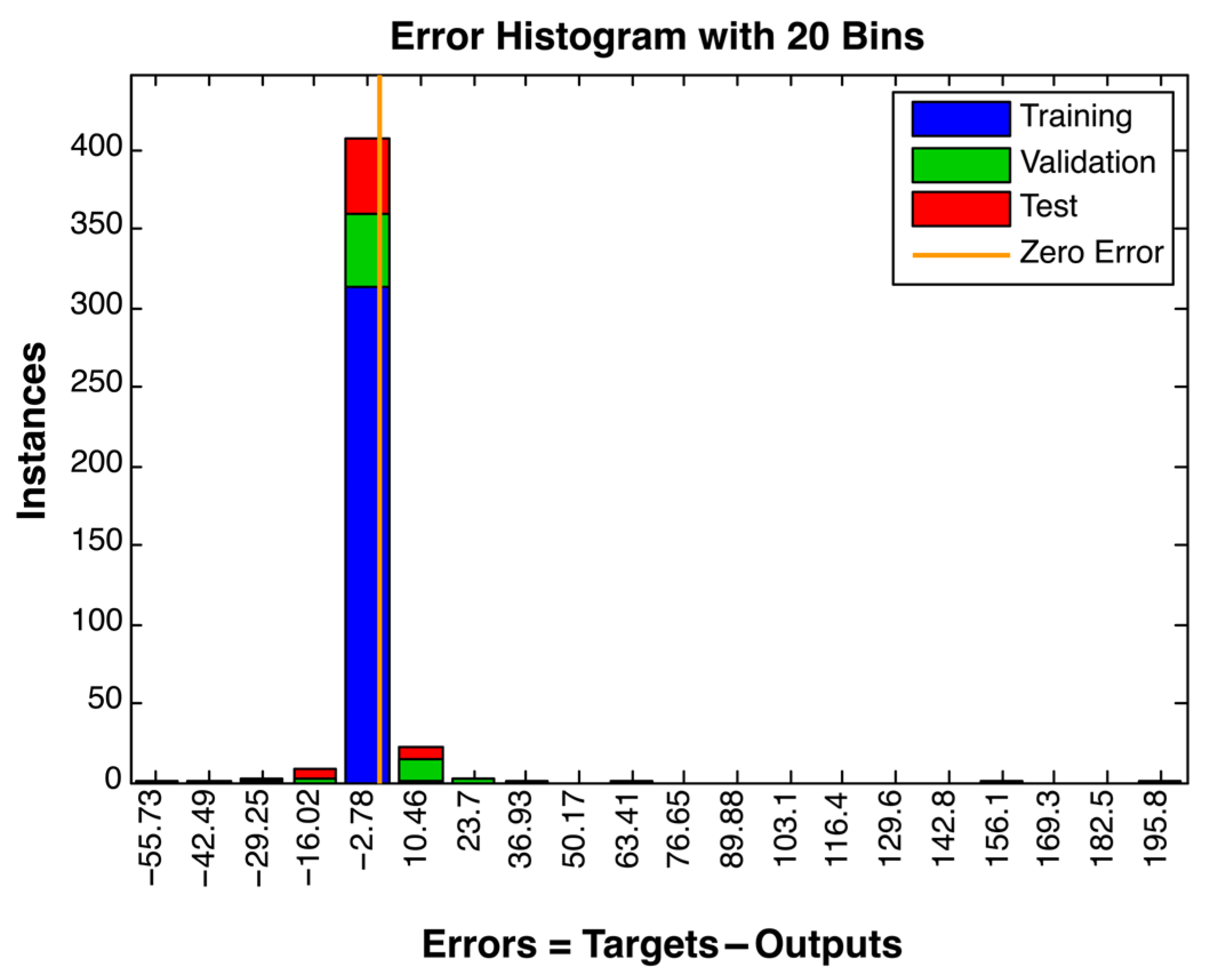
6.6. Error Histogram for Surrogate Model Prediction
- The x-axis represents the range of prediction errors (i.e., differences between true and predicted values).
- The y-axis shows the number of instances (data samples) corresponding to each error bin.
- The bars are color-coded: blue for training data, green for validation data, and red for test data.
- The orange vertical line denotes the zero-error mark, i.e., perfect prediction.
- A majority of errors are centered around zero, indicating that the model performs with high precision.
- Most predictions fall into narrow error bins near the zero line, especially for the training data, suggesting that the ANN has effectively learned the underlying data distribution.
- The validation and test errors also show a tight distribution near zero, indicating strong generalization and minimal overfitting.
- The presence of only a few outlier bins with higher error magnitudes reflects occasional deviations, likely due to nonlinear interactions under certain random parameter combinations.
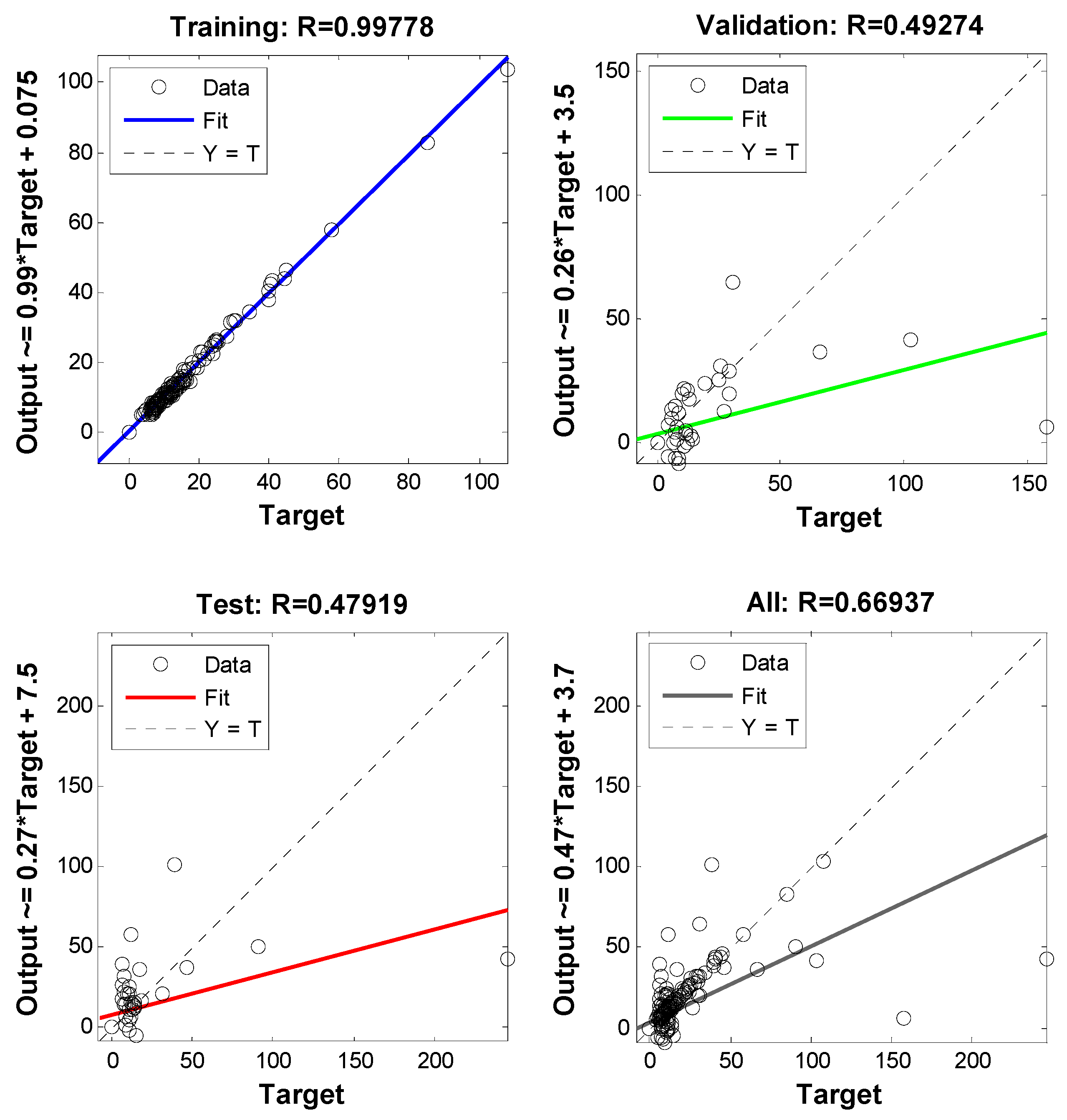
6.7. Regression Performance of Neural Network Model
7. Conclusions
- The hybrid numerical method that uses the modified exponential integrator with a compact finite difference scheme has a superior performance to the classical Runge–Kutta method in terms of nonlinearities and stiffness in the governing equations, convergence, and computational cost.
- This proves to be crucial since machine learning combined with high-order numerical solvers can realize the real-time prediction and parametric sensitivity analysis of complex non-Newtonian nanofluid systems; this will lead to AI-based design optimization of thermal-fluid systems.
- The regression and error histogram plots demonstrate the validity of the ANN-based surrogate model, with low RMSE and close concentration around the optimal prediction line, indicating that it can be used for high-fidelity numerical simulations.
- The error plots and regression diagrams of the training, validation, and testing data sets show that the accuracy of the predictions is directly related to the diversity and the balance of training samples, which highlights the importance of the creation of representative datasets in the form of tables at the stage of surrogate model design.
Author Contributions
Funding
Data Availability Statement
Acknowledgments
Conflicts of Interest
References
- Kumar, V.V.; Shekar, M.R.; Bejawada, S.G. Thermo-diffusion, diffusion-thermo impacts on heat and mass transfer casson fluid flow with porous medium in the presence of heat generation and radiation. Partial Differ. Equ. Appl. Math. 2025, 13, 101039. [Google Scholar] [CrossRef]
- Nadeem, M.; Alam, M.A.; Ali, N.; Elashiry, M. An algebraic approach of topological indices connected with finite quasigroups. J. Funct. Spaces 2024, 2024, 1948465. [Google Scholar] [CrossRef]
- Abdal, S.; Ajmal, M.; Prasannakumara, B.; Shah, N.A.; Zulqarnain, R.M.; Yook, S.-J. Significance of nanoparticles concentration for heat and mass transfer of ellis fluid dynamics across a stretching wall. J. Therm. Anal. Calorim. 2025, 150, 4617–4629. [Google Scholar] [CrossRef]
- Nandeppanavar, M.M.; Jagadevappa, V. Mathematical analysis of gyrotactic microorganisms swim in non-Newtonian nanofluid slip flow, convective heat and mass transfer due to stretching sheet. Proc. Inst. Mech. Eng. Part N J. Nanomater. Nanoeng. Nanosyst. 2025, 23977914251350600. [Google Scholar] [CrossRef]
- Benaissa, M.; Ullah, Z.; Dahshan, A.; Alam, M.M.; Abualnaja, K.M.; Abu-Zinadah, H.; Faqihi, A.A.; Khedher, N.B. Heat and mass transfer performance of power-law nanofluid flow with thermal radiation and joule heating aspects: Surface heat flux analysis. Case Stud. Therm. Eng. 2025, 67, 105843. [Google Scholar] [CrossRef]
- Ahmad, W.; Rehman, M.I.U.; Hamid, A.; Hou, M. Numerical investigation of bioconvection flow of Sutterby nanofluid with Darcy–Forchheimer porous media past an inclined stretching cylinder. Eur. Phys. J. Plus 2024, 139, 842. [Google Scholar] [CrossRef]
- Rehman, M.I.U.; Hamid, A.; Xiaoping, W.; Qi, H. Magnetohydrodynamic and thermal radiation effects with stability analysis on shear-thinning Williamson nanofluid by using response surface methodology. J. Therm. Anal. Calorim. 2025, 150, 16685–16700. [Google Scholar] [CrossRef]
- Nabwey, H.A.; EL-Hakiem, A.; Khan, W.A.; Rashad, A.; Awad, M.M. Heat and mass transfer of non-Newtonian nanofluids in assisting/reverse flow over shrinking/stretching surfaces in porous media. Multiscale Multidiscip. Model. Exp. Des. 2025, 8, 225. [Google Scholar] [CrossRef]
- Zeeshan, A.; Yousif, M.A.; Khan, M.I.; Latif, M.A.; Ali, S.S.; Mohammed, P.O. Non-similar analysis of boundary layer flow and heat transfer in non-Newtonian hybrid nanofluid over a cylinder with viscous dissipation effects. Energies 2025, 18, 1660. [Google Scholar] [CrossRef]
- Molla, M.M.; Hasan, M.F.; Islam, M.M. Elucidating thermal phenomena of non-Newtonian experimental data based copper-alumina-ethylene glycol hybrid nanofluid in a cubic enclosure with central heated plate by machine learning validations of D3q27 MRT-LBM. Int. J. Thermofluids 2025, 26, 101033. [Google Scholar] [CrossRef]
- Galal, A.M.; Obalalu, A.M.; Akindele, A.O.; Khan, U.; Usman, A.A.; Olayemi, O.A.; Khashi’ie, N.S. Thermal Performance of Entropy-Optimized Tri-Hybrid Nanofluid Flow within the Context of Two Distinct Non-Newtonian Models: Application of Solar-Powered Residential Buildings. Comput. Model. Eng. Sci. 2025, 142, 3089–3113. [Google Scholar]
- Naidu, K.K.; Babu, D.H.; Reddy, S.H.; Narayana, P.V.S. Magneto-stefan blow enhanced heat and mass transfer flow in non-Newtonian ternary hybrid nanofluid across the non-linear elongated surface. Numer. Heat Transf. Part B Fundam. 2025, 86, 1463–1482. [Google Scholar]
- Graish, M.S.; Ali, A.B.; Al-Zahiwat, M.M.; Alardhi, S.M.; Baghoolizadeh, M.; Salahshour, S.; Pirmoradian, M. Prediction of the viscosity of iron-CuO/waterethylene glycol non-Newtonian hybrid nanofluids using different machine learning algorithms. Case Stud. Chem. Environ. Eng. 2025, 11, 101180. [Google Scholar] [CrossRef]
- Hazzazi, M.M.; Nadeem, M.; Kamran, M.; Cangul, I.N.; Akhter, J. Holomorphism and edge labeling: An inner study of latin squares associated with antiautomorphic inverse property moufang quasigroups with applications. Complexity 2024, 2024, 8575569. [Google Scholar] [CrossRef]
- Ahmad, W.; Rehman, M.I.U.; Hamid, A.; Hou, M. Heat and mass transfer analysis for thermally radiative Sutterby fluid along a stretching cylinder with Cattaneo–Christov heat flux theory. J. Therm. Anal. Calorim. 2025, 150, 2961–2973. [Google Scholar] [CrossRef]
- Choi, S.U.S. Enhancing thermal conductivity of fluid with nanoparticles. In Proceedings of the ASME 1995 International Mechanical Engineering Congress and Exposition, San Francisco, CA, USA, 12–17 November 1995; Volume 231, pp. 99–105. [Google Scholar] [CrossRef]
- Rashid, U.; Baleanu, D.; Iqbal, A.; Abbas, M. Shape effect of nanosize particles on magnetohydrodynamic nanofluid flow and heat transfer over a stretching sheet with entropy generation. Entropy 2020, 22, 1171. [Google Scholar] [CrossRef] [PubMed]
- Alali, E.; Megahed, A.M. MHD dissipative Casson nanofluid liquid film flow due to an unsteady stretching sheet with radiation influence and slip velocity phenomenon. Nanotechnol. Rev. 2022, 11, 463–472. [Google Scholar] [CrossRef]
- Abbas, W.; Ibrahim, M.A.; Mokhtar, O.; Megahed, A.M.; Said, A.A.M. Numerical analysis of MHD nanofluid flow characteristics with heat and mass transfer over a vertical cone subjected to thermal radiation and chemical reaction. J. Non-Linear Math. Phys. 2023, 30, 1540–1566. [Google Scholar] [CrossRef]
- Amer, A.M.; Ghoneim, N.I.; Megahed, A.M. Investigation of dissipation phenomenon of non-Newtonian nanofluid due to a horizontal stretching rough sheet through a Darcy porous medium. Appl. Eng. Sci. 2024, 17, 100171. [Google Scholar] [CrossRef]
- Garvandha, M.; Gajjeia, N.; Naria, V.; Kumar, D. Thermodynamic entropy of a magnetized nanofluid flow over an inclined stretching cylindrical surface. J. Therm. Eng. 2024, 10, 1253–1265. [Google Scholar] [CrossRef]
- Ali, L.; Apsari, R.; Abbas, A.; Tak, P. Entropy generation on the dynamics of volume fraction of nanoparticles and Coriolis force impacts on mixed convective nanofluid flow with significant magnetic effect. Numer. Heat Transfer Part A Appl. 2025, 86, 8509–8524. [Google Scholar] [CrossRef]
- Mishra, A.; Pathak, G. Thermal-flow characteristics of an Ellis hybrid nanofluid containing polytetrafluoroethylene-SWCNTs over a stretching/shrinking cylinder with slip effect. Nanostruct. Nano-Objects 2025, 43, 101515. [Google Scholar] [CrossRef]
- Mishra, A. Analysis of radiative Ellis hybrid nanofluid flow over a stretching/shrinking cylinder embedded in a porous medium with slip condition. Multiscale Multi. Mod. 2025, 8, 282. [Google Scholar] [CrossRef]
- Hamad, M.A.A.; Uddin, M.J.; Ismail, A.M. Radiation effects on heat and mass transfer in MHD stagnation-point flow over a permeable flat plate with convective boundary condition. Nucl. Eng. Des. 2012, 242, 194–200. [Google Scholar] [CrossRef]
- Khader, M.M.; Megahed, A.M. Differential transformation method for flow and heat transfer due to a stretching sheet embedded in a porous medium. Appl. Math. Mech. 2014, 35, 1387–1400. [Google Scholar] [CrossRef]
- Hamid, A.; Khan, M. Unsteady mixed convective flow of Williamson nanofluid in the presence of variable thermal conductivity and magnetic field. J. Mol. Liq. 2018, 260, 436–446. [Google Scholar] [CrossRef]
- Jan, S.U.; Khan, U.; El-Rahman, M.A.; Islam, S.; Hassan, A.M.; Ullah, A. Effect of variable thermal conductivity of ternary hybrid nanofluids over a stretching sheet with convective boundary conditions and magnetic field. Results Eng. 2023, 20, 101531. [Google Scholar] [CrossRef]
- Khaleque, T.S.; Hossain, A.; Shamshuddin, M.D.; Ferdows, M.; Salawu, S.O.; Sun, S. Soret and Dufour impacts on radiative power-law fluid flow via a continuously stretchablesurface with varying viscosity and thermal conductivity. Sci. Rep. 2024, 14, 23152. [Google Scholar] [CrossRef]
- Ly, H.-B.; Nguyen, M.H.; Pham, B.T. Metaheuristic optimization of levenberg–marquardt-based artificial neural network using particle swarm optimization for prediction of foamed concrete compressive strength. Neural Comput. Appl. 2021, 33, 17331–17351. [Google Scholar] [CrossRef]
- Zhao, J.; Nguyen, H.; Nguyen-Thoi, T.; Asteris, P.G.; Zhou, J. Improved levenberg–marquardt backpropagation neural network by particle swarm andwhale optimization algorithms to predict the deflection of rc beams. Eng. Comput. 2022, 38, 3847–3869. [Google Scholar] [CrossRef]
- Nguyen, H.X.; Cao, H.Q.; Nguyen, T.T.; Tran, T.N.-C.; Tran, H.N.; Jeon, J.W. Improving robot precision positioning using a neural network based on levenberg marquardt–apso algorithm. IEEE Access 2021, 9, 75415–75425. [Google Scholar] [CrossRef]
- Ali, M.S.; Ayaz, M.; Mansoor, T. Prediction of discharge through a sharp crested triangular weir using ann model trained with levenberg–marquardt algorithm. Model. Earth Syst. Environ. 2022, 8, 1405–1417. [Google Scholar] [CrossRef]
- Rehman, K.U.; Shatanawi, W.; Alharbi, W.G. A Comparative Artificial Neural Networks for Schwarzschild Black Hole (SBH) Radius. Physics Open 2025, 24, 100287. [Google Scholar] [CrossRef]
- Rehman, K.U.; Shatanawi, W.; Alharbi, W.G. On non-linear coupled differential equations for corrugated backward facing step (CBFS) with circular obstacle: AI-neural networking. AIMS Math. 2025, 10, 4579–4597. [Google Scholar] [CrossRef]
- Quan, X.M.; Xin, Q. Stability and convergence of implicit-explicit Runge-Kutta methods for the reaction-diffusion equation with random diffusion coefficient. Commun. Nonlinear Sci. Numer. Simul. 2025, 155, 109602. [Google Scholar]
- D’Afiero, F.M. Embedded Strong Stability Preserving Runge–Kutta methods with adaptive time stepping for shock-dominated Flows. Comput. Fluids 2025, 305, 106916. [Google Scholar] [CrossRef]
- LeVeque, R.J. Finite Difference Methods for Ordinary and Partial Differential Equations: Steady-State and Time-Dependent Problems; Society for Industrial and Applied Mathematics: Philadelphia, PA, USA, 2007. [Google Scholar]
- Butcher, J.C. Numerical Methods for Ordinary Differential Equations; John Wiley & Sons: Hoboken, NJ, USA, 2016. [Google Scholar]
- Lele, S.K. Compact finite difference schemes with spectral-like resolution. J. Comput. Phys. 1992, 103, 16–42. [Google Scholar] [CrossRef]
- Fletcher, C.A. Computational Techniques for Fluid Dynamics 2: Specific Techniques for Different Flow Categories; Springer Science & Business Media: Berlin/Heidelberg, Germany, 2012. [Google Scholar]
- Strikwerda, J.C. Finite Difference Schemes and Partial Differential Equations; Society for Industrial and Applied Mathematics: Philadelphia, PA, USA, 2004. [Google Scholar]
- Roos, H.G.; Stynes, M.; Tobiska, L. Robust Numerical Methods for Singularly Perturbed Differential Equations: Convection-Diffusion-reaction and Flow Problems; Springer: Berlin/Heidelberg, Germany, 2008. [Google Scholar]


Disclaimer/Publisher’s Note: The statements, opinions and data contained in all publications are solely those of the individual author(s) and contributor(s) and not of MDPI and/or the editor(s). MDPI and/or the editor(s) disclaim responsibility for any injury to people or property resulting from any ideas, methods, instructions or products referred to in the content. |
© 2026 by the authors. Licensee MDPI, Basel, Switzerland. This article is an open access article distributed under the terms and conditions of the Creative Commons Attribution (CC BY) license.
Share and Cite
Nawaz, Y.; Kerdid, N.; Arif, M.S.; Bibi, M. Data-Driven Prediction of Surface Transport Quantities in Williamson Nanofluid Flow via Hybrid Numerical Neural Approach. Axioms 2026, 15, 236. https://doi.org/10.3390/axioms15030236
Nawaz Y, Kerdid N, Arif MS, Bibi M. Data-Driven Prediction of Surface Transport Quantities in Williamson Nanofluid Flow via Hybrid Numerical Neural Approach. Axioms. 2026; 15(3):236. https://doi.org/10.3390/axioms15030236
Chicago/Turabian StyleNawaz, Yasir, Nabil Kerdid, Muhammad Shoaib Arif, and Mairaj Bibi. 2026. "Data-Driven Prediction of Surface Transport Quantities in Williamson Nanofluid Flow via Hybrid Numerical Neural Approach" Axioms 15, no. 3: 236. https://doi.org/10.3390/axioms15030236
APA StyleNawaz, Y., Kerdid, N., Arif, M. S., & Bibi, M. (2026). Data-Driven Prediction of Surface Transport Quantities in Williamson Nanofluid Flow via Hybrid Numerical Neural Approach. Axioms, 15(3), 236. https://doi.org/10.3390/axioms15030236