1. Introduction
The rapid advancement of high-power industrial systems and microelectronics has created an urgent demand for more efficient heat-removal technologies. Traditional cooling fluids, such as water or ethylene glycol, often fail to meet these requirements due to their inherently low thermal conductivity. In response, the development of nanofluids—colloidal suspensions of micro- and nanoparticles—has emerged as a transformative solution in thermal engineering [
1,
2]. The integration of these particles allows for a significant leap in cooling performance, making the study of their thermal behavior essential for the next generation of heat exchangers.
Researchers actively investigate how the physical properties and scale of nanoparticles influence the effective thermal conductivity and viscosity of these fluids. It has been revealed that heat transfer can be enhanced through Brownian diffusion and thermophoresis, which increase the system’s internal thermal energy [
2]. A comprehensive review [
3] provided further details of heat transfer in multiphase flows, emphasizing “thermal slip”, where temperature gradients exist between the solid and liquid phases.
The role of particle morphology is equally critical. Studies [
4,
5] indicate that while the rotation of spherical particles in shear flows may not directly affect heat transfer, the internal thermal conductivity of the particles significantly governs the overall efficiency of the nanofluid. Mathematical modeling via symmetry analysis has already yielded new self-similar solutions that account for diffusion effects and particle concentrations [
6,
7].
The complexity of these processes is further highlighted in studies of loose materials and multilayered particles [
8,
9], which underline the necessity of accounting for internal temperature gradients for accurate predictions. Such precision is vital in high-tech applications:
Plasma Spraying: Here, unsteady thermal conduction dictates the interaction between plasma and particles [
10,
11,
12].
Solar Energy: Here, the efficiency of fixed-bed receivers depends on the precise modeling of unsteady conduction [
13].
Despite the availability of various numerical and analytical methods [
14,
15,
16,
17], group symmetry analysis (Lie group method) is employed in this study as a superior alternative for several reasons. Unlike standard numerical schemes, which can suffer from stability issues, or traditional analytical methods, which are often limited to linear problems, group analysis allows for a systematic reduction in the governing partial differential equations into simpler ordinary differential equations. This method uncovers the fundamental geometric structure of the energy equation, enabling the discovery of exact, invariant solutions that remain valid across a wide range of physical parameters [
18,
19,
20,
21]. Consequently, this study applies a group symmetry analysis to solve the unsteady heat conduction equation in spherical coordinates, providing a robust framework for optimizing nanofluid cooling and solar energy technologies.
The main objective of this work is the investigation of the unsteady heat transfer of spherical nanoparticles using the symmetry transformation method to solve unsteady heat transfer equations.
The symmetry transformation method enables self-similar forms to be obtained for solutions to unsteady heat transfer equations and reveals different stages of the unsteady process.
This research has great value for describing the heat transfer processes in nanofluids. Usually, this process is considered steady-state; however, it is predominantly unsteady. That is why the results of this research help to explain the heat transfer processes in nanofluids.
The main goal of this work is the investigation of the nonstationary heat transfer of spherical nanoparticles using the symmetry transformation method to solve the nonstationary heat transfer equation.
This article includes the following sections: an introduction, a mathematical model, an analysis of the results, and conclusions.
2. Mathematical Model and Symmetry Analysis
In practical applications, a problem arises related to unsteady heat transfer between the gaseous (or liquid) and solid phases in two-phase flows with a solid polydisperse substance. This problem is essential, as it allows for determining the relaxation time and, consequently, the length of the relaxation zone, i.e., the location where the flow becomes equilibrated. Often, the two-phase flow occurs within a range of low Reynolds numbers, which are based on the velocity difference between the carrier and solid phases and the particle diameter. In such cases, the convective component of heat transfer can be neglected.
Due to the small size of these particles, their heat transfer with the surrounding medium at low Reynolds numbers is described by a one-dimensional unsteady heat conduction equation in following form [
22]:
where
T is the temperature,
a is the thermal diffusivity,
r is the radial coordinate, and
t is time.
Let us examine the symmetries of the thermal conductivity equation in spherical coordinates. From a methodological perspective, it is important to demonstrate the entire process of finding symmetries (despite the availability of application software packages). Therefore, we begin by defining the Lie groups of the unsteady thermal conductivity equation in spherical coordinates under the assumption that the process is independent of the angular coordinates.
Let us define the dimensionless temperature and Fourier number as
where
Tw0 is the initial temperature of the sphere’s surface and
T∞ is the temperature of the liquid phase.
In this case, we have
where
,
R is the radius of the sphere.
Lie groups are used to solve this equation. In short, this procedure consists of the following stages. First, the maximal rank of Jacobian matrix is checked. Then, an infinitesimal generator is constructed.
The coefficients of the infinitesimal generator are found using Sophus Lie’s theorem, which is presented below (9). This allows for the determining equations to be defined. The solutions of these equations allow for the coefficients of infinitesimal generator (5) to be obtained. Consequently, the infinitesimal generator can explicitly determine the symmetry transformations. The optimal system can be found as well.
The symmetries in the system of differential equations (Lie groups) are sought based on the infinitesimal criterion (Sophus Lie’s theorem). Before introducing this criterion, we need to consider the concept of the maximal rank of a system of differential equations.
Definition 1. A system of differential equationshas maximal rank if the Jacobian matrix of the system Λi, with respect to all variables,has rank l everywhere, where Λi = 0.
Here, i is the number of equations, j is the number of independent arguments, and k is the order of the derivative.
The Jacobian matrix of Equation (4) according to (7) is
So, everywhere, J has rank 1, i.e., the maximal possible rank. Now, we can introduce the infinitesimal criterion that a given transformation group will be a symmetry group of a specific system of differential equations, formulated using the following theorem.
Theorem 1. A system of differential Equation (6) of maximal rank, defined on a manifold M, has a local transformation group G acting on M as its symmetry group ifwhen Λi = 0 for each infinitesimal generator of group G. The proof of this theorem can be found in monograph [
21].
Since the condition of maximal rank is satisfied, criterion (9) can be used to determine the coefficients of infinitesimal generator (5).
Applying (9) to Equation (4), we obtain
The coefficients of this equation are determined by the following formulas:
By determining the coefficients
using Formulas (12) and (13), we obtain an equation containing terms with monomials that include partial derivatives of Θ. Next, we express ∂Θ/∂Fo through the radial derivatives according to Equation (4), and equate the coefficients of monomials with identical sets of derivatives. This results in the determining equations for the symmetry groups, which, for convenience, are compiled in
Table 1.
From (14) and (15), we find that
τ is a function of only Fo; from (16)—
ξ ≠
ξ(Θ) and from (17):
Integrating (18) leads to
Now, substituting (21) and (22) into (19), we obtain
and after integrating
From here, we determine the derivative of
β with respect to the Fourier number and the second derivative of
β with respect to the radius. Using these, based on (20), we obtain the following (the coefficients at Θ):
By equating the coefficients of identical powers of the dimensionless radius, we find that
τFoFoFo = 0, i.e.,
τ is a quadratic function of Fo
σFoFo = 0, i.e.,
σ is a linear function of Fo
and, consequently
For the convenience of calculation, we chose the following values for the constants:
b1 = 2;
b2 = 4;
b3 = 2. Substitute
τ,
σ, and
ρ into the expressions for
β and
ξ, then substitute
β into expression (22) for
φ, and finally, substitute the expressions for
ξ,
τ and
φ into the relation for the infinitesimal generator (5). As a result, we obtain
Thus, the Lie algebra of infinitesimal symmetries of Equation (4) is generated by six vector fields.
and the infinite-dimensional subalgebra
where
δ is an arbitrary solution of Equation (4).
By exponentializing vector fields (31)–(37) and then expressing the “new” variables in terms of the “old” ones, we obtain the general expressions for solutions to the unsteady heat conductivity, as shown in Equation (4):
where ε is the parameter of the group transformation.
The most general symmetry group in Equation (4) is constructed as a linear combination of all generators (31)–(37). However, this leads to rather cumbersome transformation formulas. In this case, it is advisable to simplify the total vector of all Lie algebras through appropriate applications of the adjoint representations.
If the adjoint action is known, the corresponding Lie group’s adjoint representation can be constructed. For this, a system of linear ordinary differential equations is used
The solution to this system takes the following form:
Another way to construct the adjoint representation is by summing the Lie series.
By performing the specified operation on the total vector, we find that one component of the optimal system of one-dimensional subalgebras of the symmetry algebra for differential Equation (4) is the combination q4 + 2bq3 (where the factor of two is included for convenience in further calculations, and b is an arbitrary constant).
3. Analysis of Results
W. Nusselt [
22] demonstrated that the problem of steady-state heat transfer for a sphere at very low Reynolds numbers can be reduced to the problem of heat conduction through a sphere with an infinitely large radius. This classical solution takes the following form:
This steady-state solution corresponds to a hyperbolic temperature profile. An unsteady solution of the problem with the time-dependent temperature profile for Re < 1 is presented below.
In the case of unsteady heat transfer at low Reynolds numbers, the problem reduces to the solution to Equation (4). We will solve this equation using self-similar forms. Therefore, based on vector q
4 + 2
bq
3, we formulate differential equations to obtain the self-similar forms.
Here, the radial coordinate is chosen as the parametric variable. We solve these equations using the method of characteristics, resulting in the following invariants:
which represent the self-similar forms. By transitioning in Equation (4) to the self-similar variables, we obtain an ordinary differential equation with respect to
ϑ. Since, in Nusselt’s problem for the steady-state process, the temperature profile had a hyperbolic nature, we choose
b = −1/2. Then, the equation takes the following form:
The solution to this equation is
If we set
c2 = 0 and
c1 = 1, the solution takes the following form:
From this solution, it follows that at the initial moment (Fo = 0 or
η ⟶ ∞), a hyperbolic temperature distribution is present (as expected), which corresponds to B. Nusselt’s classical solution for steady-state heat transfer. Then, as the process progresses, (
η ⟶ 0) Θ ⟶ 0, meaning that the temperature field becomes uniform. Thus, the problem is solved for the given boundary conditions.
In solution (55), condition (56) is automatically satisfied, and constants
c1 and
c2 are determined from the last two conditions. By differentiating distribution (54) with respect to the radial coordinate at the sphere’s surface, we obtain the relationship for the Nusselt number.
The physical essence of solution (57) will be discussed below.
Let us examine how solution (54) transforms if it is acted upon according to the transformation group (38). As we can see, this transformation does not affect Fo and the radius term outside the square brackets remains unchanged. As a result, we obtain
If we set ε = 1, then, on the surface of the sphere for any Fourier numbers, the temperature will be constant. Then, if we take
c1 =
c2,
c1 = −1, we arrive at the solution of the problem under the following boundary conditions:
showing when the surface temperature of the sphere has a constant value. This solution is expressed as follows
From this, we can determine the Nusselt number
Equation (61) demonstrates that as soon as the Fourier number is null, the heat transfer coefficient approaches infinity due to the uniform initial temperature profile. With the Fourier number approaching infinity, the temperature profile becomes hyperbolic and the Nusselt number reaches unity.
The obtained results allow us to represent the heat transfer process around the sphere at low Reynolds numbers, as follows. In the first stage, according to Formula (61), the heat transfer coefficient decreases from an infinite value to the value obtained by V. Nusselt [
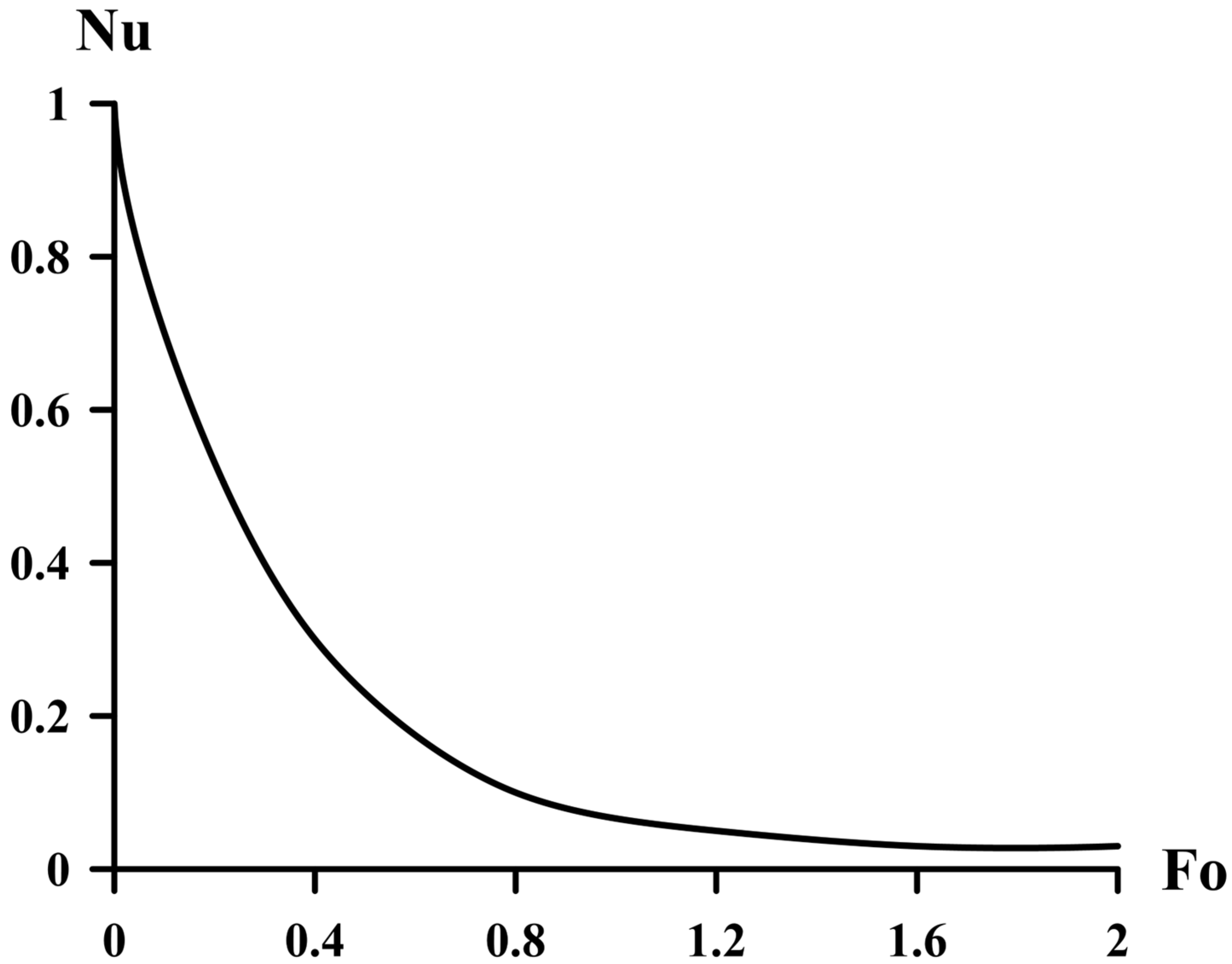
22], while the surface temperature of the sphere remains constant. In the second stage, where the initial temperature profile is the Nusselt hyperbolic profile, the heat transfer coefficient changes according to Formula (57), meaning it decreases from the initial Nusselt solution value to zero as Fo ⟶ ∞. This change is illustrated in
Figure 1, which shows that the highest rate of heat transfer reduction occurs until Fo = 0.5.
At this stage, the temperature of surface of the sphere changes, which can be found from Equation (52) by setting
r =
R. As a result, we obtain the following expression:
This shows that the excess temperature approaches zero as Fo→∞, meaning that the surface temperature of the sphere converges to the temperature of the carrier phase. Since the particle sizes in the discrete phase are typically quite small, it can be assumed that the temperature evolution law (62) is characteristic not only for the surface of the sphere but also for its entire volume. This process is typical for low Biot numbers, which justifies its conclusion in this context, as the determining factor for the Biot number (particle diameter) is relatively small, as noted earlier. The derived relationships for the Nusselt numbers are asymptotic, meaning that the limiting values are obtained as Fo→∞. However, they are practically applicable if an accuracy threshold for the asymptotic conditions is specified, such as 1% or 0.5%.





 ,
,