A New Model Dimension Reduction Technique Based on Finite Volume Element and Proper Orthogonal Decomposition for Solving the 2D Hyperbolic Equation


Abstract
1. Introduction
2. Review the Temporal Semi-Discretized and Finite Volume Element Formulations
2.1. Variational Formulation and TSD Scheme
2.2. The Finite Volume Element Formulation
- (1)
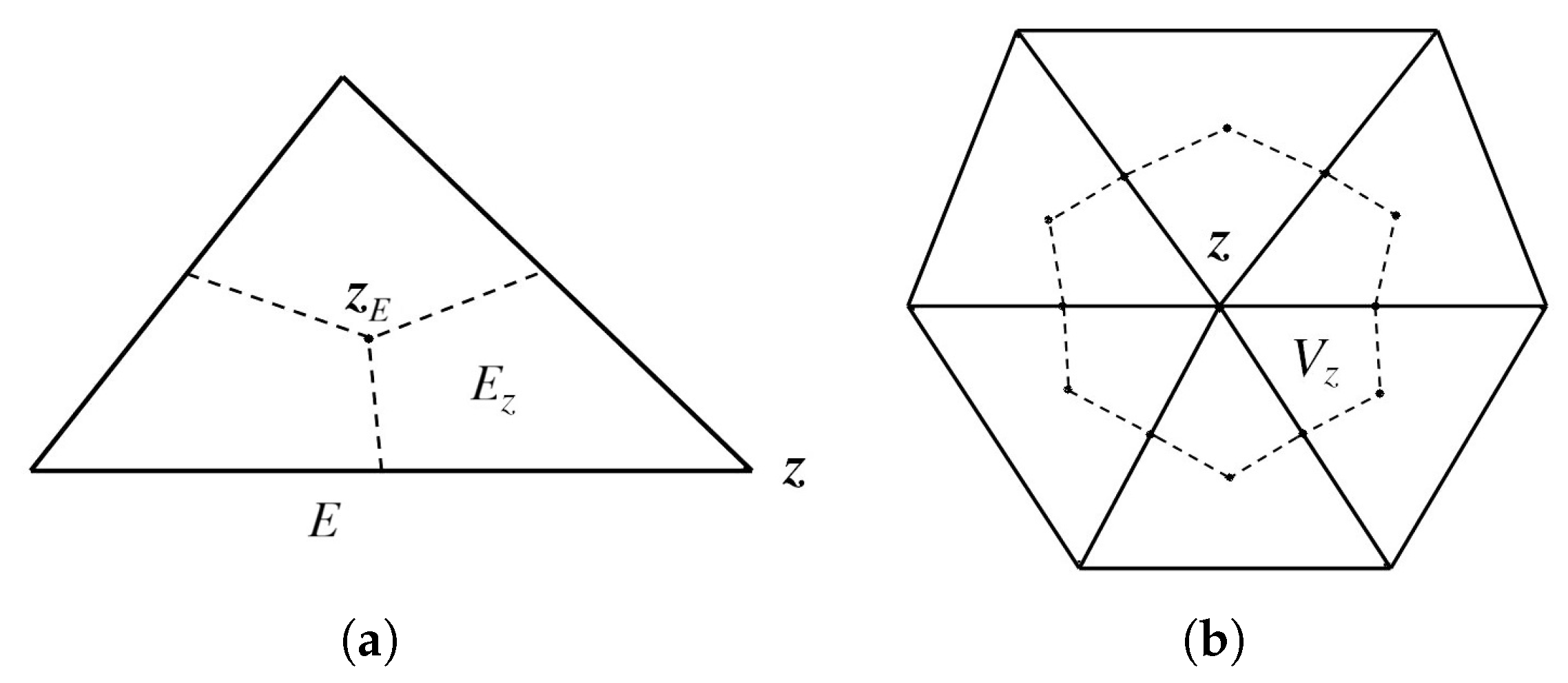
- By linking the barycenter of with the mid-points of the edges of E with line segments, we divide E as three quadrilateral elements (see Figure 1a), where , is the vertex set of E, , and the set composed of the interior vertices in is denoted by .
- (2)
- Through per vertex , we can construct a control volume composed of the union of the sub-domains to share the vertex (see Figure 1b) and the set of control volumes covering the region is known as the dual subdivision based on the triangulation .
2.3. The Matrix Representation for the FVE Formulation
3. The Finite Volume Element Model Dimension Reduction Formulation
3.1. Construction for the POD Basic Vectors
- (1)
- Compute an FVE solution vector set through Problem 5 at the first L temporal nodes to arrange the matrix , where . In calculation of actual engineering, the matrix may be made up of the measurement values at the nodes in partition without the need to compute the FVE solution vectors.
- (2)
- Compute a standard orthogonal eigenvector set rank related to the eigenvalue series of the matrix through the singular value decomposition [31].
- (3)
- Compute d () most main normalized vectors of the matrix by the formulas , which are named as the POD basic vectors, to make up the matrix .
3.2. Creation of the Finite Volume Element Model Dimension Reduction Formulation
3.3. The Theoretic Analysis of the Finite Volume Element Model Dimension Reduction Solutions
- Step 1.
- Attestation for the existence of the FVEMDR solutions.
- Step 2.
- The attestation for the unconditional stability of the FVEMDR solutions.
- (i)
- Under the case of , through the boundedness of the POD basic vectors in as well as the unconditional stability for the FVE solution vectors in Theorem 3, we can attest
- (ii)
- Step 3.
- Estimate the errors for the FVEMDR solutions.
- (1)
- Under the case of , noticing that , and using (15), we draw
- (2)
4. Two Numerical Examples
4.1. The First Numerical Example
- (1)
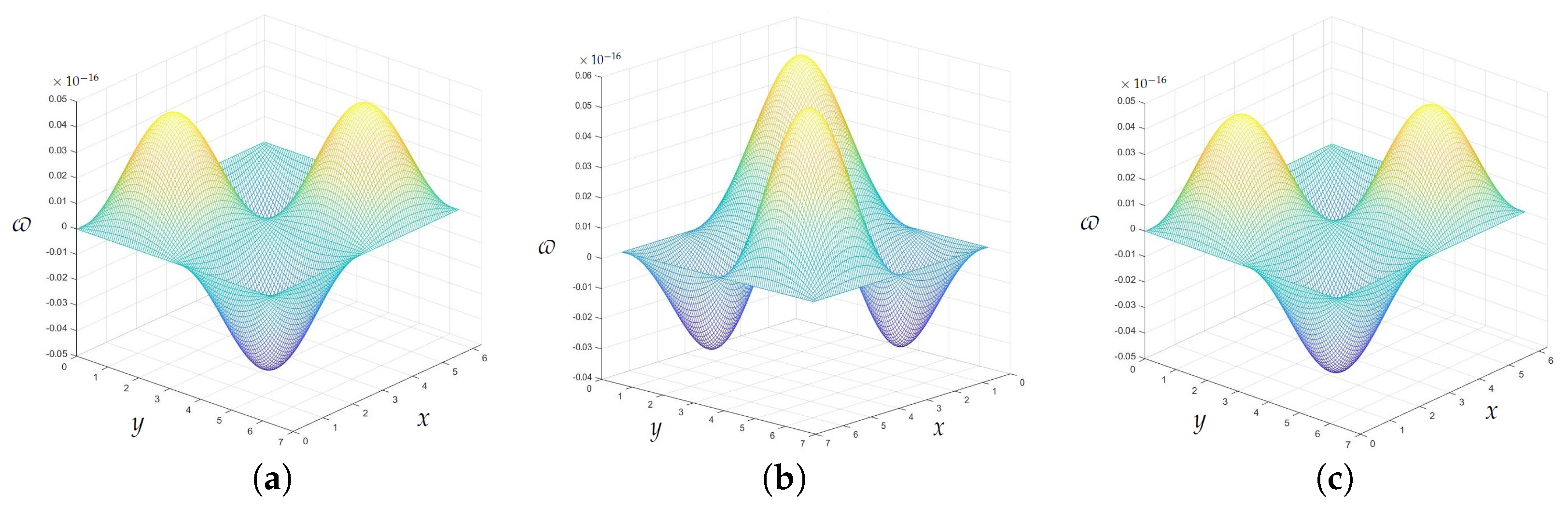
- As a matter of experience, compute the initial 20 () FVE solution coefficient vectors through Problem 5 and create a matrix , where .
- (2)
- Compute a series of orthonormal eigenvectors associated with the eigenvalues of the matrix .
- (3)
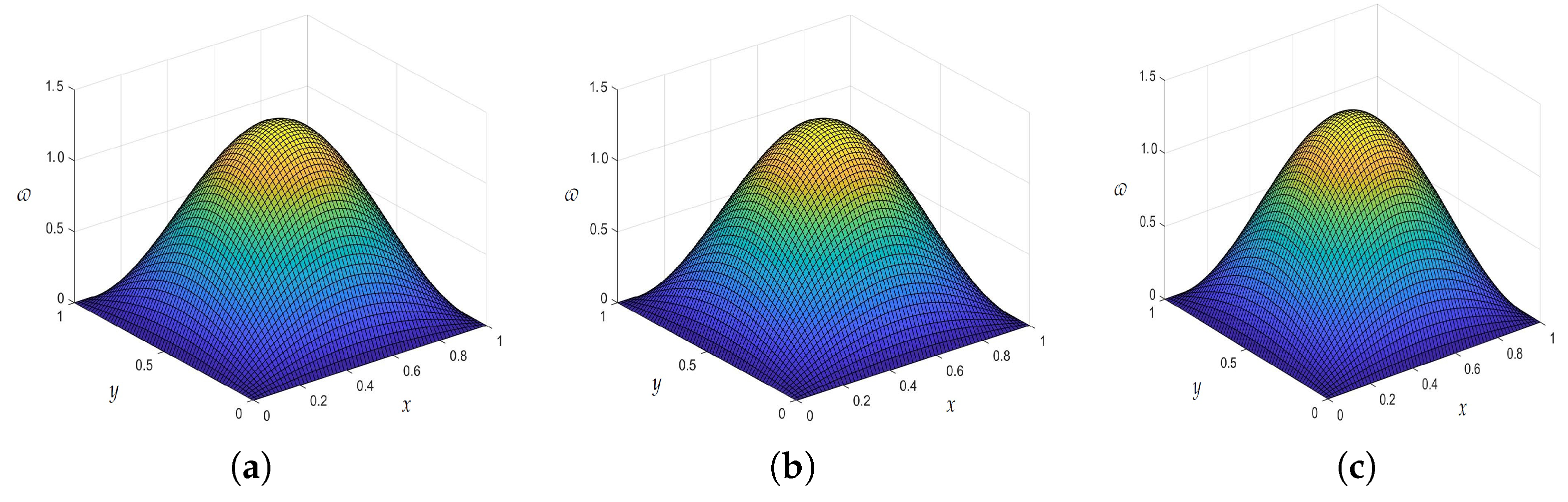
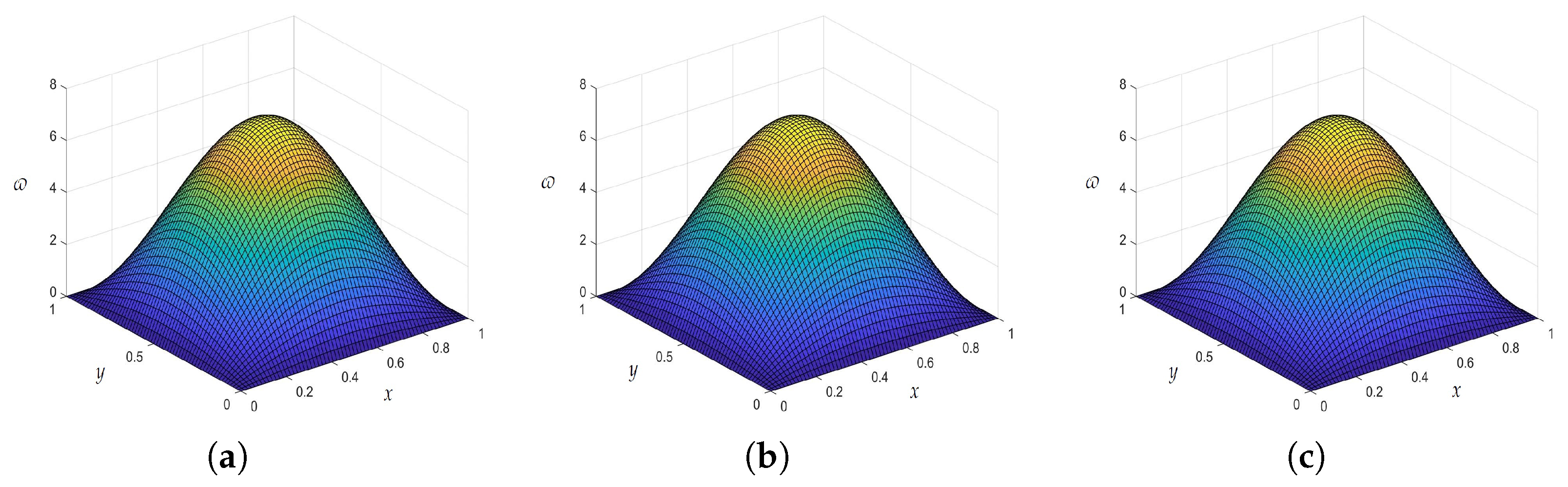
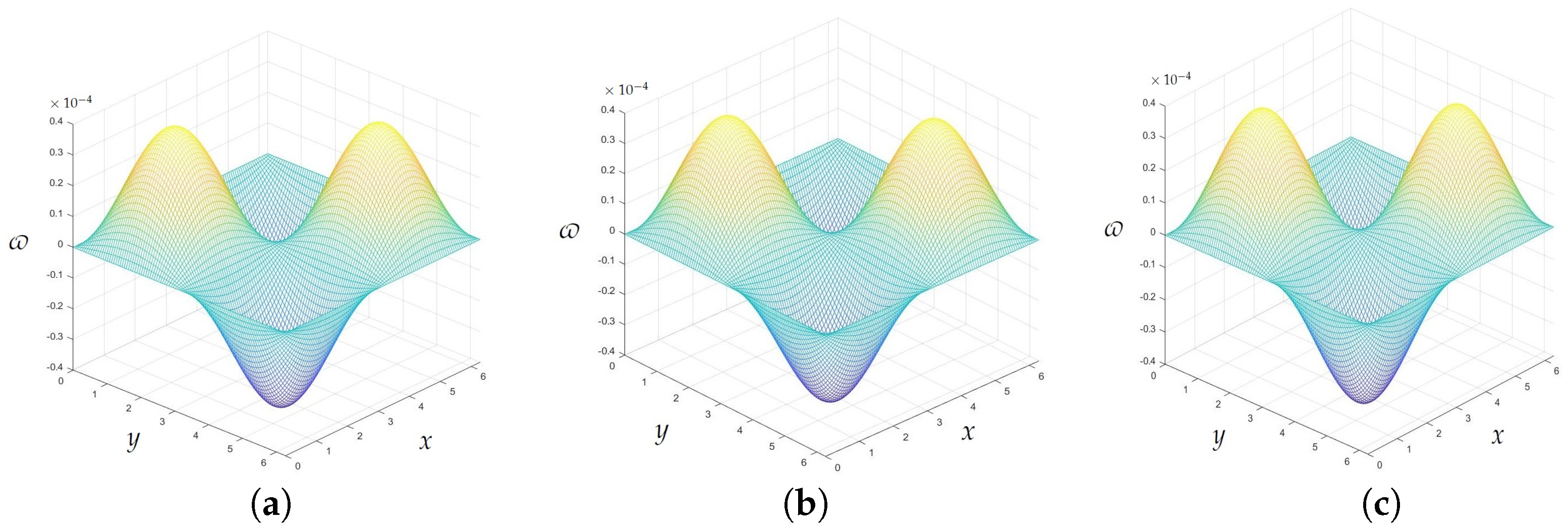
- By calculation, we obtain the result that . Accordingly, it is only required to select the first 6 standard orthogonal eigenvectors to yield the POD basic vectors through the formulas .
- (4)
4.2. The Second Numerical Example
5. Conclusions and Prospects
Author Contributions
Funding
Data Availability Statement
Conflicts of Interest
References
- Abgrall, R.; Shu, Q. Handbook of Numerical Methods for Hyperbolic Problems; Elsevier B.V.: Amsterdam, The Netherlands, 2016. [Google Scholar]
- Gardner, C.L. Numerical Methods for Hyperbolic PDEs. In Applied Numerical Methods for Partial Differential Equations; Texts in Applied Mathematics; Springer: Cham, Switzerland, 2024; Volume 78. [Google Scholar]
- Toumi, S.; Bchatnia, A.; Mlayeh, R. Theoretical and numerical approaches to torsional viberonal systems: Stability analysis and finite difference method. J. Math. Sci. 2026. [Google Scholar] [CrossRef] [Scilit]
- Luo, Z.; Teng, F. Reduced-order proper orthogonal decomposition extrapolating finite velome element format for two-dimensional hyperbolic equations. Appl. Math. Mech. 2017, 38, 289–310. [Google Scholar] [CrossRef] [Scilit]
- LeVequ, R.J. Finite Volume Methods for Hyperbolic Problems; Cambridge University Press: Cambridge, UK, 2012. [Google Scholar]
- Bank, R.E.; Rose, D.J. Some error estimates for the box methods. SIAM J. Numer. Anal. 1987, 24, 777–787. [Google Scholar] [CrossRef] [Scilit]
- Li, R.; Chen, Z.; Wu, W. Generalized Difference Methods for Differential Equations; Marcel Dekker: New York, NY, USA, 2000. [Google Scholar]
- Li, J.; Zhang, T. Generalized Finite Difference Method for Solving Viscoelastic Problems. In Computational and Experimental Simulations in Engineering; Atluri, S.N., Vušanović, I., Eds.; ICCES. Mechanisms and Machine Science; Springer: Cham, Switzerland, 2021; Volume 98. [Google Scholar]
- Cai, Z.; McCormick, S. On the accuracy of the finite volume element method for diffusion equations on composite grid. SIAM J. Numer. Anal. 1990, 27, 636–655. [Google Scholar] [CrossRef] [Scilit]
- Cannon, J.R.; Lin, Y. A priori L2 error estimates for finite-element methods for nonlinear diffusion equations with memory. SIAM J. Numer. Anal. 1990, 27, 595–607. [Google Scholar] [CrossRef] [Scilit]
- Sun, H.; Wang, Z.; Nie, J.; Zhang, Y.; Xiao, R. Generalized finite difference method for a class of multidimensional space-fractional diffusion equations. Comput. Mech. 2021, 67, 17–32. [Google Scholar] [CrossRef] [Scilit]
- Strazzullo, M.; Vicini, F. POD-Based reduced order methods for optimal control problems governed by parametric partial differential equation with varying boundary control. Appl. Math. Comput. 2023, 457, 128191. [Google Scholar] [CrossRef] [Scilit]
- Luo, Z.; Chen, G. Proper Orthogonal Decomposition Methods for Partial Differential Equations; Academic Press of Elsevier: London, UK, 2019. [Google Scholar]
- Alekseev, A.K.; Bistrian, D.A.; Bondarev, A.E.; Navon, I.M. On linear and nonlinear aspects of dynamic mode decomposition. Int. J. Numer. Methods Fluids 2016, 82, 348–371. [Google Scholar] [CrossRef] [Scilit]
- Du, J.; Navon, I.M.; Zhu, J.; Fang, F.; Alekseev, A.K. Reduced order modeling based on POD of a parabolized Navier-Stokes equations model II: Trust region POD 4D VAR data assimilation. Comput. Math. Appl. 2013, 65, 380–394. [Google Scholar] [CrossRef] [Scilit]
- Li, H.; Song, Z. A reduced-order energy-stability-preserving finite difference iterative scheme based on POD for the Allen-Cahn equation. J. Math. Anal. Appl. 2020, 491, 124245. [Google Scholar] [CrossRef] [Scilit]
- Li, H.; Song, Z. A reduced-order finite element method based on proper orthogonal decomposition for the Allen-Cahn model. J. Math. Anal. Appl. 2021, 500, 125103. [Google Scholar] [CrossRef] [Scilit]
- Li, K.; Huang, T.; Li, L.; Lanteri, S.; Xu, L.; Li, B. A reduced-order discontinuous Galerkin method based on POD for electromagnetic simulation. IEEE Trans. Antennas Propag. 2018, 66, 242–254. [Google Scholar] [CrossRef] [Scilit]
- Hinze, M.; Kunkel, M. Residual based sampling in POD model order reduction of drift-diffusion equations in parametrized electrical networks. J. Appl. Math. Mech. 2012, 92, 91–104. [Google Scholar] [CrossRef] [Scilit]
- Li, H.; Wang, D. A modified finite volume element method for solving the phase field Allen-Cahn model. Appl. Math. Lett. 2022, 127, 107860. [Google Scholar] [CrossRef] [Scilit]
- Luo, Z. Proper orthogonal decomposition-based reduced-order stabilized mixed finite volume element extrapolating model for the nonstationary incompressible Boussinesq equations. J. Math. Anal. Appl. 2015, 425, 259–280. [Google Scholar] [CrossRef] [Scilit]
- Luo, Z.; Xie, Z.; Shang, Y.; Chen, J. A reduced finite volume element formulation and numerical simulations based on POD for parabolic equations. J. Comput. Appl. Math. 2011, 235, 2098–2111. [Google Scholar] [CrossRef] [Scilit]
- Luo, Z. A reduced-order extrapolation algorithm based on SFVE method and POD technique for non-stationary Stokes equations. Appl. Math. Comput. 2014, 47, 976–995. [Google Scholar] [CrossRef] [Scilit]
- Chang, X.; Li, H. A POD-based reduced-dimension method for solution coefficient vectors in the Crank-Nicolson mixed finite element method for the fourth-order parabolic equation. Fractal Fract. 2025, 9, 137. [Google Scholar] [CrossRef] [Scilit]
- Li, Y.; Teng, F.; Zeng, Y.; Luo, Z. Two-grid reduced-dimension extrapolated algorithm of Crank-Nicolson finite element solution coefficient vectors for nonlinear parabolic equation. Comput. Math. Appl. 2025, 44, 15. [Google Scholar] [CrossRef] [Scilit]
- Yu, C.; Xu, W.; Li, X. A reduced-order extrapolation (ROE) method for solution coefficient vectors in the mixed finite element (MFE) method for the two-dimensional (2D) fourth-order hyperbolic equation. IEEE Access 2022, 10, 111996–112006. [Google Scholar] [CrossRef] [Scilit]
- Chang, X.; Li, H. The reduced-dimension method for Crank-Nicolson mixed finite element solution coefficient vectors of the extended Fisher-Kolmogorov equation. Axioms 2024, 13, 710. [Google Scholar] [CrossRef] [Scilit]
- Luo, Z. Finite Element and Reduced Dimension Methods for Partial Differential Equations; Springer: Beijing, China; Science Press of China: Beijing, China, 2024. [Google Scholar]
- Li, H.; Yang, R. Analysis of two spectral Galerkin approximation schemes for solving the perturbed FitzHugh-Nagumo neuron model. Comput. Math. Appl. 2023, 143, 1–9. [Google Scholar] [CrossRef] [Scilit]
- Zhang, G.; Lin, Y. Notes on Functional Analysis; Peking University Press: Beijing, China, 2011. (In Chinese) [Google Scholar]
- Noorizadegan, A.; Chen, C.-S.; Cavoretto, R.; De Rossi, A. Efficient truncated randomized SVD for mesh-free kernel methods. Comput. Math. Appl. 2024, 164, 12–20. [Google Scholar] [CrossRef] [Scilit]



| The FVE Model | The FVEMDR Model | ||||
|---|---|---|---|---|---|
| CPU Running Time | CPU Running Time | ||||
| 100 | 6485 s | 97 s | |||
| 150 | 31,765 s | 472 s | |||
| 200 | 64,657 s | 956 s | |||
| 250 | 12,324 s | 1441 s | |||
| t | FVE Solutions | FVEMDR Solutions | FVE Method | FVEMDR Method |
|---|---|---|---|---|
| CPU Runtime | CPU Runtime | |||
| 10 | 3.3153 | 3.4352 | 1213.262 s | 24.265 s |
| 20 | 5.5367 | 3.5674 | 2426.523 s | 48.531 s |
| 30 | 7.7581 | 3.6985 | 4853.051 s | 97.061 s |
| 40 | 9.8795 | 3.8198 | 9706.103 s | 194.121 s |
Disclaimer/Publisher’s Note: The statements, opinions and data contained in all publications are solely those of the individual author(s) and contributor(s) and not of MDPI and/or the editor(s). MDPI and/or the editor(s) disclaim responsibility for any injury to people or property resulting from any ideas, methods, instructions or products referred to in the content. |
© 2026 by the authors. Licensee MDPI, Basel, Switzerland. This article is an open access article distributed under the terms and conditions of the Creative Commons Attribution (CC BY) license.
Share and Cite
Li, Y.; Yang, J.; Luo, Z. A New Model Dimension Reduction Technique Based on Finite Volume Element and Proper Orthogonal Decomposition for Solving the 2D Hyperbolic Equation. Axioms 2026, 15, 223. https://doi.org/10.3390/axioms15030223
Li Y, Yang J, Luo Z. A New Model Dimension Reduction Technique Based on Finite Volume Element and Proper Orthogonal Decomposition for Solving the 2D Hyperbolic Equation. Axioms. 2026; 15(3):223. https://doi.org/10.3390/axioms15030223
Chicago/Turabian StyleLi, Yuejie, Jing Yang, and Zhendong Luo. 2026. "A New Model Dimension Reduction Technique Based on Finite Volume Element and Proper Orthogonal Decomposition for Solving the 2D Hyperbolic Equation" Axioms 15, no. 3: 223. https://doi.org/10.3390/axioms15030223
APA StyleLi, Y., Yang, J., & Luo, Z. (2026). A New Model Dimension Reduction Technique Based on Finite Volume Element and Proper Orthogonal Decomposition for Solving the 2D Hyperbolic Equation. Axioms, 15(3), 223. https://doi.org/10.3390/axioms15030223