Article

Strongly Exposed Points of Orlicz Sequence Spaces Equipped with the p-Amemiya Norm

1
Department of Mathematics, Harbin Normal University, Harbin 150025, China
2
Department of Mathematics, Harbin Cambridge University, Harbin 150069, China
*
Author to whom correspondence should be addressed.
Axioms 2026, 15(3), 183; https://doi.org/10.3390/axioms15030183
Submission received: 18 January 2026 / Revised: 23 February 2026 / Accepted: 27 February 2026 / Published: 2 March 2026
(This article belongs to the Special Issue Advances in Functional Analysis and Banach Space)

Abstract

Using some new techniques, criteria for strongly exposed points of Orlicz sequence spaces generated by arbitrary Orlicz function and equipped with the p-Amemiya ( 1   <   p   <   ) norm are obtained. Next, strongly exposed property of these spaces is deduced. The obtained results broaden the knowledge about these notions in Orlicz sequence spaces equipped with the p-Amemiya norm.
MSC:
46E30; 46E20; 46B45; 46B42; 46A80

1. Introduction

Let X be a real Banach space, and let B ( X ) and S ( X ) be the closed unit ball and the unit sphere of X, respectively. By X * we denote the dual space of X. For any u S ( X ) we denote by G r a d ( u ) the set of all supporting functionals at x, i.e.,
G r a d ( u ) = { f S ( X * ) : f ( u ) = u } .
Exposed points were first defined by Straszewicz in 1935 in the case of finite-dimensional spaces (see [1]). The concept of strongly exposed points were introduced by Lindenstrauss in 1963 (see [2]). Both exposed points and strongly exposed points are basic concepts in the geometric theory of Banach spaces. There is a connection of strongly exposed points and the Radon-Nikodym property. Phelps showed in 1974 that a Banach space X has a Radon-Nikodym property if every non-empty closed, bounded convex subset is contained in a closed convex hull of its strongly exposed points (see [3]). Criteria for exposed points in classical Orlicz spaces equipped the Orlicz norm, Luxemburg nom and p-Amemiya norms were presented in [4,5,6,7,8]. Criteria for strongly exposed points in classical Orlicz spaces and Musielak-Orlicz spaces equipped the Orlicz norm and Luxemburg nom were given in [9,10,11,12,13]. The p-Amemiya norms are generalization of the Orlicz norm and Luxemburg norm. Up to now, no characterization of strong exposed points and strongly exposed property of Orlicz sequence spaces equipped with the p-Amemiya norm was known. The main aim of the paper is to complete this gap.
 Definition 1 
([1]). A point u S ( X ) is said to be an exposed point if there exists f G r a d ( u ) , such that for all v B ( X ) { u } , f ( v ) < f ( u ) = 1 . Then f is called an exposed functional of u.
 Definition 2 
([2]). A point u S ( X ) is called a strongly exposed point if there exists f G r a d ( u ) , such that for any { u n } n = 1 B ( X ) , f ( u n ) f ( u ) = 1 implies u n u 0 as n . Then f is called a strongly exposed functional of u.
Obviously, a strongly exposed point is an exposed point. If every x S ( X ) is an (strongly) exposed point, then X has the (strongly) exposed property. In a strictly convex Banach space all points of its unit sphere are exposed, while in a locally uniformly convex Banach space all points of its unit sphere are strongly exposed (see [5,9]).
In the sequel, N and R denote the set of natural numbers and the set of real numbers, respectively.
The triple ( N , 2 N , μ ) stands for the counting measure space and l 0 ( μ ) = l 0 denotes the space of all real sequences u = ( u ( i ) ) . A Banach space X is called a Köthe sequence space if it is a subspace of l 0 such that
(i) if u l 0 , v X and | u ( i ) | | v ( i ) | for i N , then u X and u v ,
(ii) there exists u X such that s u p p u = N , where s u p p u = { i N : u ( i ) 0 } .
For any map Φ : R [ 0 , ] , define
a Φ = sup { x 0 : Φ ( x ) = 0 } , b Φ = sup { x > 0 : Φ ( x ) < } .
Note that if Φ is even on R , a Φ = 0 means that Φ vanishes only at zero while b Φ = means that Φ takes only finite values.
A map Φ : R [ 0 , ] is said to be an Orlicz function if Φ ( 0 ) = 0 , Φ is not identically equal to zero, Φ is even and convex on the interval ( b Φ , b Φ ) and Φ is left continuous at b Φ , i.e., lim x b Φ Φ ( x ) = Φ ( b Φ ) .
For every Orlicz function Φ , we define the complementary function, in the sense of Young, Ψ : R [ 0 , ] by the formula
Ψ ( y ) = sup { x | y | Φ ( x ) : x 0 } .
Let Φ + ( x ) and Φ ( x ) ( Ψ + ( y ) and Ψ ( y ) ) stand for the right and left derivatives of Φ ( Ψ ) at x R with 0 x < b Φ (at y R with 0 y < b Ψ ), respectively. Here we define Φ + ( b Φ ) = and Φ ( x ) = Φ + ( x ) = for all x > b Φ , Ψ + ( b Ψ ) = and Ψ ( y ) = Ψ + ( y ) = for all y > b Ψ .
For every x , y R , we have the following Young Inequality:
| x y | Φ ( x ) + Ψ ( y )
which reduces to an equality when y Φ ( x ) if x is given, or when x Ψ ( y ) if y is given, and
Φ ( x ) = [ Φ ( x ) , Φ + ( x ) ] , for b Φ < x < b Φ , [ Φ ( x ) , + ) , for x = b Φ and Φ ( b Φ ) < , ( , Φ + ( x ) ] , for x = b Φ and Φ + ( b Φ ) > .
Given any Orlicz function Φ , we define on l 0 the convex modular of u by
I Φ ( u ) = i = 1 Φ ( u ( i ) ) , for   any u = ( u ( i ) ) l 0 .
The Orlicz sequence space l Φ generated by an Orlicz function Φ is a linear space of real sequences defined by
l Φ = { u l 0 : I Φ ( c u ) < for   some c > 0 depending   on   u } .
The space h Φ is the subspace of all order continuous elements of l Φ defined by
h Φ = { u l 0 : I Φ ( c u ) < for   any c > 0 } .
The Orlicz sequence space l Φ is a Köthe sequence space when it is equipped with the Orlicz norm
u o = sup I Ψ ( v ) 1 i = 1 u ( i ) v ( i )
or the Luxemburg norm
u Φ = inf λ > 0 : I Φ u λ 1 .
At first sight the Orlicz and Luxemburg norms seem far from similar. In fact, in many cases the geometric properties of Orlicz spaces under each of these norms differ from each other. But in the fifties, I. Amemiya (see [14]) considered a norm defined by the formula
u A = inf k > 0 1 k ( 1 + I Φ ( k u ) ) .
In 2000, Hudzik and Maligranda proved the Amemiya norm and the Orlicz norm coincide for any Orlicz function Φ , i.e., · o = · A (see [15]). Moreover, it is not difficult to verify that the Luxemburg norm can be expressed by an Amemiya-like formula (see [16,17]), namely
u Φ = inf k > 0 1 k max { 1 , I Φ ( k u ) } .
The only difference between the two Amemyia formulas is the function under the infimum operation (we will call it the outer function): for all t 0 , s ( t ) = 1 + t (for the Orlicz norm) and s ( t ) = max { 1 , t } (for the Luxemburg norm). In [15], Hudzik and Maligranda proposed to investigate the Amemiya formula-norms generated by the outer functions of the type
s p ( t ) = ( 1 + t p ) 1 p , for 1 p < , max { 1 , t } , for p = ,
and for any u l Φ ,
u Φ , p = inf k > 0 1 k s p ( I Φ ( k u ) ) ( 1 p ) .
We obtain a family of topologically equivalent norms (called the p-Amemiya norm), indexed by 1 p and satisfying the inequalities
u Φ = u Φ , u Φ , p u Φ , p u Φ , 1 = u o 2 1 p u Φ , p ,
for all 1 p p .
The first paper constituting some basic and crutial results allowing further research and containing the complete characterization of rotundity and extreme points in Orlicz spaces equipped with the p-Amemiya norms ( 1 p ) was written by Cui et al. (see [17]). After that, an intensive development of research connected with Orlicz spaces equipped with the p-Amemiya norm have taken place. Necessary and sufficient conditions for non-squareness properties, smoothness, midpoint local uniform rotundity, local uniform rotundity, etc., were presented in [18,19,20,21,22,23]. These results broaden the knowledge about the geometry of these spaces.
In order to simplify notation, the Orlicz sequence spaces equipped with p-Amemiya norms are denoted by l Φ , p = ( l Φ , · Φ , p ) , h Φ , p = ( h Φ , · Φ , p ) .
An interval [ a , b ] is called a structural affine interval of Φ , or simply a SAI of Φ , provided that Φ is affine on [ a , b ] and it is not affine on either [ a ε , b ] or [ a , b + ε ] for any ε > 0 . Let ( [ a i , b i ] ) i be all SAIs of Φ . We call S C Φ = R ( i = 1 ( a i , b i ) ) the set of strictly convex points of Φ . Denote
A = { a i : S A I ( a i , b i ) with Φ ( a i ) = Φ + ( a i ) } ,
B = { b i : S A I ( a i , b i ) with Φ ( b i ) = Φ + ( b i ) } ,
A = { a i : S A I ( a i , b i ) with Φ ( a i ) < Φ + ( a i ) } ,
B = { b i : S A I ( a i , b i ) with Φ ( b i ) < Φ + ( b i ) } .
We say an Orlicz function Φ satisfies the Δ 2 -condition at zero ( Φ Δ 2 ( 0 ) , for short) if there are positive constants k and 0 < x 0 < with 0 < Φ ( x 0 ) < such that Φ ( 2 x ) k Φ ( x ) for | x | x 0 .
For any Orlicz function Φ , Φ Δ 2 ( 0 ) , we also write that its complementary function Ψ satisfies the 2 -condition at zero, i.e., Ψ 2 ( 0 ) . If Φ Δ 2 ( 0 ) and Ψ Δ 2 ( 0 ) , then we write Φ Δ 2 ( 0 ) 2 ( 0 ) . It is not difficult to prove that l Φ = h Φ Φ Δ 2 ( 0 ) 2 ( 0 ) (see [24]).
By s g n x we will denote the sign function defined on R . This function s g n x is equal to 1 for x > 0 , −1 for x < 0 and 0 for x = 0 .
Further details about Orlicz spaces, we refer to [24,25,26,27]. Some fundamental topological and geometrical properties of Orlicz spaces equipped with p-Amemiya norms have been investigated in [17,22].

2. Auxiliary Results

In this section we will present a few auxiliary definitions and results that will be used in the main part of the paper.
Let 1 p , for any u l Φ , p , i < j , we denote
[ u ] j i = ( 0 , , 0 , u ( i + 1 ) , , u ( j ) , 0 , ) , [ u ] j = ( u ( 1 ) , u ( 2 ) , , u ( j ) , 0 , ) .
By Theorem 1.43 in [24] and equivalence of p-Amemiya ( 1 p ) norms, we have
lim n u [ u ] n Φ , p = θ Φ ( u ) = inf λ > 0 , I Φ u λ < .
For any u l Φ , p , define
k p * ( u ) = inf { k 0 : I Φ p 1 ( k u ) · I Ψ ( Φ + ( k u ) ) 1 } ( with inf = ) , k p * * ( u ) = sup { k 0 : I Φ p 1 ( k u ) · I Ψ ( Φ + ( k u ) ) 1 } .
It is evident that k p * ( u ) k p * * ( u ) for every u l Φ , p { 0 } . Set K p ( u ) = { 0 < k < : k p * ( u ) k k p * * ( u ) } .
 Lemma 1 
([17]). For any 1 p the set of those k’s at which the p-Amemiya norm of an element u l Φ , p { 0 } is attainded is equal to the interval K p ( u ) .
 Lemma 2 
([17]). Let 1 < p < , the interval of norm attainable of all u l Φ , p { 0 } is nonempty, closed and bounded (in fact, equal to [ k p * ( u ) , k p * * ( u ) ] ) if and only if Φ is not linear on [ 0 , ) .
 Lemma 3 
([22]). Let 1 p < . For every u l Φ , p { 0 } , if K p ( u ) = , then u Φ , p = b Ψ i = 1 | u ( i ) | where b Ψ = lim x Φ + ( x ) = lim x Φ ( x ) x .
 Lemma 4 
([19]). Let 1 p . If u B ( l Φ , p ) { 0 } , then I Φ ( u ) u Φ , p .
We say that φ ( l Φ , p ) * is a singular functional, or simply, φ F , if φ ( h Φ ) = { 0 } .
 Lemma 5 
([22]). Let Φ , Ψ be Orlicz functions complementary to each other in the sense of Young that take finite values only and let 1 < p ,   q < with 1 p + 1 q = 1 . If the p-Amemiya norm is k * -finite, then f ( l Φ , p ) * { 0 } has the unique decomposition f = v + φ where v l Ψ , q , φ F , and
f = f Ψ , q = inf l > 0 1 l s q ( I Ψ ( l v ) + l φ ) .
 Lemma 6 
([22]). Let 1 < p ,   q < , u l Φ , p { 0 } and K p ( u ) . v S ( l Ψ , q ) is a supporting functional of u if and only if:
(i) v ( i ) = w ( i ) w Ψ , q · s g n u ( i ) , for some w satisfying Φ ( k | u ( i ) | ) w ( i ) Φ + ( k | u ( i ) | ) ,   i N , k K p ( u ) ,
(ii) I Φ p 1 ( k u ) · I Ψ ( w ) = 1 .
 Lemma 7 
([20]). Let 1 < p < , l Φ , p is strictly convex if and only if a Φ = 0 and Φ is strictly convex on the interval [ 0 , π Φ , p ( 1 2 ) ] where
π Φ , p 1 2 = sup t > 0 : ( Φ ( t ) ) p 1 · Ψ ( Φ + ( t ) ) 1 2 p .
 Lemma 8 
([23]). Let 1 < p < , l Φ , p is locally uniformly convex if and only if
(i) Φ Δ 2 ( 0 ) and Ψ Δ 2 ( 0 ) (i.e., Φ Δ 2 ( 0 ) 2 ( 0 ) ).
(ii) Φ is strictly convex on the interval 0 , π Φ , p ( 1 2 ) .
 Lemma 9 
([22]). Let 1 < p < , Φ Δ 2 ( 0 ) and u l Φ , p { 0 } . For any i N , if u n ( i ) u ( i ) (as n ) and
lim i 0 sup n i > i 0 Φ ( u n ( i ) ) = 0 ,
then u n u Φ , p 0 as n .
 Lemma 10 
([28]). If s p ( x ) = ( 1 + x p ) 1 p , s q ( y ) = ( 1 + y q ) 1 q , for any 1 < p , q < with 1 p + 1 q = 1 , and the Hölder equality x + y = s p ( x ) s q ( y ) = ( 1 + x p ) 1 p ( 1 + y q ) 1 q for all 0 < x ,   y < holds true, it is necessary and sufficient that x 1 q y 1 p = 1 ( i . e . , x p 1 y = 1 o r x y q 1 = 1 ) .
 Lemma 11 
([22]). (Minkowski Inequality) Let 1 q < . For any sequences { ξ k } , { η k } R , we have
(i) k | ξ k + η k | q 1 q ( k | ξ k | q ) 1 q + ( k | η k | q ) 1 q .
(ii) ( 1 + ( x + y ) q ) 1 q ( 1 + x q ) 1 q + y for all x , y 0 .
 Lemma 12 
([8]). Let 1 < p < , u S ( l Φ , p ) and K p ( u ) = . u is an exposed point if and only if c a r d ( s u p p ( u ) ) = 1 .
 Lemma 13 
([8]). Let 1 < p < , u S ( l Φ , p ) and K p ( u ) . u is an exposed point of B ( l Φ , p ) if and only if:
(i) K p ( u ) is a singleton set, i.e., K p ( u ) = { k u } .
(ii) c a r d ( s u p p ( u ) ) = 1 or c a r d { i N : k u u ( i ) ( R S C Φ ) } 1 .
(iii) c a r d { i N : k u u ( i ) A } · c a r d { i N : k u u ( i ) B } = 0 .
(iv) If I Φ p 1 ( k u u ) · I Ψ ( Φ ( k u u ) ) = 1 , then
c a r d { i N : k u u ( i ) A } · c a r d { i N : k u u ( i ) B } = 0 .
If I Φ p 1 ( k u u ) · I Ψ ( Φ + ( k u u ) ) = 1 , and θ Φ ( k u u ) < 1 , then
c a r d { i N : k u u ( i ) A } · c a r d { i N : k u u ( i ) B } = 0 .

3. Main Results

 Theorem 1. 
Let 1 < p < , u S ( l Φ , p ) and K p ( u ) = . u is a strongly exposed point if and only if c a r d ( s u p p ( u ) ) = 1 .
Proof. 
Necessity. Since a strongly exposed point is an exposed point, by Lemma 12, c a r d ( s u p p ( u ) ) = 1 is necessary.
Sufficiency. Without loss of generality, we assume u = ( u ( 1 ) , 0 , ) and u ( 1 ) > 0 . By K p ( u ) = and Lemma 3, u Φ , p = b Ψ u ( 1 ) where b Ψ = lim x Φ ( x ) x . Thus v = ( b Ψ , 0 , ) is the supporting functional of u. If there is { u n } n = 1 B ( l Φ , p ) that satisfies
< v , u n > = b Ψ u n ( 1 ) b Ψ u ( 1 ) ,
then u n ( 1 ) u ( 1 ) as n .
We will consider the following two cases separately.
(I) There are infinite numbers of n such that K p ( u n ) = . Passing to a subsequence of { u n } , if necessary, we may assume that for any n N , K p ( u n ) = . By Lemma 3, we have
1 u n Φ , p = b Ψ i = 1 | u n ( i ) | = b Ψ | u n ( 1 ) | + b Ψ i = 2 | u n ( i ) | 1 + b Ψ i = 2 | u n ( i ) |
as n . Therefore, i = 2 | u n ( i ) | 0 as n . Hence,
u u n Φ , p = inf k > 0 1 k ( 1 + I Φ p ( k ( u u n ) ) ) 1 p lim k 1 k ( 1 + I Φ p ( k ( u u n ) ) ) 1 p = lim k Φ ( k ( u ( 1 ) u n ( 1 ) ) ) k + i = 2 Φ ( k u n ( i ) ) k = lim k Φ ( k ( u ( 1 ) u n ( 1 ) ) ) k | u ( 1 ) u n ( 1 ) | | u ( 1 ) u n ( 1 ) | + i = 2 Φ ( k u n ( i ) ) k | u n ( i ) | | u n ( i ) | = b Ψ | u ( 1 ) u n ( 1 ) | + b Ψ i = 2 | u n ( i ) | 0
as n . Thus, u is a strongly exposed point of S ( l Φ , p ) .
(II) There are infinite numbers of n such that K p ( u n ) . Passing to a subsequence of { u n } , if necessary, we may assume that for any n N , K p ( u n ) .
Take k n K p ( u n ) . We will show that k n as n . Otherwise, without loss of generality, we may assume that k n k 0 as n . By the definition of u Φ , p , we get
u Φ , p < 1 k 0 ( 1 + I Φ p ( k 0 u ) ) 1 p = 1 k 0 ( 1 + ( Φ ( k 0 u ( 1 ) ) ) p ) 1 p = lim n 1 k n 1 + Φ ( k n u n ( 1 ) ) p 1 p lim n 1 k n ( 1 + I Φ p ( k n u n ) ) 1 p = lim n u n Φ , p 1 = u Φ , p
a contradiction.
Since,
1 u n Φ , p = 1 k n ( 1 + I Φ p ( k n u n ) ) 1 p = 1 k n 1 + Φ ( k n u n ( 1 ) ) + i 2 Φ ( k n u n ( i ) ) p 1 p 1 k n ( 1 + ( Φ ( k n u n ( 1 ) ) ) p ) 1 p [ u n ] 1 Φ , p u Φ , p = 1 .
Therefore, i = 2 Φ ( k n u n ( i ) ) 0 as n . Thus, we obtain
u n [ u n ] 1 Φ , p 1 k n 1 + i > 1 Φ ( k n u n ( i ) ) p 1 p 0
as n . Hence,
u u n Φ , p u [ u n ] 1 Φ , p + u n [ u n ] 1 Φ , p 0
as n . Thus, u is a strongly exposed point of S ( l Φ , p ) . □
 Theorem 2. 
Let 1 < q < , v S ( l Ψ , q ) and θ Ψ ( v ) < 1 . If there is { u n } n = 1 B ( l Φ , p ) such that < v , u n > 1 as n , then
lim i 0 sup n i > i 0 Φ ( u n ( i ) ) = 0 .
Proof. 
By v S ( l Ψ , q ) , { u n } n = 1 B ( l Φ , p ) and < v , u n > 1 as n , we get u n Φ , p 1 as n . If there is i 0 , such that i > i 0 Φ ( u n ( i ) ) δ 0 . We will consider the following two cases separately.
(I) K p ( u n ) ( n = 1 , 2 , ) .
Take k n K p ( u n ) , l K q ( v ) . By { u n } n = 1 B ( l Φ , p ) , v S ( l Ψ , q ) , we get k n 1 , l 1 . Since θ Ψ ( v ) < 1 , there exists α > 0 such that I Ψ ( l ( 1 + α ) v ) < . For 0 < ε < α δ 0 2 , take j 0 N large enough satisfying i > j 0 Ψ ( l ( 1 + α ) v ( i ) ) < ε . Thus,
1 1 k n l < k n u n , l v > = 1 k n l i = 1 j 0 k n u n ( i ) l v ( i ) + 1 1 + α i > j 0 k n u n ( i ) l ( 1 + α ) v ( i ) 1 k n l ( i = 1 j 0 Φ ( k n u n ( i ) ) + i = 1 j 0 Ψ ( l v ( i ) ) + 1 1 + α i > j 0 Φ ( k n u n ( i ) ) + i > j 0 Ψ ( l ( 1 + α ) v ( i ) ) ) 1 k n l I Φ ( k n u n ) + I Ψ ( l v ) α 1 + α i > j 0 Φ ( k n u n ( i ) ) + 1 1 + α i > j 0 Ψ ( l ( 1 + α ) v ( i ) ) 1 k n s p ( I Φ ( k n u n ) ) 1 l s q ( I Ψ ( l v ) ) 1 k n l α 1 + α k n δ 0 + 1 k n l ε 1 + α 1 1 k n l α 1 + α k n δ 0 + 1 k n l ε 1 + α < 1 1 l α δ 0 1 + α 1 1 2 k n < 1 α δ 0 2 l ( 1 + α )
as n , this is a contradiction.
(II) K p ( u n ) = ( n = 1 , 2 , ) .
By Lemma 3, We have u n Φ , p = b Ψ i = 1 | u n ( i ) | . By θ Ψ ( v ) < 1 , there is λ > 0 and i 0 N such that
i > i 0 Ψ v ( i ) 1 λ < .
So, for any i > i 0 , v ( i ) 1 λ < b Ψ . From
Φ ( u n ( i ) ) = 0 | u n ( i ) | Φ + ( t ) d t 0 | u n ( i ) | b Ψ d t = b Ψ | u n ( i ) | .
We obtain i > i n b Ψ | u n ( i ) | i > i n Φ ( u n ( i ) ) δ 0 for i n > i 0 . Thus,
1 < v , u n > = i = 1 i n v ( i ) u n ( i ) + ( 1 λ ) i i n v ( i ) 1 λ u n ( i ) b Ψ i = 1 i n | u n ( i ) | + ( 1 λ ) i i n b Ψ | u n ( i ) | = b Ψ i = 1 | u n ( i ) | λ i i n b Ψ | u n ( i ) | u n Φ , p λ δ 0 1 λ δ 0
as n , this is a contradiction. □
 Theorem 3. 
Let 1 < p < , if Φ Δ 2 ( 0 ) and the p-Amemiya norm · Φ , p is k p * -finite, then S ( l Φ , p ) has no strongly exposed point.
Proof. 
Let u S ( l Φ , p ) . Since k p * ( u ) < , take k K p ( u ) , then θ Φ ( k u ) 1 . We will consider the following two cases separately.
(I) θ Φ ( k u ) = 1 .
For ε > 0 , j N , by the definition of θ Φ ( k u ) , we have i = j Φ ( k u ( i ) 1 ε ) = . Take 0 = n 0 < n 1 < n 2 < , such that
I Φ k [ u ] n j n j 1 1 1 j = i = n j 1 + 1 n j Φ k u ( i ) 1 1 j > 1 ( j = 2 , 3 , ) .
By the definition of · Φ , , we obtain
[ u ] n j n j 1 Φ , 1 k 1 1 j .
Set u j = u [ u ] n j n j 1 , then u j B ( l Φ , p ) . Since Φ Δ 2 ( 0 ) , the supporting functional of u must be in l Ψ , q F . Suppose f = ( v + φ ) G r a d ( u ) where v l Ψ , q , φ F . We have
1 f ( u j ) = v , u [ u ] n j n j 1 + φ u [ u ] n j n j 1 i = 1 n j 1 v ( i ) u ( i ) + φ ( u ) < v , u > + φ ( u ) = f ( u ) = 1
as j . However,
u u j Φ , p = [ u ] n j n j 1 Φ , p [ u ] n j n j 1 Φ , 1 k 1 1 j 1 k
as j . This shows that u is not a strongly exposed point of S ( l Φ , p ) .
(II) θ Φ ( k u ) < 1 .
Take w l Φ , p such that I Φ ( w ) < and θ Φ ( k u w ) 0 (indeed, if θ Φ ( k u ) = 0 , we take w S ( l Φ , p ) with θ Φ ( w ) 0 , if θ Φ ( k u ) 0 , we take w = 0 ). Since Φ Δ 2 ( 0 ) , there exists φ 0 S ( F ) such that φ 0 ( k u w ) 0 . Set
u n = u ( 1 ) , , u ( n ) , 1 k w ( n + 1 ) , 1 k w ( n + 2 ) , .
By Minkowski Inequality, we have
u n Φ , p 1 k ( 1 + I Φ p ( k u n ) ) 1 p = 1 k 1 + i = 1 n Φ ( k u ( i ) ) + i = n + 1 Φ ( w ( i ) ) p 1 p 1 k 1 + i = 1 n Φ ( k u ( i ) ) p 1 p + 1 k i = n + 1 Φ ( w ( i ) ) 1 k ( 1 + I Φ p ( k u ) ) 1 p + 1 k i = n + 1 Φ ( w ( i ) ) u Φ , p
as n where i = n + 1 Φ ( w ( i ) ) 0 is deduced from I Φ ( w ) < . By θ Φ ( k u ) < 1 and Lemma 8 in [22], we have G r a d ( u ) l Ψ , q , take f = v G r a d ( u ) , then
1 f ( u n ) = < v , u n > = i = 1 n u ( i ) v ( i ) + 1 k i = n + 1 w ( i ) v ( i ) < v , u > = f ( u ) = 1
as n . But
u u n Φ , p | φ 0 ( u u n ) | = φ 0 u 1 k w > 0 .
So, u is not a strongly exposed point of S ( l Φ , p ) . □
 Theorem 4. 
Let 1 < p < , u S ( l Φ , p ) and K p ( u ) . u is a strongly exposed point of B ( l Φ , p ) if and only if
(i) u is an exposed point.
(ii) Φ Δ 2 ( 0 ) .
(iii) u has a supporting functional v l Ψ , q with θ Ψ ( v ) < 1 .
Proof. 
Necessity. Since a strongly exposed point is an exposed point, (i) is trivial. By Theorem 3, Φ Δ 2 ( 0 ) is necessary. We only need to prove (iii). If (iii) does not hold, then for any supporting functional v l Ψ , q , θ Ψ ( v ) = 1 , i.e., for and any τ > 0 , I Ψ ( ( 1 + τ ) v ) = . By Theorem 1.43 in [24] and equivalence of p-Amemiya norms, we have
lim n v [ v ] n Ψ , q = θ Ψ ( v ) = 1 .
Since v [ v ] n Ψ , q = sup u Φ , p = 1 u , v [ v ] n , there exists { u n } n = 1 S ( l Φ , p ) satisfying
v [ v ] n , u n = i = n + 1 v ( i ) u n ( i ) v [ v ] n Ψ , q 1 n .
Without loss of generality, let
u n = ( 0 , , 0 , u n ( n + 1 ) , u n ( n + 2 ) , ) .
Put
z n = 1 2 ( u ( 1 ) , , u ( n ) , u n ( n + 1 ) , u n ( n + 2 ) , ) = [ u ] n + u n 2 .
Then
1 1 2 [ u ] n Φ , p + u n Φ , p z n Φ , p i = 1 z n ( i ) v ( i ) = 1 2 i = 1 n u ( i ) v ( i ) + i = n + 1 u n ( i ) v ( i ) 1 2 i = 1 n u ( i ) v ( i ) + v [ v ] n Ψ , q 1 n 1
as n . But z n u Φ , p 1 2 [ u ] n Φ , p 1 2 > 0 as n . We obtain that u is not a strongly exposed point of S ( l Φ , p ) .
Sufficiency. Now, we prove the sufficiency for c a r d ( s u p p ( u ) ) = 1 .
Assume u = ( u ( 1 ) , 0 , ) and u ( 1 ) > 0 . Since u h Φ , p , we have G r a d ( u ) l Ψ , q . Suppose v = ( v ( 1 ) , 0 , ) G r a d ( u ) , then u Φ , p = u ( 1 ) v ( 1 ) = 1 . If there exists { u n } n = 1 B ( l Φ , p ) , satisfying < u n , v > < u , v > , then u n ( 1 ) u ( 1 ) as n . Since K p ( u ) , by Lemma 2, K p ( u n ) , take k n K p ( u n ) , we have
u n Φ , p = 1 k n ( 1 + I Φ p ( k n u n ) ) 1 p 1 k n ( 1 + ( Φ ( k n u n ( 1 ) ) ) p ) 1 p [ u n ] 1 Φ , p u Φ , p = 1
as n . Hence, i = 2 Φ ( k n u n ( i ) ) 0 as n , which implies i = 2 Φ ( u n ( i ) ) 0 as n . By Φ Δ 2 ( 0 ) and Theorem 1.39 in [24], we have
u n [ u n ] 1 Φ , 0
as n . By equivalence of p-Amemiya norms,
u n [ u n ] 1 Φ , p 0
as n . So,
u u n Φ , p     u [ u n ] 1 Φ , p + u n [ u n ] 1 Φ , p 0
as n . Thus, u is a strongly exposed point of S ( l Φ , p ) .
Next, we will prove the sufficiency for c a r d ( s u p p ( u ) ) > 1 .
Suppose { u n } n = 1 B ( l Φ , p ) , < u n , v > < u , v > = 1 . By Theorem 2,
lim i 0 sup n i > i 0 Φ ( u n ( i ) ) = 0
holds. Combine Φ Δ 2 ( 0 ) and Lemma 9, to prove u n u Φ , p 0 as n , we only need to prove, for any i N , u n ( i ) u ( i ) as n . Take k n K p ( u n ) . We can prove, for any i N , k n u n ( i ) k u u ( i ) as n where k u K p ( u ) .
(I) I Φ p 1 ( k u u ) · I Ψ ( Φ ( k u u ) ) = 1 .
By Lemma 6, v = Φ ( k u u ) Φ ( k u ( u ) ) Ψ , q is the unique supporting functional of u. Since I Φ p 1 ( k u u ) · I Ψ ( Φ ( k u u ) ) = 1 , we get 1 K q ( Φ ( k u u ) ) . By the Hölder Inequality ([28]) and the Young Inequality, we have
0 1 k n ( 1 + I Φ p ( k n u n ) ) 1 p Φ ( k u u ) Φ ( k u u ) Ψ , q , u n = ( 1 + I Φ p ( k n u n ) ) 1 p · Φ ( k u u ) Ψ , q Φ ( k u u ) , k n u n k n Φ ( k u u ) Ψ , q = ( 1 + I Φ p ( k n u n ) ) 1 p · ( 1 + I Ψ q ( Φ ( k u u ) ) ) 1 q i = 1 k n u n ( i ) Φ ( k u u ( i ) ) k n Φ ( k u u ) Ψ , q I Φ ( k n u n ) + I Ψ ( Φ ( k u u ) ) i = 1 k n u n ( i ) Φ ( k u u ( i ) ) k n Φ ( k u u ) Ψ , q I Φ ( k n u n ) + I Ψ ( Φ ( k u u ) ) I Φ ( k n u n ) I Ψ ( Φ ( k u u ) ) k n Φ ( k u u ) Ψ , q = 0
as n . Thus, for any i N ,
Φ ( k n u n ( i ) ) + Ψ ( Φ ( k u u ( i ) ) ) k n u n ( i ) · Φ ( k u u ( i ) ) 0
as n . And
( 1 + I Φ p ( k n u n ) ) 1 p · ( 1 + I Ψ q ( Φ ( k u u ) ) ) 1 q I Φ ( k n u n ) I Ψ ( Φ ( k u u ) ) 0
as n , which means
I Φ p 1 ( k n u n ) · I Ψ ( Φ ( k u u ) ) 1 = I Φ p 1 ( k u u ) · I Ψ ( Φ ( k u u ) )
as n , i.e.,
I Φ ( k n u n ) I Φ ( k u u )
as n .
We will discuss the following cases.
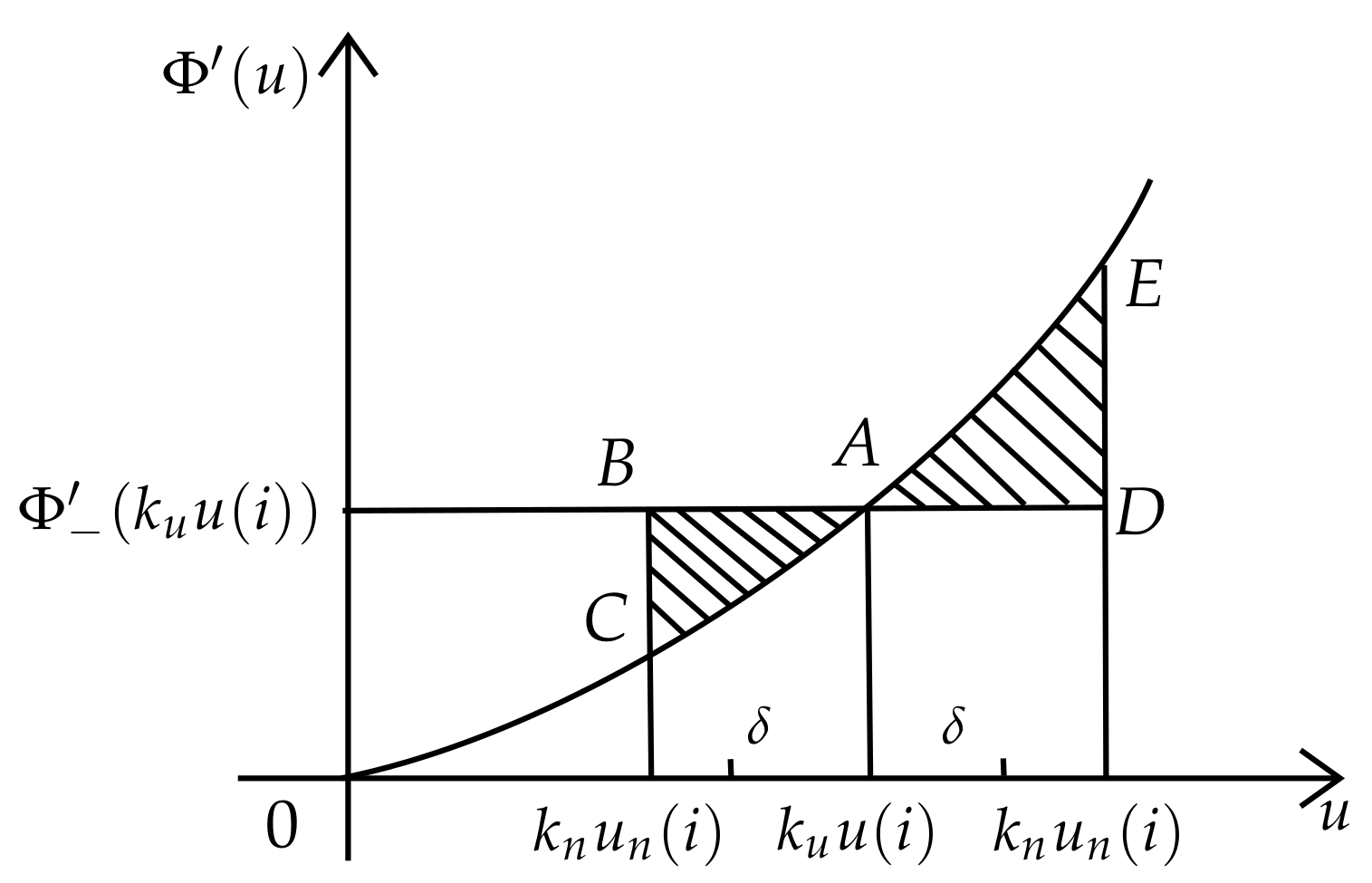
Case-1 If k u u ( i ) S C Φ , then k n u n ( i ) k u u ( i ) δ for any δ > 0 implies
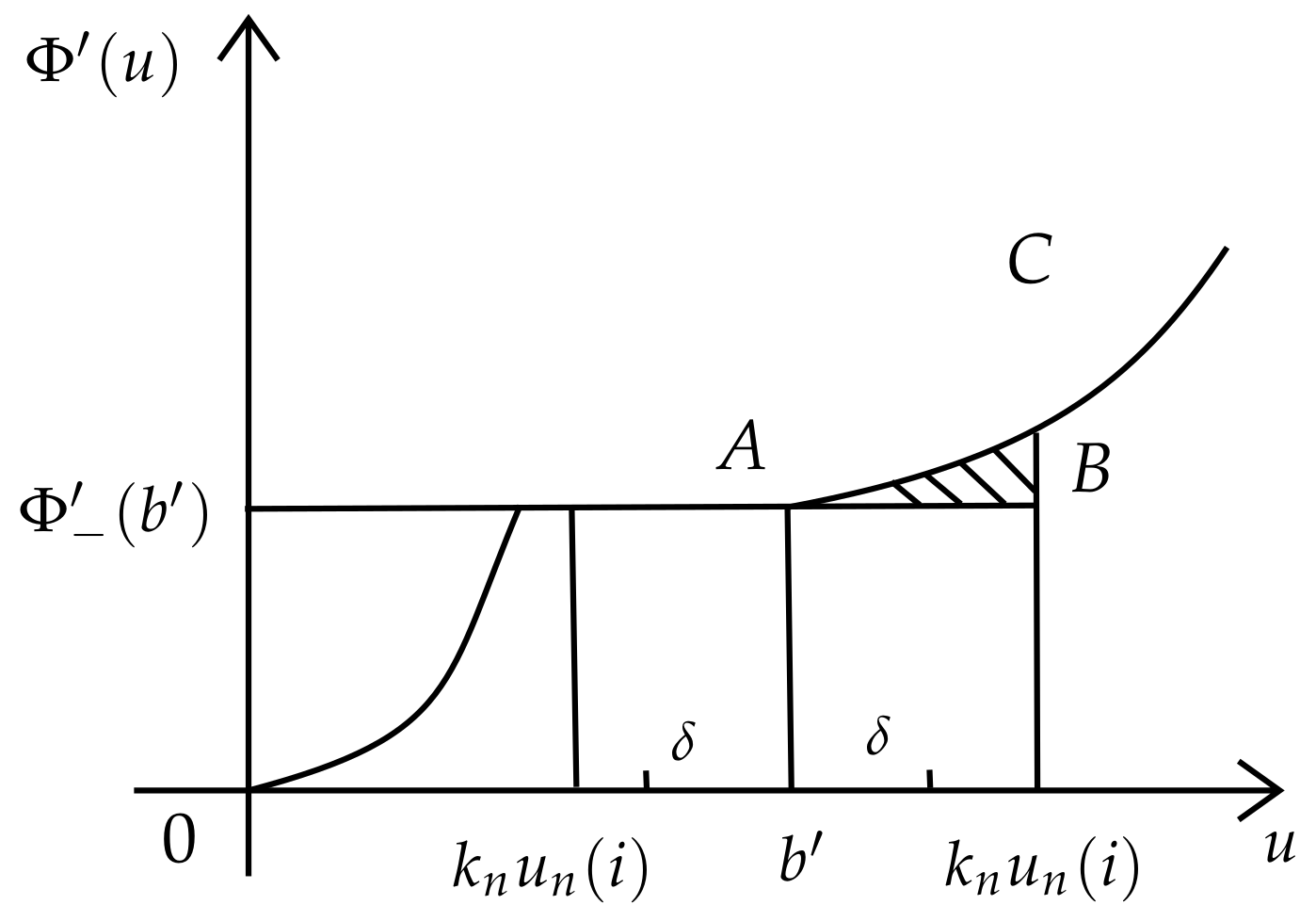
Φ ( k n u n ( i ) ) + Ψ ( Φ ( k u u ( i ) ) ) k n u n ( i ) · Φ ( k u u ( i ) ) the   area   of   figure   ABC   >   0 .
(see Figure 1). This contradicts to (4). So k n u n ( i ) > k u u ( i ) δ for n large enough and any δ > 0 .
Moreover, k n u n ( i ) k u u ( i ) + δ for any δ > 0 implies
Φ ( k n u n ( i ) ) + Ψ ( Φ ( k u u ( i ) ) ) k n u n ( i ) · Φ ( k u u ( i ) ) the   area   of   figure   ABC   >   0 .
(see Figure 1). This contradicts to (4). So k n u n ( i ) < k u u ( i ) + δ for n large enough and any δ > 0 . Thus, k n u n ( i ) k u u ( i ) as n .
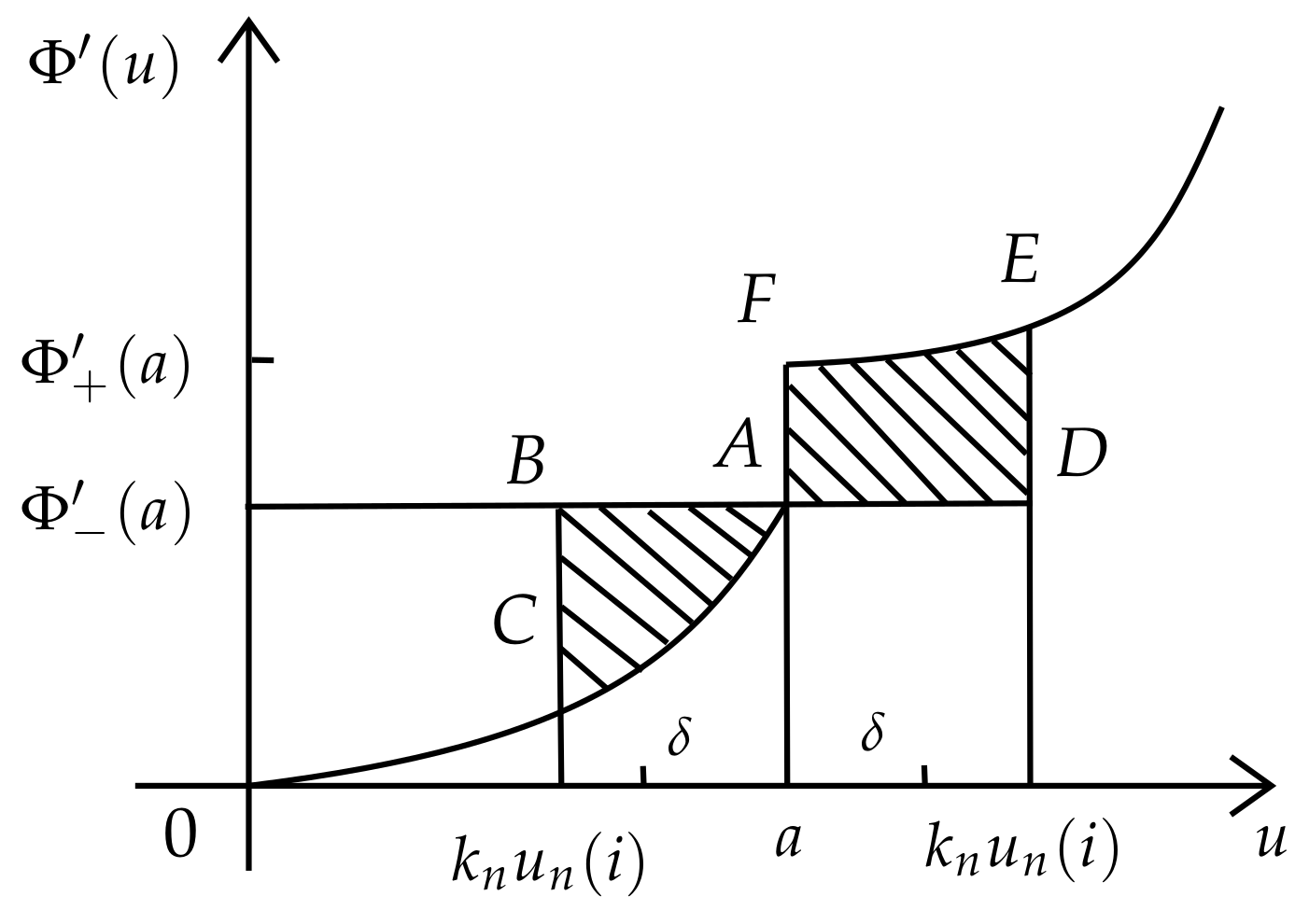
Case-2 If k u u ( i ) = a A , then k n u n ( i ) a δ for any δ > 0 implies
Φ ( k n u n ( i ) ) + Ψ ( Φ ( k u u ( i ) ) ) k n u n ( i ) · Φ ( k u u ( i ) ) = Φ ( k n u n ( i ) ) + Ψ ( Φ ( a ) ) k n u n ( i ) · Φ ( a ) the   area   of   figure   ABC   >   0 .
(see Figure 2). This contradicts to (4). So k n u n ( i ) > a δ for n large enough and any δ > 0 .
Moreover, k n u n ( i ) a + δ for any δ > 0 implies
Φ ( k n u n ( i ) ) + Ψ ( Φ ( a ) ) k n u n ( i ) · Φ ( a ) the   area   of   the   rectangle   ADEF   ( Φ + ( a ) Φ ( a ) ) δ > 0 .
(see Figure 2). This contradicts to (4). So k n u n ( i ) < a + δ for n large enough and any δ > 0 . Thus, k n u n ( i ) a as n .
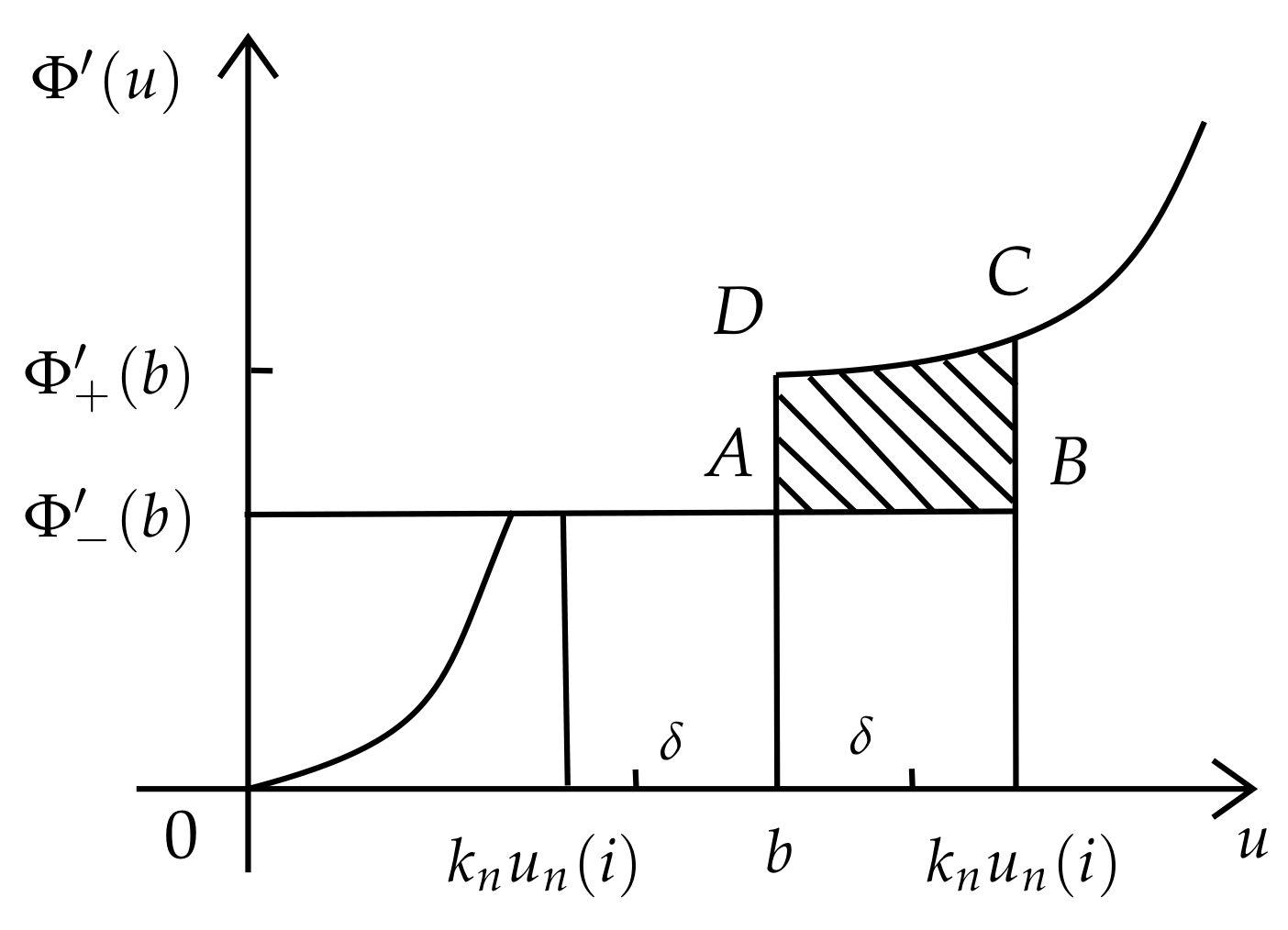
Case-3 If k u u ( i ) = b B , then k n u n ( i ) b + δ for any δ > 0 implies
Φ ( k n u n ( i ) ) + Ψ ( Φ ( k u u ( i ) ) ) k n u n ( i ) · Φ ( k u u ( i ) ) = Φ ( k n u n ( i ) ) + Ψ ( Φ ( b ) ) k n u n ( i ) · Φ ( b ) the   area   of   the   figure   ABCD   ( Φ + ( b ) Φ ( b ) ) δ > 0 .
(see Figure 3). This contradicts to (4). So k n u n ( i ) < b + δ for n large enough and any δ > 0 .
Moreover, k n u n ( i ) b δ for any δ ( 0 , b a ) or ( 0 , b a ) implies
Φ ( k n u n ( i ) ) + Ψ ( Φ ( b ) ) k n u n ( i ) · Φ ( b ) = 0 .
(see Figure 3). Thus, k n u n ( i ) b as n .
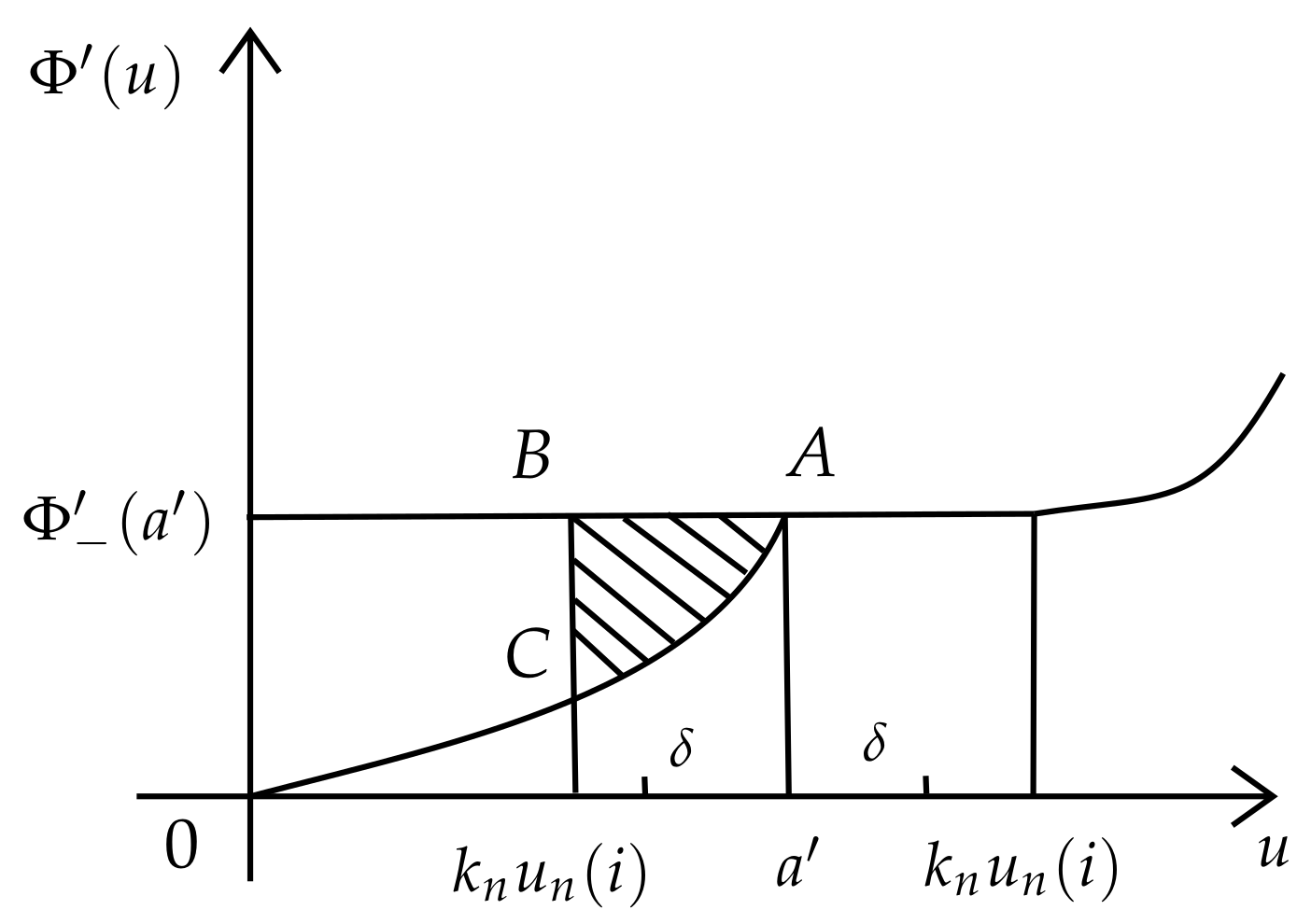
Case-4 If k u u ( i ) = a A , then k n u n ( i ) a δ for any δ > 0 implies
Φ ( k n u n ( i ) ) + Ψ ( Φ ( k u u ( i ) ) ) k n u n ( i ) · Φ ( k u u ( i ) ) = Φ ( k n u n ( i ) ) + Ψ ( Φ ( a ) ) k n u n ( i ) · Φ ( a ) the   area   of   the   figure   ABC   > 0 .
(see Figure 4). This contradicts to (4). So k n u n ( i ) > a δ for n large enough and any δ > 0 .
Moreover, k n u n ( i ) a + δ for any δ ( 0 , b a ) or ( 0 , b a ) implies
Φ ( k n u n ( i ) ) + Ψ ( Φ ( a ) ) k n u n ( i ) · Φ ( a ) = 0 .
(see Figure 4). Thus, k n u n ( i ) a as n .
Case-5 If k u u ( i ) = b B , then k n u n ( i ) b + δ for any δ > 0 implies
Φ ( k n u n ( i ) ) + Ψ ( Φ ( k u u ( i ) ) ) k n u n ( i ) · Φ ( k u u ( i ) ) = Φ ( k n u n ( i ) ) + Ψ ( Φ ( b ) ) k n u n ( i ) · Φ ( b ) the   area   of   the   figure   ABC   > 0 .
(see Figure 5). This contradicts to (4). So k n u n ( i ) < b + δ for n large enough and any δ > 0 .
Moreover, k n u n ( i ) b δ for any δ ( 0 , b a ) or ( 0 , b a ) implies
Φ ( k n u n ( i ) ) + Ψ ( Φ ( b ) ) k n u n ( i ) · Φ ( b ) = 0 .
(see Figure 5). Thus, k n u n ( i ) b as n .
If k u u ( i ) A , by u is an exposed point and Lemma 13, we get
{ i N : k u u ( i ) B } = { i N : k u u ( i ) B } = .
Set I 0 = { i N : k u u ( i ) A } . By case-1, case-2 and case-4, we have
k n u n ( i ) k u u ( i ) ( i N I 0 ) as n , k n u n ( i ) k u u ( i ) ( i I 0 ) as n .
In fact, for any i I 0 , we can claim that k n u n ( i ) k u u ( i ) as n . Otherwise, there exists i 0 I 0 , ε 0 > 0 , n 0 N such that k n u n ( i 0 ) > k u u ( i 0 ) + ε 0 for all n > n 0 . Since Φ is affine on [ a , b ] or [ a , b ] : Φ ( u ) = c u + d where c , d R for u [ a , b ] or [ a , b ] . For all n > n 0 , we have
Φ ( k n u n ( i 0 ) ) = c k n u n ( i 0 ) + d > c ( k u u ( i 0 ) + ε 0 ) + d = c k u u ( i 0 ) + d + c ε 0 = Φ ( k u u ( i 0 ) ) + c ε 0 .
Then,
I Φ ( k n u n ) = i i 0 Φ ( k n u n ( i ) ) + Φ ( k n u n ( i 0 ) ) > i i 0 Φ ( k n u n ( i ) ) + ( Φ ( k u u ( i 0 ) ) + c ε 0 ) I Φ ( k u u ) + c ε 0
as n , this contradicts to (5). Hence, for any i N , k n u n ( i ) k u u ( i ) as n .
If k u u ( i ) B B , by u is an exposed point and Lemma 13, we get
{ i N : k u u ( i ) A } = .
Set I 1 = { i N : k u u ( i ) B B } . By case-1, case-2, case-3 and case-5, we have
k n u n ( i ) k u u ( i ) ( i N I 1 ) as n , k n u n ( i ) k u u ( i ) ( i I 1 ) as n .
Use the analogous way as above, we obtain, for any i N , k n u n ( i ) k u u ( i ) as n .
Thus, for any i N , we have k n u n ( i ) k u u ( i ) as n . By u n Φ , p 1 , u Φ , p = 1 , we have ( 1 + I Φ p ( k n u n ) ) 1 p k n and ( 1 + I Φ p ( k u u ) ) 1 p = k u . From (5), we get k n k u as n . Hence, for any i N , u n ( i ) u ( i ) as n . By Lemma 9, u is a strongly exposed point of S ( l Φ , p ) .
(II) I Φ p 1 ( k u u ) I Ψ ( Φ + ( k u u ) ) = 1 .
By Lemma 6, v = Φ + ( k u u ) Φ + ( k u u ) Ψ , q is the unique supporting functional of u. Use the analogous way as case (I), we have, for any i N , u n ( i ) u ( i ) as n , and u is a strongly exposed point of S ( l Φ , p ) .
(III) I Φ p 1 ( k u u ) I Ψ ( Φ ( k u u ) ) < 1 < I Φ p 1 ( k u u ) I Ψ ( Φ + ( k u u ) ) .
By Φ Δ 2 ( 0 ) , we have ( l Φ , p ) * = ( h Φ , p ) * = l Ψ , q . Thus, there exists v l Ψ , q such that < u , v > = u Φ , p · v Ψ , q , i.e., v v Ψ , q G r a d ( u ) , and θ ( v v Ψ , q ) < 1 . By Lemma 6, Φ ( k u u ( i ) ) v ( i ) Φ + ( k u u ( i ) ) for any i N , and I Φ p 1 ( k u u ) · I Ψ ( v ) = 1 .
Set J 0 = { i N : Φ ( k u u ( i ) ) < Φ + ( k u u ( i ) ) } . Then
v ( i ) = Φ ( k u u ( i ) ) , i J 0 , Φ ( k u u ( i ) ) + ε i , i J 0 ,
where for any i J 0 , Φ ( k u u ( i ) ) + ε i Φ + ( k u u ( i ) ) . By I Φ p 1 ( k u u ) · I Ψ ( v ) = 1 , we obtain 1 K q ( v ) . For any { u n } n = 1 B ( l Φ , p ) with v v Ψ , q , u n 1 as n . Take k n K p ( u n ) . By the Young Inequality and the Hölder Inequality, we have
v v Ψ , q , u n = 1 k n v Ψ , q v , k n u n 1 k n v Ψ , q ( I Ψ ( v ) + I Φ ( k n u n ) ) 1 k n s p ( I Φ ( k n u n ) ) · 1 v Ψ , q s q ( I Ψ ( v ) ) 1 .
as n . Thus, for any i N ,
Φ ( k n u n ( i ) ) + Ψ ( v ( i ) ) k n u n ( i ) · v ( i ) 0 ,
as n . And
( 1 + I Φ p ( k n u n ) ) 1 p · ( 1 + I Ψ q ( v ) ) 1 q I Φ ( k n u n ) I Ψ ( v ) 0 ,
as n , which means
I Φ p 1 ( k n u n ) · I Ψ ( v ) 1 = I Φ p 1 ( k u u ) · I Ψ ( v ) ,
as n , i.e.,
I Φ ( k n u n ) I Φ ( k u u ) ,
as n .
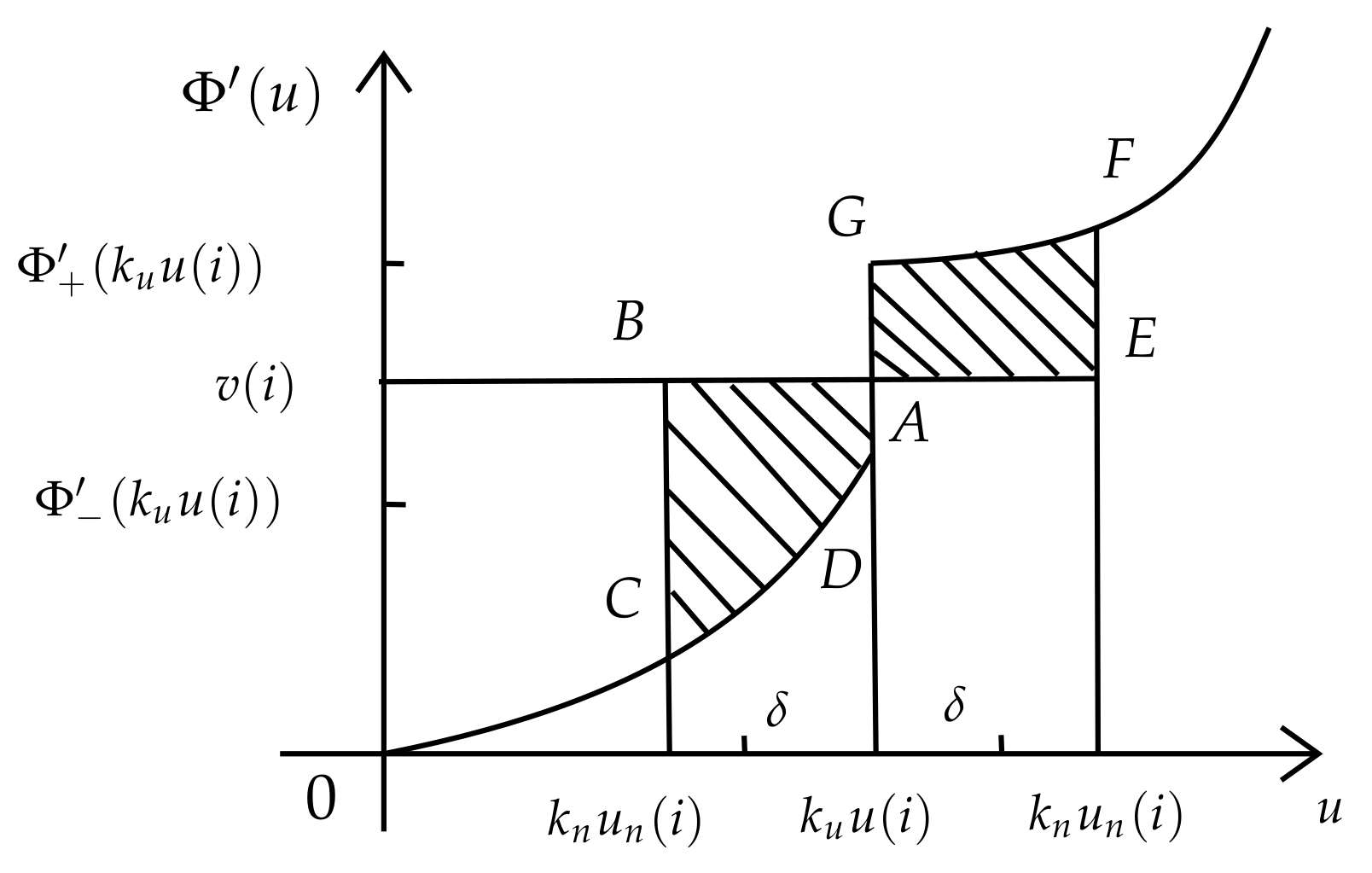
If i J 0 , then v ( i ) = Φ ( k u u ( i ) ) + ε i Φ + ( k u u ( i ) ) . For any δ > 0 , k n u n ( i ) k u u ( i ) δ implies
Φ ( k n u n ( i ) ) + Ψ ( v ( i ) ) k n u n ( i ) · v ( i ) the   area   of   the   figure   ABCD   ε i δ > 0
(see Figure 6). This contradicts to (7). So k n u n ( i ) k u u ( i ) δ for n large enough and any δ > 0 .
For any δ > 0 , k n u n ( i ) k u u ( i ) + δ implies
Φ ( k n u n ( i ) ) + Ψ ( v ( i ) ) k n u n ( i ) · v ( i ) the   area   of   the   figure   AEFG   > ( Φ + ( k u u ( i ) ) v ( i ) ) δ > 0
(see Figure 6). This contradicts to (7). So k n u n ( i ) k u u ( i ) + δ for n large enough and any δ > 0 . Thus, for any i J 0 , k n u n ( i ) k u u ( i ) as n . If i N J 0 , then v ( i ) = Φ ( k u u ( i ) ) = Φ + ( k u u ( i ) ) . We have k n u n ( i ) k u u ( i ) as n . Similarly, by (8), we can prove k n k u as n . Hence, for any i N , u n ( i ) u ( i ) as n . By Lemma 9, u is a strongly exposed point of S ( l Φ , p ) . □
 Theorem 5. 
Let 1 < p < , l Φ , p has the strongly exposed property if and only if
(i) Φ Δ 2 ( 0 ) and Ψ Δ 2 ( 0 ) (i.e., Φ Δ 2 ( 0 ) 2 ( 0 ) ).
(ii) Φ is strictly convex on the interval 0 , π Φ , p ( 1 2 ) .
Proof. 
Sufficiency. By Lemma 8, l Φ , p is a locally uniform rotundity space. So l Φ , p has the strongly exposed property.
Necessity. Φ Δ 2 ( 0 ) follows from Theorem 4. If condition (ii) fails, by Lemma 7, l Φ , p is not strictly convex, and therefore it does not have the strongly exposed property either. So (ii) is necessary. If Ψ Δ 2 ( 0 ) , for any n > 2 , there exist a i 0 such that a i Ψ + ( a i ) < 1 n i and Ψ + 1 + 1 i a i > n i Ψ + ( a i ) . Choose natural numbers m i satisfying
1 n i + 1 m i a i Ψ + ( a i ) < 1 n i ( i = 1 , 2 ) ,
and define
y = a 1 , , a 1 m 1 , a 2 , , a 2 m 2 , a 3 , , a 3 m 3 , .
Then we have
< y , Ψ + ( y ) > = i = 1 m i a i Ψ + ( a i ) < i = 1 1 n i = 1 n 1 .
Whence by < y , Ψ + ( y ) > = I Ψ ( y ) + I Φ ( Ψ + ( y ) ) , we get I Ψ ( y ) < 1 n 1 and I Φ ( Ψ + ( y ) ) < 1 n 1 . Thus, I Ψ q 1 ( y ) I Φ ( Ψ + ( y ) ) < 1 .
Notice that for any λ > 0 ,
I Φ ( Ψ + ( ( 1 + λ ) y ) ) + I Ψ ( y ) < y , Ψ + ( ( 1 + λ ) y ) > = i = 1 m i a i Ψ + ( ( 1 + λ ) a i ) i 1 λ m i a i Ψ + 1 + 1 i a i i 1 λ m i a i n i Ψ + ( a i ) i 1 λ 1 n = .
So we derive that I Φ ( Ψ + ( ( 1 + λ ) y ) ) = . We also have that for any λ > 0 ,
I Ψ ( ( 1 + 2 λ ) y ) = i = 1 m i Φ ( ( 1 + 2 λ ) a i ) i = 1 m i ( 1 + λ ) a i ( 1 + 2 λ ) a i Ψ + ( s ) d s i = 1 m i λ a i Ψ + ( ( 1 + λ ) a i ) = λ 1 + λ i = 1 m i ( 1 + λ ) a i Ψ + ( ( 1 + λ ) a i ) = λ 1 + λ < ( 1 + λ ) y , Ψ + ( ( 1 + λ ) y ) > λ 1 + λ I Φ ( Ψ + ( ( 1 + λ ) y ) ) = .
So I Ψ q 1 ( ( 1 + λ ) y ) · I Φ ( Ψ + ( ( 1 + λ ) y ) ) = , which shows K q ( y ) = { 1 } , i.e., y Ψ , q = 1 + I Ψ ( y ) . Set x = Ψ + ( y ) , by Lemma 6, y y Ψ , q is the unique supporting functional of x. For any ε > 0 , there exists n 0 N such that 2 n 1 < ε for all n > n 0 , then
I Ψ ( 1 + ε ) y y Ψ , q > I Ψ 1 + 2 n 1 y 1 + 1 n 1 = I Ψ 1 + 1 n y = .
This is contradicts to condition (iii) of Theorem 4. So Ψ Δ 2 ( 0 ) is necessary. □

4. Conclusions

The classical Orlicz and Luxemburg norms generated by an Orlicz function Φ can be defined with the use of the Amemiya formula: u Φ o = inf k > 0 1 k ( 1 + I Φ ( k u ) ) and u Φ = inf k > 0 1 k { 1 , I Φ ( k u ) } respectively (see [15]). Furthermore, the family of p-Amemiya norms u Φ , p = inf k > 0 1 k ( 1 + I Φ p ( k u ) ) 1 p ( 1 p ) (under the convention: ( 1 + x ) 1 = lim p ( 1 + x p ) 1 p = max { 1 , x } for all x 0 ) were introduced in the same paper. In last few years, a number of papers about the geometrical properties of Orlicz spaces equipped with the p-Amemiya norms have been published. The criteria for the strongly exposed points and strongly exposed property of Orlicz spaces equipped with the classical norms were presented in [9,10,11]. However, the criteria for the strongly exposed points and strongly exposed property of Orlicz sequence spaces equipped with the p-Amemiya norms have not been found. In this paper, Theorems 1, 4 and 5 resolves these issues. The obtained results broaden the knowledge about strongly exposed points and strongly exposed property in Orlicz spaces equipped with the p-Amemiya norms.

Author Contributions

Writing—original draft, X.L.; Writing—review & editing, X.L.; Supervision, Y.C. All authors have read and agreed to the published version of the manuscript.

Funding

This work was supported by the Natural Science Foundation of Heilongjiang Province (LH2024A016) and the Natural Science Foundation of China (12271121).

Data Availability Statement

No new data were created or analyzed in this study. Data sharing is not applicable to this article.

Acknowledgments

The authors are grateful to the referee for their comments, which improved the paper.

Conflicts of Interest

The authors declare no conflicts of interest.

References

  1. Straszewicz, S. Über exponierte Punkte abgeschlossener Punktmengen. Fundam. Math. 1935, 24, 139–143. [Google Scholar] [CrossRef]
  2. Lindenstrauss, J. On operators which attain their norm. Isr. J. Math. 1963, 1, 139–148. [Google Scholar] [CrossRef]
  3. Phelps, R.R. Dentability and extreme points in Banach spaces. J. Funct. Anal. 1974, 17, 78–90. [Google Scholar] [CrossRef]
  4. Wang, B. Exposed points in Orlicz spaces. Baoji Teach. Coll. 1989, 12, 43–49. [Google Scholar]
  5. Grzaslewicz, R.; Hudzik, H.; Kurc, W. Extreme and exposed points in Orlicz spaces. Can. J. Math. 1992, 44, 505–515. [Google Scholar] [CrossRef]
  6. Hudzik, H.; Pallaschke, D. On some convexity properties of Orlicz sequence spaces equipped with the Luxemburg norm. Math. Nachr. 1997, 186, 167–185. [Google Scholar] [CrossRef]
  7. Li, X.; Cui, Y. Exposed points of Orlicz function spaces equipped with p-Amemiya norms. Indian J. Pure Appl. Math. 2022, 54, 1177–1186. [Google Scholar] [CrossRef]
  8. Li, X.; Cui, Y. Exposed points of Orlicz sequence spaces equipped with p-Amemiya (1 ≤ p) norms. J. Geometric Anal. 2022, 32, 307. [Google Scholar] [CrossRef]
  9. Wang, B. Strongly exposed point property of Orlicz spaces. J. Eng. Math. 1992, 9, 115–119. (In Chinese) [Google Scholar]
  10. Wang, T.; Ji, D.; Shi, Z. The criteria of strongly exposed points in Orlicz spaces. Comment. Math. Univ. Carol. 1994, 35, 721–734. [Google Scholar]
  11. Li, M.; Wang, B.; Wang, T. Strongly exposed points of Orlicz sequence spaces. Acta Math. Sin. New Ser. 1998, 14, 593–604. [Google Scholar]
  12. Shi, Z.; Liu, C. Strongly exposed points in Musielak-Orlicz sequence spaces endowed with Orlicz norm. Banach Cent. Publ. 2011, 92, 327–338. [Google Scholar] [CrossRef]
  13. Shi, Z.; Liu, C. Exposed points and strongly exposed points in Musielak-Orlicz sequence spaces. Taiwan. J. Math. 2012, 16, 305–322. [Google Scholar] [CrossRef]
  14. Nakano, H. Topology and Linear Topological Spaces; Tokyo Mathematical Book Series; Maruzen: Tokyo, Japan, 1951; Volume 3. [Google Scholar]
  15. Hudzik, H.; Maligranda, L. Amemiya norm equals Orlicz norm in general. Indag. Math. 2000, 11, 573–585. [Google Scholar] [CrossRef]
  16. Orlicz, W. A note on modular spaces. Bull. Acad. Polon. Sci. Math. 1961, 9, 157–162. [Google Scholar]
  17. Cui, Y.; Duan, L.; Hudzik, H.; Wisła, M. Basic theory of p-Amemiya norm in Orlicz spaces: Extreme points and rotundity in Orlicz spaces endowed with these norms. Nonlinear Anal. 2008, 69, 1796–1816. [Google Scholar] [CrossRef]
  18. Cui, Y.; Hudzik, H.; Li, J.; Wisła, M. Strongly extreme points in Orlicz spaces equipped with the p-Amemiya norm. Nonlinear Anal. 2009, 71, 6343–6364. [Google Scholar] [CrossRef]
  19. Cui, Y.; Hudzik, H.; Wisła, M.; Wlaźlak, K. Non-squareness properties of Orlicz spaces equipped with the p-Amemiya norm. Nonlinear Anal. 2012, 75, 3973–3993. [Google Scholar] [CrossRef]
  20. Li, X.; Cui, Y. Strict convexity of Orlicz sequence spaces equipped with p-Amemiya norms. Indian J. Pure Appl. Math. 2021, 53, 660–671. [Google Scholar] [CrossRef]
  21. Li, X.; Cui, Y.; Wisła, M. Smoothness of Orlicz function spaces equipped with the p-Amemiya norm. Banach J. Math. Anal. 2021, 15, 46. [Google Scholar] [CrossRef]
  22. Li, X.; Cui, Y.; Wisła, M. Smoothness, very (strongly) smoothness of Orlicz sequence spaces equipped with p-Amemiya norms. Rev. Real Acad. Cienc. Exactas Fís. Nat. Ser. A Mat. 2023, 117, 110. [Google Scholar] [CrossRef]
  23. Li, X.; Cui, Y. On some local geometry of Orlicz sequence spaces equipped with the p-Amemiya norm. Ann. Funct. Anal. 2025, 16, 24. [Google Scholar] [CrossRef]
  24. Chen, S. Geometry of Orlicz Spaces; Instytut Matematyczny Polskiej Akademi Nauk: Warsaw, Poland, 1996; pp. 1–50. [Google Scholar]
  25. Luxemburg, W.A.J.; Zaanen, A.C. Conjugate spaces of Orlicz spaces. Indag. Math. 1956, 59, 217–228. [Google Scholar] [CrossRef]
  26. Musielak, J. Orlicz Spaces and Modular Spaces; Springer: Berlin/Heidelberg, Germany, 1983; pp. 5–35. [Google Scholar]
  27. Rao, M.; Ren, Z. Theory of Orlicz Spaces; Marcel Dekker: New York, NY, USA, 1991; pp. 1–50. [Google Scholar]
  28. Wisła, M. Orlicz spaces equipped with the s-norms. J. Math. Anal. Appl. 2020, 483, 123659. [Google Scholar] [CrossRef]
Figure 1. k u u ( i ) S C Φ .
Axioms 15 00183 g001
Figure 2. k u u ( i ) = a A .
Axioms 15 00183 g002
Figure 3. k u u ( i ) = b B .
Axioms 15 00183 g003
Figure 4. k u u ( i ) = a A .
Axioms 15 00183 g004
Figure 5. k u u ( i ) = b B .
Axioms 15 00183 g005
Figure 6. Φ ( k u u ( i ) ) < v ( i ) < Φ + ( k u u ( i ) ) .
Axioms 15 00183 g006
Disclaimer/Publisher’s Note: The statements, opinions and data contained in all publications are solely those of the individual author(s) and contributor(s) and not of MDPI and/or the editor(s). MDPI and/or the editor(s) disclaim responsibility for any injury to people or property resulting from any ideas, methods, instructions or products referred to in the content.