1. Introduction
Many systems in mathematical physics are governed by distinct asymptotic laws that describe their behavior in opposite limits. Classical examples include the laminar and turbulent regimes of pipe flow [
1,
2], ballistic and diffusive transport in fractional dynamics [
3], and Gaussian versus heavy-tailed statistics in stochastic processes [
4,
5,
6]. While the limiting expressions are often simple and analytically tractable, the physical system occupies the entire domain, including the intermediate region where neither asymptotic law dominates. Traditional approaches—asymptotic matching [
7], composite expansions [
8,
9,
10], and heuristic interpolation formulae [
11]—typically treat this region as a technical inconvenience, a zone where approximations must be patched or blended without a unifying geometric principle. More relevant historical content is presented in
Appendix E.
This work develops a different perspective. We argue that the intermediate regime is not merely a residual artifact of approximation but a distinct macroscopic state generated by a nonlinear interaction between asymptotic laws. This viewpoint resonates with earlier developments in the theory of intermediate asymptotics [
12], uniform approximations in mechanics [
13,
14,
15], and the analytic structure of stable distributions [
6]. To formalize this idea, we introduce the entanglement operator, a Minkowski–
metric blend that couples asymptotic regimes through an index
[
16,
17]. The resulting global state exhibits metric non-separability: For any
, the intermediate region cannot be expressed as a linear combination of its limiting behaviors. Instead, it emerges from the curvature of the underlying metric space. This phenomenon, which we term classical entanglement, provides a geometric mechanism for synthesizing asymptotic laws into a single, globally valid expression.
The geometric viewpoint reveals a universal structural feature: the transition knee, a region of maximal curvature where the system switches identity between asymptotic regimes. The curvature of this knee scales linearly with the entanglement index a, independent of amplitudes or local scales. This universality suggests that the geometry of the transition is as fundamental as the asymptotic laws themselves.
Beyond its conceptual role, the entanglement operator unifies several existing constructions. It encompasses Orlicz norms and generalized Hölder geometries [
18,
19], and its hierarchical extensions mirror the structure of self-similar root approximants [
20,
21,
22]. Factor approximants [
23] admit an interpretation as discrete Calderón-type constructions [
24,
25], situating algorithmic renormalization within a rigorous geometric meta-language. Related non-parametric interpolation methods, such as quasifractional approximants [
26,
27,
28], further illustrate the structural principle that global behavior can be dictated by simultaneous constraints from incompatible asymptotic regimes.
The framework is illustrated through applications in turbulence (Darcy friction factor) [
1,
2], fractional dynamics [
3], and scale-dependent diffusion [
4,
5,
6]. These examples demonstrate how classical entanglement provides stable, asymptotically consistent global states across multi-scale systems, offering a principled alternative to heuristic interpolation.
Because this work unifies ideas drawn from empirical modeling, geometric analysis, and functional-analytic interpolation, readers often approach the subject with different conceptual backgrounds. Practitioners rely on empirical blending rules, analysts speak in terms of interpolation functors, and geometers emphasize curvature and metric structure. These perspectives are rarely aligned, and the same structural phenomenon is often described using incompatible terminologies. To help navigate these parallel languages, we introduce in
Appendix E a conceptual “Rosetta Stone of Asymptotic Synthesis” (
Table A1), which maps practitioner heuristics to geometric constructs and to their counterparts in interpolation theory. The table is placed in the
Appendix E rather than here to avoid the conceptual “Jack-in-the-box” effect of introducing a dense summary too early, while still providing a unified vocabulary for readers who wish to consult it.
2. The Entanglement Operator
The synthesis of asymptotic laws requires a precise specification of the objects being combined. In this section, we formalize the ingredients that underlie the geometric construction introduced in the Introduction and used throughout the paper. The definitions below anchor the notions of metric non-separability, the transition knee, and the geometric interpretation of classical entanglement developed in
Section 2 and
Section 4. Further details on the Minkowski geometry can be found in
Appendix A.
2.1. Asymptotic Laws and Their Domain
Let
D be a one-dimensional domain for the independent variable
x. Throughout this work, the asymptotic laws
are real-valued, positive functions describing the behavior of a physical system in opposite limits:
These functions correspond to the “pure states” of the system in the sense introduced in the Introduction. Their positivity reflects the physical quantities of interest (e.g., friction factors, diffusivities, probability densities). No additional regularity assumptions are required beyond the existence of the asymptotic limits.
Although
and
are defined on a one-dimensional domain, the geometry of classical entanglement does not take place in
D. Instead, the map
is interpreted as a curve in the two-dimensional space
, and the entanglement operator acts on this curve through a nonlinear metric. This geometric viewpoint is the foundation for the metric non-separability and the curvature-based transition knee analyzed in
Section 4 and
Section 5.
2.2. Definition of the Entanglement Operator
For a fixed entanglement index
, the entanglement operator is defined by
This operator produces a single global state
which satisfies the anchoring asymptotic conditions
These anchoring properties are the formal version of the asymptotic compatibility principle introduced in the Introduction and used in the worked examples of
Section 5.
2.3. Geometric Interpretation
The operator (
4) is the Minkowski–
norm of the vector
:
This clarifies the geometric setting:
- -
The domain D is one-dimensional;
- -
The entanglement geometry occurs in the metric space ;
- -
The intermediate regime corresponds to the portion of the curve where neither coordinate dominates the norm.
For any
, the operator is nonlinear and induces metric non-separability:
This is the formal statement of classical entanglement introduced in the Introduction and developed conceptually in
Section 2. The geometric consequences, such as curvature, stiffness, and the transition knee, are analyzed in detail in
Section 4 and
Section 5.
2.4. Limiting Cases
The operator interpolates between two classical regimes:
and
For all intermediate values
, the geometry of the
unit ball induces a nonlinear coupling between the asymptotic laws, giving rise to a distinct intermediate macroscopic state. This is the geometric origin of the transition knee and the stiffness scaling discussed in
Section 4 and
Section 5.
3. Classical vs. Quantum Entanglement
The term entanglement is used in this work in a structural sense. Both classical and quantum entanglement describe global states that cannot be reduced to their constituent parts, but the mathematical origin of this non-separability is fundamentally different in the two settings. Quantum entanglement arises from the linear structure of Hilbert spaces and the tensor product construction [
29,
30], whereas classical entanglement arises from the nonlinear metric geometry formalized in
Section 2. This section clarifies the distinction and positions the geometric mechanism introduced in
Section 2 within a broader conceptual landscape. The discussion continues in
Section 7.5.
3.1. Quantum Entanglement: Algebraic Non-Separability
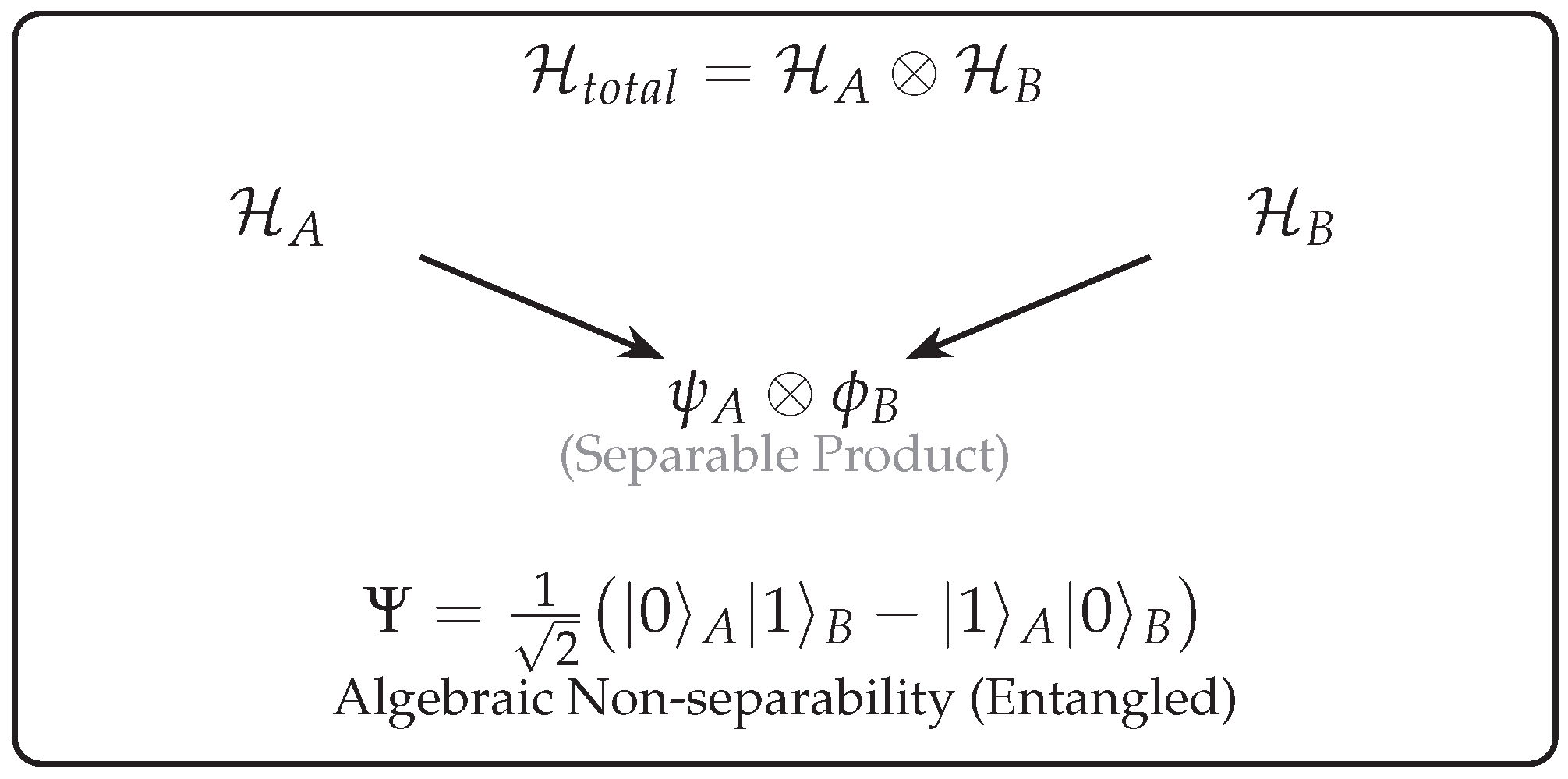
In quantum mechanics, the state space of a composite system is the tensor product
A pure state is separable if it can be written as a single product
The superposition principle allows linear combinations of such products, and these combinations need not be factorizable. A state is entangled if no change of basis can rewrite it as a single tensor product. The non-separability is therefore algebraic: it is encoded in the amplitudes of a linear superposition with complex coefficients and enforced by the linearity of the Hilbert space.
A canonical example is the singlet state
which cannot be decomposed into a product of subsystem states. The irreducibility arises from the algebraic structure of the tensor product and the linearity of quantum amplitudes. Quantum entanglement, illustrated in
Figure 1, reflects algebraic non-separability in the tensor-product structure.
3.2. Classical Entanglement: Metric Non-Separability
Classical entanglement, by contrast, arises from the nonlinear geometric coupling defined in
Section 2. Given two asymptotic laws
the global state is constructed by applying the entanglement operator introduced in
Section 2:
This operator evaluates the Minkowski
norm of the point
. For any
, the coupling is nonlinear, and the resulting global state satisfies the metric non-separability property established in
Section 2:
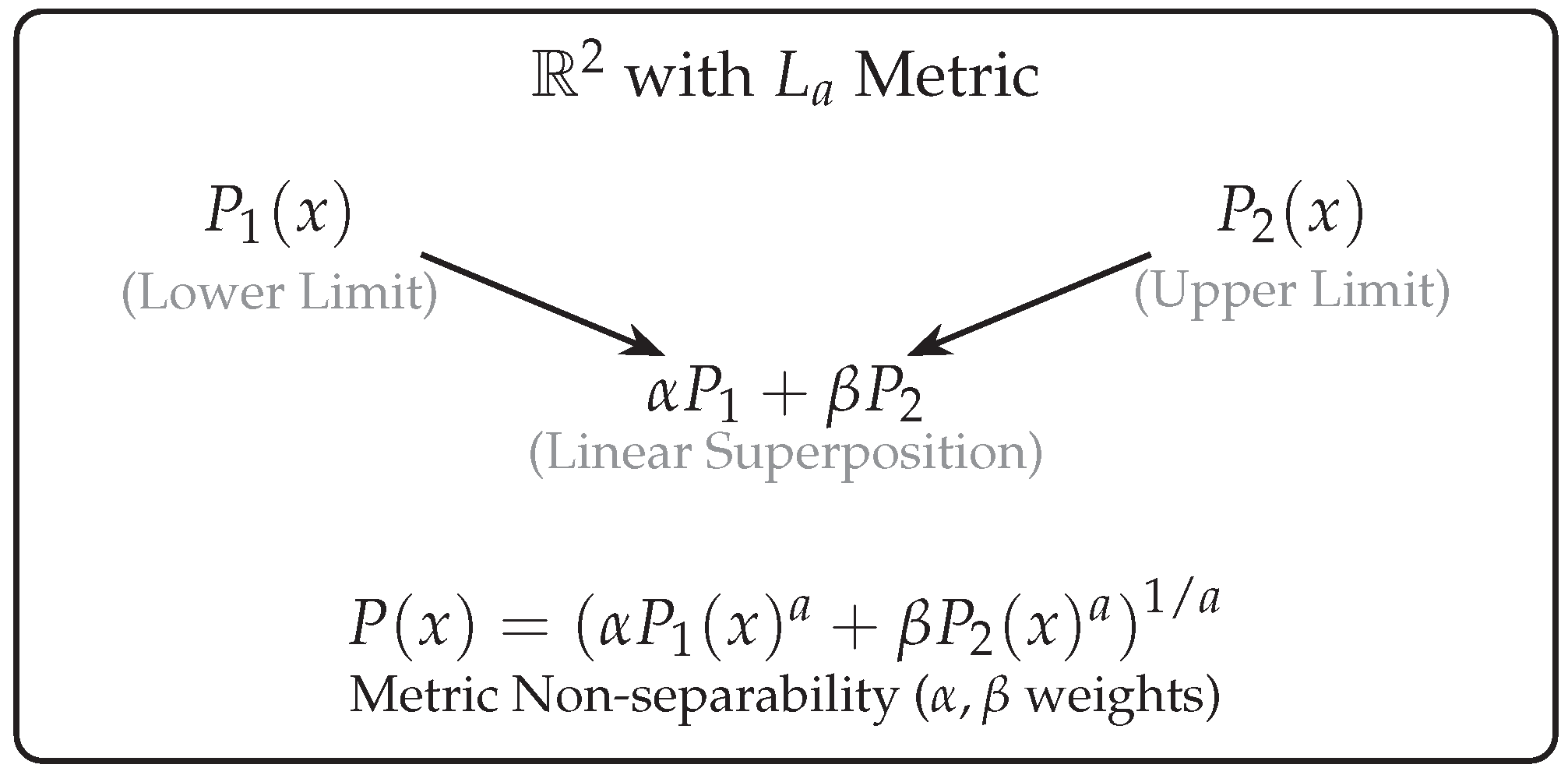
The intermediate regime is therefore metrically non-separable: it cannot be expressed as a linear combination of the asymptotic laws. Its structure reflects the curvature of the metric space
, not the algebra of a vector space. A more general weighted form,
introduces partition weights that bias the global state toward one regime or the other. These weights play a role analogous to amplitudes in quantum superposition, but the mechanism remains geometric: the nonlinearity arises from the metric, not from linear algebra. Classical entanglement, depicted in
Figure 2, emerges from nonlinear coupling in the Minkowski–
metric rather than from linear superposition.
3.3. The Special Case
The case
is structurally singular. When
, the entanglement operator reduces to a linear superposition,
and the geometry collapses to the
(Manhattan) metric. This is the only value of
a for which the operator is linear. For all
, even infinitesimally, the geometry becomes curved and the global state becomes non-separable in the metric sense.
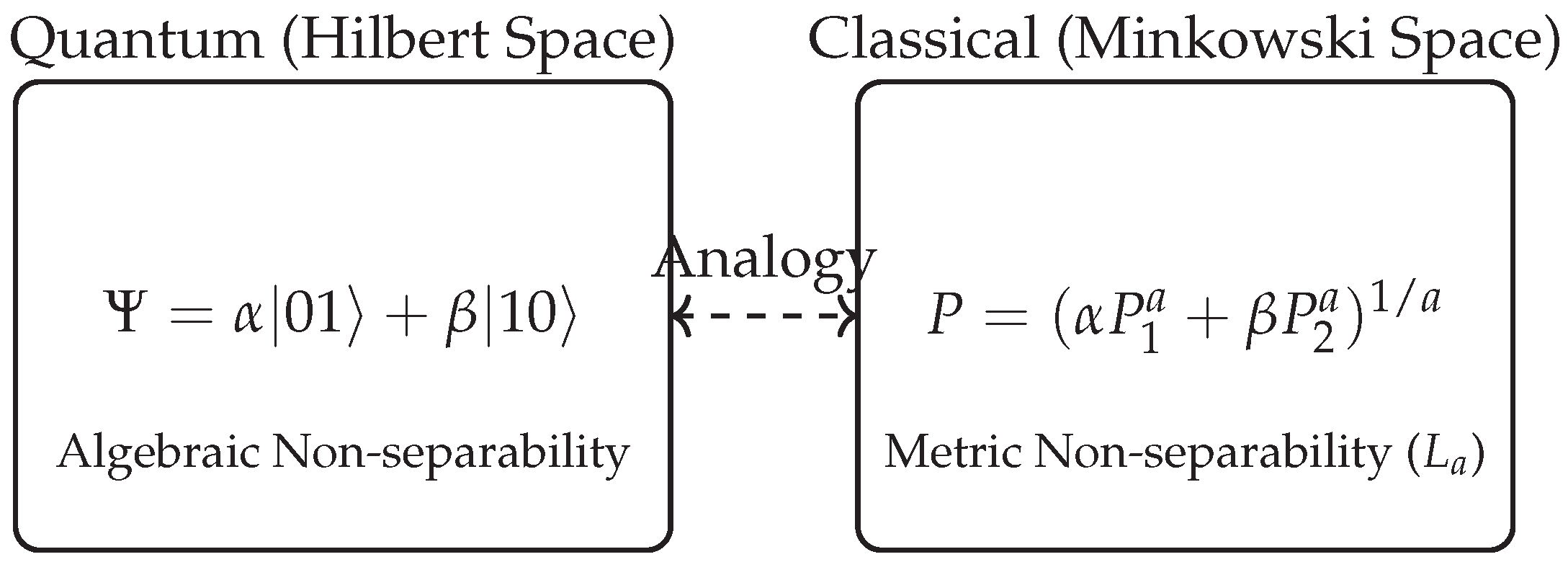
Quantum entanglement expresses the impossibility of factorizing a global state into subsystem states due to the linear structure of Hilbert space. Classical entanglement expresses the impossibility of decomposing a global state into a linear combination of its asymptotic components due to the nonlinear metric coupling formalized in
Section 2. The two phenomena share a structural theme of non-separability, but their mathematical origins, interpretations, and physical contexts are entirely distinct.
Figure 3 presents the analogy between quantum and classical entanglement, contrasting algebraic non–separability in Hilbert space with metric non–separability generated by the Minkowski–
metric.
4. Geometry of Classical Entanglement
The entanglement operator introduced in
Section 2 is not merely an algebraic device for combining asymptotic laws. Its structure is inherently geometric: the global state emerges from the curvature of a metric space rather than from the algebra of linear superposition. This section develops the geometric foundations of classical entanglement and clarifies how the entanglement index
a controls the shape, stiffness, and non-separability of the intermediate regime. These geometric features distinguish classical entanglement from the algebraic non-separability of quantum systems discussed in
Section 3.
4.1. Minkowski Geometry and the Role of the Index a
For any pair
, the Minkowski
norm is defined by
a classical construction appearing in the theory of power means and convex geometry [
18] and foundational in the development of Orlicz and generalized Hölder spaces [
19]. The level sets
form a one-parameter family of convex curves whose geometry depends on
a:
: Diamonds (Manhattan geometry);
: Circles (Euclidean geometry);
: Superellipses with increasingly square-like shapes;
: Axis-aligned squares (Chebyshev geometry).
The entanglement operator defined above,
inherits its qualitative behavior from these shapes. As
a increases, the unit ball becomes sharper, and the transition between asymptotic regimes becomes more abrupt. This is the geometric origin of the stiffness parameter introduced in
Section 2.
4.2. The Intermediate Regime as a Geometric Object
The map
traces a curve in the metric space
. The global state
is the radial projection of this curve onto the
norm. The intermediate regime corresponds to the portion of the curve where neither coordinate dominates the norm.
This geometric viewpoint explains why the intermediate regime is not a technical artifact but a genuine macroscopic state. Its structure is determined by the curvature of the Minkowski unit ball, not by algebraic manipulation of asymptotic expansions. The index
a controls how strongly the geometry suppresses linear superposition, producing the metric non-separability formalized in
Section 2.
4.3. Curvature and the Transition Knee
A central geometric feature of classical entanglement is the transition knee: the region of maximal curvature where the system switches identity from the
-dominated regime to the
-dominated regime. For the global state
the curvature increases monotonically with
a. In the limit
, the transition approaches a sharp threshold, reflecting the limiting Chebyshev geometry.
Definition 1 (Transition Knee)
. For a fixed entanglement index , the transition knee is the point at which the curvature
of the entangled state attains its maximum:
Equivalently,
is the point where the contributions of the asymptotic laws are comparable,
so that neither regime dominates the Minkowski geometry. The knee therefore marks the location where the system undergoes its most rapid geometric transition between asymptotic identities.
The transition knee is universal:
Its curvature scales linearly with a;
Its location depends only on the relative magnitudes of and ;
It is independent of amplitudes or local scales;
It appears in all systems governed by competing asymptotic laws.
This universality underlies the behavior observed in the examples of
Section 5, including fractional dynamics [
3], Lévy statistics [
4,
6], and turbulent pipe flow [
1,
2]. Despite their physical differences, these systems share the same geometric mechanism: a nonlinear transition governed by the curvature of the
metric.
For any
, the entanglement operator satisfies
This is the geometric non-separability introduced in
Section 2 and contrasted with the algebraic non-separability of quantum systems in
Section 3. In classical entanglement, non-separability arises from the curvature of the Minkowski metric: the geometry binds the asymptotic laws into a single global state that cannot be decomposed into linear parts.
This geometric mechanism also underlies the structural isomorphisms discussed in
Section 6, including the correspondence with self-similar root approximants [
20,
21,
22] and Calderón-type interpolation [
24,
25].
The geometry of classical entanglement is encoded in the Minkowski norm. The entanglement index a determines the shape of the underlying metric space, the stiffness of the transition between asymptotic regimes, the curvature of the intermediate manifold, and the degree of metric non-separability. Classical entanglement is therefore a geometric phenomenon: a nonlinear unification of asymptotic laws governed by the structure of a metric space.
5. Illustrations
Classical entanglement appears whenever a physical system is governed by two or more asymptotic laws that describe its behavior in opposite limits. Fractional-order evolution equations interpolate between ballistic and diffusive transport. Lévy processes interpolate between Gaussian and heavy-tailed statistics. In pipe flow, the Darcy friction factor f interpolates between viscous and inertial regimes. In each case, the intermediate region is not a defect or a patching zone but a genuine macroscopic state generated by the nonlinear geometry of the Minkowski metric. This section presents one fully worked example, followed by several physical examples illustrating the same geometric mechanism.
5.1. Worked Example: A Two-State Entangled System
Consider the asymptotic laws
The entangled global state is
The two laws become comparable when
which gives
. According to the definition in
Section 4.3, the transition knee
is the point of maximal curvature:
Direct computation confirms that
lies near
for all
. Differentiation shows that the maximal curvature satisfies
demonstrating the universal linear scaling predicted by the geometric theory.
The curve
passes through the region where the
unit ball is most curved. The entangled state
is the radial projection of this curve, and the transition knee corresponds to the portion where the curve crosses the diagonal
. As
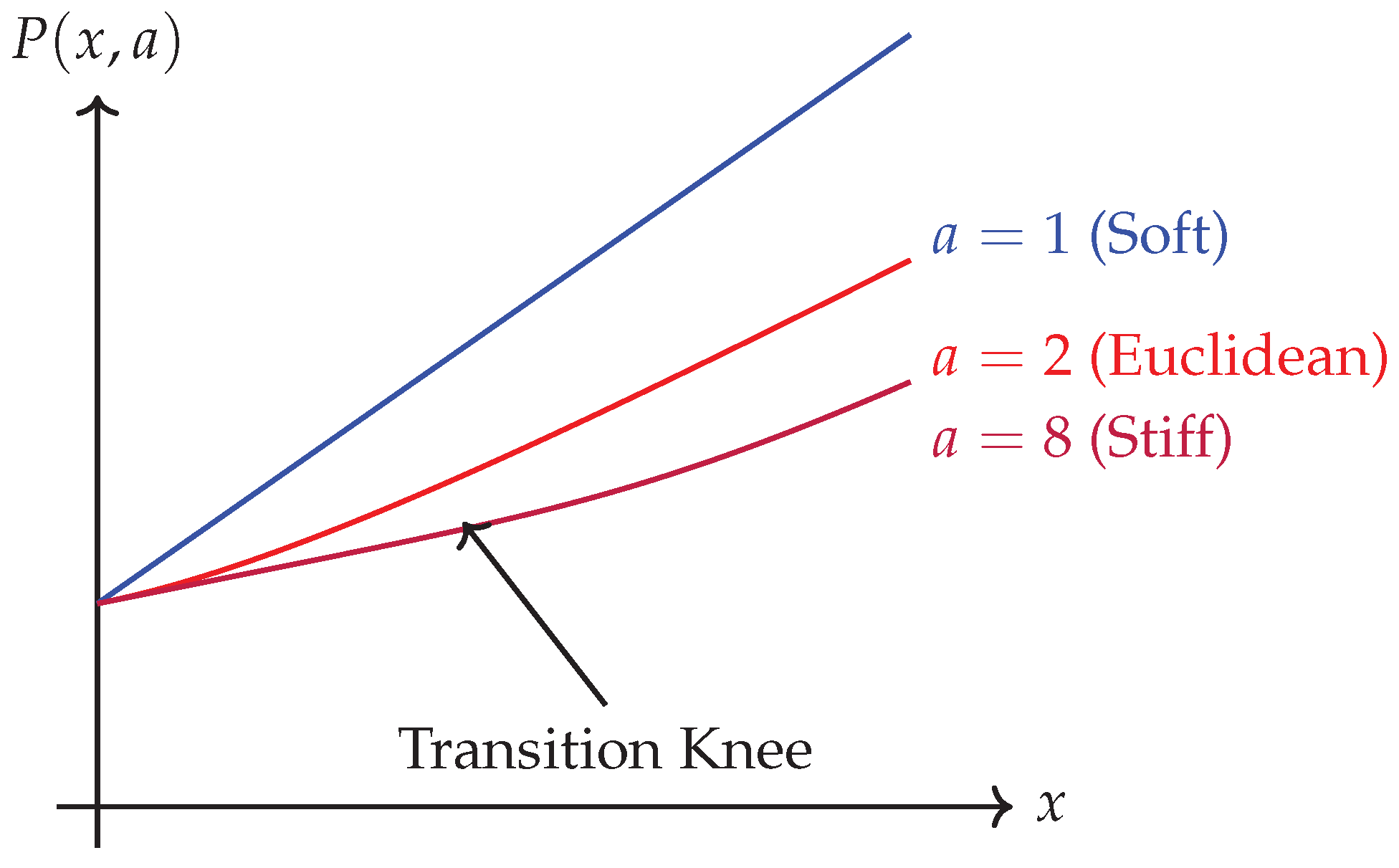
a increases, the geometry stiffens and the knee sharpens.
Figure 4 illustrates how the transition knee sharpens as the entanglement index
a increases, reflecting the growing curvature of the Minkowski–
geometry.
This example shows explicitly how classical entanglement produces a global state with its own geometry and emergent properties, distinct from either asymptotic law.
The same geometric mechanism appears across a wide range of physical systems. The following examples illustrate how contrasting asymptotic laws combine through the Minkowski metric to produce global states with well-defined intermediate structure.
5.2. Exponential and Algebraic Regimes
Consider the asymptotic laws
The entangled state
transitions from exponential decay at small
x to algebraic growth at large
x. The intermediate regime is neither exponential nor algebraic but a geometric blend determined by the curvature of the
metric.
A second example combines a Gaussian core with exponential decay:
The entangled state
captures the transition from Gaussian behavior to exponential decay. The parameter
a controls how sharply the system leaves the Gaussian regime.
5.3. The Entangled State of Turbulence: The Friction Factor
The Darcy friction factor
f in pipe flow is a canonical example of classical entanglement between viscous and inertial regimes. Two classical asymptotic laws are
The entangled state
provides a smooth global expression consistent with both limits. This form is structurally similar to the Churchill–Usagi operator [
11], although it is written here in the positive-exponent Minkowski form.
The method of self-similar root approximants (SSR) [
20] gives
which is consistent with (
35) at large
.
Gioia and Chakraborty [
31] derived friction-factor scalings from the Kolmogorov energy spectrum, recovering both the Blasius and Strickler laws. Goldenfeld and collaborators [
32,
33] showed that friction-factor data collapse onto a universal scaling curve across roughness conditions. These results reinforce the view that the friction factor is an observable with multiple asymptotic branches unified by a single geometric mechanism.
5.4. The Transition Knee in Turbulence
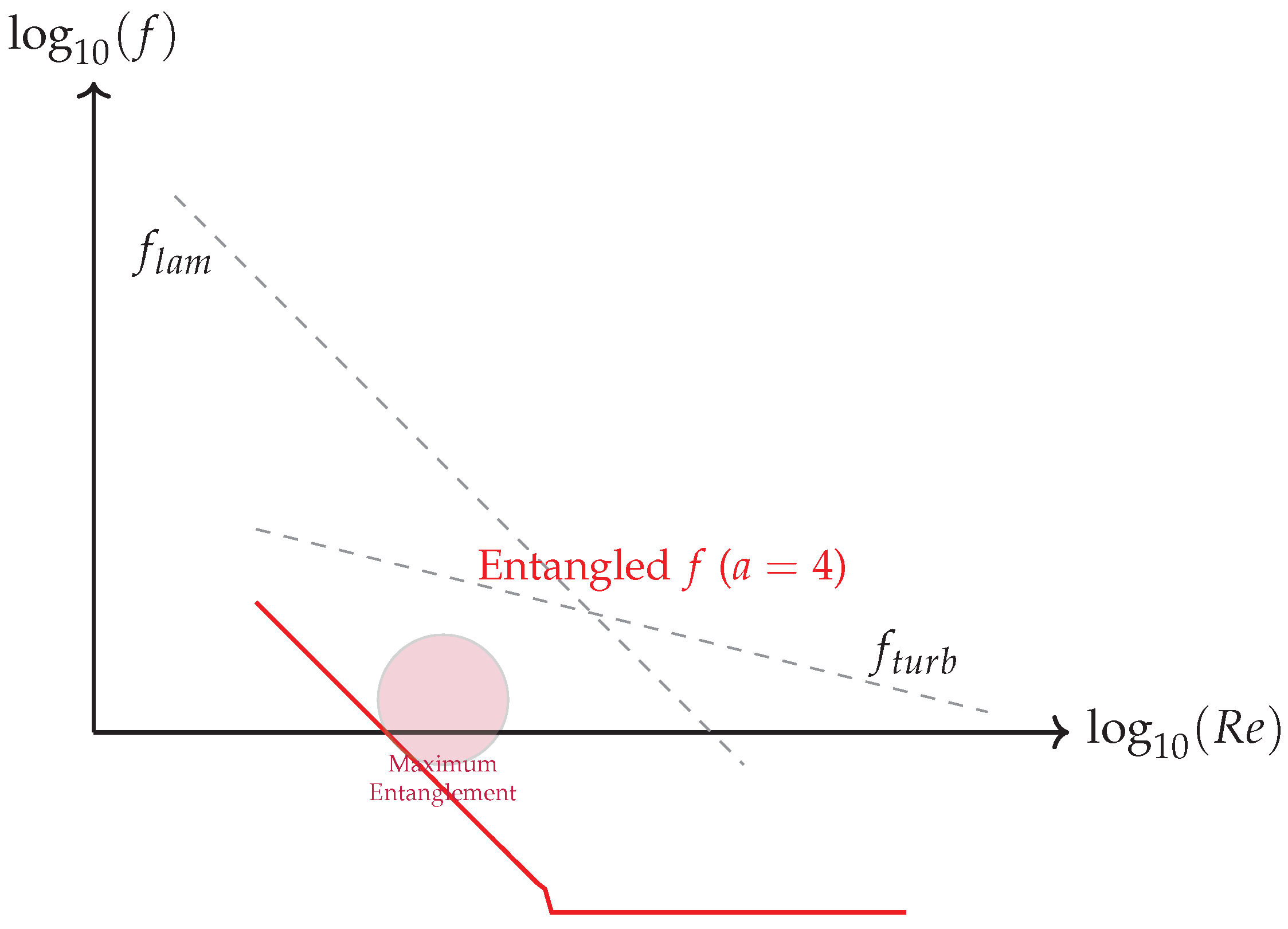
Plotting against reveals a distinct transition region near . In the entanglement framework, this region is not unstable or pathological but a stable geometric object defined by the curvature index a. The knee is the point where viscous and inertial contributions are comparable and the curvature of the entangled state is maximal.
As illustrated in
Figure 5, the Darcy friction factor exhibits a pronounced transition knee near
, where the laminar and turbulent asymptotic branches become comparable and the entangled state attains its maximal curvature.
5.5. Dynamics and Probability as Entanglement Phenomena
Fractional-order evolution equations and Lévy statistics provide further examples where the entanglement index plays a central role.
Fractional Transport
Fractional derivatives interpolate between ballistic and diffusive transport. Two asymptotic laws
and
(with
) combine into the entangled state
The intermediate regime is a distinct macroscopic state whose curvature is controlled by a.
Following [
20], a parameter-free root approximant bridging two power laws takes the form
which is exact in both limits. For a transition between Gaussian (
) and Lévy (
) statistics [
34], this yields
The intermediate structure is rigidly determined by asymptotic consistency, confirming that the entangled state is a necessary mathematical consequence of the limits.
5.6. Scale-Dependent Diffusion as an Entangled Operator
Fractional Laplacians provide another example of classical entanglement. Classical diffusion has the multiplier
, while fractional diffusion has the multiplier
with
[
35]. The entangled Fourier symbol
interpolates between these regimes.
The balance condition
defines the characteristic wavenumber
. Expanding in logarithmic variables shows that the curvature at the knee satisfies
again demonstrating linear scaling in
a. The SSR approximation [
20] provides a complementary closed-form interpolation:
These examples illustrate how classical entanglement unifies asymptotic laws into a single global state whose intermediate regime is a geometric object with its own structure. The worked example demonstrates the mechanism explicitly, while the physical examples show its broad applicability across multi-scale systems.
A wide range of additional examples of asymptotic synthesis and entangled transitional behavior appears throughout the broader literature, including numerous applications developed by Gluzman, Mityushev, Yukalov, Andrianov, and Awrejcewicz. These works show that the phenomena reviewed here represent only a small part of the much larger class of systems in which classical entanglement naturally arises.
6. Iterated Hölder Metrics and Self-Similar Roots
The entanglement operator introduced earlier provides a geometric mechanism for binding two asymptotic regimes into a single global state. In many physical systems, however, transitions occur not between two regimes but across a hierarchy of scales. Turbulence, composite materials, and fractional transport all exhibit cascades of asymptotic behaviors rather than a single crossover. This section develops the geometric framework required to describe such multi-scale transitions. The key idea is that the Minkowski metric underlying the basic entanglement operator can be iterated, producing a nested hierarchy of Hölder geometries. These iterated metrics turn out to be structurally isomorphic to the self-similar root approximants of [
20], thus linking geometric entanglement to renormalization-inspired algebraic constructions.
6.1. General Form of Iterated Hölder Metrics
The standard Minkowski
norm is limited to a single curvature index. To capture multi-scale structure, we introduce the general iterated Hölder metric. For a vector
and a non-decreasing sequence of exponents
, define
This construction produces a hierarchy of geometric couplings, each level governed by its own stiffness index. For
, the metric reduces to
The indices a and b control the curvature of successive transitions, allowing the geometry to encode cascades of asymptotic regimes.
6.2. Isomorphism to Self-Similar Root Approximants
The
k-th order self-similar root approximant of [
20] takes the hierarchical form
The original formulation of self-similar root approximants in [
20] was developed for perturbative series in integer powers. In the present work, however, the asymptotic laws entering the entanglement operator may involve arbitrary real exponents. This poses no difficulty: practically any perturbative series with real powers arranged in ascending order can be reduced to the integer-power form [
20,
36]. Puiseux expansions [
37],
are transformed into integer-power series by the substitution
. More generally, series of the form
with arbitrary real exponents belonging to an ordered group, correspond to Hahn series [
38,
39,
40]. As shown in [
41], such series can always be rewritten in the normalized form (
50) by factoring out the leading power and rescaling the variable. Consequently, the hierarchical structure (
46) extends naturally to arbitrary real powers, and the isomorphism between iterated Hölder metrics and self-similar root approximants remains valid in full generality.
This structure is algebraically isomorphic to the iterated Hölder metric. The power-law components correspond to the variables , while the exponents correspond to the geometric indices . Thus, asymptotic synthesis can be interpreted as computing the magnitude of a physical vector in a multi-scale, non-Euclidean Minkowski space. Both constructions enforce hierarchical blending: each level introduces a new stiffness index that governs how the next asymptotic regime enters the global state.
6.3. Mathematical Validity: The Nested Triangle Inequality
For the iterated metric to constitute a valid norm, it must satisfy the triangle inequality. By applying the generalized Minkowski inequality iteratively [
18], one finds that
is a norm if and only if the exponents form a non-decreasing sequence:
This condition has a natural physical interpretation: the geometric stiffness must remain constant or increase as one moves from local fluctuations toward the global macroscopic scale. In other words, the geometry must not “loosen” as it ascends the hierarchy of asymptotic regimes.
6.4. Limiting Behaviors and RG Flow Interpretation
The iterated metric provides a geometric representation of discrete renormalization-group (RG) flows [
42,
43], where each nesting level corresponds to a coarse-graining step:
Convergence: If , the metric converges to the Chebyshev (max) norm. If all , it collapses to the Manhattan metric.
Stability: The stability condition identifies the multi-scale geometry (the set of indices ) that best stabilizes the crossover manifold.
The minimal sensitivity condition presented above, along with related ideas, was developed over the years in [
44,
45,
46,
47,
48,
49]. Yukalov introduced control functions and optimization conditions to enforce convergence and stability [
45,
46], and then later formulated the functional self-similarity principle [
20,
50,
51], of which SSR may be viewed as a culmination.
There also exist techniques for extending SSR beyond interpolation and toward extrapolation. For the self-similar root (
52), Borel summation can be used to compute the critical index
s [
52], and when
s is known from independent considerations, the leading amplitude at infinity can also be determined [
53].
6.5. Connection to Self-Similar Root Approximants
The structural parallel between iterated Hölder metrics and self-similar root approximants (SSR) is more than formal. Both frameworks generate global expressions from asymptotic data by means of nonlinear transformations that suppress linear superposition and enforce hierarchical blending. In the geometric framework, this hierarchy is encoded in nested norms; in the self-similar framework, it appears through successive renormalization steps.
When applied to the diffusion laws (see
Section 5.6), the self-similar method yields the parameter-free expressions, which mirror the structure of a two-level iterated Hölder metric. In both cases, the global expression is obtained by embedding the asymptotic laws into a nonlinear hierarchy that preserves their limiting behavior while generating a smooth intermediate regime. Thus, the self-similar root approximant may be viewed as an algebraic counterpart of the geometric entanglement operator, arising from renormalization-inspired iteration rather than from metric composition.
6.6. Root Approximants as Discrete Entanglement Operators
The self-similar root approximants introduced by Gluzman and Yukalov [
20] provide a mechanism for constructing global expressions from limited asymptotic information. In the standard setting, one assumes that the small-
x behavior is known through a Taylor series,
while the large-
x behavior is characterized by a multi-power asymptotic expansion,
with
. The
k-th order self-similar root approximant takes the hierarchical form
where the coefficients
are determined by matching the small-
x expansion, and the exponents
are fixed explicitly from the large-
x exponents
in (
51).
The nested structure of (
52) may be interpreted as a
discrete entanglement operator. Each layer performs a nonlinear combination of two contributions: the renormalized behavior inherited from the previous layer, and the new monomial
. The exponent
plays the role of a geometric stiffness parameter, determining how sharply the transition occurs between the two competing asymptotic tendencies. When several powers
appear in the large-
x expansion, the full hierarchy (
52) entangles these asymptotic laws in a sequential, renormalization-like fashion.
This viewpoint parallels the iterated Hölder metrics of
Section 6. Each step of the root hierarchy corresponds to a two-regime Hölder-type coupling, and the full approximant is an iterated composition of such couplings. In this sense, the root approximant is a discrete analog of the continuous Minkowski entanglement operator
, with the sequence of exponents
playing the role of a scale-dependent, piecewise entanglement index.
The iterated Hölder metrics of
Section 6 and the self-similar root approximants (
52) are two realizations—continuous and discrete—of the same underlying principle: asymptotic regimes combine through nonlinear geometric coupling. In the continuous setting, this coupling is governed by the Minkowski
geometry; in the discrete setting, it is governed by the hierarchy of exponents
determined by the asymptotic powers
. Both constructions produce global states whose intermediate regimes are emergent geometric objects rather than linear blends of their asymptotic components.
6.7. Hierarchical Cascades: Iterated Hölder Metrics and SSR
While the basic entanglement operator
couples two asymptotic limits, complex physical systems often exhibit a hierarchy of intermediate scales. To model these, we introduce the iterated Hölder metric. Consider a sequence of asymptotic laws
governing a system at increasing scales. The global state can be constructed through a nested sequence of entanglement operations:
This nesting represents a “geometric cascade.” A profound result of this framework is the formal isomorphism between these iterated metrics and the self-similar root (SSR) approximants developed in the context of algebraic renormalization.
6.7.1. The Isomorphism Theorem
In the specific case where the entanglement indices are uniform (
) and the asymptotic laws are powers of the form
, the iterated Hölder metric takes the form
This structure is mathematically equivalent to the multi-parameter SSR
which generalizes (
52) to arbitrary real powers [
41]. Puiseux expansions [
37] and Hahn series [
38,
39,
40] demonstrate that perturbative series with arbitrary real exponents can always be reduced to the normalized form [
20], ensuring the validity of this correspondence.
6.7.2. Proof of Isomorphism
Theorem 1.
The iterated Hölder metric generated by a sequence of power laws is algebraically isomorphic to a multi-parameter self-similar root (SSR) approximant.
Proof. Consider the recursive definition
. By induction, let
. Then,
. Substituting
and factoring out the dominant scaling yields
Setting the SSR exponents shows that the geometric nesting of the Hölder metric is identical to the algebraic structure of the root approximant. □
Thus, we obtain a formal proof of the isomorphism between Minkowski-type blending operators and self-similar root approximants.
6.8. Single-Scale SSR vs. Multi-Scale Continued Roots
Although the SSR hierarchy (
52) contains several exponents
, these exponents do not introduce independent geometric scales. Only the final exponent
s determines the leading power-law behavior at infinity, while the inner exponents
govern the sequence of subleading corrections. SSR approximants therefore constitute a
single-scale cascade.
In contrast, the continued-root hierarchy [
54],
is genuinely multi-scale: each exponent
contributes to the leading asymptotic exponent. Continued roots are therefore multi-scale Hölder cascades, representing the most general discrete analog of a depth-dependent entanglement geometry.
Among the various self-similar constructions developed in the literature, the self-similar root (SSR) approximants occupy a uniquely foundational position. They are the only approximants derived directly and rigorously from the self-similar renormalization procedure, with all exponents fixed unambiguously by the asymptotic data. Their hierarchical structure mirrors that of iterated Hölder metrics, providing a single-scale geometric deformation that preserves the leading asymptotic behavior while encoding subleading corrections in a transparent and controlled manner. Other constructions, such as factor approximants (see
Appendix B.4), continued roots, and additive approximants, can be viewed as extensions, specializations, or alternative closures of the same underlying idea of self-similar transformation, yet none of them combine universality, geometric clarity, and renormalization-theoretic grounding to the same extent. In this sense, SSR forms the canonical mechanism against which the geometric and algebraic features of the other approximants can be understood.
7. Discussion and Methodological Roadmap
The preceding sections develop a geometric framework for synthesizing asymptotic laws through nonlinear metric coupling. The entanglement operator, its multi-scale generalizations, and their algebraic isomorphisms reveal a unified meta-language for constructing global states across a wide range of physical systems. This section synthesizes the conceptual lessons of the framework and provides a methodological roadmap for applying classical entanglement in practice.
7.1. Geometric Synthesis as a Unifying Principle
Classical entanglement reframes the intermediate regime not as a defect of approximation but as a genuine macroscopic state. The key insight is that the global behavior of a system governed by competing asymptotic laws is determined by the curvature of a nonlinear metric space. The entanglement index a controls the stiffness of the transition, the shape of the intermediate manifold, and the degree of metric non-separability. This geometric viewpoint unifies a broad class of constructions:
Minkowski norms (single-scale entanglement);
Iterated Hölder metrics (multi-scale entanglement);
Self-similar root approximants (discrete geometric cascades);
Factor approximants and Calderón products (multiplicative blends);
Fractional Laplacians and scale-dependent diffusion operators.
These structures, though historically developed in different contexts, share a common geometric mechanism: asymptotic regimes combine through nonlinear coupling rather than linear superposition.
7.2. The Role of the Transition Knee
The transition knee, defined in
Section 4.3, plays a central role in the framework. It is the point of maximal curvature where the system switches identity between asymptotic regimes. The knee is universal:
Its curvature scales linearly with the entanglement index a;
Its location depends only on the relative magnitudes of the asymptotic laws;
It is independent of amplitudes or local scales;
It appears in all systems governed by competing asymptotic regimes.
This universality explains why the same geometric structure appears in fractional dynamics, Lévy statistics, turbulent pipe flow, and fractional Laplacians. The knee is not a numerical artifact but a stable geometric object that encodes the interaction between asymptotic laws.
7.3. Methodological Roadmap for Practitioners
The entanglement framework provides a systematic procedure for constructing global expressions from asymptotic data. The following steps summarize the methodology:
- 1.
Identify the asymptotic laws.
Determine the limiting behaviors and (or more, in multi-scale settings). These serve as the “pure states” of the system.
- 2.
Determine the balance condition.
Solve to locate the region where neither regime dominates. This identifies the approximate location of the transition knee.
- 3.
Choose the entanglement index.
The index a controls the stiffness of the transition. It may be one of the following:
Fixed by physical considerations (e.g., turbulence);
Calibrated to data (e.g., friction factor);
Determined by stability criteria (e.g., RG-inspired minimal sensitivity);
Treated as a geometric parameter encoding the curvature of the knee.
- 4.
Construct the entangled state.
Apply the entanglement operator
For multi-scale systems, use iterated Hölder metrics or their discrete counterparts (SSR, continued roots).
- 5.
Analyze the curvature.
Compute the curvature and locate the transition knee . This provides geometric insight into the structure of the intermediate regime.
- 6.
Validate asymptotic anchoring.
Ensure that the entangled state reproduces the correct limiting behaviors as and . This is guaranteed by construction for all Minkowski-type operators.
- 7.
Interpret the intermediate regime.
The intermediate region is a geometric object with its own structure, not a linear blend of the asymptotic laws. Its properties follow from the curvature of the underlying metric.
7.4. Implications for Approximation Theory
The geometric viewpoint clarifies the structure of self-similar root approximants, continued roots, and factor approximants. These constructions can be interpreted as discrete entanglement operators, with the exponents playing the role of scale-dependent stiffness parameters. The isomorphism between iterated Hölder metrics and SSR shows the following:
Asymptotic synthesis is fundamentally geometric;
Renormalization-inspired algebraic constructions have geometric counterparts;
Multi-scale cascades correspond to depth-dependent entanglement indices;
SSR approximants represent the canonical single-scale deformation;
Continued roots represent fully multi-scale Hölder cascades.
This perspective unifies geometric interpolation, functional analysis, and self-similar approximation theory within a single conceptual framework.
7.5. Classical vs. Quantum Entanglement: Conceptual Impact
The geometric mechanism developed in this work shares a structural theme with quantum entanglement: both describe global states that cannot be decomposed into their constituent parts. However, the two forms of non-separability play fundamentally different roles in their respective domains.
Quantum entanglement is a physical phenomenon. Its non-separability arises from the linear structure of Hilbert space and is confirmed experimentally through Bell-type violations and nonlocal correlations. It reshapes our understanding of physical reality and underlies quantum information, computation, and cryptography. Its impact is ontological: it changes what we believe the world is.
Classical entanglement, by contrast, is a geometric phenomenon. Its non-separability arises from the curvature of Minkowski- and Hölder-type metric spaces. It does not describe a physical interaction but a structural principle governing how asymptotic laws combine into global states. Its impact is epistemic and methodological: it changes how we model multi-scale systems. The intermediate regime becomes a stable geometric object rather than a patching zone, and global approximants acquire a principled geometric interpretation.
This distinction clarifies the role of classical entanglement within the broader landscape of scientific modeling. Quantum entanglement reveals the non-separable structure of nature; classical entanglement reveals the non-separable structure of asymptotic synthesis. The framework developed here unifies a wide range of analytic constructions, such as self-similar root approximants, continued roots, factor approximants, and Calderón-type products, within a single geometric meta-language. Its impact is therefore not limited to terminology: it provides a conceptual foundation for global approximation, multi-scale modeling, and the geometry of asymptotic transitions.
Although quantum entanglement is rightly regarded as an experimentally verified phenomenon, it would be misleading to interpret classical entanglement as merely a mathematical or structural analogy. A substantial body of work on non-parametric asymptotic synthesis demonstrates that geometric entanglement of asymptotic laws has direct predictive consequences. In numerous applications, from nonlinear oscillators to transport processes and turbulence, non-parametric constructions such as self-similar root approximants, factor approximants, and related methods yield dramatic improvements in accuracy, particularly in the transition region where traditional perturbative or composite approaches perform worst. This enhanced accuracy is not a numerical artifact but a manifestation of geometric non-separability: when competing asymptotic laws have comparable magnitude, the curvature of the underlying geometry enforces a nonlinear coupling that produces a physically meaningful intermediate state. Classical entanglement therefore possesses empirical value analogous in spirit to that of quantum entanglement: in both cases, the structure of the state space constrains and improves our understanding of real physical systems.
The empirical improvement produced by classical entanglement does not rely on introducing additional asymptotic information, auxiliary parameters, or external fitting. In the non-parametric methods developed in earlier work—including self-similar root approximants, factor approximants, and the non-parametric constructions employed by Andrianov and collaborators—the enhanced accuracy arises solely from the structure of the formulae themselves. The geometric coupling implicit in these constructions imposes constraints on the intermediate regime that are not accessible to linear superposition, composite expansions, or heuristic interpolation. Thus, the predictive gain is a consequence of geometry rather than data: the structure of the entanglement mechanism encodes information about the transition region that is not present in the asymptotic limits individually.
Many additional examples of asymptotic synthesis and entangled transitional behavior may be found throughout the broader literature, including numerous applications developed in the works of Gluzman, Mityushev, Yukalov, Andrianov, and Awrejcewicz. These studies illustrate that the phenomena reviewed here represent only a small subset of the much wider range of systems in which classical entanglement naturally arises.
This perspective also prepares the ground for applications in physics-informed machine learning. Modern learning architectures struggle precisely in the regions where asymptotic regimes interact, because the intermediate manifold is not a smooth interpolation but a curved geometric object. Classical entanglement provides a natural geometric prior for such systems, suggesting that the synthesis of asymptotic laws should be embedded directly into the hypothesis space rather than inferred indirectly from data. One may therefore expect that entangled neural networks (ENNs), if constructed according to the geometric principles developed here, could exhibit accuracy improvements analogous to those observed in non-parametric asymptotic synthesis. Whether such gains can be realized in practice remains an open question: the architectural and training challenges may be substantial, and the feasibility of implementing ENNs at scale is not yet known. Nevertheless, the geometric mechanism underlying classical entanglement provides a compelling motivation for exploring such architectures, as discussed in
Section 8.
8. Entangled Operators as Geometric Priors in Physics-Informed Machine Learning: The Challenge of Transition Regions
Standard neural networks rely on linear combinations of features,
which cannot reproduce the metric non-separability of the transition knee (
Section 4.3). As a result, deep networks tend to smooth over sharp transitions due to spectral bias, making them ill-suited for problems where asymptotic regimes impose incompatible local behaviors.
Reconstructing a global state from asymptotic information alone is a notoriously ill-posed problem. Classical numerical techniques such as those developed in [
55] extract global structure from local expansions, but they struggle precisely when the intermediate regime plays an essential dynamical role. The asymptotic anchors determine the behavior at the extremes, yet the geometry of the transition remains underdetermined. Without additional information, the reconstruction problem admits infinitely many solutions.
When supplementary data are available—intermediate samples, partial observations, or structural constraints—the situation changes dramatically. Modern machine learning tools, particularly physics-informed neural networks (PINNs) [
56,
57,
58] and operator-learning architectures [
59,
60,
61], can exploit such information with remarkable efficiency. In this setting, the entanglement operator may be viewed as a geometric prior: a structural assumption about how asymptotic regimes interact. Rather than attempting to infer the entire global state from asymptotic data alone, one can guide the learning process by embedding the entanglement geometry directly into the model architecture or loss functional. The network then learns the intermediate regime not as an arbitrary interpolation but as a manifestation of the nonlinear metric coupling encoded by the operator.
This perspective highlights a continuity between classical numerical analysis and modern data-driven approaches. Traditional methods emphasized the reconstruction of global behavior from asymptotic expansions; contemporary approaches emphasize the integration of partial information across scales. Both confront the same fundamental difficulty: the intermediate regime is not a trivial blend of limits but a structured geometric object. PINNs address this by enforcing differential constraints, while operator-learning models attempt to learn entire input–output maps across families of problems, yet both approaches face the same challenge when multiple asymptotic regimes coexist: without an explicit geometric prior, the network tends to smooth over the transition or misrepresent its curvature.
In this sense, the entanglement operator plays a role analogous to classical regularization, but with a crucial difference. Traditional regularizers—Tikhonov, Sobolev, or total-variation penalties—impose smoothness, sparsity, or bounded variation. They control complexity but do not encode the geometry of multi-scale interaction. Entangled operators, in contrast, impose a metric structure on the space of admissible functions. They restrict the hypothesis class not by penalizing roughness but by constraining the model to a Minkowski (or more generally, Orlicz or Hölder) manifold that connects the asymptotic regimes. The intermediate region is shaped by geometric curvature rather than by smoothness assumptions, and the entanglement index a becomes an interpretable parameter controlling the stiffness of the transition.
This geometric viewpoint aligns naturally with the conceptual distinction developed in
Section 7. Quantum entanglement is a physical phenomenon; classical entanglement is a geometric mechanism for synthesizing asymptotic laws. In physics-informed machine learning (PIML), this distinction becomes operational: the intermediate regime is not a region to be patched or smoothed but a macroscopic state dictated by the metric coupling of the limits. Standard PIML architectures implicitly assume a single regime or a smoothly varying constitutive relation. When a system exhibits multiple asymptotic behaviors, such as viscous versus inertial transport, ballistic versus diffusive propagation, or Gaussian versus heavy-tailed statistics, these architectures struggle precisely where the physics is most informative: the transition zone between regimes. The difficulty is not merely a matter of insufficient data or model capacity; it is a geometric challenge. The learned model must capture a nonlinear manifold connecting incompatible asymptotic laws.
Classical entanglement provides a rigorous operator-theoretic mechanism for encoding this manifold directly into the architecture or loss function of a PIML model. The entanglement operator and its generalizations act as geometric priors that constrain the learned model to respect the correct asymptotic limits while simultaneously imposing a metric structure on the intermediate regime. In contrast to ad hoc blending functions or heuristic switching rules, the entanglement operator embeds the transition geometry directly into the hypothesis space, ensuring that the intermediate regime is learned as a structured, emergent object rather than a residual artifact.
This viewpoint suggests a new direction for physics-informed learning: instead of treating asymptotic regimes as constraints to be patched together, they become entangled into a global state. The intermediate regime is then understood as a geometric object dictated by the curvature of the underlying metric. This perspective points toward entanglement-based neural architectures and geometric priors tailored to multi-scale physical systems, offering a conceptual bridge between asymptotic analysis, operator learning, and modern machine learning practice.
A natural development of this perspective is the design of entangled neural networks (ENNs), in which the final layers do not perform a standard linear summation. Instead, the architecture mirrors the structure of the entanglement operator itself. One branch learns the first asymptotic behavior, another branch learns the second, and a final entanglement layer unifies them through the operator, with a treated either as a fixed geometric hyperparameter or as a learnable quantity. In this way, the geometry of the transition is embedded directly into the network rather than inferred indirectly from data.
By shifting the task of learning the transition from the data to the geometry of the operator, an ENN transforms a data-hungry interpolation problem into a far simpler parameter-estimation problem. Even with minimal data in the intermediate region, the model remains physically consistent and asymptotically correct, because the structure of the entanglement operator enforces the correct global geometry. This illustrates how classical entanglement can participate in the development of neural architectures that are not merely data-driven but geometrically informed.
8.1. Entangled Neural Networks (ENNs): A Geometric Architecture
The geometric mechanism underlying classical entanglement suggests a natural extension to machine learning: neural architectures in which the synthesis of features, modes, or asymptotic regimes is governed not by linear superposition but by a nonlinear entanglement operator. Such entangled neural networks (ENNs) would replace additive layer combinations with Minkowski–Hölder-type geometric couplings, thereby embedding the structure of asymptotic synthesis directly into the hypothesis space.
Standard neural networks combine activations through linear maps followed by nonlinearities. This implicitly assumes that intermediate representations are well approximated by smooth interpolations of learned features. However, in multi-scale physical systems, the intermediate regime is not a smooth interpolation but a curved geometric object generated by competing asymptotic laws. Embedding the entanglement operator into the network architecture offers a principled way to represent such curvature.
8.1.1. Schematic ENN Layer
Let
and
denote two feature channels or subnet outputs representing distinct asymptotic regimes, modes, or physical behaviors. An entangled layer replaces linear combination by the geometric coupling
where
is the entanglement index and
are trainable partition weights. This layer generalizes the classical entanglement operator and reduces to linear superposition only in the singular case
.
8.1.2. Multi-Branch ENN Architecture
A deeper ENN may consist of asymptotic branches or subnetworks specialized to different regimes (e.g., small-scale, large-scale, ballistic, diffusive). Entanglement layers introduce geometric couplings that merge these branches at multiple depths, analogous to the hierarchical structure of self-similar root approximants and continued roots.
Iterated entanglement creates nested compositions of the form
mirroring the multi-scale cascades of iterated Hölder metrics. This architecture is structurally isomorphic to the nested geometric constructions appearing in self-similar approximation theory, Calderón products, and Orlicz-type geometries.
8.1.3. Expected Benefits
If realizable in practice, ENNs may inherit the accuracy improvements observed in non-parametric asymptotic synthesis:
Enhanced performance in transition regions where standard networks struggle;
Improved stability under competing scales;
Built-in asymptotic consistency without additional data.
These potential advantages follow from geometry rather than parameterization: the entanglement operator encodes curvature that is not present in linear superposition.
8.1.4. Open Challenges
Whether ENNs can be implemented effectively remains an open question. Training such architectures may be difficult due to non-Euclidean geometry, stiffness for large a, and the need to coordinate multiple asymptotic branches. The computational cost and optimization landscape are unknown. It is therefore not yet clear whether ENNs can be realized at scale or whether their theoretical advantages will translate into practical gains.
Despite these uncertainties, the geometric structure of classical entanglement provides a compelling motivation for exploring ENNs. If successful, such architectures would offer a principled way to incorporate asymptotic knowledge into machine learning models, potentially improving accuracy in precisely the regions where data-driven methods perform worst.
In summary, the entanglement operator provides a principled geometric prior for machine learning models tasked with reconstructing global behavior from incomplete or multi-regime information. By encoding the nonlinear metric structure of the intermediate region, it offers a way to guide learning systems through precisely those transitions where standard architectures are least reliable. Whether implemented directly in network layers or indirectly through loss-based constraints, entanglement geometry supplies a structure that aligns data-driven inference with the asymptotic logic of the underlying physical system. This perspective suggests a broader methodological theme: machine learning can benefit not only from physical laws but also from the geometric mechanisms that govern how distinct regimes interact.
9. Conclusions
Classical entanglement provides a geometric mechanism for synthesizing asymptotic laws into a single, globally valid expression. The entanglement operator couples asymptotic regimes through the Minkowski– geometry, producing a global state that is metrically non-separable for all . The intermediate regime is not a residual artifact of approximation but a distinct macroscopic state whose structure is determined by the curvature of the underlying metric space. The transition knee, defined as the region of maximal curvature, exhibits a universal linear scaling with the stiffness parameter a, independent of amplitudes or local scales.
The geometric framework developed here unifies several classical constructions. Weighted and Orlicz-type generalizations extend the operator beyond power-law geometries, while iterated Hölder metrics provide a natural description of multi-regime cascades. These hierarchical structures are isomorphic to self-similar root approximants, situating algorithmic renormalization within a rigorous geometric meta-language. Factor approximants, in turn, admit an interpretation as discrete Calderón chains, linking classical entanglement to interpolation theory and functional analysis.
The examples presented here—fractional dynamics, Lévy statistics, and turbulent pipe flow—demonstrate that classical entanglement yields stable, asymptotically anchored global states across diverse physical systems. The methodology is systematic: identify the asymptotic laws; select the stiffness parameter a through minimal sensitivity, curvature matching, or physical constraints; and construct the global state using the entanglement operator or its multi-scale generalizations.
The framework developed in this work unifies three distinct languages used to describe multi-regime systems. In the empirical language of practitioners, one speaks of blending, patching, or tuning. In the geometric language introduced here, these operations correspond to metric entanglement, geometric stiffness, and the transition knee. In the abstract language of functional analysis, the same structures appear as interpolation functors, interpolation indices, and the critical interpolation manifold arising in nested Calderón products.
This correspondence clarifies how classical entanglement serves as a Rosetta Stone for asymptotic synthesis. It translates between empirical heuristics, geometric intuition, and functional-analytic structure, revealing that these perspectives are not competing descriptions but different projections of the same underlying mechanism. The full correspondence table is provided in
Appendix E. In this sense, classical entanglement does not merely provide a new operator—it provides a unifying conceptual infrastructure for understanding how asymptotic laws interact across scales.
Classical entanglement offers a principled alternative to heuristic interpolation and composite expansions. Its geometric foundations, analytic tractability, and compatibility with multi-scale generalizations suggest broad applicability across physics, applied mathematics, and scientific machine learning. The connection to physics-informed learning is particularly promising: entangled operators provide geometric priors that encode the structure of multi-regime transitions directly into neural architectures, enabling models to learn intermediate regimes as emergent geometric objects rather than residual artifacts.
Future work may explore higher-dimensional entanglement geometries, data-driven determination of multi-index structures, and the integration of entanglement operators into operator-learning architectures and physics-informed neural networks. The geometric viewpoint developed here provides a unifying language for these developments, emphasizing that the global behavior of multi-regime systems is governed not by algebraic patching but by the nonlinear geometry that binds their asymptotic limits.