Article

Event-Triggered Secure Consensus of Stochastic Multi-Agent Systems: A Defense Scheme Against Bilateral False Data Injection Attacks


1
College of Mathematics and Big Data, Dezhou University, Dezhou 253023, China
2
College of Electrical Engineering and Automation, Shandong University of Science and Technology, Qingdao 266590, China
*
Author to whom correspondence should be addressed.
Axioms 2026, 15(3), 177; https://doi.org/10.3390/axioms15030177
Submission received: 15 January 2026 / Revised: 20 February 2026 / Accepted: 26 February 2026 / Published: 28 February 2026

Abstract

This paper investigates the event-triggered secure consensus problem for stochastic multi-agent systems (MASs) subject to bilateral false data injection attacks (FDIAs). To achieve reliable secure consensus while reducing resource consumption, an event-triggered defense scheme incorporated with a configurable waiting period is proposed. By introducing an adjustable time interval between consecutive trigger events, the developed scheme not only rigorously eliminates Zeno behavior but also alleviates the computational and sensing burdens. Notably, the analysis of event-triggered secure consensus for stochastic MASs is more challenging compared to conventional deterministic scenarios, due to the coupling effects of stochastic disturbances, event-triggered mechanisms, and bilateral FDIAs. To address this critical challenge, a stochastic convergence theorem is adopted in this study. Distinct from the traditional Lyapunov theorem for stochastic stability analysis, this theorem exhibits inherent similarities to the deterministic Barbalat lemma, which offers a more flexible analytical framework. A key advantage of the proposed approach is that it relaxes the positive definiteness constraint on the candidate Lyapunov function, thereby significantly enhancing the flexibility in constructing Lyapunov functions for stochastic MASs under bilateral FDIAs. Finally, two numerical simulation examples are presented to verify the correctness and effectiveness of the proposed control protocol and key theoretical results.

1. Introduction

In recent years, MASs have garnered substantial interest from academia and industry, driven by their broad application scope [1,2,3,4,5]. In the early stages of MAS research, scholarly efforts were primarily concentrated on deterministic systems [6,7,8]. However, in practical engineering scenarios, stochastic systems exhibit greater capability in capturing real-world uncertainties [9,10,11,12,13,14]. For instance, the control problem of linear stochastic multi-agent systems was studied in [11]. Ren [13] delved into the mean-square consensus problem of stochastic MASs under external noise disturbances. Despite these initial explorations, a comprehensive literature review indicates that the research on stochastic MASs still lacks in-depth investigation of stability issues in non-ideal network environments. Consequently, this paper focuses on the secure control of stochastic MASs as its primary research object.
Given the complexity of the application environment of multi-agent systems and the inherent openness of their communication networks, cybersecurity risks caused by cyber-attacks have become a critical challenge that must be addressed. Early studies [15,16] have documented several research results and laid a foundational understanding of how cyber-attacks affect system operation [17]. Cyber attacks targeting MASs are generally classified into three major categories: denial-of-service (DoS) attacks [18,19,20], FDIAs/deception attacks [21,22], and replay attacks [23,24]. Regardless of the type of cyber-attack, it will affect system performance in varying degrees. Among these threats, FDIAs disrupt the integrity of system information by tampering with transmitted data streams. Due to their strong concealment, FDIAs have become a focal point of recent security-related research [25,26,27,28,29,30,31]. We find that most of the existing results only consider single-channel attacks on the sensor-controller. The reality is that any place with an internet connection is potentially vulnerable to attacks. Based on this background, this study examines the situation where FDIAs simultaneously disrupt the input signals of the sensor-controller and controller–actuator.
It is well known that the design of an event-triggered controller is indispensable for studying the secure consensus of MASs. In recent years, researchers have proposed a variety of event-triggered controllers, such as data-driven event-triggered adaptive dynamic programming, neural network-based attack-compensation control for fuzzy systems, extended disturbance observer-based data-driven approaches, and tighter interval estimation for discrete-time linear systems, which play important roles in fields such as smart grids. Among them, for continuously switched stochastic nonlinear MASs, the consensus tracking problem was studied via event-triggered control protocols in [14]. Under DoS attacks, secure consensus for linear MASs was achieved by designing a resilient cooperative event-triggered control scheme in [18]. The secure synchronization problem of MASs under impulsive control frameworks caused by FDIAs was addressed using a distributed impulsive controller in [21]. To achieve secure consensus in stochastic MASs, this study proposes an event-triggered defense scheme (ETDS) capable of resisting bilateral FDIAs.
Drawing inspiration from the aforementioned research, this paper investigates the event-triggered secure control of stochastic MASs under FDIAs, leveraging the stochastic convergence theorem [32] as a key analytical tool. Specifically, this paper first analyzes the propagation characteristics and impact mechanisms of FDIAs that target both controllers and system states. Then, an ETDS to defend against such attacks is proposed. Finally, sufficient conditions for ensuring the event-triggered secure consensus of stochastic MASs are derived. The main contributions of this paper are summarized as follows:
(1)
This paper develops a mathematical model for stochastic MASs subject to random cyber attacks, leveraging two mutually independent Bernoulli random sequences. The model addresses challenges in characterizing attack types and assessing attack success rates.
(2)
This paper presents an ETDS integrated with a configurable waiting period. By setting an adjustable time interval between consecutive trigger events, this scheme not only eliminates Zeno behavior, but also reduces the computational and sensing burdens.
(3)
This paper employs a stochastic convergence theorem that, unlike the conventional Lyapunov theorem used for stochastic stability analysis, shares inherent similarities with the deterministic Barbalat lemma. A critical advantage of this choice is that it does not impose the constraint of positive definiteness on the chosen Lyapunov function, thereby expanding the flexibility of constructing Lyapunov functions for stochastic MASs.
The structure of this paper is organized as follows. Section 2 first provides a review of foundational knowledge. Furthermore, this section establishes a cyber attack model to reflect cyber-attack scenarios. Section 3 focuses on the in-depth analysis of the event-triggered secure consensus problem for the stochastic MASs under the aforementioned attack model, deriving relevant stability and convergence conditions. Section 4 presents two numerical simulation examples to verify the feasibility and effectiveness of the proposed ETDS. Finally, Section 5 summarizes the main research findings of this paper and provides concluding remarks.
Notations 1.
R n : the set of all real n-dimensional vectors;  A T : the transpose of matrix(vector) A;  P { · } : the probability;  A B : the Kronecker product of A and B;  I N : the  N × N  identity matrix;  1 N : the  N × 1  column vector entries being one;  · : the norm of a vector;  E { · } : the mathematical expectation. 

2. Preliminaries

2.1. Graph Theory

G = ( V , E , A ) describes the undirected communication topology. V = { 1 , 2 , , N } , E V × V and A = [ a l m ] R N × N represent the vertex set, the communicating edge set and the weighted adjacency matrix, respectively. a l m ( l m ) is weight of edge ( l , m ) . If agent l and agent m can communicate with each other, we have ( l , m ) E , ( m , l ) E , a l m = a m l > 0 , otherwise a l m = a m l = 0 . Moreover, a l l = 0 . Let D = d i a g m = 1 N a 1 m , m = 1 N a 2 m , , m = 1 N a N m and the Laplacian matrix L = [ l l m ] = D A . Obviously, the row(column) sum of L is 0.
The interaction between a leader and N followers is represented by G ¯ , where the interactions among the followers form a subgraph of G ¯ . The leader can only send information to its adjacent followers, but cannot receive information in return. R = d i a g { r 1 , r 2 , , r N } is defined as the adjacency matrix of the leader. Here, if the leader can send its state information to follower l, then r l > 0 ; otherwise, r l = 0 . The relevant Laplacian matrix L is denoted as
L = 0 0 1 × N r ˜ L + R ,
where r ˜ = [ r 1 , r 2 , , r N ] T .

2.2. Problem Formulation

This study focuses on the following stochastic MAS consisting of N agents, which operates under an undirected communication network.
d x l ( s ) = ( A x l ( s ) + B u ^ l ( s ) ) d s + B ω x l ( s ) d W , l V d x 0 ( s ) = A x 0 ( s ) d s + B ω x 0 ( s ) d W ,
where x l ( s ) R n represents the state of agent l at time s, u l ( s ) R n is control input. A, B and B ω are constant matrices of matching appropriate dimensions.

2.3. Multi-Agent Network Modeling

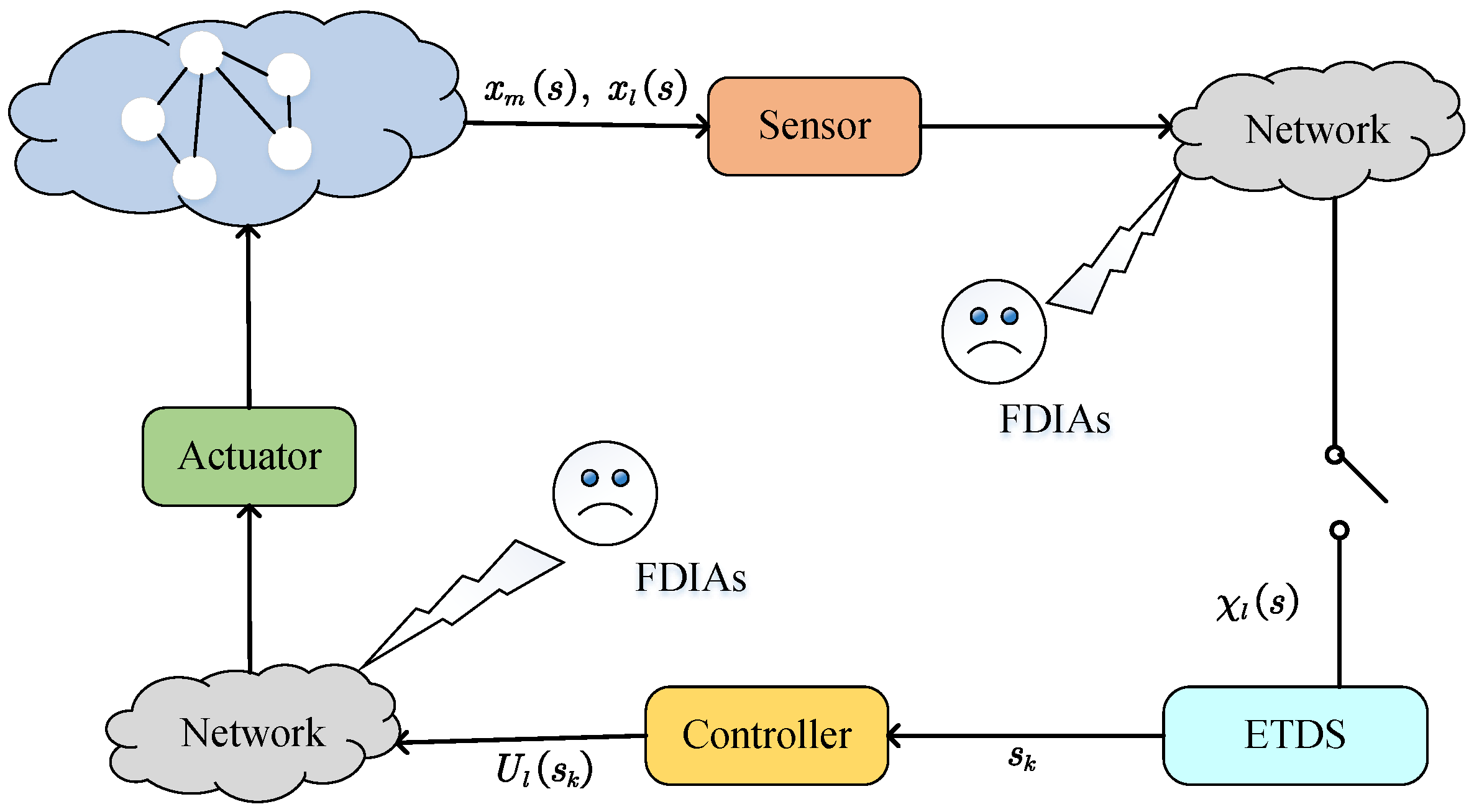
The introduction of ETDS cuts down the number of controller updates, thereby boosting the resource utilization rate. This effect is illustrated in Figure 1. The trigger condition selected for this study is as follows:
s k + 1 = inf s s k + Δ E e ( s ) 2 α E x ¯ ( s ) 2 ,
here e l ( s ) = x l ( s k ) x l ( s ) , s k represents the k-th trigger moment. x l ( s ) and x l ( s k ) denote the current measurement and the measurement at the last trigger time of agent l, respectively. Obviously, the current measured data will never be updated until the condition (2) is met. The occurrence of Zeno executions is avoided due to the introduction of Δ .
For FDIAs, attackers directly inject false data into both the measurement signals and controller inputs of the system. To characterize this scenario, the measurement outputs are expressed as follows:
x ^ l ( s ) = φ ( s ) χ l ( s ) + ( 1 φ ( s ) ) x l ( s k ) ,
where χ l ( s ) represents any false signal with bounded energy. φ ( s ) { 0 , 1 } denotes a Bernoulli distributed variable. When the attacker successfully launches FDIAs, φ ( s ) = 1 ; otherwise, φ ( s ) = 0 . In addition,
P { ϕ ( s ) = 1 } = ϕ ¯ , P { ϕ ( s ) = 0 } = 1 ϕ ¯
here, P denotes the probability.
Under FDIAs, for agent l, the actual input of the controller is
u ^ l ( s ) = w ( s ) U l ( s ) + ( 1 w ( s ) ) u l ( s ) ,
u l ( s ) = K m = 1 N a l m ( x ^ m ( s ) x ^ l ( s ) ) ,
here, U l ( s ) represents any false signal with bounded energy, and K is the feedback gain matrix set in the later stage.  w ( s ) { 0 , 1 } denotes a Bernoulli distributed variable. When the attacker successfully launches FDIAs, w ( s ) = 1 ; otherwise, w ( s ) = 0 . In addition,
P { w ( s ) = 1 } = w ¯ , P { w ( s ) = 0 } = 1 w ¯ .
By (3) and (5), the actual input of agent l is
u ^ l ( s ) = ( 1 w ( s ) ) K m = 1 N a l m [ φ ( s ) ( χ m ( s ) χ l ( s ) ) + ( 1 φ ( s ) ) ( x m ( s k ) x l ( s k ) ) ] + w ( s ) U l ( s ) .
Remark 1
([33]). Cyber attacks can lead to a decline in system performance. However, few scholars have considered the simultaneous occurrence of FDIAs on the sensor-controller and controller-executor channels. The attack model proposed in this paper provides a random allocation strategy, incorporating some of the conclusions from existing research.
Let x ¯ l ( s ) = x l ( s ) x 0 ( s ) . Then, x m ( s ) x l ( s ) = x ¯ m ( s ) x ¯ l ( s ) . Combining with (1), (4) and (5), the following closed-loop system yields
d x ¯ l ( s ) = A x ¯ l ( s ) d s + ( 1 w ( s ) ) B K m = 1 N a l m [ φ ( s ) ( χ m ( s ) χ l ( s ) ) + ( 1 φ ( s ) ) ( e m ( s ) + x ¯ m ( s ) e l ( s ) x ¯ l ( s ) ) ] d s + w ( s ) B U l ( s ) d s + B ω x ¯ l ( s ) d W .
Set
x ¯ ( s ) = ( x ¯ 1 T ( s ) , x ¯ 2 T ( s ) , , x ¯ N T ( s ) ) T ,
e ( s ) = ( e 1 T ( s ) , e 2 T ( s ) , , e N T ( s ) ) T ,
U ( s ) = ( U 1 T ( s ) , U 2 T ( s ) , , U N T ( s ) ) T ,
χ ( s ) = ( χ 1 T ( s ) , χ 2 T ( s ) , , χ N T ( s ) ) T .
Leveraging the properties of the Kronecker product, we can derive the following result:
d x ¯ ( s ) = w ( s ) ( I N B ) U ( s ) d s φ ( s ) ( 1 w ( s ) ) ( L B K ) χ ( s ) d s ( 1 φ ( s ) ) ( 1 w ( s ) ) ( L B K ) x ¯ ( s ) d s + ( I N B ω ) x ¯ ( s ) d W ( 1 φ ( s ) ) ( 1 w ( s ) ) ( L B K ) e ( s ) d s + ( I N A ) x ¯ ( s ) d s .
Assumption 1.
We suppose the false data is bounded, which means that
χ l ( s ) 2 C 1 x ¯ l ( s ) 2 ,
U l ( s ) 2 C 2 x ¯ l ( s ) 2 .
Definition 1.
The MAS (1) is capable of realizing event-triggered secure consensus for all initial states, if
lim s E x l ( s ) x 0 ( s ) = 0 , l = 1 , 2 , , N .
Lemma 1
([32]). (Convergence criterion for stochastic event-triggered dynamical systems) Consider system (8). Let x ¯ ( s ) be a solution of the system. Suppose the following hold:
(1) 
There exist a radially unbounded function Θ C ( R n , R + ) and a constant C > 0 such that, for any d > 0 ,
sup s 0 E Θ x ( s σ d ) C
with σ d = inf { s R + | x ( s ) d } .
(2) 
There exists a function θ C ( R n , R + ) such that
E 0 + θ x ¯ ( s ) d s < + .
Then, almost surely,
lim s θ x ¯ ( s ) = 0 .
Remark 2
([32]). This lemma shares the same essence as the deterministic Barbalat lemma. One of its key advantages is that it does not impose the constraint of positive definiteness on the chosen Lyapunov function, thereby expanding the flexibility in constructing Lyapunov functions.

3. Consensus Analysis

Next, we estimate the sampling error, which forms the foundation for subsequent consensus analysis.
Proposition 1.
Suppose
Δ < 2 8 b ^ ( 1 w ¯ ) ( 1 ϕ ¯ ) ,
b ^ = B · L K .
Then, for s [ Δ , 0 ] ,
E e ( s ) 2 2 a ¯ 1 b p ( 1 w ¯ ) ( 1 φ ¯ ) 32 Δ 2 · E ( s Δ s x ¯ ( v ) 2 d v ) + α + 32 b p ( 1 w ¯ ) ( 1 φ ¯ ) Δ 2 1 32 b p ( 1 w ¯ ) ( 1 φ ¯ ) Δ 2 E ( x ¯ ( s ) 2 ) .
Proof. 
Let k 1 = { s : s k + Δ s < s k + 1 } k 2 = { s : s k s < s k + Δ } k = k 1 k 2 = { s : s k s < s k + 1 } . From the trigger condition (2), for the time interval s [ s k + Δ , s k + 1 ) , we obtain
E I k 1 e ( s ) 2 < α E I k 1 x ¯ ( s ) 2 α E I k x ¯ ( s ) 2 .
By (1), the following relation is obtained
E I k 2 e ( s ) 2 = E I k 2 x ( s k ) x ( s ) 2 = E I k 2 x ¯ ( s k ) x ¯ ( s ) 2 2 E I k 2 s k s ( I N A ) x ¯ ( v ) + ( I N B ) u ^ ( s ) d v 2 + 2 E I k 2 s k s ( I N B w ) x ¯ ( v ) d W 2 .
Applying Hölder’s inequality yields the following result
E I k 2 s k s ( I N A ) x ¯ ( v ) + ( I N B ) u ^ ( v ) d v 2 E I k 2 ( s s k ) s k s ( I N A ) x ¯ ( v ) + ( I N B ) u ^ ( v ) 2 d v 2 E I k 2 ( s s k ) s k s A 2 x ¯ ( v ) 2 + B 2 u ^ ( v ) 2 d v 2 Δ · a · E I k 2 s Δ s x ¯ ( v ) 2 d v + 2 Δ · b · E I k 2 s Δ s u ^ ( v ) 2 d v ,
where a = A 2 , b = B 2 . By incorporating the actual input signals of the controllers described in (6), we derive
u ^ ( s ) 2 = w ( s ) U ( s ) 1 w ( s ) L K · φ ( s ) χ ( s ) + ( 1 φ ( s ) ) x ( s k ) 2 ,
where
u ^ ( s ) = ( u ^ 1 T ( s ) , u ^ 2 T ( s ) , , u ^ N T ( s ) ) T ,
x ( s k ) = ( x 1 T ( s k ) , x 2 T ( s k ) , , x N T ( s k ) ) T .
Combining the constraints specified in Assumption 1, we get
E I k 2 s k s ( I N A ) x ¯ ( v ) + ( I N B ) u ^ ( v ) d v 2 2 Δ · a · E I k 2 s Δ s x ¯ ( v ) 2 d v + 4 Δ · b c 1 w ¯ · E I k 2 s Δ s x ¯ ( v ) 2 d v + 8 Δ · b c 2 p φ ¯ ( 1 w ¯ ) · E I k 2 s Δ s x ¯ ( v ) 2 d v + 8 Δ 2 · b p ( 1 w ¯ ) ( 1 φ ¯ ) · E ( I k 2 x ¯ ( s ) + e ( s ) 2 ) 2 a Δ + 4 b c 1 w ¯ Δ + 8 b c 2 p φ ¯ ( 1 w ¯ ) Δ · E I k 2 s Δ s x ¯ ( v ) 2 d v + 16 Δ 2 b p ( 1 w ¯ ) ( 1 φ ¯ ) E I k 2 x ¯ ( s ) 2 + 16 Δ 2 b p ( 1 w ¯ ) ( 1 φ ¯ ) E I k 2 e ( s ) 2 ,
where c 1 = C 1 2 , c 2 = C 2 2 , p = L K 2 . By Itô isometry, for s [ s k , s k + Δ ) , we have
E I k 2 s k s ( I N B w ) x ¯ ( v ) d W 2 = E I k 2 s k s B w 2 · x ¯ ( v ) 2 d v B w 2 · E I k 2 s Δ s x ¯ ( v ) 2 d v .
Let a ¯ = 2 a Δ + 4 b c 1 w ¯ Δ + 8 b c 2 p φ ¯ ( 1 w ¯ ) Δ . Thus, (11) is organized as
E I k 2 e ( s ) 2 2 a ¯ E I k 2 s Δ s x ¯ ( v ) 2 d v + 32 b p ( 1 w ¯ ) ( 1 φ ¯ ) Δ 2 · E ( I k 2 x ¯ ( s ) 2 ) + 32 Δ 2 ( 1 w ¯ ) ( 1 φ ¯ ) b p · E ( I k 2 e ( s ) 2 ) .
By Δ < 2 8 b ^ ( 1 w ¯ ) ( 1 φ ¯ ) , b ^ = B L K , we have
E I k 2 e ( s ) 2 2 a ¯ 1 32 b p ( 1 w ¯ ) ( 1 φ ¯ ) Δ 2 E I k 2 s Δ s x ¯ ( v ) 2 d v + 32 b p ( 1 w ¯ ) ( 1 φ ¯ ) Δ 2 1 32 b p ( 1 w ¯ ) ( 1 φ ¯ ) Δ 2 E I k 2 x ¯ ( s ) 2
2 a ¯ 1 32 b p ( 1 w ¯ ) ( 1 φ ¯ ) Δ 2 E I k s Δ s x ¯ ( v ) 2 d v + 32 b p ( 1 w ¯ ) ( 1 φ ¯ ) Δ 2 1 32 b p ( 1 w ¯ ) ( 1 φ ¯ ) Δ 2 E I k x ¯ ( s ) 2 .
Combining the results of (10) and (14), it follows that
E I k e ¯ ( s ) 2 32 b p ( 1 w ¯ ) ( 1 φ ¯ ) Δ 2 · E ( I k x ¯ ( s ) 2 ) 1 32 b p ( 1 w ¯ ) ( 1 φ ¯ ) Δ 2 + 2 a ¯ E I k s Δ s x ¯ ( v ) 2 d v 1 32 b p ( 1 w ¯ ) ( 1 φ ¯ ) Δ 2 + α E ( I k x ¯ ( s ) 2 ) .
Note that for any s k , the number of triggers in k is at most ( s Δ + 1 ) . Based on the set relation = k = 1 s Δ + 1 k , we obtain
E e ( s ) 2 = k = 1 s Δ + 1 E I k e ( s ) 2 2 a ¯ 1 32 b p ( 1 w ¯ ) ( 1 φ ¯ ) Δ 2 k = 1 s Δ + 1 E I k s Δ s x ¯ ( v ) 2 d v + ( α + 32 b p ( 1 w ¯ ) ( 1 φ ¯ ) Δ 2 1 32 b p ( 1 w ¯ ) ( 1 φ ¯ ) Δ 2 k = 1 s Δ + 1 E I k x ¯ ( s ) 2 2 a ¯ 1 32 b p ( 1 w ¯ ) ( 1 φ ¯ ) Δ 2 E ( s Δ s x ¯ ( v ) 2 d v ) + α + 32 b p ( 1 w ¯ ) ( 1 φ ¯ ) Δ 2 1 32 b p ( 1 w ¯ ) ( 1 φ ¯ ) Δ 2 E ( x ¯ ( s ) 2 ) .
With the above derivations, the proof of Proposition 1 is completed. □
Building on Proposition 1, we now establish a theorem regarding the event-triggered secure consensus of the stochastic MAS (1).
Theorem 1.
Consider the stochastic MAS (1) with the trigger condition (2) satisfying Assumption 1. The closed-loop stochastic MAS (8) is capable of achieving event-triggered secure consensus, provided that the parameters Δ and α in condition (2) satisfy
Δ < 2 8 b ^ ( 1 w ¯ ) ( 1 φ ¯ ) ,
and
ρ ( Δ , α ) = λ m i n ( Q ) ς · Δ q ( 1 w ¯ ) ( 1 φ ¯ ) β · ( α + 32 b p ( 1 w ¯ ) ( 1 φ ¯ ) Δ 2 1 32 b p ( 1 w ¯ ) ( 1 φ ¯ ) Δ 2 ) > 0 ,
where
Q = I N ( A T P + P A + B w T P B w ) [ ( 2 β ) ( 1 φ ¯ ) μ φ ] ( 1 w ¯ ) ( L P B B T P ) + w ¯ γ 2 ( I N B T P + P B ) + w ¯ 2 γ I N ( C 2 T B T P + P B C 2 ) + φ ¯ ( 1 w ¯ ) μ ( L C 1 T P B B T P C 1 ) .
Proof. 
We choose
V x ¯ ( s ) = x ¯ T ( s ) ( I N P ) x ¯ ( s ) .
By applying Itô’s formula, we derive
d V ( x ¯ ( s ) ) = [ x ¯ T ( s ) ( I N ( A T P + P A ) x ¯ ( s ) + w ( s ) x ¯ T ( s ) I N ( B T P + P B ) U ( s ) ( 1 w ( s ) ) ( 1 φ ( s ) ) x ¯ T ( s ) ( L P B K + L K T B T P ) x ¯ ( s ) φ ( s ) ( 1 w ( s ) ) x ¯ T ( s ) ( L P B K + L K T B T P ) χ ( s ) ( 1 w ( s ) ) ( 1 φ ( s ) ) x ¯ T ( s ) ( L P B K + L K T B T P ) e ( s ) + x ¯ T ( s ) ( I N B w T P B w ) x ¯ ( s ) ] d s + x ¯ T ( s ) I N ( P B w + B w T P ) x ¯ ( s ) d W .
Then,
L V x ¯ ( s ) = x ¯ T ( s ) ( I N ( A T P + P A ) ( 1 w ( s ) ) ( 1 φ ( s ) ) ( L P B K + L K T B T P ) + I N ( B w T P B w ) ) x ¯ ( s ) + w ( s ) x ¯ T ( s ) ( I N ( B T P + P B ) ) U ( s ) φ ( s ) ( 1 w ( s ) ) x ¯ T ( s ) ( L P B K + L K T B T P ) χ ( s ) ( 1 w ( s ) ) ( 1 φ ( s ) ) x ¯ T ( s ) ( L P B K + L K T B T P ) e ( s ) .
Based on K = B T P , we get
x ¯ T ( s ) ( L P B K + L K T B T P ) x ¯ ( s ) = 2 x ¯ T ( s ) ( L P B B T P ) x ¯ ( s ) , x ¯ T ( s ) ( L P B K + L K T B T P ) χ ( s ) = 2 x ¯ T ( s ) ( L P B B T P ) χ ( s ) , x ¯ T ( s ) ( L P B K + L K T B T P ) e ( s ) = 2 x ¯ T ( s ) ( L P B B T P ) e ( s ) .
By Young’s inequality, we have
2 x ¯ T ( s ) ( L P B B T P ) χ ( s ) μ x ¯ T ( s ) ( L P B B T P ) x ¯ ( s ) + 1 μ χ T ( s ) ( L P B B T P ) χ ( s ) , 2 x ¯ T ( s ) ( L P B B T P ) e ( s ) β x ¯ T ( s ) ( L P B B T P ) x ¯ ( s ) + 1 β e T ( s ) ( L P B B T P ) e ( s ) , x ¯ T ( s ) I N ( B T P + P B ) U ( s ) γ 2 x ¯ T ( s ) I N ( B T P + P B ) x ¯ ( s ) + 1 2 γ U T ( s ) I N ( B T P + P B ) U ( s ) .
Substitute (21) and (22) into (20), we can derive
L V ( x ¯ ( s ) ) x ¯ T ( s ) I N ( A T P + P A + B w T P B w ) x ¯ ( s ) 2 ( 1 w ( s ) ) ( 1 φ ( s ) ) x ¯ T ( s ) ( L P B B T P ) x ¯ ( s ) + μ φ ( s ) ( 1 w ( s ) ) x ¯ T ( s ) ( L P B B T P ) x ¯ ( s ) + β ( 1 w ( s ) ) ( 1 φ ( s ) ) x ¯ T ( s ) ( L P B B T P ) x ¯ ( s ) + γ 2 w ( s ) x ¯ T ( s ) I N ( B T P + P B ) x ¯ ( s ) + w ( s ) 2 γ U T ( s ) I N ( B T P + P B ) U ( s ) + 1 μ φ ( s ) ( 1 w ( s ) ) χ T ( s ) ( L P B B T P ) χ ( s ) + 1 β ( 1 w ( s ) ) ( 1 φ ( s ) ) e T ( s ) ( L P B B T P ) e ( s ) .
By Lemma 1, in the following steps, we only need to verify that
E ( 0 x ¯ ( v ) 2 d v ) < ,
sup s 0 E ( x ¯ ( s σ d ) 2 ) C , d 0
where σ d = inf { s R + x ¯ ( s ) d } and C > 0 . Using this result and Lemma 1, we get lim s x ¯ ( s ) = 0 . By the characterization of x ¯ ( s ) and Definition 1, the closed-loop system (8) achieves event-triggered secure consensus.
Step 1: First, we choose
W x ^ ( s ) = V x ¯ ( s ) + ς s Δ s v s x ¯ ( z ) 2 d z d v ,
where x ^ ( s ) = { x ¯ ( s + w ) : w [ Δ , 0 ] } . By Itô’s formula, we have
L W ( x ^ ( s ) ) = L V ( x ¯ ( s ) ) + ς · Δ · x ¯ ( s ) 2 + ς s Δ s x ¯ ( v ) 2 d v .
This means that
E W ( x ^ ( s σ d ) ) = W ( x ^ ( 0 ) ) + E ( 0 s σ d L W ( x ^ ( v ) ) d v ) E 0 s σ d x ¯ T ( v ) Q x ¯ ( v ) d v + q β ( 1 w ¯ ) ( 1 φ ¯ ) E ( 0 s σ d e ( v ) 2 d v ) + ς · Δ · E ( 0 s σ d x ¯ ( v ) 2 d v ) ς · E ( 0 s σ d v Δ v x ¯ ( z ) 2 d z d v ) + W ( x ^ ( 0 ) ) W ( x ^ ( 0 ) ) ( λ m i n ( Q ) ς · Δ ) E 0 s σ d x ¯ ( v ) 2 d v + q ( 1 w ¯ ) ( 1 φ ¯ ) β E ( 0 s σ d e ( v ) 2 d v ) ς · E ( 0 s σ d v Δ v x ¯ ( z ) 2 d z d v ) ,
where q = L P B B T P . By virtue of Fatou’s lemma, the following relation is obtained
E W ( x ^ ( s ) ) = E lim inf d + W ( x ^ ( s σ d ) ) lim inf d + E W ( x ^ ( s σ d ) ) .
Furthermore, by leveraging the monotonic convergence theorem and Fubini’s theorem, we derive
lim d + E ( 0 s σ d x ¯ ( v ) 2 d v ) = E ( 0 s x ¯ ( v ) 2 d v ) = 0 s E ( x ¯ ( v ) 2 ) d v , lim d + E ( 0 s σ d e ( v ) 2 d v ) = E ( 0 s e ( v ) 2 d v ) = 0 s E ( e ( v ) 2 ) d v , lim d + E ( 0 s σ d v Δ v x ¯ ( z ) 2 d z d v ) = E ( 0 s v Δ v x ¯ ( z ) 2 d z d v ) = 0 s E ( v Δ v x ¯ ( z ) 2 d z ) d v .
Then,
E W ( x ^ ( s ) ) ( λ m i n ( Q ) ς · Δ ) 0 s E ( x ¯ ( v ) 2 ) d v + q ( 1 w ¯ ) ( 1 φ ¯ ) β 0 s E ( e ( v ) 2 ) d v ς · 0 s E ( v Δ v x ¯ ( z ) 2 d z ) d v + W ( x ^ ( 0 ) ) W ( x ^ ( 0 ) ) ( λ m i n ( Q ) ς · Δ ) 0 s E ( x ¯ ( v ) 2 ) d v + q ( 1 w ¯ ) ( 1 φ ¯ ) β · ( α 0 s E ( x ¯ ( v ) 2 ) d v + 32 b p ( 1 w ¯ ) ( 1 φ ¯ ) Δ 2 1 32 b p ( 1 w ¯ ) ( 1 φ ¯ ) Δ 2 0 s E ( x ¯ ( v ) 2 ) d v ) + q ( 1 w ¯ ) ( 1 φ ¯ ) β · 2 a ¯ 1 32 b p ( 1 w ¯ ) ( 1 φ ¯ ) Δ 2 0 s E ( v Δ v x ¯ ( z ) 2 d z ) d v ς · 0 s E ( v Δ v x ¯ ( z ) 2 d z ) d v .
Let ς = q ( 1 w ¯ ) ( 1 φ ¯ ) β · 2 a ¯ 1 32 b p ( 1 w ¯ ) ( 1 φ ¯ ) Δ 2 . Then,
E W ( x ^ ( s ) ) W x ^ ( 0 ) ) ρ ( Δ , α ) 0 s E ( x ¯ ( v ) 2 ) d v ,
where
ρ ( Δ , α ) = q ( 1 w ¯ ) ( 1 φ ¯ ) β · 32 b p ( 1 w ¯ ) ( 1 φ ¯ ) Δ 2 1 32 b p ( 1 w ¯ ) ( 1 φ ¯ ) Δ 2 + λ m i n ( Q ) ς · Δ q α ( 1 w ¯ ) ( 1 φ ¯ ) β > 0 .
Given ρ ( Δ , α ) > 0 , and the fact that W ( x ^ ( s ) ) is nonnegative, it follows that
0 E ( x ¯ ( v ) 2 ) d v < .
By Fubini’s theorem, it yeilds that
E ( 0 x ¯ ( v ) 2 d v ) < .
This means that (24) holds.
Step 2: For all fixed d > 0 , combining Itô’s formula with Fubini’s theorem, we have
E ( x ¯ ( s σ d ) 2 ) = x ¯ ( 0 ) 2 + E 0 s σ d ( 2 x ¯ T ( v ) ( I N A ) x ¯ ( v ) + x ¯ T ( v ) ( I N B w T B w ) x ¯ ( v ) + w ( v ) x ¯ T ( v ) ( I N B + I N B T ) U ( v ) ( 1 w ( v ) ) x ¯ T ( v ) ( L B K + L K T B T ) φ ( v ) χ ( v ) ( 1 w ( v ) ) ( 1 φ ( v ) ) x ¯ T ( v ) ( L B K + L K T B T ) x ¯ ( v ) ( 1 w ( v ) ) ( 1 φ ( v ) ) x ¯ T ( v ) ( L B K + L K T B T ) e ( v ) ) d v x ¯ ( 0 ) 2 + E ( 0 s 2 a x ¯ ( v ) 2 + B w 2 · x ¯ ( v ) 2 + 2 w ¯ b c 2 x ¯ ( v ) 2 + 2 b ^ c 1 ( 1 w ¯ ) φ ¯ x ¯ ( v ) 2 b ^ ( 1 w ¯ ) ( 1 φ ¯ ) x ¯ ( v ) 2 + b ^ ( 1 w ¯ ) ( 1 φ ¯ ) e ( v ) 2 ) x ¯ ( 0 ) 2 + ( 2 a + B w 2 + 2 w ¯ b c 2 ) 0 s E ( x ¯ ( v ) 2 ) d v + ( 2 b ^ φ ¯ c 1 ( 1 w ¯ ) + b ^ ( 1 w ¯ ) ( 1 φ ¯ ) ) 0 s E ( x ¯ ( v ) 2 ) d v + b ^ ( 1 w ¯ ) ( 1 φ ¯ ) ( α + 32 b p ( 1 w ¯ ) ( 1 φ ¯ ) Δ 2 1 32 b p ( 1 w ¯ ) ( 1 φ ¯ ) Δ 2 ) · 0 s E ( x ¯ ( v ) 2 ) d v + 2 a ¯ b ^ ( 1 w ¯ ) ( 1 φ ¯ ) 1 32 b p ( 1 w ¯ ) ( 1 φ ¯ ) Δ 2 0 s E ( v Δ v x ¯ ( z ) 2 d z ) d v .
From (34) and
0 s E ( v Δ v x ¯ ( z ) 2 d z ) d v Δ s E ( x ¯ ( z ) 2 ) z z + Δ d v d z = Δ Δ x ¯ ( 0 ) 2 + 0 s E ( x ¯ ( z ) 2 ) d z ,
we obtain (25).
In conclusion, by Lemma 1, it can be concluded that system (8) achieves event-triggered secure consensus. □
To better understand and apply Theorem 2, the following Remark presents the selection principles for each weight parameter in Young’s inequality.
Remark 3.
The weight parameter β is used to balance the penalty intensity between the state error e ( s ) and the consensus error x ¯ ( s ) . When the success rates of bilateral FDIAs increase, β needs to be reduced to avoid error accumulation.
The weight parameter μ for attack signals is employed to handle the interference from the attack signal χ ( s ) in the sensor-controller channel. It should be adjusted in conjunction with the attack success rate φ ¯ . As φ ¯ increases, μ should be increased synchronously to prevent the quadratic matrix Q from having negative eigenvalues.
The weight parameter γ for controller inputs is used to balance the impact between the attack signal U ( s ) in the controller–actuator channel and the consensus error. When the feedback gain matrix K increases, γ must be increased synchronously to match the adjustment capability of the controller input.

4. Examples

Example 1.
α serves as the threshold for the event-triggered condition, and the maximization of attack tolerance needs to be achieved through the optimization of α. The following example presents the optimal value of α.
Considering a fully connected topology of 3 agents, the corresponding Laplacian matrix is
L = 2 1 1 1 2 1 1 1 2 .
Select
A = 1 0 0 2 , B = 1 1 .
Based on the system matrices, graph topology, and feedback gain K, we calculate λ m a x ( Q ) = 0.8 , q = 1.2 , b = 1.5 and p = 2 . Assume the attack success rates range within w ¯ [ 0.1 , 0.7 ] and φ ¯ [ 0.1 , 0.7 ] . Iterate over all combinations of ( w ¯ , φ ¯ ) within this range. For each combination of ( w ¯ , φ ¯ ) , substitute it into the lower bound constraint formula of α to compute the corresponding upper bound α m a x . For example, when w ¯ m a x = 0.5 , ϕ ¯ m a x = 0.5 , Δ = 0.08 s and ς = 0.3 , the calculated upper bound is α m a x = 0.35 . For each α ( 0 , α m a x ] , verify whether E x ¯ ( s ) 2 converges to 0 through simulations. Select the optimal α that maximizes w ¯ + φ ¯ while satisfying the convergence requirement. For instance, when α = 0.3 , the maximum attack success rates are w ¯ m a x = 0.6 and φ ¯ m a x = 0.5 , with E x ¯ ( 10 ) 2 < 1 , making α = 0.3 the optimal value.
Example 2.
For the stochastic MASs concerned in this study, the effectiveness of the designed state update and synchronization mechanism is verified in the following numerical simulation.
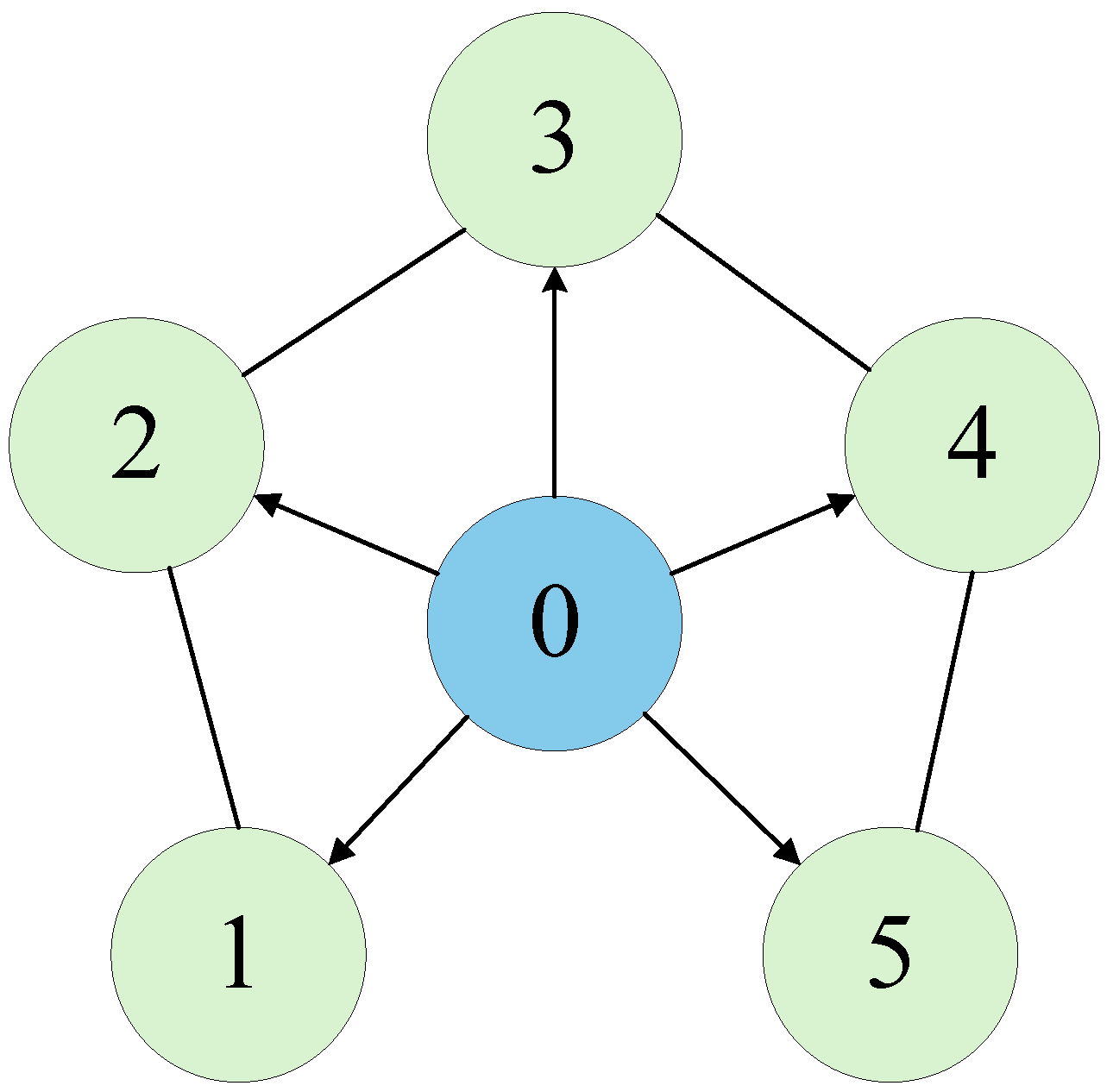
Consider the communication topology structure as shown in Figure 2, whose Laplacian matrix has the following form:
L = 0 0 0 0 0 0 1 2 1 0 0 0 1 1 3 1 0 0 1 0 1 3 1 0 1 0 0 1 3 1 1 0 0 0 1 2 .
Consider a model with the following parameters
A = 0.2 0.9 0.05 0.25 , B = 0.015 0.01 1.7 0.5 , P = 220 2 2 13 .
We choose the initial states
x 1 ( 0 ) = 1.1 0.3 , x 2 ( 0 ) = 0.2 2 ,
x 3 ( 0 ) = 1.2 0.6 , x 4 ( 0 ) = 0.7 0.2 .
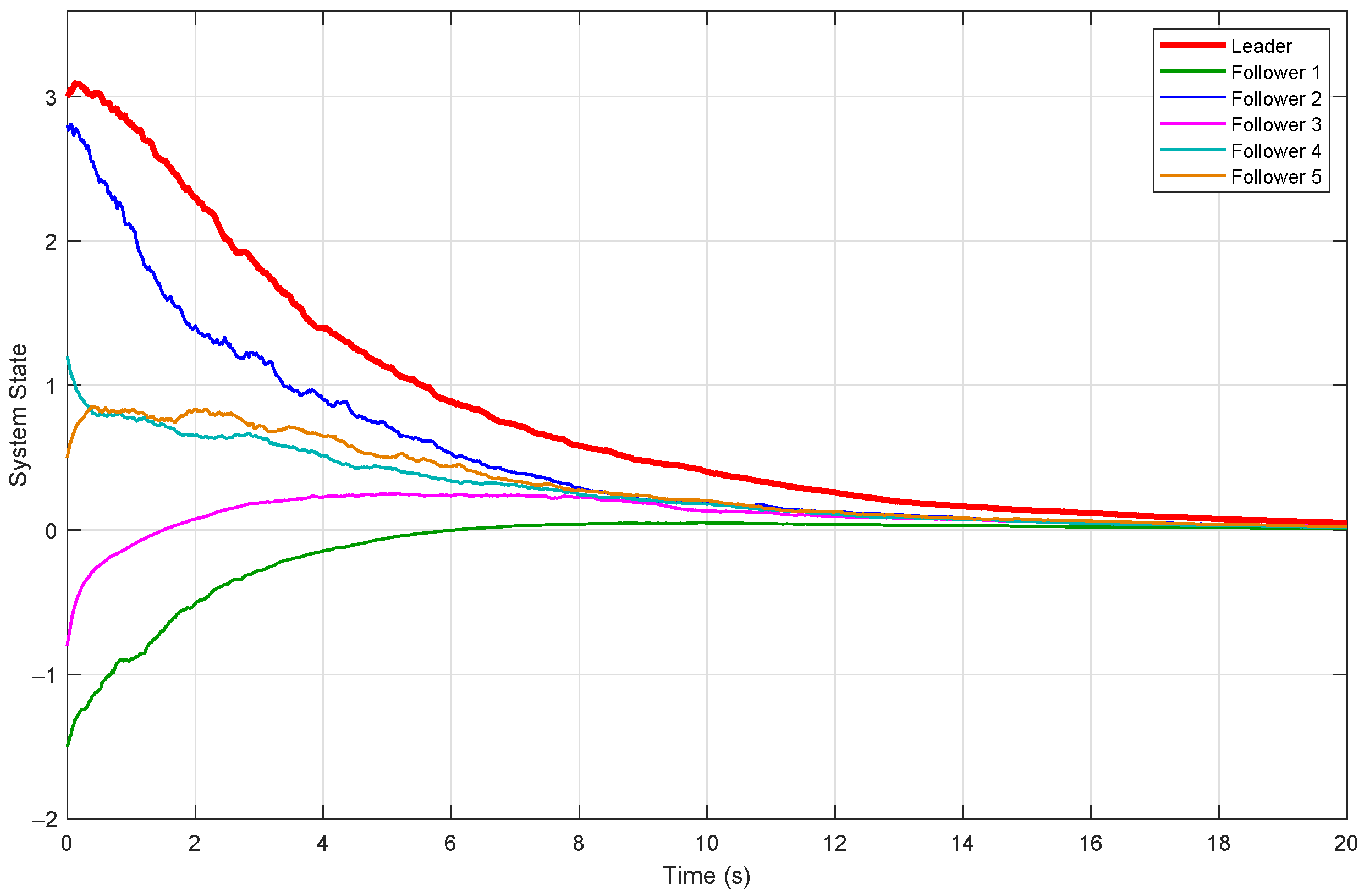
We choose trigger threshold coefficient α = 0.3 and minimum time interval Δ = 1 . Figure 3 shows the state update process, as described in the previous sections with parameter settings and the state update mechanism. The visualization results show the state trajectories of the five agents. It can be observed that the agents achieve synchronization, which verifies the validity of the designed ETDS.
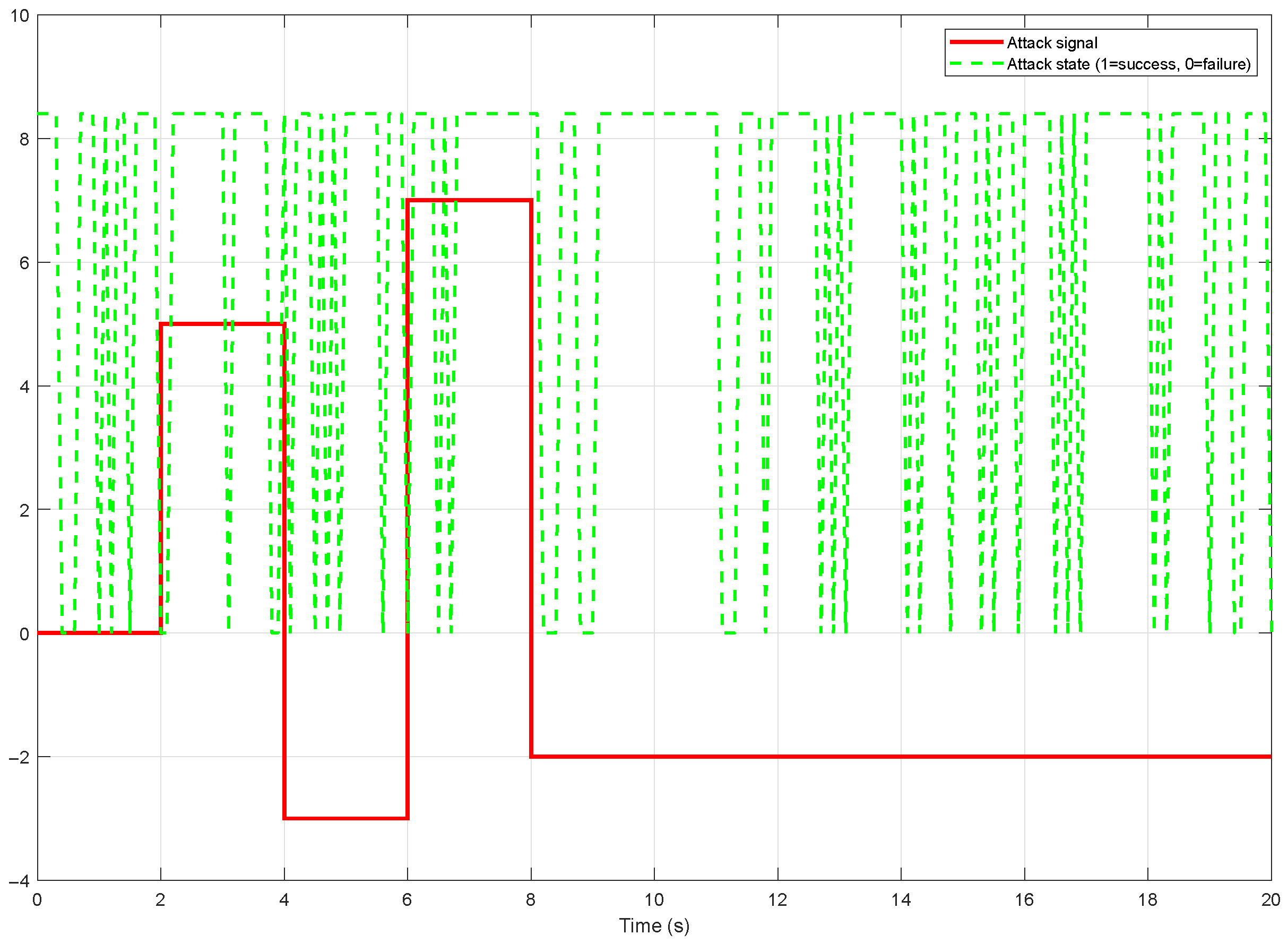
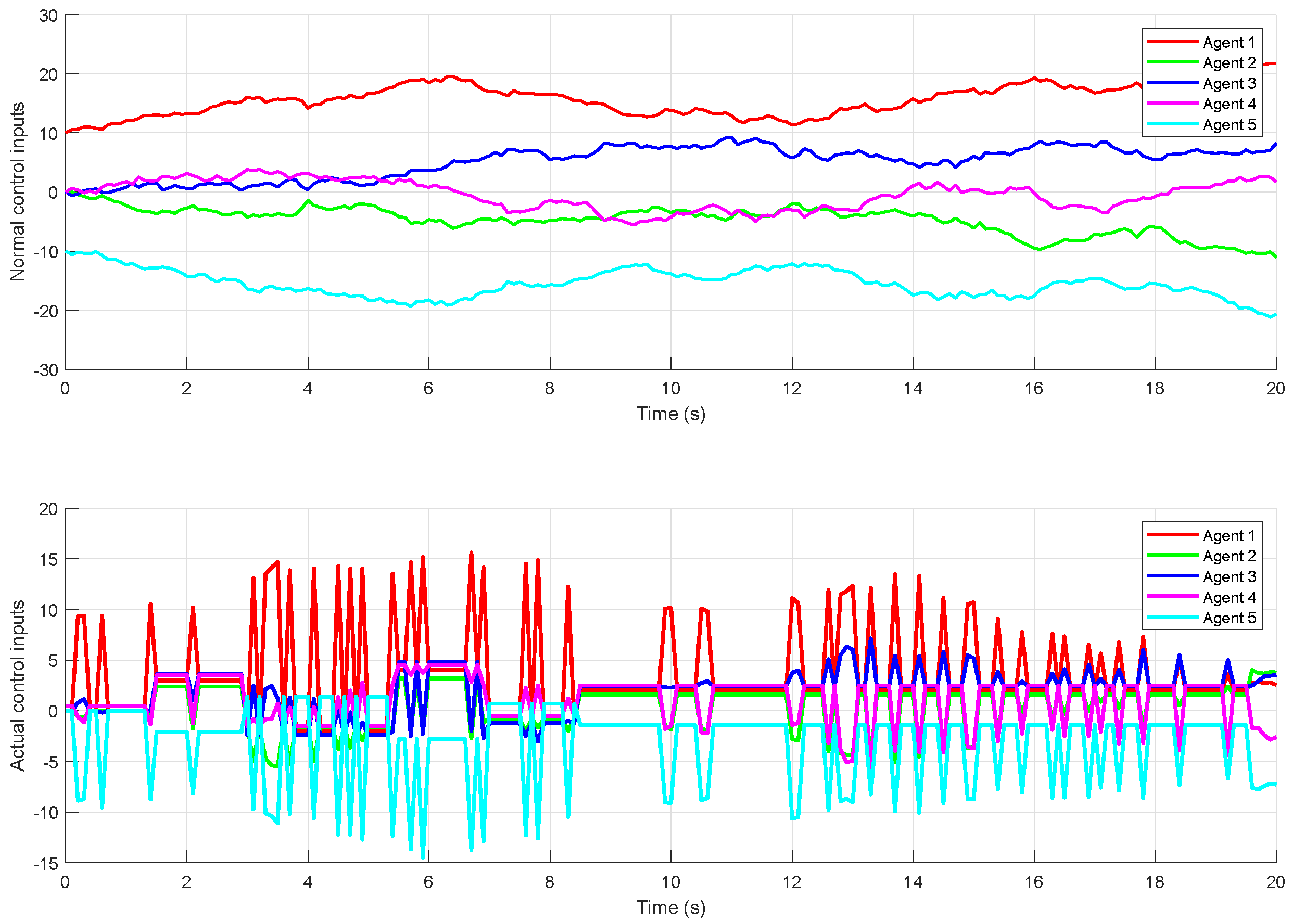
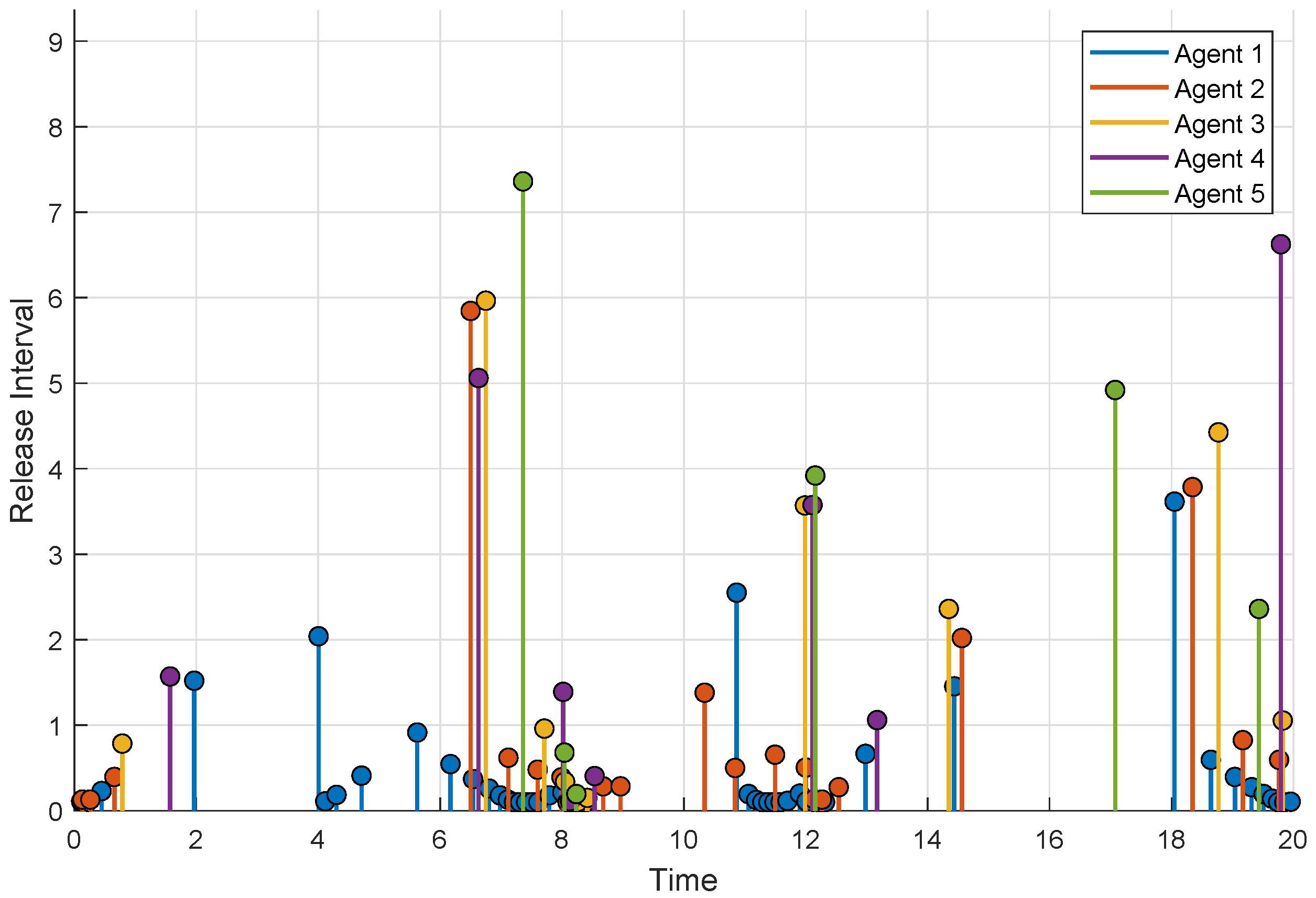
Figure 4 plots attack signals and attack status. Figure 5 shows the comparison of control inputs with and without the influence of cyber attacks. From the simulation results, it can be observed that FDIAs have an impact on the control inputs of the agents. This implies that the performance will degrade once attack occurs. Moreover, by choosing  T = 20  s and  Δ t = 0.02  s, the trigger moments of the five agents are shown in Figure 6. Relative to its continuous counterpart, the event-triggered scheme achieves a reduction in the number of triggering instances. As shown in Table 1, compared with the following triggering condition, 
s k + 1 = inf s s k E e ( s ) 2 α E x ¯ ( s ) 2 ,
the proposed event-triggered mechanism effectively reduces the number of triggers, thereby lowering the communication and computation overhead, which verifies the effectiveness of the proposed method.

5. Conclusions

In this study, we have constructed a mathematical model for stochastic MASs subjected to random cyber attacks and have designed an ETDS with a configurable waiting period. Notably, the trigger conditions we have proposed can effectively avoid Zeno behavior. In addition, the study has also explored the secure consensus problem of stochastic MASs when they are confronted with bilateral FDIA. Finally, we have verified the feasibility of the proposed theory through two examples. However, the event-triggered mechanism proposed in this paper only imposes specific constraints on the success probability of attacks, and thus may not be applicable to cases where the attack success probability is unknown. In future research, the team will further expand the existing results, with a focus on investigating the event-triggered secure consensus problem of leader-following MASs under various network attack scenarios.

Author Contributions

Conceptualization, Z.Y., Y.H. and W.Z.; methodology, Z.Y. and Y.H.; validation, Z.Y., W.Z. and Y.Y.; investigation, Z.Y., Y.H., W.Z. and Y.Y.; writing—original draft preparation, Z.Y., Y.H. and W.Z.; writing—review and editing, Z.Y., W.Z. and Y.Y. All authors have read and agreed to the published version of the manuscript.

Funding

This work was supported by the National Natural Science Foundation of China, under grant No. 62373229, and the University-level project of Dezhou University, No. 2020xjrc221.

Data Availability Statement

The data used to support the findings of this study are available from the corresponding author upon request.

Conflicts of Interest

The authors declare no conflicts of interest.

References

  1. Yan, B.; Sun, Y.; Shi, P.; Lim, C.C. Event and learning-based resilient formation control for multiagent systems under DoS attacks. IEEE Trans. Syst. Man Cybern. Syst. 2024, 54, 4876–4886. [Google Scholar] [CrossRef]
  2. Han, Z.M.; Guo, K.X.; Xie, L.H.; Lin, Z. Integrated relative localization and leader-follower formation control. IEEE Trans. Autom. Control 2019, 64, 20–34. [Google Scholar] [CrossRef]
  3. Yuan, J.X.; Chen, T. Switched fractional order multiagent systems containment control with event-triggered mechanism and input quantization. Fractal Fract. 2022, 6, 77. [Google Scholar] [CrossRef]
  4. Du, S.L.; Sheng, H.; Sun, H.Y. A fully distributed event-triggered control approach to leader-following consensus of multiagent systems. J. Frankl. Inst. 2023, 360, 13227–13243. [Google Scholar] [CrossRef]
  5. Li, Y.M.; Li, Y.X.; Tong, S.C. Event-based finite-time control for nonlinear multiagent systems with asymptotic tracking. IEEE Trans. Autom. Control 2023, 68, 3790–3797. [Google Scholar] [CrossRef]
  6. Xu, W.; Wang, Z.; Yang, S.; Yu, W. Data-driven adaptive consensus for linear multi-agent systems: A scalable distributed protocol. Automatica 2025, 174, 112126. [Google Scholar] [CrossRef]
  7. Zhang, G.; Zhang, H.G.; Sun, S.X. Adaptive dynamic event-triggered bipartite time-varying output formation tracking problem of heterogeneous multiagent systems. IEEE Trans. Syst. Man Cybern. Syst. 2024, 54, 12–22. [Google Scholar] [CrossRef]
  8. Yang, X.; Yuan, J.; Chen, T.; Yang, H. Distributed adaptive optimization algorithm for fractional high-order multiagent systems based on event-triggered strategy and input quantization. Fractal Fract. 2023, 7, 749. [Google Scholar] [CrossRef]
  9. Zhou, J.; Sang, C.; Li, X.; Fang, M.; Wang, Z. H consensus for nonlinear stochastic multi-agent systems with time delay. Appl. Math. Comput. 2018, 325, 41–58. [Google Scholar] [CrossRef]
  10. Liu, X.Y.; Fu, H.B.; Liu, L. Leader-following mean square consensus of stochastic multi-agent systems via periodically intermittent event-triggered control. Neural Process. Lett. 2021, 53, 275–298. [Google Scholar] [CrossRef]
  11. Nourian, M.; Caines, P.E.; Malhamé, R.P.; Huang, M. Mean field LQG control in leader-follower stochastic multi-agent systems: Likelihood ratio based adaptation. IEEE Trans. Autom. Control 2012, 57, 2801–2816. [Google Scholar] [CrossRef]
  12. Hua, C.C.; Li, Y.F.; Gua, X.P. Leader-following consensus for high-order nonlinear stochastic multiagent systems. IEEE Trans. Cybern. 2017, 47, 1882–1891. [Google Scholar] [CrossRef]
  13. Ren, G.J.; Yu, Y.G. Mean square consensus of stochastic multi agent systems with nonlinear dynamics by distributed event-triggered strategy. Int. J. Control 2019, 92, 745–754. [Google Scholar] [CrossRef]
  14. Zou, W.; Shi, P.; Xiang, Z.; Shi, Y. Consensus tracking control of switched stochastic nonlinear multiagent systems via event-triggered strategy. IEEE Trans. Neural Netw. Learn. Syst. 2020, 31, 1036–1045. [Google Scholar] [CrossRef]
  15. Zhu, Y.; Guo, L.; Qiao, J.; Li, W. An enhanced anti-disturbance attitude control law for flexible spacecrafts subject to multiple disturbances. Control Eng. Pract. 2019, 84, 274–283. [Google Scholar] [CrossRef]
  16. Modares, H.; Kiumarsi, B.; Lewis, F.L.; Ferrese, F.; Davoudi, A. Resilient and robust synchronization of multiagent systems under attacks on sensors and actuators. IEEE Trans. Cybern. 2020, 50, 1240–1250. [Google Scholar] [CrossRef]
  17. Kwon, C.; Hwang, I. Reachability analysis for safety assurance of cyber-physical systems against cyber attacks. IEEE Trans. Autom. Control 2018, 63, 2272–2279. [Google Scholar] [CrossRef]
  18. Feng, Z.; Hu, G.Q. Secure cooperative event-triggered control of linear multiagent systems under DoS attacks. IEEE Trans. Control Syst. Technol. 2020, 28, 741–752. [Google Scholar] [CrossRef]
  19. Zou, Y.; Li, X.; Deng, C.; Wu, X. A finite-dimensional control scheme for fractional-order systems under denial-of-service attacks. Fractal Fract. 2023, 7, 562. [Google Scholar] [CrossRef]
  20. Wang, Y.; He, P.; Shi, P.; Rudas, I.J. Event-triggered control for networked Lurie control systems subject to periodic denial-of-service attacks and time-delays. IEEE Trans. Control Netw. Syst. 2024, 11, 867–877. [Google Scholar] [CrossRef]
  21. He, W.; Gao, X.; Zhong, W.; Qian, F. Secure impulsive synchronization control of multi-agent systems under deception attacks. Inf. Sci. 2018, 459, 354–368. [Google Scholar] [CrossRef]
  22. Zhang, T.Y.; Ye, D.; Shi, Y. Decentralized false-data injection attacks against state omniscience: Existence and security analysis. IEEE Trans. Autom. Control 2023, 68, 4634–4649. [Google Scholar] [CrossRef]
  23. Zhao, D.; Shi, Y.; Ding, S.X.; Li, Y.; Fu, F. Replay attack detection based on parity space method for cyber-physical systems. IEEE Trans. Autom. Control 2025, 70, 2390–2405. [Google Scholar] [CrossRef]
  24. Naha, A.; Teixeira, A.; Ahlén, A.; Dey, S. Sequential detection of replay attacks. IEEE Trans. Autom. Control 2023, 68, 1941–1948. [Google Scholar] [CrossRef]
  25. Xing, M.P.; Lu, J.Q.; Liu, Y. Remote secure fusion estimation of cyber-physical systems under false data injection attacks. Automatica 2025, 177, 112271. [Google Scholar] [CrossRef]
  26. Zhang, Q.; He, D. Adaptive neural control of nonlinear cyber-physical systems against randomly occurring false data injection attacks. IEEE Trans. Syst. Man Cybern. Syst. 2023, 53, 2444–2455. [Google Scholar] [CrossRef]
  27. Suo, Y.; Chai, R.; Chai, S.; Farhan, I.M.; Xia, Y.; Liu, G.P. Attack detection and secure state estimation of collectively observable cyber-physical systems under false data injection attacks. IEEE Trans. Autom. Control 2024, 69, 2067–2074. [Google Scholar] [CrossRef]
  28. Zhang, T.Y.; Ye, D. False data injection attacks with complete stealthiness in cyber-physical systems: A self-generated approach. Automatica 2020, 120, 109117. [Google Scholar] [CrossRef]
  29. Zhang, H.; Chen, Z.; Yu, C.; Yue, D.; Xie, X.; Hancke, G.P. Event-trigger-based resilient distributed energy management against FDI and DoS attack of cyber-physical system of smart grid. IEEE Trans. Syst. Man Cybern. Syst. 2024, 54, 3220–3230. [Google Scholar] [CrossRef]
  30. Mazare, M. Reinforcement learning-based fixed-time resilient control of nonlinear cyber physical systems under false data injection attacks and mismatch disturbances. J. Frankl. Inst. 2023, 360, 14926–14938. [Google Scholar] [CrossRef]
  31. Zhao, B.; Gao, Q.; Li, Y.; Lü, J.; Zhang, K. Cooperative security analysis of industry cloud control systems under false data injection attacks. IEEE Trans. Syst. Man Cybern. 2024, 54, 3124–3133. [Google Scholar] [CrossRef]
  32. Li, F.Z.; Liu, Y.G. Event-triggered stabilization for continuous stochastic systems. IEEE Trans. Autom. Control 2020, 65, 4031–4046. [Google Scholar] [CrossRef]
  33. Zhang, W.H.; Yu, Z.J.; Jiang, X.S. Event-triggered security consensus of continuous-time multi-agent systems against complex cooperative attacks. Inf. Sci. 2024, 662, 120260. [Google Scholar] [CrossRef]
Figure 1. The framework of MASs with ETDS against bilateral FDIAs.
Axioms 15 00177 g001
Figure 2. Communication network with a leader and five followers.
Axioms 15 00177 g002
Figure 3. The state trajectory of a leader and five followers.
Axioms 15 00177 g003
Figure 4. Attack signal and attack state.
Axioms 15 00177 g004
Figure 5. Control input of five followers.
Axioms 15 00177 g005
Figure 6. Trigger instants of agents.
Axioms 15 00177 g006
Table 1. Comparison of the triggering times between the triggering conditions proposed in this paper and the existing triggering conditions (36).
AgentTriggering Condition (36)Triggering Condition (2)
Agent 13113
Agent 22512
Agent 32010
Agent 42413
Agent 52814
Disclaimer/Publisher’s Note: The statements, opinions and data contained in all publications are solely those of the individual author(s) and contributor(s) and not of MDPI and/or the editor(s). MDPI and/or the editor(s) disclaim responsibility for any injury to people or property resulting from any ideas, methods, instructions or products referred to in the content.