


Abstract
This paper establishes a general parametric integral identity involving -times differentiable stochastic processes, formulated entirely in terms of stochastic k-Caputo fractional derivatives. This identity serves as a unifying tool for deriving a broad class of parameter-dependent inequalities for differentiable s-convex stochastic processes. Remarkably, by assigning specific values to the underlying parameter, we have ensured our results specialize to well-known numerical integration inequalities, including those of midpoint, trapezium, Simpson, and Bullen types, in the stochastic fractional context. The findings not only enrich the theory of stochastic fractional calculus but also provide a flexible analytical apparatus for uncertainty quantification in fractional dynamical systems.
Keywords:
k-Caputo fractional derivatives; s-convex stochastic processes; midpoint inequality; trapezium inequality; Simpson inequality; Bullen inequality MSC:
26D10; 26D15; 60G05
1. Introduction
Fractional calculus constitutes a canonical generalization of classical calculus, extending the operations of differentiation and integration to arbitrary real or complex orders. While derivatives of integer order encode only local information about a function, their fractional counterparts inherently incorporate global features, such as memory effects, hereditary mechanisms, and nonlocal dynamics, rendering them especially effective for describing complex systems that exhibit anomalous or history-dependent behavior [1,2,3]. Consequently, fractional-order models have been successfully employed across a broad spectrum of disciplines, including physics, engineering, economics, and biological sciences, often outperforming conventional integer-order approaches in capturing intricate real-world phenomena.
Among the several formulations proposed in the literature, the Caputo fractional derivative [4] has gained particular prominence, primarily because it allows for the natural incorporation of standard initial conditions in fractional differential equations [5,6].
Convexity is a cornerstone concept in mathematical analysis, especially in the study of approximation theory and error bounds for numerical integration rules. Its significance is vividly illustrated by the classical Hermite–Hadamard inequality, which establishes a precise relationship between the average value of a convex function over an interval and its values at the midpoint and endpoints, thereby serving as a fundamental tool in integral inequalities and convex analysis.
In [7], Farid et al. generalized the classical Hermite–Hadamard inequality to the setting of Caputo fractional derivatives for functions with convex n-th order derivatives Moreover, they derived a midpoint-type estimate for functions whose th derivative has a convex absolute value.
To further enrich the fractional calculus framework, Farid et al. [8] introduced the notion of k-Caputo fractional derivatives, incorporating an auxiliary parameter . This generalization offers enhanced adaptability in modeling phenomena where scaling effects or nonstandard normalization are relevant. Building on this extension, Farid et al. [9] established analogues of the Hermite–Hadamard and midpoint-type inequalities in the k-Caputo setting.
Stochastic processes, which constitute a fundamental pillar of probability theory, provide a rigorous framework for analyzing systems whose evolution is governed by randomness. Owing to these processes’ broad utility in physics, computer science, signal processing, cryptography, and control theory, this area has witnessed substantial theoretical and applied progress in recent decades. Indeed, stochastic processes have become essential for modeling dynamic phenomena characterized by uncertainty, thereby catalyzing innovations across both pure and applied disciplines [10,11].
The concept of convexity has naturally been extended to the stochastic setting. Building on this idea, Kotrys [12] established a stochastic analogue of the classical Hermite–Hadamard inequality. Recent research has further highlighted the pivotal role of generalized convexity notions in the analysis of stochastic processes through integral inequalities. For example, Materano et al. [13,14] derived Simpson-type inequalities for s-convex and quasi-convex stochastic processes, along with Ostrowski-type bounds for convex, s-convex, and quasi-convex cases. Agahi and Babakhani [15] extended classical Hermite–Hadamard and Jensen inequalities to the fractional setting for convex stochastic processes. Deng and Wang [16] contributed fractional Hermite–Hadamard inequalities tailored to -logarithmically convex functions, thereby expanding the reach of fractional calculus in stochastic contexts. Afzal et al. [17] investigated Jensen and Hermite–Hadamard inequalities for h-Godunova–Levin stochastic processes, underscoring the relevance of generalized convexity structures. Moreover, Meftah et al. [18] presented k-Riemann–Liouville fractional Maclaurin-type inequalities for s-convex stochastic processes, while Alzahrani et al. [19] developed Hermite–Hadamard-type estimates for harmonically s-convex stochastic processes. Other studies [20,21,22,23,24,25,26] have continued to deepen both the theoretical foundations and practical applications of convexity in stochastic analysis.
In [27], Rashid and coauthors introduced the notion of stochastic Caputo fractional derivatives, defined in the mean-square sense, and provided Hermite–Hadamard- and midpoint-type inequalities involving these stochastic fractional derivatives. More recently, Alruwaily et al. [28] introduced the notion of stochastic k-Caputo fractional derivatives and established Hermite–Hadamard, midpoint, and trapezium-type inequalities for stochastic convex processes.
Motivated by the research presented in [28] and the parametric studies conducted in [29,30,31], in this work, we generalize the existing framework of stochastic k-Caputo fractional derivatives for stochastic processes. Building upon these operators, we establish a unified parametric identity, which acts as the cornerstone for deriving a family of parameter-dependent inequalities tailored to -times differentiable s-convex stochastic processes, expressed entirely through the newly defined stochastic k-Caputo fractional derivatives. Notably, by selecting particular values of the parameter, this general scheme recovers, as special cases, classical numerical integration inequalities of midpoint, trapezium, Simpson, and Bullen types.
The remainder of the paper is structured as follows. Section 2 recalls essential notions from stochastic calculus and fractional analysis required for our developments. In Section 3, we introduce a new parametrized identity, which forms the basis for proving a set of parametrized inequalities for mean-square differentiable s-convex stochastic processes in Section 4. Section 5 addresses specific instances obtained by choosing specific values of the parameter. A numerical illustration with graphical validation is provided in Section 6 to support the theoretical findings. Finally, Section 7 summarizes the main contributions and outlines potential directions for future research.
2. Preliminaries
This section outlines key notions that underpin the subsequent developments of our work.
Definition 1
([32]). Let be a probability space. A random variable is a -measurable mapping . A function , with , is called a stochastic process if, for each fixed , the mapping is a random variable.
Definition 2
([32]). A stochastic process is said to be continuous in probability on if, for every ,
where denotes convergence in probability.
Definition 3
([32]). The process is termed mean-square continuous on if, for all ,
where denotes the expectation operator.
Definition 4
([32]). A stochastic process is differentiable in probability at if there exists a random variable such that
Definition 5
([32]). The process is mean-square-differentiable at if there exists a random variable satisfying
Definition 6
([32]). Let be a stochastic process such that for all . The mean-square integral of over is the random variable defined by the property that, for any sequence of partitions and any choice of sample points , the Riemann sums converge in mean square to , i.e.,
where . In this case, we write
Definition 7
([33]). A stochastic process is called s-convex in the second sense if there exists such that, for all with and every ,
Definition 8
([28]). Let , and . For the stochastic process , the concept of stochastic mean-square Caputo k-fractional derivatives of the order β is defined as follows:
where denotes the k-gamma function defined in [34] as satisfying .
3. Parametrized Identity for Stochastic k-Caputo Fractional Derivatives
This section introduces a new parametrized identity involving the introduced derivatives serving as a basis for the subsequent results.
Lemma 1.
Let be a mean-square-differentiable stochastic entity such that , where with . If is mean-square-integrable on , then the following equality holds almost everywhere:
where , and
4. Parametrized Inequalities via Stochastic s-Convexity
Theorem 1.
Let be a mean-square-differentiable stochastic entity such that , where with such that is mean-square-integrable on . If is s-convex stochastic process, then the following inequality
holds almost everywhere, where is defined as in (3), and
and
where denotes the incomplete Beta function given by
Proof.
Using Lemma 1, and the fact that is an s-convex stochastic process, we deduce that
where we have used (6) and (7).
This completes the proof. □
Corollary 1.
If we attempt to make , Theorem 1 yields the following parametrized inequality via stochastic convexity
where is defined as in (3), and we have used the facts that
and
Theorem 2.
Let be a mean-square-differentiable stochastic such that , where with such that is mean-square-integrable on . If is an s-convex stochastic process for with , then the following inequality
holds almost everywhere, where is defined as in (3), and are beta and hypergeometric functions, respectively.
Proof.
Using Lemma 1, Hölder’s inequality, and the fact that is an s-convex stochastic process, we deduce that
Thus, the proof is completed. □
Corollary 2.
In Theorem 2, if we assume , then we get
Theorem 3.
5. Special Instances
5.1. Midpoint-Type Inequalities
Corollary 4.
If we set , Theorem 1 yields the following midpoint inequality via stochastic s-convexity:
Moreover, for , we get the following midpoint inequality via stochastic convexity,
which was provided by Alruwaily et al. in ([28], Theorem 8).
Corollary 5.
If we set , Theorem 2 yields the following midpoint-type inequalities via stochastic s-convexity:
5.2. Trapezium-Type Inequalities
Corollary 6.
If we attempt to make , then Theorem 1 yields the following trapezium inequality via stochastic s-convexity:
Moreover, for , we get the following trapezium inequality via stochastic convexity,
which was provided by Alruwaily et al. in [28] ([Theorem 11]).
Corollary 7.
If we set , Theorem 2 yields the following trapezium-type inequalities via stochastic s-convexity:
5.3. Simpson-Type Inequalities
Corollary 8.
If we set , Theorem 1 yields the following Simpson-type inequalities via s-convexity:
Moreover, by setting , we get
Corollary 9.
If we set , Theorem 2 yields the following Simpson-type inequalities via stochastic s-convexity:
5.4. Bullen-Type Inequalities
Corollary 10.
If we set , Theorem 1 yields the following Bullen-type inequalities via stochastic s-convexity:
Moreover, for we get the following Bullen inequality via stochastic convexity
Corollary 11.
If we set , Theorem 2 yields the following Bullen-type inequalities via stochastic s-convexity:
6. A Numerical Case Study Supporting the Theoretical Findings
This section presents a numerical example with graphical illustrations that corroborate the validity of the results established in this study.
Example 1.
Consider the stochastic process on the interval given by . Its –th derivative, , is convex over . Under these conditions, Corollary 1 leads to the following parametrized inequalities:
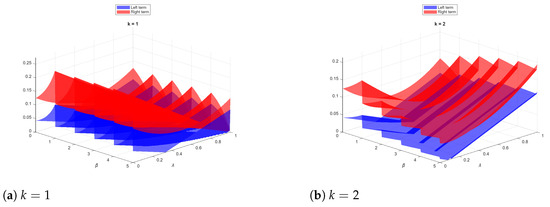
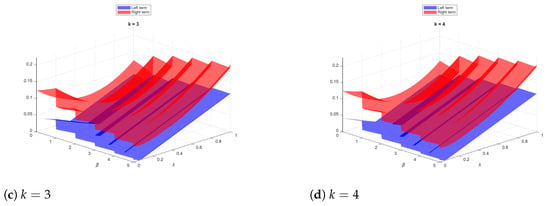
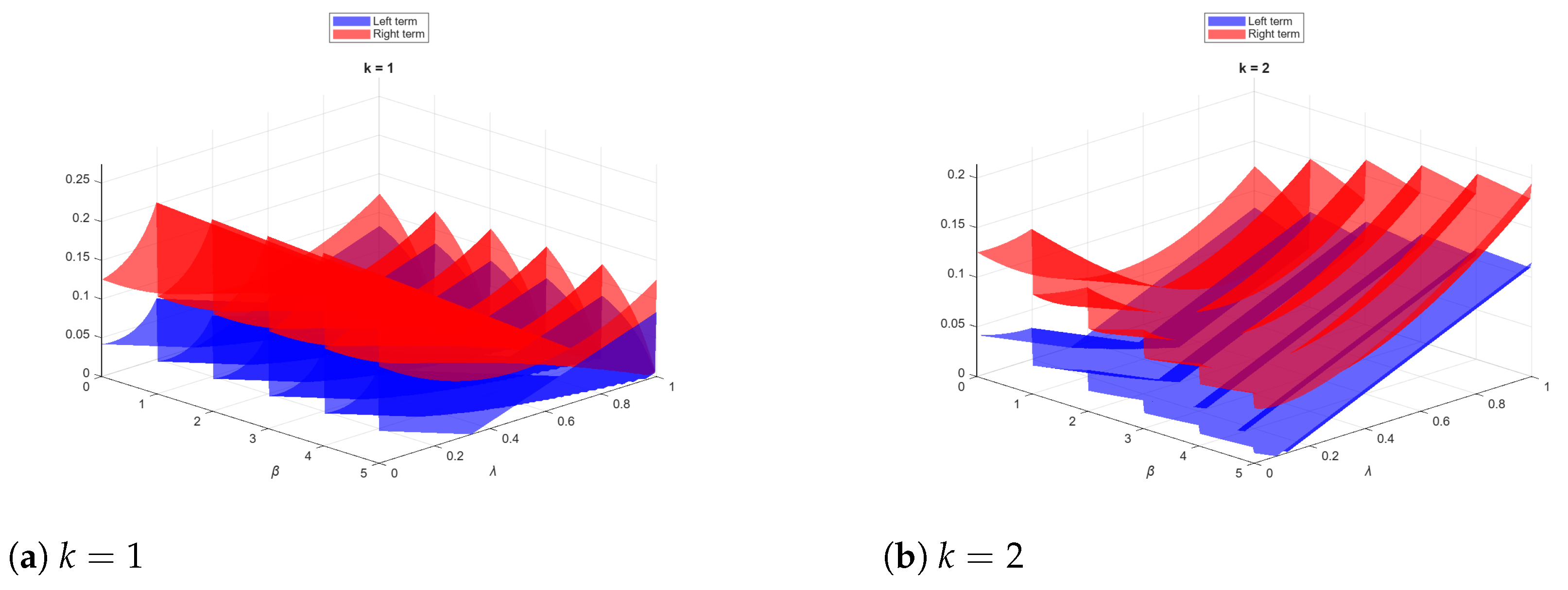
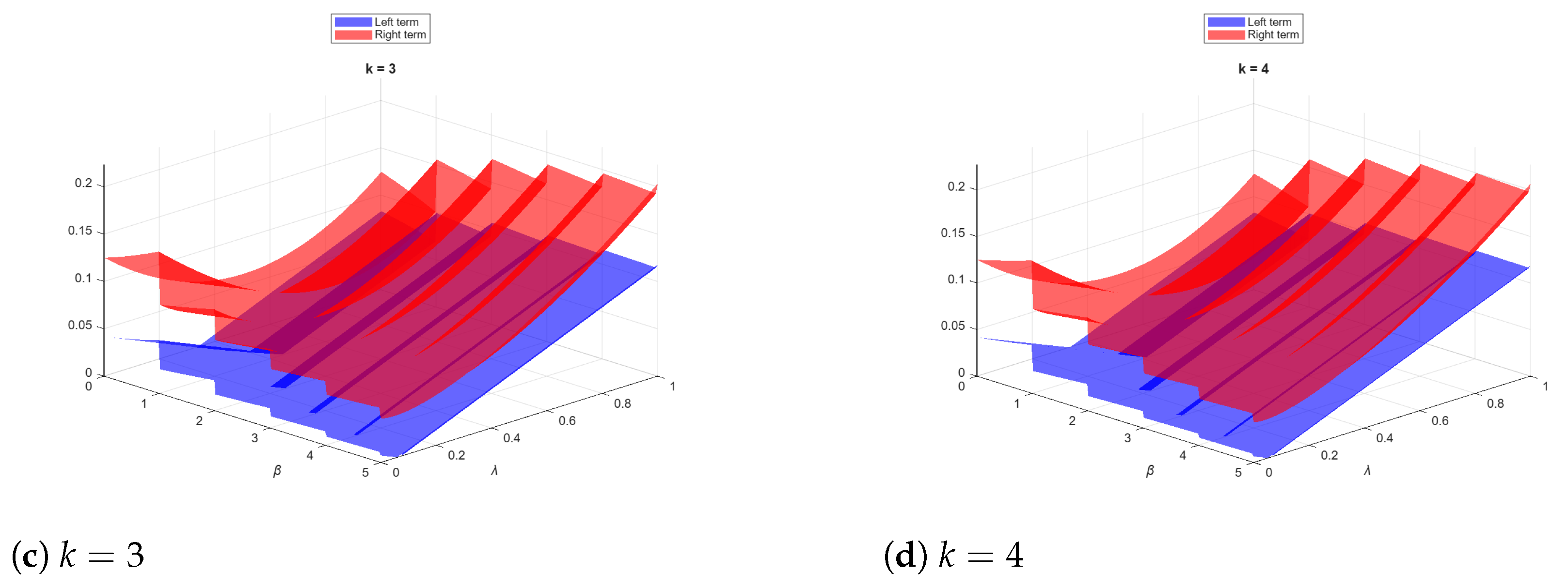
The above result depends on three parameters. Both sides of Inequality (10) are displayed in Figure 1 as functions of and for several fixed values of the parameter k. These visualizations confirm that the left-hand side is consistently bounded above by the right-hand side across a range of parameter values, thereby validating the correctness of our theoretical result.
Figure 1.
Comparison of the left-hand side (LHS) and right-hand side (RHS) of the inequality for different values of k. The surfaces are plotted over and .
7. Conclusions
In this study, we successfully constructed a versatile parametric identity for an -times mean-square-differentiable process involving a stochastic k-Caputo fractional derivative. This identity enables the systematic derivation of a wide spectrum of fractional inequalities under stochastic uncertainty for s-convex stochastic processes. Importantly, the proposed framework is sufficiently general to encapsulate classical deterministic inequalities, such as midpoint, trapezium, Simpson, and Bullen, as limiting or special cases through appropriate parameter selection. Directions for future research include extending this framework to coordinate convex stochastic processes and developing numerical schemes for the associated stochastic fractional differential equations.
Author Contributions
Conceptualization, Y.A., B.M. and R.F.; methodology, R.A.; software, F.A.; validation, B.M. and R.F.; formal analysis, Y.A. and F.A.; investigation, Y.A., R.A. and F.A.; resources, R.F.; data curation, B.M.; writing—original draft preparation, Y.A. and B.M.; writing—review and editing, Y.A., R.A., F.A. and R.F.; visualization, R.A. and F.A.; supervision, B.M. and R.F.; project administration, Y.A., F.A. and R.F.; funding acquisition, Y.A. and F.A. All authors have read and agreed to the published version of the manuscript.
Funding
This work was supported by Princess Nourah bint Abdulrahman University Researchers Supporting Project number (PNURSP2026R358), Princess Nourah bint Abdulrahman University, Riyadh, Saudi Arabia. This study was also supported via funding from Prince Sattam bin Abdulaziz University through project number PSAU/2026/R/1447.
Data Availability Statement
Data sharing is not relevant to this article, as there was no generation or analysis of new data during the course of this study.
Acknowledgments
The authors would like to thank the anonymous reviewers for their valuable suggestions.
Conflicts of Interest
The authors declare that they have no conflicts of interest related to this research.
References
- Gomez-Aguilar, J.F.; Atangana, A. Applications of Fractional Calculus Modeling in Dynamics and Chaos; CRC: Boca Raton, FL, USA, 2023. [Google Scholar]
- Dimitrov, Y.; Georgiev, S.; Todorov, V.; Hristov, J. Advances in Fractional Modeling and Computation. Fractal Fract. 2026, 10, 45. [Google Scholar] [CrossRef] [Scilit]
- West, B.J.; Chen, Y. Fractional Calculus for Skeptics I: The Fractal Paradigm; CRC Press: Boca Raton, FL, USA, 2024. [Google Scholar]
- Caputo, M. Linear models of dissipation whose Q is almost frequency independent II. Geophys. J. R. Astron. Soc. 1967, 13, 529–539. [Google Scholar] [CrossRef] [Scilit]
- Jiang, S.D.; Zhang, J.W.; Zhang, Q.; Zhang, Z.M. Fast evaluation of the Caputo fractional derivative and its applications to fractional diffusion equations. Commun. Comput. Phys. 2017, 21, 65–678. [Google Scholar] [CrossRef] [Scilit]
- Yan, Y.G.; Sun, Z.Z.; Zhang, J.W. Fast evaluation of the caputo fractional derivative and its applications to fractional diffusion equations: A second-order scheme. Commun. Comput. Phys. 2017, 22, 1028–1048. [Google Scholar] [CrossRef] [Scilit]
- Farid, G.; Naqvi, S.; Ur Rehman, A. A version of the Hadamard inequality for Caputo fractional derivatives and related results. RGMIA Res. Rep. Collect. 2017, 20, 59. [Google Scholar]
- Farid, G.; Javed, A.; Ur Rehman, A. On Hadamard inequalities for n-times differentiable functions which are relative convex via Caputo k-fractional derivatives. Nonlinear Anal. Forum 2017, 22, 17–28. [Google Scholar]
- Farid, G.; Javed, A.; Ur Rehman, A.; Qureshi, M.I. On Hadamard-type inequalities for differentiable functions via Caputo k-fractional derivatives. Cogent Math. 2017, 4, 1355429. [Google Scholar] [CrossRef] [Scilit]
- Allen, L.J.S. An Introduction to Stochastic Processes with Applications to Biology, 2nd ed.; CRC: Boca Raton, FL, USA, 2011. [Google Scholar]
- Bhattacharya, R.N.; Waymire, E.C. Stochastic Processes with Applications; reprint of the 1990 original, Classics in Applied Mathematics, 61; SIAM: Philadelphia, PA, USA, 2009. [Google Scholar]
- Kotrys, D. Hermite-Hadamard inequality for convex stochastic processes. Aequationes Math. 2012, 83, 143–151. [Google Scholar] [CrossRef] [Scilit]
- Materano, J.; Merentes, N.; Valera-López, M. Some estimates on the Simpson’s type inequalities through s-convex and quasi-convex stochastic processes. Math. Aeterna 2015, 5, 673–705. [Google Scholar]
- Materano, J.; Merentes, N.; Valera-López, M. On Ostrowskis type inequalities via convex, s-convex and quasi-convex stochastic processes. Math. Aeterna 2016, 6, 47–85. [Google Scholar]
- Agahi, H.; Babakhani, A. On fractional stochastic inequalities related to Hermite-Hadamard and Jensen types for convex stochastic processes. Aequationes Math. 2016, 90, 1035–1043. [Google Scholar] [CrossRef] [Scilit]
- Deng, J.; Wang, J. Fractional Hermite-Hadamard inequalities for (β,m)-logarithmically convex functions. J. Inequal. Appl. 2013, 2013, 364. [Google Scholar] [CrossRef] [Scilit]
- Afzal, W.; Botmart, T. Some novel estimates of Jensen and Hermite-Hadamard inequalities for h-Godunova-Levin stochastic processes. AIMS Math. 2023, 8, 7277–7291. [Google Scholar] [CrossRef] [Scilit]
- Meftah, B.; Benchettah, D.C.; Saleh, W.; Lakhdari, A. On k-Riemann–Liouville Maclaurin-type inequalities for s-convex stochastic processes. Math. Methods Appl. Sci. 2026, 49, 2035–2046. [Google Scholar] [CrossRef] [Scilit]
- Alzahrani, R.; Fakhfakh, R.; Alomani, G.; Meftah, B. On Fractional Hermite–Hadamard-type inequalities for harmonically s-convex stochastic processes. Fractal Fract. 2025, 9, 750. [Google Scholar] [CrossRef] [Scilit]
- Afzal, W.; Aloraini, N.M.; Abbas, M.; Ro, J.S.; Zaagan, A.A. Some novel Kulisch-Miranker type inclusions for a generalized class of Godunova-Levin stochastic processes. AIMS Math. 2024, 9, 5122–5146. [Google Scholar] [CrossRef] [Scilit]
- Hernández, J.E.; García, J.F.G. Hermite-Hadamard type inequalities, convex stochastic processes and Katugampola fractional integral. Rev. Integr. Temas Mat. 2018, 36, 133–149. [Google Scholar] [CrossRef] [Scilit]
- Hernández, J.E.H.; Gomez, J.F. Hermite-Hadamard type inequalities for (m, h1, h2)-convex stochastic processes using Katugampola fractional integral. Rev. Matemática Univ. Atlántico 2019, 6, 17–32. [Google Scholar]
- Jarad, F.; Sahoo, S.K.; Nisar, K.S.; Treanta, S.; Emadifar, H.; Botmart, T. New stochastic fractional integral and related inequalities of Jensen-Mercer and Hermite-Hadamard-Mercer type for convex stochastic processes. J. Inequal. Appl. 2023, 2023, 51. [Google Scholar] [CrossRef] [Scilit]
- Javed, M.Z.; Awan, M.U.; Ciurdariu, L.; Dragomir, S.S.; Almalki, Y. On extended class of totally ordered interval-valued convex stochastic processes and applications. Fractal Fract. 2024, 8, 577. [Google Scholar] [CrossRef] [Scilit]
- Set, E.; Sarıkaya, M.Z.; Tomar, M. Hermite-Hadamard type inequalities for coordinates convex stochastic processes. Math. AEterna 2015, 5, 363–382. [Google Scholar]
- Sharma, N.; Mishra, R.; Hamdi, A. On strongly generalized convex stochastic processes. Comm. Statist. Theory Methods 2024, 53, 2908–2923. [Google Scholar] [CrossRef] [Scilit]
- Rashid, S.; Noor, M.A.; Noor, K.I. Caputo fractional derivatives and inequalities via preinvex stochastic processes. Filomat 2023, 37, 6569–6584. [Google Scholar] [CrossRef] [Scilit]
- Alruwaily, Y.; Fakhfakh, R.; Alomani, G.; Alzahrani, R.; Ben Makhlouf, A. Deriving Hermite–Hadamard-type inequalities via stochastic k-Caputo fractional derivatives. Fractal Fract. 2025, 9, 757. [Google Scholar] [CrossRef] [Scilit]
- Lakhdari, A.; Mlaiki, N.; Saleh, W.; Abdeljawad, T.; Meftah, B. Exploring conformable fractional integral inequalities: A multi-parameter approach. Fractals 2025, 33, 2550055. [Google Scholar] [CrossRef] [Scilit]
- Gong, P.; Meftah, B.; Xu, H.; Budak, H.; Lakhdari, A. Exploring fractal–fractional integral inequalities: An extensive parametric study. Chaos Solitons Fractals 2025, 199, 116772. [Google Scholar] [CrossRef] [Scilit]
- Li, H.; Lakhdari, A.; Jarad, F.; Xu, H.; Meftah, B. An expanded analysis of local fractional integral inequalities via generalized (s, P)-convexity. J. Inequal. Appl. 2024, 2024, 78. [Google Scholar] [CrossRef] [Scilit]
- Sobczyk, K. Stochastic Differential Equations; Mathematics and its Applications (East European Series), 40; Kluwer Academic Publishers: Dordrecht, The Netherlands, 1991. [Google Scholar]
- Nikodem, K. On convex stochastic processes. Aequationes Math. 1980, 20, 184–197. [Google Scholar] [CrossRef] [Scilit]
- Díaz, R.; Pariguan, E. On hypergeometric functions and Pochhammer k-symbol. Divulg. Mat. 2007, 15, 179–192. [Google Scholar]
Disclaimer/Publisher’s Note: The statements, opinions and data contained in all publications are solely those of the individual author(s) and contributor(s) and not of MDPI and/or the editor(s). MDPI and/or the editor(s) disclaim responsibility for any injury to people or property resulting from any ideas, methods, instructions or products referred to in the content. |
© 2026 by the authors. Licensee MDPI, Basel, Switzerland. This article is an open access article distributed under the terms and conditions of the Creative Commons Attribution (CC BY) license.