1. Introduction
The nature of conscious experience remains one of the fundamental unsolved problems in neuroscience and philosophy of mind. While substantial progress has been made in identifying neural correlates of consciousness (NCC), particularly the role of gamma-band oscillations (30–80 Hz) in binding distributed information into unified percepts, a deeper mathematical understanding of why these specific dynamics generate subjective experience remains elusive.
1.1. The Hard Problem and Topological Approaches
Chalmers’ “hard problem” of consciousness [
1] asks why any physical process should give rise to subjective experience at all. While we do not claim to solve this problem here, we propose that consciousness may have an intrinsic mathematical structure that constrains its physical implementation. Specifically, we hypothesize that conscious experience is constitutively 4-dimensional (spatiotemporal) with a topology characterized by specific types of singularities.
Recent work has explored topological and geometric approaches to consciousness, including integrated information theory [
2], but these have not made explicit contact with the theory of integrable systems and Painlevé transcendents that are standard but advanced concepts of the theory of special functions. Our framework builds on the observation that Painlevé equations arise naturally at critical points in various physical systems and describe dynamics near singularities.
1.2. Gamma Oscillations and Binding
Gamma-band oscillations are widely observed neural correlates of conscious perception [
3,
4]. Key empirical observations include:
Gamma bursts are discrete events lasting 100–300 ms;
Gamma synchronization across brain regions correlates with successful binding;
Phase relationships encode information about stimulus features;
Consciousness appears to have a discrete “frame rate” rather than being continuous.
Despite extensive study, the mechanistic origin of gamma oscillations and their specific frequency range remains incompletely understood. While biophysical models exist based on interneuron networks, these do not explain why gamma specifically (rather than other frequencies) should be associated with consciousness.
1.3. Our Proposal
We propose that consciousness emerges through a two-stage quantum-to-classical transition:
Pre-conscious information processing corresponds to the configuration (4-punctured sphere) of Painlevé VI with four independent processing streams in full quantum superposition
An intermediate quantum state with “bipolar” character corresponds to Painlevé V, which has the “fishtail” fiber () with two bordered cusps representing coexisting quantum modes—this is where gamma oscillations emerge (possibly corresponding to lucid dreaming or hypnagogic states)
Classical consciousness corresponds to the fiber () of PVdeg (or ): the quantum-to-classical collapse that produces unified conscious experience with a single cusp.
The PVI → PV transition (chewing-gum coalescence) creates the fishtail and initiates gamma oscillations while preserving bipolar quantum character.
The PV → PVdeg transition (cusp removal) is the classical collapse that completes the gamma burst and generates unified conscious percept.
The key insight is that gamma oscillations emerge at the fishtail stage (PV): they appear during quantum coherent binding, and the subsequent classical collapse (PV → PVdeg) completes the process. This framework is mathematically precise, makes testable predictions distinguishing quantum intermediate states from classical consciousness, and provides a natural explanation for observed gamma dynamics.
The paper is organized as follows.
Section 2 introduces the mathematical framework of Painlevé equations, isomonodromic deformations, and the Kodaira classification of singular fibers, including the two-stage confluence process and its quantum-to-classical interpretation.
Section 3 develops the connections to quantum field theory, topological quantum field theory, and 4-manifold topology, including a discussion of how our framework addresses decoherence objections.
Section 4 provides the neural interpretation, mapping mathematical structures to neuroanatomical substrates and establishing the four-stream model grounded in thalamocortical architecture.
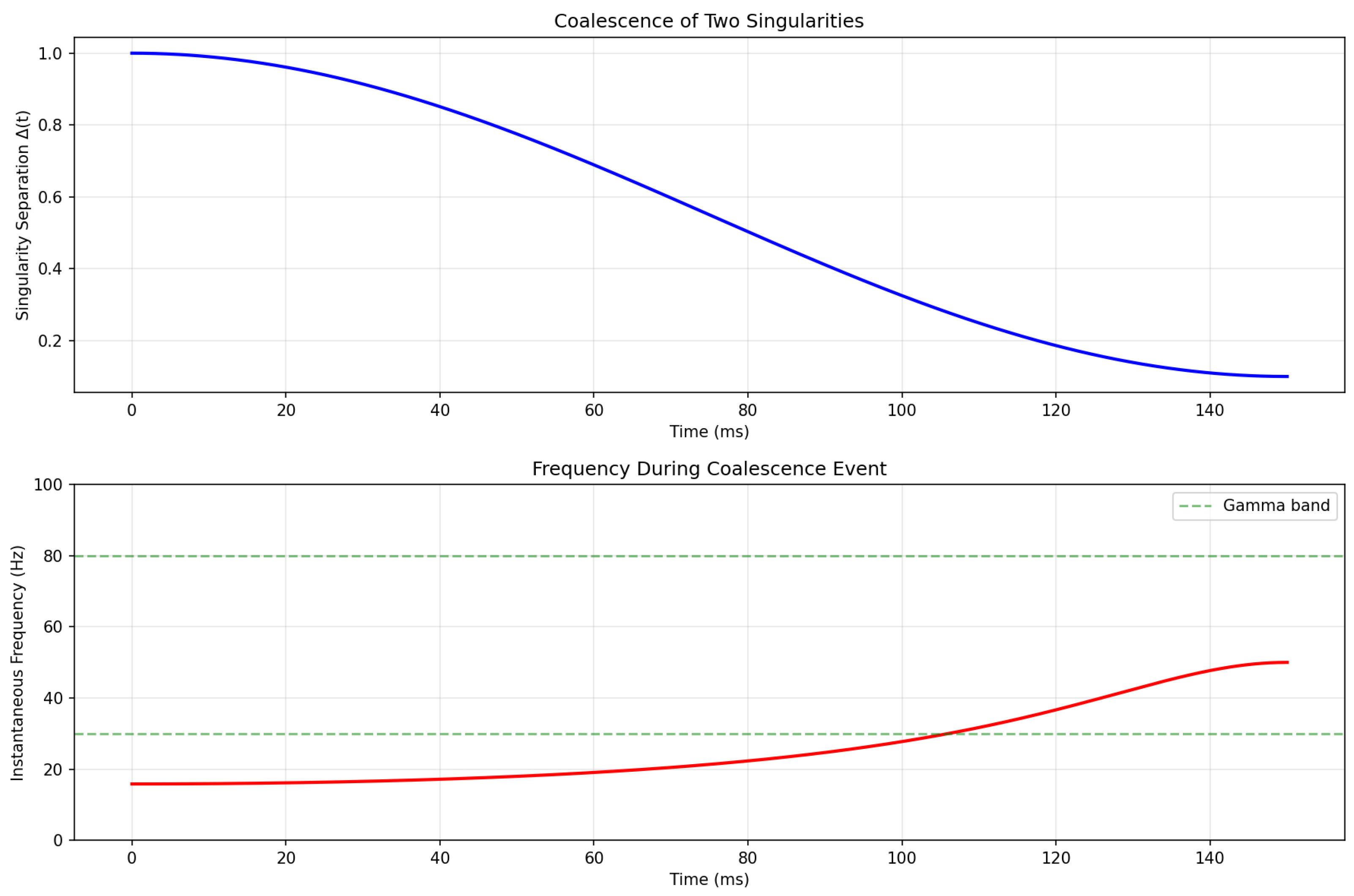
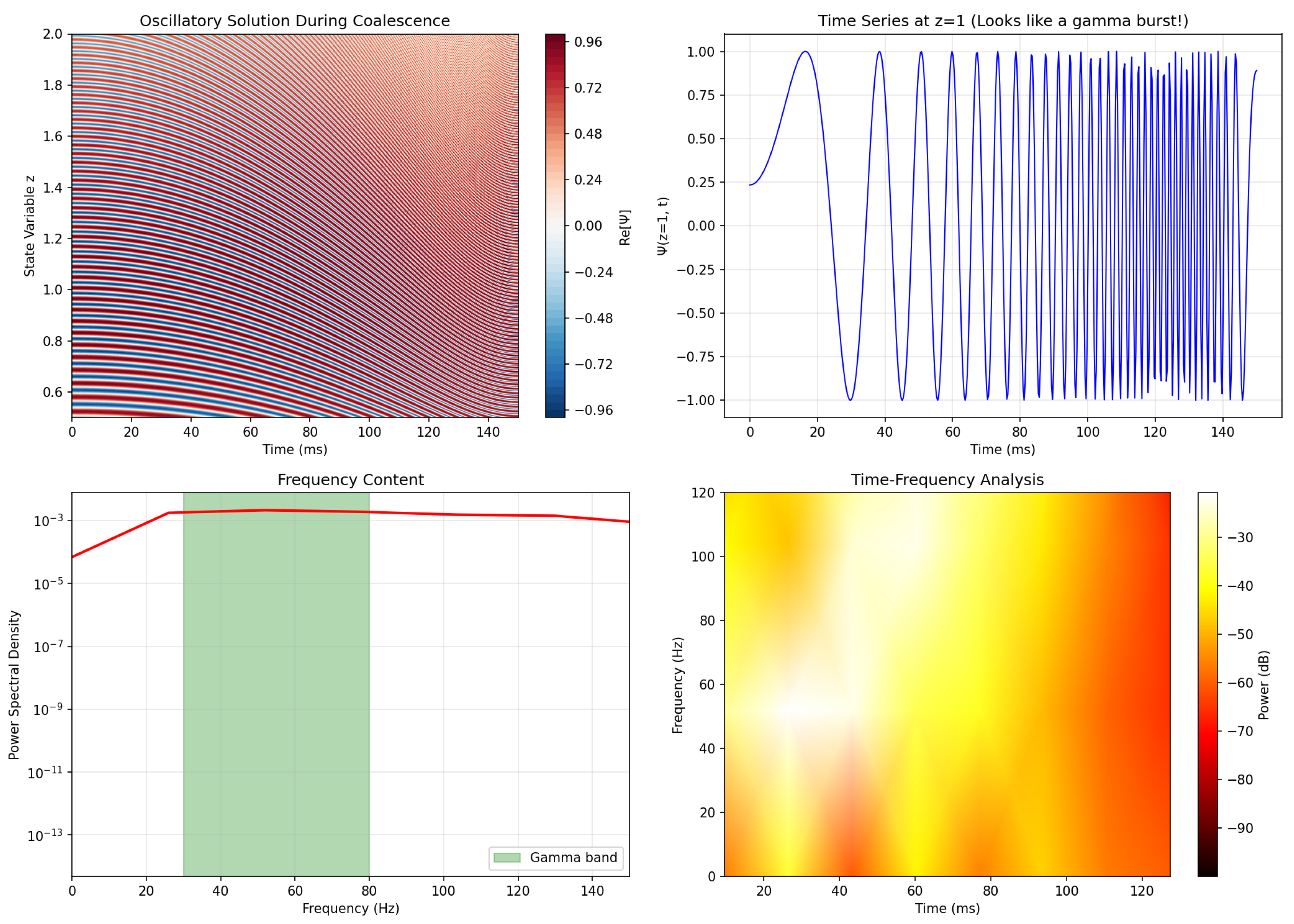
Section 5 presents the asymptotic analysis connecting coalescence dynamics to gamma-band oscillations.
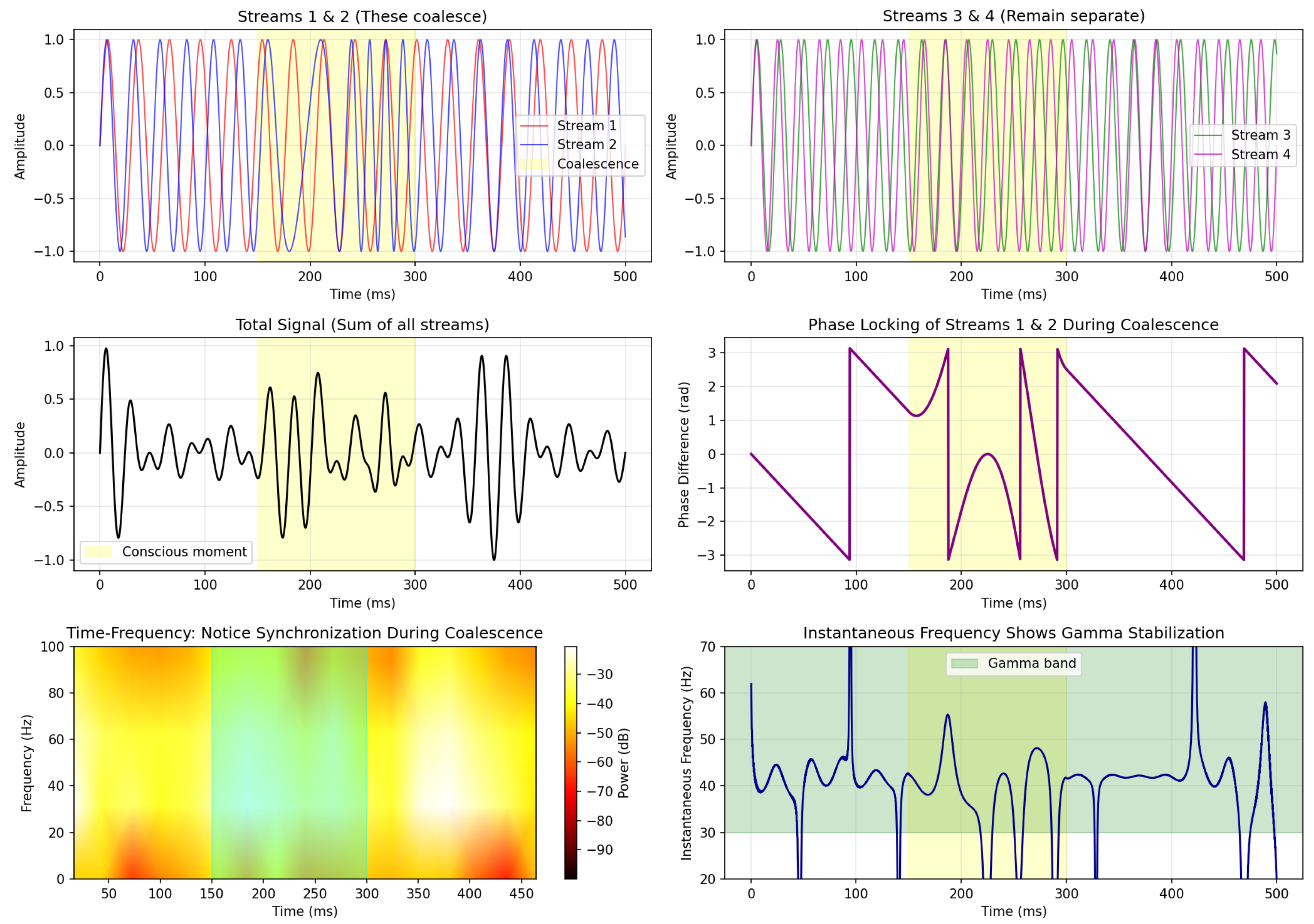
Section 6 displays numerical results demonstrating frequency evolution and the four-stream coalescence model.
Section 7 articulates seven falsifiable predictions.
Section 8 relates our framework to existing theories of consciousness and addresses open questions. We conclude in
Section 9.
Appendix A provides a self-contained derivation of the oscillation scaling relation from the PVI → PV confluence limit.
3. Quantum Field Theory, 4-Manifolds, and Topological Structure
3.1. Four-Manifolds in Quantum Physics
Four-dimensional manifolds occupy a special place in modern theoretical physics. The spacetime of general relativity is 4-manifold, and gauge theories, the foundation of the Standard Model, are naturally formulated on 4-dimensional spaces. More profoundly, the topology of 4-manifolds determines deep quantum properties through topological quantum field theory (TQFT) [
18].
3.1.1. Topological Quantum Field Theory
TQFT, pioneered by Witten and others, provides a framework where quantum amplitudes depend only on the topology of spacetime, not its metric structure. The partition function of a TQFT on a 4-manifold
M is a topological invariant:
where
is a topological action.
Key examples relevant to our framework include:
1. Donaldson Theory: Studies moduli spaces of Yang–Mills instantons on 4-manifolds. The moduli space of anti-self-dual connections has singularity structure similar to our
and
fibers [
19].
2. Seiberg–Witten Theory: Arose from
supersymmetric Yang–Mills theory [
20]. The Seiberg–Witten equations define invariants of smooth 4-manifolds through monopole solutions. Remarkably, these equations involve elliptic curves whose degenerations are classified by types closely similar to Kodaira ones (
, etc.) that appear in Painlevé theory.
3. Connection to Integrable Systems: Seiberg and Witten showed that the low-energy effective action of
gauge theory is governed by a hyperelliptic curve, and its period integrals satisfy the Picard–Fuchs equations, which are related to Painlevé equations [
21].
3.1.2. Monodromy as Gauge Holonomy
The monodromy groups in our framework have a natural interpretation in gauge theory. Consider a
gauge field
A on a 4-manifold with a Wilson loop:
The monodromy of solutions to the Painlevé linear system around a singular point is mathematically identical to gauge holonomy around a non-contractible cycle. The isomonodromy condition—that monodromy is preserved as parameters vary—parallels the requirement of consistent gauge transformations in quantum field theory.
3.2. Painlevé Equations in Quantum Integrable Systems
Painlevé equations are not merely classical; they arise naturally as correlation functions and partition functions in quantum systems [
6].
3.2.1. Quantum Painlevé Equations
The quantum Painlevé equations are
q-difference or operator equations that reduce to classical Painlevé in appropriate limits [
22]. They appear in
2D Conformal Field Theory: Correlation functions satisfy quantum Painlevé equations.
Matrix Models: Quantum corrections to matrix model partition functions (related to 2D quantum gravity) are governed by quantum Painlevé.
Integrable Quantum Mechanics: Spectral determinants of quantum integrable systems satisfy Painlevé equations [
23].
The relationship between classical and quantum Painlevé is given by the classical limit:
This suggests a profound possibility: if consciousness has the topological structure and this structure is governed by Painlevé dynamics, there may exist an underlying quantum structure of which neural dynamics represent the classical limit.
3.2.2. WKB Analysis: The Quantum-Classical Bridge
The WKB (Wentzel–Kramers–Brillouin) method is precisely the tool for understanding the quantum-to-classical transition [
24]. For a quantum system with Hamiltonian
and energy
E:
In the semiclassical limit (
), the wavefunction takes the form:
where
satisfies the classical Hamilton–Jacobi equation.
Our use of WKB analysis in
Section 5.1 below to derive oscillation frequencies is not merely a mathematical convenience, it represents the fundamental quantum-classical correspondence. The action
appearing in our analysis can be interpreted as the classical limit of a quantum mechanical phase. More details about the WKB analysis are in the
Appendix A.
3.3. The Irregular Singularity as Quantum-Classical Interface
We propose that the irregular singularity of the fishtail (PV) represents a special locus in phase space where quantum binding occurs, with gamma oscillations as its signature.
3.3.1. Physical Interpretation
Regular singularities ( with four punctures, PVI):
Correspond to quantum superposition states.
Four punctures = four basis states in Hilbert space.
Monodromy around each singularity = unitary evolution.
System maintains quantum coherence without binding.
Irregular singularity with two cusps ( fishtail, PV):
Forms through coalescence—binding begins.
Two cusps = bipolar quantum superposition (two coexisting modes).
Stokes phenomenon = gamma oscillations emerge.
System is actively binding but remains quantum coherent.
Irregular singularity with one cusp (, PVdeg):
Forms through cusp removal—classical collapse.
One cusp = unified classical percept.
Gamma burst completes, stable perception emerges.
Quantum-to-classical transition complete.
This interpretation resonates with ideas in quantum measurement theory. The two-stage transition represents the progression from quantum possibility to classical actuality—from unconscious quantum processing through active binding to conscious classical experience.
3.3.2. Connection to Penrose–Hameroff Theory
The interpretation resonates strongly with Orch-OR theory [
25,
26]: the PV → PVdeg transition may represent “orchestrated objective reduction”, the collapse of quantum superposition in microtubules that Penrose and Hameroff propose as the physical basis of conscious moments. Our framework provides a precise topological characterization of this collapse: it is the transition from the bipolar quantum fishtail state (PV,
,
) to the unified classical state (PVdeg,
,
). The fishtail is the site of quantum binding, not the endpoint.
Testable Predictions
This refined model makes specific predictions:
REM/lucid dreaming: Should show PV-type (fishtail) dynamics: gamma oscillations present but with bipolar character, reflecting active binding without classical collapse.
Waking consciousness: Should show completed PVdeg-type dynamics: gamma burst culminating in stable unified percept ().
Anesthesia: Should show regression toward PVI-type dynamics: loss of irregular singularity and cessation of binding.
Hypnagogic states: The transition zones between sleep and waking should show signatures of the PV → PVdeg transition.
3.4. Symmetry Breaking and Phase Transitions
The two-stage confluence is fundamentally a symmetry-breaking phenomenon, with deep connections to quantum field theory.
3.4.1. Symmetry Groups
The dual graph structure encodes symmetry (surface type):
(for , PVI): Four-fold structure, four regular singularities.
(for , PV = fishtail): Reduced symmetry, two bordered cusps.
(for , PVdeg): Further reduced symmetry, one cusp.
In the context of gauge theory, spontaneous symmetry breaking occurs when a gauge symmetry is broken to a subgroup. The Higgs mechanism, for instance, breaks to .
Our two-stage confluence represents successive symmetry breaking:
3.4.2. Phase Transitions in TQFT
Quantum phase transitions in topological phases of matter involve changes in topological order—characterized by different fusion rules and braiding statistics of anyons. The transition between topological phases can involve changing the number of distinct anyon types, analogous to our transition from four to three effective singularities.
Recent work on topological quantum computation shows that braiding operations on anyons are described by monodromy representations: exactly the mathematical structure underlying Painlevé equations [
27].
3.5. Implications for Consciousness
3.5.1. Three Possible Scenarios
Our topological framework is compatible with three interpretations.
Scenario A: Fully Classical
Neural networks naturally organize through the topology sequence.
The quantum-topological mathematics describes classical dynamics.
Gamma oscillations arise from classical bifurcations at the (fishtail) stage.
No quantum effects required.
Scenario B: Quantum Substrate, Classical Phenomenology
Quantum coherence at molecular/cellular scale creates states.
The PVI → PV transition creates the fishtail () with gamma oscillations during active binding.
Environmental decoherence drives the PV → PVdeg transition ().
Conscious experience = post-decoherence classical state (, unified percept).
Scenario C: Genuinely Quantum Consciousness
Consciousness requires sustained quantum coherence (Penrose–Hameroff).
The fishtail state itself has quantum character—gamma represents quantum binding.
Classical collapse to is “orchestrated objective reduction”.
Classical description (our current model) is effective theory of underlying quantum dynamics.
3.5.2. Experimental Differentiation
These scenarios make different predictions:
Coherence times: Scenario C requires long quantum coherence (>100 ms), scenario B only requires coherence during coalescence (∼1 ms), scenario A requires none.
Temperature dependence: Quantum scenarios predict consciousness disruption at elevated temperatures (decoherence increases), classical scenario less sensitive.
Isotope effects: Replacing hydrogen with deuterium should affect quantum coherence (nuclear spin effects) but not classical dynamics in any significant way.
Entanglement signatures: Genuine quantum consciousness (scenario C) should show measurable entanglement between brain regions.
3.5.3. Addressing Decoherence Objections
A standard criticism of quantum theories of consciousness, particularly Orch-OR, concerns decoherence timescales [
28,
29]. Thermal fluctuations in the warm, wet brain are argued to destroy quantum coherence on femtosecond to picosecond timescales, far shorter than the ∼25 ms (∼40 Hz) timescales relevant for gamma oscillations and conscious binding.
Our framework addresses this objection differently depending on which scenario is operative.
Scenario A (Fully Classical)
No quantum coherence is required. The Painlevé/TQFT mathematics describes the topology of classical neural dynamics, not quantum superposition. The same mathematical structures arise in classical integrable systems. This scenario is immune to decoherence objections.
Scenario B (Quantum Substrate, Classical Phenomenology)
This scenario requires quantum coherence only during the coalescence transition itself, not sustained coherence over the full gamma cycle. The coalescence event in our model occurs over a timescale:
However, the critical part of coalescence, where the irregular singularity actually forms, occurs in the final approach when
. This phase lasts approximately:
Recent work on quantum biology has demonstrated that:
Quantum coherence in photosynthetic complexes persists for ∼300–600 fs at physiological temperatures [
30].
Vibrational coherences in proteins can extend to picoseconds [
31].
Collective modes in microtubules may support coherence times of microseconds to milliseconds through topological protection or Fröhlich condensation [
26,
32].
The critical question is whether coherence can be maintained for ∼1 ms during the coalescence transition. This is 3–6 orders of magnitude longer than simple thermal estimates but potentially achievable through:
Collective protection: Coherence in a collective mode (many coupled oscillators) can exceed single-particle coherence times.
Topological protection: The configuration may itself provide protection through topological constraints on decoherence pathways.
Active error correction: Biological systems may implement forms of quantum error correction [
33].
Scenario C (Genuinely Quantum Consciousness)
This scenario requires sustained coherence over ∼100 ms and faces the strongest decoherence objections. We note, however, that:
Experimental Discrimination
The three scenarios make different predictions regarding perturbations that affect decoherence, see
Table 3:
Scenario B represents a “Goldilocks” position: it gains explanatory power from quantum-topological mathematics while requiring only modest (and potentially achievable) quantum coherence during a brief critical window. This may be the most empirically defensible version of our framework.
3.6. Mathematical Unity: Why This Structure?
The appearance of the same mathematical structures (4-manifolds, Painlevé equations, monodromy groups, TQFT) in both fundamental physics and consciousness is striking. This suggests several possibilities:
Universality: Certain topological structures are universal attractors for complex dynamical systems, whether quantum or classical.
Fundamental connection: Consciousness might be intimately related to the fundamental structure of quantum field theory on 4-manifolds.
Information geometry: Both quantum mechanics and consciousness involve information processing, and the two-stage topological transition () may represent optimal information integration: binding at the fishtail, unification at the classical endpoint.
Anthropic consideration: If consciousness requires this specific mathematical structure, and this structure is naturally selected by quantum dynamics on 4-manifolds, this constrains the physical implementation of consciousness.
The integrable structure (Painlevé) is particularly suggestive. Integrable systems have infinite conserved quantities—perhaps consciousness requires such conservation laws to maintain the continuity and coherence of subjective experience over time.
8. Discussion
8.1. Relation to Existing Theories
8.1.1. Integrated Information Theory (IIT)
IIT [
2] proposes that consciousness corresponds to integrated information (
). Our framework may provide a concrete geometric realization: the two-stage transition
represents progressive integration. The fishtail
(PV) with its two cusps represents active binding (information integration in progress), while
(PVdeg) with a single cusp represents completed integration. The
state with four separate punctures represents unintegrated processing. The coalescence can be seen as the moment when
crosses a critical threshold and binding begins.
8.1.2. Global Workspace Theory
Global workspace theory [
52] suggests consciousness arises when information is broadcast globally across cortex. The coalescence event in our model could represent this “ignition” moment, with the four pre-coalescence streams corresponding to competing local processors and the post-coalescence state representing the global broadcast.
8.1.3. Recurrent Processing Theory
Lamme’s recurrent processing theory [
53] emphasizes feedback connections. The monodromy in our framework naturally encodes recurrent dynamics: information circulating through feedback loops picks up phase shifts (monodromy), and consciousness requires these loops to close consistently (isomonodromy condition).
8.2. Why Gamma? Why Not Other Frequencies?
A key question is why gamma specifically (and not, say, theta or beta) should be the signature of consciousness. Our framework suggests:
Irregular singularities require high frequencies: The mathematical structure of irregular singularities naturally produces rapid oscillations. Regular singularities produce slower modulations.
Biophysical constraints: The parameters and are determined by neural biophysics (membrane time constants, synaptic delays, anatomical distances). These happen to fall in a range that produces gamma.
Optimal binding timescale: For binding to occur on cognitively relevant timescales (100–300 ms per conscious moment), the oscillation period must be much shorter (∼20–30 ms) to allow multiple cycles per binding event. This naturally selects for gamma.
8.3. The Hard Problem Revisited
Does this framework address the hard problem of consciousness? We make a modest claim: if consciousness is fundamentally a 4D topological structure requiring the two-stage transition , this constrains what kinds of physical systems can be conscious. Not all neural dynamics can support this topology; it requires:
Four distinct information channels (for ).
The ability to form the fishtail () via coalescence with gamma oscillations.
Subsequent collapse to unified percept ().
Dynamics governed by integrable systems (Painlevé).
Appropriate monodromy structure.
This does not explain why this topology feels like something, but it does suggest that subjective experience might be a mathematical necessity given certain structural constraints, rather than an arbitrary add-on to neural processing.
8.4. Consciousness as Integrability
An intriguing aspect of our proposal is that consciousness is associated with an integrable system (Painlevé V). Integrable systems have special properties:
Hidden conserved quantities.
Deterministic yet sensitive dynamics.
Soliton solutions (stable, localized structures).
Deep connections to geometry and topology.
This suggests consciousness might involve the brain finding special, low-dimensional trajectories through its high-dimensional state space: trajectories with conserved quantities (perhaps related to the persistence of the self or continuity of experience).
8.5. Limitations and Open Questions
Several important questions remain:
Which coalescence? We have assumed streams 1 and 2 coalesce, but which physical streams these correspond to is unclear. Different coalescence patterns might produce different types of conscious content.
Anatomical mapping: We need to identify specific neural structures corresponding to the four singularities. Likely candidates include thalamocortical loops, but precise mapping requires more work.
Other Painlevé equations: Do PI-PIV or PVI themselves correspond to other mental states (unconscious, dreaming, meditative, etc.)? The full classification of singular fiber types might map to a classification of conscious states.
Quantum effects: If Penrose–Hameroff theories about quantum effects in microtubules are correct, how do they relate to our Painlevé framework? Painlevé equations do arise in quantum mechanics (WKB, semiclassical limits), suggesting a possible connection.
Free will and determinism: Painlevé V is deterministic, yet sensitive to initial conditions. Does this bear on questions of agency and free will?
Gravitational wavefunction collapse: The Painlevé framework developed here may extend beyond consciousness to the fundamental problem of gravity-induced quantum collapse. Recent work by Hossenfelder [
54], building on the Diósi-Penrose model [
55,
56], argues that gravity necessarily induces collapse of quantum superpositions. We explore, in
Appendix B, how the four punctures of PVI might represent the four-dimensional structure of spacetime, and how singularity coalescence could provide precise dynamics for gravitational collapse, suggesting a deep unification between consciousness and fundamental physics.
8.6. The E-Type Branch: Pathological and Altered States of Consciousness
The confluence diagram of Chekhov, Mazzocco, and Rubtsov [
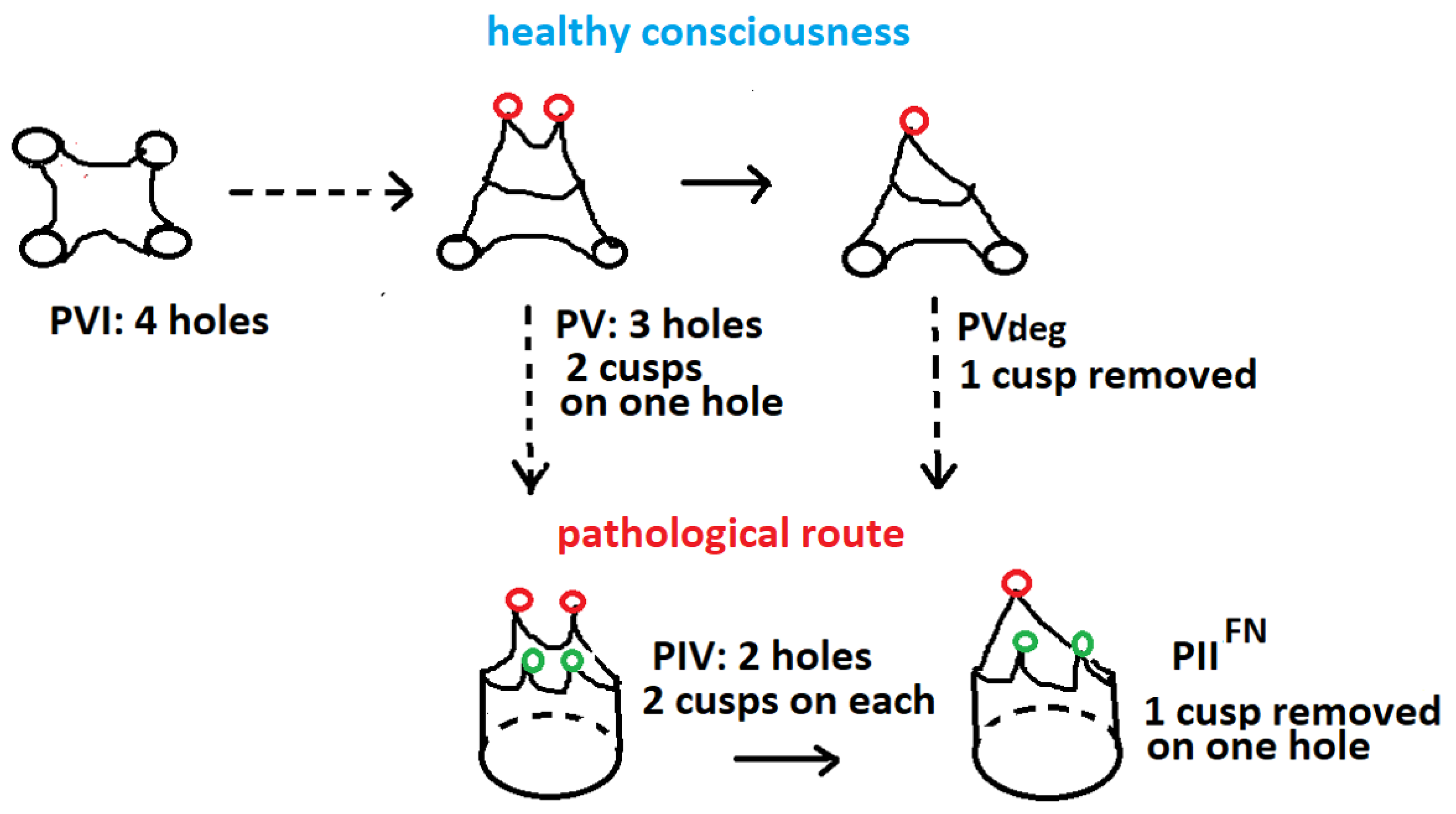
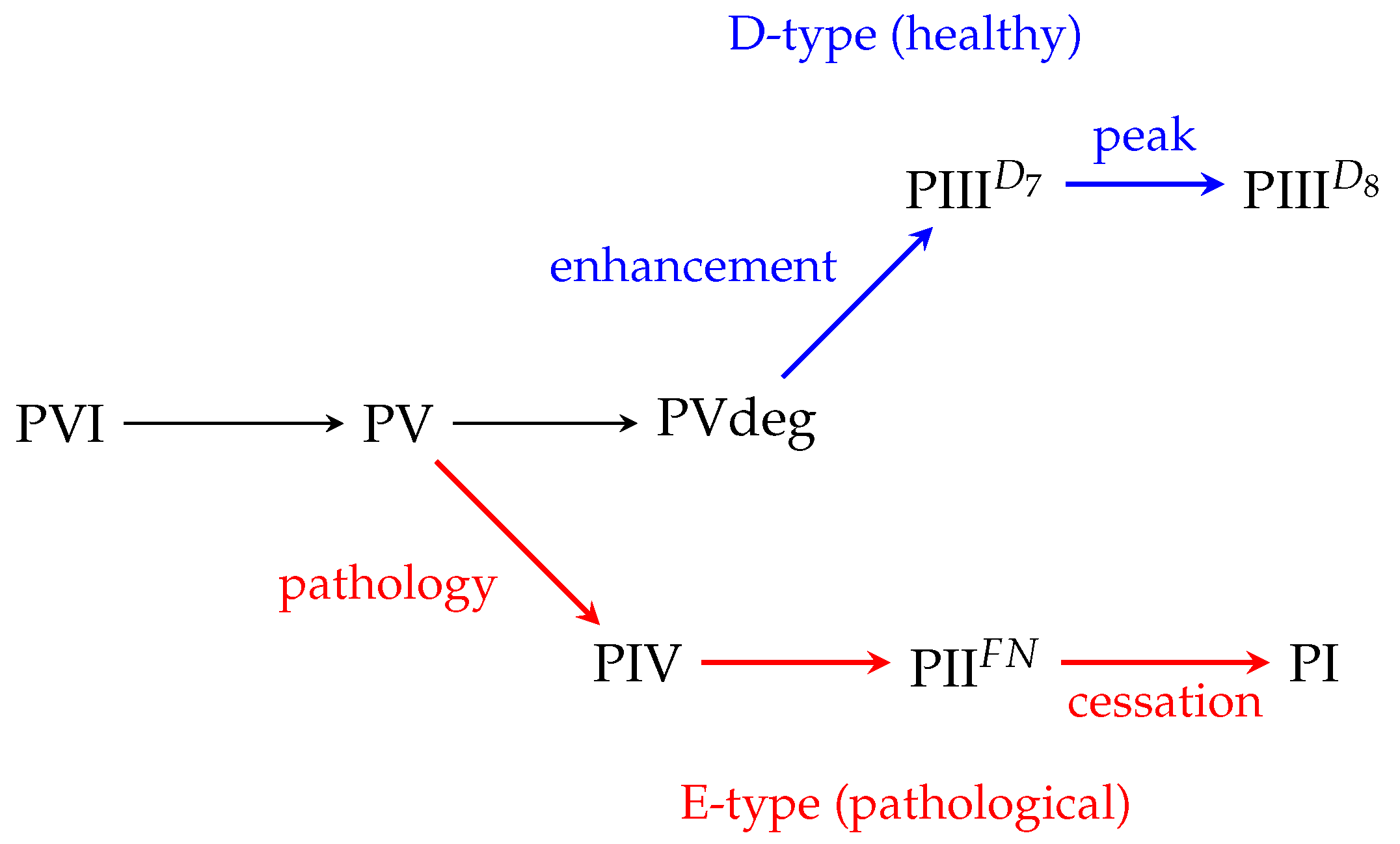
12] reveals that the path from PVI does not lead uniquely to PVdeg. At the PV stage, a branching occurs: in addition to the “normal” path PV → PVdeg (cusp removal), there exists an alternative path PV → PIV (chewing-gum coalescence) that leads to the exceptional E-type fibers. This branching structure suggests a natural framework for understanding pathological and deeply altered states of consciousness.
It is important to emphasize that these higher coalescence regimes are not introduced as established models of altered consciousness, but as a hypothesis-generating geometric framework suggesting how distinct dynamical signatures might arise from deeper levels of Painlevé degeneration.
8.6.1. The Full Confluence Diagram
The D-type fibers () correspond to the “normal” consciousness path: PVI () → PV (fishtail ) → PVdeg (). Note that while PV has surface type (fiber ), its symmetry type is . The E-type fibers () represent an alternative, exceptional branch.
8.6.2. PIV and : Pathological Hyperbinding
The transition PV → PIV is a chewing-gum coalescence that increases the number of cusps from 2 to 4, producing the fiber. This represents a qualitatively different path from the healthy PV → PVdeg transition:
Excessive cusps: Four bordered cusps (compared to 1 in healthy PVdeg) suggest over-binding—multiple irregular structures competing rather than resolving into unity.
Hyper-oscillatory dynamics: Four Stokes rays produce complex interference patterns, potentially corresponding to chaotic or hypersynchronous neural activity.
Exceptional symmetry: The , and symmetries are exceptional; they do not fit the “normal” D-type progression, suggesting a qualitatively abnormal state.
Proposed Correspondence
We conjecture that PIV/ corresponds to pathological hyperbinding states:
Epileptic seizures: Characterized by excessive gamma synchronization across brain regions, consistent with hyper-oscillatory dynamics from four Stokes rays.
Psychotic states: Aberrant binding may underlie hallucinations and delusions—the brain “binds” information that should remain separate.
Hyperarousal/panic: Excessive integration producing overwhelming conscious experience.
Certain drug-induced states: Substances that produce hypersynchrony (e.g., some stimulants, high-dose psychedelics) may push the system toward .
The key insight is that PIV represents consciousness that has “overshot” the healthy attractor (PVdeg): instead of collapsing the bipolar PV state into unified experience, the system develops additional irregular structure.
8.6.3. PIIFN and : Deep Altered States
From PIV, the cusp-removal operation yields PIIFN (Flaschka–Newell Painlevé II) with 3 cusps and the fiber. This represents partial resolution of the hyperstimulated PIV state:
Intermediate depth Between pathological hyperactivity (PIV, 4 cusps) and complete cessation (PI, 5 cusps leading to maximal confluence).
Three Stokes rays: Reduced complexity compared to PIV, but still more complex than healthy PVdeg (1 ray).
symmetry Deeper into the exceptional hierarchy.
Proposed Correspondence
We conjecture that PIIFN/ corresponds to deep altered states:
Deep meditation/samadhi: States of profound absorption where normal subject-object duality dissolves but awareness persists.
Anesthetic twilight: The transitional zone between waking and surgical unconsciousness.
Comatose states: Minimal but non-zero neural integration.
Near-death experiences: Reports of profound altered consciousness at the boundary of life.
Dissociative states: Ketamine-induced dissociation may correspond to dynamics.
8.6.4. PI and : Cessation
The endpoint of the E-type branch is PI with the fiber—the largest exceptional Lie algebra. Here all singularities have maximally confluenced:
Maximal confluence: A single irregular singularity of highest Poincaré rank.
Five Stokes rays: Paradoxically, maximal confluence produces maximal Stokes complexity.
as ground state: The largest exceptional structure may represent the “ground state” of the consciousness manifold.
Proposed Correspondence
PI/ may correspond to:
Brain death: Complete cessation of differentiated neural processing.
Deep anesthesia: Full surgical unconsciousness.
The “base” of consciousness: A mathematical ground state from which conscious dynamics emerge.
8.6.5. A Phase Diagram of Consciousness
The full branching structure suggests a phase diagram of consciousness states, see
Table 7:
The D-type branch represents the “normal” quantum-to-classical transition yielding healthy waking consciousness. The E-type branch represents deviations from this healthy path—either through excessive binding (PIV) or progression toward unconsciousness (PIIFN, PI).
8.6.6. The D-Type Continuation: Enhanced and Peak Consciousness
The confluence diagram in Chekhov et al. [
12] reveals that the D-type branch does not terminate at PVdeg. Rather, it continues:
corresponding to the fibers
, see
Table 8. The Katz invariants show increasing irregularity:
Crucially, this continuation remains within the D-type family, it represents healthy refinement of consciousness rather than pathological deviation. We propose that these states correspond to enhanced and peak consciousness.
PIIID7 and : Flow States and Heightened Awareness
The transition PVdeg → PIIID7 increases the irregular structure while preserving D-type character. We conjecture this corresponds to:
Flow states: The psychological state identified by Csikszentmihalyi [
57] characterized by effortless action, heightened focus, and loss of self-consciousness, but
not loss of awareness.
Peak performance: Athletes and musicians “in the zone,” where perception and action achieve unusual integration.
Samatha (concentration) meditation: One-pointed focus producing heightened clarity without dissociation.
Hyperfocus: Intense engagement where binding is enhanced but remains coherent.
The additional irregular structure (Katz invariant increasing from to ) may correspond to tighter gamma synchronization and more refined temporal binding.
PIIID8 and : Peak Consciousness and Non-Dual Awareness
The endpoint of the D-type branch, PIIID8 with fiber , represents maximal healthy integration. We conjecture this corresponds to:
Non-dual awareness: States reported in contemplative traditions where the subject-object distinction dissolves while clarity is preserved or enhanced.
Satori/kensho: The Zen experience of sudden awakening—not a trance or dissociation, but heightened lucidity.
Jhāna states: Deep meditative absorptions described in Buddhist psychology, characterized by profound integration and clarity.
Mystical experiences: The “unitive” experiences described across traditions, where boundaries dissolve but consciousness intensifies.
The key distinction from E-type states is that represents integration rather than dissolution. The subject-object boundary may dissolve, but this is experienced as expansion of awareness, not its cessation.
D-Type vs. E-Type: Integration vs. Dissolution
Figure 5 reveals a fundamental bifurcation in the topology of consciousness:
Both branches involve increasing complexity, but with opposite valences:
| Branch | Direction | Phenomenology | Endpoint |
| D-type | PVdeg → PIIID7 → PIIID8 | Enhanced clarity, integration | Peak consciousness |
| E-type | PV → PIV → PIIFN → PI | Hyperbinding, dissolution | Cessation |
Contemplative Implications
This mathematical structure resonates with distinctions made in contemplative traditions:
Meditation can proceed along either branch:
D-type path: Clarity increases, awareness sharpens, boundaries dissolve into unity (vipassanā, Zen, non-dual traditions).
E-type path: Dissociation, depersonalization, “spiritual emergency”—the meditator loses coherence rather than gaining clarity.
Flow vs. mania: Both involve heightened activation, but:
PIIID7 (flow): Coherent enhancement, optimal performance.
PIV/ (mania): Chaotic hyperbinding, racing thoughts, loss of control.
Non-dual awareness vs. psychosis: Both involve dissolution of ordinary boundaries, but:
PIIID8: Clear non-dual awareness, “enlightenment,” enhanced functionality.
PIV/PIIFN: Pathological boundary dissolution, confusion, impaired functionality.
The “spiritual emergency” distinction: Contemplative traditions have long recognized that intense practice can lead either to liberation (D-type) or crisis (E-type). Our framework provides a topological characterization of this distinction.
8.6.7. Clinical and Experimental Implications
This framework suggests specific predictions:
E-Type (Pathological) Branch
Epileptic seizures should show signatures of dynamics: hypersynchronous gamma with 4-fold interference structure, distinct from healthy gamma.
Anesthetic depth may be trackable via the E-type hierarchy: light sedation (), twilight (), full unconsciousness ().
Psychotic episodes should show signatures: excessive binding producing hallucinations and delusions.
Recovery from coma should show regression along the E-type branch: , followed by transition to the D-type branch.
D-Type (Enhanced) Branch
Flow states should show PIIID7 signatures: enhanced gamma coherence compared to normal waking, but with D-type (not E-type) spectral structure.
Advanced meditators in deep practice should show progression along the D-type branch, with experienced practitioners accessing or dynamics.
Peak experiences (Maslow) should correlate with transient signatures.
Long-term contemplative practice should produce stable access to enhanced D-type states, distinguishable from pathological E-type activation.
Differential Diagnosis
Psychedelic states may involve transitions between D-type and E-type branches, explaining their mixture of enhanced perception (D-type) and ego dissolution that can be either integrative () or dissociative ().
Mania vs. flow: Both show heightened activation, but mania should show E-type () signatures while flow shows D-type ().
Mystical experience vs. psychosis: Both involve boundary dissolution, but mystical states should show signatures while psychosis shows or .
Meditation-related difficulties: “Spiritual emergencies” may correspond to inadvertent transitions from D-type to E-type dynamics.
The mathematical distinction between D-type and E-type fibers, corresponding to classical vs. exceptional Lie algebras, may thus have direct neurological and clinical correlates, providing a principled classification of both normal, enhanced, and pathological consciousness states.
A recent paper by the author in the same direction is [
58].
9. Conclusions
We have proposed that consciousness has an intrinsic mathematical structure describable by the theory of Painlevé transcendents. Specifically:
Pre-conscious states correspond to the configuration (, surface/symmetry ) of Painlevé VI.
The quantum intermediate “bipolar” state corresponds to the “fishtail” fiber (, surface type ) of Painlevé V with two bordered cusps—this is where gamma oscillations emerge.
Normal waking consciousness corresponds to the fiber (, surface type ) of PVdeg—the classical collapse to unified percept.
Enhanced and peak consciousness states correspond to the D-type continuation: (flow) and (non-dual awareness).
Pathological states correspond to the E-type branch: (hyperbinding), (deep altered states), (cessation).
Gamma oscillations emerge at the fishtail (PV, ) as the signature of active quantum binding, with the subsequent PV → PVdeg transition completing the collapse to classical percept.
The framework makes specific, testable predictions distinguishing healthy from pathological states.
Our analysis demonstrates that this abstract mathematical structure, when parameterized with realistic neural timescales, reproduces key features of empirically observed gamma dynamics: burst duration, frequency range, chirp structure, and phase relationships.
The complete phase diagram, with its bifurcation into D-type (healthy/enhanced) and E-type (pathological) branches, provides a principled topological classification of consciousness states, from pre-conscious processing through normal waking to peak experiences, and from pathological hyperbinding through dissolution to cessation.
If consciousness is indeed fundamentally 4-dimensional with singularity structure governed by integrable systems, this would represent a deep connection between subjective experience and mathematical necessity, suggesting that the topology of consciousness is not arbitrary but constrained by fundamental principles encoded in the classification of Painlevé equations and their associated singular fibers.
Future work should focus on:
Testing predictions with high-density EEG during consciousness tasks, flow states, and meditation.
Developing more detailed anatomical mappings of the four streams.
Experimentally distinguishing D-type from E-type dynamics in clinical populations.
Exploring the quantum-to-classical interface at the PV → PVdeg transition.
Connecting to quantum theories of consciousness (Penrose–Hameroff) via the Stokes phenomenon.
As a final comment, recent developments further strengthen the idea of coalescence from PVI to PV. A complementary line of research of ours indicates that the electromagnetic microstructure of neuronal microtubules is governed by the Gaussian field
and the rectangular lattice
generated by tryptophan dipoles [
59]. This arithmetic geometry selects four privileged phase states
corresponding to the four units of
. These four biophysical phase states correspond suggestively to the four regular singular points of Painlevé VI:
This correspondence allows us to interpret the PVI configuration as a genuine four-channel pre-conscious phase space whose coalescence produces the reduced three-channel PV configuration associated with conscious binding. In this unified view, the phenomenology of consciousness arises from a quantum-prepared, arithmetic microstructure (the
lattice) whose large-scale collective dynamics are governed by topological constraints encoded in Painlevé equations.
The marriage of algebraic geometry, integrable systems theory, and neuroscience may provide a path toward a deeper understanding of consciousness—not merely as neural correlates, but as a mathematical structure realized in physical dynamics. Even a conscious artificial intelligence is not out of reach [
60].