Article

Iterative Integro-Differential Techniques Based on Green’s Function for Two-Point Boundary-Value Problems of Ordinary Differential Equations


Escuela de Ingenierías Industriales, Universidad de Málaga, Doctor Ortiz Ramos, s/n, 29071 Málaga, Spain
Axioms 2026, 15(1), 65; https://doi.org/10.3390/axioms15010065
Submission received: 12 November 2025 / Revised: 10 December 2025 / Accepted: 23 December 2025 / Published: 17 January 2026
(This article belongs to the Section Mathematical Analysis)

Abstract

Several iterative integro-differential formulations for two-point, second- and third-order, nonlinear, boundary-value problems of ordinary differential equations based on Green’s functions and the method of variation of parameters are presented. It is shown that the generalized or dual Lagrange multiplier method (GVIM) previously developed for the iterative solution of nonlinear, boundary-value problems of ordinary differential equations that makes use of modified functionals and two Lagrange multipliers, is nothing but an iterative Green’s function formulation that does not require Lagrange multipliers at all. It is also shown that the two Lagrange multipliers of GVIM are associated with the left and right Green’s functions. The convergence of iterative methods based on both the Green function and the method of variation of parameters is proven for nonlinear functions that depend on the dependent variable and is illustrated by means of two examples. Several new iterative integro-differential formulations based on Green’s functions that use a multiplicative function for convergence acceleration are also presented.

1. Introduction

It is well known that the analysis of two-point, boundary-value problems for ordinary differential equations may be carried out in either differential or integral form, e.g., [1]. The latter may be based on, for example, the method of variation of parameters, Green’s function, etc., and results in integral equations of the Fredholm type.
Perhaps the earliest iterative method for solving two-point, boundary-value problems for ordinary differential equations was developed by Picard [2], who considered
u ( x ) + f ( x , u ( x ) , u ( x ) ) = 0 , a < x < b ,
subject to Dirichlet boundary conditions at both ends, i.e., u ( a ) = α and u ( b ) = β , and showed the uniform convergence of the following iterative procedure:
( u n + 1 ) ( x ) + f ( x , u n ( x ) , ( u n ) ( x ) ) = 0 ,
for a Lipschitz-continuous f (see also [3,4]), where the primes denote differentiation with respect to x.
Other iterative methods used to solve the above boundary-value problem include the use of the well-known Newton iterative technique, quasilinearization [5], finite differences [6,7], finite elements, collocation [8], shooting [9], etc.
Recently, in order to obtain the solution of two-point, boundary-value problems for nonlinear, second-order, ordinary differential equations, Khuri and Sayfy [10] presented a generalization of the variational iteration method [11,12] based on the introduction of a correction functional and two Lagrange multipliers that takes into account both endpoints, and they applied it to
u K u + f ( x , u , u , u ) = 0 , a < x < b ,
with K = k 2 > 0 , subject to
u ( a ) = α , u ( b ) = β ,
which corresponds to their Case II, and
u + f ( x , u , u , u , u ) = 0 , a < x < b ,
subject to
u ( a ) = α , u ( a ) = β , u ( b ) = γ ,
which corresponds to their Case III and K = 0 in Equation (1). Khuri and Sayfy [10] also considered Case I, which is governed by Equations (1) and (2) with k = 0 .
More recently, Aanjum and He [13] applied the dual Lagrange multiplier or generalized variational iteration method of Khuri and Sayfy [10] to
u + Ω 2 u + f ( x , u , u , u ) = 0 ,
to determine approximate periodic solutions to nonlinear oscillators using a boundary-value formulation. Equation (5) may be obtained from Equation (1) by setting K = Ω 2 < 0 in the latter.
The objectives of this paper are several-fold. First, we use Green’s function to transform Equation (1) into a Fredholm integral equation and present several iterative methods for the latter’s solution, after which we show that the dual Lagrange multiplier and generalized variational iteration method for two-point, nonlinear, boundary-value problems for ordinary differential equations [10,13] are actually Green’s function formulations that make use of neither correctional functionals nor Lagrange multipliers. Second, we present several iterative procedures for these types of problems that result in Fredholm or Fredholm–Volterra integral equations. A third objective is to develop several iterative procedures for third-order, nonlinear boundary-value problems based on Green’s function and initial-value problem formulations.
The paper has been organized as follows. In Section 2, a formulation based on Green’s functions is presented for the iterative solution of two-point, second-order, nonlinear, boundary-value problems governed by Equations (1) and (2) and K > 0 , K = 0 and K < 0 . Section 2 also includes iterative techniques based on the method of variation of parameters as well as iterative procedures that make use of the left-hand side of Equation (1), a comparison between the different iterative methods presented in this paper, and a study of the convergence of Equation (1) for f ( x , u , u , u ) = R ( x , u ) . In Section 3, some sample results obtained with some of the iterative methods presented in this paper are illustrated for different initial guesses. Iterative methods for the solution of two-point, third-order, nonlinear, boundary-value problems based on Green’s function and the method of variation of parameters are presented in Appendix A. A final section on conclusions summarizes the most important findings of the paper.

2. Two-Point Nonlinear Boundary-Value Problems

In this section, we present several iterative procedures for the solution of Equations (1) and (2) for K = k 2 > 0 , K = 0 , and 0 > K = Ω 2 , which correspond to Cases II and III of Khuri and Anjum [10,13], and Equation (5), respectively, and prove that the generalized or dual Lagrange multiplier variational iteration method [10,13] is nothing else but an iterative formulation based on Green’s function.

2.1. Equation (1) with K = k 2 > 0

Proposition 1.
The solution to Equations (1) and (2) for K = k 2 > 0 is
u ( ξ ) = a b G ( x ; ξ ) f ( x , u , u , u ) d x α G ( a ; ξ ) + β G ( b ; ξ ) , a < ξ < b ,
where
G ( x ; ξ ) k 2 G ( x ; ξ ) = δ ( x ξ ) , a < x < b , , a < ξ < b ,
G ( a ; ξ ) = G ( b ; ξ ) = 0 ,
and δ ( x ξ ) is the Dirac delta function.
Proof. 
Multiplication of Equation (1) by G ( x ; ξ ) and integration of the resulting equation from x = a to x = b yield after integration by parts
a b ( G ( x ; ξ ) k 2 G ( x ; ξ ) ) u ( x ) d x = a b G ( x ; ξ ) f ( x , u , u , u ) d x G ( b ; ξ ) u ( b ) + G ( a ; ξ ) u ( a ) + G ( b ; ξ ) u ( b ) G ( a ; ξ ) u ( a ) ,
which is identical to Equation (6) upon making use of Equations (2), (7) and (8). □
Integration of Equations (7) and (8) yields
G ( x ; ξ ) = 1 k sinh ( k ( b ξ ) ) sinh ( k ( b a ) ) sinh ( k ( x a ) ) + H ( x ξ ) k sinh ( k ( x ξ ) ) ,
where H ( x ξ ) is the Heaviside (unit) step function, i.e., H ( z ) = 1 for z > 0 and H ( z ) = 0 for z < 0 , and, therefore,
G ( x ; ξ ) G L ( x ; ξ ) = 1 k sinh ( k ( b ξ ) ) sinh ( k ( b a ) ) sinh ( k ( x a ) ) , x < ξ ,
G ( x ; ξ ) G R ( x ; ξ ) = 1 k sinh ( k ( ξ a ) ) sinh ( k ( b a ) ) sinh ( k ( b x ) ) , x > ξ ,
G ( a ; ξ ) = sinh ( k ( b ξ ) ) sinh ( k ( b a ) ) , G ( b ; ξ ) = sinh ( k ( ξ a ) ) sinh ( k ( b a ) ) ,
and the subscripts L and R denote left and right, respectively, i.e., a < x < ξ and ξ < x < b , respectively. Note that Equations (11) and (12) show that G ( x ; ξ ) < 0 for a < x < b and G ( x ; ξ ) is nil at the boundary points (cf. Equation (8)).
Remark 1.
Equation (6) suggests the following iterative procedure for the solution of Equations (1) and (2)
u n + 1 ( ξ ) = a b G ( x ; ξ ) f ( x , u n , ( u n ) , ( u n ) ) d x α G ( a ; ξ ) + β G ( b ; ξ ) , a < ξ < b ,
where the subscript n denotes the n–th iteration; (the initial guess) u 0 ( x ) should be selected so that it satisfies the boundary conditions (cf. Equation (2)), and, in the integrand, u n = u n ( x ) .
Remark 2.
Addition of a b ( u k 2 u ) G d x to both sides of Equation (6) and partial integration results in
u ( ξ ) = u ( ξ ) a b ( u k 2 u + f ) G d x ,
which may also be written as
u ( ξ ) = u ( ξ ) + a b ( u k 2 u + f ) G d x ,
or
a b ( u k 2 u + f ) G d x = 0 ,
which corresponds to a weighted residual or weak formulation [14,15] for the solution of Equations (1) and (2), where G G ( x ; ξ ) . Note that use of the mean value theorem [16] in the above equation, i.e., a b ( u k 2 u + f ) G d x = G ( θ ; ξ ) a b ( u k 2 u + f ) d x = 0 implies that a b ( u k 2 u + f ) d x = 0 (cf. Equation (1)), where θ ( a , b ) , because, as stated above, G ( x ; ξ ) < 0 for a < x < b .
The above three equations suggest the following iterative procedure for the solution of Equation (1)
u n + 1 ( ξ ) = u n ( ξ ) + M a b ( ( u n ) k 2 u n + f ( x , u n , ( u n ) , ( u n ) ) ) G d x ,
where M 0 may be a function of ξ, u, u , and u and the iteration counter n.
Equation (16) can also be obtained by first multiplying Equation (1) by G ( x ; ξ ) and integrating from x = a to x = b and then multiplying the resulting equation by M and finally adding u to both sides of the resulting equation.
Proposition 2.
For M = 1 , Equation (16) is identical to the dual Lagrange multiplier or generalized variational iteration method proposed by Khuri and Sayfy [10] for K = k 2 > 0 .
Proof. 
By setting M = 1 in Equation (16) and making use of Equations (11) and (12), Equation (16) may be written as
u n + 1 ( ξ ) = u n ( ξ ) + a x ( ( u n ) k 2 u n + f ( x , u n , ( u n ) , ( u n ) ) ) G L ( x ; ξ ) d x + x b ( ( u n ) k 2 u n + f ( x , u n , ( u n ) , ( u n ) ) ) G R ( x ; ξ ) d x ,
which is identical to Equation (2.18) of Khuri and Sayfy [10] and has been obtained here by simply using a Green’s function formulation without the need for correction functionals and two Lagrange multipliers. □
A comparison between Equation (17) and Equation (2.18) of Khuri and Sayfy [10] clearly indicates that the two Lagrange multipliers used by these authors are associated with the left and right Green functions of Equations (11) and (12), respectively.
Remark 3.
By means of the method of variation of parameters, the solution to Equations (1) and (2) for K = k 2 > 0 may be written as
u ( x ) = C sinh ( k x ) + D cosh ( k x ) + 1 k a x F ( s ) sinh ( k ( s x ) ) d s ,
where
C = 1 sinh ( k ( b a ) ) β cosh ( k a ) α cosh ( k b ) cosh ( k a ) k a b F ( s ) sinh ( k ( s b ) ) d s ,
and
D = 1 sinh ( k ( b a ) ) α sinh ( k b ) β sinh ( k a ) + sinh ( k a ) k a b F ( s ) sinh ( k ( s b ) ) d s ,
and F ( x ) f ( x , u ( x ) , u ( x ) , u ( x ) ) .
Equations (18)–(20) suggest the following iterative procedure for the solution of Equations (1) and (2)
u n + 1 ( x ) = C n sinh ( k x ) + D n cosh ( k x ) + 1 k a x F n ( s ) sinh ( k ( s x ) ) d s ,
where F n ( x ) f ( x , u n ( x ) , ( u n ) ( x ) , ( u n ) ( x ) ) ) .
A comparison between Equations (14) and (21) shows that the former is of the integro-differential Fredholm type whereas the latter is of the mixed integro-differential Fredholm–Volterra type due to the dependence of C n and D n on a b F n ( s ) sinh ( k ( s x ) ) d s (cf. Equations (19) and (20)) and the dependence of u n + 1 ( x ) on a x F n ( s ) sinh ( k ( s x ) ) d s (cf. Equation (21)).

2.2. Equation (1) with K = k 2 = 0

For k = 0 which corresponds to Khuri and Sayfy [10]’s Case I, i.e., their Equation (2.5), Equations (6) and (14) hold with the following Green function
G ( x ; ξ ) = b ξ b a ( x a ) + ( x ξ ) H ( x ξ ) ,
G ( x ; ξ ) G L ( x ; ξ ) = b ξ b a ( x a ) , x < ξ ,
G ( x ; ξ ) G R ( x ; ξ ) = b x b a ( ξ a ) , x < ξ ,
and
G ( a ; ξ ) = b ξ b a , G ( b ; ξ ) = ξ a b a ,
and Equations (22)–(25) indicate that G ( x ; ξ ) < 0 for a < x < b and G ( x ; ξ ) is nil at the boundary points (cf. Equation (8)).
For the sake of completeness, the analogous expressions to Equations (14) and (16) for k = 0 are reported here as
u n + 1 ( ξ ) = a b G ( x ; ξ ) f ( x , u n , ( u n ) , ( u n ) ) d x α G ( a ; ξ ) + β G ( b ; ξ ) , a < ξ < b ,
and
u n + 1 ( ξ ) = u n ( ξ ) + M a b ( ( u n ) + f ( x , u n , ( u n ) , ( u n ) ) ) G d x ,
respectively.
Equation (27) with M = 1 becomes
u n + 1 ( ξ ) = u n ( ξ ) + a x ( ( u n ) + f ( x , u n , ( u n ) , ( u n ) ) ) G L ( x ; ξ ) d x + x b ( ( u n ) + f ( x , u n , ( u n ) , ( u n ) ) ) G R ( x ; ξ ) d x ,
which is identical to Khuri and Sayfy [10]’s Equation (2.12) and has been obtained here without using dual Lagrange multipliers and correction functionals. We have thus proved the following proposition.
Proposition 3.
Equation (28) is identical to the dual Lagrange multiplier or generalized variational iteration method proposed by Khuri and Sayfy [10] for Equations (1) and (2) with k = 0 .
Remark 4.
By means of the method of variation of parameters, the solution to Equations (1) and (2) for K = 0 may be written as
u ( x ) = C + D x + a x F ( s ) ( s x ) d s ,
where
C = 1 b a α b β a + a a b F ( s ) ( s b ) d s ,
and
D = 1 b a β α a b F ( s ) ( s b ) d s .
Equations (29)–(31) suggest the following iterative procedure
u n + 1 ( x ) = C n + D n x + a x F n ( s ) ( s x ) d s .
A comparison between Equations (26) and (32) shows that the former is of the integro-differential Fredholm type whereas the latter is of the mixed integro-differential Fredholm–Volterra type due to the dependence of C n and D n on a b F n ( s ) ( s x ) d s (cf. Equations (30) and (31)) and the dependence of u n + 1 ( x ) on a x F n ( s ) ( s x ) d s (cf. Equation (32)).

2.3. Equation (1) with K = Ω 2 < 0

For K = Ω 2 in Equation (1) (cf. see also Equation (5)), Equation (6) holds with the following Green function
G ( x ; ξ ) = 1 Ω sin ( Ω ( b ξ ) ) sin ( Ω ( b a ) ) sin ( Ω ( x a ) ) + H ( x ξ ) Ω sin ( Ω ( x ξ ) ) ,
G ( x ; ξ ) G L ( x ; ξ ) = 1 Ω sin ( Ω ( b ξ ) ) sin ( Ω ( b a ) ) sin ( Ω ( x a ) ) , x < ξ ,
G ( x ; ξ ) G R ( x ; ξ ) = 1 Ω sin ( Ω ( ξ a ) ) sin ( Ω ( b a ) ) sin ( Ω ( b x ) ) , x > ξ ,
and
G ( a ; ξ ) = sin ( Ω ( b ξ ) ) sin ( Ω ( b a ) ) , G ( b ; ξ ) = sin ( Ω ( ξ a ) ) sin ( Ω ( b a ) ) .
For the sake of completeness, the analogous expressions to Equations (14) and (16) for K = Ω 2 < 0 are
u n + 1 ( ξ ) = a b G ( x ; ξ ) f ( x , u n , ( u n ) , ( u n ) ) d x α G ( a ; ξ ) + β G ( b ; ξ ) , a < ξ < b ,
where the Green function is given by Equation (33), and
u n + 1 ( ξ ) = u n ( ξ ) + M a b ( ( u n ) + Ω 2 u n + f ( x , u n , ( u n ) , ( u n ) ) ) G d x ,
respectively. Equation (38) may also be obtained by replacing k 2 by Ω 2 in Equation (16).
For M = 1 , Equation (38) may be written as
u n + 1 ( ξ ) = u n ( ξ ) + a x ( ( u n ) + Ω 2 u n + f ( x , u n , ( u n ) , ( u n ) ) ) G L ( x ; ξ ) d x + x b ( ( u n ) + Ω 2 u n + f ( x , u n , ( u n ) , ( u n ) ) ) G R ( x ; ξ ) d x ,
which is identical to Anjum and He [13]’s Equation (7) and has been obtained in this paper without using dual Lagrange multipliers and correction functionals. We have thus proved the following proposition.
Proposition 4.
Equation (39) is identical to the dual Lagrange multiplier or generalized variational iteration method proposed by Anjum and He [13] for Equations (1) and (2) with K = Ω 2 < 0 .
Remark 5.
The solution to Equations (1) and (2) with K = Ω 2 may also be obtained by means of variation of parameters as
u ( x ) = C cos ( Ω x ) + D sin ( Ω x ) + 1 Ω a x f ( s , u ( s ) , u ( s ) , u ( s ) ) sin ( Ω ( s x ) ) d s ,
where
C = 1 sin ( Ω ( b a ) ) α sin ( Ω b ) β sin ( Ω a ) + sin ( Ω a ) Ω a b F ( s ) sin ( Ω ( s b ) ) d s ,
and
D = 1 sin ( Ω ( b a ) ) β cos ( Ω a ) α cos ( Ω b ) cos ( Ω a ) Ω a b F ( s ) sin ( Ω ( s b ) ) d s ,
provided that Ω ( b a ) is not equal to m π , where m is a natural number.
Equations (40)–(42) suggest the following iterative procedure for the solutions of Equations (1) and (2) with K = Ω 2 < 0 and Ω ( b a ) m π
u n + 1 ( x ) = C n cos ( Ω x ) + D n sin ( Ω x ) + 1 Ω a x f ( s , u n ( s ) , ( u n ( s ) ) ( s ) , ( u n ( s ) ) ) sin ( Ω ( s x ) ) d s ,
which is of the mixed integro-differential Fredholm–Volterra type due to the dependence of both C and D on a b F ( s ) sin ( Ω ( s b ) ) d s (cf. Equations (41) and (42)), and the dependence of u n + 1 ( x ) on a x F ( s ) sin ( Ω ( s x ) ) d s (cf. Equation (43)). This means that both C n and D n must be evaluated at each iteration.

2.4. Comparisons of Iterative Methods

In this subsection, we summarize, classify and compare the iterative methods presented in the three previous subsections. For the sake of simplicity, the iterative methods based on the Green function given by Equations (14), (26) and (37) which correspond to K > 0 , K = 0 and K < 0 , respectively, will be referred to as Type 1 methods; those given by Equations (21), (32) and (43) which correspond to K > 0 , K = 0 and K < 0 , respectively, and are based on the method of variation of parameters, will be referred to as Type 2 methods; and those given by Equations (16), (27) and (38) correspond to K > 0 , K = 0 and K < 0 , respectively, and M 1 , and are referred to as Type 3 methods. For M = 1 , Type 3 methods are referred to as Type 4 methods and correspond to Equations (17), (28) and (39) for K > 0 , K = 0 and K < 0 , respectively.
Type 1 methods use a Green function formulation that includes the boundary conditions of Equation (2), result in integro-differential equations of the Fredholm type and only require integrals of F ( x ) f ( x , u , u , u ) . By way of contrast, the methods of Type 2 are based on the method of variation of parameters, include the boundary conditions, result in mixed integro-differential equations of the Fredholm–Volterra type, and require the integration of F ( x ) P ( x ) , where P ( x ) = sinh ( k ( s x ) ) , ( s x ) or sin ( Ω ( s x ) ) for K > 0 , K = 0 and K < 0 , respectively.
Methods of Types 3 and 4 are really global techniques of the weighted residual type [14,15] based on the Green function and may be written as
u n + 1 ( ξ ) = u n ( ξ ) + M ( ξ ) a ξ ( ( u n ) ( s ) K u n ( s ) + F n ( s ) ) G ( s ; ξ ) d s ,
which clearly indicates that these methods require the integration of u ( x ) K u ( x ) + F ( x ) , where F ( x ) f ( x , u , u , u ) .
A major issue in methods of Type 3 is the selection of M ( x ) in Equation (44) where it plays a similar role (i.e., ensure and/or accelerate the convergence of iterative methods) to both the relaxation factor used in successive over-relaxation (SOR) methods for the solution of systems of linear equations [17,18,19] and the under-relaxation techniques employed to solve systems of nonlinearly coupled partial differential equations that arise in, for example, computational fluid dynamics, heat and mass transfer [20]. M ( x ) can only be determined by trial and error in nonlinear problems [20].
In order to illustrate the effect of M on the convergence of iterative methods of Type 3, we consider, as an example, the case where f ( x , u , u , u ) = 0 , a = 0 , b = 1 , u ( 0 ) = 0 and u ( 1 ) = 1 , for which the exact solution of Equations (1) and (2) with K = 0 is u ( x ) = x . For this simple problem, Equations (26) and (32) which correspond to iterative techniques of the Type 1 and Type 2, respectively, provide the exact solution and do not require any iterations. On the other hand, for M = 1 , Equation (27) with the initial guess u 0 ( x ) = x 2 results in u 1 ( x ) = x , i.e., the iterative method of Type 3 requires only one iteration for convergence. However, for the same initial guess but for M = 1 , Equation (27) provides the following sequence of iterates u 1 ( x ) = x ( 2 x 1 ) , u 2 ( x ) = x ( 4 x 3 ) x , u 3 ( x ) = x ( 8 x 7 ) , etc., which satisfy the boundary conditions but do not converge to the exact solution.
Remark 6.
As indicated previously, the methods of Types 3 and 4 presented in this paper which correspond to Equations (16), (27) and (38) and Equations (17), (28) and (39), respectively, and make use of the Green function for the linear differential operator of Equation (1), are weak formulations [14,15]. Other weak formulations are also possible for the solution of Equations (1) and (2). For example, if Equation (1) is multiplied by Q ( x ; ξ ) where Q is either a positive or negative function of x for all x ( a , b ) and the result is integrated from a to b, the following iterative procedure results
u n + 1 ( ξ ) = u n ( ξ ) + M ( ξ ) a b ( ( u n ) ( s ) K u n ( s ) + F n ( s ) ) Q ( s ; ξ ) d s ,
whose convergence depends on M ( ξ ) and Q ( x ; ξ ) which may be problem dependent. Equation (45) is an integro-differential equation of the Fredholm type.
Remark 7.
A weak formulation of the integro-differential Volterra type may be obtained by multiplying Equation (1) by a sign-preserving function V ( x ) in ( a , b ) and integration of the resulting expression. This results in
u n + 1 ( ξ ) = u n ( ξ ) + M ( ξ ) a x ( ( u n ) ( s ) K u n ( s ) + F n ( s ) ) V ( s ) d s ,
whose convergence depends on M ( x ) and V ( x ) which may be problem-dependent.

2.5. Convergence of Iterative Methods

In this section, we first prove the convergence of the iterative method of Equation (26) which corresponds to Equations (1) and (2) with K = 0 . To that end, we shall restrict our proof to f ( x , u , u , u ) = R ( x , u ) and assume that R ( x , u ) is Lipschitz continuous for all x ( a , b ) , i.e., | R ( x , w ( x ) ) R ( x , v ( x ) ) | L | w ( x ) v ( x ) | for all x ( a , b ) , where L is a positive constant.
Subtracting Equation (26) from the one for u n ( x ) and taking absolute values of the difference, it is easy to obtain
| u n + 1 ( ξ ) u n ( ξ ) | = | a b ( f ( x , u n + 1 ( x ) ) f ( x , u n ( x ) ) ) G ( x ; ξ ) d x | a b | f ( x , u n + 1 ) f ( x , u n ( x ) ) | | G ( x ; ξ ) | d x L a b | u n + 1 ( x ) u n ( x ) | | G ( x ; ξ ) | d x L ( | b ξ | ) + | a ξ | ) ( b a ) max x | u n + 1 ( x ) u n ( x ) | 2 L ( b a ) 2 max x | u n + 1 ( x ) u n ( x ) | ,
where we have used the largest value of the Green’s function, the continuity of u ( x ) and the mean value theorem [16,21], and max x | S ( x ) | is the largest value of | S ( x ) | for x ( a , b ) .
Equation (47) allows us to state the following proposition.
Proposition 5.
The iterative method of Equation (26) for the solution of Equations (1) and (2) with K = 0 converges if 2 L ( b a ) 2 < 1 .
It may also be easily proved that Proposition 5 also holds for Equation (32) that corresponds to a method of Type 2 for Equations (1) and (2) with K = 0 .
For f ( x , u , u , u ) = R ( x , u ( x ) ) and the same assumptions as above, it is easily shown that Equations (14) and (21) which correspond to Equations (1) and (2) with K = k 2 > 0 converge if 2 k L ( b a ) sinh ( k ( b a ) ) < 1 . Note that, as k 0 , 2 k L ( b a ) sinh ( k ( b a ) ) 2 L ( b a ) 2 < 1 in agreement with Proposition 5.
For K = Ω 2 0 , f ( x , u , u , u ) = R ( x , u ( x ) ) and the same assumptions as above, the convergence of Equations (37) and (43) is ensured if Ω ( b a ) m π , where m is a natural number, and 2 Ω sin ( Ω ( b a ) ) L ( b a ) 2 < 1 .
No convergence proof for the methods of Type 1 and Type 2 has as yet been found when f in Equation (1) depends nonlinearly on u . However, if f depends on x, u and u , Equation (1) may be written as the following two first-order ordinary differential equations u = v and v = f ( x , u , v ) which, in turn, may be written as U = F ( x , U ) where U = ( u , v ) T and F = ( v , f ( x , u , v ) ) T and the superscript T denotes transpose. The Poincaré–Lindelöf iterative procedure [21] for the initial-value problem of this system of equations converges if F is Lipschitz continuous in a neighborhood of the initial point x = a . If this condition is satisfied at all points in ( a , b ) , the Poincaré–Lindelöf iterative procedure may be used to determine a solution for all x ( a , b ) [2] but the solution thus determined may not satisfy the boundary condition at x = b . If this is the case, the value of v ( a ) = u ( a ) has to changed in an iterative manner until the boundary condition at x = b is satisfied. This technique is well known [5,22] and is referred to as the method of shooting in numerical analysis.
Remark 8.
Note that methods of Type 4 require the integration of g ( x , u , u , u ) u K u + f ( x , u , u , u ) and, therefore, they have the same expressions as those of Type 1 if in the latter f ( x , u , u , u ) is replaced by g ( x , u , u , u ) .

3. Sample Results

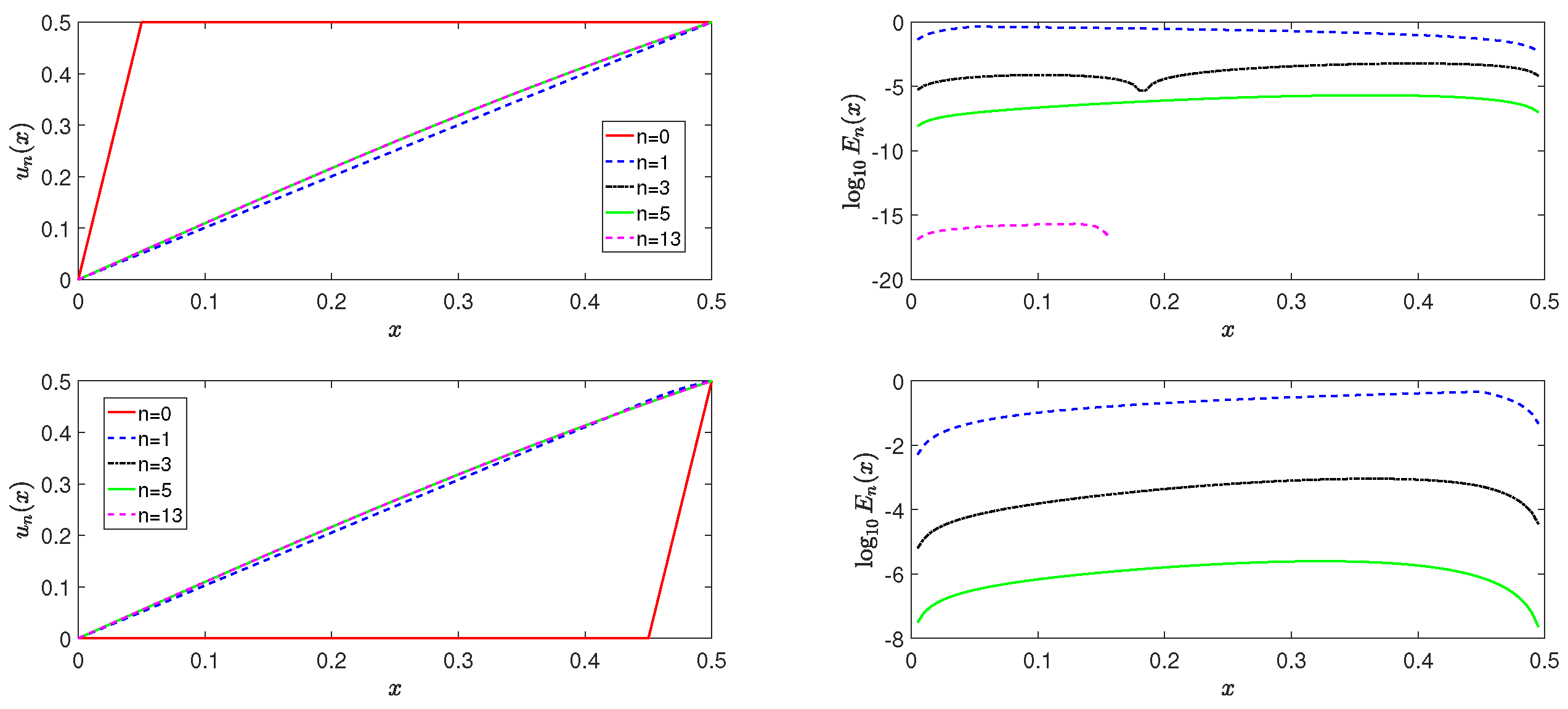
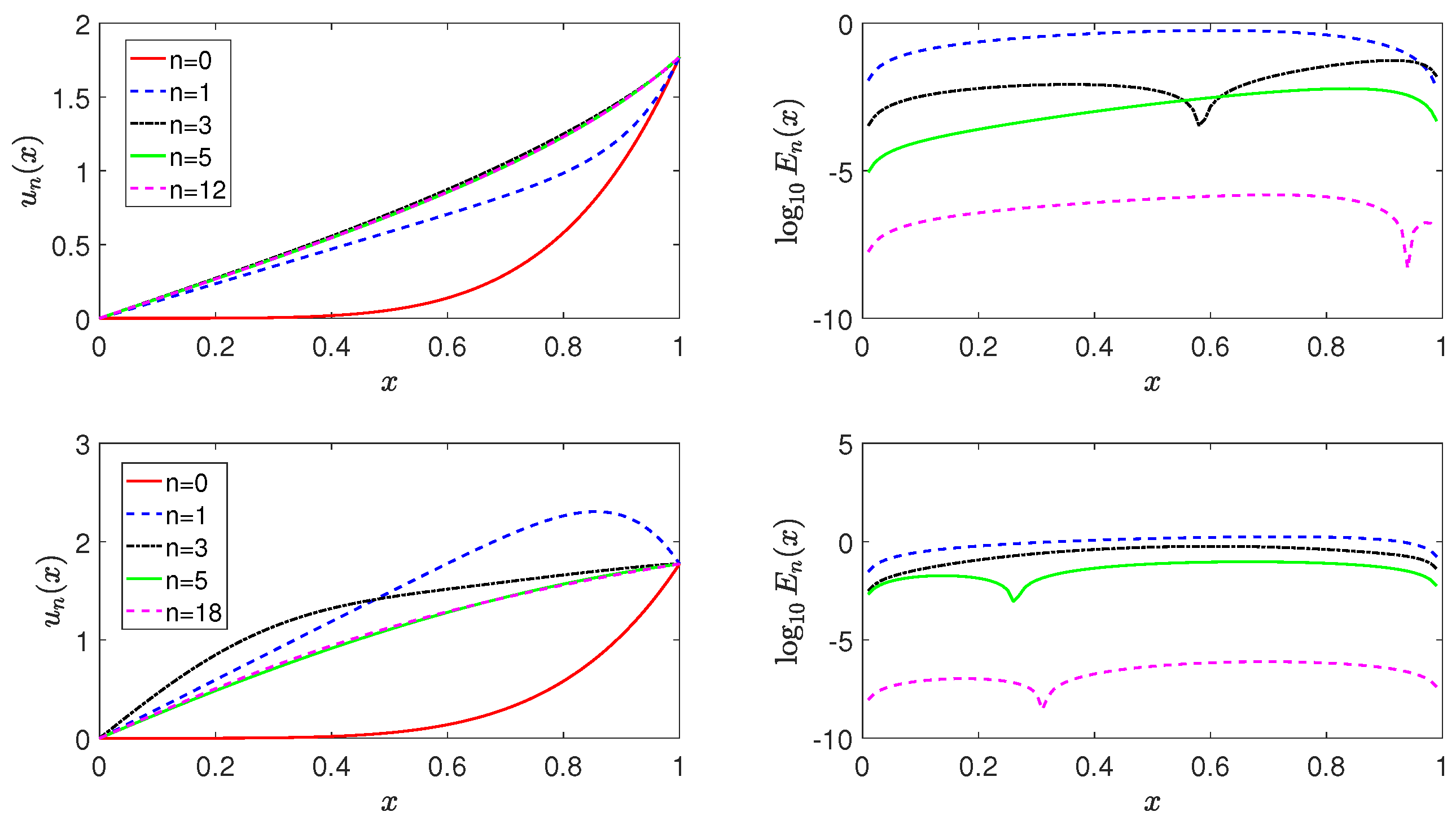
In this section, we present some sample results for two two-point, second-order, nonlinear boundary-value problems of ordinary differential equations that have been obtained with methods of the Types 1, 2 and 4. In the two examples considered here, the errors between successive iterations are determined as E n ( x ) = u n ( x ) u n 1 ( x ) and convergence is achieved when
e = 1 b a a b ( E n ( x ) ) 2 d x T O L ,
where T O L denotes a user’s specified tolerance.

3.1. Example 1

For this example, f ( x , u , u , u ) = p u ( x ) u ( x ) , a = 0 , b = 1 2 , α = 0 , β = 1 2 and p = 2 ln 3 , and the solution of Equations (1) and (2) is
u ( x ) = 3 x 1 3 x + 1 .
Figure 1 shows the solution obtained by employing the method of Type 1 described in Section 2 for the following two initial guesses
u 0 ( x ) = x 0.05 , for 0 x 0.05 , and u 0 ( x ) = 0 for 0.05 x 0.50 ,
u 0 ( x ) = 0 , for 0 x 0.45 , and u 0 ( x ) = x 0.45 0.05 for 0.45 x 0.50 ,
as a function of the iteration counter n for T O L = 10 16 .
Note that the initial guesses of Equations (50) and (51) are not differentiable at x = 0.05 and 0.45, respectively, but lim x 0.05 ( p u u ) = 0 and lim x 0.45 ( p u u ) = 0 , respectively. On the other hand, u does not exist at x = 0.05 and 0.45 for Equations (50) and (51), respectively, but u = 0 everywhere else in the open interval 0 , 1 2 for both equations.
For Equations (50) and (51), the methods of Type 1 and Type 2 required 13 iterations for convergence, whereas the method of Type 4 required 14 iterations, despite the fact that this method makes use of u and ( u 0 ) was not differentiable at x = 0.05 and 0.45, as indicated previously. With M = 1 , the method of Type 4 for Equations (50) and (51) did not converge.
Figure 1 indicates that, for the initial guess given by Equations (50) and (51), the method of Type 1 converges very fast to the exact solution as indicated by the values of E n .
For initial guesses given by u 0 = ( b a ) x b a q with q = 1 , 2 and 5, the method of Type 1 required 12, 12 and 13 iterations, respectively. These guesses are smooth and their slope at the right boundary increases as q is increased. For the same values of q, the method of Type 2 also require the same number of iterations as the method of Type 1, whereas the method of Type 4 required 14, 17, 34 iterations, respectively, to achieve convergence. The increase in the number of iterations for convergence of the method of Type 4 is associated with the fact that this method employs u (cf. Equation (28)) and | u 0 ( x ) | increases as q is increased.

3.2. Example 2

This example corresponds to
u + p u ( u ) 2 = 0 ,
whose exact solution for u ( 0 ) = 0 , u ( 1 ) = π and p = 2 π is
u ( x ) = inverf ( x erf ( 1 ) ) ,
where erf ( x ) = 2 π 0 x e s 2 d s is the error function and inverf is the inverse of the error function [23].
For the same boundary conditions and p = 2 π , the solution to Equation (52) is
0 1 exp ( s 2 ) d s = 0 u ( x ) π exp ( s 2 ) d s = exp ( v 2 ) D ( v ) ,
where v = u ( x ) π and D ( v ) = exp ( v 2 ) 0 v exp ( s 2 ) d s is Dawson’s integral [23].
In Figure 2, the values of u n and E n for p = 2 π (top) and p = 2 π (bottom) obtained with the method of Type 1 for u 0 ( x ) = π x q with q = 5 and T O L = 10 6 . This figure clearly illustrates that, for p = 2 π , the convergence is from below, whereas that for p = 2 π is from above for n 1 . The number of iterations required by the method of Type 1 to obtain convergence for q = 5 was 12 and 18 for p = 2 π and p = 2 π , respectively.
For q = 1 and 2, the method of Type 1 for p = 2 π required 11 and 11 iterations, respectively, whereas it required 15 and 16 iterations, respectively, for p = 2 π .
For q = 1 , 2 and 5, the method of Type 2 required 13, 13 and 15 iterations, respectively, for convergence for p = 2 π , and 18, 20 and 22 iterations, respectively, for p = 2 π , whereas, for the same values of q, the method of Type 4 needed 18, 19 and 23 iterations, respectively, for p = 2 π , and 28, 30 and 33 iterations, respectively, for p = 2 π . The larger number of iterations required for the convergence of the method of Type 2 is due to the fact that this method is based on the variation of parameters technique and requires that C and D be determined at each iteration as shown in Equations (30) and (31) for K = 0 . On the other hand, the larger number of iterations required by the method of Type 4 is due to the fact that this iterative technique makes use of u which may change sign from the initial guess to the first iteration as shown in the bottom of Figure 2.

4. Conclusions

Iterative procedures based on the use of Green’s function and the method of variation of parameters that result in integro-differential equations of the Fredholm and mixed Fredholm–Volterra types have been presented for the solution of nonlinear, two-point, second- and third-order, boundary-value problems of ordinary differential equations.
It has been proved that the generalized or dual Lagrange multiplier variational iteration method which was previously obtained by using modified functionals and two Lagrange multipliers, is nothing else but an iterative procedure based on a Green’s function formulation that does not make use of correction functionals and Lagrange multipliers at all. It has also be shown that these Lagrange multipliers correspond to the Green function on the left and right of the location of the Dirac delta function.
A Green’s function-based formulation that includes a function that may depend on the dependent and independent variables and the iteration counter and affects the convergence rate, has also been presented, and its performance has been illustrated by means of a simple example that has an exact analytical solution.
The effects of the initial guess on the convergence of three iterative methods presented in the paper has been illustrated in one example that has an analytical solution. In another example, it has been shown that the convexity of the iterates may change sign and, therefore, degrade the convergence rate of iterative methods that make use of the linear term of second-order differential operator that appears in the governing nonlinear, ordinary differential equation.
An iterative procedure for two-point, third-order, boundary-value problems based on a Volterra integral equation for initial-value problems has also been presented; this method does not make use of the boundary conditions at the right boundary and, therefore, must employ an iterative procedure to satisfy them in an analogous manner to the well-known shooting method for two-point boundary-value problems.

Funding

This research received no external funding.

Data Availability Statement

The original contributions presented in the study are included in the article. Further inquiries can be directed to the corresponding author.

Acknowledgments

The author is grateful to the reviewers for their critical comments on the manuscript.

Conflicts of Interest

The author declares no conflicts of interest.

Appendix A. Third-Order Boundary-Value Problems

For third-order, nonlinear, two-point, boundary-value problems governed by Equations (3) and (4), procedures analogous to those employed in the main text may be used to prove that the generalized or dual Lagrange multiplier method is nothing else but an iterative formulation based on Green’s function, as shown in this appendix, where several iterative methods are also presented.
Proposition A1
(Green’s function-based methods). The solution to Equation (3) may be written as
u ( ξ ) = a b f ( x , u , u , u , u ) G d x + B T R B T L ,
where
G ( x ; ξ ) = δ ( x ξ ) ,
and the boundary terms are
B T R = G ( b ; ξ ) u ( b ) G ( b ; ξ ) u ( b ) + G ( b ; ξ ) u ( b ) ,
and
B T L = G ( a ; ξ ) u ( a ) G ( a ; ξ ) u ( a ) + G ( a ; ξ ) u ( a ) .
Proof. 
Multiplication of Equation (3) by G ( x ; ξ ) and integration of the resulting equation from x = a to x = b yields after integration by parts Equation (A1). □
Integration of Equation (A2) yields
G ( x ; ξ ) = C + B ( x a ) + 1 2 A ( x a ) 2 + 1 2 ( x ξ ) 2 H ( x ξ ) ,
where the constants A, B and C depend on the boundary conditions for G which, in turn, depend on those for u. For example, for u ( a ) = α , u ( a ) = β and u ( b ) = γ , G ( a ; ξ ) = 0 , G ( a ; ξ ) = 0 and G ( b ; ξ ) = 0 (cf. Equation (4)), Equation (A5) becomes
G ( x ; ξ ) = 1 2 b ξ b a 2 ( x a ) 2 + 1 2 ( x ξ ) 2 H ( x ξ ) ,
and, therefore, 0 G ( x ; ξ ) for a x b . This means that the boundary terms of Equations (A3) and (A4) for the boundary conditions of Equation (4) are
B T R = R u ( b ) + ( 1 Q ) γ ,
and
B T L = Q α ,
respectively, where Q b ξ b a 2 and R = ( b ξ ) ( ξ a ) b a , and, therefore, B T R depends on the unknown u ( b ) whose value will be determine in Remark A4.
Remark A1.
The solution to Equation (A1) may be obtained iteratively as
u n + 1 ( ξ ) = a b f ( x , u n , ( u n ) , ( u n ) , ( u n ) ) G d x + B T R n B T L ,
where B T R depends on the iteration counter, but B T L is independent of n.
Remark A2.
Multiplication of Equation (3) by G and integration of the resulting equation yields
a b ( u + f ( x , u , u , u , u ) ) G d x = 0 ,
which is also satisfied if Equation (A1) is multiplied by M 0 , i.e., M a b ( u + f ( x , u , u , u , u ) ) G d x = 0 . By adding u ( ξ ) to both sides of the last expression, one obtains
u ( ξ ) = u ( ξ ) + M a b ( u + f ( x , u , u , u , u ) ) G d x ,
which may be solved iteratively as
u n + 1 ( ξ ) = u n ( ξ ) + M a b ( ( u n ) + f ( x , u n , ( u n ) , ( u n ) , ( u n ) ) ) G d x .
Remark A3.
Equation (A9) with M = 1 may also be obtained as follows. Since
T B R T B L = a b u G d x + a b u G d x ,
substitution of Equation (A11) into Equation (A7) yields Equation (A9) with M = 1 .
Proposition A2.
Equation (A10) with M = 1 is identical to Equation (2.25) of Khuri and Sayfy [10].
Proof. 
In Equation (A10) with M = 1 , split the integral from x = a to b into the sum of the integrals from a to x and from x to b and use the left and right Green’s functions from Equation (A6) in those integrals, respectively, and correct some errors in the limits of the integrals that appear in Equation (2.25) of Khuri and Sayfy [10]. □
Remark A4
(Variation of parameters-based methods). Integration of Equation (3) yields
u ( x ) = C + B ( x a ) + 1 2 A ( x a ) 2 1 2 a x F ( s ) ( x s ) 2 d s , F ( x ) = f ( x , u , u , u , u ) ,
where A, B and C are constants that depend on the boundary conditions for u.
Equation (A12) is a nonlinear Fredholm–Volterra integro-differential equation because, for the boundary conditions of Equation (4),
C = α ,
B = β ,
A = 2 ( b a ) 2 γ α β ( b a ) + 1 2 a b F ( s ) ( b s ) 2 d s ,
and A depends on a b F ( s ) ( b s ) 2 d s (cf. Equation (A15)), while u ( x ) depends on a x F ( s ) ( b s ) 2 d s (cf. Equation (A12)).
From Equation (A12), one can easily obtain
u ( b ) = B + A ( b a ) a b F ( s ) ( b s ) d s ,
with the values of A and B given by Equations (A15) and (A14), respectively. This value of u ( b ) may be used to determine the boundary term at the right boundary, i.e., B T R , as indicated in Equation (A3) and just above Remark A1.
Equation (A12) may be solved iteratively as
u n + 1 ( x ) = C n + B n ( x a ) + 1 2 A n ( x a ) 2 1 2 a x F n ( s ) ( x s ) 2 d s ,
where
F n ( x ) = f ( x , u n ( x ) , ( u n ) ( x ) , ( u n ) ( x ) , ( u n ) ( x ) ) ,
where, in the last equation, u n = u n ( x )
Remark A5
(initial value-based methods). From the following equality
a x ( x s ) 2 u ( s ) d s = 2 ( u ( x ) u ( a ) ) u ( a ) ( x a ) 1 2 u ( a ) ( x a ) 2 ,
one may obtain u ( x ) which can be substituted in Equation (A12). This substitution yields, upon using the boundary conditions at x = a
a x ( x s ) 2 ( u ( s ) + F ( s ) ) d s = 0 .
Note that, since ( x s ) 2 0 , the use of the mean value theorem [16] in Equation (A20) yields Equation (3) which may be solved by means of the following iterative procedure
u n + 1 ( x ) = u n ( x ) + M a x ( ( u n ) + f ( s , u n , ( u n ) , ( u n ) , ( u n ) ) ( x s ) 2 d s ,
where, in the integrand, u n = u n ( s ) .
Remark A6.
A comparison between the iterative procedures of Equations (A7), (A10) and (A17) indicates the following: (1) in Equation (A7), u 0 ( x ) should be selected so that the boundary conditions are satisfied, the boundary terms depend on u n ( x ) and ( u n ) ( b ) , the integro-differential equation to be solved is of the Fredholm type and only uses f ( x , u , u , u , u ) and Green’s function; (2) in Equation (A10), u 0 ( x ) should be selected so that the boundary conditions are satisfied, no boundary conditions appear in that equation, the integro-differential equation to be solved is of the Fredholm type and uses f ( x , u , u , u , u ) and the linear term u ( x ) ; and, (3) Equation (A17) is of the integro-differential Fredholm–Volterra type and uses only f ( x , u , u , u , u ) , the coefficients that multiply the monomials x k with k 2 in that equation depend on n and may, therefore, change from iteration to iteration, and u 0 ( x ) should be selected so that the boundary conditions are satisfied. In addition, Equations (A7), (A10) and (A17) are iterative formulations for solving Equations (3) and (4) as a two-point boundary-value problem. This is in marked contrast with Equation (A21) which corresponds to a Volterra integral equation, and treats Equations (3) and (4) as an initial-value problem. As a consequence, the value of u n + 1 ( b ) determined from Equation (A21) may not coincide with u ( b ) = γ (cf. Equation (4)), and, therefore, iterations are required to satisfy this condition within a user’s specified tolerance. This procedure is well-known in numerical analysis where it is referred to as shooting method [9,22,24].

References

  1. Stakgold, I.; Holst, M. Green’s Functions and Boundary Value Problems, 2nd ed.; John Wiley & Sons: New York, NY, USA, 2011. [Google Scholar]
  2. Picard, E. Sur l’application des méthodes d’approximations successives à l’etude de certaines equations differentielles ordinaires. J. Math. Pures Appl. 4e Série 1893, 9, 217–271. [Google Scholar]
  3. Shampine, L.F. Boundary value problems for ordinary differential equations. SIAM J. Numer. Anal. 1968, 5, 219–242. [Google Scholar] [CrossRef]
  4. Coles, W.J.; Sherman, T.L. Convergence of successive spproximations for nonlinear two–point boundary value problems. SIAM J. Appl. Math. 1967, 15, 426–433. [Google Scholar] [CrossRef]
  5. Bellman, R.E.; Kalaba, R.E. Quasilinearization and Non–Linear Boundary Value Problems; American Elsevier Publishing Company Inc.: New York, NY, USA, 1965. [Google Scholar]
  6. Keller, H.B. Numerical Methods for Two–Point Boundary–Value Problems; Dover Publications, Inc.: New York, NY, USA, 2003. [Google Scholar]
  7. Ascher, U.; Mattheij, R.M.M.; Russell, R.D. Numerical Solution of Boundary Value Problems for Ordinary Differential Equations; Prentice-Hall: Englewood Cliffs, NJ, USA, 1988. [Google Scholar]
  8. Russell, R.D.; Shampine, L.F. A collocation method for boundary value problems. Numer. Math. 1972, 19, 1–28. [Google Scholar] [CrossRef]
  9. Press, W.H.; Teukolsky, S.A.; Vetterling, W.T.; Flannery, B.P. Numerical Recipes: The Art of Scientific Computing, 3rd ed.; Cambridge University Press: New York, NY, USA, 2017. [Google Scholar]
  10. Khuri, S.A.; Sayfy, A. Generalizing the variational iteration method for BVPs: Proper setting of the correction functional. Appl. Math. Lett. 2017, 68, 68–75. [Google Scholar] [CrossRef]
  11. He, J.–H. Variational iteration method–a kind of non–linear analytical technique: Some examples. Int. J. Non–Linear Mech. 1999, 34, 699–708. [Google Scholar] [CrossRef]
  12. Ramos, J.I. On the variational iteration method and other iterative techniques for nonlinear differential equations. Appl. Math. Comput. 2008, 199, 39–69. [Google Scholar] [CrossRef]
  13. Anjum, N.; He, J.-H. A dual Lagrange multiplier approach for the dynamics of the mechanical systems. J. Appl. Comput. Mech. 2024, 10, 643–651. [Google Scholar] [CrossRef]
  14. Kantorovich, L.V.; Krylov, V.I. Approximate Methods of Higher Analysis; P. Noordhoff, Ltd.: Groningen, The Netherlands, 1958. [Google Scholar]
  15. Finlayson, B.A. The Method of Weighted Residuals and Variational Principles: With Applications in Fluid Mechanics, Heat and Mass Transfer; Academic Press: New York, NY, USA, 1972. [Google Scholar]
  16. Rudin, W. Principles of Mathematical Analysis; McGraw–Hill Publishing Company: New York, NY, USA, 1976. [Google Scholar]
  17. Southwell, R.V. Relaxation Methods in Engineering Science; Oxford University Press: Oxford, UK, 1940. [Google Scholar]
  18. Young, D.W. Iterative Solution of Large Linear Systems; Academic Press: New York, NY, USA, 1971. [Google Scholar]
  19. Ortega, J.M.; Rheinboldt, W.C. Iterative Solution of Nonlinear Equations in Several Variables; Classics in Applied Mathematics; Society for Industrial and Applied Mathematics (SIAM): Philadelphia, PA, USA, 2000; Volume 30. [Google Scholar]
  20. Ferziger, J.H.; Perić, M.; Street, R.L. Computational Methods for Fluid Dynamics, 4th ed.; Springer: New York, NY, USA, 2001. [Google Scholar]
  21. Coddington, E.A.; Levinson, N. Theory of Ordinary Differential Equations; McGraw–Hill Book Company: New York, NY, USA, 1955. [Google Scholar]
  22. Atkinson, K.A. An Introduction to Numerical Analysis, 2nd ed.; John Wiley & Sons, Inc.: New York, NY, USA, 1989. [Google Scholar]
  23. Abramowitz, M.; Stegun, I.A. Handbook of Mathematical Functions with Formulas, Graphs, and Mathematical Tables; Applied Mathematics Serie; Dover Publications, Inc.: New York, NY, USA, 1972; Volume 55. [Google Scholar]
  24. Mathews, J.H.; Fink, K.K. Numerical Methods Using MATLAB, 4th ed.; Pearson: Upper Saddle River, NJ, USA, 2004. [Google Scholar]
Figure 1. (Color online) u n ( x ) and decimal logarithm of E n ( x ) for Example 1 with the initial guess of Equations (50) (top) and (51) (bottom), respectively.
Axioms 15 00065 g001
Figure 2. (Color online) u n ( x ) and decimal logarithm of E n ( x ) for Example 2 for p = 2 π (top) and p = 2 π (bottom), respectively, and u 0 ( x ) = x 5 .
Axioms 15 00065 g002
Disclaimer/Publisher’s Note: The statements, opinions and data contained in all publications are solely those of the individual author(s) and contributor(s) and not of MDPI and/or the editor(s). MDPI and/or the editor(s) disclaim responsibility for any injury to people or property resulting from any ideas, methods, instructions or products referred to in the content.